EP0859797B1 - Photoinitiator - Google Patents
Photoinitiator Download PDFInfo
- Publication number
- EP0859797B1 EP0859797B1 EP96935179A EP96935179A EP0859797B1 EP 0859797 B1 EP0859797 B1 EP 0859797B1 EP 96935179 A EP96935179 A EP 96935179A EP 96935179 A EP96935179 A EP 96935179A EP 0859797 B1 EP0859797 B1 EP 0859797B1
- Authority
- EP
- European Patent Office
- Prior art keywords
- photoinitiator
- groups
- functional
- group
- amine
- Prior art date
- Legal status (The legal status is an assumption and is not a legal conclusion. Google has not performed a legal analysis and makes no representation as to the accuracy of the status listed.)
- Expired - Lifetime
Links
- 239000011162 core material Substances 0.000 claims abstract description 23
- 239000007795 chemical reaction product Substances 0.000 claims abstract description 3
- 239000000203 mixture Substances 0.000 claims description 24
- 150000001412 amines Chemical class 0.000 claims description 16
- NIXOWILDQLNWCW-UHFFFAOYSA-M Acrylate Chemical compound [O-]C(=O)C=C NIXOWILDQLNWCW-UHFFFAOYSA-M 0.000 claims description 11
- 125000002887 hydroxy group Chemical group [H]O* 0.000 claims description 7
- 239000002253 acid Substances 0.000 claims description 6
- -1 substituted-phenyl Chemical group 0.000 claims description 5
- 150000001875 compounds Chemical class 0.000 claims description 4
- 239000003431 cross linking reagent Substances 0.000 claims description 4
- 125000003277 amino group Chemical group 0.000 claims description 3
- 230000005855 radiation Effects 0.000 claims description 3
- 125000003118 aryl group Chemical group 0.000 claims description 2
- 150000002148 esters Chemical class 0.000 claims description 2
- 125000003700 epoxy group Chemical group 0.000 claims 3
- 125000005843 halogen group Chemical group 0.000 claims 3
- 125000004018 acid anhydride group Chemical group 0.000 claims 1
- 125000001931 aliphatic group Chemical group 0.000 claims 1
- 125000000746 allylic group Chemical group 0.000 claims 1
- 150000001408 amides Chemical class 0.000 claims 1
- 125000003710 aryl alkyl group Chemical group 0.000 claims 1
- 125000001743 benzylic group Chemical group 0.000 claims 1
- 125000002915 carbonyl group Chemical group [*:2]C([*:1])=O 0.000 claims 1
- 150000001732 carboxylic acid derivatives Chemical class 0.000 claims 1
- 238000006356 dehydrogenation reaction Methods 0.000 claims 1
- 150000002170 ethers Chemical class 0.000 claims 1
- 125000001072 heteroaryl group Chemical group 0.000 claims 1
- 125000004435 hydrogen atom Chemical group [H]* 0.000 claims 1
- 150000002576 ketones Chemical class 0.000 claims 1
- 239000007788 liquid Substances 0.000 claims 1
- CERQOIWHTDAKMF-UHFFFAOYSA-M methacrylate group Chemical group C(C(=C)C)(=O)[O-] CERQOIWHTDAKMF-UHFFFAOYSA-M 0.000 claims 1
- 239000000178 monomer Substances 0.000 claims 1
- 125000001997 phenyl group Chemical group [H]C1=C([H])C([H])=C(*)C([H])=C1[H] 0.000 claims 1
- 125000006850 spacer group Chemical group 0.000 claims 1
- 125000001424 substituent group Chemical group 0.000 claims 1
- 125000003396 thiol group Chemical group [H]S* 0.000 claims 1
- 150000003573 thiols Chemical class 0.000 claims 1
- 150000003673 urethanes Chemical class 0.000 claims 1
- 239000000463 material Substances 0.000 description 21
- 239000012632 extractable Substances 0.000 description 12
- 238000006243 chemical reaction Methods 0.000 description 11
- 239000000047 product Substances 0.000 description 11
- YMWUJEATGCHHMB-UHFFFAOYSA-N Dichloromethane Chemical compound ClCCl YMWUJEATGCHHMB-UHFFFAOYSA-N 0.000 description 9
- 239000002904 solvent Substances 0.000 description 8
- PFKFTWBEEFSNDU-UHFFFAOYSA-N carbonyldiimidazole Chemical compound C1=CN=CN1C(=O)N1C=CN=C1 PFKFTWBEEFSNDU-UHFFFAOYSA-N 0.000 description 6
- 238000001704 evaporation Methods 0.000 description 6
- 235000019589 hardness Nutrition 0.000 description 6
- 238000007639 printing Methods 0.000 description 6
- 230000008020 evaporation Effects 0.000 description 5
- IJGRMHOSHXDMSA-UHFFFAOYSA-N Atomic nitrogen Chemical compound N#N IJGRMHOSHXDMSA-UHFFFAOYSA-N 0.000 description 4
- RTZKZFJDLAIYFH-UHFFFAOYSA-N Diethyl ether Chemical compound CCOCC RTZKZFJDLAIYFH-UHFFFAOYSA-N 0.000 description 4
- DAKWPKUUDNSNPN-UHFFFAOYSA-N Trimethylolpropane triacrylate Chemical compound C=CC(=O)OCC(CC)(COC(=O)C=C)COC(=O)C=C DAKWPKUUDNSNPN-UHFFFAOYSA-N 0.000 description 4
- 239000011248 coating agent Substances 0.000 description 4
- 238000000576 coating method Methods 0.000 description 4
- 230000000694 effects Effects 0.000 description 4
- 239000011521 glass Substances 0.000 description 4
- 239000003999 initiator Substances 0.000 description 4
- PBOSTUDLECTMNL-UHFFFAOYSA-N lauryl acrylate Chemical compound CCCCCCCCCCCCOC(=O)C=C PBOSTUDLECTMNL-UHFFFAOYSA-N 0.000 description 4
- 238000000034 method Methods 0.000 description 4
- 238000013508 migration Methods 0.000 description 4
- 230000005012 migration Effects 0.000 description 4
- XNLHQURWXIWCDF-UHFFFAOYSA-N 2-[4-[2,4-dihydroxy-2,4-dimethyl-3-oxo-5-[4-(2-prop-2-enoyloxyethoxy)phenyl]pentyl]phenoxy]ethyl prop-2-enoate Chemical compound C=1C=C(OCCOC(=O)C=C)C=CC=1CC(C)(O)C(=O)C(O)(C)CC1=CC=C(OCCOC(=O)C=C)C=C1 XNLHQURWXIWCDF-UHFFFAOYSA-N 0.000 description 3
- WEVYAHXRMPXWCK-UHFFFAOYSA-N Acetonitrile Chemical compound CC#N WEVYAHXRMPXWCK-UHFFFAOYSA-N 0.000 description 3
- XEKOWRVHYACXOJ-UHFFFAOYSA-N Ethyl acetate Chemical compound CCOC(C)=O XEKOWRVHYACXOJ-UHFFFAOYSA-N 0.000 description 3
- HEMHJVSKTPXQMS-UHFFFAOYSA-M Sodium hydroxide Chemical compound [OH-].[Na+] HEMHJVSKTPXQMS-UHFFFAOYSA-M 0.000 description 3
- ZMANZCXQSJIPKH-UHFFFAOYSA-N Triethylamine Chemical compound CCN(CC)CC ZMANZCXQSJIPKH-UHFFFAOYSA-N 0.000 description 3
- 239000008199 coating composition Substances 0.000 description 3
- 238000002474 experimental method Methods 0.000 description 3
- 238000000605 extraction Methods 0.000 description 3
- 125000000524 functional group Chemical group 0.000 description 3
- 239000000976 ink Substances 0.000 description 3
- 239000012948 isocyanate Substances 0.000 description 3
- 150000002513 isocyanates Chemical class 0.000 description 3
- VLKZOEOYAKHREP-UHFFFAOYSA-N n-Hexane Chemical compound CCCCCC VLKZOEOYAKHREP-UHFFFAOYSA-N 0.000 description 3
- 239000004033 plastic Substances 0.000 description 3
- 229920003023 plastic Polymers 0.000 description 3
- 239000000758 substrate Substances 0.000 description 3
- OFILCBAVHOHVRW-UHFFFAOYSA-N 2-[4-[2,6-dihydroxy-4-oxo-7-[4-(2-prop-2-enoyloxyethoxy)phenyl]heptyl]phenoxy]ethyl prop-2-enoate Chemical compound C=1C=C(OCCOC(=O)C=C)C=CC=1CC(O)CC(=O)CC(O)CC1=CC=C(OCCOC(=O)C=C)C=C1 OFILCBAVHOHVRW-UHFFFAOYSA-N 0.000 description 2
- WLVPRARCUSRDNI-UHFFFAOYSA-N 2-hydroxy-1-phenyl-1-propanone Chemical compound CC(O)C(=O)C1=CC=CC=C1 WLVPRARCUSRDNI-UHFFFAOYSA-N 0.000 description 2
- DDLXBFDBKPCGQK-UHFFFAOYSA-N 3-hydroxy-2-methoxy-1,2-diphenylpropan-1-one Chemical compound C=1C=CC=CC=1C(CO)(OC)C(=O)C1=CC=CC=C1 DDLXBFDBKPCGQK-UHFFFAOYSA-N 0.000 description 2
- TXFPEBPIARQUIG-UHFFFAOYSA-N 4'-hydroxyacetophenone Chemical compound CC(=O)C1=CC=C(O)C=C1 TXFPEBPIARQUIG-UHFFFAOYSA-N 0.000 description 2
- NPFYZDNDJHZQKY-UHFFFAOYSA-N 4-Hydroxybenzophenone Chemical compound C1=CC(O)=CC=C1C(=O)C1=CC=CC=C1 NPFYZDNDJHZQKY-UHFFFAOYSA-N 0.000 description 2
- IFQUPKAISSPFTE-UHFFFAOYSA-N 4-benzoylbenzoic acid Chemical compound C1=CC(C(=O)O)=CC=C1C(=O)C1=CC=CC=C1 IFQUPKAISSPFTE-UHFFFAOYSA-N 0.000 description 2
- 0 CC(C)(*)*c(cc1)ccc1C(*)=O Chemical compound CC(C)(*)*c(cc1)ccc1C(*)=O 0.000 description 2
- VEXZGXHMUGYJMC-UHFFFAOYSA-N Hydrochloric acid Chemical compound Cl VEXZGXHMUGYJMC-UHFFFAOYSA-N 0.000 description 2
- 238000006845 Michael addition reaction Methods 0.000 description 2
- JPYHHZQJCSQRJY-UHFFFAOYSA-N Phloroglucinol Natural products CCC=CCC=CCC=CCC=CCCCCC(=O)C1=C(O)C=C(O)C=C1O JPYHHZQJCSQRJY-UHFFFAOYSA-N 0.000 description 2
- 238000013459 approach Methods 0.000 description 2
- ISAOCJYIOMOJEB-UHFFFAOYSA-N benzoin Chemical compound C=1C=CC=CC=1C(O)C(=O)C1=CC=CC=C1 ISAOCJYIOMOJEB-UHFFFAOYSA-N 0.000 description 2
- 238000004440 column chromatography Methods 0.000 description 2
- 230000000977 initiatory effect Effects 0.000 description 2
- 230000014759 maintenance of location Effects 0.000 description 2
- 239000002184 metal Substances 0.000 description 2
- 229910052751 metal Inorganic materials 0.000 description 2
- 229910052757 nitrogen Inorganic materials 0.000 description 2
- BDJRBEYXGGNYIS-UHFFFAOYSA-N nonanedioic acid Chemical compound OC(=O)CCCCCCCC(O)=O BDJRBEYXGGNYIS-UHFFFAOYSA-N 0.000 description 2
- 239000012044 organic layer Substances 0.000 description 2
- QCDYQQDYXPDABM-UHFFFAOYSA-N phloroglucinol Chemical compound OC1=CC(O)=CC(O)=C1 QCDYQQDYXPDABM-UHFFFAOYSA-N 0.000 description 2
- 229960001553 phloroglucinol Drugs 0.000 description 2
- 238000000746 purification Methods 0.000 description 2
- KIDHWZJUCRJVML-UHFFFAOYSA-N putrescine Chemical compound NCCCCN KIDHWZJUCRJVML-UHFFFAOYSA-N 0.000 description 2
- 239000000376 reactant Substances 0.000 description 2
- 239000011541 reaction mixture Substances 0.000 description 2
- 238000005406 washing Methods 0.000 description 2
- XLYOFNOQVPJJNP-UHFFFAOYSA-N water Substances O XLYOFNOQVPJJNP-UHFFFAOYSA-N 0.000 description 2
- DEQUKPCANKRTPZ-UHFFFAOYSA-N (2,3-dihydroxyphenyl)-phenylmethanone Chemical compound OC1=CC=CC(C(=O)C=2C=CC=CC=2)=C1O DEQUKPCANKRTPZ-UHFFFAOYSA-N 0.000 description 1
- SHULEACXTONYPS-UHFFFAOYSA-N (3-hydroxyphenyl)-phenylmethanone Chemical compound OC1=CC=CC(C(=O)C=2C=CC=CC=2)=C1 SHULEACXTONYPS-UHFFFAOYSA-N 0.000 description 1
- BMVXCPBXGZKUPN-UHFFFAOYSA-N 1-hexanamine Chemical compound CCCCCCN BMVXCPBXGZKUPN-UHFFFAOYSA-N 0.000 description 1
- AOGNACZDZNOTSN-UHFFFAOYSA-N 2,3-dihydroxy-1,2-diphenylpropan-1-one Chemical compound C=1C=CC=CC=1C(O)(CO)C(=O)C1=CC=CC=C1 AOGNACZDZNOTSN-UHFFFAOYSA-N 0.000 description 1
- LZHUBCULTHIFNO-UHFFFAOYSA-N 2,4-dihydroxy-1,5-bis[4-(2-hydroxyethoxy)phenyl]-2,4-dimethylpentan-3-one Chemical compound C=1C=C(OCCO)C=CC=1CC(C)(O)C(=O)C(O)(C)CC1=CC=C(OCCO)C=C1 LZHUBCULTHIFNO-UHFFFAOYSA-N 0.000 description 1
- AZWBQODZQHCIOX-UHFFFAOYSA-N 2,6-dihydroxy-1,7-bis[4-(2-hydroxyethoxy)phenyl]heptan-4-one Chemical compound C1=CC(OCCO)=CC=C1CC(O)CC(=O)CC(O)CC1=CC=C(OCCO)C=C1 AZWBQODZQHCIOX-UHFFFAOYSA-N 0.000 description 1
- HRPUANCEDYZMFT-UHFFFAOYSA-N 2-(1-hydroxycyclohexyl)-1-phenylethanone Chemical compound C=1C=CC=CC=1C(=O)CC1(O)CCCCC1 HRPUANCEDYZMFT-UHFFFAOYSA-N 0.000 description 1
- GJKGAPPUXSSCFI-UHFFFAOYSA-N 2-Hydroxy-4'-(2-hydroxyethoxy)-2-methylpropiophenone Chemical compound CC(C)(O)C(=O)C1=CC=C(OCCO)C=C1 GJKGAPPUXSSCFI-UHFFFAOYSA-N 0.000 description 1
- FGTYTUFKXYPTML-UHFFFAOYSA-N 2-benzoylbenzoic acid Chemical compound OC(=O)C1=CC=CC=C1C(=O)C1=CC=CC=C1 FGTYTUFKXYPTML-UHFFFAOYSA-N 0.000 description 1
- RXFCIXRFAJRBSG-UHFFFAOYSA-N 3,2,3-tetramine Chemical compound NCCCNCCNCCCN RXFCIXRFAJRBSG-UHFFFAOYSA-N 0.000 description 1
- HCFAJYNVAYBARA-UHFFFAOYSA-N 4-heptanone Chemical compound CCCC(=O)CCC HCFAJYNVAYBARA-UHFFFAOYSA-N 0.000 description 1
- 239000012958 Amine synergist Substances 0.000 description 1
- IISBACLAFKSPIT-UHFFFAOYSA-N Bisphenol A Natural products C=1C=C(O)C=CC=1C(C)(C)C1=CC=C(O)C=C1 IISBACLAFKSPIT-UHFFFAOYSA-N 0.000 description 1
- SZBZECBOZWQXAF-UHFFFAOYSA-N CNCCCCCCNC.CNCCCCNC.CNCCNC Chemical compound CNCCCCCCNC.CNCCCCNC.CNCCNC SZBZECBOZWQXAF-UHFFFAOYSA-N 0.000 description 1
- 239000004593 Epoxy Substances 0.000 description 1
- PIICEJLVQHRZGT-UHFFFAOYSA-N Ethylenediamine Chemical compound NCCN PIICEJLVQHRZGT-UHFFFAOYSA-N 0.000 description 1
- UFHFLCQGNIYNRP-UHFFFAOYSA-N Hydrogen Chemical compound [H][H] UFHFLCQGNIYNRP-UHFFFAOYSA-N 0.000 description 1
- ISWSIDIOOBJBQZ-UHFFFAOYSA-N Phenol Chemical compound OC1=CC=CC=C1 ISWSIDIOOBJBQZ-UHFFFAOYSA-N 0.000 description 1
- 239000005700 Putrescine Substances 0.000 description 1
- VYPSYNLAJGMNEJ-UHFFFAOYSA-N Silicium dioxide Chemical compound O=[Si]=O VYPSYNLAJGMNEJ-UHFFFAOYSA-N 0.000 description 1
- 244000028419 Styrax benzoin Species 0.000 description 1
- 235000000126 Styrax benzoin Nutrition 0.000 description 1
- 235000008411 Sumatra benzointree Nutrition 0.000 description 1
- GSEJCLTVZPLZKY-UHFFFAOYSA-N Triethanolamine Chemical compound OCCN(CCO)CCO GSEJCLTVZPLZKY-UHFFFAOYSA-N 0.000 description 1
- 238000003848 UV Light-Curing Methods 0.000 description 1
- 150000001252 acrylic acid derivatives Chemical class 0.000 description 1
- 230000003466 anti-cipated effect Effects 0.000 description 1
- QVGXLLKOCUKJST-UHFFFAOYSA-N atomic oxygen Chemical compound [O] QVGXLLKOCUKJST-UHFFFAOYSA-N 0.000 description 1
- 230000009286 beneficial effect Effects 0.000 description 1
- VXPZSDUXKPVHJC-UHFFFAOYSA-N benzene-1,2,3-tricarbonyl chloride Chemical compound ClC(=O)C1=CC=CC(C(Cl)=O)=C1C(Cl)=O VXPZSDUXKPVHJC-UHFFFAOYSA-N 0.000 description 1
- UWCPYKQBIPYOLX-UHFFFAOYSA-N benzene-1,3,5-tricarbonyl chloride Chemical compound ClC(=O)C1=CC(C(Cl)=O)=CC(C(Cl)=O)=C1 UWCPYKQBIPYOLX-UHFFFAOYSA-N 0.000 description 1
- GREFHIDGEPDFSX-UHFFFAOYSA-N benzene-1,3-diol;phenol Chemical compound OC1=CC=CC=C1.OC1=CC=CC=C1.OC1=CC=CC(O)=C1 GREFHIDGEPDFSX-UHFFFAOYSA-N 0.000 description 1
- 229960002130 benzoin Drugs 0.000 description 1
- 239000012965 benzophenone Substances 0.000 description 1
- 150000008366 benzophenones Chemical class 0.000 description 1
- 230000001588 bifunctional effect Effects 0.000 description 1
- HNDPSFQXQLTGMG-UHFFFAOYSA-N butan-1-amine decan-1-amine hexan-1-amine octan-1-amine Chemical compound CCCCN.CCCCCCN.CCCCCCCCN.CCCCCCCCCCN HNDPSFQXQLTGMG-UHFFFAOYSA-N 0.000 description 1
- LKVRHAHGAVGEIW-UHFFFAOYSA-N butane-1,4-diamine ethane-1,2-diamine hexane-1,6-diamine Chemical compound NCCCCCCN.NCCCCN.C(CN)N LKVRHAHGAVGEIW-UHFFFAOYSA-N 0.000 description 1
- VTJUKNSKBAOEHE-UHFFFAOYSA-N calixarene Chemical compound COC(=O)COC1=C(CC=2C(=C(CC=3C(=C(C4)C=C(C=3)C(C)(C)C)OCC(=O)OC)C=C(C=2)C(C)(C)C)OCC(=O)OC)C=C(C(C)(C)C)C=C1CC1=C(OCC(=O)OC)C4=CC(C(C)(C)C)=C1 VTJUKNSKBAOEHE-UHFFFAOYSA-N 0.000 description 1
- 238000012512 characterization method Methods 0.000 description 1
- 239000003153 chemical reaction reagent Substances 0.000 description 1
- 238000011109 contamination Methods 0.000 description 1
- 238000004132 cross linking Methods 0.000 description 1
- 238000001723 curing Methods 0.000 description 1
- 238000007766 curtain coating Methods 0.000 description 1
- 230000007423 decrease Effects 0.000 description 1
- 239000003085 diluting agent Substances 0.000 description 1
- 239000003480 eluent Substances 0.000 description 1
- JZMPIUODFXBXSC-UHFFFAOYSA-N ethyl carbamate;prop-2-enoic acid Chemical compound OC(=O)C=C.OC(=O)C=C.CCOC(N)=O JZMPIUODFXBXSC-UHFFFAOYSA-N 0.000 description 1
- UHESRSKEBRADOO-UHFFFAOYSA-N ethyl carbamate;prop-2-enoic acid Chemical compound OC(=O)C=C.CCOC(N)=O UHESRSKEBRADOO-UHFFFAOYSA-N 0.000 description 1
- LIWAQLJGPBVORC-UHFFFAOYSA-N ethylmethylamine Chemical compound CCNC LIWAQLJGPBVORC-UHFFFAOYSA-N 0.000 description 1
- 235000013305 food Nutrition 0.000 description 1
- 235000019382 gum benzoic Nutrition 0.000 description 1
- 150000004820 halides Chemical class 0.000 description 1
- 238000007542 hardness measurement Methods 0.000 description 1
- 239000001257 hydrogen Substances 0.000 description 1
- 229910052739 hydrogen Inorganic materials 0.000 description 1
- 230000005764 inhibitory process Effects 0.000 description 1
- IQPQWNKOIGAROB-UHFFFAOYSA-N isocyanate group Chemical group [N-]=C=O IQPQWNKOIGAROB-UHFFFAOYSA-N 0.000 description 1
- 239000004922 lacquer Substances 0.000 description 1
- 238000001459 lithography Methods 0.000 description 1
- 150000002739 metals Chemical class 0.000 description 1
- 239000007777 multifunctional material Substances 0.000 description 1
- KVKFRMCSXWQSNT-UHFFFAOYSA-N n,n'-dimethylethane-1,2-diamine Chemical compound CNCCNC KVKFRMCSXWQSNT-UHFFFAOYSA-N 0.000 description 1
- 239000001301 oxygen Substances 0.000 description 1
- 229910052760 oxygen Inorganic materials 0.000 description 1
- 238000004806 packaging method and process Methods 0.000 description 1
- 239000003208 petroleum Substances 0.000 description 1
- 230000000704 physical effect Effects 0.000 description 1
- 229920000559 poly(Bisphenol A-co-epichlorohydrin) Polymers 0.000 description 1
- 229920000642 polymer Polymers 0.000 description 1
- 238000002360 preparation method Methods 0.000 description 1
- 238000010992 reflux Methods 0.000 description 1
- 238000007650 screen-printing Methods 0.000 description 1
- 239000000741 silica gel Substances 0.000 description 1
- 229910002027 silica gel Inorganic materials 0.000 description 1
- 239000007787 solid Substances 0.000 description 1
- 239000007858 starting material Substances 0.000 description 1
- DDFYFBUWEBINLX-UHFFFAOYSA-M tetramethylammonium bromide Chemical compound [Br-].C[N+](C)(C)C DDFYFBUWEBINLX-UHFFFAOYSA-M 0.000 description 1
- 238000001757 thermogravimetry curve Methods 0.000 description 1
- 230000004580 weight loss Effects 0.000 description 1
- 238000009736 wetting Methods 0.000 description 1
- 239000002023 wood Substances 0.000 description 1
- 238000004383 yellowing Methods 0.000 description 1
Classifications
-
- G—PHYSICS
- G03—PHOTOGRAPHY; CINEMATOGRAPHY; ANALOGOUS TECHNIQUES USING WAVES OTHER THAN OPTICAL WAVES; ELECTROGRAPHY; HOLOGRAPHY
- G03F—PHOTOMECHANICAL PRODUCTION OF TEXTURED OR PATTERNED SURFACES, e.g. FOR PRINTING, FOR PROCESSING OF SEMICONDUCTOR DEVICES; MATERIALS THEREFOR; ORIGINALS THEREFOR; APPARATUS SPECIALLY ADAPTED THEREFOR
- G03F7/00—Photomechanical, e.g. photolithographic, production of textured or patterned surfaces, e.g. printing surfaces; Materials therefor, e.g. comprising photoresists; Apparatus specially adapted therefor
- G03F7/004—Photosensitive materials
- G03F7/027—Non-macromolecular photopolymerisable compounds having carbon-to-carbon double bonds, e.g. ethylenic compounds
- G03F7/028—Non-macromolecular photopolymerisable compounds having carbon-to-carbon double bonds, e.g. ethylenic compounds with photosensitivity-increasing substances, e.g. photoinitiators
- G03F7/031—Organic compounds not covered by group G03F7/029
-
- C—CHEMISTRY; METALLURGY
- C08—ORGANIC MACROMOLECULAR COMPOUNDS; THEIR PREPARATION OR CHEMICAL WORKING-UP; COMPOSITIONS BASED THEREON
- C08F—MACROMOLECULAR COMPOUNDS OBTAINED BY REACTIONS ONLY INVOLVING CARBON-TO-CARBON UNSATURATED BONDS
- C08F2/00—Processes of polymerisation
- C08F2/46—Polymerisation initiated by wave energy or particle radiation
- C08F2/48—Polymerisation initiated by wave energy or particle radiation by ultraviolet or visible light
- C08F2/50—Polymerisation initiated by wave energy or particle radiation by ultraviolet or visible light with sensitising agents
-
- C—CHEMISTRY; METALLURGY
- C09—DYES; PAINTS; POLISHES; NATURAL RESINS; ADHESIVES; COMPOSITIONS NOT OTHERWISE PROVIDED FOR; APPLICATIONS OF MATERIALS NOT OTHERWISE PROVIDED FOR
- C09D—COATING COMPOSITIONS, e.g. PAINTS, VARNISHES OR LACQUERS; FILLING PASTES; CHEMICAL PAINT OR INK REMOVERS; INKS; CORRECTING FLUIDS; WOODSTAINS; PASTES OR SOLIDS FOR COLOURING OR PRINTING; USE OF MATERIALS THEREFOR
- C09D4/00—Coating compositions, e.g. paints, varnishes or lacquers, based on organic non-macromolecular compounds having at least one polymerisable carbon-to-carbon unsaturated bond ; Coating compositions, based on monomers of macromolecular compounds of groups C09D183/00 - C09D183/16
-
- G—PHYSICS
- G03—PHOTOGRAPHY; CINEMATOGRAPHY; ANALOGOUS TECHNIQUES USING WAVES OTHER THAN OPTICAL WAVES; ELECTROGRAPHY; HOLOGRAPHY
- G03F—PHOTOMECHANICAL PRODUCTION OF TEXTURED OR PATTERNED SURFACES, e.g. FOR PRINTING, FOR PROCESSING OF SEMICONDUCTOR DEVICES; MATERIALS THEREFOR; ORIGINALS THEREFOR; APPARATUS SPECIALLY ADAPTED THEREFOR
- G03F7/00—Photomechanical, e.g. photolithographic, production of textured or patterned surfaces, e.g. printing surfaces; Materials therefor, e.g. comprising photoresists; Apparatus specially adapted therefor
- G03F7/004—Photosensitive materials
- G03F7/027—Non-macromolecular photopolymerisable compounds having carbon-to-carbon double bonds, e.g. ethylenic compounds
Definitions
- the present invention relates to a photoinitiator for curable compositions and in particular, for photo-curable coating compositions.
- compositions are any which are cured by exposure to ultraviolet light and include for example, lacquers which may be applied to wood, metal or similar substrates by suitable techniques such as roll coating or curtain coating. They may also be formulated as inks, for example to be applied by techniques such as letterpress, offset lithography, rotogravure printing, silk screen printing or flexographic printing. Printing, depending on the particular printing technique, is applicable to a wide range of substrates which include paper, board, glass, plastics materials or metals.
- photoinitiators which contain an ethylenically unsaturated moiety, for example, 4-(2-acryloyloxyethoxy)phenyl-(2-hydroxy-2-propyl) ketone as described in US-A-4 922 044.
- the ethylenically unsaturated group enables the photoinitiator to become incorporated into the polymeric structure, during the curing process.
- An alternative approach is to use photoinitiators of increased molecular size to reduce the level of migratable and/or extractable residual photoinitiator components in a cured coating or ink composition.
- Such polymeric photoinitiators are disclosed in EP-A-0 161 463 and include a commercially available compound, Fratelli-Lamberti's KIP 100. Examples of polymeric benzophenones have also been described (C. Carlini et. Al., Polymer 24, 599 (1983)).
- the present invention is aimed at providing multi-functional photoinitiators (i.e. photoinitiators which are multi-functional with respect to photoactive groups) with reduced levels of migratable and/or extractable residual photoinitiator components, compared with monofunctional photoinitiators.
- multi-functional photoinitiators i.e. photoinitiators which are multi-functional with respect to photoactive groups
- migratable and/or extractable residual photoinitiator components compared with monofunctional photoinitiators.
- WO-A-96/20919 discloses, inter alia, oligomeric multi-functional initiators in which the photoinitiator groups are bonded to a multi-functional core by means of reaction between isocyanate groups on the initiator moiety and hydroxyl or amine groups of the core. Such isocyanate derived materials are outside the scope of claim 1.
- WO-A-97/07161 discloses radiation - crosslinkable compositions which include certain multi-functional radiation-activatable crosslinking agents which are disclaimed from the present invention.
- EP-A-0 632 329 was published before the priority date of the present invention but discloses ⁇ -hydroxyalkylphenone analogues of the materials disclosed in WO-A-96/20919 ( vide supra ), i.e. formed by the same isocyanate chemistry.
- This document neither discloses nor hints at the advantage of minimising migratables and/or extractables which may be achieved by use of multi-functional photoinitiators.
- those formed by the isocyanate route have a low concentration of functional groups per molecule and so need to be used in higher amounts in the final coating composition, which mitigates against the aim of reducing extractables and/or migratables. They also have a tendency to unduly high viscosities.
- Multi-functional initiators having Type II (hydrogen abstractive-type) initiator groups are disclosed in JP-A-62 3811, '12, '13 and '14. These multi-functional Type II materials have relatively poor through-cure properties or else need to be used with an amine synergist. Both of these factors are disadvantageous to reducing extractables and/or migratables.
- any multifunctional photoinitiator molecule will have an increased probability of becoming bound into a cured coating, resulting in reduced levels of migratable and/or extractable photoinitiator components from the cured coating.
- the multifunctional photoinitiators of the present invention preferably have a relatively small "core" between the functional groups, preferably so that the average percentage molecular weight of functional groups per total molecular weight of the multi-functional photoinitiator is at least 30%, more preferably at least 40%.
- a difunctional photoinitiator according to the present invention should preferably have a core having a molecular weight less than 500.
- the core of a tetrafunctional photoinitiator according to the invention should preferably have a core having molecular weight less than 1000 and a hexafunctional photoinitiator according to the invention should preferably have a core having a molecular weight less than 1500.
- a preferred embodiment of a photoinitiator according to the present invention comprises a multifunctional photoinitiator which is obtainable as the reaction product of a multifunctional core material containing two or more reactive groups and a photoinitiator or a derivative thereof, which photoinitiator or its derivative has a reactive group capable of reacting with said reactive groups of the multifunctional core.
- Multifunctional photoinitiators according to the present invention not only show good photoinitiating properties but in addition, possess one or more advantages over the photoinitiators described in US-A-4 922 044 or EP-A-0 161 463. For example, compared to the ethylenically unsaturated materials, or indeed compared with any monofunctional material, they result in cured compositions having higher molecular weights and increased hardness. This is attributable to their polyfunctional nature.
- examples of the present invention give significantly lower viscosity compositions due to their more highly branched nature resulting from the attachment of a suitably reactive photoinitiator to a compact, multifunctionally reactive core.
- This gives a viscosity advantage over the polymeric multifunctional materials which is very beneficial in many applications, for example flexographic printing, because it makes compositions more easy to apply and endows them with better wetting capabilities etc.
- this low viscosity means that less diluent is required in the compositions, which also minimises migration of components from the cured product.
- the multifunctional photoinitiators of the present invention also meet the primary aim of minimising migration of the photoinitiators themselves, from the finally cured composition.
- Some commercially available photoinitiators themselves have a reactive group capable of reacting with suitable reactive groups on a multifunctional core material.
- the ethylenically unsaturated materials described in US-A-4 922 044 can advantageously react with multifunctional amines.
- One preferred class of material according to the present invention comprises those materials which are obtainable by reaction of a photoinitiator having an ethylenically unsaturated group together with a multifunctional amine, for example a tetrafunctional photoinitiator can be prepared by the action of 4-(2-acryloyloxyethoxy)-phenyl-(2-hydroxy-2-propyl)-ketone on 1,4-diaminobutane (Michael addition of amine to ethylenic unsaturation).
- polyfunctional amines include N,N'-dimethylethylenediamine which will result in a difunctional material; hexylamine which, again, will produce a difunctional material; ethylenediamine which will produce a tetrafunctional material; and N,N'-bis(3-aminopropyl)ethylenediamine which produces a hexafunctional material.
- Type I photoinitiators may be used in their primary or modified form, depending on whether or not they are already capable of reacting with suitable reactive groups of the multi-functional core material.
- Suitable Type I photoinitiators include any of those described in US-A-4 922 004, those described in JP-A-89-230 603, or the materials disclosed in Carlini et al (C Carlini, L Angiolini, N Lelli, F Ciardelli, P A Rollini; FATIPEC-Kongr. 1990, 20th, p.413) namely ⁇ -methylolbenzoin methyl ether acrylate.
- any suitably reactive photoinitiator for use in a Michael addition reaction scheme.
- Suitably reactive photoinitiators can be obtained through acrylating ⁇ -hydroxymethylbenzoin and ⁇ -hydroxymethylbenzoin methyl ether. Any other hydroxy-functional photoinitiator can also be treated in the same way, e.g. (1-hydroxycyclohexyl acetophenone, hydroxyacetophenone, hydroxypropiophenone, benzoin).
- Claim 1 defines a range of different mutually reactive groups of the multi-functional core and the photoinitiator or its derivative.
- reaction between an ethylenically unsaturated photoinitiator and a multi-functional amine core material is preferred the reaction between an ethylenically unsaturated photoinitiator and a multi-functional amine core material, especially when the multi-functional amine is selected from difunctional, tetrafunctional and hexafunctional amines.
- Some specific chemistries applicable to reaction between acid halide and hydroxy groups include the reaction of 1,3,5-benzene tricarboxylic acid chloride with 4-(2-hydroxyethoxy) phenyl-(2-hydroxy 2-propyl) ketone.
- photoinitiator materials containing a reactive hydroxyl group include 4-(2-hydroxyethoxy)-phenyl-2-(2-hydroxy)propyl ketone, (which is particularly preferred) p -hydroxybenzophenone, m -hydroxybenzophenone, hydroxyacetophenone and hydroxypropiophenone
- Examples 1-5 of polyfunctional photoinitiators according to the present invention were prepared in a manner analogous to that of Example A. Stoichiometric ratios, reaction conditions and purities are given for each of these Examples and also for Example A, in Table 1.
- Photoinitiating capacity of Photoinitiator "X" and examples A, 1, 4 and 5 was assessed using a Perkin Elmer DPA7, equipped with a 100 Watt Hg short arc lamp.
- the photoinitiators were made up as 0.2% (by weight) solutions in a 80:20 mixture of Craynor's CN934 (a urethane diacrylate) and TMPTA, and thermograms recorded at a cell temperature of 40°C. Prior to running each experiment, the DPC compartment was purged with nitrogen for 5 minutes so as to exclude oxygen and remove any problems due to inhibition.
- Photoinitiator "X" (4-(2-acryloyloxyethoxy)-phenyl-(2-hydroxy-2-propyl)ketone) was not used in this set of experiments owing to its bifunctional character, i.e. it contains both a photoinitiator group and an acrylate group.
- the GPC results for the cured lauryl acrylate products are shown in Table 2.
- the molecular weight of the polymeric product increases (the time to peak height maxima decreases).
- the increase in MWs can be explained in terms of multi-initiation from the higher functional multifunctional photoinitiators. Multi-initiation from a photoinitiator molecule would increase its chance of becoming bound into a UV-curing network. Thus, it would be anticipated that the amount of photoinitiator extractables/migratables should be reduced.
- the photoinitiators of the present invention produce cured films with lower levels of extractables.
- Viscosities of acrylate mixtures containing 10% Photoinitiator Photoinitiator Molecular Weight Viscosity (Poise) Example A 338 88 Example 1 644 99 Example 4 1200 121
- Example 5 1850 133 KIP100 480 153
Landscapes
- Chemical & Material Sciences (AREA)
- Physics & Mathematics (AREA)
- Organic Chemistry (AREA)
- Spectroscopy & Molecular Physics (AREA)
- General Physics & Mathematics (AREA)
- Life Sciences & Earth Sciences (AREA)
- Medicinal Chemistry (AREA)
- Polymers & Plastics (AREA)
- Chemical Kinetics & Catalysis (AREA)
- Health & Medical Sciences (AREA)
- Engineering & Computer Science (AREA)
- Materials Engineering (AREA)
- Wood Science & Technology (AREA)
- Polymerisation Methods In General (AREA)
- Holo Graphy (AREA)
- Organic Low-Molecular-Weight Compounds And Preparation Thereof (AREA)
- Addition Polymer Or Copolymer, Post-Treatments, Or Chemical Modifications (AREA)
Abstract
Description
- The present invention relates to a photoinitiator for curable compositions and in particular, for photo-curable coating compositions.
- Such compositions are any which are cured by exposure to ultraviolet light and include for example, lacquers which may be applied to wood, metal or similar substrates by suitable techniques such as roll coating or curtain coating. They may also be formulated as inks, for example to be applied by techniques such as letterpress, offset lithography, rotogravure printing, silk screen printing or flexographic printing. Printing, depending on the particular printing technique, is applicable to a wide range of substrates which include paper, board, glass, plastics materials or metals.
- There is an increasing appreciation of a need to minimise migration and/or extraction of residual photoinitiator components from the cured product. For example, inks used in printing on plastics food packaging should ideally meet the stringent standards for minimisation of extractables from the coated and/or printed plastics. Such contamination can cause problems of taint and odour of the foodstuff. Moreover, for other coating compositions, it is important to minimise migration of reactive materials which may cause other undesirable effects such as loss of adhesion to the substrate, yellowing, or other undesirable effects.
- One approach to reduce the concentration of residual photoinitiator components in the cured product and hence migratables and/or extractables is to use photoinitiators which contain an ethylenically unsaturated moiety, for example, 4-(2-acryloyloxyethoxy)phenyl-(2-hydroxy-2-propyl) ketone as described in US-A-4 922 044. The ethylenically unsaturated group enables the photoinitiator to become incorporated into the polymeric structure, during the curing process.
- An alternative approach is to use photoinitiators of increased molecular size to reduce the level of migratable and/or extractable residual photoinitiator components in a cured coating or ink composition. Such polymeric photoinitiators are disclosed in EP-A-0 161 463 and include a commercially available compound, Fratelli-Lamberti's KIP 100. Examples of polymeric benzophenones have also been described (C. Carlini et. Al., Polymer 24, 599 (1983)). It is possible to combine the advantages of greater molecular size and ethylenic unsaturation in the same compound by incorporating a photoinitiator moiety into an ehtylenically unsaturated vehicle such as urethane acrylate, as disclosed in GB-A-2 280 905.
- The present invention is aimed at providing multi-functional photoinitiators (i.e. photoinitiators which are multi-functional with respect to photoactive groups) with reduced levels of migratable and/or extractable residual photoinitiator components, compared with monofunctional photoinitiators.
- Two prior art references have dates which fall within the provisions of Art. 54(3) EPC, namely WO-A-96/20919 and WO-A-97/07161. The former (WO-A-96/20919) discloses, inter alia, oligomeric multi-functional initiators in which the photoinitiator groups are bonded to a multi-functional core by means of reaction between isocyanate groups on the initiator moiety and hydroxyl or amine groups of the core. Such isocyanate derived materials are outside the scope of claim 1. WO-A-97/07161 discloses radiation - crosslinkable compositions which include certain multi-functional radiation-activatable crosslinking agents which are disclaimed from the present invention.
- EP-A-0 632 329 was published before the priority date of the present invention but discloses α -hydroxyalkylphenone analogues of the materials disclosed in WO-A-96/20919 (vide supra), i.e. formed by the same isocyanate chemistry. This document neither discloses nor hints at the advantage of minimising migratables and/or extractables which may be achieved by use of multi-functional photoinitiators. Moreover, those formed by the isocyanate route have a low concentration of functional groups per molecule and so need to be used in higher amounts in the final coating composition, which mitigates against the aim of reducing extractables and/or migratables. They also have a tendency to unduly high viscosities.
- Multi-functional initiators having Type II (hydrogen abstractive-type) initiator groups are disclosed in JP-A-62 3811, '12, '13 and '14. These multi-functional Type II materials have relatively poor through-cure properties or else need to be used with an amine synergist. Both of these factors are disadvantageous to reducing extractables and/or migratables.
- Although not wishing to be bound by any particular theory or explanation, the applicants have conjectured that the advantage over known monofunctional photoinitiators is a consequence of the increased likelihood of any particular photoinitiator molecule initiating the polymerisation of ethylenically unsaturated materials. Thus, any multifunctional photoinitiator molecule will have an increased probability of becoming bound into a cured coating, resulting in reduced levels of migratable and/or extractable photoinitiator components from the cured coating.
- The multifunctional photoinitiators of the present invention preferably have a relatively small "core" between the functional groups, preferably so that the average percentage molecular weight of functional groups per total molecular weight of the multi-functional photoinitiator is at least 30%, more preferably at least 40%. A difunctional photoinitiator according to the present invention should preferably have a core having a molecular weight less than 500. The core of a tetrafunctional photoinitiator according to the invention should preferably have a core having molecular weight less than 1000 and a hexafunctional photoinitiator according to the invention should preferably have a core having a molecular weight less than 1500.
- A preferred embodiment of a photoinitiator according to the present invention comprises a multifunctional photoinitiator which is obtainable as the reaction product of a multifunctional core material containing two or more reactive groups and a photoinitiator or a derivative thereof, which photoinitiator or its derivative has a reactive group capable of reacting with said reactive groups of the multifunctional core.
- Multifunctional photoinitiators according to the present invention not only show good photoinitiating properties but in addition, possess one or more advantages over the photoinitiators described in US-A-4 922 044 or EP-A-0 161 463. For example, compared to the ethylenically unsaturated materials, or indeed compared with any monofunctional material, they result in cured compositions having higher molecular weights and increased hardness. This is attributable to their polyfunctional nature.
- Compared with polymeric photoinitiators, such as those disclosed in EP-A-0 161 463, examples of the present invention give significantly lower viscosity compositions due to their more highly branched nature resulting from the attachment of a suitably reactive photoinitiator to a compact, multifunctionally reactive core. This gives a viscosity advantage over the polymeric multifunctional materials which is very beneficial in many applications, for example flexographic printing, because it makes compositions more easy to apply and endows them with better wetting capabilities etc. Moreover, this low viscosity means that less diluent is required in the compositions, which also minimises migration of components from the cured product.
- The multifunctional photoinitiators of the present invention also meet the primary aim of minimising migration of the photoinitiators themselves, from the finally cured composition.
- Some commercially available photoinitiators themselves have a reactive group capable of reacting with suitable reactive groups on a multifunctional core material. For example, the ethylenically unsaturated materials described in US-A-4 922 044 can advantageously react with multifunctional amines. However, in some cases, it may be necessary first to modify a commercially available photoinitiator to endow it with a reactive group capable of reacting with the reactive groups of the multifunctional core materials.
- One preferred class of material according to the present invention comprises those materials which are obtainable by reaction of a photoinitiator having an ethylenically unsaturated group together with a multifunctional amine, for example a tetrafunctional photoinitiator can be prepared by the action of 4-(2-acryloyloxyethoxy)-phenyl-(2-hydroxy-2-propyl)-ketone on 1,4-diaminobutane (Michael addition of amine to ethylenic unsaturation).
- Other suitable polyfunctional amines include N,N'-dimethylethylenediamine which will result in a difunctional material; hexylamine which, again, will produce a difunctional material; ethylenediamine which will produce a tetrafunctional material; and N,N'-bis(3-aminopropyl)ethylenediamine which produces a hexafunctional material.
- The Type I (i.e. cleavage-type) photoinitiators may be used in their primary or modified form, depending on whether or not they are already capable of reacting with suitable reactive groups of the multi-functional core material.
- Suitable Type I photoinitiators include any of those described in US-A-4 922 004, those described in JP-A-89-230 603, or the materials disclosed in Carlini et al (C Carlini, L Angiolini, N Lelli, F Ciardelli, P A Rollini; FATIPEC-Kongr. 1990, 20th, p.413) namely α-methylolbenzoin methyl ether acrylate.
- Yet again, the vinyl-functional hydroxyalkylphenone materials of Klos et al (R Klos, H Gruber, G Greber; J. Macromol. Sci. Chem., A28, 925 (1991) may be used.
- In fact, in principle, it is possible to acrylate any suitably reactive photoinitiator for use in a Michael addition reaction scheme. Suitably reactive photoinitiators can be obtained through acrylating α-hydroxymethylbenzoin and α-hydroxymethylbenzoin methyl ether. Any other hydroxy-functional photoinitiator can also be treated in the same way, e.g. (1-hydroxycyclohexyl acetophenone, hydroxyacetophenone, hydroxypropiophenone, benzoin).
- Claim 1 defines a range of different mutually reactive groups of the multi-functional core and the photoinitiator or its derivative.
- Within set (iv) defined in claim 1, is preferred the reaction between an ethylenically unsaturated photoinitiator and a multi-functional amine core material, especially when the multi-functional amine is selected from difunctional, tetrafunctional and hexafunctional amines.
- Some specific chemistries applicable to reaction between acid halide and hydroxy groups include the reaction of 1,3,5-benzene tricarboxylic acid chloride with 4-(2-hydroxyethoxy) phenyl-(2-hydroxy 2-propyl) ketone.
- Another suitable reaction scheme comprises the reaction of multi-hydroxy functional aromatic core material with brominated photoinitiators thus:-x = 1 Phenol

x = 2 Resorcinol
Bisphenol A
Dihydroxybenzophenone
x = 3 Phloroglucinol
x = 4 Calixarene
- Yet other synthetic routes to producing multifunctional photoinitiators according to the present invention include:
- 1) Polyfunctional acid derivatives + hydroxy/amine functional PI
Acid -(COOH)x } Acid chloride -(COCI)x } xHO-PI or xH2N-Pl; or Ester -(COOR)x } Anhydride -(COOOCR)x } - 2) Polyfunctional epoxy core + acid functional PI (hydroxy functional PI)
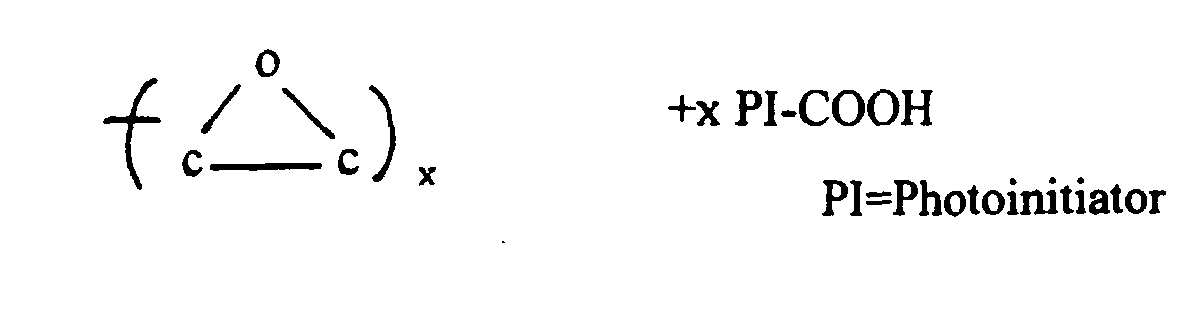
-
- The preferred route to producing multi-functional photoinitiators according to the present invention, as well as many of the other chemistries described above, rely on polyfunctional amines. In principle, any of a very extensive range of such polyfunctional amines is suitable. The following non-limiting homologous series give some idea of the range of possibilities.
Difunctional Butylamine Hexylamine Octylamine Decylamine etc. Difunctional N,N'-dimethylethylenediamine N,N'-dimethylbutylenediamine N,N'-dimethylhexylenediamine etc. Tetrafunctional Ethylenediamine 1,4-Diaminobutane 1,6-Diaminohexane etc. Hexafunctional N,N'-Bis(2-aminoethyl)-1,3-propanediamine N,N'-Bis(3-aminopropyl)-1,4-butanediamine N,N'-Bis(3-aminopropyl)ethylenediamine N,N'-Bis(3-aminopropyl)-1,3-propanediamine - Examples of photoinitiator materials containing a reactive hydroxyl group include 4-(2-hydroxyethoxy)-phenyl-2-(2-hydroxy)propyl ketone, (which is particularly preferred) p-hydroxybenzophenone, m-hydroxybenzophenone, hydroxyacetophenone and hydroxypropiophenone
- The invention will now be explained in more detail by way of the following non-limiting examples.
- To 0.234g (3.96x10⁻³mol) of N-methylethylamine dissolved in 1ml of acetonitrile was slowly added 1.00g (3.60x10⁻³mol) of 4-(2-acryloyloxyethoxy)-phenyl-(2-hydroxy)propyl ketone (Photoinitiator "X"). The reagents were stirred at room temperature under nitrogen until the reaction reached completion (4h). The reaction was followed by TLC using a mixture of 80% ether and 20% hexane as the eluent. The product was isolated by evaporating off the solvent and the excess amine.
- Using the amine starting materials specified, Examples 1-5 of polyfunctional photoinitiators according to the present invention were prepared in a manner analogous to that of Example A. Stoichiometric ratios, reaction conditions and purities are given for each of these Examples and also for Example A, in Table 1.

- All the multifunctional photoinitiators were well characterised by:
- (i) TLC
- (ii) GPC
- (iii) 1H nmr
- (iv) FAB MS
-
- 3.00g of 4-benzoyl benzoic acid (0.0133 moles) and 2.15g of N,N'-carbonyldiimidazole (0.0133 moles) were dissolved in 50 ml of THF and stirred for 3 hours. 0.56g of phloroglucinol (0.0044 moles) was added to the other reactants and the resulting mixture was stirred for a further 24 hours. The product was filtered and the solvent removed by evaporation. The solid was dissolved in 50ml of dichloromethane and washed with dilute hydrochloric acid (5 x 100ml) and then with water (2 x 100ml) and finally with dilute sodium hydroxide (3 x 100ml). The organic layer was separated, dried, filtered and the solvent removed by evaporation. The crude residue was purified by column chromatography (silica gel) using an 80:20 mixture of ethyl acetate and petroleum ether as the eluting solvent.
- 1.00g of benzenetricarbonyl trichloride (0.0038 moles) in 15 ml of freshly distilled THF was added to an ice-cold solution of 2.562g of Darocur® 2959 (0.0114 moles) and 1.52g of triethylamine in 5ml of THF.
- After 10 minutes, the reaction mixture was allowed to warm to room temperature and then stirred for 24 hours. The mixture was filtered and the solvent was removed by evaporation. The residue was dissolved in dichloromethane and washed with dilute hydrochloric acid (5 x 100ml) and water (2 x 100ml). The organic layer was separated and dried, and the solvent was subsequently removed. The product was purified in a similar fashion to that used for Example 6.
- 3.00g of 4-benzoyl benzoic acid (0.0133 moles) and 2.30g of N,N'-carbonyldiimidazole (0.0142 moles) were dissolved in 50ml of THF and stirred for 3 hours. 0.66g of triethanolamine (0.0044 moles) was added to the other reactants and allowed to react for a further 24 hours. The washing and purification procedures were the same as for Example 6.
- 2.00g of azelaic acid (0.0106 moles) and 3.44g of N,N'-carbonyldiimidazole (0.0213 moles) were dissolved in 50ml of THF and the solution was then stirred for 3.5 hours. 4.77g of Darocur® 2959 (0.0213 moles) were added to this solution and the mixture was stirred for 3 days. The solvent was removed by evaporation and the residue was dissolved in dichloromethane. The washing and purification procedures were similar to those described in Example 7.
- 7.00g of 2-benzoyl benzoic acid (0.031 moles) was dissolved in 40ml of THF along with 5.48g of poly (bisphenol A-co-epichlorohydrin) (MW ∼ 355) (0.015 moles). The reaction mixture was heated under reflux for 7 hours in the presence of 0.30g of tetramethyl ammonium bromide. The solvent was removed by evaporation and then the product was purified by column chromatography using the conditions outlined previously.
- The photoinitiating capacity of Photoinitiator "X" and examples A, 1, 4 and 5 was assessed using a Perkin Elmer DPA7, equipped with a 100 Watt Hg short arc lamp. The photoinitiators were made up as 0.2% (by weight) solutions in a 80:20 mixture of Craynor's CN934 (a urethane diacrylate) and TMPTA, and thermograms recorded at a cell temperature of 40°C. Prior to running each experiment, the DPC compartment was purged with nitrogen for 5 minutes so as to exclude oxygen and remove any problems due to inhibition.
- The following table summarises the DPC results.
Material Functionality Heat Flow (W/g) Ratio of Exotherm Peak Heat to that of Photoinitiator "X" Photoinitiator "X" Mono (polymerisable) -21.5 1.0 Example A Mono -20.5 1.05 Example 1 Di -19.5 1.10 Example 4 Tetra -19.5 1.10 Example 5 Hexa -21 1.02 - The final extent of acrylate double bond conversion for all the photoinitiators was 71% (±) 1.0%).
- Thus, from the above results, it is seen that the photoinitiating activity of the photoinitiator group is maintained.
- Mixtures containing multi-functional photoinitiator in lauryl acrylate were prepared so that the concentration of photoactive groups was 1.04% (by weight). The mixtures were cured using a Primarc Minicure rig and the products analysed by GPC. The following materials were used:
- i) Darocure 2959
- ii) Example A
- iii) Example 1
- iv) Example 4
-
- Photoinitiator "X" (4-(2-acryloyloxyethoxy)-phenyl-(2-hydroxy-2-propyl)ketone) was not used in this set of experiments owing to its bifunctional character, i.e. it contains both a photoinitiator group and an acrylate group.
- The GPC results for the cured lauryl acrylate products are shown in Table 2. As the functionality of the multifunctional photoinitiator increases, the molecular weight of the polymeric product also increases (the time to peak height maxima decreases). Assuming that the likelihood of any photoinitiator group initiating photopolymerisation is the same for all the multifunctional photoinitiators, and that the polymerisation conditions are also the same, then the increase in MWs can be explained in terms of multi-initiation from the higher functional multifunctional photoinitiators. Multi-initiation from a photoinitiator molecule would increase its chance of becoming bound into a UV-curing network. Thus, it would be anticipated that the amount of photoinitiator extractables/migratables should be reduced. This is supported by the extraction results.
GPC RETENTION TIMES (CURED LAURYL ACRYLATE) EXAMPLE FUNCTIONALITY RETENTION TIME/MINS DAROCUR 2959 MONOFUNCTIONAL 25.0 A MONOFUNCTIONAL 25.0 1 DIFUNCTIONAL 23.5 4 TETRAFUNCTIONAL 21.5 - Another consequence which would be expected if multi-initiation were operational would be that the crosslink density of a cured acrylate film would be increased. Any increase in crosslink density would result in changes in the physical properties of the cured film, such as hardness. To explore this, the hardness of multifunctional photoinitiator-cured films was determined.
- Mixtures of multi-functional acrylates (80% CN934, 20% TMPTA) containing 2%, by weight, of each of the following photoinitiators: Darocure 2959; photoinitiator "X"; - Example A (monofunctional); Example 1 (difunctional); and Example 4 (tetrafunctional); were coated onto glass plates with a No.5 K-Bar. The films were cured by passing them through a Minicure UV rig at 50ft min-1. The films were allowed to stand overnight before their hardnesses were determined with a Sheen pendulum hardness tester.
Harness (No. Of swings on sample/No. of swings Photoinitiator on glass x 100) Darocure 2959 11.67 Photoinitiator "X" 16.67 Example A 16.67 Example 1 19.17 Example 4 21.67 - From the results, it is clear that, as the functionality of the photoinitiator increases, the hardness of the film also increases. This is indicative of increased crosslinking in the cured acrylate film. This supports the notion that multi-initiation is possible form the higher functional multi-functional photoinitiators.
- Acrylate mixtures (80% CN934 and 20% TMPTA) containing 2% of each photoinitiator were coated onto glass plates with a No.5 K-Bar and passed through a Minicure UV rig (1 medium pressure Hg lamp) at 50ft min-1. The cured films were allowed to stand for 24h before being removed. About 0.40g of each cured film was then soaked in 5.0g of THF for 24h. At the end of this time, the THF solutions were decanted and the film residues dried in a vacuum oven at 25°C. The weight loss due to THF extraction was thus determined.
Photoinitiator Photoinitiator functionality % wt loss Darocure 29591 Mono 20.2 Photoinitiator "X" Mono (polymerisable) 9.9 Example A Mono 7.5 Example 1 Di 6.0 Example 4 Tetra 5.5 Example 5 Hexa 7.42 - 1. Darocure 2959 (4-(2-hydroxyethoxy)-phenyl-(2-hydroxy)propyl ketone) is the unacrylated version of photoinitiator "X" (4-(2-acryloyloxyethoxy)-phenyl-(2-hydroxy)propyl ketone) and was used as a further control experiment.
- 2. The slightly higher level of extractables from the film cured using the hexafunctional photoinitiator is probably due to the lower purity of this product.
-
- Thus, the photoinitiators of the present invention produce cured films with lower levels of extractables.
- To illustrate viscosity advantages of the photoinitiators of the present invention, 10% (w/w) solutions of photoinitiator in the previously described acrylate mixture (80 CN934:20 TMPTA) were prepared and their viscosities recorded at 25°C on an REL viscometer. For comparison, a 10% solution of Fratelli-Lamberti's KIP100 (100%) was also prepared. KIP100 is an oligomeric α-hydroxyalkylphenone with a MW of about 480. The table below shows the viscosity results.
Viscosities of acrylate mixtures containing 10% Photoinitiator Photoinitiator Molecular Weight Viscosity (Poise) Example A 338 88 Example 1 644 99 Example 4 1200 121 Example 5 1850 133 KIP100 480 153 - Therefore, it would appear that these multifunctional photoinitiators do not affect the viscosity of an acrylate mixture to the same extent as the more conventional polymeric photoinitiator, KIP 100.
Claims (4)
- A multi-functional photoinitiator which is obtainable as the reaction product of a multi-functional core material containing two or more reactive groups and a Type I (cleavage-type) photoinitiator or a derivative thereof, which photoinitiator or its derivative has a reactive group capable of reacting with said reactive groups of the multi-functional core, wherein one out of the reactive groups of the multi-functional core material and the reactive groups of the photoinitiator or its derivative is selected from either of the groups (a) or (b) in one of the following sets (i) to (iv) and the other is selected from the other group (b) or (a) in the same set:-with the proviso that said multi-functional photoinitiator is not a compound of formula:-(i)(a) an acid group, acid anhydride group, acid halide group or other carboxylic acid derivative;(b) hydroxy groups, amine groups, epoxy groups;(ii)(a) an acrylate or methacrylate group,(b) amine and thiol groups;(iii)(a) a hydroxy group,(b) halide groups and epoxy groups; or(iv)(a) an amine group,(b) halide groups and epoxy groups;wherein:
 X represents CH3-; phenyl; or substituted-phenyl; or substituted-phenyl with the proviso that any substituents on the substituted-phenyl do not interfere with the light-absorbing capacity of the radiation-activatable crosslinking agent and do not promote intramolecular hydrogen abstraction of the radiation activatable crosslinking agent;W represents -O-, -NH-, or -S-;Z represents an organic spacer selected from the group consisting of aliphatic, aromatic, aralkyl, heteroaromatic, and cycloaliphatic groups free of esters, amides, ketones, urethanes, and also free of ethers, thiols, allylic groups, and benzylic groups with hydrogen atoms intramolecularly accessible to the carbonyl group of said radiation-activatable crosslinking agent; andn represents an integer of 2 or greater.
- A photoinitiator according to claim 1, wherein the photoinitiator is an ehtylenically unsaturated photoinitiator and the multi-functional core material is a multi-functional amine.
- A photoinitiator according to claim 2, wherein the multi-functional amine is selected from difunctional tetrafunctional and hexafunctional amines.
- A liquid composition, curable by exposure to UV radiation, containing:-(a) a polymerisable component comprising one or more ethylenically unsaturated monomer or oligomers; and(b) a photoinitiator component as claimed in any preceding claim.
Applications Claiming Priority (3)
| Application Number | Priority Date | Filing Date | Title |
|---|---|---|---|
| GB9522683 | 1995-11-06 | ||
| GBGB9522683.3A GB9522683D0 (en) | 1995-11-06 | 1995-11-06 | Photoinitiator |
| PCT/GB1996/002714 WO1997017378A1 (en) | 1995-11-06 | 1996-11-06 | Photoinitiator |
Publications (2)
| Publication Number | Publication Date |
|---|---|
| EP0859797A1 EP0859797A1 (en) | 1998-08-26 |
| EP0859797B1 true EP0859797B1 (en) | 2000-08-16 |
Family
ID=10783443
Family Applications (1)
| Application Number | Title | Priority Date | Filing Date |
|---|---|---|---|
| EP96935179A Expired - Lifetime EP0859797B1 (en) | 1995-11-06 | 1996-11-06 | Photoinitiator |
Country Status (9)
| Country | Link |
|---|---|
| US (1) | US6296986B1 (en) |
| EP (1) | EP0859797B1 (en) |
| JP (1) | JP3878676B2 (en) |
| AT (1) | ATE195536T1 (en) |
| AU (1) | AU7325096A (en) |
| DE (1) | DE69609854T2 (en) |
| ES (1) | ES2151183T3 (en) |
| GB (1) | GB9522683D0 (en) |
| WO (1) | WO1997017378A1 (en) |
Cited By (1)
| Publication number | Priority date | Publication date | Assignee | Title |
|---|---|---|---|---|
| EP2368919A1 (en) | 2010-03-25 | 2011-09-28 | Universität des Saarlandes | Nanoparticulate photoinitiators |
Families Citing this family (28)
| Publication number | Priority date | Publication date | Assignee | Title |
|---|---|---|---|---|
| US6254803B1 (en) | 1998-03-25 | 2001-07-03 | Cryovac, Inc. | Oxygen scavengers with reduced oxidation products for use in plastic films |
| GB2352718A (en) | 1999-08-04 | 2001-02-07 | Coates Brothers Plc | Photoinitiators |
| WO2002079691A1 (en) | 2001-03-30 | 2002-10-10 | The Arizona Board Of Regents On Behalf Of The University Of Arizona | Materials, methods, and uses for photochemical generation of acids and/or radical species |
| EP1560888B1 (en) * | 2002-11-15 | 2008-07-30 | Markem Corporation | Radiation-curable inks |
| BRPI0410118B1 (en) * | 2003-05-06 | 2013-12-24 | Ciba Sc Holding Ag | 3-PHOTOINICIATOR, ITS PREPARATION PROCESS, ITS COMPOSITION, ITS USE, AND PROCESS FOR PRODUCTION OF A SCRATCH-RESISTANT DURABLE SURFACE |
| US20050065227A1 (en) * | 2003-09-22 | 2005-03-24 | Condon John R. | Visible-light sensitive macro-initiator |
| DE102004011497B4 (en) * | 2004-03-09 | 2008-05-21 | Ivoclar Vivadent Ag | Dental materials with improved compatibility |
| US7507773B2 (en) | 2004-07-15 | 2009-03-24 | Agfa Graphics N.V. | Radiation curable compositions |
| US7538144B2 (en) | 2004-07-15 | 2009-05-26 | Agfa Graphics, N.V. | Photoreactive polymers |
| US7795324B2 (en) | 2004-07-15 | 2010-09-14 | Agfa Graphics, N.V. | Radiation curable compositions |
| US7875698B2 (en) | 2004-07-15 | 2011-01-25 | Agfa Graphics Nv | Polymeric initiators |
| WO2006024656A1 (en) * | 2004-09-01 | 2006-03-09 | Creanova Universal Closures Ltd. | Tamper evidence means for a closure and a tamper evident closure |
| JP5324100B2 (en) | 2004-11-29 | 2013-10-23 | ディーエスエム アイピー アセッツ ビー.ブイ. | Method for reducing the amount of migratory substances contained in a polymer coating |
| US7307106B2 (en) * | 2004-12-10 | 2007-12-11 | 3M Innovative Properties Company | Photocurable Michael addition polymers |
| US20070077498A1 (en) * | 2005-09-30 | 2007-04-05 | Fuji Photo Film Co., Ltd. | Optical recording composition, optical recording medium and production method thereof, optical recording method and optical recording apparatus |
| EP1957130B1 (en) | 2005-12-09 | 2010-09-15 | DSM IP Assets B.V. | Hydrophilic coating comprising a polyelectrolyte |
| EP2061526B1 (en) | 2006-09-13 | 2015-07-29 | DSM IP Assets B.V. | Coated medical device |
| DK2114477T3 (en) | 2007-02-28 | 2012-08-20 | Dsm Ip Assets Bv | Hydrophilic coating |
| BRPI0808118A2 (en) | 2007-02-28 | 2014-06-17 | Dsm Ip Assets Bv | HYDROPHILIC COATING |
| EP2199273B1 (en) | 2008-12-18 | 2018-02-21 | Agfa Nv | Polymerizable photoinitiators and radiation curable compositions |
| US8883873B2 (en) | 2009-05-18 | 2014-11-11 | Agfa Graphics Nv | Polymerizable polymeric photoinitiators and radiation curable compositions |
| EP2451847B1 (en) | 2009-07-06 | 2021-11-24 | IGM Group B.V. | Polymer-bound bisacylphosphine oxides |
| US8507571B2 (en) * | 2009-12-02 | 2013-08-13 | Xerox Corporation | Macro-photoinitiator via enzymatic polymerization |
| MY161087A (en) * | 2010-06-16 | 2017-04-14 | Dsm Ip Assets Bv | Coating formulation for preparing a hydrophilic coating |
| JP6599446B2 (en) | 2014-05-30 | 2019-10-30 | アイジーエム レシンス イタリア ソチエタ レスポンサビリタ リミタータ | Multifunctional acylphosphine oxide photoinitiator |
| EP3788083A1 (en) | 2018-04-30 | 2021-03-10 | Basf Se | High molar mass polymers from a continuous process |
| CN111574350B (en) * | 2020-05-09 | 2022-08-16 | 北京化工大学常州先进材料研究院 | Hydroxy cyclohexyl acetophenone photoinitiator and preparation method thereof |
| CN115141113B (en) * | 2022-09-05 | 2022-11-29 | 天津久日新材料股份有限公司 | Active amine and preparation method and application thereof |
Family Cites Families (15)
| Publication number | Priority date | Publication date | Assignee | Title |
|---|---|---|---|---|
| NL294759A (en) * | 1962-07-06 | 1965-04-26 | ||
| US3429852A (en) * | 1967-03-30 | 1969-02-25 | Nat Starch Chem Corp | Ethylenically unsaturated derivatives of benzophenone and crosslinkable polymers thereof |
| US4763063A (en) | 1985-07-26 | 1988-08-09 | Allied-Signal Inc. | Compact digital pressure sensor circuitry |
| JPS6263814A (en) | 1985-08-22 | 1987-03-20 | Yokogawa Electric Corp | Encoder |
| JPS6263813A (en) | 1985-09-11 | 1987-03-20 | Yokogawa Electric Corp | Encoder |
| JPS6263811A (en) | 1985-09-13 | 1987-03-20 | Fujitsu Ltd | Potentiometer |
| DE3738567A1 (en) * | 1987-03-12 | 1988-09-22 | Merck Patent Gmbh | COREACTIVE PHOTOINITIATORS |
| DE3816304A1 (en) * | 1988-05-13 | 1989-11-23 | Merck Patent Gmbh | PHOTOINITIATOR COPOLYMERS |
| DE3826947A1 (en) * | 1988-08-09 | 1990-02-22 | Merck Patent Gmbh | THIOXANTHON DERIVATIVES, THEIR USE AS PHOTOINITIATORS, PHOTOPOLYMERIZABLE BINDING SYSTEMS AND METHOD FOR THE PRODUCTION OF A RADIATION-COATED COATING |
| TW328535B (en) * | 1993-07-02 | 1998-03-21 | Novartis Ag | Functional photoinitiators and their manufacture |
| GB2280905A (en) | 1993-08-06 | 1995-02-15 | Coates Brothers Plc | Ethylenically unsaturated photoinitiator |
| US5506279A (en) * | 1993-10-13 | 1996-04-09 | Minnesota Mining And Manufacturing Company | Acrylamido functional disubstituted acetyl aryl ketone photoinitiators |
| US5543262A (en) * | 1995-02-24 | 1996-08-06 | International Paper Company | Benzanthrone polymerization gate in photopolymerizable compositions |
| DE19526856A1 (en) * | 1995-07-22 | 1997-01-23 | Basf Ag | Radiation-curable compositions with covalently bound photoinitiators |
| US6369123B1 (en) | 1995-08-14 | 2002-04-09 | 3M Innovative Properties Company | Radiation-crosslinkable elastomers and photocrosslinkers therefor |
-
1995
- 1995-11-06 GB GBGB9522683.3A patent/GB9522683D0/en active Pending
-
1996
- 1996-11-06 AU AU73250/96A patent/AU7325096A/en not_active Abandoned
- 1996-11-06 US US09/068,288 patent/US6296986B1/en not_active Expired - Fee Related
- 1996-11-06 JP JP51797897A patent/JP3878676B2/en not_active Expired - Fee Related
- 1996-11-06 ES ES96935179T patent/ES2151183T3/en not_active Expired - Lifetime
- 1996-11-06 EP EP96935179A patent/EP0859797B1/en not_active Expired - Lifetime
- 1996-11-06 DE DE69609854T patent/DE69609854T2/en not_active Expired - Fee Related
- 1996-11-06 AT AT96935179T patent/ATE195536T1/en not_active IP Right Cessation
- 1996-11-06 WO PCT/GB1996/002714 patent/WO1997017378A1/en not_active Ceased
Cited By (3)
| Publication number | Priority date | Publication date | Assignee | Title |
|---|---|---|---|---|
| EP2368919A1 (en) | 2010-03-25 | 2011-09-28 | Universität des Saarlandes | Nanoparticulate photoinitiators |
| WO2011116972A1 (en) | 2010-03-25 | 2011-09-29 | Universität des Saarlandes | Nanoparticulate photoinitiators |
| DE112011101038T5 (en) | 2010-03-25 | 2013-05-16 | Universität des Saarlandes | Nanoparticulate photoinitiators |
Also Published As
| Publication number | Publication date |
|---|---|
| JP2000500168A (en) | 2000-01-11 |
| DE69609854T2 (en) | 2001-02-08 |
| JP3878676B2 (en) | 2007-02-07 |
| DE69609854D1 (en) | 2000-09-21 |
| GB9522683D0 (en) | 1996-01-10 |
| AU7325096A (en) | 1997-05-29 |
| ES2151183T3 (en) | 2000-12-16 |
| EP0859797A1 (en) | 1998-08-26 |
| WO1997017378A1 (en) | 1997-05-15 |
| US6296986B1 (en) | 2001-10-02 |
| ATE195536T1 (en) | 2000-09-15 |
Similar Documents
| Publication | Publication Date | Title |
|---|---|---|
| US6296986B1 (en) | Photoinitiator | |
| WO1997017378A9 (en) | Photoinitiator | |
| FI89162C (en) | Copolymerizable photoinitiators | |
| US5744512A (en) | Coreactive photoinitiators | |
| US4293678A (en) | Radiation-curable acrylated epoxy silicone compositions | |
| US4239866A (en) | Curable coating composition | |
| US5047556A (en) | Photoinitiators having a combined structure | |
| US5859084A (en) | Radiation-curable compositions containing photoinitiators linked by a covalent bond | |
| US4255243A (en) | Unsaturated poly-(carbonate-urethanes) and their applications to photocrosslinking | |
| KR100778755B1 (en) | Crosslinkable resin composition | |
| CA1179444A (en) | Urethane-acrylate and radiation curable compositions | |
| JPH0586416B2 (en) | ||
| CA2180673A1 (en) | Radiation-curable acrylates with built-in photoinitiators | |
| AU743197B2 (en) | New acrylates and actinic radiation-curable compositions containing them | |
| US5900472A (en) | Copolymerizable benzophenone photoinitiators | |
| US4308394A (en) | Aryl-glyoxyloyloxyalkylacrylates | |
| US5360836A (en) | Process for the production of coatings by radiation cross-linking | |
| SE506958C2 (en) | Photopolymerizable polyester composition and varnish or paint formulation | |
| JP2764470B2 (en) | Alicyclic acrylic monomer and radiation-curable composition using the same | |
| JP3400452B2 (en) | Addition products, radiation-curable coating compositions based on the addition products, and their use for wood and paper coatings | |
| CA1183299A (en) | Cationically polymerizable radiation curable compositions including a 3,4 dihydropyran derivative and an aryldiazonium, aryliodonium or arysulfonium salt | |
| CA2033035A1 (en) | Photo-curable amine-containing compositions | |
| JP4253977B2 (en) | Active energy ray-curable composition | |
| US4081591A (en) | Method for stabilizing unsaturated cycloacetal resin | |
| EP1200448B1 (en) | Organo-silicon compounds and their use as photoinitiators |
Legal Events
| Date | Code | Title | Description |
|---|---|---|---|
| PUAI | Public reference made under article 153(3) epc to a published international application that has entered the european phase |
Free format text: ORIGINAL CODE: 0009012 |
|
| 17P | Request for examination filed |
Effective date: 19980501 |
|
| AK | Designated contracting states |
Kind code of ref document: A1 Designated state(s): AT BE CH DE DK ES FI FR GB GR IE IT LI LU MC NL PT SE |
|
| 17Q | First examination report despatched |
Effective date: 19981028 |
|
| GRAG | Despatch of communication of intention to grant |
Free format text: ORIGINAL CODE: EPIDOS AGRA |
|
| GRAG | Despatch of communication of intention to grant |
Free format text: ORIGINAL CODE: EPIDOS AGRA |
|
| GRAG | Despatch of communication of intention to grant |
Free format text: ORIGINAL CODE: EPIDOS AGRA |
|
| GRAH | Despatch of communication of intention to grant a patent |
Free format text: ORIGINAL CODE: EPIDOS IGRA |
|
| GRAH | Despatch of communication of intention to grant a patent |
Free format text: ORIGINAL CODE: EPIDOS IGRA |
|
| GRAA | (expected) grant |
Free format text: ORIGINAL CODE: 0009210 |
|
| AK | Designated contracting states |
Kind code of ref document: B1 Designated state(s): AT BE CH DE DK ES FI FR GB GR IE IT LI LU MC NL PT SE |
|
| PG25 | Lapsed in a contracting state [announced via postgrant information from national office to epo] |
Ref country code: NL Free format text: LAPSE BECAUSE OF FAILURE TO SUBMIT A TRANSLATION OF THE DESCRIPTION OR TO PAY THE FEE WITHIN THE PRESCRIBED TIME-LIMIT Effective date: 20000816 Ref country code: GR Free format text: LAPSE BECAUSE OF NON-PAYMENT OF DUE FEES Effective date: 20000816 Ref country code: FI Free format text: LAPSE BECAUSE OF FAILURE TO SUBMIT A TRANSLATION OF THE DESCRIPTION OR TO PAY THE FEE WITHIN THE PRESCRIBED TIME-LIMIT Effective date: 20000816 Ref country code: BE Free format text: LAPSE BECAUSE OF FAILURE TO SUBMIT A TRANSLATION OF THE DESCRIPTION OR TO PAY THE FEE WITHIN THE PRESCRIBED TIME-LIMIT Effective date: 20000816 Ref country code: AT Free format text: LAPSE BECAUSE OF FAILURE TO SUBMIT A TRANSLATION OF THE DESCRIPTION OR TO PAY THE FEE WITHIN THE PRESCRIBED TIME-LIMIT Effective date: 20000816 |
|
| REF | Corresponds to: |
Ref document number: 195536 Country of ref document: AT Date of ref document: 20000915 Kind code of ref document: T |
|
| REG | Reference to a national code |
Ref country code: CH Ref legal event code: EP |
|
| REG | Reference to a national code |
Ref country code: IE Ref legal event code: FG4D |
|
| REF | Corresponds to: |
Ref document number: 69609854 Country of ref document: DE Date of ref document: 20000921 |
|
| ITF | It: translation for a ep patent filed | ||
| REG | Reference to a national code |
Ref country code: CH Ref legal event code: NV Representative=s name: RITSCHER & SEIFERT |
|
| ET | Fr: translation filed | ||
| PG25 | Lapsed in a contracting state [announced via postgrant information from national office to epo] |
Ref country code: LU Free format text: LAPSE BECAUSE OF NON-PAYMENT OF DUE FEES Effective date: 20001106 Ref country code: IE Free format text: LAPSE BECAUSE OF NON-PAYMENT OF DUE FEES Effective date: 20001106 |
|
| PG25 | Lapsed in a contracting state [announced via postgrant information from national office to epo] |
Ref country code: SE Free format text: LAPSE BECAUSE OF FAILURE TO SUBMIT A TRANSLATION OF THE DESCRIPTION OR TO PAY THE FEE WITHIN THE PRESCRIBED TIME-LIMIT Effective date: 20001116 Ref country code: PT Free format text: LAPSE BECAUSE OF FAILURE TO SUBMIT A TRANSLATION OF THE DESCRIPTION OR TO PAY THE FEE WITHIN THE PRESCRIBED TIME-LIMIT Effective date: 20001116 Ref country code: DK Free format text: LAPSE BECAUSE OF FAILURE TO SUBMIT A TRANSLATION OF THE DESCRIPTION OR TO PAY THE FEE WITHIN THE PRESCRIBED TIME-LIMIT Effective date: 20001116 |
|
| PG25 | Lapsed in a contracting state [announced via postgrant information from national office to epo] |
Ref country code: MC Free format text: THE PATENT HAS BEEN ANNULLED BY A DECISION OF A NATIONAL AUTHORITY Effective date: 20001130 |
|
| REG | Reference to a national code |
Ref country code: ES Ref legal event code: FG2A Ref document number: 2151183 Country of ref document: ES Kind code of ref document: T3 |
|
| PLBE | No opposition filed within time limit |
Free format text: ORIGINAL CODE: 0009261 |
|
| STAA | Information on the status of an ep patent application or granted ep patent |
Free format text: STATUS: NO OPPOSITION FILED WITHIN TIME LIMIT |
|
| 26N | No opposition filed | ||
| REG | Reference to a national code |
Ref country code: IE Ref legal event code: MM4A |
|
| REG | Reference to a national code |
Ref country code: GB Ref legal event code: IF02 |
|
| PGFP | Annual fee paid to national office [announced via postgrant information from national office to epo] |
Ref country code: GB Payment date: 20061101 Year of fee payment: 11 |
|
| PGFP | Annual fee paid to national office [announced via postgrant information from national office to epo] |
Ref country code: DE Payment date: 20061102 Year of fee payment: 11 |
|
| PGFP | Annual fee paid to national office [announced via postgrant information from national office to epo] |
Ref country code: FR Payment date: 20061108 Year of fee payment: 11 |
|
| PGFP | Annual fee paid to national office [announced via postgrant information from national office to epo] |
Ref country code: CH Payment date: 20061115 Year of fee payment: 11 |
|
| PGFP | Annual fee paid to national office [announced via postgrant information from national office to epo] |
Ref country code: IT Payment date: 20061130 Year of fee payment: 11 |
|
| PGFP | Annual fee paid to national office [announced via postgrant information from national office to epo] |
Ref country code: ES Payment date: 20061222 Year of fee payment: 11 |
|
| GBPC | Gb: european patent ceased through non-payment of renewal fee |
Effective date: 20071106 |
|
| PG25 | Lapsed in a contracting state [announced via postgrant information from national office to epo] |
Ref country code: LI Free format text: LAPSE BECAUSE OF NON-PAYMENT OF DUE FEES Effective date: 20071130 Ref country code: CH Free format text: LAPSE BECAUSE OF NON-PAYMENT OF DUE FEES Effective date: 20071130 |
|
| REG | Reference to a national code |
Ref country code: CH Ref legal event code: PL |
|
| PG25 | Lapsed in a contracting state [announced via postgrant information from national office to epo] |
Ref country code: DE Free format text: LAPSE BECAUSE OF NON-PAYMENT OF DUE FEES Effective date: 20080603 |
|
| REG | Reference to a national code |
Ref country code: FR Ref legal event code: ST Effective date: 20080930 |
|
| PG25 | Lapsed in a contracting state [announced via postgrant information from national office to epo] |
Ref country code: GB Free format text: LAPSE BECAUSE OF NON-PAYMENT OF DUE FEES Effective date: 20071106 |
|
| REG | Reference to a national code |
Ref country code: ES Ref legal event code: FD2A Effective date: 20071107 |
|
| PG25 | Lapsed in a contracting state [announced via postgrant information from national office to epo] |
Ref country code: FR Free format text: LAPSE BECAUSE OF NON-PAYMENT OF DUE FEES Effective date: 20071130 Ref country code: ES Free format text: LAPSE BECAUSE OF NON-PAYMENT OF DUE FEES Effective date: 20071107 |
|
| PG25 | Lapsed in a contracting state [announced via postgrant information from national office to epo] |
Ref country code: IT Free format text: LAPSE BECAUSE OF NON-PAYMENT OF DUE FEES Effective date: 20071106 |