EP0867122B1 - Grilled flavour composition and process to produce - Google Patents
Grilled flavour composition and process to produce Download PDFInfo
- Publication number
- EP0867122B1 EP0867122B1 EP98810204A EP98810204A EP0867122B1 EP 0867122 B1 EP0867122 B1 EP 0867122B1 EP 98810204 A EP98810204 A EP 98810204A EP 98810204 A EP98810204 A EP 98810204A EP 0867122 B1 EP0867122 B1 EP 0867122B1
- Authority
- EP
- European Patent Office
- Prior art keywords
- flavouring composition
- flavouring
- food
- oil
- composition
- Prior art date
- Legal status (The legal status is an assumption and is not a legal conclusion. Google has not performed a legal analysis and makes no representation as to the accuracy of the status listed.)
- Expired - Lifetime
Links
- 239000000203 mixture Substances 0.000 title claims description 61
- 238000000034 method Methods 0.000 title claims description 33
- 239000000796 flavoring agent Substances 0.000 title description 64
- 235000019634 flavors Nutrition 0.000 title description 55
- 235000013305 food Nutrition 0.000 claims description 39
- 238000004817 gas chromatography Methods 0.000 claims description 29
- 235000015112 vegetable and seed oil Nutrition 0.000 claims description 24
- 239000008158 vegetable oil Substances 0.000 claims description 24
- 229920006395 saturated elastomer Polymers 0.000 claims description 22
- 238000000197 pyrolysis Methods 0.000 claims description 19
- QVGXLLKOCUKJST-UHFFFAOYSA-N atomic oxygen Chemical compound [O] QVGXLLKOCUKJST-UHFFFAOYSA-N 0.000 claims description 18
- 238000010828 elution Methods 0.000 claims description 18
- 239000001301 oxygen Substances 0.000 claims description 18
- 229910052760 oxygen Inorganic materials 0.000 claims description 18
- 239000007787 solid Substances 0.000 claims description 17
- 150000001875 compounds Chemical class 0.000 claims description 16
- 239000007788 liquid Substances 0.000 claims description 15
- DNIAPMSPPWPWGF-UHFFFAOYSA-N Propylene glycol Chemical compound CC(O)CO DNIAPMSPPWPWGF-UHFFFAOYSA-N 0.000 claims description 12
- 239000007789 gas Substances 0.000 claims description 12
- 239000003925 fat Substances 0.000 claims description 11
- 235000012424 soybean oil Nutrition 0.000 claims description 10
- 239000006071 cream Substances 0.000 claims description 9
- 235000013372 meat Nutrition 0.000 claims description 9
- 239000007921 spray Substances 0.000 claims description 9
- VYPSYNLAJGMNEJ-UHFFFAOYSA-N Silicium dioxide Chemical compound O=[Si]=O VYPSYNLAJGMNEJ-UHFFFAOYSA-N 0.000 claims description 8
- 235000019197 fats Nutrition 0.000 claims description 8
- 238000010791 quenching Methods 0.000 claims description 7
- 230000000171 quenching effect Effects 0.000 claims description 7
- 235000015067 sauces Nutrition 0.000 claims description 7
- 239000000969 carrier Substances 0.000 claims description 6
- 238000010438 heat treatment Methods 0.000 claims description 6
- 235000011888 snacks Nutrition 0.000 claims description 6
- 235000013336 milk Nutrition 0.000 claims description 5
- 239000008267 milk Substances 0.000 claims description 5
- 210000004080 milk Anatomy 0.000 claims description 5
- 244000144977 poultry Species 0.000 claims description 5
- 235000013594 poultry meat Nutrition 0.000 claims description 5
- 235000014102 seafood Nutrition 0.000 claims description 5
- 235000013311 vegetables Nutrition 0.000 claims description 5
- 235000015278 beef Nutrition 0.000 claims description 4
- 239000012159 carrier gas Substances 0.000 claims description 4
- 235000013373 food additive Nutrition 0.000 claims description 4
- 239000002778 food additive Substances 0.000 claims description 4
- 235000014698 Brassica juncea var multisecta Nutrition 0.000 claims description 3
- 235000006008 Brassica napus var napus Nutrition 0.000 claims description 3
- 240000000385 Brassica napus var. napus Species 0.000 claims description 3
- 235000006618 Brassica rapa subsp oleifera Nutrition 0.000 claims description 3
- 235000004977 Brassica sinapistrum Nutrition 0.000 claims description 3
- UFHFLCQGNIYNRP-UHFFFAOYSA-N Hydrogen Chemical compound [H][H] UFHFLCQGNIYNRP-UHFFFAOYSA-N 0.000 claims description 3
- 241001465754 Metazoa Species 0.000 claims description 3
- 235000019482 Palm oil Nutrition 0.000 claims description 3
- 235000019483 Peanut oil Nutrition 0.000 claims description 3
- 235000014121 butter Nutrition 0.000 claims description 3
- 239000003240 coconut oil Substances 0.000 claims description 3
- 235000019864 coconut oil Nutrition 0.000 claims description 3
- 239000002285 corn oil Substances 0.000 claims description 3
- 235000005687 corn oil Nutrition 0.000 claims description 3
- 239000001257 hydrogen Substances 0.000 claims description 3
- 229910052739 hydrogen Inorganic materials 0.000 claims description 3
- 239000002540 palm oil Substances 0.000 claims description 3
- 239000006072 paste Substances 0.000 claims description 3
- 239000000312 peanut oil Substances 0.000 claims description 3
- 238000002360 preparation method Methods 0.000 claims description 3
- 239000003760 tallow Substances 0.000 claims description 3
- 239000000377 silicon dioxide Substances 0.000 claims description 2
- 239000000047 product Substances 0.000 description 42
- 238000006243 chemical reaction Methods 0.000 description 23
- 235000012343 cottonseed oil Nutrition 0.000 description 5
- 239000002385 cottonseed oil Substances 0.000 description 5
- 235000010469 Glycine max Nutrition 0.000 description 4
- 238000002485 combustion reaction Methods 0.000 description 4
- 238000004519 manufacturing process Methods 0.000 description 4
- 239000003921 oil Substances 0.000 description 4
- 235000019198 oils Nutrition 0.000 description 4
- 230000002829 reductive effect Effects 0.000 description 4
- 239000000779 smoke Substances 0.000 description 4
- 239000003549 soybean oil Substances 0.000 description 4
- 239000010409 thin film Substances 0.000 description 4
- ZCYVEMRRCGMTRW-UHFFFAOYSA-N 7553-56-2 Chemical compound [I] ZCYVEMRRCGMTRW-UHFFFAOYSA-N 0.000 description 3
- 229920002472 Starch Polymers 0.000 description 3
- 239000000828 canola oil Substances 0.000 description 3
- 235000019519 canola oil Nutrition 0.000 description 3
- 229910052740 iodine Inorganic materials 0.000 description 3
- 239000011630 iodine Substances 0.000 description 3
- 239000012263 liquid product Substances 0.000 description 3
- 230000001590 oxidative effect Effects 0.000 description 3
- 239000004576 sand Substances 0.000 description 3
- 238000000926 separation method Methods 0.000 description 3
- 235000019698 starch Nutrition 0.000 description 3
- 235000019871 vegetable fat Nutrition 0.000 description 3
- 238000003809 water extraction Methods 0.000 description 3
- IJGRMHOSHXDMSA-UHFFFAOYSA-N Atomic nitrogen Chemical compound N#N IJGRMHOSHXDMSA-UHFFFAOYSA-N 0.000 description 2
- 229920002774 Maltodextrin Polymers 0.000 description 2
- 239000005913 Maltodextrin Substances 0.000 description 2
- 238000004458 analytical method Methods 0.000 description 2
- 239000006227 byproduct Substances 0.000 description 2
- 239000003610 charcoal Substances 0.000 description 2
- 239000013065 commercial product Substances 0.000 description 2
- 230000000052 comparative effect Effects 0.000 description 2
- 239000010408 film Substances 0.000 description 2
- 229940035034 maltodextrin Drugs 0.000 description 2
- 238000010926 purge Methods 0.000 description 2
- 239000008107 starch Substances 0.000 description 2
- 239000002023 wood Substances 0.000 description 2
- 241000251468 Actinopterygii Species 0.000 description 1
- OKTJSMMVPCPJKN-UHFFFAOYSA-N Carbon Chemical compound [C] OKTJSMMVPCPJKN-UHFFFAOYSA-N 0.000 description 1
- 239000000654 additive Substances 0.000 description 1
- 230000000996 additive effect Effects 0.000 description 1
- 238000013459 approach Methods 0.000 description 1
- 229910052799 carbon Inorganic materials 0.000 description 1
- 239000001913 cellulose Substances 0.000 description 1
- 229920002678 cellulose Polymers 0.000 description 1
- 238000012512 characterization method Methods 0.000 description 1
- 239000007795 chemical reaction product Substances 0.000 description 1
- 239000003795 chemical substances by application Substances 0.000 description 1
- 239000000356 contaminant Substances 0.000 description 1
- 238000001514 detection method Methods 0.000 description 1
- 238000011161 development Methods 0.000 description 1
- 235000014113 dietary fatty acids Nutrition 0.000 description 1
- 239000000194 fatty acid Substances 0.000 description 1
- 229930195729 fatty acid Natural products 0.000 description 1
- 150000004665 fatty acids Chemical class 0.000 description 1
- 239000011152 fibreglass Substances 0.000 description 1
- 235000019688 fish Nutrition 0.000 description 1
- 239000005454 flavour additive Substances 0.000 description 1
- 239000012530 fluid Substances 0.000 description 1
- 235000013355 food flavoring agent Nutrition 0.000 description 1
- 239000005350 fused silica glass Substances 0.000 description 1
- 239000008173 hydrogenated soybean oil Substances 0.000 description 1
- 238000002347 injection Methods 0.000 description 1
- 239000007924 injection Substances 0.000 description 1
- 239000011344 liquid material Substances 0.000 description 1
- 239000000463 material Substances 0.000 description 1
- 238000002156 mixing Methods 0.000 description 1
- 229910052757 nitrogen Inorganic materials 0.000 description 1
- 239000002245 particle Substances 0.000 description 1
- 235000015277 pork Nutrition 0.000 description 1
- -1 power Substances 0.000 description 1
- 239000002243 precursor Substances 0.000 description 1
- 238000005086 pumping Methods 0.000 description 1
- 238000007086 side reaction Methods 0.000 description 1
- 239000000243 solution Substances 0.000 description 1
- 229910001220 stainless steel Inorganic materials 0.000 description 1
- 239000010935 stainless steel Substances 0.000 description 1
- 239000000126 substance Substances 0.000 description 1
- 239000011269 tar Substances 0.000 description 1
- 238000012360 testing method Methods 0.000 description 1
- 238000012546 transfer Methods 0.000 description 1
Images


Classifications
-
- A—HUMAN NECESSITIES
- A23—FOODS OR FOODSTUFFS; TREATMENT THEREOF, NOT COVERED BY OTHER CLASSES
- A23L—FOODS, FOODSTUFFS OR NON-ALCOHOLIC BEVERAGES, NOT OTHERWISE PROVIDED FOR; PREPARATION OR TREATMENT THEREOF
- A23L27/00—Spices; Flavouring agents or condiments; Artificial sweetening agents; Table salts; Dietetic salt substitutes; Preparation or treatment thereof
- A23L27/20—Synthetic spices, flavouring agents or condiments
- A23L27/201—Compounds of unspecified constitution characterised by the chemical reaction for their preparation
Definitions
- This invention relates to a novel process for preparing a novel flavouring composition which is either utilized by itself or is blended with other flavouring compositions to be used to provide a charcoal or grilled flavour to foodstuffs, e.g. beef, fish, poultry, pork, etc.
- Food flavourings are used in the food industry in a variety of ways.
- One general type of food flavouring are those that add grilled or barbeque flavour to foods.
- Typical grilled flavours include those for the preparation of products wherein the content of meat is reduced or non-existent, for example in sauces, snack foods, meat substitutes, pet foods and the like.
- Such food flavourings can be sprayed onto the food stuffs, the food can be dipped in a solution of the flavouring, or applied in a variety of different manners.
- One such composition that provides an aspect of a grill flavour is that disclosed in US Patent No. 4,571,342 (DiCicca, 1986).
- This patent describes a flavouring composition with charred flavour notes which is prepared by subjecting a film of fat or oil to temperatures in the range of 150° C to 475°C in the presence of oxygen for an effective period of time followed by collecting the fat or oil.
- the method disclosed in US Patent No. 4,571,342 involves a continuous flow, thin film apparatus where fat or vegetable oil flows down a tube where a thin film of the fat or vegetable oil is formed around the inside circumference of the tube with a constant flow of air through the centre of the tube. Furthermore, the process is oxidative since heating of the vegetable oil is done in the presence of a substantial amount of oxygen.
- US Patent No. 4,820,538 teaches use of a rototherm to carry out the reaction in the presence of between 1 - 1 1 ⁇ 2 parts of oxygen to 1 part fat or oil. Due to the presence of an equimolar ratio or more of oxygen, this reaction is an oxidative reaction carried out in a thin film heat exchanger. The period of time that the thin film remains in the heat exchanger is for a period of not exceeding 2 minutes and normally in the neighbourhood of 90 seconds. Upon exiting the heat exchanger the combustion products are quenched in less than 20 seconds and commonly in about 10 seconds.
- an oxygen starved atmosphere would have a limited amount of oxygen, i.e. less than 4% molar ratio of oxygen to feed stock.
- This invention is directed to the production of unique flavouring compositions. More specifically, this invention is related to the production of flavouring compositions with unique flavour notes using fast pyrolysis reactors and high stability vegetable oils or fats as feed stock.
- flavouring compositions having uniquely distinct grilled flavour notes that are extremely smooth and lack harsh flavour notes.
- These flavour notes are distinct from the flavour notes or characteristics achieved using the similar feedstock in the apparatus and process of the DiCicca (4,571,342) and Shulman (US 4,820,538) patents.
- the distinct differences in flavour and enhanced concentration indicates that a new and different composition results from the present process.
- Such a unique grilled flavouring is highly desirable for use in the food flavouring industry, since a reduced amount of flavouring (additive) can be used to achieve the desired flavouring.
- more pronounced flavouring can be achieved using equivalent amounts to other available grill flavourings.
- the present invention utilizes high stability vegetable oils, that is to say, saturated, or partially saturated vegetable oils. It has been determined that saturated or partially saturated vegetable oils achieve a usable product whereas the utilization of unsaturated vegetable oils including some of those disclosed in the DiCicca and Shulman patents result in products having harsh flavour notes and are unacceptable. Furthermore, the enhanced flavour profile and higher flavour concentrations of the flavouring compositions of this invention are obtained through a fast pyrolysis reactor operating in the relative absence of air and at elevated temperatures. No flavour precursors were necessary to enhance the meaty flavour notes of the disclosed flavour compositions.
- this invention relates to a process for the preparation of a flavouring comprising:
- This invention also embraces a process as defined above, wherein the vegetable oil is selected from the list comprising saturated or partially saturated palm oil, soya oil, peanut oil, canola, corn oil, coconut oil, animal fats, beef tallow, or butter. Furthermore, this invention relates to the use of saturated or partially saturated soya oil within this process.
- This invention also provides a grilled flavouring composition which is made in accordance with the process as defined above. Furthermore, this invention is directed to a flavouring composition characterized in that it comprises a compound mix resulting in a gas chromatography fingerprint as that of table 1.
- this invention embraces a grilled flavouring composition which contains the flavouring composition made by the process as defined above.
- This flavouring may be in a liquid, solid, cream, paste or powdered form, or in a spray dried form associated with an appropriate carrier such as malto dextrin or starch.
- This invention also relates to a food flavouring comprising the grilled flavouring composition defined above together with other suitable food additives.
- This flavouring may be in a liquid, solid, sauce, cream, paste or powdered form.
- This invention is directed to food to which has been applied the food flavouring defined above.
- This food is selected from, but not exclusively limited to, meat, poultry, sea food, milk products, vegetables, deep fried, surface fried, baked, micro waved, barbequed, grilled or snack foods.
- This invention is directed to a flavouring composition characterized by a gas chromatography (GC) elution profile which comprises at least seven compounds selected from the group consisting of the following approximate GC elution times (in minutes): 5.21; 6.49; 7.59; 8.69; 8.8; 9.97; 10.05; 10.21; 10.78; 11.18; 11.84; 12.2; 12.33; 12.84; 13.0; and 13.62, wherein said elution times are in reference to being performed on a gas chromatograph using a silica DB-wax capillary column run at 40°C initial temperature and ramped to 220°C at 10°C/min.
- GC gas chromatography
- embodiments of this invention include flavouring composition comprising a combination of compounds that give rise to a gas chromatography (GC) elution profile which approximates that of Table 1 (“Flavour composition”), or Table 4 ("Reaction temperature: 500°C” or “560°C”, or Table 6 (“Reaction temperature 500°C” or "560°C”).
- GC gas chromatography
- This invention also embraces food flavouring compositions, comprising the flavouring composition defined above together with other suitable food additives.
- This flavouring may be in a liquid, solid, sauce, cream, paste or powdered form.
- this invention is directed to food to which has been applied the flavouring composition defined above.
- the food is selected from, but not exclusively limited to, meat, poultry, sea food, milk products, vegetables, deep fried, surface fried, baked, micro waved, barbequed, grilled, or snack foods.
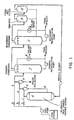
- Figure 1 discloses a schematic of a transport fast pyrolysis reactor of type that can be utilized to make the grilled flavourings of the present invention.
- the feed stream of vegetable oil or fat enters the reactor radially through an animization nozzle (1) which is positioned just prior to the solid heat carrier separator, and/or just after the solid heat carrier separator, position (2), and/or just after the secondary solid separator, position (3).
- a heat-carried (hot sand, other solid, or hot carrier gas) is transported in a fluid (recirculation gas or nitrogen with up to 4% molar residual oxygen which is present from pressure tap purge ports; see below) and comes in contact with the atomized feedstock at anyone of the entry points.
- the heat carrier together with other solids which are removed by the cyclonic separator are transferred to a heat carrier re-heating system (4).
- a noncondensible gas which is a byproduct of the high temperature reactions, is compressed in a blower and transferred to the re-heater (4) along with the solid heat carrier.
- any organic deposits on the sand particles that were not removed in the cyclone separator can be efficiently combusted by the addition of oxygen to the recirculation line (12) to help provide process heat and rid the sand of contaminants.
- Byproduct gases can also be combusted in the re-heater (4) to add to the reaction thermal energy demand.
- Immediate quenching of the hot product gaseous/vapour stream from the cyclonic separators occurs in a direct conduct condensing system (7).
- a pump draws condensed liquid from the bottom of the condensing column and passes it through a heat exchanger (8). The cool product liquid is then sprayed back to the top of the direct contact column (7). Any liquids which are carried out of the direct contact collection system are removed in stainless steel demister (9) and fibreglass filter (10). Utilization of a secondary condenser (11) can also be used in order to improve the efficiency of the process.
- vapour residence time is defined as the period of time from the point at which the feed stock comes into contact with the hot inert heat carrier to the time that it is separated from the heat carrier and cooled in the primary condensers.
- the appropriate vegetable oils that are utilized in the present invention are those having a high stability, namely, those vegetable oils that are saturated or are partially saturated.
- Examples of appropriate vegetable oils would be saturated or partially saturated palm oil, soya oil, peanut oil, canola, corn oil or coconut oil.
- Alternative feedstocks include animal fats such as butter, beef tallow, etc.
- use of unsaturated vegetable oils results in unwanted side reactions which transform the pyrolysis products into undesirable tars, etc, and is to be avoided.
- the process is conducted in a reductive atmosphere that is essentially free of oxygen or air.
- the only oxygen present is that which is necessary for pressure tap purging, or residual amounts that enter the system by reason of system limitations or leaks.
- flavour note it is meant the compound that gives rise to a flavour component of the compositions of this invention.
- flavour note and “compound” are used interchangeably.
- Specific flavour notes can be identified by analytical means such as detection following gas chromatography by a suitable detector, or by smell, or taste.
- Chemical analysis of the grilled flavouring composition made utilizing the present invention is set out in Table 2 (see Example 1, below). For comparative purposes, an analysis of the product made utilizing the Schulman patent is also set out.
- the process of the present invention is to be conducted at temperatures over 480°C (900°F) and preferably over 500°C to 550°C (930-1020°F). While the precesses of Scbulman and DiCicca are performed at lower temperature ranges, in the order of 315-370°C (600-700°F), and 150-475°C (300-890°F), respectively.
- flavour compositions that are made utilizing the present invention are very strong snd distinctive and as such, can be added with other flavourings resulting in a blended product.
- product of the present invention can be utilized in a spray dried form associated with an appropriate carrier such as malto dextrin, starches, or other carriers as would be known to one of skill in the art.
- the blended product can then be applied to meats and other foods stuffs, including but not limited to, milk products, vegetables, deep fried, surface fried, baked, micro waved, barbequed, grilled, or snack foods, and sea foods for which it is desired to produce an enhanced flavour.
- a blended flavouring can be sold directly to consumers, in the form of a liquid, solid, power, paste, sauce, or cream for applications to meats and other foods that are to be prepared.
- the grill flavourings of this invention and blends containing these flavourings can also be sold as microwave browners and flavour additives.
- a mixture of partially hydrogenated soy and cottonseed oil (see table 1, below), was processed in the reaction system.
- the mixture was preheated to approximately 40°C (for ease of pumping), and injected into the reaction vessel.
- the reactor was maintained at a temperature of 504°C.
- the reaction residence time was determined to be 211 milliseconds (i.e. for the time of injection to the time of rapid quenching).
- the resultant liquid material was taste tested and found to posses a char-grilled flavour, suitable for application to foods.
- a sample of the product was extracted in propylene glycol and analysed using gas chromatography.
- a sample of a commercially available natural grill flavour prepared using the Schulman process with a feed stock comprising partially hydrogenated soybean/cottonseed oil and extracted in propylene glycol, was also analysed.
- a Varian Satr 3400CX gas chromatograph was used, fitted with a 30 meter x 0.25 mm I.D., 0.25 micron film thickness, I&W Scientific fused silica DB-Wax capillary column (catalog number #122-7032). The column was run at 40°C inital temp and ramped to 220°C at 10°C/min with a 5 minitue hold at 220°C.
- the carrier gas was hydrogen at 25 PSIG, and 1 microliter samples were injected onto the column.
- Results of the peak areas are indicated in table 2, as are compounds that are of importance to the natural grill flavour. These compounds were determined by smelling each peak as it eluted from-the GC through a heated "sniff port". Comparisons of the gas chromatography profiles are provided in figure 2A (the product of this example) and figure 2B (the commercially available product). Gas Chromatograph Area Counts From Water Extractions of products derived from partially hydrogenated soy and cottonseed oil prepared by the process of this invention ("Flavour composition") or by the process of US 4,820,538 (“Commercial product”).
- the product of this example comprises a more complex GC peak profile when compared with the commercially available product. Furthermore, this product has a greater variety of important flavour notes. A comparison of the peak areas of the GC profiles of the important flavour notes indicates up to a two fold increase in the product produced by this example ( e.g. compare peaks areas at 6.493 min of 546 v 248 etc.). Furthermore, the commercially available product lacks the compliment of compounds eliciting important flavour notes observed after elution times greater than 10 min.
- a pure soybean oil (see Table 3) was processed under similar conditions to Example 1, at two different reactor temperatures of 500°C and 560°C. Soybean Oil Specifications Colour 15-Yellow - 1.5 Red max Flavour bland Iodine value 124-139 Smoke point 218°C min
- reaction conditions were as follows: Reactor temperature 500°C or 560°C Residence time 151 ms Reactor velocity 61.6 ft/s Feed Throughput rate 2600 lb/hr-ft 2
- a pure canola oil feedstock (see table 5) was processed at 500°C and 560°C with a reactor residence time of 130 ms. The feedstock was atomized and injected into the reactor followed by rapid quenching. The resultant liquid product was subsequently taste tested and analysed by GC (Table 6). The flavour profile exhibited some meaty flavour notes, however, it was found to be such weaker than the flavour composition of Example 1 Canola Oil Specifications Colour 15 Yellow - 1.5 Red max Flavour bland Iodine value 110-126 Smoke point 218°C Products analysed by GC (table 6) indicate the presence of different amounts of between the two reaction temperature runs. An increase in the amount and occurrence of important flavour notes is observed with flavour composition produced by the higher reaction temperature run.
- a blended product was produced to achieve a grilled flavouring food that resembled the product of example 1 but having a slightly mellower flavour. This was achieved by adding feed stock comprising 80% hydrogenated soy and cottonseed oil (see Example 1, Table 1 for specifications) and 20% soybean oil (see Example 2, Table 3 for specifications). The feedstock was processed at 500°C with a reactor residence time of 170 ms. The feedstock was atomized and injected into the reactor followed by rapid quenching. The resultant liquid product was taste tested. The flavour profile was weaker than that observed with the product of Example 1, and exhibited more mellow overtones.
Landscapes
- Chemical & Material Sciences (AREA)
- Chemical Kinetics & Catalysis (AREA)
- General Chemical & Material Sciences (AREA)
- Health & Medical Sciences (AREA)
- Nutrition Science (AREA)
- Life Sciences & Earth Sciences (AREA)
- Engineering & Computer Science (AREA)
- Food Science & Technology (AREA)
- Polymers & Plastics (AREA)
- Edible Oils And Fats (AREA)
- Dairy Products (AREA)
- Coloring Foods And Improving Nutritive Qualities (AREA)
- Seasonings (AREA)
- Confectionery (AREA)
Description
- This invention relates to a novel process for preparing a novel flavouring composition which is either utilized by itself or is blended with other flavouring compositions to be used to provide a charcoal or grilled flavour to foodstuffs, e.g. beef, fish, poultry, pork, etc.
- Food flavourings are used in the food industry in a variety of ways. One general type of food flavouring are those that add grilled or barbeque flavour to foods. Typical grilled flavours include those for the preparation of products wherein the content of meat is reduced or non-existent, for example in sauces, snack foods, meat substitutes, pet foods and the like. Such food flavourings can be sprayed onto the food stuffs, the food can be dipped in a solution of the flavouring, or applied in a variety of different manners. One such composition that provides an aspect of a grill flavour is that disclosed in US Patent No. 4,571,342 (DiCicca, 1986). This patent describes a flavouring composition with charred flavour notes which is prepared by subjecting a film of fat or oil to temperatures in the range of 150° C to 475°C in the presence of oxygen for an effective period of time followed by collecting the fat or oil. The method disclosed in US Patent No. 4,571,342 involves a continuous flow, thin film apparatus where fat or vegetable oil flows down a tube where a thin film of the fat or vegetable oil is formed around the inside circumference of the tube with a constant flow of air through the centre of the tube. Furthermore, the process is oxidative since heating of the vegetable oil is done in the presence of a substantial amount of oxygen.
- A development on the flavouring composition described in US Patent No. 4,571,342 is disclosed in US Patent No. 4,820,538 (Schulman, 1989). It is disclosed that when one scales up the DiCicca process, there is an ineffective use of equipment and the reaction is inconsistent. As such, US Patent No. 4,820,538 teaches use of a rototherm to carry out the reaction in the presence of between 1 - 1 ½ parts of oxygen to 1 part fat or oil. Due to the presence of an equimolar ratio or more of oxygen, this reaction is an oxidative reaction carried out in a thin film heat exchanger. The period of time that the thin film remains in the heat exchanger is for a period of not exceeding 2 minutes and normally in the neighbourhood of 90 seconds. Upon exiting the heat exchanger the combustion products are quenched in less than 20 seconds and commonly in about 10 seconds.
- This type of charcoal broil flavouring has achieved some commercial success. However, the product that is obtained utilizing this process has a limited flavour profile and level of flavour concentration. In addition, it is always desirable to have available new and different flavour notes that can be used either directly or in a blended form as a grilled food flavouring.
- It has been known that some food flavourings can be made utilizing a fast pyrolysis reactor of the types disclosed in US Patent Nos. 4,876,108 and 4,994,297 (Underwood, 1989 and 1991, respectively). The food flavouring disclosed in US 4,994,297 comprises liquid smoke, obtained from the pyrolysis of wood or cellulose feed stocks, using the method disclosed in US 4,876,108, to produce a flavouring that is related, but quite distinct from the grilled flavourings described herein. The Underwood composition is made utilizing short residence times and is carried out in an oxygen starved atmosphere. Due to the lack of oxygen, the resulting reactions are reductive, not oxidative. For practical reasons, one never achieves a total absence of oxygen in such a process due to the partial difficulties of voiding all oxygen from a reactor system and therefore it would be understood that an oxygen starved atmosphere would have a limited amount of oxygen, i.e. less than 4% molar ratio of oxygen to feed stock.
- The product made in accordance with the disclosure of US patents 4,876,108 and 4,994,297 has also achieved a fair amount of commercial success primarily as a meat flavouring composition having considerable browning characteristics, but does not provide flavour notes that extend beyond those associated with smoked flavours. In US 5,292,541 there is disclosed the production of a food browning material prepared from the pyrolysis of a sugar or starch feed stock. This product, while useful as a browning agent, lacks any appreciable flavouring ability and it is therefore quite distinct from the food flavouring as disclosed herein.
- This invention is directed to the production of unique flavouring compositions. More specifically, this invention is related to the production of flavouring compositions with unique flavour notes using fast pyrolysis reactors and high stability vegetable oils or fats as feed stock.
- It has unexpectedly been observed that use of apparatus of the type described in the Underwood patent (US 4,994,297), but utilizing as feed stock high stability vegetable oils or fats, instead of wood, results in flavouring compositions having uniquely distinct grilled flavour notes that are extremely smooth and lack harsh flavour notes. These flavour notes are distinct from the flavour notes or characteristics achieved using the similar feedstock in the apparatus and process of the DiCicca (4,571,342) and Shulman (US 4,820,538) patents. The distinct differences in flavour and enhanced concentration indicates that a new and different composition results from the present process. Such a unique grilled flavouring is highly desirable for use in the food flavouring industry, since a reduced amount of flavouring (additive) can be used to achieve the desired flavouring. In addition, more pronounced flavouring can be achieved using equivalent amounts to other available grill flavourings.
- The present invention utilizes high stability vegetable oils, that is to say, saturated, or partially saturated vegetable oils. It has been determined that saturated or partially saturated vegetable oils achieve a usable product whereas the utilization of unsaturated vegetable oils including some of those disclosed in the DiCicca and Shulman patents result in products having harsh flavour notes and are unacceptable. Furthermore, the enhanced flavour profile and higher flavour concentrations of the flavouring compositions of this invention are obtained through a fast pyrolysis reactor operating in the relative absence of air and at elevated temperatures. No flavour precursors were necessary to enhance the meaty flavour notes of the disclosed flavour compositions.
- Therefore, this invention relates to a process for the preparation of a flavouring comprising:
- a) heating a spray or atomized droplets of a saturated or partially saturated vegetable oil to a temperature of at least 480°C in an oxygen starved atmosphere in a fast pyrolysis system within 1.0 second;
- b) maintaining the vegetable oil together with the pyrolysis products produced from the vegetable oil, at over 480°C for a period of time less than one second;
- c) rapidly quenching the pyrolysis products formed within 0.1 second;
- d) separating and collecting said liquid extract.
-
- This invention also embraces a process as defined above, wherein the vegetable oil is selected from the list comprising saturated or partially saturated palm oil, soya oil, peanut oil, canola, corn oil, coconut oil, animal fats, beef tallow, or butter. Furthermore, this invention relates to the use of saturated or partially saturated soya oil within this process.
- This invention also provides a grilled flavouring composition which is made in accordance with the process as defined above. Furthermore, this invention is directed to a flavouring composition characterized in that it comprises a compound mix resulting in a gas chromatography fingerprint as that of table 1.
- Furthermore, this invention embraces a grilled flavouring composition which contains the flavouring composition made by the process as defined above. This flavouring may be in a liquid, solid, cream, paste or powdered form, or in a spray dried form associated with an appropriate carrier such as malto dextrin or starch.
- This invention also relates to a food flavouring comprising the grilled flavouring composition defined above together with other suitable food additives. This flavouring may be in a liquid, solid, sauce, cream, paste or powdered form.
- This invention is directed to food to which has been applied the food flavouring defined above. This food is selected from, but not exclusively limited to, meat, poultry, sea food, milk products, vegetables, deep fried, surface fried, baked, micro waved, barbequed, grilled or snack foods.
- This invention is directed to a flavouring composition characterized by a gas chromatography (GC) elution profile which comprises at least seven compounds selected from the group consisting of the following approximate GC elution times (in minutes): 5.21; 6.49; 7.59; 8.69; 8.8; 9.97; 10.05; 10.21; 10.78; 11.18; 11.84; 12.2; 12.33; 12.84; 13.0; and 13.62, wherein said elution times are in reference to being performed on a gas chromatograph using a silica DB-wax capillary column run at 40°C initial temperature and ramped to 220°C at 10°C/min. with a 5 minute hold at 220°C, using hydrogen at 172.4 kPa (25 psig) as a carrier gas, and wherein said gas chromatograph is calibrated to elute a propylene glycol peak. at about 10.49 minutes. More specifically, embodiments of this invention include flavouring composition comprising a combination of compounds that give rise to a gas chromatography (GC) elution profile which approximates that of Table 1 ("Flavour composition"), or Table 4 ("Reaction temperature: 500°C" or "560°C", or Table 6 ("Reaction temperature 500°C" or "560°C").
- This invention also embraces food flavouring compositions, comprising the flavouring composition defined above together with other suitable food additives. This flavouring may be in a liquid, solid, sauce, cream, paste or powdered form.
- Furthermore, this invention is directed to food to which has been applied the flavouring composition defined above. The food is selected from, but not exclusively limited to, meat, poultry, sea food, milk products, vegetables, deep fried, surface fried, baked, micro waved, barbequed, grilled, or snack foods.
- These and other features of the invention will become more apparent from the following description in which reference is made to the appended drawings wherein:
- FIGURE 1
- is a schematic of one fast pyrolysis process that can be utilized to produce grilled flavoured composition.
- FIGURE 2
- is a gas chromatography profile of (2A) a product of this invention; and a profile of (2B) a commercially available product produced using the process as disclosed in Schulman (US 4,820,538).
- In the following description, the corresponding elements, as shown in each figure of the drawings, are given the same reference number.
- Figure 1 discloses a schematic of a transport fast pyrolysis reactor of type that can be utilized to make the grilled flavourings of the present invention. The feed stream of vegetable oil or fat enters the reactor radially through an animization nozzle (1) which is positioned just prior to the solid heat carrier separator, and/or just after the solid heat carrier separator, position (2), and/or just after the secondary solid separator, position (3). A heat-carried (hot sand, other solid, or hot carrier gas) is transported in a fluid (recirculation gas or nitrogen with up to 4% molar residual oxygen which is present from pressure tap purge ports; see below) and comes in contact with the atomized feedstock at anyone of the entry points.
- In the reaction zones there is thorough and rapid mixing and conductive heat transfer from the heat carrier to the oil as the heat carrier transport gas and feed stock, with pyrolysis products, travels through the reactor system. In section (4) of the system the heat carrier is brought up to the desired approach temperature by means of electrical resistance heating, indirect combustion, direct combustion or a combination thereof. At the exit of the heat carrier heating system (4) the solid heat-carrier is quickly removed using a high-efficiency cyclone (5). Any fine solids which might avoid separation in this device are removed in a secondary separation means (6). After separation from the heat carrier, the pyrolysis products are rapidly quenched, resulting in an extremely short overall reaction residence time for the feedstock at the elevated temperatures.
- The heat carrier together with other solids which are removed by the cyclonic separator are transferred to a heat carrier re-heating system (4). A noncondensible gas which is a byproduct of the high temperature reactions, is compressed in a blower and transferred to the re-heater (4) along with the solid heat carrier. In the re-heater (4), any organic deposits on the sand particles that were not removed in the cyclone separator, can be efficiently combusted by the addition of oxygen to the recirculation line (12) to help provide process heat and rid the sand of contaminants. Byproduct gases can also be combusted in the re-heater (4) to add to the reaction thermal energy demand.
- Immediate quenching of the hot product gaseous/vapour stream from the cyclonic separators occurs in a direct conduct condensing system (7). A pump draws condensed liquid from the bottom of the condensing column and passes it through a heat exchanger (8). The cool product liquid is then sprayed back to the top of the direct contact column (7). Any liquids which are carried out of the direct contact collection system are removed in stainless steel demister (9) and fibreglass filter (10). Utilization of a secondary condenser (11) can also be used in order to improve the efficiency of the process.
- The system operates between 485°C and 550°C with a vapour residence time of less than 1.0 seconds and it preferred a vapour residence time of between 50 to 300 milliseconds. The "vapour residence time" is defined as the period of time from the point at which the feed stock comes into contact with the hot inert heat carrier to the time that it is separated from the heat carrier and cooled in the primary condensers.
- In any system of fast pyrolysis it is important to recognize that it is the entire period of time at which the feed stock and pyrolysis products are maintained at elevated temperatures that is critical. Any processes which can minimize this period of time will result in a preferred fast pyrolysis system.
- The appropriate vegetable oils that are utilized in the present invention are those having a high stability, namely, those vegetable oils that are saturated or are partially saturated. Examples of appropriate vegetable oils would be saturated or partially saturated palm oil, soya oil, peanut oil, canola, corn oil or coconut oil. Alternative feedstocks include animal fats such as butter, beef tallow, etc. However, use of unsaturated vegetable oils results in unwanted side reactions which transform the pyrolysis products into undesirable tars, etc, and is to be avoided.
- The process is conducted in a reductive atmosphere that is essentially free of oxygen or air. The only oxygen present is that which is necessary for pressure tap purging, or residual amounts that enter the system by reason of system limitations or leaks.
- According to the present invention by "flavour note' it is meant the compound that gives rise to a flavour component of the compositions of this invention. The term "flavour note" and "compound" are used interchangeably. Specific flavour notes can be identified by analytical means such as detection following gas chromatography by a suitable detector, or by smell, or taste. Chemical analysis of the grilled flavouring composition made utilizing the present invention is set out in Table 2 (see Example 1, below). For comparative purposes, an analysis of the product made utilizing the Schulman patent is also set out.
- It can be seen from Table 2 that the flavours notes that result from the present invention are markedly different from those obtained using the Schulman process even when using the same feedstock. In particular, in a comparative taste test panel, it was noted that the flavour profile of the present invention was more enhanced and of a rich, higher concentration (approximately twice as strong).
- The process of the present invention is to be conducted at temperatures over 480°C (900°F) and preferably over 500°C to 550°C (930-1020°F). While the precesses of Scbulman and DiCicca are performed at lower temperature ranges, in the order of 315-370°C (600-700°F), and 150-475°C (300-890°F), respectively.
- By reason of the absence or essential absence of oxygen from the reaction zone, the present process is endothermic, and it is a non-combustion process. This results in an entirely different series of reactions resulting in different products than those achieved utilizing the Schulman process. In addition, the shorter residence time and rapid quenching, result in a different product profile as is exemplified in Table 2.
- The flavour compositions that are made utilizing the present invention are very strong snd distinctive and as such, can be added with other flavourings resulting in a blended product. In addition, the product of the present invention can be utilized in a spray dried form associated with an appropriate carrier such as malto dextrin, starches, or other carriers as would be known to one of skill in the art. The blended product can then be applied to meats and other foods stuffs, including but not limited to, milk products, vegetables, deep fried, surface fried, baked, micro waved, barbequed, grilled, or snack foods, and sea foods for which it is desired to produce an enhanced flavour.
- In addition, a blended flavouring can be sold directly to consumers, in the form of a liquid, solid, power, paste, sauce, or cream for applications to meats and other foods that are to be prepared. The grill flavourings of this invention and blends containing these flavourings can also be sold as microwave browners and flavour additives.
- This invention will now be further described by references to the following examples:
- A mixture of partially hydrogenated soy and cottonseed oil (see table 1, below), was processed in the reaction system. The mixture was preheated to approximately 40°C (for ease of pumping), and injected into the reaction vessel. The reactor was maintained at a temperature of 504°C. The reaction residence time was determined to be 211 milliseconds (i.e. for the time of injection to the time of rapid quenching). The resultant liquid material was taste tested and found to posses a char-grilled flavour, suitable for application to foods.
Fatty acid profile and specifications of partially hydrogenated soy and cottonseed oil Carbon Number % 12:0 1 14:0 1 16:0 9 16:1 1 18:0 5 18:1 5 18:2 78 18:3 trace Iodine value 74-81 Flavour bland Smoke point 420-450°F - A sample of the product was extracted in propylene glycol and analysed using gas chromatography. For comparison, a sample of a commercially available natural grill flavour, prepared using the Schulman process with a feed stock comprising partially hydrogenated soybean/cottonseed oil and extracted in propylene glycol, was also analysed. A Varian Satr 3400CX gas chromatograph was used, fitted with a 30 meter x 0.25 mm I.D., 0.25 micron film thickness, I&W Scientific fused silica DB-Wax capillary column (catalog number #122-7032). The column was run at 40°C inital temp and ramped to 220°C at 10°C/min with a 5 minitue hold at 220°C. The carrier gas was hydrogen at 25 PSIG, and 1 microliter samples were injected onto the column.
- Results of the peak areas are indicated in table 2, as are compounds that are of importance to the natural grill flavour. These compounds were determined by smelling each peak as it eluted from-the GC through a heated "sniff port". Comparisons of the gas chromatography profiles are provided in figure 2A (the product of this example) and figure 2B (the commercially available product).
Gas Chromatograph Area Counts From Water Extractions of products derived from partially hydrogenated soy and cottonseed oil prepared by the process of this invention ("Flavour composition") or by the process of US 4,820,538 ("Commercial product"). Time (min) Important Flavour Peak Areas: Peak Areas: Notes Flavour composition Commercial product 0.969 44 1.064 4779 7339 1.416 46 1.809 31 2.134 31 2.543 38 2.583 29 3.153 41 4.379 34 4.538 43 4.632 29 4.736 36 4.808 24 5.212 * 92 92 6.199 37 6.493 * 546 248 6.656 60 71 7.094 22 74 7.59 * 234 101 8.254 42 8.36 28 150 8.492 28 8.568 82 165 8.685 * 189 81 8.797 * 350 95 9.003 31 9.098 21 9.177 41 9.972 * 184 61 10.053 * 241 10.21 * 54 10.368 34 10.784 * 168 10.951 43 11.179 * 110 11.519 35 11.839 * 141 12.202 * 36 12.325 * 33 12.782 47 12.835 * 59 13.005 * 101 13.381 22 13.623 * 56 14.038 42 14.296 36 14.435 26 14.594 50 15.196 27 64 15.354 76 55 16.116 22 16.296 30 240 16.586 48 17.253 20 76 17.294 27 17.542 36 18.137 38 18.185 24 18.744 48 19.102 48 19.682 520 20.098 26 22.325 48 22.177 34 Total Area 9.631 8.912 - As can be seen from Table 2 and figure 2, the product of this example comprises a more complex GC peak profile when compared with the commercially available product. Furthermore, this product has a greater variety of important flavour notes. A comparison of the peak areas of the GC profiles of the important flavour notes indicates up to a two fold increase in the product produced by this example ( e.g. compare peaks areas at 6.493 min of 546 v 248 etc.). Furthermore, the commercially available product lacks the compliment of compounds eliciting important flavour notes observed after elution times greater than 10 min.
- A pure soybean oil (see Table 3) was processed under similar conditions to Example 1, at two different reactor temperatures of 500°C and 560°C.
Soybean Oil Specifications Colour 15-Yellow - 1.5 Red max Flavour bland Iodine value 124-139 Smoke point 218°C min - The reaction conditions were as follows:
Reactor temperature 500°C or 560°C Residence time 151 ms Reactor velocity 61.6 ft/s Feed Throughput rate 2600 lb/hr-ft2 - The resultant products were analysed by GC (Table 4)
Gas Chromatograph Area Counts From Water Extractions of Products derived from Soybean Oil Time Important Flavour Notes Reaction temperature: 500°C 560°C 0.969 624 608 1.064 2777 2824 1.416 1.809 27 2.134 19 2.543 18 55 2.583 3.153 14 4.379 4.538 4.632 4.736 23 4.808 5.212 * 37 6.199 6.493 * 85 136 6.656 7.094 7.59 * 36 102 8.254 8.36 8.492 8.568 8.685 * 36 180 8.797 * 40 64 9.003 9.098 9.177 9.972 * 17 55 10.053 * 38 53 10.21 * 12 17 10.368 10.784 * 31 41 10.951 11.179 * 14 47 11.519 18 11.839 * 24 43 12.202 * 25 12.325 * 36 128 12.782 12.835 * 15 28 13.005 * 20 73 13.381 13.623 * 14.038 14.296 14.435 14.594 15.196 15.354 16.116 16.296 69 66 16.586 17.253 17.294 17.542 18.137 18.185 18.744 19.102 19.682 20.098 22.325 119 22.177 55 Total Area 4.096 5.156 - The resultant liquid product of resulting form either reaction run had a sharper taste and lacked the broad flavour profile of Example 1. However, it still exhibited the char-grilled flavour of Example 1. It can also be seen that the composition of the 560°C reaction temperature product comprises higher levels of compounds than that of the lower, 500°C, run.
- A pure canola oil feedstock (see table 5) was processed at 500°C and 560°C with a reactor residence time of 130 ms. The feedstock was atomized and injected into the reactor followed by rapid quenching. The resultant liquid product was subsequently taste tested and analysed by GC (Table 6). The flavour profile exhibited some meaty flavour notes, however, it was found to be such weaker than the flavour composition of Example 1
Canola Oil Specifications Colour 15 Yellow - 1.5 Red max Flavour bland Iodine value 110-126 Smoke point 218°C Gas Chromatograph Area Counts From Water Extractions of Canola Oil Time Important Flavour Notes Reaction temperature: 500°C 560°C 0.969 1.064 3336 3462 1.416 1.809 2.134 2.543 11 2.583 3.153 4.379 4.538 4.632 4.736 4.808 5.212 * 14 6.199 6.493 * 26 31 6.656 7.094 7.59 * 18 8.254 8.36 8.492 8.568 8.685 * 46 37 8.797 * 9.003 9.098 9.177 9.972 * 10.053 * 10.21 * 10.368 10.784 * 10.951 11.179 * 24 11 11.519 11.839 * 12 12.202 * 16 65 12.325 * 97 12.782 12.835 * 40 13.005 * 39 56 13.381 13.623 * 14.038 14.296 14.435 14.594 15.196 15.354 20 16.116 16.296 61 65 16.586 17.253 17.294 17.542 18.137 18.185 18.744 19.102 19.682 20.098 22.325 26 22.177 Total Areas 3,745 3,896 - A blended product was produced to achieve a grilled flavouring food that resembled the product of example 1 but having a slightly mellower flavour. This was achieved by adding feed stock comprising 80% hydrogenated soy and cottonseed oil (see Example 1, Table 1 for specifications) and 20% soybean oil (see Example 2, Table 3 for specifications). The feedstock was processed at 500°C with a reactor residence time of 170 ms. The feedstock was atomized and injected into the reactor followed by rapid quenching. The resultant liquid product was taste tested. The flavour profile was weaker than that observed with the product of Example 1, and exhibited more mellow overtones.
Claims (23)
- A process for the preparation of a flavouring composition comprising:a) heating a spray or atomized droplets of a saturated or partially saturated vegetable oil to a temperature of at least 480°C in an oxygen starved atmosphere in a fast pyrolysis system within 1.0 second;b) maintaining said vegetable oil together with the pyrolysis products produced from said vegetable oil, at over 480°C for a period of time less than one second;c) rapidly quenching the pyrolysis products formed within 0.1 second;d) separating and collecting the liquid extract.
- The process according to claim 1 wherein said vegetable oil is selected from the list comprising saturated or partially saturated palm oil, soya oil, peanut oil, canola, corn oil, coconut oil, animal fats, beef tallow, or butter.
- The process of claim wherein the vegetable oil is saturated or partially saturated soya oil.
- The process of claim 2 wherein the vegetable oil is saturated or partially saturated soya oil.
- A flavouring composition when made in accordance with the process of claim 1.
- A flavouring composition when made in accordance with the process of claim 4.
- A food flavouring comprising the flavouring composition of claim 5 together with other suitable food additives.
- A food flavouring comprising the flavouring composition of claim 6 together with other suitable food additives.
- The flavouring composition of claim 5 wherein the flavouring composition is in a liquid, solid, cream, sauce, paste, powdered or a spray dried form, associated with appropriate carriers.
- The flavouring composition of claim 6 wherein the flavouring composition is in a liquid, solid, cream, sauce, paste, powdered or a spray dried form, associated with appropriate carriers.
- The food flavouring composition of claim 7 wherein the flavouring composition is in a liquid, solid, cream, paste, powdered or a spray dried form, associated with appropriate carriers.
- The food flavouring composition of claim 8 wherein the flavouring composition is in a liquid, solid, cream, paste, powdered or a spray dried form, associated with appropriate carriers.
- Food to which has been applied the flavouring composition of claim 5.
- The food of claim 13 which is selected from meat, poultry, sea food, milk products, vegetables, deep fried, surface fried, baked, micro waved, barbequed, grilled, or snack foods.
- A flavouring composition characterized by a gas chromatography (GC) elution profile which comprises at least seven compounds selected from the group consisting of the following compounds characterized by the following approximate gas chromatography elution times (in minutes): 5.21; 6.49; 7.59; 8.69; 8.8; 9.97; 10.05; 10.21; 10.78; 11.18; 11.84; 12.2; 12.33; 12.84; 13.0; and 13.62, wherein said elution times are in reference to being performed on a gas chromatograph using a silica DB-wax capillary column run at 40°C initial temperature and ramped to 220°C at 10°C/min. with a 5 minute hold at 220°C, using hydrogen at 25 psig as a carrier gas, and wherein said gas chromatograph is calibrated to elute a propylene glycol peak at about 10.49 minutes.
- The flavouring composition of claim 15 comprising a combination of compounds that give rise to a gas chromatography (GC) elution profile which approximates the following elution times (in minutes): 5.21; 6.49; 7.59; 8.69; 8.8; 9.97; 10.05; 10.21; 10.78; 11.18; 11.84; 12.2; 12.33; 12.84; 13.0; and 13.62.
- The flavouring composition of claim 15 comprising a combination of compounds that give rise to a gas chromatography (GC) elution profile which approximates the following elution times (in minutes): 6.49; 7.59; 8.69; 8.8; 9.97; 10.05; 10.21; 10.78; 11.18; 11.84; 12.2; 12.33; 12.84; and 13:0.
- The flavouring composition of claim 15 comprising a combination of compounds that give rise to a gas chromatography (GC) elution profile which approximates the following elution times (in minutes): 5.21; 6.49; 7.59; 8.69; 8.8; 9.97; 10.05; 10.21; 10.78; 11.18; 11.84; 12.33; 12.84; and 13.0.
- The flavouring composition of claim 15 comprising a combination of compounds that give rise to a gas chromatography (GC) elution profile which approximates the following elution times (in minutes): 6.49; 8.69; 11.18; 12.2; 12.33; 12.84; and 13.0.
- The flavouring composition of claim 15 comprising a combination of compounds that give rise to a gas chromatography (GC) elution profile which approximates the following elution times (in minutes): 5.21; 6.49; 7.59; 8.69; 11.18; 11.84; 12.2; 12.33; and 13.0.
- The flavouring composition of claim 15 wherein the flavouring composition is in a liquid, solid, cream, sauce, paste, powdered, or a spray dried form, associated with appropriate carriers.
- Food to which has been applied the flavouring composition of claim 21.
- The food of claim 22 which is selected from meat, poultry, sea food, milk products, vegetables, deep fried, surface fried, baked, micro waved, barbequed, grilled, or snack foods.
Applications Claiming Priority (2)
| Application Number | Priority Date | Filing Date | Title |
|---|---|---|---|
| CA2199577 | 1997-03-10 | ||
| CA002199577A CA2199577C (en) | 1997-03-10 | 1997-03-10 | Grilled flavour composition and process to produce |
Publications (2)
| Publication Number | Publication Date |
|---|---|
| EP0867122A1 EP0867122A1 (en) | 1998-09-30 |
| EP0867122B1 true EP0867122B1 (en) | 2005-04-27 |
Family
ID=4160134
Family Applications (1)
| Application Number | Title | Priority Date | Filing Date |
|---|---|---|---|
| EP98810204A Expired - Lifetime EP0867122B1 (en) | 1997-03-10 | 1998-03-10 | Grilled flavour composition and process to produce |
Country Status (4)
| Country | Link |
|---|---|
| US (2) | US5952029A (en) |
| EP (1) | EP0867122B1 (en) |
| CA (1) | CA2199577C (en) |
| DE (1) | DE69829910T2 (en) |
Cited By (2)
| Publication number | Priority date | Publication date | Assignee | Title |
|---|---|---|---|---|
| WO2019141358A1 (en) | 2018-01-18 | 2019-07-25 | Symrise Ag | Method for producing aroma substances with an improved sensory profile |
| WO2019141357A1 (en) | 2018-01-18 | 2019-07-25 | Symrise Ag | Natural flavorings having novel barbecue-inspired aroma profiles |
Families Citing this family (12)
| Publication number | Priority date | Publication date | Assignee | Title |
|---|---|---|---|---|
| ITMI20010336U1 (en) * | 2001-06-20 | 2002-12-20 | Cadif Srl | MEMBRANE WITH METALLIC CORE FOR WATERPROOFING AND STRUCTURAL PROTECTIONS, ELECTROTHERMIC |
| US6495184B1 (en) | 2001-10-12 | 2002-12-17 | Kraft Foods Holdings, Inc. | Grilled meat flavoring composition and method of preparation |
| US20070125369A1 (en) * | 2005-02-07 | 2007-06-07 | Olson Edwin S | Process for converting anhydrosugars to glucose and other fermentable sugars |
| US20080006519A1 (en) * | 2006-07-06 | 2008-01-10 | Badger Phillip C | Method and system for accomplishing flash or fast pyrolysis with carbonaceous materials |
| US20080095906A1 (en) * | 2006-10-20 | 2008-04-24 | Kraft Foods Holdings, Inc. | Continuous thermal process for flavor preparation |
| US7895942B2 (en) | 2007-04-27 | 2011-03-01 | William Karau | Barbecue firebox and method of operation |
| US9526376B2 (en) | 2013-03-14 | 2016-12-27 | William H. Karau | Barbecue oven and method of operation |
| EP3524057A1 (en) | 2018-02-13 | 2019-08-14 | Puresmoke Limited | Method for making grill-type smoked food ingredients |
| EP3524058B1 (en) | 2018-02-13 | 2024-03-27 | Puresmoke Limited | Methods for making grill-type smoked food ingredients |
| PL3823949T3 (en) | 2018-07-16 | 2023-04-24 | Topsoe A/S | Thermolytic fragmentation of sugars using resistance heating |
| ES3065351T3 (en) * | 2019-12-23 | 2026-05-05 | Kerry Group Services International Ltd | Methods for formaldehyde control |
| US20230363431A1 (en) * | 2020-10-01 | 2023-11-16 | Symrise Ag | Aroma Composition Having a Grill-Type Flavour Profile |
Family Cites Families (9)
| Publication number | Priority date | Publication date | Assignee | Title |
|---|---|---|---|---|
| US4571342A (en) * | 1981-08-10 | 1986-02-18 | General Foods Corporation | Charcoal broiled flavor composition |
| US4820538A (en) * | 1987-05-27 | 1989-04-11 | General Foods Corporation | Process to produce a charcoal broiled flavor |
| US5104672A (en) * | 1987-06-17 | 1992-04-14 | Nestec S.A. | Production of flavor |
| US4876108A (en) * | 1987-11-12 | 1989-10-24 | Ensyn Engineering Associates Inc. | Method of using fast pyrolysis liquids as liquid smoke |
| US4994297A (en) * | 1987-11-12 | 1991-02-19 | Ensyn Engineering Associates, Inc. | Method of using fast pyrolysis liquids as liquid smoke |
| US5079017A (en) * | 1988-09-01 | 1992-01-07 | Nestec S.A. | Flavor production |
| US5292541A (en) * | 1989-05-26 | 1994-03-08 | Red Arrow Products Company Inc. | Browning materials derived from the pyrolysis of sugars and starches |
| CA2009021C (en) * | 1990-01-31 | 2001-09-11 | Barry A. Freel | Method and apparatus for a circulating bed transport fast pyrolysis reactor system |
| US5780089A (en) * | 1996-05-03 | 1998-07-14 | Nestec S.A. | Flavor composition |
-
1997
- 1997-03-10 CA CA002199577A patent/CA2199577C/en not_active Expired - Lifetime
- 1997-10-14 US US08/950,355 patent/US5952029A/en not_active Expired - Lifetime
-
1998
- 1998-03-10 DE DE69829910T patent/DE69829910T2/en not_active Expired - Lifetime
- 1998-03-10 EP EP98810204A patent/EP0867122B1/en not_active Expired - Lifetime
-
1999
- 1999-09-13 US US09/394,224 patent/US6316040B1/en not_active Expired - Lifetime
Cited By (2)
| Publication number | Priority date | Publication date | Assignee | Title |
|---|---|---|---|---|
| WO2019141358A1 (en) | 2018-01-18 | 2019-07-25 | Symrise Ag | Method for producing aroma substances with an improved sensory profile |
| WO2019141357A1 (en) | 2018-01-18 | 2019-07-25 | Symrise Ag | Natural flavorings having novel barbecue-inspired aroma profiles |
Also Published As
| Publication number | Publication date |
|---|---|
| US5952029A (en) | 1999-09-14 |
| CA2199577A1 (en) | 1998-09-10 |
| CA2199577C (en) | 2006-01-24 |
| DE69829910D1 (en) | 2005-06-02 |
| DE69829910T2 (en) | 2006-05-04 |
| US6316040B1 (en) | 2001-11-13 |
| EP0867122A1 (en) | 1998-09-30 |
Similar Documents
| Publication | Publication Date | Title |
|---|---|---|
| US5952029A (en) | Process to produce grilled flavor composition | |
| EP0423393B1 (en) | Liquid smoke obtained by fast pyrolysis | |
| Chung et al. | Aroma extract dilution analysis of blue crab claw meat volatiles | |
| Specht et al. | Identification of volatile flavor compounds with high aroma values from shallow-fried beef | |
| Tsai et al. | Cholesterol oxides in commercial dry egg products: quantitation | |
| MacLeod et al. | Volatile flavor components of beef boiled conventionally and by microwave radiation | |
| JPH06506361A (en) | Brown colored material and its manufacturing method | |
| EP3305082B1 (en) | Method for smoking food and apparatus therefor | |
| Vilar et al. | Volatile organic compounds in beef and pork by gas chromatography‐mass spectrometry: A review | |
| Karahadian et al. | Analysis of headspace volatiles and sensory characteristics of fresh corn tortillas made from fresh masa dough and spray-dried masa flour | |
| CA1324732C (en) | Flavour production | |
| Chen et al. | Egg yolk phospholipids: a functional food material to generate deep‐fat frying odorants | |
| CN111011543A (en) | Pepper seasoning oil and preparation method and application thereof | |
| CA1322690C (en) | Production of flavour | |
| Piotrowski et al. | Studies on aroma of cured ham | |
| US5104672A (en) | Production of flavor | |
| Oruna-Concha et al. | Comparison of the volatile components of eight cultivars of potato after microwave baking | |
| Cadwallader et al. | Aroma-impact compounds in cooked tail meat of freshwater crayfish (Procambarus clarkii) | |
| Hu et al. | Elucidation of flavor profile and polycyclic aromatic hydrocarbon formation affected by grilling time in grilled beef | |
| US20080095906A1 (en) | Continuous thermal process for flavor preparation | |
| Martin et al. | Comparison of flavor compounds of potato chips fried in palmolein and silicone fluid | |
| US5158795A (en) | Flavorants derived from fats and oils | |
| CA2170218C (en) | Process and apparatus for producing an intense grill flavor | |
| US5439691A (en) | Process for reducing carcinogens in foods | |
| Brown et al. | Direct gas chromatographic analysis of volatiles from raw and roasted peanuts |
Legal Events
| Date | Code | Title | Description |
|---|---|---|---|
| PUAI | Public reference made under article 153(3) epc to a published international application that has entered the european phase |
Free format text: ORIGINAL CODE: 0009012 |
|
| AK | Designated contracting states |
Kind code of ref document: A1 Designated state(s): CH DE ES FI FR GB IE IT LI SE |
|
| AX | Request for extension of the european patent |
Free format text: AL;LT;LV;MK;RO;SI |
|
| K1C3 | Correction of patent application (complete document) published |
Effective date: 19980930 |
|
| 17P | Request for examination filed |
Effective date: 19990330 |
|
| AKX | Designation fees paid |
Free format text: CH DE ES FI FR GB IE IT LI SE |
|
| 17Q | First examination report despatched |
Effective date: 20031211 |
|
| GRAP | Despatch of communication of intention to grant a patent |
Free format text: ORIGINAL CODE: EPIDOSNIGR1 |
|
| GRAS | Grant fee paid |
Free format text: ORIGINAL CODE: EPIDOSNIGR3 |
|
| GRAA | (expected) grant |
Free format text: ORIGINAL CODE: 0009210 |
|
| AK | Designated contracting states |
Kind code of ref document: B1 Designated state(s): CH DE ES FI FR GB IE IT LI SE |
|
| PG25 | Lapsed in a contracting state [announced via postgrant information from national office to epo] |
Ref country code: FI Free format text: LAPSE BECAUSE OF FAILURE TO SUBMIT A TRANSLATION OF THE DESCRIPTION OR TO PAY THE FEE WITHIN THE PRESCRIBED TIME-LIMIT Effective date: 20050427 |
|
| REG | Reference to a national code |
Ref country code: GB Ref legal event code: FG4D |
|
| REG | Reference to a national code |
Ref country code: CH Ref legal event code: EP |
|
| REG | Reference to a national code |
Ref country code: IE Ref legal event code: FG4D |
|
| REF | Corresponds to: |
Ref document number: 69829910 Country of ref document: DE Date of ref document: 20050602 Kind code of ref document: P |
|
| PG25 | Lapsed in a contracting state [announced via postgrant information from national office to epo] |
Ref country code: SE Free format text: LAPSE BECAUSE OF FAILURE TO SUBMIT A TRANSLATION OF THE DESCRIPTION OR TO PAY THE FEE WITHIN THE PRESCRIBED TIME-LIMIT Effective date: 20050727 |
|
| REG | Reference to a national code |
Ref country code: CH Ref legal event code: NV Representative=s name: CRONIN INTELLECTUAL PROPERTY |
|
| PLBE | No opposition filed within time limit |
Free format text: ORIGINAL CODE: 0009261 |
|
| STAA | Information on the status of an ep patent application or granted ep patent |
Free format text: STATUS: NO OPPOSITION FILED WITHIN TIME LIMIT |
|
| ET | Fr: translation filed | ||
| 26N | No opposition filed |
Effective date: 20060130 |
|
| REG | Reference to a national code |
Ref country code: CH Ref legal event code: PCAR Free format text: CRONIN INTELLECTUAL PROPERTY;CHEMIN DE PRECOSSY 31;1260 NYON (CH) |
|
| PG25 | Lapsed in a contracting state [announced via postgrant information from national office to epo] |
Ref country code: ES Free format text: LAPSE BECAUSE OF NON-PAYMENT OF DUE FEES Effective date: 20060331 |
|
| REG | Reference to a national code |
Ref country code: CH Ref legal event code: PUE Owner name: ED ARROW PRODUCTS COMPANY, LLC Free format text: ENSYN TECHNOLOGIES INC.#6847 HIRAM DRIVE#GREELY, ONTARIO K4P 1A2 (CA) -TRANSFER TO- RED ARROW PRODUCTS COMPANY, LLC#633 SOUTH 20TH STREET#MANITOWOC, WI 54220 (US) |
|
| REG | Reference to a national code |
Ref country code: CH Ref legal event code: NV Representative=s name: CRONIN INTELLECTUAL PROPERTY |
|
| REG | Reference to a national code |
Ref country code: FR Ref legal event code: TP |
|
| REG | Reference to a national code |
Ref country code: GB Ref legal event code: 732E Free format text: REGISTERED BETWEEN 20100722 AND 20100728 |
|
| PGFP | Annual fee paid to national office [announced via postgrant information from national office to epo] |
Ref country code: IT Payment date: 20120323 Year of fee payment: 15 |
|
| PGFP | Annual fee paid to national office [announced via postgrant information from national office to epo] |
Ref country code: DE Payment date: 20130306 Year of fee payment: 16 Ref country code: FR Payment date: 20130325 Year of fee payment: 16 Ref country code: CH Payment date: 20130312 Year of fee payment: 16 Ref country code: GB Payment date: 20130306 Year of fee payment: 16 Ref country code: IE Payment date: 20130312 Year of fee payment: 16 |
|
| REG | Reference to a national code |
Ref country code: DE Ref legal event code: R119 Ref document number: 69829910 Country of ref document: DE |
|
| REG | Reference to a national code |
Ref country code: CH Ref legal event code: PL |
|
| GBPC | Gb: european patent ceased through non-payment of renewal fee |
Effective date: 20140310 |
|
| REG | Reference to a national code |
Ref country code: FR Ref legal event code: ST Effective date: 20141128 |
|
| REG | Reference to a national code |
Ref country code: IE Ref legal event code: MM4A |
|
| REG | Reference to a national code |
Ref country code: DE Ref legal event code: R119 Ref document number: 69829910 Country of ref document: DE Effective date: 20141001 |
|
| PG25 | Lapsed in a contracting state [announced via postgrant information from national office to epo] |
Ref country code: DE Free format text: LAPSE BECAUSE OF NON-PAYMENT OF DUE FEES Effective date: 20141001 Ref country code: LI Free format text: LAPSE BECAUSE OF NON-PAYMENT OF DUE FEES Effective date: 20140331 Ref country code: FR Free format text: LAPSE BECAUSE OF NON-PAYMENT OF DUE FEES Effective date: 20140331 Ref country code: IE Free format text: LAPSE BECAUSE OF NON-PAYMENT OF DUE FEES Effective date: 20140310 Ref country code: CH Free format text: LAPSE BECAUSE OF NON-PAYMENT OF DUE FEES Effective date: 20140331 Ref country code: GB Free format text: LAPSE BECAUSE OF NON-PAYMENT OF DUE FEES Effective date: 20140310 |
|
| PG25 | Lapsed in a contracting state [announced via postgrant information from national office to epo] |
Ref country code: IT Free format text: LAPSE BECAUSE OF NON-PAYMENT OF DUE FEES Effective date: 20140310 |