EP0872547A1 - Process for producing l-valine and l-leucine - Google Patents
Process for producing l-valine and l-leucine Download PDFInfo
- Publication number
- EP0872547A1 EP0872547A1 EP95930006A EP95930006A EP0872547A1 EP 0872547 A1 EP0872547 A1 EP 0872547A1 EP 95930006 A EP95930006 A EP 95930006A EP 95930006 A EP95930006 A EP 95930006A EP 0872547 A1 EP0872547 A1 EP 0872547A1
- Authority
- EP
- European Patent Office
- Prior art keywords
- valine
- dna
- leucine
- producing
- microorganism
- Prior art date
- Legal status (The legal status is an assumption and is not a legal conclusion. Google has not performed a legal analysis and makes no representation as to the accuracy of the status listed.)
- Granted
Links
- KZSNJWFQEVHDMF-BYPYZUCNSA-N L-valine Chemical compound CC(C)[C@H](N)C(O)=O KZSNJWFQEVHDMF-BYPYZUCNSA-N 0.000 title claims abstract description 180
- ROHFNLRQFUQHCH-YFKPBYRVSA-N L-leucine Chemical compound CC(C)C[C@H](N)C(O)=O ROHFNLRQFUQHCH-YFKPBYRVSA-N 0.000 title claims abstract description 129
- 238000000034 method Methods 0.000 title description 41
- 244000005700 microbiome Species 0.000 claims abstract description 97
- 229960004295 valine Drugs 0.000 claims abstract description 92
- 229960003136 leucine Drugs 0.000 claims abstract description 65
- 235000019454 L-leucine Nutrition 0.000 claims abstract description 63
- 239000004395 L-leucine Substances 0.000 claims abstract description 63
- 230000002950 deficient Effects 0.000 claims abstract description 55
- AGBQKNBQESQNJD-UHFFFAOYSA-M lipoate Chemical compound [O-]C(=O)CCCCC1CCSS1 AGBQKNBQESQNJD-UHFFFAOYSA-M 0.000 claims abstract description 27
- 235000019136 lipoic acid Nutrition 0.000 claims abstract description 27
- 229960002663 thioctic acid Drugs 0.000 claims abstract description 27
- 230000000694 effects Effects 0.000 claims abstract description 21
- 230000012010 growth Effects 0.000 claims abstract description 15
- 239000007788 liquid Substances 0.000 claims abstract description 11
- 238000012258 culturing Methods 0.000 claims abstract description 6
- 239000012634 fragment Substances 0.000 claims description 129
- 241000588724 Escherichia coli Species 0.000 claims description 53
- 108090000623 proteins and genes Proteins 0.000 claims description 37
- 241000588722 Escherichia Species 0.000 claims description 36
- 108010006873 Threonine Dehydratase Proteins 0.000 claims description 21
- 238000004519 manufacturing process Methods 0.000 claims description 19
- 101150043028 ilvD gene Proteins 0.000 claims description 17
- 101150099953 ilvE gene Proteins 0.000 claims description 17
- 101150020087 ilvG gene Proteins 0.000 claims description 17
- 239000002773 nucleotide Substances 0.000 claims description 17
- 125000003729 nucleotide group Chemical group 0.000 claims description 17
- 230000015572 biosynthetic process Effects 0.000 claims description 16
- AGPKZVBTJJNPAG-WHFBIAKZSA-N L-isoleucine Chemical compound CC[C@H](C)[C@H](N)C(O)=O AGPKZVBTJJNPAG-WHFBIAKZSA-N 0.000 claims description 13
- 229960000310 isoleucine Drugs 0.000 claims description 13
- 229930182844 L-isoleucine Natural products 0.000 claims description 9
- 230000008844 regulatory mechanism Effects 0.000 claims description 6
- 101150105723 ilvD1 gene Proteins 0.000 claims description 5
- 101150003892 ilvM gene Proteins 0.000 claims description 5
- 239000002609 medium Substances 0.000 abstract description 23
- 239000001963 growth medium Substances 0.000 abstract description 2
- 108020004414 DNA Proteins 0.000 description 148
- 239000013612 plasmid Substances 0.000 description 37
- 230000035772 mutation Effects 0.000 description 32
- 108091028043 Nucleic acid sequence Proteins 0.000 description 29
- 101150095957 ilvA gene Proteins 0.000 description 25
- 108020004511 Recombinant DNA Proteins 0.000 description 22
- 238000011144 upstream manufacturing Methods 0.000 description 22
- 239000013611 chromosomal DNA Substances 0.000 description 19
- 210000004027 cell Anatomy 0.000 description 16
- 239000013598 vector Substances 0.000 description 15
- 108010000700 Acetolactate synthase Proteins 0.000 description 13
- 238000010276 construction Methods 0.000 description 12
- 230000007812 deficiency Effects 0.000 description 11
- 238000012217 deletion Methods 0.000 description 11
- 230000037430 deletion Effects 0.000 description 11
- 230000029087 digestion Effects 0.000 description 11
- 108020004707 nucleic acids Proteins 0.000 description 11
- 150000007523 nucleic acids Chemical class 0.000 description 11
- 102000039446 nucleic acids Human genes 0.000 description 11
- FAPWRFPIFSIZLT-UHFFFAOYSA-M Sodium chloride Chemical compound [Na+].[Cl-] FAPWRFPIFSIZLT-UHFFFAOYSA-M 0.000 description 10
- 102000004190 Enzymes Human genes 0.000 description 9
- 108090000790 Enzymes Proteins 0.000 description 9
- 239000000203 mixture Substances 0.000 description 9
- 108700016168 Dihydroxy-acid dehydratases Proteins 0.000 description 8
- 229910052799 carbon Inorganic materials 0.000 description 8
- 239000013615 primer Substances 0.000 description 8
- 108091008146 restriction endonucleases Proteins 0.000 description 8
- 150000001413 amino acids Chemical class 0.000 description 7
- 230000003321 amplification Effects 0.000 description 7
- 238000003199 nucleic acid amplification method Methods 0.000 description 7
- IJGRMHOSHXDMSA-UHFFFAOYSA-N Atomic nitrogen Chemical compound N#N IJGRMHOSHXDMSA-UHFFFAOYSA-N 0.000 description 6
- 108010088278 Branched-chain-amino-acid transaminase Proteins 0.000 description 6
- VTYYLEPIZMXCLO-UHFFFAOYSA-L Calcium carbonate Chemical compound [Ca+2].[O-]C([O-])=O VTYYLEPIZMXCLO-UHFFFAOYSA-L 0.000 description 6
- 108010076504 Protein Sorting Signals Proteins 0.000 description 6
- 229940024606 amino acid Drugs 0.000 description 6
- 230000002708 enhancing effect Effects 0.000 description 6
- 239000003112 inhibitor Substances 0.000 description 6
- 238000003780 insertion Methods 0.000 description 6
- 230000037431 insertion Effects 0.000 description 6
- 125000002987 valine group Chemical group [H]N([H])C([H])(C(*)=O)C([H])(C([H])([H])[H])C([H])([H])[H] 0.000 description 6
- OKTJSMMVPCPJKN-UHFFFAOYSA-N Carbon Chemical compound [C] OKTJSMMVPCPJKN-UHFFFAOYSA-N 0.000 description 5
- 241001646716 Escherichia coli K-12 Species 0.000 description 5
- KZSNJWFQEVHDMF-UHFFFAOYSA-N Valine Natural products CC(C)C(N)C(O)=O KZSNJWFQEVHDMF-UHFFFAOYSA-N 0.000 description 5
- 230000002068 genetic effect Effects 0.000 description 5
- 239000011780 sodium chloride Substances 0.000 description 5
- 235000002639 sodium chloride Nutrition 0.000 description 5
- 239000004474 valine Substances 0.000 description 5
- 229920001817 Agar Polymers 0.000 description 4
- QGZKDVFQNNGYKY-UHFFFAOYSA-N Ammonia Chemical compound N QGZKDVFQNNGYKY-UHFFFAOYSA-N 0.000 description 4
- 108010017826 DNA Polymerase I Proteins 0.000 description 4
- 102000004594 DNA Polymerase I Human genes 0.000 description 4
- 108020001019 DNA Primers Proteins 0.000 description 4
- 239000003155 DNA primer Substances 0.000 description 4
- LFQSCWFLJHTTHZ-UHFFFAOYSA-N Ethanol Chemical compound CCO LFQSCWFLJHTTHZ-UHFFFAOYSA-N 0.000 description 4
- WQZGKKKJIJFFOK-GASJEMHNSA-N Glucose Natural products OC[C@H]1OC(O)[C@H](O)[C@@H](O)[C@@H]1O WQZGKKKJIJFFOK-GASJEMHNSA-N 0.000 description 4
- 239000008272 agar Substances 0.000 description 4
- 238000012790 confirmation Methods 0.000 description 4
- 238000000855 fermentation Methods 0.000 description 4
- 230000004151 fermentation Effects 0.000 description 4
- 239000008103 glucose Substances 0.000 description 4
- 230000001965 increasing effect Effects 0.000 description 4
- 230000005764 inhibitory process Effects 0.000 description 4
- AGPKZVBTJJNPAG-UHFFFAOYSA-N isoleucine Natural products CCC(C)C(N)C(O)=O AGPKZVBTJJNPAG-UHFFFAOYSA-N 0.000 description 4
- 235000021048 nutrient requirements Nutrition 0.000 description 4
- 230000010076 replication Effects 0.000 description 4
- -1 s Species 0.000 description 4
- 238000003786 synthesis reaction Methods 0.000 description 4
- 230000002463 transducing effect Effects 0.000 description 4
- 239000012138 yeast extract Substances 0.000 description 4
- 241001302584 Escherichia coli str. K-12 substr. W3110 Species 0.000 description 3
- PEDCQBHIVMGVHV-UHFFFAOYSA-N Glycerine Chemical compound OCC(O)CO PEDCQBHIVMGVHV-UHFFFAOYSA-N 0.000 description 3
- 108010044467 Isoenzymes Proteins 0.000 description 3
- 108020005038 Terminator Codon Proteins 0.000 description 3
- 229910000019 calcium carbonate Inorganic materials 0.000 description 3
- 235000010216 calcium carbonate Nutrition 0.000 description 3
- 238000006243 chemical reaction Methods 0.000 description 3
- 210000000349 chromosome Anatomy 0.000 description 3
- KRKNYBCHXYNGOX-UHFFFAOYSA-N citric acid Chemical compound OC(=O)CC(O)(C(O)=O)CC(O)=O KRKNYBCHXYNGOX-UHFFFAOYSA-N 0.000 description 3
- 239000000284 extract Substances 0.000 description 3
- 230000037433 frameshift Effects 0.000 description 3
- 239000012528 membrane Substances 0.000 description 3
- 229910052757 nitrogen Inorganic materials 0.000 description 3
- 238000012163 sequencing technique Methods 0.000 description 3
- 238000002741 site-directed mutagenesis Methods 0.000 description 3
- 150000003588 threonines Chemical class 0.000 description 3
- 238000013518 transcription Methods 0.000 description 3
- 230000035897 transcription Effects 0.000 description 3
- 230000026683 transduction Effects 0.000 description 3
- 238000010361 transduction Methods 0.000 description 3
- 230000009466 transformation Effects 0.000 description 3
- 108091032973 (ribonucleotides)n+m Proteins 0.000 description 2
- TYEYBOSBBBHJIV-UHFFFAOYSA-N 2-oxobutanoic acid Chemical compound CCC(=O)C(O)=O TYEYBOSBBBHJIV-UHFFFAOYSA-N 0.000 description 2
- 241000186146 Brevibacterium Species 0.000 description 2
- 102000012410 DNA Ligases Human genes 0.000 description 2
- 108010061982 DNA Ligases Proteins 0.000 description 2
- 102000004163 DNA-directed RNA polymerases Human genes 0.000 description 2
- 108090000626 DNA-directed RNA polymerases Proteins 0.000 description 2
- 241001522878 Escherichia coli B Species 0.000 description 2
- 241001288713 Escherichia coli MC1061 Species 0.000 description 2
- AYFVYJQAPQTCCC-GBXIJSLDSA-N L-threonine Chemical compound C[C@@H](O)[C@H](N)C(O)=O AYFVYJQAPQTCCC-GBXIJSLDSA-N 0.000 description 2
- ROHFNLRQFUQHCH-UHFFFAOYSA-N Leucine Natural products CC(C)CC(N)C(O)=O ROHFNLRQFUQHCH-UHFFFAOYSA-N 0.000 description 2
- CSNNHWWHGAXBCP-UHFFFAOYSA-L Magnesium sulfate Chemical compound [Mg+2].[O-][S+2]([O-])([O-])[O-] CSNNHWWHGAXBCP-UHFFFAOYSA-L 0.000 description 2
- OFOBLEOULBTSOW-UHFFFAOYSA-N Malonic acid Chemical compound OC(=O)CC(O)=O OFOBLEOULBTSOW-UHFFFAOYSA-N 0.000 description 2
- 108091034117 Oligonucleotide Proteins 0.000 description 2
- 108700026244 Open Reading Frames Proteins 0.000 description 2
- LCTONWCANYUPML-UHFFFAOYSA-N Pyruvic acid Chemical compound CC(=O)C(O)=O LCTONWCANYUPML-UHFFFAOYSA-N 0.000 description 2
- NGFMICBWJRZIBI-JZRPKSSGSA-N Salicin Natural products O([C@H]1[C@H](O)[C@@H](O)[C@@H](O)[C@H](CO)O1)c1c(CO)cccc1 NGFMICBWJRZIBI-JZRPKSSGSA-N 0.000 description 2
- 108090000340 Transaminases Proteins 0.000 description 2
- 102000003929 Transaminases Human genes 0.000 description 2
- JLCPHMBAVCMARE-UHFFFAOYSA-N [3-[[3-[[3-[[3-[[3-[[3-[[3-[[3-[[3-[[3-[[3-[[5-(2-amino-6-oxo-1H-purin-9-yl)-3-[[3-[[3-[[3-[[3-[[3-[[5-(2-amino-6-oxo-1H-purin-9-yl)-3-[[5-(2-amino-6-oxo-1H-purin-9-yl)-3-hydroxyoxolan-2-yl]methoxy-hydroxyphosphoryl]oxyoxolan-2-yl]methoxy-hydroxyphosphoryl]oxy-5-(5-methyl-2,4-dioxopyrimidin-1-yl)oxolan-2-yl]methoxy-hydroxyphosphoryl]oxy-5-(6-aminopurin-9-yl)oxolan-2-yl]methoxy-hydroxyphosphoryl]oxy-5-(6-aminopurin-9-yl)oxolan-2-yl]methoxy-hydroxyphosphoryl]oxy-5-(6-aminopurin-9-yl)oxolan-2-yl]methoxy-hydroxyphosphoryl]oxy-5-(6-aminopurin-9-yl)oxolan-2-yl]methoxy-hydroxyphosphoryl]oxyoxolan-2-yl]methoxy-hydroxyphosphoryl]oxy-5-(5-methyl-2,4-dioxopyrimidin-1-yl)oxolan-2-yl]methoxy-hydroxyphosphoryl]oxy-5-(4-amino-2-oxopyrimidin-1-yl)oxolan-2-yl]methoxy-hydroxyphosphoryl]oxy-5-(5-methyl-2,4-dioxopyrimidin-1-yl)oxolan-2-yl]methoxy-hydroxyphosphoryl]oxy-5-(5-methyl-2,4-dioxopyrimidin-1-yl)oxolan-2-yl]methoxy-hydroxyphosphoryl]oxy-5-(6-aminopurin-9-yl)oxolan-2-yl]methoxy-hydroxyphosphoryl]oxy-5-(6-aminopurin-9-yl)oxolan-2-yl]methoxy-hydroxyphosphoryl]oxy-5-(4-amino-2-oxopyrimidin-1-yl)oxolan-2-yl]methoxy-hydroxyphosphoryl]oxy-5-(4-amino-2-oxopyrimidin-1-yl)oxolan-2-yl]methoxy-hydroxyphosphoryl]oxy-5-(4-amino-2-oxopyrimidin-1-yl)oxolan-2-yl]methoxy-hydroxyphosphoryl]oxy-5-(6-aminopurin-9-yl)oxolan-2-yl]methoxy-hydroxyphosphoryl]oxy-5-(4-amino-2-oxopyrimidin-1-yl)oxolan-2-yl]methyl [5-(6-aminopurin-9-yl)-2-(hydroxymethyl)oxolan-3-yl] hydrogen phosphate Polymers Cc1cn(C2CC(OP(O)(=O)OCC3OC(CC3OP(O)(=O)OCC3OC(CC3O)n3cnc4c3nc(N)[nH]c4=O)n3cnc4c3nc(N)[nH]c4=O)C(COP(O)(=O)OC3CC(OC3COP(O)(=O)OC3CC(OC3COP(O)(=O)OC3CC(OC3COP(O)(=O)OC3CC(OC3COP(O)(=O)OC3CC(OC3COP(O)(=O)OC3CC(OC3COP(O)(=O)OC3CC(OC3COP(O)(=O)OC3CC(OC3COP(O)(=O)OC3CC(OC3COP(O)(=O)OC3CC(OC3COP(O)(=O)OC3CC(OC3COP(O)(=O)OC3CC(OC3COP(O)(=O)OC3CC(OC3COP(O)(=O)OC3CC(OC3COP(O)(=O)OC3CC(OC3COP(O)(=O)OC3CC(OC3COP(O)(=O)OC3CC(OC3CO)n3cnc4c(N)ncnc34)n3ccc(N)nc3=O)n3cnc4c(N)ncnc34)n3ccc(N)nc3=O)n3ccc(N)nc3=O)n3ccc(N)nc3=O)n3cnc4c(N)ncnc34)n3cnc4c(N)ncnc34)n3cc(C)c(=O)[nH]c3=O)n3cc(C)c(=O)[nH]c3=O)n3ccc(N)nc3=O)n3cc(C)c(=O)[nH]c3=O)n3cnc4c3nc(N)[nH]c4=O)n3cnc4c(N)ncnc34)n3cnc4c(N)ncnc34)n3cnc4c(N)ncnc34)n3cnc4c(N)ncnc34)O2)c(=O)[nH]c1=O JLCPHMBAVCMARE-UHFFFAOYSA-N 0.000 description 2
- 241000319304 [Brevibacterium] flavum Species 0.000 description 2
- 239000000362 adenosine triphosphatase inhibitor Substances 0.000 description 2
- 238000005273 aeration Methods 0.000 description 2
- NGFMICBWJRZIBI-UHFFFAOYSA-N alpha-salicin Natural products OC1C(O)C(O)C(CO)OC1OC1=CC=CC=C1CO NGFMICBWJRZIBI-UHFFFAOYSA-N 0.000 description 2
- 229910021529 ammonia Inorganic materials 0.000 description 2
- BFNBIHQBYMNNAN-UHFFFAOYSA-N ammonium sulfate Chemical compound N.N.OS(O)(=O)=O BFNBIHQBYMNNAN-UHFFFAOYSA-N 0.000 description 2
- 229910052921 ammonium sulfate Inorganic materials 0.000 description 2
- 235000011130 ammonium sulphate Nutrition 0.000 description 2
- 238000004458 analytical method Methods 0.000 description 2
- 230000001580 bacterial effect Effects 0.000 description 2
- 230000033228 biological regulation Effects 0.000 description 2
- 150000005693 branched-chain amino acids Chemical class 0.000 description 2
- 229940041514 candida albicans extract Drugs 0.000 description 2
- 230000007910 cell fusion Effects 0.000 description 2
- 230000000295 complement effect Effects 0.000 description 2
- 229940079593 drug Drugs 0.000 description 2
- 239000003814 drug Substances 0.000 description 2
- 238000005516 engineering process Methods 0.000 description 2
- 231100000221 frame shift mutation induction Toxicity 0.000 description 2
- 229910052500 inorganic mineral Inorganic materials 0.000 description 2
- 230000003834 intracellular effect Effects 0.000 description 2
- SURQXAFEQWPFPV-UHFFFAOYSA-L iron(2+) sulfate heptahydrate Chemical compound O.O.O.O.O.O.O.[Fe+2].[O-]S([O-])(=O)=O SURQXAFEQWPFPV-UHFFFAOYSA-L 0.000 description 2
- 125000001909 leucine group Chemical group [H]N(*)C(C(*)=O)C([H])([H])C(C([H])([H])[H])C([H])([H])[H] 0.000 description 2
- 235000010755 mineral Nutrition 0.000 description 2
- 239000011707 mineral Substances 0.000 description 2
- 150000007524 organic acids Chemical class 0.000 description 2
- 230000037361 pathway Effects 0.000 description 2
- 239000008188 pellet Substances 0.000 description 2
- BASFCYQUMIYNBI-UHFFFAOYSA-N platinum Chemical compound [Pt] BASFCYQUMIYNBI-UHFFFAOYSA-N 0.000 description 2
- 239000002987 primer (paints) Substances 0.000 description 2
- 102000004169 proteins and genes Human genes 0.000 description 2
- 230000006798 recombination Effects 0.000 description 2
- NGFMICBWJRZIBI-UJPOAAIJSA-N salicin Chemical compound O[C@@H]1[C@@H](O)[C@H](O)[C@@H](CO)O[C@H]1OC1=CC=CC=C1CO NGFMICBWJRZIBI-UJPOAAIJSA-N 0.000 description 2
- 229940120668 salicin Drugs 0.000 description 2
- 239000007787 solid Substances 0.000 description 2
- 238000003756 stirring Methods 0.000 description 2
- 230000004102 tricarboxylic acid cycle Effects 0.000 description 2
- 239000004061 uncoupling agent Substances 0.000 description 2
- JYFNTDPGDPZMCM-UHFFFAOYSA-N 1-hydroxy-2-nonylquinolin-4-one Chemical compound C1=CC=C2N(O)C(CCCCCCCCC)=CC(=O)C2=C1 JYFNTDPGDPZMCM-UHFFFAOYSA-N 0.000 description 1
- UFBJCMHMOXMLKC-UHFFFAOYSA-N 2,4-dinitrophenol Chemical compound OC1=CC=C([N+]([O-])=O)C=C1[N+]([O-])=O UFBJCMHMOXMLKC-UHFFFAOYSA-N 0.000 description 1
- UZVUSORDFOESJG-UHFFFAOYSA-N 2-bromo-3-methyl-6-propan-2-ylphenol Chemical compound CC(C)C1=CC=C(C)C(Br)=C1O UZVUSORDFOESJG-UHFFFAOYSA-N 0.000 description 1
- OEDUVWQRVFPZFW-UHFFFAOYSA-N 4,5,6,7-tetrafluoro-2-(trifluoromethyl)-1h-benzimidazole Chemical compound FC1=C(F)C(F)=C2NC(C(F)(F)F)=NC2=C1F OEDUVWQRVFPZFW-UHFFFAOYSA-N 0.000 description 1
- 229930182536 Antimycin Natural products 0.000 description 1
- 101100402795 Caenorhabditis elegans mtl-1 gene Proteins 0.000 description 1
- 101100292356 Caenorhabditis elegans mtl-2 gene Proteins 0.000 description 1
- UXVMQQNJUSDDNG-UHFFFAOYSA-L Calcium chloride Chemical compound [Cl-].[Cl-].[Ca+2] UXVMQQNJUSDDNG-UHFFFAOYSA-L 0.000 description 1
- 241000186216 Corynebacterium Species 0.000 description 1
- QOSSAOTZNIDXMA-UHFFFAOYSA-N Dicylcohexylcarbodiimide Chemical compound C1CCCCC1N=C=NC1CCCCC1 QOSSAOTZNIDXMA-UHFFFAOYSA-N 0.000 description 1
- 108091092566 Extrachromosomal DNA Proteins 0.000 description 1
- 101000887167 Gallus gallus Gallinacin-6 Proteins 0.000 description 1
- 101000887235 Gallus gallus Gallinacin-9 Proteins 0.000 description 1
- 101100394870 Geobacter sulfurreducens (strain ATCC 51573 / DSM 12127 / PCA) hisG1 gene Proteins 0.000 description 1
- 101000608766 Mus musculus Galectin-6 Proteins 0.000 description 1
- VZUNGTLZRAYYDE-UHFFFAOYSA-N N-methyl-N'-nitro-N-nitrosoguanidine Chemical compound O=NN(C)C(=N)N[N+]([O-])=O VZUNGTLZRAYYDE-UHFFFAOYSA-N 0.000 description 1
- 101100426589 Neurospora crassa (strain ATCC 24698 / 74-OR23-1A / CBS 708.71 / DSM 1257 / FGSC 987) trp-3 gene Proteins 0.000 description 1
- IOVCWXUNBOPUCH-UHFFFAOYSA-N Nitrous acid Chemical compound ON=O IOVCWXUNBOPUCH-UHFFFAOYSA-N 0.000 description 1
- 239000001888 Peptone Substances 0.000 description 1
- 108010080698 Peptones Proteins 0.000 description 1
- 241000293869 Salmonella enterica subsp. enterica serovar Typhimurium Species 0.000 description 1
- 241000607720 Serratia Species 0.000 description 1
- 108091081024 Start codon Proteins 0.000 description 1
- 229930006000 Sucrose Natural products 0.000 description 1
- CZMRCDWAGMRECN-UGDNZRGBSA-N Sucrose Chemical compound O[C@H]1[C@H](O)[C@@H](CO)O[C@@]1(CO)O[C@@H]1[C@H](O)[C@@H](O)[C@H](O)[C@@H](CO)O1 CZMRCDWAGMRECN-UGDNZRGBSA-N 0.000 description 1
- 108010006785 Taq Polymerase Proteins 0.000 description 1
- 239000004473 Threonine Substances 0.000 description 1
- 108010067973 Valinomycin Proteins 0.000 description 1
- 238000009825 accumulation Methods 0.000 description 1
- 239000002253 acid Substances 0.000 description 1
- 150000007513 acids Chemical class 0.000 description 1
- 238000000246 agarose gel electrophoresis Methods 0.000 description 1
- 150000001412 amines Chemical class 0.000 description 1
- 150000003863 ammonium salts Chemical class 0.000 description 1
- AVKUERGKIZMTKX-NJBDSQKTSA-N ampicillin Chemical compound C1([C@@H](N)C(=O)N[C@H]2[C@H]3SC([C@@H](N3C2=O)C(O)=O)(C)C)=CC=CC=C1 AVKUERGKIZMTKX-NJBDSQKTSA-N 0.000 description 1
- 229960000723 ampicillin Drugs 0.000 description 1
- CQIUKKVOEOPUDV-IYSWYEEDSA-N antimycin Chemical compound OC1=C(C(O)=O)C(=O)C(C)=C2[C@H](C)[C@@H](C)OC=C21 CQIUKKVOEOPUDV-IYSWYEEDSA-N 0.000 description 1
- 101150024267 argH1 gene Proteins 0.000 description 1
- 238000003556 assay Methods 0.000 description 1
- 229930184953 aurovertin Natural products 0.000 description 1
- WQZGKKKJIJFFOK-VFUOTHLCSA-N beta-D-glucose Chemical compound OC[C@H]1O[C@@H](O)[C@H](O)[C@@H](O)[C@@H]1O WQZGKKKJIJFFOK-VFUOTHLCSA-N 0.000 description 1
- 230000001851 biosynthetic effect Effects 0.000 description 1
- 239000000872 buffer Substances 0.000 description 1
- 239000001110 calcium chloride Substances 0.000 description 1
- 229910001628 calcium chloride Inorganic materials 0.000 description 1
- 150000001720 carbohydrates Chemical class 0.000 description 1
- 235000014633 carbohydrates Nutrition 0.000 description 1
- 238000005341 cation exchange Methods 0.000 description 1
- 210000000170 cell membrane Anatomy 0.000 description 1
- 238000005119 centrifugation Methods 0.000 description 1
- 239000003795 chemical substances by application Substances 0.000 description 1
- FCFNRCROJUBPLU-UHFFFAOYSA-N compound M126 Natural products CC(C)C1NC(=O)C(C)OC(=O)C(C(C)C)NC(=O)C(C(C)C)OC(=O)C(C(C)C)NC(=O)C(C)OC(=O)C(C(C)C)NC(=O)C(C(C)C)OC(=O)C(C(C)C)NC(=O)C(C)OC(=O)C(C(C)C)NC(=O)C(C(C)C)OC1=O FCFNRCROJUBPLU-UHFFFAOYSA-N 0.000 description 1
- 238000007796 conventional method Methods 0.000 description 1
- ZXJXZNDDNMQXFV-UHFFFAOYSA-M crystal violet Chemical compound [Cl-].C1=CC(N(C)C)=CC=C1[C+](C=1C=CC(=CC=1)N(C)C)C1=CC=C(N(C)C)C=C1 ZXJXZNDDNMQXFV-UHFFFAOYSA-M 0.000 description 1
- 238000002425 crystallisation Methods 0.000 description 1
- 210000004748 cultured cell Anatomy 0.000 description 1
- 210000000805 cytoplasm Anatomy 0.000 description 1
- 230000009615 deamination Effects 0.000 description 1
- 238000006481 deamination reaction Methods 0.000 description 1
- 238000000354 decomposition reaction Methods 0.000 description 1
- 230000008021 deposition Effects 0.000 description 1
- 238000011161 development Methods 0.000 description 1
- ZPWVASYFFYYZEW-UHFFFAOYSA-L dipotassium hydrogen phosphate Chemical compound [K+].[K+].OP([O-])([O-])=O ZPWVASYFFYYZEW-UHFFFAOYSA-L 0.000 description 1
- 206010013663 drug dependence Diseases 0.000 description 1
- 238000002474 experimental method Methods 0.000 description 1
- 238000000605 extraction Methods 0.000 description 1
- 239000011790 ferrous sulphate Substances 0.000 description 1
- 235000003891 ferrous sulphate Nutrition 0.000 description 1
- 238000012252 genetic analysis Methods 0.000 description 1
- 238000003306 harvesting Methods 0.000 description 1
- 238000004128 high performance liquid chromatography Methods 0.000 description 1
- 238000002744 homologous recombination Methods 0.000 description 1
- 230000006801 homologous recombination Effects 0.000 description 1
- 239000000413 hydrolysate Substances 0.000 description 1
- 230000002779 inactivation Effects 0.000 description 1
- 230000006698 induction Effects 0.000 description 1
- 230000001939 inductive effect Effects 0.000 description 1
- JDNTWHVOXJZDSN-UHFFFAOYSA-N iodoacetic acid Chemical compound OC(=O)CI JDNTWHVOXJZDSN-UHFFFAOYSA-N 0.000 description 1
- 238000005342 ion exchange Methods 0.000 description 1
- 229910000359 iron(II) sulfate Inorganic materials 0.000 description 1
- 238000002955 isolation Methods 0.000 description 1
- 125000000741 isoleucyl group Chemical group [H]N([H])C(C(C([H])([H])[H])C([H])([H])C([H])([H])[H])C(=O)O* 0.000 description 1
- 101150087199 leuA gene Proteins 0.000 description 1
- 101150020767 livG gene Proteins 0.000 description 1
- 230000004807 localization Effects 0.000 description 1
- 239000006166 lysate Substances 0.000 description 1
- 229910052943 magnesium sulfate Inorganic materials 0.000 description 1
- WRUGWIBCXHJTDG-UHFFFAOYSA-L magnesium sulfate heptahydrate Chemical compound O.O.O.O.O.O.O.[Mg+2].[O-]S([O-])(=O)=O WRUGWIBCXHJTDG-UHFFFAOYSA-L 0.000 description 1
- 229940061634 magnesium sulfate heptahydrate Drugs 0.000 description 1
- 235000019341 magnesium sulphate Nutrition 0.000 description 1
- 229940099596 manganese sulfate Drugs 0.000 description 1
- 239000011702 manganese sulphate Substances 0.000 description 1
- 235000007079 manganese sulphate Nutrition 0.000 description 1
- SQQMAOCOWKFBNP-UHFFFAOYSA-L manganese(II) sulfate Chemical compound [Mn+2].[O-]S([O-])(=O)=O SQQMAOCOWKFBNP-UHFFFAOYSA-L 0.000 description 1
- SCVOEYLBXCPATR-UHFFFAOYSA-L manganese(II) sulfate pentahydrate Chemical compound O.O.O.O.O.[Mn+2].[O-]S([O-])(=O)=O SCVOEYLBXCPATR-UHFFFAOYSA-L 0.000 description 1
- 239000003550 marker Substances 0.000 description 1
- 235000013372 meat Nutrition 0.000 description 1
- 238000005374 membrane filtration Methods 0.000 description 1
- 108020004999 messenger RNA Proteins 0.000 description 1
- 230000004060 metabolic process Effects 0.000 description 1
- 230000004048 modification Effects 0.000 description 1
- 238000012986 modification Methods 0.000 description 1
- 229910000402 monopotassium phosphate Inorganic materials 0.000 description 1
- 235000019796 monopotassium phosphate Nutrition 0.000 description 1
- 239000003471 mutagenic agent Substances 0.000 description 1
- 231100000707 mutagenic chemical Toxicity 0.000 description 1
- 229910017464 nitrogen compound Inorganic materials 0.000 description 1
- 150000002830 nitrogen compounds Chemical class 0.000 description 1
- 235000015097 nutrients Nutrition 0.000 description 1
- 235000005985 organic acids Nutrition 0.000 description 1
- 230000010627 oxidative phosphorylation Effects 0.000 description 1
- 230000007918 pathogenicity Effects 0.000 description 1
- 235000019319 peptone Nutrition 0.000 description 1
- 230000035699 permeability Effects 0.000 description 1
- 150000008300 phosphoramidites Chemical class 0.000 description 1
- PJNZPQUBCPKICU-UHFFFAOYSA-N phosphoric acid;potassium Chemical compound [K].OP(O)(O)=O PJNZPQUBCPKICU-UHFFFAOYSA-N 0.000 description 1
- 239000013600 plasmid vector Substances 0.000 description 1
- 229910052697 platinum Inorganic materials 0.000 description 1
- 230000003389 potentiating effect Effects 0.000 description 1
- 238000002360 preparation method Methods 0.000 description 1
- 101150059159 proA2 gene Proteins 0.000 description 1
- 239000000047 product Substances 0.000 description 1
- 230000001737 promoting effect Effects 0.000 description 1
- 238000000746 purification Methods 0.000 description 1
- 229940107700 pyruvic acid Drugs 0.000 description 1
- 238000009790 rate-determining step (RDS) Methods 0.000 description 1
- 238000005215 recombination Methods 0.000 description 1
- 230000035806 respiratory chain Effects 0.000 description 1
- 230000029058 respiratory gaseous exchange Effects 0.000 description 1
- 210000003705 ribosome Anatomy 0.000 description 1
- 239000000523 sample Substances 0.000 description 1
- 230000035945 sensitivity Effects 0.000 description 1
- 239000013605 shuttle vector Substances 0.000 description 1
- 239000000126 substance Substances 0.000 description 1
- 208000011117 substance-related disease Diseases 0.000 description 1
- 238000006467 substitution reaction Methods 0.000 description 1
- 230000004152 substrate-level phosphorylation Effects 0.000 description 1
- 239000005720 sucrose Substances 0.000 description 1
- 239000006228 supernatant Substances 0.000 description 1
- 230000001629 suppression Effects 0.000 description 1
- TXBBUSUXYMIVOS-UHFFFAOYSA-N thenoyltrifluoroacetone Chemical compound FC(F)(F)C(=O)CC(=O)C1=CC=CS1 TXBBUSUXYMIVOS-UHFFFAOYSA-N 0.000 description 1
- 229960002898 threonine Drugs 0.000 description 1
- 230000002103 transcriptional effect Effects 0.000 description 1
- 238000012546 transfer Methods 0.000 description 1
- 238000011426 transformation method Methods 0.000 description 1
- 238000013519 translation Methods 0.000 description 1
- PIILXFBHQILWPS-UHFFFAOYSA-N tributyltin Chemical compound CCCC[Sn](CCCC)CCCC PIILXFBHQILWPS-UHFFFAOYSA-N 0.000 description 1
- 239000012137 tryptone Substances 0.000 description 1
- FCFNRCROJUBPLU-DNDCDFAISA-N valinomycin Chemical compound CC(C)[C@@H]1NC(=O)[C@H](C)OC(=O)[C@@H](C(C)C)NC(=O)[C@@H](C(C)C)OC(=O)[C@H](C(C)C)NC(=O)[C@H](C)OC(=O)[C@@H](C(C)C)NC(=O)[C@@H](C(C)C)OC(=O)[C@H](C(C)C)NC(=O)[C@H](C)OC(=O)[C@@H](C(C)C)NC(=O)[C@@H](C(C)C)OC1=O FCFNRCROJUBPLU-DNDCDFAISA-N 0.000 description 1
- 108700026220 vif Genes Proteins 0.000 description 1
Images


Classifications
-
- C—CHEMISTRY; METALLURGY
- C12—BIOCHEMISTRY; BEER; SPIRITS; WINE; VINEGAR; MICROBIOLOGY; ENZYMOLOGY; MUTATION OR GENETIC ENGINEERING
- C12N—MICROORGANISMS OR ENZYMES; COMPOSITIONS THEREOF; PROPAGATING, PRESERVING, OR MAINTAINING MICROORGANISMS; MUTATION OR GENETIC ENGINEERING; CULTURE MEDIA
- C12N15/00—Mutation or genetic engineering; DNA or RNA concerning genetic engineering, vectors, e.g. plasmids, or their isolation, preparation or purification; Use of hosts therefor
- C12N15/09—Recombinant DNA-technology
- C12N15/63—Introduction of foreign genetic material using vectors; Vectors; Use of hosts therefor; Regulation of expression
- C12N15/70—Vectors or expression systems specially adapted for E. coli
-
- C—CHEMISTRY; METALLURGY
- C12—BIOCHEMISTRY; BEER; SPIRITS; WINE; VINEGAR; MICROBIOLOGY; ENZYMOLOGY; MUTATION OR GENETIC ENGINEERING
- C12N—MICROORGANISMS OR ENZYMES; COMPOSITIONS THEREOF; PROPAGATING, PRESERVING, OR MAINTAINING MICROORGANISMS; MUTATION OR GENETIC ENGINEERING; CULTURE MEDIA
- C12N15/00—Mutation or genetic engineering; DNA or RNA concerning genetic engineering, vectors, e.g. plasmids, or their isolation, preparation or purification; Use of hosts therefor
- C12N15/09—Recombinant DNA-technology
- C12N15/11—DNA or RNA fragments; Modified forms thereof; Non-coding nucleic acids having a biological activity
- C12N15/52—Genes encoding for enzymes or proenzymes
-
- C—CHEMISTRY; METALLURGY
- C12—BIOCHEMISTRY; BEER; SPIRITS; WINE; VINEGAR; MICROBIOLOGY; ENZYMOLOGY; MUTATION OR GENETIC ENGINEERING
- C12P—FERMENTATION OR ENZYME-USING PROCESSES TO SYNTHESISE A DESIRED CHEMICAL COMPOUND OR COMPOSITION OR TO SEPARATE OPTICAL ISOMERS FROM A RACEMIC MIXTURE
- C12P13/00—Preparation of nitrogen-containing organic compounds
- C12P13/04—Alpha- or beta- amino acids
- C12P13/06—Alanine; Leucine; Isoleucine; Serine; Homoserine
-
- C—CHEMISTRY; METALLURGY
- C12—BIOCHEMISTRY; BEER; SPIRITS; WINE; VINEGAR; MICROBIOLOGY; ENZYMOLOGY; MUTATION OR GENETIC ENGINEERING
- C12P—FERMENTATION OR ENZYME-USING PROCESSES TO SYNTHESISE A DESIRED CHEMICAL COMPOUND OR COMPOSITION OR TO SEPARATE OPTICAL ISOMERS FROM A RACEMIC MIXTURE
- C12P13/00—Preparation of nitrogen-containing organic compounds
- C12P13/04—Alpha- or beta- amino acids
- C12P13/08—Lysine; Diaminopimelic acid; Threonine; Valine
Definitions
- This invention relates to a microorganism belonging to the genus Escherichia having the capability of producing L-valine or L-leucine and, more particularly, a microorganism whose capability of producing L-valine or L-leucine is enhanced.
- L-valine and L-leucine have been produced by a method of fermentation primarily using a microorganism belonging to the genus Brevibacterium , Corynebacterium or Serratia or a mutant thereof which produces L-valine or L-leucine (Amino acid fermentation, JAPAN SCIENTIFIC SOCIETY'S PRESS, pp.397-422, 1986).
- a microorganism belonging to the genus Brevibacterium , Corynebacterium or Serratia or a mutant thereof which produces L-valine or L-leucine Amino acid fermentation, JAPAN SCIENTIFIC SOCIETY'S PRESS, pp.397-422, 1986.
- the conventional methods have considerably enhanced the productivity of these amino acids, the development of a more efficient, cost-effective technique is required in order to meet increasing demand for L-valine and L-leucine in the future.
- the object of the present invention in view of the aforementioned points, is to provide an efficient and cost-effective method for producing L-valine and L-leucine by enhancing the capability of producing L-valine or L-leucine of a microorganism belonging to the genus
- a first microorganism of the present invention is a microorganism belonging to the genus Escherichia and having the capability of producing L-valine or L-leucine, which requires lipoic acid for growth.
- a second microorganism of the present invention is a microorganism belonging to the genus Escherichia and having the capability of producing L-valine or L-leucine, which is deficient in H + -ATPase.
- a third microorganism of the present invention is a microorganism belonging to the genus Escherichia and having the capability of producing L-valine or L-leucine, which requires lipoic acid for growth and is deficient in H + -ATPase.
- the present invention also provides a method for producing L-valine or L-leucine comprising culturing the aforementioned microorganism in a liquid medium to allow the L-valine or L-leucine to be produced and accumulated in the medium and collecting it.
- H + -ATPase deficient means that cells do not substantially express H + -ATPase activity, and includes both of that an H + -ATPase gene does not express due to entire or partial deletion of an atp operon coding for eight subunits of H + -ATPase or split of the atp operon and that the H + -ATPase gene has substitution, insertion or deletion of one or more nucleotides therein so that the H + -ATPase protein which is produced by expression of the gene does not have H + -ATPase activity.
- the ilvGMEDA operon means a operon including each of ilvG , ilvM , ilvE and ilvD genes, and the operon may additionally include ilvA gene, which expresses inactivated threonine deaminase, or may not include ilvA gene substantially.
- a microorganism of the invention is one which belongs to the genus Escherichia and has the capability of producing L-valine or L-leucine and has any one of the following properties:
- the microorganism may possess any one of the aforementioned properties 1 to 3, and preferably possess property 3.
- a microorganism having such properties can be obtained by giving the capability of producing L-valine or L-leucine to a microorganism belonging to the genus Escherichia , which is mutated so that it requires lipoic acid for growth and/or is deficient in H + -ATPase, or by enhancing the capability of producing L-valine or L-leucine in the aforementioned mutant.
- the microorganism of the present invention can be also obtained by inducing a mutation whereby lipoic acid is required for growth and/or a mutation whereby H + -ATPase is deficient in a microorganism belonging to the genus Escherichia .
- the microorganism to be used in obtaining the aforementioned microorganisms can include a strain, which belongs to the genus Escherichia such as Escherichia coli (hereinafter, also referred to as E. coli ) and exhibits no pathogenicity.
- E. coli Escherichia coli
- the following strains can be used.
- NG N-methyl-N'-nitro-N-nitrosoguanidine
- NG N-methyl-N'-nitro-N-nitrosoguanidine
- the introduction of a mutation into a microorganism belonging to the genus Escherichia can be carried out by other genetic technique such as gene recombination, transduction, cell fusion and the like.
- a mutant which requires lipoic acid for growth (hereinafter, referred to as a lipoic-acid-requiring strain) is obtained by culturing mutagenized bacterial cells on an agar plate, and by isolating colonies which exhibit lipoic acid requirement (A.A. Herbert and J.R. Guest: J. Gen. Microbiol., 53 , 363-381 (1968)).
- a lipoic acid requiring strain specifically, E. coli W1485lip2 (ATCC25645) can be used as a lipoic acid requiring strain.
- a mutant which is deficient in H + -ATPase (hereinafter, referred to as a H + -ATPase-deficient strain) is obtained by selecting mutants which cannot grow on an agar plate containing citric acid as the sole carbon source and can grow on an agar plate containing glucose as the sole carbon source from mutagenized bacterial cells, and by further selecting, from these mutants, strains which do not exhibit H + -ATPase activity.
- a H + -ATPase-deficient strain specifically, E. coli AN718 (E. coli Genetic Stock Center, Yale University, Department of Biology) can be used.
- H + -ATPase is a membrane-binding enzyme with approximately 500,000 KD in molecular weight, in which 8 types of subunits complicatedly associate, and functions to pump H + outside of cytoplasm through changes in the free energy caused by ATP hydrolyzation and to synthesize ATP utilizing a H + -concentration gradient between the inside and outside of cytoplasmic membrane caused by intracellular respiration.
- this enzyme is divided into an F0 fraction, which is localized on the inner membrane and exhibits H + -transport activity, and an F1 fraction, which is localized in the membrane surface and catalyzes the decomposition and synthesis of ATP, and the F0 is composed of 3 types of subunits a, b and c, while the F1 is composed of 5 types of subunits ⁇ , ⁇ , ⁇ , ⁇ , ⁇ .
- a strain which has a mutation in any of these subunits can be used as a H + -ATPase-deficient strain.
- the mutation of the H + -ATPase deficiency may include the expression of a mutant subunit, and the non-expression of subunits comprising H + -ATPase by the mutation at a promoter site.
- H + -ATPase inhibitors As oxidative phosphorylation is not carried out in a H + -ATPase-deficient strain and energy is obtained by substrate-level phosphorylation, it is expected that the addition of various agents including H + -ATPase inhibitors, TCA cycle inhibitors, respiratory chain inhibitors and uncoupling agents to the culture medium results in the same effect as H + -ATPase deficiency.
- H + -ATPase inhibitors include dicyclohexylcarbodiimide, tributyltin, and aurovertin
- TCA cycle inhibitors include malonic acid, monoiodoacetic acid, methyl violet and 2,4-dinitrophenol
- electron transport inhibitors include thenoyltrifluoroacetone, 2-n-nonyl-4-hydroxyquinoline-N-oxide and antimycin
- uncoupling agents include valinomycin, atebrin and 4,5,6,7-tetrafluoro-2-trifluoromethylbenzimidazol.
- the lipoic-acid-requiring strain obtained as above is additionally mutagenized as a parent strain for selecting an H + -ATPase-deficient strain, or the H + -ATPase-deficient strain is additionally mutagenized as a parent strain for selecting a strain which comes to require lipoic acid, whereby a mutant which exhibits both lipoic acid requirement and H + -ATPase deficiency (hereinafter referred to as lipoic acid-requiring-H + -ATPase-deficient strain can be obtained. Further, the mutant which exhibits both lipoic acid requirement and H + -ATPase deficiency can be obtained by introducing one of these mutations in a mutant which exhibits the other mutation by transduction, transformation, cell fusion and the like.
- lipoic acid-requiring-H + -ATPase deficient strain can be obtained by transducing H + -ATPase deficiency into a lipoic-acid-requiring strain as a parent strain.
- the aforementioned W1485lip2 strain can be used as a parent strain
- the aforementioned AN718 strain can be used as a donor strain.
- the lipoic acid-requiring-H + -ATPase-deficient strain can be obtained by transducing a lipoic acid requirement into a H + -ATPase-deficient strain as a parent strain.
- the lipoic acid-requiring-H + -ATPase-deficient strain can include E. coli AJ12631.
- the strain AJ12631 has been deposited on July 24, 1991 in National Institute of Bioscience and Human Technology of Agency of Industrial Science and Technology under an accession number of FERM P-12381, transferred to international deposition based on the Budapest Treaty on August 29, 1995, and deposited under an accession number of FERM BP-5209.
- a microorganism of the present invention can be obtained by giving the capability of producing L-valine or L-leucine to a lipoic acid requiring mutant, a H + -ATPase-deficient mutant or a lipoic acid-requiring-H + -ATPase-deficient mutant belonging to the genus Escherichia , or by enhancing the capability of producing L-valine or L-leucine in the aforementioned mutants. Additionally, the microorganism of the present invention can be also obtained by introducing a lipoic acid requirement and/or H + -ATPase deficiency in a microorganism belonging to the genus Escherichia having the capability of producing L-valine or L-leucine. Further, even for a microorganism being low in the capability of producing L-valine or L-leucine, this capability can be enhanced by introducing a lipoic acid requirement and/or H + -ATPase deficiency.
- An L-valine-producing microorganism can be obtained by giving the capability of producing L-valine to a lipoic-acid-requiring mutant, a H + -ATPase-deficient mutant, or a lipoic acid-requiring-H + -ATPase-deficient mutant of a microorganism belonging to the genus Escherichia , or by enhancing the capability of producing L-valine in the aforementioned mutant.
- the giving or enhancing of the capability of producing L-valine is carried out, for example, by introducing genes for L-valine biosynthesis, whose regulatory mechanism is substantially released, into a microorganism belonging to the genus Escherichia .
- a mutation which leads to the suppression of the regulatory mechanism of the genes for the L-valine biosynthesis of the microorganism belonging to the genus Escherichia may be introduced.
- the final step of L-valine biosynthesis is carried out by a group of ilvGMEDA operon-encoded enzymes.
- the ilvGMEDA operon includes each of ilvG , ilvM , ilvE , ilvD and ilvA genes, which encodes a large subunit and a small subunit of isozyme II of acetohydroxy-acid synthase, transaminase, dihydroxy-acid dehydratase and threonine deaminase, respectively.
- acetohydroxy-acid synthase, transaminase and dihydroxy-acid dehydratase catalyze the synthetic pathways from pyruvic acid to L-valine and from 2-ketobutyric acid to L-isoleucine
- threonine deaminase catalyzes the deamination from L-threonine to 2-ketobutyric acid, which is a rate-limiting step of L-isoleucine biosynthesis. Therefore, to conduct the reaction of L-valine synthesis so that it proceeds efficiently, an operon which does not express active threonine deaminase is used preferably.
- an ilvGMEDA operon in which a mutation leading to the production of an inactivated threonine deaminase is introduced to ilvA or ilvA is destroyed, or an ilvGMED operon in which ilvA is deleted, can be used.
- the region necessary for the attenuation is preferably deleted or mutated to release the regulation of the expression caused by the generating L-valine.
- the aforementioned ilvGMEDA operon which does not express threonine deaminase activity and whose attenuation is released, can be obtained by mutating a wild-type ilvGMEDA operon or modifying it with genetic recombination techniques.
- the ilvGMEDA operon can include an operon derived from a microorganism belonging to the genus Escherichia , and particularly an ilvGMEDA operon derived from E. coli .
- the microorganism to be used is not particularly limited, however specifically, microorganisms described by Neidhardt, F.C. et al. ( Escherichia coli and Salmonella typhimurium , American Society for Microbiology, Washington D.C., 1208, Table 1) can be utilized.
- Neidhardt, F.C. et al. Escherichia coli and Salmonella typhimurium , American Society for Microbiology, Washington D.C., 1208, Table 1
- a wild-type strain is used as the donor strain of DNA including an ilvGMEDA operon, DNA including a wild-type ilvGMEDA operon is obtained.
- E. coli when E. coli is used as the DNA donor strain of a wild-type ilvGMEDA operon, a wild-type K-12 strain does not express active isozyme II of acetohydroxy acid synthase (AHASII) because an ilvG gene possesses a frameshift mutation (Proc. Natl. Acad. Sci. USA, 78 , 922, 1991). Therefore, when the K-12 strain is used as the DNA donor strain, it is necessary that a mutant, in which the frame is restored so as to recover the activity of the ilvG gene-encoded acetohydroxy-acid synthase, is prepared, and then used as the DNA donor strain. Otherwise, by using E.
- ilvGMEDA acetohydroxy-acid synthase
- the isozyme II of acetohydroxy-acid synthase is composed of two different large and small subunits.
- the large subunit is encoded by a ilvG gene.
- the small subunit is encoded by a ilvM gene.
- the method of obtaining the ilvGMEDA operon which is released from the attenuation may be as follows:
- an ilvGMEDA operon wherein active threonine deaminase is not expressed and attenuator is deleted is obtained by preparing an ilvGMEDA operon wherein the attenuator is deleted.
- the nucleotide sequence shown in SEQ ID NO:1 is a sequence including the promoter, the attenuator and the ilvG gene-coding region among nucleotide sequences of the ilvGMEDA operon and includes a region necessary for attenuation.
- An amino acid sequence coded by the ilvG gene is shown in SEQ ID NO:2.
- Nucleotides 966 to 971 of the DNA sequence encode two consecutive leucine residues localized in the leader peptide
- nucleotides 999 to 1007 of the DNA sequence encode three consecutive valine residues localized in the leader peptide
- nucleotides 1008 to 1016 of the DNA sequence encode three consecutive isoleucine residues localized in the leader peptide.
- Nucleotides 1081 to 1104 of the DNA sequence encode a portion forming a rho-independent terminator-like stem-loop structure in the attenuator.
- RNA which is a transcript encoded by nucleotides 1081 to 1104 of the DNA sequence so that RNA polymerase terminates transcription, which represses the expression of the ilvGMEDA operon.
- the shortage of L-valine in a cell results in the shortage of L-valine-binding tRNA, which causes ribosomal translation to be retarded at consecutive valine residues localized in the region encoding the leader peptide.
- RNA polymerase continues transcription, which results in the expression of the ilvGMEDA operon.
- the shortage of L-isoleucine or L-leucine leads to the expression of ilvGMEDA operon.
- nucleotides 999 to 1007 or 1081 to 1104 of the DNA sequence shown in SEQ ID NO:1 may be deleted.
- nucleotides 966 to 971 or 1081 to 1104 of the DNA sequence disclosed in SEQ ID NO:1 may be deleted.
- the deletion of the region necessary for attenuation means that the introduced mutation releases the attenuation. Therefore, this mutation is not limited to only the deletion of all attenuators which are upstream in the ilvGMEDA operon. Thus, the mutation may cause the attenuator not to form a rho-independent terminator-like stem-loop structure. Additionally, in the production of L-valine producing microorganism, the mutation may cause the leader peptide not to contain consecutive valine residues. Furthermore, in the production of L-leucine-producing microorganism, the mutation may cause the leader peptide not to contain consecutive leucine residues. Attenuation does not function in any of the aforementioned cases.
- concepts of this deletion of the region necessary for attenuation include the insertion of an additional DNA fragment into the attenuator as well as the deletion of all parts or vicinities of attenuators which are 5'-upstream in the ilvGMEDA operon.
- ilvGM , ilvE , ilvD and ilvA genes are each isolated and then ligated.
- an ilvA gene encoding threonine deaminase is not necessary, so that ilvGM , ilv E and ilvD genes may be ligated to obtain a DNA including the ilvGMED .
- E. coli e.g. E. coli K-12, E. coli W3110, E. coli MC1061 (all of which include a frameshifted ilvG ), E. coli MI162 ( thr-10 , car-94 , ⁇ - , relA1 , ilvG603 , thi-1 ) or E. coli B (the latter two of which include a normal ilvG ), is cultured to obtain the cultured cells.
- the microorganism may be cultured by the usual solid medium method, and preferably cultured according to the liquid medium method in consideration of efficiency in cell harvesting.
- a medium wherein yeast extracts, pepton, trypton or meat extracts are added to sodium chloride (NaCl) is to be used.
- L-broth Bacto-yeast extracts 0.5%, NaCl 0.5%, glucose 0.1%, pH 7.2
- the initial pH of the medium is preferably adjusted to 6-8.
- the cultivation is conducted at 30 to 42°C, preferably about 37°C, for 4-24 hours, with aeration, stirring and submerged in culture, with a shaking culture, or with a stationary culture.
- E. coli MI162 is available from the E. coli Genetic Stock Center (Connecticut, U.S.A.).
- the ID No. of this strain is CGSC5919. The detail characteristics of this strain are described in Mol. Gen. Genet., 143 , 243 (1976), and J. Bacteriol., 149 , 294 (1982).
- the obtained culture is centrifuged, e.g. at 3,000 r.p.m. for 5 minutes to obtain a pellet of E. coli .
- chromosomal DNA can be obtained by the method of Saitoh and Miura (Biochem. Biophys. Acta., 72 , 619 (1963)) or K. S. Kirby (Biochem. J., 64, 405 (1956)).
- the chromosomal DNA library is prepared.
- the chromosomal DNA is partially digested by a proper restriction enzyme to obtain a mixture of different DNA fragments.
- a proper restriction enzyme can be used if the digestion reaction is adjusted for the degree of digestion.
- the chromosomal DNA is digested with Sau 3AI at not less than 30°C, preferably at 37°C, at an enzyme concentration of 1-10 units/ml for a varying period of time (1 minute to 2 hours).
- the digested DNA was ligated to vector DNA which allows autonomous replication to prepare recombinant DNA.
- the vector DNA is completely digested and cleaved with the restriction enzyme, e.g. Bam HI, which generates the restriction termini identical to those generated by Sau3AI used in the digestion of the chromosomal DNA, at a temperature of above 30°C, at a enzyme concentration of 1-100 units/ml for above 1 hour, preferably 1-3 hours.
- the restriction enzyme e.g. Bam HI
- the chromosomal DNA fragments and the cleaved vector DNA obtained as mentioned above, were mixed, added to DNA ligase, preferably T4 DNA ligase, and reacted at a temperature of 4-16°C, at a enzyme concentration of 1-100 units/ml above 1 hour, preferably 6-24 hours to obtain recombinant DNA.
- DNA ligase preferably T4 DNA ligase
- a microorganism belonging to the genus Escherichia for example, a mutant which is deficient in acetohydroxy acid synthase activity such as E. coli MI262 ( leuB6 , ilvI614 , ilvH612 , ⁇ - , relA1 , spoT1 , ilvB619 , ilvG603 , ilvG605(am) , thi-1 ), transaminase B-deficient mutants such as E.
- E. coli MI262 leuB6 , ilvI614 , ilvH612 , ⁇ - , relA1 , spoT1 , ilvB619 , ilvG603 , ilvG605(am) , thi-1
- transaminase B-deficient mutants such as E.
- coli AB2070 proA2 , trp-3 , higG4 , ilvE12 , metE12 , metE46 , thi-1 , ara-9 , lac-Y1 or lacZ4 , galK2 , malA1 , mtl-1 , rpsL8 or rpsL9 , ton-1 , tsx-3 , ⁇ R , ⁇ - , supE44 ), or dihydroxy acid dehydratase-deficient mutants such as E.
- coli AB1280 ( hisG1 , ilvD16 , metB1 , argH1 , thi-1 , ara-13 , lacY 1 or lacZ4 , gal-6 , xyl-7 , mtl-2 , malA1 , repsL8 , 9 , or 17 , tonA2 , ⁇ R , ⁇ - , supE44 ), is transformed to prepare chromosomal DNA library.
- This transformation can be performed by the method of D.M. Morrison (Methods in Enzymology 68 , 326, 1979) or a method wherein the treatment of a recipient cell with calcium chloride increases the permeability of DNA (Mandel, M.
- E. coli MI262 is available from the E. coli Genetic Stock Center (Connecticut, U.S.A.). The ID No. of this strain is CGSC5769. The detailed characteristics of this strain are described in Mol. Gen. Genet., 156 , 1 (1977). E. coli AB2070 is available from the E. coli Genetic Stock Center (Connecticut, U.S.A.). The ID No. of this strain is CGSC2070. The detailed characteristics of this strain are described in J. Bacteriol., 109 , 730 (1972).
- a certain length of DNA fragments including the aimed gene can be prepared by digesting the chromosomal DNA with a specific restriction enzyme. Only DNA fragments of a certain length are ligated to the vector DNA to generate recombinant DNA and to prepare the chromosomal DNA library, whereby the DNA fragment including the aimed gene can be obtained more efficiently.
- the strain which has recombinant DNA including the ilvGM gene is obtained by selecting a strain having increased acetohydroxy acid synthase activity or a strain whose nutrient requirement caused by the deficient in acetohydroxy acid synthase gene is complemented.
- the strain which has recombinant DNA including an ilvE gene is obtained by selecting a strain having increased transaminase B activity or a strain whose nutrient requirement caused by the deficiency in the transaminase B gene is complemented.
- the strain which has recombinant DNA including an ilvD gene is obtained by selecting a strain having increased dihydroxy acid dehydratase activity or a strain whose nutrient requirement caused by the deficiency in the dihydroxy acid dehydratase gene is complemented.
- acetohydroxy acid synthase activity is confirmed by preparing a cell extract from the candidate and further preparing a crude enzyme solution from this extract.
- the assay of acetohydroxy acid synthase activity can be performed by the method of M.D. Felice et al. (Methods in Enzymology 166 , 241).
- DNA fragments including the ilvGM gene can be obtained by isolating a strain which can grow in a minimum medium without valine, and by collecting recombinant DNA from said strain.
- the frame is normalized by placing two base pairs of TG before the termination codon TGA at a position of 982-984.
- the other mutations are described in Fig.2 in J. Bacteriol., 149 , 294 (1982).
- the method for confirming whether candidates to have recombinant DNA including the ilvE gene have recombinant DNA wherein ilvE gene is cloned or not is as follows. Because the transaminase B-deficient mutant exhibits an isoleucine requirement, when the transaminase B-deficient mutant is used as a host cell, DNA fragments including the ilvE gene can be obtained by isolating a strain which can grow in a minimum medium without isoleucine, and by collecting recombinant DNA from said strain.
- the DNA sequence including the ilvE gene has been reported by R.P. Lawther et al. (Nucleic Acids Res., 15 , 2137 (1987)).
- the confirmation can be performed by isolating the recombinant DNA from the candidates, by sequencing and comparing it with that described in the report.
- the method for confirming whether candidates to have recombinant DNA including the ilvD gene have recombinant DNA wherein ilvD gene is cloned or not is as follows. Because the dihydroxy acid dehydratase-deficient mutant exhibits an isoleucine, leucine and valine requirement, when the dihydroxy acid dehydratase-deficient mutant is used as a host cell, DNA fragments including the ilvD gene can be obtained by isolating a strain which can grow in a minimum medium without valine, and by collecting recombinant DNA from said strain.
- the DNA sequence including the ilvD gene has been reported by R.P. Lawther et al. (Nucleic Acids Res., 15 , 2137 (1987)).
- the confirmation can be performed by isolating the recombinant DNA from the candidates, by sequencing and comparing it with that described in the report.
- recombinant DNA can be isolated e.g. by the methods of P. Guerry et al. (J. Bacteriol., 166 , 1064 (1973)) and D.B. Clewell (J. Bacteriol., 110 , 667 (1972)).
- a DNA fragment including the ilvGM gene, a DNA fragment including the ilvE gene, and a DNA fragment including the ilvD gene are ligated.
- the DNA sequence of the full-length ilvGMEDA described by R.P. Lawther can be used as a reference.
- a wild-type ilvGMEDA operon may be obtained by preparing chromosomal DNA from a strain having the wild-type ilvGMEDA in its chromosome by the method of Saitoh and Miura, and by amplifying the ilvGMEDA operon by the polyrmrase chain reaction method (PCR; see White, T.J. et al.; Trends Gent., 5 , 185 (1989)).
- PCR polyrmrase chain reaction method
- those complementary to both 3'-ends of DNA double strands including all or a part of the region of ilvGMEDA operon are used.
- DNA fragments including the entire region are screened by using said DNA fragment as a probe.
- an agarose gel electrophoresis of a PCR solution which contains DNA fragments including the amplified ilvGMEDA operon followed by extraction of the aimed DNA fragments allows for the collection of DNA fragments including the ilvGMEDA operon.
- the ilvA gene is not essential to the construction of a L-valine-producing microorganism, only the ilvGMED may be amplified.
- Primer DNA can be synthesized in a commercially available DNA synthesizer (e.g. Applied Biosystems, DNA synthesizer model 380B) by the phosphoramidite method (Tetrahedron Letters, 22 , 1859 (1981)). PCR can be performed in a commercially available PCR system (Perkin Elmer, DNA thermal cycler PJ2000), using Taq DNA polymerase (supplied by Takara Shuzo, Ltd.) according to the method indicated by suppliers.
- a commercially available DNA synthesizer e.g. Applied Biosystems, DNA synthesizer model 380B
- PCR can be performed in a commercially available PCR system (Perkin Elmer, DNA thermal cycler PJ2000), using Taq DNA polymerase (supplied by Takara Shuzo, Ltd.) according to the method indicated by suppliers.
- the ilvGMEDA operon amplified by the PCR method is ligated to vector DNA, which allows autonomous replication, in the cell of the microorganism belonging to the genus Escherichia and induced into the cell of a microorganism belonging to the genus Escherichia , whereby the induction of a mutation into the ilvA gene and the deletion of the region necessary for attenuation are facilitated.
- vector DNA, transformation method, and further confirmation of the ilvGMEDA operon are the same as described above.
- E. coli K-12, E. coli W3110 and E. coli MC1061 are used as the donor microorganism of the ilvGMEDA operon, because a frameshift mutation is present within the open reading frame of the ilvG gene, this mutation needs to be normalized by the site-directed mutagenesis method.
- E. coli MI162 thr-10 , car-94 , ⁇ - , relA1 , ilvG603 , thi-1
- E. coli B are used as the donor microorganism of the ilvGMEDA operon
- the ilvG gene can be used as it is.
- the deletion of the region necessary for attenuation from ilvGMEDA include an insertion of an additional DNA fragment into the attenuator as well as a deletion of all of, a part of or an area surrounding the attenuator which is upstream in the ilvGMEDA operon.
- the "attenuator” means a DNA sequence which forms a rho-independent terminator-like stem-loop structure.
- the sequence corresponds to nucleotides 1081 to 1104 of the DNA sequence shown in SEQ ID NO:1.
- DNA fragments upstream and downstream of the attenuator in the ilvGMEDA operon may be each prepared to ligate the both DNA fragments.
- the DNA fragment upstream of the attenuator in the ilvGMEDA operon can be prepared by cleaving a DNA fragment including the full length of the ilvGMEDA operon with a proper restriction enzyme.
- the DNA fragment upstream of the attenuator in the ilvGMEDA operon may be amplified by the PCR method.
- the primer DNA used in the PCR method may be chemically synthesized on the basis of the DNA sequences described by R.P. Lawther et al.
- DNA fragment upstream of the attenuator in the ilvGMEDA operon may be chemically synthesized.
- the method for preparing the DNA fragment downstream of the attenuator in the ilvGMEDA operon is similar to that above.
- the ilvGMEDA operon wherein part or vicinity of the attenuator is deleted may be prepared. Because the location and DNA sequence of the attenuator have been reported by R.P. Lawther et al. (Nucleic Acids Res., 15 , 2137 (1987)), DNA to be deleted is determined on the basis of the sequence.
- the DNA to be deleted is preferably the DNA sequence which is necessary to form a rho-independent terminator-like stem-loop structure, and/or includes the region encoding consecutive valine residues which are upstream in the stem-loop structure.
- DNA fragments upstream and downstream of the attenuator in the ilvGMEDA operon may be each prepared to ligate both DNA fragments.
- the DNA fragment upstream in the attenuator of the ilvGMEDA operon can be prepared by cleaving a DNA fragment including the full length of the ilvGMEDA operon with a proper restriction enzyme.
- the DNA fragment upstream of the DNA to be deleted in the ilvGMEDA operon may be amplified by the PCR method.
- the primer DNA used in the PCR method may be chemically synthesized on the basis of the DNA sequences described by R.P. Lawther et al. (Nucleic Acids Res., 15 , 2137 (1987)) and G. Coopola et al. (Gene, 97 , 21 (1991)).
- the DNA fragment upstream of the DNA to be deleted in the ilvGMEDA operon may be chemically synthesized.
- the method for preparing the DNA fragment downstream of the DNA to be deleted in the ilvGMEDA operon is similar to that above.
- an ilvGMEDA operon wherein an additional DNA fragment is inserted into the attenuator may be prepared. Because the location and DNA sequence of the attenuator have been reported by R.P. Lawther et al. or G. Coppola et al., the position of the insertion and the DNA sequence of an additional DNA fragment to be inserted are determined on the basis of the sequence.
- the additional DNA fragment to be inserted is preferably inserted into the DNA sequence which is necessary to form a rho-independent terminator-like stem-loop structure, or into the DNA region encoding consecutive valine residues which is upstream of the stem-loop structure.
- the attenuator can not form a rho-independent terminator-like stem-loop structure and so the attenuator is expected to loose its function.
- the DNA sequence of the additional DNA fragment to be inserted is preferably designed not to form a rho-independent terminator-like stem-loop structure, and to cause the consecutive valine residues not to be present upstream of the rho-independent terminator-like stem-loop structure when inserted.
- the DNA fragment of the ilvGEMED operon which is upstream of the additional DNA fragment to be inserted, the DNA fragment of the ilvGEMED operon which is downstream of the additional DNA fragment to be inserted, and the additional DNA fragment to be inserted may be prepared to ligate these three DNA fragments.
- the DNA fragment upstream of the additional DNA fragment in the ilvGMEDA operon can be prepared by cleaving a DNA fragment including the full length of the ilvGMEDA operon with a proper restriction enzyme.
- the DNA fragment of the ilvGMEDA operon which is upstream of the additional DNA fragment may be amplified by the PCR method.
- the primer DNA used in the PCR method may be chemically synthesized on the basis of the DNA sequences described by R.P. Lawther et al. (Nucleic Acids Res., 15 , 2137 (1987)) and G. Coopola et al. (Gene, 97 , 21 (1991)). Furthermore, the DNA fragment upstream of the additional DNA fragment in the ilvGMEDA operon may be chemically synthesized.
- the method for preparing the DNA fragment downstream of the additional DNA fragment in the ilvGMEDA operon is similar to that above.
- the additional DNA fragment to be inserted can be prepared by chemical synthesis.
- the additional DNA fragment to be inserted can be ligated with the primer DNA.
- the 3'-end DNA primer used for the amplification of the DNA fragment upstream of the DNA region into which the additional DNA fragment is ligated with one of the strands of the additional DNA fragment to be inserted can be ligated with the primer DNA.
- the 5'-end DNA primer used for the amplification of the DNA fragment downstream of the DNA region into which the additional DNA fragment is ligated with the complementary one of the strands of the additional DNA fragment to be inserted Two different DNA fragments which have been amplified using above-mentioned primers are ligated.
- the ilvA is deleted, or modified to cause a mutation, insertion and deletion within the ilvA so as to inactivate the expressed threonine deaminase.
- a restriction site in the ilvA gene can be cleaved to delete a DNA fragment which is downstream in the cleaved site.
- a DNA fragment may be cut out by cleaving the ilvA gene at two sites and then re-ligating it.
- the expressed threonine deaminase can be inactivated by inserting another DNA fragment such as a synthesized DNA into the restriction site.
- the restriction sites are cohesive ends
- these cohesive ends are treated so as to be blunt ends, and then the resulting ends are ligated together, whereby the expressed threonine deaminase can be inactivated.
- the expressed threonine deaminase can be inactivated by site-specific mutagenesis and the like.
- the ilvGMEDA operon wherein attenuation is repressed and the threonine deaminase activity is not expressed, or ilvA is deleted, is referred to as a derepressed ilvGMEDA * operon, where A* represents the deleted ilvA gene, or the ilvA encoding inactivated threonine deaminase or a part thereof.
- a host microorganism a microorganism belonging to the genus Escherichia , e.g. Escherichia coli , is preferably used.
- a derepressed ilvGMEDA * operon, which is cut out from a recombinant DNA and inserted into the other vector DNA, may be used.
- the vector DNA which can be used in the present invention, for example, pUC19, pUC18, BR322, pHSG299, pHSG298, pHSG399, pHSG398, RSF1010, pMW119, pMW118, pMW219 and pMW218 can be used. Additionally, a vector of phage DNA also can be used.
- the other promoters which act in a microorganism including lac, trp and P L , may be ligated, and the promoter innate to the ilvGMEDA * operon may be used as it is or after amplification.
- the DNA fragment including the derepressed ilvGMEDA * operon may be present in a host microorganism as an extrachromosomal DNA such as a plasmid by inserting the operon into vector DNA which allows autonomous replication into the host, while the derepressed ilvGMEDA * operon may be inserted into the chromosome of the host microorganism by using the techniques of transduction, a transposon (Berg, D.E. and Berg, C. M., Bio/Technol., 1 , 417 (1983)), a Mu phage (Japanese Patent Application Laid-Open No.
- the number of the derepressed ilvGMEDA * operons introduced into the host may be either one or more.
- an L-valine producing microorganism can be obtained by introducing the DNA fragment including the derepressed ilvGMEDA * operon into a lipoic acid requiring and/or H + -ATPase-deficient microorganism belonging to the genus Escherichia . Also, an L-valine-producing microorganism can be obtained by introducing lipoic acid requirement and/or H + -ATPase deficiency to a microoranism belonging to the genus Escherichia and carrying the DNA fragment including the derepressed ilvGMEDA * operon.
- a lipoic acid-requiring or H + -ATPase-deficient microorganism belonging to the genus Escherichia can increase the L-valine productivity.
- This finding suggests that a lipoic acid-requiring mutation or H + -ATPase-deficient mutation causes the intracellular metabolism to stimulate the L-valine synthesis. Therefore, the lipoic acid requiring mutation or H + -ATPase-deficient mutation is considered to promote L-leucine biosynthesis whose synthetic pathway branches out from the final intermediate of L-valine.
- L-leucine is added to or enhanced in a lipoic acid-requiring mutant, a H + -ATPase-deficient mutant, or a lipoic acid-requiring and H + -ATPase-deficient mutant, the capability of producing L-leucine is expected to be added thereto or enhanced.
- L-leucine biosynthetic gene wherein the regulatory mechanism is substantially released
- a mutation whereby the regulatory mechanism of L-leucine biosynthesis in a microorganism belonging to the genus Escherichia is substantially released, may be introduced.
- genes can include, for example, a leuA gene in which inhibition by L-leucine is substantially released.
- a microorganism of the present invention may have the known characteristics which are effective in enhancing its capability of producing an amino acid, for example, various nutrient requirements, resistance to drugs, sensitivity to drugs, and drug dependence, or characteristics wherein a gene promoting the biosynthesis of an amino acid is amplified by means of gene engineering.
- L-valine or L-leucine of the invention can be performed by culturing the microorganism of the present invention in a liquid medium, to allow L-valine or L-leucine to be produced and accumulated in the liquid medium, and collecting L-valine or L-leucine from this liquid medium.
- the L-valine-producing microorganism of the present invention is used in the production of L-valine
- the L-leucine producing microorganism of the present invention is used in the production of L-leucine.
- the cultivation of the L-valine or L-leucine-producing microorganism, the collection and purification of L-valine or L-leucine from the liquid medium may be performed in a manner similar to the conventional fermentation method wherein an amino acid is produced using a microorganism.
- a medium used for culture may be either a synthetic medium or a natural medium, so long as the medium includes a carbon source and a nitrogen source and minerals and, if necessary, appropriate amounts of nutrients which the microorganism requires for growth.
- the carbon source may include various carbohydrates such as glucose and sucrose, and various organic acids.
- alcohol including ethanol and glycerol may be used.
- ammonium salts such as ammonia and ammonium sulfate, other nitrogen compounds such as amines, a natural nitrogen source such as peptone, soybean-hydrolysate and digested fermentative microorganism are used.
- minerals potassium monophosphate, magnesium sulfate, sodium chloride, ferrous sulfate, manganese sulfate, calcium carbonate, etc. are used.
- the cultivation is performed preferably under aerobic conditions such as a shake culture, and an aeration and stirring culture, at a temperature of 20 to 40°C, preferably 30 to 38°C.
- the pH of the culture is usually between 5 and 9, preferably between 6.5 and 7.2.
- the pH of the culture can be adjusted with ammonia, calcium carbonate, various acids, various bases, and buffers.
- a 1 to 3-day cultivation leads to the accumulation of the target L-valine or L-leucine in the liquid medium.
- solids such as cells can be removed from the liquid medium by centrifugation and membrane filtration, and then the target L-valine or L-leucine can be collected and purified by ion-exchange, concentration and crystallization methods.
- Figure 1 is a scheme of the construction of the plasmid pHSGSK.
- Figure 2 is a scheme of the construction of the plasmid pdGM1.
- Figure 3 is a scheme of the construction of the plasmid pMWGMA2.
- Figure 4 is a scheme of the construction of the plasmid pMWD5.
- Figure 5 is a scheme of the construction of the plasmid pMWdAR6.
- the chromosomal DNA was extracted from Escherichia coli MI162.
- the chromosomal DNA was cleaved with restriction enzyme Hin dIII.
- the length of a Hin dIII- Hin dIII DNA fragment including ilvGM genes was found to be 4.8 kb. Therefore, the Hin dIII- Hin dIII DNA fragment with approximately 4.8 kb and the DNA fragment obtained by digestion of the plasmid vector pBR322 (purchased form Takara Shuzo, Co., Ltd.) with Hin dIII, were ligated.
- the resulting DNA-ligated mixture was induced into Escherichia coli MI162 which is an acetohydroxy-acid synthase-deficient strain.
- the strains in which the deficiency of acetohydroxy-acid synthase was complemented by transformation were selected and the plasmid structure was isolated from the selected strains.
- the results of the analysis of the plasmid revealed that a 4.8-kb DNA fragment containing the ilvGM gene and a portion of 5'-terminal of ilvE gene was inserted into the Hin dIII site of the pBR322.
- the plasmid was termed pBRGM7.
- the synthetic oligonucleotides shown in SEQ ID NO:3 and NO:4 were synthesized with reference to the DNA sequence of the ilvGM gene described in Gene, 97 , 21, (1991), Pro. Natl. Acad. Sci. U.S.A., 78 , 922, (1981) and J. Bacteriol., 149 , 294, (1982).
- DNA was amplified by the PCR method, using both synthesized DNAs as a primer and chromosomal DNA of MI162 strain as a template.
- the amplified DNA fragment included nucleotides 25 to 952 of the nucleotide sequence shown in SEQ ID NO:1.
- the fragment was termed Fragment (A).
- the synthetic oligonucleotides shown in SEQ ID NO:5 and NO:6 were synthesized with reference to the DNA sequence described in Gene, 97 , 21, (1991), Pro. Natl. Acad. Sci. U.S.A., 78 , 922, (1981) and J. Bacteriol., 149 , 294, (1982).
- DNA was amplified by the PCR method, using both synthesized DNAs as a primer and chromosomal DNA of the MI162 strain as a template.
- the amplified DNA fragment included nucleotides 1161 to 2421 of the nucleotide sequence shown in SEQ ID NO:1.
- the fragment was termed Fragment (B).
- the plasmid pUCA was prepared by ligating the large fragment obtained by digestion of Fragment (A) with Sma I and the DNA fragment obtained by digestion of the vector, pUC18 (Takara Shuzo, Co., Ltd.) with Sma I.
- the plasmid pHSGB was prepared by ligating the large fragment obtained by digestion of Fragment (B) with Kpn I and the DNA fragment obtained by digestion of the vector, pHSG399 (Takara Shuzo, Co., Ltd.) with Hin cII and Kpn I.
- the plasmid pUCA was digested with Kpn I, the blunt-end fragment was prepared with the large fragment of DNA polymerase I (Klenow fragment), and digested with Pst I, and finally, a DNA fragment containing Fragment (A) was isolated.
- Plasmid pHSGB was digested with HindIII, the blunt-end fragment was prepared with the large fragment of DNA polymerase I (Klenow fragment), and digested with Pst I, and finally, a DNA fragment containing Fragment (B) was isolated.
- the plasmid pHSGSK was prepared by ligating both DNA fragments.
- Fragment (C) The Sma I- Kpn I fragment derived from Fragments (A) and (B) in pHSGSK was termed Fragment (C).
- Fragment (C) corresponded to a fragment obtained by digestion of a 4.8-kb Hin dIII- Hin dIII fragment with Sma I and Kpn I contained a promoter, the SD sequence and a upstream region of the ilvG gene, but lost the DNA sequence of 0.2 kb from a leader sequence to an attenuator.
- the scheme of construction of pHSGSK is summarized in Fig. 1.
- pdGM1 harbored a 4.6-kb Hin dIII- Hin dIII fragment including the ilvGM gene, which lost the region necessary for attenuation. This ilvGM gene which loses the region necessary for attenuation represents " ⁇ attGM”.
- the scheme of the construction of pdGM1 is summarized in Figure 2.
- the plasmid pDRIA4 described in Japanese Patent Application Laid-Open No. 2-458(1990) is prepared by combining the shuttle vector pDR1120, which allows autonomous replication in both a microorganism belonging to the genus Escherichia and a microorganism belonging to the genus Brevibacterium , with a Bam HI- Bam HI fragment including the ilvA gene encoding threonine deaminase and a portion of the 3'-terminal of the ilvD gene derived from E. coli K-12.
- the plasmid pDRIA4 is not present within the chromosomal DNA of Brevibacterium flavum AJ12358 (FERM P-9764) or Brevibacterium flavum AJ12359 (FERM P-9765). From these strains, the plasmid pDRIA4 can be prepared according to the usual method. The feedback inhibition of threonine deaminase encoded by the ilvA gene in pDRIA4 by L-isoleucine is released, whereas this release of the feedback inhibition is not essential in the present invention.
- a Hin dIII- Bam HI fragment including the ilvA gene encoding threonine deaminase, in which the inhibition by L-isoleucine was released was prepared, and ligated to a DNA fragment obtained by cleaving the vector pMW119 (NIPPON GENE) with Hin dIII and Bam HI.
- the resulting plasmid was termed pMWA1.
- the pMWGMA2 includes the ilvGM gene in which an attenuator was deleted, a 5'-terminal portion of the ilvE gene, and a 3'-terminal portion of the ilvD gene.
- the scheme of the construction of pMWGMA2 is summarized in Figure 3.
- the chromosomal DNA of Escherichia coli MI162 was prepared and cleaved with Sal I and Pst I to prepare the mixture of DNA fragments.
- a DNA fragment was prepared by cleaving the vector pUC19 (Takara Shuzo, Co., Ltd.) with Sal I and Pst I.
- the mixture of DNA fragments was ligated to the DNA fragment obtained by cleaving pUC19, and the DNA mixture was obtained.
- the DNA mixture was induced into AB2070, a transaminase B-deficient strain, (provided from Escherichia coli Genetics Stock Center. J.
- the plasmid harbored a DNA fragment obtained by cleaving the plasmid pUC19 with Sal I and Pst I, and a Sal I- Pst I DNA fragment including the ilvE gene, which were ligated.
- the plasmid was termed pUCE1.
- the pUCE1 includes a 3'-terminal portion of the ilvM gene, the ilvE gene, and a 5'-terminal portion of the ilvD gene.
- a DNA-fragment mixture was prepared by partially digesting pMWGMA2 with Hin dIII.
- a 1.7-kb Hin dIII- Hin dIII DNA fragment containing a portion of the ilvE gene and a 5'-terminal portion of the ilvD gene was prepared by cleaving pUCE1 with Hin dIII.
- AB1280 a DNA mixture obtained by ligating both of the DNA fragments, AB1280, a dihydroxy-acid dehydratase( ilvD gene product)-deficient strain, was transformed, and the strain which recovered branched chain amino acid requirement was selected from the transformants.
- the resulting plasmid pMWD5 derived from the vector pMW119 harbors the ilvGMEDA operon in which the region necessary for attenuation is deleted.
- This plasmid pMWD5 was completely digested with Sna BI and then partially digested with Acc III. The resulting DNA fragment was self-ligated to obtain the plasmid pMWdAR6 in which only the ilvA gene was destroyed ( Figure 5).
- This plasmid pMWdAR6 includes the ilvGMEDA operon in which the region necessary for attenuation is deleted and the ilvA gene is destroyed.
- E. coli W1485lip2 (ATCC25645), a lipoic acid-requiring mutant; E. coli W1485atpA401, a H + -ATPase-deficient mutant; E. coli AJ12631 (FERM P-12381); a lipoic acid-requiring and H + -ATPase-deficient mutant, and wild-type E. coli W1485 (ATCC12435) were each transformed and the following transformants were obtained:
- E. coli AJ12631 was obtained by transducing atpA401, a mutant gene, encoding mutant alpha subunit of F1 of H + -ATPase derived from E. coli AN718 (CGSC6308) into E. coli W1485lip2 (ATCC25645) (see Japanese Patent Application Laid-Open No. 5-137568(1993)).
- bgl gene positioned in the vicinity of atpA401 gene was used as a marker. Since the bgl gene encodes phospho-beta-glucosidase, E.
- E. coli W1485atpA401 was obtained by transducing atpA401 into E. coli W1485.
- the L-valine productivity of L-valine-producing microorganism obtained in Example 1 was evaluated.
- Each of transformants was plated on the medium comprising Bacto-typtone 1%, yeast extract 0.5%, NaCl 0.5%, agar 1.5%, and ampicillin 100 ⁇ g/ml, cultured at 37°C for 18 to 24 hours, and then a part of them was transferred to 20 ml of a fermentation medium (glucose 4%, ammonium sulfate 1.6%, potassium dihydrogen-phosphate 0.1%, magnesium sulfate heptahydrate 0.1%, ferrous sulfate heptahydrate 0.001%, manganese sulfate pentahydrate 0.001%, yeast extract 0.2%, Bacto-tryptone 0.2%, calcium carbonate 3%, pH 7.0) with a platinum transfer loop, and incubated at 37°C for 24 hours.
- lipoic acid was added at a final concentration of 1 ⁇ g/L.
- Productivity of the L-valine of each strain E. coli transformant
- Productivity of L-valine (g/L) W1485 0.1 W1485/pMWdAR6 6.9 W1485atpA401/pMWdAR6 8.0 W1485lip2/pMWdAR6 7.8 AJ12631/pMWdAR6 9.2
- L-valine or L-leucine production of a L-valine or L-leucine-producing microorganism By using a microorganism of the present invention, L-valine and L-leucine can be produced efficiently.
Landscapes
- Genetics & Genomics (AREA)
- Engineering & Computer Science (AREA)
- Life Sciences & Earth Sciences (AREA)
- Health & Medical Sciences (AREA)
- Organic Chemistry (AREA)
- Chemical & Material Sciences (AREA)
- Zoology (AREA)
- Wood Science & Technology (AREA)
- Biotechnology (AREA)
- Bioinformatics & Cheminformatics (AREA)
- General Engineering & Computer Science (AREA)
- Biomedical Technology (AREA)
- Microbiology (AREA)
- Biochemistry (AREA)
- General Health & Medical Sciences (AREA)
- Molecular Biology (AREA)
- General Chemical & Material Sciences (AREA)
- Physics & Mathematics (AREA)
- Chemical Kinetics & Catalysis (AREA)
- Biophysics (AREA)
- Plant Pathology (AREA)
- Micro-Organisms Or Cultivation Processes Thereof (AREA)
- Preparation Of Compounds By Using Micro-Organisms (AREA)
Abstract
Description
| Productivity of the L-valine of each strain | |
| E. coli transformant | Productivity of L-valine (g/L) |
| W1485 | 0.1 |
| W1485/pMWdAR6 | 6.9 |
| W1485atpA401/pMWdAR6 | 8.0 |
| W1485lip2/pMWdAR6 | 7.8 |
| AJ12631/pMWdAR6 | 9.2 |


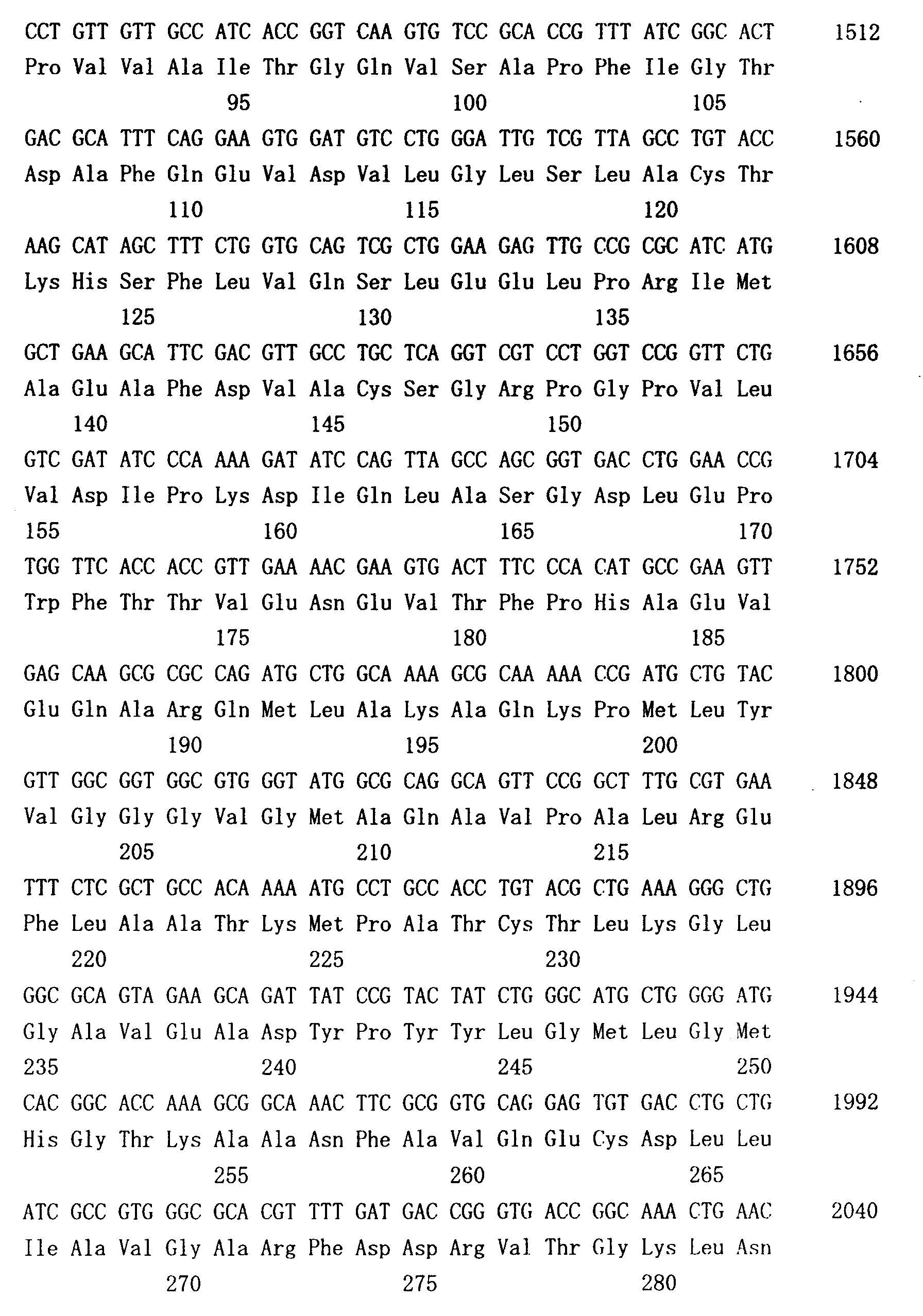

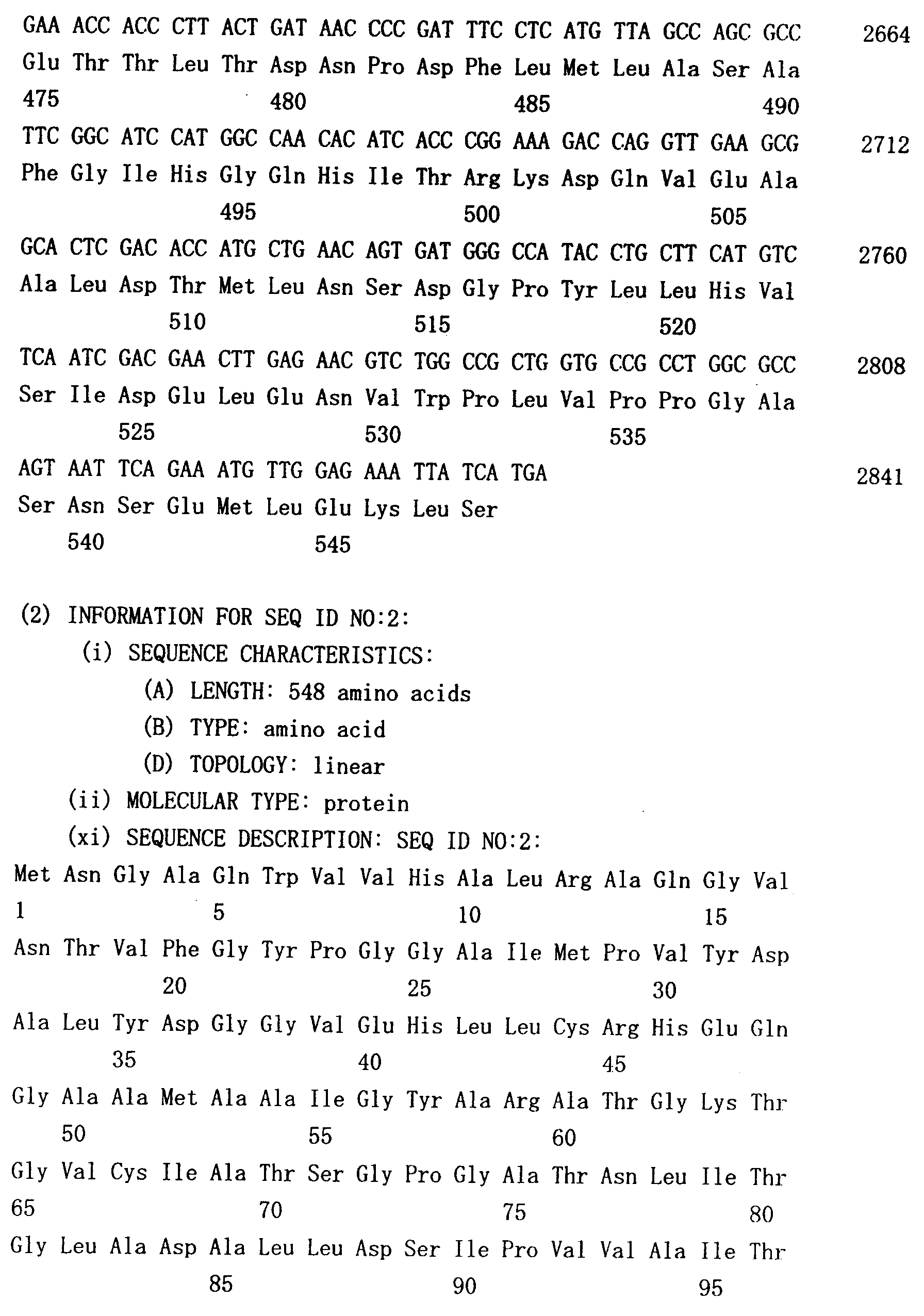


Claims (12)
- A microorganism belonging to the genus Escherichia and having a capability of producing L-valine or L-leucine, which requires lipoic acid for growth.
- A microorganism belonging to the genus Escherichia and having a capability of producing L-valine or L-leucine, which is deficient in H+-ATPase activity.
- A microorganism belonging to the genus Escherichia and having a capability of producing L-valine or L-leucine, which requires lipoic acid for growth and which is deficient in H+-ATPase activity.
- A microorganism according to any one of claims 1 to 3, which has the capability of producing L-valine by carrying a gene for L-valine biosynthesis, of which regulatory mechanism is substantially released.
- A microorganism according to any one of claims 1 to 3, which has the capability of producing L-leucine by carrying a gene for L-leucine biosynthesis, of which regulatory mechanism is substantially released.
- A microorganism according to claim 4, which has the capability of producing L-valine by introducing a DNA fragment including an ilvGMEDA operon which express each of ilvG, ilvM, ilvE and ilvD genes, and does not express threonine deaminase, into a cell.
- A microorganism according to claim 6 wherein a region of the ilvGMEDA operon necessary for attenuation by L-valine and/or L-isoleucine and/or L-leucine is deleted.
- A microorganism according to claim 7 wherein the region necessary for the attenuation which is deleted has nucleotides 953 to 1160 of a sequence shown in SEQ ID NO: 1.
- A microorganism according to any one of claims 1 to 8, which is Escherichia coli.
- A microorganism according to claim 9, which is Escherichia coli W1485atpA401/pMWdAR6, W1485lip2/pMWdAR6 or AJ12631/pMWdAR6.
- A method for producing L-valine which comprises culturing the microorganism having the capability of producing L-valine as defined in any one of claims 1 to 4 and 6 to 9 in a liquid medium to allow L-valine to be produced and accumulated in the medium, and collecting it.
- A method for producing L-leucine which comprises culturing the microorganism having the capability of producing L-leucine as defined in any one of claims 1 to 3, 5 and 9 in a liquid medium to allow L-leucine to be produced and accumulated in the medium, and collecting it.
Applications Claiming Priority (3)
| Application Number | Priority Date | Filing Date | Title |
|---|---|---|---|
| JP204856/94 | 1994-08-30 | ||
| JP20485694 | 1994-08-30 | ||
| PCT/JP1995/001719 WO1996006926A1 (en) | 1994-08-30 | 1995-08-30 | Process for producing l-valine and l-leucine |
Publications (3)
| Publication Number | Publication Date |
|---|---|
| EP0872547A1 true EP0872547A1 (en) | 1998-10-21 |
| EP0872547A4 EP0872547A4 (en) | 2001-05-23 |
| EP0872547B1 EP0872547B1 (en) | 2007-12-26 |
Family
ID=16497536
Family Applications (1)
| Application Number | Title | Priority Date | Filing Date |
|---|---|---|---|
| EP95930006A Expired - Lifetime EP0872547B1 (en) | 1994-08-30 | 1995-08-30 | Process for producing l-valine and l-leucine |
Country Status (6)
| Country | Link |
|---|---|
| US (2) | US5888783A (en) |
| EP (1) | EP0872547B1 (en) |
| JP (1) | JP3709564B2 (en) |
| CN (1) | CN1124340C (en) |
| DE (1) | DE69535674T2 (en) |
| WO (1) | WO1996006926A1 (en) |
Cited By (6)
| Publication number | Priority date | Publication date | Assignee | Title |
|---|---|---|---|---|
| WO2000050624A1 (en) * | 1999-02-22 | 2000-08-31 | Forschungszentrum Jülich GmbH | Method for microbially producing l-valine |
| EP1179597A1 (en) * | 2000-08-11 | 2002-02-13 | Ajinomoto Co., Ltd. | Method for producing threonine and isoleucine |
| WO2002026993A1 (en) * | 2000-09-28 | 2002-04-04 | Archer-Daniels-Midland Company | Escherichia coli strains which over-produce l-threonine and processes for the production of l-threonine by fermentation |
| EP1217069A3 (en) * | 2000-12-20 | 2002-07-03 | Degussa AG | Nucleotide sequences which code for the ilvE gene |
| WO2005049808A1 (en) * | 2003-11-21 | 2005-06-02 | Ajinomoto Co., Inc. | Method for producing l-amino acid by fermentation |
| WO2013151174A1 (en) | 2012-04-02 | 2013-10-10 | Ajinomoto Co.,Inc. | Auto-inducible expression system, and the use thereof for producing useful metabolites using a bacterium of the family enterobacteriaceae |
Families Citing this family (80)
| Publication number | Priority date | Publication date | Assignee | Title |
|---|---|---|---|---|
| JP3709564B2 (en) * | 1994-08-30 | 2005-10-26 | 味の素株式会社 | Process for producing L-valine and L-leucine |
| CA2366520C (en) * | 1999-04-09 | 2013-10-01 | Zoetis Services Llc | Anti-bacterial vaccine compositions |
| US6451564B1 (en) | 1999-07-02 | 2002-09-17 | Massachusetts Institute Of Technology | Methods for producing L-isoleucine |
| US6927046B1 (en) * | 1999-12-30 | 2005-08-09 | Archer-Daniels-Midland Company | Increased lysine production by gene amplification using coryneform bacteria |
| RU2209246C2 (en) | 2000-01-26 | 2003-07-27 | Закрытое акционерное общество "Научно-исследовательский институт Аджиномото-Генетика" | Small subunit of isozyme iii and isozyme iii of acetohydroxyacid synthetase from escherichia coli, dna fragment (variants), strain of bacterium escherichia coli as producer of l-valine (variants) and method for preparing l-valine |
| EP1495127A4 (en) * | 2002-02-20 | 2007-03-21 | Univ Georgia Res Found | MICROBIAL PREPARATION OF PYRUVATE AND OTHER METABOLITES |
| US8278076B2 (en) | 2002-02-20 | 2012-10-02 | University Of Georgia Research Foundation, Inc. | Microbial production of pyruvate and pyruvate derivatives |
| WO2003091396A2 (en) * | 2002-04-23 | 2003-11-06 | Cargill, Incorporated | Polypeptides and biosynthetic pathways |
| RU2243260C2 (en) * | 2002-06-25 | 2004-12-27 | Закрытое акционерное общество "Научно-исследовательский институт Аджиномото-Генетика" | Method for preparing l-leucine (variants), strain escherichia coli 505/pacyc-tyr b as producer of l-leucine |
| EP1528901A1 (en) * | 2002-08-15 | 2005-05-11 | GMP Cardiac Care, Inc. | Stent-graft with rails |
| US7481834B2 (en) * | 2003-04-14 | 2009-01-27 | Tryton Medical, Inc. | Stent for placement at luminal os |
| US8206955B2 (en) | 2003-10-21 | 2012-06-26 | Cargill, Incorporated | Production of monatin and monatin precursors |
| JP2009118740A (en) | 2006-03-03 | 2009-06-04 | Ajinomoto Co Inc | Method for producing l-amino acid |
| EP2351830B1 (en) | 2006-03-23 | 2014-04-23 | Ajinomoto Co., Inc. | A method for producing an L-amino acid using bacterium of the Enterobacteriaceae family with attenuated expression of a gene coding for small RNA |
| JP2009153382A (en) | 2006-03-30 | 2009-07-16 | Ajinomoto Co Inc | Method for producing carboxylic acid using methanol-assimilating bacterium |
| JP2009165355A (en) | 2006-04-28 | 2009-07-30 | Ajinomoto Co Inc | L-amino acid-producing microorganism and method for producing l-amino acid |
| EP2021458A1 (en) | 2006-05-23 | 2009-02-11 | Ajinomoto Co., Inc. | A method for producing an l-amino acid using a bacterium of the enterobacteriaceae family |
| JP2010017082A (en) | 2006-10-10 | 2010-01-28 | Ajinomoto Co Inc | Method for producing l-amino acid |
| EP2426142A3 (en) * | 2006-10-16 | 2012-06-13 | Genelux Corporation | Modified vaccinia virus strains for use in a diagnostic and therapeutic method |
| RU2006143864A (en) | 2006-12-12 | 2008-06-20 | Закрытое акционерное общество "Научно-исследовательский институт Аджиномото-Генетика" (ЗАО АГРИ) (RU) | METHOD FOR PRODUCING L-AMINO ACIDS USING THE BACTERIA OF THE ENTEROBACTERIACEAE FAMILY IN WHICH THE EXPRESSION OF GENES cynT, cynS, cynX, OR cynR, OR THEIR COMBINATION IS DECREASED |
| JP2010041920A (en) | 2006-12-19 | 2010-02-25 | Ajinomoto Co Inc | Method for producing l-amino acid |
| KR100832740B1 (en) | 2007-01-17 | 2008-05-27 | 한국과학기술원 | Mutant microorganism with improved branched chain amino acid production ability and method for producing branched chain amino acid using the same |
| WO2008090770A1 (en) | 2007-01-22 | 2008-07-31 | Ajinomoto Co., Inc. | Microorganism capable of producing l-amino acid, and method for production of l-amino acid |
| JP2010088301A (en) | 2007-02-01 | 2010-04-22 | Ajinomoto Co Inc | Method for production of l-amino acid |
| JP2010110216A (en) | 2007-02-20 | 2010-05-20 | Ajinomoto Co Inc | Method for producing l-amino acid or nucleic acid |
| JP2010110217A (en) | 2007-02-22 | 2010-05-20 | Ajinomoto Co Inc | L-amino acid-producing microorganism and method for producing l-amino acid |
| WO2008150496A2 (en) * | 2007-05-31 | 2008-12-11 | Genelux Corporation | Assay for sensitivity to chemotherapeutic agents |
| JP5213075B2 (en) | 2007-06-15 | 2013-06-19 | ジェネラックス・コーポレイション | Microorganisms for tumor imaging and / or treatment |
| CN101939412B (en) | 2007-09-04 | 2016-01-20 | 味之素株式会社 | Amino acid-producing microorganism and method for producing amino acid |
| RU2396336C2 (en) | 2007-09-27 | 2010-08-10 | Закрытое акционерное общество "Научно-исследовательский институт Аджиномото-Генетика" (ЗАО АГРИ) | METHOD OF PRODUCING AMINO ACIDS USING Escherichia GENUS BACTERIA |
| JP2011067095A (en) | 2008-01-10 | 2011-04-07 | Ajinomoto Co Inc | Method for producing target substance by fermentation process |
| WO2009093703A1 (en) | 2008-01-23 | 2009-07-30 | Ajinomoto Co., Inc. | Method of producing l-amino acid |
| RU2008105793A (en) | 2008-02-19 | 2009-08-27 | Закрытое акционерное общество "Научно-исследовательский институт Аджиномото-Генетика" (ЗАО АГРИ) (RU) | METHOD FOR DESIGNING OPERONS CONTAINING TRANSLATION-CONJUGATED GENES, BACTERIA CONTAINING SUCH OPERON, METHOD FOR PRODUCING USEFUL METABOLITIS AND METHOD FOR EXPRESS MONITORING |
| CN102177246B (en) | 2008-09-08 | 2015-02-11 | 味之素株式会社 | Microorganism producing L-amino acid and production method of L-amino acid |
| WO2010084995A2 (en) | 2009-01-23 | 2010-07-29 | Ajinomoto Co.,Inc. | A method for producing an l-amino acid |
| JPWO2011013707A1 (en) | 2009-07-29 | 2013-01-10 | 味の素株式会社 | Method for producing L-amino acid |
| RU2460793C2 (en) | 2010-01-15 | 2012-09-10 | Закрытое акционерное общество "Научно-исследовательский институт "Аджиномото-Генетика" (ЗАО АГРИ) | Method for producing l-amino acids with use of bacteria of enterobacteriaceae family |
| JP2013074795A (en) | 2010-02-08 | 2013-04-25 | Ajinomoto Co Inc | MUTANT rpsA GENE AND METHOD FOR PRODUCING L-AMINO ACID |
| RU2471868C2 (en) | 2010-02-18 | 2013-01-10 | Закрытое акционерное общество "Научно-исследовательский институт "Аджиномото-Генетика" (ЗАО АГРИ) | Mutant adenylate cyclase, dna coding it, bacteria of enterobacteriaceae family containing said dan and method for preparing l-amino acids |
| RU2501858C2 (en) | 2010-07-21 | 2013-12-20 | Закрытое акционерное общество "Научно-исследовательский институт "Аджиномото-Генетика" (ЗАО АГРИ) | METHOD FOR OBTAINING L-AMINOACID USING BACTERIUM OF Enterobacteriaceae FAMILY |
| RU2482188C2 (en) | 2010-07-21 | 2013-05-20 | Закрытое акционерное общество "Научно-исследовательский институт "Аджиномото-Генетика" (ЗАО АГРИ) | METHOD FOR PREPARING L-ARGININE WITH USE OF BACTERIA OF GENUS Escherichia WHEREIN astCADBE OPERON IS INACTIVATED |
| JP2014036576A (en) | 2010-12-10 | 2014-02-27 | Ajinomoto Co Inc | Method for producing l-amino acids |
| RU2011134436A (en) | 2011-08-18 | 2013-10-27 | Закрытое акционерное общество "Научно-исследовательский институт Аджиномото-Генетика" (ЗАО "АГРИ") | METHOD FOR PRODUCING L-AMINO ACID USING THE ENTEROBACTERIACEAE FAMILY POSSESSING AN INCREASED EXPRESSION OF GENES OF THE CASCADE OF THE FORMATION OF FLAGELLS AND CELL MOBILITY |
| WO2013138522A2 (en) | 2012-03-16 | 2013-09-19 | Genelux Corporation | Methods for assessing effectiveness and monitoring oncolytic virus treatment |
| WO2013158265A1 (en) | 2012-04-20 | 2013-10-24 | Genelux Corporation | Imaging methods for oncolytic virus therapy |
| US10167490B2 (en) | 2012-12-21 | 2019-01-01 | Ergo Health Llc | Ergothioneine production through metabolic engineering |
| KR101721722B1 (en) * | 2013-03-11 | 2017-04-10 | 씨제이제일제당 (주) | A microorganism having enhanced L-valine productivity and a method of producing L-valine using the microorganism |
| EP2978446B1 (en) | 2013-03-27 | 2020-03-04 | The General Hospital Corporation | Anti-cd33 antibody for use in treating alzheimer's disease |
| RU2013118637A (en) | 2013-04-23 | 2014-10-27 | Закрытое акционерное общество "Научно-исследовательский институт Аджиномото-Генетика" (ЗАО "АГРИ") | METHOD FOR PRODUCING L-AMINO ACIDS USING THE BACTERIA OF THE ENTEROBACTERIACEAE FAMILY IN WHICH THE yjjK GENE IS ADJUSTABLE |
| JP2016165225A (en) | 2013-07-09 | 2016-09-15 | 味の素株式会社 | Method for producing useful substance |
| RU2013140115A (en) | 2013-08-30 | 2015-03-10 | Закрытое акционерное общество "Научно-исследовательский институт Аджиномото-Генетика" (ЗАО "АГРИ") | METHOD FOR PRODUCING L-AMINO ACIDS USING THE BACTERIA OF THE Enterobacteriaceae FAMILY IN WHICH THE EXPRESSION OF THE znuACB GENERAL CLUSTER IS DISORDERED |
| JP2016192903A (en) | 2013-09-17 | 2016-11-17 | 味の素株式会社 | Method for manufacturing l-amino acid from biomass derived from seaweed |
| RU2628696C1 (en) | 2013-10-02 | 2017-08-21 | Адзиномото Ко., Инк. | A method for producing basic amino acid (variants) |
| RU2013144250A (en) | 2013-10-02 | 2015-04-10 | Закрытое акционерное общество "Научно-исследовательский институт Аджиномото-Генетика" (ЗАО "АГРИ") | METHOD FOR PRODUCING L-AMINO ACIDS USING THE BACTERIA OF THE Enterobacteriaceae FAMILY IN WHICH THE EXPRESSION OF A GENE CODING A PHOSPHATE TRANSPORTER IS DECREASED |
| EP2886651B1 (en) | 2013-10-21 | 2018-08-22 | Ajinomoto Co., Inc. | Method for producing l-amino acid |
| EP3083658B1 (en) | 2013-12-18 | 2019-05-08 | President and Fellows of Harvard College | Crp capture/detection of gram positive bacteria |
| EP3101130B1 (en) | 2014-01-31 | 2020-05-06 | Ajinomoto Co., Inc. | Mutant glutamate-cysteine ligase and method for manufacturing gamma-glutamyl-valyl-glycine |
| RU2014105547A (en) | 2014-02-14 | 2015-08-20 | Адзиномото Ко., Инк. | METHOD FOR PRODUCING L-AMINO ACIDS USING THE ENTEROBACTERIACEAE FAMILY HAVING A SUPER EXPRESSED GENE yajL |
| RU2015120052A (en) | 2015-05-28 | 2016-12-20 | Аджиномото Ко., Инк. | A method for producing an L-amino acid using a bacterium of the Enterobacteriaceae family in which gshA gene expression is weakened |
| US10435457B2 (en) | 2015-08-06 | 2019-10-08 | President And Fellows Of Harvard College | Microbe-binding molecules and uses thereof |
| CN109121422B (en) | 2016-02-25 | 2021-12-21 | 味之素株式会社 | Method for producing L-amino acids using bacteria of the Enterobacteriaceae family overexpressing genes coding for iron exporters |
| WO2018049261A1 (en) | 2016-09-09 | 2018-03-15 | Icellhealth Consulting Llc | Oncolytic virus expressing immune checkpoint modulators |
| US11492616B2 (en) * | 2016-10-27 | 2022-11-08 | Institute Of Microbiology, Chinese Academy Of Sciences | Method for modifying amino acid attenuator and use of same in production |
| JP7066977B2 (en) | 2017-04-03 | 2022-05-16 | 味の素株式会社 | Manufacturing method of L-amino acid |
| EP3385373A1 (en) | 2017-04-05 | 2018-10-10 | Centro de Neurociências e Biologia Celular | Compositions for reprogramming cells into dendritic cells or antigen presenting cells, methods and uses thereof |
| JP7303743B2 (en) | 2017-04-05 | 2023-07-05 | アスガード セラピューティクス エービー | Compositions, methods and uses thereof for reprogramming cells into dendritic cells or antigen-presenting cells |
| CN108517328A (en) * | 2017-12-14 | 2018-09-11 | 天津科技大学 | Fe2+With the screening technique and isoleucine hydroxylase of α-ketoglutaric acid dependent form hydroxylase |
| JP7124338B2 (en) | 2018-02-27 | 2022-08-24 | 味の素株式会社 | Method for producing mutant glutathione synthase and γ-glutamylvalylglycine |
| JP7601774B2 (en) * | 2018-10-04 | 2024-12-17 | アンナ・ユニバーシティ | Production of L-2-aminobutyric acid from citramalic acid, citraconic acid or 2-oxobutyric acid |
| WO2020071538A1 (en) | 2018-10-05 | 2020-04-09 | Ajinomoto Co., Inc. | Method for producing target substance by bacterial fermentation |
| EP3876966A4 (en) | 2018-11-09 | 2022-07-27 | The Children's Medical Center Corporation | METHODS AND COMPOSITIONS FOR THE TREATMENT OR PREVENTION OF THE DEVELOPMENT OF FOOD ALLERGIES |
| WO2020171227A1 (en) | 2019-02-22 | 2020-08-27 | Ajinomoto Co., Inc. | METHOD FOR PRODUCING L-AMINO ACIDS USING A BACTERIUM BELONGING TO THE FAMILY Enterobacteriaceae HAVING OVEREXPRESSED ydiJ GENE |
| US20220152098A1 (en) | 2019-03-01 | 2022-05-19 | Achelois Biopharma, Inc. | Methods of modulating cd160 function in the antigen-specific immune cell and uses thereof |
| JP7524909B2 (en) | 2019-04-05 | 2024-07-30 | 味の素株式会社 | Method for producing L-amino acids |
| JP7655312B2 (en) | 2019-09-25 | 2025-04-02 | 味の素株式会社 | Method for producing L-amino acids by bacterial fermentation |
| CN110982772B (en) * | 2019-12-26 | 2024-03-12 | 新疆梅花氨基酸有限责任公司 | Corynebacterium capable of producing valine at high yield and construction method and application thereof |
| CN117062611A (en) | 2021-01-26 | 2023-11-14 | 惠和生物技术(上海)有限公司 | Chimeric Antigen Receptor (CAR) constructs and NK cells expressing the CAR constructs |
| KR20240105456A (en) * | 2021-11-17 | 2024-07-05 | 메타볼릭 익스플로러 | Microorganisms and methods for improved production of valine |
| CN119012914A (en) | 2022-04-04 | 2024-11-22 | 味之素株式会社 | Method for controlling parasitic plants |
| WO2025232879A1 (en) | 2024-05-10 | 2025-11-13 | Cytocares (Shanghai) Inc. | Anti-lilrb2 monospecific and bispecific antibody constructs and uses thereof |
Family Cites Families (6)
| Publication number | Priority date | Publication date | Assignee | Title |
|---|---|---|---|---|
| JPS61185195A (en) * | 1985-02-13 | 1986-08-18 | Mitsui Toatsu Chem Inc | Production of amino acid |
| AU6737287A (en) * | 1985-11-12 | 1987-06-02 | American Biogenetics Corporation | Biogenetic cassette |
| JP3237134B2 (en) * | 1991-04-30 | 2001-12-10 | 味の素株式会社 | Microorganism having amino acid producing ability and method for producing amino acid using said microorganism |
| EP0519113A1 (en) * | 1991-06-21 | 1992-12-23 | Ajinomoto Co., Inc. | Bacterial strains having high productivity of an amino acid and method of constructing these strains |
| JP2692457B2 (en) * | 1991-11-18 | 1997-12-17 | 味の素株式会社 | Production of pyruvate by fermentation |
| JP3709564B2 (en) * | 1994-08-30 | 2005-10-26 | 味の素株式会社 | Process for producing L-valine and L-leucine |
-
1995
- 1995-08-30 JP JP50832796A patent/JP3709564B2/en not_active Expired - Lifetime
- 1995-08-30 CN CN95195879A patent/CN1124340C/en not_active Expired - Lifetime
- 1995-08-30 WO PCT/JP1995/001719 patent/WO1996006926A1/en not_active Ceased
- 1995-08-30 EP EP95930006A patent/EP0872547B1/en not_active Expired - Lifetime
- 1995-08-30 DE DE69535674T patent/DE69535674T2/en not_active Expired - Lifetime
- 1995-08-30 US US08/793,441 patent/US5888783A/en not_active Expired - Lifetime
-
1999
- 1999-01-14 US US09/231,061 patent/US6214591B1/en not_active Expired - Lifetime
Non-Patent Citations (2)
| Title |
|---|
| No further relevant documents disclosed * |
| See also references of WO9606926A1 * |
Cited By (13)
| Publication number | Priority date | Publication date | Assignee | Title |
|---|---|---|---|---|
| DE19907567B4 (en) * | 1999-02-22 | 2007-08-09 | Forschungszentrum Jülich GmbH | Process for the microbial production of L-valine |
| WO2000050624A1 (en) * | 1999-02-22 | 2000-08-31 | Forschungszentrum Jülich GmbH | Method for microbially producing l-valine |
| US7632663B1 (en) | 1999-02-22 | 2009-12-15 | Forschungszentrum Julich Gmbh | Method for microbially producing L-valine |
| EP1179597A1 (en) * | 2000-08-11 | 2002-02-13 | Ajinomoto Co., Ltd. | Method for producing threonine and isoleucine |
| KR100823044B1 (en) * | 2000-08-11 | 2008-04-17 | 아지노모토 가부시키가이샤 | Method for preparing threonine and isoleucine |
| US7687253B2 (en) | 2000-09-28 | 2010-03-30 | Archer-Daniels-Midland Company | Escherichia coli strains which over-produce L-threonine and processes for the production of L-threonine by fermentation |
| US7220571B2 (en) | 2000-09-28 | 2007-05-22 | Archer-Daniels-Midland Company | Escherichia coli strains which over-produce L-threonine and processes for the production of L-threonine by fermentation |
| WO2002026993A1 (en) * | 2000-09-28 | 2002-04-04 | Archer-Daniels-Midland Company | Escherichia coli strains which over-produce l-threonine and processes for the production of l-threonine by fermentation |
| US7767431B2 (en) | 2000-09-28 | 2010-08-03 | Archer-Daniels-Midland Company | Escherichia coli strains which over-produce L-threonine and processes for the production of L-threonine by fermentation |
| US8101386B2 (en) | 2000-09-28 | 2012-01-24 | Archer Daniels Midland Company | Escherichia coli strains which over-produce L-threonine and processes for the production of L-threonine by fermentation |
| EP1217069A3 (en) * | 2000-12-20 | 2002-07-03 | Degussa AG | Nucleotide sequences which code for the ilvE gene |
| WO2005049808A1 (en) * | 2003-11-21 | 2005-06-02 | Ajinomoto Co., Inc. | Method for producing l-amino acid by fermentation |
| WO2013151174A1 (en) | 2012-04-02 | 2013-10-10 | Ajinomoto Co.,Inc. | Auto-inducible expression system, and the use thereof for producing useful metabolites using a bacterium of the family enterobacteriaceae |
Also Published As
| Publication number | Publication date |
|---|---|
| DE69535674D1 (en) | 2008-02-07 |
| EP0872547B1 (en) | 2007-12-26 |
| US5888783A (en) | 1999-03-30 |
| EP0872547A4 (en) | 2001-05-23 |
| DE69535674T2 (en) | 2009-01-02 |
| JP3709564B2 (en) | 2005-10-26 |
| CN1124340C (en) | 2003-10-15 |
| US6214591B1 (en) | 2001-04-10 |
| WO1996006926A1 (en) | 1996-03-07 |
| CN1162976A (en) | 1997-10-22 |
Similar Documents
| Publication | Publication Date | Title |
|---|---|---|
| US5888783A (en) | Methods for producing L-valine and L-leucine | |
| JPWO1996006926A1 (en) | Method for producing L-valine and L-leucine | |
| EP0685555B1 (en) | L-Isoleucine producing bacterium and method for preparing L-Isoleucine through fermentation | |
| EP1526179B9 (en) | Method for producing l-amino acid using bacteria belonging to the genus escherichia | |
| RU2201454C2 (en) | Mutant alpha-isopropylmalate synthase (ipms), dna encoding mutant ipms, method of preparing escherichia coli strain, method of l-leucine preparing | |
| EP1942183B1 (en) | A mutant acetolactate synthase and a method for producing branched-chain L-amino acids | |
| JP5287904B2 (en) | Production method of target substances | |
| JP4088982B2 (en) | Method for producing L-amino acid by fermentation | |
| EP2977443B1 (en) | Microorganisms having putrescine productivity and process for producing putrescine using the same | |
| EP0877090A1 (en) | Process for producing l-amino acids | |
| JP2002051787A (en) | Method of production for threonine and isoleucine | |
| EP2834360B1 (en) | Auto-inducible expression system, and the use thereof for producing useful metabolites using a bacterium of the family enterobacteriaceae | |
| JP4314897B2 (en) | Method for producing L-leucine | |
| JP3975470B2 (en) | Method for producing L-isoleucine by fermentation | |
| EP1510582A1 (en) | Method for producing L-amino acid using bacterium of Enterobacteriaceae family, having nir operon inactivated | |
| Sycheva et al. | Overproduction of noncanonical amino acids by Escherichia coli cells | |
| JP4582573B2 (en) | Method for producing pyruvic acid and method for producing L-valine | |
| RU2215784C2 (en) | Method for preparing l amino acids, strain escherichia coli as producer of l-amino acid (variants) | |
| JP4742521B2 (en) | Production method of target substances | |
| CN121136890A (en) | Escherichia coli microorganisms with enhanced L-isoleucine production capacity and methods for producing L-isoleucine using them. |
Legal Events
| Date | Code | Title | Description |
|---|---|---|---|
| PUAI | Public reference made under article 153(3) epc to a published international application that has entered the european phase |
Free format text: ORIGINAL CODE: 0009012 |
|
| 17P | Request for examination filed |
Effective date: 19970227 |
|
| AK | Designated contracting states |
Kind code of ref document: A1 Designated state(s): DE FR GB IT |
|
| A4 | Supplementary search report drawn up and despatched |
Effective date: 20010405 |
|
| AK | Designated contracting states |
Kind code of ref document: A4 Designated state(s): DE FR GB IT |
|
| 17Q | First examination report despatched |
Effective date: 20020408 |
|
| GRAP | Despatch of communication of intention to grant a patent |
Free format text: ORIGINAL CODE: EPIDOSNIGR1 |
|
| RIC1 | Information provided on ipc code assigned before grant |
Ipc: C12P 13/06 20060101ALI20070806BHEP Ipc: C12P 13/08 20060101ALI20070806BHEP Ipc: C12N 1/20 20060101ALI20070806BHEP Ipc: C12N 1/21 20060101AFI20070806BHEP |
|
| GRAS | Grant fee paid |
Free format text: ORIGINAL CODE: EPIDOSNIGR3 |
|
| GRAA | (expected) grant |
Free format text: ORIGINAL CODE: 0009210 |
|
| AK | Designated contracting states |
Kind code of ref document: B1 Designated state(s): DE FR GB IT |
|
| REG | Reference to a national code |
Ref country code: GB Ref legal event code: FG4D |
|
| REF | Corresponds to: |
Ref document number: 69535674 Country of ref document: DE Date of ref document: 20080207 Kind code of ref document: P |
|
| PLBE | No opposition filed within time limit |
Free format text: ORIGINAL CODE: 0009261 |
|
| STAA | Information on the status of an ep patent application or granted ep patent |
Free format text: STATUS: NO OPPOSITION FILED WITHIN TIME LIMIT |
|
| 26N | No opposition filed |
Effective date: 20080929 |
|
| PGFP | Annual fee paid to national office [announced via postgrant information from national office to epo] |
Ref country code: DE Payment date: 20140827 Year of fee payment: 20 |
|
| PGFP | Annual fee paid to national office [announced via postgrant information from national office to epo] |
Ref country code: GB Payment date: 20140827 Year of fee payment: 20 Ref country code: FR Payment date: 20140808 Year of fee payment: 20 |
|
| PGFP | Annual fee paid to national office [announced via postgrant information from national office to epo] |
Ref country code: IT Payment date: 20140819 Year of fee payment: 20 |
|
| REG | Reference to a national code |
Ref country code: DE Ref legal event code: R071 Ref document number: 69535674 Country of ref document: DE |
|
| REG | Reference to a national code |
Ref country code: GB Ref legal event code: PE20 Expiry date: 20150829 |
|
| PG25 | Lapsed in a contracting state [announced via postgrant information from national office to epo] |
Ref country code: GB Free format text: LAPSE BECAUSE OF EXPIRATION OF PROTECTION Effective date: 20150829 |