EP0886661B1 - Compositions durcissables a base de resine epoxy contenant des durcisseurs polyamines susceptibles de subir un traitement a l'eau - Google Patents
Compositions durcissables a base de resine epoxy contenant des durcisseurs polyamines susceptibles de subir un traitement a l'eau Download PDFInfo
- Publication number
- EP0886661B1 EP0886661B1 EP97908154A EP97908154A EP0886661B1 EP 0886661 B1 EP0886661 B1 EP 0886661B1 EP 97908154 A EP97908154 A EP 97908154A EP 97908154 A EP97908154 A EP 97908154A EP 0886661 B1 EP0886661 B1 EP 0886661B1
- Authority
- EP
- European Patent Office
- Prior art keywords
- formula
- composition according
- curable composition
- polyamine
- integer
- Prior art date
- Legal status (The legal status is an assumption and is not a legal conclusion. Google has not performed a legal analysis and makes no representation as to the accuracy of the status listed.)
- Expired - Lifetime
Links
- 0 CCC(*)(CC)N Chemical compound CCC(*)(CC)N 0.000 description 2
Classifications
-
- C—CHEMISTRY; METALLURGY
- C08—ORGANIC MACROMOLECULAR COMPOUNDS; THEIR PREPARATION OR CHEMICAL WORKING-UP; COMPOSITIONS BASED THEREON
- C08G—MACROMOLECULAR COMPOUNDS OBTAINED OTHERWISE THAN BY REACTIONS ONLY INVOLVING UNSATURATED CARBON-TO-CARBON BONDS
- C08G59/00—Polycondensates containing more than one epoxy group per molecule; Macromolecules obtained by polymerising compounds containing more than one epoxy group per molecule using curing agents or catalysts which react with the epoxy groups
- C08G59/18—Macromolecules obtained by polymerising compounds containing more than one epoxy group per molecule using curing agents or catalysts which react with the epoxy groups ; e.g. general methods of curing
- C08G59/182—Macromolecules obtained by polymerising compounds containing more than one epoxy group per molecule using curing agents or catalysts which react with the epoxy groups ; e.g. general methods of curing using pre-adducts of epoxy compounds with curing agents
- C08G59/184—Macromolecules obtained by polymerising compounds containing more than one epoxy group per molecule using curing agents or catalysts which react with the epoxy groups ; e.g. general methods of curing using pre-adducts of epoxy compounds with curing agents with amines
-
- C—CHEMISTRY; METALLURGY
- C08—ORGANIC MACROMOLECULAR COMPOUNDS; THEIR PREPARATION OR CHEMICAL WORKING-UP; COMPOSITIONS BASED THEREON
- C08G—MACROMOLECULAR COMPOUNDS OBTAINED OTHERWISE THAN BY REACTIONS ONLY INVOLVING UNSATURATED CARBON-TO-CARBON BONDS
- C08G59/00—Polycondensates containing more than one epoxy group per molecule; Macromolecules obtained by polymerising compounds containing more than one epoxy group per molecule using curing agents or catalysts which react with the epoxy groups
- C08G59/18—Macromolecules obtained by polymerising compounds containing more than one epoxy group per molecule using curing agents or catalysts which react with the epoxy groups ; e.g. general methods of curing
- C08G59/40—Macromolecules obtained by polymerising compounds containing more than one epoxy group per molecule using curing agents or catalysts which react with the epoxy groups ; e.g. general methods of curing characterised by the curing agents used
- C08G59/4007—Curing agents not provided for by the groups C08G59/42 - C08G59/66
- C08G59/4014—Nitrogen containing compounds
-
- C—CHEMISTRY; METALLURGY
- C08—ORGANIC MACROMOLECULAR COMPOUNDS; THEIR PREPARATION OR CHEMICAL WORKING-UP; COMPOSITIONS BASED THEREON
- C08K—Use of inorganic or non-macromolecular organic substances as compounding ingredients
- C08K5/00—Use of organic ingredients
- C08K5/0008—Organic ingredients according to more than one of the "one dot" groups of C08K5/01 - C08K5/59
- C08K5/0025—Crosslinking or vulcanising agents; including accelerators
Definitions
- the present invention relates to curable compositions comprising an epoxy resin and specific water-processable polyamine hardeners and optional further customary additives, to the use thereof for the preparation of moulded articles, in particular of coatings, as well as to the cured moulded articles and coatings, and also to specific polyamine hardeners.
- Polyamidoamines which contain free amino groups and which can be prepared from polyalkylene polyamines and polymerised unsaturated natural fatty acids, can be used for curing epoxy resins [see Lee & Neville "Handbook of Epoxy Resins", McGraw-Hill Book Co., New York 1967, chapter 10, pages 1 - 12].
- US Patent 3 280 054 discloses that it is possible to cure epoxy resins, in the absence of water, with adducts which are formed from polyamidoamines and polyepoxides.
- German Offenlegungsschrift 1 520 918 proposes to use exactly these adducts and epoxy resins to prepare curable aqueous dispersions. It has been found, however, that the products so obtained often do not meet the requirements; in some cases, for example, the adducts, in particular the adducts prepared from aromatic polyepoxides, are semi-solid and are therefore not completely dispersible in aqueous medium, while aqueous dispersions comprising an aromatic epoxy resin and an adduct prepared from an aliphatic polyepoxide often show undesirable thixotropic behaviour.
- US Patent 3 383 347 proposes using phenol-modified amines as curing agents, which can be obtained as reaction products of a primary amino group of an aliphatic polyamine with a phenol and, where appropriate, of an aldehyde.
- the epoxy resin hardener emulsions obtained therewith have a short processing time and give very brittle coatings.
- German Offenlegungsschrift 1 925 941 discloses epoxy resin hardener emulsions which comprise as hardener component an aminoamide adduct of an aminoamide consisting of an alkylene polyamine and a fatty acid. These emulsions are instable and often precipitate water already during the processing period. The relatively soft coatings prepared therefrom are susceptible to mechanical stress and are therefore unsuitable for the preparation of resistant protective coatings.
- Swiss patent 487 955 proposes the use of aqueous dispersions which preferably additionally contain an accelerator for curing.
- the coatings prepared therewith are also relatively soft and are therefore only limitedly suited to, inter alia, mechanical stress.
- polyamine-terminated water-based polyamine hardeners such as those described in US patent 4 197 389
- aqueous formulations comprising specific diaminocyclohexane adducts and epoxy resins have a drastically prolonged working life compared to formulations comprising customary polyamine adducts such as aliphatic or cycloaliphatic amine adducts or mixtures of meta-xylylenediamine/isophoronediamine adducts.
- customary polyamine adducts such as aliphatic or cycloaliphatic amine adducts or mixtures of meta-xylylenediamine/isophoronediamine adducts.
- this invention relates to curable compositions comprising:
- Preferred ratios of components a) and b) are 40 to 90 % by weight of component a) to 60 to 10 % by weight of component b).
- Component c) is conveniently used in an amount of at most 30 % by weight, preferably from 5 to 20 % by weight, based on component b).
- the phenyl radicals can also be substituted by C 1 -C 12 alkyl or halogen atoms, preferably chloro or bromo.
- compositions of this invention with water-based epoxy resins have, at comparable NH-active equivalent weight (HAV for short), a substantially prolonged working life while having comparable curing properties.
- HAV NH-active equivalent weight
- novel polyamine hardener component b) can usefully also be additionally modified by partiallly blending the component b) with a reaction product consisting of an adduct of the above formula A with a monoalkyl ether, e.g. ethylcarbitol, or with a secondary amine, such as di-n-butylamine, such that the viscosity of the novel adduct can be adjusted or reduced as desired.
- Component b) conveniently comprises up to 20 mol% of the component b) modified in this manner.
- the monoalkyl ether conforms to formula XIII wherein t is an integer from 2 to 4, s is an integer from 1 to 5, and R 3 is C 1 -C 6 alkyl, C 6 -C 10 aryl or C 7 -C 11 aralkyl.
- Preferred compounds are those of formula XIII, wherein t is an integer from 2 to 3, s is an integer from 1 to 4, and R 3 is C 1 -C 6 alkyl or C 6 -C 10 aryl.
- Particularly preferred compounds are those of formula XIII, wherein t is an integer from 2 to 3, s is an integer from 1 to 3, and R 3 is C 1 -C 6 alkyl.
- Monoalkyl ethers of formula (XIII) are very particularly preferably polyethylene glycol monoalkyl ethers, polypropylene glycol monoalkyl ethers and polybutylene glycol monoalkyl ethers, in particular polyethylene glycol monoalkyl ether and polypropylene glycol monoalkyl ether, more preferably polyethylene glycol monomethyl ether, polypropylene glycol monomethyl ether, polyethylene glycol monoethyl ether and polypropylene glycol monoethyl ether.
- Suitable secondary amines have the general formula XIV: wherein R 4 and R 5 are each independently of the other C 1 -C 18 alkyl, C 6 -C 10 aryl, C 7 -C 11 -aralkyl or, taken together, -(CH 2 ) 4 -, -(CH 2 ) 5 - or -(CH 2 ) 2 -O-(CH 2 ) 2 -.
- the secondary amines may additionally be functionalised, e.g. with hydroxyl groups; a typical example is diethanolamine.
- Particularly preferred compounds are those of formula XIV, wherein R 4 and R 5 are each independently of the other C 1 -C 10 alkyl or C 6 -C 10 aryl.
- Very particularly preferred compounds are those of formula XIV, wherein R 4 and R 5 are each independently of the other C 1 -C 6 alkyl, but preferably di-n-butylamine, di(n-propyl)-amine, di(isopropyl)amine and di(isobutyl)amine.
- Mixtures of the above monoalkyl ethers or of the secondary amines can also be used.
- Alkyl containing up to 18 carbon atoms referring to R 2 (up to C 12 ), R 3 (up to C 6 ), R 4 and R 5 in formulae XIII and XIV is a branched or straight-chain radical, typically methyl, ethyl, propyl, isopropyl, n-butyl, sec-butyl, isobutyl, tert-butyl, 2-ethylbutyl, n-pentyl, isopentyl, 1-methylpentyl, 1,3-dimethylbutyl, n-hexyl, 1-methylhexyl, n-heptyl, isoheptyl, 1,1,3,3-tetramethylbutyl, 1-methylheptyl, 3-methylheptyl, n-octyl, 2-ethylhexyl, 1,1,3-trimethylhexyl, 1,1,3,3-tetramethylpentyl, nonyl, dec
- R 3 and R 4 /R 5 defined as C 6 -C 10 aryl typically include phenyl, methylphenyl (tolyl), dimethylphenyl (xylyl), trimethylphenyl (mesityl), ethylphenyl, propylphenyl, butylphenyl or naphthyl.
- R 4 and R 5 defined as C 7 -C 11 aralkyl typically include benzyl, ⁇ -methylbenzyl, ⁇ , ⁇ -dimethylbenzyl or 2-phenylethyl, 2-methylbenzyl, 3-methylbenzyl, 4-methylbenzyl, 2,4-dimethylbenzyl, 2,6-dimethylbenzyl or 4-tert-butylbenzyl.
- Epoxy resin a may, in principle, be any epoxy resin customarily used for application.
- epoxy resins used as component a) are:
- epoxy resins in which the 1,2-epoxy groups are attached to different hetero atoms or functional groups.
- These compounds typically comprise the N,N,O-triglycidyl derivative of 4-aminophenol, the glycidyl ether-glycidyl ester of salicylic acid, N-glycidyl-N'-(2-glycidyloxypropyl)-5,5-dimethylhydantoin or 2-glycidyloxy-1,3-bis-(5,5-dimethyl-1-glycidylhydantoin-3-yl)propane.
- epoxy resins having an epoxy content of 1 to 10 equivalents/kg, which are glycidyl ethers, glycidyl esters or N-glycidyl derivatives of aromatic, heterocyclic, cycloaliphatic or aliphatic compounds.
- the epoxy resins used are preferably liquid, i.e. they are either liquid resins or liquid mixtures of solid and liquid resins, or they are obtained as dispersions in water, if required together with small amounts of organic solvents.
- epoxy resins are polyglycidyl ethers of novolaks, more preferably of bisphenols, typically of 2,2-bis(4-hydroxyphenyl)propane (bisphenol A) or bis(4-hydroxyphenyl)methane (bisphenol F).
- Very particularly preferred epoxy resins are diglycidyl ethers of bisphenol A or bisphenol F, and also epoxy novolaks.
- Component b) in the novel compositions are the water-processable polyamine hardeners of formula I, wherein the polyamine hardener is soluble in water as solvent or may be dissolved in water by the addition of small amounts of water-soluble organic solvents.
- the above formula I is an idealised structural formula and corresponds to the main component of those structures which are obtained in the preparation of these polyamine hardeners.
- the compounds of formula I are prepared by per se known methods in a two-step process where, in a first step, a polyether polyol of formula XI is reacted with a polyepoxide conveniently at elevated temperature to the adduct of formula A (e.g. in accordance with EP-A-0 000 605), wherein R' and n have the meanings cited above.
- Elevated temperature usefully means e.g. a temperature range from 120 to 160°C.
- An epoxy compound having a molar excess from about 2 to 10 per mol of polyether polyol is conveniently used.
- An inert organic solvent may optionally also be used.
- All customary polyepoxy resins within the meaning of above formula A can be employed for the adduction reaction.
- Particularly preferred are the polyglycidyl ethers of polyvalent phenols, typically of 2,2-bis(4-hydroxyphenyl)propane (bisphenol A) or bis(4-hydroxyphenyl)methane (bisphenol F) or of novolaks, or of aliphatic polyols, preferably of straight-chain terminal diols, typically butanediol or hexanediol.
- Polyether polyols of formula XI are the following conventional components of the technology (see Ullmanns Encyclomann der ischen Chemie, 4. Ed., Vol. 19, Verlag Chemie GmbH, Weinheim 1980, pages 31 - 38 and pages 304, 305). They can be obtained, for example, by reaction of a starter with alkylene oxides, typically with ethylene oxide or propylene oxide. Suitable starters are all starters usually suitable for the preparation of polyether polyols having a functionality of 2 to 4, for example water, aliphatic, cycloaliphatic or aromatic polyhydroxy compounds having 2 to 4 hydroxyl groups, such as ethylene glycol, propylene glycol.
- Preferred polyether polyols are those based on ethylene oxide and/or propylene oxide, the ethylene/propylene oxide copolymers being randomly distributed or block copolymers.
- the ratio of ethylene oxide to propylene oxide can vary within wide limits. It is, for example, possible that only the terminal hydroxyl groups of the polyether polyols are reacted with ethylene oxide (end capping).
- the ethylene oxide units content of the polyether polyols suitable for component b) can also have values of e.g. up to 75 or 80 %. It will usually be convenient for the polyether polyols to be end-capped at least with ethylene oxide, because they will then have terminal primary hydroxyl groups which are more reactive towards the epoxy components used than the secondary hydroxyl groups obtained from the reaction with propylene oxide.
- the condensate of formula A so obtained is then reacted in a second step with an amine of the above formula XII [optionally with the addition of a less than stoichiometric amount of a monofunctional alcohol (monoalkyl ether of formula (XIII) or of a secondary amine of formula (XIV) for the modification of component b)], with heating, to the component of formula I and, where required, the resulting mixture is diluted with water.
- these compounds are usually obtained as mixtures.
- the reaction may be carried out e.g. in the temperature range from 40 to 120°C, optionally in the presence of an inert organic solvent. It is convenient to use a c. 1-10-fold molar excess of diamine of formula XII per mol of condensate A.
- diaminocyclohexane derivatives of formula XII are the following:
- Typical examples of amines of formula XII are: 1,2-, 1,3- and 1,4-diaminocyclohexane, 1,3-diamino-2-methyl- or -4-methylcyclohexane.
- the compounds of formula I are novel compounds.
- Preferred compounds are those of formula I wherein R 2 is -H or -CH 3 , and p is 1, and m, depending on the functionality of unit B, is an integer from 1 to 5, and n is an integer from 4 to 25, and B has the meanings stated above.
- polyamine hardeners of formula I wherein R 2 is -H, and p is 1, and the two amino groups are in ortho-position to each other, or R 2 is -CH 3 , and p is 1, and the two amino groups are in meta-position to each other, the radicals B are independently of one another a group of formulae II, III, IV and V or of formula VI -O-(CH 2 ) r -O-, wherein r is an integer from 2 to 10, and R and q have the meanings stated above.
- polyamine hardeners of formula I wherein R 2 is -H, and p is 1, and the two amino groups are in ortho-position to each other, and the radicals B have the meaning stated above, q in formula V being 0 to 3, and r in formula VI being 4 or 6.
- the novel compositions may comprise as further component c) additives of aliphatic, cycloaliphatic, aromatic/aliphatic, aromatic or heteroaromatic mono- or polyamines.
- additives of aliphatic, cycloaliphatic, aromatic/aliphatic, aromatic or heteroaromatic mono- or polyamines serve to modify the performance properties of the novel polyamine adducts of formula I.
- the reactivity/ working life profile of the novel hardeners as compared to the epoxy resin component a) can be adjusted by the addition of more reactive polyamines to the adduct of formula I.
- adduct A polyepoxy/polyether polyol
- diaminocyclohexane derivative of formula XII is complete and before water is added to the novel component b).
- Mono- or polyamines which may optionally be modified by adduction are, for example, reaction products with monoepoxy resins, Michael condensates addition products using unsaturated compounds, typically acrylonitrile, or reaction products of the mono- or polyamines with monocarboxylic acids.
- the amount of component d) depends on the respective embodiment of this invention and can therefore be completely variable, e.g. from 0 to 98 % by weight, based on the total weight of components a), b), c) and d).
- Extenders, fillers, reinforcing agents such as coal tar, bitumen, textile fibres, glass fibres, asbestos fibres, boron fibres, carbon fibres, mineral silicates, mica, quartz powder, aluminium oxide hydrate, bentonite, wollastonite, kaolin, silica aerogel or metal powders, e.g. aluminium powder or iron powder, and also pigments or pigment pastes, and colourants, such as carbon black, oxide colours and titanium dioxide, flame retardants, thixotropic agents, flow control agents, such as silicones, waxes and stearates, some of which are also used as demoulding agents; antifoams, reactive thinners, plasticisers, antioxidants and light stabilisers.
- reinforcing agents such as coal tar, bitumen, textile fibres, glass fibres, asbestos fibres, boron fibres, carbon fibres, mineral silicates, mica, quartz powder, aluminium oxide hydrate, bentonite, wollastonite,
- novel compositions can be used as synergistic mixtures in combination with an accelerator of formulae M + X - or M 2+ X - 2 , wherein M + and M n+ are an alkali metal ion or alkaline earth metal ion, and X - is any inorganic and/or organic anion, provided that these accelerators are soluble in the composition.
- an accelerator of formulae M + X - or M 2+ X - 2 wherein M + and M n+ are an alkali metal ion or alkaline earth metal ion, and X - is any inorganic and/or organic anion, provided that these accelerators are soluble in the composition.
- Such metal salt accelerators are known, inter alia, from EP-A-0 471 988, where they are proposed for accelerating the curing of epoxy resin systems.
- accelerators may also be used in a 10 - 90 % blend with polyether polyol-containing polyamines, such as the commercially available ®Jeffamines of the ED/D- or T-type [supplied by Texaco Chemical Co.].
- Polyether polyol-containing polyamines such as the commercially available ®Jeffamines of the ED/D- or T-type [supplied by Texaco Chemical Co.].
- Polyalkylene oxide is typically polyethylene oxide or polypropylene oxide.
- Preferred synergistic mixtures are those, wherein the alkali metal cation or alkaline earth metal cation is lithium or magnesium and/or calcium, and the anion is X - perchlorate, nitrate, laurylsulfate, acetate or iodide.
- Very particularly preferred synergistic mixtures are those, wherein the alkali metal ion is Li + , the alkaline earth metal cation M 2+ is calcium or magnesium, and the anion X - is nitrate or perchlorate. M 2+ is particularly preferably calcium, and X - is particularly preferably nitrate.
- the metal salt accelerators are normally used in a concentration from 0.1 to 10 % by weight, preferably from 1 to 6 % by weight, based on the solids content of the polyamine hardener of formula I.
- these metal salt accelerators can also have a favourable influence on the surface aspect, e.g. the gloss.
- compositions can be carried out in conventional manner, typically by mixing the components of the compositions by manual stirring or by stirring with known mixing units or dispersion aids (stirrers, kneaders, rolls, ball mills, toothed disks, and the like).
- novel compositions are suitable, for example, for the preparation of matrix systems, laminates, paints, primers, coatings, finishings, fillers, knife fillers, sealing and injection compounds, immersion resins and casting resins, adhesives, and the like, as well as for the modification of concretes, mortars, and the like, and/or as adhesion promoters on concretes, plastic materials, woods, natural and synthetic fibres, papers, and the like. They are particularly suitable for the preparation of moulded articles and coatings.
- compositions are conveniently carried out in the temperature range from -5 to 200 °C, preferably from 5 to 120 °C.
- the cure can be carried out in per se known manner in one or several steps. It is usually carried out at ambient temperature or by heating the composition to temperatures in the range from e.g. 30 to 120°C, particularly preferably from 35 to 100 °C. Owing to the mentioned excellent properties of the novel compositions, a very wide range of different performance problems can be solved.
- the invention also relates to crosslinked products obtainable by curing the novel compositions.
- a specific amount of a polyether polyol and a polyepoxy compound is dissolved, with vigourous stirring, in an inert gas atmosphere.
- the mixture is heated to a temperature of 100°C in the vessel and charged with a specific amount of a BF 3 ⁇ EtNH 2 catalyst (see mol amounts in the Examples).
- the temperature in the vessel is elevated, with vigorous stirring, to the range from 120 to 180°C and the reaction mixture is kept at this temperature until the desired epoxy value of the product is obtained.
- a specific amount (based on the intermediate of formula A) of 1,2-diaminocyclohexane or 1,3-diamino-4-methylcyclohexane (as indicated in the Examples) is placed in a reactor in an inert gas atmosphere at a bath temperature of 40°C and then, with stirring, the intermediate (described in the Examples) is added in the respective amounts such that the exothermic reaction is kept at 40-50°C.
- the reaction mixture is kept at this temperature for 1 - 2 hours and subsequently the temperature in the reactor is raised for 1 hour to 100°C.
- the product is adjusted with a specific amount of water to a solids content of 70 - 80 % by weight (see Examples 11 to 19).
- a specific amount of diaminocyclohexane is placed in a reactor in an inert gas atmosphere at a bath temperature of 90°C and then, with stirring, the intermediate of Example 9 or 10 dissolved in toluene is added, such that the exothermic reaction is kept at a temperature of 90°C in the vessel.
- the reaction mixture is kept at this temperature for 2 hours and then the temperature in the vessel is slowly raised to 200°C, all the while distilling off the solvent toluene.
- Upon reaching a temperature of 150°C in the vessel a sufficient vacuum is applied and excess diaminocyclohexane is removed from the reaction mixture by distillation.
- the product remaining in the reactor is diluted with a specific amount of water to a solids content of 70 - 80 % by weight.
- a specific amount (based on the intermediate) of diaminocyclohexane is placed in a reactor in an inert gas atmosphere at a bath temperature of 40°C and then the respective intermediate (described in the Examples 1 - 10) is added such that the exothermic reaction is kept at 40 - 50°C.
- the reaction mixture is kept at this temperature for 1 - 2 hours and then the temperature in the vessel is raised for 1 hour to 100°C.
- the product is charged with the metal salt dissolved in water (0.1 - 10 % by weight, based on the solids of the adduct).
- the novel synergistic mixture is adjusted to a solids content of 70 - 80 % by weight in a specific amount of water.
- “Working life” will be understood to denote the period of time after the epoxy resin and the polyamine hardener are mixed, during which the gloss of a coating applied does not diminish more than 10 %.
- Dust dry time will be understood to denote the period of time during which sand strewn on the coating (grain size: about 0.2 mm) adheres.
Landscapes
- Chemical & Material Sciences (AREA)
- Health & Medical Sciences (AREA)
- Chemical Kinetics & Catalysis (AREA)
- Medicinal Chemistry (AREA)
- Polymers & Plastics (AREA)
- Organic Chemistry (AREA)
- Epoxy Resins (AREA)
- Paints Or Removers (AREA)
- Compositions Of Macromolecular Compounds (AREA)
- Paper (AREA)
Claims (14)
- Composition durcissable comprenantoù, dans les formules I, A et XII,a) 10 à 90 % en poids d' au moins une résine époxy facultativement diluable par l'eau, émulsionnable dans l'eau ou dispersable dans l'eau, dont la molécule contient plus d'un groupe époxy, etb) 90 à 10 % en poids d'au moins un produit d'addition polyaminé qui correspond en majeure partie à la formule idéalisée I et qui est préparé à partir d'un produit d'addition de formule A et d'une polyamine de formule XII
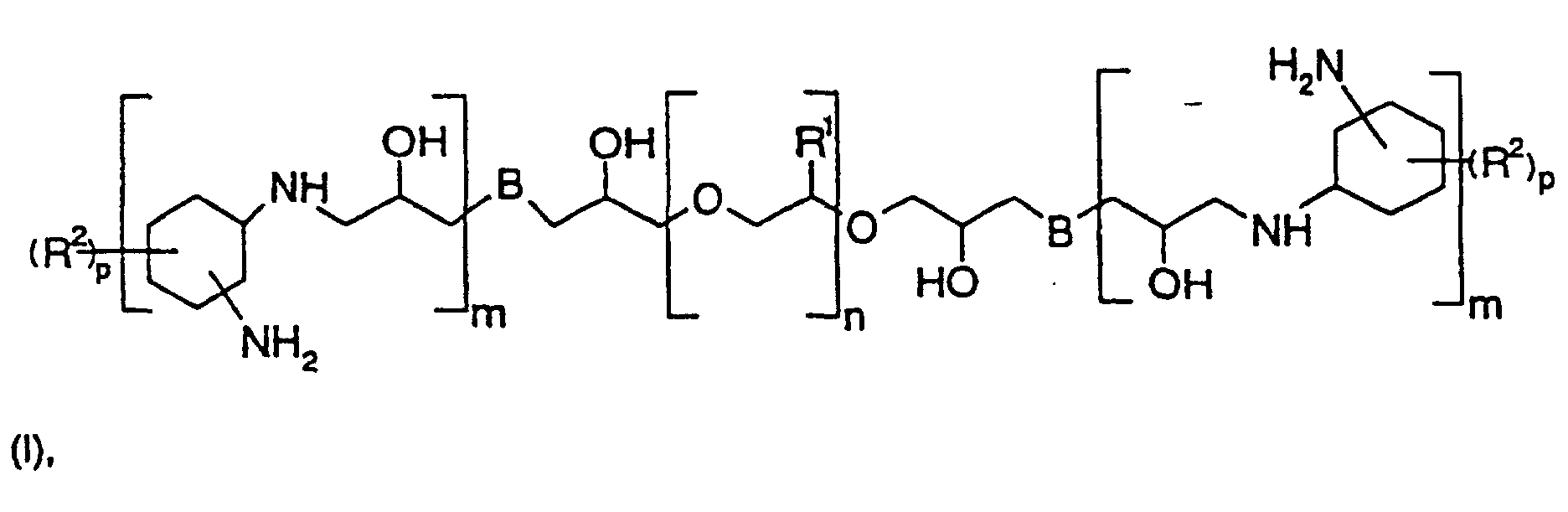
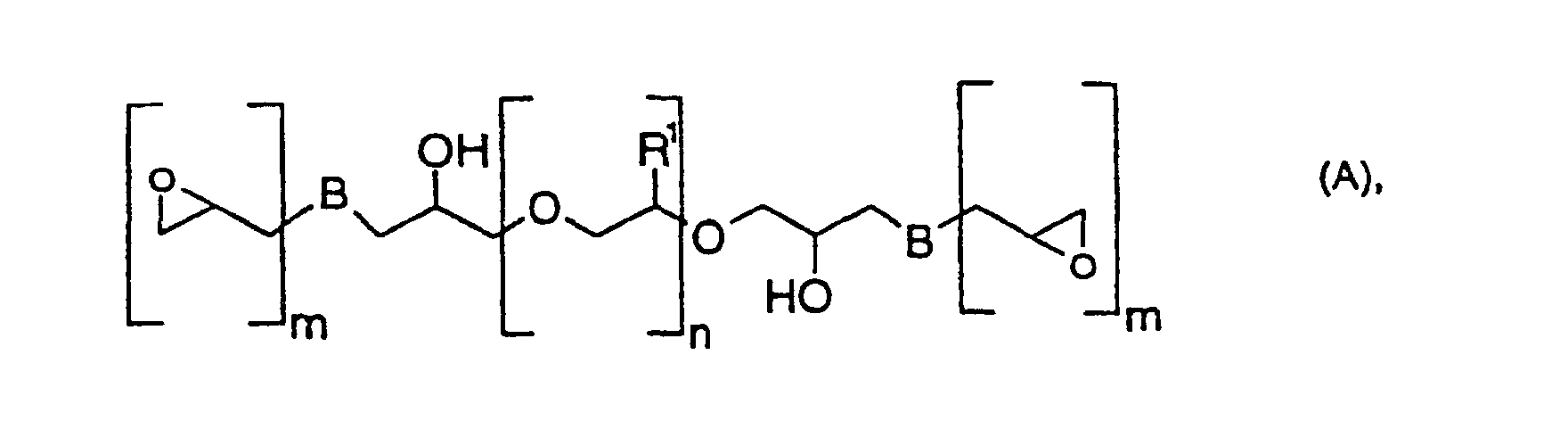 la somme des pourcentages en poids des composants a) et b) étant de 100 %,
 c) facultativement, au moins une autre mono- ou polyamine aliphatique, cycloaliphatique, aromatique/aliphatique aromatique ou hétéroaromatique, qui peut être modifiée par addition, et,d) facultativement, au moins un additif usuel,
chaque R1 est, indépendamment des autres, -H ou -CH3,
R2 est -H ou un groupe alkyle en C1-C12, et
p est 1, 2 ou 3,
les radicaux B sont chacun, indépendamment de l'autre, un groupe des formules II, III, IV, V, VI, VII, VIII, IX et X :
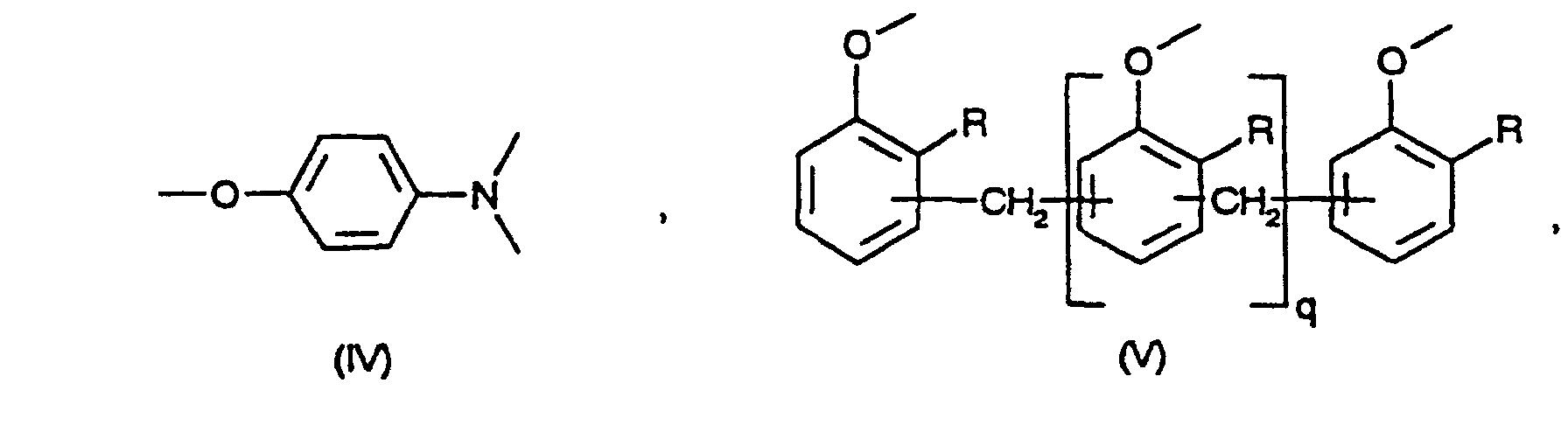
 dans lesquelles
X est >N- ou -O-,
R est -H ou -CH3, et
q est un nombre entier de 0 à 10,
m, dans les formules I et A, selon la fonctionnalité de l'unité B, est un nombre entier de 1 à 11, et
n est un nombre entier de 2 à 100, et
r, dans les formules VI et VII, est un nombre entier de 2 à 20. - Composition durcissable selon la revendication 1,
dans laquelle, dans la formule I,
R2 est -H ou -CH3, et p est 1, et
m, selon la fonctionnalité de l'unité B, est un nombre entier de 1 à 5, et
n est un nombre entier de 4 à 25. - Composition durcissable selon la revendication 2,
dans laquelle, dans la formule I,
R2 est -H et p est 1, et
les deux groupes amino sont en position ortho l'un par rapport à l'autre,
ou
R2 est -CH3 et p est 1, et
les deux groupes amino sont en position méta l'un par rapport à l'autre,
les radicaux B sont chacun, indépendamment de l'autre, un groupe des formules II, III, IV et V ou de formule VI -O-(CH2)r-O-, où r est un nombre entier de 2 à 10, et R et q sont tels que définis dans la revendication 1.
- Composition durcissable selon la revendication 3,
dans laquelle, dans la formule I,
R2 est -H, et p est 1, et
les deux groupes amino sont en position ortho l'un par rapport à l'autre,
q dans la formule V est 0 à 3, et r dans la formule VI est 4 ou 6. - Composition durcissable selon la revendication 1, dans laquelle le produit d'addition A est partiellement modifié avec un éther monoalkylique ou une amine secondaire.
- Composition durcissable selon la revendication 1, dans laquelle un accélérateur de formule M+X- ou M2+X- 2 est utilisé comme composant supplémentaire, où M+ ou M2+ est un ion de métal alcalin ou un ion de métal alcalino-terreux, et X- est tout anion minéral et/ou organique, l'accélérateur étant soluble dans la composition durcissable.
- Composition durcissable selon la revendication 6, dans laquelle M+ est Li+ et M2+ est Mg2+ ou Ca2+, et X- est ClO4 -, NO3 -, un anion laurylsulfate, acétate ou iodure.
- Composition durcissable selon la revendication 7, dans laquelle M+ est Li+ et M2+ est Mg2+ ou Ca2+, et X- est ClO4 - ou NO3 -.
- Composition durcissable selon la revendication 8, dans laquelle M2+ est Ca2+ et X- est NO3 -.
- Composition durcissable selon la revendication 6, dans laquelle l'accélérateur est présent dans un mélange à 10 à 90 % avec au moins une polyamine contenant un poly(oxyde d'alkylène).
- Composition durcissable selon la revendication 10, dans laquelle la polyamine est ®Jeffamine du type ED/D ou T.
- Composition durcissable selon la revendication 10, dans laquelle l'accélérateur est présent dans un mélange à 50 % avec ®Jeffamine ED 600.
- Utilisation de la composition selon la revendication 1, pour la fabrication d'articles moulés et de revêtements.
- Articles moulés et revêtements obtenus par durcissement de la composition selon la revendication 1.
Applications Claiming Priority (4)
| Application Number | Priority Date | Filing Date | Title |
|---|---|---|---|
| CH63496 | 1996-03-11 | ||
| CH634/96 | 1996-03-11 | ||
| CH63496 | 1996-03-11 | ||
| PCT/EP1997/000979 WO1997033931A1 (fr) | 1996-03-11 | 1997-02-28 | Compositions durcissables a base de resine epoxy contenant des durcisseurs polyamines susceptibles de subir un traitement a l'eau |
Publications (2)
| Publication Number | Publication Date |
|---|---|
| EP0886661A1 EP0886661A1 (fr) | 1998-12-30 |
| EP0886661B1 true EP0886661B1 (fr) | 2003-08-06 |
Family
ID=4191590
Family Applications (1)
| Application Number | Title | Priority Date | Filing Date |
|---|---|---|---|
| EP97908154A Expired - Lifetime EP0886661B1 (fr) | 1996-03-11 | 1997-02-28 | Compositions durcissables a base de resine epoxy contenant des durcisseurs polyamines susceptibles de subir un traitement a l'eau |
Country Status (11)
| Country | Link |
|---|---|
| US (1) | US6258919B1 (fr) |
| EP (1) | EP0886661B1 (fr) |
| JP (1) | JP3988086B2 (fr) |
| KR (1) | KR19990087666A (fr) |
| CN (1) | CN1096479C (fr) |
| AT (1) | ATE246710T1 (fr) |
| BR (1) | BR9708165A (fr) |
| DE (1) | DE69723966T2 (fr) |
| ES (1) | ES2203787T3 (fr) |
| TW (1) | TW339341B (fr) |
| WO (1) | WO1997033931A1 (fr) |
Families Citing this family (13)
| Publication number | Priority date | Publication date | Assignee | Title |
|---|---|---|---|---|
| US20040013810A1 (en) * | 2000-10-07 | 2004-01-22 | Rainer Hoefer | Coating compositions |
| DE10049654A1 (de) * | 2000-10-07 | 2002-04-11 | Cognis Deutschland Gmbh | Beschichtungszusammensetzungen |
| AU2001285901A1 (en) * | 2000-10-26 | 2002-05-06 | Vantico Ag | High functional polymers |
| US7001938B2 (en) * | 2003-01-27 | 2006-02-21 | Resolution Performance Products Llc | Epoxy resin curing compositions and resin compositions including same |
| EP1647584A1 (fr) * | 2004-10-13 | 2006-04-19 | Cytec Surface Specialties Austria GmbH | Systèmes à base de résines époxydes aqueuses |
| CN1891771B (zh) * | 2005-07-05 | 2010-05-26 | 浙江安邦新材料发展有限公司 | 一种用于水性环氧涂料的环氧固化剂乳液及其制备方法 |
| EP1803760A1 (fr) * | 2005-12-30 | 2007-07-04 | Cytec Surface Specialties Austria GmbH | Agent durcissant aqueux et aminique pour résines époxidiques |
| EP2468792A1 (fr) * | 2010-12-23 | 2012-06-27 | 3M Innovative Properties Company | Composition adhésive durcissable |
| EP2520599A1 (fr) * | 2011-05-05 | 2012-11-07 | Cytec Austria GmbH | Amine primaire, procédé pour son préparation, et son application |
| JP2016500744A (ja) * | 2012-10-24 | 2016-01-14 | ダウ グローバル テクノロジーズ エルエルシー | 常温硬化耐候性コーティング |
| KR20150079611A (ko) | 2012-10-24 | 2015-07-08 | 다우 글로벌 테크놀로지스 엘엘씨 | 부가물 경화제 |
| EP2727968A1 (fr) | 2012-11-06 | 2014-05-07 | ALLNEX AUSTRIA GmbH | Amine primaire multifonctionnel, procédure de préparation, et utilisation |
| TWI625343B (zh) * | 2013-03-28 | 2018-06-01 | 彼 布萊恩私人有限公司 | 環氧樹脂固化劑 |
Family Cites Families (17)
| Publication number | Priority date | Publication date | Assignee | Title |
|---|---|---|---|---|
| US531770A (en) * | 1895-01-01 | Mechanism foe sewing- machines | ||
| BE629845A (fr) | 1962-03-20 | |||
| DE1494525C3 (de) | 1963-09-19 | 1978-08-17 | Schering Ag, 1000 Berlin Und 4619 Bergkamen | Härtbare Kunststoffmischungen |
| US3383347A (en) | 1964-09-21 | 1968-05-14 | American Pipe & Constr Co | Epoxy emulsion coatings |
| GB1131543A (en) | 1966-04-15 | 1968-10-23 | Ciba Ltd | Epoxide resin compositions |
| CA875618A (en) | 1968-05-27 | 1971-07-13 | E. Shackelford William | Aminoamide/epoxy emulsion system |
| CH603713A5 (fr) | 1972-07-25 | 1978-08-31 | Hoechst Ag | |
| US4093594A (en) | 1976-08-18 | 1978-06-06 | Celanese Polymer Specialties Company | Process for preparing cathodically depositable coating compositions |
| US4197389A (en) * | 1977-07-18 | 1980-04-08 | Hoechst Aktiengesellschaft | Hardening agent for aqueous epoxy resin compositions |
| US4246148A (en) | 1979-08-27 | 1981-01-20 | Celanese Corporation | Two component aqueous coating composition based on an epoxy-polyamine adduct and a polyepoxide |
| US4397998A (en) * | 1981-12-14 | 1983-08-09 | Shell Oil Company | Curable epoxy compositions suitable for use in RIM processes |
| US4608405A (en) | 1985-05-06 | 1986-08-26 | Celanese Corporation | Aqueous based epoxy resin curing agents |
| JP3334160B2 (ja) * | 1992-05-01 | 2002-10-15 | 株式会社スリーボンド | マイクロカプセル型接着剤組成物 |
| JPH07301968A (ja) * | 1992-12-07 | 1995-11-14 | Xerox Corp | カラー画像形成方法及び画像形成装置 |
| JP3375160B2 (ja) * | 1992-12-15 | 2003-02-10 | 旭電化工業株式会社 | 水性エポキシ樹脂硬化性組成物 |
| US5310770A (en) | 1992-12-30 | 1994-05-10 | Hi-Tek Polymers, Inc. | Water reducible epoxy-amine adducts based on the diglycidyl ether of cyclohexane dimethanol |
| DE4303562A1 (de) * | 1993-02-08 | 1994-08-18 | Hoechst Ag | Härtungsmittel für wäßrige Epoxidharz-Dispersionen |
-
1997
- 1997-02-28 CN CN97192938A patent/CN1096479C/zh not_active Expired - Lifetime
- 1997-02-28 DE DE69723966T patent/DE69723966T2/de not_active Expired - Lifetime
- 1997-02-28 US US09/142,269 patent/US6258919B1/en not_active Expired - Lifetime
- 1997-02-28 BR BR9708165A patent/BR9708165A/pt active Search and Examination
- 1997-02-28 EP EP97908154A patent/EP0886661B1/fr not_active Expired - Lifetime
- 1997-02-28 JP JP53223397A patent/JP3988086B2/ja not_active Expired - Fee Related
- 1997-02-28 KR KR1019980707130A patent/KR19990087666A/ko not_active Ceased
- 1997-02-28 AT AT97908154T patent/ATE246710T1/de not_active IP Right Cessation
- 1997-02-28 WO PCT/EP1997/000979 patent/WO1997033931A1/fr not_active Ceased
- 1997-02-28 ES ES97908154T patent/ES2203787T3/es not_active Expired - Lifetime
- 1997-03-10 TW TW86102900A patent/TW339341B/zh active
Also Published As
| Publication number | Publication date |
|---|---|
| DE69723966D1 (de) | 2003-09-11 |
| EP0886661A1 (fr) | 1998-12-30 |
| ATE246710T1 (de) | 2003-08-15 |
| US6258919B1 (en) | 2001-07-10 |
| CN1096479C (zh) | 2002-12-18 |
| WO1997033931A1 (fr) | 1997-09-18 |
| KR19990087666A (ko) | 1999-12-27 |
| JP3988086B2 (ja) | 2007-10-10 |
| CN1213387A (zh) | 1999-04-07 |
| DE69723966T2 (de) | 2004-07-22 |
| TW339341B (en) | 1998-09-01 |
| BR9708165A (pt) | 1999-07-27 |
| ES2203787T3 (es) | 2004-04-16 |
| JP2000510505A (ja) | 2000-08-15 |
Similar Documents
| Publication | Publication Date | Title |
|---|---|---|
| KR101120797B1 (ko) | 고리지방족 디아민 경화제를 포함하는 에폭시 수지 | |
| JP2836811B2 (ja) | 自己乳化性エポキシキュアリング剤 | |
| EP0886661B1 (fr) | Compositions durcissables a base de resine epoxy contenant des durcisseurs polyamines susceptibles de subir un traitement a l'eau | |
| JPH0649193A (ja) | ポリエーテル−ポリエステルブロックコポリマー及び分散剤としてのそれらの用途 | |
| US5508324A (en) | Advanced polyamine adduct epoxy resin curing agent for use in two component waterborne coating systems | |
| EP2961784A1 (fr) | Composition et procédé de fabrication de durcisseur époxy aqueux pour utilisation dans des composés autolissants époxy à deux composants ayant des caractéristiques de longue vie en pot, durcissement rapide et faible retrait | |
| JP2021521162A (ja) | フェナルカミンを製造する方法 | |
| JP2024527059A (ja) | 組成物 | |
| TW202006107A (zh) | 可固化組成物之助黏劑 | |
| EP4288477B1 (fr) | Agents de durcissement époxy et leurs utilisations | |
| EP2239293A9 (fr) | Agents durcisseurs pour revêtements époxy | |
| TWI705083B (zh) | 硬化劑組合物及其硬化劑塗料配方 | |
| US20240294815A1 (en) | Hydrosilylation based beta-diketone primers for adhesion to metal | |
| US20220290001A1 (en) | Self-emulsifying epoxy composition and the coating composition prepared from the same | |
| WO2002074857A1 (fr) | Ethers monoglycidyliques de polyalkylene glycol | |
| KR800001195B1 (ko) | 킬레이트형 성능을 가진 에폭시수지조성물 | |
| JP2005255852A (ja) | エポキシ樹脂系塗り床材用組成物及び塗り床材 | |
| JPS6231733B2 (fr) | ||
| JPS59140221A (ja) | アミン系硬化剤組成物 | |
| JP2015196671A (ja) | 新規化合物及びそれを含有してなるエポキシ樹脂組成物 |
Legal Events
| Date | Code | Title | Description |
|---|---|---|---|
| PUAI | Public reference made under article 153(3) epc to a published international application that has entered the european phase |
Free format text: ORIGINAL CODE: 0009012 |
|
| 17P | Request for examination filed |
Effective date: 19980814 |
|
| AK | Designated contracting states |
Kind code of ref document: A1 Designated state(s): AT CH DE ES FR GB IT LI NL |
|
| 17Q | First examination report despatched |
Effective date: 19990831 |
|
| RAP1 | Party data changed (applicant data changed or rights of an application transferred) |
Owner name: VANTICO AG |
|
| GRAH | Despatch of communication of intention to grant a patent |
Free format text: ORIGINAL CODE: EPIDOS IGRA |
|
| GRAH | Despatch of communication of intention to grant a patent |
Free format text: ORIGINAL CODE: EPIDOS IGRA |
|
| GRAA | (expected) grant |
Free format text: ORIGINAL CODE: 0009210 |
|
| AK | Designated contracting states |
Designated state(s): AT CH DE ES FR GB IT LI NL |
|
| REG | Reference to a national code |
Ref country code: GB Ref legal event code: FG4D |
|
| REG | Reference to a national code |
Ref country code: CH Ref legal event code: EP |
|
| REG | Reference to a national code |
Ref country code: CH Ref legal event code: NV Representative=s name: SOLVIAS AG |
|
| REF | Corresponds to: |
Ref document number: 69723966 Country of ref document: DE Date of ref document: 20030911 Kind code of ref document: P |
|
| PGFP | Annual fee paid to national office [announced via postgrant information from national office to epo] |
Ref country code: NL Payment date: 20040204 Year of fee payment: 8 Ref country code: AT Payment date: 20040204 Year of fee payment: 8 |
|
| REG | Reference to a national code |
Ref country code: ES Ref legal event code: FG2A Ref document number: 2203787 Country of ref document: ES Kind code of ref document: T3 |
|
| ET | Fr: translation filed | ||
| PLBE | No opposition filed within time limit |
Free format text: ORIGINAL CODE: 0009261 |
|
| STAA | Information on the status of an ep patent application or granted ep patent |
Free format text: STATUS: NO OPPOSITION FILED WITHIN TIME LIMIT |
|
| 26N | No opposition filed |
Effective date: 20040507 |
|
| PG25 | Lapsed in a contracting state [announced via postgrant information from national office to epo] |
Ref country code: AT Free format text: LAPSE BECAUSE OF NON-PAYMENT OF DUE FEES Effective date: 20050228 |
|
| PG25 | Lapsed in a contracting state [announced via postgrant information from national office to epo] |
Ref country code: NL Free format text: LAPSE BECAUSE OF NON-PAYMENT OF DUE FEES Effective date: 20050901 |
|
| NLV4 | Nl: lapsed or anulled due to non-payment of the annual fee |
Effective date: 20050901 |
|
| REG | Reference to a national code |
Ref country code: CH Ref legal event code: PCAR Free format text: SOLVIAS AG;KLYBECKSTRASSE 191;4057 BASEL (CH) |
|
| PGFP | Annual fee paid to national office [announced via postgrant information from national office to epo] |
Ref country code: DE Payment date: 20150227 Year of fee payment: 19 Ref country code: IT Payment date: 20150213 Year of fee payment: 19 |
|
| REG | Reference to a national code |
Ref country code: FR Ref legal event code: PLFP Year of fee payment: 20 |
|
| PGFP | Annual fee paid to national office [announced via postgrant information from national office to epo] |
Ref country code: CH Payment date: 20160125 Year of fee payment: 20 Ref country code: ES Payment date: 20160217 Year of fee payment: 20 |
|
| PGFP | Annual fee paid to national office [announced via postgrant information from national office to epo] |
Ref country code: FR Payment date: 20160125 Year of fee payment: 20 Ref country code: GB Payment date: 20160127 Year of fee payment: 20 |
|
| REG | Reference to a national code |
Ref country code: DE Ref legal event code: R119 Ref document number: 69723966 Country of ref document: DE |
|
| PG25 | Lapsed in a contracting state [announced via postgrant information from national office to epo] |
Ref country code: IT Free format text: LAPSE BECAUSE OF NON-PAYMENT OF DUE FEES Effective date: 20160228 |
|
| PG25 | Lapsed in a contracting state [announced via postgrant information from national office to epo] |
Ref country code: DE Free format text: LAPSE BECAUSE OF NON-PAYMENT OF DUE FEES Effective date: 20160901 |
|
| REG | Reference to a national code |
Ref country code: CH Ref legal event code: PL |
|
| REG | Reference to a national code |
Ref country code: GB Ref legal event code: PE20 Expiry date: 20170227 |
|
| PG25 | Lapsed in a contracting state [announced via postgrant information from national office to epo] |
Ref country code: GB Free format text: LAPSE BECAUSE OF EXPIRATION OF PROTECTION Effective date: 20170227 |
|
| REG | Reference to a national code |
Ref country code: ES Ref legal event code: FD2A Effective date: 20180508 |
|
| PG25 | Lapsed in a contracting state [announced via postgrant information from national office to epo] |
Ref country code: ES Free format text: LAPSE BECAUSE OF EXPIRATION OF PROTECTION Effective date: 20170301 |