EP0889096A2 - Modified cyanate ester group curable resin composition, and varnish, prepreg, metal clad laminated board, film, printed circuit board, and multilayered circuit board using the same - Google Patents
Modified cyanate ester group curable resin composition, and varnish, prepreg, metal clad laminated board, film, printed circuit board, and multilayered circuit board using the same Download PDFInfo
- Publication number
- EP0889096A2 EP0889096A2 EP98305189A EP98305189A EP0889096A2 EP 0889096 A2 EP0889096 A2 EP 0889096A2 EP 98305189 A EP98305189 A EP 98305189A EP 98305189 A EP98305189 A EP 98305189A EP 0889096 A2 EP0889096 A2 EP 0889096A2
- Authority
- EP
- European Patent Office
- Prior art keywords
- cyanate ester
- ester group
- resin composition
- curable resin
- modified cyanate
- Prior art date
- Legal status (The legal status is an assumption and is not a legal conclusion. Google has not performed a legal analysis and makes no representation as to the accuracy of the status listed.)
- Granted
Links
- 239000004643 cyanate ester Substances 0.000 title claims abstract description 179
- -1 prepreg Substances 0.000 title claims abstract description 108
- 239000011342 resin composition Substances 0.000 title claims abstract description 94
- 239000002966 varnish Substances 0.000 title claims abstract description 64
- 229910052751 metal Inorganic materials 0.000 title claims abstract description 54
- 239000002184 metal Substances 0.000 title claims abstract description 54
- 229920005989 resin Polymers 0.000 claims abstract description 191
- 239000011347 resin Substances 0.000 claims abstract description 191
- 229920001955 polyphenylene ether Polymers 0.000 claims abstract description 53
- 239000003063 flame retardant Substances 0.000 claims abstract description 49
- RNFJDJUURJAICM-UHFFFAOYSA-N 2,2,4,4,6,6-hexaphenoxy-1,3,5-triaza-2$l^{5},4$l^{5},6$l^{5}-triphosphacyclohexa-1,3,5-triene Chemical compound N=1P(OC=2C=CC=CC=2)(OC=2C=CC=CC=2)=NP(OC=2C=CC=CC=2)(OC=2C=CC=CC=2)=NP=1(OC=1C=CC=CC=1)OC1=CC=CC=C1 RNFJDJUURJAICM-UHFFFAOYSA-N 0.000 claims abstract description 46
- 239000000126 substance Substances 0.000 claims abstract description 44
- 239000007809 chemical reaction catalyst Substances 0.000 claims abstract description 27
- 239000011888 foil Substances 0.000 claims abstract description 24
- 125000002496 methyl group Chemical group [H]C([H])([H])* 0.000 claims abstract description 6
- 125000000217 alkyl group Chemical group 0.000 claims abstract description 5
- 125000004435 hydrogen atom Chemical group [H]* 0.000 claims abstract description 4
- 125000001495 ethyl group Chemical group [H]C([H])([H])C([H])([H])* 0.000 claims abstract description 3
- 239000001257 hydrogen Substances 0.000 claims abstract description 3
- 229910052739 hydrogen Inorganic materials 0.000 claims abstract description 3
- UFHFLCQGNIYNRP-UHFFFAOYSA-N Hydrogen Chemical compound [H][H] UFHFLCQGNIYNRP-UHFFFAOYSA-N 0.000 claims abstract 2
- 125000004432 carbon atom Chemical group C* 0.000 claims abstract 2
- YXFVVABEGXRONW-UHFFFAOYSA-N Toluene Chemical compound CC1=CC=CC=C1 YXFVVABEGXRONW-UHFFFAOYSA-N 0.000 claims description 120
- ZWEHNKRNPOVVGH-UHFFFAOYSA-N 2-Butanone Chemical compound CCC(C)=O ZWEHNKRNPOVVGH-UHFFFAOYSA-N 0.000 claims description 63
- 238000000034 method Methods 0.000 claims description 41
- RYGMFSIKBFXOCR-UHFFFAOYSA-N Copper Chemical compound [Cu] RYGMFSIKBFXOCR-UHFFFAOYSA-N 0.000 claims description 34
- 238000004519 manufacturing process Methods 0.000 claims description 33
- 239000000203 mixture Substances 0.000 claims description 32
- 239000002904 solvent Substances 0.000 claims description 32
- 239000000463 material Substances 0.000 claims description 26
- 238000003756 stirring Methods 0.000 claims description 22
- QBDSZLJBMIMQRS-UHFFFAOYSA-N p-Cumylphenol Chemical compound C=1C=C(O)C=CC=1C(C)(C)C1=CC=CC=C1 QBDSZLJBMIMQRS-UHFFFAOYSA-N 0.000 claims description 18
- RTZKZFJDLAIYFH-UHFFFAOYSA-N Diethyl ether Chemical compound CCOCC RTZKZFJDLAIYFH-UHFFFAOYSA-N 0.000 claims description 16
- 238000010438 heat treatment Methods 0.000 claims description 16
- 239000011701 zinc Substances 0.000 claims description 16
- 150000001913 cyanates Chemical class 0.000 claims description 14
- 150000002989 phenols Chemical class 0.000 claims description 14
- AHZMUXQJTGRNHT-UHFFFAOYSA-N [4-[2-(4-cyanatophenyl)propan-2-yl]phenyl] cyanate Chemical compound C=1C=C(OC#N)C=CC=1C(C)(C)C1=CC=C(OC#N)C=C1 AHZMUXQJTGRNHT-UHFFFAOYSA-N 0.000 claims description 12
- 229920000642 polymer Polymers 0.000 claims description 10
- 238000001035 drying Methods 0.000 claims description 9
- 125000000468 ketone group Chemical group 0.000 claims description 9
- CSCPPACGZOOCGX-UHFFFAOYSA-N Acetone Chemical compound CC(C)=O CSCPPACGZOOCGX-UHFFFAOYSA-N 0.000 claims description 7
- XEEYBQQBJWHFJM-UHFFFAOYSA-N Iron Chemical compound [Fe] XEEYBQQBJWHFJM-UHFFFAOYSA-N 0.000 claims description 7
- 150000004945 aromatic hydrocarbons Chemical class 0.000 claims description 7
- 238000010030 laminating Methods 0.000 claims description 7
- 239000010949 copper Substances 0.000 claims description 6
- JHIVVAPYMSGYDF-UHFFFAOYSA-N cyclohexanone Chemical compound O=C1CCCCC1 JHIVVAPYMSGYDF-UHFFFAOYSA-N 0.000 claims description 6
- PQRRSJBLKOPVJV-UHFFFAOYSA-N 1,2-dibromo-4-(1,2-dibromoethyl)cyclohexane Chemical compound BrCC(Br)C1CCC(Br)C(Br)C1 PQRRSJBLKOPVJV-UHFFFAOYSA-N 0.000 claims description 5
- JNCRKOQSRHDNIO-UHFFFAOYSA-N [4-[(4-cyanato-3,5-dimethylphenyl)methyl]-2,6-dimethylphenyl] cyanate Chemical compound CC1=C(OC#N)C(C)=CC(CC=2C=C(C)C(OC#N)=C(C)C=2)=C1 JNCRKOQSRHDNIO-UHFFFAOYSA-N 0.000 claims description 5
- 229910052802 copper Inorganic materials 0.000 claims description 5
- DEIGXXQKDWULML-UHFFFAOYSA-N 1,2,5,6,9,10-hexabromocyclododecane Chemical compound BrC1CCC(Br)C(Br)CCC(Br)C(Br)CCC1Br DEIGXXQKDWULML-UHFFFAOYSA-N 0.000 claims description 4
- PXHVJJICTQNCMI-UHFFFAOYSA-N Nickel Chemical compound [Ni] PXHVJJICTQNCMI-UHFFFAOYSA-N 0.000 claims description 4
- CTQNGGLPUBDAKN-UHFFFAOYSA-N O-Xylene Chemical compound CC1=CC=CC=C1C CTQNGGLPUBDAKN-UHFFFAOYSA-N 0.000 claims description 4
- 239000004793 Polystyrene Substances 0.000 claims description 4
- 125000002029 aromatic hydrocarbon group Chemical group 0.000 claims description 4
- 238000009835 boiling Methods 0.000 claims description 4
- 229910052742 iron Inorganic materials 0.000 claims description 4
- 238000002156 mixing Methods 0.000 claims description 4
- 229920002223 polystyrene Polymers 0.000 claims description 4
- 150000003839 salts Chemical class 0.000 claims description 4
- 229920003048 styrene butadiene rubber Polymers 0.000 claims description 4
- 239000000758 substrate Substances 0.000 claims description 4
- 239000008096 xylene Substances 0.000 claims description 4
- NTIZESTWPVYFNL-UHFFFAOYSA-N Methyl isobutyl ketone Chemical compound CC(C)CC(C)=O NTIZESTWPVYFNL-UHFFFAOYSA-N 0.000 claims description 3
- YRKCREAYFQTBPV-UHFFFAOYSA-N acetylacetone Chemical class CC(=O)CC(C)=O YRKCREAYFQTBPV-UHFFFAOYSA-N 0.000 claims description 3
- 238000000059 patterning Methods 0.000 claims description 3
- ISAVYTVYFVQUDY-UHFFFAOYSA-N 4-tert-Octylphenol Chemical compound CC(C)(C)CC(C)(C)C1=CC=C(O)C=C1 ISAVYTVYFVQUDY-UHFFFAOYSA-N 0.000 claims description 2
- QHPQWRBYOIRBIT-UHFFFAOYSA-N 4-tert-butylphenol Chemical compound CC(C)(C)C1=CC=C(O)C=C1 QHPQWRBYOIRBIT-UHFFFAOYSA-N 0.000 claims description 2
- CPELXLSAUQHCOX-UHFFFAOYSA-N Hydrogen bromide Chemical group Br CPELXLSAUQHCOX-UHFFFAOYSA-N 0.000 claims description 2
- HCHKCACWOHOZIP-UHFFFAOYSA-N Zinc Chemical compound [Zn] HCHKCACWOHOZIP-UHFFFAOYSA-N 0.000 claims description 2
- 125000002723 alicyclic group Chemical group 0.000 claims description 2
- 229910017052 cobalt Inorganic materials 0.000 claims description 2
- 239000010941 cobalt Substances 0.000 claims description 2
- GUTLYIVDDKVIGB-UHFFFAOYSA-N cobalt atom Chemical compound [Co] GUTLYIVDDKVIGB-UHFFFAOYSA-N 0.000 claims description 2
- WPBNNNQJVZRUHP-UHFFFAOYSA-L manganese(2+);methyl n-[[2-(methoxycarbonylcarbamothioylamino)phenyl]carbamothioyl]carbamate;n-[2-(sulfidocarbothioylamino)ethyl]carbamodithioate Chemical compound [Mn+2].[S-]C(=S)NCCNC([S-])=S.COC(=O)NC(=S)NC1=CC=CC=C1NC(=S)NC(=O)OC WPBNNNQJVZRUHP-UHFFFAOYSA-L 0.000 claims description 2
- 229910052759 nickel Inorganic materials 0.000 claims description 2
- NRZWYNLTFLDQQX-UHFFFAOYSA-N p-tert-Amylphenol Chemical compound CCC(C)(C)C1=CC=C(O)C=C1 NRZWYNLTFLDQQX-UHFFFAOYSA-N 0.000 claims description 2
- 229910052725 zinc Inorganic materials 0.000 claims description 2
- 229920000265 Polyparaphenylene Polymers 0.000 claims 6
- QQZOPKMRPOGIEB-UHFFFAOYSA-N 2-Oxohexane Chemical compound CCCCC(C)=O QQZOPKMRPOGIEB-UHFFFAOYSA-N 0.000 claims 2
- YNQLUTRBYVCPMQ-UHFFFAOYSA-N Ethylbenzene Chemical compound CCC1=CC=CC=C1 YNQLUTRBYVCPMQ-UHFFFAOYSA-N 0.000 claims 2
- 125000003118 aryl group Chemical group 0.000 claims 2
- BGTOWKSIORTVQH-UHFFFAOYSA-N cyclopentanone Chemical compound O=C1CCCC1 BGTOWKSIORTVQH-UHFFFAOYSA-N 0.000 claims 2
- CATSNJVOTSVZJV-UHFFFAOYSA-N heptan-2-one Chemical compound CCCCCC(C)=O CATSNJVOTSVZJV-UHFFFAOYSA-N 0.000 claims 2
- XNLICIUVMPYHGG-UHFFFAOYSA-N pentan-2-one Chemical compound CCCC(C)=O XNLICIUVMPYHGG-UHFFFAOYSA-N 0.000 claims 2
- FDPIMTJIUBPUKL-UHFFFAOYSA-N pentan-3-one Chemical compound CCC(=O)CC FDPIMTJIUBPUKL-UHFFFAOYSA-N 0.000 claims 2
- IYDYVVVAQKFGBS-UHFFFAOYSA-N 2,4,6-triphenoxy-1,3,5-triazine Chemical compound N=1C(OC=2C=CC=CC=2)=NC(OC=2C=CC=CC=2)=NC=1OC1=CC=CC=C1 IYDYVVVAQKFGBS-UHFFFAOYSA-N 0.000 claims 1
- UIHCLUNTQKBZGK-UHFFFAOYSA-N Methyl isobutyl ketone Natural products CCC(C)C(C)=O UIHCLUNTQKBZGK-UHFFFAOYSA-N 0.000 claims 1
- AUHZEENZYGFFBQ-UHFFFAOYSA-N mesitylene Substances CC1=CC(C)=CC(C)=C1 AUHZEENZYGFFBQ-UHFFFAOYSA-N 0.000 claims 1
- 125000001827 mesitylenyl group Chemical group [H]C1=C(C(*)=C(C([H])=C1C([H])([H])[H])C([H])([H])[H])C([H])([H])[H] 0.000 claims 1
- 239000000047 product Substances 0.000 description 67
- 239000012295 chemical reaction liquid Substances 0.000 description 33
- 239000011889 copper foil Substances 0.000 description 28
- 230000000052 comparative effect Effects 0.000 description 26
- 239000000243 solution Substances 0.000 description 23
- 238000001816 cooling Methods 0.000 description 16
- 239000007787 solid Substances 0.000 description 15
- IISBACLAFKSPIT-UHFFFAOYSA-N bisphenol A Chemical compound C=1C=C(O)C=CC=1C(C)(C)C1=CC=C(O)C=C1 IISBACLAFKSPIT-UHFFFAOYSA-N 0.000 description 14
- XLJMAIOERFSOGZ-UHFFFAOYSA-M cyanate group Chemical group [O-]C#N XLJMAIOERFSOGZ-UHFFFAOYSA-M 0.000 description 13
- 239000011572 manganese Substances 0.000 description 13
- 229920002799 BoPET Polymers 0.000 description 12
- 239000003822 epoxy resin Substances 0.000 description 11
- 229920003023 plastic Polymers 0.000 description 11
- 229920000647 polyepoxide Polymers 0.000 description 11
- 238000010992 reflux Methods 0.000 description 11
- ISWSIDIOOBJBQZ-UHFFFAOYSA-N Phenol Chemical compound OC1=CC=CC=C1 ISWSIDIOOBJBQZ-UHFFFAOYSA-N 0.000 description 10
- 239000004744 fabric Substances 0.000 description 10
- UHOVQNZJYSORNB-UHFFFAOYSA-N Benzene Chemical compound C1=CC=CC=C1 UHOVQNZJYSORNB-UHFFFAOYSA-N 0.000 description 9
- 230000003247 decreasing effect Effects 0.000 description 9
- 239000000945 filler Substances 0.000 description 9
- 239000011521 glass Substances 0.000 description 8
- 125000004185 ester group Chemical group 0.000 description 7
- 229920000139 polyethylene terephthalate Polymers 0.000 description 7
- 239000005020 polyethylene terephthalate Substances 0.000 description 7
- 239000000725 suspension Substances 0.000 description 7
- 150000001875 compounds Chemical class 0.000 description 6
- GEMHFKXPOCTAIP-UHFFFAOYSA-N n,n-dimethyl-n'-phenylcarbamimidoyl chloride Chemical compound CN(C)C(Cl)=NC1=CC=CC=C1 GEMHFKXPOCTAIP-UHFFFAOYSA-N 0.000 description 6
- 239000000843 powder Substances 0.000 description 6
- CPELXLSAUQHCOX-UHFFFAOYSA-M Bromide Chemical compound [Br-] CPELXLSAUQHCOX-UHFFFAOYSA-M 0.000 description 5
- IGFHQQFPSIBGKE-UHFFFAOYSA-N Nonylphenol Natural products CCCCCCCCCC1=CC=C(O)C=C1 IGFHQQFPSIBGKE-UHFFFAOYSA-N 0.000 description 5
- 230000005540 biological transmission Effects 0.000 description 5
- SNQQPOLDUKLAAF-UHFFFAOYSA-N nonylphenol Chemical compound CCCCCCCCCC1=CC=CC=C1O SNQQPOLDUKLAAF-UHFFFAOYSA-N 0.000 description 5
- WSFQLUVWDKCYSW-UHFFFAOYSA-M sodium;2-hydroxy-3-morpholin-4-ylpropane-1-sulfonate Chemical compound [Na+].[O-]S(=O)(=O)CC(O)CN1CCOCC1 WSFQLUVWDKCYSW-UHFFFAOYSA-M 0.000 description 5
- 229910000679 solder Inorganic materials 0.000 description 5
- 238000005476 soldering Methods 0.000 description 5
- 238000012360 testing method Methods 0.000 description 5
- 229920001187 thermosetting polymer Polymers 0.000 description 5
- 239000011800 void material Substances 0.000 description 5
- JYEUMXHLPRZUAT-UHFFFAOYSA-N 1,2,3-triazine Chemical group C1=CN=NN=C1 JYEUMXHLPRZUAT-UHFFFAOYSA-N 0.000 description 4
- XQUPVDVFXZDTLT-UHFFFAOYSA-N 1-[4-[[4-(2,5-dioxopyrrol-1-yl)phenyl]methyl]phenyl]pyrrole-2,5-dione Chemical compound O=C1C=CC(=O)N1C(C=C1)=CC=C1CC1=CC=C(N2C(C=CC2=O)=O)C=C1 XQUPVDVFXZDTLT-UHFFFAOYSA-N 0.000 description 4
- VEORPZCZECFIRK-UHFFFAOYSA-N 3,3',5,5'-tetrabromobisphenol A Chemical compound C=1C(Br)=C(O)C(Br)=CC=1C(C)(C)C1=CC(Br)=C(O)C(Br)=C1 VEORPZCZECFIRK-UHFFFAOYSA-N 0.000 description 4
- VYPSYNLAJGMNEJ-UHFFFAOYSA-N Silicium dioxide Chemical compound O=[Si]=O VYPSYNLAJGMNEJ-UHFFFAOYSA-N 0.000 description 4
- 239000003054 catalyst Substances 0.000 description 4
- 150000002576 ketones Chemical class 0.000 description 4
- 238000004898 kneading Methods 0.000 description 4
- SGGOJYZMTYGPCH-UHFFFAOYSA-L manganese(2+);naphthalene-2-carboxylate Chemical compound [Mn+2].C1=CC=CC2=CC(C(=O)[O-])=CC=C21.C1=CC=CC2=CC(C(=O)[O-])=CC=C21 SGGOJYZMTYGPCH-UHFFFAOYSA-L 0.000 description 4
- 229920003192 poly(bis maleimide) Polymers 0.000 description 4
- 230000008961 swelling Effects 0.000 description 4
- 229920005992 thermoplastic resin Polymers 0.000 description 4
- BDFBPPCACYFGFA-UHFFFAOYSA-N 2,4,6-tris(2,4,6-tribromophenoxy)-1,3,5-triazine Chemical compound BrC1=CC(Br)=CC(Br)=C1OC1=NC(OC=2C(=CC(Br)=CC=2Br)Br)=NC(OC=2C(=CC(Br)=CC=2Br)Br)=N1 BDFBPPCACYFGFA-UHFFFAOYSA-N 0.000 description 3
- 239000011324 bead Substances 0.000 description 3
- 230000000694 effects Effects 0.000 description 3
- 238000005530 etching Methods 0.000 description 3
- 239000004519 grease Substances 0.000 description 3
- 230000010287 polarization Effects 0.000 description 3
- 239000000376 reactant Substances 0.000 description 3
- ZVNPWFOVUDMGRP-UHFFFAOYSA-N 4-methylaminophenol sulfate Chemical compound OS(O)(=O)=O.CNC1=CC=C(O)C=C1.CNC1=CC=C(O)C=C1 ZVNPWFOVUDMGRP-UHFFFAOYSA-N 0.000 description 2
- 0 CC(C)(C)c1cc(C(C)(C)*)ccc1 Chemical compound CC(C)(C)c1cc(C(C)(C)*)ccc1 0.000 description 2
- VTYYLEPIZMXCLO-UHFFFAOYSA-L Calcium carbonate Chemical compound [Ca+2].[O-]C([O-])=O VTYYLEPIZMXCLO-UHFFFAOYSA-L 0.000 description 2
- 101100135809 Mus musculus Pcp2 gene Proteins 0.000 description 2
- 241000781618 Ochna pulchra Species 0.000 description 2
- INHGSGHLQLYYND-UHFFFAOYSA-N [4-[2-(4-cyanatophenyl)-1,1,1,3,3,3-hexafluoropropan-2-yl]phenyl] cyanate Chemical compound C=1C=C(OC#N)C=CC=1C(C(F)(F)F)(C(F)(F)F)C1=CC=C(OC#N)C=C1 INHGSGHLQLYYND-UHFFFAOYSA-N 0.000 description 2
- 238000003486 chemical etching Methods 0.000 description 2
- 239000007795 chemical reaction product Substances 0.000 description 2
- 239000003795 chemical substances by application Substances 0.000 description 2
- MVPPADPHJFYWMZ-UHFFFAOYSA-N chlorobenzene Chemical compound ClC1=CC=CC=C1 MVPPADPHJFYWMZ-UHFFFAOYSA-N 0.000 description 2
- 239000004020 conductor Substances 0.000 description 2
- 230000010485 coping Effects 0.000 description 2
- 229940120693 copper naphthenate Drugs 0.000 description 2
- SEVNKWFHTNVOLD-UHFFFAOYSA-L copper;3-(4-ethylcyclohexyl)propanoate;3-(3-ethylcyclopentyl)propanoate Chemical compound [Cu+2].CCC1CCC(CCC([O-])=O)C1.CCC1CCC(CCC([O-])=O)CC1 SEVNKWFHTNVOLD-UHFFFAOYSA-L 0.000 description 2
- 238000004132 cross linking Methods 0.000 description 2
- 125000001651 cyanato group Chemical group [*]OC#N 0.000 description 2
- 239000005350 fused silica glass Substances 0.000 description 2
- 230000009477 glass transition Effects 0.000 description 2
- 150000002430 hydrocarbons Chemical group 0.000 description 2
- 125000002887 hydroxy group Chemical group [H]O* 0.000 description 2
- 239000011256 inorganic filler Substances 0.000 description 2
- 229910003475 inorganic filler Inorganic materials 0.000 description 2
- 238000005259 measurement Methods 0.000 description 2
- 239000003863 metallic catalyst Substances 0.000 description 2
- 239000000178 monomer Substances 0.000 description 2
- 238000007747 plating Methods 0.000 description 2
- 230000009257 reactivity Effects 0.000 description 2
- 238000000926 separation method Methods 0.000 description 2
- HECLRDQVFMWTQS-RGOKHQFPSA-N 1755-01-7 Chemical compound C1[C@H]2[C@@H]3CC=C[C@@H]3[C@@H]1C=C2 HECLRDQVFMWTQS-RGOKHQFPSA-N 0.000 description 1
- QBFHSEQNGHSFLZ-UHFFFAOYSA-N 2,4,6-tris(2,3,4-tribromophenoxy)-1,3,5-triazine Chemical compound BrC1=C(Br)C(Br)=CC=C1OC1=NC(OC=2C(=C(Br)C(Br)=CC=2)Br)=NC(OC=2C(=C(Br)C(Br)=CC=2)Br)=N1 QBFHSEQNGHSFLZ-UHFFFAOYSA-N 0.000 description 1
- 229910052582 BN Inorganic materials 0.000 description 1
- PZNSFCLAULLKQX-UHFFFAOYSA-N Boron nitride Chemical compound N#B PZNSFCLAULLKQX-UHFFFAOYSA-N 0.000 description 1
- OKTJSMMVPCPJKN-UHFFFAOYSA-N Carbon Chemical compound [C] OKTJSMMVPCPJKN-UHFFFAOYSA-N 0.000 description 1
- 239000004215 Carbon black (E152) Substances 0.000 description 1
- 229920001730 Moisture cure polyurethane Polymers 0.000 description 1
- FXHOOIRPVKKKFG-UHFFFAOYSA-N N,N-Dimethylacetamide Chemical compound CN(C)C(C)=O FXHOOIRPVKKKFG-UHFFFAOYSA-N 0.000 description 1
- ZMXDDKWLCZADIW-UHFFFAOYSA-N N,N-Dimethylformamide Chemical compound CN(C)C=O ZMXDDKWLCZADIW-UHFFFAOYSA-N 0.000 description 1
- SECXISVLQFMRJM-UHFFFAOYSA-N N-Methylpyrrolidone Chemical compound CN1CCCC1=O SECXISVLQFMRJM-UHFFFAOYSA-N 0.000 description 1
- 101710120756 Pheromone-binding protein 2 Proteins 0.000 description 1
- 101710181937 Phosphate-binding protein PstS 2 Proteins 0.000 description 1
- 229910052581 Si3N4 Inorganic materials 0.000 description 1
- FAPWRFPIFSIZLT-UHFFFAOYSA-M Sodium chloride Chemical compound [Na+].[Cl-] FAPWRFPIFSIZLT-UHFFFAOYSA-M 0.000 description 1
- GWEVSGVZZGPLCZ-UHFFFAOYSA-N Titan oxide Chemical compound O=[Ti]=O GWEVSGVZZGPLCZ-UHFFFAOYSA-N 0.000 description 1
- XSTXAVWGXDQKEL-UHFFFAOYSA-N Trichloroethylene Chemical group ClC=C(Cl)Cl XSTXAVWGXDQKEL-UHFFFAOYSA-N 0.000 description 1
- SIZDMAYTWUINIG-UHFFFAOYSA-N [4-[1-(4-cyanatophenyl)ethyl]phenyl] cyanate Chemical compound C=1C=C(OC#N)C=CC=1C(C)C1=CC=C(OC#N)C=C1 SIZDMAYTWUINIG-UHFFFAOYSA-N 0.000 description 1
- 239000000654 additive Substances 0.000 description 1
- 125000001931 aliphatic group Chemical group 0.000 description 1
- AZDRQVAHHNSJOQ-UHFFFAOYSA-N alumane Chemical compound [AlH3] AZDRQVAHHNSJOQ-UHFFFAOYSA-N 0.000 description 1
- PNEYBMLMFCGWSK-UHFFFAOYSA-N aluminium oxide Inorganic materials [O-2].[O-2].[O-2].[Al+3].[Al+3] PNEYBMLMFCGWSK-UHFFFAOYSA-N 0.000 description 1
- 125000003368 amide group Chemical group 0.000 description 1
- JRPBQTZRNDNNOP-UHFFFAOYSA-N barium titanate Chemical compound [Ba+2].[Ba+2].[O-][Ti]([O-])([O-])[O-] JRPBQTZRNDNNOP-UHFFFAOYSA-N 0.000 description 1
- 229910002113 barium titanate Inorganic materials 0.000 description 1
- 229910000019 calcium carbonate Inorganic materials 0.000 description 1
- 229910052799 carbon Inorganic materials 0.000 description 1
- 239000000919 ceramic Substances 0.000 description 1
- WYKYKTKDBLFHCY-UHFFFAOYSA-N chloridazon Chemical compound O=C1C(Cl)=C(N)C=NN1C1=CC=CC=C1 WYKYKTKDBLFHCY-UHFFFAOYSA-N 0.000 description 1
- 239000004927 clay Substances 0.000 description 1
- 238000005345 coagulation Methods 0.000 description 1
- 230000015271 coagulation Effects 0.000 description 1
- 150000004696 coordination complex Chemical class 0.000 description 1
- 238000005520 cutting process Methods 0.000 description 1
- 230000002542 deteriorative effect Effects 0.000 description 1
- 238000011161 development Methods 0.000 description 1
- NKZSPGSOXYXWQA-UHFFFAOYSA-N dioxido(oxo)titanium;lead(2+) Chemical compound [Pb+2].[O-][Ti]([O-])=O NKZSPGSOXYXWQA-UHFFFAOYSA-N 0.000 description 1
- 238000005553 drilling Methods 0.000 description 1
- 230000002500 effect on skin Effects 0.000 description 1
- 125000001033 ether group Chemical group 0.000 description 1
- 238000011049 filling Methods 0.000 description 1
- 125000000524 functional group Chemical group 0.000 description 1
- 229930195733 hydrocarbon Natural products 0.000 description 1
- 238000005470 impregnation Methods 0.000 description 1
- 239000012212 insulator Substances 0.000 description 1
- 239000012046 mixed solvent Substances 0.000 description 1
- 238000010295 mobile communication Methods 0.000 description 1
- 239000012778 molding material Substances 0.000 description 1
- 238000000465 moulding Methods 0.000 description 1
- QJGQUHMNIGDVPM-UHFFFAOYSA-N nitrogen group Chemical group [N] QJGQUHMNIGDVPM-UHFFFAOYSA-N 0.000 description 1
- 150000007524 organic acids Chemical class 0.000 description 1
- 239000002245 particle Substances 0.000 description 1
- OIOWMSSANHIUTR-NVWDZAHRSA-N pbp 10 Chemical compound C([C@H](NC(=O)[C@H](CC(C)C)NC(=O)[C@H](CCCNC(N)=N)NC(=O)[C@H](CCC(N)=O)NC(=O)C1=CC=CC=C1C=1C2=CC=C(C=C2[O+]=C2C=C(C=CC2=1)N(CC)CC)N(CC)CC)C(=O)N[C@@H](CCC(N)=O)C(=O)N[C@@H](C(C)C)C(=O)N[C@@H](CCCCN)C(=O)NCC(=O)N[C@@H](CCCNC(N)=N)C(=O)N[C@@H](CCCNC(N)=N)C([O-])=O)C1=CC=CC=C1 OIOWMSSANHIUTR-NVWDZAHRSA-N 0.000 description 1
- 239000004417 polycarbonate Substances 0.000 description 1
- 229920000515 polycarbonate Polymers 0.000 description 1
- 239000002861 polymer material Substances 0.000 description 1
- 229920013636 polyphenyl ether polymer Polymers 0.000 description 1
- 238000009774 resonance method Methods 0.000 description 1
- 238000007650 screen-printing Methods 0.000 description 1
- 239000000377 silicon dioxide Substances 0.000 description 1
- HQVNEWCFYHHQES-UHFFFAOYSA-N silicon nitride Chemical compound N12[Si]34N5[Si]62N3[Si]51N64 HQVNEWCFYHHQES-UHFFFAOYSA-N 0.000 description 1
- VEALVRVVWBQVSL-UHFFFAOYSA-N strontium titanate Chemical compound [Sr+2].[O-][Ti]([O-])=O VEALVRVVWBQVSL-UHFFFAOYSA-N 0.000 description 1
- 238000010998 test method Methods 0.000 description 1
- OGIDPMRJRNCKJF-UHFFFAOYSA-N titanium oxide Inorganic materials [Ti]=O OGIDPMRJRNCKJF-UHFFFAOYSA-N 0.000 description 1
- UBOXGVDOUJQMTN-UHFFFAOYSA-N trichloroethylene Natural products ClCC(Cl)Cl UBOXGVDOUJQMTN-UHFFFAOYSA-N 0.000 description 1
- 238000009827 uniform distribution Methods 0.000 description 1
Classifications
-
- H—ELECTRICITY
- H05—ELECTRIC TECHNIQUES NOT OTHERWISE PROVIDED FOR
- H05K—PRINTED CIRCUITS; CASINGS OR CONSTRUCTIONAL DETAILS OF ELECTRIC APPARATUS; MANUFACTURE OF ASSEMBLAGES OF ELECTRICAL COMPONENTS
- H05K1/00—Printed circuits
- H05K1/02—Details
- H05K1/03—Use of materials for the substrate
- H05K1/0313—Organic insulating material
- H05K1/032—Organic insulating material consisting of one material
- H05K1/0346—Organic insulating material consisting of one material containing N
-
- C—CHEMISTRY; METALLURGY
- C08—ORGANIC MACROMOLECULAR COMPOUNDS; THEIR PREPARATION OR CHEMICAL WORKING-UP; COMPOSITIONS BASED THEREON
- C08K—Use of inorganic or non-macromolecular organic substances as compounding ingredients
- C08K5/00—Use of organic ingredients
- C08K5/0008—Organic ingredients according to more than one of the "one dot" groups of C08K5/01 - C08K5/59
- C08K5/0066—Flame-proofing or flame-retarding additives
-
- C—CHEMISTRY; METALLURGY
- C08—ORGANIC MACROMOLECULAR COMPOUNDS; THEIR PREPARATION OR CHEMICAL WORKING-UP; COMPOSITIONS BASED THEREON
- C08K—Use of inorganic or non-macromolecular organic substances as compounding ingredients
- C08K5/00—Use of organic ingredients
- C08K5/16—Nitrogen-containing compounds
- C08K5/34—Heterocyclic compounds having nitrogen in the ring
- C08K5/3467—Heterocyclic compounds having nitrogen in the ring having more than two nitrogen atoms in the ring
- C08K5/3477—Six-membered rings
- C08K5/3492—Triazines
- C08K5/34924—Triazines containing cyanurate groups; Tautomers thereof
-
- C—CHEMISTRY; METALLURGY
- C08—ORGANIC MACROMOLECULAR COMPOUNDS; THEIR PREPARATION OR CHEMICAL WORKING-UP; COMPOSITIONS BASED THEREON
- C08L—COMPOSITIONS OF MACROMOLECULAR COMPOUNDS
- C08L71/00—Compositions of polyethers obtained by reactions forming an ether link in the main chain; Compositions of derivatives of such polymers
- C08L71/08—Polyethers derived from hydroxy compounds or from their metallic derivatives
- C08L71/10—Polyethers derived from hydroxy compounds or from their metallic derivatives from phenols
- C08L71/12—Polyphenylene oxides
- C08L71/123—Polyphenylene oxides not modified by chemical after-treatment
-
- C—CHEMISTRY; METALLURGY
- C08—ORGANIC MACROMOLECULAR COMPOUNDS; THEIR PREPARATION OR CHEMICAL WORKING-UP; COMPOSITIONS BASED THEREON
- C08L—COMPOSITIONS OF MACROMOLECULAR COMPOUNDS
- C08L79/00—Compositions of macromolecular compounds obtained by reactions forming in the main chain of the macromolecule a linkage containing nitrogen with or without oxygen or carbon only, not provided for in groups C08L61/00 - C08L77/00
- C08L79/04—Polycondensates having nitrogen-containing heterocyclic rings in the main chain; Polyhydrazides; Polyamide acids or similar polyimide precursors
-
- H—ELECTRICITY
- H05—ELECTRIC TECHNIQUES NOT OTHERWISE PROVIDED FOR
- H05K—PRINTED CIRCUITS; CASINGS OR CONSTRUCTIONAL DETAILS OF ELECTRIC APPARATUS; MANUFACTURE OF ASSEMBLAGES OF ELECTRICAL COMPONENTS
- H05K3/00—Apparatus or processes for manufacturing printed circuits
- H05K3/46—Manufacturing multilayer circuits
- H05K3/4644—Manufacturing multilayer circuits by building the multilayer layer by layer, i.e. build-up multilayer circuits
- H05K3/4673—Application methods or materials of intermediate insulating layers not specially adapted to any one of the previous methods of adding a circuit layer
- H05K3/4676—Single layer compositions
-
- Y—GENERAL TAGGING OF NEW TECHNOLOGICAL DEVELOPMENTS; GENERAL TAGGING OF CROSS-SECTIONAL TECHNOLOGIES SPANNING OVER SEVERAL SECTIONS OF THE IPC; TECHNICAL SUBJECTS COVERED BY FORMER USPC CROSS-REFERENCE ART COLLECTIONS [XRACs] AND DIGESTS
- Y10—TECHNICAL SUBJECTS COVERED BY FORMER USPC
- Y10S—TECHNICAL SUBJECTS COVERED BY FORMER USPC CROSS-REFERENCE ART COLLECTIONS [XRACs] AND DIGESTS
- Y10S428/00—Stock material or miscellaneous articles
- Y10S428/901—Printed circuit
-
- Y—GENERAL TAGGING OF NEW TECHNOLOGICAL DEVELOPMENTS; GENERAL TAGGING OF CROSS-SECTIONAL TECHNOLOGIES SPANNING OVER SEVERAL SECTIONS OF THE IPC; TECHNICAL SUBJECTS COVERED BY FORMER USPC CROSS-REFERENCE ART COLLECTIONS [XRACs] AND DIGESTS
- Y10—TECHNICAL SUBJECTS COVERED BY FORMER USPC
- Y10T—TECHNICAL SUBJECTS COVERED BY FORMER US CLASSIFICATION
- Y10T428/00—Stock material or miscellaneous articles
- Y10T428/24—Structurally defined web or sheet [e.g., overall dimension, etc.]
- Y10T428/24802—Discontinuous or differential coating, impregnation or bond [e.g., artwork, printing, retouched photograph, etc.]
- Y10T428/24917—Discontinuous or differential coating, impregnation or bond [e.g., artwork, printing, retouched photograph, etc.] including metal layer
Definitions
- the present invention relates to a modified cyanate ester group curable resin composition, and varnish, prepreg, metal clad laminated board, film, printed circuit board, and multilayered circuit board using the same.
- a large volume of data are required to be processed with a high speed in a highly information-oriented society, and consequently, frequency of signals used in computers and information equipment terminals becomes higher and higher.
- frequency of signals used in computers and information equipment terminals becomes higher and higher.
- an electric signal has a property that its transmission loss becomes larger as the frequency becomes higher, developing a low-loss printed circuit board capable of coping with the high frequency is strongly required.
- the transmission loss of the printed circuit board comprises a conductor loss depending on the shape of circuit (conductor), skin-effect resistance, characteristic impedance, and the like, and a dielectric loss depending on dielectric properties of the insulating layer (dielectric) around the circuit.
- the dielectric loss is dominant in an-electric loss in a high frequency circuit. Therefore, in order to reduce the transmission loss of the high frequency circuit, it is thought that reducing the dielectric constant and the dissipation factor (tan 6) of the printed circuit board (particularly, the insulating resin) is necessary.
- printed boards having a low dissapation factor are strongly required in order to reduce the transmission loss in a quasi-microwave band (1 to 3 GHz) as the frequency of signals is increased.
- thermoplastic resin As a method of improving the high frequency property using a thermoplastic resin, methods of using polyphenylene ether group resin compositions having a desirable dielectric property among heat-resistant thermoplastic resins such as a resin composition composed of polyphenylene ether resin (PPO or PPE) and a cross linking polymer/monomer disclosed in JP-B-5-77705 (1993), and a resin composition composed of a polyphenylene ether having a specific curable functional group and a cross linking monomer disclosed in JP-B-6-92533 (1994) have been disclosed.
- PPO or PPE polyphenylene ether resin
- JP-B-6-92533 Japanese Patent Application Laidiene
- a method of improving the high frequency property using a resin composition composed of cyanate ester resin having a low dielectric constant and polyphenylene ether resin having a desirable dielectric property a method of using a resin composition composed of cyanate ester/bismaleimide and a polyphenylene ether resin disclosed in JP-B-63-33506 (1988), and a method of using a resin composition composed of a phenol modified resin/ cyanate ester reactant and polyphenylene ether resin disclosed in JP-A-5-311071 (1993) have been disclosed. Furthermore, a resin composition prepared by kneading polyphenylene ether resin and cyanate ester resin has been disclosed in JP-B-61-18937 (1986) as a heat resistant molding material having a desirable frequency characteristics.
- thermosetting resin used together with polyphenylene ether resin was the bismaleimide/ cyanate ester resin or the phenol modified resin/ cyanate ester reactant.
- the resin composition became high in molten viscosity and lacked in fluidity to decrease moldability, as similar with the case of the polyphenylene group resin composition described above.
- the resin composition prepared by kneading polyphenylene ether resin and cyanate ester resin disclosed in JP-B-61-18937 (1986) had a desirable dielectric property and a relatively preferable moldability, because the molten viscosity was lowered by being modified by cyanate ester resin.
- a first object of the present invention is to provide a modified cyanate ester group curable resin composition having a desirable heat resistance, similar moldability and workability as conventional thermosetting resin such as epoxy resin, a low dielectric property, and a low dissapation factor and a low loss property in the high frequency band.
- a second object of the present invention is to provide a flame retardant resin film using the modified cyanate ester group curable resin composition, and a method for manufacturing same.
- An object of the present invention is to provide a resin film using the modified cyanate ester group curable resin composition, and a method for manufacturing same.
- a third object of the present invention is to provide a modified cyanate ester group curable resin varnish for printed circuit board using the modified cyanate ester group curable resin composition, and a method for manufacturing same.
- a fourth object of the present invention is to provide methods of manufacturing prepreg for laminated board and metal clad laminated board, using the modified cyanate ester group curable resin varnish.
- a fifth object of the present invention is to provide a multilayered circuit board manufactured by laminating a printed circuit board and/or an inner layer circuit board, which are manufactured by patterning the circuit on the laminated board manufactured by the above method of manufacturing prepreg for laminated board and metal clad laminated board, and a prepreg, film, and/or a film adhered with metal foil, which are manufactured the above method, and forming circuits for making connections between the inner circuits each other and the metal foil.
- the present invention provides a modified cyanate ester group curable resin composition
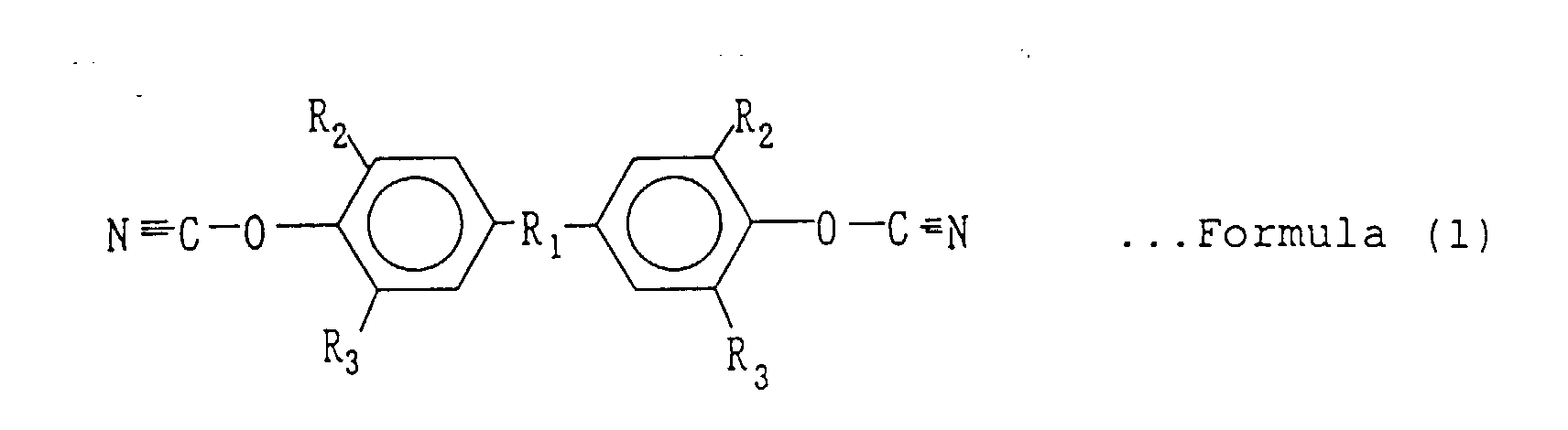
- a modified cyanate ester group curable resin composition comprising essentially (A) a cyanate ester group compound expressed by the chemical formula (1), (B) a monovalent phenolic group compound expressed by any one of the chemical formula (2) and (3), (C) a polyphenylene ether resin, (D) a flame retardant not reactive with the cyanate ester group compound and (E) a metal group reaction catalyst.
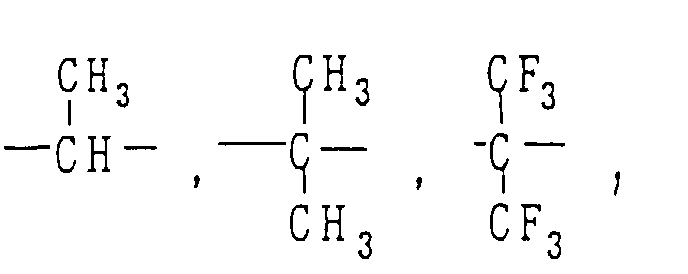
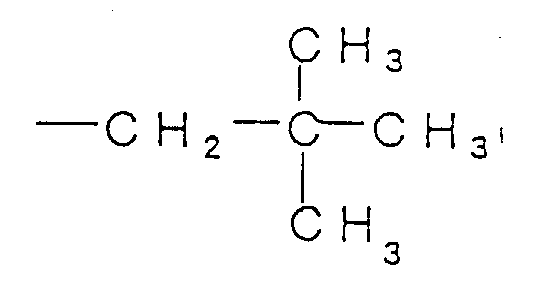
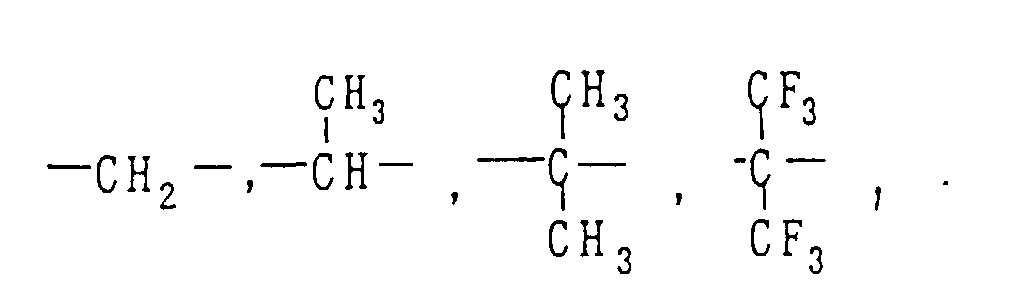
- R 1 is and respective of R 2 and R 3 is hydrogen or methyl group, and the both can be the same or different from each other
- respective of R 4 and R 5 is any one of hydrogen atom and low alkyl group having carbon number of 1 to 4, and the both can be the same or different from each other.
- n is a positive integer of 1 or 2.
- R 6 is ⁇ CH 3 , ⁇ CH 2 CH 3 , or
- a modified cyanate ester -group curable resin composition which is prepared by mixing (B) the monovalent phenolic group compound expressed by the chemical formula (2) or (3) of 4 to 30 parts by weight with 100 parts by weight of (A) the cyanate ester group compound expressed by the chemical formula (1).
- the present invention also provides the flame-retardant resin film manufactured by semi-curing or curing the modified cyanate ester group curable resin composition including the flame-retardant not reactive with the cyanate ester group compound.
- the method of manufacturing the flame-retardant resin film can be achieved by a method comprising the steps of applying the varnish comprising the modified cyanate ester group curable resin composition including the flame retardant and a solvent onto one side plane of a carrier by a flowing method, and removing the solvent by heating and drying to form the film.
- the present invention can also provide by the modified cyanate ester group curable resin film manufactured by semi-curing or curing the modified cyanate ester group curable resin composition, which does not include any flame-retardant not reactive with the cyanate ester group compound.
- the method of manufacturing the resin film can be achieved by a method comprising the steps of applying the varnish comprising the modified cyanate ester group curable resin composition, which does not include the flame retardant not reactive with the cyanate ester group compound, and a solvent onto one side plane of a carrier by a flowing method, and removing the solvent by heating and drying to form the film.
- the present invention further provides the modified cyanate ester group curable resin varnish comprising essentially (F) an aromatic hydrocarbon group solvent, and (G) a ketone group solvent, in addition to the modified cyanate ester group curable resin composition.
- the method of manufacturing the varnish with the modified cyanate ester group curable resin composition for the printed circuit board can be achieved by comprising the method with the steps of dissolving (C) polyphenylene ether resin into (F) the aromatic hydrocarbon group solvent by heating, reacting subsequently (A) the cyanate ester group compound with (B) the monovalent phenolic group compound in the presence of (E) the metal group reaction catalyst in the above solution to produce a mutually dissolving solution of the modified cyanate ester resin and the polyphenylene ether resin, and suspending the mutually dissolving resins by adding and agitating (G) the ketone group solvent.
- the present invention also provides the method for manufacturing prepreg for laminated board, which comprises impregnating the modified cyanate ester group resin varnish for printed circuit board into a substrate, and subsequently drying the impregnated substrate at a temperature in the range of 80 - 200 °C, and the method for manufacturing metal clad laminated board, which comprises piling up one or plural prepregs for the laminated board, piling up one or plural metal foils at the upper and lower end planes of the pile, or either one plane, and heating and pressurizing the pile to form the metal clad laminated board.
- the present invention also provides a method of manufacturing multilayered circuit board comprising the steps of; manufacturing a printed circuit board by patterning circuits onto the metal clad laminated board manufactured by the above method for obtaining metal clad laminated board, wherein the metal is plated onto both side planes and/or one side plane, with conventional process such as forming through-holes, metal plating, etching, and the others; laminating the prepreg, the film, or a combination of the prepreg and the film, onto the surface of the printed circuit board as an inner layer board, and a metal foil is further laminated thereon, by heating and pressurizing a pile of those materials; forming a window at a place on the metal foil, where a via-hole for connecting the inner layer circuit and the outer layer circuit must be formed, using a photosensitive resin or screen printing so that the metal foil at the place where the via-hole must be formed is exposed; forming via-holes through to the inner layer circuit by a laser beam drilling process using the metal foil as a mask after
- the multilayered circuit board having a large number of layers can be manufactured.
- Another multilayered circuit board can be manufactured by using a film adhered with a metal foil instead of the prepreg and the film in the above steps, piling up the film adhered with the metal foil onto the inner layer board so that the film plane is contacted with the inner layer board, and heating and pressurizing to laminate them.
- the dielectric property of a polymer material is strongly affected by the polarization alignment of dipoles. Therefore, the dielectric constant can be decreased by decreasing the number of polar groups in the molecule, and the dissapation factor can be lowered by suppressing the mobility of the polar groups. Since cyanate ester resin produces a symmetric and rigid triazine structure when being cured though it has a strong polar cyanate group, cyanate ester resin can provide a cured material having the lowest dielectric constant and dissapation factor among the thermosetting resins.
- the resin composition in accordance with the present invention is aimed at decreasing the dielectric constant and the dissapation factor of the cured resin by adding an appropriate quantity of (B) monovalent phenolic group compound in order to convert the remaining non-reacted cyanate groups into imidocarbonate for decreasing the polarity of the cured resin.
- a suitable material used for this purpose is a chemical composition which is highly reactive-with cyanate group, single functional, relatively low in molecular weight, and mutually soluble with cyanate ester resin (similar in molecular structure).
- the monovalent phenolic group compounds used in the resin composition of the present invention are specified by the above reason.
- a phenolic compound such as nonylphenol and the like was used as an auxiliary catalyst for trimerizing reaction of cyanate ester (forming triazine rings) by adding approximately 1 to 2 parts by weight to 100 parts by weight of cyanate ester.
- the adding amount was actually a catalyst quantity, the effect of the phenolic compound to decrease the polarization by reacting with cyanate group as above was not observed.
- the dielectric constant and the dissapation factor of the cured material could be decreased by adding the phenolic compound more than the conventional quantity, and decrease in heat resistance due to increase in the adding quantity of the phenolic compound could be suppressed by using a specific monovalent phenolic group compound.
- the method of the present invention it became possible to obtain the cured material having a dielectric constant and a dissapation factor lower than those of the conventional cured materials of single cyanate ester resin, and the conventional cured material of resin composed of epoxy resin, multivalent phenol group (hydroxyl in one side was apt to be remained as a non-reacted group, which deteriorated the dielectric property), bismaleimide, and the like.
- the adding quantity of the monovalent phenolic group compound is selected. That is, the monovalent phenolic group compound cannot react with all the non-reacted remaining cyanate group to decrease the polarization when the adding quantity is small, and the monovalent phenolic group compound itself remains as non-reactants to deteriorate the dielectric property of the cured material by the polarity of the hydroxyl of the monovalent phenolic group compound itself when the adding quantity is more than necessary.
- improving the dielectric property is intended by adding (C) the polyphenylene ether resin, which is a thermoplastic resin having a desirable dielectric property, to the modified cyanate ester resin.
- the cyanate ester resin and the polyphenylene ether resin are essentially not soluble with each other, and it is difficult to obtain a uniform resin.
- the flame retardant used in the resin composition of the present invention must be not reactive with the cyanate ester group compound so as not to interfere with the reaction between (A) the cyanate ester group compound and (B) the monovalent phenolic group compound.
- a flame retardant is an alicyclic flame retardant (aliphatic ring type flame retardant) which is a hydrocarbon group low polar composition and accordingly hardly deteriorates the dielectric property of the cured material.
- another kind of specified flame retardant is easily miscible with cyanate ester resin cured material because the specified flame retardant has a triazine structure similar to the cyanate ester cured material, and the specified flame retardant can give a flame retardant effect to the cyanate ester cured material without deteriorating the heat resistance and the dielectric property.
- a modified cyanate ester group curable resin composition in accordance with the present invention comprises (A) a cyanate ester group compound expressed by the chemical formula (1), (B) a monovalent phenolic group compound expressed by the chemical formula (2) or an alkyl substituted phenolic compound expressed by the chemical formula (3), (C) a polyphenylene ether resin, (D) a flame retardant not reactive with the cyanate ester group compound and (E) a metal group reaction catalyst, as essential components.
- the cyanate ester group compound is a cyanate ester group compound having two cyanate groups in one molecule as expressed by the chemical formula (1).
- the chemical compounds expressed by the chemical formula (1) are, for example, bis(4-cyanato-phenyl) ethane; 2, 2-bis(4-cyanato-phenyl) propane; bis(3, 5-dimethyl-4-cyanato-phenyl) methane; 2, 2-bis(4-cyanato-phenyl)-1, 1, 1, 3, 3, 3-hexafluoropropane; ⁇ , ⁇ '- bis(4-cyanato-phenyl)-m-diisopropylbenzen; a cyanate ester compound of phenol added dicyclopentadiene polymer; and the like.
- any one or a mixture of 2, 2-bis(4-cyanato-phenyl) propane and bis(3, 5-dimethyl-4-cyanato-phenyl) methane is preferable, because a balance between the dielectric property and the moldability of their cured material is particularly desirable.
- the (A) the cyanate ester group compounds can be used by a single kind or a mixture of two or more kinds.
- the monovalent phenolic group compound is a monovalent phenolic group compound expressed by the chemical formula (2) or an alkyl substituted phenolic compound expressed by the chemical formula (3), and a compound having desirable heat resistance is preferable.
- the chemical compound expressed by the chemical formula (2) is, for example, p-( ⁇ -cumyl) phenol
- the chemical compounds expressed by the chemical formula (3) are, for instance, p-tert-butylphenol, p-tert-amylphenol, and p-tert-octylphenol.
- the monovalent phenolic group compounds can be used by a single kind or a mixture of two or more kinds.
- the adding quantity of (B) the monovalent phenolic group compound in the present invention is desirably 4 to 30 parts by weight to 100 parts by weight of (A) the cyanate ester group compound, preferably 5 to 30 parts by weight, and more preferably 4 to 25 parts by weight.
- the adding quantity of (B) the monovalent phenolic group compound is not more than 4 parts by weight, the sufficient dielectric property cannot be manufactured, and the dissapation factor particularly in a high frequency band is generally not decreased sufficiently.
- the adding quantity of (B) the monovalent phenolic group compound exceeds 30 parts by weight, the dissapation factor becomes rather high. This is not preferable.
- an appropriate quantity of (B) the monovalent phenolic group compound must be added to (A) the cyanate ester group compound.
- (A) the cyanate ester group compound and (B) the monovalent phenolic group compound are used as the modified cyanate ester resin which is manufactured by reacting them. That is, they are used as a pre-polymer of (A) the cyanate ester group compound and imide-carbonated modified resin formed by adding (B) the monovalent phenolic group compound to (A) the cyanate ester group compound.
- the modified cyanate ester resin can be manufactured by adding all the appropriate quantity of (B) the monovalent phenolic group compound to be reacted from the beginning of the reaction, or the modified cyanate ester resin can be manufactured by adding a part of the appropriate quantity of (B) the monovalent phenolic group compound at the initial stage of the reaction, and after cooling, adding the remaining amount of (B) the monovalent phenolic group compound at B-stage reacting time or curing time.
- the polyphenylene ether resins are, for example, an alloyed polymer of poly(2, 6-dimethyl-1, 4-phenylene) ether, or poly(2, 6-dimethyl-1, 4-phenylene) ether, with polystyrene, an alloyed polymer of poly(2, 6-dimethyl-1, 4-phenylene) ether with styrene-butadiene copolymers, and the like.
- the alloyed polymer of poly(2, 6-dimethyl-1, 4-phenylene) ether with polystyrene or styrene-butadiene copolymer and the alloyed polymer of poly(2, 6-dimethyl-1, 4-phenylene) ether with styrene-butadiene copolymer are desirable.
- a polymer containing the alloyed polymer of poly(2, 6-dimethyl-1, 4-phenylene) ether of more than 50 % by weight is desirable, because the dielectric property of the cured material is desirable, and more than 65 % by weight is particularly preferable.
- the adding quantity of (C) the polyphenylene ether resin in the present invention is desirably 5 to 300 parts by weight to 100 parts by weight of (A) the cyanate ester group compound, preferably 10 to 200 parts by weight, and more preferably 15 to 100 parts by weight.
- the adding quantity of (C) the polyphenylene ether resin is not more than 5 parts by weight, the sufficient dielectric property cannot manufactured.
- the adding quantity of (C) the polyphenylene ether resin exceeds 300 parts by weight, the moldability is deteriorated, because the molten viscosity becomes high and the fluidity becomes low, and the reactivity with (A) the cyanate ester group compound is also deteriorated.
- the flame retardant not reactive with the cyanate ester group compounds are, for example, 1, 2-dibromo-4-(1, 2-dibromoethyl) cyclohexane, tetrabromocyclohexane, hexabromocyclododecane, polybromodiphenylether, polystyrene bromide, polycarbonate bromide, and triphenylcyanate bromide group flame retardants expressedby the chemical formula (4), and the like.
- 1, 2-dibromo-4-(1, 2-dibromoethyl) cyclohexane; tetrabromocyclooctane; hexabromocyclododecane; 2, 4, 6-tris (tribromophenoxy)-1, 3, 5-triazine are desirable, because the manufactured cured materials have preferable dielectric properties.
- respective of l, m, and n is an integer of 1 to 5, and the integers can be the same or different from each other.
- the adding quantity of (D) the flame retardant not reactive with the cyanate ester group compounds of the present invention is desirably 5 to 30 parts by weight to 100 parts by weight of the total of (A) the cyanate ester group compound, (B) the monovalent phenolic group compound and (C) the polyphenylene ether resin, and preferably 5 to 20 weight part, and further preferably 10 to 20 parts by weight.
- the adding quantity of (D) the flame retardant not reactive with the cyanate ester group compound is not more than 5 parts by weight, the flame retardant effect is insufficient.
- the adding quantity of (D) the flame retardant exceeds 30 parts by weight, the heat resistance of the resin is decreased.
- the metal group reaction catalyst accelerates the reaction between (A) the cyanate ester group compound and (B) the monovalent phenolic group compound, and used as the reaction catalyst in manufacturing the modified cyanate ester group curable resin composition and as the curing accelerator in manufacturing the laminated board.
- the metal group reaction catalysts used are metallic catalysts such as manganese, iron, cobalt, nickel, copper, and zinc. Practically, the catalysts are used as an organic acid metal salt compound such as 2-ethylhexanoic salts, naphthenic salts, and as an organic metal complex such as acetylacetone complex.
- the same kind of the metal group reaction catalyst can be solely used or two or more kinds of the metal group reaction catalysts can be respectively used as the reaction catalyst in manufacturing the modified cyanate ester group curable resin composition and as the curing accelerator in manufacturing the laminated board.
- the adding quantity of (E) the metal group reaction catalyst of the present invention is desirably 1 to 300 ppm to 1 (g) of (A) the cyanate ester group compound, preferably 1 to 200 ppm, and more preferably 2 to 150 ppm.
- the adding quantity of (E) the metal group reaction catalyst is not more than 1 ppm, the reactivity and the curabilitybecome insufficient.
- the adding quantity exceeds 300 ppm, the reaction becomes difficult to be controlled and the moldability is deteriorated, because the curing speed becomes too fast to be controlled.
- Adding timing of (E) the metal group reaction catalyst of the present invention can be at the time of manufacturing the modified cyanate ester group curable resin composition when the necessary quantity of the metal group reaction catalyst as the reaction accelerator and the curing accelerator is added together at a time, or at the time of manufacturing the modified cyanate ester group curable resin composition when the quantity of the metal group reaction catalyst necessary for accelerating the denaturalizing reaction is added and then at the time after completion of the reaction when the remaining catalyst or the other metallic catalyst is added and mixed as the curing accelerator.
- an inorganic filler and other additives other than the above-mentioned essential components can be added to the modified cyanate ester group curable resin composition of the present invention.
- the usable fillers are silica, alumina, aluminum hydride, calcium carbonate, clay, talk, silicon nitride, boron nitride, titanium oxide, barium titanate, lead titanate, strontium titanate and the like.
- the adding quantity is preferably less than 250 parts by weight to 100 parts by weight of the total resin composition, in order to obtain a uniform distribution in the adhered quantity of the resin and desirable appearance when the resin varnish of the present invention is impregnated into the supporting material such as glass cloth.
- the modified cyanate ester group curable resin composition of the present invention is used in manufacturing flame retardant films, films, varnishes, prepregs for laminated board, and metal clad laminated boards, for example, in a manner as described below. That is, initially, the prepreg is manufactured by dissolving or suspending the modified cyanate ester group curable resin composition of the present invention into a solvent to form a varnish, impregnating the varnish into a base material such as glass cloth, and then drying the impregnated base material.
- the metal clad laminated board with metallic films on both side surfaces or with a metallic film on one side surface is manufactured by laminating one or an arbitrary number of sheets of the prepreg, laminating metallic films on both sides surfaces or an one side surface of the laminated prepreg; and then heating and pressurizing the laminated prepreg.
- the flame retardant films and films can be manufactured by semi-curing or curing the modified cyanate ester group curable resin composition of the present invention.
- solvents used for making the varnish of the modified cyanate ester group curable resin composition in accordance with the present invention are aromatic hydrocarbon having a boiling point in the range of 70-170 °C such as benzene, toluene, xylene and the like, hydrocarbon halide such as trichloroethylene, chlorobenzene, and the like, amide group such as N, N-dimethyl formaldehyde, N, N-dimethylacetoamide, and the like, and nitrogen group solvents such as N-methylpyrolidone and the like.
- aromatic hydrocarbon such as benzene, toluene, xylene, and the like are desirable.
- the adding quantity of the aromatic hydrocarbon is desirably 150 to 500 parts by weight to 100 parts by weight of (C) the polyphenylene ether resin, preferably 150 to 400 parts by weight, and more preferably 150 to 300 parts by weight.
- Ketones having a boiling point in the range of 50-170 °C such as acetone, methylethylketone, methy-lisobutylketone, cyclohexanone, and the like have a low solubility to the modified cyanate ester group curable resin composition, but have such an advantage that when the ketones are used together with the above-mentioned solvents, a high density and low viscosity solution can be manufactured by forming a suspension of the resin composition in accordance with the present invention.
- the solvents used for making the varnish of the modified cyanate ester group curable resin composition in accordance with the present invention are desirably mixed solvents of the aromatic hydrocarbon such as benzene, toluene, xylene, and the like, with ketones such as acetone, methylethylketone, methy-lisobutylketone, cyclohexanone, and the like.
- the adding quantity of the ketone is desirably 50 to 500 parts by weight to 100 parts by weight of the organic hydrocarbon group solvent, preferably 50 to 400 parts by weight, and more preferably 50 to 300 parts by weight.
- modified cyanate ester group curable resin composition varnishes were manufactured in accordance with the composition indicated in Table 1.
- Toluene 450 g, and PKN 4752 (a trade name of a product of Japan GE Plastic Co.) 210 g as (C) polyphenylene ether resin were charged into a 5-liter 4-nozzle separable flask provided with a thermometer, a cooling pipe, and a stirrer, and heated to 80 °C with stirring to be dissolved.
- PPN 4752 polyphenylene ether resin
- Toluene 300 g and polyphenylene ether resin (PKN 4752, a trade name of a product of Japan GE Plastic Co.) 80 g were charged into a 5-liter 4-nozzle separable flask provided with a thermometer, a cooling pipe, and a stirrer, and heated to 80 °C with stirring to be dissolved.
- PPN 4752 polyphenylene ether resin
- tetrabromocyclooctane (Saytex BC-48, a trade name of a product of Albemarl Co.) 110 g was added into the flask and dissolved. Subsequently, the reaction liquid was cooled. When the inner temperature became 90 °C, methyl ethyl ketone (MEK) 600 g was charged into the separable flask with stirring to form a suspension.
- MEK methyl ethyl ketone
- Toluene 600 g and polyphenylene ether resin (PKN 4752, a trade name of a product of Japan GE Plastic Co.) 300 g were charged into a 5-liter 4-nozzle separable flask provided with a thermometer, a cooling pipe, and a stirrer, and heated to 80 °C with stirring to be dissolved.
- PPN 4752 polyphenylene ether resin
- Toluene 750 g and polyphenylene ether resin (PKN 4752, a trade name of a product of Japan GE Plastic Co.) 400 g were charged into a 5-liter 4-nozzle separable flask provided with a thermometer, a cooling pipe and a stirrer, and heated to 80 °C with stirring to be dissolved.
- PPN 4752 polyphenylene ether resin
- the varnishes in the embodiment 6 - 10 were manufactured by the same method under the same condition as described in the above embodiments 1 - 5 except only replacing the component (B) the monovalent phenolic group compound with the compounds indicated in the embodiments 6 - 10 of Table 1, respectively.
- Toluene 1800 g polyphenylene ether resin (PKN 4752, a trade name of a product of Japan GE Plastic Co.) 210 g, 2, 2-bis(4-cyanato-phenyl) propane (Arocy B-10, a trade name of a product of Asahi Ciba Co.) 700 g, and 2, 2-bis(4-hydroxyphenyl) propane (BPA; bisphenol A, a product of Mitsui Toatsu Chemicals, Inc.) 69 g instead of p-( ⁇ -cumyl) phenol in the embodiment 1, were charged into the separable flask, and were stirred to be dissolved.
- PPN 4752 polyphenylene ether resin
- Arocy B-10 a trade name of a product of Asahi Ciba Co.
- BPA 2-bis(4-hydroxyphenyl) propane
- Toluene 1800 g polyphenylene ether resin (PKN 4752, a trade name of a product of Japan GE Plastic Co.) 210 g, 2, 2-bis(4-cyanato-phenyl) propane (Arocy B-10, a trade name of a product of Asahi Ciba Co.) 700 g, and nonylphenol (a product of Mitsui Toatsu Chemicals, Inc.) 11 g instead of p-( ⁇ -cumyl) phenol in the embodiment 1 were charged into the separable flask, and were stirred to be dissolved.
- PPN 4752 polyphenylene ether resin
- Arocy B-10 2-bis(4-cyanato-phenyl) propane
- nonylphenol a product of Mitsui Toatsu Chemicals, Inc.
- solid content 44 % by weight
- toluene 1600 g polyphenylene ether resin (PKN 4752, a trade name of a product of Japan GE Plastic Co.) 300 g, bis(3, 5-dimethyl-4-cyanatophenyl) methane (Arocy M-10, a trade name of a product of Asahi Ciba Co.) 600 g, and nonylphenol of 9 g instead of p-( ⁇ -cumyl) phenol (a product of Sun Techno Chemical Co.) were charged into the separable flask, and were stirred to be dissolved.
- PPN 4752 polyphenylene ether resin
- Arocy M-10 bis(3, 5-dimethyl-4-cyanatophenyl) methane
- nonylphenol of 9 g instead of p-( ⁇ -cumyl) phenol (a product of Sun Techno Chemical Co.)
- a prepreg having adhered resin of which quantity was 40 to 45 % by weight, was manufactured by impregnating an E glass cloth having a thickness of 0.2 mm (weight 209 g/m 2 ) with the manufactured resin varnish and heating it at 140 °C for 5 to 10 minutes(so that gelling time (170 °C) became 5 to 7 minutes).
- the prepregs having adhered resin of which quantities were in the range of 40 to 45 % by weight, were manufactured by repeating twice the impregnation applying work, because the solid content was low.
- separation between the cyanate ester resin and the polyphenylene ether resin was observed.
- laminated boards with copper foil were manufactured by laminating four prepregs and copper foils having a thickness of 18 ⁇ m on the both sides, pressurizing to form the laminated board under a condition of 170 °C, 2.5 MPa for 60 minutes, and then performing a heat treatment at 230 °C for 120 minutes.
- dielectric property, resistance to heated solder, peeling strength of the copper foil and flame retardant property were measured in accordance with the following methods. The results are shown in Table 2.
- Peeling strength of copper foil Measurement was performed in accordance with JIS-C-6481.
- Flame retardant resistance Measurement was performed in accordance with UL-94 Vertical Test Method. Emb Dielect. prop./1 GHz. Solder. ) heat res. P.S. of Cu foil Flame retard. Remarks: Sol.ct. D.c. D. f. 260°C, 20 s. (kN/m) UL-94 of v.
- polyphenylene ether resin nonylPKN 4752, a trade name of a product of Japan GE Plastic Co.
- tetrabromocyclooctane (Saytex BC-48, a trade name of a product of Albemarl Co.) 60 g was added into the flask and dissolved. Subsequently, the reaction liquid was cooled. When the inner temperature became 90 °C, methyl ethyl ketone (MEK) 600 g was charged into the separable flask with stirring to form a suspension.
- MEK methyl ethyl ketone
- modified cyanate ester group curable resin composition varnish of embodiment 12 was manufactured using the composition indicated as embodiment 12 in Table 3.
- the modified cyanate ester group curable resin composition varnish of embodiment 12 was manufactured .
- Toluene 540 g, and polyphenylene ether resin (nonylPKN 4752, a trade name of a product of Japan GE Plastic Co.) 105 g were charged into a 1-liter 4-nozzle separable flask provided with a thermometer, a cooling pipe, and a stirrer, and heated to 80 °C with stirring to be dissolved.
- nonylPKN 4752 a trade name of a product of Japan GE Plastic Co.
- modified cyanate ester group curable resin composition varnish of embodiments 14-18, and the comparative examples 5, 7 were manufactured using the composition indicated in Table 3.
- the modified cyanate ester group curable resin composition varnish of embodiment 12 was manufactured .
- ESB bromated bisphenol A type epoxy resin
- a resin film adhered with film made of polyethylene terephthalate (PET) having a resin layer of 30 - 33 ⁇ m thick was manufactured by applying the manufactured varnish, respectively, onto a film made of PET (Burex A-63, a trade name of a product made by Teijin Co.) of 50 ⁇ m thick with a releasing agent using a comma type coater (made by Hirano techseed Co.), a kind of bar coater, and dried at 130 °C.
- PET polyethylene terephthalate
- the manufactured modified cyanate ester group curable resin films of the embodiments 11-18, and the comparative example 5 had no resin cracks nor powder spilling even if the film were cut by a cutter-knife, and were superior in handling properties.
- the resin films adhered with PET film of the embodiments 11-18 were evaluated in handling properties of the resin film alone and solvent-resistance of the cured film.
- the PET film was peeled off from the adhered resin film adhered with PET film of the embodiments 11. Twelve sheets of the manufactured resin film were piled up, and a mirror plane of electrolyzed copper foil was piled onto respective of the upper plane and the lower plane of the piled resin sheets as a peeling plane. Then, The piled sheets were pressurized with 1.5 MPa at 200 °C for 1 hour to form a cured film of the modified cyanate ester group resin of approximately 0.4 mm in thickness. Similarly, the resin films of the embodiments 12-18 were pressurized to form respective cured resin films.
- the PET film was peeled off from the adhered resin film, twelve sheets of the manufactured resin film were piled up, and a mirror plane of electrolyzed copper foil was piled onto respective of the upper plane and the lower plane of the piled resin sheets as a peeling plane. Then, The piled sheets were pressurized with 1.5 MPa at 200 °C for 1 hour to form a cured film of the modified cyanate ester group resin of approximately 0.4 mm in thickness.
- the resin film adhered with PET film of the comparative example 6 was a film made of only cyanate ester resin, and the resin film was broken when the peeling operation of the PET film was tried, because the resin film itself was brittle. Therefore, the cured film of the resin could not be manufactured.
- the above cured resin film was cut out into pieces of 50 mm square, immersed into toluene, and kept at room temperature for 60 minutes. No swelling nor changes in appearance could be observed on the cured resin films of the embodiments 11-18. Surfaces of the separately prepared cured resin films of the embodiments 11-18 were wiped several times with a cloth wetted with toluene or methyl ethyl ketone (MEK), and changes in appearance of the film were observed. However, any changes could not be observed on the surface of the cured resin films of the embodiments 11-18.
- MEK methyl ethyl ketone
- the cured resin film of the comparative example 5 was cut out into pieces of 50 mm square, immersed into toluene, and kept at room temperature for 60 minutes. Swelling of the film was observed, because the cured resin film was made of only polyphenylene ether, and a part of the film was dissolved.
- surface of the separately prepared cured resin film was wiped several times with a cloth wetted with toluene, the surface of the film was dissolved, and became sticky.
- surface of the separately prepared cured resin film was wiped several times with a cloth wetted with methyl ethyl ketone (MEK), cracks were generated on the surface of the film, and finally the film was broken by generation of holes.
- MEK methyl ethyl ketone
- the modified cyanate ester group resin film of the present invention was confirmed to be capable of handling by the film alone, and to have preferable solvent-resistance.
- Fused silica powder having an average particle size of 5 ⁇ m 25g was added as an inorganic filler to 170 g of the modified cyanate ester group resin varnishes manufactured by the compositions indicated in Table 3, further, 200 g of ceramic beads of 1.0 mm in diameter was added to the mixture, and the mixture was kneaded by 1500 rpm for one hour using a beads mill made by AIMEX Co.
- PET polyethylene terephthalate
- a filler containing cured resin film adhered with PET having a resin layer(including the filler) of 55-60 ⁇ m in thickness was manufactured by the steps of kneading fused silica powder with the varnish, applying and drying as same as the embodiment 15.
- the manufactured resin film had no resin cracks nor powder spilling even if the film were cut by a cutter-knife, and was superior in handling properties.
- the PET film was peeled off from the adhered resin film adhered with PET film of the embodiments 19. Twelve sheets of the manufactured filler containing resin film were piled up, and an electrolyzed copper foil of 18 ⁇ m in thickness was piled onto respective of the upper plane and the lower plane of the piled resin sheets. The piled sheets were pressurized with 1.5 MPa at 200 °C for 1 hour to form a cured resin composition of approximately 0.6 mm in thickness having copper foils at both ends. Similarly, the filler containing resin films adhered with PET film of the embodiments 20-26 and the comparative example 8 were pressurized with electrolyzed copper foils of 18 ⁇ m in thickness to form respective cured resin composition having copper foils at both ends.
- triplates-line oscillators having a line length of approximately 200 mm were manufactured from these cured resin composition having copper foils at both ends by chemical etching, and the dielectric constants and the dissapation factors at 1 GHz were manufactured by measuring transmission ⁇ loss at 1 GHz band using a network analyzer.
- the glass transition temperature (Tg) and the tensile elastic modulus/ 40 °C were measured in a tensile mode (frequency; 10 Hz, temperature rise; 5 °C/min.) on the filler containing cured resin composition by removing the copper foil by etching, and cutting out test pieces, with a wide band viscosity-elasticity measuring apparatus (DVE, made by Rheology Co.).
- DVE wide band viscosity-elasticity measuring apparatus
- Embodiment (comp.) Dielectric properties Glass trans. temp. (Tg) Tensile elasticity Diel. c. D. f. (°C) (MPa) 19 (Emb.11) 2.7 0.0048 174 4700 20 (Emb.12) 2.7 0.0048 170 4690 21 (Emb.13) 2.7 0.0054 176 4790 22 (Emb.14) 2.7 0.0056 172 4800 23 (Emb.15) 2.8 0.0044 178 5410 24 (Emb.16) 2.8 0.0044 180 5400 25 (Emb.17) 2.8 0.0045 188 5590 26 (Emb.18) 2.8 0.0047 184 5550 27 (Emb.19) 3.3 0.0122 172 4240 Remarks:
- the filler containing resin film using the modified cyanate ester group resin film of the present invention had low dielectric properties in Ghz band, particularly, a low dissapation factor because the cyanate ester group compounds were reacted with the specified monovalent phenol group, a preferable glass transition temperature, which can be deemed as an index of heat resistance, and a mechanical strength.
- respective of copper foil clad resin films having a resin layer of 60-70 ⁇ m in thickness of the embodiments 27-29 was manufactured by applying respective of the modified cyanate ester group curable resin composition varnishes in the embodiments 11, 13, and 15 onto a roughened surface of the electrolyzed copper foil of 18 ⁇ m in thickness using a comma type coater, a kind of coater, and drying.
- the manufactured resin film had no resin cracks nor powder spilling even if the film were cut by a cutter-knife, and was superior in handling properties.
- respective of four layer printed circuit board was manufactured by the steps of piling up respective of the resin films having the copper foils of the embodiments 27-29 at the both end planes of an inner circuit board (copper foil thickness for circuit: 18 ⁇ m), which was a copper plated epoxy resin laminated board having a glass cloth base material whereon a conductive circuit was formed, so as to contact respective of the resin layers to the inner circuit, and pressurizing the pile to form the four layer circuit board under a condition of 200 °C, 2.5 MPa for 60 minutes.
- an inner circuit board copper foil thickness for circuit: 18 ⁇ m
- a copper foil clad resin film having a resin layer of 60-70 ⁇ m in thickness was manufactured by the same method as the embodiments 27-29, and a four layer circuit board was manufactured similarly as the comparative example 9.
- a four layer printed circuit board was manufactured by the steps of piling up respective of an epoxy resin prepreg (FR-4 grade) having the a glass cloth base material for multilayered circuit board of nominal thickness of 70 ⁇ m and a copper foil of 18 ⁇ m in thickness was laminated at each of end planes of the copper plated epoxy resin laminated board having a glass cloth base material, which was as same as the board used in the embodiments 27-29, and pressurizing the pile to form the four layer circuit board under a condition of 180 °C, 2.5 MPa for 60 minutes.
- an epoxy resin prepreg FR-4 grade
- Soldering heat resistance A four layer board of 50 mm square with the outer layer copper foil was floated onto molten solder at 260 °C, and the time until generating a swell was measured.
- Copper foil peeling strength The strength was measured substantially based on the method defined by JIS-C-6481.
- Embodiment Moldability Soldering heat resistance (sec.) Peeling strength (KN/m) Flame retardance UL-94 27 No void, no blur > 180 1.5 Equ.to V-0 1) 28 No void, no blur > 180 1.5 Equ.to V-0 29 No void, no blur > 180 1.5 Equ.to V-0 C-9 No void, no blur 56 1.2 Equ.to V-0 C-10 No void, no blur > 180 1.5 Equ.to V-0
- the copper foil clad resin film of the embodiments 27-29 had a desirable moldability as a material of the multilayered circuit board, and the four layer circuit boards using the copper foil clad resin film of the present invention had a desirable soldering heat resistance because the modified cyanate ester group resin was reacted with the specified monovalent phenolic compound, and had the same characteristics as the conventional prepreg for adhesion using a glass cloth as a basic material.
Landscapes
- Chemical & Material Sciences (AREA)
- Health & Medical Sciences (AREA)
- Chemical Kinetics & Catalysis (AREA)
- Medicinal Chemistry (AREA)
- Polymers & Plastics (AREA)
- Organic Chemistry (AREA)
- Engineering & Computer Science (AREA)
- Microelectronics & Electronic Packaging (AREA)
- Macromolecular Compounds Obtained By Forming Nitrogen-Containing Linkages In General (AREA)
- Compositions Of Macromolecular Compounds (AREA)
- Laminated Bodies (AREA)
- Reinforced Plastic Materials (AREA)
Abstract



n is a positive integer of 1 or 2.

or
Description



or

the flame-retardant resin film manufactured by semi-curing or curing the modified cyanate ester group curable resin composition including the flame-retardant not reactive with the cyanate ester group compound. The method of manufacturing the flame-retardant resin film can be achieved by a method comprising the steps of applying the varnish comprising the modified cyanate ester group curable resin composition including the flame retardant and a solvent onto one side plane of a carrier by a flowing method, and removing the solvent by heating and drying to form the film.
the modified cyanate ester group curable resin varnish comprising essentially (F) an aromatic hydrocarbon group solvent, and (G) a ketone group solvent, in addition to the modified cyanate ester group curable resin composition. The method of manufacturing the varnish with the modified cyanate ester group curable resin composition for the printed circuit board can be achieved by comprising the method with the steps of dissolving (C) polyphenylene ether resin into (F) the aromatic hydrocarbon group solvent by heating, reacting subsequently (A) the cyanate ester group compound with (B) the monovalent phenolic group compound in the presence of (E) the metal group reaction catalyst in the above solution to produce a mutually dissolving solution of the modified cyanate ester resin and the polyphenylene ether resin, and suspending the mutually dissolving resins by adding and agitating (G) the ketone group solvent.
the method for manufacturing prepreg for laminated board, which comprises impregnating the modified cyanate ester group resin varnish for printed circuit board into a substrate, and subsequently drying the impregnated substrate at a temperature in the range of 80 - 200 °C, and the method for manufacturing metal clad laminated board, which comprises piling up one or plural prepregs for the laminated board, piling up one or plural metal foils at the upper and lower end planes of the pile, or either one plane, and heating and pressurizing the pile to form the metal clad laminated board.
a method of manufacturing multilayered circuit board comprising the steps of; manufacturing a printed circuit board by patterning circuits onto the metal clad laminated board manufactured by the above method for obtaining metal clad laminated board, wherein the metal is plated onto both side planes and/or one side plane, with conventional process such as forming through-holes, metal plating, etching, and the others; laminating the prepreg, the film, or a combination of the prepreg and the film, onto the surface of the printed circuit board as an inner layer board, and a metal foil is further laminated thereon, by heating and pressurizing a pile of those materials; forming a window at a place on the metal foil, where a via-hole for connecting the inner layer circuit and the outer layer circuit must be formed, using a photosensitive resin or screen printing so that the metal foil at the place where the via-hole must be formed is exposed; forming via-holes through to the inner layer circuit by a laser beam drilling process using the metal foil as a mask after removing the metal foil exposed in the window by etching; connecting the inner layer circuit and the outer layer circuit by metal plating including the inner wall of the via-holes; and manufacturing circuits onto outer surface of the metal foil to obtain the multilayered circuit board.

| Emb | (A) Cyanate ester | (B) Monovalent phenol | (C) Polyphenylene ether | (D) Flame retardant | (E) Metallic reaction catalyst | |||||
| Com | Mix | Com. | Mix. | Com. | Mix. | Com. | Mix. | Com. | Mix. | |
| 1 | B-10 | 700 | PCP | 64 | PPO | 210 | SR- 245 | 135 | Co Zn | 4 1 |
| 2 | B-10 | 700 | PCP PCP | 10 75 | PPO | 140 | SR- 245 | 125 | Mn Zn | 3 1 |
| 3 | RTX- 366 | 800 | PCP PCP | 10 75 | PPO | 80 | BC-48 | 110 | Fe Cu | 2 2 |
| 4 | M-10 | 600 | PCP PCP | 30 120 | PPO | 300 | CD- 75P | 150 | Co | 4 |
| 5 | F-10 | 500 | PCP | 28 | PPO | 400 | BCL- 462 | 150 | Cu Mn | 6 1 |
| 6 | B-10 | 700 | POP | 62 | PPO | 210 | SR- 245 | 135 | Co Zn | 4 1 |
| 7 | B-10 | 700 | POP POP | 10 73 | PPO | 140 | SR- 245 | 125 | Mn Zn | 3 1 |
| 8 | RTX- 366 | 800 | PBP PBP | 10 51 | PPO | 80 | BC-48 | 110 | Fe Cu | 2 2 |
| 9 | M-10 | 600 | POP POP | 30 115 | PPO | 300 | CD- 75p | 150 | Co | 4 |
| 10 | F-10 | 500 | PAP | 21 | PPO | 400 | BCL- 462 | 150 | Cu Mn | 6 1 |
| C-1 | B-10 | 700 | BPA | 69 | PPO | 210 | ESB- 400 | 200 | Co | 3 |
| C-2 | B-10 | 700 | NP | 11 | PPO | 210 | ESB- 400 | 190 | Co | 4 |
| C-3 | B-10 | 700 | NP | 67 | PPO | 210 | ESB- 400 | 200 | Zn | 2 |
| C-4 | M-10 | 600 | NP | 9 | PPO | 300 | TBA | 150 | Mn | 3 |
| Emb | Dielect. prop./1 GHz. | Solder. ) heat res. | P.S. of Cu foil | Flame retard. | Remarks: Sol.ct. | |
| D.c. | D. f. | 260°C, 20 s. | (kN/m) | UL-94 | of v. (%) | |
| 1 | 3.5 | 0.0045 | PCT 4h OK | 1.5 | V-0 | 51 |
| 2 | 3.5 | 0.0048 | PCT 4h OK | 1.7 | V-0 | 54 |
| 3 | 3.3 | 0.0038 | PCT 4h OK | 1.7 | V-0 | 54 |
| 4 | 3.4 | 0.0042 | PCT 3h OK | 1.4 | V-0 | 47 |
| 5 | 3.3 | 0.0039 | PCT 3h OK | 1.3 | V-0 | 46 |
| 6 | 3.5 | 0.0045 | PCT 4h OK | 1.5 | V-0 | 51 |
| 7 | 3.5 | 0.0048 | PCT 3h OK | 1.7 | V-0 | 54 |
| 8 | 3.3 | 0.0040 | PCT 3h OK | 1.6 | V-0 | 54 |
| 9 | 3.4 | 0.0043 | PCT 3h OK | 1.4 | V-0 | 47 |
| 10 | 3.3 | 0.0041 | PCT 3h OK | 1.3 | V-0 | 46 |
| C-1 | 3.9 | 0.0106 | PCT 2h OK | 1.4 | V-0 | 28(apply twice) |
| C-2 | 3.9 | 0.0092 | PCT 2h OK | 1.4 | V-0 | 29(apply twice) |
| C-3 | 3.8 | 0.0099 | PCT 1h OK | 1.1 | V-0 | 44(PPO separatd) |
| C-4 | 3.8 | 0.0088 | PCT 1h OK | 1.3 | V-0 | 27(apply twice) |
| Remarks: |
| (A) Cyanate ester | (B) Monovalent phenol | (C) Polyphenylene ether | (D) Flame retardant | (E) Metallic reaction catalyst | Solid content | ||||||
| Emb | Com | Mix | Com. | Mix. | Com. | Mix. | Com. | Mix. | Com. | Mix. | wt% |
| 11 | B-10 | 80 | PCP PCP | 2 6 | PPO | 160 | BC- 48 | 60 | Mn Zn | 0.3 0.2 | 32 |
| 12 | B-10 | 80 | POP PBP | 2 5 | PPO | 160 | BC- 48 | 60 | Mn Zn | 0.3 0.2 | 32 |
| 13 | B-10 | 75 | PCP | 15 | PPO | 105 | SR- 245 | 45 | Co Zn | 0.7 0.1 | 31 |
| 14 | B-10 | 75 | POP | 15 | PPO | 105 | SR- 245 | 45 | Co Zn | 0.7 0.1 | 31 |
| 15 | B-10 | 90 | PCP | 11 | PPO | 90 | CD- 75P | 35 | Mn | 0.7 | 30 |
| 16 | B-10 | 90 | POP | 11 | PPO | 90 | CD- 75P | 35 | Mn | 0.7 | 30 |
| 17 | M-10 | 120 | PCP | 6 | PPO | 60 | BCL- 462 | 30 | Mn Co | 0.4 0.2 | 29 |
| 18 | M-10 | 120 | PAP | 6 | PPO | 60 | BCL- 462 | 30 | Mn Co | 0.4 0.2 | 29 |
| C-5 | - | - | - | - | PPO | 120 | BC- 48 | 20 | - | - | 28 |
| C-6 | B-10 | 120 | PCP | 2 | - | - | ESB- 400 | 40 | Co | 1.2 | 40 |
| C-7 | B-30 | 90 | NP | 1 | PPO | 90 | ESB- 400 | 60 | Co | 1.0 | 29 |
| Remarks: |
| Embodiment (comp.) | Dielectric properties | Glass trans. temp. (Tg) | Tensile elasticity | |
| Diel. c. | D. f. | (°C) | (MPa) | |
| 19 (Emb.11) | 2.7 | 0.0048 | 174 | 4700 |
| 20 (Emb.12) | 2.7 | 0.0048 | 170 | 4690 |
| 21 (Emb.13) | 2.7 | 0.0054 | 176 | 4790 |
| 22 (Emb.14) | 2.7 | 0.0056 | 172 | 4800 |
| 23 (Emb.15) | 2.8 | 0.0044 | 178 | 5410 |
| 24 (Emb.16) | 2.8 | 0.0044 | 180 | 5400 |
| 25 (Emb.17) | 2.8 | 0.0045 | 188 | 5590 |
| 26 (Emb.18) | 2.8 | 0.0047 | 184 | 5550 |
| 27 (Emb.19) | 3.3 | 0.0122 | 172 | 4240 |
| Remarks: |
| Embodiment | Moldability | Soldering heat resistance (sec.) | Peeling strength (KN/m) | Flame retardance UL-94 |
| 27 | No void, no blur | > 180 | 1.5 | Equ.to V-01) |
| 28 | No void, no blur | > 180 | 1.5 | Equ.to V-0 |
| 29 | No void, no blur | > 180 | 1.5 | Equ.to V-0 |
| C-9 | No void, no blur | 56 | 1.2 | Equ.to V-0 |
| C-10 | No void, no blur | > 180 | 1.5 | Equ.to V-0 |
Claims (30)
- A modified cyanate ester group curable resin composition essentially comprising :(A) a cyanate ester group compound expressed by chemical formula (1),where, R1 is

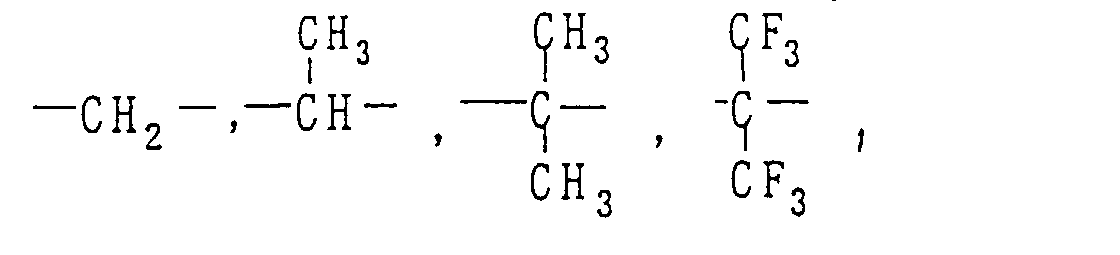 and R2 and R3 is any one of hydrogen or methyl group, and the both can be the same or different from each other,
 (B) a monovalent phenolic group compound expressed by chemical formula (2), or formula (3),where R4 and R5 is any one of hydrogen atom or low alkyl group having 1 to 4 carbon atoms, and the both can be the same or different from each other, n is a positive integer of 1 or
 where, R6 is any one of ―CH3, ―CH2CH3,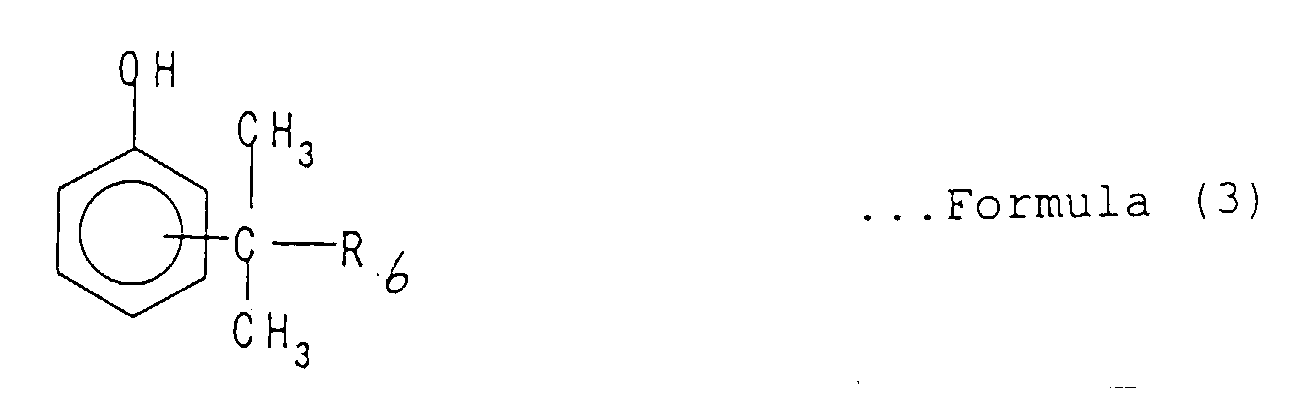
 (C) a polyphenylene ether resin,(D) a flame retardant not reactive with the cyanate ester group compound, and(E) a metal group reaction catalyst.
 - A modified cyanate ester group curable resin composition as claimed in claim 1, wherein said modified cyanate ester resin comprises;100 parts by weight of (A) the cyanate ester group compound, and4 to 30 parts by weight of (B) the monovalent phenolic group compound.
- A modified cyanate ester group curable resin composition as claimed in claim 1, which essentially comprisesa modified cyanate ester resin manufactured by the reaction of A) the cyanate ester group compound with a part of or all of (B) the monovalent phenolic group compound,(C) the polyphenylene ether resin,(D) the flame retardant not reactive with the cyanate ester group compound, and(E) the metal group reaction catalyst.
- A modified cyanate ester group curable resin composition as claimed in claim 1, wherein said modified cyanate ester group curable resin composition essentially comprises;4 to 30 parts by weight of (B) the monovalent phenolic group compound, and5 to 300 parts by weight of (C) the polyphenylene ether resin, to 100 parts of (A) the cyanate ester group compound;1 to 300 ppm of (E) the metal group reaction catalyst to the cyanate ester group compound of 1; and5 to 30 parts by weight of (D) the flame retardant not reactive with the cyanate ester group compound to 100 parts by weight of the total of said (A), (B) and (C).
- A modified cyanate ester group curable resin composition as claimed in claim 1, wherein
(A) the cyanate ester group compound is any one of or a mixture of 2, 2-bis(4-cyanato-phenyl) propane and bis(3, 5-dimethyl-4-cyanato-phenyl) methane. - A modified cyanate ester group curable resin composition as claimed in claim 1, wherein
(B) the monovalent phenolic group compound is any one of p-(α-cumyl)phenol, p-tert-butylphenol, p-tert-amylphenol, and p-tert-octylphenol. - A modified cyanate ester group curable resin composition as claimed in claim 1, wherein(C) the polyphenylene ether resin is an alloyed polymer of poly(2, 6-dimethyl-1, 4-phenylene) ether and polystyrene or styrene-butadiene copolymer; andsaid poly(2, 6-dimethyl-1, 4-phenylene) ether is contained more than 50 % by weight.
- A modified cyanate ester group curable resin composition as claimed in claim 1, wherein
(D) the flame retardant not reactive with the cyanate ester group compound is any one of single kind and mixture of alicyclic flame retardants selected from the group consisting of 1, 2-dibromo-4-(1, 2-dibromoethyl) cyclohexane, tetrabromocyclooctane and hexabromocyclododecane. - A modified cyanate ester group curable resin composition as claimed in claim 1, wherein
(D) the flame retardant not reactive with the cyanate ester group compound is any one of a triphenylcyanurate bromide group flame retardant expressed by the chemical formula (4),where, each of l, m, and n is an integer of 1 to 5, and the integers can be the same or different from one another.
- A modified cyanate ester group curable resin composition as claimed in claim 1, wherein
(D) the flame retardant not reactive with the cyanate ester group compound is any one of mixtures of a triphenylcyanurate bromide group flame retardant expressed by the chemical formula (4) and two or more kinds of flame retardants not reactive with the cyanate ester group compound. - A modified cyanate ester group curable resin composition as claimed in claim 1, wherein
(E) the metal group reaction catalyst is any one of single kind and a mixture of two or more kinds selected from the group consisting of 2-ethylhexanoic salts, naphthenic salts, and acetylacetone complexes of manganese, iron, cobalt, nickel, copper and zinc. - A method of manufacturing varnish of the modified cyanate ester group curable resin composition as claimed in claim 1, which comprises the steps of;dissolving (C) a polyphenylene ether resin into (F) an aromatic hydrocarbon solvent with heating, andreacting (A) a cyanate ester group compound with (B) a monovalent phenolic compound in said solution in the presence of (E) a metallic reaction catalyst to generate mutually dissolving solution of a modified cyanate ester resin and a polyphenylene resin.
- A method of manufacturing varnish of the modified cyanate ester group curable resin composition as claimed in claim 1, which comprises the steps of;dissolving (C) a polyphenylene ether resin into (F) an aromatic hydrocarbon solvent with heating,reacting (A) a cyanate ester group compound with (B) a monovalent phenolic compound in said solution in the presence of (E) a metallic reaction catalyst to generate a mutually dissolving solution of a modified cyanate ester resin and a polyphenylene resin, andsuspending the mutually dissolving resins by adding (G) a ketone group solvent to said mutually dissolving solution.
- A method of manufacturing varnish of the modified cyanate ester group curable resin composition as claimed in claim 13, which comprises the step of;
dissolving (D) a flame retardant not reactive with cyanate group compound into a reaction solution of (A) a cyanate ester group compound with (B) a monovalent phenolic compound in the presence of (E) a metallic reaction catalyst to generate a mutually dissolving solution of a modified cyanate ester resin and a polyphenylene resin. - A method of manufacturing varnish of the modified cyanate ester group curable resin composition as claimed in claim 13, which comprises the steps of;dissolving (C) a polyphenylene ether resin into (F) an aromatic hydrocarbon solvent with heating,reacting (A) a cyanate ester group compound with (B) a monovalent phenolic compound in said solution in the presence of (E) a metallic reaction catalyst to generate a mutually dissolving solution of a modified cyanate ester resin and a polyphenylene resin,dissolving (D) a flame retardant not reactive with cyanate group compound into said mutually dissolving solution of a modified cyanate ester resin and a polyphenylene resin, andsuspending the mutually dissolving resins by adding (G) a ketone group solvent to said mutually dissolving solution.
- A method of manufacturing varnish of the modified cyanate ester group curable resin composition as claimed in claim 13, which comprises the steps of;reacting (A) a cyanate ester group compound with a part of total mixing amount of (B) a monovalent phenolic compound in the presence of (E) a metallic reaction catalyst to generate a mutually dissolving solution of a modified cyanate ester resin and a polyphenylene resin,suspending the mutually dissolving resins by adding (G) a ketone group solvent to said mutually dissolving solution, andadding and dissolving the residual of the total mixing amount of (B) the monovalent phenolic compound into said suspended mutually dissolving solution.
- A method of manufacturing varnish of the modified cyanate ester group curable resin composition as claimed in claim 13, wherein,
after suspending said mutually dissolving solution by adding and stirring (F) a ketone group solvent, (E) ametallic group reaction catalyst is further added into said suspending solution. - A method of manufacturing varnish of the modified cyanate ester group curable resin composition as claimed in claim 12 100 parts by weight of (C) a polyphenylene ether resin is dissolved into 150-500 parts by weight of (F) an aromatic hydrocarbon group solvent by heating.
- A method of manufacturing varnish of the modified cyanate ester group curable resin composition as claimed in claim 13, wherein
50-500 parts by weight of (G) a ketone group solvent is used for 100 parts by weight of (F) an aromatic hydrocarbon group solvent, which is used for dissolving (C) said polyphenylene ether resin. - A method of manufacturing varnish of the modified cyanate ester group curable resin composition as claimed in claim 12 or 13, wherein
(F) said aromatic group solvent has a boiling point in the range of 70 - 170 °C. - A method of manufacturing varnish of the modified cyanate ester group curable resin composition as claimed in claim 12 or 13, wherein
(F) said aromatic group solvent is at least any one selected from the group consisting of toluene, xylene, ethylbenzene, iospropylbenezene, and mesitylene. - A method of manufacturing varnish of the modified cyanate ester group curable resin composition as claimed in claim 13, wherein
(G) said ketone group solvent has a boiling point in the range of 50 - 170 °C. - A method of manufacturing varnish of the modified cyanate ester group curable resin composition as claimed in claim 13, wherein
(G) said ketone group solvent is at least any one selected from the group consisting of acetone, methyl ethyl ketone, 2-pentanone, 3-pentanone, methyl isobutyl ketone, 2-hexanone, cyclopentanone, 2-heptanone, and cyclohexanone. - A varnish of the modified cyanate ester group curable resin composition manufactured by said method as claimed in claim 12 or 13.
- A prepreg manufactured by the steps of;impregnating said varnish of the modified cyanate ester group curable resin composition as claimed in claim 24 into a base material, anddrying at a temperature in the range of 80 - 200°C.
- A modified cyanate ester group curable resin film manufactured by the steps of;applying said varnish of the modified cyanate ester group curable resin composition as claimed in claim 24 onto one plane of supporting material by a flowing method, andheating and drying for removing the solvent to form said film.
- A metal foil clad modified cyanate ester group curable resin film manufactured by the steps of;applying said varnish of the modified cyanate ester group curable resin composition as claimed in claim 24 onto one plane of said metal foil by a flowing method, andheating and drying for removing the solvent to form said film.
- A metal foil clad laminated board manufactured by the steps of;piling up at least one of said prepreg as claimed in claim 25, and said film as claimed in claim 27a single form or a combined form, respectively, in a manner that one or plurality of said prepreg, said film, or said prepreg and said film, are piled alternately by every piece or every plural pieces to form a piled body,laminating said metal foil onto both end planes or one end plane of said piled body, andpressurizing said piled body laminated with said metal foil with heating to form said metal foil clad laminated board .
- A printed circuit board manufactured by forming a circuit onto said metal foil clad laminated board as claimed in claim 28.
- A multilayered circuit board manufactured by the steps of;laminating a metal foil, or said metal foil clad modified cyanate ester group curable resin film as claimed in claim 27, onto an inner layer circuit substrate via said prepreg as claimed in claim 25, or said film as claimed in claim 26,connecting said metal foil with circuits in said inner layer circuit board, andpatterning a circuit onto said metal foil.
Applications Claiming Priority (12)
| Application Number | Priority Date | Filing Date | Title |
|---|---|---|---|
| JP179572/97 | 1997-07-04 | ||
| JP17957297A JP3261076B2 (en) | 1997-07-04 | 1997-07-04 | Modified cyanate ester-based curable resin composition for laminate, prepreg and laminate using the same |
| JP17957297 | 1997-07-04 | ||
| JP181144/97 | 1997-07-07 | ||
| JP18114497 | 1997-07-07 | ||
| JP18114497A JP3261078B2 (en) | 1997-07-07 | 1997-07-07 | Modified cyanate ester-based curable resin composition for laminate, prepreg and laminate using the same |
| JP290579/97 | 1997-10-23 | ||
| JP29057697A JP3315630B2 (en) | 1997-10-23 | 1997-10-23 | Flame retardant modified cyanate ester-based resin film and method for producing the same |
| JP29057997A JP3315631B2 (en) | 1997-10-23 | 1997-10-23 | Flame retardant modified cyanate ester-based resin film and method for producing the same |
| JP29057697 | 1997-10-23 | ||
| JP29057997 | 1997-10-23 | ||
| JP290576/97 | 1997-10-23 |
Publications (3)
| Publication Number | Publication Date |
|---|---|
| EP0889096A2 true EP0889096A2 (en) | 1999-01-07 |
| EP0889096A3 EP0889096A3 (en) | 1999-12-29 |
| EP0889096B1 EP0889096B1 (en) | 2002-09-11 |
Family
ID=27474891
Family Applications (1)
| Application Number | Title | Priority Date | Filing Date |
|---|---|---|---|
| EP98305189A Expired - Lifetime EP0889096B1 (en) | 1997-07-04 | 1998-06-30 | Modified cyanate ester group curable resin composition, and varnish, prepreg, metal clad laminated board, film, printed circuit board, and multilayered circuit board using the same |
Country Status (3)
| Country | Link |
|---|---|
| US (2) | US6156831A (en) |
| EP (1) | EP0889096B1 (en) |
| DE (1) | DE69807793T2 (en) |
Cited By (10)
| Publication number | Priority date | Publication date | Assignee | Title |
|---|---|---|---|---|
| US6162876A (en) * | 1998-03-23 | 2000-12-19 | General Electric Company | Cyanate ester based thermoset compositions |
| WO2001009247A1 (en) * | 1999-08-02 | 2001-02-08 | General Electric Company | Cyanate ester based thermoset compositions |
| US6194495B1 (en) | 1998-03-23 | 2001-02-27 | General Electric Company | Cyanate ester based thermoset compositions |
| WO2001070885A1 (en) * | 2000-03-21 | 2001-09-27 | Hitachi Chemical Co., Ltd. | Resin composition with excellent dielectric characteristics, process for producing resin composition, varnish prepared from the same, process for producing the same, prepreg made with these, and metal-clad laminate |
| WO2003019656A3 (en) * | 2001-08-24 | 2003-11-20 | 3M Innovative Properties Co | Interconnect module with reduced power distribution impedance |
| EP1755161A3 (en) * | 2001-08-24 | 2007-05-02 | 3M Innovative Properties Company | Interconnect module with reduced power distribution impedance |
| EP1854828A2 (en) | 2006-05-12 | 2007-11-14 | Fraunhofer-Gesellschaft zur Förderung der angewandten Forschung e.V. | Flame-retardant prepreg resins based on cyanate and hardening at low temperatures for honeycomb sandwich components |
| EP1985654A4 (en) * | 2006-02-17 | 2010-07-14 | Hitachi Chemical Co Ltd | THERMOSETTING RESIN COMPOSITION COMPRISING A SEMI-IPN AND VARNISH COMPLEX, PREPREG AND METALLIZED LAMINATE SHEET USING THE SAME |
| US7816430B2 (en) | 2002-09-30 | 2010-10-19 | Hitachi Chemical Company, Ltd. | Composition of polycyanate ester and biphenyl epoxy resin |
| KR20140046007A (en) * | 2011-08-09 | 2014-04-17 | 미츠비시 가스 가가쿠 가부시키가이샤 | Novel cyanic acid ester compound, method for producing same, curable resin composition containing novel cyanic acid ester compound, and cured product of curable resin composition |
Families Citing this family (11)
| Publication number | Priority date | Publication date | Assignee | Title |
|---|---|---|---|---|
| KR20020087287A (en) | 2001-05-15 | 2002-11-22 | 삼성전기주식회사 | Cyanate ester-containing insulating composition, insulating film made by the composition and multilayer printed circuit board having the film |
| CN101492527B (en) * | 2002-09-30 | 2011-11-09 | 日立化成工业株式会社 | Resin composition for printed wiring board, and vanish, prepreg and metal-clad laminate using same |
| KR100561070B1 (en) * | 2003-09-05 | 2006-03-15 | 주식회사 엘지화학 | Thermosetting resin composition for high speed transmission circuit board |
| US20070004902A1 (en) * | 2005-05-25 | 2007-01-04 | Fraunhofer-Gesellschaft Zur Forderung Der Angewandten Forschung E.V. | Triazine Containing Polymers |
| EP1854827B1 (en) * | 2006-05-11 | 2015-04-29 | Fraunhofer-Gesellschaft zur Förderung der angewandten Forschung e.V. | Flame resistant, low-temperature curing cyanate resin having improved properties |
| US20080076885A1 (en) * | 2006-09-21 | 2008-03-27 | Gary William Yeager | Poly(arylene ether) composition and method |
| US20080076884A1 (en) * | 2006-09-21 | 2008-03-27 | Gary William Yeager | Poly(arylene ether) composition and method |
| US20080085989A1 (en) * | 2006-10-05 | 2008-04-10 | Gary William Yeager | Poly(arylene ether) copolymer |
| US20090004488A1 (en) * | 2007-06-26 | 2009-01-01 | Doosan Corporation | Resine Composition For Printed Circuit Board and Composite Substrate And Copper Laminates Using The Same |
| JP5024205B2 (en) * | 2007-07-12 | 2012-09-12 | 三菱瓦斯化学株式会社 | Prepreg and laminate |
| CN103509329B (en) * | 2012-06-28 | 2016-01-20 | 中山台光电子材料有限公司 | Low dielectric resin constituent and apply its copper clad laminate and printed circuit board (PCB) |
Family Cites Families (24)
| Publication number | Priority date | Publication date | Assignee | Title |
|---|---|---|---|---|
| US3950306A (en) * | 1972-06-09 | 1976-04-13 | The Dow Chemical Company | Tris-(polyhalophenoxy)-s-triazine flame retardants |
| GB1497960A (en) * | 1975-06-27 | 1978-01-12 | Voith Turbo Kg | Hydrodynamic couplings |
| JPS56145949A (en) * | 1980-04-15 | 1981-11-13 | Mitsubishi Gas Chem Co Inc | Novel curable resin composition |
| DE3111403C2 (en) * | 1980-03-24 | 1987-03-12 | Mitsubishi Gas Chemical Co., Inc., Tokio/Tokyo | Curable polyphenylene ether resin composition |
| JPS57143320A (en) * | 1981-02-28 | 1982-09-04 | Mitsubishi Gas Chem Co Inc | Novel curable resin composition |
| JPS57145148A (en) * | 1981-03-05 | 1982-09-08 | Mitsubishi Gas Chem Co Inc | Curable resin composition |
| US4608424A (en) | 1982-07-19 | 1986-08-26 | Eastman Kodak Company | Latex compositions comprising loadable polymeric particles |
| JPS6118937A (en) * | 1984-07-06 | 1986-01-27 | Mitsubishi Electric Corp | Lighting device of industrial telecamera |
| US4604452A (en) * | 1985-10-21 | 1986-08-05 | Celanese Corporation | Metal carboxylate/alkylphenol curing catalyst for polycyanate esters of polyhydric phenols |
| US4608434A (en) * | 1985-10-21 | 1986-08-26 | Celanese Corporation | Metal carboxylate/alcohol curing catalyst for polycyanate ester of polyhydric phenol |
| JPH066727B2 (en) * | 1986-07-24 | 1994-01-26 | 住友特殊金属株式会社 | Method for producing raw material powder for permanent magnet material |
| DE3852839T2 (en) * | 1987-04-27 | 1995-06-22 | Mitsubishi Gas Chemical Co | Thermosetting resin composition. |
| US4785075A (en) * | 1987-07-27 | 1988-11-15 | Interez, Inc. | Metal acetylacetonate/alkylphenol curing catalyst for polycyanate esters of polyhydric phenols |
| US4983683A (en) * | 1987-10-05 | 1991-01-08 | Hi-Tek Polymers, Inc. | Polycyanate esters of polyhydric phenols blended with thermoplastic polymers |
| US5232970A (en) * | 1990-08-31 | 1993-08-03 | The Dow Chemical Company | Ceramic-filled thermally-conductive-composites containing fusible semi-crystalline polyamide and/or polybenzocyclobutenes for use in microelectronic applications |
| US5150195A (en) * | 1990-10-24 | 1992-09-22 | Johnson Matthey Inc. | Rapid-curing adhesive formulation for semiconductor devices |
| JP3219795B2 (en) * | 1991-09-20 | 2001-10-15 | マツダ株式会社 | Anti-skid brake system for vehicles |
| JP2653603B2 (en) * | 1992-05-14 | 1997-09-17 | 住友ベークライト株式会社 | Thermosetting resin composition |
| JPH0692533A (en) * | 1992-09-11 | 1994-04-05 | Ricoh Co Ltd | Aftertreatment device for image forming device |
| EP0604823A1 (en) * | 1992-12-29 | 1994-07-06 | International Business Machines Corporation | Triazine polymer and use thereof |
| JP3238222B2 (en) * | 1993-01-19 | 2001-12-10 | 住友ベークライト株式会社 | Low dielectric constant thermosetting resin composition |
| JP3358676B2 (en) * | 1993-10-26 | 2002-12-24 | 尨 小島 | Tree protection coating agent and tree protection method |
| US5912308A (en) * | 1994-11-30 | 1999-06-15 | Alliedsignal Inc. | Multifunctional cyanate ester and epoxy blends |
| US5834565A (en) * | 1996-11-12 | 1998-11-10 | General Electric Company | Curable polyphenylene ether-thermosetting resin composition and process |
-
1998
- 1998-06-30 DE DE69807793T patent/DE69807793T2/en not_active Expired - Lifetime
- 1998-06-30 EP EP98305189A patent/EP0889096B1/en not_active Expired - Lifetime
- 1998-07-01 US US09/108,204 patent/US6156831A/en not_active Expired - Lifetime
-
2000
- 2000-09-20 US US09/665,289 patent/US6465083B1/en not_active Expired - Lifetime
Cited By (17)
| Publication number | Priority date | Publication date | Assignee | Title |
|---|---|---|---|---|
| US6194495B1 (en) | 1998-03-23 | 2001-02-27 | General Electric Company | Cyanate ester based thermoset compositions |
| US6245841B1 (en) | 1998-03-23 | 2001-06-12 | General Electric Company | Cyanate ester based thermoset compositions |
| US6162876A (en) * | 1998-03-23 | 2000-12-19 | General Electric Company | Cyanate ester based thermoset compositions |
| WO2001009247A1 (en) * | 1999-08-02 | 2001-02-08 | General Electric Company | Cyanate ester based thermoset compositions |
| US7157506B2 (en) | 2000-03-21 | 2007-01-02 | Hitachi Chemical Co., Ltd. | Resin composition with excellent dielectric characteristics, process for producing resin composition, varnish prepared from the same, process for producing the same, prepeg made with these, and metal-clad laminate |
| WO2001070885A1 (en) * | 2000-03-21 | 2001-09-27 | Hitachi Chemical Co., Ltd. | Resin composition with excellent dielectric characteristics, process for producing resin composition, varnish prepared from the same, process for producing the same, prepreg made with these, and metal-clad laminate |
| CN100506917C (en) * | 2000-03-21 | 2009-07-01 | 日立化成工业株式会社 | Resin composition with excellent dielectric characteristics, process for producing resin composition, varnish prepared from the same, process for producing the same, prepreg made with these, and metal |
| EP1755161A3 (en) * | 2001-08-24 | 2007-05-02 | 3M Innovative Properties Company | Interconnect module with reduced power distribution impedance |
| US6847527B2 (en) | 2001-08-24 | 2005-01-25 | 3M Innovative Properties Company | Interconnect module with reduced power distribution impedance |
| WO2003019656A3 (en) * | 2001-08-24 | 2003-11-20 | 3M Innovative Properties Co | Interconnect module with reduced power distribution impedance |
| US7816430B2 (en) | 2002-09-30 | 2010-10-19 | Hitachi Chemical Company, Ltd. | Composition of polycyanate ester and biphenyl epoxy resin |
| EP1985654A4 (en) * | 2006-02-17 | 2010-07-14 | Hitachi Chemical Co Ltd | THERMOSETTING RESIN COMPOSITION COMPRISING A SEMI-IPN AND VARNISH COMPLEX, PREPREG AND METALLIZED LAMINATE SHEET USING THE SAME |
| US8277948B2 (en) | 2006-02-17 | 2012-10-02 | Hitachi Chemical Co., Ltd. | Thermosetting resin composition of semi-IPN composite, and varnish, prepreg and metal clad laminated board using the same |
| US8501870B2 (en) | 2006-02-17 | 2013-08-06 | Hitachi Chemical Co., Ltd. | Thermosetting resin composition of semi-IPN composite, and varnish, prepreg and metal clad laminated board using the same |
| US8568891B2 (en) | 2006-02-17 | 2013-10-29 | Hitachi Chemical Company, Ltd. | Thermosetting resin composition of semi-IPN composite, and varnish, prepreg and metal clad laminated board using the same |
| EP1854828A2 (en) | 2006-05-12 | 2007-11-14 | Fraunhofer-Gesellschaft zur Förderung der angewandten Forschung e.V. | Flame-retardant prepreg resins based on cyanate and hardening at low temperatures for honeycomb sandwich components |
| KR20140046007A (en) * | 2011-08-09 | 2014-04-17 | 미츠비시 가스 가가쿠 가부시키가이샤 | Novel cyanic acid ester compound, method for producing same, curable resin composition containing novel cyanic acid ester compound, and cured product of curable resin composition |
Also Published As
| Publication number | Publication date |
|---|---|
| DE69807793D1 (en) | 2002-10-17 |
| EP0889096B1 (en) | 2002-09-11 |
| US6465083B1 (en) | 2002-10-15 |
| DE69807793T2 (en) | 2003-08-14 |
| EP0889096A3 (en) | 1999-12-29 |
| US6156831A (en) | 2000-12-05 |
Similar Documents
| Publication | Publication Date | Title |
|---|---|---|
| EP0889096B1 (en) | Modified cyanate ester group curable resin composition, and varnish, prepreg, metal clad laminated board, film, printed circuit board, and multilayered circuit board using the same | |
| EP1550678A1 (en) | Resin composition for printed wiring board, and vanish, prepreg and metal-clad laminate using same | |
| TWI502013B (en) | Resin composition, prepreg, and paste metal sheet laminate | |
| JP4039033B2 (en) | Modified cyanate ester-based resin composition, resin film, multilayer printed wiring board, and production method thereof | |
| JP3719833B2 (en) | Modified cyanate ester resin film and method for producing the same | |
| JP4934910B2 (en) | Modified cyanate ester-based resin composition, resin film using the same, multilayer printed wiring board and method for producing them | |
| JP3261076B2 (en) | Modified cyanate ester-based curable resin composition for laminate, prepreg and laminate using the same | |
| JP3382507B2 (en) | Modified cyanate ester resin varnish for printed wiring boards, and prepreg for laminate and metal-clad laminate using the same | |
| JP3382508B2 (en) | Modified cyanate ester resin varnish for printed wiring boards and method for producing the same | |
| JP4039034B2 (en) | Modified cyanate ester-based resin composition, flame retardant resin film, flame retardant multilayer printed wiring board, and production method thereof | |
| JP2011208150A (en) | Modified cyanate ester based resin composition, resin film and multilayer printed wiring board using the same, and method for manufacturing them | |
| JP3382509B2 (en) | Modified cyanate ester resin varnish for printed wiring boards and method for producing the same | |
| JP3382510B2 (en) | Modified cyanate ester resin varnish for printed wiring boards and method for producing prepreg for laminated board and metal-clad laminate using the same | |
| JP2002338887A (en) | Insulating varnish using modified cyanate ester based resin composition and method for producing its resin film | |
| JP3261078B2 (en) | Modified cyanate ester-based curable resin composition for laminate, prepreg and laminate using the same | |
| JP3315631B2 (en) | Flame retardant modified cyanate ester-based resin film and method for producing the same | |
| JP3722601B2 (en) | Modified cyanate ester resin film and method for producing the same | |
| JP2003332701A (en) | Modified cyanate ester resin varnish for printed wiring boards, and prepreg for laminate and metal-clad laminate using the same | |
| JP4154625B2 (en) | Modified cyanate ester resin varnish for printed wiring board and method for producing the same | |
| JP2011252152A (en) | Insulating varnish using modified cyanate ester-based resin composition, and manufacturing method of resin film of the same | |
| JP3315630B2 (en) | Flame retardant modified cyanate ester-based resin film and method for producing the same | |
| JP4075449B2 (en) | Modified cyanate ester-based curable resin composition for laminate, prepreg and laminate using the same | |
| JP4189706B2 (en) | Modified cyanate ester resin varnish for printed wiring board, and prepreg for laminate and metal-clad laminate using the same | |
| JP3981847B2 (en) | Modified cyanate ester-based curable resin composition for laminates, and prepreg and metal-clad laminate using the same | |
| JP4788934B2 (en) | Modified cyanate ester-based curable resin composition for laminate, prepreg and laminate using the same |
Legal Events
| Date | Code | Title | Description |
|---|---|---|---|
| PUAI | Public reference made under article 153(3) epc to a published international application that has entered the european phase |
Free format text: ORIGINAL CODE: 0009012 |
|
| 17P | Request for examination filed |
Effective date: 19980720 |
|
| AK | Designated contracting states |
Kind code of ref document: A2 Designated state(s): DE FR GB NL |
|
| AX | Request for extension of the european patent |
Free format text: AL;LT;LV;MK;RO;SI |
|
| PUAL | Search report despatched |
Free format text: ORIGINAL CODE: 0009013 |
|
| AK | Designated contracting states |
Kind code of ref document: A3 Designated state(s): AT BE CH CY DE DK ES FI FR GB GR IE IT LI LU MC NL PT SE |
|
| AX | Request for extension of the european patent |
Free format text: AL;LT;LV;MK;RO;SI |
|
| RIC1 | Information provided on ipc code assigned before grant |
Free format text: 6C 08L 79/04 A, 6C 08L 71/12 B, 6C 08J 5/04 B, 6H 05K 1/03 B, 6C 08K 5/00 B, 6C 08K 5/3492 B |
|
| AKX | Designation fees paid |
Free format text: DE FR GB NL |
|
| 17Q | First examination report despatched |
Effective date: 20010330 |
|
| GRAG | Despatch of communication of intention to grant |
Free format text: ORIGINAL CODE: EPIDOS AGRA |
|
| GRAG | Despatch of communication of intention to grant |
Free format text: ORIGINAL CODE: EPIDOS AGRA |
|
| GRAH | Despatch of communication of intention to grant a patent |
Free format text: ORIGINAL CODE: EPIDOS IGRA |
|
| GRAH | Despatch of communication of intention to grant a patent |
Free format text: ORIGINAL CODE: EPIDOS IGRA |
|
| GRAA | (expected) grant |
Free format text: ORIGINAL CODE: 0009210 |
|
| AK | Designated contracting states |
Kind code of ref document: B1 Designated state(s): DE FR GB NL |
|
| REG | Reference to a national code |
Ref country code: GB Ref legal event code: FG4D |
|
| REF | Corresponds to: |
Ref document number: 69807793 Country of ref document: DE Date of ref document: 20021017 |
|
| ET | Fr: translation filed | ||
| PLBE | No opposition filed within time limit |
Free format text: ORIGINAL CODE: 0009261 |
|
| STAA | Information on the status of an ep patent application or granted ep patent |
Free format text: STATUS: NO OPPOSITION FILED WITHIN TIME LIMIT |
|
| 26N | No opposition filed |
Effective date: 20030612 |
|
| PGFP | Annual fee paid to national office [announced via postgrant information from national office to epo] |
Ref country code: FR Payment date: 20110621 Year of fee payment: 14 |
|
| PGFP | Annual fee paid to national office [announced via postgrant information from national office to epo] |
Ref country code: NL Payment date: 20110629 Year of fee payment: 14 Ref country code: GB Payment date: 20110629 Year of fee payment: 14 |
|
| REG | Reference to a national code |
Ref country code: NL Ref legal event code: V1 Effective date: 20130101 |
|
| GBPC | Gb: european patent ceased through non-payment of renewal fee |
Effective date: 20120630 |
|
| REG | Reference to a national code |
Ref country code: FR Ref legal event code: ST Effective date: 20130228 |
|
| PG25 | Lapsed in a contracting state [announced via postgrant information from national office to epo] |
Ref country code: GB Free format text: LAPSE BECAUSE OF NON-PAYMENT OF DUE FEES Effective date: 20120630 Ref country code: FR Free format text: LAPSE BECAUSE OF NON-PAYMENT OF DUE FEES Effective date: 20120702 Ref country code: NL Free format text: LAPSE BECAUSE OF NON-PAYMENT OF DUE FEES Effective date: 20130101 |
|
| PGFP | Annual fee paid to national office [announced via postgrant information from national office to epo] |
Ref country code: DE Payment date: 20140619 Year of fee payment: 17 |
|
| REG | Reference to a national code |
Ref country code: DE Ref legal event code: R119 Ref document number: 69807793 Country of ref document: DE |
|
| PG25 | Lapsed in a contracting state [announced via postgrant information from national office to epo] |
Ref country code: DE Free format text: LAPSE BECAUSE OF NON-PAYMENT OF DUE FEES Effective date: 20160101 |