EP0895230B1 - Medium pour l'enregistrement d'information optique - Google Patents
Medium pour l'enregistrement d'information optique Download PDFInfo
- Publication number
- EP0895230B1 EP0895230B1 EP98113913A EP98113913A EP0895230B1 EP 0895230 B1 EP0895230 B1 EP 0895230B1 EP 98113913 A EP98113913 A EP 98113913A EP 98113913 A EP98113913 A EP 98113913A EP 0895230 B1 EP0895230 B1 EP 0895230B1
- Authority
- EP
- European Patent Office
- Prior art keywords
- light absorbing
- absorbing layer
- optical information
- dye
- recording medium
- Prior art date
- Legal status (The legal status is an assumption and is not a legal conclusion. Google has not performed a legal analysis and makes no representation as to the accuracy of the status listed.)
- Revoked
Links
- 230000003287 optical effect Effects 0.000 title claims description 41
- XLYOFNOQVPJJNP-UHFFFAOYSA-N water Substances O XLYOFNOQVPJJNP-UHFFFAOYSA-N 0.000 claims description 28
- 239000000758 substrate Substances 0.000 claims description 26
- 239000011358 absorbing material Substances 0.000 claims description 24
- 150000001450 anions Chemical class 0.000 claims description 7
- 229910001914 chlorine tetroxide Inorganic materials 0.000 claims description 4
- VLTRZXGMWDSKGL-UHFFFAOYSA-M perchlorate Chemical compound [O-]Cl(=O)(=O)=O VLTRZXGMWDSKGL-UHFFFAOYSA-M 0.000 claims description 4
- 239000010410 layer Substances 0.000 description 72
- 239000000975 dye Substances 0.000 description 49
- 239000000463 material Substances 0.000 description 47
- 239000006096 absorbing agent Substances 0.000 description 11
- 239000003381 stabilizer Substances 0.000 description 9
- ANRHNWWPFJCPAZ-UHFFFAOYSA-M thionine Chemical compound [Cl-].C1=CC(N)=CC2=[S+]C3=CC(N)=CC=C3N=C21 ANRHNWWPFJCPAZ-UHFFFAOYSA-M 0.000 description 9
- SWXVUIWOUIDPGS-UHFFFAOYSA-N diacetone alcohol Chemical compound CC(=O)CC(C)(C)O SWXVUIWOUIDPGS-UHFFFAOYSA-N 0.000 description 8
- 239000010931 gold Substances 0.000 description 8
- 238000010521 absorption reaction Methods 0.000 description 6
- 230000006866 deterioration Effects 0.000 description 6
- 238000009792 diffusion process Methods 0.000 description 6
- -1 halogen anions Chemical class 0.000 description 6
- 229920005989 resin Polymers 0.000 description 6
- 239000011347 resin Substances 0.000 description 6
- 239000002904 solvent Substances 0.000 description 6
- 238000012360 testing method Methods 0.000 description 6
- BQCADISMDOOEFD-UHFFFAOYSA-N Silver Chemical compound [Ag] BQCADISMDOOEFD-UHFFFAOYSA-N 0.000 description 5
- 150000001875 compounds Chemical class 0.000 description 5
- 229910052709 silver Inorganic materials 0.000 description 5
- 239000004332 silver Substances 0.000 description 5
- WPYMKLBDIGXBTP-UHFFFAOYSA-N benzoic acid group Chemical group C(C1=CC=CC=C1)(=O)O WPYMKLBDIGXBTP-UHFFFAOYSA-N 0.000 description 4
- 238000010586 diagram Methods 0.000 description 4
- PCHJSUWPFVWCPO-UHFFFAOYSA-N gold Chemical compound [Au] PCHJSUWPFVWCPO-UHFFFAOYSA-N 0.000 description 4
- 229910052737 gold Inorganic materials 0.000 description 4
- 229910052751 metal Inorganic materials 0.000 description 4
- 239000002184 metal Substances 0.000 description 4
- 239000000203 mixture Substances 0.000 description 4
- 239000004417 polycarbonate Substances 0.000 description 4
- 229920000515 polycarbonate Polymers 0.000 description 4
- KFZMGEQAYNKOFK-UHFFFAOYSA-N Isopropanol Chemical compound CC(C)O KFZMGEQAYNKOFK-UHFFFAOYSA-N 0.000 description 3
- 229910052782 aluminium Inorganic materials 0.000 description 3
- XAGFODPZIPBFFR-UHFFFAOYSA-N aluminium Chemical compound [Al] XAGFODPZIPBFFR-UHFFFAOYSA-N 0.000 description 3
- 229920001971 elastomer Polymers 0.000 description 3
- 229910052736 halogen Inorganic materials 0.000 description 3
- 239000011229 interlayer Substances 0.000 description 3
- 239000011241 protective layer Substances 0.000 description 3
- 230000035945 sensitivity Effects 0.000 description 3
- LFQSCWFLJHTTHZ-UHFFFAOYSA-N Ethanol Chemical compound CCO LFQSCWFLJHTTHZ-UHFFFAOYSA-N 0.000 description 2
- 239000001856 Ethyl cellulose Substances 0.000 description 2
- ZZSNKZQZMQGXPY-UHFFFAOYSA-N Ethyl cellulose Chemical compound CCOCC1OC(OC)C(OCC)C(OCC)C1OC1C(O)C(O)C(OC)C(CO)O1 ZZSNKZQZMQGXPY-UHFFFAOYSA-N 0.000 description 2
- LRHPLDYGYMQRHN-UHFFFAOYSA-N N-Butanol Chemical compound CCCCO LRHPLDYGYMQRHN-UHFFFAOYSA-N 0.000 description 2
- 239000000020 Nitrocellulose Substances 0.000 description 2
- YRKCREAYFQTBPV-UHFFFAOYSA-N acetylacetone Chemical compound CC(=O)CC(C)=O YRKCREAYFQTBPV-UHFFFAOYSA-N 0.000 description 2
- 239000000654 additive Substances 0.000 description 2
- 239000011230 binding agent Substances 0.000 description 2
- LZCLXQDLBQLTDK-UHFFFAOYSA-N ethyl 2-hydroxypropanoate Chemical compound CCOC(=O)C(C)O LZCLXQDLBQLTDK-UHFFFAOYSA-N 0.000 description 2
- 235000019325 ethyl cellulose Nutrition 0.000 description 2
- 229920001249 ethyl cellulose Polymers 0.000 description 2
- 230000010365 information processing Effects 0.000 description 2
- 238000001746 injection moulding Methods 0.000 description 2
- 229920000609 methyl cellulose Polymers 0.000 description 2
- 239000001923 methylcellulose Substances 0.000 description 2
- 235000010981 methylcellulose Nutrition 0.000 description 2
- 229920001220 nitrocellulos Polymers 0.000 description 2
- 238000001552 radio frequency sputter deposition Methods 0.000 description 2
- 150000003839 salts Chemical class 0.000 description 2
- 230000000087 stabilizing effect Effects 0.000 description 2
- 239000000126 substance Substances 0.000 description 2
- 229920002725 thermoplastic elastomer Polymers 0.000 description 2
- NBUKAOOFKZFCGD-UHFFFAOYSA-N 2,2,3,3-tetrafluoropropan-1-ol Chemical compound OCC(F)(F)C(F)F NBUKAOOFKZFCGD-UHFFFAOYSA-N 0.000 description 1
- XNWFRZJHXBZDAG-UHFFFAOYSA-N 2-METHOXYETHANOL Chemical compound COCCO XNWFRZJHXBZDAG-UHFFFAOYSA-N 0.000 description 1
- ZNQVEEAIQZEUHB-UHFFFAOYSA-N 2-ethoxyethanol Chemical compound CCOCCO ZNQVEEAIQZEUHB-UHFFFAOYSA-N 0.000 description 1
- JLBJTVDPSNHSKJ-UHFFFAOYSA-N 4-Methylstyrene Chemical compound CC1=CC=C(C=C)C=C1 JLBJTVDPSNHSKJ-UHFFFAOYSA-N 0.000 description 1
- ZCYVEMRRCGMTRW-UHFFFAOYSA-N 7553-56-2 Chemical compound [I] ZCYVEMRRCGMTRW-UHFFFAOYSA-N 0.000 description 1
- LPEKGGXMPWTOCB-UHFFFAOYSA-N 8beta-(2,3-epoxy-2-methylbutyryloxy)-14-acetoxytithifolin Natural products COC(=O)C(C)O LPEKGGXMPWTOCB-UHFFFAOYSA-N 0.000 description 1
- 229920002134 Carboxymethyl cellulose Polymers 0.000 description 1
- KRHYYFGTRYWZRS-UHFFFAOYSA-M Fluoride anion Chemical compound [F-] KRHYYFGTRYWZRS-UHFFFAOYSA-M 0.000 description 1
- VQTUBCCKSQIDNK-UHFFFAOYSA-N Isobutene Chemical group CC(C)=C VQTUBCCKSQIDNK-UHFFFAOYSA-N 0.000 description 1
- 239000004677 Nylon Substances 0.000 description 1
- 229920003171 Poly (ethylene oxide) Polymers 0.000 description 1
- 239000004793 Polystyrene Substances 0.000 description 1
- 230000000996 additive effect Effects 0.000 description 1
- 230000015572 biosynthetic process Effects 0.000 description 1
- 239000001768 carboxy methyl cellulose Substances 0.000 description 1
- 235000010948 carboxy methyl cellulose Nutrition 0.000 description 1
- 239000008112 carboxymethyl-cellulose Substances 0.000 description 1
- 230000015556 catabolic process Effects 0.000 description 1
- 239000001913 cellulose Substances 0.000 description 1
- 229920002678 cellulose Polymers 0.000 description 1
- 238000006243 chemical reaction Methods 0.000 description 1
- 239000011248 coating agent Substances 0.000 description 1
- 238000000576 coating method Methods 0.000 description 1
- 229920001577 copolymer Polymers 0.000 description 1
- 238000000354 decomposition reaction Methods 0.000 description 1
- 238000003618 dip coating Methods 0.000 description 1
- 125000004396 dithiobenzyl group Chemical group 0.000 description 1
- 150000004662 dithiols Chemical class 0.000 description 1
- ODQWQRRAPPTVAG-GZTJUZNOSA-N doxepin Chemical compound C1OC2=CC=CC=C2C(=C/CCN(C)C)/C2=CC=CC=C21 ODQWQRRAPPTVAG-GZTJUZNOSA-N 0.000 description 1
- 239000000806 elastomer Substances 0.000 description 1
- 229940116333 ethyl lactate Drugs 0.000 description 1
- 238000001914 filtration Methods 0.000 description 1
- 238000010438 heat treatment Methods 0.000 description 1
- 229910052740 iodine Inorganic materials 0.000 description 1
- 239000011630 iodine Substances 0.000 description 1
- 150000002500 ions Chemical class 0.000 description 1
- 150000003903 lactic acid esters Chemical class 0.000 description 1
- 230000031700 light absorption Effects 0.000 description 1
- 239000004611 light stabiliser Substances 0.000 description 1
- 239000007788 liquid Substances 0.000 description 1
- 230000001404 mediated effect Effects 0.000 description 1
- 150000002739 metals Chemical class 0.000 description 1
- 238000000034 method Methods 0.000 description 1
- 229940057867 methyl lactate Drugs 0.000 description 1
- LKKPNUDVOYAOBB-UHFFFAOYSA-N naphthalocyanine Chemical compound N1C(N=C2C3=CC4=CC=CC=C4C=C3C(N=C3C4=CC5=CC=CC=C5C=C4C(=N4)N3)=N2)=C(C=C2C(C=CC=C2)=C2)C2=C1N=C1C2=CC3=CC=CC=C3C=C2C4=N1 LKKPNUDVOYAOBB-UHFFFAOYSA-N 0.000 description 1
- 229920001778 nylon Polymers 0.000 description 1
- 229920002223 polystyrene Polymers 0.000 description 1
- 239000004810 polytetrafluoroethylene Substances 0.000 description 1
- 229920001343 polytetrafluoroethylene Polymers 0.000 description 1
- 150000004032 porphyrins Chemical class 0.000 description 1
- 230000009467 reduction Effects 0.000 description 1
- 238000011160 research Methods 0.000 description 1
- 239000004065 semiconductor Substances 0.000 description 1
- 150000003384 small molecules Chemical class 0.000 description 1
- 239000000243 solution Substances 0.000 description 1
- 238000004528 spin coating Methods 0.000 description 1
- 238000004544 sputter deposition Methods 0.000 description 1
- 229920006132 styrene block copolymer Polymers 0.000 description 1
- 238000005979 thermal decomposition reaction Methods 0.000 description 1
- 229920005992 thermoplastic resin Polymers 0.000 description 1
- 238000013519 translation Methods 0.000 description 1
- JSPLKZUTYZBBKA-UHFFFAOYSA-N trioxidane Chemical compound OOO JSPLKZUTYZBBKA-UHFFFAOYSA-N 0.000 description 1
- 238000007740 vapor deposition Methods 0.000 description 1
Images




Classifications
-
- G—PHYSICS
- G11—INFORMATION STORAGE
- G11B—INFORMATION STORAGE BASED ON RELATIVE MOVEMENT BETWEEN RECORD CARRIER AND TRANSDUCER
- G11B7/00—Recording or reproducing by optical means, e.g. recording using a thermal beam of optical radiation by modifying optical properties or the physical structure, reproducing using an optical beam at lower power by sensing optical properties; Record carriers therefor
- G11B7/24—Record carriers characterised by shape, structure or physical properties, or by the selection of the material
- G11B7/241—Record carriers characterised by shape, structure or physical properties, or by the selection of the material characterised by the selection of the material
- G11B7/242—Record carriers characterised by shape, structure or physical properties, or by the selection of the material characterised by the selection of the material of recording layers
- G11B7/244—Record carriers characterised by shape, structure or physical properties, or by the selection of the material characterised by the selection of the material of recording layers comprising organic materials only
- G11B7/246—Record carriers characterised by shape, structure or physical properties, or by the selection of the material characterised by the selection of the material of recording layers comprising organic materials only containing dyes
- G11B7/247—Record carriers characterised by shape, structure or physical properties, or by the selection of the material characterised by the selection of the material of recording layers comprising organic materials only containing dyes methine or polymethine dyes
- G11B7/2472—Record carriers characterised by shape, structure or physical properties, or by the selection of the material characterised by the selection of the material of recording layers comprising organic materials only containing dyes methine or polymethine dyes cyanine
-
- G—PHYSICS
- G11—INFORMATION STORAGE
- G11B—INFORMATION STORAGE BASED ON RELATIVE MOVEMENT BETWEEN RECORD CARRIER AND TRANSDUCER
- G11B7/00—Recording or reproducing by optical means, e.g. recording using a thermal beam of optical radiation by modifying optical properties or the physical structure, reproducing using an optical beam at lower power by sensing optical properties; Record carriers therefor
- G11B7/24—Record carriers characterised by shape, structure or physical properties, or by the selection of the material
- G11B7/241—Record carriers characterised by shape, structure or physical properties, or by the selection of the material characterised by the selection of the material
- G11B7/242—Record carriers characterised by shape, structure or physical properties, or by the selection of the material characterised by the selection of the material of recording layers
- G11B7/244—Record carriers characterised by shape, structure or physical properties, or by the selection of the material characterised by the selection of the material of recording layers comprising organic materials only
- G11B7/245—Record carriers characterised by shape, structure or physical properties, or by the selection of the material characterised by the selection of the material of recording layers comprising organic materials only containing a polymeric component
-
- G—PHYSICS
- G11—INFORMATION STORAGE
- G11B—INFORMATION STORAGE BASED ON RELATIVE MOVEMENT BETWEEN RECORD CARRIER AND TRANSDUCER
- G11B7/00—Recording or reproducing by optical means, e.g. recording using a thermal beam of optical radiation by modifying optical properties or the physical structure, reproducing using an optical beam at lower power by sensing optical properties; Record carriers therefor
- G11B7/24—Record carriers characterised by shape, structure or physical properties, or by the selection of the material
- G11B7/241—Record carriers characterised by shape, structure or physical properties, or by the selection of the material characterised by the selection of the material
- G11B7/242—Record carriers characterised by shape, structure or physical properties, or by the selection of the material characterised by the selection of the material of recording layers
- G11B7/244—Record carriers characterised by shape, structure or physical properties, or by the selection of the material characterised by the selection of the material of recording layers comprising organic materials only
- G11B7/246—Record carriers characterised by shape, structure or physical properties, or by the selection of the material characterised by the selection of the material of recording layers comprising organic materials only containing dyes
- G11B7/248—Record carriers characterised by shape, structure or physical properties, or by the selection of the material characterised by the selection of the material of recording layers comprising organic materials only containing dyes porphines; azaporphines, e.g. phthalocyanines
-
- G—PHYSICS
- G11—INFORMATION STORAGE
- G11B—INFORMATION STORAGE BASED ON RELATIVE MOVEMENT BETWEEN RECORD CARRIER AND TRANSDUCER
- G11B7/00—Recording or reproducing by optical means, e.g. recording using a thermal beam of optical radiation by modifying optical properties or the physical structure, reproducing using an optical beam at lower power by sensing optical properties; Record carriers therefor
- G11B7/24—Record carriers characterised by shape, structure or physical properties, or by the selection of the material
- G11B7/241—Record carriers characterised by shape, structure or physical properties, or by the selection of the material characterised by the selection of the material
- G11B7/252—Record carriers characterised by shape, structure or physical properties, or by the selection of the material characterised by the selection of the material of layers other than recording layers
- G11B7/253—Record carriers characterised by shape, structure or physical properties, or by the selection of the material characterised by the selection of the material of layers other than recording layers of substrates
- G11B7/2533—Record carriers characterised by shape, structure or physical properties, or by the selection of the material characterised by the selection of the material of layers other than recording layers of substrates comprising resins
- G11B7/2534—Record carriers characterised by shape, structure or physical properties, or by the selection of the material characterised by the selection of the material of layers other than recording layers of substrates comprising resins polycarbonates [PC]
-
- G—PHYSICS
- G11—INFORMATION STORAGE
- G11B—INFORMATION STORAGE BASED ON RELATIVE MOVEMENT BETWEEN RECORD CARRIER AND TRANSDUCER
- G11B7/00—Recording or reproducing by optical means, e.g. recording using a thermal beam of optical radiation by modifying optical properties or the physical structure, reproducing using an optical beam at lower power by sensing optical properties; Record carriers therefor
- G11B7/24—Record carriers characterised by shape, structure or physical properties, or by the selection of the material
- G11B7/241—Record carriers characterised by shape, structure or physical properties, or by the selection of the material characterised by the selection of the material
- G11B7/252—Record carriers characterised by shape, structure or physical properties, or by the selection of the material characterised by the selection of the material of layers other than recording layers
- G11B7/258—Record carriers characterised by shape, structure or physical properties, or by the selection of the material characterised by the selection of the material of layers other than recording layers of reflective layers
- G11B7/2585—Record carriers characterised by shape, structure or physical properties, or by the selection of the material characterised by the selection of the material of layers other than recording layers of reflective layers based on aluminium
-
- G—PHYSICS
- G11—INFORMATION STORAGE
- G11B—INFORMATION STORAGE BASED ON RELATIVE MOVEMENT BETWEEN RECORD CARRIER AND TRANSDUCER
- G11B7/00—Recording or reproducing by optical means, e.g. recording using a thermal beam of optical radiation by modifying optical properties or the physical structure, reproducing using an optical beam at lower power by sensing optical properties; Record carriers therefor
- G11B7/24—Record carriers characterised by shape, structure or physical properties, or by the selection of the material
-
- G—PHYSICS
- G11—INFORMATION STORAGE
- G11B—INFORMATION STORAGE BASED ON RELATIVE MOVEMENT BETWEEN RECORD CARRIER AND TRANSDUCER
- G11B7/00—Recording or reproducing by optical means, e.g. recording using a thermal beam of optical radiation by modifying optical properties or the physical structure, reproducing using an optical beam at lower power by sensing optical properties; Record carriers therefor
- G11B7/24—Record carriers characterised by shape, structure or physical properties, or by the selection of the material
- G11B7/241—Record carriers characterised by shape, structure or physical properties, or by the selection of the material characterised by the selection of the material
- G11B7/252—Record carriers characterised by shape, structure or physical properties, or by the selection of the material characterised by the selection of the material of layers other than recording layers
- G11B7/254—Record carriers characterised by shape, structure or physical properties, or by the selection of the material characterised by the selection of the material of layers other than recording layers of protective topcoat layers
- G11B7/2542—Record carriers characterised by shape, structure or physical properties, or by the selection of the material characterised by the selection of the material of layers other than recording layers of protective topcoat layers consisting essentially of organic resins
-
- G—PHYSICS
- G11—INFORMATION STORAGE
- G11B—INFORMATION STORAGE BASED ON RELATIVE MOVEMENT BETWEEN RECORD CARRIER AND TRANSDUCER
- G11B7/00—Recording or reproducing by optical means, e.g. recording using a thermal beam of optical radiation by modifying optical properties or the physical structure, reproducing using an optical beam at lower power by sensing optical properties; Record carriers therefor
- G11B7/24—Record carriers characterised by shape, structure or physical properties, or by the selection of the material
- G11B7/241—Record carriers characterised by shape, structure or physical properties, or by the selection of the material characterised by the selection of the material
- G11B7/252—Record carriers characterised by shape, structure or physical properties, or by the selection of the material characterised by the selection of the material of layers other than recording layers
- G11B7/258—Record carriers characterised by shape, structure or physical properties, or by the selection of the material characterised by the selection of the material of layers other than recording layers of reflective layers
- G11B7/259—Record carriers characterised by shape, structure or physical properties, or by the selection of the material characterised by the selection of the material of layers other than recording layers of reflective layers based on silver
-
- G—PHYSICS
- G11—INFORMATION STORAGE
- G11B—INFORMATION STORAGE BASED ON RELATIVE MOVEMENT BETWEEN RECORD CARRIER AND TRANSDUCER
- G11B7/00—Recording or reproducing by optical means, e.g. recording using a thermal beam of optical radiation by modifying optical properties or the physical structure, reproducing using an optical beam at lower power by sensing optical properties; Record carriers therefor
- G11B7/24—Record carriers characterised by shape, structure or physical properties, or by the selection of the material
- G11B7/241—Record carriers characterised by shape, structure or physical properties, or by the selection of the material characterised by the selection of the material
- G11B7/252—Record carriers characterised by shape, structure or physical properties, or by the selection of the material characterised by the selection of the material of layers other than recording layers
- G11B7/258—Record carriers characterised by shape, structure or physical properties, or by the selection of the material characterised by the selection of the material of layers other than recording layers of reflective layers
- G11B7/2595—Record carriers characterised by shape, structure or physical properties, or by the selection of the material characterised by the selection of the material of layers other than recording layers of reflective layers based on gold
Definitions
- the present invention relates to an optical information recording medium, and more particularly to a writeable optical information recording medium comprising at least a light absorbing layer and light reflecting layer on a transparent substrate.
- a recording beam such as a laser beam
- the light absorbing layer absorbs the energy and a pit is recorded by the heating and decomposition of the dye in the light absorbing layer, or the thermal deformation of the substrate.
- CD-R Such a writeable optical information recording medium is generally known as a "CD-R".
- a CD-R is essentially a compact disk (CD) for playback purposes or a disk such as a CD-ROM; this can only be written to once and the recording cannot be removed. For this reason, these have come to be widely used, especially in the field of information processing.
- the line speed is multiplied six times and a high output laser beam is radiated for 1/6 of each period of time corresponding to each pit length nT of the EFM signal.
- a high output laser beam is radiated for 1/6 of each period of time corresponding to each pit length nT of the EFM signal.
- the recording apparatus is required to have a precision greater than conventional recording at an equivalent speed, in order to control the length of each recorded pit T.
- Jitter properties can be improved by using a cyanine dye comprising halogen anions such as Br - or I - anions (negative ions of iodine), which generate little heat, in order to suppress this thermal heterogeneity.
- a cyanine dye comprising halogen anions such as Br - or I - anions (negative ions of iodine), which generate little heat, in order to suppress this thermal heterogeneity.
- I - anions and Br - anions are highly reactive and will react with a light reflecting layer comprising a metal film (such as silver, or the like) other than gold (Au). The reaction deteriorates the light reflecting layer and limits cost reductions.
- low molecular weight compounds have a higher degree of molecular diffusion because of the heat in the film and cause problems for storage under high heat and high humidity conditions.
- the molecular diffusion discussed above occurs easily and causes problems in reliability when the aforementioned cyanine dye and additives have low molecular weights, of 600 or less, for example.
- an object of the present invention to provide an optical information recording medium with superior resistance to humidity and water.
- less expensive metals such as Ag (silver) and aluminum (Al)
- the present invention gives attention to the high water solubility of dye, the lack of resistance to water and humidity, and hence to keeping the water solubility within an appropriate range;
- the present invention is an optical information recording medium for recording information by shining a recording beam on a light absorbing layer, comprising a transparent substrate; a light absorbing layer including a light absorbing material, comprising a dye for absorbing the recording beam from a laser, and which is established on this substrate; and a light reflecting layer for reflecting the laser beam and which is established on this light absorbing layer.
- the solubility of the aforementioned light absorbing layer in water at a temperature of 70 °C is no more than 1.0 x 10 -1 milligrams/liter.
- the solubility is measured as follows. 10 milligrams of material is placed in one liter of water at a temperature of 70 °C; this temperature is maintained while the mixture is agitated for 30 minutes. Afterwards, this solution is filtered using a 0.2 mm mesh PTFE filter. This filter is dried and the difference from the weight of the filter before filtration is used as the weight of material remaining on the filter; the solubility in 70 °C water is calculated from this weight.
- the solubility in 70 °C water of the aforementioned light absorbing material comprising the aforementioned light absorbing layer can be 1.0 x 10 -1 milligrams/liter or less.
- the molecular weight of the aforementioned light absorbing material comprising the aforementioned light absorbing layer can be 600 - 2000.
- the aforementioned light absorbing material comprising the aforementioned light absorbing layer can be benzoindodicarbocyanine dye.
- the anions in the aforementioned benzoindodicarbocyanine dye can be any of the following: ClO 4 - , PF 6 - , BF 4 - , SbF 6 - , IO 4 - , CF 3 COO - .
- the molecular weight of the materials in the light absorbing layer is less than 600, water solubility becomes high and the light absorbing layer easily changes over time due to the movement of molecules under high heat and humidity conditions.
- the molecular weight of the materials is greater than 2000, the materials do not easily dissolve in the solvent for application when the film is formed.
- the present invention has two types of resistance to water and humidity: the type where it is possible to record after humidity resistance tests, and the type where humidity resistance after recording is good.
- the material in the aforementioned light absorbing layer is benzoindodicarbocyanine;
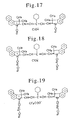
- Figures 1 through 20 show examples of the structural formulas of a group thereof.
- the anions in these benzoindodicarbocyanine correspond to X - in Figure 22 (discussed below) and X - can be any of the following: ClO 4 - , PF 6 - , BF 4 - , SbF 6 - , IO 4 - , CF 3 COO - .
- FIG 21 is a cross sectional view of the optical information recording medium 1 relating to the present invention.
- the optical information recording medium 1 comprises a transparent substrate 2, a light absorbing layer 3 formed on the substrate 2, a light reflecting layer 4 formed on the light absorbing layer 3, and a protective layer 5 formed on the light reflecting layer 4.
- a spiral-shaped pre-groove 6 is formed on the substrate 2.
- a portion other than the pre-groove 6, specifically land 7, is located on either side of the pre-groove 6.
- the light absorbing layer 3 comprises a light absorbing material.
- the light absorbing material comprises a principal light absorbing material constituted of one or a plurality of dyes which absorb the laser beam L1, and as necessary, other materials such as long-wavelength absorbing agents or stabilizers for stabilizing this principal light absorbing material.
- the light absorbing layer 3 sometimes includes binders (molecular weight is usually 2000 or more) or solvents (molecular weight is usually 600 or less), used when applying the mixture of the principal light absorbing material, stabilizer, and long-wavelength absorbing agent.
- binders molecular weight is usually 2000 or more
- solvents molecular weight is usually 600 or less
- the stabilizer is a compound wherein the absorption peak of the film is within the near infrared range of wavelength 900 - 1100 nm, and which fades into weak absorption of light in the range from short wavelengths, in the range absorbed by the principal light absorbing material, to long wavelengths, in the infrared range of 1500 nm or greater.
- the stabilizer is a compound which is very effective in stabilizing the principal light absorbing material, although it cannot be expected to greatly improve recording sensitivity.
- This stabilizer may be aminium salt, imonium salt, or a dithiol conjugate such as dithiobenzyl.
- This stabilizer must be included in the light absorbing layer 3 so as to constitute 0.1 - 30 wt%, and preferably 1 - 25 wt%, and more preferably 5 - 20 wt%.
- the long-wavelength absorbing agent has a maximum absorption peak at a longer wavelength than the wavelength of the recording beam L1; it may be, for example, a material with an absorption peak near the recording beam L1, or preferably a material where the peak differs from the recording beam by 30 - 100 nm.
- the long-wavelength absorbing agent is a material resulting in a film absorption peak of approximately 800 - 900 nm in the case of recording with a recording beam L1 which is a laser beam with a wavelength of approximately 780 nm.
- This material increases absorption at longer wavelengths in the range of 780 - 800 nm; it is added with the object of improving recording sensitivity by combining its absorption curve with that of the principal light absorbing material.
- This long-wavelength absorbing agent can be expected to improve recording sensitivity across a broader range of wavelengths than before; moreover, in combination with the stabilizers, it can be expected to improve light stability as well.
- This long-wavelength absorbing agent is a material which absorbs laser light with wavelengths near 780 - 800 nm; the long-wavelength absorbing agent is preferably a dye such as a polymethine dye like indotricarbocyanine or benzoindotricarbocyanine, or a porphyrin dye such as naphthalocyanine.
- This long-wavelength absorbing agent must make up 0.1 - 5 wt% of the light absorbing layer 3, preferably 0.3 - 4 wt%, and more preferably 0.5 - 3 wt%.
- the solvent used for the application of the mixture of the principal light absorbing material, the long-wavelength absorbing agent, and stabilizer may make up 0.01 - 1.0 wt% of the light absorbing layer 3.
- the solvent for application used here can be an alcohol such as isopropyl alcohol or butanol; an alkoxy alcohol such as methylcellosolve or ethylcellosolve; a ketoalcohol such as diacetone alcohol or acetyl acetone; lactic acid ester such as ethyl lactate or methyl lactate; or alcohol fluoride such as 2,2,3,3 tetrafluoropropanol.
- the solvent for application is not, however, limited to these.
- spin coating is generally used in forming the light absorbing layer 3 because of flexibility, but dip coating or vapor deposition methods may be used as necessary.
- resin binders may also be added to the light absorbing layer 3.
- the additive resin may be a thermoplastic resin such as nitrocellulose, a resin such as thermoplastic elastomer, liquid rubber, or the like.
- the resin may be isobutylene, maleic anhydride copolymer, polypropylene chloride, polyethylene oxide, nylon, polystyrene, or the like.
- the cellulose derivative may be carboxymethyl cellulose, nitrocellulose, MC (methyl cellulose), EC (ethyl cellulose), or the like.
- the oligomer may be oligostyrene, methylstyrene oligomer, or the like.
- the elastomer rubber may be styrene block copolymer, urethane-type thermoplastic elastomer, or the like.
- the substrate 2 and light absorbing layer 3 are in contact via the first interlayer 8.
- the light absorbing layer 3 and light reflecting layer 4 are in contact via the second interlayer 9.
- the light reflecting layer 4 and the protective layer 5 are in contact via the third interlayer 10.
- the light absorbing layer 3 absorbs the energy of this laser beam L1 and is heated thereby. Thermal deformation occurs on the side toward the substrate 2 and forms a pit 11.
- the index of refraction of the pit 11 portion is changed by the thermal decomposition of the dye in the light absorbing layer 3 at the recorded portion.
- the principal light absorbing material is a material which absorbs the laser beam L1 and breaks down during recording, creates variations in the index of refraction within the light absorbing layer 3, and causes the formation of the pit 11.
- the solubility of the light absorbing layer 3 in 70 °C water is 1.0 x 10 -1 milligrams/liter or less.
- the solubility in 70 °C water of the light absorbing material (principal light absorbing material, stabilizer, long-wavelength absorbing agent) comprising the light absorbing layer 3 is 1.0 x 10 -1 milligrams/liter or less.
- the molecular weight of the light absorbing material comprising the light absorbing layer 3 is 600 - 2000.
- the aforementioned light absorbing material can comprise the benzoindodicarbocyanine dye having the structural formula shown in Figure 22.
- the material used in the dye film in the light absorbing layer 3 has a solubility in 70 °C water (hot water) of 1.0 x 10 -1 milligrams/liter or less and preferably has a molecular weight of 600 or more and 2000 or less; with this material, the dye anions in the light absorbing layer 3 are not negative halogen ions.
- the light reflecting layer 4 of materials such as silver (Ag) and aluminum (Al), which are less expensive than gold (Au).
- the aforementioned CD-R type of optical information recording medium 1 has a light absorbing layer 3 comprising dye or the like between the polycarbonate substrate 2 and the light reflecting layer 4, which is metal; the deterioration of the recording can occur as a result of the breakdown of this light absorbing layer 3 and deformation of the substrate 2, as well as the optical phase difference in relation to the un-recorded portion of the recorded pit 11 portion caused by the difference in index of refraction in the light absorbing layer 3.
- the inventors conducted their examinations with attention to this issue. As a result, they concluded that the movement of the dye material within the light absorbing layer 3 under conditions of high heat and humidity is closely related to the solubility of the dye in hot water at this ambient temperature.
- compounds having a relatively low molecular weight of 600 or less display a marked movement of the dye material; the low molecular weight material easily causes deterioration over time.
- Materials with a molecular weight of 2000 or more cannot be used because of their limited solubility in the application solvent and because of the increased jitter during recording.
- cyanine dyes were found to have the following property.
- Dye materials comprising weakly basic anions such as I - , Br - , and SCN - easily move about; dye materials comprising strongly basic anions such as ClO 4 - , PF 6 - , BF 4 - , and SbF 6 - move about with difficulty.
- halogen anions such as I - and Br - are highly reactive and may react with and degrade a reflective film of Ag (silver). As a result, these have the limitation that such reflective films cannot be used.
- the optical information recording medium 1 using a dye material with a solubility in hot water of 0.1 milligrams/liter or less, will not deteriorate in testing at high temperatures and humidity, at the same temperature as the hot water, and has a BLER following testing which adequately satisfies the standards.
- the light absorbing layer 3 includes even one type of compound which does not satisfy the aforementioned conditions, the movement within the film of that compound degrades the recording.
- optical information recording media relating to the embodiments of the present invention are explained below.
- Injection molding was used to produce a polycarbonate substrate 2, with thickness 1.2 mm, outer diameter 120 mm, and inner diameter 15 mm, and whereon is formed a spiral-shaped pre-groove 6 with width 0.55 ⁇ m, depth 200 nm, pitch 1.6 ⁇ m.
- the benzoic cyanine dye No. NK-3386, molecular weight 701 with the structure shown in Figure 23, used as the recording dye, was dissolved in diacetone alcohol at 30 grams/liter. This was applied on the aforementioned substrate 2 and a dye film layer (light absorbing layer 3) with a film thickness of 75 nm was formed.
- the solubility of the material in the light absorbing layer 3 in hot water at a temperature of 70 °C was 0.03 milligrams/liter.
- a light reflecting layer 4 with thickness 100 nm and comprising gold (Au), was formed by RF sputtering on the substrate 2 having this dye film applied thereon.
- An ultraviolet-curable resin (Dainippon Ink and Chemicals, Inc., SD-211) was spin coated on this light reflecting layer 4 and exposed to ultraviolet light, forming a 10 ⁇ m thick protective layer 5.
- “Itop” is the maximum amount of reflected light in the CD playback signal.
- “I11” is the optical variation component corresponding to the difference between the amount of reflected light diffracted by the longest length pit recorded and returned to the objective lens, and the amount of light reflected by the non-pitted portions and returned to the objective lens.
- An optical information recording medium 1 was prepared in entirely the same manner as in the first embodiment, except for forming a 73 nm thick light absorbing layer 3 using the following recording dye material: 80 wt% of the benzoic cyanine dye used in the first embodiment and 20 wt% of the indocyanine dye (molecular weight 539), having the structure shown in Figure 24, dissolved in diacetone alcohol at 25 grams/liter.
- the solubility in 70 °C hot water of the indocyanine dye in Figure 24 and the blend forming the light absorbing layer 3 were 1.5 milligrams/liter and 1.3 milligrams/liter respectively.
- Injection molding was used to produce a polycarbonate substrate 2, with thickness 0.6 mm, outer diameter 120 mm, and inner diameter 15 mm, and whereon is formed a spiral-shaped pre-groove 6 with width 0.4 ⁇ m, depth 100 nm, pitch 0.8 ⁇ m.
- the benzoindodicarbocyanine dye (No. NK-4285, molecular weight 638) with the structure shown in Figure 25, used as the recording dye, was dissolved in diacetone alcohol at 20 grams/liter. This was applied on the aforementioned substrate 2 and a dye film layer (light absorbing layer 3) with a film thickness of 58 nm was formed.
- the solubility of the material in the light absorbing layer 3 in hot water at a temperature of 70 °C was 0.02 milligrams/liter.
- a light reflecting layer 4 with thickness 100 nm and comprising aluminum (Al), was formed by RF sputtering on the substrate 2 having this dye film applied thereon.
- An ultraviolet-curable resin (Dainippon Ink and Chemicals, Inc., SD-211) was spin coated on this light reflecting layer 4.
- An optical information recording medium prepared in the same manner as in the first embodiment, except for forming a 80 nm thick light reflecting layer 4 comprising silver (Ag) with sputtering, was evaluated in the same manner and using the same apparatus as in the first embodiment; the modulation amplitude was I11/Itop 73.8% and BLER was 0.5 cps.
- the present invention can result in an optical information recording medium having little deterioration of the recording under even conditions of high heat and humidity because of the reduced solubility of the light absorbing layer in hot water of 70 °C.
Landscapes
- Optical Record Carriers And Manufacture Thereof (AREA)
- Thermal Transfer Or Thermal Recording In General (AREA)
Claims (5)
- Support d'enregistrement optique d'informations comprenant :dans lequel les informations sont enregistrées par la brillance dudit rayon d'enregistrement sur ladite couche absorbant la lumière, etun substrat transparent ;une couche absorbant la lumière, située sur le substrat et comprenant un matériau absorbant la lumière, constitué d'une teinture qui absorbe le rayon laser d'enregistrement ; etune couche réfléchissant la lumière, située sur la couche absorbant la lumière et qui réfléchit le rayon laser ;
dans lequel la solubilité de ladite couche absorbant la lumière, dans de l'eau à 70°C, est 1,0 x 10⁻¹ milligramme/litre ou moins. - Support d'enregistrement optique d'informations selon la revendication 1, dans lequel la solubilité, dans de l'eau à 70°C, dudit matériau absorbant la lumière comprenant ladite couche absorbant la lumière est de 1,0 x 10⁻¹ milligramme/litre ou moins.
- Support d'enregistrement optique d'informations selon la revendication 1, dans lequel le poids moléculaire dudit matériau absorbant la lumière comprenant ladite couche absorbant la lumière est de 600 à 2000.
- Support d'enre gistrement optique d'informations selon la revendication 1, dans lequel ledit matériau absorbant la lumière comprenant ladite couche absorbant la lumière est une teinture de benzoindodicarbocyanine.
- Support d'enre gistrement optique d'informations selon la revendication 4, dans lequel des anions dans ladite teinture de benzoindodicarbocyanine sont l'un quelconque des suivants : clO4 -, PF6 -, BF4 -, SbF6 -, IO4 -, CF3COO- .
Applications Claiming Priority (6)
| Application Number | Priority Date | Filing Date | Title |
|---|---|---|---|
| JP21977897 | 1997-08-01 | ||
| JP21977897 | 1997-08-01 | ||
| JP219778/97 | 1997-08-01 | ||
| JP188072/98 | 1998-06-19 | ||
| JP18807298A JP3336524B2 (ja) | 1997-08-01 | 1998-06-19 | 光情報記録媒体 |
| JP18807298 | 1998-06-19 |
Publications (2)
| Publication Number | Publication Date |
|---|---|
| EP0895230A1 EP0895230A1 (fr) | 1999-02-03 |
| EP0895230B1 true EP0895230B1 (fr) | 2005-11-16 |
Family
ID=26504719
Family Applications (1)
| Application Number | Title | Priority Date | Filing Date |
|---|---|---|---|
| EP98113913A Revoked EP0895230B1 (fr) | 1997-08-01 | 1998-07-24 | Medium pour l'enregistrement d'information optique |
Country Status (7)
| Country | Link |
|---|---|
| EP (1) | EP0895230B1 (fr) |
| JP (1) | JP3336524B2 (fr) |
| KR (1) | KR19990023285A (fr) |
| CN (1) | CN1179336C (fr) |
| DE (1) | DE69832335T2 (fr) |
| SG (1) | SG94707A1 (fr) |
| TW (1) | TW389899B (fr) |
Families Citing this family (7)
| Publication number | Priority date | Publication date | Assignee | Title |
|---|---|---|---|---|
| TW575877B (en) | 2000-02-10 | 2004-02-11 | Sony Corp | Optical recording medium |
| JP3849606B2 (ja) * | 2002-08-06 | 2006-11-22 | 株式会社日立製作所 | 情報記録媒体、情報記録方法、情報再生方法 |
| JP2005310271A (ja) * | 2004-04-21 | 2005-11-04 | Tdk Corp | 色素成分の光記録媒体適性評価方法、光記録材料及び光記録媒体 |
| KR100629377B1 (ko) | 2005-02-01 | 2006-09-29 | 삼성전자주식회사 | 웨이퍼 하면의 파티클을 감지하는 웨이퍼 처리 방법 및 장치 |
| JP2006236420A (ja) * | 2005-02-22 | 2006-09-07 | Toshiba Corp | 記憶媒体、再生方法及び記録方法 |
| JP5265223B2 (ja) * | 2008-03-27 | 2013-08-14 | リンテック株式会社 | 多層光記録媒体用シート、光記録媒体用多層構造体及び多層光記録媒体 |
| JP5160330B2 (ja) * | 2008-07-25 | 2013-03-13 | 太陽誘電株式会社 | 光情報記録媒体用色素及び光情報記録媒体 |
Family Cites Families (7)
| Publication number | Priority date | Publication date | Assignee | Title |
|---|---|---|---|---|
| JP2823209B2 (ja) * | 1988-10-31 | 1998-11-11 | 日立マクセル株式会社 | 光情報記録媒体及びその製造方法 |
| US5270150A (en) * | 1990-04-25 | 1993-12-14 | Victor Company Of Japan, Ltd. | Optical recording medium and process for producing it |
| DE69123630T2 (de) * | 1990-04-25 | 1997-06-12 | Victor Company Of Japan | Optisches Aufzeichnungsmedium und Verfahren zu dessen Herstellung |
| US5274623A (en) * | 1990-07-19 | 1993-12-28 | Fuji Photo Film Co., Ltd. | Information recording medium having high modulation degree |
| JPH04360037A (ja) * | 1991-06-06 | 1992-12-14 | Pioneer Electron Corp | 追記型光ディスク |
| JPH0554432A (ja) * | 1991-08-20 | 1993-03-05 | Pioneer Electron Corp | 光記録媒体 |
| JP2657597B2 (ja) * | 1992-08-28 | 1997-09-24 | ティーディーケイ株式会社 | 光記録ディスク |
-
1998
- 1998-06-19 JP JP18807298A patent/JP3336524B2/ja not_active Expired - Lifetime
- 1998-07-15 TW TW087111534A patent/TW389899B/zh not_active IP Right Cessation
- 1998-07-21 SG SG9801829A patent/SG94707A1/en unknown
- 1998-07-24 DE DE69832335T patent/DE69832335T2/de not_active Expired - Lifetime
- 1998-07-24 EP EP98113913A patent/EP0895230B1/fr not_active Revoked
- 1998-07-31 KR KR1019980031280A patent/KR19990023285A/ko not_active Ceased
- 1998-07-31 CN CNB981167454A patent/CN1179336C/zh not_active Expired - Lifetime
Also Published As
| Publication number | Publication date |
|---|---|
| SG94707A1 (en) | 2003-03-18 |
| JPH11102539A (ja) | 1999-04-13 |
| CN1179336C (zh) | 2004-12-08 |
| CN1207553A (zh) | 1999-02-10 |
| TW389899B (en) | 2000-05-11 |
| DE69832335T2 (de) | 2006-04-20 |
| EP0895230A1 (fr) | 1999-02-03 |
| DE69832335D1 (de) | 2005-12-22 |
| JP3336524B2 (ja) | 2002-10-21 |
| KR19990023285A (ko) | 1999-03-25 |
Similar Documents
| Publication | Publication Date | Title |
|---|---|---|
| EP0676751B1 (fr) | Support d'enregistrement optique | |
| JP2699120B2 (ja) | 情報記録媒体および光情報記録方法 | |
| EP0895231B1 (fr) | Medium pour l'enregistement d'information optique | |
| JP2657579B2 (ja) | 光情報記録媒体 | |
| KR100230448B1 (ko) | 광기록매체 | |
| EP0895230B1 (fr) | Medium pour l'enregistrement d'information optique | |
| JP2686841B2 (ja) | 情報記録媒体及び光情報記録方法 | |
| US6277460B1 (en) | Optical recording medium | |
| JP2899008B2 (ja) | 情報記録媒体 | |
| JP2732314B2 (ja) | 光情報記録方法および情報記録媒体 | |
| JP3573600B2 (ja) | 光情報記録媒体 | |
| EP1035540B1 (fr) | Médium pour l' enrégistrement optique ainsi qu'un procédé d' enregistrement optique | |
| JP3059461B2 (ja) | 情報記録媒体 | |
| JPH08108623A (ja) | 光記録媒体 | |
| JP2597517B2 (ja) | 情報記録媒体 | |
| JP3141998B2 (ja) | 情報記録媒体 | |
| JP2542262B2 (ja) | 情報記録媒体 | |
| JP3184200B2 (ja) | 情報記録媒体 | |
| JP3073720B2 (ja) | 情報記録再生方法 | |
| JPH11353710A (ja) | 光情報記録媒体 | |
| JPH10340480A (ja) | 光情報記録媒体 | |
| JP2000123411A (ja) | 光情報記録媒体 | |
| JP2000057629A (ja) | 光情報記録媒体 | |
| JP2000276769A (ja) | 情報記録再生方法 | |
| KR19980023230A (ko) | 추기형 광기록 매체 |
Legal Events
| Date | Code | Title | Description |
|---|---|---|---|
| PUAI | Public reference made under article 153(3) epc to a published international application that has entered the european phase |
Free format text: ORIGINAL CODE: 0009012 |
|
| 17P | Request for examination filed |
Effective date: 19980724 |
|
| AK | Designated contracting states |
Kind code of ref document: A1 Designated state(s): CH DE FR GB LI NL |
|
| AX | Request for extension of the european patent |
Free format text: AL;LT;LV;MK;RO;SI |
|
| AKX | Designation fees paid |
Free format text: CH DE FR GB LI NL |
|
| 17Q | First examination report despatched |
Effective date: 20030226 |
|
| TPAC | Observations filed by third parties |
Free format text: ORIGINAL CODE: EPIDOSNTIPA |
|
| GRAP | Despatch of communication of intention to grant a patent |
Free format text: ORIGINAL CODE: EPIDOSNIGR1 |
|
| GRAS | Grant fee paid |
Free format text: ORIGINAL CODE: EPIDOSNIGR3 |
|
| GRAA | (expected) grant |
Free format text: ORIGINAL CODE: 0009210 |
|
| AK | Designated contracting states |
Kind code of ref document: B1 Designated state(s): CH DE FR GB LI NL |
|
| RAP1 | Party data changed (applicant data changed or rights of an application transferred) |
Owner name: TAIYO YUDEN CO., LTD. |
|
| REG | Reference to a national code |
Ref country code: GB Ref legal event code: FG4D |
|
| REG | Reference to a national code |
Ref country code: CH Ref legal event code: NV Representative=s name: BOVARD AG PATENTANWAELTE Ref country code: CH Ref legal event code: EP |
|
| REF | Corresponds to: |
Ref document number: 69832335 Country of ref document: DE Date of ref document: 20051222 Kind code of ref document: P |
|
| ET | Fr: translation filed | ||
| PLBI | Opposition filed |
Free format text: ORIGINAL CODE: 0009260 |
|
| 26 | Opposition filed |
Opponent name: CIBA SPEZIALITAETENCHEMIE HOLDING AG Effective date: 20060725 |
|
| PLAX | Notice of opposition and request to file observation + time limit sent |
Free format text: ORIGINAL CODE: EPIDOSNOBS2 |
|
| NLR1 | Nl: opposition has been filed with the epo |
Opponent name: CIBA SPEZIALITAETENCHEMIE HOLDING AG |
|
| PLAF | Information modified related to communication of a notice of opposition and request to file observations + time limit |
Free format text: ORIGINAL CODE: EPIDOSCOBS2 |
|
| PLBB | Reply of patent proprietor to notice(s) of opposition received |
Free format text: ORIGINAL CODE: EPIDOSNOBS3 |
|
| PLAB | Opposition data, opponent's data or that of the opponent's representative modified |
Free format text: ORIGINAL CODE: 0009299OPPO |
|
| R26 | Opposition filed (corrected) |
Opponent name: BASF SCHWEIZ AG Effective date: 20060725 |
|
| PGFP | Annual fee paid to national office [announced via postgrant information from national office to epo] |
Ref country code: NL Payment date: 20100714 Year of fee payment: 13 Ref country code: CH Payment date: 20100726 Year of fee payment: 13 |
|
| PGFP | Annual fee paid to national office [announced via postgrant information from national office to epo] |
Ref country code: FR Payment date: 20100805 Year of fee payment: 13 Ref country code: DE Payment date: 20100723 Year of fee payment: 13 |
|
| RDAF | Communication despatched that patent is revoked |
Free format text: ORIGINAL CODE: EPIDOSNREV1 |
|
| PGFP | Annual fee paid to national office [announced via postgrant information from national office to epo] |
Ref country code: GB Payment date: 20100722 Year of fee payment: 13 |
|
| REG | Reference to a national code |
Ref country code: CH Ref legal event code: PFA Owner name: TAIYO YUDEN CO., LTD. Free format text: TAIYO YUDEN CO., LTD.#16-20, UENO 6-CHOME#TAITO-KU TOKYO (JP) -TRANSFER TO- TAIYO YUDEN CO., LTD.#16-20, UENO 6-CHOME#TAITO-KU TOKYO (JP) |
|
| RDAG | Patent revoked |
Free format text: ORIGINAL CODE: 0009271 |
|
| STAA | Information on the status of an ep patent application or granted ep patent |
Free format text: STATUS: PATENT REVOKED |
|
| REG | Reference to a national code |
Ref country code: CH Ref legal event code: PL |
|
| 27W | Patent revoked |
Effective date: 20101230 |
|
| GBPR | Gb: patent revoked under art. 102 of the ep convention designating the uk as contracting state |
Effective date: 20101230 |
|
| PG25 | Lapsed in a contracting state [announced via postgrant information from national office to epo] |
Ref country code: LI Free format text: LAPSE BECAUSE OF THE APPLICANT RENOUNCES Effective date: 20051116 Ref country code: CH Free format text: LAPSE BECAUSE OF THE APPLICANT RENOUNCES Effective date: 20051116 |