EP0899297A2 - Pneumatic tire having a tread compound containing high levels of low TG polymer and resin - Google Patents
Pneumatic tire having a tread compound containing high levels of low TG polymer and resin Download PDFInfo
- Publication number
- EP0899297A2 EP0899297A2 EP98115684A EP98115684A EP0899297A2 EP 0899297 A2 EP0899297 A2 EP 0899297A2 EP 98115684 A EP98115684 A EP 98115684A EP 98115684 A EP98115684 A EP 98115684A EP 0899297 A2 EP0899297 A2 EP 0899297A2
- Authority
- EP
- European Patent Office
- Prior art keywords
- rubber
- phr
- pneumatic tire
- resin
- range
- Prior art date
- Legal status (The legal status is an assumption and is not a legal conclusion. Google has not performed a legal analysis and makes no representation as to the accuracy of the status listed.)
- Granted
Links
Classifications
-
- C—CHEMISTRY; METALLURGY
- C08—ORGANIC MACROMOLECULAR COMPOUNDS; THEIR PREPARATION OR CHEMICAL WORKING-UP; COMPOSITIONS BASED THEREON
- C08L—COMPOSITIONS OF MACROMOLECULAR COMPOUNDS
- C08L21/00—Compositions of unspecified rubbers
-
- B—PERFORMING OPERATIONS; TRANSPORTING
- B60—VEHICLES IN GENERAL
- B60C—VEHICLE TYRES; TYRE INFLATION; TYRE CHANGING; CONNECTING VALVES TO INFLATABLE ELASTIC BODIES IN GENERAL; DEVICES OR ARRANGEMENTS RELATED TO TYRES
- B60C1/00—Tyres characterised by the chemical composition or the physical arrangement or mixture of the composition
- B60C1/0016—Compositions of the tread
-
- C—CHEMISTRY; METALLURGY
- C08—ORGANIC MACROMOLECULAR COMPOUNDS; THEIR PREPARATION OR CHEMICAL WORKING-UP; COMPOSITIONS BASED THEREON
- C08L—COMPOSITIONS OF MACROMOLECULAR COMPOUNDS
- C08L45/00—Compositions of homopolymers or copolymers of compounds having no unsaturated aliphatic radicals in side chain, and having one or more carbon-to-carbon double bonds in a carbocyclic or in a heterocyclic ring system; Compositions of derivatives of such polymers
- C08L45/02—Compositions of homopolymers or copolymers of compounds having no unsaturated aliphatic radicals in side chain, and having one or more carbon-to-carbon double bonds in a carbocyclic or in a heterocyclic ring system; Compositions of derivatives of such polymers of coumarone-indene polymers
-
- Y—GENERAL TAGGING OF NEW TECHNOLOGICAL DEVELOPMENTS; GENERAL TAGGING OF CROSS-SECTIONAL TECHNOLOGIES SPANNING OVER SEVERAL SECTIONS OF THE IPC; TECHNICAL SUBJECTS COVERED BY FORMER USPC CROSS-REFERENCE ART COLLECTIONS [XRACs] AND DIGESTS
- Y10—TECHNICAL SUBJECTS COVERED BY FORMER USPC
- Y10S—TECHNICAL SUBJECTS COVERED BY FORMER USPC CROSS-REFERENCE ART COLLECTIONS [XRACs] AND DIGESTS
- Y10S152/00—Resilient tires and wheels
- Y10S152/905—Tread composition
Definitions
- the present invention relates to a pneumatic tire having a tread which is composed of high levels of a low Tg polymer and resin.
- the tread composition exhibits improved lab properties which correlate to improved treadwear with concomitant improvements in traction and handling.
- the present invention relates to a pneumatic tire having a tread containing (a) from 50 to 90 phr (parts by weight of rubber per 100 total parts of rubber) of a rubber which, in its uncured state, has a glass transition temperature in the range of from -80°C to -110°C and (b) from 15 to 50 phr of a resin.
- a pneumatic tire having an outer circumferential tread where said tread is a sulfur-cured composition
- said tread is a sulfur-cured composition
- Tg refers to the glass transition temperature of the identified rubber and is suitably determined by a differential scanning calorimeter at a rate of 10°C per minute.
- the tread is comprised of 50 to 90 parts by weight per 100 total parts by weight of rubber in the tread of a rubber which, in its uncured state, has a Tg in the range of from -80°C to -110°C.
- the Tg of this rubber ranges from about -90 to -105°C.
- this rubber is known as a low Tg rubber.
- the low Tg rubber is present in an amount ranging from 50 to 70 phr.
- This rubber may also be characterized by a butadiene content of at least 70 weight percent or greater. Should the butadiene content be substantially less than 70 weight percent, the Tg of the rubber will not be within the desired -80 to -110°C.
- the butadiene content ranges from about 75 to 100 weight percent.
- a representative rubber is a polybutadiene rubber having 95 weight percent or more cis 1,4-structure, a Tg of from -95 to -105°C and a Mooney viscosity (ML 1+4) at 100°C of from 30 to 100.
- Another example of a suitable rubber is an isoprene/butadiene copolymer rubber prepared by neodymium catalysis and characterized by having an isoprene content of about 20 weight percent, a Tg of about -90°C and a Mooney viscosity (ML1+4) at 100°C of 82.
- Yet another example is an isoprene/butadiene copolymer rubber prepared by neodymium catalysis and characterized by having an isoprene content of about 10 weight percent, a Tg of about -98°C and a Mooney viscosity (ML1+4) at 100°C of 82.
- suitable rubbers are solution-polymerized styrene/butadiene copolymer rubbers containing up to 10 weight percent of styrene.
- Such styrene/butadiene copolymers exhibit a Tg of from -93°C to -80°C and Mooney viscosities (ML 1+4) at 100°C from 30 to 100.
- the preferred rubber is the above-described cis-1,4-polybutadiene.
- the tread also contains from 10 to 50 phr of at least one rubber which, in its uncured state, has a Tg of from -79°C to +20°C.
- from 30 to 50 phr of the total rubber in the tread is a rubber having a Tg of from -79°C to +20°C.
- the preferred Tg range for this rubber ranges from -50 to +10°C.
- the rubbers in this broad range of Tgs can be further classified as "medium Tg" rubber and "high Tg" rubber.
- Medium Tg rubbers are those rubbers, in their uncured state, which have a Tg ranging from -79°C to -50°C.
- High Tg rubbers are those rubbers having a Tg ranging from -49°C to +20°C.
- medium Tg rubbers include cis 1,4-polyisoprene.
- the cis 1,4-polyisoprene rubber includes both natural and synthetic rubbers.
- Synthetic cis 1,4-polyisoprene generally has a Tg of about -65°C.
- Natural rubber typically has a Tg of about -65°C.
- Typical Mooney viscosities (ML 1+4) at 100°C for synthetic cis 1,4-polyisoprene and natural rubber range from 30 to 100.
- Another medium Tg rubber is an isoprene/butadiene copolymer rubber prepared by neodymium catalysis characterized by an isoprene content of about 70 weight percent, a Tg of about - 79°C and a Mooney viscosity (ML1+4) at 100°C of 76.
- Another medium Tg rubber is solution-polymerized styrene/butadiene copolymer rubber having a styrene content of about 18 weight percent, a vinyl content of about 10 weight percent, a Tg of about -78°C and a Mooney viscosity (ML1+4) at 100°C of 85.
- a medium Tg rubber is a solution-polymerized polybutadiene having a vinyl content of about 45 weight percent, a Tg of about -55°C and a Mooney viscosity (ML 1+4) at 100°C of 60.
- a medium Tg rubber is a solution-polymerized trans 1,4-polybutadiene having a weight percent content of 1,4-bonds ranging from about 60 to 80 weight percent, a Tg of about -70°C and a Mooney viscosity (ML 1+4) at 100°C of 60.
- high Tg rubbers include 3,4 polyisoprene which typically contains about 65 weight percent 3,4-isoprene units and has a Tg of about -16°C.
- Another example of a high Tg rubber is a solution-polymerized styrene/butadiene copolymer rubber containing 12 weight percent styrene, a vinyl content of about 40 weight percent, a Tg of - 45°C and a Mooney viscosity (ML1+4) at 100°C of 90.
- Another high Tg rubber is a styrene/isoprene/butadiene terpolymer rubber containing 20 weight percent styrene, 40 weight percent isoprene and 40 percent butadiene, a Tg of -42°C and a Mooney viscosity at 100°C of 90.
- Yet another high Tg rubber is an emulsion-polymerized polybutadiene rubber characterized by the weight percent of 1,4-bonds ranging from 65 to 70 percent, 15 to 20 weight percent of the units of a vinyl 1,2-structure and 8 to 15 weight percent of its units of a cis 1,4-structure.
- Such emulsion-polymerized polybutadiene has a Tg of -65°C and Mooney viscosity (ML 1+4) at 100°C of about 65.
- high Tg rubbers are emulsion-polymerized styrene/butadiene copolymer rubbers characterized by a weight percent of from 23.5 to 40 weight percent styrene.
- an emulsion-polymerized styrene/butadiene copolymer rubber having 23.5 weight percent styrene typically has a Tg of about -55°C and a Mooney viscosity (ML 1+4) at 100°C of about 50.
- An emulsion-polymerized styrene/butadiene copolymer rubber having 40 weight percent styrene typically has a Tg of about -35°C and a Mooney viscosity (ML 1+4) at 100°C of about 50.
- the tire of the present invention is comprised of a tread compound containing from 15 to 50 phr of a resin selected from the group consisting of hydrocarbon resins, phenol/acetylene resins, rosin-derived resins and mixtures thereof.
- a resin selected from the group consisting of hydrocarbon resins, phenol/acetylene resins, rosin-derived resins and mixtures thereof.
- the rubber contains from 15 to 30 phr of the resin.
- hydrocarbon resins include coumarone-indene resins, petroleum resins, terpene polymers and mixtures thereof.
- Coumarone-indene resins are commercially available in many forms with melting points ranging from 10°C to 160°C (as measured by the ball-and-ring method). Preferably, the melting point ranges from 30 to 100°C.
- Coumarone-indene resins are well known. Various analysis indicate that such resins are largely polyindene; however, typically contain random polymeric units derived from methyl indene, coumarone, methyl coumarone, styrene and methyl styrene. Representative examples of commercially available coumarone-indene resins are those marketed under the designation CUMAR® from Nalochem.
- the softening point was determined by ASTM E-28.
- the specific gravity was determined by ASTM D-71.
- the molecular weight number average was determined by ASTM D-3536.
- Petroleum resins are commercially available with softening points ranging from 10°C to 120°C. Preferably, the softening point ranges from 30 to 100°C.
- Suitable petroleum resins include both aromatic and nonaromatic types. Several types of petroleum resins are available. Some resins have a low degree of unsaturation and high aromatic content, whereas some are highly unsaturated and yet some contain no aromatic structure at all. Differences in the resins are largely due to the olefins in the feedstock from which the resins are derived. Conventional derivatives in such resins include dicyclopentadiene, cyclopentadiene, their dimers and diolefins such as isoprene and piperylene. A representative example of such a petroleum resin is Wingtack 95, which is commercially available from The Goodyear Tire & Rubber Company.
- Terpene polymers are commercially produced from polymerizing a mixture of beta pinene in mineral spirits.
- the resin is usually supplied in a variety of melting points ranging from 10°C to 135°C.
- Commercially available terpene polymers are available from Glidden under the designation CMP-361 and Schenectady Chem Co under the designation SP-560.
- Phenol/acetylene resins may be used. Phenol/acetylene resins may be derived by the addition of acetylene to butyl phenol in the presence of zinc naphthlate. Additional examples are derived from alkylphenol and acetylene. A representative example of the latter is a resin that is commercially available from GAF of New York, New York, under the designation KORESINTM. This particular resin has a melting point of from 110°C to 130°C.
- Resins derived from rosin and derivatives may be used in the present invention. Gum and wood rosin have much the same composition, although the amount of the various isomers may vary. They typically contain about 10 percent by weight neutral materials, 53 percent by weight resin acids containing two double bonds, 13 percent by weight of resin acids containing one double bond, 16 percent by weight of completely saturated resin acids and 2 percent of dehydroabietic acid which contains an aromatic ring but no unsaturation. There are also present about 6 percent of oxidized acids. Representative of the diunsaturated acids include abietic acid, levopimaric acid and neoabietic acid. Representative of the monounsaturated acids include dextroplmaris acid and dihydroabietic acid. A representative saturated rosin acid is tetrahydroabietic acid. A commercially available rosin-derived resin is sold under the designation Westvaco Resin-90 from Westvaco Chemical Co.
- the pneumatic tire of the present invention may contain a siliceous filler.
- the siliceous fillers or pigments include pyrogenic and precipitated silica.
- the siliceous pigments are preferably precipitated silicas such as, for example, those obtained by the acidification of a soluble silicate, e.g., sodium silicate.
- the silica filler if used, may be added in amounts ranging from 10 to 250 phr. Preferably, the silica is present in an amount ranging from 15 to 80 phr.
- Such silicas might be characterized, for example, by having a BET surface area, as measured using nitrogen gas, preferably in the range of about 40 to about 600, and more usually in a range of about 50 to about 300 square meters per gram.
- the BET method of measuring surface area is described in the Journal of the American Chemical Society , Volume 60, page 304 (1930).
- the silica may also be typically characterized by having a dibutyl phthalate (DBP) absorption value in a range of about 100 to about 400, and more usually about 150 to about 300.
- DBP dibutyl phthalate
- the silica might be expected to have an average ultimate particle size, for example, in the range of 0.01 to 0.05 micron as determined by the electron microscope, although the silica particles may be even smaller, or possibly larger, in size.
- silicas may be considered for use in this invention such as, only for example herein, and without limitation, silicas commercially available from PPG Industries under the Hi-Sil trademark with designations 210, 243, etc; silicas available from Rhone-Poulenc, with, for example, designations of Z1165MP and Z165GR and silicas available from Degussa AG with, for example, designations VN2 and VN3, etc.
- PPG Hi-Sil silicas are currently preferred.
- silica coupling agents to promote the adhesion between the rubber and silica.
- Representative coupling agents include organosilanes such as 3,3' bis(triethoxysilylpropyl) tetrasulfide.
- Silica coupling agents are generally used in amounts ranging from .1 to 20 phr. Specific examples of such organosilanes are disclosed in U.S. Patent 4,128,438 incorporated by reference in its entirety.
- the rubber composition would be compounded by methods generally known in the rubber compounding art, such as mixing the various sulfur-vulcanizable constituent rubbers with various commonly used additive materials such as, for example, curing aids, such as sulfur, activators, retarders and accelerators, processing oils, fillers, pigments, fatty acid, zinc oxide, waxes, antioxidants and antiozonants, peptizing agents and reinforcing materials such as, for example, carbon black.
- curing aids such as sulfur, activators, retarders and accelerators
- processing oils fillers, pigments, fatty acid, zinc oxide, waxes, antioxidants and antiozonants
- peptizing agents and reinforcing materials such as, for example, carbon black.
- the additives mentioned above are selected and commonly used in conventional amounts.
- Representative of the conventional carbon blacks which may be used in the present invention include those known to those skilled in the art under the ASTM designations N110, N121, N205, N220, N231, N234, N242, N293, N299, S315, N326, N330, M332, N339, N343, N347, N351, N358 and N375.
- Typical amounts of processing oils comprise about 1 to 50 phr. Such processing oils include aromatic, napthenic and/or paraffinic processing oils.
- Typical amounts of antioxidants comprise about 1 to about 5 phr.
- antioxidants may be, for example, diphenyl-p-phenylenediamine and others, such as, for example, those disclosed in the Vanderbilt Rubber Handbook (1978), pages 344-346.
- Typical amounts of antiozonants comprise about 1 to 5 phr.
- Typical amounts of fatty acids, if used, which can include stearic acid comprise about 0.5 to about 3 phr.
- Typical amounts of zinc oxide comprise about 2 to about 5 phr.
- Typical amounts of waxes comprise about 1 to about 5 phr. Often microcrystalline waxes are used.
- peptizers comprise about 0.1 to about 1 phr.
- Typical peptizers may be, for example, pentachlorothiophenol and dibenzamidodiphenyl disulfide.
- the vulcanization is conducted in the presence of a sulfur vulcanizing agent.
- suitable sulfur vulcanizing agents include elemental sulfur (free sulfur) or sulfur donating vulcanizing agents, for example, an amine disulfide, polymeric polysulfide or sulfur olefin adducts.
- the sulfur vulcanizing agent is elemental sulfur.
- sulfur vulcanizing agents are used in an amount ranging from about 0.5 to about 4 phr, or even, in some circumstances, up to about 8 phr, with a range of from about 1.5 to about 2.5, sometimes from 2 to 2.5, being preferred.
- Accelerators are used to control the time and/or temperature required for vulcanization and to improve the properties of the vulcanizate.
- a single accelerator system may be used, i.e., primary accelerator.
- a primary accelerator(s) is used in total amounts ranging from about 0.5 to about 4, preferably about 0.8 to about 1.5, phr.
- combinations of a primary and a secondary accelerator might be used with the secondary accelerator being used in smaller amounts (of about 0.05 to about 3 phr) in order to activate and to improve the properties of the vulcanizate.
- Combinations of these accelerators might be expected to produce a synergistic effect on the final properties and are somewhat better than those produced by use of either accelerator alone.
- delayed action accelerators may be used which are not affected by normal processing temperatures but produce a satisfactory cure at ordinary vulcanization temperatures.
- Vulcanization retarders might also be used.
- Suitable types of accelerators that may be used in the present invention are amines, disulfides, guanidines, thioureas, thiazoles, thiurams, sulfenamides, dithiocarbamates and xanthates.
- the primary accelerator is a sulfenamide.
- the secondary accelerator is preferably a guanidine, dithiocarbamate or thiuram compound.
- Vulcanization of the rubber composition of the present invention is generally carried out at conventional temperatures ranging from about 100°C to 200°C.
- the vulcanization is conducted at temperatures ranging from about 110°C to 180°C.
- Any of the usual vulcanization processes may be used such as heating in a press or mold, heating with superheated steam or hot air or in a salt bath.
- the mixing of the rubber composition can be accomplished by methods known to those having skill in the rubber mixing art.
- the ingredients are typically mixed in at least two stages, namely at least one non-productive stage followed by a productive mix stage.
- the final curatives are typically mixed in the final stage which is conventionally called the "productive" mix stage in which the mixing typically occurs at a temperature, or ultimate temperature, lower than the mix temperature(s) than the preceding non-productive mix stage(s).
- the rubber, resins, silica and silica coupler, and carbon black if used, are mixed in one or more non-productive mix stages.
- the terms "non-productive" and "productive" mix stages are well known to those having skill in the rubber mixing art.
- the mechanical mixing is under conditions sufficient to generate a rubber temperature between 130°C and 180°C for a period of time ranging from 10 seconds to 20 minutes.
- the rubber compound as described herein is particularly suited for a tread of a pneumatic tire.
- Such tires can be built, shaped, molded and cured by various methods which are known and will be readily apparent to those having skill in such art.
- the tire may be a passenger tire, aircraft tire, truck tire and the like.
- the tire is a passenger tire.
- the tire may also be a radial or bias, with a radial tire being preferred.
- Cure properties were determined using a Monsanto oscillating disc rheometer which was operated at a temperature of 150°C and at a frequency of 11 hertz.
- a description of oscillating disc rheometers can be found in the Vanderbilt Rubber Handbook edited by Robert O. Ohm (Norwalk, Conn., R. T. Vanderbilt Company, Inc., 1990), pages 554-557.
- the use of this cure meter and standardized values read from the curve are specified in ASTM D-2084.
- a typical cure curve obtained on an oscillating disc rheometer is shown on page 555 of the 1990 edition of the Vanderbilt Rubber Handbook.
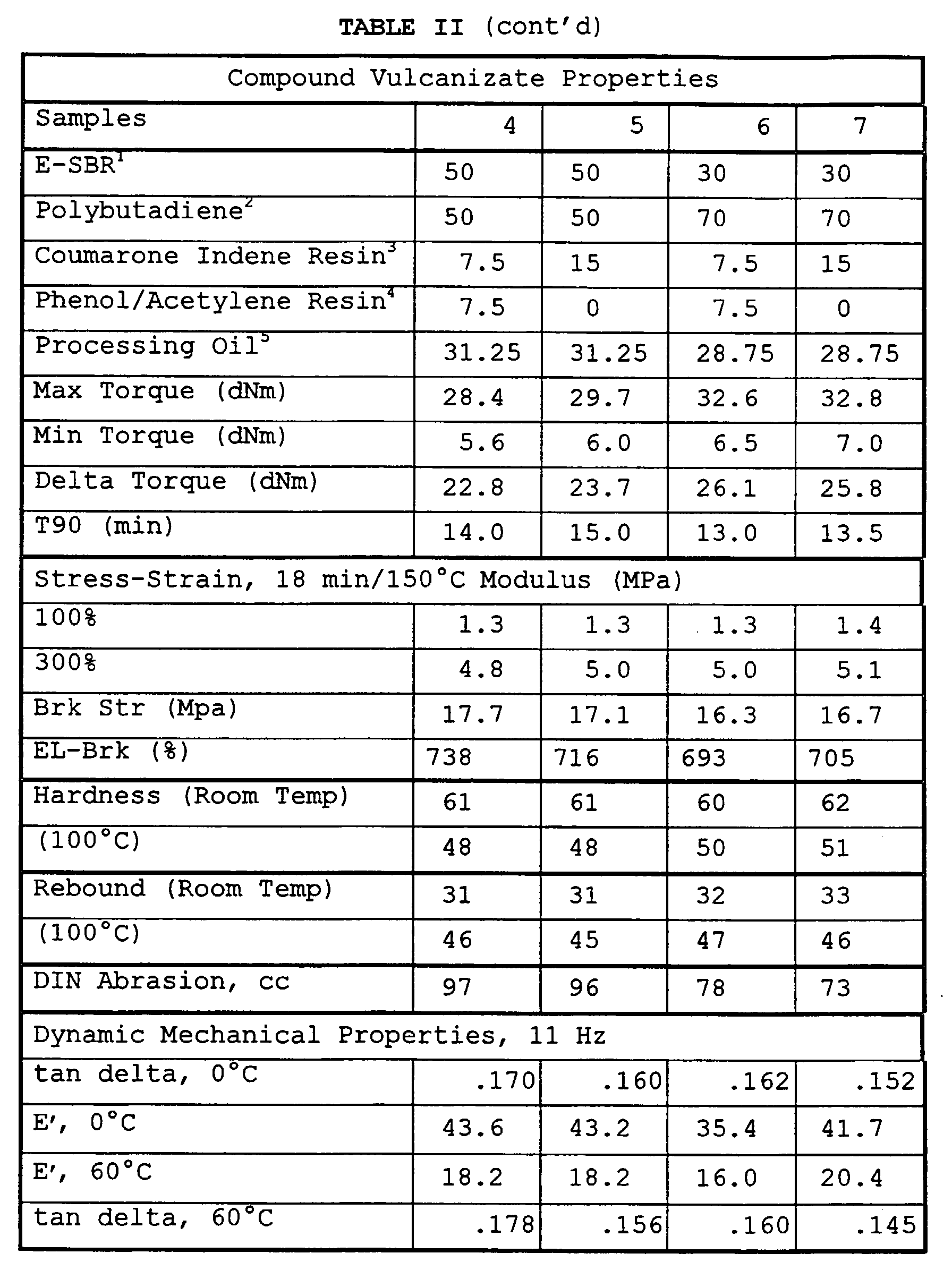
- the following tables report cure properties that were determined from cure curves that were obtained from the rubber stocks that were prepared. These properties include a torque minimum (Min. Torque), a torque maximum (Max. Torque), minutes to 90% of the torque increase (T90) and difference between the maximum torque and minimum torque (delta torque).
- Shore Hardness was determined in accordance with ASTM D-1415.
- Rubber compounds containing the materials set out in Table I were prepared in a BR BanburyTM mixer. Each sample contained the same level of each ingredient unless listed in the Tables. All samples were mixed in the same standard manner. The samples were cured at about 150°C for about 18 minutes. Table II illustrates the behavior and physical properties of each of the cured samples.
- Compound Ingredients Ingredients phr Nonproductive E-SBR Varied Polybutadiene Varied Coumarone Indene Resin Varied Phenol/Acetylene Resin Varied Processing Oil Varied Carbon Black 70 Processing Aids 3.25 Fatty Acid 2 Zinc Oxide 2 Productive Amine Antioxidant 1.15 Sulfenamide Accelerators 1.55 Sulfur 1.45
- the DIN abrasion results suggest significant improvements in treadwear for the compounds containing the higher levels of polybutadiene and resins.
- Wet traction which is related to the low temperature dynamic properties ( tan delta at 0°C ), is improved for the compounds containing the high level of resins.
- the high levels of the above polybutadiene combined with the high levels of resin improves the conventional tradeoff between treadwear and traction.
Landscapes
- Chemical & Material Sciences (AREA)
- Health & Medical Sciences (AREA)
- Chemical Kinetics & Catalysis (AREA)
- Medicinal Chemistry (AREA)
- Polymers & Plastics (AREA)
- Organic Chemistry (AREA)
- Engineering & Computer Science (AREA)
- Mechanical Engineering (AREA)
- Tires In General (AREA)
- Compositions Of Macromolecular Compounds (AREA)
- Developing Agents For Electrophotography (AREA)
- Addition Polymer Or Copolymer, Post-Treatments, Or Chemical Modifications (AREA)
Abstract
Description
| Resin | Softening Point °C | Specific Gravity @ 25°C | Molecular Weight No. Average |
| R-3 | 130 | 1.13 | 515 |
| LX-509 | 157 | 1.14 | 700 |
| R-11 | 112 | 1.09 | 700 |
| R-13 | 105 | 1.12 | 460 |
| R-17 | 70 | 1.10 | 500 |
| R-21 | 45 | 1.05 | 450 |
| R-29 | 25 | 1.08 | 420 |
| Compound Ingredients | |
| Ingredients | phr |
| Nonproductive | |
| E-SBR | Varied |
| Polybutadiene | Varied |
| Coumarone Indene Resin | Varied |
| Phenol/Acetylene Resin | Varied |
| Processing Oil | Varied |
| Carbon Black | 70 |
| Processing Aids | 3.25 |
| Fatty Acid | 2 |
| Zinc Oxide | 2 |
| Productive | |
| Amine Antioxidant | 1.15 |
| Sulfenamide Accelerators | 1.55 |
| Sulfur | 1.45 |


Claims (10)
- A pneumatic tire having an outer circumferential tread where said tread is a sulfur-cured composition characterized by(a) 50 to 90 phr of a rubber which, in its uncured state, has a glass transition temperature (Tg) in the range of from -80°C to -110°C;(b) 10 to 50 phr of at least one rubber which, in its uncured state, has a glass transition temperature (Tg) in the range of from -79°C to +20°C and which is selected from the group consisting of cis 1,4-polyisoprene, 3,4 polyisoprene, styrene/butadiene rubber, styrene/isoprene/butadiene terpolymer rubber, solution-polymerized polybutadiene rubber, emulsion-polymerized polybutadiene, isoprene/butadiene rubber and mixtures thereof; and(c) 15 to 50 phr of a resin selected from the group consisting of hydrocarbon resins, phenol/acetylene resins, rosin-derived resins and mixtures thereof.
- The pneumatic tire of claim 1 characterized in that said rubber characterized by a glass transition temperature ranging from -80°C to -110°C is selected from the group consisting of cis 1,4-polybutadiene, an isoprene/butadiene copolymer, solution-polymerized styrene/butadiene copolymer and mixtures thereof.
- The pneumatic tire of claim 1 characterized in that said composition comprises(a) 50 to 70 phr of a rubber having a glass transition temperature in the range of from -80 to -110°C and(b) 30 to 50 phr of rubber having a glass transition temperature in the range of from -79 to +20°C and is selected from the group consisting of natural rubber, synthetic cis 1,4-polyisoprene, 3,4-polyisoprene, styrene/butadiene rubber, styrene/isoprene/butadiene terpolymer rubber, high trans 1,4-polybutadiene rubber, styrene/isoprene rubber, isoprene/butadiene rubber and mixtures thereof.
- The pneumatic tire of claim 1 characterized in that said hydrocarbon resins are selected from the group consisting of coumarone-indene resins, petroleum resins, terpene polymers and mixtures thereof.
- The pneumatic tire of claim 4 characterized in that said resin is a coumarone-indene resin.
- The pneumatic tire of claim 1 characterized in that said resin is a phenol/acetylene resin.
- The pneumatic tire of claim 1 characterized in that said resin is a rosin-derived resin.
- The pneumatic tire of claim 1 characterized in that said tread contains from 10 to 250 phr of particulate silica.
- The pneumatic tire of claim 8 characterized in that said tread the silica is characterized by having a BET surface area in a range of from 40 to 600 square meters per gram and a dibutyl phthalate (DBP) absorption value in a range of from 100 to 400.
- The pneumatic tire of claim 1 characterized in that(a) 50 to 90 phr of a rubber which, in its uncured state, has a glass transition temperature in the range of from -90°C to -105°C and(b) 10 to 50 phr of at least one rubber which, in its uncured state, has a glass transition temperature in the range of from -50°C to +10°C.
Applications Claiming Priority (2)
| Application Number | Priority Date | Filing Date | Title |
|---|---|---|---|
| US920109 | 1997-08-26 | ||
| US08/920,109 US5901766A (en) | 1997-08-26 | 1997-08-26 | Pneumatic tire having a tread compound containing high levels of low Tg polymer and resin |
Publications (3)
| Publication Number | Publication Date |
|---|---|
| EP0899297A2 true EP0899297A2 (en) | 1999-03-03 |
| EP0899297A3 EP0899297A3 (en) | 1999-08-11 |
| EP0899297B1 EP0899297B1 (en) | 2001-10-31 |
Family
ID=25443177
Family Applications (1)
| Application Number | Title | Priority Date | Filing Date |
|---|---|---|---|
| EP98115684A Expired - Lifetime EP0899297B1 (en) | 1997-08-26 | 1998-08-20 | Pneumatic tire having a tread compound containing high levels of low TG polymer and resin |
Country Status (5)
| Country | Link |
|---|---|
| US (1) | US5901766A (en) |
| EP (1) | EP0899297B1 (en) |
| BR (1) | BR9803189A (en) |
| CA (1) | CA2244399A1 (en) |
| DE (1) | DE69802245T2 (en) |
Cited By (17)
| Publication number | Priority date | Publication date | Assignee | Title |
|---|---|---|---|---|
| EP1075967A1 (en) * | 1999-08-10 | 2001-02-14 | The Goodyear Tire & Rubber Company | Tire tread which contains resins with spatially-defined softening points |
| EP1077229A1 (en) * | 1999-08-19 | 2001-02-21 | The Goodyear Tire & Rubber Company | Pneumatic tire having a tread containing dicyclopentadiene/betapinene resin |
| FR2821849A1 (en) * | 2001-03-12 | 2002-09-13 | Michelin Soc Tech | RUBBER COMPOSITION FOR TIRE TREAD AND PNEUMATIC ENVELOPE INCORPORATING THE SAME |
| FR2821848A1 (en) * | 2001-03-12 | 2002-09-13 | Michelin Soc Tech | RUBBER COMPOSITION FOR TIRE TREAD AND PNEUMATIC ENVELOPE INCORPORATING THE SAME |
| EP1308317A1 (en) * | 2001-10-31 | 2003-05-07 | The Goodyear Tire & Rubber Company | Tire with component comprised of a blend of polybutadiene-rich rubber composition which contains a minor portion of styrene-rich styrene/isoprene elastomer |
| EP1225200A3 (en) * | 2001-01-17 | 2003-07-09 | Bridgestone Corporation | Rubber composition and pneumatic tire |
| WO2004013221A1 (en) * | 2002-07-29 | 2004-02-12 | Societe De Technologie Michelin | Rubber composition for the thread cap of a pneumatic tyre |
| WO2004013220A1 (en) * | 2002-07-31 | 2004-02-12 | Societe De Technologie Michelin | Rubber composition for tyre tread |
| WO2004022644A1 (en) * | 2002-09-04 | 2004-03-18 | Societe De Technologie Michelin | Rubber composition for tyre treads |
| CN100465218C (en) * | 2004-02-11 | 2009-03-04 | 米其林技术公司 | Plasticizing system for rubber compositions |
| EP2033812A1 (en) * | 2007-08-27 | 2009-03-11 | The Goodyear Tire & Rubber Company | Rubber composition and tire having component containing combination of emulsion SBR and tackifying resins |
| RU2369620C2 (en) * | 2004-10-22 | 2009-10-10 | Сосьете Де Текноложи Мишлен | Barrier layer for elastomer products |
| US7902285B2 (en) | 2006-01-14 | 2011-03-08 | Continental Aktiengesellschaft | Rubber mixture and tires |
| DE102013110719A1 (en) | 2013-09-27 | 2015-04-02 | Continental Reifen Deutschland Gmbh | Sulfur crosslinkable rubber compound and pneumatic vehicle tires |
| EP2818507A4 (en) * | 2012-02-24 | 2015-11-04 | Kuraray Co | RUBBER COMPOSITION AND TIRE |
| US10576785B2 (en) | 2009-12-23 | 2020-03-03 | Compagnie Generale Des Etablissements Michelin | Rubber composition for aircraft tire treads |
| US20220235208A1 (en) * | 2019-05-29 | 2022-07-28 | Bridgestone Americas Tire Operations, Llc | Tire Tread Rubber Composition And Related Methods |
Families Citing this family (46)
| Publication number | Priority date | Publication date | Assignee | Title |
|---|---|---|---|---|
| US7084228B2 (en) | 2002-07-29 | 2006-08-01 | Michelin Recherche Et Technique S.A. | Rubber composition for a tire tread |
| WO2004024813A1 (en) * | 2002-09-10 | 2004-03-25 | Societe De Technologie Michelin | Rubber composition for tyre treads |
| US20050245688A1 (en) * | 2004-05-03 | 2005-11-03 | Sandstrom Paul H | Tire with tread of specialized trans 1,4-polybutadiene polymer and CIS 1,4-polyisoprene natural rubber |
| DE502006004788D1 (en) | 2006-03-24 | 2009-10-22 | Continental Automotive Gmbh | Rubber compound and tires |
| US8136562B2 (en) * | 2006-12-29 | 2012-03-20 | Bridgestone Firestone North American Tire, Llc | Tire bead insulation |
| CN101636285B (en) * | 2007-04-23 | 2013-03-13 | 米其林集团总公司 | Rubber retreading formulation |
| DE102007031986A1 (en) | 2007-07-10 | 2009-01-15 | Continental Aktiengesellschaft | Rubber compound, in particular for tires |
| DE102007060859A1 (en) | 2007-12-18 | 2009-06-25 | Continental Aktiengesellschaft | Rubber mixture, in particular for vehicle tires |
| CA2710859C (en) | 2007-12-28 | 2016-05-17 | Bridgestone Americas Tire Operations, Llc | Silica containing black sidewall compounds and tires comprising same |
| CN101910278B (en) * | 2008-01-18 | 2013-04-03 | 埃克森美孚化学专利公司 | Elastomeric compositions comprising hydrocarbon polymer additives |
| EP2323856A4 (en) * | 2008-08-31 | 2011-12-21 | Michelin Soc Tech | BARRIER AGAINST ALIPHATIC RESIN GASES |
| RU2522568C2 (en) | 2008-12-31 | 2014-07-20 | Бриджстоун Корпорейшн | Rubber compositions, containing polymer component with multimodal molecular-weight distribution |
| EP2357211B1 (en) | 2010-02-17 | 2018-11-21 | Continental Reifen Deutschland GmbH | Sulphur crosslinkable rubber composition |
| US8653195B2 (en) | 2010-10-13 | 2014-02-18 | Exxonmobil Chemical Patents Inc. | Hydrocarbon polymer modifiers for elastomeric compositions |
| EP2452972B2 (en) * | 2010-11-10 | 2022-04-13 | Continental Reifen Deutschland GmbH | Commercial vehicle pneumatic tyre |
| US8143338B1 (en) | 2010-12-09 | 2012-03-27 | The Goodyear Tire & Rubber Company | Cement for rubber and tire fabrication |
| JP5351244B2 (en) * | 2011-04-22 | 2013-11-27 | 住友ゴム工業株式会社 | Rubber composition for tire and pneumatic tire |
| FR2992965B1 (en) | 2012-07-05 | 2015-07-03 | Michelin & Cie | PROCESS FOR MODIFYING UNSATURATED HYDROCARBON RESIN |
| US20140135437A1 (en) | 2012-11-15 | 2014-05-15 | The Goodyear Tire & Rubber Company | Tire with rubber tread containing combination of resin and vegetable oil, particularly soybean oil |
| JP5737324B2 (en) * | 2013-05-02 | 2015-06-17 | 横浜ゴム株式会社 | Rubber composition for tire |
| EP2853558B1 (en) | 2013-09-27 | 2016-11-09 | Continental Reifen Deutschland GmbH | Sulfur crosslinkable rubber composition |
| EP2853557B1 (en) * | 2013-09-27 | 2016-11-09 | Continental Reifen Deutschland GmbH | Sulfur crosslinkable rubber composition |
| DE102014202748B4 (en) | 2014-02-14 | 2025-02-20 | Continental Reifen Deutschland Gmbh | Vulcanized composition based on a sulfur-crosslinkable rubber mixture, its use and vehicle tires containing the composition |
| DE102014202749A1 (en) | 2014-02-14 | 2015-08-20 | Continental Reifen Deutschland Gmbh | Sulfur crosslinkable rubber compound and vehicle tires |
| US9757987B2 (en) | 2014-12-09 | 2017-09-12 | The Goodyear Tire & Rubber Company | Pneumatic tire |
| US9764594B2 (en) | 2014-12-09 | 2017-09-19 | The Goodyear Tire & Rubber Company | Pneumatic tire |
| WO2016106408A1 (en) * | 2014-12-26 | 2016-06-30 | Compagnie Generale Des Etablissements Michelin | Tire treads with functionalized rubber |
| US10087306B2 (en) | 2015-01-15 | 2018-10-02 | Flow Polymers, Llc | Additive for silica reinforced rubber formulations |
| US10563050B2 (en) | 2015-12-15 | 2020-02-18 | The Goodyear Tire & Rubber Company | Pneumatic tire |
| EP3397488B1 (en) | 2015-12-31 | 2021-10-06 | Kraton Chemical, LLC | Resin-extended rubber composition and tire rubber compositions prepared therewith |
| WO2018063313A1 (en) * | 2016-09-30 | 2018-04-05 | Compagnie Generale Des Etablissements Michelin | Rubber compositions with improved silica dispersion |
| US9758650B1 (en) * | 2016-11-17 | 2017-09-12 | The Goodyear Tire & Rubber Company | Pneumatic tire |
| WO2019213226A1 (en) | 2018-05-04 | 2019-11-07 | Bridgestone Americas Tire Operations, Llc | Tire tread rubber composition |
| US12365202B2 (en) | 2018-05-04 | 2025-07-22 | Bridgestone Americas Tire Operations, Llc | Tire tread rubber composition |
| US12103334B2 (en) | 2018-05-04 | 2024-10-01 | Bridgestone Americas Tire Operations, Llc | Tire tread rubber composition |
| JP2021523260A (en) | 2018-05-04 | 2021-09-02 | ブリヂストン アメリカズ タイヤ オペレーションズ、 エルエルシー | Tire tread rubber composition |
| EP3622843B1 (en) | 2018-09-13 | 2023-01-25 | The Goodyear Tire & Rubber Company | Resin modified oil extended rubber |
| US10947368B2 (en) | 2019-03-04 | 2021-03-16 | The Goodyear Tire & Rubber Company | Pneumatic tire |
| US11220595B2 (en) | 2019-03-04 | 2022-01-11 | The Goodyear Tire & Rubber Company | Reinforced rubber containing silylated triglyceride oil |
| EP3976393A1 (en) | 2019-05-29 | 2022-04-06 | Bridgestone Americas Tire Operations, LLC | Tire tread rubber composition and related methods |
| JP2022535725A (en) | 2019-05-29 | 2022-08-10 | ブリヂストン アメリカズ タイヤ オペレーションズ、 エルエルシー | Tire tread rubber composition and related methods |
| US11440350B2 (en) | 2020-05-13 | 2022-09-13 | The Goodyear Tire & Rubber Company | Pneumatic tire |
| JP7468130B2 (en) * | 2020-05-14 | 2024-04-16 | 住友ゴム工業株式会社 | Motorcycle tires |
| EP4056644B1 (en) | 2021-03-09 | 2026-04-29 | The Goodyear Tire & Rubber Company | A rubber composition and a tire |
| EP4056640B1 (en) | 2021-03-09 | 2026-04-29 | The Goodyear Tire & Rubber Company | A rubber composition and a tire |
| US12263705B2 (en) | 2022-09-09 | 2025-04-01 | The Goodyear Tire & Rubber Company | Tire |
Family Cites Families (6)
| Publication number | Priority date | Publication date | Assignee | Title |
|---|---|---|---|---|
| US5191021A (en) * | 1988-06-29 | 1993-03-02 | The Goodyear Tire & Rubber Company | Tire with tread containing styrene, isoprene, butadiene terpolymer rubber |
| US5005625A (en) * | 1989-04-24 | 1991-04-09 | The Goodyear Tire & Rubber Company | Pneumatic tire having air retention innerliner |
| US5082901A (en) * | 1990-09-24 | 1992-01-21 | The Goodyear Tire & Rubber Company | Tire with tread |
| US5087668A (en) * | 1990-10-19 | 1992-02-11 | The Goodyear Tire & Rubber Company | Rubber blend and tire with tread thereof |
| TW273561B (en) * | 1993-10-21 | 1996-04-01 | Sumitomo Bakelite Co | |
| US5504140A (en) * | 1994-09-30 | 1996-04-02 | The Goodyear Tire & Rubber Company | Tire with tread of elastomer composition |
-
1997
- 1997-08-26 US US08/920,109 patent/US5901766A/en not_active Expired - Lifetime
-
1998
- 1998-07-31 CA CA002244399A patent/CA2244399A1/en not_active Abandoned
- 1998-08-19 BR BR9803189-9A patent/BR9803189A/en not_active IP Right Cessation
- 1998-08-20 EP EP98115684A patent/EP0899297B1/en not_active Expired - Lifetime
- 1998-08-20 DE DE69802245T patent/DE69802245T2/en not_active Expired - Lifetime
Cited By (29)
| Publication number | Priority date | Publication date | Assignee | Title |
|---|---|---|---|---|
| EP1075967A1 (en) * | 1999-08-10 | 2001-02-14 | The Goodyear Tire & Rubber Company | Tire tread which contains resins with spatially-defined softening points |
| EP1077229A1 (en) * | 1999-08-19 | 2001-02-21 | The Goodyear Tire & Rubber Company | Pneumatic tire having a tread containing dicyclopentadiene/betapinene resin |
| US6348539B1 (en) | 1999-08-19 | 2002-02-19 | The Goodyear Tire & Rubber Company | Pneumatic tire having a tread containing dicyclopentadiene/beta-pinene resin |
| EP1225200A3 (en) * | 2001-01-17 | 2003-07-09 | Bridgestone Corporation | Rubber composition and pneumatic tire |
| WO2002072689A1 (en) * | 2001-03-12 | 2002-09-19 | Societe De Technologie Michelin | Rubber composition for tyre treads and tyres |
| WO2002072688A1 (en) * | 2001-03-12 | 2002-09-19 | Societe De Technologie Michelin | Rubber composition for tyre treads and tyres |
| FR2821848A1 (en) * | 2001-03-12 | 2002-09-13 | Michelin Soc Tech | RUBBER COMPOSITION FOR TIRE TREAD AND PNEUMATIC ENVELOPE INCORPORATING THE SAME |
| FR2821849A1 (en) * | 2001-03-12 | 2002-09-13 | Michelin Soc Tech | RUBBER COMPOSITION FOR TIRE TREAD AND PNEUMATIC ENVELOPE INCORPORATING THE SAME |
| EP1308317A1 (en) * | 2001-10-31 | 2003-05-07 | The Goodyear Tire & Rubber Company | Tire with component comprised of a blend of polybutadiene-rich rubber composition which contains a minor portion of styrene-rich styrene/isoprene elastomer |
| US6812277B2 (en) | 2001-10-31 | 2004-11-02 | The Goodyear Tire & Rubber Company | Tire with component comprised of a blend of polybutadiene-rich rubber composition which contains a minor portion of styrene-rich styrene/isoprene elastomer |
| WO2004013221A1 (en) * | 2002-07-29 | 2004-02-12 | Societe De Technologie Michelin | Rubber composition for the thread cap of a pneumatic tyre |
| EP1529077B1 (en) * | 2002-07-29 | 2018-09-12 | Compagnie Générale des Etablissements Michelin | Rubber composition for the thread cap of a pneumatic tyre |
| WO2004013220A1 (en) * | 2002-07-31 | 2004-02-12 | Societe De Technologie Michelin | Rubber composition for tyre tread |
| US7431061B2 (en) | 2002-07-31 | 2008-10-07 | Michelin Recherche Et Technique S.A. | Rubber composition for a tire tread |
| US7253225B2 (en) | 2002-09-04 | 2007-08-07 | Michelin Recherche Et Technique, S.A. | Rubber composition for a tire tread |
| WO2004022644A1 (en) * | 2002-09-04 | 2004-03-18 | Societe De Technologie Michelin | Rubber composition for tyre treads |
| RU2340637C2 (en) * | 2002-09-04 | 2008-12-10 | Сосьете Де Текноложи Мишлен | Composition of tread rubber for tires |
| JP2005537369A (en) * | 2002-09-04 | 2005-12-08 | ソシエテ ドゥ テクノロジー ミシュラン | Rubber composition for tire tread |
| CN100465218C (en) * | 2004-02-11 | 2009-03-04 | 米其林技术公司 | Plasticizing system for rubber compositions |
| RU2369620C2 (en) * | 2004-10-22 | 2009-10-10 | Сосьете Де Текноложи Мишлен | Barrier layer for elastomer products |
| US7649043B2 (en) | 2004-10-22 | 2010-01-19 | Michelin Recherche Et Technique S.A. | Barrier layer for elastomeric articles |
| US7902285B2 (en) | 2006-01-14 | 2011-03-08 | Continental Aktiengesellschaft | Rubber mixture and tires |
| EP2033812A1 (en) * | 2007-08-27 | 2009-03-11 | The Goodyear Tire & Rubber Company | Rubber composition and tire having component containing combination of emulsion SBR and tackifying resins |
| US10576785B2 (en) | 2009-12-23 | 2020-03-03 | Compagnie Generale Des Etablissements Michelin | Rubber composition for aircraft tire treads |
| EP2818507A4 (en) * | 2012-02-24 | 2015-11-04 | Kuraray Co | RUBBER COMPOSITION AND TIRE |
| US9228077B2 (en) | 2012-02-24 | 2016-01-05 | Kuraray Co., Ltd. | Rubber composition and tire |
| DE102013110719A1 (en) | 2013-09-27 | 2015-04-02 | Continental Reifen Deutschland Gmbh | Sulfur crosslinkable rubber compound and pneumatic vehicle tires |
| US20220235208A1 (en) * | 2019-05-29 | 2022-07-28 | Bridgestone Americas Tire Operations, Llc | Tire Tread Rubber Composition And Related Methods |
| US12325797B2 (en) * | 2019-05-29 | 2025-06-10 | Bridgestone Americas Tire Operations, Llc | Tire tread rubber composition and related methods |
Also Published As
| Publication number | Publication date |
|---|---|
| DE69802245T2 (en) | 2002-07-04 |
| EP0899297B1 (en) | 2001-10-31 |
| CA2244399A1 (en) | 1999-02-26 |
| DE69802245D1 (en) | 2001-12-06 |
| BR9803189A (en) | 1999-12-21 |
| EP0899297A3 (en) | 1999-08-11 |
| US5901766A (en) | 1999-05-11 |
Similar Documents
| Publication | Publication Date | Title |
|---|---|---|
| EP0899297B1 (en) | Pneumatic tire having a tread compound containing high levels of low TG polymer and resin | |
| US10654995B2 (en) | Pneumatic tire | |
| CA2948708C (en) | Tire with tread for low temperature performance and wet traction | |
| EP3181373B1 (en) | Rubber composition and pneumatic tire | |
| EP3159181B1 (en) | Rubber composition and pneumatic tire | |
| US5605951A (en) | Silica reinforced rubber compostition and tire with tread thereof | |
| EP0831122B1 (en) | Tyre with tread of elastomer composition | |
| EP3450494B1 (en) | Pneumatic tire | |
| EP3335904A1 (en) | Pneumatic tire | |
| CN109422937B (en) | Pneumatic tire with tread comprising hydroxyl-terminated polybutadiene | |
| CA2160324C (en) | Tire having silica reinforced tread | |
| EP3205514A1 (en) | Rubber composition and tire with tread for low temperature performance and wet traction | |
| EP3560992A1 (en) | Rubber composition and pneumatic tire | |
| EP4282913B1 (en) | Rubber composition and a tire comprising a rubber composition | |
| EP3216623B1 (en) | Rubber composition and pneumatic tire | |
| EP4249549A1 (en) | Rubber composition for stiffness | |
| EP4101657B1 (en) | Rubber composition and tire | |
| US12583952B2 (en) | Rubber composition and tire | |
| US12209183B2 (en) | Pneumatic tire having tread with three elastomers | |
| EP4253082A1 (en) | Rubber composition for a winter tire and a winter tire | |
| EP4257370A1 (en) | Tire rubber composition for heavy load vehicle | |
| MXPA98006708A (en) | Pneumatic tire that has a rolling compound containing high levels of bajode tg polymer and res | |
| MXPA97006817A (en) | Composition of reinforced rubber with silice and its use in llan |
Legal Events
| Date | Code | Title | Description |
|---|---|---|---|
| PUAI | Public reference made under article 153(3) epc to a published international application that has entered the european phase |
Free format text: ORIGINAL CODE: 0009012 |
|
| AK | Designated contracting states |
Kind code of ref document: A2 Designated state(s): DE FR GB IT |
|
| AX | Request for extension of the european patent |
Free format text: AL;LT;LV;MK;RO;SI |
|
| PUAL | Search report despatched |
Free format text: ORIGINAL CODE: 0009013 |
|
| AK | Designated contracting states |
Kind code of ref document: A3 Designated state(s): AT BE CH CY DE DK ES FI FR GB GR IE IT LI LU MC NL PT SE |
|
| AX | Request for extension of the european patent |
Free format text: AL;LT;LV;MK;RO;SI |
|
| 17P | Request for examination filed |
Effective date: 20000126 |
|
| AKX | Designation fees paid |
Free format text: DE FR GB IT |
|
| 17Q | First examination report despatched |
Effective date: 20000704 |
|
| GRAG | Despatch of communication of intention to grant |
Free format text: ORIGINAL CODE: EPIDOS AGRA |
|
| GRAG | Despatch of communication of intention to grant |
Free format text: ORIGINAL CODE: EPIDOS AGRA |
|
| GRAH | Despatch of communication of intention to grant a patent |
Free format text: ORIGINAL CODE: EPIDOS IGRA |
|
| GRAH | Despatch of communication of intention to grant a patent |
Free format text: ORIGINAL CODE: EPIDOS IGRA |
|
| GRAA | (expected) grant |
Free format text: ORIGINAL CODE: 0009210 |
|
| AK | Designated contracting states |
Kind code of ref document: B1 Designated state(s): DE FR GB IT |
|
| REF | Corresponds to: |
Ref document number: 69802245 Country of ref document: DE Date of ref document: 20011206 |
|
| REG | Reference to a national code |
Ref country code: GB Ref legal event code: IF02 |
|
| ET | Fr: translation filed | ||
| PLBE | No opposition filed within time limit |
Free format text: ORIGINAL CODE: 0009261 |
|
| STAA | Information on the status of an ep patent application or granted ep patent |
Free format text: STATUS: NO OPPOSITION FILED WITHIN TIME LIMIT |
|
| 26N | No opposition filed | ||
| PGFP | Annual fee paid to national office [announced via postgrant information from national office to epo] |
Ref country code: GB Payment date: 20060706 Year of fee payment: 9 |
|
| GBPC | Gb: european patent ceased through non-payment of renewal fee |
Effective date: 20070820 |
|
| PG25 | Lapsed in a contracting state [announced via postgrant information from national office to epo] |
Ref country code: GB Free format text: LAPSE BECAUSE OF NON-PAYMENT OF DUE FEES Effective date: 20070820 |
|
| PGFP | Annual fee paid to national office [announced via postgrant information from national office to epo] |
Ref country code: IT Payment date: 20080816 Year of fee payment: 11 |
|
| PG25 | Lapsed in a contracting state [announced via postgrant information from national office to epo] |
Ref country code: IT Free format text: LAPSE BECAUSE OF NON-PAYMENT OF DUE FEES Effective date: 20090820 |
|
| PGFP | Annual fee paid to national office [announced via postgrant information from national office to epo] |
Ref country code: DE Payment date: 20130902 Year of fee payment: 16 |
|
| PGFP | Annual fee paid to national office [announced via postgrant information from national office to epo] |
Ref country code: FR Payment date: 20130725 Year of fee payment: 16 |
|
| REG | Reference to a national code |
Ref country code: DE Ref legal event code: R119 Ref document number: 69802245 Country of ref document: DE |
|
| REG | Reference to a national code |
Ref country code: FR Ref legal event code: ST Effective date: 20150430 |
|
| REG | Reference to a national code |
Ref country code: DE Ref legal event code: R119 Ref document number: 69802245 Country of ref document: DE Effective date: 20150303 |
|
| PG25 | Lapsed in a contracting state [announced via postgrant information from national office to epo] |
Ref country code: DE Free format text: LAPSE BECAUSE OF NON-PAYMENT OF DUE FEES Effective date: 20150303 |
|
| PG25 | Lapsed in a contracting state [announced via postgrant information from national office to epo] |
Ref country code: FR Free format text: LAPSE BECAUSE OF NON-PAYMENT OF DUE FEES Effective date: 20140901 |