EP0908415A1 - Alliage pour le stockage d'hydrogène - Google Patents
Alliage pour le stockage d'hydrogène Download PDFInfo
- Publication number
- EP0908415A1 EP0908415A1 EP98118837A EP98118837A EP0908415A1 EP 0908415 A1 EP0908415 A1 EP 0908415A1 EP 98118837 A EP98118837 A EP 98118837A EP 98118837 A EP98118837 A EP 98118837A EP 0908415 A1 EP0908415 A1 EP 0908415A1
- Authority
- EP
- European Patent Office
- Prior art keywords
- hydrogen
- alloy
- atomic
- hydrogen storage
- capacity
- Prior art date
- Legal status (The legal status is an assumption and is not a legal conclusion. Google has not performed a legal analysis and makes no representation as to the accuracy of the status listed.)
- Withdrawn
Links
Images




Classifications
-
- C—CHEMISTRY; METALLURGY
- C01—INORGANIC CHEMISTRY
- C01B—NON-METALLIC ELEMENTS; COMPOUNDS THEREOF; METALLOIDS OR COMPOUNDS THEREOF NOT COVERED BY SUBCLASS C01C
- C01B3/00—Hydrogen; Gaseous mixtures containing hydrogen; Separation of hydrogen from mixtures containing it; Purification of hydrogen; Reversible storage of hydrogen
- C01B3/0005—Reversible storage of hydrogen, e.g. by hydrogen getters or electrodes
- C01B3/001—Reversible storage of hydrogen, e.g. by hydrogen getters or electrodes characterised by the uptaking media; Treatment thereof
- C01B3/0018—Inorganic elements or compounds, e.g. oxides, nitrides, borohydrides or zeolites; Solutions thereof
- C01B3/0031—Intermetallic compounds; Metal alloys
-
- H—ELECTRICITY
- H01—ELECTRIC ELEMENTS
- H01M—PROCESSES OR MEANS, e.g. BATTERIES, FOR THE DIRECT CONVERSION OF CHEMICAL ENERGY INTO ELECTRICAL ENERGY
- H01M4/00—Electrodes
- H01M4/02—Electrodes composed of, or comprising, active material
- H01M4/36—Selection of substances as active materials, active masses, active liquids
- H01M4/38—Selection of substances as active materials, active masses, active liquids of elements or alloys
- H01M4/383—Hydrogen absorbing alloys
-
- Y—GENERAL TAGGING OF NEW TECHNOLOGICAL DEVELOPMENTS; GENERAL TAGGING OF CROSS-SECTIONAL TECHNOLOGIES SPANNING OVER SEVERAL SECTIONS OF THE IPC; TECHNICAL SUBJECTS COVERED BY FORMER USPC CROSS-REFERENCE ART COLLECTIONS [XRACs] AND DIGESTS
- Y02—TECHNOLOGIES OR APPLICATIONS FOR MITIGATION OR ADAPTATION AGAINST CLIMATE CHANGE
- Y02E—REDUCTION OF GREENHOUSE GAS [GHG] EMISSIONS, RELATED TO ENERGY GENERATION, TRANSMISSION OR DISTRIBUTION
- Y02E60/00—Enabling technologies; Technologies with a potential or indirect contribution to GHG emissions mitigation
- Y02E60/10—Energy storage using batteries
-
- Y—GENERAL TAGGING OF NEW TECHNOLOGICAL DEVELOPMENTS; GENERAL TAGGING OF CROSS-SECTIONAL TECHNOLOGIES SPANNING OVER SEVERAL SECTIONS OF THE IPC; TECHNICAL SUBJECTS COVERED BY FORMER USPC CROSS-REFERENCE ART COLLECTIONS [XRACs] AND DIGESTS
- Y02—TECHNOLOGIES OR APPLICATIONS FOR MITIGATION OR ADAPTATION AGAINST CLIMATE CHANGE
- Y02E—REDUCTION OF GREENHOUSE GAS [GHG] EMISSIONS, RELATED TO ENERGY GENERATION, TRANSMISSION OR DISTRIBUTION
- Y02E60/00—Enabling technologies; Technologies with a potential or indirect contribution to GHG emissions mitigation
- Y02E60/30—Hydrogen technology
- Y02E60/32—Hydrogen storage
Definitions
- the present invention relates to a hydrogen storage alloy which can absorb and desorb hydrogen in a reversible manner and serves as an effective functional material for the use of hydrogen energy.
- a hydrogen storage alloy In general, there are some properties desirable for a hydrogen storage alloy to have, i.e. ease of activations, a large hydrogen storage capacity, a hydrogen absorption-desorption curve having a wide plateau region with exceptional flatness, a small hysteresis, a heat of formation suitable for its operating temperature, a high absorption-desorption velocity, resistance to poisoning by impurities, good thermal conductivity, and the like. As the most important property among them when storing hydrogen, there is a practicably usable and effectively large hydrogen storage capacity.
- RNi 5 -type alloys wherein R is La or a mish metal, are commercially used as hydrogen storage alloys having a relatively large discharge capacity which are employed for negative electrodes of nickel-metal hydride storage batteries.
- LaNi 5 alloy has a hydrogen storage capacity of 1.4 wt% and a equilibrium hydrogen absorption-desorption pressure of 0.2 to 0.3 MPa at room temperature, is easy to handle, and can absorb and desorb hydrogen at a temperature close to room temperature.
- mish metal which is a composition of unrefined rare earth metals instead of expensive lanthanum, and a mish metal-nickel multi-element alloy with ternary, quaternary and/or quinternary elements are added thereto.
- the hydrogen storage capacity of the mish metal-nickel alloy is about 1.2 to 1.5 wt% at room temperature.
- AB 2 -type Laves phase alloys with C14, C15 or C36 crystal structure have been previously investigated as hydrogen storage alloys and many Laves phase alloys are known.
- an effective hydrogen storage alloy there is one having the formula represented by Ti a Zr 1-a M 2 wherein 0 ⁇ a ⁇ 1 and M is one or more elements selected from the group consisting of Mn, Cr, V, Fe, Co and Mo.
- one of the Laves phase alloys with a large hydrogen storage capacity and exceptional plateau characteristics is Ti 0.9 Zr 0.1 Mn 1.4 Cr 0.4 V 0.2 alloy.
- This alloy has a large hydrogen storage capacity of 2.1 wt% and a hydride dissociation pressure of about 0.9 MPa at a temperature close to room temperature, and is easy to be activated.
- a large effective hydrogen absorption-desorption capacity is desired at its operating temperature. Namely, when regarding hydrogen storage alloy as a hydrogen feeding device, it is desired to possibly desorb hydrogen atom effectively when equilibrium hydrogen pressure of the alloy is not less than 1 atom, i.e. atmospheric pressure.
- the effective hydrogen transfer capacity which is the effective hydrogen absorption-desorption capacity, of the above-mentioned LaNi 5 alloy is 1.2 wt% at room temperature.
- the effective hydrogen transfer capacity of the above-mentioned Ti 0.9 Zr 0.1 Mn 1.4 Cr 0.4 V 0.2 alloy which has a large storage capacity among various Laves phase alloys known as of AB 2 -type, is 1.6 wt% at room temperature. Even the effective hydrogen transfer capacity of even metal V or V-type alloy having a large hydrogen storage capacity is about 2.0 wt% at room temperature. Further, the hydrogen storing property of V-type alloy is deteriorated as the hydrogen absorption-desorption cycle is repeated.
- the object of the present invention is to provide a hydrogen storage alloy which has a larger effective hydrogen transfer capacity than ever and good cycle life characteristics.
- the present invention provides a hydrogen storage alloy of body-centered cubic structure comprising V-type alloy, which contains at least one element selected from the group consisting of Ti, Zr, Hf, Cr and Mo in an amount of 0.3 to 5 atomic%.
- the amount of the element to be added to V is more than 5 atomic%
- the amount is necessarily not more than 5 atomic%.
- the lower limit of the amount is preferably 0.3 atomic%.
- the amount of the element to be added is 1 to 2 atomic%.
- Zr is preferable from the viewpoint that flatness of the higher plateau is excellent and hysteresis is small.
- the V-type alloy of the present invention with at least one element selected from the group consisting of the above-mentioned elements, stability of metal hydride phase corresponding to the higher plateau region is enhanced by adding the elements to the body-centered cubic structure. Therefore, there are given the following effects that the maximum hydrogen storage capacity of the alloy is increased by alloying and that the effective hydrogen transfer capacity is also increased because the higher plateau region of the hydrogen absorption-desorption curve is enlarged. As the result, a hydrogen storage alloy having a large effective hydrogen transfer capacity can be achieved.
- the present invention is based on the result obtained by designing a novel alloy while studying crystal structure and carrying out several experiments. It is noted that the alloy of the present invention can be prepared by a conventional method such as atomizing method, mechanical alloying method or the like.
- Figure 1 is a diagram of the hydrogen pressure composition isotherm at room temperature for the hydrogen storage alloy V 0.99 Ti 0.01 of the present example. 29.72 g of 99.7% pure metal V and 0.28 g of 99.5% pure metal Ti were weighed out and co-melted in an arc belting furnace under an atmosphere of argon to form an alloy. During the co-melting, the ingots were remelted five times while being rotated to form a homogeneous alloy. The obtained button ingots were pulverized to form samples for hydrogen absorption-desorption capacity measurement.
- the hydrogen absorption-desorption capacity measurement was carried out by measuring the hydrogen pressure composition isotherm.
- a change in an amount of hydrogen which reacts with an alloy is determined and is measured on the virgin metal condition.
- the change in the amount of hydrogen within a constant volume was calculated from the temperature and difference in pressures before and after the measurement.
- the amount of hydrogen which reacted with the alloy was determined.
- the measurement was based on the state where any hydrogen was stored, and was carried out after activating the sample and evacuating the same at a high temperature to remove the residual hydrogen. Namely, the activation was carried out by placing the sample in vacuum for 3 hours at 500°C, hydrogen absorption-desorption was repeated 3 times, the sample was evacuated again for 6 hours at 800°C and, then, the measurement was carried out.
- Figure 1 shows that the maximum hydrogen storage capacity is 4.0 wt%, that the width of the higher plateau region is wide and flatness thereof is good, and that the effective hydrogen transfer capacity is improved by the addition of Ti.
- the effective hydrogen transfer capacity becomes 2.1% and is increased by about 5% compared to metal V without Ti added.
- the alloy contains 1 atomic% of Ti.
- the increasing ratio (%) of the effective hydrogen transfer capacity according to the amount of Ti is as the followings: 4% in case where 2 atomic% of Ti is contained, 3% in case where 3 atomic% of Ti is contained, 2% in case where 4 atomic% of Ti is contained, and 1% in case where 5 atomic% of Ti is contained.
- the amount of Ti is more than 5 atomic%, the maximum hydrogen storage capacity is remarkably decreased and the effective hydrogen transfer capacity is also remarkably decreased. Accordingly, the amount of Ti contained in the alloy of the present invention should be not more than 5 atomic%.
- Ti element was added to pure metal V in the present example and the same effect can be obtained even when Ti element is added to solid solution vanadium material with other element added thereto.
- the same effect can be obtained even when two or more elements selected from the group consisting of Ti, Zr, Hf, Cr and Mo if the total amount of the elements is not more than 5 atomic%.
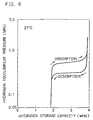
- Figure 2 is a diagram of the hydrogen pressure composition isotherm at room temperature for the hydrogen storage alloy V 0.99 Zr 0.01 of the present example. 29.47 g of 99.7% pure metal V and 0.53 g of 99% pure metal Zr were weighed out and co-melted in an arc melting furnace under an atmosphere of argon to form an alloy. During the co-melting, the ingots were remelted five times while being rotated to form a homogeneous alloy. The obtained button ingots were processed finely to form samples for hydrogen absorption-desorption capacity measurement.
- the hydrogen absorption-desorption capacity measurement was carried out in the same manner as in Example 1. The activation was carried out by placing the sample in vacuum for 3 hours at 500°C. Then, after repeating hydrogen absorption-desorption 3 times, the sample was evacuated again for 6 hours at 800°C and, then, the measurement was carried out.
- Figure 2 shows that maximum hydrogen storage capacity is 4.0 wt%, that the width of the higher plateau region is wide and flatness thereof is good, and that the effective hydrogen transfer capacity is improved by the addition of Zr.
- the effective hydrogen transfer capacity becomes 2.1% and is increased by about 5% compared to metal V without Zr added.
- the alloy contains 1 atomic% of Zr.
- the increasing ratio(%) of the effective hydrogen transfer capacity according to the amount of Zr is as the followings: 4% in case where 2 atomic% of Zr is contained, 3 % in case where 3 atomic% of Zr is contained, 2% in case where 4 atomic% of Zr is contained, and 1 % in case where 5 atomic% of Zr is contained.
- the amount of Zr is more than 5 atomic%, the maximum hydrogen storage capacity is remarkably decreased and the effective hydrogen transfer capacity is also remarkably decreased. Accordingly, the amount of Zr contained in the alloy of the present invention should be not more than 5 atomic%.
- Zr element is added to pure metal V in the present example and the same effect can be obtained even when Zr element is added to solid solution vanadium material with other element added thereto.
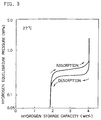
- Figure 3 is a diagram of the hydrogen pressure composition isotherm at room temperature for the hydrogen storage alloy V 0.99 Hf 0.01 of the present example.
- 28.97 g of 99.7% pure metal V and 1.03 g of 98% pure metal Hf were weighed out and co-melted in an arc melting furnace under an atmosphere of argon to form an alloy.
- the ingots were remelted five times while being rotated to form a homogeneous alloy.
- the obtained button ingots were processed finely to form samples for hydrogen absorption-desorption capacity measurement.
- the hydrogen absorption-desorption capacity measurement was carried out in the same manner as in Example 1.
- the activation was carried out by placing the sample in vacuum for 3 hours at 500°C. Then, after repeating hydrogen absorption-desorption 3 times, the sample was evacuated again for 6 hours at 800°C and, then, the measurement was carried out.
- Figure 3 shows that maximum hydrogen storage capacity is 4.0 wt%, that the width of the higher plateau region is wide and flatness thereof is good, and that the effective hydrogen transfer capacity is improved by the addition of Hf.
- the effective hydrogen transfer capacity becomes 2.1% and is increased by about 5% compared to metal V without Hf added.
- the alloy contains 1 atomic%of Hf.
- the increasing ratio(%) of the effective hydrogen transfer capacity according to the amount of Hf is as the followings: 4%in case where 2 atomic%of Hf is contained, 3%in case where 3 atomic%of Hf is contained, 2%in case where 4 atomic%of Hf is contained, and 1%in case where 5 atomic%of Hf is contained.
- the amount of Hf is more than 5 atomic%, the maximum hydrogen storage capacity is remarkably decreased and the effective hydrogen transfer capacity is also decreased remarkably. Accordingly, the amount of Hf contained in the alloy of the present invention should be not more than 5 atomic%.
- Hf element is added to pure metal V in the present example and the same effect can be obtained even when Hf element is added to solid solution vanadium material with other element added thereto.
- Hf is added to pure metal V in the present example, the same effect can be obtained even when two or more elements selected from the group consisting of Ti, Zr, Hf, Cr and Mo if the total amount of the elements is not more than 5 atomic%.
- Figure 4 is a diagram of the hydrogen pressure composition isotherm at room temperature for the hydrogen storage alloy V 0.99 Cr 0.01 of the present example. 29.69 g of 99.7% pure metal V and 0.31 g of 99.9% pure metal Cr were weighed out and co-melted in an arc melting furnace under an atmosphere of argon to form an alloy. During the co-melting, the ingots were remelted five times while being rotated to form a homogeneous alloy. The obtained button ingots were processed finely to form samples for hydrogen absorption-desorption capacity measurement. The hydrogen absorption-desorption capacity measurement was carried out in the same manner as in Example 1. The activation was carried out by placing the sample in vacuum for 3 hours at 500°C. Then, after repeating hydrogen absorption-desorption 3 times, the sample was evacuated again for 6 hours at 800°C and, then, the measurement was carried out.
- Figure 4 shows that maximum hydrogen storage capacity is 4.0 wt%, that the width of the higher plateau region is wide and flatness thereof is good, and that the effective hydrogen transfer capacity is improved by the addition of Cr.
- the effective hydrogen transfer capacity becomes 2.1% and is increased about 5% as compared as in case of metal V to which any Cr is not added.
- the alloy contains 1 atomic% of Cr.
- the increasing ratio(%) of the effective hydrogen transfer capacity according to the amount of Cr is as the followings: 4% in case where 2 atomic% of Cr is contained, 3% in case where 3 atomic% of Cr is contained, 2% in case where 4 atomic%of Cr is contained, and 1%in case where 5 atomic% of Cr is contained.
- the amount of Cr is more than 5 atomic%, the maximum hydrogen storage capacity is remarkably decreased and the effective hydrogen transfer capacity is also decreased remarkably. Accordingly, the amount of Cr contained in the alloy of the present invention should be not more than 5 atomic%.
- Cr element is added to pure metal V in the present example and the same effect can be obtained even when Cr element is added to solid solution vanadium material with other element added thereto.
- the same effect can be obtained even when two or more elements selected from the group consisting of Ti, Zr, Hf, Cr and Mo if the total amount of the elements is not more than 5 atomic%.
- Figure 5 is a diagram of the hydrogen pressure composition isotherm at room temperature for the hydrogen storage alloy V 0.99 Mo 0.01 of the present example. 29.44 g of 99.7% pure metal V and 0.56 g of 99.9% pure metal Mo were weighed out and co-melted in an arc melting furnace under an atmosphere of argon to form an alloy. During the co-melting, the ingots were remelted five times while being rotated to form a homogeneous alloy. The obtained button ingots were processed finely to form samples for hydrogen absorption-desorption capacity measurement. The hydrogen absorption-desorption capacity measurement was carried out in the same manner as in Example 1. The activation was carried out by placing the sample in vacuum for 3 hours at 500°C. Then, after repeating hydrogen absorption-desorption 3 times, the sample was evacuated again for 6 hours at 800°C and, then, the measurement was carried out.
- Figure 5 shows that maximum hydrogen storage capacity is 4.0 wt%, that the width of the higher plateau region is wide and flatness thereof is good, and that the effective hydrogen transfer capacity is improved by the addition of Mo.
- the effective hydrogen transfer capacity becomes 2.1%and is increased by about 5% compared to metal V without Mo added.
- the alloy contains 1 atomic% of Mo.
- the increasing ratio(%) of the effective hydrogen transfer capacity according to the amount of Mo is as the followings: 4% in case where 2 atomic% of Mo is contained, 3% in case where 3 atomic% of Mo is contained, 2% in case where 4 atomic% of Mo is contained, and 1% in case where 5 atomic% of Mo is contained.
- the amount of Mo is more than 5 atomic%, the maximum hydrogen storage capacity is remarkably decreased and the effective hydrogen transfer capacity is also decreased remarkably. Accordingly, the amount of Mo contained in the alloy of the present invention should be not more than 5 atomic%.
- Mo element is added to pure metal V in the present example and the same effect can be obtained even when Mo element is added to solid solution vanadium material with other element added thereto.
- Mo is added to pure metal V in the present example, the same effect can be obtained even when two or more elements selected from the group consisting of Ti, Zr, Hf, Cr and Mo if the total amount of the elements is not more than 5 atomic%.
Landscapes
- Chemical & Material Sciences (AREA)
- Chemical Kinetics & Catalysis (AREA)
- Organic Chemistry (AREA)
- Electrochemistry (AREA)
- General Chemical & Material Sciences (AREA)
- Engineering & Computer Science (AREA)
- Combustion & Propulsion (AREA)
- Inorganic Chemistry (AREA)
- Battery Electrode And Active Subsutance (AREA)
- Hydrogen, Water And Hydrids (AREA)
Applications Claiming Priority (2)
| Application Number | Priority Date | Filing Date | Title |
|---|---|---|---|
| JP276834/97 | 1997-10-09 | ||
| JP9276834A JPH11117036A (ja) | 1997-10-09 | 1997-10-09 | 水素吸蔵合金 |
Publications (1)
| Publication Number | Publication Date |
|---|---|
| EP0908415A1 true EP0908415A1 (fr) | 1999-04-14 |
Family
ID=17575061
Family Applications (1)
| Application Number | Title | Priority Date | Filing Date |
|---|---|---|---|
| EP98118837A Withdrawn EP0908415A1 (fr) | 1997-10-09 | 1998-10-06 | Alliage pour le stockage d'hydrogène |
Country Status (2)
| Country | Link |
|---|---|
| EP (1) | EP0908415A1 (fr) |
| JP (1) | JPH11117036A (fr) |
Cited By (1)
| Publication number | Priority date | Publication date | Assignee | Title |
|---|---|---|---|---|
| CN104561719A (zh) * | 2015-02-12 | 2015-04-29 | 攀钢集团攀枝花钢铁研究院有限公司 | 钒铬合金及其制备方法 |
Families Citing this family (1)
| Publication number | Priority date | Publication date | Assignee | Title |
|---|---|---|---|---|
| JP5213156B2 (ja) * | 2007-08-22 | 2013-06-19 | 株式会社日本製鋼所 | 高容量水素吸蔵合金 |
Citations (3)
| Publication number | Priority date | Publication date | Assignee | Title |
|---|---|---|---|---|
| US4440737A (en) * | 1982-09-20 | 1984-04-03 | Allied Corporation | Room temperature reaction of vanadium-based alloys with hydrogen |
| EP0161075A2 (fr) * | 1984-04-17 | 1985-11-13 | Ovonic Battery Company | Matériaux d'emmagasinage d'hydrogène, méthodes de leur calibrage et leurs préparations pour applications électrochimiques |
| WO1998014627A1 (fr) * | 1996-10-03 | 1998-04-09 | Toyota Jidosha Kabushiki Kaisha | Alliage absorbant l'hydrogene et procede de preparation de ce dernier |
-
1997
- 1997-10-09 JP JP9276834A patent/JPH11117036A/ja active Pending
-
1998
- 1998-10-06 EP EP98118837A patent/EP0908415A1/fr not_active Withdrawn
Patent Citations (3)
| Publication number | Priority date | Publication date | Assignee | Title |
|---|---|---|---|---|
| US4440737A (en) * | 1982-09-20 | 1984-04-03 | Allied Corporation | Room temperature reaction of vanadium-based alloys with hydrogen |
| EP0161075A2 (fr) * | 1984-04-17 | 1985-11-13 | Ovonic Battery Company | Matériaux d'emmagasinage d'hydrogène, méthodes de leur calibrage et leurs préparations pour applications électrochimiques |
| WO1998014627A1 (fr) * | 1996-10-03 | 1998-04-09 | Toyota Jidosha Kabushiki Kaisha | Alliage absorbant l'hydrogene et procede de preparation de ce dernier |
Non-Patent Citations (2)
| Title |
|---|
| T.B.MASSALSKI: "BINARY ALLOY PHASE DIAGRAMS, VOLUME 1", 1987, ASM, OHIO, US, XP002090167 * |
| T.B.MASSALSKI: "BINARY ALLOY PHASE DIAGRAMS, VOLUME 2", 1987, ASM, OHIO, US, XP002090168 * |
Cited By (2)
| Publication number | Priority date | Publication date | Assignee | Title |
|---|---|---|---|---|
| CN104561719A (zh) * | 2015-02-12 | 2015-04-29 | 攀钢集团攀枝花钢铁研究院有限公司 | 钒铬合金及其制备方法 |
| CN104561719B (zh) * | 2015-02-12 | 2016-08-17 | 攀钢集团攀枝花钢铁研究院有限公司 | 钒铬合金及其制备方法 |
Also Published As
| Publication number | Publication date |
|---|---|
| JPH11117036A (ja) | 1999-04-27 |
Similar Documents
| Publication | Publication Date | Title |
|---|---|---|
| Nygård et al. | Counting electrons-a new approach to tailor the hydrogen sorption properties of high-entropy alloys | |
| US6258184B1 (en) | Hydrogen-absorbing alloy | |
| US4160014A (en) | Hydrogen storage material | |
| US5238756A (en) | Electrode alloy having decreased hydrogen overpressure and/or low self-discharge | |
| US5916381A (en) | Magnesium mechanical alloys for thermal hydrogen storage | |
| Chen et al. | Exploration of Ti substitution in AB2-type YZrFe based hydrogen storage alloys | |
| JP2935806B2 (ja) | 水素貯蔵材料 | |
| US6338764B1 (en) | Hydrogen-absorbing alloy and hydrogen-absorbing alloy electrode | |
| KR100771680B1 (ko) | 지르코늄계 수소저장합금 | |
| EP0908415A1 (fr) | Alliage pour le stockage d'hydrogène | |
| Akiba et al. | Hydrogenation properties and crystal structures of Ti− Mn-V BCC solid solution alloys | |
| EP0720965A1 (fr) | Alliage pour le stockage d'hydrogène | |
| JP2004514787A (ja) | 高い貯蔵容量をもつ金属水素化物電池の材料 | |
| JPS6310215B2 (fr) | ||
| Hsu et al. | Hydrogenation of multicomponent Zr-base C15 type alloys | |
| JPS5848481B2 (ja) | 水素貯蔵用材料 | |
| JP4768111B2 (ja) | 水素吸蔵合金 | |
| JPH039175B2 (fr) | ||
| JP2775380B2 (ja) | 水素貯蔵材料 | |
| Mani et al. | Study of hydrogen absorption by ZrMnFe1-x Co x (x= 0.2, 0.4, 0.5 and 0.6) alloys | |
| JPH0242893B2 (fr) | ||
| KR100361908B1 (ko) | 수소 저장용 Ti-Zr계 라베스 상 합금 | |
| JPS6158545B2 (fr) | ||
| Bennett et al. | Investigation of hydriding processes in low-temperature/low-pressure metal hydrides | |
| Seo et al. | Effect of manganese addition on hydrogen storage performance of vanadium-based BCC hydrogen storage alloys |
Legal Events
| Date | Code | Title | Description |
|---|---|---|---|
| PUAI | Public reference made under article 153(3) epc to a published international application that has entered the european phase |
Free format text: ORIGINAL CODE: 0009012 |
|
| 17P | Request for examination filed |
Effective date: 19981006 |
|
| AK | Designated contracting states |
Kind code of ref document: A1 Designated state(s): DE FR GB IT |
|
| AX | Request for extension of the european patent |
Free format text: AL;LT;LV;MK;RO;SI |
|
| AKX | Designation fees paid |
Free format text: DE FR GB IT |
|
| STAA | Information on the status of an ep patent application or granted ep patent |
Free format text: STATUS: THE APPLICATION HAS BEEN WITHDRAWN |
|
| 18W | Application withdrawn |
Withdrawal date: 20000308 |