EP0909789B1 - Zusammensetzung die Poly(3-Hydroxyalkanoate) enthält - Google Patents
Zusammensetzung die Poly(3-Hydroxyalkanoate) enthält Download PDFInfo
- Publication number
- EP0909789B1 EP0909789B1 EP98124234A EP98124234A EP0909789B1 EP 0909789 B1 EP0909789 B1 EP 0909789B1 EP 98124234 A EP98124234 A EP 98124234A EP 98124234 A EP98124234 A EP 98124234A EP 0909789 B1 EP0909789 B1 EP 0909789B1
- Authority
- EP
- European Patent Office
- Prior art keywords
- poly
- substituted
- polymer
- group
- butyrolactone
- Prior art date
- Legal status (The legal status is an assumption and is not a legal conclusion. Google has not performed a legal analysis and makes no representation as to the accuracy of the status listed.)
- Expired - Lifetime
Links
- 239000000203 mixture Substances 0.000 title claims abstract description 87
- 229920000739 poly(3-hydroxycarboxylic acid) polymer Polymers 0.000 claims abstract description 43
- 125000003118 aryl group Chemical group 0.000 claims abstract description 29
- 229910052739 hydrogen Inorganic materials 0.000 claims abstract description 22
- 239000001257 hydrogen Substances 0.000 claims abstract description 21
- UFHFLCQGNIYNRP-UHFFFAOYSA-N Hydrogen Chemical compound [H][H] UFHFLCQGNIYNRP-UHFFFAOYSA-N 0.000 claims abstract description 14
- 125000000547 substituted alkyl group Chemical group 0.000 claims abstract description 13
- 125000000753 cycloalkyl group Chemical group 0.000 claims abstract description 12
- 125000003107 substituted aryl group Chemical group 0.000 claims abstract description 10
- 125000005346 substituted cycloalkyl group Chemical group 0.000 claims abstract description 10
- 229920006395 saturated elastomer Polymers 0.000 claims abstract description 8
- 125000003837 (C1-C20) alkyl group Chemical group 0.000 claims abstract 2
- -1 polyesterethers Polymers 0.000 claims description 142
- 229920000642 polymer Polymers 0.000 claims description 95
- 229920008347 Cellulose acetate propionate Polymers 0.000 claims description 27
- 125000001424 substituent group Chemical group 0.000 claims description 22
- QPFMBZIOSGYJDE-UHFFFAOYSA-N 1,1,2,2-tetrachloroethane Chemical compound ClC(Cl)C(Cl)Cl QPFMBZIOSGYJDE-UHFFFAOYSA-N 0.000 claims description 14
- 229920002678 cellulose Polymers 0.000 claims description 14
- 125000002993 cycloalkylene group Chemical group 0.000 claims description 14
- 229920000728 polyester Polymers 0.000 claims description 14
- 239000008186 active pharmaceutical agent Substances 0.000 claims description 13
- 125000000217 alkyl group Chemical group 0.000 claims description 13
- 125000000041 C6-C10 aryl group Chemical group 0.000 claims description 12
- 239000000835 fiber Substances 0.000 claims description 12
- 125000005702 oxyalkylene group Chemical group 0.000 claims description 12
- 229920000570 polyether Polymers 0.000 claims description 11
- 125000000229 (C1-C4)alkoxy group Chemical group 0.000 claims description 10
- 229920003232 aliphatic polyester Polymers 0.000 claims description 10
- 239000007788 liquid Substances 0.000 claims description 10
- OKTJSMMVPCPJKN-UHFFFAOYSA-N Carbon Chemical group [C] OKTJSMMVPCPJKN-UHFFFAOYSA-N 0.000 claims description 9
- 125000003545 alkoxy group Chemical group 0.000 claims description 7
- ISWSIDIOOBJBQZ-UHFFFAOYSA-N Phenol Chemical compound OC1=CC=CC=C1 ISWSIDIOOBJBQZ-UHFFFAOYSA-N 0.000 claims description 6
- 229920001451 polypropylene glycol Polymers 0.000 claims description 5
- DQEFEBPAPFSJLV-UHFFFAOYSA-N Cellulose propionate Chemical compound CCC(=O)OCC1OC(OC(=O)CC)C(OC(=O)CC)C(OC(=O)CC)C1OC1C(OC(=O)CC)C(OC(=O)CC)C(OC(=O)CC)C(COC(=O)CC)O1 DQEFEBPAPFSJLV-UHFFFAOYSA-N 0.000 claims description 4
- 229920006218 cellulose propionate Polymers 0.000 claims description 4
- 238000004519 manufacturing process Methods 0.000 claims description 4
- 229920002689 polyvinyl acetate Polymers 0.000 claims description 4
- 239000011118 polyvinyl acetate Substances 0.000 claims description 4
- 229920002301 cellulose acetate Polymers 0.000 claims description 3
- 229920006217 cellulose acetate butyrate Polymers 0.000 claims description 3
- 229920000058 polyacrylate Polymers 0.000 claims description 3
- 229920005646 polycarboxylate Polymers 0.000 claims description 3
- FERIUCNNQQJTOY-UHFFFAOYSA-N Butyric acid Natural products CCCC(O)=O FERIUCNNQQJTOY-UHFFFAOYSA-N 0.000 claims description 2
- 229920002153 Hydroxypropyl cellulose Polymers 0.000 claims description 2
- 229920003171 Poly (ethylene oxide) Polymers 0.000 claims description 2
- 229920000562 Poly(ethylene adipate) Polymers 0.000 claims description 2
- 239000004721 Polyphenylene oxide Substances 0.000 claims description 2
- 239000004372 Polyvinyl alcohol Substances 0.000 claims description 2
- 229920001727 cellulose butyrate Polymers 0.000 claims description 2
- HDERJYVLTPVNRI-UHFFFAOYSA-N ethene;ethenyl acetate Chemical group C=C.CC(=O)OC=C HDERJYVLTPVNRI-UHFFFAOYSA-N 0.000 claims description 2
- 229920001038 ethylene copolymer Polymers 0.000 claims description 2
- 239000001863 hydroxypropyl cellulose Substances 0.000 claims description 2
- 235000010977 hydroxypropyl cellulose Nutrition 0.000 claims description 2
- 229920001483 poly(ethyl methacrylate) polymer Polymers 0.000 claims description 2
- 239000005014 poly(hydroxyalkanoate) Substances 0.000 claims description 2
- 229920003229 poly(methyl methacrylate) Polymers 0.000 claims description 2
- 229920000515 polycarbonate Polymers 0.000 claims description 2
- 239000004417 polycarbonate Substances 0.000 claims description 2
- 229920000903 polyhydroxyalkanoate Polymers 0.000 claims description 2
- 239000004926 polymethyl methacrylate Substances 0.000 claims description 2
- 229920002451 polyvinyl alcohol Polymers 0.000 claims description 2
- 125000001475 halogen functional group Chemical group 0.000 claims 7
- 150000002431 hydrogen Chemical group 0.000 claims 1
- 150000002989 phenols Chemical class 0.000 claims 1
- XLYOFNOQVPJJNP-UHFFFAOYSA-N water Substances O XLYOFNOQVPJJNP-UHFFFAOYSA-N 0.000 description 97
- QTBSBXVTEAMEQO-UHFFFAOYSA-N Acetic acid Chemical compound CC(O)=O QTBSBXVTEAMEQO-UHFFFAOYSA-N 0.000 description 94
- GSCLMSFRWBPUSK-UHFFFAOYSA-N beta-Butyrolactone Chemical compound CC1CC(=O)O1 GSCLMSFRWBPUSK-UHFFFAOYSA-N 0.000 description 70
- 238000006243 chemical reaction Methods 0.000 description 70
- 239000000243 solution Substances 0.000 description 67
- 239000010408 film Substances 0.000 description 61
- 239000000178 monomer Substances 0.000 description 52
- 239000002361 compost Substances 0.000 description 41
- 238000000034 method Methods 0.000 description 41
- WYURNTSHIVDZCO-UHFFFAOYSA-N Tetrahydrofuran Chemical compound C1CCOC1 WYURNTSHIVDZCO-UHFFFAOYSA-N 0.000 description 35
- YMWUJEATGCHHMB-UHFFFAOYSA-N Dichloromethane Chemical compound ClCCl YMWUJEATGCHHMB-UHFFFAOYSA-N 0.000 description 32
- 239000003999 initiator Substances 0.000 description 32
- 238000000425 proton nuclear magnetic resonance spectrum Methods 0.000 description 31
- 239000003054 catalyst Substances 0.000 description 28
- 239000000523 sample Substances 0.000 description 28
- 238000004821 distillation Methods 0.000 description 27
- SCVFZCLFOSHCOH-UHFFFAOYSA-M potassium acetate Chemical compound [K+].CC([O-])=O SCVFZCLFOSHCOH-UHFFFAOYSA-M 0.000 description 26
- 238000006116 polymerization reaction Methods 0.000 description 24
- 229920000070 poly-3-hydroxybutyrate Polymers 0.000 description 23
- 238000004458 analytical method Methods 0.000 description 21
- 230000008569 process Effects 0.000 description 21
- 238000003756 stirring Methods 0.000 description 21
- XEZNGIUYQVAUSS-UHFFFAOYSA-N 18-crown-6 Chemical compound C1COCCOCCOCCOCCOCCO1 XEZNGIUYQVAUSS-UHFFFAOYSA-N 0.000 description 20
- 238000005481 NMR spectroscopy Methods 0.000 description 18
- 238000010438 heat treatment Methods 0.000 description 17
- 229920002472 Starch Polymers 0.000 description 16
- 235000019698 starch Nutrition 0.000 description 16
- 239000008107 starch Substances 0.000 description 16
- 229920000331 Polyhydroxybutyrate Polymers 0.000 description 15
- 125000000129 anionic group Chemical group 0.000 description 14
- 238000009264 composting Methods 0.000 description 14
- 125000002496 methyl group Chemical group [H]C([H])([H])* 0.000 description 14
- 239000002253 acid Substances 0.000 description 13
- 238000000354 decomposition reaction Methods 0.000 description 13
- 239000005015 poly(hydroxybutyrate) Substances 0.000 description 13
- 238000001556 precipitation Methods 0.000 description 13
- 239000002244 precipitate Substances 0.000 description 12
- CSDQQAQKBAQLLE-UHFFFAOYSA-N 4-(4-chlorophenyl)-4,5,6,7-tetrahydrothieno[3,2-c]pyridine Chemical compound C1=CC(Cl)=CC=C1C1C(C=CS2)=C2CCN1 CSDQQAQKBAQLLE-UHFFFAOYSA-N 0.000 description 11
- 150000001768 cations Chemical class 0.000 description 11
- 125000005843 halogen group Chemical group 0.000 description 11
- 235000011056 potassium acetate Nutrition 0.000 description 11
- 239000011541 reaction mixture Substances 0.000 description 11
- MCZDHTKJGDCTAE-UHFFFAOYSA-M tetrabutylazanium;acetate Chemical compound CC([O-])=O.CCCC[N+](CCCC)(CCCC)CCCC MCZDHTKJGDCTAE-UHFFFAOYSA-M 0.000 description 11
- HEDRZPFGACZZDS-UHFFFAOYSA-N Chloroform Chemical compound ClC(Cl)Cl HEDRZPFGACZZDS-UHFFFAOYSA-N 0.000 description 10
- 239000004793 Polystyrene Substances 0.000 description 10
- 238000002474 experimental method Methods 0.000 description 10
- 238000002156 mixing Methods 0.000 description 10
- 230000004580 weight loss Effects 0.000 description 10
- XKRFYHLGVUSROY-UHFFFAOYSA-N Argon Chemical compound [Ar] XKRFYHLGVUSROY-UHFFFAOYSA-N 0.000 description 9
- 229920001634 Copolyester Polymers 0.000 description 9
- OKKJLVBELUTLKV-UHFFFAOYSA-N Methanol Chemical compound OC OKKJLVBELUTLKV-UHFFFAOYSA-N 0.000 description 9
- 238000011021 bench scale process Methods 0.000 description 9
- 229910052799 carbon Inorganic materials 0.000 description 9
- 238000001816 cooling Methods 0.000 description 9
- 239000002739 cryptand Substances 0.000 description 9
- 150000002148 esters Chemical class 0.000 description 9
- 238000002360 preparation method Methods 0.000 description 9
- KQTIIICEAUMSDG-UHFFFAOYSA-N tricarballylic acid Chemical compound OC(=O)CC(C(O)=O)CC(O)=O KQTIIICEAUMSDG-UHFFFAOYSA-N 0.000 description 9
- IJGRMHOSHXDMSA-UHFFFAOYSA-N Atomic nitrogen Chemical compound N#N IJGRMHOSHXDMSA-UHFFFAOYSA-N 0.000 description 8
- XEKOWRVHYACXOJ-UHFFFAOYSA-N Ethyl acetate Chemical compound CCOC(C)=O XEKOWRVHYACXOJ-UHFFFAOYSA-N 0.000 description 8
- 125000002947 alkylene group Chemical group 0.000 description 8
- 239000002904 solvent Substances 0.000 description 8
- KKEYFWRCBNTPAC-UHFFFAOYSA-L terephthalate(2-) Chemical compound [O-]C(=O)C1=CC=C(C([O-])=O)C=C1 KKEYFWRCBNTPAC-UHFFFAOYSA-L 0.000 description 8
- 238000012360 testing method Methods 0.000 description 8
- VGGSQFUCUMXWEO-UHFFFAOYSA-N Ethene Chemical compound C=C VGGSQFUCUMXWEO-UHFFFAOYSA-N 0.000 description 7
- 239000005977 Ethylene Substances 0.000 description 7
- 239000004698 Polyethylene Substances 0.000 description 7
- 125000004423 acyloxy group Chemical group 0.000 description 7
- 150000007942 carboxylates Chemical group 0.000 description 7
- 238000000113 differential scanning calorimetry Methods 0.000 description 7
- 229920000573 polyethylene Polymers 0.000 description 7
- 239000007787 solid Substances 0.000 description 7
- 125000000383 tetramethylene group Chemical group [H]C([H])([*:1])C([H])([H])C([H])([H])C([H])([H])[*:2] 0.000 description 7
- 239000002699 waste material Substances 0.000 description 7
- LYCAIKOWRPUZTN-UHFFFAOYSA-N Ethylene glycol Chemical compound OCCO LYCAIKOWRPUZTN-UHFFFAOYSA-N 0.000 description 6
- DNIAPMSPPWPWGF-UHFFFAOYSA-N Propylene glycol Chemical compound CC(O)CO DNIAPMSPPWPWGF-UHFFFAOYSA-N 0.000 description 6
- HEDRZPFGACZZDS-MICDWDOJSA-N Trichloro(2H)methane Chemical compound [2H]C(Cl)(Cl)Cl HEDRZPFGACZZDS-MICDWDOJSA-N 0.000 description 6
- 238000012653 anionic ring-opening polymerization Methods 0.000 description 6
- 229910052792 caesium Chemical class 0.000 description 6
- MTHSVFCYNBDYFN-UHFFFAOYSA-N diethylene glycol Chemical compound OCCOCCO MTHSVFCYNBDYFN-UHFFFAOYSA-N 0.000 description 6
- XBDQKXXYIPTUBI-UHFFFAOYSA-N dimethylselenoniopropionate Natural products CCC(O)=O XBDQKXXYIPTUBI-UHFFFAOYSA-N 0.000 description 6
- 238000001125 extrusion Methods 0.000 description 6
- 239000000463 material Substances 0.000 description 6
- 229910052751 metal Inorganic materials 0.000 description 6
- 239000002184 metal Substances 0.000 description 6
- KYTZHLUVELPASH-UHFFFAOYSA-N naphthalene-1,2-dicarboxylic acid Chemical compound C1=CC=CC2=C(C(O)=O)C(C(=O)O)=CC=C21 KYTZHLUVELPASH-UHFFFAOYSA-N 0.000 description 6
- 229910052700 potassium Inorganic materials 0.000 description 6
- 239000011591 potassium Substances 0.000 description 6
- 125000002252 acyl group Chemical group 0.000 description 5
- 229910052786 argon Inorganic materials 0.000 description 5
- 239000012300 argon atmosphere Substances 0.000 description 5
- 239000002585 base Substances 0.000 description 5
- 125000004432 carbon atom Chemical group C* 0.000 description 5
- 239000002738 chelating agent Substances 0.000 description 5
- 238000013329 compounding Methods 0.000 description 5
- 150000003983 crown ethers Chemical class 0.000 description 5
- 150000002009 diols Chemical class 0.000 description 5
- 238000001035 drying Methods 0.000 description 5
- 125000004435 hydrogen atom Chemical group [H]* 0.000 description 5
- 238000003760 magnetic stirring Methods 0.000 description 5
- 230000000813 microbial effect Effects 0.000 description 5
- 229910052757 nitrogen Inorganic materials 0.000 description 5
- 230000035484 reaction time Effects 0.000 description 5
- 239000000126 substance Substances 0.000 description 5
- DZLFLBLQUQXARW-UHFFFAOYSA-N tetrabutylammonium Chemical compound CCCC[N+](CCCC)(CCCC)CCCC DZLFLBLQUQXARW-UHFFFAOYSA-N 0.000 description 5
- PUPZLCDOIYMWBV-UHFFFAOYSA-N (+/-)-1,3-Butanediol Chemical compound CC(O)CCO PUPZLCDOIYMWBV-UHFFFAOYSA-N 0.000 description 4
- GSCLMSFRWBPUSK-VKHMYHEASA-N (4s)-4-methyloxetan-2-one Chemical compound C[C@H]1CC(=O)O1 GSCLMSFRWBPUSK-VKHMYHEASA-N 0.000 description 4
- 125000004169 (C1-C6) alkyl group Chemical group 0.000 description 4
- 238000005160 1H NMR spectroscopy Methods 0.000 description 4
- IAZDPXIOMUYVGZ-WFGJKAKNSA-N Dimethyl sulfoxide Chemical compound [2H]C([2H])([2H])S(=O)C([2H])([2H])[2H] IAZDPXIOMUYVGZ-WFGJKAKNSA-N 0.000 description 4
- ZLMJMSJWJFRBEC-UHFFFAOYSA-N Potassium Chemical compound [K] ZLMJMSJWJFRBEC-UHFFFAOYSA-N 0.000 description 4
- 229910052783 alkali metal Inorganic materials 0.000 description 4
- 150000001340 alkali metals Chemical class 0.000 description 4
- 230000015572 biosynthetic process Effects 0.000 description 4
- 238000009835 boiling Methods 0.000 description 4
- WERYXYBDKMZEQL-UHFFFAOYSA-N butane-1,4-diol Chemical compound OCCCCO WERYXYBDKMZEQL-UHFFFAOYSA-N 0.000 description 4
- TVFDJXOCXUVLDH-UHFFFAOYSA-N caesium atom Chemical class [Cs] TVFDJXOCXUVLDH-UHFFFAOYSA-N 0.000 description 4
- 125000004181 carboxyalkyl group Chemical group 0.000 description 4
- 230000015556 catabolic process Effects 0.000 description 4
- 229920001429 chelating resin Polymers 0.000 description 4
- LDHQCZJRKDOVOX-NSCUHMNNSA-N crotonic acid Chemical group C\C=C\C(O)=O LDHQCZJRKDOVOX-NSCUHMNNSA-N 0.000 description 4
- 238000006731 degradation reaction Methods 0.000 description 4
- 238000001514 detection method Methods 0.000 description 4
- 150000001991 dicarboxylic acids Chemical class 0.000 description 4
- 239000012153 distilled water Substances 0.000 description 4
- 125000001495 ethyl group Chemical group [H]C([H])([H])C([H])([H])* 0.000 description 4
- 239000007789 gas Substances 0.000 description 4
- 238000004817 gas chromatography Methods 0.000 description 4
- 239000011521 glass Substances 0.000 description 4
- 229920002521 macromolecule Polymers 0.000 description 4
- 125000001570 methylene group Chemical group [H]C([H])([*:1])[*:2] 0.000 description 4
- 239000003921 oil Substances 0.000 description 4
- 239000002245 particle Substances 0.000 description 4
- 229920001223 polyethylene glycol Polymers 0.000 description 4
- 229940068917 polyethylene glycols Drugs 0.000 description 4
- 238000010992 reflux Methods 0.000 description 4
- 229920005989 resin Polymers 0.000 description 4
- 239000011347 resin Substances 0.000 description 4
- 150000003839 salts Chemical class 0.000 description 4
- 238000001228 spectrum Methods 0.000 description 4
- 238000006467 substitution reaction Methods 0.000 description 4
- VDZOOKBUILJEDG-UHFFFAOYSA-M tetrabutylammonium hydroxide Chemical compound [OH-].CCCC[N+](CCCC)(CCCC)CCCC VDZOOKBUILJEDG-UHFFFAOYSA-M 0.000 description 4
- QTBSBXVTEAMEQO-UHFFFAOYSA-M Acetate Chemical compound CC([O-])=O QTBSBXVTEAMEQO-UHFFFAOYSA-M 0.000 description 3
- CURLTUGMZLYLDI-UHFFFAOYSA-N Carbon dioxide Chemical compound O=C=O CURLTUGMZLYLDI-UHFFFAOYSA-N 0.000 description 3
- IAZDPXIOMUYVGZ-UHFFFAOYSA-N Dimethylsulphoxide Chemical compound CS(C)=O IAZDPXIOMUYVGZ-UHFFFAOYSA-N 0.000 description 3
- PMZURENOXWZQFD-UHFFFAOYSA-L Sodium Sulfate Chemical compound [Na+].[Na+].[O-]S([O-])(=O)=O PMZURENOXWZQFD-UHFFFAOYSA-L 0.000 description 3
- 150000007513 acids Chemical class 0.000 description 3
- 125000001931 aliphatic group Chemical group 0.000 description 3
- 229910052784 alkaline earth metal Inorganic materials 0.000 description 3
- 150000001342 alkaline earth metals Chemical class 0.000 description 3
- GGAUUQHSCNMCAU-UHFFFAOYSA-N butane-1,2,3,4-tetracarboxylic acid Chemical compound OC(=O)CC(C(O)=O)C(C(O)=O)CC(O)=O GGAUUQHSCNMCAU-UHFFFAOYSA-N 0.000 description 3
- 125000000484 butyl group Chemical group [H]C([*])([H])C([H])([H])C([H])([H])C([H])([H])[H] 0.000 description 3
- ZOAIGCHJWKDIPJ-UHFFFAOYSA-M caesium acetate Chemical compound [Cs+].CC([O-])=O ZOAIGCHJWKDIPJ-UHFFFAOYSA-M 0.000 description 3
- 238000000576 coating method Methods 0.000 description 3
- 150000001875 compounds Chemical class 0.000 description 3
- 229920001577 copolymer Polymers 0.000 description 3
- 230000003413 degradative effect Effects 0.000 description 3
- 239000002274 desiccant Substances 0.000 description 3
- 238000013461 design Methods 0.000 description 3
- 238000001914 filtration Methods 0.000 description 3
- 229920006158 high molecular weight polymer Polymers 0.000 description 3
- 230000000977 initiatory effect Effects 0.000 description 3
- 230000002503 metabolic effect Effects 0.000 description 3
- 229920006254 polymer film Polymers 0.000 description 3
- 235000019260 propionic acid Nutrition 0.000 description 3
- 125000001501 propionyl group Chemical group O=C([*])C([H])([H])C([H])([H])[H] 0.000 description 3
- 125000001436 propyl group Chemical group [H]C([*])([H])C([H])([H])C([H])([H])[H] 0.000 description 3
- IUVKMZGDUIUOCP-BTNSXGMBSA-N quinbolone Chemical compound O([C@H]1CC[C@H]2[C@H]3[C@@H]([C@]4(C=CC(=O)C=C4CC3)C)CC[C@@]21C)C1=CCCC1 IUVKMZGDUIUOCP-BTNSXGMBSA-N 0.000 description 3
- 229910052938 sodium sulfate Inorganic materials 0.000 description 3
- 239000000725 suspension Substances 0.000 description 3
- 238000004457 water analysis Methods 0.000 description 3
- DNIAPMSPPWPWGF-VKHMYHEASA-N (+)-propylene glycol Chemical compound C[C@H](O)CO DNIAPMSPPWPWGF-VKHMYHEASA-N 0.000 description 2
- 125000000027 (C1-C10) alkoxy group Chemical group 0.000 description 2
- YPFDHNVEDLHUCE-UHFFFAOYSA-N 1,3-propanediol Substances OCCCO YPFDHNVEDLHUCE-UHFFFAOYSA-N 0.000 description 2
- PXGZQGDTEZPERC-UHFFFAOYSA-N 1,4-cyclohexanedicarboxylic acid Chemical compound OC(=O)C1CCC(C(O)=O)CC1 PXGZQGDTEZPERC-UHFFFAOYSA-N 0.000 description 2
- FQXGHZNSUOHCLO-UHFFFAOYSA-N 2,2,4,4-tetramethyl-1,3-cyclobutanediol Chemical compound CC1(C)C(O)C(C)(C)C1O FQXGHZNSUOHCLO-UHFFFAOYSA-N 0.000 description 2
- GZZLQUBMUXEOBE-UHFFFAOYSA-N 2,2,4-trimethylhexane-1,6-diol Chemical compound OCCC(C)CC(C)(C)CO GZZLQUBMUXEOBE-UHFFFAOYSA-N 0.000 description 2
- CSCPPACGZOOCGX-UHFFFAOYSA-N Acetone Chemical compound CC(C)=O CSCPPACGZOOCGX-UHFFFAOYSA-N 0.000 description 2
- QGZKDVFQNNGYKY-UHFFFAOYSA-N Ammonia Chemical compound N QGZKDVFQNNGYKY-UHFFFAOYSA-N 0.000 description 2
- 239000002028 Biomass Substances 0.000 description 2
- VTYYLEPIZMXCLO-UHFFFAOYSA-L Calcium carbonate Chemical compound [Ca+2].[O-]C([O-])=O VTYYLEPIZMXCLO-UHFFFAOYSA-L 0.000 description 2
- 229910004373 HOAc Inorganic materials 0.000 description 2
- KFZMGEQAYNKOFK-UHFFFAOYSA-N Isopropanol Chemical compound CC(C)O KFZMGEQAYNKOFK-UHFFFAOYSA-N 0.000 description 2
- ZMXDDKWLCZADIW-UHFFFAOYSA-N N,N-Dimethylformamide Chemical compound CN(C)C=O ZMXDDKWLCZADIW-UHFFFAOYSA-N 0.000 description 2
- ALQSHHUCVQOPAS-UHFFFAOYSA-N Pentane-1,5-diol Chemical compound OCCCCCO ALQSHHUCVQOPAS-UHFFFAOYSA-N 0.000 description 2
- JUJWROOIHBZHMG-UHFFFAOYSA-N Pyridine Chemical compound C1=CC=NC=C1 JUJWROOIHBZHMG-UHFFFAOYSA-N 0.000 description 2
- UIIMBOGNXHQVGW-UHFFFAOYSA-M Sodium bicarbonate Chemical compound [Na+].OC([O-])=O UIIMBOGNXHQVGW-UHFFFAOYSA-M 0.000 description 2
- UWHCKJMYHZGTIT-UHFFFAOYSA-N Tetraethylene glycol, Natural products OCCOCCOCCOCCO UWHCKJMYHZGTIT-UHFFFAOYSA-N 0.000 description 2
- LUSFFPXRDZKBMF-UHFFFAOYSA-N [3-(hydroxymethyl)cyclohexyl]methanol Chemical compound OCC1CCCC(CO)C1 LUSFFPXRDZKBMF-UHFFFAOYSA-N 0.000 description 2
- YIMQCDZDWXUDCA-UHFFFAOYSA-N [4-(hydroxymethyl)cyclohexyl]methanol Chemical compound OCC1CCC(CO)CC1 YIMQCDZDWXUDCA-UHFFFAOYSA-N 0.000 description 2
- 125000000218 acetic acid group Chemical group C(C)(=O)* 0.000 description 2
- 229940081735 acetylcellulose Drugs 0.000 description 2
- 238000005273 aeration Methods 0.000 description 2
- 150000003868 ammonium compounds Chemical class 0.000 description 2
- 238000000540 analysis of variance Methods 0.000 description 2
- 239000007864 aqueous solution Substances 0.000 description 2
- 125000003710 aryl alkyl group Chemical group 0.000 description 2
- 230000008901 benefit Effects 0.000 description 2
- 125000001797 benzyl group Chemical group [H]C1=C([H])C([H])=C(C([H])=C1[H])C([H])([H])* 0.000 description 2
- HDLHSQWNJQGDLM-UHFFFAOYSA-N bicyclo[2.2.1]heptane-2,5-dicarboxylic acid Chemical compound C1C2C(C(=O)O)CC1C(C(O)=O)C2 HDLHSQWNJQGDLM-UHFFFAOYSA-N 0.000 description 2
- 229920001400 block copolymer Polymers 0.000 description 2
- OSGAYBCDTDRGGQ-UHFFFAOYSA-L calcium sulfate Chemical compound [Ca+2].[O-]S([O-])(=O)=O OSGAYBCDTDRGGQ-UHFFFAOYSA-L 0.000 description 2
- 229910002092 carbon dioxide Inorganic materials 0.000 description 2
- 150000001732 carboxylic acid derivatives Chemical class 0.000 description 2
- 238000005266 casting Methods 0.000 description 2
- HKQOBOMRSSHSTC-UHFFFAOYSA-N cellulose acetate Chemical compound OC1C(O)C(O)C(CO)OC1OC1C(CO)OC(O)C(O)C1O.CC(=O)OCC1OC(OC(C)=O)C(OC(C)=O)C(OC(C)=O)C1OC1C(OC(C)=O)C(OC(C)=O)C(OC(C)=O)C(COC(C)=O)O1.CCC(=O)OCC1OC(OC(=O)CC)C(OC(=O)CC)C(OC(=O)CC)C1OC1C(OC(=O)CC)C(OC(=O)CC)C(OC(=O)CC)C(COC(=O)CC)O1 HKQOBOMRSSHSTC-UHFFFAOYSA-N 0.000 description 2
- 230000008859 change Effects 0.000 description 2
- 238000004587 chromatography analysis Methods 0.000 description 2
- 239000008139 complexing agent Substances 0.000 description 2
- 125000004093 cyano group Chemical group *C#N 0.000 description 2
- XBZSBBLNHFMTEB-UHFFFAOYSA-N cyclohexane-1,3-dicarboxylic acid Chemical compound OC(=O)C1CCCC(C(O)=O)C1 XBZSBBLNHFMTEB-UHFFFAOYSA-N 0.000 description 2
- LNGJOYPCXLOTKL-UHFFFAOYSA-N cyclopentane-1,3-dicarboxylic acid Chemical compound OC(=O)C1CCC(C(O)=O)C1 LNGJOYPCXLOTKL-UHFFFAOYSA-N 0.000 description 2
- 230000000593 degrading effect Effects 0.000 description 2
- 239000003599 detergent Substances 0.000 description 2
- 230000001627 detrimental effect Effects 0.000 description 2
- 230000008034 disappearance Effects 0.000 description 2
- 239000000706 filtrate Substances 0.000 description 2
- 239000012467 final product Substances 0.000 description 2
- XXMIOPMDWAUFGU-UHFFFAOYSA-N hexane-1,6-diol Chemical compound OCCCCCCO XXMIOPMDWAUFGU-UHFFFAOYSA-N 0.000 description 2
- 229920001519 homopolymer Polymers 0.000 description 2
- 238000000338 in vitro Methods 0.000 description 2
- 238000002329 infrared spectrum Methods 0.000 description 2
- 239000004615 ingredient Substances 0.000 description 2
- 230000005764 inhibitory process Effects 0.000 description 2
- 239000011738 major mineral Substances 0.000 description 2
- 235000011963 major mineral Nutrition 0.000 description 2
- 239000000155 melt Substances 0.000 description 2
- SLCVBVWXLSEKPL-UHFFFAOYSA-N neopentyl glycol Chemical compound OCC(C)(C)CO SLCVBVWXLSEKPL-UHFFFAOYSA-N 0.000 description 2
- BDJRBEYXGGNYIS-UHFFFAOYSA-N nonanedioic acid Chemical compound OC(=O)CCCCCCCC(O)=O BDJRBEYXGGNYIS-UHFFFAOYSA-N 0.000 description 2
- 239000005416 organic matter Substances 0.000 description 2
- 239000005022 packaging material Substances 0.000 description 2
- 230000000737 periodic effect Effects 0.000 description 2
- 230000000704 physical effect Effects 0.000 description 2
- 230000000379 polymerizing effect Effects 0.000 description 2
- 229920002223 polystyrene Polymers 0.000 description 2
- 229920000166 polytrimethylene carbonate Polymers 0.000 description 2
- 239000013641 positive control Substances 0.000 description 2
- 238000012545 processing Methods 0.000 description 2
- 238000000746 purification Methods 0.000 description 2
- 238000007151 ring opening polymerisation reaction Methods 0.000 description 2
- 229910052701 rubidium Inorganic materials 0.000 description 2
- IGLNJRXAVVLDKE-UHFFFAOYSA-N rubidium atom Chemical compound [Rb] IGLNJRXAVVLDKE-UHFFFAOYSA-N 0.000 description 2
- 239000004576 sand Substances 0.000 description 2
- 230000035945 sensitivity Effects 0.000 description 2
- 239000010802 sludge Substances 0.000 description 2
- 235000011152 sodium sulphate Nutrition 0.000 description 2
- 239000002689 soil Substances 0.000 description 2
- 229910001220 stainless steel Inorganic materials 0.000 description 2
- 239000010935 stainless steel Substances 0.000 description 2
- 238000003786 synthesis reaction Methods 0.000 description 2
- 229920001169 thermoplastic Polymers 0.000 description 2
- 239000010409 thin film Substances 0.000 description 2
- YODZTKMDCQEPHD-UHFFFAOYSA-N thiodiglycol Chemical compound OCCSCCO YODZTKMDCQEPHD-UHFFFAOYSA-N 0.000 description 2
- 238000012546 transfer Methods 0.000 description 2
- 229910052723 transition metal Inorganic materials 0.000 description 2
- ZIBGPFATKBEMQZ-UHFFFAOYSA-N triethylene glycol Chemical compound OCCOCCOCCO ZIBGPFATKBEMQZ-UHFFFAOYSA-N 0.000 description 2
- 238000005406 washing Methods 0.000 description 2
- 238000004065 wastewater treatment Methods 0.000 description 2
- 125000004178 (C1-C4) alkyl group Chemical group 0.000 description 1
- NLMDJJTUQPXZFG-UHFFFAOYSA-N 1,4,10,13-tetraoxa-7,16-diazacyclooctadecane Chemical compound C1COCCOCCNCCOCCOCCN1 NLMDJJTUQPXZFG-UHFFFAOYSA-N 0.000 description 1
- BGYBONWLWSMGNV-UHFFFAOYSA-N 1,4,7,10,13,16,19,22-octaoxacyclotetracosane Chemical compound C1COCCOCCOCCOCCOCCOCCOCCO1 BGYBONWLWSMGNV-UHFFFAOYSA-N 0.000 description 1
- XKEHLMZHBXCJGZ-UHFFFAOYSA-N 1,4,7,10,13,16,19-heptaoxacyclohenicosane Chemical compound C1COCCOCCOCCOCCOCCOCCO1 XKEHLMZHBXCJGZ-UHFFFAOYSA-N 0.000 description 1
- RYHBNJHYFVUHQT-UHFFFAOYSA-N 1,4-Dioxane Chemical compound C1COCCO1 RYHBNJHYFVUHQT-UHFFFAOYSA-N 0.000 description 1
- XQQZRZQVBFHBHL-UHFFFAOYSA-N 12-crown-4 Chemical compound C1COCCOCCOCCO1 XQQZRZQVBFHBHL-UHFFFAOYSA-N 0.000 description 1
- 238000001644 13C nuclear magnetic resonance spectroscopy Methods 0.000 description 1
- VFTFKUDGYRBSAL-UHFFFAOYSA-N 15-crown-5 Chemical compound C1COCCOCCOCCOCCO1 VFTFKUDGYRBSAL-UHFFFAOYSA-N 0.000 description 1
- DSFHXKRFDFROER-UHFFFAOYSA-N 2,5,8,11,14,17-hexaoxabicyclo[16.4.0]docosa-1(22),18,20-triene Chemical compound O1CCOCCOCCOCCOCCOC2=CC=CC=C21 DSFHXKRFDFROER-UHFFFAOYSA-N 0.000 description 1
- GQRWGIWRQMNZNT-UHFFFAOYSA-N 2,5,8,11,14-pentaoxabicyclo[13.4.0]nonadecane Chemical compound O1CCOCCOCCOCCOC2CCCCC21 GQRWGIWRQMNZNT-UHFFFAOYSA-N 0.000 description 1
- QEVGZEDELICMKH-UHFFFAOYSA-L 2-(carboxylatomethoxy)acetate Chemical compound [O-]C(=O)COCC([O-])=O QEVGZEDELICMKH-UHFFFAOYSA-L 0.000 description 1
- RLHGFJMGWQXPBW-UHFFFAOYSA-N 2-hydroxy-3-(1h-imidazol-5-ylmethyl)benzamide Chemical compound NC(=O)C1=CC=CC(CC=2NC=NC=2)=C1O RLHGFJMGWQXPBW-UHFFFAOYSA-N 0.000 description 1
- 125000000094 2-phenylethyl group Chemical group [H]C1=C([H])C([H])=C(C([H])=C1[H])C([H])([H])C([H])([H])* 0.000 description 1
- AUFVJZSDSXXFOI-UHFFFAOYSA-N 2.2.2-cryptand Chemical compound C1COCCOCCN2CCOCCOCCN1CCOCCOCC2 AUFVJZSDSXXFOI-UHFFFAOYSA-N 0.000 description 1
- SJZRECIVHVDYJC-UHFFFAOYSA-M 4-hydroxybutyrate Chemical compound OCCCC([O-])=O SJZRECIVHVDYJC-UHFFFAOYSA-M 0.000 description 1
- HBAQYPYDRFILMT-UHFFFAOYSA-N 8-[3-(1-cyclopropylpyrazol-4-yl)-1H-pyrazolo[4,3-d]pyrimidin-5-yl]-3-methyl-3,8-diazabicyclo[3.2.1]octan-2-one Chemical class C1(CC1)N1N=CC(=C1)C1=NNC2=C1N=C(N=C2)N1C2C(N(CC1CC2)C)=O HBAQYPYDRFILMT-UHFFFAOYSA-N 0.000 description 1
- 241000894006 Bacteria Species 0.000 description 1
- LSNNMFCWUKXFEE-UHFFFAOYSA-M Bisulfite Chemical compound OS([O-])=O LSNNMFCWUKXFEE-UHFFFAOYSA-M 0.000 description 1
- GUBGYTABKSRVRQ-CUHNMECISA-N D-Cellobiose Chemical compound O[C@@H]1[C@@H](O)[C@H](O)[C@@H](CO)O[C@H]1O[C@@H]1[C@@H](CO)OC(O)[C@H](O)[C@H]1O GUBGYTABKSRVRQ-CUHNMECISA-N 0.000 description 1
- 108700025474 F 372 Proteins 0.000 description 1
- LLQPHQFNMLZJMP-UHFFFAOYSA-N Fentrazamide Chemical compound N1=NN(C=2C(=CC=CC=2)Cl)C(=O)N1C(=O)N(CC)C1CCCCC1 LLQPHQFNMLZJMP-UHFFFAOYSA-N 0.000 description 1
- DGAQECJNVWCQMB-PUAWFVPOSA-M Ilexoside XXIX Chemical compound C[C@@H]1CC[C@@]2(CC[C@@]3(C(=CC[C@H]4[C@]3(CC[C@@H]5[C@@]4(CC[C@@H](C5(C)C)OS(=O)(=O)[O-])C)C)[C@@H]2[C@]1(C)O)C)C(=O)O[C@H]6[C@@H]([C@H]([C@@H]([C@H](O6)CO)O)O)O.[Na+] DGAQECJNVWCQMB-PUAWFVPOSA-M 0.000 description 1
- 239000002841 Lewis acid Substances 0.000 description 1
- WHXSMMKQMYFTQS-UHFFFAOYSA-N Lithium Chemical compound [Li] WHXSMMKQMYFTQS-UHFFFAOYSA-N 0.000 description 1
- 229910017917 NH4 Cl Inorganic materials 0.000 description 1
- 239000007832 Na2SO4 Substances 0.000 description 1
- 241000283973 Oryctolagus cuniculus Species 0.000 description 1
- 238000013494 PH determination Methods 0.000 description 1
- QVHMSMOUDQXMRS-UHFFFAOYSA-N PPG n4 Chemical compound CC(O)COC(C)COC(C)COC(C)CO QVHMSMOUDQXMRS-UHFFFAOYSA-N 0.000 description 1
- 229920001397 Poly-beta-hydroxybutyrate Polymers 0.000 description 1
- NPYPAHLBTDXSSS-UHFFFAOYSA-N Potassium ion Chemical compound [K+] NPYPAHLBTDXSSS-UHFFFAOYSA-N 0.000 description 1
- VMHLLURERBWHNL-UHFFFAOYSA-M Sodium acetate Chemical compound [Na+].CC([O-])=O VMHLLURERBWHNL-UHFFFAOYSA-M 0.000 description 1
- HCHKCACWOHOZIP-UHFFFAOYSA-N Zinc Chemical compound [Zn] HCHKCACWOHOZIP-UHFFFAOYSA-N 0.000 description 1
- 238000009825 accumulation Methods 0.000 description 1
- 150000001242 acetic acid derivatives Chemical class 0.000 description 1
- IYKJEILNJZQJPU-UHFFFAOYSA-N acetic acid;butanedioic acid Chemical compound CC(O)=O.OC(=O)CCC(O)=O IYKJEILNJZQJPU-UHFFFAOYSA-N 0.000 description 1
- 230000004103 aerobic respiration Effects 0.000 description 1
- 229910052782 aluminium Inorganic materials 0.000 description 1
- XAGFODPZIPBFFR-UHFFFAOYSA-N aluminium Chemical compound [Al] XAGFODPZIPBFFR-UHFFFAOYSA-N 0.000 description 1
- SMZOGRDCAXLAAR-UHFFFAOYSA-N aluminium isopropoxide Chemical compound [Al+3].CC(C)[O-].CC(C)[O-].CC(C)[O-] SMZOGRDCAXLAAR-UHFFFAOYSA-N 0.000 description 1
- 150000001412 amines Chemical class 0.000 description 1
- 229910021529 ammonia Inorganic materials 0.000 description 1
- 150000003863 ammonium salts Chemical class 0.000 description 1
- 239000011952 anionic catalyst Substances 0.000 description 1
- 150000001450 anions Chemical class 0.000 description 1
- 150000001495 arsenic compounds Chemical class 0.000 description 1
- 229920001585 atactic polymer Polymers 0.000 description 1
- QVGXLLKOCUKJST-UHFFFAOYSA-N atomic oxygen Chemical compound [O] QVGXLLKOCUKJST-UHFFFAOYSA-N 0.000 description 1
- XLCNHLXQKYRGKZ-JJKGCWMISA-N azanium;(2r,3s,4r,5r)-2,3,4,5,6-pentahydroxyhexanoate Chemical compound N.OC[C@@H](O)[C@@H](O)[C@H](O)[C@@H](O)C(O)=O XLCNHLXQKYRGKZ-JJKGCWMISA-N 0.000 description 1
- FNEPSTUXZLEUCK-UHFFFAOYSA-N benzo-15-crown-5 Chemical compound O1CCOCCOCCOCCOC2=CC=CC=C21 FNEPSTUXZLEUCK-UHFFFAOYSA-N 0.000 description 1
- 229920002988 biodegradable polymer Polymers 0.000 description 1
- 239000004621 biodegradable polymer Substances 0.000 description 1
- 230000033228 biological regulation Effects 0.000 description 1
- 230000005540 biological transmission Effects 0.000 description 1
- 238000007664 blowing Methods 0.000 description 1
- 125000001246 bromo group Chemical group Br* 0.000 description 1
- 125000005997 bromomethyl group Chemical group 0.000 description 1
- 239000006227 byproduct Substances 0.000 description 1
- 229910000019 calcium carbonate Inorganic materials 0.000 description 1
- 238000011088 calibration curve Methods 0.000 description 1
- 229940041514 candida albicans extract Drugs 0.000 description 1
- 235000014633 carbohydrates Nutrition 0.000 description 1
- 150000001720 carbohydrates Chemical class 0.000 description 1
- 239000001569 carbon dioxide Substances 0.000 description 1
- 125000002915 carbonyl group Chemical group [*:2]C([*:1])=O 0.000 description 1
- 150000001735 carboxylic acids Chemical class 0.000 description 1
- 239000012159 carrier gas Substances 0.000 description 1
- 238000006555 catalytic reaction Methods 0.000 description 1
- 239000001913 cellulose Substances 0.000 description 1
- 235000013351 cheese Nutrition 0.000 description 1
- 239000007795 chemical reaction product Substances 0.000 description 1
- 239000003153 chemical reaction reagent Substances 0.000 description 1
- 125000001309 chloro group Chemical group Cl* 0.000 description 1
- 125000004218 chloromethyl group Chemical group [H]C([H])(Cl)* 0.000 description 1
- 239000013065 commercial product Substances 0.000 description 1
- 230000000052 comparative effect Effects 0.000 description 1
- 230000000536 complexating effect Effects 0.000 description 1
- 238000000748 compression moulding Methods 0.000 description 1
- 238000010276 construction Methods 0.000 description 1
- 238000007796 conventional method Methods 0.000 description 1
- 238000012937 correction Methods 0.000 description 1
- 239000013078 crystal Substances 0.000 description 1
- 239000002178 crystalline material Substances 0.000 description 1
- 125000000640 cyclooctyl group Chemical group [H]C1([H])C([H])([H])C([H])([H])C([H])([H])C([H])(*)C([H])([H])C([H])([H])C1([H])[H] 0.000 description 1
- 125000002704 decyl group Chemical group [H]C([H])([H])C([H])([H])C([H])([H])C([H])([H])C([H])([H])C([H])([H])C([H])([H])C([H])([H])C([H])([H])C([H])([H])* 0.000 description 1
- 230000002939 deleterious effect Effects 0.000 description 1
- YSSSPARMOAYJTE-UHFFFAOYSA-N dibenzo-18-crown-6 Chemical compound O1CCOCCOC2=CC=CC=C2OCCOCCOC2=CC=CC=C21 YSSSPARMOAYJTE-UHFFFAOYSA-N 0.000 description 1
- HQWPLXHWEZZGKY-UHFFFAOYSA-N diethylzinc Chemical compound CC[Zn]CC HQWPLXHWEZZGKY-UHFFFAOYSA-N 0.000 description 1
- 238000009792 diffusion process Methods 0.000 description 1
- SZXQTJUDPRGNJN-UHFFFAOYSA-N dipropylene glycol Chemical compound OCCCOCCCO SZXQTJUDPRGNJN-UHFFFAOYSA-N 0.000 description 1
- 230000000694 effects Effects 0.000 description 1
- 230000008030 elimination Effects 0.000 description 1
- 238000003379 elimination reaction Methods 0.000 description 1
- RTZKZFJDLAIYFH-UHFFFAOYSA-N ether Substances CCOCC RTZKZFJDLAIYFH-UHFFFAOYSA-N 0.000 description 1
- 125000005745 ethoxymethyl group Chemical group [H]C([H])([H])C([H])([H])OC([H])([H])* 0.000 description 1
- 239000000284 extract Substances 0.000 description 1
- 239000004744 fabric Substances 0.000 description 1
- 210000003608 fece Anatomy 0.000 description 1
- 239000003337 fertilizer Substances 0.000 description 1
- 229920005570 flexible polymer Polymers 0.000 description 1
- 125000001153 fluoro group Chemical group F* 0.000 description 1
- 125000002541 furyl group Chemical group 0.000 description 1
- 238000007429 general method Methods 0.000 description 1
- 230000009477 glass transition Effects 0.000 description 1
- 229940093920 gynecological arsenic compound Drugs 0.000 description 1
- 229910052736 halogen Inorganic materials 0.000 description 1
- 150000002367 halogens Chemical class 0.000 description 1
- 125000003187 heptyl group Chemical group [H]C([*])([H])C([H])([H])C([H])([H])C([H])([H])C([H])([H])C([H])([H])C([H])([H])[H] 0.000 description 1
- 125000001072 heteroaryl group Chemical group 0.000 description 1
- 125000004051 hexyl group Chemical group [H]C([H])([H])C([H])([H])C([H])([H])C([H])([H])C([H])([H])C([H])([H])* 0.000 description 1
- 239000012456 homogeneous solution Substances 0.000 description 1
- 239000003864 humus Substances 0.000 description 1
- 230000007062 hydrolysis Effects 0.000 description 1
- 238000006460 hydrolysis reaction Methods 0.000 description 1
- XLYOFNOQVPJJNP-UHFFFAOYSA-M hydroxide Chemical compound [OH-] XLYOFNOQVPJJNP-UHFFFAOYSA-M 0.000 description 1
- 125000002883 imidazolyl group Chemical group 0.000 description 1
- 230000006872 improvement Effects 0.000 description 1
- 238000011065 in-situ storage Methods 0.000 description 1
- 239000003112 inhibitor Substances 0.000 description 1
- 238000001746 injection moulding Methods 0.000 description 1
- 239000002054 inoculum Substances 0.000 description 1
- 125000002346 iodo group Chemical group I* 0.000 description 1
- 150000002500 ions Chemical class 0.000 description 1
- 125000000959 isobutyl group Chemical group [H]C([H])([H])C([H])(C([H])([H])[H])C([H])([H])* 0.000 description 1
- 125000001449 isopropyl group Chemical group [H]C([H])([H])C([H])(*)C([H])([H])[H] 0.000 description 1
- 229920001580 isotactic polymer Polymers 0.000 description 1
- 238000002386 leaching Methods 0.000 description 1
- 239000011968 lewis acid catalyst Substances 0.000 description 1
- 150000007517 lewis acids Chemical class 0.000 description 1
- 229910052744 lithium Inorganic materials 0.000 description 1
- 239000010871 livestock manure Substances 0.000 description 1
- 238000011068 loading method Methods 0.000 description 1
- 238000010907 mechanical stirring Methods 0.000 description 1
- 230000001404 mediated effect Effects 0.000 description 1
- 238000002844 melting Methods 0.000 description 1
- 230000008018 melting Effects 0.000 description 1
- 230000004060 metabolic process Effects 0.000 description 1
- 150000002739 metals Chemical class 0.000 description 1
- 125000001434 methanylylidene group Chemical group [H]C#[*] 0.000 description 1
- 125000004184 methoxymethyl group Chemical group [H]C([H])([H])OC([H])([H])* 0.000 description 1
- KXKVLQRXCPHEJC-UHFFFAOYSA-N methyl acetate Chemical compound COC(C)=O KXKVLQRXCPHEJC-UHFFFAOYSA-N 0.000 description 1
- NCWQJOGVLLNWEO-UHFFFAOYSA-N methylsilicon Chemical compound [Si]C NCWQJOGVLLNWEO-UHFFFAOYSA-N 0.000 description 1
- 244000005700 microbiome Species 0.000 description 1
- 238000012986 modification Methods 0.000 description 1
- 230000004048 modification Effects 0.000 description 1
- 239000002991 molded plastic Substances 0.000 description 1
- 125000000896 monocarboxylic acid group Chemical group 0.000 description 1
- 239000002362 mulch Substances 0.000 description 1
- 125000004108 n-butyl group Chemical group [H]C([H])([H])C([H])([H])C([H])([H])C([H])([H])* 0.000 description 1
- 125000004123 n-propyl group Chemical group [H]C([H])([H])C([H])([H])C([H])([H])* 0.000 description 1
- DFFZOPXDTCDZDP-UHFFFAOYSA-N naphthalene-1,5-dicarboxylic acid Chemical compound C1=CC=C2C(C(=O)O)=CC=CC2=C1C(O)=O DFFZOPXDTCDZDP-UHFFFAOYSA-N 0.000 description 1
- RXOHFPCZGPKIRD-UHFFFAOYSA-N naphthalene-2,6-dicarboxylic acid Chemical compound C1=C(C(O)=O)C=CC2=CC(C(=O)O)=CC=C21 RXOHFPCZGPKIRD-UHFFFAOYSA-N 0.000 description 1
- UKOVZLWSUZKTRL-UHFFFAOYSA-N naphthalid Chemical compound C1=CC(C(=O)OC2)=C3C2=CC=CC3=C1 UKOVZLWSUZKTRL-UHFFFAOYSA-N 0.000 description 1
- 125000001624 naphthyl group Chemical group 0.000 description 1
- 229920005615 natural polymer Polymers 0.000 description 1
- 239000013642 negative control Substances 0.000 description 1
- 230000007935 neutral effect Effects 0.000 description 1
- 239000012299 nitrogen atmosphere Substances 0.000 description 1
- 125000001400 nonyl group Chemical group [H]C([*])([H])C([H])([H])C([H])([H])C([H])([H])C([H])([H])C([H])([H])C([H])([H])C([H])([H])C([H])([H])[H] 0.000 description 1
- 239000012038 nucleophile Substances 0.000 description 1
- 230000000269 nucleophilic effect Effects 0.000 description 1
- 125000002347 octyl group Chemical group [H]C([*])([H])C([H])([H])C([H])([H])C([H])([H])C([H])([H])C([H])([H])C([H])([H])C([H])([H])[H] 0.000 description 1
- 230000003287 optical effect Effects 0.000 description 1
- 239000011368 organic material Substances 0.000 description 1
- 230000003647 oxidation Effects 0.000 description 1
- 238000007254 oxidation reaction Methods 0.000 description 1
- 239000001301 oxygen Substances 0.000 description 1
- 229910052760 oxygen Inorganic materials 0.000 description 1
- 239000008188 pellet Substances 0.000 description 1
- 125000001147 pentyl group Chemical group C(CCCC)* 0.000 description 1
- 230000002085 persistent effect Effects 0.000 description 1
- 125000001997 phenyl group Chemical group [H]C1=C([H])C([H])=C(*)C([H])=C1[H] 0.000 description 1
- 239000008363 phosphate buffer Substances 0.000 description 1
- XYFCBTPGUUZFHI-UHFFFAOYSA-O phosphonium Chemical class [PH4+] XYFCBTPGUUZFHI-UHFFFAOYSA-O 0.000 description 1
- 150000004714 phosphonium salts Chemical class 0.000 description 1
- 239000002574 poison Substances 0.000 description 1
- 231100000614 poison Toxicity 0.000 description 1
- 229920001610 polycaprolactone Polymers 0.000 description 1
- 239000004632 polycaprolactone Substances 0.000 description 1
- 229920002959 polymer blend Polymers 0.000 description 1
- 239000003505 polymerization initiator Substances 0.000 description 1
- 230000000063 preceeding effect Effects 0.000 description 1
- RZWZRACFZGVKFM-UHFFFAOYSA-N propanoyl chloride Chemical compound CCC(Cl)=O RZWZRACFZGVKFM-UHFFFAOYSA-N 0.000 description 1
- UMJSCPRVCHMLSP-UHFFFAOYSA-N pyridine Natural products COC1=CC=CN=C1 UMJSCPRVCHMLSP-UHFFFAOYSA-N 0.000 description 1
- 125000004076 pyridyl group Chemical group 0.000 description 1
- 238000011084 recovery Methods 0.000 description 1
- 238000001953 recrystallisation Methods 0.000 description 1
- 230000010076 replication Effects 0.000 description 1
- 230000000717 retained effect Effects 0.000 description 1
- 238000007142 ring opening reaction Methods 0.000 description 1
- 125000002914 sec-butyl group Chemical group [H]C([H])([H])C([H])([H])C([H])(*)C([H])([H])[H] 0.000 description 1
- 239000002453 shampoo Substances 0.000 description 1
- 239000011734 sodium Substances 0.000 description 1
- 229910052708 sodium Inorganic materials 0.000 description 1
- 239000001632 sodium acetate Substances 0.000 description 1
- 235000017281 sodium acetate Nutrition 0.000 description 1
- 229910000030 sodium bicarbonate Inorganic materials 0.000 description 1
- 235000017557 sodium bicarbonate Nutrition 0.000 description 1
- 239000002910 solid waste Substances 0.000 description 1
- 238000000807 solvent casting Methods 0.000 description 1
- 238000009987 spinning Methods 0.000 description 1
- 239000007858 starting material Substances 0.000 description 1
- 239000006228 supernatant Substances 0.000 description 1
- 239000013589 supplement Substances 0.000 description 1
- 238000010189 synthetic method Methods 0.000 description 1
- 150000004026 tertiary sulfonium compounds Chemical class 0.000 description 1
- 150000005621 tetraalkylammonium salts Chemical class 0.000 description 1
- 238000002076 thermal analysis method Methods 0.000 description 1
- 238000000357 thermal conductivity detection Methods 0.000 description 1
- 239000011573 trace mineral Substances 0.000 description 1
- 235000013619 trace mineral Nutrition 0.000 description 1
- 150000003624 transition metals Chemical class 0.000 description 1
- 239000011782 vitamin Substances 0.000 description 1
- 229940088594 vitamin Drugs 0.000 description 1
- 229930003231 vitamin Natural products 0.000 description 1
- 235000013343 vitamin Nutrition 0.000 description 1
- 150000003722 vitamin derivatives Chemical class 0.000 description 1
- 239000003643 water by type Substances 0.000 description 1
- 238000009269 windrow composting Methods 0.000 description 1
- 239000012138 yeast extract Substances 0.000 description 1
- 229910052725 zinc Inorganic materials 0.000 description 1
- 239000011701 zinc Substances 0.000 description 1
- 150000007934 α,β-unsaturated carboxylic acids Chemical class 0.000 description 1
Classifications
-
- C—CHEMISTRY; METALLURGY
- C08—ORGANIC MACROMOLECULAR COMPOUNDS; THEIR PREPARATION OR CHEMICAL WORKING-UP; COMPOSITIONS BASED THEREON
- C08L—COMPOSITIONS OF MACROMOLECULAR COMPOUNDS
- C08L67/00—Compositions of polyesters obtained by reactions forming a carboxylic ester link in the main chain; Compositions of derivatives of such polymers
- C08L67/04—Polyesters derived from hydroxycarboxylic acids, e.g. lactones
-
- C—CHEMISTRY; METALLURGY
- C08—ORGANIC MACROMOLECULAR COMPOUNDS; THEIR PREPARATION OR CHEMICAL WORKING-UP; COMPOSITIONS BASED THEREON
- C08G—MACROMOLECULAR COMPOUNDS OBTAINED OTHERWISE THAN BY REACTIONS ONLY INVOLVING UNSATURATED CARBON-TO-CARBON BONDS
- C08G63/00—Macromolecular compounds obtained by reactions forming a carboxylic ester link in the main chain of the macromolecule
- C08G63/02—Polyesters derived from hydroxycarboxylic acids or from polycarboxylic acids and polyhydroxy compounds
- C08G63/06—Polyesters derived from hydroxycarboxylic acids or from polycarboxylic acids and polyhydroxy compounds derived from hydroxycarboxylic acids
- C08G63/08—Lactones or lactides
-
- C—CHEMISTRY; METALLURGY
- C08—ORGANIC MACROMOLECULAR COMPOUNDS; THEIR PREPARATION OR CHEMICAL WORKING-UP; COMPOSITIONS BASED THEREON
- C08G—MACROMOLECULAR COMPOUNDS OBTAINED OTHERWISE THAN BY REACTIONS ONLY INVOLVING UNSATURATED CARBON-TO-CARBON BONDS
- C08G63/00—Macromolecular compounds obtained by reactions forming a carboxylic ester link in the main chain of the macromolecule
- C08G63/78—Preparation processes
- C08G63/82—Preparation processes characterised by the catalyst used
- C08G63/823—Preparation processes characterised by the catalyst used for the preparation of polylactones or polylactides
-
- C—CHEMISTRY; METALLURGY
- C08—ORGANIC MACROMOLECULAR COMPOUNDS; THEIR PREPARATION OR CHEMICAL WORKING-UP; COMPOSITIONS BASED THEREON
- C08L—COMPOSITIONS OF MACROMOLECULAR COMPOUNDS
- C08L101/00—Compositions of unspecified macromolecular compounds
-
- C—CHEMISTRY; METALLURGY
- C08—ORGANIC MACROMOLECULAR COMPOUNDS; THEIR PREPARATION OR CHEMICAL WORKING-UP; COMPOSITIONS BASED THEREON
- C08L—COMPOSITIONS OF MACROMOLECULAR COMPOUNDS
- C08L67/00—Compositions of polyesters obtained by reactions forming a carboxylic ester link in the main chain; Compositions of derivatives of such polymers
- C08L67/02—Polyesters derived from dicarboxylic acids and dihydroxy compounds
-
- C—CHEMISTRY; METALLURGY
- C08—ORGANIC MACROMOLECULAR COMPOUNDS; THEIR PREPARATION OR CHEMICAL WORKING-UP; COMPOSITIONS BASED THEREON
- C08L—COMPOSITIONS OF MACROMOLECULAR COMPOUNDS
- C08L2201/00—Properties
- C08L2201/06—Biodegradable
Definitions
- the present invention relates to a composition comprising poly(3-hydroxyalkanoates).
- the present invention also relates to biodegradable articles produced from said composition.
- Poly(3-hydroxyalkanoates) are naturally occurring thermoplastic polymers currently isolated from bacteria and other microorganisms. Unlike many thermoplastic polymers, poly(3-hydroxyalkanoates) and in particular poly(3-hydroxybutyrate) have been shown to be biodegradable and environmentally non-persistent. Poly(3-hydroxyalkanoates) have the additional feature of being both thermally and hydrolyticly unstable and thus can degrade without microbial intervention. However, the high cost of processing and isolating poly(3-hydroxyalkanoates) derived from natural sources has inhibited the wide spread use of these biodegradable polymers in commercial applications. A low cost synthetic method for the preparation of poly(3-hydroxyalkanoates) is, therefore, highly desirable.
- the Lewis acids most frequently used in the acid catalyzed polymerizations have included triethyaluminium/water complexes (often referred to as aluminoxanes) and diethyl zinc/water systems as well as transition metal alkoxides such as aluminum triisopropoxide.
- anionic ring opening polymerization of ⁇ -substituted- ⁇ -propiolactones can be found in the work of Tani et al. ( Macromolecules, 10, 275 (1977), Kricheldorf et al. ( J.Macromol. Sci.-Chem, A26, 951 (1989), and the work of Jedlinski et al. Macromolecules , 24 , 349, 1991). These references generally disclose that anionic ring opening polymerization occurs via nucleophilic attack at the ⁇ -carbon of the ⁇ -substituted- ⁇ -propiolactones. However, this type of polymerization is slow and produces low molecular weight polymers. Tani et al. also disclose that the anionic ring opening polymerization of ⁇ -alkyl or ⁇ -haloalkyl- ⁇ -propiolactones using conventional anionic catalysts either results in no ring opening or the termination of propagation at a very early stage.
- Kricheldorf et al. disclose that, in solution or in bulk, non-ionic bases or ionic bases either result in no reaction or cause significant chain termination (often indicated by crotonate end group formation) during the ring opening polymerization of ⁇ -butyrolactone.
- Kricheldorf et al. isolated only low molecular weight polymer using reaction temperatures of 50°C and reaction times of 48 hours.
- Jedlinski et al. using potassium naphthalide in terahydrofuran solution in presence of 18-crown-6 or cryptand [2, 2, 2] produced low molecular weight poly(3-hydroxybutyrate) from ⁇ -butyrolactone at room temperature with reaction times ranging from 96 to 200 hours. Using reaction times of 80 to 100 hours, Jedlinski et al. also demonstrated the preparation of low molecular weight poly(3-hydroxybutyrate) from ⁇ -butyrolactone using potassium acetate/18-crown-6 or potassium crotonate/18-crown-6 as a polymerization initiator.
- composition of the present invention comprises an atactic poly(3-hydroxyalkanoate) containing stereorandom recurring units of the formula: wherein n is an integer from 700 to 12,000 and R and R 1 are each independently selected from saturated and unsaturated C 1 to C 20 alkyls, and subsitituted alkyls C 3 to C 10 aryls and substituted aryls, and C 5 to C 10 cycloalkyls and substituted cycloalkyls and wherein R 1 can also be hydrogen.
- a further composition of the present invention comprises a poly(3-hydroxyalkanoate) containing recurring units of the formula: wherein n is an integer from 10 to 12,000; m is an integer of at least 2; P is a monomeric carbon skeleton backbone or polymeric backbone bearing polycarboxylate functionality, and R and R 1 are each independently selected from saturated and unsaturated C 1 to C 20 alkyls and substituted alkyls, C 3 to C 10 aryls and substituted aryls, and C 5 to C 10 cycloalkyls and substituted cycloalkyls, and wherein R 1 can also be hydrogen.
- An additional composition the present invention comprises a poly(3-hydroxyalkanoate) containing recurring units of the formula: wherein n is an integer from 10 to 12,000 and R and R 1 are each independently selected from saturated and unsaturated, C 1 to C 20 alkyls and substituted alkyls; C 3 to C 10 aryls and substituted aryls, and C 5 to C 10 cycloalkyls and substituted cycloalkyls.
- An additional feature of the present invention comprises a blend containing 1 to 99 % by weight of the above novel poly(3-hydroxyalkanoates) and 1 to 99 weight % of at least one other polymer such as a polyether, a cellulose ester, a starch or starch ester, a polyester, a polyesterether, or polyacrylate.
- the process for producing poly(3-hydroxyalkanoates) comprises contacting a solution containing 1 to 100 mole percent of at least one ⁇ -substituted- ⁇ -propiolactone, containing less than 5,000 ppm water, with an anionic initiator under polymerization conditions to produce a poly(3-hydroxyalkanoate).
- the poly(3-hydroxyalkanoates) are generally prepared by a novel process for the anionic ring opening polymerization of ⁇ -substituted- ⁇ -propiolactones (monomer) to produce the poly(3-hydroxyalkanoates).
- this process typically produces atactic polymer of low Tg which among other things can be used for blending with other polymers.
- this process produces isotactic or partially isotactic polymer with significant crystalline regions.
- poly(3-hydroxyalkanoates) of the present invention are useful in many applications.
- These poly(3-hyroxyalkanoates) can be made into many different articles either alone or as a blend with other compatible polymers such as molded articles, fibers, and films.
- These poly(3-hydroxyalkanoates) can be formed into novel blends of, either atactic and/or isotactic polyhydroxyalkanoates, with cellulose esters, aliphatic polyesters, aromatic polyesters, starch and starch esters, and aliphatic/aromatic polyesters.
- Such blends with poly(3-hydroxyalkanoates) have been found to be unexpectedly biodegradable.
- composition of the present invention comprises the high molecular weight atactic poly(3-hydroxyalkanoate) containing stereorandom recurring units of the formula: wherein n is an integer from 700 to 12,000 and R and R 1 are each independently selected from saturated and unsaturated C 1 to C 20 alkyls and substituted alkyls, C 3 to C 10 aryls and substituted aryls, C 5 to C 10 cycloalkyls and substituted cycloalkyls, and wherein R 1 can also be hydrogen and is preferably hydrogen.
- alkyl means straight or branched alkyl moieties of up to 20 carbon atoms such as methyl, ethyl, n-propyl, isopropyl, n-butyl, isobutyl, sec-butyl, pentyl, hexyl, heptyl, octyl, nonyl, decyl, docecyl, and the like.
- Preferred alkyl groups are C 1 to C 5 straight or branched chain alkyls.
- the substituted alkyls, aryls, and cycloakyls preferably have no more than 4 substituents with each substituent being independently selected from halo, C 3 -C 10 aryl, C 7 -C 12 arylakyl, C 1 -C 10 alkoxy, C 1 -C 10 acyl, cyano, C 1 -C 10 carboxyalkyl, and C 2 -C 10 acyloxy.
- Examples of the above substituted alkyl groups include the cyanomethyl, nitromethyl, propionyloxymethyl, methoxymethyl, ethoxymethyl, 1-butoxymethy, acetoxymethyl, chloromethyl, bromomethyl, iodomethyl, 2,4-dichloro(n-butyl), 2-carbamoyloxyethyl and the like.
- C 1 to C 10 alkoxy denotes groups of the formula OR 7 wherein R 7 is hydrogen or alkyl.
- R 7 is hydrogen or alkyl.
- preferred C 1 to C 10 alkoxy groups include methoxy, ethoxy, n-propoxy, isopropoxy, butoxy and like groups.
- C 1 to C 10 acyl or “acyl” denotes groups of the formula containing between 1 and 10 carbon atoms, wherein R 6 is hydrogen, alkyl, aryl, substituted alkyl, arylalkyl, and substituted arylalkyl.
- Examples of preferred C 1 to C 10 acyl groups are those wherein R 6 is a C 1 to C 6 alkyl group such as methyl, ethyl, propyl, or butyl.
- C 2 to C 10 acyloxy or "acyloxy” denotes of the formula containing between 2 and 10 carbon atoms, wherein R 6 is a defined here above with the exception that for acyloxy it is preferred that R 6 not be hydrogen.
- preferred C 1 to C 10 acyloxy groups include those wherein R 6 is a C 1 to C 6 alkyl group such as methyl, ethyl, propyl, or butyl.
- Further examples of preferred C 2 to C 10 acyloxy groups include those wherein R 6 is a C 7 to C 12 arylalkyl group.
- C 1 -C 10 carboxyalkyl denotes groups of the formula wherein R 6 is defined here above.
- Examples of preferred C 1 to C 10 carboxyalkyl groups are those wherein R 6 is a C 1 to C 6 alkyl group such as methyl, ethyl, propyl, or butyl.
- halo and halogen refer to the fluoro, chloro, bromo, or iodo groups.
- C 7 to C 12 arylalkyl denotes a C 1 to C 6 alkyl group substituted at any position by an aromatic ring.
- Examples of such a group include phenylmethyl (benzyl), 2-phenylethyl, 3-phenyl-(n-propyl), 4-phenyl-hexyl, 3-phenyl-hexyl, 3-phenyl-(n-amyl), 3-phenyl-(sec-butyl), and the like.
- C 3 to C 10 aryl refers to any aromatic system including heteroaromatic systems containing from 3 to 10 carbon atoms. Examples of such systems include furyl, imidazolyl, pyridyl, phenyl, naphthyl, and the like.
- This high molecular weight polymer (I), is preferably essentially linear.
- n is preferably an integer from 700 to 10,000; preferably 700 to 5,000; with an integer of 2,000 to 5,000 being most preferred.
- the higher molecular weight atactic poly(3-hydroxyalkanoate), (I) is generally useful in blends with other polymers.
- the high molecular weight poly(3-hydroxyalkanoate), (I) preferably has an inherent viscosity of 0.2 to 6 at 25°C on a 0.5 g sample and 100 ml of a 60/40 by weight solution of phenol/tetrachloroethane, more preferably 0.4 to 2.
- the higher inherent viscosities are generally more preferred.
- the high molecular weight atactic poly(3-hydroxyalkanoate), (I), of the present invention preferably has a polydispersity between 1 and 10, more preferably between 1 and 3, even more preferably between 1 and 2, with a polydispersity between 1 and 1.7 being most preferred.
- the high molecular weight atactic poly(3-hydroxyalkanoate) of the present invention can be a homopolymer containing identical recurring units of the above formula or can be a copolymer in which R and R 1 of the recurring units are independently selected. Included within the copolymers are the block copolymers in which the reoccurring units are identical for only a portion of the entire polymer chain. R and R 1 are preferably selected from C 1 to C 20 alkyls with the C 1 to C 5 alkyl being more preferred and with R 1 most preferably being hydrogen.
- the most preferred poly(3-hydroxyalkanoate) is poly(3-hydroxybutyrate), meaning R is methyl and R 1 is hydrogen.
- composition of the present invention comprises 2 or more covalently bound chains of poly(3-hydroxyalkanoate) containing units of the formula: wherein n is an integer from 10 to 12,000; m is an integer of at least 2; P is a monomeric carbon skeleton backbone or polymeric backbone bearing polycarboxylate functionality, and R and R 1 are each independently selected from saturated and unsaturated C 1 to C 20 alkyls and substituted alkyls, C 3 to C 10 aryls and substituted aryls, C 5 to C 10 cycloalkyls and substituted cycloalkyls and R 1 can also be hydrogen.
- polymeric skeleton backbone bearing polycarboxyl functionality is a cellulose acetate succinate containing at least 2 or more carboxylate groups.
- monomeric carbon skeleton backbones are carboxy substituted alkyls such as 1,2,3,-propane-tricarboxylate and 1,2,3,4-butane tetracarboxylate.
- m is preferably an integer of 2 to 1,000.
- m is preferably an integer of at least 3 with m being an integer from 3 to 100 being most preferred.
- n can be an integer from 10 to 12,000, but is preferably an integer from 150 to 10,000.
- Process problems can result when m is a large integer and/or when n is a large integer, due to high viscosities when using minimal amounts of solvent. Additionally, higher reaction rates can be achieved when n is a smaller integer (150 to 1,000). Even in cases of small n, high molecular weight polymer can be obtained through the proper choice of m.
- the above composition (II) containing the chains of poly(3-hydroxyalkanoate), is preferably of higher molecular weight.
- poly(3-hydroxyalkanoate) of formula (II) has a polydispersity of greater than 1 up to 10, preferable greater than 1 up to 3, more preferable greater than 1 up to 2, with a polydispersity of 1.05 to 1.7 being most preferred.
- Such exceptionally narrow polydispersities result in a narrower range of polymer properties for any particular preparation.
- One very apparent advantage of these narrow polydispersities is the nearly complete lack of low molecular weight components in polymers of high to medium molecular weight.
- Preferred R and R 1 in (II) are the same as the preferred R and R 1 in (I).
- the branched poly(3-hydroxyalkanoate) of formula (II) can be a homopolymer containing identical recurring units of the formula or can be a copolymer, including block copolymer, in which R and R 1 of the recurring units are independently selected.
- the branched poly(3-hydroxyalkanoate) also preferably has an inherent viscosity of 0.2 to 6 at 25°C on a 0.5 g sample and 100 ml of a 60/40 by weight solution of phenol/tetrachloroethane, more preferably between 0.4 to 2. Higher inherent viscosities are typically preferred.
- R and R 1 are preferably selected from C 1 to C 5 alkyls with R 1 more preferably being hydrogen, and R being methyl.
- An additional composition of the present invention is the bisubstituted poly(3-hydroxyalkanoate) and comprises a poly(3-hydroxyalkanoate) containing recurring units of the formula: wherein n is an integer from 10 to 12,000 and R and R 1 are each independently selected from saturated and unsaturated C 1 to C 20 alkyls and substituted alkyls, C 3 to C 10 aryls and substituted aryls, and C 5 to C 10 cycloalkyls and substituted cycloalkyls. R and R 1 are preferably selected from C 1 to C 5 alkyls.
- n is preferably an integer from 150 to 10,000 more preferably 700 to 10,000 and even more preferably 1,000 to 3,000.
- the bisubstituted poly(3-hydroxyalkanoate), (III) has a polydispersity of greater than 1 up to 10, preferably greater than 1 up to 3, more preferable greater than 1 up to 2, with a polydispersity of 1.05 to 1.7 being most preferred.
- the branched poly(3-hydroxyalkanoate) also preferably has an inherent viscosity of 0.2 to 6 at 25°C on a 0.5 g sample and 100 ml of a 60/40 by weight solution of phenol/tetrachloroethane, more preferably 0.4 to 2.
- Novel poly(3-hydroxyalkanoates) are prepared in a novel process comprising contacting a solution containing 1 to 100 mole percent at least one ⁇ -substituted- ⁇ -propiolactone containing less than 5,000 ppm water with an anionic initiator under polymerization conditions to produce a poly(3-hydroxyalkanoate).
- Applicants have unexpectedly discovered an improved process of producing poly(3-hydroxyalkanoates) from a polymerization mixture that among other aspects contains less than 5,000 ppm water.
- This improved process increases production and molecular weight of the poly(3-hydroxyalkanoates) due mostly to the lower water concentrations during polymerization.
- the applicants have been able to reduce the amount of water present during polymerization to well below 2000 ppm.
- the water concentration is preferably less than 1,000 ppm water, more preferable less than 500 ppm with a concentration of water less than 250 ppm being most preferred.
- the process of the present invention unexpectedly produces the poly(3-hydroxyalkanoates) at extremely high rates at high molecular weights and improved yields.
- the ⁇ -substituted- ⁇ -propiolactones used in the present invention are manufactured or processed to contain less then 5,000 ppm water preferably by distillation prior to use such that the generation of ⁇ -substituted- ⁇ -hydroxypropionate is minimized or that the decomposition of ⁇ -substituted- ⁇ -hydroxypropionate to produce water does not occur.
- ⁇ -Substituted- ⁇ -propiolactones react with water or hydroxide to produce ⁇ -hydroxycarboxylic acids.
- ⁇ -Hydroxycarboxylic acids and esters generally, in the presence of proper acid or base catalyst, can undergo elimination of water to produce ⁇ , ⁇ -unsaturated carboxylic acids or esters.
- the most frequently used and conventional method to purify ⁇ -substituted- ⁇ -propiolactones, and in particular ⁇ -butyrolactone involves distillation from calcium hydride drying agents.
- the present inventors have unexpectedly discovered the generation of water upon distillation of ⁇ -substituted- ⁇ -propiolactones, and in particular ⁇ -butyrolactone, from calcium hydride.
- a preferred method of reducing or removing the water in the monomer liquid prior to polymerization can be accomplished by using a selective distillation process.
- This distillation process entails a center draw of high boilers for use in polymerization from the distillation column with the simultaneous removal and, preferably recycle, of low boilers.
- This distillation process is preferably continuous.
- the number of carboxylic acid equivalents present in the monomer prior to initiation of polymerization is preferably less than 0.5 mole %, more preferably less than 0.1 mole %, even more preferably less than 0.01 mole % with less than 0.001 mole % being most preferred.
- the produced polymer poly(3 ⁇ hydroxyalkanoate) is precipitated to remove unreacted monomer into the supernatant liquid.
- This precipitation is preferably conducted by dissolving the preferred poly(3-hydroxyalkanoate), poly(3-hydroxybutyrate) in acetic acid containing up to 60 % water and then the polymer is purified by precipitation into water. Higher amounts of acetic acid (70 % or greater) are more preferred to enhance the solubility of the polymer prior to precipitation.
- This precipitation additionally serves to remove any catalyst/initiator from the polymer.
- Monomer can be further removed from the polymer by decomposition by the addition of water or other suitable nucleophile to the polymer or polymer solution preferably in the presence of an acid or base catalyst and at elevated temperatures.
- the removal of monomer from polymer can be accomplished by more than one decomposition or precipitation step.
- a further improvement in the process of removing unreacted monomer from polymer entails, prior to precipitation into water, the heating of an aqueous acetic acid solution of poly(3-hydroxybutyrate) to decompose the monomer. This heating is at a temperature preferably between 60 and 140°C and is preferably conducted for a time of at least one minute but not more than 8 hours.
- Blending of this polymer with another polymer can also be conducted prior to the aqueous precipitation process referred to herein above.
- a preferred polymer that can be blended with the poly(3-hydroxyalkanoate) by precipitative blending is a cellulose ester of a DS 1.7 to 2.8.
- the ⁇ -substituted- ⁇ -propiolactones are of the formula: and the resulting polymer is of the formula: wherein n is an integer from 10 to 12,000 and R and R 1 are each independently selected from C 1 to C 20 alkyls and substituted alkyls, C 3 to C 10 aryls and substituted aryls, and C 5 to C 10 cycloalkyls and substituted cycloalkyls and wherein R 1 can also be hydrogen and is preferably hydrogen.
- the substituted R and R 1 can have up to 4 substituents with each substituent being independently selected from halo, C 3 -C 10 aryl, C 7 -C 12 arylakyl, C 1 -C 10 alkoxy, C 1 -C 10 acyl, cyano, C 1 -C 10 carboxyalkyl, and C 2 -C 10 acyloxy. It is most preferred that (IV) be ⁇ -butyrolactone wherein R is methyl and R 1 is hydrogen. In some cases, depending on the nature or substitution pattern of (IV), the structural formula (V) overlaps or is included within the formulas (I), (II), and (III).
- structure (V) can be isotactic, syndiotactic, atactic or any combination thereof. Due to the relative ease of synthesis, it is preferred that (V) be isotactic, atactic or any combination thereof.
- the process is preferably conducted with optically enriched ( ⁇ -substituted- ⁇ --propiolactone to produce at least partially isotactic poly(3-hydroxyalkanoate) containing up to 95% R or S repeat units.
- the ⁇ -substituted- ⁇ -propiolactone is preferably at least partially enriched such that one of the two possible enantiomers is present in an enantiomer excess of 30 to 100 %, preferably 50 to 80 %, with an optical purity of 30 to 70 % being most preferred.
- the presence of small amounts of atactic regions are preferred in the isotactic poly(3-hydroxyalkanoate).
- atactic regions which result from the use of partially optically enriched ⁇ -substituted- ⁇ -propiolactone, help to decrease the extent of the crystalline regions and thus improve properties of the polymer.
- a polymer containing up to 95 % R or S repeat units is preferred.
- the process of the present invention to produce poly(3-hydroxyalkanoates) is preferably conducted at a temperature of 0 to 150°C, more preferably 25 to 90°C with a temperature of 25 to 60°C being most preferred. At temperatures much below 0°C the reaction rate, even in the substantial absence of water, is too slow to be very practical whereas temperatures above 150°C or even much above 120°C can result in polymer decomposition and uncontrollable reaction rates.
- the process of the present invention is conducted in the presence of an anionic initiator preferably at a ratio of initiator to ⁇ -substituted- ⁇ -propiolactone of 1/25 to 1/12,000 with a ratio of 1/200 to 1/8,000 being more preferred and a ratio of 1/400 to 1/3000 being most preferred.
- Anionic initiators are preferably chosen from the group of carboxylate anions and the appropriate counterion (cation).
- non-carboxylate initiators can be used if they are capable of forming carboxylate anions in situ.
- Counterions can be chosen from the group of mono to pentavalent cations.
- Preferred cation (counterions) for the carboxylate initiators are those cations which weakly coordinate to the carboxylate anion, thus permitting the carboxylate anion to be more reactive.
- the cation of the anionic initiator is preferably selected from the alkaline earth metals, alkali metals, tetrasubstituted ammonium compounds, tetrasubstituted phosphonium compounds, tetrasubstituted arsenic compounds tetrasubstituted antimonium compounds, tetrasubstituted bismuthium compounds, tertiary sulfonium compounds, and the transition metals.
- the hydrogen substituent is undesirable. Also undesirable are substituents containing OH, amine N-H, SH, COOH and the like. Generally substituents containing groups which are capable of hydrogen bonding to the carboxylate initiator or growing carboxylate chain are undesirable. It is preferred that the oxidation state of the metal cations be five or less, more preferably less than 3 and most preferably less than 2 (monocations). Suitable examples include the carboxylate salts of potassium and cesium. The alkali metals are more preferably lithium, sodium, rubidium and cesium, even more preferably rubidium and cesium with cesium being most preferred.
- the most preferred metal carboxylate is a metal acetate such as cesium acetate.
- Another preferred cation for the anionic initiator is a tetra-substituted ammonium or phosphonium cation, more preferably a tetra-alkyl ammonium salt that is preferably tetra-alkyl ammonium carboxylate with tetrabutylammonium carboxylate being more preferred and tetrabutyammonium acetate being most preferred.
- the initiators will be formed from a salt of the polyacid:
- the anionic initiator preferably contains a chelating agent capable of complexing to the cation of the anionic initiator.
- the preferred chelating agent is selected from polyethers that are preferably present at concentrations of at least 1 mole equivalent relative to the cation of the anionic initiator.
- the preferred polyethers are crown ethers and cryptands. Suitable crown ethers and cryptands can be found in the book Crown Ethers and Cryptands by George Gokel. Different crown ethers and cryptands will generally be preferred for different alkali metals and alkaline earth metals.
- Preferred crown ethers and cryptands include 15-crown-5, 18-crown-6, [2.1.1]-cryptand, 12-crown-4, benzo-15-crown-5, cyclohexano-15-crown-5, benzo-18-crown-6, Z-syn-Z-dicylohexano-18-crown-6, E-anti-E-dicyclohexano-18-crown-6, E-syn-Z-dicylohexano-18-crown-6, dibenzo-18-crown-6, 21-crown-7, 24-crown-8, [2.2.1]-cryptand, [2.2.2]-cryptand, and [3.2.2]-cryptand, with 18-crown-6 being most preferred.
- a more preferred anionic initiator/chelating agent system is a potassium carboxylate or cesium carboxylate in the presence of 18-crown-6.
- Some anionic initiators such as the cesium carboxylate and tetraalkylammonium carboxylate function very well without the chelating agent.
- the conjugate acid of the anion of the anionic initiator preferably has a pKa that is at or above 1.5. In the case where the conjugate acid is a polyacid, the last acid has a pKa over 1.5.
- the preferred pKa for the conjugate acid(s) of the anionic initiators(s) is preferably above 4.
- compositions of the present invention can be blended with another compatible polymer. These blends comprise;
- the polymer of (b) above be a compatible polymer that forms a useful blend when combined with (a). It is preferred that these blends of (a) and (b) be miscible, partially miscible, or slightly miscible. It is preferred that the blends of the present invention be formulated such that they are at least partially biodegradable. Blends of the present poly(3-hydroxyalkanoates) with isotactic poly(3-hydroxyalkanoates) obtained from natural sources are also contemplated.
- component (a) is comprised of at least partially isotactic poly(3-hydroxyalkanoate).
- This partially isotactic poly(3-hydroxyalkanoate) preferably contains up to 95 % R or S repeat units.
- alkyl and alkylene refer to either straight or branched chain moieties such as -CH 2 -CH 2 ⁇ CH 2 ⁇ CH 2 ⁇ and ⁇ CH 2 CH(X) ⁇ CH 2 ⁇ . Also, all of the carbon atoms of the cycloalkyl and cycloalkylene moieties are not necessarily in the ring structure, e.g., a C 8 cycloalkyl group can be cyclooctyl or dimethylcyclohexyl.
- oxyalkylene refers to alkylene chains containing from 1 to 4 ether oxygen groups.
- Suitable compatible polymers preferably include polyethers, cellulose esters, starch and starch esters, polyesters, polyesterethers, polyethers, and polyacrylates.
- Preferred polyethers are selected from polyethylene oxide and polypropylene oxide and polytetramethylene oxide. It is preferred that the polyethers have a molecular weight between 200 and 10,000. It is more preferred that the polyethers have a molecular weight between 200 and 4,000. Such polyethers are typically more readily available.
- Preferred polyesters are selected from aliphatic polyesters, aromatic polyesters, and aliphatic/aromatic polyesters.
- the aliphatic-aromatic copolyesters are preferably comprised of repeat units of: wherein R 2 and R 5 are selected from one or more of the following groups consisting of C 2 -C 12 alkylene or oxyalkylene; C 2 -C 12 alkylene or oxyalkylene substituted with one to four substituents independently selected from the group consisting of halo, C 6 -C 10 aryl, and C 1 -C 4 alkoxy; C 5 -C 10 cycloalkylene substituted with one to four substituents independently selected from the group consisting of halo, C 6 -C 10 aryl, and C 1 -C 4 alkoxy; R 3 is selected from one or more of the following groups consisting of up to C 12 alkylene; C 0 -C 12 oxyalkylene; C 0 -C 12 alkylene or oxyalky
- the aliphatic-aromatic copolyester R 2 and R 5 are independently selected from C 2 -C 6 alkylene, C 4 -C 8 oxyalkylene, and Cg-C 10 cycloalkylene;
- R 3 is selected from C 1 -C 4 alkylene, C 2 -C 4 oxyalkylene, and C 5 -C 10 cycloalkylene;
- R 4 is selected from C 6 -C 10 aryl.
- R 2 and R 5 can be prepolymers selected from the group consisting of polyethyleneglycols, polypropyleneglycols, and polytetramethyleneglycols. Suitable copolyesterethers and methods for their preparation are disclosed in U.S. Patent 4,349,469 the disclosure of which is incorporated herein by reference.
- the polyethyleneglycols, polypropyleneglycols, and polytetramethylenglycols preferably have molecular weights between 200 and 2,000.
- the above aliphatic-aromatic copolyesters can be prepared from any polyester comprising a combination or combinations of dicarboxylic acids or derivatives thereof, and diols.
- the dicarboxylic acids are preferably selected from the group consisting of the following diacids: malonic, succinic, glutaric, adipic, pimelic, azelaic, sebacic, fumaric, 2,2-dimethyl glutaric, suberic, 1,3-cyclopentanedicarboxylic, 1,4-cyclohexanedicarboxylic, 1,3-cyclohexanedicarboxylic, diglycolic, itaconic, maleic, oxalic, 2,5-norbornanedicarboxylic, 1,4-terephthalic, 1,3-terephthalic, 2,6-naphthalene dicarboxylic, 1,5-naphthalene dicarboxylic, and ester forming derivatives thereof, and combinations thereof.
- the diols are preferably selected from the group consisting of ethylene glycol, diethylene glycol, propylene glycol, 1,3-propanediol, 2,2-dimethyl-1,3-propanediol, 1,3-butanediol, 1,4-butanediol, 1,5-pentanediol, 1,6-hexanediol, 2,2,4-trimethyl- 1,6-hexanediol, thiodiethanol, 1,3-cyclohexane-dimethanol, 1,4-cyclohexanedimethanol, 2,2,4,4-tetramethyl-1,3-cyclobutanediol, triethylene glycol, tetraethylene glycol, di-, tri-, tetrapropylene glycol, and combinations thereof.
- Suitable preferred aliphatic-aromatic copolyesters are selected from the group consisting of poly(ethylene glutarate-co-terephthalate) at 15-70 mole % terephthalate; poly(tetramethylene glutarate-co-terephthalate) at 15-70 mole % terephthalate; poly(tetramethylene glutarate-co-terephthalate-co-diglycolate) at 15-55 mole % terephthalate and 1-10 mole % diglycolate; poly(tetramethylene adipate-co-terephthalate) at 15-70 mole % terephthalate; poly(ethylene adipate-co-terephthalate) at 15-70 mole % terephthalate; poly(tetramethylene succinate-co-terephthalate) at 15-70 mole % terephthalate; poly(ethylene succinate-co-terephthalate)at 15-70 mole % terephthalate poly
- the aliphatic-aromatic copolyesters preferably have 10 to 1000 repeat units, with repeat units of 15 to 600 being more preferred.
- the aromatic subunit containing R 4 which is: is preferably 5 to 90 mole %, with an amount of 15 to 70 mole % being more preferred.
- the blend of the present invention preferably comprises 5 to 95 weight percent poly(3-hydroxyalkanoate) and 5 to 95 weight percent aliphatic-aromatic copolyester.
- the blend of the present invention when used in molded or extruded articles preferably contains 5 to 30 weight percent poly(3-hydroxyalkanoate) and 70 to 95 weight percent aliphatic aromatic polyester.
- the blend when used in film or fiber applications the blend preferably contains 15 to 50 weight percent poly (3-hydroxyalkanoate) and 50 to 85 weight percent aliphatic-aromatic copolyester.
- the compatible aliphatic polyester used in the blends of the present invention is preferably selected from aliphatic polyester having repeat units of the following structure: wherein R 8 and R 9 are each independently selected from C 2 -C 12 alkylene, or C 2 -C 12 oxyalkylene; C 2 -C 12 alkylene or C 2 -C 12 oxyalkylene substituted with one to four substituents independently selected from the group consisting of halo, C 6 -C 10 aryl, and C 1 -C 4 alkoxy; C 5 -C 10 cycloalkylene; C 5 -C 10 cycloalkylene substituted with one to four substituents independently selected from the group consisting of halo, C 6 -C 10 aryl, and C 1 -C 4 alkoxy.
- R 8 is preferably C 2 -C 6 alkyene, C 4 -C 8 oxyalkylene, or C 5 -C 10 cycloalkylene more preferably C 2 -C 4 alkylene or C 4 -C 8 oxyalkylene; and R 9 is preferably C 2 -C 10 alkylene, C 2 -C 4 oxyalkylene, or C 5 -C 10 cycloakylene more preferably C 2 -C 4 alkylene.
- R 8 can be prepolymer selected from the group consisting of polyethyleneglycols, polypropyleneglycols, and polytetramethyleneglycols. Suitable copolyesterethers and methods for their preparation are disclosed in U.S. Patent 4,349,469.
- the polyethyleneglycols and polytetramethylenglycols preferably have molecular weight between 200 and 2,000.
- the aliphatic copolyester used in the blends of the present invention preferably have 10 to 1,000 repeat units, with repeat units of 15 to 600 being more preferred.
- the above aliphatic polyesters can be prepared from a combination or combination of dicarboxylic acids or derivatives thereof, and diols.
- the dicarboxylic acids are preferably selected from the group of diacids consisting of malonic, succinic, glutaric, adipic, pimelic, azelaic, sebacic, fumaric, 2,2-dimethyl glutaric, suberic, 1,3-cyclopentanedicarboxylic, 1,4-cyclohexanedicarboxylic, 1,3-cyclohexanedicarboxylic, diglycolic, itaconic, maleic, 2,5-norbornanedicarboxylic, ester forming derivatives thereof, and combinations thereof; and the diols are preferably selected from the group of diols consisting of; the ethylene glycol, propylene glycol, 1,3-propanediol, 2,2-dimethyl-1,3-propanediol, 1,3-
- the aliphatic polyester is more preferably selected from group consisting of poly(hexamethylene glutarate), poly(hexamethylene adipate), poly(ethylene succinate), poly(butylene glutarate), poly(butylene adipate), poly(butylene succinate), poly(etylene gularate), poly(ethylene adipate), poly(diethylene glutarate), poly(diethylene adipate), poly(diethylene succinate) and poly(hexamethylene succinate).
- the components (a) and (b) are preferably present in an amount of 8 to 40 wt % (a) and 60 to 92 wt % (b); however, when the composition is used to form a molded or extruded object the amounts of components (a) and (b) are preferably present in the range of 8 to 20 wt % (a) and 80 to 92 wt % (b); and when used to form a film or fiber present in the range of 20 to 40 wt % (a) and 60 to 80 wt % (b).
- the cellulose ester used in the blends of the present invention is preferably a C 1 -C 10 ester of cellulose having a DS/AGU of 1.7 to 3.0 more preferably 2.1 to 2.85; a Tg of 85 to 210°C, more preferably 140 to 180°C; and an inherent viscosity of 0.2 to 3.0, more preferably 0.5 to 1.5, deciliters/gram as measured at a temperature of 25°C for a 0.5 g sample in 100 ml of a 60/40 parts by weight solution of phenol/tetrachloroethane:
- This cellulose ester is preferably selected from the group consisting of cellulose acetate, cellulose propionate, cellulose butyrate, cellulose acetate propionate, cellulose acetate butyrate, and cellulose propionate butyrate, more preferably cellulose acetate propionate and cellulose acetate butyrate, with cellulose acetate propionate being most preferred.
- a particularly preferred cellulose acetate propionate is one having a DS/AGU of 2.50 to 2.75 in which the DS/AGU of acetyl ester is from 4-30 % of the total ester content.
- the components (a) and (b) are preferably present in an amount of 5 to 95 wt % (a) and 5 to 95 wt % (b); more preferably 5 to 40 wt % (a) and 60 to 95 wt % (b), however, when the composition is used to form a film or fiber the amounts of components (a) and (b) are preferably present in the range of 20 to 40 wt % (a) and 60 to 80 wt % (b).
- R 10 is selected from the group consisting of C 3 -C 5 alkylene or C 2 -C 12 alkylene substituted with one to four substituents independently selected from the group consisting of halo, C 6 -C 10 aryl, and C 1 -C 4 alkoxy.
- a more preferred polymer within this group is polycaprolactone.
- Another group of compatible polymers useful in the blends of (a) and (b) include polyvinyl acetate, partially hydrolyzed polyvinyl acetate, vinyl acetate-ethylene copolymer, polyvinyl alcohol, polymethyl methacrylate, polyethyl methacrylate, polycarbonate, and hydroxypropyl cellulose.
- the blends of components (a) and (b) can be formed into useful coatings, fibers, or shaped articles.
- the films can be prepared such as by solvent casting, melt extrusion, or by a blown film process.
- uses for films include disposable packaging material, agricultural mulch sheet, bed liners, the film part of a bandage, and diapers, such as the barrer film or outer cover of the diaper, diaper tabs or tape, or film base for diaper fasteners.
- Examples of uses for coatings include coatings for controlled or slow release of substances into the environment such as use in the slow release of fertilizers.
- shaped articles examples include eyeglass frames, toothbrush handles, tool handles, camera parts, razor parts, pen barrels, syringes, shampoo bottles, toys, automotive trim, and packaging materials.
- a preferred class of articles containing fiber are known as non-woven articles. Such non-woven articles are used in sanitary napkins, tampons, undergarment liners, and diaper inner liners.
- the fibers of the blend of (a) and (b) can be prepared by spinning from a solvent or by thermal extrusion and can be round or non-round such that the fiber retains a complex cross-sectional shape.
- Other uses of fibers include for example the construction of filter tow, fishing lines, fishnets, or surgical clothing.
- the blend composition can be prepared by many different methods that adequately mix components (a) and (b). Suitable examples of mixing include the novel precipitative blends of the present invention as well as casting from a solvent, and thermally compounding.
- the blends are preferably formed by mixing components (a) and (b) in screw extruder at a temperature of 130-185°C with the poly(3-hydroxyalkanoate) preferably introduced into the extruder as a molten liquid.
- Proton and carbon nuclear magnetic resonance (NMR) spectra were recorded on a Varian Gemini 300 NMR instrument operating at 300 MHz in proton mode and 75 MHz in carbon mode. Spectra were plotted using Varian version 6.3A software. Proton NMR spectra were typically run at a concentration of 5 to 50 mg experimental compound per gram of solution. Carbon NMR spectra were typically run at a concentration of 50 mg per gram of solution.
- Infrared spectra were recorded on a Nicolet 5DX Spectrophotometer and major peak minima are reported in reciprocal centimeters (cm -1 ). This instrument is capable of typical resolutions of less than 4 reciprocal centimeters. Infrared spectra were recorded from films (for oils) or KBr pellets for crystalline materials.
- GPC data were acquired on a Waters Model 150C gel permeation chromatograph.
- the mobile phase was CHCl 3 or THF.
- the molecular weights are reported in polystyrene equivalents.
- Water analyses were accomplished by gas chromatography using a HP 5890 instrument equipped with a 25 meter methyl silicon capillary column (J&W Scientific) using hydrogen carrier gas and thermal conductivity detection.
- the precision of this method may be estimated based on the known precision of this method for determination of water in THF.
- the standard deviation of this water analysis is estimated to be +/-10 ppm for a sample containing 100 ppm of water.
- (R,S)- ⁇ -butyrolactone was purchased from Aldrich Chemical Company and distilled from calcium hydride (20-30mm Hg, bp ca. 70°C, argon bleed to adjust pressure). Distilled ⁇ -butyrolactone was stored in oven dried laboratory glassware under an argon atmosphere. Prior to use of the monomer, the sealed glassware containing the distilled ⁇ -butyrolactone was stored in a desiccator or polyethylene bag containing calcium sulfate as drying agent. Distilled ⁇ -butyrolactone was typically used within several days of its distillation and was always used within a month of its distillation date. After distillation, all transfers of ⁇ -butyrolactone were made into oven dried glassware using an oven dried cannula and a positive pressure of dry argon or nitrogen.
- the carboxylate salt functions both as an initiator (the carboxylate portion) and as a catalyst (the counterion and, when present, the counterion complexing agent).
- the terms initiator and/or catalyst are used to refer to the carboxylate salt (and when present the ion complexing agent) and are used interchangeably.
- solution A A room temperature (ca. 24°C), oven dried flask was charged sequentially with ⁇ -butyrolactone (94.93 g, 1.10 moles), potassium acetate (0.5386 g, 5.49 mmoles), and 18-crown-6 (1.56 g, 5.90 mmoles).
- ⁇ -butyrolactone 94.93 g, 1.10 moles
- potassium acetate 0.5386 g, 5.49 mmoles
- 18-crown-6 (1.56 g, 5.90 mmoles.
- the resulting polymer was then treated to remove potassium and 18-crown-6.
- the crude polymer was dissolved in methylene chloride (1-2 L) and filtered through a scintered glass funnel to remove a small amount of particulates (thought to be traces of undissolved potassium acetate).
- the resulting stirred solution was treated with a high surface area sulfonic acid resin (H+ form, 14 g, Amberlyst XN-1010, Aldrich Cat. No. 21,640-2) for 3-4 hours at room temperature.
- the ⁇ -butyrolactone used in this reaction was obtained as a last distillate cut (500 ml) from a ca. 1.25 liter distillation from calcium hydride.
- Water analysis (gc) revealed 447 ppm of water in the ⁇ -butyrolactone used in this reaction.
- Acetic acid (100 ml) was added to the very viscous polymer sample and two layers resulted.
- the reaction vessel was placed in a 60°C sand bath and heated for 3 hours with periodic manual stirring with a spatula at the interface of the two layers.
- An additional portion of acetic acid was added (25 ml) and the reaction mixture was allowed to cool to room temperature overnight.
- the top acetic acid layer was decanted and an additional portion (125 ml) of acetic acid was added to the top of the polymer layer. Heating was continued throughout the day with occasional manual stirring between the two phases.
- the reaction mixture was once again left to cool to room temperature overnight.
- the top acetic acid layer was decanted and an additional portion (125 ml) of acetic acid was added to the top of the polymer layer.
- the reaction vessel was once again heated in a 60°C sand bath and after approximately 4 hours mechanical stirring was initiated. After a total of 8 hours (for this third acetic acid wash) heating was terminated and the polymer solution/mixture was left to stir overnight. After stirring overnight all of the polymer has dissolved. All acetic acid solutions were combined and charged into a dropping funnel. Additional acetic acid (25 ml) was added to bring the total volume of added acetic acid to 400 ml. This acetic acid solution of polymer was then added dropwise to a mechanically stirred solution of water (1600 ml) at room temperature.
- the resulting polymer sample was dissolved in methylene chloride (1200 ml) and a small amount of remaining water was removed by use of a separatory funnel.
- the methylene chloride phase was washed with water (2 x 300 ml) and filtered through sodium sulfate.
- the resulting polymer was concentrated in vacuo (ca. 100 mm Hg and then 1-4 mm Hg) for several days.
- the resulting polymer was redissolved in methylene chloride (a small amount of acetic acid was detected by proton NMR) and washed with additional portions of water 3 x 200 ml). The resulting solution was concentrated in vacuo for 3 days.
- 1,2,3-Propane-tricarboxylic acid (tricarballylic acid, 75.9 g, obtained from Aldrich) was purified by recrystallization from hot ethyl acetate (750 ml) and isopropanol (200 ml). The resulting solution was allowed to cool to near room temperature and was then filtered-away from a brown solid which had precipitated. The resulting filtrate was then concentrated in vacuo to approximately 1/4 volume with some resulting solids formation. This suspension was then brought to reflux which caused most but not all of the solids to go into solution. The resulting suspension was then allowed to cool to room temperature and was left to stand overnight. The thus formed crystals were isolated by filtration, washed with ethyl acetate and air dried (49.8g).
- Catalyst preparation An aqueous solution containing 40 wt % of tetrabutylammonium hydroxide was added with stirring to 1,2,3,4 butane-tetracarboxylic acid (Aldrich). The resulting solution was allowed to stir overnight. This homogeneous solution was then frozen, placed on a lyophilizer and brought to constant weight. There was thereby obtained a white hygroscopic solid which was not purified further before using as a catalyst/initiator in the polymerization of ⁇ -butyrolactone. The water content of this catalyst was not measured. All subsequent manipulations of this catalyst were carried out under a dry argon atmosphere.
- the jack was then removed from the vicinity of the reaction vessel to prevent excessive cooling.
- the temperature of the reaction was held at a constant temperature of ca. 30-33°C throughout the day.
- the solution was analyzed by proton NMR and the conversion of monomer to polymer was determined to be 57 %.
- Stirring of the reaction mixture was discontinued approximately 6 hours after the addition of catalyst/initiator. After a total of 17 days, NMR analysis indicated only 1 % of monomer remained.
- This example demonstrates the effect of heating and water content on the decomposition of ⁇ -butyrolactone in acetic acid.
- This example demonstrates the removal of ⁇ -butyrolactone from atactic polyhydroxybutyrate by precipitation of the polymer into water.
- a partially polymerized sample of (R,S)- ⁇ -butyrolactone was analyzed by proton NMR and was found to contain 62 % ⁇ -butyrolactone (38 % poly(3-hydroxybutyrate)).
- a 10 ml volume of this partially polymerized sample was added by dropwise addition to a solution containing 20 % acetic acid in water (v/v, 90 ml).
- the resulting precipitate was then dissolved in acetic acid (10 ml) and added by dropwise addition to a solution containing 10 % acetic acid in water (90 ml).
- This example demonstrates the ability to recover poly(3-hydroxybutyrate) without significant decomposition (molecular weight change) while treating the crude polymer under conditions which decompose monomer.
- the above cooled reaction solution was placed in a dropping funnel and precipitated by dropwise addition into a magnetically stirred solution of distilled water (350 ml).
- the resulting precipitate was shown to contain less than 2 % of ⁇ -butyrolactone by proton NMR analysis.
- the ⁇ -butyrolactone used in these reactions was obtained as a last distillate cut (500 ml) from a one liter distillation from calcium hydride (70°C, 30 mm Hg). Water analysis revealed 176 ppm of water in this distilled ⁇ -butyrolactone.
- a 300 ml oven dried flask equipped with an oil filled thermowell was charged with ⁇ -butyrolactone (144.25 g, 1.6756 moles) and then was equipped with an oven dried mechanical stirrer. Tetrabutylammonium acetate (0.86 g, 0.00285 moles) was then added with stirring at room temperature. The reaction was allowed to warm to 32°C (ca. 10-20 minutes) The reaction temperature was then maintained between 29 and 33°C using a temperature actuated cooling bath (0°C).
- Example 15 A number of additional experiments were conducted according to the general procedure described in Example 15. These experiments demonstrate the ability of different initiators and different initiator concentrations to successfully induce polymerization of ⁇ -butyrolactone at low water concentrations. The results are summarized in Table 4. Some of the previously described examples are also presented in this Table for comparison.
- the preceeding examples demonstrate that atactic or isotactic poly(3-hydroxybutyrate) can be readily prepared with molecular weights up to 150,000 (peak molecular weight) from the ring opening polymerization of ⁇ -butyrolactone. Typically, reaction times are shown to be significantly less than one day (24 hours).
- the preceding examples additionally demonstrate the extreme water sensitivity for the anionic ring opening polymerization of ⁇ -butyrolactone. High molecular weight polymer and/or reasonable reaction rates of under one day were only obtained in the relative absence of water. Also demonstrated is the ease with which either linear or branched or star shaped polymers can be prepared based upon the choice of initiator used in the polymerization of ⁇ -butyrolactone. These examples additionally teach the removal of monomer by precipitation of the polymer into water and/or the decomposition of monomer in aqueous acetic acid.
- physical mixing of the components to form a blend can be accomplished in a number of ways such as mixing the components in the appropriate solvent (e.g., acetone, THF, CH2Cl 2 /MeOH, CHCl 3 , dioxane, DMF, DMSO, AcOH, AcOMe, AcOEt, pyridine) followed by film casting or fiber extrusion.
- the blend components can also be mixed by thermally compounding. The most preferred method is by thermally compounding in an apparatus such as a torque rheometer, a single screw extruder, or a twin screw extruder.
- the blends produced by thermally compounding can be converted to thin films by a number of methods known to those skilled in the art.
- thin films can be formed by discoating as described in U.S. Patent 4,372,311, by compression molding as described in U.S. Patent 4,427,614, by melt extrusion as described in U.S. Patent 4,880,592, by melt blowing, or by other similar methods.
- the blends can be converted to molded plastic objects by injection molding as well as by extrusion into sheet from which an object is cut or stamped.
- the thermally compounded blends can be used for melt extrusion of fiber as well.
- DSC Differential Scanning Calorimetry
- GPC Gell permeation chromatography
- blends and films are prepared by two general methods: (i) the blend components are shaken together before compounding at the appropriate temperature in a Rheometrics Mechanical Spectrometer. The resulting resin is typically ground to 5 mm particle size and a portion is pressed between two metal plates at a temperature above the melt temperature of the resin (typically at 180°C) to form a melt pressed film; (ii) blends of the cellulose ester and polyhydroxybutyrate were prepared by dissolving the blend components, premixed at the desired levels, in 9/1 (v/v) CHC13/MeOH to give a 20 % (w/v) solution. Films were prepared by pulling down a portion of the solution on a glass plate using a 15 to 30 mm draw blade. The films were allowed to air dry overnight before drying to a constant weight, in a vacuum oven at 40°C.
- the tensile strength, break to elongation, and tangent modulus of the films are measured by ASTM method D882; the tear force is measured by ASTM method D1938; the water vapor transmission rates are measured by ASTM method F372.
- Inherent viscosities are measured at a temperature of 25°C for a 0.5 gram sample in 100 ml of a 60/40 by weight solution of phenol/tetrachloroethane.
- Dynamic mechanical thermal analysis (DMTA) spectra were collected using a Polymer Laboratories Mk II at 4°C/min and 1 Hz.
- cellulose acetate propionate (CAP 482-20) used in the example is a commercial product sold by Eastman Chemical Company.
- Composting can be defined as the accelerated natural degradative process that results from putting organic matter in piles or heads to conserve metabolic heat; it entails the biologically mediated aerobic decomposition of organic material to form CO 2 , H 2 O, biomass, heat, and humus.
- Bench-scale compost units were designed to emulate a municipal windrow composting operation, equipped with forced aeration for temperature regulation. A comparison of moisture content, temperature profiles, pH changes, and compost dry weight loss over 15 days, demonstrated that the bench-scale units were functioning in a manner analogous to their full-scale municipal counterparts. At the start of the experiment the moisture content was adjusted to 60 %, it dropped slightly during the thermophilic phase which required higher air flows which had a tendency to dry the compost. After five days the system started to actually produce water, a by product of metabolism. The smaller units demonstrated excellent self heating ability, with temperatures of 55-65°C being reached within 2-3 days. Unfortunately, the microbial ecosystem within a compost pile has an inherent tendency to self-limit itself by the excessive accumulation of metabolically generated heat.
- the threshold for significant inhibition is approximately 60°C, and inhibition sharply rises at higher temperatures.
- composting masses typically peak at 80°C, at which point the rate of decomposition is extremely low.
- High volume solid waste management systems can not afford to have the degradation process operate at low efficiencies, due to the relatively short time frame they are operating within. Thus, this self-limiting tendency must be aggressively countered if microbial decomposition is to be encouraged. Consequently, the central problem in the design and control of municipal composing facilities is heat removal, with an operational ceiling held near 60°C. Forced aeration has been shown to be a very effective means of removing heat.
- the compost also under went macroscopic changes during the 15 days.
- the final product was much darker than the starting material, and it had an odor which was very characteristic of fresh soil. These changes are also consistent with the final product that municipal compost units produce.
- Three films starch containing polymer (Matter-Bi TM ), polyethylene films, and the experimental polymer blend produced in Example 20 (40 wt % synthetic, atactic poly(3-hydroxybutyrate) and 60 wt % CAP 482-20) were submitted to the composting conditions described in Example 21.
- the mean percent weight loss for cellulose-acetate propionate/poly-p-hydroxybutyrate, starch containing polymer, and polyethylene films are summarized in Table 5. All three film types are statistically different from one another at the 90 % confidence level. Although the starch containing polymer films yielded the most weight loss, the rigid starch component of these films degraded preferentially, leaving behind a very flexible polymer. These composting studies indicate that these films will not pass through the final screens at most municipal compost facilities. The cellulose acetate-propionate/poly- ⁇ hydroxybutyrate films lost an average of 24 % of their original weight. These films were noticeably less flexible and were easily torn.
- Ratio of PHB to CAP 482-20 in a 40/60 Blend Before and After Composting Sample NMR Determined Total DS for CAP Component Percent PHB in Blend (NMR) Before Composting 2.85+/-0.006 42.2+/-0.23 After 2.87+/-0.068 29.12+/-7.5
Landscapes
- Chemical & Material Sciences (AREA)
- Health & Medical Sciences (AREA)
- Chemical Kinetics & Catalysis (AREA)
- Medicinal Chemistry (AREA)
- Polymers & Plastics (AREA)
- Organic Chemistry (AREA)
- Compositions Of Macromolecular Compounds (AREA)
- Polyesters Or Polycarbonates (AREA)
- Biological Depolymerization Polymers (AREA)
- Polysaccharides And Polysaccharide Derivatives (AREA)
- Manufacture Of Macromolecular Shaped Articles (AREA)
- Organic Low-Molecular-Weight Compounds And Preparation Thereof (AREA)
- Polyamides (AREA)
Claims (14)
- Zusammensetzung, umfassend ein Poly(3-hydroxyalkanoat), enthaltend wiederkehrende Einheiten der Formel:worin n eine ganze Zahl von 10 bis 12 000 ist; m eine ganze Zahl von mindestens 2 ist; P ein monomeres Kohlenstoffgrundgerüst oder ein polymeres Grundgerüst, Polycarboxylatfunktionalität tragend, ist; und R und R1 unabhängig gewählt werden aus gesättigten und ungestättigten C1-C20-Alkylen und substituierten Alkylen, C3- bis C10-Arylen und substituierten Arylen, C5- bis C10-Cycloalkylen und substituieren Cycloalkylen und R1 ebenfalls Wasserstoff sein kann.
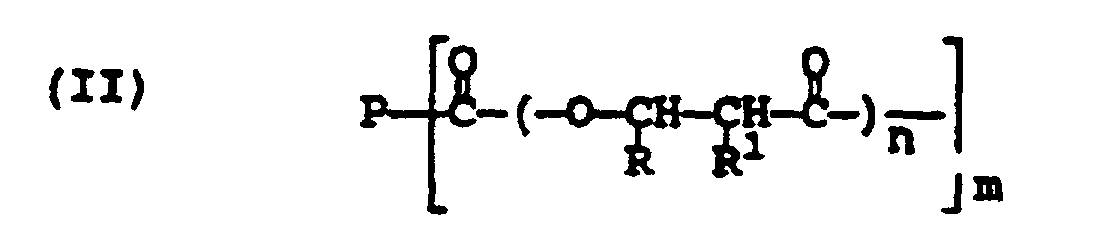
- Zusammensetzung gemäß Anspruch 1, worin m eine ganze Zahl von 2 bis 1 000 ist und n eine ganze Zahl von 150 bis 10 000 ist.
- Zusammensetzung gemäß Anspruch 2, worin m eine ganze Zahl von 3 bis 100 ist, R1 Wasserstoff ist und R gewählt wird aus C1- C5-Alkylen und substituierten Alkylen.
- Zusammensetzung gemäß Anspruch 1, worin das Poly(3-hydroxyalkanoat) eine logarithmische Viskositätszahl von 0,2 bis 6 bei 25°C bei einer 0,5 g-Probe in 100 ml einer Lösung aus Phenol/Tetrachlorethan mit einem Gewichtverhältnis von 60/40 besitzt.
- Gemisch bzw. Blend, umfassend 1 bis 99 Gew.-% der Zusammensetzung gemäß mindestens einem der Ansprüche 1 bis 4 und 1 bis 99 Gew.-% mindestens eines anderen Polymeren.
- Bioabbaubare Zusammensetzung, umfassend:(a) 1 bis 99 Gew.-% mindestens eines Poly(3-hydroxyalkanoats), wie gemäß mindestens einem der Ansprüche 1 bis 4 definiert; und(b) 1 bis 99 Gew.-% mindestens eines kompatiblen Polymeren, gewählt aus der aus Polyethern, Celluloseestern, Polyestern, Polyesterethern und Polyacrylaten bestehenden Gruppe.
- Zusammensetzung gemäß Anspruch 6, wobei der Polyether gewählt wird aus Polyethylenoxiden und Polypropylenoxiden mit einem Molekulargewicht von 200 bis 2 000 und der Polyester gewählt wird aus aliphatischen Polyestern, aromatischen Polyestern, aliphatisch-aromatischen Polyestern und isotaktischen Polyhydroxyalkanoaten, erhalten aus natürlichen Quellen.
- Zusammensetzung gemäß Anspruch 7, wobei das Poly(3-hydroxyalkanoat) in einer Menge von 5 bis 95 % vorliegt und der aliphatisch-aromatische Polyester in einer Menge von 5 bis 95 % vorliegt und wiederkehrende Einheiten aus:besitzt, worin R2 und R5 gewählt werden aus einer oder mehreren der folgenden Gruppen, bestehend aus C2-C12-Alkylen oder -Oxyalkylen, C2-C12-Alkylen oder -Oxyalkylen, substituiert mit einem bis vier Substituenten, die unabhängig gewählt werden aus der aus Halogen, C6-C10-Aryl und C1-C4-Alkoxy bestehenden Gruppe; C5-C10-Cycloalkylen, substituiert mit einem bis vier Substituenten, unabhängig gewählt aus der aus Halogen, C6-C10-Aryl und C1-C4-Alkoxy bestehenden Gruppe; R3 gewählt wird aus einer oder mehreren der folgenden Gruppen, bestehend aus bis zu C12-Alkylen; C0-C12-Oxyalkylen; C0-C12-Alkylen oder -Oxyalkylen, substituiert mit Substituenten, die unabhängig gewählt sind aus der aus Halogen, C6-C10-Aryl und C1-C4-Alkoxy bestehenden Gruppe; C5-C10-Cycloalkylen; und C5-C10-Cycloalkylen, substituiert mit einem bis vier Substituenten, die unabhängig gewählt werden aus der aus Halogen, C6-C10-Aryl und C1-C4-Alkoxy bestehenden Gruppe; R4 gewählt ist aus einer oder mehreren der folgenden Gruppen, bestehend aus C6-C10-Aryl, C6-C10-Aryl, substituiert mit einem bis vier Substituenten, unabhängig gewählt aus der Gruppe, die aus Halogen, C1-C4-Alkyl und C1-C4-Alkoxy besteht.

- Zusammensetzung gemäß Anspruch 7, worin die Komponente (a) in einer Menge von 8 % bis 40 % vorliegt und die Komponente (b) in einer Menge von 60 % bis 92% vorliegt und das kompatible Polymer aus einem aliphatischen Polyester mit wiederkehrenden Einheiten der folgenden Struktur gewählt wird:worin R8 und R9 gewählt werden aus C2-C12-Alkylen oder C2-C12-Oxyalkylen; C2-C12-Alkylen oder C2-C12-Oxyalkylen, substituiert mit einem bis vier Substituenten, die unabhängig aus der aus Halogen, C6-C10-Aryl und C1-C4-Alkoxy bestehenden Gruppe gewählt werden; C5-C10-Cycloalkylen; und C5-C10-Cycloalkylen, substituiert mit einem bis vier Substituenten, die unabhängig aus der aus Halogen, C6-C10-Aryl und C1-C4-Alkoxy bestehenden Gruppe gewählt werden.

- Zusammensetzung gemäß Anspruch 9, worin der aliphatische Polyester Poly(hexamethylenglutarat), Poly(hexamethylenadipat), Poly(ethylensuccinat), Poly(butylenglutarat), Poly-(butylenadipat), Poly(butylensuccinat), Poly(ethylenglutarat), Poly-(ethylenadipat), Poly-(diethylenglutarat), Poly(diethylenadipat), Poly(diethylensuccinat) oder Poly(hexamethylensuccinat) ist.
- Herstellungserzeugnis, gebildet aus der Zusammensetzung von einem beliebigen der Ansprüche 6-10, gewählt aus der Gruppe, die aus geformten oder extrudierten Objekten, wobei die Komponente (a) in einer Menge von 8 % bis 25 % vorliegt und die Komponente (b) in einer Menge von 75 % bis 92 % vorliegt; und Folien und Fasern, worin die Komponente (a) in einer Menge von 25 % bis 40 % vorliegt und die Komponente (b) in einer Menge von 60 % bis 75 % vorliegt, besteht.
- Zusammensetzung gemäß Anspruch 6, worin die Komponente (b) ein Celluloseester mit einer Tg von 140-180°C ist und gewählt wird aus der Gruppe, bestehend aus Celluloseacetat, Cellulosepropionat, Cellulosebutyrat, Celluloseacetatpropionat, Celluloseacetatbutyrat und Cellulosepropionatbutyrat mit einem DS/AGU-Verhältnis von 1,7 bis 3,0 und einer logarithmischen Viskositätszahl von 0,2 bis 3,0 Deziliter/Gramm, wie bei einer Temperatur von 25°C für eine 0,5 g-Probe in 100 ml einer Lösung aus Phenol/Tetrachlorethan mit einem Gewichtsteilverhältnis von 60/40 gemessen.
- Zusammensetzung gemäß Anspruch 6, worin die Komponente (b) Polyvinylacetat, partiell hydrolysiertes Polyvinylacetat, Vinylacetat-Ethylen-Copolymer, Polyvinylalkohol, Polymethylmethacrylat, Polyethylmethacrylat, Polycarbonat oder Hydroxypropylcellulose ist.
- Zusammensetzung gemäß Anspruch 6, worin die Komponenten des Gemisches in einem Einzel- oder Doppelschneckenextruder bei einer Temperatur von 130-185°C vermischt werden und das Poly(3-hydroxyalkanoat) als eine geschmolzene Flüssigkeit hinzusetzt wird.
Applications Claiming Priority (3)
| Application Number | Priority Date | Filing Date | Title |
|---|---|---|---|
| US07/901,306 US5281691A (en) | 1992-06-19 | 1992-06-19 | Poly(3-hydroxyalkanoates) |
| US901306 | 1992-06-19 | ||
| EP93915222A EP0648238B1 (de) | 1992-06-19 | 1993-06-07 | Poly-3-hydroxyalkanoate und verfahren zu ihrer herstellung |
Related Parent Applications (1)
| Application Number | Title | Priority Date | Filing Date |
|---|---|---|---|
| EP93915222A Division EP0648238B1 (de) | 1992-06-19 | 1993-06-07 | Poly-3-hydroxyalkanoate und verfahren zu ihrer herstellung |
Publications (3)
| Publication Number | Publication Date |
|---|---|
| EP0909789A2 EP0909789A2 (de) | 1999-04-21 |
| EP0909789A3 EP0909789A3 (de) | 1999-06-09 |
| EP0909789B1 true EP0909789B1 (de) | 2003-09-24 |
Family
ID=25413909
Family Applications (2)
| Application Number | Title | Priority Date | Filing Date |
|---|---|---|---|
| EP98124234A Expired - Lifetime EP0909789B1 (de) | 1992-06-19 | 1993-06-07 | Zusammensetzung die Poly(3-Hydroxyalkanoate) enthält |
| EP93915222A Expired - Lifetime EP0648238B1 (de) | 1992-06-19 | 1993-06-07 | Poly-3-hydroxyalkanoate und verfahren zu ihrer herstellung |
Family Applications After (1)
| Application Number | Title | Priority Date | Filing Date |
|---|---|---|---|
| EP93915222A Expired - Lifetime EP0648238B1 (de) | 1992-06-19 | 1993-06-07 | Poly-3-hydroxyalkanoate und verfahren zu ihrer herstellung |
Country Status (12)
| Country | Link |
|---|---|
| US (4) | US5281691A (de) |
| EP (2) | EP0909789B1 (de) |
| JP (1) | JPH08500131A (de) |
| KR (1) | KR950702221A (de) |
| AT (2) | ATE250645T1 (de) |
| CA (1) | CA2138034C (de) |
| DE (2) | DE69326341T2 (de) |
| DK (1) | DK0648238T3 (de) |
| ES (1) | ES2135482T3 (de) |
| GR (1) | GR3031600T3 (de) |
| MX (1) | MX9303692A (de) |
| WO (1) | WO1994000506A1 (de) |
Families Citing this family (82)
| Publication number | Priority date | Publication date | Assignee | Title |
|---|---|---|---|---|
| US5939467A (en) * | 1992-06-26 | 1999-08-17 | The Procter & Gamble Company | Biodegradable polymeric compositions and products thereof |
| EP0663936B1 (de) * | 1992-10-07 | 1999-01-27 | National Starch and Chemical Investment Holding Corporation | Mischungen aus stärkeestern und linearen polyestern |
| GB9223351D0 (en) * | 1992-11-06 | 1992-12-23 | Ici Plc | Polyesters |
| JP3098350B2 (ja) * | 1993-02-26 | 2000-10-16 | 高砂香料工業株式会社 | ポリ(3−ヒドロキシ酪酸)の製造方法 |
| US5780368A (en) * | 1994-01-28 | 1998-07-14 | Noda; Isao | Spray processes using a gaseous flow for preparing biodegradable fibrils, nonwoven fabrics comprising biodegradable fibrils, and articles comprising such nonwoven fabrics |
| FI962996A0 (fi) * | 1994-01-28 | 1996-07-26 | Procter & Gamble | Biohajoavia kopolymeerejä ja muoviartikkeleita, jotka sisältävät 3-hydroksiheksanoaatin biohajoavia kopolymeerejä |
| SG49096A1 (en) * | 1994-01-28 | 1998-05-18 | Procter & Gamble | Biodegradable 3-polyhydtoxybuyrate/3- polyhydroxyhexanoate copolymer films |
| EP1375556A3 (de) * | 1994-01-28 | 2004-08-11 | The Procter & Gamble Company | Bioabbaubare Copolymere und Kunststoffgegenstände die bioabbaubare 3-Hydroxyhexanoatcopolymere enthalten |
| ZA95627B (en) * | 1994-01-28 | 1995-10-05 | Procter & Gamble | Biodegradable copolymers and plastic articles comprising biodegradable copolymers |
| ID23491A (id) * | 1994-01-28 | 1995-09-07 | Procter & Gamble | Kopolimer-kopolimer yang dapat dibiodegradasi dan baha-bahan plastik yang terdiri dari kopolimer-kopolimer yang dapat dibiodegradasi |
| CN1079835C (zh) * | 1994-06-01 | 2002-02-27 | 普罗克特和甘保尔公司 | 利用空气分级作用回收聚羟基链烷酸酯的方法 |
| CN1071379C (zh) * | 1994-06-01 | 2001-09-19 | 普罗克特和甘保尔公司 | 利用离心分级回收聚羟基链烷酸酯的方法 |
| US5563239A (en) * | 1994-11-09 | 1996-10-08 | Eastman Chemical Company | Composition and process for the production of poly(3-hydroxyalkanoates) |
| JP3667812B2 (ja) * | 1995-02-28 | 2005-07-06 | グンゼ株式会社 | 養殖用網 |
| US5786408A (en) * | 1995-06-22 | 1998-07-28 | Daicel Chemical Industries, Ltd. | Biodegradable polyester resin composition, and a biodegradable molded article |
| US5942597A (en) * | 1995-08-21 | 1999-08-24 | The Procter & Gamble Company | Solvent extraction of polyhydroxyalkanoates from biomass |
| US6143947A (en) * | 1996-01-29 | 2000-11-07 | The Procter & Gamble Company | Fibers, nonwoven fabrics and absorbent articles comprising a biodegradable polyhydroxyalkanoate comprising 3-hydroxybutyrate and 3-hydroxyhexanoate |
| US6156852A (en) | 1997-04-21 | 2000-12-05 | Monsanto Company | Hydroxy-terminated polyhydroxyalkanoates |
| JP3201739B2 (ja) * | 1997-05-28 | 2001-08-27 | 株式会社島津製作所 | 眼鏡成形体 |
| US5844654A (en) * | 1997-05-28 | 1998-12-01 | Shimadzu Corporation | Biodegradable resin for forming spectacle-molded body and spectacle-molded body |
| ATE439398T1 (de) * | 1997-10-31 | 2009-08-15 | Metabolix Inc | Verwendung von organischen phosphon- oder phosphinsäuren, oder von metall-oxiden oder - hydroxiden, oder von carbonsäuresalzen eines metalls als hitzestabilisatoren für polyhydroxyalkanoate |
| JP4069282B2 (ja) * | 1998-05-11 | 2008-04-02 | リケンテクノス株式会社 | 生分解性ポリ乳酸系組成物 |
| WO2000011064A1 (en) * | 1998-08-21 | 2000-03-02 | Biotechnology Research & Development Corporation | Method of making biodegradable polymer compositions |
| US6160199A (en) * | 1998-12-21 | 2000-12-12 | The Procter & Gamble Company | Absorbent articles comprising biodegradable PHA copolymers |
| US6174990B1 (en) | 1998-12-21 | 2001-01-16 | The Procter & Gamble Company | Films comprising biodegradable PHA copolymers |
| US6077931A (en) * | 1998-12-21 | 2000-06-20 | The Procter & Gamble Company | Biodegradable PHA copolymers |
| US7037959B1 (en) * | 1999-04-12 | 2006-05-02 | The United States Of America As Represented By The Secretary Of The Agriculture | Biodegradable polymer compositions methods for making same and articles therefrom |
| ES2239004T3 (es) * | 1999-05-12 | 2005-09-16 | Metabolix, Inc. | Purificacion de polihidroxialcanoatos. |
| EP1090958B1 (de) * | 1999-10-05 | 2006-07-12 | Nippon Shokubai Co., Ltd. | Bioabbaubare Polyesterharzzusammensetzung und seine Verwendung |
| US6413017B2 (en) * | 2000-03-14 | 2002-07-02 | Jonathan B. Scott | Conversion of hydrocarbon-contaminated particulate soil and/or rock to fertile soil useful in erosion control |
| AU2001276597A1 (en) * | 2000-08-11 | 2002-02-25 | Bio-Tec Biologische Naturverpackungen Gmbh And Co.Kg | Biodegradable polymeric blend |
| DE60116127T2 (de) * | 2000-10-06 | 2006-08-24 | The Procter & Gamble Company, Cincinnati | Kunststoffgegenstände aus bioabbaubarem polyester mischzusammensetzungen |
| US7265188B2 (en) * | 2000-10-06 | 2007-09-04 | The Procter & Gamble Company | Biodegradable polyester blend compositions and methods of making the same |
| CN1235643C (zh) * | 2000-10-06 | 2006-01-11 | 宝洁公司 | 包括可生物降解的聚酯共混组合物的吸收制品 |
| EP1264859B1 (de) * | 2000-12-01 | 2008-10-29 | Toray Industries, Inc. | Polyesterzusammensetzung, damit hergestellte filme sowie verfahren zur herstellung der zusammensetzung |
| FR2819812B1 (fr) * | 2001-01-23 | 2005-04-01 | Atofina | Piegeage d'un monomere residuel contenant au moins une fonction epoxyde dans une composition thermoplastique |
| DE10137046A1 (de) * | 2001-07-31 | 2003-02-20 | Basf Ag | Verfahren zur Herstellung von thermoplastischen Poly(3-hydroxyalkanoaten) |
| DE60215511T2 (de) * | 2001-08-01 | 2007-06-06 | H.B. Fuller Licensing & Financing, Inc., St. Paul | Atmungsaktive bioabbaubare heissschmelzzusammensetzung |
| DE10208810A1 (de) | 2002-03-01 | 2003-09-11 | Basf Ag | Verfahren zur Herstellung von Poly(3-hydroxyalkanoaten) in Gegenwart eines Nucleophils |
| EP1648952B1 (de) * | 2003-06-03 | 2018-03-07 | THE UNITED STATES GOVERNMENT as represented by THE DEPARTMENT OF HEALTH AND HUMAN SERVICES | Nahrungszusätze und therapeutische zusammensetzungen, die (r)-3-hydroxybutyratderivate enthalten |
| US7582456B2 (en) * | 2003-12-19 | 2009-09-01 | Tianan Biologic Material Co., Ltd. Ningbo | Method for separating, extracting and purifying poly-β-hydroxyalkanoates (PHAs) directly from bacterial fermentation broth |
| US7153569B2 (en) * | 2004-03-19 | 2006-12-26 | Kimberly-Clark Worldwide, Inc. | Biodegradable aliphatic-aromatic copolyester films |
| US7776020B2 (en) * | 2004-03-19 | 2010-08-17 | Kimberly-Clark Worldwide, Inc. | Absorbent articles having an aliphatic-aromatic copolyester film |
| JP4403846B2 (ja) * | 2004-03-22 | 2010-01-27 | 東レ株式会社 | ポリ乳酸のラクチド除去法 |
| JP4403845B2 (ja) * | 2004-03-22 | 2010-01-27 | 東レ株式会社 | ラクチド含有量が少ないポリ乳酸の製造方法 |
| WO2005103122A1 (ja) * | 2004-04-26 | 2005-11-03 | Fuji Photo Film Co., Ltd. | セルロースアシレートフィルムおよびセルロースアシレートペレットの製造方法 |
| TW200613560A (en) * | 2004-06-29 | 2006-05-01 | Procter & Gamble | Solvent extraction of polyhydroxyalkanoates from biomass |
| US20080207870A1 (en) * | 2004-08-31 | 2008-08-28 | Riken | Thermostable Biopolyester |
| US8007775B2 (en) | 2004-12-30 | 2011-08-30 | Advanced Cardiovascular Systems, Inc. | Polymers containing poly(hydroxyalkanoates) and agents for use with medical articles and methods of fabricating the same |
| DE102005017049A1 (de) * | 2005-04-12 | 2006-10-19 | Basf Ag | Verfahren zur Herstellung von Polyhydroxyalkanoaten |
| EP1979394A1 (de) * | 2006-01-17 | 2008-10-15 | Basf Se | Verfahren zur gewinnung von polyhydroxyalkanoaten mit vermindertem gehalt an alkali- und erdalkalimetallen und erhöhter thermischer stabilität |
| EP2126623B1 (de) | 2007-03-08 | 2014-05-14 | OKIA Optical Co. Ltd. | Brillen und brillengestelle mit glykolmodifizierten copolyestern |
| JPWO2008143176A1 (ja) * | 2007-05-18 | 2010-08-05 | 東洋紡績株式会社 | 耐熱性の向上したポリ3−ヒドロキシブチレート又はポリ3−ヒドロキシブチレート共重合体およびその製造法 |
| US20090112259A1 (en) * | 2007-10-31 | 2009-04-30 | Angiotech Pharmaceuticals, Inc. | Recombinant expressed bioadsorbable polyhydroxyalkonate monofilament and multi-filaments self-retaining sutures |
| EP2240017B1 (de) | 2008-01-04 | 2019-03-13 | Oxford University Innovation Limited | Ketonkörper und ketonkörperester als blutfettsenkende mittel |
| US20150135580A1 (en) * | 2008-02-28 | 2015-05-21 | College Of William And Mary | Fishing gear with degradable component |
| US8938908B2 (en) * | 2008-02-28 | 2015-01-27 | College Of William And Mary | Fishing gear with degradable component |
| US8642654B2 (en) | 2009-04-16 | 2014-02-04 | Isis Innovation Limited | Hydroxybutyrate ester and medical use thereof |
| EP3360927B1 (de) | 2009-06-26 | 2020-09-09 | CJ CheilJedang Corporation | Pha-zusammensetzungen mit pbs und pbsa sowie verfahren zu deren herstellung |
| US8586821B2 (en) * | 2009-12-23 | 2013-11-19 | Kimberly-Clark Worldwide, Inc. | Melt-processed films of thermoplastic cellulose and microbial aliphatic polyester |
| GB201002983D0 (en) | 2010-02-22 | 2010-04-07 | Tdeltas Ltd | Nutritinal composition |
| US8821710B2 (en) | 2011-01-25 | 2014-09-02 | Ceramatec, Inc. | Production of fuel from chemicals derived from biomass |
| US9370482B1 (en) | 2011-09-09 | 2016-06-21 | Harrison Yu | Method of incorporating additives to shaped porous monocomponent biopolymer fibers during fiber orienting step |
| US9520074B2 (en) * | 2012-02-23 | 2016-12-13 | College Of William And Mary | Degradable identification component |
| WO2013184836A1 (en) | 2012-06-05 | 2013-12-12 | Metabolix, Inc. | Low glass transition polyhydroxyalkanoates for modification of biodegradable polymers |
| US9540661B2 (en) | 2012-07-09 | 2017-01-10 | Basf Se | Method for the complete anaerobic digestion of polymer mixtures |
| WO2014009176A1 (de) | 2012-07-10 | 2014-01-16 | Basf Se | Verfahren zum vollständigen anaeroben abbau von polymermischungen |
| DE102012212437A1 (de) * | 2012-07-16 | 2014-01-16 | Basf Se | Verfahren zur Herstellung von Acrylsäure aus Ethylenoxid und Kohlenmonoxid |
| DK2914251T3 (da) | 2012-11-05 | 2019-11-04 | Us Health | Ketonlegemer til beskyttelse af væv mod beskadigelse som følge af ioniseringsstråling |
| GB201304467D0 (en) | 2013-03-12 | 2013-04-24 | Tdeltas Ltd | Compound for use in protecting skin |
| GB2515603B (en) | 2013-03-14 | 2015-10-14 | Isis Innovation | Process for producing (R)-3-Hydroxybutyl (R)-3-Hydroxybutyrate |
| US9441096B2 (en) | 2014-09-26 | 2016-09-13 | Fuji Xerox Co., Ltd. | Resin composition and resin shaped product |
| JP6630998B2 (ja) * | 2014-09-26 | 2020-01-15 | 富士ゼロックス株式会社 | 樹脂組成物、及び樹脂成形体 |
| CN108463506A (zh) | 2015-11-17 | 2018-08-28 | Cj第制糖株式会社 | 具有可控生物降解速率的聚合物共混物 |
| WO2018070492A1 (ja) * | 2016-10-13 | 2018-04-19 | 株式会社カネカ | ポリヒドロキシアルカン酸の製造方法 |
| JP2018127579A (ja) * | 2017-02-10 | 2018-08-16 | 富士ゼロックス株式会社 | 樹脂組成物および樹脂成形体 |
| US11820881B2 (en) | 2020-04-02 | 2023-11-21 | Singular Solutions Inc. | Plastic pro-biodegradation additives, biodegradable plastic compositions, and related methods |
| US12054685B1 (en) | 2020-07-15 | 2024-08-06 | National Technology & Engineering Solutions Of Sandia, Llc | Coupling high yield biochemical intermediates for fuel production |
| WO2022056641A1 (en) | 2020-09-17 | 2022-03-24 | Singular Solutions Inc. | Ultra-fast marine-biodegradable composite film |
| KR20230170697A (ko) | 2021-04-16 | 2023-12-19 | 노보머, 인코포레이티드 | 폴리프로피오락톤 및 제조 방법 |
| EP4615915A1 (de) * | 2022-11-07 | 2025-09-17 | CJ CheilJedang Corporation | Zusammensetzungen mit amorphem polyhydroxyalkanoat und verwendung davon |
| JPWO2025013446A1 (de) * | 2023-07-07 | 2025-01-16 |
Family Cites Families (27)
| Publication number | Priority date | Publication date | Assignee | Title |
|---|---|---|---|---|
| CA742294A (en) * | 1966-09-06 | H. Mullins Dennis | Plasticization of vinyl resins with lactone polyesters | |
| US2917410A (en) * | 1955-06-20 | 1959-12-15 | American Cyanamid Co | Polyglycol-polyacid ester treatment of textiles |
| US3021311A (en) * | 1959-12-03 | 1962-02-13 | Union Carbide Corp | Polymerization of cyclic esters |
| US3021314A (en) * | 1959-12-03 | 1962-02-13 | Union Carbide Corp | Polymerization of cyclic esters |
| US3021309A (en) * | 1959-12-03 | 1962-02-13 | Union Carbide Corp | Polymerization of cyclic esters |
| US3021312A (en) * | 1959-12-03 | 1962-02-13 | Union Carbide Corp | Polymerization of cyclic esters |
| US3021317A (en) * | 1959-12-03 | 1962-02-13 | Union Carbide Corp | Polymerization of cyclic esters |
| US3021316A (en) * | 1959-12-03 | 1962-02-13 | Union Carbide Corp | Polymerization of cyclic esters |
| US3021315A (en) * | 1959-12-03 | 1962-02-13 | Union Carbide Corp | Polymerization of cyclic esters |
| US3021310A (en) * | 1959-12-03 | 1962-02-13 | Union Garbide Corp | Polymerization of cyclic esters |
| US3021313A (en) * | 1959-12-03 | 1962-02-13 | Union Carbide Corp | Polymerization of cyclic esters |
| FR1508041A (fr) * | 1966-01-21 | 1967-12-29 | Montedison Spa | Procédé de polymérisation des beta-lactones beta-substituées et son application à la préparation de polyesters |
| NL161475C (nl) * | 1970-01-29 | 1980-02-15 | Stamicarbon | Bereiding van lactonpolyesters. |
| US3922239A (en) * | 1971-05-06 | 1975-11-25 | Union Carbide Corp | Cellulose esters or ethers blended with cyclic ester polymers |
| US3781381A (en) * | 1971-05-06 | 1973-12-25 | Union Carbide Corp | Nylon polymers blended with cyclic ester polymers |
| EP0078609B1 (de) * | 1980-04-30 | 1987-05-06 | Imperial Chemical Industries Plc | 3-Hydroxybuttersäure-Polymere |
| US4372311A (en) * | 1980-09-12 | 1983-02-08 | Union Carbide Corporation | Disposable articles coated with degradable water insoluble polymers |
| EP0052460B1 (de) * | 1980-11-18 | 1985-02-06 | Imperial Chemical Industries Plc | Polymerzusammensetzungen |
| US4349469A (en) * | 1981-02-17 | 1982-09-14 | Eastman Kodak Company | Copolyesterethers |
| JPH0660236B2 (ja) * | 1984-05-30 | 1994-08-10 | ダイセル化学工業株式会社 | 新規なラクトン重合体の製造方法 |
| US4699974A (en) * | 1986-08-07 | 1987-10-13 | General Electric Company | Method of preparing copolyester carbonate from cyclic aromatic polycarbonate oligomer and lactone |
| AU603076B2 (en) * | 1985-12-09 | 1990-11-08 | W.R. Grace & Co.-Conn. | Polymeric products and their manufacture |
| US5023316A (en) * | 1990-06-14 | 1991-06-11 | Exxon Chemical Patents, Inc. | Catalytic polymerization of β-substituted-β-propiolactones by oligomeric isobutylaluminoxane |
| JPH0465425A (ja) * | 1990-07-06 | 1992-03-02 | Showa Denko Kk | 共重合体及びその製造法 |
| US5076983A (en) * | 1990-07-16 | 1991-12-31 | E. I. Du Pont De Nemours And Company | Polyhydroxy acid films |
| GB9016345D0 (en) * | 1990-07-25 | 1990-09-12 | Ici Plc | Polymer blends |
| CA2090977A1 (en) * | 1990-09-11 | 1992-03-12 | George J. Ostapchenko | Films containing polyhydroxy acids |
-
1992
- 1992-06-19 US US07/901,306 patent/US5281691A/en not_active Expired - Lifetime
-
1993
- 1993-06-07 DE DE69326341T patent/DE69326341T2/de not_active Expired - Fee Related
- 1993-06-07 DK DK93915222T patent/DK0648238T3/da active
- 1993-06-07 EP EP98124234A patent/EP0909789B1/de not_active Expired - Lifetime
- 1993-06-07 DE DE69333220T patent/DE69333220T2/de not_active Expired - Fee Related
- 1993-06-07 ES ES93915222T patent/ES2135482T3/es not_active Expired - Lifetime
- 1993-06-07 CA CA002138034A patent/CA2138034C/en not_active Expired - Fee Related
- 1993-06-07 AT AT98124234T patent/ATE250645T1/de not_active IP Right Cessation
- 1993-06-07 AT AT93915222T patent/ATE184294T1/de not_active IP Right Cessation
- 1993-06-07 EP EP93915222A patent/EP0648238B1/de not_active Expired - Lifetime
- 1993-06-07 JP JP6502375A patent/JPH08500131A/ja active Pending
- 1993-06-07 WO PCT/US1993/005374 patent/WO1994000506A1/en not_active Ceased
- 1993-06-18 MX MX9303692A patent/MX9303692A/es not_active IP Right Cessation
-
1994
- 1994-01-21 US US08/185,097 patent/US5391708A/en not_active Expired - Fee Related
- 1994-12-19 KR KR1019940704631A patent/KR950702221A/ko not_active Abandoned
-
1995
- 1995-02-21 US US08/395,395 patent/US5552515A/en not_active Expired - Fee Related
- 1995-05-30 US US08/452,937 patent/US5625029A/en not_active Expired - Fee Related
-
1999
- 1999-10-21 GR GR990402695T patent/GR3031600T3/el unknown
Also Published As
| Publication number | Publication date |
|---|---|
| KR950702221A (ko) | 1995-06-19 |
| US5391708A (en) | 1995-02-21 |
| EP0648238A1 (de) | 1995-04-19 |
| DE69326341T2 (de) | 2000-02-03 |
| EP0909789A3 (de) | 1999-06-09 |
| DE69333220D1 (de) | 2003-10-30 |
| JPH08500131A (ja) | 1996-01-09 |
| DE69326341D1 (de) | 1999-10-14 |
| US5625029A (en) | 1997-04-29 |
| MX9303692A (es) | 1994-01-31 |
| WO1994000506A1 (en) | 1994-01-06 |
| GR3031600T3 (en) | 2000-01-31 |
| DK0648238T3 (da) | 1999-12-20 |
| DE69333220T2 (de) | 2004-04-08 |
| ATE250645T1 (de) | 2003-10-15 |
| EP0648238B1 (de) | 1999-09-08 |
| CA2138034A1 (en) | 1994-01-06 |
| ATE184294T1 (de) | 1999-09-15 |
| CA2138034C (en) | 1999-03-02 |
| ES2135482T3 (es) | 1999-11-01 |
| US5552515A (en) | 1996-09-03 |
| US5281691A (en) | 1994-01-25 |
| EP0909789A2 (de) | 1999-04-21 |
Similar Documents
| Publication | Publication Date | Title |
|---|---|---|
| EP0909789B1 (de) | Zusammensetzung die Poly(3-Hydroxyalkanoate) enthält | |
| US5714618A (en) | Polymer containing lactic acid as its constituting unit and method for producing the same | |
| JP3482748B2 (ja) | 乳酸系ポリエステルの製造方法 | |
| JP3263710B2 (ja) | 生分解性光学活性ポリマー及びその製造方法 | |
| JP5157035B2 (ja) | ポリ乳酸樹脂組成物、その製造方法および成形品 | |
| US5648452A (en) | Polymerization of beta-substituted-beta-propiolactones initiated by alkylzinc alkoxides | |
| JP3510398B2 (ja) | ヒドロキシカルボン酸系ポリエステル組成物の製造方法 | |
| JPH08503723A (ja) | ポリエステル組成物 | |
| JPH11500468A (ja) | 生分解可能なポリマー、該ポリマーの製法及び生分解可能な成形体の製造への該ポリマーの使用 | |
| JP2004161802A (ja) | 生分解性ポリエステル系樹脂組成物およびその製造方法 | |
| JPH07126358A (ja) | アルファ−ヒドロキシ酸のポリマーの製造方法 | |
| JP3387052B2 (ja) | 生分解性ポリエステル樹脂組成物とその用途 | |
| JP3367577B2 (ja) | 酸末端封鎖ポリ乳酸 | |
| JP2006045366A (ja) | ポリ(3−ヒドロキシブチレート−コ−3−ヒドロキシヘキサノエート)組成物およびその成形体 | |
| CN113773480B (zh) | 一种用于制备聚乙交酯的催化剂组合物及聚乙交酯的制备方法 | |
| JP3144231B2 (ja) | 脂肪族ポリエステルおよび/またはその共重合体 | |
| JP5424262B2 (ja) | ヒドロキシカルボン酸重合体 | |
| JP2004285151A (ja) | ポリ乳酸ブロック共重合体、その製造方法および成形品 | |
| JP3793766B2 (ja) | 脂肪族ポリエステル共重合体、成形物ならびに農業用マルチフィルム | |
| KR100308535B1 (ko) | 폴리에스테르수지조성물및그제조방법 | |
| JP3144416B2 (ja) | 脂肪族ポリエステルおよび/またはその共重合体 | |
| JPH1129628A (ja) | 耐ブリードアウト性の優れた乳酸系共重合ポリエステル | |
| CN120818133A (zh) | 聚乳酸的制备方法 | |
| JP2004346168A (ja) | 脂肪族ポリエステルカーボネートの製造方法 | |
| JPH09124779A (ja) | 生分解性高分子組成物用相容化剤 |
Legal Events
| Date | Code | Title | Description |
|---|---|---|---|
| PUAI | Public reference made under article 153(3) epc to a published international application that has entered the european phase |
Free format text: ORIGINAL CODE: 0009012 |
|
| 17P | Request for examination filed |
Effective date: 19981217 |
|
| AC | Divisional application: reference to earlier application |
Ref document number: 648238 Country of ref document: EP |
|
| AK | Designated contracting states |
Kind code of ref document: A2 Designated state(s): AT BE CH DE DK ES FR GB GR IE IT LI LU MC NL PT SE |
|
| PUAL | Search report despatched |
Free format text: ORIGINAL CODE: 0009013 |
|
| AK | Designated contracting states |
Kind code of ref document: A3 Designated state(s): AT BE CH DE DK ES FR GB GR IE IT LI LU MC NL PT SE |
|
| 17Q | First examination report despatched |
Effective date: 20020328 |
|
| GRAH | Despatch of communication of intention to grant a patent |
Free format text: ORIGINAL CODE: EPIDOS IGRA |
|
| GRAS | Grant fee paid |
Free format text: ORIGINAL CODE: EPIDOSNIGR3 |
|
| GRAA | (expected) grant |
Free format text: ORIGINAL CODE: 0009210 |
|
| AC | Divisional application: reference to earlier application |
Ref document number: 0648238 Country of ref document: EP Kind code of ref document: P |
|
| AK | Designated contracting states |
Kind code of ref document: B1 Designated state(s): AT BE CH DE DK ES FR GB GR IE IT LI LU MC NL PT SE |
|
| PG25 | Lapsed in a contracting state [announced via postgrant information from national office to epo] |
Ref country code: NL Free format text: LAPSE BECAUSE OF FAILURE TO SUBMIT A TRANSLATION OF THE DESCRIPTION OR TO PAY THE FEE WITHIN THE PRESCRIBED TIME-LIMIT Effective date: 20030924 Ref country code: LI Free format text: LAPSE BECAUSE OF FAILURE TO SUBMIT A TRANSLATION OF THE DESCRIPTION OR TO PAY THE FEE WITHIN THE PRESCRIBED TIME-LIMIT Effective date: 20030924 Ref country code: IT Free format text: LAPSE BECAUSE OF FAILURE TO SUBMIT A TRANSLATION OF THE DESCRIPTION OR TO PAY THE FEE WITHIN THE PRE;WARNING: LAPSES OF ITALIAN PATENTS WITH EFFECTIVE DATE BEFORE 2007 MAY HAVE OCCURRED AT ANY TIME BEFORE 2007. THE CORRECT EFFECTIVE DATE MAY BE DIFFERENT FROM THE ONE RECORDED.SCRIBED TIME-LIMIT Effective date: 20030924 Ref country code: CH Free format text: LAPSE BECAUSE OF FAILURE TO SUBMIT A TRANSLATION OF THE DESCRIPTION OR TO PAY THE FEE WITHIN THE PRESCRIBED TIME-LIMIT Effective date: 20030924 Ref country code: BE Free format text: LAPSE BECAUSE OF FAILURE TO SUBMIT A TRANSLATION OF THE DESCRIPTION OR TO PAY THE FEE WITHIN THE PRESCRIBED TIME-LIMIT Effective date: 20030924 Ref country code: AT Free format text: LAPSE BECAUSE OF FAILURE TO SUBMIT A TRANSLATION OF THE DESCRIPTION OR TO PAY THE FEE WITHIN THE PRESCRIBED TIME-LIMIT Effective date: 20030924 |
|
| REG | Reference to a national code |
Ref country code: GB Ref legal event code: FG4D |
|
| REG | Reference to a national code |
Ref country code: CH Ref legal event code: EP |
|
| REG | Reference to a national code |
Ref country code: IE Ref legal event code: FG4D |
|
| REF | Corresponds to: |
Ref document number: 69333220 Country of ref document: DE Date of ref document: 20031030 Kind code of ref document: P |
|
| PG25 | Lapsed in a contracting state [announced via postgrant information from national office to epo] |
Ref country code: SE Free format text: LAPSE BECAUSE OF FAILURE TO SUBMIT A TRANSLATION OF THE DESCRIPTION OR TO PAY THE FEE WITHIN THE PRESCRIBED TIME-LIMIT Effective date: 20031224 Ref country code: GR Free format text: LAPSE BECAUSE OF FAILURE TO SUBMIT A TRANSLATION OF THE DESCRIPTION OR TO PAY THE FEE WITHIN THE PRESCRIBED TIME-LIMIT Effective date: 20031224 Ref country code: DK Free format text: LAPSE BECAUSE OF FAILURE TO SUBMIT A TRANSLATION OF THE DESCRIPTION OR TO PAY THE FEE WITHIN THE PRESCRIBED TIME-LIMIT Effective date: 20031224 |
|
| PG25 | Lapsed in a contracting state [announced via postgrant information from national office to epo] |
Ref country code: ES Free format text: LAPSE BECAUSE OF FAILURE TO SUBMIT A TRANSLATION OF THE DESCRIPTION OR TO PAY THE FEE WITHIN THE PRESCRIBED TIME-LIMIT Effective date: 20040104 |
|
| NLV1 | Nl: lapsed or annulled due to failure to fulfill the requirements of art. 29p and 29m of the patents act | ||
| REG | Reference to a national code |
Ref country code: CH Ref legal event code: PL |
|
| ET | Fr: translation filed | ||
| PG25 | Lapsed in a contracting state [announced via postgrant information from national office to epo] |
Ref country code: LU Free format text: LAPSE BECAUSE OF NON-PAYMENT OF DUE FEES Effective date: 20040607 Ref country code: IE Free format text: LAPSE BECAUSE OF NON-PAYMENT OF DUE FEES Effective date: 20040607 |
|
| PG25 | Lapsed in a contracting state [announced via postgrant information from national office to epo] |
Ref country code: MC Free format text: LAPSE BECAUSE OF NON-PAYMENT OF DUE FEES Effective date: 20040630 |
|
| PLBE | No opposition filed within time limit |
Free format text: ORIGINAL CODE: 0009261 |
|
| STAA | Information on the status of an ep patent application or granted ep patent |
Free format text: STATUS: NO OPPOSITION FILED WITHIN TIME LIMIT |
|
| 26N | No opposition filed |
Effective date: 20040625 |
|
| REG | Reference to a national code |
Ref country code: IE Ref legal event code: MM4A |
|
| PGFP | Annual fee paid to national office [announced via postgrant information from national office to epo] |
Ref country code: GB Payment date: 20050506 Year of fee payment: 13 |
|
| PGFP | Annual fee paid to national office [announced via postgrant information from national office to epo] |
Ref country code: FR Payment date: 20050602 Year of fee payment: 13 |
|
| PGFP | Annual fee paid to national office [announced via postgrant information from national office to epo] |
Ref country code: DE Payment date: 20050630 Year of fee payment: 13 |
|
| PG25 | Lapsed in a contracting state [announced via postgrant information from national office to epo] |
Ref country code: GB Free format text: LAPSE BECAUSE OF NON-PAYMENT OF DUE FEES Effective date: 20060607 |
|
| PG25 | Lapsed in a contracting state [announced via postgrant information from national office to epo] |
Ref country code: DE Free format text: LAPSE BECAUSE OF NON-PAYMENT OF DUE FEES Effective date: 20070103 |
|
| GBPC | Gb: european patent ceased through non-payment of renewal fee |
Effective date: 20060607 |
|
| REG | Reference to a national code |
Ref country code: FR Ref legal event code: ST Effective date: 20070228 |
|
| PG25 | Lapsed in a contracting state [announced via postgrant information from national office to epo] |
Ref country code: PT Free format text: LAPSE BECAUSE OF NON-PAYMENT OF DUE FEES Effective date: 20040224 |
|
| PG25 | Lapsed in a contracting state [announced via postgrant information from national office to epo] |
Ref country code: FR Free format text: LAPSE BECAUSE OF NON-PAYMENT OF DUE FEES Effective date: 20060630 |