EP0911337A1 - New triphendioxazine compounds - Google Patents
New triphendioxazine compounds Download PDFInfo
- Publication number
- EP0911337A1 EP0911337A1 EP98811051A EP98811051A EP0911337A1 EP 0911337 A1 EP0911337 A1 EP 0911337A1 EP 98811051 A EP98811051 A EP 98811051A EP 98811051 A EP98811051 A EP 98811051A EP 0911337 A1 EP0911337 A1 EP 0911337A1
- Authority
- EP
- European Patent Office
- Prior art keywords
- radical
- compounds
- unsubstituted
- parts
- substituted
- Prior art date
- Legal status (The legal status is an assumption and is not a legal conclusion. Google has not performed a legal analysis and makes no representation as to the accuracy of the status listed.)
- Granted
Links
- 150000001875 compounds Chemical class 0.000 title claims abstract description 62
- 239000000049 pigment Substances 0.000 claims abstract description 24
- NUJOXMJBOLGQSY-UHFFFAOYSA-N manganese dioxide Chemical compound O=[Mn]=O NUJOXMJBOLGQSY-UHFFFAOYSA-N 0.000 claims abstract description 14
- QAOWNCQODCNURD-UHFFFAOYSA-N Sulfuric acid Chemical compound OS(O)(=O)=O QAOWNCQODCNURD-UHFFFAOYSA-N 0.000 claims abstract description 10
- 239000001117 sulphuric acid Substances 0.000 claims abstract description 10
- 235000011149 sulphuric acid Nutrition 0.000 claims abstract description 10
- 125000004433 nitrogen atom Chemical group N* 0.000 claims abstract description 8
- 125000000623 heterocyclic group Chemical group 0.000 claims abstract description 6
- 229910052757 nitrogen Inorganic materials 0.000 claims abstract description 6
- 125000001997 phenyl group Chemical group [H]C1=C([H])C([H])=C(*)C([H])=C1[H] 0.000 claims abstract description 6
- 238000007363 ring formation reaction Methods 0.000 claims abstract description 5
- 238000004040 coloring Methods 0.000 claims abstract description 4
- 238000004519 manufacturing process Methods 0.000 claims abstract description 4
- -1 C1-8 alkyl radical Chemical class 0.000 claims description 48
- 239000000203 mixture Substances 0.000 claims description 22
- 150000003254 radicals Chemical class 0.000 claims description 13
- 239000001257 hydrogen Substances 0.000 claims description 11
- 229910052739 hydrogen Inorganic materials 0.000 claims description 11
- 125000004435 hydrogen atom Chemical class [H]* 0.000 claims description 10
- CIUQDSCDWFSTQR-UHFFFAOYSA-N [C]1=CC=CC=C1 Chemical class [C]1=CC=CC=C1 CIUQDSCDWFSTQR-UHFFFAOYSA-N 0.000 claims description 9
- 239000000460 chlorine Substances 0.000 claims description 8
- 239000003086 colorant Substances 0.000 claims description 8
- 238000000576 coating method Methods 0.000 claims description 7
- UGNWTBMOAKPKBL-UHFFFAOYSA-N tetrachloro-1,4-benzoquinone Chemical compound ClC1=C(Cl)C(=O)C(Cl)=C(Cl)C1=O UGNWTBMOAKPKBL-UHFFFAOYSA-N 0.000 claims description 7
- 239000000976 ink Substances 0.000 claims description 5
- ZAMOUSCENKQFHK-UHFFFAOYSA-N Chlorine atom Chemical compound [Cl] ZAMOUSCENKQFHK-UHFFFAOYSA-N 0.000 claims description 4
- 238000006243 chemical reaction Methods 0.000 claims description 4
- 229910052801 chlorine Inorganic materials 0.000 claims description 4
- QUPDWYMUPZLYJZ-UHFFFAOYSA-N ethyl Chemical compound C[CH2] QUPDWYMUPZLYJZ-UHFFFAOYSA-N 0.000 claims description 3
- WCYWZMWISLQXQU-UHFFFAOYSA-N methyl Chemical compound [CH3] WCYWZMWISLQXQU-UHFFFAOYSA-N 0.000 claims description 3
- 239000004753 textile Substances 0.000 claims description 3
- ULOIAOPTGWSNHU-UHFFFAOYSA-N 2-butyl radical Chemical compound C[CH]CC ULOIAOPTGWSNHU-UHFFFAOYSA-N 0.000 claims description 2
- IIVWHGMLFGNMOW-UHFFFAOYSA-N 2-methylpropane Chemical compound C[C](C)C IIVWHGMLFGNMOW-UHFFFAOYSA-N 0.000 claims description 2
- 229920001131 Pulp (paper) Polymers 0.000 claims description 2
- YUDRVAHLXDBKSR-UHFFFAOYSA-N [CH]1CCCCC1 Chemical compound [CH]1CCCCC1 YUDRVAHLXDBKSR-UHFFFAOYSA-N 0.000 claims description 2
- ZVSKZLHKADLHSD-UHFFFAOYSA-N benzanilide Chemical compound C=1C=CC=CC=1C(=O)NC1=CC=CC=C1 ZVSKZLHKADLHSD-UHFFFAOYSA-N 0.000 claims description 2
- 125000001797 benzyl group Chemical group [H]C1=C([H])C([H])=C(C([H])=C1[H])C([H])([H])* 0.000 claims description 2
- 229910052736 halogen Inorganic materials 0.000 claims description 2
- 150000002367 halogens Chemical class 0.000 claims description 2
- 125000000959 isobutyl group Chemical group [H]C([H])([H])C([H])(C([H])([H])[H])C([H])([H])* 0.000 claims description 2
- 125000001449 isopropyl group Chemical group [H]C([H])([H])C([H])(*)C([H])([H])[H] 0.000 claims description 2
- 125000004108 n-butyl group Chemical group [H]C([H])([H])C([H])([H])C([H])([H])C([H])([H])* 0.000 claims description 2
- 125000004123 n-propyl group Chemical group [H]C([H])([H])C([H])([H])C([H])([H])* 0.000 claims description 2
- 125000000449 nitro group Chemical group [O-][N+](*)=O 0.000 claims description 2
- 125000000636 p-nitrophenyl group Chemical group [H]C1=C([H])C(=C([H])C([H])=C1*)[N+]([O-])=O 0.000 claims description 2
- 229920000642 polymer Polymers 0.000 claims description 2
- 230000005012 migration Effects 0.000 abstract description 5
- 238000013508 migration Methods 0.000 abstract description 5
- 239000002904 solvent Substances 0.000 abstract description 4
- IAZDPXIOMUYVGZ-UHFFFAOYSA-N Dimethylsulphoxide Chemical compound CS(C)=O IAZDPXIOMUYVGZ-UHFFFAOYSA-N 0.000 description 21
- XLYOFNOQVPJJNP-UHFFFAOYSA-N water Substances O XLYOFNOQVPJJNP-UHFFFAOYSA-N 0.000 description 16
- LFQSCWFLJHTTHZ-UHFFFAOYSA-N Ethanol Chemical compound CCO LFQSCWFLJHTTHZ-UHFFFAOYSA-N 0.000 description 14
- ZMXDDKWLCZADIW-UHFFFAOYSA-N N,N-Dimethylformamide Chemical compound CN(C)C=O ZMXDDKWLCZADIW-UHFFFAOYSA-N 0.000 description 12
- 239000000843 powder Substances 0.000 description 12
- 238000002844 melting Methods 0.000 description 11
- 230000008018 melting Effects 0.000 description 11
- 238000000034 method Methods 0.000 description 11
- 238000001035 drying Methods 0.000 description 10
- 125000002496 methyl group Chemical group [H]C([H])([H])* 0.000 description 9
- 239000012265 solid product Substances 0.000 description 8
- 238000005160 1H NMR spectroscopy Methods 0.000 description 7
- 239000000725 suspension Substances 0.000 description 7
- HEMHJVSKTPXQMS-UHFFFAOYSA-M Sodium hydroxide Chemical compound [OH-].[Na+] HEMHJVSKTPXQMS-UHFFFAOYSA-M 0.000 description 6
- 239000011248 coating agent Substances 0.000 description 6
- 239000000543 intermediate Substances 0.000 description 6
- 238000009835 boiling Methods 0.000 description 5
- 238000010992 reflux Methods 0.000 description 5
- RFFLAFLAYFXFSW-UHFFFAOYSA-N 1,2-dichlorobenzene Chemical compound ClC1=CC=CC=C1Cl RFFLAFLAYFXFSW-UHFFFAOYSA-N 0.000 description 4
- VEXZGXHMUGYJMC-UHFFFAOYSA-N Hydrochloric acid Chemical compound Cl VEXZGXHMUGYJMC-UHFFFAOYSA-N 0.000 description 4
- 239000000463 material Substances 0.000 description 4
- 239000004800 polyvinyl chloride Substances 0.000 description 4
- 229920000915 polyvinyl chloride Polymers 0.000 description 4
- 239000000047 product Substances 0.000 description 4
- 229920005989 resin Polymers 0.000 description 4
- 239000011347 resin Substances 0.000 description 4
- VYZAHLCBVHPDDF-UHFFFAOYSA-N Dinitrochlorobenzene Chemical compound [O-][N+](=O)C1=CC=C(Cl)C([N+]([O-])=O)=C1 VYZAHLCBVHPDDF-UHFFFAOYSA-N 0.000 description 3
- OKKJLVBELUTLKV-UHFFFAOYSA-N Methanol Chemical compound OC OKKJLVBELUTLKV-UHFFFAOYSA-N 0.000 description 3
- MUBZPKHOEPUJKR-UHFFFAOYSA-N Oxalic acid Chemical compound OC(=O)C(O)=O MUBZPKHOEPUJKR-UHFFFAOYSA-N 0.000 description 3
- 239000004743 Polypropylene Substances 0.000 description 3
- VMHLLURERBWHNL-UHFFFAOYSA-M Sodium acetate Chemical compound [Na+].CC([O-])=O VMHLLURERBWHNL-UHFFFAOYSA-M 0.000 description 3
- QAOWNCQODCNURD-UHFFFAOYSA-L Sulfate Chemical compound [O-]S([O-])(=O)=O QAOWNCQODCNURD-UHFFFAOYSA-L 0.000 description 3
- 239000003822 epoxy resin Substances 0.000 description 3
- 238000004452 microanalysis Methods 0.000 description 3
- 229920003023 plastic Polymers 0.000 description 3
- 239000004033 plastic Substances 0.000 description 3
- 229920000647 polyepoxide Polymers 0.000 description 3
- 229920001155 polypropylene Polymers 0.000 description 3
- 125000002924 primary amino group Chemical group [H]N([H])* 0.000 description 3
- 239000001632 sodium acetate Substances 0.000 description 3
- 235000017281 sodium acetate Nutrition 0.000 description 3
- 229910021653 sulphate ion Inorganic materials 0.000 description 3
- ZYECOAILUNWEAL-NUDFZHEQSA-N (4z)-4-[[2-methoxy-5-(phenylcarbamoyl)phenyl]hydrazinylidene]-n-(3-nitrophenyl)-3-oxonaphthalene-2-carboxamide Chemical compound COC1=CC=C(C(=O)NC=2C=CC=CC=2)C=C1N\N=C(C1=CC=CC=C1C=1)/C(=O)C=1C(=O)NC1=CC=CC([N+]([O-])=O)=C1 ZYECOAILUNWEAL-NUDFZHEQSA-N 0.000 description 2
- 0 *N(c(c(N(*)C1=O)c2)cc(N=C3C(Cl)=C(C4=Nc5c6)Oc5cc(N(*)C5=O)c6N(*)C5=O)c2OC3=C4Cl)C1=O Chemical compound *N(c(c(N(*)C1=O)c2)cc(N=C3C(Cl)=C(C4=Nc5c6)Oc5cc(N(*)C5=O)c6N(*)C5=O)c2OC3=C4Cl)C1=O 0.000 description 2
- CPBGCVJMGKQDAG-UHFFFAOYSA-N 2,5-dichloro-3,6-bis[[1-(4-methylphenyl)-2-oxo-3h-benzimidazol-5-yl]amino]cyclohexa-2,5-diene-1,4-dione Chemical compound C1=CC(C)=CC=C1N1C(=O)NC2=CC(NC=3C(C(Cl)=C(NC=4C=C5NC(=O)N(C=6C=CC(C)=CC=6)C5=CC=4)C(=O)C=3Cl)=O)=CC=C21 CPBGCVJMGKQDAG-UHFFFAOYSA-N 0.000 description 2
- CYKQHTZEPXKUOX-UHFFFAOYSA-N 2,5-dichloro-3-[(1-ethyl-2-oxo-3h-benzimidazol-5-yl)amino]-6-[(1-methyl-2-oxo-3h-benzimidazol-5-yl)amino]cyclohexa-2,5-diene-1,4-dione Chemical compound C1=C2N(C)C(=O)NC2=CC(NC=2C(=O)C(Cl)=C(C(C=2Cl)=O)NC2=CC=C3N(C(NC3=C2)=O)CC)=C1 CYKQHTZEPXKUOX-UHFFFAOYSA-N 0.000 description 2
- PBCALYKFBUDFDM-UHFFFAOYSA-N 3-(4-methylphenyl)-6-nitro-1h-benzimidazol-2-one Chemical compound C1=CC(C)=CC=C1N1C(=O)NC2=CC([N+]([O-])=O)=CC=C21 PBCALYKFBUDFDM-UHFFFAOYSA-N 0.000 description 2
- SMRULTWULHTNNR-UHFFFAOYSA-N 6-amino-3-(4-methylphenyl)-1h-benzimidazol-2-one Chemical compound C1=CC(C)=CC=C1N1C(=O)NC2=CC(N)=CC=C21 SMRULTWULHTNNR-UHFFFAOYSA-N 0.000 description 2
- IJGRMHOSHXDMSA-UHFFFAOYSA-N Atomic nitrogen Chemical compound N#N IJGRMHOSHXDMSA-UHFFFAOYSA-N 0.000 description 2
- MHAJPDPJQMAIIY-UHFFFAOYSA-N Hydrogen peroxide Chemical compound OO MHAJPDPJQMAIIY-UHFFFAOYSA-N 0.000 description 2
- UQSXHKLRYXJYBZ-UHFFFAOYSA-N Iron oxide Chemical compound [Fe]=O UQSXHKLRYXJYBZ-UHFFFAOYSA-N 0.000 description 2
- 229920000877 Melamine resin Polymers 0.000 description 2
- LRHPLDYGYMQRHN-UHFFFAOYSA-N N-Butanol Chemical compound CCCCO LRHPLDYGYMQRHN-UHFFFAOYSA-N 0.000 description 2
- 239000004698 Polyethylene Substances 0.000 description 2
- PPBRXRYQALVLMV-UHFFFAOYSA-N Styrene Chemical compound C=CC1=CC=CC=C1 PPBRXRYQALVLMV-UHFFFAOYSA-N 0.000 description 2
- GWEVSGVZZGPLCZ-UHFFFAOYSA-N Titan oxide Chemical compound O=[Ti]=O GWEVSGVZZGPLCZ-UHFFFAOYSA-N 0.000 description 2
- XSQUKJJJFZCRTK-UHFFFAOYSA-N Urea Chemical compound NC(N)=O XSQUKJJJFZCRTK-UHFFFAOYSA-N 0.000 description 2
- GOPYZMJAIPBUGX-UHFFFAOYSA-N [O-2].[O-2].[Mn+4] Chemical class [O-2].[O-2].[Mn+4] GOPYZMJAIPBUGX-UHFFFAOYSA-N 0.000 description 2
- 125000003545 alkoxy group Chemical group 0.000 description 2
- 239000004202 carbamide Substances 0.000 description 2
- 238000001816 cooling Methods 0.000 description 2
- 239000013078 crystal Substances 0.000 description 2
- DOIRQSBPFJWKBE-UHFFFAOYSA-N dibutyl phthalate Chemical compound CCCCOC(=O)C1=CC=CC=C1C(=O)OCCCC DOIRQSBPFJWKBE-UHFFFAOYSA-N 0.000 description 2
- 229920001971 elastomer Polymers 0.000 description 2
- 150000002148 esters Chemical class 0.000 description 2
- 125000001495 ethyl group Chemical group [H]C([H])([H])C([H])([H])* 0.000 description 2
- 239000000706 filtrate Substances 0.000 description 2
- LNEPOXFFQSENCJ-UHFFFAOYSA-N haloperidol Chemical compound C1CC(O)(C=2C=CC(Cl)=CC=2)CCN1CCCC(=O)C1=CC=C(F)C=C1 LNEPOXFFQSENCJ-UHFFFAOYSA-N 0.000 description 2
- 125000002887 hydroxy group Chemical group [H]O* 0.000 description 2
- 229910052751 metal Inorganic materials 0.000 description 2
- 239000002184 metal Substances 0.000 description 2
- RNXMAPTUJXBOFX-UHFFFAOYSA-N n-(4-methylphenyl)-2,4-dinitroaniline Chemical compound C1=CC(C)=CC=C1NC1=CC=C([N+]([O-])=O)C=C1[N+]([O-])=O RNXMAPTUJXBOFX-UHFFFAOYSA-N 0.000 description 2
- 229920001225 polyester resin Polymers 0.000 description 2
- 239000004645 polyester resin Substances 0.000 description 2
- 229920000573 polyethylene Polymers 0.000 description 2
- 239000004848 polyfunctional curative Substances 0.000 description 2
- 238000002360 preparation method Methods 0.000 description 2
- 239000005060 rubber Substances 0.000 description 2
- NJVOHKFLBKQLIZ-UHFFFAOYSA-N (2-ethenylphenyl) prop-2-enoate Chemical compound C=CC(=O)OC1=CC=CC=C1C=C NJVOHKFLBKQLIZ-UHFFFAOYSA-N 0.000 description 1
- 125000004178 (C1-C4) alkyl group Chemical group 0.000 description 1
- SILNNFMWIMZVEQ-UHFFFAOYSA-N 1,3-dihydrobenzimidazol-2-one Chemical class C1=CC=C2NC(O)=NC2=C1 SILNNFMWIMZVEQ-UHFFFAOYSA-N 0.000 description 1
- HGEXWKZJLRGOOB-UHFFFAOYSA-N 1,3-dimethyl-5-nitrobenzimidazol-2-one Chemical compound C1=C([N+]([O-])=O)C=C2N(C)C(=O)N(C)C2=C1 HGEXWKZJLRGOOB-UHFFFAOYSA-N 0.000 description 1
- NOJXCBIUEXCLMZ-UHFFFAOYSA-N 1,3-dimethylbenzimidazol-2-one Chemical class C1=CC=C2N(C)C(=O)N(C)C2=C1 NOJXCBIUEXCLMZ-UHFFFAOYSA-N 0.000 description 1
- LXQOQPGNCGEELI-UHFFFAOYSA-N 2,4-dinitroaniline Chemical compound NC1=CC=C([N+]([O-])=O)C=C1[N+]([O-])=O LXQOQPGNCGEELI-UHFFFAOYSA-N 0.000 description 1
- ZOZLYSQDLUDIJJ-UHFFFAOYSA-N 2,5-dichloro-3,6-bis(4-methoxy-n-(2-oxo-1,3-dihydrobenzimidazol-5-yl)anilino)cyclohexa-2,5-diene-1,4-dione Chemical compound C1=CC(OC)=CC=C1N(C=1C=C2NC(=O)NC2=CC=1)C1=C(Cl)C(=O)C(N(C=2C=CC(OC)=CC=2)C=2C=C3NC(=O)NC3=CC=2)=C(Cl)C1=O ZOZLYSQDLUDIJJ-UHFFFAOYSA-N 0.000 description 1
- ICAGWFAGIJDXAO-UHFFFAOYSA-N 2,5-dichloro-3,6-bis[(1,3-dimethyl-2-oxobenzimidazol-5-yl)amino]cyclohexa-2,5-diene-1,4-dione Chemical compound C1=C2N(C)C(=O)N(C)C2=CC(NC=2C(=O)C(Cl)=C(C(C=2Cl)=O)NC2=CC=C3N(C(N(C)C3=C2)=O)C)=C1 ICAGWFAGIJDXAO-UHFFFAOYSA-N 0.000 description 1
- ZNQVEEAIQZEUHB-UHFFFAOYSA-N 2-ethoxyethanol Chemical compound CCOCCO ZNQVEEAIQZEUHB-UHFFFAOYSA-N 0.000 description 1
- IPZPZSUDOPUDPM-UHFFFAOYSA-N 3,4-dinitroaniline Chemical compound NC1=CC=C([N+]([O-])=O)C([N+]([O-])=O)=C1 IPZPZSUDOPUDPM-UHFFFAOYSA-N 0.000 description 1
- XENRQAHMNIWSSC-UHFFFAOYSA-N 3-(4-methoxyphenyl)-1h-benzimidazol-2-one Chemical class C1=CC(OC)=CC=C1N1C(=O)NC2=CC=CC=C21 XENRQAHMNIWSSC-UHFFFAOYSA-N 0.000 description 1
- FGAMQUWEVSYVPN-UHFFFAOYSA-N 3-(4-methoxyphenyl)-6-nitro-1h-benzimidazol-2-one Chemical compound C1=CC(OC)=CC=C1N1C(=O)NC2=CC([N+]([O-])=O)=CC=C21 FGAMQUWEVSYVPN-UHFFFAOYSA-N 0.000 description 1
- IICLMUUIBQONFI-UHFFFAOYSA-N 3-(4-methylphenyl)-1h-benzimidazol-2-one Chemical class C1=CC(C)=CC=C1N1C(=O)NC2=CC=CC=C21 IICLMUUIBQONFI-UHFFFAOYSA-N 0.000 description 1
- IHZXTIBMKNSJCJ-UHFFFAOYSA-N 3-{[(4-{[4-(dimethylamino)phenyl](4-{ethyl[(3-sulfophenyl)methyl]amino}phenyl)methylidene}cyclohexa-2,5-dien-1-ylidene)(ethyl)azaniumyl]methyl}benzene-1-sulfonate Chemical compound C=1C=C(C(=C2C=CC(C=C2)=[N+](C)C)C=2C=CC(=CC=2)N(CC)CC=2C=C(C=CC=2)S([O-])(=O)=O)C=CC=1N(CC)CC1=CC=CC(S(O)(=O)=O)=C1 IHZXTIBMKNSJCJ-UHFFFAOYSA-N 0.000 description 1
- 125000000590 4-methylphenyl group Chemical group [H]C1=C([H])C(=C([H])C([H])=C1*)C([H])([H])[H] 0.000 description 1
- JHKRQZQRGCCWOO-UHFFFAOYSA-N 5-amino-1,3-dimethylbenzimidazol-2-one Chemical compound C1=C(N)C=C2N(C)C(=O)N(C)C2=C1 JHKRQZQRGCCWOO-UHFFFAOYSA-N 0.000 description 1
- GJXXUHGUCBUXSL-UHFFFAOYSA-N 5-amino-3h-1,3-benzoxazol-2-one Chemical class NC1=CC=C2OC(=O)NC2=C1 GJXXUHGUCBUXSL-UHFFFAOYSA-N 0.000 description 1
- DLJZIPVEVJOKHB-UHFFFAOYSA-N 5-nitro-1,3-dihydrobenzimidazol-2-one Chemical compound [O-][N+](=O)C1=CC=C2NC(=O)NC2=C1 DLJZIPVEVJOKHB-UHFFFAOYSA-N 0.000 description 1
- OLSHHFCQRNBAAK-UHFFFAOYSA-N 6-amino-3-ethyl-1h-benzimidazol-2-one Chemical compound C1=C(N)C=C2NC(=O)N(CC)C2=C1 OLSHHFCQRNBAAK-UHFFFAOYSA-N 0.000 description 1
- MHEBKJBEJUTXJQ-UHFFFAOYSA-N 6-amino-3-methyl-1h-benzimidazol-2-one Chemical compound C1=C(N)C=C2NC(=O)N(C)C2=C1 MHEBKJBEJUTXJQ-UHFFFAOYSA-N 0.000 description 1
- STLPJYGZOIEDAJ-UHFFFAOYSA-N 6-amino-3h-1,3-benzoxazol-2-one Chemical class NC1=CC=C2NC(=O)OC2=C1 STLPJYGZOIEDAJ-UHFFFAOYSA-N 0.000 description 1
- NIXOWILDQLNWCW-UHFFFAOYSA-M Acrylate Chemical compound [O-]C(=O)C=C NIXOWILDQLNWCW-UHFFFAOYSA-M 0.000 description 1
- 239000004925 Acrylic resin Substances 0.000 description 1
- 229920000178 Acrylic resin Polymers 0.000 description 1
- PMTMFBFSXJJFTP-UHFFFAOYSA-N CC(C)N(c(cc(cc1)N)c1O1)C1=O Chemical compound CC(C)N(c(cc(cc1)N)c1O1)C1=O PMTMFBFSXJJFTP-UHFFFAOYSA-N 0.000 description 1
- VEXZGXHMUGYJMC-UHFFFAOYSA-M Chloride anion Chemical compound [Cl-] VEXZGXHMUGYJMC-UHFFFAOYSA-M 0.000 description 1
- MQIUGAXCHLFZKX-UHFFFAOYSA-N Di-n-octyl phthalate Natural products CCCCCCCCOC(=O)C1=CC=CC=C1C(=O)OCCCCCCCC MQIUGAXCHLFZKX-UHFFFAOYSA-N 0.000 description 1
- UFHFLCQGNIYNRP-UHFFFAOYSA-N Hydrogen Chemical compound [H][H] UFHFLCQGNIYNRP-UHFFFAOYSA-N 0.000 description 1
- XEEYBQQBJWHFJM-UHFFFAOYSA-N Iron Chemical compound [Fe] XEEYBQQBJWHFJM-UHFFFAOYSA-N 0.000 description 1
- 239000004640 Melamine resin Substances 0.000 description 1
- 238000007126 N-alkylation reaction Methods 0.000 description 1
- PAYRUJLWNCNPSJ-UHFFFAOYSA-N Nc1ccccc1 Chemical compound Nc1ccccc1 PAYRUJLWNCNPSJ-UHFFFAOYSA-N 0.000 description 1
- CTQNGGLPUBDAKN-UHFFFAOYSA-N O-Xylene Chemical compound CC1=CC=CC=C1C CTQNGGLPUBDAKN-UHFFFAOYSA-N 0.000 description 1
- YGYAWVDWMABLBF-UHFFFAOYSA-N Phosgene Chemical compound ClC(Cl)=O YGYAWVDWMABLBF-UHFFFAOYSA-N 0.000 description 1
- 239000004952 Polyamide Substances 0.000 description 1
- 239000004793 Polystyrene Substances 0.000 description 1
- 229920000297 Rayon Polymers 0.000 description 1
- HEMHJVSKTPXQMS-DYCDLGHISA-M Sodium hydroxide-d Chemical compound [Na+].[2H][O-] HEMHJVSKTPXQMS-DYCDLGHISA-M 0.000 description 1
- 239000002174 Styrene-butadiene Substances 0.000 description 1
- 150000008065 acid anhydrides Chemical class 0.000 description 1
- 238000012644 addition polymerization Methods 0.000 description 1
- 150000001347 alkyl bromides Chemical class 0.000 description 1
- 150000001351 alkyl iodides Chemical class 0.000 description 1
- 239000004411 aluminium Substances 0.000 description 1
- 229910052782 aluminium Inorganic materials 0.000 description 1
- XAGFODPZIPBFFR-UHFFFAOYSA-N aluminium Chemical compound [Al] XAGFODPZIPBFFR-UHFFFAOYSA-N 0.000 description 1
- AGEZXYOZHKGVCM-UHFFFAOYSA-N benzyl bromide Chemical compound BrCC1=CC=CC=C1 AGEZXYOZHKGVCM-UHFFFAOYSA-N 0.000 description 1
- KCXMKQUNVWSEMD-UHFFFAOYSA-N benzyl chloride Chemical compound ClCC1=CC=CC=C1 KCXMKQUNVWSEMD-UHFFFAOYSA-N 0.000 description 1
- 229940073608 benzyl chloride Drugs 0.000 description 1
- 239000011230 binding agent Substances 0.000 description 1
- 230000015572 biosynthetic process Effects 0.000 description 1
- BJQHLKABXJIVAM-UHFFFAOYSA-N bis(2-ethylhexyl) phthalate Chemical compound CCCCC(CC)COC(=O)C1=CC=CC=C1C(=O)OCC(CC)CCCC BJQHLKABXJIVAM-UHFFFAOYSA-N 0.000 description 1
- 125000006367 bivalent amino carbonyl group Chemical group [H]N([*:1])C([*:2])=O 0.000 description 1
- 230000000740 bleeding effect Effects 0.000 description 1
- MTAZNLWOLGHBHU-UHFFFAOYSA-N butadiene-styrene rubber Chemical compound C=CC=C.C=CC1=CC=CC=C1 MTAZNLWOLGHBHU-UHFFFAOYSA-N 0.000 description 1
- 125000000484 butyl group Chemical group [H]C([*])([H])C([H])([H])C([H])([H])C([H])([H])[H] 0.000 description 1
- 229920002301 cellulose acetate Polymers 0.000 description 1
- 239000000919 ceramic Substances 0.000 description 1
- 239000003795 chemical substances by application Substances 0.000 description 1
- 239000004567 concrete Substances 0.000 description 1
- 238000002425 crystallisation Methods 0.000 description 1
- 230000008025 crystallization Effects 0.000 description 1
- 150000001991 dicarboxylic acids Chemical class 0.000 description 1
- QGBSISYHAICWAH-UHFFFAOYSA-N dicyandiamide Chemical compound NC(N)=NC#N QGBSISYHAICWAH-UHFFFAOYSA-N 0.000 description 1
- 125000001891 dimethoxy group Chemical group [H]C([H])([H])O* 0.000 description 1
- VAYGXNSJCAHWJZ-UHFFFAOYSA-N dimethyl sulfate Chemical compound COS(=O)(=O)OC VAYGXNSJCAHWJZ-UHFFFAOYSA-N 0.000 description 1
- 239000006185 dispersion Substances 0.000 description 1
- 238000004043 dyeing Methods 0.000 description 1
- 239000012065 filter cake Substances 0.000 description 1
- 239000011521 glass Substances 0.000 description 1
- 239000012943 hotmelt Substances 0.000 description 1
- 150000002460 imidazoles Chemical class 0.000 description 1
- 239000004615 ingredient Substances 0.000 description 1
- 239000012948 isocyanate Substances 0.000 description 1
- 150000002513 isocyanates Chemical class 0.000 description 1
- 238000004898 kneading Methods 0.000 description 1
- 239000002649 leather substitute Substances 0.000 description 1
- 239000007788 liquid Substances 0.000 description 1
- GPKUICFDWYEPTK-UHFFFAOYSA-N methoxycyclohexatriene Chemical compound COC1=CC=C=C[CH]1 GPKUICFDWYEPTK-UHFFFAOYSA-N 0.000 description 1
- 238000003801 milling Methods 0.000 description 1
- CXYDBMSOXLXDAC-UHFFFAOYSA-N n-(4-methoxyphenyl)-2,4-dinitroaniline Chemical compound C1=CC(OC)=CC=C1NC1=CC=C([N+]([O-])=O)C=C1[N+]([O-])=O CXYDBMSOXLXDAC-UHFFFAOYSA-N 0.000 description 1
- 150000002828 nitro derivatives Chemical class 0.000 description 1
- 239000003960 organic solvent Substances 0.000 description 1
- 235000006408 oxalic acid Nutrition 0.000 description 1
- 150000002918 oxazolines Chemical class 0.000 description 1
- RZXMPPFPUUCRFN-UHFFFAOYSA-N p-toluidine Chemical compound CC1=CC=C(N)C=C1 RZXMPPFPUUCRFN-UHFFFAOYSA-N 0.000 description 1
- 239000003973 paint Substances 0.000 description 1
- 239000000123 paper Substances 0.000 description 1
- ISWSIDIOOBJBQZ-UHFFFAOYSA-N phenol group Chemical group C1(=CC=CC=C1)O ISWSIDIOOBJBQZ-UHFFFAOYSA-N 0.000 description 1
- 229920001568 phenolic resin Polymers 0.000 description 1
- 230000000485 pigmenting effect Effects 0.000 description 1
- 239000004014 plasticizer Substances 0.000 description 1
- 229920002492 poly(sulfone) Polymers 0.000 description 1
- 229920002647 polyamide Polymers 0.000 description 1
- 238000006068 polycondensation reaction Methods 0.000 description 1
- 229920000728 polyester Polymers 0.000 description 1
- 238000006116 polymerization reaction Methods 0.000 description 1
- 229920002223 polystyrene Polymers 0.000 description 1
- 229920002635 polyurethane Polymers 0.000 description 1
- 239000004814 polyurethane Substances 0.000 description 1
- 229920005749 polyurethane resin Polymers 0.000 description 1
- 150000003141 primary amines Chemical class 0.000 description 1
- 125000001436 propyl group Chemical group [H]C([*])([H])C([H])([H])C([H])([H])[H] 0.000 description 1
- UNHKSXOTUHOTAB-UHFFFAOYSA-N sodium;sulfane Chemical compound [Na].S UNHKSXOTUHOTAB-UHFFFAOYSA-N 0.000 description 1
- WRVHPSSSTBDGRK-UHFFFAOYSA-N sodium;sulfane;hydrate Chemical compound O.[Na].S WRVHPSSSTBDGRK-UHFFFAOYSA-N 0.000 description 1
- 239000007858 starting material Substances 0.000 description 1
- 238000003756 stirring Methods 0.000 description 1
- 239000011115 styrene butadiene Substances 0.000 description 1
- 229920003048 styrene butadiene rubber Polymers 0.000 description 1
- 239000000126 substance Substances 0.000 description 1
- 125000001424 substituent group Chemical group 0.000 description 1
- 238000006467 substitution reaction Methods 0.000 description 1
- 238000003786 synthesis reaction Methods 0.000 description 1
- 229920003002 synthetic resin Polymers 0.000 description 1
- 239000000057 synthetic resin Substances 0.000 description 1
- 125000003698 tetramethyl group Chemical group [H]C([H])([H])* 0.000 description 1
- 239000004408 titanium dioxide Substances 0.000 description 1
- 239000001993 wax Substances 0.000 description 1
- 239000012463 white pigment Substances 0.000 description 1
- 239000002023 wood Substances 0.000 description 1
- 239000008096 xylene Substances 0.000 description 1
Classifications
-
- C—CHEMISTRY; METALLURGY
- C07—ORGANIC CHEMISTRY
- C07D—HETEROCYCLIC COMPOUNDS
- C07D498/00—Heterocyclic compounds containing in the condensed system at least one hetero ring having nitrogen and oxygen atoms as the only ring hetero atoms
- C07D498/22—Heterocyclic compounds containing in the condensed system at least one hetero ring having nitrogen and oxygen atoms as the only ring hetero atoms in which the condensed system contains four or more hetero rings
-
- C—CHEMISTRY; METALLURGY
- C09—DYES; PAINTS; POLISHES; NATURAL RESINS; ADHESIVES; COMPOSITIONS NOT OTHERWISE PROVIDED FOR; APPLICATIONS OF MATERIALS NOT OTHERWISE PROVIDED FOR
- C09B—ORGANIC DYES OR CLOSELY-RELATED COMPOUNDS FOR PRODUCING DYES, e.g. PIGMENTS; MORDANTS; LAKES
- C09B19/00—Oxazine dyes
- C09B19/02—Bisoxazines prepared from aminoquinones
Definitions
- the invention relates to novel chlorine-containing triphendioxazine compounds and to their use as pigments.
- the invention also relates to a particularly advantageous process for preparing these triphendioxazine compounds.
- the preparation process disclosed in GB 2284427 A starts from intermediates i.e. amino compounds, which are ortho-substituted by an alkoxy group and are obtainable only by way of a relatively complex synthesis.
- the pigments disclosed in GB 2284427 A are difficultly dispersible and cannot easily be brought into pigment form.
- Another object of the invention is to provide a process by which the novel pigments are obtainable and which starts from readily available intermediates.
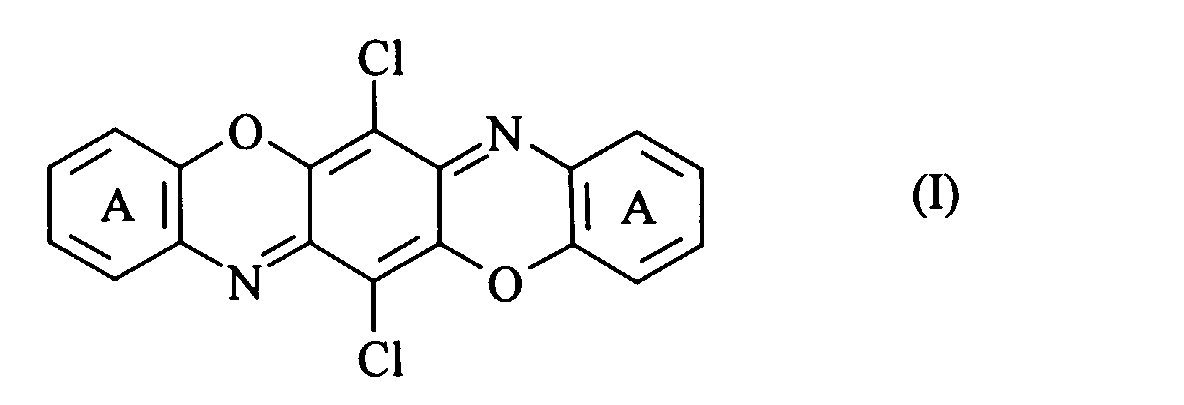
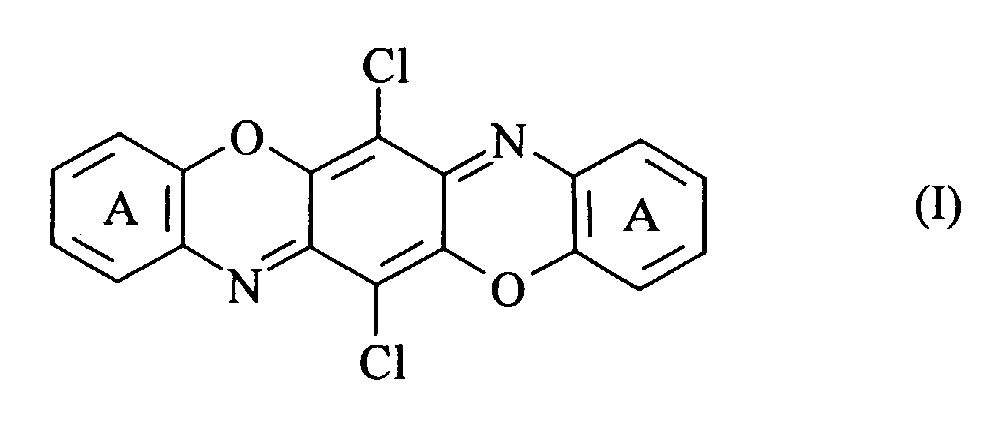
- the present patent application therefore provides, firstly, compounds of the general formula (I) in which the rings labelled A in positions 1,2-, 2,3- or 3,4- and 8,9-, 9,10- or 10,11- carry a linearly or angularly fused heterocyclic ring containing at least one nitrogen atom which is substituted or unsubstituted, with the proviso that compounds with only unsubstituted nitrogen atoms and symmetrically disubstituted compounds with C 1-2 alkyl and unsubstituted phenyl substituents are excluded. Examples of such fused heterocyclic rings are enumerated in GB 2284427 which is incorporated by reference.
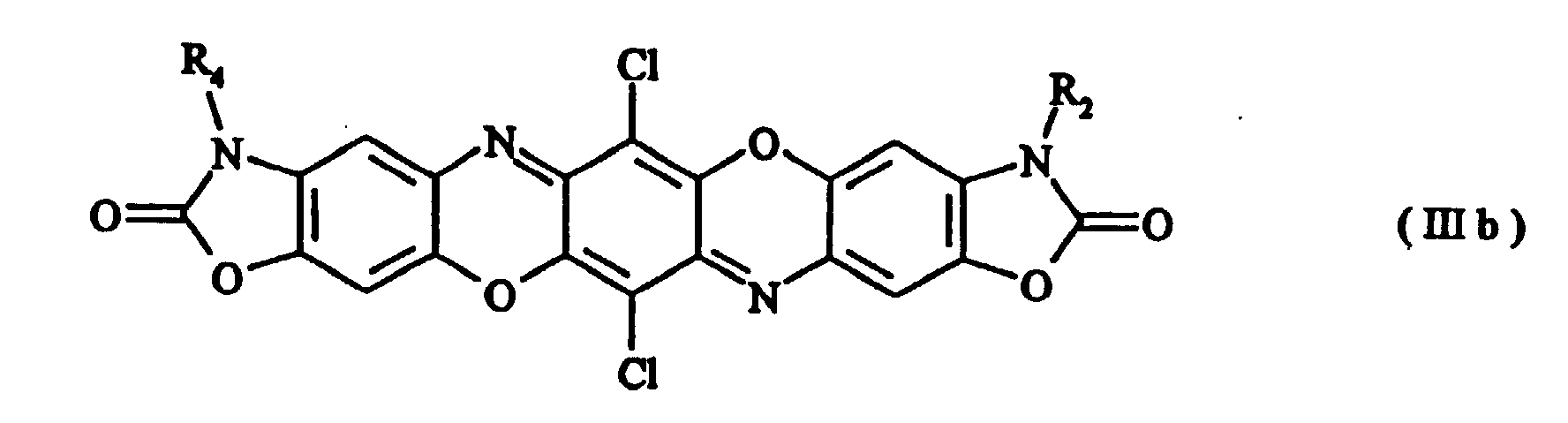
- Preferred compounds of formula (I) are those with formulae (Ia), (IIa), (IIIa) and (IIIb) where R 1 , R 2 , R 3 and R 4 , independently of one another, are hydrogen, a C 1-8 alkyl radical, a substituted or unsubstituted phenyl, benzyl, benzanilide or naphthyl radical, a substituted or unsubstituted C 5-6 cycloalkyl radical or a radical of the formula with the proviso that in the case of symmetrically disubstituted compounds the definitions hydrogen, C 1-2 alkyl radical and unsubstituted phenyl radical are excluded.
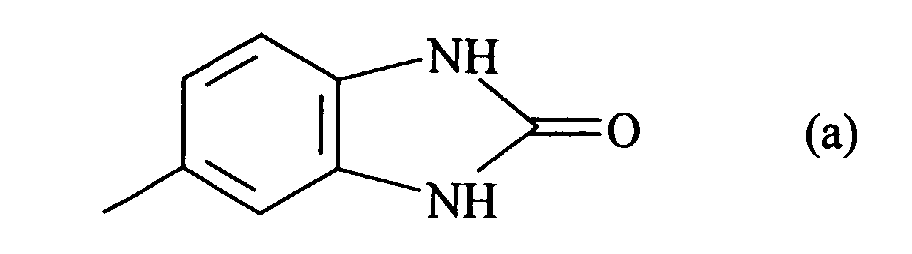
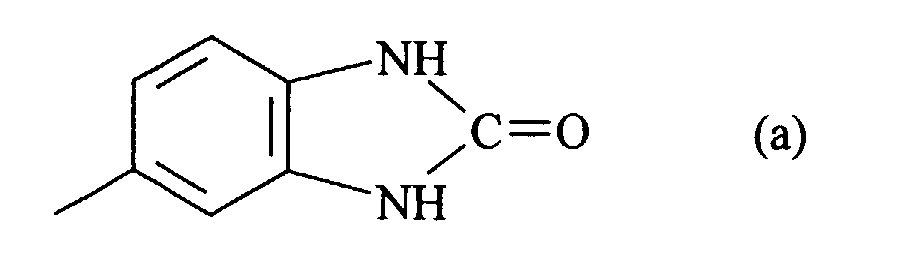
- the substituents R 1 , R 2 , R 3 and R 4 are preferably hydrogen, a methyl radical, an ethyl radical, an n- or i-propyl radical, an n-, i-, sec- or tert-butyl radical, a cyclohexyl radical, a substituted or unsubstituted benzanilide radical, a naphthyl radical, a radical of the formula (a) an unsubstituted phenyl radical, a phenyl radical substituted one or more times by radicals selected from the group consisting of halogen, preferably chlorine, nitro groups, phenyl radicals, C 1-8 alkyl radicals, preferably C 1-4 alkyl radicals, and C 1-2 alkoxy radicals, with the abovementioned proviso for symmetrically disubstituted compounds.
- halogen preferably chlorine, nitro groups
- the abovementioned substituted phenyl radical in the definition of R 1 to R 4 is preferably selected from the group consisting of o-, m-, p-methyl-, ethyl-, methoxyphenyl, 2,4-and 3,5-dimethylphenyl, 2,5-dichloro-, dimethoxy-, diethoxyphenyl, m-, p-nitrophenyl, 2,5-dichloro-, 2,5-diethoxy-4-nitrophenyl, 2-methoxy-4-nitrophenyl, 3-chloro-4-methyl-, 3-chloro-4-methoxyphenyl, p-ethoxyphenyl and the radical
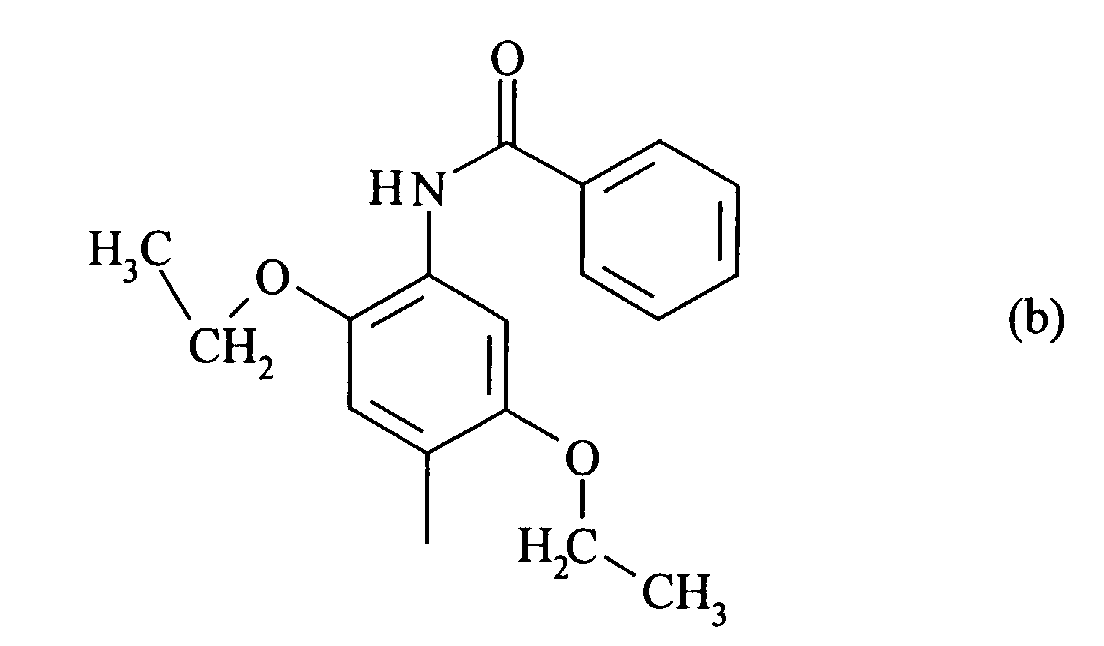
- the abovementioned substituted benzanilide radical in the definition of R 1 to R 4 is preferably selected from the group consisting of radicals of the formulae (b) and (c)
- Preferred triphendioxazine compounds are those for which R 2 and R 4 are hydrogen and R 1 is a methyl radical and R 3 is an ethyl radical (asymmetrically disubstituted compound) or in which R 1 and R 3 are each a 4-methylphenyl or 4-methoxyphenyl radical (symmetrically disubstituted compounds).
- Preferred symmetrically tetrasubstituted compounds are the tetramethyl-, tetraethyl-, tetrapropyl (n- or i-) and tetrabutyl (n-, i-, sec- or tert-)substituted compounds.
- Preferred asymmetrically tetrasubstituted compounds are those for which the definitions of R 1 and R 2 are selected from the group consisting of the radicals methyl, ethyl, propyl (n- or i-) and butyl (n-, i-, sec- or tert-) and R 3 and R 4 can have any of the above definitions.
- Preferred intermediates of formula (IV) are those of formulae (XVI) to (XVIc) where R 1 and R 2 are as defined above.
- a third step the cyclization of a compound of the formula (XIII), preferably with phosgene, chloroformic ester or urea, to give the 1,3-dihydrobenzimidazol-2-one compound where R 1 is as defined above.
- the disubstituted intermediate required to prepare the tetrasubstituted triphendioxazine compounds is obtainable, for example, by N-alkylation of the compound of the formula (XIV) in which R 1 is as defined above, preferably using dialkyl sulphate, alkyl bromide or alkyl iodide or, respectively, benzyl bromide or benzyl chloride, to give the compound of the formula (XV)
- the nitro compound of the formula (XV) is reduced, preferably by the method of Béchamp, to give the amino compound of the formula (XVI) where R 1 and R 2 are as defined above.
- Triphendioxazine compounds of the formula (I) according to the invention are used as pigments.
- the pigments according to the invention are excellently suited to the colouring of polymer compositions, by which are meant solvent-free and solvent-containing compositions comprising plastics or synthetic resins (in oil-based or water-based paints, in coating materials of various kinds, for the spin dyeing of viscose or cellulose acetate, or for pigmenting plastics, such as polyamide, polyethylene, polystyrene, polyvinyl chloride, rubber and artificial leather). They can also be used in printing inks for the graphical industry, for the colouring of paper pulps, for the coating of textile or for pigment printing.
- solvent-free and solvent-containing compositions comprising plastics or synthetic resins (in oil-based or water-based paints, in coating materials of various kinds, for the spin dyeing of viscose or cellulose acetate, or for pigmenting plastics, such as polyamide, polyethylene, polystyrene, polyvinyl chloride, rubber and artificial leather). They can also be used in printing inks for the graphical industry, for
- the resulting colorations are notable for their outstanding heat, light and weather fastness, chemical resistance, colour strength and very good applications properties, examples being their crystallization fastness and dispersing fastness, and especially for their fastness to migration, bleeding, overcoating and solvents.
- the pigments of the invention are also suitable as colorants in electrophotographic toners and developers, such as one- or two-component powder toners (also known as one- or two-component developers), magnetic toners, liquid toners, polymerization toners and further speciality toners (literature: L.B. Schein, “Electrophotography and Development Physics”; Springer Series in Electrophysics 14, Springer Verlag, 2nd edition, 1992).
- Typical toner binders are addition polymerization, polyaddition and polycondensation resins, such as styrene, styrene-acrylate, styrene-butadiene, acrylate, polyester and phenolic-epoxy resins, polysulphones, polyurethanes, individually or in combination, and also polyethylene and polypropylene, in or to which further ingredients, such as charge control agents, waxes or flow assistants may be present or may be added subsequently.
- polyaddition and polycondensation resins such as styrene, styrene-acrylate, styrene-butadiene, acrylate, polyester and phenolic-epoxy resins, polysulphones, polyurethanes, individually or in combination, and also polyethylene and polypropylene, in or to which further ingredients, such as charge control agents, waxes or flow assistants may be present or may be added subsequently.
- a further area of application of pigments of the invention is their use as colorants in powders and powder coating materials, especially triboelectrically or electrokinetically sprayed powder coating materials, which are used to coat the surfaces of articles made, for example, from metal, wood, plastic, glass, ceramic, concrete, textile material, paper or rubber (J.F. Hughes, "Electrostatics Powder Coating", Research Studies Press, John Wiley & Sons, 1984).
- Powder coating resins employed are typically epoxy resins, carboxyl- and hydroxyl-containing polyester resins, polyurethane resins and acrylic resins, together with customary hardeners. Combinations of resins are also used. For example, epoxy resins are frequently employed in combination with carboxyl- and hydroxyl-containing polyester resins. Examples of typical hardener components (depending on the resin system) are acid anhydrides, imidazoles and dicyandiamide and derivatives thereof, blocked isocyanates, bisacylurethanes, phenolic and melamine resins, triglycidyl isocyanurates, oxazolines and dicarboxylic acids.
- the pigments of the invention are suitable, moreover, as colorants in ink-jet inks, both aqueous and non-aqueous, and in those inks which operate in accordance with the hot-melt process.
- Example 2 Using the method described in Example 1 further derivatives of similar 1,3-dihydro-benzimidazol-2-ones can be prepared as illustrated in Examples 2 and 3.
- the resulting dispersion is sprayed onto sheet aluminium, left to dry in air for 30 minutes and then baked at 120°C for 30 minutes.
- the result is a film of the colour specified in the table below, with very good migration fastness and also good light and weathering stability.
- Example of the preparation of a 0.1% coloured PVC film (blend of colour pigment to white pigment 1:5): 16.5 parts of a plasticizer mixture consisting of equal parts of dioctyl phthalate and dibutyl phthalate are mixed with 0.05 parts of the pigment set out in the table below and with 0.25 parts of titanium dioxide. Then 33.5 parts of polyvinyl chloride are added.
Landscapes
- Chemical & Material Sciences (AREA)
- Organic Chemistry (AREA)
- Nitrogen And Oxygen Or Sulfur-Condensed Heterocyclic Ring Systems (AREA)
- Inks, Pencil-Leads, Or Crayons (AREA)
- Compositions Of Macromolecular Compounds (AREA)
- Pigments, Carbon Blacks, Or Wood Stains (AREA)
- Paper (AREA)
- Coloring (AREA)
- Paints Or Removers (AREA)
Abstract
are outstanding pigments and are notable over the closest comparable pigments in particular for better migration, light and solvent fastnesses, better heat stability and enhanced colouring power and also better dispersibility and capability to be brought into pigment form.
Description
- The invention relates to novel chlorine-containing triphendioxazine compounds and to their use as pigments. The invention also relates to a particularly advantageous process for preparing these triphendioxazine compounds.
- GB 2284427 A describes chlorine-containing, symmetrically disubstituted triphendioxazine compounds of the following general formulawhere
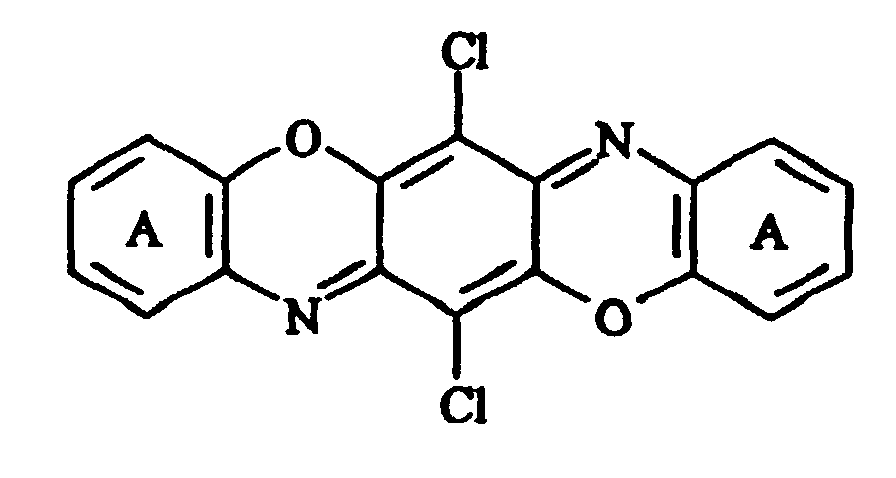
the rings labelled A carry rings which are fused linearly or angularly and consist of radical members, inter alia, of the formulae -NR1-(CO)m-NH- and -CR1=CH-CO-NH- wherein R1 is hydrogen, C1-4alkyl or phenyl, preferably hydrogen, methyl or ethyl; and m is 1 or 2. - The preparation process disclosed in GB 2284427 A starts from intermediates i.e. amino compounds, which are ortho-substituted by an alkoxy group and are obtainable only by way of a relatively complex synthesis. The pigments disclosed in GB 2284427 A are difficultly dispersible and cannot easily be brought into pigment form.
- It is an object of the invention to provide new pigments possessing high fastness to solvents, migration and light, which have good thermal stabilities and a high tinting power and are also easily dispersible resp. easily to be brought into pigment form.
- Another object of the invention is to provide a process by which the novel pigments are obtainable and which starts from readily available intermediates.
- These objects are achieved by the novel triphendioxazine compounds according to Claim 1 and their use for preparing pigments according to Claim 7, and by the process according to Claim 6 by which these novel triphendioxazine compounds are obtainable.
- The present patent application therefore provides, firstly, compounds of the general formula (I)in which the rings labelled A in positions 1,2-, 2,3- or 3,4- and 8,9-, 9,10- or 10,11- carry a linearly or angularly fused heterocyclic ring containing at least one nitrogen atom which is substituted or unsubstituted, with the proviso that compounds with only unsubstituted nitrogen atoms and symmetrically disubstituted compounds with C1-2alkyl and unsubstituted phenyl substituents are excluded. Examples of such fused heterocyclic rings are enumerated in GB 2284427 which is incorporated by reference.
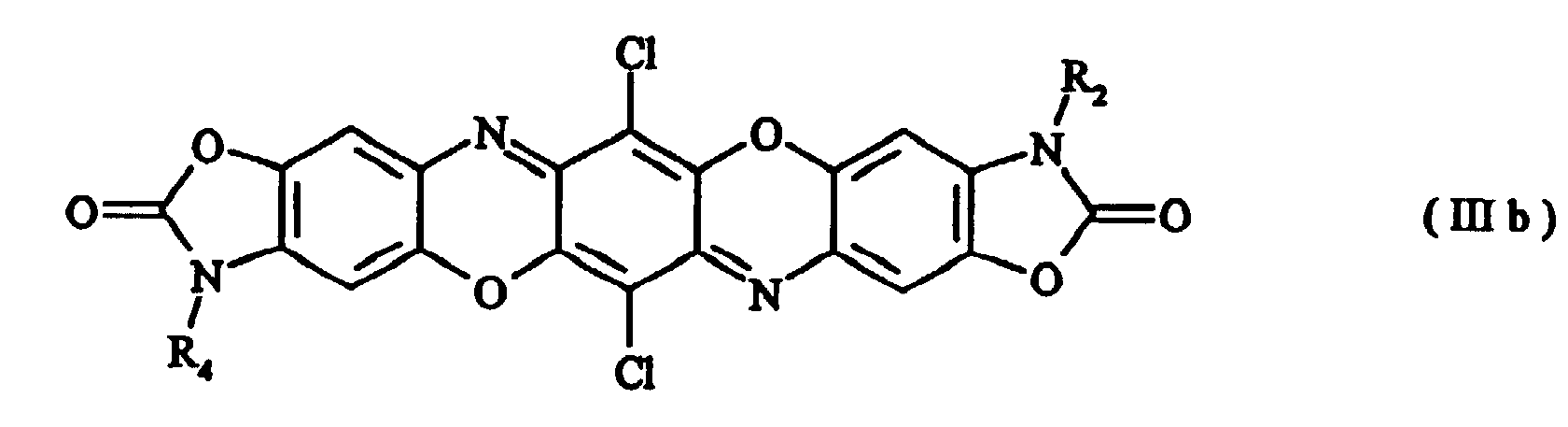
- Preferred compounds of formula (I) are those with formulae (Ia), (IIa), (IIIa) and (IIIb)


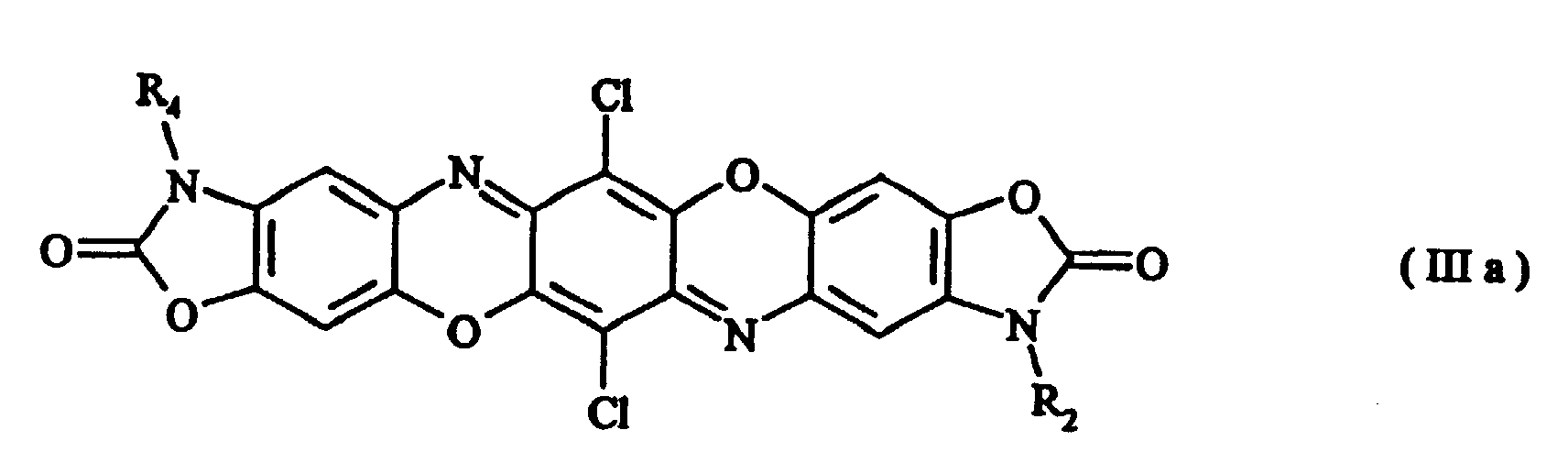 where R1, R2, R3 and R4, independently of one another, are hydrogen, a C1-8 alkyl radical, a substituted or unsubstituted phenyl, benzyl, benzanilide or naphthyl radical, a substituted or unsubstituted C5-6 cycloalkyl radical or a radical of the formula
 with the proviso that in the case of symmetrically disubstituted compounds the definitions hydrogen, C1-2 alkyl radical and unsubstituted phenyl radical are excluded.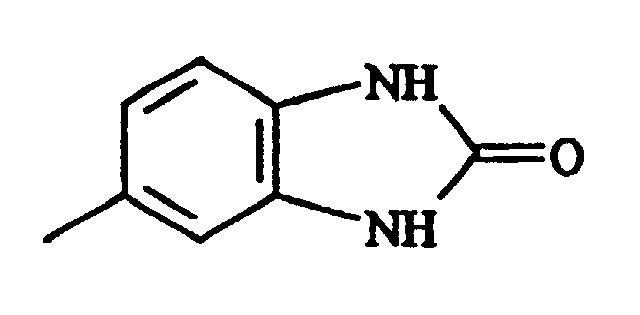
- In view of the fact that only compounds having hydrogen substituents are capable of building hydrogen bridges (which is believed to be necessary for the pigmentary properties), it is surprising that even tetrasubstituted compounds possess pigmentary properties.
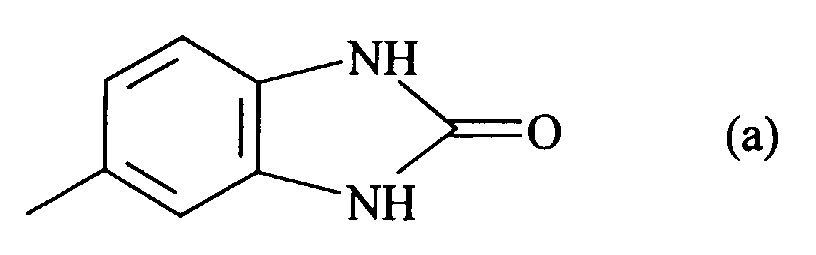
- The substituents R1, R2, R3 and R4, independently of one another, are preferably hydrogen, a methyl radical, an ethyl radical, an n- or i-propyl radical, an n-, i-, sec- or tert-butyl radical, a cyclohexyl radical, a substituted or unsubstituted benzanilide radical, a naphthyl radical, a radical of the formula (a)an unsubstituted phenyl radical, a phenyl radical substituted one or more times by radicals selected from the group consisting of halogen, preferably chlorine, nitro groups, phenyl radicals, C1-8 alkyl radicals, preferably C1-4 alkyl radicals, and C1-2 alkoxy radicals, with the abovementioned proviso for symmetrically disubstituted compounds.

- The abovementioned substituted phenyl radical in the definition of R1 to R4 is preferably selected from the group consisting of o-, m-, p-methyl-, ethyl-, methoxyphenyl, 2,4-and 3,5-dimethylphenyl, 2,5-dichloro-, dimethoxy-, diethoxyphenyl, m-, p-nitrophenyl, 2,5-dichloro-, 2,5-diethoxy-4-nitrophenyl, 2-methoxy-4-nitrophenyl, 3-chloro-4-methyl-, 3-chloro-4-methoxyphenyl, p-ethoxyphenyl and the radical
- The abovementioned substituted benzanilide radical in the definition of R1 to R4 is preferably selected from the group consisting of radicals of the formulae (b) and (c)

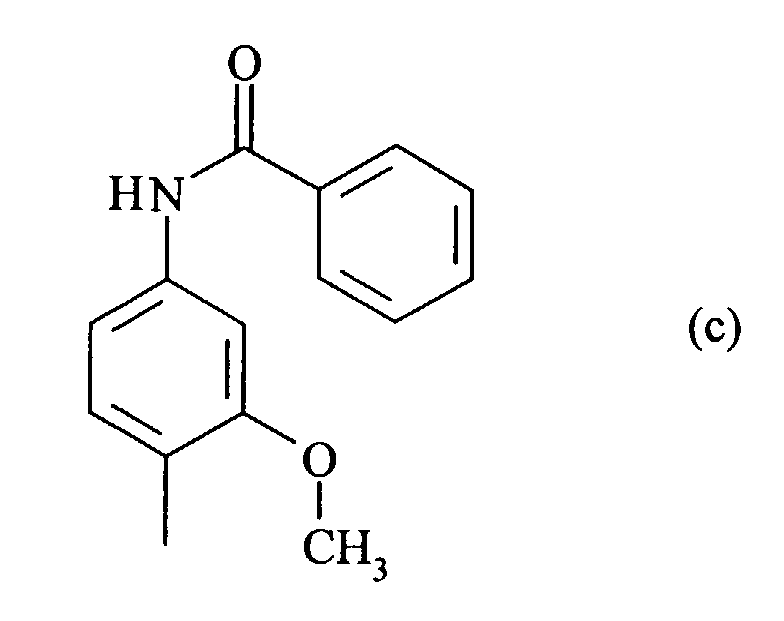
- Preferred triphendioxazine compounds are those for which R2 and R4 are hydrogen and R1 is a methyl radical and R3 is an ethyl radical (asymmetrically disubstituted compound) or in which R1 and R3 are each a 4-methylphenyl or 4-methoxyphenyl radical (symmetrically disubstituted compounds).
- Preferred symmetrically tetrasubstituted compounds are the tetramethyl-, tetraethyl-, tetrapropyl (n- or i-) and tetrabutyl (n-, i-, sec- or tert-)substituted compounds.
- Preferred asymmetrically tetrasubstituted compounds are those for which the definitions of R1 and R2 are selected from the group consisting of the radicals methyl, ethyl, propyl (n- or i-) and butyl (n-, i-, sec- or tert-) and R3 and R4 can have any of the above definitions.
- It has been found that even amino compounds which are not ortho-substituted are suitable as intermediates provided that the cyclization which follows the reaction with 2,3,5,6-tetrachlorobenzoquinone (chloranil) is carried out with manganese dioxide and concentrated sulphuric acid, e.g. from 80 to 100% strength, preferably from 90 to 95% strength. The process for preparing the novel compounds of the formula (I) is therefore also an object of the present patent application. Following the reaction of 1 mol of chloranil with 2 mol of a compound of the general formula (IV)in which ring A carries a fused heterocyclic ring containing at least one nitrogen atom which is substituted or unsubstituted with the abovementioned proviso, there follows the characterizing process step of the cyclization conducted with manganese dioxide (MnO2) and concentrated sulphuric acid, e.g. from 80 to 100% strength, preferably from 90 to 95% strength.
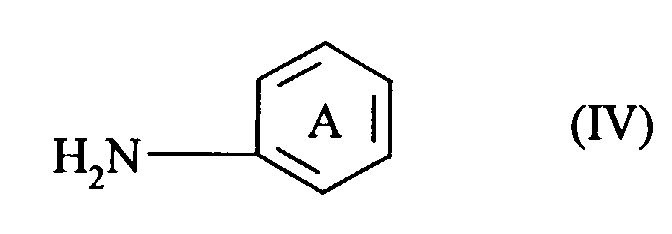
- Preferred intermediates of formula (IV) are those of formulae (XVI) to (XVIc)
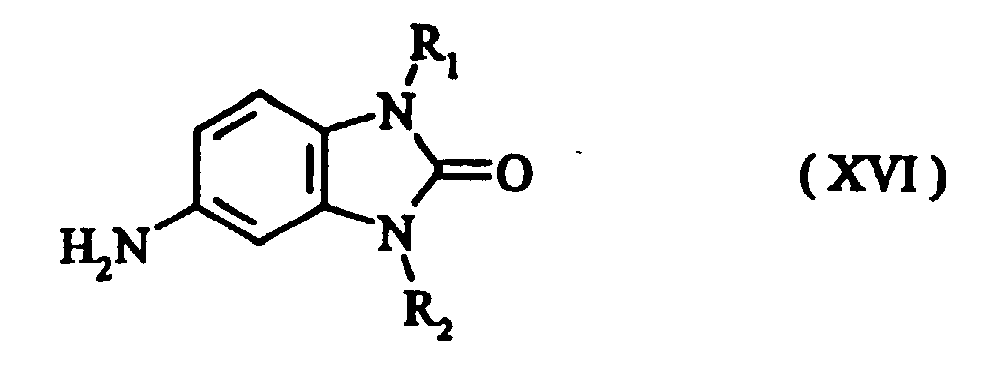
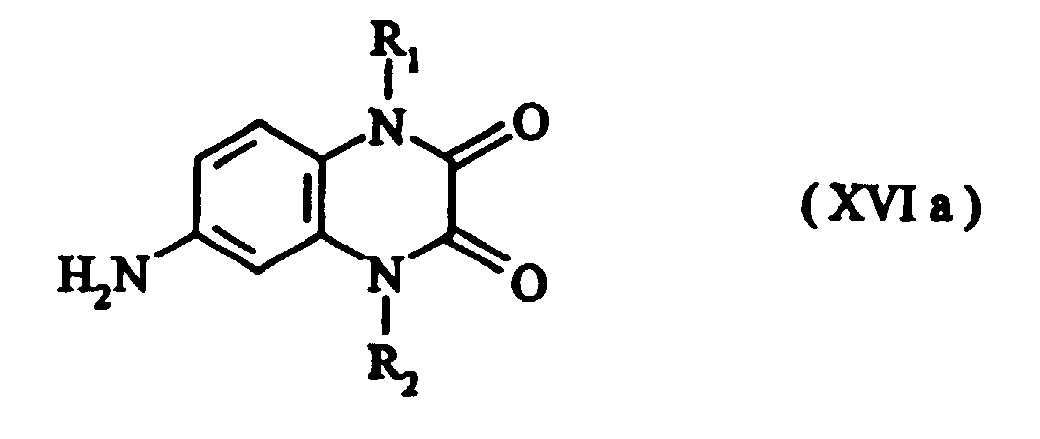
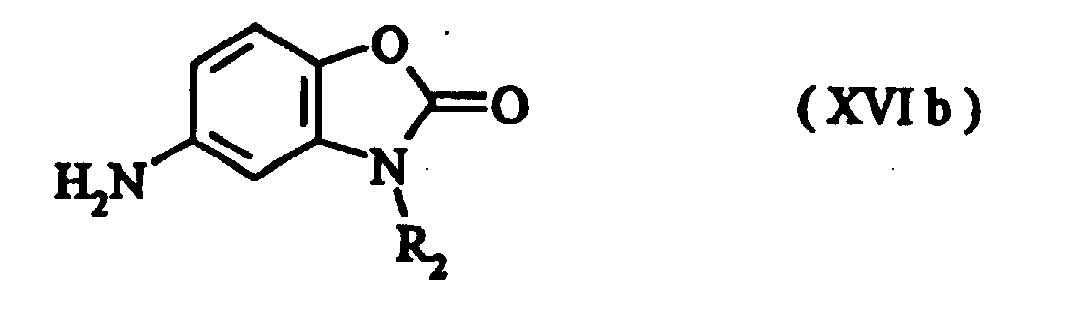 where R1 and R2 are as defined above.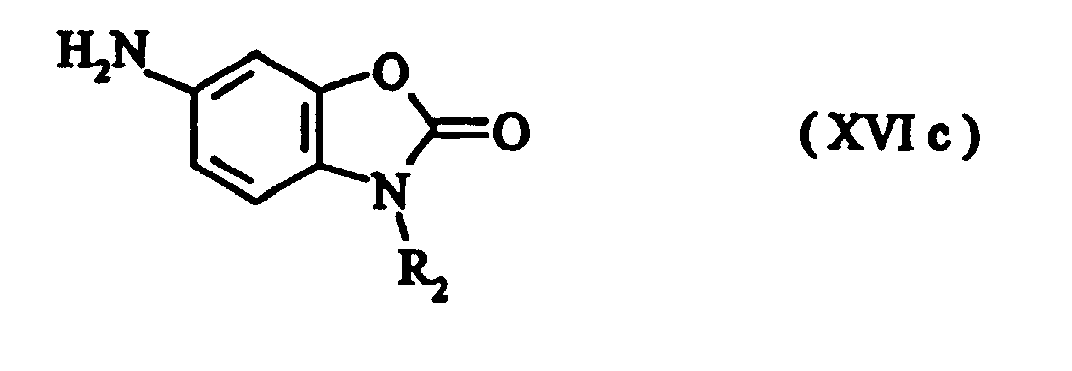
- The advantage of this process is that it is possible to start from the intermediates (XVI), (XVIa), (XVIb) and (XVIc) which, unlike the amino compounds which carry an alkoxy group in the ortho position, are relatively easy to obtain. For example, compounds of the formula (XVI) are obtainable by a process comprising the following steps:
- In a first step, the reaction of 2,4-dinitrochlorobenzene (XI) with the corresponding primary amine, to give the N-substituted 2,4-dinitroaniline (XII)

- In a second step, the reduction of the compound of the formula XII, preferably with hydrated sodium hydrogen sulphide, to give the 1,2-diamine compound (XIII)
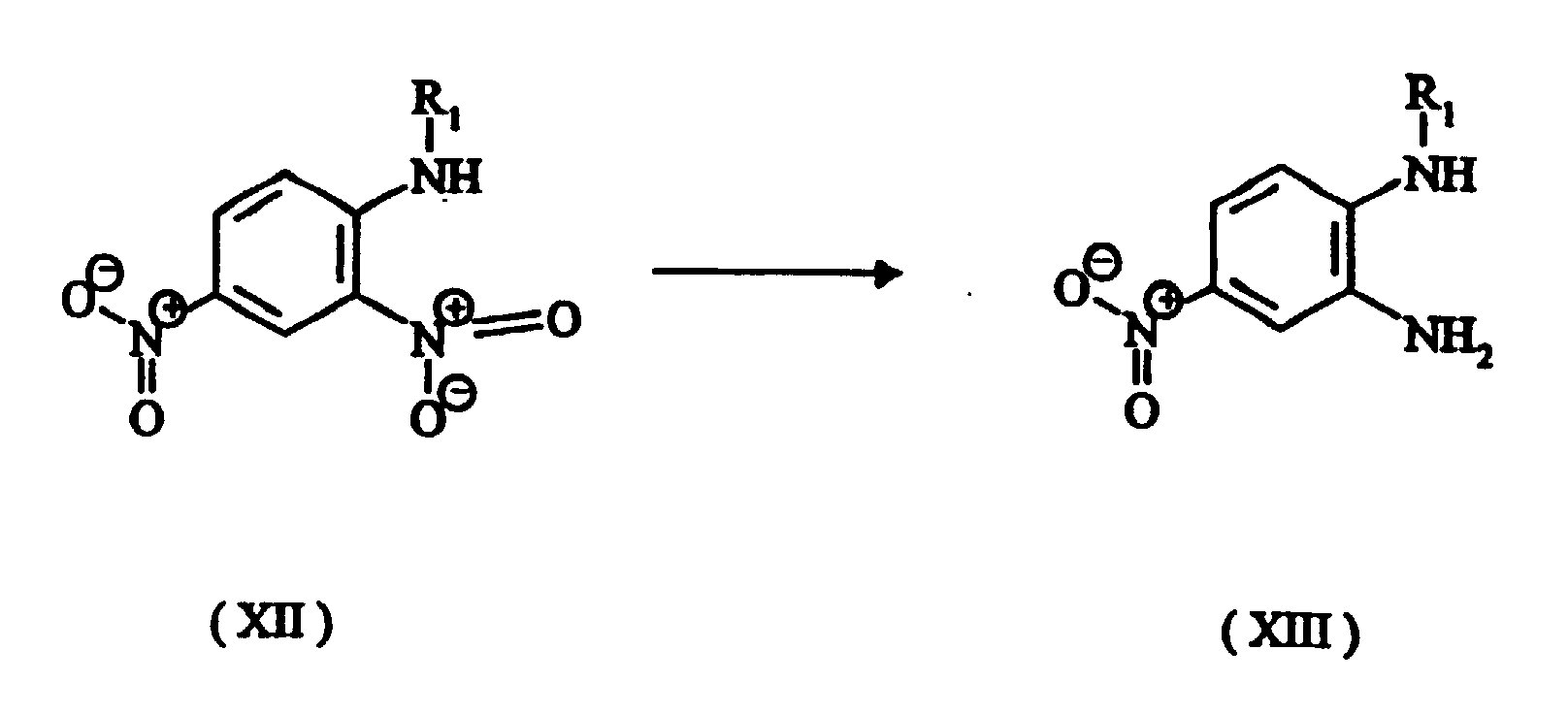
- In a third step, the cyclization of a compound of the formula (XIII), preferably with phosgene, chloroformic ester or urea, to give the 1,3-dihydrobenzimidazol-2-one compoundwhere R1 is as defined above.
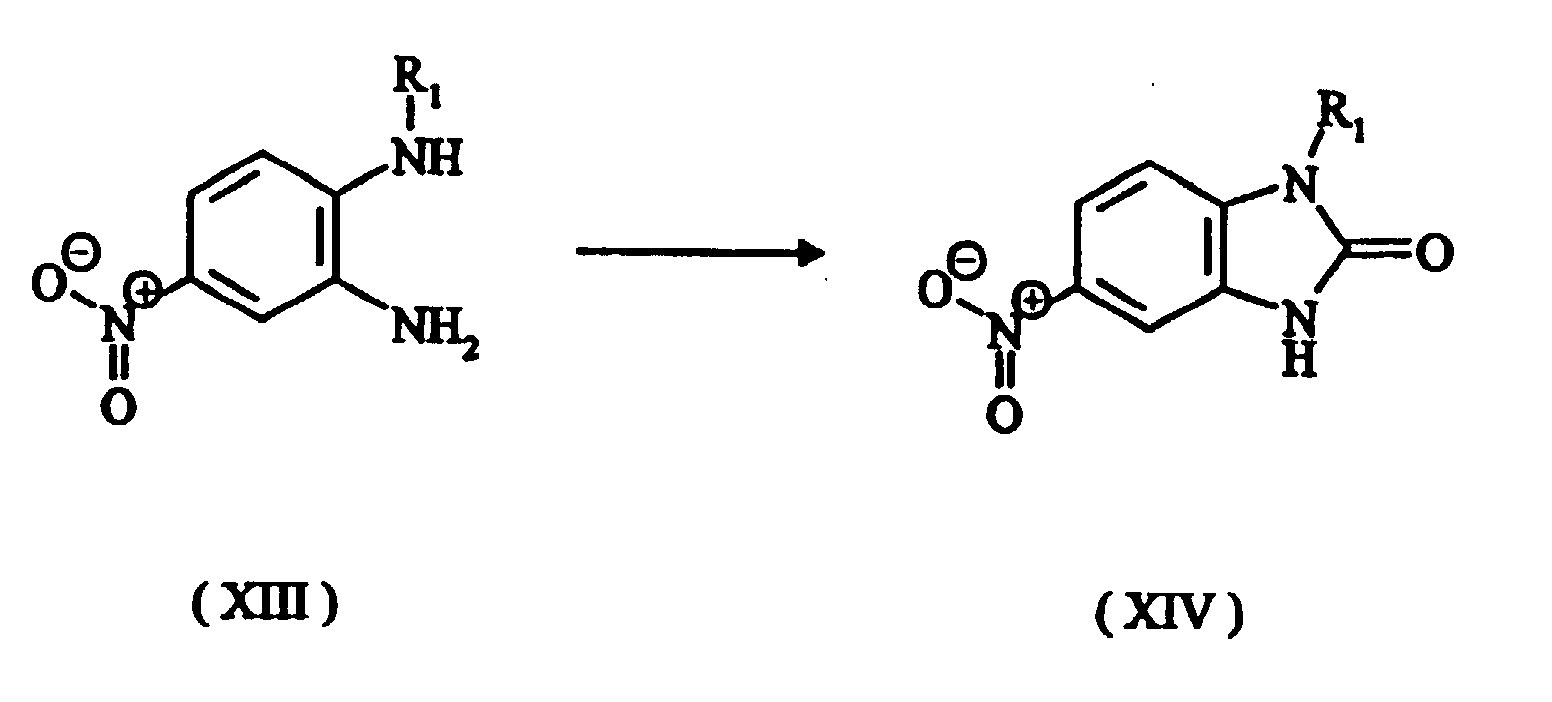
- The disubstituted intermediate required to prepare the tetrasubstituted triphendioxazine compounds is obtainable, for example, by N-alkylation of the compound of the formula (XIV) in which R1 is as defined above, preferably using dialkyl sulphate, alkyl bromide or alkyl iodide or, respectively, benzyl bromide or benzyl chloride, to give the compound of the formula (XV)In a further step, the nitro compound of the formula (XV) is reduced, preferably by the method of Béchamp, to give the amino compound of the formula (XVI)
 where R1 and R2 are as defined above.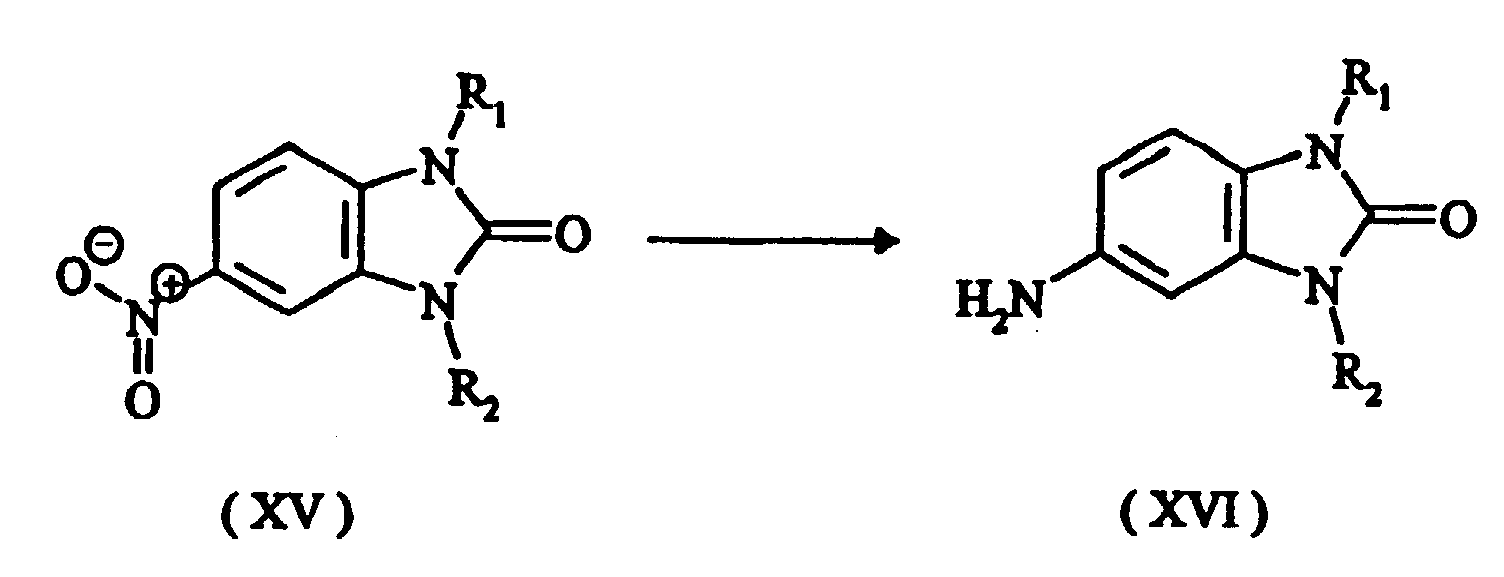
- Compounds of the formula (XVIa) are obtainable, for example, by cyclizing the compound of the formula (XIII) with oxalic acid or oxalic ester.
- Compounds of the formula (XVIb) (5-aminobenzoxazolones) are preferably prepared by a process comprising the following steps:

- Compounds of the formula (XVIc) (6-aminobenzoxazolones) are obtainable, for example, by a process comprising the following steps:

- Compounds with angularly fused rings can be produced by similar methods using starting compounds having isomeric substitution, e.g. 3,4-dinitroaniline instead of 2,4-dinitroaniline.
- Triphendioxazine compounds of the formula (I) according to the invention are used as pigments.
- Aftertreating the crude pigments in organic solvents in which the pigments themselves are not dissolved and at elevated temperatures, for example at from 60 to 200°C, especially from 70 to 150°C and preferably from 75 to 100°C, can often be used to further improve the pigment properties. Aftertreatment is preferably combined with a milling or kneading operation.
- The pigments according to the invention are excellently suited to the colouring of polymer compositions, by which are meant solvent-free and solvent-containing compositions comprising plastics or synthetic resins (in oil-based or water-based paints, in coating materials of various kinds, for the spin dyeing of viscose or cellulose acetate, or for pigmenting plastics, such as polyamide, polyethylene, polystyrene, polyvinyl chloride, rubber and artificial leather). They can also be used in printing inks for the graphical industry, for the colouring of paper pulps, for the coating of textile or for pigment printing.
- The resulting colorations are notable for their outstanding heat, light and weather fastness, chemical resistance, colour strength and very good applications properties, examples being their crystallization fastness and dispersing fastness, and especially for their fastness to migration, bleeding, overcoating and solvents.
- In addition, the pigments of the invention are also suitable as colorants in electrophotographic toners and developers, such as one- or two-component powder toners (also known as one- or two-component developers), magnetic toners, liquid toners, polymerization toners and further speciality toners (literature: L.B. Schein, "Electrophotography and Development Physics"; Springer Series in Electrophysics 14, Springer Verlag, 2nd edition, 1992).
- Typical toner binders are addition polymerization, polyaddition and polycondensation resins, such as styrene, styrene-acrylate, styrene-butadiene, acrylate, polyester and phenolic-epoxy resins, polysulphones, polyurethanes, individually or in combination, and also polyethylene and polypropylene, in or to which further ingredients, such as charge control agents, waxes or flow assistants may be present or may be added subsequently.
- A further area of application of pigments of the invention is their use as colorants in powders and powder coating materials, especially triboelectrically or electrokinetically sprayed powder coating materials, which are used to coat the surfaces of articles made, for example, from metal, wood, plastic, glass, ceramic, concrete, textile material, paper or rubber (J.F. Hughes, "Electrostatics Powder Coating", Research Studies Press, John Wiley & Sons, 1984).
- Powder coating resins employed are typically epoxy resins, carboxyl- and hydroxyl-containing polyester resins, polyurethane resins and acrylic resins, together with customary hardeners. Combinations of resins are also used. For example, epoxy resins are frequently employed in combination with carboxyl- and hydroxyl-containing polyester resins. Examples of typical hardener components (depending on the resin system) are acid anhydrides, imidazoles and dicyandiamide and derivatives thereof, blocked isocyanates, bisacylurethanes, phenolic and melamine resins, triglycidyl isocyanurates, oxazolines and dicarboxylic acids.
- The pigments of the invention are suitable, moreover, as colorants in ink-jet inks, both aqueous and non-aqueous, and in those inks which operate in accordance with the hot-melt process.
- In the following examples the parts and percentages are by weight. The temperatures are indicated in degrees Celsius. One part by volume corresponds to the volume of one part by weight of water.
-
- a) 2,4-dinitrophenyl-p-tolylamine 310 parts of 2,4-dinitrochlorobenzene (98%) are suspended
in 1250 parts of ethanol and the suspension is heated to
50°C. 325 parts of para-toluidine are added over 1.5
hours. The mixture is heated under reflux for 2 hours and
filtered while hot, and the solid product is washed with
400 parts of hot alcohol. It is then washed with water
until free from chloride. Drying under reduced pressure at
80°C gives 406 parts of red-orange needles of a compound
of the following formula

- Yield:
- 99%
- Melting point:
- 133.6°C
- IR (KBr):
- 3313 - 1622 - 1609 - 1581 - 1519 - 1335 cm-1
- MS(m/e):
- 273 - 256 - 229 - 226 - 210 - 196 - 180 - 168 - 152 - 139 - 127
- b) 4-nitro-N-1-p-tolyl-1,2-diaminobenzene 382 parts of 2,4-dinitrophenyl-p-tolylamine are suspended
in 1600 parts of ethanol and the suspension is heated to
55°C. A solution of 162 parts of sodium hydrogen sulphide
hydrate in 300 parts of water is added dropwise over 2
hours. The mixture is subsequently stirred under reflux
for 2 hours and then cooled to room temperature and
filtered, and the filter cake is washed with 600 parts of
alcohol and 3000 parts of water. Drying under reduced
pressure at 80°C gives 284 parts of dark red crystals of a
compound of the following formula
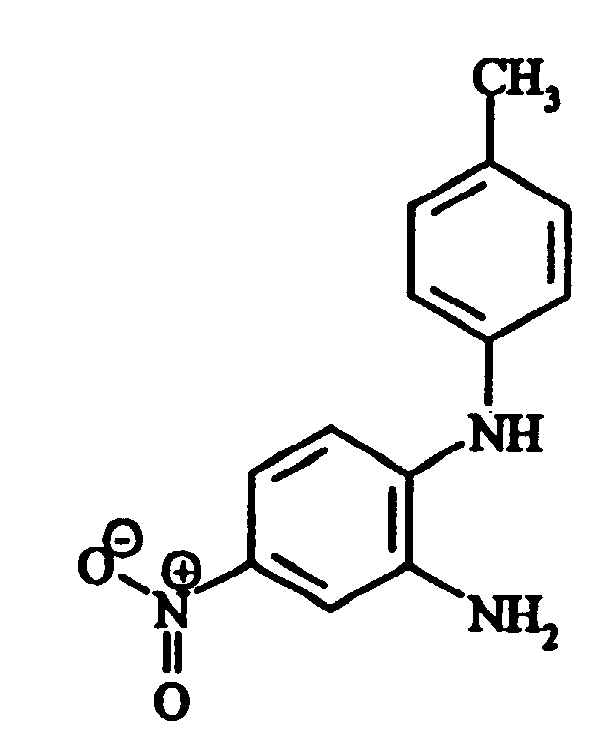
- Yield:
- 83%
- Melting point:
- 156.2°C
- IR (KBr):
- 3428 - 1587 - 1549 - 1478 - 1284 cm-1
- 1H-NMR (DMSO): δ:
- 2.25 (s, CH3) - 5.37 (s, NH2) - 6.93 (d, 3J=9Hz, H-C6) - 7.05 (d, 3J=9Hz, 2H-Ctolyl) - 7.15 (d, 3J=9HZ, 2H-Ctolyl) - 7.42 (dd, 3J=9Hz, 4J=2Hz, H-C5) - 7.55 (d, 4J=2Hz, H-C3) - 7.70 (s, NH)
- MS (m/e):
- 243 - 228 - 213 - 196 - 182 - 168 - 154 - 142 - 130
- c) 5-nitro-1-p-tolyl-1,3-dihydrobenzimidazol-2-one 221 parts of 4-nitro-N-1-p-tolyl-1,2-diaminobenzene and 72
parts of urea are heated with stirring at 165°C in 780
parts of o-dichlorobenzene for 4.5 hours. The mixture is
subsequently cooled to room temperature and filtered and
the solid product is washed with 400 parts of o-dichlorobenzene,
400 parts of methanol and 1000 parts of water.
Drying under reduced pressure at 80°C gives 234 parts of
beige crystals as a compound of the following formula

- Yield:
- 97%
- Melting point:
- >300°C
- IR (KBr):
- 3033 - 1725 - 1518 - 1488 - 1392 - 1343 cm-1
- 1H-NMR (DMSO): δ:
- 2.40 (s, CH3) - 7.06 (d, 3J=9Hz, H-C7) - 7.38 (d, 3J=9Hz, 2H-Ctolyl) - 7.41 (d, 3J=9Hz, 2H-Ctolyl) - 7.83 (d, 4J=2Hz, H-C4) - 7.95 (dd, 3J=9Hz, 4J=2Hz, H-C6) - 11.50 (s, H-N3)
- d) 5-amino-1-p-tolyl-1,3-dihydrobenzimidazol-2-one 84 parts of iron dust and 14 parts of hydrochloric acid
(36%) are heated under reflux in 700 parts of water for 1
hour. 64 parts of 5-nitro-1-p-tolyl-1,3-dihydrobenzimidazol-2-one
are added over 7 hours and the mixture is
subsequently stirred at this temperature for 15 hours. The
mixture is then rendered alkaline with 53 parts of aqueous
sodium hydroxide solution (30%), filtered to remove iron
oxide, and subsequently washed with 200 parts of boiling
water. Hydrochloric acid is added to adjust the filtrate
to a pH of 6.5, and this filtrate is then cooled under
nitrogen. The precipitated product is filtered and dried
under reduced pressure at 120°C. This gives 24 parts of a
pink powder of a compound of the following formula

- Yield:
- 43%
- Melting point:
- 245-246°C
- IR (KBr):
- 3359 - 3134 - 1690 - 1637 - 1610 - 1519 - 1480 - 1396 cm-1
- 1H-NMR (DMSO): δ:
- 2.34 (s, CH3) - 4.84 (s, NH2) - 6.24 (dd, 3J=9Hz, 4J=2Hz, H-C6) - 6.46 (d, 4J=2Hz, H-C4) - 6.67 (d, 3J=9Hz, H-C7) - 7.30 (d, 3J=9Hz, H-C2', H-C6') - 7.35 (d, 3J=9Hz, H-C3', H-C5') -10.68 (s, H-N3)
- MS (m/e):
- 239 - 210 - 196 - 182 - 168 - 148 - 121
- e) 2,5-dichloro-3,6-bis(1-p-tolyl-2-oxo-1,3-dihydrobenzimidazol-5-ylamino)[1,4]benzoquinone 7.4 parts of sodium acetate and 21.5 parts of 5-amino-1-p-tolyl-1,3-dihydrobenzimidazol-2-one
are suspended in 160
parts of ethanol and the suspension is heated to 60°C.
11.2 parts of chloranil are added over 3 hours and the
mixture is subsequently refluxed for 1 hour. The solid
product is filtered off hot and washed first with 400
parts of boiling ethanol and then with 300 parts of
boiling water. After drying, the product is suspended in
250 parts of dimethylformamide, the suspension is heated
at 90°C for 5 hours and filtered while hot, and the solid
product is washed first with 500 parts of hot (100°C)
dimethylformamide and then with 300 parts of water. Drying
under reduced pressure at 80°C gives 20 parts of a brown
powder of a compound of the following formula
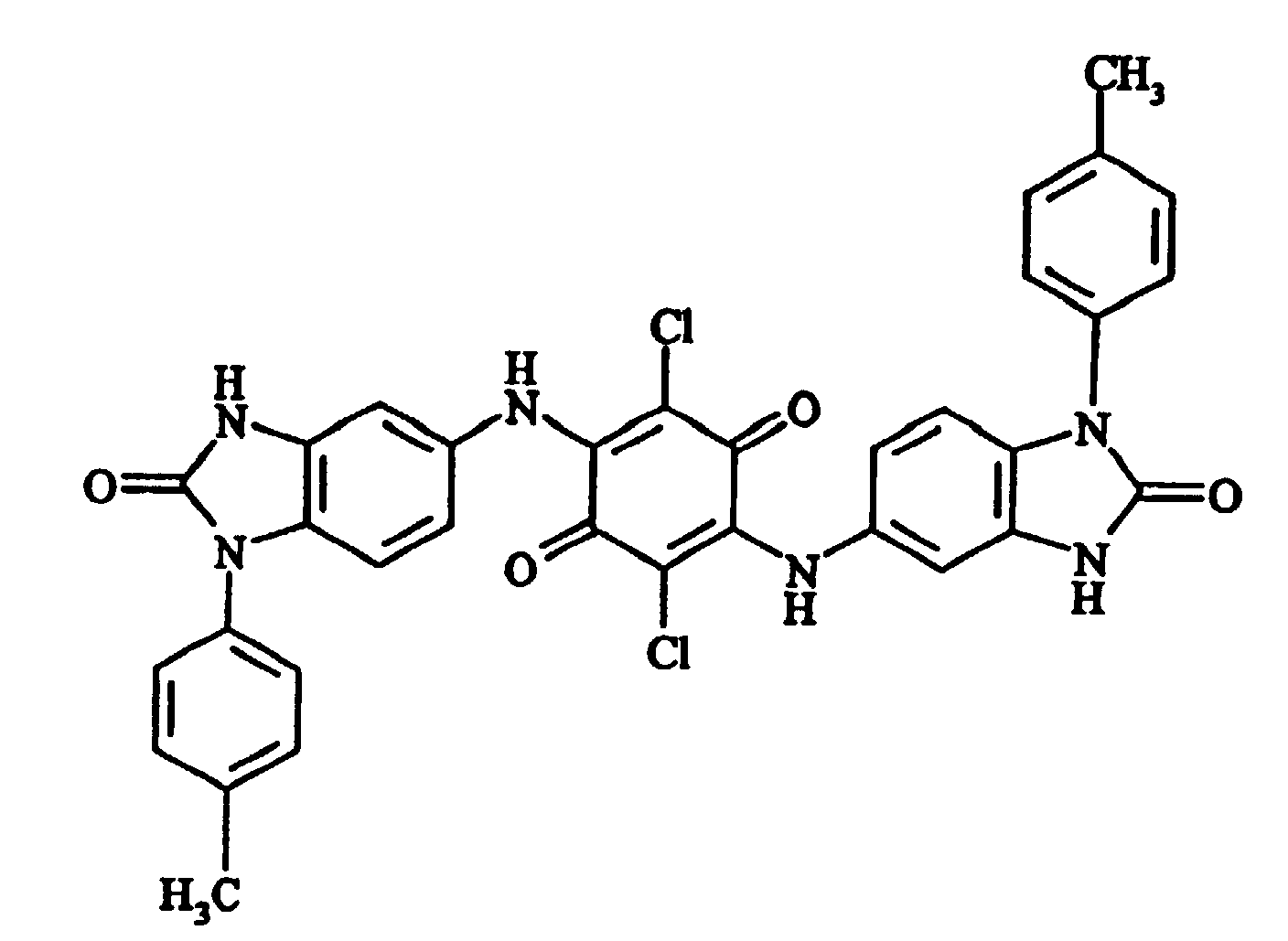
- Yield:
- 69%
- Melting point:
- >300°C
- IR (KBr):
- 3100 (1) - 1696 - 1587 - 1491 - 1385 cm-1
- 1H-NMR (DMSO): δ:
- 2.40 (s, CH3) - 6.83 (d, 3J=9Hz, H-C6 or H-C7) - 6.89 (d, 3J=9Hz, H-C6 or H-C7) - 6.91 (s, H-C4) - 7.30 (d, 3J=9Hz, 2Htolyl) - 7.41 (d, 3J=9Hz, 2Htolyl) - 9.64 (s, NH) - 11.17 (s, NHCO)
- f) Diimidazolone(4,5-b:4',5'-m)triphendioxazine-3,11-di-p-tolyl-6,14-dichloro-2,10-dione 180 parts of sulphuric acid (92%) are cooled to 5°C and 17
parts of 2,5-dichloro-3,6-bis(1-p-tolyl-2-oxo-1,3-dihydrobenzimidazol-5-ylamino)-[1,4]-benzoquinone
are added over
30 minutes. Then 6.1 parts of activated manganese dioxide
(88%) are added over 3 hours and the mixture is
subsequently heated at room temperature for 12 hours. The
mixture is diluted to 80% by adding 27 parts of water,
with cooling. The excess manganese dioxide is destroyed
using 1.2 parts of hydrogen peroxide (30%). The product is
filtered off on a polypropylene filter, washed first with
250 parts of sulphuric acid (80%) and then 250 parts of
sulphuric acid (50%), and subsequently washed free from
sulphate with water. Drying under reduced pressure at 80°C
gives 12.9 parts of a metallic-green powder of a compound
of the following formula
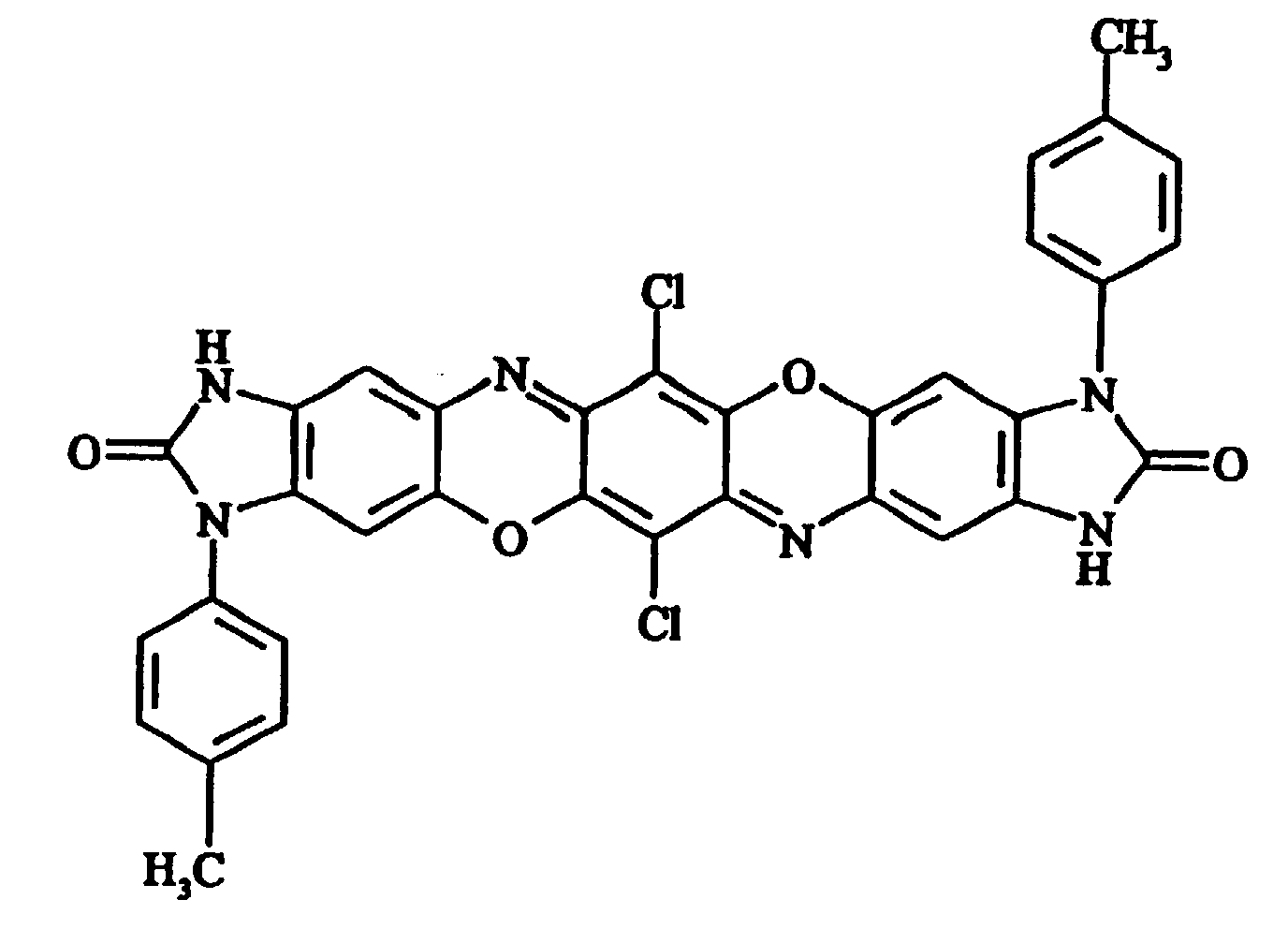
- Yield:
- 77%
- Melting point:
- >300°C
- IR (KBr):
- 3019 (1) - 1712 - 1647 - 1562 - 1480 - 1309 - 1263 cm-1
- Microanalysis:
-
- calc. C 63.07 H 3.11 N 12.98 Cl 10.95 O 9.88
- exp. C 62.6 H 3.2 N 13.0 Cl 11.2 O 10.0
-
- Using the method described in Example 1 further derivatives of similar 1,3-dihydro-benzimidazol-2-ones can be prepared as illustrated in Examples 2 and 3.
-
- a) 2,4-dinitrophenyl-(4-methoxyphenyl)amine
- b) N-1-(4-methoxyphenyl)-4-nitro-1,2-diaminobenzene
- c) 1-(4-methoxyphenyl)-5-nitro-1,3-dihydrobenzimidazol-2-one
- d) 5-amino-1-(4-methoxyphenyl-1,3-dihydrobenzimidazol-2-one
- e) 2,5-dichloro-3,6-bis(4-methoxyphenyl-2-oxo-1,3-dihydrobenzimidazol-5-ylamino)[1,4]benzoquinone
- f) Diimidazolone(4,5-b:4',5',-m)triphendioxazine-3,11-di(4-methoxyphenyl)-6,14-dichloro-2,10-dione
of the following formula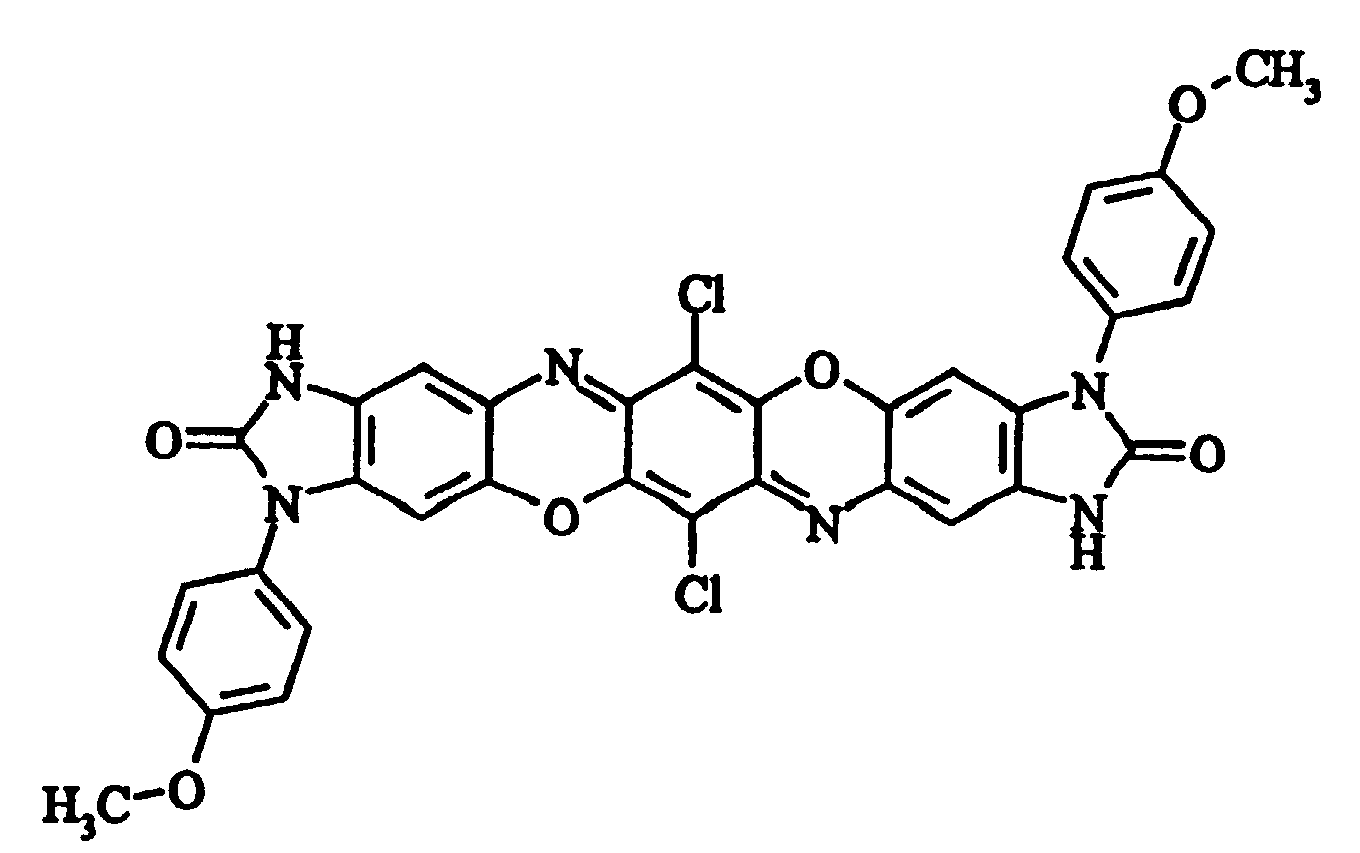
- Yield:
- 70%
- Melting point:
- >300°C
- IR (KBr):
- 3437 (1) - 1702 - 1515 - 1479 - 1313 - 1257 cm-1
- 1H-NMR (DMSO+NaOD): δ:
- 2.76 and 2,92 (s, CH3) - 6.87 (s, H-Car) - 7.01 and 7.36 (d, 3J=9Hz, 2H-CPhOMe) - 7.03 (s, H-Car) - 7.05 and 7.38 (d, 3J=9Hz, 2H-CPhOMe)
-
-
- a) 1,3-dimethyl-5-nitro-1,3-dihydrobenzimidazol-2-one
90 parts of 5-nitro-1,3-dihydrobenzimidazol-2-one are suspended in 500 parts of aqueous sodium hydroxide solution (30%) and the suspension is heated to 53°C; 161 parts of dimethyl sulphate are added dropwise over 12 hours during which the temperature rises to 70°C. The mixture is cooled to room temperature and filtered and the solid product is washed to neutrality. Drying under reduced pressure at 80°C gives 99 parts of a beige powder of a compound of the following formula
- Yield:
- 96%
- Melting point:
- 206.3°C
- 1H-NMR (DMSO): δ:
- 3.35 (s, CH3) - 3.37 (s,CH3) - 7.28 (d, 3J=9Hz, H-C7) - 7.98 (d, 4J=2Hz, H-C4) - 8.00 (dd, 3J=9Hz, 4J=2Hz, H-C6)
- b) 5-amino-1,3-dimethyl-1,3-dihydrobenzimidazol-2-one
- c) 2,5-dichloro-3,6-bis(1,3-dimethyl-2-oxo-1,3-dihydrobenzimidazol-5-ylamino)[1,4]benzoquinone
- d) Diimidazolone(4,5-b:4',5'-m)triphendioxazine-1,3,9,11-tetramethyl-6,14-dichloro-2,10-drone
of the following formula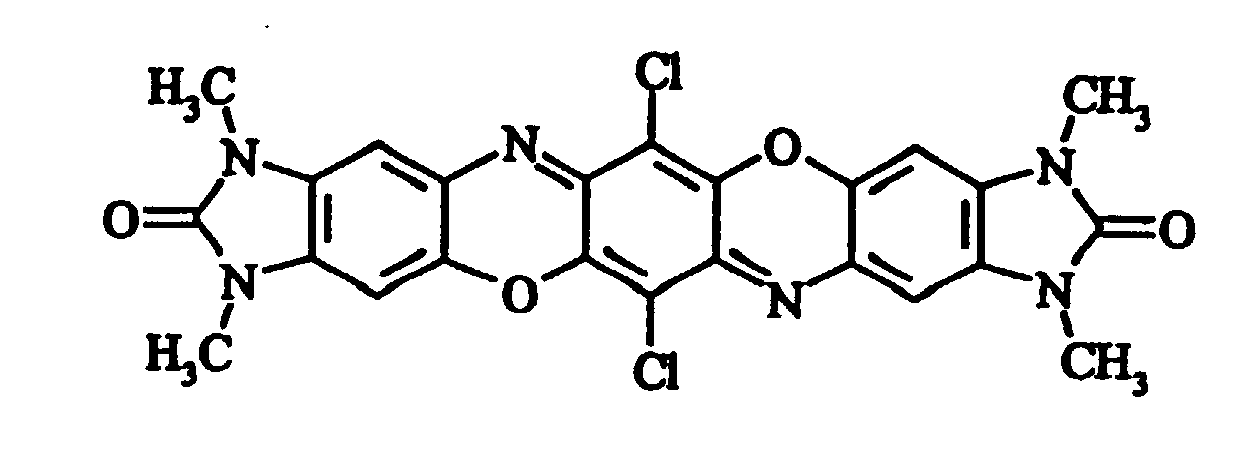
- Yield:
- 41%
- Melting point:
- >300°C
- Microanalysis:
-
- calc. C 55.08 H 3.08 Cl 13.55 N 16.06 O 12.23
- exp. C 54.9 H 3.3 Cl 13.3 N 16.1 O 12.4
-
-
- a) 2,5-dichloro-3-(1-ethyl-2-oxo-1,3-dihydrobenzimidazol-5-ylamino)-6-(1-methyl-2-oxo-1,3-dihydrobenzimidazol-5-ylamino)[1,4]benzoquinone 12 parts of sodium acetate and 15 parts of chloranil are
suspended in 200 parts of ethanol and the suspension is
heated to 53°C. 10.6 parts of 5-amino-1-ethyl-1,3-dihydrobenzimidazol-2-one
are added over 1 hour and the
mixture is subsequently heated under reflux for 1 hour.
Then a further 12 parts of sodium acetate are added,
followed by 9.8 parts of 5-amino-1-methyl-1,3-dihydrobenzimidazol-2-one.
The mixture is stirred under reflux
for 10 hours, then the solid product is filtered off hot
and washed with 400 parts of boiling ethanol and then with
500 parts of boiling water. After drying, 24 parts of the
product are suspended in 200 parts of dimethylformamide,
the suspension is heated at 100°C for 4 hours and filtered
while hot, and the solid product is washed with 600 parts
of hot (100°C) dimethyl-formamide followed by 500 parts of
water. Drying under reduced pressure at 80°C gives 16
parts of a brown powder of a compound of the following
formula

- Yield:
- 53%
- Melting point:
- >300°C
- IR(KBr):
- 3250 - 2978 - 1703 - 1595 - 1574 - 1501 - 1485 cm-1
- 1H-NMR (DMSO 120°C): δ:
- 1.21 (t, 3J=6Hz, CH3) - 3.31 (s, NCH3) - 3.83 (q, 3J=6Hz, NCH2) - 6.84 (m, 3J=9Hz, 4J=2Hz, H-C4, H-C4', H-C6, H-C6') - 7. 03 (d, 3J=9Hz, H-C7) - 7.09 (d, 3J=9Hz, H-C7') - 9.61 (s, H-N5, H-N5') - 10.86 (s, H-N3) - 10.88 (s, H-N3')
- b) Diimidazolone(4,5-b:4',5'-m)triphendioxazine-3-ethyl-11-methyl-6,14-dichloro-2,10-dione 150 parts of sulphuric acid (92%) are cooled to 5°C, and
15.4 parts of 2,5-dichloro-3-(1-ethyl-2-oxo-1,3-dihydrobenzimidazol-5-ylamino)-6(1-methyl-2-oxo-1,3-dihydrobenzimidazol-5-ylamino)-[1,4]-benzoquinone
are added over 30
minutes. Then 7.1 parts of activated manganese dioxide
(88%) are added over 3 hours and the mixture is
subsequently heated at room temperature for 18 hours. The
mixture is diluted to 80% by adding 22 parts of water,
with cooling. The excess manganese dioxide is destroyed
using 1.4 parts of hydrogen peroxide (30%). The mixture is
filtered over a polypropylene filter and the solid product
is washed with 250 parts of sulphuric acid (80%), then
with 250 parts of sulphuric acid (50%) and subsequently is
washed free from sulphate with water. Drying under reduced
pressure at 80°C gives 10 parts of metallic-green powder
of a compound of the following formula
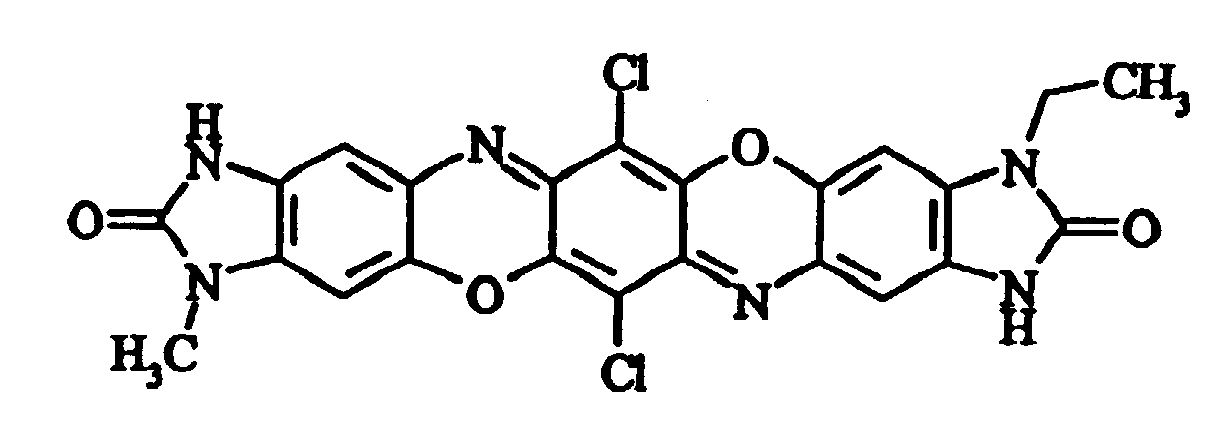
- Yield:
- 66%
- Melting point:
- >300°C
- IR (KBr):
- 3086 - 3000 - 1698 - 1646 - 1560 - 1485 - 1321 cm-1
- Microanalysis:
-
- calc C 54.22 H 2.75 O 12.57
- exp. C 54.0 H 2.9 O 12.7
-
-
4 parts of the pigment set out in the table below are milled in a ball mill with 96 parts of a mixture of 50 parts of a 60 per cent strength solution of coco-aldehyde-melamine resin solution in butanol, 10 parts of xylene and 10 parts of ethylene glycol monoethyl ether for 24 hours. - The resulting dispersion is sprayed onto sheet aluminium, left to dry in air for 30 minutes and then baked at 120°C for 30 minutes. The result is a film of the colour specified in the table below, with very good migration fastness and also good light and weathering stability.
- Example of the preparation of a 0.1% coloured PVC film (blend of colour pigment to white pigment 1:5):
16.5 parts of a plasticizer mixture consisting of equal parts of dioctyl phthalate and dibutyl phthalate are mixed with 0.05 parts of the pigment set out in the table below and with 0.25 parts of titanium dioxide. Then 33.5 parts of polyvinyl chloride are added. - The mixture is friction-rolled on a double-roll mill for 10 minutes, the resulting sheet being continually cut with a spatula and rolled together. In the roll mill, one roll is held at a temperature of 40° and the other at a temperature of 140°. The mixture is subsequently taken off in sheet form and pressed between two polished metal plates at 160° for 5 minutes. This gives a coloured PVC film of high brightness and very good migration and light fastness.
Pigment of Example Colour in Use Example 1 Colour in Use Example 2 1 f violet violet 2 f violet violet 3 d red-violet red-violet 4 b violet violet
Claims (9)
- The triphendioxazine compounds of the general formula (I)in which the rings labelled A in positions 1,2-, 2,3- or 3,4- and 8,9-, 9,10- or 10,11- carry a linearly or angularly fused heterocyclic ring containing at least one nitrogen atom which is substituted or unsubstituted, with the proviso that compounds with only unsubstituted nitrogen atoms and symmetrically disubstituted compounds with C1-2alkyl and unsubstituted phenyl substituents are excluded.
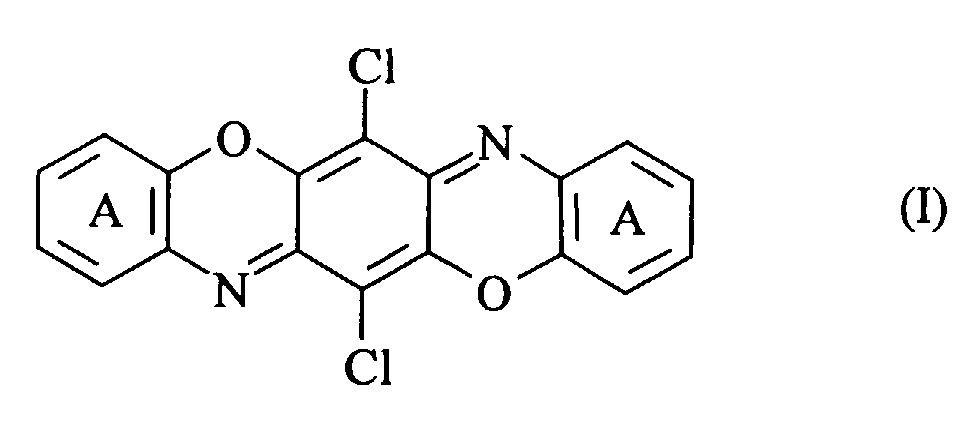
- Compounds according to claim 1 of the formulae (Ia) to (IIIb)

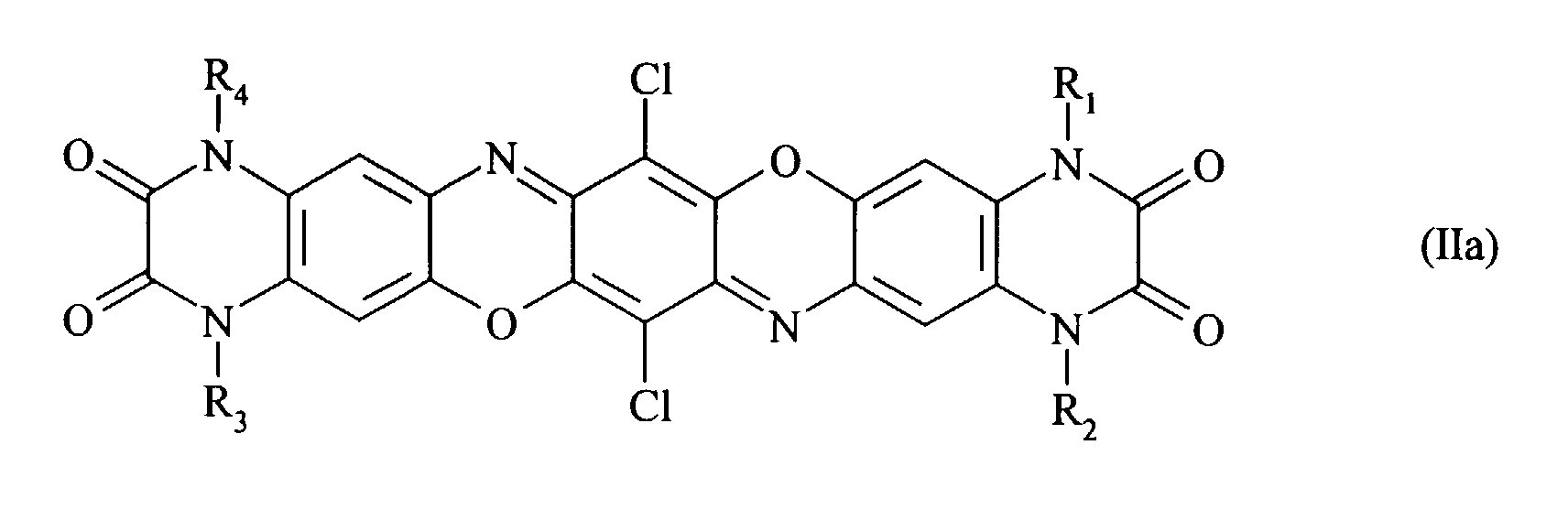
 where R1, R2, R3 and R4, independently of one another, are hydrogen, a C1-8 alkyl radical, a substituted or unsubstituted phenyl, benzyl, benzanilide or naphthyl radical, a substituted or unsubstituted C5-6 cycloalkyl radical or a radical of the formula
 with the proviso that in the case of symmetrically disubstituted compounds the definitions hydrogen, C1-2alkyl radical and unsubstituted phenyl radical are excluded.
- Triphendioxazine compounds according to Claim 2 in which R1, R2, R3 and R4, independently of one another, are hydrogen, a methyl radical, an ethyl radical, an n- or i-propyl radical, an n-, i-, sec- or tert-butyl radical, a cyclohexyl radical, a substituted or unsubstituted benzanilide radical, a naphthyl radical, a radical of the formulaan unsubstituted phenyl radical, a phenyl radical substituted one or more times by radicals selected from the group consisting of halogen, preferably chlorine, nitro groups, phenyl radicals, C1-2 alkoxy radicals, and C1-2 alkyl radicals, preferably C1-4 alkyl radicals, with the proviso that in the case of symmetrically disubstituted compounds the definitions hydrogen, C1-2alkyl radical and unsubstituted phenyl radical are excluded.
- Triphendioxazine compounds according to Claim 2 or 3, in which the substituted phenyl radical is selected from the group consisting of o-, m- and p-methyl-, ethyl- and methoxyphenyl, 2,4- and 3,5-dimethylphenyl, 2,5-dichloro-, dimethoxy- and diethoxyphenyl, m- and p-nitrophenyl, 2,5-dichloro- and 2,5-diethoxy-4-nitrophenyl, 2-methoxy-4-nitrophenyl, 3-chloro-4-methyl- and 3-chloro-4-methoxyphenyl, p-ethoxyphenyl and the radical
- Triphendioxazine compounds according to Claim 2 or 3, in which the substituted benzanilide radical is selected from the group consisting of radicals of the formulae (a) and (b)

- Process for preparing triphendioxazine compounds of the formula (I) according to Claim 1, characterized in that following the reaction of two moles of a compound of the formula (IV)in which ring A carries a fused heterocyclic ring containing at least one nitrogen atom which is substituted or unsubstituted with the proviso mentioned in Claim 1,

with one mole of 2,3,5,6-tetrachloro-1,4-benzoquinone (chloranil)where the rings labelled A are as defined in Claim 1,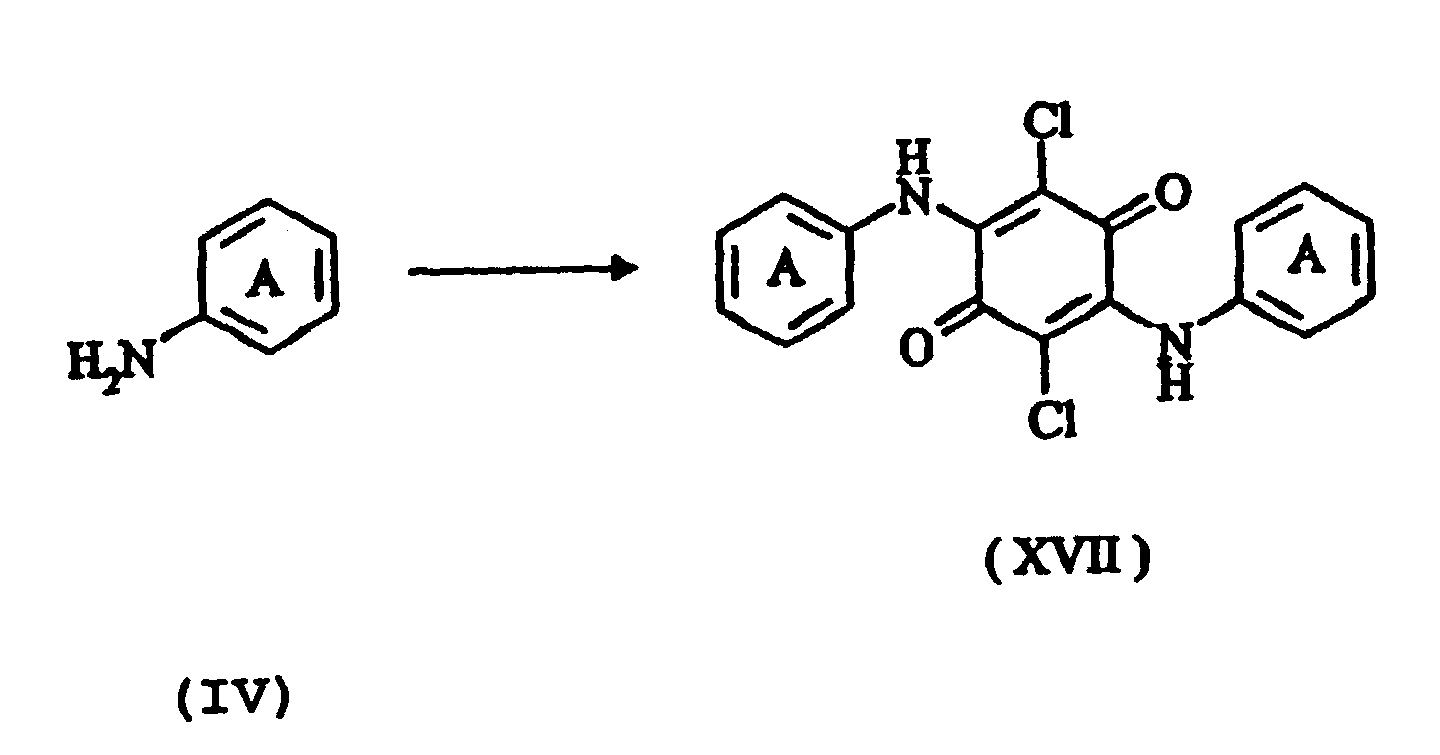
the cyclization of the compound of the formula (XVII) to the compound of the formula (I) is conducted in the presence of manganese dioxide and concentrated sulphuric acid.
- Use of the compounds of the formula (I) according to claim 1 as pigments.
- Use according to claim 7 of compounds of formulae (Ia), (IIa), (IIIa) and (IIIb) according to claim 2.
- Use according to Claim 7 or 8 as colorants for colouring polymer compositions or paper pulps, as colorants in electrophotographic toners and developers, as colorants in ink-jet inks, as colorants in the coatings industry, as colorants for textile printing or as a printing ink in the graphical industry.
Priority Applications (2)
| Application Number | Priority Date | Filing Date | Title |
|---|---|---|---|
| EP01110506A EP1120420B1 (en) | 1997-10-24 | 1998-10-21 | Triphendioxazine compounds |
| EP01110507A EP1120421B1 (en) | 1997-10-24 | 1998-10-21 | New triphendioxazine compounds |
Applications Claiming Priority (2)
| Application Number | Priority Date | Filing Date | Title |
|---|---|---|---|
| DE19747175A DE19747175A1 (en) | 1997-10-24 | 1997-10-24 | Triphendioxazin compounds containing chlorine |
| DE19747175 | 1997-10-24 |
Related Child Applications (2)
| Application Number | Title | Priority Date | Filing Date |
|---|---|---|---|
| EP01110507A Division EP1120421B1 (en) | 1997-10-24 | 1998-10-21 | New triphendioxazine compounds |
| EP01110506A Division EP1120420B1 (en) | 1997-10-24 | 1998-10-21 | Triphendioxazine compounds |
Publications (2)
| Publication Number | Publication Date |
|---|---|
| EP0911337A1 true EP0911337A1 (en) | 1999-04-28 |
| EP0911337B1 EP0911337B1 (en) | 2003-02-26 |
Family
ID=7846602
Family Applications (3)
| Application Number | Title | Priority Date | Filing Date |
|---|---|---|---|
| EP01110506A Expired - Lifetime EP1120420B1 (en) | 1997-10-24 | 1998-10-21 | Triphendioxazine compounds |
| EP01110507A Expired - Lifetime EP1120421B1 (en) | 1997-10-24 | 1998-10-21 | New triphendioxazine compounds |
| EP98811051A Expired - Lifetime EP0911337B1 (en) | 1997-10-24 | 1998-10-21 | Process for the preparation of triphendioxazine compounds |
Family Applications Before (2)
| Application Number | Title | Priority Date | Filing Date |
|---|---|---|---|
| EP01110506A Expired - Lifetime EP1120420B1 (en) | 1997-10-24 | 1998-10-21 | Triphendioxazine compounds |
| EP01110507A Expired - Lifetime EP1120421B1 (en) | 1997-10-24 | 1998-10-21 | New triphendioxazine compounds |
Country Status (5)
| Country | Link |
|---|---|
| US (2) | US6255482B1 (en) |
| EP (3) | EP1120420B1 (en) |
| JP (1) | JP4485611B2 (en) |
| DE (4) | DE19747175A1 (en) |
| ES (3) | ES2191919T3 (en) |
Cited By (6)
| Publication number | Priority date | Publication date | Assignee | Title |
|---|---|---|---|---|
| EP1125986A3 (en) * | 2000-02-10 | 2001-10-04 | Clariant Finance (BVI) Limited | New Triphendioxazine pigments |
| US6355795B1 (en) | 1997-10-24 | 2002-03-12 | Clariant Finance (Bvi) Limited | Triphendioxazine compounds |
| US6359131B1 (en) * | 1999-03-25 | 2002-03-19 | Clariant Gmbh | Process for preparing dioxazine compounds |
| EP1199309A1 (en) * | 2000-10-21 | 2002-04-24 | Clariant GmbH | Process for producing new crystalline modifications of a methyl-substituted benzimidazolonedioxazine pigment |
| US6512115B2 (en) * | 2000-03-06 | 2003-01-28 | Clariant Finance (Bvi) Limited | Preparation of pigments |
| EP1201718A3 (en) * | 2000-10-24 | 2003-02-12 | Clariant GmbH | Mixed crystals of benzimidazoloneoxazine derivatives |
Families Citing this family (4)
| Publication number | Priority date | Publication date | Assignee | Title |
|---|---|---|---|---|
| US6617453B1 (en) | 1997-10-24 | 2003-09-09 | Clariant Finance (Bvi) Limited | Triphendioxazine compounds |
| JP4526650B2 (en) | 1999-04-22 | 2010-08-18 | クラリアント ファイナンス (ビーブイアイ) リミティド | Solid solution |
| JP4735792B2 (en) * | 2001-09-27 | 2011-07-27 | 大日本印刷株式会社 | Colored resist composition and color filter using dioxazine pigment |
| DE102005024722A1 (en) * | 2005-05-31 | 2006-12-07 | Clariant Produkte (Deutschland) Gmbh | Blue colorant based on C.I. Pigment Blue 80 |
Citations (1)
| Publication number | Priority date | Publication date | Assignee | Title |
|---|---|---|---|---|
| GB2284427A (en) * | 1993-12-06 | 1995-06-07 | Sandoz Ltd | Triphendioxazine compounds |
Family Cites Families (21)
| Publication number | Priority date | Publication date | Assignee | Title |
|---|---|---|---|---|
| AR204531A1 (en) * | 1973-05-29 | 1976-02-12 | Ciba Geigy Ag | IMINOISOINDOLINE PIGMENTS AND PROCEDURE FOR THEIR PREPARATION |
| CH599299A5 (en) | 1973-10-30 | 1978-05-31 | Ciba Geigy Ag | |
| DE2612391C2 (en) * | 1976-03-24 | 1982-09-23 | Hoechst Ag, 6000 Frankfurt | Process for the preparation of 5-acetoacetylaminobenzimidazolone- (2) |
| DE2925541A1 (en) * | 1979-06-25 | 1981-01-22 | Hoechst Ag | 5-AMINO-BENZIMIDAZOLE-2-ON-HYDRATE, METHOD FOR THE PRODUCTION THEREOF AND ITS USE AS A COLOR PRODUCT |
| DE3010949A1 (en) | 1980-03-21 | 1981-10-01 | Cassella Ag, 6000 Frankfurt | IMPROVED METHOD FOR PRODUCING A VIOLET PIGMENT DYE |
| JPS5950260B2 (en) | 1980-03-27 | 1984-12-07 | 住友化学工業株式会社 | Manufacturing method of dioxazine compound |
| DE3125104A1 (en) * | 1981-06-26 | 1983-01-13 | Hoechst Ag, 6000 Frankfurt | METHOD FOR PRODUCING ARYLDIAZOSULFONATES |
| FR2515668A1 (en) * | 1981-11-02 | 1983-05-06 | Sandoz Sa | NOVEL DIOXAZINE COMPOUNDS, THEIR PREPARATION AND THEIR USE AS PIGMENTS |
| GB2131823A (en) * | 1982-05-24 | 1984-06-27 | Ici Plc | Triphendioxazine dyes, methods for their manufacture and their use for dying cecculosic substrates |
| GB8421555D0 (en) * | 1984-08-24 | 1984-09-26 | Ici Plc | Water-soluble dye |
| DE3714288A1 (en) * | 1987-04-29 | 1988-11-10 | Bayer Ag | FANAL PIGMENTS OF RING-CLOSED INDAMINE AND DIPHENYLMETHANE DYES CONTAINING DRY TONERS |
| DE3917602A1 (en) * | 1989-05-31 | 1990-12-06 | Basf Ag | METHOD FOR PRODUCING TRIPHENDIOXAZINE |
| DE4442291B4 (en) * | 1993-12-06 | 2006-04-13 | Clariant Finance (Bvi) Ltd. | Triphendioxazine compounds |
| DE59509166D1 (en) * | 1994-02-04 | 2001-05-17 | Dystar Textilfarben Gmbh & Co | Water-soluble azo compounds, processes for their preparation and their use as dyes |
| DE4419849A1 (en) | 1994-06-07 | 1995-12-14 | Hoechst Ag | Isoindoline pigments |
| ATE187955T1 (en) * | 1995-04-12 | 2000-01-15 | Ueno Seiyaku Oyo Kenkyujo Kk | NAPTHOL DERIVATIVES AND A METHOD FOR THE PRODUCTION THEREOF |
| HRP960159A2 (en) * | 1995-04-21 | 1997-08-31 | Bayer Ag | Benzocyclopentane oxazolidinones containing heteroatoms |
| DE19643344A1 (en) | 1996-10-21 | 1998-04-23 | Clariant Gmbh | Process for the preparation of dioxazine compounds |
| DE19727079A1 (en) | 1997-06-25 | 1999-01-07 | Clariant Int Ltd | Triphendioxazine |
| DE19747175A1 (en) | 1997-10-24 | 1999-04-29 | Clariant Int Ltd | Triphendioxazin compounds containing chlorine |
| EP0945455A1 (en) | 1998-03-26 | 1999-09-29 | Clariant Finance (BVI) Limited | Thriphendioxazine pigments |
-
1997
- 1997-10-24 DE DE19747175A patent/DE19747175A1/en not_active Withdrawn
-
1998
- 1998-10-19 US US09/175,139 patent/US6255482B1/en not_active Expired - Fee Related
- 1998-10-21 DE DE69833135T patent/DE69833135T2/en not_active Expired - Lifetime
- 1998-10-21 DE DE69811598T patent/DE69811598T2/en not_active Expired - Lifetime
- 1998-10-21 EP EP01110506A patent/EP1120420B1/en not_active Expired - Lifetime
- 1998-10-21 EP EP01110507A patent/EP1120421B1/en not_active Expired - Lifetime
- 1998-10-21 DE DE69829006T patent/DE69829006T2/en not_active Expired - Lifetime
- 1998-10-21 EP EP98811051A patent/EP0911337B1/en not_active Expired - Lifetime
- 1998-10-21 ES ES98811051T patent/ES2191919T3/en not_active Expired - Lifetime
- 1998-10-21 ES ES01110507T patent/ES2234728T3/en not_active Expired - Lifetime
- 1998-10-21 ES ES01110506T patent/ES2252106T3/en not_active Expired - Lifetime
- 1998-10-22 JP JP30143898A patent/JP4485611B2/en not_active Expired - Fee Related
-
2000
- 2000-05-31 US US09/583,973 patent/US6355795B1/en not_active Expired - Fee Related
Patent Citations (1)
| Publication number | Priority date | Publication date | Assignee | Title |
|---|---|---|---|---|
| GB2284427A (en) * | 1993-12-06 | 1995-06-07 | Sandoz Ltd | Triphendioxazine compounds |
Cited By (10)
| Publication number | Priority date | Publication date | Assignee | Title |
|---|---|---|---|---|
| US6355795B1 (en) | 1997-10-24 | 2002-03-12 | Clariant Finance (Bvi) Limited | Triphendioxazine compounds |
| US6359131B1 (en) * | 1999-03-25 | 2002-03-19 | Clariant Gmbh | Process for preparing dioxazine compounds |
| EP1125986A3 (en) * | 2000-02-10 | 2001-10-04 | Clariant Finance (BVI) Limited | New Triphendioxazine pigments |
| US6512115B2 (en) * | 2000-03-06 | 2003-01-28 | Clariant Finance (Bvi) Limited | Preparation of pigments |
| EP1132432A3 (en) * | 2000-03-06 | 2003-10-29 | Clariant Finance (BVI) Limited | Preparation process of pigments |
| EP1199309A1 (en) * | 2000-10-21 | 2002-04-24 | Clariant GmbH | Process for producing new crystalline modifications of a methyl-substituted benzimidazolonedioxazine pigment |
| US6620931B2 (en) | 2000-10-21 | 2003-09-16 | Clariant Gmbh | Process for preparing new crystal polymorphs of a methyl-substituted benzimidazolone-dioxazine pigment |
| EP1201718A3 (en) * | 2000-10-24 | 2003-02-12 | Clariant GmbH | Mixed crystals of benzimidazoloneoxazine derivatives |
| US6762299B2 (en) | 2000-10-24 | 2004-07-13 | Clariant Gmbh | Mixed crystals of benzimidazolonedioxazine compounds |
| KR100836975B1 (en) * | 2000-10-24 | 2008-06-10 | 클라리안트 프로두크테 (도이칠란트) 게엠베하 | Mixed crystals of benzimidazolonedioxazine compounds |
Also Published As
| Publication number | Publication date |
|---|---|
| US6355795B1 (en) | 2002-03-12 |
| ES2191919T3 (en) | 2003-09-16 |
| ES2252106T3 (en) | 2006-05-16 |
| EP1120421A3 (en) | 2003-03-05 |
| JP4485611B2 (en) | 2010-06-23 |
| US6255482B1 (en) | 2001-07-03 |
| EP1120421A2 (en) | 2001-08-01 |
| ES2234728T3 (en) | 2005-07-01 |
| DE69833135D1 (en) | 2006-04-06 |
| DE69829006D1 (en) | 2005-03-17 |
| EP1120420B1 (en) | 2006-01-11 |
| JPH11335575A (en) | 1999-12-07 |
| DE69829006T2 (en) | 2006-05-11 |
| DE19747175A1 (en) | 1999-04-29 |
| DE69811598D1 (en) | 2003-04-03 |
| EP0911337B1 (en) | 2003-02-26 |
| EP1120420A3 (en) | 2003-03-05 |
| DE69833135T2 (en) | 2006-08-24 |
| EP1120420A2 (en) | 2001-08-01 |
| DE69811598T2 (en) | 2003-09-25 |
| EP1120421B1 (en) | 2005-02-09 |
Similar Documents
| Publication | Publication Date | Title |
|---|---|---|
| JP4213254B2 (en) | Triphendioxazine | |
| US6255482B1 (en) | Triphendioxazine compounds | |
| EP1046681B1 (en) | Hybrid pigments | |
| US6375732B1 (en) | Pigments, the process of their manufacturing and their use | |
| EP1379527B1 (en) | Epindolidione pigments | |
| JP4028709B2 (en) | Mixed crystals of benzimidazolone dioxazine compounds | |
| US6617453B1 (en) | Triphendioxazine compounds | |
| EP1125986B1 (en) | New Triphendioxazine pigments | |
| EP1341851B1 (en) | Process for the preparation of triphenodioxazine pigments | |
| US6046335A (en) | Heterocyclic compounds | |
| KR100416015B1 (en) | Aminoquinazolinedione-insoluble azo colorant | |
| US6512115B2 (en) | Preparation of pigments | |
| US6540820B1 (en) | Heterocyclic compounds |
Legal Events
| Date | Code | Title | Description |
|---|---|---|---|
| PUAI | Public reference made under article 153(3) epc to a published international application that has entered the european phase |
Free format text: ORIGINAL CODE: 0009012 |
|
| AK | Designated contracting states |
Kind code of ref document: A1 Designated state(s): BE CH DE ES FR GB IT LI |
|
| AX | Request for extension of the european patent |
Free format text: AL;LT;LV;MK;RO;SI |
|
| 17P | Request for examination filed |
Effective date: 19990906 |
|
| AKX | Designation fees paid |
Free format text: BE CH DE ES FR GB IT LI |
|
| 17Q | First examination report despatched |
Effective date: 20000629 |
|
| GRAG | Despatch of communication of intention to grant |
Free format text: ORIGINAL CODE: EPIDOS AGRA |
|
| GRAG | Despatch of communication of intention to grant |
Free format text: ORIGINAL CODE: EPIDOS AGRA |
|
| GRAG | Despatch of communication of intention to grant |
Free format text: ORIGINAL CODE: EPIDOS AGRA |
|
| GRAH | Despatch of communication of intention to grant a patent |
Free format text: ORIGINAL CODE: EPIDOS IGRA |
|
| RTI1 | Title (correction) |
Free format text: PROCESS FOR THE PREPARATION OF TRIPHENDIOXAZINE COMPOUNDS |
|
| GRAH | Despatch of communication of intention to grant a patent |
Free format text: ORIGINAL CODE: EPIDOS IGRA |
|
| GRAA | (expected) grant |
Free format text: ORIGINAL CODE: 0009210 |
|
| AK | Designated contracting states |
Designated state(s): BE CH DE ES FR GB IT LI |
|
| REG | Reference to a national code |
Ref country code: GB Ref legal event code: FG4D |
|
| REG | Reference to a national code |
Ref country code: CH Ref legal event code: NV Representative=s name: CLARIANT INTERNATIONAL LTD. Ref country code: CH Ref legal event code: EP |
|
| REF | Corresponds to: |
Ref document number: 69811598 Country of ref document: DE Date of ref document: 20030403 Kind code of ref document: P |
|
| ET | Fr: translation filed | ||
| REG | Reference to a national code |
Ref country code: ES Ref legal event code: FG2A Ref document number: 2191919 Country of ref document: ES Kind code of ref document: T3 |
|
| PLBE | No opposition filed within time limit |
Free format text: ORIGINAL CODE: 0009261 |
|
| STAA | Information on the status of an ep patent application or granted ep patent |
Free format text: STATUS: NO OPPOSITION FILED WITHIN TIME LIMIT |
|
| 26N | No opposition filed |
Effective date: 20031127 |
|
| PGFP | Annual fee paid to national office [announced via postgrant information from national office to epo] |
Ref country code: CH Payment date: 20100909 Year of fee payment: 13 |
|
| PGFP | Annual fee paid to national office [announced via postgrant information from national office to epo] |
Ref country code: FR Payment date: 20101005 Year of fee payment: 13 |
|
| PGFP | Annual fee paid to national office [announced via postgrant information from national office to epo] |
Ref country code: GB Payment date: 20100910 Year of fee payment: 13 |
|
| PGFP | Annual fee paid to national office [announced via postgrant information from national office to epo] |
Ref country code: DE Payment date: 20100904 Year of fee payment: 13 Ref country code: BE Payment date: 20100820 Year of fee payment: 13 |
|
| PGFP | Annual fee paid to national office [announced via postgrant information from national office to epo] |
Ref country code: IT Payment date: 20101006 Year of fee payment: 13 |
|
| PGFP | Annual fee paid to national office [announced via postgrant information from national office to epo] |
Ref country code: ES Payment date: 20101005 Year of fee payment: 13 |
|
| BERE | Be: lapsed |
Owner name: *CLARIANT FINANCE (BVI) LTD Effective date: 20111031 |
|
| REG | Reference to a national code |
Ref country code: CH Ref legal event code: PL |
|
| GBPC | Gb: european patent ceased through non-payment of renewal fee |
Effective date: 20111021 |
|
| REG | Reference to a national code |
Ref country code: FR Ref legal event code: ST Effective date: 20120629 |
|
| PG25 | Lapsed in a contracting state [announced via postgrant information from national office to epo] |
Ref country code: LI Free format text: LAPSE BECAUSE OF NON-PAYMENT OF DUE FEES Effective date: 20111031 Ref country code: CH Free format text: LAPSE BECAUSE OF NON-PAYMENT OF DUE FEES Effective date: 20111031 Ref country code: DE Free format text: LAPSE BECAUSE OF NON-PAYMENT OF DUE FEES Effective date: 20120501 Ref country code: BE Free format text: LAPSE BECAUSE OF NON-PAYMENT OF DUE FEES Effective date: 20111031 |
|
| REG | Reference to a national code |
Ref country code: DE Ref legal event code: R119 Ref document number: 69811598 Country of ref document: DE Effective date: 20120501 |
|
| PG25 | Lapsed in a contracting state [announced via postgrant information from national office to epo] |
Ref country code: GB Free format text: LAPSE BECAUSE OF NON-PAYMENT OF DUE FEES Effective date: 20111021 Ref country code: IT Free format text: LAPSE BECAUSE OF NON-PAYMENT OF DUE FEES Effective date: 20111021 Ref country code: FR Free format text: LAPSE BECAUSE OF NON-PAYMENT OF DUE FEES Effective date: 20111102 |
|
| REG | Reference to a national code |
Ref country code: ES Ref legal event code: FD2A Effective date: 20130606 |
|
| PG25 | Lapsed in a contracting state [announced via postgrant information from national office to epo] |
Ref country code: ES Free format text: LAPSE BECAUSE OF NON-PAYMENT OF DUE FEES Effective date: 20111022 |