EP0917135A1 - Substrate for information recording media - Google Patents
Substrate for information recording media Download PDFInfo
- Publication number
- EP0917135A1 EP0917135A1 EP98923132A EP98923132A EP0917135A1 EP 0917135 A1 EP0917135 A1 EP 0917135A1 EP 98923132 A EP98923132 A EP 98923132A EP 98923132 A EP98923132 A EP 98923132A EP 0917135 A1 EP0917135 A1 EP 0917135A1
- Authority
- EP
- European Patent Office
- Prior art keywords
- mol
- substrate
- glass
- recording medium
- information recording
- Prior art date
- Legal status (The legal status is an assumption and is not a legal conclusion. Google has not performed a legal analysis and makes no representation as to the accuracy of the status listed.)
- Granted
Links
- 239000000758 substrate Substances 0.000 title claims abstract description 259
- 239000011521 glass Substances 0.000 claims abstract description 328
- 239000000126 substance Substances 0.000 claims abstract description 88
- GWEVSGVZZGPLCZ-UHFFFAOYSA-N Titan oxide Chemical compound O=[Ti]=O GWEVSGVZZGPLCZ-UHFFFAOYSA-N 0.000 claims description 127
- VYPSYNLAJGMNEJ-UHFFFAOYSA-N Silicium dioxide Chemical compound O=[Si]=O VYPSYNLAJGMNEJ-UHFFFAOYSA-N 0.000 claims description 70
- CPLXHLVBOLITMK-UHFFFAOYSA-N magnesium oxide Inorganic materials [Mg]=O CPLXHLVBOLITMK-UHFFFAOYSA-N 0.000 claims description 58
- FUJCRWPEOMXPAD-UHFFFAOYSA-N Li2O Inorganic materials [Li+].[Li+].[O-2] FUJCRWPEOMXPAD-UHFFFAOYSA-N 0.000 claims description 40
- XUCJHNOBJLKZNU-UHFFFAOYSA-M dilithium;hydroxide Chemical compound [Li+].[Li+].[OH-] XUCJHNOBJLKZNU-UHFFFAOYSA-M 0.000 claims description 40
- KKCBUQHMOMHUOY-UHFFFAOYSA-N Na2O Inorganic materials [O-2].[Na+].[Na+] KKCBUQHMOMHUOY-UHFFFAOYSA-N 0.000 claims description 37
- PNEYBMLMFCGWSK-UHFFFAOYSA-N aluminium oxide Inorganic materials [O-2].[O-2].[O-2].[Al+3].[Al+3] PNEYBMLMFCGWSK-UHFFFAOYSA-N 0.000 claims description 35
- 229910052681 coesite Inorganic materials 0.000 claims description 35
- 229910052906 cristobalite Inorganic materials 0.000 claims description 35
- 239000000377 silicon dioxide Substances 0.000 claims description 35
- 229910052682 stishovite Inorganic materials 0.000 claims description 35
- 229910052905 tridymite Inorganic materials 0.000 claims description 35
- 229910052593 corundum Inorganic materials 0.000 claims description 34
- 229910001845 yogo sapphire Inorganic materials 0.000 claims description 34
- MCMNRKCIXSYSNV-UHFFFAOYSA-N Zirconium dioxide Chemical compound O=[Zr]=O MCMNRKCIXSYSNV-UHFFFAOYSA-N 0.000 claims description 33
- 230000005484 gravity Effects 0.000 claims description 28
- 230000009477 glass transition Effects 0.000 claims description 21
- RUDFQVOCFDJEEF-UHFFFAOYSA-N yttrium(III) oxide Inorganic materials [O-2].[O-2].[O-2].[Y+3].[Y+3] RUDFQVOCFDJEEF-UHFFFAOYSA-N 0.000 claims description 19
- 229910000314 transition metal oxide Inorganic materials 0.000 claims description 14
- 239000000463 material Substances 0.000 claims description 11
- PLDDOISOJJCEMH-UHFFFAOYSA-N neodymium oxide Inorganic materials [O-2].[O-2].[O-2].[Nd+3].[Nd+3] PLDDOISOJJCEMH-UHFFFAOYSA-N 0.000 claims description 6
- 229910001404 rare earth metal oxide Inorganic materials 0.000 claims description 6
- -1 Tb2O3 Inorganic materials 0.000 claims description 5
- NLQFUUYNQFMIJW-UHFFFAOYSA-N dysprosium(III) oxide Inorganic materials O=[Dy]O[Dy]=O NLQFUUYNQFMIJW-UHFFFAOYSA-N 0.000 claims description 4
- VQCBHWLJZDBHOS-UHFFFAOYSA-N erbium(III) oxide Inorganic materials O=[Er]O[Er]=O VQCBHWLJZDBHOS-UHFFFAOYSA-N 0.000 claims description 4
- RSEIMSPAXMNYFJ-UHFFFAOYSA-N europium(III) oxide Inorganic materials O=[Eu]O[Eu]=O RSEIMSPAXMNYFJ-UHFFFAOYSA-N 0.000 claims description 4
- CMIHHWBVHJVIGI-UHFFFAOYSA-N gadolinium(III) oxide Inorganic materials [O-2].[O-2].[O-2].[Gd+3].[Gd+3] CMIHHWBVHJVIGI-UHFFFAOYSA-N 0.000 claims description 4
- FKTOIHSPIPYAPE-UHFFFAOYSA-N samarium(III) oxide Inorganic materials [O-2].[O-2].[O-2].[Sm+3].[Sm+3] FKTOIHSPIPYAPE-UHFFFAOYSA-N 0.000 claims description 4
- FIXNOXLJNSSSLJ-UHFFFAOYSA-N ytterbium(III) oxide Inorganic materials O=[Yb]O[Yb]=O FIXNOXLJNSSSLJ-UHFFFAOYSA-N 0.000 claims description 4
- 230000015572 biosynthetic process Effects 0.000 claims description 3
- ODINCKMPIJJUCX-UHFFFAOYSA-N calcium oxide Inorganic materials [Ca]=O ODINCKMPIJJUCX-UHFFFAOYSA-N 0.000 claims description 3
- 229910052804 chromium Inorganic materials 0.000 claims description 3
- 229910052684 Cerium Inorganic materials 0.000 claims description 2
- 229910052692 Dysprosium Inorganic materials 0.000 claims description 2
- 229910052691 Erbium Inorganic materials 0.000 claims description 2
- 229910052689 Holmium Inorganic materials 0.000 claims description 2
- 229910052779 Neodymium Inorganic materials 0.000 claims description 2
- 229910052777 Praseodymium Inorganic materials 0.000 claims description 2
- 229910052771 Terbium Inorganic materials 0.000 claims description 2
- 229910052769 Ytterbium Inorganic materials 0.000 claims description 2
- 229910052735 hafnium Inorganic materials 0.000 claims description 2
- 230000010365 information processing Effects 0.000 claims description 2
- 229910052742 iron Inorganic materials 0.000 claims description 2
- 229910052748 manganese Inorganic materials 0.000 claims description 2
- 229910052758 niobium Inorganic materials 0.000 claims description 2
- 229910052715 tantalum Inorganic materials 0.000 claims description 2
- 229910052721 tungsten Inorganic materials 0.000 claims description 2
- 229910052720 vanadium Inorganic materials 0.000 claims description 2
- 229910052725 zinc Inorganic materials 0.000 claims description 2
- 229910052726 zirconium Inorganic materials 0.000 claims description 2
- 229910052693 Europium Inorganic materials 0.000 claims 1
- 229910052688 Gadolinium Inorganic materials 0.000 claims 1
- 229910052775 Thulium Inorganic materials 0.000 claims 1
- 239000007788 liquid Substances 0.000 claims 1
- 230000003014 reinforcing effect Effects 0.000 claims 1
- 239000000292 calcium oxide Substances 0.000 description 41
- 239000010410 layer Substances 0.000 description 32
- 239000000395 magnesium oxide Substances 0.000 description 29
- 238000003426 chemical strengthening reaction Methods 0.000 description 17
- 239000000203 mixture Substances 0.000 description 15
- 230000000052 comparative effect Effects 0.000 description 11
- 150000003839 salts Chemical class 0.000 description 10
- 230000003746 surface roughness Effects 0.000 description 10
- 239000003513 alkali Substances 0.000 description 9
- 230000000704 physical effect Effects 0.000 description 9
- 230000003247 decreasing effect Effects 0.000 description 8
- 238000004090 dissolution Methods 0.000 description 8
- 150000002500 ions Chemical class 0.000 description 8
- BASFCYQUMIYNBI-UHFFFAOYSA-N platinum Chemical compound [Pt] BASFCYQUMIYNBI-UHFFFAOYSA-N 0.000 description 8
- 230000007423 decrease Effects 0.000 description 7
- 230000006870 function Effects 0.000 description 7
- 239000000523 sample Substances 0.000 description 7
- 239000013078 crystal Substances 0.000 description 6
- 238000005259 measurement Methods 0.000 description 6
- 238000002844 melting Methods 0.000 description 6
- 230000008018 melting Effects 0.000 description 6
- 230000003287 optical effect Effects 0.000 description 5
- 238000005342 ion exchange Methods 0.000 description 4
- 238000004519 manufacturing process Methods 0.000 description 4
- 229910052697 platinum Inorganic materials 0.000 description 4
- VWDWKYIASSYTQR-UHFFFAOYSA-N sodium nitrate Chemical compound [Na+].[O-][N+]([O-])=O VWDWKYIASSYTQR-UHFFFAOYSA-N 0.000 description 4
- 238000005728 strengthening Methods 0.000 description 4
- 229910052782 aluminium Inorganic materials 0.000 description 3
- XAGFODPZIPBFFR-UHFFFAOYSA-N aluminium Chemical compound [Al] XAGFODPZIPBFFR-UHFFFAOYSA-N 0.000 description 3
- 239000005345 chemically strengthened glass Substances 0.000 description 3
- 238000010438 heat treatment Methods 0.000 description 3
- XLYOFNOQVPJJNP-UHFFFAOYSA-N water Substances O XLYOFNOQVPJJNP-UHFFFAOYSA-N 0.000 description 3
- GOLCXWYRSKYTSP-UHFFFAOYSA-N Arsenious Acid Chemical compound O1[As]2O[As]1O2 GOLCXWYRSKYTSP-UHFFFAOYSA-N 0.000 description 2
- VTYYLEPIZMXCLO-UHFFFAOYSA-L Calcium carbonate Chemical compound [Ca+2].[O-]C([O-])=O VTYYLEPIZMXCLO-UHFFFAOYSA-L 0.000 description 2
- 229910001018 Cast iron Inorganic materials 0.000 description 2
- UQSXHKLRYXJYBZ-UHFFFAOYSA-N Iron oxide Chemical compound [Fe]=O UQSXHKLRYXJYBZ-UHFFFAOYSA-N 0.000 description 2
- BPQQTUXANYXVAA-UHFFFAOYSA-N Orthosilicate Chemical compound [O-][Si]([O-])([O-])[O-] BPQQTUXANYXVAA-UHFFFAOYSA-N 0.000 description 2
- CDBYLPFSWZWCQE-UHFFFAOYSA-L Sodium Carbonate Chemical compound [Na+].[Na+].[O-]C([O-])=O CDBYLPFSWZWCQE-UHFFFAOYSA-L 0.000 description 2
- 230000003416 augmentation Effects 0.000 description 2
- 238000000465 moulding Methods 0.000 description 2
- 238000005191 phase separation Methods 0.000 description 2
- FGIUAXJPYTZDNR-UHFFFAOYSA-N potassium nitrate Chemical compound [K+].[O-][N+]([O-])=O FGIUAXJPYTZDNR-UHFFFAOYSA-N 0.000 description 2
- 238000003825 pressing Methods 0.000 description 2
- 239000011833 salt mixture Substances 0.000 description 2
- 235000012239 silicon dioxide Nutrition 0.000 description 2
- OGIDPMRJRNCKJF-UHFFFAOYSA-N titanium oxide Inorganic materials [Ti]=O OGIDPMRJRNCKJF-UHFFFAOYSA-N 0.000 description 2
- 230000007704 transition Effects 0.000 description 2
- OKTJSMMVPCPJKN-UHFFFAOYSA-N Carbon Chemical compound [C] OKTJSMMVPCPJKN-UHFFFAOYSA-N 0.000 description 1
- BVKZGUZCCUSVTD-UHFFFAOYSA-L Carbonate Chemical compound [O-]C([O-])=O BVKZGUZCCUSVTD-UHFFFAOYSA-L 0.000 description 1
- QPLDLSVMHZLSFG-UHFFFAOYSA-N Copper oxide Chemical compound [Cu]=O QPLDLSVMHZLSFG-UHFFFAOYSA-N 0.000 description 1
- 239000005751 Copper oxide Substances 0.000 description 1
- DGAQECJNVWCQMB-PUAWFVPOSA-M Ilexoside XXIX Chemical compound C[C@@H]1CC[C@@]2(CC[C@@]3(C(=CC[C@H]4[C@]3(CC[C@@H]5[C@@]4(CC[C@@H](C5(C)C)OS(=O)(=O)[O-])C)C)[C@@H]2[C@]1(C)O)C)C(=O)O[C@H]6[C@@H]([C@H]([C@@H]([C@H](O6)CO)O)O)O.[Na+] DGAQECJNVWCQMB-PUAWFVPOSA-M 0.000 description 1
- 229910002651 NO3 Inorganic materials 0.000 description 1
- 229910019714 Nb2O3 Inorganic materials 0.000 description 1
- NHNBFGGVMKEFGY-UHFFFAOYSA-N Nitrate Chemical compound [O-][N+]([O-])=O NHNBFGGVMKEFGY-UHFFFAOYSA-N 0.000 description 1
- ZLMJMSJWJFRBEC-UHFFFAOYSA-N Potassium Chemical compound [K] ZLMJMSJWJFRBEC-UHFFFAOYSA-N 0.000 description 1
- 229910000272 alkali metal oxide Inorganic materials 0.000 description 1
- 229910045601 alloy Inorganic materials 0.000 description 1
- 239000000956 alloy Substances 0.000 description 1
- WNROFYMDJYEPJX-UHFFFAOYSA-K aluminium hydroxide Chemical compound [OH-].[OH-].[OH-].[Al+3] WNROFYMDJYEPJX-UHFFFAOYSA-K 0.000 description 1
- 229910000410 antimony oxide Inorganic materials 0.000 description 1
- ADCOVFLJGNWWNZ-UHFFFAOYSA-N antimony trioxide Inorganic materials O=[Sb]O[Sb]=O ADCOVFLJGNWWNZ-UHFFFAOYSA-N 0.000 description 1
- 238000005452 bending Methods 0.000 description 1
- 229910000019 calcium carbonate Inorganic materials 0.000 description 1
- 229910052799 carbon Inorganic materials 0.000 description 1
- 229910000420 cerium oxide Inorganic materials 0.000 description 1
- 238000001816 cooling Methods 0.000 description 1
- 229910052802 copper Inorganic materials 0.000 description 1
- 239000010949 copper Substances 0.000 description 1
- 229910000431 copper oxide Inorganic materials 0.000 description 1
- 238000000354 decomposition reaction Methods 0.000 description 1
- 230000006866 deterioration Effects 0.000 description 1
- 238000004031 devitrification Methods 0.000 description 1
- 238000007598 dipping method Methods 0.000 description 1
- 239000000156 glass melt Substances 0.000 description 1
- 239000002241 glass-ceramic Substances 0.000 description 1
- 230000020169 heat generation Effects 0.000 description 1
- 230000006872 improvement Effects 0.000 description 1
- XEEYBQQBJWHFJM-UHFFFAOYSA-N iron Substances [Fe] XEEYBQQBJWHFJM-UHFFFAOYSA-N 0.000 description 1
- JEIPFZHSYJVQDO-UHFFFAOYSA-N iron(III) oxide Inorganic materials O=[Fe]O[Fe]=O JEIPFZHSYJVQDO-UHFFFAOYSA-N 0.000 description 1
- MRELNEQAGSRDBK-UHFFFAOYSA-N lanthanum oxide Inorganic materials [O-2].[O-2].[O-2].[La+3].[La+3] MRELNEQAGSRDBK-UHFFFAOYSA-N 0.000 description 1
- XGZVUEUWXADBQD-UHFFFAOYSA-L lithium carbonate Chemical compound [Li+].[Li+].[O-]C([O-])=O XGZVUEUWXADBQD-UHFFFAOYSA-L 0.000 description 1
- 229910052808 lithium carbonate Inorganic materials 0.000 description 1
- 229910001416 lithium ion Inorganic materials 0.000 description 1
- INHCSSUBVCNVSK-UHFFFAOYSA-L lithium sulfate Inorganic materials [Li+].[Li+].[O-]S([O-])(=O)=O INHCSSUBVCNVSK-UHFFFAOYSA-L 0.000 description 1
- 238000005461 lubrication Methods 0.000 description 1
- ZLNQQNXFFQJAID-UHFFFAOYSA-L magnesium carbonate Chemical compound [Mg+2].[O-]C([O-])=O ZLNQQNXFFQJAID-UHFFFAOYSA-L 0.000 description 1
- 239000001095 magnesium carbonate Substances 0.000 description 1
- 229910000021 magnesium carbonate Inorganic materials 0.000 description 1
- AXZKOIWUVFPNLO-UHFFFAOYSA-N magnesium;oxygen(2-) Chemical compound [O-2].[Mg+2] AXZKOIWUVFPNLO-UHFFFAOYSA-N 0.000 description 1
- 239000000155 melt Substances 0.000 description 1
- 238000000034 method Methods 0.000 description 1
- 238000009740 moulding (composite fabrication) Methods 0.000 description 1
- 229910000480 nickel oxide Inorganic materials 0.000 description 1
- BMMGVYCKOGBVEV-UHFFFAOYSA-N oxo(oxoceriooxy)cerium Chemical compound [Ce]=O.O=[Ce]=O BMMGVYCKOGBVEV-UHFFFAOYSA-N 0.000 description 1
- KTUFCUMIWABKDW-UHFFFAOYSA-N oxo(oxolanthaniooxy)lanthanum Chemical compound O=[La]O[La]=O KTUFCUMIWABKDW-UHFFFAOYSA-N 0.000 description 1
- SIWVEOZUMHYXCS-UHFFFAOYSA-N oxo(oxoyttriooxy)yttrium Chemical compound O=[Y]O[Y]=O SIWVEOZUMHYXCS-UHFFFAOYSA-N 0.000 description 1
- VTRUBDSFZJNXHI-UHFFFAOYSA-N oxoantimony Chemical compound [Sb]=O VTRUBDSFZJNXHI-UHFFFAOYSA-N 0.000 description 1
- GNRSAWUEBMWBQH-UHFFFAOYSA-N oxonickel Chemical compound [Ni]=O GNRSAWUEBMWBQH-UHFFFAOYSA-N 0.000 description 1
- 238000007517 polishing process Methods 0.000 description 1
- 229910052700 potassium Inorganic materials 0.000 description 1
- 239000011591 potassium Substances 0.000 description 1
- 239000000843 powder Substances 0.000 description 1
- 230000008569 process Effects 0.000 description 1
- 230000009467 reduction Effects 0.000 description 1
- 239000013074 reference sample Substances 0.000 description 1
- 239000002356 single layer Substances 0.000 description 1
- 239000011734 sodium Substances 0.000 description 1
- 229910052708 sodium Inorganic materials 0.000 description 1
- 229910000029 sodium carbonate Inorganic materials 0.000 description 1
- 229910001415 sodium ion Inorganic materials 0.000 description 1
- 239000004317 sodium nitrate Substances 0.000 description 1
- 235000010344 sodium nitrate Nutrition 0.000 description 1
- 230000007480 spreading Effects 0.000 description 1
- 238000003892 spreading Methods 0.000 description 1
- RBTVSNLYYIMMKS-UHFFFAOYSA-N tert-butyl 3-aminoazetidine-1-carboxylate;hydrochloride Chemical compound Cl.CC(C)(C)OC(=O)N1CC(N)C1 RBTVSNLYYIMMKS-UHFFFAOYSA-N 0.000 description 1
- 230000000930 thermomechanical effect Effects 0.000 description 1
Images

Classifications
-
- C—CHEMISTRY; METALLURGY
- C03—GLASS; MINERAL OR SLAG WOOL
- C03C—CHEMICAL COMPOSITION OF GLASSES, GLAZES OR VITREOUS ENAMELS; SURFACE TREATMENT OF GLASS; SURFACE TREATMENT OF FIBRES OR FILAMENTS MADE FROM GLASS, MINERALS OR SLAGS; JOINING GLASS TO GLASS OR OTHER MATERIALS
- C03C3/00—Glass compositions
- C03C3/04—Glass compositions containing silica
- C03C3/076—Glass compositions containing silica with 40% to 90% silica, by weight
- C03C3/078—Glass compositions containing silica with 40% to 90% silica, by weight containing an oxide of a divalent metal, e.g. an oxide of zinc
-
- G—PHYSICS
- G11—INFORMATION STORAGE
- G11B—INFORMATION STORAGE BASED ON RELATIVE MOVEMENT BETWEEN RECORD CARRIER AND TRANSDUCER
- G11B5/00—Recording by magnetisation or demagnetisation of a record carrier; Reproducing by magnetic means; Record carriers therefor
- G11B5/62—Record carriers characterised by the selection of the material
-
- C—CHEMISTRY; METALLURGY
- C03—GLASS; MINERAL OR SLAG WOOL
- C03C—CHEMICAL COMPOSITION OF GLASSES, GLAZES OR VITREOUS ENAMELS; SURFACE TREATMENT OF GLASS; SURFACE TREATMENT OF FIBRES OR FILAMENTS MADE FROM GLASS, MINERALS OR SLAGS; JOINING GLASS TO GLASS OR OTHER MATERIALS
- C03C3/00—Glass compositions
- C03C3/04—Glass compositions containing silica
- C03C3/076—Glass compositions containing silica with 40% to 90% silica, by weight
- C03C3/083—Glass compositions containing silica with 40% to 90% silica, by weight containing aluminium oxide or an iron compound
- C03C3/085—Glass compositions containing silica with 40% to 90% silica, by weight containing aluminium oxide or an iron compound containing an oxide of a divalent metal
- C03C3/087—Glass compositions containing silica with 40% to 90% silica, by weight containing aluminium oxide or an iron compound containing an oxide of a divalent metal containing calcium oxide, e.g. common sheet or container glass
-
- C—CHEMISTRY; METALLURGY
- C03—GLASS; MINERAL OR SLAG WOOL
- C03C—CHEMICAL COMPOSITION OF GLASSES, GLAZES OR VITREOUS ENAMELS; SURFACE TREATMENT OF GLASS; SURFACE TREATMENT OF FIBRES OR FILAMENTS MADE FROM GLASS, MINERALS OR SLAGS; JOINING GLASS TO GLASS OR OTHER MATERIALS
- C03C3/00—Glass compositions
- C03C3/04—Glass compositions containing silica
- C03C3/076—Glass compositions containing silica with 40% to 90% silica, by weight
- C03C3/095—Glass compositions containing silica with 40% to 90% silica, by weight containing rare earths
-
- G—PHYSICS
- G11—INFORMATION STORAGE
- G11B—INFORMATION STORAGE BASED ON RELATIVE MOVEMENT BETWEEN RECORD CARRIER AND TRANSDUCER
- G11B5/00—Recording by magnetisation or demagnetisation of a record carrier; Reproducing by magnetic means; Record carriers therefor
- G11B5/62—Record carriers characterised by the selection of the material
- G11B5/73—Base layers, i.e. all non-magnetic layers lying under a lowermost magnetic recording layer, e.g. including any non-magnetic layer in between a first magnetic recording layer and either an underlying substrate or a soft magnetic underlayer
- G11B5/739—Magnetic recording media substrates
- G11B5/73911—Inorganic substrates
- G11B5/73921—Glass or ceramic substrates
-
- G—PHYSICS
- G11—INFORMATION STORAGE
- G11B—INFORMATION STORAGE BASED ON RELATIVE MOVEMENT BETWEEN RECORD CARRIER AND TRANSDUCER
- G11B23/00—Record carriers not specific to the method of recording or reproducing; Accessories, e.g. containers, specially adapted for co-operation with the recording or reproducing apparatus ; Intermediate mediums; Apparatus or processes specially adapted for their manufacture
- G11B23/0014—Record carriers not specific to the method of recording or reproducing; Accessories, e.g. containers, specially adapted for co-operation with the recording or reproducing apparatus ; Intermediate mediums; Apparatus or processes specially adapted for their manufacture record carriers not specifically of filamentary or web form
- G11B23/0021—Record carriers not specific to the method of recording or reproducing; Accessories, e.g. containers, specially adapted for co-operation with the recording or reproducing apparatus ; Intermediate mediums; Apparatus or processes specially adapted for their manufacture record carriers not specifically of filamentary or web form discs
- G11B23/0028—Details
-
- G—PHYSICS
- G11—INFORMATION STORAGE
- G11B—INFORMATION STORAGE BASED ON RELATIVE MOVEMENT BETWEEN RECORD CARRIER AND TRANSDUCER
- G11B5/00—Recording by magnetisation or demagnetisation of a record carrier; Reproducing by magnetic means; Record carriers therefor
- G11B5/48—Disposition or mounting of heads or head supports relative to record carriers ; arrangements of heads, e.g. for scanning the record carrier to increase the relative speed
- G11B5/58—Disposition or mounting of heads or head supports relative to record carriers ; arrangements of heads, e.g. for scanning the record carrier to increase the relative speed with provision for moving the head for the purpose of maintaining alignment of the head relative to the record carrier during transducing operation, e.g. to compensate for surface irregularities of the latter or for track following
- G11B5/60—Fluid-dynamic spacing of heads from record-carriers
- G11B5/6005—Specially adapted for spacing from a rotating disc using a fluid cushion
- G11B5/6011—Control of flying height
-
- G—PHYSICS
- G11—INFORMATION STORAGE
- G11B—INFORMATION STORAGE BASED ON RELATIVE MOVEMENT BETWEEN RECORD CARRIER AND TRANSDUCER
- G11B5/00—Recording by magnetisation or demagnetisation of a record carrier; Reproducing by magnetic means; Record carriers therefor
- G11B5/74—Record carriers characterised by the form, e.g. sheet shaped to wrap around a drum
- G11B5/82—Disk carriers
Definitions
- This invention relates to a disk substrate (will hereinafter be referred to as "a substrate for an information recording medium”) for use in an information recording medium, ouch as a magnetic disk, an optical disk, and a magnetooptic disk as well as an information recording medium and, in particular, to a glass substrate for an information recording medium as well as an information recording medium using the above-mentioned substrate.
- a substrate for an information recording medium for use in an information recording medium, ouch as a magnetic disk, an optical disk, and a magnetooptic disk as well as an information recording medium and, in particular, to a glass substrate for an information recording medium as well as an information recording medium using the above-mentioned substrate.
- a substrate for an information recording medium use is made of an aluminum substrate, an amorphous glass substrate (will simply be referred to as "a glass substrate” hereinafter), and a crystallized glass substrate.
- the glass substrate is gradually expanding its market share because high surface smoothness (small surface roughness Ra) is easily obtained as compared with the other substrates and its strength is sufficient to withstand a reduction in thickness and size.
- a chemically strengthened glass substrate with its surface chemically strengthened by ion exchange is widely known in the art.
- Such a chemically strengthened glass substrate may comprise a glass substance including 60.0-70.0 wt% of SiO 2 , 0.5-14.0 wt% of Al 2 O 3 , 10.0-32.0 wt% of alkali metal oxide, 1.0-15.0 wt% of ZnO, and 1.1-14.0 wt% of B 2 O 3 and having a linear expansion coefficient, pressure strength, and transverse rupture strength which are not smaller than specific values, respectively (see Japanese Patent Publication (JP-B) No. 4-70262).
- glass substances (a) and (b) mentioned below As a material for preparing the chemically strengthened glass substrate, use is made of glass substances (a) and (b) mentioned below.
- the magnetic disk is desired to be rotated at a high speed. If the high speed rotation is sought by the use of the conventional glass substrate (glass substrate for an information recording medium), it is difficult to keep a stable flying height (the distance between the magnetic head and the magnetic disk upon recording and reproducing operations).
- the present inventors have made extensive studies to reveal the cause of the difficulty in keeping the stable flying height when the above-mentioned high speed rotation is attempted by the use of the conventional glass substrate (glass substrate for an information recording medium).
- the conventional glass substrate glass substrate for an information recording medium.
- a crystallized glass substrate As the substrate for an information recording medium having a high Young's modulus, a crystallized glass substrate is known. In the crystallized glass substrate, however, the strength and the Young's modulus are controlled by its crystallinity. Therefore, in order to increase the strength and the Young's modulus, the ratio of crystals is increased. As a result, it is difficult to obtain the surface smoothness (the surface roughness Ra) required to the information recording medium. Thus, it is difficult to assure a stable flying height even if the high speed rotation is attempted by the use of the crystallized glass substrate.
- the substrate for an information recording medium according to this invention can be classified into first through sixth aspects. Among those, the first through the fourth aspects are common in the Young's modulus and the liguidus temperature.
- the substrate for an information recording medium according to each of the first through the sixth aspects forms a first embodiment and can achieve the above-mentioned first object.
- the substrate for an information recording medium according to the seventh aspect essentially includes coexistence of Y 2 O 3 and TiO 2 while the substrate for an information recording medium according to the eighth aspect includes coexistence of TiO 2 , Y 2 O 3 , and ZrO 2 .
- the substrate for an information recording medium according to the ninth aspect includes TiO 2 and at least one oxide selected from a group consisting of Er 2 O 3 , Nd 2 O 3 , Sm 2 O 3 , Eu 2 O 3 , Gd 2 O 3 , Tb 2 O 3 , Dy 2 O 3 , and Yb 2 O 3 .
- the substrate for an information recording medium according to each of the seventh through the ninth aspects forms a second embodiment of this invention.
- the substrate for an information recording medium or the medium according to each of the first and the second embodiments has a glass transition point not higher than 650°C, preferably, not higher than 550°C.
- the abovementioned glass transition point is a comparatively low temperature.
- Such a comparatively low glass transition point is effective in suppressing a damage during chemical strengthening. More specifically, upon the chemical strengthening, the glass substrate is typically immersed in fused salt. During the chemical strengthening, the fused salt is kept at a temperature 100-150°C lower than the glass transition point of the glass substrate. However, the fused salt starts to decompose at a temperature not lower than 500°C. The fused salt thus decomposed damages the surface of the glass substrate. Taking the above into consideration, it is desired that the glass transition point is not higher than 650°C, preferably, not higher than 550°C in order to prevent the damage on the glass substrate. Thus, in order to accomplish such a comparatively low glass transition point, alkali components such as Na 2 O and Li 2 O and alkaline earth components such as MgO and CaO are added.
- the glass substrate I of this invention comprises a glass substance having the Young's modulus not smaller than 100GPa and the liquidus temperature not higher than 1350°C.
- the glass substrate referred to in this invention means a substrate comprising a glass (amorphous glass) substance which is substantially free from crystal grains.
- the above-mentioned "glass” is essentially different from crystallized glass or glass ceramics containing crystal grains.
- the Young's modulus of the glass substrate is not smaller than 100GPa.
- the glass substrate specified in this invention it is required that substantially no crystal is precipitated during the manufacturing process.
- various steps such as melting, forming, and cooling of the material performed in manufacturing of the glass substrate must be carried out at temperatures not lower than the liquidus temperature of the glass substance. Note that, if the liquidus temperature is extremely high, manufacture of the glass substrate itself is difficult so that the practicability is lost.
- the glass substance has the Young's modulus not smaller than 100GPa and the liquidus temperature not higher than 1350°C.
- the Young's modulus is not smaller than 105GPa.
- the liquidus temperature is not higher than 1250°C, more preferably, not higher than 1150°C.
- the specific gravity of the glass substrate I of this invention is preferably not greater than abuot 3.5g/cm 3 , more preferably, not greater than 3.0g/cm 3 .
- silicate-based glass has a value substantially not smaller than 2.1g/cm 3 .
- the viscosity of the glass substance in a formable temperature range namely, the viscosity in a temperature range not lower than the liquidus temperature is extremely low. Specifically, it is difficult to control the flow rate of glass melt supplied to the forming step in the manufacturing process of the glass substrate. In addition, the degree of freedom in a formable shape is decreased. Therefore, the viscosity of the glass substance for the glass substrate I of this invention is preferably not less than 10 poises, more preferably, not less than 30 poises.
- the information recording medium such as a magnetic disk, an optical disk, and a magnetooptic disk
- the information recording medium is rotated while it is fixed by a clamp to a spindle of a drive motor arranged in the information processing apparatus.
- a thermal expansion coefficient of the information recording medium is remarkably different from that of the clamp, the following problem will arise.
- the temperature of each of the information recording medium, the spindle, and the clamp is rapidly increased, for example, up to about 90°C due to heat generation by the drive motor. If the thermal expansion coefficients are much different between the information recording medium and the clamp, this will bring about loosening between the information recording medium and the clamp and distortion or deflection in the information recording medium when the temperature is increased as described above. As a result, the position of a data recording site (track) in the information recording medium is changed so that an error is liable to occur in information recording and reproducing operations. Particularly, the above-mentioned problem is serious in a large substrate such as a 3.5-inch substrate.
- the thermal expansion coefficient of the glass substrate I of this invention is approximate to that of the clamp as nearly as possible. Since the above-mentioned clamp is typically made from a stainless alloy, the thermal expansion coefficient (The mean thermal expansion coefficient within a range between 100 and 300°C is meant. The same also applies in the following.) of the glass substrate I of this invention is preferably within a range between 7 and 14 ppm/°C (between 7 x 10 -6 and 14 x 10 -6 /°C), more preferably, between 9 and 12 ppm/°C (between 9 x 10 -6 and 12 x 10 -6 /°C).
- the glass substrate II of this invention comprises a glass substance at least including TiO 2 and CaO as glass components, the contents of TiO 2 and CaO being selected so that the Young's modulus is not smaller than 100GPa and the liquidus temperature is not higher than 1350°C.
- the Young's modulus not smaller than 100GPa and the liquidus temperature not higher than 1350°C are selected for the glass substance of the glass substrate II because of the same reason as described in conjunction with the glass substrate I of this invention.
- the preferable ranges for these physical properties are similar to those described in conjunction with the glass substrate I of this invention.
- TiO 2 is preferably included as a glass component.
- CaO is preferably included as a glass component.
- the glass substrate II of this invention is formed by the glass substance at least including TiO 2 and CaO as the glass components.
- the contents of TiO 2 and CaO are appropriately selected, depending upon the kinds and the contents of the other glass components, so as to obtain the glass substance having the Young's modulus not smaller than 100GPa and the liquidus temperature not higher than 1350°C.
- the specific gravity of the glass substrate II is preferably equal to about 3.5g/cm 3 or less, more preferably, equal to about 3.0g/cm 3 or less.
- the thermal expansion coefficient of the glass substrate II preferably falls within a range generally between 7 and 14 ppm/°C (between 7 x 10 -6 and 14 x 10 -6 /°C), more preferably, between 9 and 12 ppm/°C (between 9 x 10 -6 and 12 x 10 -6 /°C).
- the glass substrate III of this invention comprises a glass substance at least including TiO 2 and CaO as glass components, the contents of TiO 2 and CaO being selected so that the Young's modulus is not smaller than 100GPa, the liquidus temperature is not higher than 1350°C, and the viscosity in a formable temperature range is not smaller than 10 poises.
- the Young's modulus not smaller than 100GPa, the liquidus temperature not higher than 1350°C, and the viscosity in the formable temperature range not smaller than 10 poises are selected for the glass substance forming the glass substrate III because of the same reason as described in conjunction with the glass substrate I of this invention.
- the preferable ranges for these physical properties are similar to those described in conjunction with the glass substrate I of this invention.
- the glass substrate III is formed by the glass substance at least including TiO 2 and CaO because of the same reason as described in conjunction with the glass substrate II of this invention.
- the contents of TiO 2 and CaO are appropriately selected, depending upon the kinds and the contents of the other glass components, so as to obtain the glass substance having the Young's modulus not smaller than 100GPa, the liquidus temperature not higher than 1350°C and the viscosity not smaller than 10 poises in the formable temperature range.
- the specific gravity of the glass substrate III is preferably equal to about 3.5g/cm 3 or less, more preferably, about 3.0g/cm 3 or less.
- the thermal expansion coefficient of the glass substrate III preferably falls within a range generally between 7 and 14 ppm/°C (between 7 x 10 -6 and 14 x 10 -6 /°C), more preferably, between 9 and 12 ppm/°C (between 9 x 10 -6 and 12 x 10 -6 /°C).
- the glass substrate IV of this invention comprises a glass substance at least including TiO 2 , CaO, MgO, Na 2 O, Li 2 O, and Al 2 O 3 as glass components, the contents of the above-mentioned glass components being selected so that the Young's modulus is not smaller than 100 GPa, the liquidus temperature is not higher than 1350°C, the viscosity in a formable temperature range is not smaller than 10 poises, and the specific gravity is not greater than 3.5g/cm 3 .
- the Young's modulus not smaller than 100GPa, the liquidus temperature not higher than 1350°C, the viscosity in the formable temperature range not smaller than 10 poises, and the specific gravity not greater than 3.5g/cm 3 are selected for the glass substance forming the glass substrate IV because of the same reason as described in conjunction with the glass substrate I of this invention.
- the preferable ranges for these physical properties are similar to those described in conjunction with the glass substrate I of this invention.
- TiO 2 is a glass component effective in obtaining the glass substance having a high Young's modulus.
- CaO is a glass component effective in obtaining the glass substance having a high Young's modulus and a low liquidus temperature. It is noted that CaO has a function of increasing the specific gravity.
- MgO is also a glass component effective in obtaining the glass substance having a high Young's modulus but has a function of increasing the liquidus temperature as compared with CaO.
- MgO has a function of reducing the specific gravity.
- Na 2 O has a function of decreasing the Young's modulus but contributes to remarkable decrease of the liquidus temperature of the glass substance. Such decrease in liquidus temperature by presence of Na 2 O is further remarkable in case where Na 2 O and TiO 2 coexist.
- Na 2 O is also a glass component useful in obtaining the glass substance having a high thermal expansion coefficient.
- Li 2 O is a glass component which is effective in improving the meltability of the glass substance without decreasing the Young's modulus, and which enables augmentation in strength by chemical strengthening.
- Al 2 O 3 is a glass component which does not contribute to increase or decrease in Young's modulus at all but is effective in decreasing the liquidus temperature of the glass substance, suppressing the phase separation tendency, and improving the viscosity in a working temperature range and the chemical strengthening characteristic.
- the glass substrate IV of this invention is formed by the glass substance at least including the above-mentioned six kinds of the glass components.
- the content of each of the above-mentioned glass components is appropriately selected, depending upon the kinds and the contents of the other glass components (including those except the above-mentioned six kinds of the glass components), so as to obtain the glass substance having the Young's modulus not smaller than 100GPa, the liquidus temperature not higher than 1350°C, the viscosity not smaller than 10 poises in the formable temperature range, and the specific gravity not greater than 3.5g/cm 3 .
- the thermal expansion coefficient of the glass substrate IV preferably falls within a range generally between 7 and 14 ppm/°C (between 7 x 10 -6 and 14 x 10 -6 /°C), more preferably, between 9 and 12 ppm/°C (between 9 x 10 -6 and 12 x 10 -6 /°C).
- the above-mentioned glass substrate IV has a glass
- the glass transition point is a relatively low temperature.
- fused salt used in chemically strengthening the glass substance is held at a temperature 100 to 150°C lower than the glass transition point.
- the fused salt begins to decompose if the temperature reaches 500°C or more. This results in a damage on the surface of the glass substrate. In order to avoid the situation described above, the above-mentioned glass transition point is preferred.
- the glass substrate V of this invention comprises a glass substance including as glass components 0.1-30 mol% of TiO 2 , 1-45 mol% of CaO, 5-40 mol% of (MgO+CaO), 3-30 mol% of (Na 2 O+Li 2 O), 0-15 mol% of Al 2 O 3 , and 35-65 mol% of SiO 2 .
- the total amount of (CaO+MgO) preferably falls within a range between 5 and 35 mol%.
- the content of SiO 2 is preferably kept within the range exceeding 55 mol% but up to 65 mol% taking the water durability of the glass substance into consideration.
- the content of Al 2 O 3 may be less than 5 mol%.
- the glass substance having the above-mentioned composition easily achieves a Young's modulus not smaller than 100GPa, a liquidus temperature not higher than 1350°C, a viscosity not smaller than 10 poises within a formable temperature range, and a specific gravity not greater than 3.5g/cm 3 .
- TiO 2 is a glass component effective in obtaining the glass substance having a high Young's modulus.
- the content is preferably equal to 0.1 mol% or more in order to obtain the glass substance having a Young's modulus not smaller than 100GPa. However, if the content exceeds 30 mol%, devitrification resistance of the glass substance is decreased. This results in difficulty in obtaining the glass substance having a liquidus temperature not higher than 1350°C.
- CaO is a glass component effective in obtaining the glass substance having a high Young's modulus and a low liquidus temperature.
- the content is preferably equal to 1 mol% or more in order to obtain the glass substance having the Young's modulus not smaller than 100 GPa and the liquidus temperature not higher than 1350°C. However, if the content exceeds 45 mol%, glass formation is difficult.
- MgO is a glass component effective in obtaining the glass substance having a high Young's modulus and a low specific gravity.
- MgO has a function of increasing the liquidus temperature of the glass substance. Therefore, the content is preferably selected so that the total amount of MgO and CaO is between 10 and 45 mol%. Desirably, the amount of MgO falls within a range between 5 and 40 mol%. In any event, both of CaO and MgO are contained in the glass substrate according to each of the first through the fifth aspects.
- Na 2 O is a glass component which has a function of reducing the Young's modulus but significantly decreases the liquidus temperature of the glass substance. Such a decrease in liquidus temperature by presence of Na 2 O is more and more remarkable in case where Na 2 O and TiO 2 coexist. Therefore, particularly when the content of TiO 2 is comparatively large (for example, not less than 5 mol%), it is preferred that Na 2 O is included.
- Na 2 O is also a glass component useful in obtaining the glass substance having a large thermal expansion coefficient. By appropriately selecting the content, the thermal expansion coefficient of the glass substance can be adjusted.
- Li 2 O is a glass component which is effective in improving the meltability of the glass substance without decreasing the Young's modulus, and which enables augmentation in strength by chemical strengthening.
- the total amount of Na 2 O and Li 2 O is preferably equal to 3 mol% or more.
- the total amount of Na 2 O and Li 2 O exceeds 30 mol%, chemical durability of the glass substance is deteriorated.
- the total amount of Na 2 O and Li 2 O is between 5 and 22 mol%.
- Al 2 O 3 is not essential because it is a glass component which does not contribute to increase or decrease in Young's modulus, but may be contained if necessary because it is a glass component effective in decreasing the liquidus temperature of the glass substance, suppressing the phase separation tendency, and improving the viscosity in a working temperature range and the chemical strengthening characteristic. If Al 2 O 3 is contained and the content exceeds 15 mol%, various problems would often arise, such as considerable increase in liquidus temperature and presence of unmelted materials resulting from deterioration in meltability.
- SiO 2 is a component forming a glass structure.
- the content is preferably equal to 35 mol% or more.
- the content of SiO 2 is between 35 and 65 mol%.
- SiO 2 is a component having an influence upon dissolution of alkali ions. In view of the water durability, the content between 40 and 60 mol% is effective.
- the glass substrate V preferably has the Young's modulus not smaller than 100GPa, the liquidus temperature not higher than 1350°C, the viscosity not smaller than 10 poises in the formable temperature range, the specific gravity not greater than 3.5g/cm 3 , and the thermal expansion coefficient generally between 7 and 14 ppm/°C (between 7 x 10 -6 and 14 x 10 -6 /°C).
- the contents of the glass components are appropriately selected within the above-mentioned ranges. The preferable ranges for these physical properties are similar to those described in conjunction with the glass substrate I of this invention.
- the glass substrate V comprises the glass substance including as glass components 5-15 mol% of TiO 2 , 4-20 mol% of CaO, 5-30 mol% of (MgO+CaO), 5-22 mol% of (Na 2 O+Li 2 O), 0-8 mol% of Al 2 O 3 , and 40-60 mol% of SiO 2 .
- each of the glass substrates comprising the glass substance including TiO 2 as an essential glass component namely, in each of the glass substrates II, III, IV, and V, a part or a whole of TiO 2 may be replaced by transition metal oxide (except titanium oxide).
- Such transition metal oxide is at least one selected from a group consisting of oxides of Cr, Mn, Fe, Co, Ni, Ga, Ge, Y, Zr, Nb, Mo, La, Ce, Pr, Nd, Pn, Ev, Gd, Tb, Dy, Ho, Er, Tn, Yb, Hf, Ta, and W.
- Y 2 O 3 serves to increase the Young' modulus without an increase of the specific gravity.
- the content of such oxide falls within a range between 0.1 and 15 mol%, preferably, between 0.1 and 8 mol%.
- the transition metal oxide coexists with TiO 2 of 10 mol% or less. This is because IMPROVEMENT IN YOUNG'S MODULUS/OXIDE CONTENT is slightly decreased if TiO 2 is more than 10 mol%.
- the transition metal oxide mentioned above is not so effective in improving the Young's modulus of the glass substance but has a function of increasing the specific gravity. Therefore, the content is suitably selected, depending on the kinds and the contents of the other glass components, so that the desired glass substrate is obtained.
- the content of ZrO 2 is preferably equal to 10 mol% or less, more preferably, 4 mol% or less.
- the liquidus temperature can be slightly lowered.
- the glass substrates I through V of this invention can be obtained without chemical strengthening, chemical strenghtening may be carried out.
- the glass substance before chemical strengthening preferably includes, as glass components, at least 40 mol% of (SiO 2 +Al 2 O 3 ), at least 3 mol% of Li 2 O, at least 5 mol% of (Na 2 O+Li 2 O), and at most 35 mol% of (CaO+MgO).
- the content of SiO 2 is preferably equal to 40 mol% or more in order to form a sufficient compressive stress layer by chemical strengthening. It is noted here that a part of SiO 2 can be replaced by Al 2 O 3 . Therefore, the total amount of SiO 2 and Al 2 O 3 preferably falls within a range between 40 and 80 mol%. More preferably, the total amount of SiO 2 and Al 2 O 3 is equal to 44 mol% or more.
- Li 2 O and Na 2 O serve to introduce into the glass substance Li + ions and Na + ions required in chemical strengthening.
- the content of Li 2 O is not smaller than 3 mol% and the total amount of Na 2 O and Li 2 O is not smaller than 5 mol%.
- the total amount of the alkali ions is preferably equal to 22 mol% or less.
- CaO and MgO are the glass components effective in adjusting the Young's modulus, the liquidus temperature, and the viscosity in the formable temperature range of the glass substance.
- these components prevent the movement of the alkali ions during chemical strengthening. Therefore, in order to form the sufficient compressive stress layer, it is preferred that the total amount of CaO and MgO is not greater than 35 mol%.
- the glass substrate VI of this invention is formed by chemically strengthening any one of the glass substrates I through V or by chemically strengthening the glass substance thereof.
- Chemical strengthening is an effective measure in obtaining a glass substrate having high impact resistance.
- chemical strengthening by the use of low-temperature ion exchange can be performed by dipping the glass substance to be chemically strengthened into a preselected fused salt which comprises carbonate or nitrate of potassium or sodium or a mixture thereof and which is held at a temperature 50-150°C lower than a transition point Tg of the glass substance to be chemically strengthened.
- the fused salt starts decomposition beyond 500°C to damage the glass substrate. Therefore, it is desired that the glass substrate has a glass transition point not higher than 650°C, preferably, not higher than 550°C.
- the glass substrates I through VI of this invention described above are made from amorphous glass which has a high Young's modulus not smaller than 100GPa (glass substrates I through IV and VI) or can easily provide a Young's modulus not smaller than 100GPa (glass substrates V and VI) and which has a liquidus temperature not higher than 1350°C. Therefore, it is easy to obtain from these glass substrates an information recording medium which is adapted to high speed rotation.
- the glass substrates I through VI of this invention having the above-mentioned advantages are particularly adapted for use as a substrate for a magnetic disk.
- these substrates are also suitable as a substrate for a magnetooptic disk or an optical disk.
- the information recording medium of this invention comprises any one of the above-mentioned glass substrates I through VI and the recording layer formed on the glass substrate.
- the recording layer formed on the glass substrate means a layer which is formed on a surface of the glass substrate directly or via any desired layer and which has a single-layer structure or a multi-layer structure.
- the material and the layer structure of the recording layer are appropriately selected so as to serve as a magnetic recording layer, a magnetooptic recording layer, an erasable recording layer, or a phase-variable recording layer in correspondence to the type of a desired information recording medium.
- the above-mentioned information recording medium essentially comprises as a substrate any one of the above-mentioned glass substrates I through VI.
- a protection layer and a lubrication layer may appropriately be formed in dependence upon the type of the desired information recording medium, like in the prior art.
- the recording layer may be interposed between two substrates.
- the information recording medium of this invention easily meets the increase in rotation speed since the substrate forming the information recording medium comprises any one of the above-mentioned glass substrates I through VI of this invention. As a result, it is easy to obtain a recording/reproducing apparatus having a high access speed (for example, an auxiliary memory unit used in a personal computer or a server-and-client system) if the information recording medium of this invention is used.
- a recording/reproducing apparatus having a high access speed for example, an auxiliary memory unit used in a personal computer or a server-and-client system
- the present invention is not restricted by the following examples.
- the thickness of the compressive stress layer and the physical properties of the glass substrates were obtained in the following manner.
- Each sample having a dimension of 20 x 20 x 100 mm was prepared.
- An ultrasonic wave of 5MHz is made to propagate through the sample to measure a velocity of longitudinal wave (V 1 ) and a velocity of transversal wave (V s ) by the use of the sing-around sound velocity measuring equipment (UVM-2 manufactured by Ultrasonic Engineering Co., Ltd.). Then, calculation was made by the following equation.
- Young's modulus (4G 2 - 3G ⁇ V 1 2 ⁇ ⁇ )/(G - V 1 2 ⁇ ⁇ )
- G V s 2 ⁇ ⁇ ⁇ : Specific Gravity (g/cm 3 ) of Sample.
- the sample was put into a platinum container and was held in a temperature gradient furnace for thirty minutes. Thereafter, the surface and the interior of the sample were observed by an optical microscope for presence or absence of crystals.
- the liquidus temperature was defined as a lowest temperature at which no crystal was precipitated.
- thermomechanical analyzer (TMA8140) manufactured by Rigaku Corp. at a heating rate of +4°C/min.
- SiO 2 was used as a reference sample.
- a mean coefficient of thermal expansion between 100°C and 300°C is meant. Measurement was performed simultaneously when the glass transition point was measured.
- glass materials such as silicate powder, aluminum hydroxide, alumina, lithium carbonate, lithium sulfate, sodium carbonate, sodium nitrate, calcium carbonate, magnesium carbonate, magnesium oxide, titanium oxide, iron oxide, nickel oxide, yttrium oxide, lantern oxide, neodymium oxide, copper oxide, antimony oxide, and arsenious acid were appropriately weighted or measured to prepare a mixture of 100kg for each example.
- melted glass was prepared in the following manner by the use of an atmosphere-heating type semicontinuous melting equipment of platinum which comprises a melting furnace having an internal volume of 2 liters, a working tank connected to the melting furnace and having an internal volume of 30 liters with a stirrer, and a cylindrical outflow tube having an inner diameter between 5mm and 20mm and connected to the working tank. Specifically, the above-mentioned mixture was put in the melting furnace to be melted at a temperature between 1350°C and 1450°C and then stirred in the working tank to be clarified or refined. Thus, melted glass was obtained.
- an atmosphere-heating type semicontinuous melting equipment of platinum which comprises a melting furnace having an internal volume of 2 liters, a working tank connected to the melting furnace and having an internal volume of 30 liters with a stirrer, and a cylindrical outflow tube having an inner diameter between 5mm and 20mm and connected to the working tank.
- the melted glass thus obtained was made to flow out from the cylindrical outflow tube at a temperature slightly higher than the liquidus temperature to be received in a molding die (lower die) having a circular shape (diameter of 100mm) and made from cast iron.
- the melted glass was quickly pressed by an upper die made from cast iron and then annealed to obtain a disk-shaped object having a diameter of about 100mm and a thickness of 1mm.
- the liquidus temperature is not higher than 1350°C and the surface tension is high. Therefore, pressing was performed without any deformation due to spreading at the periphery.
- a glass substrate after pressing was excellent in reproducibility for the molding die and presence of bubbles at the periphery was not observed.
- the above-mentioned disk-shaped object was subjected to a grinding process and a polishing process (using a cerium oxide polisher) to obtain a disk-shaped glass substrate having a dimension of 3.5 inches ⁇ x 0.635mm.
- a salt mixture of NaNO 3 and KNO 3 at a weight ratio of 6 : 4 was prepared.
- the salt mixture was heated to a temperature 100°C lower than the glass transition point (Tg) of the glass substrate to be chemically strengthened and was melted to obtain fused salt. Then, the glass substrate to be chemically strengthened was dipped into the fused salt for nine hours. Thus, chemical strengthening was performed.
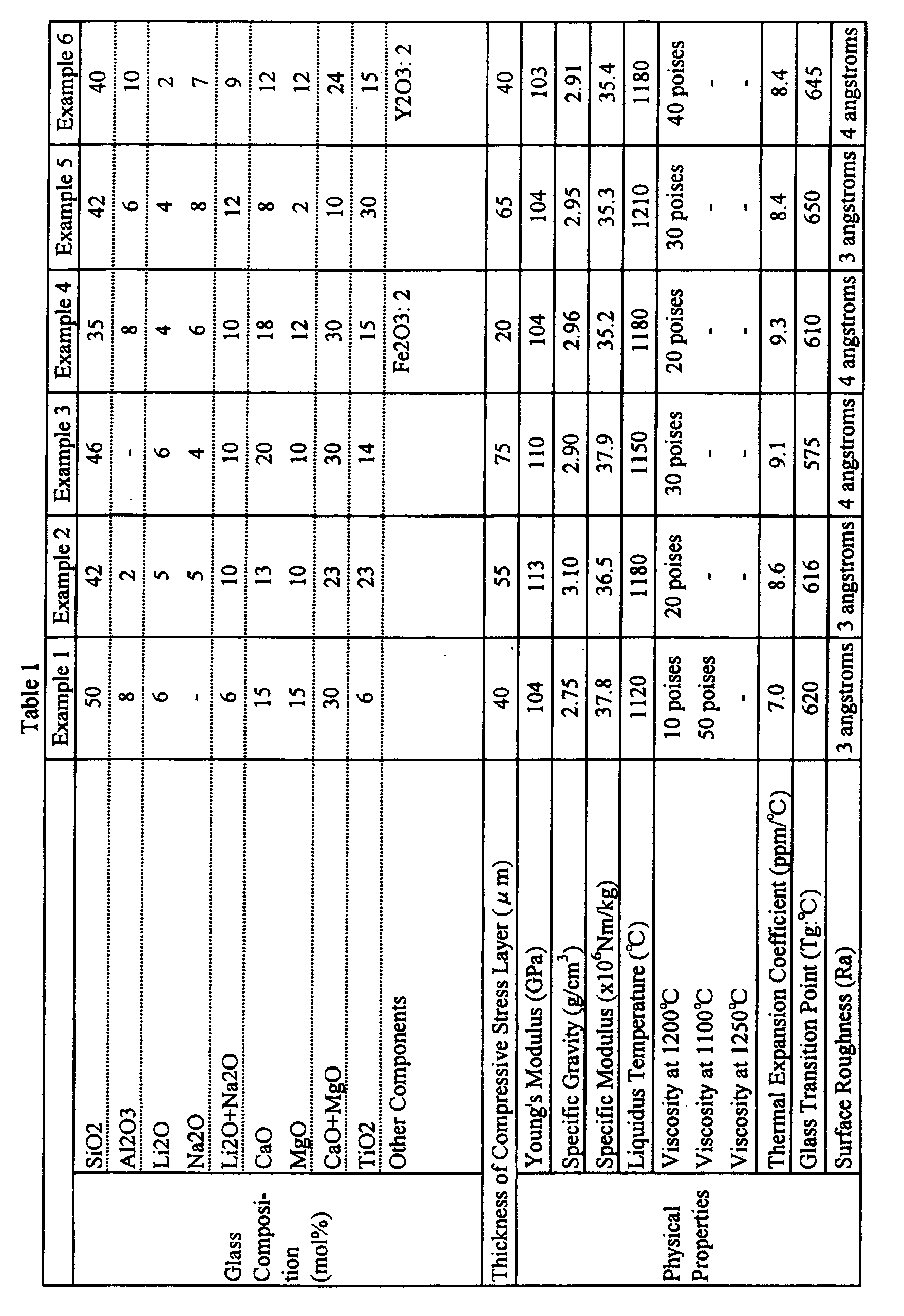
- the thickness of the compressive stress layer in each glass substrate (excluding the glass substrates in Examples 25 and 26) thus obtained and the physical property of each glass substrate are shown in Tables 1 through 5. All of the Young's modulus, the specific modulus, the surface roughness (Ra), and the specific gravity were measured by the use of the glass samples after chemically strengthened (except for the glass substrates of Examples 25 and 26). On the other hand, the liquidus temperature, the viscosity, the glass transition point, and the thermal expansion coefficient were measured by the use of the glass samples which were not chemically strengthened.
- Glass materials were weighted so as to obtain a glass substance having a composition (in terms of mol%) substantially same as that described in Example 1 of Japanese Unexamined Patent Publication (JP-A) No. 1-167245.
- a glass substrate before chemically strengthened was obtained and thereafter chemically strengthened under the same condition as in Examples 1 through 30 to obtain a desired glass substrate.
- the thickness of the compressive stress layer was obtained in the manner similar to Examples 1 through 30. These values are shown in Table 6.
- Glass materials were weighted so as to obtain a glass substance having a composition (in terms of mol %) substantially same as that described in Example 1 of Japanese Patent Publication (JP-B) No. 6-76224.
- a glass substrate before chemically strengthened was obtained and thereafter chemically strengthened under the same condition as in Examples 1 through 30 to obtain a desired glass substrate.
- the thickness of the compressive stress layer was obtained in the manner similar to Examples 1 through 30. These values are shown in Table 6.
- Glass materials were weighted so as to obtain a glass substance having a composition (in terms of mol%) substantially same as that described in Example 1 (Glass of Composition 2) of Japanese Patent Publication (JP-B) No. 4-70262.
- a glass substrate before chemically strengthened was obtained and thereafter chemically strengthened under the same condition as in Examples 1 through 30 to obtain a desired glass substrate.
- the thickness of the compressive stress layer was obtained in the manner similar to Examples 1 through 30. These values are shown in Table 6.
- Glass materials were weighted so as to obtain a glass substance having a composition (in terms of mol%) substantially same as that described in the claim of Japanese Unexamined Patent Publication (JP-A) No. 7-187711.
- a melt was obtained and subjected to heat treatment at the temperature and for the time period specified in the abovementioned claim to obtain a crystallized glass. Thereafter, the crystallized glass was processed in the manner similar to Examples 1 through 30 to obtain a desired glass substrate.
- the Young's modulus, the specific gravity, the specific modulus, and the surface roughness were obtained in the manner similar to Examples 1 through 30. These values are shown in Table 6.
- each of the glass substrates obtained in Examples 1 through 30 has a high Young's modulus between 102 and 120 GPa and an excellent surface roughness (Ra) between 3 and 5 angstroms.
- the liquidus temperature of the glass substance as a material for each of these glass substrates is relatively low, specifically, between 1000 and 1230°C. Therefore, it is supposed that, if a magnetic disk is prepared by the use of any one of these glass substrates, a flying height can be stably kept at about 1 ⁇ m or less even during the high speed rotation.
- each of the glass substrates obtained in Comparative Examples 1 through 3 has a low Young's modulus between 74 and 78 GPa.
- the crystallized glass substrate obtained in Comparative Example 4 has a surface roughness (Ra) as inferior as 25 angstroms. Therefore, it is supposed that, if a magnetic disk is prepared by the use of any one of these glass substrates and the crystallized glass substrate, a stable flying height of about 1 ⁇ m or less is difficult to keep during the high speed rotation.
- each of Examples 1 through 30 has a composition range specified by 35-65 mol% of SiO 2 , 0-15 mol% of Al 2 O 3 , 3-30 mol% of (Li 2 O+Na 2 O), 1-45 mol% of CaO, 5-45 mol% of (MgO+CaO), and 0.1-30 mol% of TiO 2 .
- the amount of (MgO+CaO) is preferably within a range between 5 and 35 mol% and that the amount of SiO 2 preferably falls within a range which exceeds 55 mol% and which does not exceed 65 mol%.
- a magnetic disk was prepared in the following manner by the use of the glass substrate obtained in each of Examples 25 through 30.
- a texture was formed on a landing zone of each glass substrate by the use of a laser beam so as to prevent attraction between the magnetic head and the magnetic disk.
- Each magnetic disk thus prepared was mounted on a hard disk unit and rotated at 12000 rpm with the flying height kept at 1 ⁇ m or less to be subjected to a recording/reproducing test by an MR head. As a result, in all of the magnetic disks, recording/reproducing operations could be normally carried out.
- the substrate for an information recording medium according to the second embodiment of this invention is based on each of the seventh through the ninth aspects of this invention.
- the glass substrate according to the seventh aspect i.e., the substrate for an information recording medium includes coexistence of Y 2 O 3 and TiO 2 to obtain the Young's modulus and the liquidus temperature mentioned above.
- This substrate will be referred to as a glass substrate I of the second embodiment. More specifically, the glass substrate I of the second embodiment includes Y 2 O 3 and TiO 2 in addition to SiO 2 , Al 2 O 3 , MgO and/or CaO, and Li 2 O.
- a glass substrate II according to the eighth aspect of this invention includes Y 2 O 3 , TiO 2 , and ZrO 2 in addition to SiO 2 , Al 2 O 3 , MgO and/or CaO, and Li 2 O.
- a glass substrate III according to the ninth aspect of this invention includes TiO 2 and at least one oxide which is selected from a rare earth metal oxide group consisting of Er 2 O 3 , Nd 2 O 3 , Sm 2 O 3 , Eu 2 O 3 , Gd 2 O 3 , Tb 2 O 3 , Dy 2 O 3 , and Yb 2 O 3 .
- the glass substrate having a desired Young's modulus and a desired liquidus temperature can also be obtained by inclusion of only TiO 2 and ZrO 2 in a composition of SiO 2 , Al 2 O 3 , MgO and/or CaO, and Li 2 O.
- the glass substrate is called a glass substrate IV according to the second embodiment.
- the rare earth metal oxide mentioned above also serves to increase the Young's modulus like the transition metal oxide but is liable to increase the specific gravity. Taking this into consideration, it is effective that such rare earth metal oxide is contained in the amount between 0 and 10 mol%.
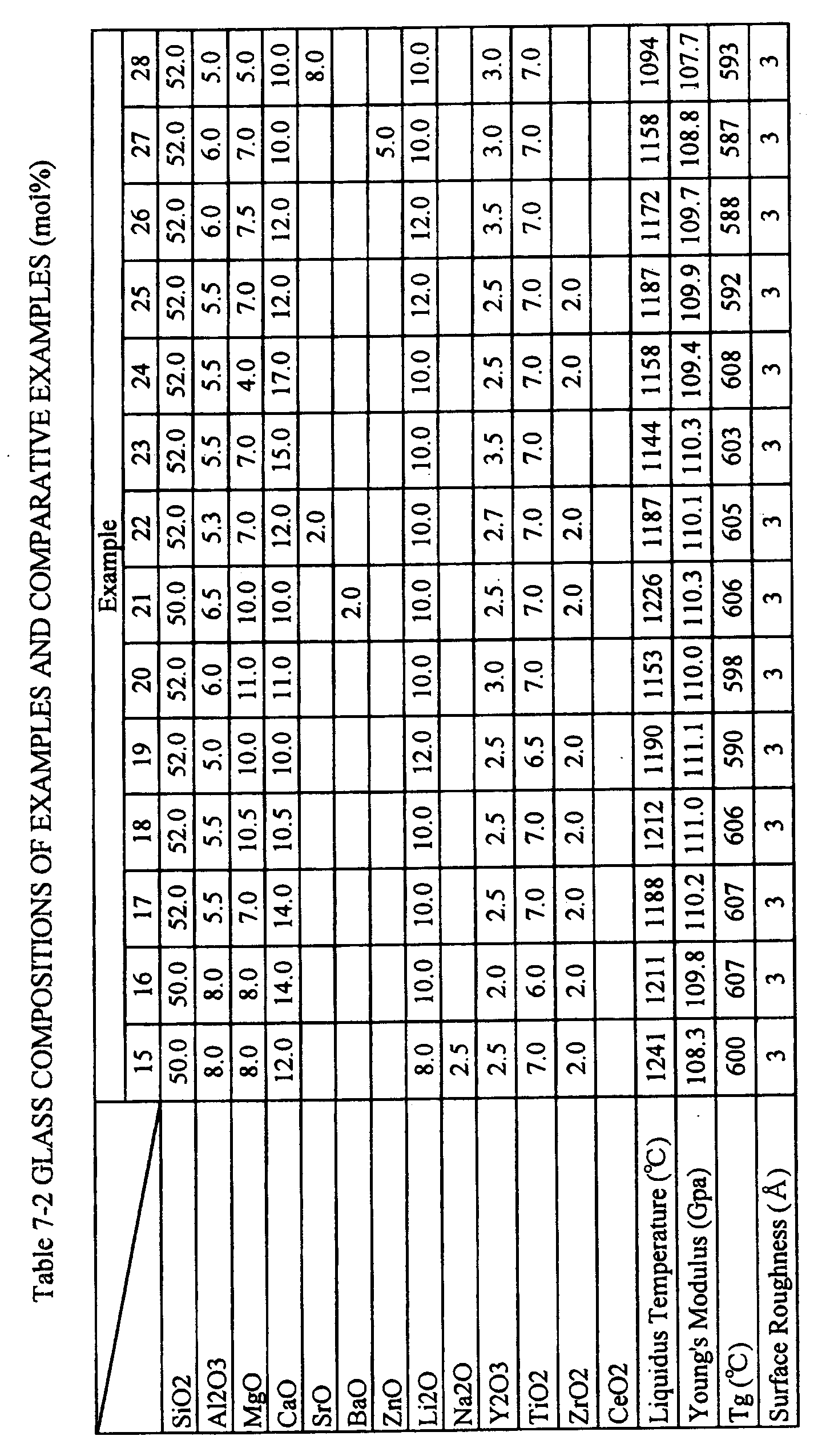
- Table 7 shows Examples 1 through 48 for the above-mentioned glass substrates I, II, III, and IV.
- Examples 1 through 48 shown in Table 7 each of Examples 1, 2, 3, 4, 5, 9, 10, 11, 12, 13, 14, 15, 16, 17, 18, 19, 21, 22, 24, 25, 29, 36, 37, and 38 includes Y 2 O 3 , TiO 2 , and ZrO 2 and corresponds to the glass substrate II of the second embodiment.
- each of Examples 6, 7, 8, 20, 23, 26, 27, 28, 30, 31, 32, 33, 34, 35, 39, and 40 includes Y 2 O 3 and TiO 2 and corresponds to the glass substrate I of the second embodiment.
- Each of Examples 41 through 48 includes TiO 2 and rare earth metal oxide and corresponds to the glass substrate III of the second embodiment.
- Table 8 shows Examples 49 to 63. These Examples are classified into the glass substrates I, II, III, and IV of the second embodiment. Specifically, each of Examples 49, 52, 53, 55, 58, 62, and 63 includes coexistence of TiO 2 and Y 2 O 3 and thus is the glass substrate I of the second embodiment. On the other hand, each of Examples 50, 54, 55, 56, 57, and 59 includes TiO 2 , Y 2 O 3 , and ZrO 2 and corresponds to the glass substrate II of the second embodiment. Each of Examples 61 and 62 including TiO 2 and ZrO 2 alone corresponds to the glass substrate IV of the second embodiment.
- Table 8 shows the thickness of the compressive stress layer, the viscosity, the specific gravity, the liquidus temperature, the specific modulus, the Young's modulus, the glass transition point (Tg), the thermal expansion coefficient, and the surface roughness for each of Examples.
- each of Examples 48 through 63 of the second embodiment comprises 45-65 mol% of SiO 2 , 0-15 mol% of Al 2 O 3 , 4-20 mol% of Li 2 O, 1-8 mol% of Na 2 O, 3-30 mo% of (Li 2 O+Na 2 O), 0-21 mol% of CaO, 0-22 mol% of MgO, 4-40 mol% of (CaO+MgO), 0-16 mol% of Y 2 O 3 , 1-15 mol% of TiO 2 , and 0-10 mol% of ZrO 2 .
- Each of Examples 41 to 48 which do not contain Y 2 O 3 comprises 5 mol% of at least one oxide selected from a rare earth metal oxide group consisting of Er 2 O 3 , Nd 2 O 3 , Sm 2 O 3 , Eu 2 O 3 , Gd 2 O 3 , Tb 2 O 3 , Dy 2 O 3 , and Yb 2 O 3 .
- each of the glass substrates according to the first and the second embodiments was immersed in water in order to measure the amount of dissolution of alkali ions.
- Table 9 shows the amounts of dissolution per 2.5-inch disk and per unit area for each of Examples 2, 4, 29, 9, 3, and 17 of the first embodiment and Examples 49 and 50 of the second embodiment. AS is obvious from Table 9, Examples 9, 13, and 17 are smaller in amount of dissolution than in Examples 2, 4, and 29. The same also applies to Examples 49 and 50. This means that the amount of dissolution tends to decrease with an increase of the amount of SiO 2 .
- each of Examples 1 through 63 of the second embodiment has the Young's modulus not smaller than 100GPa and the liquidus temperature not higher than 1350°C.
- each of Examples 16, 17, 20, 23, and 31 of the second embodiment was chemically strengthened in a predetermined treating bath at a preselected ion exchange temperature.
- measurement was made of the Young's modulus, the glass transition point (Tg), the surface roughness, and the bending strength. The results are tabulated in Table 10.
- the disk A comprises an aluminum substrate.
- the disk B comprises an SiO 2 substrate.
- the disks C and D comprise the substrates in Comparative Examples 1 and 2 mentioned above, respectively.
- Each of these disks A, B, C, and D has the Young's modulus not greater than 80 GPa.
- each of the above-mentioned substrates had a diameter of 3.5 inches and was rotated at a speed of 10,000 rpm. Then, a relative value of vibration was measured.
- the vibration of the disk A among the conventional disks is represented as 100 while the vibration of other disks is given as the relative values.
- the vibration of each of the disks E8, 10, 15, 24, and 30 in Examples of this invention having the Young's modulus not smaller than 100 GPa (Examples 8, 10, 15, 24, and 30 in Tables 2 through 5) can be reduced to 60% or less as compared with the typical conventional disk formed by the aluminum substrate (A), as illustrated in Fig. 1.
- each of the disks B, C, and D comprising the other conventional substrates exhibits the vibration on the order or 90% with respect to the vibration of the disk A as 100.
- the substrate for an information recording medium according to this invention has a high Young's modulus and, when the disk is formed therefrom, can suppress the vibration so that the flying height can be stabilized.
- the substrate (glass substrate) of this invention it is possible to obtain the information recording medium which can readily meet the increase in rotation speed.
- the recording/reproducing apparatus having a high recording capacity and a high access speed can be obtained by the use of the information recording medium comprising the substrate according to this invention.
- Comparative Example 1 Comparative Example 2 Comparative Example 3 Comparative Example 4 Glass Composition (mol%) SiO2 64.2 68.5 67.2 52.0 Al2O3 7.6 8.8 1.8 1.0 Li2O - 10.0 - - Na2O 14.5 8.2 9.4 7.0 K2O 2.0 - 6.2 5.0 CaO - - 0.1 16.0 MgO 6.4 4.5 4.5 - BaO 0.2 - - - TiO2 4.0 - 0.5 - ZrO2 1.0 - - - ZnO - - 9.1 - B2O3 - - 1.0 - As2O3 - - 0.07 - Sb2O3 - - 0.07 - F - - - 19.0 Thickness of Compressive Stress Layer ( ⁇ m) 75 270 85 - Physical Properties Young's Modulus (GPa) 74 78 76 93 Specific Gravity (g/cm 3 ) 2.56 2.43 2.41 2.60 Specific Modulus (x10 6 N
Landscapes
- Chemical & Material Sciences (AREA)
- Engineering & Computer Science (AREA)
- Materials Engineering (AREA)
- Chemical Kinetics & Catalysis (AREA)
- General Chemical & Material Sciences (AREA)
- Geochemistry & Mineralogy (AREA)
- Life Sciences & Earth Sciences (AREA)
- Organic Chemistry (AREA)
- Ceramic Engineering (AREA)
- Inorganic Chemistry (AREA)
- Glass Compositions (AREA)
- Magnetic Record Carriers (AREA)
- Optical Record Carriers And Manufacture Thereof (AREA)
Abstract
Description


| Comparative Example 1 | Comparative Example 2 | Comparative Example 3 | Comparative Example 4 | ||
| Glass Composition (mol%) | SiO2 | 64.2 | 68.5 | 67.2 | 52.0 |
| Al2O3 | 7.6 | 8.8 | 1.8 | 1.0 | |
| Li2O | - | 10.0 | - | - | |
| Na2O | 14.5 | 8.2 | 9.4 | 7.0 | |
| K2O | 2.0 | - | 6.2 | 5.0 | |
| CaO | - | - | 0.1 | 16.0 | |
| MgO | 6.4 | 4.5 | 4.5 | - | |
| BaO | 0.2 | - | - | - | |
| TiO2 | 4.0 | - | 0.5 | - | |
| ZrO2 | 1.0 | - | - | - | |
| ZnO | - | - | 9.1 | - | |
| B2O3 | - | - | 1.0 | - | |
| As2O3 | - | - | 0.07 | - | |
| Sb2O3 | - | - | 0.07 | - | |
| F | - | - | - | 19.0 | |
| Thickness of Compressive Stress Layer (µm) | 75 | 270 | 85 | - | |
| Physical Properties | Young's Modulus (GPa) | 74 | 78 | 76 | 93 |
| Specific Gravity (g/cm3) | 2.56 | 2.43 | 2.41 | 2.60 | |
| Specific Modulus (x106Nm/kg) | 29.1 | 31.9 | 31.3 | 35.0 | |
| Liquidus Temperature (°C) | - | 960 | - | - | |
| Thermal Expansion Coefficient (ppm/°C) | - | - | 9.6 | - | |
| Glass Transition Point (Tg:°C) | 626 | - | 555 | - | |
| Surface Roughness (Rmax) | - | - | - | 25 angstroms |



| Example | 2 | 4 | 29 | 9 | 13 | 17 | 49 | 50 |
| SiO2 | 42 | 35 | 37 | 60 | 54 | 46 | 52 | 58 |
| Al2O3 | 2 | 8 | 2 | 0 | 0 | 0 | 6 | 3 |
| Li2O | 5 | 4 | 4 | 6 | 12 | 4 | 10 | 12 |
| Na2O | 5 | 6 | 2 | 3 | 8 | 5 | 4 | |
| CaO | 13 | 18 | 19 | 9 | 2 | 15 | 11 | 6 |
| MgO | 10 | 12 | 24 | 9 | 8 | 15 | 11 | 6 |
| TiO2 | 23 | 15 | 14 | 11 | 16 | 15 | 7 | 8 |
| Fe2O3 | 2 | |||||||
| ZrO2 | 2 | 2.5 | ||||||
| Nb2O3 | 2 | |||||||
| La2O3 | 2 | |||||||
| Y2O3 | 3 | 0.5 | ||||||
| Dissolution of Alkali Ion (µ mol/disk) | 43.3 | 75 | 82 | 5.1 | 9.5 | 18 | 6 | 2.7 |
| Dissolution of Alkali Ion (µ mol/cm2) | 0.72 | 1.25 | 1.37 | 0.09 | 0.16 | 0.3 | 0.1 | 0.045 |

Claims (36)
- A substrate for an information recoring medium, comprising a glass substance having a Young's modulus not smaller than 100GPa and a liquidus temperature not higher than 1350°C.
- A substrate as claimed in claim 1, having a specific gravity not greater than 3.5g/cm3.
- A substrate as claimed in claim 1 or 2, wherein said glass substance has a viscosity not smaller than 10 poises in a formable temperature range.
- A substrate as claimed in any one of claims 1 through 3, having a thermal mansion coefficient between 7 and 14ppm/°C.
- A substance for an formation recording medium, comprising a glass substance at least including TiO2 and CaO as glass components, the contents of TiO2 and CaO being selected so that a Young's modulus is not smaller than 100GPa and a liquidus temperature is not higher than 1350°C.
- A substrate for an information recording medium, comprising a glass substance at least including TiO2 and CaO as glass components, the contents of TiO2 and CaO being selected so that a Young's modulus is not smaller than 100GPa, a liquidus temperature is not higher than 1350°C, and a viscosity is not smaller than 10 poises in a formable temperature range.
- A substrate for an information recording medium, comprising a glass substance which includes, as glass components, TiO2, CaO, MgO, and Al2O3 along with at least Li2O selected from & group of Na2O and Li2O, the contents of these glass components being selected so that a Young's modulus in not smaller than 100GPa a liquidus temperature is not higher than 1350°C, a viscosity in a formable temperature range is not smaller than 10 poises, and a specific gravity is not greater than 3.5g/cm3.
- A substrate for an information recording medium as claimed in claim 7, further including Y2O3 and ZrO2.
- A substrate for an information recording medium as claimed in claim 7 or 8, wherein a glass transition point is not higher than 650°C.
- a substrate for an information recording medium as claimed in claim 9, wherein a glass transition point is not higher than 550°C.
- A substrate for an information recording medium, comprising a glass substance including, as glass components, 0.1-30 mol% of TiO2, 1-45 mol% of CaO, 5-40 mol% of (MgO+CaO), 3-30 mol% of (Na2O+Li2O), less than 15 mol% of Al2O3, and 35-65 mol% of SiO2.
- A substrate for an information recording medium, comprising a glass substance including, as glass components, 0.1-30 mol% of TiO2, 1-45 mol% of CaO, 5-40 mol% of (MgO+CaO), 3-30 mol% of (Na2O+Li2O), 0-less than 5 mol% of Al2O3, and 35-65 mol% of SiO2.
- A substrate for an information recording medium. comprising a glass substance including, as glass components, 0.1-30 mol% of TiO2, 1-45 mol% of CaO, 5-40 mol% of (MgO+CaO), 3-30 mol% of (Na2O+Li2O), 0-less than 15 mol% of Al2O3, and are than 55 mol% and up to 65 mol% of SiO2.
- A substrate for an information recording medium, comprising a glass substance including, as glass components, 5-15 mol% of TiO2, 4-20 mol% of CaO, 5-30 mol% of (MgO+CaO), 5-22 mol% of (Na2O+Li2O), 0-8 mol% of Al2O3, and 40-60 mol% of SiO2.
- A substrate for an information recording medium as claimed in any one of claims 8 through 11, which includes transition metal oxide in place of a part or a whole of TiO2 as a glass component.
- A substrate for an information recording medium as claimed in claim 15, wherein said transition metal oxide is at least one oxide selected from a grow consisting of oxides of Cr, Mn, Fe, Co, Ni, Ga, Ge, Y, Zr, Nb, Mo, La, Ce, Pr, Nd, Pm, Eu, Gd, Tb, Dy, Ho, Er, Tm, Yb, Hf, Ta, and W.
- A substrate for an information recording medium an claimed in claim 15, wherein said transition metal oxide is at least one oxide selected from a group consisting of oxides of Cr, V, and Zn.
- A substrate for an informtion recording medium as claimed in claim 16 or 17, wherein said transition metal oxide has a content of 0.1-15 mol% and coexists with TiO2.
- A substrate for an information recording medium as claimed in claim 16 or 17, wherein said transition metal oxide has a content of 0.1-8 mol%.
- A substrate for an information recording medium as claimed in claim 16, wherein said transition metal oxide coexisting with TiO2 is Y2O3 and ZrO2.
- A substrate for an information recording medium as claimed in claim 11 or 18, including 0.1-25 mol% of Li2O.
- A substrate for an formation recording medium as claimed in claim 11 or 18, including 1-15 mol% of Na2O.
- A substrate for an information recording medium as claimed in claim 9 or 11, which is formed by the use of a mold.
- A substrate as claimd in any one of claims 11 through 13, including as glass components at least 40 mol% of (SiO2+Al2O3), at least 3 mol% of Li2O, at Least 5 mol% of (Na2O+Li2O), and at most 35 mol% of (CaO+MgO).
- A substrate for an information recording medium, formed by chemically reinforcing the information recording medium claimed in any one of claims 7, 8, 11, 16, 18, and 20 or the glass substance thereof.
- A substrate for an information recording medium as claimed in any one of claims 7, 8, 11, 16, 18, and 20, said substrate having a thermal expansion coefficient approximate to that of a material of a clamp for fixing the information recording medium in an information processing apparatus.
- An information recording medium comprising the substrate claimed in any one of claims 7, 8, 11, 16, 18, and 20 and a recording layer formed on said substrate
- A substrate for an information recording medium, including glass components which achieve a Young's modulus not smaller than 100GPa and a liquidus temperature not higher than 1350°C by the coexistence of Y2O3 and TiO2.
- A substrate for an information recording medium as claimed in claim 28, wherein said glass components includes SiO2, Al2O3, at least one of MgO and CaO, and Li2O.
- A substrate for an information recording medium as claimed in claim 29, wherein said glass components include 45-65 mol% of SiO2, 0-15 mol% of Al2O3, 4-20 mol% of Li2O, 0-8 mol% of Na2O, 3-30 mo% of (Li2O+Na2O), 0-21 mol% of CaO, 0-22 mol% of MgO, 4-40 mol% of (CaO+MgO), 0-16 mol% of Y2O3, and 1-15 mol% of TiO2.
- A substrate for an information recording medium, comprising glass components which achieve a Young's modulus not smaller than 100GPa and a liquidus temperature not higher than 1350°C by the coexistence Of Y2O3, TiO2, and ZrO2.
- A substrate for an information recording medium as claimed in claim 31, wherein said glass components include SiO2, Al2O3, at least one of MgO and CaO, and Li2O.
- A substrate for an information recording medium, comprising TiO2 and at least one oxide selected from a rare earth metal oxide group consisting of Er2O3, Nd2O3, Sm2O3, Eu2O3, Gd2O3, Tb2O3, Dy2O3, and Yb2O3, and including glass components which achieve a Young's modulus not smaller than 100 GPa and a liquids temperature not higher than 1350°C.
- A substrate for an informtion recording medium as claimed in claim 33, wherein said at least one oxide has a content of 5 mol%.
- A substrate for an information recording medium as claimed in claim 34, wherein said glass components include SiO2, Al2O3, at least one of MgO and CaO, and Li2O and doe: not include Y2O3.
- An information recording device for use in recording/reproducing information by a magnetic head on an information recording medium claimed in claim 27.
Applications Claiming Priority (5)
| Application Number | Priority Date | Filing Date | Title |
|---|---|---|---|
| US4862397P | 1997-06-05 | 1997-06-05 | |
| US48623P | 1997-06-05 | ||
| US6667597P | 1997-11-14 | 1997-11-14 | |
| US66675P | 1997-11-14 | ||
| PCT/JP1998/002486 WO1998055993A1 (en) | 1997-06-05 | 1998-06-04 | Substrate for information recording media |
Publications (3)
| Publication Number | Publication Date |
|---|---|
| EP0917135A1 true EP0917135A1 (en) | 1999-05-19 |
| EP0917135A4 EP0917135A4 (en) | 1999-12-15 |
| EP0917135B1 EP0917135B1 (en) | 2006-08-16 |
Family
ID=26726335
Family Applications (1)
| Application Number | Title | Priority Date | Filing Date |
|---|---|---|---|
| EP98923132A Expired - Lifetime EP0917135B1 (en) | 1997-06-05 | 1998-06-04 | Substrate for information recording media |
Country Status (9)
| Country | Link |
|---|---|
| EP (1) | EP0917135B1 (en) |
| JP (2) | JP4098834B2 (en) |
| KR (1) | KR100446053B1 (en) |
| CN (2) | CN1256720C (en) |
| AU (1) | AU749543B2 (en) |
| CA (1) | CA2262700C (en) |
| DE (1) | DE69835572T2 (en) |
| MY (1) | MY118378A (en) |
| WO (1) | WO1998055993A1 (en) |
Cited By (9)
| Publication number | Priority date | Publication date | Assignee | Title |
|---|---|---|---|---|
| EP0945855A3 (en) * | 1998-03-23 | 1999-10-13 | Kabushiki Kaisha Ohara | Glass-ceramic substrate for a magnetic information storage medium |
| EP1081512A1 (en) * | 1999-08-30 | 2001-03-07 | Kabushiki Kaisha Ohara | Glass for a light filter and a light filter |
| EP1079373A3 (en) * | 1999-08-27 | 2001-03-28 | Kabushiki Kaisha Ohara | Glass-ceramic substrate for an information storage medium and a method for manufacturing the same |
| WO2001049620A2 (en) | 2000-01-05 | 2001-07-12 | Schott Glass Technologies, Inc. | Alkaline-earth-free boroalkali silicate glass |
| DE10103085A1 (en) * | 2001-01-24 | 2002-08-01 | Schott Glas | Aluminosilicate glass substrate containing lithium oxide, for hard discs, field emission displays and advanced telecoms filters, has specified composition |
| US6495480B1 (en) | 1998-09-11 | 2002-12-17 | Kabushiki Kaisha Ohara | Glass-ceramic substrate for an information storage medium |
| DE10133963A1 (en) * | 2001-07-17 | 2003-02-06 | Schott Glas | Boroalkali silicate glass used e.g. as substrate glass in display technology for plasma display panels comprises oxides of silicon, aluminum, boron, sodium, potassium, zinc, titanium and zirconium |
| EP0953548B1 (en) * | 1997-07-30 | 2006-05-03 | Hoya Corporation | Method of producing glass substrate for information recording medium |
| WO2014081747A1 (en) * | 2012-11-21 | 2014-05-30 | Corning Incorporated | Ion exchangeable glasses having high hardness and high modulus |
Families Citing this family (15)
| Publication number | Priority date | Publication date | Assignee | Title |
|---|---|---|---|---|
| JP4507135B2 (en) * | 1998-09-11 | 2010-07-21 | Hoya株式会社 | Glass composition, substrate for information recording medium and information recording medium using the same |
| JP4488555B2 (en) * | 1998-09-22 | 2010-06-23 | Hoya株式会社 | GLASS COMPOSITION, PROCESS FOR PRODUCING THE SAME, AND SUBSTRATE FOR INFORMATION RECORDING MEDIUM USING THE SAME, INFORMATION RECORDING MEDIUM |
| JP4161509B2 (en) * | 1999-04-13 | 2008-10-08 | 旭硝子株式会社 | Glass for information recording medium substrate and glass substrate for information recording medium |
| JP3383942B2 (en) | 1999-08-02 | 2003-03-10 | Hoya株式会社 | Glass substrate for WDM optical filter, WDM optical filter, optical multiplexer / demultiplexer for WDM |
| US20050181218A1 (en) * | 2002-06-03 | 2005-08-18 | Hoya Corporation | Glass substrate for information recording media and information recording medium |
| US7566673B2 (en) | 2003-10-31 | 2009-07-28 | Konica Minolta Opto, Inc. | Glass substrate for an information recording medium and information recording medium employing it |
| JP4039381B2 (en) | 2004-03-25 | 2008-01-30 | コニカミノルタオプト株式会社 | Glass substrate for information recording medium using glass composition and information recording medium using the same |
| US8613206B2 (en) * | 2006-03-24 | 2013-12-24 | Hoya Corporation | Method for manufacturing glass substrate for magnetic disk and method for manufacturing magnetic disk |
| JP5720499B2 (en) * | 2010-10-26 | 2015-05-20 | 旭硝子株式会社 | Substrate glass and glass substrate |
| CN108083631B (en) * | 2017-12-15 | 2020-11-06 | 成都光明光电股份有限公司 | Glass composition |
| CN114920453A (en) * | 2017-12-15 | 2022-08-19 | 成都光明光电股份有限公司 | Glass composition |
| MY208527A (en) | 2018-08-07 | 2025-05-14 | Hoya Corp | Substrate for magnetic disk and magnetic disk |
| WO2020175407A1 (en) | 2019-02-25 | 2020-09-03 | 日本板硝子株式会社 | Glass composition, glass plate and method for producing same, and substrate for information recording medium |
| JP7551312B2 (en) | 2020-03-13 | 2024-09-17 | 日本板硝子株式会社 | Glass composition, glass plate and its manufacturing method, and substrate for information recording medium |
| EP4201898A1 (en) * | 2021-12-21 | 2023-06-28 | Schott Ag | Glass composition, glass article and method of making it |
Family Cites Families (17)
| Publication number | Priority date | Publication date | Assignee | Title |
|---|---|---|---|---|
| US3804646A (en) * | 1969-06-11 | 1974-04-16 | Corning Glass Works | Very high elastic moduli glasses |
| US4149895A (en) * | 1977-07-01 | 1979-04-17 | Corning Glass Works | Glass with high refractive index and low density |
| FI56820C (en) * | 1978-09-27 | 1980-04-10 | Paraisten Kalkki Oy | GLASKOMPOSITION AVSEDD FOER FRAMSTAELLNING AV FIBER |
| US4439528A (en) * | 1983-06-02 | 1984-03-27 | Corning Glass Works | Spontaneous opal glass compositions |
| GB2150553A (en) * | 1983-12-01 | 1985-07-03 | Glass Int Inc | Composition for making glass fibres |
| JPH01201043A (en) * | 1988-02-05 | 1989-08-14 | Eta G K:Kk | High-strength glass |
| GB2220654B (en) * | 1988-07-13 | 1992-10-07 | Glass Int Inc | Glass composition and batch blend for its production |
| ATE213721T1 (en) * | 1994-11-08 | 2002-03-15 | Rockwool Int | SYNTHETIC GLASS FIBERS |
| US5491116A (en) * | 1995-04-03 | 1996-02-13 | Corning Incorporated | Fine-grained glass-ceramics |
| GB2299991B (en) * | 1995-04-20 | 1998-09-09 | Ag Technology Corp | Glass substrate for magnetic disk |
| JP3078230B2 (en) * | 1996-06-11 | 2000-08-21 | ホーヤ株式会社 | Glass substrate for recording medium, magnetic recording medium using the substrate, and method of manufacturing the same |
| JP3187321B2 (en) * | 1996-06-14 | 2001-07-11 | 日本板硝子株式会社 | Chemically strengthened glass composition and chemically strengthened glass article |
| JP3138641B2 (en) * | 1996-07-05 | 2001-02-26 | 住友ゴム工業株式会社 | Golf club head and method of manufacturing the same |
| JP3930113B2 (en) * | 1996-08-30 | 2007-06-13 | Hoya株式会社 | Glass substrate for magnetic disk |
| JP3989988B2 (en) * | 1996-09-04 | 2007-10-10 | Hoya株式会社 | Information recording medium substrate, magnetic disk, and manufacturing method thereof |
| JPH1079122A (en) * | 1996-09-04 | 1998-03-24 | Hoya Corp | Method for selecting material suitable for substrate of information recording medium, material selected by using the method, and substrate and magnetic disk using the material |
| JP3379621B2 (en) * | 1996-09-04 | 2003-02-24 | Hoya株式会社 | Material used for information recording medium substrate, substrate using the same, and magnetic disk using the substrate |
-
1998
- 1998-06-04 MY MYPI98002500A patent/MY118378A/en unknown
- 1998-06-04 CN CNB2004100589046A patent/CN1256720C/en not_active Expired - Lifetime
- 1998-06-04 AU AU75504/98A patent/AU749543B2/en not_active Ceased
- 1998-06-04 JP JP52651198A patent/JP4098834B2/en not_active Expired - Fee Related
- 1998-06-04 WO PCT/JP1998/002486 patent/WO1998055993A1/en not_active Ceased
- 1998-06-04 EP EP98923132A patent/EP0917135B1/en not_active Expired - Lifetime
- 1998-06-04 KR KR10-1999-7000929A patent/KR100446053B1/en not_active Expired - Fee Related
- 1998-06-04 DE DE69835572T patent/DE69835572T2/en not_active Expired - Lifetime
- 1998-06-04 CN CNB988007444A patent/CN1170273C/en not_active Expired - Lifetime
- 1998-06-04 CA CA002262700A patent/CA2262700C/en not_active Expired - Fee Related
-
2007
- 2007-12-18 JP JP2007326008A patent/JP4134266B2/en not_active Expired - Lifetime
Cited By (15)
| Publication number | Priority date | Publication date | Assignee | Title |
|---|---|---|---|---|
| EP0953548B1 (en) * | 1997-07-30 | 2006-05-03 | Hoya Corporation | Method of producing glass substrate for information recording medium |
| EP0945855A3 (en) * | 1998-03-23 | 1999-10-13 | Kabushiki Kaisha Ohara | Glass-ceramic substrate for a magnetic information storage medium |
| US6383645B1 (en) | 1998-03-23 | 2002-05-07 | Kabushiki Kaisha Ohara | Glass-ceramic substrate for an information storage medium |
| US6495480B1 (en) | 1998-09-11 | 2002-12-17 | Kabushiki Kaisha Ohara | Glass-ceramic substrate for an information storage medium |
| EP1079373A3 (en) * | 1999-08-27 | 2001-03-28 | Kabushiki Kaisha Ohara | Glass-ceramic substrate for an information storage medium and a method for manufacturing the same |
| KR100394044B1 (en) * | 1999-08-30 | 2003-08-06 | 가부시키가이샤 오하라 | Glass for a light filter and a light filter |
| EP1081512A1 (en) * | 1999-08-30 | 2001-03-07 | Kabushiki Kaisha Ohara | Glass for a light filter and a light filter |
| US6461733B1 (en) | 1999-08-30 | 2002-10-08 | Kabushiki Kaisha Ohara | Glass for a light filter and light filter |
| WO2001049620A2 (en) | 2000-01-05 | 2001-07-12 | Schott Glass Technologies, Inc. | Alkaline-earth-free boroalkali silicate glass |
| DE10103085C2 (en) * | 2001-01-24 | 2003-03-27 | Schott Glas | Lithium oxide-containing aluminosilicate glass, and uses of this glass |
| DE10103085A1 (en) * | 2001-01-24 | 2002-08-01 | Schott Glas | Aluminosilicate glass substrate containing lithium oxide, for hard discs, field emission displays and advanced telecoms filters, has specified composition |
| DE10133963A1 (en) * | 2001-07-17 | 2003-02-06 | Schott Glas | Boroalkali silicate glass used e.g. as substrate glass in display technology for plasma display panels comprises oxides of silicon, aluminum, boron, sodium, potassium, zinc, titanium and zirconium |
| DE10133963B4 (en) * | 2001-07-17 | 2006-12-28 | Schott Ag | Boroalkali silicate glass and its uses |
| WO2014081747A1 (en) * | 2012-11-21 | 2014-05-30 | Corning Incorporated | Ion exchangeable glasses having high hardness and high modulus |
| US10501364B2 (en) | 2012-11-21 | 2019-12-10 | Corning Incorporated | Ion exchangeable glasses having high hardness and high modulus |
Also Published As
| Publication number | Publication date |
|---|---|
| EP0917135B1 (en) | 2006-08-16 |
| WO1998055993A1 (en) | 1998-12-10 |
| CN1256720C (en) | 2006-05-17 |
| MY118378A (en) | 2004-10-30 |
| CN1170273C (en) | 2004-10-06 |
| DE69835572T2 (en) | 2007-08-09 |
| AU7550498A (en) | 1998-12-21 |
| DE69835572D1 (en) | 2006-09-28 |
| JP2008097821A (en) | 2008-04-24 |
| KR20000068047A (en) | 2000-11-25 |
| JP4134266B2 (en) | 2008-08-20 |
| CA2262700A1 (en) | 1998-12-10 |
| KR100446053B1 (en) | 2004-08-30 |
| JP4098834B2 (en) | 2008-06-11 |
| CN1558398A (en) | 2004-12-29 |
| EP0917135A4 (en) | 1999-12-15 |
| CN1228184A (en) | 1999-09-08 |
| CA2262700C (en) | 2002-09-17 |
| AU749543B2 (en) | 2002-06-27 |
Similar Documents
| Publication | Publication Date | Title |
|---|---|---|
| US5997977A (en) | Information recording substrate and information recording medium prepared from the substrate | |
| EP0917135A1 (en) | Substrate for information recording media | |
| EP0953548B1 (en) | Method of producing glass substrate for information recording medium | |
| US6376403B1 (en) | Glass composition and process for producing the same | |
| US6306786B1 (en) | Glass composition and process for producing the same | |
| US8883330B2 (en) | Glass for chemical strengthening, substrate for information recording media and information recording media | |
| US8394516B2 (en) | Glass substrate for magnetic recording medium and magnetic recording medium | |
| JP5982500B2 (en) | Glass substrate for HDD and information recording medium | |
| JPWO1998055993A1 (en) | Information storage medium substrate | |
| CN103493133B (en) | Glass base plate for magnetic recording carrier and utilization thereof | |
| US6495480B1 (en) | Glass-ceramic substrate for an information storage medium | |
| US6451720B1 (en) | Glass composition, and information recording medium substrate, information recording medium, and information recording device each comprising the composition | |
| CN100482606C (en) | Substrate for information recording medium, and method for producing the same | |
| US6340647B1 (en) | Glass composition and substrate for information recording media comprising the same | |
| US6376084B1 (en) | Glass-ceramics, process for producing the same, and substrate for information recording medium, information recording medium and information recording device each using the glass-ceramics | |
| JP2000203872A (en) | Glass composition, substrate for information recording medium by using the same, and information recording medium | |
| JP3793401B2 (en) | Substrate for information recording medium made of crystallized glass and information recording medium | |
| JP4619115B2 (en) | Glass substrate for information recording medium and information recording medium | |
| JP2000313634A (en) | Glass composition and method for producing the same, and substrate for information recording medium, information recording medium and information recording apparatus using the same | |
| WO2025013797A1 (en) | Glass composition for information recording medium and glass plate for information recording medium | |
| JPWO1999006333A1 (en) | Method for manufacturing glass substrate for information recording medium |
Legal Events
| Date | Code | Title | Description |
|---|---|---|---|
| PUAI | Public reference made under article 153(3) epc to a published international application that has entered the european phase |
Free format text: ORIGINAL CODE: 0009012 |
|
| 17P | Request for examination filed |
Effective date: 19990129 |
|
| AK | Designated contracting states |
Kind code of ref document: A1 Designated state(s): DE FR GB IT |
|
| A4 | Supplementary search report drawn up and despatched |
Effective date: 19991104 |
|
| AK | Designated contracting states |
Kind code of ref document: A4 Designated state(s): DE FR GB IT |
|
| RIC1 | Information provided on ipc code assigned before grant |
Free format text: 6G 11B 5/62 A, 6G 11B 7/24 B, 6G 11B 11/10 B, 6C 03C 4/00 B, 6C 03C 3/087 B, 6C 03C 3/095 B, 6G 11B 5/64 B |
|
| 17Q | First examination report despatched |
Effective date: 20030220 |
|
| GRAP | Despatch of communication of intention to grant a patent |
Free format text: ORIGINAL CODE: EPIDOSNIGR1 |
|
| GRAS | Grant fee paid |
Free format text: ORIGINAL CODE: EPIDOSNIGR3 |
|
| GRAA | (expected) grant |
Free format text: ORIGINAL CODE: 0009210 |
|
| AK | Designated contracting states |
Kind code of ref document: B1 Designated state(s): DE FR GB IT |
|
| PG25 | Lapsed in a contracting state [announced via postgrant information from national office to epo] |
Ref country code: IT Free format text: LAPSE BECAUSE OF FAILURE TO SUBMIT A TRANSLATION OF THE DESCRIPTION OR TO PAY THE FEE WITHIN THE PRESCRIBED TIME-LIMIT;WARNING: LAPSES OF ITALIAN PATENTS WITH EFFECTIVE DATE BEFORE 2007 MAY HAVE OCCURRED AT ANY TIME BEFORE 2007. THE CORRECT EFFECTIVE DATE MAY BE DIFFERENT FROM THE ONE RECORDED. Effective date: 20060816 |
|
| REG | Reference to a national code |
Ref country code: GB Ref legal event code: FG4D |
|
| REF | Corresponds to: |
Ref document number: 69835572 Country of ref document: DE Date of ref document: 20060928 Kind code of ref document: P |
|
| ET | Fr: translation filed | ||
| PLBE | No opposition filed within time limit |
Free format text: ORIGINAL CODE: 0009261 |
|
| STAA | Information on the status of an ep patent application or granted ep patent |
Free format text: STATUS: NO OPPOSITION FILED WITHIN TIME LIMIT |
|
| 26N | No opposition filed |
Effective date: 20070518 |
|
| REG | Reference to a national code |
Ref country code: FR Ref legal event code: PLFP Year of fee payment: 19 |
|
| PGFP | Annual fee paid to national office [announced via postgrant information from national office to epo] |
Ref country code: GB Payment date: 20160621 Year of fee payment: 19 Ref country code: DE Payment date: 20160621 Year of fee payment: 19 |
|
| PGFP | Annual fee paid to national office [announced via postgrant information from national office to epo] |
Ref country code: FR Payment date: 20160627 Year of fee payment: 19 |
|
| PGFP | Annual fee paid to national office [announced via postgrant information from national office to epo] |
Ref country code: IT Payment date: 20160628 Year of fee payment: 19 |
|
| REG | Reference to a national code |
Ref country code: DE Ref legal event code: R119 Ref document number: 69835572 Country of ref document: DE |
|
| GBPC | Gb: european patent ceased through non-payment of renewal fee |
Effective date: 20170604 |
|
| REG | Reference to a national code |
Ref country code: FR Ref legal event code: ST Effective date: 20180228 |
|
| PG25 | Lapsed in a contracting state [announced via postgrant information from national office to epo] |
Ref country code: DE Free format text: LAPSE BECAUSE OF NON-PAYMENT OF DUE FEES Effective date: 20180103 Ref country code: GB Free format text: LAPSE BECAUSE OF NON-PAYMENT OF DUE FEES Effective date: 20170604 |
|
| PG25 | Lapsed in a contracting state [announced via postgrant information from national office to epo] |
Ref country code: FR Free format text: LAPSE BECAUSE OF NON-PAYMENT OF DUE FEES Effective date: 20170630 Ref country code: IT Free format text: LAPSE BECAUSE OF NON-PAYMENT OF DUE FEES Effective date: 20170604 |