EP0936287A1 - Turbinenbauteil und Verfahren zur Steuerung der Oxidation eines Turbinenbauteils - Google Patents
Turbinenbauteil und Verfahren zur Steuerung der Oxidation eines Turbinenbauteils Download PDFInfo
- Publication number
- EP0936287A1 EP0936287A1 EP98810120A EP98810120A EP0936287A1 EP 0936287 A1 EP0936287 A1 EP 0936287A1 EP 98810120 A EP98810120 A EP 98810120A EP 98810120 A EP98810120 A EP 98810120A EP 0936287 A1 EP0936287 A1 EP 0936287A1
- Authority
- EP
- European Patent Office
- Prior art keywords
- substrate
- oxide
- turbine component
- oxidation
- electrolyte
- Prior art date
- Legal status (The legal status is an assumption and is not a legal conclusion. Google has not performed a legal analysis and makes no representation as to the accuracy of the status listed.)
- Withdrawn
Links
Images

Classifications
-
- C—CHEMISTRY; METALLURGY
- C23—COATING METALLIC MATERIAL; COATING MATERIAL WITH METALLIC MATERIAL; CHEMICAL SURFACE TREATMENT; DIFFUSION TREATMENT OF METALLIC MATERIAL; COATING BY VACUUM EVAPORATION, BY SPUTTERING, BY ION IMPLANTATION OR BY CHEMICAL VAPOUR DEPOSITION, IN GENERAL; INHIBITING CORROSION OF METALLIC MATERIAL OR INCRUSTATION IN GENERAL
- C23F—NON-MECHANICAL REMOVAL OF METALLIC MATERIAL FROM SURFACE; INHIBITING CORROSION OF METALLIC MATERIAL OR INCRUSTATION IN GENERAL; MULTI-STEP PROCESSES FOR SURFACE TREATMENT OF METALLIC MATERIAL INVOLVING AT LEAST ONE PROCESS PROVIDED FOR IN CLASS C23 AND AT LEAST ONE PROCESS COVERED BY SUBCLASS C21D OR C22F OR CLASS C25
- C23F13/00—Inhibiting corrosion of metals by anodic or cathodic protection
- C23F13/02—Inhibiting corrosion of metals by anodic or cathodic protection cathodic; Selection of conditions, parameters or procedures for cathodic protection, e.g. of electrical conditions
- C23F13/06—Constructional parts, or assemblies of cathodic-protection apparatus
- C23F13/08—Electrodes specially adapted for inhibiting corrosion by cathodic protection; Manufacture thereof; Conducting electric current thereto
- C23F13/12—Electrodes characterised by the material
-
- F—MECHANICAL ENGINEERING; LIGHTING; HEATING; WEAPONS; BLASTING
- F01—MACHINES OR ENGINES IN GENERAL; ENGINE PLANTS IN GENERAL; STEAM ENGINES
- F01D—NON-POSITIVE DISPLACEMENT MACHINES OR ENGINES, e.g. STEAM TURBINES
- F01D5/00—Blades; Blade-carrying members; Heating, heat-insulating, cooling or antivibration means on the blades or the members
- F01D5/12—Blades
- F01D5/28—Selecting particular materials; Particular measures relating thereto; Measures against erosion or corrosion
- F01D5/288—Protective coatings for blades
Definitions
- the invention relates to a turbine component in accordance with the preamble of the first claim. It likewise relates to a method to control the oxidation of a turbine component in accordance with the preamble of the independent method claim.
- Turbine components are protected against high temperature and oxidation through a thermal barrier coating (TBC) and a bond coat respectively.
- TBC thermal barrier coating
- the disadvantage of such coatings are that the oxidation is relatively outly ongoing and that the TBC tends to spall when oxidation is too strong.
- Electrolytic protection of metals against corrosion is applied in industry to protect ships, pipelines, tanks and so on. This is mainly concerning the cathodic protection of steels using a sacrificial anode. Anodic protection had been of some concern.
- one object of the invention is to provide turbine components with high thermomechanical fatigue (TMF) strength and high oxidation resistance.
- TMF thermomechanical fatigue
- the core of the invention is therefore that the electrolyte is coated with an electrode and the substrate is electrically connected with the electrode through a DC supply.
- the substrate serving as cathode and the electrode as anode.
- a bond coating shows less degradation due to preferred formation of more stable oxide types.
- the bond coating needs not to be highly oxidation resistant, therefore focusing on mechanical properties is possible.
- a method to control the oxidation of a turbine component is further specified.
- the formation of the substrate oxide is controlled by a DC supply dependent on the temperature and the oxygen partial pressure the turbine component is exposed to.
- the growth of the substrate oxide can therefore be controlled and limited to a chosen scale by an individual voltage supply according to the individual turbine component. This lowers the maintainance costs of the turbine because of the prolonged life time. Furthermore the turbine efficiency can be enhanced because of the possibility to use higher gas temperatures.
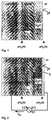
- an electron conductive substrate 1 coated with an electrolyte 2 is exposed to air or oxygen.
- the electron conducting substrate 1 may consist of a Ni-base-superalloy, a refractory element or carbon.
- the electrolyte may consist of a metallic oxide like yttria-stabilized zirconia or hafnia.
- Substrates made out of Ni-base-superalloy may be single crystal (SX or SC), directional solidified (DS) or conventional cast (CC) components.
- SX or SC single crystal
- DS directional solidified
- CC conventional cast
- this can be realized by applying a closed circuit with a direct current source having the negative pole at the substrate 1 side B and the positive pole at the oxide surface 4 side A.
- the anode 3 should be high temperature resistant, have a good adherence, have the same thermal expansion coefficient as the electrolyte.
- the electrode should have preferably no porosity to prevent the substrate from molecular oxygen.
- the impressed current provides an external potential E ext in the opposite direction to the potential in the oxide. Is the external potential about the same order than the internal one the electron flow balance becomes minimal and therefore also the flux of oxygen ions. Equation 2 shows the oxide growth rate in dependence of the potentials.
- Figure 3 shows the conditions existing in a gas turbine component surface consisting of a substrate 1 of a Ni-base-superalloy, an optional bond coat 6 of MCrAlY, preferably NiCoCrAlY, a substrate oxide 7 and an electrolyte 2 of yttria-stabilized zirconia (ZrO 2 with Y 2 O 3 ), normally used as a thermal barrier coating (TBC).
- a thermal barrier coating TBC
- a NiCoCrAlY bond or overlay coating which forms a protective substrate oxide (alumina) scale generally provides this protection.
- the TBC is utilized to provide a thermal gradient to keep the blade surface relatively cool.
- the aluminum of the NiCoCrAlY coating will be consumed by the oxidation to maintain the protective alumina scale. Therefore there is a limit in oxidation resistance depending on the residual aluminum content of the coating.
- Another limit with respect to the TBC is the alumina scale thickness. Up to a alumina scale thickness of about 5 ⁇ m relatively good TBC adherence exists.
- TBC-alumina integrity Above 5 ⁇ m up to about 10 ⁇ m TBC-alumina integrity is not guarantied anymore. Above 10 ⁇ m the TBC spalls.
- the oxidation protection can be enhanced. A control and decrease of the oxide growth will provide higher component lifetime by reducing oxidation and keeping the substrate-TBC integrity.
- the rate of oxidation depends on the oxygen partial pressure at the substrate oxide - electrolyte interface 5, which in term depends on the amount of oxygen ions diffusing through the electrolyte layer 2.
- the oxygen ion transport in the electrolyte has to be reduced.
- the advantageous nature of the TBC to be a highly ion conductive but poorly electron conductive material makes it possible to use the TBC as a solid electrolyte.
- the change in electron flow rate can be realized by polarizing the base material with respect to an electrode 3 placed on top of the TBC.
- the substrate material 1 would be the cathode and the outer electrode an inert anode 3.
- a perowskite oxide La 0.84 Sr 0.16 MnO 3
- Oxides with perowskite structure are electron conductive to more than 1500 °C, high temperature resistant, relatively inert to the environment and they can be plasma sprayed or physical vapor deposited.
- Another advantage of the polarization-induced reduction of the oxygen partial pressure at the metal-oxide interface is the preferred formation of thermodynamically more stable oxides.
- the voltage necessary to stop oxidation can be estimated by using equation (1) with respect to the existence of a TBC as the ion conducting oxide (equation "modified (1)").
- the voltage required to dissociate alumina would by in the range of -1.1 to -1.5 V, preferably -1,3 V.
- the applicable voltage is mainly depending on the temperature and the oxygen partial pressure according to equation modified (1).
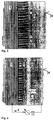
- FIG. 5 shows as an example the utilization for a gas turbine blade airfoil 6 with a blade root 9 inserted in a rotor 10.
- the exact location of the DC source 11 depends on the design of the turbine and the type of component. In this case the DC source could be placed in the rotor 11 or outward the rotor with an electric connection to the blade airfoil 8 or root 9.
- the substrate is the cathode and the electrode is the anode. According to the location of the turbine component in the turbine, the temperature and the oxygen partial pressure at this location the voltage of the DC supply is adjusted to limit the growth of the substrate oxide.
- the application will be easier than for blades since these components are static and placed at the for the power source accessible engine casing.
- the oxidation parameters change along the rotor longitudinal axis due to the changing temperature. Then it is useful to polarize the blades of one row with a certain potential and blades of another row with a different potential according to the temperature term in equation (1). This allows to adjust the substrate oxide scale 7 for every temperature and oxygen pressure in the turbine. Because of economical reasons not every single blade and vane should be polarized by an own DC source. Several components can be connected to one DC power source. The power required to protect a component can be calculated after the Ohm's law in equations (3), (4) and (5). For the calculation the resistance of the different materials have to be taken into consideration. In Figure 6 the electrical scheme of the component surface is shown.
- the potential necessary to retard oxidation has to be maintained over the TBC and the oxide scale which forms beneath the TBC.
- the ranking of the resistance is R1 ⁇ R3 « R2 ⁇ R6. Since the resistance of the superalloys and the anode material are neglectable compared to the resistance of the TBC and the oxide scale (pure alumina assumed), only R6 and R2 according to Figure 6 are of importance. After Ohm the resistance's are additive in this scheme.
- the substrate oxide scale which should be retarded in growth should not become thicker than about 10 ⁇ m, preferably not thicker than 5 ⁇ m.
- the invention is of course not restricted to the exemplary embodiment shown and described. It can also be applied to steam turbine components.
Landscapes
- Engineering & Computer Science (AREA)
- Chemical & Material Sciences (AREA)
- Materials Engineering (AREA)
- Mechanical Engineering (AREA)
- Metallurgy (AREA)
- Organic Chemistry (AREA)
- General Engineering & Computer Science (AREA)
- Turbine Rotor Nozzle Sealing (AREA)
Priority Applications (1)
| Application Number | Priority Date | Filing Date | Title |
|---|---|---|---|
| EP98810120A EP0936287A1 (de) | 1998-02-16 | 1998-02-16 | Turbinenbauteil und Verfahren zur Steuerung der Oxidation eines Turbinenbauteils |
Applications Claiming Priority (1)
| Application Number | Priority Date | Filing Date | Title |
|---|---|---|---|
| EP98810120A EP0936287A1 (de) | 1998-02-16 | 1998-02-16 | Turbinenbauteil und Verfahren zur Steuerung der Oxidation eines Turbinenbauteils |
Publications (1)
| Publication Number | Publication Date |
|---|---|
| EP0936287A1 true EP0936287A1 (de) | 1999-08-18 |
Family
ID=8235940
Family Applications (1)
| Application Number | Title | Priority Date | Filing Date |
|---|---|---|---|
| EP98810120A Withdrawn EP0936287A1 (de) | 1998-02-16 | 1998-02-16 | Turbinenbauteil und Verfahren zur Steuerung der Oxidation eines Turbinenbauteils |
Country Status (1)
| Country | Link |
|---|---|
| EP (1) | EP0936287A1 (de) |
Cited By (3)
| Publication number | Priority date | Publication date | Assignee | Title |
|---|---|---|---|---|
| DE10001620A1 (de) * | 2000-01-17 | 2001-07-19 | Abb Alstom Power Ch Ag | Beschichtungsverfahren |
| EP1722011A1 (de) * | 2005-05-11 | 2006-11-15 | Siemens Aktiengesellschaft | Turbinenkomponente, elektrisches System mit der Turbinenkomponente, Brenner, Turbine und Verfahren zur Verminderung von Korrosion bei einer Turbinenkomponente |
| FR3072456A1 (fr) * | 2017-10-16 | 2019-04-19 | Safran Aircraft Engines | Systeme de protection contre la corrosion des pieces en aluminium d'une turbomachine |
Citations (2)
| Publication number | Priority date | Publication date | Assignee | Title |
|---|---|---|---|---|
| EP0455419A1 (de) * | 1990-04-30 | 1991-11-06 | General Electric Company | Beschichtung von Stahlkörpern |
| US5652044A (en) * | 1992-03-05 | 1997-07-29 | Rolls Royce Plc | Coated article |
-
1998
- 1998-02-16 EP EP98810120A patent/EP0936287A1/de not_active Withdrawn
Patent Citations (2)
| Publication number | Priority date | Publication date | Assignee | Title |
|---|---|---|---|---|
| EP0455419A1 (de) * | 1990-04-30 | 1991-11-06 | General Electric Company | Beschichtung von Stahlkörpern |
| US5652044A (en) * | 1992-03-05 | 1997-07-29 | Rolls Royce Plc | Coated article |
Non-Patent Citations (1)
| Title |
|---|
| COURTRIGHT: "Electrolytic Protection to Reduce High-Temperature Oxidation", OXID. MET., vol. 38, no. 3/4, 1992, pages 267 - 287, XP002073280 * |
Cited By (3)
| Publication number | Priority date | Publication date | Assignee | Title |
|---|---|---|---|---|
| DE10001620A1 (de) * | 2000-01-17 | 2001-07-19 | Abb Alstom Power Ch Ag | Beschichtungsverfahren |
| EP1722011A1 (de) * | 2005-05-11 | 2006-11-15 | Siemens Aktiengesellschaft | Turbinenkomponente, elektrisches System mit der Turbinenkomponente, Brenner, Turbine und Verfahren zur Verminderung von Korrosion bei einer Turbinenkomponente |
| FR3072456A1 (fr) * | 2017-10-16 | 2019-04-19 | Safran Aircraft Engines | Systeme de protection contre la corrosion des pieces en aluminium d'une turbomachine |
Similar Documents
| Publication | Publication Date | Title |
|---|---|---|
| EP0848077B1 (de) | Wärmesperrschichtsysteme und -materialien | |
| EP0992603B1 (de) | Wärmedämmende Beschichtungssysteme und Materialen | |
| JP3051395B2 (ja) | 熱遮断コ―トへのオ―バ―コ―トの方法及びそのオ―バ―コ―トされた物 | |
| EP1321542B1 (de) | Wärmedämmschicht-Systeme sowie -Werkstoffe | |
| US7291408B2 (en) | Thermal barrier coatings with low thermal conductivity | |
| EP1837412B1 (de) | Beschichtung geeignet zur Verwendung als Bindeschicht in einem wärmedämmenden Beschichtungssystem | |
| US5834070A (en) | Method of producing protective coatings with chemical composition and structure gradient across the thickness | |
| US6123997A (en) | Method for forming a thermal barrier coating | |
| RU2395624C2 (ru) | Материал и система слоев | |
| CN1005495B (zh) | 用于陆上和船用燃气轮机的涡轮叶片的改进 | |
| EP1400610A1 (de) | Wärmedämmschichtmaterial mit niedriger Wärmeleitfähigkeit Lanthanid Sesquioxide enthaltend | |
| MXPA06014620A (es) | Capa de union nicocraiy modificada con platino para revestimiento termico de barrera. | |
| KR100707789B1 (ko) | 열장벽 코팅 | |
| EP1711339A2 (de) | Langlebige wärmesperrbeschichtung mit geringer wärmeleitfähigkeit | |
| KR100611723B1 (ko) | 내고온 부식성, 내산화성이 우수한 내열성 티타늄합금재료 및 그 제조방법 | |
| Vorkötter et al. | Oxide dispersion strengthened bond coats with higher alumina content: Oxidation resistance and influence on thermal barrier coating lifetime | |
| US20100291302A1 (en) | Article protected by a thermal barrier coating having a group 2 or 3/group 5 stabilization-composition-enriched surface | |
| JP2003041358A (ja) | 金属基体に断熱コーティングシステムを付与する方法 | |
| JPH0978258A (ja) | 遮熱コーティングを有する高温部材およびその製造方法 | |
| EP0936287A1 (de) | Turbinenbauteil und Verfahren zur Steuerung der Oxidation eines Turbinenbauteils | |
| JP2001521992A (ja) | 高温ガスの衝流を受ける構造部材及びこの構造部材への被膜の形成方法 | |
| KR100306247B1 (ko) | 저열팽창합금 | |
| KR100270226B1 (ko) | 새로운 구조의 열차폐 코팅 및 그의 제조방법 | |
| KR101166150B1 (ko) | 낮은 열 도전율을 갖는 내구성 열 차폐 코팅 | |
| CA1339403C (en) | Thermal barrier coating for superalloy components |
Legal Events
| Date | Code | Title | Description |
|---|---|---|---|
| PUAI | Public reference made under article 153(3) epc to a published international application that has entered the european phase |
Free format text: ORIGINAL CODE: 0009012 |
|
| AK | Designated contracting states |
Kind code of ref document: A1 Designated state(s): AT BE CH DE DK ES FI FR GB GR IE IT LI LU MC NL PT SE |
|
| AX | Request for extension of the european patent |
Free format text: AL;LT;LV;MK;RO;SI |
|
| AKX | Designation fees paid | ||
| REG | Reference to a national code |
Ref country code: DE Ref legal event code: 8566 |
|
| STAA | Information on the status of an ep patent application or granted ep patent |
Free format text: STATUS: THE APPLICATION IS DEEMED TO BE WITHDRAWN |
|
| 18D | Application deemed to be withdrawn |
Effective date: 20000219 |