EP0937108B1 - Copolymeres et terpolymeres a base de composes alpha,beta-insatures et d'anhydrides d'acide dicarboxylique alpha,beta-insatures - Google Patents
Copolymeres et terpolymeres a base de composes alpha,beta-insatures et d'anhydrides d'acide dicarboxylique alpha,beta-insatures Download PDFInfo
- Publication number
- EP0937108B1 EP0937108B1 EP97948822A EP97948822A EP0937108B1 EP 0937108 B1 EP0937108 B1 EP 0937108B1 EP 97948822 A EP97948822 A EP 97948822A EP 97948822 A EP97948822 A EP 97948822A EP 0937108 B1 EP0937108 B1 EP 0937108B1
- Authority
- EP
- European Patent Office
- Prior art keywords
- mol
- structural units
- terpolymers
- methyl
- formula
- Prior art date
- Legal status (The legal status is an assumption and is not a legal conclusion. Google has not performed a legal analysis and makes no representation as to the accuracy of the status listed.)
- Expired - Lifetime
Links
- 0 *N*(O[N+](N*)[O-])=O Chemical compound *N*(O[N+](N*)[O-])=O 0.000 description 2
Classifications
-
- C—CHEMISTRY; METALLURGY
- C10—PETROLEUM, GAS OR COKE INDUSTRIES; TECHNICAL GASES CONTAINING CARBON MONOXIDE; FUELS; LUBRICANTS; PEAT
- C10L—FUELS NOT OTHERWISE PROVIDED FOR; NATURAL GAS; SYNTHETIC NATURAL GAS OBTAINED BY PROCESSES NOT COVERED BY SUBCLASSES C10G OR C10K; LIQUIFIED PETROLEUM GAS; USE OF ADDITIVES TO FUELS OR FIRES; FIRE-LIGHTERS
- C10L1/00—Liquid carbonaceous fuels
- C10L1/10—Liquid carbonaceous fuels containing additives
- C10L1/14—Organic compounds
- C10L1/22—Organic compounds containing nitrogen
- C10L1/234—Macromolecular compounds
- C10L1/236—Macromolecular compounds obtained by reactions involving only carbon-to-carbon unsaturated bonds derivatives thereof
- C10L1/2364—Macromolecular compounds obtained by reactions involving only carbon-to-carbon unsaturated bonds derivatives thereof homo- or copolymers derived from unsaturated compounds containing amide and/or imide groups
-
- C—CHEMISTRY; METALLURGY
- C08—ORGANIC MACROMOLECULAR COMPOUNDS; THEIR PREPARATION OR CHEMICAL WORKING-UP; COMPOSITIONS BASED THEREON
- C08F—MACROMOLECULAR COMPOUNDS OBTAINED BY REACTIONS ONLY INVOLVING CARBON-TO-CARBON UNSATURATED BONDS
- C08F210/00—Copolymers of unsaturated aliphatic hydrocarbons having only one carbon-to-carbon double bond
- C08F210/02—Ethene
-
- C—CHEMISTRY; METALLURGY
- C08—ORGANIC MACROMOLECULAR COMPOUNDS; THEIR PREPARATION OR CHEMICAL WORKING-UP; COMPOSITIONS BASED THEREON
- C08F—MACROMOLECULAR COMPOUNDS OBTAINED BY REACTIONS ONLY INVOLVING CARBON-TO-CARBON UNSATURATED BONDS
- C08F222/00—Copolymers of compounds having one or more unsaturated aliphatic radicals, each having only one carbon-to-carbon double bond, and at least one being terminated by a carboxyl radical and containing at least one other carboxyl radical in the molecule; Salts, anhydrides, esters, amides, imides, or nitriles thereof
- C08F222/04—Anhydrides, e.g. cyclic anhydrides
- C08F222/06—Maleic anhydride
-
- C—CHEMISTRY; METALLURGY
- C10—PETROLEUM, GAS OR COKE INDUSTRIES; TECHNICAL GASES CONTAINING CARBON MONOXIDE; FUELS; LUBRICANTS; PEAT
- C10L—FUELS NOT OTHERWISE PROVIDED FOR; NATURAL GAS; SYNTHETIC NATURAL GAS OBTAINED BY PROCESSES NOT COVERED BY SUBCLASSES C10G OR C10K; LIQUIFIED PETROLEUM GAS; USE OF ADDITIVES TO FUELS OR FIRES; FIRE-LIGHTERS
- C10L1/00—Liquid carbonaceous fuels
- C10L1/10—Liquid carbonaceous fuels containing additives
- C10L1/14—Organic compounds
- C10L1/143—Organic compounds mixtures of organic macromolecular compounds with organic non-macromolecular compounds
-
- C—CHEMISTRY; METALLURGY
- C10—PETROLEUM, GAS OR COKE INDUSTRIES; TECHNICAL GASES CONTAINING CARBON MONOXIDE; FUELS; LUBRICANTS; PEAT
- C10L—FUELS NOT OTHERWISE PROVIDED FOR; NATURAL GAS; SYNTHETIC NATURAL GAS OBTAINED BY PROCESSES NOT COVERED BY SUBCLASSES C10G OR C10K; LIQUIFIED PETROLEUM GAS; USE OF ADDITIVES TO FUELS OR FIRES; FIRE-LIGHTERS
- C10L1/00—Liquid carbonaceous fuels
- C10L1/10—Liquid carbonaceous fuels containing additives
- C10L1/14—Organic compounds
- C10L1/22—Organic compounds containing nitrogen
- C10L1/234—Macromolecular compounds
- C10L1/236—Macromolecular compounds obtained by reactions involving only carbon-to-carbon unsaturated bonds derivatives thereof
- C10L1/2366—Macromolecular compounds obtained by reactions involving only carbon-to-carbon unsaturated bonds derivatives thereof homo- or copolymers derived from unsaturated compounds containing amine groups
-
- C—CHEMISTRY; METALLURGY
- C10—PETROLEUM, GAS OR COKE INDUSTRIES; TECHNICAL GASES CONTAINING CARBON MONOXIDE; FUELS; LUBRICANTS; PEAT
- C10M—LUBRICATING COMPOSITIONS; USE OF CHEMICAL SUBSTANCES EITHER ALONE OR AS LUBRICATING INGREDIENTS IN A LUBRICATING COMPOSITION
- C10M145/00—Lubricating compositions characterised by the additive being a macromolecular compound containing oxygen
- C10M145/02—Macromolecular compounds obtained by reactions only involving carbon-to-carbon unsaturated bonds
- C10M145/06—Macromolecular compounds obtained by reactions only involving carbon-to-carbon unsaturated bonds containing monomers having an unsaturated radical bound to an acyloxy radical of a saturated carboxylic or carbonic acid
- C10M145/08—Vinyl esters of a saturated carboxylic or carbonic acid
-
- C—CHEMISTRY; METALLURGY
- C10—PETROLEUM, GAS OR COKE INDUSTRIES; TECHNICAL GASES CONTAINING CARBON MONOXIDE; FUELS; LUBRICANTS; PEAT
- C10M—LUBRICATING COMPOSITIONS; USE OF CHEMICAL SUBSTANCES EITHER ALONE OR AS LUBRICATING INGREDIENTS IN A LUBRICATING COMPOSITION
- C10M149/00—Lubricating compositions characterised by the additive being a macromolecular compound containing nitrogen
- C10M149/02—Macromolecular compounds obtained by reactions only involving carbon-to-carbon unsaturated bonds
- C10M149/06—Macromolecular compounds obtained by reactions only involving carbon-to-carbon unsaturated bonds containing monomers having an unsaturated radical bound to an amido or imido group
-
- C—CHEMISTRY; METALLURGY
- C10—PETROLEUM, GAS OR COKE INDUSTRIES; TECHNICAL GASES CONTAINING CARBON MONOXIDE; FUELS; LUBRICANTS; PEAT
- C10M—LUBRICATING COMPOSITIONS; USE OF CHEMICAL SUBSTANCES EITHER ALONE OR AS LUBRICATING INGREDIENTS IN A LUBRICATING COMPOSITION
- C10M157/00—Lubricating compositions characterised by the additive being a mixture of two or more macromolecular compounds covered by more than one of the main groups C10M143/00 - C10M155/00, each of these compounds being essential
- C10M157/04—Lubricating compositions characterised by the additive being a mixture of two or more macromolecular compounds covered by more than one of the main groups C10M143/00 - C10M155/00, each of these compounds being essential at least one of them being a nitrogen-containing compound
-
- C—CHEMISTRY; METALLURGY
- C10—PETROLEUM, GAS OR COKE INDUSTRIES; TECHNICAL GASES CONTAINING CARBON MONOXIDE; FUELS; LUBRICANTS; PEAT
- C10L—FUELS NOT OTHERWISE PROVIDED FOR; NATURAL GAS; SYNTHETIC NATURAL GAS OBTAINED BY PROCESSES NOT COVERED BY SUBCLASSES C10G OR C10K; LIQUIFIED PETROLEUM GAS; USE OF ADDITIVES TO FUELS OR FIRES; FIRE-LIGHTERS
- C10L1/00—Liquid carbonaceous fuels
- C10L1/10—Liquid carbonaceous fuels containing additives
- C10L1/14—Organic compounds
- C10L1/16—Hydrocarbons
- C10L1/1608—Well defined compounds, e.g. hexane, benzene
-
- C—CHEMISTRY; METALLURGY
- C10—PETROLEUM, GAS OR COKE INDUSTRIES; TECHNICAL GASES CONTAINING CARBON MONOXIDE; FUELS; LUBRICANTS; PEAT
- C10L—FUELS NOT OTHERWISE PROVIDED FOR; NATURAL GAS; SYNTHETIC NATURAL GAS OBTAINED BY PROCESSES NOT COVERED BY SUBCLASSES C10G OR C10K; LIQUIFIED PETROLEUM GAS; USE OF ADDITIVES TO FUELS OR FIRES; FIRE-LIGHTERS
- C10L1/00—Liquid carbonaceous fuels
- C10L1/10—Liquid carbonaceous fuels containing additives
- C10L1/14—Organic compounds
- C10L1/16—Hydrocarbons
- C10L1/1616—Hydrocarbons fractions, e.g. lubricants, solvents, naphta, bitumen, tars, terpentine
-
- C—CHEMISTRY; METALLURGY
- C10—PETROLEUM, GAS OR COKE INDUSTRIES; TECHNICAL GASES CONTAINING CARBON MONOXIDE; FUELS; LUBRICANTS; PEAT
- C10L—FUELS NOT OTHERWISE PROVIDED FOR; NATURAL GAS; SYNTHETIC NATURAL GAS OBTAINED BY PROCESSES NOT COVERED BY SUBCLASSES C10G OR C10K; LIQUIFIED PETROLEUM GAS; USE OF ADDITIVES TO FUELS OR FIRES; FIRE-LIGHTERS
- C10L1/00—Liquid carbonaceous fuels
- C10L1/10—Liquid carbonaceous fuels containing additives
- C10L1/14—Organic compounds
- C10L1/18—Organic compounds containing oxygen
- C10L1/192—Macromolecular compounds
- C10L1/195—Macromolecular compounds obtained by reactions involving only carbon-to-carbon unsaturated bonds
-
- C—CHEMISTRY; METALLURGY
- C10—PETROLEUM, GAS OR COKE INDUSTRIES; TECHNICAL GASES CONTAINING CARBON MONOXIDE; FUELS; LUBRICANTS; PEAT
- C10L—FUELS NOT OTHERWISE PROVIDED FOR; NATURAL GAS; SYNTHETIC NATURAL GAS OBTAINED BY PROCESSES NOT COVERED BY SUBCLASSES C10G OR C10K; LIQUIFIED PETROLEUM GAS; USE OF ADDITIVES TO FUELS OR FIRES; FIRE-LIGHTERS
- C10L1/00—Liquid carbonaceous fuels
- C10L1/10—Liquid carbonaceous fuels containing additives
- C10L1/14—Organic compounds
- C10L1/18—Organic compounds containing oxygen
- C10L1/192—Macromolecular compounds
- C10L1/195—Macromolecular compounds obtained by reactions involving only carbon-to-carbon unsaturated bonds
- C10L1/196—Macromolecular compounds obtained by reactions involving only carbon-to-carbon unsaturated bonds derived from monomers containing a carbon-to-carbon unsaturated bond and a carboxyl group or salts, anhydrides or esters thereof homo- or copolymers of compounds having one or more unsaturated aliphatic radicals each having one carbon bond to carbon double bond, and at least one being terminated by a carboxyl radical or of salts, anhydrides or esters thereof
- C10L1/1966—Macromolecular compounds obtained by reactions involving only carbon-to-carbon unsaturated bonds derived from monomers containing a carbon-to-carbon unsaturated bond and a carboxyl group or salts, anhydrides or esters thereof homo- or copolymers of compounds having one or more unsaturated aliphatic radicals each having one carbon bond to carbon double bond, and at least one being terminated by a carboxyl radical or of salts, anhydrides or esters thereof poly-carboxylic
-
- C—CHEMISTRY; METALLURGY
- C10—PETROLEUM, GAS OR COKE INDUSTRIES; TECHNICAL GASES CONTAINING CARBON MONOXIDE; FUELS; LUBRICANTS; PEAT
- C10L—FUELS NOT OTHERWISE PROVIDED FOR; NATURAL GAS; SYNTHETIC NATURAL GAS OBTAINED BY PROCESSES NOT COVERED BY SUBCLASSES C10G OR C10K; LIQUIFIED PETROLEUM GAS; USE OF ADDITIVES TO FUELS OR FIRES; FIRE-LIGHTERS
- C10L1/00—Liquid carbonaceous fuels
- C10L1/10—Liquid carbonaceous fuels containing additives
- C10L1/14—Organic compounds
- C10L1/18—Organic compounds containing oxygen
- C10L1/192—Macromolecular compounds
- C10L1/195—Macromolecular compounds obtained by reactions involving only carbon-to-carbon unsaturated bonds
- C10L1/197—Macromolecular compounds obtained by reactions involving only carbon-to-carbon unsaturated bonds derived from monomers containing a carbon-to-carbon unsaturated bond and an acyloxy group of a saturated carboxylic or carbonic acid
- C10L1/1973—Macromolecular compounds obtained by reactions involving only carbon-to-carbon unsaturated bonds derived from monomers containing a carbon-to-carbon unsaturated bond and an acyloxy group of a saturated carboxylic or carbonic acid mono-carboxylic
-
- C—CHEMISTRY; METALLURGY
- C10—PETROLEUM, GAS OR COKE INDUSTRIES; TECHNICAL GASES CONTAINING CARBON MONOXIDE; FUELS; LUBRICANTS; PEAT
- C10L—FUELS NOT OTHERWISE PROVIDED FOR; NATURAL GAS; SYNTHETIC NATURAL GAS OBTAINED BY PROCESSES NOT COVERED BY SUBCLASSES C10G OR C10K; LIQUIFIED PETROLEUM GAS; USE OF ADDITIVES TO FUELS OR FIRES; FIRE-LIGHTERS
- C10L1/00—Liquid carbonaceous fuels
- C10L1/10—Liquid carbonaceous fuels containing additives
- C10L1/14—Organic compounds
- C10L1/18—Organic compounds containing oxygen
- C10L1/192—Macromolecular compounds
- C10L1/198—Macromolecular compounds obtained otherwise than by reactions involving only carbon-to-carbon unsaturated bonds homo- or copolymers of compounds having one or more unsaturated aliphatic radicals, each having only one carbon to carbon double bond, and at least one being terminated by an acyloxy radical of a saturated carboxylic acid, of carbonic acid
- C10L1/1985—Macromolecular compounds obtained otherwise than by reactions involving only carbon-to-carbon unsaturated bonds homo- or copolymers of compounds having one or more unsaturated aliphatic radicals, each having only one carbon to carbon double bond, and at least one being terminated by an acyloxy radical of a saturated carboxylic acid, of carbonic acid polyethers, e.g. di- polygylcols and derivatives; ethers - esters
-
- C—CHEMISTRY; METALLURGY
- C10—PETROLEUM, GAS OR COKE INDUSTRIES; TECHNICAL GASES CONTAINING CARBON MONOXIDE; FUELS; LUBRICANTS; PEAT
- C10L—FUELS NOT OTHERWISE PROVIDED FOR; NATURAL GAS; SYNTHETIC NATURAL GAS OBTAINED BY PROCESSES NOT COVERED BY SUBCLASSES C10G OR C10K; LIQUIFIED PETROLEUM GAS; USE OF ADDITIVES TO FUELS OR FIRES; FIRE-LIGHTERS
- C10L1/00—Liquid carbonaceous fuels
- C10L1/10—Liquid carbonaceous fuels containing additives
- C10L1/14—Organic compounds
- C10L1/22—Organic compounds containing nitrogen
- C10L1/222—Organic compounds containing nitrogen containing at least one carbon-to-nitrogen single bond
- C10L1/224—Amides; Imides carboxylic acid amides, imides
-
- C—CHEMISTRY; METALLURGY
- C10—PETROLEUM, GAS OR COKE INDUSTRIES; TECHNICAL GASES CONTAINING CARBON MONOXIDE; FUELS; LUBRICANTS; PEAT
- C10M—LUBRICATING COMPOSITIONS; USE OF CHEMICAL SUBSTANCES EITHER ALONE OR AS LUBRICATING INGREDIENTS IN A LUBRICATING COMPOSITION
- C10M2209/00—Organic macromolecular compounds containing oxygen as ingredients in lubricant compositions
- C10M2209/02—Macromolecular compounds obtained by reactions only involving carbon-to-carbon unsaturated bonds
- C10M2209/04—Macromolecular compounds obtained by reactions only involving carbon-to-carbon unsaturated bonds containing monomers having an unsaturated radical bound to an alcohol or ester thereof; bound to an aldehyde, ketonic, ether, ketal or acetal radical
-
- C—CHEMISTRY; METALLURGY
- C10—PETROLEUM, GAS OR COKE INDUSTRIES; TECHNICAL GASES CONTAINING CARBON MONOXIDE; FUELS; LUBRICANTS; PEAT
- C10M—LUBRICATING COMPOSITIONS; USE OF CHEMICAL SUBSTANCES EITHER ALONE OR AS LUBRICATING INGREDIENTS IN A LUBRICATING COMPOSITION
- C10M2209/00—Organic macromolecular compounds containing oxygen as ingredients in lubricant compositions
- C10M2209/02—Macromolecular compounds obtained by reactions only involving carbon-to-carbon unsaturated bonds
- C10M2209/06—Macromolecular compounds obtained by reactions only involving carbon-to-carbon unsaturated bonds containing monomers having an unsaturated radical bound to an acyloxy radical of saturated carboxylic or carbonic acid
-
- C—CHEMISTRY; METALLURGY
- C10—PETROLEUM, GAS OR COKE INDUSTRIES; TECHNICAL GASES CONTAINING CARBON MONOXIDE; FUELS; LUBRICANTS; PEAT
- C10M—LUBRICATING COMPOSITIONS; USE OF CHEMICAL SUBSTANCES EITHER ALONE OR AS LUBRICATING INGREDIENTS IN A LUBRICATING COMPOSITION
- C10M2209/00—Organic macromolecular compounds containing oxygen as ingredients in lubricant compositions
- C10M2209/02—Macromolecular compounds obtained by reactions only involving carbon-to-carbon unsaturated bonds
- C10M2209/06—Macromolecular compounds obtained by reactions only involving carbon-to-carbon unsaturated bonds containing monomers having an unsaturated radical bound to an acyloxy radical of saturated carboxylic or carbonic acid
- C10M2209/062—Vinyl esters of saturated carboxylic or carbonic acids, e.g. vinyl acetate
-
- C—CHEMISTRY; METALLURGY
- C10—PETROLEUM, GAS OR COKE INDUSTRIES; TECHNICAL GASES CONTAINING CARBON MONOXIDE; FUELS; LUBRICANTS; PEAT
- C10M—LUBRICATING COMPOSITIONS; USE OF CHEMICAL SUBSTANCES EITHER ALONE OR AS LUBRICATING INGREDIENTS IN A LUBRICATING COMPOSITION
- C10M2215/00—Organic non-macromolecular compounds containing nitrogen as ingredients in lubricant Compositions
- C10M2215/02—Amines, e.g. polyalkylene polyamines; Quaternary amines
- C10M2215/04—Amines, e.g. polyalkylene polyamines; Quaternary amines having amino groups bound to acyclic or cycloaliphatic carbon atoms
-
- C—CHEMISTRY; METALLURGY
- C10—PETROLEUM, GAS OR COKE INDUSTRIES; TECHNICAL GASES CONTAINING CARBON MONOXIDE; FUELS; LUBRICANTS; PEAT
- C10M—LUBRICATING COMPOSITIONS; USE OF CHEMICAL SUBSTANCES EITHER ALONE OR AS LUBRICATING INGREDIENTS IN A LUBRICATING COMPOSITION
- C10M2215/00—Organic non-macromolecular compounds containing nitrogen as ingredients in lubricant Compositions
- C10M2215/24—Organic non-macromolecular compounds containing nitrogen as ingredients in lubricant Compositions having hydrocarbon substituents containing thirty or more carbon atoms, e.g. nitrogen derivatives of substituted succinic acid
- C10M2215/26—Amines
-
- C—CHEMISTRY; METALLURGY
- C10—PETROLEUM, GAS OR COKE INDUSTRIES; TECHNICAL GASES CONTAINING CARBON MONOXIDE; FUELS; LUBRICANTS; PEAT
- C10M—LUBRICATING COMPOSITIONS; USE OF CHEMICAL SUBSTANCES EITHER ALONE OR AS LUBRICATING INGREDIENTS IN A LUBRICATING COMPOSITION
- C10M2217/00—Organic macromolecular compounds containing nitrogen as ingredients in lubricant compositions
- C10M2217/02—Macromolecular compounds obtained from nitrogen containing monomers by reactions only involving carbon-to-carbon unsaturated bonds
- C10M2217/024—Macromolecular compounds obtained from nitrogen containing monomers by reactions only involving carbon-to-carbon unsaturated bonds containing monomers having an unsaturated radical bound to an amido or imido group
-
- C—CHEMISTRY; METALLURGY
- C10—PETROLEUM, GAS OR COKE INDUSTRIES; TECHNICAL GASES CONTAINING CARBON MONOXIDE; FUELS; LUBRICANTS; PEAT
- C10M—LUBRICATING COMPOSITIONS; USE OF CHEMICAL SUBSTANCES EITHER ALONE OR AS LUBRICATING INGREDIENTS IN A LUBRICATING COMPOSITION
- C10M2217/00—Organic macromolecular compounds containing nitrogen as ingredients in lubricant compositions
- C10M2217/02—Macromolecular compounds obtained from nitrogen containing monomers by reactions only involving carbon-to-carbon unsaturated bonds
- C10M2217/028—Macromolecular compounds obtained from nitrogen containing monomers by reactions only involving carbon-to-carbon unsaturated bonds containing monomers having an unsaturated radical bound to a nitrogen-containing hetero ring
-
- C—CHEMISTRY; METALLURGY
- C10—PETROLEUM, GAS OR COKE INDUSTRIES; TECHNICAL GASES CONTAINING CARBON MONOXIDE; FUELS; LUBRICANTS; PEAT
- C10M—LUBRICATING COMPOSITIONS; USE OF CHEMICAL SUBSTANCES EITHER ALONE OR AS LUBRICATING INGREDIENTS IN A LUBRICATING COMPOSITION
- C10M2217/00—Organic macromolecular compounds containing nitrogen as ingredients in lubricant compositions
- C10M2217/04—Macromolecular compounds from nitrogen-containing monomers obtained otherwise than by reactions only involving carbon-to-carbon unsaturated bonds
- C10M2217/046—Polyamines, i.e. macromoleculars obtained by condensation of more than eleven amine monomers
-
- C—CHEMISTRY; METALLURGY
- C10—PETROLEUM, GAS OR COKE INDUSTRIES; TECHNICAL GASES CONTAINING CARBON MONOXIDE; FUELS; LUBRICANTS; PEAT
- C10M—LUBRICATING COMPOSITIONS; USE OF CHEMICAL SUBSTANCES EITHER ALONE OR AS LUBRICATING INGREDIENTS IN A LUBRICATING COMPOSITION
- C10M2217/00—Organic macromolecular compounds containing nitrogen as ingredients in lubricant compositions
- C10M2217/06—Macromolecular compounds obtained by functionalisation op polymers with a nitrogen containing compound
Definitions
- the invention relates to copolymers and terpolymers based on ⁇ , ⁇ -unsaturated Compounds and ⁇ , ⁇ -unsaturated dicarboxylic anhydrides, various Process for their preparation and their use as flow improvers in Mineral oils and mineral oil distillates.
- Crude oils and middle distillates obtained by distilling crude oils such as gas oil, Diesel oil or heating oil contain different ones depending on the origin of the crude oils Amounts of n-paraffins which, when the temperature is lowered, are platelet-shaped Crystallize crystals and partially agglomerate with the inclusion of oil. This leads to a deterioration in the flow properties of these oils or distillates, which means, for example, during extraction, transport, storage and / or use of mineral oils and mineral oil distillates can. With mineral oils, this crystallization phenomenon can occur during transport through pipelines, especially in winter, to deposits on the pipe walls, in Individual cases, e.g. if a pipeline is at a standstill, even to completely block it to lead.
- the modified paraffin crystals are less prone to agglomeration, so that the oils mixed with these additives still pump or can be processed, which are often more than 20 ° lower than with non-additive oils.
- the paraffin-inhibiting effect of the flow improvers is often not sufficient so that it is used for sedimentation and thus for the formation of a paraffin-rich layer on the bottom of storage containers comes. To do this prevent, paraffin dispersants are added to the oils.
- Typical flow improvers for crude oils and middle distillates are copolymers of Ethylene with carboxylic acid esters of vinyl alcohol.
- copolymers based on ⁇ , ⁇ -unsaturated compounds and maleic anhydride are known for use as flow improvers.
- EP-A-0 154 177 describes reaction products of alternating Copolymers based on ⁇ , ⁇ -unsaturated compounds and Maleic anhydride with primary monoalkylamines and / or aliphatic Alcohols described. These copolymers are used as paraffin inhibitors for petroleum products containing paraffin, such as crude oils and distillation residues suitable for petroleum processing.
- EP-A-0 320 766 describes mixtures of ethylene / vinyl acetate copolymers and copolymers with 10 to 90% by weight of C 6 -C 24 olefins and 10 to 90% by weight of NC 6 -C22 alkyl maleimide. These polymer blends are used as flow improvers for high-boiling mineral oil distillates.
- DE-OS 2 024 131 describes the conversion of statistical copolymers Ethylene and maleic anhydride with primary or secondary polyamines known.
- the implementation enables partial or full networking the copolymers, is preferred for curing molded parts or with Copolymers produced coatings performed and supplies products with good mechanical properties and high heat resistance, e.g. as Insulation for cables, as packaging material for hot products or as heat-resistant pipes, but not as paraffin inhibitors.
- DE-OS 2 214 331 describes a method for producing adhesives improved adhesion properties known in which a random copolymer from ethylene and maleic anhydride with ammonia, primary or secondary Amines is treated.
- the acid groups of those copolymerized in the copolymer Maleic anhydride units are under the chosen reaction conditions converted to amide groups and ammonium salts, but not to imide groups.
- the effectiveness of the known additives to improve the properties of mineral oil fractions includes depending on the origin of the mineral oil from which they were obtained and, in particular, from its composition. Additives that are used to set certain property values of fractions of a Crude oils are ideally suited for distillates of crude oils of other origin lead to completely unsatisfactory results.
- Additives are now available that have a wide range of applications, ie significantly improve the flow properties of mineral oils and mineral oil fractions from different origins at low temperatures. Nevertheless, there are cases in which they prove to be of little or no use. The causes for this are manifold; Examples include the opening up of previously unused raw materials, the changed processing of primary products and new requirements in special markets.
- diesel fuels that are characterized by a reduced environmental impact characterized by combustion and by a very low sulfur content of less than 500 ppm and in particular less than 100 ppm as well a low aromatic content can be characterized with conventional ones Do not add or only insufficiently add flow improvers. Problems arise especially those made for use under arctic conditions Winter qualities of diesel fuels with their extreme cold properties, such as e.g. a cloud point below -20 ° C and especially below -30 ° C, very much narrow distillation cuts with boiling ranges of 20 to 90 vol .-% smaller 100 ° C, especially less than 80 ° C and sometimes also less than 60 ° C, and one approx. 350 ° C and especially at approx. 320 ° C limited boiling point.
- the Cold properties of such distillates can currently only be achieved by adding low-boiling, low-paraffin components, e.g. Kerosene, satisfactory be improved.
- the invention relates to oil-soluble, statistical copolymers and terpolymers based on ⁇ , ⁇ -unsaturated compounds and ⁇ , ⁇ -unsaturated dicarboxylic acid anhydrides, which are characterized in that they contain 60-99 mol% of bivalent structural units A and optionally B.
- X is a C 2 -C 4 alkylene group
- R 10 is methyl or a C 6 -C 22 alkyl group and R 11 is a C 6 -C 24 alkyl group
- Y is a C 2 -C 4 alkylene group
- n is a number between 1 and 100
- R 12 is C 1 -C 30 alkyl, C 5 -C 12 cycloalkyl or C 6 -C 30 aryl
- R 13 is hydrogen
- R 8 and R 9 are the same or different and represent a radical -NHR 7 or OR 14 , where R 14 is hydrogen or an ammonium cation of the formula H 3 N ⁇ R 7 , where in the event that the structural units C and E contain different radicals R 7 , the proportion of the radicals R 7 with a meaning according to the formula G max. 10 mol%, based on the total number of radicals R 7 , and the
- copolymers based on ⁇ , ⁇ -unsaturated Compounds and ⁇ , ⁇ -unsaturated dicarboxylic anhydrides such polymers understand that from structural units A, which are derived from ethylene, and Structural units C and optionally D and E exist. However, are in the Polymer in addition to the structural units A and the structural units C and optionally D and E also before structural units B, so according to the invention spoken of a terpolymer, regardless of whether one or more different types of structural units B are present.
- the copolymers or terpolymers according to the invention contain 60 to 99 mol%, preferably 70 to 98 mol%, in particular 80 to 97.5 mol% of bivalent Structural units A and optionally structural units B and 1 to 40 mol%, preferably 2 to 30 mol%, in particular 2.5 to 20 mol% of bivalent Structural units C and optionally D and E.
- the share of structural units A in the sum of structural units A and B. is at least 70 mol%, preferably at least 80 mol% and in particular at least 90 mol%.
- the proportion of structural units C, based on the sum of the structural units C, D and E is preferably at least 80 mol% at least 85 mol%, particularly preferably at least 90 mol% and in particular at least 93 mol%.
- the proportion of the radicals R 7 with a meaning according to the formula G is at most 10 mol%, preferably at most 6 mol% and in particular at most 3 mol%, based on the total number the residues R 7 .
- the Co and Terpolymers only in a manner known per se during the polymerization end groups created by initiation, moderation and chain termination contain.
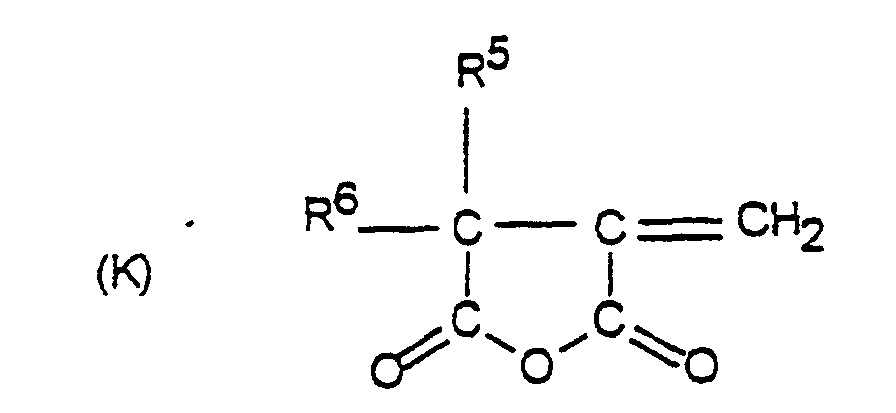
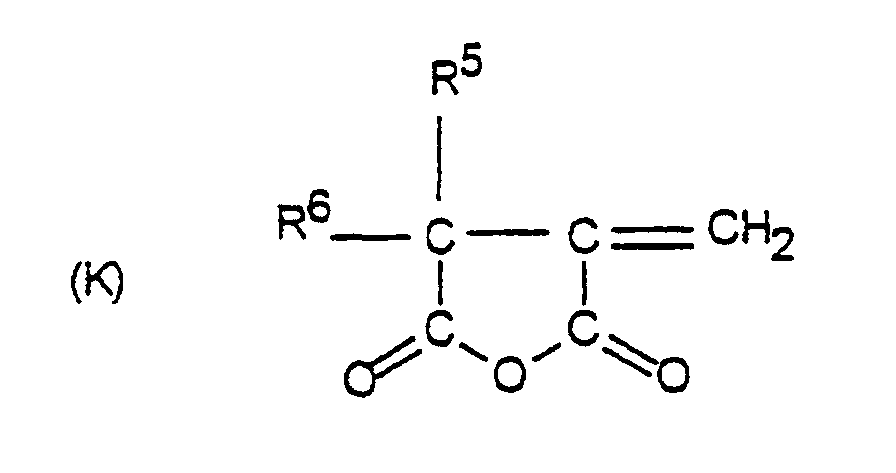
- the structural units c, D and E are derived from ⁇ , ⁇ -unsaturated dicarboxylic anhydrides of the general formula J and / or K. from where R 5 and R 6 are independently hydrogen or methyl. Examples include maleic anhydride, itaconic anhydride and citraconic anhydride; maleic anhydride is preferably used.
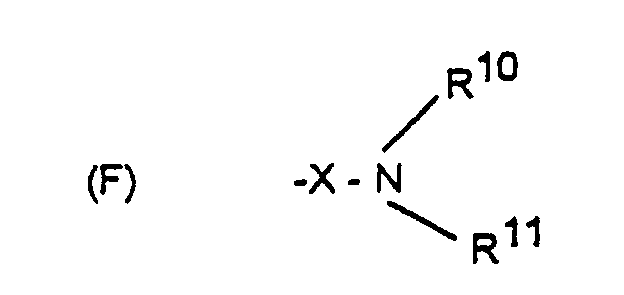
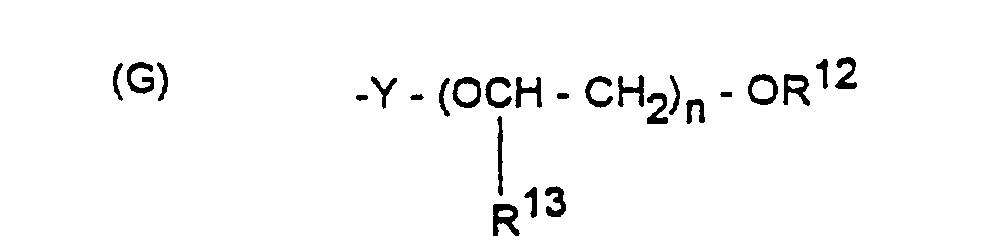
- the structural units C contain the imide group -NR 7 and the structural units E the amide group -NHR 7 and the ammonium cation H 3 N ⁇ R 7 . These groups are all derived from primary amines of formula L (L) NH 2 R 7 wherein R 7 is the same or different and a C 6 -C 24 alkyl group, a group of the general formula F or represents a group of the general formula G.
- primary amines of the formula L primary fatty alkyl amines with C 6 -C 24 -alkyl radicals such as octylamine, decylamine, dodecylamine, tetradecylamine, hexadecylamine, octadecylamine or mixtures of primary fatty alkylamines of natural origin such as coconut fatty amines or tallow fatty amines.
- Preferred primary amines of the formula L in which R 7 represents a group of the formula F are also those in which X represents a propylene radical and R 10 and / or R 11 represents a lauryl, coconut fat or tallow fat residue.
- Examples of primary amines of the formula L in which R 7 represents a group of the formula G are aminated oxethylates of lower alcohols, such as methanol or butanol, with a ratio of ethylene oxide: propylene oxide of 1:10 to 10: 1 and a molecular weight of up to 2000 g / mol.
- aminated oxethylates are described in DE 44 22 154 for reaction with polymers which contain dicarboxylic anhydride units.
- the copolymers or terpolymers according to the invention have intrinsic viscosity values K. (measured according to Ubbelohde in 5% by weight solution in toluene at 25 ° C) from 10 to 100, preferably 10 to 50.
- the melt viscosity of the copolymers or terpolymers at 140 ° C. (V 140 ) is 10-10,000 mPas, preferably 20-5,000 mPas.
- the invention further relates to a process for the preparation of the copolymers and terpolymers according to the invention based on ⁇ , ⁇ -unsaturated compounds and ⁇ , ⁇ -unsaturated dicarboxylic anhydrides, which is characterized in that first ethylene and optionally further monomers of the general formula H where R 1 and R 2 are different, R 1 is hydrogen or methyl and R 2 is hydrogen, a group -COOR 3 or a group -OOCR 4 , in which R 3 and R 4 are identical or different and are a linear or branched C 1 - C 12 alkyl group, preferably methyl or ethyl, and monomers of the general formula J and / or K, where R 5 and R 6 independently of one another are hydrogen or methyl, polymerize with one another and then react the copolymer or terpolymer obtained with one or more amines of the formula L, (L) NH 2 R 7 wherein R 7 represents a C 6 -C 22 alkyl group,
- X is a C 2 -C 4 alkylene group and R 10 is methyl or a C 6 -C 22 alkyl group
- R 11 is a C 6 -C 22 alkyl group
- Y is a C 2 -C 4 alkylene group
- n is a number between 1 and 100
- R 12 is C 1 -C 30 alkyl, C 5 -C 12 cycloalkyl or C 6 -C 30 aryl
- R 13 is hydrogen, C 1 -C 4 alkyl, preferably methyl.
- amines with radicals R 7 it is preferred to add the amines with radicals R 7 according to the formula G with a maximum of 10 mol%, preferably a maximum of 6 mol% and in particular with a maximum of 3 mol%, based on the acid anhydride groups to be reacted in the polymerized ⁇ , ⁇ -unsaturated dicarboxylic acid anhydrides.
- the polymerization is carried out in a continuous or batchwise manner, preferably continuous high pressure polymerization.
- the Polymerization conditions for the production of statistical copolymers Ethylene and optionally further ⁇ , ⁇ -unsaturated monomers and Maleic anhydride is from Terteryan and Khrapov (Polymer Science U.S.S.R. 1983, Vol. 25, 2151 - 2160) have been extensively examined and also from FR 2 569 412, FR 2 569 411 and DD 108 757 are known.
- the polymerization process is carried out at temperatures between 100 and 350, preferably 140-300 ° C and under a pressure of 50 and 400 MPa, preferably 100 and 300 Mpa.
- Suitable initiators are used for the polymerization Radical chain starters such as Hydroperoxides, peroxides or azo compounds.
- Dilauryl peroxide dibenzoyl peroxide, t-butyl pivalate, t-butyl permaleinate, t-butyl perbenzoate, dicumyl peroxide, t-butylamyl peroxide, Di-t-butyl peroxide, cumene hydroperoxide, t-butyl hydroperoxide, 2,2'-azobis (2-methylpropanonitrile), 2,2'-azo-bis- (2-methylbutyronitrile) or mixtures thereof.
- these initiators are generally used in amounts of 0.1-20% by weight, preferably 0.2 up to 10% by weight, based on the monomers.
- Maleic anhydride can be melted in the polymerization reactor State or as a solution in an organic inert solvent such as ketones, preferably methyl ethyl ketone, or ester, preferably methyl acetate or -ethyl ester, are supplied.
- an organic inert solvent such as ketones, preferably methyl ethyl ketone, or ester, preferably methyl acetate or -ethyl ester
- ⁇ , ⁇ -unsaturated compounds used as solvents polymerized in the polymerization as monomers and lead to Structural units of the formula B. If maleic anhydride is used as a solution, it is important to ensure that the saturation limit of the maleic anhydride in the the respective
- 0.2-15 mol% are the ⁇ , ⁇ -unsaturated dicarboxylic anhydrides and 85-99.2 mol%, preferred 90 - 99.5 mol% of the ⁇ , ⁇ -unsaturated compounds used.
- the desired melt viscosity of the copolymers and terpolymers is given Composition of the monomer mixture in a manner familiar to the person skilled in the art Way by varying the reaction parameters pressure and temperature and optionally adjusted by adding molecular weight regulators.
- Suitable regulators are, for example, hydrogen, alkanes, preferred Propane, aldehydes, preferably propionaldehyde, ketones, preferably acetone or Methyl ethyl ketone and organic mercapto compounds such as 2-mercaptoethanol, 2-mercaptopropanol, mercaptoacetic acid, mercaptopropionic acid, tert-butyl mercaptan, n-butyl mercaptan, n-octyl mercaptan, n-dodecyl mercaptan and tert-dodecyl mercaptan.
- These controllers are targeted depending on the Viscosity used in amounts of 0.1 to 20 wt .-%.
- the reaction mixture in the polymer-analogous reaction to subsequently increase the molecular weight can also have certain amounts, ie up to 20 mol%, based on the acid anhydride groups of the structural units which differ from the ⁇ , ⁇ derive unsaturated dicarboxylic acid anhydride, are added to compounds having 2 amino groups, each of which has at least one acidic proton.
- Diamines of the formula M are suitable, for example (M) H 2 N - (CH 2 ) x - NH 2 where x is an integer from 2 to 8, preferred are ethylenediamine, propylenediamine and hexamethylenediamine.
- poly (ether) diamines of the formula N. where Y is a C 2 -C 4 alkylene group, n is a number between 1 and 100 and R 13 is hydrogen or C 1 -C 4 alkyl, preferably methyl.
- the amount of the diamines mentioned must be so small that the product remains oil-soluble and does not crosslink.
- High pressure polymerization is carried out in known high pressure reactors, e.g. Autoclaves or tubular reactors, preferably carried out continuously. Especially Tube reactors have proven themselves. Solvents such as aliphatic Hydrocarbons or hydrocarbon mixtures, benzene or toluene, can be contained in the reaction mixture.
- the Polymerization is the mixture of the monomers, the initiator and, if provided used, the moderator, a tubular reactor via the reactor inlet and optionally supplied via one or more side branches.
- the Monomer streams as described in EP 0 271 738 B1, differ be composed.
- the polymer-analogous conversion of the Co- or terpolymers with one or more amines of the general formula L is chosen so that they are as extensive as possible Conversion of the polymerized acid anhydride groups to imide groups takes place, which leads to the formation of structural units C.
- the copolymers or terpolymers are usually converted at temperatures between 30 and 250 ° C in the course of 0.5 - 20 hours.
- the Water of reaction is preferred with water entraining agents such as toluene, xylene or higher boiling hydrocarbons or an inert gas stream, e.g. Nitrogen, away.
- esterification catalysts such as toluenesulfonic acid, Methanesulfonic acid or hypophosphorous acid can be added.
- the amine will in amounts of 0.8 to 1.2 mol, preferably 0.9 to 1.1 mol and particularly preferably 1 mol / mol of copolymerized dicarboxylic anhydride is used.
- the acid number of the solvent-free product is less than 20 mg KOH / g, preferably less than 10 mg KOH / g.
- the invention also relates to a further process for the preparation of the copolymers and terpolymers according to the invention based on ⁇ , ⁇ -unsaturated compounds and ⁇ , ⁇ -unsaturated dicarboxylic anhydrides, which is characterized in that first monomers of the general formulas J and / or K where R 5 and R 6 independently of one another are hydrogen or methyl, with one or more amines of the formula L. (L) NH 2 R 7 wherein R 7 is a C 6 -C 24 alkyl group; a radical of formula F or represents a radical of formula G.
- X is a C 2 -C 4 alkylene group and R 10 is methyl or a C 6 -C 22 alkyl group and R 11 is a C 6 -C 22 alkyl group
- Y is a C 2 -C 4 alkylene group
- n is a number between 1 and 100
- R 12 is C 1 -C 30 alkyl, C 5 -C 12 cycloalkyl or C 6 -C 30 aryl
- R 13 is hydrogen, C 1 -C 4 alkyl, preferably methyl, is reacted and that Reaction product then with ethylene and optionally further monomers of the general formula H where R 1 and R 2 are different, R 1 is hydrogen or methyl and R 2 is hydrogen, a group -COOR 3 or a group -OOCR 4 , in which R 3 and R 4 are identical or different and are a linear or branched C 1 - C 12 alkyl group, preferably methyl or ethyl, are polymerized.
- reaction of the ⁇ , ⁇ -unsaturated dicarboxylic anhydrides with one or several amines of the formula L are carried out in a manner familiar to the person skilled in the art, e.g. as described in EP-A-0 320 766.
- amines with radicals R 7 it is preferred to use the amines with radicals R 7 according to that of the formula G with at most 10 mol%, preferably at most 6 mol% and and in particular with a maximum of 3 mol%, based on the acid anhydride groups of the ⁇ , ⁇ -unsaturated dicarboxylic acid anhydrides to be reacted.
- the reaction product of ⁇ , ⁇ -unsaturated dicarboxylic acid anhydrides and one or more amines of the formula L which is at least 80 mol%, preferred at least 85 mol%, particularly preferably at least 90 mol% and in particular at least 93 mol% from the corresponding ⁇ , ⁇ -unsaturated ones Dicarboximides exist, especially with imides with higher Softening point in molten form or as a solution in a solvent metered into the polymerization reactor.
- organic Solvents such as esters, preferably methyl or ethyl acetate or Ketones, preferably methyl ethyl ketone, are used which are found in the Keep the polymerization inert.
- ⁇ , ⁇ -unsaturated ones can also be used Compounds such as vinyl acetate, methyl methacrylate or Methacrylic acid ethyl ester can be used as a solvent on the subsequent polymerization are involved and corresponding to that already given inventive definition of the terms copolymers and terpolymers Lead terpolymers.
- the polymerization of the reaction product from ⁇ , ⁇ -unsaturated Dicarboxylic anhydrides and one or more amines with the ⁇ , ⁇ -unsaturated compounds are preferably carried out continuously performed high pressure process.
- the reaction conditions of this High pressure polymerization with regard to temperature, pressure, initiator, Monomer ratios, molecular weight regulators, molecular weight increasing Substances and high-pressure reactor types correspond to Reaction conditions that were previously in the context of polymer-analog Manufacturing process were called.
- the copolymers and terpolymers according to the invention are statistical Copolymers and terpolymers, which act as flow improvers for crude oils containing paraffin and especially for petroleum products, paraffin waxes, asphaltenes, resins etc. included, are suitable. They bring about an improvement in Cold flow properties, in particular the filterability, of the additives added with them Oils below the cloud point. Furthermore, they cause a paraffin dispersion, i.e. there is an accumulation of failed paraffins, e.g. on prevents the bottom of the tank.
- Petroleum products containing paraffin in the sense of the invention are, for example, crude oils, Distillation residues from petroleum processing or other paraffinic oils, prefers middle distillates (comparable e.g. compositions and properties of petroleum, F. Ence Publishers, Stuttgart 1981, pages 1-37). Paraffins can straight-chain or branched alkanes with about 10-50 carbon atoms his.
- the copolymers and terpolymers according to the invention are preferably suitable as Flow improver for the diesel fuels commonly used in Scandinavia, which are characterized by a reduced environmental impact during combustion and a very low sulfur content of less than 500 ppm and especially less than 50 ppm and a low aromatic content are characterized.
- the copolymers and terpolymers can be used particularly advantageously Additization of those intended for use under arctic conditions Use winter qualities of diesel fuels. These show extreme Cold properties, e.g.
- a cloud point of less than -20 ° C, in particular less than -30 ° C very narrow distillation cuts with boiling ranges of 20 - 90 vol .-% less than 100 ° C, especially less than 80 ° C and sometimes even less than 60 ° C, as well a boiling point limited to approx. 350 ° C, in particular 320 ° C.
- the flow improvers according to the invention are the crude oil containing paraffin or Petroleum product generally with 10 - 10,000 ppm, preferably 20 - 5,000 ppm, particularly preferably 50-2000 ppm added.
- the one for a particular paraffinic oil optimal application concentration can be determined in each case e.g. by determining the Cold Filter Plugging Point (CFPP) according to EN 116.
- CFPP Cold Filter Plugging Point
- the terpolymers according to the invention are mineral oils or Mineral oil distillates added in the form of solutions or dispersions.
- Suitable Solvents or dispersing agents are aliphatic and / or aromatic Hydrocarbons or hydrocarbon mixtures, e.g. Gasoline fractions, Kerosene, decane, pentadecane, toluene, xylene, ethylbenzene or commercial Solvent mixtures such as Solvent Naphtha, ®Shellsol AB, ®Solvesso 150, ®Solvesso 200, ®Solvesso 250, ®Exxsol, ®ISOPAR and Shellsol D types.
- improved mineral oils or mineral oil distillates contain 0.001 to 2, preferably 0.005 to 0.5% by weight of terpolymer, based on the distillate.
- the terpolymers according to the invention can be used in the paraffin-containing crude oils and petroleum products as flow improvers also used in the form of mixtures be made of polymers of the claimed type, but different qualitative and / or quantitative composition and / or different Viscosity (measured at 140 ° C) exist. This way you can target Adapt flow improvers to individual requirements.
- the polymers according to the invention can also optimize substrates can be used together with one or more oil-soluble co-additives, which alone has the cold flow properties of crude oils, lubricating oils or Improve fuel oils.
- oil-soluble co-additives are those containing vinyl acetate Copolymers or terpolymers of ethylene, polar compounds, the one Paraffin dispersion effects (paraffin dispersants), as well as comb polymers.
- the terpolymers of the neononanoic acid vinyl ester or the neodecanoic acid vinyl ester contain in addition to ethylene 10 to 35 wt .-% vinyl acetate and 1 to 25 wt .-% of respective new connection.
- the new copolymers and terpolymers can be used as flow improvers also used in a mixture with other known paraffin dispersants become. These additives reduce the size of the wax crystals and cause that the paraffin particles do not settle, but, colloidally with clearly reduced sedimentation efforts, remain dispersed.
- Paraffin dispersants have become oil-soluble polar compounds with ionic or polar groups, e.g. Amine salts and / or amides proven by reaction aliphatic or aromatic amines, preferably long-chain aliphatic Amines, with aliphatic or aromatic mono-, di-, tri- or Tetracarboxylic acids or their anhydrides are obtained (cf. US-A-4,211,534).
- paraffin dispersants are those described in EP-A-0 154 177 alternating copolymers of maleic anhydride and ⁇ , ⁇ -unsaturated Compounds optionally with primary monoalkylamines and / or aliphatic alcohols can be implemented, furthermore the reaction products of alkenyl spirobis lactones with amines (cf. EP-B-0 413 279) and after EP-A-0 606 055 reaction products of terpolymers based ⁇ , ⁇ -unsaturated dicarboxylic acid anhydrides, ⁇ , ⁇ -unsaturated compounds and Polyoxyalkylene ethers of lower unsaturated alcohols.
- the new copolymers and terpolymers are used together with comb polymers as flow improvers.
- This is understood to mean polymers in which hydrocarbon radicals having at least 8, in particular at least 10, carbon atoms are bonded to a polymer backbone. They are preferably homopolymers whose alkyl side chains contain at least 8 and in particular at least 10 carbon atoms. In copolymers, at least 20%, preferably at least 30%, of the monomers have side chains (cf. Comb-like Polymers - Structure and Properties; NA Platé and VP Shibaev, J. Polym. Sci. Macromolecular Revs. 1974, 8, 117 ff).
- Suitable comb polymers are, for example, fumarate / vinyl acetate copolymers (cf. EP 0 153 176 A1), copolymers of a C 6 -C 24 - ⁇ -olefin and an NC 6 -C 22 -alkylmaleimide (cf. EP 0 320 766), furthermore esterified olefin / maleic anhydride copolymers, polymers and copolymers of ⁇ -olefins and esterified copolymers of styrene and maleic anhydride.
- fumarate / vinyl acetate copolymers cf. EP 0 153 176 A1
- copolymers of a C 6 -C 24 - ⁇ -olefin and an NC 6 -C 22 -alkylmaleimide cf. EP 0 320 766
- esterified olefin / maleic anhydride copolymers polymers and copolymers of
- the mixing ratio (in parts by weight) of the invention Terpolymers with paraffin dispersants or comb polymers is in each case 1:10 to 20: 1, preferably 1: 1 to 10: 1.
- the new copolymers and terpolymers and their mixtures with one another and with co-additives can be used alone or together with other additives with dewaxing agents, corrosion inhibitors, Antioxidants, lubricity additives or sludge inhibitors.
- the reactions are carried out in 4-neck round-bottom flasks, which are equipped with a stirrer, Water separator, internal thermometer, electric heating bath and Gas inlet pipe are equipped.
- the co- or terpolymer to be reacted used in the form of a solution in solvent naphtha.
- Solvent Naphtha is a commercially available aromatic boiling above 180 ° C Veba Oel solvent mixture.
- the solids content is determined by drying the at Solutions obtained at 100 ° C under reduced pressure (10 mbar) over 12 hours. According to Ubbelohde, the intrinsic viscosity values K are shown on one 5 wt .-% solution in toluene measured at 25 ° C. The determination of the acid number takes place potentiometrically with ethanolic KOH in a mixture of toluene and Propanol.
- the amines used are commercially available compounds.
- a brown, viscous solution with a solids content of 51.6% is obtained.
- the acid number is 2.9 mg KOH / g, the K value of the polymer is 16.7.
- a brown, viscous solution with a solids content of 55.2% is obtained.
- the acid number is 3.1 mg KOH / g, the K value of the polymer is 19.2.
- a brown, viscous solution with a solids content of 54.8% is obtained.
- the acid number is 3.5 mg KOH / g, the K value of the polymer is 18.5.
- the application behavior of the copolymers or terpolymers obtained according to Examples 1-5 as flow improvers for mineral oil distillates is determined using the CFPP test (Cold Filter Plugging Test according to EN 116) in test oils 1-3, which are various distillates Scandinavian refineries traded, checked (Table 2).
- the characterization of the test oils is shown in Table 1 below.
- the copolymers or terpolymers are used as 50% solutions in solvent naphtha.
- the effectiveness of a commercially available ethylene-vinyl acetate copolymer (EVA copolymer) with 13.3 mol% (32% by weight) of vinyl acetate and a melt viscosity V 140 of 125 mPas is shown in Table 2.
- a representative winter diesel fuel is used for the following tests German refinery used (test oil 4).
- the middle distillate is below at 40 ° C Shake with the specified amounts of the co- or Terpolymers and an additional 400 ppm of a commercially available ethylene-vinyl acetate copolymer (EVA) with 32% by weight vinyl acetate and a melt viscosity (at 140 ° C) of 200 mPas and then cooled to room temperature.
- EVA ethylene-vinyl acetate copolymer
- the middle distillate added in this way becomes the CFPP value certainly.
- the additive middle distillate is cooled in 200 ml measuring cylinders in a refrigerator at -2 ° C / hour to -13 ° C and stored for 13 hours at this temperature.
- the volume and appearance of both the sedimented paraffin phase and the oil phase above it are then determined and assessed visually.
- the lower 20 vol% are isolated and the cloud point is determined.
- a slight deviation ( ⁇ CP) of the cloud point of the lower phase (CP KS ) from the blank value of the oil shows good paraffin dispersion.
Landscapes
- Chemical & Material Sciences (AREA)
- Oil, Petroleum & Natural Gas (AREA)
- Chemical Kinetics & Catalysis (AREA)
- Organic Chemistry (AREA)
- General Chemical & Material Sciences (AREA)
- Engineering & Computer Science (AREA)
- Health & Medical Sciences (AREA)
- Medicinal Chemistry (AREA)
- Polymers & Plastics (AREA)
- Addition Polymer Or Copolymer, Post-Treatments, Or Chemical Modifications (AREA)
- Liquid Carbonaceous Fuels (AREA)
Claims (23)
- Co- et terpolymères statistiques, solubles dans l'huile, à base de composés α,β-insaturés et d'anhydrides dicarboxyliques α,β-insaturés, caractérisés en ce qu'ils présentent une viscosité à l'état fondu à 140°C (V140) de 10 à 10000 mPas, etde 60 à 99% en mole de motifs de structure bivalents A et éventuellement B
 dans lesquels la proportion de motifs de structure A par rapport à la somme des motifs de structure A et B s'élève à au moins 70% en mole,dans lesquels R1 et R2 sont différents et R1 représente un atome d'hydrogène ou un groupe méthyle et R2 représente un atome d'hydrogène, un groupe COOR3 ou un groupe -OOCR4, dans lesquels R3 et R4 sont identiques ou différents et représentent un groupe alkyle linéaire ou ramifié en C1 à C12, de préférence un groupe méthyle ou éthyle,de 1 à 40% en mole de motifs de structure bivalents C et éventuellement D ainsi que E,

 dans lesquels la proportion de motifs de structure bivalents C est supérieure à 80% en mole, par rapport à la somme des motifs de structure C, D et E, R5 et R6 représentent, identiques ou différents, un atome d'hydrogène ou un groupe méthyle, a, b sont égaux à 0 ou 1 et a + b est égal 1, les R7 sont identiques ou différents et représentent un groupe alkyle en C6 à C24, un groupe de formule générale Fou un groupe de formule générale G
 dans lesquelles X représente un groupe alkylène en C2 à C4, R10 un groupe méthyle ou un groupe alkyle en C6 à C22 et R11 représente un groupe alkyle en C6 à C24, Y un groupe alkylène en C2 à C4, n représente un nombre compris entre 1 et 100, R12 un groupe alkyle en C1 à C30, cycloalkyle en C5 à C12 ou aryle en C6 à C30 et R13 un atome d'hydrogène, un groupe alkyle en C1 à C4, de préférence le méthyle, et R8 et R9 sont identiques ou différents et représentent un reste -NHR7 ou OR14, dans laquelle R14 représente un atome d'hydrogène ou un cation ammonium de formule H3N⊕R7, dans lesquels au cas où les motifs de structure C et E contiennent des restes R7 différents, la proportion des restes R7 avec une signification conforme à la formule G s'élève au-maximum à 10% en mole, par rapport au nombre total de groupes R7.
 - Co- et terpolymères selon la revendication 1, caractérisés en ce qu'ils contiennent de 70 à 98% en mole, en particulier de 80 à 97,5% en mole de motifs de structure A et éventuellement en motifs de structure B ainsi que de 2 à 30% en mole, en particulier de 2,5 à 20% en mole de motifs de structure bivalents C et éventuellement D ainsi que E.
- Co- et terpolymères selon la revendication 1 ou 2, caractérisés en ce que la proportion des motifs de structure A par rapport à la somme des motifs de structure A et B se monte à au moins 80% en mole et en particulier à au moins 90% en mole.
- Co- et terpolymères selon une ou plusieurs des revendications 1 à 3, caractérisés en ce que la proportion des motifs de structure C, par rapport à la somme des motifs de structure C, D et E se monte à au moins 85% en mole, de manière particulièrement préférée à au moins 90% en mole et en particulier à au moins 93% en mole.
- Co- et terpolymères selon une ou plusieurs des revendications 1 à 4, caractérisés en ce que la proportion des résidus R7 avec une signification conforme à la formule G se monte au maximum à 10% en mole, de préférence au maximum à 6% en mole et en particulier au maximum à 3% en mole, par rapport au nombre total de résidus R7.
- Co- et terpolymères selon une ou plusieurs des revendications 1 à 5, caractérisés en ce qu'ils contiennent des motifs de structure B qui dérivent de l'acétate de vinyle, de l'acrylate de méthyle, du méthacrylate de méthyle, de l'acrylate d'éthyle ou du méthacrylate d'éthyle, et contiennent des motifs de structure C qui dérivent de l'anhydride maléique.
- Co- et terpolymères selon une ou plusieurs des revendications 1 à 6, caractérisés en ce que le groupe imide -NR7 dans les motifs de structure C et le groupe amide -NR7 ainsi que le cation ammonium H3N⊕R7 dans les motifs de structure E sont obtenus à partir d'amines primaires de formule L,
- Procédé pour la préparation des co- et terpolymères selon la revendication 1, caractérisé en ce qu'on fait polymériser d'abord l'éthylène et éventuellement d'autres monomères de formule générale Hdans laquelle R1 et R2 sont différents, R1 représente un atome d'hydrogène ou un groupe méthyle et R2 un atome d'hydrogène, un groupe -COOR3 ou un groupe -OOCR4, dans lesquels R3 et R4 sont identiques ou différents et représentent un groupe alkyle en C1 à C12 linéaire ou ramifié, de- préférence le méthyle ou l'éthyle, et des monomères de formule générale J et/ou K

 dans lesquelles R5 et R6 représentent indépendamment l'un de l'autre un atome d'hydrogène ou un groupe méthyle et en ce qu'on met ensuite à réagir le co- ou terpolymère obtenu avec une ou plusieurs amines de formule L,
 ou un résidu de formule G
 dans lesquelles X représente un groupe alkylène en C2 à C4 et R10 le méthyle ou un groupe alkyle en C6 à C22, R11 un groupe alkyle en C6 à C22, Y un groupe alkylène en C2 à C4, n un nombre entre 1 et 100, R12 un groupe alkyle en C1 à C30, cycloalkyle en C5 à C12 ou aryle en C6 à C30 et R13 un atome d'hydrogène, un groupe alkyle en C1 à C4, de préférence le méthyle.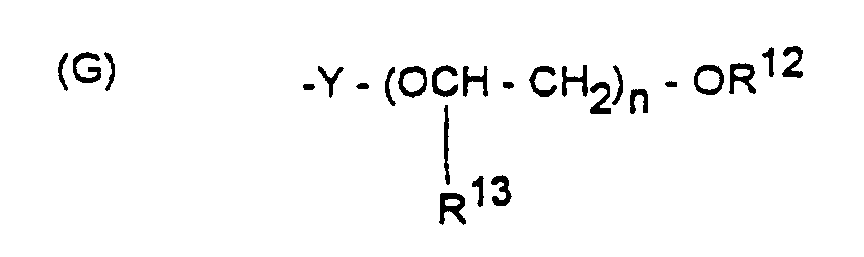
- Procédé pour la préparation des co- et terpolymères selon la revendication 1, caractérisé en ce qu'on met d'abord à réagir des monomères des formules générales J et/ou K
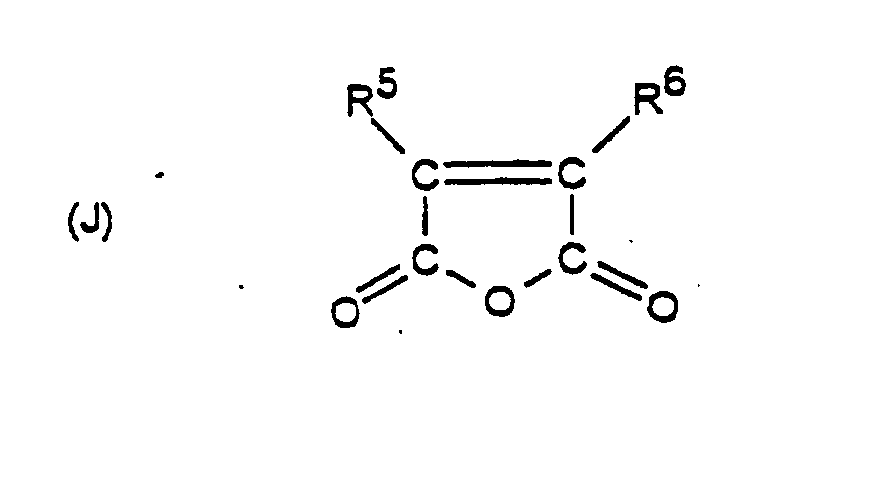 dans lesquelles R5 et R6 représentent indépendamment l'un de l'autre un atome d'hydrogène ou un groupe méthyle avec une ou plusieurs amines de formule L,
 ou un résidu de formule G
 dans lesquelles X représente un groupe alkylène en C2 à C4, R10 le méthyle ou un groupe alkyle en C6 à C22 et R11 un groupe alkyle en C6 à C22, Y un groupe alkylène en C2 à C4, n un nombre entre 1 et 100, R12 un groupe alkyle en C1 à C30, cycloalkyle en C5 à C12 ou aryle en C6 à C30 et R13 un atome d'hydrogène, un groupe alkyle en C1 à C4, de préférence le méthyle et on fait polymériser ensuite le produit de réaction avec l'éthylène et éventuellement d'autres monomères de formule générale H
 dans laquelle R1 et R2 sont différents, R1 représente un atome d'hydrogène ou un groupe méthyle et R2 un atome d'hydrogène, un groupe -COOR3 ou un groupe -OOCR4, dans lesquels R3 et R4 sont identiques ou différents et représentent un groupe alkyle en C1 à C12 linéaire ou ramifié, de préférence le méthyle ou l'éthyle.
- Procédé selon la revendication 8 ou 9, caractérisé en ce qu'on effectue la polymérisation sous la forme de polymérisation sous haute pression en continu ou en discontinu, de préférence en continu, à une température de 100 à 350°C, de préférence de 140 à 300°C, et sous une pression de-50 à 400 MPa, de préférence de 100 à 300 MPa.
- Procédé selon une ou plusieurs des revendications 8 à 10, caractérisé en ce qu'on met en oeuvre pour la polymérisation de 0,1 à 20% en poids, de préférence de 0,2 à 10% en poids, par rapport aux monomères, d'un amorceur de chaínes radicalaires.
- Procédé selon une ou plusieurs des revendications 8 à 11, caractérisé en ce qu'on met en oeuvre pour la polymérisation de 0,2 à 15% en mole, de préférence de 0,5 à 10% en mole des anhydrides d'acide dicarboxylique α,β-insaturés ainsi que de 85 à 99,2% en mole, de préférence de 90 à 99,5% en mole des composés α,β-insaturés.
- Procédé selon une ou plusieurs des revendications 8 à 12, caractérisé en ce qu'on réalise la polymérisation en présence de 0,1 à 20% en poids, par rapport à la teneur en monomères, d'un régulateur de masse moléculaire.
- Utilisation des co- et terpolymères selon la revendication 1 comme agents d'amélioration de l'écoulement pour les huiles brutes contenant de la paraffine et en particulier pour les produits pétroliers.
- Utilisation des co- et terpolymères selon la revendication 14, caractérisée en ce qu'on ajoute à l'huile brute contenant de la paraffine ou au produit pétrolier de 10 à 10000 ppm, de préférence de 20 à 5000 ppm et de manière particulièrement préférée de 50 à 2000 ppm du-co- ou terpolymère.
- Huiles brutes et produits pétroliers contenant au moins un co- ou terpolymère selon la revendication 1.
- Mélange contenant au moins un co- ou terpolymère selon la revendication 1 et au moins un copolymère éthylène-ester de vinyle, de préférence un copolymère éthylène-acétate de vinyle et en particulier un copolymère éthylène-acétate de vinyle qui contient de 10 à 40% en poids d'acétate de vinyle et de 60 à 90% en poids d'éthylène.
- Mélanges selon la revendication 17, caractérisés en ce qu'ils contiennent les co- ou terpolymères et les copolymères éthylène-ester de vinyle dans le rapport (en parties en poids) de 20 : 1 à 1 : 20, de préférence de 10 : 1 à 1 : 10.
- Mélanges contenant des co- ou terpolymères selon la revendication 1 et des terpolymères éthylène/acétate de vinyle/néononanoate de vinyle ou éthylène/acétate de vinyle/néodécanoate de vinyle dans le rapport (en parties en poids) de 20 : 1 à 1 : 20, de préférence de 10 : 1 à 1 : 10.
- Mélanges selon la revendication 19, caractérisés en ce que les terpolymères éthylène/acétate de vinyle/-néononanoate de vinyle et les terpolymères éthylène/-acétate de vinyle/néodécanoate de vinyle contiennent en plus de l'éthylène de 10 à 35% en poids d'acétate de vinyle et de 1 à 25% en poids de néononanoate de vinyle ou de néodéeanoate de vinyle.
- Mélanges contenant des co- et terpolymères selon la revendication 1 et des agents de dispersion de la paraffine dans le rapport (en parties en poids) de 1 : 10 à 20 : 1, de préférence de 1 : 1 à 10 : 1.
- Mélanges contenant des co- et terpolymères selon la revendication 1 et des polymères en peigne dans le rapport (en parties en poids) de 1 : 10 à 20 : 1, de préférence de 1 : 1 à 10 : 1.
- Huiles brutes et produits pétroliers contenant de la paraffine, contenant des mélanges selon une ou plusieurs des revendications 17 à 22.
Applications Claiming Priority (3)
| Application Number | Priority Date | Filing Date | Title |
|---|---|---|---|
| DE19645603 | 1996-11-06 | ||
| DE19645603A DE19645603A1 (de) | 1996-11-06 | 1996-11-06 | Co- und Terpolymere auf Basis von alpha, beta-ungesättigten Verbindungen und alpha, beta-ungesättigten Dicarbonsäureanhydriden |
| PCT/EP1997/005946 WO1998020056A1 (fr) | 1996-11-06 | 1997-10-28 | Copolymeres et terpolymeres a base de composes g(a),g(b)-insatures et d'anhydrides d'acide dicarboxylique g(a),g(b)-insatures |
Publications (2)
| Publication Number | Publication Date |
|---|---|
| EP0937108A1 EP0937108A1 (fr) | 1999-08-25 |
| EP0937108B1 true EP0937108B1 (fr) | 2001-06-06 |
Family
ID=7810716
Family Applications (1)
| Application Number | Title | Priority Date | Filing Date |
|---|---|---|---|
| EP97948822A Expired - Lifetime EP0937108B1 (fr) | 1996-11-06 | 1997-10-28 | Copolymeres et terpolymeres a base de composes alpha,beta-insatures et d'anhydrides d'acide dicarboxylique alpha,beta-insatures |
Country Status (4)
| Country | Link |
|---|---|
| EP (1) | EP0937108B1 (fr) |
| DE (2) | DE19645603A1 (fr) |
| WO (1) | WO1998020056A1 (fr) |
| ZA (1) | ZA979935B (fr) |
Families Citing this family (8)
| Publication number | Priority date | Publication date | Assignee | Title |
|---|---|---|---|---|
| DE19729055C2 (de) * | 1997-07-08 | 2000-07-27 | Clariant Gmbh | Brennstofföle auf Basis von Mitteldestillaten und Copolymeren aus Ethylen und ungesättigten Carbonsäureestern |
| US6846338B2 (en) | 1997-07-08 | 2005-01-25 | Clariant Gmbh | Fuel oils based on middle distillates and copolymers of ethylene and unsaturated carboxylic esters |
| DE19729057A1 (de) | 1997-07-08 | 1999-01-14 | Clariant Gmbh | Copolymere auf Basis von Ethylen und ungesättigten Carbonsäureestern und ihre Verwendung als Mineralöladditive |
| FR2827608B1 (fr) * | 2001-07-17 | 2004-01-16 | Elf Antar France | Polymeres a base d'olefine et d'alkylate d'alkenyle et leur utilisation comme additif multifonctionnel dans les carburants et les combustiles |
| DE10254280A1 (de) * | 2002-11-20 | 2004-06-03 | Basf Ag | Ethylenterpolymerwachse, Verfahren zu ihrer Herstellung und ihre Verwendung |
| US7820604B2 (en) * | 2006-10-27 | 2010-10-26 | Chevron Oronite Company Llc | Lubricating oil additive composition and method of making the same |
| US7816309B2 (en) | 2006-10-27 | 2010-10-19 | Chevron Oronite Company Llc | Lubricating oil additive composition and method of making the same |
| CN116751327A (zh) * | 2023-07-04 | 2023-09-15 | 嘉兴华雯化工股份有限公司 | 一种聚合物耐热相容剂的连续化生产工艺及其应用 |
Family Cites Families (6)
| Publication number | Priority date | Publication date | Assignee | Title |
|---|---|---|---|---|
| JPS59126496A (ja) * | 1983-01-11 | 1984-07-21 | Nippon Zeon Co Ltd | 燃料油組成物 |
| DE3405843A1 (de) * | 1984-02-17 | 1985-08-29 | Bayer Ag, 5090 Leverkusen | Copolymere auf basis von maleinsaeureanhydrid und (alpha), (beta)-ungesaettigten verbindungen, ein verfahren zu ihrer herstellung und ihre verwendung als paraffininhibitoren |
| JPS60245602A (ja) * | 1984-05-21 | 1985-12-05 | Showa Denko Kk | 加硫性変性エチレン共重合体 |
| JP2753838B2 (ja) * | 1988-10-08 | 1998-05-20 | 日本ユニカー株式会社 | N−置換マレイミドで変性されたエチレン−極性コモノマー共重合体 |
| FR2649709A1 (fr) * | 1989-07-12 | 1991-01-18 | Norsolor Sa | Copolymeres de l'ethylene, un procede pour leur preparation et leur application au revetement de metaux |
| DK0606055T3 (da) * | 1993-01-06 | 1998-04-14 | Clariant Gmbh | Terpolymerer på basis af alfa,beta-umættede dicarboxylsyreanhydrider, alfa-beta-umættede forbindelser og polyoxyalkylenethere af lavere umættede alkoholer |
-
1996
- 1996-11-06 DE DE19645603A patent/DE19645603A1/de not_active Withdrawn
-
1997
- 1997-10-28 DE DE59703738T patent/DE59703738D1/de not_active Expired - Fee Related
- 1997-10-28 EP EP97948822A patent/EP0937108B1/fr not_active Expired - Lifetime
- 1997-10-28 WO PCT/EP1997/005946 patent/WO1998020056A1/fr not_active Ceased
- 1997-11-05 ZA ZA979935A patent/ZA979935B/xx unknown
Also Published As
| Publication number | Publication date |
|---|---|
| DE59703738D1 (de) | 2001-07-12 |
| EP0937108A1 (fr) | 1999-08-25 |
| DE19645603A1 (de) | 1998-05-07 |
| WO1998020056A1 (fr) | 1998-05-14 |
| ZA979935B (en) | 1998-09-14 |
Similar Documents
| Publication | Publication Date | Title |
|---|---|---|
| EP0777712B1 (fr) | Melanges polymeres et leur utilisation comme additifs pour distillats moyens de petrole | |
| EP0922716B1 (fr) | Procédé de préparation de terpolymères d'éthylène et leur utilisation comme additifs à l'huile minérale et aux distillats d'huile minérale | |
| EP0688796B1 (fr) | Produits de réaction de polyétheramines avec des polymères d'acides dicarboxyliques alpha-, bêta-insaturés | |
| EP0807642B1 (fr) | Terpolymères de l'éthylène, leur préparation et leur utilisation pour les distillats d'huile minérale | |
| DE19620119C1 (de) | Terpolymerisate des Ethylens, ihre Herstellung und ihre Verwendung als Additive für Mineralöldestillate | |
| DE69905082T2 (de) | Brennölzusatz-z usammensetzungen | |
| EP3464399B1 (fr) | Copolymère et son utilisation pour la diminution de la cristallisation de cristaux de paraffine dans des carburants | |
| EP1433836A1 (fr) | Huiles combustibles à propriétés au froid améliorées. | |
| DE19901803B4 (de) | Copolymere und ihre Verwendung als Additiv zur Verbesserung der Kaltfließeigenschaften von Mitteldestillaten | |
| EP0890589B1 (fr) | Solutions ou dispersions à base de copolymres d'oléfines et d'esters d'acides carboxyliques non saturés et leur utilisation comme additifs pour des huiles minérales | |
| EP0909307A1 (fr) | Dispersants paraffiniques pour distillats moyens de petrole | |
| EP1500691B1 (fr) | Additifs pour huiles combustibles et huiles combustibles contenant un additif à propriétés au froid améliorées. | |
| EP0937108B1 (fr) | Copolymeres et terpolymeres a base de composes alpha,beta-insatures et d'anhydrides d'acide dicarboxylique alpha,beta-insatures | |
| DE19927561C1 (de) | Verwendung hydroxylgruppenhaltiger Copolymere zur Herstellung von Brennstoffölen mit verbesserter Schmierwirkung | |
| EP0892012B1 (fr) | Agent améliorant l'ecoulement d'huiles minerales | |
| EP1194456B1 (fr) | Copolymeres comportant des groupes hydroxyl et leur utilisation pour la preparation d'huiles combustibles a pouvoir lubrifiant ameliore | |
| DE19729055C2 (de) | Brennstofföle auf Basis von Mitteldestillaten und Copolymeren aus Ethylen und ungesättigten Carbonsäureestern | |
| EP1675932A2 (fr) | Melange additif utilise comme composant de compositions a base d'huile minerale |
Legal Events
| Date | Code | Title | Description |
|---|---|---|---|
| PUAI | Public reference made under article 153(3) epc to a published international application that has entered the european phase |
Free format text: ORIGINAL CODE: 0009012 |
|
| 17P | Request for examination filed |
Effective date: 19990607 |
|
| AK | Designated contracting states |
Kind code of ref document: A1 Designated state(s): BE DE FI FR GB NL SE |
|
| RTI1 | Title (correction) |
Free format text: CO- AND TERPOLYMERS BASED ON ALPHA,BETA-UNSATURATED COMPOUNDS AND ALPHA,BETA-UNSATURATED DICARBOXYLIC ACID ANHYDRIDES |
|
| 17Q | First examination report despatched |
Effective date: 19991227 |
|
| GRAG | Despatch of communication of intention to grant |
Free format text: ORIGINAL CODE: EPIDOS AGRA |
|
| GRAG | Despatch of communication of intention to grant |
Free format text: ORIGINAL CODE: EPIDOS AGRA |
|
| GRAH | Despatch of communication of intention to grant a patent |
Free format text: ORIGINAL CODE: EPIDOS IGRA |
|
| RBV | Designated contracting states (corrected) |
Designated state(s): BE DE FI FR GB NL SE |
|
| GRAH | Despatch of communication of intention to grant a patent |
Free format text: ORIGINAL CODE: EPIDOS IGRA |
|
| GRAA | (expected) grant |
Free format text: ORIGINAL CODE: 0009210 |
|
| AK | Designated contracting states |
Kind code of ref document: B1 Designated state(s): BE DE FI FR GB NL SE |
|
| REF | Corresponds to: |
Ref document number: 59703738 Country of ref document: DE Date of ref document: 20010712 |
|
| GBT | Gb: translation of ep patent filed (gb section 77(6)(a)/1977) |
Effective date: 20010817 |
|
| ET | Fr: translation filed | ||
| REG | Reference to a national code |
Ref country code: GB Ref legal event code: IF02 |
|
| PLBE | No opposition filed within time limit |
Free format text: ORIGINAL CODE: 0009261 |
|
| STAA | Information on the status of an ep patent application or granted ep patent |
Free format text: STATUS: NO OPPOSITION FILED WITHIN TIME LIMIT |
|
| 26N | No opposition filed | ||
| PGFP | Annual fee paid to national office [announced via postgrant information from national office to epo] |
Ref country code: DE Payment date: 20050809 Year of fee payment: 9 |
|
| PGFP | Annual fee paid to national office [announced via postgrant information from national office to epo] |
Ref country code: GB Payment date: 20050811 Year of fee payment: 9 Ref country code: FR Payment date: 20050811 Year of fee payment: 9 Ref country code: SE Payment date: 20050811 Year of fee payment: 9 |
|
| PGFP | Annual fee paid to national office [announced via postgrant information from national office to epo] |
Ref country code: NL Payment date: 20050812 Year of fee payment: 9 |
|
| PGFP | Annual fee paid to national office [announced via postgrant information from national office to epo] |
Ref country code: BE Payment date: 20050915 Year of fee payment: 9 |
|
| PGFP | Annual fee paid to national office [announced via postgrant information from national office to epo] |
Ref country code: FI Payment date: 20051005 Year of fee payment: 9 |
|
| PG25 | Lapsed in a contracting state [announced via postgrant information from national office to epo] |
Ref country code: FI Free format text: LAPSE BECAUSE OF NON-PAYMENT OF DUE FEES Effective date: 20061028 |
|
| PG25 | Lapsed in a contracting state [announced via postgrant information from national office to epo] |
Ref country code: SE Free format text: LAPSE BECAUSE OF NON-PAYMENT OF DUE FEES Effective date: 20061029 |
|
| PG25 | Lapsed in a contracting state [announced via postgrant information from national office to epo] |
Ref country code: NL Free format text: LAPSE BECAUSE OF NON-PAYMENT OF DUE FEES Effective date: 20070501 Ref country code: DE Free format text: LAPSE BECAUSE OF NON-PAYMENT OF DUE FEES Effective date: 20070501 |
|
| EUG | Se: european patent has lapsed | ||
| GBPC | Gb: european patent ceased through non-payment of renewal fee |
Effective date: 20061028 |
|
| NLV4 | Nl: lapsed or anulled due to non-payment of the annual fee |
Effective date: 20070501 |
|
| REG | Reference to a national code |
Ref country code: FR Ref legal event code: ST Effective date: 20070629 |
|
| PG25 | Lapsed in a contracting state [announced via postgrant information from national office to epo] |
Ref country code: GB Free format text: LAPSE BECAUSE OF NON-PAYMENT OF DUE FEES Effective date: 20061028 |
|
| BERE | Be: lapsed |
Owner name: *CLARIANT G.M.B.H. Effective date: 20061031 |
|
| PG25 | Lapsed in a contracting state [announced via postgrant information from national office to epo] |
Ref country code: FR Free format text: LAPSE BECAUSE OF NON-PAYMENT OF DUE FEES Effective date: 20061031 |
|
| PG25 | Lapsed in a contracting state [announced via postgrant information from national office to epo] |
Ref country code: BE Free format text: LAPSE BECAUSE OF FAILURE TO SUBMIT A TRANSLATION OF THE DESCRIPTION OR TO PAY THE FEE WITHIN THE PRESCRIBED TIME-LIMIT Effective date: 20061031 |