EP0938887A1 - Utilisation d'agent de coloration photochrome dans une composition cosmétique, et composition cosmétique le comprenant - Google Patents
Utilisation d'agent de coloration photochrome dans une composition cosmétique, et composition cosmétique le comprenant Download PDFInfo
- Publication number
- EP0938887A1 EP0938887A1 EP98402849A EP98402849A EP0938887A1 EP 0938887 A1 EP0938887 A1 EP 0938887A1 EP 98402849 A EP98402849 A EP 98402849A EP 98402849 A EP98402849 A EP 98402849A EP 0938887 A1 EP0938887 A1 EP 0938887A1
- Authority
- EP
- European Patent Office
- Prior art keywords
- composition
- composition according
- photochromic
- group
- les
- Prior art date
- Legal status (The legal status is an assumption and is not a legal conclusion. Google has not performed a legal analysis and makes no representation as to the accuracy of the status listed.)
- Granted
Links
- 0 CC(*)=C(*)*N Chemical compound CC(*)=C(*)*N 0.000 description 4
Classifications
-
- A—HUMAN NECESSITIES
- A61—MEDICAL OR VETERINARY SCIENCE; HYGIENE
- A61Q—SPECIFIC USE OF COSMETICS OR SIMILAR TOILETRY PREPARATIONS
- A61Q1/00—Make-up preparations; Body powders; Preparations for removing make-up
- A61Q1/02—Preparations containing skin colorants, e.g. pigments
-
- A—HUMAN NECESSITIES
- A61—MEDICAL OR VETERINARY SCIENCE; HYGIENE
- A61K—PREPARATIONS FOR MEDICAL, DENTAL OR TOILETRY PURPOSES
- A61K8/00—Cosmetics or similar toiletry preparations
- A61K8/18—Cosmetics or similar toiletry preparations characterised by the composition
- A61K8/30—Cosmetics or similar toiletry preparations characterised by the composition containing organic compounds
- A61K8/49—Cosmetics or similar toiletry preparations characterised by the composition containing organic compounds containing heterocyclic compounds
-
- A—HUMAN NECESSITIES
- A61—MEDICAL OR VETERINARY SCIENCE; HYGIENE
- A61Q—SPECIFIC USE OF COSMETICS OR SIMILAR TOILETRY PREPARATIONS
- A61Q3/00—Manicure or pedicure preparations
- A61Q3/02—Nail coatings
-
- A—HUMAN NECESSITIES
- A61—MEDICAL OR VETERINARY SCIENCE; HYGIENE
- A61Q—SPECIFIC USE OF COSMETICS OR SIMILAR TOILETRY PREPARATIONS
- A61Q5/00—Preparations for care of the hair
- A61Q5/06—Preparations for styling the hair, e.g. by temporary shaping or colouring
- A61Q5/065—Preparations for temporary colouring the hair, e.g. direct dyes
-
- A—HUMAN NECESSITIES
- A61—MEDICAL OR VETERINARY SCIENCE; HYGIENE
- A61K—PREPARATIONS FOR MEDICAL, DENTAL OR TOILETRY PURPOSES
- A61K2800/00—Properties of cosmetic compositions or active ingredients thereof or formulation aids used therein and process related aspects
- A61K2800/40—Chemical, physico-chemical or functional or structural properties of particular ingredients
- A61K2800/42—Colour properties
- A61K2800/43—Pigments; Dyes
- A61K2800/438—Thermochromatic; Photochromic; Phototropic
Definitions
- the present invention relates to a new cosmetic composition, in particular a cosmetic makeup composition or a hair composition, comprising a particular coloring agent having photochromic properties, and allowing to obtain new coloring effects.
- Make-up compositions such as loose or compact powders, foundations, blushes or eye shadows, lipsticks or nail varnishes, consist of a suitable vehicle and of various coloring agents intended for impart a certain color to said compositions before and / or after their application to the skin, mucous membranes, semi-mucous membranes and / or integuments such as the nails or the hair.
- coloring agents intended for impart a certain color to said compositions before and / or after their application to the skin, mucous membranes, semi-mucous membranes and / or integuments such as the nails or the hair.
- lacquers mineral pigments or pearlescent pigments. Lacquers provide bright colors, but most are unstable when exposed to light, temperature, or pH. Some also have the disadvantage of unsightly staining the skin after application, by disgorging the dye.
- the mineral pigments in particular the mineral oxides are on the contrary very stable but give rather dull and pale colors. To obtain colored effects, it is still possible to use pearlescent pigments of various colors, but never intense, which make it possible to obtain iridescent effects but most often quite weak.
- Photochromic compounds are compounds which have the property of changing color when they are irradiated by a light source, then of resuming their initial color, or a close color, when the irradiation is stopped.
- Such compounds find in particular a particularly advantageous application in cosmetic compositions, in particular in makeup compositions such as foundations and blushes or eye shadows.
- makeup compositions such as foundations and blushes or eye shadows.
- cosmetic compositions comprising particular mineral photochromic compounds, chosen from metal oxides, their hydrates and their complexes.
- mineral photochromic compounds chosen from metal oxides, their hydrates and their complexes.
- this document mentions the use of titanium oxide treated so as to make it photochromic, in makeup compositions such as powders and foundations.
- organic photochromic compounds such as the compounds of the family of spiropyrans or naphtooxazines.
- photochromic compounds are particularly advantageous insofar as they make it possible to obtain a rapid change in coloration of the support on which they are applied, when said support is exposed to UV for example, with a rapid return to the initial color when the exposure UV ceases.
- the compositions comprising these compounds have the ability to constantly change color depending on the light intensity.
- the present invention therefore aims to provide a cosmetic composition which comprises such coloring agents, and which is therefore capable of changing color rapidly, depending on the nature and / or the intensity of light radiation. particular, but at the discretion of the user, while having good cosmetic properties.
- the subject of the invention is therefore a cosmetic composition
- a cosmetic composition comprising, in a cosmetically acceptable medium, at least one thermally irreversible photochromic coloring agent, said coloring agent being preferably chosen from the compounds which belong to the family of diarylethenes and / or those who belong to the fulgid family.
- Another object of the invention is the use of a photochromic coloring agent as defined above as a coloring agent in a cosmetic composition.
- Another object of the invention is a make-up and / or coloring process temporary of a support chosen from the mucous membranes, the semi-mucous membranes, the skin and / or integuments, in which a composition is applied to said support cosmetic as defined above.
- thermally irreversible photochromic coloring agent is understood to mean a compound which has thermally irreversible photochromic properties.
- the test for determining whether a photochromic compound is thermally reversible or irreversible is as follows: the compound to be tested is subjected to irradiation with UV radiation for a few minutes, preferably for 1 minute, then its color is determined using '' a MINOLTA CM 2002 colorimeter; the values are expressed in H, V, C in the MUNSELL notation (according to standard ASTM D 1535-68).
- H denotes the shade or HUE
- V denotes the intensity or VALUE
- C denotes the purity or CHROMATICITY.
- photochromic compounds are notably excluded from the scope of the present invention.
- thermally reversible such as doped titanium oxide, spiropyrans, spirooxazines or chromenes.
- the difference in behavior between the photochromic coloring agents according to the invention and the photochromic compounds according to the prior art can be illustrated in the following manner.
- a cosmetic composition according to the invention When a cosmetic composition according to the invention is applied to a support, a colorless or very slightly colored film may be obtained, depending on the choice of photochromic coloring agent.
- This film remains colorless or weakly colored whatever the light intensity of the environment; when the user wishes, he can modify the color of the film, for example obtaining a film of red color, by subjecting the support to a particular UV radiation, of given wavelength.
- the film turns red and remains as long as desired; it is then possible to change the color of said film again, by making it become colorless or slightly colored again, by illumination under radiation of given wavelength.
- a composition comprising a photochromic compound according to the art anterior, for example a spiropyran or a doped titanium oxide, will give after application a colorless or weakly colored film; when the support is at sun, the film will become, for example, red, to return automatically and very quickly colorless or slightly colored when the support is at in the shade or in a dimly or not lit space.
- a photochromic compound according to the art anterior for example a spiropyran or a doped titanium oxide
- This phenomenon of 'discoloration' in the shade is controlled by the use of photochromic coloring according to the invention.
- the cosmetic composition according to the invention finds in particular a particularly advantageous application in the field of make-up of the skin, semi-mucous membranes, mucous membranes and / or integuments.
- the term “mucous membrane” is understood to mean in particular the internal part of the lower eyelid; among the semi-mucous membranes, we mean more particularly the lips of the face.
- Hair appendages are understood to mean the hair systems constituted in particular by human hair, body hair, eyelashes and eyebrows, as well as nails of natural or artificial origin.
- the compounds used in the context of the present invention present in particular the advantage of being soluble in the organic solvents usually used in cosmetics, such as alcohols and / or esters.
- composition according to the invention may be in any cosmetically acceptable galenical form, such as in the form of a lotion, suspension, dispersion, solution in a solvent or hydroalcoholic medium, optionally multiphase; in the form of a gel, a foam, a spray, an oil-in-water, water-in-oil, or multiple emulsion; in the form of a loose, compact or cast powder; as a solid or an anhydrous paste.
- a cosmetically acceptable galenical form such as in the form of a lotion, suspension, dispersion, solution in a solvent or hydroalcoholic medium, optionally multiphase; in the form of a gel, a foam, a spray, an oil-in-water, water-in-oil, or multiple emulsion; in the form of a loose, compact or cast powder; as a solid or an anhydrous paste.
- photochromic coloring agents which can be used in the context of the present invention, preferably those which are organic in nature, and especially those who belong to the family of diarylethenes and / or those who belong to the fulgid family.
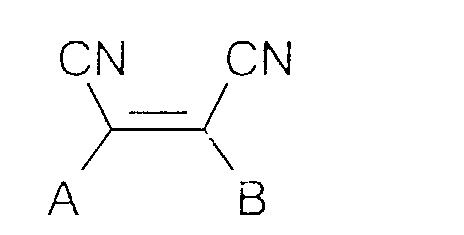
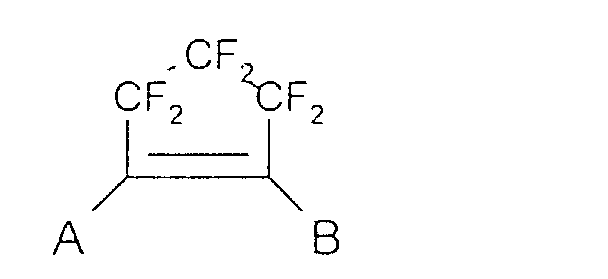
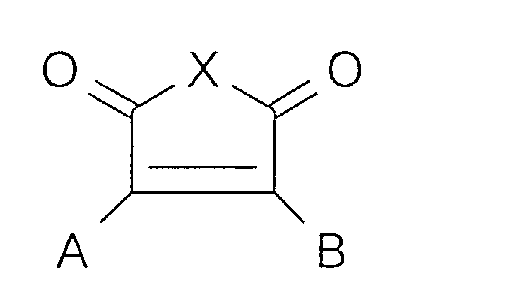
- the diarylethenes can be represented by the following formula (I): in which the radicals R1 and R2 are always in "cis" relation with respect to the double bond.
- radicals R1 and R2 can be, independently of one another, chosen from C1-C16 alkyl radicals, optionally fluorinated or perfluorinated, or nitriles. Mention may in particular be made of the compounds of the following formula:
- X may be an oxygen atom or a radical -NR 3 , with R representing a C2-C16 alkyl and / or hydroxyalkyl radical.
- Groups A and B can be separated from the ring by one or two double bonds.
- the photochromic coloring agent may be present in the composition at a content of 0.05-30% by weight, preferably 0.1-10% by weight.
- the skilled person can determine the optimal content of photochromic coloring agent, so as to obtain on the one hand a cosmetically acceptable composition, and on the other hand, the desired coloring effect.
- composition according to the invention also contains a cosmetically acceptable medium, that is to say a medium compatible with all keratin materials such as skin, nails, hair, eyelashes and eyebrows, mucous membranes and the semi-mucous membranes, and any other skin area of the body and face.
- a cosmetically acceptable medium may include or be in the form of, in particular, a suspension, dispersion, solution in a solvent or hydroalcoholic medium, possibly thickened or even gelled; an oil-in-water, water-in-oil emulsion, or multiple; a gel or foam; an emulsified gel; a spray; a powder free, compact or poured; an anhydrous paste.
- composition according to the invention can comprise a fatty phase, in particular consisting of fatty substances liquid at 25 ° C, such as original oils animal, vegetable, mineral or synthetic; solid fats at 25 ° C such as animal, vegetable, mineral or synthetic waxes; pasty fatty substances; gums; of their mixtures.
- fatty substances liquid at 25 ° C such as original oils animal, vegetable, mineral or synthetic
- solid fats at 25 ° C such as animal, vegetable, mineral or synthetic waxes
- pasty fatty substances such as gums; of their mixtures.
- composition according to the invention may also comprise one or more cosmetically acceptable organic solvents (tolerance, toxicology and acceptable feel).
- organic solvents can represent from 0% to 98% of the total weight of the composition. They can be chosen from the group consisting of hydrophilic organic solvents, lipophilic organic solvents, amphiphilic solvents or their mixtures.
- hydrophilic organic solvents there may be mentioned, for example, linear or branched lower monoalcohols having from 1 to 8 carbon atoms such as ethanol, propanol, butanol, isopropanol, isobutanol; polyethylene glycols having from 6 to 80 ethylene oxides; polyols such as propylene glycol, isoprene glycol, butylene glycol, glycerol, sorbitol; the mono- or di-alkyl of isosorbide in which the alkyl groups have from 1 to 5 carbon atoms; glycol ethers such as diethylene glycol mono-methyl or mono-ethyl ether and propylene glycol ethers such as dipropylene glycol methyl ether.
- linear or branched lower monoalcohols having from 1 to 8 carbon atoms such as ethanol, propanol, butanol, isopropanol, isobutanol
- polyethylene glycols having from 6 to 80
- polyols such as derivatives of polypropylene glycol (PPG) such as the esters of polypropylene glycol and of fatty acid, of PPG and of fatty alcohol such as PPG-23 oleyl ether and PPG- 36 oleate.
- PPG polypropylene glycol
- Lipophilic organic solvents that may be mentioned, for example, are fatty esters such as diisopropyl adipate, dioctyl adipate, alkyl benzoates, isopropyl myristate, isopropyl palmitate, butyl stearate, hexyl laurate, isononyl isononanoate, 2-ethyl hexyl palmitate, 2-hexyl-decyl laurate, 2-octyl-decyl palmitate, 2-octyl-dodecyl myristate, succinate di- (ethyl-2-hexyl), diisostearyl malate, 2-octyl-dodecyl lactate, glycerin triisostearate, diglycerin triisostearate.
- fatty esters such as diisopropyl adipate, dioctyl adipate, alkyl benzoates
- composition according to the invention can also comprise an aqueous phase, which can comprise water, a floral water such as blueberry water and / or a mineral water such as VITTEL water, LUCAS water or LA ROCHE POSAY water.
- Said aqueous phase can comprise from 0% to 14% by weight, relative to the total weight of the aqueous phase, of a lower C 2 -C 6 monoalcohol and / or of a polyol such as glycerol, butylene glycol, isoprene glycol, propylene glycol, polyethylene glycol.
- composition according to the invention when it is in the form of an emulsion, it may optionally further comprise a surfactant, preferably in an amount of 0.01 to 30% by weight relative to the total weight of the composition.
- a surfactant preferably in an amount of 0.01 to 30% by weight relative to the total weight of the composition.
- anionic surfactants which can be used alone or as a mixture, there may be mentioned in particular the alkaline salts, the ammonium salts, the amine salts or the amino alcohol salts of the following compounds: alkyl sulfates, alkyl!
- the alkyl or acyl radical in all of these compounds generally designates a chain of 12 to 18 carbon atoms. Mention may also be made of soaps and salts of fatty acids such as oleic, ricinoleic, palmitic, stearic acids, coconut oil or hydrogenated coconut oil acids and in particular the amine salts such as stearates.
- fatty acids such as oleic, ricinoleic, palmitic, stearic acids, coconut oil or hydrogenated coconut oil acids and in particular the amine salts such as stearates.
- amines acyl lactylates, the acyl radical of which contains 8-20 carbon atoms
- carboxylic acids of polyglycolic ethers corresponding to the formula: Alk- (OCH 2 -CH 2 ) n -OCH 2 -COOH in acid or salified form where the substituent Alk corresponds to a linear chain having from 12 to 18 carbon atoms and where n is an integer between 5 and 15.
- nonionic surfactants which can be used alone or as a mixture, there may be mentioned in particular: alcohols, alkylphenols and polyethoxylated, polypropoxylated or polyglycerolated fatty acids containing 8 to 18 carbon atoms; copolymers of ethylene and propylene oxides, condensates of ethylene and propylene oxide on fatty alcohols, polyethoxylated fatty amides, polyethoxylated fatty amines, ethanolamides, glycol fatty acid esters, esters of fatty acids of sorbitan oxyethylenated or not, esters of fatty acids of sucrose, esters of fatty acids of polyethylene glycol, phosphoric triesters, esters of fatty acids of glucose derivatives; alkylpolyglycosides and alkylamides of amino sugars; the condensation products of an ⁇ -diol, a monoalcohol, an alkylphenol, an amide or a diglycol
- composition according to the invention can also comprise 0 to 5% by weight, based on the total weight of the emulsion, of at least one co-emulsifier which can be chosen from oxyethylenated sorbitan monostearate, fatty alcohols such than stearyl alcohol or cetyl alcohol, or esters of fatty acids and polyols such as glyceryl stearate.
- co-emulsifier which can be chosen from oxyethylenated sorbitan monostearate, fatty alcohols such than stearyl alcohol or cetyl alcohol, or esters of fatty acids and polyols such as glyceryl stearate.
- the composition may also comprise a film-forming polymer.
- a film-forming polymer This is particularly the case when it is desired to prepare a composition of the nail varnish, mascara, eyeliner or hair composition of the lacquer type.
- the polymers can be dissolved or dispersed in the cosmetically acceptable medium.
- the polymer can be present in the form of a solution in an organic solvent or in the form of an aqueous dispersion of film-forming polymer particles.
- Said polymer can be chosen from nitrocellulose, cellulose acetobutyrate, butyralpolyvinyls, alkyd resins, polyesters, acrylics, vinyls, and / or polyurethanes.
- resins mention may be made of resins of the aryl-sulfonamide formaldehyde or aryl-sulfonamide epoxy type; resins of the acrylic, styrenic, acrylate-styrenic and vinyl type.
- the composition can also comprise at least one plasticizer, such as tricresyl phosphate, benzyl benzoate, triethyl citrate, tributyl citrate, triethyl acetyl citrate, 2-triethyl acetyl citrate, camphor; glycol ethers; castor oil oxyethylenated to 40 moles of ethylene oxide; propylene glycol; butyl glycol; ethylene glycol monomethyl ether acetate; propylene glycol ethers; ethers of propylene glycol and ethylene glycol; diacid esters such as diethyl, dibutyl and diisopropyl phthalates and adipates, diethyl and dibutyl tartrates, diethyl and dibutyl succinates, diethyl and dibutyl sebacates, diethyl, dibutyl and dibutyl phosphates 2-diethyl hexyl, diethy
- the plasticizers can generally be present at a content ranging from 1% to 40% by weight relative to the total weight of the composition.
- the solvent system can represent approximately from 55% to 90% by weight relative to the total weight of the varnish.
- This solvent system can consist of a mixture of various volatile organic solvents such as ketones, in particular acetone, methyl ethyl ketone, methyl isobutyl ketone; acetates, in particular ethyl acetate, butyl acetate, 2-methoxy ethyl acetate, methyl acetate, amyl acetate and isopropyl acetate.
- the solvent system can also comprise a diluent such as hexane or octane or also an aromatic hydrocarbon such as toluene or xylene in a proportion in particular of 10 to 35% by weight relative to the total weight of the varnish.
- a diluent such as hexane or octane or also an aromatic hydrocarbon such as toluene or xylene in a proportion in particular of 10 to 35% by weight relative to the total weight of the varnish.
- the composition can also comprise a particulate phase, which can comprise pigments and / or nacres and / or fillers usually used in cosmetic compositions.
- a particulate phase which can comprise pigments and / or nacres and / or fillers usually used in cosmetic compositions.
- the term “pigments” should be understood to mean white or colored, mineral or organic particles, intended to color and / or opacify the composition.
- fillers it is necessary to understand colorless or white, mineral or synthetic particles, lamellar or non-lamellar, intended to give body or rigidity to the composition, and / or softness, mattness and uniformity. makeup.
- pearlescent we must understand iridescent particles that reflect light.
- the pigments can be present in the composition in an amount of 0 to 15% by weight of the final composition, and preferably in an amount of 8 to 10% by weight.
- They can be white or colored, mineral and / or organic, of usual size or nanometric. They can be in the form of powder or pigment paste. Mention may be made of titanium, zirconium or cerium dioxides, as well as oxides of zinc, iron or chromium, ferric blue, chromium hydrate, carbon black, ultramarines (aluminosilicate polysulphides) , manganese pyrophosphate and certain metallic powders such as those of silver or aluminum, carbon black.
- lacquers commonly used to give the lips and the skin a make-up effect which are calcium, barium, aluminum or zirconium salts, of acid dyes such as halo-acid dyes, azo dyes , anthraquinone, etc.
- the nacres can be present in the composition in a proportion of 0 to 20% by weight, preferably at a rate of the order of 8 to 15% by weight.
- the fillers which can be present in an amount of 0 to 30% by weight, preferably 5 to 15%, in the composition, can be mineral or synthetic, lamellar or non-lamellar. Mention may be made of talc, mica, silica, kaolin, nylon and polyethylene powders, Teflon, starch, boron nitride, polymer microspheres such as Expancel (Nobel Industrie), polytrap (Dow Corning) and silicone resin microbeads (Toshiba's Tospearls, for example), precipitated calcium carbonate, magnesium carbonate or hydrocarbon, metal soaps derived from organic carboxylic acids having 8 to 22 carbon atoms. Depending on the type of formulation, the pulverulent phase can represent from 0.01 to 99% by weight of the composition.
- the composition may also comprise a dye, in particular an organic dye natural such as cochineal carmine, and / or a synthetic dye such than halo-acid, azo, anthraquinone dyes.
- a dye in particular an organic dye natural such as cochineal carmine, and / or a synthetic dye such than halo-acid, azo, anthraquinone dyes.
- the composition may also comprise any additive usually used in the cosmetic field, such as antioxidants, perfumes, essential oils, preservatives, lipophilic or hydrophilic cosmetic active agents, moisturizers, vitamins, dyes, essential fatty acids. , sphingolipids, self-tanning agents such as DHA, sunscreens, anti-foaming agents, sequestering agents, antioxidants.
- any additive usually used in the cosmetic field such as antioxidants, perfumes, essential oils, preservatives, lipophilic or hydrophilic cosmetic active agents, moisturizers, vitamins, dyes, essential fatty acids.
- sphingolipids self-tanning agents such as DHA, sunscreens, anti-foaming agents, sequestering agents, antioxidants.
- any additive usually used in the cosmetic field such as antioxidants, perfumes, essential oils, preservatives, lipophilic or hydrophilic cosmetic active agents, moisturizers, vitamins, dyes, essential fatty acids.
- sphingolipids self-tanning agents such as DHA
- the cosmetic compositions according to the invention are essentially those concerning face makeup, i.e. eyeshadows, eye-liners, mascaras, powders, foundations, blushes, "Blush", tinted creams, reds lip sticks, lip sticks or concealer sticks, but also make-up for hair, in particular gels, creams or mousses for temporary coloring hair, and nail makeup, in particular anhydrous nail varnishes.
- the anhydrous compositions can be in the form of a loose powder or compacted, solid, pasty or liquid make-up which may contain a binder which may represent preferably from 0.01 to 95% by weight relative to the total weight of the composition.
- the hair compositions according to the invention can be presented in the form of pressurized aerosol compositions in the presence of a propellant.
- the compositions according to the invention can also be presented under form of a gel, an aqueous or hydroalcoholic solution of one or more polymers water-soluble such as polyacrylic acid derivatives or in the form of emulsified gels obtained by dispersing oils in gels using emulsifiers such as Pemulens from the company GOODRICH.
- the essays according to the invention can also be in the form of a stick and can contain fillers and a binder which may preferably represent from 0.01 to 95% by weight relative to the total weight of the composition.
- composition according to the invention When the composition according to the invention is applied to the back of the hand, and after irradiation, a good-looking effect is obtained.
- this lotion gives the hair after drying and irradiation, reflections.
- the varnish obtained is colorless to slightly yellow in the bottle.
- This varnish can also be applied to false nails. You can use pre-cut covers to apply on the nails before lighting, so as to allow to draw patterns or write on the nail. You can also use different coloring agents for each nail, so as to obtain different colored nails.
- This varnish can also be applied to false nails.
- compositions obtained are slightly yellow to yellow in color in the bottle, protected from light, and red in color if the bottle is exposed to daylight.
- a light source having a wavelength of approximately 400 nm By applying these yellow compositions to the nail, and after irradiation with a light source having a wavelength of approximately 400 nm, a pink to red effect is obtained.
- These compositions can also be applied to false nails.
Landscapes
- Health & Medical Sciences (AREA)
- Life Sciences & Earth Sciences (AREA)
- Animal Behavior & Ethology (AREA)
- General Health & Medical Sciences (AREA)
- Public Health (AREA)
- Veterinary Medicine (AREA)
- Birds (AREA)
- Epidemiology (AREA)
- Cosmetics (AREA)
Abstract
Description
Pour créer des couleurs, on utilise aujourd'hui une gamme d'agents de coloration assez limitée et notamment des laques, des pigments minéraux ou des pigments nacrés. Les laques permettent d'obtenir des couleurs vives, mais pour la plupart sont instables à la lumière, à la température ou au pH. Certaines présentent également l'inconvénient de tacher la peau de manière disgracieuse après application, par dégorgement du colorant. Les pigments minéraux, en particulier les oxydes minéraux sont au contraire très stables mais donnent des couleurs plutôt ternes et pâles. Pour obtenir des effets colorés, on peut encore employer des pigments nacrés de couleurs variées, mais jamais intenses, qui permettent d'obtenir des effets irisés mais le plus souvent assez faibles.
Les composés photochromes sont des composés qui possèdent la propriété de changer de couleur lorsqu'ils sont irradiés par une source lumineuse, puis de reprendre leur couleur initiale, ou une couleur proche, lorsque l'on arrête l'irradiation. De tels composés trouvent notamment une application particulièrement intéressante dans les compositions cosmétiques, en particulier dans les compositions de maquillage telles que les fonds de teint et les fards à joues ou à paupières. En effet, on a constaté que le 'rendu maquillage' d'une peau maquillée est différent selon que l'on se trouve en éclairage naturel ou en éclairage artificiel. Ainsi, un maquillage réalisé en éclairage artificiel paraítra plus clair en lumière naturelle. A l'opposé, un maquillage réalisé à l'extérieur paraítra plus sombre dans un endroit éclairé artificiellement.
Pour pallier ce problème, il a été proposé, par exemple par le brevet EP359909, des compositions cosmétiques comprenant des composés photochromes minéraux particulier, choisis parmi les oxydes métalliques, leurs hydrates et leurs complexes. En particulier, ce document mentionne l'utilisation d'oxyde de titane traité de manière à le rendre photochrome, dans des compositions de maquillage telles que des poudres et des fonds de teint.
Il a également été proposé d'utiliser des composés photochromes organiques, tels que les composés de la famille des spiropyrannes ou des naphtooxazines.
Ces composés photochromes sont particulièrement intéressants dans la mesure où ils permettent d'obtenir un changement rapide de coloration du support sur lequel ils sont appliqués, lorsque ledit support est exposé aux UV par exemple, avec un retour rapide à la couleur initiale lorsque l'exposition aux UV cesse.
On peut ainsi citer le brevet FR1604929 qui décrit des compositions cosmétiques notamment capillaires sous forme d'aérosol, qui contiennent des composés phototropes tels que des nitrobenzylpyridines, des thiosemicarbazones ou des dérivés de spiropyrannes. Après sprayage de ces compositions sur les cheveux et exposition à la lumière du soleil, on obtient une coloration bleu-violet qui redevient jaune pâle dans l'obscurité.
Les compositions comprenant ces composés ont toutefois la faculté de changer constamment de couleur en fonction de l'intensité lumineuse.
La présente invention a donc pour but de proposer une composition cosmétique qui comprend de tels agents de coloration, et qui est donc susceptible de changer de couleur de manière rapide, en fonction de la nature et/ou de l'intensité d'un rayonnement lumineux particulier, mais au gré de l'utilisateur, tout en présentant de bonnes propriétés cosmétiques.
Un autre objet de l'invention est l'utilisation d'un agent de coloration photochrome tel que défini ci-dessus comme agent de coloration dans une composition cosmétique.
Le test pour déterminer si un composé photochrome est thermiquement réversible ou irréversible est le suivant : on soumet le composé à tester à une irradiation par un rayonnement UV pendant quelques minutes, de préférence pendant 1 minute, puis on détermine sa couleur à l'aide d'un colorimètre MINOLTA CM 2002; on exprime les valeurs en H, V, C dans la notation MUNSELL (selon la norme ASTM D 1535-68).
Ainsi, H désigne la nuance ou HUE, V désigne l'intensité ou VALUE, et C désigne la pureté ou CHROMATICITE.
On obtient ainsi une valeur A qui est correspond au maximum de la couleur que l'on peut obtenir.
On laisse ensuite ledit composé dans l'obscurité totale pendant 30 minutes à 25°C, puis on détermine à nouveau sa couleur selon la méthode ci-dessus; on obtient ainsi une valeur B.
Lorsque la valeur B est au moins égale à 50% de la valeur A, on considère que le composé est thermiquement irréversible.
Lorsqu'on l'applique sur un support, une composition cosmétique selon l'invention, on peut obtenir, selon le choix de l'agent de coloration photochrome, un film incolore ou très faiblement coloré. Ce film reste incolore ou faiblement coloré quelle que soit l'intensité lumineuse de l'environnement; lorsque l'utilisateur le souhaite, il peut modifier la couleur du film, par exemple obtenir un film de couleur rouge, en soumettant le support à un rayonnement UV particulier, de longueur d'onde donnée. Le film devient rouge et le reste aussi longtemps que souhaité; il est ensuite possible de faire à nouveau changer la couleur dudit film, en le faisant redevenir incolore ou légèrement coloré, par illumination sous un rayonnement de longueur d'onde donnée.
On entend notamment par muqueuse, la partie interne de la paupière inférieure; parmi les semi-muqueuses, on entend plus particulièrement les lèvres du visage. On entend par phanères, les systèmes pileux constitués notamment par la chevelure humaine, les poils, les cils et les sourcils, ainsi que les ongles d'origine naturelle ou artificielle.
L'homme du métier pourra choisir la forme galénique appropriée, ainsi que sa méthode de préparation, sur base de ses connaissances générales, en tenant compte d'une part de la nature des constituants utilisés, notamment de leur solubilité dans le support, et d'autre part de l'application envisagée pour la composition.

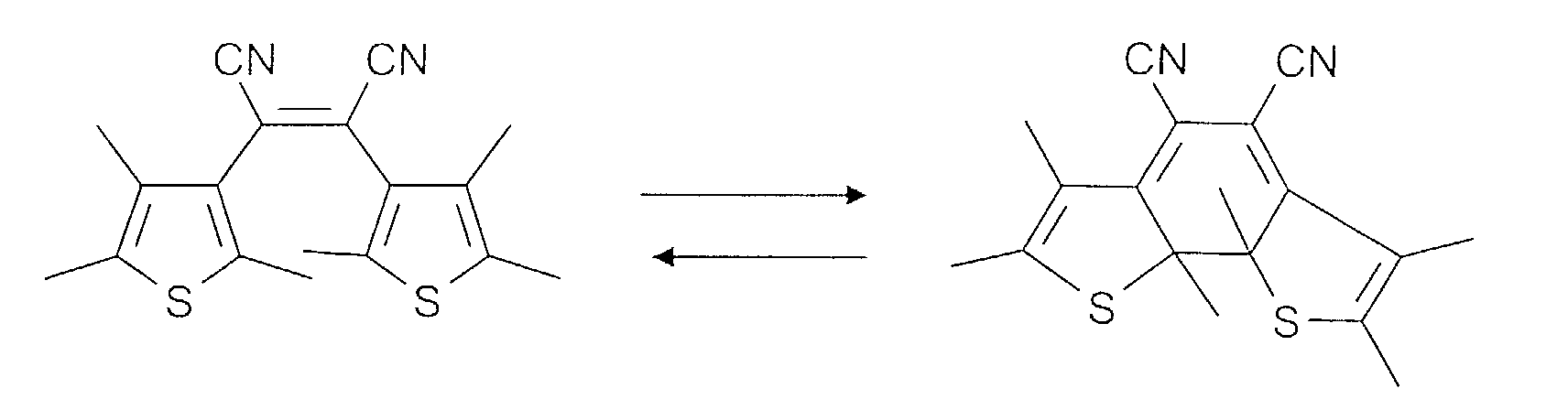
On peut notamment citer les composés de formule suivante :

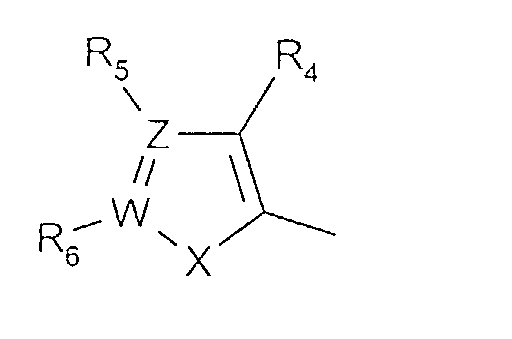
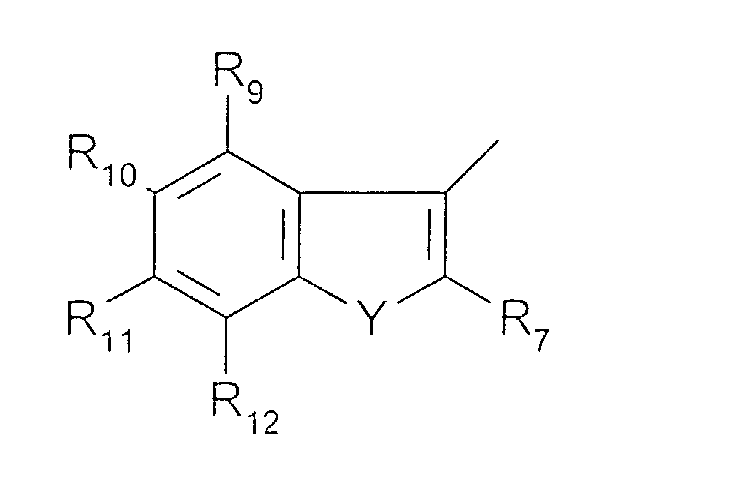

- X et Y peuvent être égaux ou différents, et peuvent représenter un atome d'oxygène, de soufre, d'une forme oxydée du soufre, d'azote ou de sélénium,
- Z et W peuvent être égaux ou différents, et peuvent représenter un atome de carbone ou d'azote,
- les radicaux R3 à R12 peuvent être égaux ou différents, et peuvent représenter un hydrogène, un groupe alkyle ou alkoxy, linéaire ou ramifié, en C1-C16, un halogène, un groupe fluoré ou perfluoré linéaire ou ramifié en C1-C4, un groupe carboxylique, un groupe alkyle carboxylique en C1-C16, un groupe mono- ou dialkylamino en C1-C16, un groupe nitrile; un groupe phényle, naphtalène ou un hétérocycle (pyridine, quinoléine, thiophène) peut être substitué sur ces radicaux.

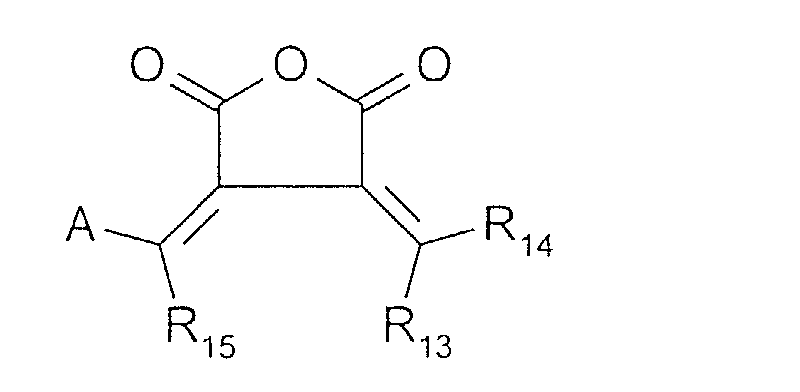
- le groupe A a la même signification que ci-dessus.
- les groupes R13 à R15 peuvent être égaux ou différents, et peuvent représenter un groupe alkyle linéaire ou ramifié en C1-C16, ou bien les groupes R13 et R14 peuvent former un cycle de 3 à 12 atomes de carbone tel qu'un cyclopropane ou un adamantylène.
On peut ainsi citer les huiles siliconées volatiles, telles que :
- les silicones volatiles cycliques ayant de 3 à 8 atomes de silicium et de préférence de 4 à 6. Il s'agit par exemple de la cyclotétradiméthylsiloxane, de la cyclopentadiméthylsiloxane ou de la cyclohexadiméthylsiloxane,
- les cyclocopolymères du type diméthylsiloxane/méthylalkylsiloxane, tels que la SILICONE FZ 3109 vendue par la société UNION CARBIDE, qui est un cyclocopolymère diméthylsiloxane/méthyloctylsiloxane,
- les silicones volatiles linéaires ayant de 2 à 9 atomes de silicium. Il s'agit par exemple de l'hexaméthyldisiloxane, de l'hexyl heptaméthyltrisiloxane ou de l'octyl heptaméthyltrisiloxane.
- les polyalkyl(C1-C20) siloxanes et notamment ceux à groupements terminaux triméthylsilyle, de préférence ceux dont la viscosité est inférieure à 0,06 m2/s parmi lesquels on peut citer les polydiméthylsiloxanes linéaires et les alkylméthylpolysiloxanes tels que la cétyldiméthicone (nom CTFA),
- les silicones modifiées par des groupements aliphatiques et/ou aromatiques, éventuellement fluorés, ou par des groupements fonctionnels tels que des groupements hydroxyles, thiols et/ou amines.
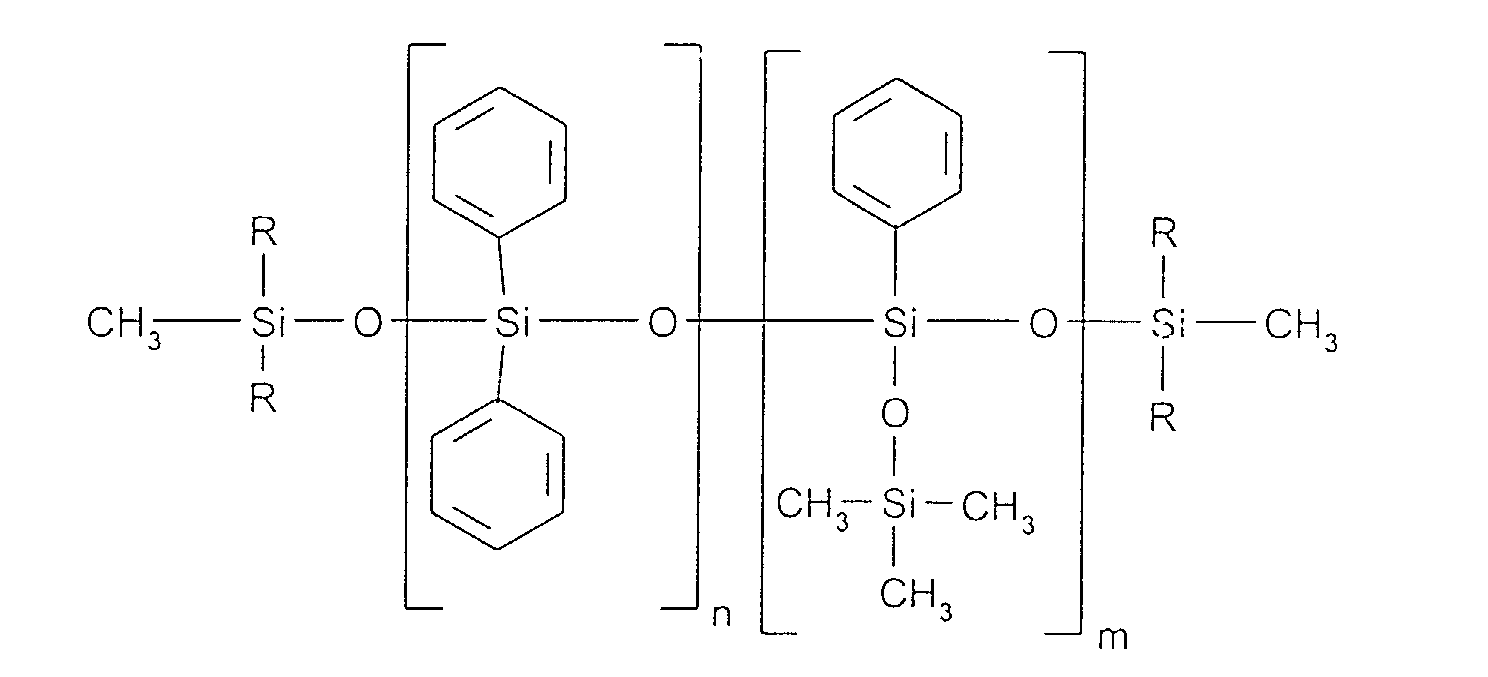
- les huiles de silicone phénylées, notamment celles de formule :
dans laquelle R est un radical alkyle en C1-C30, un radical aryle ou un radical aralkyle, n est un nombre entier compris entre 0 et 100, et m est un nombre entier compris entre 0 et 100, sous réserve que la somme est comprise entre 1 et 100.
- les huiles d'origine animale, végétale ou minérale, et notamment les huiles animales ou végétales formées par des esters d'acide gras et de polyols, en particulier les triglycérides liquides, par exemple les huiles de tournesol, de maïs, de soja, de courge, de pépins de raisin, de sésame, de noisette, d'abricot, d'amandes ou d'avocat; les huiles de poisson, le tricaprocaprylate de glycérol, ou les huiles végétales ou animales de formule R1COOR2 dans laquelle R1 représente le reste d'un acide gras supérieur comportant de 7 à 19 atomes de carbone et R2 représente une chaíne hydrocarbonée ramifiée contenant de 3 à 20 atomes de carbone, par exemple, l'huile de Purcellin; l'huile de paraffine, de vaseline, le perhydrosqualène, l'huile de germes de blé, de calophyllum, de sésame, de macadamia, de pépins de raisin, de colza, de coprah, d'arachide, de palme, de ricin, de jojoba, d'olive ou de germes de céréales; des esters d'acides gras; des alcools; des acétylglycérides; des octanoates, décanoates ou ricinoléates d'alcools ou de polyalcools; des triglycérides d'acides gras; des glycérides;
- les huiles fluorées et perfluorées.
On peut notamment citer :
- les gommes de silicones,
- les cires d'origine animale, végétale, minérale ou synthétique telles que les cires microcristallines, la paraffine, le pétrolatum, la vaseline, l'ozokérite, la cire de montan; la cire d'abeilles, la lanoline et ses dérivés; les cires de Candellila, d'Ouricury, de Carnauba, du Japon, le beurre de cacao, les cires de fibres de lièges ou de canne à sucre; les huiles hydrogénées concrètes à 25°C, les ozokérites, les esters gras et les glycérides concrets à 25°C; les cires de polyéthylène et les cires obtenues par synthèse de Fischer-Tropsch; des huiles hydrogénées concrètes à 25°C; des lanolines; des esters gras concrets à 25°C; les cires de silicone; les cires fluorées.
Parmi les solvants organiques hydrophiles, on peut citer par exemple des monoalcools inférieurs linéaires ou ramifiés ayant de 1 à 8 atomes de carbone comme l'éthanol, le propanol, le butanol, l'isopropanol, l'isobutanol ; des polyéthylène glycols ayant de 6 à 80 oxydes d'éthylène ; des polyols tels que le propylène glycol, l'isoprène glycol, le butylène glycol, le glycérol, le sorbitol ; les mono- ou di-alkyle d'isosorbide dont les groupements alkyle ont de 1 à 5 atomes de carbone ; les éthers de glycol comme le diéthylène glycol mono-méthyl ou mono-éthyl éther et les éthers de propylène glycol comme le dipropylène glycol méthyl éther.
Comme solvants organiques amphiphiles, on peut citer des polyols tels des dérivés de polypropylène glycol (PPG) tels que les esters de polypropylène glycol et d'acide gras, de PPG et d'alcool gras comme le PPG-23 oléyl éther et le PPG-36 oléate.
Comme solvants organiques lipophiles, on peut citer par exemple les esters gras tels que l'adipate de diisopropyle, l'adipate de dioctyle, les benzoates d'alkyle, le myristate d'isopropyle, le palmitate d'isopropyle, le stéarate de butyle, le laurate d'hexyle, l'isononanoate d'isononyle, le palmitate de 2-éthyl hexyle, le laurate de 2-hexyl-décyle, le palmitate de 2-octyl-décyle, le myristate de 2-octyl-dodécyle, le succinate de di-(éthyl-2-hexyle), le malate de diisostéaryle, le lactate de 2-octyl-dodécyle, le triisostéarate de glycérine, le triisostéarate de diglycérine.
Ladite phase aqueuse peut comprendre de 0 % à 14 % en poids, par rapport au poids total de la phase aqueuse, d'un monoalcool inférieur en C2-C6 et/ou d'un polyol tel que le glycérol, le butylèneglycol, l'isoprène glycol, le propylèneglycol, le polyéthylèneglycol.
Parmi les tensioactifs anioniques qui peuvent être utilisés seuls ou en mélange, on peut citer en particulier les sels alcalins, les sels d'ammonium, les sels d'amines ou les sels d'aminoalcools des composés suivants : les alcoylsulfates, alcoy!éther sulfates, alcoylamides sulfates et éthers sulfates, alcoylarylpolyéthersulfates, monoglycérides sulfates, alcoylsulfonates, alcoylamides sulfonates, alcoylarylsulfonates, α-oléfines sulfonates, paraffines sulfonates, alcoylsulfosuccinates, alcoyléthersulfosuccinates, alcoylamides sulfosuccinates, alcoylsulfosuccinamates, alcoylsulfoacétates, alcoylpolyglycérol carboxylates, alcoylphosphates/alcoylétherphosphates, acylsarcosinates, alcoylpolypeptidates, alcoylamidopolypeptidates, acyliséthionates, alcoyllaurates.
Le radical alcoyle ou acyle dans tous ces composés désigne généralement une chaíne de 12 à 18 atomes de carbone.
On peut aussi citer les savons et les sels d'acides gras tels que les acides oléique, ricinoléique, palmitique, stéarique, les acides d'huile de coprah ou d'huile de coprah hydrogénée et notamment les sels d'amines tels que les stéarates d'amines; les acyl lactylates dont le radical acyle comprend 8-20 atomes de carbone; les acides carboxyliques d'éthers polyglycoliques répondant à la formule :
Parmi les tensioactifs non ioniques qui peuvent être utilisés seuls ou en mélange, on peut citer en particulier : les alcools, les alcoylphénols et acides gras polyéthoxylés, polypropoxylés ou polyglycérolés à chaíne grasse comportant 8 à 18 atomes de carbone; des copolymères d'oxydes d'éthylène et de propylène, des condensats d'oxyde d'éthylène et de propylène sur des alcools gras, des amides gras polyéthoxylés, des amines grasses polyéthoxylées, des éthanolamides, des esters d'acides gras de glycol, des esters d'acides gras du sorbitan oxyéthylénés ou non, des esters d'acides gras du saccharose, des esters d'acides gras de polyéthylèneglycol, des triesters phosphoriques, des esters d'acides gras de dérivés de glucose; les alkylpolyglycosides et les alkylamides des sucres aminés; les produits de condensation d'un α-diol, d'un monoalcool, d'un alcoylphénol, d'un amide ou d'un diglycolamide avec le glycidol ou un précurseur de glycidol.
- les biopolymères polysaccharidiques comme la gomme de xanthane, la gomme de caroube, la gomme de guar, les alginates, les celluloses modifiées telles que l'hydroxyéthylcellulose, la méthylcellulose, l'hydroxypropylcellulose et la carboxyméthylcellulose, les dérivés de l'amidon, les dérivés d'éthers de cellulose possédant des groupes ammonium quaternaires, les polysaccharides cationiques;
- les polymères synthétiques comme les acides polyacryliques tels que les polymères poly(méth)acrylates de glycéryl tels que l'HISPAGEL ou le LUBRAGEL des sociétés HISPANO QUIMICA ou GARDIAN, la polyvinylpyrrolidone, l'alcool polyvinylique, les polymères réticulés d'acrylamide et d'acrylate d'ammonium tels que le PAS 5161 ou BOZEPOL C de HOECHST; les copolymères acrylate/octylacrylamide tels que le Dermacryl de National Starch; les polymères à base de polyacrylamide tels que le SEPIGEL 305 de SEPPIC, les polymères réticulés d'acrylamide et de chlorure de méthacryloyloxyéthyltriméthylammonium tels que le SALCARE SC 92 de ALLIED COLLOIDS,
- le silicate de magnésium et d'aluminium.
Les polymères peuvent être dissous ou dispersés dans le milieu cosmétiquement acceptable. En particulier, le polymère peut être présent sous forme de solution dans un solvant organique ou sous forme de dispersion aqueuse de particules de polymère filmogène.
Ledit polymère peut être choisi parmi la nitrocellulose, l'acétobutyrate de cellulose, les butyralpolyvinyliques, les résines alkydes, les polyesters, les acryliques, les vinyliques, et/ou les polyuréthannes.
On peut en particulier citer les copolymères d'acide (méth)acrylique et d'au moins un monomère ester d'acide (méth)acrylique linéaire, ramifié ou cyclique et/ou d'au moins un monomère amide d'acide (méth)acrylique mono ou di-substitué linéaire, ramifié ou cyclique; les copolymères acide (méth)acrylique/(meth)acrylate de tertio-butyle et/ou (méth)acrylate d'isobutyle/(méth)acrylate d'alkyle en C1-C4; les terpolymères et tétrapolymères acide (meth)acrylique/acrylate d'éthyle/ méthacrylate de méthyle; les tétrapolymères méthacrylate de méthyle/acrylate de butyle ou d'éthyle/acrylate ou méthacrylate d'hydroxyéthyle ou de 2-hydroxypropyle/acide (meth)acrylique; les copolymères d'acide acrylique et de méthacrylate d'alkyle en C1-C4 ; les terpolymères de vinyl pyrrolidone, d'acide acrylique et de méthacrylate d'alkyle en C1-20; les copolymères amphotères; les esters vinyliques d'acide ramifiés; les esters vinyliques d'acide benzoïque; les copolymères d'acide (meth)acrylique et d'au moins un monomère oléfinique; les copolymères de monoacide vinylique et/ou de monoacide allylique.
Parmi les résines, on peut citer les résines du type aryl-sulfonamide formaldéhyde ou aryl-sulfonamide époxy; les résines du type acrylique, styrénique, acrylate-styrénique et vinylique.
La composition peut également comprendre au moins un plastifiant, tel que le phosphate de tricrésyle, le benzoate de benzyle, le citrate de triéthyle, le citrate de tributyle, l'acétylcitrate de triéthyle, l'acétylcitrate de triétyl-2 hexyle, le camphre; les éthers de glycol; l'huile de ricin oxyéthylénée à 40 moles d'oxyde d'éthylène; le propylène glycol; le butyl glycol ; l'éthylène glycol monométhyléther acétate; les éthers de propylène glycol; les éthers esters de propylène glycol et d'éthylène glycol; les esters de diacides tels que les phtalates et adipates de diéthyle, dibutyle et de diisopropyle, les tartrates de diéthyle et dibutyle, les succinates de diéthyle et de dibutyle, les sébacates de diéthyle et de dibutyle, les phosphates de diéthyle, de dibutyle et de diéthyl-2 hexyle, l'acétyl citrate de diéthyle ou de dibutyle; les esters de glycérol. Les plastifiants peuvent être généralement présents à une teneur allant de 1 % à 40 % en poids par rapport au poids total de la composition.
Lorsque les compositions se présentent sous forme d'un vernis à ongles anhydre, le système solvant peut représenter environ de 55 % à 90 % en poids par rapport au poids total du vernis. Ce système solvant peut être constitué par un mélange de divers solvants organiques volatils tels que les cétones notamment l'acétone, la méthyléthylcétone, la méthylisobutylcétone; les acétates notamment l'acétate d'éthyle, l'acétate de butyle, l'acétate de méthoxy-2 éthyle, l'acétate de méthyle, l'acétate d'amyle et l'acétate d'isopropyle. Le système solvant peut également comprendre un diluant tel que l'hexane ou l'octane ou encore un hydrocarbure aromatique tel que le toluène ou le xylène en une proportion notamment de 10 à 35 % en poids par rapport au poids total du vernis.
Par pigments, il faut comprendre des particules blanches ou colorées, minérales ou organiques, destinées à colorer et/ou opacifier la composition. Par charges, il faut comprendre des particules incolores ou blanches, minérales ou de synthèse, lamellaires ou non lamellaires, destinées à donner du corps ou de la rigidité à la composition, et/ou de la douceur, de la matité et de l'uniformité au maquillage.
Par nacres, il faut comprendre des particules irisées qui réfléchissent la lumière.
Les pigments peuvent être présents dans la composition à raison de 0 à 15% en poids de la composition finale, et de préférence à raison de 8 à 10% en poids. Ils peuvent être blancs ou colorés, minéraux et/ou organiques, de taille usuelle ou nanométrique. Ils peuvent se présenter sous forme de poudre ou de pâte pigmentaire.
On peut citer les dioxydes de titane, de zirconium ou de cérium, ainsi que les oxydes de zinc, de fer ou de chrome, le bleu ferrique, l'hydrate de chrome, le noir de carbone, les outremers (polysulfures d'aluminosilicates), le pyrophosphate de manganèse et certaines poudres métalliques telles que celles d'argent ou d'aluminium, le noir de carbone. On peut encore citer les laques couramment employées pour conférer aux lèvres et à la peau un effet de maquillage, qui sont des sels de calcium, de baryum, d'aluminium ou de zirconium, de colorants acides tels que les colorants halogéno-acides, azoïques, anthraquinoniques, etc.
Les nacres peuvent être présentes dans la composition à raison de 0 à 20% en poids, de préférence à un taux de l'ordre de 8 à 15% en poids. Parmi les nacres envisageables, on peut citer la nacre naturelle, le mica recouvert d'oxyde de titane, d'oxyde de fer, de pigment naturel ou d'oxychlorure de bismuth ainsi que le mica titane coloré.
Les charges, qui peuvent être présentes à raison de 0 à 30% en poids, de préférence 5 à 15%, dans la composition, peuvent être minérales ou de synthèse, lamellaires ou non lamellaires. On peut citer le talc, le mica, la silice, le kaolin, les poudres de Nylon et de polyéthylène, le Téflon, l'amidon, le nitrure de bore, les microsphères de polymère telles que l'Expancel (Nobel Industrie), le polytrap (Dow Corning) et les microbilles de résine de silicone (Tospearls de Toshiba, par exemple), le carbonate de calcium précipité, le carbonate ou l'hydrocarbonate de magnésium, des savons métalliques dérivés d'acides organiques carboxyliques ayant de 8 à 22 atomes de carbone.
Selon le type de formulation, la phase pulvérulente peut représenter de 0,01 à 99% en poids de la composition.
Bien entendu l'homme du métier veillera à choisir les éventuels composés complémentaires, et/ou leur quantité, de manière telle que les propriétés avantageuses de la composition selon l'invention ne soient pas, ou substantiellement pas, altérées par l'adjonction envisagée.
- Huiles (minérale, de silicone et hydrocarbonées) 20%
- Magnésium aluminium silicate gel à 5 % 20%
- Gomme de cellulose 3,5%
- Tensioactif 4%
- Conservateurs q.s.
- Eau qsp 100%
- Agent de coloration selon l'invention 2%
2,3-bis (2,4,5-triméthyl-thiophen-3-yl)-but-2-ènedinitrile
- Polymère filmogène à 30% dans une solution hydroalcoolique 50/50 9%
- Ethanol 35%
- Eau qsp 100%
- Agent de coloration selon l'invention 5%
2,3-bis (2,4,5-triméthyl-thiophen-3-yl)-but-2-ènedinitrile
- Nitrocellulose 15%
- Résine toluène sulfonamide formaldéhyde 10%
- Acétylcitrate de tributyle 6%
- Acétate de butyle 20%
- Acétate d'éthyle 10%
- Toluène qsp 100%
- Agent de coloration selon l'invention 4%
2,3-bis (2,4,5-triméthyl-thiophen-3-yl)-but-2-ènedinitrile
En appliquant directement ce vernis à ongles sur l'ongle, et après irradiation, on obtient un léger effet rose.
On peut utiliser des caches prédécoupés à appliquer sur les ongles avant illumination, de manière à permettre de dessiner des motifs ou d'écrire sur l'ongle. On peut également utiliser des agents de coloration différents pour chaque ongle,
de manière à obtenir des ongles de couleur différente.
- dispersion aqueuse de polyester-polyuréthanne (35,8% de matière sèche) 55%
- dispersion aqueuse de polymère acrylique (matière sèche: 45,5%) 18%
- épaississant associatif polyuréthanne 0,8%
- eau qsp 100%
- agent de coloration selon l'invention 3%
2,3-bis (2,4,5-triméthyl-thiophen-3-yl)-but-2-ènedinitrile
- nitrocellulose 15%
- résine toluène sulfonamide formaldéhyde 10%
- acétylcitrate de tributyle 6%
- acétate de butyle 20%
- acétate d'éthyle 10%
- 2,3-bis (2,4,5-triméthyl-thiophen-3-yl)-but-2-ènedinitrile x%
- toluène qsp 100%
En appliquant ces compositions jaune sur l'ongle, et après irradiation par une source lumineuse ayant une longueur d'ondes d'environ 400 nm, on obtient un effet rose à rouge.
Ces compositions peuvent également être appliquées sur de faux ongles.
- lampe PHILIPS SOX-E18, de longueur d'onde 596 nm
- lampe UV avec filtre pour chromatographie couche mince, de longueur d'onde 365 nm
| x(%) | H | V | C | L | a | b |
| 0 | 4,73 | 8,0 | 3,0 | 80,40 | -2,01 | 20,77 |
| 0,125 | 6,73 | 7,4 | 3,2 | 75,56 | -4,09 | 23,03 |
| 0,25 | 7,77 | 7,3 | 3,6 | 73,94 | -5,67 | 26,08 |
| 0,5 | 6,87 | 7,2 | 5,0 | 72,88 | -5,88 | 35,55 |
| 1,125 | 6,27 | 6,7 | 5,9 | 67,82 | -5,03 | 42,07 |
| 2,5 | 6,67 | 7,9 | 8,3 | 79,90 | -7,97 | 59,10 |
| 5 | 6,17 | 7,4 | 8,8 | 74,97 | -6,44 | 62,34 |
| 10 | 6,90 | 7,2 | 8,1 | 72,68 | -7,81 | 57,97 |
| x(%) | H | V | C | L | a | b |
| 0 | 4,80 | 7,9 | 2,9 | 80,36 | -2,03 | 20,94 |
| 0,125 | 3,17 | 5,9 | 6,2 | 59,83 | 19,85 | 29,89 |
| 0,25 | 4,77 | 4,7 | 9,4 | 47,32 | 39,68 | 19,76 |
| 0,5 | 8,90 | 4,6 | 8,9 | 47,05 | 35,23 | 29,73 |
| 1,125 | 7,83 | 4,3 | 8,8 | 44,40 | 36,42 | 26,70 |
| 2,5 | 9,67 | 5,0 | 10,4 | 51,34 | 39,78 | 37,93 |
| 5 | 9,43 | 4,8 | 10,4 | 48,49 | 39,85 | 36,86 |
| 10 | 0,00 | 4,7 | 9,5 | 48,11 | 35,76 | 35,56 |
| x(%) | H | V | C | L | a | b |
| 0 | 4,73 | 8,0 | 3,0 | 80,40 | -2,01 | 20,77 |
| 0,125 | 0,23 | 6,8 | 4,6 | 69,35 | 4,07 | 30,28 |
| 0,25 | 2,13 | 5,9 | 5,4 | 60,22 | 18,56 | 24,31 |
| 0,5 | 0,07 | 5,0 | 7,9 | 51,24 | 29,95 | 30,01 |
| 1,125 | 5,40 | 3,9 | 10,0 | 39,32 | 42,83 | 22,31 |
| 2,5 | 5,70 | 4,1 | 12,1 | 42,52 | 51,28 | 29,01 |
| 5 | 4,60 | 3,5 | 11,7 | 36,00 | 50,09 | 23,20 |
| 10 | 4,50 | 3,5 | 11,0 | 35,81 | 47,52 | 21,51 |
Claims (12)
- Composition cosmétique comprenant, dans un milieu cosmétiquement acceptable, au moins un agent de coloration photochrome thermiquement irréversible.
- Composition selon la revendication 1, dans laquelle l'agent de coloration photochrome est choisi parmi les composés qui appartiennent à la famille des diaryléthènes et/ou ceux qui appartiennent à la famille des fulgides.
- Composition selon la revendication 2, dans laquelle les diaryléthènes répondent à la formule (I) suivante :dans laquelle :
 dans lesquelles :les radicaux R1 et R2, toujours en relation "cis" par rapport à la double liaison, sont, indépendamment l'un de l'autre, choisis parmi les radicaux alkyles en C1-C16, éventuellement fluorés ou perfluorés, ou le radical nitrile CN; ou forment ensemble un cycle à 5 ou 6 atomes de carbone, éventuellement fluoré ou perfluoré; ou forment ensemble un cycle à 5 atomes de carbone d'anhydride, et notamment selon la formule suivante :dans laquelle X peut être un atome d'oxygène ou un radical -NR3, avec R représentant un radical alkyle et/ou hydroxyalkyle en C2-C16.
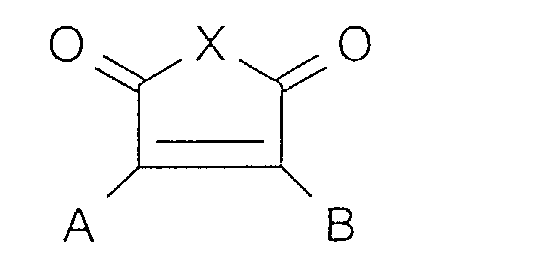 les radicaux A et B, égaux ou différents, représentent un cycle à 5 atomes ou un bicycle à 5 et 6 atomes, selon les structures suivantes :
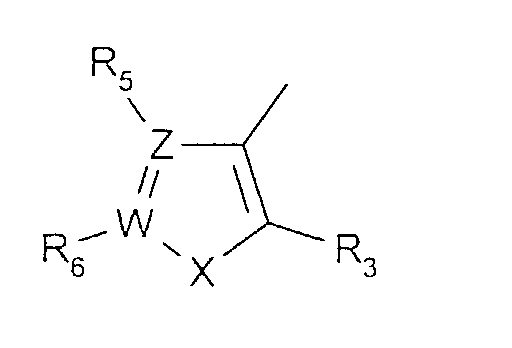
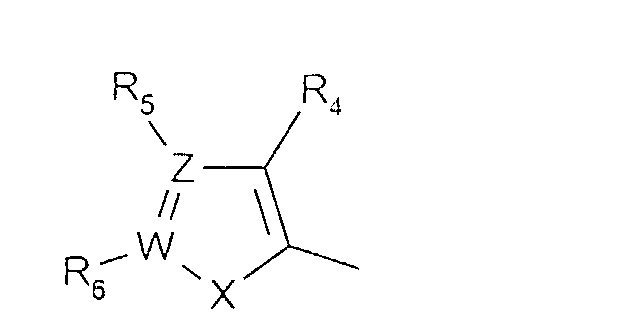
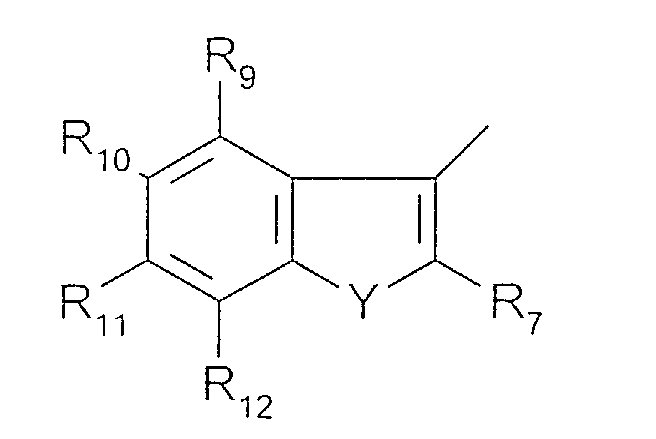
 X et Y, égaux ou différents, représentent un atome d'oxygène, de soufre, d'une forme oxydée du soufre, d'azote ou de sélénium,Z et W, égaux ou différents, représentent un atome de carbone ou d'azote,les radicaux R3 à R12, égaux ou différents, représentent un hydrogène, un groupe alkyle ou alkoxy, linéaire ou ramifié, en C1-C16, un halogène, un groupe fluoré ou perfluoré linéaire ou ramifié en C1-C4, un groupe carboxylique, un groupe alkyle carboxylique en C1-C16, un groupe mono- ou dialkylamino en C1-C16, un groupe nitrile; éventuellement substitués par un groupe phényle, naphtalène ou un hétérocycle (pyridine, quinoléine, thiophène).les groupes A et B pouvant être séparés du cycle par une ou deux doubles liaisons,les groupes A et B n'étant pas tous les deux égaux à une structure de type indolique.
- Composition selon la revendication 3, dans laquelle le composé photochrome est de formule :
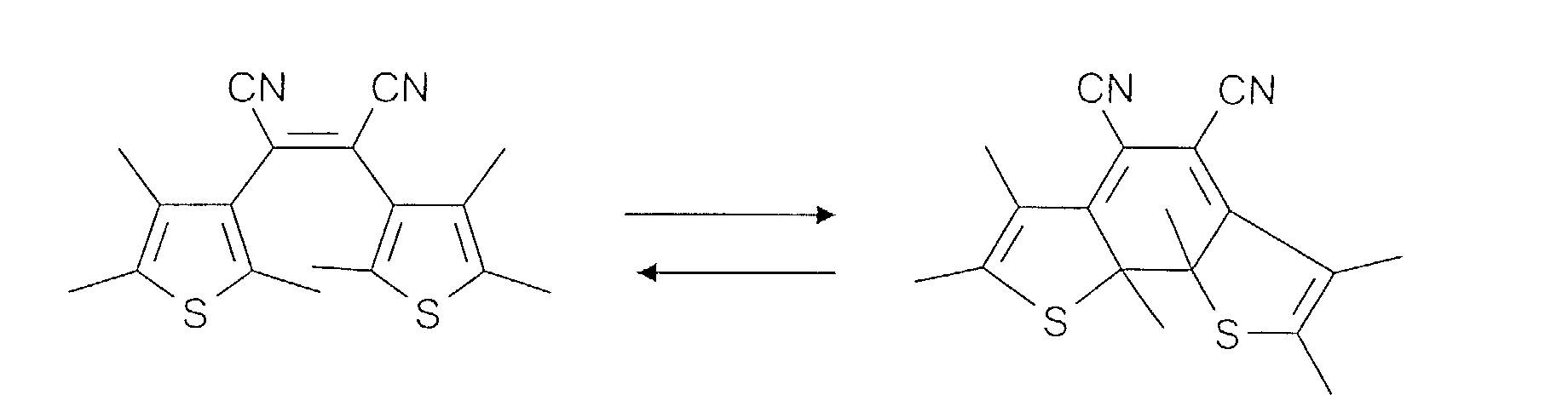
- Composition selon la revendication 2, dans laquelle les fulgides sont représentés par la formule suivante :dans laquelle
 le groupe A a la même signification que ci-dessus.les groupes R13 à R15, égaux ou différents, représentent un groupe alkyle linéaire ou ramifié en C1-C16, ou bien les groupes R13 et R14 forment un cycle de 3 à 12 atomes de carbone tel qu'un cyclopropane ou un adamantylène.
- Composition selon l'une des revendications précédentes, dans laquelle l'agent de coloration photochrome est présent à une teneur de 0,05-30% en poids, de préférence 0,1-10% en poids.
- Composition selon l'une des revendications précédentes, comprenant en outre une phase grasse comprenant des corps gras liquides à 25°C, tels que des huiles d'origine animale, végétale, minérale ou synthétique; des corps gras solides à 25°C tels que des cires d'origine animale, végétale, minérale ou synthétique; des corps gras pâteux; des gommes; des huiles volatiles; et leurs mélanges.
- Composition selon l'une des revendications précédentes, comprenant en outre une phase aqueuse et/ ou un tensioactif et/ou un épaississant et/ou un polymère filmogène et/ou une phase particulaire qui comprend des pigments et/ou des nacres et/ou des charges
- Composition selon l'une des revendications précédentes, se présentant sous la forme d'une lotion, une suspension, une dispersion, une solution en milieu solvant ou hydroalcoolique, éventuellement épaissie voire gélifiée; une émulsion huile-dans-eau, eau-dans-huile, ou multiple; un gel ou une mousse; un gel émulsionné; un spray; une poudre libre, compacte ou coulée; une pâte anhydre.
- Composition selon l'une des revendications précédentes, se présentant sous la forme d'une composition de maquillage du visage, telle que fard à paupières, eye-liner, mascara, poudre, fond de teint, fard à joues, "Blush", crème teintée, rouge à lèvres, stick à lèvres ou stick anti-cernes; d'une composition de maquillage des cheveux telle que gel, crème ou mousse pour la coloration temporaire des cheveux; d'une composition de maquillage des ongles telle que vernis à ongles.
- Utilisation d'un agent de coloration photochrome tel que défini dans l'une des revendications 1 à 5, comme agent de coloration dans une composition cosmétique.
- Procédé de maquillage et/ou de coloration temporaire d'un support choisi parmi les muqueuses, les semi-muqueuses, la peau et/ou les phanères, dans lequel on applique sur ledit support une composition cosmétique telle que définie dans l'une des revendications 1 à 10.
Applications Claiming Priority (2)
| Application Number | Priority Date | Filing Date | Title |
|---|---|---|---|
| FR9715769A FR2772266B1 (fr) | 1997-12-12 | 1997-12-12 | Utilisation d'agent de coloration photochrome dans une composition cosmetique, et composition cosmetique le comprenant |
| FR9715769 | 1997-12-12 |
Publications (3)
| Publication Number | Publication Date |
|---|---|
| EP0938887A1 true EP0938887A1 (fr) | 1999-09-01 |
| EP0938887B1 EP0938887B1 (fr) | 2003-11-19 |
| EP0938887B2 EP0938887B2 (fr) | 2008-02-13 |
Family
ID=9514530
Family Applications (1)
| Application Number | Title | Priority Date | Filing Date |
|---|---|---|---|
| EP98402849A Expired - Lifetime EP0938887B2 (fr) | 1997-12-12 | 1998-11-17 | Utilisation d'agent de coloration photochrome dans une composition cosmétique, et composition cosmétique le comprenant |
Country Status (8)
| Country | Link |
|---|---|
| US (1) | US6123952A (fr) |
| EP (1) | EP0938887B2 (fr) |
| JP (1) | JP3590731B2 (fr) |
| AT (1) | ATE254442T1 (fr) |
| CA (1) | CA2254322C (fr) |
| DE (1) | DE69819866T3 (fr) |
| ES (1) | ES2212241T5 (fr) |
| FR (1) | FR2772266B1 (fr) |
Cited By (26)
| Publication number | Priority date | Publication date | Assignee | Title |
|---|---|---|---|---|
| FR2838960A1 (fr) * | 2002-04-30 | 2003-10-31 | Oreal | Composition comprenant des photochromes et son utilisation en cosmetique |
| EP2221042A1 (fr) * | 2009-02-23 | 2010-08-25 | L'Oréal | Procédé de photomaquillage et composition de photomaquillage |
| EP2221038A1 (fr) | 2009-02-23 | 2010-08-25 | L'Oréal | Procédé de maquillage avec application d'une couche de base et ensemble pour la mise en oeuvre d'un tel procédé |
| EP2221037A1 (fr) | 2009-02-23 | 2010-08-25 | L'Oréal | Procédé de photomaquillage dans lequel un agent optique est utilisé pour protéger le résultat obtenu |
| EP2221041A2 (fr) | 2009-02-23 | 2010-08-25 | L'Oréal | Procédé de photomaquillage progressif |
| WO2010095120A1 (fr) | 2009-02-23 | 2010-08-26 | L'oreal | Procede de maquillage mettant en oeuvre une source de lumiere a matrice adressable |
| WO2010095118A2 (fr) | 2009-02-23 | 2010-08-26 | L'oreal | Procédé applicable à un traitement cosmétique impliquant la projection d'une image sur la zone à traiter |
| WO2010095116A1 (fr) | 2009-02-23 | 2010-08-26 | L'oreal | Procédé de démaquillage et démaquillant |
| WO2010095117A1 (fr) | 2009-02-23 | 2010-08-26 | L'oreal | Procédé de maquillage avec un maquillage photosensible au moyen d'une composition photochrome à l'état déjà développé |
| FR2942399A1 (fr) * | 2009-02-23 | 2010-08-27 | Oreal | Procede de demaquillage et dispositif d'aide au demaquillage |
| FR2942398A1 (fr) * | 2009-02-23 | 2010-08-27 | Oreal | Procede de maquillage avec protection mecanique du photomaquillage |
| WO2010103420A2 (fr) | 2009-03-12 | 2010-09-16 | L'oreal | Procédé de maquillage par maquillage sensible à la lumière avec protection mécanique du maquillage sensible à la lumière |
| WO2013093890A2 (fr) | 2011-12-23 | 2013-06-27 | L'oreal | Procédé de maquillage de la peau |
| WO2015097620A1 (fr) | 2013-12-27 | 2015-07-02 | L'oreal | Dispositif de maquillage comportant une pluralite d'encres cosmetiques |
| WO2015097616A1 (fr) | 2013-12-27 | 2015-07-02 | L'oreal | Dispositif de transfert pour maquiller des matières kératiniques |
| WO2015097613A1 (fr) | 2013-12-27 | 2015-07-02 | L'oreal | Dispositif de transfert pour maquiller des matériaux kératiniques |
| WO2015097612A1 (fr) | 2013-12-27 | 2015-07-02 | L'oreal | Dispositif de transfert pour maquiller des matières kératiniques |
| CN106726694A (zh) * | 2017-02-06 | 2017-05-31 | 金华市名仕科技股份有限公司 | 一种温变指甲贴膜及其制备方法 |
| US10265260B2 (en) | 2013-12-27 | 2019-04-23 | L'oreal | Transfer makeup process and related device |
| US10532011B2 (en) | 2013-12-27 | 2020-01-14 | L'oreal | Transfer device for making up keratin materials |
| WO2020260056A1 (fr) | 2019-06-28 | 2020-12-30 | L'oreal | Dispositif de prélèvement et d'application d'un produit cosmétique |
| WO2020260515A1 (fr) | 2019-06-28 | 2020-12-30 | L'oreal | Procédé de mise en forme d'un applicateur pour l'application d'une composition cosmétique |
| FR3102349A1 (fr) | 2019-10-28 | 2021-04-30 | L'oreal | Système de prélèvement et d’application d’une composition cosmétique |
| US11178955B2 (en) | 2013-12-27 | 2021-11-23 | L'oreal | Transfer device and process for making up keratin materials |
| US11191340B2 (en) | 2013-12-27 | 2021-12-07 | L'oreal | Transfer device for making up keratin materials |
| FR3117791A1 (fr) | 2020-12-22 | 2022-06-24 | L'oreal | Composition aqueuse soft-solid comprenant un sel de magnésium de grade léger |
Families Citing this family (27)
| Publication number | Priority date | Publication date | Assignee | Title |
|---|---|---|---|---|
| US6355261B1 (en) | 1999-12-02 | 2002-03-12 | The C. P. Hall Company | Ultraviolet radiation absorbing waxes useful in cosmetic compositions |
| US6361763B1 (en) * | 2000-03-27 | 2002-03-26 | George H. Carroll | Photochromic tanning and sunscreen lotion |
| US20030206966A1 (en) * | 2000-07-27 | 2003-11-06 | Burrell Robert E. | Methods of inducing apoptosis and modulating metalloproteinases |
| US7022331B2 (en) | 2001-04-26 | 2006-04-04 | Lyle Theisen | Thermochromic/photochromic cosmetic compositions |
| KR20020096213A (ko) * | 2001-06-19 | 2002-12-31 | 조현화 | 광호변성 컬러무스 |
| CA2494920C (fr) * | 2002-08-09 | 2013-01-22 | Simon Fraser University | Composes photochromes et electrochromes et methodes de synthese et d'utilisation correspondantes |
| KR20020072519A (ko) * | 2002-08-30 | 2002-09-16 | 최명식 | 헤어 젤용 변색용제 및 이를 갖춘 헤어 젤 |
| US7097668B2 (en) * | 2002-09-16 | 2006-08-29 | Combe Incorporated | Temporary hair dye composition |
| US20050276767A1 (en) * | 2002-10-18 | 2005-12-15 | L'oreal | Composition containing an oily phase and a naphthopyran dye, cosmetic treatment processes |
| US20040228818A1 (en) * | 2002-10-18 | 2004-11-18 | L'oreal | Cosmetic composition combining at least two dyes including at least one photochromic dye |
| US20040228817A1 (en) * | 2002-10-18 | 2004-11-18 | L'oreal | Makeup combining at least one photochromic dye and at least one goniochromatic agent |
| US20040142008A1 (en) * | 2002-11-06 | 2004-07-22 | L'oreal | Composition containing fibers and polyurethane, methods |
| US20040120915A1 (en) * | 2002-12-19 | 2004-06-24 | Kaiyuan Yang | Multifunctional compositions for surface applications |
| GB0303319D0 (en) | 2003-02-13 | 2003-03-19 | Novartis Ag | Organic compounds |
| US20040213747A1 (en) * | 2003-04-26 | 2004-10-28 | Patil Anjali Abhimanyu | Cosmetic compositions with film forming polymer |
| EP1888553A4 (fr) * | 2005-05-25 | 2010-03-10 | Switch Materials Inc | Composes electrochromiques et photochromiques et synthese et utilisation de ceux-ci |
| FR2893628B1 (fr) * | 2005-11-18 | 2008-05-16 | Expanscience Laboratoires Sa | Procede d'obtention d'une huile d'avocat raffinee riche en triglycerides et huile susceptible d'etre obtenue par un tel procede |
| JP5941906B2 (ja) * | 2011-03-24 | 2016-06-29 | リンテック株式会社 | 粘着剤組成物、及び粘着シート |
| CN108690045B (zh) | 2011-09-30 | 2022-08-30 | 首诺加拿大公司 | 二芳基乙烯化合物及其用途 |
| WO2013146813A1 (fr) * | 2012-03-30 | 2013-10-03 | リンテック株式会社 | Composition adhésive et feuille adhésive |
| EP2871216A4 (fr) * | 2012-07-06 | 2016-03-02 | Mitsui Chemicals Inc | Particules polymères et leur utilisation |
| US9693945B1 (en) * | 2016-05-03 | 2017-07-04 | Clifton Sanders | Method of solubilizing a composition of a cleaned photochromic dye suitable for use on human skin |
| CN114212851B (zh) * | 2021-03-03 | 2022-10-28 | 中国科学院化学研究所 | 一种基于天然植物杆的太阳能海水淡化材料及其制备方法和应用 |
| WO2022212691A1 (fr) * | 2021-03-31 | 2022-10-06 | The Regents Of The University Of Colorado, A Body Corporate | Pigments photochromes multistables à usage intradermique |
| US12329838B1 (en) * | 2022-10-07 | 2025-06-17 | The Procter & Gamble Company | Hair dye composition |
| EP4788295A1 (fr) | 2023-10-06 | 2026-08-12 | The Procter & Gamble Company | Gamme de produits de coloration capillaire |
| CN122070121A (zh) | 2023-10-06 | 2026-05-19 | 宝洁公司 | 毛发染料组合物 |
Citations (2)
| Publication number | Priority date | Publication date | Assignee | Title |
|---|---|---|---|---|
| FR1604929A (fr) * | 1967-11-22 | 1971-05-15 | ||
| EP0359909A2 (fr) * | 1988-06-01 | 1990-03-28 | Shiseido Company Limited | Cosmétiques photochromes régulateurs de couleur |
Family Cites Families (13)
| Publication number | Priority date | Publication date | Assignee | Title |
|---|---|---|---|---|
| FR2088003A1 (en) * | 1970-05-06 | 1972-01-07 | Saint Gobain | Sun-screening preparations containing photochromatic substances |
| JPS536222B2 (fr) * | 1973-09-11 | 1978-03-06 | ||
| JPS56100709A (en) * | 1980-01-16 | 1981-08-12 | Kanebo Keshohin Kk | Novel nail enamel |
| JPS61275209A (ja) * | 1985-05-30 | 1986-12-05 | Shiseido Co Ltd | メ−キヤツプ化粧料 |
| IT1218208B (it) * | 1988-04-08 | 1990-04-12 | Enichem Sintesi | Smalto o vernice per unghie avente caratteristiche fotocromatiche e relativo procedimento di preparazione |
| JP2746452B2 (ja) * | 1990-03-13 | 1998-05-06 | 鐘紡株式会社 | ジアリールエテン系化合物 |
| JPH0816215B2 (ja) * | 1990-06-18 | 1996-02-21 | 株式会社松井色素化学工業所 | フォトクロミック材料 |
| EP0562201B1 (fr) * | 1992-03-23 | 1997-04-23 | Nippon Telegraph And Telephone Corporation | Senseur de discrimination de UV-A et UV-B |
| JP3257122B2 (ja) * | 1993-03-12 | 2002-02-18 | 入江 正浩 | アゾフェニル基を有するフォトクロミックジアリールエテン誘導体 |
| JPH08245579A (ja) * | 1995-03-10 | 1996-09-24 | Masahiro Irie | ジアリールエテン系フォトクロミック化合物および該化合物を用いた光学記録材料 |
| JPH09100469A (ja) * | 1995-10-03 | 1997-04-15 | Dai Ichi Kogyo Seiyaku Co Ltd | 色可変マイクロカプセルおよびそれを含有する分散液 |
| JPH09241625A (ja) * | 1996-03-08 | 1997-09-16 | Masahiro Irie | フォトクロミック材料及びそれを用いた光記録媒体、並びに光記録媒体を用いた情報の記録、読み出し方法 |
| JPH09241254A (ja) * | 1996-03-08 | 1997-09-16 | Masahiro Irie | アモルファスフォトクロミック材料とこれを用いた光記録媒体 |
-
1997
- 1997-12-12 FR FR9715769A patent/FR2772266B1/fr not_active Expired - Fee Related
-
1998
- 1998-11-17 EP EP98402849A patent/EP0938887B2/fr not_active Expired - Lifetime
- 1998-11-17 ES ES98402849T patent/ES2212241T5/es not_active Expired - Lifetime
- 1998-11-17 AT AT98402849T patent/ATE254442T1/de not_active IP Right Cessation
- 1998-11-17 DE DE69819866T patent/DE69819866T3/de not_active Expired - Lifetime
- 1998-12-11 JP JP35333698A patent/JP3590731B2/ja not_active Expired - Lifetime
- 1998-12-11 CA CA002254322A patent/CA2254322C/fr not_active Expired - Fee Related
- 1998-12-11 US US09/209,002 patent/US6123952A/en not_active Expired - Lifetime
Patent Citations (2)
| Publication number | Priority date | Publication date | Assignee | Title |
|---|---|---|---|---|
| FR1604929A (fr) * | 1967-11-22 | 1971-05-15 | ||
| EP0359909A2 (fr) * | 1988-06-01 | 1990-03-28 | Shiseido Company Limited | Cosmétiques photochromes régulateurs de couleur |
Non-Patent Citations (1)
| Title |
|---|
| CHEMICAL ABSTRACTS, 1 January 1900, Columbus, Ohio, US; abstract no. 105:208778, KAKURAI T, TAKANO T: "PHOTOCHRONIC COMPOUNDS" XP002072882 * |
Cited By (45)
| Publication number | Priority date | Publication date | Assignee | Title |
|---|---|---|---|---|
| FR2838960A1 (fr) * | 2002-04-30 | 2003-10-31 | Oreal | Composition comprenant des photochromes et son utilisation en cosmetique |
| RU2445070C2 (ru) * | 2009-02-23 | 2012-03-20 | Л'Ореаль | Способ нанесения светочувствительного макияжа путем нанесения слоя основы и набор для осуществления такого способа |
| EP2221038A1 (fr) | 2009-02-23 | 2010-08-25 | L'Oréal | Procédé de maquillage avec application d'une couche de base et ensemble pour la mise en oeuvre d'un tel procédé |
| EP2221037A1 (fr) | 2009-02-23 | 2010-08-25 | L'Oréal | Procédé de photomaquillage dans lequel un agent optique est utilisé pour protéger le résultat obtenu |
| EP2221041A2 (fr) | 2009-02-23 | 2010-08-25 | L'Oréal | Procédé de photomaquillage progressif |
| WO2010095120A1 (fr) | 2009-02-23 | 2010-08-26 | L'oreal | Procede de maquillage mettant en oeuvre une source de lumiere a matrice adressable |
| WO2010095118A2 (fr) | 2009-02-23 | 2010-08-26 | L'oreal | Procédé applicable à un traitement cosmétique impliquant la projection d'une image sur la zone à traiter |
| WO2010095116A1 (fr) | 2009-02-23 | 2010-08-26 | L'oreal | Procédé de démaquillage et démaquillant |
| WO2010095117A1 (fr) | 2009-02-23 | 2010-08-26 | L'oreal | Procédé de maquillage avec un maquillage photosensible au moyen d'une composition photochrome à l'état déjà développé |
| FR2942402A1 (fr) * | 2009-02-23 | 2010-08-27 | Oreal | Procede de photomaquillage utilisant une source de lumiere matricielle adressable |
| FR2942400A1 (fr) * | 2009-02-23 | 2010-08-27 | Oreal | Procede de photomaquillage dans lequel un agent optique est utilise pour proteger le resultat obtenu |
| FR2942407A1 (fr) * | 2009-02-23 | 2010-08-27 | Oreal | Procede de photomaquillage et composition de photomaquillage |
| FR2942404A1 (fr) * | 2009-02-23 | 2010-08-27 | Oreal | Procede de photomaquillage utilisant une composition photochromique a l'etat deja revele |
| FR2942399A1 (fr) * | 2009-02-23 | 2010-08-27 | Oreal | Procede de demaquillage et dispositif d'aide au demaquillage |
| FR2942403A1 (fr) * | 2009-02-23 | 2010-08-27 | Oreal | Procede de photomaquillage avec application d'une couche de base et ensemble pour la mise en oeuvre d'un tel procede |
| FR2942398A1 (fr) * | 2009-02-23 | 2010-08-27 | Oreal | Procede de maquillage avec protection mecanique du photomaquillage |
| FR2942405A1 (fr) * | 2009-02-23 | 2010-08-27 | Oreal | Procede de photomaquillage progressif |
| FR2942401A1 (fr) * | 2009-02-23 | 2010-08-27 | Oreal | Procede de traitement cosmetique comportant la projection d'une image sur la zone a traiter |
| EP2221042A1 (fr) * | 2009-02-23 | 2010-08-25 | L'Oréal | Procédé de photomaquillage et composition de photomaquillage |
| EP2221041A3 (fr) * | 2009-02-23 | 2010-11-17 | L'Oréal | Procédé de photomaquillage progressif |
| WO2010095118A3 (fr) * | 2009-02-23 | 2011-06-16 | L'oreal | Procédé applicable à un traitement cosmétique impliquant la projection d'une image sur la zone à traiter |
| RU2447883C2 (ru) * | 2009-02-23 | 2012-04-20 | Л'Ореаль | Способ нанесения светочувствительного макияжа и композиция для светочувствительного макияжа |
| RU2440091C2 (ru) * | 2009-02-23 | 2012-01-20 | Л'Ореаль | Способ постепенного нанесения светочувствительного макияжа |
| WO2010103420A2 (fr) | 2009-03-12 | 2010-09-16 | L'oreal | Procédé de maquillage par maquillage sensible à la lumière avec protection mécanique du maquillage sensible à la lumière |
| WO2013093890A2 (fr) | 2011-12-23 | 2013-06-27 | L'oreal | Procédé de maquillage de la peau |
| US10265260B2 (en) | 2013-12-27 | 2019-04-23 | L'oreal | Transfer makeup process and related device |
| US11178955B2 (en) | 2013-12-27 | 2021-11-23 | L'oreal | Transfer device and process for making up keratin materials |
| WO2015097613A1 (fr) | 2013-12-27 | 2015-07-02 | L'oreal | Dispositif de transfert pour maquiller des matériaux kératiniques |
| WO2015097612A1 (fr) | 2013-12-27 | 2015-07-02 | L'oreal | Dispositif de transfert pour maquiller des matières kératiniques |
| EP4218940A2 (fr) | 2013-12-27 | 2023-08-02 | L'oreal | Dispositif de transfert pour le maquillage de matières kératiniques |
| US11445801B2 (en) | 2013-12-27 | 2022-09-20 | L'oreal | Transfer device for making up keratin materials |
| US10477938B2 (en) | 2013-12-27 | 2019-11-19 | L'oreal | Makeup device comprising a plurality of cosmetic dyes |
| WO2015097620A1 (fr) | 2013-12-27 | 2015-07-02 | L'oreal | Dispositif de maquillage comportant une pluralite d'encres cosmetiques |
| US10532011B2 (en) | 2013-12-27 | 2020-01-14 | L'oreal | Transfer device for making up keratin materials |
| WO2015097616A1 (fr) | 2013-12-27 | 2015-07-02 | L'oreal | Dispositif de transfert pour maquiller des matières kératiniques |
| US11272777B2 (en) | 2013-12-27 | 2022-03-15 | L'oreal | Transfer device for making up keratin materials |
| US11191340B2 (en) | 2013-12-27 | 2021-12-07 | L'oreal | Transfer device for making up keratin materials |
| CN106726694A (zh) * | 2017-02-06 | 2017-05-31 | 金华市名仕科技股份有限公司 | 一种温变指甲贴膜及其制备方法 |
| FR3097728A1 (fr) | 2019-06-28 | 2021-01-01 | L'oreal | Dispositif de prélèvement et d’application d’une composition cosmétique |
| FR3097729A1 (fr) | 2019-06-28 | 2021-01-01 | L'oreal | Procédé de mise en forme d’un applicateur en vue de l’application d’une composition cosmétique |
| WO2020260056A1 (fr) | 2019-06-28 | 2020-12-30 | L'oreal | Dispositif de prélèvement et d'application d'un produit cosmétique |
| WO2020260515A1 (fr) | 2019-06-28 | 2020-12-30 | L'oreal | Procédé de mise en forme d'un applicateur pour l'application d'une composition cosmétique |
| US12232593B2 (en) | 2019-06-28 | 2025-02-25 | L'oreal | Method for shaping an applicator for applying a cosmetic composition |
| FR3102349A1 (fr) | 2019-10-28 | 2021-04-30 | L'oreal | Système de prélèvement et d’application d’une composition cosmétique |
| FR3117791A1 (fr) | 2020-12-22 | 2022-06-24 | L'oreal | Composition aqueuse soft-solid comprenant un sel de magnésium de grade léger |
Also Published As
| Publication number | Publication date |
|---|---|
| CA2254322C (fr) | 2004-04-13 |
| ES2212241T5 (es) | 2008-06-01 |
| JPH11236309A (ja) | 1999-08-31 |
| US6123952A (en) | 2000-09-26 |
| CA2254322A1 (fr) | 1999-06-12 |
| FR2772266B1 (fr) | 2000-02-04 |
| EP0938887B1 (fr) | 2003-11-19 |
| FR2772266A1 (fr) | 1999-06-18 |
| DE69819866D1 (de) | 2003-12-24 |
| EP0938887B2 (fr) | 2008-02-13 |
| DE69819866T2 (de) | 2004-09-02 |
| ATE254442T1 (de) | 2003-12-15 |
| JP3590731B2 (ja) | 2004-11-17 |
| DE69819866T3 (de) | 2008-08-28 |
| ES2212241T3 (es) | 2004-07-16 |
Similar Documents
| Publication | Publication Date | Title |
|---|---|---|
| EP0938887B1 (fr) | Utilisation d'agent de coloration photochrome dans une composition cosmétique, et composition cosmétique le comprenant | |
| EP1333790B1 (fr) | Composition cosmetique contenant un agent de coloration photochrome et son utilisation pour le maquillage et/ou le soin de la peau et/ou des phaneres | |
| EP0970689B1 (fr) | Produit de maquillage associant un pigment photochrome et un filtre U.V. ses utilisations | |
| EP1002514B1 (fr) | Composition cosmétique à phase continue lipophile contenant un pigment vanadate de bismuth | |
| CA2233262C (fr) | Utilisation d'un composant particulier pour ameliorer le photochromisme d'un compose initialement photochrome | |
| FR2750599A1 (fr) | Nouvelles compositions cosmetiques comprenant des agents de coloration cristaux liquides et leur utilisation | |
| EP1326575A1 (fr) | Utilisation notamment en maquillage d'une composition cosmetique a phase continue hydrophile comprenant un pigment goniochromatique multicouche | |
| EP0899236A1 (fr) | Procédé de préparation d'oxyde de titane photochrome, composé obtenu et composition le comprenant | |
| CA2309296C (fr) | Composition cosmetique comprenant un compose de type indigoide | |
| EP0847751B1 (fr) | Composition cosmétique comprenant des composés minéraux photochromes | |
| EP1000604B1 (fr) | Composition cosmétique à phase continue hydrophile contenant du vanadate de bismuth | |
| CA2341840A1 (fr) | Composition cosmetique comprenant un derive de furane-naphtoquinone, leur utilisation comme agent colorant, et derives | |
| EP0898952B1 (fr) | Utilisation d'un conducteur ionique pour améliorer le photochromisme et composition le contenant | |
| EP0854176B1 (fr) | Procédé de préparation d'un composé photochrome, le composé photochrome obtenu et la composition cosmétique le comprenant | |
| EP1410786B1 (fr) | Composition cosmétique associant au moins deux matières colorantes dont au moins une matière colorante photochrome | |
| FR2845899A1 (fr) | Composition cosmetique comprenant une phase huileuse et un colorant de type naptopyranne, et procedes de traitement cosmetique | |
| EP1410784B1 (fr) | Composition cosmétique comprenant une phase huileuse et un colorant de type naphtopyranne et procédé de traitement cosmétique | |
| FR2845910A1 (fr) | Composition cosmetique comprenant une phase huileuse siliconee phenylee et un colorant de type naphtopyranne, et procedes de traitement cosmetique | |
| FR2845898A1 (fr) | Composition cosmetique associant au moins deux matieres colorantes dont au moins une matiere colorante photochrome. |
Legal Events
| Date | Code | Title | Description |
|---|---|---|---|
| PUAI | Public reference made under article 153(3) epc to a published international application that has entered the european phase |
Free format text: ORIGINAL CODE: 0009012 |
|
| AK | Designated contracting states |
Kind code of ref document: A1 Designated state(s): AT BE CH DE ES FR GB IT LI NL SE |
|
| AX | Request for extension of the european patent |
Free format text: AL;LT;LV;MK;RO;SI |
|
| 17P | Request for examination filed |
Effective date: 20000301 |
|
| AKX | Designation fees paid |
Free format text: AT BE CH DE ES FR GB IT LI NL SE |
|
| 17Q | First examination report despatched |
Effective date: 20020813 |
|
| GRAH | Despatch of communication of intention to grant a patent |
Free format text: ORIGINAL CODE: EPIDOS IGRA |
|
| GRAS | Grant fee paid |
Free format text: ORIGINAL CODE: EPIDOSNIGR3 |
|
| GRAA | (expected) grant |
Free format text: ORIGINAL CODE: 0009210 |
|
| AK | Designated contracting states |
Kind code of ref document: B1 Designated state(s): AT BE CH DE ES FR GB IT LI NL SE |
|
| PG25 | Lapsed in a contracting state [announced via postgrant information from national office to epo] |
Ref country code: NL Free format text: LAPSE BECAUSE OF FAILURE TO SUBMIT A TRANSLATION OF THE DESCRIPTION OR TO PAY THE FEE WITHIN THE PRESCRIBED TIME-LIMIT Effective date: 20031119 Ref country code: AT Free format text: LAPSE BECAUSE OF FAILURE TO SUBMIT A TRANSLATION OF THE DESCRIPTION OR TO PAY THE FEE WITHIN THE PRESCRIBED TIME-LIMIT Effective date: 20031119 |
|
| REG | Reference to a national code |
Ref country code: GB Ref legal event code: FG4D Free format text: NOT ENGLISH |
|
| REG | Reference to a national code |
Ref country code: CH Ref legal event code: EP |
|
| REF | Corresponds to: |
Ref document number: 69819866 Country of ref document: DE Date of ref document: 20031224 Kind code of ref document: P |
|
| PG25 | Lapsed in a contracting state [announced via postgrant information from national office to epo] |
Ref country code: SE Free format text: LAPSE BECAUSE OF FAILURE TO SUBMIT A TRANSLATION OF THE DESCRIPTION OR TO PAY THE FEE WITHIN THE PRESCRIBED TIME-LIMIT Effective date: 20040219 |
|
| GBT | Gb: translation of ep patent filed (gb section 77(6)(a)/1977) |
Effective date: 20040209 |
|
| NLV1 | Nl: lapsed or annulled due to failure to fulfill the requirements of art. 29p and 29m of the patents act | ||
| REG | Reference to a national code |
Ref country code: ES Ref legal event code: FG2A Ref document number: 2212241 Country of ref document: ES Kind code of ref document: T3 |
|
| PLBI | Opposition filed |
Free format text: ORIGINAL CODE: 0009260 |
|
| PLAX | Notice of opposition and request to file observation + time limit sent |
Free format text: ORIGINAL CODE: EPIDOSNOBS2 |
|
| 26 | Opposition filed |
Opponent name: HENKEL KGAA Effective date: 20040812 |
|
| PG25 | Lapsed in a contracting state [announced via postgrant information from national office to epo] |
Ref country code: LI Free format text: LAPSE BECAUSE OF NON-PAYMENT OF DUE FEES Effective date: 20041130 Ref country code: CH Free format text: LAPSE BECAUSE OF NON-PAYMENT OF DUE FEES Effective date: 20041130 |
|
| PLAX | Notice of opposition and request to file observation + time limit sent |
Free format text: ORIGINAL CODE: EPIDOSNOBS2 |
|
| PGFP | Annual fee paid to national office [announced via postgrant information from national office to epo] |
Ref country code: BE Payment date: 20050215 Year of fee payment: 7 |
|
| PLBB | Reply of patent proprietor to notice(s) of opposition received |
Free format text: ORIGINAL CODE: EPIDOSNOBS3 |
|
| REG | Reference to a national code |
Ref country code: CH Ref legal event code: PL |
|
| PG25 | Lapsed in a contracting state [announced via postgrant information from national office to epo] |
Ref country code: BE Free format text: LAPSE BECAUSE OF NON-PAYMENT OF DUE FEES Effective date: 20051130 |
|
| BERE | Be: lapsed |
Owner name: L'*OREAL Effective date: 20051130 |
|
| PUAH | Patent maintained in amended form |
Free format text: ORIGINAL CODE: 0009272 |
|
| STAA | Information on the status of an ep patent application or granted ep patent |
Free format text: STATUS: PATENT MAINTAINED AS AMENDED |
|
| RIC2 | Information provided on ipc code assigned after grant |
Ipc: A61Q 19/00 20060101ALI20071212BHEP Ipc: A61Q 5/00 20060101ALI20071212BHEP Ipc: A61K 8/49 20060101AFI20071212BHEP |
|
| PGFP | Annual fee paid to national office [announced via postgrant information from national office to epo] |
Ref country code: ES Payment date: 20071219 Year of fee payment: 10 |
|
| 27A | Patent maintained in amended form |
Effective date: 20080213 |
|
| AK | Designated contracting states |
Kind code of ref document: B2 Designated state(s): AT BE CH DE ES FR GB IT LI NL SE |
|
| PGFP | Annual fee paid to national office [announced via postgrant information from national office to epo] |
Ref country code: IT Payment date: 20071123 Year of fee payment: 10 |
|
| GBTA | Gb: translation of amended ep patent filed (gb section 77(6)(b)/1977) |
Effective date: 20080312 |
|
| REG | Reference to a national code |
Ref country code: ES Ref legal event code: DC2A Date of ref document: 20080331 Kind code of ref document: T5 |
|
| PG25 | Lapsed in a contracting state [announced via postgrant information from national office to epo] |
Ref country code: IT Free format text: LAPSE BECAUSE OF NON-PAYMENT OF DUE FEES Effective date: 20081117 |
|
| REG | Reference to a national code |
Ref country code: ES Ref legal event code: FD2A Effective date: 20081118 |
|
| PG25 | Lapsed in a contracting state [announced via postgrant information from national office to epo] |
Ref country code: ES Free format text: LAPSE BECAUSE OF NON-PAYMENT OF DUE FEES Effective date: 20081118 |
|
| REG | Reference to a national code |
Ref country code: FR Ref legal event code: PLFP Year of fee payment: 18 |
|
| REG | Reference to a national code |
Ref country code: FR Ref legal event code: PLFP Year of fee payment: 19 |
|
| REG | Reference to a national code |
Ref country code: FR Ref legal event code: PLFP Year of fee payment: 20 |
|
| PGFP | Annual fee paid to national office [announced via postgrant information from national office to epo] |
Ref country code: DE Payment date: 20171114 Year of fee payment: 20 Ref country code: FR Payment date: 20171012 Year of fee payment: 20 |
|
| PGFP | Annual fee paid to national office [announced via postgrant information from national office to epo] |
Ref country code: GB Payment date: 20171115 Year of fee payment: 20 |
|
| REG | Reference to a national code |
Ref country code: DE Ref legal event code: R071 Ref document number: 69819866 Country of ref document: DE |
|
| REG | Reference to a national code |
Ref country code: GB Ref legal event code: PE20 Expiry date: 20181116 |
|
| PG25 | Lapsed in a contracting state [announced via postgrant information from national office to epo] |
Ref country code: GB Free format text: LAPSE BECAUSE OF EXPIRATION OF PROTECTION Effective date: 20181116 |