EP0939066A1 - Method for forming high density boron nitride and high density agglomerated boron nitride particles - Google Patents
Method for forming high density boron nitride and high density agglomerated boron nitride particles Download PDFInfo
- Publication number
- EP0939066A1 EP0939066A1 EP98400361A EP98400361A EP0939066A1 EP 0939066 A1 EP0939066 A1 EP 0939066A1 EP 98400361 A EP98400361 A EP 98400361A EP 98400361 A EP98400361 A EP 98400361A EP 0939066 A1 EP0939066 A1 EP 0939066A1
- Authority
- EP
- European Patent Office
- Prior art keywords
- boron nitride
- particles
- microns
- density
- particle size
- Prior art date
- Legal status (The legal status is an assumption and is not a legal conclusion. Google has not performed a legal analysis and makes no representation as to the accuracy of the status listed.)
- Granted
Links
- PZNSFCLAULLKQX-UHFFFAOYSA-N Boron nitride Chemical compound N#B PZNSFCLAULLKQX-UHFFFAOYSA-N 0.000 title claims abstract description 84
- 229910052582 BN Inorganic materials 0.000 title claims abstract description 82
- 239000002245 particle Substances 0.000 title claims abstract description 75
- 238000000034 method Methods 0.000 title claims abstract description 24
- 239000000843 powder Substances 0.000 claims abstract description 56
- 238000003825 pressing Methods 0.000 claims abstract description 21
- 238000005469 granulation Methods 0.000 claims abstract description 17
- 230000003179 granulation Effects 0.000 claims abstract description 17
- 239000008188 pellet Substances 0.000 claims abstract description 13
- 239000000945 filler Substances 0.000 claims description 8
- 229920000642 polymer Polymers 0.000 claims description 3
- 238000005056 compaction Methods 0.000 description 24
- 239000000463 material Substances 0.000 description 12
- 238000010586 diagram Methods 0.000 description 9
- 238000003801 milling Methods 0.000 description 6
- 238000006243 chemical reaction Methods 0.000 description 5
- 239000008187 granular material Substances 0.000 description 3
- QVGXLLKOCUKJST-UHFFFAOYSA-N atomic oxygen Chemical compound [O] QVGXLLKOCUKJST-UHFFFAOYSA-N 0.000 description 2
- 150000001642 boronic acid derivatives Chemical class 0.000 description 2
- 150000001875 compounds Chemical class 0.000 description 2
- 239000011231 conductive filler Substances 0.000 description 2
- 239000011361 granulated particle Substances 0.000 description 2
- 229910052760 oxygen Inorganic materials 0.000 description 2
- 239000001301 oxygen Substances 0.000 description 2
- 238000004513 sizing Methods 0.000 description 2
- 238000003826 uniaxial pressing Methods 0.000 description 2
- QTWJRLJHJPIABL-UHFFFAOYSA-N 2-methylphenol;3-methylphenol;4-methylphenol Chemical compound CC1=CC=C(O)C=C1.CC1=CC=CC(O)=C1.CC1=CC=CC=C1O QTWJRLJHJPIABL-UHFFFAOYSA-N 0.000 description 1
- ZOXJGFHDIHLPTG-UHFFFAOYSA-N Boron Chemical compound [B] ZOXJGFHDIHLPTG-UHFFFAOYSA-N 0.000 description 1
- 239000004593 Epoxy Substances 0.000 description 1
- ISWSIDIOOBJBQZ-UHFFFAOYSA-N Phenol Chemical compound OC1=CC=CC=C1 ISWSIDIOOBJBQZ-UHFFFAOYSA-N 0.000 description 1
- 229910052796 boron Inorganic materials 0.000 description 1
- 239000002131 composite material Substances 0.000 description 1
- 239000000356 contaminant Substances 0.000 description 1
- 229930003836 cresol Natural products 0.000 description 1
- 230000032798 delamination Effects 0.000 description 1
- 239000006185 dispersion Substances 0.000 description 1
- 230000000694 effects Effects 0.000 description 1
- 238000009472 formulation Methods 0.000 description 1
- 238000007731 hot pressing Methods 0.000 description 1
- 239000012535 impurity Substances 0.000 description 1
- 239000000203 mixture Substances 0.000 description 1
- 238000010587 phase diagram Methods 0.000 description 1
- 239000004848 polyfunctional curative Substances 0.000 description 1
- 239000002243 precursor Substances 0.000 description 1
- 229920001187 thermosetting polymer Polymers 0.000 description 1
Images


Classifications
-
- C—CHEMISTRY; METALLURGY
- C04—CEMENTS; CONCRETE; ARTIFICIAL STONE; CERAMICS; REFRACTORIES
- C04B—LIME, MAGNESIA; SLAG; CEMENTS; COMPOSITIONS THEREOF, e.g. MORTARS, CONCRETE OR LIKE BUILDING MATERIALS; ARTIFICIAL STONE; CERAMICS; REFRACTORIES; TREATMENT OF NATURAL STONE
- C04B35/00—Shaped ceramic products characterised by their composition; Ceramics compositions; Processing powders of inorganic compounds preparatory to the manufacturing of ceramic products
- C04B35/515—Shaped ceramic products characterised by their composition; Ceramics compositions; Processing powders of inorganic compounds preparatory to the manufacturing of ceramic products based on non-oxide ceramics
- C04B35/58—Shaped ceramic products characterised by their composition; Ceramics compositions; Processing powders of inorganic compounds preparatory to the manufacturing of ceramic products based on non-oxide ceramics based on borides, nitrides, i.e. nitrides, oxynitrides, carbonitrides or oxycarbonitrides or silicides
- C04B35/583—Shaped ceramic products characterised by their composition; Ceramics compositions; Processing powders of inorganic compounds preparatory to the manufacturing of ceramic products based on non-oxide ceramics based on borides, nitrides, i.e. nitrides, oxynitrides, carbonitrides or oxycarbonitrides or silicides based on boron nitride
- C04B35/5831—Shaped ceramic products characterised by their composition; Ceramics compositions; Processing powders of inorganic compounds preparatory to the manufacturing of ceramic products based on non-oxide ceramics based on borides, nitrides, i.e. nitrides, oxynitrides, carbonitrides or oxycarbonitrides or silicides based on boron nitride based on cubic boron nitrides or Wurtzitic boron nitrides, including crystal structure transformation of powder
-
- C—CHEMISTRY; METALLURGY
- C01—INORGANIC CHEMISTRY
- C01B—NON-METALLIC ELEMENTS; COMPOUNDS THEREOF; METALLOIDS OR COMPOUNDS THEREOF NOT COVERED BY SUBCLASS C01C
- C01B21/00—Nitrogen; Compounds thereof
- C01B21/06—Binary compounds of nitrogen with metals, with silicon, or with boron, or with carbon, i.e. nitrides; Compounds of nitrogen with more than one metal, silicon or boron
- C01B21/064—Binary compounds of nitrogen with metals, with silicon, or with boron, or with carbon, i.e. nitrides; Compounds of nitrogen with more than one metal, silicon or boron with boron
- C01B21/0648—After-treatment, e.g. grinding, purification
-
- C—CHEMISTRY; METALLURGY
- C01—INORGANIC CHEMISTRY
- C01P—INDEXING SCHEME RELATING TO STRUCTURAL AND PHYSICAL ASPECTS OF SOLID INORGANIC COMPOUNDS
- C01P2004/00—Particle morphology
- C01P2004/50—Agglomerated particles
-
- C—CHEMISTRY; METALLURGY
- C01—INORGANIC CHEMISTRY
- C01P—INDEXING SCHEME RELATING TO STRUCTURAL AND PHYSICAL ASPECTS OF SOLID INORGANIC COMPOUNDS
- C01P2004/00—Particle morphology
- C01P2004/51—Particles with a specific particle size distribution
-
- C—CHEMISTRY; METALLURGY
- C01—INORGANIC CHEMISTRY
- C01P—INDEXING SCHEME RELATING TO STRUCTURAL AND PHYSICAL ASPECTS OF SOLID INORGANIC COMPOUNDS
- C01P2004/00—Particle morphology
- C01P2004/60—Particles characterised by their size
- C01P2004/61—Micrometer sized, i.e. from 1-100 micrometer
-
- C—CHEMISTRY; METALLURGY
- C01—INORGANIC CHEMISTRY
- C01P—INDEXING SCHEME RELATING TO STRUCTURAL AND PHYSICAL ASPECTS OF SOLID INORGANIC COMPOUNDS
- C01P2006/00—Physical properties of inorganic compounds
- C01P2006/10—Solid density
-
- C—CHEMISTRY; METALLURGY
- C01—INORGANIC CHEMISTRY
- C01P—INDEXING SCHEME RELATING TO STRUCTURAL AND PHYSICAL ASPECTS OF SOLID INORGANIC COMPOUNDS
- C01P2006/00—Physical properties of inorganic compounds
- C01P2006/12—Surface area
Definitions
- the present invention relates to a method for forming high density boron nitride for use as precursor feedstock material in the conversion of hexagonal boron nitride to cubic boron nitride and as high density agglomerated boron nitride particles formed from such method for use as high thermal conductivity fillers.
- turbostratic boron nitride The two conventional forms of hexagonal boron nitride are turbostratic boron nitride and ideal or graphitic boron nitride.
- the hexagonal form of boron nitride is used in the conversion to cubic boron nitride and as a filler material for many other applications particularly where high thermal conductivity and high electrical resistivity is required.
- turbostratic boron nitride is first purified into what is conventionally referred to as "high purity hexagonal boron nitride" by treatment at high temperature, typically between about 1800 °C to 1900°C, for removing volatile impurities and surface oxide contaminants.
- Such high temperature treatment causes the boron nitride to become highly agglomerated in consistency which must be broken down for suitable commercial application. Accordingly, current practice is to first mill the high purity boron nitride into a fine powder and then, for ease of handling, to cold press and granulate the boron nitride in one or more stages. The milling operation forms a fine powder of small particle size typically with 99.9% of all of the milled powder below -325 mesh. The average particle size of the milled powder lies between 5-11 microns.
- the density of the boron nitride pellets formed from the cold pressing operation is no greater than an average of about 1.80 g/cc or 80% of the theoretical density of hexagonal boron nitride independent of the number of repeated granulation and cold pressing stages.
- the compacts or pellets of boron nitride formed by compaction are subjected to extremely high pressures and temperatures within the stable region of the cubic boron nitride phase diagram.
- the density of the boron nitride pellets is significant to the economics of the cubic boron nitride conversion process.
- the density of cold pressed boron nitride powder may be substantially increased to a density of at least about 1.86g/cc and approximating 1.9g/cc i.e approximating 85% of theoretical by controlling the particle size distribution of the boron nitride particles prior to compaction so that the distribution of particle sizes is as wide as possible and preferably with the majority of the particles having a particle size above 50 microns.
- the preferred particle size range for the majority of the particles should be between 20-500 microns.
- agglomerated particles of boron nitride formed from a wide boron nitride particle size distribution following cold press compaction and granulation will possess a density closer to the average density achieved with hot pressing.
- thermal conductivity for use as a filler is enhanced particularly for use as a filler material in polymer composites.
- the method of the present invention broadly comprises the steps of forming high purity hexagonal boron nitride; crushing said high purity hexagonal boron nitride into boron nitride particles extending in size over a size range of at least 100 microns with the majority of the particles having a particle size above 50 microns, cold pressing the crushed particles into a compacted form and granulating the compacted particles into a granulated powder with the operations of cold pressing and granulation occurring in one or more stages.
- Agglomerated boron nitride particles of high density and high thermal conductivity are also formed from cold pressed hexagonal boron nitride in accordance with the present invention by the process of crushing high purity hexagonal boron nitride into boron nitride particles extending in size over a size range of at least 100 microns with the majority of the particles having a particle size above 50 microns, cold pressing the crushed particles into a compacted form, granulating the compacted form into a granulated powder, with the cold pressing and granulation steps occurring in one or more stages, to a suitable size for use as fillers of high thermally conductivity.
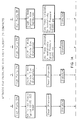
- the schematic flow diagram labeled A in Figure 1 illustrates the current practice of forming a compact of cold pressed boron nitride starting from high purity boron nitride material.
- the high purity boron nitride material is converted into a very fine high purity hexagonal boron nitride (hBN) powder using a conventional milling operation utilizing, e.g., a high speed impact mill to reduce the BN to a fine powder.
- hBN hexagonal boron nitride
- the fine powder formed from the milling operation has a particle size distribution such that 99.9% is milled to below -325 mesh (44 micron) and has an average particle size of 5-11 microns and a maximum particle size of no more than about 42 microns.
- the size of this powder is difficult to handle and to compact. With the powder being so fine, it needs to be deaired (prepressed) before compaction. If it is not deaired, the powder tends to flow out of the press die during compaction. Deairation is typically conducted by pressing the powder at a relatively high pressure in a large uniaxial press. The resultant cake is then granulated.
- This feedstock is then loaded into the hopper of an automated uniaxial press, for continuously pressing the powder into small pellets or plugs of material of e.g., 2.25" diameter x 2" long.
- the compacted boron nitride (BN) may again be granulated and again compacted in the automated uniaxial press.
- the deairation/compaction/ granulation procedure may be repeated in any number of stages.
- the highest green density achieved for a compact formed from milled powder was 1.74 g/cc or 77.3% of theoretical.
- the density increased slightly as indicated in sample 4 in Table 1 to a density of 1.81 g/cc.
- the density of the compacted pellets may be increased to approximately 1.9g/cc i.e. up to 85% of theoretical by controlling the distribution of the boron nitride particle sizes before compaction by extending the range of particle sizes to a range of over at least 100 microns.
- the preferred method for achieving a wide particle size distribution is to crush the hard chunks of high purity BN resulting from the low purity boron nitride high temperature treatment. This yields a wide distribution of particle sizes as is evident in Table II shown below and in Figure 3.
- Table II shows the typical properties for roll crushed high purity boron nitride. Crushing of the high purity boron nitride material leaves a much wider particle size distribution and higher tap density, both of which are evident from table II result in a higher compaction density.
- the tap density of the crushed particles is at least .76g/cc.
- the sample 1 lot was screened to remove the fines whereas samples 2, 3 and 4 were not screened.
- the tap density and precompacted density of Sample 1 is higher than the milled samples but is less than samples 2, 3 and 4.
- the deairation step was eliminated in Samples 1-3 of the roll crushed lots and a uniaxial pressing, granulation, uniaxial pressing procedure as described with the milled material was used for compaction.
- the compacted density is significantly higher than in Table I. Also, delamination did not occur with these samples, indicating less of a tendency for springback.
- the higher compacted densities and lower tendency for springback in the roll crushed material are useful for conversion to cubic boron nitride.
- the flow diagram D in Figure 1 may be used to produce boron nitride crushed agglomerated particles as high thermally conductive fillers. The following are examples of the present invention:
- the pellets or compacts may again be crushed into a powder compound of agglomerates having a wide particle size distribution. These agglomerates are of higher density than corresponding agglomerates formed from milled powder undergoing the same steps.
Landscapes
- Chemical & Material Sciences (AREA)
- Engineering & Computer Science (AREA)
- Organic Chemistry (AREA)
- Ceramic Engineering (AREA)
- Crystallography & Structural Chemistry (AREA)
- Manufacturing & Machinery (AREA)
- Materials Engineering (AREA)
- Structural Engineering (AREA)
- Inorganic Chemistry (AREA)
- Ceramic Products (AREA)
Abstract
Description
- The present invention relates to a method for forming high density boron nitride for use as precursor feedstock material in the conversion of hexagonal boron nitride to cubic boron nitride and as high density agglomerated boron nitride particles formed from such method for use as high thermal conductivity fillers.
- The two conventional forms of hexagonal boron nitride are turbostratic boron nitride and ideal or graphitic boron nitride. The hexagonal form of boron nitride is used in the conversion to cubic boron nitride and as a filler material for many other applications particularly where high thermal conductivity and high electrical resistivity is required. Typically, turbostratic boron nitride is first purified into what is conventionally referred to as "high purity hexagonal boron nitride" by treatment at high temperature, typically between about 1800 °C to 1900°C, for removing volatile impurities and surface oxide contaminants. Such high temperature treatment causes the boron nitride to become highly agglomerated in consistency which must be broken down for suitable commercial application. Accordingly, current practice is to first mill the high purity boron nitride into a fine powder and then, for ease of handling, to cold press and granulate the boron nitride in one or more stages. The milling operation forms a fine powder of small particle size typically with 99.9% of all of the milled powder below -325 mesh. The average particle size of the milled powder lies between 5-11 microns. The density of the boron nitride pellets formed from the cold pressing operation is no greater than an average of about 1.80 g/cc or 80% of the theoretical density of hexagonal boron nitride independent of the number of repeated granulation and cold pressing stages.
- In the conversion of high purity hexagonal boron nitride to cubic boron nitride the compacts or pellets of boron nitride formed by compaction are subjected to extremely high pressures and temperatures within the stable region of the cubic boron nitride phase diagram. The density of the boron nitride pellets is significant to the economics of the cubic boron nitride conversion process.
- It has been discovered in accordance with the present invention that the density of cold pressed boron nitride powder may be substantially increased to a density of at least about 1.86g/cc and approximating 1.9g/cc i.e approximating 85% of theoretical by controlling the particle size distribution of the boron nitride particles prior to compaction so that the distribution of particle sizes is as wide as possible and preferably with the majority of the particles having a particle size above 50 microns. The preferred particle size range for the majority of the particles should be between 20-500 microns. It has been further discovered in accordance with the present invention that agglomerated particles of boron nitride formed from a wide boron nitride particle size distribution following cold press compaction and granulation will possess a density closer to the average density achieved with hot pressing. In addition its thermal conductivity for use as a filler is enhanced particularly for use as a filler material in polymer composites.
- The method of the present invention broadly comprises the steps of forming high purity hexagonal boron nitride; crushing said high purity hexagonal boron nitride into boron nitride particles extending in size over a size range of at least 100 microns with the majority of the particles having a particle size above 50 microns, cold pressing the crushed particles into a compacted form and granulating the compacted particles into a granulated powder with the operations of cold pressing and granulation occurring in one or more stages.
- Agglomerated boron nitride particles of high density and high thermal conductivity are also formed from cold pressed hexagonal boron nitride in accordance with the present invention by the process of crushing high purity hexagonal boron nitride into boron nitride particles extending in size over a size range of at least 100 microns with the majority of the particles having a particle size above 50 microns, cold pressing the crushed particles into a compacted form, granulating the compacted form into a granulated powder, with the cold pressing and granulation steps occurring in one or more stages, to a suitable size for use as fillers of high thermally conductivity.
- The advantages of the present invention will become apparent from the following detailed description of the present invention when read in conjunction with the accompanying drawings of which:
- FIG 1 shows four schematic flow diagrams labeled A,B,C, and D comparing the standard prior art method of compaction labeled A for cold pressing high purity boron nitride with the alternate methods of the present invention labeled B.C., and D respectively;
- FIG 2 shows typical particle size distribution curves for the high purity boron nitride particles formed from the milling operation used in the standard compaction method A of Figure 1;
- FIG 3 shows a corresponding particle size distribution curve for the high purity boron nitride particles formed from crushing high purity boron in each of the alternate methods B, C and D shown in Figure 1; and
- FIG 4 is a graph showing the relationship of density to the powder compaction cycle i.e. number of powder compaction stages for milled and crushed powder.
-
- The schematic flow diagram labeled A in Figure 1 illustrates the current practice of forming a compact of cold pressed boron nitride starting from high purity boron nitride material. The high purity boron nitride material is converted into a very fine high purity hexagonal boron nitride (hBN) powder using a conventional milling operation utilizing, e.g., a high speed impact mill to reduce the BN to a fine powder. Typical properties of the fine high purity BN powder are shown below in Table 1.
Properties of Milled High Purity BN &
Final Compacted Density (After 2 Cycles)Sample 1 2 3 4 % Oxygen 0.605 0.488 0.275 0.548 Surface Area (m2/g) 5.67 5.48 5.26 6.39 Tap Density (g/cc) 0.58 0.60 0.51 .47 % Soluble Borates 0.33 0.16 0.10 .26 -325 Mesh Sizing 99.9 99.9 99.9 99.9 Avg.Part.Size (µm) 10.62 10.05 10.25 9.59 Max. Part. Size(µm) 42.2 29.9 29.9 29.9 Density (g/cc) (2X) 1.80 1.79 1.77 1.81 %Theoretical Density 80.0 79.6 78.7 80.44 - As evident from the above Table 1 in conjunction with Figure 1 column A the fine powder formed from the milling operation has a particle size distribution such that 99.9% is milled to below -325 mesh (44 micron) and has an average particle size of 5-11 microns and a maximum particle size of no more than about 42 microns. The size of this powder is difficult to handle and to compact. With the powder being so fine, it needs to be deaired (prepressed) before compaction. If it is not deaired, the powder tends to flow out of the press die during compaction. Deairation is typically conducted by pressing the powder at a relatively high pressure in a large uniaxial press. The resultant cake is then granulated. This feedstock is then loaded into the hopper of an automated uniaxial press, for continuously pressing the powder into small pellets or plugs of material of e.g., 2.25" diameter x 2" long. After the first pressing, the compacted boron nitride (BN) may again be granulated and again compacted in the automated uniaxial press. In fact the deairation/compaction/ granulation procedure may be repeated in any number of stages. As can be seen Figure 4, the highest green density achieved for a compact formed from milled powder was 1.74 g/cc or 77.3% of theoretical. By repeating the compaction/ granulation steps the density increased slightly as indicated in
sample 4 in Table 1 to a density of 1.81 g/cc. Additional stages of compaction/ granulation will have little effect on the density as is confirmed in figure 4. Also, from observation the tops of the compacted pellets have a tendency to delaminate, indicating springback after pressing.
It was discovered that the density of the compacted pellets may be increased to approximately 1.9g/cc i.e. up to 85% of theoretical by controlling the distribution of the boron nitride particle sizes before compaction by extending the range of particle sizes to a range of over at least 100 microns. The preferred method for achieving a wide particle size distribution is to crush the hard chunks of high purity BN resulting from the low purity boron nitride high temperature treatment. This yields a wide distribution of particle sizes as is evident in Table II shown below and in Figure 3. This is accomplished in accordance with the method of the present invention by substituting a crushing operation for the milling operation as is evident in Figure 1 flow sequence B,C and D respectively. The crushing operation as shown in flow diagram B may be followed by the standard deairation/granulation - compaction/granulation stages as used in the standard flow diagram A of Figure 1 or only by compaction/granulation stages without a deairation step as shown in the flow diagram sequences C or D of Figure 1. The final step of the flow diagram sequence D of Figure 1 is a crushing operation to produce a wide particle size dispersion of agglomerated boron nitride particles. This is particularly useful as a thermally conductive filler material particularly to fill polymers.Properties of Crushed High Purity BN &
Final Compacted Density (After 2 Cycles)Sample 1 2 3 4 Oxygen 0.571 0.275 0.426 .60 Surface Area(m2/g) 3.16 5.26 2.51 3.02 Tap Density(g/cc) 0.76 0.85 0.92 .89 % Soluble Borates ---- 0.10 0.09 .14 Screen Sizing +40 ----- 11.12 71.64 67.51 -40 +80 ----- 41.46 12.04 13.72 -80 +100 ----- 6.16 1.08 1.82 -100 +150 ----- 8.36 2.20 3.01 -150 +200 ----- 5.76 1.44 2.42 -200 +325 ----- 7.32 2.32 2.90 -325 11.16 19.82 9.28 8.62 Density (g/cc) (2X) 1.86 1.89 1.91 1.84 %Theoretical Density 82.70 84.0 84.90 81.78 - The above Table II shows the typical properties for roll crushed high purity boron nitride. Crushing of the high purity boron nitride material leaves a much wider particle size distribution and higher tap density, both of which are evident from table II result in a higher compaction density. The tap density of the crushed particles is at least .76g/cc. The
sample 1 lot was screened to remove the fines whereassamples Sample 1 is higher than the milled samples but is less thansamples
The following are examples of the present invention: - Example 1- Highly agglomerated high purity boron nitride powder was crushed
in a roll mill to the particle size distribution shown in Figure 3 with properties
as shown in Table 2
column 3. This powder was was compacted using a horizontal press at a pressure of 19,000 psi. The compacted pieces were granulated by forcing the material through a screen with openings approximately 1\2 inch. The granulated particles were again compacted at 19,000 psi. The procedure is outlined in Figure 1 in the flow diagram labeleed C. The density of the resultant compact was 1.91 g/cc.
For comparison a highly agglomerated high purity boron nitride powder was milled to a fine powder using the standard milling procedure as shown in the flow sequence A of Figure 1. The properties of thispowder Sample 4 are shown in Table 1column 4. The particle size distribution of this powder is shown in Figure 2 as the curve labeled "MilledFine Powder 4". This fine powder was deaired at 25OO psi and granulated followed again by compaction, granulation and compaction as outlined in Figure 1 flow diagram A. The density of the resultant compacts were only 1.81 g/cc. - Example 2 - Highly agglomerated, high purity boron nitride powder was
crushed in a two roll mill to the particle size distribution as shown in Figure 3
labeled as "
Crushed Powder 4". The properties of this powder are shown in Table 2column 4. This powder was compacted using a horizontal press at a pressure of 19,000 psi. Four additional granulation / compaction steps as described in example 1 were performed. The resultant compact density was 1.91 g/cc. The density of the compacts as a function of compaction cycles is shown on Figure 4, on the curve labeled "RollCrushed Powder 4".
In comparison the highly agglomerated high purity boron nitride powder was milled to a fine powder. The properties of this powder are shown in Table 1column 4. The particle size distribution of this powder is shown in Figure 2 as the curve labeled "MilledFine Powder 4". This fine powder was deaired at 25OO psi and granulated followed by the same five cycles of granulation and compaction as was done for the crushed powder. The density of the resultant compacts was only 1.84g/cc. The density of the compacts as a function of compaction cycles is shown on Figure 4 on the curve labeled "Prepressed +MilledPowder 4". - Example 3 - Highly agglomerated, high purity boron nitride powder was
crushed in a roll mill to the particle size distribution shown on Figure 3 labeled
as "
Crushed Powder 2". The properties of this powder are shown in Table 2column 2. This powder was compacted using a horizontal press at a pressure of 19,000 psi. The compacted pieces were granulated by forcing the material through a screen with openings approximately ½ inch. The granulated particles were again compacted at 19000 psi. The density of the resultant compact was 1.89 g/cc. This should be compared with the four different fine milled powders of Table 1 in which the resultant compact densities are 1.80, 1.79, 1.77, and 1.81 g/cc respectively. - Example 4- Highly agglomerated high purity hexagonal boron nitride powder
with the properties as indicated on Table 2
Column 4, was crushed using a roll mill to the particle size distribution shown on Figure 3 in the curve labeled "CrushedPowder 4". This crushed powder was compacted at 19,000 psi using a powder compaction press (uniaxial press), and was then formed into granules of 1/16 inch and finer using a granulator. The granules were once again compacted at 19,000psi. These compacts were crushed using a sawtooth and roll crusher and screened through a 120 mesh screen, resulting in a powder that had a tap density of 0.68m2/g. The screened particles were added to a cresol novalak thermoset epoxy formulation with a phenol novalak hardener at a 65wt% BN loading, and then molded in a transfer press. The thermal conductivity of the molded compound was 7.4 W/m°C. -
- The pellets or compacts may again be crushed into a powder compound of agglomerates having a wide particle size distribution. These agglomerates are of higher density than corresponding agglomerates formed from milled powder undergoing the same steps.
Claims (8)
- A method of forming pellets or agglomerates of high density boron nitride comprising the steps of forming high purity hexagonal boron nitride; crushing said high purity hexagonal boron nitride into boron nitride particles extending in size over a size range of at least 100 microns with the majority of the particles having a particle size above 50 microns, cold pressing the crushed particles into a compacted form and granulating the compacted particles into a granulated powder with the operations of cold pressing and granulation occurring in one or more stages for forming pellets of boron nitride or agglomerates of high density boron nitride.
- A method as defined in claim 1 further comprising the additional step of crushing the compacted boron nitride into a wide distribution of agglomerated boron nitride particles for use as a filler.
- A method as defined in claim 1 wherein the majority of the particles have an average particle size above 200 microns.
- A method as defined in claim 3 wherein said particle size range extends from below 20 microns to above 400 microns.
- A method as defined in claim 4 wherein said particle size range extends up to 500 microns.
- High density agglomerated particles of hexagonal boron nitride having a density above at least 1.86g/cc for use as a high thermal conductivity filler formed by a cold forming process carried out at ambient temperature comprising crushing agglomerated chunks of relatively large size high purity hexagonal boron nitride into boron nitride particles having a size distribution which extends over a size range of at least 100 microns from minimum to maximum with the majority of the particles having a particle size above 50 microns, cold pressing the crushed particles into a compacted form, granulating the compacted form into a granulated powder, cold pressing the granulated powder into a finally compacted form and crushing the finally compacted form into agglomerated particles of filler of high thermal conductivity particles with the steps of cold pressing and crushing repeated until the density is above at least 1.86g/cc.
- High density agglomerated particles of boron nitride as defined in claim1 wherein when loaded into a polymer give a thermal conductivity of at least 7.4 W/m°C.
- Boron nitride pellets having a density of at least between 1.86 and 1.91 g\cc for use in converting hexagonal boron nitride into cubic boron nitride formed by the process comprising crushing high purity hexagonal boron nitride into boron nitride particles extending over a size range of at least 100 microns with the majority of the particles having a particle size above 50 microns, cold pressing the crushed particles into a compacted form, granulating the compacted particles into a granulated powder and cold pressing the granulated powder into pellets with the operations of cold pressing and granulation occurring in one or more stages.
Priority Applications (2)
| Application Number | Priority Date | Filing Date | Title |
|---|---|---|---|
| DE1998607040 DE69807040T2 (en) | 1998-02-16 | 1998-02-16 | Process for forming high density boron nitride and agglomerated high density boron nitride particles |
| EP19980400361 EP0939066B1 (en) | 1998-02-16 | 1998-02-16 | Method for forming high density boron nitride and high density agglomerated boron nitride particles |
Applications Claiming Priority (1)
| Application Number | Priority Date | Filing Date | Title |
|---|---|---|---|
| EP19980400361 EP0939066B1 (en) | 1998-02-16 | 1998-02-16 | Method for forming high density boron nitride and high density agglomerated boron nitride particles |
Publications (2)
| Publication Number | Publication Date |
|---|---|
| EP0939066A1 true EP0939066A1 (en) | 1999-09-01 |
| EP0939066B1 EP0939066B1 (en) | 2002-08-07 |
Family
ID=8235274
Family Applications (1)
| Application Number | Title | Priority Date | Filing Date |
|---|---|---|---|
| EP19980400361 Expired - Lifetime EP0939066B1 (en) | 1998-02-16 | 1998-02-16 | Method for forming high density boron nitride and high density agglomerated boron nitride particles |
Country Status (2)
| Country | Link |
|---|---|
| EP (1) | EP0939066B1 (en) |
| DE (1) | DE69807040T2 (en) |
Cited By (16)
| Publication number | Priority date | Publication date | Assignee | Title |
|---|---|---|---|---|
| WO2003013845A1 (en) | 2001-08-07 | 2003-02-20 | Saint-Gobain Ceramics And Plastics, Inc. | A high solids hbn slurry hbn paste spherical hbn powder, and methods of making and using them |
| US6794435B2 (en) | 2000-05-18 | 2004-09-21 | Saint Gobain Ceramics & Plastics, Inc. | Agglomerated hexagonal boron nitride powders, method of making, and uses thereof |
| US6951583B2 (en) | 2000-05-01 | 2005-10-04 | Saint-Gobain Ceramics & Plastics, Inc. | Highly delaminated hexagonal boron nitride powders, process for making, and uses thereof |
| WO2006117117A1 (en) * | 2005-05-04 | 2006-11-09 | Esk Ceramics Gmbh & Co. Kg | Easily dispergible bn granulat, method for the production and use thereof |
| CN1300056C (en) * | 2005-07-19 | 2007-02-14 | 武汉理工大学 | Fast preparation of high-purity hexagonal boron nitride ceramic material under low-temperature |
| US7189774B2 (en) | 2000-11-28 | 2007-03-13 | Saint-Gobain Ceramics & Plastics, Inc. | Method for making high thermal diffusivity boron nitride powders |
| US7494635B2 (en) | 2003-08-21 | 2009-02-24 | Saint-Gobain Ceramics & Plastics, Inc. | Boron nitride agglomerated powder |
| US7662324B2 (en) | 2001-04-30 | 2010-02-16 | Saint-Gobain Ceramics & Plastics, Inc | Polymer processing aid and method for processing polymers |
| DE102010050900A1 (en) | 2010-11-10 | 2012-05-10 | Esk Ceramics Gmbh & Co. Kg | Boron nitride agglomerates, process for their preparation and their use |
| WO2013167306A1 (en) | 2012-05-09 | 2013-11-14 | Esk Ceramics Gmbh & Co. Kg | Boron nitride agglomerates, method for the production thereof and usage thereof |
| JP2013241321A (en) * | 2011-11-29 | 2013-12-05 | Mitsubishi Chemicals Corp | Aggregated boron nitride particle, composition containing aggregated boron nitride particle, and three-dimensional integrated circuit having layer comprising composition |
| EP2860008A1 (en) | 2013-10-14 | 2015-04-15 | Esk Ceramics GmbH&Co. Kg | Components produced by the thermoplastic processing of polymer boron nitride compounds, polymer boron nitride compounds for producing such components, method for producing such components and use of the same |
| EP3257810A1 (en) | 2016-06-16 | 2017-12-20 | 3M Innovative Properties Company | Formed hexagonal boron nitride body, hexagonal boron nitride granulates for making the same, and process for producing the same |
| EP3279173A1 (en) | 2016-08-05 | 2018-02-07 | 3M Innovative Properties Company | Formed hexagonal boron nitride body, heat-treated hexagonal boron nitride body and processes for producing the same |
| CN112159158A (en) * | 2020-09-01 | 2021-01-01 | 浙江创特新材科技有限公司 | Manufacturing process of boron nitride block and boron nitride block |
| CN118580080A (en) * | 2024-06-27 | 2024-09-03 | 天津理工大学 | A method for preparing high-density boron nitride ceramics at low temperature |
Families Citing this family (2)
| Publication number | Priority date | Publication date | Assignee | Title |
|---|---|---|---|---|
| DE102014013375A1 (en) | 2014-09-09 | 2016-03-10 | Häusermann GmbH | Printed circuit board with thermal contacting elements |
| DE102016005291B4 (en) | 2016-04-29 | 2024-01-11 | Ksg Austria Gmbh | Method for producing an electronic device in the form of an injection molded part with an inserted circuit board |
Citations (3)
| Publication number | Priority date | Publication date | Assignee | Title |
|---|---|---|---|---|
| US3513229A (en) * | 1968-08-16 | 1970-05-19 | Atomic Energy Commission | Method for pressing thin walled boron nitride articles utilizing a liquid nitrogen pretreatment |
| FR2469970A1 (en) * | 1979-11-26 | 1981-05-29 | Gould Inc | HIGH DENSITY, SINTERED POWDERED METAL ALLOY AND PROCESS FOR PRODUCING THE SAME |
| JPH0333046A (en) * | 1989-06-27 | 1991-02-13 | Matsushita Electric Ind Co Ltd | Pulverized body and its production and production of sintered compact using the same |
-
1998
- 1998-02-16 EP EP19980400361 patent/EP0939066B1/en not_active Expired - Lifetime
- 1998-02-16 DE DE1998607040 patent/DE69807040T2/en not_active Expired - Fee Related
Patent Citations (3)
| Publication number | Priority date | Publication date | Assignee | Title |
|---|---|---|---|---|
| US3513229A (en) * | 1968-08-16 | 1970-05-19 | Atomic Energy Commission | Method for pressing thin walled boron nitride articles utilizing a liquid nitrogen pretreatment |
| FR2469970A1 (en) * | 1979-11-26 | 1981-05-29 | Gould Inc | HIGH DENSITY, SINTERED POWDERED METAL ALLOY AND PROCESS FOR PRODUCING THE SAME |
| JPH0333046A (en) * | 1989-06-27 | 1991-02-13 | Matsushita Electric Ind Co Ltd | Pulverized body and its production and production of sintered compact using the same |
Non-Patent Citations (1)
| Title |
|---|
| DATABASE WPI Section Ch Week 9113, Derwent World Patents Index; Class L02, AN 91-089702, XP002069656 * |
Cited By (41)
| Publication number | Priority date | Publication date | Assignee | Title |
|---|---|---|---|---|
| US6951583B2 (en) | 2000-05-01 | 2005-10-04 | Saint-Gobain Ceramics & Plastics, Inc. | Highly delaminated hexagonal boron nitride powders, process for making, and uses thereof |
| US6794435B2 (en) | 2000-05-18 | 2004-09-21 | Saint Gobain Ceramics & Plastics, Inc. | Agglomerated hexagonal boron nitride powders, method of making, and uses thereof |
| US7189774B2 (en) | 2000-11-28 | 2007-03-13 | Saint-Gobain Ceramics & Plastics, Inc. | Method for making high thermal diffusivity boron nitride powders |
| US7662324B2 (en) | 2001-04-30 | 2010-02-16 | Saint-Gobain Ceramics & Plastics, Inc | Polymer processing aid and method for processing polymers |
| US6645612B2 (en) | 2001-08-07 | 2003-11-11 | Saint-Gobain Ceramics & Plastics, Inc. | High solids hBN slurry, hBN paste, spherical hBN powder, and methods of making and using them |
| USRE45803E1 (en) | 2001-08-07 | 2015-11-17 | Saint-Gobain Ceramics & Plastics, Inc. | High solids HBN slurry, HBN paste, spherical HBN powder, and methods of making and using them |
| WO2003013845A1 (en) | 2001-08-07 | 2003-02-20 | Saint-Gobain Ceramics And Plastics, Inc. | A high solids hbn slurry hbn paste spherical hbn powder, and methods of making and using them |
| USRE47635E1 (en) | 2001-08-07 | 2019-10-08 | Saint-Gobain Ceramics & Plastics, Inc. | High solids hBN slurry, hBN paste, spherical hBN powder, and methods of making and using them |
| EP2511091A2 (en) | 2001-08-07 | 2012-10-17 | Saint-Gobain Ceramics and Plastics, Inc. | A high solids hBN slurry, hBN paste, spherical hBN powder, and methods of making and using them |
| USRE45923E1 (en) | 2001-08-07 | 2016-03-15 | Saint-Gobain Ceramics & Plastics, Inc. | High solids HBN slurry, HBN paste, spherical HBN powder, and methods of making and using them |
| US7494635B2 (en) | 2003-08-21 | 2009-02-24 | Saint-Gobain Ceramics & Plastics, Inc. | Boron nitride agglomerated powder |
| US7914886B2 (en) | 2003-08-21 | 2011-03-29 | Saint-Gobain Ceramics & Plastics, Inc. | Structural component comprising boron nitride agglomerated powder |
| WO2006117117A1 (en) * | 2005-05-04 | 2006-11-09 | Esk Ceramics Gmbh & Co. Kg | Easily dispergible bn granulat, method for the production and use thereof |
| CN1300056C (en) * | 2005-07-19 | 2007-02-14 | 武汉理工大学 | Fast preparation of high-purity hexagonal boron nitride ceramic material under low-temperature |
| DE102010050900A1 (en) | 2010-11-10 | 2012-05-10 | Esk Ceramics Gmbh & Co. Kg | Boron nitride agglomerates, process for their preparation and their use |
| US9422200B2 (en) | 2010-11-10 | 2016-08-23 | 3M Innovative Properties Company | Boron nitride agglomerates, method of production thereof and use thereof |
| US10526250B2 (en) | 2010-11-10 | 2020-01-07 | 3M Innovative Properties Company | Boron nitride agglomerates, method of production thereof and use thereof |
| WO2012062627A1 (en) | 2010-11-10 | 2012-05-18 | Esk Ceramics Gmbh & Co. Kg | Boron nitride agglomerates, method for producing same, and use thereof |
| US10173931B2 (en) | 2010-11-10 | 2019-01-08 | 3M Innovative Properties Company | Boron nitride agglomerates, method of production and use thereof |
| CN107253704A (en) * | 2010-11-10 | 2017-10-17 | 3M创新有限公司 | Boron nitride aggregate, its production method and application thereof |
| EP2786961A4 (en) * | 2011-11-29 | 2015-10-07 | Mitsubishi Chem Corp | AGGREGATED BORON NITRIDE PARTICLES, COMPOSITION CONTAINING THESE PARTICLES, AND THREE-DIMENSIONAL INTEGRATED CIRCUIT HAVING A LAYER COMPRISING THE SAME |
| CN106044727A (en) * | 2011-11-29 | 2016-10-26 | 三菱化学株式会社 | Boron nitride agglomerated particle, composition containing the particle, and three-dimensional integrated circuit having a layer containing the composition |
| US9822294B2 (en) | 2011-11-29 | 2017-11-21 | Mitsubishi Chemical Corporation | Agglomerated boron nitride particles, composition containing said particles, and three-dimensional integrated circuit having layer comprising said composition |
| US10400151B2 (en) | 2011-11-29 | 2019-09-03 | Mitsubishi Chemical Corporation | Agglomerated boron nitride particles, composition containing said particles, and three- dimensional integrated circuit having layer comprising said composition |
| JP2013241321A (en) * | 2011-11-29 | 2013-12-05 | Mitsubishi Chemicals Corp | Aggregated boron nitride particle, composition containing aggregated boron nitride particle, and three-dimensional integrated circuit having layer comprising composition |
| CN106044727B (en) * | 2011-11-29 | 2018-09-25 | 三菱化学株式会社 | Boron nitride agglomerated particle, composition containing the particle, and three-dimensional integrated circuit having a layer containing the composition |
| US9371449B2 (en) | 2012-05-09 | 2016-06-21 | 3M Innovative Properties Company | Boron nitride agglomerates, method for the production thereof and use thereof |
| WO2013167306A1 (en) | 2012-05-09 | 2013-11-14 | Esk Ceramics Gmbh & Co. Kg | Boron nitride agglomerates, method for the production thereof and usage thereof |
| DE102012104049A1 (en) | 2012-05-09 | 2013-11-28 | Esk Ceramics Gmbh & Co. Kg | Boron nitride agglomerates, process for their preparation and their use |
| US10328620B2 (en) | 2013-10-14 | 2019-06-25 | 3M Innovative Properties Company | Component parts produced by thermoplastic processing of polymer/boron nitride compounds, polymer/boron nitride compounds for producing such component parts, method for producing such component parts and use thereof |
| EP3254821A2 (en) | 2013-10-14 | 2017-12-13 | 3M Innovative Properties Company | Components produced by the thermoplastic processing of polymer boron nitride compounds, polymer boron nitride compounds for producing such components, method for producing such components and use of the same |
| WO2015055552A1 (en) | 2013-10-14 | 2015-04-23 | 3M Innovative Properties Company | Component parts produced by thermoplastic processing of polymer/boron nitride compounds, polymer/boron nitride compounds for producing such component parts, method for producing such component parts and use thereof |
| EP2860008A1 (en) | 2013-10-14 | 2015-04-15 | Esk Ceramics GmbH&Co. Kg | Components produced by the thermoplastic processing of polymer boron nitride compounds, polymer boron nitride compounds for producing such components, method for producing such components and use of the same |
| WO2017218730A1 (en) | 2016-06-16 | 2017-12-21 | 3M Innovative Properties Company | Formed hexagonal boron nitride body, hexagonal boron nitride granulates for making the same, and process for producing the same |
| EP3257810A1 (en) | 2016-06-16 | 2017-12-20 | 3M Innovative Properties Company | Formed hexagonal boron nitride body, hexagonal boron nitride granulates for making the same, and process for producing the same |
| US10829417B2 (en) | 2016-06-16 | 2020-11-10 | 3M Innovative Properties Company | Formed hexagonal boron nitride body, hexagonal boron nitride granulates for making the same, and process for producing the same |
| WO2018026548A1 (en) | 2016-08-05 | 2018-02-08 | 3M Innovative Properties Company | Formed hexagonal boron nitride body, heat-treated hexagonal boron nitride body and processes for producing the same |
| EP3279173A1 (en) | 2016-08-05 | 2018-02-07 | 3M Innovative Properties Company | Formed hexagonal boron nitride body, heat-treated hexagonal boron nitride body and processes for producing the same |
| US10954164B2 (en) | 2016-08-05 | 2021-03-23 | 3M Innovative Properties Company | Formed hexagonal boron nitride body, heat-treated hexagonal boron nitride body and processes for producing the same |
| CN112159158A (en) * | 2020-09-01 | 2021-01-01 | 浙江创特新材科技有限公司 | Manufacturing process of boron nitride block and boron nitride block |
| CN118580080A (en) * | 2024-06-27 | 2024-09-03 | 天津理工大学 | A method for preparing high-density boron nitride ceramics at low temperature |
Also Published As
| Publication number | Publication date |
|---|---|
| DE69807040T2 (en) | 2003-05-08 |
| DE69807040D1 (en) | 2002-09-12 |
| EP0939066B1 (en) | 2002-08-07 |
Similar Documents
| Publication | Publication Date | Title |
|---|---|---|
| US6048511A (en) | Method for forming high density boron nitride and high density agglomerated boron nitride particles | |
| EP0939066B1 (en) | Method for forming high density boron nitride and high density agglomerated boron nitride particles | |
| US7189774B2 (en) | Method for making high thermal diffusivity boron nitride powders | |
| EP1656323B1 (en) | Boron nitride agglomerated powder | |
| RU2383638C2 (en) | Nano-crystal sintered bodies on base of alpha-oxide of aluminium, method of their fabrication and implementation | |
| EP2816082B1 (en) | Components produced by means of the thermoplastic processing of polymer boron nitride compounds, polymer boron nitride compounds for producing such components and use of same | |
| KR20160021832A (en) | Component part produced from a polymer/boron nitride compound, polymer/boron nitride compound for producing such a component part and use thereof | |
| JP2019043804A (en) | Heat-conductive filler, heat-conductive composite material, and method for producing the heat-conductive filler | |
| JP4155473B2 (en) | Method for producing high density boron nitride and high density agglomerated boron nitride particles | |
| JPH0617270B2 (en) | Boron nitride atmospheric pressure sintered body | |
| CN101523531B (en) | Powder modification in the manufacture of solid state capacitor anodes | |
| JP2525432B2 (en) | Normal pressure sintered boron nitride compact | |
| JPH1160215A (en) | Highly-filled boron nitride powder granules, method for producing the same, and method for producing isotropic boron nitride compact | |
| JP2001130963A (en) | Method for producing isotropic high-density carbon material | |
| JP2008031016A (en) | Tantalum carbide powder, tantalum carbide-niobium composite powder and method for producing them | |
| JPH11126734A (en) | Carbon material for electric double layer capacitor | |
| JPH0247261A (en) | Silicide target and production thereof | |
| JP3899402B2 (en) | Method for producing diamond-titanium carbide composite sintered body | |
| JPH0681076A (en) | Production of betafesi2 | |
| JPH06216414A (en) | Manufacture of thermoelectric conversion material | |
| CA3162473C (en) | Method for producing uranium carbide/mwcnt disc which is isol target material, and uranium carbide/mwcnt disc produced by same | |
| JPH05140739A (en) | Manufacturing method of silicide target | |
| JP2924062B2 (en) | Production method of raw material powder for carbon material | |
| JPH03200305A (en) | Manufacture of resin bond type oxide magnetic material | |
| JP2000191308A (en) | Aluminum nitride powder and aluminum nitride sintered body |
Legal Events
| Date | Code | Title | Description |
|---|---|---|---|
| PUAI | Public reference made under article 153(3) epc to a published international application that has entered the european phase |
Free format text: ORIGINAL CODE: 0009012 |
|
| AK | Designated contracting states |
Kind code of ref document: A1 Designated state(s): DE GB SE |
|
| AX | Request for extension of the european patent |
Free format text: AL;LT;LV;MK;RO;SI |
|
| AKX | Designation fees paid |
Free format text: DE GB SE |
|
| 17P | Request for examination filed |
Effective date: 20000229 |
|
| RBV | Designated contracting states (corrected) |
Designated state(s): DE GB SE |
|
| 17Q | First examination report despatched |
Effective date: 20010529 |
|
| GRAG | Despatch of communication of intention to grant |
Free format text: ORIGINAL CODE: EPIDOS AGRA |
|
| GRAG | Despatch of communication of intention to grant |
Free format text: ORIGINAL CODE: EPIDOS AGRA |
|
| GRAH | Despatch of communication of intention to grant a patent |
Free format text: ORIGINAL CODE: EPIDOS IGRA |
|
| GRAH | Despatch of communication of intention to grant a patent |
Free format text: ORIGINAL CODE: EPIDOS IGRA |
|
| GRAA | (expected) grant |
Free format text: ORIGINAL CODE: 0009210 |
|
| AK | Designated contracting states |
Kind code of ref document: B1 Designated state(s): DE GB SE |
|
| REG | Reference to a national code |
Ref country code: GB Ref legal event code: FG4D |
|
| REF | Corresponds to: |
Ref document number: 69807040 Country of ref document: DE Date of ref document: 20020912 |
|
| PGFP | Annual fee paid to national office [announced via postgrant information from national office to epo] |
Ref country code: SE Payment date: 20030203 Year of fee payment: 6 |
|
| PLBE | No opposition filed within time limit |
Free format text: ORIGINAL CODE: 0009261 |
|
| STAA | Information on the status of an ep patent application or granted ep patent |
Free format text: STATUS: NO OPPOSITION FILED WITHIN TIME LIMIT |
|
| 26N | No opposition filed |
Effective date: 20030508 |
|
| PG25 | Lapsed in a contracting state [announced via postgrant information from national office to epo] |
Ref country code: SE Free format text: LAPSE BECAUSE OF NON-PAYMENT OF DUE FEES Effective date: 20040217 |
|
| EUG | Se: european patent has lapsed | ||
| REG | Reference to a national code |
Ref country code: GB Ref legal event code: 732E |
|
| PGFP | Annual fee paid to national office [announced via postgrant information from national office to epo] |
Ref country code: GB Payment date: 20090227 Year of fee payment: 12 |
|
| PGFP | Annual fee paid to national office [announced via postgrant information from national office to epo] |
Ref country code: DE Payment date: 20090331 Year of fee payment: 12 |
|
| GBPC | Gb: european patent ceased through non-payment of renewal fee |
Effective date: 20100216 |
|
| PG25 | Lapsed in a contracting state [announced via postgrant information from national office to epo] |
Ref country code: DE Free format text: LAPSE BECAUSE OF NON-PAYMENT OF DUE FEES Effective date: 20100901 |
|
| PG25 | Lapsed in a contracting state [announced via postgrant information from national office to epo] |
Ref country code: GB Free format text: LAPSE BECAUSE OF NON-PAYMENT OF DUE FEES Effective date: 20100216 |