EP0939196A2 - Aube de turbine à gaz - Google Patents
Aube de turbine à gaz Download PDFInfo
- Publication number
- EP0939196A2 EP0939196A2 EP99103783A EP99103783A EP0939196A2 EP 0939196 A2 EP0939196 A2 EP 0939196A2 EP 99103783 A EP99103783 A EP 99103783A EP 99103783 A EP99103783 A EP 99103783A EP 0939196 A2 EP0939196 A2 EP 0939196A2
- Authority
- EP
- European Patent Office
- Prior art keywords
- blade
- passage
- leading edge
- heat transfer
- cooling medium
- Prior art date
- Legal status (The legal status is an assumption and is not a legal conclusion. Google has not performed a legal analysis and makes no representation as to the accuracy of the status listed.)
- Granted
Links
- 239000002826 coolant Substances 0.000 claims abstract description 160
- 238000001816 cooling Methods 0.000 claims description 213
- 238000011084 recovery Methods 0.000 claims description 39
- 238000011144 upstream manufacturing Methods 0.000 claims description 22
- WYTGDNHDOZPMIW-RCBQFDQVSA-N alstonine Natural products C1=CC2=C3C=CC=CC3=NC2=C2N1C[C@H]1[C@H](C)OC=C(C(=O)OC)[C@H]1C2 WYTGDNHDOZPMIW-RCBQFDQVSA-N 0.000 claims description 12
- 238000000605 extraction Methods 0.000 claims description 4
- 239000007789 gas Substances 0.000 description 116
- 239000000567 combustion gas Substances 0.000 description 4
- 238000000034 method Methods 0.000 description 4
- 238000005192 partition Methods 0.000 description 4
- 238000010586 diagram Methods 0.000 description 3
- 238000010248 power generation Methods 0.000 description 3
- 238000000926 separation method Methods 0.000 description 3
- 238000010276 construction Methods 0.000 description 2
- 239000012530 fluid Substances 0.000 description 2
- 239000000463 material Substances 0.000 description 2
- 230000001154 acute effect Effects 0.000 description 1
- 230000015556 catabolic process Effects 0.000 description 1
- 230000000694 effects Effects 0.000 description 1
- 238000012986 modification Methods 0.000 description 1
- 230000004048 modification Effects 0.000 description 1
- 230000002093 peripheral effect Effects 0.000 description 1
- 238000009331 sowing Methods 0.000 description 1
- 230000008646 thermal stress Effects 0.000 description 1
Images








Classifications
-
- F—MECHANICAL ENGINEERING; LIGHTING; HEATING; WEAPONS; BLASTING
- F01—MACHINES OR ENGINES IN GENERAL; ENGINE PLANTS IN GENERAL; STEAM ENGINES
- F01D—NON-POSITIVE DISPLACEMENT MACHINES OR ENGINES, e.g. STEAM TURBINES
- F01D5/00—Blades; Blade-carrying members; Heating, heat-insulating, cooling or antivibration means on the blades or the members
- F01D5/12—Blades
- F01D5/14—Form or construction
- F01D5/18—Hollow blades, i.e. blades with cooling or heating channels or cavities; Heating, heat-insulating or cooling means on blades
- F01D5/187—Convection cooling
-
- F—MECHANICAL ENGINEERING; LIGHTING; HEATING; WEAPONS; BLASTING
- F05—INDEXING SCHEMES RELATING TO ENGINES OR PUMPS IN VARIOUS SUBCLASSES OF CLASSES F01-F04
- F05D—INDEXING SCHEME FOR ASPECTS RELATING TO NON-POSITIVE-DISPLACEMENT MACHINES OR ENGINES, GAS-TURBINES OR JET-PROPULSION PLANTS
- F05D2260/00—Function
- F05D2260/20—Heat transfer, e.g. cooling
- F05D2260/221—Improvement of heat transfer
- F05D2260/2212—Improvement of heat transfer by creating turbulence
-
- F—MECHANICAL ENGINEERING; LIGHTING; HEATING; WEAPONS; BLASTING
- F05—INDEXING SCHEMES RELATING TO ENGINES OR PUMPS IN VARIOUS SUBCLASSES OF CLASSES F01-F04
- F05D—INDEXING SCHEME FOR ASPECTS RELATING TO NON-POSITIVE-DISPLACEMENT MACHINES OR ENGINES, GAS-TURBINES OR JET-PROPULSION PLANTS
- F05D2260/00—Function
- F05D2260/20—Heat transfer, e.g. cooling
- F05D2260/221—Improvement of heat transfer
- F05D2260/2214—Improvement of heat transfer by increasing the heat transfer surface
Definitions
- the present invention relates to a gas turbine blade, in particular, having an improved cooling passages formed inside the blade.
- the air supply source is an air compressor connected directly to the gas turbine. For this reason, several ten percents (%) of high pressure air supplied from the air compressor to the gas turbine are used for cooling the gas turbine blade.
- the gas turbine plant which uses much cooling air, has a plant heat efficiency lower than a gas turbine plant which uses a small amount of cooling air. Therefore, it is important to reduce the cooling air so as to improve the plant heat efficiency.
- a steam is used as a cooling medium in order to make high the gas turbine inlet combustion gas temperature and to secure a high power.
- the steam supplied into the gas turbine blade is circulated.
- the cooling medium supplied into the gas turbine blade is again recovered, and then, the recovered cooling medium is supplied for heat utilization to other equipments, whereby it is expected that the plant heat efficiency is further improved.
- the cooling medium In the case of supplying a cooling medium into the gas turbine blade, the cooling medium is circulated to the gas turbine blade to be cooled, and thereafter, is supplied for heat utilization to other equipments. Therefore, a plant heat efficiency can be further improved unlike the conventional case where the cooling medium after cooling the blade joins together with a gas turbine driving gas (main stream). Further, the cooling medium cools the inside of the blade, and thereafter, is recovered, so that there is no disturbance of a stream line of the gas turbine driving gas. Therefore, a blade efficiency can be improved.
- a leading edge or trailing edge of the gas turbine blade is requested having a thin wall thickness to improve a flow performance in spite of receiving a high thermal load of the gas turbine driving gas.
- the leading edge or trailing edge of the gas turbine blade is required having a streamline shape having a larger curvature. For this reason, a cooling passage section area and the ratio of cooling surface area to an outer surface area inevitably become small as compared with the middle of the blade.
- it is disadvantageous to plant efficiency to provide film cooing or ejection holes in a blade wall. For this reason, the following problem arises.
- a cooling efficiency as a design value is not obtained by convection cooling of merely circulating the cooling medium. Further, a pressure loss of the cooling medium becomes great, and a velocity of flow lowers, resulting in local superheat. Therefore, effective cooling method is required for a blade leading edge and trailing edge.
- the present invention has been made on the basis of the technical background as described above, and an object of the present invention is to provide a gas turbine blade which is constructed in a manner that a heat transfer accelerating element is located on a proper position even if a cooling area is small, and a pressure loss is reduced so as to achieve effective cooling by a cooling medium.
- a gas turbine blade provided with a hollow blade effective section and a blade implanted section operatively connected to the blade effective section, the gas turbine blade including:
- a gas turbine blade provided with a hollow blade effective section and a blade implanted section operatively connected to the blade effective section, the gas turbine blade including:
- the heat transfer accelerating element located on the leading edge passage or on the trailing edge passage is alternately arranged with respect to a blade wall on a ventral side and a back side.
- the heat transfer accelerating element located on the leading edge passage or on the trailing edge passage is arranged in plural lines of stages.
- the heat transfer accelerating element located on the leading edge passage or on the trailing edge passage is arranged in plural lines of stages, and the heat transfer accelerating element located on one line is alternately arranged with respect to a heat transfer accelerating element located on an adjacent line.
- the heat transfer accelerating element located on the trailing edge passage is arranged on only blade wall on the ventral side.
- the leading edge bent portion on the blade implanted section side of the leading edge intermediate passage is provided with a guide plate.
- a gas turbine blade provided with a hollow blade effective section and a blade implanted section operatively connected to the blade effective section, the gas turbine blade including:
- a guide plate is provided at a bent portion on the blade platform side of the inner side intermediate passage.
- a gas turbine blade provided with a hollow blade effective section and a blade implanted section operatively connected to the blade effective section, the gas turbine blade including:
- a gas turbine blade provided with a hollow blade effective section and a blade implanted section operatively connected to the blade effective section, the gas turbine blade including:
- the heat transfer accelerating elements located on the ventral side and the back side is alternately arranged, and the heat transfer accelerating element located on the back side of the heat transfer accelerating elements located on the ventral side and the back side has an intersecting angle to the advancing flow direction of the cooling medium relatively larger than an intersecting angle to the advancing flow direction of the cooling medium of the heat transfer accelerating element located on the ventral side.
- the heat transfer accelerating elements are changed from the right ascendant inclined state to the left ascendant inclined state with respect to the advancing flow direction of the cooling medium from the leading edge bent portion on the blade tip section side of the leading edge intermediate passage in a manner of forming the heat transfer accelerating element so as to be changed from one having a relatively long length to one having a relatively short length.
- the heat transfer accelerating element is located from the leading edge bent portion on the blade tip section side of the leading edge intermediate passage, and includes a relatively short heat transfer accelerating element which is arranged in a right ascendant state inclined to the advancing flow direction of the cooling medium, and a relatively short heat transfer accelerating element which is arranged in a left ascendant state inclined to the advancing flow direction of the cooling medium.
- a gas turbine blade provided with a hollow blade effective section and a blade implanted section operatively connected to the blade effective section, the gas turbine blade including:
- leading edge intermediate passage and the leading edge return passage are provided with a heat transfer accelerating element which is alternately arranged in a left ascendant state and a right ascendant state inclined to the advancing flow direction of the cooling medium, and is located in at least two lines or more, and the heat transfer accelerating element is alternately arranged with respect to the blade wall on the ventral side and on the back side.
- the heat transfer accelerating element is composed of either one of a rod-like rib having a square shape in a cross section thereof or a rod-like rib having a round shape in a cross section thereof.
- a heat transfer accelerating element is constructed in a manner that an upstream side of the advancing flow direction of a cooling medium is formed as a heat transfer accelerating element leading edge, a downstream side thereof is formed as a heat transfer accelerating element trailing edge, a ventral side line connecting the heat transfer accelerating element leading edge and the heat transfer accelerating element trailing edge is formed into a straight line, and a back side line connecting the heat transfer accelerating element leading edge and the heat transfer accelerating element trailing edge is formed into a curved line which is bulged outwardly, and that the heat transfer accelerating element thus formed is located in plural lines in a cooling passage of a hollow blade effective section.
- a pitch of the heat transfer accelerating element on the upstream side on the same line and the heat transfer accelerating element on the downstream side on the same line is set as P
- a height of the heat transfer accelerating element is set as e
- a heat transfer accelerating element is constructed in a manner that an upstream side of the advancing flow direction of a cooling medium is formed as a heat transfer accelerating element leading edge, a downstream side thereof is formed as a heat transfer accelerating element trailing edge, a turning portion is formed at an intermediate portion of the heat transfer accelerating element leading edge and the heat transfer accelerating element trailing edge, a ventral side surface connecting the heat transfer accelerating element leading edge and the turning portion is formed into a straight line, a back side surface connecting the heat transfer accelerating element leading edge and the turning portion is formed into a curved line which is bulged outwardly, the back side surface connecting the intermediate portion and the turning portion is formed into a linear surface, a turning ventral side surface connecting the turning portion and the heat transfer accelerating element leading edge is formed into a straight line and is bent toward the back side surface, and that a turning back side surface connecting the turning portion and the heat transfer accelerating element trailing edge is formed into a straight
- the inclination angle ⁇ a of the ventral side surface is set within a range expressed by the following equation, [Mathematical Equation 2] 30° ⁇ ⁇ a ⁇ 60° .
- the inclination angle ⁇ b of the heat transfer accelerating element trailing edge is set within a range expressed by the following equation, [Mathematical Equation 3] 30° ⁇ ⁇ b ⁇ 60° .
- the inclination angles ⁇ c and ⁇ d are set within a range expressed by the following equation, [Mathematical Equation 4] 30° ⁇ ⁇ c, ⁇ d ⁇ 60 ° .
- the ventral side surface is formed into a straight line so as to connecting the heat transfer accelerating element leading edge and the turning portion, and an angle intersecting the advancing flow direction of the cooling medium to the blade wall of the cooling passage is set as ⁇ e
- the inclination angle ⁇ e of the vertral side surface is set within a range expressed by the following equation, [Mathematical Equation 5] 30° ⁇ ⁇ e ⁇ 60° .
- cooling medium either air or steam is selected as the cooling medium, and a turbine extraction of a steam turbine is selected as a steam used for the cooling medium.
- the gas turbine blade according to the present invention is constructed in a manner that the heat transfer accelerating elements located in each cooling passage of the blade effective section are arranged in a so-called right ascendant state inclined to the advancing flow direction of the cooling steam, and alternately located on the ventral side and the back side of the blade, and thus, a circulating swirl based on the secondary flow is induced. Therefore, it is possible to further improve a heat transfer coefficient of the cooling medium.
- the heat transfer accelerating element which is arranged in a right ascendant inclined state in one cooling passage, is arranged in a left ascendant inclined state in the adjacent cooling passage.
- the heat transfer accelerating element located in the blade effective section has a ventral side line formed into a straight line, and a back side line which is formed into a curved line (like a convex) bulged outwardly.
- the ventral side line formed into a straight line is set to an angle intersecting with the advancing flow direction of the cooling medium, or a turning portion is formed on an intermediate portion connecting the heat transfer accelerating element leading edge and the heat transfer accelerating element trailing edge.
- a back side surface connecting the heat transfer accelerating element leading edge and the turning portion is formed into a curved surface which is bulged outwardly and has a straight line surface extending from the intermediate portion.
- the turning ventral side surface and the turning back side surface extending from the turning portion to the heat transfer accelerating element trailing edge is set to a predetermined angle inclined to the blade wall. Therefore, it is possible to further improve a heat transfer coefficient of the cooling medium and to restrict a pressure loss.
- Fig. 1 is a longitudinally cross sectional view schematically showing a first embodiment of a gas turbine blade according to the present invention.
- a reference numeral 1 denotes the whole of a gas turbine blade.
- the gas turbine blade 1 is composed of a blade effective section 2 which passes a gas turbine driving gas (main stream (flow)) G so as to perform a work of expansion, a blade implanted section 3 which is implanted in a turbine shaft (not shown), a blade shank section 4 which continuously connects the blade effective section 2 and the blade implanted section 3 integrally with each other, and a blade platform 5 which is attached to the blade effective section 2.
- the blade effective section 2 has a hollow shape so as to form a passage for a cooling steam CS, for example, an air or steam, and is formed with a blade cooling passage 6 at the interior thereof.
- the blade implanted section 3 is formed with two passages 7 and 8 which extend to a radius direction (blade height direction) of the gas turbine blade 1.
- One of these passages 7 and 8 is a supply passage 7 for a cooling steam CS and is independently located at a blade leading edge 9 side of the gas turbine blade 1.
- the other one of these passages is a recovery passage 8 for the cooling steam, and is independently located at a blade trailing edge 10 side of the gas turbine blade 1.
- the supply passage 7 for the cooling steam CS extends from the bottom portion of the blade implanted section 3 to a radius direction (blade height direction) of the gas turbine blade 1. Further, the supply passage 7 forks two ways, that is, a leading edge side supply passage 7a and a trailing edge side supply passage 7b at the blade shank section 4 so that the cooling steam CS is supplied to the blade leading edge 9 and the blade trailing edge 10 of the blade implanted section 2.
- the trailing edge side supply passage 7b makes an overpass or underpass with the recovery passage 8 for the cooling steam at the blade shank section 4 so that the supply passage 7 and the recovery passage 8 are independent from each other.
- the leading edge side supply passage 7a communicates with a leading edge passage 11 of the blade cooling passage 6 which extends to a radius direction (blade height direction) of the blade leading edge 9 of the blade effective section 2.
- the leading edge passage 11 is turned by an angle of 180 ° in its direction at a leading edge first bent portion 13 of a blade tip section 12 which is a blade distal end of the blade effective section 2 and communicates with a leading edge first intermediate passage 14.
- the leading edge first intermediate passage 14 extends straight to a leading edge second bent portion 15 toward an inner diameter direction (blade platform side), and is turned by an angle of 180° in its direction via a guide plate 16, and thus, communicates with a leading edge second intermediate passage 17. Further, the leading edge second intermediate passage 17 is turned by an angle of 180 ° in its direction at a leading edge third bent portion 18 of the blade tip section 12 so as to form a serpentine shape, and then, communicates with a leading edge return passage 19.
- the leading edge return passage 19 extends toward an inner diameter direction of the blade effective section 2 in the vicinity of the blade middle portion between the blade leading edge 9 and the blade trailing edge 10, and communicates with the recovery passage 8 at a blade root section which is the blade platform 5.
- the trailing edge side supply passage 7b also communicates with a trailing edge passage 20 of the blade cooling passage 6 which extends to a radius direction (blade height direction) of the blade trailing edge 10 of the blade effective section 2.
- the trailing edge passage 20 is turned by an angle of 180° in its direction at a trailing edge first bent portion 21 of the blade tip section 12 of the blade effective section 2, and extends like a serpentine toward an inner diameter direction (blade platform side) of a trailing edge return passage 22, and thus, communicates with the recovery passage 8 at a blade root section of the blade platform 5.
- a blade leading edge side cooling passage 23 and a blade trailing edge side cooling passage 24 are independently formed between the blade leading edge 9 side and the blade trailing edge 10 side of the blade effective section 2.
- heat transfer accelerating elements 25a and 25b are located from the blade root section of the blade platform 5 toward the blade tip section 12 and along each blade wall on a ventral side 26 and a back side 27. Further, these elements 25a and 25b are arranged an angle of ⁇ which is inclined to an advancing flow direction of the cooling steam CS, and, in a so-called right ascendant state or left ascendant state. More specifically, rod-like ribs having a square or round shape in its cross section extend from a partition wall defining respective passages 11, 14, 17, 19, 20, and 22 to adjacent partition wall.
- the heat transfer accelerating element 25a is located in the blade leading edge side cooling passage 23 and is inclined in a right ascendant state to the advancing flow direction of the cooling steam CS.
- a heat transfer accelerating element 25a 1 on the ventral side 26 and a heat transfer accelerating element 25a 2 on the back side 27 are alternately located from an inner diameter direction (blade platform side) to a radius direction (blade height direction.
- the heat transfer accelerating element 25b is located on the blade trailing edge 10 side and is inclined in a so-called left ascendant state to the advancing flow direction of the cooling steam CS.
- the heat transfer accelerating element 25b is shortened in its length, and is arranged in two lines of stages. Then, a heat transfer accelerating element 25b 1 (shown by a chain double-dashed line) on the ventral side 26 and a heat transfer accelerating element 25b 2 (shown by a solid line) on the back side 27 are alternately located toward a radial direction (blade height direction).
- the heat transfer accelerating element 25b is also located in the trailing edge return passage 22 of the blade trailing edge side cooling passage 24 and is inclined in a left ascendant state to the advancing flow direction of the cooling steam CS. Likewise the aforesaid heat transfer accelerating element 25a located on the blade leading side cooling passage 23, a heat transfer accelerating element 25b 1 on the ventral side 26 and a heat transfer accelerating element 25b 2 on the back side 27 are alternately located from the blade tip section 12 toward the blade root section of the blade platform 5.
- the heat transfer accelerating element 25b located on the blade trailing edge 10 side may be provided with a heat transfer accelerating element 25b 1 at only one side of the ventral side 26.
- the heat transfer accelerating element 25b 1 extends along a blade wall of the ventral side 26 from the blade root section of the blade platform 5 toward the blade tip section 12, and is arranged at an angle of ⁇ which is inclined to an advancing flow direction of the cooling steam CS, in a so-called left ascendant state.
- the heat transfer accelerating element 25bl is located at only one side on a ventral side 18. By doing so, in particular, it is possible to improve a strength on the ventral side 18 receiving a high thermal load by a gas turbine driving gas, and further, a pressure loss of the cooling steam CS can be reduced.
- the gas turbine blade 1 of this embodiment is effectively cooled with a higher heat transfer coefficient and at a lower pressure loss of the cooling steam CS during a gas turbine operation.
- the cooling steam CS supplied to the supply passage 7 of the blade implanted section 3 is divided into the leading edge side supply passage 7a and the trailing edge side supply passage 7b at the blade shank section 4, and then, the cooling steam CS thus divided are guided into the blade leading edge side supply passage 23 and the blade trailing edge side cooling passage of the blade cooling passage 6, respectively.
- the cooling steam CS guided to the blade leading edge cooling passage 23 is first guided to the leading edge passage 11 of the blade effective section 2. Then, the cooling steam CS guided to the leading edge passage 11 has a velocity component crossing in the advancing flow direction. Therefore, the cooling stream CS flows along the heat transfer accelerating element 25a which is inclined in a so-called right ascendant state.
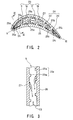
- a so-called secondary flows SF 1 and SF 2 are induced with respect to the ventral side 26 and the back side, respectively.
- These secondary flows SF 1 and SF 2 are a circulating swirl flowing to a direction shown by an arrow.
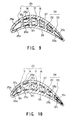
- a Coriolis force is generated as shown in Fig. 10
- the cooling steam CS flows to the same direction as the circulating swirl based on the Coriolis force. For this reason, the secondary flows SF 1 and SF 2 are accelerated in its direction so as to improve a heat transfer coefficient.
- these secondary flow SF 1 and SF 2 are accelerated in its direction by the Coriolis force, and thereby, a heat transfer coefficient can be improved.
- the cooling steam CS jumps over the heat transfer accelerating elements 25a 1 and 25a 2 on the ventral side 26 and on the back side 27, the cooling steam CS flowing through each space of adjacent back side 27 and ventral side 26 swirls up, and then, is continuously exchanged into a new cooling steam CS, so that a heat transfer coefficient can be increased. Therefore, a wall surface of the leading edge passage 11 can be effectively cooled.
- the cooling steam CS passed through the leading edge passage 11 is turned by an angle of 180° at the leading edge first bent portion 13 of the blade tip section 12, and then, flows to the leading edge first intermediate passage 14.
- the secondary flow SF 1 and SF 2 of the cooling steam CS has a circulating swirl direction shown by an arrow as shown in Fig. 9 when passing through the leading edge first bent portion 13.
- the circulating swirl direction coincides with the circulating swirl direction of the cooling steam CS flowing through the leading edge first intermediate passage 14, and also, coincides with the circulating swirl direction by Coriolis force as shown in Fig. 10.
- the cooling steam CS serves to improve a heat transfer coefficient because the secondary flows SF 1 and SF 2 have the circulating swirl direction coincident with each other.
- the cooling steam CS passed through the leading edge first intermediate passage 14 is turned by an angle of 180 ° at the leading edge second bent portion 15, and then, when flowing into the leading edge intermediate passage 17, the cooling steam CS is guide by means of the guide plate 16.
- the circulating swirl direction by the secondary flow SF 1 and SF 2 of the cooling steam CS becomes reverse when the cooling steam CS is turned by an angle of 180 ° at the leading edge second bent portion 15. Further, the circulating swirl direction by the Coriolis force also becomes reverse. Then, the aforesaid turned direction circulating swirl is applied to the cooling steam CS, and the initial cooling steam CS is offset in its circulating swirl direction. As a result, it is impossible to maintain a high heat transfer coefficient, and because of this reason, in this embodiment, the leading edge second bent portion 15 is provided with the guide plate 16, and a cross sectional area of the leading edge second bent portion 15 is made relatively large to reduce a velocity of flow. As a result, the circulating swirl direction shown in Fig.
- the circulating swirl direction shown by the broken line of Fig. 9 coincide with each other so that a heat transfer of the cooling steam CS can be prevented from being lowered.
- the circulating swirl direction shown by the broken line of Fig. 9 is observed from the blade root section which is the blade platform 5.
- the cooling steam CS straight advances from the leading edge second intermediate passage 17 toward a radial direction (blade height direction), and then, is turned by an angle of 180 ° at the leading edge third bent portion 18.
- the circulating swirl direction by the secondary flow SF 1 and SF 2 shown in Fig. 9 and the direction shown in Fig. 2 and Fig. 10 coincide with each other so as to keep a high heat transfer efficient, and then, the cooling steam CS effectively cools the leading edge return passage 19, and thereafter, is guided to the recovery passage 8.
- the cooling steam CS guided to the trailing edge passage 20 also flows along the heat transfer accelerating elements 25b which are arranged in two lines in a so-called left ascendant state inclined to the advancing flow direction of the cooling steam CS, and then, induces the secondary flows SF 1 and SF 2 in the ventral side 26 and the back side 27 as shown in Fig. 2.
- These secondary flows SF 1 and SF 2 are a circulating swirl flowing to a direction shown by an arrow.
- a Coriolis force is generated as shown in Fig.
- the secondary flows SF 1 and SF 2 are accelerated in its direction by the Coriolis force so as to keep a high heat transfer coefficient. For this reason, when the cooling steam CS jumps over the heat transfer accelerating elements 25b 1 and 25b 2 on the ventral side 26 and the back side 27 shown in Fig. 4 and Fig. 5, the cooling steam CS in each space of the ventral side 26 and on the back side 27 swirls up, and then, is continuously exchanged into a new cooling steam CS so as to improve a heat transfer coefficient. Therefore, even if the trailing edge passage has a relatively narrow passage area, it is possible to effectively cool a wall surface of the trailing edge passage 20.
- the cooling steam CS passed through the blade trailing edge 20 is turned by an angle of 180 ° at the trailing edge bent portion 21 of the blade tip section 12, and then, flows to the trailing edge return passage 22.
- the circulating swirl direction by the secondary flow SF 1 and SF 2 shown in Fig. 9 and the direction shown in Fig. 2 and Fig. 10 coincide with each other so as to keep a high heat transfer efficient, and the cooling steam CS preferably cools the trailing edge return passage 22, and thereafter, joins together with the cooling steam Cs from the leading edge return passage 19 at the recovery passage 8.
- the secondary flows SF 1 and SF 2 are induced by the heat transfer accelerating elements 25a and 25b which are arranged in a right ascendant state or left ascendant state inclined to the advancing flow direction of the cooling steam CS.
- the circulating swirl based on these secondary flows SF 1 and SF 2 serves to enhance a heat transfer coefficient, particularly making very high at the secondary flow impinging side, i.e. leading edge 9 and trailing edge 10 side.
- the heat transfer accelerating elements 25a and 25b located on the ventral side 26 and the back side 27 are alternately located along a radial direction (blade height direction), and when the cooling steam CS jumps over the heat transfer accelerating elements 25a and 25b located on the ventral side 26 and the back side 27, the cooling steam CS in each space on the ventral side 26 and the back side swirls up, and thereby, the cooling steam CS is exchanged into a new cooling steam CS so as to further enhance a heat transfer coefficient. Therefore, it is possible to further effectively cool each wall surface of the leading edge passage 11 and the trailing edge passage 20.
- the circulating swirl based on these secondary flows SF 1 and SF 2 induced in cooling passages 23 and 24 is further accelerated in its directivity by the Coriolis force, and the circulating swirl directions in bent portions 13, 18 and 21 coincide with each other. Therefore, it is possible to further restrict a pressure loss of the cooling steam CS. Further, when the cooling steam CS is turned by an angle of 180° at the leading edge second bent portion 15, the circulating swirl direction based on the secondary flows SF 1 and SF 2 of the leading edge first intermediate passage 14 and the circulating swirl direction based on the secondary flows SF 1 and SF 2 based on the Coriolis force become reverse in its direction, and then, the heat transfer coefficient of the cooling steam CS is reduced.
- a cross sectional area of the leading edge second bent portion 15 is made relatively large so as to reduce a velocity of flow, and the guide plate 16 is provided therein so as to make smooth the flow of cooling steam CS. Therefore, it is possible to restrict a reduction in the heat transfer coefficient of the cooling steam CS.
- Fig. 11 is a longitudinally sectional view schematically showing a second embodiment of a gas turbine blade according to the present invention.
- like reference numerals are used to designate the same components as the first embodiment or parts corresponding thereto.
- a gas turbine blade 1 of this second embodiment is provided with passages 28a and 28b which divide the blade effective section 2 into two parts so as to cool the gas turbine blade 1.
- One of these passages 28a and 28b is a blade trailing edge outer side supply passage 28a of the cooling steam CS which is independently formed on the blade trailing edge 10 side of the gas turbine blade 1, and the other one of these passages is a blade trailing edge inner side supply passage 28b of the cooling steam CS which is independently formed inside the aforesaid blade trailing edge outer side supply passage 28a.
- the blade trailing edge outer side supply passage 28a of the cooling steam CS communicates with a trailing edge passage 20 which extends from the blade implanted section 3 to a radial direction (blade height direction) of the blade trailing edge 10 of the blade effective section 2.
- the trailing edge passage 20 is bent in its cross section at the blade tip section 12 which is a distal end of the blade effective section 2 so that a blade tip section passage 29 is formed.
- the blade tip section passage 29 extends to the blade leading edge 9 side. Further, the blade tip section passage 29 is again bent at its end portion, and then, communicates with a blade leading edge outer side recovery passage 30a via the leading edge passage 11 extending to an inner diameter direction (the blade root section of the blade platform 5) of the blade leading edge 9.
- the blade trailing edge outer side supply passage 28b also communicates with a blade trailing edge side inner passage 31 which extends from the blade implanted section 3 to a radial direction (blade height direction) of the blade trailing edge 10 of the blade effective section 2 and is arranged in parallel with the trailing edge passage 20.
- the blade trailing edge side inner passage 31 is turned by 180 ° at a first bent portion 32 of the blade tip section passage 29 and communicates with an inner first intermediate passage 33 which extends toward an inner diameter direction of the blade leading edge 9. Further, the blade trailing edge side inner passage 31 is again turned by 180 ° via a guide plate 16 located on a second bent portion 34 of the inner first intermediate passage 33, and then, extends like a serpentine to an inner second intermediate passage 35.
- the blade trailing edge side inner passage 31 is turned by 180° at a third bent portion 36 of the inner second intermediate passage 35 blade tip section passage 29 and communicates with a blade leading edge side inner recovery passage 30b via a leading edge side inner passage 37 which extends to an inner diameter direction of the blade leading edge 9.
- the blade effective section 2 is divided into two parts, that is, an outer cooling passage 38 and an inner cooling passage 39 which are independently formed.
- These outer and inner cooling passages 38 and 39 are provided with heat transfer accelerating elements 25a and 25b.
- these elements 25a and 25b are arranged at an angle of ⁇ which is inclined in a so-called left ascendant state to an advancing flow direction of the cooling steam CS flowing from the blade root section of the blade platform 5 toward the blade tip section 12 and the blade tip section passage 29.
- rod-like ribs having a square or round shape in its cross section extend from a partition wall defining respective passages 20, 29, 11, 31, 33, 35 and 37 to adjacent partition wall.
- heat transfer accelerating elements 25a and 25b are alternately located on the ventral side and the back side like the first embodiment.
- the blade effective section 2 is divided into two parts, that is, an outer cooling passage 38 and an inner cooling passage 39 which are independently formed, and much cooling steam is supplied by the blade trailing edge 10 and the blade leading edge 9.
- the respective passages 38 and 39 are provided with heat transfer accelerating elements 25a and 25b which are inclined in a left ascendant state so as to further improve a heat transfer coefficient of the cooling steam CS. Therefore, it is possible to effectively cool the blade leading edge 9 and the blade trailing edge 10 which have not sufficiently been cooled before because a passage area is relatively small.
- the outer cooling passage 38 and the inner cooling passage 39 formed in the blade effective section 2 are each simplified in its structure, so that the cooling steam CS can be relatively smooth supplied.
- the outer cooling passage 38 is formed into one straight path, so that a pressure loss of the cooling steam CS can be restricted.
- Fig. 12 is a longitudinally sectional view schematically showing a third embodiment of a gas turbine blade according to the present invention.
- like reference numerals are used to designate the same components as the first embodiment or parts corresponding thereto.
- a gas turbine blade 1 of this third embodiment has basically the same construction as that of the first embodiment.
- the heat transfer accelerating element 25a is located from the leading edge first intermediate passage 14 to the leading edge second intermediate passage 17 through the leading edge second bent portion 15. Further, the heat transfer accelerating element 25a is arranged at an angle of ⁇ inclined to the advancing flow direction of the cooling steam CS in a so-called left ascendant state in place of the right ascendant state.
- the heat transfer accelerating element 25b located in the trailing edge return passage 22 is arranged in two lines of stages and located at an angle of ⁇ inclined to the advancing flow direction of the cooling steam CS in a so-called left ascendant state.
- the heat transfer accelerating element 25a is located in a so-called left ascendant state inclined to the advancing flow direction of the cooling steam CS so that the circulating swirl direction based on the secondary flows SF 1 and SF 2 of the leading edge first intermediate passage 14, the circulating swirl direction based on the secondary flows SF 1 and SF 2 of the cooling steam CS which flows through the leading edge second intermediate passage 17 via the leading edge second bent portion 15, and the circulating swirl direction based on the secondary flows SF 1 and SF 2 by the Coriolis force, coincide with each other. Therefore, it is possible to keep the cooling steam CS at a high heat transfer coefficient.
- the heat transfer accelerating element 25b located in the trailing edge return passage 22 is arranged in two lines of stages, so that a heat transfer of the cooling steam can be further improved.
- Fig. 13 is a longitudinally sectional view schematically showing a fourth embodiment of a gas turbine blade according to the present invention.
- like reference numerals are used to designate the same components as the first embodiment or parts corresponding thereto.
- a gas turbine blade 1 of this embodiment has basically the same construction as the third embodiment.
- the heat transfer accelerating element 25a 1 (shown by a chain double-dashed line) is located on a blade wall on the ventral side of the leading edge second intermediate passage 17, and on the other hand, the heat transfer accelerating element 25a 2 (shown by a solid line) is located on a blade wall on the back side thereof.
- the heat transfer accelerating element 25a 1 located on the ventral side is arranged at an angle of ⁇ 1 which is a so-called left ascendant state inclined to the advancing flow direction of the cooling steam CS
- the heat transfer accelerating element 25a 2 located on the back side is arranged at an angle of ⁇ 2 which is a so-called left ascendant state inclined to the advancing flow direction of the cooling steam CS.
- these angles have the following relation of ⁇ 2 > ⁇ 1.
- the back side receives a higher thermal load as compared with the ventral side when a gas turbine driving gas G passes therethrough.
- a circulating swirl based on the secondary flow SF 2 by the heat transfer accelerating element 25a 2 located on the back side is made larger so as to improve a heat transfer coefficient of the cooling steam CS.
- the circulating swirl based on the secondary flow SF 1 by the Coriolis force is generated in the ventral side, and because of this reason, this circulating swirl on the ventral side is larger than that generated in the back side.
- the inclination angle ⁇ 2 of the heat transfer accelerating element 25a 2 to the advancing flow direction of the cooling steam CS is made lager than the inclination angle ⁇ 1 of the heat transfer accelerating element 25a 1 to the advancing flow direction of the cooling steam CS.
- the circulating swirl generated in the back side is made relatively larger than the circulating swirl generated in the ventral side so as to make a balance of the heat transfer coefficient of the cooling steam CS, so that the back side and the ventral side can be uniformly cooled.
- the heat transfer accelerating element 25a is located from the leading edge second intermediate passage 17 to the leading edge return passage 19 via the leading edge third bent portion 18. Further, the heat transfer accelerating element 25a is arranged at an angle of ⁇ to the advancing flow direction of the cooling steam CS and is alternately changed from the so-called left ascendant state to the right ascendant state, and, is again changed into the left ascendant state.
- the heat transfer accelerating element 25a is located from the leading edge second intermediate passage 17 to the leading edge return passage 19 via the leading edge third bent portion 18. Further, the heat transfer accelerating element 25a is alternately changed from the so-called left ascendant state to the right ascendant state and is again changed into the left ascendant state. By doing so, the circulating swirl direction based on the secondary flows SF 1 and SF 2 by the heat transfer accelerating element 25a and the circulating swirl direction based on the secondary flows SF 1 and SF 2 by the Coriolis force, always coincide with each other. Therefore, it is possible to keep the cooling steam CS at a high heat transfer coefficient.
- the heat transfer accelerating element 25a has been located at an angle of ⁇ to the advancing flow direction of the cooling steam CS and is alternately changed from the so-called left ascendant state to the right ascendant state and is again changed into the left ascendant state.
- the heat transfer accelerating element 25a may be formed so as to have a length extending to a wall surface defining the leading edge return passage 19 or so as to have a relatively short length.
- the heat transfer accelerating element 25a may be formed in the following manner. That is, the heat transfer accelerating elements 25a may be successively made short from the heat transfer accelerating elements 25a having a length extending to a wall surface defining the leading edge return passage 19 and may be successively made long so as to correspond thereto.
- the heat transfer accelerating element 25a is changed from the right ascendant state inclined at an angle of ⁇ to the left ascendant state inclined at an angle of ⁇ .
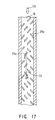
- the heat transfer accelerating element 25a may be arranged in the following manner. First, the heat transfer accelerating element having a relatively short length is arranged in a right ascendant inclined state, and next, is arranged in a left ascendant inclined state in order. Further, as shown in Fig. 17, the heat transfer accelerating element having a relatively short length may be arranged with a combination of the right ascendant inclined state and the left ascendant inclined state.
- a relatively short heat transfer accelerating element 25a is located on each middle portion of the leading edge first intermediate passage 14, the leading edge second intermediate passage 17 and the leading edge return passage 19 excluding each peripheral portion of the leading edge first bent portion 13, the leading edge second bent portion 15 and the leading edge third bent portion.
- the relatively short heat transfer accelerating element 25a is arranged successively in a left ascendant state, a right ascendant state and a right ascendant state (Fig. 18), inclined to the advancing flow direction of the cooling steam CS, that is, in at least three lines or more.
- the heat transfer accelerating element 25a arranged in at least three lines or more may be located on the ventral side (shown by a chain double-dashed line) and on the back side (shown by a solid line).
- the heat transfer accelerating element 25a is arranged in a manner that a heat transfer accelerating element 25a 1 located on the ventral side 26 and a heat transfer accelerating element 25a 2 located on the back side 27 are alternately located with respect to the advancing flow direction of the cooling steam CS.
- the heat transfer accelerating element 25a is arranged successively in a right ascendant state and a left ascendant state, inclined to the advancing flow direction of the cooling steam CS, that is, in at least three lines of stages or more. Further, the heat transfer accelerating element 25a 1 located on the ventral side 26 and the heat transfer accelerating element 25a 2 located on the back side 27 are alternately located so as to further improve a heat transfer coefficient of the cooling steam CS. Therefore, it is possible to effectively make convection cooling with respect to each intermediate portion of passages 14, 17 and 19.
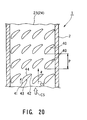
- Fig. 20 is a view schematically showing another embodiment of the heat transfer accelerating element located on a cooling passage formed in a blade effective section of the gas turbine blade according to the present invention.
- the blade effective section 2 is formed with the blade leading edge side cooling passage 23 and the trailing edge side cooling passage 24. These passages 23 and 24 are provided with a heat transfer accelerating element 40 according to this embodiment.
- the heat transfer accelerating element 40 is arranged in a plurality of lines of stages with respect to a direction crossing the advancing flow direction of the cooling steam CS which flows through the blade leading edge side cooling passage 23 and the trailing edge side cooling passage 24 formed in the blade effective section 2. Further, the heat transfer accelerating element 40 is arranged in a manner that a pitch P between an upstream side heat transfer accelerating element 40 and a downstream side heat transfer accelerating element 40 is made constant, and is located at an angle of ⁇ in a right ascendant state inclined to the advancing flow direction of the cooling steam CS.
- the heat transfer accelerating element 40 has a heat transfer accelerating element leading edge 41 (i.e. leading end which is an upstream end of such an element) on an upstream side of the cooling steam CS and a heat transfer accelerating element leading edge 42 on a downstream side thereof, as shown in Fig. 20 and Fig. 21, a ventral side line 43 connecting the heat transfer accelerating element leading edge 41 and the heat transfer accelerating element leading edge 42 is formed into a straight line.
- a back side line 44 connecting the heat transfer accelerating element leading edge 41 and the heat transfer accelerating element leading edge 42 is formed into a curved line (like a convex) which is bulged outwardly.
- ventral side line 43 is formed into a curved line (like a convex) which is bulged outwardly, the cooling steam CS collides with the heat transfer accelerating element leading edge 41, and then, a flow of a circulating swirl based on the secondary flow induced by collision is made worse and is stagnant. Moreover, if the ventral side line 43 is formed into a curved line (like a concave) which is bulged inwardly, the circulating swirl based on the aforesaid secondary flow is made stagnant due to the heat transfer accelerating element trailing edge 42. Therefore, it is the most proper way to form the ventral side line 43 into a straight line.
- the back side line 44 is formed into a curved line (like a convex) which is bulged outwardly.
- a height of the heat transfer accelerating element 40 on the upstream and downstream sides of the cooling steam CS is set as "e”
- a pitch between the upstream side heat transfer accelerating element 40 and the downstream side heat transfer accelerating element 40 is set as "P”
- the cooling steam CS separated from the back side line 44 of the upstream side heat transfer accelerating element 40 flows to the downstream side, and when it again adheres to the blade wall, a heat transfer coefficient becomes high.
- the heat transfer coefficient lowers before and after the cooling steam CS again adheres to the blade wall.
- This embodiment was made by taking the above matter into consideration, and a ratio of a distance where the cooling steam CS again adheres to the blade wall and the height "e" of the heat transfer accelerating element 40 is about 2 to 3 when observed from the back side line 44. For this reason, if the pitch P between the upstream side heat transfer accelerating element 40 and the downstream side heat transfer accelerating element 40 is made small, the cooling steam CS is prevented from again adhering to the blade wall. If the pitch P is made large, a high heat transfer distribution is scattered. In each case, an average heat transfer coefficient lowers, and then, changes as shown in Fig. 22.
- the heat transfer accelerating element 40 is located in the blade leading edge side cooling passage 23 and the blade trailing edge side cooling passage 24 which are formed in the blade effective section 2, and is arranged in a plurality of lines of stages at an angle of ⁇ in a so-called right ascendant state inclined to the advancing flow direction of the cooling steam CS. Further, the ventral side line 43 connecting the heat transfer accelerating element leading edge 41 and the heat transfer accelerating element leading edge 42 of the heat transfer accelerating element 40 is formed into a straight line. On the other hand, the back side line connecting the heat transfer accelerating element leading edge 41 and the heat transfer accelerating element leading edge 42 is formed into a curved line (like a convex) which is bulged outwardly.
- the height of the heat transfer accelerating element 40 on the upstream and downstream sides of the cooling steam CS is set as "e"
- the pitch between the upstream side heat transfer accelerating element 40 and the downstream side heat transfer accelerating element 40 is set as "P”
- Fig. 23 is a perspective view schematically showing still another embodiment of the heat transfer accelerating element located on a cooling passage formed in a blade effective section of the gas turbine blade according to the present invention.
- a heat transfer accelerating element 45 of this embodiment has a heat transfer accelerating element leading edge 46 on an upstream side of the cooling steam CS and a heat transfer accelerating element trailing edge 47 on a downstream side thereof.
- a turning portion 48 is formed on an intermediate portion between the heat transfer accelerating element leading edge 46 and the heat transfer accelerating element trailing edge 47. Further, a ventral side surface 49 connecting the heat transfer accelerating element leading edge 46 and the turning portion 48 is formed into a straight line, and a back side surface 50 connecting the heat transfer accelerating element leading edge 46 and the turning portion 48 is formed into a curved surface 51 which is bulged outwardly (like convex). The back side surface 50 connecting the intermediate portion and the turning portion 48 is formed into a straight surface 52.
- a turning ventral side surface 53 connecting the turning portion 48 and the heat transfer accelerating element trailing edge 47 is formed like a straight line, and then, is gradually bent toward the bask side surface 50.
- a turning back side surface 54 connecting the turning portion 48 and the heat transfer accelerating element trailing edge 47 is formed like a straight line.
- the heat transfer accelerating element 45 of this embodiment has a top portion 55 which is formed like a flat when viewing it from an arrow G direction, a bottom portion 56 which is fixed onto the blade wall 57. Further, the heat transfer accelerating element 45 is formed so as to substantially have a parallelogram in its cross section.
- the inclination angle ⁇ a is set within a range expressed by the following equation, [Mathematical Equation 2] 30° ⁇ ⁇ a ⁇ 60 ° .
- the inclination angle of the ventral side surface is set to the aforesaid range.
- aforesaid range As shown in Fig. 28, if the inclination angle ⁇ a exceeds an angle of 60° or more with respect to the blade wall 57, and is in a vertical state, there is a case where the cooling steam Cs jumps over the top portion 55. However, most of the cooling steam CS collides with the ventral side surface, and then, a swirl is generated. As a result, a pressure loss of the cooling steam CS increases. Conversely, if the inclination angle ⁇ a is set to 30° or less, a heat transfer coefficient of the cooling steam CS becomes low.
- the inclination angle ⁇ a of the ventral side surface 49 is set to 45 ° in the following manner that an inclination angle shown by a broken line connecting a separation point S on the blade wall 57 of the cooling steam CS and the top portion 55.
- the inclination angle ⁇ b is set within a range expressed by the following equation, [Mathematical Equation 3] 30° ⁇ ⁇ b ⁇ 60 ° .
- the heat transfer accelerating element trailing edge 47 has an inclination angle ⁇ b exceeding an angle of 60° to the blade wall 57, the ventral side surface 49 and the turning ventral side surface 53 of the turning portion 48 cross each other at an acute angle. As shown in Fig. 29, the secondary flow of the cooling steam CS is separated at the turning portion 48, and for this reason, a pressure loss is increased.
- the inclination angle ⁇ b is smaller than an angle of 30°, the heat transfer accelerating element trailing edge 47 extends to the downstream side heat transfer accelerating element leading edge of the adjacent the heat transfer accelerating element arranged in a plurality of lines of stages. Accordingly, it is possible to prevent a flow of the cooling steam flowing through the adjacent downstream side heat transfer accelerating element.
- the inclination angles ⁇ c and ⁇ d are set within a range expressed by the following equation, [Mathematical Equation 4] 30° ⁇ ⁇ c, ⁇ d ⁇ 60 ° .
- the secondary flow of the cooling steam CS flowing along the back side surface 50 of the heat transfer accelerating element 45 becomes the maximum velocity of flow at a portion where a curvature of the heat transfer accelerating element leading edge 46 is large, and thereafter, flows inertially.
- the secondary flow is gradually decelerated while flowing to the heat transfer accelerating element trailing edge 47, and for this reason, separation is easy to be generated. In this case, when deceleration and separation are remarkably observed, there is generated a reverse flow from the heat transfer accelerating element trailing edge 47 to the heat transfer accelerating element leading edge 46. Therefore, a pressure loss becomes large.
- the turning ventral side surface 53 and the turning back side surface 54 are formed like a straight line from the turning portion 48 to the heat transfer accelerating element trailing edge 47 in a manner that the back side surface 50 is formed by a combination of the curved surface 51 extending outwardly and the straight surface 52 so as to connect the turning portion 48.
- the turning ventral side surface 53 and the turning back side surface 54 respectively have the inclination angles ⁇ c and ⁇ d exceeding an angle of 60° to the blade wall 57, as shown in Fig. 30, a counter vortex (swirl generated with the secondary flow) of the cooling steam CS is generated; for this reason, a pressure loss becomes large. If the inclination angles ⁇ c and ⁇ d are smaller than an angle of 30°, it is impossible to improve a heat transfer coefficient of the cooling steam CS.
- the inclination angles ⁇ c and ⁇ d of turning ventral side surface 53 and the turning back side surface 54 to the blade wall 57 are set to a range from 30° to 60°. Further, in order to reduce a pressure loss of the cooling steam CS and improve a heat transfer coefficient, it is preferable that these inclination angles ⁇ c and ⁇ d are set to an angle of 45°.
- the inclination angle ⁇ a in a height direction from the blade wall 57 of the cooling passage to the top portion 55 is set to a range from 30° to 60°, and the ventral side surface 49 from the heat transfer accelerating element leading edge 45 to the turning portion 48 is formed into a straight line.
- this inclination angle ⁇ e is set within a range expressed by the following equation, [Mathematical Equation 5] 30° ⁇ ⁇ e ⁇ 60° .
- intersection angle ⁇ e of the straight line of ventral side surface 49 and the advancing flow direction of the cooling steam CS is set to the aforesaid range. If the intersection angle ⁇ e exceeds an angle of 60°, the secondary flow of the cooling steam CS is restricted. Moreover, if the intersection angle ⁇ e is smaller than an angle of 30° , the vertical swirl V shown in Fig. 21 is not effectively used; as a result, it is impossible to improve a heat transfer coefficient of the cooling steam CS.
- the intersection angle ⁇ of the straight line of the ventral side line 43 shown in Fig. 20 and Fig. 21 and the advancing flow direction of the cooling steam CS is set to that range from 30° to 60°, like the above description.
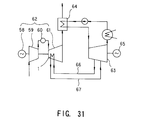
- Fig. 31 is a system diagram schematically showing a steam cooling supply/recovery system when supplying and recovering a steam as a cooling medium to the heat transfer accelerating element located on a cooling passage formed in a blade effective section of the gas turbine blade according to the present invention.
- a recent thermal power generation plant is mainly transferring to a combined cycle power generation plant which is constructed in a manner of combining a gas turbine plant 62 comprising a generator 58, an air compressor 59, a gas turbine combustor 60 and a gas turbine 61 with a steam turbine plant 63 and an exhaust heat recovery boiler 64.
- an exhaust heat gas G which finishes a work of expansion in the gas turbine 61, is used as a heat source, and then, a steam is generated in the exhaust heat recovery boiler 64.
- the steam thus generated is guided to the steam turbine 63 and performs a work of expansion so as to drive the generator 65.
- the gas turbine blade 1 as shown in Fig. 1, Fig. 11, Fig. 12 and Fig. 13 is incorporated into the gas turbine 61. Further, the gas turbine blade 1 is provided with a cooling steam supply system 66 for guiding a turbine extraction from the steam turbine 63 and a steam recovery system 67 for recovering the steam to the steam turbine 63 after cooled the gas turbine blade 1.
- the turbine extraction from the steam supply system 66 of the steam turbine 63 is supplied as a cooling medium to the heat transfer accelerating element located in the gas turbine blade 1 and the steam cools the gas turbine blade 1, and thereafter, is recovered to the steam turbine 63 via the steam recovery system 67. Therefore, even if the gas turbine driving gas is made high temperature, it is possible to keep a high strength of the gas turbine blade 1, and improve a plant heat efficiency.
Landscapes
- Engineering & Computer Science (AREA)
- Mechanical Engineering (AREA)
- General Engineering & Computer Science (AREA)
- Turbine Rotor Nozzle Sealing (AREA)
Applications Claiming Priority (2)
| Application Number | Priority Date | Filing Date | Title |
|---|---|---|---|
| JP4577698 | 1998-02-26 | ||
| JP10045776A JPH11241602A (ja) | 1998-02-26 | 1998-02-26 | ガスタービン翼 |
Publications (3)
| Publication Number | Publication Date |
|---|---|
| EP0939196A2 true EP0939196A2 (fr) | 1999-09-01 |
| EP0939196A3 EP0939196A3 (fr) | 2001-01-10 |
| EP0939196B1 EP0939196B1 (fr) | 2007-06-06 |
Family
ID=12728707
Family Applications (1)
| Application Number | Title | Priority Date | Filing Date |
|---|---|---|---|
| EP99103783A Expired - Lifetime EP0939196B1 (fr) | 1998-02-26 | 1999-02-26 | Aube de turbine à gaz |
Country Status (4)
| Country | Link |
|---|---|
| US (1) | US6227804B1 (fr) |
| EP (1) | EP0939196B1 (fr) |
| JP (1) | JPH11241602A (fr) |
| DE (1) | DE69936243T2 (fr) |
Cited By (18)
| Publication number | Priority date | Publication date | Assignee | Title |
|---|---|---|---|---|
| WO2001031170A1 (fr) * | 1999-10-22 | 2001-05-03 | Pratt & Whitney Canada Corp. | Structure favorisant le transfert thermique destinee a des profils de refroidissement par convection interne |
| EP1321627A1 (fr) * | 2001-12-21 | 2003-06-25 | Siemens Aktiengesellschaft | Aube de turbine à refroidissement à air et à vapeur et procédé de refroidissement |
| EP1116861A3 (fr) * | 2000-01-13 | 2003-12-03 | General Electric Company | Circuit et méthode de refroidissement pour des aubes de turbines à gaz |
| WO2004029416A1 (fr) * | 2002-09-26 | 2004-04-08 | Kevin Dorling | Conception de refroidissement faisant intervenir un generateur de turbulences pour une aube de turbine |
| EP1319803A3 (fr) * | 2001-12-11 | 2004-09-01 | United Technologies Corporation | Aube de rotor refroidie pour turbines à gaz industrielles |
| EP1637699A3 (fr) * | 2004-09-09 | 2007-02-28 | General Electric Company | Aube de turbine à nervures décalées |
| EP1818504A3 (fr) * | 2006-02-09 | 2008-11-05 | Hitachi, Ltd. | Matériau comportant un canal de refroidissement interne et procédé de refroidissement d'un matériau comportant un canal de refroidissement interne |
| US7934906B2 (en) | 2007-11-14 | 2011-05-03 | Siemens Energy, Inc. | Turbine blade tip cooling system |
| WO2011161188A1 (fr) * | 2010-06-23 | 2011-12-29 | Siemens Aktiengesellschaft | Pale de turbine à gaz |
| WO2013076110A1 (fr) * | 2011-11-21 | 2013-05-30 | Siemens Aktiengesellschaft | Système d'ailette de refroidissement pour un canal de refroidissement d'une aube de turbine |
| WO2014042955A1 (fr) | 2012-09-14 | 2014-03-20 | United Technologies Corporation | Passage de refroidissement à serpentin pour moteur à turbine à gaz |
| WO2014105392A1 (fr) | 2012-12-27 | 2014-07-03 | United Technologies Corporation | Passage de refroidissement sinueux avec chevrons pour moteur à turbine à gaz |
| WO2014186162A1 (fr) * | 2013-05-14 | 2014-11-20 | Siemens Aktiengesellschaft | Passages de refroidissement comprenant un système générateur de tourbillons et profil aérodynamique correspondant |
| EP2853689A1 (fr) * | 2013-09-25 | 2015-04-01 | Siemens Aktiengesellschaft | Agencement de canaux de refroidissement dans une aube de turbine |
| EP2863013A1 (fr) * | 2013-10-21 | 2015-04-22 | Siemens Aktiengesellschaft | Agencement de canaux de refroidissement dans une aube de turbine dans une structure en arc |
| WO2015184294A1 (fr) * | 2014-05-29 | 2015-12-03 | General Electric Company | Générateur de turbulence fastback |
| DE10316909B4 (de) * | 2002-05-16 | 2016-01-07 | Alstom Technology Ltd. | Kühlbares Turbinenblatt mit Rippen im Kühlkanal |
| EP3054093A1 (fr) * | 2015-02-09 | 2016-08-10 | United Technologies Corporation | Restagger de bande de déclenchement |
Families Citing this family (69)
| Publication number | Priority date | Publication date | Assignee | Title |
|---|---|---|---|---|
| US6331098B1 (en) * | 1999-12-18 | 2001-12-18 | General Electric Company | Coriolis turbulator blade |
| JP2002250572A (ja) * | 2001-02-22 | 2002-09-06 | Komatsu Electronics Inc | 熱交換器 |
| JP2003056995A (ja) * | 2001-08-20 | 2003-02-26 | Komatsu Electronics Inc | 熱交換器 |
| US6932573B2 (en) | 2003-04-30 | 2005-08-23 | Siemens Westinghouse Power Corporation | Turbine blade having a vortex forming cooling system for a trailing edge |
| DE102004002327A1 (de) * | 2004-01-16 | 2005-08-04 | Alstom Technology Ltd | Gekühlte Schaufel für eine Gasturbine |
| US7137782B2 (en) * | 2004-04-27 | 2006-11-21 | General Electric Company | Turbulator on the underside of a turbine blade tip turn and related method |
| US7131817B2 (en) * | 2004-07-30 | 2006-11-07 | General Electric Company | Method and apparatus for cooling gas turbine engine rotor blades |
| US7198467B2 (en) * | 2004-07-30 | 2007-04-03 | General Electric Company | Method and apparatus for cooling gas turbine engine rotor blades |
| US7144215B2 (en) * | 2004-07-30 | 2006-12-05 | General Electric Company | Method and apparatus for cooling gas turbine engine rotor blades |
| US7128533B2 (en) * | 2004-09-10 | 2006-10-31 | Siemens Power Generation, Inc. | Vortex cooling system for a turbine blade |
| US7217097B2 (en) * | 2005-01-07 | 2007-05-15 | Siemens Power Generation, Inc. | Cooling system with internal flow guide within a turbine blade of a turbine engine |
| US7435053B2 (en) * | 2005-03-29 | 2008-10-14 | Siemens Power Generation, Inc. | Turbine blade cooling system having multiple serpentine trailing edge cooling channels |
| JP4872410B2 (ja) * | 2005-04-04 | 2012-02-08 | 株式会社日立製作所 | 内部に冷却通路を有する部材及びその冷却方法 |
| US7980818B2 (en) | 2005-04-04 | 2011-07-19 | Hitachi, Ltd. | Member having internal cooling passage |
| US8545169B2 (en) * | 2005-07-27 | 2013-10-01 | Siemens Aktiengesellschaft | Cooled turbine blade for a gas turbine and use of such a turbine blade |
| US7413403B2 (en) * | 2005-12-22 | 2008-08-19 | United Technologies Corporation | Turbine blade tip cooling |
| JP4738176B2 (ja) * | 2006-01-05 | 2011-08-03 | 三菱重工業株式会社 | 冷却翼 |
| US7513745B2 (en) * | 2006-03-24 | 2009-04-07 | United Technologies Corporation | Advanced turbulator arrangements for microcircuits |
| US20070297916A1 (en) * | 2006-06-22 | 2007-12-27 | United Technologies Corporation | Leading edge cooling using wrapped staggered-chevron trip strips |
| US7641445B1 (en) * | 2006-12-01 | 2010-01-05 | Florida Turbine Technologies, Inc. | Large tapered rotor blade with near wall cooling |
| US7866947B2 (en) * | 2007-01-03 | 2011-01-11 | United Technologies Corporation | Turbine blade trip strip orientation |
| SI2025869T1 (sl) * | 2007-08-08 | 2011-04-29 | Alstom Technology Ltd | Lopatica plinske turbine z notranjim hlajenjem |
| US8376706B2 (en) * | 2007-09-28 | 2013-02-19 | General Electric Company | Turbine airfoil concave cooling passage using dual-swirl flow mechanism and method |
| US8231350B1 (en) * | 2009-07-09 | 2012-07-31 | Florida Turbine Technologies, Inc. | Turbine rotor blade |
| US8807945B2 (en) | 2011-06-22 | 2014-08-19 | United Technologies Corporation | Cooling system for turbine airfoil including ice-cream-cone-shaped pedestals |
| US8864467B1 (en) * | 2012-01-26 | 2014-10-21 | Florida Turbine Technologies, Inc. | Turbine blade with serpentine flow cooling |
| US8920122B2 (en) * | 2012-03-12 | 2014-12-30 | Siemens Energy, Inc. | Turbine airfoil with an internal cooling system having vortex forming turbulators |
| JP6002505B2 (ja) * | 2012-08-27 | 2016-10-05 | 三菱日立パワーシステムズ株式会社 | ガスタービン及びガスタービン翼、及びガスタービン翼の製造方法 |
| WO2015023338A2 (fr) | 2013-05-24 | 2015-02-19 | United Technologies Corporation | Composant de moteur à turbine à gaz possédant des bandes de déclenchement |
| EP2832956A1 (fr) * | 2013-07-29 | 2015-02-04 | Siemens Aktiengesellschaft | Aube de turbine avec corps de refroidissement en forme de profil aérodynamique |
| EP2907974B1 (fr) | 2014-02-12 | 2020-10-07 | United Technologies Corporation | Composant et moteur à turbine à gaz associé |
| EP2918780A1 (fr) * | 2014-03-13 | 2015-09-16 | Siemens Aktiengesellschaft | Composant refroidi par impact pour une turbine à gaz |
| US10364684B2 (en) | 2014-05-29 | 2019-07-30 | General Electric Company | Fastback vorticor pin |
| US10119404B2 (en) * | 2014-10-15 | 2018-11-06 | Honeywell International Inc. | Gas turbine engines with improved leading edge airfoil cooling |
| US10233775B2 (en) | 2014-10-31 | 2019-03-19 | General Electric Company | Engine component for a gas turbine engine |
| US10280785B2 (en) | 2014-10-31 | 2019-05-07 | General Electric Company | Shroud assembly for a turbine engine |
| US9777635B2 (en) * | 2014-12-31 | 2017-10-03 | General Electric Company | Engine component |
| US10156157B2 (en) * | 2015-02-13 | 2018-12-18 | United Technologies Corporation | S-shaped trip strips in internally cooled components |
| EP3059394B1 (fr) * | 2015-02-18 | 2019-10-30 | Ansaldo Energia Switzerland AG | Aube de turbine et ensemble d'aubes de turbine |
| DE102015112643A1 (de) * | 2015-07-31 | 2017-02-02 | Wobben Properties Gmbh | Windenergieanlagen-Rotorblatt |
| EP3130848B1 (fr) * | 2015-08-12 | 2019-01-16 | Ansaldo Energia Switzerland AG | Dispositif à combustion séquentielle avec gaz de refroidissement pour la dilution |
| WO2017095438A1 (fr) * | 2015-12-04 | 2017-06-08 | Siemens Aktiengesellschaft | Surface portante de turbine avec agencement de refroidissement d'un bord de fuite à sollicitation |
| US10683763B2 (en) * | 2016-10-04 | 2020-06-16 | Honeywell International Inc. | Turbine blade with integral flow meter |
| US10598028B2 (en) | 2016-10-26 | 2020-03-24 | General Electric Company | Edge coupon including cooling circuit for airfoil |
| US10233761B2 (en) | 2016-10-26 | 2019-03-19 | General Electric Company | Turbine airfoil trailing edge coolant passage created by cover |
| US10273810B2 (en) | 2016-10-26 | 2019-04-30 | General Electric Company | Partially wrapped trailing edge cooling circuit with pressure side serpentine cavities |
| US10309227B2 (en) | 2016-10-26 | 2019-06-04 | General Electric Company | Multi-turn cooling circuits for turbine blades |
| US10352176B2 (en) * | 2016-10-26 | 2019-07-16 | General Electric Company | Cooling circuits for a multi-wall blade |
| US10450875B2 (en) | 2016-10-26 | 2019-10-22 | General Electric Company | Varying geometries for cooling circuits of turbine blades |
| US10465521B2 (en) | 2016-10-26 | 2019-11-05 | General Electric Company | Turbine airfoil coolant passage created in cover |
| US10450950B2 (en) * | 2016-10-26 | 2019-10-22 | General Electric Company | Turbomachine blade with trailing edge cooling circuit |
| US10301946B2 (en) | 2016-10-26 | 2019-05-28 | General Electric Company | Partially wrapped trailing edge cooling circuits with pressure side impingements |
| US20180149028A1 (en) | 2016-11-30 | 2018-05-31 | General Electric Company | Impingement insert for a gas turbine engine |
| US10830060B2 (en) * | 2016-12-02 | 2020-11-10 | General Electric Company | Engine component with flow enhancer |
| KR101906701B1 (ko) * | 2017-01-03 | 2018-10-10 | 두산중공업 주식회사 | 가스터빈 블레이드 |
| KR20180082118A (ko) * | 2017-01-10 | 2018-07-18 | 두산중공업 주식회사 | 가스 터빈의 블레이드 또는 베인의 컷백 |
| JP6806599B2 (ja) | 2017-03-10 | 2021-01-06 | 三菱パワー株式会社 | タービン翼、タービン及びタービン翼の冷却方法 |
| US10378363B2 (en) | 2017-04-10 | 2019-08-13 | United Technologies Corporation | Resupply hole of cooling air into gas turbine blade serpentine passage |
| JP6996947B2 (ja) | 2017-11-09 | 2022-01-17 | 三菱パワー株式会社 | タービン翼及びガスタービン |
| US10641106B2 (en) * | 2017-11-13 | 2020-05-05 | Honeywell International Inc. | Gas turbine engines with improved airfoil dust removal |
| US11002138B2 (en) * | 2017-12-13 | 2021-05-11 | Solar Turbines Incorporated | Turbine blade cooling system with lower turning vane bank |
| JP7096695B2 (ja) * | 2018-04-17 | 2022-07-06 | 三菱重工業株式会社 | タービン翼及びガスタービン |
| CN111042871B (zh) * | 2019-12-10 | 2024-10-29 | 西安交通大学 | 一种透平动叶内部冷却结构 |
| CN111927563A (zh) * | 2020-07-31 | 2020-11-13 | 中国航发贵阳发动机设计研究所 | 一种适用于高温环境的涡轮叶片 |
| US11603765B1 (en) * | 2021-07-16 | 2023-03-14 | Raytheon Technologies Corporation | Airfoil assembly with fiber-reinforced composite rings and toothed exit slot |
| US11814965B2 (en) | 2021-11-10 | 2023-11-14 | General Electric Company | Turbomachine blade trailing edge cooling circuit with turn passage having set of obstructions |
| CN114215609B (zh) * | 2021-12-30 | 2023-07-04 | 华中科技大学 | 一种可强化冷却的叶片内冷通道及其应用 |
| JP7847031B2 (ja) * | 2022-05-06 | 2026-04-16 | 三菱重工業株式会社 | タービン翼及びガスタービン |
| US20250283415A1 (en) | 2024-03-07 | 2025-09-11 | General Electric Company | Turbine engine with a blade assembly having a set of cooling conduits |
Family Cites Families (20)
| Publication number | Priority date | Publication date | Assignee | Title |
|---|---|---|---|---|
| US3171631A (en) * | 1962-12-05 | 1965-03-02 | Gen Motors Corp | Turbine blade |
| US3741285A (en) * | 1968-07-09 | 1973-06-26 | A Kuethe | Boundary layer control of flow separation and heat exchange |
| GB1410014A (en) * | 1971-12-14 | 1975-10-15 | Rolls Royce | Gas turbine engine blade |
| US4571935A (en) * | 1978-10-26 | 1986-02-25 | Rice Ivan G | Process for steam cooling a power turbine |
| US4474532A (en) * | 1981-12-28 | 1984-10-02 | United Technologies Corporation | Coolable airfoil for a rotary machine |
| US4627480A (en) * | 1983-11-07 | 1986-12-09 | General Electric Company | Angled turbulence promoter |
| GB2165315B (en) * | 1984-10-04 | 1987-12-31 | Rolls Royce | Improvements in or relating to hollow fluid cooled turbine blades |
| US5052889A (en) * | 1990-05-17 | 1991-10-01 | Pratt & Whintey Canada | Offset ribs for heat transfer surface |
| JP3006174B2 (ja) | 1991-07-04 | 2000-02-07 | 株式会社日立製作所 | 内部に冷却通路を有する部材 |
| US5700132A (en) * | 1991-12-17 | 1997-12-23 | General Electric Company | Turbine blade having opposing wall turbulators |
| US5695321A (en) * | 1991-12-17 | 1997-12-09 | General Electric Company | Turbine blade having variable configuration turbulators |
| US5681144A (en) * | 1991-12-17 | 1997-10-28 | General Electric Company | Turbine blade having offset turbulators |
| US5246341A (en) * | 1992-07-06 | 1993-09-21 | United Technologies Corporation | Turbine blade trailing edge cooling construction |
| WO1994012390A2 (fr) * | 1992-11-24 | 1994-06-09 | United Technologies Corporation | Structure d'aube de rotor refroidie |
| US5472316A (en) * | 1994-09-19 | 1995-12-05 | General Electric Company | Enhanced cooling apparatus for gas turbine engine airfoils |
| US5536143A (en) * | 1995-03-31 | 1996-07-16 | General Electric Co. | Closed circuit steam cooled bucket |
| US5591007A (en) * | 1995-05-31 | 1997-01-07 | General Electric Company | Multi-tier turbine airfoil |
| JP2851575B2 (ja) * | 1996-01-29 | 1999-01-27 | 三菱重工業株式会社 | 蒸気冷却翼 |
| DE19713268B4 (de) * | 1997-03-29 | 2006-01-19 | Alstom | Gekühlte Gasturbinenschaufel |
| US5915923A (en) * | 1997-05-22 | 1999-06-29 | Mitsubishi Heavy Industries, Ltd. | Gas turbine moving blade |
-
1998
- 1998-02-26 JP JP10045776A patent/JPH11241602A/ja active Pending
-
1999
- 1999-02-26 EP EP99103783A patent/EP0939196B1/fr not_active Expired - Lifetime
- 1999-02-26 US US09/258,194 patent/US6227804B1/en not_active Expired - Lifetime
- 1999-02-26 DE DE69936243T patent/DE69936243T2/de not_active Expired - Lifetime
Non-Patent Citations (1)
| Title |
|---|
| None |
Cited By (33)
| Publication number | Priority date | Publication date | Assignee | Title |
|---|---|---|---|---|
| US6406260B1 (en) | 1999-10-22 | 2002-06-18 | Pratt & Whitney Canada Corp. | Heat transfer promotion structure for internally convectively cooled airfoils |
| WO2001031170A1 (fr) * | 1999-10-22 | 2001-05-03 | Pratt & Whitney Canada Corp. | Structure favorisant le transfert thermique destinee a des profils de refroidissement par convection interne |
| CZ298450B6 (cs) * | 1999-10-22 | 2007-10-10 | Pratt & Whitney Canada Corp. | Chlazená konstrukce reakcního profilu plynové turbíny |
| EP1116861A3 (fr) * | 2000-01-13 | 2003-12-03 | General Electric Company | Circuit et méthode de refroidissement pour des aubes de turbines à gaz |
| CN1313706C (zh) * | 2001-12-11 | 2007-05-02 | 联合工艺公司 | 用于工业燃气涡轮发动机的可冷却的转子叶片 |
| EP1319803A3 (fr) * | 2001-12-11 | 2004-09-01 | United Technologies Corporation | Aube de rotor refroidie pour turbines à gaz industrielles |
| WO2003054357A3 (fr) * | 2001-12-21 | 2003-09-25 | Siemens Ag | Aube de turbine a refroidissement par l'air et la vapeur, et procede de refroidissement d'une aube de turbine |
| EP1321627A1 (fr) * | 2001-12-21 | 2003-06-25 | Siemens Aktiengesellschaft | Aube de turbine à refroidissement à air et à vapeur et procédé de refroidissement |
| DE10316909B4 (de) * | 2002-05-16 | 2016-01-07 | Alstom Technology Ltd. | Kühlbares Turbinenblatt mit Rippen im Kühlkanal |
| WO2004029416A1 (fr) * | 2002-09-26 | 2004-04-08 | Kevin Dorling | Conception de refroidissement faisant intervenir un generateur de turbulences pour une aube de turbine |
| US7347671B2 (en) | 2002-09-26 | 2008-03-25 | Kevin Dorling | Turbine blade turbulator cooling design |
| EP1637699A3 (fr) * | 2004-09-09 | 2007-02-28 | General Electric Company | Aube de turbine à nervures décalées |
| EP1818504A3 (fr) * | 2006-02-09 | 2008-11-05 | Hitachi, Ltd. | Matériau comportant un canal de refroidissement interne et procédé de refroidissement d'un matériau comportant un canal de refroidissement interne |
| US8292578B2 (en) | 2006-02-09 | 2012-10-23 | Hitachi, Ltd. | Material having internal cooling passage and method for cooling material having internal cooling passage |
| US7934906B2 (en) | 2007-11-14 | 2011-05-03 | Siemens Energy, Inc. | Turbine blade tip cooling system |
| US8702391B2 (en) | 2010-06-23 | 2014-04-22 | Ooo Siemens | Gas turbine blade |
| WO2011161188A1 (fr) * | 2010-06-23 | 2011-12-29 | Siemens Aktiengesellschaft | Pale de turbine à gaz |
| EP2599957A1 (fr) * | 2011-11-21 | 2013-06-05 | Siemens Aktiengesellschaft | Système de nervure de refroidissement pour un canal de refroidissement d'une aube de turbine |
| WO2013076110A1 (fr) * | 2011-11-21 | 2013-05-30 | Siemens Aktiengesellschaft | Système d'ailette de refroidissement pour un canal de refroidissement d'une aube de turbine |
| WO2014042955A1 (fr) | 2012-09-14 | 2014-03-20 | United Technologies Corporation | Passage de refroidissement à serpentin pour moteur à turbine à gaz |
| EP2895694A4 (fr) * | 2012-09-14 | 2015-12-02 | United Technologies Corp | Passage de refroidissement à serpentin pour moteur à turbine à gaz |
| WO2014105392A1 (fr) | 2012-12-27 | 2014-07-03 | United Technologies Corporation | Passage de refroidissement sinueux avec chevrons pour moteur à turbine à gaz |
| EP2938830A4 (fr) * | 2012-12-27 | 2016-08-17 | United Technologies Corp | Passage de refroidissement sinueux avec chevrons pour moteur à turbine à gaz |
| US9091495B2 (en) | 2013-05-14 | 2015-07-28 | Siemens Aktiengesellschaft | Cooling passage including turbulator system in a turbine engine component |
| WO2014186162A1 (fr) * | 2013-05-14 | 2014-11-20 | Siemens Aktiengesellschaft | Passages de refroidissement comprenant un système générateur de tourbillons et profil aérodynamique correspondant |
| WO2015044007A1 (fr) * | 2013-09-25 | 2015-04-02 | Siemens Aktiengesellschaft | Agencement de canaux de refroidissement dans une aube de turbine |
| EP2853689A1 (fr) * | 2013-09-25 | 2015-04-01 | Siemens Aktiengesellschaft | Agencement de canaux de refroidissement dans une aube de turbine |
| CN105593471A (zh) * | 2013-09-25 | 2016-05-18 | 西门子股份公司 | 涡轮机叶片内冷却通道的布置 |
| EP2863013A1 (fr) * | 2013-10-21 | 2015-04-22 | Siemens Aktiengesellschaft | Agencement de canaux de refroidissement dans une aube de turbine dans une structure en arc |
| WO2015184294A1 (fr) * | 2014-05-29 | 2015-12-03 | General Electric Company | Générateur de turbulence fastback |
| US10563514B2 (en) | 2014-05-29 | 2020-02-18 | General Electric Company | Fastback turbulator |
| EP3054093A1 (fr) * | 2015-02-09 | 2016-08-10 | United Technologies Corporation | Restagger de bande de déclenchement |
| US9963975B2 (en) | 2015-02-09 | 2018-05-08 | United Technologies Corporation | Trip strip restagger |
Also Published As
| Publication number | Publication date |
|---|---|
| US6227804B1 (en) | 2001-05-08 |
| DE69936243T2 (de) | 2008-02-14 |
| JPH11241602A (ja) | 1999-09-07 |
| DE69936243D1 (de) | 2007-07-19 |
| EP0939196A3 (fr) | 2001-01-10 |
| EP0939196B1 (fr) | 2007-06-06 |
Similar Documents
| Publication | Publication Date | Title |
|---|---|---|
| EP0939196A2 (fr) | Aube de turbine à gaz | |
| EP1001137B1 (fr) | Aube de turbine à gaz à circuits de refroidissement en serpentin | |
| US6607355B2 (en) | Turbine airfoil with enhanced heat transfer | |
| CA1273583A (fr) | Canalisations de caloporteur a rainure pleine largeur de refroidissement de pellicules | |
| EP3436668B1 (fr) | Profil aérodynamique de turbine avec élément de turbulence sur une paroi froide | |
| KR100553295B1 (ko) | 터빈블레이드 | |
| EP0852284B1 (fr) | Générateur de turbulences pour les passages de refroidissement des aubes de turbine à gaz | |
| DE69924953T2 (de) | Schaufel eines Gasturbinentriebwerks | |
| US7377747B2 (en) | Turbine airfoil with integrated impingement and serpentine cooling circuit | |
| JP3111182B2 (ja) | タービン・エーロフォイル | |
| CA2819816C (fr) | Lame refroidie pour une turbine a gaz | |
| US20050025623A1 (en) | Cooling circuits for a gas turbine blade | |
| EP3436669B1 (fr) | Profil aérodynamique de turbine avec canaux de refroidissement internes ayant un élément de diviseur d'écoulement | |
| GB2358226A (en) | Cooled blade for a gas turbine | |
| JP2001214707A (ja) | 勾配付きフイルム冷却を備えるタービンノズル | |
| US9341069B2 (en) | Gas turbine | |
| US6168380B1 (en) | Cooling system for the leading-edge region of a hollow gas-turbine blade | |
| CA2513045A1 (fr) | Profil de turbine a gaz refroidi par l'interieur et methode | |
| CN113250758B (zh) | 涡轮喷嘴部段和包括这种涡轮喷嘴部段的涡轮喷嘴 | |
| EP0921276B1 (fr) | Aube de turbine à gaz | |
| JPH10306701A (ja) | タービン動翼およびその製造方法 | |
| JP7608460B2 (ja) | 定置形ガスタービンのタービン翼 | |
| JPH1047005A (ja) | ガスタービンの冷却翼 |
Legal Events
| Date | Code | Title | Description |
|---|---|---|---|
| PUAI | Public reference made under article 153(3) epc to a published international application that has entered the european phase |
Free format text: ORIGINAL CODE: 0009012 |
|
| 17P | Request for examination filed |
Effective date: 19990226 |
|
| AK | Designated contracting states |
Kind code of ref document: A2 Designated state(s): CH DE GB LI |
|
| AX | Request for extension of the european patent |
Free format text: AL;LT;LV;MK;RO;SI |
|
| PUAL | Search report despatched |
Free format text: ORIGINAL CODE: 0009013 |
|
| AK | Designated contracting states |
Kind code of ref document: A3 Designated state(s): AT BE CH CY DE DK ES FI FR GB GR IE IT LI LU MC NL PT SE |
|
| AX | Request for extension of the european patent |
Free format text: AL;LT;LV;MK;RO;SI |
|
| AKX | Designation fees paid |
Free format text: CH DE GB LI |
|
| 17Q | First examination report despatched |
Effective date: 20020222 |
|
| GRAP | Despatch of communication of intention to grant a patent |
Free format text: ORIGINAL CODE: EPIDOSNIGR1 |
|
| GRAS | Grant fee paid |
Free format text: ORIGINAL CODE: EPIDOSNIGR3 |
|
| GRAA | (expected) grant |
Free format text: ORIGINAL CODE: 0009210 |
|
| AK | Designated contracting states |
Kind code of ref document: B1 Designated state(s): CH DE GB LI |
|
| REG | Reference to a national code |
Ref country code: GB Ref legal event code: FG4D |
|
| REG | Reference to a national code |
Ref country code: CH Ref legal event code: EP |
|
| REF | Corresponds to: |
Ref document number: 69936243 Country of ref document: DE Date of ref document: 20070719 Kind code of ref document: P |
|
| REG | Reference to a national code |
Ref country code: CH Ref legal event code: NV Representative=s name: E. BLUM & CO. AG PATENT- UND MARKENANWAELTE VSP |
|
| PLBE | No opposition filed within time limit |
Free format text: ORIGINAL CODE: 0009261 |
|
| STAA | Information on the status of an ep patent application or granted ep patent |
Free format text: STATUS: NO OPPOSITION FILED WITHIN TIME LIMIT |
|
| 26N | No opposition filed |
Effective date: 20080307 |
|
| PGFP | Annual fee paid to national office [announced via postgrant information from national office to epo] |
Ref country code: GB Payment date: 20130220 Year of fee payment: 15 Ref country code: CH Payment date: 20130212 Year of fee payment: 15 Ref country code: DE Payment date: 20130220 Year of fee payment: 15 |
|
| REG | Reference to a national code |
Ref country code: DE Ref legal event code: R119 Ref document number: 69936243 Country of ref document: DE |
|
| REG | Reference to a national code |
Ref country code: CH Ref legal event code: PL |
|
| GBPC | Gb: european patent ceased through non-payment of renewal fee |
Effective date: 20140226 |
|
| PG25 | Lapsed in a contracting state [announced via postgrant information from national office to epo] |
Ref country code: LI Free format text: LAPSE BECAUSE OF NON-PAYMENT OF DUE FEES Effective date: 20140228 Ref country code: CH Free format text: LAPSE BECAUSE OF NON-PAYMENT OF DUE FEES Effective date: 20140228 |
|
| REG | Reference to a national code |
Ref country code: DE Ref legal event code: R119 Ref document number: 69936243 Country of ref document: DE Effective date: 20140902 |
|
| PG25 | Lapsed in a contracting state [announced via postgrant information from national office to epo] |
Ref country code: DE Free format text: LAPSE BECAUSE OF NON-PAYMENT OF DUE FEES Effective date: 20140902 Ref country code: GB Free format text: LAPSE BECAUSE OF NON-PAYMENT OF DUE FEES Effective date: 20140226 |