EP0949549A1 - Montre astronomique - Google Patents
Montre astronomique Download PDFInfo
- Publication number
- EP0949549A1 EP0949549A1 EP98110269A EP98110269A EP0949549A1 EP 0949549 A1 EP0949549 A1 EP 0949549A1 EP 98110269 A EP98110269 A EP 98110269A EP 98110269 A EP98110269 A EP 98110269A EP 0949549 A1 EP0949549 A1 EP 0949549A1
- Authority
- EP
- European Patent Office
- Prior art keywords
- watch
- date
- astronomical
- display
- watch according
- Prior art date
- Legal status (The legal status is an assumption and is not a legal conclusion. Google has not performed a legal analysis and makes no representation as to the accuracy of the status listed.)
- Granted
Links
Images
Classifications
-
- G—PHYSICS
- G04—HOROLOGY
- G04G—ELECTRONIC TIME-PIECES
- G04G9/00—Visual time or date indication means
- G04G9/0076—Visual time or date indication means in which the time in another time-zone or in another city can be displayed at will
-
- G—PHYSICS
- G04—HOROLOGY
- G04B—MECHANICALLY-DRIVEN CLOCKS OR WATCHES; MECHANICAL PARTS OF CLOCKS OR WATCHES IN GENERAL; TIME PIECES USING THE POSITION OF THE SUN, MOON OR STARS
- G04B19/00—Indicating the time by visual means
- G04B19/26—Clocks or watches with indicators for tides, for the phases of the moon, or the like
- G04B19/262—Clocks or watches with indicators for tides, for the phases of the moon, or the like with indicators for astrological informations
-
- G—PHYSICS
- G04—HOROLOGY
- G04B—MECHANICALLY-DRIVEN CLOCKS OR WATCHES; MECHANICAL PARTS OF CLOCKS OR WATCHES IN GENERAL; TIME PIECES USING THE POSITION OF THE SUN, MOON OR STARS
- G04B19/00—Indicating the time by visual means
- G04B19/26—Clocks or watches with indicators for tides, for the phases of the moon, or the like
- G04B19/264—Clocks or watches with indicators for tides, for the phases of the moon, or the like with indicators for biological cycles
Definitions
- This watch which is partially described in the document US-A-4 825 426, includes a planetarium which permanently indicates the astronomical positions of the Sun, Moon and five planets other than the Earth, relative to the latter and to the zodiac, as well as the phases of the Moon and the current date.
- the watch can also indicate the phase of the moon.
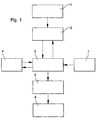
- the watch according to the invention which is shown schematically in Figure 1, includes a time base 1, a circuit for determining the time and date current 2, a processing and control unit 3 to which is associated with a data memory 4, a circuit display control 5, a display system 6, a manual control system 7 and a voltage source continuous supply, for example a battery, no represented.
- the time and date determination circuit current 2 includes a frequency divider, a counter seconds if necessary, as well as minute, hour, day of month, month counters and years and possibly centuries and millennia. This circuit 2 can also include a weekdays counter if they are also indicated by the watch.
- circuit 2 contains the means necessary, on the one hand, to take account of the months of 28, 29, 30 and 31 days, in other words for the watch to be provided with a perpetual calendar and, on the other hand, for allow time and time corrections date through the processing unit and control 3 to which this circuit is connected.
- circuit 2 is also designed to provide to unit 3 and through it to the circuit of display 5 control all periodic signals produced by its frequency divider and of which these have need to fulfill their different functions.
- memory 4 also contains all data necessary for the processor which is also programmed for that.
- control system 7 also includes transducers which allow generate representative electrical control signals of the state in which the organ or an organ of control and / or manipulations to which this body is submitted.
- transducers which allow generate representative electrical control signals of the state in which the organ or an organ of control and / or manipulations to which this body is submitted.
- a control rod for example the switches or switches that are operated by this rod when it is moved axially and rotated in one way or the other are part of the system of ordered.
- system 6 can ultimately understand that two needles to selectively display the current time, the current date or another date, the positions of the solar stars relative to the Earth and zodiac and possibly other information such as phases of the Moon.
- system 6 also includes motors step by step and the cogs that serve to train them.
- system 6 When system 6 is only or also digital, it includes at least one display cell electro-optic, preferably a crystal cell liquids.
- the display control circuit 5 is used to transform the logic signals it receives from the unit processing and control 3 in attack signals from the display system 6.
- this can be performed by a decoding circuit, one or more pulse forming circuits for producing display command pulses and one or more circuits to transform these into pulses drive and selectively apply these to engines which drive the display elements.
- the maintenance circuit of the resonator included in time base 1, circuit 2, unit 3, memory 4 and circuit 5 can be advantageously produced in the form of a integrated microcontroller.
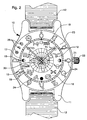
- the watch in Figure 2 is a wristwatch with analog display which conventionally includes a box 10 consisting of a middle part 11 to which are attached the two ends or the two strands of a bracelet 12, a crystal 13 attached to the front of this middle part and a background not visible in the drawing, which can be removable or fitted with a hatch to allow entry and change a battery that serves as a voltage source power supply for the watch.
- a box 10 consisting of a middle part 11 to which are attached the two ends or the two strands of a bracelet 12, a crystal 13 attached to the front of this middle part and a background not visible in the drawing, which can be removable or fitted with a hatch to allow entry and change a battery that serves as a voltage source power supply for the watch.
- the watch could also be designed to indicate the zodiac position of the Moon.
- the display system 6 of the watch in FIG. 2 includes a 14 hour hand and a 15 minutes which are each driven by a stepping motor in two directions of rotation and through a appropriate cog.
- This planisphere is carried by a spinning disc around the same axis as hands 14 and 15 and which is mechanically coupled to the drive train of the hour hand 14 so as to make a revolution in 24 hours counterclockwise.
- the manual control system 7 of the watch includes a control rod 21 provided with a crown 22 and a rotating bezel 23.
- the control rod 21 is a rotary rod which can be moved axially between three positions, namely a stable neutral position which corresponds to the normal watch operation, one position pulled also stable and an unstable pushed position in which a return spring permanently tends to bring back the rod in neutral position.
- the needles 14 and 15 are used not only for indicate the current time, but also to display any other information the watch can provide. It is therefore necessary that the processing and control 3 knows the position of each of these needles to find out how much they must be moved to move from the display of the current time to that of one or more others information and vice versa.
- unit 3 contains a minute counter and an hour counter identical to those of the circuit of determination of the current time and date 2 and of which the states determine and respectively represent the positions of the minute hand and those of the hours.
- the binary logic signals which represent the contents of these position counters needles are continuously transmitted to the display control 5.
- unit 3 also contains the means, including two comparators, which allow minute and hand position counters minutes on the one hand and at the hour and position of the hour hand on the other hand, apart from having the same contents when the watch indicates the current time and when the latter is modified or on the contrary to minute and hour hand position counters to have different contents from those of the counters of minutes and hours when these hands should display other information.
- the minute counter of circuit 2 and the minute hand position counter of unit 3 the contents of which are then the same, simultaneously receive from the frequency divider included in circuit 2 pulses of 1/60 Hz which allow to increment them each time by one.
- these minute counters and position of the minute hand produce all twelve minutes of the pulses which increment the contents of hour counters and hour hand position which are also the same and the binary signals which represent the contents of the position counters of the needles are transformed by the control circuit of display 5 in driving impulses so that the display system 6 motors move forward the minute hand 15 of one step per minute and the hour hand 14 one step every twelve minutes.
- unit 3 In response to this impulse, unit 3 interrupts the transmission of 1/60 Hz pulses from the divider frequency of circuit 2 at its position counter of the minute hand and transfers the content of the counter days of the month of this circuit in its counter of position of the minute hand 15.
- the display control circuit 5 reacts to this change the content of the position counter of the 15 minute hand sending to the engine drive of this motor impulse needle much higher than normal frequency so that it turns quickly one way or the other to come and take the shortest route opposite of the graduation mark 17 of the dial 16 of the watch which corresponds to the day of the month of the current date. If by example this day is the 27, the needle 15 comes to go in the position where it normally indicates 27 minutes.
- unit 3 If the rod is turned slowly, unit 3 first of all interrupts the transmission of frequency divider output from circuit 2 to meter minutes of this same circuit and at its own counter of position of the minute hand 15. Then, unit 3 produces correction pulses whose number and frequency correspond to the rotational movement of the rod at these two counters to increment or decrement their content and move the needle forward or backward minutes via the control circuit display 5, according to the direction of rotation of the rod, after which the link between the frequency divider and the minute and hand position counters minutes is restored when the rod is returned to its normal position.
- the unit detects that, the rod is turned quickly, the link between the divider of frequency and minute counters and position the minute hand is not interrupted and unit 3 generates and applies hour counter inputs and position of the hour hand 14 a number of high frequency pulses which allows this needle to progress or regress by one hour, always following the direction of rotation of the rod order and each time it is subject to a fast rotation.
- the user can then redo the same operations for one or more other stars.
- the symbol 24 of the Earth is at 12 hours for the contents of the position counters needles are compared and equalized with those of circuit 2 minute and hour counters and the 15 minute hand and possibly the hours return to the position where they indicate the current time.
- the watch displays the phase at using the minute hand 15. If this phase is not not one of the four main phases whose symbols 19 are represented on the dial, the minute hand is placed in an intermediate position which allows find out approximately the number of days between phase on the current date of the previous main phase or the next.
- the contents of the circuit 2 day of the month counter is transferred to the hand pointer position counter minutes and this hand indicates the current day of the month using the first 31 minute marks of the graduation 17 of the dial.
- the day of the month can then be modified by bringing the rod 21 into the pulled position and slowly turning in one direction or the other.
- positioning the small symbol 25 of the Moon at 12 o'clock causes the transfer of the contents of the month counter in the position counter the minute hand and the display of the current month by this needle using the first 12 marks of minutes of graduation and traction followed by slow rotation of the rod 21 makes it possible to select a another month.
- the current date should only be corrected when a battery change.
- user or person changing the battery then proceed in the same way as that which has just been described for selecting a date other than the date current except at the end where he must exercise on the rod 21 a long press, for example 3 seconds, so that the watch records the date selected as the current date.
- This planisphere is used to indicate half of the Earth that is in the night and the one that is lit by the Sun at the time indicated by the hands and assuming the Sun is at 12 o'clock.
- the part of the ice 13 which is located above of the latter could be for example more or less tinted or made slightly translucent.
- the period during which can be indicated the positions in the zodiac of the stars seen from Earth as well as the lunar phases is of a hundred years. This is mainly due to the fact that only the last two digits of a year are taken into account to allow them to be displayed simultaneously by only the hour and minute hands of the watch.
- This way of doing things allows the user to read and quickly and safely select a year error, while limiting the number of axial positions of the control rod.
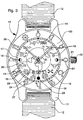
- the display system of the watch in Figure 3 also includes a 14 hour hand and a 15 minutes hand each driven by a motor bidirectional step by step, as well as an annular dial 16 with a peripheral scale in hours and minutes 17 and inside it the symbols 18 of the twelve zodiac signs and 19 representations of the four main phases of the Moon.
- the date is not displayed in permanently, but only on order and by milky color figures. Besides, this way displaying the date hides the date as little as possible part of the central planisphere 20 which is at the rear part of the cell display area. Conversely, to make it easier to read the date, in this form of execution, the planisphere 20 does more features that divide it into 24 zones.
- the display control circuit 5 further comprises means used to control the drive motors needles 14 and 15 and which are the same as those of circuit 5 of the purely analog watch of FIG. 2, a decoding circuit which receives logic signals binaries applied to it on command by the unit processing and control 3 and a driver circuit to selectively apply potential differences required between the control electrodes of the cell.
- the user wants to know the position in the zodiac of one or more other stars that the Earth at the current date, it just has to manipulate the telescope 23 and the control rod 21 of the same way as with the watch of figure 2 so that the minute hand 14 possibly the hour hand and 15 provide him with the information he wants also in the same way.
- unit 3 establishes the link between the binary outputs of its display status counters and the circuit decoder 5 and cell 27 then displays the current date.
- the user can then, by pressing the control rod again quickly, select and flash the two digits 29 of the cell indicating the month then bring this rod in pulled position and turn it to choose the month it wish and memorize this month by bringing back the rod in neutral position.
- the user can again apply short pressure on the rod to select the corresponding digits 30, turn the rod after having drawn it and memorizing this year in returning the rod to its normal position.
- the user can do indicate by the hands of the watch the position zodiac of one or more stars and possibly the phase of the Moon by acting on the rotating bezel 23 in the same way as with the watch in Figure 2.
- the user only has to bring the rotating bezel in the position where the symbol of the Earth is at 12 o'clock so that the contents of needle position counters and counters display status of unit 3 are compared and equalized with the corresponding hour and current date, that the link between the binary outputs display status counters of unit 3 and the display control circuit 5 is interrupted and the watch returns to normal operation.
- the watch could be equipped with a display cell with two additional digits for centuries and millennia, placed before those of years and decades and that would display the content of corresponding counters.
- the figures displayed by these digits could then be changed using the rod command in the same way as the other pairs of figures and unlike what would pass for a shows purely analog, like the one in figure 2, the reading a year indicated by four digits would obviously no more difficult for the user, no more uncertain than that of a year indicated only by two digits.
- the cell could be located on the back of the watch and visible to through a window pierced in the bottom of the box.
- the current date could then be permanently indicated, by a cell which would preferably display in dark on a light background and which would present a very good contrast. Reading this current date or any other date displayed by the cell during a selection would then be easier for the user.
- the face main part of the watch would constantly look aesthetic of a purely analog watch.
- the watch could simply indicate the sign of the zodiac in which there is a star on a date determined, without even specifying approximately the position of this star inside this sign.
- the display control circuit could then receive directly from the divider of frequency of the circuit for determining the time and current date of standard frequency signals of 1/60 or 1/30 Hz to allow the display circuit drive the needles using a single motor, preferably a bidirectional motor to allow faster time corrections.
- the hands of the chronograph function could be used to indicate a date and / or position of a star relative to the zodiac, when this function is not used.
Landscapes
- Physics & Mathematics (AREA)
- General Physics & Mathematics (AREA)
- Astronomy & Astrophysics (AREA)
- Health & Medical Sciences (AREA)
- Life Sciences & Earth Sciences (AREA)
- Engineering & Computer Science (AREA)
- Biomedical Technology (AREA)
- General Health & Medical Sciences (AREA)
- Molecular Biology (AREA)
- Electromechanical Clocks (AREA)
- Electric Clocks (AREA)
Abstract
Description
- la figure 1 est un schéma bloc qui représente d'une façon générale une forme possible d'exécution de la montre selon l'invention; et
- les figures 2 et 3 sont des vues de face de deux formes d'exécution particulières de la montre représentée à la figure 1.
Claims (15)
- Montre astronomique capable d'indiquer la position d'astres du système solaire à la date courante et par rapport à la Terre et au zodiaque, caractérisée par le fait que cette montre est une montre électronique comprenant :une base de temps (1) pour produire un signal de fréquence standard,un circuit (2) pour déterminer l'heure et la date courante partir dudit signal de fréquence standard, ladite date courante incluant le jour du mois, le mois et l'année,un système de commande manuelle (7;21,22,23) permettant de sélectionner chacun desdits astres,un système d'affichage (6;14,15,16,20), etdes moyens (3,4,5) pour déterminer la position d'un astre sélectionné par rapport à la Terre et aux signes du zodiaque et faire indiquer cette position par ledit système d'affichage.
- Montre astronomique selon la revendication 1, caractérisée par le fait qu'elle est conçue pour permettre de sélectionner une date autre que la date courante et pour déterminer et faire indiquer par ledit système d'affichage (6;14,15,16,20) la position d'un astre sélectionné à cette autre date qui peut être une date passée ou future.
- Montre astronomique selon la revendication 1 ou 2, caractérisée par le fait que lesdits astres du système solaire comprennent le Soleil et les huit planètes autres que la Terre.
- Montre selon la revendication 3, caractérisée par le fait qu'elle est conçue pour déterminer et indiquer également la phase de la Lune.
- Montre astronomique selon la revendication 4, caractérisée par le fait que lesdits astres comprennent également la Lune.
- Montre astronomique selon l'une quelconque des revendications 2 à 5, caractérisée par le fait que ledit système d'affichage (6) comprend une aiguille d'heures (14) et une aiguille de minutes (15) coopérant avec un cadran (16), qui indiquent l'heure courante lorsque la montre est dans un mode de fonctionnement normal et que l'une desdites aiguilles est aussi utilisée pour indiquer sur commande la position d'un astre sélectionné à ladite date courante ou à ladite date autre que la date courante.
- Montre astronomique selon la revendication 6, caractérisée par le fait que l'aiguille indiquant la position de l'astre sélectionné est l'aiguille de minutes (15), en coopération avec des représentations (18) des signes du zodiaque portées par le cadran (16) et une graduation en heures et en minutes de ce même cadran.
- Montre astronomique selon la revendication 7, caractérisée par le fait que lesdites aiguilles de minutes (15) et d'heures (14) sont également utilisées pour indiquer séquentiellement et sur commande, le jour du mois, le mois et l'année de ladite date courante et de ladite autre date.
- Montre astronomique selon la revendication 7, caractérisée par le fait que ledit système d'affichage (6) comprend également une cellule d'affichage électro-optique (27) pour indiquer simultanément le jour du mois, le mois et l'année de ladite date courante et de ladite autre date.
- Montre astronomique selon la revendication 9, comprenant une boíte (10) avec une glace (13), caractérisée par le fait que la cellule d'affichage (27) est incorporée dans ladite glace ou fixée à l'arrière de celle-ci, que cette cellule est transparente lorsque la montre fonctionne normalement et que cette cellule n'affiche que sur commande la date courante lorsqu'il s'agit simplement de la lire ou de sélectionner une autre date.
- Montre astronomique selon l'une des revendications 6 à 10, caractérisée par le fait que ledit système d'affichage (6) comprend également un planisphère (20) représentant la Terre vue d'un pôle et effectuant un tour en 24 heures dans le sens anti-horaire pour indiquer la moitié de la Terre qui se trouve dans la nuit et celle qui est éclairée par le Soleil à l'heure affichée par lesdites aiguilles (14,15).
- Montre astronomique selon l'une quelconque des revendications 2 à 11, caractérisée par le fait que la sélection d'un astre est effectuée au moyen d'une lunette tournante (23) faisant partie dudit système de commande manuelle (7).
- Montre astronomique selon la revendication 12, caractérisée par le fait que ladite lunette tournante (23) permet également de placer la montre dans un mode de fonctionnement dans lequel il est possible de sélectionner ladite autre date au moyen d'une tige de commande rotative à plusieurs positions axiales (21) qui fait également partie dudit système de commande manuelle (7).
- Montre astronomique selon la revendication 13, caractérisée par le fait que ladite tige de commande (21) permet également d'effectuer une mise à l'heure de la montre.
- Montre astronomique selon l'une quelconque des revendications précédentes, caractérisée par le fait que ladite montre est une montre-bracelet.
Priority Applications (5)
| Application Number | Priority Date | Filing Date | Title |
|---|---|---|---|
| US09/283,303 US6272076B1 (en) | 1998-04-09 | 1999-04-01 | Astronomic watch |
| JP09866299A JP5036926B2 (ja) | 1998-04-06 | 1999-04-06 | 液晶ディスプレイセルの制御装置 |
| CNB991049772A CN1208700C (zh) | 1998-04-09 | 1999-04-09 | 天文表 |
| JP10233999A JP4286959B2 (ja) | 1998-04-09 | 1999-04-09 | 天文時計 |
| HK00102112.9A HK1023189B (en) | 1998-04-09 | 2000-04-06 | Astronomic watch |
Applications Claiming Priority (2)
| Application Number | Priority Date | Filing Date | Title |
|---|---|---|---|
| CH84598 | 1998-04-09 | ||
| CH84598A CH692066A5 (fr) | 1998-04-09 | 1998-04-09 | Montre astronomique. |
Publications (2)
| Publication Number | Publication Date |
|---|---|
| EP0949549A1 true EP0949549A1 (fr) | 1999-10-13 |
| EP0949549B1 EP0949549B1 (fr) | 2008-11-19 |
Family
ID=4196558
Family Applications (1)
| Application Number | Title | Priority Date | Filing Date |
|---|---|---|---|
| EP19980110269 Expired - Lifetime EP0949549B1 (fr) | 1998-04-06 | 1998-06-05 | Montre astronomique |
Country Status (4)
| Country | Link |
|---|---|
| EP (1) | EP0949549B1 (fr) |
| CH (1) | CH692066A5 (fr) |
| DE (1) | DE69840228D1 (fr) |
| TW (1) | TW384420B (fr) |
Cited By (4)
| Publication number | Priority date | Publication date | Assignee | Title |
|---|---|---|---|---|
| EP1498790A1 (fr) * | 2003-07-14 | 2005-01-19 | Asulab S.A. | Montre astronomique |
| EP1708054A1 (fr) * | 2005-03-30 | 2006-10-04 | Asulab S.A. | Pièce d'horlogerie à affichage analogique capable de convertir des dates d'un calendrier à un autre |
| WO2019043307A1 (fr) | 2017-08-31 | 2019-03-07 | Sauzay Marc | Equipement électronique d'horlogerie indiquant l'heure et l'azimut du soleil au moyen d'une unique aiguille indicatrice |
| EP3454140A1 (fr) | 2017-09-08 | 2019-03-13 | ETA SA Manufacture Horlogère Suisse | Dispositif horloger astronomique |
Citations (8)
| Publication number | Priority date | Publication date | Assignee | Title |
|---|---|---|---|---|
| JPS5674683A (en) * | 1979-11-26 | 1981-06-20 | Seiko Instr & Electronics Ltd | Electronic clock with horoscope |
| FR2500181A1 (fr) * | 1981-02-13 | 1982-08-20 | Staiger Feinmech | Appareil de mesure du temps |
| US4435795A (en) * | 1981-04-07 | 1984-03-06 | A.I.M. Services | Celestial clock |
| US4711583A (en) * | 1985-03-05 | 1987-12-08 | Ulysse Nardin S.A. | Astronomical wrist-watch |
| US4825426A (en) | 1986-09-05 | 1989-04-25 | Ulysse Nardin S.A. | Horometric arrangement for indicating the position of the planets |
| JPH0254293A (ja) * | 1988-08-19 | 1990-02-23 | T I Shii Shichizun:Kk | 星座時計 |
| US5197043A (en) * | 1991-03-29 | 1993-03-23 | Strader Verne A | Night and day earth clock calendar |
| EP0652498A1 (fr) * | 1993-05-21 | 1995-05-10 | Seiko Epson Corporation | Montre electronique a affichage multifonctions |
-
1998
- 1998-04-09 CH CH84598A patent/CH692066A5/fr not_active IP Right Cessation
- 1998-06-05 DE DE69840228T patent/DE69840228D1/de not_active Expired - Lifetime
- 1998-06-05 EP EP19980110269 patent/EP0949549B1/fr not_active Expired - Lifetime
-
1999
- 1999-04-06 TW TW88105451A patent/TW384420B/zh active
Patent Citations (8)
| Publication number | Priority date | Publication date | Assignee | Title |
|---|---|---|---|---|
| JPS5674683A (en) * | 1979-11-26 | 1981-06-20 | Seiko Instr & Electronics Ltd | Electronic clock with horoscope |
| FR2500181A1 (fr) * | 1981-02-13 | 1982-08-20 | Staiger Feinmech | Appareil de mesure du temps |
| US4435795A (en) * | 1981-04-07 | 1984-03-06 | A.I.M. Services | Celestial clock |
| US4711583A (en) * | 1985-03-05 | 1987-12-08 | Ulysse Nardin S.A. | Astronomical wrist-watch |
| US4825426A (en) | 1986-09-05 | 1989-04-25 | Ulysse Nardin S.A. | Horometric arrangement for indicating the position of the planets |
| JPH0254293A (ja) * | 1988-08-19 | 1990-02-23 | T I Shii Shichizun:Kk | 星座時計 |
| US5197043A (en) * | 1991-03-29 | 1993-03-23 | Strader Verne A | Night and day earth clock calendar |
| EP0652498A1 (fr) * | 1993-05-21 | 1995-05-10 | Seiko Epson Corporation | Montre electronique a affichage multifonctions |
Non-Patent Citations (2)
| Title |
|---|
| PATENT ABSTRACTS OF JAPAN vol. 005, no. 138 (P - 078) 2 September 1981 (1981-09-02) * |
| PATENT ABSTRACTS OF JAPAN vol. 014, no. 226 (P - 1047) 14 May 1990 (1990-05-14) * |
Cited By (8)
| Publication number | Priority date | Publication date | Assignee | Title |
|---|---|---|---|---|
| EP1498790A1 (fr) * | 2003-07-14 | 2005-01-19 | Asulab S.A. | Montre astronomique |
| US7154815B2 (en) | 2003-07-14 | 2006-12-26 | Asulab S.A. | Astronomical timepiece |
| EP1708054A1 (fr) * | 2005-03-30 | 2006-10-04 | Asulab S.A. | Pièce d'horlogerie à affichage analogique capable de convertir des dates d'un calendrier à un autre |
| US7433269B2 (en) | 2005-03-30 | 2008-10-07 | Asulab S.A. | Timepiece with analog display capable of indicating a date of one calendar in another calendar |
| WO2019043307A1 (fr) | 2017-08-31 | 2019-03-07 | Sauzay Marc | Equipement électronique d'horlogerie indiquant l'heure et l'azimut du soleil au moyen d'une unique aiguille indicatrice |
| US11567452B2 (en) | 2017-08-31 | 2023-01-31 | Marc Sauzay | Electronic timepiece device indicating the time and the azimuth of the sun by means of a single indicator hand |
| EP3454140A1 (fr) | 2017-09-08 | 2019-03-13 | ETA SA Manufacture Horlogère Suisse | Dispositif horloger astronomique |
| US11119445B2 (en) | 2017-09-08 | 2021-09-14 | Eta Sa Manufacture Horlogere Suisse | Astronomical horological device |
Also Published As
| Publication number | Publication date |
|---|---|
| TW384420B (en) | 2000-03-11 |
| EP0949549B1 (fr) | 2008-11-19 |
| CH692066A5 (fr) | 2002-01-15 |
| DE69840228D1 (de) | 2009-01-02 |
Similar Documents
| Publication | Publication Date | Title |
|---|---|---|
| EP2362277B1 (fr) | Fuseau horaire à la demande sur l'aiguillage principal d'une pièce d'horlogerie | |
| EP0735442B1 (fr) | Pièce d'horlogerie électronique analogique à disque de quantième multifunctionnel | |
| EP1498790B1 (fr) | Montre astronomique | |
| EP1936450B1 (fr) | Montre électronique à indication de la direction d'un lieu géographique préprogrammé | |
| US6272076B1 (en) | Astronomic watch | |
| WO2009121699A1 (fr) | Montre avec affichage de fuseaux horaires | |
| EP1625879B1 (fr) | Pièce d'horlogerie électronique portable au poignet permettant d'effectuer le comptage des points au golf | |
| EP0515611B1 (fr) | Affichage dissimule | |
| EP3696617B1 (fr) | Mecanisme d'affichage de mois et d'annee bissextile pour piece d'horlogerie | |
| EP0949549B1 (fr) | Montre astronomique | |
| EP0644469B1 (fr) | Pièce d'horlogerie à affichage analogique présentant au moins un mode d'affichage universel de l'heure | |
| EP2021880B1 (fr) | Procédé de changement de fuseau horaire, et pièce d'horlogerie adaptée a celui-ci | |
| EP0366610A1 (fr) | Montre, notamment montre-bracelet, à affichage multiple par aiguilles | |
| CH333770A (de) | Traktor mit Vierradantrieb | |
| EP0644468B1 (fr) | Pièce d'horlogerie à affichage analogique pouvant fournir une ou plusieurs informations alphanumériques sur l'état d'un mode de fonctionnement ou d'un événement programmé | |
| EP0247418A1 (fr) | Montre calendrier perpétuel à deux moteurs | |
| EP1792236B1 (fr) | Piece d' horlogerie a quantieme comprenant un dispositif d' equation du temps marchante | |
| EP4113218B1 (fr) | Mécanisme d'affichage combiné d'un quantième lunaire et des phases de la lune pour mouvement horloger | |
| CH702718A2 (fr) | Fuseau horaire à la demande sur l'aiguillage principal d'une pièce d'horlogerie. | |
| CH703258A2 (fr) | Montre à heures universelles. | |
| EP1792235A1 (fr) | Piece d'horlogerie a quantieme comprenant un dispositif d'equation du temps marchante | |
| CH704080A2 (fr) | Montre comprenant une indication astronomique. | |
| EP1184751A1 (fr) | Montre électronique avec quantième à grand guichet | |
| CH708648A2 (fr) | Montre comprenant une indication astronomique. | |
| CH714555A2 (fr) | Mouvement horloger comportant un organe de commande agencé pour actionner simultanément plusieurs mécanismes. |
Legal Events
| Date | Code | Title | Description |
|---|---|---|---|
| PUAI | Public reference made under article 153(3) epc to a published international application that has entered the european phase |
Free format text: ORIGINAL CODE: 0009012 |
|
| AK | Designated contracting states |
Kind code of ref document: A1 Designated state(s): CH DE FR GB IT LI |
|
| AX | Request for extension of the european patent |
Free format text: AL;LT;LV;MK;RO;SI |
|
| 17P | Request for examination filed |
Effective date: 20000413 |
|
| AKX | Designation fees paid |
Free format text: CH DE FR GB IT LI |
|
| 17Q | First examination report despatched |
Effective date: 20071026 |
|
| GRAP | Despatch of communication of intention to grant a patent |
Free format text: ORIGINAL CODE: EPIDOSNIGR1 |
|
| GRAS | Grant fee paid |
Free format text: ORIGINAL CODE: EPIDOSNIGR3 |
|
| GRAA | (expected) grant |
Free format text: ORIGINAL CODE: 0009210 |
|
| AK | Designated contracting states |
Kind code of ref document: B1 Designated state(s): CH DE FR GB IT LI |
|
| REG | Reference to a national code |
Ref country code: GB Ref legal event code: FG4D Free format text: NOT ENGLISH |
|
| REG | Reference to a national code |
Ref country code: CH Ref legal event code: EP |
|
| RAP2 | Party data changed (patent owner data changed or rights of a patent transferred) |
Owner name: ASULAB S.A. |
|
| REF | Corresponds to: |
Ref document number: 69840228 Country of ref document: DE Date of ref document: 20090102 Kind code of ref document: P |
|
| REG | Reference to a national code |
Ref country code: CH Ref legal event code: NV Representative=s name: ICB INGENIEURS CONSEILS EN BREVETS SA |
|
| PLBE | No opposition filed within time limit |
Free format text: ORIGINAL CODE: 0009261 |
|
| STAA | Information on the status of an ep patent application or granted ep patent |
Free format text: STATUS: NO OPPOSITION FILED WITHIN TIME LIMIT |
|
| 26N | No opposition filed |
Effective date: 20090820 |
|
| PGFP | Annual fee paid to national office [announced via postgrant information from national office to epo] |
Ref country code: GB Payment date: 20090526 Year of fee payment: 12 |
|
| GBPC | Gb: european patent ceased through non-payment of renewal fee |
Effective date: 20100605 |
|
| PG25 | Lapsed in a contracting state [announced via postgrant information from national office to epo] |
Ref country code: IT Free format text: LAPSE BECAUSE OF FAILURE TO SUBMIT A TRANSLATION OF THE DESCRIPTION OR TO PAY THE FEE WITHIN THE PRESCRIBED TIME-LIMIT Effective date: 20081119 |
|
| PG25 | Lapsed in a contracting state [announced via postgrant information from national office to epo] |
Ref country code: GB Free format text: LAPSE BECAUSE OF NON-PAYMENT OF DUE FEES Effective date: 20100605 |
|
| PGFP | Annual fee paid to national office [announced via postgrant information from national office to epo] |
Ref country code: FR Payment date: 20110727 Year of fee payment: 14 |
|
| PGFP | Annual fee paid to national office [announced via postgrant information from national office to epo] |
Ref country code: DE Payment date: 20110606 Year of fee payment: 14 |
|
| REG | Reference to a national code |
Ref country code: FR Ref legal event code: ST Effective date: 20130228 |
|
| REG | Reference to a national code |
Ref country code: DE Ref legal event code: R119 Ref document number: 69840228 Country of ref document: DE Effective date: 20130101 |
|
| PG25 | Lapsed in a contracting state [announced via postgrant information from national office to epo] |
Ref country code: FR Free format text: LAPSE BECAUSE OF NON-PAYMENT OF DUE FEES Effective date: 20120702 Ref country code: DE Free format text: LAPSE BECAUSE OF NON-PAYMENT OF DUE FEES Effective date: 20130101 |
|
| PGFP | Annual fee paid to national office [announced via postgrant information from national office to epo] |
Ref country code: CH Payment date: 20170526 Year of fee payment: 20 |
|
| REG | Reference to a national code |
Ref country code: CH Ref legal event code: PFUS Owner name: THE SWATCH GROUP RESEARCH AND DEVELOPMENT LTD , CH Free format text: FORMER OWNER: ASULAB S.A., CH |
|
| REG | Reference to a national code |
Ref country code: CH Ref legal event code: PL |