EP0963825B1 - Mecanochemical process for treating plastic materials - Google Patents
Mecanochemical process for treating plastic materials Download PDFInfo
- Publication number
- EP0963825B1 EP0963825B1 EP19990830299 EP99830299A EP0963825B1 EP 0963825 B1 EP0963825 B1 EP 0963825B1 EP 19990830299 EP19990830299 EP 19990830299 EP 99830299 A EP99830299 A EP 99830299A EP 0963825 B1 EP0963825 B1 EP 0963825B1
- Authority
- EP
- European Patent Office
- Prior art keywords
- grinding
- plastic materials
- carbon dioxide
- materials according
- vessel
- Prior art date
- Legal status (The legal status is an assumption and is not a legal conclusion. Google has not performed a legal analysis and makes no representation as to the accuracy of the status listed.)
- Expired - Lifetime
Links
Images

Classifications
-
- B—PERFORMING OPERATIONS; TRANSPORTING
- B29—WORKING OF PLASTICS; WORKING OF SUBSTANCES IN A PLASTIC STATE IN GENERAL
- B29B—PREPARATION OR PRETREATMENT OF THE MATERIAL TO BE SHAPED; MAKING GRANULES OR PREFORMS; RECOVERY OF PLASTICS OR OTHER CONSTITUENTS OF WASTE MATERIAL CONTAINING PLASTICS
- B29B17/00—Recovery of plastics or other constituents of waste material containing plastics
- B29B17/04—Disintegrating plastics, e.g. by milling
- B29B17/0404—Disintegrating plastics, e.g. by milling to powder
- B29B17/0408—Disintegrating plastics, e.g. by milling to powder using cryogenic systems
-
- B—PERFORMING OPERATIONS; TRANSPORTING
- B02—CRUSHING, PULVERISING, OR DISINTEGRATING; PREPARATORY TREATMENT OF GRAIN FOR MILLING
- B02C—CRUSHING, PULVERISING, OR DISINTEGRATING IN GENERAL; MILLING GRAIN
- B02C17/00—Disintegrating by tumbling mills, i.e. mills having a container charged with the material to be disintegrated with or without special disintegrating members such as pebbles or balls
- B02C17/007—Disintegrating by tumbling mills, i.e. mills having a container charged with the material to be disintegrated with or without special disintegrating members such as pebbles or balls specially adapted for disintegrating refuse
-
- B—PERFORMING OPERATIONS; TRANSPORTING
- B02—CRUSHING, PULVERISING, OR DISINTEGRATING; PREPARATORY TREATMENT OF GRAIN FOR MILLING
- B02C—CRUSHING, PULVERISING, OR DISINTEGRATING IN GENERAL; MILLING GRAIN
- B02C19/00—Other disintegrating devices or methods
- B02C19/18—Use of auxiliary physical effects, e.g. ultrasonic waves or irradiation, for disintegrating
- B02C19/186—Use of cold or heat for disintegrating
-
- B—PERFORMING OPERATIONS; TRANSPORTING
- B29—WORKING OF PLASTICS; WORKING OF SUBSTANCES IN A PLASTIC STATE IN GENERAL
- B29B—PREPARATION OR PRETREATMENT OF THE MATERIAL TO BE SHAPED; MAKING GRANULES OR PREFORMS; RECOVERY OF PLASTICS OR OTHER CONSTITUENTS OF WASTE MATERIAL CONTAINING PLASTICS
- B29B17/00—Recovery of plastics or other constituents of waste material containing plastics
- B29B17/04—Disintegrating plastics, e.g. by milling
- B29B2017/0424—Specific disintegrating techniques; devices therefor
- B29B2017/0472—Balls or rollers in a container
-
- Y—GENERAL TAGGING OF NEW TECHNOLOGICAL DEVELOPMENTS; GENERAL TAGGING OF CROSS-SECTIONAL TECHNOLOGIES SPANNING OVER SEVERAL SECTIONS OF THE IPC; TECHNICAL SUBJECTS COVERED BY FORMER USPC CROSS-REFERENCE ART COLLECTIONS [XRACs] AND DIGESTS
- Y02—TECHNOLOGIES OR APPLICATIONS FOR MITIGATION OR ADAPTATION AGAINST CLIMATE CHANGE
- Y02W—CLIMATE CHANGE MITIGATION TECHNOLOGIES RELATED TO WASTEWATER TREATMENT OR WASTE MANAGEMENT
- Y02W30/00—Technologies for solid waste management
- Y02W30/50—Reuse, recycling or recovery technologies
- Y02W30/52—Mechanical processing of waste for the recovery of materials, e.g. crushing, shredding, separation or disassembly
-
- Y—GENERAL TAGGING OF NEW TECHNOLOGICAL DEVELOPMENTS; GENERAL TAGGING OF CROSS-SECTIONAL TECHNOLOGIES SPANNING OVER SEVERAL SECTIONS OF THE IPC; TECHNICAL SUBJECTS COVERED BY FORMER USPC CROSS-REFERENCE ART COLLECTIONS [XRACs] AND DIGESTS
- Y02—TECHNOLOGIES OR APPLICATIONS FOR MITIGATION OR ADAPTATION AGAINST CLIMATE CHANGE
- Y02W—CLIMATE CHANGE MITIGATION TECHNOLOGIES RELATED TO WASTEWATER TREATMENT OR WASTE MANAGEMENT
- Y02W30/00—Technologies for solid waste management
- Y02W30/50—Reuse, recycling or recovery technologies
- Y02W30/62—Plastics recycling; Rubber recycling
Definitions
- the present invention relates to a process for grinding plastic materials - in presence of carbon dioxide in a liquid state inside the grinding vessel - capable of destructuring the plastic materials and to ensure the compatibility of heterogeneous plastic materials in order to allow the recovery thereof from urban and industrial waste.
- GB-A-1.334.718 refers to the recovery of rubber from discarded fabric or fiber reinforced rubber articles.
- GB-A-1.453.852 refers to a method for reclaiming wire and insulating material from insulated wire.
- EP-A-610162 refers to the cryogenic transformation and sorting of solid municipal waste. In all these documents the starting material is cooled at a temperature below the embrittlement temperature before grinding.
- the present invention provides a process for grinding plastic materials having characteristics that are radically innovative with respect to this process, and technical effects that are as much unexpected as advantageous.
- the process for grinding plastic materials according to the present invention is carried out in presence of carbon dioxide in a liquid state inside the grinding vessel preferably at room temperature.
- the grinding vessel can be selected from the group comprising the vibrating mills, the ball mills, and the attrition means provided of grinding bodies.
- the grinding bodies are preferably ball-shaped.
- the weight ratio between the carbon dioxide and the plastic materials can be comprised within the range 5-50.
- the weight ratio between the carbon dioxide and the grinding bodies can be comprised within the range 0.01 - 10, preferably within the range 0.05 - 1.5.
- a further subject of the present invention is represented by the materials, in a fibrous or in a powdery state, obtainable from the above described grinding process.
- the grinding process according to the invention finds important applications in the mechanochemistry and in the environmental protection fields.
- the mechanical energy developed and transferred, and the destructuring at a molecular level carried out in the course of the grinding process according to the invention allow the synthesis of new polymers, or of polymeric matrix compounds, having peculiar properties in the mechanochemistry field, and - in the field of the environmental protection - the compatibilization of heterogeneous plastic materials and, therefore, the recycling of plastic waste of urban or industrial origin.
- the process according to the invention can be effectively used in the field of the recovery of the plastic materials deriving from urban and industrial waste.
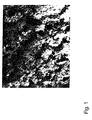
- Figure 1 shows a microphotography of the material obtained through a 10-minutes grinding in a vibrating mill of the heterogeneous plastics deriving from urban solid waste with the process according to the invention.
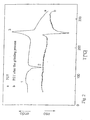
- FIG. 2 shows the comparison between the Differential Scanning Calorimetry (DSC) plotting of polyethylene terephtalate (PET) prior to (plotting a) and after (plotting b) the grinding process according to the invention.
- DSC Differential Scanning Calorimetry
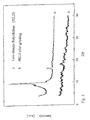
- Figure 3 shows the X-ray diffraction spectrum of the polystyrene (PS) prior to (plotting a) and after (plotting b) having been subjected to the grinding process according to the invention.
- Figure 4 shows the X-ray diffraction spectrum of the low-density polyethylene (PELD) prior to (plotting a) and after (plotting b) having been subjected to the grinding process according to the present invention.
- PELD low-density polyethylene
- PET polyethylene terephthalate
- the reaction vessel contained 200 g of tungsten carbide balls having 8mm and 12mm diameter and 30 g carbon dioxide introduced therein in a solid state.
- the vessel having copper rings, ensured a seal up to a pressure of 100 atm and the final temperature of the process was 30°C.
- Figure 2 shows the DSC (Differential Scanning Calorimetry) plottings of the PET prior to (plotting a of figure 2) and after (plotting b of figure 2) the grinding process. The comparison of the two plottings highlights the extreme destructuring of the polymer order after the grinding.
- DSC Different Scanning Calorimetry
- the plotting (a) exhibits the signals related to the polymer glass transition (point 1) crystallisation (point 2) and fusion (point 3).
- the plotting (b), related to the product after grinding does not exhibit any glass transition, showing that the crystallisation peak overlaps (and is greater than) the one related to the melting.
- Such characteristic indicates that the yielded amorphous product has a degree of stability so high as to require a molecular mobility equal to that of the liquid polymer for the arrangement process of the amorphous product, which is however concurrent with the melting process.
- the reaction vessel contained 100 g of tungsten carbide balls of 8mm and 12mm diameter and 15 g carbon dioxide introduced therein in a solid state.
- the vessel seal was not lower than 60 atm and the process final temperature 30°C.
- the high destructurating rate resulting from the process is highlighted by the comparison between the X-ray diffraction spectrum of the PELD prior to (plotting a of figure 4) and after (plotting b of figure 4) having been subjected to the grinding process. In this case as well, it can be remarked that after the grinding the X-ray spectrum does not exhibit any crystalline peak anymore.
Landscapes
- Engineering & Computer Science (AREA)
- Food Science & Technology (AREA)
- Health & Medical Sciences (AREA)
- Toxicology (AREA)
- Environmental & Geological Engineering (AREA)
- Mechanical Engineering (AREA)
- Separation, Recovery Or Treatment Of Waste Materials Containing Plastics (AREA)
- Polymers With Sulfur, Phosphorus Or Metals In The Main Chain (AREA)
Description
- The present invention relates to a process for grinding plastic materials - in presence of carbon dioxide in a liquid state inside the grinding vessel - capable of destructuring the plastic materials and to ensure the compatibility of heterogeneous plastic materials in order to allow the recovery thereof from urban and industrial waste.
- As it is known, the possibility of subjecting the plastic materials to a mechanical treatment was examined in recent years by Shaw and co-workers (1).
- These researchers demonstrated that grinding with the Ball Grinding technique at a temperature lower than the glass transition temperature of the plastic materials, it is possible to crush such materials in a way wholly analogous to that carried out on the metallic or ceramic materials.
- GB-A-1.334.718 refers to the recovery of rubber from discarded fabric or fiber reinforced rubber articles. GB-A-1.453.852 refers to a method for reclaiming wire and insulating material from insulated wire. EP-A-610162 refers to the cryogenic transformation and sorting of solid municipal waste. In all these documents the starting material is cooled at a temperature below the embrittlement temperature before grinding.
- The present invention provides a process for grinding plastic materials having characteristics that are radically innovative with respect to this process, and technical effects that are as much unexpected as advantageous.
- The process for grinding plastic materials according to the present invention is carried out in presence of carbon dioxide in a liquid state inside the grinding vessel preferably at room temperature.
- The grinding vessel can be selected from the group comprising the vibrating mills, the ball mills, and the attrition means provided of grinding bodies. The grinding bodies are preferably ball-shaped.
- The weight ratio between the carbon dioxide and the plastic materials can be comprised within the range 5-50.
- The weight ratio between the carbon dioxide and the grinding bodies can be comprised within the range 0.01 - 10, preferably within the range 0.05 - 1.5.
- The grinding times, depending on the chemical nature of the plastic materials to be ground, anyhow are longer than one minute.
- A further subject of the present invention is represented by the materials, in a fibrous or in a powdery state, obtainable from the above described grinding process.
- The grinding process according to the invention finds important applications in the mechanochemistry and in the environmental protection fields.
- In fact, the mechanical energy developed and transferred, and the destructuring at a molecular level carried out in the course of the grinding process according to the invention, allow the synthesis of new polymers, or of polymeric matrix compounds, having peculiar properties in the mechanochemistry field, and - in the field of the environmental protection - the compatibilization of heterogeneous plastic materials and, therefore, the recycling of plastic waste of urban or industrial origin.
- Taking into account the fact that the processing times are extremely short and that the high solvent power of the carbon dioxide is capable of solubilising the additives of the polymer products on the market, the process according to the invention can be effectively used in the field of the recovery of the plastic materials deriving from urban and industrial waste.
- The mechanisms underlying the process according to the invention are not yet completely clarified. However, the following working hypotheses can be made. Under the operational conditions defining the grinding process according to the present invention the carbon dioxide is probably to be found in a dynamic equilibrium state, not far from the liquid-vapor transition zone.
- Under such conditions, it is highly probable that during a collision between the grinding body and the grinding vessel wall (2, 3), due to the sudden energy transfer, the carbon dioxide trapped in the event undergoes an instantaneous "microexplosive" vaporisation, with disruptive effects on the material that is trapped as well, which in turn result in the crystal structure destructuring. Moreover, as the possibility of producing free radicals into the polymers by the mechanochemical way is well known (4), it is assumed that the combination of a deep destructuring of the molecular order with a high free radicals concentration during the process, and the consequent possibility of crosslinks, might be advantageously exploited in the formulation of new polymer mixtures.
- So far only a general description of the present invention has been given. A more detailed description of its embodiments will be given hereinafter, making reference to the figures and to the examples, aimed at making apparent the objects, characteristics, advantages and operation modes thereof.
- Figure 1 shows a microphotography of the material obtained through a 10-minutes grinding in a vibrating mill of the heterogeneous plastics deriving from urban solid waste with the process according to the invention.
- Figure 2 shows the comparison between the Differential Scanning Calorimetry (DSC) plotting of polyethylene terephtalate (PET) prior to (plotting a) and after (plotting b) the grinding process according to the invention.
- Figure 3 shows the X-ray diffraction spectrum of the polystyrene (PS) prior to (plotting a) and after (plotting b) having been subjected to the grinding process according to the invention.
- Figure 4 shows the X-ray diffraction spectrum of the low-density polyethylene (PELD) prior to (plotting a) and after (plotting b) having been subjected to the grinding process according to the present invention.
- 1 g heterogeneous plastics recovered from urban solid wastes (mainly consisting of fragments of polypropylene, polythene, polyethylene terephtalate and other plastic residues from household use), was subjected to the grinding process according to the invention, for 7 minutes in a vibrating mill. The reaction vessel contained 150 g of tungsten carbide balls having 8mm and 12mm diameter, and 15 g carbon dioxide introduced therein in a solid state. The vessel seal was not lower than 60 atm and the final temperature of the process was 30°C. Figure 1 microphotography (10x) shows that the material obtained is completely destructurated and that the starting heterogeneous plastics are completely homogenized.
- 1 g polyethylene terephthalate (PET) was subjected to the grinding process according to the invention for 10 minutes in a vibrating mill. The reaction vessel contained 200 g of tungsten carbide balls having 8mm and 12mm diameter and 30 g carbon dioxide introduced therein in a solid state. The vessel, having copper rings, ensured a seal up to a pressure of 100 atm and the final temperature of the process was 30°C. Figure 2 shows the DSC (Differential Scanning Calorimetry) plottings of the PET prior to (plotting a of figure 2) and after (plotting b of figure 2) the grinding process. The comparison of the two plottings highlights the extreme destructuring of the polymer order after the grinding. In fact, the plotting (a) exhibits the signals related to the polymer glass transition (point 1) crystallisation (point 2) and fusion (point 3). On the contrary, the plotting (b), related to the product after grinding, does not exhibit any glass transition, showing that the crystallisation peak overlaps (and is greater than) the one related to the melting. Such characteristic indicates that the yielded amorphous product has a degree of stability so high as to require a molecular mobility equal to that of the liquid polymer for the arrangement process of the amorphous product, which is however concurrent with the melting process.
- 2 g polystyrene (PS) deriving from a foodstuff wrapper were subjected to the grinding process according to the invention, for 10 minutes in a vibrating mill. The steel reaction vessel contained 200 g of tungsten carbide balls of 8mm and 12mm diameter and 20 g carbon dioxide introduced therein in a solid state. The steel vessel was provided with an insulation jacket with a cooling circuit set at a temperature of 20°C. The high destructuring rate resulting from the process is highlighted by the comparison between the X-ray diffraction spectrum of the PS prior to and after the grinding. In fact, while in the plotting a of figure 3 the peaks related to the crystalline fraction can be seen, the X-ray spectrum after the grinding of the material (see plotting b of figure 3) does not exhibit any crystalline peak.
- 2 g low-density Polyethylene (PELD) were subjected to the grinding process according to the invention, for 5 minutes in a vibrating mill. The reaction vessel contained 100 g of tungsten carbide balls of 8mm and 12mm diameter and 15 g carbon dioxide introduced therein in a solid state. The vessel seal was not lower than 60 atm and the process
final temperature 30°C. The high destructurating rate resulting from the process is highlighted by the comparison between the X-ray diffraction spectrum of the PELD prior to (plotting a of figure 4) and after (plotting b of figure 4) having been subjected to the grinding process. In this case as well, it can be remarked that after the grinding the X-ray spectrum does not exhibit any crystalline peak anymore. -
- (1) W.J.D. Shaw, Mater. Science Forum, 269-272, 19 (1998);
- (2) M. Magini and A. Iasonna, Mater. Trans., JIM, 36,123 (1995);
- (3) M. Magini, A. Iasonna and F. Padella, Scripta Materialia, 34, 13 (1996);
- (4) A. Casale and R.S. Porter, Acts of the XVIII AIM Meeting, 9-14 June 1996.
-
Claims (10)
- A process for grinding plastic materials, characterized in that it is carried out in the presence of carbon dioxide in a liquid state inside the grinding vessel.
- The process for grinding plastic materials according to claim 1, wherein the grinding vessel is at room temperature at the moment of the carbon dioxide introduction.
- The process for grinding plastic materials according to claim 1 or 2, wherein the grinding vessel is selected from the group comprising the vibrating mills, the ball mills and the attrition means provided with grinding bodies.
- The process for grinding plastic materials according to claim 3, wherein the grinding bodies are ball-shaped.
- The process for grinding plastic materials as in any one of the preceding claims, wherein the weight ratio between the carbon dioxide and the plastic materials is comprised in the range 5 - 50.
- The process for grinding plastic materials according to any one of claims 1 to 5, wherein the weight ratio between the carbon dioxide and the grinding bodies is comprised in the range 0.01 - 10.
- The process for grinding plastic materials according to claim 6, wherein the weight ratio between the carbon dioxide and the grinding bodies is comprised in the range 0.05 - 1.5.
- The process for grinding plastic materials according to any one of claims 1 to 7, wherein the grinding times top one minute.
- Use of the process for grinding plastic materials according to claims 1 to 8, in mechanochemistry for the synthesis of new polymers, new polymer compositions or compounds having a polymer matrix.
- Use of the process for grinding plastic materials according to claims 1 to 8, in the field of the environmental protection for the compatibilisation and the recycling of heterogeneous plastic materials recovered from urban or industrial wastes.
Applications Claiming Priority (2)
| Application Number | Priority Date | Filing Date | Title |
|---|---|---|---|
| ITRM980372 | 1998-06-10 | ||
| IT98RM000372 IT1299503B1 (en) | 1998-06-10 | 1998-06-10 | MECHANOCHEMICAL PROCEDURE FOR TREATMENT OF PLASTIC MATERIALS |
Publications (2)
| Publication Number | Publication Date |
|---|---|
| EP0963825A1 EP0963825A1 (en) | 1999-12-15 |
| EP0963825B1 true EP0963825B1 (en) | 2003-09-24 |
Family
ID=11405969
Family Applications (1)
| Application Number | Title | Priority Date | Filing Date |
|---|---|---|---|
| EP19990830299 Expired - Lifetime EP0963825B1 (en) | 1998-06-10 | 1999-05-14 | Mecanochemical process for treating plastic materials |
Country Status (3)
| Country | Link |
|---|---|
| EP (1) | EP0963825B1 (en) |
| DE (1) | DE69911502T2 (en) |
| IT (1) | IT1299503B1 (en) |
Cited By (4)
| Publication number | Priority date | Publication date | Assignee | Title |
|---|---|---|---|---|
| WO2019141504A1 (en) | 2018-01-20 | 2019-07-25 | Bürkle Consulting Gmbh | Mechanochemical process for producing valuable products free from persistent organic pollutants and other organohalogen compounds from waste comprising plastics and plastic laminates |
| WO2020164792A2 (en) | 2019-02-12 | 2020-08-20 | Smart Material Printing B.V. | Mechanochemical process |
| WO2024176220A1 (en) * | 2023-02-23 | 2024-08-29 | Technion Research & Development Foundation Limited | Mechano-chemical upcycling of polymer waste |
| DE102025101736B3 (en) * | 2025-01-19 | 2026-02-19 | Elke Münch | Mechanochemical reactors with a self-regulating thermal management system based on heat pipes |
Families Citing this family (1)
| Publication number | Priority date | Publication date | Assignee | Title |
|---|---|---|---|---|
| WO2016205192A1 (en) | 2015-06-15 | 2016-12-22 | Herring George Birks | Compositions for injection moulding |
Family Cites Families (7)
| Publication number | Priority date | Publication date | Assignee | Title |
|---|---|---|---|---|
| CA954103A (en) * | 1970-09-14 | 1974-09-03 | Rudolph H. Kohler | Process for cryogenically reclaiming scrap rubber |
| US3666185A (en) * | 1971-02-17 | 1972-05-30 | Virgil C Williams | Cryogenic crushing of materials |
| US3718284A (en) * | 1971-04-26 | 1973-02-27 | V Richardson | Method of and apparatus for communiting rubber tires |
| GB1453851A (en) * | 1973-07-18 | 1976-10-27 | Boc International Ltd | Cover removal |
| DE4220623A1 (en) * | 1992-06-24 | 1994-01-05 | Flexokem Ag Luxemburg Luxembou | Fine particle rubber powder prodn. from scrap rubber - involves breaking up large pieces, granulating, cryogenically cooling, pulverising, sieving and bacterially extracting sulphur@ from finest powder |
| IT1271454B (en) * | 1993-01-28 | 1997-05-28 | Pro Co Gen Progettazioni E Cos | CRYOTRANSFORMATION PLANT AND SELECTION OF SOLID URBAN WASTE. |
| US5533680A (en) * | 1994-12-28 | 1996-07-09 | U.S. Rubber Reclaiming, Inc. | Process to grind thermoset or thermoplastic materials |
-
1998
- 1998-06-10 IT IT98RM000372 patent/IT1299503B1/en active IP Right Grant
-
1999
- 1999-05-14 DE DE1999611502 patent/DE69911502T2/en not_active Expired - Fee Related
- 1999-05-14 EP EP19990830299 patent/EP0963825B1/en not_active Expired - Lifetime
Cited By (6)
| Publication number | Priority date | Publication date | Assignee | Title |
|---|---|---|---|---|
| WO2019141504A1 (en) | 2018-01-20 | 2019-07-25 | Bürkle Consulting Gmbh | Mechanochemical process for producing valuable products free from persistent organic pollutants and other organohalogen compounds from waste comprising plastics and plastic laminates |
| US11807724B2 (en) | 2018-01-20 | 2023-11-07 | Gregor Luthe | Mechanochemical process for producing valuable products free from persistent organic pollutants and other organohalogen compounds from waste comprising plastics and plastic laminates |
| EP4293072A2 (en) | 2018-01-20 | 2023-12-20 | Smart Material Printing B.V. | Mechanochemical process for the production of persistent organic pollutants and other organohalogen compounds free valuables from waste of plastics and plastic laminates |
| WO2020164792A2 (en) | 2019-02-12 | 2020-08-20 | Smart Material Printing B.V. | Mechanochemical process |
| WO2024176220A1 (en) * | 2023-02-23 | 2024-08-29 | Technion Research & Development Foundation Limited | Mechano-chemical upcycling of polymer waste |
| DE102025101736B3 (en) * | 2025-01-19 | 2026-02-19 | Elke Münch | Mechanochemical reactors with a self-regulating thermal management system based on heat pipes |
Also Published As
| Publication number | Publication date |
|---|---|
| DE69911502T2 (en) | 2004-07-08 |
| ITRM980372A0 (en) | 1998-06-10 |
| DE69911502D1 (en) | 2003-10-30 |
| IT1299503B1 (en) | 2000-03-16 |
| EP0963825A1 (en) | 1999-12-15 |
| ITRM980372A1 (en) | 1999-12-10 |
Similar Documents
| Publication | Publication Date | Title |
|---|---|---|
| Matias et al. | Use of recycled polypropylene/poly (ethylene terephthalate) blends to manufacture water pipes: An industrial scale study | |
| Thiounn et al. | Advances and approaches for chemical recycling of plastic waste | |
| Das et al. | Plastic recycling of polyethylene terephthalate (PET) and polyhydroxybutyrate (PHB)—A comprehensive review | |
| Yang et al. | Recycling of automotive shredder residue by solid state shear milling technology | |
| JP2023522635A (en) | Vitrification material for partial oxidation gasifier | |
| CN115397906A (en) | Chemical recovery of metal-containing plastic mixtures | |
| CN115397904A (en) | Chemical recovery of plastic dry fines | |
| CN115380066A (en) | Chemical recycling of waste plastics from various sources including wet fines | |
| Agwuncha et al. | Influence of Boehmite Nanoparticle Loading on the Mechanical, Thermal, and Rheological Properties of Biodegradable Polylactide/Poly (ϵ‐caprolactone) Blends | |
| EP0963825A1 (en) | Mecanochemical process for treating plastic materials | |
| JP2023522637A (en) | Liquefaction and dehalogenation of waste plastics | |
| KR101134809B1 (en) | Method for producing pulverized waste plastic | |
| CN115443304A (en) | Chemical recovery of pigmented plastic mixtures | |
| CN115427489A (en) | Chemical recovery plastic purifying material | |
| CN114907600A (en) | Single-direction and two-direction solid-phase stretching processing method for regenerated hybrid plastic material | |
| CA2079209A1 (en) | Process for preparing rubber-containing waste for further treatment | |
| JP2002067029A (en) | Method for recycling used plastics and molded articles for recycling | |
| CN102272220A (en) | A method of processing recycled and shredded material | |
| Luyt et al. | Blends of polyamide 12 and maleic anhydride grafted paraffin wax as potential phase change materials | |
| CN115397905A (en) | Chemical recycling and regenerating device sheet waste | |
| JPH11192469A (en) | Plastic processing method, solid fuel obtained by the processing method, ore reducing agent | |
| EP4464739A2 (en) | An aqueous separation process for multiple polymer components | |
| US5785734A (en) | Residue and waste treatment process | |
| JP4139897B2 (en) | Method and apparatus for thermal decomposition of plastic | |
| US6066685A (en) | Method for treating plastics and solid fuel obtained by the same method |
Legal Events
| Date | Code | Title | Description |
|---|---|---|---|
| PUAI | Public reference made under article 153(3) epc to a published international application that has entered the european phase |
Free format text: ORIGINAL CODE: 0009012 |
|
| AK | Designated contracting states |
Kind code of ref document: A1 Designated state(s): DE ES FR GB |
|
| AX | Request for extension of the european patent |
Free format text: AL;LT;LV;MK;RO;SI |
|
| 17P | Request for examination filed |
Effective date: 20000508 |
|
| AKX | Designation fees paid |
Free format text: DE ES FR GB |
|
| 17Q | First examination report despatched |
Effective date: 20001127 |
|
| GRAH | Despatch of communication of intention to grant a patent |
Free format text: ORIGINAL CODE: EPIDOS IGRA |
|
| GRAS | Grant fee paid |
Free format text: ORIGINAL CODE: EPIDOSNIGR3 |
|
| GRAA | (expected) grant |
Free format text: ORIGINAL CODE: 0009210 |
|
| AK | Designated contracting states |
Kind code of ref document: B1 Designated state(s): DE ES FR GB |
|
| PG25 | Lapsed in a contracting state [announced via postgrant information from national office to epo] |
Ref country code: ES Free format text: LAPSE BECAUSE OF FAILURE TO SUBMIT A TRANSLATION OF THE DESCRIPTION OR TO PAY THE FEE WITHIN THE PRESCRIBED TIME-LIMIT Effective date: 20030924 |
|
| REG | Reference to a national code |
Ref country code: GB Ref legal event code: FG4D |
|
| REF | Corresponds to: |
Ref document number: 69911502 Country of ref document: DE Date of ref document: 20031030 Kind code of ref document: P |
|
| PG25 | Lapsed in a contracting state [announced via postgrant information from national office to epo] |
Ref country code: GB Free format text: LAPSE BECAUSE OF NON-PAYMENT OF DUE FEES Effective date: 20040514 |
|
| ET | Fr: translation filed | ||
| PLBE | No opposition filed within time limit |
Free format text: ORIGINAL CODE: 0009261 |
|
| STAA | Information on the status of an ep patent application or granted ep patent |
Free format text: STATUS: NO OPPOSITION FILED WITHIN TIME LIMIT |
|
| 26N | No opposition filed |
Effective date: 20040625 |
|
| GBPC | Gb: european patent ceased through non-payment of renewal fee |
Effective date: 20040514 |
|
| PGFP | Annual fee paid to national office [announced via postgrant information from national office to epo] |
Ref country code: DE Payment date: 20070522 Year of fee payment: 9 |
|
| PGFP | Annual fee paid to national office [announced via postgrant information from national office to epo] |
Ref country code: FR Payment date: 20070516 Year of fee payment: 9 |
|
| REG | Reference to a national code |
Ref country code: FR Ref legal event code: ST Effective date: 20090119 |
|
| PG25 | Lapsed in a contracting state [announced via postgrant information from national office to epo] |
Ref country code: FR Free format text: LAPSE BECAUSE OF NON-PAYMENT OF DUE FEES Effective date: 20080602 Ref country code: DE Free format text: LAPSE BECAUSE OF NON-PAYMENT OF DUE FEES Effective date: 20081202 |