EP0971038A1 - Sonden für die bestimmung von polynukleotiden und bestimmungsverfahren - Google Patents
Sonden für die bestimmung von polynukleotiden und bestimmungsverfahren Download PDFInfo
- Publication number
- EP0971038A1 EP0971038A1 EP97941257A EP97941257A EP0971038A1 EP 0971038 A1 EP0971038 A1 EP 0971038A1 EP 97941257 A EP97941257 A EP 97941257A EP 97941257 A EP97941257 A EP 97941257A EP 0971038 A1 EP0971038 A1 EP 0971038A1
- Authority
- EP
- European Patent Office
- Prior art keywords
- fluorescent dye
- fluorescence
- hybrid
- specimen
- detection probes
- Prior art date
- Legal status (The legal status is an assumption and is not a legal conclusion. Google has not performed a legal analysis and makes no representation as to the accuracy of the status listed.)
- Ceased
Links
Images













Classifications
-
- C—CHEMISTRY; METALLURGY
- C12—BIOCHEMISTRY; BEER; SPIRITS; WINE; VINEGAR; MICROBIOLOGY; ENZYMOLOGY; MUTATION OR GENETIC ENGINEERING
- C12Q—MEASURING OR TESTING PROCESSES INVOLVING ENZYMES, NUCLEIC ACIDS OR MICROORGANISMS; COMPOSITIONS OR TEST PAPERS THEREFOR; PROCESSES OF PREPARING SUCH COMPOSITIONS; CONDITION-RESPONSIVE CONTROL IN MICROBIOLOGICAL OR ENZYMOLOGICAL PROCESSES
- C12Q1/00—Measuring or testing processes involving enzymes, nucleic acids or microorganisms; Compositions therefor; Processes of preparing such compositions
- C12Q1/68—Measuring or testing processes involving enzymes, nucleic acids or microorganisms; Compositions therefor; Processes of preparing such compositions involving nucleic acids
- C12Q1/6813—Hybridisation assays
- C12Q1/6816—Hybridisation assays characterised by the detection means
- C12Q1/6818—Hybridisation assays characterised by the detection means involving interaction of two or more labels, e.g. resonant energy transfer
Definitions
- This invention relates to techniques for detection probes and method of detection for detecting a specimen that has specified polynucleotide base (DNA, RNA or the like ), by mixing detection probes, which are labeled with fluorescent dyes and can be bound to the specimen,into a specimen sample containing a specimen and measuring the fluorescence emitted by the specimen sample.
- detection probes which are labeled with fluorescent dyes and can be bound to the specimen,into a specimen sample containing a specimen and measuring the fluorescence emitted by the specimen sample.
- RNA detection probes For methods for detecting and quantifying DNAs or RNAs having specified base sequences present in samples, methods utilizing "detection probes" that specifically hybridize to DNAs or RNAs, which are the subject of detection, are widely in use. Oligonucleotide nucleic acids having base sequences complementary to parts of the base sequences for DNAs or RNAs (target nucleic acids), which are the subject of detection, are frequently used as detection probes.
- any changes resulting from the formation of the hybrids are detected, thereby confirming that the target nucleic acids to be the subject of detection are contained in samples and quantifying their contents.
- a detection probe is labeled with a fluorescent dye.
- This fluorescent labeled detection probe (fluorescent labeled oligonucleotide nucleic acid) is added to a sample. If a target nucleic acid is present in the sample, the fluorescent labeled detection probe binds to the target nucleic acid to form a hybrid.
- a manipulation is performed to separate the fluorescent labeled detection probe that does not bind from the fluorescent labeled detection probe that has been hybridized to the target nucleic acid in the sample, thereby removing the fluorescent labeled detection probe that does not bind in the sample.
- the fluorescence intensity of the sample is measured, it will enable the amount of the target nucleic acid in the sample to be quantified.
- the above-described method needs a manipulation for removing the detection probe that does not bind to the target nucleic acid after the detection probe has been added to the sample. Because such a manipulation for separation is complicated in practice, a variety of assays that do not require manipulations for separating non-bound probes from bound probes after addition of probes have been attempted(homogeneous assays).
- One of the homogeneous assays is a method that utilizes resonance energy transfer occurring between two kinds of fluorescent molecules.
- two kinds of fluorescent molecules are within a distance of about 70-80 angstroms, interaction between the fluorescent molecules occurs(resonance energy transfer) and thus their fluorescence spectrum or fluorescence decay curve changes.
- fluorescence intensity resulting from a donor in general between the two kinds of fluorescent molecules, the molecule whose absorption spectrum is on the shorter wavelength side
- the fluorescence intensity resulting from an acceptor between the two kinds of fluorescent molecules, the molecule whose absorption is on the longer wavelength side
- decay for the donor accelerates, whereas decay for the acceptor delays.
- USP 4996143 discloses oligonucleotide probes labeled with fluorescence dyes suited for methods of detecting target nucleic acids based on measurement of changes in fluorescence spectra.
- the method to measure any change in a fluorescence spectrum caused by the energy transfer is useful for the homogeneous assays of nucleic acids.
- the amount of detection probes in a sample exceeds that of a target nucleic acid (the number of its molecules)
- the fluorescence spectrum to be measured is the sum of a fluorescence spectrum resulting from a small number of fluorescent dye molecules that has undergone the energy transfer and a fluorescence spectrum resulting from a large number of fluorescent dye molecules that has not undergone the energy transfer.
- the fluorescence spectrum resulting from the small number of fluorescent dye molecules that has undergone the energy transfer is buried in the fluorescence spectrum resulting from the large number of fluorescent dye molecules that has not undergone the energy transfer, which makes it practically impossible to detect any changes in the fluorescence spectrum caused by the energy transfer.
- nucleic acids which are the subject of detection.
- concentrations of detection probes in samples can not be lowered below certain levels, because sensitivity in measurement depends on the fluorescence intensities of the samples.
- the amounts of the target nucleic acids are very small (low concentrations)
- the amounts of the detection probes exceed those of the target nucleic acids.
- Hei 7-229835 a method to detect energy transfer between fluorescent molecules through time-resolved measurement
- the detection of a target nucleic acid is feasible even under the conditions where detection probes are present in excess relative to a target nucleic acid.
- the detection probes to be used in said method should satisfy.
- This invention relates to the fluorescent labeled detection probes wherein the fluorescence decay of a fluorescent dye as an acceptor is sufficiently delayed when two kinds of detection probes labeled with fluorescent dyes are hybridized to the same specimen (target nucleic acid) adjacently with each other to form a hybrid and energy transfer occurs between the two kinds of fluorescent dye molecules.
- This invention also provides a method for detecting a target nucleic acid with high sensitivity by the use of said probes. This has enabled the detection of the target nucleic acid with high sensitivity and great accuracy under the conditions where the detection probes are present in excess relative to the target nucleic acid.
- the magnitude of the delay in the fluorescence decay of the acceptor excited by the energy transfer largely depended on the following factors: (1) the base number between the two nucleotides, one of which is conjugated with the donor fluorescent dye molecule on the one detection probe and the other of which is conjugated with acceptor flourescent dye molecule on the other detection probe (which defines the mean distance between the two fluorescent dye molecules); (2) the structure of spacing (double-stranded or single-stranded) between the two nucleotides, one of which is conjugated with the donor fluorescent dye molecule on the one detection probe and the other of which is conjugated with acceptor flourescent dye molecule on the other detection probe; (3) the positions of the nucleotides, which the fluorescent dye molecules were conjugated with, on the detection probes; and (4) the kinds of the fluorescent dye molecules.
- the amounts of changes in a fluorescence spectrum become greater as energy transfer efficiency increases.
- the energy transfer efficiency is in inverse proportion to the sixth power of the distance between a donor and an acceptor; therefore, to accurately detect the energy transfer based on the changes in the fluorescence spectrum, the distance between the donor and the acceptor is desirably made as close as possible in an actual sample.
- USP 4996143 describes that the distance (base number) between a donor dye and an acceptor dye which substantially makes the detection of the energy transfer possible is "two to seven bases" and that the smaller the base number is, the better the detection.
- the distance (base number) between the donor dye and the acceptor dye at the time of hybrid formation is most desirably that which brings a median degree of the energy transfer efficiency (as will be described later, see FIG. 2).
- this distance proved to be "from 10 to 12 bases” in terms of the base number in a hybrid: in the case where the spacing between the two nucleotides to which the dyes bind in the hybrid adopts a double-stranded structure, as will be described later.
- the distance between a donor dye and an acceptor dye is fixed in an actual sample, and it frequently fluctuates with time.
- Such fluctuations in the distance between the donor dye and the acceptor dye are caused by movement of the dye molecules or the like and their magnitude or speed greatly differs depending on the structure of a hybrid.
- the mean distance (mean energy transfer efficiency) between a donor and an acceptor in the hybrid thus far there has been little necessity for giving consideration to the magnitude of fluctuations in the distance between the dyes in the hybrid formed when the properties of detection probes were investigated.
- a fluorescence decay curve generally depends on fluctuations of the distance between two dyes and their distribution.
- This invention relates to the finding of detection probes that are suited for the detection of a specimen by time-resolved measurement of the energy transfer (i.e., a method to measure changes in a fluorescence decay curve) with a view to enabling the detection with great accuracy, of a specimen under the conditions where the detection probes are in large excess in the specimen.
- time-resolved measurement of the energy transfer i.e., a method to measure changes in a fluorescence decay curve
- this invention provides:
- the invention provides the detection probes as described above, wherein spacing between a nucleotide to which the first fluorescent molecule of the donor probe binds and a nucleotide to which the second fluorescent molecule of the acceptor probe binds is a double-stranded structure in the hybrid.
- the invention provides the detection probes as described above, wherein the donor probe and the acceptor probe are hybridized to the specimen sequentially and adjacently in the hybrid.
- the invention provides the detection probes as described above, wherein either the first fluorescent dye molecule or the second fluorescent dye molecule is a terminal part at a side on which the pair of detection probes sequentially hybridizing on the specimen are adjacent with each other.
- the invention provides the detection probes as described above, wherein the donor probe and the acceptor probe are hybridized to the specimen and a part of spacing between a nucleotide to which the first fluorescent dye molecule binds and a nucleotide to which the second fluorescent dye molecule binds adopts a double-stranded structure in the hybrid formed from the pair of detection probes and the specimen.
- the invention provides the detection probes as described above, wherein a base number between a nucleotide to which the first fluorescent dye molecule binds and a nucleotide to which the second fluorescent dye molecule binds is from 4 to 20 in the hybrid.
- the invention provides the detection probes as described above, wherein a base number between a nucleotide to which the first fluorescent dye molecule binds and a nucleotide to which the second fluorescent dye molecule binds is from 8 to 16 in the hybrid.
- the invention provides the detection probes as described above, wherein the first fluorescent dye molecule has either a fluorophore of a 4,4-difluoro-4-boro-3a,4a-diaza-s-indacene type or a fluorophore of a fluorescein type, and the second fluorescent dye molecule has either a fluorophore of an Indocyanine type or a fluorophore of a Rhodamine type.
- the invention provides the detection probes as described above, wherein the first fluorescent dye molecule has a fluorophore of a 4,4-difluoro-4-boro-3a,4a-diaza-s-indacene type and the second fluorescent dye molecule has a fluorophore of an Indocyanine type.
- this invention provides a method for detecting a specimen having a specified polynucleotide base sequence, said method comprising:
- the invention provides the method for detecting a specimen having a specified polynucleotide base sequence as described above, wherein spacing between a nucleotide to which the first fluorescent dye molecule of the donor probe binds and a nucleotide to which the second fluorescent dye molecule of the acceptor probe binds is a double-stranded structure in the hybrid.
- the invention provides the method for detecting a specimen having a specified polynucleotide base sequence as described above, wherein the donor probe and the acceptor probe hybridize to the specimen sequentially and adjacently in the hybrid.
- the invention provides the method for detecting a specimen having a specified polynucleotide base sequence as described above, wherein either the first fluorescent dye molecule or the second fluorescent dye molecule is a terminal part at a side on which the pair of detection probes sequentially hybridizing on the specimen are adjacent with each other.
- the invention provides the method for detecting a specimen having a specified polynucleotide base sequence as described above, wherein the donor probe and the acceptor probe hybridize to the specimen and a part of spacing between a nucleotide to which the first fluorescent dye molecule binds and a nucleotide to which the second fluorescent dye molecule binds adopts a double-stranded structure in the hybrid formed from the pair of detection probes and the specimen.
- the invention provides the method for detecting a specimen having a specified polynucleotide base sequence as described above, wherein a base number between a nucleotide to which the first fluorescent dye molecule binds and a nucleotide to which the second fluorescent dye molecule binds is from 4 to 20 in the hybrid.
- the invention provides the method for detecting a specimen having a specified polynucleotide base sequence as described above, wherein a base number between a nucleotide to which the first fluorescent dye molecule binds and a nucleotide to which the second fluorescent dye molecule binds is from 8 to 16 in the hybrid.
- the invention provides the method for detecting a specimen having a specified polynucleotide base sequence as described above, wherein the first fluorescent dye molecule has either a fluorophore of a 4,4-difluoro-4-boro-3a,4a-diaza-s-indacene type or a fluorophore of a fluorescein type and the second fluorescent dye molecule has either a fluorophore of an Indocyanine type or a fluorophore of a Rhodamine type.
- the invention provides the method for detecting a specimen having a specified polynucleotide base sequence as described above, wherein the first fluorescent dye molecule has a fluorophore of a 4,4-difluoro-4-boro-3a,4a-diaza-s-indacene type and the second fluorescent dye molecule has a fluorophore of an Indocyanine type.
- Specimens to be detected by the detection probes and method of detection according to this invention are not particularly limited with respect to their kinds, structures, length, etc. and include ordinary nucleic acids and nucleic acid analogs.
- DNA, RNA, synthetic oligonucleotides, synthetic polynucleotides, and the like are named.
- the specimen also includes that which possesses in its part a structure having a specified base sequence to which the detection probes according to the invention bind substantially in a specific manner.
- the specimen does not need to possess a nucleic acid structure throughout.
- two fluorescent labeled oligonucleotides that are labeled with different types of fluorescent dye molecules are to be used as a pair.
- Nucleic acid portions comprising the backbone of the detection probes are not limited to DNA or RNA and may be various nucleic acid analogs that are commonly used. For example, among others those in which phosphoric ester portions are converted to phosphorothioates (S-oligo) and those in which they are converted to methylphosphonates (M-oligo) are named. Those in which amide, sulfoamide, ethyleneglycol, and thioformal substitute phosphodiester bonds are also named. Those in which sugars are modified may also be used.
- ribose examples include the ones in which 2'-position of a ribose is modified by 2'-O-alkyl, 2'-O-allyl, 2'-halogen, and 2'-amino.
- Polyamidonucleic acids may also be used.
- each probe there is no particular limitation to the base number of each probe. It suffices if the following conditions are satisfied: the formation of a stable hybrid with a target nucleic acid that is a specimen; and low probability of forming hybrids through erroneous recognition of nucleic acids other than the specimen. For this purpose, usually more than 10 bases are enough and more than 15 bases are preferable.
- the total base number of the two probes is also not particularly limited. It suffices if the two probes are both able to hybridize with the specified base sequence site of a target nucleic acid of the specimen. Usually it is more than 20 bases and preferably more than 30 bases.
- the base sequence of the probe according to this invention may be the one that is complementary to the base sequence of the specified site in the specimen at which the detection probes bind to (or hybridize with) the specimen.
- the detection probes substantially hybridize with the specified site of the specimen as described above, parts of the base sequences of the detection probes do not need to have complementation to the base sequence of the specified site of the specimen as described above.
- the probes according to the invention are those which show large delays in the fluorescence decay of an acceptor fluorescent dye at the time of forming a hybrid with a target nucleic acid to be the specimen.
- the following factors are appropriately set: the combination of fluorescent dyes; the base number between the nucleotides to which the fluorescent dye molecules bind in the hybrid; whether the spacing between the nucleotides to which the fluorescent dye molecules bind in the hybrid is single-stranded or double-stranded; and the positions of the fluorescent dye molecules in the hybrid.
- fluorescence decay of the donor accelerates and that of the acceptor delays.
- fluorescence decay curve of the donor is represented by eq (3).
- fluorescence lifetime ⁇ da is defined by efficiency E of the energy transfer. Namely, the higher the energy transfer efficiency becomes, the more fluorescence decay of the donor accelerates.
- eqs (3) and (4) represent the fluorescence decay curves when the distance between the donor molecule and the acceptor molecule is supposed to be fixed. If the distance between the donor and the acceptor is not fixed and fluctuates, the fluorescence lifetime of the donor during its energy transfer in eqs (3) and (4) is not a constant, but incorporates a function expressing distribution of the distance between the donor and the acceptor due to the fluctuations.
- a target nucleic acid is to be detected under the conditions where detection probes are present in excess relative to the target nucleic acid: for this purpose, it is necessary to enlarge the difference between the fluorescence decay curve represented by eq (4) and the fluorescence decay curve represented by eq (2).
- the fluorescence decay curve of eq (4) is defined by fluorescence lifetime of the donor, fluorescence lifetime of the acceptor, the energy transfer efficiency and fluctuations in the distance between the donor and the acceptor, while the fluorescence decay curve of eq (2) is defined by lifetime of the acceptor.
- the combination of fluorescent dyes, the mean distance between two fluorescent dye molecules in a hybrid (which principally defines the energy transfer efficiency), and the magnitude of its fluctuations may be set in a mutually appropriate manner.
- the combination of the fluorescent dyes desirably satisfy the following conditions:
- the combination of fluorescent dyes that satisfy the above-mentioned conditions is, for example, the one in which a Bodipy (4,4-difluoro-4-boro-3a,4a-diaza-s-indacene) type dye or fluorescein type dye is used as the donor dye and this is combined an Indocyanine type dye or Rhodamine type dye as the acceptor dye.
- a Bodipy (4,4-difluoro-4-boro-3a,4a-diaza-s-indacene) type dye or fluorescein type dye is used as the donor dye and this is combined an Indocyanine type dye or Rhodamine type dye as the acceptor dye.
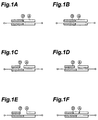
- the mean distance between two fluorescent dye molecules in a hybrid is determined by the base number between the nucleotides to which the two fluorescent dye molecules bind in the hybrid. It is also supposed that the magnitude of fluctuations in the distance between the fluorescent dye molecules is determined by the following factors among others: whether the spacing between the nucleotides to which the two fluorescent dye molecules bind is a single-stranded structure or double-stranded structure (see FIG. 1); the positions of the fluorescent dye molecules in the hybrid; and the structures and length of linkers between the fluorescent dye molecules and the oligonucleotides.
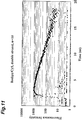
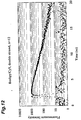
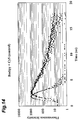
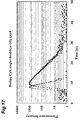
- Table 1 on the basis of Examples, summarizes the cases in which delays in the fluorescence decay curves in the fluorescence wavelength region of acceptors were observed for hybrids between a variety of fluorescent labeled probes and a target DNA.
- the variety of fluorescent labeled probes were prepared and each one pair of the probes was mixed with the target DNA to form a hybrid.
- the hybrid was separated with a high performance liquid column chromatogram and its fluorescence spectrum and fluorescence decay curve were measured. With respect to the pair of probes, its fluorescence spectrum and fluorescence decay curve were measured in a sample containing no target DNA, and changes in the fluorescence spectra as well as in the fluorescence decay curves (delays) resulting from the formation of the hybrid were observed. See Examples for details.
- Combination of fluorescent dyes donor/ acceptor Oligonucleotide Structure between the donor fluorescent dye and the acceptor flourescent dye in the hybrid base number (n) between the donor fluorescent dye and the acceptor fluorescent dye in the hybrid changes in fluorescence spectrum delays in fluorescence decay in fluorescence wavelength region of acceptor BODIPY/Cy5 single-stranded 4,8,10,12,15,20 + +++ double-stranded 4,8,10,12,14 + ++++ BODIPY/Cy3.5 double-stranded 8,12,16 + ++ FITC/Cy5 single-stranded 12,15,20 + + double-stranded 10,12 + ++ FITC/Cy3 single-stranded 12,15,20 + - double-stranded 10,13,15 + + single-stranded 4,8,12,15,20 + - double-stranded 15 + + + +
- Bodipy is a trademark of Molecular Probes Inc. (Eugene, OR, USA). Also, unless otherwise stated, “Bodipy” in Examples is “Bodipy 493/503.” Cy3, Cy3.5, and Cy5 are trademarks of Amersham Inc.
- Bodipy/Cy5 is most preferable for the combination of fluorescent dyes, and Bodipy/Cy3.5 and FITC/Cy5 follow in this order. Combinations of FITC/Cy3 and FITC/Rhodamine are usable when the spacing between fluorescent dye molecules in the hybrid is made double-stranded. Bodipy is superior to FITC as a donor dye: it is thought to be mainly ascribable to the fact that the difference between fluorescence lifetime of the donor and fluorescence lifetime of the acceptor (Cy5, about one ns; Rhodamine, about three ns) grows larger because the fluorescence lifetime of Bodipy (about seven ns) is longer than that of FITC (about four ns).
- the accuracy to identify changes in the fluorescence decay curve resulting from the formation of the hybrid is determined by the magnitude of the changes in the decay curve and variations in the quantity of fluorescence.
- S/N signal-to-noise ratio
- S/N signal-to-noise ratio
- Table 2 and FIG. 3 show the results: ⁇ / ⁇ ⁇ values in Table 2 and FIG. 3 are in relative units.
- the base numbers were fixed to 10 in the combinations of Bodipy/Cy5 dyes and their spacing was made into a mixed structure of single-stranded and double-stranded, where the ratio of single-stranded to double-stranded was varied: variations in the S/N then are also shown in the Table.
- the result in (6) may be interpreted as follows.
- the hybrid comprising two probes and a target nucleic acid
- a gap on the chain at the probe side is generated between the nucleotides at which the two probes are adjacent to each other.
- the corresponding phosphodiester bond on the side of the target nucleic acid has increasing freedom of movement. Accordingly, it is supposed that the magnitude of fluctuations in the distance between the two fluorescent dyes, which results from the movement of the hybrid in an aqueous solution, becomes smaller as the fluorescent dyes approach the gap position of the hybrid.
- the result in (6) suggests that if either one of the donor and acceptor probes is labeled at a terminus on the side opposing the other probe, it will increase the S/N for identification to the greatest degree.
- the most suitable ones are the pair in which Bodipy/Cy5 was used as a combination of the fluorescent dyes and the spacing between the nucleotides to which Bodipy and Cy5 bind forms a double-stranded structure and its base number is from 10 to 12 in the hybrid with a specimen.
- either dye of Bodipy and Cy5 is labeled to a terminus of the corresponding detection probe.
- groups binding fluorescent dye molecules to oligonucleotides are not particularly limited, but they are desirably bound through suitable linkers.
- linker is too short then, there is a possibility that interaction between fluorescent dye molecules and the backbone or base part of a nucleic acid grows strong, and as a result, the desired resonance energy transfer between the two fluorescent dye molecules does not take place sufficiently.
- linker is too long, there is a strong possibility that the two fluorescent dye molecules freely move and fluctuations in the distance between the two fluorescent dye molecules become exceedingly large, which is thus not preferred.
- Preferable length of the linker for the detection probes according to the invention is from a tetramethylene chain to a decamethylene chain.
- covalent bond formation reactions known in the art can be used.
- they are an amide, ester, and ether bond, etc. and particularly an amide bond is preferable.
- the detection probes used in the present Examples employ a tetramethylene chain as a linker.
- fluorescent dyes to be used for the detection probes according to this invention
- dyes having fluorophores of the Bodipy type (4-difluoro-4-boro-3a,4a-diaza-s-indacene) are used as donor dyes and to these are combined dyes having fluorophores of the Indocyanin type as acceptors; as examples of those combinations, combinations of Bodipy 493/503 with Cy3, Cy3.5, and Cy5 are illustrated.
- Bodipy 493/503 with Cy3, Cy3.5, and Cy5 are illustrated.
- Other kinds of Bodipy having different wavelength characteristics (Molecular Probes Inc.) and Cy5.5, Cy7 (Amersham) are also usable.
- Bodipy-TMR and Cy5.5 and “Bodipy-TR and Cy7” their wavelengths are generally shifted to the longer wavelength side by about 50 nm and about 100 nm, respectively as compared with “Bodipy 493/503 and Cy5.”
- biological samples frequently contain luminescent substances and this luminescence forms background light against measurements, thus lowering measured S/Ns. Because the quantity of luminescence for this background light generally decreases toward the long wavelength region, it is advantageous to use the long wavelength region when the high sensitivity measurements of biological samples is to be performed.
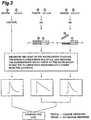
- the detection of a specimen using detection probes according to this invention can, for example, be carried out in the following manner (see FIG. 3).
- FIG. 4 shows the results obtained when the combination of Bodipy/Cy5 fluorescent dyes was used as detection probes, where the spacing between the two nucleotides to which the fluorescent dyes bind adopted a double-stranded structure and its base number was 12. This shows changes in the fluorescence decay curves when the concentration ratio of the detection probes to the target DNA was varied. The concentration of the detection probes was fixed and to this was added the target DNA to provide 0% (no target DNA was added), 1%, 3%, 5%, and 20% as molar ratios. From FIG. 4, it is apparent that even if the detection probes are present in excess 100-fold relative to the target nucleic acid, the fluorescence decay curve sufficiently displaying significant differences is obtained.
- ⁇ ⁇ (sample containing target DNA)- ⁇ (control)
- ⁇ ⁇ ( ⁇ (sample containing target DNA) 2 + ⁇ (control) 2 ) 1/2
- ⁇ / ⁇ ⁇ represents S/N identifying the difference between the two fluorescence decay curves and its greater value means that examination of the presence of target the DNA with great accuracy is feasible.
- probe: BODIPY/CY5 (double-stranded, n 12) specimen DNA/probe: 1% 3% 5% 20% ⁇ / ⁇ ⁇ 7.09 12.10 17.14 36.02
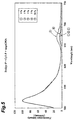
- FIG. 5 shows changes in fluorescence spectra for the same sample used in FIG. 4.
- the magnitude of changes in a fluorescence spectrum can be expressed in terms of either of the two ratios: the ratio of Ia/Id wherein Id is fluorescence intensity at the maximum wavelength (517 nm) of the Bodipy 493/503 fluorescence and Ia is fluorescence intensity at the maximum wavelength (667 nm) of the Cy5 fluorescence; and the ratio of fluorescence intensity in the wavelength region of the Bodipy fluorescence (e.g., 510-560 nm) to fluorescence intensity in the wavelength region of the Cy5 fluorescence (e.g., 650-700 nm).
- S/N for identifying the difference between the two fluorescence spectra is expressed by ⁇ I/ ⁇ ⁇ I .
- ⁇ I I a /I b (sample containing target DNA)- I a /I b (control)
- ⁇ ⁇ I ( ⁇ (sample containing target DNA) 2 + ⁇ (control) 2 ) 1/2
- the detection probes and method of detection according to this invention are applicable even if the specimen is RNA.
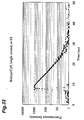
- FIG. 36 is an example where various detection probes and method of detection according to the invention were used to detect RNA. It is understood that similarly to the results in FIG. 4 where the specimen is DNA, the fluorescence decay curves delay in proportion to the contents of RNA in samples where the detection probes are present in excess relative to RNA, which is the specimen. See Examples for details.
- the detection probes and method of detection according to this invention are also effective in the case where the oligonucleotide part of the detection probe is an oligonucleotide of the phosphorothioate type.
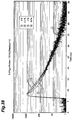
- FIG. 38 shows an example where oligonucleotides of the phosphorothioate type (S-oligo) were used as detection probes to detect RNA. It is understood that similarly to the results in FIGs. 4 and 36, the fluorescence decay curves delay in proportion to the contents of RNA in samples where the detection probes are present in excess relative to RNA, which is the specimen. See Examples for details.
- the subject that the detection probes and the method using the same can detect is not limited to the detection of nucleic acids to be a specimen.
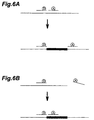
- the positions at which two probes are hybridized onto the DNA are set to be on both sides of the site into which the DNA fragment will be incorporated, as is shown in FIG. 6A. If the DNA fragment is not incorporated, energy transfer occurs because the two probes are hybridized adjacently. On the other hand, if the incorporation takes place, the energy transfer efficiency decreases because the two probes are to be hybridized at distant sites, causing the fluorescence decay curve to change. Also, as shown in FIG. 6B, when a probe hybridizing with a DNA fragment to be incorporated is used as one of the probes, the two probes are hybridized adjacently and the energy transfer occurs if the incorporation takes place.
- the incorporation of other DNA fragment into a specified site of a DNA is utilized in manipulations for gene cloning, e.g., when a desired DNA fragment is incorporated into a vector. If the detection probes and method of detection according to this invention are employed, it does not necessitate manipulations such as separation of non-bonded probes or washing, after addition of the detection probes to the sample and makes it possible to easily detect that the incorporation has taken place.
- FIG. 7 it is designed such that one of the probes is hybridized to one end of a DNA fragment being incorporated; if the DNA is incorporated in one direction (tentative normal direction in FIG. 7, top), the energy transfer occurs, whereas if it is incorporated in the inverted direction (inverted direction in FIG. 7, bottom), the energy transfer does not occur.
- DNA fragments of certain size may sometimes be removed (i.e., deletion).
- deletion of a DNA fragment from a specified site causes such genepathy.
- splicing reaction in cell nuclei produces messenger RNA, an RNA fragment at a specified site (intron) is removed. As shown in FIG. 8, if it is designed such that one of the probes is hybridized to a nucleic acid fragment to be removed, the detection of these reactions is enabled.
- oligo-DNAs labeled with various fluorescent dyes were synthesized and these hybridized to DNAs that serve as specimens to be tested. After separating and purifying the resulting hybrids, their fluorescence spectra and fluorescence decay curves were measured.
- Oligo-DNAs having base sequences as described below were synthesized with a DNA/RNA synthesizer (Perkin Elmer Model 394 or Perspective Model 18909) according to the ⁇ -cyanoethylamidite method.
- the respective products thus obtained were separated with an ion-exchange high performance chromatograph and main peaks were fractionated.
- the conditions used for the ion-exchange high performance chromatograph were as follows: a TSK-GEL DEAE-2WS column (available form Tosoh Co. LTD., 4.6 mm ⁇ x 250 mm in full length) was used; a flow rate of 0.8 ml/min, 40 °C temperature, and a HCOOHNH 4 gradient- 20% CH 3 CN as a mobile phase were used; and detection was carried out at an absorption wavelength of 260 nm.
- the HCOOHNH 4 gradient was prepared by changing the mixing ratio of two solutions: A solution-0.2 M HCOOHNH 4 ; and B solution-1 M HCOOHNH 4 . For the proportion of the B solution, a gradient of 35%-85% /20 min was used.
- Oligo-DNAs (N8, N9, N10, and N11) were labeled with Bodipy 493/503 dye.
- NHSS N-hydroxysulfosuccinimide sodium salt
- EDAC 1-ethyl-3-(3-dimethylaminopropyl) carbodiimide
- the product was purified with a reverse phase high performance liquid column chromatograph.
- the conditions used for the reverse phase high performance liquid column chromatograph were as follows: a CAPCELL PAKC18 (available from Shiseido Co. LTD., 6 mm ⁇ x 250 mm in full length) was used; a flow rate of 1 ml/min, 40 °C temperature, and a CH 3 CN gradient -5mMTEAA as a mobile phase were used; and detection was carried out at an absorption wavelength of 260 nm.
- the CH 3 CN gradient was prepared by changing the mixing ratio of two solutions: A solution-5% CH 3 CN; and B solution-40% CH 3 CN.
- Oligo-DNAs (N11, N12, N13, N14, N15, and N17) were labeled with FITC (fluorescein isothiocyanate, Molecular Probes Inc.).
- FITC 1.5 mg was dissolved in 150 ⁇ l of DMF. This was mixed with a solution dissolving a lyophilized oligo-DNA in 300 ⁇ l of 0.5 M Na 2 CO 3 /NaHCO 3 buffer (pH 9.3) and allowed to react overnight under the shielded light. After the reaction solution was gel filtrated to remove unreacted dye, the product was purified with a reverse phase high performance liquid column chromatograph.
- the conditions used for the reverse phase high performance liquid column chromatograph were as follows: a CAPCELL PAKC18 (available from Shiseido Co.
- the CH 3 CN gradient was prepared by changing the mixing ratio of two solutions: A solution-5% CH 3 CN; and B solution-40% CH 3 CN. For the proportion of the B solution, a gradient of 15%-65% /20 min was used. The absorption spectra of fractionated peaks were measured, thus confirming absorption at 260 nm and absorption of the fluorescent dye (495 nm). These fractions were lyophilized and stored.
- Qligo-DNA (N11) was labeled with XRITC (rhodamine X isothiocyanate, Molecular Probes Inc.).
- XRITC 1.5 mg was dissolved in 150 ⁇ l of DMF. This was mixed with a solution dissolving the lyophilized oligo-DNA in 300 ⁇ l of 0.5 M Na 2 CO 3 /NaHCO 3 buffer (pH 9.3) and allowed to react overnight under the shielded light. After the reaction solution was gel filtrated to remove unreacted dye, the product was purified with a reverse phase high performance liquid column chromatograph. The conditions used for the reverse phase high performance liquid column chromatograph were as follows: a CAPCELL PAKC18 (available from Shiseido Co.
- the CH 3 CN gradient was prepared by changing the mixing ratio of two solutions: A solution-5% CH 3 CN; and B solution-40% CH 3 CN. For the proportion of the B solution, a gradient of 30%-80% /20 min was used. The absorption spectra of fractionated peaks were measured, thus confirming absorption at 260 nm and absorption of the fluorescent dye (570 nm). These fractions were lyophilized and stored.
- Oligo-DNA (N11) was labeled with Cy3 dye.
- Cy3 dye (Amersham Inc, FluoroLink Cat. No. PA23001) was dissolved in 100 ⁇ l of sterilized water. This was mixed with a solution dissolving the lyophilized oligo-DNA in 200 ⁇ l of 0.5 M Na 2 CO 3 /NaHCO, buffer (pH 9.3) and allowed to react overnight under the shielded light. After the reaction solution was gel filtrated to remove unreacted dye, the product was purified with a reverse phase high performance liquid column chromatograph. The conditions used for the reverse phase high performance liquid column chromatograph were as follows: a CAPCELL PAKC18 (available from Shiseido Co.
- the CH 3 CN gradient was prepared by changing the mixing ratio of two solutions: A solution-5% CH 3 CN; and B solution-40% CH 3 CN. For the proportion of the B solution, a gradient of 15%-60% /20 min was used. The absorption spectra of fractionated peaks were measured, thus confirming absorption at 260 nm and absorption of the fluorescent dye (550 nm). These fractions were lyophilized and stored.
- Oligo-DNAs (N3, N6, and N16) were labeled with Cy3.5 dye.
- Cy3.5 dye (Amersham Inc, FluoroLink Cat. No. PA23501) was dissolved in 100 ⁇ l of sterilized water. This was mixed with a solution dissolving a lyophilized oligo-DNA in 200 ⁇ l of 0.5 M Na 2 CO 3 /NaHCO 3 buffer (pH 9.3) and allowed to react overnight under the shielded light. After the reaction solution was gel filtrated to remove unreacted dye, the product was purified with a reverse phase high performance liquid column chromatograph. The conditions used for the reverse phase high performance liquid column chromatograph were as follows: a CAPCELL PAKC18 (available from Shiseido Co.
- the CH 3 CN gradient was prepared by changing the mixing ratio of two solutions: A solution-5% CH 3 CN; and B solution-40% CH 3 CN. For the proportion of the B solution, a gradient of 15%-60% /20 min was used. The absorption spectra of fractionated peaks were measured, thus confirming absorption at 260 nm and absorption of the fluorescent dye (581 nm). These fractions were lyophilized and stored.
- Oligo-DNAs (N1, N2, N3, N4, N5, N6, N7, N11, and N17) were labeled with Cy5 dye.
- Cy5 dye (Amersham Inc, FluoroLink cat. No. PA25001) was dissolved in 100 ⁇ l of sterilized water. This was mixed with a solution dissolving a lyophilized oligo-DNA in 200 ⁇ l of 0.5 M Na 2 CO 3 /NaHCO 3 buffer (pH 9.3) and allowed to react overnight under the shielded light. After the reaction solution was gel filtrated to remove unreacted dye, the product was purified with a reverse phase high performance liquid column chromatograph. The conditions used for the reverse phase high performance liquid column chromatograph were as follows: a CAPCELL PAKC18 (available from Shiseido Co.
- the CH 3 CN gradient was prepared by changing the mixing ratio of two solutions: A solution-5% CH 3 CN; and B solution-40% CH 3 CN. For the proportion of the B solution, a gradient of 15%-60% /20 min was used. The absorption spectra of fractionated peaks were measured, thus confirming absorption at 260 nm and absorption of the fluorescent dye (649 nm). These fractions were lyophilized and stored.
- Oligo-DNAs having base sequences as described below were synthesized with a DNA/RNA synthesizer (Perkin Elmer Model 394 or Perspective Model 18909) according to the ⁇ -cyanoethylamidite method.
- the respective products thus obtained were separated with an ion-exchange high performance chromatograph and main peaks were fractionated.
- the conditions used for the ion-exchange high performance chromatograph were as follows: a TSK-GEL DEAE-2WS column (available from Tosoh Co. LTD., 4.6 mm ⁇ x 250 mm in full length) was used; a flow rate of 0.8 ml/min, 40 °C temperature, and a gradient of HCOOHNH 4 - 20% CH 3 CN as a mobile phase were used; and detection was carried out at an absorption wavelength of 260 nm.
- the HCOOHNH 4 gradient was prepared by changing the mixing ratio of two solutions: A solution-0.2 M HCOOHNH 4 ; and B solution-1 M HCOOHNH 4 .
- a solution-0.2 M HCOOHNH 4 A solution-0.2 M HCOOHNH 4 ; and B solution-1 M HCOOHNH 4 .
- B solution-1 M HCOOHNH 4 B solution-1 M HCOOHNH 4 .
- a pair of detection probes consisting of a donor probe and an acceptor probe 40 pmol was mixed with 40 pmol of a specimen DNA in 10 mM Tris-HCl (pH 7.4) and 140 mM NaCl 10 ⁇ l at room temperature for 5 min and allowed to hybridize with each other. Subsequently, the hybrid was separated with an ion-exchange high performance chromatograph (ion exchange HPLC).
- ion exchange HPLC ion exchange HPLC
- the NaCl gradient was prepared by changing the mixing ratio of two solutions: A solution-20 mM Tris-HCl (pH 9.5); and B solution-20 mM Tris-HCl (pH 9.5), 1 M NaCl. The following conditions were used:
- the fluorescence decay curves of the hybrids separated, purified with a high performance liquid column chromatograph were measured.
- Picosecond fluorescence lifetime recording device C4780 (Hamamatsu Photonics Co. Ltd.)
- Bodipy 493/503 is labeled to the 5'-end position of the donor probes and Cy5 is labeled to the middle parts of the acceptor probes.
- BP0/Cy510 is the sample where BP0 40 pmol and cy510 40 pmol were dissolved in 200 ⁇ l of 20 mM Tris-HCl (pH 7.4) and 0.5 M NaCl.
- BP0/Cy510 is the sample where BP0 40 pmol and Cy510 40 pmol were dissolved in 200 ⁇ l of 20 mM Tris-HCl (pH 9.5) and 0.5 M NaCl.
- BP0/Cy510 is the sample where BP0 40 pmol and Cy510 40 pmol were dissolved in 200 ⁇ l of 20 mM Tris-HCl (pH 9.5) and 0.5 H NaCl.
- BP0/Cy3512 is the sample where BP0 40 pmol and Cy3512 40 pmol were dissolved in 200 ⁇ l of 20 mM Tris-HCl (pH 9.5) and 0.5 M NaCl.
- Fluorescence decay curves of the hybrids 5F10/5Cy5/T0 and 5F12/5Cy5/T0, were measured.
- the fluorescence decay curve of a sample was also measured as control: the sample where 5F 10 40 pmol and 5Cy5 40 pmol were dissolved in 200 ⁇ l of 20 mM Tris-HCl (pH 9.5) and 0.5 M NaCl. Delays in the fluorescence decay curves caused by the formation of the hybrids were noted but not distinct (not shown in the figures).
- Fluorescence decay curves of the hybrids-5F/3Cy5/T12, 5F/3Cy5/T15, and 5F/3Cy5/T20- were measured.
- the fluorescence decay curve of a sample was also measured as control: the sample where 5F 40 pmol and 3Cy5 40 pmol were dissolved in 200 ⁇ l of 20 mM Tris-HCl (pH 9.5) and 0.5 M NaCl. Delays in the fluorescence decay curves caused by the formation of the hybrids were not particularly noted (not shown in the figures).
- Fluorescence decay curves of the hybrids-3F/5Cy3/T12, 3F/5Cy3/T15, and 3F/5Cy3/T20- were measured.
- the fluorescence decay curve of a sample was also measured as control: the sample where 3F 40 pmol and 5Cy3 40 pmol were dissolved in 200 ⁇ l of 20 mM Tris-HCl (pH 9.5) and 0.5 M NaCl. Delays in the fluorescence decay curves caused by the formation of the hybrids were not particularly noted (not shown in the figures).
- Fluorescence decay curves of the hybrids-5F10/5Cy3/T0, 5F/5Cy3/T0, and 5F15/5Cy3/T0- were measured.
- the fluorescence decay curve of a sample was also measured as control: the sample where 5F10 40 pmol and 5Cy3 40 pmol were dissolved in 200 ⁇ l of 20 mM Tris-HCl (pH 9.5) and 0.5 M NaCl. Delays in the fluorescence decay curves caused by the formation of the hybrids were not particularly noted (not shown in the figures).
- the fluorescence decay curve of the hybrid was measured.
- the fluorescence decay curve of a sample was also measured as control: the sample where 5F15 40 pmol and 5R16 40 pmol were dissolved in 200 ⁇ l of 20 mM Tris-HCl (pH 9.5) and 0.5 M NaCl.
- a delay in the fluorescence decay curve caused by the formation of the hybrid was not particularly noted (not shown in the figures).
- Excitation light titanium sapphire laser 480 nm wavelength region of fluorescence measurement: 600-650 nm
- Bodipy 493/503 is labeled to the 5'-end positions of the donor probes and Cy5 is labeled to middle parts of the acceptor probes.
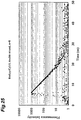
- FIG. 35 represents the fluorescence decay curve of the sample where BP0 40 pmol and Cy510 40 pmol. were dissolved in 200 ⁇ l of 20 mM Tris-HCl (pH 9.5) and 0.5 M NaCl.
- Fluorescent labeled oligo-DNAs and fluorescent labeled oligonucleotides of the phosphorothioate type (S-oligo) having base sequences as described below were synthesized according to the procedures as described in the foregoing "1. Detection Probes
- Specimen DNAs and RNAs having the base sequences as described below were synthesized according to the procedures as described in the foregoing "1. Detection Probes (2) Synthesis of Specimen DNAs.”
- a pair of detection probes consisting of a donor probe and an acceptor probe (each 200 pmol) and varying concentrations of a specimen were mixed in 200 ⁇ l of 1xSSC buffer (15 mM Na 3 citrate, pH 7.0, 150 mM NaCl) and allowed to react at room temperature for 10 min. Subsequently, fluorescence spectra and fluorescence decay curves were measured.
- decay curve 1 (a sample containing no specimen) and decay curve 2 (a sample containing the specimen DNA with its content being 1% as a molar ratio relative to the probe) are unambiguously distinguishable and even if the detection probe are present in 1000-fold excess, detection of the specimen is feasible.
- the detection probe in order to detect a RNA that serve as a specimen, there is used a pair of oligo-DNAs: the donor fluorescent dye is Bodipy 493/503 and the acceptor dye is Cy5; the spacing between the two nucleotides to which the fluorescent dyes bind adopts a double-stranded structure when the hybrid is formed; and the Bodipy 494/503 is bound to the nucleotide locating at the gap of the hybrid.
- RNA that serves as a specimen there is used a pair of oligo-DNAS of the phosphothioate type: the donor fluorescent dye is Bodipy 493/503 and the acceptor dye is Cy5; the spacing between the two nucleotides to which the fluorescent dyes bind adopts a double-stranded structure when the hybrid is formed; and the Bodipy 494/503 is bound to the nucleotide locating at the gap of the hybrid.
- donor probe acceptor probe specimen base number between two dyes fluorescence decay curve D2 A2 RT1 n 10 FIG. 38
- This invention has developed detection probes and method of detection that will enable the detection of DNAs and RNAs having specified base sequences contained in a specimen sample with great ease, accuracy, and high sensivity. It is anticipated that if the detection probes and method of detection according to this invention are applied to gene diagnosis, cell diagnosis and the like, they will exercise great power. It is also expected that by applying the detection probe and method of detection according to this invention to experimental protocols in the field of genetic engineering such as gene cloning, experimental techniques in said filed will be advanced enormous.
Landscapes
- Chemical & Material Sciences (AREA)
- Organic Chemistry (AREA)
- Life Sciences & Earth Sciences (AREA)
- Zoology (AREA)
- Wood Science & Technology (AREA)
- Proteomics, Peptides & Aminoacids (AREA)
- Health & Medical Sciences (AREA)
- Engineering & Computer Science (AREA)
- Microbiology (AREA)
- Biochemistry (AREA)
- Physics & Mathematics (AREA)
- Molecular Biology (AREA)
- Biotechnology (AREA)
- Biophysics (AREA)
- Analytical Chemistry (AREA)
- Immunology (AREA)
- Bioinformatics & Cheminformatics (AREA)
- General Engineering & Computer Science (AREA)
- General Health & Medical Sciences (AREA)
- Genetics & Genomics (AREA)
- Measuring Or Testing Involving Enzymes Or Micro-Organisms (AREA)
- Investigating Or Analysing Biological Materials (AREA)
Applications Claiming Priority (3)
| Application Number | Priority Date | Filing Date | Title |
|---|---|---|---|
| JP25683396 | 1996-09-27 | ||
| JP25683396 | 1996-09-27 | ||
| PCT/JP1997/003438 WO1998013524A1 (en) | 1996-09-27 | 1997-09-26 | Probes for detecting polynucleotides and detection method |
Publications (2)
| Publication Number | Publication Date |
|---|---|
| EP0971038A1 true EP0971038A1 (de) | 2000-01-12 |
| EP0971038A4 EP0971038A4 (de) | 2000-03-29 |
Family
ID=17298069
Family Applications (1)
| Application Number | Title | Priority Date | Filing Date |
|---|---|---|---|
| EP97941257A Ceased EP0971038A4 (de) | 1996-09-27 | 1997-09-26 | Sonden für die bestimmung von polynukleotiden und bestimmungsverfahren |
Country Status (5)
| Country | Link |
|---|---|
| US (1) | US6284462B1 (de) |
| EP (1) | EP0971038A4 (de) |
| JP (1) | JP3194969B2 (de) |
| AU (1) | AU4321497A (de) |
| WO (1) | WO1998013524A1 (de) |
Cited By (4)
| Publication number | Priority date | Publication date | Assignee | Title |
|---|---|---|---|---|
| WO2003000933A1 (en) | 2001-06-25 | 2003-01-03 | Georgia Tech Research Corporation | Dual resonance energy transfer nucleic acid probes |
| EP1104491A4 (de) * | 1998-08-11 | 2003-01-29 | Caliper Techn Corp | Verfahren und systeme zur sequenzierung von dna mkittels unterscheidung der zerfallszeiten fluoreszierender sonden |
| US6716394B2 (en) | 1998-08-11 | 2004-04-06 | Caliper Technologies Corp. | DNA sequencing using multiple fluorescent labels being distinguishable by their decay times |
| US20070059690A1 (en) * | 2002-05-31 | 2007-03-15 | Amirul Islam | "Met/fret based method of target nucleic acid detection whereby the donor/acceptor moieties are on complementary strands" |
Families Citing this family (12)
| Publication number | Priority date | Publication date | Assignee | Title |
|---|---|---|---|---|
| EP0965635A1 (de) * | 1997-02-03 | 1999-12-22 | Laboratory of Molecular Biophotonics | Methode zur transkriptionsüberwachung und dafür geeignete apparatur |
| EP1054250B1 (de) | 1999-01-25 | 2002-09-04 | Hamamatsu Photonics K.K. | Adapter für eine pipette, pipette zur absorptionsmessung, verfahren und vorrichtung zur absorptionsmessung |
| EP1052293B1 (de) | 1999-05-12 | 2003-12-17 | Hamamatsu Photonics K.K. | Nachweis von Nukleinsäuren im Zytoplasma |
| JP3460673B2 (ja) | 2000-02-04 | 2003-10-27 | 浜松ホトニクス株式会社 | 特定の遺伝子を発現した生細胞の選択的分離方法 |
| US7407747B2 (en) * | 2002-10-15 | 2008-08-05 | Applera Corporation | Method for drying dye-terminator sequencing reagents |
| US20040241667A1 (en) * | 2003-05-30 | 2004-12-02 | Chesk William G. | Pulse-jet ejection head diagnostic system |
| US7619059B2 (en) | 2003-07-29 | 2009-11-17 | Life Technologies Corporation | Bimolecular optical probes |
| CA2445420A1 (en) | 2003-07-29 | 2005-01-29 | Invitrogen Corporation | Kinase and phosphatase assays |
| US7727752B2 (en) | 2003-07-29 | 2010-06-01 | Life Technologies Corporation | Kinase and phosphatase assays |
| EP1923075B1 (de) | 2004-08-13 | 2015-11-11 | Rutgers, The State University | Röntgendichte Polymerstents |
| CN101065153B (zh) | 2004-08-13 | 2013-02-20 | 罗格斯州立大学 | 不透射线性聚合物支架 |
| US20060034769A1 (en) * | 2004-08-13 | 2006-02-16 | Rutgers, The State University | Radiopaque polymeric stents |
Family Cites Families (19)
| Publication number | Priority date | Publication date | Assignee | Title |
|---|---|---|---|---|
| CA1190838A (en) | 1981-07-17 | 1985-07-23 | Cavit Akin | Homogeneous nucleic acid hybridization diagnostics by non-radiative energy transfer |
| US4822733A (en) * | 1985-05-28 | 1989-04-18 | Amoco Corporation | Lifetime-resolved assay procedures |
| US4996143A (en) | 1985-12-23 | 1991-02-26 | Syngene, Inc. | Fluorescent stokes shift probes for polynucleotide hybridization |
| CA1273552A (en) * | 1985-12-23 | 1990-09-04 | Michael J. Heller | Fluorescent stokes shift probes for polynucleotide hybridization assays |
| US4868103A (en) | 1986-02-19 | 1989-09-19 | Enzo Biochem, Inc. | Analyte detection by means of energy transfer |
| US5274113A (en) * | 1991-11-01 | 1993-12-28 | Molecular Probes, Inc. | Long wavelength chemically reactive dipyrrometheneboron difluoride dyes and conjugates |
| US5326692B1 (en) | 1992-05-13 | 1996-04-30 | Molecular Probes Inc | Fluorescent microparticles with controllable enhanced stokes shift |
| WO1992014845A1 (en) * | 1991-02-26 | 1992-09-03 | Worcester Foundation For Experimental Biology | Diagnosing cystic fibrosis and other genetic diseases using fluorescence resonance energy transfer (fret) |
| EP1067134B1 (de) | 1991-11-07 | 2004-07-28 | Nanotronics, Inc. | Hybridisierung von mit Chromophoren und Fluorophoren konjugierten Polynukleotiden zur Erzeugung eines Donor-Donor Energietransfersystems |
| ES2082256T3 (es) * | 1992-03-23 | 1996-03-16 | Hoffmann La Roche | Metodo de deteccion del adn. |
| EP0601889A2 (de) | 1992-12-10 | 1994-06-15 | Maine Medical Center Research Institute | Nukleinsäure-Sonden |
| JPH06201256A (ja) | 1992-12-28 | 1994-07-19 | Toshiba Corp | 冷蔵庫 |
| JP2925897B2 (ja) | 1993-08-23 | 1999-07-28 | 三洋電機株式会社 | 空気調和機 |
| EP0720659A1 (de) * | 1993-09-23 | 1996-07-10 | Zeneca Limited | Nuklein säure nachweis mittels energieübertragung |
| JP3667359B2 (ja) | 1993-12-29 | 2005-07-06 | 扶桑薬品工業株式会社 | 5−フルオロウリジン誘導体の製造および医薬組成物 |
| JP3448090B2 (ja) | 1994-02-16 | 2003-09-16 | 浜松ホトニクス株式会社 | エネルギー移動検出法およびその装置 |
| JPH10511460A (ja) | 1994-12-22 | 1998-11-04 | アボツト・ラボラトリーズ | 被験サンプル中の複数分析物の時差式検出方法 |
| AU694313B2 (en) * | 1995-02-17 | 1998-07-16 | Hamamatsu Photonics K.K. | Probe for use in nucleic acid analysis and detecting method |
| DE69630517T2 (de) * | 1995-02-17 | 2004-08-12 | Hamamatsu Photonics K.K., Hamamatsu | Sonde zur Verwendung in der Nukleinsäurenanalyse und Detektionsverfahren auf der Basis von Excimer-Fluoreszenz |
-
1997
- 1997-09-26 US US09/091,332 patent/US6284462B1/en not_active Expired - Fee Related
- 1997-09-26 AU AU43214/97A patent/AU4321497A/en not_active Abandoned
- 1997-09-26 EP EP97941257A patent/EP0971038A4/de not_active Ceased
- 1997-09-26 WO PCT/JP1997/003438 patent/WO1998013524A1/ja not_active Ceased
- 1997-09-26 JP JP51550598A patent/JP3194969B2/ja not_active Expired - Fee Related
Cited By (7)
| Publication number | Priority date | Publication date | Assignee | Title |
|---|---|---|---|---|
| EP1104491A4 (de) * | 1998-08-11 | 2003-01-29 | Caliper Techn Corp | Verfahren und systeme zur sequenzierung von dna mkittels unterscheidung der zerfallszeiten fluoreszierender sonden |
| US6716394B2 (en) | 1998-08-11 | 2004-04-06 | Caliper Technologies Corp. | DNA sequencing using multiple fluorescent labels being distinguishable by their decay times |
| WO2003000933A1 (en) | 2001-06-25 | 2003-01-03 | Georgia Tech Research Corporation | Dual resonance energy transfer nucleic acid probes |
| EP1409735A4 (de) * | 2001-06-25 | 2005-10-05 | Georgia Tech Res Inst | Doppel-resonanzenergietransfer-nukleinsäuresonden |
| US7081336B2 (en) | 2001-06-25 | 2006-07-25 | Georgia Tech Research Corporation | Dual resonance energy transfer nucleic acid probes |
| US7399591B2 (en) | 2001-06-25 | 2008-07-15 | Georgia Tech Research Corporation | Dual resonance energy transfer nucleic acid probes |
| US20070059690A1 (en) * | 2002-05-31 | 2007-03-15 | Amirul Islam | "Met/fret based method of target nucleic acid detection whereby the donor/acceptor moieties are on complementary strands" |
Also Published As
| Publication number | Publication date |
|---|---|
| JP3194969B2 (ja) | 2001-08-06 |
| EP0971038A4 (de) | 2000-03-29 |
| US6284462B1 (en) | 2001-09-04 |
| AU4321497A (en) | 1998-04-17 |
| WO1998013524A1 (en) | 1998-04-02 |
Similar Documents
| Publication | Publication Date | Title |
|---|---|---|
| US6284462B1 (en) | Probes and methods for polynucleotide detection | |
| US6046004A (en) | Solution hybridization of nucleic acids with antisense probes having modified backbones | |
| US7473767B2 (en) | Methods for detection and quantification of analytes in complex mixtures | |
| EP0599338B1 (de) | Verfahren zum Nachweis einer Zielnukleinsäure | |
| US6177555B1 (en) | Homogeneous detection of a target through nucleic acid ligand-ligand beacon interaction | |
| US20050106610A1 (en) | Kits containing modified amplification oligonucleotides | |
| US7572588B2 (en) | Modified probe molecules having self-complementary regions | |
| US6420109B1 (en) | Nucleic acid ligand interaction assays | |
| JPWO1998013524A1 (ja) | ポリヌクレオチド検出用プローブ及び検出方法 | |
| EP3246414A1 (de) | Methode und kit für den nachweis und zur quantifizierung einer oder mehrerer zielnukleinsäuren | |
| JP3992079B2 (ja) | 核酸分析用プローブおよび検出方法 | |
| JPWO1996025518A1 (ja) | 核酸分析用プローブおよび検出方法 | |
| JP7482506B2 (ja) | 短鎖ヘアピンDNAを用いた改良型in situ ハイブリダイゼーション反応 | |
| KR20220116931A (ko) | 대장암 및 대장 용종 선별 방법 및 그 응용 | |
| US6768000B1 (en) | Multi-fluorescent hairpin energy transfer oligonucleotides | |
| WO1996025518A1 (en) | Probe for use in nucleic acid analysis and detecting method | |
| JP3618768B2 (ja) | 標的核酸の検出方法、プローブ、2本鎖核酸ハイブリッド内のミスマッチの検出方法及びプローブの製造方法 | |
| WO2024117156A1 (ja) | 核酸測定方法 | |
| US20050089915A1 (en) | Hybridization-based fluorescence assay | |
| JPH06153998A (ja) | 核酸ハイブリッド体の検出方法及びそれに用いるプローブ | |
| JP2003061679A (ja) | オリゴヌクレオチドの巨視的な自己集合体の検出方法及びその形成方法。 | |
| JP2004168672A (ja) | ポリヌクレオチド誘導体及びその利用 | |
| Brown | Development of novel fluorescent oligonucleotide probes for use in nucleic acid sequence analysis | |
| Vaccaro | Use of luminescence energy transfer probes to detect genetic variants |
Legal Events
| Date | Code | Title | Description |
|---|---|---|---|
| PUAI | Public reference made under article 153(3) epc to a published international application that has entered the european phase |
Free format text: ORIGINAL CODE: 0009012 |
|
| 17P | Request for examination filed |
Effective date: 19990421 |
|
| AK | Designated contracting states |
Kind code of ref document: A1 Designated state(s): DE FR GB SE |
|
| A4 | Supplementary search report drawn up and despatched |
Effective date: 20000215 |
|
| AK | Designated contracting states |
Kind code of ref document: A4 Designated state(s): DE FR GB SE |
|
| 17Q | First examination report despatched |
Effective date: 20000525 |
|
| GRAG | Despatch of communication of intention to grant |
Free format text: ORIGINAL CODE: EPIDOS AGRA |
|
| STAA | Information on the status of an ep patent application or granted ep patent |
Free format text: STATUS: THE APPLICATION HAS BEEN REFUSED |
|
| 18R | Application refused |
Effective date: 20021021 |