EP0971073A1 - Hand guide roller of manually steering type - Google Patents
Hand guide roller of manually steering type Download PDFInfo
- Publication number
- EP0971073A1 EP0971073A1 EP99112554A EP99112554A EP0971073A1 EP 0971073 A1 EP0971073 A1 EP 0971073A1 EP 99112554 A EP99112554 A EP 99112554A EP 99112554 A EP99112554 A EP 99112554A EP 0971073 A1 EP0971073 A1 EP 0971073A1
- Authority
- EP
- European Patent Office
- Prior art keywords
- roller
- rolling bearing
- supporting frame
- steering
- frame
- Prior art date
- Legal status (The legal status is an assumption and is not a legal conclusion. Google has not performed a legal analysis and makes no representation as to the accuracy of the status listed.)
- Granted
Links
- 238000005096 rolling process Methods 0.000 claims abstract description 28
- 230000007246 mechanism Effects 0.000 description 7
- 230000035939 shock Effects 0.000 description 7
- 239000006096 absorbing agent Substances 0.000 description 5
- 238000004519 manufacturing process Methods 0.000 description 3
- 230000007547 defect Effects 0.000 description 2
- 230000005540 biological transmission Effects 0.000 description 1
- 244000145845 chattering Species 0.000 description 1
- 230000000694 effects Effects 0.000 description 1
Images



Classifications
-
- E—FIXED CONSTRUCTIONS
- E01—CONSTRUCTION OF ROADS, RAILWAYS, OR BRIDGES
- E01C—CONSTRUCTION OF, OR SURFACES FOR, ROADS, SPORTS GROUNDS, OR THE LIKE; MACHINES OR AUXILIARY TOOLS FOR CONSTRUCTION OR REPAIR
- E01C19/00—Machines, tools or auxiliary devices for preparing or distributing paving materials, for working the placed materials, or for forming, consolidating, or finishing the paving
- E01C19/22—Machines, tools or auxiliary devices for preparing or distributing paving materials, for working the placed materials, or for forming, consolidating, or finishing the paving for consolidating or finishing laid-down unset materials
- E01C19/23—Rollers therefor; Such rollers usable also for compacting soil
- E01C19/28—Vibrated rollers or rollers subjected to impacts, e.g. hammering blows
- E01C19/282—Vibrated rollers or rollers subjected to impacts, e.g. hammering blows self-propelled, e.g. with an own traction-unit
- E01C19/283—Vibrated rollers or rollers subjected to impacts, e.g. hammering blows self-propelled, e.g. with an own traction-unit pedestrian-controlled, e.g. with safety arrangements for operator
Definitions
- the invention relates to a hand guide roller for leveling ground of roadbed and pavement, and more particularly to a hand guide roller of manually steering type to be steered by pushing and pulling a handle in a horizontal direction by man power.
- rollers for preparing the ground of roadbed and pavement there are hand guide rollers among comparatively small sized rollers. This is demanded for simpleness in structure because of small size, and therefore, the steering is manual by pushing and pulling the handle in the horizontal direction by man power.
- FIG.5 The structure as shown in Fig.5 has now been used widely as such hand guide rollers.
- a front and a rear rollers 4, 5 are supported by a frame, and a handle bar 9 is secured at the rear side of the frame.
- a one vibration generator (not shown) is provided to transmit vibration to the front and rear rollers 4, 5 through the frame.
- Advancing directions are, as shown in the same, changed by pushing and pulling the handle bar 9 by man power in the horizontal directions to steer the front and rear rollers 4, 5 together with the frame. Since this structure is sufficient with a one vibration generator and is not provided with a steering mechanism, it is very simple and economical in production cost, and thus, such a structure is most suitable to the hand guide roller.
- the steering mechanisms there are 1 ⁇ a mechanism of turning either one of the front and rear rollers with a turning axis positioned at the center of the roller, 2 ⁇ a mechanism of concurrently turning both the front and rear rollers with turning axes disposed at both rollers, and 3 ⁇ a mechanism where the frame for supporting the front and rear rollers is divided into two back and forth, and the divided frames are pivoted at the center of the roller car.
- 1 ⁇ has a defect that difference in inner wheels between the front and rear rollers is large during turning, and traveling loci are largely deviated in front and in rear, 2 ⁇ two turning axes are necessary to make the structure complicated and high cost, and in comparison, 3 ⁇ will be assumed to be most suitable, but has defects as under mentioned.
- the invention has been devised in view of problems involved with the prior art, and accordingly it is an object to offer such a hand guide roller which is easy in steering, compact in the structure, and low in production cost.
- the hand guide roller of manually steering type in dependence upon the present invention is basically characterized by directly or indirectly connecting turnably a front support frame for supporting a front roller and a rear support frame for supporting a rear roller at a center part of a roller car main body through a rolling bearing, disposing a vibration generator in vicinity of the rolling bearing and transmitting vibration of the vibration generator to at least one of the front roller and the rear roller via the rolling bearing.
- the invention employs the rolling bearing for connecting the front supporting frame and the rear supporting frame, and specifically, these frames are directly or indirectly secured to an inner wheel and an outer wheel respectively, and are mutually turnable.
- the rolling bearing is generally plain, so that the height of both cars can be made low.
- the rolling bearing is stronger than the structure connected by the shaft and bearing, and is less rattling when vibration is transmitted from the vibration generator. Further, the high precision is not required, and the durability is superior.
- the front supporting frame and the rear supporting frame are mutually turnable via the rolling bearing, the steering is easily carried out by pushing and pulling horizontally the handle bar provided at an optional position.
- These frames are turnably connected at the center of the car main body, so that smooth steering may be effected without causing large deviation in the traveling loci of the front roller and the rear roller.
- reference numeral 1 designates a roller car frame
- 2 is a front supporting frame
- 3 is a rear supporting frame
- 4 is a front roller
- 5 is a rear roller
- 6 is a turning bearing
- 7 is a vibration generator
- 8 is a rod
- 9 is a handle bar
- 10 is a handle axis
- 12 is a shock absorber
- 18 is a driving part
- 90 is a locking apparatus.
- Fig.1 is a side view
- Fig.2 is a side view taking off a driving part as an engine and others mounted on the upper part shown in Fig.1 (showing an inner part partially in section).
- Fig.3(a) is a plan view
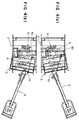
- Fig.4 is plan views showing steering conditions.
- the car frame 1 comprises the front supporting frame 2 and the rear supporting frame 3, and on the car frame 1 (more specifically, on the front supporting frame 2), the driving part 18 composed of the engine and others are provided via a base plate 16.
- the rear supporting frame 3 is composed of a part of the upper side of the rear roller 5, while the front supporting frame 2 is formed to cover largely over the rear supporting frame 3.
- the front supporting frame 2 and the rear supporting frame 3 are mutually turnable via the rolling bearing 6 at the center of the car. More specifically, an outer wheel 60 of the rolling bearing is screwed with bolts, respectively in the front supporting frame 2, and an inner wheel 61 is screwed in a base plate 30 extending from the rear supporting frame 3.
- the front supporting frame 2 is turnably pivoted at the rear part with the handle bar 9.
- a bracket of the handle axis 10 is connected with the rod 8, and the end part of the rod 8 is connected with the base plate 30.
- the base plate 30 is a member which extends from the rear supporting plate 3 and is screwed with the inner wheel 61 of the rolling bearing 6.
- the locking device 90 is provided nearly the handle bar 9 (omitting in Fig.4), and this comprises a locking lever 91 pivoted turnably up and down and a locking hole 92 holding the basic part of the locking lever 91 when the locking lever 91 is turned upward, and the locking lever 91 is pivoted at the under surface of the base plate 16, while the locking hole 92 is secured to the rear supporting frame 3. Since the base plate 16 is fixed to the front supporting frame 2, when the locking lever 91 is tilted upward, the basic part thereof is held by the locking hole 92, thereby to lock the mutual actuation of the front supporting frame 2 and the rear supporting frame 3 linking the locking lever 91 and the locking hole 92.
- the rear roller 5 is fixed and the steering cannot be made.
- the locking lever 91 is tilted downward, the basic part thereof is detached from the locking hole 92, and the front supporting lever 2 and the rear supporting lever 3 are freely turned by pushing and pulling the handle lever 9.
- the locking device 90 of the invention can avoid such labor.
- the rear roller 5 can be effectively prevented from playing by vibration during transportation.
- the vibration generator 7 is installed under the rolling bearing 6, and the vibration therefrom is respectively transmitted to the front roller 4 via the front supporting frame 2, and to the rear roller 5 via the rolling bearing 6, the base plate 30 and the rear supporting frame 3.
- the rolling bearing 6 is flat and stable and has no matter in strength in regard to transmission of vibration.
- the vibration is directly transmitted to the front roller 4 via the front supporting frame 2, and indirectly to the rear roller 5 via the rolling bearing 6, and it is sufficient that the vibration generator is installed within the rear supporting frame 3 so that the vibration is directly transmitted to the rear roller 5 via the rear supporting frame 3 and indirectly to the front roller 4 via the rolling bearing 6.
- the shock absorber 12 for steering is placed.
- a frame shaped body 13 formed with a slit along an axial direction is fixed to the base plate 30 and is turned together with the rear supporting frame 3.
- the slit of the frame shaped body 13 is fitted with a fixing piece 14, and its head is screwed with one part of the front supporting frame 2 by a bolt.
- the fixing piece 14 is disposed at its right and left sides with springs 15(concretely, one end of the spring is held by the fixing piece 14 and the other end is held by a bracket of the frame shaped body 13). If the frame shaped body 13 slides with respect to the fixing piece 14, the spring effects elasticity such that the fixing piece 14 stands at the center.
- the frame shaped body 13 also relatively turns as it holds the fixing piece 14 in the slit, and even at such a case, the elasticity is effected by the spring 15 such that the fixing piece 14 stands at the center of the frame shaped body 13.
- the handle 9 since the fixing piece 14 is connected to the front supporting frame 2, when the steering is broken, the handle 9 is effected with a force that the handle always returns to a straightforward condition. Even when shock turning load is transmitted to the handle 9 from the running road, it is effectively cancelled by the shock absorber 12.
- the handle bar 9 can be instantly returned to the initial condition.
- the handle bar 9 is pushed and pulled to make an optional steering, the handle is rapidly returned to the initial condition by releasing it.
- the inventive roller car has the holding function of the straightforward condition.
- the steering can be easily carried out by pushing and pulling the handle bar 9 in the horizontal direction.
- the rear supporting frame 3 to be turned composes one part of the upper side of the rear roller 5, and the labor for pushing and pulling the handle bar 9 is sufficient with a small amount.
- the rolling bearing 6 is flat, the height of the roller car is made low, and the rolling bearing is turnably connected to the center part, so that there is no large lag in running loci between the front roller 4 and the rear roller, and the steering may be smooth.
- the rear roller 5 is fixed to easily hold the steering action when the steering is not necessary or turning at right angle.
- the vibration of the vibration generator 7 is transmitted to the rear roller 5 through the rolling bearing 6, and since the rolling bearing is stably disposed, the vibration can be fully transmitted without causing a problem of the breakage. Consequently, the vibration generator 7 is one, it is cheap thereby.
- shock absorber 12 shock added to the handle bar 9 is absorbed and the straightforward condition can be kept appropriately.
- the present embodied structure is, as mentioned above, that the action of the handle bar 9 and the tilting action of the rear supporting frame 3 (the rear roller 5) are linked, and the pushing direction of the handle bar 9 and the steering direction are made agree with, but it may be permitted that, for example, the handle bar 9 is fixed to the back part of the front supporting frame, whereby the action of the handle bar 9 and the tilting action of the front supporting frame 2 (the front roller 4) are linked, and the pushing direction of the handle bar 9 and the steering direction are made reverse.
- Some of operators are acquainted with a structure a shown in Fig.5 where the pushing direction of the handle bar 9 and the steering direction are reverse, and in such a case, this structure is of merit.
- the structure is simple in using the rolling bearing. It is possible to make the height of the car low, and the vibration generator is enough with one, so that the structure can be made very compact, resulting in low production cost. Further, the steering can be easily made by pushing and pulling the handle bar in the horizontal direction without causing a large lag in the running loci between the front and rear rollers, and in addition, since the rolling bearing can be stable disposed, causing no chattering by vibration, and the roller car is superior in durability in comparison with a mere shaft and bearing structure.
Landscapes
- Engineering & Computer Science (AREA)
- Architecture (AREA)
- Civil Engineering (AREA)
- Structural Engineering (AREA)
- Road Paving Machines (AREA)
Abstract
Description
- The invention relates to a hand guide roller for leveling ground of roadbed and pavement, and more particularly to a hand guide roller of manually steering type to be steered by pushing and pulling a handle in a horizontal direction by man power.
- With respect to rollers for preparing the ground of roadbed and pavement, there are hand guide rollers among comparatively small sized rollers. This is demanded for simpleness in structure because of small size, and therefore, the steering is manual by pushing and pulling the handle in the horizontal direction by man power.
- The structure as shown in Fig.5 has now been used widely as such hand guide rollers. A front and a
rear rollers handle bar 9 is secured at the rear side of the frame. Within the frame, a one vibration generator (not shown) is provided to transmit vibration to the front andrear rollers handle bar 9 by man power in the horizontal directions to steer the front andrear rollers - However, in this structure, when steering, the guide roller must be moved as a whole, and for pushing and pulling the handle, physical strength is required to a certain extent. Therefore, structures provided with the steering mechanism have been employed, making much account of laborsaving viewpoint.
- As the steering mechanisms, there are 1 ○ a mechanism of turning either one of the front and rear rollers with a turning axis positioned at the center of the roller, 2 ○ a mechanism of concurrently turning both the front and rear rollers with turning axes disposed at both rollers, and 3 ○ a mechanism where the frame for supporting the front and rear rollers is divided into two back and forth, and the divided frames are pivoted at the center of the roller car.
- Comparing these three steering mechanisms, 1 ○ has a defect that difference in inner wheels between the front and rear rollers is large during turning, and traveling loci are largely deviated in front and in rear, 2 ○ two turning axes are necessary to make the structure complicated and high cost, and in comparison, 3 ○ will be assumed to be most suitable, but has defects as under mentioned.
- Firstly, in the structure pivoting the front and rear supporting frames with the turning axis, since the turning axes and the bearing are opposite in a vertical direction, the height of the car is inevitably tall and this is a non preferable structure as the hand guide roller which requires compactness.
- When providing one vibration generator, since vibration is transmitted to at least either of the front and rear rollers via the axis, the turning axis and the bearing must be high strength, inviting high cost. On the other hand, if respective vibrators are disposed in respective interiors of the rollers as large sized guide rollers, members of high strength are not necessary, but two vibrators are required, and a structure for synchronizing both vibrators is required to also invite cost up.
- Merely with axis and bearing, since rattling is made large due to precision of both, high precision is required which is troublesome working while producing, and besides durability is uneasy.
- The invention has been devised in view of problems involved with the prior art, and accordingly it is an object to offer such a hand guide roller which is easy in steering, compact in the structure, and low in production cost.
- For accomplishing this object, the hand guide roller of manually steering type in dependence upon the present invention is basically characterized by directly or indirectly connecting turnably a front support frame for supporting a front roller and a rear support frame for supporting a rear roller at a center part of a roller car main body through a rolling bearing, disposing a vibration generator in vicinity of the rolling bearing and transmitting vibration of the vibration generator to at least one of the front roller and the rear roller via the rolling bearing.
- The invention employs the rolling bearing for connecting the front supporting frame and the rear supporting frame, and specifically, these frames are directly or indirectly secured to an inner wheel and an outer wheel respectively, and are mutually turnable. The rolling bearing is generally plain, so that the height of both cars can be made low.
- The rolling bearing is stronger than the structure connected by the shaft and bearing, and is less rattling when vibration is transmitted from the vibration generator. Further, the high precision is not required, and the durability is superior.
- Since in the inventive structure, the front supporting frame and the rear supporting frame are mutually turnable via the rolling bearing, the steering is easily carried out by pushing and pulling horizontally the handle bar provided at an optional position. These frames are turnably connected at the center of the car main body, so that smooth steering may be effected without causing large deviation in the traveling loci of the front roller and the rear roller.
-
- Fig.1 is a side view for explaining the structure of one embodiment of the invention;
- Fig.2 is a side view (partially in section) omitting the driving part as an engine mounted on the upper part shown in Fig.1;
- Fig.3(a) is a plan view of Fig.2, and (b) is seen along A-A of (a);
- Fig.4 is a plan view for explaining the steering condition of the embodiment, and (a) is a condition of steering to the right, (b) is a condition of steering to the left; and
- Fig.5 is a view for explaining the steering condition (right direction)of the manually steering hand guide roller.
-
- In the drawings, reference numeral 1 designates a roller car frame, 2 is a front supporting frame, 3 is a rear supporting frame, 4 is a front roller, 5 is a rear roller, 6 is a turning bearing, 7 is a vibration generator, 8 is a rod, 9 is a handle bar, 10 is a handle axis, 12 is a shock absorber, 18 is a driving part and 90 is a locking apparatus.
- Exemplified embodiment of the invention will be explained. Fig.1 is a side view, and Fig.2 is a side view taking off a driving part as an engine and others mounted on the upper part shown in Fig.1 (showing an inner part partially in section). Fig.3(a) is a plan view, and Fig.4 is plan views showing steering conditions.
- As shown, the car frame 1 comprises the
front supporting frame 2 and the rear supportingframe 3, and on the car frame 1 (more specifically, on the front supporting frame 2), thedriving part 18 composed of the engine and others are provided via abase plate 16. In the car frame 1, the rear supportingframe 3 is composed of a part of the upper side of therear roller 5, while thefront supporting frame 2 is formed to cover largely over the rear supportingframe 3. Further, thefront supporting frame 2 and the rear supportingframe 3 are mutually turnable via the rollingbearing 6 at the center of the car. More specifically, anouter wheel 60 of the rolling bearing is screwed with bolts, respectively in thefront supporting frame 2, and aninner wheel 61 is screwed in abase plate 30 extending from the rear supportingframe 3. - The front supporting
frame 2 is turnably pivoted at the rear part with thehandle bar 9. A bracket of thehandle axis 10 is connected with therod 8, and the end part of therod 8 is connected with thebase plate 30. Thebase plate 30 is a member which extends from the rear supportingplate 3 and is screwed with theinner wheel 61 of the rolling bearing 6. Thus, by connecting thebase plate 30 and therod 8, if thehandle bar 9 is actuated, the rear supportingframe 3 is turned (with respect to the front supporting frame 2) by the linkage therebetween. Accordingly, as seen in Fig.4(a), if thehandle bar 9 is pushed to the right, the rear supportingframe 3 and therear roller 5 are tilted right-upward, and if advancing under such a state, the car is steered to the right direction. Reversely, if thehandle bar 9 is pushed to the left as shown in the same (b), the car is steered to the left direction. Namely, by pushing and pulling thehandle bar 9, the steering can be easily operated. - On the other hand, as shown in Fig.3, the
locking device 90 is provided nearly the handle bar 9 (omitting in Fig.4), and this comprises alocking lever 91 pivoted turnably up and down and alocking hole 92 holding the basic part of thelocking lever 91 when thelocking lever 91 is turned upward, and thelocking lever 91 is pivoted at the under surface of thebase plate 16, while thelocking hole 92 is secured to the rear supportingframe 3. Since thebase plate 16 is fixed to thefront supporting frame 2, when thelocking lever 91 is tilted upward, the basic part thereof is held by thelocking hole 92, thereby to lock the mutual actuation of the front supportingframe 2 and the rear supportingframe 3 linking thelocking lever 91 and thelocking hole 92. That is, therear roller 5 is fixed and the steering cannot be made. Reversely, if thelocking lever 91 is tilted downward, the basic part thereof is detached from thelocking hole 92, and thefront supporting lever 2 and the rear supportinglever 3 are freely turned by pushing and pulling thehandle lever 9. When running on a road inclined leftward or rightward, therear roller 5 is twisted incidentally, and when keeping forward, thehandle bar 9 must be held, but thelocking device 90 of the invention can avoid such labor. Further, when turning at right angle in a narrow place, it is sufficient to steer the car frame 1 as it is, and if locking the steering by means of thelocking device 90, the same actuation is available. In addition, therear roller 5 can be effectively prevented from playing by vibration during transportation. - The vibration generator 7 is installed under the rolling bearing 6, and the vibration therefrom is respectively transmitted to the
front roller 4 via thefront supporting frame 2, and to therear roller 5 via the rollingbearing 6, thebase plate 30 and the rear supportingframe 3. The rollingbearing 6 is flat and stable and has no matter in strength in regard to transmission of vibration. In the instant embodiment, the vibration is directly transmitted to thefront roller 4 via thefront supporting frame 2, and indirectly to therear roller 5 via the rollingbearing 6, and it is sufficient that the vibration generator is installed within the rear supportingframe 3 so that the vibration is directly transmitted to therear roller 5 via the rear supportingframe 3 and indirectly to thefront roller 4 via the rollingbearing 6. - After the
base plate 30, the shock absorber 12 for steering is placed. With respect to the shock absorber 12, a frame shapedbody 13 formed with a slit along an axial direction is fixed to thebase plate 30 and is turned together with the rear supportingframe 3. The slit of the frame shapedbody 13 is fitted with afixing piece 14, and its head is screwed with one part of the front supportingframe 2 by a bolt. Thefixing piece 14 is disposed at its right and left sides with springs 15(concretely, one end of the spring is held by thefixing piece 14 and the other end is held by a bracket of the frame shaped body 13). If the frame shapedbody 13 slides with respect to thefixing piece 14, the spring effects elasticity such that thefixing piece 14 stands at the center. Therefore, when therear support frame 3 turns, the frame shapedbody 13 also relatively turns as it holds thefixing piece 14 in the slit, and even at such a case, the elasticity is effected by thespring 15 such that thefixing piece 14 stands at the center of the frame shapedbody 13. On the other hand, since the fixingpiece 14 is connected to the front supportingframe 2, when the steering is broken, thehandle 9 is effected with a force that the handle always returns to a straightforward condition. Even when shock turning load is transmitted to thehandle 9 from the running road, it is effectively cancelled by theshock absorber 12. In case that the car is given an incidental force and the steering is broken unexpectedly, thehandle bar 9 can be instantly returned to the initial condition. When thehandle bar 9 is pushed and pulled to make an optional steering, the handle is rapidly returned to the initial condition by releasing it. Thus, the inventive roller car has the holding function of the straightforward condition. - As mentioned above, in the present embodiment, since the front supporting
frame 2 and therear supporting frame 3 are mutually turnable by means of the rollingbearing 6, the steering can be easily carried out by pushing and pulling thehandle bar 9 in the horizontal direction. In particular, therear supporting frame 3 to be turned composes one part of the upper side of therear roller 5, and the labor for pushing and pulling thehandle bar 9 is sufficient with a small amount. Further, since the rollingbearing 6 is flat, the height of the roller car is made low, and the rolling bearing is turnably connected to the center part, so that there is no large lag in running loci between thefront roller 4 and the rear roller, and the steering may be smooth. On the other hand, by thesteering lock device 90, therear roller 5 is fixed to easily hold the steering action when the steering is not necessary or turning at right angle. The vibration of the vibration generator 7 is transmitted to therear roller 5 through the rollingbearing 6, and since the rolling bearing is stably disposed, the vibration can be fully transmitted without causing a problem of the breakage. Consequently, the vibration generator 7 is one, it is cheap thereby. By theshock absorber 12, shock added to thehandle bar 9 is absorbed and the straightforward condition can be kept appropriately. - The present embodied structure is, as mentioned above, that the action of the
handle bar 9 and the tilting action of the rear supporting frame 3 (the rear roller 5) are linked, and the pushing direction of thehandle bar 9 and the steering direction are made agree with, but it may be permitted that, for example, thehandle bar 9 is fixed to the back part of the front supporting frame, whereby the action of thehandle bar 9 and the tilting action of the front supporting frame 2 (the front roller 4) are linked, and the pushing direction of thehandle bar 9 and the steering direction are made reverse. Some of operators are acquainted with a structure a shown in Fig.5 where the pushing direction of thehandle bar 9 and the steering direction are reverse, and in such a case, this structure is of merit. - As mentioned above, depending on the hand guide roller of the invention, basically, the structure is simple in using the rolling bearing. It is possible to make the height of the car low, and the vibration generator is enough with one, so that the structure can be made very compact, resulting in low production cost. Further, the steering can be easily made by pushing and pulling the handle bar in the horizontal direction without causing a large lag in the running loci between the front and rear rollers, and in addition, since the rolling bearing can be stable disposed, causing no chattering by vibration, and the roller car is superior in durability in comparison with a mere shaft and bearing structure.
Claims (1)
- A hand guide roller of manually steering type, characterized by directly or indirectly connecting turnably a front support frame for supporting a front roller and a rear support frame for supporting a rear roller at a center part of a roller car main body through a rolling bearing, disposing a vibration generator in vicinity of rolling bearing and transmitting vibration of the vibration generator to at least one of the front roller and the rear roller via the rolling bearing.
Applications Claiming Priority (2)
| Application Number | Priority Date | Filing Date | Title |
|---|---|---|---|
| JP19132898A JP3365960B2 (en) | 1998-07-07 | 1998-07-07 | Manual steering hand guide roller |
| JP19132898 | 1998-07-07 |
Publications (2)
| Publication Number | Publication Date |
|---|---|
| EP0971073A1 true EP0971073A1 (en) | 2000-01-12 |
| EP0971073B1 EP0971073B1 (en) | 2004-01-02 |
Family
ID=16272734
Family Applications (1)
| Application Number | Title | Priority Date | Filing Date |
|---|---|---|---|
| EP99112554A Expired - Lifetime EP0971073B1 (en) | 1998-07-07 | 1999-07-01 | Hand guide roller of manually steering type |
Country Status (4)
| Country | Link |
|---|---|
| US (1) | US6302620B1 (en) |
| EP (1) | EP0971073B1 (en) |
| JP (1) | JP3365960B2 (en) |
| DE (1) | DE69913890T2 (en) |
Cited By (4)
| Publication number | Priority date | Publication date | Assignee | Title |
|---|---|---|---|---|
| EP1096072A3 (en) * | 1999-10-28 | 2003-02-12 | Sakai Heavy Industries, Ltd. | Hand guided vibrating roller |
| DE102017000951A1 (en) | 2017-02-02 | 2018-08-02 | Bomag Gmbh | Manual guided soil compaction roller with steering mode of operation and method for steering a hand-held soil compaction roller |
| CN111910928A (en) * | 2020-08-23 | 2020-11-10 | 刘争 | Concrete vibrating device |
| CN114941272A (en) * | 2022-04-01 | 2022-08-26 | 中建新疆建工土木工程有限公司 | Road construction is with road bed compaction device |
Families Citing this family (8)
| Publication number | Priority date | Publication date | Assignee | Title |
|---|---|---|---|---|
| CN100387779C (en) * | 2005-12-05 | 2008-05-14 | 佛山市南海南洋电机电器有限公司 | A steering mechanism of a double-drum vibratory roller |
| US8100603B2 (en) * | 2008-06-26 | 2012-01-24 | Sampson Russel H | Roller drum assembly for packing a surface |
| US7621694B1 (en) | 2008-07-10 | 2009-11-24 | Curb Roller LLC | Curb and gutter forming method |
| US9334612B2 (en) * | 2013-10-04 | 2016-05-10 | Wacker Neuson Production Americas Llc | Control lever assembly for walk-behind compaction roller |
| USD760301S1 (en) * | 2015-03-17 | 2016-06-28 | Wacker Neuson Production Americas Llc | Walk-behind compaction roller |
| US9593453B2 (en) * | 2015-03-27 | 2017-03-14 | Wacker Neuson Production Americas Llc | Walk-behind compaction roller incorporating noise reduction measures |
| WO2020051227A1 (en) | 2018-09-04 | 2020-03-12 | Curb Roller LLC | Powered concrete screed |
| KR102196564B1 (en) * | 2020-07-01 | 2020-12-29 | 김종국 | Construction method of civil and building structures using vibration rollers |
Citations (2)
| Publication number | Priority date | Publication date | Assignee | Title |
|---|---|---|---|---|
| CH429605A (en) * | 1965-12-06 | 1967-01-31 | Losenhausenwerk Duesseldorfer | Vibrating roller |
| DE2264813A1 (en) * | 1971-12-13 | 1975-06-26 | Koehring Co | ARTICULATED ROLLER ARRANGEMENT |
Family Cites Families (7)
| Publication number | Priority date | Publication date | Assignee | Title |
|---|---|---|---|---|
| US694213A (en) * | 1901-06-08 | 1902-02-25 | J Carroll Stark | Land-roller. |
| FR1449896A (en) * | 1965-07-09 | 1966-05-06 | Francois Brasseur Atel | Improvements to vibrating rollers with tandem cylinders |
| US3814531A (en) * | 1971-12-13 | 1974-06-04 | Koehring Co | Articulated roller assembly |
| FR2194847A1 (en) * | 1972-08-03 | 1974-03-01 | Richier Sa | |
| JPS5677508A (en) | 1979-11-30 | 1981-06-25 | Suzuki Motor Co Ltd | Breather oil recovering device for motorcycle engine |
| US4927289A (en) * | 1988-06-24 | 1990-05-22 | M-B-W Inc. | Vibratory mechanism for a compaction roller |
| US5234284A (en) * | 1991-11-04 | 1993-08-10 | Kabushiki Kaisha Komatsu Seisakusho | Wheeled road surface cutter |
-
1998
- 1998-07-07 JP JP19132898A patent/JP3365960B2/en not_active Expired - Fee Related
-
1999
- 1999-07-01 DE DE69913890T patent/DE69913890T2/en not_active Expired - Lifetime
- 1999-07-01 EP EP99112554A patent/EP0971073B1/en not_active Expired - Lifetime
- 1999-07-07 US US09/348,252 patent/US6302620B1/en not_active Expired - Lifetime
Patent Citations (2)
| Publication number | Priority date | Publication date | Assignee | Title |
|---|---|---|---|---|
| CH429605A (en) * | 1965-12-06 | 1967-01-31 | Losenhausenwerk Duesseldorfer | Vibrating roller |
| DE2264813A1 (en) * | 1971-12-13 | 1975-06-26 | Koehring Co | ARTICULATED ROLLER ARRANGEMENT |
Cited By (6)
| Publication number | Priority date | Publication date | Assignee | Title |
|---|---|---|---|---|
| EP1096072A3 (en) * | 1999-10-28 | 2003-02-12 | Sakai Heavy Industries, Ltd. | Hand guided vibrating roller |
| DE102017000951A1 (en) | 2017-02-02 | 2018-08-02 | Bomag Gmbh | Manual guided soil compaction roller with steering mode of operation and method for steering a hand-held soil compaction roller |
| CN111910928A (en) * | 2020-08-23 | 2020-11-10 | 刘争 | Concrete vibrating device |
| CN111910928B (en) * | 2020-08-23 | 2021-11-16 | 石门县山力建材有限责任公司 | Concrete vibrating device |
| CN114941272A (en) * | 2022-04-01 | 2022-08-26 | 中建新疆建工土木工程有限公司 | Road construction is with road bed compaction device |
| CN114941272B (en) * | 2022-04-01 | 2023-08-22 | 中建新疆建工土木工程有限公司 | Roadbed compacting device for road construction |
Also Published As
| Publication number | Publication date |
|---|---|
| DE69913890T2 (en) | 2004-12-09 |
| JP2000027115A (en) | 2000-01-25 |
| US6302620B1 (en) | 2001-10-16 |
| EP0971073B1 (en) | 2004-01-02 |
| DE69913890D1 (en) | 2004-02-05 |
| JP3365960B2 (en) | 2003-01-14 |
Similar Documents
| Publication | Publication Date | Title |
|---|---|---|
| EP0971073A1 (en) | Hand guide roller of manually steering type | |
| US5131287A (en) | Steering wheel rod with sliding and tilting movements | |
| US11247716B2 (en) | Steering device | |
| EP1201526A2 (en) | An apparatus for mounting a foot pedal and a steering column to a vehicle | |
| US20140109715A1 (en) | Steering device for construction machine | |
| US11383753B2 (en) | Traveling vehicle | |
| GB2215626A (en) | Steering device for a toy | |
| US8840129B2 (en) | Mechanism for automatically lifting a trailer drawbar support | |
| WO2017042145A1 (en) | Dynamically balancing vehicle | |
| US6279951B1 (en) | Steering column | |
| EP1975050B1 (en) | Motorcycle comprising a wind screen structure | |
| CN218986841U (en) | Kart and frame thereof | |
| EP0970872A2 (en) | Hand guide roller of manually steering type | |
| CN218986840U (en) | Kart frame and assembly mechanism thereof | |
| CN115123366B (en) | Kart, frame and control method thereof | |
| JP2000342039A (en) | Riding lawn mower | |
| JP4484795B2 (en) | Tractor body steering operation device | |
| JP4852748B2 (en) | Wheel equipment | |
| CN210335919U (en) | Tool vehicle | |
| JPH0733Y2 (en) | Pretreatment lifting control device for walking type agricultural machine | |
| JP2586859Y2 (en) | Concrete leveler | |
| WO2025263331A1 (en) | Traveling vehicle | |
| JPH0528791U (en) | Cab tilt and slide structure | |
| JP3978921B2 (en) | Clutch device for electric vehicle | |
| JPH0519241Y2 (en) |
Legal Events
| Date | Code | Title | Description |
|---|---|---|---|
| PUAI | Public reference made under article 153(3) epc to a published international application that has entered the european phase |
Free format text: ORIGINAL CODE: 0009012 |
|
| 17P | Request for examination filed |
Effective date: 19991112 |
|
| AK | Designated contracting states |
Kind code of ref document: A1 Designated state(s): DE FR GB |
|
| AX | Request for extension of the european patent |
Free format text: AL;LT;LV;MK;RO;SI |
|
| AKX | Designation fees paid |
Free format text: DE FR GB |
|
| 17Q | First examination report despatched |
Effective date: 20021107 |
|
| GRAP | Despatch of communication of intention to grant a patent |
Free format text: ORIGINAL CODE: EPIDOSNIGR1 |
|
| GRAP | Despatch of communication of intention to grant a patent |
Free format text: ORIGINAL CODE: EPIDOSNIGR1 |
|
| GRAS | Grant fee paid |
Free format text: ORIGINAL CODE: EPIDOSNIGR3 |
|
| GRAA | (expected) grant |
Free format text: ORIGINAL CODE: 0009210 |
|
| AK | Designated contracting states |
Kind code of ref document: B1 Designated state(s): DE FR GB |
|
| REG | Reference to a national code |
Ref country code: GB Ref legal event code: FG4D |
|
| REF | Corresponds to: |
Ref document number: 69913890 Country of ref document: DE Date of ref document: 20040205 Kind code of ref document: P |
|
| ET | Fr: translation filed | ||
| PLBE | No opposition filed within time limit |
Free format text: ORIGINAL CODE: 0009261 |
|
| STAA | Information on the status of an ep patent application or granted ep patent |
Free format text: STATUS: NO OPPOSITION FILED WITHIN TIME LIMIT |
|
| 26N | No opposition filed |
Effective date: 20041005 |
|
| REG | Reference to a national code |
Ref country code: GB Ref legal event code: 732E Free format text: REGISTERED BETWEEN 20090402 AND 20090408 |
|
| REG | Reference to a national code |
Ref country code: FR Ref legal event code: TP |
|
| PGFP | Annual fee paid to national office [announced via postgrant information from national office to epo] |
Ref country code: GB Payment date: 20120723 Year of fee payment: 14 |
|
| PGFP | Annual fee paid to national office [announced via postgrant information from national office to epo] |
Ref country code: FR Payment date: 20120803 Year of fee payment: 14 Ref country code: DE Payment date: 20120910 Year of fee payment: 14 |
|
| GBPC | Gb: european patent ceased through non-payment of renewal fee |
Effective date: 20130701 |
|
| REG | Reference to a national code |
Ref country code: DE Ref legal event code: R119 Ref document number: 69913890 Country of ref document: DE Effective date: 20140201 |
|
| REG | Reference to a national code |
Ref country code: FR Ref legal event code: ST Effective date: 20140331 |
|
| PG25 | Lapsed in a contracting state [announced via postgrant information from national office to epo] |
Ref country code: GB Free format text: LAPSE BECAUSE OF NON-PAYMENT OF DUE FEES Effective date: 20130701 Ref country code: DE Free format text: LAPSE BECAUSE OF NON-PAYMENT OF DUE FEES Effective date: 20140201 |
|
| PG25 | Lapsed in a contracting state [announced via postgrant information from national office to epo] |
Ref country code: FR Free format text: LAPSE BECAUSE OF NON-PAYMENT OF DUE FEES Effective date: 20130731 |