EP0976821A1 - Diagnostische mikrobiologische testvorrichtung und verfahren - Google Patents
Diagnostische mikrobiologische testvorrichtung und verfahren Download PDFInfo
- Publication number
- EP0976821A1 EP0976821A1 EP98916796A EP98916796A EP0976821A1 EP 0976821 A1 EP0976821 A1 EP 0976821A1 EP 98916796 A EP98916796 A EP 98916796A EP 98916796 A EP98916796 A EP 98916796A EP 0976821 A1 EP0976821 A1 EP 0976821A1
- Authority
- EP
- European Patent Office
- Prior art keywords
- samples
- culture medium
- coli
- turbidimetric
- sample
- Prior art date
- Legal status (The legal status is an assumption and is not a legal conclusion. Google has not performed a legal analysis and makes no representation as to the accuracy of the status listed.)
- Granted
Links
Images




Classifications
-
- C—CHEMISTRY; METALLURGY
- C12—BIOCHEMISTRY; BEER; SPIRITS; WINE; VINEGAR; MICROBIOLOGY; ENZYMOLOGY; MUTATION OR GENETIC ENGINEERING
- C12Q—MEASURING OR TESTING PROCESSES INVOLVING ENZYMES, NUCLEIC ACIDS OR MICROORGANISMS; COMPOSITIONS OR TEST PAPERS THEREFOR; PROCESSES OF PREPARING SUCH COMPOSITIONS; CONDITION-RESPONSIVE CONTROL IN MICROBIOLOGICAL OR ENZYMOLOGICAL PROCESSES
- C12Q1/00—Measuring or testing processes involving enzymes, nucleic acids or microorganisms; Compositions therefor; Processes of preparing such compositions
- C12Q1/02—Measuring or testing processes involving enzymes, nucleic acids or microorganisms; Compositions therefor; Processes of preparing such compositions involving viable microorganisms
- C12Q1/04—Determining presence or kind of microorganism; Use of selective media for testing antibiotics or bacteriocides; Compositions containing a chemical indicator therefor
- C12Q1/10—Enterobacteria
-
- C—CHEMISTRY; METALLURGY
- C12—BIOCHEMISTRY; BEER; SPIRITS; WINE; VINEGAR; MICROBIOLOGY; ENZYMOLOGY; MUTATION OR GENETIC ENGINEERING
- C12M—APPARATUS FOR ENZYMOLOGY OR MICROBIOLOGY; APPARATUS FOR CULTURING MICROORGANISMS FOR PRODUCING BIOMASS, FOR GROWING CELLS OR FOR OBTAINING FERMENTATION OR METABOLIC PRODUCTS, i.e. BIOREACTORS OR FERMENTERS
- C12M41/00—Means for regulation, monitoring, measurement or control, e.g. flow regulation
- C12M41/30—Means for regulation, monitoring, measurement or control, e.g. flow regulation of concentration
- C12M41/36—Means for regulation, monitoring, measurement or control, e.g. flow regulation of concentration of biomass, e.g. colony counters or by turbidity measurements
-
- C—CHEMISTRY; METALLURGY
- C12—BIOCHEMISTRY; BEER; SPIRITS; WINE; VINEGAR; MICROBIOLOGY; ENZYMOLOGY; MUTATION OR GENETIC ENGINEERING
- C12Q—MEASURING OR TESTING PROCESSES INVOLVING ENZYMES, NUCLEIC ACIDS OR MICROORGANISMS; COMPOSITIONS OR TEST PAPERS THEREFOR; PROCESSES OF PREPARING SUCH COMPOSITIONS; CONDITION-RESPONSIVE CONTROL IN MICROBIOLOGICAL OR ENZYMOLOGICAL PROCESSES
- C12Q2334/00—O-linked chromogens for determinations of hydrolase enzymes, e.g. glycosidases, phosphatases, esterases
- C12Q2334/20—Coumarin derivatives
- C12Q2334/22—4-Methylumbelliferyl, i.e. beta-methylumbelliferone, 4MU
-
- G—PHYSICS
- G01—MEASURING; TESTING
- G01N—INVESTIGATING OR ANALYSING MATERIALS BY DETERMINING THEIR CHEMICAL OR PHYSICAL PROPERTIES
- G01N2333/00—Assays involving biological materials from specific organisms or of a specific nature
- G01N2333/195—Assays involving biological materials from specific organisms or of a specific nature from bacteria
- G01N2333/24—Assays involving biological materials from specific organisms or of a specific nature from bacteria from Enterobacteriaceae (F), e.g. Citrobacter, Serratia, Proteus, Providencia, Morganella, Yersinia
- G01N2333/245—Escherichia (G)
-
- Y—GENERAL TAGGING OF NEW TECHNOLOGICAL DEVELOPMENTS; GENERAL TAGGING OF CROSS-SECTIONAL TECHNOLOGIES SPANNING OVER SEVERAL SECTIONS OF THE IPC; TECHNICAL SUBJECTS COVERED BY FORMER USPC CROSS-REFERENCE ART COLLECTIONS [XRACs] AND DIGESTS
- Y10—TECHNICAL SUBJECTS COVERED BY FORMER USPC
- Y10S—TECHNICAL SUBJECTS COVERED BY FORMER USPC CROSS-REFERENCE ART COLLECTIONS [XRACs] AND DIGESTS
- Y10S435/00—Chemistry: molecular biology and microbiology
- Y10S435/8215—Microorganisms
- Y10S435/822—Microorganisms using bacteria or actinomycetales
- Y10S435/848—Escherichia
-
- Y—GENERAL TAGGING OF NEW TECHNOLOGICAL DEVELOPMENTS; GENERAL TAGGING OF CROSS-SECTIONAL TECHNOLOGIES SPANNING OVER SEVERAL SECTIONS OF THE IPC; TECHNICAL SUBJECTS COVERED BY FORMER USPC CROSS-REFERENCE ART COLLECTIONS [XRACs] AND DIGESTS
- Y10—TECHNICAL SUBJECTS COVERED BY FORMER USPC
- Y10S—TECHNICAL SUBJECTS COVERED BY FORMER USPC CROSS-REFERENCE ART COLLECTIONS [XRACs] AND DIGESTS
- Y10S435/00—Chemistry: molecular biology and microbiology
- Y10S435/8215—Microorganisms
- Y10S435/822—Microorganisms using bacteria or actinomycetales
- Y10S435/848—Escherichia
- Y10S435/849—Escherichia coli
-
- Y—GENERAL TAGGING OF NEW TECHNOLOGICAL DEVELOPMENTS; GENERAL TAGGING OF CROSS-SECTIONAL TECHNOLOGIES SPANNING OVER SEVERAL SECTIONS OF THE IPC; TECHNICAL SUBJECTS COVERED BY FORMER USPC CROSS-REFERENCE ART COLLECTIONS [XRACs] AND DIGESTS
- Y10—TECHNICAL SUBJECTS COVERED BY FORMER USPC
- Y10S—TECHNICAL SUBJECTS COVERED BY FORMER USPC CROSS-REFERENCE ART COLLECTIONS [XRACs] AND DIGESTS
- Y10S435/00—Chemistry: molecular biology and microbiology
- Y10S435/968—High energy substrates, e.g. fluorescent, chemiluminescent, radioactive
-
- Y—GENERAL TAGGING OF NEW TECHNOLOGICAL DEVELOPMENTS; GENERAL TAGGING OF CROSS-SECTIONAL TECHNOLOGIES SPANNING OVER SEVERAL SECTIONS OF THE IPC; TECHNICAL SUBJECTS COVERED BY FORMER USPC CROSS-REFERENCE ART COLLECTIONS [XRACs] AND DIGESTS
- Y10—TECHNICAL SUBJECTS COVERED BY FORMER USPC
- Y10S—TECHNICAL SUBJECTS COVERED BY FORMER USPC CROSS-REFERENCE ART COLLECTIONS [XRACs] AND DIGESTS
- Y10S435/00—Chemistry: molecular biology and microbiology
- Y10S435/975—Kit
Definitions
- the present invention is related to the Microbiology, specifically with an equipment, a kit and a method useful for the rapid microbiological diagnosis, all of them having applications in human and veterinary clinic.
- microbiological diagnosis based on physical, chemical as well as biological methods is a aspect that has been widely approached in previous art.
- the patent US 8,000,755 deals with an electrochemical method for detecting bacteria through the measurement of the decreasing of polarographic content of the oxygen which circulates through an electroanalytical cell that contains two different electrodes immersed on inoculated culture medium.
- This system uses for its exploration great quantities culture medium (15-18 ml), this makes difficult the manipulation of the samples in a routine level.
- Another method that has been used to detect the microbial growth is the voltaic cell source, which is based on the use of an appropriate recipient with electrodes of noble metals and required volumes, which generate a potential, which falls down at the moment of the growth of the bacterium.
- the equipment described by the patent GB 83-17685 uses the same procedure.
- An efficient and simple method for detecting the microbial growth is based on the measurement of conductimetric changes that occur due to the microbial growth in an suitable culture medium. According to the pertinent literature, ionic movements produce a signal which indicates the conductimetric value in a solution contained in a cell of the conductivity measurement.
- microbial growth can be detected fluid samples by different ways, for example by using turbidimetric method where the bacteria growth produces turbidity that is read by the system and compared with well know standards.
- the patents US 4,021,120 and US 3,714,445 describe devices based on turbidimetric principle to measure the growth microorganisms in liquid media.
- the patent US 4,021,120 describe a device to monitor the growth of microorganisms in a liquid medium that contains gas. Samples are taken form the recipient where the medium is, with the assistance with a pump that carries them to a disgasifier chamber with the purpose of eliminating gas bubbles. After this, the sample is introduced in a measurement chamber where a light ray passes through it. The light ray impinges on photoelectric cell, producing a current that is increased by an amplifier.
- patent GB 2 221 986 and patents US 3,819,278 and US 4,725,148 refer to turbidometers to measure directly the microbial growth using the same principle of previous methods. They present optical and mechanical complex systems and they need the sterilization of their parts among each batch of microorganisms.
- the patent US 3,832,532 also uses an optic conventional device that includes a cuvette spectrophotometric quality, that trying to make measurements using antibiotic discs, includes in its design a bi-lobed chamber interconnected, in such way that once that the incubation is finished, the liquid must pass to the other chamber in order to execute the measurement, and trying by this way to avoid antibiotic disc presence during the reading operation.
- the proposed solution of this invention presents a great complexity not only operatively but also technically and it has economical implications.
- microbiology is directed towards the search of procedures that allow a quick identification of the microorganisms (between 2-4 hours) biological samples. to fulfill this, different strategies have being used, among them the use of specific enzymatic markers.
- the most of the biological samples can not be used directly, being necessary previously the isolation and growth of the microorganism to be identified, this takes a lot of time and it is impossible to obtain results before 24-48 hours after receiving the samples in the lab.
- the infections of the urinary tract are considered one of the most frequent among infection illness.
- E.coli is carried out mainly by two specific enzymatic markers of this bacterium, ⁇ -D-glucoronidase and Triptofanase enzymes, through Indol formation (Kovacks, N. Neue ippofachte Methode für der Nachweis der Indol Struktur für Bakterien. Z. Immunitatsforsch., 55; 311-315, 1928).
- WO 80/02433 refers a procedure to identify bacteria through the combination of different tests, to determine 26 bacterial enzymes; among them ⁇ -D-glucoronidase and Triptofanase are useful to identify E.coli.
- bacteria should be isolated from the clinic specimens before their identification.
- the objective of the present invention is to provide a system that allows to detect microbial growth early, in samples from obtained directly from animals, plants and their fluids, on which detecting of microorganisms growing is required through the use of micro-samples.
- This system is based on the detection turbidimetric changes in a culture medium, produced by the microorganism growing.
- This system includes an equipment, a diagnostic kit and a method designed for this purpose.
- the novelty of the present technical solution is that it allows detecting infected samples, directly obtained from the species which produce them.
- the present invention permits getting the sensibility scheme to the different antibiotics of microorganisms using previously isolated colonies or positive samples of urocultures and hemocultures, in this case saving the time required for isolation and purification processes.
- the present invention allows discriminate positive samples from negative ones using direct urine samples, contaminated or not with other germs. It can also include the simultaneous identification of those infected samples, specifically with E.coli bacterium.
- the results based on more than 1000 tested samples have shown a 95% of concordance with total count of viable cells in CLED culture medium; this method is conventionally used to detect urinary tract infection.
- the present invention provides useful information related clinic microbiological diagnosis in a short period of time.
- the system is characterized by its celerity, in a period of four hours the urine infection can be determined and on positive samples reliable antibiogram results could be obtained.
- the system has a great importance, because the possibility of providing antibiotics in a rational and convenient way, avoiding long hospital stays. From the ecological point of view, the invention similarly restrains the development of bacterial resistance.
- the system of the present invention has an equipment, a diagnostic kit and a method designed for rapid microbiological diagnosis, which can be applied on human and veterinary clinic.
- the equipment has been designed to work with a great amount of samples and it uses an not only a operative program, but also an interface man-machine very functional. It also provides an audiovisual alarm to arrange the reading/lecture and avoid operational mistakes.
- the module of measurement of this equipment can be inserted in the free slot of a computer machine.
- the equipment of the present invention is conformed by the following devices:
- the personal computer should have the following properties:
- the peristaltic pump has been designed to produce the circulation of the samples through the sensor. It has a settable and handily cassette that allows a regulated and uninterrupted flow, being possible its use independent or incorporated to the system.
- the pump uses a flow of 2.0 - 2.6 ml/minute and it is fed optionally 220 vac or 12 vdc. Its potential consumption is 0.5 watts.
- the sensor is integrated by a reader of continuous microflow which is used to detect changes of turbidity, due to microbial growth in prepared previous samples coming from different sources, in very small volumes (up to 200 microliters), in movement, i.e. in moving liquid, where samples can be or not interfered.
- a reader of continuous microflow which is used to detect changes of turbidity, due to microbial growth in prepared previous samples coming from different sources, in very small volumes (up to 200 microliters), in movement, i.e. in moving liquid, where samples can be or not interfered.
- the control of the temperature is not required for the measurements, and it is possible to make undetermined number of measurements, of different samples, from different sources and microbial cell concentration.
- this sensor is distinguished by its calibration which is automatic and to a continuous flow of 2 - 2.6 ml/minute. Optic range of measurement is 0.00 - 2.00 McFarland units.
- calibrator which is based on nephelometric techniques and it follows McFarland scale. It is integrated by direct light source and a photosensor and it is adjusted through a program. Calibrator function is to measure the turbidity in Mueller-Hinton liquid medium up to 2.0 McFarland units. Energy requirement is 5 vdc and its consumption is 50 ma.
- the UV lamp that it is coupled optionally to the equipment allows the bacterium E.coli identification in tested samples.
- the program offers a friendly man-machine interface, it is easy to be managed and allows the selection of different options of Bar-menu or function keyboard, combined with the use icons, as well as the storing of data in automatic way.
- SQL structured interrogative language
- the program has an alarm system to be used in the case of infringement of the entrance condition, an audiovisual alarm to control the reading time of each sample, as well as other utilities for technical maintenance.
- the distinctive essential features of the equipment of this invention are the turbidimetric static minireader, the microflow sensor which is fed by the peristaltic pump, and their connection to a microcomputer with a program package for acquisition, processing and creation data bases, to be used in generating necessary reports.
- FIG. 1 shows the integral scheme of the equipment of the present invention, in a general overview.
- this equipment is based on a turbidimetric reader of microflow (1), which is fed by a peristaltic pump (2) and adjusted to an electronic equipment of high sensibility (3) that detects turbidimetric changes of (1) through a measure method which allows using a group of algorithms to detect small turbidimetric variations and properly prosecute obtained data.
- It is formed by turbidimetric measurement circuit (4) connected through an interface card to a central processing unit (5).
- This unit receives all keyboard commands (6) and delivers the results in a display (7). It can detect smallest variations of turbidity that occur in the culture inoculated medium in the sample that will be tested.
- FIG 2 it is shown a detailed scheme of the internal structure of the turbidimetric reader (1) where the variations of turbidity are detected.
- the procedure for measuring is very simple: the little mouth of the reader (8) is introduced in the sample to be tested which then circulates through it with help of the peristaltic pump (2) of the Figure 1.
- This peristaltic pump works all required time to carry out the measurements. First of all the presence of the sample is detected obtaining a voltage value which exceeds a pre-designated umbra and after a determined period of time the measurement is done and so.
- the peristaltic pump (2) of Figure 1 is kept working, there is a period of time between each measurement during which air circulate through the turbidimetric reader (1). This period of time is considered as the moment in which the turbidimetric reader (1) is cleaned, it means that it is not necessary the additional process of washing in order to sterilize all part of the reader.
- the measurement chamber is composed by a plastic tube (9) introduced in a glass capillary (10).
- the light pass (11) is the orifice diameter through which the light coming from the photoemisor (12) should cross over to arrive to the measurement chamber (9 and 10).
- the intensity of the luminous radiation, transmitted through the measurement chamber (9 and 10) will depend on turbidity grade of the sample and it is measured by a photodetector (13).
- the radiation produced by the photoemissor (12), is stabilized by means of an electronic loop of conventional automatic control.
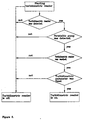
- the Figure 3 shows turbidimetric reader working through a diagram of flow. Firstly, the presence of the turbidimetric reader is verified by means of the subroutine of detection and if it is present, then the existence of the peristaltic pump is checked which is necessary for the turbidimetric reader working and for cleaning execution subroutine, besides it establishes the required working flow.
- the cleaning subroutine has a significative importance because the reader's parameters depends on the cleanness of the measurement chamber. This aspect influences on its useful period of life.
- the turbidimetric reader will be ready. Any subroutine that is infringed will disable the reader functioning.
- the main application of this device is oriented towards the antibiogram determination of the sample, (antibiotic microorganism susceptibility), which is achieved in a period of time between 2 and 6 hours, supported by a diagnostic kit designed for these purposes.
- the other device which is incorporated into the equipment of the present invention is the static turbidimetric minireader quoted before. It detects turbidity changes due to microbial growth in the sample that is developed in a glass vial that contains liquid culture medium, which is one of the components of the diagnostic kit of this invention.
- This vial is exactly adapted to the reading shaft of the equipment.
- the device is adjusted to use the mentioned vials for the direct reading of the sample, it means, special cuvets are not necessary to execute the reading which makes possible its use in routine diagnostic media.
- the mentioned device is used to calibrate the inoculum that it is used in the diagnostic kit for detecting the antibiogram. It reports turbidity in McFarland units, according to latex patterns of NCCLS standards in a established range of measurement (0 - 4,0 McFarland units).
- the diagnostic kit of the present invention is conformed by a nephelometric vial of 8 ml volume that contains 4,5 ml of culture medium, and it is glass vial of autoclaveable borosilicate with a plastic cover.
- Figure 4 shows the components of the diagnostic kit of the present invention, constituted by a vial containing culture medium and the polymer, the strip support and the strip used for antibiogram determination of the sample to be tested.
- Modified Mueller-Hinton Broth OXOID sterile pH de 7.4 ⁇ 0.2. is used as culture medium in order to follow microbial growth, which includes additionally a polymer.
- the diagnostic kit used for detecting antibiogram in a sample is characterized by the use of antibiotic discs commercially available. They can be used conforming schemes that change according any necessity. Antibiotic discs are organized into non-transparent strips containing two free positions for negative and positive controls, which are filled with only culture medium and inoculated culture medium respectively.
- the program created for these purposes allows the introduction of these changes in the acquisition and edition processes. It means that the kit has high flexibility and permits adaptations according to different necessities.
- a polymer that could be any lineal polysaccharide of structural formula CH3-CH3-Ch3-N or similar to this one, with molecular weight between 50,000 and 150,000, is added to the glass vial aforementioned containing culture medium for dilution, which form part of the diagnostic kit of the present invention.
- the incorporation of this polymer to the culture medium at the concentration in the range between 0.05 and 1%, allows to eliminate the inhibitor effect of catabolic products accompanying the sample inoculum to be tested, thus greater growth indexes of the infection involved bacteria are obtained in a smaller period of time, in comparison with the required time when the same culture medium is used without said polymer.
- this polymer is only metabolizable by a reduced number of microorganisms which are generally not found in those analysis where the present system is applied, it is inferred that bacterial growth effect is motivated by an inhibition of the repressor agents which are present in the culture medium. For this reason said polymer should act absorbing the catabolits which are involuntarily incorporated together with the inoculum that is analyzed. Besides, it has been observed that once these catabolits are neutralized by the mentioned polymer during microorganism growth measurement process, the bactericidal activity of tested antibiotics is more specific.
- One of the advantages of the present invention is the fact that the system allows to diagnose not only previously isolated strains but also direct samples of positive hemocultures, urine, etc.
- the referred sample is placed in the glass vial containing the polymer and the culture medium, immediately after the turbidity is determined (t0) and this value, as well as the reading time according to the adjudicated number of each sample, is fixed by the employed program. After that, mentioned vial is incubated between 2 to 5 hours at temperature between 35 and 37°C. At the end of the incubation, the system emits, according to the routine structured, a beep alarm sound and screen warning indicating that the sample should be read again. Those samples that shown increments higher than 0.08 McFarland units, are considered as positive samples.
- the system of the present invention allows, from positive samples once are detected, determine their antibiogram in a very rapid way. For that purpose, an aliquot of the sample is taken and transferred to new dilution vial that contains fresh culture medium, which is distributed in the strip where two controls (positive and negative) and from 10 to 22 antibiotic discs are found. After a 4 hours incubation period at temperature of 37°C, the strip is read, putting the microflow sensor in each micro well, following the instructions that the program emits, which selects the moment of each measurement in series is carried out. Thus, the interference of the previous reading is eliminated. From the obtained density values, the growth indexes are calculated (in the controls), as well as the inhibition percentage for each sample by each antibiotic.
- the criteria of sensible, resistant o intermedium are adjudicated, among inhibition values in a range of 60 to 100%. It means, those samples with inhibition percentage smaller than 60% can be considered resistant, those showing values between 60 to 80% can be considered sensibles in an intermedium level and those which are inhibited between 80 and 100% are considered sensibles to the antibiotic tested.
- Each result is checked in order to value if it is between a minimum or maximum admissible growth (satisfactory antibiogram).
- the obtained results and edit data of each sample automatically pass to create the corresponding data bases.
- the invention when applied to urocultures, it allows work with direct samples in liquid medium, read in commercial vials and afterwards execute antibiogram in positive samples. All this process is executed in a period of time smaller than 9 hours, avoiding that way previous steps of isolation and purification of the samples and obtaining the sensibility levels upper than 90%.
- the offered system also allows to face generated interferences due to the contaminated samples as well as the infection caused for more than one germ.
- the contaminated interference has been overcome, adjusting the magnitude sign and the time for detecting infected levels international accepted (>100,000 ufc/ml), this way, contaminated no infested samples are not included for further process, because its smaller bacterial level ( ⁇ 1000 ufc/ml), which gives the opportunity of detecting only contaminated samples only when they are infected.
- the contaminated species are generally saprophytes, that according to gram reaction, are sensible to all antibiotics, is evident that they cannot interfere in the detection of the resistance scheme of infected strains.
- bacterial identification should be incorporate, in order to produce a complete report. Aiming to achieve this purpose, to the quoted vial with culture medium and polymer, used for detection for urinary infection, optionally two substrates that allows rapid identification of E.coli bacteria in urine, could be added, as had been stated before, in the same detection vial.
- a designed culture medium that could be used in proposed system allows detection of E.coli in 4-6 hours incubation time, from infected urine samples tested.
- Proposed culture medium in the present invention include per litter, more than conventional nutritive bases included in Oxoid Muller Hinton culture medium: Meet infusion, 300 mg; casein hydrolyzate, 17 g. and starch, 1,5 g., substrates as MU- ⁇ -glucoronid (0,1 g), L-triptophane (1 g), and used polymer with de-repression activity (1 g). All those components are solubilized in potassium phosphate buffer 50 mM, and medium pH is adjusted between 7-7.5. After that medium is distributed in 4.5 ml volume in vials, that finally are sterilized by autoclave during 20 minutes at 121° C.
- Quoted substrates are useful for detection of MU- ⁇ -D-glucuronidase and triptophanase enzymatic activity, produced by E.coli.
- Indol detection is needed, so after bacterial growth is obtained in the medium, an auxiliary reactive is added for activity develop (modified Kovacks chemical reactive) ; which formula is : paradimethylamino benzaldehyde (2g), ethanol and concentrated chlorhydric acid (20 ml).
- Produced signal of enzymes-substrate interaction is detected, as a first step by exposition of vials with turbidity increment (positives ), to a UV light source, (Item that optionally could be included to the equipment of present invention), for florescence detection that is generated from 4-methilumbeliferone liberated.
- a UV light source Item that optionally could be included to the equipment of present invention
- Indol production is tested in the same vial, by addition of Kovacks modified reactive.
- the equipment is on. Once computer is activate, the auto-execution program drives directly to the program designed for the execution of all process, in this way initially, will test the existence and integrity of data base and; checking functioning capacity of each one of measurement module components : sensor, inoculum calibrator and peristaltic pump. Also, it will check electronic key existence, that is coupled to a parallel port of the computer. Program will inform about any mistake detected in any of system elements and will disable related options. If data base had been not created , will be created if the user takes this decision. If there is no any data base, it will be created if the user decides it.
- Uroculture is a well known test, used for screen urine samples infection. Procedure stars by optical density measuring immediately after vials had been inoculated (T0h), followed by a second measurement 4 hours after incubation (T4h).
- the measurement is made photomethrically by inoculum calibrator utilization.
- the following steps show the hole procedure:
- Samples classified as positive are ready for antibiogram detection (directly).
- strips of 12 to 24 microwells are used. The two first are for positive (C+) and negative (C-) controls, respectively ; antibiotic discs are placed in the others microwells.
- Strip inoculation is done by sample distribution in the first microwell and those with antibiotic discs.
- the second microwell is filled with sterile culture medium.
- Example 4 Inoculum preparation.
- the invention supplies a set of full interactive programs to carry out the Antibiogram and Uroculture tests. Data obtained in each test can be stored in the database for further processing. The user is guided inside an easy to operate environment that does not require previous experience in computer operation.
- the main window of the menu is composed of three basic panels:
- the principal menu is integrated by a set of icons that contain drawings related to the operation that is performed when these are activated.
- a black triangle noting toward the right in the options "URO and ATB" is an indicator that notifies that upon activating one of them will be shown a submenu with additional options.
- Procedure for the reading of urocultures Upon activating this option, a list of the uroculture cases that are waiting to be read is displayed, where the consecutive case number, the time that must elapse between readings and the date and time of the next reading are shown. If the list is empty, no cases are pending.
- the "READ URO" selection will provide the following options:
- a field marked by a black triangle pointing down indicates that when this field is selected, a pre-edited list will appear in order to select the desired text.
- An intelligent search is possible by typing the first letters of the searched word. This edition style is used to standardize the text corresponding to important fields avoiding spelling mistakes that could confuse a "Search" process. Words in this list can be deleted, modified or added, but if a text element of the list is modified, the complete database will be modified accordingly.
- This report may be printed.
- the outside surface of the flasks used in the calibrator must be clean and free from scratches.
- flasks that are measured in the McFarland calibrator should be marked in such a way that its position can be easily repeated each time the flask is read.
- the mark should always be visible to the operator.
- the stored data can also be modified at user's choice.
- the database can be queried by specifying the content of one or several fields in one search.
- Case number of the current data is shown.
- the total number of cases in the database (Example: Case 1 of 100) and the display mode are also reported.
- the display mode refers to the way data was extracted from de database: if the option "Browse” was used, “All the cases” will be reported, but if a searching process was executed, “Search” will be reported and only those cases matching the search conditions will be available.
- the term “Viewing” informs if the displayed data corresponds to "General data” or to the final “Results” of the test.
- This option becomes useful when it is required to start the uroculture's counter in a number different than 1, for instance, to start from 50, 100, etc.
- the program handles the consecutive number as the "consecutive of the day.” When a change of date is detected, the system, by default, will set the consecutive number to 1.
- the system will automatically check if the sensor has been rinsed and compensated and if the peristaltic pump is working properly. This procedure is transparent to the user if no problems are encountered. Any detected malfunction will be communicated to the user.
- the system When the first ATB of a day is going to be executed, the system will proceed in order to compensate the electronic operation point of the microflow sensor. To comply with this requirement, a totally interactive step by step procedure will guide the operator through the process.
- the system will send a report with the "Compensation Constant”, which is a numerical value that will be normally found below 2.00. However, values above 2.00 but fewer than 2.50 will be accepted and the user will be warn about the convenience of installing a new sensor.
- This procedure is used to test the sensor's performance.
- Statistic parameters such as mean value, standard deviation and variance coefficient of a set of 16 identical samples are calculated. Results are stored in a specific database where they can be retrieved for viewing or printing at user's choice.
- a user's choice Sensor Cleaning Procedure can be carried out in which the duration of each step can be manually programmed.
- the complete cleaning cycle is composed of three basic steps:
- Calibration is a procedure by means of which the response level of each sensor to a predetermined bacterial growth (0.5 McFarland) is established. It is not a daily routine and it is recommended to perform calibration each and every time that the software recommends this action in order to keep a standardized response and sensitivity.
- the system will calculate a mean value for the three measurements and the final result will be stored after selecting "OK".
- This auxiliary procedure helps the operator while checking the amount and stability of the flow delivered by the peristaltic pump, since a lack of continuity or an incorrect flow may cause errors during the measurements.
- the flow is checked using a 10 milliliter graduate probe and a recipient with distilled water.
- the overall sensitivity of the present system was 86.4%, and the specificity (i.e. the ability to detect truly negative samples as defined by routine culture) was 98.5%.
- Screen of Main Menu (5A) It constitutes the starting point for all operations that are performed when these are activated.
- Screen of Menu of Urocultures (5B): It represents a specific menu for the particular treatment of the urocultures, which contains the operations to perform during these tests, as a representation of the main options given by the Main Menu.
Landscapes
- Chemical & Material Sciences (AREA)
- Organic Chemistry (AREA)
- Health & Medical Sciences (AREA)
- Life Sciences & Earth Sciences (AREA)
- Engineering & Computer Science (AREA)
- Wood Science & Technology (AREA)
- Zoology (AREA)
- Bioinformatics & Cheminformatics (AREA)
- Analytical Chemistry (AREA)
- General Health & Medical Sciences (AREA)
- Proteomics, Peptides & Aminoacids (AREA)
- Biochemistry (AREA)
- Biotechnology (AREA)
- General Engineering & Computer Science (AREA)
- Microbiology (AREA)
- Genetics & Genomics (AREA)
- Biophysics (AREA)
- Molecular Biology (AREA)
- Immunology (AREA)
- Physics & Mathematics (AREA)
- Toxicology (AREA)
- Biomedical Technology (AREA)
- Sustainable Development (AREA)
- Measuring Or Testing Involving Enzymes Or Micro-Organisms (AREA)
- Apparatus Associated With Microorganisms And Enzymes (AREA)
Applications Claiming Priority (7)
| Application Number | Priority Date | Filing Date | Title |
|---|---|---|---|
| CU1997045A CU22549A1 (es) | 1997-04-18 | 1997-04-18 | Equipo y método para el diagnóstico rápido microbiológico |
| CU4597 | 1997-04-18 | ||
| CU1997048A CU22708A1 (es) | 1997-04-29 | 1997-04-29 | Juego para el diagnóstico microbiológico |
| CU4897 | 1997-04-29 | ||
| CU1997065 | 1997-06-06 | ||
| CU6597 | 1997-06-06 | ||
| PCT/CU1998/000004 WO1998047999A1 (es) | 1997-04-18 | 1998-04-20 | Equipo, juego y metodo para el diagnostico microbiologico |
Related Child Applications (1)
| Application Number | Title | Priority Date | Filing Date |
|---|---|---|---|
| EP08159290 Division | 2008-06-27 |
Publications (2)
| Publication Number | Publication Date |
|---|---|
| EP0976821A1 true EP0976821A1 (de) | 2000-02-02 |
| EP0976821B1 EP0976821B1 (de) | 2009-02-18 |
Family
ID=27179615
Family Applications (1)
| Application Number | Title | Priority Date | Filing Date |
|---|---|---|---|
| EP98916796A Expired - Lifetime EP0976821B1 (de) | 1997-04-18 | 1998-04-20 | Diagnostische mikrobiologische testvorrichtung und verfahren |
Country Status (9)
| Country | Link |
|---|---|
| US (1) | US6537772B1 (de) |
| EP (1) | EP0976821B1 (de) |
| CN (1) | CN1125172C (de) |
| AT (1) | ATE423190T1 (de) |
| CA (1) | CA2286845C (de) |
| DE (1) | DE69840571D1 (de) |
| ES (1) | ES2322679T3 (de) |
| PT (1) | PT976821E (de) |
| WO (1) | WO1998047999A1 (de) |
Cited By (1)
| Publication number | Priority date | Publication date | Assignee | Title |
|---|---|---|---|---|
| US10829797B2 (en) | 2015-06-24 | 2020-11-10 | Q-Linea Ab | Method for determining antimicrobial susceptibility of a microorganism |
Families Citing this family (12)
| Publication number | Priority date | Publication date | Assignee | Title |
|---|---|---|---|---|
| US7418399B2 (en) * | 1999-03-10 | 2008-08-26 | Illinois Institute Of Technology | Methods and kits for managing diagnosis and therapeutics of bacterial infections |
| NZ591884A (en) * | 2004-02-23 | 2012-07-27 | Crecy Eudes Francois Marie De | Continuous culture apparatus including movable flexible tubing divided into chambers by clamps |
| US20070037276A1 (en) * | 2004-02-23 | 2007-02-15 | Eudes Francois Marie De Crecy | Continuous culture apparatus with mobile vessel, allowing selection of fitter cell variants and producing a culture in a continuous manner |
| US8313643B1 (en) * | 2008-10-20 | 2012-11-20 | David Baltimore | System and method for analyzing a biological sample |
| RU2390015C1 (ru) * | 2008-12-29 | 2010-05-20 | Государственное образовательное учреждение высшего профессионального образования "Саратовский государственный университет им. Н.Г. Чернышевского" | СПОСОБ ИЗБИРАТЕЛЬНОЙ ИДЕНТИФИКАЦИИ ТРИПТОФАНА В СМЕСИ α-АМИНОКИСЛОТ |
| DE102009004371A1 (de) * | 2009-01-08 | 2010-07-15 | Papst Licensing Gmbh & Co. Kg | Vorrichtung und Verfahren zum Messen der Aktivität von Enzymen nach Inhibitorentzug |
| US20100279354A1 (en) * | 2009-04-29 | 2010-11-04 | Evolugate, Llc | Adapting microorganisms for agricultural products |
| WO2012014208A2 (en) * | 2010-07-27 | 2012-02-02 | Yeda Research And Development Co. Ltd. | Methods and systems for assessing clonality of cell cultures |
| CN106916728B (zh) * | 2017-04-18 | 2023-10-27 | 朱红 | 一种磁力搅拌式药敏分析仪器以及配套试剂盒 |
| AU2018254602B2 (en) | 2017-04-20 | 2021-04-01 | Biomerieux, Inc. | Optical density instrument and systems and methods using the same |
| CN112286267A (zh) * | 2020-10-28 | 2021-01-29 | 合肥猎知科技有限公司 | 一种基于大数据的室内菌菇种植环境智能监测分析系统 |
| CN116858784A (zh) * | 2023-06-02 | 2023-10-10 | 湖北丛光传感技术有限公司 | 一种电子视镜 |
Family Cites Families (21)
| Publication number | Priority date | Publication date | Assignee | Title |
|---|---|---|---|---|
| US3506544A (en) | 1964-10-09 | 1970-04-14 | Magna Corp | Method of determining microbial populations,enzyme activities,and substrate concentrations by electrochemical analysis |
| US3609040A (en) * | 1969-02-24 | 1971-09-28 | Lilly Co Eli | Automated system for performing sample measurements, dilutions and photometric measurements |
| FR2067508A5 (de) | 1969-11-06 | 1971-08-20 | Inst Nal Rech Agr | |
| US3889011A (en) | 1970-07-23 | 1975-06-10 | Lever Brothers Ltd | Fat products |
| US3712144A (en) * | 1971-03-10 | 1973-01-23 | Lilly Co Eli | Automated system for performing sample measurement, dilutions and photometric measurements |
| CH544145A (de) | 1971-07-23 | 1973-11-15 | Mueller Hans | Vorrichtung zur Überwachung des Organismenwachstums in Fermentationsgefässen |
| US3832532A (en) | 1972-08-18 | 1974-08-27 | Pfizer | Method and apparatus for testing antibiotic susceptibility |
| US3895661A (en) | 1972-08-18 | 1975-07-22 | Pfizer | Cuvette apparatus for testing a number of reactants |
| US3852532A (en) | 1973-05-30 | 1974-12-03 | Gen Electric | Control system for an electrical power line |
| US4021120A (en) | 1974-03-18 | 1977-05-03 | Dr. Ing. Hans Mueller | Method of measuring the turbidity of gas-containing liquid mediums with microorganisms |
| JPH0321160B2 (de) | 1979-05-02 | 1991-03-22 | Nat Res Dev | |
| US4482967A (en) | 1981-09-18 | 1984-11-13 | Dionex Corporation | Conductivity detector and method |
| GB2142433B (en) | 1983-06-29 | 1986-10-29 | Metal Box Plc | Apparatus for detecting micr-organisms |
| JPS60259935A (ja) | 1984-06-07 | 1985-12-23 | Komatsugawa Kakoki Kk | 濁度計 |
| IT1211721B (it) * | 1987-08-13 | 1989-11-03 | Genesis S R L | Apparecchiatura per il conteggio automatico di microrganismi eventualmente presenti in liquidi, con particolare riferimento alle acque per uso umano |
| FR2628531B1 (fr) * | 1988-03-08 | 1992-10-02 | Chemunex Sa | Procede de recherche, de detection specifique et de numeration de micro-organismes, installation pour la mise en oeuvre dudit procede |
| US4893935A (en) | 1988-08-19 | 1990-01-16 | Mandel William R | Apparatus and method for optical density measurements of biomass processes |
| US5345395A (en) * | 1991-10-31 | 1994-09-06 | Baxter Diagnostics Inc. | Specimen processing and analyzing systems and methods using photometry |
| WO1994007123A1 (en) * | 1992-09-18 | 1994-03-31 | Tam Lisa A | Method and device for measuring cell density in microbiological cultures and other reflectometric properties of liquids |
| DE4324392A1 (de) | 1993-07-21 | 1995-01-26 | Merck Patent Gmbh | Kulturmedium für den gleichzeitigen Nachweis von coliformen Bakterien und Escherichia coli |
| US5637082A (en) * | 1996-02-22 | 1997-06-10 | Haemonetics Corporation | Adaptive apheresis apparatus |
-
1998
- 1998-04-20 EP EP98916796A patent/EP0976821B1/de not_active Expired - Lifetime
- 1998-04-20 AT AT98916796T patent/ATE423190T1/de not_active IP Right Cessation
- 1998-04-20 CN CN98805493A patent/CN1125172C/zh not_active Expired - Fee Related
- 1998-04-20 WO PCT/CU1998/000004 patent/WO1998047999A1/es not_active Ceased
- 1998-04-20 PT PT98916796T patent/PT976821E/pt unknown
- 1998-04-20 DE DE69840571T patent/DE69840571D1/de not_active Expired - Lifetime
- 1998-04-20 ES ES98916796T patent/ES2322679T3/es not_active Expired - Lifetime
- 1998-04-20 CA CA002286845A patent/CA2286845C/en not_active Expired - Fee Related
-
1999
- 1999-10-18 US US09/426,074 patent/US6537772B1/en not_active Expired - Fee Related
Non-Patent Citations (1)
| Title |
|---|
| See references of WO9847999A1 * |
Cited By (2)
| Publication number | Priority date | Publication date | Assignee | Title |
|---|---|---|---|---|
| US10829797B2 (en) | 2015-06-24 | 2020-11-10 | Q-Linea Ab | Method for determining antimicrobial susceptibility of a microorganism |
| US12203125B2 (en) | 2015-06-24 | 2025-01-21 | Q-Linea Ab | Device for determining antimicrobial susceptibility of a microorganism |
Also Published As
| Publication number | Publication date |
|---|---|
| CN1265140A (zh) | 2000-08-30 |
| DE69840571D1 (de) | 2009-04-02 |
| EP0976821B1 (de) | 2009-02-18 |
| CA2286845C (en) | 2009-01-13 |
| ES2322679T3 (es) | 2009-06-24 |
| ATE423190T1 (de) | 2009-03-15 |
| CA2286845A1 (en) | 1998-10-29 |
| WO1998047999A1 (es) | 1998-10-29 |
| US6537772B1 (en) | 2003-03-25 |
| PT976821E (pt) | 2009-05-25 |
| CN1125172C (zh) | 2003-10-22 |
Similar Documents
| Publication | Publication Date | Title |
|---|---|---|
| CA2286845C (en) | Equipment, kit and method for microbiological diagnosis | |
| US5164301A (en) | Process and kit for detecting microbial metabolism | |
| US11807894B2 (en) | Systems and methods for identifying a culture as positive for microorganisms with high confidence | |
| US5164796A (en) | Apparatus and method for detection of microorganisms | |
| EP0333253B1 (de) | Einrichtung und Gerät für die Detektion von Mikroorganismen | |
| US4448534A (en) | Antibiotic susceptibility testing | |
| CA2753161C (en) | A device for measuring light scattering and turbity in biological samples and methods of use thereof | |
| EP0472622B1 (de) | Vorrichtung zum nachweis von mikroorganismen | |
| US6611765B2 (en) | System for validation and interpreting results of antimicrobial susceptibility tests of micro-organisms | |
| EP0538450A4 (de) | ||
| US9097672B2 (en) | Method and system for detecting biological molecules in samples | |
| Magrisso et al. | Fiber-optic biosensor to assess circulating phagocyte activity by chemiluminescence | |
| MXPA99009562A (en) | Equipment, kit and method for microbiological diagnosis | |
| JP2002238596A (ja) | 微生物検出キットおよび微生物計量装置 | |
| Palmer et al. | Clinical evaluation of a rapid diagnostic screen (Uriscreen) for bacteriuria in children | |
| US10481083B2 (en) | Determination of blood volume in a culture bottle | |
| Uldall | Quality assurance within clinical chemistry—a brief review emphasizing ‘good laboratory practice’ | |
| Wosnitzer et al. | Rapid detection methods for bacteriol identification in urologic office laboratory |
Legal Events
| Date | Code | Title | Description |
|---|---|---|---|
| PUAI | Public reference made under article 153(3) epc to a published international application that has entered the european phase |
Free format text: ORIGINAL CODE: 0009012 |
|
| 17P | Request for examination filed |
Effective date: 19991020 |
|
| AK | Designated contracting states |
Kind code of ref document: A1 Designated state(s): AT BE CH CY DE DK ES FI FR GB GR IE IT LI LU MC NL PT SE |
|
| 17Q | First examination report despatched |
Effective date: 20030715 |
|
| 17Q | First examination report despatched |
Effective date: 20030715 |
|
| GRAP | Despatch of communication of intention to grant a patent |
Free format text: ORIGINAL CODE: EPIDOSNIGR1 |
|
| RIN1 | Information on inventor provided before grant (corrected) |
Inventor name: ROMAY PENABAD, CHEYLAEDIFICIO 2 APARTAMENTO 208 Inventor name: ZAYAS TAMAYO, ANGELA MARIANA Inventor name: TRAVIESO RUIZ, FERNANDO Inventor name: RAMIREZ MOLINA, IVAN MANUEL Inventor name: RAMIREZ FROMETA, NARDO Inventor name: HERNANDEZ RAMIREZ, SILVIO Inventor name: NOVO MESEGUE, FRANCISCO Inventor name: ROURA CARMONA, GLORIA Inventor name: CONTRERAS ALARCON, ORESTES ROLANDO |
|
| GRAS | Grant fee paid |
Free format text: ORIGINAL CODE: EPIDOSNIGR3 |
|
| GRAA | (expected) grant |
Free format text: ORIGINAL CODE: 0009210 |
|
| AK | Designated contracting states |
Kind code of ref document: B1 Designated state(s): AT BE CH CY DE DK ES FI FR GB GR IE IT LI LU MC NL PT SE |
|
| REG | Reference to a national code |
Ref country code: GB Ref legal event code: FG4D |
|
| REG | Reference to a national code |
Ref country code: CH Ref legal event code: EP |
|
| REG | Reference to a national code |
Ref country code: IE Ref legal event code: FG4D |
|
| REF | Corresponds to: |
Ref document number: 69840571 Country of ref document: DE Date of ref document: 20090402 Kind code of ref document: P |
|
| REG | Reference to a national code |
Ref country code: CH Ref legal event code: NV Representative=s name: KATZAROV S.A. |
|
| REG | Reference to a national code |
Ref country code: PT Ref legal event code: SC4A Free format text: AVAILABILITY OF NATIONAL TRANSLATION Effective date: 20090518 |
|
| REG | Reference to a national code |
Ref country code: SE Ref legal event code: TRGR |
|
| REG | Reference to a national code |
Ref country code: ES Ref legal event code: FG2A Ref document number: 2322679 Country of ref document: ES Kind code of ref document: T3 |
|
| PG25 | Lapsed in a contracting state [announced via postgrant information from national office to epo] |
Ref country code: FI Free format text: LAPSE BECAUSE OF FAILURE TO SUBMIT A TRANSLATION OF THE DESCRIPTION OR TO PAY THE FEE WITHIN THE PRESCRIBED TIME-LIMIT Effective date: 20090218 |
|
| PG25 | Lapsed in a contracting state [announced via postgrant information from national office to epo] |
Ref country code: AT Free format text: LAPSE BECAUSE OF FAILURE TO SUBMIT A TRANSLATION OF THE DESCRIPTION OR TO PAY THE FEE WITHIN THE PRESCRIBED TIME-LIMIT Effective date: 20090218 |
|
| PG25 | Lapsed in a contracting state [announced via postgrant information from national office to epo] |
Ref country code: DK Free format text: LAPSE BECAUSE OF FAILURE TO SUBMIT A TRANSLATION OF THE DESCRIPTION OR TO PAY THE FEE WITHIN THE PRESCRIBED TIME-LIMIT Effective date: 20090218 |
|
| PLBE | No opposition filed within time limit |
Free format text: ORIGINAL CODE: 0009261 |
|
| STAA | Information on the status of an ep patent application or granted ep patent |
Free format text: STATUS: NO OPPOSITION FILED WITHIN TIME LIMIT |
|
| 26N | No opposition filed |
Effective date: 20091119 |
|
| PG25 | Lapsed in a contracting state [announced via postgrant information from national office to epo] |
Ref country code: MC Free format text: LAPSE BECAUSE OF NON-PAYMENT OF DUE FEES Effective date: 20090430 Ref country code: IE Free format text: LAPSE BECAUSE OF NON-PAYMENT OF DUE FEES Effective date: 20090420 |
|
| PGFP | Annual fee paid to national office [announced via postgrant information from national office to epo] |
Ref country code: ES Payment date: 20100629 Year of fee payment: 13 |
|
| PGFP | Annual fee paid to national office [announced via postgrant information from national office to epo] |
Ref country code: DE Payment date: 20100628 Year of fee payment: 13 |
|
| PG25 | Lapsed in a contracting state [announced via postgrant information from national office to epo] |
Ref country code: GR Free format text: LAPSE BECAUSE OF FAILURE TO SUBMIT A TRANSLATION OF THE DESCRIPTION OR TO PAY THE FEE WITHIN THE PRESCRIBED TIME-LIMIT Effective date: 20090519 |
|
| PGFP | Annual fee paid to national office [announced via postgrant information from national office to epo] |
Ref country code: NL Payment date: 20100630 Year of fee payment: 13 Ref country code: CH Payment date: 20100715 Year of fee payment: 13 |
|
| PGFP | Annual fee paid to national office [announced via postgrant information from national office to epo] |
Ref country code: SE Payment date: 20100715 Year of fee payment: 13 Ref country code: IT Payment date: 20100630 Year of fee payment: 13 Ref country code: GB Payment date: 20100629 Year of fee payment: 13 Ref country code: FR Payment date: 20100809 Year of fee payment: 13 |
|
| PGFP | Annual fee paid to national office [announced via postgrant information from national office to epo] |
Ref country code: PT Payment date: 20100713 Year of fee payment: 13 |
|
| PGFP | Annual fee paid to national office [announced via postgrant information from national office to epo] |
Ref country code: BE Payment date: 20100715 Year of fee payment: 13 |
|
| PG25 | Lapsed in a contracting state [announced via postgrant information from national office to epo] |
Ref country code: LU Free format text: LAPSE BECAUSE OF NON-PAYMENT OF DUE FEES Effective date: 20090420 |
|
| PG25 | Lapsed in a contracting state [announced via postgrant information from national office to epo] |
Ref country code: CY Free format text: LAPSE BECAUSE OF FAILURE TO SUBMIT A TRANSLATION OF THE DESCRIPTION OR TO PAY THE FEE WITHIN THE PRESCRIBED TIME-LIMIT Effective date: 20090218 |
|
| REG | Reference to a national code |
Ref country code: PT Ref legal event code: MM4A Free format text: LAPSE DUE TO NON-PAYMENT OF FEES Effective date: 20111020 |
|
| BERE | Be: lapsed |
Owner name: CENTRO NACIONAL DE INVESTIGACIONES CIENTIFICAS Effective date: 20110430 |
|
| REG | Reference to a national code |
Ref country code: DE Ref legal event code: R119 Ref document number: 69840571 Country of ref document: DE |
|
| REG | Reference to a national code |
Ref country code: DE Ref legal event code: R119 Ref document number: 69840571 Country of ref document: DE |
|
| REG | Reference to a national code |
Ref country code: NL Ref legal event code: V1 Effective date: 20111101 |
|
| REG | Reference to a national code |
Ref country code: SE Ref legal event code: EUG |
|
| REG | Reference to a national code |
Ref country code: CH Ref legal event code: PL |
|
| GBPC | Gb: european patent ceased through non-payment of renewal fee |
Effective date: 20110420 |
|
| REG | Reference to a national code |
Ref country code: FR Ref legal event code: ST Effective date: 20111230 |
|
| PG25 | Lapsed in a contracting state [announced via postgrant information from national office to epo] |
Ref country code: CH Free format text: LAPSE BECAUSE OF NON-PAYMENT OF DUE FEES Effective date: 20110430 Ref country code: PT Free format text: LAPSE BECAUSE OF NON-PAYMENT OF DUE FEES Effective date: 20111020 Ref country code: FR Free format text: LAPSE BECAUSE OF NON-PAYMENT OF DUE FEES Effective date: 20110502 Ref country code: LI Free format text: LAPSE BECAUSE OF NON-PAYMENT OF DUE FEES Effective date: 20110430 Ref country code: NL Free format text: LAPSE BECAUSE OF NON-PAYMENT OF DUE FEES Effective date: 20111101 Ref country code: BE Free format text: LAPSE BECAUSE OF NON-PAYMENT OF DUE FEES Effective date: 20110430 |
|
| PG25 | Lapsed in a contracting state [announced via postgrant information from national office to epo] |
Ref country code: GB Free format text: LAPSE BECAUSE OF NON-PAYMENT OF DUE FEES Effective date: 20110420 Ref country code: IT Free format text: LAPSE BECAUSE OF NON-PAYMENT OF DUE FEES Effective date: 20110420 |
|
| REG | Reference to a national code |
Ref country code: ES Ref legal event code: FD2A Effective date: 20120604 |
|
| PG25 | Lapsed in a contracting state [announced via postgrant information from national office to epo] |
Ref country code: ES Free format text: LAPSE BECAUSE OF NON-PAYMENT OF DUE FEES Effective date: 20110421 |
|
| PG25 | Lapsed in a contracting state [announced via postgrant information from national office to epo] |
Ref country code: SE Free format text: LAPSE BECAUSE OF NON-PAYMENT OF DUE FEES Effective date: 20110421 |
|
| PG25 | Lapsed in a contracting state [announced via postgrant information from national office to epo] |
Ref country code: DE Free format text: LAPSE BECAUSE OF NON-PAYMENT OF DUE FEES Effective date: 20111031 |