EP0982022A2 - Fragrance releasing non-volatile polymeric siloxanes - Google Patents
Fragrance releasing non-volatile polymeric siloxanes Download PDFInfo
- Publication number
- EP0982022A2 EP0982022A2 EP99306599A EP99306599A EP0982022A2 EP 0982022 A2 EP0982022 A2 EP 0982022A2 EP 99306599 A EP99306599 A EP 99306599A EP 99306599 A EP99306599 A EP 99306599A EP 0982022 A2 EP0982022 A2 EP 0982022A2
- Authority
- EP
- European Patent Office
- Prior art keywords
- formula
- alcohol
- fragrance releasing
- sio
- subscript
- Prior art date
- Legal status (The legal status is an assumption and is not a legal conclusion. Google has not performed a legal analysis and makes no representation as to the accuracy of the status listed.)
- Granted
Links
Classifications
-
- A—HUMAN NECESSITIES
- A61—MEDICAL OR VETERINARY SCIENCE; HYGIENE
- A61K—PREPARATIONS FOR MEDICAL, DENTAL OR TOILETRY PURPOSES
- A61K8/00—Cosmetics or similar toiletry preparations
- A61K8/18—Cosmetics or similar toiletry preparations characterised by the composition
- A61K8/72—Cosmetics or similar toiletry preparations characterised by the composition containing organic macromolecular compounds
- A61K8/84—Cosmetics or similar toiletry preparations characterised by the composition containing organic macromolecular compounds obtained by reactions otherwise than those involving only carbon-carbon unsaturated bonds
- A61K8/89—Polysiloxanes
- A61K8/895—Polysiloxanes containing silicon bound to unsaturated aliphatic groups, e.g. vinyl dimethicone
-
- A—HUMAN NECESSITIES
- A61—MEDICAL OR VETERINARY SCIENCE; HYGIENE
- A61Q—SPECIFIC USE OF COSMETICS OR SIMILAR TOILETRY PREPARATIONS
- A61Q13/00—Formulations or additives for perfume preparations
-
- A—HUMAN NECESSITIES
- A61—MEDICAL OR VETERINARY SCIENCE; HYGIENE
- A61K—PREPARATIONS FOR MEDICAL, DENTAL OR TOILETRY PURPOSES
- A61K2800/00—Properties of cosmetic compositions or active ingredients thereof or formulation aids used therein and process related aspects
- A61K2800/40—Chemical, physico-chemical or functional or structural properties of particular ingredients
- A61K2800/57—Compounds covalently linked to a(n inert) carrier molecule, e.g. conjugates, pro-fragrances
Definitions
- the present invention relates to non-volatile oligomeric or polymeric siloxanes which may be linear, branched or cross-linked, suitable for use in a variety of applications including personal care formulations, household products, automotive, textiles and molding materials wherein the non-volatile polymeric siloxane has been chemically modified to release a fragrant molecule upon hydrolysis.
- the present invention further relates to such molecules where the rate of fragrant molecule release is sufficiently slow so that products formulated with the modified polymeric non-volatile siloxane exhibit a desirable fragrance for long periods of time.
- the slow sustained release of a fragrant molecule is a highly desirable trait in many personal care products.
- a number of means have been proposed and implemented to achieve this goal. Among these means are dissolving or suspending fragrant compounds in personal care emulsions (U.S. patents 5,525,588; 5,525,555; 5,490,982; and 5,372,806), encapsulation of a fragrant compound (U.S. patents 5,500,223; 5,324,444; 5,185,155; 5,176,903; and 5,130,171), dissolving a fragrant compound into a hydrophobic phase such as a silicone (U.S.
- the present invention provides for a fragrance releasing siloxane having the formula: M f M F g D h D F i T j T F k Q l where M has the formula R 7 R 8 R 9 SiO 1/2 ; M F has the formula R 7 R 8 R F SiO 1/2 ; D has the formula R 10 R 11 SiO 2/2 ; D F has the formula R 10 R F SiO 2/2 ; T has the formula R 12 SiO 3/2 ; T F has the formula R F SiO 3/2 ; and Q has the formula SiO 4/2 where R 7 , R 8 , R 9 , R 10 , R 11 and R 12 are each independently selected for each M, M F , D, D F , T and T F from the group of one to forty carbon atom monovalent alkyl or alkoxy radicals and one to forty carbon atom monovalent aryl or aryloxy radicals where the subscripts f or g are positive, and one or more of the subscripts h, i, j, k
- the compounds of the present invention introduce fragrant moieties via hydrosilylation of an olefinic silane molecule. These siloxane molecules are useful in a variety of personal care compositions.
- the present invention is directed to new compositions of matter that are siloxanes that release a fragrant alcohol upon hydrolysis.
- the olefinic silanes utilized by the present invention are described by the formula: (R 1 O) a (R 2 O) b (R 3 O) c (R 4 ) d (R 5 ) c SiR 6 where R 1 O, R 2 O and R 3 O, fragrant alkoxide moieties, are selected (or derived from) from the group of alcohols consisting of R 1 OH, R 2 OH and R 3 OH wherein R 1 OH, R 2 OH and R 3 OH are fragrant alcohols with R 4 and R 5 selected from the group consisting of monovalent hydrocarbon radicals having from one to forty carbon atoms and monovalent alkoxy radicals having from one to forty carbon atoms, R 6 a two to forty atom monovalent unsaturated hydrocarbon radical containing a terminal olefinic or acetylenic moiety where the subscript a has a value ranging from 1 to 3 and the subscripts b, c, d, and e have values ranging from 0 to
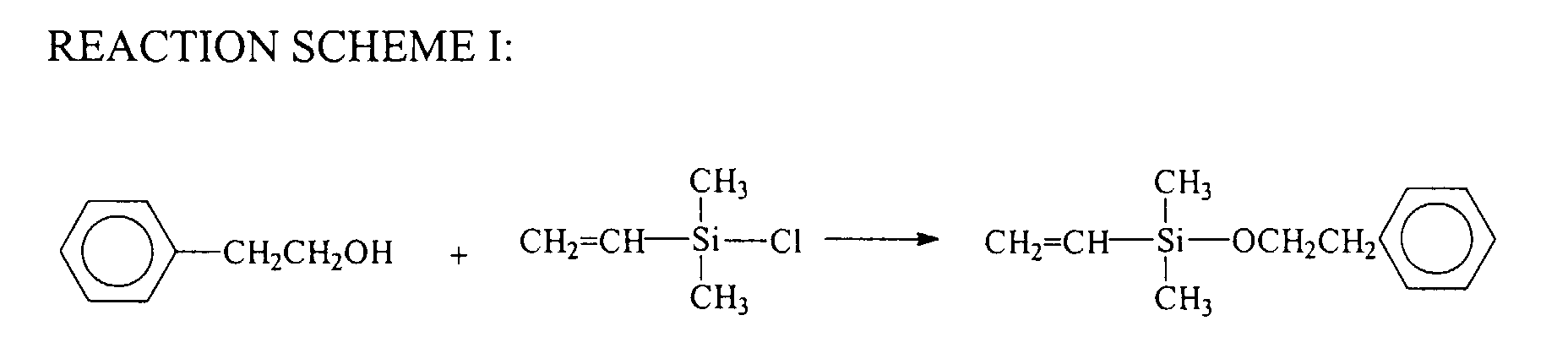
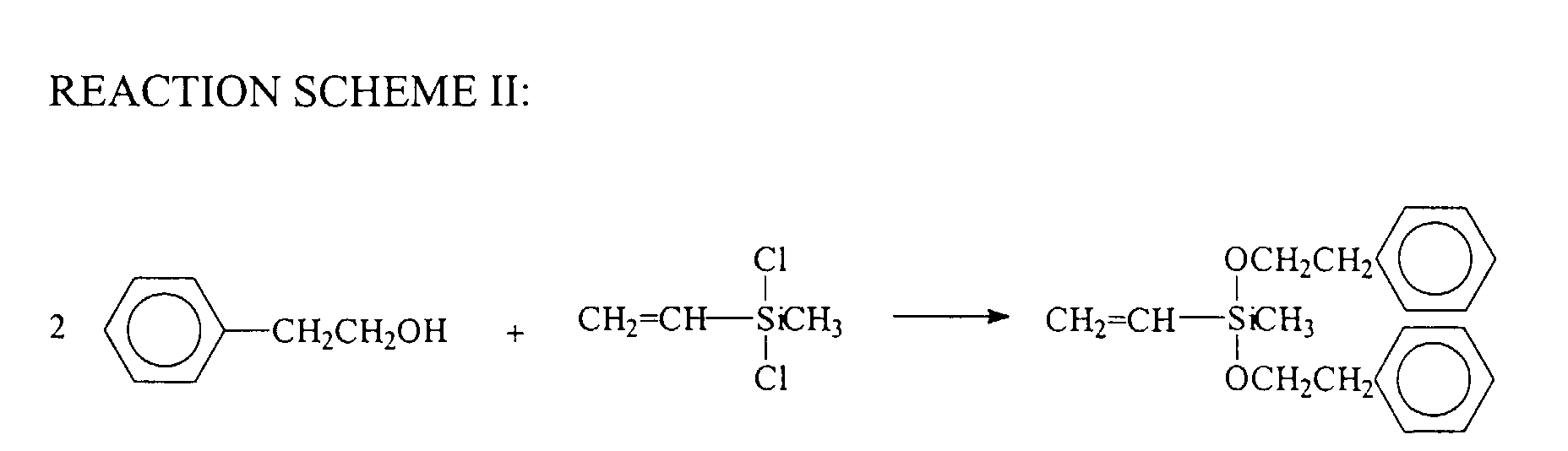
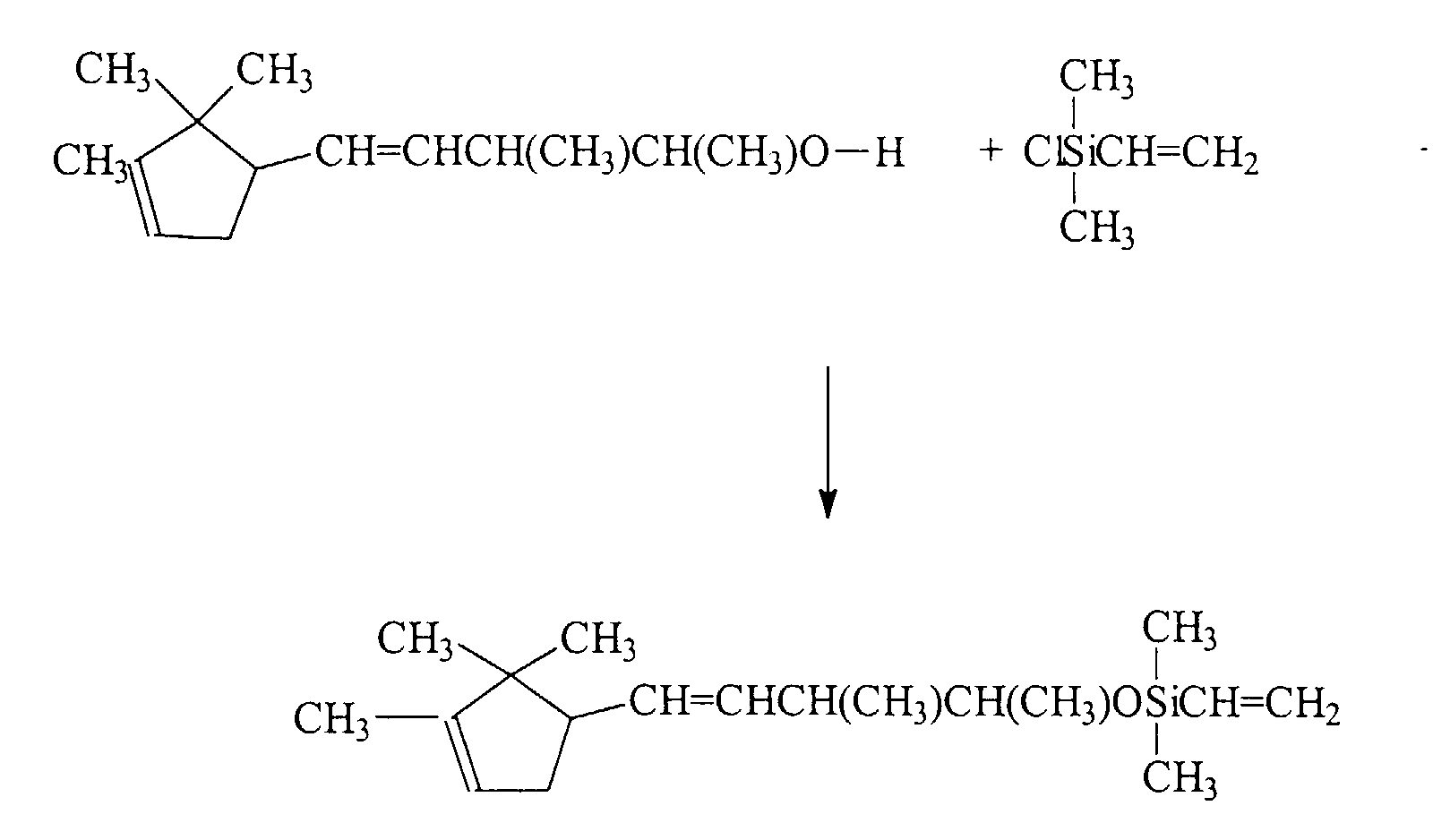
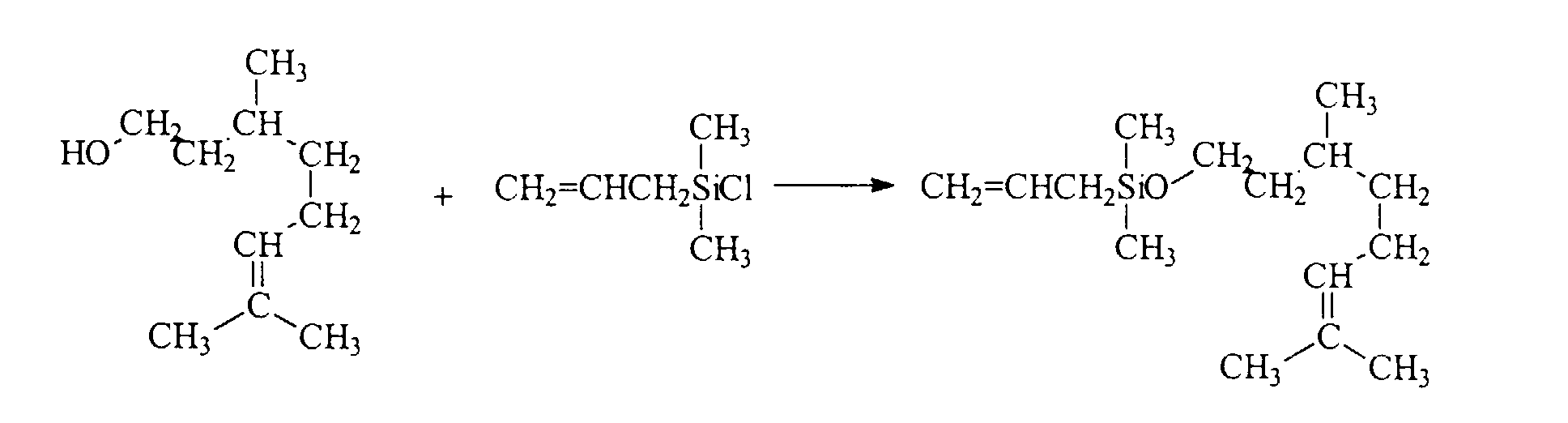
- olefinic halosilanes or olefinic silicon alkoxides may be employed as starting materials to produce the fragrance-releasing siloxanes of the present invention via fragrance bearing olefinic silanes.
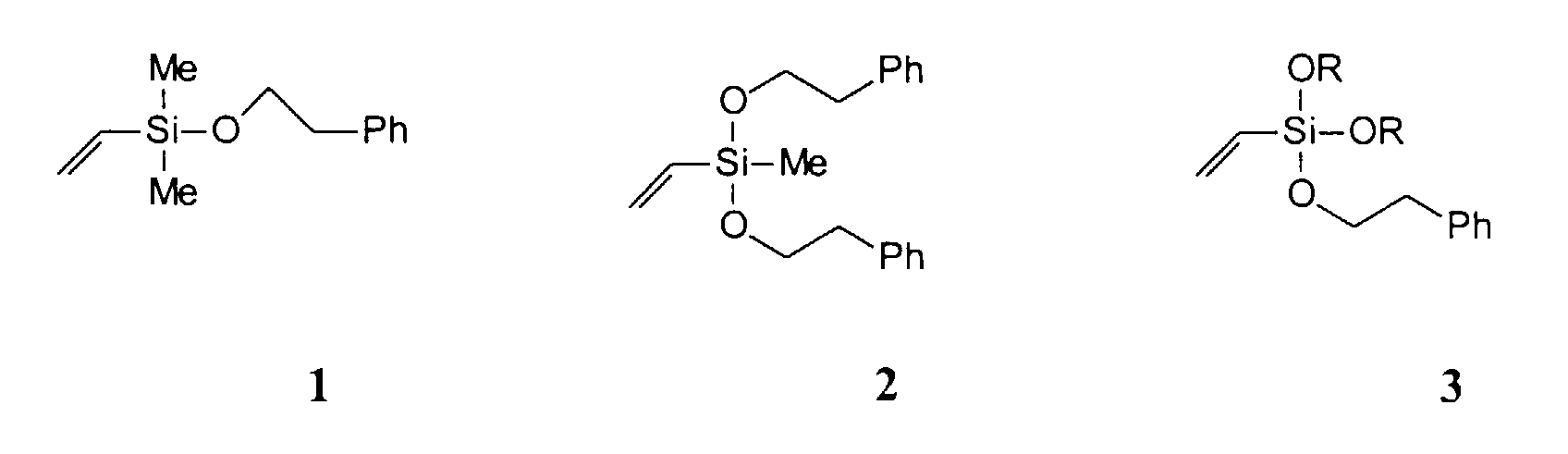
- R groups for reaction III may be Et (C 2 H 5 -) or -CH 2 CH 2 C 6 H 5 .
- 3-methyl-5-(2,2,3,-trimethyl-3-cyclopenten-1-yl)-4-penten-2-ol will react with chloromethylvinylsilane in a similar fashion
- reaction scheme V is a fragrant alcohol such as phenethanol, olefinic halosilanes or olefinic silicon alkoxides.
- the fragrant alcohols that are precursors of the silanes of the present invention are selected from the group consisting of 3-methyl-5-(2,2,3,-trimethyl-3-cyclopenten-1-yl)-4-penten-2-ol, 2-methylbutanol, 3-pentanol, n-pentanol, 2-pentanol, n-hexanol, 2-methylpentanol, 1-decanol, sandela, nonadyl, dimetol, thymol, 1-heptanol, menthol, eugenol, vanillan, o-vanillan, 4-( p -hydroxyphenyl)-2-butanone, syringealdehyde, prenol, cis -3-hexanol, trans-3-hexanol, cis -4-heptenol, trans -2-octenol, trans -2- cis -6-nonadienol, ger
- the fragrance releasing siloxanes of the present invention are prepared from an organohydrogen siloxane via conventional hydrosilylation using the fragrance bearing olefinic silane as the alkenyl source.
- an organohydrogensiloxane having the formula: M f M H g D h D H i T j T H k Q l where M has the formula R 7 R 8 R 9 SiO 1/2 ; M H has the formula R 7 R 8 HSiO 1/2 ; D has the formula R 10 R 11 SiO 2/2 ; D H has the formula R 10 HSiO 2/2 ; T has the formula R 12 SiO 3/2 ; T H has the formula HSiO 3/2 ; and Q has the formula SiO 4/2 where R 7 , R 8 , R 9 , R 10 , R 11 and R 12 are each independently selected for each M, M H , D, D H , and T from the group of one to forty carbon atom monovalent alkyl or alkoxy radicals and one to forty carbon atom
- the organohydrogensiloxane is reacted under hydrosilylation conditions to produce a fragrance releasing siloxane having the formula: M f M F g D h D F i T j T F k Q l where the components and subscripts satisfy the previous definitions and requirements and M F has the formula R 7 R 8 R F SiO 1/2 ; D F has the formula R 10 R F SiO 2/2 ; and T F has the formula R F SiO 3/2 ; where R F has the formula (R 1 O) a (R 2 O) b (R 3 O) c (R 4 ) d (R 5 ) e SiR U with R U a two to forty atom divalent hydrocarbon radical where the subscripts and components are as previously defined.
- This non-volatile silicone undergoes a slow hydrolysis under most conditions of use whereby the silicone releases a fragrant alcohol upon hydrolysis. This imparts a desirable odor to many different useful compositions such as cosmetics and household products.
- hydrosilylation reaction is conventionally carried out in the presence of a hydrosilylation catalyst selected from the group of ruthenium, osmium, rhodium, iridium, palladium and platinum hydrosilylation catalysts.
- a hydrosilylation catalyst selected from the group of ruthenium, osmium, rhodium, iridium, palladium and platinum hydrosilylation catalysts.
- ruthenium, osmium, rhodium, iridium, palladium and platinum hydrosilylation catalysts Exemplary of such catalysts are those described in U.S. patents 2,823,218; 3,159,601; 3,159,662; and 3,775,452.
- compositions of the present invention further provide that the fragrance releasing silicone have one or more substituents R 1 , R 2 , or R 3 where each substituent is independently selected whereby one fragrant alcohol resulting from hydrolysis of said silicone is selected from the group consisting of 2-methylbutanol, 3-pentanol, n-pentanol, 2-pentanol, n-hexanol, 2-methylpentanol, 1-decanol, sandela, nonadyl, dimetol, thymol, 1-heptanol, menthol, eugenol, vanillan, o-vanillan, 4-( p -hydroxyphenyl)-2-butanone, syringealdehyde, prenol, cis -3-hexanol, trans-3-hexanol, cis -4-heptenol, trans -2-octenol, trans -2- cis -6-nonadien
- the fragrance releasing compounds of the present invention are particularly suited to incorporation into personal care products to impart a desirable long lasting fragrance to the products.
- Suitable uses include but are not limited to deodorants, antiperspirants, skin creams, facial creams, hair care products such as shampoos, mousses, styling gels, protective creams, shaving creams, after shave, cologne, perfume, color cosmetics such as lipsticks, foundations, blushes, makeup, and mascara; and other cosmetic formulations where other silicon containing components have been added and where it is desirable to impart a fragrance.
- Incorporation of small amounts of the compositions of the present invention into fragrance products such as shaving lotions, colognes, toilet water, and perfumes can impart a desirable long lasting fragrance to these products.
- silanes of the present invention may incorporated into other products where it is desirable to mask unpleasant odors with a pleasant fragrance for example household cleaning products such as waxes and polishes, automobile cleaning products such as waxes and polishes, detergents, textile coatings, paints, varnishes and the like subject to the limitation that the silane of the present invention be compatible or capable of being rendered compatible with the product in which it is incorporated.
- Vinylsilanes 1-2 were prepared by phenethyl alcohol displacement on the corresponding chlorosilanes.
- Vinylsilane 3 was a mixture of products consisting of 45% diethoxyphenethyloxy units, 39% ethoxydiphenethyloxy units and 8% triphenethyloxy units that were made by equilibration of a 1:1 mixture of triethoxyvinyl silane and phenethyl alcohol.
- These vinylsilanes were then attached to various hydrogen containing siloxanes to form the compositions of the present invention.
- 1-3 were allowed to react with M H D 25 M H , MD 20 D H 3 M and 1,1,1,3,5,5,5-heptamethyltrisiloxane to give polymers 4-9 and siloxanes 10-12 shown below.
- Siloxane 10 was treated with a dilute base solution of NaOH and water and the release of phenethyl alcohol, relative to an internal standard, was monitored by gas chromatography (GC). Table 1 shows that it took about 20 h for 50% of the fragrance to be released.
- siloxane 11 and polymers 4 and 5 were treated with aqueous base to effect the catalytic release of the fragrant alcohol.
- Figure 1 shows that there was a much more rapid release of the alcohols from materials that possessed two alkoxy groups on a silicon. Compare 10 vs 11 and 4 vs 5 .
- Polymers 7-9 were also hydrolyzed with dilute base in a similar manner. Table 2 shows the polymer 8 , with two phenethyloxy groups hydrolyzed fastest under these conditions and polymers 7 and 9 exhibited slower rates of hydrolysis and had only about 50% of the alcohol released. Hydrolysis of Siloxanes 10-11 and Polymers 4-5. Siloxane10 Siloxane 11 Polymer 4 Polymer5 Time, hrs. % Release Time, hrs. % Release Time, hrs. % Release Time, hrs.
Landscapes
- Health & Medical Sciences (AREA)
- Life Sciences & Earth Sciences (AREA)
- Animal Behavior & Ethology (AREA)
- General Health & Medical Sciences (AREA)
- Public Health (AREA)
- Veterinary Medicine (AREA)
- Birds (AREA)
- Epidemiology (AREA)
- Silicon Polymers (AREA)
- Cosmetics (AREA)
- Fats And Perfumes (AREA)
- Compositions Of Macromolecular Compounds (AREA)
Abstract
Description




| Hydrolysis of Siloxanes 10-11 and Polymers 4-5. | |||||||
| Siloxane10 | Siloxane 11 | Polymer 4 | Polymer5 | ||||
| Time, hrs. | % Release | Time, hrs. | % Release | Time, hrs. | % Release | Time, hrs. | % Release |
| 0.0 | 0.0 | 1.5 | 22.4 | 3.3 | 12.0 | 0.7 | 0.0 |
| 2.38 | 4.6 | 3.1 | 42.5 | 21.0 | 37.1 | 3.3 | 56.4 |
| 4.5 | 6.6 | 18.2 | 77.6 | 46.0 | 47.8 | 19.9 | 92.0 |
| 21.2 | 52.5 | 42.3 | 88.7 | 141.8 | 51.0 | 27.0 | 92.9 |
| 46.0 | 55.1 | 72.0 | 88.1 | 44.0 | 89.5 | ||
| 165 | 53.6 | 140.9 | 99.6 | 97.3 | 94.0 |
| Hydrolysis of Polymers 7-9. | |||||
| Polymer 7 | Polymer 8 | Polymer 9 | |||
| Time, hrs. | % Release | Time, hrs. | % Release | Time, hrs. | % Release |
| 0.5 | 8.5 | 0.1 | 7.8 | 0.1 | 10.8 |
| 4.4 | 16.3 | 3.8 | 41.5 | 3.6 | 24.8 |
| 21.0 | 28.3 | 21.0 | 78.0 | 21.1 | 29.5 |
| 45.5 | 40.3 | 45.4 | 96.7 | 45.5 | 33.0 |
| 45.8 | 43.4 | 75.6 | 100.0 | 75.5 | 38.2 |
| 93.3 | 45.2 | 92.8 | 100.0 | 92.6 | 40.8 |
Claims (11)
- A fragrance releasing siloxane having the formula:
- The fragrance releasing siloxane of claim 1 wherein the subscript a has a value of 2 or 3.
- The fragrance releasing siloxane of claim 1 where the subscript 1 is 0.
- The fragrance releasing siloxane of claim 3 where the subscript k is 0.
- The fragrance releasing siloxane of claim 4 where the subscript j is 0.
- The fragrance releasing siloxane of claim 5 where the subscript i is 0.
- The fragrance releasing siloxane of claim 6 where the subscript g is 0.
- The fragrance releasing siloxane of any preceding claim where R1, R2 and R3 are derived from the group of fragrant alcohols consisting of 2-methylbutanol, 3-pentanol, n-pentanol, 2-pentanol, n-hexanol, 2-methylpentanol, 1-decanol, sandela, nonadyl, dimetol, thymol, 1-heptanol, menthol, eugenol, vanillan, o-vanillan, 4-(p-hydroxyphenyl)-2-butanone, syringealdehyde, prenol, cis-3-hexanol, trans-3-hexanol, cis-4-heptenol, trans-2-octenol, trans-2-cis-6-nonadienol, geraniol, nerol, ebanol, citronellol, crotyl alcohol, oleyl alcohol, linalool, α-terpineol, β-phenethyl alcohol, cinnamic alcohol, benzyl alcohol, α-methylbenzyl alcohol, nonyl alcohol, 1-octanol, 3-octanol, phenethyl salicylate, hydrocinnamyl alcohol, cis-6-nonen-1-ol, trans-2-nonen-1-ol, methyl salicylate, cis-3-octen-ol, anisyl alcohol, carvacrol, dihydrocarveol, benzyl salicylate, tetrahydrogeraniol, ethyl salicylate, ethyl vanillin, isoeugenol, isopulegol, lauryl alcohol, tetrahydrolinalool and 2-phenoxyethanol.
- A composition comprising a fragrance releasing siloxane of any preceding claim
- A cosmetic composition selected from the group consisting of deodorants, antiperspirants, skin creams, facial creams, hair care products shampoos, mousses, styling gels, protective creams, shaving creams, after shave, cologne, perfume, lipsticks, foundations, blushes, makeup, and mascara; and other cosmetic formulations where other silicon containing components have been added comprising the fragrance releasing siloxane of any one of claims 1-8.
- A fragrance releasing siloxane comprising a substituent having the formula:
Applications Claiming Priority (2)
| Application Number | Priority Date | Filing Date | Title |
|---|---|---|---|
| US09/143,641 US6054547A (en) | 1998-08-28 | 1998-08-28 | Fragrance releasing non-volatile polymeric-siloxanes |
| US143641 | 1998-08-28 |
Publications (3)
| Publication Number | Publication Date |
|---|---|
| EP0982022A2 true EP0982022A2 (en) | 2000-03-01 |
| EP0982022A3 EP0982022A3 (en) | 2001-06-20 |
| EP0982022B1 EP0982022B1 (en) | 2006-04-05 |
Family
ID=22504952
Family Applications (1)
| Application Number | Title | Priority Date | Filing Date |
|---|---|---|---|
| EP99306599A Expired - Lifetime EP0982022B1 (en) | 1998-08-28 | 1999-08-20 | Fragrance releasing non-volatile polymeric siloxanes |
Country Status (4)
| Country | Link |
|---|---|
| US (2) | US6054547A (en) |
| EP (1) | EP0982022B1 (en) |
| JP (2) | JP4759111B2 (en) |
| DE (1) | DE69930698T2 (en) |
Cited By (8)
| Publication number | Priority date | Publication date | Assignee | Title |
|---|---|---|---|---|
| EP0982313A3 (en) * | 1998-08-28 | 2001-10-24 | General Electric Company | Fragrance releasing olefinic silanes |
| DE10338070A1 (en) * | 2003-08-19 | 2005-03-17 | Henkel Kgaa | Agent on substrate surfaces |
| WO2005066186A3 (en) * | 2003-12-19 | 2005-08-25 | Gen Electric | Cyclic siloxane compositions for the release of active ingredients |
| WO2007068339A1 (en) * | 2005-12-13 | 2007-06-21 | Henkel Ag & Co. Kgaa | Cosmetic agents having increased fragrance intensity and persistence |
| US7479522B2 (en) | 2005-11-09 | 2009-01-20 | Momentive Performance Materials Inc. | Silicone elastomer composition |
| US7767754B2 (en) | 2005-11-08 | 2010-08-03 | Momentive Performance Materials Inc. | Silicone composition and process of making same |
| WO2016164421A1 (en) * | 2015-04-09 | 2016-10-13 | Momentive Performance Materials Inc. | Extended longevity fragrance delivery composition |
| WO2020185481A1 (en) * | 2019-03-08 | 2020-09-17 | The Procter & Gamble Company | Compositions that include siloxane compounds having pendant silyl ether moieties |
Families Citing this family (39)
| Publication number | Priority date | Publication date | Assignee | Title |
|---|---|---|---|---|
| US6054547A (en) * | 1998-08-28 | 2000-04-25 | General Electric Company | Fragrance releasing non-volatile polymeric-siloxanes |
| US6309715B1 (en) * | 2000-08-02 | 2001-10-30 | International Flavors & Fragrances Inc. | Decorative materials encased in a polymer with fragrance releasing characteristics |
| US6531540B1 (en) | 2001-05-16 | 2003-03-11 | General Electric Company | Polyether siloxane copolymer network compositions |
| US7241835B2 (en) * | 2001-05-16 | 2007-07-10 | General Electric Company | Cosmetic compositions comprising silicone gels |
| US20030203978A1 (en) * | 2001-05-16 | 2003-10-30 | O'brien Michael Joseph | Cosmetic compositions comprising silicone gels comprising entrapped, occluded or encapsulated pigments |
| US6538061B2 (en) * | 2001-05-16 | 2003-03-25 | General Electric Company | Cosmetic compositions using polyether siloxane copolymer network compositions |
| US20030095935A1 (en) * | 2001-11-16 | 2003-05-22 | General Electric Company | Transfer resistant cosmetic compositions comprising silicone gels |
| DE10206257C1 (en) * | 2002-02-15 | 2003-06-26 | Beiersdorf Ag | Massage system for applying preparation with e.g. analgesic or heating effect to the skin, comprising active preparation reservoir, massaging device and contact surface adjusting system |
| US7579495B2 (en) * | 2003-12-19 | 2009-08-25 | Momentive Performance Materials Inc. | Active-releasing cyclic siloxanes |
| US7723285B2 (en) * | 2004-07-20 | 2010-05-25 | Michigan Molecular Institute | Beneficial agent delivery systems |
| US7935842B2 (en) * | 2006-02-09 | 2011-05-03 | Momentive Performance Materials Inc. | Hydrolysis resistant organomodified trisiloxane surfactants |
| US20070197394A1 (en) * | 2006-02-17 | 2007-08-23 | General Electric Company | Hydrolysis resistant organomodified trisiloxane surfactants |
| US20070249560A1 (en) | 2006-04-21 | 2007-10-25 | Leatherman Mark D | Hydrolysis resistant organomodified silyated surfactants |
| US7259220B1 (en) * | 2006-07-13 | 2007-08-21 | General Electric Company | Selective hydrosilylation method |
| US20080033136A1 (en) * | 2006-07-13 | 2008-02-07 | Rinard Chauncey J | Selective hydrosilylation conditions |
| US7964032B2 (en) * | 2006-10-17 | 2011-06-21 | Momentive Performance Materials Inc. | Fluorine-free trisiloxane surfactant compositions for use in coatings and printing ink compositions |
| US7399350B2 (en) * | 2006-10-17 | 2008-07-15 | Momentive Performance Materials Inc. | Fluorine-free disiloxane surfactant compositions for use in coatings and printing ink compositions |
| US20080167269A1 (en) * | 2006-12-11 | 2008-07-10 | Momentive Performance Materials Inc. | Hydrolysis resistant organomodified silylated ionic surfactants |
| US7879916B2 (en) * | 2006-12-11 | 2011-02-01 | Momentive Performance Materials Inc. | Hydrolysis resistant organomodified silylated ionic surfactants |
| EP2450413A1 (en) | 2007-03-08 | 2012-05-09 | Momentive Performance Materials Inc. | Hydrolysis resistant organomodified trisiloxane surfactants |
| WO2008111928A1 (en) | 2007-03-08 | 2008-09-18 | Momentive Performance Materials Inc. | Hydrolysis resistant organomodified trisiloxane surfactants |
| DE102007012909A1 (en) * | 2007-03-19 | 2008-09-25 | Momentive Performance Materials Gmbh | Fragrance-modified, reactive polyorganosiloxanes |
| DE102007012910A1 (en) * | 2007-03-19 | 2008-09-25 | Momentive Performance Materials Gmbh | Fragrance-modified, branched polyorganosiloxanes |
| WO2009061362A2 (en) | 2007-11-02 | 2009-05-14 | Momentive Performance Materials Inc. | Textiles treated with copolymers of epoxy compounds and amind silanes |
| US20090173912A1 (en) * | 2007-12-26 | 2009-07-09 | Momentive Performance Materials Inc. | Mixtures of hydrolysis resistant organomodified trisiloxane ionic surfactants |
| US20090173913A1 (en) * | 2007-12-26 | 2009-07-09 | Momentive Performance Materials Inc. | Hydrolysis resistant organomodified disiloxane ionic surfactants |
| US20090176893A1 (en) * | 2007-12-26 | 2009-07-09 | Momentive Performance Materials Inc. | Hydrolysis resistant organomodified trisiloxane ionic surfactants |
| US20090171108A1 (en) * | 2007-12-26 | 2009-07-02 | Momentive Performance Materials Inc. | Mixtures comprising hydrolysis resistant organomodified disiloxane ionic surfactants |
| EP2358344A2 (en) * | 2008-12-18 | 2011-08-24 | Momentive Performance Materials Inc. | Composition comprising at least two different cycloalkylmethicones and use thereof |
| CN102762668B (en) | 2009-12-23 | 2019-02-05 | 莫门蒂夫性能材料股份有限公司 | Network copolymer crosslinked compositions and products containing the same |
| US9175141B2 (en) | 2010-08-05 | 2015-11-03 | Biofilm Ip, Llc | Cyclosiloxane-substituted polysiloxane compounds, compositions containing the compounds and methods of use thereof |
| JP5988737B2 (en) * | 2011-07-26 | 2016-09-07 | 花王株式会社 | Perfume release agent |
| US8497338B2 (en) | 2011-10-31 | 2013-07-30 | Momentive Performance Materials Inc. | Process of manufacturing organosilicon products with improved quality using heterogeneous precious metal catalysts |
| US20150306009A1 (en) | 2014-03-26 | 2015-10-29 | Momentive Performance Materials Inc. | Use of hydrolysis resistant organomodified silylated surfactants in personal care and home care |
| JP6656245B2 (en) * | 2014-11-14 | 2020-03-04 | ザ プロクター アンド ギャンブル カンパニーThe Procter & Gamble Company | Silicone compound |
| US9777122B2 (en) | 2015-04-10 | 2017-10-03 | General Electric Company | Thickening compositions, and related materials and processes |
| US9988404B2 (en) | 2016-04-07 | 2018-06-05 | Momentive Performance Materials Inc. | Ester-modified organosilicon-based surfactants, methods of making same and applications containing the same |
| CN107880269B (en) * | 2017-11-15 | 2020-11-27 | 华东理工大学 | Polyhedral oligomeric sesquisiloxane group-containing compound and use thereof |
| US11471642B2 (en) | 2019-07-19 | 2022-10-18 | Custom Training Solutions LLC | Personal therapy systems and methods employing sensory stimulation |
Family Cites Families (38)
| Publication number | Priority date | Publication date | Assignee | Title |
|---|---|---|---|---|
| US2679496A (en) * | 1954-05-25 | Production of organosilicon | ||
| US3271305A (en) * | 1961-09-01 | 1966-09-06 | Dan River Mills Inc | Textile treatments and treated textiles |
| US3779987A (en) * | 1972-10-12 | 1973-12-18 | Gen Electric | Process for producing diorganopolysiloxane polymers |
| IT1209302B (en) * | 1979-02-01 | 1989-07-16 | Dow Corning Ltd | SOAP-BASING COMPOSITION CONTAINING SILICON COMPOUNDS SUCH AS LONG-LAST PERFUMED INGREDIENTS |
| US4500725A (en) * | 1981-07-30 | 1985-02-19 | Chisso Corporation | Silane derivative and fragrant article |
| JPS5822063A (en) * | 1981-07-30 | 1983-02-09 | チッソ株式会社 | Aromatic agent |
| US4445641A (en) * | 1982-01-08 | 1984-05-01 | Bend Research, Inc. | Controlled-release dispenser |
| JPS58208211A (en) * | 1982-05-28 | 1983-12-03 | Chisso Corp | Aromatic agent prepared by using slowly decomposable perfume |
| EP0281034A3 (en) * | 1987-02-26 | 1990-09-19 | Tohru Yamamoto | An aromatic composition and a method for the production of the same |
| JP2619905B2 (en) * | 1987-02-27 | 1997-06-11 | 株式会社中戸研究所 | Composite material and method for producing the same |
| US5008115A (en) * | 1988-04-22 | 1991-04-16 | Dow Corning Corporation | Matrix for release of active ingredients |
| US4908208A (en) * | 1988-04-22 | 1990-03-13 | Dow Corning Corporation | Matrix for release of active ingredients |
| FR2643572A1 (en) * | 1988-12-22 | 1990-08-31 | Rhone Poulenc Chimie | METHOD FOR ENCAPSULATING PARTICLES BY FILMING USING A THERMOPLASTIC SILICONE COPOLYMER |
| US5071704A (en) * | 1990-06-13 | 1991-12-10 | Fischel Ghodsian Fariba | Device for controlled release of vapors and scents |
| GB9021061D0 (en) * | 1990-09-27 | 1990-11-07 | Unilever Plc | Encapsulating method and products containing encapsulated material |
| US5387411A (en) * | 1990-10-05 | 1995-02-07 | Dow Corning Corporation | Antiperspirant containing a hydrophobic macroporous polymer as the suspending agent |
| US5234689A (en) * | 1990-11-08 | 1993-08-10 | La Parfumerie, Inc. | Multi-purpose fragrance composition |
| US5176903A (en) * | 1990-12-13 | 1993-01-05 | Revlon Consumer Products Corporation | Antiperspirant/deodorant containing microcapsules |
| ES2091591T3 (en) * | 1991-12-20 | 1996-11-01 | Procter & Gamble | A PROCEDURE FOR PREPARING A COMPOSITION OF PERFUME CAPSULES. |
| US5372806A (en) * | 1992-01-03 | 1994-12-13 | Soft And Shine | Grooming composition |
| US5160494A (en) * | 1992-04-14 | 1992-11-03 | Dow Corning Corporation | Alkylmethylsiloxane containing perfume compositions |
| JPH06136129A (en) * | 1992-10-26 | 1994-05-17 | Toray Dow Corning Silicone Co Ltd | Organopolysiloxane and method for producing the same |
| US5508259A (en) * | 1993-02-11 | 1996-04-16 | Firmenich Sa | Perfuming composition |
| US5447893A (en) * | 1994-08-01 | 1995-09-05 | Dow Corning Corporation | Preparation of high density titanium carbide ceramics with preceramic polymer binders |
| US5525588A (en) * | 1994-09-14 | 1996-06-11 | Elzabeth Arden Co. | Cosmetic composition |
| US5449512A (en) * | 1994-08-24 | 1995-09-12 | The Procter & Gamble Company | Anhydrous after shave lotions |
| US5490982A (en) * | 1995-02-01 | 1996-02-13 | Elizabeth Arden Company, Division Of Conopco, Inc. | Cosmetic composition |
| CH689622A5 (en) * | 1995-03-15 | 1999-07-15 | Firmenich & Cie | Polysiloxane new, their use in perfumery and process for their preparation. |
| DE19517504A1 (en) * | 1995-05-12 | 1996-11-14 | Haarmann & Reimer Gmbh | Boric acid esters and their use as fragrances |
| JPH10237175A (en) * | 1996-11-22 | 1998-09-08 | General Electric Co <Ge> | Aroma releasing non-volatile polymeric siloxane |
| CA2236189A1 (en) * | 1997-05-15 | 1998-11-15 | Givaudan-Roure (International) Sa | Fragrance precursor compounds |
| EP0878497A3 (en) * | 1997-05-15 | 1999-12-15 | Givaudan-Roure (International) S.A. | Fragrance precursor compounds |
| US6046156A (en) * | 1998-08-28 | 2000-04-04 | General Electric Company | Fragrance releasing olefinic silanes |
| US6075111A (en) * | 1998-08-28 | 2000-06-13 | General Electric Company | Fragrance releasing non-volatile polymeric siloxanes |
| US6083901A (en) * | 1998-08-28 | 2000-07-04 | General Electric Company | Emulsions of fragrance releasing silicon compounds |
| US6054547A (en) * | 1998-08-28 | 2000-04-25 | General Electric Company | Fragrance releasing non-volatile polymeric-siloxanes |
| DE19841147A1 (en) * | 1998-09-09 | 2000-03-16 | Henkel Kgaa | Kiselsäureester |
| DE10338070A1 (en) * | 2003-08-19 | 2005-03-17 | Henkel Kgaa | Agent on substrate surfaces |
-
1998
- 1998-08-28 US US09/143,641 patent/US6054547A/en not_active Expired - Lifetime
-
1999
- 1999-08-20 EP EP99306599A patent/EP0982022B1/en not_active Expired - Lifetime
- 1999-08-20 DE DE69930698T patent/DE69930698T2/en not_active Expired - Lifetime
- 1999-08-27 JP JP24069199A patent/JP4759111B2/en not_active Expired - Fee Related
- 1999-10-20 US US09/420,715 patent/US6322777B1/en not_active Expired - Lifetime
-
2011
- 2011-01-28 JP JP2011017135A patent/JP2011122165A/en active Pending
Cited By (16)
| Publication number | Priority date | Publication date | Assignee | Title |
|---|---|---|---|---|
| EP0982313A3 (en) * | 1998-08-28 | 2001-10-24 | General Electric Company | Fragrance releasing olefinic silanes |
| US7446086B2 (en) | 2003-08-19 | 2008-11-04 | Henkel Kommanditgesellschaft Auf Aktien | Agents that are absorbed on the surfaces of substrates |
| DE10338070A1 (en) * | 2003-08-19 | 2005-03-17 | Henkel Kgaa | Agent on substrate surfaces |
| EP2281545A1 (en) * | 2003-12-19 | 2011-02-09 | General Electric Company | Cyclic siloxane compositions for the release of active ingredients |
| US7576170B2 (en) | 2003-12-19 | 2009-08-18 | Momentive Performance Materials | Cyclic siloxane compositions for the release of active ingredients |
| WO2005066186A3 (en) * | 2003-12-19 | 2005-08-25 | Gen Electric | Cyclic siloxane compositions for the release of active ingredients |
| US7767754B2 (en) | 2005-11-08 | 2010-08-03 | Momentive Performance Materials Inc. | Silicone composition and process of making same |
| US7479522B2 (en) | 2005-11-09 | 2009-01-20 | Momentive Performance Materials Inc. | Silicone elastomer composition |
| WO2007068339A1 (en) * | 2005-12-13 | 2007-06-21 | Henkel Ag & Co. Kgaa | Cosmetic agents having increased fragrance intensity and persistence |
| RU2438649C2 (en) * | 2005-12-13 | 2012-01-10 | Хенкель Аг Унд Ко. Кгаа | High intense and long-lasting scent cosmetic agent |
| RU2438649C9 (en) * | 2005-12-13 | 2012-12-27 | Хенкель Аг Унд Ко. Кгаа | High intense and long-lasting scent cosmetic agent |
| WO2016164421A1 (en) * | 2015-04-09 | 2016-10-13 | Momentive Performance Materials Inc. | Extended longevity fragrance delivery composition |
| CN107690330A (en) * | 2015-04-09 | 2018-02-13 | 莫门蒂夫性能材料股份有限公司 | The fragrance release composition that persistence continues |
| CN107690330B (en) * | 2015-04-09 | 2021-08-17 | 莫门蒂夫性能材料股份有限公司 | Long lasting aroma release composition |
| WO2020185481A1 (en) * | 2019-03-08 | 2020-09-17 | The Procter & Gamble Company | Compositions that include siloxane compounds having pendant silyl ether moieties |
| CN113557261A (en) * | 2019-03-08 | 2021-10-26 | 宝洁公司 | Compositions comprising siloxane compounds having pendant silyl ether moieties |
Also Published As
| Publication number | Publication date |
|---|---|
| JP2011122165A (en) | 2011-06-23 |
| EP0982022B1 (en) | 2006-04-05 |
| US6322777B1 (en) | 2001-11-27 |
| JP2000119394A (en) | 2000-04-25 |
| DE69930698T2 (en) | 2007-01-11 |
| DE69930698D1 (en) | 2006-05-18 |
| EP0982022A3 (en) | 2001-06-20 |
| US6054547A (en) | 2000-04-25 |
| JP4759111B2 (en) | 2011-08-31 |
Similar Documents
| Publication | Publication Date | Title |
|---|---|---|
| EP0982022B1 (en) | Fragrance releasing non-volatile polymeric siloxanes | |
| EP0982313B1 (en) | Fragrance releasing olefinic silanes | |
| EP0998911B1 (en) | Fragrance releasing non-volatile polymeric siloxanes | |
| JPH10237175A (en) | Aroma releasing non-volatile polymeric siloxane | |
| JP2000119394A5 (en) | ||
| EP1697386B1 (en) | Active ingredient-releasing cyclic siloxanes | |
| JPH10512233A (en) | Polymers in cosmetics and body care products | |
| JP2000297292A (en) | Emulsion of fragrant silicon compound | |
| KR20130109217A (en) | Amphiphilic high refractive index organopolysiloxanes | |
| EP0478284A2 (en) | Organic silicon compounds and cosmetic compositions | |
| EP1716159B1 (en) | Bicyclic siloxane compositions for the release of active ingredients | |
| EP1138715A1 (en) | Organosilicon compositions from cyclosiloxanes | |
| KR20220111291A (en) | Methods for preparing polysiloxazanes and methods of using polysiloxazanes for preparing amino-functional polyorganosiloxanes | |
| WO2005000856A2 (en) | Siloxane compounds | |
| JP2002511510A (en) | Process for preparing silicones containing arylalkyl functions by hydrosilylation | |
| HK1098159B (en) | Bicyclic siloxane compositions for the release of active ingredients | |
| JPH08165348A (en) | Organopolysiloxane modified with polyaluminum salt of phosphoric ester, production thereof, and cosmetic containing same | |
| JPH1072394A (en) | Perfluoroalkyl compounds | |
| HK1073314B (en) | Use of siloxanes as evaporable supports | |
| HK1073314A1 (en) | Use of siloxanes as evaporable supports |
Legal Events
| Date | Code | Title | Description |
|---|---|---|---|
| PUAI | Public reference made under article 153(3) epc to a published international application that has entered the european phase |
Free format text: ORIGINAL CODE: 0009012 |
|
| AK | Designated contracting states |
Kind code of ref document: A2 Designated state(s): DE FR GB |
|
| AX | Request for extension of the european patent |
Free format text: AL;LT;LV;MK;RO;SI |
|
| PUAL | Search report despatched |
Free format text: ORIGINAL CODE: 0009013 |
|
| AK | Designated contracting states |
Kind code of ref document: A3 Designated state(s): AT BE CH CY DE DK ES FI FR GB GR IE IT LI LU MC NL PT SE |
|
| AX | Request for extension of the european patent |
Free format text: AL;LT;LV;MK;RO;SI |
|
| RIC1 | Information provided on ipc code assigned before grant |
Free format text: 7C 08G 77/04 A, 7C 08G 77/38 B, 7C 08G 77/18 B, 7A 61K 7/46 B, 7A 61K 7/48 B |
|
| 17P | Request for examination filed |
Effective date: 20011220 |
|
| AKX | Designation fees paid |
Free format text: DE FR GB |
|
| 17Q | First examination report despatched |
Effective date: 20040521 |
|
| GRAP | Despatch of communication of intention to grant a patent |
Free format text: ORIGINAL CODE: EPIDOSNIGR1 |
|
| GRAS | Grant fee paid |
Free format text: ORIGINAL CODE: EPIDOSNIGR3 |
|
| GRAA | (expected) grant |
Free format text: ORIGINAL CODE: 0009210 |
|
| RIC1 | Information provided on ipc code assigned before grant |
Ipc: A61K 47/48 20060101ALI20060209BHEP Ipc: C08G 77/18 20060101ALI20060209BHEP Ipc: C08G 77/38 20060101ALI20060209BHEP Ipc: C08G 77/04 20060101AFI20060209BHEP |
|
| AK | Designated contracting states |
Kind code of ref document: B1 Designated state(s): DE FR GB |
|
| REG | Reference to a national code |
Ref country code: GB Ref legal event code: FG4D |
|
| REF | Corresponds to: |
Ref document number: 69930698 Country of ref document: DE Date of ref document: 20060518 Kind code of ref document: P |
|
| ET | Fr: translation filed | ||
| PLBE | No opposition filed within time limit |
Free format text: ORIGINAL CODE: 0009261 |
|
| STAA | Information on the status of an ep patent application or granted ep patent |
Free format text: STATUS: NO OPPOSITION FILED WITHIN TIME LIMIT |
|
| 26N | No opposition filed |
Effective date: 20070108 |
|
| REG | Reference to a national code |
Ref country code: DE Ref legal event code: R082 Ref document number: 69930698 Country of ref document: DE Representative=s name: MAI DOERR BESIER PATENTANWAELTE, DE |
|
| PGFP | Annual fee paid to national office [announced via postgrant information from national office to epo] |
Ref country code: DE Payment date: 20140827 Year of fee payment: 16 |
|
| PGFP | Annual fee paid to national office [announced via postgrant information from national office to epo] |
Ref country code: FR Payment date: 20140818 Year of fee payment: 16 Ref country code: GB Payment date: 20140827 Year of fee payment: 16 |
|
| REG | Reference to a national code |
Ref country code: DE Ref legal event code: R119 Ref document number: 69930698 Country of ref document: DE |
|
| GBPC | Gb: european patent ceased through non-payment of renewal fee |
Effective date: 20150820 |
|
| REG | Reference to a national code |
Ref country code: FR Ref legal event code: ST Effective date: 20160429 |
|
| PG25 | Lapsed in a contracting state [announced via postgrant information from national office to epo] |
Ref country code: GB Free format text: LAPSE BECAUSE OF NON-PAYMENT OF DUE FEES Effective date: 20150820 Ref country code: DE Free format text: LAPSE BECAUSE OF NON-PAYMENT OF DUE FEES Effective date: 20160301 |
|
| PG25 | Lapsed in a contracting state [announced via postgrant information from national office to epo] |
Ref country code: FR Free format text: LAPSE BECAUSE OF NON-PAYMENT OF DUE FEES Effective date: 20150831 |