EP0986965A1 - Antifungal food coatings - Google Patents
Antifungal food coatings Download PDFInfo
- Publication number
- EP0986965A1 EP0986965A1 EP98203144A EP98203144A EP0986965A1 EP 0986965 A1 EP0986965 A1 EP 0986965A1 EP 98203144 A EP98203144 A EP 98203144A EP 98203144 A EP98203144 A EP 98203144A EP 0986965 A1 EP0986965 A1 EP 0986965A1
- Authority
- EP
- European Patent Office
- Prior art keywords
- natamycin
- ppm
- imazalil sulfate
- polyvinyl acetate
- cheese
- Prior art date
- Legal status (The legal status is an assumption and is not a legal conclusion. Google has not performed a legal analysis and makes no representation as to the accuracy of the status listed.)
- Withdrawn
Links
Classifications
-
- A—HUMAN NECESSITIES
- A23—FOODS OR FOODSTUFFS; TREATMENT THEREOF, NOT COVERED BY OTHER CLASSES
- A23B—PRESERVATION OF FOODS, FOODSTUFFS OR NON-ALCOHOLIC BEVERAGES; CHEMICAL RIPENING OF FRUIT OR VEGETABLES
- A23B2/00—Preservation of foods or foodstuffs, in general
- A23B2/70—Preservation of foods or foodstuffs, in general by treatment with chemicals
- A23B2/725—Preservation of foods or foodstuffs, in general by treatment with chemicals in the form of liquids or solids
- A23B2/729—Organic compounds; Microorganisms; Enzymes
- A23B2/771—Organic compounds containing hetero rings
-
- A—HUMAN NECESSITIES
- A23—FOODS OR FOODSTUFFS; TREATMENT THEREOF, NOT COVERED BY OTHER CLASSES
- A23B—PRESERVATION OF FOODS, FOODSTUFFS OR NON-ALCOHOLIC BEVERAGES; CHEMICAL RIPENING OF FRUIT OR VEGETABLES
- A23B2/00—Preservation of foods or foodstuffs, in general
- A23B2/70—Preservation of foods or foodstuffs, in general by treatment with chemicals
- A23B2/725—Preservation of foods or foodstuffs, in general by treatment with chemicals in the form of liquids or solids
- A23B2/729—Organic compounds; Microorganisms; Enzymes
- A23B2/762—Organic compounds containing nitrogen
-
- A—HUMAN NECESSITIES
- A23—FOODS OR FOODSTUFFS; TREATMENT THEREOF, NOT COVERED BY OTHER CLASSES
- A23B—PRESERVATION OF FOODS, FOODSTUFFS OR NON-ALCOHOLIC BEVERAGES; CHEMICAL RIPENING OF FRUIT OR VEGETABLES
- A23B2/00—Preservation of foods or foodstuffs, in general
- A23B2/70—Preservation of foods or foodstuffs, in general by treatment with chemicals
- A23B2/725—Preservation of foods or foodstuffs, in general by treatment with chemicals in the form of liquids or solids
- A23B2/729—Organic compounds; Microorganisms; Enzymes
- A23B2/767—Organic compounds containing sulfur
-
- A—HUMAN NECESSITIES
- A23—FOODS OR FOODSTUFFS; TREATMENT THEREOF, NOT COVERED BY OTHER CLASSES
- A23B—PRESERVATION OF FOODS, FOODSTUFFS OR NON-ALCOHOLIC BEVERAGES; CHEMICAL RIPENING OF FRUIT OR VEGETABLES
- A23B4/00—Preservation of meat, sausages, fish or fish products
- A23B4/10—Coating with a protective layer; Compositions or apparatus therefor
-
- A—HUMAN NECESSITIES
- A23—FOODS OR FOODSTUFFS; TREATMENT THEREOF, NOT COVERED BY OTHER CLASSES
- A23C—DAIRY PRODUCTS, e.g. MILK, BUTTER OR CHEESE; MILK OR CHEESE SUBSTITUTES; PREPARATION THEREOF
- A23C19/00—Cheese; Cheese preparations; Making thereof
- A23C19/14—Treating cheese after having reached its definite form, e.g. ripening or smoking
- A23C19/16—Covering the cheese surface, e.g. with wax coating compositions
- A23C19/163—Covering the cheese surface, e.g. with wax coating compositions with a non-edible liquid or semi-liquid coating, e.g. wax, polymer dispersions
-
- A—HUMAN NECESSITIES
- A23—FOODS OR FOODSTUFFS; TREATMENT THEREOF, NOT COVERED BY OTHER CLASSES
- A23L—FOODS, FOODSTUFFS OR NON-ALCOHOLIC BEVERAGES, NOT OTHERWISE PROVIDED FOR; PREPARATION OR TREATMENT THEREOF
- A23L13/00—Meat products; Meat meal; Preparation or treatment thereof
- A23L13/60—Comminuted or emulsified meat products, e.g. sausages; Reformed meat from comminuted meat product
- A23L13/65—Sausages
Definitions
- the present invention concerns antifungal compositions comprising imazalil sulfate. It also relates to the use of said compositions to treat food products such as cheeses and sausages and protect them against mould growth.
- Antimicrobial agents are either mixed directly with foods or applied to the surface of foods to inhibit spoilage. If mixed directly, all added substances will be consumed even though they may not be needed in the interior of the food. Surface application does not have this disadvantage and only provides surface protection. Also an additional step in the manufacturing process is required.
- Said coatings to protect cheese advantageously have one or more of the following properties:
- Natamycin has been used to prevent fungal growth on cheeses and sausages.
- Natamycin also known as pimaricin, is a polyene antifungal antibiotic produced by Steptomyces natalensis. Natamycin is a white, tasteless and odourless powder and is poorly soluble in water. Due to its poor solubility in water of only 50 mg per liter (Oostendorp J.G. in De Ware(n)-Chemicus, 11 , p. 30-39, 1981) natamycin forms a suspension. Natamycin is quickly inactivated under the influence of ultraviolet light (The Merck Index, 10th edition) and breaks down during storage of cheese (Daemen C.B.G. and van den Berg G., NIZO-niews nr. 11, (1984), by the Dutch Institute for Dairy Research).
- Natamycin exerts its antifungal activity by an irreversible reaction with the cell membrane of fungi. Only the natamycin which is in solution will be available to inhibit fungal growth. Due to the low solubility of natamycin this can result in fungal spoilage in circumstances where the amount of fungi is high since the dissolved fraction of natamycin is then insufficient to prevent fungal growth. Especially when food products are exposed to natamycin resistant moulds (see e.g. EP-0,748,588, page 1, first column, lines 28 to 33) the low solubility of natamycin hampers the prevention of spoilage.
- a disadvantage of immersion is the necessity of a large scale preparation of immersion liquid. This means a considerable spillage of immersion liquid, as in most cases the remaining fluid cannot be re-used due to "pollution" by cheese ingredients and the limited stability of the liquid caused by bacterial contamination. This means non-economical use of the preparation and causes an environmental burden.
- Natamycin containing plastic coatings are applied on hard and semi-hard cheeses. Unlike immersion, plastic coating of cheese has the advantage that the surface of the cheese can be treated by brushing, sponging or spraying with an emulsion, so there is no contaminated remaining immersion fluid. Applying plastic coating is economically attractive as the coating reduces loss of moisture and does not negatively influence the development of taste.
- aqueous polymer emulsion of the polyvinyl acetate type can be used.
- Commercially available aqueous polyvinyl acetate emulsions are e.g. PlasticoatTM and CeskaTM.
- PlasticoatTM can be acquired from National Starch & Chemical B.V., while the CeskaTM coating is obtainable from CSK Food Enrichment.
- natamycin resistant fungal species Due to the widespread use of natamycin in the prevention of fungal growth on food products, natamycin resistant fungal species are emerging.
- Example of such species are, e.g., Penicillium echinulatum var. discolor ( P. discolor ) and Cladosporium herbarum.
- natamycin resistant fungal species can be overcome by increasing the amount of natamycin in the cheese coating, however there is a limit to the amount of natamycin in these coatings due to governmental regulations on the Acceptable Daily Intake (ADI) of food additives. Natamycin has the tendency to migrate slowly from the coating into the cheese.
- ADI Acceptable Daily Intake
- the European Parliament and Council Directive No. 95/2/EC of 20 February 1995 on food additives other than colours and sweeteners establishes that the penetration depth of natamycin into cheese should not exceed 5 mm and that the amount of natamycin on the surface should not exceed 1 mg per dm 2 cheese surface.
- EP-0,513,922 published on 19 November 1992, discloses an oil in water emulsion comprising a suitable emulsifier, and at least one suitable antifungal agent, such as, e.g. natamycin, imazalil, lucensomycin, amphotericin B or nystatin, as a coating for foods and agricultural products to prevent the growth of moulds.
- a suitable emulsifier such as, e.g. natamycin, imazalil, lucensomycin, amphotericin B or nystatin
- EP-0,608,944 published on 3 August 1994, describes an antifungal composition comprising an antifungal agent of the polyene type, preferably natamycin or lucensomycin, an acidic antifungal compound and an additional organic acid or its alkali or earth alkali salt, as a fungicide composition to prevent the growth of mould on foodstuffs and agricultural products.
- WO-95/089108 published on 6 April 1995, discloses antifungal suspensions for the treatment of foodstuffs or agricultural products containing an antifungal agent of the polyene type, such as natamycin, wherein said antifungal agent is incorporated into the composition in a form which shows an enhanced activity, e.g. being in a modified polymorphic form.
- EP-0,748,588, published on 13 May 1996 discloses fungicide compositions comprising an antifungal amount of a polyene antifungal agent, such as natamycin, and an antifungal amount of an imidazole antifungal agent, such as imazalil, for the protection of foodstuffs or agricultural products.
- a polyene antifungal agent such as natamycin
- an imidazole antifungal agent such as imazalil
- the present invention relates to aqueous emulsions comprising polyvinyl acetate or a copolymer of polyvinyl acetate with dibutyl maleic acid, and the antifungal imazalil sulfate for the protection of food products.
- aqueous emulsions comprising polyvinyl acetate or a copolymer of polyvinyl acetate with dibutyl maleic acid
- the antifungal imazalil sulfate for the protection of food products.
- the resulting food coatings are able to prevent growth of natamycin resistant fungal species.
- imazalil sulfate remains in the coating and after a storage period of 3 months or more the penetration depth of imazalil sulfate in the cheese does not exceed 1 mm while the amount of imazalil sulfate on the surface does not exceed 1 mg per dm 2 .
- Imazalil sulfate is the 1:1 addition salt of imazalil with sulfuric acid and is the generic name of the compound ( ⁇ )-1-[2-(2,4-dichlorophenyl)-2-(2-propenyloxy)ethyl]-1 H- imidazole sulfate, which compound can be represented by the formula:
- imazalil sulfate i.e. imazalil
- US-3,658,813 The free base form of imazalil sulfate, i.e. imazalil, is described in US-3,658,813, as well as its synthesis and its antifungal properties.
- the present invention also relates to the use of imazalil sulfate for combatting natamycin resistant fungi.
- aqueous polymer emulsions of the present invention comprise polyvinyl acetate or a copolymer of polyvinyl acetate with dibutyl maleic acid having a concentration of about 40% w/v.
- the amount of the antifungal imazalil sulfate ranges from 0.1 ppm to 1000 ppm, in particular from 13 ppm to 666 ppm, especially from 133 to 333 ppm.
- the amount of imazalil sulfate in the aqueous polymer emulsions of the present invention can also be expressed in function of the amount of A.I. (active ingredient), i.e. the free base form imazalil.
- A.I. active ingredient
- the amount of imazalil sulfate, expressed in function of the amount of A.I. ranges from 0.1 to 750 ppm, in particular from 10 to 500 ppm, more particular from 100 to 250 ppm.
- the pH of the present aqueous polymer emulsions is from 3 to 8 and preferably from 4.5 to 5.5.
- the pH of these aqueous polymer emulsions can be adjusted by any method, e.g. by adding an acidic or a basic compound.
- Useful acids are e.g. citric acid, lactic acid, hydrochloric acid, phosphoric acid, sulphuric acid and tartaric acid.
- Useful basic compounds are e.g. sodium hydroxide, potassium hydroxide, ammonia and calcium hydroxide.
- a surfactant may be advantageous, in particular for treating objects with a hydrophobic surface.
- useful surfactants are for example, anionic tensides such as sodium lauryl sulphate or polyethylene alkyl ethers such as CetomacrogolTM 1000 or polyoxyethylene ethers e.g. Tween 60TM, 61 and 65.
- aqueous emulsions of the present invention are preferably obtained from concentrates, such as e.g. emulsifiable concentrates, suspension concentrates, or soluble concentrates, which upon dilution with water yield an aqueous emulsion comprising polyvinyl acetate or a copolymer of polyvinyl acetate with dibutyl maleic acid having a concentration of about 40% w/v and the antifungal imazalil sulfate having a concentration ranging from 0.1 ppm to 1000 ppm, in particular from 13 ppm to 666 ppm, more particular from 133 to 333 ppm.
- concentrates such as e.g. emulsifiable concentrates, suspension concentrates, or soluble concentrates
- the invention also relates to a product containing an aqueous emulsion of polyvinyl acetate or a copolymer of polyvinyl acetate with dibutyl maleic acid, and an aqueous concentrate of imazalil sulfate, which upon combination and dilution with water yields an aqueous emulsion for treating food products.
- a batch of "Gouda” type cheeses was treated with an aqueous polymer emulsion of the polyvinyl acetate type comprising 250 ppm of natamycin. After drying the cheeses were kept on perforated coated steel plates during the whole experiment. Said batch of cheeses was divided in three equal lots and each lot was contaminated with a different amount of spores of P. discolor :
- the surface of the contaminated cheeses was also sampled for microbiological analysis using sterile cotton swabs.
- the samples were diluted and plated on oxytetracycline glucose yeast extract (OGY) agar medium and incubated at 25°C for 5 days.
- OOGY oxytetracycline glucose yeast extract
- the results were calculated as CFU (Colony Forming Units) per 100 cm 2 cheese surface.
- Cheeses treated with a natamycin coating showed a flora fully dominated by P. discolor and high numbers of CFU.
- the cheeses treated with the imazalil sulfate coatings had a much lower number of CFU.
Landscapes
- Life Sciences & Earth Sciences (AREA)
- Engineering & Computer Science (AREA)
- Chemical & Material Sciences (AREA)
- Food Science & Technology (AREA)
- Polymers & Plastics (AREA)
- Wood Science & Technology (AREA)
- Zoology (AREA)
- Health & Medical Sciences (AREA)
- Nutrition Science (AREA)
- Food Preservation Except Freezing, Refrigeration, And Drying (AREA)
- Agricultural Chemicals And Associated Chemicals (AREA)
- Dairy Products (AREA)
Abstract
The present invention concerns antifungal compositions comprising imazalil sulfate. It
also relates to the use of said compositions to treat food products such as cheeses and
sausages and protect them against mould growth.
Description
- The present invention concerns antifungal compositions comprising imazalil sulfate. It also relates to the use of said compositions to treat food products such as cheeses and sausages and protect them against mould growth.
- Surface contamination is a major factor in the microbial deterioration of several foods and is undesired since it can degrade the organoleptic properties, cause an unacceptable appearance or even lead to the formation of mycotoxins harmful to the health of consumers. Antimicrobial agents are either mixed directly with foods or applied to the surface of foods to inhibit spoilage. If mixed directly, all added substances will be consumed even though they may not be needed in the interior of the food. Surface application does not have this disadvantage and only provides surface protection. Also an additional step in the manufacturing process is required.
- Cheese must ripen - the better the ripening, the better the cheese. However, as is well known, ripening is a time-consuming process and needs optimal conditions to work properly. To help maintain these conditions and to prevent mould growth on the surface, hard and semi-hard cheeses are covered with several layers of protective coatings during ripening. These coatings serve mainly to protect and preserve the rind. Both the characteristics of the cheese itself and the conditions that typically prevail in processing rooms and ripening chambers, make cheese an ideal substrate for a variety of moulds. Most prevailing moulds are Aspergillus spp., A. penicillioides, A. versicolor, Cladosporium spp., Penicillium spp., P. brevicompactum, P. chrysogenum, P. corylophilum, P. discolor, P. echinulatum, P. verrucosum complex, Trichoderma spp. and Wallemia sebi.
- Said coatings to protect cheese advantageously have one or more of the following properties:
- protect the rind against moulds
- protect the rind against mechanical damage
- slow down drying-out without affecting the ripening process
- gas-permeable (CO2, O2, etc.)
- do not affect the taste
- give the cheese an attractive look.
- For almost 30 years natamycin has been used to prevent fungal growth on cheeses and sausages. Natamycin, also known as pimaricin, is a polyene antifungal antibiotic produced by Steptomyces natalensis. Natamycin is a white, tasteless and odourless powder and is poorly soluble in water. Due to its poor solubility in water of only 50 mg per liter (Oostendorp J.G. in De Ware(n)-Chemicus, 11, p. 30-39, 1981) natamycin forms a suspension. Natamycin is quickly inactivated under the influence of ultraviolet light (The Merck Index, 10th edition) and breaks down during storage of cheese (Daemen C.B.G. and van den Berg G., NIZO-niews nr. 11, (1984), by the Dutch Institute for Dairy Research).
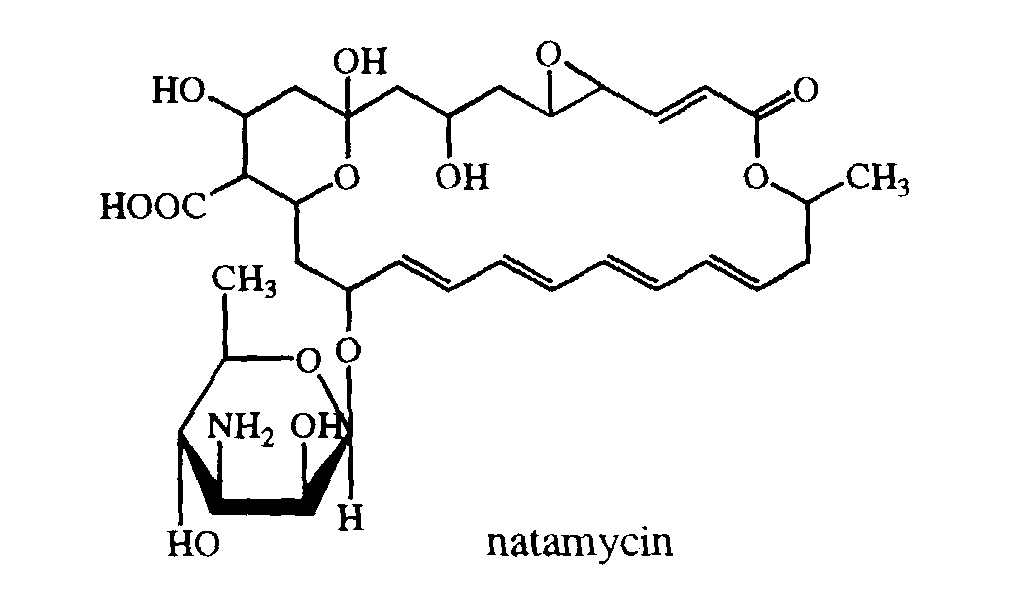
- Natamycin exerts its antifungal activity by an irreversible reaction with the cell membrane of fungi. Only the natamycin which is in solution will be available to inhibit fungal growth. Due to the low solubility of natamycin this can result in fungal spoilage in circumstances where the amount of fungi is high since the dissolved fraction of natamycin is then insufficient to prevent fungal growth. Especially when food products are exposed to natamycin resistant moulds (see e.g. EP-0,748,588, page 1, first column, lines 28 to 33) the low solubility of natamycin hampers the prevention of spoilage.
- It is known in the art, that e.g. cheeses are treated by immersion in a suspension of natamycin in water or covered by an emulsion of plastic in water, (mostly polyvinyl-acetate). Sausages are mainly treated by immersion or by spray coating with a suspension of natamycin in water.
- A disadvantage of immersion is the necessity of a large scale preparation of immersion liquid. This means a considerable spillage of immersion liquid, as in most cases the remaining fluid cannot be re-used due to "pollution" by cheese ingredients and the limited stability of the liquid caused by bacterial contamination. This means non-economical use of the preparation and causes an environmental burden.
- Natamycin containing plastic coatings are applied on hard and semi-hard cheeses. Unlike immersion, plastic coating of cheese has the advantage that the surface of the cheese can be treated by brushing, sponging or spraying with an emulsion, so there is no contaminated remaining immersion fluid. Applying plastic coating is economically attractive as the coating reduces loss of moisture and does not negatively influence the development of taste.
- For the treatment of cheese an aqueous polymer emulsion of the polyvinyl acetate type can be used. Commercially available aqueous polyvinyl acetate emulsions are e.g. Plasticoat™ and Ceska™. Plasticoat™ can be acquired from National Starch & Chemical B.V., while the Ceska™ coating is obtainable from CSK Food Enrichment.
- Due to the widespread use of natamycin in the prevention of fungal growth on food products, natamycin resistant fungal species are emerging. Example of such species are, e.g., Penicillium echinulatum var. discolor (P. discolor) and Cladosporium herbarum. Once P. discolor develops resistance against natamycin, it has a competitive advantage over other moulds and can quickly contaminate a complete cheese production facility (F.T.J. van Rijn, E.S. Hoekstra, M.I. van der Horst, R.A. Samson and J. Stark, Voedingsmiddeltechnologie, 20, p. 19 - 23, 1997). When contamination with P. discolor takes place before the first coating is applied to the cheese, the development of this mould can no longer be controlled, even by applying multiple layers of natamycin containing plastic coating, thus causing serious spoilage problems in the production of cheese.
- Growth of natamycin resistant fungal species can be overcome by increasing the amount of natamycin in the cheese coating, however there is a limit to the amount of natamycin in these coatings due to governmental regulations on the Acceptable Daily Intake (ADI) of food additives. Natamycin has the tendency to migrate slowly from the coating into the cheese. The European Parliament and Council Directive No. 95/2/EC of 20 February 1995 on food additives other than colours and sweeteners establishes that the penetration depth of natamycin into cheese should not exceed 5 mm and that the amount of natamycin on the surface should not exceed 1 mg per dm2 cheese surface. A theoretical calculation shows that 1 treatment of cheese with a plastic coating having a natamycin content of 500 ppm can exceed the limit of 1 mg/dm2 natamycin (Daemen C.B.G. and van den Berg G., NIZO-niews nr. 11, (1984), by the Dutch Institute for Dairy Research). Since a 5 month old cheese, depending on the storage conditions, usually needs 4 to 5 treatments with a plastic coating the amount of natamycin in these plastic coatings is typically about 250 ppm. Higher amounts of natamycin in plastic coating can easily lead to exceeding the limit of 1 mg per dm2 cheese surface or the maximum penetration depth of 5 mm. Hence, there is an upper limit to the amount of natamycin in plastic cheese coatings which may be insufficient to protect cheeses from spoilage by natamycin resistant fungal species.
- Increasing the amount of natamycin in polyvinyl acetate emulsions is also hampered by the low solubility of natamycin.
- To control unwanted outgrowth of natamycin resistant fungal species and in view of an effective anti-resistance strategy, it would be very useful to have an alternative fungicide to natamycin available.
- The inhibition of moulds on cheese by imazalil incorporated into low density polyethylene (LDPE) film has been described by Wheng Y.-M. and Hotchkiss J.H. in Journal of Food Protection, 55, p. 367 - 369, (1992). They described the inhibition of mould growth on the surface of Cheddar cheese by a LDPE packaging film containing imazalil.
- EP-0,513,922, published on 19 November 1992, discloses an oil in water emulsion comprising a suitable emulsifier, and at least one suitable antifungal agent, such as, e.g. natamycin, imazalil, lucensomycin, amphotericin B or nystatin, as a coating for foods and agricultural products to prevent the growth of moulds.
- EP-0,608,944, published on 3 August 1994, describes an antifungal composition comprising an antifungal agent of the polyene type, preferably natamycin or lucensomycin, an acidic antifungal compound and an additional organic acid or its alkali or earth alkali salt, as a fungicide composition to prevent the growth of mould on foodstuffs and agricultural products.
- WO-95/08918, published on 6 April 1995, discloses antifungal suspensions for the treatment of foodstuffs or agricultural products containing an antifungal agent of the polyene type, such as natamycin, wherein said antifungal agent is incorporated into the composition in a form which shows an enhanced activity, e.g. being in a modified polymorphic form.
- EP-0,748,588, published on 13 May 1996, discloses fungicide compositions comprising an antifungal amount of a polyene antifungal agent, such as natamycin, and an antifungal amount of an imidazole antifungal agent, such as imazalil, for the protection of foodstuffs or agricultural products. On page 8 second column, lines 13 to 18, it is stated that imazalil alone, even at very high concentrations, will not prevent spoilage by fungal species and that imazalil penetrates into the cheese and will not prevent fungal growth at the surface of the cheese, even when used at very high concentrations.
- The present invention relates to aqueous emulsions comprising polyvinyl acetate or a copolymer of polyvinyl acetate with dibutyl maleic acid, and the antifungal imazalil sulfate for the protection of food products. Unexpectedly and contrary to what was alleged in EP-0,748,588, it was found that the resulting food coatings are able to prevent growth of natamycin resistant fungal species. Furthermore, imazalil sulfate remains in the coating and after a storage period of 3 months or more the penetration depth of imazalil sulfate in the cheese does not exceed 1 mm while the amount of imazalil sulfate on the surface does not exceed 1 mg per dm2. Hence, the imazalil sulfate comprising food coatings of the present invention are in full compliance with European Community regulations.
- Imazalil sulfate is the 1:1 addition salt of imazalil with sulfuric acid and is the generic name of the compound (±)-1-[2-(2,4-dichlorophenyl)-2-(2-propenyloxy)ethyl]-1H-imidazole sulfate, which compound can be represented by the formula:
- The free base form of imazalil sulfate, i.e. imazalil, is described in US-3,658,813, as well as its synthesis and its antifungal properties.
- In a broader sense, the present invention also relates to the use of imazalil sulfate for combatting natamycin resistant fungi.
- The aqueous polymer emulsions of the present invention comprise polyvinyl acetate or a copolymer of polyvinyl acetate with dibutyl maleic acid having a concentration of about 40% w/v.
- The amount of the antifungal imazalil sulfate ranges from 0.1 ppm to 1000 ppm, in particular from 13 ppm to 666 ppm, especially from 133 to 333 ppm.
- The amount of imazalil sulfate in the aqueous polymer emulsions of the present invention can also be expressed in function of the amount of A.I. (active ingredient), i.e. the free base form imazalil. Hence the amount of imazalil sulfate, expressed in function of the amount of A.I. ranges from 0.1 to 750 ppm, in particular from 10 to 500 ppm, more particular from 100 to 250 ppm.
- The pH of the present aqueous polymer emulsions is from 3 to 8 and preferably from 4.5 to 5.5. The pH of these aqueous polymer emulsions can be adjusted by any method, e.g. by adding an acidic or a basic compound. Useful acids are e.g. citric acid, lactic acid, hydrochloric acid, phosphoric acid, sulphuric acid and tartaric acid. Useful basic compounds are e.g. sodium hydroxide, potassium hydroxide, ammonia and calcium hydroxide.
- The addition of a surfactant may be advantageous, in particular for treating objects with a hydrophobic surface. Useful surfactants are for example, anionic tensides such as sodium lauryl sulphate or polyethylene alkyl ethers such as Cetomacrogol™ 1000 or polyoxyethylene ethers e.g. Tween 60™, 61 and 65.
- The aqueous emulsions of the present invention are preferably obtained from concentrates, such as e.g. emulsifiable concentrates, suspension concentrates, or soluble concentrates, which upon dilution with water yield an aqueous emulsion comprising polyvinyl acetate or a copolymer of polyvinyl acetate with dibutyl maleic acid having a concentration of about 40% w/v and the antifungal imazalil sulfate having a concentration ranging from 0.1 ppm to 1000 ppm, in particular from 13 ppm to 666 ppm, more particular from 133 to 333 ppm. Consequently, the invention also relates to a product containing an aqueous emulsion of polyvinyl acetate or a copolymer of polyvinyl acetate with dibutyl maleic acid, and an aqueous concentrate of imazalil sulfate, which upon combination and dilution with water yields an aqueous emulsion for treating food products.
- The effectiveness of the food coatings comprising imazalil sulfate of the present invention to control natamycin resistant moulds was demonstrated in an experiment using cheeses of the "Gouda" type inoculated with three different amounts of spores of Penicillium echinulatum var. discolor. These P. discolor spores were isolated from cheese treated with natamycin.
- A batch of "Gouda" type cheeses was treated with an aqueous polymer emulsion of the polyvinyl acetate type comprising 250 ppm of natamycin. After drying the cheeses were kept on perforated coated steel plates during the whole experiment.
Said batch of cheeses was divided in three equal lots and each lot was contaminated with a different amount of spores of P. discolor: - Lot A : contaminated with 59x105 CFU/ml suspension (CFU : Colony Forming Units)
- Lot B : contaminated with 190x105 CFU/ml suspension
- Lot C : contaminated with 420x105 CFU/ml suspension.
-
- One day after contamination each lot of cheeses was treated with an aqueous polymer emulsion of the polyvinyl acetate type comprising either 100 ppm natamycin, 250 ppm natamycin, 133 ppm imazalil sulfate (corresponding to 100 ppm A.I.) or 333 ppm imazalil sulfate (corresponding to 250 ppm A.I.). Five days later all cheeses were treated again with the same coating.
- Within 12 days after contamination cheeses coated with the natamycin coatings (both the 100 ppm and the 250 ppm coatings) developed a clearly visible green mould and no visible difference was observed in mould intensity between the two concentrations of natamycin in the coating. The cheeses coated with an imazalil sulfate coating (both the 133 ppm and the 333 ppm) were free of visible mould growth.
- The surface of the contaminated cheeses was also sampled for microbiological analysis using sterile cotton swabs. The samples were diluted and plated on oxytetracycline glucose yeast extract (OGY) agar medium and incubated at 25°C for 5 days. The results were calculated as CFU (Colony Forming Units) per 100 cm2 cheese surface. Cheeses treated with a natamycin coating showed a flora fully dominated by P. discolor and high numbers of CFU. The cheeses treated with the imazalil sulfate coatings had a much lower number of CFU.
- It was concluded that the coatings comprising imazalil sulfate had the ability to suppress the growth of Penicillium echinulatum var. Discolor on cheese which could not be inhibited by natamycin coatings.
- Cheeses were treated with an aqueous polymer emulsion of the polyvinyl acetate type comprising imazalil sulfate and samples were collected at depths of 0 to 10 mm from the surface and analysed. Even after a storage period of 1, 2 and 3 months and after several treatments with imazalil sulfate comprising food coatings only traces of imazalil sulfate were detected under the surface layer not exceeding a penetration depth of 1 mm.
Claims (10)
- An aqueous emulsion suitable for coating a food product comprising(a) polyvinyl acetate or a copolymer of polyvinyl acetate with dibutyl maleic acid, and(b) the antifungal imazalil sulfate.
- An aqueous emulsion as claimed in claim 1 wherein the amount of polyvinyl acetate or a copolymer of polyvinyl acetate with dibutyl maleic acid is about 40% w/v.
- An aqueous emulsion as claimed in claim 1 or claim 2 wherein the amount of imazalil sulfate ranges from 0.1 ppm to 1000 ppm.
- An aqueous emulsion as claimed in claim 1 or claim 2 wherein the amount of imazalil sulfate ranges from 13 ppm to 666 ppm.
- An aqueous emulsion as claimed in claim 1 or claim 2 wherein the amount of imazalil sulfate ranges from 133 ppm to 333 ppm.
- A food product coated with an emulsion as defined in any of claims 1 to 5.
- A food product according to claim 6 wherein said food product is a sausage or a hard or semi-hard cheese.
- Use of an aqueous emulsion as defined in any of claims 1 to 5 for coating a food product.
- Use of imazalil sulfate for combatting natamycin resistant fungi.
- A product containinga) an aqueous emulsion of polyvinyl acetate or a copolymer of polyvinyl acetate with dibutyl maleic acid, andb) an aqueous concentrate of imazalil sulfate,
which upon combination and dilution with water yields an aqueous emulsion for treating food products.
Priority Applications (7)
| Application Number | Priority Date | Filing Date | Title |
|---|---|---|---|
| EP98203144A EP0986965A1 (en) | 1998-09-18 | 1998-09-18 | Antifungal food coatings |
| AU63278/99A AU6327899A (en) | 1998-09-18 | 1999-09-14 | Food coatings |
| PL99346657A PL346657A1 (en) | 1998-09-18 | 1999-09-14 | Food coatings |
| PCT/EP1999/006777 WO2000016644A1 (en) | 1998-09-18 | 1999-09-14 | Food coatings |
| EP99950526A EP1113727A1 (en) | 1998-09-18 | 1999-09-14 | Food coatings |
| NO20011285A NO20011285L (en) | 1998-09-18 | 2001-03-14 | Coatings for food |
| ZA200102177A ZA200102177B (en) | 1998-09-18 | 2001-03-15 | Food coatings. |
Applications Claiming Priority (1)
| Application Number | Priority Date | Filing Date | Title |
|---|---|---|---|
| EP98203144A EP0986965A1 (en) | 1998-09-18 | 1998-09-18 | Antifungal food coatings |
Publications (1)
| Publication Number | Publication Date |
|---|---|
| EP0986965A1 true EP0986965A1 (en) | 2000-03-22 |
Family
ID=8234134
Family Applications (2)
| Application Number | Title | Priority Date | Filing Date |
|---|---|---|---|
| EP98203144A Withdrawn EP0986965A1 (en) | 1998-09-18 | 1998-09-18 | Antifungal food coatings |
| EP99950526A Withdrawn EP1113727A1 (en) | 1998-09-18 | 1999-09-14 | Food coatings |
Family Applications After (1)
| Application Number | Title | Priority Date | Filing Date |
|---|---|---|---|
| EP99950526A Withdrawn EP1113727A1 (en) | 1998-09-18 | 1999-09-14 | Food coatings |
Country Status (6)
| Country | Link |
|---|---|
| EP (2) | EP0986965A1 (en) |
| AU (1) | AU6327899A (en) |
| NO (1) | NO20011285L (en) |
| PL (1) | PL346657A1 (en) |
| WO (1) | WO2000016644A1 (en) |
| ZA (1) | ZA200102177B (en) |
Cited By (9)
| Publication number | Priority date | Publication date | Assignee | Title |
|---|---|---|---|---|
| DE102005027347A1 (en) * | 2005-06-13 | 2006-12-14 | Fraunhofer-Gesellschaft zur Förderung der angewandten Forschung e.V. | Process for the preparation of an antimicrobial coating on a technical surface |
| US7312272B2 (en) | 2001-12-21 | 2007-12-25 | Celanese Emulsions Gmbh | Food coating substance containing a softener-free aqueous copolymer poly(vinyl ester) dispersion, production and use thereof |
| US7491777B2 (en) | 2003-12-02 | 2009-02-17 | Celanese Emulsions Gmbh | Polymer dispersions having improved water-vapor barrier action, their production and use for food coating |
| US7776938B2 (en) | 2004-06-23 | 2010-08-17 | Celanese Emulsions Gmbh | Food coating composition comprising protective colloid-stabilized polyacrylate dispersions, use thereof and coated foods produced therewith |
| NL2005010C2 (en) * | 2010-07-01 | 2012-01-03 | Csk Food Enrichment Bv | Spray coating compositions for cheese. |
| US20120076919A1 (en) * | 2005-06-13 | 2012-03-29 | Dieter Sandmeier | Method for producing an antimicrobial coating on a technical surface |
| EP2443934A1 (en) * | 2010-10-25 | 2012-04-25 | CSK Food Enrichment B.V. | Use of a sugar fatty acid ester as a fungicide in the surface treatment of cheese |
| WO2012107466A1 (en) | 2011-02-09 | 2012-08-16 | Dsm Ip Assets B.V. | New antifungal compositions |
| WO2012117051A1 (en) * | 2011-03-03 | 2012-09-07 | Dsm Ip Assets B.V. | New antifungal compositions |
Families Citing this family (2)
| Publication number | Priority date | Publication date | Assignee | Title |
|---|---|---|---|---|
| MX2009002351A (en) | 2008-03-07 | 2009-09-25 | Plant Protectants Llc | METHODS TO PROTECT CROPS FROM POST HARVEST MICROBIAL DECOMPOSITION. |
| US9675080B2 (en) | 2009-03-20 | 2017-06-13 | Verdesian Life Sciences U.S., Llc | Methods for delaying maturity of crops |
Citations (5)
| Publication number | Priority date | Publication date | Assignee | Title |
|---|---|---|---|---|
| US3658813A (en) * | 1970-01-13 | 1972-04-25 | Janssen Pharmaceutica Nv | 1-(beta-aryl-beta-(r-oxy)-ethyl)-imidazoles |
| FR2609714A1 (en) * | 1987-01-15 | 1988-07-22 | Sanofi Sa | Stable liquid compositions based on fungicidal imidazole derivatives |
| EP0513922A1 (en) * | 1991-05-17 | 1992-11-19 | Gist-Brocades N.V. | Coating for foods and agricultural products to prevent the growth of moulds |
| ES2065284A1 (en) * | 1993-07-14 | 1995-02-01 | Agriplan S A | Fungicidal compsn. for application to fruit - contains fungicide mixt., wax, surfactant and thickener suspended in liquid vehicle |
| EP0748588A1 (en) * | 1995-05-12 | 1996-12-18 | Gist-Brocades B.V. | Fungicide compositions |
Family Cites Families (7)
| Publication number | Priority date | Publication date | Assignee | Title |
|---|---|---|---|---|
| EP0002331A3 (en) * | 1977-12-07 | 1979-06-27 | Imperial Chemical Industries Plc | Imidazole and triazole compounds, fungicidal and plant growth regulating compositions, method of combating fungal infections in plants and method of regulating plant growth |
| GB2013175A (en) * | 1977-12-07 | 1979-08-08 | Ici Ltd | Imidazole and triazole compounds, fungicidal and plant growth regulating compositions, method of combating fungal infections in plants and method of regulating plant growth |
| DE3202604A1 (en) * | 1982-01-27 | 1983-08-04 | Bayer Ag, 5090 Leverkusen | ETHER DERIVATIVES OF SUBSTITUTED 1-HYDROXYALKYL-AZOLES, METHOD FOR THE PRODUCTION THEREOF AND THEIR USE AS FUNGICIDES AND PLANT GROWTH REGULATORS |
| DE3803832A1 (en) * | 1988-02-09 | 1989-08-17 | Bayer Ag | SUBSTITUTED VINYLAZOLE |
| GB8903019D0 (en) * | 1989-02-10 | 1989-03-30 | Ici Plc | Fungicides |
| AU666415B2 (en) * | 1993-01-27 | 1996-02-08 | Dsm Ip Assets B.V. | A fungicide composition to prevent the growth of mould on foodstuff and agricultural products |
| EP0670676B1 (en) * | 1993-09-29 | 2005-12-07 | DSM IP Assets B.V. | Modified forms of natamycin, methods for preparing them and antifungal compositions containing them |
-
1998
- 1998-09-18 EP EP98203144A patent/EP0986965A1/en not_active Withdrawn
-
1999
- 1999-09-14 PL PL99346657A patent/PL346657A1/en unknown
- 1999-09-14 EP EP99950526A patent/EP1113727A1/en not_active Withdrawn
- 1999-09-14 WO PCT/EP1999/006777 patent/WO2000016644A1/en not_active Ceased
- 1999-09-14 AU AU63278/99A patent/AU6327899A/en not_active Abandoned
-
2001
- 2001-03-14 NO NO20011285A patent/NO20011285L/en not_active Application Discontinuation
- 2001-03-15 ZA ZA200102177A patent/ZA200102177B/en unknown
Patent Citations (5)
| Publication number | Priority date | Publication date | Assignee | Title |
|---|---|---|---|---|
| US3658813A (en) * | 1970-01-13 | 1972-04-25 | Janssen Pharmaceutica Nv | 1-(beta-aryl-beta-(r-oxy)-ethyl)-imidazoles |
| FR2609714A1 (en) * | 1987-01-15 | 1988-07-22 | Sanofi Sa | Stable liquid compositions based on fungicidal imidazole derivatives |
| EP0513922A1 (en) * | 1991-05-17 | 1992-11-19 | Gist-Brocades N.V. | Coating for foods and agricultural products to prevent the growth of moulds |
| ES2065284A1 (en) * | 1993-07-14 | 1995-02-01 | Agriplan S A | Fungicidal compsn. for application to fruit - contains fungicide mixt., wax, surfactant and thickener suspended in liquid vehicle |
| EP0748588A1 (en) * | 1995-05-12 | 1996-12-18 | Gist-Brocades B.V. | Fungicide compositions |
Non-Patent Citations (1)
| Title |
|---|
| DATABASE WPI Section Ch Week 9511, Derwent World Patents Index; Class A97, AN 95-076656, XP002092299 * |
Cited By (14)
| Publication number | Priority date | Publication date | Assignee | Title |
|---|---|---|---|---|
| US7312272B2 (en) | 2001-12-21 | 2007-12-25 | Celanese Emulsions Gmbh | Food coating substance containing a softener-free aqueous copolymer poly(vinyl ester) dispersion, production and use thereof |
| US7491777B2 (en) | 2003-12-02 | 2009-02-17 | Celanese Emulsions Gmbh | Polymer dispersions having improved water-vapor barrier action, their production and use for food coating |
| US7776938B2 (en) | 2004-06-23 | 2010-08-17 | Celanese Emulsions Gmbh | Food coating composition comprising protective colloid-stabilized polyacrylate dispersions, use thereof and coated foods produced therewith |
| US20120076919A1 (en) * | 2005-06-13 | 2012-03-29 | Dieter Sandmeier | Method for producing an antimicrobial coating on a technical surface |
| DE102005027347B4 (en) * | 2005-06-13 | 2007-09-27 | Fraunhofer-Gesellschaft zur Förderung der angewandten Forschung e.V. | Process for the preparation of an antimicrobial coating on a technical surface |
| AU2006257495B2 (en) * | 2005-06-13 | 2011-11-10 | Fraunhofer-Gesellschaft Zur Forderung Der Angewandten Forschung E.V. | Method for producing an antimicrobial coating on a technical surface |
| DE102005027347A1 (en) * | 2005-06-13 | 2006-12-14 | Fraunhofer-Gesellschaft zur Förderung der angewandten Forschung e.V. | Process for the preparation of an antimicrobial coating on a technical surface |
| US8986776B2 (en) | 2005-06-13 | 2015-03-24 | Fraunhofer-Gesellschaft zur Förderung der angewandten Forschung e.V. | Method for producing an antimicrobial coating on a technical surface |
| NL2005010C2 (en) * | 2010-07-01 | 2012-01-03 | Csk Food Enrichment Bv | Spray coating compositions for cheese. |
| EP2401911A1 (en) * | 2010-07-01 | 2012-01-04 | CSK Food Enrichment B.V. | Spray coating compositions for cheese |
| EP2443934A1 (en) * | 2010-10-25 | 2012-04-25 | CSK Food Enrichment B.V. | Use of a sugar fatty acid ester as a fungicide in the surface treatment of cheese |
| WO2012107466A1 (en) | 2011-02-09 | 2012-08-16 | Dsm Ip Assets B.V. | New antifungal compositions |
| WO2012117051A1 (en) * | 2011-03-03 | 2012-09-07 | Dsm Ip Assets B.V. | New antifungal compositions |
| US8946121B2 (en) | 2011-03-03 | 2015-02-03 | Dsm Ip Assets B.V. | Antifungal compositions |
Also Published As
| Publication number | Publication date |
|---|---|
| NO20011285L (en) | 2001-05-16 |
| EP1113727A1 (en) | 2001-07-11 |
| ZA200102177B (en) | 2002-03-15 |
| NO20011285D0 (en) | 2001-03-14 |
| AU6327899A (en) | 2000-04-10 |
| PL346657A1 (en) | 2002-02-25 |
| WO2000016644A1 (en) | 2000-03-30 |
Similar Documents
| Publication | Publication Date | Title |
|---|---|---|
| US5597598A (en) | Fungicide composition to prevent the growth of mould on foodstuff and agricultural products | |
| Davidson et al. | Natamycin | |
| EP0670676B1 (en) | Modified forms of natamycin, methods for preparing them and antifungal compositions containing them | |
| AU666415B2 (en) | A fungicide composition to prevent the growth of mould on foodstuff and agricultural products | |
| US7816332B2 (en) | Stable aqueous solution of natamycin fungicide | |
| Stiles et al. | Antifungal activity of sodium acetate and Lactobacillus rhamnosus | |
| US20140023762A1 (en) | Antimicrobial Composition | |
| EP2224817A2 (en) | Antimicrobial composition | |
| WO2000016644A1 (en) | Food coatings | |
| Delves-Broughton et al. | Natamycin | |
| Stark et al. | Natamycin | |
| US5997926A (en) | Antifungal complexes | |
| US20040175473A1 (en) | Anti-listeria compositions for use in food products | |
| De Boer et al. | Sensitivity to natamycin (pimaricin) of fungi isolated in cheese warehouses | |
| CA2232157C (en) | Antifungal composition | |
| EP0748588B1 (en) | Fungicide compositions | |
| EP0867124A1 (en) | Antifungal composition | |
| Rusul et al. | Growth and aflatoxin production by Aspergillus parasiticus NRRL 2999 in the presence of acetic or propionic acid and at different initial pH values | |
| US20050226974A1 (en) | Natamycin dosage form, process for preparing same, method for preserving a food product and preserved food product | |
| Stark | Cheese and fermented sausages | |
| WO2007063043A1 (en) | Improved anti-microbial composition | |
| MXPA04006110A (en) | IMPROVED METHOD FOR TREATMENT OF FOOD, BALANCED FOOD OR AGRICULTURAL PRODUCTS WITH AN ANTIFUNGIC POLYENIC COMPOUND. |
Legal Events
| Date | Code | Title | Description |
|---|---|---|---|
| PUAI | Public reference made under article 153(3) epc to a published international application that has entered the european phase |
Free format text: ORIGINAL CODE: 0009012 |
|
| AK | Designated contracting states |
Kind code of ref document: A1 Designated state(s): AT BE CH CY DE DK ES FI FR GB GR IE IT LI LU MC NL PT SE |
|
| AX | Request for extension of the european patent |
Free format text: AL;LT;LV;MK;RO;SI |
|
| AKX | Designation fees paid | ||
| STAA | Information on the status of an ep patent application or granted ep patent |
Free format text: STATUS: THE APPLICATION IS DEEMED TO BE WITHDRAWN |
|
| 18D | Application deemed to be withdrawn |
Effective date: 20000923 |