EP0995727A1 - Cement additive on the basis of acrylic copolymers - Google Patents
Cement additive on the basis of acrylic copolymers Download PDFInfo
- Publication number
- EP0995727A1 EP0995727A1 EP99121074A EP99121074A EP0995727A1 EP 0995727 A1 EP0995727 A1 EP 0995727A1 EP 99121074 A EP99121074 A EP 99121074A EP 99121074 A EP99121074 A EP 99121074A EP 0995727 A1 EP0995727 A1 EP 0995727A1
- Authority
- EP
- European Patent Office
- Prior art keywords
- addition
- denotes
- general formula
- glycol
- carbon atoms
- Prior art date
- Legal status (The legal status is an assumption and is not a legal conclusion. Google has not performed a legal analysis and makes no representation as to the accuracy of the status listed.)
- Granted
Links
- 239000004568 cement Substances 0.000 title claims abstract description 105
- 239000000654 additive Substances 0.000 title claims abstract description 47
- 230000000996 additive effect Effects 0.000 title claims abstract description 43
- 229920006243 acrylic copolymer Polymers 0.000 title 1
- 229920001577 copolymer Polymers 0.000 claims abstract description 134
- 125000004432 carbon atom Chemical group C* 0.000 claims abstract description 95
- 229920001515 polyalkylene glycol Polymers 0.000 claims abstract description 57
- 125000005702 oxyalkylene group Chemical group 0.000 claims abstract description 35
- 239000000178 monomer Substances 0.000 claims description 83
- 150000002148 esters Chemical group 0.000 claims description 53
- 239000000203 mixture Substances 0.000 claims description 40
- 229910052751 metal Inorganic materials 0.000 claims description 23
- 239000002184 metal Substances 0.000 claims description 23
- 238000000034 method Methods 0.000 claims description 19
- LFQSCWFLJHTTHZ-UHFFFAOYSA-N Ethanol Chemical compound CCO LFQSCWFLJHTTHZ-UHFFFAOYSA-N 0.000 claims description 14
- 150000001412 amines Chemical class 0.000 claims description 13
- 125000006353 oxyethylene group Chemical group 0.000 claims description 13
- 239000001257 hydrogen Substances 0.000 claims description 12
- 229910052739 hydrogen Inorganic materials 0.000 claims description 12
- 125000002496 methyl group Chemical group [H]C([H])([H])* 0.000 claims description 8
- QGZKDVFQNNGYKY-UHFFFAOYSA-O Ammonium Chemical compound [NH4+] QGZKDVFQNNGYKY-UHFFFAOYSA-O 0.000 claims description 7
- UFHFLCQGNIYNRP-UHFFFAOYSA-N Hydrogen Chemical compound [H][H] UFHFLCQGNIYNRP-UHFFFAOYSA-N 0.000 claims description 6
- 150000002431 hydrogen Chemical class 0.000 claims description 6
- 125000001183 hydrocarbyl group Chemical group 0.000 claims 4
- 239000004570 mortar (masonry) Substances 0.000 abstract description 47
- 239000012530 fluid Substances 0.000 abstract description 18
- 125000004185 ester group Chemical group 0.000 abstract 2
- LYCAIKOWRPUZTN-UHFFFAOYSA-N Ethylene glycol Chemical compound OCCO LYCAIKOWRPUZTN-UHFFFAOYSA-N 0.000 description 151
- -1 acrylic ester Chemical class 0.000 description 81
- WGCNASOHLSPBMP-UHFFFAOYSA-N hydroxyacetaldehyde Natural products OCC=O WGCNASOHLSPBMP-UHFFFAOYSA-N 0.000 description 77
- DNIAPMSPPWPWGF-UHFFFAOYSA-N Propylene glycol Chemical compound CC(O)CO DNIAPMSPPWPWGF-UHFFFAOYSA-N 0.000 description 63
- 125000002947 alkylene group Chemical group 0.000 description 63
- 229920001223 polyethylene glycol Polymers 0.000 description 58
- 239000002202 Polyethylene glycol Substances 0.000 description 55
- 229920001451 polypropylene glycol Polymers 0.000 description 42
- 150000003839 salts Chemical class 0.000 description 42
- PUPZLCDOIYMWBV-UHFFFAOYSA-N (+/-)-1,3-Butanediol Chemical compound CC(O)CCO PUPZLCDOIYMWBV-UHFFFAOYSA-N 0.000 description 40
- HEMHJVSKTPXQMS-UHFFFAOYSA-M Sodium hydroxide Chemical compound [OH-].[Na+] HEMHJVSKTPXQMS-UHFFFAOYSA-M 0.000 description 39
- NIXOWILDQLNWCW-UHFFFAOYSA-M Acrylate Chemical compound [O-]C(=O)C=C NIXOWILDQLNWCW-UHFFFAOYSA-M 0.000 description 35
- 230000000052 comparative effect Effects 0.000 description 35
- 239000000243 solution Substances 0.000 description 33
- XLYOFNOQVPJJNP-UHFFFAOYSA-N water Substances O XLYOFNOQVPJJNP-UHFFFAOYSA-N 0.000 description 33
- 229920001748 polybutylene Polymers 0.000 description 31
- IAYPIBMASNFSPL-UHFFFAOYSA-N Ethylene oxide Chemical compound C1CO1 IAYPIBMASNFSPL-UHFFFAOYSA-N 0.000 description 28
- 238000006243 chemical reaction Methods 0.000 description 28
- 235000019441 ethanol Nutrition 0.000 description 24
- 239000002253 acid Substances 0.000 description 23
- GWZMWHWAWHPNHN-UHFFFAOYSA-N 2-hydroxypropyl prop-2-enoate Chemical compound CC(O)COC(=O)C=C GWZMWHWAWHPNHN-UHFFFAOYSA-N 0.000 description 20
- NIXOWILDQLNWCW-UHFFFAOYSA-N acrylic acid group Chemical group C(C=C)(=O)O NIXOWILDQLNWCW-UHFFFAOYSA-N 0.000 description 18
- ROOXNKNUYICQNP-UHFFFAOYSA-N ammonium persulfate Chemical compound [NH4+].[NH4+].[O-]S(=O)(=O)OOS([O-])(=O)=O ROOXNKNUYICQNP-UHFFFAOYSA-N 0.000 description 18
- GOOHAUXETOMSMM-UHFFFAOYSA-N Propylene oxide Chemical compound CC1CO1 GOOHAUXETOMSMM-UHFFFAOYSA-N 0.000 description 17
- 239000004567 concrete Substances 0.000 description 17
- 239000002585 base Substances 0.000 description 16
- 150000001298 alcohols Chemical class 0.000 description 14
- 239000002518 antifoaming agent Substances 0.000 description 14
- 238000004519 manufacturing process Methods 0.000 description 14
- 239000000047 product Substances 0.000 description 14
- CERQOIWHTDAKMF-UHFFFAOYSA-N Methacrylic acid Chemical compound CC(=C)C(O)=O CERQOIWHTDAKMF-UHFFFAOYSA-N 0.000 description 13
- SMZOUWXMTYCWNB-UHFFFAOYSA-N 2-(2-methoxy-5-methylphenyl)ethanamine Chemical compound COC1=CC=C(C)C=C1CCN SMZOUWXMTYCWNB-UHFFFAOYSA-N 0.000 description 12
- ATVJXMYDOSMEPO-UHFFFAOYSA-N 3-prop-2-enoxyprop-1-ene Chemical compound C=CCOCC=C ATVJXMYDOSMEPO-UHFFFAOYSA-N 0.000 description 12
- WYURNTSHIVDZCO-UHFFFAOYSA-N Tetrahydrofuran Chemical compound C1CCOC1 WYURNTSHIVDZCO-UHFFFAOYSA-N 0.000 description 12
- 239000002270 dispersing agent Substances 0.000 description 11
- 238000002156 mixing Methods 0.000 description 11
- 238000006116 polymerization reaction Methods 0.000 description 11
- 239000003795 chemical substances by application Substances 0.000 description 10
- 239000003513 alkali Substances 0.000 description 9
- 125000005336 allyloxy group Chemical group 0.000 description 9
- 229910001870 ammonium persulfate Inorganic materials 0.000 description 9
- 125000001301 ethoxy group Chemical group [H]C([H])([H])C([H])([H])O* 0.000 description 9
- 150000002334 glycols Chemical class 0.000 description 9
- 238000000265 homogenisation Methods 0.000 description 9
- 125000000956 methoxy group Chemical group [H]C([H])([H])O* 0.000 description 9
- 125000002572 propoxy group Chemical group [*]OC([H])([H])C(C([H])([H])[H])([H])[H] 0.000 description 9
- DKIDEFUBRARXTE-UHFFFAOYSA-N 3-mercaptopropanoic acid Chemical compound OC(=O)CCS DKIDEFUBRARXTE-UHFFFAOYSA-N 0.000 description 8
- 150000001252 acrylic acid derivatives Chemical class 0.000 description 8
- 239000007864 aqueous solution Substances 0.000 description 8
- 239000000463 material Substances 0.000 description 8
- 238000005259 measurement Methods 0.000 description 8
- LCPVQAHEFVXVKT-UHFFFAOYSA-N 2-(2,4-difluorophenoxy)pyridin-3-amine Chemical compound NC1=CC=CN=C1OC1=CC=C(F)C=C1F LCPVQAHEFVXVKT-UHFFFAOYSA-N 0.000 description 7
- VYPSYNLAJGMNEJ-UHFFFAOYSA-N Silicium dioxide Chemical compound O=[Si]=O VYPSYNLAJGMNEJ-UHFFFAOYSA-N 0.000 description 7
- 239000012298 atmosphere Substances 0.000 description 7
- 230000007062 hydrolysis Effects 0.000 description 7
- 238000006460 hydrolysis reaction Methods 0.000 description 7
- IJGRMHOSHXDMSA-UHFFFAOYSA-N nitrogen Substances N#N IJGRMHOSHXDMSA-UHFFFAOYSA-N 0.000 description 7
- 229910052757 nitrogen Inorganic materials 0.000 description 7
- 239000012299 nitrogen atmosphere Substances 0.000 description 7
- QJGQUHMNIGDVPM-UHFFFAOYSA-N nitrogen group Chemical group [N] QJGQUHMNIGDVPM-UHFFFAOYSA-N 0.000 description 7
- 238000010992 reflux Methods 0.000 description 7
- CHQMHPLRPQMAMX-UHFFFAOYSA-L sodium persulfate Substances [Na+].[Na+].[O-]S(=O)(=O)OOS([O-])(=O)=O CHQMHPLRPQMAMX-UHFFFAOYSA-L 0.000 description 7
- 238000003756 stirring Methods 0.000 description 7
- QTBSBXVTEAMEQO-UHFFFAOYSA-N Acetic acid Chemical compound CC(O)=O QTBSBXVTEAMEQO-UHFFFAOYSA-N 0.000 description 6
- WEVYAHXRMPXWCK-UHFFFAOYSA-N Acetonitrile Chemical compound CC#N WEVYAHXRMPXWCK-UHFFFAOYSA-N 0.000 description 6
- KFZMGEQAYNKOFK-UHFFFAOYSA-N Isopropanol Chemical compound CC(C)O KFZMGEQAYNKOFK-UHFFFAOYSA-N 0.000 description 6
- OKKJLVBELUTLKV-UHFFFAOYSA-N Methanol Chemical compound OC OKKJLVBELUTLKV-UHFFFAOYSA-N 0.000 description 6
- 150000007513 acids Chemical class 0.000 description 6
- 150000001408 amides Chemical class 0.000 description 6
- 150000001991 dicarboxylic acids Chemical class 0.000 description 6
- 235000014113 dietary fatty acids Nutrition 0.000 description 6
- 230000032050 esterification Effects 0.000 description 6
- 238000005886 esterification reaction Methods 0.000 description 6
- 239000000194 fatty acid Substances 0.000 description 6
- 229930195729 fatty acid Natural products 0.000 description 6
- 150000002430 hydrocarbons Chemical group 0.000 description 6
- 239000006072 paste Substances 0.000 description 6
- HRPVXLWXLXDGHG-UHFFFAOYSA-N Acrylamide Chemical compound NC(=O)C=C HRPVXLWXLXDGHG-UHFFFAOYSA-N 0.000 description 5
- 229920003171 Poly (ethylene oxide) Polymers 0.000 description 5
- 125000000217 alkyl group Chemical group 0.000 description 5
- 230000007423 decrease Effects 0.000 description 5
- 230000000694 effects Effects 0.000 description 5
- 238000004898 kneading Methods 0.000 description 5
- 239000002245 particle Substances 0.000 description 5
- 229920001296 polysiloxane Polymers 0.000 description 5
- UIIIBRHUICCMAI-UHFFFAOYSA-N prop-2-ene-1-sulfonic acid Chemical compound OS(=O)(=O)CC=C UIIIBRHUICCMAI-UHFFFAOYSA-N 0.000 description 5
- DGAQECJNVWCQMB-PUAWFVPOSA-M Ilexoside XXIX Chemical compound C[C@@H]1CC[C@@]2(CC[C@@]3(C(=CC[C@H]4[C@]3(CC[C@@H]5[C@@]4(CC[C@@H](C5(C)C)OS(=O)(=O)[O-])C)C)[C@@H]2[C@]1(C)O)C)C(=O)O[C@H]6[C@@H]([C@H]([C@@H]([C@H](O6)CO)O)O)O.[Na+] DGAQECJNVWCQMB-PUAWFVPOSA-M 0.000 description 4
- RRHGJUQNOFWUDK-UHFFFAOYSA-N Isoprene Chemical compound CC(=C)C=C RRHGJUQNOFWUDK-UHFFFAOYSA-N 0.000 description 4
- 239000011398 Portland cement Substances 0.000 description 4
- 229920002125 Sokalan® Polymers 0.000 description 4
- XXROGKLTLUQVRX-UHFFFAOYSA-N allyl alcohol Chemical compound OCC=C XXROGKLTLUQVRX-UHFFFAOYSA-N 0.000 description 4
- 150000003863 ammonium salts Chemical class 0.000 description 4
- 230000003247 decreasing effect Effects 0.000 description 4
- RTZKZFJDLAIYFH-UHFFFAOYSA-N ether Substances CCOCC RTZKZFJDLAIYFH-UHFFFAOYSA-N 0.000 description 4
- FPYJFEHAWHCUMM-UHFFFAOYSA-N maleic anhydride Chemical compound O=C1OC(=O)C=C1 FPYJFEHAWHCUMM-UHFFFAOYSA-N 0.000 description 4
- GLDOVTGHNKAZLK-UHFFFAOYSA-N octadecan-1-ol Chemical compound CCCCCCCCCCCCCCCCCCO GLDOVTGHNKAZLK-UHFFFAOYSA-N 0.000 description 4
- 239000004584 polyacrylic acid Substances 0.000 description 4
- 229920000642 polymer Polymers 0.000 description 4
- 239000003505 polymerization initiator Substances 0.000 description 4
- 239000011734 sodium Substances 0.000 description 4
- 229910052708 sodium Inorganic materials 0.000 description 4
- 159000000000 sodium salts Chemical class 0.000 description 4
- VZCYOOQTPOCHFL-UHFFFAOYSA-N trans-butenedioic acid Natural products OC(=O)C=CC(O)=O VZCYOOQTPOCHFL-UHFFFAOYSA-N 0.000 description 4
- RBACIKXCRWGCBB-UHFFFAOYSA-N 1,2-Epoxybutane Chemical compound CCC1CO1 RBACIKXCRWGCBB-UHFFFAOYSA-N 0.000 description 3
- GELKGHVAFRCJNA-UHFFFAOYSA-N 2,2-Dimethyloxirane Chemical compound CC1(C)CO1 GELKGHVAFRCJNA-UHFFFAOYSA-N 0.000 description 3
- PQXKWPLDPFFDJP-UHFFFAOYSA-N 2,3-dimethyloxirane Chemical compound CC1OC1C PQXKWPLDPFFDJP-UHFFFAOYSA-N 0.000 description 3
- ZWEHNKRNPOVVGH-UHFFFAOYSA-N 2-Butanone Chemical compound CCC(C)=O ZWEHNKRNPOVVGH-UHFFFAOYSA-N 0.000 description 3
- CSCPPACGZOOCGX-UHFFFAOYSA-N Acetone Chemical compound CC(C)=O CSCPPACGZOOCGX-UHFFFAOYSA-N 0.000 description 3
- UHOVQNZJYSORNB-UHFFFAOYSA-N Benzene Chemical compound C1=CC=CC=C1 UHOVQNZJYSORNB-UHFFFAOYSA-N 0.000 description 3
- KAKZBPTYRLMSJV-UHFFFAOYSA-N Butadiene Chemical compound C=CC=C KAKZBPTYRLMSJV-UHFFFAOYSA-N 0.000 description 3
- FBPFZTCFMRRESA-FSIIMWSLSA-N D-Glucitol Natural products OC[C@H](O)[C@H](O)[C@@H](O)[C@H](O)CO FBPFZTCFMRRESA-FSIIMWSLSA-N 0.000 description 3
- FBPFZTCFMRRESA-JGWLITMVSA-N D-glucitol Chemical compound OC[C@H](O)[C@@H](O)[C@H](O)[C@H](O)CO FBPFZTCFMRRESA-JGWLITMVSA-N 0.000 description 3
- XEKOWRVHYACXOJ-UHFFFAOYSA-N Ethyl acetate Chemical compound CCOC(C)=O XEKOWRVHYACXOJ-UHFFFAOYSA-N 0.000 description 3
- PEDCQBHIVMGVHV-UHFFFAOYSA-N Glycerine Chemical compound OCC(O)CO PEDCQBHIVMGVHV-UHFFFAOYSA-N 0.000 description 3
- IMNFDUFMRHMDMM-UHFFFAOYSA-N N-Heptane Chemical compound CCCCCCC IMNFDUFMRHMDMM-UHFFFAOYSA-N 0.000 description 3
- KWYUFKZDYYNOTN-UHFFFAOYSA-M Potassium hydroxide Chemical compound [OH-].[K+] KWYUFKZDYYNOTN-UHFFFAOYSA-M 0.000 description 3
- OFOBLEOULBTSOW-UHFFFAOYSA-N Propanedioic acid Natural products OC(=O)CC(O)=O OFOBLEOULBTSOW-UHFFFAOYSA-N 0.000 description 3
- YXFVVABEGXRONW-UHFFFAOYSA-N Toluene Chemical compound CC1=CC=CC=C1 YXFVVABEGXRONW-UHFFFAOYSA-N 0.000 description 3
- QYKIQEUNHZKYBP-UHFFFAOYSA-N Vinyl ether Chemical class C=COC=C QYKIQEUNHZKYBP-UHFFFAOYSA-N 0.000 description 3
- HSFWRNGVRCDJHI-UHFFFAOYSA-N alpha-acetylene Natural products C#C HSFWRNGVRCDJHI-UHFFFAOYSA-N 0.000 description 3
- 239000002956 ash Substances 0.000 description 3
- KRKNYBCHXYNGOX-UHFFFAOYSA-N citric acid Chemical compound OC(=O)CC(O)(C(O)=O)CC(O)=O KRKNYBCHXYNGOX-UHFFFAOYSA-N 0.000 description 3
- 239000007859 condensation product Substances 0.000 description 3
- 150000005690 diesters Chemical class 0.000 description 3
- 239000010881 fly ash Substances 0.000 description 3
- 239000000499 gel Substances 0.000 description 3
- VZCYOOQTPOCHFL-UPHRSURJSA-N maleic acid Chemical compound OC(=O)\C=C/C(O)=O VZCYOOQTPOCHFL-UPHRSURJSA-N 0.000 description 3
- 239000011976 maleic acid Substances 0.000 description 3
- BDERNNFJNOPAEC-UHFFFAOYSA-N propan-1-ol Chemical compound CCCO BDERNNFJNOPAEC-UHFFFAOYSA-N 0.000 description 3
- 239000004576 sand Substances 0.000 description 3
- 239000002893 slag Substances 0.000 description 3
- 239000000600 sorbitol Substances 0.000 description 3
- 239000000126 substance Substances 0.000 description 3
- 229920002818 (Hydroxyethyl)methacrylate Polymers 0.000 description 2
- MYRTYDVEIRVNKP-UHFFFAOYSA-N 1,2-Divinylbenzene Chemical compound C=CC1=CC=CC=C1C=C MYRTYDVEIRVNKP-UHFFFAOYSA-N 0.000 description 2
- OZAIFHULBGXAKX-UHFFFAOYSA-N 2-(2-cyanopropan-2-yldiazenyl)-2-methylpropanenitrile Chemical compound N#CC(C)(C)N=NC(C)(C)C#N OZAIFHULBGXAKX-UHFFFAOYSA-N 0.000 description 2
- HIXDQWDOVZUNNA-UHFFFAOYSA-N 2-(3,4-dimethoxyphenyl)-5-hydroxy-7-methoxychromen-4-one Chemical compound C=1C(OC)=CC(O)=C(C(C=2)=O)C=1OC=2C1=CC=C(OC)C(OC)=C1 HIXDQWDOVZUNNA-UHFFFAOYSA-N 0.000 description 2
- SVTBMSDMJJWYQN-UHFFFAOYSA-N 2-methylpentane-2,4-diol Chemical compound CC(O)CC(C)(C)O SVTBMSDMJJWYQN-UHFFFAOYSA-N 0.000 description 2
- QGZKDVFQNNGYKY-UHFFFAOYSA-N Ammonia Chemical compound N QGZKDVFQNNGYKY-UHFFFAOYSA-N 0.000 description 2
- CIWBSHSKHKDKBQ-JLAZNSOCSA-N Ascorbic acid Chemical compound OC[C@H](O)[C@H]1OC(=O)C(O)=C1O CIWBSHSKHKDKBQ-JLAZNSOCSA-N 0.000 description 2
- RGHNJXZEOKUKBD-SQOUGZDYSA-N D-gluconic acid Chemical compound OC[C@@H](O)[C@@H](O)[C@H](O)[C@@H](O)C(O)=O RGHNJXZEOKUKBD-SQOUGZDYSA-N 0.000 description 2
- SRBFZHDQGSBBOR-IOVATXLUSA-N D-xylopyranose Chemical compound O[C@@H]1COC(O)[C@H](O)[C@H]1O SRBFZHDQGSBBOR-IOVATXLUSA-N 0.000 description 2
- VZCYOOQTPOCHFL-OWOJBTEDSA-N Fumaric acid Chemical compound OC(=O)\C=C\C(O)=O VZCYOOQTPOCHFL-OWOJBTEDSA-N 0.000 description 2
- 229920001503 Glucan Polymers 0.000 description 2
- DHMQDGOQFOQNFH-UHFFFAOYSA-N Glycine Chemical compound NCC(O)=O DHMQDGOQFOQNFH-UHFFFAOYSA-N 0.000 description 2
- MHAJPDPJQMAIIY-UHFFFAOYSA-N Hydrogen peroxide Chemical compound OO MHAJPDPJQMAIIY-UHFFFAOYSA-N 0.000 description 2
- WOBHKFSMXKNTIM-UHFFFAOYSA-N Hydroxyethyl methacrylate Chemical compound CC(=C)C(=O)OCCO WOBHKFSMXKNTIM-UHFFFAOYSA-N 0.000 description 2
- FYYHWMGAXLPEAU-UHFFFAOYSA-N Magnesium Chemical compound [Mg] FYYHWMGAXLPEAU-UHFFFAOYSA-N 0.000 description 2
- TWRXJAOTZQYOKJ-UHFFFAOYSA-L Magnesium chloride Chemical compound [Mg+2].[Cl-].[Cl-] TWRXJAOTZQYOKJ-UHFFFAOYSA-L 0.000 description 2
- ISWSIDIOOBJBQZ-UHFFFAOYSA-N Phenol Chemical compound OC1=CC=CC=C1 ISWSIDIOOBJBQZ-UHFFFAOYSA-N 0.000 description 2
- NBIIXXVUZAFLBC-UHFFFAOYSA-N Phosphoric acid Chemical compound OP(O)(O)=O NBIIXXVUZAFLBC-UHFFFAOYSA-N 0.000 description 2
- 229920002472 Starch Polymers 0.000 description 2
- 235000021355 Stearic acid Nutrition 0.000 description 2
- PPBRXRYQALVLMV-UHFFFAOYSA-N Styrene Chemical compound C=CC1=CC=CC=C1 PPBRXRYQALVLMV-UHFFFAOYSA-N 0.000 description 2
- MOYAFQVGZZPNRA-UHFFFAOYSA-N Terpinolene Chemical compound CC(C)=C1CCC(C)=CC1 MOYAFQVGZZPNRA-UHFFFAOYSA-N 0.000 description 2
- ZJCCRDAZUWHFQH-UHFFFAOYSA-N Trimethylolpropane Chemical compound CCC(CO)(CO)CO ZJCCRDAZUWHFQH-UHFFFAOYSA-N 0.000 description 2
- XLOMVQKBTHCTTD-UHFFFAOYSA-N Zinc monoxide Chemical compound [Zn]=O XLOMVQKBTHCTTD-UHFFFAOYSA-N 0.000 description 2
- PNEYBMLMFCGWSK-UHFFFAOYSA-N aluminium oxide Inorganic materials [O-2].[O-2].[O-2].[Al+3].[Al+3] PNEYBMLMFCGWSK-UHFFFAOYSA-N 0.000 description 2
- WQZGKKKJIJFFOK-VFUOTHLCSA-N beta-D-glucose Chemical compound OC[C@H]1O[C@@H](O)[C@H](O)[C@@H](O)[C@@H]1O WQZGKKKJIJFFOK-VFUOTHLCSA-N 0.000 description 2
- WERYXYBDKMZEQL-UHFFFAOYSA-N butane-1,4-diol Chemical compound OCCCCO WERYXYBDKMZEQL-UHFFFAOYSA-N 0.000 description 2
- ZCCIPPOKBCJFDN-UHFFFAOYSA-N calcium nitrate Chemical compound [Ca+2].[O-][N+]([O-])=O.[O-][N+]([O-])=O ZCCIPPOKBCJFDN-UHFFFAOYSA-N 0.000 description 2
- 150000001720 carbohydrates Chemical class 0.000 description 2
- 239000003638 chemical reducing agent Substances 0.000 description 2
- 150000001805 chlorine compounds Chemical class 0.000 description 2
- 150000001875 compounds Chemical class 0.000 description 2
- 239000013078 crystal Substances 0.000 description 2
- WNAHIZMDSQCWRP-UHFFFAOYSA-N dodecane-1-thiol Chemical compound CCCCCCCCCCCCS WNAHIZMDSQCWRP-UHFFFAOYSA-N 0.000 description 2
- POULHZVOKOAJMA-UHFFFAOYSA-N dodecanoic acid Chemical compound CCCCCCCCCCCC(O)=O POULHZVOKOAJMA-UHFFFAOYSA-N 0.000 description 2
- 239000003480 eluent Substances 0.000 description 2
- 239000000839 emulsion Substances 0.000 description 2
- 150000004665 fatty acids Chemical class 0.000 description 2
- 150000004676 glycans Chemical class 0.000 description 2
- 125000003055 glycidyl group Chemical group C(C1CO1)* 0.000 description 2
- BXWNKGSJHAJOGX-UHFFFAOYSA-N hexadecan-1-ol Chemical compound CCCCCCCCCCCCCCCCO BXWNKGSJHAJOGX-UHFFFAOYSA-N 0.000 description 2
- 238000006703 hydration reaction Methods 0.000 description 2
- XMGQYMWWDOXHJM-UHFFFAOYSA-N limonene Chemical compound CC(=C)C1CCC(C)=CC1 XMGQYMWWDOXHJM-UHFFFAOYSA-N 0.000 description 2
- 238000004811 liquid chromatography Methods 0.000 description 2
- 229910052749 magnesium Inorganic materials 0.000 description 2
- 239000011777 magnesium Substances 0.000 description 2
- 125000005395 methacrylic acid group Chemical group 0.000 description 2
- BDAGIHXWWSANSR-UHFFFAOYSA-N methanoic acid Natural products OC=O BDAGIHXWWSANSR-UHFFFAOYSA-N 0.000 description 2
- QIQXTHQIDYTFRH-UHFFFAOYSA-N octadecanoic acid Chemical compound CCCCCCCCCCCCCCCCCC(O)=O QIQXTHQIDYTFRH-UHFFFAOYSA-N 0.000 description 2
- OQCDKBAXFALNLD-UHFFFAOYSA-N octadecanoic acid Natural products CCCCCCCC(C)CCCCCCCCC(O)=O OQCDKBAXFALNLD-UHFFFAOYSA-N 0.000 description 2
- 235000014593 oils and fats Nutrition 0.000 description 2
- 229920001542 oligosaccharide Polymers 0.000 description 2
- 150000002482 oligosaccharides Chemical class 0.000 description 2
- 229920001282 polysaccharide Polymers 0.000 description 2
- 239000005017 polysaccharide Substances 0.000 description 2
- 239000000843 powder Substances 0.000 description 2
- 108090000623 proteins and genes Proteins 0.000 description 2
- 102000004169 proteins and genes Human genes 0.000 description 2
- 229910021487 silica fume Inorganic materials 0.000 description 2
- 239000000377 silicon dioxide Substances 0.000 description 2
- 239000000344 soap Substances 0.000 description 2
- GEHJYWRUCIMESM-UHFFFAOYSA-L sodium sulfite Chemical compound [Na+].[Na+].[O-]S([O-])=O GEHJYWRUCIMESM-UHFFFAOYSA-L 0.000 description 2
- 239000002904 solvent Substances 0.000 description 2
- 239000008107 starch Substances 0.000 description 2
- 235000019698 starch Nutrition 0.000 description 2
- 239000008117 stearic acid Substances 0.000 description 2
- 150000005846 sugar alcohols Chemical class 0.000 description 2
- 125000000542 sulfonic acid group Chemical group 0.000 description 2
- 239000004094 surface-active agent Substances 0.000 description 2
- HJUGFYREWKUQJT-UHFFFAOYSA-N tetrabromomethane Chemical compound BrC(Br)(Br)Br HJUGFYREWKUQJT-UHFFFAOYSA-N 0.000 description 2
- VZGDMQKNWNREIO-UHFFFAOYSA-N tetrachloromethane Chemical compound ClC(Cl)(Cl)Cl VZGDMQKNWNREIO-UHFFFAOYSA-N 0.000 description 2
- 229920002554 vinyl polymer Polymers 0.000 description 2
- 239000001993 wax Substances 0.000 description 2
- YHQGMYUVUMAZJR-UHFFFAOYSA-N α-terpinene Chemical compound CC(C)C1=CC=C(C)CC1 YHQGMYUVUMAZJR-UHFFFAOYSA-N 0.000 description 2
- YKFLAYDHMOASIY-UHFFFAOYSA-N γ-terpinene Chemical compound CC(C)C1=CCC(C)=CC1 YKFLAYDHMOASIY-UHFFFAOYSA-N 0.000 description 2
- LNAZSHAWQACDHT-XIYTZBAFSA-N (2r,3r,4s,5r,6s)-4,5-dimethoxy-2-(methoxymethyl)-3-[(2s,3r,4s,5r,6r)-3,4,5-trimethoxy-6-(methoxymethyl)oxan-2-yl]oxy-6-[(2r,3r,4s,5r,6r)-4,5,6-trimethoxy-2-(methoxymethyl)oxan-3-yl]oxyoxane Chemical compound CO[C@@H]1[C@@H](OC)[C@H](OC)[C@@H](COC)O[C@H]1O[C@H]1[C@H](OC)[C@@H](OC)[C@H](O[C@H]2[C@@H]([C@@H](OC)[C@H](OC)O[C@@H]2COC)OC)O[C@@H]1COC LNAZSHAWQACDHT-XIYTZBAFSA-N 0.000 description 1
- WRIDQFICGBMAFQ-UHFFFAOYSA-N (E)-8-Octadecenoic acid Natural products CCCCCCCCCC=CCCCCCCC(O)=O WRIDQFICGBMAFQ-UHFFFAOYSA-N 0.000 description 1
- BJEPYKJPYRNKOW-REOHCLBHSA-N (S)-malic acid Chemical compound OC(=O)[C@@H](O)CC(O)=O BJEPYKJPYRNKOW-REOHCLBHSA-N 0.000 description 1
- FGTUGLXGCCYKPJ-SPIKMXEPSA-N (Z)-but-2-enedioic acid 2-[2-(2-hydroxyethoxy)ethoxy]ethanol Chemical compound OC(=O)\C=C/C(O)=O.OC(=O)\C=C/C(O)=O.OCCOCCOCCO FGTUGLXGCCYKPJ-SPIKMXEPSA-N 0.000 description 1
- FEGUODPCXXSESO-SNAWJCMRSA-N (e)-4-amino-4-oxo-2-(propylamino)but-2-enoic acid Chemical compound CCCN\C(C(O)=O)=C\C(N)=O FEGUODPCXXSESO-SNAWJCMRSA-N 0.000 description 1
- KKSNTCYLMGYFFB-UHFFFAOYSA-N (prop-2-enoylamino)methanesulfonic acid Chemical compound OS(=O)(=O)CNC(=O)C=C KKSNTCYLMGYFFB-UHFFFAOYSA-N 0.000 description 1
- FFJCNSLCJOQHKM-CLFAGFIQSA-N (z)-1-[(z)-octadec-9-enoxy]octadec-9-ene Chemical compound CCCCCCCC\C=C/CCCCCCCCOCCCCCCCC\C=C/CCCCCCCC FFJCNSLCJOQHKM-CLFAGFIQSA-N 0.000 description 1
- TUSDEZXZIZRFGC-UHFFFAOYSA-N 1-O-galloyl-3,6-(R)-HHDP-beta-D-glucose Natural products OC1C(O2)COC(=O)C3=CC(O)=C(O)C(O)=C3C3=C(O)C(O)=C(O)C=C3C(=O)OC1C(O)C2OC(=O)C1=CC(O)=C(O)C(O)=C1 TUSDEZXZIZRFGC-UHFFFAOYSA-N 0.000 description 1
- KBPLFHHGFOOTCA-UHFFFAOYSA-N 1-Octanol Chemical compound CCCCCCCCO KBPLFHHGFOOTCA-UHFFFAOYSA-N 0.000 description 1
- IXPNQXFRVYWDDI-UHFFFAOYSA-N 1-methyl-2,4-dioxo-1,3-diazinane-5-carboximidamide Chemical compound CN1CC(C(N)=N)C(=O)NC1=O IXPNQXFRVYWDDI-UHFFFAOYSA-N 0.000 description 1
- BJELTSYBAHKXRW-UHFFFAOYSA-N 2,4,6-triallyloxy-1,3,5-triazine Chemical compound C=CCOC1=NC(OCC=C)=NC(OCC=C)=N1 BJELTSYBAHKXRW-UHFFFAOYSA-N 0.000 description 1
- LXOFYPKXCSULTL-UHFFFAOYSA-N 2,4,7,9-tetramethyldec-5-yne-4,7-diol Chemical compound CC(C)CC(C)(O)C#CC(C)(O)CC(C)C LXOFYPKXCSULTL-UHFFFAOYSA-N 0.000 description 1
- IHJUECRFYCQBMW-UHFFFAOYSA-N 2,5-dimethylhex-3-yne-2,5-diol Chemical compound CC(C)(O)C#CC(C)(C)O IHJUECRFYCQBMW-UHFFFAOYSA-N 0.000 description 1
- OVPQPMTZOLCPHB-UHFFFAOYSA-N 2-(2-heptoxyethoxy)ethanol Chemical compound CCCCCCCOCCOCCO OVPQPMTZOLCPHB-UHFFFAOYSA-N 0.000 description 1
- BDKLKNJTMLIAFE-UHFFFAOYSA-N 2-(3-fluorophenyl)-1,3-oxazole-4-carbaldehyde Chemical compound FC1=CC=CC(C=2OC=C(C=O)N=2)=C1 BDKLKNJTMLIAFE-UHFFFAOYSA-N 0.000 description 1
- JAHNSTQSQJOJLO-UHFFFAOYSA-N 2-(3-fluorophenyl)-1h-imidazole Chemical compound FC1=CC=CC(C=2NC=CN=2)=C1 JAHNSTQSQJOJLO-UHFFFAOYSA-N 0.000 description 1
- FEBUJFMRSBAMES-UHFFFAOYSA-N 2-[(2-{[3,5-dihydroxy-2-(hydroxymethyl)-6-phosphanyloxan-4-yl]oxy}-3,5-dihydroxy-6-({[3,4,5-trihydroxy-6-(hydroxymethyl)oxan-2-yl]oxy}methyl)oxan-4-yl)oxy]-3,5-dihydroxy-6-(hydroxymethyl)oxan-4-yl phosphinite Chemical compound OC1C(O)C(O)C(CO)OC1OCC1C(O)C(OC2C(C(OP)C(O)C(CO)O2)O)C(O)C(OC2C(C(CO)OC(P)C2O)O)O1 FEBUJFMRSBAMES-UHFFFAOYSA-N 0.000 description 1
- HCZMHWVFVZAHCR-UHFFFAOYSA-N 2-[2-(2-sulfanylethoxy)ethoxy]ethanethiol Chemical compound SCCOCCOCCS HCZMHWVFVZAHCR-UHFFFAOYSA-N 0.000 description 1
- 125000000022 2-aminoethyl group Chemical group [H]C([*])([H])C([H])([H])N([H])[H] 0.000 description 1
- BKMMTJMQCTUHRP-UHFFFAOYSA-N 2-aminopropan-1-ol Chemical compound CC(N)CO BKMMTJMQCTUHRP-UHFFFAOYSA-N 0.000 description 1
- OYUNTGBISCIYPW-UHFFFAOYSA-N 2-chloroprop-2-enenitrile Chemical compound ClC(=C)C#N OYUNTGBISCIYPW-UHFFFAOYSA-N 0.000 description 1
- PJEKREDJLDASAE-UHFFFAOYSA-N 2-ethylhexyl 2-sulfanylpropanoate Chemical compound CCCCC(CC)COC(=O)C(C)S PJEKREDJLDASAE-UHFFFAOYSA-N 0.000 description 1
- 125000000954 2-hydroxyethyl group Chemical group [H]C([*])([H])C([H])([H])O[H] 0.000 description 1
- CEBKHWWANWSNTI-UHFFFAOYSA-N 2-methylbut-3-yn-2-ol Chemical compound CC(C)(O)C#C CEBKHWWANWSNTI-UHFFFAOYSA-N 0.000 description 1
- FKOZPUORKCHONH-UHFFFAOYSA-N 2-methylpropane-1-sulfonic acid Chemical compound CC(C)CS(O)(=O)=O FKOZPUORKCHONH-UHFFFAOYSA-N 0.000 description 1
- NDAJNMAAXXIADY-UHFFFAOYSA-N 2-methylpropanimidamide Chemical compound CC(C)C(N)=N NDAJNMAAXXIADY-UHFFFAOYSA-N 0.000 description 1
- AGBXYHCHUYARJY-UHFFFAOYSA-N 2-phenylethenesulfonic acid Chemical compound OS(=O)(=O)C=CC1=CC=CC=C1 AGBXYHCHUYARJY-UHFFFAOYSA-N 0.000 description 1
- 125000003903 2-propenyl group Chemical group [H]C([*])([H])C([H])=C([H])[H] 0.000 description 1
- BHWWTWCFLZECFZ-UHFFFAOYSA-N 2-sulfanylethyl octanoate Chemical compound CCCCCCCC(=O)OCCS BHWWTWCFLZECFZ-UHFFFAOYSA-N 0.000 description 1
- KGIGUEBEKRSTEW-UHFFFAOYSA-N 2-vinylpyridine Chemical compound C=CC1=CC=CC=N1 KGIGUEBEKRSTEW-UHFFFAOYSA-N 0.000 description 1
- LQJBNNIYVWPHFW-UHFFFAOYSA-N 20:1omega9c fatty acid Natural products CCCCCCCCCCC=CCCCCCCCC(O)=O LQJBNNIYVWPHFW-UHFFFAOYSA-N 0.000 description 1
- FRIBMENBGGCKPD-UHFFFAOYSA-N 3-(2,3-dimethoxyphenyl)prop-2-enal Chemical compound COC1=CC=CC(C=CC=O)=C1OC FRIBMENBGGCKPD-UHFFFAOYSA-N 0.000 description 1
- OSWFIVFLDKOXQC-UHFFFAOYSA-N 4-(3-methoxyphenyl)aniline Chemical compound COC1=CC=CC(C=2C=CC(N)=CC=2)=C1 OSWFIVFLDKOXQC-UHFFFAOYSA-N 0.000 description 1
- JLBJTVDPSNHSKJ-UHFFFAOYSA-N 4-Methylstyrene Chemical compound CC1=CC=C(C=C)C=C1 JLBJTVDPSNHSKJ-UHFFFAOYSA-N 0.000 description 1
- QSBYPNXLFMSGKH-UHFFFAOYSA-N 9-Heptadecensaeure Natural products CCCCCCCC=CCCCCCCCC(O)=O QSBYPNXLFMSGKH-UHFFFAOYSA-N 0.000 description 1
- 229920002126 Acrylic acid copolymer Polymers 0.000 description 1
- NLHHRLWOUZZQLW-UHFFFAOYSA-N Acrylonitrile Chemical compound C=CC#N NLHHRLWOUZZQLW-UHFFFAOYSA-N 0.000 description 1
- 239000004342 Benzoyl peroxide Substances 0.000 description 1
- OMPJBNCRMGITSC-UHFFFAOYSA-N Benzoylperoxide Chemical compound C=1C=CC=CC=1C(=O)OOC(=O)C1=CC=CC=C1 OMPJBNCRMGITSC-UHFFFAOYSA-N 0.000 description 1
- OYPRJOBELJOOCE-UHFFFAOYSA-N Calcium Chemical compound [Ca] OYPRJOBELJOOCE-UHFFFAOYSA-N 0.000 description 1
- UXVMQQNJUSDDNG-UHFFFAOYSA-L Calcium chloride Chemical compound [Cl-].[Cl-].[Ca+2] UXVMQQNJUSDDNG-UHFFFAOYSA-L 0.000 description 1
- CBOCVOKPQGJKKJ-UHFFFAOYSA-L Calcium formate Chemical compound [Ca+2].[O-]C=O.[O-]C=O CBOCVOKPQGJKKJ-UHFFFAOYSA-L 0.000 description 1
- UNMYWSMUMWPJLR-UHFFFAOYSA-L Calcium iodide Chemical compound [Ca+2].[I-].[I-] UNMYWSMUMWPJLR-UHFFFAOYSA-L 0.000 description 1
- KXDHJXZQYSOELW-UHFFFAOYSA-N Carbamic acid Chemical class NC(O)=O KXDHJXZQYSOELW-UHFFFAOYSA-N 0.000 description 1
- 229920002134 Carboxymethyl cellulose Polymers 0.000 description 1
- VEXZGXHMUGYJMC-UHFFFAOYSA-M Chloride anion Chemical compound [Cl-] VEXZGXHMUGYJMC-UHFFFAOYSA-M 0.000 description 1
- 229920002558 Curdlan Polymers 0.000 description 1
- 239000001879 Curdlan Substances 0.000 description 1
- XDTMQSROBMDMFD-UHFFFAOYSA-N Cyclohexane Chemical compound C1CCCCC1 XDTMQSROBMDMFD-UHFFFAOYSA-N 0.000 description 1
- AVGPOAXYRRIZMM-UHFFFAOYSA-N D-Apiose Natural products OCC(O)(CO)C(O)C=O AVGPOAXYRRIZMM-UHFFFAOYSA-N 0.000 description 1
- ASNHGEVAWNWCRQ-LJJLCWGRSA-N D-apiofuranose Chemical compound OC[C@@]1(O)COC(O)[C@@H]1O ASNHGEVAWNWCRQ-LJJLCWGRSA-N 0.000 description 1
- ASNHGEVAWNWCRQ-UHFFFAOYSA-N D-apiofuranose Natural products OCC1(O)COC(O)C1O ASNHGEVAWNWCRQ-UHFFFAOYSA-N 0.000 description 1
- QXKAIJAYHKCRRA-JJYYJPOSSA-N D-arabinonic acid Chemical compound OC[C@@H](O)[C@@H](O)[C@H](O)C(O)=O QXKAIJAYHKCRRA-JJYYJPOSSA-N 0.000 description 1
- RGHNJXZEOKUKBD-UHFFFAOYSA-N D-gluconic acid Natural products OCC(O)C(O)C(O)C(O)C(O)=O RGHNJXZEOKUKBD-UHFFFAOYSA-N 0.000 description 1
- HMFHBZSHGGEWLO-SOOFDHNKSA-N D-ribofuranose Chemical compound OC[C@H]1OC(O)[C@H](O)[C@@H]1O HMFHBZSHGGEWLO-SOOFDHNKSA-N 0.000 description 1
- 229920002307 Dextran Polymers 0.000 description 1
- 229920001353 Dextrin Polymers 0.000 description 1
- 239000004375 Dextrin Substances 0.000 description 1
- RWSOTUBLDIXVET-UHFFFAOYSA-N Dihydrogen sulfide Chemical class S RWSOTUBLDIXVET-UHFFFAOYSA-N 0.000 description 1
- 239000001856 Ethyl cellulose Substances 0.000 description 1
- ZZSNKZQZMQGXPY-UHFFFAOYSA-N Ethyl cellulose Chemical compound CCOCC1OC(OC)C(OCC)C(OCC)C1OC1C(O)C(O)C(OC)C(CO)O1 ZZSNKZQZMQGXPY-UHFFFAOYSA-N 0.000 description 1
- PIICEJLVQHRZGT-UHFFFAOYSA-N Ethylenediamine Chemical compound NCCN PIICEJLVQHRZGT-UHFFFAOYSA-N 0.000 description 1
- DBVJJBKOTRCVKF-UHFFFAOYSA-N Etidronic acid Chemical compound OP(=O)(O)C(O)(C)P(O)(O)=O DBVJJBKOTRCVKF-UHFFFAOYSA-N 0.000 description 1
- 239000001263 FEMA 3042 Substances 0.000 description 1
- 229930091371 Fructose Natural products 0.000 description 1
- RFSUNEUAIZKAJO-ARQDHWQXSA-N Fructose Chemical compound OC[C@H]1O[C@](O)(CO)[C@@H](O)[C@@H]1O RFSUNEUAIZKAJO-ARQDHWQXSA-N 0.000 description 1
- 239000005715 Fructose Substances 0.000 description 1
- 108010010803 Gelatin Proteins 0.000 description 1
- WQZGKKKJIJFFOK-GASJEMHNSA-N Glucose Natural products OC[C@H]1OC(O)[C@H](O)[C@@H](O)[C@@H]1O WQZGKKKJIJFFOK-GASJEMHNSA-N 0.000 description 1
- HDIFHQMREAYYJW-XGXNLDPDSA-N Glyceryl Ricinoleate Chemical compound CCCCCC[C@@H](O)C\C=C/CCCCCCCC(=O)OCC(O)CO HDIFHQMREAYYJW-XGXNLDPDSA-N 0.000 description 1
- 239000004471 Glycine Substances 0.000 description 1
- VEXZGXHMUGYJMC-UHFFFAOYSA-N Hydrochloric acid Chemical compound Cl VEXZGXHMUGYJMC-UHFFFAOYSA-N 0.000 description 1
- 239000004354 Hydroxyethyl cellulose Substances 0.000 description 1
- 229920000663 Hydroxyethyl cellulose Polymers 0.000 description 1
- 229920002153 Hydroxypropyl cellulose Polymers 0.000 description 1
- 229920001543 Laminarin Polymers 0.000 description 1
- 239000005639 Lauric acid Substances 0.000 description 1
- YIVJZNGAASQVEM-UHFFFAOYSA-N Lauroyl peroxide Chemical compound CCCCCCCCCCCC(=O)OOC(=O)CCCCCCCCCCC YIVJZNGAASQVEM-UHFFFAOYSA-N 0.000 description 1
- 235000019738 Limestone Nutrition 0.000 description 1
- WSTYNZDAOAEEKG-UHFFFAOYSA-N Mayol Natural products CC1=C(O)C(=O)C=C2C(CCC3(C4CC(C(CC4(CCC33C)C)=O)C)C)(C)C3=CC=C21 WSTYNZDAOAEEKG-UHFFFAOYSA-N 0.000 description 1
- IOVCWXUNBOPUCH-UHFFFAOYSA-N Nitrous acid Chemical class ON=O IOVCWXUNBOPUCH-UHFFFAOYSA-N 0.000 description 1
- IGFHQQFPSIBGKE-UHFFFAOYSA-N Nonylphenol Natural products CCCCCCCCCC1=CC=C(O)C=C1 IGFHQQFPSIBGKE-UHFFFAOYSA-N 0.000 description 1
- CTQNGGLPUBDAKN-UHFFFAOYSA-N O-Xylene Chemical compound CC1=CC=CC=C1C CTQNGGLPUBDAKN-UHFFFAOYSA-N 0.000 description 1
- 239000005642 Oleic acid Substances 0.000 description 1
- ZQPPMHVWECSIRJ-UHFFFAOYSA-N Oleic acid Natural products CCCCCCCCC=CCCCCCCCC(O)=O ZQPPMHVWECSIRJ-UHFFFAOYSA-N 0.000 description 1
- 229910019142 PO4 Inorganic materials 0.000 description 1
- 229920002984 Paramylon Polymers 0.000 description 1
- LRBQNJMCXXYXIU-PPKXGCFTSA-N Penta-digallate-beta-D-glucose Natural products OC1=C(O)C(O)=CC(C(=O)OC=2C(=C(O)C=C(C=2)C(=O)OC[C@@H]2[C@H]([C@H](OC(=O)C=3C=C(OC(=O)C=4C=C(O)C(O)=C(O)C=4)C(O)=C(O)C=3)[C@@H](OC(=O)C=3C=C(OC(=O)C=4C=C(O)C(O)=C(O)C=4)C(O)=C(O)C=3)[C@H](OC(=O)C=3C=C(OC(=O)C=4C=C(O)C(O)=C(O)C=4)C(O)=C(O)C=3)O2)OC(=O)C=2C=C(OC(=O)C=3C=C(O)C(O)=C(O)C=3)C(O)=C(O)C=2)O)=C1 LRBQNJMCXXYXIU-PPKXGCFTSA-N 0.000 description 1
- ALQSHHUCVQOPAS-UHFFFAOYSA-N Pentane-1,5-diol Chemical compound OCCCCCO ALQSHHUCVQOPAS-UHFFFAOYSA-N 0.000 description 1
- 229920002845 Poly(methacrylic acid) Polymers 0.000 description 1
- 239000004372 Polyvinyl alcohol Substances 0.000 description 1
- ZLMJMSJWJFRBEC-UHFFFAOYSA-N Potassium Chemical compound [K] ZLMJMSJWJFRBEC-UHFFFAOYSA-N 0.000 description 1
- PYMYPHUHKUWMLA-LMVFSUKVSA-N Ribose Natural products OC[C@@H](O)[C@@H](O)[C@@H](O)C=O PYMYPHUHKUWMLA-LMVFSUKVSA-N 0.000 description 1
- 240000004808 Saccharomyces cerevisiae Species 0.000 description 1
- 229920002305 Schizophyllan Polymers 0.000 description 1
- DWAQJAXMDSEUJJ-UHFFFAOYSA-M Sodium bisulfite Chemical compound [Na+].OS([O-])=O DWAQJAXMDSEUJJ-UHFFFAOYSA-M 0.000 description 1
- AWMVMTVKBNGEAK-UHFFFAOYSA-N Styrene oxide Chemical compound C1OC1C1=CC=CC=C1 AWMVMTVKBNGEAK-UHFFFAOYSA-N 0.000 description 1
- 229930006000 Sucrose Natural products 0.000 description 1
- CZMRCDWAGMRECN-UGDNZRGBSA-N Sucrose Chemical compound O[C@H]1[C@H](O)[C@@H](CO)O[C@@]1(CO)O[C@@H]1[C@H](O)[C@@H](O)[C@H](O)[C@@H](CO)O1 CZMRCDWAGMRECN-UGDNZRGBSA-N 0.000 description 1
- QAOWNCQODCNURD-UHFFFAOYSA-L Sulfate Chemical compound [O-]S([O-])(=O)=O QAOWNCQODCNURD-UHFFFAOYSA-L 0.000 description 1
- GSEJCLTVZPLZKY-UHFFFAOYSA-N Triethanolamine Chemical compound OCCN(CCO)CCO GSEJCLTVZPLZKY-UHFFFAOYSA-N 0.000 description 1
- XTXRWKRVRITETP-UHFFFAOYSA-N Vinyl acetate Chemical compound CC(=O)OC=C XTXRWKRVRITETP-UHFFFAOYSA-N 0.000 description 1
- YDONNITUKPKTIG-UHFFFAOYSA-N [Nitrilotris(methylene)]trisphosphonic acid Chemical compound OP(O)(=O)CN(CP(O)(O)=O)CP(O)(O)=O YDONNITUKPKTIG-UHFFFAOYSA-N 0.000 description 1
- 229920006222 acrylic ester polymer Polymers 0.000 description 1
- XECAHXYUAAWDEL-UHFFFAOYSA-N acrylonitrile butadiene styrene Chemical compound C=CC=C.C=CC#N.C=CC1=CC=CC=C1 XECAHXYUAAWDEL-UHFFFAOYSA-N 0.000 description 1
- 238000012644 addition polymerization Methods 0.000 description 1
- 125000002723 alicyclic group Chemical group 0.000 description 1
- 125000001931 aliphatic group Chemical group 0.000 description 1
- 150000001338 aliphatic hydrocarbons Chemical class 0.000 description 1
- 229910052784 alkaline earth metal Inorganic materials 0.000 description 1
- 125000003342 alkenyl group Chemical group 0.000 description 1
- 125000003545 alkoxy group Chemical group 0.000 description 1
- 125000005211 alkyl trimethyl ammonium group Chemical group 0.000 description 1
- 125000000304 alkynyl group Chemical group 0.000 description 1
- HMFHBZSHGGEWLO-UHFFFAOYSA-N alpha-D-Furanose-Ribose Natural products OCC1OC(O)C(O)C1O HMFHBZSHGGEWLO-UHFFFAOYSA-N 0.000 description 1
- WQZGKKKJIJFFOK-PHYPRBDBSA-N alpha-D-galactose Chemical compound OC[C@H]1O[C@H](O)[C@H](O)[C@@H](O)[C@H]1O WQZGKKKJIJFFOK-PHYPRBDBSA-N 0.000 description 1
- XYLMUPLGERFSHI-UHFFFAOYSA-N alpha-Methylstyrene Chemical compound CC(=C)C1=CC=CC=C1 XYLMUPLGERFSHI-UHFFFAOYSA-N 0.000 description 1
- BJEPYKJPYRNKOW-UHFFFAOYSA-N alpha-hydroxysuccinic acid Natural products OC(=O)C(O)CC(O)=O BJEPYKJPYRNKOW-UHFFFAOYSA-N 0.000 description 1
- 229910000147 aluminium phosphate Inorganic materials 0.000 description 1
- CEGOLXSVJUTHNZ-UHFFFAOYSA-K aluminium tristearate Chemical compound [Al+3].CCCCCCCCCCCCCCCCCC([O-])=O.CCCCCCCCCCCCCCCCCC([O-])=O.CCCCCCCCCCCCCCCCCC([O-])=O CEGOLXSVJUTHNZ-UHFFFAOYSA-K 0.000 description 1
- 229940063655 aluminum stearate Drugs 0.000 description 1
- 125000003368 amide group Chemical group 0.000 description 1
- 125000003277 amino group Chemical group 0.000 description 1
- 229910021529 ammonia Inorganic materials 0.000 description 1
- 239000002280 amphoteric surfactant Substances 0.000 description 1
- 150000008064 anhydrides Chemical class 0.000 description 1
- 239000010775 animal oil Substances 0.000 description 1
- 239000003945 anionic surfactant Substances 0.000 description 1
- PYMYPHUHKUWMLA-UHFFFAOYSA-N arabinose Natural products OCC(O)C(O)C(O)C=O PYMYPHUHKUWMLA-UHFFFAOYSA-N 0.000 description 1
- 150000004945 aromatic hydrocarbons Chemical class 0.000 description 1
- 150000008378 aryl ethers Chemical class 0.000 description 1
- 125000003118 aryl group Chemical group 0.000 description 1
- 235000010323 ascorbic acid Nutrition 0.000 description 1
- 229960005070 ascorbic acid Drugs 0.000 description 1
- 239000011668 ascorbic acid Substances 0.000 description 1
- 239000010426 asphalt Substances 0.000 description 1
- 235000019400 benzoyl peroxide Nutrition 0.000 description 1
- SRBFZHDQGSBBOR-UHFFFAOYSA-N beta-D-Pyranose-Lyxose Natural products OC1COC(O)C(O)C1O SRBFZHDQGSBBOR-UHFFFAOYSA-N 0.000 description 1
- 150000001642 boronic acid derivatives Chemical class 0.000 description 1
- 238000012662 bulk polymerization Methods 0.000 description 1
- 125000000484 butyl group Chemical group [H]C([*])([H])C([H])([H])C([H])([H])C([H])([H])[H] 0.000 description 1
- 239000011575 calcium Substances 0.000 description 1
- 229910052791 calcium Inorganic materials 0.000 description 1
- 229910001622 calcium bromide Inorganic materials 0.000 description 1
- 239000001110 calcium chloride Substances 0.000 description 1
- 229910001628 calcium chloride Inorganic materials 0.000 description 1
- WGEFECGEFUFIQW-UHFFFAOYSA-L calcium dibromide Chemical compound [Ca+2].[Br-].[Br-] WGEFECGEFUFIQW-UHFFFAOYSA-L 0.000 description 1
- 239000004281 calcium formate Substances 0.000 description 1
- 235000019255 calcium formate Nutrition 0.000 description 1
- 229940044172 calcium formate Drugs 0.000 description 1
- 229940046413 calcium iodide Drugs 0.000 description 1
- 229910001640 calcium iodide Inorganic materials 0.000 description 1
- 159000000007 calcium salts Chemical class 0.000 description 1
- ZCZLQYAECBEUBH-UHFFFAOYSA-L calcium;octadec-9-enoate Chemical compound [Ca+2].CCCCCCCCC=CCCCCCCCC([O-])=O.CCCCCCCCC=CCCCCCCCC([O-])=O ZCZLQYAECBEUBH-UHFFFAOYSA-L 0.000 description 1
- XFWJKVMFIVXPKK-UHFFFAOYSA-N calcium;oxido(oxo)alumane Chemical compound [Ca+2].[O-][Al]=O.[O-][Al]=O XFWJKVMFIVXPKK-UHFFFAOYSA-N 0.000 description 1
- 229910052799 carbon Inorganic materials 0.000 description 1
- 150000004649 carbonic acid derivatives Chemical class 0.000 description 1
- 125000005588 carbonic acid salt group Chemical group 0.000 description 1
- 239000001768 carboxy methyl cellulose Substances 0.000 description 1
- 235000010948 carboxy methyl cellulose Nutrition 0.000 description 1
- 229920003064 carboxyethyl cellulose Polymers 0.000 description 1
- 150000001732 carboxylic acid derivatives Chemical class 0.000 description 1
- 150000001735 carboxylic acids Chemical class 0.000 description 1
- 239000008112 carboxymethyl-cellulose Substances 0.000 description 1
- 239000004359 castor oil Substances 0.000 description 1
- 235000019438 castor oil Nutrition 0.000 description 1
- 239000003093 cationic surfactant Substances 0.000 description 1
- 229920003086 cellulose ether Polymers 0.000 description 1
- 239000012986 chain transfer agent Substances 0.000 description 1
- YACLQRRMGMJLJV-UHFFFAOYSA-N chloroprene Chemical compound ClC(=C)C=C YACLQRRMGMJLJV-UHFFFAOYSA-N 0.000 description 1
- 239000003818 cinder Substances 0.000 description 1
- HNEGQIOMVPPMNR-IHWYPQMZSA-N citraconic acid Chemical compound OC(=O)C(/C)=C\C(O)=O HNEGQIOMVPPMNR-IHWYPQMZSA-N 0.000 description 1
- 229940018557 citraconic acid Drugs 0.000 description 1
- 239000003245 coal Substances 0.000 description 1
- 239000003086 colorant Substances 0.000 description 1
- 235000019316 curdlan Nutrition 0.000 description 1
- 229940078035 curdlan Drugs 0.000 description 1
- 150000007973 cyanuric acids Chemical class 0.000 description 1
- VTXVGVNLYGSIAR-UHFFFAOYSA-N decane-1-thiol Chemical compound CCCCCCCCCCS VTXVGVNLYGSIAR-UHFFFAOYSA-N 0.000 description 1
- 230000006866 deterioration Effects 0.000 description 1
- 235000019425 dextrin Nutrition 0.000 description 1
- 150000001470 diamides Chemical class 0.000 description 1
- 150000001993 dienes Chemical class 0.000 description 1
- 235000013681 dietary sucrose Nutrition 0.000 description 1
- 125000000118 dimethyl group Chemical group [H]C([H])([H])* 0.000 description 1
- 239000004205 dimethyl polysiloxane Substances 0.000 description 1
- 235000013870 dimethyl polysiloxane Nutrition 0.000 description 1
- USIUVYZYUHIAEV-UHFFFAOYSA-N diphenyl ether Natural products C=1C=CC=CC=1OC1=CC=CC=C1 USIUVYZYUHIAEV-UHFFFAOYSA-N 0.000 description 1
- 150000002016 disaccharides Chemical class 0.000 description 1
- KPUWHANPEXNPJT-UHFFFAOYSA-N disiloxane Chemical class [SiH3]O[SiH3] KPUWHANPEXNPJT-UHFFFAOYSA-N 0.000 description 1
- 239000006185 dispersion Substances 0.000 description 1
- MOTZDAYCYVMXPC-UHFFFAOYSA-N dodecyl hydrogen sulfate Chemical compound CCCCCCCCCCCCOS(O)(=O)=O MOTZDAYCYVMXPC-UHFFFAOYSA-N 0.000 description 1
- 229940043264 dodecyl sulfate Drugs 0.000 description 1
- JRBPAEWTRLWTQC-UHFFFAOYSA-N dodecylamine Chemical compound CCCCCCCCCCCCN JRBPAEWTRLWTQC-UHFFFAOYSA-N 0.000 description 1
- DUYCTCQXNHFCSJ-UHFFFAOYSA-N dtpmp Chemical compound OP(=O)(O)CN(CP(O)(O)=O)CCN(CP(O)(=O)O)CCN(CP(O)(O)=O)CP(O)(O)=O DUYCTCQXNHFCSJ-UHFFFAOYSA-N 0.000 description 1
- NFDRPXJGHKJRLJ-UHFFFAOYSA-N edtmp Chemical compound OP(O)(=O)CN(CP(O)(O)=O)CCN(CP(O)(O)=O)CP(O)(O)=O NFDRPXJGHKJRLJ-UHFFFAOYSA-N 0.000 description 1
- 230000002708 enhancing effect Effects 0.000 description 1
- 238000010931 ester hydrolysis Methods 0.000 description 1
- QZFOQZYWWWDDKS-UHFFFAOYSA-N ethane-1,2-diol;octadecanoic acid Chemical compound OCCO.CCCCCCCCCCCCCCCCCC(O)=O.CCCCCCCCCCCCCCCCCC(O)=O QZFOQZYWWWDDKS-UHFFFAOYSA-N 0.000 description 1
- UIWXSTHGICQLQT-UHFFFAOYSA-N ethenyl propanoate Chemical compound CCC(=O)OC=C UIWXSTHGICQLQT-UHFFFAOYSA-N 0.000 description 1
- 150000002170 ethers Chemical class 0.000 description 1
- 229920001249 ethyl cellulose Polymers 0.000 description 1
- 235000019325 ethyl cellulose Nutrition 0.000 description 1
- 125000001495 ethyl group Chemical group [H]C([H])([H])C([H])([H])* 0.000 description 1
- 229910001653 ettringite Inorganic materials 0.000 description 1
- 238000000855 fermentation Methods 0.000 description 1
- 230000004151 fermentation Effects 0.000 description 1
- 239000008394 flocculating agent Substances 0.000 description 1
- NVVZQXQBYZPMLJ-UHFFFAOYSA-N formaldehyde;naphthalene-1-sulfonic acid Chemical compound O=C.C1=CC=C2C(S(=O)(=O)O)=CC=CC2=C1 NVVZQXQBYZPMLJ-UHFFFAOYSA-N 0.000 description 1
- 235000019253 formic acid Nutrition 0.000 description 1
- 150000004675 formic acid derivatives Chemical class 0.000 description 1
- 238000010528 free radical solution polymerization reaction Methods 0.000 description 1
- 239000001530 fumaric acid Substances 0.000 description 1
- 229930182830 galactose Natural products 0.000 description 1
- 239000008273 gelatin Substances 0.000 description 1
- 229920000159 gelatin Polymers 0.000 description 1
- 235000019322 gelatine Nutrition 0.000 description 1
- 235000011852 gelatine desserts Nutrition 0.000 description 1
- 239000000174 gluconic acid Substances 0.000 description 1
- 235000012208 gluconic acid Nutrition 0.000 description 1
- 239000008103 glucose Substances 0.000 description 1
- ZEMPKEQAKRGZGQ-XOQCFJPHSA-N glycerol triricinoleate Natural products CCCCCC[C@@H](O)CC=CCCCCCCCC(=O)OC[C@@H](COC(=O)CCCCCCCC=CC[C@@H](O)CCCCCC)OC(=O)CCCCCCCC=CC[C@H](O)CCCCCC ZEMPKEQAKRGZGQ-XOQCFJPHSA-N 0.000 description 1
- 125000003827 glycol group Chemical group 0.000 description 1
- 239000010440 gypsum Substances 0.000 description 1
- 229910052602 gypsum Inorganic materials 0.000 description 1
- ORTRWBYBJVGVQC-UHFFFAOYSA-N hexadecane-1-thiol Chemical compound CCCCCCCCCCCCCCCCS ORTRWBYBJVGVQC-UHFFFAOYSA-N 0.000 description 1
- ACCCMOQWYVYDOT-UHFFFAOYSA-N hexane-1,1-diol Chemical compound CCCCCC(O)O ACCCMOQWYVYDOT-UHFFFAOYSA-N 0.000 description 1
- XXMIOPMDWAUFGU-UHFFFAOYSA-N hexane-1,6-diol Chemical compound OCCCCCCO XXMIOPMDWAUFGU-UHFFFAOYSA-N 0.000 description 1
- 239000003906 humectant Substances 0.000 description 1
- 239000010903 husk Substances 0.000 description 1
- 230000003301 hydrolyzing effect Effects 0.000 description 1
- 150000004679 hydroxides Chemical class 0.000 description 1
- 235000019447 hydroxyethyl cellulose Nutrition 0.000 description 1
- 229920003063 hydroxymethyl cellulose Polymers 0.000 description 1
- 229940031574 hydroxymethyl cellulose Drugs 0.000 description 1
- 239000001863 hydroxypropyl cellulose Substances 0.000 description 1
- 235000010977 hydroxypropyl cellulose Nutrition 0.000 description 1
- FBAFATDZDUQKNH-UHFFFAOYSA-M iron chloride Chemical compound [Cl-].[Fe] FBAFATDZDUQKNH-UHFFFAOYSA-M 0.000 description 1
- QXJSBBXBKPUZAA-UHFFFAOYSA-N isooleic acid Natural products CCCCCCCC=CCCCCCCCCC(O)=O QXJSBBXBKPUZAA-UHFFFAOYSA-N 0.000 description 1
- 239000003350 kerosene Substances 0.000 description 1
- 150000002576 ketones Chemical class 0.000 description 1
- DBTMGCOVALSLOR-VPNXCSTESA-N laminarin Chemical compound O[C@@H]1[C@@H](O)[C@H](O)[C@@H](CO)OC1O[C@@H]1[C@@H](O)C(O[C@H]2[C@@H]([C@@H](CO)OC(O)[C@@H]2O)O)O[C@H](CO)[C@H]1O DBTMGCOVALSLOR-VPNXCSTESA-N 0.000 description 1
- 239000006028 limestone Substances 0.000 description 1
- 229940057995 liquid paraffin Drugs 0.000 description 1
- 229910001629 magnesium chloride Inorganic materials 0.000 description 1
- FSQQTNAZHBEJLS-UPHRSURJSA-N maleamic acid Chemical compound NC(=O)\C=C/C(O)=O FSQQTNAZHBEJLS-UPHRSURJSA-N 0.000 description 1
- 150000002688 maleic acid derivatives Chemical class 0.000 description 1
- 239000001630 malic acid Substances 0.000 description 1
- 235000011090 malic acid Nutrition 0.000 description 1
- 150000002739 metals Chemical class 0.000 description 1
- MCVVUJPXSBQTRZ-ONEGZZNKSA-N methyl (e)-but-2-enoate Chemical compound COC(=O)\C=C\C MCVVUJPXSBQTRZ-ONEGZZNKSA-N 0.000 description 1
- 229920000609 methyl cellulose Polymers 0.000 description 1
- 239000001923 methylcellulose Substances 0.000 description 1
- 235000010981 methylcellulose Nutrition 0.000 description 1
- LVHBHZANLOWSRM-UHFFFAOYSA-N methylenebutanedioic acid Natural products OC(=O)CC(=C)C(O)=O LVHBHZANLOWSRM-UHFFFAOYSA-N 0.000 description 1
- 230000002906 microbiologic effect Effects 0.000 description 1
- 239000002480 mineral oil Substances 0.000 description 1
- 235000010446 mineral oil Nutrition 0.000 description 1
- 235000013379 molasses Nutrition 0.000 description 1
- 150000002763 monocarboxylic acids Chemical class 0.000 description 1
- 150000002772 monosaccharides Chemical class 0.000 description 1
- 238000003823 mortar mixing Methods 0.000 description 1
- GOQYKNQRPGWPLP-UHFFFAOYSA-N n-heptadecyl alcohol Natural products CCCCCCCCCCCCCCCCCO GOQYKNQRPGWPLP-UHFFFAOYSA-N 0.000 description 1
- 238000006386 neutralization reaction Methods 0.000 description 1
- 239000002736 nonionic surfactant Substances 0.000 description 1
- SNQQPOLDUKLAAF-UHFFFAOYSA-N nonylphenol Chemical compound CCCCCCCCCC1=CC=CC=C1O SNQQPOLDUKLAAF-UHFFFAOYSA-N 0.000 description 1
- 239000003921 oil Substances 0.000 description 1
- 235000019198 oils Nutrition 0.000 description 1
- ZQPPMHVWECSIRJ-KTKRTIGZSA-N oleic acid Chemical compound CCCCCCCC\C=C/CCCCCCCC(O)=O ZQPPMHVWECSIRJ-KTKRTIGZSA-N 0.000 description 1
- 239000012188 paraffin wax Substances 0.000 description 1
- 150000002978 peroxides Chemical class 0.000 description 1
- JRKICGRDRMAZLK-UHFFFAOYSA-L peroxydisulfate Chemical class [O-]S(=O)(=O)OOS([O-])(=O)=O JRKICGRDRMAZLK-UHFFFAOYSA-L 0.000 description 1
- 229920001568 phenolic resin Polymers 0.000 description 1
- RAFRTSDUWORDLA-UHFFFAOYSA-N phenyl 3-chloropropanoate Chemical compound ClCCC(=O)OC1=CC=CC=C1 RAFRTSDUWORDLA-UHFFFAOYSA-N 0.000 description 1
- 125000001997 phenyl group Chemical group [H]C1=C([H])C([H])=C(*)C([H])=C1[H] 0.000 description 1
- NBIIXXVUZAFLBC-UHFFFAOYSA-K phosphate Chemical compound [O-]P([O-])([O-])=O NBIIXXVUZAFLBC-UHFFFAOYSA-K 0.000 description 1
- 239000010452 phosphate Substances 0.000 description 1
- 150000003009 phosphonic acids Chemical class 0.000 description 1
- 150000003014 phosphoric acid esters Chemical class 0.000 description 1
- 150000003016 phosphoric acids Chemical class 0.000 description 1
- 239000010773 plant oil Substances 0.000 description 1
- 229920000233 poly(alkylene oxides) Polymers 0.000 description 1
- 229920000435 poly(dimethylsiloxane) Polymers 0.000 description 1
- 229920000172 poly(styrenesulfonic acid) Polymers 0.000 description 1
- 229920002401 polyacrylamide Polymers 0.000 description 1
- 229920000768 polyamine Polymers 0.000 description 1
- 229920001444 polymaleic acid Polymers 0.000 description 1
- 229920005862 polyol Chemical class 0.000 description 1
- 150000003077 polyols Chemical class 0.000 description 1
- 229920002503 polyoxyethylene-polyoxypropylene Polymers 0.000 description 1
- 229940005642 polystyrene sulfonic acid Drugs 0.000 description 1
- 229920002451 polyvinyl alcohol Polymers 0.000 description 1
- 239000011591 potassium Substances 0.000 description 1
- 229910052700 potassium Inorganic materials 0.000 description 1
- USHAGKDGDHPEEY-UHFFFAOYSA-L potassium persulfate Chemical compound [K+].[K+].[O-]S(=O)(=O)OOS([O-])(=O)=O USHAGKDGDHPEEY-UHFFFAOYSA-L 0.000 description 1
- WSHYKIAQCMIPTB-UHFFFAOYSA-M potassium;2-oxo-3-(3-oxo-1-phenylbutyl)chromen-4-olate Chemical compound [K+].[O-]C=1C2=CC=CC=C2OC(=O)C=1C(CC(=O)C)C1=CC=CC=C1 WSHYKIAQCMIPTB-UHFFFAOYSA-M 0.000 description 1
- 125000002924 primary amino group Chemical group [H]N([H])* 0.000 description 1
- FZYCEURIEDTWNS-UHFFFAOYSA-N prop-1-en-2-ylbenzene Chemical compound CC(=C)C1=CC=CC=C1.CC(=C)C1=CC=CC=C1 FZYCEURIEDTWNS-UHFFFAOYSA-N 0.000 description 1
- HJWLCRVIBGQPNF-UHFFFAOYSA-N prop-2-enylbenzene Chemical compound C=CCC1=CC=CC=C1 HJWLCRVIBGQPNF-UHFFFAOYSA-N 0.000 description 1
- TVDSBUOJIPERQY-UHFFFAOYSA-N prop-2-yn-1-ol Chemical compound OCC#C TVDSBUOJIPERQY-UHFFFAOYSA-N 0.000 description 1
- 125000001436 propyl group Chemical group [H]C([*])([H])C([H])([H])C([H])([H])[H] 0.000 description 1
- 229920005989 resin Polymers 0.000 description 1
- 239000011347 resin Substances 0.000 description 1
- XWGJFPHUCFXLBL-UHFFFAOYSA-M rongalite Chemical compound [Na+].OCS([O-])=O XWGJFPHUCFXLBL-UHFFFAOYSA-M 0.000 description 1
- 229920006395 saturated elastomer Polymers 0.000 description 1
- 150000004671 saturated fatty acids Chemical class 0.000 description 1
- 235000003441 saturated fatty acids Nutrition 0.000 description 1
- 239000008159 sesame oil Substances 0.000 description 1
- 235000011803 sesame oil Nutrition 0.000 description 1
- 229920002545 silicone oil Polymers 0.000 description 1
- 239000002002 slurry Substances 0.000 description 1
- 235000017281 sodium acetate Nutrition 0.000 description 1
- 229940087562 sodium acetate trihydrate Drugs 0.000 description 1
- 235000010413 sodium alginate Nutrition 0.000 description 1
- 239000000661 sodium alginate Substances 0.000 description 1
- 229940005550 sodium alginate Drugs 0.000 description 1
- 229940079827 sodium hydrogen sulfite Drugs 0.000 description 1
- 235000010267 sodium hydrogen sulphite Nutrition 0.000 description 1
- 235000010265 sodium sulphite Nutrition 0.000 description 1
- NTVDGBKMGBRCKB-UHFFFAOYSA-M sodium;12-hydroxyoctadecanoate Chemical compound [Na+].CCCCCCC(O)CCCCCCCCCCC([O-])=O NTVDGBKMGBRCKB-UHFFFAOYSA-M 0.000 description 1
- XCPXWEJIDZSUMF-UHFFFAOYSA-M sodium;dioctyl phosphate Chemical compound [Na+].CCCCCCCCOP([O-])(=O)OCCCCCCCC XCPXWEJIDZSUMF-UHFFFAOYSA-M 0.000 description 1
- 239000007787 solid Substances 0.000 description 1
- 239000004575 stone Substances 0.000 description 1
- 125000001424 substituent group Chemical group 0.000 description 1
- 229960004793 sucrose Drugs 0.000 description 1
- 150000003460 sulfonic acids Chemical class 0.000 description 1
- QAOWNCQODCNURD-UHFFFAOYSA-N sulfuric acid Substances OS(O)(=O)=O QAOWNCQODCNURD-UHFFFAOYSA-N 0.000 description 1
- 150000003467 sulfuric acid derivatives Chemical class 0.000 description 1
- 230000008961 swelling Effects 0.000 description 1
- LRBQNJMCXXYXIU-NRMVVENXSA-N tannic acid Chemical compound OC1=C(O)C(O)=CC(C(=O)OC=2C(=C(O)C=C(C=2)C(=O)OC[C@@H]2[C@H]([C@H](OC(=O)C=3C=C(OC(=O)C=4C=C(O)C(O)=C(O)C=4)C(O)=C(O)C=3)[C@@H](OC(=O)C=3C=C(OC(=O)C=4C=C(O)C(O)=C(O)C=4)C(O)=C(O)C=3)[C@@H](OC(=O)C=3C=C(OC(=O)C=4C=C(O)C(O)=C(O)C=4)C(O)=C(O)C=3)O2)OC(=O)C=2C=C(OC(=O)C=3C=C(O)C(O)=C(O)C=3)C(O)=C(O)C=2)O)=C1 LRBQNJMCXXYXIU-NRMVVENXSA-N 0.000 description 1
- 229920002258 tannic acid Polymers 0.000 description 1
- 229940033123 tannic acid Drugs 0.000 description 1
- 235000015523 tannic acid Nutrition 0.000 description 1
- 238000010998 test method Methods 0.000 description 1
- UEUXEKPTXMALOB-UHFFFAOYSA-J tetrasodium;2-[2-[bis(carboxylatomethyl)amino]ethyl-(carboxylatomethyl)amino]acetate Chemical compound [Na+].[Na+].[Na+].[Na+].[O-]C(=O)CN(CC([O-])=O)CCN(CC([O-])=O)CC([O-])=O UEUXEKPTXMALOB-UHFFFAOYSA-J 0.000 description 1
- 239000002562 thickening agent Substances 0.000 description 1
- 150000004764 thiosulfuric acid derivatives Chemical class 0.000 description 1
- STCOOQWBFONSKY-UHFFFAOYSA-N tributyl phosphate Chemical compound CCCCOP(=O)(OCCCC)OCCCC STCOOQWBFONSKY-UHFFFAOYSA-N 0.000 description 1
- ZIBGPFATKBEMQZ-UHFFFAOYSA-N triethylene glycol Chemical compound OCCOCCOCCO ZIBGPFATKBEMQZ-UHFFFAOYSA-N 0.000 description 1
- 150000004043 trisaccharides Chemical class 0.000 description 1
- 150000004670 unsaturated fatty acids Chemical class 0.000 description 1
- 235000021122 unsaturated fatty acids Nutrition 0.000 description 1
- 125000000391 vinyl group Chemical group [H]C([*])=C([H])[H] 0.000 description 1
- NLVXSWCKKBEXTG-UHFFFAOYSA-N vinylsulfonic acid Chemical class OS(=O)(=O)C=C NLVXSWCKKBEXTG-UHFFFAOYSA-N 0.000 description 1
- 238000004078 waterproofing Methods 0.000 description 1
- 239000008096 xylene Substances 0.000 description 1
- 239000011787 zinc oxide Substances 0.000 description 1
Classifications
-
- C—CHEMISTRY; METALLURGY
- C04—CEMENTS; CONCRETE; ARTIFICIAL STONE; CERAMICS; REFRACTORIES
- C04B—LIME, MAGNESIA; SLAG; CEMENTS; COMPOSITIONS THEREOF, e.g. MORTARS, CONCRETE OR LIKE BUILDING MATERIALS; ARTIFICIAL STONE; CERAMICS; REFRACTORIES; TREATMENT OF NATURAL STONE
- C04B24/00—Use of organic materials as active ingredients for mortars, concrete or artificial stone, e.g. plasticisers
- C04B24/24—Macromolecular compounds
- C04B24/28—Macromolecular compounds obtained otherwise than by reactions only involving carbon-to-carbon unsaturated bonds
-
- C—CHEMISTRY; METALLURGY
- C04—CEMENTS; CONCRETE; ARTIFICIAL STONE; CERAMICS; REFRACTORIES
- C04B—LIME, MAGNESIA; SLAG; CEMENTS; COMPOSITIONS THEREOF, e.g. MORTARS, CONCRETE OR LIKE BUILDING MATERIALS; ARTIFICIAL STONE; CERAMICS; REFRACTORIES; TREATMENT OF NATURAL STONE
- C04B24/00—Use of organic materials as active ingredients for mortars, concrete or artificial stone, e.g. plasticisers
- C04B24/24—Macromolecular compounds
- C04B24/26—Macromolecular compounds obtained by reactions only involving carbon-to-carbon unsaturated bonds
- C04B24/2641—Polyacrylates; Polymethacrylates
- C04B24/2647—Polyacrylates; Polymethacrylates containing polyether side chains
-
- C—CHEMISTRY; METALLURGY
- C08—ORGANIC MACROMOLECULAR COMPOUNDS; THEIR PREPARATION OR CHEMICAL WORKING-UP; COMPOSITIONS BASED THEREON
- C08F—MACROMOLECULAR COMPOUNDS OBTAINED BY REACTIONS ONLY INVOLVING CARBON-TO-CARBON UNSATURATED BONDS
- C08F220/00—Copolymers of compounds having one or more unsaturated aliphatic radicals, each having only one carbon-to-carbon double bond, and only one being terminated by only one carboxyl radical or a salt, anhydride ester, amide, imide or nitrile thereof
- C08F220/02—Monocarboxylic acids having less than ten carbon atoms; Derivatives thereof
- C08F220/04—Acids; Metal salts or ammonium salts thereof
-
- C—CHEMISTRY; METALLURGY
- C08—ORGANIC MACROMOLECULAR COMPOUNDS; THEIR PREPARATION OR CHEMICAL WORKING-UP; COMPOSITIONS BASED THEREON
- C08F—MACROMOLECULAR COMPOUNDS OBTAINED BY REACTIONS ONLY INVOLVING CARBON-TO-CARBON UNSATURATED BONDS
- C08F220/00—Copolymers of compounds having one or more unsaturated aliphatic radicals, each having only one carbon-to-carbon double bond, and only one being terminated by only one carboxyl radical or a salt, anhydride ester, amide, imide or nitrile thereof
- C08F220/02—Monocarboxylic acids having less than ten carbon atoms; Derivatives thereof
- C08F220/10—Esters
- C08F220/26—Esters containing oxygen in addition to the carboxy oxygen
- C08F220/28—Esters containing oxygen in addition to the carboxy oxygen containing no aromatic rings in the alcohol moiety
- C08F220/285—Esters containing oxygen in addition to the carboxy oxygen containing no aromatic rings in the alcohol moiety and containing a polyether chain in the alcohol moiety
- C08F220/286—Esters containing oxygen in addition to the carboxy oxygen containing no aromatic rings in the alcohol moiety and containing a polyether chain in the alcohol moiety and containing polyethylene oxide in the alcohol moiety, e.g. methoxy polyethylene glycol (meth)acrylate
-
- C—CHEMISTRY; METALLURGY
- C04—CEMENTS; CONCRETE; ARTIFICIAL STONE; CERAMICS; REFRACTORIES
- C04B—LIME, MAGNESIA; SLAG; CEMENTS; COMPOSITIONS THEREOF, e.g. MORTARS, CONCRETE OR LIKE BUILDING MATERIALS; ARTIFICIAL STONE; CERAMICS; REFRACTORIES; TREATMENT OF NATURAL STONE
- C04B2103/00—Function or property of ingredients for mortars, concrete or artificial stone
- C04B2103/0045—Polymers chosen for their physico-chemical characteristics
- C04B2103/0059—Graft (co-)polymers
Definitions
- the present invention relates to a cement additive, and more particularly, to a cement additive having excellent fluid retainability of a cement composition such as cement paste, mortar or concrete, and further, excellent mortar kneadability.
- JP-A-06-321596 and JP-A-06-279082 propose polymers as formed from a (meth)acrylic monomer in which an ester bond between polyalkylene glycol and (meth)acrylic acid is made through propylene oxide.
- JP-A-06-321596 and JP-A-06-279082 propose polymers as formed from a (meth)acrylic monomer in which an ester bond between polyalkylene glycol and (meth)acrylic acid is made through propylene oxide.
- these polycarboxylic acids with oxyalkylene groups it is insufficient to achieve excellent fluid retainability and excellent mortar kneadability.
- JP-A-06-321596 and JP-A-06-279082 disclose only oxyalkylene groups of which the chain length of ethylene oxide as linked to polypropylene oxide is short in acrylic esters.
- the above conventional cement dispersants have problems in that they lack the fluid retainability and are still insufficient to shorten the kneading time of mortar and concrete.
- An object of the present invention is to provide a cement additive which can achieve excellent fluid retainability and has excellent mortar kneadability, therefore, can shorten the production time of mortar and concrete and thereby enhance the productivity thereof.
- Acrylic esters have much more excellent mortar kneadability and water reducibility than methacrylic esters.
- acrylic esters more easily undergo hydrolysis of ester bonding in a cement alkali and more easily decrease the mortar or concrete fluidity with time than methacrylic esters.
- the present inventors diligently studied and, as a result, completed the present invention by finding that if the structure in a polyalkylene glycol ester unit is specified, it is possible to suppress the hydrolyzability of the ester moiety of the acrylic ester to thereby allow the acrylic ester to thoroughly exhibit its excellent performance, in other words, it is possible to achieve excellent fluid retainability and to enhance the mortar kneadability.
- the present invention provides cement additives as shown in ⁇ 1> to ⁇ 4> below.
- the cement additive according to the present invention comprises at least one copolymer selected from the group consisting of copolymers (A) to (D).
- Copolymer (A) is a copolymer which has repeating units (I) and (II).
- Copolymer (A) can be obtained by a process including the step of copolymerizing a monomer mixture including a monomer to give repeating unit (I) of general formula (1) above and a monomer to give repeating unit (II) of general formula (2) above.
- copolymer (A) can also be obtained by a process including the step of directly esterifying an alkoxypolyalkylene glycol with a polyacrylic acid or a poly(acrylic acid-methacrylic acid) copolymer.
- copolymer (B) is a copolymer as obtained by a process including the step of copolymerizing a monomer mixture including monomers (IV) and (V).
- Copolymer (C) is a copolymer which has repeating units (VII) and (VIII).
- Copolymer (C) can be obtained by a process including the step of copolymerizing a monomer mixture including a monomer to give repeating unit (VII) of general formula (5) above and a monomer to give repeating unit (VIII) of general formula (6) above.
- copolymer (C) can also be obtained by a process including the step of directly esterifying an alkoxypolyalkylene glycol with a polyacrylic acid or a poly(acrylic acid-methacrylic acid) copolymer.
- copolymer (D) is a copolymer as obtained by a process including the step of copolymerizing a monomer mixture including monomers (X) and (XI).
- the monomer (polyalkylene glycol ester monomer (IV)) to give repeating unit (I) is a product by esterification of acrylic acid with a block addition form of alkoxypolyalkylene glycol as obtained by adding 35 ⁇ 300 mol of an alkylene oxide with 2 to 18 carbon atoms and then 1 ⁇ 50 mol of an alkylene oxide with 3 to 7 carbon atoms to any one of the following alcohols: aliphatic alcohols with 1 to 3 carbon atoms, such as methanol, ethanol, 1-propanol, and 2-propanol; alcohols having an alkenyl group with 3 carbon atoms, such as allyl alcohol; and alcohols having an alkynyl group with 3 carbon atoms, such as propargyl alcohol.
- the monomer (polyalkylene glycol ester monomer (X)) to give repeating unit (VII) is a product by esterification of acrylic acid with a block addition form of alkoxypolyalkylene glycol as obtained by adding 1 ⁇ 300 mol of an alkylene oxide with 2 to 18 carbon atoms and then 1 ⁇ 50 mol of an alkylene oxide with 4 to 7 carbon atoms to any one of the above alcohols.
- Specific examples of the monomers (polyalkylene glycol ester monomers (IV) and (X)) to give repeating units (I) and (VII) include the following monomers. However, the monomers as hereinafter marked with * are specific examples of the monomer (polyalkylene glycol ester monomer (IV)) to give repeating unit (I), but are not specific examples of the monomer (polyalkylene glycol ester monomer (X)) to give repeating unit (VII).
- Alkoxypolyalkylene glycol (poly)(alkylene glycol) acrylates (the alkylene glycols in the braces ⁇ ⁇ may be in the form of either random addition or block addition), such as methoxypolyethylene glycol (poly)propylene glycol monoacrylate (*), methoxypolyethylene glycol (poly)butylene glycol monoacrylate, methoxypolyethylene glycol (poly)propylene glycol (poly)butylene glycol monoacrylate, ethoxypolyethylene glycol (poly)propylene glycol monoacrylate (*), ethoxypolyethylene glycol (poly)butylene glycol monoacrylate, ethoxypolyethylene glycol (poly)propylene glycol (poly)butylene glycol monoacrylate, propoxypolyethylene glycol (poly)propylene glycol monoacrylate (*), propoxypolyethylene glycol (poly)butylene glycol monoacrylate, propoxypolyethylene glyco
- repeating unit (I) polyalkylene glycol ester monomer (IV)
- R 1 O alkylene oxide chain (R 1 O) with 3 to 7 carbon atoms
- R 2 O alkylene oxide chain (R 2 O) with 2 to 18 carbon atoms in the block form
- R 1 O alkylene oxide chain (R 1 O) with 3 to 7 carbon atoms
- repeating unit (VII) polyalkylene glycol ester monomer (X)
- the alkylene oxide chain (R 5 O) with 4 to 7 carbon atoms is linked to the alkylene oxide chain (R 6 0) with 2 to 18 carbon atoms in the block form, and it is the most important that the alkylene oxide chain (R 5 O) with 4 to 7 carbon atoms is linked to the ester bonding moiety.
- the ethylene oxide chain is linked to the ester bonding moiety, those polymers have the demerit of easily hydrolyzing in a cement alkali to eliminate the polyoxyethylene group which is a dispersible group, so that the fluid retainability decreases with time.
- the hydrolysis of the polyoxyalkylene group can be prevented due to the hydrophobicity and steric hindrance effects of the alkylene oxide chain with a large number of carbon atoms.
- R 1 O and R 2 O in repeating unit (I) are such that R 2 O begins where an alkylene oxide chain of which the number of carbon atoms is out of the range of 3 to 7 (namely, of which the number of carbon atoms is 2 or in the range of 8 to 18) occurs for the first time when viewed from the ester bonding moiety side.
- R 5 O and R 6 O in repeating unit (VII) are such that R 6 O begins where an alkylene oxide chain of which the number of carbon atoms is out of the range of 4 to 7 (namely, of which the number of carbon atoms is in the range of 2 to 3, or 8 to 18) occurs for the first time when viewed from the ester bonding moiety.
- alkylene oxides examples include alkylene oxides such as ethylene oxide, propylene oxide, isobutylene oxide, 1-butene oxide, 2-butene oxide, and styrene oxide.
- alkylene oxides such as ethylene oxide, propylene oxide, isobutylene oxide, 1-butene oxide, 2-butene oxide, and styrene oxide.
- ethylene oxide is the most preferable for giving the hydrophilicity to the copolymer and performing excellent dispersibility and mortar kneadability, because the presence of an oxyalkylene chain with a large number of carbon atoms at a moiety other than the ester bonding moiety would enhance the hydrophobicity of the copolymer itself.
- alkylene oxides with 2 to 18 carbon atoms can be used as the added alkylene oxide moiety with 2 to 18 carbon atoms.
- any form of random addition, block addition, and alternating addition can be used.
- the average molar number (m) of addition of the alkylene oxide (R 2 O) with 2 to 18 carbon atoms in repeating unit (I) is a number of 35 to 300
- the average molar number (q) of addition of the alkylene oxide (R 6 O) with 2 to 18 carbon atoms in repeating unit (VII) is a number of 1 to 300, preferably 35 to 300.
- the average molar number of addition of the alkylene oxide with 2 to 18 carbon atoms is preferably in the range of 51 to 280, more preferably 55 to 250, still more preferably 60 to 200, for the purpose of obtaining excellent dispersibility and enhancing the mortar kneadability.
- the average molar number of addition of the alkylene oxide with 2 to 18 carbon atoms is small, the mortar kneadability tends to be low.
- the average molar number of addition of the alkylene oxide with 2 to 18 carbon atoms is larger than 300, it is difficult to obtain excellent dispersibility.
- alkylene oxide (R 1 O) with 3 to 7 carbon atoms in repeating unit (I) examples include alkylene oxides such as propylene oxide, butylene oxide, isobutylene oxide, 1-butene oxide, and 2-butene oxide.
- alkylene oxides such as propylene oxide, butylene oxide, isobutylene oxide, 1-butene oxide, and 2-butene oxide.
- Preferable are products by addition of alkylene oxides with 3 to 6 carbon atoms, and more preferable are products by addition of alkylene oxide with 3 to 5 carbon atoms, and still more preferable are products by addition of propylene oxide or butylene oxide with 3 to 4 carbon atoms.
- alkylene oxides with 3 to 7 carbon atoms can be used as the added alkylene oxide moiety with 3 to 7 carbon atoms.
- any form of random addition, block addition, and alternating addition can be used.
- alkylene oxide (R 5 O) with 4 to 7 carbon atoms in repeating unit (VII) examples include alkylene oxides such as butylene oxide, isobutylene oxide, 1-butene oxide, and 2-butene oxide.
- alkylene oxides such as butylene oxide, isobutylene oxide, 1-butene oxide, and 2-butene oxide.
- Preferable are products by addition of alkylene oxides with 4 to 6 carbon atoms, and more preferable are products by addition of alkylene oxide with 4 to 5 carbon atoms, and still more preferable are products by addition of butylene oxide with 4 carbon atoms.
- one or more kinds of alkylene oxides with 4 to 7 carbon atoms can be used as the added alkylene oxide moiety with 4 to 7 carbon atoms.
- any form of random addition, block addition, and alternating addition can be used.
- the average molar number (n) of addition of the alkylene oxide (R 1 O) with 3 to 7 carbon atoms in repeating unit (I) and the average molar number (p) of addition of the alkylene oxide (R 5 O) with 4 to 7 carbon atoms in repeating unit (VII) are in the range of 1 ⁇ 50 mol, but preferably 1 ⁇ 30 mol, more preferably 2 ⁇ 20 mol, still more preferably 2 ⁇ 10 mol, yet still more preferably 2 ⁇ 5 mol.
- the case where the average molar number of addition is smaller than 1 means including a component with a molar number of addition of 0 mol which easily hydrolyzes in a cement alkali.
- the average molar number of addition is not smaller than 1 mol, but smaller than 2 mol, there might be included a component with a molar number of addition of 0 mol which is unable to sufficiently give the hydrophobicity and easily hydrolyzes in a cement alkali, therefore the effect to prevent the hydrolysis is low.
- the hydrophobicity can be enhanced sufficiently, and the amount of the component with a molar number of addition of 0 mol which easily hydrolyzes in a cement alkali can be reduced sufficiently, so that the hydrolysis can sufficiently be prevented.
- the average molar number of addition is larger than 50, the hydrolysis resistance is enhanced, but the cement dispersibility is deteriorated due to the hydrophobicity and steric hindrance of the copolymer itself.
- the distribution of the molar numbers of addition of the alkylene oxide (R 1 O) with 3 to 7 carbon atoms in repeating unit (I) and the distribution of the molar numbers of addition of the alkylene oxide (R 5 O) with 4 to 7 carbon atoms in repeating unit (VII) are preferably such that the ratio of the polyalkylene glycol ester units with a molar number of addition of R 1 O or R 5 O of 0 mol is not more than 2 weight % of the entire polyalkylene glycol ester units (I) or (VII) in terms of alcohol (HO(R 1 O) n (R 2 O) m R 3 ) or (HO(R 5 O) p (R 6 O) q R 7 ) respectively, and further that the ratio of the polyalkylene glycol ester units with a molar number of addition of R 1 O or R 5 O of not larger than 1 mol is not more than 20 weight % of the entire polyalkylene glycol ester units (I) or
- repeating unit (I) polyalkylene glycol ester monomer (IV)
- not less than 80 mol % of the oxyalkylene groups (total of the alkylene oxide chain with 3 to 7 carbon atoms (R 1 O) and the alkylene oxide chain with 2 to 18 carbon atoms (R 2 O)) need to be oxyethylene groups, and preferably not less than 90 mol %, more preferably not less than 95 mol %, of the oxyalkylene groups (total of R 1 O and R 2 O) are oxyethylene groups.
- repeating unit (VII) polyalkylene glycol ester monomer (X)
- not less than 80 mol % of the oxyalkylene groups (total of the alkylene oxide chain with 4 to 7 carbon atoms (R 5 O) and the alkylene oxide chain with 2 to 18 carbon atoms (R 6 O)) need to be oxyethylene groups, and preferably not less than 90 mol %, more preferably not less than 95 mol %, of the oxyalkylene groups (total of R 5 O and R 6 O) are oxyethylene groups. Because the presence of an oxyalkylene chain with a large number of carbon atoms at a moiety other than the ester bonding moiety would enhance the hydrophobicity of the copolymer itself, therefore, deteriorate the cement dispersibility.
- repeating unit (I) polyalkylene glycol ester monomer (IV)
- repeating unit (VII) polyalkylene glycol ester monomer (X)
- Terminal R 3 and R 7 of the oxyalkylene groups are hydrocarbon groups with 1 to 3 carbon atoms.
- hydrocarbon groups with 1 to 2 carbon atoms are preferable, and hydrocarbon groups with 1 carbon atom are more preferable.
- Hydrocarbon groups with more than 3 carbon atoms have too strong hydrophobicity to obtain good dispersibility and mortar kneadability.
- the monomers (polyalkylene glycol ester monomers (IV)) to give repeating unit (I) and the monomers (polyalkylene glycol ester monomers (X)) to give repeating unit (VII) can be used either alone respectively or in combinations with each other.
- Examples of the monomers (carboxylic monomers (V) and (XI)) to give repeating units (II) and (VIII) respectively include acrylic acid, methacrylic acid, and their monovalent metal salts, divalent metal salts, ammonium salts, and organic amine salts. These can be used either alone respectively or in combinations with each other. For the enhancement of the cement dispersibility and the mortar kneadability, it is preferable to use acrylic acid and its monovalent metal salts, divalent metal salts, ammonium salts, or organic amine salts.
- Examples of monomers to give repeating units (III) and (IX) and examples of monomers (VI) and (XII) include: unsaturated dicarboxylic acids, such as maleic acid, fumaric acid, itaconic acid, and citraconic acid, and their monovalent metal salts, divalent metal salts, ammonium salts, and organic amine salts, or anhydrides of the unsaturated dicarboxylic acids; half esters and diesters of the above unsaturated dicarboxylic acids with alcohols having 1 to 22 carbon atoms; half amides and diamides of the above unsaturated dicarboxylic acids with amines having 1 to 22 carbon atoms; half esters and diesters of the above unsaturated dicarboxylic acids with alkyl polyalkylene glycols as obtained by adding 1 to 300 mol of alkylene oxides with 2 to 4 carbon atoms to the above alcohols or amines; half esters and diesters of the above unsaturated dicarboxylic
- the weight-average molecular weight of each of copolymers (A) to (D) is usually in the range of 5,000 ⁇ 200,000, preferably 10,000 ⁇ 100,000, more preferably 15,000 ⁇ 80,000, still more preferably 20,000 ⁇ 70,000. In the case where these component ratio and weight-average molecular weight are out of the above ranges, there is no obtaining a cement additive that exhibits high water reducibility and the enhanced mortar kneadability.
- copolymers (A) to (D) are not especially limited and, for example, conventional polymerization methods such as solution polymerization and bulk polymerization using polymerization initiators can be used.
- copolymers (A) and (C) can be obtained also by a process including the step of directly esterifying an alkoxypolyalkylene glycol, for example, with a polyacrylic acid or a poly(acrylic acid-methacrylic acid) copolymer.
- the polymerization method can be carried out in either a batch manner or a continuous manner.
- the solvent as used therefor if necessary, may be a conventional one and is not especially limited. Examples thereof include: water; alcohols, such as methyl alcohol, ethyl alcohol, and isopropyl alcohol; aromatic or aliphatic hydrocarbons, such as benzene, toluene, xylene, cyclohexane, and n-heptane; esters, such as ethyl acetate; and ketones, such as acetone and methyl ethyl ketone.
- the polymerization initiator may be a conventional one and is not especially limited.
- examples of such a polymerization initiator include: persulfate salts, such as ammonium persulfate, sodium persulfate, and potassium persulfate; hydrogen peroxide; azo compounds, such as azobis(2-m ethylpropionamidine) hydrochloride and azobisisobutyronitrile; and peroxides, such as benzoyl peroxide, lauroyl peroxide, and cumene hydroperoxide. These may be used either alone respectively or in combinations with each other.
- promotors can further be used, and examples thereof include: reducing agents, such as sodium hydrogensulfite, sodium sulfite, Mohr's salts, sodium pyrobisulfite, sodium formaldehydesulfoxylate, and ascorbic acid; and amine compounds, such as ethylenediamine, sodium ethylenediaminetetraacetate, and glycine. These may be used either alone respectively or in combinations with each other.
- reducing agents such as sodium hydrogensulfite, sodium sulfite, Mohr's salts, sodium pyrobisulfite, sodium formaldehydesulfoxylate, and ascorbic acid
- amine compounds such as ethylenediamine, sodium ethylenediaminetetraacetate, and glycine.
- Chain transfer agents also can be used, if necessary.
- the chain transfer agents may be conventional ones and are not especially limited, but examples thereof include: mercaptopropionic acid, 2-ethylhexyl mercaptopropionate, 2-mercaptoethyl octanoate, 1,8-dimercapto-3,6-dioxaoctane, decanetrithiol, dodecylmercaptan, hexadecanethiol, decanethiol, carbon tetrachloride, carbon tetrabromide, ⁇ -methylstyrene dimer, terpinolene, ⁇ -terpinene, ⁇ -terpinene, dipentene, and 2-aminopropan-1-ol. These may be used either alone respectively or in combinations with each other.
- the polymerization temperature is fitly determined from the polymerization method, solvent, polymerization initiator, or chain transfer agent as used, but is usually in the range of 0 ⁇ 150 °C.
- Copolymers (A) to (D) according to the present invention may directly be used as the main component of the cement additive.
- copolymers (A) to (D) may further be treated by neutralization with an alkaline substance before being used.
- an alkaline substance include: inorganic salts, such as hydroxides, chlorides and carbonates of mono- and divalent metals; ammonia; and organic amines.
- Copolymers (A) to (D) according to the present invention may be added in the ratio of 0.01 ⁇ 10 weight %, preferably 0.05 ⁇ 5 weight %, in terms of solid content, to the cement weight.
- the amount of addition smaller than 0.01 weight % is insufficient to the performance. Or otherwise, even if an amount exceeding 10 weight % is used, there are economical disadvantages.
- the cement composition, to which each of copolymers (A) to (D) according to the present invention is added, comprises cement, water, and the present invention cement additive.
- cement paste aqueous cement slurry
- mortar and concrete.
- the aqueous cement paste comprises cement, water, and the present invention cement additive as the essential components.
- the mortar further comprises sand in addition to the cement paste as the essential components.
- the concrete further comprises stone in addition to the mortar as the essential components.
- These cement paste, mortar, and concrete generally comprise materials as fitly selected from the group consisting of cement, water, fine aggregates, and coarse aggregates, but may further comprise fine powders such as fly ash, shaft furnace slag, silica fume, and limestone.
- the cement as used is, generally, normal portland cement, but the following other materials are also available: portland cement, such as high-early-strength types, ultra-high-early-strength types, moderate heat types, and white types; and mixed portland cement, such as alumina cement, fly ash cement, slag cement, and silica cement. There is no especial limitation with regard to the amount of cement as used and the unit water amount, per 1 m 3 of concrete.
- cement additive of the present invention can be used jointly with conventional cement dispersants.
- conventional cement dispersant examples include: ligninsulfonic acid salts; polyol derivatives; naphthalenesulfonic acid-formalin condensation products; melaminesulfonic acid-formalin condensation products; polystyrenesulfonic acid salts; aminosulfonic compounds, such as aminoarylsulfonic acid-phenol-formaldehyde condensation products (JP-A-01-113419); and polycarboxylic acids (or salts thereof), for example: cement dispersants comprising (a) copolymers and/or salts thereof, as formed from polyalkylene glycol mono(meth)acrylate compounds and (meth)acrylic compounds, (b) copolymers and/or their hydrolyzed products and/or salts, as formed from polyalkylene glycol mono(meth)allyl ether compounds and maleic anhydride, and (c) copolymers and
- copolymers as formed from either polyethylene(propylene) glycol (meth)acrylate or polyethylene(propylene) glycol mono(meth)allyl ether, and (meth)allylsulfonic acid (or salts thereof) and (meth)acrylic acid (or salts thereof) JP-A-62-216950
- copolymers as formed from polyethylene(propylene) glycol (meth)acrylate, (meth)allylsulfonic acid (or salts thereof), and (meth)acrylic acid (or salts thereof) JP-A-01-226757
- copolymers as formed from polyethylene(propylene) glycol (meth)acrylate, either (meth)allylsulfonic acid (or salts thereof) or p-(meth)allyloxybenzenesulfonic acid (or salts thereof), and (meth)acrylic acid (or salts thereof) JP-B-05-036377
- the mixing ratio by weight of the present invention cement additive to the conventional cement dispersant is usually in the range of (5 ⁇ 95) : (95 ⁇ 5), preferably (10 ⁇ 90) : (90 ⁇ 10), though not uniformly determinable, depending on differences in factors such as kind, composition, and test conditions of the cement dispersant as used.
- cement additive of the present invention can be used in combination with other conventional cement additives (materials to add to cement) as exemplified below:
- Examples of yet other conventional cement additives include: cement humectants, thickeners, separation-decreasing agents, flocculants, dry-shrinkage-diminishing agents, strength-enhancing agents, self-levelling agents, anticorrosives, colorants, moldproofing agents, shaft furnace slag, fly ash, cinder ash, clinker ash, husk ash, silica fume, silica powder, and gypsum.
- These conventional cement additives materials to add to cement
- the use of the present invention cement additive can shorten the kneading time of mortar and concrete, therefore, is effective also for high fluid concrete, and can shorten the production time of mortar or concrete and thereby enhance the productivity thereof. Furthermore, the present invention cement additive has so excellent fluid retainability that this cement additive can enhance the workability of mortar or concrete.
- the present invention is more specifically illustrated by the following examples of some preferred embodiments in comparison with comparative examples not according to the invention.
- the invention is not limited to the below-mentioned examples.
- the unit "%" is by weight.
- the copolymer was hydrolyzed with an aqueous sodium hydroxide solution, and the composition (ratio by weight) of the alkylene oxide constituting the resultant alcohol was measured by liquid chromatography. The weight average of the molar numbers of addition was taken as the average molar number of addition.
- the measurement conditions were as follows: Measurement instrument Millenium System (made by Waters Co., Ltd.) Detector 410RI Detector (made by Waters Co., Ltd.) Columns used TSK-GEL G4000SWXL, TSK-GEL G3000SWXL, TSK-GEL G2000SWXL (made by TOSOH Corporation) Eluent used as prepared by adjusting the pH of a mixture of 1,765 g of acetonitrile, 3,235 g of water, and 34 g of sodium acetate trihydrate to 6 with acetic acid. Flow rate 1.0 ml/min Measurement temperature 25°C Standard samples Polyethylene glycols with weight-average molecular weights of 170,000; 85,000; 46,000; 26,000; 12,600; and 7,100.
- an aqueous monomer solution as prepared by mixing 52.7 g of methoxypolyethylene glycol polypropylene glycol monoacrylate, 2.1 g of acrylic acid, 5.2 g of methacrylic acid, 0.4 g of a 30 % aqueous sodium hydroxide solution, 36.9 g of water and 0.6 g of 3-mercaptopropionic acid, was dropped into the reaction vessel together with 24 g of a 2.3 % aqueous ammonium persulfate solution over a period of 4 hours, and then 6 g of a 2.3 % aqueous ammonium persulfate solution was further dropped over a period of 1 hour.
- the resultant copolymer was neutralized with a 30 % aqueous sodium hydroxide solution so as to have pH 7.0, thus obtaining an aqueous solution of present invention copolymer (2) with a weight-average molecular weight of 35,600.
- the resultant copolymer was neutralized with a 30 % aqueous sodium hydroxide solution so as to have pH 7.0, thus obtaining an aqueous solution of present invention copolymer (3) with a weight-average molecular weight of 34,300.
- an aqueous monomer solution as prepared by mixing 107.5 g of methoxypolyethylene glycol polybutylene glycol monoacrylate, 27.5 g of acrylic acid, 2.1 g of a 30 % aqueous sodium hydroxide solution, 31.6 g of water and 1.7 g of 3-mercaptopropionic acid, was dropped into the reaction vessel together with 24 g of a 9 % aqueous ammonium persulfate solution over a period of 4 hours, and then 6 g of a 9 % aqueous ammonium persulfate solution was further dropped over a period of 1 hour. Thereafter, the temperature was maintained at 80 °C for 1 hour to complete the polymerization reaction.
- the resultant copolymer was neutralized with a 30 % aqueous sodium hydroxide solution so as to have pH 7.0, thus obtaining an aqueous solution of present invention copolymer (4) with a weight-average molecular weight of 20,200.
- the materials, as used for the test, and the mortar mixing ratio were 600 g of Chichibu Onoda's normal portland cement, 600 g of Toyoura standard sand, and 210 g of an aqueous solution containing the cement additive.
- the mortar was prepared by kneading cement and sand without water at a low speed for 30 seconds, and then adding water containing the additive, and then kneading them for 3 minutes, wherein the kneading was carried out mechanically with a mortar mixer.
- the mortar homogenization time the time for the mortar to fall into a homogeneous state was measured with the eye and regarded as the mortar homogenization time.
- the prepared mortar was filled into a hollow cylinder of 55 mm in diameter and 55 mm in height at each time of 5 minutes, 30 minutes, 60 minutes, and 90 minutes after the addition of water.
- Present invention copolymers (1) to (3) have a molar number of addition of ethylene oxide of 75 mol in repeating unit (I), while comparative copolymer (1) has a molar number of addition of ethylene oxide of 25 mol.
- present invention copolymers (1) to (3) have a larger molar number of addition of ethylene oxide, therefore, have higher hydrophilicity and the advantage, for example, of giving cement particles wettability that is important for the mortar kneadability.
- present invention copolymer (4) has a molar number of addition of ethylene oxide of 25 mol in repeating unit (VII), therefore, the same molar number as comparative copolymer (1) has.
- present invention copolymer (4) having a butylene oxide chain on the ester bonding moiety has stronger hydrophobicity of the ester bonding moiety, therefore, exhibits greater effects to prevent the hydrolysis in a cement alkali, than comparative copolymer (1) having a propylene oxide chain on the ester bonding moiety.
- present invention copolymer (4) has greatly enhanced the mortar kneadability when compared with comparative copolymer (1).
- comparative copolymer (2) it is considered that the molar number of addition of ethylene oxide therein is 75 mol, therefore, the same as those in present invention copolymers (1) to (3), but that comparative copolymer (2) has no propylene oxide moiety on the moiety of ester bonding to acrylic acid, therefore, easily hydrolyzes in a cement alkali to make the mortar homogenization time slower than those of present invention copolymers (1) to (3).
- present invention copolymers (1) to (3) it is considered that present invention copolymers (1) to (3) have a propylene oxide moiety on the ester bonding moiety, and further that present invention copolymer (4) has a butylene oxide moiety on the ester bonding moiety, therefore the hydrophobicity and the steric hindrance effects of the propylene oxide or butylene oxide could prevent the hydrolysis when compared with comparative copolymer (2) having ethylene oxide only.
- comparative copolymer (2) of Comparative Example 2 its mortar flow value has decreased to 55 mm after 60 minutes, so it would be understood that present invention copolymers (1) to (4) have very excellent fluid retainability.
- the causes of the decrease of the fluid retainability with time are, for example, considered to be as follows. (1) The copolymer as adsorbed to cement particles grows embedded into crystals as formed by hydration reactions of the cement particles with time, so that the fluid retainability decreases. (2) The copolymer decomposes in a cement alkali.
- present invention copolymers (1) to (3) have a molar number of addition of ethylene oxide of 75 mol, while comparative copolymer (1) has a smaller molar number of addition of ethylene oxide of 25 mol and therefore exhibits a faster time to grow embedded into crystals, as formed by hydration reactions of cement particles, than present invention copolymer (1), so that the fluid retainability decreases.
- present invention copolymer (4) has a molar number of addition of ethylene oxide of 25 mol, therefore, the same molar number as comparative copolymer (1) has.
- present invention copolymer (4) with a butylene oxide chain on the ester bonding moiety exhibits a little stronger hydrophobicity in the vicinity of cement particles than comparative copolymer (1) with a propylene oxide chain on the ester bonding moiety, and that the fluid retainability has been enhanced due to such a little hydrophobicity of present invention copolymer (4).
- the cause that the fluid retainability of comparative copolymer (2) is inferior to those of present invention copolymers (1) to (4) is considered to be as follows.
- the molar number of addition of ethylene oxide in comparative copolymer (2) is 75 mol, therefore, the same as those in present invention copolymers (1) to (3), but comparative copolymer (2) has high hydrophilicity due to ethylene oxide having neither propylene oxide nor butylene oxide on the moiety of ester bonding to acrylic acid, and therefore easily undergoes ester hydrolysis in a cement alkali to lose the methoxypolyethylene glycol moiety, which is a dispersible group, with time, so that the fluid retainability of comparative copolymer (2) has decreased to less than those of present invention copolymers (1) to (4).
Landscapes
- Chemical & Material Sciences (AREA)
- Chemical Kinetics & Catalysis (AREA)
- Organic Chemistry (AREA)
- Engineering & Computer Science (AREA)
- Ceramic Engineering (AREA)
- Health & Medical Sciences (AREA)
- Medicinal Chemistry (AREA)
- Polymers & Plastics (AREA)
- Materials Engineering (AREA)
- Structural Engineering (AREA)
- Curing Cements, Concrete, And Artificial Stone (AREA)
Abstract
Description
- The present invention relates to a cement additive, and more particularly, to a cement additive having excellent fluid retainability of a cement composition such as cement paste, mortar or concrete, and further, excellent mortar kneadability.
- Since early deterioration of concrete structures became social problems in 1981, it has been strongly required to improve execution and durability of the concrete structures by decreasing the unit quantity of water in concrete. Thus, a lot of technological innovation is carried out to cement admixtures which have much influence on the quality and the capability of cement mixtures.
- Especially, as to polycarboxylic cement dispersants, many proposals were made, because the polycarboxylic cement dispersants exhibit higher water reducibility than conventional cement dispersants such as naphthalenic ones. For example, JP-A-06-321596 and JP-A-06-279082 propose polymers as formed from a (meth)acrylic monomer in which an ester bond between polyalkylene glycol and (meth)acrylic acid is made through propylene oxide. However, even as to these polycarboxylic acids with oxyalkylene groups, it is insufficient to achieve excellent fluid retainability and excellent mortar kneadability.
- As to the oxyalkylene group, as things stand, the above known patent publications (JP-A-06-321596 and JP-A-06-279082) disclose only oxyalkylene groups of which the chain length of ethylene oxide as linked to polypropylene oxide is short in acrylic esters.
- As is mentioned above, the above conventional cement dispersants have problems in that they lack the fluid retainability and are still insufficient to shorten the kneading time of mortar and concrete.
- An object of the present invention is to provide a cement additive which can achieve excellent fluid retainability and has excellent mortar kneadability, therefore, can shorten the production time of mortar and concrete and thereby enhance the productivity thereof.
- Acrylic esters have much more excellent mortar kneadability and water reducibility than methacrylic esters. However, on the other hand, acrylic esters more easily undergo hydrolysis of ester bonding in a cement alkali and more easily decrease the mortar or concrete fluidity with time than methacrylic esters. The present inventors diligently studied and, as a result, completed the present invention by finding that if the structure in a polyalkylene glycol ester unit is specified, it is possible to suppress the hydrolyzability of the ester moiety of the acrylic ester to thereby allow the acrylic ester to thoroughly exhibit its excellent performance, in other words, it is possible to achieve excellent fluid retainability and to enhance the mortar kneadability.
- The structure in a polyalkylene glycol ester unit, as specified by the present invention, is described in detail below, but the point is briefed as follows:
- (1) an alkylene oxide chain with a large number of carbon atoms is bonded to the ester bonding moiety (thereto the ethylene oxide chain is not bonded); and
- (2) the proportion of the ethylene oxide chain in the alkylene oxide chain is high.
-
- Thus, the present invention provides cement additives as shown in <1> to <4> below.
- <1> The object is achieved with a cement additive which comprises
copolymer (A) having polyalkylene glycol ester unit (I) of general
formula (1) below as a repeating unit and carboxylic unit (II) of general
formula (2) below as a repeating unit,
wherein general formula (1) is:where:
- R1O
- denotes an oxyalkylene group with 3 to 7 carbon atoms or a mixture of two or more thereof, wherein the mixture may be formed by either block addition or random addition;
- R2O
- denotes an oxyalkylene group with 2 to 18 carbon atoms or a mixture of two or more thereof, wherein the mixture may be formed by either block addition or random addition;
- R3
- denotes a hydrocarbon group with 1 to 3 carbon atoms;
- n
- is an average molar number of addition of R1O and denotes a number of 1 to 50;
- m
- is an average molar number of addition of R2O and denotes
a number of 35 to 300; and
not less than 80 mol % of the oxyalkylene groups (total of R1O
and R2O) are oxyethylene groups; and wherein general formula (2) is:where:
- R4
- denotes hydrogen or a methyl group; and
- M
- denotes hydrogen, a monovalent metal, a divalent metal, ammonium, or an organic amine.
- <2> The object is achieved also with a cement additive which
comprises copolymer (B) as obtained by a process including the step of
copolymerizing a monomer mixture including polyalkylene glycol ester
monomer (IV) of general formula (3) below and carboxylic monomer (V)
of general formula (4) below,
wherein general formula (3) is:where the symbols are the same as those in general formula (1) above;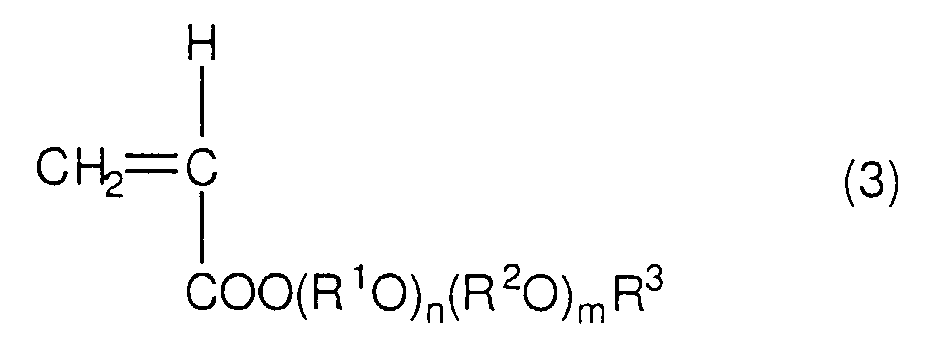
and wherein general formula (4) is:where the symbols are the same as those in general formula (2) above.
- <3> The object is achieved also with a cement additive which
comprises copolymer (C) having polyalkylene glycol ester unit (VII) of
general formula (5) below as a repeating unit and carboxylic unit (VIII) of
general formula (6) below as a repeating unit,
wherein general formula (5) is:where:
- R5O
- denotes an oxyalkylene group with 4 to 7 carbon atoms or a mixture of two or more thereof, wherein the mixture may be formed by either block addition or random addition;
- R6O
- denotes an oxyalkylene group with 2 to 18 carbon atoms or a mixture of two or more thereof, wherein the mixture may be formed by either block addition or random addition;
- R7
- denotes a hydrocarbon group with 1 to 3 carbon atoms;
- p
- is an average molar number of addition of R5O and denotes a number of 1 to 50;
- q
- is an average molar number of addition of R6O and denotes a
number of 1 to 300; and
not less than 80 mol % of the oxyalkylene groups (total of R5O and R6O) are oxyethylene groups;
where:
- R8
- denotes hydrogen or a methyl group; and
- M'
- denotes hydrogen, a monovalent metal, a divalent metal, ammonium, or an organic amine.
- <4> The object is achieved also with a cement additive which
comprises copolymer (D) as obtained by a process including the step of
copolymerizing a monomer mixture including polyalkylene glycol ester
monomer (X) of general formula (7) below and carboxylic monomer (XI)
of general formula (8) below,
wherein general formula (7) is:where the symbols are the same as those in general formula (5) above;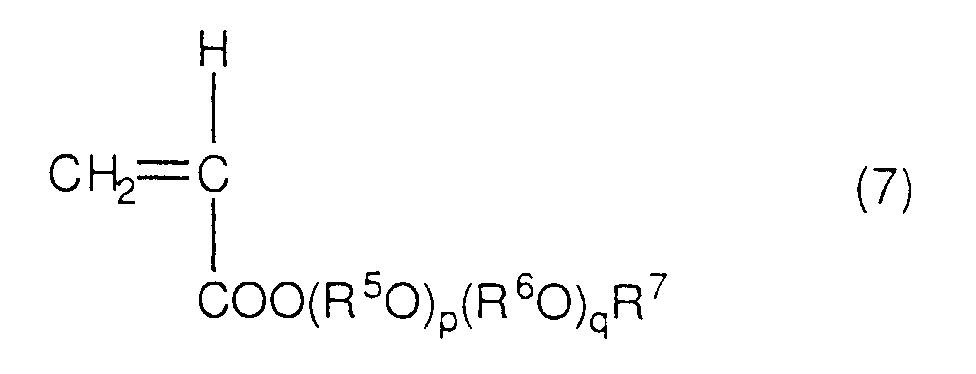
and wherein general formula (8) is:where the symbols are the same as those in general formula (6) above.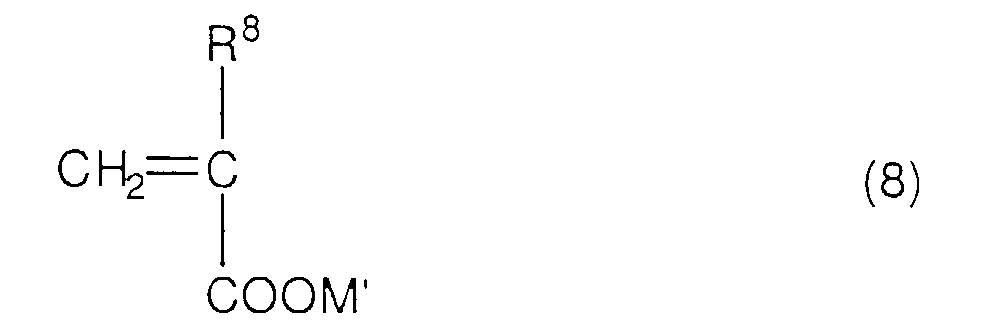
-
- These and other objects and the advantages of the present invention will be more fully apparent from the following detailed disclosure.
- The cement additive according to the present invention comprises at least one copolymer selected from the group consisting of copolymers (A) to (D).
- Copolymer (A) is a copolymer which has repeating units (I) and (II). Copolymer (A) can be obtained by a process including the step of copolymerizing a monomer mixture including a monomer to give repeating unit (I) of general formula (1) above and a monomer to give repeating unit (II) of general formula (2) above. In addition, copolymer (A) can also be obtained by a process including the step of directly esterifying an alkoxypolyalkylene glycol with a polyacrylic acid or a poly(acrylic acid-methacrylic acid) copolymer.
- In addition, copolymer (B) is a copolymer as obtained by a process including the step of copolymerizing a monomer mixture including monomers (IV) and (V).
- Copolymer (C) is a copolymer which has repeating units (VII) and (VIII). Copolymer (C) can be obtained by a process including the step of copolymerizing a monomer mixture including a monomer to give repeating unit (VII) of general formula (5) above and a monomer to give repeating unit (VIII) of general formula (6) above. In addition, copolymer (C) can also be obtained by a process including the step of directly esterifying an alkoxypolyalkylene glycol with a polyacrylic acid or a poly(acrylic acid-methacrylic acid) copolymer.
- In addition, copolymer (D) is a copolymer as obtained by a process including the step of copolymerizing a monomer mixture including monomers (X) and (XI).
- The monomer (polyalkylene glycol ester monomer (IV)) to give repeating unit (I) is a product by esterification of acrylic acid with a block addition form of alkoxypolyalkylene glycol as obtained by adding 35∼300 mol of an alkylene oxide with 2 to 18 carbon atoms and then 1∼50 mol of an alkylene oxide with 3 to 7 carbon atoms to any one of the following alcohols: aliphatic alcohols with 1 to 3 carbon atoms, such as methanol, ethanol, 1-propanol, and 2-propanol; alcohols having an alkenyl group with 3 carbon atoms, such as allyl alcohol; and alcohols having an alkynyl group with 3 carbon atoms, such as propargyl alcohol.
- The monomer (polyalkylene glycol ester monomer (X)) to give repeating unit (VII) is a product by esterification of acrylic acid with a block addition form of alkoxypolyalkylene glycol as obtained by adding 1∼300 mol of an alkylene oxide with 2 to 18 carbon atoms and then 1∼50 mol of an alkylene oxide with 4 to 7 carbon atoms to any one of the above alcohols.
- Specific examples of the monomers (polyalkylene glycol ester monomers (IV) and (X)) to give repeating units (I) and (VII) include the following monomers. However, the monomers as hereinafter marked with * are specific examples of the monomer (polyalkylene glycol ester monomer (IV)) to give repeating unit (I), but are not specific examples of the monomer (polyalkylene glycol ester monomer (X)) to give repeating unit (VII). Alkoxypolyalkylene glycol (poly)(alkylene glycol) acrylates (the alkylene glycols in the braces { } may be in the form of either random addition or block addition), such as methoxypolyethylene glycol (poly)propylene glycol monoacrylate (*), methoxypolyethylene glycol (poly)butylene glycol monoacrylate, methoxypolyethylene glycol (poly)propylene glycol (poly)butylene glycol monoacrylate, ethoxypolyethylene glycol (poly)propylene glycol monoacrylate (*), ethoxypolyethylene glycol (poly)butylene glycol monoacrylate, ethoxypolyethylene glycol (poly)propylene glycol (poly)butylene glycol monoacrylate, propoxypolyethylene glycol (poly)propylene glycol monoacrylate (*), propoxypolyethylene glycol (poly)butylene glycol monoacrylate, propoxypolyethylene glycol (poly)propylene glycol (poly)butylene glycol monoacrylate, allyloxypolyethylene glycol (poly)propylene glycol monoacrylate (*), allyloxypolyethylene glycol (poly)butylene glycol monoacrylate, allyloxypolyethylene glycol (poly)propylene glycol (poly)butylene glycol monoacrylate, propargyloxypolyethylene glycol (poly)propylene glycol monoacrylate (*), propargyloxypolyethylene glycol (poly)butylene glycol monoacrylate, propargyloxypolyethylene glycol (poly)propylene glycol (poly)butylene glycol monoacrylate, methoxy{polyethylene glycol polypropylene glycol} (poly)propylene glycol monoacrylate (*), methoxy{polyethylene glycol polybutylene glycol} (poly)propylene glycol monoacrylate (*), methoxy{polyethylene glycol polypropylene glycol polybutylene glycol} (poly)propylene glycol monoacrylate (*), methoxy{polyethylene glycol polypropylene glycol} (poly)butylene glycol monoacrylate, methoxy(polyethylene glycol polybutylene glycol} (poly)butylene glycol monoacrylate, methoxy{polyethylene glycol polypropylene glycol polybutylene glycol} (poly)butylene glycol monoacrylate, methoxy(polyethylene glycol polypropylene glycol} {(poly)propylene glycol (poly)butylene glycol monoacrylate} (*), methoxy{polyethylene glycol polybutylene glycol} {(poly)propylene glycol (poly)butylene glycol monoacrylate} (*), methoxy{polyethylene glycol polypropylene glycol polybutylene glycol} {(poly)propylene glycol (poly)butylene glycol monoacrylate} (*), ethoxy{polyethylene glycol polypropylene glycol} (poly)propylene glycol monoacrylate (*), ethoxy{polyethylene glycol polybutylene glycol} (poly)propylene glycol monoacrylate (*), ethoxy{polyethylene glycol polypropylene glycol polybutylene glycol} (poly)propylene glycol monoacrylate (*), ethoxy{polyethylene glycol polypropylene glycol} (poly)butylene glycol monoacrylate, ethoxy{polyethylene glycol polybutylene glycol} (poly)butylene glycol monoacrylate, ethoxy{polyethylene glycol polypropylene glycol polybutylene glycol} (poly)butylene glycol monoacrylate, ethoxy{polyethylene glycol polypropylene glycol} {(poly)propylene glycol (poly)butylene glycol monoacrylate} (*), ethoxy{polyethylene glycol polybutylene glycol} {(poly)propylene glycol (poly)butylene glycol monoacrylate} (*), ethoxy{polyethylene glycol polypropylene glycol polybutylene glycol} {(poly)propylene glycol (poly)butylene glycol monoacrylate} (*), propoxy{polyethylene glycol polypropylene glycol} (poly)propylene glycol monoacrylate (*), propoxy{polyethylene glycol polybutylene glycol} (poly)propylene glycol monoacrylate (*), propoxy{polyethylene glycol polypropylene glycol polybutylene glycol} (poly)propylene glycol monoacrylate (*), propoxy{polyethylene glycol polypropylene glycol} (poly)butylene glycol monoacrylate, propoxy{polyethylene glycol polybutylene glycol} (poly)butylene glycol monoacrylate, propoxy{polyethylene glycol polypropylene glycol polybutylene glycol} (poly)butylene glycol monoacrylate, propoxy{polyethylene glycol polypropylene glycol} {(poly)propylene glycol (poly)butylene glycol monoacrylate} (*), propoxy{polyethylene glycol polybutylene glycol} {(poly)propylene glycol (poly)butylene glycol monoacrylate} (*), propoxy{polyethylene glycol polypropylene glycol polybutylene glycol} {(poly)propylene glycol (poly)butylene glycol monoacrylate} (*), allyloxy{polyethylene glycol polypropylene glycol} (poly)propylene glycol monoacrylate (*), allyloxy{polyethylene glycol polybutylene glycol} (poly)propylene glycol monoacrylate (*), allyloxy{polyethylene glycol polypropylene glycol polybutylene glycol} (poly)propylene glycol monoacrylate (*), allyloxy{polyethylene glycol polypropylene glycol} (poly)butylene glycol monoacrylate, allyloxy{polyethylene glycol polybutylene glycol} (poly)butylene glycol monoacrylate, allyloxy{polyethylene glycol polypropylene glycol polybutylene glycol} (poly)butylene glycol monoacrylate, allyloxy{polyethylene glycol polypropylene glycol} {(poly)propylene glycol (poly)butylene glycol monoacrylate} (*), allyloxy{polyethylene glycol polybutylene glycol} {(poly)propylene glycol (poly)butylene glycol monoacrylate} (*), allyloxy{polyethylene glycol polypropylene glycol polybutylene glycol} {(poly)propylene glycol (poly)butylene glycol monoacrylate} (*), propargyloxy{polyethylene glycol polypropylene glycol} (poly)propylene glycol monoacrylate (*), propargyloxy{polyethylene glycol polybutylene glycol} (poly)propylene glycol monoacrylate (*), propargyloxy{polyethylene glycol polypropylene glycol polybutylene glycol} (poly)propylene glycol monoacrylate (*), propargyloxy{polyethylene glycol polypropylene glycol} (poly)butylene glycol monoacrylate, propargyloxy{polyethylene glycol polybutylene glycol} (poly)butylene glycol monoacrylate, propargyloxy{polyethylene glycol polypropylene glycol polybutylene glycol} (poly)butylene glycol monoacrylate, propargyloxy{polyethylene glycol polypropylene glycol} {(poly)propylene glycol (poly)butylene glycol monoacrylate} (*), propargyloxy{polyethylene glycol polybutylene glycol} {(poly)propylene glycol (poly)butylene glycol monoacrylate} (*), and propargyloxy{polyethylene glycol polypropylene glycol polybutylene glycol} {(poly)propylene glycol (poly)butylene glycol monoacrylate} (*).
- In repeating unit (I) (polyalkylene glycol ester monomer (IV)), it is necessary that the alkylene oxide chain (R1O) with 3 to 7 carbon atoms is linked to the alkylene oxide chain (R2O) with 2 to 18 carbon atoms in the block form, and it is the most important that the alkylene oxide chain (R1O) with 3 to 7 carbon atoms is linked to the ester bonding moiety. Similarly, in repeating unit (VII) (polyalkylene glycol ester monomer (X)), it is necessary that the alkylene oxide chain (R5O) with 4 to 7 carbon atoms is linked to the alkylene oxide chain (R60) with 2 to 18 carbon atoms in the block form, and it is the most important that the alkylene oxide chain (R5O) with 4 to 7 carbon atoms is linked to the ester bonding moiety. Because, in conventional acrylic ester polymers, the ethylene oxide chain is linked to the ester bonding moiety, those polymers have the demerit of easily hydrolyzing in a cement alkali to eliminate the polyoxyethylene group which is a dispersible group, so that the fluid retainability decreases with time. However, if the alkylene oxide chain with a large number of carbon atoms is present on the ester bonding moiety like in the present invention, the hydrolysis of the polyoxyalkylene group can be prevented due to the hydrophobicity and steric hindrance effects of the alkylene oxide chain with a large number of carbon atoms.
- Incidentally, the border between R1O and R2O in repeating unit (I) (polyalkylene glycol ester monomer (IV)) is such that R2O begins where an alkylene oxide chain of which the number of carbon atoms is out of the range of 3 to 7 (namely, of which the number of carbon atoms is 2 or in the range of 8 to 18) occurs for the first time when viewed from the ester bonding moiety side. Similarly, the border between R5O and R6O in repeating unit (VII) (polyalkylene glycol ester monomer (X)) is such that R6O begins where an alkylene oxide chain of which the number of carbon atoms is out of the range of 4 to 7 (namely, of which the number of carbon atoms is in the range of 2 to 3, or 8 to 18) occurs for the first time when viewed from the ester bonding moiety.
- Examples of usable alkylene oxides (R2O and R6O) with 2 to 18 carbon atoms include alkylene oxides such as ethylene oxide, propylene oxide, isobutylene oxide, 1-butene oxide, 2-butene oxide, and styrene oxide. But ethylene oxide is the most preferable for giving the hydrophilicity to the copolymer and performing excellent dispersibility and mortar kneadability, because the presence of an oxyalkylene chain with a large number of carbon atoms at a moiety other than the ester bonding moiety would enhance the hydrophobicity of the copolymer itself. In addition, one or more kinds of alkylene oxides with 2 to 18 carbon atoms can be used as the added alkylene oxide moiety with 2 to 18 carbon atoms. When using two or more kinds of the alkylene oxides, any form of random addition, block addition, and alternating addition can be used.
- The average molar number (m) of addition of the alkylene oxide (R2O) with 2 to 18 carbon atoms in repeating unit (I) (polyalkylene glycol ester monomer (IV)) is a number of 35 to 300, and the average molar number (q) of addition of the alkylene oxide (R6O) with 2 to 18 carbon atoms in repeating unit (VII) (polyalkylene glycol ester monomer (X)) is a number of 1 to 300, preferably 35 to 300. And, in either case, the average molar number of addition of the alkylene oxide with 2 to 18 carbon atoms is preferably in the range of 51 to 280, more preferably 55 to 250, still more preferably 60 to 200, for the purpose of obtaining excellent dispersibility and enhancing the mortar kneadability. In the case where the average molar number of addition of the alkylene oxide with 2 to 18 carbon atoms is small, the mortar kneadability tends to be low. In addition, in the case where the average molar number of addition of the alkylene oxide with 2 to 18 carbon atoms is larger than 300, it is difficult to obtain excellent dispersibility.
- Examples of the alkylene oxide (R1O) with 3 to 7 carbon atoms in repeating unit (I) (polyalkylene glycol ester monomer (IV)), which is usable, include alkylene oxides such as propylene oxide, butylene oxide, isobutylene oxide, 1-butene oxide, and 2-butene oxide. Preferable are products by addition of alkylene oxides with 3 to 6 carbon atoms, and more preferable are products by addition of alkylene oxide with 3 to 5 carbon atoms, and still more preferable are products by addition of propylene oxide or butylene oxide with 3 to 4 carbon atoms. In addition, one or more kinds of alkylene oxides with 3 to 7 carbon atoms can be used as the added alkylene oxide moiety with 3 to 7 carbon atoms. When using two or more kinds of the alkylene oxides, any form of random addition, block addition, and alternating addition can be used.
- Examples of the alkylene oxide (R5O) with 4 to 7 carbon atoms in repeating unit (VII) (polyalkylene glycol ester monomer (X)), which is usable, include alkylene oxides such as butylene oxide, isobutylene oxide, 1-butene oxide, and 2-butene oxide. Preferable are products by addition of alkylene oxides with 4 to 6 carbon atoms, and more preferable are products by addition of alkylene oxide with 4 to 5 carbon atoms, and still more preferable are products by addition of butylene oxide with 4 carbon atoms. In addition, one or more kinds of alkylene oxides with 4 to 7 carbon atoms can be used as the added alkylene oxide moiety with 4 to 7 carbon atoms. When using two or more kinds of the alkylene oxides, any form of random addition, block addition, and alternating addition can be used.
- The average molar number (n) of addition of the alkylene oxide (R1O) with 3 to 7 carbon atoms in repeating unit (I) and the average molar number (p) of addition of the alkylene oxide (R5O) with 4 to 7 carbon atoms in repeating unit (VII) are in the range of 1∼50 mol, but preferably 1∼30 mol, more preferably 2∼20 mol, still more preferably 2∼10 mol, yet still more preferably 2∼5 mol. The case where the average molar number of addition is smaller than 1 means including a component with a molar number of addition of 0 mol which easily hydrolyzes in a cement alkali. In the case where the average molar number of addition is not smaller than 1 mol, but smaller than 2 mol, there might be included a component with a molar number of addition of 0 mol which is unable to sufficiently give the hydrophobicity and easily hydrolyzes in a cement alkali, therefore the effect to prevent the hydrolysis is low. However, if not less than 2 mol of the alkylene oxide is introduced, the hydrophobicity can be enhanced sufficiently, and the amount of the component with a molar number of addition of 0 mol which easily hydrolyzes in a cement alkali can be reduced sufficiently, so that the hydrolysis can sufficiently be prevented. On the other hand, in the case where the average molar number of addition is larger than 50, the hydrolysis resistance is enhanced, but the cement dispersibility is deteriorated due to the hydrophobicity and steric hindrance of the copolymer itself.
- Thus, the distribution of the molar numbers of addition of the alkylene oxide (R1O) with 3 to 7 carbon atoms in repeating unit (I) and the distribution of the molar numbers of addition of the alkylene oxide (R5O) with 4 to 7 carbon atoms in repeating unit (VII) are preferably such that the ratio of the polyalkylene glycol ester units with a molar number of addition of R1O or R5O of 0 mol is not more than 2 weight % of the entire polyalkylene glycol ester units (I) or (VII) in terms of alcohol (HO(R1O)n(R2O)mR3) or (HO(R5O)p(R6O)qR7) respectively, and further that the ratio of the polyalkylene glycol ester units with a molar number of addition of R1O or R5O of not larger than 1 mol is not more than 20 weight % of the entire polyalkylene glycol ester units (I) or (VII) respectively in terms of alcohol (HO(R1O)n(R2O)mR3) or (HO(R5O)p(R6O)qR7).
- In repeating unit (I) (polyalkylene glycol ester monomer (IV)), not less than 80 mol % of the oxyalkylene groups (total of the alkylene oxide chain with 3 to 7 carbon atoms (R1O) and the alkylene oxide chain with 2 to 18 carbon atoms (R2O)) need to be oxyethylene groups, and preferably not less than 90 mol %, more preferably not less than 95 mol %, of the oxyalkylene groups (total of R1O and R2O) are oxyethylene groups. Similarly, in repeating unit (VII) (polyalkylene glycol ester monomer (X)), not less than 80 mol % of the oxyalkylene groups (total of the alkylene oxide chain with 4 to 7 carbon atoms (R5O) and the alkylene oxide chain with 2 to 18 carbon atoms (R6O)) need to be oxyethylene groups, and preferably not less than 90 mol %, more preferably not less than 95 mol %, of the oxyalkylene groups (total of R5O and R6O) are oxyethylene groups. Because the presence of an oxyalkylene chain with a large number of carbon atoms at a moiety other than the ester bonding moiety would enhance the hydrophobicity of the copolymer itself, therefore, deteriorate the cement dispersibility.
- In addition, for the same reason as above, in repeating unit (I) (polyalkylene glycol ester monomer (IV)), it is preferable that there is a relation of (m/n) > 8 between the average molar number n of addition of the alkylene oxide chain with 3 to 7 carbon atoms (R1O) and the average molar number m of addition of the alkylene oxide chain with 2 to 18 carbon atoms (R2O). Similarly, in repeating unit (VII) (polyalkylene glycol ester monomer (X)),it is preferable that there is a relation of (q/p) > 8 between the average molar number p of addition of the alkylene oxide chain with 4 to 7 carbon atoms (R5O) and the average molar number q of addition of the alkylene oxide chain with 2 to 18 carbon atoms (R6O).
- Terminal R3 and R7 of the oxyalkylene groups are hydrocarbon groups with 1 to 3 carbon atoms. For performing excellent dispersibility and mortar kneadability, hydrocarbon groups with 1 to 2 carbon atoms are preferable, and hydrocarbon groups with 1 carbon atom are more preferable. Hydrocarbon groups with more than 3 carbon atoms have too strong hydrophobicity to obtain good dispersibility and mortar kneadability.
- Incidentally, the monomers (polyalkylene glycol ester monomers (IV)) to give repeating unit (I) and the monomers (polyalkylene glycol ester monomers (X)) to give repeating unit (VII) can be used either alone respectively or in combinations with each other.
- Examples of the monomers (carboxylic monomers (V) and (XI)) to give repeating units (II) and (VIII) respectively include acrylic acid, methacrylic acid, and their monovalent metal salts, divalent metal salts, ammonium salts, and organic amine salts. These can be used either alone respectively or in combinations with each other. For the enhancement of the cement dispersibility and the mortar kneadability, it is preferable to use acrylic acid and its monovalent metal salts, divalent metal salts, ammonium salts, or organic amine salts.
- If necessary, the following components can further be introduced: repeating units (III) other than repeating units (I) and (II); monomers (VI) other than polyalkylene glycol ester monomer (IV) and carboxylic monomer (V); repeating units (IX) other than repeating units (VII) and (VIII); and monomers (XII) other than polyalkylene glycol ester monomer (X) and carboxylic monomer (XI). Examples of monomers to give repeating units (III) and (IX) and examples of monomers (VI) and (XII) include: unsaturated dicarboxylic acids, such as maleic acid, fumaric acid, itaconic acid, and citraconic acid, and their monovalent metal salts, divalent metal salts, ammonium salts, and organic amine salts, or anhydrides of the unsaturated dicarboxylic acids; half esters and diesters of the above unsaturated dicarboxylic acids with alcohols having 1 to 22 carbon atoms; half amides and diamides of the above unsaturated dicarboxylic acids with amines having 1 to 22 carbon atoms; half esters and diesters of the above unsaturated dicarboxylic acids with alkyl polyalkylene glycols as obtained by adding 1 to 300 mol of alkylene oxides with 2 to 4 carbon atoms to the above alcohols or amines; half esters and diesters of the above unsaturated dicarboxylic acids with glycols having 2 to 4 carbon atoms or with polyalkylene glycols of 2 to 300 in molar number of addition of the foregoing glycols; half amides of maleamic acid with glycols having 2 to 4 carbon atoms or with polyalkylene glycols of 2 to 300 in molar number of addition of the foregoing glycols; (poly)alkylene glycol di(meth)acrylates, such as triethylene glycol di(meth)acrylate, (poly)ethylene glycol di(meth)acrylate, polypropylene glycol di(meth)acrylate, and (poly)ethylene glycol (poly)propylene glycol di(meth)acrylate; difunctional (meth)acrylates, such as hexanediol di(meth)acrylate, trimethylolpropane tri(meth)acrylate, and trimethylolpropane di(meth)acrylate; (poly)alkylene glycol dimaleates, such as triethylene glycol dimaleate and polyethylene glycol dimaleate; unsaturated sulfonic acids, such as vinylsulfonates, (meth)allylsulfonates, 2-(meth)acryloxyethylsulfonates, 3-(meth)acryloxypropylsulfonates, 3-(meth)acryloxy-2-hydroxypropylsulfonates, 3-(meth)acryloxy-2-hydroxypropylsulfophenyl ether, 3-(meth)acryloxy-2-hydroxypropyloxysulfobenzoates, 4-(meth)acryloxybutylsulfonates, (meth)acrylamidomethylsulfonic acid, (meth)acrylamidoethylsulfonic acid, 2-methylpropanesulfonic acid (meth)acrylamide, and styrenesulfonic acid, and their monovalent metal salts, divalent metal salts, ammonium salts, and organic amine salts; esters of (meth)acrylic acid with alcohols having 1 to 22 carbon atoms, such as methyl (meth)acrylate, ethyl (meth)acrylate, propyl (meth)acrylate, butyl (meth)acrylate, 2-ethylhexyl (meth)acrylate, 2-hydroxyethyl (meth)acrylate, hydroxypropyl (meth)acrylate, hydroxybutyl (meth)acrylate, methyl crotonate, and glycidyl (meth)acrylate; amides of unsaturated monocarboxylic acids with amines having 1 to 22 carbon atoms, such as methyl(meth)acrylamide; vinyl aromatic compounds, such as styrene, α-methylstyrene, vinyltoluene, and p-methylstyrene; alkanediol mono(meth)acrylates, such as 1,4-butanediol mono(meth)acrylate, 1,5-pentanediol mono(meth)acrylate, and 1,6-hexanediol mono(meth)acrylate; dienes, such as butadiene, isoprene, 2-methyl-1,3-butadiene, and 2-chloro-1,3-butadiene; unsaturated amides, such as (meth)acrylamide, (meth)acrylalkylamide, N-methylol(meth)acrylamide, and N,N-dimethyl(meth)acrylamide; unsaturated cyanes, such as (meth)acrylonitrile and α-chloroacrylonitrile; unsaturated esters, such as vinyl acetate and vinyl propionate; unsaturated amines, such as aminoethyl (meth)acrylate, methylaminoethyl (meth)acrylate, dimethylaminoethyl (meth)acrylate, dimethylaminopropyl (meth)acrylate, dibutylaminoethyl (meth)acrylate, and vinylpyridine; divinyl aromatic compounds, such as divinylbenzene; cyanurates, such as triallyl cyanurate; allyl compounds, such as (meth)allyl alcohol and glycidyl (meth)allyl ether; unsaturated amino compounds, such as dimethylaminoethyl (meth)acrylate; vinyl ethers or allyl ethers, such as methoxypolyethylene glycol monovinyl ether, polyethylene glycol monovinyl ether, methoxypolyethylene glycol mono(meth)allyl ether, and polyethylene glycol mono(meth)allyl ether; siloxane derivatives such as polydimethylsiloxanepropylaminomaleamic acid, polydimethylsiloxaneaminopropyleneaminomaleamic acid, polydimethylsiloxanebis(propylaminomaleamic acid), polydimethylsiloxanebis(dipropyleneaminomaleamic acid), polydimethylsiloxane-(1-propyl-3-acrylate), polydimethylsiloxane-(1-propyl-3-methacrylate), polydimethylsiloxanebis(1-propyl-3-acrylate), and polydimethylsiloxanebis(1-propyl-3-methacrylate); and products by esterification of methacrylic acid with alkoxypolyalkylene glycols, as obtained by adding 1 to 300 mol of alkylene oxides with 2 to 18 carbon atoms to alcohols with 1 to 30 carbon atoms, such as methoxypolyethylene glycol, ethoxypolyethylene glycol, propoxypolyethylene glycol, methoxypolyethylene glycol polypropylene glycol, ethoxypolyethylene glycol polypropylene glycol, and propoxypolyethylene glycol polypropylene glycol. These may be used either alone respectively or in combinations with each other. For maintaining the dispersibility and dispersion retainability of the copolymer to cement, it is preferable to introduce the products by esterification of methacrylic acid with alkoxypolyalkylene glycols, particularly, alkoxypolyethylene glycols, as obtained by adding of ethylene oxide to alcohols with 1 to 3 carbon atoms, such as methoxypolyethylene glycol, among the above repeating units (monomers).
- It is preferable that copolymer (A) according to the present invention comprises repeating units (I), (II) and (III) in the weight ratio (I)/(II)/(III) = (1∼99)/(99∼1)/(0∼50), more preferably (40∼99)/(60∼1)/(0∼50), still more preferably (70∼97)/(30∼3)/(0∼30), yet still more preferably (75∼96)/(25∼4)/(0∼10).
- It is preferable that copolymer (B) according to the present invention comprises (IV), (V) and (VI) in the weight ratio (IV)/(V)/(VI) = (1∼99)/(99∼1)/(0∼50), more preferably (40∼99)/(60∼1)/(0∼50), still more preferably (70∼97)/(30∼3)/(0∼30), yet still more preferably (75∼96)/(25∼4)/(0∼10).
- It is preferable that copolymer (C) according to the present invention comprises repeating units (VII), (VIII) and (IX) in the weight ratio (VII)/(VIII)/(IX) = (1∼99)/(99∼1)/(0∼50), more preferably (40∼99)/(60∼1)/(0∼50), still more preferably (70∼97)/(30∼3)/(0∼30), yet still more preferably (75∼96)/(25∼4)/(0∼10).
- It is preferable that copolymer (D) according to the present invention comprises (X), (XI) and (XII) in the weight ratio (X)/(XI)/(XII) = (1∼99)/(99∼1)/(0∼50), more preferably (40∼99)/(60∼1)/(0∼50), still more preferably (70∼97)/(30∼3) /(0∼30), yet still more preferably (75∼96)/(25∼4)/(0∼10).
- The weight-average molecular weight of each of copolymers (A) to (D) is usually in the range of 5,000∼200,000, preferably 10,000∼100,000, more preferably 15,000∼80,000, still more preferably 20,000∼70,000. In the case where these component ratio and weight-average molecular weight are out of the above ranges, there is no obtaining a cement additive that exhibits high water reducibility and the enhanced mortar kneadability.
- Methods to obtain copolymers (A) to (D) are not especially limited and, for example, conventional polymerization methods such as solution polymerization and bulk polymerization using polymerization initiators can be used. In addition, copolymers (A) and (C) can be obtained also by a process including the step of directly esterifying an alkoxypolyalkylene glycol, for example, with a polyacrylic acid or a poly(acrylic acid-methacrylic acid) copolymer.
- The polymerization method can be carried out in either a batch manner or a continuous manner. The solvent, as used therefor if necessary, may be a conventional one and is not especially limited. Examples thereof include: water; alcohols, such as methyl alcohol, ethyl alcohol, and isopropyl alcohol; aromatic or aliphatic hydrocarbons, such as benzene, toluene, xylene, cyclohexane, and n-heptane; esters, such as ethyl acetate; and ketones, such as acetone and methyl ethyl ketone. Considering the solubilities of the monomer mixture and the resultant polycarboxylic acid, it is preferable to use at least one member selected from the group consisting of water and lower alcohols with 1 to 4 carbon atoms.
- The polymerization initiator may be a conventional one and is not especially limited. Examples of such a polymerization initiator include: persulfate salts, such as ammonium persulfate, sodium persulfate, and potassium persulfate; hydrogen peroxide; azo compounds, such as azobis(2-m ethylpropionamidine) hydrochloride and azobisisobutyronitrile; and peroxides, such as benzoyl peroxide, lauroyl peroxide, and cumene hydroperoxide. These may be used either alone respectively or in combinations with each other. In this case, promotors can further be used, and examples thereof include: reducing agents, such as sodium hydrogensulfite, sodium sulfite, Mohr's salts, sodium pyrobisulfite, sodium formaldehydesulfoxylate, and ascorbic acid; and amine compounds, such as ethylenediamine, sodium ethylenediaminetetraacetate, and glycine. These may be used either alone respectively or in combinations with each other.
- Chain transfer agents also can be used, if necessary. The chain transfer agents may be conventional ones and are not especially limited, but examples thereof include: mercaptopropionic acid, 2-ethylhexyl mercaptopropionate, 2-mercaptoethyl octanoate, 1,8-dimercapto-3,6-dioxaoctane, decanetrithiol, dodecylmercaptan, hexadecanethiol, decanethiol, carbon tetrachloride, carbon tetrabromide, α-methylstyrene dimer, terpinolene, α-terpinene, γ-terpinene, dipentene, and 2-aminopropan-1-ol. These may be used either alone respectively or in combinations with each other.
- The polymerization temperature is fitly determined from the polymerization method, solvent, polymerization initiator, or chain transfer agent as used, but is usually in the range of 0∼150 °C.
- Copolymers (A) to (D) according to the present invention, as obtained in the above way, may directly be used as the main component of the cement additive. However, if necessary, copolymers (A) to (D) may further be treated by neutralization with an alkaline substance before being used. Preferable examples of such an alkaline substance include: inorganic salts, such as hydroxides, chlorides and carbonates of mono- and divalent metals; ammonia; and organic amines.
- Copolymers (A) to (D) according to the present invention may be added in the ratio of 0.01∼10 weight %, preferably 0.05∼5 weight %, in terms of solid content, to the cement weight. The amount of addition smaller than 0.01 weight % is insufficient to the performance. Or otherwise, even if an amount exceeding 10 weight % is used, there are economical disadvantages.
- The cement composition, to which each of copolymers (A) to (D) according to the present invention is added, comprises cement, water, and the present invention cement additive. Examples thereof include cement paste (aqueous cement slurry), mortar, and concrete. The aqueous cement paste comprises cement, water, and the present invention cement additive as the essential components. The mortar further comprises sand in addition to the cement paste as the essential components. The concrete further comprises stone in addition to the mortar as the essential components. These cement paste, mortar, and concrete generally comprise materials as fitly selected from the group consisting of cement, water, fine aggregates, and coarse aggregates, but may further comprise fine powders such as fly ash, shaft furnace slag, silica fume, and limestone. The cement as used is, generally, normal portland cement, but the following other materials are also available: portland cement, such as high-early-strength types, ultra-high-early-strength types, moderate heat types, and white types; and mixed portland cement, such as alumina cement, fly ash cement, slag cement, and silica cement. There is no especial limitation with regard to the amount of cement as used and the unit water amount, per 1 m3 of concrete. However, for the production of concrete of high durability and high strength, the unit water amount of 100∼185 kg/m3 and the water/cement ratio = 10∼70 weight % are recommended, and the unit water amount of 120∼175 kg/m3 and the water/cement ratio = 20∼65 weight % are preferably recommended.
- In addition, the cement additive of the present invention can be used jointly with conventional cement dispersants. Examples of the conventional cement dispersant, as used jointly, include: ligninsulfonic acid salts; polyol derivatives; naphthalenesulfonic acid-formalin condensation products; melaminesulfonic acid-formalin condensation products; polystyrenesulfonic acid salts; aminosulfonic compounds, such as aminoarylsulfonic acid-phenol-formaldehyde condensation products (JP-A-01-113419); and polycarboxylic acids (or salts thereof), for example: cement dispersants comprising (a) copolymers and/or salts thereof, as formed from polyalkylene glycol mono(meth)acrylate compounds and (meth)acrylic compounds, (b) copolymers and/or their hydrolyzed products and/or salts, as formed from polyalkylene glycol mono(meth)allyl ether compounds and maleic anhydride, and (c) copolymers and/or salts thereof, as formed from polyalkylene glycol mono(meth)allyl ether compounds and polyalkylene glycol maleates (JP-A-07-267705); admixtures for concrete, comprising (A) copolymers as formed from polyalkylene glycol (meth)acrylates and (meth)acrylic acid (or salts thereof), (B) specific polyethylene glycol polypropylene glycol compounds, and (C) specific surfactants (Japanese Patent No. 2508113); copolymers as formed from either polyethylene(propylene) glycol (meth)acrylate or polyethylene(propylene) glycol mono(meth)allyl ether, and (meth)allylsulfonic acid (or salts thereof) and (meth)acrylic acid (or salts thereof) (JP-A-62-216950); copolymers as formed from polyethylene(propylene) glycol (meth)acrylate, (meth)allylsulfonic acid (or salts thereof), and (meth)acrylic acid (or salts thereof) (JP-A-01-226757); copolymers as formed from polyethylene(propylene) glycol (meth)acrylate, either (meth)allylsulfonic acid (or salts thereof) or p-(meth)allyloxybenzenesulfonic acid (or salts thereof), and (meth)acrylic acid (or salts thereof) (JP-B-05-036377); copolymers as formed from polyethylene glycol mono(meth)allyl ether and maleic acid (or salts thereof) (JP-A-04-149056); copolymers as formed from polyethylene glycol (meth)acrylate, (meth)allylsulfonic acid (or salts thereof), (meth)acrylic acid (or salts thereof), alkanediol mono(meth)acrylate, polyalkylene glycol mono(meth)acrylate, and α,β-unsaturated monomers with an amide group in their molecules (JP-A-05-170501); copolymers as formed from polyethylene glycol mono(meth)allyl ether, polyethylene glycol mono(meth)acrylate, alkyl (meth)acrylates, (meth)acrylic acid (or salts thereof), and either (meth)allylsulfonic acid (or salts thereof) or p-(meth)allyloxybenzenesulfonic acid (or salts thereof) (JP-A-06-191918); copolymers or their hydrolyzed products or salts, as formed from alkoxypolyalkylene glycol monoallyl ether and maleic anhydride (JP-A-05-043288); copolymers or their salts or esters, as formed from polyethylene glycol monoallyl ether, maleic acid, and monomers copolymerizable with these monomers (JP-B-58-038380); copolymers as formed from polyalkylene glycol mono(meth)acrylate monomers, (meth)acrylic ester monomers, and monomers copolymerizable with these monomers (JP-B-59-018338); copolymers or salts thereof, as formed from (meth)acrylic esters with a sulfonic acid group and, in case of need, monomers copolymerizable therewith (JP-A-62-119147); products by esterification of alkenyl-terminal polyoxyalkylene derivatives with copolymers as formed from alkoxypolyalkylene glycol monoallyl ether and maleic anhydride (JP-A-06-271347); and products by esterification of hydroxy-terminal polyoxyalkylene derivatives with copolymers as formed from alkoxypolyalkylene glycol monoallyl ether and maleic anhydride (JP-A-06-298555). These conventional cement dispersants can be jointly used in plural.
- Incidentally, when the above conventional cement dispersant is jointly used with the present invention cement additive, the mixing ratio by weight of the present invention cement additive to the conventional cement dispersant is usually in the range of (5∼95) : (95∼5), preferably (10∼90) : (90∼10), though not uniformly determinable, depending on differences in factors such as kind, composition, and test conditions of the cement dispersant as used.
- Furthermore, the cement additive of the present invention can be used in combination with other conventional cement additives (materials to add to cement) as exemplified below:
- (1) water-soluble high-molecular substances, for example: unsaturated carboxylic acid polymers such as polyacrylic acid (or its sodium salt), polymethacrylic acid (or its sodium salt), polymaleic acid (or its sodium salt), and sodium salts of acrylic acid-maleic acid copolymers; polymers or copolymers of polyoxyethylene or polyoxypropylene such as polyethylene glycol and polypropylene glycol; nonionic cellulose ethers such as methyl cellulose, ethyl cellulose, hydroxymethyl cellulose, hydroxyethyl cellulose, carboxymethyl cellulose, carboxyethyl cellulose, and hydroxypropyl cellulose; polysaccharides produced by microbiological fermentation such as yeast glucan, xanthane gum, and β-1.3 glucans (which may be either a linear or branched chain type and of which examples include curdlan, paramylon, vacciman, scleroglucan and laminaran); polyacrylamide; polyvinyl alcohol; starch; starch phosphate; sodium alginate; gelatin; and acrylic acid copolymers having an amino group in their molecules and their quaternized compounds;
- (2) high-molecular emulsions, for example: copolymers of various vinyl monomers such as alkyl (meth)acrylates;
- (3) retarders, for example: oxycarboxylic acids such as gluconic acid, glucoheptonic acid, arabonic acid, malic acid or citric acid, and their inorganic or organic salts of sodium, potassium, calcium, magnesium, ammonium and triethanolamine; saccharides, for example, monosaccharides such as glucose, fructose, galactose, saccharose, xylose, apiose, ribose, and isomerized saccharides, or oligosaccharides such as disaccharides and trisaccharides, or oligosaccharides such as dextrin, or polysaccharides such as dextran, or molasses including them; sugar alcohols such as sorbitol; magnesium silicofluoride; phosphoric acid and its salts or borates; aminocarboxylic acids and its salts; alkali-soluble proteins; fumic acid; tannic acid; phenol; polyhydric alcohols such as glycerol; and phosphonic acids and derivatives thereof, such as aminotri(methylenephosphonic acid), 1-hydroxyethylidene-1,1-diphosphonic acid, ethylenediaminetetra(methylenephosphonic acid), diethylenetriaminepenta(methylenephosphonic acid), and their alkaline metal salts and alkaline earth metal salts;
- (4) high-early-strength agents and promotors, for example: soluble calcium salts such as calcium chloride, calcium nitrite, calcium nitrate, calcium bromide, and calcium iodide; chlorides such as iron chloride and magnesium chloride; sulfates; potassium hydroxide; sodium hydroxide; carbonic acid salts; thiosulfates; formic acid and formates such as calcium formate; alkanol amines; alumina cement; and calcium aluminate silicate;
- (5) mineral oil base defoaming agents, for example: kerosine and liquid paraffin;
- (6) oils-and-fats base defoaming agents, for example: animal and plant oils, sesame oil, castor oil and their alkylene oxide adducts;
- (7) fatty acid base defoaming agents, for example: oleic acid, stearic acid and their alkylene oxide adducts;
- (8) fatty acid ester base defoaming agents, for example: glycerol monoricinolate, alkenyl succinic acid derivatives, sorbitol monolaurate, sorbitol trioleate, and natural wax;
- (9) oxyalkylene base defoaming agents, for example: polyoxyalkylenes such as (poly)oxyethylene (poly)oxypropylene adducts; (poly)oxyalkyl ethers such as diethylene glycol heptyl ether, polyoxyethylene oleyl ether, polyoxypropylene butyl ether, polyoxyethylene polyoxypropylene 2-ethylhexyl ether, and adducts of oxyethylene oxypropylene to higher alcohols with 12 to 14 carbon atoms; (poly)oxyalkylene (alkyl) aryl ethers such as polyoxypropylene phenyl ether and polyoxyethylene nonyl phenyl ether; acetylene ethers as formed by addition polymerization of alkylene oxides to acetylene alcohols such as 2,4,7,9-tetramethyl-5-decyne-4,7-diol, 2,5-dimethyl-3-hexyne-2,5-diol, and 3-methyl-1-butyn-3-ol; (poly)oxyalkylene fatty acid esters such as diethylene glycol oleic acid ester, diethylene glycol lauric acid ester, and ethylene glycol distearic acid; (poly)oxyalkylene sorbitan fatty acid esters such as (poly)oxyethylene sorbitan monolauric acid ester and (poly)oxyethylene sorbitan trioleic acid ester; (poly)oxyalkylene alkyl (aryl) ether sulfuric acid ester salts such as sodium polyoxypropylene methyl ether sulfate, and sodium polyoxyethylene dodecylphenol ether sulfate; (poly)oxyalkylene alkyl phosphoric acid esters such as (poly)oxyethylene stearyl phosphate; (poly)oxyalkylene alkylamines such as polyoxyethylene laurylamine; and polyoxyalkylene amide;
- (10) alcohol base defoaming agents, for example: octyl alcohol, hexadecyl alcohol, acetylene alcohol, and glycols;
- (11) amide base defoaming agents, for example: acrylate polyamines;
- (12) phosphoric acid ester base defoaming agents, for example: tributyl phosphate and sodium octyl phosphate;
- (13) metal soap base defoaming agents, for example: aluminum stearate and calcium oleate;
- (14) silicone base defoaming agents, for example: dimethyl silicone oils, silicone pastes, silicone emulsions, organic-denatured polysiloxanes (polyorganosiloxanes such as dimethyl polysiloxane), and fluorosilicone oils;
- (15) AE agents, for example: resin soap, saturated or unsaturated fatty acids, sodium hydroxystearate, lauryl sulfate, ABS (alkylbenzenesulfonic acids), LAS (linear alkylbenzenesulfonic acids), alkanesulfonates, polyoxyethylene alkyl (phenyl) ethers, polyoxyethylene alkyl (phenyl) ether sulfuric acid esters or its salts, polyoxyethylene alkyl (phenyl) ether phosphoric acid esters or its salts, protein materials, alkenylsulfosuccinic acids, and α-olefinsulfonates;
- (16) other surfactants, for example: polyalkylene oxide derivatives as formed by addition of 10 mol or more of alkylene oxides, such as ethylene oxide and propylene oxide, to aliphatic monohydric alcohols with 6 to 30 carbon atoms in the molecules, such as octadecyl alcohol and stearyl alcohol, or to alicyclic monohydric alcohols with 6 to 30 carbon atoms in the molecules, such as abiethyl alcohol, or to monovalent mercaptans with 6 to 30 carbon atoms in the molecules, such as dodecyl mercaptan, or to alkylphenols with 6 to 30 carbon atoms in the molecules, such as nonylphenol, or to amines with 6 to 30 carbon atoms in the molecules, such as dodecylamine, or to carboxylic acids with 6 to 30 carbon atoms in the molecules, such as lauric acid and stearic acid; alkyl diphenyl ether sulfonates as formed by ether-bonding of two phenyl groups having a sulfonic acid group, which may have an alkyl or alkoxy group as a substituent; various kinds of anionic surfactants; various kinds of cationic surfactants such as alkylamine acetate and alkyltrimethylammonium chloride; various kinds of nonionic surfactants; and various kinds of amphoteric surfactants;
- (17) waterproofing agents, for example: fatty acids (or their salts), fatty acid esters, oils and fats, silicone, paraffin, asphalt, and wax;
- (18) anticorrosives, for example: nitrous acid salts, phosphoric acid salts, and zinc oxide;
- (19) fissure-reducing agents, for example: polyoxyalkyl ethers; alkanediols such as 2-methyl-2,4-pentanediol; and
- (20) swelling materials, for example: ettringite base and coal base ones.
-
- Examples of yet other conventional cement additives (materials to add to cement) include: cement humectants, thickeners, separation-decreasing agents, flocculants, dry-shrinkage-diminishing agents, strength-enhancing agents, self-levelling agents, anticorrosives, colorants, moldproofing agents, shaft furnace slag, fly ash, cinder ash, clinker ash, husk ash, silica fume, silica powder, and gypsum. These conventional cement additives (materials to add to cement) can be jointly used in plural.
- Examples of especially preferable embodiments include the following 1)∼3):
- 1) A combination comprising the following two components: (1) the present invention cement additive and (2) a ligninsulfonic acid salt. Incidentally, the mixing ratio by weight of (1) the present invention cement additive to (2) the ligninsulfonic acid salt is preferably in the range of (5∼95) : (95∼5), more preferably (10∼90) : (90∼10).
- 2) A combination comprising the following two components: (1) the present invention cement additive and (2) the oxyalkylene base defoaming agent. Incidentally, the mixing ratio by weight of (2) the oxyalkylene base defoaming agent is preferably in the range of 0.01∼10 weight % of (1) the present invention cement additive.
- 3) A combination comprising the following three components: (1) the present invention cement additive, (2) the copolymer as formed from a polyalkylene glycol mono(meth)acrylate monomer, a (meth)acrylic ester monomer, and a monomer copolymerizable with these monomers (JP-B-59-018338), and (3) the oxyalkylene base defoaming agent. Incidentally, the mixing ratio by weight of (3) the oxyalkylene base defoaming agent is preferably in the range of 0.01∼10 weight % of the total of (1) the present invention cement additive and (2) the copolymer.
-
- As is mentioned above, the use of the present invention cement additive can shorten the kneading time of mortar and concrete, therefore, is effective also for high fluid concrete, and can shorten the production time of mortar or concrete and thereby enhance the productivity thereof. Furthermore, the present invention cement additive has so excellent fluid retainability that this cement additive can enhance the workability of mortar or concrete.
- Hereinafter, the present invention is more specifically illustrated by the following examples of some preferred embodiments in comparison with comparative examples not according to the invention. However, the invention is not limited to the below-mentioned examples. Incidentally, in the examples, unless otherwise noted, the unit "%" is by weight.
- The copolymer was hydrolyzed with an aqueous sodium hydroxide solution, and the composition (ratio by weight) of the alkylene oxide constituting the resultant alcohol was measured by liquid chromatography. The weight average of the molar numbers of addition was taken as the average molar number of addition.
-Measurement conditions of liquid chromatography - Measurement instrument Millenium System (made by Waters Co., Ltd.) Detector 410RI Detector (made by Waters Co., Ltd.) Columns used ODS-2 (3 columns) (made by GL Science) Eluent used as prepared by adjusting the pH of a mixture of 6,000 g of acetonitrile, 8,946 g of water, and 54 g of acetic acid to 4 with a 30 % aqueous sodium hydroxide solution. Flow rate 0.6 ml/min Measurement temperature 35 °C - The measurement conditions were as follows:
Measurement instrument Millenium System (made by Waters Co., Ltd.) Detector 410RI Detector (made by Waters Co., Ltd.) Columns used TSK-GEL G4000SWXL, TSK-GEL G3000SWXL, TSK-GEL G2000SWXL (made by TOSOH Corporation) Eluent used as prepared by adjusting the pH of a mixture of 1,765 g of acetonitrile, 3,235 g of water, and 34 g of sodium acetate trihydrate to 6 with acetic acid. Flow rate 1.0 ml/min Measurement temperature 25°C Standard samples Polyethylene glycols with weight-average molecular weights of 170,000; 85,000; 46,000; 26,000; 12,600; and 7,100. - First of all, 169.4 g of water was placed into a glass-made reaction vessel as equipped with a thermometer, a stirrer, a dropping funnel, a nitrogen-introducing tube and a reflux condenser, and the internal atmosphere of the reaction vessel was then replaced with nitrogen under stirring, and the reaction vessel was then heated to 80 °C under the nitrogen atmosphere. Next, an aqueous monomer solution, as prepared by mixing 52.9 g of methoxypolyethylene glycol polypropylene glycol monoacrylate (average molar number of addition of ethylene oxide = 75; average molar number of addition of propylene oxide = 2), 7.1 g of acrylic acid, 0.5 g of a 30 % aqueous sodium hydroxide solution, 39.5 g of water and 0.6 g of 3-mercaptopropionic acid, was dropped into the reaction vessel together with 24 g of a 1.15 % aqueous sodium persulfate solution over a period of 4 hours, and then 6 g of a 1.15 % aqueous sodium persulfate solution was further dropped over a period of 1 hour. Thereafter, the temperature was maintained at 80 °C for 1 hour to complete the polymerization reaction, thus obtaining an aqueous solution of present invention copolymer (1) with a weight-average molecular weight of 34,900.
- First of all, 169.4 g of water was placed into a glass-made reaction vessel as equipped with a thermometer, a stirrer, a dropping funnel, a nitrogen-introducing tube and a reflux condenser, and the internal atmosphere of the reaction vessel was then replaced with nitrogen under stirring, and the reaction vessel was then heated to 80 °C under the nitrogen atmosphere. Next, an aqueous monomer solution, as prepared by mixing 52.7 g of methoxypolyethylene glycol polypropylene glycol monoacrylate, 2.1 g of acrylic acid, 5.2 g of methacrylic acid, 0.4 g of a 30 % aqueous sodium hydroxide solution, 36.9 g of water and 0.6 g of 3-mercaptopropionic acid, was dropped into the reaction vessel together with 24 g of a 2.3 % aqueous ammonium persulfate solution over a period of 4 hours, and then 6 g of a 2.3 % aqueous ammonium persulfate solution was further dropped over a period of 1 hour. Thereafter, the temperature was maintained at 80 °C for 1 hour to complete the polymerization reaction. The resultant copolymer was neutralized with a 30 % aqueous sodium hydroxide solution so as to have pH 7.0, thus obtaining an aqueous solution of present invention copolymer (2) with a weight-average molecular weight of 35,600.
- The measurement of distribution and average of molar numbers of addition of alkylene oxide chains for the resultant copolymer (2) by the above method gave the following results: average molar number of addition of ethylene oxide = 75; average molar number of addition of propylene oxide = 2.6; amount of ethylene oxide introduced = 96.6 mol %; m/n = 28.8. The distribution of molar numbers of addition of propylene oxide was as follows:
Molar number of addition of propylene oxide Weight % 0 0 1 15.0 2 33.5 3 30.2 4 15.3 5 4.9 6 1.1 7 and larger 0 - First of all, 169.4 g of water was placed into a glass-made reaction vessel as equipped with a thermometer, a stirrer, a dropping funnel, a nitrogen-introducing tube and a reflux condenser, and the internal atmosphere of the reaction vessel was then replaced with nitrogen under stirring, and the reaction vessel was then heated to 80 °C under the nitrogen atmosphere. Next, an aqueous monomer solution, as prepared by mixing 34.2 g of the same methoxypolyethylene glycol polypropylene glycol monoacrylate as used in Production Example 2, 18.7 g of methoxypolyethylene glycol monomethacrylate (average molar number of addition of ethylene oxide = 23), 7.2 g of acrylic acid, 0.5 g of a 30 % aqueous sodium hydroxide solution, 34.8 g of water and 0.5 g of 3-mercaptopropionic acid, was dropped into the reaction vessel together with 24 g of a 2.3 % aqueous ammonium persulfate solution over a period of 4 hours, and then 6 g of a 2.3 % aqueous ammonium persulfate solution was further dropped over a period of 1 hour. Thereafter, the temperature was maintained at 80 °C for 1 hour to complete the polymerization reaction. The resultant copolymer was neutralized with a 30 % aqueous sodium hydroxide solution so as to have pH 7.0, thus obtaining an aqueous solution of present invention copolymer (3) with a weight-average molecular weight of 34,300.
- First of all, 99.6 g of water was placed into a glass-made reaction vessel as equipped with a thermometer, a stirrer, a dropping funnel, a nitrogen-introducing tube and a reflux condenser, and the internal atmosphere of the reaction vessel was then replaced with nitrogen under stirring, and the reaction vessel was then heated to 80 °C under the nitrogen atmosphere. Next, an aqueous monomer solution, as prepared by mixing 107.5 g of methoxypolyethylene glycol polybutylene glycol monoacrylate, 27.5 g of acrylic acid, 2.1 g of a 30 % aqueous sodium hydroxide solution, 31.6 g of water and 1.7 g of 3-mercaptopropionic acid, was dropped into the reaction vessel together with 24 g of a 9 % aqueous ammonium persulfate solution over a period of 4 hours, and then 6 g of a 9 % aqueous ammonium persulfate solution was further dropped over a period of 1 hour. Thereafter, the temperature was maintained at 80 °C for 1 hour to complete the polymerization reaction. The resultant copolymer was neutralized with a 30 % aqueous sodium hydroxide solution so as to have pH 7.0, thus obtaining an aqueous solution of present invention copolymer (4) with a weight-average molecular weight of 20,200.
- The measurement of distribution and average of molar numbers of addition of alkylene oxide chains for the resultant copolymer (4) by the above method gave the following results: average molar number of addition of ethylene oxide = 25; average molar number of addition of butylene oxide = 2.6; amount of ethylene oxide introduced = 90.6 mol %; m/n = 9.6. The distribution of molar numbers of addition of butylene oxide was as follows:
Molar number of addition of butylene oxide Weight % 0 0 1 11.7 2 36.4 3 35.0 4 16.9 5 and larger 0 - First of all, 99.8 g of water was placed into a glass-made reaction vessel as equipped with a thermometer, a stirrer, a dropping funnel, a nitrogen-introducing tube and a reflux condenser, and the internal atmosphere of the reaction vessel was replaced with nitrogen under stirring, and the reaction vessel was heated to 80 °C under the nitrogen atmosphere. Next, an aqueous monomer solution, as prepared by mixing 118.9 g of methoxypolyethylene glycol polypropylene glycol monoacrylate (average molar number of addition of ethylene oxide = 25; average molar number of addition of propylene oxide = 2), 16.0 g of acrylic acid, 1.0 g of a 30 % aqueous sodium hydroxide solution, 32.7 g of water and 1.5 g of 3-mercaptopropionic acid, was dropped into the reaction vessel together with 24 g of a 1.15 % aqueous sodium persulfate solution over a period of 4 hours, and then 6 g of a 1.15 % aqueous sodium persulfate solution was further dropped over a period of 1 hour. Thereafter, the temperature was maintained at 80 °C for 1 hour to complete the polymerization reaction, thus obtaining an aqueous solution of comparative copolymer (1) with a weight-average molecular weight of 22,300.
- First of all, 169 g of water was placed into a glass-made reaction vessel as equipped with a thermometer, a stirrer, a dropping funnel, a nitrogen-introducing tube and a reflux condenser, and the internal atmosphere of the reaction vessel was replaced with nitrogen under stirring, and the reaction vessel was heated to 80 °C under the nitrogen atmosphere. Next, an aqueous monomer solution, as prepared by mixing 55.3 g of methoxypolyethylene glycol monoacrylate (average molar number of addition of ethylene oxide = 75), 7.5 g of acrylic acid, 0.1 g of a 30 % aqueous sodium hydroxide solution, 40.0 g of water and 1.0 g of 3-mercaptopropionic acid, was dropped into the reaction vessel together with 24 g of a 4.6 % aqueous sodium persulfate solution over a period of 4 hours, and then 6 g of a 4.6 % aqueous sodium persulfate solution was further dropped over a period of 1 hour. Thereafter, the temperature was maintained at 80 °C for 1 hour to complete the polymerization reaction, thus obtaining an aqueous solution of comparative copolymer (2) with a weight-average molecular weight of 19,800.
- First of all, 169.4 g of water was placed into a glass-made reaction vessel as equipped with a thermometer, a stirrer, a dropping funnel, a nitrogen-introducing tube and a reflux condenser, and the internal atmosphere of the reaction vessel was then replaced with nitrogen under stirring, and the reaction vessel was then heated to 80 °C under the nitrogen atmosphere. Next, an aqueous monomer solution, as prepared by mixing 121.2 g of methoxypolyethylene glycol monomethacrylate (average molar number of addition of ethylene oxide = 25), 13.8 g of methacrylic acid, 0.2 g of a 30 % aqueous sodium hydroxide solution, 33.5 g of water and 0.7 g of 3-mercaptopropionic acid, was dropped into the reaction vessel together with 24 g of a 5.2 % aqueous ammonium persulfate solution over a period of 4 hours, and then 6 g of a 5.2 % aqueous ammonium persulfate solution was further dropped over a period of 1 hour. Thereafter, the temperature was maintained at 80 °C for 1 hour to complete the polymerization reaction, thus obtaining an aqueous solution of a polycarboxylic acid with a weight-average molecular weight of 24,600.
- Mortars, containing present invention copolymers (1) to (4) (as obtained in Production Examples 1 to 4 respectively), comparative copolymers (1) and (2) (as obtained in Comparative Production Examples 1 and 2 respectively), and the polycarboxylic acid (as obtained in Referential Production Example 1) respectively as the cement additive in the amount of Table 1, were prepared, and the changes of their flow values with time and their mortar homogenization times were measured as follows.
- The materials, as used for the test, and the mortar mixing ratio were 600 g of Chichibu Onoda's normal portland cement, 600 g of Toyoura standard sand, and 210 g of an aqueous solution containing the cement additive.
- The mortar was prepared by kneading cement and sand without water at a low speed for 30 seconds, and then adding water containing the additive, and then kneading them for 3 minutes, wherein the kneading was carried out mechanically with a mortar mixer. As to the mortar homogenization time, the time for the mortar to fall into a homogeneous state was measured with the eye and regarded as the mortar homogenization time. Next, the prepared mortar was filled into a hollow cylinder of 55 mm in diameter and 55 mm in height at each time of 5 minutes, 30 minutes, 60 minutes, and 90 minutes after the addition of water. Next, after lifting the cylinder in perpendicular, the diameters of the mortar as spread on a table were measured in two directions, and the average value thereof was regarded as the flow value. The results are shown in Table 1.
Amount of addition (wt % /cement)1) Polycarboxylic acid (wt % /cement) Mortar homogenization time (sec) ) Mortar flow value (mm) After 5 minutes After 30 minutes After 60 minutes After 90 minutes Example 1 Present invention copolymer (1) 0.15 ----- 60 110 100 90 75 Example 2 Present invention copolymer (2) 0.15 ----- 60 104 92 79 72 Example 3 Present invention copolymer (3) 0.15 ----- 60 110 97 81 70 Example 4 Present invention copolymer (4) 0.25 ----- 15 113 93 87 82 Example 5 Present invention copolymer (1) 0.075 0.075 70 118 100 91 77 Example 6 Present invention copolymer (2) 0.075 0.075 70 119 102 82 77 Example 7 Present invention copolymer (3) 0.075 0.075 70 110 99 77 73 Example 8 Present invention copolymer (4) 0.125 0.125 30 115 96 89 84 Comparative Example 1 Comparative copolymer (1) 0.15 ----- 120 110 95 80 65 Comparative Example 2 Comparative copolymer (2) 0.15 ----- 70 110 75 55 ----- - Comparing present invention copolymers (1) to (4) with comparative copolymers (1) and (2) in respect to the mortar homogenization time from the results of Table 1, it would be understood that the mortar homogenization times of present invention copolymers (1) to (3) of Examples 1 to 3 are all 60 seconds, and the mortar homogenization time of present invention copolymer (4) of Example 4 is 15 seconds, while those of comparative copolymers (1) and (2) of Comparative Examples 1 and 2 are 120 seconds and 70 seconds respectively, so the mortar homogenization times of present invention copolymers (1) to (4) are all very fast.
- The reason therefor is considered to be as follows. Present invention copolymers (1) to (3) have a molar number of addition of ethylene oxide of 75 mol in repeating unit (I), while comparative copolymer (1) has a molar number of addition of ethylene oxide of 25 mol. Thus, present invention copolymers (1) to (3) have a larger molar number of addition of ethylene oxide, therefore, have higher hydrophilicity and the advantage, for example, of giving cement particles wettability that is important for the mortar kneadability. In addition, present invention copolymer (4) has a molar number of addition of ethylene oxide of 25 mol in repeating unit (VII), therefore, the same molar number as comparative copolymer (1) has. However, present invention copolymer (4) having a butylene oxide chain on the ester bonding moiety has stronger hydrophobicity of the ester bonding moiety, therefore, exhibits greater effects to prevent the hydrolysis in a cement alkali, than comparative copolymer (1) having a propylene oxide chain on the ester bonding moiety. As a result, present invention copolymer (4) has greatly enhanced the mortar kneadability when compared with comparative copolymer (1).
- In addition, as to comparative copolymer (2), it is considered that the molar number of addition of ethylene oxide therein is 75 mol, therefore, the same as those in present invention copolymers (1) to (3), but that comparative copolymer (2) has no propylene oxide moiety on the moiety of ester bonding to acrylic acid, therefore, easily hydrolyzes in a cement alkali to make the mortar homogenization time slower than those of present invention copolymers (1) to (3). As to present invention copolymers (1) to (3), it is considered that present invention copolymers (1) to (3) have a propylene oxide moiety on the ester bonding moiety, and further that present invention copolymer (4) has a butylene oxide moiety on the ester bonding moiety, therefore the hydrophobicity and the steric hindrance effects of the propylene oxide or butylene oxide could prevent the hydrolysis when compared with comparative copolymer (2) having ethylene oxide only.
- Comparing present invention copolymers (1) to (4) with comparative copolymers (1) and (2) in respect to the change of the flow value with time, the mortar flow values of present invention copolymers (1) to (4) of Examples 1 to 4 are in the range of 70∼82 mm after 90 minutes, while the mortar flow value of comparative copolymer (1) of Comparative Example 1 has decreased to 65 mm after 90 minutes. In addition, as to comparative copolymer (2) of Comparative Example 2, its mortar flow value has decreased to 55 mm after 60 minutes, so it would be understood that present invention copolymers (1) to (4) have very excellent fluid retainability.
- The causes of the decrease of the fluid retainability with time are, for example, considered to be as follows. (1) The copolymer as adsorbed to cement particles grows embedded into crystals as formed by hydration reactions of the cement particles with time, so that the fluid retainability decreases. (2) The copolymer decomposes in a cement alkali.
- The cause that the fluid retainability of comparative copolymer (1) is inferior to that of present invention copolymers (1) to (3) is considered to be as follows. Present invention copolymers (1) to (3) have a molar number of addition of ethylene oxide of 75 mol, while comparative copolymer (1) has a smaller molar number of addition of ethylene oxide of 25 mol and therefore exhibits a faster time to grow embedded into crystals, as formed by hydration reactions of cement particles, than present invention copolymer (1), so that the fluid retainability decreases. In addition, present invention copolymer (4) has a molar number of addition of ethylene oxide of 25 mol, therefore, the same molar number as comparative copolymer (1) has. However, it is considered that present invention copolymer (4) with a butylene oxide chain on the ester bonding moiety exhibits a little stronger hydrophobicity in the vicinity of cement particles than comparative copolymer (1) with a propylene oxide chain on the ester bonding moiety, and that the fluid retainability has been enhanced due to such a little hydrophobicity of present invention copolymer (4).
- In addition, the cause that the fluid retainability of comparative copolymer (2) is inferior to those of present invention copolymers (1) to (4) is considered to be as follows. The molar number of addition of ethylene oxide in comparative copolymer (2) is 75 mol, therefore, the same as those in present invention copolymers (1) to (3), but comparative copolymer (2) has high hydrophilicity due to ethylene oxide having neither propylene oxide nor butylene oxide on the moiety of ester bonding to acrylic acid, and therefore easily undergoes ester hydrolysis in a cement alkali to lose the methoxypolyethylene glycol moiety, which is a dispersible group, with time, so that the fluid retainability of comparative copolymer (2) has decreased to less than those of present invention copolymers (1) to (4).
- In addition, from the results of Examples 5 to 8, it would be understood that present invention copolymers (1) to (4) exhibit good mortar kneadability and excellent fluid retainability even if they are used jointly with the conventional polycarboxylic acid.
- Various details of the invention may be changed without departing from its spirit not its scope. Furthermore, the foregoing description of the preferred embodiments according to the present invention is provided for the purpose of illustration only, and not for the purpose of limiting the invention as defined by the appended claims and their equivalents.
Claims (12)
- A cement additive, which comprises copolymer (A) having polyalkylene glycol ester unit (I) of general formula (1) below as a repeating unit and carboxylic unit (II) of general formula (2) below as a repeating unit,
wherein general formula (1) is:where:
- R1O
- denotes an oxyalkylene group with 3 to 7 carbon atoms or a mixture of two or more thereof, wherein the mixture may be formed by either block addition or random addition;
- R2O
- denotes an oxyalkylene group with 2 to 18 carbon atoms or a mixture of two or more thereof, wherein the mixture may be formed by either block addition or random addition;
- R3
- denotes a hydrocarbon group with 1 to 3 carbon atoms;
- n
- is an average molar number of addition of R1O and denotes a number of 1 to 50;
- m
- is an average molar number of addition of R2O and denotes
a number of 35 to 300; and
not less than 80 mol % of the oxyalkylene groups (total of R1O and R2O) are oxyethylene groups;
where:
- R4
- denotes hydrogen or a methyl group; and
- M
- denotes hydrogen, a monovalent metal, a divalent metal, ammonium, or an organic amine.
- A cement additive according to claim 1, wherein R2O in general formula (1) is an oxyethylene group.
- A cement additive according to claim 1, wherein the ratio of the polyalkylene glycol ester units with a molar number of addition of R1O of 0 mol is not more than 2 weight % of the entire polyalkylene glycol ester units (I) of general formula (1) in terms of alcohol (HO(R1O)n(R2O)mR3).
- A cement additive according to claim 1, wherein the ratio of the polyalkylene glycol ester units with a molar number of addition of R1O of not larger than 1 mol is not more than 20 weight % of the entire polyalkylene glycol ester units (I) of general formula (1) in terms of alcohol (HO(R1O)n(R2O)mR3).
- A cement additive according to claim 1, wherein there is a relation of (m/n) > 8 between the average molar number n of addition of R1O and the average molar number m of addition of R2O.
- A cement additive, which comprises copolymer (B) as obtained by a process including the step of copolymerizing a monomer mixture including polyalkylene glycol ester monomer (IV) of general formula (3) below and carboxylic monomer (V) of general formula (4) below, wherein general formula (3) is:where:
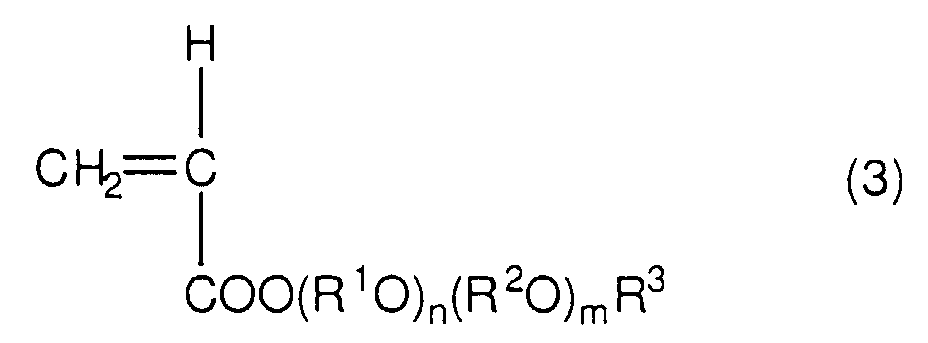
- R1O
- denotes an oxyalkylene group with 3 to 7 carbon atoms or a mixture of two or more thereof, wherein the mixture may be formed by either block addition or random addition;
- R2O
- denotes an oxyalkylene group with 2 to 18 carbon atoms or a mixture of two or more thereof, wherein the mixture may be formed by either block addition or random addition;
- R3
- denotes a hydrocarbon group with 1 to 3 carbon atoms;
- n
- is an average molar number of addition of R1O and denotes a number of 1 to 50;
- m
- is an average molar number of addition of R2O and denotes
a number of 35 to 300; and
not less than 80 mol % of the oxyalkylene groups (total of R1O and R2O) are oxyethylene groups;
where: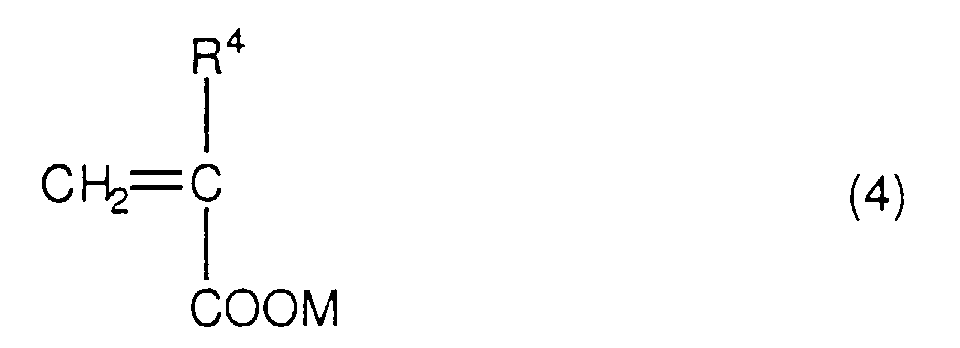
- R4
- denotes hydrogen or a methyl group; and
- M
- denotes hydrogen, a monovalent metal, a divalent metal, ammonium, or an organic amine.
- A cement additive, which comprises copolymer (C) having polyalkylene glycol ester unit (VII) of general formula (5) below as a repeating unit and carboxylic unit (VIII) of general formula (6) below as a repeating unit,
wherein general formula (5) is:where:
- R5O
- denotes an oxyalkylene group with 4 to 7 carbon atoms or a mixture of two or more thereof, wherein the mixture may be formed by either block addition or random addition;
- R6O
- denotes an oxyalkylene group with 2 to 18 carbon atoms or a mixture of two or more thereof, wherein the mixture may be formed by either block addition or random addition;
- R7
- denotes a hydrocarbon group with 1 to 3 carbon atoms;
- p
- is an average molar number of addition of R5O and denotes a number of 1 to 50;
- q
- is an average molar number of addition of R6O and denotes a
number of 1 to 300; and
not less than 80 mol % of the oxyalkylene groups (total of R5O and R6O) are oxyethylene groups;
where:
- R8
- denotes hydrogen or a methyl group; and
- M'
- denotes hydrogen, a monovalent metal, a divalent metal, ammonium, or an organic amine.
- A cement additive according to claim 7, wherein R6Oin general formula (5) is an oxyethylene group.
- A cement additive according to claim 7, wherein the ratio of the polyalkylene glycol ester units with a molar number of addition of R5O of 0 mol is not more than 2 weight % of the entire polyalkylene glycol ester units (VII) of general formula (5) in terms of alcohol (HO(R5O)p(R6O)qR7).
- A cement additive according to claim 7, wherein the ratio of the polyalkylene glycol ester units with a molar number of addition of R5O of not larger than 1 mol is not more than 20 weight % of the entire polyalkylene glycol ester units (VII) of general formula (5) in terms of alcohol (HO(R5O)p(R6O)qR7).
- A cement additive according to claim 7, wherein there is a relation of (q/p) > 8 between the average molar number p of addition of R5O and the average molar number q of addition of R6O.
- A cement additive, which comprises copolymer (D) as obtained by a process including the step of copolymerizing a monomer mixture including polyalkylene glycol ester monomer (X) of general formula (7) below and carboxylic monomer (XI) of general formula (8) below, wherein general formula (7) is:where:

- R5O
- denotes an oxyalkylene group with 4 to 7 carbon atoms or a mixture of two or more thereof, wherein the mixture may be formed by either block addition or random addition;
- R6O
- denotes an oxyalkylene group with 2 to 18 carbon atoms or a mixture of two or more thereof, wherein the mixture may be formed by either block addition or random addition;
- R7
- denotes a hydrocarbon group with 1 to 3 carbon atoms;
- p
- is an average molar number of addition of R5O and denotes a number of 1 to 50;
- q
- is an average molar number of addition of R6O and denotes a
number of 1 to 300; and
not less than 80 mol % of the oxyalkylene groups (total of R5O and R6O) are oxyethylene groups; and wherein general formula (8) is:where:
- R8
- denotes hydrogen or a methyl group; and
- M'
- denotes hydrogen, a monovalent metal, a divalent metal, ammonium, or an organic amine.
Applications Claiming Priority (2)
| Application Number | Priority Date | Filing Date | Title |
|---|---|---|---|
| JP30085298 | 1998-10-22 | ||
| JP30085298 | 1998-10-22 |
Publications (2)
| Publication Number | Publication Date |
|---|---|
| EP0995727A1 true EP0995727A1 (en) | 2000-04-26 |
| EP0995727B1 EP0995727B1 (en) | 2004-08-25 |
Family
ID=17889906
Family Applications (1)
| Application Number | Title | Priority Date | Filing Date |
|---|---|---|---|
| EP99121074A Expired - Lifetime EP0995727B1 (en) | 1998-10-22 | 1999-10-21 | Cement additive on the basis of acrylic copolymers |
Country Status (5)
| Country | Link |
|---|---|
| US (1) | US6258162B1 (en) |
| EP (1) | EP0995727B1 (en) |
| KR (1) | KR100449387B1 (en) |
| CN (1) | CN1093097C (en) |
| DE (1) | DE69919652T2 (en) |
Cited By (7)
| Publication number | Priority date | Publication date | Assignee | Title |
|---|---|---|---|---|
| FR2814465A1 (en) * | 2000-09-27 | 2002-03-29 | Synthron | Grafted acrylic polymers for use in hydraulic cement compositions as liquefying and-or water reducing agent, optionally comprise alkyl esters of acrylic or methacrylic acids and acid groups esterified with polyethylene glycol monoether |
| FR2827593A1 (en) * | 2001-07-23 | 2003-01-24 | Chryso Sas | Methacrylic acid copolymers with polyalkylene glycol ester side-chains are used as dispersants for aqueous compositions of calcium sulfate hemihydrate, e.g. for production of plaster tiles |
| FR2827594A1 (en) * | 2001-07-23 | 2003-01-24 | Chryso Sas | Use of methacrylic acid copolymers with polyalkylene glycol ester side-chains as dispersants for aqueous compositions of anhydrous calcium sulfate, e.g. floor coating compositions |
| EP1481952A1 (en) * | 2002-03-11 | 2004-12-01 | Kao Corporation | Admixture for a hydraulic composition |
| EP1426349A4 (en) * | 2001-09-14 | 2008-08-06 | Nmb Ltd | Additive for cement composition and cement composition containing the same |
| EP2003154A3 (en) * | 2000-12-27 | 2010-10-13 | Nippon Shokubai Co., Ltd. | Polycarboxylic acid type copolymer, method for producing the same, cement additive and cement composition |
| WO2016079213A1 (en) * | 2014-11-20 | 2016-05-26 | Basf Se | Rheology modifier for inorganic suspensions |
Families Citing this family (17)
| Publication number | Priority date | Publication date | Assignee | Title |
|---|---|---|---|---|
| DE1136508T1 (en) * | 2000-03-22 | 2002-04-18 | Sika Ag, Vormals Kaspar Winkler & Co | Cement mix with extended processing time |
| EP1138696A1 (en) * | 2000-03-29 | 2001-10-04 | Sika AG, vorm. Kaspar Winkler & Co. | Polymers for cement dispersing admixtures |
| JP3428954B2 (en) * | 2000-08-21 | 2003-07-22 | 竹本油脂株式会社 | Additive for hydraulic cement composition and hydraulic cement composition |
| JP4294259B2 (en) * | 2001-09-19 | 2009-07-08 | Basfポゾリス株式会社 | Workability improver for cement composition and cement water reducing agent containing the same |
| WO2003040194A1 (en) * | 2001-11-06 | 2003-05-15 | Nippon Shokubai Co., Ltd. | (meth)acrylic acid (salt) polymer and process for production thereof |
| JP2003300766A (en) * | 2002-02-06 | 2003-10-21 | Nippon Shokubai Co Ltd | Concrete composition, method for producing the same and cement admixture |
| KR100484725B1 (en) * | 2002-06-28 | 2005-04-20 | 주식회사 엘지화학 | Cement admixture having superior water-reducing properties, method for preparing the same, and cement composition comprising the same |
| US7141112B2 (en) * | 2003-01-31 | 2006-11-28 | Douglas C Comrie | Cementitious materials including stainless steel slag and geopolymers |
| TWI259831B (en) * | 2003-05-07 | 2006-08-11 | Nippon Catalytic Chem Ind | Cement admixture and cement admixture composite |
| KR100924665B1 (en) * | 2003-11-05 | 2009-11-03 | 가부시키가이샤 닛폰 쇼쿠바이 | Cement mixture |
| DE102006007004A1 (en) * | 2006-02-15 | 2007-08-16 | Construction Research & Technology Gmbh | Water-soluble sulfo-containing copolymers, process for their preparation and their use |
| US8592040B2 (en) | 2008-09-05 | 2013-11-26 | Basf Se | Polymer emulsion coating or binding formulations and methods of making and using same |
| FR2940295B1 (en) * | 2008-12-18 | 2010-12-17 | Coatex Sas | MACROMONOMERS IMPROVING THE THERMAL STABILITY OF COMBINED (METH) ACRYLIC POLYMERS, USE OF THESE POLYMERS IN CHARGED PLASTIC COMPOSITIONS |
| CN102834566B (en) | 2010-03-23 | 2016-04-27 | 巴斯夫欧洲公司 | Paper Coating or bonding preparaton and its production and use |
| US9212095B2 (en) | 2011-02-21 | 2015-12-15 | Construction Research & Technology, Gmbh | Use of HyperBranched polyether surfactant in cementitious systems |
| US9102848B2 (en) | 2011-02-28 | 2015-08-11 | Basf Se | Environmentally friendly, polymer dispersion-based coating formulations and methods of preparing and using same |
| KR20160026303A (en) * | 2014-08-29 | 2016-03-09 | 삼성정밀화학 주식회사 | Cement mortar additive for extrusion molding, cement mortar for extrusion molding, and extrusion molded product |
Citations (4)
| Publication number | Priority date | Publication date | Assignee | Title |
|---|---|---|---|---|
| US4808641A (en) * | 1986-07-31 | 1989-02-28 | Fujisawa Pharmaceutical Co., Ltd. | Concrete admixture |
| EP0692465A1 (en) * | 1994-06-30 | 1996-01-17 | Kao Corporation | Hydraulic composition |
| EP0792850A1 (en) * | 1996-02-22 | 1997-09-03 | Nippon Shokubai Co., Ltd. | Cementitions composition comprising acrylic copolymers |
| WO1997048656A1 (en) * | 1996-06-21 | 1997-12-24 | Kao Corporation | Concrete admixture |
Family Cites Families (13)
| Publication number | Priority date | Publication date | Assignee | Title |
|---|---|---|---|---|
| JPH08165156A (en) | 1993-02-16 | 1996-06-25 | Toho Chem Ind Co Ltd | Cement dispersant composition |
| JPH06279082A (en) | 1993-03-30 | 1994-10-04 | Kao Corp | Concrete admixture |
| JPH0725651A (en) | 1993-05-10 | 1995-01-27 | Kao Corp | Concrete admixture |
| JPH06321596A (en) | 1993-05-17 | 1994-11-22 | Kao Corp | Concrete admixture |
| ES2140558T3 (en) * | 1993-09-29 | 2000-03-01 | Grace W R & Co | IMPROVED CEMENT ADDITIVE PRODUCT, WITH IMPROVED RHEOLOGICAL PROPERTIES, AND PROCEDURE FOR THE FORMATION OF THE SAME. |
| JP2774445B2 (en) * | 1993-12-14 | 1998-07-09 | 花王株式会社 | Concrete admixture |
| US5753744A (en) * | 1995-02-27 | 1998-05-19 | W.R. Grace & Co.-Conn. | Cement and cement composition having improved rheological properties |
| US5665158A (en) * | 1995-07-24 | 1997-09-09 | W. R. Grace & Co.-Conn. | Cement admixture product |
| US5840114A (en) * | 1995-06-21 | 1998-11-24 | W. R. Grace & Co.-Conn. | High early-strength-enhancing admixture for precast hydraulic cement and compositions containing same |
| JPH09241056A (en) | 1996-03-07 | 1997-09-16 | Kao Corp | Admixture for concrete |
| JPH09248438A (en) | 1996-03-12 | 1997-09-22 | Kao Corp | Dispersant for inorganic powder |
| US5736600A (en) * | 1996-08-07 | 1998-04-07 | W.R. Grace & Co.-Conn. | Mortar admixtures and method of preparing same |
| US5912284A (en) * | 1996-12-26 | 1999-06-15 | Nippon Shokubai Co., Ltd. | Cement additive, its production process and use |
-
1999
- 1999-09-25 US US09/405,566 patent/US6258162B1/en not_active Expired - Lifetime
- 1999-10-21 DE DE69919652T patent/DE69919652T2/en not_active Expired - Lifetime
- 1999-10-21 EP EP99121074A patent/EP0995727B1/en not_active Expired - Lifetime
- 1999-10-21 KR KR10-1999-0045759A patent/KR100449387B1/en not_active Expired - Fee Related
- 1999-10-22 CN CN99123314A patent/CN1093097C/en not_active Expired - Fee Related
Patent Citations (4)
| Publication number | Priority date | Publication date | Assignee | Title |
|---|---|---|---|---|
| US4808641A (en) * | 1986-07-31 | 1989-02-28 | Fujisawa Pharmaceutical Co., Ltd. | Concrete admixture |
| EP0692465A1 (en) * | 1994-06-30 | 1996-01-17 | Kao Corporation | Hydraulic composition |
| EP0792850A1 (en) * | 1996-02-22 | 1997-09-03 | Nippon Shokubai Co., Ltd. | Cementitions composition comprising acrylic copolymers |
| WO1997048656A1 (en) * | 1996-06-21 | 1997-12-24 | Kao Corporation | Concrete admixture |
Cited By (10)
| Publication number | Priority date | Publication date | Assignee | Title |
|---|---|---|---|---|
| FR2814465A1 (en) * | 2000-09-27 | 2002-03-29 | Synthron | Grafted acrylic polymers for use in hydraulic cement compositions as liquefying and-or water reducing agent, optionally comprise alkyl esters of acrylic or methacrylic acids and acid groups esterified with polyethylene glycol monoether |
| EP2003154A3 (en) * | 2000-12-27 | 2010-10-13 | Nippon Shokubai Co., Ltd. | Polycarboxylic acid type copolymer, method for producing the same, cement additive and cement composition |
| FR2827593A1 (en) * | 2001-07-23 | 2003-01-24 | Chryso Sas | Methacrylic acid copolymers with polyalkylene glycol ester side-chains are used as dispersants for aqueous compositions of calcium sulfate hemihydrate, e.g. for production of plaster tiles |
| FR2827594A1 (en) * | 2001-07-23 | 2003-01-24 | Chryso Sas | Use of methacrylic acid copolymers with polyalkylene glycol ester side-chains as dispersants for aqueous compositions of anhydrous calcium sulfate, e.g. floor coating compositions |
| WO2003010110A1 (en) * | 2001-07-23 | 2003-02-06 | Chryso S.A.S. | Use of dispersant for aqueous compositions of calcium sulphate hemihydrate |
| WO2003011790A1 (en) * | 2001-07-23 | 2003-02-13 | Chryso S.A.S | Use of dispersant for anhydrous calcium sulphate aqueous compositions and dispersant mixture for such compositions |
| US8093326B2 (en) | 2001-07-23 | 2012-01-10 | Martin Mosquet | Use of dispersant for aqueous compositions of calcium sulphate hemihydrate |
| EP1426349A4 (en) * | 2001-09-14 | 2008-08-06 | Nmb Ltd | Additive for cement composition and cement composition containing the same |
| EP1481952A1 (en) * | 2002-03-11 | 2004-12-01 | Kao Corporation | Admixture for a hydraulic composition |
| WO2016079213A1 (en) * | 2014-11-20 | 2016-05-26 | Basf Se | Rheology modifier for inorganic suspensions |
Also Published As
| Publication number | Publication date |
|---|---|
| CN1093097C (en) | 2002-10-23 |
| KR100449387B1 (en) | 2004-09-21 |
| DE69919652D1 (en) | 2004-09-30 |
| CN1252394A (en) | 2000-05-10 |
| EP0995727B1 (en) | 2004-08-25 |
| US6258162B1 (en) | 2001-07-10 |
| DE69919652T2 (en) | 2005-09-15 |
| KR20000029225A (en) | 2000-05-25 |
Similar Documents
| Publication | Publication Date | Title |
|---|---|---|
| EP0995727B1 (en) | Cement additive on the basis of acrylic copolymers | |
| EP0931799B1 (en) | Cement admixture and cement composition | |
| EP1179517B1 (en) | Cement dispersant and cement composition comprising this | |
| KR100771024B1 (en) | Cement Additives and Cement Compositions | |
| JP5955386B2 (en) | Polycarboxylic acid copolymer, cement dispersant, cement admixture, and cement composition | |
| US6727315B2 (en) | Copolymer for cement admixtures and its production process and use | |
| KR100979768B1 (en) | Cement Admixtures and Manufacturing Method Thereof | |
| JP4233294B2 (en) | Cement admixture, cement composition, and method for producing cement admixture | |
| JP4410438B2 (en) | Cement dispersant and cement composition using the same | |
| JP6012139B2 (en) | Cement admixture and cement composition | |
| JP4947856B2 (en) | Cement dispersant and cement composition using the same | |
| EP1041053A1 (en) | Cement additive | |
| EP0931776A1 (en) | Cement admixture and cement composition | |
| JP4283940B2 (en) | Cement admixture | |
| JP6109240B2 (en) | Cement admixture and cement composition | |
| JP2000007402A (en) | Cement additive | |
| JP2003327459A (en) | Cement admixture | |
| JP5912964B2 (en) | Polycarboxylic acid copolymer for cement admixture | |
| JP4667550B2 (en) | Cement additive | |
| JP2003183338A (en) | New copolymer and its use | |
| JP2002348160A (en) | Cement admixture and cement composition | |
| JP2014031296A (en) | Polycarboxylic acid-based copolymer for cement admixture | |
| JP5235318B2 (en) | Cement admixture and cement composition |
Legal Events
| Date | Code | Title | Description |
|---|---|---|---|
| PUAI | Public reference made under article 153(3) epc to a published international application that has entered the european phase |
Free format text: ORIGINAL CODE: 0009012 |
|
| AK | Designated contracting states |
Kind code of ref document: A1 Designated state(s): DE FR IT |
|
| AX | Request for extension of the european patent |
Free format text: AL;LT;LV;MK;RO;SI |
|
| 17P | Request for examination filed |
Effective date: 20001002 |
|
| AKX | Designation fees paid |
Free format text: DE FR IT |
|
| 17Q | First examination report despatched |
Effective date: 20030402 |
|
| GRAP | Despatch of communication of intention to grant a patent |
Free format text: ORIGINAL CODE: EPIDOSNIGR1 |
|
| RIC1 | Information provided on ipc code assigned before grant |
Ipc: 7C 08F 220/06 B Ipc: 7C 04B 24/32 B Ipc: 7C 04B 24/26 A |
|
| GRAS | Grant fee paid |
Free format text: ORIGINAL CODE: EPIDOSNIGR3 |
|
| GRAA | (expected) grant |
Free format text: ORIGINAL CODE: 0009210 |
|
| AK | Designated contracting states |
Kind code of ref document: B1 Designated state(s): DE FR IT |
|
| REF | Corresponds to: |
Ref document number: 69919652 Country of ref document: DE Date of ref document: 20040930 Kind code of ref document: P |
|
| ET | Fr: translation filed | ||
| PLBE | No opposition filed within time limit |
Free format text: ORIGINAL CODE: 0009261 |
|
| STAA | Information on the status of an ep patent application or granted ep patent |
Free format text: STATUS: NO OPPOSITION FILED WITHIN TIME LIMIT |
|
| 26N | No opposition filed |
Effective date: 20050526 |
|
| PGFP | Annual fee paid to national office [announced via postgrant information from national office to epo] |
Ref country code: FR Payment date: 20071009 Year of fee payment: 9 |
|
| REG | Reference to a national code |
Ref country code: FR Ref legal event code: ST Effective date: 20090630 |
|
| PG25 | Lapsed in a contracting state [announced via postgrant information from national office to epo] |
Ref country code: FR Free format text: LAPSE BECAUSE OF NON-PAYMENT OF DUE FEES Effective date: 20081031 |
|
| PGFP | Annual fee paid to national office [announced via postgrant information from national office to epo] |
Ref country code: DE Payment date: 20121017 Year of fee payment: 14 |
|
| PGFP | Annual fee paid to national office [announced via postgrant information from national office to epo] |
Ref country code: IT Payment date: 20121013 Year of fee payment: 14 |
|
| REG | Reference to a national code |
Ref country code: DE Ref legal event code: R119 Ref document number: 69919652 Country of ref document: DE Effective date: 20140501 |
|
| PG25 | Lapsed in a contracting state [announced via postgrant information from national office to epo] |
Ref country code: DE Free format text: LAPSE BECAUSE OF NON-PAYMENT OF DUE FEES Effective date: 20140501 Ref country code: IT Free format text: LAPSE BECAUSE OF NON-PAYMENT OF DUE FEES Effective date: 20131021 |