EP0995813A2 - Method and apparatus for measurement of weight during CVI/CVD process - Google Patents
Method and apparatus for measurement of weight during CVI/CVD process Download PDFInfo
- Publication number
- EP0995813A2 EP0995813A2 EP99120704A EP99120704A EP0995813A2 EP 0995813 A2 EP0995813 A2 EP 0995813A2 EP 99120704 A EP99120704 A EP 99120704A EP 99120704 A EP99120704 A EP 99120704A EP 0995813 A2 EP0995813 A2 EP 0995813A2
- Authority
- EP
- European Patent Office
- Prior art keywords
- furnace
- cvi
- cvd
- weight
- parts
- Prior art date
- Legal status (The legal status is an assumption and is not a legal conclusion. Google has not performed a legal analysis and makes no representation as to the accuracy of the status listed.)
- Ceased
Links
- 238000000034 method Methods 0.000 title claims abstract description 90
- 238000005259 measurement Methods 0.000 title description 6
- 238000005303 weighing Methods 0.000 claims abstract description 26
- 238000000151 deposition Methods 0.000 claims description 12
- 239000000376 reactant Substances 0.000 claims description 12
- 239000011159 matrix material Substances 0.000 claims description 10
- 238000012544 monitoring process Methods 0.000 claims description 8
- 230000009257 reactivity Effects 0.000 claims description 4
- 239000000758 substrate Substances 0.000 claims 2
- 238000005229 chemical vapour deposition Methods 0.000 abstract description 40
- 235000019786 weight gain Nutrition 0.000 abstract description 9
- 230000004584 weight gain Effects 0.000 abstract description 9
- 238000001764 infiltration Methods 0.000 abstract description 7
- 230000008595 infiltration Effects 0.000 abstract description 7
- 239000000126 substance Substances 0.000 abstract description 4
- 230000008021 deposition Effects 0.000 description 9
- 208000021017 Weight Gain Diseases 0.000 description 8
- OKTJSMMVPCPJKN-UHFFFAOYSA-N Carbon Chemical compound [C] OKTJSMMVPCPJKN-UHFFFAOYSA-N 0.000 description 3
- 229910052799 carbon Inorganic materials 0.000 description 3
- 239000000919 ceramic Substances 0.000 description 3
- 230000001965 increasing effect Effects 0.000 description 3
- 239000002131 composite material Substances 0.000 description 2
- 230000006835 compression Effects 0.000 description 2
- 238000007906 compression Methods 0.000 description 2
- 230000001186 cumulative effect Effects 0.000 description 2
- 230000003466 anti-cipated effect Effects 0.000 description 1
- 235000021053 average weight gain Nutrition 0.000 description 1
- 239000006227 byproduct Substances 0.000 description 1
- 239000011248 coating agent Substances 0.000 description 1
- 238000000576 coating method Methods 0.000 description 1
- 238000001816 cooling Methods 0.000 description 1
- 238000000280 densification Methods 0.000 description 1
- 238000010438 heat treatment Methods 0.000 description 1
- 230000001939 inductive effect Effects 0.000 description 1
- 230000010354 integration Effects 0.000 description 1
- 239000007788 liquid Substances 0.000 description 1
- 238000004519 manufacturing process Methods 0.000 description 1
- 238000012545 processing Methods 0.000 description 1
- 239000002296 pyrolytic carbon Substances 0.000 description 1
- 239000011226 reinforced ceramic Substances 0.000 description 1
- 238000012552 review Methods 0.000 description 1
- 239000007787 solid Substances 0.000 description 1
- 230000003068 static effect Effects 0.000 description 1
Images
Classifications
-
- C—CHEMISTRY; METALLURGY
- C23—COATING METALLIC MATERIAL; COATING MATERIAL WITH METALLIC MATERIAL; CHEMICAL SURFACE TREATMENT; DIFFUSION TREATMENT OF METALLIC MATERIAL; COATING BY VACUUM EVAPORATION, BY SPUTTERING, BY ION IMPLANTATION OR BY CHEMICAL VAPOUR DEPOSITION, IN GENERAL; INHIBITING CORROSION OF METALLIC MATERIAL OR INCRUSTATION IN GENERAL
- C23C—COATING METALLIC MATERIAL; COATING MATERIAL WITH METALLIC MATERIAL; SURFACE TREATMENT OF METALLIC MATERIAL BY DIFFUSION INTO THE SURFACE, BY CHEMICAL CONVERSION OR SUBSTITUTION; COATING BY VACUUM EVAPORATION, BY SPUTTERING, BY ION IMPLANTATION OR BY CHEMICAL VAPOUR DEPOSITION, IN GENERAL
- C23C16/00—Chemical coating by decomposition of gaseous compounds, without leaving reaction products of surface material in the coating, i.e. chemical vapour deposition [CVD] processes
- C23C16/44—Chemical coating by decomposition of gaseous compounds, without leaving reaction products of surface material in the coating, i.e. chemical vapour deposition [CVD] processes characterised by the method of coating
- C23C16/52—Controlling or regulating the coating process
-
- C—CHEMISTRY; METALLURGY
- C23—COATING METALLIC MATERIAL; COATING MATERIAL WITH METALLIC MATERIAL; CHEMICAL SURFACE TREATMENT; DIFFUSION TREATMENT OF METALLIC MATERIAL; COATING BY VACUUM EVAPORATION, BY SPUTTERING, BY ION IMPLANTATION OR BY CHEMICAL VAPOUR DEPOSITION, IN GENERAL; INHIBITING CORROSION OF METALLIC MATERIAL OR INCRUSTATION IN GENERAL
- C23C—COATING METALLIC MATERIAL; COATING MATERIAL WITH METALLIC MATERIAL; SURFACE TREATMENT OF METALLIC MATERIAL BY DIFFUSION INTO THE SURFACE, BY CHEMICAL CONVERSION OR SUBSTITUTION; COATING BY VACUUM EVAPORATION, BY SPUTTERING, BY ION IMPLANTATION OR BY CHEMICAL VAPOUR DEPOSITION, IN GENERAL
- C23C16/00—Chemical coating by decomposition of gaseous compounds, without leaving reaction products of surface material in the coating, i.e. chemical vapour deposition [CVD] processes
- C23C16/04—Coating on selected surface areas, e.g. using masks
- C23C16/045—Coating cavities or hollow spaces, e.g. interior of tubes; Infiltration of porous substrates
Definitions
- This invention is in the field of Chemical vapor infiltration and Chemical vapor deposition (CVI/CVD). More specifically, this invention is directed to a method of weighing parts being subjected to the CVI/CVD process, during the process itself.
- CVI/CVD Chemical vapor infiltration and Chemical vapor deposition
- CVI/CVD process as described herein is to deposit a binding matrix within a porous structure. This process adds mass to the parts, and increases part density. During a CVI/CVD process, there is a correlation between the increase in part weight, and the increase in part density. Under current state of the art, CVI/CVD run times are predetermined, based on the starting densities of the parts, and the anticipated time necessary to process them to a predetermined higher density. However, CVI/CVD runs are never exactly the same due to many variables, and likewise the results of the process vary from run to run. This means that parts may be either too dense, or not dense enough at the predetermined conclusion of a run.
- process parameters such as furnace temperature, reactant gas flow rate, internal furnace pressure and reactant gas reactivity, may be continuously adjusted to increase, decrease, or maintain the densification rate.
- the principal object of the present invention is to determine the weight change of parts during the CVI/CVD process.
- the furnace is weighed.
- an indicator unit is electrically connected to a means for weighing the furnace, parts are placed in the furnacefor the CVI/CVD process, and the indicator unit is monitored during the CVI/CVD process for the change in weight of the furnace as the change in weight of the parts therein.
- Another important object of this invention is to control the run time, and the process parameters of each CVI/CVD process based on the weight change of the parts.
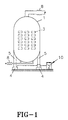
- a furnace 1 for use in a CVI/CVD process is disposed upon a weighing device 10 , and the weighing device 10 is configured to indicate the weight of the furnace.
- the weighing device 10 is also configured to support the furnace.
- the weighing device 10 may be any device which is capable of being used to determine weight.
- the weighing device 10 depicted in Figure 1 is the combination of a load cell 4 under each furnace leg 6 , all connected to an indicator unit 2 .
- CVI/CVD Chemical vapor infiltration and deposition
- CVD chemical vapor deposition
- the term "chemical vapor deposition” (CVD) generally implies deposition of a surface coating, but the term is also used to refer to infiltration and deposition of a matrix within a porous structure.
- CVI/CVD is intended to refer to infiltration and deposition of a matrix within a porous part or structure.
- the technique is particularly suitable for fabricating high temperature structural composites by depositing a carbonaceous or ceramic matrix within a carbonaceous or ceramic porous structure resulting in very useful structures such as carbon/carbon aircraft brake disks, and ceramic combustor or turbine components.
- the generally known CVI/CVD processes may be classified into four general categories: isothermal, thermal gradient, pressure gradient, and pulsed flow. See W.V. Kotlensky, Deposition of Pyrolytic Carbon in Porous Solids . 8 Chemistry and Physics of Carbon, 173, 190-203 (1973); W.J. Lackey, Review, Status, and Future of the Chemical Vapor Infiltration Process for Fabrication of Fiber-Reinforced Ceramic Composites , Ceram. Eng. Sci. Proc. 10[7-8]577, 577-81 (1989) (W.J.Lackey refers to the pressure gradient process as "isothermal forced flow").
- a reactant gas passes around a heated porous structure at absolute pressures as low as a few torr.
- the gas diffuses into the porous structure driven by concentration gradients and cracks to deposit a binding matrix.
- This process is also known as "conventional" CVI/CVD.
- the porous structure is heated to a more or less uniform temperature, hence the term "isothermal”.
- a thermal gradient CVI/CVD process a porous structure is heated in a manner that generates steep thermal gradients that induce deposition in a desired portion of the porous structure.
- the thermal gradients may be induced by heating only one surface of a porous structure, for example by placing a porous structure surface against a susceptor wall, and may be enhanced by cooling an opposing surface, for example by placing the opposing surface of the porous structure against a liquid cooled wall.
- Deposition of the binding matrix progresses from the hot surface to the cold surface.
- the reactant gas is forced to flow through the porous structure by inducing a pressure gradient from one surface of the porous structure to the opposing surface of the porous structure. Flow rate of the reactant gas is greatly increased relative to the isothermal and thermal gradient processes which results in increased deposition rate of the binding matrix. This process is also known as "forced-flow" CVI/CVD.
- pulsed flow involves rapidly and cyclically filling and evacuating a chamber containing the heated porous structure with the reactant gas.
- the cyclical action forces the reactant gas to infiltrate the porous structure and also forces removal of the cracked reactant gas by-products from the porous structure.
- the furnace configuration may vary substantially depending upon the type of processes, and the various aspects of the invention may be implemented with any of these processes, depending upon the particular configuration. As such, the furnace configuration of Figure 1 is presented by way of example, and is not intended to limit the invention to the specific arrangement presented.
- a method to determine the weight change of parts 3 in a furnace 1 during a CVI/CVD process comprises weighing the furnace 1 , including contents, during the CVI/CVD process.
- the weight change of parts during the CVI/CVD process is monitored by attaching the furnace 1 to a means for weighing the furnace, electrically connecting an indicator unit 2 to the means for weighing the furnace, placing the parts 3 in the furnace for the CVI/CVD process, and monitoring the indicator unit 2 during the CVI/CVD process for the change in weight of the furnace 1 as the change in weight of the parts 3 therein.
- the means for weighing the furnace comprises placing the furnace on load cells.
- the means for weighing the furnace comprises placing load cells 4 under the furnace 1 , such that the weight of the furnace 1 is supported by the load cells 4 . In Figure 1 the load cells 4 are placed under each furnace leg 5 .
- the indicator unit 2 is tared immediately before the process is commenced, such that the indicator unit 2 reflects the change in weight of the parts.
- all connections 8 to the furnace 1 may be flexible, to increase the accuracy of the weight measurement. Increasing the flexibility of the connections generally tends to increase the accuracy of the weight measurement.
- a CVI/CVD process is terminated based on the average weight gain per part.
- a CVI/CVD process comprises the steps of attaching the furnace 1 to a means for weighing the furnace, electrically connecting an indicator unit 2 to the means for weighing the furnace, placing the parts 3 in the furnace 1 for the CVI/CVD process, monitoring the indicator unit 2 during the CVI/CVD process for the change in weight of the furnace 1 as the change in weight of the parts 3 therein, and terminating the CVI/CVD process when the indicator unit 2 indicates that the parts 3 have gained a prescribed amount of weight.
- the means for weighing the furnace comprises placing the furnace 1 on load cells 4.
- the means for weighing the furnace comprises placing load cells 4 under the furnace 1 , such that the entire weight of the furnace 1 is supported by the load cells 4 .
- the load cells 4 are placed under each furnace leg 5.
- the indicator unit 2 is tared immediately before the process is commenced, such that the indicator unit 2 reflects the change in weight of the parts 3 directly.
- all connections 8 to the furnace 1 may be flexible, to increase the accuracy of the weight measurement.
- a method to determine the weight change of parts during a CVI/CVD process comprises the steps of placing the furnace 1 on load cells 4 appropriate for the entire furnace 1 weight plus weight of the parts 3 , attaching an indicator uni t 2 to the compression load cells 4 , placing the parts 3 in the furnace 1 for the CVI/CVD process, and monitoring the indicator unit 2 during the CVI/CVD process for the change in weight.
- the apparatus for determining the weight change of parts 3 during a CVI/CVD process comprises load cells 4 supporting the furnace 1 , and an indicator unit 2 electrically connected to the load cells 4 .
- a furnace weighing 120,000 lbs to 150,000 lbs is configured to process aircraft brake disks. All connections 8 to the furnace are flexible.
- One Flexmount Weight Module static strain gage with 45,000 lb capacity load cell manufactured by Mettler, Toledo and Co. is placed under each furnace leg 5 .
- These load cells are electrically connected to an indicator unit 2, specifically a Jaguar TM System Integration Terminal (also manufactured by Mettler, Toledo and Co.) for a cumulative weight measurement such that one indicator unit 2 displays the total weight on all four load cells 4 . Parts with an initial cumulative weight of on the order of a few percent of the furnace weight are then placed in the furnace, and the indicator unit 2 is tared.
- the weight gain measurement of the parts is accurate to within ⁇ 10% for parts having a lesser weight gain (total weight gain on the order of 1% of the total furnace weight), and is accurate to within ⁇ 5% for parts having a greater weight gain (total weight gain on the order of 3% of the total furnace weight).
- the weight gain measured according to the invention may be less than or equal to 10% of the total furnace weight, may be less than or equal to 5% of the total furnace weight, and may be less than or equal to 3% of the total furnace weight. Weight gains less than or equal to 1% of the total furnace weight have been measured with an accuracy within ⁇ 10%.
- the process further comprises the step of monitoring the rate at which the parts gain weight, wherein the rate is influenced by process parameters including furnace temperature, reactant gas flow rate, internal furnace pressure, and reactivity of the reactant gas.
- the process may further comprise the step of varying at least one of the parameters to achieve a desired rate. For example, CVI/CVD deposition rate tends to decrease as matrix is deposited. It may be desireable to decrease the reactivity of the gas at a later stage in the process in order to promote infiltration of the gas into the parts. This may produce a greater overall weight gain. Other variations are possible.
- the furnace may be disposed in other orientations, and the weight of the furnace may be measured in any manner suitable for the particular orientation.
Landscapes
- Chemical & Material Sciences (AREA)
- General Chemical & Material Sciences (AREA)
- Chemical Kinetics & Catalysis (AREA)
- Engineering & Computer Science (AREA)
- Materials Engineering (AREA)
- Mechanical Engineering (AREA)
- Metallurgy (AREA)
- Organic Chemistry (AREA)
- Chemical Vapour Deposition (AREA)
Abstract
Description
Claims (14)
- A method to determine the change in weight of parts in a furnace during a CVI/CVD process, comprising the step of: measuring the change in weight of the entire furnace, including contents, during the CVI/CVD process.
- In combination, a furnace for use in a CVI/CVD process, and a weighing device, the furnace disposed upon the weighing device, the weighing device being configured to indicate the weight of the furnace.
- A method to determine the weight change of parts during a CVI/CVD process, comprising the steps:a. attaching a CVI/CVD furnace to a means for weighing the CVI/CVD furnace;b. electrically connecting an indicator unit to the means for weighing the CVI/CVD furnace;c. placing the parts in the furnace for the CVI/CVD process; and,d. monitoring the indicator unit during the CVI/CVD process for the change in weight of the furnace as an indication of the change in weight of the parts therein.
- The method of Claim 3, wherein the means for weighing the furnace comprises placing load cells under the furnace.
- The method of Claim 3 further comprising the step of taring the indicator unit immediately before the process is commenced, such that the indicator unit reflects the change in weight of the parts.
- The method of Claim 3,4, or 5, wherein all connections to the furnace are flexible.
- A CVI/CVD process, comprising the steps of:CVI/CVD depositing a binding matrix within parts disposed within the CVI/CVD furnace while weighing the entire CVI/CVD furnace, including contents, to indicate a gain in weight of said porous substrates during the process.
- The process of Claim 7, further comprising the step of terminating the CVI/CVD process when the substrates have gained a prescribed amount of weight.
- The process of Claim 7, further comprising the step of weighing the entire CVI/CVD furnace using at least one load cell.
- The process of Claim 7, further comprising the step of taring the indicator unit immediately before the process is commenced, such that the indicator unit reflects the change in weight of the parts directly.
- The process of Claim 7 wherein all connections to the furnace are flexible.
- The process of Claim 7, further comprising the step of monitoring the rate at which the parts gain weight, wherein the rate is influenced by process parameters including furnace temperature, reactant gas flow rate, internal furnace pressure, and reactant gas reactivity, and further comprising the step of varying at least one of the parameters to achieve a desired rate.
- A method to determine the weight change of parts during a CVI/CVD process, comprising the steps:a. placing the furnace on load cells;b. electrically connecting an indicator unit to said load cells;c. placing the parts in the furnace for the CVI/CVD process; and,d. monitoring the indicator unit during the CVI/CVD process for the change in weight of the CVI/CVD furnace.
- Apparatus for monitoring the weight change of parts in a CVI/CVD furnace during a CVI/CVD process, comprising:a. load cells supporting the CVI/CVD furnace; and,b. an indicator unit electrically connected to the load cells.
Applications Claiming Priority (2)
| Application Number | Priority Date | Filing Date | Title |
|---|---|---|---|
| US178399 | 1998-10-23 | ||
| US09/178,399 US20010011609A1 (en) | 1998-10-23 | 1998-10-23 | Method and apparatus for measurement of weight during cvi/cvd process |
Publications (2)
| Publication Number | Publication Date |
|---|---|
| EP0995813A2 true EP0995813A2 (en) | 2000-04-26 |
| EP0995813A3 EP0995813A3 (en) | 2001-01-24 |
Family
ID=22652408
Family Applications (1)
| Application Number | Title | Priority Date | Filing Date |
|---|---|---|---|
| EP99120704A Ceased EP0995813A3 (en) | 1998-10-23 | 1999-10-19 | Method and apparatus for measurement of weight during CVI/CVD process |
Country Status (2)
| Country | Link |
|---|---|
| US (2) | US20010011609A1 (en) |
| EP (1) | EP0995813A3 (en) |
Cited By (2)
| Publication number | Priority date | Publication date | Assignee | Title |
|---|---|---|---|---|
| WO2009156023A1 (en) * | 2008-06-24 | 2009-12-30 | Ika - Werke Gmbh & Co. Kg | Laboratory reactor with a reaction vessel |
| EP3228728A1 (en) * | 2016-03-21 | 2017-10-11 | Goodrich Corporation | System and method for enhancing a diffusion limited cvi/cvd process |
Families Citing this family (3)
| Publication number | Priority date | Publication date | Assignee | Title |
|---|---|---|---|---|
| US6787713B2 (en) | 2002-07-29 | 2004-09-07 | Chart Inc. | Load cell and weighing system for cryogenic tanks |
| US20070193379A1 (en) * | 2006-02-21 | 2007-08-23 | Mccluskey William P | Electronic Scale for Measuring Gas in Pressurized Cylinders Over a Wide Range of Capacities |
| CN105349969B (en) * | 2015-12-15 | 2018-08-28 | 湖南顶立科技有限公司 | A kind of weighing device |
Family Cites Families (8)
| Publication number | Priority date | Publication date | Assignee | Title |
|---|---|---|---|---|
| US4044920A (en) * | 1976-02-02 | 1977-08-30 | Chore-Time Equipment, Inc. | Load cell and control for bulk bin |
| US4217785A (en) * | 1979-01-08 | 1980-08-19 | Bofors America, Inc. | Erasable-foil-resistance compensation of strain gage transducers |
| EP0044707B1 (en) * | 1980-07-17 | 1987-10-14 | Kabushiki Kaisha Shimadzu Seisakusho | An electronic balance |
| NL8202882A (en) * | 1982-07-15 | 1984-02-01 | Jacob Adriaan Moulijn Dr | Laboratory device for determn. of wt. as function of time - comprising chemical balance and reaction vessel connected to inlet and outlet lines, vessel being freely movable in oven |
| JPS5954944A (en) * | 1982-09-21 | 1984-03-29 | Kazuo Makino | Thermal weight analyzing apparatus |
| JPH01282464A (en) * | 1988-05-10 | 1989-11-14 | Chubu Electric Power Co Inc | Moisture measuring device |
| US5348774A (en) * | 1993-08-11 | 1994-09-20 | Alliedsignal Inc. | Method of rapidly densifying a porous structure |
| US5770823A (en) * | 1996-04-15 | 1998-06-23 | Kistler-Morse Corporation | Zero height load measuring system and method of installing same |
-
1998
- 1998-10-23 US US09/178,399 patent/US20010011609A1/en not_active Abandoned
-
1999
- 1999-10-19 EP EP99120704A patent/EP0995813A3/en not_active Ceased
-
2004
- 2004-02-11 US US10/776,395 patent/US20040159472A1/en not_active Abandoned
Cited By (8)
| Publication number | Priority date | Publication date | Assignee | Title |
|---|---|---|---|---|
| WO2009156023A1 (en) * | 2008-06-24 | 2009-12-30 | Ika - Werke Gmbh & Co. Kg | Laboratory reactor with a reaction vessel |
| DE102008029900B4 (en) * | 2008-06-24 | 2010-10-14 | Ika-Werke Gmbh & Co. Kg | Laboratory reactor with a reaction vessel |
| CN102065990A (en) * | 2008-06-24 | 2011-05-18 | 艾卡工厂有限及两合公司 | Laboratory reactor with a reaction vessel |
| CN102065990B (en) * | 2008-06-24 | 2014-03-26 | 艾卡工厂有限及两合公司 | Laboratory reactor with a reaction vessel |
| EP3228728A1 (en) * | 2016-03-21 | 2017-10-11 | Goodrich Corporation | System and method for enhancing a diffusion limited cvi/cvd process |
| US10131985B2 (en) | 2016-03-21 | 2018-11-20 | Goodrich Corporation | System and method for enhancing a diffusion limited CVI/CVD process |
| US10752988B2 (en) | 2016-03-21 | 2020-08-25 | Goodrich Corporation | System and method for enhancing a diffusion limited CVI/CVD process |
| US11584987B2 (en) | 2016-03-21 | 2023-02-21 | Goodrich Corporation | System and method for enhancing a diffusion limited CVI/CVD process |
Also Published As
| Publication number | Publication date |
|---|---|
| US20010011609A1 (en) | 2001-08-09 |
| EP0995813A3 (en) | 2001-01-24 |
| US20040159472A1 (en) | 2004-08-19 |
Similar Documents
| Publication | Publication Date | Title |
|---|---|---|
| EP0832863B1 (en) | Pressure gradient CVI/CVD apparatus, process, and product | |
| EP0713538B1 (en) | Method of rapidly densifying a porous structure | |
| US7476419B2 (en) | Method for measurement of weight during a CVI/CVD process | |
| Filipuzzi et al. | Oxidation mechanisms and kinetics of 1D‐SiC/C/SiC composite materials: II, modeling | |
| EP0995813A2 (en) | Method and apparatus for measurement of weight during CVI/CVD process | |
| EP1065294B1 (en) | Method and apparatus for pressure measurement in a CVI/CVD furnace | |
| EP0594290B1 (en) | Ceramic body and method and apparatus for detecting change thereof | |
| EP1063318A1 (en) | Combination CVI/CVD and heat treat susceptor lid | |
| EP0682718B1 (en) | METHOD OF MAKING CVD Si3N4 | |
| Stinton et al. | Mechanical property characterization of fiber-reinforced SiC matrix composites | |
| Roman | Forced flow chemical vapour infiltration | |
| Besmann et al. | Chemical vapor deposition (CVD) and infiltration (CVI) | |
| Bououdina et al. | An apparatus for gravimetric analysis: its application to metal-hydrogen systems | |
| EP4279642A1 (en) | Method for measuring etching amount, and measurement system therefor | |
| Carlsson | Deposition rate and rate-limiting steps in the chemical vapour deposition of boron in a closed system | |
| KR20240148884A (en) | Calibration assembly for lithium deposition process, lithium deposition apparatus, and method for determining lithium deposition rate in a lithium deposition process | |
| Golecki et al. | Novel Real‐Time Method for Measuring the Densification Rate of Carbon‐Carbon Fiber‐Matrix Composites and Other Articles | |
| PRUEGER | Equipment model for the low pressure chemical vapor deposition of polysilicon(M. S. Thesis) | |
| Balachandran | Gas Phase and Surface Modeling of Chemical Vapor Deposition of Pyrolytic Carbon on Silicon Carbide Fibers Using a Pure Methane Precursor | |
| Vernickel et al. | Gas uptake by coated and uncoated graphite exposed to air | |
| Gurary et al. | Temperature Measurements Using In Thermocouple In The Mocvd Rotating Disk Reactors | |
| Golecki et al. | COMPOSITES AND OTHER ARTICLES | |
| EP0148835A1 (en) | Method of making silicon nitride comprising objects. |
Legal Events
| Date | Code | Title | Description |
|---|---|---|---|
| PUAI | Public reference made under article 153(3) epc to a published international application that has entered the european phase |
Free format text: ORIGINAL CODE: 0009012 |
|
| AK | Designated contracting states |
Kind code of ref document: A2 Designated state(s): DE FR GB |
|
| AX | Request for extension of the european patent |
Free format text: AL;LT;LV;MK;RO;SI |
|
| PUAL | Search report despatched |
Free format text: ORIGINAL CODE: 0009013 |
|
| AK | Designated contracting states |
Kind code of ref document: A3 Designated state(s): AT BE CH CY DE DK ES FI FR GB GR IE IT LI LU MC NL PT SE |
|
| AX | Request for extension of the european patent |
Free format text: AL;LT;LV;MK;RO;SI |
|
| 17P | Request for examination filed |
Effective date: 20010222 |
|
| AKX | Designation fees paid |
Free format text: DE FR GB |
|
| RAP1 | Party data changed (applicant data changed or rights of an application transferred) |
Owner name: GOODRICH CORPORATION |
|
| 17Q | First examination report despatched |
Effective date: 20020905 |
|
| STAA | Information on the status of an ep patent application or granted ep patent |
Free format text: STATUS: THE APPLICATION HAS BEEN REFUSED |
|
| 18R | Application refused |
Effective date: 20060226 |