EP0996848B1 - Echangeur de chaleur - Google Patents
Echangeur de chaleur Download PDFInfo
- Publication number
- EP0996848B1 EP0996848B1 EP98921490A EP98921490A EP0996848B1 EP 0996848 B1 EP0996848 B1 EP 0996848B1 EP 98921490 A EP98921490 A EP 98921490A EP 98921490 A EP98921490 A EP 98921490A EP 0996848 B1 EP0996848 B1 EP 0996848B1
- Authority
- EP
- European Patent Office
- Prior art keywords
- heat exchanger
- exchanger according
- partial elements
- pipe
- fiber
- Prior art date
- Legal status (The legal status is an assumption and is not a legal conclusion. Google has not performed a legal analysis and makes no representation as to the accuracy of the status listed.)
- Expired - Lifetime
Links
Images



Classifications
-
- F—MECHANICAL ENGINEERING; LIGHTING; HEATING; WEAPONS; BLASTING
- F28—HEAT EXCHANGE IN GENERAL
- F28F—DETAILS OF HEAT-EXCHANGE AND HEAT-TRANSFER APPARATUS, OF GENERAL APPLICATION
- F28F1/00—Tubular elements; Assemblies of tubular elements
- F28F1/10—Tubular elements and assemblies thereof with means for increasing heat-transfer area, e.g. with fins, with projections, with recesses
- F28F1/12—Tubular elements and assemblies thereof with means for increasing heat-transfer area, e.g. with fins, with projections, with recesses the means being only outside the tubular element
- F28F1/24—Tubular elements and assemblies thereof with means for increasing heat-transfer area, e.g. with fins, with projections, with recesses the means being only outside the tubular element and extending transversely
- F28F1/32—Tubular elements and assemblies thereof with means for increasing heat-transfer area, e.g. with fins, with projections, with recesses the means being only outside the tubular element and extending transversely the means having portions engaging further tubular elements
-
- F—MECHANICAL ENGINEERING; LIGHTING; HEATING; WEAPONS; BLASTING
- F28—HEAT EXCHANGE IN GENERAL
- F28D—HEAT-EXCHANGE APPARATUS, NOT PROVIDED FOR IN ANOTHER SUBCLASS, IN WHICH THE HEAT-EXCHANGE MEDIA DO NOT COME INTO DIRECT CONTACT
- F28D7/00—Heat-exchange apparatus having stationary tubular conduit assemblies for both heat-exchange media, the media being in contact with different sides of a conduit wall
- F28D7/0008—Heat-exchange apparatus having stationary tubular conduit assemblies for both heat-exchange media, the media being in contact with different sides of a conduit wall the conduits for one medium being in heat conductive contact with the conduits for the other medium
-
- F—MECHANICAL ENGINEERING; LIGHTING; HEATING; WEAPONS; BLASTING
- F28—HEAT EXCHANGE IN GENERAL
- F28F—DETAILS OF HEAT-EXCHANGE AND HEAT-TRANSFER APPARATUS, OF GENERAL APPLICATION
- F28F21/00—Constructions of heat-exchange apparatus characterised by the selection of particular materials
- F28F21/04—Constructions of heat-exchange apparatus characterised by the selection of particular materials of ceramic; of concrete; of natural stone
-
- F—MECHANICAL ENGINEERING; LIGHTING; HEATING; WEAPONS; BLASTING
- F28—HEAT EXCHANGE IN GENERAL
- F28F—DETAILS OF HEAT-EXCHANGE AND HEAT-TRANSFER APPARATUS, OF GENERAL APPLICATION
- F28F9/00—Casings; Header boxes; Auxiliary supports for elements; Auxiliary members within casings
- F28F9/007—Auxiliary supports for elements
- F28F9/013—Auxiliary supports for elements for tubes or tube-assemblies
- F28F9/0131—Auxiliary supports for elements for tubes or tube-assemblies formed by plates
-
- F—MECHANICAL ENGINEERING; LIGHTING; HEATING; WEAPONS; BLASTING
- F28—HEAT EXCHANGE IN GENERAL
- F28F—DETAILS OF HEAT-EXCHANGE AND HEAT-TRANSFER APPARATUS, OF GENERAL APPLICATION
- F28F2275/00—Fastening; Joining
- F28F2275/02—Fastening; Joining by using bonding materials; by embedding elements in particular materials
Definitions
- the present invention relates to a heat exchanger, the at least a first Pipe for passing a first fluid to be cooled, which emits heat and at least one second tube for passing a heat absorbing second Fluid, wherein at least the first tube, made of a fluid-tight, corrosion-resistant and oxidation-resistant material, in one of several individual Supporting elements formed from sub-elements made of SiC-containing material in a bore the sub-elements is held.
- Such a heat exchanger is known from EP-A1 0 479 657.
- This heat exchanger is made up of a bundle of first tubes that are spaced apart by means of a Support structure are held, built.
- the supporting structure consists of individual Plates.
- a first fluid, which is cooled, is passed through the first tubes shall be.
- the entire support structure is from a second tube, i.e. a cladding tube, surrounded, which has an inlet and outlet, via which a second fluid to the the first pipes is passed to the heat given off by the first pipes dissipate.
- the first pipes and the supporting structure that fixes the first pipes consist of silicon carbide.
- the support plates are first produced as green bodies with appropriate Holes into which the first silicon carbide tubes are to be inserted. This is followed by sintering at temperatures between 1900 to 2500 ° C, around the Support plates with the first tubes firmly, i.e. immovable to connect. Thereby, that the individual first tubes are kept at a distance from one another, the second fluid flows well from all sides to remove the heat.
- Such an arrangement poses problems in particular in that if a single one of the first pipes is defective, the entire heat exchanger is unusable is because a separation of its individual components is practically impossible is.
- the present one is now Invention, the object of a heat exchanger from a corrosion and oxidation resistant material to create a high mechanical Strength that withstands high temperature cycling cycles, one high efficiency, i.e. good heat exchange between the two fluids enables, and in addition, simple, despite the materials to be used is buildable and with regard to defective parts an easy exchange of such parts enables.
- This task is solved, starting from a heat exchanger with the characteristics of the preamble of claim 1, characterized in that the support structure from stacked and connected to one another via a SiC-containing connecting layer plate or disc-shaped partial elements made of a carbon and / or ceramic fiber reinforced composite is built that at least an expansion compensation layer between the first tube and the supporting structure is made of ceramic material and / or carbon and that at least a second tube adjacent to the at least one first tube in one the sub-elements introduced hole is held.
- the heat exchanger according to the invention is characterized on the one hand in that it is made up of individual, plate-shaped or disc-shaped partial elements which Have cavities and are stacked on top of one another and contain a silicon carbide Connection layer are interconnected.
- the first pipes carrying the first fluid are then inserted into the support structure, such that an expansion compensation layer between the first tubes and the support structure is arranged from ceramic material and / or carbon.
- the support structure and the tubes are, at least those Pipes that carry the first fluid are mechanically decoupled. Only when a fluid is passed through the heat exchanger at high temperature Expansion of the first pipes, so that these, when the heat exchanger is in operation, are firmly anchored to the supporting structure. Due to the stretch compensation layer it is possible to operate the heat exchanger at working temperatures that are even higher than 1400 ° C; In addition, an internal pressure can be applied to the first pipes be provided. The high working temperature and the high internal pressure lead to a higher efficiency.
- fluid in the description and the claims, in the sense of the explanations, this includes not only liquid media, but also gaseous media or mixtures of liquid and gaseous media that pass through the tubes of the heat exchanger are passed through, which also contain solid particles can carry along.
- the supporting structure is made up of individual plates or panes, you can use prefabricated, standardized parts of any length heat exchanger structures such individual plates or disks are built up with the corresponding ones Cavities or holes into which the pipes that carry the fluids are inserted become. Due to the expansion compensation layer made of ceramic material and / or Carbon is obtained from the pipes that are in the operating state of the heat exchanger are firmly fixed in the supporting structure, are released when the heat exchanger is out of order so that there are no voltages at the transitions be saved and it is also possible to have individual, possibly defective pipes the heat exchanger, without special measures, and by others Replace pipes. Due to the inventive design of the support structure and of the pipes will only be low when the pipes are subjected to internal pressure Train claims what a safe and trouble-free operation of a heat exchanger is an essential advantage.
- the first pipes made of a fluid-tight, corrosion or oxidation resistant Material can be commercially available pipes, which are preferably made of monolithic Ceramic, are formed from silicon carbide, silicon nitride, cordierite or mullite.
- a monolithic ceramics will always be beneficial when gas tightness is primary is required, while the first tubes made of silicon carbide and silicon nitride are then used should be when under particularly high temperatures with low material expansion and high temperature changes. Cordierite or mullite should then be used for the first pipes if on the one hand work under high temperatures, on the other hand a good oxidation and corrosion resistance is required.
- the materials specified above can also be used for the second tubes be used for the passage of the second fluid over which the heat of the first fluid is removed in exchange.
- the second fluid which is separated from the first fluid in terms of flow, that is precisely defined and therefore no high demands on the second pipes provides, in contrast to the first pipes through which the fluid to be cooled is passed becomes.
- silicon carbide is used at least for the first tubes, it should preferably a silicon-infiltrated silicon carbide (SiSiC) or a act sintered silicon carbide (SSiC).
- SiSiC silicon-infiltrated silicon carbide
- SSiC act sintered silicon carbide
- this expansion compensation layer is preferred formed from a ceramic powder or from carbon powder.
- Farther are expansion compensation layers, which are essentially made of ceramic and / or Carbon fibers are formed, which moreover with the respective materials can be filled in powder form.
- the fibers in the area of the expansion compensation layer a preferred orientation is given such that it is circumferential the pipes are oriented.
- Such expansion compensation layers can simple and thin.
- Typical outside diameter of pipes, around which the strain compensation layer is formed are in the range of 10 to 100 mm with a wall thickness depending on the diameter of 3 to 15 mm.
- the strain compensation layer should have thermal stresses in the area prevent the pipes and therefore, in the order of 0.1 to 0.5 mm in the cooled Condition of the pipes around them.
- boron nitride and / or aluminum nitride powders are particularly suitable. Boron nitride powder and aluminum nitride powder are preferred if one high heat conduction on the one hand, good mechanical decoupling between the Pipes and the expansion compensation layer are required.
- the fiber reinforcement in the sub-elements made of two-dimensional fabrics, fiber rovings or Fabric tapes formed.
- a carbon fiber reinforced composite material is used, whose carbon fibers are embedded in silicon carbide. This silicon carbide is by infiltrating liquid silicon into a crack structure under the action of heat and reaction with carbon formed.
- the sub-elements from which the support structure is built should be in the fiber course their carbon and / or ceramic fibers are oriented so that a possible high heat flow between the first pipes that carry the heated fluid, to the second pipes that carry the cooling fluid or to the outside of the heat exchanger is guaranteed. This can also be done by choosing of the fiber volume in the support structure as well as the fiber type can be achieved.
- Around To achieve this heat flow through the fiber orientation should be at least 50% of the fibers, preferably at least 90% of the fibers, in the sub-elements in parallel to the plate or disc level of the partial elements designed as plates or discs run, i.e. the fibers are radially outward with a high proportion seen from the tube axes of the first and / or the second tubes, in each case oriented.
- such fiber rovings or fabric tapes are wound, preferably such that the individual layers are located radially around the axes of the later used pipes or the cavities in which the pipes are inserted, extend. This results in a high strength of the partial elements in the circumferential direction, from which the supporting structure is built.
- intermediate cavities can be created during the construction of such wound partial elements be formed, especially when the holes in the individual sub-elements are alternately wrapped with an endless tape.
- the intermediate cavities then form in the area of the crossing fibers.
- Insert parts with a high directional value can then be inserted into such intermediate cavities Heat conduction can be used.
- Such insert parts can also be retrofitted cavities introduced into the sub-elements are used.
- ceramic or ceramicized carbon fiber reinforced composites are suitable.
- Insert parts made of silicon carbide which are in the winding body are particularly preferred be embedded. Silicon carbide in particular has the advantage that it is of the same type Material for the tubes or the fiber ceramic can be used.
- insert parts should be arranged in such a distributed manner and dimensioned in their volume be that the highest possible, directed heat conduction radially from the individual pipes that carry the working fluid to the pipes that carry the cooling fluid there.
- first and second tubes are inserted through which the first and second Fluid is guided.
- first and second tubes are inserted through which the first and second Fluid is guided.
- first and second tubes are inserted through which the first and second Fluid is guided.
- first and second tubes are inserted through which the first and second Fluid is guided.
- first and second tubes are inserted through which the first and second Fluid is guided.
- first and second tubes are inserted through which the first and second Fluid is guided.
- first and second tubes are inserted through which the first and second Fluid is guided.
- a first pipe through which the first fluid to be cooled is passed, centrally in the support structure is arranged while the second tubes are distributed radially around the first tube, through which the cooling fluid is passed.
- a symmetrical is preferred Arranging the second tubes around the central first tube, moreover, an arrangement such that the axes of the respective tubes are parallel to each other.
- the heat exchanger as described above in its various embodiments can serve as a module unit, in which case the cross-sectional shape of the Support structure (which then forms the module unit), is designed so that adjacent Module units lie flat against each other.
- This is a cross-sectional shape the supporting structure as a polygon, preferably as a hexagon, to be preferred, so that at the respective side edges of such a support structure, another one Module unit is created.
- the polygonal cross-sectional shape is the same Has side length, furthermore the polygon is a six-sided polygon (Hexagon), six additional module units can be added to a central module unit be applied so that there is a larger heat exchanger unit. Further Such module units can then be placed around this unit on the outside be added.
- the fixing parts should be one with the support structure be of the same type to avoid different thermal expansions to evoke.
- the outer surface the supporting structure with an appropriate protective layer are, preferably one made of silicon carbide and / or silicon dioxide and / or molybdenum disilicide is formed.
- the supporting structure is made up of individual sub-elements built up. Each sub-element can in turn consist of several individual plates.
- Each sub-element can in turn consist of several individual plates.
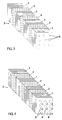
- the heat exchanger as seen in the perspective view in FIG. 4 is comprised of a plurality of plate-shaped partial elements 1 and 2 Support structure 3.
- This support structure 3 are a central first tube 4 and around Circumference of the central tube 4 distributed further second tubes 5 embedded. While the central, first tube 4 is used to pass a fluid to be cooled a second fluid, which serves as a cooling fluid, is passed through the second tube 5.
- each sub-element 1, 2 is made of one with carbon and ceramic fibers reinforced composite material.
- the sub-elements 1 and 2, as shown in Figure 1 can be seen, each differ in a different fiber orientation, as through the grain in the upper left corner of each sub-element 1, 2 is indicated.
- any Partial element can be built from individual plates with a small thickness.
- a plate part or a partial element 1, 2 is produced from a porous, carbon fiber reinforced carbon material (C / C) with so-called long fibers, or fibers that are endless in an orthotropic or quasi-isotropic orientation to the plate level.
- Such fiberboard then initially become a sub-element 1 assembled, for example by gluing with a carbon-rich Paste.
- the individual sub-elements 1, 2 are then also under each other Using this connection technique glued so that a preform results, as shown in Figure 2.
- holes 6 introduced which is possible with relatively little effort, since this pre-body is easy to work with conventional drilling techniques. With this pre-body it is a porous structure, the pores possibly being defined can be trained.
- a technique is preferably used for this, wherein the individual carbon fibers are embedded in a carbon-rich polymer are, with such a defined crack structure generated and defined under pyrolysis can be adjusted.
- the pores or the crack structure of this supporting structure of the C / C body is then infiltrated with liquid silicon, which under the influence of heat Temperatures in the range of 1410 ° C to 1700 ° C converted to silicon carbide becomes.
- the cross sections of the bores 6 can be set in a defined manner.
- the first and second tubes 4 and 5 dimensioned, but in such a way that their diameter is slight is smaller than the free bore diameter, so that a gap arises when the tube is inserted. These spaces serve as a strain compensation area, the one with an expansion compensation layer 8 made of ceramic material and / or carbon is filled.
- the expansion compensation layer 8 can thereby are formed that, before inserting the pipes into the holes, a layer is inserted from ceramic and / or carbon fibers or foils. Subsequently the pipes are inserted so that they comply with a defined Fill in the remaining space.
- first drill into the holes the first and second pipes inserted and the space with a ceramic Powder material largely filled up. in the arrangement as shown in figure 4 can be seen, the first and second tubes 4, 5 are fixed in the support structure 3, however, not embedded in a force-fitting or form-fitting manner so that it cannot be moved would be.
- FIG. 7 in turn a single sub-element 1, 2 of such Support structure 3 shows.
- Several such sub-elements 1, 2 are then on top of each other glued, as indicated in Figure 8 with the adhesive or connecting layers 7 is.
- the Pipes 4, 5 inserted into the bores, again with a ceramic intermediate layer, which serves as an expansion layer 8, as indicated in Figure 5.
- the modular design of the heat exchanger can be manufactured with individual sub-elements 1, 2 heat exchangers of any length, what standardized parts are used for.
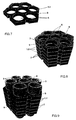
- the support structure 3 as described above, in particular with a hexagonal cross-sectional shape that has sides of the same length Heat exchanger structures are constructed, as can be seen, for example, in FIG. 6 is.
- a central heat exchanger unit further module units assigned a corresponding cross-sectional shape to each side surface, so that the middle, central heat exchanger module unit completely from outer module units is surrounded.
- the tubes 4, 5 seen fixing grooves 9 formed, for example with a semicircular cross section, which is then in the construction of the heat exchanger 6 with the grooves of adjacent heat exchanger modules add to a hole into which, for example, locating pins or locating rods 10 can be used.
- the individual module units corresponding to FIG. 6 can be connected with suitable connection techniques, for example Silicon carbide layers are suitable.
- the respective tubes 4, 5 of the module units 6 can be connected to one another in a suitable manner in terms of flow be, so that there are two flow systems, the first flow system the first tubes 4 (light cross section in Figure 6), while the second pipe system (second pipes 5 - indicated dark in Figure 6) the second pipe system forms.
- the fluid to be cooled is passed through the first pipe system during the second pipe system receives the cooling fluid.
- module units such as they are shown in FIG. 5, other geometric structures can be produced, for example Heat exchangers that have a relatively large, medium cavity or complex heat exchanger structures, such as wall surfaces, which in their length and height are variable in order to adapt them to the requirements.
- Heat exchangers that have a relatively large, medium cavity or complex heat exchanger structures, such as wall surfaces, which in their length and height are variable in order to adapt them to the requirements.
- a support structure 3 which consists of fiber rovings or fabric tapes is wrapped. As from the indicated fiber course in the area of the front End faces of the wrapping structure can be seen, this support structure is in the Z direction building itself wrapped by alternating the individual fiber layers around the individual Bores 6, for the placeholder, not initially shown, during the Winding process can be used, wound. Through the crosswise course essentially around the corresponding placeholder for the one to be used inner tube 4 results in a high-strength structure. As continues to be seen is, the fibers or slivers are placed so that they are opposite each other Placeholders run and then to the neighboring placeholder be performed.
- the inner tube 4 is formed or the bore 6 for the inner tube 4 adjacent triangular cavities, in which then has a corresponding insert 11 made of a good heat-conducting material, for example a fiber ceramic can be used.
- the stretch compensation layer can initially with a structure as shown in FIG Placeholder moldings are placed around before the actual wrapping process he follows.
- the stretch compensation layer can also be used during winding by applying fibers radially around a corresponding core or area respective prefabricated first and second pipes 4, 5, which, however, are not described in more detail in Figure 10 are shown to be built.
Landscapes
- Engineering & Computer Science (AREA)
- Physics & Mathematics (AREA)
- Thermal Sciences (AREA)
- Mechanical Engineering (AREA)
- General Engineering & Computer Science (AREA)
- Ceramic Engineering (AREA)
- Geometry (AREA)
- Heat-Exchange Devices With Radiators And Conduit Assemblies (AREA)
Claims (29)
- Echangeur de chaleur qui présente au moins un premier tuyau (4) pour faire passer un premier fluide à refroidir, cédant de la chaleur et au moins un deuxième tuyau (5) pour faire passer un deuxième fluide absorbant de la chaleur, au moins le premier tuyau (4) formé d'un matériau étanche aux fluides, résistant à la corrosion et à l'oxydation, étant maintenu dans une structure support (3) formée de plusieurs éléments partiels individuels (1,2) en matériau contenant SiC, dans un trou (6) des éléments partiels (1,2), caractérisé en ce que la structure support (3) est constituée d'éléments partiels (1,2) en matériau composite renforcé par les fibres de carbone et/ou de céramique, en forme de plaques ou de rondelles empilées les unes sur les autres et liées les unes avec les autres par une couche de liaison (7) contenant SiC, qu'au moins entre le premier tuyau (4) et la structure support (3) est placée une couche de compensation de dilatation (8) en matériau céramique et/ou en carbone et que le moins un deuxième tuyau (5) est maintenu dans un trou (6) effectué dans les éléments partiels (1,2) au voisinage du au moins un premier tuyau (4),
- Echangeur de chaleur selon la revendication 1, caractérisé en ce qu'au moins le premier tuyau (4) est constitué de céramique monolithique.
- Echangeur de chaleur selon la revendication 2, caractérisé en ce qu'au moins le premier tuyau (4) est constitué de carbure de silicium, de nitrure de silicium, de cordiérite ou de mullite.
- Echangeur de chaleur selon la revendication 3, caractérisé en ce qu'on utilise comme carbure de silicium du carbure de silicium avec silicium infiltré (SiSiC) ou du carbure de silicium fritté (SSiC).
- Echangeur de chaleur selon la revendication 1, caractérisé en ce que la couche de compensation de dilatation (8) est constituée essentiellement de poudre de céramique ou de poudre de carbone.
- Echangeur de chaleur selon la revendication 1, caractérisé en ce que la couche de compensation de dilatation (8) est constituée essentiellement de fibres de céramique et/ou de carbone.
- Echangeur de chaleur selon la revendication 6, caractérisé en ce que les fibres sont orientées de préférence en direction périphérique des tuyaux (4,5).
- Echangeur de chaleur selon la revendication 1, caractérisé en ce que la couche de compensation de dilatation (8) est constituée d'un matériau en forme de feuille, en particulier une feuille de graphite.
- Echangeur de chaleur selon la revendication 1, caractérisé en ce que la couche de compensation de dilatation (8) est constituée d'un mélange de matériau en forme de fibres et de poudre.
- Echangeur de chaleur selon la revendication 5, caractérisé en ce que la couche de dilatation (8) est constituée de poudre de nitrure de bore et/ou de nitrure d'aluminium.
- Echangeur de chaleur selon la revendication 1, caractérisé en ce qu'au moins 50% des fibres dans les éléments partiels (1,2) sont placées parallèlement aux plans des plaques ou des rondelles qui se développent en tant que plaques ou rondelles des éléments partiels (1,2) formés.
- Echangeur de chaleur selon la revendication 11, caractérisé en ce qu'au moins 90% des fibres dans les éléments partiels (1,2) sont placées parallèlement aux plans des plaques ou des rondelles qui se développent en tant que plaques ou rondelles des éléments partiels (1,2) formés.
- Echangeur de chaleur selon la revendication 1, caractérisé en ce les éléments partiels (1,2) sont constitués d'un composite renforcé par des fibres de carbone, les fibres de carbone étant enrobées dans du carbure de silicium, qui est transformé en carbure de silicium par infiltration de silicium liquide et par action de la chaleur avec du carbone.
- Echangeur de chaleur selon la revendication 1, caractérisé en ce le renforcement par des fibres dans les éléments partiels (1,2) est formé à partir de tissus, de tissus de fibres de verre ou de bandes de tissus à deux dimensions.
- Echangeur de chaleur selon la revendication 14, caractérisé en ce que le renforcement par des fibres dans les éléments partiels (1,2) est formé à partir de tissus de fibres de verre ou de bandes de tissus bobinés ou de tissus de fibres de verre tricotés (figure 10).
- Echangeur de chaleur selon la revendication 15, caractérisé en ce que dans les espaces intermédiaires vides obtenus par le bobinage de fibres sont placées, ou sont formées dans ceux-ci, des garnitures de remplissage avec une conductibilité thermique orientée élevée.
- Echangeur de chaleur selon la revendication 16, caractérisé en ce que les garnitures de remplissage sont constituées de composite renforcé par les fibres de céramique ou de carbone avec céramique.
- Echangeur de chaleur selon la revendication 17, caractérisé en ce que les garnitures de remplissage sont constituées de SiC.
- Echangeur de chaleur selon la revendication 1, caractérisé en ce qu'autour d'un premier tuyau central (4) sont placés plusieurs deuxièmes tuyaux (5).
- Echangeur de chaleur selon la revendication 19, caractérisé en ce que les deuxièmes tuyaux sont placés symétriquement autour du premier tuyau central.
- Echangeur de chaleur selon la revendication 19 ou 20, caractérisé en ce que les axes du premier et des deuxièmes tuyaux (4,5) sont parallèles les uns aux autres.
- Echangeur de chaleur selon l'une des revendications 1 à 21, caractérisé en ce qu'en tant qu'unités modulaires, plusieurs unités modulaires sont rassemblées en une unité d'échangeur de chaleur, la forme en coupe transversale de l'unité modulaire étant telle que les unités modulaires contiguës sont placées en nappes les unes sur les autres.
- Echangeur de chaleur selon la revendication 22, caractérisé en ce que la forme en coupe transversale des unités modulaires est un polygone, de préférence un hexagone.
- Echangeur de chaleur selon la revendication 23, caractérisé en ce que le polygone présente des longueurs de côtés identiques.
- Échangeur de chaleur selon la revendication 24, caractérisé en ce que de chaque côté d'une unité modulaire centrale se trouve une autre unité modulaire.
- Echangeur de chaleur selon la revendication 1 ou la revendication 22, caractérisé en ce que des encoches de fixation (9) sont prévues dans leur surface externe.
- Echangeur de chaleur selon la revendication 1 ou la revendication 22, caractérisé en ce. que la surface externe de la structure support (3) est prévue avec une couche de protection contre l'oxydation ou la corrosion.
- Echangeur de chaleur selon la revendication 27, caractérisé en ce que la couche de protection est constituée de carbure de silicium et/ou de dioxyde de silicium et/ou de disiliciure de molybdène.
- Echangeur de chaleur selon la revendication 1, caractérisé en ce que dans la structure support (3) plusieurs éléments partiels (1,2) sont rassemblés chaque fois en groupes et que des groupes voisins présentent une orientation différente de fibres.
Applications Claiming Priority (3)
| Application Number | Priority Date | Filing Date | Title |
|---|---|---|---|
| DE19730389 | 1997-07-16 | ||
| DE19730389A DE19730389C2 (de) | 1997-07-16 | 1997-07-16 | Wärmetauscher |
| PCT/EP1998/002472 WO1999004213A1 (fr) | 1997-07-16 | 1998-04-25 | Echangeur de chaleur |
Publications (2)
| Publication Number | Publication Date |
|---|---|
| EP0996848A1 EP0996848A1 (fr) | 2000-05-03 |
| EP0996848B1 true EP0996848B1 (fr) | 2001-08-01 |
Family
ID=7835824
Family Applications (1)
| Application Number | Title | Priority Date | Filing Date |
|---|---|---|---|
| EP98921490A Expired - Lifetime EP0996848B1 (fr) | 1997-07-16 | 1998-04-25 | Echangeur de chaleur |
Country Status (3)
| Country | Link |
|---|---|
| EP (1) | EP0996848B1 (fr) |
| DE (2) | DE19730389C2 (fr) |
| WO (1) | WO1999004213A1 (fr) |
Cited By (2)
| Publication number | Priority date | Publication date | Assignee | Title |
|---|---|---|---|---|
| US9382874B2 (en) | 2010-11-18 | 2016-07-05 | Etalim Inc. | Thermal acoustic passage for a stirling cycle transducer apparatus |
| US9394851B2 (en) | 2009-07-10 | 2016-07-19 | Etalim Inc. | Stirling cycle transducer for converting between thermal energy and mechanical energy |
Families Citing this family (3)
| Publication number | Priority date | Publication date | Assignee | Title |
|---|---|---|---|---|
| US7261146B2 (en) * | 2003-01-17 | 2007-08-28 | Illinois Tool Works Inc | Conductive heat-equalizing device |
| CN107487054B (zh) * | 2016-06-12 | 2023-08-08 | 中国科学院宁波材料技术与工程研究所 | 多层复合膜、其制备方法以及作为纤维增强复合材料的连接材料的应用 |
| ES1295571Y (es) * | 2022-06-28 | 2023-02-07 | Univ Navarra Publica | Elemento de refrigeración de material cerámico electroconductor |
Family Cites Families (10)
| Publication number | Priority date | Publication date | Assignee | Title |
|---|---|---|---|---|
| GB1100832A (en) * | 1965-02-19 | 1968-01-24 | Birwelco Ltd | Improvements in or relating to heat exchangers |
| DE2758998C2 (de) * | 1977-12-30 | 1980-02-21 | Mtu Motoren- Und Turbinen-Union Muenchen Gmbh, 8000 Muenchen | Rekuperator fur den Wärmeaustausch zwischen zwei Strömungsmitteln unterschiedlicher Temperaturen |
| JPS6183897A (ja) * | 1984-09-28 | 1986-04-28 | Asahi Glass Co Ltd | セラミツクス製の熱交換体 |
| US4768586A (en) * | 1984-10-29 | 1988-09-06 | The Babcock & Wilcox Company | Ceramic heat exchangers |
| DE8600544U1 (de) * | 1986-01-11 | 1987-03-12 | Bommer, Rolf, Dipl.-Ing., 7700 Uberlingen | Wärmetauscher für Feuerungen, insbesondere Ölfeuerungen |
| DE3643749A1 (de) * | 1986-12-20 | 1988-06-30 | Hoechst Ag | Waermetauschermodul aus gebranntem keramischen material |
| DE3831812A1 (de) * | 1988-09-19 | 1990-03-22 | Interatom | Verfahren zur herstellung komplizierter bauteile aus siliziuminfiltriertem siliziumkarbid |
| CA2059293A1 (fr) * | 1989-06-30 | 1990-12-31 | Peter Robert Saxby | Composition d'acier pour rouleau composite et traitement thermique de celui-ci |
| DE3924411A1 (de) * | 1989-07-24 | 1991-01-31 | Hoechst Ceram Tec Ag | Rippenrohrwaermetauscher |
| FR2667591B1 (fr) | 1990-10-04 | 1993-11-05 | Ceramiques Composites | Procede d'assemblage d'objets en carbure de silicium et assemblages ainsi obtenus. |
-
1997
- 1997-07-16 DE DE19730389A patent/DE19730389C2/de not_active Expired - Fee Related
-
1998
- 1998-04-25 EP EP98921490A patent/EP0996848B1/fr not_active Expired - Lifetime
- 1998-04-25 DE DE59801133T patent/DE59801133D1/de not_active Expired - Fee Related
- 1998-04-25 WO PCT/EP1998/002472 patent/WO1999004213A1/fr not_active Ceased
Cited By (2)
| Publication number | Priority date | Publication date | Assignee | Title |
|---|---|---|---|---|
| US9394851B2 (en) | 2009-07-10 | 2016-07-19 | Etalim Inc. | Stirling cycle transducer for converting between thermal energy and mechanical energy |
| US9382874B2 (en) | 2010-11-18 | 2016-07-05 | Etalim Inc. | Thermal acoustic passage for a stirling cycle transducer apparatus |
Also Published As
| Publication number | Publication date |
|---|---|
| DE19730389A1 (de) | 1999-01-21 |
| WO1999004213A1 (fr) | 1999-01-28 |
| EP0996848A1 (fr) | 2000-05-03 |
| DE59801133D1 (de) | 2001-09-06 |
| DE19730389C2 (de) | 2002-06-06 |
Similar Documents
| Publication | Publication Date | Title |
|---|---|---|
| DE4110141C2 (de) | Keramik-Verbundaufbau und Verfahren zu dessen Herstellung | |
| WO2007110196A1 (fr) | Echangeur de chaleur à plaques, procédé de fabrication de celui-ci et utilisation de celui-ci | |
| EP1544565A2 (fr) | Echangeur de chaleur à plaques, procédé de fabrication d'un échangeur de chaleur à plaques et matériau composite en céramique renforcé par des fibres, notamment pour échangeur de chaleur à plaques | |
| CH643349A5 (de) | Waermetauscher aus keramischem material und verfahren zu seiner herstellung. | |
| EP0996848B1 (fr) | Echangeur de chaleur | |
| EP2647942B1 (fr) | Composant microfluidique et son procédé de fabrication | |
| WO2008034664A1 (fr) | Élément filtrant, notamment pour filtrer les gaz d'échappement d'un moteur à combustion interne | |
| DE19937812A1 (de) | Bauelement mit einem bei erhöhter Temperatur belastbaren Teil aus Verbundwerkstoff mit Fluidumwälzkühlung | |
| WO1998053218A1 (fr) | Unite de friction compacte, notamment disque de frein, a plusieurs corps de friction | |
| EP0225527A2 (fr) | Paroi refroidie pour turbines à gaz | |
| DE102005005509B4 (de) | Blockwärmetauscher aus Graphit | |
| DE3042557C2 (de) | Wärmetauscher, insbesondere für Sonnenkraftwerke | |
| DE102004005832B4 (de) | Verbundwärmetauscher | |
| EP1757887A1 (fr) | Bloc échangeur de chaleur | |
| DE102011010800A1 (de) | Keramik aus präkeramischen Papier- und/oder Pappstrukturen | |
| DE3008079A1 (de) | Waermetauscher | |
| EP2917032B1 (fr) | Matériau composite stratifié | |
| DE102005055955B3 (de) | Solarempfänger | |
| EP2917672B1 (fr) | Corps alvéolaire en matériau céramique | |
| DE102014112053A1 (de) | Rohrleitung für Heißgase und Verfahren zu deren Herstellung | |
| EP3759411A1 (fr) | Échangeur de chaleur à faisceau tubulaire et plaque tubulaire et procédé pour assurer son étanchéité | |
| EP1447623B1 (fr) | Méthode de fabrication d'éléments de stockage | |
| DE8323129U1 (de) | Keramischer Wärmetauscher | |
| DE102018125284A1 (de) | Wärmeübertragungsvorrichtung und Verfahren zum Herstellen einer Wärmeübertragungsvorrichtung | |
| DE69107795T2 (de) | Verbindungsvorrichtung zwischen zwei Körpern mit verschiedenen Dehnungskoeffizienten und Verfahren zum Herstellen derselben. |
Legal Events
| Date | Code | Title | Description |
|---|---|---|---|
| PUAI | Public reference made under article 153(3) epc to a published international application that has entered the european phase |
Free format text: ORIGINAL CODE: 0009012 |
|
| 17P | Request for examination filed |
Effective date: 19991015 |
|
| AK | Designated contracting states |
Kind code of ref document: A1 Designated state(s): DE FR GB |
|
| GRAG | Despatch of communication of intention to grant |
Free format text: ORIGINAL CODE: EPIDOS AGRA |
|
| 17Q | First examination report despatched |
Effective date: 20001211 |
|
| GRAG | Despatch of communication of intention to grant |
Free format text: ORIGINAL CODE: EPIDOS AGRA |
|
| GRAH | Despatch of communication of intention to grant a patent |
Free format text: ORIGINAL CODE: EPIDOS IGRA |
|
| GRAH | Despatch of communication of intention to grant a patent |
Free format text: ORIGINAL CODE: EPIDOS IGRA |
|
| GRAA | (expected) grant |
Free format text: ORIGINAL CODE: 0009210 |
|
| AK | Designated contracting states |
Kind code of ref document: B1 Designated state(s): DE FR IT |
|
| REF | Corresponds to: |
Ref document number: 59801133 Country of ref document: DE Date of ref document: 20010906 |
|
| EN | Fr: translation not filed | ||
| RBV | Designated contracting states (corrected) |
Designated state(s): DE FR IT |
|
| EN | Fr: translation not filed |
Free format text: BO 01/52 PAGES: 283, IL Y A LIEU DE SUPPRIMER: LA MENTION DE LA NON REMISE. LA REMISE EST PUBLIEE DANS LE PRESENT BOPI. |
|
| ET | Fr: translation filed | ||
| PLBE | No opposition filed within time limit |
Free format text: ORIGINAL CODE: 0009261 |
|
| STAA | Information on the status of an ep patent application or granted ep patent |
Free format text: STATUS: NO OPPOSITION FILED WITHIN TIME LIMIT |
|
| 26N | No opposition filed | ||
| PGFP | Annual fee paid to national office [announced via postgrant information from national office to epo] |
Ref country code: DE Payment date: 20070329 Year of fee payment: 10 |
|
| PGFP | Annual fee paid to national office [announced via postgrant information from national office to epo] |
Ref country code: IT Payment date: 20070609 Year of fee payment: 10 |
|
| PGFP | Annual fee paid to national office [announced via postgrant information from national office to epo] |
Ref country code: FR Payment date: 20070418 Year of fee payment: 10 |
|
| PG25 | Lapsed in a contracting state [announced via postgrant information from national office to epo] |
Ref country code: DE Free format text: LAPSE BECAUSE OF NON-PAYMENT OF DUE FEES Effective date: 20081101 |
|
| REG | Reference to a national code |
Ref country code: FR Ref legal event code: ST Effective date: 20081231 |
|
| PG25 | Lapsed in a contracting state [announced via postgrant information from national office to epo] |
Ref country code: FR Free format text: LAPSE BECAUSE OF NON-PAYMENT OF DUE FEES Effective date: 20080430 |
|
| PG25 | Lapsed in a contracting state [announced via postgrant information from national office to epo] |
Ref country code: IT Free format text: LAPSE BECAUSE OF NON-PAYMENT OF DUE FEES Effective date: 20080425 |