EP0997143A2 - Soft chewable tablets - Google Patents
Soft chewable tablets Download PDFInfo
- Publication number
- EP0997143A2 EP0997143A2 EP99306455A EP99306455A EP0997143A2 EP 0997143 A2 EP0997143 A2 EP 0997143A2 EP 99306455 A EP99306455 A EP 99306455A EP 99306455 A EP99306455 A EP 99306455A EP 0997143 A2 EP0997143 A2 EP 0997143A2
- Authority
- EP
- European Patent Office
- Prior art keywords
- tablet
- active ingredient
- coated
- tablets
- hardness
- Prior art date
- Legal status (The legal status is an assumption and is not a legal conclusion. Google has not performed a legal analysis and makes no representation as to the accuracy of the status listed.)
- Granted
Links
Images

Classifications
-
- A—HUMAN NECESSITIES
- A61—MEDICAL OR VETERINARY SCIENCE; HYGIENE
- A61J—CONTAINERS SPECIALLY ADAPTED FOR MEDICAL OR PHARMACEUTICAL PURPOSES; DEVICES OR METHODS SPECIALLY ADAPTED FOR BRINGING PHARMACEUTICAL PRODUCTS INTO PARTICULAR PHYSICAL OR ADMINISTERING FORMS; DEVICES FOR ADMINISTERING FOOD OR MEDICINES ORALLY; BABY COMFORTERS; DEVICES FOR RECEIVING SPITTLE
- A61J1/00—Containers specially adapted for medical or pharmaceutical purposes
-
- A—HUMAN NECESSITIES
- A61—MEDICAL OR VETERINARY SCIENCE; HYGIENE
- A61K—PREPARATIONS FOR MEDICAL, DENTAL OR TOILETRY PURPOSES
- A61K9/00—Medicinal preparations characterised by special physical form
- A61K9/0012—Galenical forms characterised by the site of application
- A61K9/0053—Mouth and digestive tract, i.e. intraoral and peroral administration
- A61K9/0056—Mouth soluble or dispersible forms; Suckable, eatable, chewable coherent forms; Forms rapidly disintegrating in the mouth; Lozenges; Lollipops; Bite capsules; Baked products; Baits or other oral forms for animals
Definitions
- the present invention relates to soft, convex-shaped compressed chewable tablets and a process for preparing such tablets.
- Chewable tablets are widely used in the pharmaceutical industry for patients, such as children, who have who have difficulty swallowing conventional tablets or capsules.
- Children's TYLENOL® Chewable Tables are an example of a pediatric chewable acetaminophen tablet sold in the United States. These tables are packaged in bottles and have a flat face, beveled edge shape. Samples of these tablets obtained from retail locations had hardnesses (average of ten tablets) ranging from 5.3 - 13.1 kp or normalized hardnesses of 12.3 - 30.5 kp/cm 2 .
- Rapidly disintegrating dosage forms such as those described in US Patent No. 5,464,632, issued November 7, 1995, are also available for patients, particularly aged and pediatric patients, having difficluties swallowing tablets and caplets.
- rapidly disintegrating dosage forms currently available are highly friable, and require the use of special handling and costly packaging, e.g., specially designed blister packs, to prevent breakage or chipping of the tablets.
- Tablet shape also affects tablet friability.
- T. Chakrabarti et al. in The Indian Journal of Pharmacy, Vol. 38, No. 3, pp. 62-65 (1975) disclose that lower friability was observed in beveled flat tablets followed by standard convex and plain flat tablets. Similarily, K. Sugimori et al. in Powder Technology, Vol. 58, pp. 259-264 (1989) report that capping occurs more often in convex-shaped tablets than flat faced tablets.
- the present invention provides a compressed, chewable tablet containing at least one active ingredient, a water-disintegratable, compressible carbohydrate and a binder. These components are dry blended and compressed into a convex-shaped tablet having a hardness of about 2 to about 11 kp/cm 2 .
- the tablet has a friability of less than 1%.
- the compressed, chewable tablet is prepared by dry blending the active ingredient, water-disintegratable, compressible carbohydrate and binder, and then compressing into a convex-shaped tablet having a hardness of about 2 to about 11 kp/cm 2 . If the active ingredient has an objectionable taste, it is coated with a taste masking composition.
- the convex tablet geometry significantly reduces tablet friability at a given compression force. This reduction in tablet friability allows for the use of lower compression forces and lower tablet hardness, while maintaining the ability to process the tablets with conventional bulk handling equipment and package them in conventional bottles.
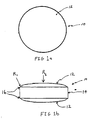
- FIGS. 1a and 1b are front and side views, respectively, of a bi-convex tablet of the present invention.
- FIG. 2 is a graph of friability (wt % loss) vs. hardness (kp/cm 2 ) for a flat face, beveled edge tablet (control) and a concave tablet of the present invention.
- the compressed, chewable tablets of the present invention comprise at least one active ingredient, a water-disintegratable, compressible carbohydrate, and a binder. These ingredients are dry blended and then compressed into a convex-shaped tablet having a hardness of about 2 to about 11, preferably about 5 to about 8.5, kp/cm 2 . Tablet friability is also preferably less than 1%.
- Tableting machines preferably those capable of applying separate pre-compression and main compression forces, are used to compress the ingredients into tablets. Since the ingredients are dry blended, watersoluble, as well as water-insoluble, active ingredients can be used in the tablet. If the active ingredients have an objectionable taste they may be coated with a taste masking composition.
- the water-disintegratable, compressible carbohydrate used in the present invention includes carbohydrate materials conventionally used in tablets.
- the carbohydrates facilitate the breakup of the dosage form after oral administration, and are described in Lieberman et al., Pharmaceutical Dosage Forms, Marcel Dekker, Inc., New York, 2 Ed. Vol. 1, pp. 205-209 (1990), which is hereby incorporated by reference.
- Preferred water-disintegratable, compressible carbohydrates include mannitol, sorbitol, maltitol, dextrose, sucrose, xylitol, lactose, and mixtures thereof.
- the binder in the present invention is used to add cohesiveness to the formulation, thereby providing the necessary bonding to form a cohesive mass or compact upon compression.
- These binders are conventionally used in direct compression tablets and are described in Lieberman et al., Pharmaceutical Dosage Forms , 2 Ed., Vol. 1, pp. 209-214 (1990), which is hereby incorporated by reference.
- Preferred binders include cellulose, cellulosic derivatives, polyvinyl pyrrolidone, starch, modified starch, and mixtures thereof, and, in particular, microcrystalline cellulose available from FMC Corp. under the trademark AVICEL® PH 101.
- the tablets of the present invention are used to orally administer a wide variety of active ingredients.
- Suitable active ingredients include pharmaceuticals, minerals, vitamins and other nutraceuticals.
- Suitable pharmacuticals include analgesics, decongestants, expectorants, antitussives, antihistamines, gastrointestinal agents, diuretics, bronchodilators, sleep-inducing agents and mixtures thereof.
- Preferred pharmaceuticals include acetaminophen, ibuprofen, flurbiprofen, naproxen, aspirin, pseudoephedrine, phenylpropanolamine, chlorpheniramine maleate, dextromethorphan, diphenhydramine, famotidine, loperamide, ranitidine, cimetidine, astemizole, terfenadine, terfenadine carboxylate, cetirizine, mixtures thereof and pharmaceutically acceptable salts thereof.
- the active ingredient(s) are present in the tablet in a therapeutic effective amount, which is an amount that produces the desired therapeutic response upon oral administration and can be readily determined by one skilled in the art. In determining such amounts, the particular compound being administered, the bioavailability characteristics of the ingredient, the dose regime, the age and weight of the patient, and other factors must be considered.
- a coated particle containing the active ingredient coated with a taste masking coating is employed.
- the active may be coated with taste masking coatings known in the art, such as those described in U.S. Patent No. 4,851,226, issued July 25, 1989, to T.W. Julian, et al.; U.S. Patent No. 5,075,114, issued December 24, 1991 to E.J. Roche; and U.S. Patent No. 5,489,436, issued February 6, 1996, all of which are hereby incorporated by reference.
- Commercially available taste masked active ingredients may also be employed.
- acetaminophen particles which are encapsulated with ethylcellulose or other polymers by a coaccervation process may be used in the present invention.
- Coaccervation-encapsulated acetaminophen may be purchased commercially from Eurand America, Inc. Vandalia, Ohio, or from Circa Inc., Dayton, Ohio.
- coated particle refers to a solid active ingredient in the form of a crystal or particle, an agglomerate of individual particles, or a granuled particle, which has been encapsulated with a the taste masking composition, either by film coating or by another process such as coaccervation.
- the tablet may provide for immediate or sustained release of the active.
- Substantially all of the active ingredient or granulated active ingredient should be coated with a layer of a taste masking composition having a thickness of about 3 to about 10 microns.
- the coating should be substantially free of cracks, holes or other imperfections when examined under a scanning electron microscope at 100-500x.
- the active ingredient is preferably coated with a blend of a first polymer selected from the group consisting of cellulose acetate and cellulose acetate butyrate and a second polymer selected from the group consisting of polyvinyl pyrrolidone and hydroxypropyl cellulose.
- the weight ratio of the first polymer to the second polymer in this blend is within the range of about 90:10 to about 50:50 and preferably about 90:10 to about 70:30.
- the blend of first and second polymers may be coated directly onto the pure active ingredient or may be coated onto a granulated particle containing the active.
- a granulated particle such as a rotogranulated particle
- the active will constitute from about 5 to about 90 weight percent of the particle, with the remainder being the binder or filler.
- Suitable binders for the granulated particles include polyvinyl pyrrolidone, hydroxypropylmethyl cellulose, hydroxypropyl cellulose, and other pharmaceutically acceptable polymers.
- Fillers suitable for use in such granulated particles include lactose, confectioner's sugar, mannitol, dextrose, fructose, other pharmaceutically acceptable saccharides and microcrystalline cellulose.
- the coated particles may be prepared by spraying an organic solvent solution of the polymeric blend onto the active ingredient, or a granulated particle containing the active ingredient, in a fluidized bed, such as a Wurster coater or a rotogranulator.
- organic solvents may be used to prepare the solution of the polymeric blend.
- a preferred solvent is a mixture of acetone and methanol, but other solvent systems may be employed, including methylene chloride, methylene chloride-methanol, acetone-ethyl acetate, toluene-ethanol and acetone-ethanol.
- the proportion of the polymer blend in the solvent solution will be within the range of about 5 to about 20, preferably about 8 to about 15, weight percent, depending on the solvent and other similar considerations.
- air which may be heated, passes through a bed of the active ingredient solids to fluidize them, and the solution of the polymeric blend is sprayed onto the fluidized bed and thereby coats the active.
- the air passing through the bed dried the coating onto the active ingredient, so that a dry coated granule is obtained.
- Conventional fluidized bed coating equipment may be used in the present invention to coat the active ingredient or the rotogranulated particle containing the pharmaceutical.
- This equipment includes Wurster fluid-bed coaters, where the solution of the polymer blend is sprayed from the bottom of the chamber, and a rotogranulator, where the solution of the polymer blend is tangentially sprayed.
- the coated particle in a dried state, generally contains about 5 to about 60, preferably about 10 to 40, weight percent of the blend of the first and second polymers.
- the exact proportions of the coating to the active ingredient can, however, vary depending upon the level of taste masking required and whether a sustained or immediate release of the active is desired. Larger proportions of the coating tend to provide a sustained release effect and enhance taste masking.
- the tablet may also contain ingredients other than the coated particles, carbohydrate and binder.
- the additional ingredients include sweeteners, such as aspartame, acesulfame potassium, sucralose and saccharin; and lubricants, such as magnesium stearate, stearic acid, talc, and waxes.
- the dosage form may also incorporate pharmaceutical acceptable adjuvants. Such adjuvants, include, for example, preservatives, flavors, antioxidants, surfactants, and/or colors.
- the tablets on a dry basis, generally comprise from about 0.1 to about 60, preferably about 12 to about 25, percent by weight of the active ingredient; from about 30 to about 90, preferably about 40 to about 65, percent by weight of the water-disintegratable, compressible carbohydrate material; from about 1 to about 30, preferably about 5 to about 20, percent by weight of the binder; from about 0.1 to about 5, preferably about 0.5 to about 1.5, percent by weight of the lubricant; from 0 to about 5, preferably about 0.1 to about 3.0, percent by weight of the sweetener; from 0 to about 5, preferably about 0.2 to about 2.0, percent by weight of the flavor; and from 0 to about 5, preferably about 0.01 to about 0.4, percent by weight of the color.
- the unit weight of the tablet will vary depending on the dosage of the active ingredient.
- the unit weight will generally range from about 250 to about 1000 mg.
- a typical dosage form may contain: Ingredient Unit Wt. (ma) Active Ingredient 0.5 - 600 Compressible Carbohydrate 80 - 900 Binder 10 - 200 Lubricant 1 - 15 Sweetener 0 - 30 Flavor 0 - 20 Color 0 - 10
- coated particles of the active ingredient are prepared using the aforementioned techniques.
- the particle size of the coated particles, as well as the remaining components, is generally less than 600 microns.
- the components of the tablet are then dry mixed to form a uniform powder blend.
- the blend is then compressed into a tablet of the desired hardness using conventional compression tableting techniques.
- the compressed, chewable tablet has a convex or bi-convex shape and is relatively soft so as to provide good mouthfeel and taste and ease of chewing.
- the tablet will have a diameter of about 7 to about 19, preferably about 9 to about 13,mm and a thickness of about 2 to about 12, preferably about 3 to about 8, mm.
- FIGS. 1a and 1b are, top and side views, respectively, of a bi-convex tablet 10 of the present invention.
- the tablet 10 has a pair of opposed face surfaces 12 and a side surface 14. The intersection of the face surfaces 12 with the side surface 14 defines the edges 16.
- the face surfaces 12 for the bi-convex tablet 10 have two radii of curvature, R 1 and R 2 .
- the radius of curvature R 1 at the portion of the face surface 12 proximate to the edge 16 is about 0.7 to about 7.6, preferably about 2.36, mm.
- the radius of curvature R 2 at the center of the tablet face 12 is about 7 to about 76, preferably about 25.2, mm.
- the minor axis cup radius R 1 is about 10 % to about 40% of the tablet diameter, while the major axis cup radius R 2 is about 100 % to about 400% of the tablet diameter.
- the radius of curvature of the face surface of a simple convex tablet of the present invention (not shown) is about 5 to about 60 mm, which is about 75% to about 300% of the tablet diameter. Tri-convex tablets may also be used.
- the external pressure applied by the tablet press during the compression step is controlled so that the hardness of the tablet is within the range of about 2 to about 11, preferably about 5 to about 8.5, kiloponds (kp) per sq. cm (cm 2 ).
- Tablet breaking strength, or hardness is dependent on cross-sectional area at the tablet breaking point. In order to compare values across different size tablets, the breaking strength must be normalized for the area of the break. This normalized value, expressed in kp/cm 2 , is often referred in the art as tablet tensile strength.
- Hardness is measure by conventional pharmaceutical hardness testing equipment, such as a Schleuniger Hardness Tester.
- the compression forces in two steps.
- a pre-compression pressure of about 2 to about 17, preferably about 5.5 to about 11.5, kN/cm 2 is applied.
- the main compression pressure of about 3 to about 18, preferably about 7 to about 13, kN/cm 2 is then applied to complete the compression operation.
- the tablet may be formed in one compression step using a compression pressure of about 3 to about 18, preferably about 7 to about 13, kN/cm 2 .
- the compressed, chewable tablet has a friability of less than 1%, preferably less than 0.5%.
- tablet friability is determined in accordance with USP Method ⁇ 1216> Tablet Friability, USP 23 (1995) and is expressed as percent weight loss. As shown in FIG. 2, as the hardness of a flat face, beveled edge tablet is reduced, friability increases. However, when the hardness of a concave tablet of the present decreases, friability remains substantially constant.
- the tablets of the present invention can be compressed at lower compression forces, but still maintain acceptable friability. This results in a softer tablet having improved product taste, mouthfeel and ease of chewing. Compressing at reduced forces also reduces the probability of fracturing the coating used for masking the unpleasant taste of the active ingredient.
- This Example provides a formulation for making a compressed, chewable bi-convex tablet containing acetaminophen coated with a blend of cellulose acetate and polyvinyl pyrrolidone.
- the weights provided hereinafter are based on a tablet unit weight of 385 mg.
- a coating solution containing a blend of cellulose acetate and polyvinyl pyrrolidone was prepared in accordance with US Patent No. 4,851,226 and applied to acetaminophen until coated acetaminophen particles containing approximately 11% by weight of coating were obtained.
- the ratio of cellulose acetate to polyvinyl pyrrolidone was 85:15.
- the coated acetaminophen particles were combined with following ingredients to produce the tablets: Ingredients Unit Wt. (mg) CA/PVP Coated Acetaminophen Particles 89.9 Mannitol (Granular), USP 246.03 Microcrystalline Cellulose, NF 30.0 Aspartame, NF 9.0 Color 1.27 Citric Acid, USP 2.1 Flavor 2.3 Magnesium Stearate, NF 4.4 Tablet Weight 385.0
- Example 2 describes the friability testing reported in FIG. 2 for the flat face, beveled edge (FFBE) tablet (control) and the concave tablet of the present invention.
- the acetaminophen was coated with the taste masking coating described in Example I.
- the coated acetaminophen particles were combined with following ingredients to produce the FFBE and concave tablets: Unit Wt. (mg) Ingredients Concave FFBE CA/PVP Coated Acetaminophen 90.7 90.7 Mannitol (Granular), USP 241.55 226.55 Microcrystalline Cellulose, NF 30.0 30.0 Aspartame, NF 5.0 11.0 Acesulfame Potassium 6.0 ----- Color 0.35 0.35 Flavor 22.5 22.5 Magnesium Stearate, NF 3.9 3.9 Tablet Weight 400.0 385.0
- Friabilty in wt% was then plotted against normalized hardness or tablet tensile strength in FIG. 2.
- acetaminophen particles prepared in the manner described in Example I, were combined with the following ingredients to produce compressed, chewable tablets, using the process described below: Ingredients Unit Wt. (mg) CA/PVP Coated Acetaminophen Particles 90.7 Mannitol (Granular), USP 243.96 Microcrystalline Cellulose, NF 30.0 Aspartame, NF 11.0 Color 0.04 Citric Acid, USP 2.1 Flavor 3.3 Magnesium Stearate, NF 3.9 Tablet Weight 385.0
- a sensory preference test was conducted among 130 adults who tasted these tablets in comparison with Children's TYLENOL® 80 mg Acetaminophen Chewable Tablets (having an average hardness of 5.5 kp or 13.4 kp/cm 2 ) obtained from retail locations.
- the tablets in this example were preferred over the commercial product by 77% of the participants, while 22% preferred the commercial product.
- the tablets in this example were perceived as less bitter, more sweet, and having more pleasant taste and mouthfeel than the commercial product.
Landscapes
- Health & Medical Sciences (AREA)
- Life Sciences & Earth Sciences (AREA)
- Veterinary Medicine (AREA)
- Public Health (AREA)
- Pharmacology & Pharmacy (AREA)
- General Health & Medical Sciences (AREA)
- Animal Behavior & Ethology (AREA)
- Medicinal Chemistry (AREA)
- Nutrition Science (AREA)
- Epidemiology (AREA)
- Chemical & Material Sciences (AREA)
- Physiology (AREA)
- Zoology (AREA)
- Medicinal Preparation (AREA)
- Acyclic And Carbocyclic Compounds In Medicinal Compositions (AREA)
- Pharmaceuticals Containing Other Organic And Inorganic Compounds (AREA)
- Medicines That Contain Protein Lipid Enzymes And Other Medicines (AREA)
Abstract
Description
| Polymer System | Coat Level | Polymer Ratio |
| Cellulose Acetate/PVP | 5-60% | 90/10 to 60/40 |
| Cellulose Acetate Butyrate/PVP | 5-60% | 90/10 to 60/40 |
| Cellulose Acetate/HPC | 5-60% | 90/10 to 50/50 |
| Cellulose Acetate Butyrate/HPC | 5-60% | 90/10 to 50/50 |
| Cellulose Acetate/EUDRAGIT E100 | 8-60% | All ratios |
| Cellulose Acetate Butyrate/EUDRAGIT E 100 | 8-60% | All ratios |
| Ethyl Cellulose/PVP | 8-60% | 90/10 to 60/40 |
| Ethyl Cellulose/HPC | 8-60% | 90/10 to 50/50 |
| Ethyl Cellulose/EUDRAGIT E 100 | 8-60% | All ratios |
| HPC | 10-60% | NA |
| HEC | 10-60% | NA |
| EUDRAGIT E 100 | 10-60% | NA |
| HPMC | 10-60% | NA |
| HEC/HPMC | 10-60% | All ratios |
| HPC/HPMC | 10-60% | All ratios |
| HEC/HPC | 10-60% | All ratios |
| 2-vinyl pyrridine styrene co-polymer | 10-60% | NA |
| CA/2-vps | 8-60% | All ratios |
| CAB/2-vps | 8-60% | All ratios |
| Ethyl Cellulose/2-vps | 8-60% | All ratios |
| Cellulose Triacetate/PVP | 8-60% | 90/10 to 60/40 |
| Cellulose Triacetate/HPC | 8-60% | 90/10 to 50/50 |
| Cellulose Triacetate/EUDRAGIT E 100 | 8-60% | All ratios |
| Ingredient | Unit Wt. (ma) |
| Active Ingredient | 0.5 - 600 |
| Compressible Carbohydrate | 80 - 900 |
| Binder | 10 - 200 |
| Lubricant | 1 - 15 |
| Sweetener | 0 - 30 |
| Flavor | 0 - 20 |
| Color | 0 - 10 |
| Ingredients | Unit Wt. (mg) |
| CA/PVP Coated Acetaminophen Particles | 89.9 |
| Mannitol (Granular), USP | 246.03 |
| Microcrystalline Cellulose, NF | 30.0 |
| Aspartame, NF | 9.0 |
| Color | 1.27 |
| Citric Acid, USP | 2.1 |
| Flavor | 2.3 |
| Magnesium Stearate, NF | 4.4 |
| Tablet Weight | |
| Physical Property | Average of 5 | Individuals |
| Weight (mg) | 382 - 389 | 379 - 391 |
| Hardness (kp/cm2) | 6.0 - 7.4 | 5.2 - 8.3 |
| Thickness (mm) | 4.44 - 4.49 | 4.43 - 4.52 |
| Friability | --- | 0.11 - 0.18 |
| Unit Wt. (mg) | ||
| Ingredients | Concave | FFBE |
| CA/PVP Coated Acetaminophen | 90.7 | 90.7 |
| Mannitol (Granular), USP | 241.55 | 226.55 |
| Microcrystalline Cellulose, NF | 30.0 | 30.0 |
| Aspartame, NF | 5.0 | 11.0 |
| Acesulfame Potassium | 6.0 | ----- |
| Color | 0.35 | 0.35 |
| Flavor | 22.5 | 22.5 |
| Magnesium Stearate, NF | 3.9 | 3.9 |
| Tablet Weight | 400.0 | 385.0 |
| Ingredients | Unit Wt. (mg) |
| CA/PVP Coated Acetaminophen Particles | 90.7 |
| Mannitol (Granular), USP | 243.96 |
| Microcrystalline Cellulose, NF | 30.0 |
| Aspartame, NF | 11.0 |
| Color | 0.04 |
| Citric Acid, USP | 2.1 |
| Flavor | 3.3 |
| Magnesium Stearate, NF | 3.9 |
| Tablet Weight | 385.0 |
Target
| Physical Property | Range |
| Weight (average of 10) | 383.5 - 386.7 mg |
| Hardness (average of 5) | 2.90 - 3.06 kp (6.27 - 6.61 kp/cm2) |
| Thickness (average of 5) | 4.62 - 4.66 mm |
Claims (19)
- A compressed, chewable tablet having opposed face surfaces, comprising:at least one active ingredient;a water-disintegratable, compressible carbohydrate; anda binder, said face surfaces having a convex shape and said tablet having an hardness of 2 to 11 kp/cm2.
- The tablet of claim 1 wherein said face surfaces have a bi-convex or tri-convex shape.
- The tablet of claim 2 having bi-convex shaped face surfaces and a minor axis cup radius of 10 to 40 percent of the tablet diameter and major axis cup radius of 100 to 400 percent of the tablet diameter.
- The tablet of any one of claims 1 to 3 having a hardness of 5 to 8.5 kp/cm2.
- The table of any one of claims 1 to 4 having a friability of less than about 1%, preferably less than about 0.5%.
- The tablet of any one of claims 1 to 5 having a diameter of 7 to 19 mm and a thickness of 2 to 12 mm.
- The tablet of claim 6 having a diameter of 9 to 13 mm and a thickness of 3 to 8 mm.
- The tablet of any one of claims 1 to 7 wherein said at least one active ingredient is coated with a taste masking coating.
- The tablet of claim 8 comprising at least one coated particle comprising said at least one active ingredient coated with said taste masking coating.
- The tablet of claim 8 or claim 9 wherein said coated active ingredient comprises at least one active ingredient coated with a blend of a first polymer selected from the group consisting of a cellulose acetate and cellulose acetate butyrate and a second polymer selected from the group consisting of polyvinyl pyrrolidone and hydroxypropyl cellulose, wherein the weight ratio of the first polymer to the second polymer is within the range of 90:10 to 50:50.
- The tablet of claim 10 wherein the coated active ingredient comprises 5 to 60 percent by weight of the blend of first and second polymers.
- The tablet of any one of claims 1 to 11 wherein the compressible carbohydrate is mannitol, sorbitol, maltitol, dextrose, sucrose, xylitol, lactose or a mixture thereof.
- The tablet of any one of claims 1 to 12 wherein the binder is cellulose, a cellulosic derivative, polyvinyl pyrrolidone, starch, modified starch or a mixture thereof.
- The tablet of any one of claims 1 to 13 wherein the active ingredient is acetaminophen, ibuprofen, flurbiprofen, naproxen, aspirin, pseudoephedrine, phenylpropanolamine, chlorpheniramine maleate, dextromethorphan, diphenhydramine, famotidine, loperamide, ranitidine, cimetidine, astemizole, terfenadine, terfenadine carboxylate, cetirizine, or a mixture thereof or a pharmaceutically acceptable salt thereof
- The tablet of any one of claims 1 to 14 comprising:0.1 to 60% of coated active ingredient;30 to 90% of said carbohydrate;1 to 30% of said binder;0.1 to 5% of a lubricant;0 to 5% sweetener;0 to 5% flavor; and0 to 5% color, by weight of said tablet.
- A process for preparing a compressed, chewable tablet, comprising the steps of:dry mixing at least one active ingredient, a water-disintegratable, compressible carbohydrate and a binder; andcompressing the mixture into a table having convex shaped opposed face surfaces and a hardness of 2 to 11 kp/cm2.
- The process of claim 16 further comprising the step of coating said active ingredient with a taste masking coating.
- The process of claim 16 or claim 17 wherein a pre-compression force is applied to said mixture before the application of a main compression force.
- The process of any one of claims 16 to 18 which produces a tablet according to any one of claims 1 to 15.
Applications Claiming Priority (2)
| Application Number | Priority Date | Filing Date | Title |
|---|---|---|---|
| US09/135,723 US6270790B1 (en) | 1998-08-18 | 1998-08-18 | Soft, convex shaped chewable tablets having reduced friability |
| US135723 | 1998-08-18 |
Publications (3)
| Publication Number | Publication Date |
|---|---|
| EP0997143A2 true EP0997143A2 (en) | 2000-05-03 |
| EP0997143A3 EP0997143A3 (en) | 2001-11-14 |
| EP0997143B1 EP0997143B1 (en) | 2007-12-19 |
Family
ID=22469364
Family Applications (1)
| Application Number | Title | Priority Date | Filing Date |
|---|---|---|---|
| EP99306455A Expired - Lifetime EP0997143B1 (en) | 1998-08-18 | 1999-08-17 | Soft chewable tablets |
Country Status (17)
| Country | Link |
|---|---|
| US (3) | US6270790B1 (en) |
| EP (1) | EP0997143B1 (en) |
| JP (1) | JP2000095673A (en) |
| KR (1) | KR20000017352A (en) |
| CN (1) | CN1249176A (en) |
| AR (1) | AR022065A1 (en) |
| AT (1) | ATE381320T1 (en) |
| AU (1) | AU773549B2 (en) |
| BR (1) | BR9903736A (en) |
| CA (1) | CA2280628C (en) |
| CO (1) | CO5130019A1 (en) |
| DE (1) | DE69937780T2 (en) |
| ES (1) | ES2299234T3 (en) |
| NZ (1) | NZ337310A (en) |
| PT (1) | PT997143E (en) |
| SA (1) | SA99200655B1 (en) |
| ZA (1) | ZA995248B (en) |
Cited By (8)
| Publication number | Priority date | Publication date | Assignee | Title |
|---|---|---|---|---|
| US7014867B2 (en) | 2001-06-28 | 2006-03-21 | Ucb Farchim Sa | Tablet comprising cetirizine and pseudoephedrine |
| EP1905430A4 (en) * | 2005-07-08 | 2012-08-01 | Takeda Pharmaceutical | COMPRESSED |
| WO2013037650A1 (en) | 2011-09-15 | 2013-03-21 | Friulchem Spa | Compositions for oral administration to animals, production methods thereof and uses of same |
| US8501160B2 (en) | 2006-03-01 | 2013-08-06 | Ethypharm Sa | Crush-resistant oxycodone tablets intended for preventing accidental misuse and unlawful diversion |
| WO2014033230A1 (en) | 2012-08-31 | 2014-03-06 | Friulchem Spa | Compositions for oral administration to animals, production methods thereof and uses of same |
| EP2509631A4 (en) * | 2009-12-10 | 2014-04-02 | Monosol Rx Llc | Ph sensitive compounds in taste masking within oral thin film strips |
| EP3389628A4 (en) * | 2015-12-19 | 2019-08-07 | Dixit, Manesh A. | Soft-chew tablet pharmaceutical formulations |
| EP3090729B1 (en) | 2006-01-25 | 2023-06-07 | Vitux Group AS | Emulsion |
Families Citing this family (75)
| Publication number | Priority date | Publication date | Assignee | Title |
|---|---|---|---|---|
| US6270790B1 (en) * | 1998-08-18 | 2001-08-07 | Mxneil-Ppc, Inc. | Soft, convex shaped chewable tablets having reduced friability |
| US20040102486A1 (en) * | 1998-11-12 | 2004-05-27 | Smithkline Beecham Corporation | Novel method of treatment |
| US20040081697A1 (en) * | 1998-11-12 | 2004-04-29 | Smithkline Beecham P.L.C. | Pharmaceutical composition for modified release of an insulin sensitiser and another antidiabetic agent |
| US20020122823A1 (en) * | 2000-12-29 | 2002-09-05 | Bunick Frank J. | Soft tablet containing dextrose monohydrate |
| EP1390015A1 (en) * | 2001-05-31 | 2004-02-25 | Cima Labs Inc. | Taste-masking of highly water-soluble drugs |
| US20030060422A1 (en) * | 2001-08-31 | 2003-03-27 | Balaji Venkataraman | Tannate compositions and methods of treatment |
| US7323192B2 (en) * | 2001-09-28 | 2008-01-29 | Mcneil-Ppc, Inc. | Immediate release tablet |
| MXPA04002973A (en) | 2001-09-28 | 2005-06-20 | Johnson & Johnson | Modified release dosage forms. |
| US7838026B2 (en) | 2001-09-28 | 2010-11-23 | Mcneil-Ppc, Inc. | Burst-release polymer composition and dosage forms comprising the same |
| US7122143B2 (en) | 2001-09-28 | 2006-10-17 | Mcneil-Ppc, Inc. | Methods for manufacturing dosage forms |
| KR100446153B1 (en) * | 2001-10-24 | 2004-08-30 | 한국유나이티드제약 주식회사 | Formulation of a soluble ibuprofen and its process |
| FR2831820B1 (en) * | 2001-11-05 | 2004-08-20 | Ethypharm Sa | ORODISPERSIBLE TABLET HAVING HIGH HOMOGENEITY AND PREPARATION METHOD THEREOF |
| FR2833173B1 (en) * | 2001-12-10 | 2004-08-27 | Roquette Freres | ANTIPYRETIC PREPARATION CONTAINING XYLITOL |
| US20030215502A1 (en) * | 2002-03-20 | 2003-11-20 | Elan Pharma International Limited | Fast dissolving dosage forms having reduced friability |
| ES2298540T3 (en) | 2002-04-04 | 2008-05-16 | Pfizer Products Inc. | NICE MASTICABLE TABLETS. |
| WO2004014143A1 (en) | 2002-08-13 | 2004-02-19 | Akzo Nobel | Compositions and process for delivering an additive |
| US7982008B2 (en) | 2002-11-27 | 2011-07-19 | David Bar-Or | Treatment of diseases and conditions mediated by increased phosphorylation |
| US20040109889A1 (en) * | 2002-12-04 | 2004-06-10 | Bunick Frank J. | Surface treatment composition for soft substrates |
| US20040265372A1 (en) * | 2003-06-27 | 2004-12-30 | David Wynn | Soft tablet containing high molecular weight cellulosics |
| US20040265373A1 (en) * | 2003-06-27 | 2004-12-30 | David Wynn | Soft tablet containing high molecular weight cellulosics |
| DK2792363T3 (en) * | 2003-08-26 | 2016-09-26 | Shire Biopharmaceuticals Holdings Ireland Ltd | PHARMACEUTICAL FORM, INCLUDING LANTHAN CONNECTIONS |
| US7282217B1 (en) | 2003-08-29 | 2007-10-16 | Kv Pharmaceutical Company | Rapidly disintegrable tablets |
| EP1663196A2 (en) * | 2003-09-25 | 2006-06-07 | DMI Biosciences, Inc. | Methods and products which utilize n-acyl-l-aspartic acid |
| US20050095300A1 (en) * | 2003-10-30 | 2005-05-05 | Wynn David W. | Controlled release analgesic suspensions |
| US20050095299A1 (en) * | 2003-10-30 | 2005-05-05 | Wynn David W. | Controlled release analgesic suspensions |
| US7201920B2 (en) | 2003-11-26 | 2007-04-10 | Acura Pharmaceuticals, Inc. | Methods and compositions for deterring abuse of opioid containing dosage forms |
| BRPI0509673A (en) * | 2004-04-07 | 2007-10-09 | Intervet Int Bv | parasite treatment composition, pharmaceutical dosage form, method for treating an organism, and processes for introducing at least one additive into an organism, for making a composition, for releasing an additive in an organism, and for forming a product soft chewy |
| US20070020330A1 (en) | 2004-11-24 | 2007-01-25 | Medpointe Healthcare Inc. | Compositions comprising azelastine and methods of use thereof |
| PL2486942T3 (en) | 2004-11-24 | 2019-05-31 | Meda Pharmaceuticals Inc | Compositions comprising azelastine and methods of use thereof |
| US8758816B2 (en) | 2004-11-24 | 2014-06-24 | Meda Pharmaceuticals Inc. | Compositions comprising azelastine and methods of use thereof |
| CN1686089B (en) * | 2005-05-08 | 2010-08-18 | 北京健健康康生物技术有限公司 | Xylitol granule capable of directly being pressed into tablet and its preparation method |
| US20070020186A1 (en) * | 2005-07-22 | 2007-01-25 | Alpex Pharma S.A. | Solid dosage formulations of narcotic drugs having improved buccal adsorption |
| US20070077300A1 (en) * | 2005-09-30 | 2007-04-05 | Wynn David W | Oral compositions containing a salivation inducing agent |
| US20070128251A1 (en) * | 2005-12-07 | 2007-06-07 | Piedmont Pharmaceuticals, Inc. | Process for manufacturing chewable dosage forms for drug delivery and products thereof |
| US20070251352A1 (en) | 2006-05-01 | 2007-11-01 | Pruitt Judith G | Pelletized Feed Material for Biomass Generator |
| WO2007144902A1 (en) * | 2006-06-12 | 2007-12-21 | Jubliant Organosys Limited | Chewable bilayer tablet formulation |
| WO2008094877A2 (en) * | 2007-01-30 | 2008-08-07 | Drugtech Corporation | Compositions for oral delivery of pharmaceuticals |
| KR101109633B1 (en) | 2007-08-03 | 2012-01-31 | 제이더블유중외제약 주식회사 | Composition for preparing oral disintegrant type in which the coating of the active ingredient is protected |
| USD616032S1 (en) * | 2007-08-24 | 2010-05-18 | Maraia Micah L | Clip for identifying elongated objects |
| EP3090739A1 (en) | 2008-01-04 | 2016-11-09 | Schabar Research Associates LLC | Compositions composed of naproxen sodium and nizatidine |
| US20100009012A1 (en) * | 2008-07-11 | 2010-01-14 | Zukkoor N David | Chewable pharyngeal inflammation symptom relief composition |
| WO2010077878A1 (en) * | 2008-12-15 | 2010-07-08 | Fleming And Company, Pharmaceuticals | Rapidly dissolving vitamin formulation and methods of using the same |
| US20100278913A1 (en) * | 2009-04-30 | 2010-11-04 | Sancilio & Company | Chewable tablet |
| AU330360S (en) * | 2009-08-27 | 2010-04-14 | Astrazeneca Ab | Tablet |
| EP3064064A1 (en) * | 2009-09-30 | 2016-09-07 | Acura Pharmaceuticals, Inc. | Methods and compositions for deterring abuse |
| USD636070S1 (en) * | 2010-02-26 | 2011-04-12 | Astrazeneca Ab | Tablet |
| USD632386S1 (en) * | 2010-06-01 | 2011-02-08 | Herbalife International of America | Oral supplement |
| JP5771381B2 (en) * | 2010-10-22 | 2015-08-26 | アサヒフードアンドヘルスケア株式会社 | Tablet containing dry yeast |
| USD697510S1 (en) * | 2011-03-23 | 2014-01-14 | Brother Industries, Ltd. | Scanner with projector |
| WO2013068371A1 (en) | 2011-11-08 | 2013-05-16 | Intervet International B.V. | Soft chewable dosage form compositions of cannabinoid receptor type 1 (cb-1) antagonists |
| AP2014007874A0 (en) | 2012-02-06 | 2014-08-31 | Merial Ltd | Parasiticidal oral veterinary compositions comprising systemetically- acting active agents, methods and uses thereof |
| CN108685894B (en) | 2012-04-04 | 2022-04-26 | 英特维特国际股份有限公司 | Soft chewable pharmaceutical product |
| PL2861236T3 (en) | 2012-06-15 | 2020-03-31 | Pharmathen S.A. | Pharmaceutical composition containing phosphate binding polymer |
| US9532946B2 (en) | 2012-11-20 | 2017-01-03 | Intervet Inc. | Manufacturing of semi-plastic pharmaceutical dosage units |
| CN104968333B (en) | 2012-11-30 | 2018-07-10 | 阿库拉制药公司 | Self-regulated release of active pharmaceutical ingredients |
| JP6510628B2 (en) | 2014-03-26 | 2019-05-15 | サン・ファーマ・アドバンスト・リサーチ・カンパニー・リミテッド | Abuse prevention immediate release coated reservoir solid dosage form |
| WO2016033424A1 (en) | 2014-08-29 | 2016-03-03 | Genzyme Corporation | Methods for the prevention and treatment of major adverse cardiovascular events using compounds that modulate apolipoprotein b |
| CN104490804A (en) * | 2014-12-05 | 2015-04-08 | 海南卫康制药(潜山)有限公司 | Cimetidine composition chewable tablets and preparation method thereof |
| EP3061501A1 (en) | 2015-02-27 | 2016-08-31 | Rottapharm Ltd. | Composition for the treatment of acne |
| EP3117825A1 (en) | 2015-07-16 | 2017-01-18 | Rottapharm S.p.A. | Oral formulation comprising berberine and morus alba extract |
| WO2017040607A1 (en) | 2015-08-31 | 2017-03-09 | Acura Pharmaceuticals, Inc. | Methods and compositions for self-regulated release of active pharmaceutical ingredient |
| US20190022013A1 (en) | 2015-12-19 | 2019-01-24 | First Time Us Generics Llc | Soft-chew tablet pharmaceutical formulations |
| WO2017151571A1 (en) * | 2016-02-29 | 2017-09-08 | First Time Us Generics Llc | Abuse deterrent soft chewable drug formulations |
| JP2019514991A (en) | 2016-05-12 | 2019-06-06 | バイエル・アニマル・ヘルス・ゲゼルシャフト・ミット・ベシュレンクテル・ハフツングBayer Animal Health Gmbh | Method for producing molded body for administration to animals |
| US10323226B2 (en) | 2017-03-30 | 2019-06-18 | Nch Corporation | Feed material for biomass generator |
| WO2019004155A1 (en) * | 2017-06-27 | 2019-01-03 | 第一三共株式会社 | tablet |
| EP3878436A1 (en) | 2020-03-09 | 2021-09-15 | Bayer Animal Health GmbH | Soft chewable formed body for the administration to animals |
| US11324727B2 (en) | 2020-07-15 | 2022-05-10 | Schabar Research Associates, Llc | Unit oral dose compositions composed of naproxen sodium and famotidine for the treatment of acute pain and the reduction of the severity of heartburn and/or the risk of heartburn |
| US12514846B2 (en) | 2020-07-15 | 2026-01-06 | Schabar Research Associates Llc | Unit oral dose compositions composed of ibuprofen or a pharmaceutically acceptable salt thereof and famotidine or a pharmaceutically acceptable salt thereof for the treatment of acute pain and the reduction of the severity and/or risk of heartburn and/or upset stomach |
| JP2023534810A (en) | 2020-07-15 | 2023-08-14 | シャバー リサーチ アソシエイツ エルエルシー | A unit oral dose composition consisting of ibuprofen and famotidine for treating acute pain and reducing the severity and/or risk of heartburn |
| WO2022133420A1 (en) | 2020-12-18 | 2022-06-23 | Boehringer Ingelheim Animal Health USA Inc. | Boron containing pyrazole compounds, compositions comprising them, methods and uses thereof |
| IT202100016310A1 (en) * | 2021-06-22 | 2022-12-22 | Alaia Idea S R L | Method for making tablets |
| US20230123099A1 (en) * | 2021-10-15 | 2023-04-20 | Fertin Pharma A/S | Dextrose tablets with improved mouthfeel |
| EP4486311A1 (en) * | 2022-03-01 | 2025-01-08 | Chemo Research, S.L. | Chewable oral contraceptive |
| US20240130974A1 (en) * | 2022-10-19 | 2024-04-25 | Genexa Inc. | Solid pharmaceutical tablet |
Family Cites Families (21)
| Publication number | Priority date | Publication date | Assignee | Title |
|---|---|---|---|---|
| US3431339A (en) * | 1966-07-20 | 1969-03-04 | Colgate Palmolive Co | Dentifrices |
| US3619292A (en) * | 1968-07-15 | 1971-11-09 | Penick & Ford Ltd | Tablets and method of forming |
| GB8426152D0 (en) * | 1984-10-16 | 1984-11-21 | Reckitt & Colmann Prod Ltd | Medicinal compositions |
| CA1259924A (en) * | 1985-03-25 | 1989-09-26 | Wallace E. Becker | Pharmaceutical tableting method |
| US4760094A (en) * | 1986-10-21 | 1988-07-26 | American Home Products Corporation (Del.) | Spray dried acetaminophen |
| US4851226A (en) * | 1987-11-16 | 1989-07-25 | Mcneil Consumer Products Company | Chewable medicament tablet containing means for taste masking |
| US5536526A (en) * | 1988-01-11 | 1996-07-16 | Cultor Ltd. | Xylitol-based binding and diluting agent and a process for the production thereof |
| US4866046A (en) * | 1988-05-31 | 1989-09-12 | Top Laboratories, Inc. | Low-dosage sublingual aspirin |
| US5275823A (en) * | 1989-04-27 | 1994-01-04 | Smith Kline & French Laboratories Ltd. | Pharmaceutical compositions |
| US5075114A (en) | 1990-05-23 | 1991-12-24 | Mcneil-Ppc, Inc. | Taste masking and sustained release coatings for pharmaceuticals |
| US5460825A (en) * | 1990-05-23 | 1995-10-24 | Mcneil-Ppc, Inc. | Taste mask coatings for preparing chewable pharmaceutical tablets |
| CA2068402C (en) | 1991-06-14 | 1998-09-22 | Michael R. Hoy | Taste mask coatings for preparation of chewable pharmaceutical tablets |
| US5464632C1 (en) | 1991-07-22 | 2001-02-20 | Prographarm Lab | Rapidly disintegratable multiparticular tablet |
| DK71993D0 (en) * | 1993-06-18 | 1993-06-18 | Novo Nordisk As | ENZYME |
| CA2128820A1 (en) * | 1993-07-27 | 1995-01-28 | Walter G. Gowan, Jr. | Rapidly disintegrating pharmaceutical dosage form and process for preparation thereof |
| US5609883A (en) | 1994-09-16 | 1997-03-11 | Advanced Technology Pharmaceuticals Corporation | Compressed tablet transitory lubricant system |
| US5529783A (en) * | 1994-12-19 | 1996-06-25 | Mcneil-Ppc, Inc. | Rotor granulation and coating of acetaminophen, pseudoephedrine, chlorpheniramine, and, optionally dextromethorphan |
| US5686107A (en) * | 1995-01-30 | 1997-11-11 | Fmc Corporation | Chewable pharmaceutical tablets |
| EP0910345B1 (en) * | 1996-06-17 | 2002-02-13 | Janssen Pharmaceutica N.V. | Biconvex rapidly disintegrating dosage forms |
| US6024981A (en) * | 1997-04-16 | 2000-02-15 | Cima Labs Inc. | Rapidly dissolving robust dosage form |
| US6270790B1 (en) | 1998-08-18 | 2001-08-07 | Mxneil-Ppc, Inc. | Soft, convex shaped chewable tablets having reduced friability |
-
1998
- 1998-08-18 US US09/135,723 patent/US6270790B1/en not_active Expired - Lifetime
-
1999
- 1999-08-17 AT AT99306455T patent/ATE381320T1/en not_active IP Right Cessation
- 1999-08-17 KR KR1019990033896A patent/KR20000017352A/en not_active Withdrawn
- 1999-08-17 PT PT99306455T patent/PT997143E/en unknown
- 1999-08-17 ZA ZA9905248A patent/ZA995248B/en unknown
- 1999-08-17 CA CA002280628A patent/CA2280628C/en not_active Expired - Lifetime
- 1999-08-17 EP EP99306455A patent/EP0997143B1/en not_active Expired - Lifetime
- 1999-08-17 DE DE69937780T patent/DE69937780T2/en not_active Expired - Lifetime
- 1999-08-17 ES ES99306455T patent/ES2299234T3/en not_active Expired - Lifetime
- 1999-08-18 BR BR9903736-0A patent/BR9903736A/en not_active Application Discontinuation
- 1999-08-18 NZ NZ337310A patent/NZ337310A/en unknown
- 1999-08-18 AR ARP990104128A patent/AR022065A1/en not_active Application Discontinuation
- 1999-08-18 JP JP11232034A patent/JP2000095673A/en active Pending
- 1999-08-18 AU AU44565/99A patent/AU773549B2/en not_active Expired
- 1999-08-18 CN CN99119112A patent/CN1249176A/en active Pending
- 1999-08-18 CO CO99052293A patent/CO5130019A1/en unknown
- 1999-10-10 SA SA99200655A patent/SA99200655B1/en unknown
-
2001
- 2001-06-13 US US09/880,179 patent/US6471991B2/en not_active Expired - Lifetime
-
2002
- 2002-08-22 US US10/226,540 patent/US7029699B2/en not_active Expired - Lifetime
Cited By (12)
| Publication number | Priority date | Publication date | Assignee | Title |
|---|---|---|---|---|
| US7014867B2 (en) | 2001-06-28 | 2006-03-21 | Ucb Farchim Sa | Tablet comprising cetirizine and pseudoephedrine |
| US7226614B2 (en) | 2001-06-28 | 2007-06-05 | Ucb Farchim Sa | Tablet comprising cetirizine and pseudoephedrine |
| EP1905430A4 (en) * | 2005-07-08 | 2012-08-01 | Takeda Pharmaceutical | COMPRESSED |
| EP3090729B1 (en) | 2006-01-25 | 2023-06-07 | Vitux Group AS | Emulsion |
| US8501160B2 (en) | 2006-03-01 | 2013-08-06 | Ethypharm Sa | Crush-resistant oxycodone tablets intended for preventing accidental misuse and unlawful diversion |
| EP3115041A1 (en) | 2006-03-01 | 2017-01-11 | Ethypharm | Crush-resistant tablets intended for preventing accidental misuse and unlawful diversion |
| EP3115042A1 (en) | 2006-03-01 | 2017-01-11 | Ethypharm | Crush-resistant oxycodone tablets intended for preventing accidental misuse and unlawful diversion |
| EP2509631A4 (en) * | 2009-12-10 | 2014-04-02 | Monosol Rx Llc | Ph sensitive compounds in taste masking within oral thin film strips |
| WO2013037650A1 (en) | 2011-09-15 | 2013-03-21 | Friulchem Spa | Compositions for oral administration to animals, production methods thereof and uses of same |
| US11103524B2 (en) | 2011-09-15 | 2021-08-31 | Friulchem Spa | Compositions for oral administration to animals, processes for obtaining the same and the uses thereof |
| WO2014033230A1 (en) | 2012-08-31 | 2014-03-06 | Friulchem Spa | Compositions for oral administration to animals, production methods thereof and uses of same |
| EP3389628A4 (en) * | 2015-12-19 | 2019-08-07 | Dixit, Manesh A. | Soft-chew tablet pharmaceutical formulations |
Also Published As
| Publication number | Publication date |
|---|---|
| US6270790B1 (en) | 2001-08-07 |
| BR9903736A (en) | 2000-09-26 |
| JP2000095673A (en) | 2000-04-04 |
| AR022065A1 (en) | 2002-09-04 |
| US6471991B2 (en) | 2002-10-29 |
| ES2299234T3 (en) | 2008-05-16 |
| AU773549B2 (en) | 2004-05-27 |
| SA99200655B1 (en) | 2006-08-22 |
| CA2280628C (en) | 2009-02-10 |
| US20010043947A1 (en) | 2001-11-22 |
| CN1249176A (en) | 2000-04-05 |
| US20030049316A1 (en) | 2003-03-13 |
| DE69937780T2 (en) | 2008-12-04 |
| CO5130019A1 (en) | 2002-02-27 |
| DE69937780D1 (en) | 2008-01-31 |
| NZ337310A (en) | 2000-05-26 |
| PT997143E (en) | 2008-02-07 |
| KR20000017352A (en) | 2000-03-25 |
| CA2280628A1 (en) | 2000-02-18 |
| ZA995248B (en) | 2001-02-19 |
| US7029699B2 (en) | 2006-04-18 |
| EP0997143B1 (en) | 2007-12-19 |
| EP0997143A3 (en) | 2001-11-14 |
| AU4456599A (en) | 2000-03-09 |
| ATE381320T1 (en) | 2008-01-15 |
Similar Documents
| Publication | Publication Date | Title |
|---|---|---|
| US6471991B2 (en) | Soft chewable tablets having convexed shaped face surfaces | |
| EP0636364B1 (en) | Rapidly disintegrating pharmaceutical dosage form and process for preparation thereof | |
| EP1058538B9 (en) | Fast disintegrating tablets | |
| US6277409B1 (en) | Protective coating for tablet | |
| US7223421B2 (en) | Teste masked pharmaceutical particles | |
| JP3157190B2 (en) | Taste masking and long acting coatings for drugs | |
| CN100379407C (en) | Process for producing chewable dispersible tablets | |
| AU783593B2 (en) | Texture masked particles containing an active ingredient | |
| US6814978B2 (en) | Process for preparing a soft tablet | |
| US20110142931A1 (en) | Soft tablet containing dextrose monohydrate | |
| AU620866B2 (en) | Pharmaceutical compositions | |
| MXPA99007660A (en) | Chewable tablets sua |
Legal Events
| Date | Code | Title | Description |
|---|---|---|---|
| PUAI | Public reference made under article 153(3) epc to a published international application that has entered the european phase |
Free format text: ORIGINAL CODE: 0009012 |
|
| AK | Designated contracting states |
Kind code of ref document: A2 Designated state(s): AT BE CH CY DE DK ES FI FR GB GR IE IT LI LU MC NL PT SE |
|
| AX | Request for extension of the european patent |
Free format text: AL;LT;LV;MK;RO;SI |
|
| PUAL | Search report despatched |
Free format text: ORIGINAL CODE: 0009013 |
|
| AK | Designated contracting states |
Kind code of ref document: A3 Designated state(s): AT BE CH CY DE DK ES FI FR GB GR IE IT LI LU MC NL PT SE |
|
| AX | Request for extension of the european patent |
Free format text: AL;LT;LV;MK;RO;SI |
|
| 17P | Request for examination filed |
Effective date: 20020424 |
|
| AKX | Designation fees paid |
Free format text: AT BE CH CY DE DK ES FI FR GB GR IE IT LI LU MC NL PT SE |
|
| 17Q | First examination report despatched |
Effective date: 20030825 |
|
| GRAP | Despatch of communication of intention to grant a patent |
Free format text: ORIGINAL CODE: EPIDOSNIGR1 |
|
| GRAS | Grant fee paid |
Free format text: ORIGINAL CODE: EPIDOSNIGR3 |
|
| GRAA | (expected) grant |
Free format text: ORIGINAL CODE: 0009210 |
|
| AK | Designated contracting states |
Kind code of ref document: B1 Designated state(s): AT BE CH CY DE DK ES FI FR GB GR IE IT LI LU MC NL PT SE |
|
| REG | Reference to a national code |
Ref country code: GB Ref legal event code: FG4D |
|
| REG | Reference to a national code |
Ref country code: IE Ref legal event code: FG4D |
|
| REG | Reference to a national code |
Ref country code: CH Ref legal event code: EP |
|
| REF | Corresponds to: |
Ref document number: 69937780 Country of ref document: DE Date of ref document: 20080131 Kind code of ref document: P |
|
| REG | Reference to a national code |
Ref country code: PT Ref legal event code: SC4A Free format text: AVAILABILITY OF NATIONAL TRANSLATION Effective date: 20080125 |
|
| PG25 | Lapsed in a contracting state [announced via postgrant information from national office to epo] |
Ref country code: SE Free format text: LAPSE BECAUSE OF FAILURE TO SUBMIT A TRANSLATION OF THE DESCRIPTION OR TO PAY THE FEE WITHIN THE PRESCRIBED TIME-LIMIT Effective date: 20080319 Ref country code: LI Free format text: LAPSE BECAUSE OF FAILURE TO SUBMIT A TRANSLATION OF THE DESCRIPTION OR TO PAY THE FEE WITHIN THE PRESCRIBED TIME-LIMIT Effective date: 20071219 Ref country code: CH Free format text: LAPSE BECAUSE OF FAILURE TO SUBMIT A TRANSLATION OF THE DESCRIPTION OR TO PAY THE FEE WITHIN THE PRESCRIBED TIME-LIMIT Effective date: 20071219 |
|
| REG | Reference to a national code |
Ref country code: ES Ref legal event code: FG2A Ref document number: 2299234 Country of ref document: ES Kind code of ref document: T3 |
|
| PG25 | Lapsed in a contracting state [announced via postgrant information from national office to epo] |
Ref country code: NL Free format text: LAPSE BECAUSE OF FAILURE TO SUBMIT A TRANSLATION OF THE DESCRIPTION OR TO PAY THE FEE WITHIN THE PRESCRIBED TIME-LIMIT Effective date: 20071219 Ref country code: FI Free format text: LAPSE BECAUSE OF FAILURE TO SUBMIT A TRANSLATION OF THE DESCRIPTION OR TO PAY THE FEE WITHIN THE PRESCRIBED TIME-LIMIT Effective date: 20071219 |
|
| NLV1 | Nl: lapsed or annulled due to failure to fulfill the requirements of art. 29p and 29m of the patents act | ||
| REG | Reference to a national code |
Ref country code: CH Ref legal event code: PL |
|
| PG25 | Lapsed in a contracting state [announced via postgrant information from national office to epo] |
Ref country code: AT Free format text: LAPSE BECAUSE OF FAILURE TO SUBMIT A TRANSLATION OF THE DESCRIPTION OR TO PAY THE FEE WITHIN THE PRESCRIBED TIME-LIMIT Effective date: 20071219 |
|
| ET | Fr: translation filed | ||
| PG25 | Lapsed in a contracting state [announced via postgrant information from national office to epo] |
Ref country code: BE Free format text: LAPSE BECAUSE OF FAILURE TO SUBMIT A TRANSLATION OF THE DESCRIPTION OR TO PAY THE FEE WITHIN THE PRESCRIBED TIME-LIMIT Effective date: 20071219 |
|
| PLBE | No opposition filed within time limit |
Free format text: ORIGINAL CODE: 0009261 |
|
| STAA | Information on the status of an ep patent application or granted ep patent |
Free format text: STATUS: NO OPPOSITION FILED WITHIN TIME LIMIT |
|
| PG25 | Lapsed in a contracting state [announced via postgrant information from national office to epo] |
Ref country code: DK Free format text: LAPSE BECAUSE OF FAILURE TO SUBMIT A TRANSLATION OF THE DESCRIPTION OR TO PAY THE FEE WITHIN THE PRESCRIBED TIME-LIMIT Effective date: 20071219 |
|
| PGFP | Annual fee paid to national office [announced via postgrant information from national office to epo] |
Ref country code: PT Payment date: 20080814 Year of fee payment: 10 |
|
| 26N | No opposition filed |
Effective date: 20080922 |
|
| PG25 | Lapsed in a contracting state [announced via postgrant information from national office to epo] |
Ref country code: GR Free format text: LAPSE BECAUSE OF FAILURE TO SUBMIT A TRANSLATION OF THE DESCRIPTION OR TO PAY THE FEE WITHIN THE PRESCRIBED TIME-LIMIT Effective date: 20080320 |
|
| PG25 | Lapsed in a contracting state [announced via postgrant information from national office to epo] |
Ref country code: MC Free format text: LAPSE BECAUSE OF NON-PAYMENT OF DUE FEES Effective date: 20080831 |
|
| PG25 | Lapsed in a contracting state [announced via postgrant information from national office to epo] |
Ref country code: CY Free format text: LAPSE BECAUSE OF FAILURE TO SUBMIT A TRANSLATION OF THE DESCRIPTION OR TO PAY THE FEE WITHIN THE PRESCRIBED TIME-LIMIT Effective date: 20071219 |
|
| REG | Reference to a national code |
Ref country code: PT Ref legal event code: MM4A Free format text: LAPSE DUE TO NON-PAYMENT OF FEES Effective date: 20100217 |
|
| PG25 | Lapsed in a contracting state [announced via postgrant information from national office to epo] |
Ref country code: PT Free format text: LAPSE BECAUSE OF NON-PAYMENT OF DUE FEES Effective date: 20100217 |
|
| PG25 | Lapsed in a contracting state [announced via postgrant information from national office to epo] |
Ref country code: LU Free format text: LAPSE BECAUSE OF NON-PAYMENT OF DUE FEES Effective date: 20080817 |
|
| REG | Reference to a national code |
Ref country code: FR Ref legal event code: PLFP Year of fee payment: 17 |
|
| PGFP | Annual fee paid to national office [announced via postgrant information from national office to epo] |
Ref country code: DE Payment date: 20150811 Year of fee payment: 17 Ref country code: IE Payment date: 20150810 Year of fee payment: 17 Ref country code: ES Payment date: 20150713 Year of fee payment: 17 |
|
| PGFP | Annual fee paid to national office [announced via postgrant information from national office to epo] |
Ref country code: FR Payment date: 20150629 Year of fee payment: 17 |
|
| PGFP | Annual fee paid to national office [announced via postgrant information from national office to epo] |
Ref country code: IT Payment date: 20150827 Year of fee payment: 17 |
|
| REG | Reference to a national code |
Ref country code: DE Ref legal event code: R119 Ref document number: 69937780 Country of ref document: DE |
|
| REG | Reference to a national code |
Ref country code: FR Ref legal event code: ST Effective date: 20170428 |
|
| REG | Reference to a national code |
Ref country code: IE Ref legal event code: MM4A |
|
| PG25 | Lapsed in a contracting state [announced via postgrant information from national office to epo] |
Ref country code: DE Free format text: LAPSE BECAUSE OF NON-PAYMENT OF DUE FEES Effective date: 20170301 Ref country code: FR Free format text: LAPSE BECAUSE OF NON-PAYMENT OF DUE FEES Effective date: 20160831 Ref country code: IE Free format text: LAPSE BECAUSE OF NON-PAYMENT OF DUE FEES Effective date: 20160817 |
|
| PG25 | Lapsed in a contracting state [announced via postgrant information from national office to epo] |
Ref country code: IT Free format text: LAPSE BECAUSE OF NON-PAYMENT OF DUE FEES Effective date: 20160817 |
|
| PG25 | Lapsed in a contracting state [announced via postgrant information from national office to epo] |
Ref country code: ES Free format text: LAPSE BECAUSE OF NON-PAYMENT OF DUE FEES Effective date: 20160818 |
|
| REG | Reference to a national code |
Ref country code: ES Ref legal event code: FD2A Effective date: 20181121 |
|
| PGFP | Annual fee paid to national office [announced via postgrant information from national office to epo] |
Ref country code: GB Payment date: 20180815 Year of fee payment: 20 |
|
| REG | Reference to a national code |
Ref country code: GB Ref legal event code: PE20 Expiry date: 20190816 |
|
| PG25 | Lapsed in a contracting state [announced via postgrant information from national office to epo] |
Ref country code: GB Free format text: LAPSE BECAUSE OF EXPIRATION OF PROTECTION Effective date: 20190816 |