EP1003816B1 - Emulsions aqueuses de resines epoxydes - Google Patents
Emulsions aqueuses de resines epoxydes Download PDFInfo
- Publication number
- EP1003816B1 EP1003816B1 EP98951306A EP98951306A EP1003816B1 EP 1003816 B1 EP1003816 B1 EP 1003816B1 EP 98951306 A EP98951306 A EP 98951306A EP 98951306 A EP98951306 A EP 98951306A EP 1003816 B1 EP1003816 B1 EP 1003816B1
- Authority
- EP
- European Patent Office
- Prior art keywords
- epoxy
- epoxy resin
- resin
- weight
- amidoamine
- Prior art date
- Legal status (The legal status is an assumption and is not a legal conclusion. Google has not performed a legal analysis and makes no representation as to the accuracy of the status listed.)
- Expired - Lifetime
Links
- 229920000647 polyepoxide Polymers 0.000 title claims abstract description 125
- 239000003822 epoxy resin Substances 0.000 title claims abstract description 119
- 239000006185 dispersion Substances 0.000 title claims abstract description 104
- LNEPOXFFQSENCJ-UHFFFAOYSA-N haloperidol Chemical compound C1CC(O)(C=2C=CC(Cl)=CC=2)CCN1CCCC(=O)C1=CC=C(F)C=C1 LNEPOXFFQSENCJ-UHFFFAOYSA-N 0.000 title abstract description 23
- 229920005989 resin Polymers 0.000 claims abstract description 105
- 239000011347 resin Substances 0.000 claims abstract description 105
- 239000004593 Epoxy Substances 0.000 claims abstract description 87
- 239000004094 surface-active agent Substances 0.000 claims abstract description 77
- -1 cycloaliphatic Chemical group 0.000 claims abstract description 53
- 239000000203 mixture Substances 0.000 claims abstract description 51
- 150000001412 amines Chemical class 0.000 claims abstract description 39
- 229910052739 hydrogen Inorganic materials 0.000 claims abstract description 25
- 239000001257 hydrogen Substances 0.000 claims abstract description 24
- 238000002360 preparation method Methods 0.000 claims abstract description 21
- 238000000034 method Methods 0.000 claims abstract description 19
- 125000003118 aryl group Chemical group 0.000 claims abstract description 17
- 125000002496 methyl group Chemical group [H]C([H])([H])* 0.000 claims abstract description 17
- 125000001931 aliphatic group Chemical group 0.000 claims abstract description 16
- 125000004432 carbon atom Chemical group C* 0.000 claims abstract description 16
- 125000001495 ethyl group Chemical group [H]C([H])([H])C([H])([H])* 0.000 claims abstract description 15
- UFHFLCQGNIYNRP-UHFFFAOYSA-N Hydrogen Chemical class [H][H] UFHFLCQGNIYNRP-UHFFFAOYSA-N 0.000 claims abstract description 12
- 125000000217 alkyl group Chemical group 0.000 claims abstract description 10
- QVGXLLKOCUKJST-UHFFFAOYSA-N atomic oxygen Chemical compound [O] QVGXLLKOCUKJST-UHFFFAOYSA-N 0.000 claims abstract description 9
- 239000001301 oxygen Substances 0.000 claims abstract description 9
- 229910052760 oxygen Inorganic materials 0.000 claims abstract description 9
- 125000004435 hydrogen atom Chemical group [H]* 0.000 claims abstract description 8
- 150000002431 hydrogen Chemical group 0.000 claims abstract description 5
- 125000004433 nitrogen atom Chemical group N* 0.000 claims abstract description 5
- XLYOFNOQVPJJNP-UHFFFAOYSA-N water Substances O XLYOFNOQVPJJNP-UHFFFAOYSA-N 0.000 claims description 75
- 239000003795 chemical substances by application Substances 0.000 claims description 36
- CSCPPACGZOOCGX-UHFFFAOYSA-N Acetone Chemical compound CC(C)=O CSCPPACGZOOCGX-UHFFFAOYSA-N 0.000 claims description 31
- 150000002118 epoxides Chemical group 0.000 claims description 23
- 239000002253 acid Substances 0.000 claims description 22
- 239000003607 modifier Substances 0.000 claims description 20
- 238000002156 mixing Methods 0.000 claims description 16
- 150000001875 compounds Chemical class 0.000 claims description 15
- 239000007788 liquid Substances 0.000 claims description 15
- 230000002209 hydrophobic effect Effects 0.000 claims description 14
- 229920001515 polyalkylene glycol Polymers 0.000 claims description 14
- 125000003710 aryl alkyl group Chemical group 0.000 claims description 6
- 150000004985 diamines Chemical class 0.000 claims description 6
- 239000007764 o/w emulsion Substances 0.000 claims description 4
- 239000002904 solvent Substances 0.000 claims description 4
- 229920001807 Urea-formaldehyde Polymers 0.000 claims description 3
- ZLWZYSUXRRLBGR-UHFFFAOYSA-N C=O.NC(=O)N.C(C1CO1)OCC1CO1 Chemical compound C=O.NC(=O)N.C(C1CO1)OCC1CO1 ZLWZYSUXRRLBGR-UHFFFAOYSA-N 0.000 claims 1
- WSNMPAVSZJSIMT-UHFFFAOYSA-N COc1c(C)c2COC(=O)c2c(O)c1CC(O)C1(C)CCC(=O)O1 Chemical compound COc1c(C)c2COC(=O)c2c(O)c1CC(O)C1(C)CCC(=O)O1 WSNMPAVSZJSIMT-UHFFFAOYSA-N 0.000 claims 1
- 239000000839 emulsion Substances 0.000 abstract description 30
- 125000003700 epoxy group Chemical group 0.000 abstract description 7
- 238000004945 emulsification Methods 0.000 abstract description 3
- 239000002245 particle Substances 0.000 description 40
- 239000008367 deionised water Substances 0.000 description 33
- 229910021641 deionized water Inorganic materials 0.000 description 33
- ISWSIDIOOBJBQZ-UHFFFAOYSA-N Phenol Chemical compound OC1=CC=CC=C1 ISWSIDIOOBJBQZ-UHFFFAOYSA-N 0.000 description 30
- IISBACLAFKSPIT-UHFFFAOYSA-N bisphenol A Chemical compound C=1C=C(O)C=CC=1C(C)(C)C1=CC=C(O)C=C1 IISBACLAFKSPIT-UHFFFAOYSA-N 0.000 description 30
- IJGRMHOSHXDMSA-UHFFFAOYSA-N Atomic nitrogen Chemical compound N#N IJGRMHOSHXDMSA-UHFFFAOYSA-N 0.000 description 26
- GYZLOYUZLJXAJU-UHFFFAOYSA-N diglycidyl ether Chemical class C1OC1COCC1CO1 GYZLOYUZLJXAJU-UHFFFAOYSA-N 0.000 description 26
- 238000006243 chemical reaction Methods 0.000 description 23
- 239000003973 paint Substances 0.000 description 21
- 239000003085 diluting agent Substances 0.000 description 19
- 239000000243 solution Substances 0.000 description 19
- 229920001223 polyethylene glycol Polymers 0.000 description 17
- 239000000047 product Substances 0.000 description 17
- 239000007787 solid Substances 0.000 description 17
- 229940106691 bisphenol a Drugs 0.000 description 15
- 230000000052 comparative effect Effects 0.000 description 15
- GWEVSGVZZGPLCZ-UHFFFAOYSA-N Titan oxide Chemical compound O=[Ti]=O GWEVSGVZZGPLCZ-UHFFFAOYSA-N 0.000 description 14
- 239000000049 pigment Substances 0.000 description 14
- KFZMGEQAYNKOFK-UHFFFAOYSA-N Isopropanol Chemical compound CC(C)O KFZMGEQAYNKOFK-UHFFFAOYSA-N 0.000 description 13
- 229910052757 nitrogen Inorganic materials 0.000 description 13
- 150000002989 phenols Chemical class 0.000 description 13
- QTBSBXVTEAMEQO-UHFFFAOYSA-N Acetic acid Chemical compound CC(O)=O QTBSBXVTEAMEQO-UHFFFAOYSA-N 0.000 description 12
- SLAFUPJSGFVWPP-UHFFFAOYSA-M ethyl(triphenyl)phosphanium;iodide Chemical compound [I-].C=1C=CC=CC=1[P+](C=1C=CC=CC=1)(CC)C1=CC=CC=C1 SLAFUPJSGFVWPP-UHFFFAOYSA-M 0.000 description 12
- 239000002202 Polyethylene glycol Substances 0.000 description 11
- 238000007792 addition Methods 0.000 description 11
- 238000011065 in-situ storage Methods 0.000 description 11
- 239000000463 material Substances 0.000 description 11
- YMWUJEATGCHHMB-UHFFFAOYSA-N Dichloromethane Chemical compound ClCCl YMWUJEATGCHHMB-UHFFFAOYSA-N 0.000 description 10
- HEMHJVSKTPXQMS-UHFFFAOYSA-M Sodium hydroxide Chemical compound [OH-].[Na+] HEMHJVSKTPXQMS-UHFFFAOYSA-M 0.000 description 9
- 238000000576 coating method Methods 0.000 description 9
- 239000000126 substance Substances 0.000 description 9
- WTFAGPBUAGFMQX-UHFFFAOYSA-N 1-[2-[2-(2-aminopropoxy)propoxy]propoxy]propan-2-amine Chemical compound CC(N)COCC(C)OCC(C)OCC(C)N WTFAGPBUAGFMQX-UHFFFAOYSA-N 0.000 description 8
- 239000003054 catalyst Substances 0.000 description 8
- 229920003986 novolac Polymers 0.000 description 8
- 239000011541 reaction mixture Substances 0.000 description 8
- VILCJCGEZXAXTO-UHFFFAOYSA-N 2,2,2-tetramine Chemical compound NCCNCCNCCN VILCJCGEZXAXTO-UHFFFAOYSA-N 0.000 description 7
- 229920003180 amino resin Polymers 0.000 description 7
- 238000009472 formulation Methods 0.000 description 7
- YEYKMVJDLWJFOA-UHFFFAOYSA-N 2-propoxyethanol Chemical compound CCCOCCO YEYKMVJDLWJFOA-UHFFFAOYSA-N 0.000 description 6
- WSFSSNUMVMOOMR-UHFFFAOYSA-N Formaldehyde Chemical compound O=C WSFSSNUMVMOOMR-UHFFFAOYSA-N 0.000 description 6
- YXFVVABEGXRONW-UHFFFAOYSA-N Toluene Chemical compound CC1=CC=CC=C1 YXFVVABEGXRONW-UHFFFAOYSA-N 0.000 description 6
- QQWAKSKPSOFJFF-UHFFFAOYSA-N oxiran-2-ylmethyl 2,2-dimethyloctanoate Chemical compound CCCCCCC(C)(C)C(=O)OCC1CO1 QQWAKSKPSOFJFF-UHFFFAOYSA-N 0.000 description 6
- 229920000642 polymer Polymers 0.000 description 6
- 238000010992 reflux Methods 0.000 description 6
- 0 C*(*NO*)O* Chemical compound C*(*NO*)O* 0.000 description 5
- RPNUMPOLZDHAAY-UHFFFAOYSA-N Diethylenetriamine Chemical compound NCCNCCN RPNUMPOLZDHAAY-UHFFFAOYSA-N 0.000 description 5
- 229920000877 Melamine resin Polymers 0.000 description 5
- 239000004698 Polyethylene Substances 0.000 description 5
- 239000000654 additive Substances 0.000 description 5
- 150000001732 carboxylic acid derivatives Chemical class 0.000 description 5
- 239000008199 coating composition Substances 0.000 description 5
- 238000001816 cooling Methods 0.000 description 5
- MTHSVFCYNBDYFN-UHFFFAOYSA-N diethylene glycol Chemical compound OCCOCCO MTHSVFCYNBDYFN-UHFFFAOYSA-N 0.000 description 5
- 238000009826 distribution Methods 0.000 description 5
- 235000019441 ethanol Nutrition 0.000 description 5
- 125000005842 heteroatom Chemical group 0.000 description 5
- 125000002887 hydroxy group Chemical group [H]O* 0.000 description 5
- JDSHMPZPIAZGSV-UHFFFAOYSA-N melamine Chemical compound NC1=NC(N)=NC(N)=N1 JDSHMPZPIAZGSV-UHFFFAOYSA-N 0.000 description 5
- 150000003141 primary amines Chemical class 0.000 description 5
- KUBDPQJOLOUJRM-UHFFFAOYSA-N 2-(chloromethyl)oxirane;4-[2-(4-hydroxyphenyl)propan-2-yl]phenol Chemical compound ClCC1CO1.C=1C=C(O)C=CC=1C(C)(C)C1=CC=C(O)C=C1 KUBDPQJOLOUJRM-UHFFFAOYSA-N 0.000 description 4
- ZWEHNKRNPOVVGH-UHFFFAOYSA-N 2-Butanone Chemical compound CCC(C)=O ZWEHNKRNPOVVGH-UHFFFAOYSA-N 0.000 description 4
- RTZKZFJDLAIYFH-UHFFFAOYSA-N Diethyl ether Chemical compound CCOCC RTZKZFJDLAIYFH-UHFFFAOYSA-N 0.000 description 4
- 229920000663 Hydroxyethyl cellulose Polymers 0.000 description 4
- FDLQZKYLHJJBHD-UHFFFAOYSA-N [3-(aminomethyl)phenyl]methanamine Chemical compound NCC1=CC=CC(CN)=C1 FDLQZKYLHJJBHD-UHFFFAOYSA-N 0.000 description 4
- 125000003277 amino group Chemical group 0.000 description 4
- 239000007795 chemical reaction product Substances 0.000 description 4
- 239000011248 coating agent Substances 0.000 description 4
- 235000019447 hydroxyethyl cellulose Nutrition 0.000 description 4
- 239000002243 precursor Substances 0.000 description 4
- 125000003003 spiro group Chemical group 0.000 description 4
- 239000004408 titanium dioxide Substances 0.000 description 4
- XNWFRZJHXBZDAG-UHFFFAOYSA-N 2-METHOXYETHANOL Chemical compound COCCO XNWFRZJHXBZDAG-UHFFFAOYSA-N 0.000 description 3
- JZUHIOJYCPIVLQ-UHFFFAOYSA-N 2-methylpentane-1,5-diamine Chemical compound NCC(C)CCCN JZUHIOJYCPIVLQ-UHFFFAOYSA-N 0.000 description 3
- 239000004606 Fillers/Extenders Substances 0.000 description 3
- GRYLNZFGIOXLOG-UHFFFAOYSA-N Nitric acid Chemical compound O[N+]([O-])=O GRYLNZFGIOXLOG-UHFFFAOYSA-N 0.000 description 3
- GOOHAUXETOMSMM-UHFFFAOYSA-N Propylene oxide Chemical compound CC1CO1 GOOHAUXETOMSMM-UHFFFAOYSA-N 0.000 description 3
- XSQUKJJJFZCRTK-UHFFFAOYSA-N Urea Chemical compound NC(N)=O XSQUKJJJFZCRTK-UHFFFAOYSA-N 0.000 description 3
- 150000007513 acids Chemical class 0.000 description 3
- 150000001299 aldehydes Chemical class 0.000 description 3
- 239000002518 antifoaming agent Substances 0.000 description 3
- 239000007864 aqueous solution Substances 0.000 description 3
- 229920001400 block copolymer Polymers 0.000 description 3
- OYACROKNLOSFPA-UHFFFAOYSA-N calcium;dioxido(oxo)silane Chemical compound [Ca+2].[O-][Si]([O-])=O OYACROKNLOSFPA-UHFFFAOYSA-N 0.000 description 3
- 150000007942 carboxylates Chemical class 0.000 description 3
- 150000002148 esters Chemical class 0.000 description 3
- 239000000835 fiber Substances 0.000 description 3
- 239000007789 gas Substances 0.000 description 3
- 229910017604 nitric acid Inorganic materials 0.000 description 3
- 230000003647 oxidation Effects 0.000 description 3
- 238000007254 oxidation reaction Methods 0.000 description 3
- 150000003254 radicals Chemical class 0.000 description 3
- 238000003756 stirring Methods 0.000 description 3
- 239000000758 substrate Substances 0.000 description 3
- 239000002562 thickening agent Substances 0.000 description 3
- GPRLSGONYQIRFK-MNYXATJNSA-N triton Chemical compound [3H+] GPRLSGONYQIRFK-MNYXATJNSA-N 0.000 description 3
- 125000000008 (C1-C10) alkyl group Chemical group 0.000 description 2
- VUZNLSBZRVZGIK-UHFFFAOYSA-N 2,2,6,6-Tetramethyl-1-piperidinol Chemical compound CC1(C)CCCC(C)(C)N1O VUZNLSBZRVZGIK-UHFFFAOYSA-N 0.000 description 2
- VRRDONHGWVSGFH-UHFFFAOYSA-N 2,5-diethylcyclohexane-1,4-diamine Chemical compound CCC1CC(N)C(CC)CC1N VRRDONHGWVSGFH-UHFFFAOYSA-N 0.000 description 2
- WNISWKAEAPQCJQ-UHFFFAOYSA-N 2-[(2-nonylphenoxy)methyl]oxirane Chemical compound CCCCCCCCCC1=CC=CC=C1OCC1OC1 WNISWKAEAPQCJQ-UHFFFAOYSA-N 0.000 description 2
- YIWUKEYIRIRTPP-UHFFFAOYSA-N 2-ethylhexan-1-ol Chemical compound CCCCC(CC)CO YIWUKEYIRIRTPP-UHFFFAOYSA-N 0.000 description 2
- QTWJRLJHJPIABL-UHFFFAOYSA-N 2-methylphenol;3-methylphenol;4-methylphenol Chemical compound CC1=CC=C(O)C=C1.CC1=CC=CC(O)=C1.CC1=CC=CC=C1O QTWJRLJHJPIABL-UHFFFAOYSA-N 0.000 description 2
- WJQOZHYUIDYNHM-UHFFFAOYSA-N 2-tert-Butylphenol Chemical compound CC(C)(C)C1=CC=CC=C1O WJQOZHYUIDYNHM-UHFFFAOYSA-N 0.000 description 2
- RNLHGQLZWXBQNY-UHFFFAOYSA-N 3-(aminomethyl)-3,5,5-trimethylcyclohexan-1-amine Chemical compound CC1(C)CC(N)CC(C)(CN)C1 RNLHGQLZWXBQNY-UHFFFAOYSA-N 0.000 description 2
- DZIHTWJGPDVSGE-UHFFFAOYSA-N 4-[(4-aminocyclohexyl)methyl]cyclohexan-1-amine Chemical compound C1CC(N)CCC1CC1CCC(N)CC1 DZIHTWJGPDVSGE-UHFFFAOYSA-N 0.000 description 2
- CNPURSDMOWDNOQ-UHFFFAOYSA-N 4-methoxy-7h-pyrrolo[2,3-d]pyrimidin-2-amine Chemical compound COC1=NC(N)=NC2=C1C=CN2 CNPURSDMOWDNOQ-UHFFFAOYSA-N 0.000 description 2
- YXALYBMHAYZKAP-UHFFFAOYSA-N 7-oxabicyclo[4.1.0]heptan-4-ylmethyl 7-oxabicyclo[4.1.0]heptane-4-carboxylate Chemical compound C1CC2OC2CC1C(=O)OCC1CC2OC2CC1 YXALYBMHAYZKAP-UHFFFAOYSA-N 0.000 description 2
- IKHGUXGNUITLKF-UHFFFAOYSA-N Acetaldehyde Chemical compound CC=O IKHGUXGNUITLKF-UHFFFAOYSA-N 0.000 description 2
- 241000254173 Coleoptera Species 0.000 description 2
- 229920003270 Cymel® Polymers 0.000 description 2
- BRLQWZUYTZBJKN-UHFFFAOYSA-N Epichlorohydrin Chemical compound ClCC1CO1 BRLQWZUYTZBJKN-UHFFFAOYSA-N 0.000 description 2
- 229920003332 Epotuf® Polymers 0.000 description 2
- LFQSCWFLJHTTHZ-UHFFFAOYSA-N Ethanol Chemical compound CCO LFQSCWFLJHTTHZ-UHFFFAOYSA-N 0.000 description 2
- LYCAIKOWRPUZTN-UHFFFAOYSA-N Ethylene glycol Chemical compound OCCO LYCAIKOWRPUZTN-UHFFFAOYSA-N 0.000 description 2
- IAYPIBMASNFSPL-UHFFFAOYSA-N Ethylene oxide Chemical compound C1CO1 IAYPIBMASNFSPL-UHFFFAOYSA-N 0.000 description 2
- PIICEJLVQHRZGT-UHFFFAOYSA-N Ethylenediamine Chemical compound NCCN PIICEJLVQHRZGT-UHFFFAOYSA-N 0.000 description 2
- UQSXHKLRYXJYBZ-UHFFFAOYSA-N Iron oxide Chemical compound [Fe]=O UQSXHKLRYXJYBZ-UHFFFAOYSA-N 0.000 description 2
- LRHPLDYGYMQRHN-UHFFFAOYSA-N N-Butanol Chemical compound CCCCO LRHPLDYGYMQRHN-UHFFFAOYSA-N 0.000 description 2
- 238000005481 NMR spectroscopy Methods 0.000 description 2
- IGFHQQFPSIBGKE-UHFFFAOYSA-N Nonylphenol Natural products CCCCCCCCCC1=CC=C(O)C=C1 IGFHQQFPSIBGKE-UHFFFAOYSA-N 0.000 description 2
- CTQNGGLPUBDAKN-UHFFFAOYSA-N O-Xylene Chemical compound CC1=CC=CC=C1C CTQNGGLPUBDAKN-UHFFFAOYSA-N 0.000 description 2
- KFSLWBXXFJQRDL-UHFFFAOYSA-N Peracetic acid Chemical compound CC(=O)OO KFSLWBXXFJQRDL-UHFFFAOYSA-N 0.000 description 2
- NBBJYMSMWIIQGU-UHFFFAOYSA-N Propionic aldehyde Chemical compound CCC=O NBBJYMSMWIIQGU-UHFFFAOYSA-N 0.000 description 2
- NINIDFKCEFEMDL-UHFFFAOYSA-N Sulfur Chemical group [S] NINIDFKCEFEMDL-UHFFFAOYSA-N 0.000 description 2
- 239000000853 adhesive Substances 0.000 description 2
- 230000001070 adhesive effect Effects 0.000 description 2
- 239000003513 alkali Substances 0.000 description 2
- 150000001346 alkyl aryl ethers Chemical class 0.000 description 2
- 125000002947 alkylene group Chemical group 0.000 description 2
- 229910052782 aluminium Inorganic materials 0.000 description 2
- XAGFODPZIPBFFR-UHFFFAOYSA-N aluminium Chemical compound [Al] XAGFODPZIPBFFR-UHFFFAOYSA-N 0.000 description 2
- 125000003368 amide group Chemical group 0.000 description 2
- TZCXTZWJZNENPQ-UHFFFAOYSA-L barium sulfate Chemical compound [Ba+2].[O-]S([O-])(=O)=O TZCXTZWJZNENPQ-UHFFFAOYSA-L 0.000 description 2
- 239000011230 binding agent Substances 0.000 description 2
- 230000015572 biosynthetic process Effects 0.000 description 2
- PXKLMJQFEQBVLD-UHFFFAOYSA-N bisphenol F Chemical compound C1=CC(O)=CC=C1CC1=CC=C(O)C=C1 PXKLMJQFEQBVLD-UHFFFAOYSA-N 0.000 description 2
- WERYXYBDKMZEQL-UHFFFAOYSA-N butane-1,4-diol Chemical compound OCCCCO WERYXYBDKMZEQL-UHFFFAOYSA-N 0.000 description 2
- 235000013877 carbamide Nutrition 0.000 description 2
- 125000003178 carboxy group Chemical group [H]OC(*)=O 0.000 description 2
- 229940072282 cardura Drugs 0.000 description 2
- 238000009833 condensation Methods 0.000 description 2
- 230000005494 condensation Effects 0.000 description 2
- 229930003836 cresol Natural products 0.000 description 2
- SSJXIUAHEKJCMH-UHFFFAOYSA-N cyclohexane-1,2-diamine Chemical compound NC1CCCCC1N SSJXIUAHEKJCMH-UHFFFAOYSA-N 0.000 description 2
- HGCIXCUEYOPUTN-UHFFFAOYSA-N cyclohexene Chemical compound C1CCC=CC1 HGCIXCUEYOPUTN-UHFFFAOYSA-N 0.000 description 2
- XBDQKXXYIPTUBI-UHFFFAOYSA-N dimethylselenoniopropionate Natural products CCC(O)=O XBDQKXXYIPTUBI-UHFFFAOYSA-N 0.000 description 2
- 238000004821 distillation Methods 0.000 description 2
- LQZZUXJYWNFBMV-UHFFFAOYSA-N dodecan-1-ol Chemical compound CCCCCCCCCCCCO LQZZUXJYWNFBMV-UHFFFAOYSA-N 0.000 description 2
- RUZYUOTYCVRMRZ-UHFFFAOYSA-N doxazosin Chemical compound C1OC2=CC=CC=C2OC1C(=O)N(CC1)CCN1C1=NC(N)=C(C=C(C(OC)=C2)OC)C2=N1 RUZYUOTYCVRMRZ-UHFFFAOYSA-N 0.000 description 2
- 230000000694 effects Effects 0.000 description 2
- 125000004185 ester group Chemical group 0.000 description 2
- 150000002170 ethers Chemical class 0.000 description 2
- 239000011888 foil Substances 0.000 description 2
- 239000011521 glass Substances 0.000 description 2
- 238000010438 heat treatment Methods 0.000 description 2
- KWLMIXQRALPRBC-UHFFFAOYSA-L hectorite Chemical class [Li+].[OH-].[OH-].[Na+].[Mg+2].O1[Si]2([O-])O[Si]1([O-])O[Si]([O-])(O1)O[Si]1([O-])O2 KWLMIXQRALPRBC-UHFFFAOYSA-L 0.000 description 2
- NAQMVNRVTILPCV-UHFFFAOYSA-N hexane-1,6-diamine Chemical compound NCCCCCCN NAQMVNRVTILPCV-UHFFFAOYSA-N 0.000 description 2
- 238000005984 hydrogenation reaction Methods 0.000 description 2
- 238000002329 infrared spectrum Methods 0.000 description 2
- NLYAJNPCOHFWQQ-UHFFFAOYSA-N kaolin Chemical compound O.O.O=[Al]O[Si](=O)O[Si](=O)O[Al]=O NLYAJNPCOHFWQQ-UHFFFAOYSA-N 0.000 description 2
- 239000011968 lewis acid catalyst Substances 0.000 description 2
- SNQQPOLDUKLAAF-UHFFFAOYSA-N nonylphenol Chemical compound CCCCCCCCCC1=CC=CC=C1O SNQQPOLDUKLAAF-UHFFFAOYSA-N 0.000 description 2
- QWVGKYWNOKOFNN-UHFFFAOYSA-N o-cresol Chemical compound CC1=CC=CC=C1O QWVGKYWNOKOFNN-UHFFFAOYSA-N 0.000 description 2
- 239000012074 organic phase Substances 0.000 description 2
- WTSXICLFTPPDTL-UHFFFAOYSA-N pentane-1,3-diamine Chemical compound CCC(N)CCN WTSXICLFTPPDTL-UHFFFAOYSA-N 0.000 description 2
- 229920000768 polyamine Polymers 0.000 description 2
- 239000004848 polyfunctional curative Substances 0.000 description 2
- 239000000843 powder Substances 0.000 description 2
- 239000000376 reactant Substances 0.000 description 2
- 239000006254 rheological additive Substances 0.000 description 2
- QRUBYZBWAOOHSV-UHFFFAOYSA-M silver trifluoromethanesulfonate Chemical compound [Ag+].[O-]S(=O)(=O)C(F)(F)F QRUBYZBWAOOHSV-UHFFFAOYSA-M 0.000 description 2
- 238000004513 sizing Methods 0.000 description 2
- ZNCPFRVNHGOPAG-UHFFFAOYSA-L sodium oxalate Chemical compound [Na+].[Na+].[O-]C(=O)C([O-])=O ZNCPFRVNHGOPAG-UHFFFAOYSA-L 0.000 description 2
- 229940039790 sodium oxalate Drugs 0.000 description 2
- BPILDHPJSYVNAF-UHFFFAOYSA-M sodium;diiodomethanesulfonate Chemical compound [Na+].[O-]S(=O)(=O)C(I)I BPILDHPJSYVNAF-UHFFFAOYSA-M 0.000 description 2
- 239000007858 starting material Substances 0.000 description 2
- 238000003860 storage Methods 0.000 description 2
- 125000001424 substituent group Chemical group 0.000 description 2
- VZGDMQKNWNREIO-UHFFFAOYSA-N tetrachloromethane Chemical compound ClC(Cl)(Cl)Cl VZGDMQKNWNREIO-UHFFFAOYSA-N 0.000 description 2
- UMGDCJDMYOKAJW-UHFFFAOYSA-N thiourea Chemical compound NC(N)=S UMGDCJDMYOKAJW-UHFFFAOYSA-N 0.000 description 2
- 239000003039 volatile agent Substances 0.000 description 2
- 239000001993 wax Substances 0.000 description 2
- 239000008096 xylene Substances 0.000 description 2
- PUPZLCDOIYMWBV-UHFFFAOYSA-N (+/-)-1,3-Butanediol Chemical compound CC(O)CCO PUPZLCDOIYMWBV-UHFFFAOYSA-N 0.000 description 1
- 125000004178 (C1-C4) alkyl group Chemical group 0.000 description 1
- DNIAPMSPPWPWGF-GSVOUGTGSA-N (R)-(-)-Propylene glycol Chemical compound C[C@@H](O)CO DNIAPMSPPWPWGF-GSVOUGTGSA-N 0.000 description 1
- HCNHNBLSNVSJTJ-UHFFFAOYSA-N 1,1-Bis(4-hydroxyphenyl)ethane Chemical compound C=1C=C(O)C=CC=1C(C)C1=CC=C(O)C=C1 HCNHNBLSNVSJTJ-UHFFFAOYSA-N 0.000 description 1
- BOKGTLAJQHTOKE-UHFFFAOYSA-N 1,5-dihydroxynaphthalene Chemical compound C1=CC=C2C(O)=CC=CC2=C1O BOKGTLAJQHTOKE-UHFFFAOYSA-N 0.000 description 1
- ZPANWZBSGMDWON-UHFFFAOYSA-N 1-[(2-hydroxynaphthalen-1-yl)methyl]naphthalen-2-ol Chemical compound C1=CC=C2C(CC3=C4C=CC=CC4=CC=C3O)=C(O)C=CC2=C1 ZPANWZBSGMDWON-UHFFFAOYSA-N 0.000 description 1
- JOLQKTGDSGKSKJ-UHFFFAOYSA-N 1-ethoxypropan-2-ol Chemical compound CCOCC(C)O JOLQKTGDSGKSKJ-UHFFFAOYSA-N 0.000 description 1
- DPQHRXRAZHNGRU-UHFFFAOYSA-N 2,4,4-trimethylhexane-1,6-diamine Chemical compound NCC(C)CC(C)(C)CCN DPQHRXRAZHNGRU-UHFFFAOYSA-N 0.000 description 1
- LXOFYPKXCSULTL-UHFFFAOYSA-N 2,4,7,9-tetramethyldec-5-yne-4,7-diol Chemical compound CC(C)CC(C)(O)C#CC(C)(O)CC(C)C LXOFYPKXCSULTL-UHFFFAOYSA-N 0.000 description 1
- WMDZKDKPYCNCDZ-UHFFFAOYSA-N 2-(2-butoxypropoxy)propan-1-ol Chemical compound CCCCOC(C)COC(C)CO WMDZKDKPYCNCDZ-UHFFFAOYSA-N 0.000 description 1
- KFUSXMDYOPXKKT-UHFFFAOYSA-N 2-[(2-methylphenoxy)methyl]oxirane Chemical compound CC1=CC=CC=C1OCC1OC1 KFUSXMDYOPXKKT-UHFFFAOYSA-N 0.000 description 1
- FZZMTSNZRBFGGU-UHFFFAOYSA-N 2-chloro-7-fluoroquinazolin-4-amine Chemical compound FC1=CC=C2C(N)=NC(Cl)=NC2=C1 FZZMTSNZRBFGGU-UHFFFAOYSA-N 0.000 description 1
- BNCADMBVWNPPIZ-UHFFFAOYSA-N 2-n,2-n,4-n,4-n,6-n,6-n-hexakis(methoxymethyl)-1,3,5-triazine-2,4,6-triamine Chemical compound COCN(COC)C1=NC(N(COC)COC)=NC(N(COC)COC)=N1 BNCADMBVWNPPIZ-UHFFFAOYSA-N 0.000 description 1
- ZDRSNHRWLQQICP-UHFFFAOYSA-N 2-tert-butyl-4-[2-(3-tert-butyl-4-hydroxyphenyl)propan-2-yl]phenol Chemical compound C1=C(O)C(C(C)(C)C)=CC(C(C)(C)C=2C=C(C(O)=CC=2)C(C)(C)C)=C1 ZDRSNHRWLQQICP-UHFFFAOYSA-N 0.000 description 1
- RXFCIXRFAJRBSG-UHFFFAOYSA-N 3,2,3-tetramine Chemical compound NCCCNCCNCCCN RXFCIXRFAJRBSG-UHFFFAOYSA-N 0.000 description 1
- NECRQCBKTGZNMH-UHFFFAOYSA-N 3,5-dimethylhex-1-yn-3-ol Chemical compound CC(C)CC(C)(O)C#C NECRQCBKTGZNMH-UHFFFAOYSA-N 0.000 description 1
- XJPRSEHZFUXDPM-UHFFFAOYSA-N 3-(hydroxymethyl)-1,1-dimethoxyurea Chemical compound CON(OC)C(=O)NCO XJPRSEHZFUXDPM-UHFFFAOYSA-N 0.000 description 1
- MONKMMOKPDOZIP-UHFFFAOYSA-N 3-[1-(3-aminopropyl)piperazin-2-yl]propan-1-amine Chemical compound NCCCC1CNCCN1CCCN MONKMMOKPDOZIP-UHFFFAOYSA-N 0.000 description 1
- ZGZVGZCIFZBNCN-UHFFFAOYSA-N 4,4'-(2-Methylpropylidene)bisphenol Chemical compound C=1C=C(O)C=CC=1C(C(C)C)C1=CC=C(O)C=C1 ZGZVGZCIFZBNCN-UHFFFAOYSA-N 0.000 description 1
- IGSBHTZEJMPDSZ-UHFFFAOYSA-N 4-[(4-amino-3-methylcyclohexyl)methyl]-2-methylcyclohexan-1-amine Chemical compound C1CC(N)C(C)CC1CC1CC(C)C(N)CC1 IGSBHTZEJMPDSZ-UHFFFAOYSA-N 0.000 description 1
- BDBZTOMUANOKRT-UHFFFAOYSA-N 4-[2-(4-aminocyclohexyl)propan-2-yl]cyclohexan-1-amine Chemical compound C1CC(N)CCC1C(C)(C)C1CCC(N)CC1 BDBZTOMUANOKRT-UHFFFAOYSA-N 0.000 description 1
- KSYGTCNPCHQRKM-UHFFFAOYSA-N 4-[2-(4-hydroxyphenyl)propan-2-yl]phenol Chemical compound C=1C=C(O)C=CC=1C(C)(C)C1=CC=C(O)C=C1.C=1C=C(O)C=CC=1C(C)(C)C1=CC=C(O)C=C1 KSYGTCNPCHQRKM-UHFFFAOYSA-N 0.000 description 1
- LSNVWJUXAFTVLR-UHFFFAOYSA-N 4-cyclohexylcyclohexane-1,2-diamine Chemical compound C1C(N)C(N)CCC1C1CCCCC1 LSNVWJUXAFTVLR-UHFFFAOYSA-N 0.000 description 1
- FQXNPLMUQMVWPO-UHFFFAOYSA-N 4-ethylcyclohexane-1,2-diamine Chemical compound CCC1CCC(N)C(N)C1 FQXNPLMUQMVWPO-UHFFFAOYSA-N 0.000 description 1
- OECTYKWYRCHAKR-UHFFFAOYSA-N 4-vinylcyclohexene dioxide Chemical compound C1OC1C1CC2OC2CC1 OECTYKWYRCHAKR-UHFFFAOYSA-N 0.000 description 1
- GZVHEAJQGPRDLQ-UHFFFAOYSA-N 6-phenyl-1,3,5-triazine-2,4-diamine Chemical compound NC1=NC(N)=NC(C=2C=CC=CC=2)=N1 GZVHEAJQGPRDLQ-UHFFFAOYSA-N 0.000 description 1
- YPIFGDQKSSMYHQ-UHFFFAOYSA-N 7,7-dimethyloctanoic acid Chemical compound CC(C)(C)CCCCCC(O)=O YPIFGDQKSSMYHQ-UHFFFAOYSA-N 0.000 description 1
- OAOABCKPVCUNKO-UHFFFAOYSA-N 8-methyl Nonanoic acid Chemical compound CC(C)CCCCCCC(O)=O OAOABCKPVCUNKO-UHFFFAOYSA-N 0.000 description 1
- 239000004925 Acrylic resin Substances 0.000 description 1
- 229920000178 Acrylic resin Polymers 0.000 description 1
- WKBOTKDWSSQWDR-UHFFFAOYSA-N Bromine atom Chemical compound [Br] WKBOTKDWSSQWDR-UHFFFAOYSA-N 0.000 description 1
- WWZKQHOCKIZLMA-UHFFFAOYSA-N Caprylic acid Natural products CCCCCCCC(O)=O WWZKQHOCKIZLMA-UHFFFAOYSA-N 0.000 description 1
- 229920013683 Celanese Polymers 0.000 description 1
- 239000004971 Cross linker Substances 0.000 description 1
- LCGLNKUTAGEVQW-UHFFFAOYSA-N Dimethyl ether Chemical compound COC LCGLNKUTAGEVQW-UHFFFAOYSA-N 0.000 description 1
- OTMSDBZUPAUEDD-UHFFFAOYSA-N Ethane Chemical compound CC OTMSDBZUPAUEDD-UHFFFAOYSA-N 0.000 description 1
- PXGOKWXKJXAPGV-UHFFFAOYSA-N Fluorine Chemical compound FF PXGOKWXKJXAPGV-UHFFFAOYSA-N 0.000 description 1
- IWYRWIUNAVNFPE-UHFFFAOYSA-N Glycidaldehyde Chemical compound O=CC1CO1 IWYRWIUNAVNFPE-UHFFFAOYSA-N 0.000 description 1
- 239000004354 Hydroxyethyl cellulose Substances 0.000 description 1
- OWYWGLHRNBIFJP-UHFFFAOYSA-N Ipazine Chemical compound CCN(CC)C1=NC(Cl)=NC(NC(C)C)=N1 OWYWGLHRNBIFJP-UHFFFAOYSA-N 0.000 description 1
- VGGLHLAESQEWCR-UHFFFAOYSA-N N-(hydroxymethyl)urea Chemical compound NC(=O)NCO VGGLHLAESQEWCR-UHFFFAOYSA-N 0.000 description 1
- OAICVXFJPJFONN-UHFFFAOYSA-N Phosphorus Chemical compound [P] OAICVXFJPJFONN-UHFFFAOYSA-N 0.000 description 1
- 229920002025 Pluronic® F 88 Polymers 0.000 description 1
- RVGRUAULSDPKGF-UHFFFAOYSA-N Poloxamer Chemical compound C1CO1.CC1CO1 RVGRUAULSDPKGF-UHFFFAOYSA-N 0.000 description 1
- 239000004952 Polyamide Substances 0.000 description 1
- 229920002125 Sokalan® Polymers 0.000 description 1
- 239000005864 Sulphur Substances 0.000 description 1
- QYTDEUPAUMOIOP-UHFFFAOYSA-N TEMPO Chemical group CC1(C)CCCC(C)(C)N1[O] QYTDEUPAUMOIOP-UHFFFAOYSA-N 0.000 description 1
- WYURNTSHIVDZCO-UHFFFAOYSA-N Tetrahydrofuran Chemical compound C1CCOC1 WYURNTSHIVDZCO-UHFFFAOYSA-N 0.000 description 1
- ZJCCRDAZUWHFQH-UHFFFAOYSA-N Trimethylolpropane Chemical compound CCC(CO)(CO)CO ZJCCRDAZUWHFQH-UHFFFAOYSA-N 0.000 description 1
- 238000006959 Williamson synthesis reaction Methods 0.000 description 1
- XZAHJRZBUWYCBM-UHFFFAOYSA-N [1-(aminomethyl)cyclohexyl]methanamine Chemical compound NCC1(CN)CCCCC1 XZAHJRZBUWYCBM-UHFFFAOYSA-N 0.000 description 1
- ORLQHILJRHBSAY-UHFFFAOYSA-N [1-(hydroxymethyl)cyclohexyl]methanol Chemical compound OCC1(CO)CCCCC1 ORLQHILJRHBSAY-UHFFFAOYSA-N 0.000 description 1
- QLBRROYTTDFLDX-UHFFFAOYSA-N [3-(aminomethyl)cyclohexyl]methanamine Chemical compound NCC1CCCC(CN)C1 QLBRROYTTDFLDX-UHFFFAOYSA-N 0.000 description 1
- OXIKYYJDTWKERT-UHFFFAOYSA-N [4-(aminomethyl)cyclohexyl]methanamine Chemical compound NCC1CCC(CN)CC1 OXIKYYJDTWKERT-UHFFFAOYSA-N 0.000 description 1
- ISKQADXMHQSTHK-UHFFFAOYSA-N [4-(aminomethyl)phenyl]methanamine Chemical compound NCC1=CC=C(CN)C=C1 ISKQADXMHQSTHK-UHFFFAOYSA-N 0.000 description 1
- YKTSYUJCYHOUJP-UHFFFAOYSA-N [O--].[Al+3].[Al+3].[O-][Si]([O-])([O-])[O-] Chemical compound [O--].[Al+3].[Al+3].[O-][Si]([O-])([O-])[O-] YKTSYUJCYHOUJP-UHFFFAOYSA-N 0.000 description 1
- 238000005299 abrasion Methods 0.000 description 1
- 150000001241 acetals Chemical class 0.000 description 1
- NJYZCEFQAIUHSD-UHFFFAOYSA-N acetoguanamine Chemical compound CC1=NC(N)=NC(N)=N1 NJYZCEFQAIUHSD-UHFFFAOYSA-N 0.000 description 1
- 125000003158 alcohol group Chemical group 0.000 description 1
- 150000001298 alcohols Chemical class 0.000 description 1
- GZCGUPFRVQAUEE-SLPGGIOYSA-N aldehydo-D-glucose Chemical compound OC[C@@H](O)[C@@H](O)[C@H](O)[C@@H](O)C=O GZCGUPFRVQAUEE-SLPGGIOYSA-N 0.000 description 1
- 125000002723 alicyclic group Chemical group 0.000 description 1
- 125000002877 alkyl aryl group Chemical group 0.000 description 1
- 150000001343 alkyl silanes Chemical class 0.000 description 1
- SZOHULOJLBUVSJ-UHFFFAOYSA-K aluminum;zinc;phosphate;hydrate Chemical compound O.[Al+3].[Zn+2].[O-]P([O-])([O-])=O SZOHULOJLBUVSJ-UHFFFAOYSA-K 0.000 description 1
- 150000001408 amides Chemical class 0.000 description 1
- IMUDHTPIFIBORV-UHFFFAOYSA-N aminoethylpiperazine Chemical compound NCCN1CCNCC1 IMUDHTPIFIBORV-UHFFFAOYSA-N 0.000 description 1
- 239000003963 antioxidant agent Substances 0.000 description 1
- BTFJIXJJCSYFAL-UHFFFAOYSA-N arachidyl alcohol Natural products CCCCCCCCCCCCCCCCCCCCO BTFJIXJJCSYFAL-UHFFFAOYSA-N 0.000 description 1
- 150000004982 aromatic amines Chemical class 0.000 description 1
- 238000010533 azeotropic distillation Methods 0.000 description 1
- 239000002585 base Substances 0.000 description 1
- GONOPSZTUGRENK-UHFFFAOYSA-N benzyl(trichloro)silane Chemical compound Cl[Si](Cl)(Cl)CC1=CC=CC=C1 GONOPSZTUGRENK-UHFFFAOYSA-N 0.000 description 1
- IDSLNGDJQFVDPQ-UHFFFAOYSA-N bis(7-oxabicyclo[4.1.0]heptan-4-yl) hexanedioate Chemical compound C1CC2OC2CC1OC(=O)CCCCC(=O)OC1CC2OC2CC1 IDSLNGDJQFVDPQ-UHFFFAOYSA-N 0.000 description 1
- DJUWPHRCMMMSCV-UHFFFAOYSA-N bis(7-oxabicyclo[4.1.0]heptan-4-ylmethyl) hexanedioate Chemical compound C1CC2OC2CC1COC(=O)CCCCC(=O)OCC1CC2OC2CC1 DJUWPHRCMMMSCV-UHFFFAOYSA-N 0.000 description 1
- 239000004841 bisphenol A epoxy resin Substances 0.000 description 1
- GDTBXPJZTBHREO-UHFFFAOYSA-N bromine Substances BrBr GDTBXPJZTBHREO-UHFFFAOYSA-N 0.000 description 1
- 229910052794 bromium Inorganic materials 0.000 description 1
- ZTQSAGDEMFDKMZ-UHFFFAOYSA-N butyric aldehyde Natural products CCCC=O ZTQSAGDEMFDKMZ-UHFFFAOYSA-N 0.000 description 1
- 235000012241 calcium silicate Nutrition 0.000 description 1
- 229910052918 calcium silicate Inorganic materials 0.000 description 1
- VAWSWDPVUFTPQO-UHFFFAOYSA-N calcium strontium Chemical compound [Ca].[Sr] VAWSWDPVUFTPQO-UHFFFAOYSA-N 0.000 description 1
- 239000004202 carbamide Substances 0.000 description 1
- 239000006229 carbon black Substances 0.000 description 1
- 125000002843 carboxylic acid group Chemical group 0.000 description 1
- 239000003153 chemical reaction reagent Substances 0.000 description 1
- FOCAUTSVDIKZOP-UHFFFAOYSA-N chloroacetic acid Chemical compound OC(=O)CCl FOCAUTSVDIKZOP-UHFFFAOYSA-N 0.000 description 1
- 229940106681 chloroacetic acid Drugs 0.000 description 1
- 239000004927 clay Substances 0.000 description 1
- 239000012141 concentrate Substances 0.000 description 1
- 235000008504 concentrate Nutrition 0.000 description 1
- 238000005260 corrosion Methods 0.000 description 1
- 230000007797 corrosion Effects 0.000 description 1
- 239000006184 cosolvent Substances 0.000 description 1
- 239000004064 cosurfactant Substances 0.000 description 1
- 150000001925 cycloalkenes Chemical class 0.000 description 1
- 239000013530 defoamer Substances 0.000 description 1
- QGBSISYHAICWAH-UHFFFAOYSA-N dicyandiamide Chemical compound NC(N)=NC#N QGBSISYHAICWAH-UHFFFAOYSA-N 0.000 description 1
- 235000014113 dietary fatty acids Nutrition 0.000 description 1
- 238000010790 dilution Methods 0.000 description 1
- 239000012895 dilution Substances 0.000 description 1
- 235000013870 dimethyl polysiloxane Nutrition 0.000 description 1
- 150000002009 diols Chemical class 0.000 description 1
- 238000001035 drying Methods 0.000 description 1
- 229920001971 elastomer Polymers 0.000 description 1
- 239000000806 elastomer Substances 0.000 description 1
- 239000002320 enamel (paints) Substances 0.000 description 1
- 229920006334 epoxy coating Polymers 0.000 description 1
- 125000001033 ether group Chemical group 0.000 description 1
- 239000000194 fatty acid Substances 0.000 description 1
- 229930195729 fatty acid Natural products 0.000 description 1
- 150000004665 fatty acids Chemical class 0.000 description 1
- 239000000945 filler Substances 0.000 description 1
- 239000012065 filter cake Substances 0.000 description 1
- 238000001914 filtration Methods 0.000 description 1
- 239000012467 final product Substances 0.000 description 1
- 230000009969 flowable effect Effects 0.000 description 1
- 229910052731 fluorine Inorganic materials 0.000 description 1
- 239000011737 fluorine Substances 0.000 description 1
- 239000006260 foam Substances 0.000 description 1
- 125000003055 glycidyl group Chemical group C(C1CO1)* 0.000 description 1
- VOZRXNHHFUQHIL-UHFFFAOYSA-N glycidyl methacrylate Chemical compound CC(=C)C(=O)OCC1CO1 VOZRXNHHFUQHIL-UHFFFAOYSA-N 0.000 description 1
- 150000002334 glycols Chemical class 0.000 description 1
- 229910052736 halogen Inorganic materials 0.000 description 1
- 150000002367 halogens Chemical class 0.000 description 1
- 150000003944 halohydrins Chemical class 0.000 description 1
- 229910000271 hectorite Inorganic materials 0.000 description 1
- 125000000623 heterocyclic group Chemical group 0.000 description 1
- ACCCMOQWYVYDOT-UHFFFAOYSA-N hexane-1,1-diol Chemical compound CCCCCC(O)O ACCCMOQWYVYDOT-UHFFFAOYSA-N 0.000 description 1
- WGCNASOHLSPBMP-UHFFFAOYSA-N hydroxyacetaldehyde Natural products OCC=O WGCNASOHLSPBMP-UHFFFAOYSA-N 0.000 description 1
- 150000002460 imidazoles Chemical class 0.000 description 1
- YAMHXTCMCPHKLN-UHFFFAOYSA-N imidazolidin-2-one Chemical compound O=C1NCCN1 YAMHXTCMCPHKLN-UHFFFAOYSA-N 0.000 description 1
- 229910052500 inorganic mineral Inorganic materials 0.000 description 1
- LDHBWEYLDHLIBQ-UHFFFAOYSA-M iron(3+);oxygen(2-);hydroxide;hydrate Chemical compound O.[OH-].[O-2].[Fe+3] LDHBWEYLDHLIBQ-UHFFFAOYSA-M 0.000 description 1
- JEIPFZHSYJVQDO-UHFFFAOYSA-N iron(III) oxide Inorganic materials O=[Fe]O[Fe]=O JEIPFZHSYJVQDO-UHFFFAOYSA-N 0.000 description 1
- 229920001427 mPEG Polymers 0.000 description 1
- 238000004519 manufacturing process Methods 0.000 description 1
- 150000007974 melamines Chemical class 0.000 description 1
- 238000002844 melting Methods 0.000 description 1
- 230000008018 melting Effects 0.000 description 1
- 229910052751 metal Inorganic materials 0.000 description 1
- 239000002184 metal Substances 0.000 description 1
- WSFSSNUMVMOOMR-NJFSPNSNSA-N methanone Chemical compound O=[14CH2] WSFSSNUMVMOOMR-NJFSPNSNSA-N 0.000 description 1
- QABLOFMHHSOFRJ-UHFFFAOYSA-N methyl 2-chloroacetate Chemical compound COC(=O)CCl QABLOFMHHSOFRJ-UHFFFAOYSA-N 0.000 description 1
- 239000011707 mineral Substances 0.000 description 1
- 150000007522 mineralic acids Chemical class 0.000 description 1
- 150000002763 monocarboxylic acids Chemical class 0.000 description 1
- AFFLGGQVNFXPEV-UHFFFAOYSA-N n-decene Natural products CCCCCCCCC=C AFFLGGQVNFXPEV-UHFFFAOYSA-N 0.000 description 1
- FUZZWVXGSFPDMH-UHFFFAOYSA-N n-hexanoic acid Natural products CCCCCC(O)=O FUZZWVXGSFPDMH-UHFFFAOYSA-N 0.000 description 1
- SLCVBVWXLSEKPL-UHFFFAOYSA-N neopentyl glycol Chemical compound OCC(C)(C)CO SLCVBVWXLSEKPL-UHFFFAOYSA-N 0.000 description 1
- 239000012299 nitrogen atmosphere Substances 0.000 description 1
- 229920000847 nonoxynol Polymers 0.000 description 1
- 239000004843 novolac epoxy resin Substances 0.000 description 1
- 125000006353 oxyethylene group Chemical group 0.000 description 1
- 239000012071 phase Substances 0.000 description 1
- 229910052698 phosphorus Inorganic materials 0.000 description 1
- 239000011574 phosphorus Substances 0.000 description 1
- 239000004014 plasticizer Substances 0.000 description 1
- 229920001983 poloxamer Polymers 0.000 description 1
- 229920000962 poly(amidoamine) Polymers 0.000 description 1
- 229920000435 poly(dimethylsiloxane) Polymers 0.000 description 1
- 229920001281 polyalkylene Polymers 0.000 description 1
- 229920002647 polyamide Polymers 0.000 description 1
- 229920001748 polybutylene Polymers 0.000 description 1
- 229920000728 polyester Polymers 0.000 description 1
- 229920000570 polyether Polymers 0.000 description 1
- 229920000573 polyethylene Polymers 0.000 description 1
- 238000006116 polymerization reaction Methods 0.000 description 1
- 230000000379 polymerizing effect Effects 0.000 description 1
- ODGAOXROABLFNM-UHFFFAOYSA-N polynoxylin Chemical class O=C.NC(N)=O ODGAOXROABLFNM-UHFFFAOYSA-N 0.000 description 1
- 229920001451 polypropylene glycol Polymers 0.000 description 1
- 239000001103 potassium chloride Substances 0.000 description 1
- 235000019260 propionic acid Nutrition 0.000 description 1
- 230000001681 protective effect Effects 0.000 description 1
- IUVKMZGDUIUOCP-BTNSXGMBSA-N quinbolone Chemical compound O([C@H]1CC[C@H]2[C@H]3[C@@H]([C@]4(C=CC(=O)C=C4CC3)C)CC[C@@]21C)C1=CCCC1 IUVKMZGDUIUOCP-BTNSXGMBSA-N 0.000 description 1
- 229920006395 saturated elastomer Polymers 0.000 description 1
- 238000005201 scrubbing Methods 0.000 description 1
- 239000012748 slip agent Substances 0.000 description 1
- 239000007921 spray Substances 0.000 description 1
- 238000003892 spreading Methods 0.000 description 1
- 235000020354 squash Nutrition 0.000 description 1
- 239000003381 stabilizer Substances 0.000 description 1
- 238000012360 testing method Methods 0.000 description 1
- JRMUNVKIHCOMHV-UHFFFAOYSA-M tetrabutylammonium bromide Chemical compound [Br-].CCCC[N+](CCCC)(CCCC)CCCC JRMUNVKIHCOMHV-UHFFFAOYSA-M 0.000 description 1
- FAGUFWYHJQFNRV-UHFFFAOYSA-N tetraethylenepentamine Chemical compound NCCNCCNCCNCCN FAGUFWYHJQFNRV-UHFFFAOYSA-N 0.000 description 1
- 230000008719 thickening Effects 0.000 description 1
- QXJQHYBHAIHNGG-UHFFFAOYSA-N trimethylolethane Chemical compound OCC(C)(CO)CO QXJQHYBHAIHNGG-UHFFFAOYSA-N 0.000 description 1
- 229930195735 unsaturated hydrocarbon Natural products 0.000 description 1
- 150000003672 ureas Chemical class 0.000 description 1
- 238000005292 vacuum distillation Methods 0.000 description 1
- 238000009736 wetting Methods 0.000 description 1
- 239000000080 wetting agent Substances 0.000 description 1
- 239000004711 α-olefin Substances 0.000 description 1
Classifications
-
- C—CHEMISTRY; METALLURGY
- C08—ORGANIC MACROMOLECULAR COMPOUNDS; THEIR PREPARATION OR CHEMICAL WORKING-UP; COMPOSITIONS BASED THEREON
- C08J—WORKING-UP; GENERAL PROCESSES OF COMPOUNDING; AFTER-TREATMENT NOT COVERED BY SUBCLASSES C08B, C08C, C08F, C08G or C08H
- C08J3/00—Processes of treating or compounding macromolecular substances
- C08J3/02—Making solutions, dispersions, lattices or gels by other methods than by solution, emulsion or suspension polymerisation techniques
- C08J3/03—Making solutions, dispersions, lattices or gels by other methods than by solution, emulsion or suspension polymerisation techniques in aqueous media
-
- C—CHEMISTRY; METALLURGY
- C08—ORGANIC MACROMOLECULAR COMPOUNDS; THEIR PREPARATION OR CHEMICAL WORKING-UP; COMPOSITIONS BASED THEREON
- C08L—COMPOSITIONS OF MACROMOLECULAR COMPOUNDS
- C08L63/00—Compositions of epoxy resins; Compositions of derivatives of epoxy resins
-
- C—CHEMISTRY; METALLURGY
- C08—ORGANIC MACROMOLECULAR COMPOUNDS; THEIR PREPARATION OR CHEMICAL WORKING-UP; COMPOSITIONS BASED THEREON
- C08J—WORKING-UP; GENERAL PROCESSES OF COMPOUNDING; AFTER-TREATMENT NOT COVERED BY SUBCLASSES C08B, C08C, C08F, C08G or C08H
- C08J2363/00—Characterised by the use of epoxy resins; Derivatives of epoxy resins
Definitions
- This invention relates to aqueous dispersions of epoxy resins.
- the invention relates to improved aqueous dispersions of epoxy resins which provide improved coating properties, and a process to prepare such dispersions.
- Aqueous dispersions of epoxy resins have been known for many years. However, the performance of these dispersions as elements of coatings has been viewed as inferior to their solvent borne counterparts. It is known that the surfactants employed to render the epoxy component emulsifiable such as nonylphenol ethoxylates, alkylphenol initiated poly(oxyethylene) ethanols, alkylphenol initiated poly(oxypropylene) poly(oxyethylene) ethanols, and block copolymers containing an internal poly(oxypropylene) block and two external poly(oxyethylene) ethanol blocks readily migrate to surface interfaces where, it is speculated, they deleteriously affect film performance.
- the surfactants employed to render the epoxy component emulsifiable such as nonylphenol ethoxylates, alkylphenol initiated poly(oxyethylene) ethanols, alkylphenol initiated poly(oxypropylene) poly(oxyethylene) ethanols, and block copolymers containing an internal poly(oxypropylene) block and two external poly
- aqueous dispersions of epoxy resins have become more widely used in industry, improved handling properties such as storage stability, uniformity, small particle size, higher inversion temperature, viscosity reproducibility, and ease of transferring the dispersions become more desirable. Therefore, there is a growing need for aqueous dispersions of epoxy resins that have improved, user friendly handling properties.
- an aqueous dispersion of an epoxy resin comprising:
- curable epoxy resin compositions comprising these epoxy resin dispersions and water-compatible curing agents are provided.
- an effective aqueous epoxy resin dispersion can be formed having an average particle size of generally less than 1 ⁇ m that has good shelf-life and handling properties.
- These dispersions are stable, retaining consistent viscosity and epoxy functionality for suitable periods of time. Further, it has been found that these dispersions can be obtained at higher inversion temperature and higher resin concentration using these surfactants resulting in shorter preparation time, greater ease of handling and higher temperature storage stability.
- the epoxy-functional surfactant useful in the invention can be prepared by reacting (i) at least one amidoamine having the structures: wherein R 1 is an alkyl, aryl, or alkylaryl group having 1 to 15 carbon atoms, preferably C 1 -C 4 alkyl or nonylphenyl, most preferably methyl, R 2 is aliphatic, cycloaliphatic, or aromatic group having 2 to 18 carbon atoms optionally containing non-reactive oxygen or nitrogen atoms in the backbone, X and Y are independently a hydrogen, methyl or ethyl group with the provision that if X is methyl or ethyl, Y is hydrogen or if Y is methyl or ethyl, X is hydrogen, and n+m+o is a real number from 40 to 400, m is a real number from 0 to 70, preferably from 0 to 50, most preferably 0, and n+o is a real number in an amount effective to provide resin emuls
- the epoxy-functional amidoamine surfactant preferably has a molecular weight within the range of from 1,700 to 40,000, preferably to 20,000.
- the ratio of n+o to m is in the range of 100:1 to 55:45.
- n is a real number from 0 to 70 and n and o are independently a real number from 5 to 395.
- m is a real number from 0 to 70
- n is a real number from 0 to 395
- o is a real number from 0 to 400, more preferably from 20 to 380.
- n+o must be a real number in an amount effective to provide resin emulsification which is typically at least 15, preferably at least 35.
- m is 0.
- the surfactant can be prepared by reacting amidoamine of structures (I) and (II) in a ratio of (I) to (II) by weight in the range of 99:1 to 1:99, preferably in the range of 20:80 to 80:20, and at least one epoxy resin.
- the surfactant can be prepared by reacting amidoamine of structures (II) and (III) in a ratio of (II) to (III) by weight in the range of 99:1 to 1:99, preferably in the range of 20:80 to 80:20, and at least one epoxy resin.
- the surfactant can be prepared by reacting amidoamine of structures (I) and (III) in a ratio of (I) to (III) by weight in the range of 99:1 to 1:99, preferably in the range of 20:80 to 80:20, and at least one epoxy resin. Further, the surfactant can be prepared by reacting amidoamine of structures (I), (II) and (III) in an amount of 4 to 98 percent by weight of (I), 1 to 95 percent by weight of (II), and 1 to 95 percent by weight of (III) with an epoxy resin.
- the amidoamine is contacted with the epoxy resin under conditions effective to react the amine group and the epoxide group.
- the equivalent ratio of the amine to epoxy is at least 1:2, preferably in the range of from 1:6 to 1:500, more preferably in the range of from 1:6 to 1:30.
- the reaction is typically carried out at a temperature from ambient temperature to an elevated temperature sufficient to react the amine group and the epoxide group preferably in the range of from 50 °C to 150 °C for a time effective to produce the reaction products.
- the progress of the reaction can be monitored and targeted to produce the desired product by measuring the amine equivalent weight and the epoxy equivalent weight of the reactant mixture. Generally, the reaction mixture is heated until the epoxy equivalents equal to the amine equivalents added are consumed which is generally one hour or greater.
- More than one epoxy resin can be reacted with the amidoamine.
- the amidoamine can be reacted first with an monoepoxide resin and then with a diepoxy resin.
- the epoxy resin can be reacted with a novolac epoxy resin and a diepoxy resin stepwise or at the same time in any order.
- the surfactant can be recovered from the reaction mixture or made "in-situ.”
- the amidoamine can be reacted into the desired epoxy resin component.
- the in-situ method is preferred providing an epoxy-functional amidoamine surfactant where the residue of the epoxy resin (hydrophobic moiety) which was reacted with the amidoamine is the same as the bulk epoxy resin that is dispersed.
- the residue of the epoxy resin (hydrophobic moiety) is the same as the bulk epoxy resin when the hydrophobic moiety from the surfactant has the same IR spectrum as the IR spectrum of the bulk epoxy resin.
- the equivalent ratio of the amine to epoxy is preferably within the range of from 1:30 to 1:6.
- the epoxy resin should be present in an amount sufficient to provide unreacted epoxy resin component and the surfactant adduct.
- the amidoamine can be reacted into the mixtures of diepoxy resins such as diglycidyl ethers of dihydric phenols and dihydric phenols during advancement reaction or can be reacted into the resin after the advancement reaction.
- diepoxy resins such as diglycidyl ethers of dihydric phenols and dihydric phenols during advancement reaction or can be reacted into the resin after the advancement reaction.
- diepoxy resin and the dihydric phenol are allowed to react in a molar ratio of 7.5:1 to 1.1:1 in the presence of an advancement catalyst, producing an advanced epoxy resin having a weight per epoxy value of from 225 to 3,500.
- 0.1 to 15 weight percent of the amidoamine, based on epoxy resin or epoxy resin and phenolic compound, is used. It is preferred to add the amidoamine after the advancement reaction, whether the advanced products are separated or as is
- the preferred amidoamine is prepared by reacting an acid-terminated polyalkyleneglycol-containing compound having the formula or wherein R 1 is an alkyl, aryl, or arylalkyl group having 1 to 15 carbon atoms, X, Y, n, m, and o are as described above, and at least one diamine in an amine to acid equivalent ratio of 6:1 to 25:1.
- One embodiment of the preferred amidoamine can be prepared by reacting an acid-terminated polyalkyleneglycol methylether having the formula wherein R 1 is as defined above, preferably methyl, and k is a positive real number from 40 to 400, and at least one diamine in an amine to acid equivalent ratio of 6:1 to 25:1.
- Preferred diamine has the formula: H 2 N ⁇ R 2 ⁇ NH 2 wherein R 2 is as defined above.
- suitable diamines include for example, m-xylylenediamine, 1,3-bis-aminomethylcyclohexane, 2-methyl-1,5-pentanediamine, 1-ethyl-1,3-propanediamine, ethylenediamine, diethylenetriamine, triethylenetetramine, polyoxy-propylenediamines, 2,2(4),4-trimethyl-1,6-hexanediamine, isophorone diamine, 2,4(6)-toluenediamine, 1,6-hexanediamine, and 1,2-diaminocyclohexane.
- the acid-terminated polyalkyleneglycol-containing compound can be produced by oxidation of a polyethylene glycol monoalkylether or a monoalkylether of a block copolymer of ethylene oxide and propylene oxide or butylene oxide ("polyalkylene glycol") or by at least a partial oxidation of a polyethylene glycol, or a block copolymer of ethylene oxide and propylene oxide or polybutylene oxide (“polyalkylene glycol").
- Polyalkylene glycols generally contain a distribution of compounds with a varying number of oxyethylene units, n or o and/or oxypropylene or oxybutylene units, m. Generally, the quoted number of units is the whole number closest to the statistical average, and the peak of the distribution. Positive real number as used herein refers to a number which is positive and includes integers and fractions of integers.
- the acid-terminated polyalkyleneglycol-containing compounds can be produced by oxidation of the polyalkylene glycols including, but not limited to, the processes described in U.S. Patent Nos. 5,250,727 and 5,166,423. Generally, oxygen-containing gas is added to the polyalkylene glycol in the presence of a free radical (e.g., 2,2,6,6-tetramethyl-1-piperidinyloxy) and an inorganic acid (e.g., nitric acid) to produce the carboxylic acid until at least one hydroxyl group per molecule, or if diacid-terminated polyalkyleneglycol is desired substantially all of the alcohol groups, are oxidized to carboxylic acid groups.
- Acid-terminated polyalkyleneglycol-containing compound can also be made by Williamson ether synthesis where a polyalkyleneglycol is reacted with chloroacetic acid and/or esters in the presence of a base.
- the epoxy resins used in producing the surfactant can be any reactive epoxy resin having a 1,2-epoxy equivalency (functionality) preferably, on the average, greater than 0.8 epoxide group per molecule, in some application preferably at least 1.5, to preferably 6.5 epoxide groups per molecule.
- the epoxy resin can be saturated or unsaturated, linear or branched, aliphatic, cycloaliphatic, aromatic or heterocyclic, and may bear substituents which do not materially interfere with the reaction with the carboxylic acid. Such substituents can include bromine or fluorine. They may be monomeric or polymeric, liquid or solid, but are preferably liquid or a low melting solid at room temperature.
- Suitable epoxy resins include glycidyl ethers prepared by reacting epichlorohydrin with a compound containing at least 1.5 aromatic hydroxyl groups carried out under alkaline reaction conditions.
- examples of other epoxy resins suitable for use in the invention include monoepoxies, diglycidyl ethers of dihydric compounds, epoxy novolacs and cycloaliphatic epoxies.
- epoxy resins contain a distribution of compounds with a varying number of repeat units. Further, the epoxy resin can be a mixture of epoxy resins.
- the epoxy resin can comprise a monoepoxide resin and a di- and/or a multi-functional epoxy resin, preferably an epoxy resin having a functionality of from 0.7 to 1.3 and an epoxy resin having a functionality of at least 1.5, preferably at least 1.7, more preferably from 1.8 to 2.5.
- the mixture can be added or reacted with the amidoamine stepwise or simultaneously.
- R 4 can be a divalent cycloaliphatic group having the formula wherein R 9 and R 10 are each independently an alkylene group, or a divalent arylaliphatic group having the formula wherein R 11 is an alkylene group.
- the epoxy resin is a difunctional epoxy resin such as a diglycidyl ether of a dihydric phenol, diglycidyl ether of a hydrogenated dihydric phenol, an aliphatic glycidyl ether, epoxy novolac or a cycloaliphatic epoxy.
- a difunctional epoxy resin such as a diglycidyl ether of a dihydric phenol, diglycidyl ether of a hydrogenated dihydric phenol, an aliphatic glycidyl ether, epoxy novolac or a cycloaliphatic epoxy.
- Diglycidyl ethers of dihydric phenols can be produced, for example, by reacting an epihalohydrin with a dihydric phenol in the presence of an alkali.
- suitable dihydric phenols include: 2,2-bis(4-hydroxyphenyl) propane (bisphenol-A); 2,2-bis(4-hydroxy-3-tert-butylphenyl) propane; 1,1-bis(4-hydroxyphenyl)ethane; 1,1-bis(4-hydroxyphenyl) isobutane; bis(2-hydroxy-1-naphthyl) methane; 1,5-dihydroxynaphthalene; 1,1-bis(4-hydroxy-3-alkylphenyl) ethane and the like.
- Suitable dihydric phenols can also be obtained from the reaction of phenol with aldehydes such as formaldehyde (bisphenol-F).
- Diglycidyl ethers of dihydric phenols includes advancement products of the above diglycidyl ethers of dihydric phenols with dihydric phenols such as bisphenol-A, such as those described in U.S. Patent Nos. 3,477,990 and 4,734,468.
- Diglycidyl ethers of hydrogenated dihydric phenols can be produced, for example, by hydrogenation of dihydric phenols followed by glycidation reaction with an epihalohydrin in the presence of a Lewis acid catalyst and subsequent formation of the glycidyl ether by reaction with sodium hydroxide.
- suitable dihydric phenols are listed above.
- Aliphatic glycidyl ethers can be produced, for example, by reacting an epihalohydrin with an aliphatic diol in the presence of a Lewis acid catalyst followed by conversion of the halohydrin intermediate to the glycidyl ether by reaction with sodium hydroxide.
- a Lewis acid catalyst for example, a Lewis acid catalyst, a Lewis acid catalyst, or a Lewis acid catalyst, or a Lewis acid catalyst.
- Examples of preferred aliphatic glycidyl ethers include those corresponding to the formulas: wherein:
- Suitable aliphatic glycidyl ethers include for example, diglycidyl ethers of 1,4 butanediol, neopentyl glycol, cyclohexanedimethanol, hexanediol, polypropylene glycol, and like diols and glycols; and triglycidyl ethers of trimethylol ethane and trimethylol propane.
- Suitable monoepoxies include for example the glycidyl ethers or phenol, t-butylphenol, cresol, nonylphenol, and aliphatic alcohols.
- Other suitable monoepoxies include glycidated monoacids and epoxides formed from alpha olefins and glycidoxyalkylalkoxysilanes.
- Epoxy novolacs can be produced by condensation of formaldehyde and a phenol followed by glycidation by reaction of an epihalohydrin in the presence of an alkali.
- the phenol can be for example, phenol, cresol, nonylphenol and t-butylphenol.
- Examples of the preferred epoxy novolacs include those corresponding to the formula: wherein R 5 is independently a hydrogen or a C 1 -C 10 alkyl group and r is a real number from 0 to 6.
- Epoxy novolacs generally contain a distribution of compounds with a varying number of glycidated phenoxymethylene units, r. Generally, the quoted number of units is the number closest to the statistical average, and the peak of the distribution.
- Cycloaliphatic epoxies can be produced by epoxidizing a cycloalkene-containing compound with greater than one olefinic bond with peracetic acid.
- Examples of the preferred cycloaliphatic epoxies include those corresponding to the formula: wherein R 6 is a divalent aliphatic group optionally containing ether or ester group(s) or together with R 7 or R 8 form a spiro ring optionally containing heteroatoms, and R 9 and R 10 are independently hydrogen or R 7 or R 8 together with R 6 form a spiro ring optionally containing heteroatoms such as oxygen, preferably R 6 contains from 1 to 20 carbon atoms.
- cycloaliphatic epoxies are 3,4-epoxycyclo-hexylmethyl-(3,4-epoxy)cyclohexane carboxylate, dicycloaliphatic diether diepoxy [2-(3,4-epoxy)cyclohexyl-5,5-spiro(3,4-epoxy)-cyclohexane-m-dioxane], bis(3,4-epoxycyclohexylmethyl)adipate, bis(3,4-epoxycyclohexyl)adipate and vinylcyclohexene dioxide [4-(1,2-epoxyethyl)-1,2-epoxycyclohexane].
- Cycloaliphatic epoxies include compounds of the formulas:
- EPON Resins DPL-862, 828, 826, 825 1001, 1002, EPONEX Resin 1510, HELOXY Modifiers 32, 62, 63, 64, 65, 67, 68, 71, 107, 116, EPON Resin DPS155, EPON Resin HPT 1050 and CARDURA Resin E-10 all available from Shell Chemical Company and Union Carbide Epoxy Resins ERL-4221, -4289, -4299, -4234 and -4206 (EPONEX, HELOXY, EPON and CARDURA are trademarks).
- the hydrophilic amidoamine is contacted with the hydrophobic epoxy resin under conditions effective to react the amine group and the epoxide group and to produce the epoxy-functional polyethers.
- the epoxy resin component can be any epoxy resin having a functionality of greater than 0.8 epoxide group per molecule, preferably at least 1.2 epoxide group per molecule, preferably at most to 6.5 epoxide group per molecule.
- epoxy resins include those mentioned above for use in preparing the surfactant.
- Suitable epoxy resins include glycidyl ethers prepared by reacting epichlorohydrin with a compound containing, on the average, greater than one hydroxyl group carried out under alkaline reaction conditions.
- Examples of epoxy resins suitable for use in the invention include in addition to the epoxy resins mentioned above, polyglycidyl esters of polycarboxylic acids, and glycidylmethacrylate-containing acrylic resin. Polyglycidyl esters of polycarboxylic acids are mentioned below.
- the amount of the epoxy resin component (b) is from 20 to 75 percent by weight, preferably from 55 to 65 percent by weight, based on the total dispersion.
- a) water and b) an epoxy resin having a functionality of greater than 0.8 epoxide group per molecule are mixed under conditions effective to provide an oil-in-water emulsion in the presence of c) from 0.1, preferably from 0.5, more preferably from 1, to 20, most preferably to 6 weight percent, based on the epoxy resin of at least one epoxy-functional amidoamine surfactant mentioned above.
- One or more epoxy-functional amidoamine surfactants can be used.
- a co-surfactant can be used along with the surfactant.
- the dispersion also contains acetone. More preferably, the dispersion contains acetone and at least one non-volatile hydrophobic liquid resin or resin modifier.
- Acetone is preferably present in an amount from 0.1, preferably from 0.5, more preferably in an amount of 1, up to preferably 5, more preferably up to 3% of the total aqueous dispersion.
- the non-volatile hydrophobic liquid resin or resin modifier is preferably present in an amount from 0.1, preferably in an amount from 1, to 10, preferably to 25%, based on the total amount of components b), c), and d)ii).
- the invention provides a stable aqueous dispersion having an average particle size of preferably less than 2 ⁇ m, more preferably less than 1 ⁇ m.
- the hydrophobic liquid resin or resin modifier can be any non-volatile, hydrophobic compound which is liquid, flowable at room temperature, whether neat or in a hydrophobic solution such as xylene or butanol.
- a substance is non-volatile when it meets the definition according to ASTM D 2369-93 or ASTM D 3960-93.
- the hydrophobic liquid resin or resin modifier must be compatible (e.g. does not detract from corrosion resistance, or high gloss, etc.) with the curing agents in the coating composition, for example, such as amine curing agents.
- Preferable hydrophobic liquid resin or resin modifier include, for example, an aliphatic monoglycidylether, urea formaldehyde resin or an aliphatic monoglycidylester.
- Preferable hydrophobic liquid resin or resin modifier can be, for example, HELOXY 7 Modifier (alkyl C 8 -C 10 glycidyl ether), HELOXY 9 Modifier (C 10-11 alkyl glycidylether) available from Shell Chemicals Ltd. and BEETLE 216-10 Resin (BEETLE is a trade mark for alkylated urea formaldehyde high solids solution from Cytec Industries Inc).
- These dispersions can be made by adding the surfactant and water to the epoxy resin to be dispersed or by producing the surfactant "in-situ" as described above. These dispersions can also be made by adding the epoxy resin to the amidoamine precursor and water.
- the surfactant can be produced in-situ by adding amidoamine precursor to the epoxy resin at an effective temperature to react the amidoamine and epoxy resin, or by adding the amidoamine precursor to a difunctional epoxy resin and dihydric phenol before or during the advancement reaction as described above.
- the epoxy resin coating composition of the invention may include other additives, such as elastomers, stabilizers, extenders, plasticizers, pigments, pigment pastes, antioxidants, leveling or thickening agents, defoaming agents and/or cosolvents, wetting agents, cosurfactants, reactive diluents, fillers, catalysts, and the like.
- the aqueous dispersion can contain a monoepoxide diluent as reactive diluent.
- Preferable monoepoxide diluents are those which contain a water-immiscible glycidated C 8-20 aliphatic alcohol, C 1-18 alkylphenol glycidylether, or glycidated VERSATIC acid (VERSATIC is a trademark).
- the monoepoxide component can contain alicyclic and aromatic structures, as well as halogen, sulphur, phosphorus, and other such heteroatoms.
- Reactive diluents can be, for example, epoxidized unsaturated hydrocarbons such as epoxidized decene and cyclohexene; glycidyl ethers of monohydric alcohols such as 2-ethylhexanol, dodecanol and eicosanol; glycidyl esters of monocarboxylic acids such as hexanoic acid; acetals of glycidaldehyde; and the like.
- the preferred reactive diluent is glycidyl ether of monohydric C 8-14 aliphatic alcohols.
- Useful coating compositions can be obtained by mixing an amine-functional epoxy resin curing agent with the aqueous epoxy resin dispersion mentioned above.
- the epoxy resin curing agent can be any curing agent effective to cure (or crosslink) the epoxy resin dispersed in the aqueous solution.
- These curing agents are generally water compatible (i.e., dilutable and/or dispersable).
- Suitable curing agents for use with the dispersions include those typically employed with epoxy resins, such as aliphatic, araliphatic and aromatic amines, polyamides, amidoamines and epoxy-amine adducts. They exhibit varying levels of compatibility with water, depending upon the nature of the starting materials employed for their preparation. In many cases, partial ionization with acetic acid, propionic acid and the like is required to effect or improve water compatibility or emulsifiability.
- epoxide equivalent to amine hydrogen equivalent ratio of from 1:0.75 to 1:1.5 are generally employed.
- Suitable polyalkylene amines curing agents are those which are soluble or dispersible in water and which contain more than 2 active hydrogen atoms per molecule such as diethyleneamine, triethylenetetramine, tetraethylenepentamine, etc.
- Suitable curing agents include, for example, 2,2,4- and/or 2,4,4-trimethylhexamethylenediamine, 1,6-hexanediamine, 1-ethyl-1,3-propanediamine, 2,2(4),4-trimethyl-1,6-hexanediamine, bis(3-aminopropyl)piperazine, N-aminoethylpiperazine, N,N-bis(3-aminopropyl)ethylenediamine, 2,4(6)-toluenediamine and also cycloaliphatic amines such as 1,2-diaminocyclohexane, 1,4-diamino-3,6-diethylcyclohexane, 1,2-diamino-4-ethylcyclohexane, 1,4-diamino-3,6-diethylcyclohexane, 1-cyclohexyl-3,4-diaminocyclohexane, isophoronediamine, nor
- araliphatic amines in particular those amines are employed in which the amino groups are present on the aliphatic radical for example m-and p-xylylenediamine or their hydrogenation products.
- the amines may be used alone or as mixtures.
- Suitable amine-epoxide adducts are, for example, reaction products of diamines such as, ethylenediamine, diethylenetriamine, triethylenetetramine, m-xylylenediamine and/or bis(aminomethyl)cyclohexane with terminal epoxides such as, for example, polyglycidyl ethers of polyhydric phenols listed above.
- Polyamidoamine curing agents can be obtained, for example by reacting polyamines with polycarboxylic acids such as dimerized fatty acids.
- polycarboxylic acids such as dimerized fatty acids.
- the water-soluble polyoxypropylenediamines with molecular weights of 190 to 2,000 and also the readily water-dispersible curing agents, such as are described in the German Auslegeschrift 2,332,177 and the European Patent 0,000,605, can be used.
- Modified amine adducts are preferably employed.
- the coatings obtainable from these dispersions may also be heated for 30 to 120 minutes at an elevated temperature, preferably within the range of 50 °C to 120 °C.
- aminoplast resins can be used as curing agents for epoxy resins having a high equivalent weight, e.g. greater than 700. Generally, from 5, preferably from 10, to 40, preferably to 30 weight percent of aminoplast resins, based on the combined weight of the epoxy resin and aminoplast resin, is used.
- Suitable aminoplast resins are the reaction products of ureas and melamines with aldehydes further etherified in some cases with an alcohol. Examples of aminoplast resin components are urea, ethylene urea, thiourea, melamine, benzoguanamine and acetoguanamine. Examples of aldehydes include formaldehyde, acetaldehyde and propionaldehyde.
- the aminoplast resins can be used in the alkylol form but, preferably, are utilized in the ether form wherein the etherifying agent is a monohydric alcohol containing from 1 to 8 carbon atoms.
- suitable aminoplast resins are methylol urea, dimethoxymethylol urea, butylated polymeric urea-formaldehyde resins, hexamethoxymethyl melamine, methylated polymeric melamine-formaldehyde resins and butylated polymeric melamine-formaldehyde resins.
- water-compatible curing agents include EPI-CURE 8535, 8536, 8537, 8290 and 8292 Curing Agents (available from Shell Chemicals Ltd.), ANQUAMINE 401, CASAMID 360 and 362 curing agents (Air Products); EPILINK 381 and DP660 curing agents (Akzo Chemical Co.); Hardener HZ350, Hardeners 92-113 and 92-116 (Ciba Geigy); BECKOPOX EH659W, EH623W, VEH2133W curing agents (Hoechst Celanese) and EPOTUF 37-680 and 37-681 curing agents (Reichhold Chemical Co.) (EPICURE, ANQUAMINE, CASAMID, EPILINK, BECKOPOX and EPOTUF are trademarks).
- the curable epoxy resin composition can be cured at a temperature within the range of from 5 °C, preferably from 20 °C, to 200 °C, preferably to 175 °C for a time effective to cure the epoxy resin.
- aqueous dispersions of the instant invention and curing agents described above can serve as components of paints and coatings for application to substrates such as, for example, metal and cementitious structures.
- these resins are blended with primary, extender and anti-corrosive pigments, and optionally, additives such as surfactants, antifoam agents, rheology modifiers and mar and slip reagents.
- additives such as surfactants, antifoam agents, rheology modifiers and mar and slip reagents.
- the selection and amount of these pigments and additives depends on the intended application of the paint and is generally recognized by those skilled in the art.
- Examples of primary pigments include rutile titanium dioxide, such as KRONOS 2160(Kronos, Inc.) and TI-PURE R-960 from Du Pont, buff titanium dioxide, red iron oxide, yellow iron oxide and carbon black.
- Examples of extender pigments include calcium meta silicate, such as 10ES WOLLASTOKUP (NYCO Minerals, Inc.), barium sulfate, such as SPARMITE (Harcros Pigments, Inc.) and aluminum silicate, such as ASP 170 (Englehard Corp.).
- anti-corrosive pigments examples include calcium strontium phosphosilicate, such as HALOX SW111(Halox Pigments), zinc ion modified aluminum triphosphate, such as K-WHITE 84 (Tayca Corp.) and basic aluminum zinc phosphate hydrate, such as HEUCOPHOS ZPA (Heuco Tech, Ltd.) (KRONOS, TI-Pure, WOLLASTOKUP, NYCO, SPARMITE, ASP, HALOX, K-WHITE, HEUCOPHOS-ZPA are trademarks).
- calcium strontium phosphosilicate such as HALOX SW111(Halox Pigments)
- zinc ion modified aluminum triphosphate such as K-WHITE 84 (Tayca Corp.)
- basic aluminum zinc phosphate hydrate such as HEUCOPHOS ZPA (Heuco Tech, Ltd.) (KRONOS, TI-Pure, WOLLASTOKUP, NYCO, SPARMITE, ASP, HALOX, K
- surfactants can be included in waterborne epoxy paints and coatings to improve both pigment and substrate wetting.
- surfactants are typically nonionic, examples of which include TRITON X-100 and TRITON X-405 (Union Carbide), PLURONIC F-88 (BASF) and SURFYNOL 104 (Air Products and Chemicals) (TRITON, PLURONIC, SURFYNOL are trademarks).
- Anti-foam agents and defoamers suppress foam generation during manufacture of the paint or coating.
- Useful defoamers include DREWPLUS L-475 (Drew Industrial Div.), DE FO PF-4 Concentrate (Ultra Additives) and BYK 033 (BYK-Chemie) (DREWPLUS, DE FO-PF, BYK are trademarks).
- Rheological additives are employed to obtain proper application properties.
- NATROSOL 250 MBR and NATROSOL Plus are examples of modified hydroxyethylcellulosics and BENTONE LT (RHEOX, Inc.) is representative of a hectorite clay.
- ACRYSOL QR-708 (Rohm and Haas Co.) is an often useful associative thickener (NATROSOL, AQUALON, BENTONE, RHEOX, ACRYSOL-QR are trademarks).
- Mar and slip agents improve early resistance to abrasion from scrubbing or light foot traffic.
- Polydimethylsiloxanes and polyethylene waxes are used in this regard.
- An example of a commercially available wax is MICHEM LUBE 182 (MICHELMAN, INC.) (MICHEM LUBE is a trademark).
- the curable paint and coating compositions can be applied to a substrate by brush, spray, or rollers.
- aqueous dispersions of the instant invention can also be used as components of adhesives and fiber sizing.
- Examples A-N demonstrate the epoxy resin dispersions of the invention containing the epoxy-functional amidoamine surfactant.
- the formation of the aqueous dispersion of the invention is compared with using a carboxylated polyethyleneglycol/epoxy adduct as a surfactant in Comparative Examples A-C and compared with using JEFFAMINE-based surfactant in Comparatives D and E (JEFFAMINE is trademark).
- Example I with comparative examples demonstrate paint formulations using the epoxy resin dispersion of the invention.
- EPON Resin 828 (a diglycidyl ether of dihydric phenol having epoxy equivalent weight of 187-188) and EPON Resin 1001F (an epoxy resin formed by advancing a diglycidyl ether of dihydric phenol with bisphenol-A having epoxy equivalent weight of 525-550), EPON Resin 1002 (an epoxy resin formed by advancing a diglycidyl ether of dihydric phenol with bisphenol-A having epoxy equivalent weight of 600-700), HELOXY Modifier 64 (nonylphenol glycidylether), HELOXY Modifier 62 (ortho-cresol glycidylether), HELOXY Modifier 7 (alkyl C 8 -C 10 glycidylether).
- HELOXY Modifier 9 C 10 -C 11 alkyl glycidylether or liquid epoxy diluent were obtained from Shell Chemical Company.
- DEN 438 phenol novolac glycidyl ether having EEW of 176-181 was obtained from Dow Chemical Company.
- Polyethylene glycol monomethyl ether and polyethylene glycol were obtained from Aldrich Chemical Co.
- 2-methyl-1,5-pentanediamine (DYTEX A) was obtained from DuPont.
- m-Xylylenediamine was obtained from Mitsubishi Gas Chemical Co. (DYTEX is a trademark).
- Example 3 To a 1 litre 4-neck round bottom flask were added 300 grams of Example 3 (0.1439 equivalents acid). This flask was then equipped with a stirrer, temperature controller, distillation apparatus and a subsurface gas inlet sparge tube. To the acid was added 83.5 grams (2.874 equivalents of amine hydrogen) DYTEK A amine (2-methyl-1,5-pentanediamine). The contents were allowed to react at 190 °C for 5 hours then the excess amine and water of amide condensation were removed using 4.88 cm vacuum. The residual unreacted amine and water were removed by sparging the batch at 200 °C with nitrogen for 2 hours and 35 minutes. The amido aminated material was then poured onto an aluminum pan and allowed to solidify. The resulting material gave a titrateable nitrogen that indicated an amine hydrogen equivalent weight of 2032.5.
- Poly(ethylene glycol) of 4,600 average molecular weight was oxidized to the corresponding acid using 4-Hydroxy -2,2,6,6-teramethyl-1-piperidinyloxy free radical in a similar manner to that described in Example 1.
- the resulting material had a weight per equivalent acid of 2735.
- This material was then amidified with 10 equivalents of primary amine per equivalent acid using DYTEK A amine. This amidoamine was isolated; 25% of the primary amine was capped with CARDURA E-10 epoxy (glycidated neodecanoic acid from Shell Chemical Co.) and then diluted to approximately 65%NV with deionized water.
- Poly(ethylene glycol), 4,600 average molecular weight was oxidized to the corresponding acid using 4-Hydroxy - 2,2,6,6-teramethyl-1-piperidinyloxy free radical in a similar manner to that described in Example 1.
- the resulting material had a weight per equivalent acid of 2735.
- This material was then amidified with 10 equivalents of primary amine per equivalent acid using DYTEK A amine. This amido amine was isolated; 25% of the primary amine was capped with CARDURA E-10 epoxy and then diluted to approximately 65%NV with deionized water.
- Poly(ethylene glycol), 4600 average molecular weight was oxidized to the carboxylic acid form in a similar manner described in the Example 8 above.
- the acid functional starting material had an acid equivalent weight of 2847.
- This material was then amidified using 10 moles of diethylenetriamine [111-40-0]. The excess amine was removed by distillation and the resulting amidoamine had a measured weight per titratable nitroge was 2416.
- the sodium oxalate of Poly(ethylene glycol) 4600 average molecular weight (PEG 4600) was made by dehydrating 230 grams PEG4600 blended with 4.8 grams of 50% aqueous NaOH in 100 grams of toluene. This sodium oxalate was then reacted with methyl chloroacetate in the presence of tetrabutyl ammonium bromide 0.23 grams at 100 °C for 3 hours. The toluene was distilled off under vacuum and then 73 grams triethylenetetramine [112-24-3] was added. These reactants were held at 190 °C for 6 hours and the excess amine was removed under vacuum at 230 °C. The resulting amido amine had a measured weight per titratable nitrogen of 2153. This amidoamine, 65 grams, was dissolved in 35 grams deionized water. This aqueous solution was used to make an epoxy dispersion.
- EPON Resin 828 (80.9 grams, 0.433 eq.) from Shell Chemical Co., 75.38 grams (0.015 equivalent) of the carboxylic acid of Example 1, and 0.16 grams of ethyltriphenylphosphonium iodide (ETPPI) were reacted under nitrogen at 120 °C for 2.5 hours, then the mixture was isolated.
- the epoxy equivalent weight (EEW) of the product was determined to be 378.
- the batch was then allowed to cool to 93 °C over 20 minutes. Then, 81.6 g deionized water was added over 1 minute during which time the temperature was allowed to drop to 87 °C. At this point the batch had inverted to form a resin in water emulsion. The batch was held for 12 hours at 65-34 °C. Then the batch was diluted to 1,840 cP viscosity at 58.8% NV with deionized water over 1 hour and 40 minutes. The particle size of this dispersion was Dn average 0.741 and Dw average 1.271 microns
- DYTEK A-amido amine adduct of carboxylated methoxy PEG 5000 from Example 2 was added to EPON Resin 828 in the ratio of 5 equivalents of epoxy to 1 equivalent of active amine hydrogen.
- This adduct in the excess epoxy was used to make an epoxy dispersion by adding 42.4 grams of the EPON Resin 828/DYTEK A-amidoamine adduct, excess EPON 828 mixture to 357.81 grams of a molten bisphenol A epoxy resin having an epoxy equivalent weight of 504. Then to this molten mixture at 116 °C was added 32.4 grams of ethylene glycol monopropyl ether solvent. To this solution at 82 °C was added 55.1 grams deionized water over 10 minutes. At the end of this add the batch was 70 °C and had inverted to form a resin in water emulsion. This emulsion was allowed to mix for 54 minutes then an additional 45.8 grams water was added over 12 minutes.
- the batch was allowed to mix for 78 minutes and then 7.27 grams of HELOXY 7 monoepoxide diluent was added with good mixing. After 15 minutes the batch was thinned over 25 minutes in order with 145.6 grams deionized water and 43.0 grams ethylene glycol monopropyl ether. The emulsion was allowed to cool to 42 °C during these additions. The batch was then characterized after mixing an additional 15 minutes. The particle size of the resulting emulsion was Dn 0.514 ⁇ and Dw 0.653 ⁇ . The viscosity was 1,636 centipoise at 55%NV and the epoxy equivalent weight of the solids was 487.
- the resulting dispersion had a particle size Dn of 0.395 m and Dw 0.572m.
- the viscosity of this batch was 15,260 centipoise when adjusted to 50.7% NV with additional water.
- Example 2 Using amidoamine from Example 2 above, in a similar manner to Example C, using the same weights of each component, a dispersion was made except the amidoamine was added with the EPON Resin 828 and Bisphenol A during the polymerization. After the target EEW was reached the batch was diluted with Eastman EP and the appropriate amount of water to form an emulsion. Then the same level HELOXY Modifier 7 as diluent was added after which the batch was further diluted with EASTMAN EP and deionized water to reach the same composition as in Example C. This dispersion had a particle size Dn 0.405 ⁇ and Dw 0.623 ⁇ . The dispersion viscosity was 12,320 centipoise when adjusted to 52.0% with additional water.
- a dispersion was made using this surfactant at the same concentration polyethylene glycol surfactant as in example B.
- the resulting emulsion had a particle size Dn of 0.698 ⁇ and Dw 0.974 ⁇ .
- the viscosity was 508 centipoise at 54.7% NV.
- Dispersed DEN 438 (a glycidated phenol novolac from Dow Chemical Co.), was made using surfactant from a repeat of the surfactant described in Example B above.
- Epoxy resin dispersion made using Example 4 surfactant added to an Epoxy Solution made using Example 4 surfactant added to an Epoxy Solution.
- the epoxy resin was made using 294.3 g EPON resin 828, 85.85 g bisphenol A and 0.22g ethyl triphenyl phosphonium iodide catalyst.
- the diamido amine surfactant from Example 4 25.06 g, was added at 120 °C right after 57.24 g of glycol ether, EASTMAN EP was added to the batch.
- the batch was allowed to cool to 73 °C and then 185.4 g of deionized water was added over 3 hours and 20 minutes. The batch was then allowed to cool to 58 °C at which point it inverted to form a resin in water emulsion.
- the batch was then shut down overnight. The next morning the batch was heated to 76 °C with good mixing and 75.8 g additional DI water was added. Then 7.36 g HELOXY 7 epoxy diluent was added. The batch was rather thin at this temperature and 19.08 g of EASTMAN EP was mixed in quickly. The batch was further diluted to obtain a 45% nonvolatile emulsion that was nonflowable at ambient conditions. The particle size of this emulsion was measured to be 0.744 ⁇ Dn and 1.032 ⁇ Dw.
- an epoxy emulsion was formed from an advanced epoxy resin.
- This resin was composed of 281.8 g EPON Resin 828, 85.85 g bisphenol A, 0.21 g of ETPPI, 37.5 g of surfactant above, 76.33 g EASTMAN EP glycol ether, 7.36 g HELOXY 7 epoxy diluent and 336.1 deionized water.
- the resin in water emulsion formed at 67% NV and 72 °C. At 50% nonvolatiles, this emulsion was too thick to pour.
- the resulting particle size was Dn 0.319 ⁇ and Dw 0.985 ⁇ .
- Example A an epoxy dispersion was made in similar fashion to Example A.
- the amido amine from Example 6 the DYTEK A diamido amine of the carboxylated Methoxy PEG2000
- This dispersion inverted at 53 °C after 152 g of deionized water was added.
- the batch after inversion was allowed to mix for approximately 2 hours at 53-34 °C after which the particle size average was Dn 0.577 and Dw 0.742 microns.
- the batch was then diluted with additional deionized water to 12,500 cP viscosity at 57.9% NV.
- Example 8 surfactant solution was added and allowed to react with the epoxy polymer at 100 °C for 1.5 hours.
- This epoxy polymer containing the surfactant was then allowed to disperse by adding 225 g of deionized water.
- the polymer emulsified with moderate mixing. After mixing for approximately one hour at 70-80 °C the polymer emulsion became homogeneous.
- the emulsion was then diluted with 875 g deionized water, 10 g acetone and 5.66 g of Example 8 surfactant solution.
- the resulting epoxy dispersion had the following measured properties: 1) %NV 56.4, 2) Epoxy equivalent weight 915, 3) Brookfield viscosity 3,600 centipoise and a measured Dn particle size average 0.499 microns.
- EPON Resin 1001 360.66 grams was dissolved in 55.77 grams of ARCOSOLV PE at 100 °C. To this solution was added 35.7 grams of the aqueous solution from Example 9. After allowing the Example 9 solution to mix with the epoxy solution for 40 minutes at 101-93 °C, the epoxy-surfactant solution was dispersed by adding 47.34 grams of deionized water over 4 minutes; allowing the batch to cool to 65 °C then adding 45 grams of deionized water with good mixing over 1 hour and 35 minutes. At this point the batch was a resin in water dispersion. The batch was mixed an additional hour at 63-66 °C and then 7.43 grams of CARDURA E-10 was mixed into the dispersion.
- the resulting stable dispersion had an average particle size of 0.526 micron Dn and 0.746 Dw.
- the dispersion %NV was 54.0, the ambient viscosity was 16,720 centipoise and the resin epoxy equivalent weight was determined to be 564.
- Teta solution from Example 10. 36.05 grams, was used to disperse 360.66 grams of EPON Resin 1001F in 55.77 grams ARCOSOLV PE.
- the resulting epoxy dispersion had an average particle size of 1.68 micron Dn and 2.08 micron Dw.
- the ambient viscosity was 18,200 centipoise at 48.1% NV.
- the resin epoxy equivalent weight was measured to be 585.
- the batch was mixed for an additional 30 minutes while the temperature dropped to 90 °C. During this time the resin became emulsified in the aqueous continuous phase. After an additional 10 minutes of mixing the emulsion particle size was measured by a COULTER LS230 particle size analyzer. At this point the surface area mean particle size was 1.026 microns with 90% ⁇ 2.502 and 99% ⁇ 4.753 microns. To this emulsion was added 16.35 grams of HELOXY 9 liquid epoxy diluent and 27.76 grams of acetone over 10 minutes at 76-84 °C. The particle size was measured again 25 minutes after this addition and it was surface area mean particle size 0.621 microns, 90% ⁇ 1.332 and 99% ⁇ 2.529.
- the surface area mean particle size was 0.526 micron with 90% ⁇ 0.923 and 99% ⁇ 2.234.
- the batch was then thinned with additional 475 grams deionized water while allowing the temperature to drop to 85 °C.
- the final properties of this batch measured at 25 °C after filtering through an 80 mesh polyester filter were 42,000 cp. viscosity, 57.4% NV and surface area mean particle size 0.411 microns, 90% ⁇ 0.572 and 99% ⁇ 0.865.
- Epoxy resin dispersion using Example 8 adducted surfactant.
- Example M The same composition as Example M was scaled up to 11 gallons using the same invention process.
- the particle size dropped very quickly after the HELOXY 9 liquid epoxy diluent and acetone were added (N-1) at 17 hours after inversion reaching a particle size of 0.73 microns in 22 hours and (N-2) 1 hour after inversion reaching a particle size of 0.52 microns in 22 hours.
- the particle size was measured by a COULTER LS230 particle size analyzer.
- EPON Resin 828 (262.6 g, 1.405 eq.), bisphenol A(81.6 g, 0.716 eq.) and 0.2 g of ethyltriphenylphosphonium iodide were added to a 1 litre resin kettle. The kettle was flushed with nitrogen, then the contents were warmed to 101 °C and held until a solution formed. The contents were warmed slowly to 170 °C and maintained until the product EEW attained 510. The mixture was cooled to 75 °C, during which time 51 grams of EASTMAN EP was added. When the temperature reached 75 °C, 55.6 grams of the surfactant prepared in Comparative Example 1 were added.
- EPON Resin 828 (283.9 grams,1.52 equivalents) and 36.0 grams (0.0076 eq.) of an oxidized polyethylene glycol monomethyl ether of 5000 MW, prepared according to the procedure of Example 1, were added to a one litre resin kettle and warmed to 90 °C under vacuum for 43 minutes. After this time, 80.1 grams (0.703 eq.) of bisphenol A and 0.27 grams of ethyltriphenylphosphonium iodide were added. The mixture was slowly warmed to a peak temperature of 183 °C whereupon the mixture exhibited a EEW of 497.
- the following properties of the final product were determined to be: viscosity, 67,600 cP; % solids, 57; EEW, 480 and number average particle size, 0.80 microns.
- the JEFFAMINE M2070-EPON Resin 828 adduct surfactant was made by allowing 0.145 equivalents of the JEFFAMINE M2070 (Texaco Chemical Co.) to react with 1.452 equivalents of EPON Resin 828 at 110 °C for 3 hours.
- 253.7 grams EPON Resin 828, 78.9 grams bisphenol A and 0.20 grams ETPPI catalyst were polymerized and 67.4 grams of the JEFFAMINE M2070-EPON Resin 828 surfactant was added prior to dilution with ethylene glycol monopropyl ether, 51.6 grams.
- Example I 12,500 57.9 0.577 0.742
- the EPI-REZ Resin 3520/EPI-CURE Curing Agent 8536 paint was made as outlined in Shell Chemical Company Resins Starting Formulation No. 1805, standard publication SC:1893-94, wherein the titanium dioxide is dispersed in the curing agent.
- the EPI-REZ Resin 5522/EPI-CURE Curing Agent 8290 paint was made as outlined in Shell Chemical Company Resins Starting Formulation No. 1804, standard publication SC:1892-94 wherein the pigment is dispersed in the curing agent.
- the paints using epoxy resin dispersions from Example B where made by the same respective general guidelines except in the No.
- ARCOSOLV PnP glycol ether (1-ethyoxy-2-propanol from ARCO Chemical Co.) was used to replace CYCLO SO1 63 (CYCLO is a trademark) and no additional Eastman EP was added. Also no lube was added to any of the paints but 0.5% FC431 (from 3M) was added to all the paints as a flow modifier.
- Example B When epoxy dispersion of Example B is formulated in a 1:1 Pigment to Binder (R-960 from DuPont) ratio, titanium dioxide paint it performs comparable or better than EPI-REZ Resin 3520 based dispersion for methyl ethyl ketone resistance and better than EPI-REZ Resin 5522 based dispersion for higher percent gloss.
- the paint properties are listed in Table 2.
- the acetic acid was used at a level that was 0.12 equivalents acetic acid per total equivalents of titrateable nitrogen of the curing agent.
- the pigment to binder ratio in this paint was 0.7:1.0; the VOC was 1.2 pounds per gallon (composed of acetone and dipropylene glycol normal butyl ether in a weight ratio of 1:1 and the existing VOC introduced into the paint by the Example N-2 epoxy dispersion); and the combining ratio of equivalents of epoxy to amine hydrogen was 1.1 to 1.0.
- Curing Agent E is a curing agent dispersion described as follows:
- a 4 necked round-bottomed glass flask was equipped with a condensor having a water trap, a nitrogen inlet, a resin solution inlet and the amine inlet. The flask was flushed with nitrogen.
- the amine (triethylenetetramine) (468.72g) was charged into the reactor and heated to 93 deg C. At 93 deg C a metered addition of the resin solution EPON Resin 1001-X-75 (670 g)to the amine was started at such a rate that the temperature of the reaction mixture did not exceed 121 deg C.
- the mixture is kept at 93 deg C for additional 60 minutes.
- Excess amine and xylene were distilled off at about 140 °C under about 1.5 mmHg.
- the reaction product had an amine value of about 300 mg KOH/g.
- the reaction mixture was cooled to 121 °C and 80.63 g of acid terminated polyalkyleneglycol surfactant (in solid form), representing a final surfactant level of about 3.2% on solids resin weight, were charged into the flask and heated to about 200 °C for 2 hours.
- the acid value of the reaction mixture was measured after 2 hours of reaction and a value of 2 mg KOH/g was found indicating that the reaction was completed.
- reaction mixture was cooled to 93 °C, after which 176.5 g of HELOXY 62 Modifier, representing about 1 equivalent of epoxy per primary amine on the amine adduct, were added to the reaction vessel at a rate such that the maximum temperature did not exceed 121 °C. After completion of the addition, the reaction was held at 93 °C for 60 minutes. The reaction mixture was allowed to cool to about 78 °C. Water was dropwise added until the reaction mixture was inverted from a water in oil to an oil in water emulsion. Further water was added to a total amount of 882.37 g to obtain a final solids content of 45% by weight. The average particle size was 0.5 ⁇ .
- Example N-2 Paint Performance of Dispersions Using MPEG5000/DYTEK A Amido Amine-Based Epoxy Resin Dispersions Epoxy Curing Agent Set to Touch Cure at RT 60° Gloss Pencil Hardness MEK D.Rubs A C 1 hour 7 days 100 F 24 Example B C 1 hour 7 days 100 F 30 B D 1 hour 7 days 88 H 71 Example B D 0.5 hour 7 days 96 F 54 Example N-2 E 0.5 hour 5 days 95 F 60
- This batch was allowed to cool to 86 °C and 97 grams of deionized water were added over 53 minutes while the batch cooled to 77 °C. With the disperser set at 200 rpm, the batch formed a resin in water emulsion just prior to reaching 80% nonvolatile. The batch was allowed to mix for 75 minutes, then it was diluted over 10 minutes to 75% nonvolatile with deionized water while the batch was mixed at 400 rpm at 77 °C. To the batch was then added 12.0 grams of CYMEL 300 melamine (CYMEL is a trademark of CYTEC Industries). This material was added over 13 minutes while the batch was continually mixed at 400 rpm and held at 77-78 °C. This batch was then thinned with 137.2 grams deionized water while allowing the batch to cool to 52 °C with 400 rpm mixing.
- CYMEL 300 melamine CYMEL is a trademark of CYTEC Industries
- the resulting dispersion had a particle size of Dn 0.964 ⁇ and Dw 1.317 ⁇ .
- the resulting nonvolatile content was 59.0% and the Brookfield, 6 at 50 rpm viscosity was 9,320 cP.
- This dispersion had good shelf stability. After 7 months the viscosity was 10,220 cP, the measurable epoxy equivalent weight was 693 and the nonvolatile had increased by only 0.5%. After 10 weeks at 120 °F the viscosity was 4,800 cP, the measurable epoxy equivalent weight was 883 and the nonvolatile content had increased by 1.4%.
- This example illustrates the utility of this invention in providing waterborne epoxy resins for heat curable fiber sizing or adhesive formulations which are typically crosslinked by heating them to 200 °F to 400 °F in the presence or 0.1 to 3.0% imidazoles or dicyandiamide catalyst and crosslinkers.
Landscapes
- Chemical & Material Sciences (AREA)
- Organic Chemistry (AREA)
- Health & Medical Sciences (AREA)
- Chemical Kinetics & Catalysis (AREA)
- Medicinal Chemistry (AREA)
- Polymers & Plastics (AREA)
- Dispersion Chemistry (AREA)
- Epoxy Resins (AREA)
- Compositions Of Macromolecular Compounds (AREA)
- Processes Of Treating Macromolecular Substances (AREA)
- Paints Or Removers (AREA)
- Colloid Chemistry (AREA)
- Processing Of Solid Wastes (AREA)
- Emulsifying, Dispersing, Foam-Producing Or Wetting Agents (AREA)
Claims (14)
- Dispersion aqueuse comprenant :dans lesquelles R1 est un groupe alkyle, aryle ou arylalkyle ou des mélanges de ceux-ci, ayant de 1 à 15 atomes de carbone, R2 est un groupe aliphatique, cycloaliphatique ou aromatique ayant de 2 à 18 atomes de carbone, contenant éventuellement de l'oxygène non réactif ou au plus en moyenne 4 atomes d'azote secondaire et/ou tertiaire par structure dans le squelette, X et Y sont indépendamment un groupe hydrogène, méthyle ou éthyle, avec la condition que si X est un groupe méthyle ou éthyle, Y est l'hydrogène, ou si Y est un groupe méthyle ou éthyle, X est l'hydrogène, et n+m+o est un nombre réel de 40 à 400, et n+o est un nombre réel d'au moins 15, et le rapport en poids de (I) à (II) est compris entre 100:0 et 0:100, le rapport en poids de (I) à (III) est compris entre 100:0 et 0:100, et le rapport en poids de (II) à (III) est compris entre 100:0 et 0:100, et au moins une résine époxy ayant une fonctionnalité supérieure à 0,8 groupe époxyde par molécule, selon un rapport d'équivalent d'amine à époxy d'au moins 1:2.a) de l'eau ;b) au moins une résine époxy ayant une fonctionnalité supérieure à 0,8 groupe époxyde par molécule ;c) de 0,1 à 20 % en poids, par rapport à la résine époxy, d'au moins un agent tensio-actif à fonctionnalité époxy,
qu'on prépare en faisant réagir une amidoamine ayant les structures :
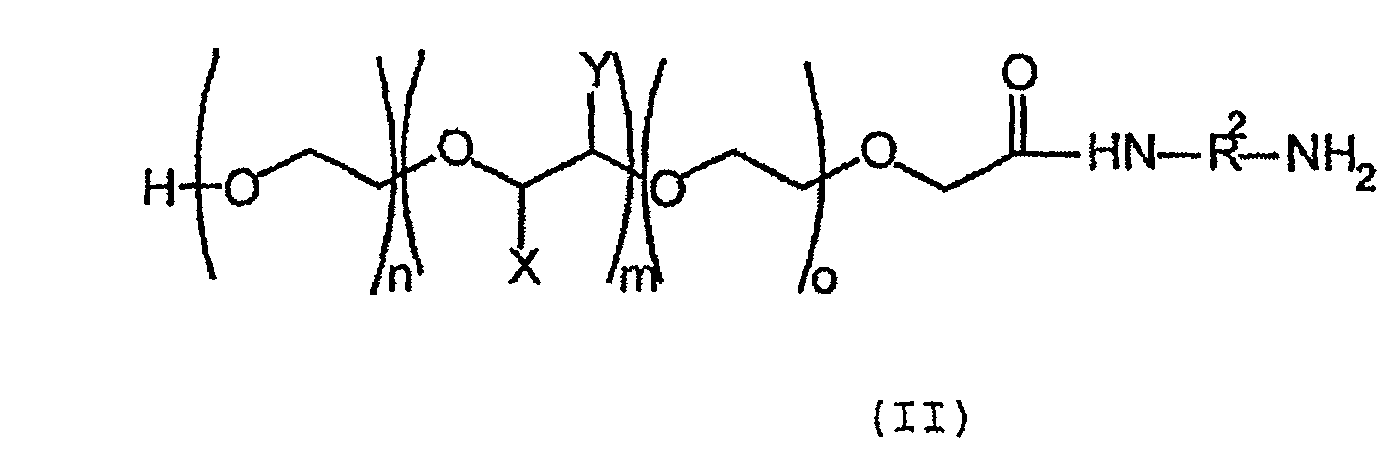

- Dispersion aqueuse selon la revendication 1, dans laquelle m est un nombre réel de 0 à 70 et n et o sont indépendamment un nombre réel de 5 à 395 dans la formule (I), m est un nombre réel de 0 à 70, n est un nombre réel de 0 à 395 et o est un nombre réel de 0 à 400 dans la formule (II), ou m est un nombre réel de 0 à 70, n est un nombre réel de 0 à 395 et o est un nombre réel de 0 à 400 dans la formule (III), et n+o a une valeur d'au moins 35.
- Dispersion aqueuse selon la revendication 1, dans laquelle on prépare l'agent tensio-actif à fonctionnalité époxy, au nombre d'au moins un, en faisant réagir une amidoamine de structures (I) et (II), le rapport en poids de (I) à (II) étant compris entre 20:80 et 80:20, et la résine époxy, au nombre d'au moins une, ou dans laquelle on prépare l'agent tensio-actif à fonctionnalité époxy, au nombre d'au moins un, en faisant réagir une amidoamine de structures (I) et (III), le rapport en poids de (I) à (III) étant compris entre 20:80 et 80:20, et la résine époxy, au nombre d'au moins une, ou dans laquelle on prépare l'agent tensio-actif à fonctionnalité époxy, au nombre d'au moins un, en faisant réagir une amidoamine de structures (II) et (III), le rapport en poids de (II) à (III) étant compris entre 20:80 et 80:20, et la résine époxy au nombre d'au moins une.
- Dispersion aqueuse selon les revendications 1-3, dans laquelle on prépare l'agent tensio-actif à fonctionnalité époxy, au nombre d'au moins un, en faisant réagir l'amidoamine de structure (I) ou l'amidoamine de structure II ou l'amidoamine de structure III, dans chacune desquelles m=0, et la résine époxy au nombre d'au moins une.
- Dispersion aqueuse selon les revendications 1-4, dans laquelle on prépare l'amidoamine de structure III en faisant réagir un composé contenant un polyalkylèneglycol à terminaison acide, ayant la formuledans laquelle R1 est un groupe alkyle, aryle ou arylalkyle ayant de 1 à 15 atomes de carbone, k est un nombre réel positif de 40 à 400, et au moins une diamine selon un rapport d'équivalent d'amine à acide de 6:1 à 25:1.

- Dispersion aqueuse selon les revendications 1-5, comprenant, en outre, un solvant comprenant i) de l'acétone.
- Dispersion aqueuse selon la revendication 6, dans laquelle l'acétone est présente en une quantité de 0,5 à 5 % en poids de la dispersion aqueuse totale.
- Dispersion aqueuse selon la revendication 6, dans laquelle le solvant comprend, en outre, ii) une résine liquide hydrophobe non volatile ou un modificateur de résine qui est présent(e) en une quantité de 1 à 10 % en poids par rapport aux quantités totales des composants (b), (c) et (d) ii).
- Dispersion aqueuse selon la revendication 8, dans laquelle la résine liquide hydrophobe non volatile ou le modificateur de résine est une résine d'éther monoglycidylique aliphatique et d'urée-formaldéhyde ou un ester monoglycidylique aliphatique.
- Dispersion aqueuse selon la revendication 1, dans laquelle la résine époxy en (c) comprend un mélange d'une résine époxy ayant une fonctionnalité comprise entre 0,8 et 1,3 et d'une résine époxy ayant une fonctionnalité d'au moins 1,7.
- Composition de résine époxy durcissable comprenant la dispersion aqueuse selon les revendications 1-10 et un agent de durcissement compatible avec l'eau pour la résine époxy.
- Composition de résine époxy durcissable comprenant la dispersion aqueuse, dans laquelle on prépare l'agent tensio-actif à fonctionnalité époxy, au nombre d'au moins un, en faisant réagir une amidoamine de structures II et III, le rapport en poids de II à III étant compris entre 20:80 et 80:20, et au moins une résine époxy, et un agent de durcissement compatible avec l'eau pour la résine époxy.
- Composition durcie, obtenue par durcissement des compositions selon les revendications 11 et 12.
- Procédé de préparation d'une dispersion aqueuse, comprenant le mélange, dans des conditions efficaces pour fournir une émulsion huile dans eau, a) de l'eau et b) une résine époxy ayant une fonctionnalité supérieure à 0,8 groupe époxyde par molécule, en présence de c) de 0,1 à 20 % en poids, par rapport à la résine époxy, d'au moins un agent tensio-actif à fonctionnalité époxy, préparé par mise en réaction d'une amidoamine ayant la structure :

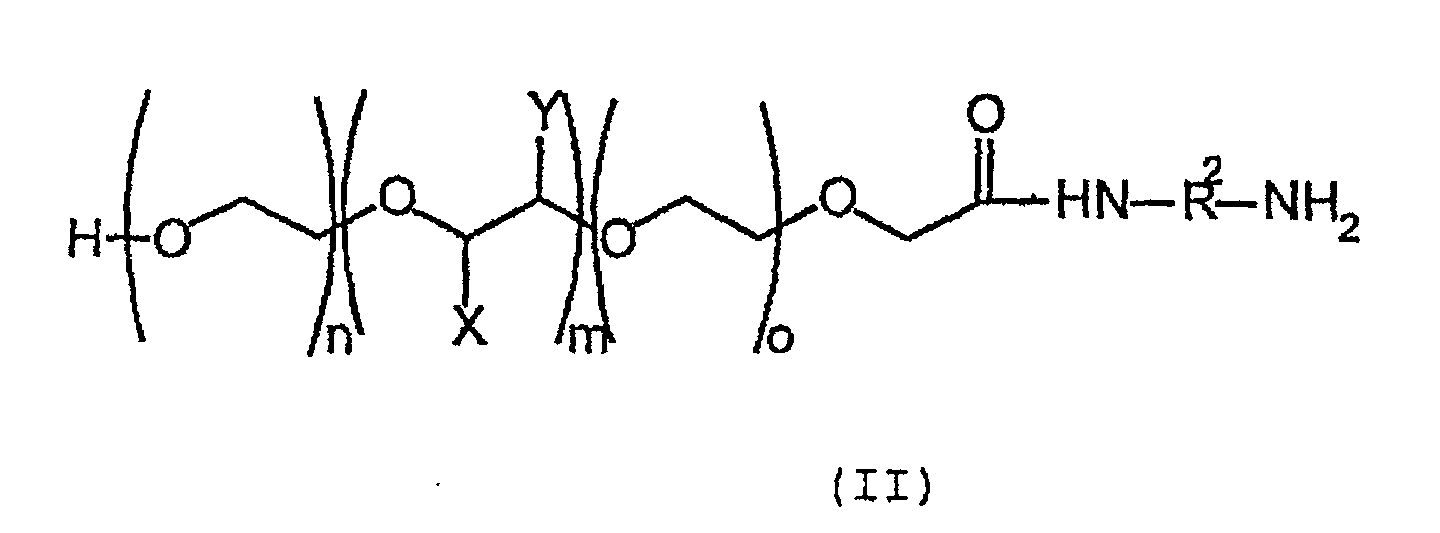 dans lesquelles R1 est un groupe alkyle, aryle ou arylalkyle ou des mélanges de ceux-ci, ayant de 1 à 15 atomes de carbone, R2 est un groupe aliphatique, cycloaliphatique ou aromatique ayant de 2 à 18 atomes de carbone, contenant éventuellement de l'oxygène non réactif ou au plus en moyenne 4 atomes d'azote secondaire et/ou tertiaire par structure dans le squelette, X et Y sont indépendamment un groupe hydrogène, méthyle ou éthyle, avec la condition que si X est un groupe méthyle ou éthyle, Y est l'hydrogène, ou si Y est un groupe méthyle ou éthyle, X est l'hydrogène, et n+m+o est un nombre réel de 40 à 400, et n+o est un nombre réel d'au moins 15, et le rapport en poids de (I) à (II) est compris entre 100:0 et 0:100, le rapport en poids de (I) à (III) est compris entre 100:0 et 0:100, et le rapport en poids de (II) à (III) est compris entre 100:0 et 0:100, et au moins une résine époxy ayant une fonctionnalité supérieure à 0,8 groupe époxyde par molécule, selon un rapport d'équivalent d'amine à époxy d'au moins 1:2.
Applications Claiming Priority (5)
| Application Number | Priority Date | Filing Date | Title |
|---|---|---|---|
| US91148097A | 1997-08-14 | 1997-08-14 | |
| US911480 | 1997-08-14 | ||
| US116923 | 1998-07-17 | ||
| US09/116,923 US6221934B1 (en) | 1997-08-14 | 1998-07-17 | Aqueous dispersions of epoxy resins |
| PCT/EP1998/005281 WO1999009089A2 (fr) | 1997-08-14 | 1998-08-13 | Emulsions aqueuses de resines epoxydes |
Publications (2)
| Publication Number | Publication Date |
|---|---|
| EP1003816A2 EP1003816A2 (fr) | 2000-05-31 |
| EP1003816B1 true EP1003816B1 (fr) | 2002-12-18 |
Family
ID=26814759
Family Applications (1)
| Application Number | Title | Priority Date | Filing Date |
|---|---|---|---|
| EP98951306A Expired - Lifetime EP1003816B1 (fr) | 1997-08-14 | 1998-08-13 | Emulsions aqueuses de resines epoxydes |
Country Status (15)
| Country | Link |
|---|---|
| EP (1) | EP1003816B1 (fr) |
| JP (1) | JP4051176B2 (fr) |
| CN (1) | CN1100827C (fr) |
| AT (1) | ATE229994T1 (fr) |
| AU (1) | AU740982B2 (fr) |
| BR (1) | BR9811164A (fr) |
| CA (1) | CA2300169C (fr) |
| DE (1) | DE69810304T2 (fr) |
| DK (1) | DK1003816T3 (fr) |
| HU (1) | HUP0104940A2 (fr) |
| ID (1) | ID24092A (fr) |
| IL (1) | IL133717A0 (fr) |
| NO (1) | NO329114B1 (fr) |
| TR (1) | TR200000381T2 (fr) |
| WO (1) | WO1999009089A2 (fr) |
Families Citing this family (9)
| Publication number | Priority date | Publication date | Assignee | Title |
|---|---|---|---|---|
| US6143809A (en) * | 1998-07-17 | 2000-11-07 | Shell Oil Company | Process to prepare aqueous dispersions of epoxy resins |
| JP4674112B2 (ja) * | 2005-04-28 | 2011-04-20 | 出光興産株式会社 | エポキシ樹脂組成物及びそれを用いた光学電子部材 |
| US8580871B2 (en) * | 2010-12-13 | 2013-11-12 | Momentive Specialty Chemicals Inc. | Epoxy systems and amine polymer systems and methods for making the same |
| EP2476672A1 (fr) * | 2010-12-22 | 2012-07-18 | Momentive Specialty Chemicals Research Belgium S.A. | Esters glycidyliques de compositions d'acides ramifiés alpha |
| JP2014009270A (ja) * | 2012-06-28 | 2014-01-20 | Henkel Japan Ltd | 水性エポキシ樹脂エマルション |
| TWI684609B (zh) * | 2017-08-15 | 2020-02-11 | 長春人造樹脂廠股份有限公司 | 反應性環氧化合物及其製備方法及包含其之核-殼型環氧樹脂顆粒、水性環氧樹脂組合物及塗料組合物 |
| WO2022211653A1 (fr) * | 2021-03-29 | 2022-10-06 | Общество с ограниченной ответственностью "НАУЧНО-ПРОИЗВОДСТВЕННАЯ ФИРМА "РЕКОН" | Procédé de production d'une dispersion époxyde aqueuse |
| CN116478344A (zh) * | 2022-01-17 | 2023-07-25 | 万华化学集团股份有限公司 | 一种水性单组份环氧乳液及其制备方法 |
| WO2024207393A1 (fr) * | 2023-04-07 | 2024-10-10 | Dic Corporation | Composition de résine époxy dispersée dans l'eau, peinture et article |
Family Cites Families (2)
| Publication number | Priority date | Publication date | Assignee | Title |
|---|---|---|---|---|
| DE3901279A1 (de) * | 1989-01-18 | 1990-07-19 | Hoechst Ag | Verwendung von polyamidoaminen als haerter fuer epoxidharze und diese enthaltende haertbare mischungen |
| DE4206392A1 (de) * | 1992-02-29 | 1993-09-02 | Hoechst Ag | Haertungsmittel fuer epoxidharze |
-
1998
- 1998-08-13 AT AT98951306T patent/ATE229994T1/de active
- 1998-08-13 WO PCT/EP1998/005281 patent/WO1999009089A2/fr not_active Ceased
- 1998-08-13 CN CN98807958A patent/CN1100827C/zh not_active Expired - Lifetime
- 1998-08-13 CA CA002300169A patent/CA2300169C/fr not_active Expired - Lifetime
- 1998-08-13 TR TR2000/00381T patent/TR200000381T2/xx unknown
- 1998-08-13 DE DE69810304T patent/DE69810304T2/de not_active Expired - Lifetime
- 1998-08-13 DK DK98951306T patent/DK1003816T3/da active
- 1998-08-13 BR BR9811164-7A patent/BR9811164A/pt not_active IP Right Cessation
- 1998-08-13 ID IDW20000276A patent/ID24092A/id unknown
- 1998-08-13 EP EP98951306A patent/EP1003816B1/fr not_active Expired - Lifetime
- 1998-08-13 IL IL13371798A patent/IL133717A0/xx unknown
- 1998-08-13 AU AU97385/98A patent/AU740982B2/en not_active Expired
- 1998-08-13 HU HU0104940A patent/HUP0104940A2/hu unknown
- 1998-08-13 JP JP2000509764A patent/JP4051176B2/ja not_active Expired - Lifetime
-
2000
- 2000-02-11 NO NO20000685A patent/NO329114B1/no not_active IP Right Cessation
Also Published As
| Publication number | Publication date |
|---|---|
| CN1265695A (zh) | 2000-09-06 |
| DE69810304D1 (de) | 2003-01-30 |
| ATE229994T1 (de) | 2003-01-15 |
| AU9738598A (en) | 1999-03-08 |
| HUP0104940A2 (hu) | 2002-04-29 |
| DK1003816T3 (da) | 2003-04-07 |
| WO1999009089A3 (fr) | 1999-05-27 |
| BR9811164A (pt) | 2000-07-25 |
| EP1003816A2 (fr) | 2000-05-31 |
| CN1100827C (zh) | 2003-02-05 |
| AU740982B2 (en) | 2001-11-22 |
| JP2001515112A (ja) | 2001-09-18 |
| ID24092A (id) | 2000-07-06 |
| WO1999009089A2 (fr) | 1999-02-25 |
| NO20000685L (no) | 2000-02-11 |
| NO329114B1 (no) | 2010-08-30 |
| CA2300169C (fr) | 2008-02-05 |
| JP4051176B2 (ja) | 2008-02-20 |
| TR200000381T2 (tr) | 2000-11-21 |
| NO20000685D0 (no) | 2000-02-11 |
| IL133717A0 (en) | 2001-04-30 |
| DE69810304T2 (de) | 2003-05-22 |
| CA2300169A1 (fr) | 1999-02-25 |
Similar Documents
| Publication | Publication Date | Title |
|---|---|---|
| US5602193A (en) | Aqueous dispersions of epoxy resins | |
| US6221934B1 (en) | Aqueous dispersions of epoxy resins | |
| US6653436B2 (en) | Water dispersible epoxy resins | |
| US6136894A (en) | Aqueous epoxy resin system with curing agent from reacting acid-terminated polyalkylene glycol with epoxy-amine adduct | |
| US5741835A (en) | Aqueous dispersions of epoxy resins | |
| EP1060205B1 (fr) | Agents de durcissement dispersables dans l'eau pour resines epoxy | |
| BR112013014596B1 (pt) | Composição de epóxi, revestimento termofixado, e, encolamento de fibra | |
| US6143809A (en) | Process to prepare aqueous dispersions of epoxy resins | |
| EP1003816B1 (fr) | Emulsions aqueuses de resines epoxydes | |
| EP2652040B1 (fr) | Systèmes époxy améliorés et systèmes améliorés de polymère d'amine et leurs procédés de fabrication | |
| EP1141085B1 (fr) | Procede d' oxydation partielle de compositions de polyols de polyoxyalkylene en composition d'acide polycarboxylique | |
| MXPA00001132A (en) | Aqueous dispersions of epoxy resins | |
| EP2652039B1 (fr) | Modèles améliorés de systèmes époxy et de polymères d'amines, et procédés de fabrication correspondants |
Legal Events
| Date | Code | Title | Description |
|---|---|---|---|
| PUAI | Public reference made under article 153(3) epc to a published international application that has entered the european phase |
Free format text: ORIGINAL CODE: 0009012 |
|
| 17P | Request for examination filed |
Effective date: 19991215 |
|
| AK | Designated contracting states |
Kind code of ref document: A2 Designated state(s): AT BE CH DE DK ES FR GB GR IT LI NL SE |
|
| 17Q | First examination report despatched |
Effective date: 20010411 |
|
| RAP1 | Party data changed (applicant data changed or rights of an application transferred) |
Owner name: RESOLUTION RESEARCH NEDERLAND B.V. |
|
| GRAG | Despatch of communication of intention to grant |
Free format text: ORIGINAL CODE: EPIDOS AGRA |
|
| GRAG | Despatch of communication of intention to grant |
Free format text: ORIGINAL CODE: EPIDOS AGRA |
|
| GRAH | Despatch of communication of intention to grant a patent |
Free format text: ORIGINAL CODE: EPIDOS IGRA |
|
| GRAH | Despatch of communication of intention to grant a patent |
Free format text: ORIGINAL CODE: EPIDOS IGRA |
|
| GRAA | (expected) grant |
Free format text: ORIGINAL CODE: 0009210 |
|
| AK | Designated contracting states |
Kind code of ref document: B1 Designated state(s): AT BE CH DE DK ES FR GB GR IT LI NL SE |
|
| PG25 | Lapsed in a contracting state [announced via postgrant information from national office to epo] |
Ref country code: GR Free format text: LAPSE BECAUSE OF FAILURE TO SUBMIT A TRANSLATION OF THE DESCRIPTION OR TO PAY THE FEE WITHIN THE PRESCRIBED TIME-LIMIT Effective date: 20021218 |
|
| REF | Corresponds to: |
Ref document number: 229994 Country of ref document: AT Date of ref document: 20030115 Kind code of ref document: T |
|
| REG | Reference to a national code |
Ref country code: GB Ref legal event code: FG4D |
|
| REG | Reference to a national code |
Ref country code: CH Ref legal event code: EP |
|
| REF | Corresponds to: |
Ref document number: 69810304 Country of ref document: DE Date of ref document: 20030130 Kind code of ref document: P Ref document number: 69810304 Country of ref document: DE Date of ref document: 20030130 |
|
| REG | Reference to a national code |
Ref country code: CH Ref legal event code: NV Representative=s name: NOVAGRAAF INTERNATIONAL SA |
|
| PG25 | Lapsed in a contracting state [announced via postgrant information from national office to epo] |
Ref country code: SE Free format text: LAPSE BECAUSE OF FAILURE TO SUBMIT A TRANSLATION OF THE DESCRIPTION OR TO PAY THE FEE WITHIN THE PRESCRIBED TIME-LIMIT Effective date: 20030318 |
|
| REG | Reference to a national code |
Ref country code: DK Ref legal event code: T3 |
|
| PG25 | Lapsed in a contracting state [announced via postgrant information from national office to epo] |
Ref country code: ES Free format text: LAPSE BECAUSE OF FAILURE TO SUBMIT A TRANSLATION OF THE DESCRIPTION OR TO PAY THE FEE WITHIN THE PRESCRIBED TIME-LIMIT Effective date: 20030627 |
|
| ET | Fr: translation filed | ||
| RAP2 | Party data changed (patent owner data changed or rights of a patent transferred) |
Owner name: RESOLUTION RESEARCH NEDERLAND B.V. |
|
| PLBE | No opposition filed within time limit |
Free format text: ORIGINAL CODE: 0009261 |
|
| STAA | Information on the status of an ep patent application or granted ep patent |
Free format text: STATUS: NO OPPOSITION FILED WITHIN TIME LIMIT |
|
| NLT2 | Nl: modifications (of names), taken from the european patent patent bulletin |
Owner name: RESOLUTION RESEARCH NEDERLAND B.V. |
|
| 26N | No opposition filed |
Effective date: 20030919 |
|
| REG | Reference to a national code |
Ref country code: CH Ref legal event code: PCAR Free format text: NOVAGRAAF INTERNATIONAL SA;25, AVENUE DU PAILLY;1220 LES AVANCHETS (CH) |
|
| REG | Reference to a national code |
Ref country code: CH Ref legal event code: PFA Owner name: RESOLUTION RESEARCH NEDERLAND B.V. Free format text: RESOLUTION RESEARCH NEDERLAND B.V.#BADHUISWEG 3#1031 CM AMSTERDAM (NL) -TRANSFER TO- RESOLUTION RESEARCH NEDERLAND B.V.#BADHUISWEG 3#1031 CM AMSTERDAM (NL) |
|
| REG | Reference to a national code |
Ref country code: NL Ref legal event code: PLEX Effective date: 20130515 |
|
| REG | Reference to a national code |
Ref country code: FR Ref legal event code: PLFP Year of fee payment: 19 |
|
| REG | Reference to a national code |
Ref country code: FR Ref legal event code: PLFP Year of fee payment: 20 |
|
| PGFP | Annual fee paid to national office [announced via postgrant information from national office to epo] |
Ref country code: NL Payment date: 20170826 Year of fee payment: 20 |
|
| PGFP | Annual fee paid to national office [announced via postgrant information from national office to epo] |
Ref country code: CH Payment date: 20170827 Year of fee payment: 20 Ref country code: IT Payment date: 20170823 Year of fee payment: 20 Ref country code: DE Payment date: 20170829 Year of fee payment: 20 Ref country code: GB Payment date: 20170829 Year of fee payment: 20 Ref country code: FR Payment date: 20170825 Year of fee payment: 20 |
|
| PGFP | Annual fee paid to national office [announced via postgrant information from national office to epo] |
Ref country code: AT Payment date: 20170719 Year of fee payment: 20 Ref country code: DK Payment date: 20170825 Year of fee payment: 20 Ref country code: BE Payment date: 20170828 Year of fee payment: 20 |
|
| REG | Reference to a national code |
Ref country code: DE Ref legal event code: R071 Ref document number: 69810304 Country of ref document: DE |
|
| REG | Reference to a national code |
Ref country code: NL Ref legal event code: MK Effective date: 20180812 |
|
| REG | Reference to a national code |
Ref country code: DK Ref legal event code: EUP Effective date: 20180813 |
|
| REG | Reference to a national code |
Ref country code: CH Ref legal event code: PL |
|
| REG | Reference to a national code |
Ref country code: GB Ref legal event code: PE20 Expiry date: 20180812 |
|
| REG | Reference to a national code |
Ref country code: AT Ref legal event code: MK07 Ref document number: 229994 Country of ref document: AT Kind code of ref document: T Effective date: 20180813 |
|
| REG | Reference to a national code |
Ref country code: BE Ref legal event code: MK Effective date: 20180813 |
|
| PG25 | Lapsed in a contracting state [announced via postgrant information from national office to epo] |
Ref country code: GB Free format text: LAPSE BECAUSE OF EXPIRATION OF PROTECTION Effective date: 20180812 |