EP1004609A2 - Aromatic polycarbonate - Google Patents
Aromatic polycarbonate Download PDFInfo
- Publication number
- EP1004609A2 EP1004609A2 EP99123160A EP99123160A EP1004609A2 EP 1004609 A2 EP1004609 A2 EP 1004609A2 EP 99123160 A EP99123160 A EP 99123160A EP 99123160 A EP99123160 A EP 99123160A EP 1004609 A2 EP1004609 A2 EP 1004609A2
- Authority
- EP
- European Patent Office
- Prior art keywords
- group
- aromatic
- formula
- substituted
- unsubstituted
- Prior art date
- Legal status (The legal status is an assumption and is not a legal conclusion. Google has not performed a legal analysis and makes no representation as to the accuracy of the status listed.)
- Granted
Links
Images

Classifications
-
- C—CHEMISTRY; METALLURGY
- C08—ORGANIC MACROMOLECULAR COMPOUNDS; THEIR PREPARATION OR CHEMICAL WORKING-UP; COMPOSITIONS BASED THEREON
- C08G—MACROMOLECULAR COMPOUNDS OBTAINED OTHERWISE THAN BY REACTIONS ONLY INVOLVING UNSATURATED CARBON-TO-CARBON BONDS
- C08G64/00—Macromolecular compounds obtained by reactions forming a carbonic ester link in the main chain of the macromolecule
- C08G64/20—General preparatory processes
- C08G64/30—General preparatory processes using carbonates
- C08G64/307—General preparatory processes using carbonates and phenols
Definitions
- the present invention relates to an aromatic polycarbonate and in particular, to an aromatic polycarbonate which is improved in color tone and heat resistance.
- Polycarbonate resins have been extensively used in various application fields because of excellent impact resistance, transparency or the like. Among others, these polycarbonate resins are especially useful as transparent materials such as optical discs, sheets, molding materials, alternate materials for glass products or the like.
- the polycarbonate resins have to be kneaded and molded at a high temperature of 250 to 380°C due to a high melting viscosity thereof. Therefore, there arises such a problem that these resins tend to be discolored when kneaded with additives and molded.
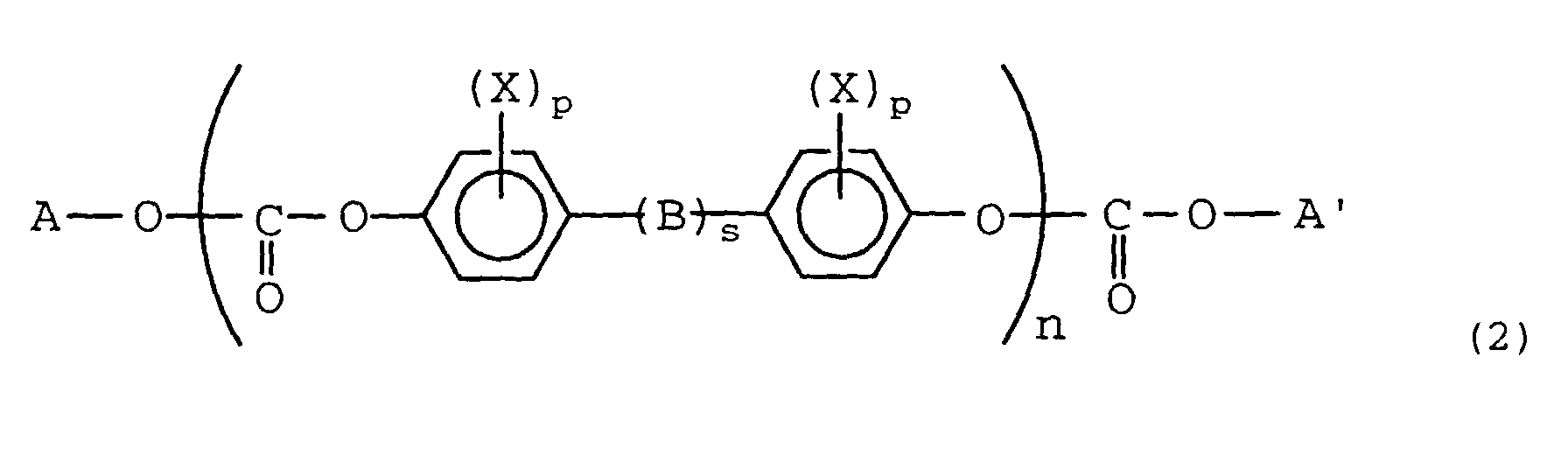
- an aromatic polycarbonate which is produced by reacting an aromatic dihydroxy compound with a compound capable of introducing a carbonate bond, and has a viscosity-average molecular weight of 12,000 to 40,000 and a content of a cyclic oligomer represented by the following formula (1) of not more than 1,000 ppm, and in which the percentage of the content of said cyclic oligomer represented by the formula (1) based on the total contents of said cyclic oligomer represented by the formula (1), an oligomer represented by the following formula (2) and an oligomer represented by the following formula (3) satisfies the following relational formula [I]: 0 ⁇ (1) (1) + (2) + (3) ⁇ 100 ⁇ 3.6 ⁇ 10 -8 ⁇ (Mv) 2 wherein (1), (2) and (3) are contents of the oligomers represented by the formulae (1), (2) and (3), respectively; and Mv is a viscosity-average molecular weight of said aromatic polycarbonate.
- B is a divalent group selected from the group consisting of a halogen-substituted or unsubstituted C 1 to C 15 hydrocarbon group, O, S, CO, SO and SO 2 ;
- X is a monovalent group selected from the group consisting of a halogen atom, a substituted or unsubstituted C 1 to C 14 aliphatic group, a substituted or unsubstituted C 6 to C 18 aromatic group, a C 1 to C 8 oxyalkyl group and a C 6 to C 18 oxyaryl group;
- m is an integer of 2 to 8;
- p is an integer of 0 to 4;
- s is an integer of 0 or 1; and
- X's and p's are respectively the same or different.
- a and A' are independently a monovalent group selected from the group consisting of a substituted or unsubstituted C 1 to C 18 aliphatic group and a substituted or unsubstituted C 6 to C 18 aromatic group, and may be the same or different; n is an integer of 1 to 7; and B, X, p and s have the same meanings as set forth in the above formula (1).
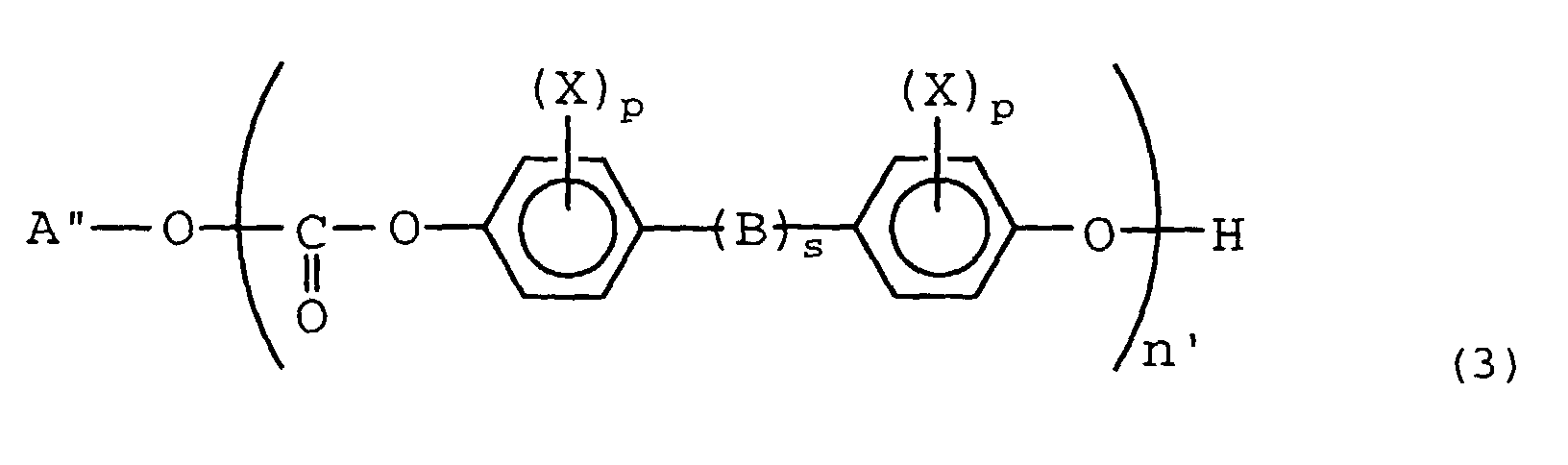
- A'' is a monovalent group selected from the group consisting of a substituted or unsubstituted C 1 to C 18 aliphatic group and a substituted or unsubstituted C 6 to C 18 aromatic group; n' is an integer of 1 to 7; and B, X, p and s have the same meanings as set forth in the above formula (1).
- the aromatic polycarbonate according to the present invention can be produced by known methods such as an interfacial polycondensation method, a transesterification method, etc., using an aromatic dihydroxy compound and a compound capable of introducing a carbonate bond as raw materials. Among these methods, the use of the transesterification method is preferred.
- carbonic acid diesters As the compound capable of introducing a carbonate bond, there may be exemplified phosgene, carbonic acid diesters or the like.
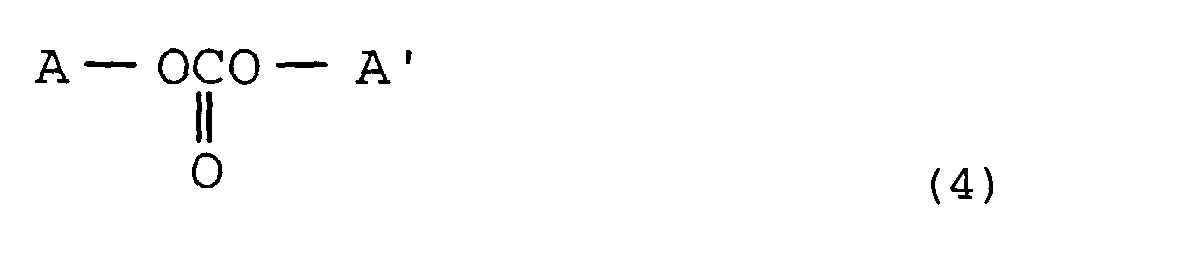
- the carbonic acid diesters are represented by the following formula (4): wherein A and A' are independently a monovalent group selected from the group consisting of a substituted or unsubstituted C 1 to C 18 aliphatic group and a substituted or unsubstituted C 6 to C 18 aromatic group, and may be the same or different.
- Examples of the carbonic acid diesters represented by the above formula (4) may include dimethyl carbonate, diethyl carbonate, di-t-butyl carbonate, diphenyl carbonate, substituted diphenyl carbonate such as ditolyl carbonate or the like. Among them, the use of diphenyl carbonate or substituted diphenyl carbonate is preferred. Especially, the use of diphenyl carbonate is more preferred. These carbonic acid diesters may be used singly or in the form of a mixture of any two or more thereof.
- dicarboxylic acids or dicarboxylic esters can be used in an amount of preferably not more than 50 mol%, more preferably not more than 30 mol%.
- dicarboxylic acids or dicarboxylic esters there may be exemplified terephthalic acid, isophthalic acid, diphenyl terephthalate, diphenyl isophthalate or the like.
- polyester carbonate can be produced.
- the aromatic dihydroxy compound as another raw material is represented by the following formula (5): wherein B is a divalent group selected from the group consisting of a halogen-substituted or unsubstituted C 1 to C 15 hydrocarbon group, O, S, CO, SO and SO 2 ; X is a monovalent group selected from the group consisting of a halogen atom, a substituted or unsubstituted C 1 to C 14 aliphatic group, a substituted or unsubstituted C 6 to C 18 aromatic group, a C 1 to C 8 oxyalkyl group and a C 6 to C 18 oxyaryl group; p is an integer of 0 to 4; s is an integer of 0 or 1; and X's and p's are respectively the same or different.
- the mixing ratio of the carbonic acid diester to the aromatic dihydroxy compound may be varied and determined depending upon the molecular weight of the aimed aromatic polycarbonate and the amount of terminal hydroxyl groups thereof.
- the amount of the terminal hydroxyl groups has a large influence on heat stability, hydrolysis stability, color tone, etc., of the obtained polycarbonate products.
- the amount of terminal hydroxyl groups is usually not more than 1,000 ppm, preferably not more than 800 ppm, more preferably not more than 700 ppm.
- the amount of terminal hydroxyl groups is usually not less than 100 ppm, preferably not less than 200 ppm, more preferably not less than 300 ppm.
- the carbonic acid diester may be generally used in an equimolar amount or higher based on one mole of the aromatic dihydroxy compound. More specifically, the carbonic acid diester may be used in an amount of usually 1.01 to 1.30 moles, preferably 1.01 to 1.20 moles based on one mole of the aromatic dihydroxy compound.
- transesterification catalyst When the aromatic polycarbonate is produced by the transesterification method, a transesterification catalyst is usually used therein.
- the transesterification catalyst used in the present invention is not particularly restricted, but there may be mainly used alkali metal compounds and/or alkaline earth metal compounds. These alkali metal compounds and/or alkaline earth metal compounds may be used together with basic compounds as an auxiliary catalyst component such as basic boron compounds, basic phosphorus compounds, basic ammonium compounds or amine-based compounds. These catalysts may be used singly or in the form of a mixture of any two or more thereof.
- the amount of the catalyst used is usually 1 ⁇ 10 -9 to 1 ⁇ 10 -3 mole based on one mole of the aromatic dihydroxy compound.
- the alkali metal compounds or alkaline earth metal compounds may be used in an amount of usually 1 ⁇ 10 -9 to 1 ⁇ 10 -4 mole, preferably 1 ⁇ 10 -8 to 1 ⁇ 10 -5 mole based on one mole of the aromatic dihydroxy compound, and the basic compounds such as basic boron compounds, basic phosphorus compounds, basic ammonium compounds or amine-based compounds may be used in an amount of usually 1 ⁇ 10 -9 to 1 ⁇ 10 -3 mole, preferably 1 ⁇ 10 -7 to 1 ⁇ 10 -4 mole based on one mole of the aromatic dihydroxy compound.
- the amount of the catalyst used is less than each lower limit value, it is difficult to exhibit a polymerization activity enough to produce a polycarbonate having the aimed molecular weight and the aimed amount of terminal hydroxyl groups.
- the amount of the catalyst used is more than each upper limit value, the obtained polycarbonate disadvantageously may undergo the increase in amount of the cyclic oligomer as described hereinafter, discoloration, low heat resistance, low hydrolysis resistance, increase in amount of foreign substances due to gel generation, or the like.
- alkali metal compounds there may be exemplified inorganic alkali metal compounds such as hydroxides, hydrogen carbonates, carbonates, hydrogen phosphates or phenyl phosphates of lithium, sodium, potassium, rubidium or cesium; organic alkali metal compounds, e.g., alkali metal salts of organic acids such as acetic acid, stearic acid or benzoic acid, alkali metal salts of alcohols such as methanol or ethanol, or alkali metal salts of phenols such as phenol or bisphenol A; or the like.
- organic alkali metal compounds e.g., alkali metal salts of organic acids such as acetic acid, stearic acid or benzoic acid, alkali metal salts of alcohols such as methanol or ethanol, or alkali metal salts of phenols such as phenol or bisphenol A; or the like.
- alkaline earth metal compounds there may be exemplified inorganic alkaline earth metal compounds such as hydroxides, hydrogen carbonates or carbonates of beryllium, calcium, magnesium, strontium or barium; organic alkaline earth metal compounds, e.g., alkaline earth metal salts of organic acids such as acetic acid, stearic acid or benzoic acid, alkaline earth metal salts of alcohols, or alkaline earth metal salts of phenols; or the like.
- inorganic alkaline earth metal compounds such as hydroxides, hydrogen carbonates or carbonates of beryllium, calcium, magnesium, strontium or barium
- organic alkaline earth metal compounds e.g., alkaline earth metal salts of organic acids such as acetic acid, stearic acid or benzoic acid, alkaline earth metal salts of alcohols, or alkaline earth metal salts of phenols; or the like.
- the basic boron compounds may include sodium salts, potassium salts, lithium salts, calcium salts, magnesium salts, barium salts or strontium salts of boron compounds such as tetramethyl boron, tetraethyl boron, tetrapropyl boron, tetrabutyl boron, trimethylethyl boron, trimethylbenzyl boron, trimethylphenyl boron, triethylmethyl boron, triethylbenzyl boron, triethylphenyl boron, tributylbenzyl boron, tributylphenyl boron, tetraphenyl boron, benzyltriphenyl boron, methyltriphenyl boron or butyltriphenyl boron, or the like.
- boron compounds such as tetramethyl boron, tetraethyl boron, te
- triethyl phosphine tri-n-propyl phosphine, triisopropyl phosphine, tri-n-butyl phosphine, triphenyl phosphine, quaternary phosphonium salts or the like.
- tetramethyl ammonium hydroxide tetraethyl ammonium hydroxide, tetrapropyl ammonium hydroxide, tetrabutyl ammonium hydroxide, trimethylethyl ammonium hydroxide, trimethylbenzyl ammonium hydroxide, trimethylphenyl ammonium hydroxide, triethylmethyl ammonium hydroxide, triethylbenzyl ammonium hydroxide, triethylphenyl ammonium hydroxide, tributylbenzyl ammonium hydroxide, tributylphenyl ammonium hydroxide, tetraphenyl ammonium hydroxide, benzyltriphenyl ammonium hydroxide, methyltriphenyl ammonium hydroxide, butyltriphenyl ammonium hydroxide or the like.
- amine-based compounds there may be exemplified 4-aminopyridine, 2-aminopyridine, N,N-dimethyl-4-aminopyridine, 4-diethylaminopyridine, 2-hydroxypyridine, 2-methoxypyridine, 4-methoxypyridine, 2-dimethylaminoimidazole, 2-methoxyimidazole, imidazole, 2-mercaptoimidazole, 2-methylimidazole, aminoquinoline or the like.
- the alkali metal compounds, the basic ammonium compounds and the basic phosphorus compounds are practically preferred, and the alkali metal compounds are more preferred.
- the polycarbonate according to the present invention can be produced by reacting the above-described compound capable of introducing a carbonate bond with the above-described aromatic dihydroxy compound usually in the presence of the above-described transesterification catalyst, and has a viscosity-average molecular weight of usually 12,000 to 40,000.
- the viscosity-average molecular weight is less than 12,000, the obtained polycarbonate may be deteriorated in mechanical properties.
- the viscosity-average molecular weight is more than 40,000, the obtained polycarbonate may be deteriorated in moldability.
- the content of the cyclic oligomer represented by the formula (1) is required to be not more than 1,000 ppm, preferably 700 ppm, more preferably 550 ppm.
- the content of the cyclic oligomer is more than 1,000 ppm, the obtained polycarbonate tends to be discolored, and deteriorated in heat resistance, hydrolysis resistance or the like.
- the reason therefor is not clearly known, it is considered that since the cyclic oligomer exhibits a high reactivity, the large content of the cyclic oligomer tends to produce colored components or accelerate the hydrolysis reaction under a high temperature condition.
- the properties of the obtained polycarbonate is adversely affected when the percentage of the content of the cyclic oligomer represented by the formula (1) based on the total content of oligomers including specific linear oligomers is more than a specific value.
- the percentage of the content of the cyclic oligomer represented by the formula (1) based on the total content of oligomers represented by the following formulae (1), (2) and (3) satisfies the following relational formula [I]: 0 ⁇ (1) (1) + (2) + (3) ⁇ 100 ⁇ 3.6 ⁇ 10 -8 ⁇ (Mv) 2 wherein (1), (2) and (3) are contents of the oligomers represented by the following formulae (1), (2) and (3), respectively; and Mv is a viscosity-average molecular weight of the obtained aromatic polycarbonate.
- B is a divalent group selected from the group consisting of a halogen-substituted or unsubstituted C 1 to C 15 hydrocarbon group, O, S, CO, SO and SO 2 ;
- X is a monovalent group selected from the group consisting of a halogen atom, a substituted or unsubstituted C 1 to C 14 aliphatic group, a substituted or unsubstituted C 6 to C 18 aromatic group, a C 1 to C 8 oxyalkyl group and a C 6 to C 18 oxyaryl group;
- m is an integer of 2 to 8;
- p is an integer of 0 to 4;
- s is an integer of 0 or 1; and
- X's and p's are respectively the same or different.
- a and A' are independently a monovalent group selected from the group consisting of a substituted or unsubstituted C 1 to C 18 aliphatic group and a substituted or unsubstituted C 6 to C 18 aromatic group, and may be the same or different; n is an integer of 1 to 7; and B, X, p and s have the same meanings as set forth in the above formula (1).
- A'' is a monovalent group selected from the group consisting of a substituted or unsubstituted C 1 to C 18 aliphatic group and a substituted or unsubstituted C 6 to C 18 aromatic group; n' is an integer of 1 to 7; and B, X, p and s have the same meanings as set forth in the above formula (1).
- the linear oligomers represented by the formulae (2) and (3) are components obtained during the production of the polycarbonate as well as the cyclic oligomer represented by the formula (1). Accordingly, the specific structures of repeating units expressed in the parentheses of the formulae (1) to (3) are derived from the aromatic dihydroxy compounds used in the production of polycarbonate. Whereas, the terminal groups A, A' and A'' are derived from either terminal groups of the compound capable of introducing a carbonate bond, or a terminal stopper used upon producing the polycarbonate by an interfacial polycondensation method using phosgene.
- the cyclic oligomer represented by the formula (1) exhibits a high reactivity, the properties such as color tone or heat resistance of the obtained polycarbonate are adversely affected when the content of the cyclic oligomer is more than 1,000 ppm. However, even though the content of the cyclic oligomer is not more than 1,000 ppm, the properties of the obtained polycarbonate are sometimes adversely affected.
- the properties of the polycarbonate become deteriorated in the case where the percentage of the content of the cyclic oligomer based on the total content of the cyclic oligomer and the specific linear oligomers represented by the formulae (2) and (3) is more than the value of 3.6 ⁇ 10 -8 ⁇ (Mv) 2 , wherein Mv is a viscosity-average molecular weight of the obtained polycarbonate.
- Mv is a viscosity-average molecular weight of the obtained polycarbonate.
- the above content and percentage of the cyclic oligomer produced are varied depending upon heat history of the polymer production process, kind and amount of the catalyst used, concentrations of the monomers or by-produced aromatic hydroxy compounds during the polymer production process, or the like, though the production mechanism of the cyclic oligomer is not clearly known.
- such a reaction is ordinarily difficult to occur.
- terminal groups of adjacent molecules are reacted with each other in an initial stage of the polymerization. Then the polymerization reaction further proceeds, only specific kinds of terminal groups remain in the reaction system.
- the amount of terminal hydroxyl groups present at an inlet of the final polymerization apparatus is preferably not less than 100 ppm, more preferably not less than 200 ppm.
- the carbonate bond tends to be activated. As a result, it is considered that the reaction between terminal carbonate groups which is ordinarily difficult to occur tends to be caused, thereby producing the cyclic oligomer.
- the polymerization temperature is usually not more than 320°C, preferably not more than 310°C.
- the cyclic oligomer If only the content of the cyclic oligomer is to be reduced, it is possible to extract out the cyclic oligomer with a solvent such as hexane, heptane, methanol or acetone in which the polycarbonate is difficult to dissolve.
- a solvent such as hexane, heptane, methanol or acetone
- the contents of other oligomers are also reduced, so that the percentage of the content of the cyclic oligomer based on the total content of oligomers remains almost unchanged.
- the extraction of the cyclic oligomer cannot necessarily improve the heat resistance of the obtained polycarbonate.
- the respective contents of the oligomers represented by the formulae (1), (2) and (3) may be measured by various methods, for example, a gel permeation chromatography (GPC), a high performance liquid chromatography (HPLC), a mass spectrometry, nuclear magnetic resonance (NMR) or the like.
- GPC gel permeation chromatography
- HPLC high performance liquid chromatography
- NMR nuclear magnetic resonance
- measuring devices such as MALDI-TOFMS (Matrix Assisted Laser Desorption Ionization Time of Flight Mass Spectrometry) or the like, because whole contents of high to low molecular weight moieties can be measured at the same time.
- the transesterification reaction using the above-described raw materials may be conducted in the form of a melt-polycondensation reaction at a temperature of 100 to 320°C under ordinary pressure or reduced pressure while removing by-products such as aromatic hydroxy compounds.
- the above reaction may be usually carried out at two or more multiple stages which are different in temperature or pressure conditions from each other.
- the reaction temperature of each stage is not particularly restricted as long as the polymer can be maintained in a molten state under the above conditions.
- the reaction time of each stage can be appropriately determined depending upon the degree of progress of the reaction, but is preferably in the range of 0.1 to 10 hours.
- each stage can be varied according to molecular weight and color tone of the obtained polymer, content of the cyclic oligomer, or the like. More specifically, the reaction of the first stage may be conducted at a temperature of usually 140 to 260°C, preferably 180 to 240°C for usually 0.1 to 5 hours, preferably 0.5 to 3 hours under ordinary pressure or reduced pressure. Subsequently, the reaction temperature is increased from stage to stage while correspondingly reducing the pressure of the reaction system. At the final stage, the polycondensation reaction is conducted at a temperature of 240 to 320°C under a reduced pressure of not more than 2 mmHg. In this case, it is preferred to keep the conditions of each reactor as unchangeable as possible so as to reduce the amount of the cyclic oligomer produced.
- the melt-polycondensation reaction may be carried out by either continuous or batch method.
- the use of the continuous method is preferred from the standpoint of stability of the products.
- the preferred embodiment of the present invention will now be explained by referring to Fig. 1.
- the apparatus used in the present invention may be of any type such as a tank type, a tube type or a column type. Specifically, there may be used vertical-type polymerization reactors 21 to 24 equipped with stirring blades 31 or 32, a single-screw or twin-screw horizontal-type polymerization reactor 5 equipped with stirring blades 6, or the like.
- the atmosphere of each high temperature reactor including a mixing tank 1 for raw materials is not particularly restricted, but the use of an inert gas atmosphere such as a nitrogen gas atmosphere is preferred from the standpoint of quality of the polymer produced.
- the aromatic polycarbonate produced is usually recovered in the form of pellets.
- the obtained aromatic polycarbonate may be passed through a vent-type extruder.
- the aromatic polycarbonate according to the present invention may further contain various additives such as a thermal stabilizer, an ultraviolet light absorber, a mold-releasing agent, a colorant, an anti-static agent, a slip agent, an anti-blocking agent, a lubricant, an anti-fogging agent, natural oils, synthetic oils, waxes, organic fillers, inorganic fillers or the like. These additives may be added to a molten resin or a remolten resin produced by melting pelletized resin.
- additives such as a thermal stabilizer, an ultraviolet light absorber, a mold-releasing agent, a colorant, an anti-static agent, a slip agent, an anti-blocking agent, a lubricant, an anti-fogging agent, natural oils, synthetic oils, waxes, organic fillers, inorganic fillers or the like.
- the extruder which is ordinarily used at the highest temperature, is to be operated under moderate conditions in order to reduce the amount of cyclic oligomer produced.
- the temperature is elevated under activated condition of the catalyst , the cyclic oligomer is produced. Therefore, it is preferred that the catalyst be deactivated using an appropriate deactivating agent.
- sulfur-containing acidic compounds or derivatives thereof may be suitably used as a deactivating agent for the catalyst.
- the deactivating agent may be added in an amount of usually 0.5 to 10 equivalents, preferably 1 to 5 equivalents based on one equivalent of the catalyst metal, i.e., in an amount of usually 1 to 100 ppm, preferably 1 to 20 ppm based on the polymer.
- sulfur-containing acidic compounds or derivatives thereof there may be exemplified sulfonic acid, sulfinic acid, sulfuric acid or esters thereof.
- Specific examples of the sulfur-containing acidic compounds or derivatives thereof may include dimethyl sulfate, diethyl sulfate, p-toluenesulfonic acid or methyl, ethyl, butyl, octyl or phenyl esters thereof; benzenesulfonic acid or methyl, ethyl, butyl, octyl, phenyl or dodecyl esters thereof; benzenesulfinic acid; toluenesulfinic acid; naphthalenesulfonic acid; or the like.
- the sulfur-containing acidic compounds or derivatives thereof may be added to the polycarbonate by an optional method.
- the sulfur-containing acidic compounds or derivatives thereof may be added directly or after being diluted with a diluent, to molten or solid polycarbonate and then dispersed therein. More specifically, these compounds may be supplied to a polycondensation reactor, a transportation line from the reactor or an extruder, and mixed with polycarbonate therein.
- the sulfur-containing acidic compounds or derivatives thereof may be preliminarily mixed with pellets, flakes or powder of polycarbonate using a mixer or the like, and then supplied to the extruder, etc., where the mixture is kneaded together.
- the sulfur-containing acidic compounds or derivatives thereof may be added to the polycarbonate simultaneously with the above treatment and the above addition of water or additives. However, it is preferred that the sulfur-containing acidic compounds or derivatives thereof be added to the polycarbonate and sufficiently kneaded therewith prior to the above treatment and addition.
- the oligomer content was measured using MALDI-TOFMS (VISION 2000, manufactured by Finnigan Mat Ltd.; laser: N 2 laser, 337 nm; mass-measuring range (m/z): 0 to 35,000).
- 0.10 g of polycarbonate and 0.01 g of tris(3,5-di-t-butyl-4-hydroxybenzyl)isocyanurate as an internal standard were dissolved in 10 ml of dichloromethane to prepare a polymer solution, and 80 mg of 2,4,6-trihydroxyacetophenone was dissolved in 1 ml of THF to prepare a matrix solution.
- the thus-prepared polymer and matrix solutions were mixed together at a volume ratio of 1:1, and the obtained mixed solution was used as a sample solution.
- a polycarbonate resin was dried at 120°C for 6 hours in a nitrogen atmosphere, and molded into a 3mm-thick product as a 5th shot under the conditions of 360°C and a residence time of 10 minutes, using an injection molding machine (J-100, manufactured by Nippon Seikosho Co., Ltd.).
- the tristimulus values XYZ of the obtained product were measured in the same manner as in the above (3) by a transmission method using a color tester (SC-1, manufactured by Suga Shikenki Co., Ltd.), and the YI value was calculated from the above formula.
- Calorimetric determination was conducted by a titanium tetrachloride/acetic acid method (Macromol. Chem., 88 , 215(1965)).
- BPA Bisphenol A
- DPC diphenyl carbonate
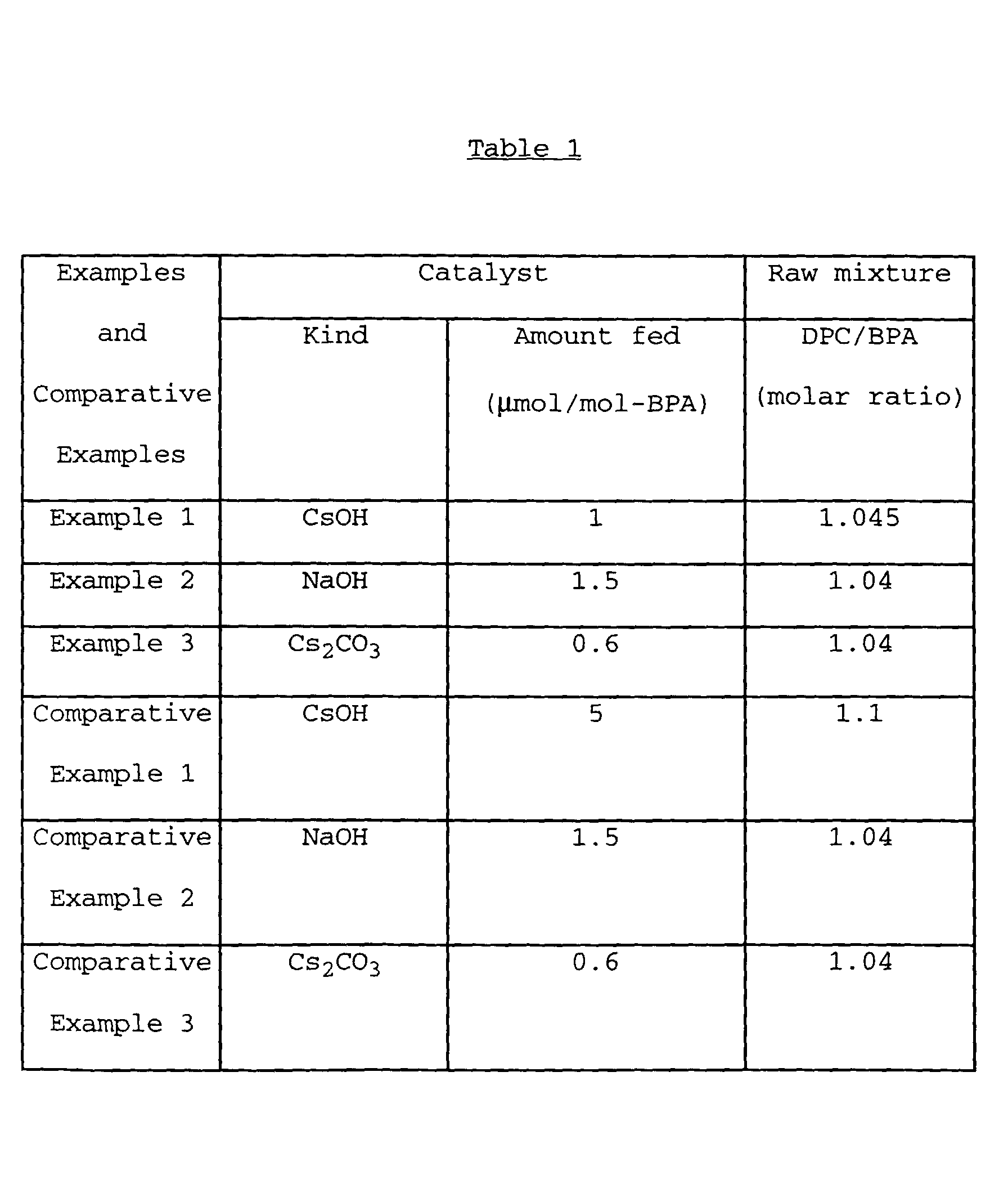
- an aqueous solution 7 of cesium hydroxide as a catalyst was continuously fed into the first reactor in an amount of 1 ⁇ 10 -6 mole based on one mole of bisphenol A.
- the polymer solution discharged from the bottom of the first reactor was sequentially continuously fed into second, third and fourth vertical-type polymerization reactors 22 to 24 and fifth horizontal-type polymerization reactor 5.
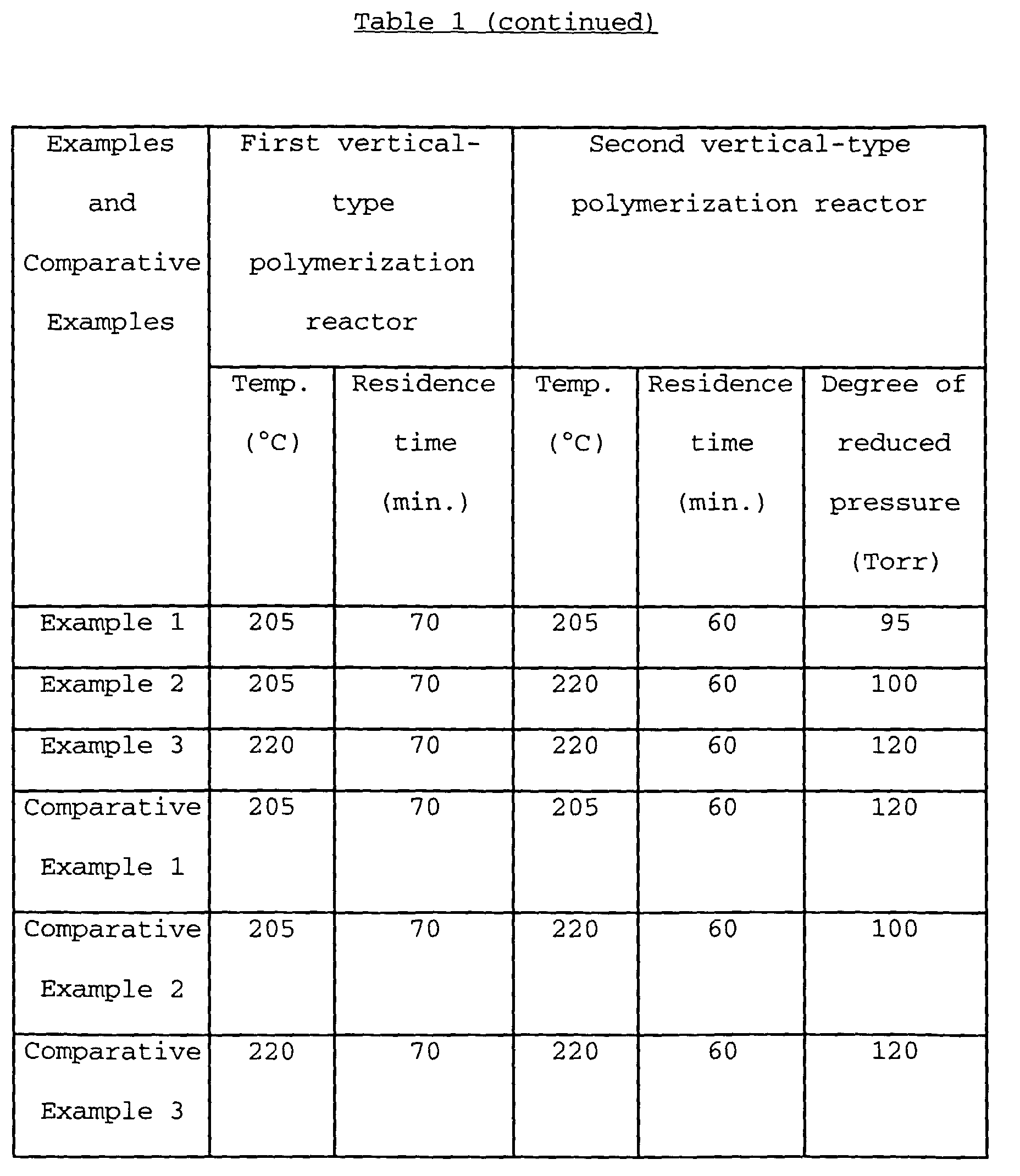
- the liquid level of each reactor was controlled so as to obtain the average residence time as shown in Table 1.
- phenol 4 by-produced was distilled off.
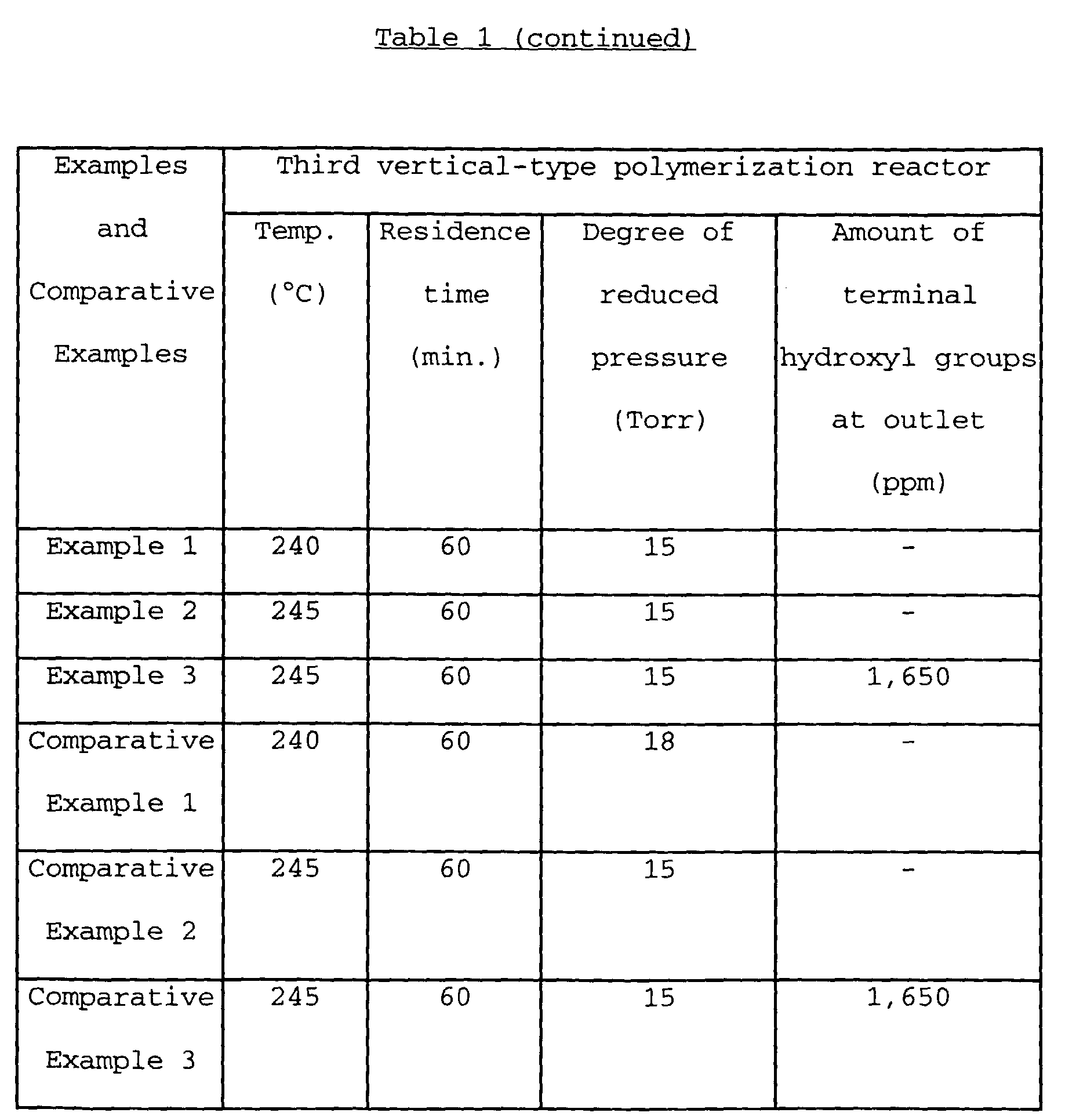
- Polymerization conditions of each of from the second vertical-type polymerization reactor 22 to the fifth horizontal-type polymerization reactor 5 and the amount of terminal hydroxyl groups at an inlet of the final stage polymerization reactor (i.e., an outlet of the fourth polymerization reactor 24 in this example) are also shown in Table 1.
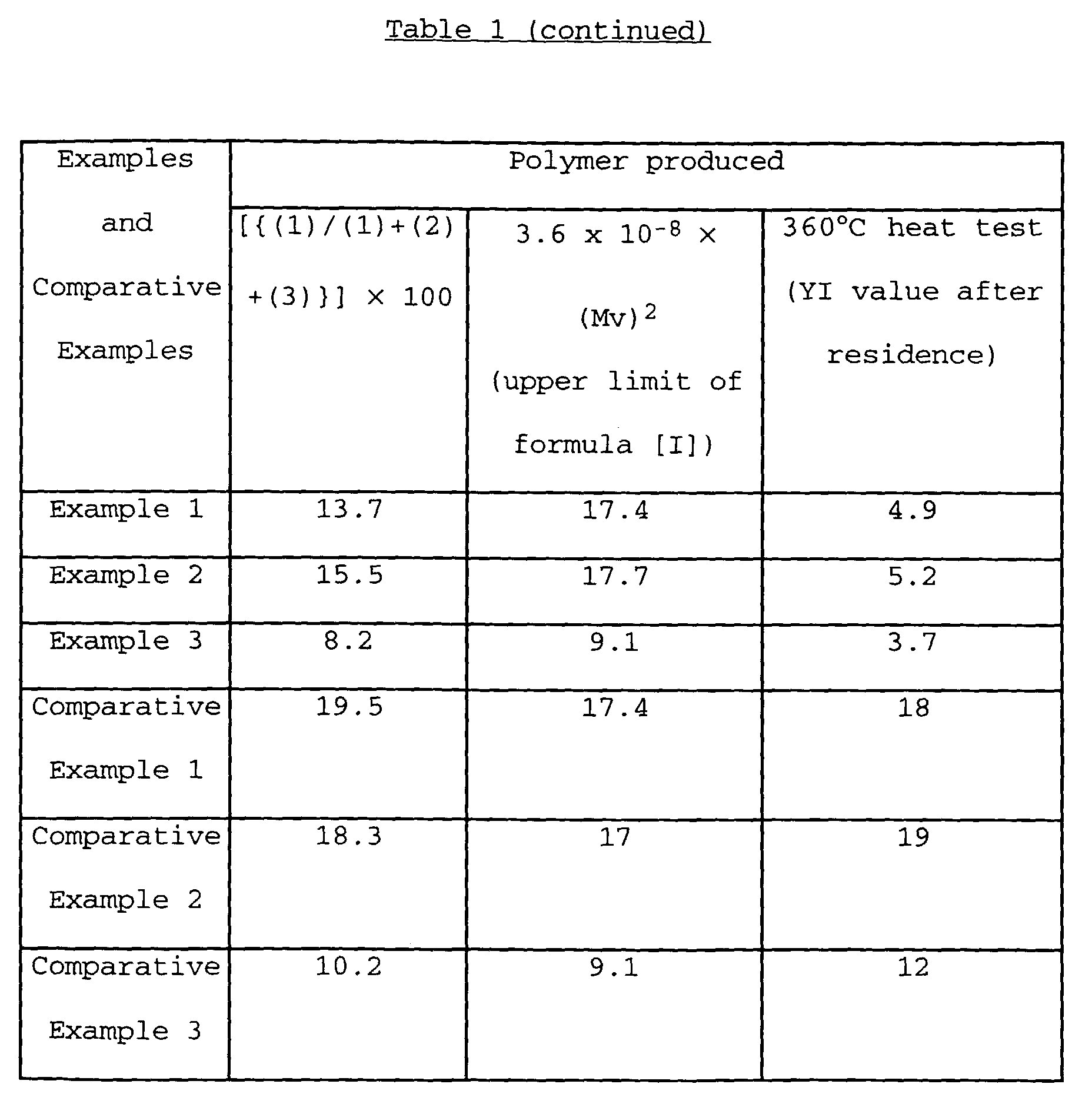
- the obtained polycarbonate had a viscosity-average molecular weight of 22,000 and a cyclic oligomer (1) content of 400 ppm. Further, the percentage of the cyclic oligomer (1) content based on the total content of oligomers which was calculated from the above formula [I] was 13.7 %, and the YI value after 360°C heating test was 4.9. The results of other evaluations are also shown in Table 1.
- Example 1 The same procedure as defined in Example 1 was conducted except that the catalyst was changed to sodium hydroxide and the polymerization conditions were varied as shown in Table 1, thereby producing polycarbonate. The results of evaluation of the obtained polycarbonate are shown in Table 1.
- Example 1 The same procedure as defined in Example 1 was conducted except that the catalyst was changed to cesium carbonate, the horizontal-type polymerization reactor was not used, and the polymerization conditions were varied as shown in Table 1, thereby producing polycarbonate. The results of evaluation of the obtained polycarbonate are shown in Table 1.
- Example 1 The same procedure as defined in Example 1 was conducted except that the amount of the catalyst used was changed to 5 ⁇ 10 -6 mole and the polymerization conditions were varied as shown in Table 1 for achieving identical molecular weights, thereby producing polycarbonate. The results of evaluation of the obtained polycarbonate are shown in Table 1.
- Example 2 The same procedure as defined in Example 2 was conducted except that the operating conditions of the extruder was changed as shown in Table 1, thereby producing polycarbonate. The results of evaluation of the obtained polycarbonate are shown in Table 1.
- Example 3 The same procedure as defined in Example 3 was conducted except that the reaction conditions of the fourth vertical-type polymerization reactor was varied as shown in Table 1, thereby producing polycarbonate. The results of evaluation of the obtained polycarbonate are shown in Table 1.
Landscapes
- Chemical & Material Sciences (AREA)
- Health & Medical Sciences (AREA)
- Chemical Kinetics & Catalysis (AREA)
- Medicinal Chemistry (AREA)
- Polymers & Plastics (AREA)
- Organic Chemistry (AREA)
- Polyesters Or Polycarbonates (AREA)
Abstract
in which the percentage of the content of said cyclic oligomer represented by the formula (1) based on the total contents of the cyclic oligomer represented by the formula (1), an oligomer represented by the formula (2) and an oligomer represented by the formula (3) satisfies the following relational formula [I]:
Description
in which the percentage of the content of said cyclic oligomer represented by the formula (1) based on the total contents of said cyclic oligomer represented by the formula (1), an oligomer represented by the following formula (2) and an oligomer represented by the following formula (3) satisfies the following relational formula [I]:






Claims (6)
- An aromatic polycarbonate which is produced by reacting an aromatic dihydroxy compound with a compound capable of introducing a carbonate bond, and has a viscosity-average molecular weight of 12,000 to 40,000 and a content of a cyclic oligomer represented by the following formula (1) of not more than 1,000 ppm, and
in which the percentage of the content of said cyclic oligomer represented by the formula (1) based on the total contents of the cyclic oligomer represented by the formula (1), an oligomer represented by the following formula (2) and an oligomer represented by the following formula (3) satisfies the following relational formula [I]:wherein B is a divalent group selected from the group consisting of a halogen-substituted or unsubstituted C1 to C15 hydrocarbon group, O, S, CO, SO and SO2; X is a monovalent group selected from the group consisting of a halogen atom, a substituted or unsubstituted C1 to C14 aliphatic group, a substituted or unsubstituted C6 to C18 aromatic group, a C1 to C8 oxyalkyl group and a C6 to C18 oxyaryl group; m is an integer of 2 to 8; p is an integer of 0 to 4; s is an integer of 0 or 1; and X's and p's may be the same or different, respectively. wherein A and A' are independently a monovalent group selected from the group consisting of a substituted or unsubstituted C1 to C18 aliphatic group and a substituted or unsubstituted C6 to C18 aromatic group, and may be the same or different; n is an integer of 1 to 7; and B, X, p and s have the same meanings as set forth in the above formula (1).
 wherein A'' is a monovalent group selected from the group consisting of a substituted or unsubstituted C1 to C18 aliphatic group and a substituted or unsubstituted C6 to C18 aromatic group; n' is an integer of 1 to 7; and B, X, p and s have the same meanings as set forth in the above formula (1).
- An aromatic polycarbonate according to claim 1, which is produced by transesterification reaction between said aromatic dihydroxy compound and a carbonic acid diester.
- An aromatic polycarbonate according to claim 2, wherein said aromatic dihydroxy compound is 2,2-bis(4-hydroxyphenyl)propane, and said carbonic acid diester is diphenyl carbonate.
- An aromatic polycarbonate according to claim 2 or claim 3, wherein the transesterification between said aromatic dihydroxy compound and said carbonic acid diester is carried out in the presence of a catalyst comprising alkali metal, alkaline earth metal or a mixture thereof in an amount of 1 × 10⁻⁹ to 1 × 10⁻⁴ mole based on one mole of said aromatic dihydroxy compound.
- An aromatic polycarbonate according to claim 1, wherein the content of said cyclic oligomer represented by the formula (1) is not more than 700 ppm.
- An aromatic polycarbonate according to claim 2, wherein the content of terminal hydroxyl groups is 100 to 1,000 ppm.
Applications Claiming Priority (2)
| Application Number | Priority Date | Filing Date | Title |
|---|---|---|---|
| JP33293398 | 1998-11-24 | ||
| JP33293398A JP3583305B2 (en) | 1998-11-24 | 1998-11-24 | Aromatic polycarbonate |
Publications (3)
| Publication Number | Publication Date |
|---|---|
| EP1004609A2 true EP1004609A2 (en) | 2000-05-31 |
| EP1004609A3 EP1004609A3 (en) | 2000-07-12 |
| EP1004609B1 EP1004609B1 (en) | 2006-01-25 |
Family
ID=18260445
Family Applications (1)
| Application Number | Title | Priority Date | Filing Date |
|---|---|---|---|
| EP99123160A Expired - Lifetime EP1004609B1 (en) | 1998-11-24 | 1999-11-22 | Aromatic polycarbonate |
Country Status (5)
| Country | Link |
|---|---|
| US (1) | US6255436B1 (en) |
| EP (1) | EP1004609B1 (en) |
| JP (1) | JP3583305B2 (en) |
| DE (1) | DE69929560T2 (en) |
| ES (1) | ES2257004T3 (en) |
Cited By (1)
| Publication number | Priority date | Publication date | Assignee | Title |
|---|---|---|---|---|
| EP2552995B1 (en) | 2010-04-01 | 2015-12-02 | Covestro Deutschland AG | Melt polycarbonate having improved heat ageing |
Families Citing this family (11)
| Publication number | Priority date | Publication date | Assignee | Title |
|---|---|---|---|---|
| JP4641591B2 (en) * | 2000-05-24 | 2011-03-02 | 三菱エンジニアリングプラスチックス株式会社 | Aromatic polycarbonate resin composition |
| JP4601122B2 (en) * | 2000-05-24 | 2010-12-22 | 三菱エンジニアリングプラスチックス株式会社 | Aromatic polycarbonate resin composition |
| JP4601123B2 (en) * | 2000-05-24 | 2010-12-22 | 三菱エンジニアリングプラスチックス株式会社 | Aromatic polycarbonate resin composition |
| DE10131127A1 (en) * | 2001-06-28 | 2003-01-16 | Bayer Ag | Production and use of polyester carbonates |
| JP2003040997A (en) * | 2001-07-26 | 2003-02-13 | Mitsubishi Engineering Plastics Corp | Polycarbonate resin for manufacturing parts for transporting electrical and electronic parts and parts for transporting electrical and electronic parts |
| BR0317203A (en) * | 2002-12-23 | 2005-11-01 | Dow Global Technologies Inc | Method of Molding Sheet Molding Compounds |
| US7510768B2 (en) * | 2005-06-17 | 2009-03-31 | Eastman Chemical Company | Thermoplastic articles comprising cyclobutanediol having a decorative material embedded therein |
| US20120059098A1 (en) * | 2007-01-09 | 2012-03-08 | Mitsubishi Engineering-Plastics Corporation | Flame-retardant aromatic polycarbonate resin composition |
| US8354555B2 (en) * | 2008-05-22 | 2013-01-15 | Massachusetts Institute Of Technology | Monolayer-coated surfaces as catalytic platforms for organic reactions |
| JP6135221B2 (en) * | 2012-03-30 | 2017-05-31 | 三菱化学株式会社 | Method for producing polycarbonate resin and polycarbonate resin composition |
| US20190085123A1 (en) * | 2016-03-30 | 2019-03-21 | Mitsubishi Gas Chemical Company, Inc. | Aromatic polycarbonate resin composition and aromatic polycarbonate resin manufacturing method |
Family Cites Families (13)
| Publication number | Priority date | Publication date | Assignee | Title |
|---|---|---|---|---|
| US4686046A (en) | 1985-12-23 | 1987-08-11 | General Electric Company | Process for separating cyclic oligomeric dihydric phenol carbonate from aromatic polycarbonate |
| US4686277A (en) | 1985-12-23 | 1987-08-11 | General Electric Company | Process for separating and polymerizing cyclic oligomeric polycarbonate |
| US4663433A (en) | 1985-12-23 | 1987-05-05 | General Electric Company | Separation of cyclic oligomeric carbonate from high molecular weight polycarbonate |
| US4789730A (en) | 1986-06-05 | 1988-12-06 | The Dow Chemical Company | Preparation of polycarbonate having reduced cyclic carbonate oligomer content |
| JPS63278929A (en) * | 1987-05-12 | 1988-11-16 | Teijin Chem Ltd | Production of optical molding |
| JPH02135120A (en) | 1988-11-15 | 1990-05-24 | Daikin Ind Ltd | Deodorizing machine |
| NL9101081A (en) | 1991-06-24 | 1993-01-18 | Gen Electric | PROCESS FOR PREPARING AROMATIC POLYCARBONATES. |
| JPH07126374A (en) | 1993-10-29 | 1995-05-16 | Teijin Ltd | Method for producing polycarbonate resin |
| JP3866299B2 (en) | 1993-07-06 | 2007-01-10 | 出光興産株式会社 | Method for producing polycarbonate |
| JPH07102056A (en) * | 1993-08-13 | 1995-04-18 | Mitsui Toatsu Chem Inc | Method for producing aromatic polycarbonate |
| JPH083304A (en) * | 1994-06-24 | 1996-01-09 | Mitsubishi Chem Corp | Polycarbonate for optical moldings |
| JP3390277B2 (en) | 1994-12-28 | 2003-03-24 | 日本ジーイープラスチックス株式会社 | Method for producing polycarbonate |
| JP3327308B2 (en) | 1994-12-28 | 2002-09-24 | 日本ジーイープラスチックス株式会社 | Method for producing polycarbonate |
-
1998
- 1998-11-24 JP JP33293398A patent/JP3583305B2/en not_active Expired - Lifetime
-
1999
- 1999-11-22 DE DE69929560T patent/DE69929560T2/en not_active Expired - Lifetime
- 1999-11-22 ES ES99123160T patent/ES2257004T3/en not_active Expired - Lifetime
- 1999-11-22 EP EP99123160A patent/EP1004609B1/en not_active Expired - Lifetime
- 1999-11-22 US US09/444,933 patent/US6255436B1/en not_active Expired - Lifetime
Cited By (1)
| Publication number | Priority date | Publication date | Assignee | Title |
|---|---|---|---|---|
| EP2552995B1 (en) | 2010-04-01 | 2015-12-02 | Covestro Deutschland AG | Melt polycarbonate having improved heat ageing |
Also Published As
| Publication number | Publication date |
|---|---|
| JP3583305B2 (en) | 2004-11-04 |
| US6255436B1 (en) | 2001-07-03 |
| JP2000159879A (en) | 2000-06-13 |
| ES2257004T3 (en) | 2006-07-16 |
| EP1004609B1 (en) | 2006-01-25 |
| DE69929560T2 (en) | 2006-09-14 |
| DE69929560D1 (en) | 2006-04-13 |
| EP1004609A3 (en) | 2000-07-12 |
Similar Documents
| Publication | Publication Date | Title |
|---|---|---|
| RU2551370C2 (en) | Method of producing highly polymerised aromatic polycarbonate resin | |
| EP1004609B1 (en) | Aromatic polycarbonate | |
| US7084232B2 (en) | Method for preparing high molecular weight polycarbonate | |
| US5405934A (en) | Process for producing (co)polycarbonate | |
| EP2921517B1 (en) | Production method for aromatic polycarbonate resin having increased molecular weight | |
| JP2628905B2 (en) | Method for producing polycarbonate | |
| JP3544623B2 (en) | Production method of optical polycarbonate | |
| JP3667534B2 (en) | Method for producing polycarbonate | |
| JP4053291B2 (en) | Aromatic polycarbonate and method for producing the same | |
| JP4641591B2 (en) | Aromatic polycarbonate resin composition | |
| JP2001338436A (en) | Molding material for optical disk substrate and optical disk substrate | |
| JP3783921B2 (en) | Method for producing aromatic polycarbonate | |
| JP3437033B2 (en) | Aromatic polycarbonate composition and method for producing the same | |
| JPH1025409A (en) | Aromatic polycarbonate and composition thereof | |
| JP3616515B2 (en) | Aromatic polycarbonate | |
| EP1016688B1 (en) | Aromatic polycarbonate composition | |
| US6797837B2 (en) | Process for the preparation of stabilized polycarbonate | |
| JP3718094B2 (en) | Method for producing aromatic polycarbonate | |
| JP2000219735A (en) | Aromatic polycarbonate | |
| JP3714595B2 (en) | Method for producing aromatic polycarbonate | |
| JP2001329158A (en) | Aromatic polycarbonate resin composition | |
| JP3715491B2 (en) | Method for producing aromatic polycarbonate | |
| JP4601123B2 (en) | Aromatic polycarbonate resin composition | |
| JP2001329156A (en) | Aromatic polycarbonate resin composition | |
| JP3683471B2 (en) | Method for producing aromatic polycarbonate |
Legal Events
| Date | Code | Title | Description |
|---|---|---|---|
| PUAI | Public reference made under article 153(3) epc to a published international application that has entered the european phase |
Free format text: ORIGINAL CODE: 0009012 |
|
| PUAL | Search report despatched |
Free format text: ORIGINAL CODE: 0009013 |
|
| AK | Designated contracting states |
Kind code of ref document: A2 Designated state(s): DE ES |
|
| AX | Request for extension of the european patent |
Free format text: AL;LT;LV;MK;RO;SI |
|
| AK | Designated contracting states |
Kind code of ref document: A3 Designated state(s): AT BE CH CY DE DK ES FI FR GB GR IE IT LI LU MC NL PT SE |
|
| AX | Request for extension of the european patent |
Free format text: AL;LT;LV;MK;RO;SI |
|
| 17P | Request for examination filed |
Effective date: 20001031 |
|
| AKX | Designation fees paid |
Free format text: DE ES |
|
| 17Q | First examination report despatched |
Effective date: 20021004 |
|
| RAP1 | Party data changed (applicant data changed or rights of an application transferred) |
Owner name: MITSUBISHI GAS CHEMICAL COMPANY, INC. Owner name: MITSUBISHI CHEMICAL CORPORATION |
|
| GRAP | Despatch of communication of intention to grant a patent |
Free format text: ORIGINAL CODE: EPIDOSNIGR1 |
|
| GRAS | Grant fee paid |
Free format text: ORIGINAL CODE: EPIDOSNIGR3 |
|
| RIN1 | Information on inventor provided before grant (corrected) |
Inventor name: HAYASHI, KATSUSHIGE,MITSUBISHI GAS CHEM. COMP.INC Inventor name: NAKAJIMA, MASAYUKI,MITSUBISHI GAS CHEM. COMP. INC Inventor name: NAKANO, HIROSHI,MITSUBISHI ENGINEERING-PLASTICS Inventor name: TAKEGUCHI, HIROSHI,YOKKAICHI PLANT Inventor name: KAWAI, MICHIO Inventor name: KIMURA, MASATOSHI,YOKKAICHI PLANT |
|
| GRAA | (expected) grant |
Free format text: ORIGINAL CODE: 0009210 |
|
| AK | Designated contracting states |
Kind code of ref document: B1 Designated state(s): DE ES |
|
| REF | Corresponds to: |
Ref document number: 69929560 Country of ref document: DE Date of ref document: 20060413 Kind code of ref document: P |
|
| REG | Reference to a national code |
Ref country code: ES Ref legal event code: FG2A Ref document number: 2257004 Country of ref document: ES Kind code of ref document: T3 |
|
| RAP2 | Party data changed (patent owner data changed or rights of a patent transferred) |
Owner name: MITSUBISHI GAS CHEMICAL COMPANY, INC. Owner name: MITSUBISHI CHEMICAL CORPORATION |
|
| PLBE | No opposition filed within time limit |
Free format text: ORIGINAL CODE: 0009261 |
|
| STAA | Information on the status of an ep patent application or granted ep patent |
Free format text: STATUS: NO OPPOSITION FILED WITHIN TIME LIMIT |
|
| 26N | No opposition filed |
Effective date: 20061026 |
|
| REG | Reference to a national code |
Ref country code: DE Ref legal event code: R082 Ref document number: 69929560 Country of ref document: DE Representative=s name: HOFFMANN - EITLE PATENT- UND RECHTSANWAELTE PA, DE Ref country code: DE Ref legal event code: R081 Ref document number: 69929560 Country of ref document: DE Owner name: MITSUBISHI CHEMICAL CORPORATION, JP Free format text: FORMER OWNERS: MITSUBISHI CHEMICAL CORP., TOKIO/TOKYO, JP; MITSUBISHI GAS CHEMICAL CO., INC., TOKIO/TOKYO, JP Ref country code: DE Ref legal event code: R081 Ref document number: 69929560 Country of ref document: DE Owner name: MITSUBISHI GAS CHEMICAL CO., INC., JP Free format text: FORMER OWNERS: MITSUBISHI CHEMICAL CORP., TOKIO/TOKYO, JP; MITSUBISHI GAS CHEMICAL CO., INC., TOKIO/TOKYO, JP |
|
| REG | Reference to a national code |
Ref country code: ES Ref legal event code: PC2A Owner name: MITSUBISHI CHEMICAL CORPORATION Effective date: 20180131 |
|
| PGFP | Annual fee paid to national office [announced via postgrant information from national office to epo] |
Ref country code: DE Payment date: 20181106 Year of fee payment: 20 |
|
| PGFP | Annual fee paid to national office [announced via postgrant information from national office to epo] |
Ref country code: ES Payment date: 20181204 Year of fee payment: 20 |
|
| REG | Reference to a national code |
Ref country code: DE Ref legal event code: R071 Ref document number: 69929560 Country of ref document: DE |
|
| REG | Reference to a national code |
Ref country code: ES Ref legal event code: FD2A Effective date: 20200804 |
|
| PG25 | Lapsed in a contracting state [announced via postgrant information from national office to epo] |
Ref country code: ES Free format text: LAPSE BECAUSE OF EXPIRATION OF PROTECTION Effective date: 20191123 |