EP1008026B1 - Verbessertes gerät und verfahren für modulare multiplikation und exponentation basierend auf montgomerymultiplikation - Google Patents
Verbessertes gerät und verfahren für modulare multiplikation und exponentation basierend auf montgomerymultiplikation Download PDFInfo
- Publication number
- EP1008026B1 EP1008026B1 EP98910967A EP98910967A EP1008026B1 EP 1008026 B1 EP1008026 B1 EP 1008026B1 EP 98910967 A EP98910967 A EP 98910967A EP 98910967 A EP98910967 A EP 98910967A EP 1008026 B1 EP1008026 B1 EP 1008026B1
- Authority
- EP
- European Patent Office
- Prior art keywords
- bit
- bits
- multiplier
- carry
- value
- Prior art date
- Legal status (The legal status is an assumption and is not a legal conclusion. Google has not performed a legal analysis and makes no representation as to the accuracy of the status listed.)
- Expired - Lifetime
Links
Images



Classifications
-
- G—PHYSICS
- G06—COMPUTING OR CALCULATING; COUNTING
- G06F—ELECTRIC DIGITAL DATA PROCESSING
- G06F7/00—Methods or arrangements for processing data by operating upon the order or content of the data handled
- G06F7/60—Methods or arrangements for performing computations using a digital non-denominational number representation, i.e. number representation without radix; Computing devices using combinations of denominational and non-denominational quantity representations, e.g. using difunction pulse trains, STEELE computers, phase computers
- G06F7/72—Methods or arrangements for performing computations using a digital non-denominational number representation, i.e. number representation without radix; Computing devices using combinations of denominational and non-denominational quantity representations, e.g. using difunction pulse trains, STEELE computers, phase computers using residue arithmetic
- G06F7/728—Methods or arrangements for performing computations using a digital non-denominational number representation, i.e. number representation without radix; Computing devices using combinations of denominational and non-denominational quantity representations, e.g. using difunction pulse trains, STEELE computers, phase computers using residue arithmetic using Montgomery reduction
Definitions
- the present invention relates to apparatus and methods for modular multiplication and exponentiation and for serial integer division.
- EP-A-0566498 describes a digital signature device and process which is intended to perform modular arithmetic operations employed in modem cryptography.
- the device comprises means for carrying out modular exponentiation and/or modular multiplications.
- the present invention seeks to provide improved apparatus and methods for modular multiplication and exponentiation and for serial integer division.
- ALU a microelectronic arithmetic logic unit
- the system is operative to multiply at least one pair of integer inputs of any bit length.
- the at least one pair of integer inputs includes two pairs of integer inputs.
- the ALU is operative to generate a product of integer inputs and to reduce the size of the product without previously computing a zero-forcing Montgomery constant, J o .
- serial integer division apparatus including a serial division device operative to receive a dividend of any bit length and a divisor of any bit length and to compute a quotient and a remainder.
- the apparatus includes a pair of registers for storing a pair of integer inputs and which is operative to multiply a pair of integer inputs, at least one of which exceeds the bit length of its respective register, without interleaving.
- a modular multiplication and exponentiation system including a serial-parallel multiplying device having only one carry-save accumulator and being operative to perform a pair of multiplications and to sum results thereof.
- a modular multiplication and exponentiation method including providing a serial-parallel arithmetic logic unit (ALU) including a single modular multiplying device having a single carry-save adder, and employing the serial-parallel ALU to perform modular multiplication and exponentiation.
- ALU serial-parallel arithmetic logic unit
- a method for natural (not modular) multiplication of large integers including providing a serial-parallel arithmetic logic unit (ALU) including a single modular multiplying device having a single carry-save adder, and employing the serial-parallel ALU to perform natural (not modular) multiplication of large integers.
- ALU serial-parallel arithmetic logic unit
- the apparatus may be adapted to multiply a first integer of any bit length by a second integer of any bit length to obtain a first product, multiplying a third integer of any bit length by a fourth integer of any bit length to obtain a second product, and summing the first and second products with a fifth integer of any bit length to obtain a sum.
- the apparatus may be adapted to perform modular multiplication and exponentiation with a multiplicand, multiplier and modulus of any bit length.
- the system may also include a double multiplicand precomputing system for executing Montgomery modular multiplication with only one precomputed constant.
- the apparatus may be adapted to perform Montgomery multiplication including generating a product of integer inputs including a multiplier and a multiplicand, and executing modular reduction without previously computing a Montgomery constant, J 0 .
- the Montgomery constant J 0 may include a function of N mod 2 k , where N is a modulus of the modular reduction and k is the bit-length of the multiplicand.
- a sequence of interleaved Montgomery multiplication operations may be performed.
- Each of the interleaved Montgomery multiplication operations may be performed without previously computing the number of times the modulus must be summated into a congruence of the multiplication operation in order to force a result with at least k significant zeros.
- the system may also include a data preprocessor operative to collect and serially summate multiplicands generated in an i'th interleaved Montgomery multiplication operation thereby to generate a sum and to feed in the sum to an (i+1)'th Montgomery multiplication operation.
- the function may include an additive inverse of a multiplicative inverse of N mod 2 k .
- the present invention also relates to a compact microelectronic arithmetic logic unit, ALU, for performing modular and normal (natural, non-negative field of integers) multiplication, division, addition, subtraction and exponentiation over very large integers.
- ALU a compact microelectronic arithmetic logic unit
- the present invention also relates to arithmetic processing of large integers. These large numbers can be in the natural field of (non-negative) integers or in the Galois field of prime numbers, GF(p), and also of composite prime moduli. More specifically, the invention relates to a device that can implement modular multiplications/exponentiations of large numbers, which is suitable for performing the operations essential to Public Key Cryptographic authentication and encryption protocols, which work over increasingly large operands and which cannot be executed efficiently with present generation modular arithmetic coprocessers, and cannot be executed securely with software implementations.
- the invention can be driven by any 4 bit or longer processor, achieving speeds which can surpass present day digital signal processors.
- the present invention also relates to the hardware implementation of large operand integer arithmetic, especially as concerns the numerical manipulations in a derivative of a procedure known as the interleaved Montgomery multiprecision modular multiplication method often used in encryption software oriented systems, but also of intrinsic value in basic arithmetic operations on long operand integers; in particular, A ⁇ B+C ⁇ D+S, wherein there is no theoretical limit on the sizes of A, B, C, D, or S.
- the device is especially attuned to perform modular multiplication and exponentiation.
- the basic device is particularly suited to be a modular arithmetic co-processor (MAP), also including a device for performing division of very large integers, wherein the divisor can have a bit length as long as the modulus register N and the bit length of the dividend can be as large as the bit length of two concatenated registers.
- MAP modular arithmetic co-processor
- This device preferably performs all of the functions of US Patent 5,513,133 , with the same order of logic gates, in less than half the number of machine clock cycles. This is mostly because there is only one double action serial/parallel multiplier instead of two half size multipliers using the same carry save accumulator mechanism, the main component of a conventional serial parallel multiplier.
- the new arithmetic logic unit, ALU, or specifically the modular arithmetic coprocessor, MAP preferably intrinsically obviates a separate multiplication process which would have preceded the new process. This process would also have required a second Montgomery constant, J 0 , which is now also preferably obviated. Stated differently, instead of the two constants in the previous Montgomery procedures, and the delays encountered, only one constant is now computed, and the delay caused by the now superfluous J type multiplications (explained later) is preferably removed.
- operands which are performed on operands longer than the natural register size of the device can preferably be performed at reduced processing times using less temporary storage memory.
- Kaliski Jr. "A cryptographic library for the Motorola DSP 56000", Proc Eurocrypt '90, Springer-Verlag, Berlin, 1990 ] hereinafter referred to as "Dussé”, and the method of US Patent 4,514,592 to Miyaguchi , and the method of US Patent 5,101,431, to Even , and the method of US Patent 5,321,752 to Iwamura , and the method of US Patent 5,448,639, to Arazi , and the method of US Patent 5,513,133 to Gressel .
- the preferred architecture is of a machine that can be integrated to any microcontroller design, mapped into the host controller's memory; while working in parallel with the controller which for very long commands constantly swap or feed operands to and from the data feeding mechanism, allowing for modular arithmetic computations of any popular length where the size of the coprocessor volatile memory necessary for manipulations should rarely be more than three times the length of the largest operand.
- This solution uses only one multiplying device which inherently serves the function of two multiplying devices, in previous implementations. Using present popular technologies, it enables the integration of the complete solution including a microcontroller with memories onto a 4 by 4.5 by 0.2 mm microelectronic circuit.
- the invention is also directed to the architecture of a digital device which is intended to be a peripheral to a conventional digital processor, with computational, logical and architectural novel features relative to the processes published by Montgomery and Dussé, as described in detail below.
- a concurrent process and a unique hardware architecture are provided, to perform modular exponentiation without division preferably with the same number of operations as would be performed with a classic multiplication/division device, wherein a classic device would perform both a multiplication and a division on each operation.
- a particular feature of a preferred embodiment of the present invention is the concurrency of operations performed by the device to allow for unlimited operand lengths, with uninterrupted efficient use of resources, allowing for the basic large operand integer arithmetic functions.
- the machine By synchronizing and on the fly detecting and on the fly preloading and simultaneous addition of next to be used operands, the machine operates in a deterministic fashion, wherein all multiplications and exponentiations are executed in a predetermined number of clock cycles.
- Conditional branches are replaced with local detection and compensation devices, thereby providing a basis for the simple type control mechanism, which, when refined, typically include a series of self-exciting cascaded counters.
- the basic operations herein described can be executed in deterministic time using the device described in US Patent 5,513,133 as manufactured both by Motorola in East Kilbride, Scotland under the trade name SC-49, and by SGS-Thomson in Rousset, France, under the trade name ST16-CF54.
- the machine has particularly lean demands on volatile memory for most operations, as operands are loaded into and stored in the device for the total length of the operation; however, the machine preferably exploits the CPU onto which it is appended, to execute simple loads and unloads, and sequencing of commands to the machine, whilst the machine performs its large number computations.
- the exponentiation processing time is virtually independent of the CPU which controls it. In practice, no architectural changes are necessary when appending the machine to any CPU.
- the hardware device is self-contained, and can be appended to any CPU bus.
- Apparatus for accelerating the modular multiplication and exponentiation process is preferably provided, including means for precomputing the necessary constants.
- the preferred embodiments of the invention described herein provide a modular mathematical operator for public key cryptographic applications on portable Smart Cards, typically identical in shape and size to the popular magnetic stripe credit and bank cards. Similar Smart Cards (as per US Patent 5,513,133 ) are being used in the new generation of public key cryptographic devices for controlling access to computers, databases, and critical installations; to regulate and secure data flow in commercial, military and domestic transactions; to decrypt scrambled pay television programs, etc. It should be appreciated that these devices are also incorporated in computer and fax terminals, door locks, vending machines, etc.
- the hardware described carries out modular multiplication and exponentiation by applying the operator in a novel way. Further, the squaring can be carried out in the same method, by applying it to a multiplicand and a multiplier that are equal. Modular exponentiation involves a succession of modular multiplications and squarings, and therefore is carried out by a method which comprises the repeated, suitably combined and oriented application of the aforesaid multiplication, squaring and exponentiation methods.
- a method for executing a Montgomery modular multiplication wherein the multiplicand A (which may be stored either in the CPU's volatile RAM or in the S A register, 130, the multiplier B in the B register 1000, which is a concatenation of 70 and 80 and the modulus N in the N register, 1005, which is a concatenation of 200 and 210; comprise m characters of k bits each, the multiplicand and the multiplier generally not being greater than the modulus, comprises the steps of:
- the preloading phase ends here. This phase is typically executed whilst the MAP was performing a previous multiplication iteration. Processes a) and b) can be executed simultaneously, wherein the A i-1 character is loaded into its respective register, whilst the Ai stream is synchronized with the rotation of the N 0 register, loading R2, 320. Simultaneously, the Ai stream and the N 0 stream are summated and loaded into the R3 register, 340.
- Steps a) and b) the first k bits of Bd are inserted into R1, as the B 0 register is rotated, simultaneously with the N 0 register. Subsequent k bit B i strings are preloaded into the R1 register, as they are fed serially into the ALU.
- Y 0 bits are anticipated in the following manner in the YOS-YOSENSE unit, 430, from five deterministic quantities:
- Y 0i A 0 ⁇ B d ⁇ CO 0 ⁇ SO 1 ⁇ S d ⁇ CO Z If the Y 0i bit is a one, then another N of the same rank (multiplied by the necessary power of 2), is typically added, otherwise, N, the modulus, is typically not added.
- This apparatus is suited to efficiently perform multiplications and summations of normal integers. If these operands are all of no longer than k bit length, the process preferably is executed without interleave, where the Z stream of 2k+1 bits are directed to final storage. For integers longer than k bits, the process is similar to the predescribed interleaved modular arithmetic process, excepting that the result will now potentially be one bit longer than twice the length of the longest operand.
- the apparatus of the invention is capable, using the resources available in the described device, to simultaneously perform two separate multiplications, A, multiplicand, preferably loaded in segments in the R1- Ai register, times B, the multiplier, of A, preferably loaded into the B register as previously designated, plus N, a second multiplier, preferably loaded into the N register, times an operand, C, loaded into the R2 Register, plus S, a bit stream entering the apparatus, on the first iteration, only from the Sd, signal line, preferably from the S A register.
- the Y0 SENSE apparatus is not used.
- the multiplicands are summated into the R3 register prior to the initiation of an iteration.
- registers R1, R2, and R3 are copied into latches L1, L2, and L3 until the end of an iteration. Meanwhile, during the mk + k + 1 effective clock cycles of an iteration, the next segments of A and C are again preloaded and summated in preparation for the next iteration.
- the first LS k bits of the result on the Z stream which are, now, (not by definition zero, as in MM) directed to a separate storage, vacated to accumulate the LS portion of the result, again suitably the S A register.
- the most significant mk + 1 bits comprise the S B , temporary quantity, for the next iteration.
- the CSA is flushed out of accumulated value.
- the LS portion for numbers which are longer than the multiplier registers, can be exited through the normal data out register and unloader, units 60 and 30, respectively.
- the MS, 2m'th bit of the result is read from the LAST CARRY bit of the FA2, unit 460, through the OVERFLOW signal line.
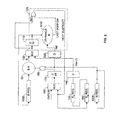
- Figs. 1A - 1B taken together, form a simplified block diagram of a serial-parallel arithmetic logic unit (ALU) constructed and operative in accordance with a preferred embodiment of the present invention.
- ALU serial-parallel arithmetic logic unit
- the apparatus of Figs. 1A - 1B preferably include the following components:
- a and B be the multiplicand and the multiplier
- N is the modulus which is usually larger than A or B.
- N also denotes the register where the value of the modulus is stored. N, may, in some instances, be smaller than A.
- the N and S registers can be used for temporary storage of other arithmetic operands.
- ⁇ congruence in a more limited sense.
- a value is often either the desired value, or equal to the desired value plus the modulus.
- X can be equal to 2 or 9.
- X has limited congruence to 2 mod 7.
- the modular multiplicative inverse is a basic concept.
- MS and LS are used to signify most significant and least significant when referencing bits, characters, and full operand values, as is conventional in digital nomenclature.
- N designates both the value N, and the name of the shift register which contains N.
- An asterisk superscript on a value denotes that the value, as stands, is potentially incomplete or subject to change.
- A is the value of the number which is to be exponentiated, and n is the bit length of the N operand.
- A* and N are constant values throughout the intermediate step in the exponentiation.
- B is equal to A*.
- B is also the name of the register wherein the accumulated value which finally equals the desired result of exponentiation resides.
- S* designates a temporary value
- S, S A and S B designate, also, the register or registers in which all but the single MS bit of S is stored.
- S* concatenated with this MS bit is identical to S.
- S(i-1) denotes the value of S at the outset of the i'th iteration
- S 0 denotes the LS character of an S(i) 'th value.
- our process is a clocked serial/parallel carry save process, where it is desired to have a continuous number of LS zeros, and wherein at each clock cycle we only have to fix the next bit, at each clock it is sufficient to add the fix, if the next bit would potentially be a one or not to add the fix if the potential bit were to be a zero.
- this fix is preferably summated previously with the multiplicand, to be added into the accumulator when the relevant multiplier bit is one, and the Y Sense also detects a one.
- Ns the modulus
- the Montgomery Multiply function (A ⁇ B)N performs a multiplication modulo N of the A ⁇ B product into the P field. (In the above example, where we derived 4).
- the retrieval from the P field back into the normal modular field is performed by enacting P on the result of (A ⁇ B)N using the precomputed constant H.
- P ⁇ (A ⁇ B)N it follows that (P ⁇ H)N ⁇ A ⁇ B mod N; thereby performing a normal modular multiplication in two P field multiplications.
- Montgomery modular reduction averts a series of multiplication and division operations on operands that are n and 2n bits long, by performing a series of multiplications, additions, and subtractions on operands that are n or n+1 bits long.
- the entire process yields a result which is smaller than or equal to N.
- H I - 2 ⁇ mod N ⁇ 2 2 ⁇ n mod N (H is a function ofN and we call it the H parameter)
- N ⁇ J mod 2 n are congruent to -1 or: J ⁇ - N - 1 ⁇ mod 2 n . and we have found the constant J.
- J therefore, is a precomputed constant which is a function of N only.
- this methodic can only work for odd Ns.
- the process described employs three multiplications, one summation, and a maximum of one subtraction, for the given A, B, N, and a precomputed constant to obtain (A ⁇ B)N.
- a precomputed constant, H (a function of the module N) we are able to find A B mod N.
- A can also be equal to B, this basic operator can be used as a device to square or multiply in the modular arithmetic.
- the J and J 0 constants are compensating numbers that when enacted on the potential output, tell us how many times to add the modulus, in order to have a predefined number of least significant zeros.
- congruency is maintained, as no matter how many times the modulus is added to the result, the remainder is constant.
- Knuth The following derivation of a sequence [ D. Knuth, The art of computer programming, vol. 2: Seminumerical algorithms, Addison-Wesley, Reading Mass., 1981 ] hereinafter referred to as "Knuth", explains a sequence of squares and multiplies, which implements a modular exponentiation.
- the value B is ⁇ to A E mod N, and C is the final value.
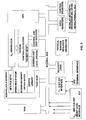
- Fig. 2 illustrates a preferred embodiment of a deterministic processing device for performing long division, using the data manipulation devices available on the processor of Fig. 1A.
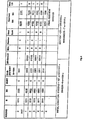
- Figs. 4 and 5 are examples of the operation of the apparatus of Fig. 2.
- d is preloaded into the N right-shift register, 1005 (a concatenation of the N 0 and the N 1 registers, 210 and 200) in Fig 2, the MS n bits of the dividend, D, are preloaded in the B right-shift register, (1000), and the n LS bits of D are reverse loaded into the S A right shift register (130).
- the S B register is preloaded with all zeros.
- the overflow flip flop 170 of Fig. 2 is initially reset.
- the quotient generator, 120 is a detector which determines if B ⁇ N, and transmits a NEXT SUBTRACT which determines if d will be subtracted from B, in 90, in the next iteration; this signal is a one, if, and only if, B is larger than or equal to N.
- This NEXT SUBTRACT bit denotes success, and is the most significant bit of the quotient, and is also clocked into the S B register, 180. As this is clocked into the S B register, a zero is shifted out of the S B register, into the S A register, forcing a NEW LS BIT out of the S A register. Note, that as these registers are all right shift registers, both the quotient in S B and the dividend value in S A , are held in reverse order.
- a NEW LS BIT shifted out of the S A precedes the output, R, of 90, thereby multiplying R by 2 and adding the value of the NEW LS BIT to 2R.
- the most significant one of both the dividend and the divisor is preferably in the most significant bit cells of the B register and the N register, for all sizes of D and d.
- the number of iterations necessary to obtain a result is decreased for Ds which are smaller than 2 2n-1 , and is increased for ds which are smaller than 2 n-1 .
- the device is hardware driven, and firmware compensations may be provided for shifting operands when unloading the device.
- the program residing in the non-volatile memory of Fig. 3, preferably ascertains that the registers are loaded, and defines for the control register, a number of iterations necessary for a successful division process.
- the quotient bits are rereversed, byte by byte, when processed through the reverse data out unloader, units 60 and 40.
- This processor is an element useful for computing the H Parameter, and also is preferably used in computations of the Euclidean functions.
- the dividend B is 187 (10111011)
- the divisor N is 7 (111)
- the quotient is found to be 20 (10100) and the remainder is found to be 7 (111).
- the dividend B is 173 (10101101)
- the divisor N is 5 (101)
- the quotient is found to be 34 (100010) and the remainder is found to be 3 (11).
- a carry-save accumulator is illustrated in Fig. 5 of U.S. Patent 5,513,133 to Gressel .
- normal field of integers refers to non-negative integers e.g. natural numbers.
- the software components of the present invention may, if desired, be implemented in ROM (read-only memory) form.
- the software components may, generally, be implemented in hardware, if desired, using conventional techniques.
Landscapes
- Physics & Mathematics (AREA)
- Engineering & Computer Science (AREA)
- General Physics & Mathematics (AREA)
- Mathematical Analysis (AREA)
- Mathematical Optimization (AREA)
- Pure & Applied Mathematics (AREA)
- Computational Mathematics (AREA)
- Theoretical Computer Science (AREA)
- Computing Systems (AREA)
- Mathematical Physics (AREA)
- General Engineering & Computer Science (AREA)
- Complex Calculations (AREA)
- Signal Processing For Digital Recording And Reproducing (AREA)
- Error Detection And Correction (AREA)
Claims (16)
- Mikroelektronische Arithmetik-Logik-Einheit (ALU) zum Durchführen modularer Multiplikation von P(A·B)N des Montgomery-Typs, wobei P(A·B)N modular A·B·I mod N kongruent ist, wobei I gleich 2-n mod N ist, A, B und N n Bit lange Operanden sind, wobei N ungerade ist, wobei die Vorrichtung folgendes umfaßt:erste (70, 80; 1000) und zweite (200, 210; 1005) Hauptspeicherregister, wobei jedes Register zum Halten eines n Bit langen Operanden dient, wobei die Register jeweils dafür ausgelegt sind, den Multiplikator B und den Teilungsrest N zu speichern;eine Einrichtung (390, ...) zum gleichzeitigen Multiplizieren einer ersten k-Bit-Kette (A i ) mit einem ersten ankommenden Bit (Bd) und einer zweiten k-Bit-Kette (N0, Y0) mit einem zweiten ankommenden Bit (Y0, N d ) und zum Akkumulieren des Ergebnisses, wobei die Einrichtung nur einen Carry-save-Addierer (410) aufweist, mit einer Länge von mindestens k+1 Bit, wobei die Einrichtung dafür ausgelegt ist, als einen Eingangswert für den Carry-save-Addierer entweder einen Durchweg-null-Kettenwert, die erste k-Bit-Kette, die zweite k-Bit-Kette oder die vorberechnete Summe der ersten und der zweiten k-Bit-Kette auszuwählen, wobei die Vorrichtung dafür ausgelegt ist, in einer ersten Phase folgendes einzugeben:aufeinanderfolgende niedrigstwertige Bit von B als erste ankommende Bit;aufeinanderfolgende Bit eines "in Verlauf' erzeugten antizipierten Werts Y0 als zweite in die Einrichtung ankommende Bit;aufeinanderfolgende Bit des Multiplikanden (A) als die erste k-Bit-Kette; undaufeinanderfolgende k niedrigstwertige Bit von N als die zweite k-Bit-Kette;wobei die Vorrichtung dafür ausgelegt ist, in einer zweiten Phase folgendes einzugeben:aufeinanderfolgende niedrigstwertige Bit von B als erste ankommende Bit;aufeinanderfolgende Bit von N als zweite in die Einrichtung ankommende Bit;aufeinanderfolgende k Bit des Multiplikanden (A) als die erste k-Bit-Kette; undin der ersten Phase erzeugte aufeinanderfolgende k niedrigstwertige Bit von Y0 als die zweite k-Bit-Kette;eine Logikeinrichtung (430) zum Bestimmen von Y0 dergestalt, daß die von dem Carry-save-Addierer (410) in der ersten Phase ausgegebenen k niedrigstwertigen Bit Nullen sind, wobei die Logikeinrichtung folgendes als Eingaben erhält:das niedrigstwertige Bit der ersten k-Bit-Kette (A i );das erste ankommende Bit (B d );ein niedrigstwertiges Carry-out-Bit aus dem Carry-save-Addierer (410);das zweitniedrigstwertige Bit aus dem Carry-save-Addierer (410);das nächste Bit aus einem Temporärspeicherregister (S); undein Carry-out-Bit aus einem Addierer (460);wobei der Carry-save-Addierer (410) dafür ausgelegt ist, Werte gleichzeitig auszugeben, während Multiplikanden in den Carry-save-Addierer (410) hineinaddiert werden; undeinen Ausgangstransfermechanismus, der dafür ausgelegt ist, in einer zweiten Phase ein P(A·B)N-Endergebnis aus dem Carry-save-Addierer (410) auszugeben.
- Vorrichtung nach Anspruch 1, die dafür ausgelegt ist, Summierungen in den Carry-save-Addierer (410) hinein durch Multiplikatorenbit sukzessiv höherer Ordnung, die seriell eines nach dem anderen geladen werden, zu aktivieren.
- Vorrichtung nach Anspruch 2, die als Reaktion auf die sukzessiv geladenen Multiplikatorenbit für folgendes ausgelegt ist:Bewirken keiner Summierung in den Carry-save-Addierer (410) hinein, wenn sowohl das Eingangsmultiplikatorenbit als auch ein entsprechendes Eingangs-Y0-Bit Nullen sind;Hineinaddieren nur des A i -Multiplikanden, wenn das Eingangsmultiplikatorenbit eine Eins ist und das entsprechende Y0-Bit eine Null ist;Hineinaddieren nur des Teilungsrests N, wenn das Multiplikatorenbit eine Null ist und das entsprechende Y0-Bit eine Eins ist; undHineinaddieren der Summierung des Teilungsrests N mit dem Multiplikanden A i , wenn sowohl das Eingangsmultiplikatorenbit als auch das entsprechende Y0-Bit Einsen sind.
- Vorrichtung nach Anspruch 3, die dafür ausgelegt ist, Multiplikandenwerte A i und Teilungsrestwerte N in zwei eigene Vorladepuffer (290, 320) vorzuladen und diese Werte in einen dritten Multiplikanden-Vorladepuffer (340) hineinzusummieren, wodurch es überflüssig wird, jeden Multiplikandenwert separat hineinzuaddieren, wenn entsprechende Multiplikatoren- und Y0-Bit beide Einsen sind.
- Vorrichtung nach Anspruch 4, die dafür ausgelegt ist, die Vorladepuffer (290, 320, 340) seriell zu speisen und Multiplikandenwerte im Verlauf aus beliebigen der Register (1000, 1005) oder aus der CPU über beliebige der Register in die Vorladepuffer vorzuladen.
- Vorrichtung nach Anspruch 1, die dafür ausgelegt ist, die Multiplikatorenwerte seriell einzugeben und die Ausgabe des Carry-save-Addierers (410) seriell auszugeben, wobei die Detektionseinrichtung (430) dafür ausgelegt ist, an nur einem Bit zu antizipieren, ob der Teilungsrestwert in den Carry-save-Addierer hineinzuaddieren ist.
- Vorrichtung nach Anspruch 1 oder Anspruch 6, die dafür ausgelegt ist, k niedrigstwertige Nullen aus der modularen Multipliziereinrichtung gesteuert durch die folgenden drei Größen beim Antizipieren des nächsten Y0-Bit austreten zu lassen:i) das niedrigstwertige Bit des A i -Registers UND das nächste Bit des B-Stroms A0·B d ;ii) das niedrigstwertige Carry-out-Bit aus dem Carry-save-Addierer CO0; undiii) das S out -Bit aus der zweitniedrigstwertigen Zelle des Carry-save-Addierers SO1.
- Vorrichtung nach Anspruch 7, die dafür ausgelegt ist, eine XOR-Verknüpfung der drei Werte A0·B d , CO0 und SO1 miteinander durchzuführen, um ein gültiges Y0-Antizipationsbit auszugeben.
- Vorrichtung nach Anspruch 1, ferner mit einem Komparator (480, 490), der dafür ausgelegt ist, eine Ausgabe der modularen Multipliziereinrichtung zu erfassen, wobei von dieser Ausgabe die k niedrigstwertigen Bit verworfen werden, wobei die Ausgabe größer als der Teilungsrest N und kleiner als 2N ist, wobei der Komparator dafür ausgelegt ist, eine modulare Reduktion unter Verwendung eines von dem Speicherregister ausgegebenen Werts, für das ein Ausgangsstrom der Multiplizierereinrichtung bestimmt ist, zu steuern, wodurch es überflüssig wird, eine zweite Speicherungseinrichtung für kleinere Montgomery-Produktwerte zuzuteilen.
- Vorrichtung nach Anspruch 1, wobei ein serieller Komparator dafür ausgelegt ist, zu erfassen, wann eine Ausgabe Z/2k der modularen Multiplikationseinrichtung größer als 2 n ist, und dadurch dafür ausgelegt ist, ein Überlaufbit zu setzen.
- Vorrichtung nach Anspruch 1, die dafür ausgelegt ist, durch Ersetzen der Y0-Multiplikatoreneingabe durch eine Konstant-null-Eingabe eine Multiplikation natürlicher ganzer Zahlen von Ai mal B in dem normalen Feld der ganzen Zahlen durchzuführen.
- Vorrichtung nach Anspruch 1, die dafür ausgelegt ist, durch Ersetzen der Y0-Multiplikatoreneingabe durch eine Konstant-null-Eingabe eine Multiplikation natürlicher ganzer Zahlen von A i mal B durchzuführen, während ein anderer, aus einem n-Bit-Register kommender Wert S damit summierbar ist, um einen Wert von A i mal B plus S zu erzeugen.
- Vorrichtung nach Anspruch 1, die dafür ausgelegt ist, durch Ersetzen der Y0-Multiplikatoreneingabe durch die Ausgabe eines Speicherregisters zum Speisen eines Operanden C und durch Ersetzen des Operanden N durch einen alternativen Operanden D eine Multiplikation natürlicher ganzer Zahlen von A i mal B und C mal D durchzuführen, während ein anderer, aus einem n-Bit-Register kommender Wert S in dem normalen Feld der ganzen Zahlen damit summierbar ist, um so einen Wert von A i mal B plus C mal D plus S zu erzeugen.
- Vorrichtung nach Anspruch 1, die dafür ausgelegt ist, modulare Montgomery-Multiplikation mit nur einer vorberechneten Montgomery-Variablen durchzuführen, und keine Benutzung einer Jo-Montgomery-Konstanten erfordert.
- Vorrichtung nach Anspruch 1, die dafür ausgelegt ist, eine Montgomery-J0-Konstante zu berechnen, indem sowohl der A i -Operandenwert als auch der B-Operandenwert auf null zurückgesetzt und ein Partialergebniswert S0 auf 1 gesetzt werden.
- Vorrichtung nach Anspruch 1, wobei die Einrichtung dafür ausgelegt ist, eine modulare Exponentiation des Montgomery-Typs durchzuführen.
Applications Claiming Priority (5)
| Application Number | Priority Date | Filing Date | Title |
|---|---|---|---|
| IL12077697 | 1997-05-04 | ||
| IL12077697A IL120776A0 (en) | 1997-05-04 | 1997-05-04 | Apparatus and methods for modular multiplication and exponentiation based on montgomery multiplication |
| IL12131197 | 1997-07-14 | ||
| IL12131197A IL121311A (en) | 1997-07-14 | 1997-07-14 | Apparatus and method for modular multiplication and exponentiation based on montgomery multiplication |
| PCT/IL1998/000148 WO1998050851A1 (en) | 1997-05-04 | 1998-03-29 | Improved apparatus & method for modular multiplication & exponentiation based on montgomery multiplication |
Publications (3)
| Publication Number | Publication Date |
|---|---|
| EP1008026A4 EP1008026A4 (de) | 2000-06-14 |
| EP1008026A1 EP1008026A1 (de) | 2000-06-14 |
| EP1008026B1 true EP1008026B1 (de) | 2007-09-05 |
Family
ID=26323418
Family Applications (1)
| Application Number | Title | Priority Date | Filing Date |
|---|---|---|---|
| EP98910967A Expired - Lifetime EP1008026B1 (de) | 1997-05-04 | 1998-03-29 | Verbessertes gerät und verfahren für modulare multiplikation und exponentation basierend auf montgomerymultiplikation |
Country Status (9)
| Country | Link |
|---|---|
| US (1) | US6185596B1 (de) |
| EP (1) | EP1008026B1 (de) |
| JP (2) | JP2001527673A (de) |
| KR (1) | KR100684134B1 (de) |
| AT (1) | ATE372541T1 (de) |
| AU (1) | AU6516498A (de) |
| DE (1) | DE69838390T2 (de) |
| ES (1) | ES2293677T3 (de) |
| WO (1) | WO1998050851A1 (de) |
Cited By (1)
| Publication number | Priority date | Publication date | Assignee | Title |
|---|---|---|---|---|
| CN103699358B (zh) * | 2013-12-05 | 2016-11-23 | 西安交通大学 | 一种适用于大数的快速模平方运算电路 |
Families Citing this family (55)
| Publication number | Priority date | Publication date | Assignee | Title |
|---|---|---|---|---|
| US6317769B1 (en) * | 1996-09-18 | 2001-11-13 | International Business Machines Corporation | Apparatus for calculating of Bc (mod n) with repeatedly shifting a holding value |
| US7587044B2 (en) * | 1998-01-02 | 2009-09-08 | Cryptography Research, Inc. | Differential power analysis method and apparatus |
| ATE325478T1 (de) * | 1998-01-02 | 2006-06-15 | Cryptography Res Inc | Leckresistentes kryptographisches verfahren und vorrichtung |
| AU6381699A (en) | 1998-06-03 | 2000-01-10 | Cryptography Research, Inc. | Improved des and other cryptographic processes with leak minimization for smartcards and other cryptosystems |
| AU5458199A (en) | 1998-07-02 | 2000-01-24 | Cryptography Research, Inc. | Leak-resistant cryptographic indexed key update |
| IL128007A (en) * | 1999-01-11 | 2003-02-12 | Milsys Ltd | Enhancements on compact logic devices and also for accelerating and securing computations in modular arithmetic especially for use in public key cryptographic co-processors designed for elliptic curve and rsa type computations |
| FR2791156B1 (fr) * | 1999-03-17 | 2001-05-11 | St Microelectronics Sa | Dispositif et procede de mise en oeuvre d'une operation modulaire elementaire selon la methode de montgomery |
| FR2791155B1 (fr) | 1999-03-17 | 2001-05-11 | St Microelectronics Sa | Dispositif et procede de mise en oeuvre d'une operation modulaire elementaire selon la methode de montgomery |
| FR2791157A1 (fr) * | 1999-03-17 | 2000-09-22 | St Microelectronics Sa | Dispositif et procede de mise en oeuvre d'une operation modulaire elementaire selon la methode de montgomery |
| IL135247A0 (en) * | 2000-03-23 | 2003-06-24 | Cipherit Ltd | Method and apparatus for the calculation of modular multiplicative inverses |
| US7240204B1 (en) * | 2000-03-31 | 2007-07-03 | State Of Oregon Acting By And Through The State Board Of Higher Education On Behalf Of Oregon State University | Scalable and unified multiplication methods and apparatus |
| US6820105B2 (en) | 2000-05-11 | 2004-11-16 | Cyberguard Corporation | Accelerated montgomery exponentiation using plural multipliers |
| DE60139401D1 (de) * | 2000-05-15 | 2009-09-10 | Sandisk Il Ltd | Erweiterung des bereichs rechnerischer körper von ganzen zahlen |
| FR2809894B1 (fr) * | 2000-05-31 | 2002-10-25 | France Telecom | Procede de cryptographie, microcircuit pour carte a puce et cartes a puce incluant un tel microcircuit |
| IL140267A0 (en) | 2000-12-13 | 2003-09-17 | Milsys Ltd | Dual processor trusted computing environment |
| US20020116429A1 (en) * | 2000-12-19 | 2002-08-22 | International Business Machines Corporation | System and method for modular multiplication |
| US6963977B2 (en) * | 2000-12-19 | 2005-11-08 | International Business Machines Corporation | Circuits and methods for modular exponentiation |
| US7607165B2 (en) * | 2001-03-09 | 2009-10-20 | The Athena Group, Inc. | Method and apparatus for multiplication and/or modular reduction processing |
| FR2822260A1 (fr) * | 2001-03-14 | 2002-09-20 | Bull Sa | Procedes et dispositifs pour accelerer le temps de calcul d'un produit de montgomery d'un multiplication et d'une exponentiation modulaire |
| JP3820909B2 (ja) * | 2001-04-24 | 2006-09-13 | ソニー株式会社 | 楕円曲線暗号処理方法および楕円曲線暗号処理装置、並びにプログラム |
| DE10127195A1 (de) * | 2001-06-05 | 2002-12-19 | Infineon Technologies Ag | Prozessor mit interner Speicherkonfiguration |
| US6917956B2 (en) * | 2001-08-14 | 2005-07-12 | Sun Microsystems, Inc. | Apparatus and method for efficient modular exponentiation |
| US20030072442A1 (en) * | 2001-10-01 | 2003-04-17 | Blakley George Robert | Cisponentiation method, software, and device for exponentiation |
| US7376235B2 (en) * | 2002-04-30 | 2008-05-20 | Microsoft Corporation | Methods and systems for frustrating statistical attacks by injecting pseudo data into a data system |
| US20040010470A1 (en) * | 2002-07-09 | 2004-01-15 | Mills Charles A. | Anti-piracy system for software and digital entertainment |
| KR100458031B1 (ko) * | 2003-03-14 | 2004-11-26 | 삼성전자주식회사 | 몽고메리 유형의 모듈라 곱셈 장치 및 방법 |
| US7050475B2 (en) | 2003-05-02 | 2006-05-23 | Litelaser Llc | Waveguide laser |
| CN1985458B (zh) * | 2003-11-16 | 2013-05-08 | 桑迪斯克以色列有限公司 | 增强的自然蒙哥马利指数掩蔽和恢复的方法和装置 |
| DE602004027943D1 (de) | 2003-11-16 | 2010-08-12 | Sandisk Il Ltd | Verbesserte natürliche montgomery-exponentenmaskierung |
| US7664810B2 (en) * | 2004-05-14 | 2010-02-16 | Via Technologies, Inc. | Microprocessor apparatus and method for modular exponentiation |
| US7583717B2 (en) * | 2004-08-30 | 2009-09-01 | Videojet Technologies Inc | Laser system |
| US7296359B2 (en) * | 2004-10-27 | 2007-11-20 | Videojet Technologies | Laser alignment system and method |
| DE102006025677B4 (de) * | 2005-10-28 | 2020-03-12 | Infineon Technologies Ag | Vorrichtung und Verfahren zum Berechnen eines Ergebnisses einer Summe mit einem Rechenwerk mit begrenzter Wortlänge |
| DE102006025569A1 (de) * | 2005-10-28 | 2007-05-03 | Infineon Technologies Ag | Vorrichtung und Verfahren zum Berechnen einer Multiplikations-Additions-Operation und zum Berechnen eines Ergebnisses einer modularen Multiplikation |
| DE102006025713B9 (de) | 2005-10-28 | 2013-10-17 | Infineon Technologies Ag | Kryptographie-Vorrichtung und Kryptographie-Verfahren zum Berechnen eines Ergebnisses einer modularen Multiplikation |
| DE102006025673B9 (de) | 2005-10-28 | 2010-12-16 | Infineon Technologies Ag | Rechenwerk zum Reduzieren einer Eingabe-Zahl bezüglich eines Moduls |
| EP1975906B1 (de) | 2006-01-13 | 2012-07-04 | Fujitsu Ltd. | Montgomery-s-algorithmus-multiplikationsrest-kalkulator |
| JP5027422B2 (ja) * | 2006-02-09 | 2012-09-19 | ルネサスエレクトロニクス株式会社 | 剰余演算処理装置 |
| US7805479B2 (en) * | 2006-03-28 | 2010-09-28 | Michael Andrew Moshier | Scalable, faster method and apparatus for montgomery multiplication |
| US8229109B2 (en) * | 2006-06-27 | 2012-07-24 | Intel Corporation | Modular reduction using folding |
| US20080043406A1 (en) * | 2006-08-16 | 2008-02-21 | Secure Computing Corporation | Portable computer security device that includes a clip |
| US7925011B2 (en) * | 2006-12-14 | 2011-04-12 | Intel Corporation | Method for simultaneous modular exponentiations |
| US20080263115A1 (en) * | 2007-04-17 | 2008-10-23 | Horizon Semiconductors Ltd. | Very long arithmetic logic unit for security processor |
| US8042025B2 (en) * | 2007-12-18 | 2011-10-18 | Intel Corporation | Determining a message residue |
| US8402078B2 (en) * | 2008-02-26 | 2013-03-19 | International Business Machines Corporation | Method, system and computer program product for determining required precision in fixed-point divide operations |
| US8626816B2 (en) * | 2008-02-26 | 2014-01-07 | International Business Machines Corporation | Method, system and computer program product for detecting errors in fixed point division operation results |
| EP2334006B1 (de) * | 2009-12-10 | 2016-03-23 | Nxp B.V. | Gegen Angriffe mit verborgenen Kanälen gesicherte modulare Potenzierung |
| FR2974201B1 (fr) | 2011-04-18 | 2013-04-12 | Inside Secure | Circuit de multiplication de montgomery |
| FR2974202B1 (fr) | 2011-04-18 | 2013-04-12 | Inside Secure | Procede de multiplication de montgomery |
| US10025556B2 (en) * | 2014-09-08 | 2018-07-17 | Atmel Corporation | Optimized multi-precision division |
| US11468797B2 (en) | 2020-06-24 | 2022-10-11 | Western Digital Technologies, Inc. | Low complexity conversion to Montgomery domain |
| US11508263B2 (en) | 2020-06-24 | 2022-11-22 | Western Digital Technologies, Inc. | Low complexity conversion to Montgomery domain |
| WO2022115108A1 (en) * | 2020-11-27 | 2022-06-02 | Pqsecure Technologies, Llc | An architecture for small and efficient modular multiplication using carry-save adders |
| TWI802095B (zh) | 2021-11-22 | 2023-05-11 | 財團法人工業技術研究院 | 模數乘法電路與對應之計算模數乘法之方法 |
| CN120803397B (zh) * | 2025-09-16 | 2025-12-09 | 山东华翼微电子技术股份有限公司 | 一种适用多种模乘算法的模乘电路 |
Family Cites Families (14)
| Publication number | Priority date | Publication date | Assignee | Title |
|---|---|---|---|---|
| US3621218A (en) * | 1967-09-29 | 1971-11-16 | Hitachi Ltd | High-speed divider utilizing carry save additions |
| US4110832A (en) * | 1977-04-28 | 1978-08-29 | International Business Machines Corporation | Carry save adder |
| US4514592A (en) | 1981-07-27 | 1985-04-30 | Nippon Telegraph & Telephone Public Corporation | Cryptosystem |
| US4538238A (en) * | 1983-01-18 | 1985-08-27 | Honeywell Information Systems Inc. | Method and apparatus for calculating the residue of a signed binary number |
| KR19990024971A (ko) * | 1997-09-09 | 1999-04-06 | 정선종 | 모듈러 승산장치 |
| CA2008774C (en) * | 1989-01-30 | 1999-10-05 | Hikaru Morita | Modular multiplication method and the system for processing data |
| JP2710412B2 (ja) * | 1989-06-20 | 1998-02-10 | 日本電気株式会社 | 乗除算回路 |
| US5185714A (en) * | 1989-09-19 | 1993-02-09 | Canon Kabushiki Kaisha | Arithmetic operation processing apparatus |
| US5101431A (en) | 1990-12-14 | 1992-03-31 | Bell Communications Research, Inc. | Systolic array for modular multiplication |
| DE69229766T2 (de) * | 1991-09-05 | 2000-03-23 | Canon K.K., Tokio/Tokyo | Verfahren und Gerät zum Verschlüsseln und Entschlüsseln von Kommunikationsdaten |
| IL101623A (en) * | 1992-04-16 | 1997-06-10 | Fortress U & T 2000 Ltd | Digital signature device |
| US5513133A (en) * | 1992-11-30 | 1996-04-30 | Fortress U&T Ltd. | Compact microelectronic device for performing modular multiplication and exponentiation over large numbers |
| US5349551A (en) * | 1993-07-30 | 1994-09-20 | The United States Of America As Represented By The Director Of National Security Agency | Device for and method of preforming an N-bit modular multiplication in approximately N/2 steps |
| GB2332542B (en) * | 1997-12-20 | 2002-08-07 | Motorola Ltd | Data processing system for performing multiplication and multiplication method |
-
1998
- 1998-03-29 ES ES98910967T patent/ES2293677T3/es not_active Expired - Lifetime
- 1998-03-29 EP EP98910967A patent/EP1008026B1/de not_active Expired - Lifetime
- 1998-03-29 KR KR1019997010171A patent/KR100684134B1/ko not_active Expired - Fee Related
- 1998-03-29 AU AU65164/98A patent/AU6516498A/en not_active Abandoned
- 1998-03-29 AT AT98910967T patent/ATE372541T1/de not_active IP Right Cessation
- 1998-03-29 WO PCT/IL1998/000148 patent/WO1998050851A1/en not_active Ceased
- 1998-03-29 DE DE69838390T patent/DE69838390T2/de not_active Expired - Lifetime
- 1998-03-29 JP JP54788398A patent/JP2001527673A/ja not_active Withdrawn
- 1998-04-01 US US09/050,958 patent/US6185596B1/en not_active Expired - Lifetime
-
2009
- 2009-06-12 JP JP2009140914A patent/JP2009230153A/ja active Pending
Non-Patent Citations (1)
| Title |
|---|
| None * |
Cited By (1)
| Publication number | Priority date | Publication date | Assignee | Title |
|---|---|---|---|---|
| CN103699358B (zh) * | 2013-12-05 | 2016-11-23 | 西安交通大学 | 一种适用于大数的快速模平方运算电路 |
Also Published As
| Publication number | Publication date |
|---|---|
| AU6516498A (en) | 1998-11-27 |
| US6185596B1 (en) | 2001-02-06 |
| ATE372541T1 (de) | 2007-09-15 |
| ES2293677T3 (es) | 2008-03-16 |
| JP2009230153A (ja) | 2009-10-08 |
| JP2001527673A (ja) | 2001-12-25 |
| EP1008026A4 (de) | 2000-06-14 |
| WO1998050851A1 (en) | 1998-11-12 |
| DE69838390T2 (de) | 2008-05-29 |
| DE69838390D1 (de) | 2007-10-18 |
| EP1008026A1 (de) | 2000-06-14 |
| KR20010012222A (ko) | 2001-02-15 |
| KR100684134B1 (ko) | 2007-02-16 |
Similar Documents
| Publication | Publication Date | Title |
|---|---|---|
| EP1008026B1 (de) | Verbessertes gerät und verfahren für modulare multiplikation und exponentation basierend auf montgomerymultiplikation | |
| EP1299797B1 (de) | Erweiterung des bereichs rechnerischer körper von ganzen zahlen | |
| US5513133A (en) | Compact microelectronic device for performing modular multiplication and exponentiation over large numbers | |
| US6748410B1 (en) | Apparatus and method for modular multiplication and exponentiation based on montgomery multiplication | |
| US6820105B2 (en) | Accelerated montgomery exponentiation using plural multipliers | |
| US7277540B1 (en) | Arithmetic method and apparatus and crypto processing apparatus for performing multiple types of cryptography | |
| EP1560110A1 (de) | Schaltung für die Mehrwort-Multiplikation/Akkumulation und Schaltung für die modulare Montgomery Multiplikation/Akkumulation | |
| CA2251178A1 (en) | Computationally efficient modular multiplication method and apparatus | |
| US7580966B2 (en) | Method and device for reducing the time required to perform a product, multiplication and modular exponentiation calculation using the Montgomery method | |
| WO1998019231A1 (en) | Co-processor for performing modular multiplication | |
| EP1068565B1 (de) | Beschleunigung und sicherheitsverbesserung für koprozessoren zur berechnung einer elliptischen kurve und einer rsa-funktion | |
| EP1430394B1 (de) | Verfahren und vorrichtung zur ausführung von modularen multiplikationen | |
| Großschädl | High-speed RSA hardware based on Barret’s modular reduction method | |
| Wang et al. | New VLSI architectures of RSA public-key cryptosystem | |
| GB2318892A (en) | Co-processor for performing modular multiplication | |
| Guo et al. | Design and implementation of an RSA public-key cryptosystem | |
| de Macedo Mourelle et al. | Fast reconfigurable hardware for the m-ary modular exponentiation | |
| Nedjah et al. | Efficient hardware for modular exponentiation using the sliding-window method with variable-length partitioning | |
| Chiou et al. | Parallel modular multiplication with table look-up | |
| Yang et al. | An optimized scalable and unified hardware structure of Montgomery multiplier | |
| Großschädl | A new serial/parallel architecture for a low power modular multiplier | |
| Meng et al. | FPGA Implementation of Expandable RSA Pubic-Key Cryptographic Coprocessor | |
| Tenca et al. | for Montgomery Multiplication | |
| IL106923A (en) | Device for performing modular multiplication |
Legal Events
| Date | Code | Title | Description |
|---|---|---|---|
| PUAI | Public reference made under article 153(3) epc to a published international application that has entered the european phase |
Free format text: ORIGINAL CODE: 0009012 |
|
| 17P | Request for examination filed |
Effective date: 19991206 |
|
| A4 | Supplementary search report drawn up and despatched |
Effective date: 20000207 |
|
| AK | Designated contracting states |
Kind code of ref document: A4 Designated state(s): AT BE CH DE DK ES FI FR GB GR IE IT LI LU MC NL PT SE Kind code of ref document: A1 Designated state(s): AT BE CH DE DK ES FI FR GB GR IE IT LI LU MC NL PT SE |
|
| RAP1 | Party data changed (applicant data changed or rights of an application transferred) |
Owner name: M-SYSTEMS FLASH DISK PIONEERS LTD. |
|
| 17Q | First examination report despatched |
Effective date: 20040331 |
|
| GRAP | Despatch of communication of intention to grant a patent |
Free format text: ORIGINAL CODE: EPIDOSNIGR1 |
|
| GRAS | Grant fee paid |
Free format text: ORIGINAL CODE: EPIDOSNIGR3 |
|
| GRAA | (expected) grant |
Free format text: ORIGINAL CODE: 0009210 |
|
| AK | Designated contracting states |
Kind code of ref document: B1 Designated state(s): AT BE CH DE DK ES FI FR GB GR IE IT LI LU MC NL PT SE |
|
| REG | Reference to a national code |
Ref country code: GB Ref legal event code: FG4D |
|
| REG | Reference to a national code |
Ref country code: CH Ref legal event code: EP |
|
| REF | Corresponds to: |
Ref document number: 69838390 Country of ref document: DE Date of ref document: 20071018 Kind code of ref document: P |
|
| REG | Reference to a national code |
Ref country code: IE Ref legal event code: FG4D |
|
| RAP2 | Party data changed (patent owner data changed or rights of a patent transferred) |
Owner name: SANDISK IL LTD |
|
| NLT2 | Nl: modifications (of names), taken from the european patent patent bulletin |
Owner name: SANDISK IL LTD Effective date: 20071114 |
|
| PG25 | Lapsed in a contracting state [announced via postgrant information from national office to epo] |
Ref country code: FI Free format text: LAPSE BECAUSE OF FAILURE TO SUBMIT A TRANSLATION OF THE DESCRIPTION OR TO PAY THE FEE WITHIN THE PRESCRIBED TIME-LIMIT Effective date: 20070905 |
|
| PG25 | Lapsed in a contracting state [announced via postgrant information from national office to epo] |
Ref country code: CH Free format text: LAPSE BECAUSE OF FAILURE TO SUBMIT A TRANSLATION OF THE DESCRIPTION OR TO PAY THE FEE WITHIN THE PRESCRIBED TIME-LIMIT Effective date: 20070905 Ref country code: LI Free format text: LAPSE BECAUSE OF FAILURE TO SUBMIT A TRANSLATION OF THE DESCRIPTION OR TO PAY THE FEE WITHIN THE PRESCRIBED TIME-LIMIT Effective date: 20070905 Ref country code: AT Free format text: LAPSE BECAUSE OF FAILURE TO SUBMIT A TRANSLATION OF THE DESCRIPTION OR TO PAY THE FEE WITHIN THE PRESCRIBED TIME-LIMIT Effective date: 20070905 |
|
| NLV1 | Nl: lapsed or annulled due to failure to fulfill the requirements of art. 29p and 29m of the patents act | ||
| REG | Reference to a national code |
Ref country code: ES Ref legal event code: FG2A Ref document number: 2293677 Country of ref document: ES Kind code of ref document: T3 |
|
| PG25 | Lapsed in a contracting state [announced via postgrant information from national office to epo] |
Ref country code: BE Free format text: LAPSE BECAUSE OF FAILURE TO SUBMIT A TRANSLATION OF THE DESCRIPTION OR TO PAY THE FEE WITHIN THE PRESCRIBED TIME-LIMIT Effective date: 20070905 |
|
| REG | Reference to a national code |
Ref country code: CH Ref legal event code: PL |
|
| ET | Fr: translation filed | ||
| PG25 | Lapsed in a contracting state [announced via postgrant information from national office to epo] |
Ref country code: NL Free format text: LAPSE BECAUSE OF FAILURE TO SUBMIT A TRANSLATION OF THE DESCRIPTION OR TO PAY THE FEE WITHIN THE PRESCRIBED TIME-LIMIT Effective date: 20070905 Ref country code: GR Free format text: LAPSE BECAUSE OF FAILURE TO SUBMIT A TRANSLATION OF THE DESCRIPTION OR TO PAY THE FEE WITHIN THE PRESCRIBED TIME-LIMIT Effective date: 20071206 |
|
| PG25 | Lapsed in a contracting state [announced via postgrant information from national office to epo] |
Ref country code: PT Free format text: LAPSE BECAUSE OF FAILURE TO SUBMIT A TRANSLATION OF THE DESCRIPTION OR TO PAY THE FEE WITHIN THE PRESCRIBED TIME-LIMIT Effective date: 20080206 |
|
| PG25 | Lapsed in a contracting state [announced via postgrant information from national office to epo] |
Ref country code: SE Free format text: LAPSE BECAUSE OF FAILURE TO SUBMIT A TRANSLATION OF THE DESCRIPTION OR TO PAY THE FEE WITHIN THE PRESCRIBED TIME-LIMIT Effective date: 20071205 |
|
| PLBE | No opposition filed within time limit |
Free format text: ORIGINAL CODE: 0009261 |
|
| STAA | Information on the status of an ep patent application or granted ep patent |
Free format text: STATUS: NO OPPOSITION FILED WITHIN TIME LIMIT |
|
| PG25 | Lapsed in a contracting state [announced via postgrant information from national office to epo] |
Ref country code: DK Free format text: LAPSE BECAUSE OF FAILURE TO SUBMIT A TRANSLATION OF THE DESCRIPTION OR TO PAY THE FEE WITHIN THE PRESCRIBED TIME-LIMIT Effective date: 20070905 |
|
| 26N | No opposition filed |
Effective date: 20080606 |
|
| PG25 | Lapsed in a contracting state [announced via postgrant information from national office to epo] |
Ref country code: MC Free format text: LAPSE BECAUSE OF NON-PAYMENT OF DUE FEES Effective date: 20080331 |
|
| PG25 | Lapsed in a contracting state [announced via postgrant information from national office to epo] |
Ref country code: IE Free format text: LAPSE BECAUSE OF NON-PAYMENT OF DUE FEES Effective date: 20080331 |
|
| PG25 | Lapsed in a contracting state [announced via postgrant information from national office to epo] |
Ref country code: LU Free format text: LAPSE BECAUSE OF NON-PAYMENT OF DUE FEES Effective date: 20080329 |
|
| PG25 | Lapsed in a contracting state [announced via postgrant information from national office to epo] |
Ref country code: IT Free format text: LAPSE BECAUSE OF NON-PAYMENT OF DUE FEES Effective date: 20080331 |
|
| PGFP | Annual fee paid to national office [announced via postgrant information from national office to epo] |
Ref country code: ES Payment date: 20130313 Year of fee payment: 16 Ref country code: GB Payment date: 20130327 Year of fee payment: 16 Ref country code: FR Payment date: 20130325 Year of fee payment: 16 |
|
| GBPC | Gb: european patent ceased through non-payment of renewal fee |
Effective date: 20140329 |
|
| REG | Reference to a national code |
Ref country code: FR Ref legal event code: ST Effective date: 20141128 |
|
| PG25 | Lapsed in a contracting state [announced via postgrant information from national office to epo] |
Ref country code: GB Free format text: LAPSE BECAUSE OF NON-PAYMENT OF DUE FEES Effective date: 20140329 Ref country code: FR Free format text: LAPSE BECAUSE OF NON-PAYMENT OF DUE FEES Effective date: 20140331 |
|
| REG | Reference to a national code |
Ref country code: ES Ref legal event code: FD2A Effective date: 20150428 |
|
| PG25 | Lapsed in a contracting state [announced via postgrant information from national office to epo] |
Ref country code: ES Free format text: LAPSE BECAUSE OF NON-PAYMENT OF DUE FEES Effective date: 20140330 |
|
| PGFP | Annual fee paid to national office [announced via postgrant information from national office to epo] |
Ref country code: DE Payment date: 20160322 Year of fee payment: 19 |
|
| REG | Reference to a national code |
Ref country code: DE Ref legal event code: R119 Ref document number: 69838390 Country of ref document: DE |
|
| PG25 | Lapsed in a contracting state [announced via postgrant information from national office to epo] |
Ref country code: DE Free format text: LAPSE BECAUSE OF NON-PAYMENT OF DUE FEES Effective date: 20171003 |