EP1013751A1 - Water-soluble cutting fluid - Google Patents
Water-soluble cutting fluid Download PDFInfo
- Publication number
- EP1013751A1 EP1013751A1 EP98928587A EP98928587A EP1013751A1 EP 1013751 A1 EP1013751 A1 EP 1013751A1 EP 98928587 A EP98928587 A EP 98928587A EP 98928587 A EP98928587 A EP 98928587A EP 1013751 A1 EP1013751 A1 EP 1013751A1
- Authority
- EP
- European Patent Office
- Prior art keywords
- water
- cutting fluid
- ion
- soluble cutting
- soluble
- Prior art date
- Legal status (The legal status is an assumption and is not a legal conclusion. Google has not performed a legal analysis and makes no representation as to the accuracy of the status listed.)
- Withdrawn
Links
- 239000002173 cutting fluid Substances 0.000 title claims abstract description 85
- BVKZGUZCCUSVTD-UHFFFAOYSA-M Bicarbonate Chemical compound OC([O-])=O BVKZGUZCCUSVTD-UHFFFAOYSA-M 0.000 claims abstract description 26
- CPELXLSAUQHCOX-UHFFFAOYSA-M Bromide Chemical compound [Br-] CPELXLSAUQHCOX-UHFFFAOYSA-M 0.000 claims abstract description 13
- 229940006460 bromide ion Drugs 0.000 claims abstract description 11
- 239000003795 chemical substances by application Substances 0.000 claims abstract description 11
- KRHYYFGTRYWZRS-UHFFFAOYSA-M Fluoride anion Chemical compound [F-] KRHYYFGTRYWZRS-UHFFFAOYSA-M 0.000 claims abstract description 8
- 239000000654 additive Substances 0.000 claims abstract description 7
- CDBYLPFSWZWCQE-UHFFFAOYSA-L Sodium Carbonate Chemical compound [Na+].[Na+].[O-]C([O-])=O CDBYLPFSWZWCQE-UHFFFAOYSA-L 0.000 claims description 22
- JHJLBTNAGRQEKS-UHFFFAOYSA-M sodium bromide Chemical compound [Na+].[Br-] JHJLBTNAGRQEKS-UHFFFAOYSA-M 0.000 claims description 22
- UIIMBOGNXHQVGW-UHFFFAOYSA-M Sodium bicarbonate Chemical compound [Na+].OC([O-])=O UIIMBOGNXHQVGW-UHFFFAOYSA-M 0.000 claims description 14
- PUZPDOWCWNUUKD-UHFFFAOYSA-M sodium fluoride Chemical compound [F-].[Na+] PUZPDOWCWNUUKD-UHFFFAOYSA-M 0.000 claims description 14
- 229910000029 sodium carbonate Inorganic materials 0.000 claims description 11
- 235000017557 sodium bicarbonate Nutrition 0.000 claims description 7
- 229910000030 sodium bicarbonate Inorganic materials 0.000 claims description 7
- 235000013024 sodium fluoride Nutrition 0.000 claims description 7
- 239000011775 sodium fluoride Substances 0.000 claims description 7
- 239000002904 solvent Substances 0.000 claims description 7
- 239000004599 antimicrobial Substances 0.000 claims description 6
- -1 brighteners Substances 0.000 claims description 6
- 150000001298 alcohols Chemical class 0.000 claims description 5
- 239000010730 cutting oil Substances 0.000 abstract description 17
- 238000001816 cooling Methods 0.000 abstract description 6
- 230000001050 lubricating effect Effects 0.000 abstract description 2
- 238000005520 cutting process Methods 0.000 description 33
- XLYOFNOQVPJJNP-UHFFFAOYSA-N water Substances O XLYOFNOQVPJJNP-UHFFFAOYSA-N 0.000 description 16
- 238000000227 grinding Methods 0.000 description 12
- 238000000034 method Methods 0.000 description 11
- 229910000831 Steel Inorganic materials 0.000 description 10
- 239000010959 steel Substances 0.000 description 10
- 229910052751 metal Inorganic materials 0.000 description 9
- 239000002184 metal Substances 0.000 description 9
- 229940001593 sodium carbonate Drugs 0.000 description 9
- 238000012360 testing method Methods 0.000 description 9
- 229910000975 Carbon steel Inorganic materials 0.000 description 8
- XEEYBQQBJWHFJM-UHFFFAOYSA-N Iron Chemical compound [Fe] XEEYBQQBJWHFJM-UHFFFAOYSA-N 0.000 description 8
- 239000010962 carbon steel Substances 0.000 description 8
- 239000000243 solution Substances 0.000 description 8
- 150000002739 metals Chemical class 0.000 description 7
- 229910052755 nonmetal Inorganic materials 0.000 description 7
- 239000000126 substance Substances 0.000 description 7
- LFQSCWFLJHTTHZ-UHFFFAOYSA-N Ethanol Chemical compound CCO LFQSCWFLJHTTHZ-UHFFFAOYSA-N 0.000 description 6
- 239000012530 fluid Substances 0.000 description 6
- 150000002843 nonmetals Chemical class 0.000 description 6
- 239000003921 oil Substances 0.000 description 6
- ZAMOUSCENKQFHK-UHFFFAOYSA-N Chlorine atom Chemical compound [Cl] ZAMOUSCENKQFHK-UHFFFAOYSA-N 0.000 description 5
- 239000000460 chlorine Substances 0.000 description 5
- 229910052801 chlorine Inorganic materials 0.000 description 5
- 238000005553 drilling Methods 0.000 description 5
- 150000002500 ions Chemical class 0.000 description 5
- 241000894006 Bacteria Species 0.000 description 4
- RYGMFSIKBFXOCR-UHFFFAOYSA-N Copper Chemical compound [Cu] RYGMFSIKBFXOCR-UHFFFAOYSA-N 0.000 description 4
- 229920002472 Starch Polymers 0.000 description 4
- 229910052782 aluminium Inorganic materials 0.000 description 4
- XAGFODPZIPBFFR-UHFFFAOYSA-N aluminium Chemical compound [Al] XAGFODPZIPBFFR-UHFFFAOYSA-N 0.000 description 4
- 229910052802 copper Inorganic materials 0.000 description 4
- 239000010949 copper Substances 0.000 description 4
- 239000012153 distilled water Substances 0.000 description 4
- 239000011521 glass Substances 0.000 description 4
- 229910052742 iron Inorganic materials 0.000 description 4
- 235000019698 starch Nutrition 0.000 description 4
- 239000008107 starch Substances 0.000 description 4
- LYCAIKOWRPUZTN-UHFFFAOYSA-N Ethylene glycol Chemical compound OCCO LYCAIKOWRPUZTN-UHFFFAOYSA-N 0.000 description 3
- PEDCQBHIVMGVHV-UHFFFAOYSA-N Glycerine Chemical compound OCC(O)CO PEDCQBHIVMGVHV-UHFFFAOYSA-N 0.000 description 3
- OKKJLVBELUTLKV-UHFFFAOYSA-N Methanol Chemical compound OC OKKJLVBELUTLKV-UHFFFAOYSA-N 0.000 description 3
- 150000001768 cations Chemical class 0.000 description 3
- 239000000919 ceramic Substances 0.000 description 3
- 230000000052 comparative effect Effects 0.000 description 3
- 150000001875 compounds Chemical class 0.000 description 3
- 230000006378 damage Effects 0.000 description 3
- 239000007788 liquid Substances 0.000 description 3
- 239000000314 lubricant Substances 0.000 description 3
- 239000002480 mineral oil Substances 0.000 description 3
- 235000010446 mineral oil Nutrition 0.000 description 3
- 239000000203 mixture Substances 0.000 description 3
- 238000005498 polishing Methods 0.000 description 3
- 239000011435 rock Substances 0.000 description 3
- 229910001220 stainless steel Inorganic materials 0.000 description 3
- 239000010935 stainless steel Substances 0.000 description 3
- QTWJRLJHJPIABL-UHFFFAOYSA-N 2-methylphenol;3-methylphenol;4-methylphenol Chemical compound CC1=CC=C(O)C=C1.CC1=CC=CC(O)=C1.CC1=CC=CC=C1O QTWJRLJHJPIABL-UHFFFAOYSA-N 0.000 description 2
- CURLTUGMZLYLDI-UHFFFAOYSA-N Carbon dioxide Chemical compound O=C=O CURLTUGMZLYLDI-UHFFFAOYSA-N 0.000 description 2
- 239000004287 Dehydroacetic acid Substances 0.000 description 2
- PIICEJLVQHRZGT-UHFFFAOYSA-N Ethylenediamine Chemical compound NCCN PIICEJLVQHRZGT-UHFFFAOYSA-N 0.000 description 2
- PXGOKWXKJXAPGV-UHFFFAOYSA-N Fluorine Chemical compound FF PXGOKWXKJXAPGV-UHFFFAOYSA-N 0.000 description 2
- DGAQECJNVWCQMB-PUAWFVPOSA-M Ilexoside XXIX Chemical compound C[C@@H]1CC[C@@]2(CC[C@@]3(C(=CC[C@H]4[C@]3(CC[C@@H]5[C@@]4(CC[C@@H](C5(C)C)OS(=O)(=O)[O-])C)C)[C@@H]2[C@]1(C)O)C)C(=O)O[C@H]6[C@@H]([C@H]([C@@H]([C@H](O6)CO)O)O)O.[Na+] DGAQECJNVWCQMB-PUAWFVPOSA-M 0.000 description 2
- KFZMGEQAYNKOFK-UHFFFAOYSA-N Isopropanol Chemical compound CC(C)O KFZMGEQAYNKOFK-UHFFFAOYSA-N 0.000 description 2
- 229910001209 Low-carbon steel Inorganic materials 0.000 description 2
- ZOKXTWBITQBERF-UHFFFAOYSA-N Molybdenum Chemical compound [Mo] ZOKXTWBITQBERF-UHFFFAOYSA-N 0.000 description 2
- PXHVJJICTQNCMI-UHFFFAOYSA-N Nickel Chemical compound [Ni] PXHVJJICTQNCMI-UHFFFAOYSA-N 0.000 description 2
- ZLMJMSJWJFRBEC-UHFFFAOYSA-N Potassium Chemical compound [K] ZLMJMSJWJFRBEC-UHFFFAOYSA-N 0.000 description 2
- 238000005299 abrasion Methods 0.000 description 2
- 239000006061 abrasive grain Substances 0.000 description 2
- SWLVFNYSXGMGBS-UHFFFAOYSA-N ammonium bromide Chemical compound [NH4+].[Br-] SWLVFNYSXGMGBS-UHFFFAOYSA-N 0.000 description 2
- 230000000844 anti-bacterial effect Effects 0.000 description 2
- 238000009835 boiling Methods 0.000 description 2
- BVKZGUZCCUSVTD-UHFFFAOYSA-N carbonic acid Chemical compound OC(O)=O BVKZGUZCCUSVTD-UHFFFAOYSA-N 0.000 description 2
- 239000004203 carnauba wax Substances 0.000 description 2
- 235000013869 carnauba wax Nutrition 0.000 description 2
- 229930003836 cresol Natural products 0.000 description 2
- JEQRBTDTEKWZBW-UHFFFAOYSA-N dehydroacetic acid Chemical compound CC(=O)C1=C(O)OC(C)=CC1=O JEQRBTDTEKWZBW-UHFFFAOYSA-N 0.000 description 2
- 229940061632 dehydroacetic acid Drugs 0.000 description 2
- PGRHXDWITVMQBC-UHFFFAOYSA-N dehydroacetic acid Natural products CC(=O)C1C(=O)OC(C)=CC1=O PGRHXDWITVMQBC-UHFFFAOYSA-N 0.000 description 2
- 235000019258 dehydroacetic acid Nutrition 0.000 description 2
- 238000007865 diluting Methods 0.000 description 2
- 229910052571 earthenware Inorganic materials 0.000 description 2
- 239000003995 emulsifying agent Substances 0.000 description 2
- 239000011737 fluorine Substances 0.000 description 2
- 229910052731 fluorine Inorganic materials 0.000 description 2
- 239000000383 hazardous chemical Substances 0.000 description 2
- 238000002844 melting Methods 0.000 description 2
- 230000008018 melting Effects 0.000 description 2
- 238000003801 milling Methods 0.000 description 2
- 229910052750 molybdenum Inorganic materials 0.000 description 2
- 239000011733 molybdenum Substances 0.000 description 2
- 239000011591 potassium Substances 0.000 description 2
- 229960003975 potassium Drugs 0.000 description 2
- 229910052700 potassium Inorganic materials 0.000 description 2
- IOLCXVTUBQKXJR-UHFFFAOYSA-M potassium bromide Chemical compound [K+].[Br-] IOLCXVTUBQKXJR-UHFFFAOYSA-M 0.000 description 2
- NROKBHXJSPEDAR-UHFFFAOYSA-M potassium fluoride Chemical compound [F-].[K+] NROKBHXJSPEDAR-UHFFFAOYSA-M 0.000 description 2
- 238000002360 preparation method Methods 0.000 description 2
- 239000002990 reinforced plastic Substances 0.000 description 2
- 239000011734 sodium Substances 0.000 description 2
- 229910052708 sodium Inorganic materials 0.000 description 2
- 239000008399 tap water Substances 0.000 description 2
- 235000020679 tap water Nutrition 0.000 description 2
- 230000005641 tunneling Effects 0.000 description 2
- 239000002699 waste material Substances 0.000 description 2
- HGUFODBRKLSHSI-UHFFFAOYSA-N 2,3,7,8-tetrachloro-dibenzo-p-dioxin Chemical compound O1C2=CC(Cl)=C(Cl)C=C2OC2=C1C=C(Cl)C(Cl)=C2 HGUFODBRKLSHSI-UHFFFAOYSA-N 0.000 description 1
- WOHLSTOWRAOMSG-UHFFFAOYSA-N 2,3-dihydro-1,3-benzothiazole Chemical compound C1=CC=C2SCNC2=C1 WOHLSTOWRAOMSG-UHFFFAOYSA-N 0.000 description 1
- PJAIMBYNTXNOCN-UHFFFAOYSA-N 3,6-dibromo-1h-indole Chemical compound BrC1=CC=C2C(Br)=CNC2=C1 PJAIMBYNTXNOCN-UHFFFAOYSA-N 0.000 description 1
- ASZZHBXPMOVHCU-UHFFFAOYSA-N 3,9-diazaspiro[5.5]undecane-2,4-dione Chemical compound C1C(=O)NC(=O)CC11CCNCC1 ASZZHBXPMOVHCU-UHFFFAOYSA-N 0.000 description 1
- DDFHBQSCUXNBSA-UHFFFAOYSA-N 5-(5-carboxythiophen-2-yl)thiophene-2-carboxylic acid Chemical compound S1C(C(=O)O)=CC=C1C1=CC=C(C(O)=O)S1 DDFHBQSCUXNBSA-UHFFFAOYSA-N 0.000 description 1
- 229910000851 Alloy steel Inorganic materials 0.000 description 1
- ATRRKUHOCOJYRX-UHFFFAOYSA-N Ammonium bicarbonate Chemical compound [NH4+].OC([O-])=O ATRRKUHOCOJYRX-UHFFFAOYSA-N 0.000 description 1
- 229910000013 Ammonium bicarbonate Inorganic materials 0.000 description 1
- 229910001369 Brass Inorganic materials 0.000 description 1
- OYPRJOBELJOOCE-UHFFFAOYSA-N Calcium Chemical compound [Ca] OYPRJOBELJOOCE-UHFFFAOYSA-N 0.000 description 1
- OKTJSMMVPCPJKN-UHFFFAOYSA-N Carbon Chemical compound [C] OKTJSMMVPCPJKN-UHFFFAOYSA-N 0.000 description 1
- 229910000669 Chrome steel Inorganic materials 0.000 description 1
- VYZAMTAEIAYCRO-UHFFFAOYSA-N Chromium Chemical compound [Cr] VYZAMTAEIAYCRO-UHFFFAOYSA-N 0.000 description 1
- 229920002261 Corn starch Polymers 0.000 description 1
- 229910000677 High-carbon steel Inorganic materials 0.000 description 1
- 229910000997 High-speed steel Inorganic materials 0.000 description 1
- 229910000861 Mg alloy Inorganic materials 0.000 description 1
- NPYPAHLBTDXSSS-UHFFFAOYSA-N Potassium ion Chemical compound [K+] NPYPAHLBTDXSSS-UHFFFAOYSA-N 0.000 description 1
- FKNQFGJONOIPTF-UHFFFAOYSA-N Sodium cation Chemical compound [Na+] FKNQFGJONOIPTF-UHFFFAOYSA-N 0.000 description 1
- QAOWNCQODCNURD-UHFFFAOYSA-L Sulfate Chemical compound [O-]S([O-])(=O)=O QAOWNCQODCNURD-UHFFFAOYSA-L 0.000 description 1
- NINIDFKCEFEMDL-UHFFFAOYSA-N Sulfur Chemical compound [S] NINIDFKCEFEMDL-UHFFFAOYSA-N 0.000 description 1
- 229910001069 Ti alloy Inorganic materials 0.000 description 1
- RTAQQCXQSZGOHL-UHFFFAOYSA-N Titanium Chemical compound [Ti] RTAQQCXQSZGOHL-UHFFFAOYSA-N 0.000 description 1
- 229910001315 Tool steel Inorganic materials 0.000 description 1
- 229910001361 White metal Inorganic materials 0.000 description 1
- WBJRCFQWEOAKLV-UHFFFAOYSA-N [K].Br Chemical compound [K].Br WBJRCFQWEOAKLV-UHFFFAOYSA-N 0.000 description 1
- JLEBIUQZAHRLTP-UHFFFAOYSA-N [O-2].[Na+].N1=C(C=CC=C1)S.[Na+] Chemical compound [O-2].[Na+].N1=C(C=CC=C1)S.[Na+] JLEBIUQZAHRLTP-UHFFFAOYSA-N 0.000 description 1
- 229910045601 alloy Inorganic materials 0.000 description 1
- 239000000956 alloy Substances 0.000 description 1
- 150000001408 amides Chemical class 0.000 description 1
- 150000001412 amines Chemical class 0.000 description 1
- 150000001413 amino acids Chemical class 0.000 description 1
- 235000012538 ammonium bicarbonate Nutrition 0.000 description 1
- 239000001099 ammonium carbonate Substances 0.000 description 1
- QVGXLLKOCUKJST-UHFFFAOYSA-N atomic oxygen Chemical compound [O] QVGXLLKOCUKJST-UHFFFAOYSA-N 0.000 description 1
- LDDQLRUQCUTJBB-UHFFFAOYSA-O azanium;hydrofluoride Chemical compound [NH4+].F LDDQLRUQCUTJBB-UHFFFAOYSA-O 0.000 description 1
- 239000003899 bactericide agent Substances 0.000 description 1
- DMSMPAJRVJJAGA-UHFFFAOYSA-N benzo[d]isothiazol-3-one Chemical compound C1=CC=C2C(=O)NSC2=C1 DMSMPAJRVJJAGA-UHFFFAOYSA-N 0.000 description 1
- 239000011230 binding agent Substances 0.000 description 1
- 238000007664 blowing Methods 0.000 description 1
- 239000010951 brass Substances 0.000 description 1
- 239000011575 calcium Substances 0.000 description 1
- 229910052791 calcium Inorganic materials 0.000 description 1
- 229910052799 carbon Inorganic materials 0.000 description 1
- 239000001569 carbon dioxide Substances 0.000 description 1
- 229910002092 carbon dioxide Inorganic materials 0.000 description 1
- 239000010960 cold rolled steel Substances 0.000 description 1
- 238000007796 conventional method Methods 0.000 description 1
- 239000008120 corn starch Substances 0.000 description 1
- 229940099112 cornstarch Drugs 0.000 description 1
- 239000010432 diamond Substances 0.000 description 1
- 238000004512 die casting Methods 0.000 description 1
- 235000014113 dietary fatty acids Nutrition 0.000 description 1
- MQRJBSHKWOFOGF-UHFFFAOYSA-L disodium;carbonate;hydrate Chemical compound O.[Na+].[Na+].[O-]C([O-])=O MQRJBSHKWOFOGF-UHFFFAOYSA-L 0.000 description 1
- 230000000694 effects Effects 0.000 description 1
- 229940093476 ethylene glycol Drugs 0.000 description 1
- 239000003925 fat Substances 0.000 description 1
- 239000000194 fatty acid Substances 0.000 description 1
- 229930195729 fatty acid Natural products 0.000 description 1
- 239000007789 gas Substances 0.000 description 1
- XLYOFNOQVPJJNP-UHFFFAOYSA-M hydroxide Chemical compound [OH-] XLYOFNOQVPJJNP-UHFFFAOYSA-M 0.000 description 1
- 238000003754 machining Methods 0.000 description 1
- 238000004519 manufacturing process Methods 0.000 description 1
- 239000000463 material Substances 0.000 description 1
- 150000001247 metal acetylides Chemical class 0.000 description 1
- 238000005555 metalworking Methods 0.000 description 1
- 238000002156 mixing Methods 0.000 description 1
- 238000012986 modification Methods 0.000 description 1
- 230000004048 modification Effects 0.000 description 1
- 229910052759 nickel Inorganic materials 0.000 description 1
- 229910021652 non-ferrous alloy Inorganic materials 0.000 description 1
- 235000015097 nutrients Nutrition 0.000 description 1
- 229910052760 oxygen Inorganic materials 0.000 description 1
- 239000001301 oxygen Substances 0.000 description 1
- 239000012188 paraffin wax Substances 0.000 description 1
- 239000004033 plastic Substances 0.000 description 1
- 229920003023 plastic Polymers 0.000 description 1
- 231100000614 poison Toxicity 0.000 description 1
- 239000011736 potassium bicarbonate Substances 0.000 description 1
- 235000015497 potassium bicarbonate Nutrition 0.000 description 1
- 229910000028 potassium bicarbonate Inorganic materials 0.000 description 1
- 235000003270 potassium fluoride Nutrition 0.000 description 1
- 239000011698 potassium fluoride Substances 0.000 description 1
- TYJJADVDDVDEDZ-UHFFFAOYSA-M potassium hydrogencarbonate Chemical compound [K+].OC([O-])=O TYJJADVDDVDEDZ-UHFFFAOYSA-M 0.000 description 1
- 229940086066 potassium hydrogencarbonate Drugs 0.000 description 1
- 229910001414 potassium ion Inorganic materials 0.000 description 1
- QQVLLZPVTXZNAS-UHFFFAOYSA-M potassium;bromide;dihydrate Chemical compound O.O.[K+].[Br-] QQVLLZPVTXZNAS-UHFFFAOYSA-M 0.000 description 1
- 229920001592 potato starch Polymers 0.000 description 1
- 230000001012 protector Effects 0.000 description 1
- 238000011160 research Methods 0.000 description 1
- 150000003839 salts Chemical class 0.000 description 1
- 239000004065 semiconductor Substances 0.000 description 1
- 239000000779 smoke Substances 0.000 description 1
- 239000000344 soap Substances 0.000 description 1
- 239000008149 soap solution Substances 0.000 description 1
- 229940076133 sodium carbonate monohydrate Drugs 0.000 description 1
- 229910001415 sodium ion Inorganic materials 0.000 description 1
- BXBUVIPNRGDTNE-UHFFFAOYSA-N sodium;hydrobromide Chemical compound [Na].Br BXBUVIPNRGDTNE-UHFFFAOYSA-N 0.000 description 1
- BFXAWOHHDUIALU-UHFFFAOYSA-M sodium;hydron;difluoride Chemical compound F.[F-].[Na+] BFXAWOHHDUIALU-UHFFFAOYSA-M 0.000 description 1
- 229910052717 sulfur Inorganic materials 0.000 description 1
- 239000011593 sulfur Substances 0.000 description 1
- 239000004094 surface-active agent Substances 0.000 description 1
- 239000010936 titanium Substances 0.000 description 1
- 229910052719 titanium Inorganic materials 0.000 description 1
- 239000003440 toxic substance Substances 0.000 description 1
- 238000003466 welding Methods 0.000 description 1
- 239000010969 white metal Substances 0.000 description 1
Classifications
-
- C—CHEMISTRY; METALLURGY
- C10—PETROLEUM, GAS OR COKE INDUSTRIES; TECHNICAL GASES CONTAINING CARBON MONOXIDE; FUELS; LUBRICANTS; PEAT
- C10M—LUBRICATING COMPOSITIONS; USE OF CHEMICAL SUBSTANCES EITHER ALONE OR AS LUBRICATING INGREDIENTS IN A LUBRICATING COMPOSITION
- C10M173/00—Lubricating compositions containing more than 10% water
-
- C—CHEMISTRY; METALLURGY
- C10—PETROLEUM, GAS OR COKE INDUSTRIES; TECHNICAL GASES CONTAINING CARBON MONOXIDE; FUELS; LUBRICANTS; PEAT
- C10M—LUBRICATING COMPOSITIONS; USE OF CHEMICAL SUBSTANCES EITHER ALONE OR AS LUBRICATING INGREDIENTS IN A LUBRICATING COMPOSITION
- C10M125/00—Lubricating compositions characterised by the additive being an inorganic material
- C10M125/10—Metal oxides, hydroxides, carbonates or bicarbonates
-
- C—CHEMISTRY; METALLURGY
- C10—PETROLEUM, GAS OR COKE INDUSTRIES; TECHNICAL GASES CONTAINING CARBON MONOXIDE; FUELS; LUBRICANTS; PEAT
- C10M—LUBRICATING COMPOSITIONS; USE OF CHEMICAL SUBSTANCES EITHER ALONE OR AS LUBRICATING INGREDIENTS IN A LUBRICATING COMPOSITION
- C10M125/00—Lubricating compositions characterised by the additive being an inorganic material
- C10M125/18—Compounds containing halogen
-
- C—CHEMISTRY; METALLURGY
- C10—PETROLEUM, GAS OR COKE INDUSTRIES; TECHNICAL GASES CONTAINING CARBON MONOXIDE; FUELS; LUBRICANTS; PEAT
- C10M—LUBRICATING COMPOSITIONS; USE OF CHEMICAL SUBSTANCES EITHER ALONE OR AS LUBRICATING INGREDIENTS IN A LUBRICATING COMPOSITION
- C10M2201/00—Inorganic compounds or elements as ingredients in lubricant compositions
- C10M2201/02—Water
-
- C—CHEMISTRY; METALLURGY
- C10—PETROLEUM, GAS OR COKE INDUSTRIES; TECHNICAL GASES CONTAINING CARBON MONOXIDE; FUELS; LUBRICANTS; PEAT
- C10M—LUBRICATING COMPOSITIONS; USE OF CHEMICAL SUBSTANCES EITHER ALONE OR AS LUBRICATING INGREDIENTS IN A LUBRICATING COMPOSITION
- C10M2201/00—Inorganic compounds or elements as ingredients in lubricant compositions
- C10M2201/06—Metal compounds
- C10M2201/062—Oxides; Hydroxides; Carbonates or bicarbonates
-
- C—CHEMISTRY; METALLURGY
- C10—PETROLEUM, GAS OR COKE INDUSTRIES; TECHNICAL GASES CONTAINING CARBON MONOXIDE; FUELS; LUBRICANTS; PEAT
- C10M—LUBRICATING COMPOSITIONS; USE OF CHEMICAL SUBSTANCES EITHER ALONE OR AS LUBRICATING INGREDIENTS IN A LUBRICATING COMPOSITION
- C10M2201/00—Inorganic compounds or elements as ingredients in lubricant compositions
- C10M2201/08—Inorganic acids or salts thereof
-
- C—CHEMISTRY; METALLURGY
- C10—PETROLEUM, GAS OR COKE INDUSTRIES; TECHNICAL GASES CONTAINING CARBON MONOXIDE; FUELS; LUBRICANTS; PEAT
- C10M—LUBRICATING COMPOSITIONS; USE OF CHEMICAL SUBSTANCES EITHER ALONE OR AS LUBRICATING INGREDIENTS IN A LUBRICATING COMPOSITION
- C10M2201/00—Inorganic compounds or elements as ingredients in lubricant compositions
- C10M2201/08—Inorganic acids or salts thereof
- C10M2201/081—Inorganic acids or salts thereof containing halogen
-
- C—CHEMISTRY; METALLURGY
- C10—PETROLEUM, GAS OR COKE INDUSTRIES; TECHNICAL GASES CONTAINING CARBON MONOXIDE; FUELS; LUBRICANTS; PEAT
- C10M—LUBRICATING COMPOSITIONS; USE OF CHEMICAL SUBSTANCES EITHER ALONE OR AS LUBRICATING INGREDIENTS IN A LUBRICATING COMPOSITION
- C10M2201/00—Inorganic compounds or elements as ingredients in lubricant compositions
- C10M2201/08—Inorganic acids or salts thereof
- C10M2201/082—Inorganic acids or salts thereof containing nitrogen
-
- C—CHEMISTRY; METALLURGY
- C10—PETROLEUM, GAS OR COKE INDUSTRIES; TECHNICAL GASES CONTAINING CARBON MONOXIDE; FUELS; LUBRICANTS; PEAT
- C10M—LUBRICATING COMPOSITIONS; USE OF CHEMICAL SUBSTANCES EITHER ALONE OR AS LUBRICATING INGREDIENTS IN A LUBRICATING COMPOSITION
- C10M2201/00—Inorganic compounds or elements as ingredients in lubricant compositions
- C10M2201/08—Inorganic acids or salts thereof
- C10M2201/084—Inorganic acids or salts thereof containing sulfur, selenium or tellurium
-
- C—CHEMISTRY; METALLURGY
- C10—PETROLEUM, GAS OR COKE INDUSTRIES; TECHNICAL GASES CONTAINING CARBON MONOXIDE; FUELS; LUBRICANTS; PEAT
- C10N—INDEXING SCHEME ASSOCIATED WITH SUBCLASS C10M RELATING TO LUBRICATING COMPOSITIONS
- C10N2010/00—Metal present as such or in compounds
- C10N2010/02—Groups 1 or 11
-
- C—CHEMISTRY; METALLURGY
- C10—PETROLEUM, GAS OR COKE INDUSTRIES; TECHNICAL GASES CONTAINING CARBON MONOXIDE; FUELS; LUBRICANTS; PEAT
- C10N—INDEXING SCHEME ASSOCIATED WITH SUBCLASS C10M RELATING TO LUBRICATING COMPOSITIONS
- C10N2040/00—Specified use or application for which the lubricating composition is intended
- C10N2040/20—Metal working
- C10N2040/22—Metal working with essential removal of material, e.g. cutting, grinding or drilling
-
- C—CHEMISTRY; METALLURGY
- C10—PETROLEUM, GAS OR COKE INDUSTRIES; TECHNICAL GASES CONTAINING CARBON MONOXIDE; FUELS; LUBRICANTS; PEAT
- C10N—INDEXING SCHEME ASSOCIATED WITH SUBCLASS C10M RELATING TO LUBRICATING COMPOSITIONS
- C10N2050/00—Form in which the lubricant is applied to the material being lubricated
- C10N2050/01—Emulsions, colloids, or micelles
Definitions
- the present invention relates to a water-soluble cutting fluid. More particularly, the invention relates to a water-soluble cutting fluid, which can be used as a substitute for a cutting oil to cut metals and such nonmetals as glasses and ceramics.
- Cutting metals such as an iron, aluminum, and various types of alloys, and nonmetals such as glasses, ceramics, special earthenware and reinforced plastics is one of the working processes for removing unnecessary parts from a workpiece with the use of a cutting tool to provide a desired shape, size or surface to the workpiece.
- a cutting tool to provide a desired shape, size or surface to the workpiece.
- big friction occurs between a workpiece and a tool. Frictional heat burns the tool and makes the machined surface of the workpiece rough, and thermal expansion lowers the accuracy of the shape and the size of the workpiece and the tool, thus causing various problems.
- a cutting fluid or a lubricant has been employed in cutting.
- Water-soluble and water-insoluble cutting oils are commonly used as a cutting fluid or a lubricant to cut metals.
- a typical example of water-insoluble cutting oils is an oil solution including mineral oil, sulfur, and chlorine.
- the disadvantage of the oil solution is that it can be used only when the cutting temperature is low because high cutting temperature may cause the production of fire and smoke.
- a water-soluble cutting oil including mineral oil and the like, to which soap and sulfate are added as an emulsifier or higher alcohol and fatty acid ester are added as a binder can be used. It is generally used after being diluted with water.
- Such a water-soluble cutting oil has an excellent lubricity, but on the other hand, it has low cooling property.
- Water-insoluble cutting oils can be used repeatedly in cutting operation.
- the bacteria propagates in cutting oil as time goes by, and the cutting oil gives off a bad smell by the bacteria itself or the gas produced by the bacteria.
- the disposal of the used cutting oil has become the serious problem because the oil and emulsifier in the cutting oil inflicts a bad influence on the environment when said fluid is discharged as a waste liquid.
- antiseptic agent To prevent decay and offensive smell, antiseptic agent, mildewproof agent, and/or antibacterial substances such as amine, amide, amino acid have been added to water-soluble cutting oil. However, these agents and substances lower the quality of water-soluble cutting fluid as oil solution.
- One of the objectives of the present invention is to provide a water-soluble cutting fluid, which is mainly used to cut metals and nonmetals, has an excellent lubricity and cooling property, prevents abrasion of a cutting tool, and can extend service life of a tool.
- Another objective of the present invention is to provide a water-soluble cutting fluid, which can be used a number of times, does not provide a nutrient media for bacteria growth, and does not include environmentally-hazardous substances.
- the present invention namely, a water-soluble cutting fluid, which contain no or little perishable organic substances, and no oil component as a base.
- a water-soluble cutting fluid of the present invention contains bromide ion, carbonic acid ion (CO 3 2- ) and hydrogencarbonate ion (HCO 3 - ) , which is adjusted to pH 7.0 to 11.5.
- a water-soluble cutting fluid of the present invention may further contain such cations as sodium ion and potassium ion.
- Said cutting fluid can be obtained by dissolving sodium carbonate and sodium bromide in water.
- a method for preparing a water-soluble cutting fluid of the present invention is not limited by the above method. It may contain other cations such as potassium as a substitute for sodium.
- a water-soluble cutting fluid of the present invention may further contain fluoride ion in addition to bromide ion, carbonic acid ion and hydrogencarbonate ion.
- a water-soluble cutting fluid of the present invention may contain sodium carbonate, sodium hydrogencarbonate, sodium bromide and sodium fluoride, however, it is not limited by the above.
- a water-soluble cutting fluid of the present invention may contain 0.1 to 10 wt% of sodium carbonate and 0.005 to 1 wt% of sodium bromide.
- Such water-soluble cutting fluid is suitable for grinding, abrasive machining such as honing, lapping, and polishing.
- a water-soluble cutting fluid may contain 0.1 to 10 wt% of sodium carbonate, 0.1 to 10 wt% of sodium hydrogencarbonate, 0.005 to 1 wt% of sodium bromide, and 0.01 to 1 wt% of sodium fluoride.
- Such water-soluble cutting fluid is suitable for metal-cutting, drilling, and the like.
- a water-soluble cutting fluid may further contain additives.
- Said additives may be one or more kinds selected from a group consisting of alcohols solvents, rust-preventive agents, antiseptic agents and brighteners, however, they are not limited by the above.
- cutting is used herein in a comprehensive sense, i.e., to broadly refer to cutting metals and nonmetals such as cutting with an edge tool, turning, drilling, planing and milling, grinding with abrasive grain such as honing and lapping, and polishing wafer of semiconductor or the like. It is not limited to cutting work of metals, glasses, plastics and the like, but includes rock drilling by shield tunneling method or the like.
- a water-soluble cutting fluid of the present invention can be obtained by dissolving bromide ion, carbonic acid ion, and hydrogencarbonate ion in water such as demineralized water, distilled water, and the like, which has a melting point of about 0°C, a boiling point of about 100°C and a density of about 1.00 g/cm 3 at the temperature of 4°C, and then being adjusted to pH 7.0 to pH 11.5.
- a water-soluble cutting fluid of the present invention can be also obtained by dissolving bromide ion, carbonic acid ion, hydrogencarbonate ion, and fluoride ion in demineralized water, distilled water, which has a melting point of about 0°C, a boiling point of about 100°C and a density of about 1.00 g/cm 3 at the temperature of 4°C, and then being adjusted to pH 7.0 to pH 11.5.
- a water-soluble cutting fluid of the present invention can be obtained by dissolving bromide ion, carbonic acid ion, hydrogencarbonate ion, and, if necessary, fluoride ion in alkaline components of a tap water extracted by electrolyzing the tap water.
- a method for dissolving bromide ion, carbonic acid ion, hydrogencarbonate ion, and, if necessary, fluoride ion in water is not particularly limited and any conventional method well-known by the persons skilled in the art can be used in the present invention.
- One of the direct and easy methods is the method for dissolving a suitable amount of compounds containing bromide, fluorine, hydrogencarbonate or carbonic acid in water.
- Such compound is not particularly limited. Any compound containing one or more kinds selected from the group consisting of bromide, fluorine, hydrogencarbonate and carbonic acid, which are known by the persons in the art, can be used.
- potassium bromide, sodium bromide, potassium bromide dihydrate, potassium hydrogen bromide, ammonium bromide, ammonium hydrogen bromide, sodium hydrogen bromide, potassium fluoride, potassium fluoride dihydrate, potassium hydrogen fluoride, ammonium fluoride, ammonium hydrogen fluoride, sodium fluoride, sodium hydrogen fluoride, sodium hydrogencarbonate, sodium carbonate, sodium carbonate monohydrate, potassium hydrogencarbonate, ammonium hydrogencarbonate and the like can be used.
- the method for blowing gaseous carbon dioxide directly to water can be also used as one of the methods for dissolving hydrogencarbonate ion in water.
- a water-soluble cutting fluid can be also obtained by preparing a solution containing a high concentration of bromide ion, hydrogencarbonate ion, carbonic acid ion, and if necessary, fluoride ion, and then appropriately diluting the solution with water to arbitrarily adjust an ion concentration of said solution.
- the pH of the water used to dilute the solution is not particularly limited.
- the concentrations of bromide ion, carbonic acid ion, hydrogencarbonate ion, and, if necessary, fluoride ion are not particularly limited. However, in the case that the concentrations of these substances are considerably low in a cutting fluid, the cutting fluid does not work effectively in metal-working. Higher concentrations of these substances may lead to higher cutting efficiency. However, when these concentrations are reached at a certain level, cutting efficiency is no longer increased. Therefore, unnecessarily high concentrations of these substances are not preferable because they uselessly raise the cost and make it difficult to prepare a water-soluble cutting fluid.
- the optimum concentration of each ion in a water-soluble cutting fluid may vary with a kind of the metal of a workpiece. A workpiece, which is mainly made of iron, can be worked by using a cutting fluid with low ion concentration. However, in the case of working nonmetal, a cutting fluid with high ion concentration should be used.
- a water-soluble cutting fluid of the present invention can be used as a substitute for a conventional cutting oil.
- Such water-soluble cutting fluid can be prepared by dissolving sodium carbonate and sodium bromide, and if necessary, sodium hydrogencarbonate and sodium fluoride.
- a method for preparing the cutting fluid of the present invention is not limited by the above. Therefore, a water-soluble cutting fluid of the present invention can be prepared by dissolving salt containing cations such as potassium, calcium, and the like, as a substitute for sodium.
- a water-soluble cutting fluid of the present invention may contain 0.1 to 10 wt% of sodium carbonate and 0.005 to 1 wt% of sodium bromide, and , if necessary, 0.1 to 10 wt% of sodium hydrogencarbonate and 0.01 to 1 wt% of sodium fluoride.
- a water-soluble cutting fluid of the present invention may contain various kinds of additives; for example, rust-preventive agents to prevent a tool and a workpiece from rusting; antiseptic agents to prevent repeatedly-used cutting fluid from spoiling; volatile components including alcohols solvent to promote cooling of a tool and a workpiece; brightener to provide burnish the surface of a workpiece, especially in grinding and polishing works; and substances to strengthen lubricity, e.g., starch and the like.
- Any rust-preventive agent commercially available can be used in the present invention.
- rust-preventive agents as ion coat type agent, paraffin wax, end carnauba wax can be used.
- RUSTCOAT series solvent cutback type rust-preventive agent produced by Showa Shell Sekiyu K.K., Radiator Protector produced by SOFT 99 CORPORATION, carnauba wax produced by Ishihara Chemical Co., Ltd. and the like can be taken as an example.
- antiseptic agent such well-known antiseptic agents and bactericides as dehydroacetic acid, cresol, ethylene diamine and the like can be used.
- alcohols solvent such well-known solvents as methanol, ethanol, isopropanol and the like can be used.
- benzothiazoline or the like can be used as a brightener.
- starch As a starch, cornstarch, potato starch and the like can be used. However, starch used in the present invention is not limited by the above.
- various fats, oils, surface active agents and glycerol such as ethyleneglycol can be added to prepare a water-soluble cutting fluid of the present invention.
- Kinds and amounts of these additives may vary with kinds of a metal workpiece.
- the concentration of the rust-preventive agent in the cutting fluid is not particularly limited, however, preferably 0.1 to 2 wt% and, more preferably, 0.5 to 2 wt% of a total amount of the cutting fluid.
- the concentration of alcohols solvent in the cutting fluid is not particularly limited, however, preferably 0.1 to 10 wt%.
- a water-soluble cutting fluid of the present invention can be used as a substitute for a conventional cutting oil or fluid in cutting metals and nonmetals.
- single-point tools such as a bite
- multiple-point tools such as a drill, a reamer, a milling cutter, a broach, a saw and a shank
- grinding tools such as a bonded abrasive and loose abrasive, and formed tool or cutter, which cutting edge have the same shape as a specific outline of a product
- carbon tool steel, high-speed steel, cast nonferrous alloys, cemented carbides, cemented oxides, diamonds, artificial abrasive grain and the like can be used.
- bar steels such as a round bar, a square bar and a hexagonal bar steel, steel plates and the like can be used in the present invention. More specifically, the followings can be used as a workpiece; a structural rolled steel, a carbon steel, a molybdenum steel plate, a round bar for rivet, a chain bar, a rolled steel for the purpose of welding, a hot rolled mild steel plate and a steel plate in coil, a cold rolled steel and a steel plate in coil, a carbon steel tube for general structural purpose, a carbon steel tube for machine structural use, a carbon steel pipe for ordinary piping, a carbon steel pipe for pressure piping, a carbon steel pipe for high pressure piping, a carbon steel pipe for high temperature piping, alloy steel pipe for ordinary piping, low carbon steel wire rod, high carbon steel wire rod, carbon steel for machine structural use, nickel, chrome steel, aluminum, chrome, molybdenum steel, stainless steel, oxygen free cooper, tough pitch copper, deoxidized copper, brass, magnesium
- a water-soluble cutting fluid of the present invention can be also used to cut nonmetals such as glasses, ceramics, special earthenware, reinforced plastics and the like. Furthermore, a water-soluble cutting fluid of the present invention can be used in rock drilling by shield tunneling method.
- a water-soluble cutting fluid of the present invention can prevent such damages as damage by heat of a cutting tool, destruction of a cutting blade and increasing abrasion of a cutting blade.
- a water-soluble cutting fluid of the present invention for example, is supplied to a pomp of a circular sawing machine , a bench drilling machine, a turning machine, a rock drill and the like and is used as a substitute for a conventional cutting fluid or a lubricant to cut a round bar, to drill, and to produce a flange surface.
- a water-soluble cutting fluid of the present invention is characterized by lower viscosity than conventional cutting oil containing mineral oil as a base, smooth liquid current, excellent circulation in a pomp and no loading. Moreover, a proper viscosity resulting from a hydroxyl ion as well as fluoride ions in a polymer-like state contribute an excellent lubricity and excellent cooling property to prevent frictional heat produced between a tool and a workpiece to water-soluble cutting fluid of the present invention, so that the effective tool life can be increased with the use of the fluid.
- a water-soluble cutting fluid of the present invention will be more clearly understood by referring to the Examples below. However, the Examples should not be construed to limit the invention in any way. It will be apparent to one of ordinary skill in the art that various changes and modifications can be made thereto without departing from the spirit or scope of the present invention.
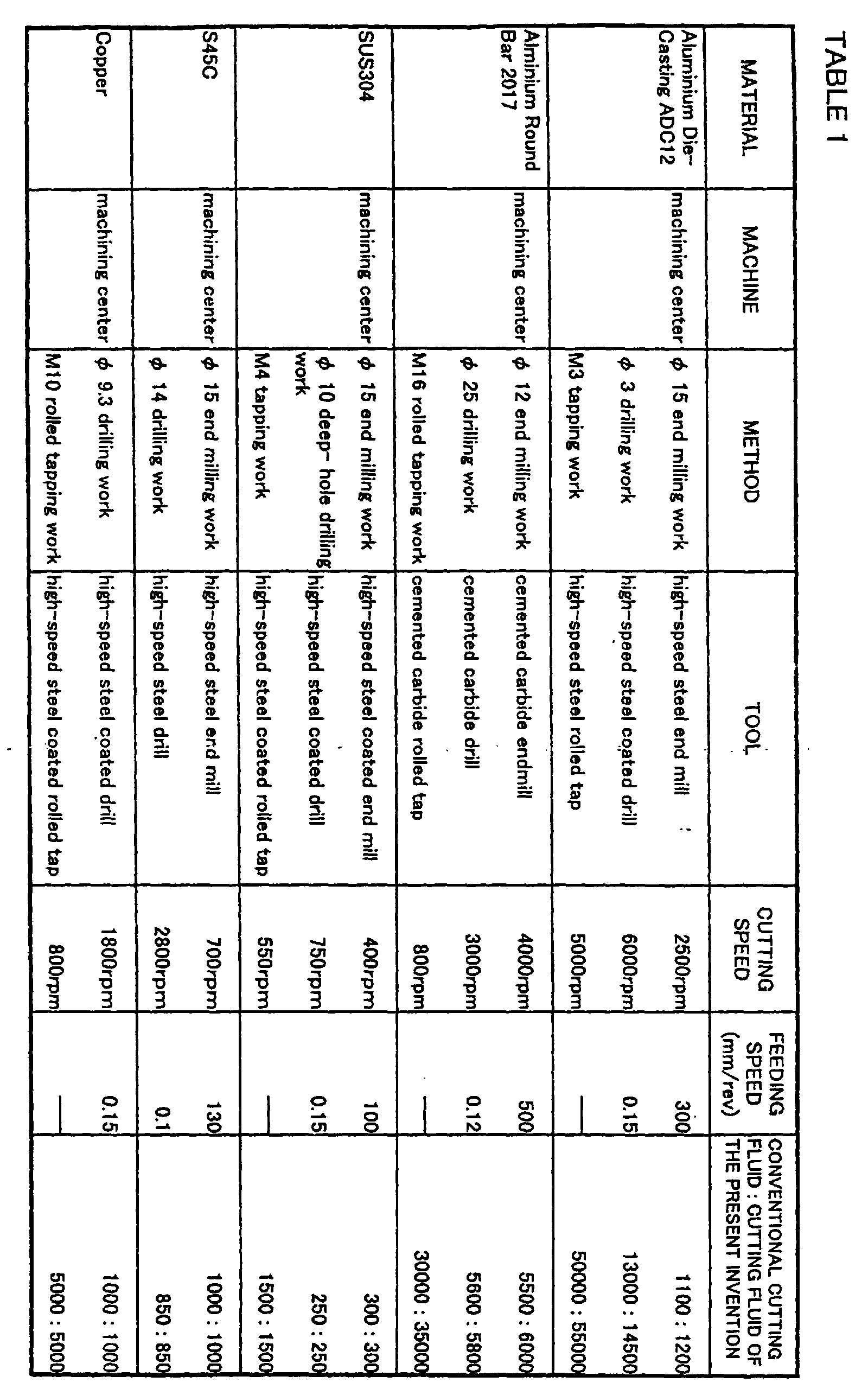
- a water-soluble cutting fluid of the present invention was supplied to a machining center. Cutting tests of aluminum, stainless steel, iron, and copper were conducted under various cutting conditions as shown in Table 1. In the same manner, comparative tests were conducted by supplying a conventional cutting fluid including chlorine to the machining center.
- a water-soluble cutting fluid of the present invention was supplied to the NC lathe. Cutting tests of aluminum, stainless steel, iron, and copper were conducted under various cutting conditions as shown in Table 2. In the same manner, comparative tests were conducted by supplying a conventional chlorine cutting fluid to the NC lathe.
- water-soluble cutting fluid II 50 g of sodium carbonate, 3 g of sodium bromide, and 300 cc of THIOLIGHT 500 (produced by CHIYODA CHEMICAL CO., LTD) to prepare water-soluble cutting fluid II.
- Concentrated water-soluble cutting fluid of the present invention was prepared by mixing 100 cc of the cutting fluid I and 1300 cc of the cutting fluid II. The pH of the mixture was 11.83 at the temperature of 25°C. This mixture was diluted 30 times with water and then the following tests were conducted in EXAMPLE 11.
- the grinding tests were conducted by using the cutting fluid II.
- the cutting fluid II was supplied to the OKAMOTO IGM-type grinding machine with a grind wheel #60, which inner diameter is 10 mm and which outer diameter is 150 mm.
- SCM435 and SCM412 shafts which diameters were from 30 mm to 50 mm, were used.
- the grinding machine was operated at 120 r.p.m. and 500 mm per second of feeding speed in roughing, and 800 mm per second of feeding speed in finishing.
- Comparative tests were conducted by using conventional grinding fluids, Neocool and UK-465, which were used after being diluted 40 times and 30 times with water, respectively.
- the cutting fluid II had the same effect as Neocool , thus preventing loading of the grinding wheel effectively.
- the cutting fluid II produced less loading of the grinding wheel than UK-465, and was more than 20 % or more effective than UK-465.
- the number of revolution of the grinding wheel was reduced by 20 %, compared to that of UK-465.
- a water-soluble cutting fluid which is used as a substitute for conventionally-used cutting oil or cutting fluid including chlorine, can be obtained according to the present invention.
- Said water-soluble cutting fluid is characterized by low viscosity, excellent liquid flow in a pomp, and excellent lubricating and cooling properties. Therefore, a water-soluble cutting fluid of the present invention increases the useful life of a cutting tool and improves the operation efficiency.
- waste fluid of a water-soluble cutting fluid of the present invention does not include environmentally-hazardous substances, e.g., chlorine, which lead to the generation of dioxin, and other toxic substances. Therefore, it does not exert a bad influence on the environment.
Landscapes
- Chemical & Material Sciences (AREA)
- Chemical Kinetics & Catalysis (AREA)
- General Chemical & Material Sciences (AREA)
- Oil, Petroleum & Natural Gas (AREA)
- Organic Chemistry (AREA)
- Inorganic Chemistry (AREA)
- Lubricants (AREA)
Abstract
Description

Claims (6)
- A water-soluble cutting fluid comprising bromide ion, carbonic acid ion and hydrogencarbonate ion, and having a pH of 7.0 to 11.5.
- A water-soluble cutting fluid according to claim 1, wherein said cutting fluid mainly contains a solution of sodium carbonate and sodium bromide.
- A water-soluble cutting fluid according to claim 1, wherein said cutting fluid mainly contains bromide ion, carbonic acid ion, hydrogencarbonate ion, and fluoride ion, and having a pH of 7.0 to 11.5.
- A water-soluble cutting fluid according to claim 1, wherein said cutting fluid mainly contains a solution of sodium carbonate, sodium hydrogencarbonate, sodium bromide and sodium fluoride.
- A water-soluble cutting fluid according to any one of claims 1 to 4, wherein said cutting fluid further contains additives.
- A water-soluble cutting fluid according to any one of claims 1 to 5, wherein said additives contain one or more kinds selected form a group consisting of alcohols solvents, rust-preventive agents, brighteners, and antiseptic agents.
Applications Claiming Priority (1)
| Application Number | Priority Date | Filing Date | Title |
|---|---|---|---|
| PCT/JP1998/002743 WO1999066014A1 (en) | 1998-06-18 | 1998-06-18 | Water-soluble cutting fluid |
Publications (2)
| Publication Number | Publication Date |
|---|---|
| EP1013751A1 true EP1013751A1 (en) | 2000-06-28 |
| EP1013751A4 EP1013751A4 (en) | 2003-02-05 |
Family
ID=14208440
Family Applications (1)
| Application Number | Title | Priority Date | Filing Date |
|---|---|---|---|
| EP98928587A Withdrawn EP1013751A4 (en) | 1998-06-18 | 1998-06-18 | Water-soluble cutting fluid |
Country Status (7)
| Country | Link |
|---|---|
| US (1) | US6242391B1 (en) |
| EP (1) | EP1013751A4 (en) |
| JP (1) | JP3368892B2 (en) |
| KR (1) | KR100525971B1 (en) |
| AU (1) | AU8036498A (en) |
| TW (1) | TW475943B (en) |
| WO (1) | WO1999066014A1 (en) |
Cited By (4)
| Publication number | Priority date | Publication date | Assignee | Title |
|---|---|---|---|---|
| EP1081211A4 (en) * | 1999-02-19 | 2003-02-05 | Yasuo Fukutani | Lubricating fluid |
| DE102006045065A1 (en) * | 2006-09-21 | 2008-03-27 | Schülke & Mayr GmbH | Microbicidal preparation based on 1,2-benzisothiazolin-3-one |
| DE102006045066A1 (en) * | 2006-09-21 | 2008-04-03 | Schülke & Mayr GmbH | Microbicidal preparation based on 1,2-benzisothiazolin-3-one with an aromatic alcohol content |
| EP3360413A1 (en) | 2017-02-08 | 2018-08-15 | Schülke & Mayr GmbH | New preservative composition based on 1,2-benzisothiazolin-3-one |
Families Citing this family (17)
| Publication number | Priority date | Publication date | Assignee | Title |
|---|---|---|---|---|
| WO1999021944A1 (en) * | 1997-10-24 | 1999-05-06 | Sadao Futahashi | Metal working water and metal working composition |
| JP3368892B2 (en) * | 1998-06-18 | 2003-01-20 | 泰雄 福谷 | Water soluble cutting fluid |
| DE19833894A1 (en) * | 1998-07-28 | 2000-02-03 | Fuchs Dea Schmierstoffe Gmbh & | Water-miscible coolant concentrate |
| TWI229127B (en) | 1999-10-06 | 2005-03-11 | Kikuko Fukutani | Metal working fluid |
| EP1305381A4 (en) | 2000-07-28 | 2007-07-18 | Corning Inc | High performance cutting fluids for glassy, crystalline, or aggregate materials |
| BRPI0315900B1 (en) * | 2002-11-04 | 2016-09-06 | Ashland Licensing & Intellectu | method of neutralizing, removing and / or preventing growth of undifferentiated or virally infected hyperproliferative cells suspended in physiological fluid |
| US7048863B2 (en) * | 2003-07-08 | 2006-05-23 | Ashland Licensing And Intellectual Property Llc | Device and process for treating cutting fluids using ultrasound |
| US8112860B2 (en) * | 2003-12-17 | 2012-02-14 | Stephen Collins | Method of treating glazing panels |
| US20110237471A1 (en) * | 2004-03-26 | 2011-09-29 | Council Of Scientific & Industrial Research | Process for metalworking fluid from heavy alkylate |
| JP2006312735A (en) * | 2005-04-07 | 2006-11-16 | Shinei Seisakusho:Kk | Electrolyzed water solution for metal working |
| JP4856511B2 (en) * | 2006-10-12 | 2012-01-18 | 大智化学産業株式会社 | Drilling plate and drilling method |
| RU2348682C1 (en) * | 2007-05-16 | 2009-03-10 | Государственное образовательное учреждение высшего профессионального образования "Ивановский государственный энергетический университет имени В.И. Ленина" (ИГЭУ) | Technical washing fluid for finish machining of silver and silver-based alloys |
| EP2042489A1 (en) * | 2007-09-26 | 2009-04-01 | Straetmans high TAC GmbH | Removal and prevention of discolouration of pyrithione-containing materials |
| US8091455B2 (en) | 2008-01-30 | 2012-01-10 | Cummins Filtration Ip, Inc. | Apparatus, system, and method for cutting tubes |
| WO2015077209A1 (en) * | 2013-11-19 | 2015-05-28 | Arch Chemicals, Inc. | Enhanced preservative |
| WO2015198677A1 (en) * | 2014-06-24 | 2015-12-30 | 株式会社Ihi | Cutting fluid |
| CN104120015B (en) * | 2014-06-30 | 2016-05-25 | 安徽铖友汽车零部件制造有限公司 | Cutting fluid that a kind of antirust, anti-corrosive lubricity cooling is good and preparation method thereof |
Family Cites Families (10)
| Publication number | Priority date | Publication date | Assignee | Title |
|---|---|---|---|---|
| US3215630A (en) * | 1964-11-12 | 1965-11-02 | Cincinnati Milling Machine Co | Cutting composition |
| US3669858A (en) * | 1970-05-21 | 1972-06-13 | Gen Motors Corp | Electrochemical machining |
| US3750847A (en) * | 1972-05-03 | 1973-08-07 | Master Chemical Corp | Method of supplying an aqueous cutting fluid to machine tools |
| ZA805265B (en) * | 1979-08-29 | 1982-10-27 | Lysaght Australia Ltd | Temper rolling fluids |
| US4406812A (en) * | 1980-12-04 | 1983-09-27 | Chemed Corporation | Deodorant and reconditioner for metal working fluids |
| JPH06101457B2 (en) * | 1986-06-10 | 1994-12-12 | 株式会社ジャパンエナジー | Mirror polishing liquid for GaAs wafer and mirror polishing method |
| JPH0727881B2 (en) * | 1986-06-10 | 1995-03-29 | 株式会社ジャパンエナジー | InP wafer mirror polishing liquid and mirror polishing method |
| US5061389A (en) * | 1990-04-19 | 1991-10-29 | Man-Gill Chemical Co. | Water surface enhancer and lubricant for formed metal surfaces |
| JP2875923B2 (en) * | 1992-02-14 | 1999-03-31 | ユシロ化学工業株式会社 | Grinding oil for electrolytic dressing grinding and electrolytic dressing method |
| JP3368892B2 (en) * | 1998-06-18 | 2003-01-20 | 泰雄 福谷 | Water soluble cutting fluid |
-
1998
- 1998-06-18 JP JP2000554824A patent/JP3368892B2/en not_active Expired - Fee Related
- 1998-06-18 KR KR10-2000-7001597A patent/KR100525971B1/en not_active Expired - Fee Related
- 1998-06-18 EP EP98928587A patent/EP1013751A4/en not_active Withdrawn
- 1998-06-18 WO PCT/JP1998/002743 patent/WO1999066014A1/en not_active Ceased
- 1998-06-18 US US09/486,211 patent/US6242391B1/en not_active Expired - Fee Related
- 1998-06-18 AU AU80364/98A patent/AU8036498A/en not_active Abandoned
-
1999
- 1999-06-14 TW TW088109882A patent/TW475943B/en active
Cited By (8)
| Publication number | Priority date | Publication date | Assignee | Title |
|---|---|---|---|---|
| EP1081211A4 (en) * | 1999-02-19 | 2003-02-05 | Yasuo Fukutani | Lubricating fluid |
| DE102006045065A1 (en) * | 2006-09-21 | 2008-03-27 | Schülke & Mayr GmbH | Microbicidal preparation based on 1,2-benzisothiazolin-3-one |
| DE102006045066A1 (en) * | 2006-09-21 | 2008-04-03 | Schülke & Mayr GmbH | Microbicidal preparation based on 1,2-benzisothiazolin-3-one with an aromatic alcohol content |
| EP1908349A3 (en) * | 2006-09-21 | 2010-04-28 | Air Liquide Sante (International) | Microbicidal preparations based on 1,2-benzisothiazolin-3-one |
| DE102006045066B4 (en) * | 2006-09-21 | 2010-07-01 | Schülke & Mayr GmbH | Microbicidal preparation based on 1,2-benzisothiazolin-3-one with an aromatic alcohol content |
| EP2641470A1 (en) * | 2006-09-21 | 2013-09-25 | Air Liquide Santé (International) | Microbicidal preparations based on 1,2-benzisothiazolin-3-one |
| US9872496B2 (en) | 2006-09-21 | 2018-01-23 | Air Liquide Sante (International) | Microbicidal preparations based on 1, 2-benzisothiazonlin-3-one with a content of aromatic alcohol |
| EP3360413A1 (en) | 2017-02-08 | 2018-08-15 | Schülke & Mayr GmbH | New preservative composition based on 1,2-benzisothiazolin-3-one |
Also Published As
| Publication number | Publication date |
|---|---|
| US6242391B1 (en) | 2001-06-05 |
| TW475943B (en) | 2002-02-11 |
| KR20010022989A (en) | 2001-03-26 |
| WO1999066014A1 (en) | 1999-12-23 |
| AU8036498A (en) | 2000-01-05 |
| JP3368892B2 (en) | 2003-01-20 |
| EP1013751A4 (en) | 2003-02-05 |
| KR100525971B1 (en) | 2005-11-03 |
Similar Documents
| Publication | Publication Date | Title |
|---|---|---|
| US6242391B1 (en) | Water-soluble cutting fluid | |
| US6258759B1 (en) | Metal working water and metal working composition | |
| US6448207B1 (en) | Metal working fluid | |
| EP3394230B1 (en) | Metalworking fluid | |
| US8722592B2 (en) | Use of triazoles in reducing cobalt leaching from cobalt-containing metal working tools | |
| JPWO1999066014A1 (en) | water soluble cutting fluid | |
| JPWO2001025374A1 (en) | metal working fluid | |
| JPWO1999021944A1 (en) | Metal-working water and metal-working composition | |
| CN106929137A (en) | Fully synthetic cutting fluid | |
| EP3042946A1 (en) | Bio-lubricating metalworking fluid free of oils and emulsifiers | |
| CN104877737B (en) | Aerospace equipment special material emulsion cutting fluid and preparation method and purposes | |
| CN115029175A (en) | Zinc alloy cutting fluid free of phosphorus and boron and preparation method thereof | |
| HK1030963A (en) | Water-soluble cutting fuild | |
| RU2415177C2 (en) | Lubricant coolant | |
| RU1822197C (en) | Coolant-lubricant liquid concentrate for mechanical treatment of metals | |
| RU2255966C1 (en) | Lubricant-and-coolant concentrate for metal working | |
| JP4005204B2 (en) | Water-soluble cutting grinding fluid for cemented carbide | |
| US20060160710A1 (en) | Synthetic metal working fluids for ferrous metals | |
| RU2679651C1 (en) | Coolant-cutting fluid | |
| CN111303979A (en) | A kind of green environmental protection water-based fully synthetic cutting fluid and its preparation method and application | |
| Lindsay et al. | Cutting Oils | |
| SU1100299A1 (en) | Cutting fluid for grinding and honing metals | |
| RU2174147C2 (en) | Lubrication fluid for metal machining | |
| JP2000087074A (en) | Water-soluble oil for machining cemented carbide | |
| GB2249556A (en) | Water-in-oil emulsions |
Legal Events
| Date | Code | Title | Description |
|---|---|---|---|
| PUAI | Public reference made under article 153(3) epc to a published international application that has entered the european phase |
Free format text: ORIGINAL CODE: 0009012 |
|
| 17P | Request for examination filed |
Effective date: 20000218 |
|
| AK | Designated contracting states |
Kind code of ref document: A1 Designated state(s): CH DE DK FR GB IT LI SE |
|
| A4 | Supplementary search report drawn up and despatched |
Effective date: 20021220 |
|
| RIC1 | Information provided on ipc code assigned before grant |
Ipc: 7C 10N 40:22 Z Ipc: 7C 10M 125:18 J Ipc: 7C 10M 125:10 J Ipc: 7C 10M 173/00 J Ipc: 7C 10M 173/00 A |
|
| 17Q | First examination report despatched |
Effective date: 20050419 |
|
| REG | Reference to a national code |
Ref country code: HK Ref legal event code: WD Ref document number: 1030963 Country of ref document: HK |
|
| STAA | Information on the status of an ep patent application or granted ep patent |
Free format text: STATUS: THE APPLICATION IS DEEMED TO BE WITHDRAWN |
|
| 18D | Application deemed to be withdrawn |
Effective date: 20070103 |