EP1016777B1 - Dispositif de purification catalytique - Google Patents
Dispositif de purification catalytique Download PDFInfo
- Publication number
- EP1016777B1 EP1016777B1 EP99850220A EP99850220A EP1016777B1 EP 1016777 B1 EP1016777 B1 EP 1016777B1 EP 99850220 A EP99850220 A EP 99850220A EP 99850220 A EP99850220 A EP 99850220A EP 1016777 B1 EP1016777 B1 EP 1016777B1
- Authority
- EP
- European Patent Office
- Prior art keywords
- gas flow
- carrier
- walls
- recited
- catalytic treatment
- Prior art date
- Legal status (The legal status is an assumption and is not a legal conclusion. Google has not performed a legal analysis and makes no representation as to the accuracy of the status listed.)
- Expired - Lifetime
Links
Images


Classifications
-
- F—MECHANICAL ENGINEERING; LIGHTING; HEATING; WEAPONS; BLASTING
- F28—HEAT EXCHANGE IN GENERAL
- F28D—HEAT-EXCHANGE APPARATUS, NOT PROVIDED FOR IN ANOTHER SUBCLASS, IN WHICH THE HEAT-EXCHANGE MEDIA DO NOT COME INTO DIRECT CONTACT
- F28D9/00—Heat-exchange apparatus having stationary plate-like or laminated conduit assemblies for both heat-exchange media, the media being in contact with different sides of a conduit wall
- F28D9/0025—Heat-exchange apparatus having stationary plate-like or laminated conduit assemblies for both heat-exchange media, the media being in contact with different sides of a conduit wall the conduits being formed by zig-zag bend plates
-
- F—MECHANICAL ENGINEERING; LIGHTING; HEATING; WEAPONS; BLASTING
- F01—MACHINES OR ENGINES IN GENERAL; ENGINE PLANTS IN GENERAL; STEAM ENGINES
- F01N—GAS-FLOW SILENCERS OR EXHAUST APPARATUS FOR MACHINES OR ENGINES IN GENERAL; GAS-FLOW SILENCERS OR EXHAUST APPARATUS FOR INTERNAL-COMBUSTION ENGINES
- F01N3/00—Exhaust or silencing apparatus having means for purifying, rendering innocuous, or otherwise treating exhaust
- F01N3/08—Exhaust or silencing apparatus having means for purifying, rendering innocuous, or otherwise treating exhaust for rendering innocuous
- F01N3/0807—Exhaust or silencing apparatus having means for purifying, rendering innocuous, or otherwise treating exhaust for rendering innocuous by using absorbents or adsorbents
- F01N3/0814—Exhaust or silencing apparatus having means for purifying, rendering innocuous, or otherwise treating exhaust for rendering innocuous by using absorbents or adsorbents combined with catalytic converters, e.g. NOx absorption/storage reduction catalysts
-
- F—MECHANICAL ENGINEERING; LIGHTING; HEATING; WEAPONS; BLASTING
- F01—MACHINES OR ENGINES IN GENERAL; ENGINE PLANTS IN GENERAL; STEAM ENGINES
- F01N—GAS-FLOW SILENCERS OR EXHAUST APPARATUS FOR MACHINES OR ENGINES IN GENERAL; GAS-FLOW SILENCERS OR EXHAUST APPARATUS FOR INTERNAL-COMBUSTION ENGINES
- F01N3/00—Exhaust or silencing apparatus having means for purifying, rendering innocuous, or otherwise treating exhaust
- F01N3/08—Exhaust or silencing apparatus having means for purifying, rendering innocuous, or otherwise treating exhaust for rendering innocuous
- F01N3/0807—Exhaust or silencing apparatus having means for purifying, rendering innocuous, or otherwise treating exhaust for rendering innocuous by using absorbents or adsorbents
- F01N3/0871—Exhaust or silencing apparatus having means for purifying, rendering innocuous, or otherwise treating exhaust for rendering innocuous by using absorbents or adsorbents using means for controlling, e.g. purging, the absorbents or adsorbents
-
- F—MECHANICAL ENGINEERING; LIGHTING; HEATING; WEAPONS; BLASTING
- F01—MACHINES OR ENGINES IN GENERAL; ENGINE PLANTS IN GENERAL; STEAM ENGINES
- F01N—GAS-FLOW SILENCERS OR EXHAUST APPARATUS FOR MACHINES OR ENGINES IN GENERAL; GAS-FLOW SILENCERS OR EXHAUST APPARATUS FOR INTERNAL-COMBUSTION ENGINES
- F01N3/00—Exhaust or silencing apparatus having means for purifying, rendering innocuous, or otherwise treating exhaust
- F01N3/08—Exhaust or silencing apparatus having means for purifying, rendering innocuous, or otherwise treating exhaust for rendering innocuous
- F01N3/10—Exhaust or silencing apparatus having means for purifying, rendering innocuous, or otherwise treating exhaust for rendering innocuous by thermal or catalytic conversion of noxious components of exhaust
- F01N3/18—Exhaust or silencing apparatus having means for purifying, rendering innocuous, or otherwise treating exhaust for rendering innocuous by thermal or catalytic conversion of noxious components of exhaust characterised by methods of operation; Control
- F01N3/20—Exhaust or silencing apparatus having means for purifying, rendering innocuous, or otherwise treating exhaust for rendering innocuous by thermal or catalytic conversion of noxious components of exhaust characterised by methods of operation; Control specially adapted for catalytic conversion
- F01N3/2006—Periodically heating or cooling catalytic reactors, e.g. at cold starting or overheating
-
- F—MECHANICAL ENGINEERING; LIGHTING; HEATING; WEAPONS; BLASTING
- F01—MACHINES OR ENGINES IN GENERAL; ENGINE PLANTS IN GENERAL; STEAM ENGINES
- F01N—GAS-FLOW SILENCERS OR EXHAUST APPARATUS FOR MACHINES OR ENGINES IN GENERAL; GAS-FLOW SILENCERS OR EXHAUST APPARATUS FOR INTERNAL-COMBUSTION ENGINES
- F01N3/00—Exhaust or silencing apparatus having means for purifying, rendering innocuous, or otherwise treating exhaust
- F01N3/08—Exhaust or silencing apparatus having means for purifying, rendering innocuous, or otherwise treating exhaust for rendering innocuous
- F01N3/10—Exhaust or silencing apparatus having means for purifying, rendering innocuous, or otherwise treating exhaust for rendering innocuous by thermal or catalytic conversion of noxious components of exhaust
- F01N3/18—Exhaust or silencing apparatus having means for purifying, rendering innocuous, or otherwise treating exhaust for rendering innocuous by thermal or catalytic conversion of noxious components of exhaust characterised by methods of operation; Control
- F01N3/20—Exhaust or silencing apparatus having means for purifying, rendering innocuous, or otherwise treating exhaust for rendering innocuous by thermal or catalytic conversion of noxious components of exhaust characterised by methods of operation; Control specially adapted for catalytic conversion
- F01N3/2006—Periodically heating or cooling catalytic reactors, e.g. at cold starting or overheating
- F01N3/2013—Periodically heating or cooling catalytic reactors, e.g. at cold starting or overheating using electric or magnetic heating means
-
- F—MECHANICAL ENGINEERING; LIGHTING; HEATING; WEAPONS; BLASTING
- F01—MACHINES OR ENGINES IN GENERAL; ENGINE PLANTS IN GENERAL; STEAM ENGINES
- F01N—GAS-FLOW SILENCERS OR EXHAUST APPARATUS FOR MACHINES OR ENGINES IN GENERAL; GAS-FLOW SILENCERS OR EXHAUST APPARATUS FOR INTERNAL-COMBUSTION ENGINES
- F01N3/00—Exhaust or silencing apparatus having means for purifying, rendering innocuous, or otherwise treating exhaust
- F01N3/08—Exhaust or silencing apparatus having means for purifying, rendering innocuous, or otherwise treating exhaust for rendering innocuous
- F01N3/10—Exhaust or silencing apparatus having means for purifying, rendering innocuous, or otherwise treating exhaust for rendering innocuous by thermal or catalytic conversion of noxious components of exhaust
- F01N3/18—Exhaust or silencing apparatus having means for purifying, rendering innocuous, or otherwise treating exhaust for rendering innocuous by thermal or catalytic conversion of noxious components of exhaust characterised by methods of operation; Control
- F01N3/20—Exhaust or silencing apparatus having means for purifying, rendering innocuous, or otherwise treating exhaust for rendering innocuous by thermal or catalytic conversion of noxious components of exhaust characterised by methods of operation; Control specially adapted for catalytic conversion
- F01N3/2006—Periodically heating or cooling catalytic reactors, e.g. at cold starting or overheating
- F01N3/2033—Periodically heating or cooling catalytic reactors, e.g. at cold starting or overheating using a fuel burner or introducing fuel into exhaust duct
-
- F—MECHANICAL ENGINEERING; LIGHTING; HEATING; WEAPONS; BLASTING
- F01—MACHINES OR ENGINES IN GENERAL; ENGINE PLANTS IN GENERAL; STEAM ENGINES
- F01N—GAS-FLOW SILENCERS OR EXHAUST APPARATUS FOR MACHINES OR ENGINES IN GENERAL; GAS-FLOW SILENCERS OR EXHAUST APPARATUS FOR INTERNAL-COMBUSTION ENGINES
- F01N3/00—Exhaust or silencing apparatus having means for purifying, rendering innocuous, or otherwise treating exhaust
- F01N3/08—Exhaust or silencing apparatus having means for purifying, rendering innocuous, or otherwise treating exhaust for rendering innocuous
- F01N3/10—Exhaust or silencing apparatus having means for purifying, rendering innocuous, or otherwise treating exhaust for rendering innocuous by thermal or catalytic conversion of noxious components of exhaust
- F01N3/24—Exhaust or silencing apparatus having means for purifying, rendering innocuous, or otherwise treating exhaust for rendering innocuous by thermal or catalytic conversion of noxious components of exhaust characterised by constructional aspects of converting apparatus
- F01N3/28—Construction of catalytic reactors
- F01N3/2803—Construction of catalytic reactors characterised by structure, by material or by manufacturing of catalyst support
- F01N3/2807—Metal other than sintered metal
-
- F—MECHANICAL ENGINEERING; LIGHTING; HEATING; WEAPONS; BLASTING
- F01—MACHINES OR ENGINES IN GENERAL; ENGINE PLANTS IN GENERAL; STEAM ENGINES
- F01N—GAS-FLOW SILENCERS OR EXHAUST APPARATUS FOR MACHINES OR ENGINES IN GENERAL; GAS-FLOW SILENCERS OR EXHAUST APPARATUS FOR INTERNAL-COMBUSTION ENGINES
- F01N3/00—Exhaust or silencing apparatus having means for purifying, rendering innocuous, or otherwise treating exhaust
- F01N3/08—Exhaust or silencing apparatus having means for purifying, rendering innocuous, or otherwise treating exhaust for rendering innocuous
- F01N3/10—Exhaust or silencing apparatus having means for purifying, rendering innocuous, or otherwise treating exhaust for rendering innocuous by thermal or catalytic conversion of noxious components of exhaust
- F01N3/24—Exhaust or silencing apparatus having means for purifying, rendering innocuous, or otherwise treating exhaust for rendering innocuous by thermal or catalytic conversion of noxious components of exhaust characterised by constructional aspects of converting apparatus
- F01N3/28—Construction of catalytic reactors
- F01N3/2882—Catalytic reactors combined or associated with other devices, e.g. exhaust silencers or other exhaust purification devices
- F01N3/2889—Catalytic reactors combined or associated with other devices, e.g. exhaust silencers or other exhaust purification devices with heat exchangers in a single housing
-
- F—MECHANICAL ENGINEERING; LIGHTING; HEATING; WEAPONS; BLASTING
- F01—MACHINES OR ENGINES IN GENERAL; ENGINE PLANTS IN GENERAL; STEAM ENGINES
- F01N—GAS-FLOW SILENCERS OR EXHAUST APPARATUS FOR MACHINES OR ENGINES IN GENERAL; GAS-FLOW SILENCERS OR EXHAUST APPARATUS FOR INTERNAL-COMBUSTION ENGINES
- F01N3/00—Exhaust or silencing apparatus having means for purifying, rendering innocuous, or otherwise treating exhaust
- F01N3/08—Exhaust or silencing apparatus having means for purifying, rendering innocuous, or otherwise treating exhaust for rendering innocuous
- F01N3/10—Exhaust or silencing apparatus having means for purifying, rendering innocuous, or otherwise treating exhaust for rendering innocuous by thermal or catalytic conversion of noxious components of exhaust
- F01N3/24—Exhaust or silencing apparatus having means for purifying, rendering innocuous, or otherwise treating exhaust for rendering innocuous by thermal or catalytic conversion of noxious components of exhaust characterised by constructional aspects of converting apparatus
- F01N3/30—Arrangements for supply of additional air
- F01N3/306—Preheating additional air
-
- F—MECHANICAL ENGINEERING; LIGHTING; HEATING; WEAPONS; BLASTING
- F01—MACHINES OR ENGINES IN GENERAL; ENGINE PLANTS IN GENERAL; STEAM ENGINES
- F01N—GAS-FLOW SILENCERS OR EXHAUST APPARATUS FOR MACHINES OR ENGINES IN GENERAL; GAS-FLOW SILENCERS OR EXHAUST APPARATUS FOR INTERNAL-COMBUSTION ENGINES
- F01N2240/00—Combination or association of two or more different exhaust treating devices, or of at least one such device with an auxiliary device, not covered by indexing codes F01N2230/00 or F01N2250/00, one of the devices being
- F01N2240/02—Combination or association of two or more different exhaust treating devices, or of at least one such device with an auxiliary device, not covered by indexing codes F01N2230/00 or F01N2250/00, one of the devices being a heat exchanger
-
- F—MECHANICAL ENGINEERING; LIGHTING; HEATING; WEAPONS; BLASTING
- F01—MACHINES OR ENGINES IN GENERAL; ENGINE PLANTS IN GENERAL; STEAM ENGINES
- F01N—GAS-FLOW SILENCERS OR EXHAUST APPARATUS FOR MACHINES OR ENGINES IN GENERAL; GAS-FLOW SILENCERS OR EXHAUST APPARATUS FOR INTERNAL-COMBUSTION ENGINES
- F01N2330/00—Structure of catalyst support or particle filter
- F01N2330/30—Honeycomb supports characterised by their structural details
- F01N2330/32—Honeycomb supports characterised by their structural details characterised by the shape, form or number of corrugations of plates, sheets or foils
- F01N2330/323—Corrugations of saw-tooth or triangular form
-
- F—MECHANICAL ENGINEERING; LIGHTING; HEATING; WEAPONS; BLASTING
- F01—MACHINES OR ENGINES IN GENERAL; ENGINE PLANTS IN GENERAL; STEAM ENGINES
- F01N—GAS-FLOW SILENCERS OR EXHAUST APPARATUS FOR MACHINES OR ENGINES IN GENERAL; GAS-FLOW SILENCERS OR EXHAUST APPARATUS FOR INTERNAL-COMBUSTION ENGINES
- F01N2330/00—Structure of catalyst support or particle filter
- F01N2330/30—Honeycomb supports characterised by their structural details
- F01N2330/40—Honeycomb supports characterised by their structural details made of a single sheet, foil or plate
-
- F—MECHANICAL ENGINEERING; LIGHTING; HEATING; WEAPONS; BLASTING
- F01—MACHINES OR ENGINES IN GENERAL; ENGINE PLANTS IN GENERAL; STEAM ENGINES
- F01N—GAS-FLOW SILENCERS OR EXHAUST APPARATUS FOR MACHINES OR ENGINES IN GENERAL; GAS-FLOW SILENCERS OR EXHAUST APPARATUS FOR INTERNAL-COMBUSTION ENGINES
- F01N2330/00—Structure of catalyst support or particle filter
- F01N2330/30—Honeycomb supports characterised by their structural details
- F01N2330/48—Honeycomb supports characterised by their structural details characterised by the number of flow passages, e.g. cell density
-
- F—MECHANICAL ENGINEERING; LIGHTING; HEATING; WEAPONS; BLASTING
- F01—MACHINES OR ENGINES IN GENERAL; ENGINE PLANTS IN GENERAL; STEAM ENGINES
- F01N—GAS-FLOW SILENCERS OR EXHAUST APPARATUS FOR MACHINES OR ENGINES IN GENERAL; GAS-FLOW SILENCERS OR EXHAUST APPARATUS FOR INTERNAL-COMBUSTION ENGINES
- F01N2470/00—Structure or shape of exhaust gas passages, pipes or tubes
- F01N2470/18—Structure or shape of exhaust gas passages, pipes or tubes the axis of inlet or outlet tubes being other than the longitudinal axis of apparatus
-
- Y—GENERAL TAGGING OF NEW TECHNOLOGICAL DEVELOPMENTS; GENERAL TAGGING OF CROSS-SECTIONAL TECHNOLOGIES SPANNING OVER SEVERAL SECTIONS OF THE IPC; TECHNICAL SUBJECTS COVERED BY FORMER USPC CROSS-REFERENCE ART COLLECTIONS [XRACs] AND DIGESTS
- Y02—TECHNOLOGIES OR APPLICATIONS FOR MITIGATION OR ADAPTATION AGAINST CLIMATE CHANGE
- Y02T—CLIMATE CHANGE MITIGATION TECHNOLOGIES RELATED TO TRANSPORTATION
- Y02T10/00—Road transport of goods or passengers
- Y02T10/10—Internal combustion engine [ICE] based vehicles
- Y02T10/12—Improving ICE efficiencies
Definitions
- the present invention relates generally to a device for catalytic treatment of a gas flow.
- BACKGROUND ART Solvents and other organic compounds can be removed from air by oxidation or combustion. The impurities are made to react with oxygen in the air and they are thereby converted into harmless water and carbon dioxide. A high temperature is normally required for the reaction to proceed. Once the reaction has been initiated by ignition, however, the heat developed during the reaction is often sufficient to maintain a working temperature, provided the impurity concentration exceeds a lower explosive limit, but is below an upper explosive limit. For safety reasons, however, in most normal industrial processes care is taken to remain well below the explosive limit when air containing solvents or other combustible vapors are involved. This means that emissions of ventilating air containing impurities are virtually always below the explosive limit and usually far below.
- One way to reduce the reaction temperature, and thus energy consumption, is to let the reaction proceed with the help of catalysts.
- contact with metals from the platinum group can provide a good reaction rate even at temperatures as low as 200°C or 300°C.
- Catalysts consisting of various blends of metal oxides may also be used. This field is quite large and new catalysts and ways of handling these catalysts to provide better catalytic activity are continuously being developed. However, temperatures well above room temperature are still normally needed in order to achieve a satisfactory reaction rate.
- a catalytic purification device In which a preheating heat exchanger is an integrated part of the device.
- the device according to WO 96/04509 provides heat economy by heat exchange between incoming and outgoing flows in the device.
- the temperature of the exhaust gas is insufficient to start the catalytic reaction.
- the exhaust gas is rich in hydrocarbons which pass through the cold catalytic purification device substantially unaffected.
- a device according to WO 96/04509 is provided with a heating element which supplies heat to raise the temperature of the exhaust gas and start the catalytic reaction.
- a preliminary catalytic reactor is provided in series with a hydrocarbon trap and a second catalytic reactor within a single canister.
- the hydrocarbon trap adsorbs hydrocarbons during the initial minutes of operation when the exhaust gas is below the ignition temperature of the catalyst. When the temperature rises, the hydrocarbons are released from the hydrocarbon trap and transferred to the second catalytic reactor.
- such a device has been found to be exceedingly bulky and cannot be used for applications where space is limited. Moreover, the device exhibits a large pressure-drop between the inlet and the outlet thereof.
- EP6610908 Another example of a catalytic reactor provided in series with a hydrocarbon trap is given in EP661098, which is a conventional example of how to arrange an adsorbent structure in an exhaust gas treatment system comprising adsorbent material and catalytic material.
- EP661098 describes several different exhaust gas purification systems all including a downstream catalytic element and an adsorbent or adsorbent/catalytic body positioned on the upstream side of the downstream catalytic element.
- a second catalytic body should be positioned upstream of the adsorbent or adsorbent/catalytic body.
- EP661098 thus constitutes a conventional modular building of exhaust gas purification systems making use of a combination of adsorbent/catalytic body or adsorbent body together with downstream possibly also upstream positioned catalysts.
- This modular increases the pressure drop over the arrangement. Further, the arrangement will suffer from having a rather early release of the adsorbed impurities since the adsorbent/desorbent body is arranged in an upstream position of the arrangement.
- the present invention in its several disclosed embodiments alleviates the drawbacks described above with respect to conventionally designed devices for catalytic treatment of gas flows and incorporates several additionally beneficial features.
- a device for catalytic treatment of a gas flow is provided as defined in claim 1.
- the carrier walls in the carrier body act as membranes separating incoming gas from outgoing gas.
- the carrier walls are constructed such that heat can pass from the outgoing gas to the incoming gas as in an ordinary recuperative heat exchanger.
- gas flow around the carrier walls is so arranged that heat exchange occurs in a so-called counter-current process in which the coldest part of the outgoing stream heats the incoming stream just as it is coming in, while the warmer, not yet cooled part of the outgoing stream heats the incoming stream at a later stage. This produces a high degree of heat exchange and good heating efficiency.
- the gas For efficient heat exchange, it is also important that the gas have good transfer contact with the surfaces of the carrier walls. Moreover, good contact between the gas flow and the carrier walls is advantageous in order to bring the gas stream into contact with the catalyst and the impurity-adsorbing/desorbing agent(s) which are coated onto the carrier walls. Hence, intimate contact between the carrier walls and the gas flow creates favorable conditions for achieving efficient purification of the gas flow.
- flow paths are created between the carrier walls by providing at least one of the abutting carrier wall surfaces with a three-dimensional, raised pattern.
- a pattern acts as a spacing means between the carrier wall surfaces; the thus created space between the surfaces forming flow paths through the carrier body.
- a particularly preferred raised pattern is a pattern of parallel corrugations arranged at an angle to the inlet of the catalytic purification device.
- the carrier walls have three main functions: separating an incoming gas flow from an outgoing gas flow; transferring heat between ingoing and outgoing gas flows; and carrying the catalyst and the adsorbing/desorbing agent, which are thus brought into intimate contact with a passing gas flow.
- gas is taken to mean any gas or gas mixture, such as exhaust gas from a vehicle engine, containing impurities or other compounds which are advantageously removed by passing the gas through a catalytic purification device in accordance with the present invention.
- the heat transferring membranes constituted by the carrier walls may be made of a thin metal sheet or foil, such as stainless steel, which is coated with a thin layer of catalyst and formed into a carrier body by folding or otherwise.
- the catalyst can be applied as an intermittent coating or can be applied as a continuous layer.
- the membrane may alternatively consist of a ceramic material impregnated or coated with a catalyst.
- the catalyst may be applied to only one side of the membranes, or to both sides thereof.
- the adsorption/desorption agent is a material which adsorbs impurities, usually hydrocarbons and nitrogen oxides (NO x ), at a first, lower temperature and releases the impurities at a second, higher temperature. This implies that during an initial period of operation of the purification device, when the incoming gas has a low temperature, impurities will be trapped by the adsorption/desorption agent. The trapping takes place shortly after the incoming gas has entered through the inlet. After a while, when the temperature of the incoming gas has reached the desorption temperature for the adsorption/desorption agent, the impurities are released.
- impurities usually hydrocarbons and nitrogen oxides (NO x )
- the incoming gas will lose heat when traveling through the cold purification device upon start-up which implies that the impurities will again be adsorbed further downstream in the purification device.
- all of the carrier body of the purification device will be heated and the released impurities will thus be brought into reactive contact with the catalyst.
- the desorption temperature of the adsorption/desorption agent is at least as high as the ignition temperature of the catalyst. In this manner impurities will remain trapped until the temperature is sufficiently high to obtain a catalytic reaction resulting in a high degree of purification and low emissions during the cold-start period.
- the heat-exchange function may nevertheless enable reaction in a heated part of the device. This part may be kept at a sufficient temperature, either by the reaction heat alone, or if this is insufficient, with additional heat supplied by an external heater.
- the adsorption/desorption agent may comprise any adsorptive material conventionally used to adsorb hydrocarbons, such as activated alumina, porous glass, silica gel and activated carbon.
- a particularly useful class of materials are the zeolites, which are molecular sieves having a porous structure.
- the adsorption/desorption agent may be mixed with the catalyst or may be applied to the carrier walls in areas which are macroscopically separate from catalyst carrying areas.
- the type of adsorption/desorption agent is chosen with regard to the compounds which are to be removed from the treated gas flow. Two or more different adsorption/desorption agents may be mixed to achieve a trapping effect for several different kinds of compounds. In some instances, the same material can be used both as a catalyst and as an adsorption/desorption agent.
- the device is also suitable for other combined heat exchange and catalytic treatments of gases, for example for the selective reduction of nitrogen oxides (NO x ) with ammonia or other reducing nitrogen compounds.
- the device is well suited to treating engine exhaust gases, whether they have high oxygen contents, (diesel engines) or low oxygen contents (Otto engines). This is particularly true when the temperature of the exhaust or the properties of the catalyst are such that satisfactory results cannot be achieved without heating.
- Figs. 1 and 2 show one embodiment of the present invention.
- a carrier material in the form of a long metal strip 1a is shaped by pressing, rolling, or similar process to create corrugations which run at an angle across a longitudinal axis of the strip 1a.
- the strip 1a is then repeatedly folded onto itself in zigzag form so that it forms a bundle 1b. Normally, the fold lines will be transverse to the corrugations.
- the corrugations of adjacent layers are arranged crosswise to one another and thereby serve as spacers and form gas flow channels 3 between the folded layers of strip 1a. This relationship may be best appreciated in Fig. 3.
- the flow patterns in these channels 3 are such that gas flowing through the channels 3 will be continuously mixed, thus achieving good contact with the channel walls.
- the corrugations 2 can be discontinued at regular intervals, leaving narrow, corrugation-free folding areas 4 and 5.
- alternately directed folding notches may be arranged at the folding areas 4, 5 in order to facilitate pleating of the metal strip 1a.
- the strip 1a is coated with catalyst material and an adsorption/desorption agent and is enclosed in a heat-insulated outer container 6.
- the outer container has a rectangular shape with two end walls 6a, 6b, two side walls 6c, 6d, a bottom wall 6e and a top wall 6f.
- the strip bundle 1b is sealed on the two sides 7, 8 which are arranged to be parallel to a gas flow through the strip bundle 1b.
- the ends of the bundle 1b are not sealed, but instead end in reversing chambers 9,10 as is shown in Fig. 2.
- reversing chambers 9, 10 appear in the drawings as fairly large spaces at the ends of the carrier strip bundle 1b. In reality, however the distance from each end of the strip bundle to the corresponding end wall 6a, 6b of the outer container 6 can be very small; that is on the order of 1 millimeter or less.
- the outer container 6 has an inlet which is equipped with an attachment 11 for connecting incoming gas and an outlet which is equipped with another attachment 12 for connecting outgoing gas. Due to the way the strip is folded, connection to all channels on one side of the bundle 1b can readily be made, so that the two attachments 11 and 12 each connect to one side of the strip. In the embodiment of Fig. 2, however, the inlet and the outlet are placed directly opposite each other on either side wall. The inlet 11 and the outlet 12 are centrally arranged on the side walls 6c,6d of the outer container 6, which means that the inlet 11 and the outlet 12 are positioned at an equal distance from each end walls 6a,6b of the container.
- An optional heating element 13 is shown to be located in each reversing chamber 9,10.
- the heating element consists of electric heating coils but other heating devices can also be used, such as gas or oil burners.
- the reversing chamber and the treated gas stream can be heated by supplying warm air or gas from an external source.
- the reversing chambers 9,10 may be heated by heating element 13 to a temperature that is just above the temperature which is needed for the catalytic reaction.
- the temperature in the reversing chambers is subsequently maintained at this temperature by regulating the heat that is supplied by heating element 13 or by the heat that is generated from the chemical reactions during operation of the unit.
- Gas containing impurities is supplied through intake attachment 11 and is divided into two half-flows 14, 15 which flow in opposite directions through the flow channels on the inlet side of bundle 1b towards reversing chambers 9, 10.
- the supplied gas is an exhaust gas from, for instance, a vehicle engine, it will initially be cold upon start-up. During the cold start period, the temperature of the supplied gas is low so that impurities will almost immediately be trapped by the adsorption/desorption agent wall coatings. When the temperature of the incoming gas reaches the desorption temperature for the adsorption/desorption agent, however, the impurities will be released again to the flow of gas.
- the temperature of the incoming gas will decrease as the gas travels towards the reversing chambers 9,10. This implies that the released impurities will again be adsorbed further downstream in the unit. However, eventually all of the carrier body of the purification device will be heated and the released impurities will thus be brought into reactive contact with the catalyst.
- the desorption temperature of the adsorption/desorption agent is at least as high as the ignition temperature of the catalyst. In this manner, impurities will remain trapped until the temperature is sufficiently high to immediately obtain a catalytic reaction thereby resulting in a high degree of purification and low emissions during the cold-start period. Good results, however, are also obtained when the desorption temperature of the adsorption/desorption agent is lower than the ignition temperature of the catalyst. In such a case, the impurities are desorbed at a first location in the unit and then transported downstream in the unit to a second location where the temperature is high enough to enable a catalytic reaction.
- the local temperatures of these flows are caused to be close to each other. Consequently, it is not normally necessary to supply additional heat to the reversing chambers 9,10 to support the catalytic reactions during operation of the purification unit. In this way operation of the unit is made extremely economical.
- the heat which is produced by the catalytic reactions may not be sufficient to heat the incoming gas flow to the catalyst's reaction temperature. Under such circumstances, the heating element 13 may be used to provide the additional heat which is needed.
- the gas flow is being heated to the desired temperature in the unit, it is also moving over the catalyst-coated surface which is basically at the same temperature.
- the flow passes over the catalyst surface along tortuous flow paths that result in constant mixing in a cross-sectional direction of the flow channels so that the gas is brought into repeated close contact with the catalyst. This creates favorable conditions for the reaction and, accordingly, the purification unit provides a high degree of purification.
- the device is self-regulating in temperature and adjusts itself to a working temperature that is suitably just above the temperature at which the main reaction occurs. The temperature is somewhat higher at a high flow rate than at a low flow rate.
- the catalyst and/or adsorption/desorption agent may be applied to the carrier walls in different concentrations at different areas along the flow path.
- the catalyst should be concentrated to these areas of the heat exchange catalyst carrier bundle 1b.
- Other applications may require the catalyst to be concentrated away from the reversing zones 9,10.
- the flow that is to be purified contains some substance that requires higher treatment temperatures than the main part of the impurities, it can be an advantage to coat only the outlet side of the carrier strip bundle 1b with catalyst material. Thereby, high temperatures can be achieved even with a readily reacting fuel.
- a similar effect can also be achieved using different catalysts on the two sides of the bundles, whereby the catalyst used for the heat-generating reaction is placed on the outlet side of the bundle 1b and the catalyst which is needed for the high-temperature reaction is placed on the inlet side of the bundle 1b.
- the chemical reaction mainly takes place in the warm section of the carrier strip bundle 1b.
- the part of the bundle which is closest to the inlet and outlet attachments 11,12 is normally at a low temperature and, thus, is not catalytically active, but simply serves as a heat exchanger. Consequently, in order to save costly catalyst, it is possible to limit the catalytic coating to the parts of the carrier strip which are closest to the reversing chambers 9,10. With high contents of heat-generating impurities, however, this means that the temperature in the purification device can become high, just as in the case in which the coating is applied only on the outlet side of the strip.
- the corrugations 3 in the carrier strip material are shown in Fig. 3.
- the corrugations are arranged at an acute angle to the longitudinal direction of extension of the unfolded carrier strip 1a.
- the corrugations in abutting layers run across each other as is indicated in Fig. 3.
- the flow resistance will be comparatively great and the heat transfer will be good.
- a small angle between the corrugations and the flow is preferred when a low flow resistance is desired. Accordingly, by carefully choosing the angle of the corrugations, it is possible to optimize the purification device for a particular application.
- a low pressure drop can be achieved in a flow through a purification device in accordance with the invention if the corrugations or other three-dimensional structures are arranged in such a way that the angle against the direction of flow is small.
- this normally results in a reduction of heat transfer to the walls.
- the reduction in heat transfer can be compensated with additional surface area. Depending on the circumstances, such a larger area may actually be desirable to make room for additional catalyst and additional adsorption/desorption material.
- a combined heat exchanger and catalytic reactor is obtained that has an active surface which is large within a limited volume.
- the angular corrugations which are described are not the only means to achieve a suitable spacing between the various layers in the bundle. Many other patterns with alternating protrusions and depressions can create the same results.
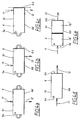
- Figs. 4a-4e show different embodiments of a purification device in accordance with the present invention in which the inlet and the outlet are arranged at different locations on an outer container housing a heat exchange catalyst carrier body.
- the embodiments shown in Figs. 4a and 4c exhibit excellent purification characteristics during a cold-start period.
- the embodiments shown in Figs. 4d and 4e have a low ability of removing impurities during cold-start periods and the embodiment shown in Fig. 4b has an intermediate purification capacity.
- the device in Fig. 4a has gas flow inlet and outlet connections 11,12 arranged on opposite sides of the outer container 6 on the longitudinal side walls 6c,6d thereof and at a distance from each container end 6a,6b which corresponds to half the distance between the ends.
- Such an arrangement of the inlet/outlet connections 11,12 may be appreciated in Figs. 1 and 2.
- An advantage to having the inlet and outlet connections 11,12 centrally arranged on the outer container 6 is that flow resistance in the purification device is minimized.
- a further advantage is that there is no need to seal off the inlet and outlet ends of the heat exchange catalyst carrier body.
- the device in Fig. 4b has the inlet connection 11 displaced towards a first end 6a of the outer container 6 and the outlet connection 12 displaced towards the second end 6b of the outer container.
- the inlet and outlet connections are symmetrically arranged on the side walls 6c, 6d of the outer container 6. Such an arrangement offers a relatively low pressure resistance in the device and, at the same time, exhibits fairly good heat exchange properties.
- the inlet and outlet connections 11,12 are arranged at one end 6b of the outer container 6, implying good heat exchange, but a high pressure resistance.
- the heat exchange catalyst carrier body has to be sealed at the inlet and outlet end 6b.
- Fig. 4d shows a device having the inlet connection 11 at one end 6a thereof and the outlet connection 12 at the opposite end 6b.
- Such a device provides excellent mixing of a treated gas flow, and is a catalytic reactor without heat exchange capacity.
- the purification device in Fig. 4e has a heat exchange catalyst carrier body which is made up of two serially arranged parts 1b', 1b", which are rotated 90° in relation to each other around a longitudinal axis through the device.
- the inlet and outlet connections 11,12 are arranged at opposing transverse ends 6a,6b of the device. Accordingly, a gas flow through the device runs in only one main direction.
- the device in Fig. 4e offers further improved mixing of a treated gas flow.
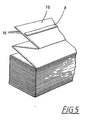
- Fig. 5 illustrates an alternative way of creating a reversing space at an end of a carrier strip bundle 1b.
- the carrier strip is provided with perforations 16 which permit passage of a reversing gas flow.
- a carrier strip bundle such as shown in Fig. 5 can be closely fitted inside an outer container without any space between the container end walls and the ends of the carrier strip bundle.
- a heat exchange catalyst carrier body for use in a purification device in accordance with the present Invention may have any suitable shape other than the rectangular shape which has been described herein. Accordingly, heat exchange catalyst carrier bodies having cylindrical, oval, hexagonal, triangular or other cross-sections can be used.
Landscapes
- Engineering & Computer Science (AREA)
- Chemical & Material Sciences (AREA)
- Chemical Kinetics & Catalysis (AREA)
- Mechanical Engineering (AREA)
- General Engineering & Computer Science (AREA)
- Combustion & Propulsion (AREA)
- Health & Medical Sciences (AREA)
- Toxicology (AREA)
- Physics & Mathematics (AREA)
- Thermal Sciences (AREA)
- Catalysts (AREA)
- Exhaust Gas Treatment By Means Of Catalyst (AREA)
- Exhaust Gas After Treatment (AREA)
- Physical Or Chemical Processes And Apparatus (AREA)
Claims (20)
- Dispositif de traitement catalytique d'un flux gazeux, ledit dispositif comportant :un corps de support de catalyseur à échange thermique (1b) ayant une face d'entrée et une face de sortie, ladite face d'entrée étant distincte de ladite face de sortie,ledit corps de support (1b) ayant des parois de support qui définissent une pluralité de passages de flux gazeux (3), ladite pluralité de passages de flux gazeux incluant un ensemble de canaux d'entrée s'étendant depuis ladite face d'entrée et un ensemble de canaux de sortie s'étendant depuis ladite face de sortie, lesdites parois de support séparant lesdits canaux d'entrée desdits canaux de sortie,une chambre d'inversion (9, 10) pour permettre au flux gazeux de passer desdits canaux d'entrée dans lesdits canaux de sortie de sorte que lesdites parois de support permettent un échange thermique entre lesdits canaux d'entrée et lesdits canaux de sortie dans un processus d'échange thermique à contre-courant,un matériau catalytique appliqué auxdites parois de support et exposé auxdits passages de flux gazeux (3),un carter (6) enfermant ledit corps de support et ayant une entrée pour alimenter un flux gazeux dans ladite face d'entrée dudit corps de support et une sortie pour décharger ledit flux gazeux depuis ladite face de sortie dudit corps de support, et un agent d'absorption/désorption d'impuretés appliqué auxdites parois de support et exposé auxdits passages de flux gazeux (3), ledit agent d'adsorption/désorption d'impuretés étant adapté pour adsorber des impuretés à une première température et désorber ces impuretés à une seconde température, ladite première température étant inférieure à ladite seconde température, le corps de support de catalyseur à échange thermique (1b) étant conçu pour, pendant des conditions de départ à froid, transférer de la chaleur depuis lesdits canaux d'entrée dans lesdits canaux de sortie, de sorte que les impuretés sont désorbées à un premier emplacement dans l'unité et ensuite transportées en aval dans l'unité jusqu'à un second emplacement où la température est suffisamment élevée pour permettre une réaction catalytique, caractérisé en ce que le dispositif comporte de plus : une bande de support (1a) configurée pour former lesdites parois de support, ladite bande de support (1a) ayant une première surface mise en forme de manière tridimensionnelle et une seconde surface mise en forme de manière tridimensionnelle, ladite bande de support étant repliée de manière multiple sur elle-même en un faisceau de bandes, etladite première surface mise en forme de manière tridimensionnelle établissant une paroi de support de ladite face d'entrée dudit corps de support et ladite seconde surface mise en forme de manière tridimensionnelle établissant une paroi de support de ladite face dudit corps de support.
- Dispositif de traitement catalytique d'un flux gazeux selon la revendication 1, dans lequel ladite bande de support (1a) est repliée en un faisceau de bandes (1b) ayant une coupe transversale essentiellement rectangulaire.
- Dispositif de traitement catalytique d'un flux gazeux selon la revendication 1, dans lequel ladite bande de support (1a) est munie d'un motif ayant des ondulations généralement parallèles agencées à un angle par rapport à une direction principale d'extension de ladite bande de support.
- Dispositif de traitement catalytique d'un flux gazeux selon la revendication 1, comportant de plus :ledit carter (6) ayant une première extrémité et une seconde extrémité, une paroi de carter (6a, 6b) étant agencée au niveau de chacune desdites première et seconde extrémités dudit carter, lesdites parois de carter s'étendant essentiellement perpendiculairement à ladite direction principale desdits passages de flux gazeux, etledit corps de support se terminant à une distance par rapport à au moins une desdites parois de carter de manière à former ladite chambre d'inversion (9, 10) positionnée entre ladite au moins une paroi de carter et ledit corps de support.
- Dispositif de traitement catalytique d'un flux gazeux selon la revendication 4, comportant de plus :un élément de chauffage (13) positionné au niveau de ladite chambre d'inversion.
- Dispositif de traitement catalytique d'un flux gazeux selon la revendication 1, comportant de plus :ledit carter (6) ayant une première extrémité et une seconde extrémité, une paroi de carter (6a, 6b) étant agencée au niveau de chacune desdites première et seconde extrémités dudit carter, lesdites parois de carter s'étendant essentiellement perpendiculairement à ladite direction principale desdits passages de flux gazeux, etledit corps de support étant muni de perforations (16) dans lesdites parois de support à proximité immédiate d'au moins desdites parois de carter, lesdites perforations formant ladite chambre d'inversion (9, 10).
- Dispositif de traitement catalytique d'un flux gazeux selon la revendication 1, dans lequel ledit matériau catalytique est appliqué auxdites parois de support sous forme d'un revêtement macroscopiquement homogène.
- Dispositif de traitement catalytique d'un flux gazeux selon les revendications 7, 9, 10, dans lequel ledit agent d'adsorption/désorption d'impuretés est appliqué auxdites parois de support sous forme d'un revêtement macroscopiquement homogène.
- Dispositif de traitement catalytique d'un flux gazeux selon la revendication 1, dans lequel ledit matériau catalytique et ledit agent d'adsorption/désorption d'impuretés sont appliqués auxdites parois de support sous forme de revêtements intermittents de manière à former des zones de revêtement catalytique alternant avec des zones revêtues d'un agent d'adsorption/désorption d'impuretés.
- Dispositif de traitement catalytique d'un flux gazeux selon la revendication 1, dans lequel ledit corps de support et ledit carter (6) ont une forme généralement allongée ayant une direction longitudinale et une direction transversale, ledit carter ayant deux parois d'extrémité s'étendant généralement dans la direction transversale et des parois latérales (6c, 6d) reliant lesdites parois d'extrémité et s'étendant généralement dans la direction longitudinale.
- Dispositif de traitement catalytique d'un flux gazeux selon la revendication 10, dans lequel ladite entrée (11) et ladite sortie (12) sont agencées dans lesdites parois latérales.
- Dispositif de traitement catalytique d'un flux gazeux selon la revendication 11, dans lequel ladite entrée (11) et ladite sortie (12) sont agencées généralement en vis-à-vis l'une de l'autre à une distance par rapport à chaque extrémité de carter correspondant approximativement à la moitié de la distance entre lesdites extrémités de carter.
- Dispositif de traitement catalytique d'un flux gazeux selon la revendication 1, dans lequel ledit corps de support comporte un matériau de support métallique.
- Dispositif de traitement catalytique d'un flux gazeux selon la revendication 1, dans lequel ledit corps de support comporte un matériau de support en céramique.
- Dispositif de traitement catalytique d'un flux gazeux selon la revendication 1, dans lequel ledit agent d'adsorption/désorption d'impuretés est adapté pour adsorber et désorber des composés hydrocarbures.
- Dispositif de traitement catalytique d'un flux gazeux selon la revendication 1 ou 15, dans lequel ledit agent d'adsorption/désorption d'impuretés est adapté pour adsorber et désorber des oxydes d'azote.
- Dispositif de traitement catalytique d'un flux gazeux selon la revendication 1, dans lequel ledit corps de support est constitué de deux parties (1b', 1b") agencées en série le long d'un axe longitudinal, chaque partie étant tournée d'approximativement 90° par rapport à l'autre autour d'un axe longitudinal dudit dispositif.
- Dispositif de traitement catalytique d'un flux gazeux selon la revendication 1, dans lequel lesdites parois de support affichent des concentrations en catalyseur différentes dans différentes zones le long desdits passages de flux gazeux.
- Dispositif de traitement catalytique d'un flux gazeux selon la revendication 1, dans lequel lesdites parois de support affichent des concentrations différentes dudit agent d'adsorption/désorption d'impuretés dans des zones différentes le long desdits passages de flux gazeux.
- Méthode de reduction d'emissions pendant des conditions de départ à froid dans un dispositif de traitement catalytique d'un flux gazeux selon les revendications 1 - 19.
Applications Claiming Priority (2)
| Application Number | Priority Date | Filing Date | Title |
|---|---|---|---|
| US222975 | 1994-04-05 | ||
| US22297598A | 1998-12-30 | 1998-12-30 |
Publications (3)
| Publication Number | Publication Date |
|---|---|
| EP1016777A2 EP1016777A2 (fr) | 2000-07-05 |
| EP1016777A3 EP1016777A3 (fr) | 2002-12-18 |
| EP1016777B1 true EP1016777B1 (fr) | 2006-07-19 |
Family
ID=22834480
Family Applications (1)
| Application Number | Title | Priority Date | Filing Date |
|---|---|---|---|
| EP99850220A Expired - Lifetime EP1016777B1 (fr) | 1998-12-30 | 1999-12-29 | Dispositif de purification catalytique |
Country Status (3)
| Country | Link |
|---|---|
| EP (1) | EP1016777B1 (fr) |
| JP (1) | JP2000189757A (fr) |
| DE (1) | DE69932398T2 (fr) |
Families Citing this family (11)
| Publication number | Priority date | Publication date | Assignee | Title |
|---|---|---|---|---|
| SE524226C2 (sv) * | 2002-02-15 | 2004-07-13 | Volvo Technology Corp | En anordning för behandling av ett gasflöde |
| SE524225C2 (sv) | 2002-02-15 | 2004-07-13 | Volvo Technology Corp | En anordning för behandling av ett gasflöde |
| JP4041888B2 (ja) * | 2002-07-22 | 2008-02-06 | 独立行政法人産業技術総合研究所 | 自己熱交換型熱交換器 |
| EP1479883A1 (fr) | 2003-05-10 | 2004-11-24 | Universität Stuttgart | Procédé et dispositif de purification des gaz d'échappement |
| WO2005075800A1 (fr) * | 2004-02-05 | 2005-08-18 | National Institute Of Advanced Industrial Science And Technology | Reacteur avec fonction d’echange thermique |
| DE102005057666A1 (de) * | 2005-12-01 | 2007-07-12 | Emitec Gesellschaft Für Emissionstechnologie Mbh | Vorrichtung und Verfahren zur thermischen Behandlung eines Abgasstroms |
| WO2010110410A1 (fr) | 2009-03-27 | 2010-09-30 | 独立行政法人産業技術総合研究所 | Dispositif à réaction intégrée-échange thermique comportant des conduits d'évacuation et de retour pour une section de réaction |
| MX2012004275A (es) | 2009-10-28 | 2012-05-22 | Haldor Topsoe As | Proceso y aparato para la purificacion de un gas de escape de un motor de combustion interna. |
| MX2012005271A (es) | 2009-11-04 | 2012-06-28 | Dsm Ip Assets Bv | Transformantes de talaromyces. |
| DE102010052461A1 (de) | 2010-11-24 | 2012-05-24 | Eisenmann Ag | Filtervorrichtung und Verfahren zur Reinigung eines Gasstroms |
| DE102017205147B4 (de) | 2017-03-27 | 2019-04-04 | Continental Automotive Gmbh | Verfahren zur Herstellung eines Wabenkörpers |
Family Cites Families (8)
| Publication number | Priority date | Publication date | Assignee | Title |
|---|---|---|---|---|
| JP2915549B2 (ja) * | 1990-11-09 | 1999-07-05 | 日本碍子株式会社 | 通電発熱型ヒーター及び触媒コンバーター |
| US5296198A (en) * | 1990-11-09 | 1994-03-22 | Ngk Insulators, Ltd. | Heater and catalytic converter |
| JP3526084B2 (ja) * | 1993-12-28 | 2004-05-10 | 日本碍子株式会社 | 排ガス浄化用吸着・触媒体、吸着体、排ガス浄化システム及び排ガス浄化方法 |
| US5451558A (en) * | 1994-02-04 | 1995-09-19 | Goal Line Environmental Technologies | Process for the reaction and absorption of gaseous air pollutants, apparatus therefor and method of making the same |
| JP3516718B2 (ja) * | 1994-07-05 | 2004-04-05 | 日本碍子株式会社 | 排ガス浄化用触媒−吸着体及び排ガス浄化方法 |
| SE511260C2 (sv) * | 1998-01-26 | 1999-09-06 | Bjoern Heed | Katalytisk gasbehandlingsanordning med packe av bandmaterial |
| SE503172C2 (sv) * | 1994-08-04 | 1996-04-15 | Bjoern Heed | Katalytisk reningsanordning |
| US6471924B1 (en) * | 1995-07-12 | 2002-10-29 | Engelhard Corporation | Method and apparatus for NOx abatement in lean gaseous streams |
-
1999
- 1999-12-28 JP JP11375820A patent/JP2000189757A/ja active Pending
- 1999-12-29 DE DE69932398T patent/DE69932398T2/de not_active Expired - Lifetime
- 1999-12-29 EP EP99850220A patent/EP1016777B1/fr not_active Expired - Lifetime
Also Published As
| Publication number | Publication date |
|---|---|
| EP1016777A2 (fr) | 2000-07-05 |
| JP2000189757A (ja) | 2000-07-11 |
| EP1016777A3 (fr) | 2002-12-18 |
| DE69932398D1 (de) | 2006-08-31 |
| DE69932398T2 (de) | 2007-07-19 |
Similar Documents
| Publication | Publication Date | Title |
|---|---|---|
| US6207116B1 (en) | Catalytic purification device | |
| US7211226B2 (en) | Catalyst and filter combination | |
| US5603215A (en) | Method and apparatus for treatment of exhaust streams | |
| EP1016777B1 (fr) | Dispositif de purification catalytique | |
| JP2015044191A (ja) | リーンバーンicエンジン用排気装置 | |
| WO2003068364A1 (fr) | Regeneration de regulation d'emission post-traitement de gaz d'echappement | |
| KR950704598A (ko) | 엔진 배기 가스 스트림 처리 방법 및 장치(Method and Apparatus for Treating an Engine Exhaust Gas Stream) | |
| US7473403B2 (en) | Device for treatment of a gas flow | |
| CN102575554B (zh) | 内燃机废气的提纯方法和装置 | |
| EP0774099B1 (fr) | Dispositif d'epuration par catalyse | |
| EP1068002A1 (fr) | Systemes oxydants catalytiques rotatifs et portables | |
| CA2146244A1 (fr) | Methode et appareil pour le traitement des gaz d'echappement d'un moteur | |
| JPH0615141A (ja) | 不均質触媒による有害物質含有排気を浄化するための方法及び装置 | |
| JPH04326924A (ja) | 間欠式触媒浄化装置および浄化方法 | |
| WO1995008702A1 (fr) | Piege a hydrocarbures combine avec un convertisseur a chauffage electrique | |
| JP2004069293A (ja) | 熱交換器並びにそれを用いた反応器及び輻射ヒータ | |
| JP2007198706A (ja) | 交差した流路方向を有する内部発熱式の熱交換構造体 | |
| JP2008157592A (ja) | 積層一体型自己熱交換構造体 | |
| EP1485589B1 (fr) | Dispositif de traitement d'un ecoulement gazeux | |
| KR100882371B1 (ko) | 소형 산화 질소 흡착기 | |
| JP4521513B2 (ja) | 内部発熱式の熱交換構造体 | |
| US20050092688A1 (en) | System and process for treating contaminated fluid system | |
| JPWO2005075800A1 (ja) | 熱交換機能を備えた反応器 |
Legal Events
| Date | Code | Title | Description |
|---|---|---|---|
| PUAI | Public reference made under article 153(3) epc to a published international application that has entered the european phase |
Free format text: ORIGINAL CODE: 0009012 |
|
| AK | Designated contracting states |
Kind code of ref document: A2 Designated state(s): AT BE CH CY DE DK ES FI FR GB GR IE IT LI LU MC NL PT SE |
|
| AX | Request for extension of the european patent |
Free format text: AL;LT;LV;MK;RO;SI |
|
| PUAL | Search report despatched |
Free format text: ORIGINAL CODE: 0009013 |
|
| AK | Designated contracting states |
Kind code of ref document: A3 Designated state(s): AT BE CH CY DE DK ES FI FR GB GR IE IT LI LU MC NL PT SE |
|
| AX | Request for extension of the european patent |
Free format text: AL;LT;LV;MK;RO;SI |
|
| 17P | Request for examination filed |
Effective date: 20030616 |
|
| AKX | Designation fees paid |
Designated state(s): DE FR GB |
|
| 17Q | First examination report despatched |
Effective date: 20030908 |
|
| GRAP | Despatch of communication of intention to grant a patent |
Free format text: ORIGINAL CODE: EPIDOSNIGR1 |
|
| GRAC | Information related to communication of intention to grant a patent modified |
Free format text: ORIGINAL CODE: EPIDOSCIGR1 |
|
| RAP1 | Party data changed (applicant data changed or rights of an application transferred) |
Owner name: HEED CONSULTING AB Owner name: AB VOLVO |
|
| GRAS | Grant fee paid |
Free format text: ORIGINAL CODE: EPIDOSNIGR3 |
|
| GRAA | (expected) grant |
Free format text: ORIGINAL CODE: 0009210 |
|
| AK | Designated contracting states |
Kind code of ref document: B1 Designated state(s): DE FR GB |
|
| REG | Reference to a national code |
Ref country code: GB Ref legal event code: FG4D |
|
| REF | Corresponds to: |
Ref document number: 69932398 Country of ref document: DE Date of ref document: 20060831 Kind code of ref document: P |
|
| ET | Fr: translation filed | ||
| PLBE | No opposition filed within time limit |
Free format text: ORIGINAL CODE: 0009261 |
|
| STAA | Information on the status of an ep patent application or granted ep patent |
Free format text: STATUS: NO OPPOSITION FILED WITHIN TIME LIMIT |
|
| 26N | No opposition filed |
Effective date: 20070420 |
|
| PGFP | Annual fee paid to national office [announced via postgrant information from national office to epo] |
Ref country code: GB Payment date: 20131218 Year of fee payment: 15 |
|
| PGFP | Annual fee paid to national office [announced via postgrant information from national office to epo] |
Ref country code: DE Payment date: 20141222 Year of fee payment: 16 |
|
| PGFP | Annual fee paid to national office [announced via postgrant information from national office to epo] |
Ref country code: FR Payment date: 20141231 Year of fee payment: 16 |
|
| GBPC | Gb: european patent ceased through non-payment of renewal fee |
Effective date: 20141229 |
|
| PG25 | Lapsed in a contracting state [announced via postgrant information from national office to epo] |
Ref country code: GB Free format text: LAPSE BECAUSE OF NON-PAYMENT OF DUE FEES Effective date: 20141229 |
|
| REG | Reference to a national code |
Ref country code: DE Ref legal event code: R119 Ref document number: 69932398 Country of ref document: DE |
|
| REG | Reference to a national code |
Ref country code: FR Ref legal event code: ST Effective date: 20160831 |
|
| PG25 | Lapsed in a contracting state [announced via postgrant information from national office to epo] |
Ref country code: DE Free format text: LAPSE BECAUSE OF NON-PAYMENT OF DUE FEES Effective date: 20160701 |
|
| PG25 | Lapsed in a contracting state [announced via postgrant information from national office to epo] |
Ref country code: FR Free format text: LAPSE BECAUSE OF NON-PAYMENT OF DUE FEES Effective date: 20151231 |