EP1026143A1 - Novel liquid-crystal compounds having large negative value of permittivity anisotropy, liquid-crystal composition, and liquid-crystal display element - Google Patents
Novel liquid-crystal compounds having large negative value of permittivity anisotropy, liquid-crystal composition, and liquid-crystal display element Download PDFInfo
- Publication number
- EP1026143A1 EP1026143A1 EP98950385A EP98950385A EP1026143A1 EP 1026143 A1 EP1026143 A1 EP 1026143A1 EP 98950385 A EP98950385 A EP 98950385A EP 98950385 A EP98950385 A EP 98950385A EP 1026143 A1 EP1026143 A1 EP 1026143A1
- Authority
- EP
- European Patent Office
- Prior art keywords
- group
- liquid crystal
- ring
- replaced
- atom
- Prior art date
- Legal status (The legal status is an assumption and is not a legal conclusion. Google has not performed a legal analysis and makes no representation as to the accuracy of the status listed.)
- Granted
Links
- 0 CC(CC1)CC=C1*(cc1)c*(F)c1-c1ccc(*)c(F)c1F Chemical compound CC(CC1)CC=C1*(cc1)c*(F)c1-c1ccc(*)c(F)c1F 0.000 description 2
Classifications
-
- C—CHEMISTRY; METALLURGY
- C07—ORGANIC CHEMISTRY
- C07D—HETEROCYCLIC COMPOUNDS
- C07D239/00—Heterocyclic compounds containing 1,3-diazine or hydrogenated 1,3-diazine rings
- C07D239/02—Heterocyclic compounds containing 1,3-diazine or hydrogenated 1,3-diazine rings not condensed with other rings
- C07D239/24—Heterocyclic compounds containing 1,3-diazine or hydrogenated 1,3-diazine rings not condensed with other rings having three or more double bonds between ring members or between ring members and non-ring members
- C07D239/26—Heterocyclic compounds containing 1,3-diazine or hydrogenated 1,3-diazine rings not condensed with other rings having three or more double bonds between ring members or between ring members and non-ring members with only hydrogen atoms, hydrocarbon or substituted hydrocarbon radicals, directly attached to ring carbon atoms
-
- C—CHEMISTRY; METALLURGY
- C07—ORGANIC CHEMISTRY
- C07C—ACYCLIC OR CARBOCYCLIC COMPOUNDS
- C07C25/00—Compounds containing at least one halogen atom bound to a six-membered aromatic ring
- C07C25/18—Polycyclic aromatic halogenated hydrocarbons
-
- C—CHEMISTRY; METALLURGY
- C07—ORGANIC CHEMISTRY
- C07C—ACYCLIC OR CARBOCYCLIC COMPOUNDS
- C07C43/00—Ethers; Compounds having groups, groups or groups
- C07C43/02—Ethers
- C07C43/20—Ethers having an ether-oxygen atom bound to a carbon atom of a six-membered aromatic ring
- C07C43/225—Ethers having an ether-oxygen atom bound to a carbon atom of a six-membered aromatic ring containing halogen
-
- C—CHEMISTRY; METALLURGY
- C07—ORGANIC CHEMISTRY
- C07D—HETEROCYCLIC COMPOUNDS
- C07D309/00—Heterocyclic compounds containing six-membered rings having one oxygen atom as the only ring hetero atom, not condensed with other rings
- C07D309/02—Heterocyclic compounds containing six-membered rings having one oxygen atom as the only ring hetero atom, not condensed with other rings having no double bonds between ring members or between ring members and non-ring members
- C07D309/04—Heterocyclic compounds containing six-membered rings having one oxygen atom as the only ring hetero atom, not condensed with other rings having no double bonds between ring members or between ring members and non-ring members with only hydrogen atoms, hydrocarbon or substituted hydrocarbon radicals, directly attached to ring carbon atoms
- C07D309/06—Radicals substituted by oxygen atoms
-
- C—CHEMISTRY; METALLURGY
- C07—ORGANIC CHEMISTRY
- C07D—HETEROCYCLIC COMPOUNDS
- C07D319/00—Heterocyclic compounds containing six-membered rings having two oxygen atoms as the only ring hetero atoms
- C07D319/04—1,3-Dioxanes; Hydrogenated 1,3-dioxanes
- C07D319/06—1,3-Dioxanes; Hydrogenated 1,3-dioxanes not condensed with other rings
-
- C—CHEMISTRY; METALLURGY
- C09—DYES; PAINTS; POLISHES; NATURAL RESINS; ADHESIVES; COMPOSITIONS NOT OTHERWISE PROVIDED FOR; APPLICATIONS OF MATERIALS NOT OTHERWISE PROVIDED FOR
- C09K—MATERIALS FOR MISCELLANEOUS APPLICATIONS, NOT PROVIDED FOR ELSEWHERE
- C09K19/00—Liquid crystal materials
- C09K19/04—Liquid crystal materials characterised by the chemical structure of the liquid crystal components, e.g. by a specific unit
- C09K19/0403—Liquid crystal materials characterised by the chemical structure of the liquid crystal components, e.g. by a specific unit the structure containing one or more specific, optionally substituted ring or ring systems
-
- C—CHEMISTRY; METALLURGY
- C09—DYES; PAINTS; POLISHES; NATURAL RESINS; ADHESIVES; COMPOSITIONS NOT OTHERWISE PROVIDED FOR; APPLICATIONS OF MATERIALS NOT OTHERWISE PROVIDED FOR
- C09K—MATERIALS FOR MISCELLANEOUS APPLICATIONS, NOT PROVIDED FOR ELSEWHERE
- C09K19/00—Liquid crystal materials
- C09K19/04—Liquid crystal materials characterised by the chemical structure of the liquid crystal components, e.g. by a specific unit
- C09K19/06—Non-steroidal liquid crystal compounds
- C09K19/08—Non-steroidal liquid crystal compounds containing at least two non-condensed rings
- C09K19/30—Non-steroidal liquid crystal compounds containing at least two non-condensed rings containing saturated or unsaturated non-aromatic rings, e.g. cyclohexane rings
- C09K19/3001—Cyclohexane rings
-
- C—CHEMISTRY; METALLURGY
- C09—DYES; PAINTS; POLISHES; NATURAL RESINS; ADHESIVES; COMPOSITIONS NOT OTHERWISE PROVIDED FOR; APPLICATIONS OF MATERIALS NOT OTHERWISE PROVIDED FOR
- C09K—MATERIALS FOR MISCELLANEOUS APPLICATIONS, NOT PROVIDED FOR ELSEWHERE
- C09K19/00—Liquid crystal materials
- C09K19/04—Liquid crystal materials characterised by the chemical structure of the liquid crystal components, e.g. by a specific unit
- C09K19/06—Non-steroidal liquid crystal compounds
- C09K19/08—Non-steroidal liquid crystal compounds containing at least two non-condensed rings
- C09K19/30—Non-steroidal liquid crystal compounds containing at least two non-condensed rings containing saturated or unsaturated non-aromatic rings, e.g. cyclohexane rings
- C09K19/3001—Cyclohexane rings
- C09K19/3003—Compounds containing at least two rings in which the different rings are directly linked (covalent bond)
-
- C—CHEMISTRY; METALLURGY
- C09—DYES; PAINTS; POLISHES; NATURAL RESINS; ADHESIVES; COMPOSITIONS NOT OTHERWISE PROVIDED FOR; APPLICATIONS OF MATERIALS NOT OTHERWISE PROVIDED FOR
- C09K—MATERIALS FOR MISCELLANEOUS APPLICATIONS, NOT PROVIDED FOR ELSEWHERE
- C09K19/00—Liquid crystal materials
- C09K19/04—Liquid crystal materials characterised by the chemical structure of the liquid crystal components, e.g. by a specific unit
- C09K19/06—Non-steroidal liquid crystal compounds
- C09K19/08—Non-steroidal liquid crystal compounds containing at least two non-condensed rings
- C09K19/30—Non-steroidal liquid crystal compounds containing at least two non-condensed rings containing saturated or unsaturated non-aromatic rings, e.g. cyclohexane rings
- C09K19/3001—Cyclohexane rings
- C09K19/3028—Cyclohexane rings in which at least two rings are linked by a carbon chain containing carbon to carbon single bonds
-
- C—CHEMISTRY; METALLURGY
- C09—DYES; PAINTS; POLISHES; NATURAL RESINS; ADHESIVES; COMPOSITIONS NOT OTHERWISE PROVIDED FOR; APPLICATIONS OF MATERIALS NOT OTHERWISE PROVIDED FOR
- C09K—MATERIALS FOR MISCELLANEOUS APPLICATIONS, NOT PROVIDED FOR ELSEWHERE
- C09K19/00—Liquid crystal materials
- C09K19/04—Liquid crystal materials characterised by the chemical structure of the liquid crystal components, e.g. by a specific unit
- C09K19/06—Non-steroidal liquid crystal compounds
- C09K19/34—Non-steroidal liquid crystal compounds containing at least one heterocyclic ring
- C09K19/3402—Non-steroidal liquid crystal compounds containing at least one heterocyclic ring having oxygen as hetero atom
-
- C—CHEMISTRY; METALLURGY
- C09—DYES; PAINTS; POLISHES; NATURAL RESINS; ADHESIVES; COMPOSITIONS NOT OTHERWISE PROVIDED FOR; APPLICATIONS OF MATERIALS NOT OTHERWISE PROVIDED FOR
- C09K—MATERIALS FOR MISCELLANEOUS APPLICATIONS, NOT PROVIDED FOR ELSEWHERE
- C09K19/00—Liquid crystal materials
- C09K19/04—Liquid crystal materials characterised by the chemical structure of the liquid crystal components, e.g. by a specific unit
- C09K19/42—Mixtures of liquid crystal compounds covered by two or more of the preceding groups C09K19/06 - C09K19/40
-
- C—CHEMISTRY; METALLURGY
- C09—DYES; PAINTS; POLISHES; NATURAL RESINS; ADHESIVES; COMPOSITIONS NOT OTHERWISE PROVIDED FOR; APPLICATIONS OF MATERIALS NOT OTHERWISE PROVIDED FOR
- C09K—MATERIALS FOR MISCELLANEOUS APPLICATIONS, NOT PROVIDED FOR ELSEWHERE
- C09K19/00—Liquid crystal materials
- C09K19/04—Liquid crystal materials characterised by the chemical structure of the liquid crystal components, e.g. by a specific unit
- C09K19/42—Mixtures of liquid crystal compounds covered by two or more of the preceding groups C09K19/06 - C09K19/40
- C09K19/44—Mixtures of liquid crystal compounds covered by two or more of the preceding groups C09K19/06 - C09K19/40 containing compounds with benzene rings directly linked
-
- C—CHEMISTRY; METALLURGY
- C09—DYES; PAINTS; POLISHES; NATURAL RESINS; ADHESIVES; COMPOSITIONS NOT OTHERWISE PROVIDED FOR; APPLICATIONS OF MATERIALS NOT OTHERWISE PROVIDED FOR
- C09K—MATERIALS FOR MISCELLANEOUS APPLICATIONS, NOT PROVIDED FOR ELSEWHERE
- C09K19/00—Liquid crystal materials
- C09K19/04—Liquid crystal materials characterised by the chemical structure of the liquid crystal components, e.g. by a specific unit
- C09K19/42—Mixtures of liquid crystal compounds covered by two or more of the preceding groups C09K19/06 - C09K19/40
- C09K19/46—Mixtures of liquid crystal compounds covered by two or more of the preceding groups C09K19/06 - C09K19/40 containing esters
-
- C—CHEMISTRY; METALLURGY
- C07—ORGANIC CHEMISTRY
- C07C—ACYCLIC OR CARBOCYCLIC COMPOUNDS
- C07C2601/00—Systems containing only non-condensed rings
- C07C2601/12—Systems containing only non-condensed rings with a six-membered ring
- C07C2601/14—The ring being saturated
-
- C—CHEMISTRY; METALLURGY
- C09—DYES; PAINTS; POLISHES; NATURAL RESINS; ADHESIVES; COMPOSITIONS NOT OTHERWISE PROVIDED FOR; APPLICATIONS OF MATERIALS NOT OTHERWISE PROVIDED FOR
- C09K—MATERIALS FOR MISCELLANEOUS APPLICATIONS, NOT PROVIDED FOR ELSEWHERE
- C09K19/00—Liquid crystal materials
- C09K19/04—Liquid crystal materials characterised by the chemical structure of the liquid crystal components, e.g. by a specific unit
- C09K2019/0444—Liquid crystal materials characterised by the chemical structure of the liquid crystal components, e.g. by a specific unit characterized by a linking chain between rings or ring systems, a bridging chain between extensive mesogenic moieties or an end chain group
- C09K2019/0448—Liquid crystal materials characterised by the chemical structure of the liquid crystal components, e.g. by a specific unit characterized by a linking chain between rings or ring systems, a bridging chain between extensive mesogenic moieties or an end chain group the end chain group being a polymerizable end group, e.g. -Sp-P or acrylate
-
- C—CHEMISTRY; METALLURGY
- C09—DYES; PAINTS; POLISHES; NATURAL RESINS; ADHESIVES; COMPOSITIONS NOT OTHERWISE PROVIDED FOR; APPLICATIONS OF MATERIALS NOT OTHERWISE PROVIDED FOR
- C09K—MATERIALS FOR MISCELLANEOUS APPLICATIONS, NOT PROVIDED FOR ELSEWHERE
- C09K19/00—Liquid crystal materials
- C09K19/04—Liquid crystal materials characterised by the chemical structure of the liquid crystal components, e.g. by a specific unit
- C09K2019/0444—Liquid crystal materials characterised by the chemical structure of the liquid crystal components, e.g. by a specific unit characterized by a linking chain between rings or ring systems, a bridging chain between extensive mesogenic moieties or an end chain group
- C09K2019/0451—Liquid crystal materials characterised by the chemical structure of the liquid crystal components, e.g. by a specific unit characterized by a linking chain between rings or ring systems, a bridging chain between extensive mesogenic moieties or an end chain group the end chain group being a CH3CH=CHCH2CH2- chain
-
- C—CHEMISTRY; METALLURGY
- C09—DYES; PAINTS; POLISHES; NATURAL RESINS; ADHESIVES; COMPOSITIONS NOT OTHERWISE PROVIDED FOR; APPLICATIONS OF MATERIALS NOT OTHERWISE PROVIDED FOR
- C09K—MATERIALS FOR MISCELLANEOUS APPLICATIONS, NOT PROVIDED FOR ELSEWHERE
- C09K19/00—Liquid crystal materials
- C09K19/04—Liquid crystal materials characterised by the chemical structure of the liquid crystal components, e.g. by a specific unit
- C09K19/06—Non-steroidal liquid crystal compounds
- C09K19/34—Non-steroidal liquid crystal compounds containing at least one heterocyclic ring
- C09K19/3402—Non-steroidal liquid crystal compounds containing at least one heterocyclic ring having oxygen as hetero atom
- C09K2019/3422—Non-steroidal liquid crystal compounds containing at least one heterocyclic ring having oxygen as hetero atom the heterocyclic ring being a six-membered ring
-
- C—CHEMISTRY; METALLURGY
- C09—DYES; PAINTS; POLISHES; NATURAL RESINS; ADHESIVES; COMPOSITIONS NOT OTHERWISE PROVIDED FOR; APPLICATIONS OF MATERIALS NOT OTHERWISE PROVIDED FOR
- C09K—MATERIALS FOR MISCELLANEOUS APPLICATIONS, NOT PROVIDED FOR ELSEWHERE
- C09K2323/00—Functional layers of liquid crystal optical display excluding electroactive liquid crystal layer characterised by chemical composition
Definitions
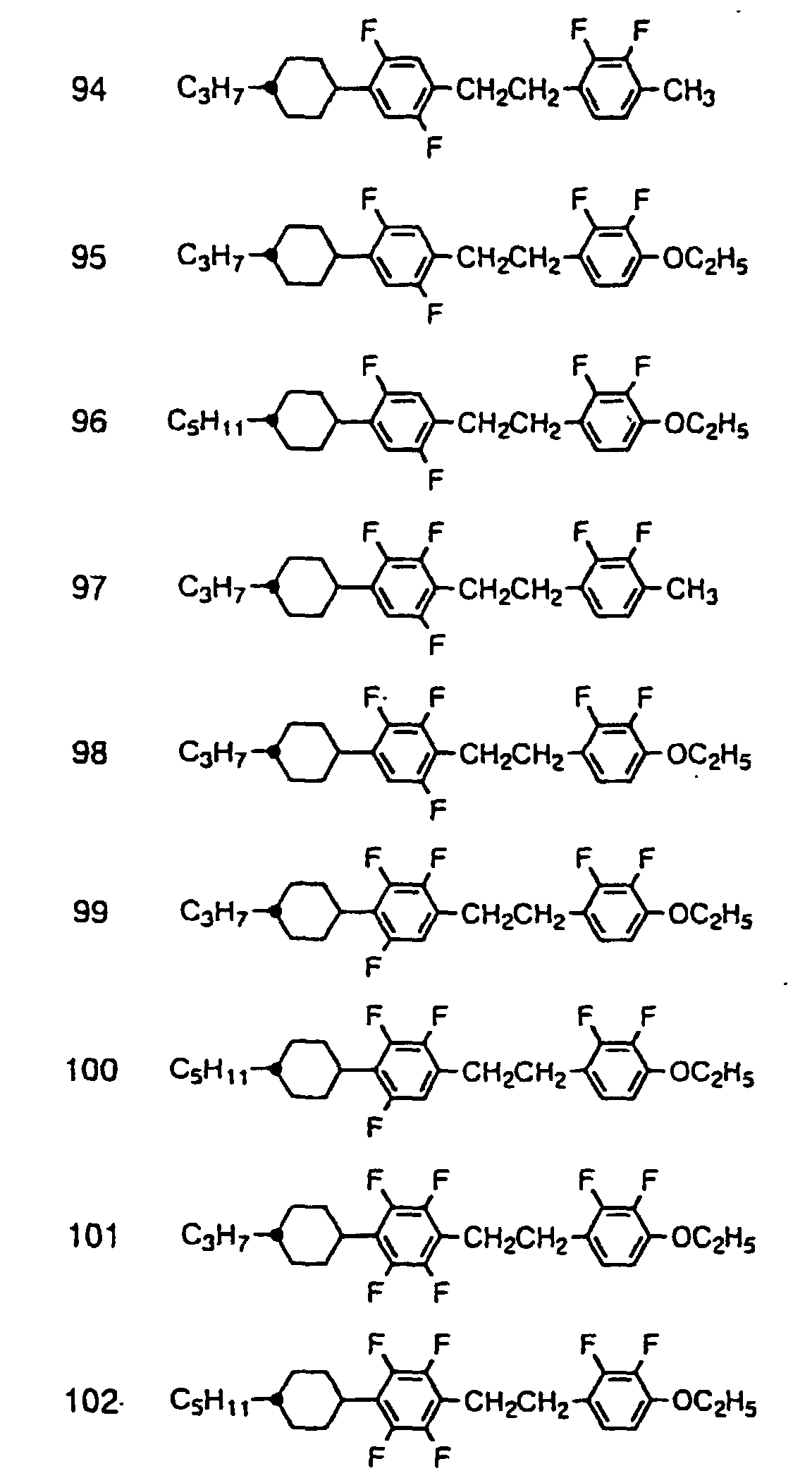
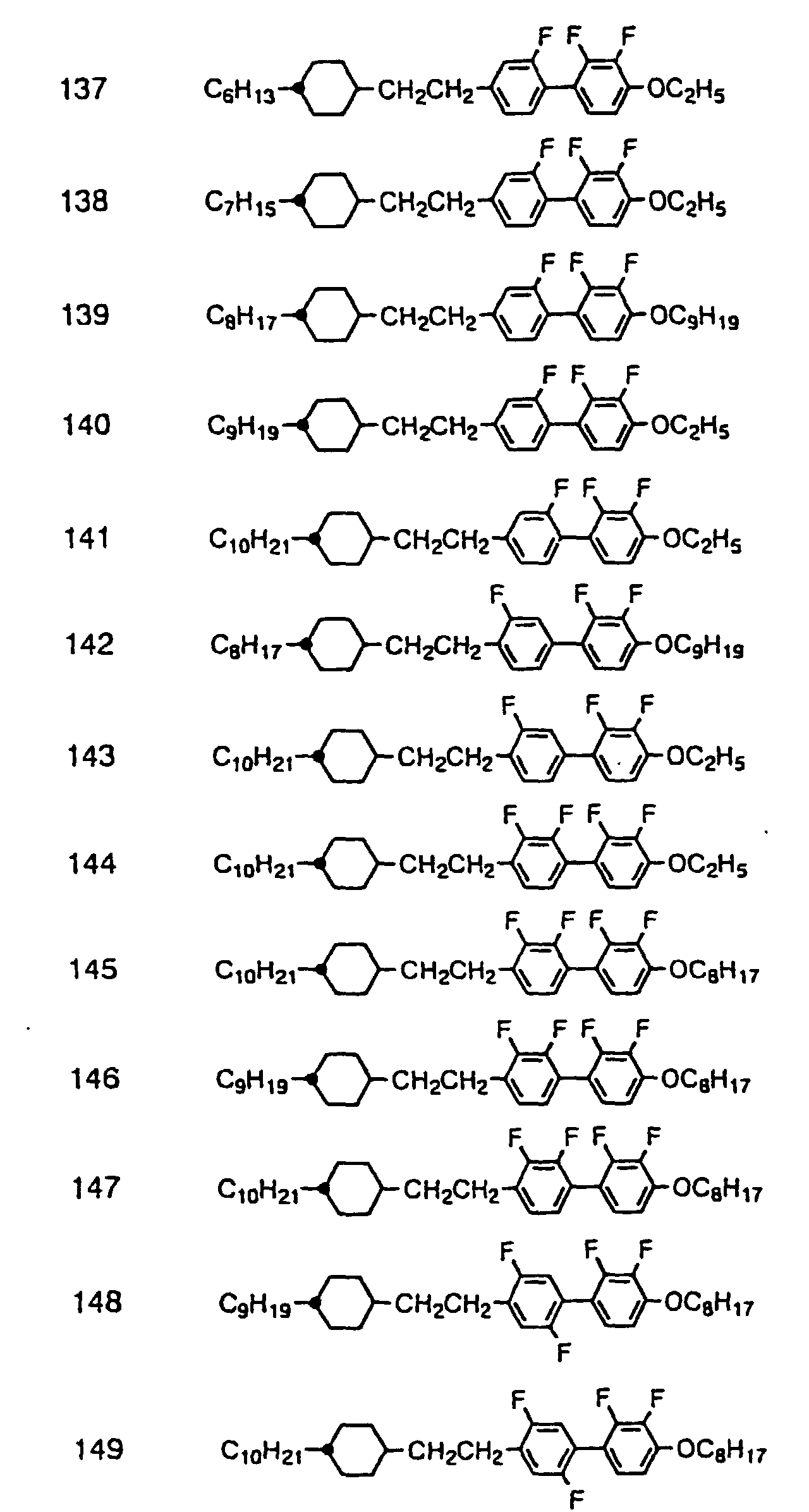
- the present invention relates to novel liquid crystalline compounds and liquid crystal compositions. More specifically, the invention relates to liquid crystalline compounds having 2,3-difluorophenyl moiety, liquid crystal compositions comprising the compound, and liquid crystal display devices fabricated by using the liquid crystal composition.
- Liquid crystal display devices fabricated by using liquid crystalline compounds are widely being used for the display of computers, television sets, and the likes.
- IPS In-plane switching
- VA vertical alignment
- the dielectric anisotropy value can not be said to be sufficiently large, and a satisfactory lowering of driving voltage was unable to actualize.
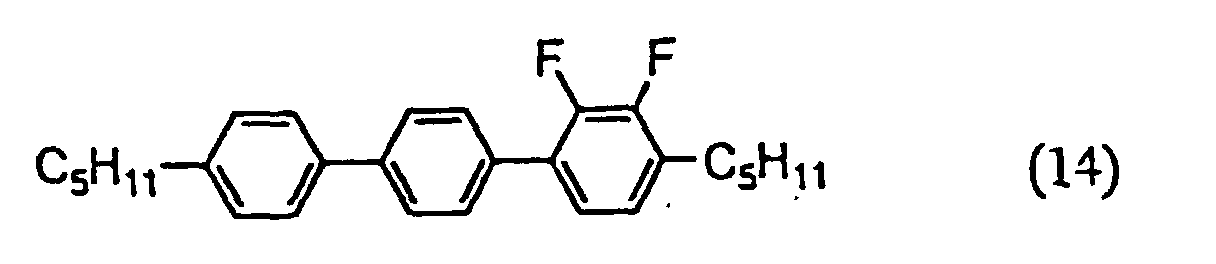
- the terphenyl compound of the formula (14) is known (J. Chem. Soc. Perkin Trans. II 2 , 2041 (1989)). This compound is narrow (10.5°C) in the temperature range showing nematic phase and exhibits smectic phase in a wide temperature range (50.5°C). Further, terphenyl compounds were generally extremely large in optical anisotropy value and were unsuitable as component of liquid crystal compositions for IPS mode or VA mode.
- dielectric anisotropy value is increased in negative when fluorine atom is introduced at a lateral position of a phenylene group which constitutes the skeleton of liquid crystalline compounds is well known to a person skilled in the art.
- the order parameters of liquid crystalline compounds are decreased by the introduction of fluorine atom to the lateral position.
- Dielectric anisotropy value and optical anisotropy value are regarded as functions of the order parameters (W. Maier and G. Meier, Z. Naturf. (a), 16 , 262 (1961)), and the decrease of the order parameters caused by the introduction of fluorine atom will bring about the decrease in dielectric anisotropy value. Accordingly, the introduction of fluorine atom to the lateral position does not necessarily produce a large amount of increase in negative dielectric anisotropy value (Theory of Maier and Meier).
- an object of the present invention is to provide liquid crystalline compounds having a negative and extremely large dielectric anisotropy value and a small optical anisotropy value at the same time, to provide liquid crystal compositions comprising the compound, and to provide liquid crystal display devices fabricated by using the liquid crystal composition.
- ring A 1 represents cyclohexane-1,4-diyl in which ring not-adjacent any methylene group may be replaced by -O-;
- ring A 2 represents 2,3-difluoro-1,4-phenylene in which phenylene hydrogen atoms at 5-position and 6-position may each independently be replaced by fluorine atoms;
- Z 1 and Z 2 each independently represent single bond or -CH 2 CH 2 -;
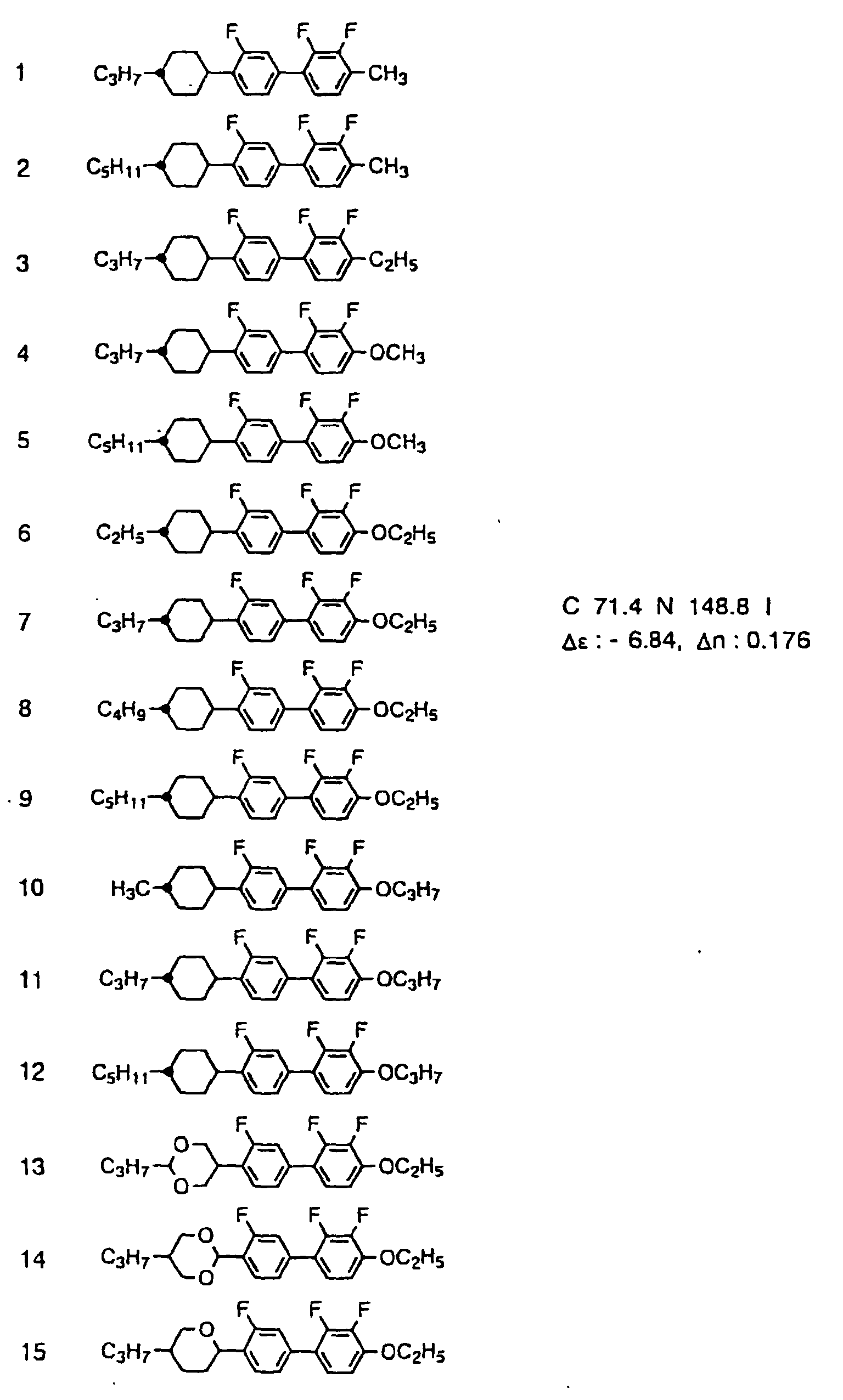
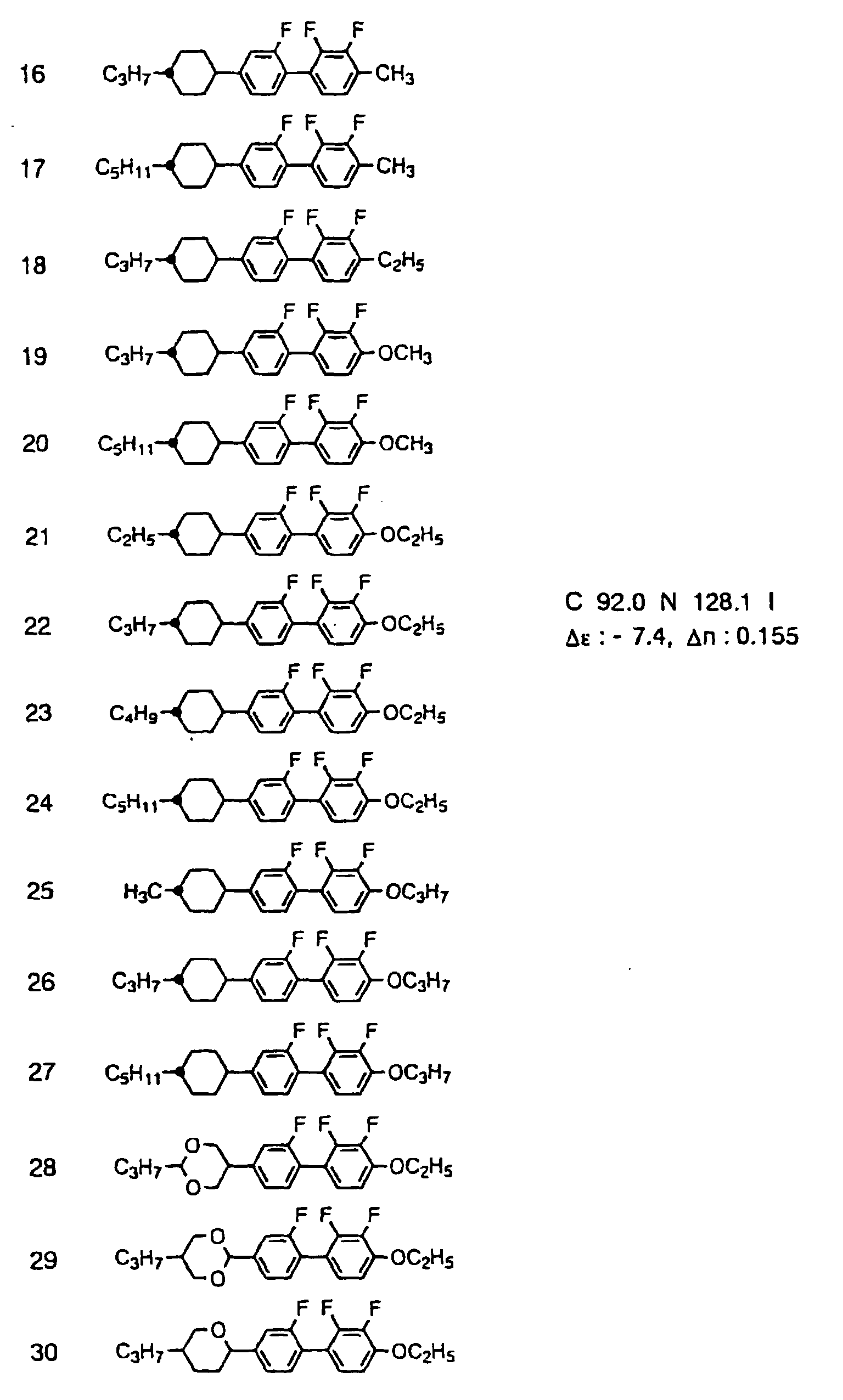
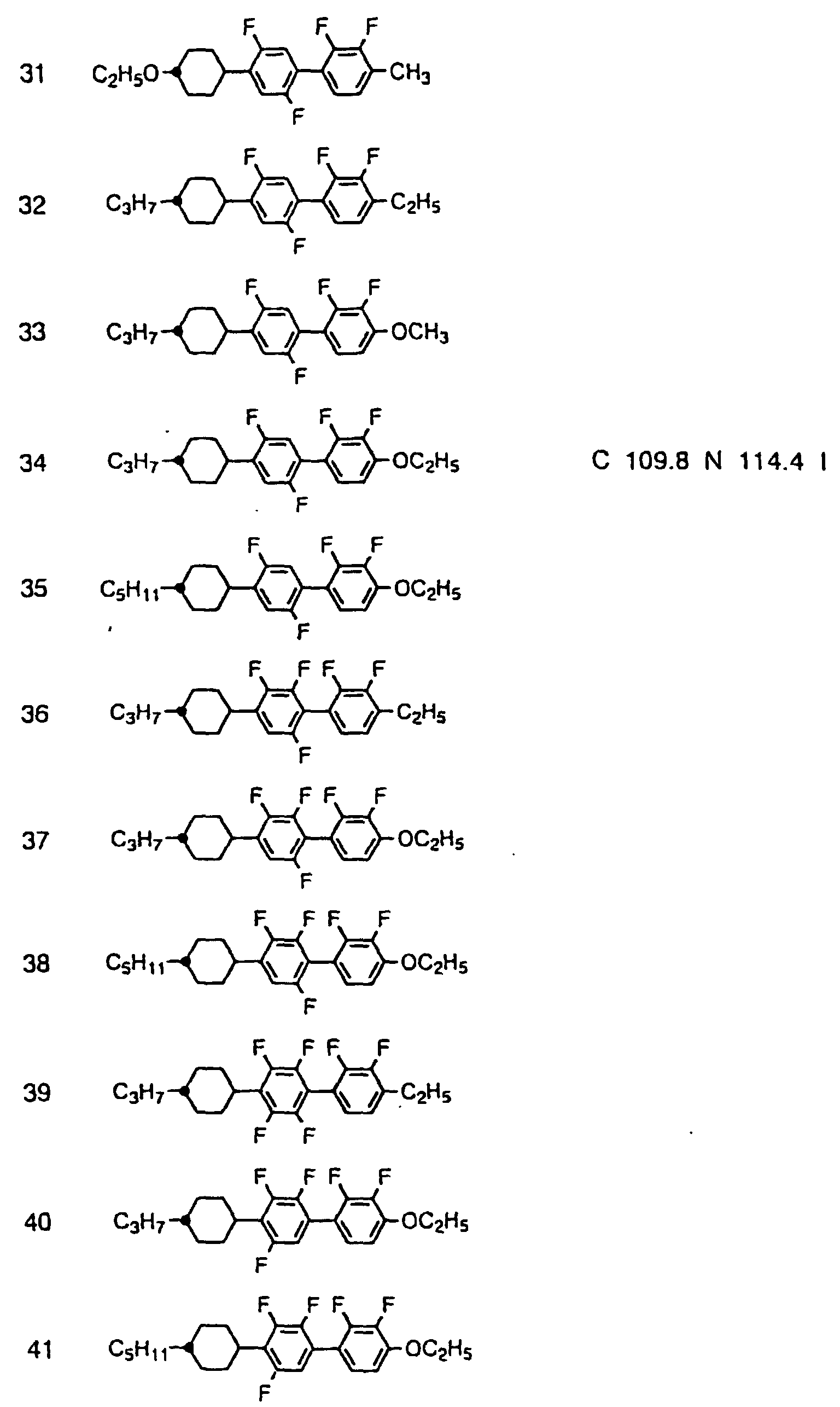
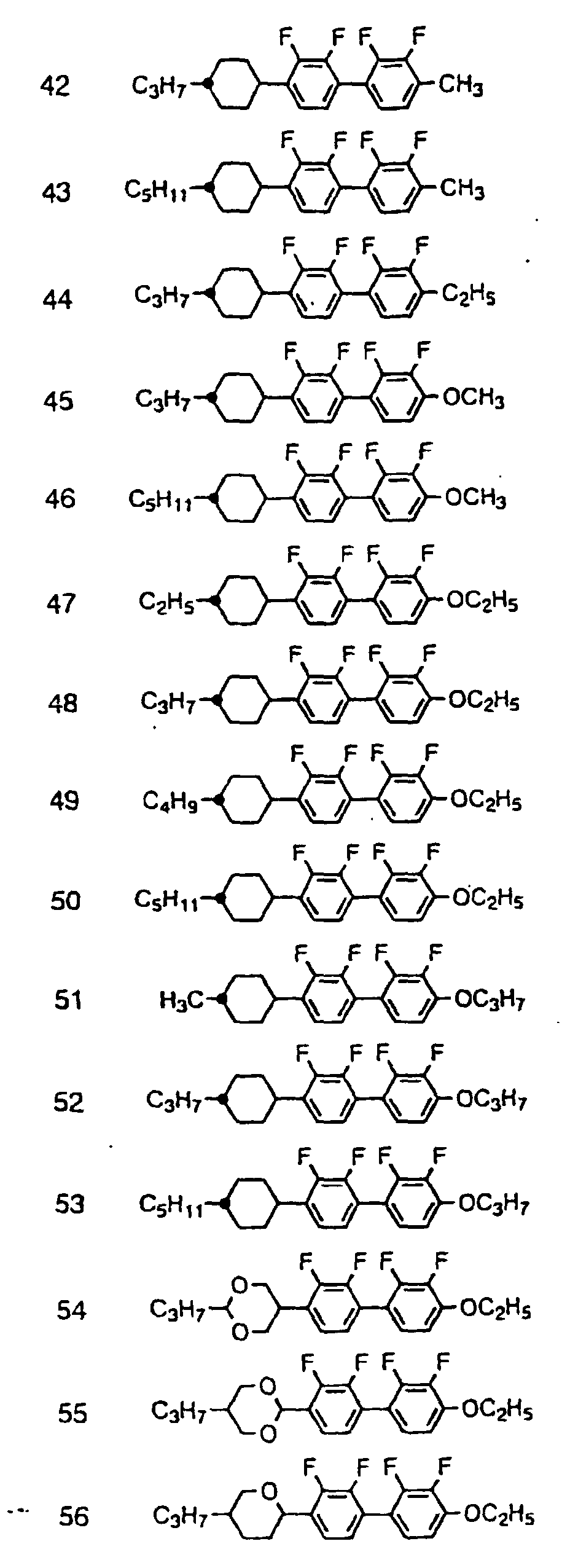
- the compounds which exhibit particularly preferable characteristics are those expressed by one of the following general formulas (1-1) to (1-18)
- Ra and Rb are alkyl groups, alkoxy groups, alkoxyalkyl groups, alkoxyalkoxy groups, alkenyl groups, or alkynyl groups.
- Compounds in which Ra and Rb are alkyl groups, alkoxy groups, alkoxyalkyl groups, or alkoxyalkoxy groups are chemically stable, and the compounds in which Ra and Rb are alkenyl groups or alkynyl groups exhibit a slightly large optical anisotropy.
- the compounds in which Ra and Rb are alkyl groups, alkoxy groups, or alkenyl groups are preferable since they have a low viscosity. Further, when used for display devices of IPS mode or VA mode, the compounds in which Ra and Rb are alkyl groups or alkoxy groups are optimum since a high chemical stability and a small optical anisotropy value are required in such case.
- Z 1 and Z 2 are each independently single bond or -CH 2 CH 2 -, the compounds in which one of Z 1 and Z 2 is single bond have a lower viscosity and the compounds in which one of them is -CH 2 CH 2 - have nematic phase in a wider temperature range.
- Group -CH 2 CH 2 - is preferably introduced to Z 1 , and when it is introduced to Z 2 , compounds are provided of which the upper limit of the temperature range exhibiting nematic phase is slightly low.
- Xa, Xb, Xc, and Xd are each independently hydrogen atom, fluorine atom, or chlorine atom
- at least one of Xa, Xb, Xc, and Xd is a halogen atom.
- fluorine atom is preferable, and when it is chlorine atom, compounds having a slightly high viscosity are provided.
- Number of the halogen atom is preferably 1, 2, or 3, and 1 or 2 is desirable to obtain compounds having a low viscosity.
- ring A 1 is cyclohexane-1,4-diyl, 1,3-dioxane-2,5-diyl, or tetrahydropyran-2,5-diyl
- cyclohexane-1,4-diyl is optimum to obtain compounds having a low viscosity.
- Compounds in which 1,3-dioxane-2,5-diyl is introduced to the position of ring A 1 have a small elastic constant value (K), and are preferable since they lower the driving voltage of liquid crystal display devices of TN mode including IPS mode or VA mode.
- any atom which constitutes the compounds of the present invention may be replaced by its isotope since the compounds in which the atom is replaced by the isotope exhibit the same characteristics.
- iodized benzene derivative (16) can be obtained by reacting halogenated benzene derivative (15) with n-or sec-butyl lithium and then reacting with iodine. Increase of yield can be expected by selecting the type of butyl lithium to be used depending on the position and number of halogen atom in halogenated benzene derivative (15).
- Compounds of the general formula (1) can be produced by reacting the iodized benzene derivative (16) with phenyl boric acid derivative (17) in the presence of a catalyst to perform a cross-coupling reaction. While the catalyst to be used is preferably Pd or Ni type, any catalyst may be used so far as it makes the reaction smoothly proceed.
- the phenyl boric acid derivative (17) can be produced by reacting a corresponding phenyl magnesium halide derivative with an boric acid ester at a low temperature.
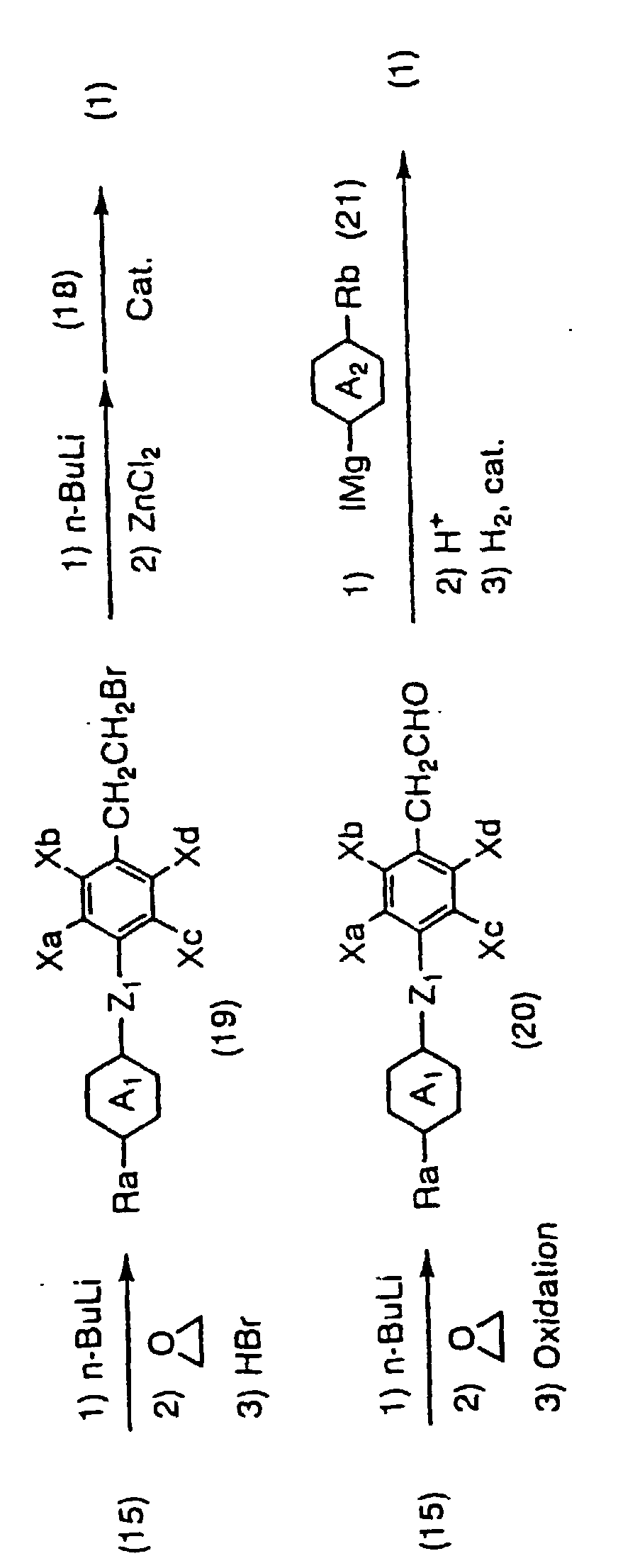
- the compounds of the general formula (1) can be produced by converting halogenated benzene derivative (15) into an organic zinc compound and then reacting with phenyl halide derivative (18) in the presence of a catalyst.
- a catalyst While the catalyst to be used is preferably Pd or Ni type, any catalyst may be used so far as it makes the reaction smoothly proceed.
- Halogenated benzene derivative (15) can be produced by reacting cyclohexanone derivative (26) or aldehyde derivative (27) with a Grignard reagent (28) and then subjecting to a dehydration reaction and hydrogenation reaction in the same manner as described above.
- Compounds expressed by the general formula (1) wherein Z 2 is -CH 2 CH 2 - can be produced by the method described below. That is, compound (19) can be produced by reacting the halogenated benzene derivative (15) described above with n- or sec-butyl lithium and then with ethylene oxide to obtain an alcohol derivative, and subsequently halogenating (preferably brominating or iodinating) the alcohol derivative.
- Compounds of the general formula (1) can be produced by reacting the compound (19) with metal lithium under ultrasonic radiation to convert into an organic lithium compound, reacting in-situ with zinc chloride to form a zinc compound, and then reacting it with the phenyl halide derivative (18) described above in the presence of a catalyst. While the catalyst to be used is preferably Pd or Ni type, a Pd catalyst of zero valent is particularly preferable.
- Compounds of the general formula (1) can also be obtained by reacting halogenated benzene derivative (15) with n- or sec-butyl lithium and subsequently with ethylene oxide to obtain an alcohol derivative, oxidizing it to convert into aldehyde derivative (20), reacting it with a Grignard reagent (21) which can be prepared from phenyl halide derivative (18), and further subjecting it to a dehydration reaction and a hydrogenation reaction in turn.
- biphenyl derivative (24) can be produced by reacting halogenated phenyl bromide or halogenated phenyl iodide (22) with phenyl boric acid derivative (23) in the presence of a catalyst to perform a cross-coupling reaction.
- Compounds of the general formula (1) can be obtained by reacting biphenyl derivative (24) with n- or sec-butyl lithium and subsequently with cyclohexanone derivative (25), and then subjecting it to a dehydration reaction and hydrogenation reaction as in the case described above.
- liquid crystalline compounds of the present invention obtained by such a method exhibit a negative and extremely large dielectric anisotropy, low voltage driving of liquid crystal display devices can be actualized.
- liquid crystalline compounds of the present invention are sufficiently stable physically and chemically under conditions wherein liquid crystal display devices are ordinarily used, are readily mixed with various liquid crystal materials, and have an extremely excellent miscibility even at low temperatures, the compounds are remarkably excellent as component of nematic liquid crystal compositions.
- These compounds have a negative and large dielectric anisotropy value and a comparatively small optical anisotropy value at the same time, and can preferably be used as component of liquid crystal compositions for IPS mode or VA mode in particular.
- Liquid crystal compositions of the present invention are described below.
- Liquid crystal compositions of the present invention preferably comprise at least one compound expressed by the general formula (1) in the ratio of 0.1 to 99.9 % by weight to develop excellent characteristics, and the amount is more desirably 1 to 60 % by weight.
- the liquid crystal compositions of the present invention are completed by mixing a compound arbitrarily selected from the group consisting of the compounds expressed by one of the general formulas (2) to (12) depending on the purpose of the liquid crystal compositions, in addition to a first component comprising at least one compound expressed by the general formula (1).
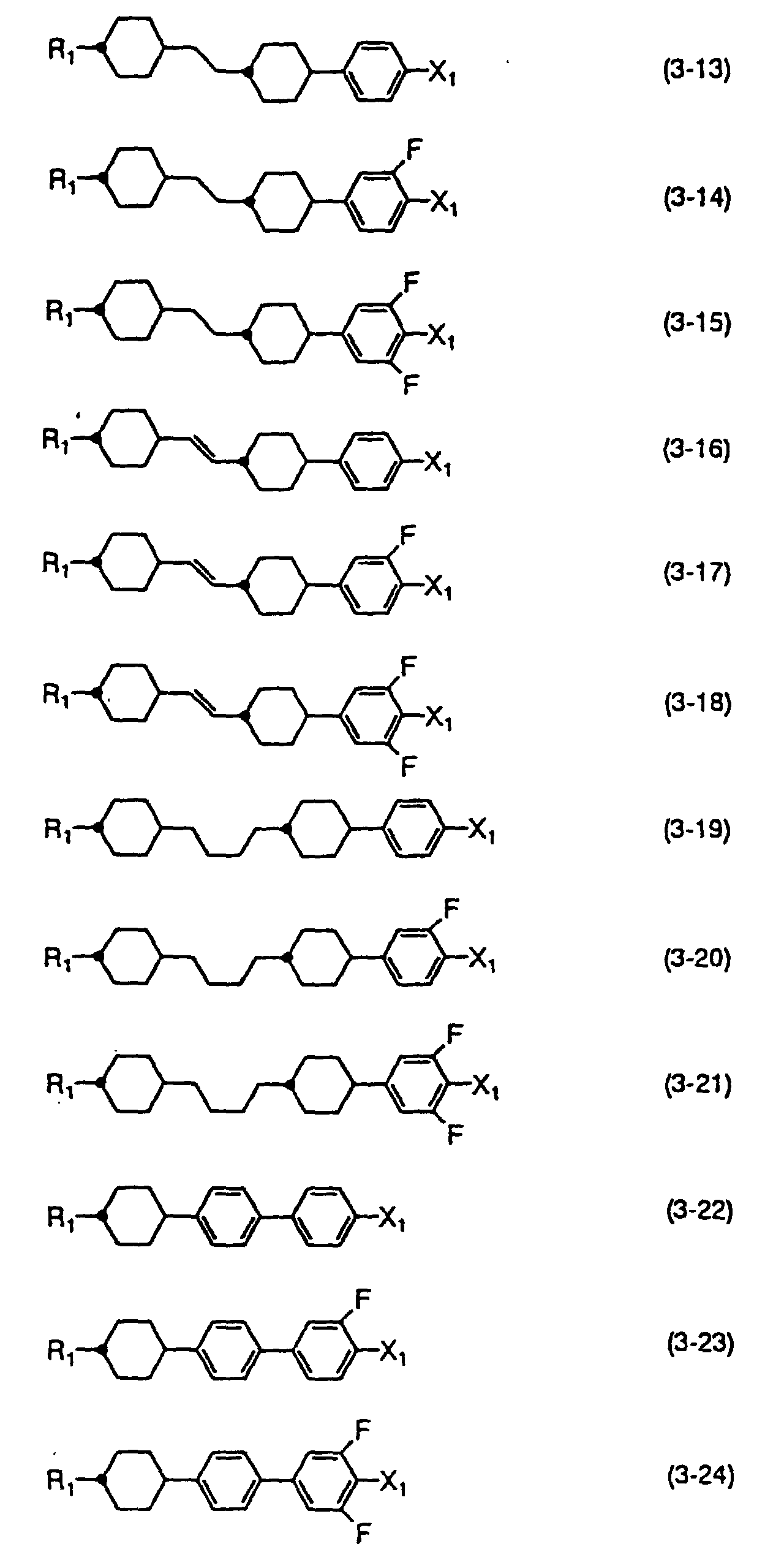
- Compounds expressed by one of the general formulas (2) to (4) have a positive dielectric anisotropy value, are excellent in thermal stability and chemical stability, and are extremely useful especially when liquid crystal compositions for AM (active matrix), particularly for TFT (thin film transistor) of which a high reliability such as a high voltage holding ratio and a large specific resistivity is required are produced.
- the compound expressed by one of the general formulas (2) to (4) can be used in the range of 0.1 to 99.9 % by weight based on the total amount of liquid crystal composition, the amount is preferably 10 to 97 % by weight and more desirably 40 to 95 % by weight.
- the compound expressed by one of the general formulas (10) to (12) may further be added for the purpose of adjusting viscosity.
- liquid crystal compositions for STN or TN are produced, the compound expressed by one of the general formulas (2) to (4) can be used, but its amount is preferably less than 50 % by weight.
- Compounds expressed by the general formula (5) or (6) have a large positive dielectric anisotropy value, and are used particularly for the purpose of lowering threshold voltage of liquid crystal compositions. Also, they are used for the purpose of adjusting optical anisotropy value and widening nematic range such as raising clearing point. Further, they are used for the purpose of improving the steepness of voltage-transmittance curve of liquid crystal compositions for STN or TN.
- the amount of the compound expressed by the general formula (5) or (6) is increased in liquid crystal compositions, threshold voltage of liquid crystal compositions lowers but viscosity rises. Accordingly, it is advantageous to use a large amount of the compound since liquid crystal display devices can be driven at a low voltage so far as the viscosity of liquid crystal compositions satisfies a required value.
- the compound expressed by the general formula (5) or (6) can be used in the range of 0.1 to 99.9 % by weight based on the total amount of liquid crystal composition, and the amount is preferably 10 to 97 % by weight and more desirably 40 to 95 % by weight.
- Compounds expressed by one of the general formulas (7) to (9) have a negative dielectric anisotropy. Since the compounds expressed by the general formula (7) are two rings compounds, they are used principally for the purpose of adjusting threshold voltage, adjusting viscosity, or adjusting optical anisotropy value. Compounds expressed by the general formula (8) are used for the purpose of widening nematic range such as raising clearing point and for the purpose of adjusting optical anisotropy value. Compounds expressed by the general formula (9) are used for the purpose of adjusting optical anisotropy value.
- liquid crystal compositions for TFT having a negative dielectric anisotropy value When liquid crystal compositions for TFT having a negative dielectric anisotropy value are produced, it is preferable to use the compound expressed by one of the general formulas (7) to (9) in a range of more than 40 % by weight based on the total amount of liquid crystal composition and 50 to 95 % by weight is preferable.
- compound expressed by one of the general formulas (7) to (9) is sometime added to liquid crystal compositions having a positive dielectric anisotropy value.
- the amount of the compound expressed by one of the general formulas (7) to (9) is preferably less than 30 % by weight.
- Compounds expressed by one of the general formulas (10) to (12) are small in the absolute value of dielectric anisotropy and the value is close to zero.
- Compounds expressed by the general formula (10) are used principally for the purpose of adjusting viscosity or adjusting optical anisotropy value.
- Compounds expressed by the general formula (11) or (12) are used for the purpose of widening nematic range such as raising clearing point or for the purpose of adjusting optical anisotropy value.
- the amount of the compound expressed by one of the general formulas (10) to (12) is increased in liquid crystal compositions, threshold voltage of the liquid crystal compositions rises and viscosity lowers. Accordingly, it is desirable to use the compound in a large amount in the range wherein the threshold voltage of the liquid crystal compositions satisfies a required value.
- the amount of the compound expressed by one of the general formulas (10) to (12) is preferably less than 40 % by weight in liquid crystal compositions and the amount is more desirably less than 35 % by weight.
- the amount of the compound expressed by one of the general formulas (10) to (12) is preferably less than 70 % by weight in liquid crystal compositions and the amount is more desirably less than 60 % by weight.
- an optically active compound is usually added for the purpose of inducing helical structure of liquid crystals to adjust required twist angle and to prevent reverse twist.
- any of known optically active compounds can be added for such purposes.
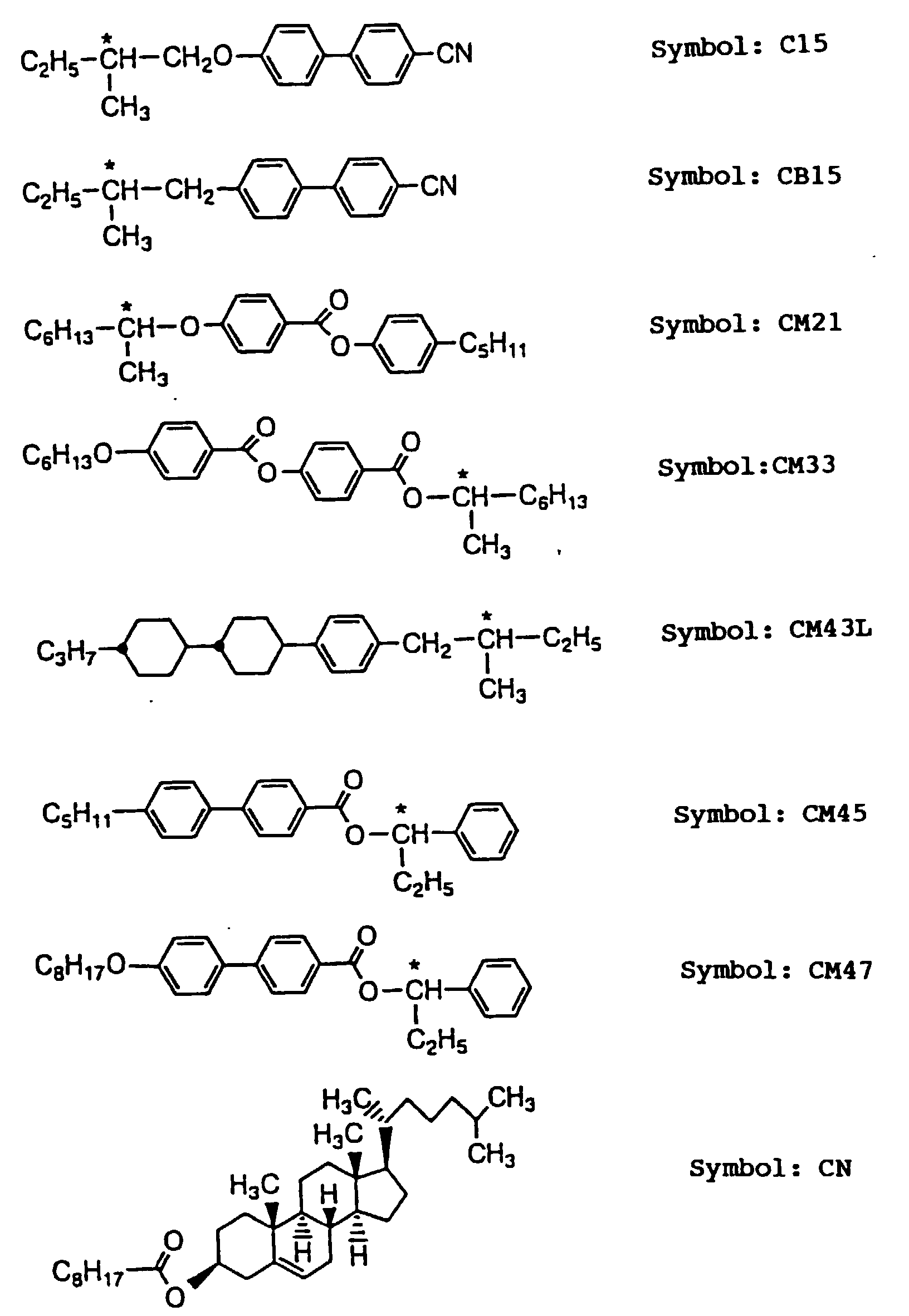
- preferable optically active compounds the compound of the following formulas can be mentioned:
- these optically active compounds are added to the liquid crystal compositions of the present invention to adjust the pitch of the twist.
- Pitch of the twist is preferably adjusted in the range of 40 to 200 ⁇ m in the case of liquid crystal compositions for TFT or TN, and preferably adjusted in the range of 6 to 20 ⁇ m in the case of liquid crystal compositions for STN. In the case of liquid crystal compositions for bistable TN, it is preferably adjusted in the range of 1.5 to 4 ⁇ m.
- two or more kind of optically active compounds may be added for the purpose of adjusting the dependency of the pitch on temperature.
- Liquid crystal compositions of the present invention can be used as ones for GH (guest-host) mode by adding a dichroic dye such as merocyanine type, styryl type, azo type, azomethine type, azoxy type, quinophthalone type, anthraquinone type, and tetrazine type thereto.
- the liquid crystal compositions can be used as NCAP which is prepared by the microencapsulation of a nematic liquid crystal, or as liquid crystal compositions for polymer dispersed liquid crystal display devices (PDLCD) represented by polymer net work liquid crystal display devices (PNLCD) prepared by forming a polymer of three-dimensional reticulated structure in a liquid crystal.
- the liquid crystal compositions of the present invention can be used as ones for ECB (electrically controlled birefringence) mode or dynamic scattering (DS) mode.
- ECB electrically controlled birefringence
- DS dynamic scattering
- Liquid crystal compositions of the present invention can be produced by conventional methods. Generally, a method in which various components are dissolved in one another at a high temperature is adopted.
- the crystals thus obtained were washed with 100 ml of ethanol and recrystallized from 50 ml of heptane.
- the crystals were confirmed to be 4-(3-fluoro-4-iodophenyl)-propylcyclohexane (0.24 mol).
- the reaction product was gradually warmed up to room temperature (about 18°C), 100 ml of 6M hydrochloric acid was added thereto, and the solution was stirred for 30 minutes.
- the reaction solution was extracted thrice with 300 ml of diethyl ether. After the extracts were combined and washed with 100 ml of saturated aqueous sodium chloride solution, diethyl ether layer was dried over anhydrous sodium sulfate. After solid substances were removed, it was concentrated under a reduced pressure to obtain a brown solid.
- This product was sufficiently washed with 100 ml of heptane to obtain pale brown, powder-like crystals of 2,3-difluoro-4-ethoxyphenyl boric acid (0.29 mol).
- the residue thus obtained was purified by subjecting it to silica gel column chromatography (eluent: heptane/toluene 10/1 mixed solvent) and then recrystallizing from 100 ml of ethanol to obtain a white solid of the subject compound (0.031 mol).
- Liquid crystal composition (A) comprising the following liquid crystal compounds in the amount shown below was prepared.
- 4-ethoxyphenyl 4-propylcyclohexane carboxylate 17.2 %
- 4-butoxyphenyl 4-propylcyclohexane carboxylate 27.6 %
- 4-ethoxyphenyl 4-butylcyclohexane carboxylate 20.7 %
- 4-methoxyphenyl 4-pentylcyclohexane carboxylate 20.7 %
- 4-ethoxyphenyl 4-pentylcyclohexane carboxylate 13.8 %
- Example 2 From the comparison between Example 2 and Comparative Example 1, it can be confirmed that the compounds of the present invention combine a large dielectric anisotropy value and a small optical anisotropy value compared with heretofore known compounds.
- transition temperatures indicate the phase transition temperatures of a particular compound itself
- ⁇ and ⁇ n indicate the extrapolated values calculated from the physical property values of the liquid crystal composition obtained by mixing the liquid crystal composition (A) described above with 15 % by weight of the particular compound.
- liquid crystal compositions shown in Use Example 2 through Use Example 16 were prepared.
- "%” means % by weight unless otherwise specified, and when cis-trans isomers exist in a particular compound, the compound used was transform. Further, the compounds in the following use examples are designated by symbols according to the definitions shown in the following Table 1 and Table 2. Viscosity ( ⁇ ) was determined at 20°C.
- 3-HB(2F)B(2F,3F)-O2 9.0% 3-HB-O1 15.0% 3-HB-O2 6.0% 3-HEB(2F,3F)-O2 9.0% 4-HEB(2F,3F)-O2 9.0% 2-BB2B-O2 6.0% 3-BB2B-O2 6.0% 5-BB2B-O1 6.0% 5-BB2B-O2 6.0% 1-B2BB(2F)-5 7.0% 3-B2BB(2F)-5 7.0% 5-B(F)BB-O2 7.0% 3-BB(2F,3F)B-3 7.0%
- Pitch (P) of the twist of the liquid crystal composition obtained by adding 0.8 part by weight of optically active compound CM33 to 100 parts by weight of the composition described above was 11.5 ⁇ m.
- Pitch (P) of the twist of the liquid crystal composition obtained by adding 0.2 part by weight of optically active compound CM43L to 100 parts by weight of the composition described above was 77.8 ⁇ m.
- Liquid crystalline compounds of the present invention have a negative and extremely large dielectric anisotropy value and a small optical anisotropy value at the same time. Also, the compounds exhibit an excellent characteristic even in the miscibility with other liquid crystal materials. Accordingly, liquid crystal compositions exhibiting both a low threshold voltage and a small optical anisotropy value can be actualized by using the liquid crystalline compound of the present invention as component of liquid crystal compositions. Further, it is possible to provide excellent liquid crystal display devices by using the liquid crystal composition.
- Typical compound of the present invention exhibits 25 % larger dielectric anisotropy value than the compound (compound of Comparative Example 1) reported by V. Reiffenrath et al. (Liq. Cryst., 5 (1), 159 (1989)).
- the compound of comparative Example 1 is 0.188 in optical anisotropy value
- the compound of Example 1 is as small as 0.155 and preferable as component of liquid crystal compositions for IPS mode and VA mode.
- Liquid crystalline compounds of the present invention can preferably be employed as component of liquid crystal compositions not only for IPS mode and VA mode but also for ECB (electrically controlled birefringence) mode and GH (guest-host) mode. Also, the compounds can preferably be employed as component of liquid crystal compositions for TN (twisted nematic), STN (super twisted nematic), and AM (active matrix) modes.
Landscapes
- Chemical & Material Sciences (AREA)
- Organic Chemistry (AREA)
- Crystallography & Structural Chemistry (AREA)
- Engineering & Computer Science (AREA)
- Materials Engineering (AREA)
- Liquid Crystal Substances (AREA)
- Organic Low-Molecular-Weight Compounds And Preparation Thereof (AREA)
- Heterocyclic Compounds That Contain Two Or More Ring Oxygen Atoms (AREA)
- Pyrane Compounds (AREA)
Abstract

Description







| 4-ethoxyphenyl=4-propylcyclohexane carboxylate | 17.2 % |
| 4-butoxyphenyl=4-propylcyclohexane carboxylate | 27.6 % |
| 4-ethoxyphenyl=4-butylcyclohexane carboxylate | 20.7 % |
| 4-methoxyphenyl=4-pentylcyclohexane carboxylate | 20.7 % |
| 4-ethoxyphenyl=4-pentylcyclohexane carboxylate | 13.8 % |





| Right side terminal group | Symbol |
| -F | - F |
| -Cl | - CL |
| -CN | - C |
| -CF3 | - CF3 |
| -OCF3 | - OCF3 |
| -OCF2H | - OCF2H |
| -CnH2n+1 | - n |
| -OCnH2n+1 | - On |
| -COOCH3 | - EMe |
| -CH=CH2 | - V |
| -(CH2)nCH=CH2 | - nV |
| -(CH2)nCH=CHCmH2m+1 | - nVm |
| -C≡C-CN | - TC |
| -CH=CF2 | - VFF |
| -(CH2)nCH=CF2 | - nVFF |
| -CH=CHCnH2nF | - VnF |
| 3-HB(F)B(2F,3F)-O2 | 7.0% |
| 3-HB(2F)B(2F,3F)-O2 | 7.0% |
| 3-HEB-O4 | 28.0% |
| 4-HEB-O2 | 20.0% |
| 5-HEB-O1 | 20.0% |
| 3-HEB-O2 | 18.0% |
| 3-HB(2F,5F)B(2F,3F)-O2 | 7.0% |
| 3-H2B(2F)B(2F,3F)-O2 | 7.0% |
| 3-HH-2 | 5.0% |
| 3-HH-4 | 6.0% |
| 3-HH-O1 | 4.0% |
| 3-HH-O3 | 5.0% |
| 5-HH-O1 | 4.0% |
| 3-HB(2F,3F)-O2 | 12.0% |
| 5-HB(2F,3F)-O2 | 11.0% |
| 5-HHB(2F,3F)-O2 | 15.0% |
| 3-HHB(2F,3F)-2 | 24.0% |
| 3-HB(F)B(2F,3F)-O2 | 4.0% |
| 3-HB(2F)B(2F,3F)-O2 | 4.0% |
| 3-H2B(2F)B(2F,3F)-O2 | 4.0% |
| 3-HH-4 | 5.0% |
| 3-HH-5 | 5.0% |
| 3-HH-O1 | 6.0% |
| 3-HH-O3 | 6.0% |
| 3-HB-O1 | 5.0% |
| 3-HB-O2 | 5.0% |
| 3-HB(2F,3F)-O2 | 10.0% |
| 5-HB(2F,3F)-O2 | 10.0% |
| 5-HHB(2F,3F)-O2 | 13.0% |
| 3-HHB(2F,3F)-2 | 4.0% |
| 3-HHB(2F,3F)-2 | 4.0% |
| 3-HHEH-3 | 5.0% |
| 3-HHEH-3 | 5.0% |
| 3-HHEH-3 | 5.0% |
| 3-HB(F)B(2F,3F)-O2 | 4.0% |
| 3-HB(2F)B(2F,3F)-O2 | 4.0% |
| 3-HB(2F,5F)B(2F,3F)-O2 | 4.0% |
| 3-H2B(2F)B(2F,3F)-O2 | 4.0% |
| 3-BB(2F,3F)-O2 | 12.0% |
| 3-BB(2F,3F)-O4 | 10.0% |
| 5-BB(2F,3F)-O4 | 10.0% |
| 2-BB(2F,3F)B-3 | 25.0% |
| 3-BB(2F,3F)B-5 | 13.0% |
| 5-BB(2F,3F)B-5 | 14.0% |
| 3-HB(F)B(2F,3F)-O2 | 6.0% |
| 3-BB(2F,3F)-O2 | 10.0% |
| 5-BB-5 | 9.0% |
| 5-BB-O6 | 9.0% |
| 5-BB-O8 | 8.0% |
| 1-BEB-5 | 6.0% |
| 3-BEB-5 | 6.0% |
| 5-BEB-5 | 3.0% |
| 3-HEB-O2 | 20.0% |
| 5-BBB(2F,3F)-7 | 3.0% |
| 3-H2BB(2F)-5 | 20.0% |
| 3-HB(2F)B(2F,3F)-O2 | 9.0% |
| 3-HB-O1 | 15.0% |
| 3-HB-O2 | 6.0% |
| 3-HEB(2F,3F)-O2 | 9.0% |
| 4-HEB(2F,3F)-O2 | 9.0% |
| 2-BB2B-O2 | 6.0% |
| 3-BB2B-O2 | 6.0% |
| 5-BB2B-O1 | 6.0% |
| 5-BB2B-O2 | 6.0% |
| 1-B2BB(2F)-5 | 7.0% |
| 3-B2BB(2F)-5 | 7.0% |
| 5-B(F)BB-O2 | 7.0% |
| 3-BB(2F,3F)B-3 | 7.0% |
| 3-HB(F)B(2F,3F)-O2 | 5.0% |
| 3-H2B(2F)B(2F,3F)-O2 | 5.0% |
| 3-HB-O1 | 9.0% |
| 3-HB-O2 | 9.0% |
| 3-HB-O4 | 9.0% |
| 2-BTB-O1 | 5.0% |
| 1-BTB-O2 | 5.0% |
| 3-BTB(2F,3F)-O2 | 13.0% |
| 5-BTB(2F,3F)-O2 | 13.0% |
| 3-B(2F,3F)TB(2F,3F)-O4 | 4.0% |
| 5-B(2F,3F)TB(2F,3F)-O4 | 4.0% |
| 3-HBTB-O1 | 5.0% |
| 3-HHB(2F,3F)-O2 | 6.0% |
| 5-HBB(2F,3F)-O2 | 5.0% |
| 5-BPr(F)-O2 | 3.0% |
| 3-HB(2F)B(2F,3F)-O2 | 6.0% |
| 3-H2B(2F)B(2F,3F)-O2 | 6.0% |
| 3-HB-O2 | 10.0% |
| 5-HB-3 | 8.0% |
| 5-BB(2F,3F)-O2 | 10.0% |
| 3-HB(2F,3F)-O2 | 10.0% |
| 5-HB(2F,3F)-O2 | 8.0% |
| 5-HHB(2F,3F)-O2 | 4.0% |
| 5-HHB(2F,3F)-1O1 | 4.0% |
| 2-HHB(2F,3F)-1 | 5.0% |
| 3-HHB(2F,3F)-1 | 5.0% |
| 3-HBB-2 | 6.0% |
| 3-BB(2F,3F)B-3 | 8.0% |
| 5-B2BB(2F,3F)-O2 | 10.0% |
| 3-HB(F)B(2F,3F)-O2 | 3.0% |
| 3-HB(2F)B(2F,3F)-O2 | 4.0% |
| 3-HB(2F,5F)B(2F,3F)-O2 | 3.0% |
| 3-H2B(2F)B(2F,3F)-O2 | 2.0% |
| 3-HB-O2 | 20.0% |
| 1O1-HH-3 | 6.0% |
| 101-HH-5 | 5.0% |
| 3-HH-EMe | 12.0% |
| 4-HEB-O1 | 9.0% |
| 4-HEB-O2 | 7.0% |
| 5-HEB-O1 | 8.0% |
| 3-HHB-1 | 6.0% |
| 3-HHB-3 | 6.0% |
| 4-HEB(2CN,3CN)-O4 | 3.0% |
| 2-HBEB(2CN,3CN)-O2 | 2.0% |
| 4-HBEB(2CN,3CN)-O4 | 4.0% |
| 3-HB(F)B(2F,3F)-O2 | 6.0% |
| 1V2-BEB(F,F)-C | 5.0% |
| 3-HB-C | 20.0% |
| V2-HB-C | 6.0% |
| 1-BTB-3 | 5.0% |
| 2-BTB-1 | 10.0% |
| 1O1-HH-3 | 3.0% |
| 3-HH-4 | 11.0% |
| 3-HHB-1 | 5.0% |
| 3-HHB-3 | 3.0% |
| 3-H2BTB-2 | 4.0% |
| 3-H2BTB-3 | 4.0% |
| 3-H2BTB-4 | 4.0% |
| 3-HB(F)TB-2 | 6.0% |
| 3-HB(F)TB-3 | 5.0% |
| 3-HHB-C | 3.0% |
| 3-HB(2F)B(2F,3F)-O2 | 5.0% |
| 3-H2B(2F)B(2F,3F)-O2 | 5.0% |
| V2-HB-TC | 10.0% |
| 3-HB-TC | 10.0% |
| 3-HB-C | 10.0% |
| 5-HB-C | 7.0% |
| 5-BB-C | 3.0% |
| 2-BTB-1 | 10.0% |
| 2-BTB-O1 | 5.0% |
| 3-HH-4 | 5.0% |
| 3-HHB-3 | 11.0% |
| 3-H2BTB-2 | 3.0% |
| 3-H2BTB-3 | 3.0% |
| 3-HB(F)TB-2 | 3.0% |
| 5-BTB(F)TB-3 | 10.0% |
| 3-HB(F)B(2F,3F)-O2 | 2.0% |
| 3-HB(2F,5F)B(2F,3F)-O2 | 2.0% |
| 1V2-BEB(F,F)-C | 6.0% |
| 3-HB-C | 18.0% |
| 2-BTB-1 | 10.0% |
| 5-HH-VFF | 30.0% |
| 1-BHH-VFF | 8.0% |
| 1-BHH-2VFF | 11.0% |
| 3-H2BTB-2 | 5.0% |
| 3-H2BTB-3 | 4.0% |
| 3-H2BTB-4 | 4.0% |
| 3-HB(2F)B(2F,3F)-O2 | 2.0% |
| 3-HB-CL | 10.0% |
| 5-HB-CL | 4.0% |
| 7-HB-CL | 4.0% |
| 1O1-HH-5 | 5.0% |
| 2-HBB(F)-F | 8.0% |
| 3-HBB(F)-F | 8.0% |
| 5-HBB(F)-F | 14.0% |
| 4-HHB-CL | 8.0% |
| 5-HHB-CL | 8.0% |
| 3-H2HB(F)-CL | 4.0% |
| 3-HBB(F,F)-F | 10.0% |
| 5-H2BB(F,F)-F | 9.0% |
| 3-HB(F)VB-2 | 2.0% |
| 3-H2BTB-2 | 4.0% |
| 3-HB(F)B(2F,3F)-O2 | 2.0% |
| 3-HB(2F)B(2F,3F)-O2 | 2.0% |
| 3-H2B(2F)B(2F,3F)-O2 | 2.0% |
| 2-HHB(F)-F | 2.0% |
| 3-HHB(F)-F | 2.0% |
| 5-HHB(F)-F | 2.0% |
| 3-HBB(F)-F | 6.0% |
| 5-HBB(F)-F | 10.0% |
| 2-H2BB(F)-F | 9.0% |
| 3-H2BB(F)-F | 9.0% |
| 3-HBB(F,F)-F | 25.0% |
| 5-HBB(F,F)-F | 19.0% |
| 1O1-HBBH-4 | 5.0% |
| 1O1-HBBH-5 | 5.0% |
| 3-HB(F)B(2F,3F)-O2 | 15.0% |
| 5-HB(F)B(2F,3F)-O2 | 10.0% |
| 3-HB(2F)B(2F,3F)-O2 | 15.0% |
| 5-HB(2F)B(2F,3F)-O2 | 10.0% |
| 3-HHB(2F,3F)-O2 | 10.0% |
| 5-HHB(2F,3F)-O2 | 10.0% |
| 3-HB-O2 | 20.0% |
| 3-HH-4 | 10.0% |

Claims (19)
- A liquid crystalline compound expressed by the general formula (1)wherein Ra and Rb each independently represent a straight chain or branched alkyl group having 1 to 10 carbon atoms in which group any methylene group may be replaced by -O-, -CH=CH-, or -C≡C-, but there is not a case wherein -O- continues; ring A1 represents cyclohexane-1,4-diyl in which ring not-adjacent any methylene group may be replaced by -O-; ring A2 represents 2,3-difluoro-1,4-phenylene in which phenylene hydrogen atoms at 5-position and 6-position may each independently be replaced by fluorine atoms; Z1 and Z2 each independently represent single bond or -CH2CH2-; Xa, Xb, Xc, and Xd each independently represent hydrogen atom, fluorine atom, or chlorine atom, but at least one of Xa, Xb, Xc, and Xd is fluorine atom or chlorine atom; and any atom which constitutes the compound may be replaced by its isotope.

- The liquid crystalline compound according to claim 1 wherein both Z1 and Z2 are single bonds, ring A2 is 2,3-difluoro-1,4-phenylene, Xa is fluorine atom, and all of Xb, Xc, and Xd are hydrogen atoms.
- The liquid crystalline compound according to claim 1 wherein both Z1 and Z2 are single bonds, ring A2 is 2,3-difluoro-1,4-phenylene, Xb is fluorine atom, and all of Xa, Xc, and Xd are hydrogen atoms.
- The liquid crystalline compound according to claim 1 wherein both Z1 and Z2 are single bonds, ring A2 is 2,3-difluoro-1,4-phenylene, both Xa and Xd are fluorine atoms, and both Xb and Xc are hydrogen atoms.
- The liquid crystalline compound according to claim 1 wherein both Z1 and Z2 are single bonds, ring A2 is 2,3-difluoro-1,4-phenylene, both Xa and Xb are fluorine atoms, and both Xc and Xd are hydrogen atoms.
- The liquid crystalline compound according to claim 1 wherein Z1 is -CH2CH2-, Z2 is single bond, ring A2 is 2,3-difluoro-1,4-phenylene, Xa is fluorine atom, and all of Xb, Xc, and Xd are hydrogen atoms.
- The liquid crystalline compound according to claim 1 wherein Z1 is -CH2CH2-, Z2 is single bond, ring A2 is 2,3-difluoro-1,4-phenylene, Xb is fluorine atom, and all of Xa, Xc, and Xd are hydrogen atoms.
- The liquid crystalline compound according to claim 1 wherein Z1 is -CH2CH2-, Z2 is single bond, ring A2 is 2,3-difluoro-1,4-phenylene, both Xa and Xd are fluorine atoms, and both Xb and Xc are hydrogen atoms.
- The liquid crystalline compound according to claim 1 wherein Z1 is -CH2CH2-, Z2 is single bond, ring A2 is 2,3-difluoro-1,4-phenylene, both Xa and Xb are fluorine atoms, and both Xc and Xd are hydrogen atoms.
- A liquid crystal composition comprising at least one liquid crystalline compound defined in claim 1.
- A liquid crystal composition comprising, as a first component, at least one liquid crystalline compound defined in claim 1 and comprising, as a second component, at least one compound selected from the group consisting of the compounds expressed by any one of the general formulas (2), (3), and (4)wherein R1 represents an alkyl group having 1 to 10 carbon atoms in which group not-adjacent any methylene group may be replaced by -O- or -CH=CH- and any hydrogen atom in the group may be replaced by fluorine atom; X1 represents fluorine atom, chlorine atom, -OCF3, -OCF2H, -CF3, -CF2H, -CFH2, -OCF2CF2H, or -OCF2CFHCF3; L1 and L2 each independently represent hydrogen atom or fluorine atom; Z3 and Z4 each independently represent -CH2CH2-, -(CH2)4-, -COO-, -CF2O-, -OCF2-, -CH=CH-, or single bond; ring B represents cyclohexane-1,4-diyl or 1,3-dioxane-2,5-diyl, or 1,4-phenylene in which hydrogen atom may be replaced by fluorine atom; ring C represents cyclohexane-1,4-diyl, or 1,4-phenylene in which hydrogen atom may be replaced by fluorine atom; and any atom which constitutes these compounds may be replaced by its isotope.

- A liquid crystal composition comprising, as a first component, at least one liquid crystalline compound defined in claim 1 and comprising, as a second component, at least one compound selected from the group consisting of the compounds expressed by the general formula (5) or (6)wherein R2 and R3 each independently represent an alkyl group having 1 to 10 carbon atoms in which group not-adjacent any methylene group may be replaced by -O- or -CH=CH- and any hydrogen atom in the group may be replaced by fluorine atom; X2 represents -CN or -C≡C-CN; ring D represents cyclohexane-1,4-diyl, 1,4-phenylene, 1,3-dioxane-2,5-diyl, or pyrimidine-2,5-diyl; ring E represents cyclohexane-1,4-diyl, 1,4-phenylene in which hydrogen atom may be replaced by fluorine atom, or pyrimidine-2,5-diyl; ring F represents cyclohexane-1,4-diyl or 1,4-phenylene; Z5 represents -CH2CH2-, -COO-, or single bond; L3, L4, and L5 each independently represent hydrogen atom or fluorine atom; b, c, and d are each independently 0 or 1; and any atom which constitutes these compounds may be replaced by its isotope.

- A liquid crystal composition comprising, as a first component, at least one liquid crystalline compound defined in claim 1 and comprising, as a second component, at least one compound selected from the group consisting of the compounds expressed by any one of the general formulas (7), (8), and (9)wherein R4 and R5 each independently represent an alkyl group having 1 to 10 carbon atoms in which group not-adjacent any methylene group may be replaced by -O- or -CH=CH- and any hydrogen atom in the group may be replaced by fluorine atom; ring G and ring I each independently represent cyclohexane-1,4-diyl or 1,4-phenylene;L6 and L7 each independently represent hydrogen atom, cyano group, or fluorine atom, but there is not a case wherein L6 and L7 represent hydrogen atom at the same time; Z6 and Z7 each independently represent -CH2CH2-, -COO-, or single bond; and any atom which constitutes these compounds may be replaced by its isotope.

- A liquid crystal composition comprising, as a first component, at least one liquid crystalline compound defined in claim 1, comprising, as a second component, at least one compound selected from the group consisting of the compounds expressed by any one of the general formulas (2),(3), and (4) described above, and comprising, as a third component, at least one compound selected from the group consisting of the compounds expressed by any one of the general formulas (10), (11), and (12)wherein R6 and R7 each independently represent an alkyl group having 1 to 10 carbon atoms in which group not-adjacent any methylene group may be replaced by -O- or -CH=CH- and any hydrogen atom in the group may be replaced by fluorine atom; ring J, ring K, and ring M each independently represent cyclohexane-1,4-diyl or pyrimidine-2,5-diyl, or 1,4-phenylene in which hydrogen atom may be replaced by fluorine atom; Z8 and Z9 each independently represent -CH2CH2-, -C≡C-, -COO-, -CH=CH-, or single bond; and any atom which constitutes these compounds may be replaced by its isotope.

- A liquid crystal composition comprising, as a first component, at least one liquid crystalline compound defined in claim 1, comprising, as a second component, at least one compound selected from the group consisting of the compounds expressed by the general formula (5) or (6) described above, and comprising, as a third component, at least one compound selected from the group consisting of the compounds expressed by any one of the general formulas (10), (11), and (12) described above.
- A liquid crystal composition comprising, as a first component, at least one liquid crystalline compound defined in claim 1, comprising, as a second component, at least one compound selected from the group consisting of the compounds expressed by any one of the general formulas (7), (8), and (9) described above, and comprising, as a third component, at least one compound selected from the group consisting of the compounds expressed by any one of the general formulas (10), (11), and (12) described above.
- A liquid crystal composition comprising, as a first component, at least one liquid crystalline compound defined in claim 1, comprising, as a second component, at least one compound selected from the group consisting of the compounds expressed by any one of the general formulas (2), (3), and (4) described above, comprising, as a third component, at least one compound selected from the group consisting of the compounds expressed by the general formula (5) or (6) described above, and comprising, as a fourth component, at least one compound selected from the group consisting of the compounds expressed by any one of the general formulas (10), (11), and (12) described above.
- A liquid crystal composition which further comprising one or more optically active compounds, in addition to the liquid crystal composition defined in any one of claims 10 to 17.
- A liquid crystal display device fabricated by using a liquid crystal composition defined in any one of claims 10 to 18.
Applications Claiming Priority (3)
| Application Number | Priority Date | Filing Date | Title |
|---|---|---|---|
| JP30991897 | 1997-10-24 | ||
| JP30991897 | 1997-10-24 | ||
| PCT/JP1998/004834 WO1999021816A1 (en) | 1997-10-24 | 1998-10-26 | Novel liquid-crystal compounds having large negative value of permittivity anisotropy, liquid-crystal composition, and liquid-crystal display element |
Publications (3)
| Publication Number | Publication Date |
|---|---|
| EP1026143A1 true EP1026143A1 (en) | 2000-08-09 |
| EP1026143A4 EP1026143A4 (en) | 2001-10-04 |
| EP1026143B1 EP1026143B1 (en) | 2004-05-12 |
Family
ID=17998917
Family Applications (1)
| Application Number | Title | Priority Date | Filing Date |
|---|---|---|---|
| EP98950385A Expired - Lifetime EP1026143B1 (en) | 1997-10-24 | 1998-10-26 | Novel liquid-crystal compounds having large negative value of permittivity anisotropy, liquid-crystal composition, and liquid-crystal display element |
Country Status (5)
| Country | Link |
|---|---|
| US (1) | US6348244B1 (en) |
| EP (1) | EP1026143B1 (en) |
| JP (1) | JP4337264B2 (en) |
| DE (1) | DE69823857T2 (en) |
| WO (1) | WO1999021816A1 (en) |
Cited By (10)
| Publication number | Priority date | Publication date | Assignee | Title |
|---|---|---|---|---|
| EP1302523A1 (en) | 2001-10-12 | 2003-04-16 | MERCK PATENT GmbH | Liquid crystalline medium |
| EP1306418A1 (en) * | 2001-10-23 | 2003-05-02 | MERCK PATENT GmbH | Liquid crystalline medium and liquid crystal display |
| EP1431369A1 (en) * | 2002-12-21 | 2004-06-23 | MERCK PATENT GmbH | Liquid crystalline medium |
| CN102659533A (en) * | 2012-04-10 | 2012-09-12 | 江苏和成显示科技股份有限公司 | Indene derivative used as component of liquid crystal medium, preparation method thereof and application thereof |
| EP2607451A1 (en) * | 2011-12-20 | 2013-06-26 | Merck Patent GmbH | Liquid crystalline medium |
| CN104350129A (en) * | 2012-06-06 | 2015-02-11 | Dic株式会社 | liquid crystal composition |
| CN107207965A (en) * | 2015-04-24 | 2017-09-26 | Dic株式会社 | Nematic liquid crystal composition and liquid crystal display element using same |
| EP3173457A4 (en) * | 2014-07-25 | 2018-05-30 | DIC Corporation | Liquid-crystal composition and liquid-crystal display element obtained using same |
| TWI633174B (en) * | 2008-12-22 | 2018-08-21 | 馬克專利公司 | Liquid-crystalline medium, processes and uses of the same and electro-optical display |
| WO2021253623A1 (en) * | 2020-06-16 | 2021-12-23 | 石家庄诚志永华显示材料有限公司 | Liquid crystal composition, liquid crystal display element, and liquid crystal display |
Families Citing this family (30)
| Publication number | Priority date | Publication date | Assignee | Title |
|---|---|---|---|---|
| JP4320824B2 (en) | 1998-06-02 | 2009-08-26 | チッソ株式会社 | Alkenyl compound having negative value of Δε, liquid crystal composition, and liquid crystal display device |
| JP4742207B2 (en) * | 1999-08-31 | 2011-08-10 | Jnc株式会社 | 2,3-difluorophenyl derivative having negative dielectric anisotropy, liquid crystal composition, and liquid crystal display device |
| DE19959033A1 (en) * | 1999-12-08 | 2001-06-13 | Merck Patent Gmbh | Liquid crystalline medium |
| DE10107544A1 (en) * | 2000-03-24 | 2001-09-27 | Merck Patent Gmbh | Pneumatic liquid crystal medium, used in e.g. active matrix display, contains dielectrically negative cyclohexyl-2,3-difluoro-diphenyl and cyclohexyl-cyclohex(en)yl- and -2-fluoro-cyclohexenyl-2,3-difluorobenzene compound(s) |
| DE10112954A1 (en) * | 2000-04-18 | 2001-12-13 | Merck Patent Gmbh | Liquid crystal media for use in in-plane switching (IPS) electro-optical liquid crystal displays contain a 4-cyanophenyl fluorobenzoate compound |
| DE10120024A1 (en) | 2000-04-25 | 2001-11-22 | Sumitomo Chemical Co | Novel phenylacetylene compounds are useful for production of liquid crystal mixtures for the fabrication of flat-screen displays |
| JP4734579B2 (en) * | 2000-08-10 | 2011-07-27 | Jnc株式会社 | Difluoromethyl ether derivative and process for producing the same |
| JP5279975B2 (en) * | 2000-12-19 | 2013-09-04 | メルク パテント ゲゼルシャフト ミット ベシュレンクテル ハフツング | Negative DC anisotropic alkenyl compound and liquid crystalline medium |
| DE10229828B4 (en) * | 2001-07-31 | 2011-12-01 | Merck Patent Gmbh | Liquid-crystalline medium and its use |
| DE10216197B4 (en) * | 2002-04-12 | 2013-02-07 | Merck Patent Gmbh | Liquid crystal medium and its use in an electro-optical display |
| DE10337016B4 (en) * | 2002-09-11 | 2014-06-26 | Merck Patent Gmbh | Liquid crystalline medium with high birefringence and its use |
| US7074464B2 (en) * | 2003-05-14 | 2006-07-11 | Chisso Petrochemical Corporation | Perfluoropropenyl-containing compound, liquid crystal composition and liquid crystal display element |
| KR100716969B1 (en) * | 2003-11-27 | 2007-05-10 | 삼성전자주식회사 | Vertically oriented liquid crystal compound and liquid crystal composition comprising the same |
| ATE480608T1 (en) * | 2004-07-02 | 2010-09-15 | Merck Patent Gmbh | LIQUID CRYSTALLINE MEDIUM |
| JP4997972B2 (en) * | 2004-10-04 | 2012-08-15 | Jnc石油化学株式会社 | Tetrahydropyran compound, liquid crystal composition, and liquid crystal display device containing the liquid crystal composition |
| KR101215721B1 (en) * | 2004-11-02 | 2012-12-26 | 메르크 파텐트 게엠베하 | Liquid crystal medium |
| JP4776279B2 (en) | 2005-06-09 | 2011-09-21 | 株式会社Adeka | Novel compound and liquid crystal composition |
| JP5092287B2 (en) * | 2005-06-22 | 2012-12-05 | Jnc株式会社 | Liquid crystal composition and liquid crystal display element |
| JP4360388B2 (en) * | 2006-09-07 | 2009-11-11 | セイコーエプソン株式会社 | Polarizing plate, liquid crystal device, and electronic device |
| KR101541138B1 (en) | 2008-12-16 | 2015-08-03 | 주식회사 동진쎄미켐 | Liquid crystal compound and its production method |
| CN101735823B (en) * | 2009-12-18 | 2014-04-02 | 北京八亿时空液晶科技股份有限公司 | Negative dielectric anisotropy liquid crystal composition |
| TWI560261B (en) * | 2010-05-28 | 2016-12-01 | Jnc Corp | Liquid crystal composition and liquid crystal display element |
| JP5845653B2 (en) * | 2011-06-24 | 2016-01-20 | Dic株式会社 | Liquid crystal composition having negative dielectric anisotropy, and liquid crystal display device using the liquid crystal composition |
| JP5834535B2 (en) * | 2011-06-24 | 2015-12-24 | Dic株式会社 | Liquid crystal composition having negative dielectric anisotropy, and liquid crystal display device using the liquid crystal composition |
| JP5845654B2 (en) * | 2011-06-24 | 2016-01-20 | Dic株式会社 | Liquid crystal composition having negative dielectric anisotropy, and liquid crystal display device using the liquid crystal composition |
| JP5961933B2 (en) * | 2011-06-24 | 2016-08-03 | Dic株式会社 | Liquid crystal composition having negative dielectric anisotropy, and liquid crystal display device using the liquid crystal composition |
| EP3081620B1 (en) * | 2015-04-13 | 2020-04-01 | Merck Patent GmbH | Liquid-crystalline medium and liquid-crystal display comprising the same |
| JP6489382B2 (en) * | 2017-02-17 | 2019-03-27 | Dic株式会社 | Nematic liquid crystal composition |
| CN112143508B (en) * | 2020-10-09 | 2022-03-18 | 烟台显华科技集团股份有限公司 | Liquid crystal compound with negative dielectric anisotropy, liquid crystal composition and liquid crystal display device |
| JP7671095B1 (en) * | 2024-05-08 | 2025-05-01 | 株式会社Jactaコラボレーション | Liquid crystal composition and liquid crystal display device using the liquid crystal composition |
Family Cites Families (4)
| Publication number | Priority date | Publication date | Assignee | Title |
|---|---|---|---|---|
| DE3839213A1 (en) * | 1988-11-19 | 1990-05-23 | Merck Patent Gmbh | Bis(difluorophenylene) derivatives |
| GB2249309B (en) * | 1990-10-25 | 1995-03-22 | Merck Patent Gmbh | Polyfluorobiphenyls |
| JP3569871B2 (en) | 1992-12-11 | 2004-09-29 | 関東化学株式会社 | Fluorine-substituted benzene derivatives and liquid crystal compositions containing them |
| US5534187A (en) * | 1994-03-29 | 1996-07-09 | Chisso Corporation | Liquid crystalline compound and liquid crystal composition |
-
1998
- 1998-10-26 US US09/529,989 patent/US6348244B1/en not_active Expired - Lifetime
- 1998-10-26 JP JP2000517928A patent/JP4337264B2/en not_active Expired - Lifetime
- 1998-10-26 DE DE69823857T patent/DE69823857T2/en not_active Expired - Lifetime
- 1998-10-26 WO PCT/JP1998/004834 patent/WO1999021816A1/en not_active Ceased
- 1998-10-26 EP EP98950385A patent/EP1026143B1/en not_active Expired - Lifetime
Cited By (16)
| Publication number | Priority date | Publication date | Assignee | Title |
|---|---|---|---|---|
| EP1302523A1 (en) | 2001-10-12 | 2003-04-16 | MERCK PATENT GmbH | Liquid crystalline medium |
| EP1306418A1 (en) * | 2001-10-23 | 2003-05-02 | MERCK PATENT GmbH | Liquid crystalline medium and liquid crystal display |
| EP1431369A1 (en) * | 2002-12-21 | 2004-06-23 | MERCK PATENT GmbH | Liquid crystalline medium |
| TWI633174B (en) * | 2008-12-22 | 2018-08-21 | 馬克專利公司 | Liquid-crystalline medium, processes and uses of the same and electro-optical display |
| US9982194B2 (en) | 2011-12-20 | 2018-05-29 | Mereck Patent Gmbh | Liquid-crystalline media |
| EP2607451A1 (en) * | 2011-12-20 | 2013-06-26 | Merck Patent GmbH | Liquid crystalline medium |
| US10072209B2 (en) | 2011-12-20 | 2018-09-11 | Merck Patent Gmbh | Liquid-crystalline media |
| US11377596B2 (en) | 2011-12-20 | 2022-07-05 | Merck Patent Gmbh | Liquid-crystalline media |
| CN102659533B (en) * | 2012-04-10 | 2015-05-13 | 江苏和成显示科技股份有限公司 | Indene derivative used as component of liquid crystal medium, preparation method thereof and application thereof |
| CN102659533A (en) * | 2012-04-10 | 2012-09-12 | 江苏和成显示科技股份有限公司 | Indene derivative used as component of liquid crystal medium, preparation method thereof and application thereof |
| CN104350129A (en) * | 2012-06-06 | 2015-02-11 | Dic株式会社 | liquid crystal composition |
| EP3173457A4 (en) * | 2014-07-25 | 2018-05-30 | DIC Corporation | Liquid-crystal composition and liquid-crystal display element obtained using same |
| CN107207965A (en) * | 2015-04-24 | 2017-09-26 | Dic株式会社 | Nematic liquid crystal composition and liquid crystal display element using same |
| CN107207965B (en) * | 2015-04-24 | 2021-03-09 | Dic株式会社 | Nematic liquid crystal composition and liquid crystal display element using same |
| WO2021253623A1 (en) * | 2020-06-16 | 2021-12-23 | 石家庄诚志永华显示材料有限公司 | Liquid crystal composition, liquid crystal display element, and liquid crystal display |
| US12006462B2 (en) | 2020-06-16 | 2024-06-11 | Shijiazhuang Chengzhi Yonghua Display Material Co., Ltd. | Liquid crystal composition, liquid crystal display element and liquid crystal display |
Also Published As
| Publication number | Publication date |
|---|---|
| DE69823857T2 (en) | 2005-04-14 |
| US20020030179A1 (en) | 2002-03-14 |
| US6348244B1 (en) | 2002-02-19 |
| DE69823857D1 (en) | 2004-06-17 |
| WO1999021816A1 (en) | 1999-05-06 |
| EP1026143B1 (en) | 2004-05-12 |
| EP1026143A4 (en) | 2001-10-04 |
| JP4337264B2 (en) | 2009-09-30 |
Similar Documents
| Publication | Publication Date | Title |
|---|---|---|
| EP1026143B1 (en) | Novel liquid-crystal compounds having large negative value of permittivity anisotropy, liquid-crystal composition, and liquid-crystal display element | |
| EP0916639B1 (en) | Liquid crystal compounds, liquid crystal compositions containing the compounds, and liquid crystal display devices made by using the compositions | |
| JP4333032B2 (en) | 2,3-difluorophenyl derivative having negative dielectric anisotropy, liquid crystal composition, and liquid crystal display device | |
| US6458433B1 (en) | Difluorophenyl derivatives, liquid-crystal compounds, and liquid-crystal composition | |
| JP4320824B2 (en) | Alkenyl compound having negative value of Δε, liquid crystal composition, and liquid crystal display device | |
| EP1245660B1 (en) | Liquid crystal compounds having bis(trifluoromethyl)phenyl rings, liquid crystal compositions and liquid crystal display devices | |
| JPWO1999021816A1 (en) | Novel liquid crystal compound having large negative dielectric anisotropy, liquid crystal composition and liquid crystal display device | |
| JPWO1997036847A1 (en) | Liquid crystal compound, liquid crystal composition containing the liquid crystal compound, and liquid crystal display element using the liquid crystal composition | |
| JPWO1999021815A1 (en) | 2,3-Difluorophenyl derivative having negative dielectric anisotropy, liquid crystal composition and liquid crystal display device | |
| US6210761B1 (en) | Liquid crystal compounds exhibiting negative anisotropy of permittivity, liquid crystal compositions, and liquid crystal displays | |
| JP4654474B2 (en) | Liquid crystalline compound having branched methyl group, liquid crystal composition and liquid crystal display device | |
| EP1149885A1 (en) | Cyclohexane derivatives, liquid crystal compositions comprising the same and liquid crystal display devices | |
| JP4465879B2 (en) | Liquid crystalline compound having a piperidine ring, liquid crystal composition and liquid crystal display device | |
| JP4098368B2 (en) | Liquid crystalline compound, liquid crystal composition and liquid crystal display element having bicyclo [1.1.1] pentane structure | |
| JPH0952851A (en) | Alkenylcyclohexane derivative and liquid crystal composition | |
| US6685995B1 (en) | Ester compounds, liquid crystal compositions and liquid crystal display devices | |
| EP1352886B1 (en) | Liquid crystal compound having hydrogen as a terminal group, composition comprising the compound, and liquid crystal display element comprising the composition | |
| US6143198A (en) | Liquid crystalline compounds having exo-methylene site and liquid crystal compositions comprising the same | |
| EP1013649A1 (en) | Liquid crystal compounds incorporating furan ring, liquid crystal composition and liquid crystal display device | |
| US6372153B1 (en) | Fluoroalkoxybenzene derivatives having ether bond, liquid-crystal composition, and liquid-crystal display element | |
| JP4660916B2 (en) | Liquid crystal compound having a piperidine ring, liquid crystal composition, and liquid crystal display device | |
| JP4788062B2 (en) | Dihydropyran derivatives substituted with fluorine atoms |
Legal Events
| Date | Code | Title | Description |
|---|---|---|---|
| PUAI | Public reference made under article 153(3) epc to a published international application that has entered the european phase |
Free format text: ORIGINAL CODE: 0009012 |
|
| 17P | Request for examination filed |
Effective date: 20000502 |
|
| AK | Designated contracting states |
Kind code of ref document: A1 Designated state(s): DE FR GB |
|
| A4 | Supplementary search report drawn up and despatched |
Effective date: 20010821 |
|
| AK | Designated contracting states |
Kind code of ref document: A4 Designated state(s): DE FR GB |
|
| RIC1 | Information provided on ipc code assigned before grant |
Free format text: 7C 07C 43/225 A, 7C 07C 25/18 B, 7C 07D 319/06 B, 7C 07D 309/06 B, 7C 09K 19/30 B, 7C 09K 19/34 B, 7C 09K 19/42 B, 7G 02F 1/13 B, 7C 09K 19/04 B, 7C 09K 19/44 B, 7C 09K 19/46 B |
|
| 17Q | First examination report despatched |
Effective date: 20021128 |
|
| GRAP | Despatch of communication of intention to grant a patent |
Free format text: ORIGINAL CODE: EPIDOSNIGR1 |
|
| GRAS | Grant fee paid |
Free format text: ORIGINAL CODE: EPIDOSNIGR3 |
|
| GRAA | (expected) grant |
Free format text: ORIGINAL CODE: 0009210 |
|
| AK | Designated contracting states |
Kind code of ref document: B1 Designated state(s): DE FR GB |
|
| PG25 | Lapsed in a contracting state [announced via postgrant information from national office to epo] |
Ref country code: FR Free format text: LAPSE BECAUSE OF FAILURE TO SUBMIT A TRANSLATION OF THE DESCRIPTION OR TO PAY THE FEE WITHIN THE PRESCRIBED TIME-LIMIT Effective date: 20040512 |
|
| REG | Reference to a national code |
Ref country code: GB Ref legal event code: FG4D |
|
| REF | Corresponds to: |
Ref document number: 69823857 Country of ref document: DE Date of ref document: 20040617 Kind code of ref document: P |
|
| PLBE | No opposition filed within time limit |
Free format text: ORIGINAL CODE: 0009261 |
|
| STAA | Information on the status of an ep patent application or granted ep patent |
Free format text: STATUS: NO OPPOSITION FILED WITHIN TIME LIMIT |
|
| 26N | No opposition filed |
Effective date: 20050215 |
|
| EN | Fr: translation not filed | ||
| REG | Reference to a national code |
Ref country code: GB Ref legal event code: 732E Free format text: REGISTERED BETWEEN 20110616 AND 20110622 |
|
| REG | Reference to a national code |
Ref country code: DE Ref legal event code: R082 Ref document number: 69823857 Country of ref document: DE Representative=s name: HOFFMANN - EITLE, DE |
|
| REG | Reference to a national code |
Ref country code: DE Ref legal event code: R082 Ref document number: 69823857 Country of ref document: DE Representative=s name: HOFFMANN - EITLE PATENT- UND RECHTSANWAELTE PA, DE Effective date: 20120117 Ref country code: DE Ref legal event code: R082 Ref document number: 69823857 Country of ref document: DE Representative=s name: HOFFMANN - EITLE, DE Effective date: 20120117 Ref country code: DE Ref legal event code: R081 Ref document number: 69823857 Country of ref document: DE Owner name: JNC CORPORATION, JP Free format text: FORMER OWNER: CHISSO CORP., OSAKA, JP Effective date: 20120117 |
|
| PGFP | Annual fee paid to national office [announced via postgrant information from national office to epo] |
Ref country code: DE Payment date: 20171018 Year of fee payment: 20 |
|
| PGFP | Annual fee paid to national office [announced via postgrant information from national office to epo] |
Ref country code: GB Payment date: 20171025 Year of fee payment: 20 |
|
| REG | Reference to a national code |
Ref country code: DE Ref legal event code: R071 Ref document number: 69823857 Country of ref document: DE |
|
| REG | Reference to a national code |
Ref country code: GB Ref legal event code: PE20 Expiry date: 20181025 |
|
| PG25 | Lapsed in a contracting state [announced via postgrant information from national office to epo] |
Ref country code: GB Free format text: LAPSE BECAUSE OF EXPIRATION OF PROTECTION Effective date: 20181025 |