EP1028454A2 - Wafer support apparatus - Google Patents
Wafer support apparatus Download PDFInfo
- Publication number
- EP1028454A2 EP1028454A2 EP00101989A EP00101989A EP1028454A2 EP 1028454 A2 EP1028454 A2 EP 1028454A2 EP 00101989 A EP00101989 A EP 00101989A EP 00101989 A EP00101989 A EP 00101989A EP 1028454 A2 EP1028454 A2 EP 1028454A2
- Authority
- EP
- European Patent Office
- Prior art keywords
- processing
- workpiece
- base
- head
- processing head
- Prior art date
- Legal status (The legal status is an assumption and is not a legal conclusion. Google has not performed a legal analysis and makes no representation as to the accuracy of the status listed.)
- Withdrawn
Links
Images





Classifications
-
- H—ELECTRICITY
- H10—SEMICONDUCTOR DEVICES; ELECTRIC SOLID-STATE DEVICES NOT OTHERWISE PROVIDED FOR
- H10P—GENERIC PROCESSES OR APPARATUS FOR THE MANUFACTURE OR TREATMENT OF DEVICES COVERED BY CLASS H10
- H10P72/00—Handling or holding of wafers, substrates or devices during manufacture or treatment thereof
- H10P72/04—Apparatus for manufacture or treatment
- H10P72/0451—Apparatus for manufacturing or treating in a plurality of work-stations
- H10P72/0462—Apparatus for manufacturing or treating in a plurality of work-stations characterised by the construction of the processing chambers, e.g. modular processing chambers
-
- H—ELECTRICITY
- H10—SEMICONDUCTOR DEVICES; ELECTRIC SOLID-STATE DEVICES NOT OTHERWISE PROVIDED FOR
- H10P—GENERIC PROCESSES OR APPARATUS FOR THE MANUFACTURE OR TREATMENT OF DEVICES COVERED BY CLASS H10
- H10P72/00—Handling or holding of wafers, substrates or devices during manufacture or treatment thereof
- H10P72/04—Apparatus for manufacture or treatment
- H10P72/0402—Apparatus for fluid treatment
- H10P72/0418—Apparatus for fluid treatment for etching
- H10P72/0422—Apparatus for fluid treatment for etching for wet etching
- H10P72/0424—Apparatus for fluid treatment for etching for wet etching using mainly spraying means, e.g. nozzles
-
- H—ELECTRICITY
- H10—SEMICONDUCTOR DEVICES; ELECTRIC SOLID-STATE DEVICES NOT OTHERWISE PROVIDED FOR
- H10P—GENERIC PROCESSES OR APPARATUS FOR THE MANUFACTURE OR TREATMENT OF DEVICES COVERED BY CLASS H10
- H10P72/00—Handling or holding of wafers, substrates or devices during manufacture or treatment thereof
- H10P72/04—Apparatus for manufacture or treatment
- H10P72/0402—Apparatus for fluid treatment
- H10P72/0418—Apparatus for fluid treatment for etching
- H10P72/0422—Apparatus for fluid treatment for etching for wet etching
- H10P72/0426—Apparatus for fluid treatment for etching for wet etching with the semiconductor substrates being dipped in baths or vessels
-
- H—ELECTRICITY
- H10—SEMICONDUCTOR DEVICES; ELECTRIC SOLID-STATE DEVICES NOT OTHERWISE PROVIDED FOR
- H10P—GENERIC PROCESSES OR APPARATUS FOR THE MANUFACTURE OR TREATMENT OF DEVICES COVERED BY CLASS H10
- H10P72/00—Handling or holding of wafers, substrates or devices during manufacture or treatment thereof
- H10P72/70—Handling or holding of wafers, substrates or devices during manufacture or treatment thereof for supporting or gripping
- H10P72/76—Handling or holding of wafers, substrates or devices during manufacture or treatment thereof for supporting or gripping using mechanical means, e.g. clamps or pinches
- H10P72/7602—Handling or holding of wafers, substrates or devices during manufacture or treatment thereof for supporting or gripping using mechanical means, e.g. clamps or pinches the wafers being placed on a robot blade or gripped by a gripper for conveyance
-
- H—ELECTRICITY
- H10—SEMICONDUCTOR DEVICES; ELECTRIC SOLID-STATE DEVICES NOT OTHERWISE PROVIDED FOR
- H10P—GENERIC PROCESSES OR APPARATUS FOR THE MANUFACTURE OR TREATMENT OF DEVICES COVERED BY CLASS H10
- H10P72/00—Handling or holding of wafers, substrates or devices during manufacture or treatment thereof
- H10P72/70—Handling or holding of wafers, substrates or devices during manufacture or treatment thereof for supporting or gripping
- H10P72/76—Handling or holding of wafers, substrates or devices during manufacture or treatment thereof for supporting or gripping using mechanical means, e.g. clamps or pinches
- H10P72/7604—Handling or holding of wafers, substrates or devices during manufacture or treatment thereof for supporting or gripping using mechanical means, e.g. clamps or pinches the wafers being placed on a susceptor, stage or support
- H10P72/7608—Handling or holding of wafers, substrates or devices during manufacture or treatment thereof for supporting or gripping using mechanical means, e.g. clamps or pinches the wafers being placed on a susceptor, stage or support characterised by a plurality of separate clamping members, e.g. clamping fingers
-
- H—ELECTRICITY
- H10—SEMICONDUCTOR DEVICES; ELECTRIC SOLID-STATE DEVICES NOT OTHERWISE PROVIDED FOR
- H10P—GENERIC PROCESSES OR APPARATUS FOR THE MANUFACTURE OR TREATMENT OF DEVICES COVERED BY CLASS H10
- H10P72/00—Handling or holding of wafers, substrates or devices during manufacture or treatment thereof
- H10P72/70—Handling or holding of wafers, substrates or devices during manufacture or treatment thereof for supporting or gripping
- H10P72/76—Handling or holding of wafers, substrates or devices during manufacture or treatment thereof for supporting or gripping using mechanical means, e.g. clamps or pinches
- H10P72/7604—Handling or holding of wafers, substrates or devices during manufacture or treatment thereof for supporting or gripping using mechanical means, e.g. clamps or pinches the wafers being placed on a susceptor, stage or support
- H10P72/7624—Handling or holding of wafers, substrates or devices during manufacture or treatment thereof for supporting or gripping using mechanical means, e.g. clamps or pinches the wafers being placed on a susceptor, stage or support characterised by the mechanical construction of the susceptor, stage or support
-
- H—ELECTRICITY
- H10—SEMICONDUCTOR DEVICES; ELECTRIC SOLID-STATE DEVICES NOT OTHERWISE PROVIDED FOR
- H10P—GENERIC PROCESSES OR APPARATUS FOR THE MANUFACTURE OR TREATMENT OF DEVICES COVERED BY CLASS H10
- H10P72/00—Handling or holding of wafers, substrates or devices during manufacture or treatment thereof
- H10P72/70—Handling or holding of wafers, substrates or devices during manufacture or treatment thereof for supporting or gripping
- H10P72/76—Handling or holding of wafers, substrates or devices during manufacture or treatment thereof for supporting or gripping using mechanical means, e.g. clamps or pinches
- H10P72/7604—Handling or holding of wafers, substrates or devices during manufacture or treatment thereof for supporting or gripping using mechanical means, e.g. clamps or pinches the wafers being placed on a susceptor, stage or support
- H10P72/7626—Handling or holding of wafers, substrates or devices during manufacture or treatment thereof for supporting or gripping using mechanical means, e.g. clamps or pinches the wafers being placed on a susceptor, stage or support characterised by the construction of the shaft
-
- G—PHYSICS
- G11—INFORMATION STORAGE
- G11B—INFORMATION STORAGE BASED ON RELATIVE MOVEMENT BETWEEN RECORD CARRIER AND TRANSDUCER
- G11B7/00—Recording or reproducing by optical means, e.g. recording using a thermal beam of optical radiation by modifying optical properties or the physical structure, reproducing using an optical beam at lower power by sensing optical properties; Record carriers therefor
- G11B7/24—Record carriers characterised by shape, structure or physical properties, or by the selection of the material
- G11B7/26—Apparatus or processes specially adapted for the manufacture of record carriers
-
- Y—GENERAL TAGGING OF NEW TECHNOLOGICAL DEVELOPMENTS; GENERAL TAGGING OF CROSS-SECTIONAL TECHNOLOGIES SPANNING OVER SEVERAL SECTIONS OF THE IPC; TECHNICAL SUBJECTS COVERED BY FORMER USPC CROSS-REFERENCE ART COLLECTIONS [XRACs] AND DIGESTS
- Y10—TECHNICAL SUBJECTS COVERED BY FORMER USPC
- Y10S—TECHNICAL SUBJECTS COVERED BY FORMER USPC CROSS-REFERENCE ART COLLECTIONS [XRACs] AND DIGESTS
- Y10S134/00—Cleaning and liquid contact with solids
- Y10S134/902—Semiconductor wafer
Definitions
- the technical field of this invention relates to single wafer processors for holding, transporting and processing individual semiconductor wafers in conjunction with fluid treatment of at least one wafer surface.
- US-A-4788994 discloses apparatus for surface treating a wafer, having a rotatable processing head allowing the wafer to be lowered into a treatment chamber and then raised out of it.
- the wafer is held above a wafer plate forming part of the processing head by upright, radially movable pillars or similar elements for holding the periphery of the wafer.
- a single wafer processor including a processing head which is centred about a first reference axis and includes: a wafer plate coaxially centred about the first reference axis at one axial end of the processing head, and having oppositely facing inner and outer surfaces; drive means operably connected to the wafer plate for selectively rotating it about the first reference axis; and a plurality of gripping fingers arranged about the first reference axis for selectively holding a wafer adjacent the outer surface of the wafer plate;
- the processor being characterised by: a processing base, including a bowl having a stationary circumferential upright wall surface having a peripheral bottom edge and an axially movable bottom wall adapted to sealingly engage the bottom edge of the upright wall surface, the upright wall surface and the bottom wall together forming an upwardly-open bowl interior centred about a second reference axis; the diameter of the upright wall surface relative to the second reference axis being greater than the outside diameters of the fingers relative to the first reference axis; and
- a single wafer processor including a processing head which is centred about a reference axis and includes: a wafer plate coaxially centred about the reference axis at one axial end of the processing head, and having oppositely facing inner and outer surfaces; drive means operably connected to the wafer plate for selectively rotating it about the reference axis; a plurality of gripping fingers arranged about the reference axis for holding a wafer adjacent the outer surface of the wafer plate; and mounting means for attaching the processing head to a movable support; characterised in that the gripping fingers each protrude axially to both sides of the wafer plate; there are individual lever means movably mounted to the inner surface of the wafer plate, the individual lever means being connected respectively to the individual fingers for yieldably biasing the fingers to closed positions adapted to hold the wafer at a location adjacent the outer surface of the wafer plate and for moving the fingers to open positions adapted to engage or disengage the wafer; and there are actuator means operably engageable
- a processing base for use with a movable processing head for a single semiconductor wafer includes a stationary processing bowl within which at least one surface of a wafer held by a portable processing head is to be subjected to contact with a processing fluid, characterised in that the bowl includes a stationary circumferential upright wall surface having a peripheral bottom edge and an axially movable bottom wall adapted to sealingly engage the bottom edge of the upright wall surface, the upright wall surface and the bottom wall together forming an upwardly-open bowl interior centred about a reference axis, and in that the processing base further includes mounting means located about the bowl for selectively holding the processing head in a fixed coaxial relationship and with a wafer axially engaged thereby centred within the bowl interior.
- the present invention was developed to minimize such economic losses by handling only a single wafer.
- the preferred processor in accordance with the invention adapts readily to existing single wafer production techniques common in the semiconductor industry.
- the single wafer process as described herein permits treatment of one wafer surface (by application of liquid sprays) as well as both wafer surfaces (by immersion treatment). It also readily accommodates robotic transfer of each wafer between processing units and other automated handling equipment. Indexing and rotation of each wafer can be controlled to meet precise processing requirements.
- the drawings show components of a single wafer processing station that includes a processing base and a complementary processing head.
- the processing head can be portable for movement from one location to another with no restrictions on its orientation or location, or can be movably mounted relative to a common frame supporting the processing base.
- the details of the processing head and processing base are subject to a number of variations, depending upon the specific wafer processes to which they are directed.
- a single wafer processing apparatus constructed in accordance with this invention might include a processing head that is constructed as a fully portable unit ( Figures 1-8) for engagement by a conventional robotic arm or as a movable module ( Figures 9-16) mounted on a machine base.
- the processing head When used as an attachment to a robotic arm, the processing head can be moved to or from a wafer receiving and discharging station. There wafers can be automatically or manually placed or removed between movable fingers carried by the processing head.
- the processing head can also be moved to one or more receiving bases mounted in horizontal or upright orientation in a processing cabinet housing chemical cells and supplies of liquids and gases required during a specified process for the wafer.
- the processing head When movably mounted on a machine frame, the processing head can be robotically loaded or unloaded in a first open position relative to the frame and can be shifted to a processing position or positions relative to one or more complementary processing bases on the frame.
- the processing head shown designated generally at 12 in the drawings, is designed for handling a single semiconductor wafer 10 (Figure 1) having at least one surface to be subjected to contact with a processing fluid.
- the processing head 12 can transport an engaged wafer 10 to and from a processing base 70, either as a freestanding portable module or as a captive movable unit on a common machine frame. In both instances, the processing head has the capability of selectively rotating an engaged wafer 10 while the wafer is suspended below it within a processing fluid or while one or both wafer surfaces are subjected to a fluid spray or stream.
- the processing head 12 is centered about a first reference axis, shown in Fig. 1 as axis X-X. Mounting means is provided on the processing head for attaching it to a movable support.
- the processing head 12 detailed in Figs. 1-8 has a mount 14 adapted to be attached to a robotic support (not shown), such as an articulated arm capable of moving the processing head 12 to a variety of positions and orientations during handling of a wafer.
- the mount 14 is of conventional design complementary to the robotic equipment with which it is to be used. Its details are unnecessary to an understanding of the present improvements.
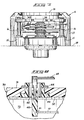
- Processing head 12 includes a removable cover 13, a structural motor base 15 and rigid supporting spacers 16 that fix mount 14 to motor base 15. Processing head 12 also includes a radially enlarged circular shroud 18 that is outwardly open along axis X-X. The dished shroud 18 is fixed across one axial end of the processing head 12. Shroud has a peripheral rim centered about the reference axis X-X adapted to elevationally support the processing head 12 with its one axial end facing downwardly;
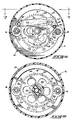
- a solid wafer plate 30 is coaxially centered about the axis X-X at the one axial end of the processing head 12.
- Wafer plate 30 is a rigid circular disk having opposed inner and outer surfaces 31, 32 and an inwardly projecting peripheral flange 33.
- the outer peripheral corner formed about the circular wafer plate 30 is relatively sharp and well-defined to facilitate the radial exit of fluid along its outer surface 32.
- Flange 33 overlaps a complementary cylindrical flange 20 about the interior of shroud 18, and closely abuts a peripheral horizontal flange 19 about the rim of shroud 18.
- the flanges 19, 20 and 33 form a baffle to prevent entry of liquid into the open chamber between the nonrotatable shroud 18 and the rotatable wafer plate 30.
- the horizontal flange 19 further serves as a support for processing head 12 while resting on a processing base 70 in an inverted position, as shown in Fig. 1.
- the periphery of shroud 18 also mounts a radially projecting electrical coupler 22 adapted to be connected to an electrical receiver 23 on a complementary processing base 70. Electrical power and control circuits for the equipment within the processing head 12 are completed by this connection.
- the electrical coupler and receiver 22, 23 are of conventional design. Their details are unnecessary to an understanding of the present improvements.
- Drive means are provided in the processing head.
- the drive means is operably connected to the gripper means for selectively rotating the gripper means relative to the processing head 12 and shroud 18 about the reference axis X-X.
- the wafer plate 30 is selectively rotated by a motor 34 located within cover 13.
- Motor 34 rotatably powers a driven shaft 35 having an enlargement 36 fastened to the inner surface 31 of wafer plate 30.
- the driven shaft 35 in turn is powered by a surrounding tubular motor drive shaft 38.
- Driven shaft 35 and drive shaft 38 are coaxially centered about the reference axis X-X of processing head 12.
- the drive shaft 38 and driven shaft 35 are axially splined to one another. They are held in an assembled condition by an enlarged nut 39 that threadably engages driven shaft 35 and radially overlaps the inner end of drive shaft 38.
- the above-described shaft assembly permits easy substitution of wafer plates 30 as required to support wafers 10 of different configurations or sizes. Substitution or repair of a wafer plate 30 can be readily accomplished by removal of nut 39 at the outer end of the portable processing head. One can then move the driven shaft 35 and wafer plate 30 axially from the remainder of the processing head 12. No interior access is required in the vicinity of wafer plate 30 to accomplish its assembly or disassembly.
- Gripper means is provided on the processing head 12 for holding a wafer 10 in a coaxial position perpendicular to the reference axis X-X, the gripper means being axially and radially overlapped by shroud 18.
- the gripper means includes a plurality of movable gripping fingers 40 which selectively hold a wafer 10 at a location adjacent to the outer surface 32 of wafer plate 30.
- the fingers 40 protrude axially to both sides of the wafer plate 30.
- Each is notched at 41 adjacent to its outer end to receive and engage the edges of a wafer 10.
- Fingers 40 are geometrically arranged about the reference axis of processing head 12 to receive and grip a wafer 10 within notches 41 in a coaxial position perpendicular to the axis X-X. Three fingers 40 are shown in the illustrated apparatus, but four or more fingers can be used when desired.
- each finger 40 is individually mounted in the wafer plate 30 within a flexible supporting diaphragm 42.
- the periphery of each diaphragm 42 presents a seal 43 engageable within the periphery of a complementary aperture formed through the wafer plate 30.
- the inner periphery of the seal is releasably held in place by a snap ring 44.
- Each diaphragm 42 is molded or otherwise formed integrally with one finger 40. This integral connection and support for the individual fingers 40 eliminates seams or openings across the wafer plate 30, while permitting the limited movement of finger 40 required to engage or disengage a wafer 10. Only the operative wafer-engaging section of each finger 40 is exposed to the processing fluids and gases outwardly of the wafer plate 30.
- Finger control means are located inwardly of the wafer plate 30 in the processing head 12 for moving fingers 40 in unison between closed positions engaging a wafer between them and open positions to permit receipt or discharge of a wafer.
- the finger control means comprises a combination of individual lever assemblies mounted about the inner surface 31 of wafer plate 30 and a common actuator assembly mounted within the motor base 15.
- the common actuator assembly is operably engageable with the individual lever assemblies for selectively moving the fingers in unison from their closed positions to their open positions.
- the actuator assembly does not physically engage the individual lever assemblies during normal operation and rotation of the wafer plate 30 in conjunction with the processing of a wafer 10.
- the individual lever assemblies are connected respectively to the individual fingers 40. They yieldably bias fingers 40 to their closed positions and selectively move the fingers to their open positions.
- Each of the individual lever assemblies for the fingers 40 includes a radial linkage bar 45 spaced inwardly from wafer plate 30. The outer end of each linkage bar 45 is pivotally connected to the inner end of the finger 40 controlled by it. Its inner end is pivotally connected to a pivot arm 46 mounted to a parallel pivot shaft 47. A torsion spring 53 wrapped about each pivot shaft 47 yieldably urges the associated pivot arm 46 to an upright or inwardly protruding position as illustrated in Fig. 1, where the fingers 40 are in a closed position parallel tc the reference axis X-X.
- An annular push ring 50 overlies the inner ends of the linkage bars 45 adjacent to the motor base 15.
- Motor base 15 has two cylinders formec diametrically apart through reference axis X-X. Each mounts an axially movable pneumatic piston 51 having a protruding piston shaft 52 fixed to the push ring 50.
- Pistons 51 are inwardly biased by surrounding compression springs 49. Piston springs 49 normally maintain push ring 50 clear of engagement with the underlying linkage bars 45.
- the piston shaft 52 and push ring 50 extend axially to depress the pivot arms 46 about pivot shaft 47 and thereby pull the inner ends of fingers 40 radially inward to permit a wafer 10 to be positioned for subsequent gripping by the fingers 40.
- the gripping movement is effected by the yieldable spring forces of springs 53 on pivot arms 46 when the pressure of push ring 50 is released by terminating application of pneumatic pressure to the piston 51.
- Indexing means for this purpose is provided within processing head 12. It selectively positions the fingers 40 in preselected angular locations about the reference axis when the wafer plate 30 is not being rotated by motor 34.
- Indexing is accomplished by a multi-sided rotor plate 59 having a plurality of sides equal in number to the fingers 40 on a particular wafer plate 30 with which it is used.
- Each side of rotor plate 59 has a curved edge configuration (shown in Fig. 5) that serves as a detent in combination with an inwardly-biased roller 60.
- the motor 34 is inoperative and drive shaft 38 is freely rotatable, the inward biasing force of roller 60 will cause rotor plate 59 to pivot an angular amount necessary to center roller 60 across the engaged side of rotor plate 59 in the centered position shown in Fig. 5.
- Roller 60 is mounted at one end of a crank arm 62 pivotally supported on a supporting shaft 63 depending from the mount 14.
- crank arm 62 includes a clevis 64 pivotally joined to the outer ends of two parallel piston rods 65 that are part of two parallel pneumatic cylinder assemblies 66.
- the remaining ends of the cylinder assemblies 66 are pivotally mounted about a parallel axis on a spacer 67 that joins the motor base 15 and mount 14.
- the cylinder assemblies 66 are normally spring biased to a retracted position where roller 60 is radially clear of the rotor plate 59, which rotates in unison with the drive shaft 38. However, when rotation of drive shaft 38 terminates and indexing of the wafer plate 30 is required, the cylinder assemblies 66 are extended. This forces roller 60 radially inward against the relationship illustrated by axis X-X in Fig. 1 and with the fingers 40 gripping a wafer within the bowl interior.
- the mounting means comprises an upwardly-facing peripheral flange 75 extending radially outward about the upright wall 71.
- the flange 75 is complementary to the flange 19 formed about shroud 18, which freely rests upon it to properly locate the processing head 12 on the processing base 70.
- Trough 78 is interposed between the upright wall surface 73 and the supporting flange 75 about the processing base 70. Trough 78 serves to collect liquid that escapes radially outward over the upright wall surface 73 during rotation of the wafer plate 30 and associated wafer 10. It also acts as an overflow for the upwardly open bowl or basin when immersion processing techniques are being carried out within it.
- the components of the processing base 70 arc located within a base enclosure formed by a surrounding cylindrical wall 79 and lower horizontal wall 82.
- the walls 72, 82 can be apertured as required for access of hoses, drains, pipes and other supply fittings to the interior of the enclosure.
- the base enclosure mounts the processing base 70 within a surrounding frame support 88.
- the bottom wall 72 of the processing bowl is supported by an annular bellows 80 extending about its full periphery to lower wall 82.
- Bellows 80 is interposed between the lower wall 82 and the lower wall 72 of the bowl for movably supporting bottom wall 72 during axial movement relative to the upright wall 71.
- Linear actuators are provided in the processing base 70 to move the bottom wall 72 parallel to axis X-X between the closed position shown in Fig. 1 and a lowered open position. These linear actuators are illustrated by one pneumatic cylinder assembly 84 in Fig. 1. In actual practice, a plurality of such cylinder assemblies 84 will be provided to move the relatively large bottom wall 72 in the required axial path.
- a drain 85 is provided in lower wall 82 at the exterior of bellows 80 for carrying away liquid received from within the bowl and from within the previously-described trough 78.
- any suitable number of liquid or gaseous jets or nozzles can be directed into the interior of the bowl.
- One illustrative jet 86 is shown extending through the movable bottom wall 72, although a plurality of similar jets or nozzles can be provided in any desired geometric pattern to direct fluid or gas against the edge of rotor plate 59 and properly centers the rotor plate as shown.
- the detent assures that the fingers 40 are angularly indexed when stationary to thereby meet operational requirements of associated robotic wafer handling equipment.
- a motion monitoring assembly is also provided within processing head 12 for measuring the speed and direction of rotation of the wafer plate 30 about the reference axis X-X.
- This is illustrated by an optical disk 54 fixed to the drive shaft 38 and provided with a plurality of small notches 55 and interspersed large notches 56 (Fig. 6).
- One or more optical sensors 57 overlie disk 54 to read the two sets of notches (Fig.1).
- the positions of the large notches 56 are utilized to confirm the angular position of the rotor plate 59 and held by the detent roller 60 in a stationary position. Additional sensors can be utilized to measure speed and direction of the disk by monitoring movement of the small notches 55. The details of such optical monitoring are well known and not necessary to an understanding of the present improvements.
- the general details of the processing base 70 are shown in the cross-sectional presentation of Fig. 1. It basically comprises an upwardly open bowl formed by a combination of a stationary circumferential upright wall surface 71 and an axially movable bottom wall 72.
- the bottom wall 72 is adapted to be shifted axially to sealingly engage the bottom edge of the upright wall 71. When lowered, the bottom wall 72 allows any liquid within the bowl to drain about its full periphery.
- the upright wall surface 73 and outer surface of bottom wall 72 together form an upwardly-open bowl interior centered about a second reference axis.
- This second reference axis of the processing base 70 is also identified in Fig. 1 by axis X-X, since the first and second reference axes of the portable processing head and supporting processing base 70 are coaxial when used in conjunction with one another.
- the inner diameter of the cylindrical surface 73 within the bowl relative to the axis X-X is greater than the outside diameters of the fingers 40 relative to the axis. -This provides clearance within the upwardly open bowl for reception of the gripping fingers 40 which position a wafer 10 within the bowl interior.
- Mounting means is located about the bowl for selectively holding a processing head with the first and second reference axes in a fixed coaxial facing surface of a wafer 10 in the required pattern.
- nozzles extending through the bottom wall 72 can be used to fill the bowl during processing and to circulate processing fluid as required.
- Peripheral liquid or gas supply nozzles and jets can also be provided about the cylindrical surface 73, as illustrated by the single jet 87 shown at the left side of Fig. 1.
- the processing base 70 lends itself to a wide variety of semiconductor wafer processing techniques requiring spraying of liquids and/or gases, as well as immersion within liquids.
- the illustrated bowl assembly permits rapid dumping of liquids from within the bowl interior. This is accomplished by moving the bottom wall 72 downwardly, which allows liquid to escape about its full periphery.
- Figs. 9-11 generally illustrate one self-contained machine application for the processing station previously described.
- the processing head 12 and processing base 70 are essentially identical to that detailed in Fig. 1.
- the processing base 70 is stationary and supported by the frame support 88, shown as a horizontal upper cabinet surface interrupted by one or more apertures 90.
- the open periphery of each aperture 90 is complementary in shape to the exterior of the base enclosure and the adjacent linear actuating mechanism for the processing head 12, which is described below.
- the interconnection between each processing head 12 and its associated processing base 70 are illustrated in Figs. 12-16.
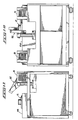
- the machine shown in Figs. 9-11 is a processing machine for semiconductor wafers. It includes four processing stations. In the drawings, three of the processing stations are shown with the processing base 70 and processing head 12 in closed positions on the upper surface of a machine cabinet. These components are not shown at the fourth processing station in order to illustrate the general shape of the receiving aperture 90.
- the machine cabinet also supports a pair of conventional portable wafer carriers 91 of a type conventionally used for supporting a stack of parallel semiconductor wafers during handling and transport. Incoming wafers would be handled by one carrier and processed wafers by the other.
- a universally movable and programmable robotic transfer arm assembly 92 is located centrally on the machine frame 88 for transferring individual wafers between carriers 91 and the four processing stations.
- the processing stations on a given cabinet might all be used for a common processing method involving application of one or more fluids to the surface(s) of a wafer positioned within them by the processing heads 12. or might be used in a sequence of processing steps wherein wafers are transferred from one processing head 12 to the next by operation of the robotic transfer arm 92.
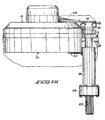
- the processing head 12 is cantilevered by a radial arm 93.
- the arm 93 is horizontal and upwardly adjacent to the previously-described shroud 18.
- the outer end of arm 93 is pinned to a support bracket 95 that serves as the previously-described mounting means provided on the processing head for attaching it to a movable support.
- the bracket 95 is fixed to the upper end of a vertically movable support shaft 100.
- Shaft 100 is hollow and cylindrical. It is slidably surrounded by a supporting tube 94 fixed to the lower wall 82 of the associated base enclosure by a bracket 110.
- a guide bearing 111 on the base enclosure also surrounds and slidably receives shaft 100 to stabilize its axial movement relative to tube 94.
- tube 94 The upper and lower ends of tube 94 are slidably sealed about the exterior of support shaft 100.
- An intermediate piston 96 is fixed to the exterior of support shaft 100 within tube 94 and sealingly engages the inside walls of tube 94.
- the support shaft 100 can be urged upwardly by introduction of pressurized air through the lower end of tube 94. It can be urged downwardly by introduction of pressurized air through the upper end of tube 94.
- processing head 12 can be pivoted about a vertically movable horizontal axis to the position shown in Fig. 15. This is accomplished manually by first removing an inner pin 101 interconnecting the outer end of radial support arm 93 and the support bracket 95. Removal of pin 101 frees the processing head 12 for pivotal movement about the horizontal center axis of the remaining pin 102.
- the processing head 12 might be raised to the position shown in Fig. 15 to permit substitution or repair of the wafer plate 30 and associated equipment, as described above.
- the electrical connections required between the reciprocable processing head 12 and the interior of the machine frame 88 can be made by flexible cables extending through the hollow support shaft 100 to a detachable electrical coupling 104 housed within a removable cover 103 that forms part of the radial support arm 93.
- the processing heads 12 illustrated in Figs. 9-15 are capable of limited vertical movement relative to the machine frame 88. They pop up and down in response to pneumatic pressure applied to their respective supporting pneumatic cylinder assemblies. When in their raised positions, the exposed fingers 40 can be spread apart to facilitate transfer of a wafer by operation of the robotic transfer arm 92. When lowered, the fingers 40 engage and locate a wafer 10 within the upwardly open processing bowl for exposure to processing fluids.
- Rotary actuator 106 can be a hydraulic motor or electric motor designed to turn processing head 12 about the axis of shaft 100 any desired angular distance.
- the rotary actuator 106 can be selectively operated to pivot the lower end of shaft 100 about its central vertical axis through interconnecting splines 105.
- the splines 105 can also accommodate vertical movement of shaft 100 and processing head 12 in response to actuation of the pneumatic cylinder assembly described above and illustrated in Fig. 13.
- the apparatus described in Figs. 9-16 maintains each wafer 10 elevationally beneath the processing head 12, where it the wafer is protected from contamination by contact of falling particulates.
- the complementary processing heads 12 and processing bases 70 form enclosures that minimize contamination within the space where processing of each wafer takes place. When desired, this space can be pressurized by introduction of compressed neutral gases to assure that contaminants cannot enter the enclosure formed by the processing head 12 and base 70.
- the above-described processing stations arc extremely versatile. They adapt to installations where it is desired that wafers are moved to and from a head movably supported on a processing cabinet or frame, as well as to installations where the head is required to be moved between multiple wafer handling and processing stations. In each type of installation, the wafers are securely and accurately gripped by the supporting fingers 40, and the adjacent shroud 18 is available to cover the wafer and minimize contamination of its surfaces during movement of the processing head 12.
Landscapes
- Cleaning Or Drying Semiconductors (AREA)
- Container, Conveyance, Adherence, Positioning, Of Wafer (AREA)
- Weting (AREA)
- Mechanical Treatment Of Semiconductor (AREA)
- Exchange Systems With Centralized Control (AREA)
- Die Bonding (AREA)
- Supplying Of Containers To The Packaging Station (AREA)
Abstract
Description
Claims (10)
- A processing apparatus for processing a microelectronic workpiece, the apparatus comprising:a processing base including one or more processing fluid inlets disposed to provide a processing fluid to an interior of the processing base;a processing head disposed opposite the processing base, the processing base and the processing head being movable with respect to one another;a workpiece support disposed on the processing head and operable between a first state, in which the workpiece is fixed to the processing head by the workpiece support, and a second state in which the workpiece may be removed from the workpiece support and the processing head;a drive mechanism disposed to provide relative movement between the processing base and the processing head between at least a workpiece loading position, in which the processing head and the processing base are positioned relative to one another to allow a workpiece to be loaded on, or removed from, the workpiece support, and a workpiece processing position in which the processing head and the processing base are positioned relative to one another so that the processing head and the processing base define a processing chamber that substantially surrounds the workpiece held upon the workpiece support, and wherein a processing fluid may be introduced through one or more of the processing fluid inlets of the processing base.
- Apparatus as claimed in claim 1, wherein the workpiece support comprises a pluaality of individual fingers that are operable between at least a first state, in which the individual fingers grasp a peripheral edge of the workpiece, and a second state in which the individual fingers are disengaged from the peripheral edge of the workpiece.
- Apparatus as claimed in claim 1 or claim 2, wherein the workpiece support is connected to a rotor assembly that is disposed on the processing head, the rotor assembly being operable to rotate the workpiece support and a workpiece disposed thereupon when the processing head and the processing base are in the relative processing position.
- Apparatus as claimed in any one of claims 1 to 3, wherein at least one of the inlets of the processing base is connected to receive a processing vapour.
- Apparatus as claimed in any one of claims 1 to 4, further comprising:a workpiece inventory; andan automated workpiece transfer mechanism operable to transfer a workpiece between at least the workpiece inventory and the workpiece support.
- Apparatus as claimed in claim 5, further comprising:a frame supporting the workpiece inventory, the processing base, and the automated workpiece transfer mechanism; anda further processing apparatus supported by the frame and accessible by the automated workpiece transfer mechanism.
- Apparatus as claimed in claim 6, wherein the further processmg apparatus is a single wafer processing apparatus having a processing head, a processing base, and a drive mechanism connected to provide relative movement between the processing head and the processing base.
- A processing apparatus for processing a microelectronic workpiece, the apparatus comprising:a frame;a processing base supported by the frame, the processing base including an open top and at least one fluid inlet disposed to provide a processing fluid to an interior of the processing base;a processmg head respectively associated with the processing base, the processing base and the processing head being movable with respect to one another;a workpiece support disposed on the processing head and operable between a first state, in which the workpiece is engaged by the workpiece support at peripheral of the workpiece so that the workpiece may be removed from the workpiece support and the processing head;a linear actuator supported by the frame and connected to provide relative movement between the processing base and the processing head between at least a workpiece loading position, in which the processing head and processing base are positioned relative to one another to allow a workpiece to be loaded on, or removed from, the workpiece support, and a workpiece processing position in which the processing head and the processing base are positioned relative to one another so that the processing head and the processing base define an enclosed processing chamber that substantially surrounds the workpiece held upon the workpiece support, and wherein a processing fluid may be introduced through one or more of the processing fluid inlets of the processing base.
- Apparatus as claimed in claim 8, wherein the workpiece support is connected to a rotor assembly that is disposed on the processing head, the rotor assembly being operable to rotate the workpiece support and a workpiece disposed thereupon when the processing head and the processing base are in the relative processing position.
- Apparatus as claimed in claim 8 or claim 9, wherein the workpiece support comprises a plurality of individual fingers that are operable between at least a first state, in which the individual fingers grasp a peripheral edge of the workpiece, and a second state in which the individual fingers are disengaged from the peripheral edge of the workpiece.
Applications Claiming Priority (4)
| Application Number | Priority Date | Filing Date | Title |
|---|---|---|---|
| US07/526,243 US5168887A (en) | 1990-05-18 | 1990-05-18 | Single wafer processor apparatus |
| US526243 | 1990-05-18 | ||
| EP94115503A EP0635872A2 (en) | 1990-05-18 | 1991-04-24 | Wafer support apparatus |
| EP91909105A EP0530230B1 (en) | 1990-05-18 | 1991-04-24 | Single wafer processor apparatus |
Related Parent Applications (1)
| Application Number | Title | Priority Date | Filing Date |
|---|---|---|---|
| EP94115503A Division EP0635872A2 (en) | 1990-05-18 | 1991-04-24 | Wafer support apparatus |
Publications (2)
| Publication Number | Publication Date |
|---|---|
| EP1028454A2 true EP1028454A2 (en) | 2000-08-16 |
| EP1028454A3 EP1028454A3 (en) | 2003-09-24 |
Family
ID=24096519
Family Applications (4)
| Application Number | Title | Priority Date | Filing Date |
|---|---|---|---|
| EP94115503A Withdrawn EP0635872A2 (en) | 1990-05-18 | 1991-04-24 | Wafer support apparatus |
| EP94115502A Withdrawn EP0644580A3 (en) | 1990-05-18 | 1991-04-24 | A micro wafer processor. |
| EP00101989A Withdrawn EP1028454A3 (en) | 1990-05-18 | 1991-04-24 | Wafer support apparatus |
| EP91909105A Expired - Lifetime EP0530230B1 (en) | 1990-05-18 | 1991-04-24 | Single wafer processor apparatus |
Family Applications Before (2)
| Application Number | Title | Priority Date | Filing Date |
|---|---|---|---|
| EP94115503A Withdrawn EP0635872A2 (en) | 1990-05-18 | 1991-04-24 | Wafer support apparatus |
| EP94115502A Withdrawn EP0644580A3 (en) | 1990-05-18 | 1991-04-24 | A micro wafer processor. |
Family Applications After (1)
| Application Number | Title | Priority Date | Filing Date |
|---|---|---|---|
| EP91909105A Expired - Lifetime EP0530230B1 (en) | 1990-05-18 | 1991-04-24 | Single wafer processor apparatus |
Country Status (7)
| Country | Link |
|---|---|
| US (1) | US5168887A (en) |
| EP (4) | EP0635872A2 (en) |
| JP (2) | JP3190331B2 (en) |
| AT (1) | ATE121220T1 (en) |
| AU (1) | AU7794891A (en) |
| DE (2) | DE69108908T2 (en) |
| WO (1) | WO1991018414A1 (en) |
Cited By (2)
| Publication number | Priority date | Publication date | Assignee | Title |
|---|---|---|---|---|
| WO2002095806A1 (en) * | 2001-05-18 | 2002-11-28 | Tokyo Electron Limited | Universal backplane assembly and methods |
| EP2012073A1 (en) | 2007-02-05 | 2009-01-07 | Frisquet SA | Heat exchanger for a boiler, boiler having such a heat exchanger and method for producing such a heat exchanger |
Families Citing this family (57)
| Publication number | Priority date | Publication date | Assignee | Title |
|---|---|---|---|---|
| US6375741B2 (en) | 1991-03-06 | 2002-04-23 | Timothy J. Reardon | Semiconductor processing spray coating apparatus |
| US5222310A (en) * | 1990-05-18 | 1993-06-29 | Semitool, Inc. | Single wafer processor with a frame |
| US5658387A (en) * | 1991-03-06 | 1997-08-19 | Semitool, Inc. | Semiconductor processing spray coating apparatus |
| JPH07245285A (en) * | 1994-03-03 | 1995-09-19 | Dainippon Screen Mfg Co Ltd | Substrate processing equipment |
| US5664337A (en) * | 1996-03-26 | 1997-09-09 | Semitool, Inc. | Automated semiconductor processing systems |
| AT405225B (en) * | 1995-05-02 | 1999-06-25 | Sez Semiconduct Equip Zubehoer | DEVICE FOR TREATING APPROXIMATELY ROUND OR DISC-SHAPED OBJECTS, IN PARTICULAR SILICON WAFERS |
| US5744417A (en) * | 1996-05-02 | 1998-04-28 | Lyondell Petrochemical Company | Supported catalyst |
| US6203582B1 (en) | 1996-07-15 | 2001-03-20 | Semitool, Inc. | Modular semiconductor workpiece processing tool |
| US6358388B1 (en) * | 1996-07-15 | 2002-03-19 | Semitool, Inc. | Plating system workpiece support having workpiece-engaging electrodes with distal contact-part and dielectric cover |
| US6672820B1 (en) | 1996-07-15 | 2004-01-06 | Semitool, Inc. | Semiconductor processing apparatus having linear conveyer system |
| US6645355B2 (en) | 1996-07-15 | 2003-11-11 | Semitool, Inc. | Semiconductor processing apparatus having lift and tilt mechanism |
| US5731678A (en) * | 1996-07-15 | 1998-03-24 | Semitool, Inc. | Processing head for semiconductor processing machines |
| US5980706A (en) * | 1996-07-15 | 1999-11-09 | Semitool, Inc. | Electrode semiconductor workpiece holder |
| US6001234A (en) * | 1997-09-30 | 1999-12-14 | Semitool, Inc. | Methods for plating semiconductor workpieces using a workpiece-engaging electrode assembly with sealing boot |
| US6599412B1 (en) * | 1997-09-30 | 2003-07-29 | Semitool, Inc. | In-situ cleaning processes for semiconductor electroplating electrodes |
| US6805778B1 (en) * | 1996-07-15 | 2004-10-19 | Semitool, Inc. | Contact assembly for supplying power to workpieces during electrochemical processing |
| US6091498A (en) | 1996-07-15 | 2000-07-18 | Semitool, Inc. | Semiconductor processing apparatus having lift and tilt mechanism |
| US7087143B1 (en) | 1996-07-15 | 2006-08-08 | Semitool, Inc. | Plating system for semiconductor materials |
| WO2000061498A2 (en) | 1999-04-13 | 2000-10-19 | Semitool, Inc. | System for electrochemically processing a workpiece |
| US6228231B1 (en) | 1997-05-29 | 2001-05-08 | International Business Machines Corporation | Electroplating workpiece fixture having liquid gap spacer |
| EP1027481A1 (en) | 1997-09-30 | 2000-08-16 | Semitool, Inc. | Electroplating system having auxiliary electrode exterior to main reactor chamber for contact cleaning operations |
| US6921468B2 (en) * | 1997-09-30 | 2005-07-26 | Semitool, Inc. | Electroplating system having auxiliary electrode exterior to main reactor chamber for contact cleaning operations |
| US6090711A (en) * | 1997-09-30 | 2000-07-18 | Semitool, Inc. | Methods for controlling semiconductor workpiece surface exposure to processing liquids |
| US6565729B2 (en) | 1998-03-20 | 2003-05-20 | Semitool, Inc. | Method for electrochemically depositing metal on a semiconductor workpiece |
| US6416647B1 (en) * | 1998-04-21 | 2002-07-09 | Applied Materials, Inc. | Electro-chemical deposition cell for face-up processing of single semiconductor substrates |
| DE69929967T2 (en) | 1998-04-21 | 2007-05-24 | Applied Materials, Inc., Santa Clara | ELECTROPLATING SYSTEM AND METHOD FOR ELECTROPLATING ON SUBSTRATES |
| DE19825381B4 (en) * | 1998-05-28 | 2004-10-28 | Institut für Halbleiterphysik Frankfurt (Oder) GmbH | Process for handling wafers of large diameter during an annealing process |
| US6071388A (en) * | 1998-05-29 | 2000-06-06 | International Business Machines Corporation | Electroplating workpiece fixture having liquid gap spacer |
| US6497801B1 (en) | 1998-07-10 | 2002-12-24 | Semitool Inc | Electroplating apparatus with segmented anode array |
| US6494984B2 (en) | 1999-01-14 | 2002-12-17 | Semitool, Inc. | Flat media processing machine |
| US6190103B1 (en) * | 1999-03-31 | 2001-02-20 | Gasonics International Corporation | Wafer transfer device and method |
| US6557237B1 (en) * | 1999-04-08 | 2003-05-06 | Applied Materials, Inc. | Removable modular cell for electro-chemical plating and method |
| US7438788B2 (en) | 1999-04-13 | 2008-10-21 | Semitool, Inc. | Apparatus and methods for electrochemical processing of microelectronic workpieces |
| US7020537B2 (en) | 1999-04-13 | 2006-03-28 | Semitool, Inc. | Tuning electrodes used in a reactor for electrochemically processing a microelectronic workpiece |
| US7585398B2 (en) | 1999-04-13 | 2009-09-08 | Semitool, Inc. | Chambers, systems, and methods for electrochemically processing microfeature workpieces |
| US7264698B2 (en) | 1999-04-13 | 2007-09-04 | Semitool, Inc. | Apparatus and methods for electrochemical processing of microelectronic workpieces |
| US7351315B2 (en) | 2003-12-05 | 2008-04-01 | Semitool, Inc. | Chambers, systems, and methods for electrochemically processing microfeature workpieces |
| US7160421B2 (en) * | 1999-04-13 | 2007-01-09 | Semitool, Inc. | Turning electrodes used in a reactor for electrochemically processing a microelectronic workpiece |
| US6916412B2 (en) | 1999-04-13 | 2005-07-12 | Semitool, Inc. | Adaptable electrochemical processing chamber |
| US7189318B2 (en) | 1999-04-13 | 2007-03-13 | Semitool, Inc. | Tuning electrodes used in a reactor for electrochemically processing a microelectronic workpiece |
| US7351314B2 (en) | 2003-12-05 | 2008-04-01 | Semitool, Inc. | Chambers, systems, and methods for electrochemically processing microfeature workpieces |
| TW499696B (en) * | 1999-04-27 | 2002-08-21 | Tokyo Electron Ltd | Processing apparatus and processing method |
| JP3367476B2 (en) | 1999-07-07 | 2003-01-14 | 住友電気工業株式会社 | Roadside transmission device |
| US6796517B1 (en) | 2000-03-09 | 2004-09-28 | Advanced Micro Devices, Inc. | Apparatus for the application of developing solution to a semiconductor wafer |
| US20040178065A1 (en) * | 2001-03-16 | 2004-09-16 | Semitool, Inc. | Electrode semiconductor workpiece holder and processing methods |
| AU2002343330A1 (en) | 2001-08-31 | 2003-03-10 | Semitool, Inc. | Apparatus and methods for electrochemical processing of microelectronic workpieces |
| US7247223B2 (en) | 2002-05-29 | 2007-07-24 | Semitool, Inc. | Method and apparatus for controlling vessel characteristics, including shape and thieving current for processing microfeature workpieces |
| US7114903B2 (en) | 2002-07-16 | 2006-10-03 | Semitool, Inc. | Apparatuses and method for transferring and/or pre-processing microelectronic workpieces |
| US20040118694A1 (en) * | 2002-12-19 | 2004-06-24 | Applied Materials, Inc. | Multi-chemistry electrochemical processing system |
| US20040255442A1 (en) * | 2003-06-19 | 2004-12-23 | Mcdiarmid James | Methods and apparatus for processing workpieces |
| JP4265306B2 (en) * | 2003-06-27 | 2009-05-20 | 株式会社東京精密 | Wafer delivery device |
| US20050077182A1 (en) * | 2003-10-10 | 2005-04-14 | Applied Materials, Inc. | Volume measurement apparatus and method |
| KR100829923B1 (en) * | 2006-08-30 | 2008-05-16 | 세메스 주식회사 | Spin head and substrate processing method using same |
| US8309045B2 (en) | 2011-02-11 | 2012-11-13 | General Electric Company | System and method for controlling emissions in a combustion system |
| US9421617B2 (en) | 2011-06-22 | 2016-08-23 | Tel Nexx, Inc. | Substrate holder |
| US8613474B2 (en) | 2011-07-06 | 2013-12-24 | Tel Nexx, Inc. | Substrate loader and unloader having a Bernoulli support |
| US20240375293A1 (en) * | 2023-05-10 | 2024-11-14 | Samsung Electronics Co., Ltd. | In-chamber maintenance apparatus, system, and maintenance method using the same |
Family Cites Families (20)
| Publication number | Priority date | Publication date | Assignee | Title |
|---|---|---|---|---|
| US4161356A (en) * | 1977-01-21 | 1979-07-17 | Burchard John S | Apparatus for in-situ processing of photoplates |
| JPS57166250A (en) * | 1981-04-03 | 1982-10-13 | Dainippon Screen Mfg Co Ltd | Conveyance positioning device of sheet material |
| US4339297A (en) * | 1981-04-14 | 1982-07-13 | Seiichiro Aigo | Apparatus for etching of oxide film on semiconductor wafer |
| US4429983A (en) * | 1982-03-22 | 1984-02-07 | International Business Machines Corporation | Developing apparatus for exposed photoresist coated wafers |
| JPS59124591A (en) * | 1982-12-30 | 1984-07-18 | 大日本スクリ−ン製造株式会社 | Shifter for sheet material |
| JPS59201782A (en) * | 1983-04-23 | 1984-11-15 | 大日本スクリ−ン製造株式会社 | Conveyor for sheet material such as wafer |
| US4439261A (en) * | 1983-08-26 | 1984-03-27 | International Business Machines Corporation | Composite pallet |
| US4519846A (en) * | 1984-03-08 | 1985-05-28 | Seiichiro Aigo | Process for washing and drying a semiconductor element |
| US4745422A (en) * | 1985-11-18 | 1988-05-17 | Kabushiki Kaisha Toshiba | Automatic developing apparatus |
| US4724317A (en) * | 1985-12-05 | 1988-02-09 | Baxter Travenol Laboratories, Inc. | Optical data collection apparatus and method used with moving members |
| US4651440A (en) * | 1986-05-16 | 1987-03-24 | Eastman Kodak Company | Spin drying apparatus |
| JPS6314434A (en) * | 1986-07-04 | 1988-01-21 | Dainippon Screen Mfg Co Ltd | Substrate surface processing and equipment therefor |
| US4788994A (en) * | 1986-08-13 | 1988-12-06 | Dainippon Screen Mfg. Co. | Wafer holding mechanism |
| JPH0834205B2 (en) * | 1986-11-21 | 1996-03-29 | 株式会社東芝 | Dry etching equipment |
| JPS63133545A (en) * | 1986-11-25 | 1988-06-06 | Dainippon Screen Mfg Co Ltd | Substrate transferring transporting device for thermal treatment equipment |
| US4817556A (en) * | 1987-05-04 | 1989-04-04 | Varian Associates, Inc. | Apparatus for retaining wafers |
| JPH0617295Y2 (en) * | 1987-11-27 | 1994-05-02 | 大日本スクリーン製造株式会社 | Substrate transfer device |
| JPH01304732A (en) * | 1988-06-01 | 1989-12-08 | Nec Corp | Semiconductor wafer washer |
| SU1734865A1 (en) * | 1988-07-18 | 1992-05-23 | Московское научно-производственное объединение "Биофизприбор" | Centrifuge control device |
| TWI313428B (en) | 2005-12-14 | 2009-08-11 | Darfon Electronic Corporatio | Mouse |
-
1990
- 1990-05-18 US US07/526,243 patent/US5168887A/en not_active Expired - Lifetime
-
1991
- 1991-04-24 AT AT91909105T patent/ATE121220T1/en not_active IP Right Cessation
- 1991-04-24 EP EP94115503A patent/EP0635872A2/en not_active Withdrawn
- 1991-04-24 EP EP94115502A patent/EP0644580A3/en not_active Withdrawn
- 1991-04-24 JP JP50885991A patent/JP3190331B2/en not_active Expired - Fee Related
- 1991-04-24 DE DE69108908T patent/DE69108908T2/en not_active Expired - Fee Related
- 1991-04-24 EP EP00101989A patent/EP1028454A3/en not_active Withdrawn
- 1991-04-24 EP EP91909105A patent/EP0530230B1/en not_active Expired - Lifetime
- 1991-04-24 AU AU77948/91A patent/AU7794891A/en not_active Abandoned
- 1991-04-24 DE DE0644580T patent/DE644580T1/en active Pending
- 1991-04-24 WO PCT/US1991/002817 patent/WO1991018414A1/en not_active Ceased
-
2001
- 2001-02-21 JP JP2001045043A patent/JP3545713B2/en not_active Expired - Fee Related
Cited By (3)
| Publication number | Priority date | Publication date | Assignee | Title |
|---|---|---|---|---|
| WO2002095806A1 (en) * | 2001-05-18 | 2002-11-28 | Tokyo Electron Limited | Universal backplane assembly and methods |
| US6645344B2 (en) | 2001-05-18 | 2003-11-11 | Tokyo Electron Limited | Universal backplane assembly and methods |
| EP2012073A1 (en) | 2007-02-05 | 2009-01-07 | Frisquet SA | Heat exchanger for a boiler, boiler having such a heat exchanger and method for producing such a heat exchanger |
Also Published As
| Publication number | Publication date |
|---|---|
| JP3190331B2 (en) | 2001-07-23 |
| JPH05507179A (en) | 1993-10-14 |
| EP0635872A2 (en) | 1995-01-25 |
| EP0530230A1 (en) | 1993-03-10 |
| WO1991018414A1 (en) | 1991-11-28 |
| US5168887A (en) | 1992-12-08 |
| EP0530230B1 (en) | 1995-04-12 |
| EP1028454A3 (en) | 2003-09-24 |
| AU7794891A (en) | 1991-12-10 |
| DE69108908D1 (en) | 1995-05-18 |
| JP3545713B2 (en) | 2004-07-21 |
| DE69108908T2 (en) | 1995-11-16 |
| EP0644580A2 (en) | 1995-03-22 |
| ATE121220T1 (en) | 1995-04-15 |
| DE644580T1 (en) | 1995-11-09 |
| EP0635872A3 (en) | 1995-03-01 |
| EP0644580A3 (en) | 1995-05-24 |
| JP2001291692A (en) | 2001-10-19 |
Similar Documents
| Publication | Publication Date | Title |
|---|---|---|
| EP0530230B1 (en) | Single wafer processor apparatus | |
| US5573023A (en) | Single wafer processor apparatus | |
| US5156174A (en) | Single wafer processor with a bowl | |
| US5168886A (en) | Single wafer processor | |
| US5230743A (en) | Method for single wafer processing in which a semiconductor wafer is contacted with a fluid | |
| US5224504A (en) | Single wafer processor | |
| US5370741A (en) | Dynamic semiconductor wafer processing using homogeneous chemical vapors | |
| US5377708A (en) | Multi-station semiconductor processor with volatilization | |
| US5232511A (en) | Dynamic semiconductor wafer processing using homogeneous mixed acid vapors | |
| KR100983421B1 (en) | Substrate Processing Equipment | |
| US6799586B2 (en) | Substrate processing method | |
| WO1998056034A1 (en) | Carousel wafer transfer system | |
| JPH06507523A (en) | semiconductor wafer processing module | |
| JPH11163094A (en) | Substrate chucking device and substrate cleaning device | |
| US5357991A (en) | Gas phase semiconductor processor with liquid phase mixing | |
| US6668844B2 (en) | Systems and methods for processing workpieces | |
| WO2002017355A9 (en) | Semiconductor wafer container cleaning apparatus | |
| US6427359B1 (en) | Systems and methods for processing workpieces | |
| US8082932B2 (en) | Single side workpiece processing | |
| EP0528995B1 (en) | Semiconductor processor apparatus with dynamic wafer vapor treatment and particle volatilization | |
| US12159794B2 (en) | Wafer processing method and carrier | |
| US7849865B2 (en) | System for processing a workpiece | |
| JP2001077075A (en) | Processing device and processing method | |
| JP7752037B2 (en) | Substrate processing apparatus and substrate processing method | |
| WO2003008114A1 (en) | Systems and methods for processing workpieces |
Legal Events
| Date | Code | Title | Description |
|---|---|---|---|
| PUAI | Public reference made under article 153(3) epc to a published international application that has entered the european phase |
Free format text: ORIGINAL CODE: 0009012 |
|
| 17P | Request for examination filed |
Effective date: 20000221 |
|
| AC | Divisional application: reference to earlier application |
Ref document number: 635872 Country of ref document: EP Ref document number: 530230 Country of ref document: EP |
|
| AK | Designated contracting states |
Kind code of ref document: A2 Designated state(s): AT BE CH DE DK ES FR GB GR IT LI LU NL SE |
|
| RIN1 | Information on inventor provided before grant (corrected) |
Inventor name: OWCZARZ, ALCKSANDOR Inventor name: THOMPSON, RAYMON F. |
|
| RIN1 | Information on inventor provided before grant (corrected) |
Inventor name: OWCZARZ, ALCKSANDOR Inventor name: THOMPSON, RAYMON F. |
|
| PUAL | Search report despatched |
Free format text: ORIGINAL CODE: 0009013 |
|
| AK | Designated contracting states |
Kind code of ref document: A3 Designated state(s): AT BE CH DE DK ES FR GB GR IT LI LU NL SE |
|
| 17Q | First examination report despatched |
Effective date: 20040402 |
|
| AKX | Designation fees paid |
Designated state(s): AT BE CH DE DK ES FR GB GR IT LI LU NL SE |
|
| STAA | Information on the status of an ep patent application or granted ep patent |
Free format text: STATUS: THE APPLICATION IS DEEMED TO BE WITHDRAWN |
|
| 18D | Application deemed to be withdrawn |
Effective date: 20040813 |