EP1028623B1 - Verfahren zur gefrierkonservierung - Google Patents
Verfahren zur gefrierkonservierung Download PDFInfo
- Publication number
- EP1028623B1 EP1028623B1 EP98949129A EP98949129A EP1028623B1 EP 1028623 B1 EP1028623 B1 EP 1028623B1 EP 98949129 A EP98949129 A EP 98949129A EP 98949129 A EP98949129 A EP 98949129A EP 1028623 B1 EP1028623 B1 EP 1028623B1
- Authority
- EP
- European Patent Office
- Prior art keywords
- point
- temperature
- sample
- nucleating
- lowering
- Prior art date
- Legal status (The legal status is an assumption and is not a legal conclusion. Google has not performed a legal analysis and makes no representation as to the accuracy of the status listed.)
- Expired - Lifetime
Links
Images


Classifications
-
- A—HUMAN NECESSITIES
- A01—AGRICULTURE; FORESTRY; ANIMAL HUSBANDRY; HUNTING; TRAPPING; FISHING
- A01N—PRESERVATION OF BODIES OF HUMANS OR ANIMALS OR PLANTS OR PARTS THEREOF; BIOCIDES, e.g. AS DISINFECTANTS, AS PESTICIDES OR AS HERBICIDES; PEST REPELLANTS OR ATTRACTANTS; PLANT GROWTH REGULATORS
- A01N1/00—Preservation of bodies of humans or animals, or parts thereof
- A01N1/10—Preservation of living parts
- A01N1/16—Physical preservation processes
- A01N1/162—Temperature processes, e.g. following predefined temperature changes over time
-
- A—HUMAN NECESSITIES
- A01—AGRICULTURE; FORESTRY; ANIMAL HUSBANDRY; HUNTING; TRAPPING; FISHING
- A01N—PRESERVATION OF BODIES OF HUMANS OR ANIMALS OR PLANTS OR PARTS THEREOF; BIOCIDES, e.g. AS DISINFECTANTS, AS PESTICIDES OR AS HERBICIDES; PEST REPELLANTS OR ATTRACTANTS; PLANT GROWTH REGULATORS
- A01N1/00—Preservation of bodies of humans or animals, or parts thereof
- A01N1/10—Preservation of living parts
-
- A—HUMAN NECESSITIES
- A01—AGRICULTURE; FORESTRY; ANIMAL HUSBANDRY; HUNTING; TRAPPING; FISHING
- A01N—PRESERVATION OF BODIES OF HUMANS OR ANIMALS OR PLANTS OR PARTS THEREOF; BIOCIDES, e.g. AS DISINFECTANTS, AS PESTICIDES OR AS HERBICIDES; PEST REPELLANTS OR ATTRACTANTS; PLANT GROWTH REGULATORS
- A01N1/00—Preservation of bodies of humans or animals, or parts thereof
- A01N1/10—Preservation of living parts
- A01N1/14—Mechanical aspects of preservation; Apparatus or containers therefor
- A01N1/142—Apparatus
- A01N1/144—Apparatus for temperature control, e.g. refrigerators or freeze-drying apparatus
- A01N1/145—Stationary or portable vessels generating cryogenic temperatures, e.g. liquid nitrogen baths
-
- C—CHEMISTRY; METALLURGY
- C12—BIOCHEMISTRY; BEER; SPIRITS; WINE; VINEGAR; MICROBIOLOGY; ENZYMOLOGY; MUTATION OR GENETIC ENGINEERING
- C12N—MICROORGANISMS OR ENZYMES; COMPOSITIONS THEREOF; PROPAGATING, PRESERVING, OR MAINTAINING MICROORGANISMS; MUTATION OR GENETIC ENGINEERING; CULTURE MEDIA
- C12N1/00—Microorganisms; Compositions thereof; Processes of propagating, maintaining or preserving microorganisms or compositions thereof; Processes of preparing or isolating a composition containing a microorganism; Culture media therefor
- C12N1/04—Preserving or maintaining viable microorganisms
-
- Y—GENERAL TAGGING OF NEW TECHNOLOGICAL DEVELOPMENTS; GENERAL TAGGING OF CROSS-SECTIONAL TECHNOLOGIES SPANNING OVER SEVERAL SECTIONS OF THE IPC; TECHNICAL SUBJECTS COVERED BY FORMER USPC CROSS-REFERENCE ART COLLECTIONS [XRACs] AND DIGESTS
- Y10—TECHNICAL SUBJECTS COVERED BY FORMER USPC
- Y10S—TECHNICAL SUBJECTS COVERED BY FORMER USPC CROSS-REFERENCE ART COLLECTIONS [XRACs] AND DIGESTS
- Y10S128/00—Surgery
- Y10S128/27—Cryogenic
-
- Y—GENERAL TAGGING OF NEW TECHNOLOGICAL DEVELOPMENTS; GENERAL TAGGING OF CROSS-SECTIONAL TECHNOLOGIES SPANNING OVER SEVERAL SECTIONS OF THE IPC; TECHNICAL SUBJECTS COVERED BY FORMER USPC CROSS-REFERENCE ART COLLECTIONS [XRACs] AND DIGESTS
- Y10—TECHNICAL SUBJECTS COVERED BY FORMER USPC
- Y10T—TECHNICAL SUBJECTS COVERED BY FORMER US CLASSIFICATION
- Y10T436/00—Chemistry: analytical and immunological testing
- Y10T436/10—Composition for standardization, calibration, simulation, stabilization, preparation or preservation; processes of use in preparation for chemical testing
Definitions
- the present invention relates to a method and apparatus for cryopreserving biological material including, for example, cell suspensions, such as embryos, gametes, (spermatozoa, oocytes) cell lines, bone marrow, blood stem cells and the like; solutions of proteins and/or other biologically active substances; and perfused tissues and organs, either engineered or obtained from a natural source.
- cell suspensions such as embryos, gametes, (spermatozoa, oocytes) cell lines, bone marrow, blood stem cells and the like
- solutions of proteins and/or other biologically active substances such as perfused tissues and organs, either engineered or obtained from a natural source.
- Cryopreservation is a process where samples such as biological materials are stored at low temperatures. Cryopreservation of biological material substantially as described above is generally affected by freezing in appropriate retaining means, such as flexible bags, glass or plastic ampoules, or plastic tubes (usually referred to as "straws" in the field of cryopreservation) of the type suitable for long term storage at the low temperatures employed.
- appropriate retaining means such as flexible bags, glass or plastic ampoules, or plastic tubes (usually referred to as "straws" in the field of cryopreservation) of the type suitable for long term storage at the low temperatures employed.
- cryopreservation has been widely employed for a range of biological materials, there are certain materials for which it is not suitable. For example, with certain materials, cellular injury can occur on thawing. Furthermore, cryopreservation is not applicable for cell types where recovery on thawing may either be low or very variable, or even non-existent. For example, recovery on thawing of sub-fertile human spermatozoa, human testicular spermatozoa, pig spermatozoa and the like is generally low or variable, and in other cases such as mammalian oocytes, fish eggs, fish embryos, tissues, organs or the like, survival is non-existent.
- cell survival can be dependent on the conditions and techniques employed, such as appropriate nucleation techniques, addition of suitable cryoprotective additives and also the control of the cooling rate.
- Nucleation for example, is known to be a problem when not externally controlled in cryopreservation techniques, and occurs at a wide range of temperatures below the melting point of individual materials.
- nucleation In order to nucleate biological materials in a reproducible manner, it is common practice firstly to cool the materials to a temperature below the melting point thereof, then after a short period of thermal equilibration, to nucleate ice in the supercooled material. Nucleation can be achieved by any of the following techniques - application of cold forceps to the outside of the material, by cold wires, by devices employing "reverse Peltier effects" or by the application of physical disturbances.
- An alternative method of ensuring nucleation near to the melting point is to incorporate an ice nucleating agent into the biological suspension before temperature reduction.
- ice nucleating agents include the so called ice nucleating bacteria for example Pseudomonas syringae, the active proteins from ice nucleating bacteria and organic compounds such as cholesterol. Following nucleation and initial crystal growth, cooling of the materials is then resumed.
- WO 98/23907 an Article 54(3) EPC publication, describes apparatus for freezing sperm.
- the apparatus comprises a container having cooling means with at least one contact face for contacting the cell sample, and means for controlling the cooling rate and ambient temperature of the container.
- WO 96/02801 discusses the importance of employing a linear cooling rate over the entire cooling phase employed in cryopreservation, and is concerned with the provision of a cooling assembly capable of obtaining a substantially linear and reproducible rate of cooling samples.
- WO 96/24018 is concerned with the cryopreservation of mammalian tissue, or living cultured equivalents made by in vitro technology.
- the temperature control employs linear temperature lowering, but different rates of linear temperature lowering are respectively employed in different stages of the cryopreservation process. More particularly, the temperature is initially lowered at a rate of -10.0°C/minute to the solid-liquid phase equilibrium temperature range for an employed cryoprotectant, and following propagation of ice seed crystals throughout the cryoprotectant cooling is resumed at a rate of between -0.02 to about -0.3°C/minute.
- US 4799358 describes freezing of biological material, and also employs linear temperature lowering but with different rates of linear temperature lowering being respectively employed in different stages of the freezing process.
- the temperature is typically initially lowered at a rate of -0.5°C/minute between +20°C and -7°C and then -0.3°C/minute between -7°C and -35°C.
- WO91/01635 is concerned with a cooling process and apparatus where the material being frozen is subjected to a greater rate of heat extraction when the latent heat is being given up during nucleation, than when the material is cooled further.
- WO91/01635 indicates that the heat extraction rates may be non-linear, but does not provide clear guidance as to the parameters of non-linear heat extraction employed.
- a method of cryopreserving biological material comprises: providing a sample of the biological material, where a liquid phase of the sample includes at least one solute; lowering the temperature of the sample to a nucleating point at which ice nucleation can occur in the sample; effecting ice nucleation in the sample; and lowering the temperature of the sample from the nucleating point to the solidification point thereof, characterised in that the temperature lowering from the nucleating point to the solidification point is non-linear, whereby the rate of change of solute concentration in the liquid phase decreases for more than 80% of the time taken to lower the temperature from the nucleating point to the solidification point.
- the liquid phase is aqueous and, preferably, the biological sample is suspended or dissolved therein.
- solidification point denotes the temperature at which substantially all the liquid phase of the sample solidifies, or vitrifies. This temperature can be determined from a phase diagram or may be measured by differential scanning calorimetry. For simple solutions, the solidification point is the eutectic temperature.
- the method of the present invention comprises determining the melting point of the sample.
- the melting point can be determined based on the osmolality of the liquid phase, and a method according to the present invention aptly further comprises determining the osmolality of the liquid phase.
- Osmolality can be determined by any convenient technique known in the art, such as solidificatión point osmometry, or may be calculated from the composition of the liquid phase.
- the equilibrium phase diagram during solidification or freezing can then be constructed by an appropriate method, including experimental measurement, by reference to standard text (for example the CRH Handbook of Chemistry and Physics) or scientific publication (for example Rasmussen & Mckenzie, Nature 220 , 1315-1317, 1968, Shepard et al ., Cryobiology 13 , 9-23, 1976, Lane, Ind. Engr. Chem. 17 , 924, 1925).
- standard text for example the CRH Handbook of Chemistry and Physics
- scientific publication for example Rasmussen & Mckenzie, Nature 220 , 1315-1317, 1968, Shepard et al ., Cryobiology 13 , 9-23, 1976, Lane, Ind. Engr. Chem. 17 , 924, 1925.
- the phase diagram may be approximated by any well defined system, for example glycerol and water (Lane, Ind. Engr. Chem. 17 , 924, 1925).
- the method according to the present invention preferably includes determining the nucleating point of the sample.
- the nucleating point should be substantially close to the melting point.
- the nucleating point should not be less than about 4°C below the melting point. Even more preferably, the nucleating point should not be less than about 2 °C below the melting point. Ice nucleation can be achieved by employing any known prior art techniques substantially as herein before described.
- the method can further comprise a step of thermal re-equilibration following ice nucleation.
- substantially no re-equilibration is carried out.
- the temperature lowering from the nucleating point to the solidification point is non-linear, so that the rate of change of solute concentration in the liquid phase decreases for more than 80% of the time taken to lower the temperature from the nucleating point to the solidification point. It will be appreciated, however, that any particular such non-linear thermal profile will be substantially dependent on the biological material being cryopreserved, the concentration thereof, solute concentration or concentrations and also the presence of any other additives in the sample.
- temperature lowering from the nucleating point to the solidification point is non-linear so that the rate of change of solute concentration in the liquid phase decreases for more than 90% of the time taken to lower the temperature from the nucleating point to the solidification point.
- the sample employed in a method according to the present invention contains one or more cryoprotectants.
- a suitable cryoprotectant can include a solution of glycerol, fructose and sodium citrate.
- the method according to the present invention preferably further involves determining the time to be taken for the non-linear temperature lowering from the nucleating point to the solidification point.
- the time elapsed from the nucleation point to the solidification point can be dependent on a number of factors, such as the biological material being cryopreserved, and suitably also the cryoprotectant employed, and can be determined in a number of ways.
- the elapsed time can suitably substantially correspond to the time that would be taken from the nucleating point to the solidification point where the optimal linear rate of cooling was employed for a selected biological material.
- the optimal linear rate of cooling for mammalian spermatozoa is -10°C and -0.3°C for mammalian embryos. This optimum linear rate of cooling may be estimated from a knowledge of the basic biophysical parameters that determine osmotic behaviour during solidification.
- the elapsed time during the non-linear cooling employed in the present invention can be determined by modelling the osmotic behaviour during solidification. Accordingly, the elapsed time may be determined by selecting the shortest time that achieves sufficient water loss so as to substantially avoid any intracellular ice formation in the cells of the biological material, during any of the temperature lowering steps employed in the present invention.
- Biological material employed in a method according to the present invention suitably comprises cell suspensions, such as embryos, gametes (spermatozoa, oocytes), cell lines, bone marrow, blood stem cells or the like; solutions of proteins and/or other biologically active substances; and perfused tissues and organs, either engineered or obtained from a natural source.
- cell suspensions such as embryos, gametes (spermatozoa, oocytes), cell lines, bone marrow, blood stem cells or the like; solutions of proteins and/or other biologically active substances; and perfused tissues and organs, either engineered or obtained from a natural source.
- Biological material substantially as herein before described can be provided cryopreserved by a method substantially as herein before described.
- Suitable apparatus for cryopreserving a biological material in accordance with the method of the invention comprises means for receiving one or more samples of the biological material, where a liquid phase of the sample or samples includes at least one solute; means for lowering the temperature of the sample or samples to a nucleating point thereof at which ice nucleation can occur in the sample or samples; means for effecting ice nucleation in the sample or samples; and means for lowering the temperature of the sample or samples from the nucleating point to a solidification point thereof, characterised in that the temperature lowering means effect non-linear temperature lowering from the nucleating point to the solidification point, whereby the rate of change of solute concentration in the liquid phase decreases for more than 80% of the time taken to lower the temperature from the nucleating point to the solidification point.
- the receiving means of the apparatus are dimensioned so as to be suitable for receiving sample retaining means generally employed in cryopreservation, such as plastic tubes (commonly known in the field of cryopreserving as "straws") for the biological sample or samples.
- the receiving means can comprise a grooved (typically machined) holder for the retaining means such as straws, and can generally comprise a suitable thermally conductive material.
- the grooved holder is substantially horizontally arranged for receiving the straws.
- the retaining means comprise plastic ampoules or glass vials
- the holder can comprise substantially vertically arranged apertures for receiving these retaining means. Where plastic ampoules are employed as the retaining means, it is generally preferable to employ transparent lids for the ampoules to facilitate nucleation detection substantially as herein after described.
- the apparatus appropriately further comprises means for illuminating one or more biological samples arranged therein.
- the illuminating means may simply comprise a light source remotely arrangeable relative to the receiving means to illuminate straws or the like.
- the illuminating means may comprise transparent plug means for axially illuminating samples being cryopreserved according to the present invention. In the latter case, the presence of ice can be indicated by sideways scattering form a resulting axial light beam.
- an indicator may be included in a sample being cryopreserved according to the present invention so that changes in selected physical properties of the sample can be detected following ice formation.
- a pH indicator capable of providing a colorimetric indication of pH change may be employed.
- the apparatus further comprises means for viewing a sample or samples arranged therein.
- the receiving means may suitably be arrangeable within a chamber of which at least one wall portion comprises a transparent material so as to allow viewing of a sample or samples arranged in the chamber.
- the wall portion may comprise an insulating material, such as Perspex, and may further be provided with an insulating cover that may be removed to allow inspection of a sample or samples being cryopreserved according to the present invention.
- nucleation may be repeated for a sample or samples that have been detected not to have previously undergone nucleation, and this will not be detrimental for samples in the apparatus according to the present invention that have previously undergone successful nucleation.
- This aspect of the present invention is particularly advantageous, as successful detection of ice nucleation can be an important parameter in achieving successful cryopreservation.
- the temperature lowering means employed in apparatus for use in the present invention may comprise a feedback loop incorporating means of temperature measurement, a controller and a thin film heater.
- Figure 1 is a side view of a holder (1) for receiving horizontally arranged straws (2) containing suspensions to be cryopreserved, where the suspensions are illuminated by a remote light source (3).
- Figure 2 is a plan view of holder (1) shown in Figure 1.
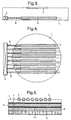
- Figure 3 is a side view of a holder (1) for receiving horizontally arranged straws (2) containing suspensions to be cryopreserved, where the suspensions are illuminated through light guides (8).
- Figure 4 is a plan view of holder (1) shown in Figure 3.
- Figure 5 is a side view of a passive cooler for use in the method according to the present invention.
- Figures 1 and 2 show suspension holder (1) in which suspensions are illuminated by a light source (3).
- Light source (3) is positioned so as to enable ice within straws (2) to be visualised through a viewing window (4).
- Heat is continually extracted from holder (1) through an insulating plate (5) to a cold heat sink (6).
- the temperature of holder (1) is measured by any suitable technique, such as a thermocouple (not shown) and a thin film heater (7) is then used to control the temperature of holder (1) as required. Temperature control during solidification is achieved using any suitable controller that may be programmed to achieve non-linear rates of temperature change.
- Figures 3 and 4 show holder (1) in which straws (2) are illuminated axially through light guides (8) at the end of straws (2).
- Light source (3) provides light to guide 8.
- FIG. 5 shows a passive cooler suitable for use in the method according to the present invention.
- the temperature o f f holder (1) up to ice nucleation of the suspensions is controlled by upper thin-film heater (7) backing off the cooling to heat sink (6).
- Two insulated plates.(5) and (9) are used, with a second thin-film heater (10) therebetween.
- Heater (10) is used to maintain the temperature at the bottom of upper insulated plate (5) at a predetermined temperature (T 1 ).
- T 1 predetermined temperature
- the upper heater (7) is switched off and holder (1) then cools passively to temperature T 1 .
- second heater (10) is switched off and holder (1) cools to the temperature of cold heat sink (6).
- Normal human sperm was diluted into a cryoprotectant solution containing glycerol, fructose and sodium citrate prior to freezing.
- the osmolality of the cell suspension was measured to be 1430 mOsm/Kg by freezing point osmometry, equivalent to an aqueous glycerol solution of 13.5w/v.
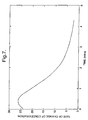
- the temperature-time curve to achieve a change in solute concentration of the unfrozen fraction that was decreasing for >90% of the elapsed time was then determined and is shown in Figure 6 together with the calculated time-concentration curve shown in Figure 7.
- the elapsed time from -5°C (the nucleation temperature) to -45 °C (the eutectic temperature for glycerol/water was 4 minutes.
- Straws (0.25ml IMV, L'Aigle France) were filled with the cell suspension and sealed with PVA powder.
- the straws were placed in apparatus of the type shown in Figure 1 and cooled from 20°C to -5°C at a rate of 2°C/min.
- -5°C the straws were nucleated within the equipment by touching the straw at the free surface of the liquid column with a nucleating tool that had been cooled by immersion into liquid nitrogen. Confirmation that ice had formed in all straws was achieved by direct observation of illuminated straws on the cooling plate.
- the temperature of the straws was then reduced to -45°C following the temperature time curve shown in Figure 6. Straws were then cooled to -100°C at a rate of 10°C/min and then transferred to liquid nitrogen for storing. When required straws were then thawed at room temperature and the motility assessed.
Landscapes
- Life Sciences & Earth Sciences (AREA)
- Engineering & Computer Science (AREA)
- Health & Medical Sciences (AREA)
- Zoology (AREA)
- Wood Science & Technology (AREA)
- General Health & Medical Sciences (AREA)
- Dentistry (AREA)
- Environmental Sciences (AREA)
- Chemical & Material Sciences (AREA)
- Biotechnology (AREA)
- Organic Chemistry (AREA)
- Genetics & Genomics (AREA)
- Bioinformatics & Cheminformatics (AREA)
- Virology (AREA)
- Biomedical Technology (AREA)
- Tropical Medicine & Parasitology (AREA)
- Microbiology (AREA)
- Biochemistry (AREA)
- General Engineering & Computer Science (AREA)
- Medicinal Chemistry (AREA)
- Agricultural Chemicals And Associated Chemicals (AREA)
- Micro-Organisms Or Cultivation Processes Thereof (AREA)
- Catching Or Destruction (AREA)
- Investigating Or Analysing Biological Materials (AREA)
- Devices That Are Associated With Refrigeration Equipment (AREA)
Claims (11)
- Eine Methode für die Kryopreservation von biologischem Material, wobei dieselbe Methode das Folgende umfasst: das Erstellen einer Probe des vorgenannten biologischen Materials, wobei eine Flüssigphase derselben Probe mindestens einen aufgelösten Stoff umfasst; das Verringern der Temperatur derselben Probe bis auf einen Gefrierpunkt, bei welchem Eisbildung innerhalb der Probe auftreten kann; das Erzeugen einer solchen Eisbildung innerhalb der vorgenannten Probe; und das nicht lineare Verringern der Temperatur der Probe mit Bezug auf die Zeitspanne, welche von dem Erreichen des Gefrierpunktes bis zum Erreichen des Verfestigungspunktes abläuft, dadurch gekennzeichnet, dass die vorgenannte Verringerung der Temperatur auf eine solche Art und Weise erfolgt, dass die Änderungsrate der Konzentration des aufgelösten Stoffes während der Flüssigphase für mehr als 80% der Zeit abfällt, welche für das Verringern der Temperatur von dem Gefrierpunkt bis auf den Verfestigungspunkt erforderlich ist.
- Eine Methode nach Anspruch 1, welche weiter das Bestimmen des Schmelzpunktes der Probe umfasst.
- Eine Methode nach Anspruch 1 oder 2, welche weiter das Bestimmen der Osmolalität der Flüssigphase umfasst.
- Eine Methode nach einem der obigen Ansprüche 1 bis 3, welche weiter das Bestimmen des Gefrierpunktes der Probe umfasst.
- Eine Methode nach einem der obigen Ansprüche 1 bis 4, bei welcher der Gefrierpunkt nicht mehr als ungefähr 4°C unter dem Schmelzpunkt liegen sollte.
- Eine Methode nach Anspruch 5, bei welcher der Gefrierpunkt nicht mehr als ungefähr 2°C unter dem Schmelzpunkt liegen sollte.
- Eine Methode nach einem der obigen Ansprüche 1 bis 6, welche weiter die Stufe der thermalen Neugleichgewichtung nach der vorausgehenden Eisbildung umfasst.
- Eine Methode nach einem der obigen Ansprüche 1 bis 7, bei welcher das Verringern der Temperatur von dem Gefrierpunkt auf den Verfestigungspunkt nicht linear ist, so dass die Änderungsrate der Konzentration des aufgelösten Stoffes innerhalb der Flüssigphase für mehr als 90% der Zeit abfällt, welche für das Verringern der Temperatur von dem Gefrierpunkt bis auf den Verfestigungspunkt erforderlich ist.
- Eine Methode nach einem der obigen Ansprüche 1 bis 8, bei welcher die Änderung in der Konzentration des aufgelösten Stoffes innerhalb der Zeit, welche für das Verringern der Temperatur von dem Gefrierpunkt bis auf den Verfestigungspunkt erforderlich ist, nahezu wie folgt ausgedrückt werden kann
- Eine Methode nach einem der obigen Ansprüche 1 bis 9, bei welcher die Probe ein Kryoschutzmittel beinhaltet.
- Eine Methode nach einem der obigen Ansprüche 1 bis 10, bei welcher die Probe ein Eisbildungsagens beinhaltet.
Applications Claiming Priority (3)
| Application Number | Priority Date | Filing Date | Title |
|---|---|---|---|
| GB9722156 | 1997-10-22 | ||
| GB9722156A GB2330516A (en) | 1997-10-22 | 1997-10-22 | Cryopreservation of cell suspensions |
| PCT/GB1998/003160 WO1999020104A1 (en) | 1997-10-22 | 1998-10-22 | Method and apparatus for cryopreservation |
Publications (2)
| Publication Number | Publication Date |
|---|---|
| EP1028623A1 EP1028623A1 (de) | 2000-08-23 |
| EP1028623B1 true EP1028623B1 (de) | 2003-09-24 |
Family
ID=10820819
Family Applications (1)
| Application Number | Title | Priority Date | Filing Date |
|---|---|---|---|
| EP98949129A Expired - Lifetime EP1028623B1 (de) | 1997-10-22 | 1998-10-22 | Verfahren zur gefrierkonservierung |
Country Status (9)
| Country | Link |
|---|---|
| US (1) | US6361934B1 (de) |
| EP (1) | EP1028623B1 (de) |
| AT (1) | ATE250337T1 (de) |
| AU (1) | AU750589B2 (de) |
| CA (1) | CA2308250A1 (de) |
| DE (1) | DE69818502T2 (de) |
| ES (1) | ES2205554T3 (de) |
| GB (2) | GB2330516A (de) |
| WO (1) | WO1999020104A1 (de) |
Families Citing this family (20)
| Publication number | Priority date | Publication date | Assignee | Title |
|---|---|---|---|---|
| JP2002516254A (ja) | 1998-05-26 | 2002-06-04 | ライフセル コーポレイション | ヒト赤血球の低温保存 |
| GB0013714D0 (en) * | 2000-06-07 | 2000-07-26 | Acton Elizabeth | Method and apparatus for freezing tissue |
| DE10251668A1 (de) | 2002-11-06 | 2004-05-27 | Fraunhofer-Gesellschaft zur Förderung der angewandten Forschung e.V. | Tieftemperaturspeicherung von Suspensionsproben in hängenden Probenkammern |
| DE10251722A1 (de) * | 2002-11-06 | 2004-05-27 | Fraunhofer-Gesellschaft zur Förderung der angewandten Forschung e.V. | Träger für eine Probenkammer, insbesondere zur Kryokonservierung biologischer Proben |
| DE10251721B4 (de) * | 2002-11-06 | 2006-06-01 | Fraunhofer-Gesellschaft zur Förderung der angewandten Forschung e.V. | Verfahren zur Beschickung von Probenkammern mit Suspensionsproben |
| GB0308360D0 (en) * | 2003-04-11 | 2003-05-14 | Acton Elizabeth | Improved method of freeze drying |
| DE10328869A1 (de) * | 2003-06-26 | 2005-01-20 | Fraunhofer-Gesellschaft zur Förderung der angewandten Forschung e.V. | Probenaufnahmeeinrichtung und Verfahren zu deren Herstellung |
| US20050108048A1 (en) * | 2003-11-18 | 2005-05-19 | The Jackson Laboratory | Methods and system for managing mouse colonies |
| EP1765986A4 (de) * | 2004-06-02 | 2007-11-07 | Es Cell Int Pte Ltd | Zellkonservierungsverfahren |
| AU2005250053B2 (en) * | 2004-06-02 | 2009-08-06 | Es Cell International Pte Ltd | Cell preservation method |
| US20060063141A1 (en) * | 2004-09-17 | 2006-03-23 | Mcgann Locksley E | Method of cryopreserving cells |
| US20080269549A1 (en) * | 2007-04-27 | 2008-10-30 | The Jackson Laboratory | Method, article, and apparatus for cryopreservation of biological samples |
| JP5261496B2 (ja) * | 2007-11-20 | 2013-08-14 | マックス プランク ゲゼルシャフト ツゥアー フェデルゥン デル ヴィッセンシャフテン エー フォー | 超急速冷凍装置及び超急速冷凍方法 |
| AU2010242985B2 (en) | 2009-04-29 | 2015-06-18 | Biolife Solutions, Inc. | Apparatuses and compositions for cryopreservation of cellular monolayers |
| EP2594334A1 (de) * | 2011-11-21 | 2013-05-22 | Drive O2 | Probenfläschchen zur digitalen holographischen Analyse einer flüssigen Zellprobe |
| CA2842377C (en) | 2011-07-19 | 2019-08-27 | Ovizio Imaging Systems N.V. | A method and system for detecting and/or classifying cancerous cells in a cell sample |
| EP2626686A1 (de) | 2012-02-13 | 2013-08-14 | Ovizio Imaging Systems NV/SA | Durchflusszytometer mit digitalem holografischen Mikroskop |
| EP2898310B1 (de) | 2012-09-20 | 2019-05-01 | Ovizio Imaging Systems NV/SA | Digitales holografisches mikroskop mit fluidsysteme |
| CN108027203B (zh) | 2015-07-22 | 2020-11-03 | 北卡罗来纳-查佩尔山大学 | 具有利用冰成核剂的冻结-解冻阀的流体装置和相关的操作和分析方法 |
| EP3196631A1 (de) | 2016-01-19 | 2017-07-26 | Ovizio Imaging Systems NV/SA | Digitales holografisches mikroskop mit elektrofluidischem system, besagtes elektrofluidisches system und verfahren zur verwendung |
Family Cites Families (11)
| Publication number | Priority date | Publication date | Assignee | Title |
|---|---|---|---|---|
| DE2929278A1 (de) * | 1979-07-19 | 1981-01-29 | Forschungsgesellschaft Fuer Bi | Verfahren zum eingefrieren von zellsuspensionen |
| DE3125345A1 (de) | 1981-06-27 | 1983-01-20 | Franz Dr.-Ing. 8552 Höchstadt Dittrich | Verfahren zum automatischen gefrieren eines insbesondere biologischen materials |
| DE3238535A1 (de) * | 1982-10-18 | 1984-04-19 | Planer Products Ltd., Sunbury-on-Thames, Middlesex | Verfahren und apparat zum gesteuerten kuehlen eines produktes |
| CH672834A5 (de) * | 1987-01-19 | 1989-12-29 | Agrogen Stiftung | |
| US5045446A (en) * | 1988-08-26 | 1991-09-03 | Cryopharm Corporation | Lyophilization of cells |
| WO1991001635A2 (en) * | 1989-08-07 | 1991-02-21 | Cell Systems Limited | Cooling process and apparatus |
| CA2051092C (en) * | 1990-09-12 | 2002-07-23 | Stephen A. Livesey | Method and apparatus for cryopreparation, dry stabilization and rehydration of biological suspensions |
| US5891617A (en) * | 1993-09-15 | 1999-04-06 | Organogenesis Inc. | Cryopreservation of harvested skin and cultured skin or cornea equivalents by slow freezing |
| GB9414428D0 (en) * | 1994-07-16 | 1994-09-07 | Sec Dep For Foreign And Common | Improvements in or relating to cryopreservation |
| US5629145A (en) * | 1995-03-24 | 1997-05-13 | Organ, Inc. | Cryopreservation of cell suspensions |
| NL1004619C2 (nl) * | 1996-11-26 | 1998-05-27 | Instituut Voor Dierhouderij En | Inrichting en werkwijze voor het invriezen van levende cellen, in het bijzonder sperma. |
-
1997
- 1997-10-22 GB GB9722156A patent/GB2330516A/en not_active Withdrawn
-
1998
- 1998-10-22 US US09/529,667 patent/US6361934B1/en not_active Expired - Fee Related
- 1998-10-22 CA CA002308250A patent/CA2308250A1/en not_active Abandoned
- 1998-10-22 AT AT98949129T patent/ATE250337T1/de not_active IP Right Cessation
- 1998-10-22 GB GB0008526A patent/GB2346064B/en not_active Expired - Fee Related
- 1998-10-22 WO PCT/GB1998/003160 patent/WO1999020104A1/en not_active Ceased
- 1998-10-22 ES ES98949129T patent/ES2205554T3/es not_active Expired - Lifetime
- 1998-10-22 DE DE69818502T patent/DE69818502T2/de not_active Expired - Fee Related
- 1998-10-22 EP EP98949129A patent/EP1028623B1/de not_active Expired - Lifetime
- 1998-10-22 AU AU95508/98A patent/AU750589B2/en not_active Ceased
Also Published As
| Publication number | Publication date |
|---|---|
| GB2330516A (en) | 1999-04-28 |
| WO1999020104A1 (en) | 1999-04-29 |
| DE69818502T2 (de) | 2004-06-24 |
| GB9722156D0 (en) | 1997-12-17 |
| GB2346064A (en) | 2000-08-02 |
| ES2205554T3 (es) | 2004-05-01 |
| GB2346064B (en) | 2001-07-25 |
| EP1028623A1 (de) | 2000-08-23 |
| AU750589B2 (en) | 2002-07-25 |
| US6361934B1 (en) | 2002-03-26 |
| DE69818502D1 (de) | 2003-10-30 |
| ATE250337T1 (de) | 2003-10-15 |
| GB0008526D0 (en) | 2000-05-24 |
| CA2308250A1 (en) | 1999-04-29 |
| AU9550898A (en) | 1999-05-10 |
Similar Documents
| Publication | Publication Date | Title |
|---|---|---|
| EP1028623B1 (de) | Verfahren zur gefrierkonservierung | |
| Rall et al. | Zona fracture damage and its avoidance during the cryopreservation of mammalian embryos | |
| Ozkavukcu et al. | Cryopreservation: basic knowledge and biophysical effects | |
| Hafez | Preservation and cryopreservation of gametes and embryos | |
| CA2301023C (en) | Cassette device and system to facilitate cryopreservation | |
| US7939316B2 (en) | Systems and methods for cryopreservation of cells | |
| EP2156735A1 (de) | Verfahren und Instrument zur Vitrifizierung und Aufbewahrung biologischer Proben | |
| US11903383B2 (en) | Cryopreservation method and apparatus | |
| EP0246824A2 (de) | Biologische Kryoprotektion | |
| Woelders et al. | Cryopreservation of boar semen: equilibrium freezing in the cryomicroscope and in straws | |
| CA2809571A1 (en) | Method for cryopreservation of human spermatozoa free from seminal plasma using a fast and simple aseptic vitrification-devitrification process; portable kit for carrying out the method; and use of the same for treatment of disorders related to reproductive failures | |
| US20230404067A1 (en) | Method and apparatus for reducing probability of ice nucleation during preservation of biological matter in isochoric systems | |
| Nannou et al. | Cryopreservation: Methods, equipment and critical concerns | |
| Kojima et al. | Effect of silver iodide as an ice inducer on viability of frozen-thawed rabbit morulae | |
| Doughman et al. | Temperature variations in eyebank containers: comparative study of corneal transport containers and packing methods | |
| Liebermann et al. | 37 Post-compaction Embryos for IVF | |
| Carnevale | Cooling and cryopreservation of equine embryos | |
| Daniel Jr | thermore, these same approaches and equipment can be used with minimal | |
| SU1076054A1 (ru) | Способ криоконсервировани живых одноклеточных организмов | |
| Nagy et al. | The human embryo: Vitrification Vitrification | |
| Talwar | Semen Cryopreservation and Banking | |
| Pegg | Cryopreservation of Tissue Culture Cells | |
| Isachenko et al. | nitrogen or by using an aseptic approach | |
| Liebermann et al. | Cryopreservation of Post-compaction Embryos for IVF | |
| Lehman et al. | MOUSE EMBRYO VITRIFICATION |
Legal Events
| Date | Code | Title | Description |
|---|---|---|---|
| PUAI | Public reference made under article 153(3) epc to a published international application that has entered the european phase |
Free format text: ORIGINAL CODE: 0009012 |
|
| 17P | Request for examination filed |
Effective date: 20000407 |
|
| AK | Designated contracting states |
Kind code of ref document: A1 Designated state(s): AT BE CH DE DK ES FR IT LI NL SE |
|
| RBV | Designated contracting states (corrected) |
Designated state(s): AT BE CH DE DK ES FR IT LI NL SE |
|
| 17Q | First examination report despatched |
Effective date: 20020517 |
|
| GRAH | Despatch of communication of intention to grant a patent |
Free format text: ORIGINAL CODE: EPIDOS IGRA |
|
| RTI1 | Title (correction) |
Free format text: METHOD FOR CRYOPRESERVATION |
|
| GRAS | Grant fee paid |
Free format text: ORIGINAL CODE: EPIDOSNIGR3 |
|
| GRAA | (expected) grant |
Free format text: ORIGINAL CODE: 0009210 |
|
| AK | Designated contracting states |
Kind code of ref document: B1 Designated state(s): AT BE CH DE DK ES FR IT LI NL SE |
|
| PG25 | Lapsed in a contracting state [announced via postgrant information from national office to epo] |
Ref country code: NL Free format text: LAPSE BECAUSE OF FAILURE TO SUBMIT A TRANSLATION OF THE DESCRIPTION OR TO PAY THE FEE WITHIN THE PRESCRIBED TIME-LIMIT Effective date: 20030924 Ref country code: AT Free format text: LAPSE BECAUSE OF FAILURE TO SUBMIT A TRANSLATION OF THE DESCRIPTION OR TO PAY THE FEE WITHIN THE PRESCRIBED TIME-LIMIT Effective date: 20030924 |
|
| REG | Reference to a national code |
Ref country code: CH Ref legal event code: EP |
|
| REF | Corresponds to: |
Ref document number: 69818502 Country of ref document: DE Date of ref document: 20031030 Kind code of ref document: P |
|
| PG25 | Lapsed in a contracting state [announced via postgrant information from national office to epo] |
Ref country code: SE Free format text: LAPSE BECAUSE OF FAILURE TO SUBMIT A TRANSLATION OF THE DESCRIPTION OR TO PAY THE FEE WITHIN THE PRESCRIBED TIME-LIMIT Effective date: 20031224 Ref country code: DK Free format text: LAPSE BECAUSE OF FAILURE TO SUBMIT A TRANSLATION OF THE DESCRIPTION OR TO PAY THE FEE WITHIN THE PRESCRIBED TIME-LIMIT Effective date: 20031224 |
|
| REG | Reference to a national code |
Ref country code: CH Ref legal event code: NV Representative=s name: ISLER & PEDRAZZINI AG |
|
| NLV1 | Nl: lapsed or annulled due to failure to fulfill the requirements of art. 29p and 29m of the patents act | ||
| REG | Reference to a national code |
Ref country code: ES Ref legal event code: FG2A Ref document number: 2205554 Country of ref document: ES Kind code of ref document: T3 |
|
| ET | Fr: translation filed | ||
| PLBE | No opposition filed within time limit |
Free format text: ORIGINAL CODE: 0009261 |
|
| STAA | Information on the status of an ep patent application or granted ep patent |
Free format text: STATUS: NO OPPOSITION FILED WITHIN TIME LIMIT |
|
| 26N | No opposition filed |
Effective date: 20040625 |
|
| PGFP | Annual fee paid to national office [announced via postgrant information from national office to epo] |
Ref country code: IT Payment date: 20061031 Year of fee payment: 9 |
|
| PGFP | Annual fee paid to national office [announced via postgrant information from national office to epo] |
Ref country code: CH Payment date: 20070405 Year of fee payment: 9 |
|
| PGFP | Annual fee paid to national office [announced via postgrant information from national office to epo] |
Ref country code: DE Payment date: 20070427 Year of fee payment: 9 |
|
| PGFP | Annual fee paid to national office [announced via postgrant information from national office to epo] |
Ref country code: ES Payment date: 20070529 Year of fee payment: 9 |
|
| REG | Reference to a national code |
Ref country code: CH Ref legal event code: PCAR Free format text: ISLER & PEDRAZZINI AG;POSTFACH 1772;8027 ZUERICH (CH) |
|
| PGFP | Annual fee paid to national office [announced via postgrant information from national office to epo] |
Ref country code: BE Payment date: 20070410 Year of fee payment: 9 |
|
| BERE | Be: lapsed |
Owner name: *MORRIS GEORGE JOHN Effective date: 20071031 Owner name: *ACTON ELIZABETH Effective date: 20071031 |
|
| PGFP | Annual fee paid to national office [announced via postgrant information from national office to epo] |
Ref country code: FR Payment date: 20070426 Year of fee payment: 9 |
|
| REG | Reference to a national code |
Ref country code: CH Ref legal event code: PL |
|
| PG25 | Lapsed in a contracting state [announced via postgrant information from national office to epo] |
Ref country code: LI Free format text: LAPSE BECAUSE OF NON-PAYMENT OF DUE FEES Effective date: 20071031 Ref country code: DE Free format text: LAPSE BECAUSE OF NON-PAYMENT OF DUE FEES Effective date: 20080501 Ref country code: CH Free format text: LAPSE BECAUSE OF NON-PAYMENT OF DUE FEES Effective date: 20071031 |
|
| PG25 | Lapsed in a contracting state [announced via postgrant information from national office to epo] |
Ref country code: BE Free format text: LAPSE BECAUSE OF NON-PAYMENT OF DUE FEES Effective date: 20071031 |
|
| REG | Reference to a national code |
Ref country code: FR Ref legal event code: ST Effective date: 20080630 |
|
| REG | Reference to a national code |
Ref country code: ES Ref legal event code: FD2A Effective date: 20071023 |
|
| PG25 | Lapsed in a contracting state [announced via postgrant information from national office to epo] |
Ref country code: FR Free format text: LAPSE BECAUSE OF NON-PAYMENT OF DUE FEES Effective date: 20071031 Ref country code: ES Free format text: LAPSE BECAUSE OF NON-PAYMENT OF DUE FEES Effective date: 20071023 |
|
| PG25 | Lapsed in a contracting state [announced via postgrant information from national office to epo] |
Ref country code: IT Free format text: LAPSE BECAUSE OF NON-PAYMENT OF DUE FEES Effective date: 20071022 |