EP1029841A1 - 6-Substituted 3-methyloct-6-enols - Google Patents
6-Substituted 3-methyloct-6-enols Download PDFInfo
- Publication number
- EP1029841A1 EP1029841A1 EP00102807A EP00102807A EP1029841A1 EP 1029841 A1 EP1029841 A1 EP 1029841A1 EP 00102807 A EP00102807 A EP 00102807A EP 00102807 A EP00102807 A EP 00102807A EP 1029841 A1 EP1029841 A1 EP 1029841A1
- Authority
- EP
- European Patent Office
- Prior art keywords
- mixtures
- mixture
- tert
- lily
- valley
- Prior art date
- Legal status (The legal status is an assumption and is not a legal conclusion. Google has not performed a legal analysis and makes no representation as to the accuracy of the status listed.)
- Granted
Links
- -1 6-Substituted 3-methyloct-6-enols Chemical class 0.000 title description 7
- 239000000203 mixture Substances 0.000 claims abstract description 57
- 239000003205 fragrance Substances 0.000 claims abstract description 17
- 125000002496 methyl group Chemical group [H]C([H])([H])* 0.000 claims description 8
- 125000001495 ethyl group Chemical group [H]C([H])([H])C([H])([H])* 0.000 claims description 4
- GTLKSTALFRGBQG-NYYWCZLTSA-N (e)-6-ethyl-3-methyloct-6-en-1-ol Chemical compound CC\C(=C/C)CCC(C)CCO GTLKSTALFRGBQG-NYYWCZLTSA-N 0.000 claims description 2
- GTLKSTALFRGBQG-WCIBSUBMSA-N (z)-6-ethyl-3-methyloct-6-en-1-ol Chemical compound CC\C(=C\C)CCC(C)CCO GTLKSTALFRGBQG-WCIBSUBMSA-N 0.000 claims description 2
- POGALGKUJPRYEH-RUDMXATFSA-N (e)-3,6-dimethyloct-6-en-1-ol Chemical compound C\C=C(/C)CCC(C)CCO POGALGKUJPRYEH-RUDMXATFSA-N 0.000 claims 1
- POGALGKUJPRYEH-WTKPLQERSA-N (z)-3,6-dimethyloct-6-en-1-ol Chemical compound C\C=C(\C)CCC(C)CCO POGALGKUJPRYEH-WTKPLQERSA-N 0.000 claims 1
- POGALGKUJPRYEH-UHFFFAOYSA-N 3,6-dimethyloct-6-en-1-ol Chemical class CC=C(C)CCC(C)CCO POGALGKUJPRYEH-UHFFFAOYSA-N 0.000 abstract description 2
- GTLKSTALFRGBQG-UHFFFAOYSA-N 6-ethyl-3-methyloct-6-en-1-ol Chemical class CCC(=CC)CCC(C)CCO GTLKSTALFRGBQG-UHFFFAOYSA-N 0.000 abstract description 2
- 241000755716 Convallaria Species 0.000 description 23
- 235000009046 Convallaria majalis Nutrition 0.000 description 23
- BZLVMXJERCGZMT-UHFFFAOYSA-N Methyl tert-butyl ether Chemical compound COC(C)(C)C BZLVMXJERCGZMT-UHFFFAOYSA-N 0.000 description 21
- OFBQJSOFQDEBGM-UHFFFAOYSA-N Pentane Chemical compound CCCCC OFBQJSOFQDEBGM-UHFFFAOYSA-N 0.000 description 20
- WYURNTSHIVDZCO-UHFFFAOYSA-N Tetrahydrofuran Chemical compound C1CCOC1 WYURNTSHIVDZCO-UHFFFAOYSA-N 0.000 description 18
- HUHXLHLWASNVDB-UHFFFAOYSA-N 2-(oxan-2-yloxy)oxane Chemical compound O1CCCCC1OC1OCCCC1 HUHXLHLWASNVDB-UHFFFAOYSA-N 0.000 description 16
- PMZURENOXWZQFD-UHFFFAOYSA-L Sodium Sulfate Chemical compound [Na+].[Na+].[O-]S([O-])(=O)=O PMZURENOXWZQFD-UHFFFAOYSA-L 0.000 description 16
- HEDRZPFGACZZDS-MICDWDOJSA-N Trichloro(2H)methane Chemical compound [2H]C(Cl)(Cl)Cl HEDRZPFGACZZDS-MICDWDOJSA-N 0.000 description 16
- YMWUJEATGCHHMB-UHFFFAOYSA-N Dichloromethane Chemical compound ClCCl YMWUJEATGCHHMB-UHFFFAOYSA-N 0.000 description 15
- 239000012074 organic phase Substances 0.000 description 14
- 150000001875 compounds Chemical class 0.000 description 13
- XLYOFNOQVPJJNP-UHFFFAOYSA-N water Chemical compound O XLYOFNOQVPJJNP-UHFFFAOYSA-N 0.000 description 13
- OKKJLVBELUTLKV-UHFFFAOYSA-N Methanol Chemical compound OC OKKJLVBELUTLKV-UHFFFAOYSA-N 0.000 description 12
- 238000003756 stirring Methods 0.000 description 11
- 238000003818 flash chromatography Methods 0.000 description 10
- 239000011541 reaction mixture Substances 0.000 description 9
- YLQBMQCUIZJEEH-UHFFFAOYSA-N tetrahydrofuran Natural products C=1C=COC=1 YLQBMQCUIZJEEH-UHFFFAOYSA-N 0.000 description 9
- SZXQTJUDPRGNJN-UHFFFAOYSA-N dipropylene glycol Chemical compound OCCCOCCCO SZXQTJUDPRGNJN-UHFFFAOYSA-N 0.000 description 8
- 229910052938 sodium sulfate Inorganic materials 0.000 description 8
- 235000011152 sodium sulphate Nutrition 0.000 description 8
- VYPSYNLAJGMNEJ-UHFFFAOYSA-N Silicium dioxide Chemical compound O=[Si]=O VYPSYNLAJGMNEJ-UHFFFAOYSA-N 0.000 description 7
- 150000001299 aldehydes Chemical group 0.000 description 7
- 238000010992 reflux Methods 0.000 description 7
- 239000000741 silica gel Substances 0.000 description 7
- 229910002027 silica gel Inorganic materials 0.000 description 7
- IJGRMHOSHXDMSA-UHFFFAOYSA-N Atomic nitrogen Chemical compound N#N IJGRMHOSHXDMSA-UHFFFAOYSA-N 0.000 description 6
- 239000008346 aqueous phase Substances 0.000 description 6
- 238000001644 13C nuclear magnetic resonance spectroscopy Methods 0.000 description 5
- 238000005160 1H NMR spectroscopy Methods 0.000 description 5
- UIIMBOGNXHQVGW-UHFFFAOYSA-M Sodium bicarbonate Chemical class [Na+].OC([O-])=O UIIMBOGNXHQVGW-UHFFFAOYSA-M 0.000 description 5
- FAPWRFPIFSIZLT-UHFFFAOYSA-M Sodium chloride Chemical class [Na+].[Cl-] FAPWRFPIFSIZLT-UHFFFAOYSA-M 0.000 description 5
- 238000002330 electrospray ionisation mass spectrometry Methods 0.000 description 5
- IXQGCWUGDFDQMF-UHFFFAOYSA-N 2-Ethylphenol Chemical compound CCC1=CC=CC=C1O IXQGCWUGDFDQMF-UHFFFAOYSA-N 0.000 description 4
- IKHGUXGNUITLKF-UHFFFAOYSA-N Acetaldehyde Chemical compound CC=O IKHGUXGNUITLKF-UHFFFAOYSA-N 0.000 description 4
- NBBJYMSMWIIQGU-UHFFFAOYSA-N Propionic aldehyde Chemical compound CCC=O NBBJYMSMWIIQGU-UHFFFAOYSA-N 0.000 description 4
- 150000001298 alcohols Chemical class 0.000 description 4
- 230000000295 complement effect Effects 0.000 description 4
- SDQFDHOLCGWZPU-UHFFFAOYSA-N lilial Chemical compound O=CC(C)CC1=CC=C(C(C)(C)C)C=C1 SDQFDHOLCGWZPU-UHFFFAOYSA-N 0.000 description 4
- 239000007788 liquid Substances 0.000 description 4
- 239000002904 solvent Substances 0.000 description 4
- KRLBLPBPZSSIGH-CSKARUKUSA-N (6e)-3,7-dimethylnona-1,6-dien-3-ol Chemical compound CC\C(C)=C\CCC(C)(O)C=C KRLBLPBPZSSIGH-CSKARUKUSA-N 0.000 description 3
- RNLHVODSMDJCBR-SOFGYWHQSA-N (e)-3-methyl-5-(2,2,3-trimethylcyclopent-3-en-1-yl)pent-4-en-2-ol Chemical compound CC(O)C(C)\C=C\C1CC=C(C)C1(C)C RNLHVODSMDJCBR-SOFGYWHQSA-N 0.000 description 3
- FYMOBFDUZIDKMI-UHFFFAOYSA-N 2,2-dimethyl-3-(3-methylphenyl)propan-1-ol Chemical compound CC1=CC=CC(CC(C)(C)CO)=C1 FYMOBFDUZIDKMI-UHFFFAOYSA-N 0.000 description 3
- HGDVHRITTGWMJK-UHFFFAOYSA-N 2,6-dimethylheptan-2-ol Chemical compound CC(C)CCCC(C)(C)O HGDVHRITTGWMJK-UHFFFAOYSA-N 0.000 description 3
- DHFUGLZCCDRGCH-UHFFFAOYSA-N 5-bromo-3-methylpentan-1-ol Chemical compound OCCC(C)CCBr DHFUGLZCCDRGCH-UHFFFAOYSA-N 0.000 description 3
- 238000006646 Dess-Martin oxidation reaction Methods 0.000 description 3
- 241000234269 Liliales Species 0.000 description 3
- HEMHJVSKTPXQMS-UHFFFAOYSA-M Sodium hydroxide Chemical compound [OH-].[Na+] HEMHJVSKTPXQMS-UHFFFAOYSA-M 0.000 description 3
- YXFVVABEGXRONW-UHFFFAOYSA-N Toluene Chemical compound CC1=CC=CC=C1 YXFVVABEGXRONW-UHFFFAOYSA-N 0.000 description 3
- SWUIQEBPZIHZQS-UHFFFAOYSA-N calone Chemical compound O1CC(=O)COC2=CC(C)=CC=C21 SWUIQEBPZIHZQS-UHFFFAOYSA-N 0.000 description 3
- 238000006243 chemical reaction Methods 0.000 description 3
- 238000001816 cooling Methods 0.000 description 3
- 238000001035 drying Methods 0.000 description 3
- WFEISWUNAJPLRX-ONNFQVAWSA-N dupical Chemical compound C12CCCC2C2C\C(=C/CCC=O)C1C2 WFEISWUNAJPLRX-ONNFQVAWSA-N 0.000 description 3
- JHYNXXDQQHTCHJ-UHFFFAOYSA-M ethyl(triphenyl)phosphanium;bromide Chemical compound [Br-].C=1C=CC=CC=1[P+](C=1C=CC=CC=1)(CC)C1=CC=CC=C1 JHYNXXDQQHTCHJ-UHFFFAOYSA-M 0.000 description 3
- 239000000284 extract Substances 0.000 description 3
- ONKNPOPIGWHAQC-UHFFFAOYSA-N galaxolide Chemical compound C1OCC(C)C2=C1C=C1C(C)(C)C(C)C(C)(C)C1=C2 ONKNPOPIGWHAQC-UHFFFAOYSA-N 0.000 description 3
- WPFVBOQKRVRMJB-UHFFFAOYSA-N hydroxycitronellal Chemical compound O=CCC(C)CCCC(C)(C)O WPFVBOQKRVRMJB-UHFFFAOYSA-N 0.000 description 3
- KVWWIYGFBYDJQC-UHFFFAOYSA-N methyl dihydrojasmonate Chemical compound CCCCCC1C(CC(=O)OC)CCC1=O KVWWIYGFBYDJQC-UHFFFAOYSA-N 0.000 description 3
- 229910052757 nitrogen Inorganic materials 0.000 description 3
- 239000002304 perfume Substances 0.000 description 3
- 239000000126 substance Substances 0.000 description 3
- 125000003774 valeryl group Chemical group O=C([*])C([H])([H])C([H])([H])C([H])([H])C([H])([H])[H] 0.000 description 3
- KHWTYGFHPHRQMP-UHFFFAOYSA-N (4-propan-2-ylcyclohexyl)methanol Chemical compound CC(C)C1CCC(CO)CC1 KHWTYGFHPHRQMP-UHFFFAOYSA-N 0.000 description 2
- ZALVGSSYVAPZDA-UHFFFAOYSA-N 1-acetyloxynonyl acetate Chemical group CCCCCCCCC(OC(C)=O)OC(C)=O ZALVGSSYVAPZDA-UHFFFAOYSA-N 0.000 description 2
- WRMNZCZEMHIOCP-UHFFFAOYSA-N 2-phenylethanol Chemical compound OCCC1=CC=CC=C1 WRMNZCZEMHIOCP-UHFFFAOYSA-N 0.000 description 2
- OHRBQTOZYGEWCJ-UHFFFAOYSA-N 3-(3-propan-2-ylphenyl)butanal Chemical compound CC(C)C1=CC=CC(C(C)CC=O)=C1 OHRBQTOZYGEWCJ-UHFFFAOYSA-N 0.000 description 2
- PCBSXBYCASFXTM-UHFFFAOYSA-N 4-(4-Methoxyphenyl)-2-butanone Chemical compound COC1=CC=C(CCC(C)=O)C=C1 PCBSXBYCASFXTM-UHFFFAOYSA-N 0.000 description 2
- ORMHZBNNECIKOH-UHFFFAOYSA-N 4-(4-hydroxy-4-methylpentyl)cyclohex-3-ene-1-carbaldehyde Chemical compound CC(C)(O)CCCC1=CCC(C=O)CC1 ORMHZBNNECIKOH-UHFFFAOYSA-N 0.000 description 2
- XSFCJNDQFKISFC-UHFFFAOYSA-N 6-ethyl-3-methyloct-5-en-1-ol Chemical compound CCC(CC)=CCC(C)CCO XSFCJNDQFKISFC-UHFFFAOYSA-N 0.000 description 2
- NLXLAEXVIDQMFP-UHFFFAOYSA-N Ammonia chloride Chemical class [NH4+].[Cl-] NLXLAEXVIDQMFP-UHFFFAOYSA-N 0.000 description 2
- ZCTQGTTXIYCGGC-UHFFFAOYSA-N Benzyl salicylate Chemical compound OC1=CC=CC=C1C(=O)OCC1=CC=CC=C1 ZCTQGTTXIYCGGC-UHFFFAOYSA-N 0.000 description 2
- 235000018958 Gardenia augusta Nutrition 0.000 description 2
- GLZPCOQZEFWAFX-UHFFFAOYSA-N Geraniol Chemical compound CC(C)=CCCC(C)=CCO GLZPCOQZEFWAFX-UHFFFAOYSA-N 0.000 description 2
- 239000007818 Grignard reagent Substances 0.000 description 2
- VEXZGXHMUGYJMC-UHFFFAOYSA-N Hydrochloric acid Chemical compound Cl VEXZGXHMUGYJMC-UHFFFAOYSA-N 0.000 description 2
- SIKJAQJRHWYJAI-UHFFFAOYSA-N Indole Chemical compound C1=CC=C2NC=CC2=C1 SIKJAQJRHWYJAI-UHFFFAOYSA-N 0.000 description 2
- FYYHWMGAXLPEAU-UHFFFAOYSA-N Magnesium Chemical compound [Mg] FYYHWMGAXLPEAU-UHFFFAOYSA-N 0.000 description 2
- 241000220317 Rosa Species 0.000 description 2
- 206010040880 Skin irritation Diseases 0.000 description 2
- 239000004133 Sodium thiosulphate Substances 0.000 description 2
- 150000001241 acetals Chemical class 0.000 description 2
- QUKGYYKBILRGFE-UHFFFAOYSA-N benzyl acetate Chemical compound CC(=O)OCC1=CC=CC=C1 QUKGYYKBILRGFE-UHFFFAOYSA-N 0.000 description 2
- ZTQSAGDEMFDKMZ-UHFFFAOYSA-N butyric aldehyde Natural products CCCC=O ZTQSAGDEMFDKMZ-UHFFFAOYSA-N 0.000 description 2
- 229920001429 chelating resin Polymers 0.000 description 2
- 239000003795 chemical substances by application Substances 0.000 description 2
- IVLCENBZDYVJPA-ARJAWSKDSA-N cis-Jasmone Natural products C\C=C/CC1=C(C)CCC1=O IVLCENBZDYVJPA-ARJAWSKDSA-N 0.000 description 2
- QMVPMAAFGQKVCJ-UHFFFAOYSA-N citronellol Chemical compound OCCC(C)CCC=C(C)C QMVPMAAFGQKVCJ-UHFFFAOYSA-N 0.000 description 2
- JOZKFWLRHCDGJA-UHFFFAOYSA-N citronellol acetate Chemical compound CC(=O)OCCC(C)CCC=C(C)C JOZKFWLRHCDGJA-UHFFFAOYSA-N 0.000 description 2
- 239000001926 citrus aurantium l. subsp. bergamia wright et arn. oil Substances 0.000 description 2
- 239000002537 cosmetic Substances 0.000 description 2
- NKLCNNUWBJBICK-UHFFFAOYSA-N dess–martin periodinane Chemical compound C1=CC=C2I(OC(=O)C)(OC(C)=O)(OC(C)=O)OC(=O)C2=C1 NKLCNNUWBJBICK-UHFFFAOYSA-N 0.000 description 2
- 238000002845 discoloration Methods 0.000 description 2
- 150000004795 grignard reagents Chemical class 0.000 description 2
- 238000010438 heat treatment Methods 0.000 description 2
- 150000002500 ions Chemical class 0.000 description 2
- 239000011777 magnesium Substances 0.000 description 2
- 229910052749 magnesium Inorganic materials 0.000 description 2
- 238000004519 manufacturing process Methods 0.000 description 2
- BOPPSUHPZARXTH-UHFFFAOYSA-N ocean propanal Chemical compound O=CC(C)CC1=CC=C2OCOC2=C1 BOPPSUHPZARXTH-UHFFFAOYSA-N 0.000 description 2
- 239000003921 oil Substances 0.000 description 2
- 235000019198 oils Nutrition 0.000 description 2
- LPNYRYFBWFDTMA-UHFFFAOYSA-N potassium tert-butoxide Chemical compound [K+].CC(C)(C)[O-] LPNYRYFBWFDTMA-UHFFFAOYSA-N 0.000 description 2
- LEHBURLTIWGHEM-UHFFFAOYSA-N pyridinium chlorochromate Chemical compound [O-][Cr](Cl)(=O)=O.C1=CC=[NH+]C=C1 LEHBURLTIWGHEM-UHFFFAOYSA-N 0.000 description 2
- 230000036556 skin irritation Effects 0.000 description 2
- 231100000475 skin irritation Toxicity 0.000 description 2
- AKHNMLFCWUSKQB-UHFFFAOYSA-L sodium thiosulfate Chemical compound [Na+].[Na+].[O-]S([O-])(=O)=S AKHNMLFCWUSKQB-UHFFFAOYSA-L 0.000 description 2
- 235000019345 sodium thiosulphate Nutrition 0.000 description 2
- XMLSXPIVAXONDL-UHFFFAOYSA-N trans-jasmone Natural products CCC=CCC1=C(C)CCC1=O XMLSXPIVAXONDL-UHFFFAOYSA-N 0.000 description 2
- PHXATPHONSXBIL-UHFFFAOYSA-N xi-gamma-Undecalactone Chemical compound CCCCCCCC1CCC(=O)O1 PHXATPHONSXBIL-UHFFFAOYSA-N 0.000 description 2
- PSQYTAPXSHCGMF-BQYQJAHWSA-N β-ionone Chemical compound CC(=O)\C=C\C1=C(C)CCCC1(C)C PSQYTAPXSHCGMF-BQYQJAHWSA-N 0.000 description 2
- SFEOKXHPFMOVRM-UHFFFAOYSA-N (+)-(S)-gamma-ionone Natural products CC(=O)C=CC1C(=C)CCCC1(C)C SFEOKXHPFMOVRM-UHFFFAOYSA-N 0.000 description 1
- ORHSGDMSYGKJJY-SAIIYOCFSA-N (1'r,6's)-2,2,4',7',7'-pentamethylspiro[1,3-dioxane-5,5'-bicyclo[4.1.0]heptane] Chemical compound C12([C@H]3[C@H](C3(C)C)CCC2C)COC(C)(C)OC1 ORHSGDMSYGKJJY-SAIIYOCFSA-N 0.000 description 1
- FINOAUDUYKVGDS-UHFFFAOYSA-N (2-tert-butylcyclohexyl) acetate Chemical compound CC(=O)OC1CCCCC1C(C)(C)C FINOAUDUYKVGDS-UHFFFAOYSA-N 0.000 description 1
- XWNKVSFNBVIKJB-UHFFFAOYSA-N (3-butyl-5-methyloxan-4-yl) acetate Chemical compound CCCCC1COCC(C)C1OC(C)=O XWNKVSFNBVIKJB-UHFFFAOYSA-N 0.000 description 1
- NVIPUOMWGQAOIT-UHFFFAOYSA-N (E)-7-Hexadecen-16-olide Natural products O=C1CCCCCC=CCCCCCCCCO1 NVIPUOMWGQAOIT-UHFFFAOYSA-N 0.000 description 1
- QMVPMAAFGQKVCJ-SNVBAGLBSA-N (R)-(+)-citronellol Natural products OCC[C@H](C)CCC=C(C)C QMVPMAAFGQKVCJ-SNVBAGLBSA-N 0.000 description 1
- UFLHIIWVXFIJGU-ARJAWSKDSA-N (Z)-hex-3-en-1-ol Chemical compound CC\C=C/CCO UFLHIIWVXFIJGU-ARJAWSKDSA-N 0.000 description 1
- WSTQLNQRVZNEDV-CSKARUKUSA-N (e)-4-methyldec-3-en-5-ol Chemical compound CCCCCC(O)C(\C)=C\CC WSTQLNQRVZNEDV-CSKARUKUSA-N 0.000 description 1
- CRIGTVCBMUKRSL-FNORWQNLSA-N 1-(2,6,6-trimethylcyclohex-2-en-1-yl)but-2-enone Chemical compound C\C=C\C(=O)C1C(C)=CCCC1(C)C CRIGTVCBMUKRSL-FNORWQNLSA-N 0.000 description 1
- NEHPIUGJDUWSRR-UHFFFAOYSA-N 1-(4-propan-2-ylcyclohexyl)ethanol Chemical compound CC(C)C1CCC(C(C)O)CC1 NEHPIUGJDUWSRR-UHFFFAOYSA-N 0.000 description 1
- QUMXDOLUJCHOAY-UHFFFAOYSA-N 1-Phenylethyl acetate Chemical compound CC(=O)OC(C)C1=CC=CC=C1 QUMXDOLUJCHOAY-UHFFFAOYSA-N 0.000 description 1
- YQYKESUTYHZAGG-BZNIZROVSA-N 1-[(1r,2s)-1,2,8,8-tetramethyl-1,3,4,5,6,7-hexahydronaphthalen-2-yl]ethanone Chemical compound C1([C@H]([C@@](CC2)(C)C(C)=O)C)=C2CCCC1(C)C YQYKESUTYHZAGG-BZNIZROVSA-N 0.000 description 1
- YBUIAJZFOGJGLJ-SWRJLBSHSA-N 1-cedr-8-en-9-ylethanone Chemical compound C1[C@]23[C@H](C)CC[C@H]3C(C)(C)[C@@H]1C(C)=C(C(C)=O)C2 YBUIAJZFOGJGLJ-SWRJLBSHSA-N 0.000 description 1
- 150000000215 1-octanols Chemical class 0.000 description 1
- SHWFPOIJJLMZKA-UHFFFAOYSA-N 2,4-dimethyl-4,4a,5,9b-tetrahydroindeno[1,2-d][1,3]dioxine Chemical compound C1=CC=C2C3OC(C)OC(C)C3CC2=C1 SHWFPOIJJLMZKA-UHFFFAOYSA-N 0.000 description 1
- UEGBWDUVDAKUGA-UHFFFAOYSA-N 2,6,10-trimethylundec-9-enal Chemical compound CC(C)=CCCC(C)CCCC(C)C=O UEGBWDUVDAKUGA-UHFFFAOYSA-N 0.000 description 1
- GTNCESCYZPMXCJ-UHFFFAOYSA-N 3-Phenylpropyl propanoate Chemical compound CCC(=O)OCCCC1=CC=CC=C1 GTNCESCYZPMXCJ-UHFFFAOYSA-N 0.000 description 1
- BMYNFMYTOJXKLE-UHFFFAOYSA-N 3-azaniumyl-2-hydroxypropanoate Chemical compound NCC(O)C(O)=O BMYNFMYTOJXKLE-UHFFFAOYSA-N 0.000 description 1
- SXFJDZNJHVPHPH-UHFFFAOYSA-N 3-methylpentane-1,5-diol Chemical compound OCCC(C)CCO SXFJDZNJHVPHPH-UHFFFAOYSA-N 0.000 description 1
- YCTDZYMMFQCTEO-UHFFFAOYSA-N 3-octene Chemical compound CCCCC=CCC YCTDZYMMFQCTEO-UHFFFAOYSA-N 0.000 description 1
- QWNKGUFEJXENIX-UHFFFAOYSA-N 4-(4-tert-butylphenyl)butan-2-one Chemical compound CC(=O)CCC1=CC=C(C(C)(C)C)C=C1 QWNKGUFEJXENIX-UHFFFAOYSA-N 0.000 description 1
- YXVSKJDFNJFXAJ-UHFFFAOYSA-N 4-cyclohexyl-2-methylbutan-2-ol Chemical compound CC(C)(O)CCC1=CC=CC=C1 YXVSKJDFNJFXAJ-UHFFFAOYSA-N 0.000 description 1
- OALYTRUKMRCXNH-UHFFFAOYSA-N 5-pentyloxolan-2-one Chemical compound CCCCCC1CCC(=O)O1 OALYTRUKMRCXNH-UHFFFAOYSA-N 0.000 description 1
- AZUVBPVDRHGGEP-UHFFFAOYSA-N 6a,9a-dimethyl-4,5,7,8,9,9a-hexahydro-6aH-dipyrrolo(2,3-b;3',2',1'-hi)indole Natural products CC(=C)C1CCC(C)=CCCC(C)=CCCC(C)=CC1O AZUVBPVDRHGGEP-UHFFFAOYSA-N 0.000 description 1
- NVIPUOMWGQAOIT-DUXPYHPUSA-N 7-hexadecen-1,16-olide Chemical compound O=C1CCCCC\C=C\CCCCCCCCO1 NVIPUOMWGQAOIT-DUXPYHPUSA-N 0.000 description 1
- 240000007436 Cananga odorata Species 0.000 description 1
- JOZKFWLRHCDGJA-LLVKDONJSA-N Citronellyl acetate Natural products CC(=O)OCC[C@H](C)CCC=C(C)C JOZKFWLRHCDGJA-LLVKDONJSA-N 0.000 description 1
- 241000207199 Citrus Species 0.000 description 1
- FKUPPRZPSYCDRS-UHFFFAOYSA-N Cyclopentadecanolide Chemical compound O=C1CCCCCCCCCCCCCCO1 FKUPPRZPSYCDRS-UHFFFAOYSA-N 0.000 description 1
- BUDQDWGNQVEFAC-UHFFFAOYSA-N Dihydropyran Chemical compound C1COC=CC1 BUDQDWGNQVEFAC-UHFFFAOYSA-N 0.000 description 1
- 241000402754 Erythranthe moschata Species 0.000 description 1
- XRHCAGNSDHCHFJ-UHFFFAOYSA-N Ethylene brassylate Chemical compound O=C1CCCCCCCCCCCC(=O)OCCO1 XRHCAGNSDHCHFJ-UHFFFAOYSA-N 0.000 description 1
- GLZPCOQZEFWAFX-YFHOEESVSA-N Geraniol Natural products CC(C)=CCC\C(C)=C/CO GLZPCOQZEFWAFX-YFHOEESVSA-N 0.000 description 1
- 239000005792 Geraniol Substances 0.000 description 1
- XMLSXPIVAXONDL-PLNGDYQASA-N Jasmone Chemical compound CC\C=C/CC1=C(C)CCC1=O XMLSXPIVAXONDL-PLNGDYQASA-N 0.000 description 1
- 235000019501 Lemon oil Nutrition 0.000 description 1
- WSTYNZDAOAEEKG-UHFFFAOYSA-N Mayol Natural products CC1=C(O)C(=O)C=C2C(CCC3(C4CC(C(CC4(CCC33C)C)=O)C)C)(C)C3=CC=C21 WSTYNZDAOAEEKG-UHFFFAOYSA-N 0.000 description 1
- ALHUZKCOMYUFRB-OAHLLOKOSA-N Muscone Chemical compound C[C@@H]1CCCCCCCCCCCCC(=O)C1 ALHUZKCOMYUFRB-OAHLLOKOSA-N 0.000 description 1
- GPMLJOOQCIHFET-UHFFFAOYSA-N Rhubafuran Chemical compound C1OC(C)CC1(C)C1=CC=CC=C1 GPMLJOOQCIHFET-UHFFFAOYSA-N 0.000 description 1
- 240000000513 Santalum album Species 0.000 description 1
- 235000008632 Santalum album Nutrition 0.000 description 1
- 206010040829 Skin discolouration Diseases 0.000 description 1
- 238000007239 Wittig reaction Methods 0.000 description 1
- IIUKCYITROTKFB-HNNXBMFYSA-N [(1s)-3-(4-methylpent-3-enyl)cyclohex-3-en-1-yl]methyl acetate Chemical compound CC(C)=CCCC1=CCC[C@H](COC(C)=O)C1 IIUKCYITROTKFB-HNNXBMFYSA-N 0.000 description 1
- DHKHKXVYLBGOIT-UHFFFAOYSA-N acetaldehyde Diethyl Acetal Natural products CCOC(C)OCC DHKHKXVYLBGOIT-UHFFFAOYSA-N 0.000 description 1
- 125000003172 aldehyde group Chemical group 0.000 description 1
- CRIGTVCBMUKRSL-UHFFFAOYSA-N alpha-Damascone Natural products CC=CC(=O)C1C(C)=CCCC1(C)C CRIGTVCBMUKRSL-UHFFFAOYSA-N 0.000 description 1
- YPZUZOLGGMJZJO-UHFFFAOYSA-N ambrofix Natural products C1CC2C(C)(C)CCCC2(C)C2C1(C)OCC2 YPZUZOLGGMJZJO-UHFFFAOYSA-N 0.000 description 1
- MFMVRILBADIIJO-UHFFFAOYSA-N benzo[e][1]benzofuran Chemical compound C1=CC=C2C(C=CO3)=C3C=CC2=C1 MFMVRILBADIIJO-UHFFFAOYSA-N 0.000 description 1
- 229940007550 benzyl acetate Drugs 0.000 description 1
- JGQFVRIQXUFPAH-UHFFFAOYSA-N beta-citronellol Natural products OCCC(C)CCCC(C)=C JGQFVRIQXUFPAH-UHFFFAOYSA-N 0.000 description 1
- 150000001721 carbon Chemical class 0.000 description 1
- 239000010627 cedar oil Substances 0.000 description 1
- 235000000484 citronellol Nutrition 0.000 description 1
- 235000020971 citrus fruits Nutrition 0.000 description 1
- 239000001071 citrus reticulata blanco var. mandarin Substances 0.000 description 1
- 230000018044 dehydration Effects 0.000 description 1
- 238000006297 dehydration reaction Methods 0.000 description 1
- 238000010511 deprotection reaction Methods 0.000 description 1
- 238000011161 development Methods 0.000 description 1
- 230000018109 developmental process Effects 0.000 description 1
- USIUVYZYUHIAEV-UHFFFAOYSA-N diphenyl ether Chemical compound C=1C=CC=CC=1OC1=CC=CC=C1 USIUVYZYUHIAEV-UHFFFAOYSA-N 0.000 description 1
- 230000000694 effects Effects 0.000 description 1
- 229940093468 ethylene brassylate Drugs 0.000 description 1
- 239000001148 ferula galbaniflua oil terpeneless Substances 0.000 description 1
- 239000000796 flavoring agent Substances 0.000 description 1
- 235000019634 flavors Nutrition 0.000 description 1
- 239000006260 foam Substances 0.000 description 1
- VQHLGZRKOZIABH-FIXIBIHLSA-N folenox Chemical compound C([C@H](C1)C2(C)C)C[C@@]31[C@@]21O[C@@H]1CCC3(C)C VQHLGZRKOZIABH-FIXIBIHLSA-N 0.000 description 1
- 125000002485 formyl group Chemical group [H]C(*)=O 0.000 description 1
- 125000000524 functional group Chemical group 0.000 description 1
- PHXATPHONSXBIL-JTQLQIEISA-N gamma-Undecalactone Natural products CCCCCCC[C@H]1CCC(=O)O1 PHXATPHONSXBIL-JTQLQIEISA-N 0.000 description 1
- 229940020436 gamma-undecalactone Drugs 0.000 description 1
- 239000000499 gel Substances 0.000 description 1
- 229940113087 geraniol Drugs 0.000 description 1
- CBOIHMRHGLHBPB-UHFFFAOYSA-N hydroxymethyl Chemical compound O[CH2] CBOIHMRHGLHBPB-UHFFFAOYSA-N 0.000 description 1
- 239000005457 ice water Substances 0.000 description 1
- PZOUSPYUWWUPPK-UHFFFAOYSA-N indole Natural products CC1=CC=CC2=C1C=CN2 PZOUSPYUWWUPPK-UHFFFAOYSA-N 0.000 description 1
- RKJUIXBNRJVNHR-UHFFFAOYSA-N indolenine Natural products C1=CC=C2CC=NC2=C1 RKJUIXBNRJVNHR-UHFFFAOYSA-N 0.000 description 1
- 239000004615 ingredient Substances 0.000 description 1
- 229930002839 ionone Natural products 0.000 description 1
- 150000002499 ionone derivatives Chemical class 0.000 description 1
- 150000002576 ketones Chemical class 0.000 description 1
- 150000002596 lactones Chemical class 0.000 description 1
- 239000010501 lemon oil Substances 0.000 description 1
- 239000001683 mentha spicata herb oil Substances 0.000 description 1
- 238000000034 method Methods 0.000 description 1
- ALHUZKCOMYUFRB-UHFFFAOYSA-N muskone Natural products CC1CCCCCCCCCCCCC(=O)C1 ALHUZKCOMYUFRB-UHFFFAOYSA-N 0.000 description 1
- VDHRTASWKDTLER-UHFFFAOYSA-N oct-5-en-1-ol Chemical class CCC=CCCCCO VDHRTASWKDTLER-UHFFFAOYSA-N 0.000 description 1
- 125000002801 octanoyl group Chemical group C(CCCCCCC)(=O)* 0.000 description 1
- 239000007800 oxidant agent Substances 0.000 description 1
- 230000001590 oxidative effect Effects 0.000 description 1
- 229940067107 phenylethyl alcohol Drugs 0.000 description 1
- 125000005547 pivalate group Chemical group 0.000 description 1
- 238000002360 preparation method Methods 0.000 description 1
- 125000006239 protecting group Chemical group 0.000 description 1
- 229930194459 prunolide Natural products 0.000 description 1
- ZDYVRSLAEXCVBX-UHFFFAOYSA-N pyridinium p-toluenesulfonate Chemical compound C1=CC=[NH+]C=C1.CC1=CC=C(S([O-])(=O)=O)C=C1 ZDYVRSLAEXCVBX-UHFFFAOYSA-N 0.000 description 1
- 239000010666 rose oil Substances 0.000 description 1
- 235000019719 rose oil Nutrition 0.000 description 1
- 229920006395 saturated elastomer Polymers 0.000 description 1
- UOGMZEGKCNHMBF-UHFFFAOYSA-N scentenal Chemical compound C12CC(C=O)CC2C2CC(OC)C1C2 UOGMZEGKCNHMBF-UHFFFAOYSA-N 0.000 description 1
- 230000037370 skin discoloration Effects 0.000 description 1
- 229910000030 sodium bicarbonate Inorganic materials 0.000 description 1
- 235000017557 sodium bicarbonate Nutrition 0.000 description 1
- 235000019721 spearmint oil Nutrition 0.000 description 1
- 125000001981 tert-butyldimethylsilyl group Chemical group [H]C([H])([H])[Si]([H])(C([H])([H])[H])[*]C(C([H])([H])[H])(C([H])([H])[H])C([H])([H])[H] 0.000 description 1
- 239000000341 volatile oil Substances 0.000 description 1
Classifications
-
- C—CHEMISTRY; METALLURGY
- C07—ORGANIC CHEMISTRY
- C07C—ACYCLIC OR CARBOCYCLIC COMPOUNDS
- C07C33/00—Unsaturated compounds having hydroxy or O-metal groups bound to acyclic carbon atoms
- C07C33/02—Acyclic alcohols with carbon-to-carbon double bonds
- C07C33/025—Acyclic alcohols with carbon-to-carbon double bonds with only one double bond
-
- C—CHEMISTRY; METALLURGY
- C11—ANIMAL OR VEGETABLE OILS, FATS, FATTY SUBSTANCES OR WAXES; FATTY ACIDS THEREFROM; DETERGENTS; CANDLES
- C11B—PRODUCING, e.g. BY PRESSING RAW MATERIALS OR BY EXTRACTION FROM WASTE MATERIALS, REFINING OR PRESERVING FATS, FATTY SUBSTANCES, e.g. LANOLIN, FATTY OILS OR WAXES; ESSENTIAL OILS; PERFUMES
- C11B9/00—Essential oils; Perfumes
- C11B9/0007—Aliphatic compounds
- C11B9/0015—Aliphatic compounds containing oxygen as the only heteroatom
Definitions
- the invention is concerned with mixtures of the ( 6E )- and ( 6Z )-isomers of 3,6-dimethyloct-6-en-1-ols and 6-ethyl-3-methyloct-6-en-1-ols and their mixtures as well as the use of these mixtures in odorant compositions.
- the mixtures are free from their corresponding oct-5-ene double bond isomers.
- this mixture of compounds Ib has, in fact, the indicated odour after lily of the valley and rose, but the odour of the rose side notes is unpleasantly musty. Because of this musty rose-like side note the mixture Ib can not completely satisfy the requirements of a lily of the valley odorant without an aldehyde function. It has therefore been used in perfumery only sporadically. Today there is practically no longer any commercial demand. The production of the mixture Ib has in the meanwhile been discontinued for this reason.
- the object of the invention are therefore the mixtures of general formula II including all R- and S-enantiomers, in which R can stand for a methyl or ethyl group.
- the class of compound accordingly embraces the two mixtures II 1 and II 2 and their mixtures.
- the mixture II 1 has a floral, crisp-aldehydic odour typical of lily of the valley with surprisingly a delicate citric nuance and a threshold value of 10 ng/l air. More surprising, however, is the fact that the mixture II 2 even has an extremely uniform and independent, specific lily of the valley fragrance, floral, crisp-aldehydic, with an even somewhat lower threshold value than mixture II 1 , namely of 6 ng/l air.
- the musty-rose like aspects of the mixtures Ia and Ib are no longer present; on the contrary new, independent fragrance notes can now be created.
- the mixtures II 1 and II 2 are therefore ideally suited - unlike the mixtures Ia and Ib - as lily of the valley odorants without an aldehyde function, which surpass the known aldehyde substitutes in radiating strength, crispness and olfactory uniformity.
- the citric olfactory nuance of the mixture II 1 is a surprising new occurrence. It is presumed that this was therefore not previously recognized in the mixtures Ia and Ib according to GB Patent 1,167,776, because it was masked by the musty rose-like note.
- the mixtures II 1 and II 2 or their mixtures are thus outstandingly suitable for perfumes of the crisp-flowery type, especially of the so-called Eaux Fra ⁇ ches, such as, for example, Eau d'Eden (Cacharel, 1996), Eau d'Issey (I. Miyake, 1997), Eau belle (L. Azzaro, 1995), Eternity (C. Klein, 1988), Escape (C. Klein, 1991), New West for her (Aramis, 1990), and particularly those with an accentuated lily of the valley character, such as, for example, Diorissimo (Dior, 1956), Pleasures (E. Lauder, 1995), Aqua di Gio (Armani, 1994), Hugo Woman (H. Boss, 1997), Envy (Gucci, 1996), Polo Sport Woman (R. Lauren, 1996).
- Eaux Fra ⁇ ches such as, for example, Eau d'Eden (Cacharel, 1996), Eau d'Issey (I. Mi
- the mixtures II 1 and II 2 were produced by the reaction of the Grignard reagent of THP-protected 5-bromo-3-methylpentan-1-ol with acetaldehyde or propionaldehyde, subsequent Dess-Martin oxidation, followed by a Wittig reaction with ethyltriphenylphosphonium bromide and acid-catalyzed deprotection.
- Other protecting groups e.g. tert -butyldimethylsilyl
- oxidizing agents e.g. pyridinium chlorochromate
- the corresponding Grignard reagent was prepared in analogy to Example 1 from 1.65 g (67.8 mmol) of magnesium shavings and 18.9 g (67.8 mmol) of 5'-bromo-3'-methylpent-1'-yl tetrahydropyran-2-yl ether ( 4 ) in 85 ml of dry tetrahydrofuran. After heating under reflux for 3 hours the reaction mixture was left to cool to 30°C and treated dropwise with 4.32 g (74.6 mmol) of propionaldehyde dissolved in 30 ml of dry tetrahydrofuran.
- the compounds II are ideally suited for the creation of crisp-flowery lily of the valley accords, as is demonstrated hereinafter in Example 3.
- the mixtures II especially the mixture II 1 , intensify the floral base accord.
- the compounds II is likewise ideally suited for use in cosmetic articles and body care agents, especially shower gels and foam baths, for the emphasis of a floral, crisp-aldehydic specific olfactory impression of lily of the valley, whereby the odorant mixture in accordance with the invention does not lead to skin irritations or discoloration.
- the lily of the valley aldehydic odorants of the state of the art also frequently cause discolorations in addition to skin irritations.
- the floral base accord is intensified by the mixture II 1 .
- the mixture confers to it a crisp, intensive lily of the valley note without musty side aspects as, for example, when the mixture Ia or Ib is used. Thereby, the transparent, tea-like facets of the composition come into play especially well.
- the light, clear, crisp lily of the valley character of the mixture II 2 clearly comes into play in the composition, surprisingly even in this relatively low dosage, brings elegance and crispness into the olfactory picture and underlines the caring character of the product.
- the mixture II 2 can even intensify the effect of other alcohols with less pronounced lily of the valley odour, as shown here by the example of Florol®. Neither Majantol® nor Majol® or Mugetamol® is able to produce in this composition in like dosages a similar natural lily of the valley note, and the mixtures Ia and Ib are also not capable of this.
Landscapes
- Chemical & Material Sciences (AREA)
- Organic Chemistry (AREA)
- Life Sciences & Earth Sciences (AREA)
- Engineering & Computer Science (AREA)
- Chemical Kinetics & Catalysis (AREA)
- Oil, Petroleum & Natural Gas (AREA)
- Wood Science & Technology (AREA)
- Fats And Perfumes (AREA)
- Organic Low-Molecular-Weight Compounds And Preparation Thereof (AREA)
Abstract
Description
- The invention is concerned with mixtures of the (6E)- and (6Z)-isomers of 3,6-dimethyloct-6-en-1-ols and 6-ethyl-3-methyloct-6-en-1-ols and their mixtures as well as the use of these mixtures in odorant compositions. The mixtures are free from their corresponding oct-5-ene double bond isomers.
- Although it has previously not been known that one compound alone can imitate true to nature the complex olfactory impression of lily of the valley, hydroxycitronellal (3,7-dimethyl-7-hydroxyoctan-1-al) comes remarkably close to the odour of lily of the valley. In combination with other lily of the valley odorants such as Lyral® [4-(4-hydroxy-4-methyl-pent-1-yl)-cyclohex-3-ene-1-carboxaldehyde], Lilial ® [3-(4-tert-butylphenyl)-2-methyl-propanal] and/or Dupical ® [4-(octahydro-4,7-methano-5H-inden-5-ylidene)butanal] (G. Fráter, J.A. Bajgrowicz, P. Kraft, Fragrance Chemistry, Tetrahedron 1998, 54, 7633-7703) it is, however, possible to come very close to the natural standard. The aldehyde group is common to all of these mentioned odorants with lily of the valley character. This gives rise to an instability of the compounds in oxidizing or strongly alkaline media.
- Some lily of the valley odorants without an aldehyde function have been found in the alcohols Mayol® (4-(1-methylethyl)cyclohexylmethanol), Majantol® (2,2-dimethyl-3-(3-methylphenyl)propanol), Florol® (tetrahydro-4-methyl-2-(2-methylpropyl-2H-pyran-4-ol) and Mugetanol® [U. Harder, E Oelkers, in: Recent Developments in Flavor and Fragrance Chemistry, published by VCH, Weinheim, 1993, pp. 162-163]. Moreover, the carbon analogue to Florol with very similar olfactory properties to Florol® has become known from WO 98/47842. However, these alcohols possess neither the naturalness, radiating strength and crispness nor the olfactory strength of the aforementioned aldehydes, and the need for a replacement substance for the lily of the valley aldehydes therefore continues to exist. There is therefore a requirement for additional lily of the valley odorants, especially with a functional group other than the aldehyde function, in order to obviate the previously mentioned disadvantages.
- In GB Patent 1,167,776 claim is made, inter alia, to a supposed compound of general formulae Ia and Ib.

- From the examples given therein it is, however, evident that compounds falling within formulae Ia and Ib were never prepared in pure form. It has now been established that this is also not at all possible on the basis of the route of preparation described. In fact, in the dehydration of the 1,6-diols which are the basis for the compounds Ia and Ib there is obtained a mixture of all three possible isomeric octan-1-ols with respect to the double bond. For example, in the case of compounds Ib there are obtained according to the given process the alcohols (6E)-6-ethyl-3-methyloct-6-en-1-ol (ca. 30%), (6Z) -6-ethyl-3-methyloct-6-en-1-ol (ca. 30%) and 6-ethyl-3-methyloct-5-en-1-ol (ca. 40%). As mentioned in the patent, this mixture of compounds Ib has, in fact, the indicated odour after lily of the valley and rose, but the odour of the rose side notes is unpleasantly musty. Because of this musty rose-like side note the mixture Ib can not completely satisfy the requirements of a lily of the valley odorant without an aldehyde function. It has therefore been used in perfumery only sporadically. Today there is practically no longer any commercial demand. The production of the mixture Ib has in the meanwhile been discontinued for this reason.
- It has now surprisingly been found that the undesired musty rose-like side notes of the mixtures Ia and Ib is due to the oct-5-en-1-ols 6-ethyl-3-methyloct-5-en-1-ol and (5E/Z)-3,6-dimethyloct-5-en-1-ol and that in the absence of these compounds there are obtained mixtures which do not have the aforementioned disadvantages. The object of the invention are therefore the mixtures of general formula IIincluding all R- and S-enantiomers, in which R can stand for a methyl or ethyl group. The class of compound accordingly embraces the two mixtures II1 and II2 and their mixtures.


- The mixture II1 has a floral, crisp-aldehydic odour typical of lily of the valley with surprisingly a delicate citric nuance and a threshold value of 10 ng/l air. More surprising, however, is the fact that the mixture II2 even has an extremely uniform and independent, specific lily of the valley fragrance, floral, crisp-aldehydic, with an even somewhat lower threshold value than mixture II1 , namely of 6 ng/l air. The musty-rose like aspects of the mixtures Ia and Ib are no longer present; on the contrary new, independent fragrance notes can now be created. The mixtures II1 and II2 are therefore ideally suited - unlike the mixtures Ia and Ib - as lily of the valley odorants without an aldehyde function, which surpass the known aldehyde substitutes in radiating strength, crispness and olfactory uniformity. The citric olfactory nuance of the mixture II1 is a surprising new occurrence. It is presumed that this was therefore not previously recognized in the mixtures Ia and Ib according to GB Patent 1,167,776, because it was masked by the musty rose-like note.
- The mixtures II1 and II2 or their mixtures are thus outstandingly suitable for perfumes of the crisp-flowery type, especially of the so-called Eaux Fraíches, such as, for example, Eau d'Eden (Cacharel, 1996), Eau d'Issey (I. Miyake, 1997), Eau belle (L. Azzaro, 1995), Eternity (C. Klein, 1988), Escape (C. Klein, 1991), New West for her (Aramis, 1990), and particularly those with an accentuated lily of the valley character, such as, for example, Diorissimo (Dior, 1956), Pleasures (E. Lauder, 1995), Aqua di Gio (Armani, 1994), Hugo Woman (H. Boss, 1997), Envy (Gucci, 1996), Polo Sport Woman (R. Lauren, 1996).
- The use is, however, limited neither to these perfume types, nor to special olfactory directions, odorants or classes of substance. The following are set forth as examples of classes of substance which harmonize especially well with the mixtures in accordance with the invention.
- -Ethereal oils and extracts, e.g.
- bergamot oil, cedarwood oil, galbanum oil, jasmin absolute, rose oil, ylang-ylang oil.
- -Alcohols, e.g.
- citronellol, Dimetol®, dimethylphenylethyl carbinol, Ebanol®, ethyllinalool, geraniol, Peonil®, phenylethyl alcohol, Radjanol®, Undecavertol®.
- - Aldehydes and ketones, e.g.
- Adoxal®, alpha-damascone, Dupical®, Florhydral®, Hedione®, hydroxycitronellal, cis-jasmone, Lilial®, Lyral®, 4-(4-methoxyphenyl)-butan-2-one, Myraldene®, Nectaryl®, Scentenal®, Tricyclal®, Tropional®, Vertofix®.
- - Ethers and acetals, e.g.
- Acetal CD®, Ambrofix®, Calone®, diphenyl oxide, Folenox®, Galaxolide®, Glycolierral®, Limettol®, Magnolan®, Rhubafuran®, Spirambrene®.
- - Esters and lactones, e.g.
- Agrumex®, benzyl acetate, benzyl salicylate, citronellyl acetate, Gardenol®, cis-3-hexenyl salicylate, Myraldylacetate®, Prunolide®, cisjasmone lactone, Jasmonyl®, gammaundecalactone.
- - Macrocycles, e.g.
- Ambrettolide®, Ambretone®, Ethylenebrassylate®, Habanolide®, Muscone®, Musk CPD®, Musk 174®, Thibetolide®.
- - Heterocycles, e.g.
- indole, Pyralone®.
- The mixtures II1 and II2 were produced by the reaction of the Grignard reagent of THP-protected 5-bromo-3-methylpentan-1-ol with acetaldehyde or propionaldehyde, subsequent Dess-Martin oxidation, followed by a Wittig reaction with ethyltriphenylphosphonium bromide and acid-catalyzed deprotection. Other protecting groups (e.g. tert-butyldimethylsilyl) or oxidizing agents (e.g. pyridinium chlorochromate) can, however, also be employed. This approach, which yields the compounds free from the corresponding oct-5-ene double bond isomers, is illustrated in the following Schemes:

- Further advantages, features and details will be evident from the following description of the Examples for the production of the mixtures and of preferred working Examples with respect to the use of the mixtures.
- A solution of 182 ml (1.50 mol) of 3-methylpentane-1,5-diol (3) in 3 l of toluene was treated portionwise with a total of 185 ml (1.6 mol) of 48 percent hydrobromic acid and then heated to reflux (internal temperature 100-110°C) on a water separator for 5 hours. After 170 ml of water had been separated the reaction mixture was left to cool, poured on to 400 g of ice and treated with 500 ml of water and 30 ml of 30 percent sodium hydroxide solution. The organic phase was separated and washed with 750 ml of 2N hydrochloric acid, twice with 750 ml of water each time and then with 750 ml of saturated sodium chloride solution. After drying over sodium sulphate and concentration on a rotary evaporator there were obtained, after flash chromatography (tert-butyl methyl ether:n-pentane, 1:1, R f = 0.57) on silica gel, 106 g (39%) of 5-bromo-3-methylpentan-1-ol. A solution of 1.48 g (0.82 mol) of 5-bromo-3-methylpentan-1-ol from several analogous batches in 1 l of dry dichloromethane was treated under nitrogen and while stirring and cooling in an ice-water bath with a solution of 107 g (1.27 mol) of 3,4-dihydropyran and 17.4 g (69.3 mmol) of pyridinium toluene-4-sulphonate in 1 l of dry dichloromethane. After removal of the cooling the reaction mixture was left to stir at room temperature for a further 8 hours, then poured into 6 l of water and the product was extracted twice with 500 ml of tert-butyl methyl ether each time. The combined organic extracts were dried over sodium sulphate and freed from solvent on a rotary evaporator. Flash chromatography (n-pentane:tert-butyl methyl ether, 20:1) on silica gel yielded 197 g (91%) of 5'-bromo-3'-methylpent-1'-yl tetrahydropyran-2-yl ether (4).
- IR (film): ν = 1035/1077/1121/1135 cm-1 (ν C-O), 1353/1381 cm-1(ν CH3), 1454/1441 cm-1 (ν CH2). - 1H-NMR (CDCl3): δ = 0.94 (d,J= 6.4 Hz, 3H, 3'-H3), 1.43-1.71 (m, 8H, 3-,4-,5-, 2'-H2), 1.82 (mc, 2H, 3'-H, 4'-Hb), 1.93 (mc, 1H, 4'-Ha), 3.37-3.52 (m, 4H, 1'-,5'-H2), 3.77-3.87 (m, 2H, 6-H2), 4.57 (mc, 1H, 2-H). - 13C-NMR (CDCl3): δ = 18.83/18.92 (2q, 3'-Me), 19.48 (2t, C-4), 25.35 (2t, C-5), 28.88/28.94 (2d, C-3'), 30.61 (2t, C-3), 31.67 (2t, C-5'), 35.94/36.03 (2t, C-2'), 39.82/39.93 (2t, C-4'), 62.15/62.18 (2t, C-1'), 65.16/65.34 (2t, C-6), 98.62/98.83 (2d, C-2). - MS (EI): m/z (%) = 41 (30) [C3H5 +], 55 (63) [C4H7 +], 85 (100) [C5H9O+], 101 (3) [C5H9O2 +, complementary to m/z = 163/165], 163/165 (9) [C6H12Br+, complementary to m/z = 101], 263/265 (2) [M+-H].
-
- About 5 ml of a solution of 50.0 g (200 mmol) of 5'-bromo-3'-methylpent-1'-yl tetrahydropyran-2-yl ether (4) in 250 ml of dry tetrahydrofuran were added to 5.50 g (226 mmol) of magnesium shavings in 40 ml of dry tetrahydrofuran and the mixture was heated while stirring slowly with a KPG stirrer until the reaction began. Thereupon, the heating source was removed and the remainder of the 5'-bromo-3'-methylpent-1'-yl tetrahydropyran-2-yl ether solution was slowly added dropwise. Subsequently, the mixture was heated under reflux for 20 hours and, after cooling, a solution of 11.0 g (250 mmol) of acetaldehyde in 70 ml of dry tetrahydrofuran was slowly added dropwise. After stirring for 3 hours the reaction mixture was added to 1 l of saturated ammonium chloride solution, the organic phase was separated and the aqueous phase was extracted twice with 300 ml of tert-butyl methyl ether each time. The combined organic phases were washed twice with 300 ml of saturated sodium chloride solution each time, dried over sodium sulphate and concentrated to dryness on a rotary evaporator. By flash chromatography (n-pentane:tert-butyl methyl ether, 5:1, R f= 0.30) of the residue on silica gel there were obtained 26.5 g (58%) of 5'-methyl-2'-hydroxyhept-7'-yl tetrahydropyran-2-yl ether. This was taken up in 350 ml of dry dichloromethane and treated at room temperature with a solution of 73.1 g (173 mmol) of Dess-Martin periodinate in 350 ml of dry dichloromethane. After stirring at room temperature for 2 hours the reaction mixture was treated with 1 l of tert-butyl methyl ether and a solution of 225 g (1.42 mmol) of sodium thiosulphate in 1 l of saturated sodium hydrogen carbonate solution. After stirring at room temperature for 10 minutes the organic phase was separated, the aqueous phase was extracted twice with 500 ml of tert-butyl methyl ether each time and the combined organic phases were washed with saturated sodium hydrogen carbonate solution and saturated sodium chloride solution. After drying over sodium sulphate and removal of the solvent on a rotary evaporator there are obtained by flash chromatography (n-pentane:tert-butyl methyl ether, 10:1, R f = 0.42) on silica gel 23.1 g (88%) of 5'-methyl-2'-oxohept-7'-yl tetrahydropyran-2-yl ether (5).
- IR (film): ν = 1717 cm-1 (ν C=O), 1035/1078/1122/1136 cm-1 (ν C-O), 1355 cm-1 (ν CH3), 1454/1441 cm-1 (ν CH2). - 1H-NMR (CDCl3): δ = 0.91 (d, J = 5.6 Hz, 3H, 5'-H3), 1.43-1.81 (m, 11H, 3-H25-H2 and 4'-H2-6'-H2), 2.15 (s, 3H, 1'-H3), 2.42-2.48 (m, 2H, 3'-H2), 3.38-3.53 (m, 2H, 7'-H2), 3.74-3.88 (m, 2H, 6-H2), 4.56/4.57 (2t, J = 4.2/4.0 Hz, 1H, 2-H).-13C-NMR (CDCl3): δ = 19.17/19.28 (2q, C-1'), 19.47/19.52 (2q, 5'-Me), 25.27 (2t, C-5), 29.37/29.41 (2d, C-5'), 30.48/30.57 (2t, C-3), 36.18/36.22 (2t, C-6'), 41.14/41.11 (2t, C-3'), 62.14/62.21 (2t, C-7'), 65.32/65.51 (2t, C-6), 98.61/98.94 (2d, C-2), 208.97/209.60 (2s, C-2'). - MS (EI): m/z (%) = 43 (48) [C3H7 +], 55 (15) [C4H7 +], 69 (27) [C5H9 +], 85 (100) [C5H9O+], 101 (18) [C8H15O+, complementary to m/z = 127], 109 (43) [C8H13 +], 127 (35) [M+-C8H15O, complementary to m/z = 101], 143 (8) [M+-C5H9O], 227 (1) [M+-H].
-
- 14.7 g (39.5 mmol) of ethyltriphenylphosphonium bromide were added under nitrogen to a solution of 4.25 g (37.8 mmol) of potassium tert-butylate in 50 ml of dry tetrahydrofuran. The reaction mixture was heated to reflux and at this temperature a solution of 7.50 g (32.9 mmol) of 5'-methyl-2'-oxohept-7'-yl tetrahydropyran-2-yl ether (5) in 25 ml of dry tetrahydrofuran was allowed to drop in. After stirring under reflux for 2 hours and at room temperature for 8 hours the reaction mixture was added to 400 ml of tert-butyl methyl ether/water (1:1), the organic phase was separated and the aqueous phase was extracted three times with 100 ml of tert-butyl methyl ether each time. The organic phases were combined, dried over sodium sulphate and concentrated on a rotary evaporator. By flash chromatography (n-pentane:tert-butyl methyl ether, 100:1, R f = 0.44) on silica gel there were obtained 7.15 g (90%) of 3',6'-dimethyloct-2'-en-8'-yl tetrahydropyran-2-yl ether as a colourless liquid. A solution of 7.00 g (29.1 mmol) of the 3',6'-dimethyloct-2'-en-8'-yl tetrahydropyran-2-yl ether in 200 ml of dry methanol was treated with 10 g of Amberlyst® 15 and stirred for 20 hours at room temperature. The ion exchanger was filtered off and extracted twice with 100 ml of methanol. After concentration of the combined organic phases on a rotary evaporator there were obtained by flash chromatography (n-pentane:tert-butyl methyl ether, 10:1, R f= 0.14) 3.86 g (85%) of(6E/Z)-3,6-dimethyloct-6-en-1-ol (II1 ) as a colourless liquid with an intensive odour.
- Odour: Floral, crisp-aldehydic, after lily of the valley with a light citrus nuance. - IR (film): ν = 3338 cm-1 (ν O-H), 1059 cm-1 (ν C-O), 1457 cm-1 (ν CH2), 1378 cm-1 (ν CH3). - 1H-NMR (CDl3): δ = 0.89/0.90 (2d, J = 6.8/6.4 Hz, 3H, 3-Me), 1.26-1.18 (m, 1H, 3-H), 1.35-1.43 (m, 2H, 4-H2), 1.52-1.66 (m, 2H, 2-H2), therein 1.56 (d, J = 6.8 Hz, 3H, 8-H3), 1.59/1.67 (2s, 3H, 6-Me), 1.98-2.04 (m, 2H, 5-H2), 2.42 (br s, 1H, OH), 3.61-3.70 (m, 2H, 1-H2), 5.19 (mc, 1H, 7-H). - 13C-NMR (CDCl3): δ = 13.03/13.20 (2q, C-8), 19.44 (2q, 3-Me), 15.48/23.27 (2q, 6-Me), 29.12/29.47 (2d, C-3), 28.70/35.03/35.33/36.93 (4t, C-4,-5), 39.68/39.71 (2t, C-2), 60.79 (2t, C-1),117.93/118.51 (d, C-7), 136.24/135.96 (2s, C-6). - MS (EI): m/z (%) = 41(100) [C3H5 +], 55 (88) [C4H7 +], 70 (73) [C5H10 +], 81 (35) [C6H9 +], 109 (19) [C8H13 +], 123 (4) [M+-H2O-CH3],138 (2) [M++CHO], 156 (8) [M+].
-
- The corresponding Grignard reagent was prepared in analogy to Example 1 from 1.65 g (67.8 mmol) of magnesium shavings and 18.9 g (67.8 mmol) of 5'-bromo-3'-methylpent-1'-yl tetrahydropyran-2-yl ether (4) in 85 ml of dry tetrahydrofuran. After heating under reflux for 3 hours the reaction mixture was left to cool to 30°C and treated dropwise with 4.32 g (74.6 mmol) of propionaldehyde dissolved in 30 ml of dry tetrahydrofuran. After the exothermic reaction had subsided the mixture was stirred at room temperature for a further 1 hour and thereupon added to 500 ml of saturated ammonium chloride solution. The organic phase was separated and the aqueous phase was extracted three times with 100 ml of tert-butyl methyl ether each time. The combined organic phases were washed twice with 150 ml of saturated sodium chloride solution each time and then dried over sodium sulphate. After removal of the solvent on a rotary evaporator there were obtained by flash chromatography (n-pentane:tert-butyl methyl ether, 5:1, R f = 0.30) of the residue on silica gel 5.87 g (36%) of 6'-methyl-3'-hydroxyoct-8'-yl tetrahydropyran-2-yl ether. This was dissolved in 75 ml of dry dichloromethane and treated at room temperature with 15.3 g (36.0 mmol) of Dess-Martin periodinate while stirring vigorously. After stirring for 2 hours 250 ml of tert-butyl methyl ether were added, followed by a solution of 48 g of sodium thiosulphate in 250 ml of saturated aqueous sodium hydrogen carbonate solution. After stirring for 10 minutes the organic phase was separated, the aqueous phase was extracted twice with 200 ml of tert-butyl methyl ether and the combined organic extracts were washed with saturated sodium hydrogen carbonate solution and saturated sodium chloride solution. After drying over sodium sulphate and removal of the solvent on a rotary evaporator there were obtained by flash chromatography (n-pentane:tert-butyl methyl ether, 10:1, R f = 0.31) 5.00 g (94%) of 6'-methyl-3'-oxooct-8'-yl tetrahydropyran-2-yl ether (6) as a colourless oil.
- IR (film): ν = 1716 cm-1 (ν C=O), 1034/1078/1122/1136 cm-1 (ν C-O), 1353/1378 cm-1 (ν CH3), 1456 cm-1 (ν CH2). - 1H-NMR (CDl3): δ = 0.91 (d, J = 6.0 Hz, 3H, 6'-H3), 1.05 (t, J = 7.4 Hz, 3H, 1'-H3), 1.41-1.81 (m, 11H, 3-H2-5-H2 and 5'-H2-7'-H2), 2.37-2.48 (m, 4H, 2'-,4'-H2), 3.36-3.53 (m, 2H, 8'-H2), 3.74-3.88 (m, 2H, 6-H2), 4.56/4.57 (2t, J = 3.5/4.0 Hz, 1H, 2-H). - 13C-NMR (CDCl3): δ = 7.65 (2q, C-1'), 19.19/19.30 (2q, 6'-Me), 19.48/19.52 (2t, C-4), 25.28 (2t, C-5), 29.44/29.49 (2d, C-6'), 30.57/30.57/30.60/30.67 (4t, C-3,-5'), 35.62/35.64/36.19/ 36.24 (4t, C-2'-7'), 39.75/39.77 (2t, C-4'), 62.14/62.21 (2t, C-8'), 65.36/65.54 (2t, C-6), 98.62/98.84 (2d, C-2), 211.58/211.59 (2s, C-3'). - MS (EI): m/z (%) = 57 (53) [C4H5], 85 (100) [C5H9O], 101 (10) [C5H8O], 123 (19) [C8H11O], 141 (32) [M+-C5H9O2], 158 (8) [M+-C5H8O], 213 (1) [M+-C2H5], 241 (1) [M+-H].
-
- Likewise in analogy to Example 1, 9.10 g (24.6 mmol) of ethyltriphenylphosphonium bromide were added under nitrogen to a solution of 2.60 g (23.2 mmol) of potassium tert-butylate in 40 ml of dry tetrahydrofuran. The reaction mixture was heated to reflux and at this temperature a solution of 9.10 g (24.6 mmol) of 6'-methyl-3'-oxooct-8'-yl tetrahydropyran-2-yl ether (6) in 10 ml of dry tetrahydrofuran was allowed to drop in. After stirring under reflux for 33 hours and at room temperature for 8 hours the reaction mixture was added to 300 ml of tert-butyl methyl ether/water (1:1), the organic phase was separated and the aqueous phase was extracted three times with 100 ml of tert-butyl methyl ether each time. The organic phases were combined, dried over sodium sulphate and concentrated on a rotary evaporator. After flash chromatography (n-pentane:tert-butyl methyl ether, 100:1, R f = 0.39) on silica gel there were obtained 4.62 g (96%) of 3'-ethyl-6'-methyloct-2'-en-8'-yl tetrahydropyran-2-yl ether as a colourless liquid. A solution of 4.50 g (18.9 mmol) of the 3'-ethyl-6'-methyloct-2'-en-8'-yl tetrahydropyran-2-yl ether in 150 ml of dry methanol was treated with 7.50 g of Amberlyst® 15 and stirred for 16 hours at room temperature. The ion exchanger was filtered off and extracted twice with 150 ml of methanol. After concentration of the combined organic phases on a rotary evaporator there were obtained by flash chromatography (n-pentane:tert-butyl methyl ether, 10:1, R f= 0.22) 2.52 g (78%) of (6E/Z)-6-ethyl-3-methyloct-6-en-1-ol (II2 ) as a colourless liquid with an intensive odour.
- Odour: Extremely uniform and independent, specifically after lily of the valley, floral, crispaldehydic. - IR (film): ν = 3328 cm-1 (ν O-H), 1058 cm-1 (ν C-O), 1459 cm-1 (ν CH2), 1377 cm-1 (ν CH3). - 1H-NMR (CDCl3): δ = 0.90-0.99 (m, 6H, 2'-H3, 3-Me), 1.18-1.26 (m 1H, 3-H), 1.35-1.45 (m, 2H, 4-H2), 1.51-1.66 (m, 2H, 2-H2), therein 1.57 (d, J = 6.8 Hz, 3H, 8-H3), 1.96-2.06 (m, 4H, 5-,1'-H2), 2.15 (br s, 1H, OH), 3.60-3.71 (m, 2H, 1-H2), 5.17 (mc, 1H, 7-H). - 13C-NMR (CDCl3): δ = 12.73/12.74/12.86/12.98 (4q, C-8, C-2'), 19.45/19.48 (2q, 3-Me), 22.62/27.17 (2t, C-1'), 29.27/29.67 (2d, C-3), 29.57/33.87 (2t, C-5), 35.48/35.61 (2t, C-4), 39.69/39.76 (2t, C-2), 60.90 (2t, C-1), 116.78/117.47 (2d, C-7), 141.97 (2s, C-6). - MS (EI): m/z (%) = 31 (8) [CH2OH+], 41 (38) [C3H5 +], 55 (85) [C4H7 +], 69 (84) [C5H9 +], 84 (100) [C6H12 +], 97 (19) [C7H13 +], 123 (18) [M+-H2O-C2H5], 141 (5) [M+-CHO], 170 (21) [M+].
-
- The compounds II are ideally suited for the creation of crisp-flowery lily of the valley accords, as is demonstrated hereinafter in Example 3. The mixtures II, especially the mixture II1 , intensify the floral base accord.
- The compounds II, especially the mixture II1 , is likewise ideally suited for use in cosmetic articles and body care agents, especially shower gels and foam baths, for the emphasis of a floral, crisp-aldehydic specific olfactory impression of lily of the valley, whereby the odorant mixture in accordance with the invention does not lead to skin irritations or discoloration. On the other hand, the lily of the valley aldehydic odorants of the state of the art also frequently cause discolorations in addition to skin irritations.
- Unisex Eau Fraíche with hesperidic top notes, a clean-flowery middle note with lily of the valley, ionone and jasmin bouquet as well as green, crisp-marine accents and an amber like-woody base note with reminiscences of iris and sandalwood:
Compound/Ingredient Parts by weight in %o 1. Allylcyclohexylglycolate, 10% in dipropylene glycol 20 2. Bergamot oil 150 3. 3-Butyltetrahydro-5-methyl-2H-pyran-4-yl acetate [Jasmonyl®] 50 4. Lemon oil, Italian 25 5. 2,6-Dimethylheptan-2-ol [Dimetol®] 35 6. 3,7-Dimethylnona-1,6-dien-3-ol [ethyl linalool] 50 7. Dipropylene glycol 60 8. Florhydral®, 10% in dipropylene glycol 5 9. 1,3,4,6,7,8-Hexahydro-4,6,6,7,8,8-hexamethyl-cyclopenta[g]-2-benzopyran [Galaxolide®] 50 PHT 100 10. cis-Hex-3-en-1-ol, 10% in dipropylene glycol 5 11. beta-Ionone 35 12. Spearmint oil, USA, 10% in dipropylene glycol 5 13. Mandarin oil, Italian 10 14. 7-Methyl-2H-1,5-benzodioxepin-3(4H)-one [Calone 1951®], 10% in dipropylene glycol 5 15. Methyl dihydrojasmonate 200 16. 1-Methyl-3-[4-(1,1-dimethylethyl)phenyl] propanal [Lilial®] 35 17. 3-Methyl-5-(2,2,3-trimethyl-3-cyclopenten-1-yl)-4-penten-2-ol [Ebanol®], 10% in dipropylene glycol 30 18. 1-(1,2,3,4,5,6,7,8-Octahydro-1,2,8,8-tetramethyl-2-naphthalenylethanone [Georgywood®] 30 19. 3a,6,6,9a-Teramethyldodecahydro[2,1b]naphthofuran [Fixambrene®], 10% in dipropylene glycol 75 20. Tropional 25 21. Mixture II1 50 1 000 - The floral base accord is intensified by the mixture II1 . The mixture confers to it a crisp, intensive lily of the valley note without musty side aspects as, for example, when the mixture Ia or Ib is used. Thereby, the transparent, tea-like facets of the composition come into play especially well.
-

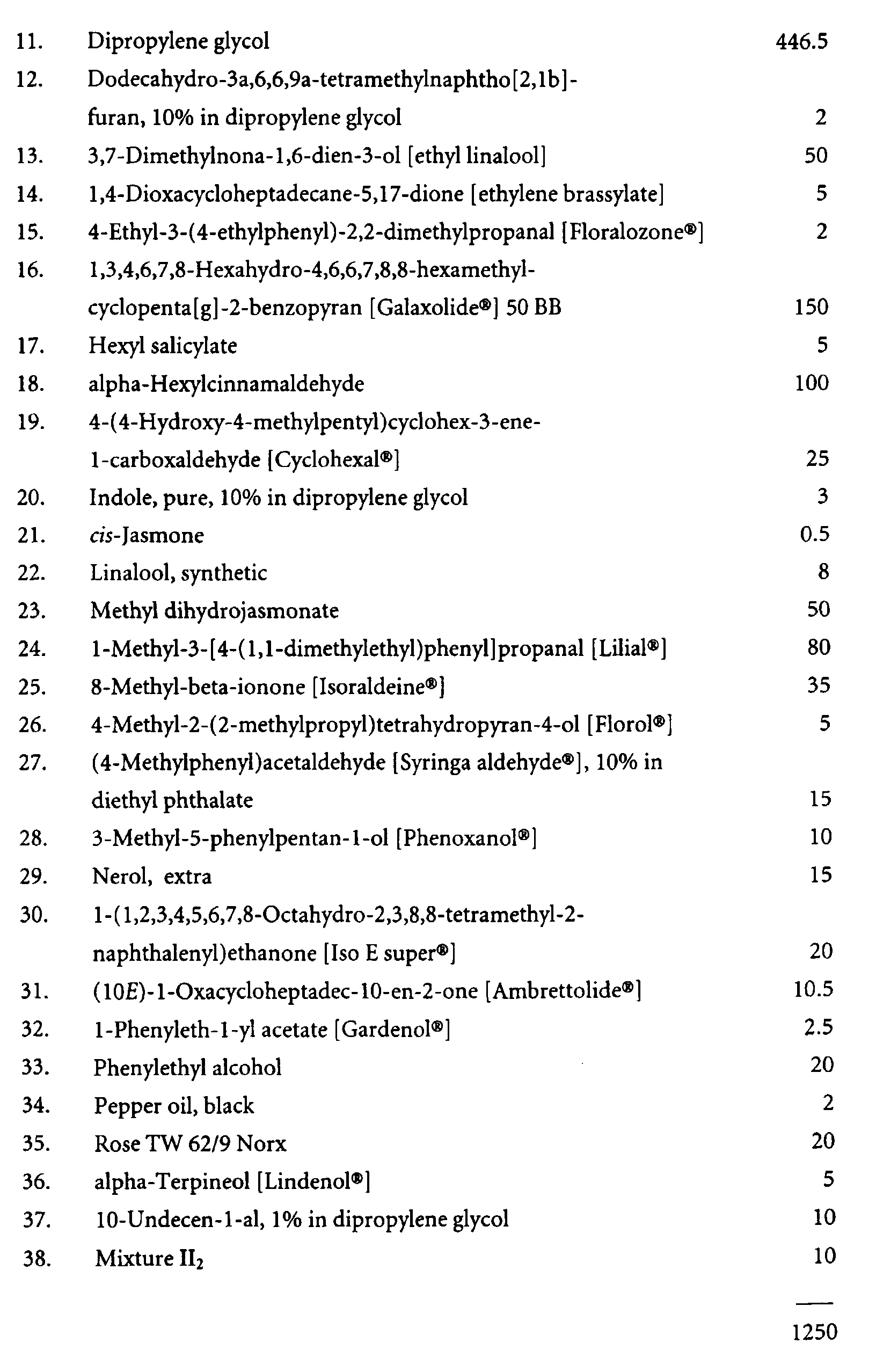
- The light, clear, crisp lily of the valley character of the mixture II2 clearly comes into play in the composition, surprisingly even in this relatively low dosage, brings elegance and crispness into the olfactory picture and underlines the caring character of the product. The mixture II2 can even intensify the effect of other alcohols with less pronounced lily of the valley odour, as shown here by the example of Florol®. Neither Majantol® nor Majol® or Mugetamol® is able to produce in this composition in like dosages a similar natural lily of the valley note, and the mixtures Ia and Ib are also not capable of this.
Claims (5)
- Mixtures of general formula IIincluding all R- and S-enantiomers, wherein R represents methyl or ethyl, which are free from the corresponding oct-5-ene double bond isomers.

- The mixture according to claim 1 containing (6E)-3,6-dimethyloct-6-en-1-ol and (6Z)-3,6-dimethyloct-6-en-1-ol (II1 ), which is free from (5E/Z)-3,6-dimethyloct-5-en-1-ol.
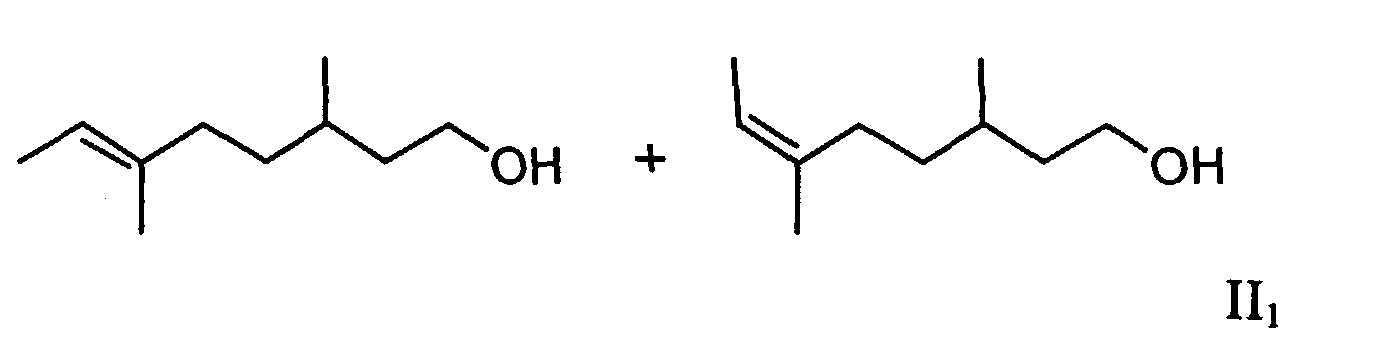
- The mixture according to claim 1 containing (6E)-6-ethyl-3-methyloct-6-en-1-ol and (6Z)-6-ethyl-3-methyloct-6-en-1-ol (II2 ), which is free from (5E/Z)-ethyl-3-methyloct-5-en-1-ol.

- An odorant composition, which contains a mixture in accordance with any one of claims 1 to 3.
- The use of the mixture in accordance with any one of claims 1 to 3 as an odorant.
Priority Applications (1)
| Application Number | Priority Date | Filing Date | Title |
|---|---|---|---|
| EP20000102807 EP1029841B1 (en) | 1999-02-19 | 2000-02-11 | 6-Substituted 3-methyloct-6-enols |
Applications Claiming Priority (3)
| Application Number | Priority Date | Filing Date | Title |
|---|---|---|---|
| EP99103243 | 1999-02-19 | ||
| EP99103243 | 1999-02-19 | ||
| EP20000102807 EP1029841B1 (en) | 1999-02-19 | 2000-02-11 | 6-Substituted 3-methyloct-6-enols |
Publications (2)
| Publication Number | Publication Date |
|---|---|
| EP1029841A1 true EP1029841A1 (en) | 2000-08-23 |
| EP1029841B1 EP1029841B1 (en) | 2003-04-09 |
Family
ID=26070532
Family Applications (1)
| Application Number | Title | Priority Date | Filing Date |
|---|---|---|---|
| EP20000102807 Expired - Lifetime EP1029841B1 (en) | 1999-02-19 | 2000-02-11 | 6-Substituted 3-methyloct-6-enols |
Country Status (1)
| Country | Link |
|---|---|
| EP (1) | EP1029841B1 (en) |
Cited By (5)
| Publication number | Priority date | Publication date | Assignee | Title |
|---|---|---|---|---|
| WO2004009750A1 (en) * | 2002-07-18 | 2004-01-29 | Quest International Services B.V. | Improvements in or relating to perfume compositions |
| DE102007045241A1 (en) | 2007-04-20 | 2008-10-23 | Beiersdorf Ag | Cosmetic preparation, useful as an agent that is effective against e.g. gram negative and gram positive bacteria, yeast and/or fungus, comprises piroctone olamine and stabilizing agent e.g. benzaldehyde and/or alkane-diol |
| WO2010091969A1 (en) * | 2009-02-13 | 2010-08-19 | Basf Se | Lily of the valley-type fragrance compositions |
| DE102011076869A1 (en) | 2011-06-01 | 2012-12-06 | Beiersdorf Ag | Emulsion preparations with improved rheological properties |
| EP3521409A3 (en) * | 2014-03-26 | 2019-10-16 | The Procter & Gamble Company | Perfume systems |
Families Citing this family (1)
| Publication number | Priority date | Publication date | Assignee | Title |
|---|---|---|---|---|
| EP3470388A1 (en) | 2017-10-13 | 2019-04-17 | Basf Se | Synthesis of aliphatic alcohols as aroma chemicals |
Citations (2)
| Publication number | Priority date | Publication date | Assignee | Title |
|---|---|---|---|---|
| FR338895A (en) * | 1903-06-27 | 1904-08-29 | Louis Bouveault | Obtaining new industrial substances (alcohols and their derivatives) and general process for preparing primary alcohols |
| FR1562796A (en) * | 1966-08-03 | 1969-04-11 |
-
2000
- 2000-02-11 EP EP20000102807 patent/EP1029841B1/en not_active Expired - Lifetime
Patent Citations (2)
| Publication number | Priority date | Publication date | Assignee | Title |
|---|---|---|---|---|
| FR338895A (en) * | 1903-06-27 | 1904-08-29 | Louis Bouveault | Obtaining new industrial substances (alcohols and their derivatives) and general process for preparing primary alcohols |
| FR1562796A (en) * | 1966-08-03 | 1969-04-11 |
Cited By (7)
| Publication number | Priority date | Publication date | Assignee | Title |
|---|---|---|---|---|
| WO2004009750A1 (en) * | 2002-07-18 | 2004-01-29 | Quest International Services B.V. | Improvements in or relating to perfume compositions |
| DE102007045241A1 (en) | 2007-04-20 | 2008-10-23 | Beiersdorf Ag | Cosmetic preparation, useful as an agent that is effective against e.g. gram negative and gram positive bacteria, yeast and/or fungus, comprises piroctone olamine and stabilizing agent e.g. benzaldehyde and/or alkane-diol |
| DE102007045242A1 (en) | 2007-04-20 | 2008-10-23 | Beiersdorf Ag | Benzaldehydes in cosmetic or dermatological preparations |
| WO2010091969A1 (en) * | 2009-02-13 | 2010-08-19 | Basf Se | Lily of the valley-type fragrance compositions |
| DE102011076869A1 (en) | 2011-06-01 | 2012-12-06 | Beiersdorf Ag | Emulsion preparations with improved rheological properties |
| WO2012164030A2 (en) | 2011-06-01 | 2012-12-06 | Beiersdorf Ag | Emulsion preparations with enhanced rheological properties |
| EP3521409A3 (en) * | 2014-03-26 | 2019-10-16 | The Procter & Gamble Company | Perfume systems |
Also Published As
| Publication number | Publication date |
|---|---|
| EP1029841B1 (en) | 2003-04-09 |
Similar Documents
| Publication | Publication Date | Title |
|---|---|---|
| EP2920139B1 (en) | Improvements in or relating to organic compounds | |
| CN110418780B (en) | Cyclohexene derivatives as perfuming ingredients | |
| JP7405868B2 (en) | organic compound | |
| US6297211B1 (en) | Odorant compositions | |
| EP1029841B1 (en) | 6-Substituted 3-methyloct-6-enols | |
| JPH05246917A (en) | Novel odorant substance | |
| EP2268779B1 (en) | Ketones as perfuming ingredients | |
| JP6054157B2 (en) | Fragrance composition | |
| EP1924544B1 (en) | 6-methoxy-2,6-dimethyloctanal and its use as a fragrance ingredient | |
| RU2712172C2 (en) | 2,4,7-trimethyloct-6-en-1-ol as fragrance | |
| JP4718026B2 (en) | Novel optically active oxygenated alicyclic compounds, their use, perfumed compositions and perfumed articles | |
| JP2013519646A (en) | 7- (Alka-1'-enyl) -2H-benzo [b] [1,4] dioxepin-3 (4H) -ones and their use in fragrance applications | |
| JP6154893B2 (en) | Organic compounds | |
| JP3574861B2 (en) | Fragrance composition containing 3- (3-hexenyl) -2-cyclopentenone | |
| EP1921129B1 (en) | Perfume composition | |
| EP1321508A2 (en) | Fragrance composition containing 3-(3-Hexenyl)-2-cyclopentenone | |
| EP3707229B1 (en) | Cyclohexene propanal derivatives as perfuming ingredients | |
| MXPA00001679A (en) | 6-substituted 3-methyloct-6-enols | |
| JP3574862B2 (en) | Cis-jasmon containing 3- (3-hexenyl) -2-cyclopentenone | |
| JP2024541099A (en) | Organic compounds as fragrances |
Legal Events
| Date | Code | Title | Description |
|---|---|---|---|
| PUAI | Public reference made under article 153(3) epc to a published international application that has entered the european phase |
Free format text: ORIGINAL CODE: 0009012 |
|
| AK | Designated contracting states |
Kind code of ref document: A1 Designated state(s): AT BE CH CY DE DK ES FI FR GB GR IE IT LI LU MC NL PT SE |
|
| AX | Request for extension of the european patent |
Free format text: AL;LT;LV;MK;RO;SI |
|
| RAP1 | Party data changed (applicant data changed or rights of an application transferred) |
Owner name: GIVAUDAN SA |
|
| 17P | Request for examination filed |
Effective date: 20010223 |
|
| AKX | Designation fees paid |
Free format text: AT BE CH CY DE DK ES FI FR GB GR IE IT LI LU MC NL PT SE |
|
| GRAG | Despatch of communication of intention to grant |
Free format text: ORIGINAL CODE: EPIDOS AGRA |
|
| 17Q | First examination report despatched |
Effective date: 20020516 |
|
| GRAG | Despatch of communication of intention to grant |
Free format text: ORIGINAL CODE: EPIDOS AGRA |
|
| GRAH | Despatch of communication of intention to grant a patent |
Free format text: ORIGINAL CODE: EPIDOS IGRA |
|
| GRAH | Despatch of communication of intention to grant a patent |
Free format text: ORIGINAL CODE: EPIDOS IGRA |
|
| GRAA | (expected) grant |
Free format text: ORIGINAL CODE: 0009210 |
|
| AK | Designated contracting states |
Designated state(s): AT BE CH CY DE DK ES FI FR GB GR IE IT LI LU MC NL PT SE |
|
| PG25 | Lapsed in a contracting state [announced via postgrant information from national office to epo] |
Ref country code: FI Free format text: LAPSE BECAUSE OF FAILURE TO SUBMIT A TRANSLATION OF THE DESCRIPTION OR TO PAY THE FEE WITHIN THE PRESCRIBED TIME-LIMIT Effective date: 20030409 Ref country code: BE Free format text: LAPSE BECAUSE OF FAILURE TO SUBMIT A TRANSLATION OF THE DESCRIPTION OR TO PAY THE FEE WITHIN THE PRESCRIBED TIME-LIMIT Effective date: 20030409 Ref country code: AT Free format text: LAPSE BECAUSE OF FAILURE TO SUBMIT A TRANSLATION OF THE DESCRIPTION OR TO PAY THE FEE WITHIN THE PRESCRIBED TIME-LIMIT Effective date: 20030409 Ref country code: CY Free format text: LAPSE BECAUSE OF FAILURE TO SUBMIT A TRANSLATION OF THE DESCRIPTION OR TO PAY THE FEE WITHIN THE PRESCRIBED TIME-LIMIT Effective date: 20030409 |
|
| REG | Reference to a national code |
Ref country code: GB Ref legal event code: FG4D |
|
| REG | Reference to a national code |
Ref country code: CH Ref legal event code: EP |
|
| REG | Reference to a national code |
Ref country code: IE Ref legal event code: FG4D |
|
| PG25 | Lapsed in a contracting state [announced via postgrant information from national office to epo] |
Ref country code: DK Free format text: LAPSE BECAUSE OF FAILURE TO SUBMIT A TRANSLATION OF THE DESCRIPTION OR TO PAY THE FEE WITHIN THE PRESCRIBED TIME-LIMIT Effective date: 20030709 Ref country code: GR Free format text: LAPSE BECAUSE OF FAILURE TO SUBMIT A TRANSLATION OF THE DESCRIPTION OR TO PAY THE FEE WITHIN THE PRESCRIBED TIME-LIMIT Effective date: 20030709 Ref country code: PT Free format text: LAPSE BECAUSE OF FAILURE TO SUBMIT A TRANSLATION OF THE DESCRIPTION OR TO PAY THE FEE WITHIN THE PRESCRIBED TIME-LIMIT Effective date: 20030709 Ref country code: SE Free format text: LAPSE BECAUSE OF FAILURE TO SUBMIT A TRANSLATION OF THE DESCRIPTION OR TO PAY THE FEE WITHIN THE PRESCRIBED TIME-LIMIT Effective date: 20030709 |
|
| REG | Reference to a national code |
Ref country code: CH Ref legal event code: NV Representative=s name: PATENTANWAELTE SCHAAD, BALASS, MENZL & PARTNER AG |
|
| REG | Reference to a national code |
Ref country code: ES Ref legal event code: FG2A Ref document number: 2193014 Country of ref document: ES Kind code of ref document: T3 |
|
| ET | Fr: translation filed | ||
| PG25 | Lapsed in a contracting state [announced via postgrant information from national office to epo] |
Ref country code: LU Free format text: LAPSE BECAUSE OF NON-PAYMENT OF DUE FEES Effective date: 20040211 Ref country code: IE Free format text: LAPSE BECAUSE OF NON-PAYMENT OF DUE FEES Effective date: 20040211 |
|
| PLBE | No opposition filed within time limit |
Free format text: ORIGINAL CODE: 0009261 |
|
| STAA | Information on the status of an ep patent application or granted ep patent |
Free format text: STATUS: NO OPPOSITION FILED WITHIN TIME LIMIT |
|
| PG25 | Lapsed in a contracting state [announced via postgrant information from national office to epo] |
Ref country code: MC Free format text: LAPSE BECAUSE OF NON-PAYMENT OF DUE FEES Effective date: 20040228 |
|
| 26N | No opposition filed |
Effective date: 20040112 |
|
| REG | Reference to a national code |
Ref country code: IE Ref legal event code: MM4A |
|
| REG | Reference to a national code |
Ref country code: CH Ref legal event code: NV Representative=s name: JOHN ANTHONY MCSTEA GIVAUDAN SCHWEIZ AG |
|
| REG | Reference to a national code |
Ref country code: FR Ref legal event code: PLFP Year of fee payment: 17 |
|
| REG | Reference to a national code |
Ref country code: FR Ref legal event code: PLFP Year of fee payment: 18 |
|
| REG | Reference to a national code |
Ref country code: FR Ref legal event code: PLFP Year of fee payment: 19 |
|
| PGFP | Annual fee paid to national office [announced via postgrant information from national office to epo] |
Ref country code: NL Payment date: 20190218 Year of fee payment: 20 |
|
| PGFP | Annual fee paid to national office [announced via postgrant information from national office to epo] |
Ref country code: CH Payment date: 20190218 Year of fee payment: 20 Ref country code: DE Payment date: 20190219 Year of fee payment: 20 Ref country code: IT Payment date: 20190225 Year of fee payment: 20 Ref country code: GB Payment date: 20190218 Year of fee payment: 20 Ref country code: ES Payment date: 20190320 Year of fee payment: 20 |
|
| PGFP | Annual fee paid to national office [announced via postgrant information from national office to epo] |
Ref country code: FR Payment date: 20190219 Year of fee payment: 20 |
|
| REG | Reference to a national code |
Ref country code: CH Ref legal event code: NV Representative=s name: GIVAUDAN INTERNATIONAL SA GLOBAL PATENTS, CH |
|
| REG | Reference to a national code |
Ref country code: DE Ref legal event code: R071 Ref document number: 60001997 Country of ref document: DE |
|
| REG | Reference to a national code |
Ref country code: NL Ref legal event code: MK Effective date: 20200210 |
|
| REG | Reference to a national code |
Ref country code: CH Ref legal event code: PL |
|
| REG | Reference to a national code |
Ref country code: GB Ref legal event code: PE20 Expiry date: 20200210 |
|
| PG25 | Lapsed in a contracting state [announced via postgrant information from national office to epo] |
Ref country code: GB Free format text: LAPSE BECAUSE OF EXPIRATION OF PROTECTION Effective date: 20200210 |
|
| REG | Reference to a national code |
Ref country code: ES Ref legal event code: FD2A Effective date: 20200723 |
|
| PG25 | Lapsed in a contracting state [announced via postgrant information from national office to epo] |
Ref country code: ES Free format text: LAPSE BECAUSE OF EXPIRATION OF PROTECTION Effective date: 20200212 |