EP1031415A1 - Dry method for preparing a thermal lithographic printing plate precursor - Google Patents
Dry method for preparing a thermal lithographic printing plate precursor Download PDFInfo
- Publication number
- EP1031415A1 EP1031415A1 EP99200528A EP99200528A EP1031415A1 EP 1031415 A1 EP1031415 A1 EP 1031415A1 EP 99200528 A EP99200528 A EP 99200528A EP 99200528 A EP99200528 A EP 99200528A EP 1031415 A1 EP1031415 A1 EP 1031415A1
- Authority
- EP
- European Patent Office
- Prior art keywords
- compound
- image
- printing
- press
- organic
- Prior art date
- Legal status (The legal status is an assumption and is not a legal conclusion. Google has not performed a legal analysis and makes no representation as to the accuracy of the status listed.)
- Granted
Links
- 238000000034 method Methods 0.000 title claims abstract description 59
- 238000007639 printing Methods 0.000 title claims abstract description 50
- 239000002243 precursor Substances 0.000 title description 7
- 239000000463 material Substances 0.000 claims abstract description 40
- 150000001875 compounds Chemical class 0.000 claims abstract description 37
- 239000000843 powder Substances 0.000 claims abstract description 28
- 229910052751 metal Inorganic materials 0.000 claims abstract description 21
- 239000002184 metal Substances 0.000 claims abstract description 21
- 150000002894 organic compounds Chemical class 0.000 claims abstract description 20
- 238000003384 imaging method Methods 0.000 claims abstract description 17
- 239000002245 particle Substances 0.000 claims description 24
- XLYOFNOQVPJJNP-UHFFFAOYSA-N water Substances O XLYOFNOQVPJJNP-UHFFFAOYSA-N 0.000 claims description 15
- 229920001169 thermoplastic Polymers 0.000 claims description 9
- OKTJSMMVPCPJKN-UHFFFAOYSA-N Carbon Chemical compound [C] OKTJSMMVPCPJKN-UHFFFAOYSA-N 0.000 claims description 8
- 229920000642 polymer Polymers 0.000 claims description 7
- 239000004793 Polystyrene Substances 0.000 claims description 4
- 229920002223 polystyrene Polymers 0.000 claims description 4
- 229920003986 novolac Polymers 0.000 claims description 3
- 229910052799 carbon Inorganic materials 0.000 claims description 2
- 229920000058 polyacrylate Polymers 0.000 claims description 2
- 239000007788 liquid Substances 0.000 claims 2
- 238000000576 coating method Methods 0.000 description 19
- 239000010410 layer Substances 0.000 description 19
- 229910052782 aluminium Inorganic materials 0.000 description 13
- XAGFODPZIPBFFR-UHFFFAOYSA-N aluminium Chemical compound [Al] XAGFODPZIPBFFR-UHFFFAOYSA-N 0.000 description 13
- 239000011248 coating agent Substances 0.000 description 13
- 238000012545 processing Methods 0.000 description 13
- PNEYBMLMFCGWSK-UHFFFAOYSA-N Alumina Chemical compound [O-2].[O-2].[O-2].[Al+3].[Al+3] PNEYBMLMFCGWSK-UHFFFAOYSA-N 0.000 description 12
- -1 borides Chemical class 0.000 description 11
- 239000006229 carbon black Substances 0.000 description 9
- 239000000203 mixture Substances 0.000 description 8
- 239000004411 aluminium Substances 0.000 description 7
- 230000008569 process Effects 0.000 description 7
- 238000012546 transfer Methods 0.000 description 7
- 238000011282 treatment Methods 0.000 description 7
- 229920003229 poly(methyl methacrylate) Polymers 0.000 description 6
- 239000004926 polymethyl methacrylate Substances 0.000 description 6
- 239000000975 dye Substances 0.000 description 5
- 230000005660 hydrophilic surface Effects 0.000 description 5
- 229920000126 latex Polymers 0.000 description 5
- VEXZGXHMUGYJMC-UHFFFAOYSA-N Hydrochloric acid Chemical compound Cl VEXZGXHMUGYJMC-UHFFFAOYSA-N 0.000 description 4
- 238000002679 ablation Methods 0.000 description 4
- 239000010439 graphite Substances 0.000 description 4
- 229910002804 graphite Inorganic materials 0.000 description 4
- 238000010438 heat treatment Methods 0.000 description 4
- 239000004816 latex Substances 0.000 description 4
- 230000001846 repelling effect Effects 0.000 description 4
- QAOWNCQODCNURD-UHFFFAOYSA-N Sulfuric acid Chemical class OS(O)(=O)=O QAOWNCQODCNURD-UHFFFAOYSA-N 0.000 description 3
- 239000011324 bead Substances 0.000 description 3
- KRKNYBCHXYNGOX-UHFFFAOYSA-N citric acid Chemical compound OC(=O)CC(O)(C(O)=O)CC(O)=O KRKNYBCHXYNGOX-UHFFFAOYSA-N 0.000 description 3
- 229920002451 polyvinyl alcohol Polymers 0.000 description 3
- 229920000742 Cotton Polymers 0.000 description 2
- 101100221809 Neurospora crassa (strain ATCC 24698 / 74-OR23-1A / CBS 708.71 / DSM 1257 / FGSC 987) cpd-7 gene Proteins 0.000 description 2
- 229910019142 PO4 Inorganic materials 0.000 description 2
- OAICVXFJPJFONN-UHFFFAOYSA-N Phosphorus Chemical compound [P] OAICVXFJPJFONN-UHFFFAOYSA-N 0.000 description 2
- 239000002253 acid Substances 0.000 description 2
- 230000008901 benefit Effects 0.000 description 2
- 238000004132 cross linking Methods 0.000 description 2
- 238000011161 development Methods 0.000 description 2
- 239000006185 dispersion Substances 0.000 description 2
- 238000005516 engineering process Methods 0.000 description 2
- 230000002209 hydrophobic effect Effects 0.000 description 2
- 238000007645 offset printing Methods 0.000 description 2
- NBIIXXVUZAFLBC-UHFFFAOYSA-K phosphate Chemical compound [O-]P([O-])([O-])=O NBIIXXVUZAFLBC-UHFFFAOYSA-K 0.000 description 2
- 239000010452 phosphate Substances 0.000 description 2
- 230000035945 sensitivity Effects 0.000 description 2
- 239000002356 single layer Substances 0.000 description 2
- 239000000126 substance Substances 0.000 description 2
- 239000000758 substrate Substances 0.000 description 2
- 239000001117 sulphuric acid Substances 0.000 description 2
- 235000011149 sulphuric acid Nutrition 0.000 description 2
- BVKZGUZCCUSVTD-UHFFFAOYSA-M Bicarbonate Chemical compound OC([O-])=O BVKZGUZCCUSVTD-UHFFFAOYSA-M 0.000 description 1
- 229910000906 Bronze Inorganic materials 0.000 description 1
- KRKNYBCHXYNGOX-UHFFFAOYSA-K Citrate Chemical compound [O-]C(=O)CC(O)(CC([O-])=O)C([O-])=O KRKNYBCHXYNGOX-UHFFFAOYSA-K 0.000 description 1
- RYGMFSIKBFXOCR-UHFFFAOYSA-N Copper Chemical compound [Cu] RYGMFSIKBFXOCR-UHFFFAOYSA-N 0.000 description 1
- 239000004593 Epoxy Substances 0.000 description 1
- 229920000877 Melamine resin Polymers 0.000 description 1
- GRYLNZFGIOXLOG-UHFFFAOYSA-N Nitric acid Chemical compound O[N+]([O-])=O GRYLNZFGIOXLOG-UHFFFAOYSA-N 0.000 description 1
- ISWSIDIOOBJBQZ-UHFFFAOYSA-N Phenol Chemical compound OC1=CC=CC=C1 ISWSIDIOOBJBQZ-UHFFFAOYSA-N 0.000 description 1
- 239000004115 Sodium Silicate Substances 0.000 description 1
- 229910000831 Steel Inorganic materials 0.000 description 1
- ATJFFYVFTNAWJD-UHFFFAOYSA-N Tin Chemical compound [Sn] ATJFFYVFTNAWJD-UHFFFAOYSA-N 0.000 description 1
- 125000002777 acetyl group Chemical class [H]C([H])([H])C(*)=O 0.000 description 1
- 229910045601 alloy Inorganic materials 0.000 description 1
- 239000000956 alloy Substances 0.000 description 1
- 238000004458 analytical method Methods 0.000 description 1
- QVGXLLKOCUKJST-UHFFFAOYSA-N atomic oxygen Chemical compound [O] QVGXLLKOCUKJST-UHFFFAOYSA-N 0.000 description 1
- 239000010974 bronze Substances 0.000 description 1
- 238000001311 chemical methods and process Methods 0.000 description 1
- 238000012993 chemical processing Methods 0.000 description 1
- 238000006243 chemical reaction Methods 0.000 description 1
- 238000005345 coagulation Methods 0.000 description 1
- 230000015271 coagulation Effects 0.000 description 1
- 229910052802 copper Inorganic materials 0.000 description 1
- 239000010949 copper Substances 0.000 description 1
- KUNSUQLRTQLHQQ-UHFFFAOYSA-N copper tin Chemical compound [Cu].[Sn] KUNSUQLRTQLHQQ-UHFFFAOYSA-N 0.000 description 1
- 238000000354 decomposition reaction Methods 0.000 description 1
- 230000008030 elimination Effects 0.000 description 1
- 238000003379 elimination reaction Methods 0.000 description 1
- 238000002474 experimental method Methods 0.000 description 1
- 239000000945 filler Substances 0.000 description 1
- 238000004108 freeze drying Methods 0.000 description 1
- 230000005661 hydrophobic surface Effects 0.000 description 1
- 229910001506 inorganic fluoride Inorganic materials 0.000 description 1
- 230000003993 interaction Effects 0.000 description 1
- 239000002346 layers by function Substances 0.000 description 1
- 238000011068 loading method Methods 0.000 description 1
- 239000006224 matting agent Substances 0.000 description 1
- 230000007246 mechanism Effects 0.000 description 1
- 150000001247 metal acetylides Chemical class 0.000 description 1
- 239000003094 microcapsule Substances 0.000 description 1
- 238000002156 mixing Methods 0.000 description 1
- 229910017604 nitric acid Inorganic materials 0.000 description 1
- 150000004767 nitrides Chemical class 0.000 description 1
- FOKLVOHHYNATHU-UHFFFAOYSA-N oxan-2-ylmethyl 2-methylprop-2-enoate Chemical compound CC(=C)C(=O)OCC1CCCCO1 FOKLVOHHYNATHU-UHFFFAOYSA-N 0.000 description 1
- 239000001301 oxygen Substances 0.000 description 1
- 229910052760 oxygen Inorganic materials 0.000 description 1
- 229920001568 phenolic resin Polymers 0.000 description 1
- 150000003014 phosphoric acid esters Chemical class 0.000 description 1
- 230000000704 physical effect Effects 0.000 description 1
- 239000000049 pigment Substances 0.000 description 1
- 229920000767 polyaniline Polymers 0.000 description 1
- 229920000128 polypyrrole Polymers 0.000 description 1
- 238000003825 pressing Methods 0.000 description 1
- 229920005989 resin Polymers 0.000 description 1
- 239000011347 resin Substances 0.000 description 1
- 238000012552 review Methods 0.000 description 1
- 238000012216 screening Methods 0.000 description 1
- 239000004065 semiconductor Substances 0.000 description 1
- 238000000926 separation method Methods 0.000 description 1
- NTHWMYGWWRZVTN-UHFFFAOYSA-N sodium silicate Chemical compound [Na+].[Na+].[O-][Si]([O-])=O NTHWMYGWWRZVTN-UHFFFAOYSA-N 0.000 description 1
- 229910052911 sodium silicate Inorganic materials 0.000 description 1
- 239000002904 solvent Substances 0.000 description 1
- 238000005507 spraying Methods 0.000 description 1
- 238000004544 sputter deposition Methods 0.000 description 1
- 239000010935 stainless steel Substances 0.000 description 1
- 229910001220 stainless steel Inorganic materials 0.000 description 1
- 239000010959 steel Substances 0.000 description 1
- 230000003746 surface roughness Effects 0.000 description 1
- 238000001931 thermography Methods 0.000 description 1
- 150000003673 urethanes Chemical class 0.000 description 1
Classifications
-
- B—PERFORMING OPERATIONS; TRANSPORTING
- B41—PRINTING; LINING MACHINES; TYPEWRITERS; STAMPS
- B41C—PROCESSES FOR THE MANUFACTURE OR REPRODUCTION OF PRINTING SURFACES
- B41C1/00—Forme preparation
- B41C1/10—Forme preparation for lithographic printing; Master sheets for transferring a lithographic image to the forme
- B41C1/1066—Forme preparation for lithographic printing; Master sheets for transferring a lithographic image to the forme by spraying with powders, by using a nozzle, e.g. an ink jet system, by fusing a previously coated powder, e.g. with a laser
Definitions
- the present invention relates to a method for making a heat-mode lithographic printing plate precursor and a lithographic printing master in computer-to-plate and computer-to-press procedures.
- Rotary printing presses use a so-called master such as a printing plate which is mounted on a cylinder of the printing press.
- the master carries an image which is defined by the ink accepting areas of the printing surface and a print is obtained by applying ink to said surface and then transferring the ink from the master onto a substrate, which is typically a paper substrate.
- ink as well as an aqueous fountain solution are fed to the printing surface of the master, which is referred to herein as lithographic surface and consists of oleophilic (or hydrophobic, i.e. ink accepting, water repelling) areas as well as hydrophilic (or oleophobic, i.e. water accepting, ink repelling) areas.
- Printing masters are generally obtained by the so-called computer-to-film method wherein various pre-press steps such as typeface selection, scanning, colour separation, screening, trapping, layout and imposition are accomplished digitally and each colour selection is transferred to graphic arts film using an image-setter.
- the film can be used as a mask for the exposure of an imaging material called plate precursor and after plate processing, a printing plate is obtained which can be used as a master.
- EP-A- 786 337 discloses a process for imaging a printing plate, wherein the printing plate is charged over the whole surface and over the whole surface is covered with toner particles, which are charged oppositely. Thereon is the layer, formed by the particles imagewise fixed or imagewise ablated by infrared exposure on the surface of the printing plate. Thereafter the parts which are not fixed are removed and optionally the non-ablated areas are fixed by heating over the whole surface of the plate. This process requires a cumbersome development.
- thermal materials disclosed in the prior art are suitable for exposure with either an internal drum image-setter (i.e. typically a high-power short-time exposure) or an external drum image-setter (i.e. relatively low-power long-time exposure).
- an internal drum image-setter i.e. typically a high-power short-time exposure
- an external drum image-setter i.e. relatively low-power long-time exposure
- a method for making a negative working non-ablative imaging material suitable for making a lithographic printing plate, comprising the steps of applying a dry powder containing at least a compound capable of converting light into heat and an organic compound on a surface of a non-electrically charged metal support, characterized in that the amount of organic compound in said powder ranges from 51 to 95% by weight.
- Said organic compound is present in said powder in an amount of at least 51%.
- Said organic compound is preferably a thermoplastic polymer particle, more preferably with a diameter between 0.02 ⁇ m and 10 ⁇ m, most preferably between 0.050 ⁇ m and 2 ⁇ m.
- Preferred thermoplastic polymers are novolac, polystyrene or a polyacrylate, used alone or mixed with one or two of the other components.
- Preferably said thermoplastic polymer particles contain a reactive compound inside or outside these particles. Particles containing reactive compounds inside the particles are prepared according to the well known technique of preparing microcapsules or by adding the reactive compound in a water immiscible solvent to the particles dispersed in water.
- Particles containig reactive compounds outside the particles are prepared according to the well known technique of loading latices as described in EP-A- 483 416 .
- Reactive compounds are compounds which can cause cross-linking.
- Preferred reactive compounds are melamine resins, urethanes, phenol-formaldehyde resins and epoxy compounds.
- the compound which is capable of converting light into heat is preferably an organic dye or pigment, carbon black, graphite, metal carbides, borides, nitrides, carbonitrides, or oxides.
- the materials made by the method of the present invention are preferably sensitive to near infrared light.
- the compound capable of converting light into heat is preferably a near infrared light absorbing compound such as carbon or an infrared dye. It is also possible to use dry, finely divided polymer particles consisting of e.g. a polypyrrole or polyaniline-based polymer.
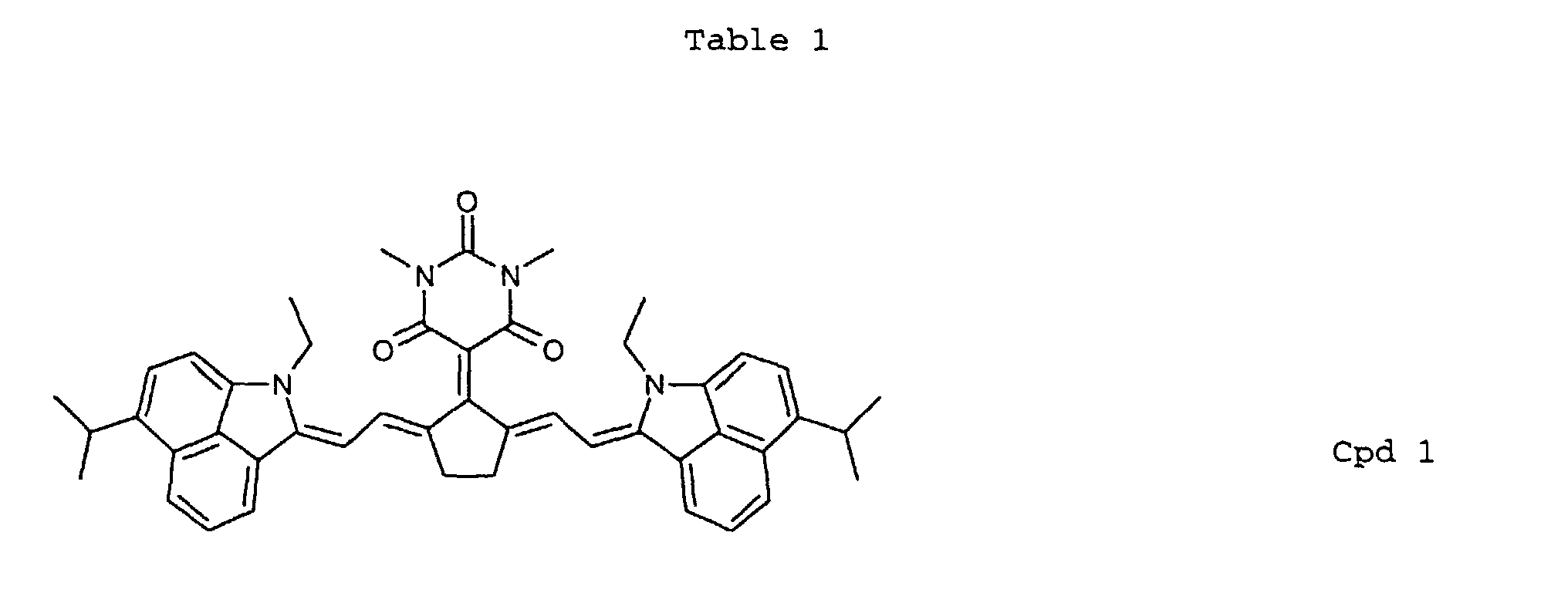
- the infrared dyes listed in Table 1 are highly preferred.
- the amount of the compound capable of converting light into heat is in the range of 5 to 49% by weight, more preferably between 10 to 49% by weight of the dry powder.
- the compound capable of converting light into heat can also be incorporated in or adsorbed to or mixed with the polymeric particles or is heterogeneously mixed with said organic compound.
- the materials made by the method of the present invention require no processing or can be processed with plain water. Since it is a dry coating method, the method of the present invention is very suitable for computer-to-press applications and on-press coating procedures.
- the imaging mechanism of the materials that are made according to the present invention is not known, but may rely on a thermal interaction between the light absorbing compound and the metal support.
- image is used herein in the context of lithographic printing, i.e. "a pattern consisting of oleophilic and hydrophilic areas".
- the material that is made according to the present invention is negative working, which means that the areas, which are exposed to light, are rendered oleophilic and thus ink accepting due to said exposure.
- the feature "negative working” may be considered as an equivalent of the feature “non-ablative", since in ablative materials the functional layers are completely removed from the underlying (hydrophilic) metal support upon image-wise exposure so as to obtain a positive image (exposed areas are hydrophilic, ink repelling).
- the dry powder used in the present invention may further comprise non-reactive compounds, i.e. inert components such as e.g. a matting agent or a filler.
- inert components such as e.g. a matting agent or a filler.
- inert components such as e.g. a matting agent or a filler.
- inert components such as e.g. a matting agent or a filler.
- inert components such as e.g. a matting agent or a filler.
- inert components such as e.g. a matting agent or a filler.
- inert components such as e.g. a matting agent or a filler.
- inert components such as e.g. a matting agent or a filler.
- inert components such as e.g. a matting agent or a filler.
- inert components such as e.g. a matting agent
- the method of the present invention may be used to apply a stack of layers on a metal support but a single layer is preferred.
- the compound capable of converting light into heat may be present in all the layers of said stack or may be localised in just a single layer of said stack.
- the layer comprising the compound capable of converting light into heat is preferably applied directly on the metal support.
- the layer comprising the compound capable of converting light into heat is preferably very thin, i.e. having a dry layer thickness below 2 ⁇ m, preferably not higher than 1 ⁇ m.
- the support used in the present invention is a non-electrically charged metal support.
- Preferred examples of said metal support are steel, especially polished stainless steel, and aluminium.
- Phosphor bronze an alloy comprising >90 wt.% of copper, ⁇ 10 wt.% of tin and small amounts of phosphor
- the aluminium support is preferably an electrochemically grained and anodised aluminium support. Most preferably said aluminium support is grained in nitric acid, yielding imaging elements with a higher sensitivity.
- the anodised aluminium support may be treated to improve the hydrophilic properties of its surface.
- the aluminium support may be silicated by treating its surface with sodium silicate solution at elevated temperature, e.g. 95°C.
- a phosphate treatment may be applied which involves treating the aluminium oxide surface with a phosphate solution that may further contain an inorganic fluoride. Further, the aluminium oxide surface may be rinsed with a citric acid or citrate solution. This treatment may be carried out at room temperature or can be carried out at a slightly elevated temperature of about 30 to 50°C. A further treatment may involve rinsing the aluminium oxide surface with a bicarbonate solution.
- the aluminium oxide surface may be treated with poly(vinyl phosphonic acid), poly(vinyl methylphosphonic acid), phosphoric acid esters of poly(vinyl alcohol), poly(vinyl sulphonic acid), poly(vinyl benzenesulphonic acid), sulphuric acid esters of poly(vinyl alcohol), and acetals of poly(vinyl alcohols) formed by reaction with a sulphonated aliphatic aldehyde. It is evident that one or more of these post treatments may be carried out alone or in combination.
- a highly preferred material made according to the present invention comprises a non-electrically charged anodised aluminium support and provided directly thereon a single recording layer which consists essentially of a compound capable of converting light into heat and thermoplastic polymer particles. On top of said recording layer there may be provided a top layer for protecting the recording layer against moisture, chemicals, oxygen, mechanical impact, etc.
- a non-electrically charged metal support can be applied with a dry powder by rubbing in the surface of said support with said dry powder.
- Alternative dry coating methods can also be used, e.g. sputter-coating of the powder on the metal support.
- the method of the present invention can be used in computer-to-plate (off-press exposure) or computer-to-press (on-press exposure) procedures.
- the method may also involve on-press coating, i.e. applying a dry powder according to the present invention directly on the non-electrically charged metal surface of a cylinder of a rotary printing press.
- Said on-press coating can also be performed indirectly by applying the dry powder on a metal support which is mounted on a cylinder of a rotary printing press.
- said composition can be applied on a metal sleeve which, after image-wise exposure and optional processing, is then transferred to a cylinder of a rotary printing press.
- the dry powder may also be applied on the non-electrically charged metal support by contacting the surface of said support with another material, which carries a dry layer containing an organic compound and a compound capable of transferring light into heat which are then transferred to the metal support.
- the method of this embodiment can be automated easily, e.g. by incorporating a supply roll of such a transfer material, such as a ribbon impregnated with the dry powder in a print station of a digital press similar to the configuration which is described in EP-A 698 488 .
- the transfer material can be unwound from said supply roll and the layer containing the dry powder can then be brought in direct contact with the surface of a plate cylinder by one or more contact rollers.
- the used transfer material may be wound up again on a take-up roll.
- the transfer of dry power can be carried out so as to obtain a uniform layer which then can be image-wise exposed.
- said pressure and/or heat can be applied image-wise, so that the dry powder is transferred image-wise to the metal support.
- This step then may be followed by intense overall heating, e.g. by infrared laser exposure. However, if sufficient heat is applied during said image-wise transfer, a suitable printing master may directly be obtained without intense overall heating.
- a dry coating unit as described above consisting of a supply roll, one or more contact rollers and a take-up roll, is mounted on the same carriage as the laser exposure unit of an external drum image-setter.
- a spray coating unit is mounted on the same carriage as the laser exposure unit in an external drum configuration.
- said dry coating unit moves in front of the laser exposure unit along the so-called slow scan axis, parallel to the axis of the plate cylinder.
- the whole surface of said cylinder passes the dry coating unit and a layer is coated along a spiral path around the cylinder. Since the laser exposure unit moves together with the dry coating unit, an area which has been coated during one revolution of the cylinder is exposed by the laser exposure unit a number of revolutions later, i.e. coating and image-wise exposing can be carried out almost simultaneously during the same scan procedure.
- the materials made according to the present invention can be exposed to light by a light emitting diode or a laser such as a He/Ne or Ar laser.
- a laser emitting near infrared light having a wavelength in the range from about 700 to about 1500 nm is used, e.g. a semiconductor laser diode, a Nd:YAG or a Nd:YLF laser.
- the required laser power depends on the pixel dwell time of the laser beam, which is determined by the spot diameter (typical value of modern plate-setters at 1/e 2 of maximum intensity : 10-25 ⁇ m), the scan speed and the resolution (i.e.
- ITD image-setters are typically characterised by very high scan speeds up to 500 m/sec and may require a laser power of several Watts. Satisfactory results have also been obtained by using XTD image-setters having a typical laser power from 100 mW to 500 mW at a lower scan speed, e.g. from 0.1 to 10 m/sec.
- the unexposed areas of the material made according to the present invention can be removed easily by wiping the material after exposure with plain water. This step may be performed on-press, i.e. after mounting the exposed plate on the plate cylinder of a printing press.
- the materials can even be used as a printing master immediately after image-wise exposure without any additional processing because the unexposed areas are readily removed by the fountain solution or the ink applied during the first runs of the printing job.
- the printing plate of the present invention can also be used in the printing process as a seamless sleeve printing plate.
- the printing plate is soldered in a cylindrical form by means of a laser.
- This cylindrical printing plate which has as diameter the diameter of the print cylinder is slid on the print cylinder instead of mounting a conventional printing plate. More details on sleeves are given in "Grafisch Nieuws" , 15, 1995, page 4 to 6.
- post-bake i.e. an overall heating treatment after image-wise exposure and optional processing so as to increase the run length of the plate.
- the materials made according to the present invention allow to achieve satisfactory run lengths without a post-bake.
- An aluminum support was electrochemically roughened using hydrochloric acid , anodized in sulphuric acid and subsequently treated with polyvinylphosphonic acid.
- the obtained hydrophilic surface was further used for the application of a dry powder.
- Dry powders consisting of organic compounds and infrared absorbing compounds were used for rubbing in the above described hydrophilic surface of the electrochemically roughened and anodized aluminum support, using a cotton pad.
- Powders with various types and ratios of the organic compound and the IR-absorbing compound were prepared and applied by dry rubbing.
- the carbon black containing powders were prepared by mixing the aqueous carbon black dispersion with an aqueous latex or dispersion of the organic compound in an appropriate ratio and freeze drying the aqueous mixture to remove water from the mixture.
- the carbon black used in these experiments is Printex L6 TM, a trade name of Degussa and the different organic compounds are described in tabel 2.
- the IR-dye was included into the latex particle and in composition 7 the IR-dye was absorbed on the latex particle.
- Organic compound (particle size) IR_sensitive compound Required plane image power Ratio organic comp./IR-sensitive comp.
- the obtained imaging element was exposed with a 830 nm diode laser (Isomet-3600dpi-spot size 11 ⁇ m- at a speed of 3.2 m/s; i.e. pixel dwell time of 3.4 ⁇ s-image plane power was varied :80mW-190mW-292mW were used) and printed on a conventional offset printing machine equipped with a conventional ink and fountain solution.
- a 830 nm diode laser Isomet-3600dpi-spot size 11 ⁇ m- at a speed of 3.2 m/s; i.e. pixel dwell time of 3.4 ⁇ s-image plane power was varied :80mW-190mW-292mW were used
- Printing was started without any treatment between imaging and the press start.
- An aluminum support is electrochemically roughened using hydrochloric acid, anodized in sulphuric acid, and subsequently treated with polyvinylphosphonic acid.
- the obtained hydrophilic surface was further used for the application of dry powders consisting of polymethylmethacrylate beads of 1 ⁇ m and graphite (Graphite NaturalTM trade name of Carbone Lorraine, France- with a particle size ⁇ 20 ⁇ m as an infrared absorbing compound were used for dry rubbing in the above described hydrophilic surface of an electrochemically roughened and anodized aluminum support, using a cotton pad.
- dry powders consisting of polymethylmethacrylate beads of 1 ⁇ m and graphite (Graphite NaturalTM trade name of Carbone Lorraine, France- with a particle size ⁇ 20 ⁇ m as an infrared absorbing compound were used for dry rubbing in the above described hydrophilic surface of an electrochemically roughened and anodized aluminum support, using a cotton pad.
- the obtained imaging element was exposed with an 830 nm laser diode (Isomet-3600 dpi-spot size 11 ⁇ m-at a speed of 3.2 m/s; i.e.pixel dwell time of 3.4 ⁇ s-Image plane power was varied: 200 mW and 300 mW were used) as well as with a 1060 nm NdYLF laser (Isomet-3600 dpi-spot size 18 ⁇ m-at a speed of 3.2 m/s-image plane power was varied: 585 mW and 780 mW were used) and printed on a conventional offset printing machine equipped with a conventional ink and fountain solution system.
- 830 nm laser diode Isomet-3600 dpi-spot size 11 ⁇ m-at a speed of 3.2 m/s; i.e.pixel dwell time of 3.4 ⁇ s-Image plane power was varied: 200 mW and 300 mW were used
- Printing was started without any treatment between imaging and the press start.
- the ink-uptake measured by Dmax on print 100 (see table 3), proves that the organic compound is needed in an amount of at least 51% to print high densities (>1.55 required); without said amount of polymethylmethacrylate-beads high densities print could not be guaranteed.
- Ratio graphite/polymethylmethacrylate 1 ⁇ m beads Dmax (100 sheets) Isomet NdYLF 3.2 m/s Dmax (100 sheets) Isomet diode 3.2 m/s 100/0 585 mW 1.45 200 mW 0.81 780 mW 1.12 300 mW 1.52 75/25 585 mW 1.41 200 mW 1.42 780 mW 1.52 300mW 1.49 50/50 585mW 1.43 200 mW 1.51 780mW 1.53 300 mW 1.52 25/75 585mW 1.61 200 mW 1.55 780 mW 1.61 300 mW 1.60
Landscapes
- Physics & Mathematics (AREA)
- Optics & Photonics (AREA)
- Engineering & Computer Science (AREA)
- Manufacturing & Machinery (AREA)
- Manufacture Or Reproduction Of Printing Formes (AREA)
- Printing Plates And Materials Therefor (AREA)
Abstract
Description


In the composition 6, the IR-dye was included into the latex particle and in composition 7 the IR-dye was absorbed on the latex particle.
| Organic compound (particle size) | IR_sensitive compound | Required plane image power | Ratio organic comp./IR-sensitive comp. |
| 1.Polystyrene(71 nm) | carbon black | between 190 and 292 mW | 90/10 |
| 2.Polystyrene(71nm) | carbon black | ≅190 mW | 55/45 |
| 3.Polymethylmethacrylate(72nm) | carbon black | between 80 and 190 mW | 90/10 |
| Polymethylmethacrylate(72nm) | carbon black | ≅292 mW | 55/45 |
| Novolac(phenol/creso 1 resin) | carbon black | <80 mW | 55/45 |
| Polymethylmethacrylate(1µm) | Tab 1 Cpd 7 | between 80 and 190 mW | 94.8/5.2 |
| Polymethylmethacrylate(90nm) | Tab 1 Cpd 7 | >292 mW | 94.8/5.2 |
| Ratio graphite/polymethylmethacrylate 1µm beads | Dmax (100 sheets) Isomet NdYLF 3.2 m/s | Dmax (100 sheets) Isomet diode 3.2 m/s | ||
| 100/0 | 585 mW | 1.45 | 200 mW | 0.81 |
| 780 mW | 1.12 | 300 mW | 1.52 | |
| 75/25 | 585 mW | 1.41 | 200 mW | 1.42 |
| 780 mW | 1.52 | 300mW | 1.49 | |
| 50/50 | 585mW | 1.43 | 200 mW | 1.51 |
| 780mW | 1.53 | 300 mW | 1.52 | |
| 25/75 | 585mW | 1.61 | 200 mW | 1.55 |
| 780 mW | 1.61 | 300 mW | 1.60 |
Claims (13)
- A method for making a negative working non-ablative imaging material, suitable for making a lithographic printing plate, comprising the steps of applying a dry powder containing at least a compound capable of converting light into heat and an organic compound on a surface of a non-electrically charged metal support, characterized in that the amount of organic compound in said powder ranges from 51 to 95% by weight.
- A method according to claim 1 wherein said organic compound consists of organic thermoplastic polymer particles having a diameter between 0.02 and 10 µm.
- A method according to claim 1 or 2 wherein said organic compound consists of organic thermoplastic polymer particles having a diameter between 0.05 and 2 µm.
- A method according to claim 2 or 3 wherein said organic thermoplastic polymer particles have a reactive compound inside or outside said particles.
- A method according to claim 2 or 3 wherein said organic thermoplastic polymer particles consist of novolac and/or polystyrene and/or a polyacrylate.
- A method according to claim 1 to 5 wherein the compound capable of converting light into heat is a near infrared absorbing compound.
- A method according to claim 6 wherein the near infrared absorbing compound is an organic dye or carbon.
- A method according to any of the claims 6 or 7 wherein the near infrared absorbing compound is incorporated into or adsorbed on or mixed with said polymer particles.
- A method according to claim 6 or 7 wherein the near infrared absorbing compound is heterogeneously mixed with said organic compound.
- A method according to any of the previous claims wherein the metal support is a sleeve or a cylinder of a rotary printing press.
- A method for making a printing plate comprising the steps of:exposing a material prepared according to any of the previous claims;optionally wiping the exposed material with water.
- A method for making a printing plate comprising the steps of:image-wise exposing with an IR-laser a material prepared according to any of claims 1 to 9;mounting the exposed material on a printing cylinder of a rotating press;rotating said cylinder while supplying an aqueous dampening liquid and/or supplying ink to said image-wise exposed material.
- A method for making a printing plate comprising the steps of:mounting a material prepared according to any of claims 1 to 9 on a printing cylinder of a rotating press;image-wise exposing with an IR-laser said material and;rotating said cylinder while supplying an aqueous dampening liquid and/or supplying ink to said image-wise exposed material.
Priority Applications (4)
| Application Number | Priority Date | Filing Date | Title |
|---|---|---|---|
| EP19990200528 EP1031415B1 (en) | 1999-02-23 | 1999-02-23 | Dry method for preparing a thermal lithographic printing plate precursor |
| DE69931459T DE69931459T2 (en) | 1999-02-23 | 1999-02-23 | Dry process for the preparation of a thermal planographic printing plate precursor |
| US09/501,224 US6357353B1 (en) | 1999-02-23 | 2000-02-10 | Dry method for preparing a thermal lithographic printing plate precursor |
| JP2000039390A JP2000247053A (en) | 1999-02-23 | 2000-02-17 | Dry method for preparing thermal lithographic printing plate precursor |
Applications Claiming Priority (1)
| Application Number | Priority Date | Filing Date | Title |
|---|---|---|---|
| EP19990200528 EP1031415B1 (en) | 1999-02-23 | 1999-02-23 | Dry method for preparing a thermal lithographic printing plate precursor |
Publications (2)
| Publication Number | Publication Date |
|---|---|
| EP1031415A1 true EP1031415A1 (en) | 2000-08-30 |
| EP1031415B1 EP1031415B1 (en) | 2006-05-24 |
Family
ID=8239918
Family Applications (1)
| Application Number | Title | Priority Date | Filing Date |
|---|---|---|---|
| EP19990200528 Expired - Lifetime EP1031415B1 (en) | 1999-02-23 | 1999-02-23 | Dry method for preparing a thermal lithographic printing plate precursor |
Country Status (3)
| Country | Link |
|---|---|
| EP (1) | EP1031415B1 (en) |
| JP (1) | JP2000247053A (en) |
| DE (1) | DE69931459T2 (en) |
Cited By (1)
| Publication number | Priority date | Publication date | Assignee | Title |
|---|---|---|---|---|
| EP1132200A3 (en) * | 2000-01-14 | 2003-12-17 | Fuji Photo Film Co., Ltd. | Lithographic printing plate precursor |
Citations (4)
| Publication number | Priority date | Publication date | Assignee | Title |
|---|---|---|---|---|
| GB1157918A (en) * | 1966-12-23 | 1969-07-09 | Rca Corp | Automatic Type Composition |
| EP0099264A2 (en) * | 1982-07-09 | 1984-01-25 | Vickers Plc | Improvements in or relating to printing plates |
| EP0786337A2 (en) * | 1996-01-24 | 1997-07-30 | M.A.N.-ROLAND Druckmaschinen Aktiengesellschaft | Process for the imaging of erasable printing forms |
| US5683848A (en) * | 1996-10-02 | 1997-11-04 | Xerox Corporation | Acrylonitrile-modified toner composition and processes |
-
1999
- 1999-02-23 DE DE69931459T patent/DE69931459T2/en not_active Expired - Fee Related
- 1999-02-23 EP EP19990200528 patent/EP1031415B1/en not_active Expired - Lifetime
-
2000
- 2000-02-17 JP JP2000039390A patent/JP2000247053A/en active Pending
Patent Citations (4)
| Publication number | Priority date | Publication date | Assignee | Title |
|---|---|---|---|---|
| GB1157918A (en) * | 1966-12-23 | 1969-07-09 | Rca Corp | Automatic Type Composition |
| EP0099264A2 (en) * | 1982-07-09 | 1984-01-25 | Vickers Plc | Improvements in or relating to printing plates |
| EP0786337A2 (en) * | 1996-01-24 | 1997-07-30 | M.A.N.-ROLAND Druckmaschinen Aktiengesellschaft | Process for the imaging of erasable printing forms |
| US5683848A (en) * | 1996-10-02 | 1997-11-04 | Xerox Corporation | Acrylonitrile-modified toner composition and processes |
Non-Patent Citations (1)
| Title |
|---|
| A.S.DIAMOND: "HANDBOOK OF IMAGING MATERIALS", MARCEL DEKKER, NEW YORK, XP002111081 * |
Cited By (3)
| Publication number | Priority date | Publication date | Assignee | Title |
|---|---|---|---|---|
| EP1132200A3 (en) * | 2000-01-14 | 2003-12-17 | Fuji Photo Film Co., Ltd. | Lithographic printing plate precursor |
| US6740464B2 (en) | 2000-01-14 | 2004-05-25 | Fuji Photo Film Co., Ltd. | Lithographic printing plate precursor |
| EP1724112A3 (en) * | 2000-01-14 | 2007-03-14 | FUJIFILM Corporation | Lithographic printing plate precursor |
Also Published As
| Publication number | Publication date |
|---|---|
| JP2000247053A (en) | 2000-09-12 |
| DE69931459D1 (en) | 2006-06-29 |
| DE69931459T2 (en) | 2006-12-07 |
| EP1031415B1 (en) | 2006-05-24 |
Similar Documents
| Publication | Publication Date | Title |
|---|---|---|
| EP1049582B1 (en) | Laser-imageable printing members for wet lithographic printing | |
| CN101076448B (en) | Method for making lithographic printing plates | |
| US6408755B1 (en) | Method for erasing a lithographic printing master | |
| EP1151859B1 (en) | Lithographic imaging with metal-based, non-ablative wet printing members | |
| EP1080884B1 (en) | Processless thermal printing plate with well defined nanostructure | |
| US6748864B2 (en) | Apparatus for automatic plate coating and cleaning | |
| US6357353B1 (en) | Dry method for preparing a thermal lithographic printing plate precursor | |
| EP1031415B1 (en) | Dry method for preparing a thermal lithographic printing plate precursor | |
| US6550387B1 (en) | Processless thermal printing plate with well defined nanostructure | |
| US6250225B1 (en) | Thermal lithographic printing plate precursor with excellent shelf life | |
| EP0974455B1 (en) | Dry method for preparing a thermal lithographic printing plate precursor | |
| EP1048458B1 (en) | Method for making a lithographic printing master | |
| US6190828B1 (en) | Method for making a lithographic printing master | |
| US6694881B2 (en) | Direct-to-plate lithographic printing method using automatic plate-coating and cleaning | |
| US6244181B1 (en) | Dry method for preparing a thermal lithographic printing plate precursor | |
| EP0972637B1 (en) | Thermal lithographic printing plate precursor with excellent shelf life | |
| EP1080942B1 (en) | Method for erasing a lithographic printing master | |
| EP0993945B1 (en) | Heat-mode driographic printing plate precursor | |
| EP1142706B1 (en) | Direct-to-plate lithographic printing method using automatic plate-coating and -cleaning | |
| EP1118473B1 (en) | Apparatus for automatically coating and cleaning lithographic printing plates | |
| JP2000062339A (en) | Thermal lithographic printing plate precursory body having excellent preservation life | |
| JP2000081698A (en) | Dry-type method for producing precursor of thermal planographic printing plate | |
| JP2004090290A (en) | Original plate for lithographic printing |
Legal Events
| Date | Code | Title | Description |
|---|---|---|---|
| PUAI | Public reference made under article 153(3) epc to a published international application that has entered the european phase |
Free format text: ORIGINAL CODE: 0009012 |
|
| AK | Designated contracting states |
Kind code of ref document: A1 Designated state(s): DE FR GB |
|
| AX | Request for extension of the european patent |
Free format text: AL;LT;LV;MK;RO;SI |
|
| 17P | Request for examination filed |
Effective date: 20010228 |
|
| AKX | Designation fees paid |
Free format text: DE FR GB |
|
| RAP1 | Party data changed (applicant data changed or rights of an application transferred) |
Owner name: AGFA-GEVAERT |
|
| 17Q | First examination report despatched |
Effective date: 20020411 |
|
| GRAP | Despatch of communication of intention to grant a patent |
Free format text: ORIGINAL CODE: EPIDOSNIGR1 |
|
| GRAS | Grant fee paid |
Free format text: ORIGINAL CODE: EPIDOSNIGR3 |
|
| GRAA | (expected) grant |
Free format text: ORIGINAL CODE: 0009210 |
|
| AK | Designated contracting states |
Kind code of ref document: B1 Designated state(s): DE FR GB |
|
| REG | Reference to a national code |
Ref country code: GB Ref legal event code: FG4D |
|
| REF | Corresponds to: |
Ref document number: 69931459 Country of ref document: DE Date of ref document: 20060629 Kind code of ref document: P |
|
| PLBE | No opposition filed within time limit |
Free format text: ORIGINAL CODE: 0009261 |
|
| STAA | Information on the status of an ep patent application or granted ep patent |
Free format text: STATUS: NO OPPOSITION FILED WITHIN TIME LIMIT |
|
| REG | Reference to a national code |
Ref country code: GB Ref legal event code: 732E |
|
| 26N | No opposition filed |
Effective date: 20070227 |
|
| EN | Fr: translation not filed | ||
| PG25 | Lapsed in a contracting state [announced via postgrant information from national office to epo] |
Ref country code: FR Free format text: LAPSE BECAUSE OF FAILURE TO SUBMIT A TRANSLATION OF THE DESCRIPTION OR TO PAY THE FEE WITHIN THE PRESCRIBED TIME-LIMIT Effective date: 20070309 |
|
| PG25 | Lapsed in a contracting state [announced via postgrant information from national office to epo] |
Ref country code: FR Free format text: LAPSE BECAUSE OF FAILURE TO SUBMIT A TRANSLATION OF THE DESCRIPTION OR TO PAY THE FEE WITHIN THE PRESCRIBED TIME-LIMIT Effective date: 20060524 |
|
| PGFP | Annual fee paid to national office [announced via postgrant information from national office to epo] |
Ref country code: DE Payment date: 20090115 Year of fee payment: 11 |
|
| PGFP | Annual fee paid to national office [announced via postgrant information from national office to epo] |
Ref country code: GB Payment date: 20090115 Year of fee payment: 11 |
|
| GBPC | Gb: european patent ceased through non-payment of renewal fee |
Effective date: 20100223 |
|
| PG25 | Lapsed in a contracting state [announced via postgrant information from national office to epo] |
Ref country code: DE Free format text: LAPSE BECAUSE OF NON-PAYMENT OF DUE FEES Effective date: 20100901 |
|
| PG25 | Lapsed in a contracting state [announced via postgrant information from national office to epo] |
Ref country code: GB Free format text: LAPSE BECAUSE OF NON-PAYMENT OF DUE FEES Effective date: 20100223 |