EP1048684A1 - Process for producing polycarbonate and optical-disk substrate - Google Patents
Process for producing polycarbonate and optical-disk substrate Download PDFInfo
- Publication number
- EP1048684A1 EP1048684A1 EP99900148A EP99900148A EP1048684A1 EP 1048684 A1 EP1048684 A1 EP 1048684A1 EP 99900148 A EP99900148 A EP 99900148A EP 99900148 A EP99900148 A EP 99900148A EP 1048684 A1 EP1048684 A1 EP 1048684A1
- Authority
- EP
- European Patent Office
- Prior art keywords
- polycarbonate
- prepolymer
- reaction
- group
- polycarbonates
- Prior art date
- Legal status (The legal status is an assumption and is not a legal conclusion. Google has not performed a legal analysis and makes no representation as to the accuracy of the status listed.)
- Withdrawn
Links
Classifications
-
- C—CHEMISTRY; METALLURGY
- C08—ORGANIC MACROMOLECULAR COMPOUNDS; THEIR PREPARATION OR CHEMICAL WORKING-UP; COMPOSITIONS BASED THEREON
- C08G—MACROMOLECULAR COMPOUNDS OBTAINED OTHERWISE THAN BY REACTIONS ONLY INVOLVING UNSATURATED CARBON-TO-CARBON BONDS
- C08G64/00—Macromolecular compounds obtained by reactions forming a carbonic ester link in the main chain of the macromolecule
- C08G64/20—General preparatory processes
- C08G64/30—General preparatory processes using carbonates
-
- C—CHEMISTRY; METALLURGY
- C08—ORGANIC MACROMOLECULAR COMPOUNDS; THEIR PREPARATION OR CHEMICAL WORKING-UP; COMPOSITIONS BASED THEREON
- C08G—MACROMOLECULAR COMPOUNDS OBTAINED OTHERWISE THAN BY REACTIONS ONLY INVOLVING UNSATURATED CARBON-TO-CARBON BONDS
- C08G64/00—Macromolecular compounds obtained by reactions forming a carbonic ester link in the main chain of the macromolecule
- C08G64/20—General preparatory processes
- C08G64/30—General preparatory processes using carbonates
- C08G64/307—General preparatory processes using carbonates and phenols
-
- C—CHEMISTRY; METALLURGY
- C08—ORGANIC MACROMOLECULAR COMPOUNDS; THEIR PREPARATION OR CHEMICAL WORKING-UP; COMPOSITIONS BASED THEREON
- C08G—MACROMOLECULAR COMPOUNDS OBTAINED OTHERWISE THAN BY REACTIONS ONLY INVOLVING UNSATURATED CARBON-TO-CARBON BONDS
- C08G64/00—Macromolecular compounds obtained by reactions forming a carbonic ester link in the main chain of the macromolecule
- C08G64/04—Aromatic polycarbonates
- C08G64/06—Aromatic polycarbonates not containing aliphatic unsaturation
- C08G64/14—Aromatic polycarbonates not containing aliphatic unsaturation containing a chain-terminating or -crosslinking agent
-
- G—PHYSICS
- G11—INFORMATION STORAGE
- G11B—INFORMATION STORAGE BASED ON RELATIVE MOVEMENT BETWEEN RECORD CARRIER AND TRANSDUCER
- G11B7/00—Recording or reproducing by optical means, e.g. recording using a thermal beam of optical radiation by modifying optical properties or the physical structure, reproducing using an optical beam at lower power by sensing optical properties; Record carriers therefor
- G11B7/24—Record carriers characterised by shape, structure or physical properties, or by the selection of the material
- G11B7/241—Record carriers characterised by shape, structure or physical properties, or by the selection of the material characterised by the selection of the material
- G11B7/252—Record carriers characterised by shape, structure or physical properties, or by the selection of the material characterised by the selection of the material of layers other than recording layers
- G11B7/253—Record carriers characterised by shape, structure or physical properties, or by the selection of the material characterised by the selection of the material of layers other than recording layers of substrates
- G11B7/2533—Record carriers characterised by shape, structure or physical properties, or by the selection of the material characterised by the selection of the material of layers other than recording layers of substrates comprising resins
- G11B7/2534—Record carriers characterised by shape, structure or physical properties, or by the selection of the material characterised by the selection of the material of layers other than recording layers of substrates comprising resins polycarbonates [PC]
-
- G—PHYSICS
- G11—INFORMATION STORAGE
- G11B—INFORMATION STORAGE BASED ON RELATIVE MOVEMENT BETWEEN RECORD CARRIER AND TRANSDUCER
- G11B7/00—Recording or reproducing by optical means, e.g. recording using a thermal beam of optical radiation by modifying optical properties or the physical structure, reproducing using an optical beam at lower power by sensing optical properties; Record carriers therefor
- G11B7/24—Record carriers characterised by shape, structure or physical properties, or by the selection of the material
- G11B7/241—Record carriers characterised by shape, structure or physical properties, or by the selection of the material characterised by the selection of the material
- G11B7/252—Record carriers characterised by shape, structure or physical properties, or by the selection of the material characterised by the selection of the material of layers other than recording layers
- G11B7/253—Record carriers characterised by shape, structure or physical properties, or by the selection of the material characterised by the selection of the material of layers other than recording layers of substrates
- G11B7/2533—Record carriers characterised by shape, structure or physical properties, or by the selection of the material characterised by the selection of the material of layers other than recording layers of substrates comprising resins
-
- G—PHYSICS
- G11—INFORMATION STORAGE
- G11B—INFORMATION STORAGE BASED ON RELATIVE MOVEMENT BETWEEN RECORD CARRIER AND TRANSDUCER
- G11B7/00—Recording or reproducing by optical means, e.g. recording using a thermal beam of optical radiation by modifying optical properties or the physical structure, reproducing using an optical beam at lower power by sensing optical properties; Record carriers therefor
- G11B7/24—Record carriers characterised by shape, structure or physical properties, or by the selection of the material
- G11B7/241—Record carriers characterised by shape, structure or physical properties, or by the selection of the material characterised by the selection of the material
- G11B7/252—Record carriers characterised by shape, structure or physical properties, or by the selection of the material characterised by the selection of the material of layers other than recording layers
- G11B7/253—Record carriers characterised by shape, structure or physical properties, or by the selection of the material characterised by the selection of the material of layers other than recording layers of substrates
- G11B7/2533—Record carriers characterised by shape, structure or physical properties, or by the selection of the material characterised by the selection of the material of layers other than recording layers of substrates comprising resins
- G11B7/2536—Record carriers characterised by shape, structure or physical properties, or by the selection of the material characterised by the selection of the material of layers other than recording layers of substrates comprising resins polystyrene [PS]
Definitions
- the present invention relates to a process for producing polycarbonates with well-balanced fluidity and impact resistance, and to optical-disk substrates as obtained by molding the polycarbonates produced in the process.
- Polycarbonate resins are used for substrates for optical information-recording media on which information data are written, read or rewritten by the use of laser rays, including, for example, audio disks, laser disks, optical memory disks, magnet optical disks, etc, because the polycarbonate resins have good moldability, good transparency, good heat resistance and good mechanical properties.
- the substrates for DVDs (digital video disks or digital versatile disks) shall be thinner than those for ordinary CDs. Therefore, polycarbonates for substrates for DVDs are required to have good fluidity so that they could satisfy the requirements of reduced birefringence, good transcriptional ability and good cracking resistance in molding.
- polycarbonates may be so controlled as to have a lowered molecular weight.
- the problem with polycarbonates having a lowered molecular weight is that their impact resistance is poor. Therefore, polycarbonates for DVD substrates are required to have well-balanced and improved fluidity and impact resistance.
- DVD substrates proposed are problematic in that the interfacial polycondensation method for them requires toxic phosgene as one reactant and is therefore unfavorable. In addition, although their properties are good in some degree, they are not yet on the satisfactory level.
- One object of the present invention is to provide a process for producing polycarbonates having well-balanced fluidity and impact resistance, without requiring toxic phosgene as the reactant.
- Another object of the invention is to provide optical-disk substrates with reduced birefringence and improved transcriptional ability, by molding the polycarbonates produced in the process.
- the present inventors have found that, when a dicarbonate is transesterified with a dihydroxy compound to produce a polycarbonate in the presence of a chain terminator having a specific structure, then the polycarbonate produced can have well-balanced fluidity and impact resistance. On the basis of this finding, we have completed the invention.
- the invention provides a process for producing polycarbonates, and optical-disk substrates, which are as follows:
- aromatic dihydroxy compounds and aliphatic dihydroxy compounds are mentioned, and at least one selected from them is used in the invention.
- aromatic dihydroxy compounds usable as the component (A) are those of a general formula (2):
- R 1 and R 2 each represent a halogen atom such as a fluorine, chlorine, bromine or iodine atom, or an alkyl group having from 1 to 8 carbon atoms such as a methyl, ethyl, n-propyl, isopropyl, n-butyl, isobutyl, sec-butyl, t-butyl, pentyl, hexyl, cyclohexyl, heptyl or octyl group.
- R 1 and R 2 may be the same or different ones.
- Plural R 1 's, if any, may be the same or different ones; and plural R 2 's, if any, may be the same or different ones.
- n and n each represent an integer of from 0 to 4.
- Z represents a single bond, an alkylene group having from 1 to 8 carbon atoms, an alkylidene group having from 2 to 8 carbon atoms, a cycloalkylene group having from 5 to 15 carbon atoms, a cycloalkylidene group having from 5 to 15 carbon atoms, or a bond of -S-, -SO-, -SO 2 -, -O- or -CO-, or a bond of the following formula (3) or (4):
- the alkylene group having from 1 to 8 carbon atoms and the alkylidene group having from 2 to 8 carbon atoms include, for example, methylene, ethylene, propylene, butylene, pentylene, hexylene, ethylidene and isopropylidene groups.
- the cycloalkylene group having from 5 to 15 carbon atoms and the cycloalkylidene group having from 5 to 15 carbon atoms include, for example, cyclopentylene, cyclohexylene, cyclopentylidene and cyclohexylidene groups.
- the compounds include hydroquinone, 4,4'-dihydroxydiphenyl, bis(4-hydroxyphenyl)alkanes, bis(4-hydroxyphenyl)cycloalkanes, bis(4-hydroxyphenyl) oxide, bis(4-hydroxyphenyl) sulfide, bis(4-hydroxyphenyl) sulfone, bis(4-hydroxyphenyl) ketone, 9,9-bis(4-hydroxyphenyl)fluorene and their halide derivatives.
- preferred is 2,2-bis(4-hydroxyphenyl)propane (bisphenol A).
- One or more of the compounds mentioned above are suitably selected and used as the dihydroxy compounds for the component (A).
- dicarbonates are usable in the invention.
- used is at least one selected from the group consisting of diaryl carbonates, dialkyl carbonates and alkylaryl carbonates.
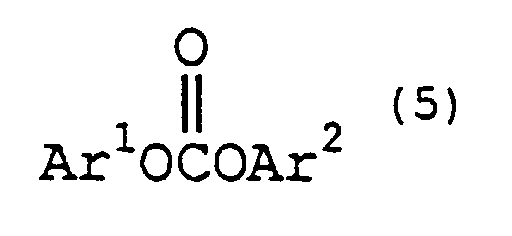
- the diaryl carbonates usable for the component (B) include compounds of a general formula (5):
- the dialkyl carbonates include compounds of a general formula (7):
- the alkylaryl carbonates include compounds of a general formula (9):
- One or more of the compounds mentioned above are suitably selected and used as the dicarbonates for the component (B). Of those compounds noted above, preferred is diphenyl carbonate.
- a chain terminator selected from compounds of the following formula (1) must be used.
- X represents -OH, -COCH, -COCl or -NH 2 ;
- R represents an alkyl group having a branched structure with from 5 to 20 carbon atoms; and
- n indicates an integer of from 1 to 5.
- the compounds include 4-(1,1,3,3-tetramethylbutyl)phenol, 4-(3,5-dimethylheptyl)phenol, 2-(3,5-dimethylheptyl)phenol, p-tert-amylphenol, 3,5,5-trimethylhexanoic acid, 3,5,5-trimethylhexanoic acid, 3,5,5-trimethylhexanoic acid chloride, 2-hexyldecanoic acid, etc.
- 4-(1,1,3,3-tetramethylbutyl)phenol that is, p-tert-octylphenol.
- One or more these chain terminators may be used either singly or as combined. If desired, the chain terminator of formula (1) may be combined with any others, such as p-tert-butylphenol, p-cumylphenol, etc.
- Compounds having at least three functional groups may be used as a branched agent with no specific limitation.
- they include 1,1,1-tris(4-hydroxyphenyl)ethane, ⁇ , ⁇ ', ⁇ ''-tris(4-hydroxyphenyl)-1,3,5-triisopropylbenzene, 1-[ ⁇ -methyl- ⁇ -(4'-hydroxyphenyl)ethyl]-4-[ ⁇ ', ⁇ '-bis(4''-hydroxyphenyl)ethyl]benzene, phloroglucinol, trimellitic acid, isatin-bis(o-cresol), ⁇ -resorcylic acid, etc.
- tetraphenols such as 1,1,2,2-tetra(4-hydroxyphenyl)ethane, 1,1,3,3-tetra(4-hydroxyphenyl)propane, ⁇ , ⁇ , ⁇ ', ⁇ '-tetra(4-hydroxyphenyl)p-xylene, 1,1,2,2-tetra(3-methyl-4-hydroxyphenyl)ethane, ⁇ , ⁇ , ⁇ ', ⁇ '-tetra(3-methyl-4-hydroxyphenyl)p-xylene, ⁇ , ⁇ '-dimethyl- ⁇ , ⁇ , ⁇ ', ⁇ '-tetra(4-hydroxyphenyl)-p-xylene, etc.
- branching agents may be used either singly or as combined.
- the reaction of the dihydroxy compound with the dicarbonate is effected preferably in the presence of a catalyst.
- the catalyst is not specifically defined, but preferred are nitrogen-containing basic compounds and phosphorus-containing basic compounds. One or more of these compounds may be used as the catalyst either singly or as combined.
- nitrogen-containing organic basic compounds are employable herein with no specific limitation.
- employable are aliphatic tertiary amine compounds such as trimethylamine, triethylamine, tripropylamine, tributylamine, tripentylamine, trihexylamine, dimethylbenzylamine, etc.; aromatic tertiary amine compounds such as triphenylamine, etc.; and nitrogen-containing heterocyclic compounds such as N,N-dimethyl-4-aminopyridine, 4-diethylaminopyridine, 4-pyrrolidinopyridine, 4-aminopyridine, 2-aminopyridine, 2-hydroxypyridine, 4-hydroxypyridine, 2-methoxypyridine, 4-methoxypyridine, imidazole, 2-methylimidazole, 4-methylimidazole, 2-dimethylaminoimidazole, 2-methoxyimidazole, 2-mercaptoimidazole, aminoquinoline, diazabicyclooctane (
- R 9 represents an organic group, for example, an alkyl or cycloalkyl group such as a methyl, ethyl, propyl, butyl, pentyl, hexyl, octyl or cyclohexyl group, an aryl group such as a phenyl, tolyl, naphthyl or biphenyl group, or an arylalkyl group such as a benzyl group.
- R 9 's may be the same or different ones; and two of them may be bonded to each other to form a cyclic structure.
- X 1 represents a halogen atom, a hydroxyl group, or BR 4 , in which R represents a hydrogen atom, or a hydrocarbon group such as an alkyl or aryl group, and four R's may be the same or different ones.
- quaternary ammonium salts include, for example, ammonium hydroxides having alkyl, aryl and/or alaryl groups, such as tetramethylammonium hydroxide, tetraethylammonium hydroxide, tetrabutylammonium hydroxide, trimethylbenzylammonium hydroxide, etc.; and basic salts such as tetramethylammonium borohydride, tetrabutylammonium borohydride, tetrabutylammonium tetraphenyl borate, tetramethylammonium tetraphenyl borate, etc.
- ammonium hydroxides having alkyl, aryl and/or alaryl groups such as tetramethylammonium hydroxide, tetraethylammonium hydroxide, tetrabutylammonium hydroxide, trimethylbenzylammonium hydroxide, etc.
- basic salts such
- quaternary ammonium salts of formula (I) concretely such as tetramethylammonium hydroxide, tetrabutylammonium hydroxide, tetramethylammonium borohydride, and tetrabutylammonium borohydride, since they have high catalytic activity and since they are easily pyrolyzed and hardly remain in the polymers produced. Of those, especially preferred is tetramethylammonium hydroxide.
- the phosphorus-containing basic compounds usable herein include, for example, tri-valent phosphorus compounds, tetra-valent phosphorus compounds, quaternary phosphonium salts, etc. Of those, preferred are quaternary phosphonium salts. Various quaternary phosphonium salts are usable with no specific limitation. For example, preferably used are compounds of general formulae (12) and (13): (PR 10 4 ) + (X 1 ) - (PR 10 4 ) 2 + (Y 1 ) 2-
- R 10 represents an organic group.
- the organic group includes, for example, an alkyl or cycloalkyl group such as a methyl, ethyl, propyl, butyl, pentyl, hexyl, octyl or cyclohexyl group; an aryl group such as a phenyl, tolyl, naphthyl or biphenyl group; and an arylalkyl group such as a benzyl group.
- R 10 's may be the same or different ones, or two of them may be bonded to each other to form a cyclic structure.
- R' represents a hydrocarbon group such as an alkyl group, an aryl group or the like, and two (R'O)s may be the same or different ones.
- R'' represents a hydrogen atom, or a hydrocarbon group such as an alkyl group, an aryl group or the like, and four R''s may be the same or different ones.
- Y 1 represents a group capable of forming a di-valent anion, such as CO 3 or the like.
- the quaternary phosphonium salts include, for example, tetra(aryl or alkyl)phosphonium hydroxides such as tetraphenylphosphonium hydroxide, tetranaphthylphosphonium hydroxide, tetra(chlorophenyl)phosphonium hydroxide, tetra(biphenyl)phosphonium hydroxide, tetratolylphosphonium hydroxide, tetramethylphosphonium hydroxide, tetraethylphosphonium hydroxide, tetrabutylphosphonium hydroxide, etc.; as well as tetramethylphosphonium tetraphenyl borate, tetraphenylphosphonium bromide, tetraphenylphosphonium phenolate, tetraphenylphosphonium tetraphenyl borate, methyltriphenylphosphonium tetraphenyl borate, benzyl
- tetrabutylphosphonium tetraphenyl borate preferred are tetrabutylphosphonium tetraphenyl borate, tetraethylphosphonium tetraphenyl borate, tetraphenylphosphonium tetraphenyl borate and cyclohexyltriphenylphosphonium tetraphenylborate, as their catalytic activity is well balanced with the quality of the polycarbonates produced in the presence of them.
- a dicarbonate for the component (B) is transesterified with a dihydroxy compound for the component (A) in a ratio of the dicarbonate to the dihydroxy compound falling between 0.9 and 1.5 by mol. Depending on the condition for the transesterification between them, the ratio will preferably fall between 0.98 and 1.20 by mol. It is desirable that the amount of the chain terminator to be in the transesterification system falls between 0.05 and 10 mol% of the dihydroxy compound of the component (A), as the polycarbonates produced could have well-balanced impact resistance and fluidity.
- All the necessary amount of the chain terminator may be previously put into the reaction system; or alternatively, a part thereof may be previously put into it, and the remaining part maybe added thereto after the reaction has started. Apart from the cases, all the necessary amount of the chain terminator may be added to the system after the transesterification between the dicarbonate of the component (B) with the dihydroxy compound of the component (A) has started and has progressed to some degree.
- the amount of the catalyst to be added to the reaction system may fall generally between 10 -8 and 10 -1 mols, but preferably between 10 -7 and 10 -2 mols, more preferably between 10 -6 and 10 -3 mols, relative to one mol of the starting dihydroxy compound of the component (A). If its amount added is smaller than 10 -8 mols, the catalyst could not exhibit its function; but if larger than 10 -1 mols, the physical properties, especially the heat resistance and the hydrolysis resistance of the final product, polycarbonate will be poor.
- the temperature for the transesterification is not specifically defined, but may fall generally between 100 and 330°C, preferably between 180 and 300°C. More preferably, the reaction temperature is gradually elevated up to 180 to 300°C in progress of the reaction. If the transesterification temperature is lower than 100°C, the reaction speed will be low; but if higher than 330°C, such high temperatures are unfavorable as often causing side reactions or often causing the problem of coloration of the polycarbonates produced.
- the reaction pressure will be settled, depending on the vapor pressure of the monomers used and the reaction temperature, but should not be specifically defined. Anyhow, the reaction pressure may be so settled that the reaction could progress efficiently under the settled pressure.
- the reaction system will be kept under atmospheric pressure (normal pressure) or increased pressure that falls between 1 and 50 atmospheric pressures (760 and 38,000 Torr) in the initial stage of the reaction, and will be kept under reduced pressure in the latter stage of the reaction, preferably falling between 0.01 and 100 Torr in the final stage thereof.
- the reaction may be continued until the product, polycarbonate could have the intended molecular weight, and its time may fall generally between 0.2 and 10 hours or so.
- the transesterification is effected in melt generally in the presence of an inert solvent.
- the amount of the inert solvent to be in the system may fall between 1 and 150 % by weight of the polycarbonate to be produced.
- the inert solvent includes, for example, aromatic compounds such as diphenyl ether, diphenyl ether halides, benzophenone, polyphenyl ether, dichlorobenzene, methylnaphthalene, etc.; cycloalkanes such as tricyclo(5,2,10)decane, cyclooctane, cyclodecane, etc.
- the reaction may be effected in an inert gas atmosphere.
- inert gases include, for example, gases such as argon, carbon dioxide, dinitrogen monoxide, nitrogen, etc.; chlorofluorohydrocarbons; alkanes such as ethane, propane, etc.; alkenes such as ethylene, propylene, etc. Further if desired, an antioxidant may be added to the reaction system.
- gases such as argon, carbon dioxide, dinitrogen monoxide, nitrogen, etc.
- chlorofluorohydrocarbons such as argon, carbon dioxide, dinitrogen monoxide, nitrogen, etc.
- alkanes such as ethane, propane, etc.
- alkenes such as ethylene, propylene, etc.
- an antioxidant may be added to the reaction system.
- the reactor is equipped with an apparatus for removing the discharges.
- the reaction may be effected either batchwise or continuously, for which any desired apparatus can be used.
- the material and the structure of the reactors to be used are not specifically defined, so far as they are provided with an ordinary stirring mechanism.
- the reactor for the latter stage of reaction is provided with a high-performance stirring mechanism, since the viscosity of the reaction system increases in that stage.
- the shape of the reactors is not also specifically defined, and any of tank reactors or extrusion reactors are employable herein.
- the reaction product is subjected to heat treatment at a temperature not lower than the decomposition point of the catalyst used, preferably at around 300°C or so to pyrolyze and remove the catalyst. This is for improving the quality of the polycarbonate produced, for example, for preventing the polycarbonate from being colored with the catalyst.
- This comprises prepolymerizing the starting compounds, (A) a dihydroxy compound and (B) a dicarbonate or phosgene such as those mentioned above, optionally along with a chain terminator and a branching agent such as those mentioned above in the presence of a catalyst such as that mentioned above, thereby to give a prepolymer, followed by further polymerizing the resulting prepolymer in a solid phase or in a swollen solid phase to complete a polycarbonate.
- the catalyst may be put in the prepolymerization system, or may be again added to the next polymerization system.
- the prepolymerization may be effected in any known manner.
- the prepolymer may be prepared through ordinary interfacial prepolymerization, for which the catalyst may be added to the system in the next polymerization step. Preferred embodiments of the process and the conditions for them are described concretely hereunder.
- a dihydroxy compound is reacted with a dicarbonate under heat to give a prepolymer while the aromatic monohydroxy compound resulting from the reaction is removed.
- the reaction may be effected in a solvent inert to the reaction, for example, in methylene chloride, chloroform or the like, but, in general, it is effected in the absence of a solvent and in melt.
- the ratio of the dicarbonate to the dihydroxy compound to be reacted (that is, to be fed into the reactor) varies, depending on the type of the compounds, the reaction temperature and also the other reaction conditions, but may fall generally between 0.9 and 2.5.
- the amount of the catalyst to be added to the reaction system may fall generally between 10 -8 and 10 -1 mols, but preferably between 10 -7 and 10 -2 mols, more preferably between 10 -6 and 10 -3 mols, relative to one mol of the starting dihydroxy compound of the component (A). If its amount added is smaller than 10 -8 mols, the catalyst could not exhibit its function; but if larger than 10 -1 mols, the physical properties, especially the heat resistance and the hydrolysis resistance of the final product polycarbonate, will be poor.
- the reaction temperature and the reaction time vary, depending on the type and the amount of the starting compounds and the catalyst used, on the necessary degree of polymerization of the prepolymer to be formed, and on the other reaction conditions. Preferably, however, the reaction temperature falls between 50 and 350°C, and the reaction time between 1 minute and 100 hours. In order not to color the prepolymer prepared, it is desirable that the temperature for the prepolymerization is as low as possible and the time for it is as short as possible.
- the prepolymer to be prepared through the prepolymerization may have a relatively low molecular weight. Under the condition defined above, colorless transparent prepolymers having the necessary degree of polymerization are easy to prepare.
- the reaction pressure preferably falls between 1 Torr and 5 kg/cm 2 G.
- a solution in an organic solvent of a polycarbonate prepolymer having been prepared separately may be put into a granulator that contains a powdery polycarbonate prepolymer prepared in the prepolymerization step, so that the powdery prepolymer is kept in contact with the prepolymer solution while the organic solvent is evaporated away from the solution.
- the powdery prepolymer may be granulated into spherical grains.
- the prepolymer may be processed with a solvent or may be heated to crystallize it.
- the polycarbonate prepolymer prepared in the manner as above is then polymerized in a solid phase or in a swollen solid phase.
- the catalyst that may be used in the polymerization step is described above.
- the chain terminator to be used in the step is also described above.
- the crystallized solid prepolymer is further polymerized.
- the reaction could be promoted by removing the aromatic monohydroxy compound or the dicarbonate or both the two to be formed as side products, from the reaction system.
- various methods are employable.
- One preferred method is to introduce some type of gas into the reaction system, with which the side products are removed from the reaction system.
- the gas includes, for example, inert gases such as nitrogen, argon, helium, carbon dioxide, etc.; gases of linear, branched or cyclic aliphatic hydrocarbon compounds having from 4 to 18 carbon atoms, such as pentane, hexane, heptane, cyclohexane, etc.; gases of ketones such as acetone, cyclohexane, etc.; gases of ethers such as dioxane, tetrahydrofuran, etc.; acetonitrile gas, etc.
- gases of inert gases such as nitrogen, argon, helium, carbon dioxide, etc.
- gases of linear, branched or cyclic aliphatic hydrocarbon compounds having from 4 to 18 carbon atoms such as pentane, hexane, heptane, cyclohexane, etc.
- gases of ketones such as acetone, cyclohexane, etc.
- the shape of the crystalline prepolymer to be subjected to the solid-phase polymerization is not specifically defined, but preferred are pellets or beads of the prepolymer.
- the reaction catalyst having been added to and still remaining in the prepolymerization system could act, as it would be, further in the solid-phase polymerization step, but, as the case may be, an additional catalyst such as that mentioned above may be added to the solid-phase polymerization system.
- the additional catalyst may be powdery, liquid or gaseous.
- the reaction temperature and the reaction time for the polymerization nay vary, depending on the conditions for it. Preferably, however, the reaction temperature falls between the glass transition point of the intended aromatic polycarbonate and a temperature at which the crystalline prepolymer being polymerized in a solid phase does not melt and could keep its solid phase; and the prepolymer may be heated at a temperature falling within the defined range for a period of time falling between 1 minute and 100 hours.
- the prepolymer prepared in the prepolymerization step is crystallized and then further polymerized in a solid phase while being swollen in a swelling gas.
- the swelling gas will be mentioned below.
- This process includes a step of flaking the prepolymer prepared in the manner as above, and a molecular weight-increasing step of polymerizing the resulting flaky prepolymer in a solid phase in a swelling solvent stream (this is a swollen solid-phase polymerization step).
- the prepolymer is flaked in any conventional manner, for example, through rolling granulation, extrusion granulation or the like.
- the prepolymer flakes are polymerized into a polymer having an increased molecular weight while they are kept in a solid phase.
- This step is characterized in that the flaky prepolymer is polymerized in a solid phase in a swelling solvent atmosphere while the side products, phenols are removed from the system.
- the advantages of the process including this step are that the intended polymerization could be effected at lower temperatures as compared with ordinary melt transesterification, and that the time for the polymerization could be significantly shortened as compared with that for ordinary solid-phase polymerization or melt transesterification.
- the swelling solvent to be used herein is meant to include solvents capable of swelling polycarbonates under the reaction conditions that will be mentioned below; mixtures of two or more such solvents; and mixtures to be prepared by adding one or more of inert gases or poor solvents for polycarbonates to the solvents or their mixtures.
- the swollen condition in this step is meant to indicate that the starting prepolymer flakes are swollen by volume or weight at least to a degree not lower than the thermal swell thereof under the reaction conditions mentioned below.
- the swelling solvent is a single compound having a boiling point at which it can completely vaporize within the range of the following reaction conditions or having a vapor pressure of generally not lower than 50 mmHg under those reaction conditions, or a mixture of such compounds, and it can form the swollen condition defined above.
- the swelling solvent for use herein is not specifically defined, so far as it satisfies the swelling conditions noted above.
- aromatic compounds and oxygen-containing compounds having a solubility parameter of generally from 4 to 20 (cal/cm 3 ) 1/2 , preferably from 7 to 14 (cal/cm 3 ) 1/2 belong to the category of the swelling solvent.
- the swelling solvent includes, for example, aromatic compounds such as benzene, toluene, xylene, ethylbenzene, diethylbenzene, propylbenzene, dipropylbenzene, etc.; ethers such as tetrahydrofuran, dioxane, etc.; ketones such as methyl ethyl ketone, methyl isobutyl ketone, etc. Of those, preferred are single compounds of aromatic hydrocarbons having from 6 to 20 carbon atoms, and their mixtures.
- the poor solvent to be mixed with the swelling solvent shall be such that the solubility of the product polycarbonate in it is at most 0.1 % by weight under the reaction conditions mentioned below and that it participates little in the reaction.
- Preferred examples of the poor solvent are linear, branched or cyclic aliphatic hydrocarbon compounds having from 4 to 18 carbon atoms such as pentane, hexane, heptane, octane, nonane, cyclohexane, etc.; ketones such as acetone, cyclohexanone, etc.; ethers such as dioxane, tetrahydrofuran, etc.; acetonitrile, etc.
- the proportion of the swelling solvent shall be at least 1 % by weight of the mixed solvent, but preferably at least 5 % by weight thereof.
- the reaction temperature preferably falls between 100 and 240°C, and the reaction pressure preferably falls between 10 Torr and 5 kg/cm 2 G, but is more preferably not higher than the atmospheric pressure. If the reaction temperature is lower than the defined range, the prepolymer could not undergo transesterification. On the other hand, however, if the reaction is effected at high-temperature conditions exceeding the melting point of the prepolymer, the reaction system could not keep a solid phase, and the prepolymer grains will fuse together at such high temperatures. If so, the operability to continue the reaction will be greatly lowered. Therefore, the reaction temperature must not be higher than the melting point of the prepolymer.
- reaction catalyst having been added to and still remaining in the prepolymerization system could act, as it would be, further in the swollen solid-phase polymerization step, but, as the case may be, an additional catalyst such as that mentioned above may be added to the swollen solid-phase polymerization system.
- the additional catalyst may be powdery, liquid or gaseous.
- the liquid solvent may be directly fed into the reactor and is vaporized therein; or the liquid solvent is, after having been previously vaporized by the use of a heat exchanger or the like, fed into the reactor.
- the flow rate of the swelling gas solvent may be at least 1 ⁇ 10 -3 cm/sec, but is preferably at least 1 ⁇ 10 -3 cm/sec.
- the amount of the swelling gas to be fed into the reactor is preferably at least 0.5 liters (normal condition)/hr/g of prepolymer.
- the polycarbonate of which the molecular weight has been increased in the manner as above may be dried and pelletized in any known manner.
- an additive is added to the polymer product, some preferred methods are employed; for example, its powder may be directly added to the flaky product before or after the product is dried; or its liquid may be sprayed over the product; or its vapor may be applied thereto so that the product could absorb the additive vapor.
- the additive to be added thereto may be mixed with the polymer product in an extruder.
- the blend ratio of the inert gas to the swelling solvent may be such that the swelling solvent accounts for at least 1 % by volume of the mixed solvent gas, but preferably at least 5 % by volume thereof.
- the polycarbonate produced in the manner mentioned above may be directly granulated, or may be molded by the use of an extruder or the like.
- the polycarbonate may be compounded with any known additives such as plasticizers, pigments, lubricants, mold release agents, stabilizers, inorganic fillers, etc. Further if desired, any known antioxidant may be added to the reaction system. For use herein, preferred are phosphorus-containing antioxidants.
- the polycarbonate may be blended with any other polymers such as polyolefins, polystyrenes, polyesters, polysulfonates, polyamides, polyphenylene ethers, etc.
- polymers such as polyolefins, polystyrenes, polyesters, polysulfonates, polyamides, polyphenylene ethers, etc.
- polyphenylene ethers terminated with any of OH, COOH, NH 2 and the like groups; terminal-modified polysiloxanes, modified polypropylenes, modified polystyrenes, etc.
- the viscosity-average molecular weight of the polycarbonates produced in the invention may fall between 10000 and 50000, but preferably between 11000 and 40000, more preferably between 12000 and 35000. Polycarbonates having a viscosity-average molecular weight of smaller than 10000 will have poor impact resistance; and those having a viscosity-average molecular weight of larger than 50000 will have poor fluidity and will be difficult to mold.
- the viscosity-average molecular weight of the polycarbonates for optical-disk substrates may fall between 10000 and 17000, but preferably between 11000 and 16000; and especially that of the polycarbonates for DVD substrates may fall between 10000 and 16000, but preferably between 11000 and 15000, more preferably between 12000 and 14500.
- optical-disk substrates from the polycarbonates of the invention, employable are any ordinary molding methods including, for example, injection molding, extrusion molding, and even ultrasonic injection molding, multi-stage compression injection molding, rapid-charge injection molding, etc.
- the molding temperature (cylinder temperature) may fall between 300 and 400°C; and the mold temperature may fall between 80 and 140°C. If the molding temperature is higher than 400°C, the polycarbonates being molded will be degraded and will often lose their transparency at such high temperatures.
- the mold temperature is preferably higher in view of the fluidity of the polycarbonates, but if it is higher than 140°C, the substrates formed will be deformed.
- the injection rate is preferably at least 150 cm 3 /sec, more preferably at least 200 cm 3 /sec. If it is smaller than 150 cm 3 /sec, the molding material will be cooled too rapidly in the mold so that the fluid pressure loss therein will increase. If so, the degree of orientation of the polycarbonates being molded will increase too much, and the resulting moldings will be unfavorably warped or will be even failures.
- a protective film and a recording film may be formed in a known film-forming process to give optical disks.
- Pellets were molded into ten test pieces through injection molding. At 23°C and 5°C, the test pieces were subjected to the impact test stipulated in JIS-K-7110, and the ratio of the ductile-fractured pieces was obtained.
- the mixture was heated at 180°C, and reacted for 30 minutes in the argon atmosphere. This was gradually heated up to 235°C and reacted for 60 minutes with being vacuumed up to a vacuum degree of 60 mmHg; then this was further heated gradually up to 270°C and reacted for 120 minutes with being vacuumed up to a vacuum degree of 10 mmHg; then this was still further reacted at that temperature of 270°C for 30 minutes with being vacuumed up to a vacuum degree of 1 mmHg; and finally, this was still further reacted at that temperature for 15 minutes with being vacuumed up to a vacuum degree of 0.5 mmHg.
- the reactor was restored with argon to have an atmospheric pressure, and the product formed therein was taken out. While still in melt, this was introduced into a double-screw extruder via a gear pump, and pelletized therethrough.
- the polymer thus produced had a viscosity-average molecular weight (Mv) of 13400.
- the DVD substrates were tested for the birefringence and the drop-weight impact ductile fracture rate.
- the data were as follows:
- Example 2 The same process as in Example 1 was repeated, except that 4-(1,1,3,3-tetramethylbutyl)phenol was not added to the reaction system.
- the polymer produced herein had a viscosity-average molecular weight (Mv) of 13600. This was tested and evaluated in the same manner as in Example 1.
- Example 1 The polymer of Example 1 and that of Comparative Example 1 both had a high viscosity-average molecular weight on the same level, and the birefringence of the two was reduced to the same degree.
- the drop-weight impact ductile fracture rate of the substrates produced in Comparative Example 1 was 0, from which it is understood that the substrates produced in Comparative Example 1 were not ductile-fractured and their impact resistance is poor.
- Example 2 The same process as in Example 1 was repeated, except that the monomers were reacted for 30 minutes but not for 15 minutes at the vacuum degree of 0.5 mmHg in the final step.
- the polymer produced herein had a viscosity-average molecular weight of 17200.
- the polymer was pelletized in the same manner as in Example 1, and the resulting pellets were formed into Izod impact test pieces.
- the Izod ductile fracture rate of the test pieces was as follows:
- the same process as in Comparative Example 1 was repeated, except that the monomers were reacted for 30 minutes but not for 15 minutes at the vacuum degree of 0.5 mmHg in the final step.
- the polymer produced herein had a viscosity-average molecular weight of 17500. This was tested in the same manner as in Example 2.
- the Izod ductile fracture rate of the test pieces of the polymer was as follows:
- Example 2 The polymer of Example 2 and that of Comparative Example 2 both had a high viscosity-average molecular weight on the same level, but the Izod ductile fracture rate of the test pieces produced in Comparative Example 2 was low. From this, it is understood that the test pieces produced in Comparative Example 2 were not ductile-fractured and their impact resistance is poor.
- BPA bisphenol A
- DPC diphenyl carbonate
- 103.2 g (0.50 mols) of 4-(1,1,3,3-tetramethylbutyl)phenol, and tetramethylammonium hydroxide (its amount was 2.5 ⁇ 10 -4 mols relative to bisphenol A) serving as a catalyst were put into a 10-liter nickel autoclave equipped with a stirrer, and purged five times with argon. Next, the mixture was heated at 180°C, and reacted for 30 minutes in the argon atmosphere.
- the prepolymer was polymerized in a solid phase for 2 hours to obtain a polycarbonate.
- the polycarbonate had a viscosity-average molecular weight (Mv) of 17500.
- the flaky PC was pelletized in the same manner as in Example 1, and the resulting pellets were formed into Izod impact test pieces.
- the Izod ductile fracture rate of the test pieces was as follows:
- Example 3 The same process as in Example 3 was repeated, except that 4-(1,1,3,3-tetramethylbutyl)phenol was not used.
- the polycarbonate produced herein had a viscosity-average molecular weight (Mv) of 17000.
- the Izod ductile fracture rate of the test pieces of the polymer was as follows:
- Example 3 The polymer of Example 3 and that of Comparative Example 3 both had a high viscosity-average molecular weight on the same level, but the Izod ductile fracture rate of the test pieces of Comparative Example 3 was low. From this, it is understood that the test pieces of Comparative Example 3 were not ductile-fractured and their impact resistance is poor.
- Example 3 The same process as in Example 3 was repeated to obtain a polycarbonate, except that pre-heated n-heptane gas but not nitrogen gas was introduced into the reaction system at a flow rate of 100 ml/ml. In this, the gaseous component having passed through the reactor tube was cooled and recovered.
- the polycarbonate had a viscosity-average molecular weight (Mv) of 17300.
- the flaky PC was pelletized in the same manner as in Example 1, and the resulting pellets were formed into Izod impact test pieces.
- the Izod ductile fracture rate of the test pieces was as follows:
- Example 4 The same process as in Example 4 was repeated, except that 4-(1,1,3,3-tetramethylbutyl)phenol was not used.
- the polycarbonate produced herein had a viscosity-average molecular weight (Mv) of 17100.
- the Izod ductile fracture rate of the test pieces of the polycarbonate was as follows:
- Example 4 The polymer of Example 4 and that of Comparative Example 4 both had a high viscosity-average molecular weight on the same level, but the Izod ductile fracture rate of the test pieces of Comparative Example 4 was low. From this, it is understood that the test pieces of Comparative Example 4 were not ductile-fractured and their impact resistance is poor.
- Example 3 2 kg of the powdery prepolymer having been prepared in the same manner as in Example 3 was charged into a SUS tube, and heated from room temperature up to 240°C while paraxylene gas was introduced thereinto. In that condition, the prepolymer was polymerized in a swollen solid phase for 2 hours to obtain a polycarbonate.
- the polycarbonate had a viscosity-average molecular weight (Mv) of 17000.
- the flaky polycarbonate was pelletized in the same manner as in Example 1, and the resulting pellets were formed into Izod impact test pieces.
- the Izod ductile fracture rate of the test pieces was as follows:
- Example 5 The same process as in Example 5 was repeated, except that 4-(1,1,3,3-tetramethylbutyl)phenol was not used.
- the polycarbonate produced herein had a viscosity-average molecular weight (Mv) of 17100.
- the Izod ductile fracture rate of the test pieces of the polycarbonate was as follows:
- Example 5 The polymer of Example 5 and that of Comparative Example 5 both had a high viscosity-average molecular weight on the same level, but the Izod ductile fracture rate of the test pieces of Comparative Example 5 was low. From this, it is understood that the test pieces of Comparative Example 5 were not ductile-fractured and their impact resistance is poor.
- polycarbonates having well-balanced fluidity and impact resistance obtained are polycarbonates having well-balanced fluidity and impact resistance.
- toxic phosgene is not used as the starting material.
- the polycarbonates thus produced in the process can be molded into optical-disk substrates having reduced birefringence and improved impact resistance.
Landscapes
- Chemical & Material Sciences (AREA)
- Health & Medical Sciences (AREA)
- Chemical Kinetics & Catalysis (AREA)
- Medicinal Chemistry (AREA)
- Polymers & Plastics (AREA)
- Organic Chemistry (AREA)
- Polyesters Or Polycarbonates (AREA)
- Optical Record Carriers And Manufacture Thereof (AREA)
Abstract
Description


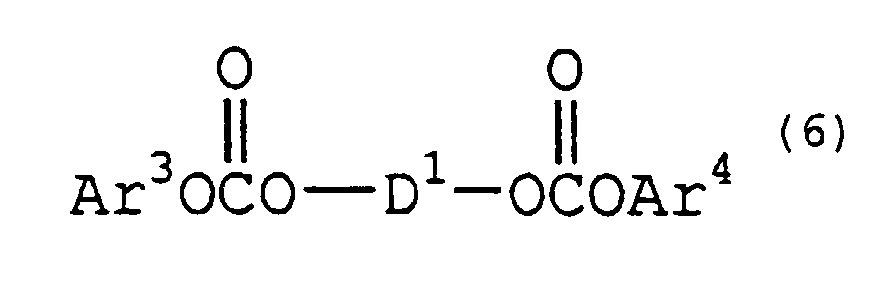
- wherein Ar3 and Ar4 each represent an aryl group, and these may be the same or different ones; and D1 represents a residue of an aromatic dihydroxy compound of those noted above from which two hydroxyl groups are removed.


- wherein R5 and R6 each represent an alkyl group having from 1 to 6 carbon atoms or a cycloalkyl group having from 4 to 7 carbon atoms, and these may be the same or different ones; and D2 represents a residue of an aromatic dihydroxy compound of those noted above from which two hydroxyl groups are removed.


- wherein Ar6 represents an aryl group; R8 represents an alkyl group having from 1 to 6 carbon atoms or a cycloalkyl group having from 4 to 7 carbon atoms; and D3 represents a residue of an aromatic dihydroxy compound of those noted above from which two hydroxyl groups are removed.

(4) The polycarbonate produced in the manner mentioned above may be directly granulated, or may be molded by the use of an extruder or the like.
Claims (7)
- A process for producing a polycarbonate, which comprises transesterifying a dicarbonate with a dihydroxy compound in the presence of a compound having a structure of the following general formula (1) and serving as a chain terminator:wherein X represents -OH, -COOH, -COCl or -NH2; R represents an alkyl group having a branched structure with from 5 to 20 carbon atoms; and n indicates an integer of from 1 to 5.

- The process for producing a polycarbonate as claimed in claim 1, wherein the transesterification of a dicarbonate with a dihydroxy compound is effected in the presence of at least one catalyst selected from the group consisting of nitrogen-containing organic basic compounds and phosphorus-containing basic compounds.
- A process for producing a polycarbonate, which comprises preparing a polycarbonate prepolymer through prepolymerization of a dihydroxy compound with a dicarbonate followed by polymerizing the resulting prepolymer in a solid phase or in a swollen solid phase in the presence of a compound having a structure of the following general formula (1) and serving as a chain terminator:wherein X represents -OH, -COOH, -COCl or -NH2; R represents an alkyl group having a branched structure with from 5 to 20 carbon atoms; and n indicates an integer of from 1 to 5.

- The process for producing a polycarbonate as claimed in claim 3, wherein the prepolymerization of a dihydroxy compound with a dicarbonate to give a polycarbonate prepolymer followed by the polymerization of the resulting prepolymer in a solid phase or in a swollen solid phase is effected in the presence of at least one catalyst selected from the group consisting of nitrogen-containing organic basic compounds and phosphorus-containing basic compounds.
- The process for producing a polycarbonate as claimed in claim 2 or 4, wherein the phosphorus-containing basic compounds are quaternary phosphonium salts.
- An optical-disk substrate as produced by molding the polycarbonate prepared in the process of any one of claims 1 to 5.
- The optical-disk substrate as claimed in claim 6, which is for DVDs (digital video disks or digital versatile disks).
Applications Claiming Priority (3)
| Application Number | Priority Date | Filing Date | Title |
|---|---|---|---|
| JP440098 | 1998-01-13 | ||
| JP440098 | 1998-01-13 | ||
| PCT/JP1999/000037 WO1999036458A1 (en) | 1998-01-13 | 1999-01-08 | Process for producing polycarbonate and optical-disk substrate |
Publications (2)
| Publication Number | Publication Date |
|---|---|
| EP1048684A1 true EP1048684A1 (en) | 2000-11-02 |
| EP1048684A4 EP1048684A4 (en) | 2002-06-26 |
Family
ID=11583303
Family Applications (1)
| Application Number | Title | Priority Date | Filing Date |
|---|---|---|---|
| EP99900148A Withdrawn EP1048684A4 (en) | 1998-01-13 | 1999-01-08 | Process for producing polycarbonate and optical-disk substrate |
Country Status (5)
| Country | Link |
|---|---|
| US (1) | US6258922B1 (en) |
| EP (1) | EP1048684A4 (en) |
| KR (1) | KR20010024851A (en) |
| CN (1) | CN1286712A (en) |
| WO (1) | WO1999036458A1 (en) |
Families Citing this family (10)
| Publication number | Priority date | Publication date | Assignee | Title |
|---|---|---|---|---|
| DE19933132A1 (en) * | 1999-07-19 | 2001-01-25 | Bayer Ag | Process for the production of modified polycarbonates |
| JP4965016B2 (en) * | 2000-09-07 | 2012-07-04 | 旭化成ケミカルズ株式会社 | Polycarbonate resin composition for optical information board |
| KR100413534B1 (en) * | 2001-05-08 | 2003-12-31 | 학교법인 포항공과대학교 | Method for preparing aromatic polycarbonate |
| JP3556932B2 (en) * | 2001-09-27 | 2004-08-25 | 日精樹脂工業株式会社 | Optical recording substrate, optical recording medium, and method of manufacturing the same |
| DE10219229A1 (en) * | 2002-04-30 | 2003-11-13 | Bayer Ag | Polycarbonates, polyester carbonates and polyesters with special branched end groups |
| US6916899B2 (en) * | 2002-10-21 | 2005-07-12 | Bayer Aktiengesellschaft | Polycarbonates, polyester carbonates and polyesters having lateral, cycloalkyl-substituted phenols |
| US6646097B1 (en) * | 2002-10-31 | 2003-11-11 | General Electric Company | Method for purifying 1,1-bis(4′-hydroxy-3′-methylphenyl)cyclohexane and methods of producing polycarbonates therefrom |
| DE102004053047A1 (en) * | 2004-11-03 | 2006-05-04 | Bayer Materialscience Ag | Branched polycarbonates |
| KR100713099B1 (en) * | 2005-03-07 | 2007-05-02 | 주식회사 엘지화학 | Method of producing polycarbonate resin |
| KR20090128377A (en) * | 2007-03-08 | 2009-12-15 | 데이진 가부시키가이샤 | Terminal modified polycarbonate and its manufacturing method |
Family Cites Families (10)
| Publication number | Priority date | Publication date | Assignee | Title |
|---|---|---|---|---|
| JPH06102720B2 (en) * | 1988-12-08 | 1994-12-14 | 旭化成工業株式会社 | Method for producing aromatic polycarbonate |
| JP2901418B2 (en) * | 1992-06-22 | 1999-06-07 | 出光石油化学株式会社 | Method for producing polycarbonate |
| JPH06322097A (en) * | 1993-05-17 | 1994-11-22 | Teijin Chem Ltd | Method for producing aromatic polycarbonate resin |
| JPH07207016A (en) * | 1994-01-19 | 1995-08-08 | Mitsui Toatsu Chem Inc | Method for producing aromatic polycarbonate |
| DE69632527D1 (en) * | 1995-01-31 | 2004-06-24 | Idemitsu Kosan Co | METHOD FOR PRODUCING POLYCARBONATE |
| JP3112837B2 (en) * | 1995-08-14 | 2000-11-27 | 旭化成工業株式会社 | Polycarbonate resin composition |
| US5852156A (en) * | 1995-08-14 | 1998-12-22 | Asahi Kasei Kogyo Kabushiki Kaisha | Polycarbonate composition |
| JP3436466B2 (en) * | 1996-03-07 | 2003-08-11 | 出光石油化学株式会社 | Digital video disk board |
| JPH10289482A (en) * | 1997-04-10 | 1998-10-27 | Nippon Columbia Co Ltd | Optical information recording medium |
| JPH10302312A (en) * | 1997-04-22 | 1998-11-13 | Ricoh Co Ltd | Optical recording medium |
-
1999
- 1999-01-08 WO PCT/JP1999/000037 patent/WO1999036458A1/en not_active Ceased
- 1999-01-08 US US09/582,195 patent/US6258922B1/en not_active Expired - Fee Related
- 1999-01-08 CN CN99801656A patent/CN1286712A/en active Pending
- 1999-01-08 EP EP99900148A patent/EP1048684A4/en not_active Withdrawn
- 1999-01-08 KR KR1020007007694A patent/KR20010024851A/en not_active Withdrawn
Also Published As
| Publication number | Publication date |
|---|---|
| WO1999036458A1 (en) | 1999-07-22 |
| EP1048684A4 (en) | 2002-06-26 |
| US6258922B1 (en) | 2001-07-10 |
| KR20010024851A (en) | 2001-03-26 |
| CN1286712A (en) | 2001-03-07 |
Similar Documents
| Publication | Publication Date | Title |
|---|---|---|
| CN100537634C (en) | Method of polycarbonate preparation | |
| US6476249B1 (en) | Copolycarbonate and process for producing the same | |
| KR100357656B1 (en) | Method for producing polycarbonate | |
| KR101538207B1 (en) | A method for preparing polysiloxane based copolycarbonate | |
| US6258922B1 (en) | Process for producing polycarbonate and optical-disk substrate | |
| JP3613355B2 (en) | Polycarbonate and method for producing the same | |
| US6316575B1 (en) | Processes for the production of polycarbonate | |
| US6462165B1 (en) | Polycarbonate and optical material | |
| JP2010079975A (en) | Optical disk substrate | |
| JP4577815B2 (en) | Film for transparent protective layer of optical disc | |
| EP0890944B1 (en) | Digital video disk substrate | |
| KR100878453B1 (en) | Process for the preparation of high molecular weight copolycarbonates by solid state polymerization | |
| US6506870B1 (en) | Polycarbonate resin for use in the production of a substrate for an optical information medium | |
| JPWO1999036458A1 (en) | Polycarbonate manufacturing method and optical disc substrate | |
| US6245878B1 (en) | Process for producing polycarbonate | |
| JP5330811B2 (en) | Polycarbonate and optical materials | |
| KR100590722B1 (en) | Method for producing branched polycarbonate resin | |
| KR100529366B1 (en) | Preparation of polycarbonate resin | |
| JPH107785A (en) | Polycarbonate for optical materials | |
| JP3617733B2 (en) | Method for producing polycarbonate | |
| HK1034527A (en) | Process for producing polycarbonate and optical-disk substrate | |
| JP2000044785A (en) | Polycarbonate resin composition and laminate | |
| JP4651149B2 (en) | Method for producing polycarbonate | |
| KR20040032195A (en) | Method for preparing of polycarbonate resin | |
| JP2005054144A (en) | Optical disk substrate |
Legal Events
| Date | Code | Title | Description |
|---|---|---|---|
| PUAI | Public reference made under article 153(3) epc to a published international application that has entered the european phase |
Free format text: ORIGINAL CODE: 0009012 |
|
| 17P | Request for examination filed |
Effective date: 20000216 |
|
| AK | Designated contracting states |
Kind code of ref document: A1 Designated state(s): BE DE ES IT NL |
|
| A4 | Supplementary search report drawn up and despatched |
Effective date: 20020510 |
|
| AK | Designated contracting states |
Kind code of ref document: A4 Designated state(s): BE DE ES IT NL |
|
| RIC1 | Information provided on ipc code assigned before grant |
Free format text: 7C 08G 64/30 A, 7G 11B 7/24 B, 7C 08G 64/14 B, 7G 11B 27/24 B |
|
| 17Q | First examination report despatched |
Effective date: 20030312 |
|
| STAA | Information on the status of an ep patent application or granted ep patent |
Free format text: STATUS: THE APPLICATION IS DEEMED TO BE WITHDRAWN |
|
| 18D | Application deemed to be withdrawn |
Effective date: 20030723 |