EP1048799A1 - A modular structure for making handrails - Google Patents
A modular structure for making handrails Download PDFInfo
- Publication number
- EP1048799A1 EP1048799A1 EP99830259A EP99830259A EP1048799A1 EP 1048799 A1 EP1048799 A1 EP 1048799A1 EP 99830259 A EP99830259 A EP 99830259A EP 99830259 A EP99830259 A EP 99830259A EP 1048799 A1 EP1048799 A1 EP 1048799A1
- Authority
- EP
- European Patent Office
- Prior art keywords
- support
- bearing element
- structure according
- coupling
- gripping
- Prior art date
- Legal status (The legal status is an assumption and is not a legal conclusion. Google has not performed a legal analysis and makes no representation as to the accuracy of the status listed.)
- Withdrawn
Links
- 230000008878 coupling Effects 0.000 claims abstract description 36
- 238000010168 coupling process Methods 0.000 claims abstract description 36
- 238000005859 coupling reaction Methods 0.000 claims abstract description 36
- 238000003780 insertion Methods 0.000 claims description 9
- 230000037431 insertion Effects 0.000 claims description 9
- 239000011248 coating agent Substances 0.000 claims description 7
- 238000000576 coating method Methods 0.000 claims description 7
- 230000003287 optical effect Effects 0.000 claims description 5
- 229910000838 Al alloy Inorganic materials 0.000 claims description 3
- 238000002347 injection Methods 0.000 claims description 3
- 239000007924 injection Substances 0.000 claims description 3
- 238000001125 extrusion Methods 0.000 claims description 2
- 239000004020 conductor Substances 0.000 description 5
- 239000000463 material Substances 0.000 description 4
- 230000008901 benefit Effects 0.000 description 3
- 230000000694 effects Effects 0.000 description 2
- 230000009471 action Effects 0.000 description 1
- 230000036541 health Effects 0.000 description 1
- 238000009434 installation Methods 0.000 description 1
- 230000003993 interaction Effects 0.000 description 1
- 238000002955 isolation Methods 0.000 description 1
- 238000004519 manufacturing process Methods 0.000 description 1
- 229910052751 metal Inorganic materials 0.000 description 1
- 239000002184 metal Substances 0.000 description 1
- 230000009467 reduction Effects 0.000 description 1
- 239000000243 solution Substances 0.000 description 1
- 230000002459 sustained effect Effects 0.000 description 1
Images
Classifications
-
- F—MECHANICAL ENGINEERING; LIGHTING; HEATING; WEAPONS; BLASTING
- F16—ENGINEERING ELEMENTS AND UNITS; GENERAL MEASURES FOR PRODUCING AND MAINTAINING EFFECTIVE FUNCTIONING OF MACHINES OR INSTALLATIONS; THERMAL INSULATION IN GENERAL
- F16B—DEVICES FOR FASTENING OR SECURING CONSTRUCTIONAL ELEMENTS OR MACHINE PARTS TOGETHER, e.g. NAILS, BOLTS, CIRCLIPS, CLAMPS, CLIPS OR WEDGES; JOINTS OR JOINTING
- F16B7/00—Connections of rods or tubes, e.g. of non-circular section, mutually, including resilient connections
- F16B7/04—Clamping or clipping connections
- F16B7/0406—Clamping or clipping connections for rods or tubes being coaxial
- F16B7/0413—Clamping or clipping connections for rods or tubes being coaxial for tubes using the innerside thereof
-
- E—FIXED CONSTRUCTIONS
- E04—BUILDING
- E04F—FINISHING WORK ON BUILDINGS, e.g. STAIRS, FLOORS
- E04F11/00—Stairways, ramps, or like structures; Balustrades; Handrails
- E04F11/18—Balustrades; Handrails
- E04F11/1802—Handrails mounted on walls, e.g. on the wall side of stairs
- E04F11/1804—Details of anchoring to the wall
-
- E—FIXED CONSTRUCTIONS
- E04—BUILDING
- E04F—FINISHING WORK ON BUILDINGS, e.g. STAIRS, FLOORS
- E04F11/00—Stairways, ramps, or like structures; Balustrades; Handrails
- E04F11/18—Balustrades; Handrails
- E04F11/1802—Handrails mounted on walls, e.g. on the wall side of stairs
- E04F11/1808—Handrail members; Connections between handrail members
-
- E—FIXED CONSTRUCTIONS
- E04—BUILDING
- E04F—FINISHING WORK ON BUILDINGS, e.g. STAIRS, FLOORS
- E04F11/00—Stairways, ramps, or like structures; Balustrades; Handrails
- E04F11/18—Balustrades; Handrails
- E04F2011/1868—Miscellaneous features of handrails not otherwise provided for
- E04F2011/1872—Miscellaneous features of handrails not otherwise provided for illuminated
-
- F—MECHANICAL ENGINEERING; LIGHTING; HEATING; WEAPONS; BLASTING
- F21—LIGHTING
- F21W—INDEXING SCHEME ASSOCIATED WITH SUBCLASSES F21K, F21L, F21S and F21V, RELATING TO USES OR APPLICATIONS OF LIGHTING DEVICES OR SYSTEMS
- F21W2111/00—Use or application of lighting devices or systems for signalling, marking or indicating, not provided for in codes F21W2102/00 – F21W2107/00
- F21W2111/08—Use or application of lighting devices or systems for signalling, marking or indicating, not provided for in codes F21W2102/00 – F21W2107/00 for handles or handrails
Definitions
- the present invention relates to a modular structure for making handrails able to be applied along walls of buildings, of the type comprising the characteristics expressed in the preamble to claim 1.
- the modular structure according to the invention is suitable for the realisation of a handrail of the kind commonly installed in locations accessible to the public such as hospitals, schools, hotels, stations or others and designed to provide a bearing or gripping means to ease walking.
- modular handrails exist, essentially comprising a plurality of supports which are fastened to the walls at pre-set mutual distance and mutually aligned to support respective bearing elements positioned one after the other to define a continuous structure that follows the development of the walls at a constant height from the floor.
- a modular structure normally comprises rectilinear bearing elements, extending along the walls whereto the structure is applied, and curvilinear bearing elements applied in correspondence with the comers of the walls to join two contiguous rectilinear elements or to serve as a finish for the extremity of the modular structure.
- Each rectilinear bearing element normally comprises an extruded section bar made of aluminium alloy and having a substantially "H" shaped cross section profile.
- the "H" section bar presents a flat central portion integral in its extremities with lateral wings substantially curved according to a circular profile.
- each covering element Onto the section bar can also be applied, by snapping, one or more covering elements made of plastic material, destined to define the visible portion of the rectilinear bearing element.
- Each covering element presents a downward facing "C” shaped cross section profile.
- the assembly operation provides for the edges of the "C” profile to be placed to bear down on upper portions of the lateral wings of the "H” section bar.
- the covering element is then pushed downward, so that its structure is elastically deformed expanding and then settling onto the section bar after the snapping action.
- each curvilinear bearing element is made of plastic with one or more coupling plates projecting at least from one terminal edge of the bearing element itself.
- the curvilinear bearing element is engageable on the rectilinear bearing element through the insertion of the coupling plates in a corresponding longitudinal seat defined between the wings and the central portion of the "H" profile. After insertion, the curvilinear bearing element is fastened to the section bar of the rectilinear bearing element by means of threaded elements that join the coupling plates to the central portion of the section bar.
- junction of rectilinear bearing elements consecutively aligned occurs similarly to the junction of the curvilinear bearing element with the "H" section bar.
- junction pins or blocks are used, suitable to be inserted with a first extremity into the longitudinal seat of a section bar and with a second extremity into the longitudinal seat of the other section bar.
- each junction block can be fastened to the central portion of each section bar by means of threaded fastening elements.
- connection between the continuous structure defined by the rectilinear and curvilinear bearing elements and the supports fastened to the wall is obtained by means of additional threaded elements engaged through the central portion of the "H" section bar of each rectilinear element to be screwed into a shaped fastening portion, sustained in overhang by the respective support and inserted between the wings of the section bar.
- the subject of the present invention therefore is a modular structure for making handrails able to be applied along walls of buildings, comprising the features expressed in the characterising part of claim 1.
- the number 1 indicates in its entirety a modular structure for making handrails able to be applied along walls of buildings, according to the present invention.
- the modular structure 1 essentially comprises a plurality of bearing elements 2, 3 able to be assembled with a plurality of supports 4 to form a continuous handrail extending along the development of the walls of a building at a pre-set distance from the floor.
- the bearing elements 2, 3 are distinguished in rectilinear support elements 2 able to be applied along the walls, and curvilinear bearing elements 3 employable in correspondence with the angles formed by contiguous walls to guarantee the continuity of the handrail from one wall to the other.
- each rectilinear bearing element 2 comprises at least a tubular section bar 5 with substantially circular cross section profile, made of aluminium alloy by extrusion and externally covered with a finishing coating 6, preferably made of plastic material, which can advantageously be injection moulded on the section bar itself.
- the inner surface of the rectilinear bearing element 2 defines an engagement seat 7 whereby the rectilinear bearing element itself is rigidly engageable to a respective support 4.
- each curvilinear bearing element 3 is preferably realised in the form of an injection moulded bent pipe made of plastic material. More in particular, the curvilinear bearing element 3 presents a curved central segment 3a and two rectilinear terminal segments 3b extending from the opposite extremities of the curved segment 3a and oriented according to a pre-set angle, preferably equal to 90°, with respect to one another.
- gripping seats 8a defined by grooves extending at least along the rectilinear segments 3b.
- Each support 4 comprises an internally hollow fastening structure whereby the support itself is fastened to the respective wall with the aid of threaded elements 10 engaging in respective dowels 11.
- the fastening portion 9 supports a tubular connecting portion 12, whereby the bearing elements 2, 3 are rigidly engaged to the support 4.
- the fastening portion 9 communicates, through at least an opening 13, with the tubular connecting portion 12, for purposes which will become more readily apparent farther on.
- the tubular connecting portion 12 presents a substantially circular cross section profile, and defines with its inner surface an auxiliary engagement seat 13 provided with auxiliary gripping seats 14a each constituted by a groove extending essentially along the development of the tubular connecting portion itself.
- both the gripping portions 7a, 8a of the rectilinear and curvilinear bearing elements 2 and 3, and the auxiliary gripping seats 14a of the attachment portions 12 of each support 4 are distributed according to an angular step no greater than 20°, and more preferably equal to 15°.
- Such coupling means comprise a series of junction inserts 15 able to be interposed between the bearing elements 2, 3 and the respective supports 4.
- each junction insert 15 comprises at least a first coupling shank 16 engageable by axial insertion into the engagement seat 7, 8 of the respective bearing element 2, 3 and a second coupling shank 17, opposite to the first coupling shank, engageable by axial insertion into the auxiliary engagement seat 14 of the respective support 4.
- the first engagement shank 16 presents cylindrical shape with substantially circular profile and gripping projections 16a extending axially on an outer surface thereof.
- the second coupling shank 17 also presents cylindrical shape having a substantially circular cross section profile, and auxiliary gripping projections 17a obtained axially on its outer surface.
- the gripping projections 16a of the first coupling shank 16 and the auxiliary gripping projections 17a of the second coupling shank 17 are distributed according to the same angular step as the gripping seats 7a, 8a and as the auxiliary gripping seats 14a, i.e. according to a step no greater than 20° and preferably equal to 15°.
- the first coupling shank 16 is joined in the same piece to the second coupling shank 17, a diametral stop expansion being interposed between the coupling shanks.
- the diametral stop expansion 18 advantageously presents an outer diameter equal to the outer diameter of the bearing elements 2, 3 and of the tubular connecting portions 12 of the supports 4, thereby guaranteeing a superficial continuity along the entire handrail formed as a result of the engagement of the junction inserts 15 into the respective bearing elements 2, 3 and into the supports 4.
- each junction insert 15 is internally hollow to define, once it is assembled with the other components of the modular structure 1, a continuous internal passage channel extending through the fastening portions 9 of the supports 4 and through the bearing elements 2, 3, and communicating with the inner cavities of the fastening portions 9 of each support 4.
- the pre-arrangement of the intercommunicating inner cavities in the modular structure 1 is advantageously exploited to include one or more lighting units 20 usable for instance as night and/or emergency lights to indicate the corridor route and/or signal the presence of obstacles.
- one or more of the supports 4 of the modular structure 1 can be advantageously integrated at least one of said lighting units 20, removably engaged in the fastening portion 9 of the support itself.
- said lighting unit 20 essentially comprises an optical diffuser 21, defined for instance by a transparent screen removably engaged to the fastening portion 9 of the support and facing the inner cavity thereof, and a light bulb 22 housed in the support 4, in correspondence with the optical diffuser itself.
- the light bulb 22 is removably engaged in a seat 22a set in the optical diffuser 21, as Figure 2 clearly shows.
- the individual lighting units 20 can be electrically connected to each other by means of connecting electrical conductors 23 extending from one support 4 to the other, through the bearing supports 2, 3 and the tubular connecting portions 12 of the supports themselves.
- the electrical power supply of the lighting units 20 can be provided through further electrical power supply conductors 23a housed inside the fastening portion 9 of at least one of the supports 4 and connected to an electrical power supply line, preferably of the low voltage type, preinstalled in the wall whereon the modular structure 1 is engaged.
- each bearing element 2, 3 is sequentially engaged to the respective supports 4, which in turn are fastened on the respective walls at the same distance from the wall.
- the engagement of each bearing element 2, 3 with the respective support 4 provides for the junction insert 15 to be inserted with the first coupling shank 16 into the support element itself, in such a way that the gripping projections 16a slidingly engage the respective gripping seats 7a, 8a present in the engagement seat 7, 8.
- the interaction between the gripping projections 16a of the junction insert 15 with the gripping seats 7a, 8a of the bearing element 2,3 allows rotatorily to lock the bearing element with respect to the junction insert itself.
- the junction insert 15 is also inserted with the second shank 17 into the tubular connecting portion 14 of the respective support 4 by the sliding of the auxiliary gripping projections 17a into the respective auxiliary gripping seats 14a of the tubular connecting portion 12.
- the electrical power supply conductors 23a are connected to the respective lighting unit 20.
- the additional lighting units 20 can in turn be connected in cascade by means of the connecting electrical conductors 23 which extend from a lighting unit to the other through the cavity of the various components of the entire modular structure 1, or they can be directly connected to respective electrical power supply conductors 23a exiting the walls.
- the invention attains important advantages.
- the subject modular structure allows to realise handrail in a much simpler and faster way than the prior art, thanks to the possibility of assembling its individual components 2, 3, 4, 15 by means of simple axial insertion operations.
- each curvilinear bearing element 3 can be used both as a terminal element of the handrail, setting a single junction element 15 for the connection of the curvilinear element itself to the remaining part of the structure 1, and as a union element between two successive rectilinear segments, in correspondence both with a convex angle and with a concave angle formed by the walls, using two junction elements 15 inserted in correspondence with the opposite extremities of the curvilinear element itself.
- the grooved coupling junction between the junction inserts 15 and the bearing elements 2, 3 and support elements 4 allows to modify, according to requirements, the orientation of the plane of a curvilinear bearing element 3 and, thus, the mutual orientation of the two rectilinear bearing elements 2, between which is interposed the aforesaid curvilinear element.
- This possibility is particularly useful and advantageous in correspondence with angles formed by the walls in proximity to staircases and the like, where the development of the handrail must follow a broken line to remain parallel, for a certain segment, to the floor of the landing and, in a subsequent segment, to the flight of stairs.
- each junction element 15 into the respective engagement seats 7, 8 and 14 automatically determines, by effect of the mutual engagement between the gripping projections 16a, 17a and the gripping seats 7a, 8a, 14a, the rotatory locking of the bearing and/or support elements engaged by the connecting element itself.
- each junction insert 15 can be obtained by means of at least a threaded element traversing a diametral diaphragm positioned inside the insert itself coinciding with the diametral expansion 18, to engage operatively in a threaded seat set in the bearing element 2, 3 and/or in the connecting portion 14 of the support 4.
- each bearing element 2, 3 also allows to realise the coating 6 directly by injecting plastic material on the entire outer surface of the bearing element itself, eliminating the need to perform any other additional operation for the engagement of the coating 6 upon assembling the modular structure 1 and determining an advantageous electrical isolation of the metal core constituting the section bar 5. This also eliminates the need to provide a grounding connection of the section bars 5.
- the application of the coating 6 directly on the bearing elements further guarantees a greater stability of the coating itself, to the advantage of the safe employment of the handrail, in addition to a greater superficial continuity, advantageous not only from the aesthetic point of view but also from the standpoint of hygiene and health.
- the invention has moreover attained the possibility of exploiting the presence of the handrail to install one or more lighting units, aimed for instance at indicating the corridor paths or the presence of obstacles during night-time hours and/or in emergencies.
Landscapes
- Engineering & Computer Science (AREA)
- Architecture (AREA)
- Civil Engineering (AREA)
- Structural Engineering (AREA)
- General Engineering & Computer Science (AREA)
- Mechanical Engineering (AREA)
- Steps, Ramps, And Handrails (AREA)
Abstract
Description
- The present invention relates to a modular structure for making handrails able to be applied along walls of buildings, of the type comprising the characteristics expressed in the preamble to claim 1.
- In particular, the modular structure according to the invention is suitable for the realisation of a handrail of the kind commonly installed in locations accessible to the public such as hospitals, schools, hotels, stations or others and designed to provide a bearing or gripping means to ease walking.
- As is well known, modular handrails exist, essentially comprising a plurality of supports which are fastened to the walls at pre-set mutual distance and mutually aligned to support respective bearing elements positioned one after the other to define a continuous structure that follows the development of the walls at a constant height from the floor.
- More specifically, a modular structure normally comprises rectilinear bearing elements, extending along the walls whereto the structure is applied, and curvilinear bearing elements applied in correspondence with the comers of the walls to join two contiguous rectilinear elements or to serve as a finish for the extremity of the modular structure. Each rectilinear bearing element normally comprises an extruded section bar made of aluminium alloy and having a substantially "H" shaped cross section profile. In detail, the "H" section bar presents a flat central portion integral in its extremities with lateral wings substantially curved according to a circular profile.
- Onto the section bar can also be applied, by snapping, one or more covering elements made of plastic material, destined to define the visible portion of the rectilinear bearing element. Each covering element presents a downward facing "C" shaped cross section profile. The assembly operation provides for the edges of the "C" profile to be placed to bear down on upper portions of the lateral wings of the "H" section bar. The covering element is then pushed downward, so that its structure is elastically deformed expanding and then settling onto the section bar after the snapping action.
- Differently from the rectilinear bearing elements, each curvilinear bearing element is made of plastic with one or more coupling plates projecting at least from one terminal edge of the bearing element itself. The curvilinear bearing element is engageable on the rectilinear bearing element through the insertion of the coupling plates in a corresponding longitudinal seat defined between the wings and the central portion of the "H" profile. After insertion, the curvilinear bearing element is fastened to the section bar of the rectilinear bearing element by means of threaded elements that join the coupling plates to the central portion of the section bar.
- The junction of rectilinear bearing elements consecutively aligned occurs similarly to the junction of the curvilinear bearing element with the "H" section bar. To join two contiguous section bars, junction pins or blocks are used, suitable to be inserted with a first extremity into the longitudinal seat of a section bar and with a second extremity into the longitudinal seat of the other section bar. In this case as well each junction block can be fastened to the central portion of each section bar by means of threaded fastening elements.
- The connection between the continuous structure defined by the rectilinear and curvilinear bearing elements and the supports fastened to the wall is obtained by means of additional threaded elements engaged through the central portion of the "H" section bar of each rectilinear element to be screwed into a shaped fastening portion, sustained in overhang by the respective support and inserted between the wings of the section bar. The Applicant has noted that the modular structures of the type described above can be improved in several respects, mainly in relation to their ease of installation and mounting, as well as to their structural strength and reliability over time.
- It should also be noted that current modular structures require the production of a series of different curvilinear bearing elements, destined to be suited to the different connection conditions, for instance in correspondence with convex or concave angles and/or in particular cases, such as angles formed in correspondence with staircases, where the handrail must necessarily follow a route distributed over different floors. The need to have a large number of different components available is counterproductive both in relation to realisation costs and to the ease of assembly of the modular structures.
- The subject of the present invention therefore is a modular structure for making handrails able to be applied along walls of buildings, comprising the features expressed in the characterising part of
claim 1. - Further features and advantages of the invention shall be made more readily apparent from the detailed description of a preferred, but not exclusive embodiment of a modular structure for making handrails able to be applied along walls of buildings, according to the present invention.
- The description shall be provided below with reference to the accompanying drawings, provided purely by way of non limiting example, wherein:
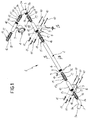
- Figure 1 is an exploded perspective view of a modular structure for making a handrail able to be applied along walls of buildings;
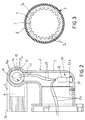
- Figure 2 is a section view of a support of the modular structure, taken according to trace II-II of Figure 1;
- Figure 3 is a cross section view taken according to trace III-III of Figure 1 on a rectilinear bearing element comprised in the modular structure.
- With reference to the aforementioned drawings, the
number 1 indicates in its entirety a modular structure for making handrails able to be applied along walls of buildings, according to the present invention. - As Figure 1 shows, the
modular structure 1 essentially comprises a plurality ofbearing elements supports 4 to form a continuous handrail extending along the development of the walls of a building at a pre-set distance from the floor. - The
bearing elements rectilinear support elements 2 able to be applied along the walls, and curvilinear bearingelements 3 employable in correspondence with the angles formed by contiguous walls to guarantee the continuity of the handrail from one wall to the other. - As shown in section in Figure 3, each rectilinear bearing
element 2 comprises at least atubular section bar 5 with substantially circular cross section profile, made of aluminium alloy by extrusion and externally covered with afinishing coating 6, preferably made of plastic material, which can advantageously be injection moulded on the section bar itself. - The inner surface of the rectilinear bearing
element 2 defines anengagement seat 7 whereby the rectilinear bearing element itself is rigidly engageable to arespective support 4. - More specifically, in the
engagement seat 7 of the rectilinear bearingelement 2 are obtained gripping seats 7a which extend along the entire development of the inner surface of thesection bar 5. - Differently from the rectilinear bearing
element 2, each curvilinear bearingelement 3 is preferably realised in the form of an injection moulded bent pipe made of plastic material. More in particular, the curvilinear bearingelement 3 presents a curved central segment 3a and two rectilinearterminal segments 3b extending from the opposite extremities of the curved segment 3a and oriented according to a pre-set angle, preferably equal to 90°, with respect to one another. The curvilinear bearingelement 3, too, presents an inner surface that constitutes anengagement seat 8 whereby it is possible to fasten the curvilinear bearing element itself to therespective support 4. In theengagement seat 8 of the curvilinear bearingelement 3 are obtained gripping seats 8a defined by grooves extending at least along therectilinear segments 3b. - Each
support 4 comprises an internally hollow fastening structure whereby the support itself is fastened to the respective wall with the aid of threadedelements 10 engaging inrespective dowels 11. The fastening portion 9 supports a tubular connectingportion 12, whereby the bearingelements support 4. The fastening portion 9 communicates, through at least anopening 13, with the tubular connectingportion 12, for purposes which will become more readily apparent farther on. - In detail, the tubular connecting
portion 12 presents a substantially circular cross section profile, and defines with its inner surface anauxiliary engagement seat 13 provided with auxiliary gripping seats 14a each constituted by a groove extending essentially along the development of the tubular connecting portion itself. - Preferably both the gripping portions 7a, 8a of the rectilinear and curvilinear bearing
elements attachment portions 12 of eachsupport 4 are distributed according to an angular step no greater than 20°, and more preferably equal to 15°. - In order to join the
bearing elements respective supports 4, appropriate coupling means 15 are associated to themodular structure 1. Such coupling means comprise a series ofjunction inserts 15 able to be interposed between thebearing elements respective supports 4. - Preferably each
junction insert 15 comprises at least afirst coupling shank 16 engageable by axial insertion into theengagement seat respective bearing element second coupling shank 17, opposite to the first coupling shank, engageable by axial insertion into theauxiliary engagement seat 14 of therespective support 4. - The
first engagement shank 16 presents cylindrical shape with substantially circular profile and gripping projections 16a extending axially on an outer surface thereof. Thesecond coupling shank 17 also presents cylindrical shape having a substantially circular cross section profile, and auxiliary gripping projections 17a obtained axially on its outer surface. - The gripping projections 16a of the
first coupling shank 16 and the auxiliary gripping projections 17a of thesecond coupling shank 17 are distributed according to the same angular step as the gripping seats 7a, 8a and as the auxiliary gripping seats 14a, i.e. according to a step no greater than 20° and preferably equal to 15°. - In detail, the
first coupling shank 16 is joined in the same piece to thesecond coupling shank 17, a diametral stop expansion being interposed between the coupling shanks. Thediametral stop expansion 18 advantageously presents an outer diameter equal to the outer diameter of thebearing elements portions 12 of thesupports 4, thereby guaranteeing a superficial continuity along the entire handrail formed as a result of the engagement of thejunction inserts 15 into therespective bearing elements supports 4. - Preferably, each
junction insert 15 is internally hollow to define, once it is assembled with the other components of themodular structure 1, a continuous internal passage channel extending through the fastening portions 9 of thesupports 4 and through thebearing elements support 4. - In accordance with a further aspect of the present invention which may be exploited also independently from the above description, the pre-arrangement of the intercommunicating inner cavities in the
modular structure 1 is advantageously exploited to include one ormore lighting units 20 usable for instance as night and/or emergency lights to indicate the corridor route and/or signal the presence of obstacles. To this end, in one or more of thesupports 4 of themodular structure 1 can be advantageously integrated at least one of saidlighting units 20, removably engaged in the fastening portion 9 of the support itself. Preferably, saidlighting unit 20 essentially comprises anoptical diffuser 21, defined for instance by a transparent screen removably engaged to the fastening portion 9 of the support and facing the inner cavity thereof, and alight bulb 22 housed in thesupport 4, in correspondence with the optical diffuser itself. Preferably, thelight bulb 22 is removably engaged in a seat 22a set in theoptical diffuser 21, as Figure 2 clearly shows. Theindividual lighting units 20 can be electrically connected to each other by means of connectingelectrical conductors 23 extending from onesupport 4 to the other, through the bearing supports 2, 3 and the tubular connectingportions 12 of the supports themselves. The electrical power supply of thelighting units 20 can be provided through further electricalpower supply conductors 23a housed inside the fastening portion 9 of at least one of thesupports 4 and connected to an electrical power supply line, preferably of the low voltage type, preinstalled in the wall whereon themodular structure 1 is engaged. - For the purpose of mounting the
modular structure 1 according to the invention, the individual bearingelements respective supports 4, which in turn are fastened on the respective walls at the same distance from the wall. The engagement of each bearingelement respective support 4 provides for thejunction insert 15 to be inserted with thefirst coupling shank 16 into the support element itself, in such a way that the gripping projections 16a slidingly engage the respective gripping seats 7a, 8a present in theengagement seat bearing element junction insert 15 is also inserted with thesecond shank 17 into the tubular connectingportion 14 of therespective support 4 by the sliding of the auxiliary gripping projections 17a into the respective auxiliary gripping seats 14a of the tubular connectingportion 12. Once thebearing element respective support 4, both are rotatorily fastened with respect to one another thanks to the coupling realised between the gripping projections 16a with the gripping seats 7a, 8a and the auxiliary gripping projections 17a with the auxiliary gripping seats 14a. - In a manner similar to the one described above, it is possible, if need be, to obtain the mutual coupling between two contiguous rectilinear 2 and/or curvilinear 3 support elements.
- Through at least one of the fastening portions 9 of the
supports 4 the electricalpower supply conductors 23a are connected to therespective lighting unit 20. Theadditional lighting units 20 can in turn be connected in cascade by means of the connectingelectrical conductors 23 which extend from a lighting unit to the other through the cavity of the various components of the entiremodular structure 1, or they can be directly connected to respective electricalpower supply conductors 23a exiting the walls. - The invention attains important advantages.
- The subject modular structure allows to realise handrail in a much simpler and faster way than the prior art, thanks to the possibility of assembling its
individual components - The invention further attains an appreciable reduction, with respect to known solutions, in the number of component types to be assembled in a modular manner to realise a handrail that follows the development of the walls whereon it is applied. In this respect, it should also be observed that each
curvilinear bearing element 3 can be used both as a terminal element of the handrail, setting asingle junction element 15 for the connection of the curvilinear element itself to the remaining part of thestructure 1, and as a union element between two successive rectilinear segments, in correspondence both with a convex angle and with a concave angle formed by the walls, using twojunction elements 15 inserted in correspondence with the opposite extremities of the curvilinear element itself. - It should further be noted that the grooved coupling junction between the junction inserts 15 and the
bearing elements support elements 4 allows to modify, according to requirements, the orientation of the plane of acurvilinear bearing element 3 and, thus, the mutual orientation of the tworectilinear bearing elements 2, between which is interposed the aforesaid curvilinear element. This possibility is particularly useful and advantageous in correspondence with angles formed by the walls in proximity to staircases and the like, where the development of the handrail must follow a broken line to remain parallel, for a certain segment, to the floor of the landing and, in a subsequent segment, to the flight of stairs. - The axial insertion of each
junction element 15 into therespective engagement seats - It is also possible to obtain an axial locking effect, conferring to the outer surfaces of the
shanks 16, 17 a slight conicity, developing to converge away from the central area of the junction insert itself. Additionally or alternatively, the axial locking of eachjunction insert 15 can be obtained by means of at least a threaded element traversing a diametral diaphragm positioned inside the insert itself coinciding with thediametral expansion 18, to engage operatively in a threaded seat set in thebearing element portion 14 of thesupport 4. - The tubular shape with closed profile of each
bearing element coating 6 directly by injecting plastic material on the entire outer surface of the bearing element itself, eliminating the need to perform any other additional operation for the engagement of thecoating 6 upon assembling themodular structure 1 and determining an advantageous electrical isolation of the metal core constituting thesection bar 5. This also eliminates the need to provide a grounding connection of the section bars 5. - The application of the
coating 6 directly on the bearing elements further guarantees a greater stability of the coating itself, to the advantage of the safe employment of the handrail, in addition to a greater superficial continuity, advantageous not only from the aesthetic point of view but also from the standpoint of hygiene and health. - The invention has moreover attained the possibility of exploiting the presence of the handrail to install one or more lighting units, aimed for instance at indicating the corridor paths or the presence of obstacles during night-time hours and/or in emergencies.
Claims (16)
- Modular structure for making handrails able to be applied along walls of buildings, of the type comprising:characterised in that said coupling means (15) comprise at least a first coupling shank (16) engageable by axial insertion into an engagement seat (7, 8) of the bearing element (2, 3), said first coupling shank (16) being provided with longitudinal gripping projections (16a) engageable by sliding in respective gripping seats (7a, 8a) obtained in the engagement seat (7, 8) of the bearing element (2, 3) and interacting with said gripping seats (7, 8) to lock the bearing element (2, 3) rotatorily with respect to the support (4).at least one support (4) rigidly engageable to a wall of a building;at least a bearing element (2, 3) rigidly engageable to said support (4);coupling means (15) to join the bearing element (2, 3) rigidly to the support (4),
- Structure according to claim 1, wherein said first coupling shank (16) presents cylindrical shape with substantially circular profile, said gripping projections (16a) being obtained on an outer surface of said first coupling shank (16).
- Structure according to claim 1, wherein said coupling means (15) comprise at least a second coupling shank (17), opposite to the first coupling shank (16), engageable by axial insertion into an auxiliary engagement seat (14) of the support (4), said second coupling shank (17) being provided with auxiliary gripping projections (17a) engageable by sliding into respective auxiliary gripping seats (14a) obtained in the auxiliary engagement seat (14) of the support (4) and interacting with said auxiliary gripping seats (14a) to lock the bearing element (2, 3) rotatorily with respect to the support (4).
- Structure according to claim 3, wherein said second coupling shank (17) presents cylindrical shape with substantially circular profile, said auxiliary gripping projections (17a) of the second coupling shank (17) being obtained on an outer surface of said second coupling shank (17).
- Structure according to claim 4, wherein said support (4) comprises a tubular connecting portion (12) having substantially circular profile, said auxiliary engagement seat (4) being defined in said tubular connecting portion (12).
- Structure according to claim 5, wherein said first and second coupling shanks (16, 17) are joined in the same piece to form a junction insert (15) able to be interposed between the bearing element (2, 3) and the support (4).
- Structure according to claim 6, wherein said junction insert (15) presents a diametral expansion (18) interposed between the first coupling shank (16) and the second coupling shank (17), and having its outer diameter equal to the outer diameter of the bearing element (2, 3) and of the connecting portion (12) of the support (4).
- Structure according to claim 1, wherein said bearing element (2, 3) presents tubular shape, said engagement seat (7, 8) being defined by an inner surface of the bearing element and said gripping seats (7a, 8a) being realised on said inner surface of the bearing element (2, 3) in such a way as to receive by insertion the first coupling shank (16).
- Structure according to claim 8, wherein said bearing element (2) comprises at least a tubular section bar (5), made of aluminium alloy by extrusion, externally covered with a finishing coating (6), said finishing coating (6) being injection moulded on the section bar itself.
- Structure according to claim 8, wherein said bearing element (3) presents a curvilinear development.
- Structure according to claim 5, wherein said support (4) further comprises a hollow fastening portion (9) whereby the support (4) is rigidly engageable to the wall of a building, said fastening portion (9) being in communication with said tubular connecting portion (12) by means of at least an opening internal to the support (4).
- Structure according to claim 11, wherein said junction insert (15) and said bearing element (2, 3) are internally hollow to define together with the support (4) an inner passage channel which extends from the fastening portion (9) of the support (4) to the bearing element.
- Modular structure, in particular according to claim 12, further comprising at least a lighting unit (20) integrated in said support.
- Structure according to claim 13, wherein said lighting unit (20) comprises an optical diffuser (21) removably engaged to the fastening portion (9) of the support and at least a light bulb (22) housed in the support (4) in correspondence with the optical diffuser (21).
- Structure according to claim 4, wherein said gripping projections (16a, 17a) of the first and of the second shank (16, 17) are distributed according to an angular step no greater than 20°.
- Structure according to claim 4, wherein said gripping seats (7a, 8a, 14a) of the bearing element (2, 3) and of the tubular connecting portion (12) of the support (4) are distributed according to an angular step no greater than 20°.
Priority Applications (1)
| Application Number | Priority Date | Filing Date | Title |
|---|---|---|---|
| EP99830259A EP1048799A1 (en) | 1999-04-30 | 1999-04-30 | A modular structure for making handrails |
Applications Claiming Priority (1)
| Application Number | Priority Date | Filing Date | Title |
|---|---|---|---|
| EP99830259A EP1048799A1 (en) | 1999-04-30 | 1999-04-30 | A modular structure for making handrails |
Publications (1)
| Publication Number | Publication Date |
|---|---|
| EP1048799A1 true EP1048799A1 (en) | 2000-11-02 |
Family
ID=8243385
Family Applications (1)
| Application Number | Title | Priority Date | Filing Date |
|---|---|---|---|
| EP99830259A Withdrawn EP1048799A1 (en) | 1999-04-30 | 1999-04-30 | A modular structure for making handrails |
Country Status (1)
| Country | Link |
|---|---|
| EP (1) | EP1048799A1 (en) |
Cited By (7)
| Publication number | Priority date | Publication date | Assignee | Title |
|---|---|---|---|---|
| EP1630320A2 (en) | 2004-08-24 | 2006-03-01 | Trident Industrial Limited | Modular handrail systems |
| GB2426259A (en) * | 2005-05-18 | 2006-11-22 | Glentworth Fabrications Ltd | Hand rail with emergency lighting |
| EP2003265A2 (en) | 2007-06-15 | 2008-12-17 | Burger et CIE (Société par Actions Simplifiée) | System of balustrade, ramp or similar |
| WO2015168440A1 (en) * | 2014-04-30 | 2015-11-05 | Zephyros, Inc. | Extruded reinforcements |
| CN109518898A (en) * | 2018-12-29 | 2019-03-26 | 山东联升安全设施有限公司 | It is a kind of for connecting the connection structure of handrail and wall |
| USD991023S1 (en) | 2017-12-21 | 2023-07-04 | Lustre Products Ltd. | Modular rail system connector |
| US11739536B2 (en) | 2017-12-19 | 2023-08-29 | Lustre Products Ltd. | Modular rail system |
Citations (4)
| Publication number | Priority date | Publication date | Assignee | Title |
|---|---|---|---|---|
| DE8634895U1 (en) * | 1986-12-23 | 1987-02-19 | Pan Bausysteme GmbH, 1000 Berlin | Combined handrail and wall protection |
| DE3737171A1 (en) * | 1987-11-03 | 1989-05-24 | Klaus Dipl Ing Westerheide | PIPE MOUNTING SYSTEM FOR EMPTY AND LIGHT TUBES |
| US5450299A (en) * | 1995-01-23 | 1995-09-12 | Lepre; Dominic | Touch activated illuminated hand rail assembly |
| US5779228A (en) * | 1996-08-03 | 1998-07-14 | Hansen; Randall C. | Anti-slip hand rail |
-
1999
- 1999-04-30 EP EP99830259A patent/EP1048799A1/en not_active Withdrawn
Patent Citations (4)
| Publication number | Priority date | Publication date | Assignee | Title |
|---|---|---|---|---|
| DE8634895U1 (en) * | 1986-12-23 | 1987-02-19 | Pan Bausysteme GmbH, 1000 Berlin | Combined handrail and wall protection |
| DE3737171A1 (en) * | 1987-11-03 | 1989-05-24 | Klaus Dipl Ing Westerheide | PIPE MOUNTING SYSTEM FOR EMPTY AND LIGHT TUBES |
| US5450299A (en) * | 1995-01-23 | 1995-09-12 | Lepre; Dominic | Touch activated illuminated hand rail assembly |
| US5779228A (en) * | 1996-08-03 | 1998-07-14 | Hansen; Randall C. | Anti-slip hand rail |
Cited By (14)
| Publication number | Priority date | Publication date | Assignee | Title |
|---|---|---|---|---|
| EP1630320A2 (en) | 2004-08-24 | 2006-03-01 | Trident Industrial Limited | Modular handrail systems |
| EP1630320A3 (en) * | 2004-08-24 | 2008-04-02 | Trident Industrial Limited | Modular handrail systems |
| GB2426259A (en) * | 2005-05-18 | 2006-11-22 | Glentworth Fabrications Ltd | Hand rail with emergency lighting |
| GB2426259B (en) * | 2005-05-18 | 2009-11-25 | Glentworth Fabrications Ltd | Hand rail |
| EP2003265A2 (en) | 2007-06-15 | 2008-12-17 | Burger et CIE (Société par Actions Simplifiée) | System of balustrade, ramp or similar |
| EP2003265A3 (en) * | 2007-06-15 | 2010-02-24 | Burger et CIE (Société par Actions Simplifiée) | System of balustrade, ramp or similar |
| WO2015168440A1 (en) * | 2014-04-30 | 2015-11-05 | Zephyros, Inc. | Extruded reinforcements |
| CN106536150A (en) * | 2014-04-30 | 2017-03-22 | 泽菲罗斯公司 | extruded reinforcement |
| US10427346B2 (en) | 2014-04-30 | 2019-10-01 | Zephyros, Inc. | Extruded reinforcements |
| CN106536150B (en) * | 2014-04-30 | 2020-01-24 | 泽菲罗斯公司 | Extruded reinforcement |
| US11739536B2 (en) | 2017-12-19 | 2023-08-29 | Lustre Products Ltd. | Modular rail system |
| USD991023S1 (en) | 2017-12-21 | 2023-07-04 | Lustre Products Ltd. | Modular rail system connector |
| CN109518898A (en) * | 2018-12-29 | 2019-03-26 | 山东联升安全设施有限公司 | It is a kind of for connecting the connection structure of handrail and wall |
| CN109518898B (en) * | 2018-12-29 | 2024-06-04 | 山东联升安全设施有限公司 | Connecting structure for connecting handrail and wall |
Similar Documents
| Publication | Publication Date | Title |
|---|---|---|
| EP0446312B1 (en) | Picket attachment | |
| US4403767A (en) | Variable rack stair rail assembly | |
| US5908185A (en) | Handrail and bumper combination | |
| US8356802B2 (en) | Handrail assembly and method | |
| US4612606A (en) | Apparatus for indirect lighting of stairs | |
| US11339575B2 (en) | Hand rails | |
| CA2914021A1 (en) | Baluster connector | |
| US2427723A (en) | Ornamental balustrade | |
| US9644836B1 (en) | Lighted handrail assembly | |
| EP3899158B1 (en) | Panel mounting system | |
| CN103748295A (en) | Modular system for sub-cealing | |
| CZ250595A3 (en) | Siding | |
| US9181709B2 (en) | Rapidly mounted, modular, universal grab bar and handrail system | |
| US20040056241A1 (en) | Hidden connector system for railings | |
| US6036156A (en) | Handrail and bumper combination | |
| CN201148703Y (en) | Guardrail convenient for mounting and dismounting | |
| US4293122A (en) | Pipe railing system | |
| KR102326281B1 (en) | Handrail Fixing Structure for Construction | |
| EP1630320B1 (en) | Modular handrail systems | |
| KR100757029B1 (en) | Wall Mount Handrails | |
| JPH0319546Y2 (en) | ||
| EP0890698A3 (en) | A building facade member and a set of fittings for external mounting in an opening in a building facade and a method of mounting such a facade member | |
| JP3216159B2 (en) | Balcony structure | |
| JPH0421959Y2 (en) | ||
| KR200231816Y1 (en) | Stairs railing of a construction type |
Legal Events
| Date | Code | Title | Description |
|---|---|---|---|
| PUAI | Public reference made under article 153(3) epc to a published international application that has entered the european phase |
Free format text: ORIGINAL CODE: 0009012 |
|
| AK | Designated contracting states |
Kind code of ref document: A1 Designated state(s): AT BE CH DE DK ES FI FR GB GR IE IT LI LU NL PT SE |
|
| AX | Request for extension of the european patent |
Free format text: AL;LT;LV;MK;RO;SI |
|
| 17P | Request for examination filed |
Effective date: 20010315 |
|
| 17Q | First examination report despatched |
Effective date: 20010425 |
|
| AKX | Designation fees paid |
Free format text: AT BE CH DE DK ES FI FR GB GR IE IT LI LU NL PT SE |
|
| STAA | Information on the status of an ep patent application or granted ep patent |
Free format text: STATUS: THE APPLICATION IS DEEMED TO BE WITHDRAWN |
|
| 18D | Application deemed to be withdrawn |
Effective date: 20010905 |