EP1059370A1 - Fibres isotactiques de polypropylène catalysé par métallocènes à retrait réduit - Google Patents
Fibres isotactiques de polypropylène catalysé par métallocènes à retrait réduit Download PDFInfo
- Publication number
- EP1059370A1 EP1059370A1 EP00202005A EP00202005A EP1059370A1 EP 1059370 A1 EP1059370 A1 EP 1059370A1 EP 00202005 A EP00202005 A EP 00202005A EP 00202005 A EP00202005 A EP 00202005A EP 1059370 A1 EP1059370 A1 EP 1059370A1
- Authority
- EP
- European Patent Office
- Prior art keywords
- polypropylene
- fiber
- polymer
- minutes
- range
- Prior art date
- Legal status (The legal status is an assumption and is not a legal conclusion. Google has not performed a legal analysis and makes no representation as to the accuracy of the status listed.)
- Granted
Links
- -1 polypropylene Polymers 0.000 title claims abstract description 154
- 229920001155 polypropylene Polymers 0.000 title claims abstract description 142
- 239000004743 Polypropylene Substances 0.000 title claims abstract description 136
- 239000000835 fiber Substances 0.000 title claims abstract description 109
- 229920000642 polymer Polymers 0.000 claims abstract description 76
- 239000012968 metallocene catalyst Substances 0.000 claims abstract description 39
- 238000000034 method Methods 0.000 claims abstract description 39
- 239000000155 melt Substances 0.000 claims abstract description 18
- 238000010438 heat treatment Methods 0.000 claims abstract description 13
- 238000006116 polymerization reaction Methods 0.000 claims abstract description 13
- 238000001125 extrusion Methods 0.000 claims abstract description 12
- 125000004805 propylene group Chemical group [H]C([H])([H])C([H])([*:1])C([H])([H])[*:2] 0.000 claims abstract description 12
- QQONPFPTGQHPMA-UHFFFAOYSA-N propylene Natural products CC=C QQONPFPTGQHPMA-UHFFFAOYSA-N 0.000 claims abstract description 11
- 238000004519 manufacturing process Methods 0.000 claims abstract description 7
- 238000009987 spinning Methods 0.000 claims description 25
- 125000003454 indenyl group Chemical group C1(C=CC2=CC=CC=C12)* 0.000 claims description 14
- 239000011954 Ziegler–Natta catalyst Substances 0.000 claims description 13
- YBYIRNPNPLQARY-UHFFFAOYSA-N 1H-indene Natural products C1=CC=C2CC=CC2=C1 YBYIRNPNPLQARY-UHFFFAOYSA-N 0.000 claims description 10
- 239000003446 ligand Substances 0.000 claims description 10
- 125000004432 carbon atom Chemical group C* 0.000 claims description 6
- QCWXUUIWCKQGHC-UHFFFAOYSA-N Zirconium Chemical compound [Zr] QCWXUUIWCKQGHC-UHFFFAOYSA-N 0.000 claims description 5
- 125000002496 methyl group Chemical group [H]C([H])([H])* 0.000 claims description 5
- 229910052726 zirconium Inorganic materials 0.000 claims description 5
- 150000003624 transition metals Chemical class 0.000 claims description 4
- 229910052735 hafnium Inorganic materials 0.000 claims description 3
- VBJZVLUMGGDVMO-UHFFFAOYSA-N hafnium atom Chemical compound [Hf] VBJZVLUMGGDVMO-UHFFFAOYSA-N 0.000 claims description 3
- 229910052723 transition metal Inorganic materials 0.000 claims description 3
- RTAQQCXQSZGOHL-UHFFFAOYSA-N Titanium Chemical compound [Ti] RTAQQCXQSZGOHL-UHFFFAOYSA-N 0.000 claims description 2
- 229910052736 halogen Inorganic materials 0.000 claims description 2
- 125000001424 substituent group Chemical group 0.000 claims description 2
- 229910052719 titanium Inorganic materials 0.000 claims description 2
- 239000010936 titanium Substances 0.000 claims description 2
- 229910052720 vanadium Inorganic materials 0.000 claims description 2
- 125000004178 (C1-C4) alkyl group Chemical group 0.000 claims 1
- 125000000484 butyl group Chemical group [H]C([*])([H])C([H])([H])C([H])([H])C([H])([H])[H] 0.000 claims 1
- 125000001495 ethyl group Chemical group [H]C([H])([H])C([H])([H])* 0.000 claims 1
- 150000002367 halogens Chemical class 0.000 claims 1
- 125000001183 hydrocarbyl group Chemical group 0.000 claims 1
- 125000001449 isopropyl group Chemical group [H]C([H])([H])C([H])(*)C([H])([H])[H] 0.000 claims 1
- 125000001997 phenyl group Chemical group [H]C1=C([H])C([H])=C(*)C([H])=C1[H] 0.000 claims 1
- LEONUFNNVUYDNQ-UHFFFAOYSA-N vanadium atom Chemical compound [V] LEONUFNNVUYDNQ-UHFFFAOYSA-N 0.000 claims 1
- 101000573447 Homo sapiens Multiple inositol polyphosphate phosphatase 1 Proteins 0.000 description 82
- 102100026284 Multiple inositol polyphosphate phosphatase 1 Human genes 0.000 description 82
- 239000003054 catalyst Substances 0.000 description 35
- 239000011347 resin Substances 0.000 description 18
- 229920005989 resin Polymers 0.000 description 18
- 239000003963 antioxidant agent Substances 0.000 description 16
- 235000006708 antioxidants Nutrition 0.000 description 16
- 230000003078 antioxidant effect Effects 0.000 description 15
- VYPSYNLAJGMNEJ-UHFFFAOYSA-N Silicium dioxide Chemical compound O=[Si]=O VYPSYNLAJGMNEJ-UHFFFAOYSA-N 0.000 description 13
- 239000000463 material Substances 0.000 description 13
- 230000008569 process Effects 0.000 description 12
- TWRXJAOTZQYOKJ-UHFFFAOYSA-L Magnesium chloride Chemical compound [Mg+2].[Cl-].[Cl-] TWRXJAOTZQYOKJ-UHFFFAOYSA-L 0.000 description 10
- 239000000203 mixture Substances 0.000 description 10
- CTQNGGLPUBDAKN-UHFFFAOYSA-N O-Xylene Chemical compound CC1=CC=CC=C1C CTQNGGLPUBDAKN-UHFFFAOYSA-N 0.000 description 8
- 239000000654 additive Substances 0.000 description 8
- 239000003426 co-catalyst Substances 0.000 description 8
- 229910052809 inorganic oxide Inorganic materials 0.000 description 8
- 238000012360 testing method Methods 0.000 description 8
- XJDNKRIXUMDJCW-UHFFFAOYSA-J titanium tetrachloride Chemical compound Cl[Ti](Cl)(Cl)Cl XJDNKRIXUMDJCW-UHFFFAOYSA-J 0.000 description 8
- 239000008096 xylene Substances 0.000 description 8
- 239000002253 acid Substances 0.000 description 7
- 230000008901 benefit Effects 0.000 description 7
- 238000009826 distribution Methods 0.000 description 7
- 238000002844 melting Methods 0.000 description 7
- 230000008018 melting Effects 0.000 description 7
- CPLXHLVBOLITMK-UHFFFAOYSA-N Magnesium oxide Chemical compound [Mg]=O CPLXHLVBOLITMK-UHFFFAOYSA-N 0.000 description 6
- MCMNRKCIXSYSNV-UHFFFAOYSA-N Zirconium dioxide Chemical compound O=[Zr]=O MCMNRKCIXSYSNV-UHFFFAOYSA-N 0.000 description 6
- CJZGTCYPCWQAJB-UHFFFAOYSA-L calcium stearate Chemical compound [Ca+2].CCCCCCCCCCCCCCCCCC([O-])=O.CCCCCCCCCCCCCCCCCC([O-])=O CJZGTCYPCWQAJB-UHFFFAOYSA-L 0.000 description 6
- 235000013539 calcium stearate Nutrition 0.000 description 6
- 239000008116 calcium stearate Substances 0.000 description 6
- 238000002074 melt spinning Methods 0.000 description 6
- SSDSCDGVMJFTEQ-UHFFFAOYSA-N octadecyl 3-(3,5-ditert-butyl-4-hydroxyphenyl)propanoate Chemical compound CCCCCCCCCCCCCCCCCCOC(=O)CCC1=CC(C(C)(C)C)=C(O)C(C(C)(C)C)=C1 SSDSCDGVMJFTEQ-UHFFFAOYSA-N 0.000 description 6
- 230000000704 physical effect Effects 0.000 description 6
- 239000000377 silicon dioxide Substances 0.000 description 6
- VOITXYVAKOUIBA-UHFFFAOYSA-N triethylaluminium Chemical compound CC[Al](CC)CC VOITXYVAKOUIBA-UHFFFAOYSA-N 0.000 description 6
- JKIJEFPNVSHHEI-UHFFFAOYSA-N Phenol, 2,4-bis(1,1-dimethylethyl)-, phosphite (3:1) Chemical compound CC(C)(C)C1=CC(C(C)(C)C)=CC=C1OP(OC=1C(=CC(=CC=1)C(C)(C)C)C(C)(C)C)OC1=CC=C(C(C)(C)C)C=C1C(C)(C)C JKIJEFPNVSHHEI-UHFFFAOYSA-N 0.000 description 5
- 150000001875 compounds Chemical class 0.000 description 5
- AQZWEFBJYQSQEH-UHFFFAOYSA-N 2-methyloxaluminane Chemical compound C[Al]1CCCCO1 AQZWEFBJYQSQEH-UHFFFAOYSA-N 0.000 description 4
- GWEVSGVZZGPLCZ-UHFFFAOYSA-N Titan oxide Chemical compound O=[Ti]=O GWEVSGVZZGPLCZ-UHFFFAOYSA-N 0.000 description 4
- PNEYBMLMFCGWSK-UHFFFAOYSA-N aluminium oxide Inorganic materials [O-2].[O-2].[O-2].[Al+3].[Al+3] PNEYBMLMFCGWSK-UHFFFAOYSA-N 0.000 description 4
- 238000006555 catalytic reaction Methods 0.000 description 4
- 125000000058 cyclopentadienyl group Chemical group C1(=CC=CC1)* 0.000 description 4
- 239000002815 homogeneous catalyst Substances 0.000 description 4
- 229920001580 isotactic polymer Polymers 0.000 description 4
- 235000011147 magnesium chloride Nutrition 0.000 description 4
- 229910052751 metal Inorganic materials 0.000 description 4
- 239000002184 metal Substances 0.000 description 4
- 229920000098 polyolefin Polymers 0.000 description 4
- 238000012545 processing Methods 0.000 description 4
- 230000000707 stereoselective effect Effects 0.000 description 4
- 229920001585 atactic polymer Polymers 0.000 description 3
- 239000000969 carrier Substances 0.000 description 3
- 125000002091 cationic group Chemical group 0.000 description 3
- 230000008859 change Effects 0.000 description 3
- 229920006240 drawn fiber Polymers 0.000 description 3
- 229920001519 homopolymer Polymers 0.000 description 3
- 230000006872 improvement Effects 0.000 description 3
- 239000000395 magnesium oxide Substances 0.000 description 3
- 239000000178 monomer Substances 0.000 description 3
- 229910052710 silicon Inorganic materials 0.000 description 3
- 239000010703 silicon Substances 0.000 description 3
- 229920001576 syndiotactic polymer Polymers 0.000 description 3
- MCULRUJILOGHCJ-UHFFFAOYSA-N triisobutylaluminium Chemical compound CC(C)C[Al](CC(C)C)CC(C)C MCULRUJILOGHCJ-UHFFFAOYSA-N 0.000 description 3
- VBICKXHEKHSIBG-UHFFFAOYSA-N 1-monostearoylglycerol Chemical compound CCCCCCCCCCCCCCCCCC(=O)OCC(O)CO VBICKXHEKHSIBG-UHFFFAOYSA-N 0.000 description 2
- YVSMQHYREUQGRX-UHFFFAOYSA-N 2-ethyloxaluminane Chemical compound CC[Al]1CCCCO1 YVSMQHYREUQGRX-UHFFFAOYSA-N 0.000 description 2
- IJGRMHOSHXDMSA-UHFFFAOYSA-N Atomic nitrogen Chemical compound N#N IJGRMHOSHXDMSA-UHFFFAOYSA-N 0.000 description 2
- KAKZBPTYRLMSJV-UHFFFAOYSA-N Butadiene Chemical compound C=CC=C KAKZBPTYRLMSJV-UHFFFAOYSA-N 0.000 description 2
- 239000004215 Carbon black (E152) Substances 0.000 description 2
- 239000004793 Polystyrene Substances 0.000 description 2
- PPBRXRYQALVLMV-UHFFFAOYSA-N Styrene Chemical compound C=CC1=CC=CC=C1 PPBRXRYQALVLMV-UHFFFAOYSA-N 0.000 description 2
- 239000012963 UV stabilizer Substances 0.000 description 2
- BZHJMEDXRYGGRV-UHFFFAOYSA-N Vinyl chloride Chemical compound ClC=C BZHJMEDXRYGGRV-UHFFFAOYSA-N 0.000 description 2
- BGYHLZZASRKEJE-UHFFFAOYSA-N [3-[3-(3,5-ditert-butyl-4-hydroxyphenyl)propanoyloxy]-2,2-bis[3-(3,5-ditert-butyl-4-hydroxyphenyl)propanoyloxymethyl]propyl] 3-(3,5-ditert-butyl-4-hydroxyphenyl)propanoate Chemical compound CC(C)(C)C1=C(O)C(C(C)(C)C)=CC(CCC(=O)OCC(COC(=O)CCC=2C=C(C(O)=C(C=2)C(C)(C)C)C(C)(C)C)(COC(=O)CCC=2C=C(C(O)=C(C=2)C(C)(C)C)C(C)(C)C)COC(=O)CCC=2C=C(C(O)=C(C=2)C(C)(C)C)C(C)(C)C)=C1 BGYHLZZASRKEJE-UHFFFAOYSA-N 0.000 description 2
- 125000005234 alkyl aluminium group Chemical group 0.000 description 2
- 239000002216 antistatic agent Substances 0.000 description 2
- 125000003118 aryl group Chemical group 0.000 description 2
- 230000015572 biosynthetic process Effects 0.000 description 2
- 150000001768 cations Chemical class 0.000 description 2
- 239000002734 clay mineral Substances 0.000 description 2
- 238000002425 crystallisation Methods 0.000 description 2
- 230000008025 crystallization Effects 0.000 description 2
- 238000005227 gel permeation chromatography Methods 0.000 description 2
- 239000002638 heterogeneous catalyst Substances 0.000 description 2
- 229930195733 hydrocarbon Natural products 0.000 description 2
- 239000011777 magnesium Substances 0.000 description 2
- 238000012986 modification Methods 0.000 description 2
- 230000004048 modification Effects 0.000 description 2
- 125000001181 organosilyl group Chemical group [SiH3]* 0.000 description 2
- 239000002245 particle Substances 0.000 description 2
- 239000002952 polymeric resin Substances 0.000 description 2
- 229920002223 polystyrene Polymers 0.000 description 2
- 238000002360 preparation method Methods 0.000 description 2
- 238000001953 recrystallisation Methods 0.000 description 2
- 229920003002 synthetic resin Polymers 0.000 description 2
- 229920000576 tactic polymer Polymers 0.000 description 2
- 239000000454 talc Substances 0.000 description 2
- 229910052623 talc Inorganic materials 0.000 description 2
- 238000009864 tensile test Methods 0.000 description 2
- JLTRXTDYQLMHGR-UHFFFAOYSA-N trimethylaluminium Chemical compound C[Al](C)C JLTRXTDYQLMHGR-UHFFFAOYSA-N 0.000 description 2
- LFXVBWRMVZPLFK-UHFFFAOYSA-N trioctylalumane Chemical compound CCCCCCCC[Al](CCCCCCCC)CCCCCCCC LFXVBWRMVZPLFK-UHFFFAOYSA-N 0.000 description 2
- 125000000391 vinyl group Chemical group [H]C([*])=C([H])[H] 0.000 description 2
- 239000010457 zeolite Substances 0.000 description 2
- 239000004711 α-olefin Substances 0.000 description 2
- VNQNXQYZMPJLQX-UHFFFAOYSA-N 1,3,5-tris[(3,5-ditert-butyl-4-hydroxyphenyl)methyl]-1,3,5-triazinane-2,4,6-trione Chemical compound CC(C)(C)C1=C(O)C(C(C)(C)C)=CC(CN2C(N(CC=3C=C(C(O)=C(C=3)C(C)(C)C)C(C)(C)C)C(=O)N(CC=3C=C(C(O)=C(C=3)C(C)(C)C)C(C)(C)C)C2=O)=O)=C1 VNQNXQYZMPJLQX-UHFFFAOYSA-N 0.000 description 1
- OZCMOJQQLBXBKI-UHFFFAOYSA-N 1-ethenoxy-2-methylpropane Chemical compound CC(C)COC=C OZCMOJQQLBXBKI-UHFFFAOYSA-N 0.000 description 1
- NMXLXQGHBSPIDR-UHFFFAOYSA-N 2-(2-methylpropyl)oxaluminane Chemical compound CC(C)C[Al]1CCCCO1 NMXLXQGHBSPIDR-UHFFFAOYSA-N 0.000 description 1
- AIBRSVLEQRWAEG-UHFFFAOYSA-N 3,9-bis(2,4-ditert-butylphenoxy)-2,4,8,10-tetraoxa-3,9-diphosphaspiro[5.5]undecane Chemical compound CC(C)(C)C1=CC(C(C)(C)C)=CC=C1OP1OCC2(COP(OC=3C(=CC(=CC=3)C(C)(C)C)C(C)(C)C)OC2)CO1 AIBRSVLEQRWAEG-UHFFFAOYSA-N 0.000 description 1
- ZOXJGFHDIHLPTG-UHFFFAOYSA-N Boron Chemical compound [B] ZOXJGFHDIHLPTG-UHFFFAOYSA-N 0.000 description 1
- OKTJSMMVPCPJKN-UHFFFAOYSA-N Carbon Chemical compound [C] OKTJSMMVPCPJKN-UHFFFAOYSA-N 0.000 description 1
- UFHFLCQGNIYNRP-UHFFFAOYSA-N Hydrogen Chemical compound [H][H] UFHFLCQGNIYNRP-UHFFFAOYSA-N 0.000 description 1
- 239000005909 Kieselgur Substances 0.000 description 1
- FYYHWMGAXLPEAU-UHFFFAOYSA-N Magnesium Chemical compound [Mg] FYYHWMGAXLPEAU-UHFFFAOYSA-N 0.000 description 1
- 101100233255 Mus musculus Ipp gene Proteins 0.000 description 1
- 101100513472 Mus musculus Minpp1 gene Proteins 0.000 description 1
- XYFCBTPGUUZFHI-UHFFFAOYSA-N Phosphine Natural products P XYFCBTPGUUZFHI-UHFFFAOYSA-N 0.000 description 1
- 206010034962 Photopsia Diseases 0.000 description 1
- 239000004698 Polyethylene Substances 0.000 description 1
- 229920002472 Starch Polymers 0.000 description 1
- NINIDFKCEFEMDL-UHFFFAOYSA-N Sulfur Chemical compound [S] NINIDFKCEFEMDL-UHFFFAOYSA-N 0.000 description 1
- 229910004369 ThO2 Inorganic materials 0.000 description 1
- QYKIQEUNHZKYBP-UHFFFAOYSA-N Vinyl ether Chemical class C=COC=C QYKIQEUNHZKYBP-UHFFFAOYSA-N 0.000 description 1
- 229910021536 Zeolite Inorganic materials 0.000 description 1
- AHSOXAGSIAQQOB-UHFFFAOYSA-L [Cl-].[Cl-].C(C)(C)=[Zr+2]C1=C(C=CC=2C3=CC=CC=C3CC1=2)C1C=CC=C1 Chemical group [Cl-].[Cl-].C(C)(C)=[Zr+2]C1=C(C=CC=2C3=CC=CC=C3CC1=2)C1C=CC=C1 AHSOXAGSIAQQOB-UHFFFAOYSA-L 0.000 description 1
- UCIKZESDXASJNG-UHFFFAOYSA-L [Cl-].[Cl-].C1=CC=C2C([Zr+2])C=CC2=C1 Chemical compound [Cl-].[Cl-].C1=CC=C2C([Zr+2])C=CC2=C1 UCIKZESDXASJNG-UHFFFAOYSA-L 0.000 description 1
- LEOYKWIXWJXYQJ-UHFFFAOYSA-L [Cl-].[Cl-].CC1=CC2=CC=CC=C2C1[Zr+2]([SiH](C)C)C1C2=CC=CC=C2C=C1C Chemical compound [Cl-].[Cl-].CC1=CC2=CC=CC=C2C1[Zr+2]([SiH](C)C)C1C2=CC=CC=C2C=C1C LEOYKWIXWJXYQJ-UHFFFAOYSA-L 0.000 description 1
- 150000001298 alcohols Chemical class 0.000 description 1
- 150000001299 aldehydes Chemical class 0.000 description 1
- 150000001336 alkenes Chemical class 0.000 description 1
- 125000003342 alkenyl group Chemical group 0.000 description 1
- 150000004703 alkoxides Chemical class 0.000 description 1
- 150000003973 alkyl amines Chemical class 0.000 description 1
- 125000002877 alkyl aryl group Chemical group 0.000 description 1
- 125000000217 alkyl group Chemical group 0.000 description 1
- 229910052782 aluminium Inorganic materials 0.000 description 1
- XAGFODPZIPBFFR-UHFFFAOYSA-N aluminium Chemical compound [Al] XAGFODPZIPBFFR-UHFFFAOYSA-N 0.000 description 1
- 150000001412 amines Chemical class 0.000 description 1
- 150000001450 anions Chemical class 0.000 description 1
- 125000003710 aryl alkyl group Chemical group 0.000 description 1
- 125000003609 aryl vinyl group Chemical group 0.000 description 1
- 229920006378 biaxially oriented polypropylene Polymers 0.000 description 1
- 239000011127 biaxially oriented polypropylene Substances 0.000 description 1
- 229910052796 boron Inorganic materials 0.000 description 1
- 229910052799 carbon Inorganic materials 0.000 description 1
- 238000006243 chemical reaction Methods 0.000 description 1
- 239000003795 chemical substances by application Substances 0.000 description 1
- 239000004927 clay Substances 0.000 description 1
- 229910052681 coesite Inorganic materials 0.000 description 1
- 238000010622 cold drawing Methods 0.000 description 1
- 238000010960 commercial process Methods 0.000 description 1
- 230000000052 comparative effect Effects 0.000 description 1
- 229920001577 copolymer Polymers 0.000 description 1
- 230000002596 correlated effect Effects 0.000 description 1
- 230000000875 corresponding effect Effects 0.000 description 1
- 229910052593 corundum Inorganic materials 0.000 description 1
- 229910052906 cristobalite Inorganic materials 0.000 description 1
- 239000013078 crystal Substances 0.000 description 1
- 125000004210 cyclohexylmethyl group Chemical group [H]C([H])(*)C1([H])C([H])([H])C([H])([H])C([H])([H])C([H])([H])C1([H])[H] 0.000 description 1
- 125000001511 cyclopentyl group Chemical group [H]C1([H])C([H])([H])C([H])([H])C([H])(*)C1([H])[H] 0.000 description 1
- 230000003247 decreasing effect Effects 0.000 description 1
- 238000013461 design Methods 0.000 description 1
- 238000011161 development Methods 0.000 description 1
- GUJOJGAPFQRJSV-UHFFFAOYSA-N dialuminum;dioxosilane;oxygen(2-);hydrate Chemical compound O.[O-2].[O-2].[O-2].[Al+3].[Al+3].O=[Si]=O.O=[Si]=O.O=[Si]=O.O=[Si]=O GUJOJGAPFQRJSV-UHFFFAOYSA-N 0.000 description 1
- JJSGABFIILQOEY-UHFFFAOYSA-M diethylalumanylium;bromide Chemical compound CC[Al](Br)CC JJSGABFIILQOEY-UHFFFAOYSA-M 0.000 description 1
- YNLAOSYQHBDIKW-UHFFFAOYSA-M diethylaluminium chloride Chemical compound CC[Al](Cl)CC YNLAOSYQHBDIKW-UHFFFAOYSA-M 0.000 description 1
- ZGMHEOLLTWPGQX-UHFFFAOYSA-M dimethylalumanylium;bromide Chemical compound C[Al](C)Br ZGMHEOLLTWPGQX-UHFFFAOYSA-M 0.000 description 1
- JGHYBJVUQGTEEB-UHFFFAOYSA-M dimethylalumanylium;chloride Chemical compound C[Al](C)Cl JGHYBJVUQGTEEB-UHFFFAOYSA-M 0.000 description 1
- HNPSIPDUKPIQMN-UHFFFAOYSA-N dioxosilane;oxo(oxoalumanyloxy)alumane Chemical compound O=[Si]=O.O=[Al]O[Al]=O HNPSIPDUKPIQMN-UHFFFAOYSA-N 0.000 description 1
- 238000001035 drying Methods 0.000 description 1
- 230000000694 effects Effects 0.000 description 1
- ZSWFCLXCOIISFI-UHFFFAOYSA-N endo-cyclopentadiene Natural products C1C=CC=C1 ZSWFCLXCOIISFI-UHFFFAOYSA-N 0.000 description 1
- 238000005516 engineering process Methods 0.000 description 1
- 150000002148 esters Chemical class 0.000 description 1
- 230000001747 exhibiting effect Effects 0.000 description 1
- 238000002474 experimental method Methods 0.000 description 1
- 238000007380 fibre production Methods 0.000 description 1
- 229910052732 germanium Inorganic materials 0.000 description 1
- 239000003365 glass fiber Substances 0.000 description 1
- 125000005843 halogen group Chemical group 0.000 description 1
- 150000004678 hydrides Chemical class 0.000 description 1
- BHEPBYXIRTUNPN-UHFFFAOYSA-N hydridophosphorus(.) (triplet) Chemical compound [PH] BHEPBYXIRTUNPN-UHFFFAOYSA-N 0.000 description 1
- 150000002430 hydrocarbons Chemical class 0.000 description 1
- 229910052739 hydrogen Inorganic materials 0.000 description 1
- 239000001257 hydrogen Substances 0.000 description 1
- 238000003780 insertion Methods 0.000 description 1
- 230000037431 insertion Effects 0.000 description 1
- JEIPFZHSYJVQDO-UHFFFAOYSA-N iron(III) oxide Inorganic materials O=[Fe]O[Fe]=O JEIPFZHSYJVQDO-UHFFFAOYSA-N 0.000 description 1
- 125000000654 isopropylidene group Chemical group C(C)(C)=* 0.000 description 1
- 229910052749 magnesium Inorganic materials 0.000 description 1
- OTCKOJUMXQWKQG-UHFFFAOYSA-L magnesium bromide Chemical compound [Mg+2].[Br-].[Br-] OTCKOJUMXQWKQG-UHFFFAOYSA-L 0.000 description 1
- 229910001629 magnesium chloride Inorganic materials 0.000 description 1
- 150000002739 metals Chemical class 0.000 description 1
- 238000002156 mixing Methods 0.000 description 1
- 229910052901 montmorillonite Inorganic materials 0.000 description 1
- 230000007935 neutral effect Effects 0.000 description 1
- 229910052757 nitrogen Inorganic materials 0.000 description 1
- 230000003287 optical effect Effects 0.000 description 1
- 239000008188 pellet Substances 0.000 description 1
- 230000000737 periodic effect Effects 0.000 description 1
- XMGMFRIEKMMMSU-UHFFFAOYSA-N phenylmethylbenzene Chemical group C=1C=CC=CC=1[C]C1=CC=CC=C1 XMGMFRIEKMMMSU-UHFFFAOYSA-N 0.000 description 1
- 229910000065 phosphene Inorganic materials 0.000 description 1
- 229910000073 phosphorus hydride Inorganic materials 0.000 description 1
- 229920001230 polyarylate Polymers 0.000 description 1
- 229920000573 polyethylene Polymers 0.000 description 1
- 239000002685 polymerization catalyst Substances 0.000 description 1
- 229920005629 polypropylene homopolymer Polymers 0.000 description 1
- 239000011148 porous material Substances 0.000 description 1
- 238000010791 quenching Methods 0.000 description 1
- 150000004760 silicates Chemical class 0.000 description 1
- 239000002904 solvent Substances 0.000 description 1
- 235000019698 starch Nutrition 0.000 description 1
- 229910052682 stishovite Inorganic materials 0.000 description 1
- 239000000126 substance Substances 0.000 description 1
- 229910052717 sulfur Inorganic materials 0.000 description 1
- 239000011593 sulfur Substances 0.000 description 1
- ZCUFMDLYAMJYST-UHFFFAOYSA-N thorium dioxide Chemical compound O=[Th]=O ZCUFMDLYAMJYST-UHFFFAOYSA-N 0.000 description 1
- 150000003623 transition metal compounds Chemical class 0.000 description 1
- 229910052905 tridymite Inorganic materials 0.000 description 1
- GPPXJZIENCGNKB-UHFFFAOYSA-N vanadium Chemical compound [V]#[V] GPPXJZIENCGNKB-UHFFFAOYSA-N 0.000 description 1
- 229920002554 vinyl polymer Polymers 0.000 description 1
- 238000004804 winding Methods 0.000 description 1
- 229910001845 yogo sapphire Inorganic materials 0.000 description 1
- VPGLGRNSAYHXPY-UHFFFAOYSA-L zirconium(2+);dichloride Chemical compound Cl[Zr]Cl VPGLGRNSAYHXPY-UHFFFAOYSA-L 0.000 description 1
- 229910000859 α-Fe Inorganic materials 0.000 description 1
Images


Classifications
-
- D—TEXTILES; PAPER
- D01—NATURAL OR MAN-MADE THREADS OR FIBRES; SPINNING
- D01F—CHEMICAL FEATURES IN THE MANUFACTURE OF ARTIFICIAL FILAMENTS, THREADS, FIBRES, BRISTLES OR RIBBONS; APPARATUS SPECIALLY ADAPTED FOR THE MANUFACTURE OF CARBON FILAMENTS
- D01F6/00—Monocomponent artificial filaments or the like of synthetic polymers; Manufacture thereof
- D01F6/02—Monocomponent artificial filaments or the like of synthetic polymers; Manufacture thereof from homopolymers obtained by reactions only involving carbon-to-carbon unsaturated bonds
- D01F6/04—Monocomponent artificial filaments or the like of synthetic polymers; Manufacture thereof from homopolymers obtained by reactions only involving carbon-to-carbon unsaturated bonds from polyolefins
- D01F6/06—Monocomponent artificial filaments or the like of synthetic polymers; Manufacture thereof from homopolymers obtained by reactions only involving carbon-to-carbon unsaturated bonds from polyolefins from polypropylene
-
- Y—GENERAL TAGGING OF NEW TECHNOLOGICAL DEVELOPMENTS; GENERAL TAGGING OF CROSS-SECTIONAL TECHNOLOGIES SPANNING OVER SEVERAL SECTIONS OF THE IPC; TECHNICAL SUBJECTS COVERED BY FORMER USPC CROSS-REFERENCE ART COLLECTIONS [XRACs] AND DIGESTS
- Y10—TECHNICAL SUBJECTS COVERED BY FORMER USPC
- Y10T—TECHNICAL SUBJECTS COVERED BY FORMER US CLASSIFICATION
- Y10T428/00—Stock material or miscellaneous articles
- Y10T428/29—Coated or structually defined flake, particle, cell, strand, strand portion, rod, filament, macroscopic fiber or mass thereof
- Y10T428/2913—Rod, strand, filament or fiber
-
- Y—GENERAL TAGGING OF NEW TECHNOLOGICAL DEVELOPMENTS; GENERAL TAGGING OF CROSS-SECTIONAL TECHNOLOGIES SPANNING OVER SEVERAL SECTIONS OF THE IPC; TECHNICAL SUBJECTS COVERED BY FORMER USPC CROSS-REFERENCE ART COLLECTIONS [XRACs] AND DIGESTS
- Y10—TECHNICAL SUBJECTS COVERED BY FORMER USPC
- Y10T—TECHNICAL SUBJECTS COVERED BY FORMER US CLASSIFICATION
- Y10T428/00—Stock material or miscellaneous articles
- Y10T428/29—Coated or structually defined flake, particle, cell, strand, strand portion, rod, filament, macroscopic fiber or mass thereof
- Y10T428/2913—Rod, strand, filament or fiber
- Y10T428/2933—Coated or with bond, impregnation or core
- Y10T428/2964—Artificial fiber or filament
- Y10T428/2967—Synthetic resin or polymer
Definitions
- This invention relates to polypropylene fibers and, more particularly, to such fibers and processes for their preparation from metallocene-based isotactic polypropylene.
- Isotactic polypropylene is one of a number of crystalline polymers which can be characterized in terms of the stereoregularity of the polymer chain.
- Various stereospecific structural relationships characterized primarily in terms of syndiotacticity and isotacticity, may be involved in the formation of stereoregular polymers for various monomers.
- Stereospecific propagation may be applied in the polymerization of ethylenically-unsaturated monomers, such as C 3 + alpha olefins, 1-dienes such as 1,3-butadiene, substituted vinyl compounds such as vinyl aromatics, e.g.
- styrene or vinyl chloride vinyl chloride
- vinyl ethers such as alkyl vinyl ethers, e.g. isobutyl vinyl ether, or even aryl vinyl ethers.
- Stereospecific polymer propagation is probably of most significance in the production of polypropylene of isotactic or syndiotactic structure.
- Isotactic polypropylene is conventionally used in the production of fibers in which the polypropylene is heated and then extruded through one or more dies to produce a fiber preform which is processed by a spinning and drawing operation to produce the desired fiber product.
- the structure of isotactic polypropylene is characterized in terms of the methyl group attached to the tertiary carbon atoms of the successive propylene monomer units lying on the same side of the main chain of the polymer. That is, the methyl groups are characterized as being all above or below the polymer chain.
- Isotactic polypropylene can be illustrated by the following chemical formula: Stereoregular polymers, such as isotactic and syndiotactic polypropylene, can be characterized in terms of the Fisher projection formula. Using the Fisher projection formula, the stereochemical sequence of isotactic polypropylene, as shown by Formula (2), is described as follows: Another way of describing the structure is through the use of NMR. Bovey's NMR nomenclature for an isotactic pentad is ...mmmm... with each "m" representing a "meso" dyad, or successive methyl groups on the same side of the plane of the polymer chain. As is known in the art, any deviation or inversion in the structure of the chain lowers the degree of isotacticity and crystallinity of the polymer.
- syndiotactic propylene polymers are those in which the methyl groups attached to the tertiary carbon atoms of successive monomeric units in the polymer chain lie on alternate sides of the plane of the polymer.
- the structure of syndiotactic polypropylene can be shown as follows: The corresponding syndiotactic pentad is rrrr with each r representing a racemic diad.
- Syndiotactic polymers are semi-crystalline and, like the isotactic polymers, are insoluble in xylene.
- This crystallinity distinguishes both syndiotactic and isotactic polymers from an atactic polymer, which is non-crystalline and highly soluble in xylene.
- An atactic polymer exhibits no regular order of repeating unit configurations in the polymer chain and forms essentially a waxy product.
- Catalysts that produce syndiotactic polypropylene are disclosed in U.S. Patent No. 4,892,851.
- the syndiospecific metallocene catalysts are characterized as bridged structures in which one Cp group is sterically different from the others.
- a syndiospecific metallocene is isopropylidene(cyclopentadienyl-1-fluorenyl) zirconium dichloride.
- the preferred polymer configuration will be a predominantly isotactic or syndiotactic polymer with very little atactic polymer.
- Catalysts that produce isotactic polyolefins are disclosed in U.S. Patent Nos. 4,794,096 and 4,975,403. These patents disclose chiral, stereorigid metallocene catalysts that polymerize olefins to form isotactic polymers and are especially useful in the polymerization of highly isotactic polypropylene. As disclosed, for example, in the aforementioned U.S. Patent No.
- stereoregular hafnium metallocenes which may be characterized by the following formula: R''(C 5 (R') 4 ) 2 HfQp
- (C 5 (R') 4 ) is a cyclopentadienyl or substituted cyclopentadienyl group
- R' is independently hydrogen or a hydrocarbyl radical having 1-20 carbon atoms
- R'' is a structural bridge extending between the cyclopentadienyl rings.
- Q is a halogen or a hydrocarbon radical, such as an alkyl, aryl, alkenyl, alkylaryl, or arylalkyl, having 1-20 carbon atoms and p is 2.
- Metallocene catalysts such as those described above, can be used either as so-called “neutral metallocenes” in which case an alumoxane, such as methylalumoxane, is used as a co-catalyst, or they can be employed as so-called “cationic metallocenes” which incorporate a stable non-coordinating anion and normally do not require the use of an alumoxane.
- neutral metallocenes such as methylalumoxane
- cationic metallocenes which incorporate a stable non-coordinating anion and normally do not require the use of an alumoxane.
- syndiospecific cationic metallocenes are disclosed in U.S. Patent No. 5,243,002 to Razavi.
- the metallocene cation is characterized by the cationic metallocene ligand having sterically dissimilar ring structures which are joined to a positively-charged coordinating transition metal atom.
- the metallocene cation is associated with a stable non-coordinating counter-anion. Similar relationships can be established for isospecific metallocenes.
- Catalysts employed in the polymerization of alpha-olefins may be characterized as supported catalysts or as unsupported catalysts, sometimes referred to as homogeneous catalysts.
- Metallocene catalysts are often employed as unsupported or homogeneous catalysts, although, as described below, they also may be employed in supported catalyst components.
- Traditional supported catalysts are the so-called "conventional" Ziegler-Natta catalysts, such as titanium tetrachloride supported on an active magnesium dichloride, as disclosed, for example, in U.S. Patent Nos. 4,298,718 and 4,544,717, both to Myer et al.
- a supported catalyst component as disclosed in the Myer '718 patent, includes titanium tetrachloride supported on an "active" anhydrous magnesium dihalide, such as magnesium dichloride or magnesium dibromide.
- the supported catalyst component in Myer '718 is employed in conjunction with a co-catalyst such and an alkylaluminum compound, for example, triethylaluminum (TEAL).
- TEAL triethylaluminum
- the Myer '717 patent discloses a similar compound which may also incorporate an electron donor compound which may take the form of various amines, phosphenes, esters, aldehydes, and alcohols.
- metallocene catalysts are generally proposed for use as homogeneous catalysts, it is also known in the art to provide supported metallocene catalysts.
- a metallocene catalyst component may be employed in the form of a supported catalyst.
- the support may be any support such as talc, an inorganic oxide, or a resinous support material such as a polyolefin.
- Specific inorganic oxides include silica and alumina, used alone or in combination with other inorganic oxides such as magnesia, zirconia and the like.
- Non-metallocene transition metal compounds such as titanium tetrachloride
- the Welborn '561 patent discloses a heterogeneous catalyst which is formed by the reaction of a metallocene and an alumoxane in combination with the support material.
- a catalyst system embodying both a homogeneous metallocene component and a heterogeneous component. which may be a "conventional" supported Ziegler-Natta catalyst, e.g. a supported titanium tetrachloride, is disclosed in U.S. Patent No. 5,242,876 to Shamshoum et al.
- Various other catalyst systems involving supported metallocene catalysts are disclosed in U.S. Patent Nos. 5,308,811 to Suga et al and 5,444,134 to Matsumoto.
- the polymers normally employed in the preparation of drawn polypropylene fibers are normally prepared through the use of conventional Ziegler-Natta catalysts of the type disclosed, for example, in the aforementioned patents to Myer et al.
- U.S. Patent Nos. 4,560,734 to Fujishita and 5,318,734 to Kozulla disclose the formation of fibers by heating, extruding, melt spinning, and drawing from polypropylene produced by titanium tetrachloride-based isotactic polypropylene.
- the preferred isotactic polypropylene for use in forming such fibers has a relatively broad molecular weight distribution (abbreviated MWD), as determined by the ratio of the weight average molecular weight (M w ) to the number average molecular (M n ) of about 5.5 or above.
- MWD molecular weight distribution
- M w /M n the molecular weight distribution, is at least 7.
- the present invention relates to a method for the production of polypropylene fibers.
- the method includes providing a polypropylene polymer with a melt flow index of no more than about 25 grams per 10 minutes.
- This polymer includes isotactic polypropylene produced by the polymerization of propylene in the presence of an isospecific metallocene catalyst.
- the polymer is then heated to a molten state and extruded to form a fiber preform.
- the preform is spun and subsequently drawn at a take-away speed and a drawing speed providing a draw ratio of no more than about 3, and more preferably no more than about 2.5, to produce a continuous polypropylene fiber.
- the fiber based on metallocene catalyzed isotactic polypropylene demonstrates improved shrinkage properties of at least about 10% and at some draw ratios at least about 25% over the shrinkage properties of Ziegler-Natta catalyzed isotactic polypropylenes having similar melt-flow indices.
- the polymer when the polymer is heated to a molten state, the polymer is preferably heated in a feeding zone to a temperature within the range of about 180°C to about 225°C followed by heating in an extrusion zone to a temperature within the range of about 215°C to about 240°C immediately prior to extruding the polymer.
- the present invention further encompasses an elongated fiber product comprising a drawn polypropylene fiber.
- the fiber is prepared from an isotactic polypropylene having a melt flow index within the range of about 5 grams per 10 minutes to about 15 grams per 10 minutes, polymerized in the presence of an isospecific metallocene catalyst.
- the fiber is spun and drawn with a draw ratio within the range of about 1.5 to about 4 at a draw speed of at least about 1,000.
- the fiber has a percentage shrinkage at 132°C within the range of about 8% to about 12%.
- the present invention further encompasses an elongated fiber product comprising a drawn polypropylene fiber prepared from an isotactic polypropylene having a melt flow index within the range of about 15 grams per 10 minutes to about 25 grams per 10 minutes, polymerized in the presence of an isospecific metallocene catalyst.
- the fiber is spun and drawn with a draw ratio within the range of about 1.5 to about 4 at a draw speed of at least about 1,000.
- the fiber has a percentage shrinkage at 132°C within the range of about 6% to about 10%.
- the fiber products of the present invention are formed using a particularly-configured polyolefin polymer, as described in greater detail below, and by using any suitable melt spinning procedure, such as the Fourne fiber spinning line.
- the use of isospecific metallocene catalysts in accordance with the present invention provides for isotactic polypropylene structures which can be correlated with desired fiber characteristics, such as strength, toughness, shrinkage, and in terms of the draw speed and draw ratios employed during the fiber-forming procedure.
- the fibers produced in accordance with the present invention can be formed by any suitable melt spinning procedure, such as the Fourne melt spinning procedure, as will be understood by those skilled in the art.
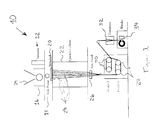
- a Fourne fiber spinning machine 10 such as illustrated in Figure 1
- the polypropylene is passed from a hopper 14 through a heat exchanger 16 where the polymer pellets are heated to a suitable temperature for extrusion, about 180-280°C for the metallocene-based polypropylene used here, and then through a metering pump 18 (also called a spin pump) to a spin extruder 20 (also called a spin pack).
- the portion of the machine from hopper 14 through the spin pack 20 is collectively referred to as extruder 12 .
- the fiber preforms 24 thus formed are cooled in air in quench column 2 2 then passed through a spin finisher 26 .
- the collected fibers are then applied through one or more godets to a take-away roll, illustrated in this embodiment as rolls 28 (also collectively referred to as Godet 1. These rolls are operated at a desired take-away rate (referred to as the G1 speed), about 100-1500 meters per minute, in the present invention.
- the thus-formed filaments are drawn off the spin role to the drawing rollers 30 (also collectively referred to as Godet 2) which are operated at a substantially-enhanced speed (the draw speed or G2 speed) in order to produce the drawn fiber.
- the draw speed normally will range from about 500-4,000 meters per minute and is operated relative to the take-away godet to provide the desired draw ratio normally within the range of 1.5:1 to 6:1.
- the spun and drawn fiber is often passed through a texturizer 32 and then wound up on a winder 34 . While the illustrated embodiment and description encompasses the spinning and drawing of a fully oriented yarn, the same equipment may also be used to make a partially oriented yarn. In that instance the drawing step is left out leaving only the act of spinning the yarn out of the extruder. This step is often accomplished by connecting winder 34 immediately following spin finisher 26 , and certainly involves bypassing drawing rollers 30 .
- the process of melt spinning of polypropylene can be termed as non-isothermal crystallization under elongation.
- the rate of crystallization in this process is highly influenced by the speed of take-away.
- BCF bulk continuous filament
- the present invention involves the use of isotactic polypropylene polymerized in the presence of metallocene catalysts to make fibers, both partially and fully oriented fibers with improved shrinkage characteristics. While applicable in most propylene fibers where the use of isotactic polypropylene is desired, the present description focuses on use in fully-oriented fiber processes such as the Foume process. It is to be recognized that the invention may be applied to oriented fibers in general in addition to the specific application details of the Fourne process which may impose more rigorous concerns with respect to fiber breakage and/or orientation.
- Oriented fibers are characterized in terms of certain well-defined characteristics relating to their stereoregular structures and physical properties, including melt temperatures and shrinkage characteristics, as well as in relatively low coefficients of friction and relatively high tensile moduli.
- the present invention addresses fibers involving the use of isotactic polypropylene as a homopolymer.
- the present invention also involves the use isotactic polypropylene as a primary component either in an ethylene-propylene copolymer or in combination with atactic or syndiotactic polypropylene homopolymer.
- the polymerized mixture will often further include minor amounts (typically less than 1 weight percent, and more typically less than 0.5 weight percent) of additives designed to enhance other physical or optical properties.
- additives designed to enhance other physical or optical properties.
- Such mixtures may have, for example, one or more anti-oxidants present in an amount totaling no more than about 0.25 weight percent (in the tested examples no more than about 0.15 weight percent) and one or more acid neutralizers present in an amount totaling no more than about 0.25 weight percent (in the tested examples no more than about .05 weight percent).
- additives acting as "anti-block" agents may also be present, again in relatively low percentages such as no more than about 1 weight percent, more preferably no more than about 0.5 weight percent, and even more preferably no more than about 0.25 weight percent.
- metallocenes are characterized by the formula: R''(C 5 (R') 4 ) 2 MeQp "Me” is the designation used for the generic transition metal which defines the metallocene catalyst, where Me is a Group 4, 5, or 6 metal from the Periodic Table of Elements but preferably is a Group 4 or 5 metal and more preferably a Group 4 metal, specifically titanium, zirconium, or hafnium. Vanadium is the most suitable of the Group 5 metals. For the present invention, Me is most preferably zirconium.
- R'' is a stable component that bridges the two (C 5 (R') 4 ) rings in order to render the catalyst stereorigid.
- R'' may be organic or inorganic and may include groups depending from the moiety acting as a bridge. Examples of R'' include an alkylene radical having 1-4 carbon atoms, a silicon hydrocarbyl group, a germanium hydrocarbyl group, an alkyl phosphine, an alkyl amine, boron, nitrogen, sulfur, phosphorous, aluminum or groups containing these elements.
- the preferred R'' components are methylene, ethylene, substituted methylene such as isopropylidene and diphenyl methylene, and alkyl silicon, and cycloalkyl silicon moieties such as dicyclopropyl silyl, among others.
- a silicon bridge is most preferable, particularly a dimethylsilyl bridge.
- a preferred practice in forming polypropylene fibers has been to produce the fibers from stereoregular isotactic polypropylene produced by supported Ziegler-Natta catalysts, that is, catalysts such as zirconium or titanium tetrachloride supported on crystalline supports such as magnesium dichloride.
- Canadian Patent Application No. 2,178,104 discloses propylene polymers prepared in the presence of isospecific catalysts incorporating heavily substituted bis(indenyl) ligand structures and the use of such polymers in forming biaxially-oriented polypropylene films.
- the polymers used have a very narrow molecular weight distribution, preferably less than three, and well-defined uniform melting points.
- the ligand structures are substituted on both the cyclopentyl portion of the indenyl structure (at the 2 position), and also on the aromatic portion of the indenyl structure.
- the tri-substituted structures appear to be preferred, and less relatively-bulky substituents are used in the case of 2-methyl, 4-phenyl substituted ligands or the 2-ethyl, 4-phenyl substituted ligands.
- the present invention can be carried out with isotactic polypropylene prepared in the presence of metallocenes, as disclosed in the Canadian Peiffer patent application.
- the present invention may be carried out by employing a polypropylene produced by an isospecific metallocene based upon an indenyl structure which is mono-substituted at the proximal position and otherwise unsubstituted, with the exception that the indenyl group can be hydrogenated at the 4, 5, 6, and 7 positions.
- the ligand structure may be characterized by racemic silyl-bridged bis(2-alkylindenyl) or a 2-alkyl hydrogenated indenyl as indicated by the following structural formulas.
- a specific example is a rac dimethyl silyl bis(2 methyl indenyl ligand structure).
- Mixtures of mono- and poly-substituted indenyl-based metallocenes may be used in producing the polymers used in the present invention.
- Poly-substituted indenyl-based metallocenes may be employed in conjunction with the mono-substituted indenyl structures shown above.
- at least 10% of the metallocene catalyst system should comprise the mono-substituted bis(indenyl) structure.
- at least 25% of the catalyst system comprises the mono-substituted bis(indenyl) metallocene.
- the remainder of the catalyst system can include polysubstituted indenyl-based metallocenes.
- metallocene or metallocene mixture catalyst systems employed in the present invention are used in combination with an alumoxane co-catalyst as will be well understood by those skilled in the art. Normally, methylalumoxane will be employed as a co-catalyst, but various other polymeric alumoxanes, such as ethylalumoxane and isobutylalumoxane, may be employed in lieu of or in conjunction with methylalumoxane.
- co-catalysts in metallocene-based catalyst systems are well-known in the art, as disclosed, for example, in U.S. Patent No. 4,975,403, the entire disclosure of which is incorporated herein by reference.
- alkylaluminum co-catalysts or scavengers are also normally employed in combination with the metallocene alumoxane catalyst systems.
- Suitable alkylaluminum or alkylaluminum halides include trimethyl aluminum, triethylaluminum (TEAL), triisobutylaluminum (TIBAL), and tri-n-octylaluminum (TNOAL). Mixtures of such co-catalysts may also be employed in carrying out the present invention.
- alkylaluminum halides such as diethylaluminum chloride, diethylaluminum bromide, and dimethylaluminum chloride, or dimethylaluminum bromide, may also be used in the practice of the present invention.
- metallocene catalysts employed in the present invention can be used as homogeneous catalyst systems, preferably they are used as supported catalysts.
- Supported catalyst systems are well-known in the art as both conventional Ziegler-Natta and metallocene-type catalysts.
- Suitable supports for use in supporting metallocene catalysts are disclosed, for example, in U.S. Patent No. 4,701,432 to Welborn, and include talc, an inorganic oxide, or a resinous support material such as a polyolefin.
- Specific inorganic oxides include silica and alumina, used alone or in combination with other inorganic oxides such as magnesia, titania, zirconia, and the like.
- the catalyst components in Suga are prepared by mixing the support material, the metallocene, and an organoaluminum compound such as triethylaluminum, trimethylaluminum, various alkylaluminum chlorides, alkoxides, or hydrides or an alumoxane such as methylalumoxane, ethylalumoxane, or the like.
- organoaluminum compound such as triethylaluminum, trimethylaluminum, various alkylaluminum chlorides, alkoxides, or hydrides or an alumoxane such as methylalumoxane, ethylalumoxane, or the like.
- organoaluminum compound such as triethylaluminum, trimethylaluminum, various alkylaluminum chlorides, alkoxides, or hydrides or an alumoxane such as methylalumoxane, eth
- the patent to Matsumoto similarly discloses a supported catalyst in which the support may be provided by inorganic oxide carriers such as SiO 2 , Al 2 O 3 , MgO, ZrO 2 , TiO 2 , Fe 2 O 3 , B 2 O 2 , CaO, ZnO, BaO, ThO 2 and mixtures thereof, such as silica alumina, zeolite, ferrite, and glass fibers.
- inorganic oxide carriers such as SiO 2 , Al 2 O 3 , MgO, ZrO 2 , TiO 2 , Fe 2 O 3 , B 2 O 2 , CaO, ZnO, BaO, ThO 2 and mixtures thereof, such as silica alumina, zeolite, ferrite, and glass fibers.
- Other carriers include MgCl 2 .
- Mg(0-Et) 2 and polymers such as polystyrene, polyethylene, polypropylene, substituted polystyrene and polyarylate, starches, and
- the carriers are described as having a surface area of 50-500 m 2 /g and a particle size of 20-100 microns. Supports such as those described above may be used. Preferred supports for use in carrying out the present invention include silica, having a surface area of about 300-800 m 2 /g and a particle size of about 5-10 microns. Where mixtures of metallocenes are employed in formulating the catalyst system, the support may be treated with an organoaluminum co-catalyst, such as TEAL or TIBAL, and then contacted with a hydrocarbon solution of the metallocenes followed by drying steps to remove the solvent to arrive at a dried particulate catalyst system.
- organoaluminum co-catalyst such as TEAL or TIBAL
- mixtures of separately supported metallocenes may be employed.
- a first metallocene such as racemic dimethylsilyl bis(2-methyl indenyl) zirconium dichloride
- the second di-substituted metallocene such as racemic dimethylsilyl bis(2-methyl, 4-phenyl indenyl) zirconium dichloride
- the two quantities of separately supported metallocenes may then be mixed together to form a heterogeneous catalyst mixture which is employed in the polymerization reaction.
- the fiber-forming operation can be modified in terms of the isotactic polypropylene and its polymerization catalyst and in terms of the fiber spinning parameters to produce fibers of desired physical characteristics during one mode of operation and of another desired physical characteristic or characteristics during another mode of operation.
- Parameters which can be varied include draw speed and spin speed over desired ranges while maintaining the draw ratio constant or varying the draw ratio in order to impact parameters such as percent elongation and toughness.
- a change may be made from a polymer catalyzed by one catalyst system to a polymer catalyzed by a different catalyst system to impact such physical parameters of the fibers while maintaining the draw speed and/or the draw ratio constant or while varying these fiber spinning parameters.
- the use of propylene polymers prepared with the metallocene catalysts is desirable in terms of producing good shrinkage properties at lower draw ratios (for example at draw ratios less than or equal to about 3.5 or more preferably less than or equal to about 3).
- the first set had relatively low melt-flow indices (14, 9, & 11 g/10 min), while the second set had medium melt-flow indices (20, 19, & 22 g/10 min). Additional testing done with high and very high melt-flow indices (above about 30 g/10 min) did not reveal the same significant advantages in shrinkage ratio between the isotactic propylenes polymerized in the presence of a metallocene catalyst and those polymerized in the presence of a more traditional Ziegler-Natta catalyst. The test results provide indication of significant advantages in shrinkage ratio for melt flow indices below about 30 g/10 min.
- the melt spinning and drawing operations were carried out using a trilobal spinnerette with 60 holes (0.3/0.7mm) producing Fully Oriented Yarns (FOY) of 10 denier per fiber (dpf) and Partially Oriented Yarns (POY) of 2 dpf.
- the fibers were spun at their optimum melt temperatures ranging between 200°C to 230°C.
- the draw ratios for the FOY were increased in steps of 0.5 up to their maximum draw, with the final Godet Speed (G2, also referred to as the drawing speed) maintained at 1000 m/min. Samples of about 2400 denier were collected at each draw ratio for the properties testing.
- the spinning fiber was quenched at 2.0 mBar with cool air at 10°C.
- the godet temperatures were maintained at 120°C for the spin godet (G1) and at 100°C at the second godet (G2).
- the linear density desired was maintained by varying the spin pump speed and winder speed accordingly.
- the draw speed (G2) was maintained at a constant 1000 m/min, with the spin speed (G1) gradually decreased to obtain the 0.5 step increases in draw ratio.
- Normal commercial operation has spin and draw speeds of about 500 m/min and 1500 m/min respectively to provide a draw ratio of 3:1.
- the limitations of the material would determine the extent to which the draw ratio can be increased, in the experimental work both the goders and the Barmag winder in the Fourne fiber line have a maximum speed of 6000 m/min.
- the two metallocene-based isotactic polypropylenes (Low MFI MIPP 1 (or “MIPP 1") and Low MFI MIPP 2 (or “MIPP 2”)) and the Ziegler-Natta-based isotactic polypropylene (Low MFI ZNPP 1 (or “ZNPP 1 ”)) were used to prepare melt spun yarns on a Fourne fiber spinning machine. Both partially oriented yarn (POY) and hilly oriented yarn (FOY) were prepared.
- MIPP 1 and MIPP 2 were each generated using a metallocene catalyst, specifically a silyl bridged rac bis indenyl zirconium dichloride. MIPP 1 had a measured melt flow index of 14 grams per 10 minutes with xylene solubles of 0.4%. MIPP 1 also included the following additives (identified here by the tradenames under which they are commercially available): Irganox 1010 (an anti-oxidant) in an amount of 0.073 weight percent.
- Irganox 1076 an anti-oxidant
- Irgafos 168 an anti-oxidant
- calcium stearate an acid neutralizer
- MIPP 2 as noted above was also generated using a metallocene catalyst, specifically ["FINA MiPP Broad MW"] .
- MIPP 2 had a measured melt flow index of 9 grams per 10 minutes with a xylene solubles percentage of 0.5%.
- MIPP 2 included the following additives (identified here by the tradenames under which they are commercially available): Irganox 1076 (an anti-oxidant) in an amount of 0.01 weight percent, Irgafos 168 (an anti-oxidant) in an amount of 0.095 weight percent, Chimasorb 944 (a UV stabilizer) in an amount of 0.031 weight percent, and calcium stearate (an acid neutralizer) in an amount of 0.047 weight percent.
- Irganox 1076 an anti-oxidant
- Irgafos 168 an anti-oxidant
- Chimasorb 944 a UV stabilizer
- calcium stearate an acid neutralizer
- the sample ZNPP 1 was polymerized using a standard Ziegler-Natta catalyst, more specifically a supported titanium tetrachloride catalyst of the type disclosed in the aforementioned Myer patents with a cyclohexyl methyl dimothoxysilane electron donor.
- ZNPP 1 had a measured melt flow index of 11 grams per 10 minutes with xylene solubles of 1.4%.
- ZNPP 1 included the following additives (identified here by the tradenames under which they are commercially available): Irganox 1076 (an anti-oxidant) in an amount of 0.005 weight percent, Ultranox 626 (an anti-oxidant) in an amount of 0.086 weight percent, Atmos 150 (an anti-static agent) in an amount of 0.033 weight percent, and calcium stearate (an acid neutralizer) in an amount of 0.066 weight percent.
- Irganox 1076 an anti-oxidant
- Ultranox 626 an anti-oxidant
- Atmos 150 an anti-static agent
- calcium stearate an acid neutralizer
- the metallocene polypropylenes of MIPP 1 and MIPP 2 have lower melting points than Ziegler-Natta polypropylenes of comparable melt flow index.
- Table 1 shows that ZNPP 1, the Ziegler-Natta polypropylene, had a melting point of 162° C which is at least 10° more than that of the MIPP 1 and MIPP 2 metallocene polymers which were 152° C and 151° C, respectively.
- the metallocene isotactic polypropylene materials had a lower heat absorb for melting (endothermic) and a lower heat evolved during heat recrystallization (exothermic) demonstrating that they have a lower crystalline content than the Ziegler-Natta polypropylene ZNPP 1.
- Low MFI MIPP 1 Low MFI MIPP 2
- Low MFI ZNPP 1 DSC 2nd Melt (°C) 152 151 162 dH, 2nd Melt (J/g) 93 90 107 DSC, Recryst (°C) 110 109 111 dH, Recryst (J/g) -93 -91 -104
- Table 2 shows the gel permeation chromatography results.
- the metallocene compounds or MIPP 1 and MIPP 2 have a narrower molecular weight distribution, as shown by the lower polydispersity index (PDI).
- Low MFI MIPP 1 Low MFI MIPP 2
- Low MFI ZNPP 1 M n (g/mol) 45,000 59,000 29,000 M w (g/mol) 182,000 225,000 239,000 PDI 4.1 3.8 8.3 M 2 (g/mol) 438,000 577,000 928,000
- Figures 2-6 reflect the results of various physical tests performed on the 10 dpf fibers.
- the measured parameter as described below is plotted on the ordinate versus the draw ratio under which the fibers were oriented which is plotted on the abscissa.
- curve 100 illustrates the relationship for MIPP 1 between elongation at break, measured in percent, and draw ratio.
- curve 102 illustrates the relationship for MIPP 2 between elongation at break, measured in percent, and draw ratio.
- curve 104 illustrates the relationship for ZNPP 1 between elongation at break, measured in percent, and draw ratio.
- curve 110 illustrates the relationship for MIPP 1 between tenacity at maximum elongation, measured in grams per denier, and draw ratio.
- curve 112 illustrates the relationship for MIPP 2 between tenacity at maximum elongation, measured in grams per denier, and draw ratio.
- curve 114 illustrates the relationship for ZNPP 1 between tenacity at maximum elongation, measured in grams per denier, and draw ratio.
- curve 120 illustrates the relationship for MIPP 1 between tenacity at 5% elongation, measured in grams per denier, and draw ratio.
- curve 122 illustrates the relationship for MIPP 2 between tenacity at 5% elongation, measured in grams per denier, and draw ratio.
- curve 124 illustrates the relationship for ZNPP 1 between tenacity at 5% elongation, measured in grams per denier, and draw ratio.
- curve 130 illustrates the relationship for MIPP 1 between the tensile modulus at 5% elongation, measured in MPa, and draw ratio.
- curve 132 illustrates the relationship for MIPP 2 between the tensile modulus at 5% elongation, measured in MPa, and draw ratio.
- curve 134 illustrates the relationship for ZNPP 1 between the tensile modulus at 5% elongation, measured in MPa, and draw ratio. While these physical properties compared between the samples are not identical, they show similar curves in similar regions, with the curve for ZNPP 1 in most instances bracketed by the different MIPP curves.
- the elongation for MIPP 1 and ZNPP 1 were slightly higher at lower draw ratios but nearly equal for the three materials with increasing draw ratios.
- its tenacity is lower compared to the other two materials.
- the tensile modulus at 5% elongation separates the three materials.
- curve 140 illustrates the relationship for MIPP 1 between shrinkage, measured in percent, and draw ratio.
- curve 142 illustrates the relationship for MIPP 2 between shrinkage, measured in percent, and draw ratio.
- curve 144 illustrates the relationship for ZNPP 1 between shrinkage, measured in percent, and draw ratio. While the shrinkage for ZNPP 1 starts relatively high, increase initially and reduces at higher draw ratios, the shrinkage for MIPP 1 and MIPP 2 does not change appreciably with draw ratio. This provides unexpected advantages of reduced shrinkage at lower draw ratios for "low" melt-flow index isotactic polypropylenes.
- the work leading up to the results also reveals improved results when the metallocene isotactic polypropylenes are heated in a feeding zone to a temperature within the range of about 190°C to about 210°C followed by heating in an extrusion zone to a temperature within the range of about 225°C to about 235°C immediately prior to extrusion.
- melt-flow index homopolymer resins of isotactic polypropylene were used.
- two of the three resins were isotactic polypropylenes which had been generated by a metallocene catalyst, while the third resin was an isotactic polypropylene generated by a Ziegler-Natta catalyst.
- the two metallocene-based isotactic polypropylenes (Med MFI MIPP 3 (or “MIPP 3") and Med MFI MIPP 4 (or “MIPP 4")) and the Ziegler-Natta-based isotactic polypropylene (Med MFI ZNPP 2 (or "ZNPP 2")) were used to prepare melt spun yarns on a Fourne fiber spinning machine. Both partially oriented yarn (POY) and fully oriented yarn (FOY) were prepared.
- MIPP 3 and MIPP4 were each produced by polymerization of propylene using a metallocene catalyst of the type described previously to produce a narrower molecular weight distribution than MIPP2 and PIPP2.
- MIPP 3 had a measured melt flow index of 20 grams per 10 minutes with xylene solubles of 0.49%.
- MIPP 3 also included the following additives (identified here by the tradenames under which they are commercially available): Irganox 1010 (an anti-oxidant) in an amount of 0.065 weight percent, Irganox 1076 (an anti-oxidant) in an amount of 0.005 weight percent, Irgafos 168 (an anti-oxidant) in an amount of 0.05 weight percent, and calcium stearate (an acid neutralizer) in an amount of 0.047 weight percent.
- Irganox 1010 an anti-oxidant
- Irganox 1076 an anti-oxidant
- Irgafos 168 an anti-oxidant
- calcium stearate an acid neutralizer
- MIPP 4 had a measured melt flow index of 19 grams per 10 minutes with a xylene solubles percentage of 0.39%.
- MIPP 4 included the following additives (identified here by the tradenames under which they are commercially available): Irganox 1076 (an anti-oxidant) in an amount of 0.005 weight percent, Irgafos 168 (an anti-oxidant) in an amount of 0.1 weight percent, Chimasorb 944 (a UV stabilizer) in an amount of 0.038 weight percent, and calcium stearate (an acid neutralizer) in an amount of 0.05 weight percent.
- Irganox 1076 an anti-oxidant
- Irgafos 168 an anti-oxidant
- Chimasorb 944 a UV stabilizer
- calcium stearate an acid neutralizer
- ZNPP 2 was polymerized using a standard supported Ziegler-Natta catalyst, specifically of the type described previously.
- ZNPP 2 had a measured melt flow index of 22 grams per 10 minutes with xylene solubles of 2.18%.
- ZNPP 2 included the following additives (identified here by the tradenames under which they are commercially available): Irganox 1076 (an anti-oxidant) in an amount of 0.005 weight percent, Irganox 3114 (an anti-oxidant) in an amount or 0.068 weight percent, Irgafos 168 (an anti-oxidant) in an amount of 0.059 weight percent, Atmos 150 (an anti-static agent) in an amount of 0.029 weight percent, and calcium stearate (an acid neutralizer) in an amount of 0.064 weight percent.
- Irganox 1076 an anti-oxidant
- Irganox 3114 an anti-oxidant
- Irgafos 168 an anti-oxidant
- Atmos 150
- the metallocene polypropylenes of MIPP 3 and MIPP 4 have lower melting points than Ziegler-Natta polypropylenes of comparable melt flow index.
- Table 4 shows that ZNPP 2, the Ziegler-Natta polypropylene, had a melting point of 162° C which is at least 10° more than that of the MIPP 1 and MIPP 2 metallocene polymers which were both at 152° C.
- the metallocene isotactic polypropylene materials had a lower heat absorb for melting (endothermic) and a lower heat evolved during heat recrystallization (exothermic) demonstrating that they have a lower crystalline content than the Ziegler-Natta polypropylene ZNPP 2.
- Med MFI MIPP 3 Med MFI MIPP 4 Med MFI ZNPP 2 DSC 2nd Melt (°C) 152 152 162 dH, 2nd Melt (J/g) 91 92 100 DSC, Recryst (°C) 109 106 112 dH, Recryst (J/g) -89 -91 -101
- Table 5 shows the gel permeation chromatography results for the two MIPP's. Comparative results for ZNPP 2 are not shown. Med MFI MIPP 3 Med MFI MIPP 4 Med MFI ZNPP 2 M n (g/mol) 57,000 79,000 ----- M w (g/mol) 230,000 233,000 ----- PDI 4.0 2.9 ----- M 2 (g/mol) 534,000 495,000 -----
- the actual processing of fully and partially oriented yarns from the base resins was accomplished on a Fourne fiber line as addressed above.
- the processing details are shown in Table 6 below.
- the two metallocene catalyzed resins were processed at a melt temperatures of 220° C and 210° C, respectively, with the Ziegler-Natta catalyzed resin processed at 220° C.
- Pellet feeding problems were again observed in the extruder for the two MIPP resins. Raising the temperature of the feeding zone to 220°C alleviated the feeding problem.
- the spinnabilities of the two MIPP resins were lower than ZNPP 2, but the maximum draw ratios were slightly higher. Also, the spin and draw tensions for MIPP 3 and MIPP 4 were lower during the spinning process.
- Figures 7-11 reflect the results of various physical tests performed on the 10 dpf fibers.
- the measured parameter as described below is plotted on the ordinate versus the draw ratio under which the fibers were oriented which is plotted on the abscissa.
- curve 200 illustrates the relationship for MIPP 3 between elongation at break, measured in percent, and draw ratio.
- curve 202 illustrates the relationship for MIPP 4 between elongation at break, measured in percent, and draw ratio.
- curve 204 illustrates the relationship for ZNPP 2 between elongation at break, measured in percent, and draw ratio.
- curve 210 illustrates the relationship for MIPP 3 between tenacity at maximum elongation, measured in grams per denier, and draw ratio.
- curve 212 illustrates the relationship for MIPP 4 between tenacity at maximum elongation, measured in grams per denier, and draw ratio.
- curve 214 illustrates the relationship for ZNPP 2 between tenacity at maximum elongation, measured in grains per denier, and draw ratio.
- curve 220 illustrates the relationship for MIPP 3 between tenacity at 5% elongation, measured in grams per denier, and draw ratio.
- curve 222 illustrates the relationship for MIPP 4 between tenacity at 5% elongation, measured in grams per denier, and draw ratio.
- curve 224 illustrates the relationship for ZNPP 2 between tenacity at 5% elongation, measured in grams per denier, and draw ratio.
- curve 230 illustrates the relationship for MIPP 3 between the tensile modulus at 5% elongation, measured in MPa, and draw ratio.
- curve 232 illustrates the relationship for MIPP 4 between the tensile modulus at 5% elongation, measured in MPa, and draw ratio.
- curve 234 illustrates the relationship for ZNPP 2 between the tensile modulus at 5% elongation, measured in MPa, and draw ratio. While these physical properties compared between the samples are not identical, they show similar curves in similar regions, with the curve for ZNPP 2 in most instances near to or bracketed by the different MIPP curves.
- the elongation for MIPP 4 is slightly higher at middle draw ratios than MIPP 3 and ZNPP 2.
- MIPP 3 which showed lower draw tensions, did not have a drop in tenacity with draw ratio. There was no real difference in tenacity values among the three resins at low extensions. The tensile modulus values at 5% extension for MIPP 3 and ZNPP 2 were higher than that for MIPP 4.
- curve 240 illustrates the relationship for MIPP 3 between shrinkage, measured in percent, and draw ratio.
- curve 242 illustrates the relationship for MIPP 4 between shrinkage, measured in percent, and draw ratio.
- curve 244 illustrates the relationship for ZNPP 2 between shrinkage, measured in percent, and draw ratio.
- the shrinkage for ZNPP 2 again starts relatively high, increases initially and reduces at higher draw ratios.
- the shrinkage values for MIPP 3 and MIPP 4 did not change appreciably with draw ratio. This provides unexpected advantages of reduced shrinkage at lower draw ratios for "medium" melt flow index isotactic polypropylenes as well.
- the shrinkage percentages at 132°C are at least about 10% less than the shrinkage percentages at 132° C for the Ziegler-Natta catalyzed isotactic polypropylene at draw ratios below about 3.0 and at least about 25% less at draw ratios within the range of about 1.5 to about 2.5.
- the work leading up to the results also revealed improved results when the metallocene isotactic polypropylenes are heated in a feeding zone to a temperature within the range of about 215°C to about 225°C followed by heating in an extrusion zone to a temperature within the range of about 205°C to about 225°C immediately prior to extrusion.
- a further embodiment of the present invention involves the operation of a fiber production line in which changes in the isotactic propylene polymer feed may be made between a Ziegler-Natta isotactic polypropylene and a metallocene isotactic polypropylene.
- the line may be operated employing an isotactic propylene polymer produced by propylene polymerization in the presence of a conventional Ziegler-Natta catalyst of the type disclosed, for example, in the aforementioned patent to Myer et al.
- the specific example of such a Ziegler-Natta-based polypropylene would be propylene produced by the homopolymerization of propylene in the presence of a Ziegler-Natta catalyst, specifically a titanium tetrachloride catalyst supported on magnesium dichloride.
- a Ziegler-Natta catalyst specifically a titanium tetrachloride catalyst supported on magnesium dichloride.
- the propylene polymer product supplied to the preheating and extruding step is switched to a metallocene-based polymer produced by the homopolymerization of propylene in the presence of a metallocene catalyst, preferably a silicon-bridged metallocene catalyst with zirconium as the transition metal.
- a preferred method implementing this embodiment would produce polypropylene fibers using first Ziegler-Natta catalyzed polypropylene followed by the use of metallocene catalyzed polypropylene.
- the system would be provided with a polypropylene polymer with a melt flow index no more than about 25 grams per 10 minutes, comprising isotactic polypropylene produced by the polymerization of polypropylene in the presence of an isospecific Ziegler-Natta catalyst. This would be followed by heating the polypropylene polymer to a molten state and extruding said molten polymer to form a first fiber preform.
- the first fiber preform would be spun at a take-away speed of at least about 333 meters per minute and subsequently drawn at a drawing speed of at least about 500 meters per minute with the two speeds selected to provide a draw ratio of no more than about 3. This would produce a first continuous polypropylene fiber having a defined percentage shrinkage at 132°C. If an improved shrinkage percentage was then desired, the process could move forward by continuing to provide a polypropylene polymer with a melt flow index no more than about 25 grams per 10 minutes, but in this case use a polymer produced by the polymerization of polypropylene in the presence of an isospecific metallocene catalyst. This polymer would also be heated to a molten state and extruded to form a second fiber preform.
- the second fiber preform would be spun at a take-away speed of at least about 333 meters per minute and subsequently drawn at a drawing speed of at least about 500 meters per minute with the two speeds selected to provide a draw ratio within the range of about 1.5 to about 3 to produce a second continuous polypropylene fiber. It would be desirable for this fiber (the metallocene catalyzed fiber) to have a shrinkage percentage at 132°C which is at least about 25% less than the defined shrinkage percentage of the first (Ziegler-Natta catalyzed) continuous polypropylene fiber as evidenced in the examples herein.
- the shrinkage percentage of the second (metallocene catalyzed) continuous polypropylene fiber would desirably be at least about 10% less than the defined shrinkage percentage of the first (Ziegler-Natta catalyzed) continuous polypropylene fiber.
- improved shrinkage properties in spun and drawn fibers may be obtained in metallocene catalyzed isotactic polypropylenes, where the melt-flow indices are no more than about 25 grams per 10 minutes, and where the draw ratios are no more than about 3.
- the take-away speed is preferably at least about 333 meters per minutes and the drawing speed no more than about 1,000 meters per minute.
- the take-away speed is preferably at least about 1,000 meters per minutes and the drawing speed is preferably no more than about 3,000 meters per minute.
- additional preferable features of the process include increasing the temperature in the feeding zone (the early portion of the extruder immediately following insertion through the hopper in the example discussed above) above that which is normally expected.
- the metallocene catalyzed isotactic polypropylene is heated in the feeding zone to a temperature within the range of about 180°C to about 225°C followed by heating in the extrusion zone to a temperature within the range of about 215°C to about 240°C immediately prior to extrusion of the isotactic polypropylene polymer.
Landscapes
- Chemical & Material Sciences (AREA)
- Chemical Kinetics & Catalysis (AREA)
- General Chemical & Material Sciences (AREA)
- Engineering & Computer Science (AREA)
- Textile Engineering (AREA)
- Artificial Filaments (AREA)
- Compositions Of Macromolecular Compounds (AREA)
- Addition Polymer Or Copolymer, Post-Treatments, Or Chemical Modifications (AREA)
Applications Claiming Priority (2)
| Application Number | Priority Date | Filing Date | Title |
|---|---|---|---|
| US09/328,924 US6416699B1 (en) | 1999-06-09 | 1999-06-09 | Reduced shrinkage in metallocene isotactic polypropylene fibers |
| US328924 | 2002-12-24 |
Publications (2)
| Publication Number | Publication Date |
|---|---|
| EP1059370A1 true EP1059370A1 (fr) | 2000-12-13 |
| EP1059370B1 EP1059370B1 (fr) | 2010-09-01 |
Family
ID=23283066
Family Applications (1)
| Application Number | Title | Priority Date | Filing Date |
|---|---|---|---|
| EP00202005A Expired - Lifetime EP1059370B1 (fr) | 1999-06-09 | 2000-06-07 | Fibres isotactiques de polypropylène catalysé par métallocènes à retrait réduit |
Country Status (7)
| Country | Link |
|---|---|
| US (2) | US6416699B1 (fr) |
| EP (1) | EP1059370B1 (fr) |
| JP (1) | JP2001020131A (fr) |
| AT (1) | ATE479785T1 (fr) |
| DE (1) | DE60044890D1 (fr) |
| DK (1) | DK1059370T3 (fr) |
| ES (1) | ES2349500T3 (fr) |
Cited By (6)
| Publication number | Priority date | Publication date | Assignee | Title |
|---|---|---|---|---|
| WO2002086207A1 (fr) * | 2001-04-24 | 2002-10-31 | Rhodia Industrial Yarns Ag | Procede pour produire des monofilaments fins en polypropylene, monofilaments fins en polypropylene et leur utilisation |
| EP1279754A3 (fr) * | 2001-07-27 | 2003-07-30 | Fina Technology, Inc. | Fibres filées au fondu à base de copolymères statistiques de propylène-alpha-oléfines catalysés aux métallocènes |
| FR2868437A1 (fr) * | 2004-03-30 | 2005-10-07 | Rhodia Chimie Sa | Monofilaments a base de polypropylene a proprietes ameliorees |
| AU2002352212B2 (en) * | 2001-12-05 | 2006-09-28 | Rhodia Industrial Yarns Ag | Method for making propylene monofilaments, propylene monofilaments and their use |
| CN101798711A (zh) * | 2010-03-26 | 2010-08-11 | 山东爱地高分子材料有限公司 | 超高分子量聚乙烯纤维的无断点直纺连续生产方法 |
| CN101768846B (zh) * | 2010-01-22 | 2012-06-13 | 苏州华绸科技有限公司 | 弹力真丝反应釜 |
Families Citing this family (19)
| Publication number | Priority date | Publication date | Assignee | Title |
|---|---|---|---|---|
| US6416699B1 (en) * | 1999-06-09 | 2002-07-09 | Fina Technology, Inc. | Reduced shrinkage in metallocene isotactic polypropylene fibers |
| TW477835B (en) * | 1999-07-06 | 2002-03-01 | Pyung-Yul Park | Polypropylene fiber and preparation thereof |
| MY120636A (en) * | 1999-11-10 | 2005-11-30 | Kolon Glotech Inc | Polypropylene fiber and preparation thereof |
| US6758994B2 (en) * | 2002-03-28 | 2004-07-06 | Fina Technology, Inc. | Method of producing polypropylene tapes |
| US6878327B2 (en) * | 2002-04-19 | 2005-04-12 | Fina Technology, Inc. | Process of making polypropylene fibers |
| ES2394304T3 (es) | 2002-10-15 | 2013-01-30 | Exxonmobil Chemical Patents, Inc. | Sistema de múltiples catalizadores para la polimerización de olefinas y polímeros producidos a partir de éstos |
| US7550528B2 (en) | 2002-10-15 | 2009-06-23 | Exxonmobil Chemical Patents Inc. | Functionalized olefin polymers |
| US7700707B2 (en) | 2002-10-15 | 2010-04-20 | Exxonmobil Chemical Patents Inc. | Polyolefin adhesive compositions and articles made therefrom |
| JP2006521225A (ja) * | 2003-02-26 | 2006-09-21 | オムリドン・テクノロジーズ・エルエルシー | 高分子ゲル・プロセッシング法及び高モジュラス製品 |
| US20060009603A1 (en) * | 2004-07-09 | 2006-01-12 | David Young | Fibrillation-resistant polypropylene tape |
| US7138474B1 (en) * | 2005-05-03 | 2006-11-21 | Fina Technology, Inc. | End use articles derived from polypropylene homopolymers and random copolymers |
| US20070040292A1 (en) * | 2005-08-22 | 2007-02-22 | Fina Technology, Inc. | Polypropylene composition for high gloss retention |
| US7589138B2 (en) * | 2006-12-05 | 2009-09-15 | Fina Technology, Inc. | Injection molding process |
| US7745527B2 (en) * | 2006-12-15 | 2010-06-29 | Fina Technology, Inc. | Polyethylene-syndiotactic polypropylene composition and processing thereof |
| US8623261B2 (en) * | 2007-12-13 | 2014-01-07 | Fina Technology, Inc. | Transforming process |
| CN104884478B (zh) | 2012-12-03 | 2017-09-19 | 埃克森美孚化学专利公司 | 丙烯聚合物 |
| US9322114B2 (en) | 2012-12-03 | 2016-04-26 | Exxonmobil Chemical Patents Inc. | Polypropylene fibers and fabrics |
| JP6597020B2 (ja) * | 2015-07-24 | 2019-10-30 | 三菱ケミカル株式会社 | ポリプロピレン繊維の製造方法と高強度のポリプロピレン繊維 |
| EP3327189A4 (fr) * | 2015-07-24 | 2018-07-18 | Mitsubishi Chemical Corporation | Fibre de polypropylène et procédé permettant de fabriquer des fibres de polypropylène |
Citations (3)
| Publication number | Priority date | Publication date | Assignee | Title |
|---|---|---|---|---|
| EP0600461A2 (fr) * | 1992-12-02 | 1994-06-08 | Hoechst Aktiengesellschaft | Composition de moulage à base de polyoléfine pour la fabrication de fibres, filaments et non-tissés par des procédé de filage au fondu |
| WO1994028219A1 (fr) * | 1993-05-25 | 1994-12-08 | Exxon Chemical Patents Inc. | Nouvelles fibres en polyolefines et tissus fabriques a l'aide desdits fibres |
| EP0905290A2 (fr) * | 1997-09-24 | 1999-03-31 | Fina Technology, Inc. | Fibres de polypropylène |
Family Cites Families (18)
| Publication number | Priority date | Publication date | Assignee | Title |
|---|---|---|---|---|
| YU35844B (en) | 1968-11-25 | 1981-08-31 | Montedison Spa | Process for obtaining catalysts for the polymerization of olefines |
| NL162664B (nl) | 1969-06-20 | 1980-01-15 | Montedison Spa | Werkwijze om een katalysator te bereiden voor de poly- merisatie van alkenen-1. |
| JPS5947418A (ja) | 1982-09-07 | 1984-03-17 | Chisso Corp | 熱収縮性改良フラツトヤ−ン |
| US4808561A (en) | 1985-06-21 | 1989-02-28 | Exxon Chemical Patents Inc. | Supported polymerization catalyst |
| US4692380A (en) | 1985-08-06 | 1987-09-08 | Hercules Incorporated | Metallizable polypropylene film |
| US4701432A (en) | 1985-11-15 | 1987-10-20 | Exxon Chemical Patents Inc. | Supported polymerization catalyst |
| US4794096A (en) | 1987-04-03 | 1988-12-27 | Fina Technology, Inc. | Hafnium metallocene catalyst for the polymerization of olefins |
| US4975403A (en) | 1987-09-11 | 1990-12-04 | Fina Technology, Inc. | Catalyst systems for producing polyolefins having a broad molecular weight distribution |
| US5243002A (en) | 1988-07-15 | 1993-09-07 | Fina Technology, Inc. | Process and catalyst for producing syndiotactic polymers |
| US4892851A (en) | 1988-07-15 | 1990-01-09 | Fina Technology, Inc. | Process and catalyst for producing syndiotactic polyolefins |
| FI112252B (fi) | 1990-02-05 | 2003-11-14 | Fibervisions L P | Korkealämpötilasietoisia kuitusidoksia |
| US5272003A (en) | 1990-10-26 | 1993-12-21 | Exxon Chemical Patents Inc. | Meso triad syndiotactic polypropylene fibers |
| TW218884B (fr) | 1991-05-01 | 1994-01-11 | Mitsubishi Kakoki Kk | |
| DE69222700T2 (de) | 1991-07-11 | 1998-03-26 | Idemitsu Kosan Co | Verfahren zur Herstellung von Polymeren auf Olefinbasis und Olefin-Polymerisationskatalysatoren |
| CN2178104Y (zh) | 1993-09-30 | 1994-09-28 | 无锡市第四人民医院 | 人工胸壁 |
| US6090872A (en) * | 1998-10-05 | 2000-07-18 | Fina Technology, Inc. | Polymerization process |
| US6248835B1 (en) * | 1998-11-05 | 2001-06-19 | Fina Technology, Inc. | Polypropylene/polystyrene polymer blend, improved fibers produced from the blend and method of manufacturing |
| US6416699B1 (en) * | 1999-06-09 | 2002-07-09 | Fina Technology, Inc. | Reduced shrinkage in metallocene isotactic polypropylene fibers |
-
1999
- 1999-06-09 US US09/328,924 patent/US6416699B1/en not_active Expired - Fee Related
-
2000
- 2000-06-02 JP JP2000165819A patent/JP2001020131A/ja active Pending
- 2000-06-07 AT AT00202005T patent/ATE479785T1/de not_active IP Right Cessation
- 2000-06-07 DK DK00202005.5T patent/DK1059370T3/da active
- 2000-06-07 ES ES00202005T patent/ES2349500T3/es not_active Expired - Lifetime
- 2000-06-07 DE DE60044890T patent/DE60044890D1/de not_active Expired - Lifetime
- 2000-06-07 EP EP00202005A patent/EP1059370B1/fr not_active Expired - Lifetime
-
2001
- 2001-10-22 US US10/007,237 patent/US6565970B2/en not_active Expired - Fee Related
Patent Citations (3)
| Publication number | Priority date | Publication date | Assignee | Title |
|---|---|---|---|---|
| EP0600461A2 (fr) * | 1992-12-02 | 1994-06-08 | Hoechst Aktiengesellschaft | Composition de moulage à base de polyoléfine pour la fabrication de fibres, filaments et non-tissés par des procédé de filage au fondu |
| WO1994028219A1 (fr) * | 1993-05-25 | 1994-12-08 | Exxon Chemical Patents Inc. | Nouvelles fibres en polyolefines et tissus fabriques a l'aide desdits fibres |
| EP0905290A2 (fr) * | 1997-09-24 | 1999-03-31 | Fina Technology, Inc. | Fibres de polypropylène |
Cited By (11)
| Publication number | Priority date | Publication date | Assignee | Title |
|---|---|---|---|---|
| WO2002086207A1 (fr) * | 2001-04-24 | 2002-10-31 | Rhodia Industrial Yarns Ag | Procede pour produire des monofilaments fins en polypropylene, monofilaments fins en polypropylene et leur utilisation |
| US6805955B2 (en) | 2001-04-24 | 2004-10-19 | Rhodia Industrial Yarns Ag | Method for producing fine monofilaments consisting of polypropylene, fine monofilaments consisting of polypropylene and the use thereof |
| US7214426B2 (en) | 2001-04-24 | 2007-05-08 | Rhodia Industrial Yarns Ag | Production of polypropylene fine monofilaments, polypropylene fine monofilaments and use thereof |
| CN100355952C (zh) * | 2001-04-24 | 2007-12-19 | 罗狄亚工业纱线股份公司 | 聚丙烯细单丝的生产方法,聚丙烯细单丝及其用途 |
| EP1279754A3 (fr) * | 2001-07-27 | 2003-07-30 | Fina Technology, Inc. | Fibres filées au fondu à base de copolymères statistiques de propylène-alpha-oléfines catalysés aux métallocènes |
| AU2002352212B2 (en) * | 2001-12-05 | 2006-09-28 | Rhodia Industrial Yarns Ag | Method for making propylene monofilaments, propylene monofilaments and their use |
| FR2868437A1 (fr) * | 2004-03-30 | 2005-10-07 | Rhodia Chimie Sa | Monofilaments a base de polypropylene a proprietes ameliorees |
| WO2005100648A1 (fr) * | 2004-03-30 | 2005-10-27 | Rhodia Chimie | Monofilaments a base de polypropylene a proprietes ameliorees. |
| AU2005233340B2 (en) * | 2004-03-30 | 2008-08-07 | Monosuisse Ag | Polypropylene monofilaments with improved properties |
| CN101768846B (zh) * | 2010-01-22 | 2012-06-13 | 苏州华绸科技有限公司 | 弹力真丝反应釜 |
| CN101798711A (zh) * | 2010-03-26 | 2010-08-11 | 山东爱地高分子材料有限公司 | 超高分子量聚乙烯纤维的无断点直纺连续生产方法 |
Also Published As
| Publication number | Publication date |
|---|---|
| ES2349500T3 (es) | 2011-01-04 |
| DE60044890D1 (de) | 2010-10-14 |
| DK1059370T3 (da) | 2010-11-01 |
| US6565970B2 (en) | 2003-05-20 |
| US20020146560A1 (en) | 2002-10-10 |
| EP1059370B1 (fr) | 2010-09-01 |
| ATE479785T1 (de) | 2010-09-15 |
| US6416699B1 (en) | 2002-07-09 |
| JP2001020131A (ja) | 2001-01-23 |
Similar Documents
| Publication | Publication Date | Title |
|---|---|---|
| US6565970B2 (en) | Reduced shrinkage in metallocene isotactic polypropylene fibers | |
| US6146758A (en) | Polypropylene fibers | |
| EP1279754B1 (fr) | Fibres filées au fondu à base de copolymères statistiques de propylène-alpha-oléfines catalysés aux métallocènes | |
| US6878327B2 (en) | Process of making polypropylene fibers | |
| EP0905173A1 (fr) | Films de polypropylène à orientation biaxiale obtenus au moyen d'un catalyseur métallocène | |
| EP0747430B1 (fr) | Mélanges de petites quantités de polypropylène syndiotactique avec polypropylène isotactique dans un réacteur | |
| US6090872A (en) | Polymerization process | |
| US20060241254A1 (en) | Polypropylene blends having a narrow molecular weight distribution | |
| US6758994B2 (en) | Method of producing polypropylene tapes | |
| US6824721B2 (en) | Polypropylene fibers | |
| KR20200051498A (ko) | 이성분계 섬유용 수지 조성물 | |
| US7025919B2 (en) | Syndiotactic polypropylene fibers | |
| US7098277B2 (en) | Polypropylene films | |
| US11845816B2 (en) | Drawn articles of low MTI metallocene polypropylene and process to produce such drawn articles | |
| US20030236378A1 (en) | For producing propylene polymers that are suited for fiber spinning | |
| KR102860011B1 (ko) | 폴리프로필렌계 섬유의 제조 방법 및 이에 따라 제조된 폴리프로필렌계 섬유 | |
| US20060009603A1 (en) | Fibrillation-resistant polypropylene tape |
Legal Events
| Date | Code | Title | Description |
|---|---|---|---|
| PUAI | Public reference made under article 153(3) epc to a published international application that has entered the european phase |
Free format text: ORIGINAL CODE: 0009012 |
|
| 17P | Request for examination filed |
Effective date: 20000607 |
|
| AK | Designated contracting states |
Kind code of ref document: A1 Designated state(s): AT BE CH CY DE DK ES FI FR GB GR IE IT LI LU MC NL PT SE |
|
| AX | Request for extension of the european patent |
Free format text: AL;LT;LV;MK;RO;SI |
|
| AKX | Designation fees paid |
Free format text: AT BE CH CY DE DK ES FI FR GB GR IE IT LI LU MC NL PT SE |
|
| 17Q | First examination report despatched |
Effective date: 20040505 |
|
| RAP1 | Party data changed (applicant data changed or rights of an application transferred) |
Owner name: TOTAL PETROCHEMICALS RESEARCH FELUY |
|
| 17Q | First examination report despatched |
Effective date: 20040505 |
|
| GRAP | Despatch of communication of intention to grant a patent |
Free format text: ORIGINAL CODE: EPIDOSNIGR1 |
|
| GRAS | Grant fee paid |
Free format text: ORIGINAL CODE: EPIDOSNIGR3 |
|
| GRAA | (expected) grant |
Free format text: ORIGINAL CODE: 0009210 |
|
| AK | Designated contracting states |
Kind code of ref document: B1 Designated state(s): AT BE CH CY DE DK ES FI FR GB GR IE IT LI LU MC NL PT SE |
|
| REG | Reference to a national code |
Ref country code: GB Ref legal event code: FG4D |
|
| REG | Reference to a national code |
Ref country code: CH Ref legal event code: EP |
|
| REG | Reference to a national code |
Ref country code: IE Ref legal event code: FG4D |
|
| REF | Corresponds to: |
Ref document number: 60044890 Country of ref document: DE Date of ref document: 20101014 Kind code of ref document: P |
|
| REG | Reference to a national code |
Ref country code: DK Ref legal event code: T3 |
|
| REG | Reference to a national code |
Ref country code: SE Ref legal event code: TRGR |
|
| REG | Reference to a national code |
Ref country code: NL Ref legal event code: VDEP Effective date: 20100901 |
|
| REG | Reference to a national code |
Ref country code: ES Ref legal event code: FG2A Effective date: 20101221 |
|
| PG25 | Lapsed in a contracting state [announced via postgrant information from national office to epo] |
Ref country code: AT Free format text: LAPSE BECAUSE OF FAILURE TO SUBMIT A TRANSLATION OF THE DESCRIPTION OR TO PAY THE FEE WITHIN THE PRESCRIBED TIME-LIMIT Effective date: 20100901 |
|
| PG25 | Lapsed in a contracting state [announced via postgrant information from national office to epo] |
Ref country code: CY Free format text: LAPSE BECAUSE OF FAILURE TO SUBMIT A TRANSLATION OF THE DESCRIPTION OR TO PAY THE FEE WITHIN THE PRESCRIBED TIME-LIMIT Effective date: 20100901 |
|
| PG25 | Lapsed in a contracting state [announced via postgrant information from national office to epo] |
Ref country code: GR Free format text: LAPSE BECAUSE OF FAILURE TO SUBMIT A TRANSLATION OF THE DESCRIPTION OR TO PAY THE FEE WITHIN THE PRESCRIBED TIME-LIMIT Effective date: 20101202 Ref country code: NL Free format text: LAPSE BECAUSE OF FAILURE TO SUBMIT A TRANSLATION OF THE DESCRIPTION OR TO PAY THE FEE WITHIN THE PRESCRIBED TIME-LIMIT Effective date: 20100901 |
|
| PG25 | Lapsed in a contracting state [announced via postgrant information from national office to epo] |
Ref country code: PT Free format text: LAPSE BECAUSE OF FAILURE TO SUBMIT A TRANSLATION OF THE DESCRIPTION OR TO PAY THE FEE WITHIN THE PRESCRIBED TIME-LIMIT Effective date: 20110103 |
|
| PLBE | No opposition filed within time limit |
Free format text: ORIGINAL CODE: 0009261 |
|
| STAA | Information on the status of an ep patent application or granted ep patent |
Free format text: STATUS: NO OPPOSITION FILED WITHIN TIME LIMIT |
|
| 26N | No opposition filed |
Effective date: 20110606 |
|
| PGFP | Annual fee paid to national office [announced via postgrant information from national office to epo] |
Ref country code: NL Payment date: 20110621 Year of fee payment: 12 |
|
| REG | Reference to a national code |
Ref country code: DE Ref legal event code: R097 Ref document number: 60044890 Country of ref document: DE Effective date: 20110606 |
|
| REG | Reference to a national code |
Ref country code: CH Ref legal event code: PL |
|
| REG | Reference to a national code |
Ref country code: IE Ref legal event code: MM4A |
|
| PG25 | Lapsed in a contracting state [announced via postgrant information from national office to epo] |
Ref country code: LI Free format text: LAPSE BECAUSE OF NON-PAYMENT OF DUE FEES Effective date: 20110630 Ref country code: CH Free format text: LAPSE BECAUSE OF NON-PAYMENT OF DUE FEES Effective date: 20110630 Ref country code: IE Free format text: LAPSE BECAUSE OF NON-PAYMENT OF DUE FEES Effective date: 20110607 |
|
| PGFP | Annual fee paid to national office [announced via postgrant information from national office to epo] |
Ref country code: ES Payment date: 20120627 Year of fee payment: 13 |
|
| PG25 | Lapsed in a contracting state [announced via postgrant information from national office to epo] |
Ref country code: MC Free format text: LAPSE BECAUSE OF NON-PAYMENT OF DUE FEES Effective date: 20110630 |
|
| PG25 | Lapsed in a contracting state [announced via postgrant information from national office to epo] |
Ref country code: LU Free format text: LAPSE BECAUSE OF NON-PAYMENT OF DUE FEES Effective date: 20110607 |
|
| PGFP | Annual fee paid to national office [announced via postgrant information from national office to epo] |
Ref country code: SE Payment date: 20130619 Year of fee payment: 14 Ref country code: DK Payment date: 20130619 Year of fee payment: 14 Ref country code: GB Payment date: 20130619 Year of fee payment: 14 Ref country code: DE Payment date: 20130620 Year of fee payment: 14 |
|
| PGFP | Annual fee paid to national office [announced via postgrant information from national office to epo] |
Ref country code: FI Payment date: 20130613 Year of fee payment: 14 Ref country code: IT Payment date: 20130625 Year of fee payment: 14 Ref country code: FR Payment date: 20130703 Year of fee payment: 14 |
|
| PGFP | Annual fee paid to national office [announced via postgrant information from national office to epo] |
Ref country code: BE Payment date: 20130619 Year of fee payment: 14 |
|
| REG | Reference to a national code |
Ref country code: DE Ref legal event code: R119 Ref document number: 60044890 Country of ref document: DE |
|
| REG | Reference to a national code |
Ref country code: DK Ref legal event code: EBP Effective date: 20140630 |
|
| PG25 | Lapsed in a contracting state [announced via postgrant information from national office to epo] |
Ref country code: FI Free format text: LAPSE BECAUSE OF NON-PAYMENT OF DUE FEES Effective date: 20140607 Ref country code: SE Free format text: LAPSE BECAUSE OF NON-PAYMENT OF DUE FEES Effective date: 20140608 |
|
| REG | Reference to a national code |
Ref country code: SE Ref legal event code: EUG |
|
| GBPC | Gb: european patent ceased through non-payment of renewal fee |
Effective date: 20140607 |
|
| REG | Reference to a national code |
Ref country code: DE Ref legal event code: R119 Ref document number: 60044890 Country of ref document: DE Effective date: 20150101 |
|
| REG | Reference to a national code |
Ref country code: FR Ref legal event code: ST Effective date: 20150227 |
|
| PG25 | Lapsed in a contracting state [announced via postgrant information from national office to epo] |
Ref country code: IT Free format text: LAPSE BECAUSE OF NON-PAYMENT OF DUE FEES Effective date: 20140607 Ref country code: DE Free format text: LAPSE BECAUSE OF NON-PAYMENT OF DUE FEES Effective date: 20150101 |
|
| PG25 | Lapsed in a contracting state [announced via postgrant information from national office to epo] |
Ref country code: FR Free format text: LAPSE BECAUSE OF NON-PAYMENT OF DUE FEES Effective date: 20140630 Ref country code: GB Free format text: LAPSE BECAUSE OF NON-PAYMENT OF DUE FEES Effective date: 20140607 |
|
| REG | Reference to a national code |
Ref country code: ES Ref legal event code: FD2A Effective date: 20150729 |
|
| PG25 | Lapsed in a contracting state [announced via postgrant information from national office to epo] |
Ref country code: DK Free format text: LAPSE BECAUSE OF NON-PAYMENT OF DUE FEES Effective date: 20140630 |
|
| PG25 | Lapsed in a contracting state [announced via postgrant information from national office to epo] |
Ref country code: ES Free format text: LAPSE BECAUSE OF NON-PAYMENT OF DUE FEES Effective date: 20140608 |
|
| PG25 | Lapsed in a contracting state [announced via postgrant information from national office to epo] |
Ref country code: BE Free format text: LAPSE BECAUSE OF NON-PAYMENT OF DUE FEES Effective date: 20140630 |