EP1065060B1 - Verfahren und Gerät zum Füllen und Abdichten eines akustischen Tintendruckkopfes - Google Patents
Verfahren und Gerät zum Füllen und Abdichten eines akustischen Tintendruckkopfes Download PDFInfo
- Publication number
- EP1065060B1 EP1065060B1 EP00113589A EP00113589A EP1065060B1 EP 1065060 B1 EP1065060 B1 EP 1065060B1 EP 00113589 A EP00113589 A EP 00113589A EP 00113589 A EP00113589 A EP 00113589A EP 1065060 B1 EP1065060 B1 EP 1065060B1
- Authority
- EP
- European Patent Office
- Prior art keywords
- printhead
- capping
- ink
- sealing element
- chamber
- Prior art date
- Legal status (The legal status is an assumption and is not a legal conclusion. Google has not performed a legal analysis and makes no representation as to the accuracy of the status listed.)
- Expired - Lifetime
Links
Images




Classifications
-
- B—PERFORMING OPERATIONS; TRANSPORTING
- B41—PRINTING; LINING MACHINES; TYPEWRITERS; STAMPS
- B41J—TYPEWRITERS; SELECTIVE PRINTING MECHANISMS, i.e. MECHANISMS PRINTING OTHERWISE THAN FROM A FORME; CORRECTION OF TYPOGRAPHICAL ERRORS
- B41J2/00—Typewriters or selective printing mechanisms characterised by the printing or marking process for which they are designed
- B41J2/005—Typewriters or selective printing mechanisms characterised by the printing or marking process for which they are designed characterised by bringing liquid or particles selectively into contact with a printing material
- B41J2/01—Ink jet
- B41J2/135—Nozzles
- B41J2/14—Structure thereof only for on-demand ink jet heads
- B41J2/14008—Structure of acoustic ink jet print heads
-
- B—PERFORMING OPERATIONS; TRANSPORTING
- B41—PRINTING; LINING MACHINES; TYPEWRITERS; STAMPS
- B41J—TYPEWRITERS; SELECTIVE PRINTING MECHANISMS, i.e. MECHANISMS PRINTING OTHERWISE THAN FROM A FORME; CORRECTION OF TYPOGRAPHICAL ERRORS
- B41J2/00—Typewriters or selective printing mechanisms characterised by the printing or marking process for which they are designed
- B41J2/005—Typewriters or selective printing mechanisms characterised by the printing or marking process for which they are designed characterised by bringing liquid or particles selectively into contact with a printing material
- B41J2/01—Ink jet
- B41J2/135—Nozzles
- B41J2/165—Prevention or detection of nozzle clogging, e.g. cleaning, capping or moistening for nozzles
- B41J2/16517—Cleaning of print head nozzles
- B41J2/16535—Cleaning of print head nozzles using wiping constructions
- B41J2/16544—Constructions for the positioning of wipers
- B41J2/16547—Constructions for the positioning of wipers the wipers and caps or spittoons being on the same movable support
-
- B—PERFORMING OPERATIONS; TRANSPORTING
- B41—PRINTING; LINING MACHINES; TYPEWRITERS; STAMPS
- B41J—TYPEWRITERS; SELECTIVE PRINTING MECHANISMS, i.e. MECHANISMS PRINTING OTHERWISE THAN FROM A FORME; CORRECTION OF TYPOGRAPHICAL ERRORS
- B41J2/00—Typewriters or selective printing mechanisms characterised by the printing or marking process for which they are designed
- B41J2/005—Typewriters or selective printing mechanisms characterised by the printing or marking process for which they are designed characterised by bringing liquid or particles selectively into contact with a printing material
- B41J2/01—Ink jet
- B41J2/17—Ink jet characterised by ink handling
- B41J2/175—Ink supply systems ; Circuit parts therefor
- B41J2/17503—Ink cartridges
- B41J2/17506—Refilling of the cartridge
- B41J2/17509—Whilst mounted in the printer
Definitions
- the present invention relates to a method for filling an acoustic ink printhead and a capping and filling apparatus for performing the method.
- the invention is directed to a method and apparatus utilizing a capping element having a sealing element or gasket which is pushed against the orifice plate of an acoustic ink printhead when capping and filling. This traps a small volume of air around an array of orifices in the orifice plate forming an air cushion, enabling the printhead to be filled without any exiting of ink through the orifices.
- ink printheads possess a variety of features that constitute significant distinctions over traditional printheads.
- ink jet printheads typically have segmented ink reservoirs (or individual ink compartments) for each ink ejector or nozzle. Each compartment also has separate inlets for ink. Similar configurations are found in piezoelectric and bubble jet type printheads.
- acoustic ink printheads are generally compartmentless printheads that utilize a common pool of flowing ink instead of separate ink compartments. Focusing of a sound beam in such pool is an important feature of acoustic ink printing so the pool of ink is typically very shallow.
- a sealing assembly being a part of the refill assembly, comprises a gasket which forms, under pressure a leak-proof seal with a nozzle plate of the printhead. Having reached a desired ink level, the refill assembly is moved out of the sealing engagement with the printhead nozzle plate.
- Figure 1 provides a view of an exemplary acoustic ink printing ejector 10 to which the embodiment is directed.
- acoustic ink printing ejector 10 to which the embodiment is directed.
- other configurations may also have the embodiment applied thereto.
- an acoustic ink printhead will consist of a number of the ejectors arranged in an array configuration on a printhead, and the embodiment is intended to work with such a printhead(s).
- ejector 10 includes a glass layer 12 having an electrode 14 disposed thereon.
- a piezoelectric layer 16, preferably formed of zinc oxide, is positioned on the electrode layer 14 and an electrode 18 is disposed on the piezoelectric layer 16.
- Electrode layer 14 and electrode 18 are connected through a surface wiring pattern representatively shown by lines 20 and 22 to a radio frequency (RF) power source 24 which generates power that is transferred to the electrodes 14 and 18.
- RF radio frequency
- RF radio frequency
- a lens 26 such as a concentric Fresnel lens, or other appropriate lens, is formed on a side opposite the electrode layer 14, a lens 26, such as a concentric Fresnel lens, or other appropriate lens, is formed.
- a liquid level control plate (also called an orifice plate) 28 having an orifice or aperture 30 formed therein.
- Ink 32 is retained between the orifice plate 28 and the glass layer 12.
- the orifice 30 is aligned with the lens 26 to facilitate emission of a droplet 34
- the lens 26, the electrode layer 14, the piezoelectric layer 16 and the electrode 28 are formed in the glass layer 12 through photolithographic techniques.
- the orifice plate 28 is subsequently positioned to be spaced from the glass layer 12.
- the ink 32 is fed into the space between the orifice plate 28 and the glass layer 12 from an ink supply (not shown but such supply is well known in the art).
- a capping and filling station 110 is shown.
- This station 110 could be positioned at any convenient location within an acoustic ink printer (not shown); however, preferably, the station 110 is disposed in a position and oriented such that printheads that are supported on a carriage (not shown) within the printer align with the station 110 when the carriage and printheads are in a "parked" or standby mode.
- the capping and filling station 110 comprises a plurality of capping elements 112, a base portion 114 having shaft holes (not in view) with collar elements 116 extending therefrom, and a drive mechanism or motor 118.
- the drive motor 118 operatively engages the capping elements 112 through rotation of drive shaft 120 which has connected thereto a drive belt 122.
- the belt 122 is also operatively engaged with cam shaft 124, having cams such as those shown at 125, that is positioned under the base 114 by support brackets 126.
- the drive motor 118, drive shaft 120, drive belt 122 and cam shaft 124 may take a variety of forms to accomplish the goals of the technical teaching.
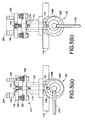
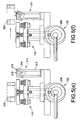
- the drive motor 118 is a stepper motor and the cam shaft 124 is configured such that a full revolution thereof facilitates the capping and filling procedure to be hereafter described in connection with Figures 5(a) through 5(f) .
- the drive motor 118 could be replaced with other automated or manually operated devices.
- the belt and drive motor could be replaced by simply attaching a lever to the cam shaft to serve as the drive mechanism so that the cam shaft is manually rotated.
- drive motor and shaft, drive belt, and cam shaft and support brackets, as well as the base portion 114 and its components, should all be formed of material that is compatible with the efficient operation of the printer yet sufficiently durable to provide longevity to the system.
- a first body portion 140 has a recess or chamber 142 defined therein and an air vent valve 144 disposed in the chamber.
- the vent valve 144 also has a shaft or rod having an opposite end 145.
- Around the periphery of the reservoir 142 is a shoulder portion 146.
- the shoulder portion 146 has disposed thereon a sealing or gasket element 148.
- a drain tube 150 is also provided to the first body portion 140.
- a second body portion 160 is also shown.
- the second body portion 160 has gimbal mounted thereon the first body portion 140. Gimballing is provided by spring mechanisms 162 that are disposed between the first and second body portions.
- the spring mechanisms 162 are also disposed around guide-shafts 164 which enable vertical motion with gimballing adjustment between the body portions.
- a third body or shaft portion 170 is also provided to the capping element 112.
- the shaft portion 170 is preferably hollow through portion 172 and includes a substantially flat end portion 174 having cam follower member 176 disposed thereon. Also provided to the shaft portion 170 is a pin member 178 that is sized to be received in a slot 117 on collar element 116 ( Figure 2 ).
- Figure 4 shows a cross-sectional view of the sealing element 148.
- the sealing element 148 has a base portion 180 that has a substantially rectangular cross-sectional shape and an arcuate portion 182 disposed thereon.
- the arcuate portion 182 includes the surface that ultimately engages the printhead.
- the capping element 112 may take a variety of forms, provided that any such form facilitate achieving the goals of the technical teaching.
- the spring mechanisms 162 and guide shafts 164 may be replaced by suitable elastomer pads or a single spring that provides equivalent force and gimballing when desired.
- the components may be formed of any suitable material that will be apparent to those skilled in the art.
- the material used should also be compatible with the ink that is emitted from the printhead, where appropriate.
- the sealing element 148 should be formed of a material that will not absorb the ink.
- the printhead 200 is shown in alignment with the capping element 112. It will be appreciated by those skilled in the art that the printhead 200 is preferably positioned on a printhead carriage along with other printheads. The printheads are spaced on the carriage to correspond to the spacing of the capping elements 112 (as shown in Figure 1 ).
- the carriage is selectively moved along a track or rail and the printheads selectively emit ink onto paper at specific locations according to control parameters that are beyond the scope of this description.
- the carriage is parked, or placed in a standby mode, so that the printheads are aligned with the capping elements 112.
- the printhead is shown to be aligned with the capping element 112, however, the printhead is uncapped.
- the vent valve 144 is shown in an open state.
- the valve 144 has disposed around its rod or shaft a spring mechanism 202 and an O-ring sealing element or gasket 204.
- the rod of the valve 144 goes through the center of the hollow shaft portion 170 with the opposite end 145 (also shown in Figure 3 ) sitting on the outer cam surface 206.
- cam 125 also shown in Figure 2
- cam 125 includes the cam surfaces 206 and 208.
- the surfaces 208 and 206 are configured to facilitate movement and relative movement of the third body portion 170 and the end 145 of the rod of the valve 144, respectively, as will be described herein. While exemplary shapes of the surfaces 208 and 206 are shown, any contours that accomplish the objectives of the embodiment will suffice.
- the cam 125 is rotated and cam follower element 176 follows the cam surfaces 208 so that the third body portion 170 is moved in a vertical direction upward so that the sealing element 148 touches, but does not transmit any substantial force to, the printhead 200.
- the sealing element 148 preferably surrounds the emitter array of the printhead but does not touch the array itself.
- the vent valve 144 becomes closed due to the spring 202 around the rod and/or the relative movement of the portion 170. Note that the valve 144 is seated against the O-ring sealing element 204 and the spring 202 is in an altered state of compression.
- the printhead is capped and substantially protected from the environment of the printer in that paper dust and other undesired contaminants are prevented from coming into contact with the emitter array elements of printhead 200.
- this stage of the capping process may be assumed during an OFF or standby mode.
- the sealing element in this stage is not fully sealing the reservoir and emitter array. In this stage, moisture might still be able to enter the reservoir.
- the cam 125 is further rotated such that the cam follower element 176 moves the third portion 170 further in the vertical direction such that a substantial force is transmitted by the spring mechanisms 162 to the printhead 200 through the sealing elements 148 which are compressed.
- the vent valve remains closed in this position. As such, the printhead is capped and is fully protected from elements of the environment, including moisture. Therefore, this may be a stage at which the user desires the printhead to be capped when the printer is in an OFF or standby mode.
- the flow of ink can be initiated to fill the printhead and complete the recirculating flow circuit.
- the ink flow rate has to be above a minimum amount.
- the ink pressure in the orifice region of the acoustic ink jet printheads of the type described will reach a high pressure point anywhere between 5.52 to 16.55 mbar (0.08 to 0.24 psi) (above ambient) because of the flow impedance of the printhead and also because of the geometric (vertical) layout of the fluid circuit.
- the required level of seal strength will allow no air-leak up to 137.90 mbar (2.0 psi) (greater than 7 times filling pressure above threshold) and the level of air cushion stiffness achieved by an air chamber volume (between the orifice plate and the sealed cap) is less than 3.3 x 10 -3 cm 3 (2.0 x 10 -4 inch 3 ) (less than 1.78 x 10 -5 cm 3 /mbar (7.5 x 10 -5 inch 3 /psi) of volume per spill pressure above threshold) per nozzle.
- the required seal strength can be achieved by choosing a compliant material (low durometer) for the seal 148 with a small nip width for the portion 182 and pressing it onto the printhead with sufficient force.
- the cap seal material when the orifice array is about 4.31 cm (1.7") long by 0.51 cm (0.20") wide, the cap seal material has a durometer of 45 shore A, a nip width of 0.038 cm (0.015”) and a force of engagement to the printhead greater than 17.79N (4.0 lbf). It can be appreciated that as the maximum fill pressure above spill threshold increases/decreases, the capping will require levels of seal-strength and air cushion stiffness to increase/decrease accordingly.
- the air cushion may be relieved and the printhead uncapped.
- the capping element 112 it is important that the capping element 112 not be abruptly pulled away from the printhead so that an undesired suction force is generated. If a suction force is so generated, there is a high probability that the flowing ink will flow out through the orifices and stop flowing within the printhead and back through the recirculating ink path. Therefore, as shown in Figure 5(d) , the cam 125 is further rotated so that the compression force is removed from the printhead (but the sealing element remains in contact with the printhead) and the vent valve is opened. Relative to the first body portion 140, the vent valve is opened toward the printhead, thus avoiding any suction force pulling the ink out through the orifices.
- Figure 5(e) shows the cam 125 rotated back to the original position shown in Figure 5(a) such that the capping element 112 is no longer capping the printhead 200.
- Figure 5(e) also shows an optional wiper system (not shown in Figures 5(a) - 5(d)) that is positioned to wipe the bottom surface of the printhead for cleaning purposes.
- the wiper structure 211 includes a support structure 212, a wiper frame 214 and wiper blades 216 and 218.
- the capping element 112 can be used for rapidly flooding an acoustic ink jet printhead, in a manner similar to that shown in Figures 5(a)-(f) , for such cleaning.
- capping element 112 is used in a first step of cleaning an acoustic ink printhead, such as comprised of a plurality of ejectors 10 previously described. As shown in Figures 5(a)-(c) , capping element 112 is moved into alignment with printhead array in a manner known within the art. Next, as shown, capping element 112 is engaged with printhead such as to form a seal. For the cleaning operation of the embodiment, once the dirty printhead is capped, the ink pressure in the printhead is increased significantly to allow ink to escape through the orifices and completely fill a small reservoir 142 inside the capped structure.
- the orifices may be allowed to soak for a predetermined time period in order to attempt to dissolve dried ink and loosen dust debris.
- the vent valve is opened which allows the ink to drain out of the cap through the drain port 150. While the drain nozzle 150 is in an open position, the ink pressure inside the printhead is moved to an intermediate high level. This pressure prevents the ink still remaining inside each orifice from reentering the printhead. Following this operation, the outside surface of the orifice plate may be cleaned off by wiping with the wiper blades 216, 218 or 240 as disclosed herein.
- valve/wiper blade 242 is provided to the capping element 240 within the boundary of the sealing element 248. It is to be appreciated that when desired, the valve/wiper blade is simply opened or extended toward the printhead so that it engages the surface of the printhead to wipe excess ink therefrom. When wiping is not desired, the valve/wiper blade is retracted to a "valve open” or “valve closed” state depending on the stage of the capping and filling procedure being implemented.
- a capping element 240 is disposed in a base portion 260 that accommodates other similar capping elements. Further, the wiper blade 242 extends across the full length of the recess of the capping element 240 within the boundaries of the sealing element 248. Also shown in Figure 7 is printhead 300 having emitter element arrays 302 disposed therein. Of course, these arrays ultimately align with the capping elements 240 during the capping and filling procedure.
Landscapes
- Ink Jet (AREA)
- Particle Formation And Scattering Control In Inkjet Printers (AREA)
Claims (3)
- Verfahren zum Füllen eines akustischen Tinten- Druckkopfes mit Tinte an einer Abdichtungs- und Füllstation, aufweisend zumindest ein Abdichtungselement (112) mit einer darin gebildeten Kammer (142) und einem Dichtungselement (148), angeordnet rund um einen Umfang der Kammer (142), wobei das Verfahren die Schritte aufweist von:Ausrichten des Druckkopfes mit dem Abdichtungselement (112);Bewegen des Dichtungselementes (148) des Abdichtungselementes (112) in Eingriff mit dem Druckkopf derart, dass das Dichtungselement (148) den Druckkopf berührt, aber im Wesentlichen keine Kraft auf den Druckkopf überträgt;Ausüben einer Kraft auf das Dichtungselement (148), um die Kammer (142) derart abzudichten, dass die Kraft auf den Druckkopf durch das Dichtungselement (148) übertragen wird, und um ein Luftkissen innerhalb der Kammer (142) zu erzeugen, um dadurch die Ausbildung eines Tintenflusses zu erleichtern;Ausbilden des Tintenflusses in dem Druckkopf;Entfernen der Kraft von dem Abdichtungselement (112), um die Kraft von dem Druckkopf zu entfernen; undBewegen des Dichtungselementes (148) aus dem Eingriff mit dem Druckkopf.
- Verfahren nach Anspruch 1, wobei ein Entlüftungsventil (144) des Abdichtungselementes (112) geschlossen ist, während das Dichtungselementes (148) in den Eingriff mit dem Druckkopf bewegt wird, und geöffnet wird, nachdem der Tintenfluss hergestellt ist.
- Abdichtungs- und Füllvorrichtung, vorgesehen das Verfahren von Anspruch 1 auszuführen, wobei die Vorrichtung aufweist:eine Mehrzahl von Abdichtungselementen (112), wobei jedes Abdichtungselement (112) aufweisteinen ersten Körperabschnitt (140) mit einer darin gebildeten Kammer (142), einem Ventil, angeordnet in der Kammer (142) und einem Schulterabschnitt (146), der am Umfang der Kammer (142) positioniert ist,ein Dichtungselement (148), positioniert auf der Schulter (146),einen zweiten Körperabschnitt (160), auf dem der erste Körperabschnitt (140) kardanisch montiert ist, undeinen dritten Körperabschnitt (170), der eine erste Welle innerhalb einer zweiten hohlen Welle aufweist, die sich von dem zweiten Körperabschnitt (160) erstreckt;ein Basiselement mit einer Mehrzahl von darin gebildeten Wellenöffnungen undeiner entsprechenden Mehrzahl von Kragenelementen (116), die sich von den Öffnungen in Umfangsrichtung erstrecken und bemessen sind, die dritten Körperabschnitte (170) aufzunehmen; undeine Antriebsvorrichtung (118), die betrieblich mit den dritten Körperabschnitten (170) im Eingriff ist.
Applications Claiming Priority (2)
| Application Number | Priority Date | Filing Date | Title |
|---|---|---|---|
| US340938 | 1982-01-20 | ||
| US09/340,938 US6595618B1 (en) | 1999-06-28 | 1999-06-28 | Method and apparatus for filling and capping an acoustic ink printhead |
Publications (3)
| Publication Number | Publication Date |
|---|---|
| EP1065060A2 EP1065060A2 (de) | 2001-01-03 |
| EP1065060A3 EP1065060A3 (de) | 2001-05-02 |
| EP1065060B1 true EP1065060B1 (de) | 2008-09-03 |
Family
ID=23335572
Family Applications (1)
| Application Number | Title | Priority Date | Filing Date |
|---|---|---|---|
| EP00113589A Expired - Lifetime EP1065060B1 (de) | 1999-06-28 | 2000-06-27 | Verfahren und Gerät zum Füllen und Abdichten eines akustischen Tintendruckkopfes |
Country Status (4)
| Country | Link |
|---|---|
| US (1) | US6595618B1 (de) |
| EP (1) | EP1065060B1 (de) |
| JP (1) | JP4651158B2 (de) |
| DE (1) | DE60040120D1 (de) |
Families Citing this family (18)
| Publication number | Priority date | Publication date | Assignee | Title |
|---|---|---|---|---|
| EP1681846B1 (de) * | 2002-03-28 | 2008-07-30 | Brother Kogyo Kabushiki Kaisha | Druckvorrichtung |
| US7118189B2 (en) | 2004-05-28 | 2006-10-10 | Videojet Technologies Inc. | Autopurge printing system |
| KR100608060B1 (ko) * | 2004-07-01 | 2006-08-02 | 삼성전자주식회사 | 잉크젯 프린터 |
| EP1934054B1 (de) * | 2005-10-11 | 2011-01-26 | Silverbrook Research Pty. Ltd | Druckkopfwartungsanordnung mit wartungsrolle und reinigungsmechanismus |
| US7997683B2 (en) * | 2007-03-02 | 2011-08-16 | Marvell International Ltd. | Device for servicing an inkjet print head on a hand held printer |
| JP4311472B2 (ja) * | 2007-04-26 | 2009-08-12 | セイコーエプソン株式会社 | 流体噴射装置および該装置の制御方法 |
| WO2009073862A1 (en) * | 2007-12-07 | 2009-06-11 | Sunprint Inc. | Focused acoustic printing of patterned photovoltaic materials |
| US20100184244A1 (en) * | 2009-01-20 | 2010-07-22 | SunPrint, Inc. | Systems and methods for depositing patterned materials for solar panel production |
| EP3972813B1 (de) | 2019-05-23 | 2026-02-25 | General Electric Company | Vorrichtung zur generativen fertigung |
| CN114206591A (zh) | 2019-05-23 | 2022-03-18 | 通用电气公司 | 用于增材制造设备的清洁系统及其使用方法 |
| US12358227B2 (en) | 2019-05-23 | 2025-07-15 | General Electric Company | Fluid management and circulation systems for use in additive manufacturing apparatuses |
| CN118848013A (zh) | 2019-05-23 | 2024-10-29 | 通用电气公司 | 增材制造设备及方法 |
| WO2020237118A2 (en) | 2019-05-23 | 2020-11-26 | General Electric Company | Wiper arrays for use in additive manufacturing apparatuses |
| WO2020237138A1 (en) | 2019-05-23 | 2020-11-26 | General Electric Company | Printing assemblies and methods for using the same |
| US12172370B2 (en) | 2019-05-23 | 2024-12-24 | General Electric Company | Recoat assemblies for additive manufacturing systems and methods for using the same |
| US12257778B2 (en) | 2019-05-23 | 2025-03-25 | General Electric Company | Additive manufacturing recoat assemblies including a vacuum and methods for using the same |
| EP3972818A1 (de) | 2019-05-23 | 2022-03-30 | General Electric Company | Generative fertigung von überzugsanordnungen mit sensoren und verfahren zu ihrer verwendung |
| EP3972761A2 (de) | 2019-05-23 | 2022-03-30 | General Electric Company | Reinigungsflüssigkeiten zur verwendung in generativen fertigungsvorrichtungen und verfahren zur überwachung des zustandes und der leistung derselben |
Family Cites Families (27)
| Publication number | Priority date | Publication date | Assignee | Title |
|---|---|---|---|---|
| JPS609018Y2 (ja) * | 1977-12-30 | 1985-04-01 | 東レ株式会社 | インクジエツトヘツドの乾燥防止装置 |
| US4308547A (en) | 1978-04-13 | 1981-12-29 | Recognition Equipment Incorporated | Liquid drop emitter |
| US4697195A (en) | 1985-09-16 | 1987-09-29 | Xerox Corporation | Nozzleless liquid droplet ejectors |
| US4751530A (en) | 1986-12-19 | 1988-06-14 | Xerox Corporation | Acoustic lens arrays for ink printing |
| US4751534A (en) | 1986-12-19 | 1988-06-14 | Xerox Corporation | Planarized printheads for acoustic printing |
| DE68919775T2 (de) | 1988-09-07 | 1995-07-13 | Seiko Epson Corp | Abdichtung für Tintenstrahldrucker. |
| US5028937A (en) | 1989-05-30 | 1991-07-02 | Xerox Corporation | Perforated membranes for liquid contronlin acoustic ink printing |
| US4967207A (en) | 1989-07-26 | 1990-10-30 | Hewlett-Packard Company | Ink jet printer with self-regulating refilling system |
| US5027134A (en) | 1989-09-01 | 1991-06-25 | Hewlett-Packard Company | Non-clogging cap and service station for ink-jet printheads |
| US5041849A (en) | 1989-12-26 | 1991-08-20 | Xerox Corporation | Multi-discrete-phase Fresnel acoustic lenses and their application to acoustic ink printing |
| DE69122539T2 (de) * | 1990-02-13 | 1997-03-13 | Canon Kk | Abdeckvorrichtung und eine diese nutzende Tintenstrahlaufzeichnungsvorrichtung |
| US5701146A (en) * | 1991-10-18 | 1997-12-23 | Canon Kabushiki Kaisha | Ink head recovery method and apparatus |
| US5644347A (en) | 1992-09-21 | 1997-07-01 | Hewlett-Packard Company | Inkjet printer with variable wiping capabilities for multiple printheads |
| US5638099A (en) * | 1992-09-30 | 1997-06-10 | Hewlett-Packard Company | Removable service station sled for inkjet printer |
| JP3097718B2 (ja) * | 1992-11-06 | 2000-10-10 | セイコーエプソン株式会社 | インクジェット記録装置、及びインク供給方法 |
| JPH06191055A (ja) * | 1992-12-25 | 1994-07-12 | Canon Inc | インクジェット記録装置のインク再充填装置 |
| JPH06320744A (ja) | 1993-04-19 | 1994-11-22 | Xerox Corp | 全巾インクジェットプリンタ用の湿式拭い保守装置 |
| DE69507730T2 (de) | 1994-04-08 | 1999-09-16 | Hewlett-Packard Co., Palo Alto | Feuchtwischer für einen Tintenstrahldruckkopf |
| US5565113A (en) | 1994-05-18 | 1996-10-15 | Xerox Corporation | Lithographically defined ejection units |
| JP3317020B2 (ja) | 1994-05-24 | 2002-08-19 | 富士ゼロックス株式会社 | インクジェット記録装置 |
| JP2888511B2 (ja) | 1995-07-25 | 1999-05-10 | 富士ゼロックス株式会社 | インクジェットヘッド洗浄方法及びそのための洗浄用カートリッジ |
| US5801735A (en) | 1995-09-05 | 1998-09-01 | Xerox Corporation | Automated system for refilling ink jet cartridges |
| JPH0976493A (ja) * | 1995-09-12 | 1997-03-25 | Toshiba Corp | インクジェット記録装置 |
| JP3414605B2 (ja) * | 1995-12-25 | 2003-06-09 | セイコーエプソン株式会社 | インクジェット記録装置、及びメンテナンス方法 |
| US6010203A (en) * | 1996-07-09 | 2000-01-04 | Brother Kogyo Kabushiki Kaisha | Apparatus for recovering an ink jet head and ink jet recorder including the same |
| DE69719936T2 (de) * | 1996-12-24 | 2003-12-11 | Seiko Epson Corp., Tokio/Tokyo | Tintenstrahlaufzeichnungsgerät |
| JPH10286974A (ja) | 1997-04-14 | 1998-10-27 | Brother Ind Ltd | インクジェットプリンタ |
-
1999
- 1999-06-28 US US09/340,938 patent/US6595618B1/en not_active Expired - Lifetime
-
2000
- 2000-06-22 JP JP2000187212A patent/JP4651158B2/ja not_active Expired - Fee Related
- 2000-06-27 EP EP00113589A patent/EP1065060B1/de not_active Expired - Lifetime
- 2000-06-27 DE DE60040120T patent/DE60040120D1/de not_active Expired - Lifetime
Also Published As
| Publication number | Publication date |
|---|---|
| JP2001026114A (ja) | 2001-01-30 |
| EP1065060A3 (de) | 2001-05-02 |
| EP1065060A2 (de) | 2001-01-03 |
| JP4651158B2 (ja) | 2011-03-16 |
| DE60040120D1 (de) | 2008-10-16 |
| US6595618B1 (en) | 2003-07-22 |
Similar Documents
| Publication | Publication Date | Title |
|---|---|---|
| EP1065060B1 (de) | Verfahren und Gerät zum Füllen und Abdichten eines akustischen Tintendruckkopfes | |
| US5790146A (en) | Fluid applicator for maintenance of liquid ink printers | |
| US6609780B2 (en) | Ink jet printer having a mechanism for driving wiper and purge pump | |
| US6805437B2 (en) | Liquid supply system, ink jet recording head, ink jet recording apparatus and liquid filling method | |
| EP1464500B1 (de) | Verfahren zur Reinigung eines Tintenstrahlkopfes und Tintenstrahldrucker | |
| US7901033B2 (en) | Capping device, and recovery device having the same | |
| EP3231613B1 (de) | Reinigungsvorrichtung eines flüssigkeitsausstosskopfes und flüssigkeitsausstossvorrichtung | |
| US6350012B1 (en) | Method and apparatus for cleaning/maintaining of an AIP type printhead | |
| JP5493944B2 (ja) | クリーニング方法及び流体噴射装置 | |
| US6336699B1 (en) | Self-cleaning wet wipe method and apparatus for cleaning orifices in an AIP type printhead | |
| JP2017193163A (ja) | 液体噴射ヘッドのクリーニング方法及び液体噴射装置 | |
| JP4009936B2 (ja) | インクジェット式記録装置 | |
| JPH04284256A (ja) | インクジェット印刷装置及びプリントヘッド面洗浄方法 | |
| JP3555347B2 (ja) | インクジェット方式の画像形成装置 | |
| KR100799005B1 (ko) | 액체 와이퍼 장치를 갖는 액체 분사 장치 | |
| US6517187B1 (en) | Method and apparatus for cleaning residual ink from printhead nozzle faces | |
| JPWO2010070975A1 (ja) | 液体噴射ヘッド、液体噴射記録装置及び液体噴射ヘッドの液体充填方法 | |
| US9421778B2 (en) | Liquid discharge apparatus | |
| JP4506390B2 (ja) | 液体噴射装置および液体噴射ヘッドの液体吸引装置 | |
| JP2005231307A (ja) | 液体噴射装置および液体噴射ヘッドの液体吸引装置 | |
| JP3520463B2 (ja) | インクジェット式記録装置 | |
| JP2007130806A (ja) | インクジェット記録装置 | |
| JP3799916B2 (ja) | インクジェット記録装置 | |
| JP2017193162A (ja) | 液体噴射ヘッドのクリーニング装置及び液体噴射装置 | |
| JP2006110900A (ja) | インクジェット記録装置 |
Legal Events
| Date | Code | Title | Description |
|---|---|---|---|
| PUAI | Public reference made under article 153(3) epc to a published international application that has entered the european phase |
Free format text: ORIGINAL CODE: 0009012 |
|
| AK | Designated contracting states |
Kind code of ref document: A2 Designated state(s): DE FR GB |
|
| AX | Request for extension of the european patent |
Free format text: AL;LT;LV;MK;RO;SI |
|
| PUAL | Search report despatched |
Free format text: ORIGINAL CODE: 0009013 |
|
| AK | Designated contracting states |
Kind code of ref document: A3 Designated state(s): AT BE CH CY DE DK ES FI FR GB GR IE IT LI LU MC NL PT SE |
|
| AX | Request for extension of the european patent |
Free format text: AL;LT;LV;MK;RO;SI |
|
| 17P | Request for examination filed |
Effective date: 20011102 |
|
| AKX | Designation fees paid |
Free format text: DE FR GB |
|
| 17Q | First examination report despatched |
Effective date: 20050207 |
|
| 17Q | First examination report despatched |
Effective date: 20050207 |
|
| GRAP | Despatch of communication of intention to grant a patent |
Free format text: ORIGINAL CODE: EPIDOSNIGR1 |
|
| GRAS | Grant fee paid |
Free format text: ORIGINAL CODE: EPIDOSNIGR3 |
|
| GRAA | (expected) grant |
Free format text: ORIGINAL CODE: 0009210 |
|
| AK | Designated contracting states |
Kind code of ref document: B1 Designated state(s): DE FR GB |
|
| REG | Reference to a national code |
Ref country code: GB Ref legal event code: FG4D |
|
| REF | Corresponds to: |
Ref document number: 60040120 Country of ref document: DE Date of ref document: 20081016 Kind code of ref document: P |
|
| PLBE | No opposition filed within time limit |
Free format text: ORIGINAL CODE: 0009261 |
|
| STAA | Information on the status of an ep patent application or granted ep patent |
Free format text: STATUS: NO OPPOSITION FILED WITHIN TIME LIMIT |
|
| 26N | No opposition filed |
Effective date: 20090604 |
|
| REG | Reference to a national code |
Ref country code: FR Ref legal event code: PLFP Year of fee payment: 17 |
|
| REG | Reference to a national code |
Ref country code: FR Ref legal event code: PLFP Year of fee payment: 18 |
|
| PGFP | Annual fee paid to national office [announced via postgrant information from national office to epo] |
Ref country code: FR Payment date: 20170523 Year of fee payment: 18 Ref country code: GB Payment date: 20170526 Year of fee payment: 18 Ref country code: DE Payment date: 20170522 Year of fee payment: 18 |
|
| REG | Reference to a national code |
Ref country code: DE Ref legal event code: R119 Ref document number: 60040120 Country of ref document: DE |
|
| GBPC | Gb: european patent ceased through non-payment of renewal fee |
Effective date: 20180627 |
|
| PG25 | Lapsed in a contracting state [announced via postgrant information from national office to epo] |
Ref country code: GB Free format text: LAPSE BECAUSE OF NON-PAYMENT OF DUE FEES Effective date: 20180627 Ref country code: FR Free format text: LAPSE BECAUSE OF NON-PAYMENT OF DUE FEES Effective date: 20180630 Ref country code: DE Free format text: LAPSE BECAUSE OF NON-PAYMENT OF DUE FEES Effective date: 20190101 |