EP1079632A1 - Dispositif et procede de traitement de signaux numeriques et support associe - Google Patents
Dispositif et procede de traitement de signaux numeriques et support associe Download PDFInfo
- Publication number
- EP1079632A1 EP1079632A1 EP20000907932 EP00907932A EP1079632A1 EP 1079632 A1 EP1079632 A1 EP 1079632A1 EP 20000907932 EP20000907932 EP 20000907932 EP 00907932 A EP00907932 A EP 00907932A EP 1079632 A1 EP1079632 A1 EP 1079632A1
- Authority
- EP
- European Patent Office
- Prior art keywords
- video data
- encoding
- storing
- digital signal
- stored
- Prior art date
- Legal status (The legal status is an assumption and is not a legal conclusion. Google has not performed a legal analysis and makes no representation as to the accuracy of the status listed.)
- Withdrawn
Links
Images






Classifications
-
- H—ELECTRICITY
- H04—ELECTRIC COMMUNICATION TECHNIQUE
- H04N—PICTORIAL COMMUNICATION, e.g. TELEVISION
- H04N7/00—Television systems
- H04N7/24—Systems for the transmission of television signals using pulse code modulation
- H04N7/52—Systems for transmission of a pulse code modulated video signal with one or more other pulse code modulated signals, e.g. an audio signal or a synchronizing signal
-
- H—ELECTRICITY
- H04—ELECTRIC COMMUNICATION TECHNIQUE
- H04N—PICTORIAL COMMUNICATION, e.g. TELEVISION
- H04N21/00—Selective content distribution, e.g. interactive television or video on demand [VOD]
- H04N21/80—Generation or processing of content or additional data by content creator independently of the distribution process; Content per se
- H04N21/81—Monomedia components thereof
- H04N21/8166—Monomedia components thereof involving executable data, e.g. software
- H04N21/8193—Monomedia components thereof involving executable data, e.g. software dedicated tools, e.g. video decoder software or IPMP tool
-
- H—ELECTRICITY
- H04—ELECTRIC COMMUNICATION TECHNIQUE
- H04N—PICTORIAL COMMUNICATION, e.g. TELEVISION
- H04N21/00—Selective content distribution, e.g. interactive television or video on demand [VOD]
- H04N21/40—Client devices specifically adapted for the reception of or interaction with content, e.g. set-top-box [STB]; Operations thereof
- H04N21/41—Structure of client; Structure of client peripherals
- H04N21/414—Specialised client platforms, e.g. receiver in car or embedded in a mobile appliance
- H04N21/4143—Specialised client platforms, e.g. receiver in car or embedded in a mobile appliance embedded in a Personal Computer [PC]
-
- H—ELECTRICITY
- H04—ELECTRIC COMMUNICATION TECHNIQUE
- H04N—PICTORIAL COMMUNICATION, e.g. TELEVISION
- H04N21/00—Selective content distribution, e.g. interactive television or video on demand [VOD]
- H04N21/40—Client devices specifically adapted for the reception of or interaction with content, e.g. set-top-box [STB]; Operations thereof
- H04N21/43—Processing of content or additional data, e.g. demultiplexing additional data from a digital video stream; Elementary client operations, e.g. monitoring of home network or synchronising decoder's clock; Client middleware
- H04N21/443—OS processes, e.g. booting an STB, implementing a Java virtual machine in an STB or power management in an STB
Definitions
- the invention relates to digital signal processing apparatus and method and providing medium. More particularly, the invention relates to digital signal processing apparatus and method for encoding or decoding video data and audio data by a software process and relates to a providing medium.
- the digital video data and digital audio data are encoded by, for example, an MPEG (Moving Picture Experts Group) system and transmitted.
- MPEG Motion Picture Experts Group
- an encoding is performed synchronously with an input period of video data.
- the input period has been defined by various standards. For example, in the NTSC (National Television System Committee) system, it is set to 33.36 msec.
- the maximum processing time (encoding time) allocated to one image is restricted by the input period of the video data which has been determined by such a standard. In other words, the inputted video data has to be encoded arid the process has to be finished within the input period.
- the video data encoded in this manner is recorded to a predetermined recording medium or the like or transmitted through a satellite.
- a receiving apparatus for receiving digital data transmitted through the satellite decodes received data by the MPEG system.
- decoding the digital video data by a software process it is necessary to successively execute a plurality of processes which are necessary for decoding.
- To output in a real-time manner it is necessary to complete all of the processes necessary for decoding within a time which is matched with a period that is required for output. For example, in case of the NTSC system, since a frame rate is equal to 30 frames/sec, one period is equal to 33.36 msec. It is, therefore, necessary to decode the digital video data of one frame within 33.36 msec.
- a time necessary for executing those processes fluctuates.
- a time necessary for a decoding process of a variable length code changes depending on a bit rate of a bit stream.
- a processing time of a motion compensation also changes depending on a kind of picture coding type such as I picture, B picture, or P picture or depending on a difference of motion compensation precision such as half pel or full pel. Further, it also takes time to perform a process such as decoding or demultiplexing of the digital audio data as well as the video image. Further, a time which is consumed by the OS for managing the whole processes also fluctuates.
- the encoding since the encoding is performed synchronously with the input period of the video data, the encoding has to be completed at the maximum precision within the input period for each image.
- the precision upon encoding depends on a similarity between the image before encoding and the image obtained by decoding the encoded image. The precision also depends on the processing time for encoding, encoding method, or the like.
- an encoding apparatus In the case where the encoding process is changed on the time base (for example, MPEG (Moving Picture Experts Group) 2) or in the case where each image has to be encoded at the closest precision as possible (to prevent a situation such that when the precision of the encoding differs on the time base, the decoded image flickers and becomes hard to be seen), an encoding apparatus has to be designed by setting it so that there is an enough time for the encoding process in order to raise the encoding precision.
- the time base for example, MPEG (Moving Picture Experts Group) 2
- each image has to be encoded at the closest precision as possible
- the encoding apparatus by the software process has to perform a control of an input, an output, and the like of the video data in addition to the encoding process, and those processes have to be simultaneously performed by a built-in processor.
- a problem such that it is difficult to calculate the longest processing time which is allocated to the encoding process due to a relation with the processes other than the encoding process.
- a vain time during which the processor executes no process is caused.
- the processor needs to have a high processing ability and the costs rise.
- the invention is made in consideration of such a situation and it is an object of the invention to enable encoding at high precision to be performed even by a processor of a low processing ability by allowing an encoding process of one image to be executed while preferentially executing other processes.
- a dedicated receiving apparatus for receiving a satellite broadcasting even in case of decoding a reception signal by a software process, the process for decimating an output by skipping a process of a part of data in order to maintain real-time performance should not be permitted in consideration of the fact that such an apparatus is a dedicated apparatus for decoding a digital video signal which is inherently transmitted through a satellite.
- the invention is made in consideration of such a situation and intends to enable a decoding process to be performed at low costs by a software process by using a processor having an ordinary processing ability.
- a digital signal processing apparatus comprising: input means for inputting an encoded digital signal; decoding means constructed by software for decoding the digital signal inputted by the input means; first storing means for storing the digital signal decoded by the decoding means by an amount corresponding to a plurality of access units; and managing means for managing an outputting order of the digital signal of the access units stored in the first storing means by an FIFO format.
- a digital signal processing method comprising: an input step of inputting an encoded digital signal; a decoding step of decoding the digital signal inputted by a process in the input step by software; a first storing step of storing the digital signal decoded by a process in the decoding step by an amount corresponding to a plurality of access units; and a managing step of managing an outputting order of the digital signal of the access units stored by a process in the first storing step by an FIFO format.
- a providing medium for providing a computer-readable program for allowing a digital signal processing apparatus to execute processes, wherein the processes comprise: an input step of inputting an encoded digital signal; a decoding step of decoding the digital signal inputted by a process in the input step by software; a first storing step of storing the digital signal decoded by a process in the decoding step by an amount corresponding to a plurality of access units; and a managing step of managing an outputting order of the digital signal of the access units stored by a process in the first storing step by an FIFO format.
- a digital signal processing apparatus comprising: input means for inputting video data; first storing means for storing the video data inputted by the input means; predicting means for predicting a data amount at the time when the video data stored in the first storing means is encoded; encoding means for encoding the video data stored by the first storing means; and second storing means for storing the video data encoded by the encoding means, wherein the encoding by the encoding means is executed if it is determined that the data of the amount predicted by the predicting means can be stored in the second storing means, and the encoding is interrupted while the video data is being inputted by the input means and is being processed.
- a digital signal processing method comprising: an input step of inputting video data; a first storing step of storing the video data inputted by the input step; a predicting step of predicting a data amount at the time when the video data stored in the first storing step is encoded; an encoding step of encoding the video data stored by the first storing step; and a second storing step of storing the video data encoded by the encoding step, wherein the encoding in the encoding step is executed in the case where the data of the amount predicted by the predicting step can be stored by a process in the second storing step, and the encoding is interrupted while the video data is being inputted by the input step and being processed.
- a program for a medium comprising: an input step of inputting video data; a first storing step of storing the video data inputted by the input step; a predicting step of predicting a data amount at the time when the video data stored in the first storing step is encoded; an encoding step of encoding the video data stored by the first storing step; and a second storing step of storing the video data encoded by the encoding step, and the encoding in the encoding step is executed if it is determined that the data of the amount predicted by the predicting step can be stored by a process in the second storing step, and the encoding is interrupted while the video data is being inputted by the input step and being processed.
- the digital signal processing method according to claim 3 and the providing medium according to claim 4 the stored outputting order of the digital signal of the access units is managed by the FIFO format.
- the data amount at the time when the inputted video data is encoded is predicted, the video data is encoded, the encoded video data is stored, the encoding is performed when it is determined that the data of the predicted amount can be stored, and the encoding is interrupted while the video data is being inputted and processed.
- FIG. 1 shows a constructional example of a digital signal processing apparatus to which the invention is applied.
- a decoding program for performing a decoding process of an inputted stream, a processing program for controlling each section, and the like have been stored in a program memory 2.
- a CPU 1 properly reads out the program stored in the program memory 2 through a bus 7 and executes it.
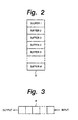
- a video frame buffer 3 is a storing apparatus for temporarily storing decoded video data and has a capacity to hold video data of a plurality of frames.
- An output FIFO (First In First Out) 4 stores management IDs of buffers 1 to N in which images of frames to be outputted have been stored in the outputting order.
- a stream input interface (I/F) 5 executes an interface process for inputting a transport stream which is transmitted through a satellite or the like and has been encoded by, for example, the MPEG system.
- a display controller 6 executes a process for outputting the decoded video data to a display (not shown) and displaying it.
- the video frame buffer 3 has the buffers 1 to N as areas for storing the video data of N frames. It is not always necessary to define those buffers into continuous address areas. Each buffer is used in order of the allocation for a decoding output, the holding of a decoding result, and the output of the data. The buffer in which the output has been finished is used again as a buffer for decoding output. Further, all of the buffers are equivalently used and are not used for an application in which a specific buffer is limited.
- the output FIFO 4 can be also formed in the video frame buffer 3.
- Fig. 3 shows a principled construction of the output FIFO 4.
- the output FIFO 4 manages the order of the buffers for outputting the decoding result and a delay that is caused before the output.
- Management IDs or pointers of the buffers 1 to N of the video frame buffer 3 shown in Fig. 2 are inputted and stored in the output FIFO 4 in the outputting order.
- each of time t1 to time t4 indicates a timing for outputting the decoded video data. That is, each interval between time t1 and time t4 is set to a period (33.36 msec) of one frame.
- the CPU 1 executes a process 1 at the timing of time t1 in accordance with a program read out from the program memory 2. When the process of the process 1 is finished, the CPU 1 subsequently executes a process 2. When the process of the process 2 is completed, the CPU 1 subsequently executes a process 3. In this manner, regarding the priorities of the processes, the process 1 is set to the highest priority, the process 2 is set to the second highest priority, and the process 3 is set to the lowest priority, respectively.
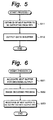
- step S11 the CPU 1 obtains the ID of the buffer to which the data is outputted next from the output FIFO 4.
- step S12 the CPU 1 reads out video data corresponding to the ID obtained in step S11 from the video frame buffer 3 and outputs it to the display controller 6 via the bus 7.
- the display controller 6 outputs the inputted data to the display (not shown) and allows it to be displayed.
- step S11 the CPU 1 reads out "A” as a management ID from the output FIFO 4, reads out the video data of the buffer corresponding to the management ID "A” among the buffers 1 to N in the video frame buffer 3, and outputs it.
- the CPU 1 subsequently executes the process 2.
- the process 2 is a decoding process of audio data.
- the processed audio data is generated from speakers (not shown) synchronously with a predetermined timing signal which is outputted from the display controller 6.
- step S21 the CPU 1 executes an allocating process of the buffer for the next decoding output. That is, the empty buffer (which has already been read out) among the buffers 1 to N of the video frame buffer 3 shown in Fig. 2 is allocated as a buffer for storing the decoded video data.
- step S22 the CPU 1 decodes the video data of one frame inputted from the stream input interface 5 by the decoding program read out from the program memory 2 by the MPEG system. The decoded data is stored in the buffer allocated in step S21. Further, in step S23, the CPU 1 registers the ID of the buffer to be outputted (read out) next into the output FIFO 4.
- the decoding process of the frame in which the management ID is set to D has been performed by the process 3. Therefore, the CPU 1 registers D as a management ID into the output FIFO 4. In the example of Fig. 4, the process 3 can be completed in a period of time from time t1 to time t2.
- the image of the frame which has been outputted at just previous time t2 and whose management ID is set to B is outputted again at time t3.
- an image of the frame which has been stored in the output FIFO 4 and whose management ID is set to C is outputted as a process 1.
- the process which was once interrupted is restarted as a process 3.
- a process of the video data of the next frame is executed.
- the video data of two frames whose management IDs are set to E and F can be processed for a period of time from time t3 to time t4, and E and F as management IDs of those frames are stored in the output FIFO 4.
- the buffers 1 to N can be managed by the output FIFO 4, even in the case where the execution time of the process 3 temporarily exceeds the output period or in the case where the execution timings of the process 1 and process 3 become asynchronous due to the reduction and extension of the execution time of each process, the buffer to which the data is outputted at a predetermined period can be always assured in the process 1.
- the processing ability of the software that is required for the CPU 1 does not need to be made to correspond to the case where the processing time that is required for decoding of one frame becomes the longest time. It is sufficient to make it to correspond to the average processing time that is required for decoding of a few frames. Therefore, a cheaper processor can be used as a CPU 1.
- FIG. 7 is a block diagram showing an internal construction of the digital signal processing apparatus to which the invention is applied.
- a CPU (Central Processing Unit) 11 executes predetermined processes in accordance with a program stored in a memory 12 comprising an ROM (Read Only Memory), an RAM (Random Access Memory), or the like.
- a video frame buffer 13 temporarily stores video data inputted via an input/output interface 14.
- An encoder 15 encodes the video data stored in the video frame buffer 13 and outputs it to a code buffer 16.
- the code buffer 16 temporarily stores the encoded video data.
- the video data stored in the code buffer 16 is outputted to another apparatus, for example, a recording apparatus (not shown) through the input/output interface 14.
- Those sections are mutually connected by a bus 17.
- the video frame buffer 13 has a capacity which can store video data of a plurality of frames and a plurality of buffers have been defined as shown in Fig. 8. That is, N buffers 13-1 to 13-N have been defined in the video frame buffer 13. Video data 1 is stored in the buffer 13-1, the video data 2 is stored in the buffer 13-2, and the video data N is stored in the buffer 13-N, respectively.
- the buffers 13-1 to 13-N are managed by IDs or pointers for unconditionally specifying them. Explanation will be made hereinbelow on the assumption that they are managed by the IDs.
- the buffers 1 to N are not always necessary to be defined in continuous address areas.
- step S31 when the video data is inputted to an encoding apparatus 10 through the input/output interface 14, the CPU 11 examines an empty buffer in the video frame buffer 13 in step S32.
- Each buffer in the video frame buffer 13 is managed by the ID which can be unconditionally specified.
- the CPU 11 examines the empty buffer by referring to the ID.
- the IDs of the buffers in which the video data has been stored are sequentially written by using an FIFO (First In First Out) and by examining the ID which is not written in the FIFO, the empty buffer can be examined.
- FIFO First In First Out
- the data is sequentially outputted in the writing order in a reading process, which will be explained hereinlater. Since the same ID is not written in the FIFO, the outputted ID (therefore, the ID which is not written in the FIFO) is the ID Showing the empty buffer.
- step S33 the video data inputted in step S31 is written in the buffer examined to be the empty buffer in step S32.
- the video data written in this manner is read out when the encoding is performed by the encoder 15.
- the reading process will be described with reference to a flowchart of Fig. 10.
- an encoding amount in the case where the image of one frame stored in the video frame buffer 13 was encoded is predicted in step S41.
- the video data as a target of the encoding is video data stored in the buffer corresponding to the ID which has been written first in the FIFO at that time point.
- step S41 When the encoding amount is predicted in step S41, whether the empty capacity enough to store the data of the encoding amount remains in the code buffer 16 or not is discriminated in step S42. If it is determined that the empty capacity enough to store the data of the predicted encoding amount does not exist in the code buffer 16, the encoded video data cannot be stored, so that the processes of this flowchart are finished.
- step S43 follows.
- the video data whose encoding amount has been predicted in step S41 is read out from the video frame buffer 13 and encoded by the encoder 15.
- the video data encoded by the encoder 15 is stored in the code buffer 16.
- the video data encoded in step S43 is deleted from the video frame buffer 13 in step S44.
- the ID of the buffer in the video frame buffer 13 in which the encoded video data has been stored is abandoned (outputted) from the FIFO.
- the encoding by the encoder 15 is executed when the CPU 11 does not perform another process, when the video data has been stored in the video frame buffer 13, and when the empty capacity enough to store the encoded video data remains in the code buffer 16 as mentioned above.
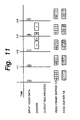
- a time interval between time t and time t+1 is set to, for example, 33.36 msec in case of the NTSC system. The other time intervals are also the same as it.
- step S42 When it is determined by the process in step S42 that the data of the encoding amount at the time when the video data (a) has been encoded can be stored in the code buffer 16, the encoding by the encoder 15 is started. In this case, since nothing is stored in the code buffer 16, it is determined that there is the empty capacity enough to store the encoded video data (a).
- the CPU 1 allows the encoder 5 to encode the video data (a).
- step S43 when the video data (a) is read out from the video frame buffer 13, encoded by the encoder 15, and stored in the code buffer 16, as a process in step S44, the video data (a) (ID corresponding to the buffer in which the video data (a) has been stored) stored in the video frame buffer 13 is deleted.
- the encoding of the video data (b) is restarted.
- the encoding of the video data (b) is finished and the encoding of the video data (c) is also completed until time t+4. Therefore, just before time t+4, a state where only the video data (d) newly inputted has been stored in the video frame buffer 13 is obtained, and a state where the video data (a), video data (b), and video data (c) which had already been encoded have been stored in the code buffer 16 is obtained.
- Video data (e) is inputted and stored in the video frame buffer 13 at time t+4.
- the video data (d) since the video data (d) has already been stored in the video frame buffer 13 and the CPU 1 does not perform another process, it can execute the encoding process. However, since the empty capacity in the code buffer 16 is not enough, the encoding is not performed.
- Video data (f) is inputted at time t+5 (Fig. 12) and a predetermined amount of video data stored in the code buffer 16 is continuously outputted to another apparatus, for example, a recording apparatus or the like. In this output process, since it is sufficient that the CPU 11 instructs only the start of the reading process by providing a DMAC (Direct Memory Access Controller) or the like and allowing the data to be DMA transferred, the video data can be outputted without tasking the CPU 1 itself.
- DMAC Direct Memory Access Controller
- the encoding process for one video data is executed in consideration of the empty capacity in the code buffer 6 and the empty time of the CPU 11, thereby enabling the encoding process to be performed without being restricted by a condition such that the process has to be finished within the input period of the video data.
- the processor (CPU 11) of the low processing ability is used in the encoding apparatus 10, the encoding can be performed at high precision and both of the input and the encoding of the video data can be performed.
- the program can be provided for the user in a state where it has previously been installed in a hard disk 22 or a semiconductor memory 23 (corresponding to the memory 2) as a recording medium built in a personal computer 21.
- the program can be temporarily or permanently stored in a recording medium such as floppy disk 31, CD-ROM 32, MO disk 33, DVD 34, magnetic disk 35, semiconductor memory 36, or the like and provided as package software.
- a recording medium such as floppy disk 31, CD-ROM 32, MO disk 33, DVD 34, magnetic disk 35, semiconductor memory 36, or the like and provided as package software.
- the program can be transferred from a downloading site 41 to a personal computer 43 through a satellite 42 in a wireless manner, or can be transferred to the personal computer 43 in a wired or wireless manner through a network 51 such as local area network or Internet and can downloaded to a built-in hard disk or the like in the personal computer 43.
- a network 51 such as local area network or Internet
- the access unit has been set to the frame in the above description, it can be also set to a field.
- the case of decoding the digital signal encoded by the MPEG system has been shown as an example, the encoding (compression) and its decoding (decompression) process can be also obviously performed by other systems.
- the digital signal processing apparatus As mentioned above, according to the digital signal processing apparatus according to claim 1, the digital signal processing method according to claim 3, and the providing medium according to claim 4, the stored outputting order of the digital signal of the access units is managed by the FIFO format. Therefore, the decoding process can be performed by an inexpensive apparatus while keeping the real-time performance by the software.
- the digital signal processing apparatus According to the digital signal processing apparatus according to claim 5, the digital signal processing method according to claim 6, and the medium according to claim 7, the data amount at the time when the inputted video data is encoded is predicted, the video data is encoded, the encoded video data is stored, the encoding is performed when it is determined that the data of the predicted amount can be stored, and the encoding is interrupted while the video data is being inputted and processed. Therefore, the encoding can be performed at high precision even in case of using the processor of the low processing ability.
Landscapes
- Engineering & Computer Science (AREA)
- Multimedia (AREA)
- Signal Processing (AREA)
- General Engineering & Computer Science (AREA)
- Software Systems (AREA)
- Compression Or Coding Systems Of Tv Signals (AREA)
Applications Claiming Priority (5)
| Application Number | Priority Date | Filing Date | Title |
|---|---|---|---|
| JP6031699 | 1999-03-08 | ||
| JP6031699 | 1999-03-08 | ||
| JP17201399 | 1999-06-18 | ||
| JP17201399 | 1999-06-18 | ||
| PCT/JP2000/001384 WO2000054509A1 (fr) | 1999-03-08 | 2000-03-08 | Dispositif et procede de traitement de signaux numeriques et support associe |
Publications (1)
| Publication Number | Publication Date |
|---|---|
| EP1079632A1 true EP1079632A1 (fr) | 2001-02-28 |
Family
ID=26401385
Family Applications (1)
| Application Number | Title | Priority Date | Filing Date |
|---|---|---|---|
| EP20000907932 Withdrawn EP1079632A1 (fr) | 1999-03-08 | 2000-03-08 | Dispositif et procede de traitement de signaux numeriques et support associe |
Country Status (5)
| Country | Link |
|---|---|
| US (1) | US7103100B1 (fr) |
| EP (1) | EP1079632A1 (fr) |
| JP (1) | JP4770023B2 (fr) |
| KR (1) | KR100726695B1 (fr) |
| WO (1) | WO2000054509A1 (fr) |
Families Citing this family (4)
| Publication number | Priority date | Publication date | Assignee | Title |
|---|---|---|---|---|
| US9307262B2 (en) * | 2011-01-13 | 2016-04-05 | Texas Instruments Incorporated | Methods and systems for facilitating multimedia data encoding utilizing configured buffer information |
| US10390010B1 (en) | 2013-06-12 | 2019-08-20 | Ovics | Video coding reorder buffer systems and methods |
| US9472168B2 (en) * | 2014-03-07 | 2016-10-18 | Apple Inc. | Display pipe statistics calculation for video encoder |
| US10062405B2 (en) * | 2015-05-06 | 2018-08-28 | Samsung Electronics Co., Ltd. | Electronic device and method for operating the same |
Family Cites Families (16)
| Publication number | Priority date | Publication date | Assignee | Title |
|---|---|---|---|---|
| JP3255639B2 (ja) | 1989-11-13 | 2002-02-12 | オリンパス光学工業株式会社 | 画像再生装置 |
| JP3200864B2 (ja) | 1991-04-25 | 2001-08-20 | 株式会社日立製作所 | フレーム間予測符号化復号化装置 |
| JP3297472B2 (ja) | 1992-07-31 | 2002-07-02 | 沖電気工業株式会社 | 画像圧縮符号化装置 |
| US6201536B1 (en) * | 1992-12-09 | 2001-03-13 | Discovery Communications, Inc. | Network manager for cable television system headends |
| JPH0818953A (ja) * | 1994-07-01 | 1996-01-19 | Hitachi Ltd | 動画像復号表示装置 |
| JPH089383A (ja) | 1994-06-20 | 1996-01-12 | Oki Electric Ind Co Ltd | 画像符号化装置 |
| DE69525424T2 (de) * | 1994-11-25 | 2002-10-02 | Koninklijke Philips Electronics N.V., Eindhoven | Verfahren und Vorrichtung zur Dekodierung von kodierten Videosignalen |
| JP3824678B2 (ja) * | 1995-05-09 | 2006-09-20 | 株式会社ルネサステクノロジ | 画像復号表示装置 |
| KR970707686A (ko) * | 1995-09-20 | 1997-12-01 | 요트. 게. 아. 롤페즈 | 부호화된 디지털 비디오 신호 디코딩 방법 및 장치(Method and device for decoding coded video signals) |
| JP3535297B2 (ja) * | 1996-01-26 | 2004-06-07 | ローム株式会社 | 画像データ復号方法およびこの方法を用いた画像データ復号装置 |
| JP2973964B2 (ja) | 1997-01-24 | 1999-11-08 | 日本電気株式会社 | フレーム・バッファ管理方式 |
| FR2780184B1 (fr) * | 1998-06-23 | 2000-08-11 | St Microelectronics Sa | Procede et dispositif de decodage d'images, permettant un nombre reduit d'ouvertures de pages-memoire dans le traitement de prediction |
| FR2780186B1 (fr) * | 1998-06-23 | 2000-08-11 | St Microelectronics Sa | Procede et dispositif de decodage d'une image, comprimee notamment selon les normes mpeg, en particulier une image bidirectionnelle |
| JP3110390B2 (ja) * | 1998-08-28 | 2000-11-20 | 日本電気アイシーマイコンシステム株式会社 | 画像再生装置 |
| US6229852B1 (en) * | 1998-10-26 | 2001-05-08 | Sony Corporation | Reduced-memory video decoder for compressed high-definition video data |
| JP2001016593A (ja) * | 1999-06-25 | 2001-01-19 | Mitsubishi Electric Corp | 画像復号表示装置 |
-
2000
- 2000-03-08 WO PCT/JP2000/001384 patent/WO2000054509A1/fr not_active Ceased
- 2000-03-08 JP JP2000604614A patent/JP4770023B2/ja not_active Expired - Fee Related
- 2000-03-08 US US09/674,887 patent/US7103100B1/en not_active Expired - Fee Related
- 2000-03-08 KR KR1020007012252A patent/KR100726695B1/ko not_active Expired - Fee Related
- 2000-03-08 EP EP20000907932 patent/EP1079632A1/fr not_active Withdrawn
Non-Patent Citations (1)
| Title |
|---|
| See references of WO0054509A1 * |
Also Published As
| Publication number | Publication date |
|---|---|
| WO2000054509A1 (fr) | 2000-09-14 |
| KR20010043292A (ko) | 2001-05-25 |
| JP4770023B2 (ja) | 2011-09-07 |
| US7103100B1 (en) | 2006-09-05 |
| KR100726695B1 (ko) | 2007-06-13 |
Similar Documents
| Publication | Publication Date | Title |
|---|---|---|
| US8401072B2 (en) | Information processing apparatus and method, recording medium, and program | |
| US7342967B2 (en) | System and method for enhancing performance of personal video recording (PVR) functions on hits digital video streams | |
| US9020047B2 (en) | Image decoding device | |
| JP2005510981A (ja) | 複数チャネル・ビデオトランスコーディング・システムおよび方法 | |
| US5926223A (en) | Adaptive video decompression | |
| JP2000115787A (ja) | Mpeg―2ビットストリ―ムから選択されたユ―ザデ―タを取り除くプログラム可能なフィルタ | |
| KR20020026250A (ko) | 비디오 신호 인코딩 및 버퍼 관리 | |
| US8009741B2 (en) | Command packet system and method supporting improved trick mode performance in video decoding systems | |
| US7103100B1 (en) | Digital signal processing apparatus and method and providing medium | |
| US6973131B2 (en) | Decoding apparatus, decoding method, decoding processing program and computer-readable storage medium having decoding processing program codes stored therein | |
| US10349072B2 (en) | Image processing apparatus and control method for the same | |
| US7751687B2 (en) | Data processing apparatus, data processing method, data processing system, program, and storage medium | |
| JPWO2000054509A1 (ja) | デジタル信号処理装置および方法、並びに提供媒体 | |
| US8649617B2 (en) | Image decoding apparatus and non-transitory computer readable medium | |
| JPH11239348A (ja) | 映像音声処理装置 | |
| JP2002027457A (ja) | 遅延時間を縮めたデコーディング方法 | |
| US20100150247A1 (en) | Video processing apparatus for processing plurality of multimedia, video processing method applied to the same, recording medium, and display apparatus | |
| JP3532796B2 (ja) | 単一の外部記憶メモリを備えたマルチメディア復号化装置 | |
| US7577204B2 (en) | Hits stream rewind | |
| JP2002218458A (ja) | 映像再生装置 | |
| JP2009060536A (ja) | 画像符号化装置、画像符号化方法 | |
| JP2001324998A (ja) | 映像音声処理装置 | |
| JPH08116535A (ja) | 符号化映像信号の復号装置 | |
| JPH08223218A (ja) | マルチメディア通信端末装置 | |
| JPH104553A (ja) | 動画像復号化装置 |
Legal Events
| Date | Code | Title | Description |
|---|---|---|---|
| PUAI | Public reference made under article 153(3) epc to a published international application that has entered the european phase |
Free format text: ORIGINAL CODE: 0009012 |
|
| 17P | Request for examination filed |
Effective date: 20001122 |
|
| AK | Designated contracting states |
Kind code of ref document: A1 Designated state(s): AT BE CH CY DE DK ES FI FR GB GR IE IT LI LU MC NL PT SE |
|
| STAA | Information on the status of an ep patent application or granted ep patent |
Free format text: STATUS: THE APPLICATION HAS BEEN WITHDRAWN |
|
| 18W | Application withdrawn |
Withdrawal date: 20021009 |
|
| RBV | Designated contracting states (corrected) |
Designated state(s): DE FR GB |