EP1084698B1 - Composition cosmétique comprenant au moins un copolymère silicone/acrylate et au moins un polymère siliconé greffé - Google Patents
Composition cosmétique comprenant au moins un copolymère silicone/acrylate et au moins un polymère siliconé greffé Download PDFInfo
- Publication number
- EP1084698B1 EP1084698B1 EP00402377A EP00402377A EP1084698B1 EP 1084698 B1 EP1084698 B1 EP 1084698B1 EP 00402377 A EP00402377 A EP 00402377A EP 00402377 A EP00402377 A EP 00402377A EP 1084698 B1 EP1084698 B1 EP 1084698B1
- Authority
- EP
- European Patent Office
- Prior art keywords
- acrylate
- silicone
- composition according
- chosen
- meth
- Prior art date
- Legal status (The legal status is an assumption and is not a legal conclusion. Google has not performed a legal analysis and makes no representation as to the accuracy of the status listed.)
- Revoked
Links
Classifications
-
- A—HUMAN NECESSITIES
- A61—MEDICAL OR VETERINARY SCIENCE; HYGIENE
- A61Q—SPECIFIC USE OF COSMETICS OR SIMILAR TOILETRY PREPARATIONS
- A61Q5/00—Preparations for care of the hair
- A61Q5/06—Preparations for styling the hair, e.g. by temporary shaping or colouring
-
- A—HUMAN NECESSITIES
- A61—MEDICAL OR VETERINARY SCIENCE; HYGIENE
- A61K—PREPARATIONS FOR MEDICAL, DENTAL OR TOILETRY PURPOSES
- A61K8/00—Cosmetics or similar toiletry preparations
- A61K8/18—Cosmetics or similar toiletry preparations characterised by the composition
- A61K8/72—Cosmetics or similar toiletry preparations characterised by the composition containing organic macromolecular compounds
- A61K8/84—Cosmetics or similar toiletry preparations characterised by the composition containing organic macromolecular compounds obtained by reactions otherwise than those involving only carbon-carbon unsaturated bonds
- A61K8/89—Polysiloxanes
- A61K8/891—Polysiloxanes saturated, e.g. dimethicone, phenyl trimethicone, C24-C28 methicone or stearyl dimethicone
- A61K8/894—Polysiloxanes saturated, e.g. dimethicone, phenyl trimethicone, C24-C28 methicone or stearyl dimethicone modified by a polyoxyalkylene group, e.g. cetyl dimethicone copolyol
-
- A—HUMAN NECESSITIES
- A61—MEDICAL OR VETERINARY SCIENCE; HYGIENE
- A61K—PREPARATIONS FOR MEDICAL, DENTAL OR TOILETRY PURPOSES
- A61K8/00—Cosmetics or similar toiletry preparations
- A61K8/18—Cosmetics or similar toiletry preparations characterised by the composition
- A61K8/72—Cosmetics or similar toiletry preparations characterised by the composition containing organic macromolecular compounds
- A61K8/81—Cosmetics or similar toiletry preparations characterised by the composition containing organic macromolecular compounds obtained by reactions involving only carbon-to-carbon unsaturated bonds
- A61K8/8141—Compositions of homopolymers or copolymers of compounds having one or more unsaturated aliphatic radicals, each having only one carbon-to-carbon double bond, and at least one being terminated by only one carboxyl radical, or of salts, anhydrides, esters, amides, imides or nitriles thereof; Compositions of derivatives of such polymers
- A61K8/8147—Homopolymers or copolymers of acids; Metal or ammonium salts thereof, e.g. crotonic acid, (meth)acrylic acid; Compositions of derivatives of such polymers
-
- A—HUMAN NECESSITIES
- A61—MEDICAL OR VETERINARY SCIENCE; HYGIENE
- A61K—PREPARATIONS FOR MEDICAL, DENTAL OR TOILETRY PURPOSES
- A61K8/00—Cosmetics or similar toiletry preparations
- A61K8/18—Cosmetics or similar toiletry preparations characterised by the composition
- A61K8/72—Cosmetics or similar toiletry preparations characterised by the composition containing organic macromolecular compounds
- A61K8/81—Cosmetics or similar toiletry preparations characterised by the composition containing organic macromolecular compounds obtained by reactions involving only carbon-to-carbon unsaturated bonds
- A61K8/8141—Compositions of homopolymers or copolymers of compounds having one or more unsaturated aliphatic radicals, each having only one carbon-to-carbon double bond, and at least one being terminated by only one carboxyl radical, or of salts, anhydrides, esters, amides, imides or nitriles thereof; Compositions of derivatives of such polymers
- A61K8/8152—Homopolymers or copolymers of esters, e.g. (meth)acrylic acid esters; Compositions of derivatives of such polymers
-
- A—HUMAN NECESSITIES
- A61—MEDICAL OR VETERINARY SCIENCE; HYGIENE
- A61K—PREPARATIONS FOR MEDICAL, DENTAL OR TOILETRY PURPOSES
- A61K8/00—Cosmetics or similar toiletry preparations
- A61K8/18—Cosmetics or similar toiletry preparations characterised by the composition
- A61K8/72—Cosmetics or similar toiletry preparations characterised by the composition containing organic macromolecular compounds
- A61K8/84—Cosmetics or similar toiletry preparations characterised by the composition containing organic macromolecular compounds obtained by reactions otherwise than those involving only carbon-carbon unsaturated bonds
- A61K8/89—Polysiloxanes
- A61K8/895—Polysiloxanes containing silicon bound to unsaturated aliphatic groups, e.g. vinyl dimethicone
Definitions
- the subject of the invention is a cosmetic composition, comprising at least one copolymer particular silicone / acrylate and at least one grafted silicone polymer with a polysiloxane backbone grafted with non-silicone organic monomers. It also targets a cosmetic process, in particular a method of fixing and / or maintaining the hairstyle using said composition as well as the use of this composition for the manufacture of a formulation cosmetic, intended in particular for maintaining and / or shaping the hairstyle.
- compositions essentially consisting of a solution, most often alcoholic or aqueous and one or more materials.
- compositions When the compositions are intended for fixing and / or maintaining the hairstyle, these materials are usually polymer resins, the function of which is to form welds between the hair, also called fixing materials, mixed with various adjuvants cosmetics.
- fixing materials polymer resins, the function of which is to form welds between the hair, also called fixing materials, mixed with various adjuvants cosmetics.
- These compositions are generally packaged either in an aerosol container suitable pressurized with a propellant, either in a pump bottle.
- gels or hair foams which are generally applied on wet hair before brushing or styling. To format and fix the hairstyle, then brush or dry. These gels or foams can also contain polymer resins.
- these hair compositions also have the major drawback of give rise to a dusting effect.
- the term “Dusting” means the ability of the material obtained by drying the hair composition to form a powder after application to the hair. Of course, the powder falls on the shoulders or user's clothes, or it sticks to the comb or brush, and this is detrimental.
- the subject of the invention is a cosmetic composition
- a cosmetic composition comprising, in a medium cosmetically acceptable, at least one silicone / acrylate copolymer and at least one polymer grafted silicone, with polysiloxane backbone grafted with non-silicone organic monomers, the silicone / acrylate copolymer being obtained by radical polymerization of at least one ethylenically unsaturated monomer (a) in the presence of at least one silicone derivative (b) comprising oxyalkylenated groups.
- Another subject of the invention relates to a hair cosmetic process, in particular a method of fixing and / or maintaining the hairstyle using said composition.
- Yet another subject of the invention relates to the use of this composition for the manufacture of a hair cosmetic formulation, intended in particular for maintaining and / or hairstyle shaping.
- the silicone / acrylate copolymers particularly targeted by the present invention are those described in international application WO99 / 04750.
- the copolymer marketed by BASF under the name Luviflex Silk This polymer a grafted copolymer of tert-butyl acrylate / methacrylic acid and silicone copolyol.
- the monomers (a) of formula (Ia) are acrylic acid and its salts, esters or amides.
- Esters may be derived from C 1 -C 40 linear alkyl, branched alkyl, C 3 -C 40 carboxylic alcohols or C 3 to C 40 polyfunctional alcohols having 2 to 8 hydroxyl, such as ethylene glycol, hexylene glycol, glycerol and 1,2,6-hexanetriol, amino alcohols or alcohol ethers such as methoxymethanol and ethoxyethanol or polyalkylene glycols.
- the monomers (a) of formula (Ia) can also be chosen from N, N-dialkylaminoalkyl acrylates and methacrylates and N-dialkylaminoalkylacryl- and -methacrylamides, the amide group possibly being unsubstituted, N-aklyl- or N-alkylamino- monosubstituted or N, N-dialkylamino-disubstituted, the alkyl or alkylamino groups being derived from linear C 1 to C 40 or branched C 3 to C 40 carboxylic units.
- the monomers (a) of formula (la) which can be used can also be compounds substituted derivatives of acrylic acid or its salts, esters or amides.
- monomers (a) which are particularly suitable are C 1 to C 40 vinyl and allyl esters, C 3 to C 40 linear or C 3 to C 40 carboxycyclic acids, halides of vinyl or allyl, vinyllactams, preferably vinylpyrrolidone and vinylcaprolactam, heterocycles compounds substituted by vinyl or allyl groups, preferably vinylpyridine, vinyloxazoline and allylpyridine, N-vinylimidazoles, diallylamines, chloride of vinylidene, unsaturated carbon compounds, such as styrene or isoprene, derivatives quaternized by epichlorohydrin of acrylic or methacrylic acid
- N-vinylimidazoles diallylamines, vinylidene chloride, unsaturated carbon compounds such as styrene and isoprene, derivatives quaternized by epichlorohydrin of acrylic or methacrylic acid.
- the monomer (a) can also contain atoms of silicon, fluorine or thio groups.
- the monomers (a) can be neutralized if they contain groups acids, and this before or after the polymerization, totally or partially, so as to adjust the solubility or degree of dispersion in water to the desired level.
- mineral bases such as sodium carbonate
- bases oraganics such as amino alcohols, such as alkanolamines such as methanolamine, 2-amino-2-methyl-1-propanol, triethanolamine, diamines, such as lysine.
- the monomers (a) can also be quaternized when they have a nitrogen atom basic. If they have at least two ethylenic double bonds, the monomers (a) can be partially crosslinked.
- the silicone derivatives (b) are in particular the compounds known, under the name INCI by dimethicone copolyols or silicone surfactants. We can cite those sold under the brand name Abil ® by Goldschmidt, Alkasil ® by Rhône-Poulenc, silicone Polyol Copolymer ® by Genesee, Besil ® by Wacker, Silwet ® by OSI or Dow Corning 190® by Dow Corning.
- R 1 is chosen from methyl, ethyl, propyl, butyl, isobutyl, pentyl, isopentyl, hexyl, octyl, decyl, dodecyl and octadecyl groups, cycloaliphatic radicals, in particular cyclohexyl groups, aromatic groups, in particular phenyl or naphthyl groups, mixtures of aromatic and aliphatic radicals, such as benzyl and phenylethyl, and also tolyl and xylyl.
- R 4 radicals having the formula - (CO) cR 6 are preferred, R 6 being an alkyl, cycloalkyl or aryl having 1 to 40 carbon atoms which may contain additional groups such as NH 2 , COOH and / or SO 3 H .
- Particularly preferred silicone derivatives (b) are those having the following general formula:
- the relative proportion of derivative (b) in the copolymer is generally 0.1 to 50, and preferably from 1 to 20% by weight.
- the composition advantageously comprises, as a relative percentage by weight of the composition, from 0.1 to 20% of grafted silicone polymer, with a polysiloxane skeleton grafted by non-silicone organic monomers, and preferably from 0.2 to 10%.
- the composition advantageously comprises, in relative percentage by weight, between 0.1 and 20 % of silicone / acrylate copolymer, and more preferably between 0.5 and 10% of this polymer.
- sicone polymer is intended to denote, in accordance with general acceptance, all organosilicon polymers or oligomers with linear or cyclic, branched or crosslinked structure, of variable molecular weight, obtained by polymerization and / or polycondensation of silanes suitably functionalized, and essentially consisting of a repetition of main units in which the silicon atoms are linked together by oxygen atoms (siloxane bond ⁇ Si-O-Si ⁇ ), optionally substituted hydrocarbon radicals being directly linked via a carbon atom on said silicon atoms.
- hydrocarbon radicals are alkyl radicals, in particular C 1 -C 10 and in particular methyl radicals, fluoroalkyl radicals, aryl radicals and in particular phenyl, and alkenyl radicals and in particular vinyl; other types of radicals that can be linked either directly; either via a hydrocarbon radical, in the siloxane chain are in particular hydrogen, halogens and in particular chlorine, bromine or fluorine, thiols, alkoxy radicals, polyoxyalkylene (or polyether) radicals and in particular polyoxyethylene and / or polyoxypropylene, hydroxyl or hydroxyalkyl radicals, substituted or unsubstituted amino groups, amide groups, acyloxy or acyloxyalkyl radicals, hydroxyalkylamino or aminoalkyl radicals, quaternary ammonium groups, amphoteric or betainic groups, groups anionics such as carboxylates, thioglycolates, sulfosuccin
- the silicone polymer (s) which must be used are those which comprise a main silicone chain (or polysiloxane ( ⁇ Si-O-) n ) on which is grafted, inside said chain as well as 'optionally at at least one of its ends, at least one organic group not comprising silicone.
- silicone polymers suitable for the implementation of the present invention are notably described in the Patent applications EP-A-0582152, WO93 / 23009 and WO 95/03776.
- the polymer silicone used includes the result of radical copolymerization between on the one hand at least one non-silicone anionic organic monomer having ethylenic unsaturation and / or a non-silicone hydrophobic organic monomer having ethylenic unsaturation and on the other hand a silicone having in its chain at least one functional group capable to react on said ethylenic unsaturations of said non-silicone monomers in forming a covalent bond, in particular thio-functional groups.
- said ethylenically unsaturated anionic monomers are preferably chosen, alone or as mixtures, from unsaturated, linear or branched, possibly partially or totally neutralized in the form of a salt, this or these unsaturated carboxylic acids which can more particularly be acrylic acid, acid methacrylic, maleic acid, maleic anhydride, itaconic acid, fumaric acid and crotonic acid.
- Suitable salts include the alkali, alkaline earth and ammonium.
- the group organic anionic which includes the result of radical (homo) polymerization at least one anionic monomer of the unsaturated carboxylic acid type may be, after reaction, post-neutralized with a base (soda, ammonia, ...) to bring it in the form of a salt.
- the hydrophobic ethylenically unsaturated monomers are preferably chosen, alone or as a mixture, from acrylic acid alkanol esters and / or methacrylic acid esters from alkanols.
- the alkanols are preferably C 1 -C 18 and more particularly C 1 -C 12 .
- the preferred monomers are chosen from the group consisting of isooctyl (meth) acrylate, isononyl (meth) acrylate, 2-ethylhexyl (meth) acrylate, lauryl (meth) acrylate, (meth) acrylate isopentyl, n-butyl (meth) acrylate, isobutyl (meth) acrylate, methyl (meth) acrylate, tert-butyl (meth) acrylate, tridecyl (meth) acrylate, stearyl (meth) acrylate or mixtures thereof.
- a family of silicone polymers grafted particularly well when implementing the present invention consists of silicone polymers comprising in their structure the following motif of formula (I): in which the radicals G 1 , which are identical or different, represent hydrogen or a C 1 -C 10 alkyl radical or also a phenyl radical; the radicals G 2 , which may be identical or different, represent a C 1 -C 10 alkylene group; G 3 represents a polymer residue resulting from the (homo) polymerization of at least one anionic monomer containing ethylenic unsaturation; G 4 represents a polymer residue resulting from the (homo) polymerization of at least one hydrophobic ethylenically unsaturated monomer; m and n are 0 or 1; a is an integer ranging from 0 and 50; b is an integer which can be between 10 and 350, c is an integer ranging from 0 to 50; provided that one of the parameters a and c is different from 0.
- silicone polymers corresponding to formula (I) are in particular polydimethylsiloxanes (PDMS) to which are grafted, via a chain of thiopropylene type connection, acid type mixed polymer units poly (meth) acrylic and of poly (meth) acrylate type.
- PDMS polydimethylsiloxanes
- silicone polymers corresponding to formula (I) are in particular polydimethylsiloxanes (PDMS) to which are grafted, via a chain of thiopropylene type connection, poly (meth) acrylate type polymer units isobutyl.
- PDMS polydimethylsiloxanes
- the number-average molecular mass of the silicone polymers of the invention varies from 10,000 to 1,000,000 approximately, and even more preferably from 10,000 to 100,000 about.
- the cosmetically acceptable medium is preferably constituted by water or one or more cosmetically acceptable solvents such as alcohols or water-solvent mixtures (s), these solvents preferably being C 1 -C 4 alcohols.
- composition of the invention can also contain at least one additive chosen from anionic, cationic, nonionic or amphoteric surfactants, perfumes, filters, preservatives, proteins, vitamins, polymers other than those of the invention, vegetable, mineral or synthetic oils and any other additive conventionally used in cosmetic compositions.
- additives chosen from anionic, cationic, nonionic or amphoteric surfactants, perfumes, filters, preservatives, proteins, vitamins, polymers other than those of the invention, vegetable, mineral or synthetic oils and any other additive conventionally used in cosmetic compositions.
- compositions can be packaged in various forms, in particular in pump dispensers or in aerosol containers, in order to ensure application of the composition in vaporized form or in foam form. Such forms of packaging are indicated, for example, when it is desired to obtain a spray, a lacquer or a foam for the fixing or treating hair.
- the compositions according to the invention can also be present in the form of creams, gels, emulsions, lotions or waxes.
- composition according to the invention when packaged in the form of an aerosol for to obtain a lacquer or a foam, it comprises at least one propellant which can be chosen from volatile hydrocarbons such as n-butane, propane, isobutane, pentane, a halogenated hydrocarbon and mixtures thereof. It can also be used as a propellant carbon dioxide, nitrous oxide, dimethyl ether (DME), nitrogen, compressed air. We can also use mixtures of propellants. Preferably, dimethyl ether is used.
- the propellant is present at a concentration of between 5 and 90% by weight relative to the total weight of the composition in the aerosol device and, more particularly, at a concentration between 10 and 60%.
- compositions in accordance with the invention can be applied to the skin, the nails, lips, hair, eyebrows and eyelashes.
- compositions according to the invention are particularly suitable for hair dry or wet, as styling preparations.
- composition is prepared in a pump bottle.
- BASF Luviflex Silk
- Polysilicone 8 VS80 sold by the company 3M
- AMP qs pH 7
- Water 14% Ethanol qs 100g This composition is sprayed on Eurochâtain hair. After drying, the hair is well maintained and has a cosmetic feel.
Landscapes
- Life Sciences & Earth Sciences (AREA)
- Health & Medical Sciences (AREA)
- Animal Behavior & Ethology (AREA)
- General Health & Medical Sciences (AREA)
- Public Health (AREA)
- Veterinary Medicine (AREA)
- Birds (AREA)
- Epidemiology (AREA)
- Cosmetics (AREA)
- Compositions Of Macromolecular Compounds (AREA)
Description

- X est choisi dans le groupe comprenant OH, OM, OR8, NH2, NHR8, N(R8)2 ;
- M est un cation choisi parmi Na+, K+, Mg++, NH 4+ , alkylammonium, dialkylammonium, trialkylammonium, et tétraalkylammonium ;
- les radicaux R8 peuvent être identiques ou différents et sont choisis dans le groupe comprenant l'hydrogène, les groupements alkyls linéaires ou ramifiés en C1 à C40, les groupements alkyls en C1 à C40 mono- ou polyhydroxylés, éventuellement substitués par un ou plusieurs groupement(s) alcoxy, amino ou carboxy, les groupements polyéthers hydroxylés, les groupements N,N-diméthylaminoéthyl, 2-hydroxyéthyl, 2-méthoxyéthyl, 2-éthoxyéthyl, hydroxypropyl, méthoxypropyl et éthoxypropyl ;
- R7 et R6 sont choisis indépendamment l'un de l'autre dans le groupe comprenant l'hydrogène, les groupements alkyls linéaires ou ramifiés en C1 à C8, méthoxy, éthoxy, 2-hydroxyéthoxy, 2-méthoxyéthoxy et 2-éthoxyéthyl, les groupements CN, COOH et COOM.
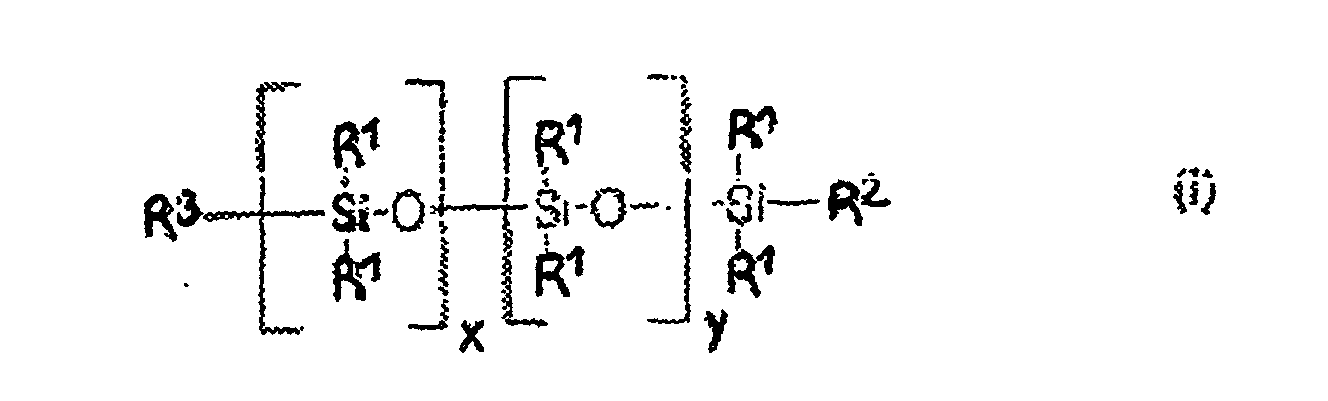
- R2 est choisi parmi CH3 ou le groupement

- R3 est choisi parmi CH3 ou le groupement R2,
- R4 est choisi parmi l'hydrogène, CH3, ou les groupements
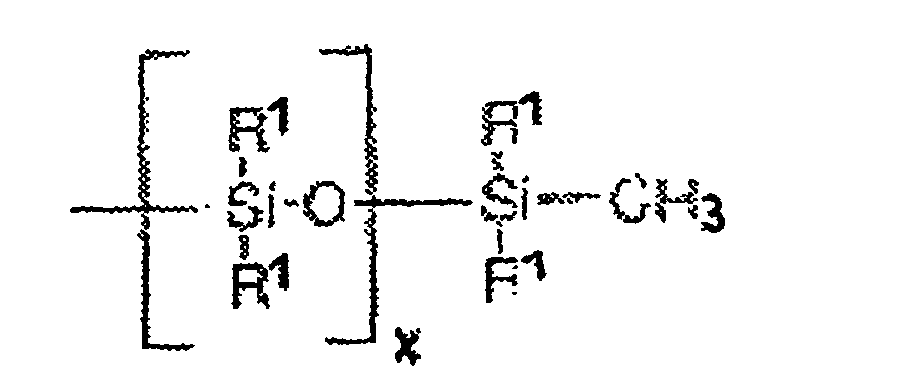
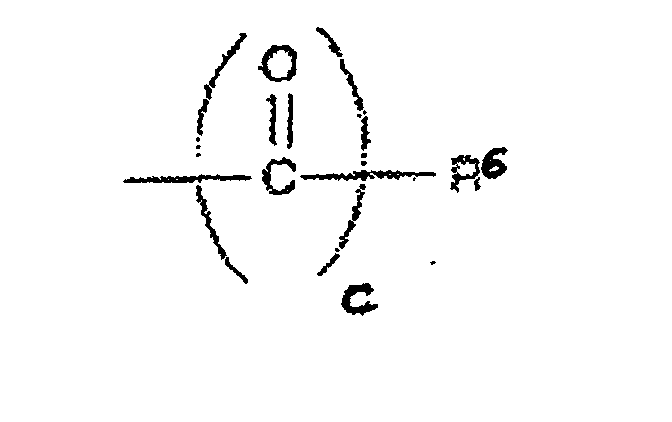
- R6 est un groupement organique en C1 à C40 pouvant contenir des groupements amino, carboxyles ou sulfonates, et si c=0, R6 est l'anion d'un acide inorganique ;
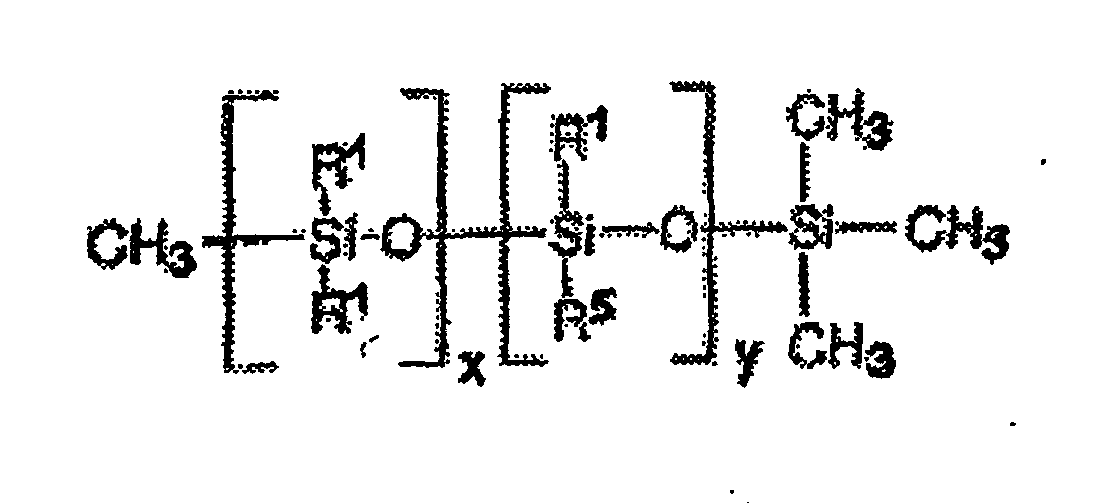
- les radicaux R1 peuvent être identiques ou différents et sont choisis parmi les hydrocarbures
aliphatiques en C1 à C20, les hydrocarbures aliphatiques ou cycloaliphatiques en C3 à C20, et les
groupements R5 répondant à la formule ci-après :

- n est un nombre entier compris entre 1 et 6,
- x et y sont des nombres entiers choisis de telle sorte que le poids moléculaire du polysiloxane soit compris entre 300 et 30 000,
- a et b sont des nombres entiers compris entre 0 et 50, et
- c est 0 ou 1.
- les radicaux G1 désignent un radical alkyle, de préférence le radical méthyle ;
- n est non nul, et les radicaux G2 représentent un radical divalent en C1-C3, de préférence un radical propylène ;
- G3 représente un radical polymérique résultant de l'(homo)polymérisation d'au moins un monomère du type acide carboxylique à insaturation éthylénique, de préférence l'acide acrylique et/ou l'acide méthacrylique
- G4 représente un radical polymérique résultant de l'(homo)polymérisation d'au moins un monomère du'type (méth)acrylate d'alkyle (C1-C10), de préférence le (méth)acrylate d'isobutyle ou de méthyle.
| Luviflex Silk (BASF) | 4 % |
| Polysilicone 8 (VS80 commercialisé par la Société 3M) | 2 % |
| AMP qs | pH=7 |
| Eau | 14 % |
| Ethanol | qsp 100g |
Claims (23)
- Composition cosmétique comprenant, dans un milieu cosmétiquement acceptable, au moins un copolymère silicone/acrylate et au moins un polymère siliconé greffé, à squelette polysiloxanique greffé par des monomères organiques non-siliconés, caractérise par le fait que le copolymère silicone/acrylate est obtenu par polymérisation radicalaire d'au moins un monomère éthyléniquement insaturé (a) en présence d'au moins un dérivé siliconé (b) comprenant des groupements oxyalkylénés.
- Composition selon la revendication 1, caractérisée par le fait que le monomère (a) répond à la formule (Ia):dans laquelle :
 X est choisi dans le groupe comprenant OH, OM, OR8, NH2, NHR8, N(R8)2;M est un cation choisi parmi Na+, K+, Mg++, NH 4+ , alkylammonium, dialkylammonium, trialkylammonium, et tétraalkylammonium;les radicaux R8 peuvent être identiques ou différents et sont choisis dans le groupe comprenant l'hydrogène, les groupements alkyls linéaires ou -ramifiés en C1 à C40, les groupements alkyls en C1 à C40 mono- ou polyhydroxylés, éventuellement substitués par un ou plusieurs groupement(s) alcoxy, amino ou carboxy, les groupements polyéthers hydroxylés, le N,N-diméthylaminoéthyl, le 2-hydroxyéthyl, le 2-méthoxyéthyl, le 2-éthoxyéthyl, le hydroxypropyl, le méthoxypropyl et l'éthoxypropyl ;R7 et R6 sont choisis indépendamment l'un de l'autre dans le groupe comprenant l'hydrogène, les groupements alkyls linéaires ou ramifiés en C1 à C8, méthoxy, éthoxy, 2-hydroxyéthoxy, 2-méthoxyéthoxy et 2-éthoxyéthyl, les groupements CN, COOH et COOM.
 - Composition cosmétique capillaire selon la revendication 1, caractérisée par le fait que le dérivé siliconé (b) répond à la formule I ci-après :dans laquelle formule (I):
 R2 est choisi parmi CH3 ou le groupement
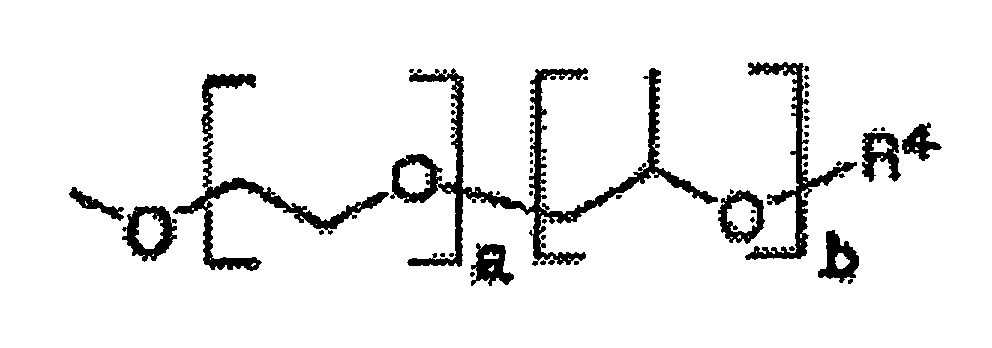 R3 est choisi parmi CH3 ou le groupement R2,R4 est choisi parmi l'hydrogène, CH3, ou les groupements
 R6 est un groupement organique en C1 à C40 pouvant contenir des groupements amino, carboxyles ou sulfonates, et si c=0, R6 est l'anion d'un acide inorganique ;les radicaux R1 peuvent être identiques ou différents et sont choisis parmi les hydrocarbures aliphatiques en C1 à C20, les hydrocarbures aliphatiques ou cycloaliphatiques en C3 à C20, et les groupements R5 répondant à la formule ci-après :
 n est un nombre entier compris entre 1 et 6,x et y sont des nombres entiers choisis de telle sorte que le poids moléculaire du polysiloxane soit compris entre 300 et 30 000,a et b sont des nombres entiers compris entre 0 et 50, etc est 0 ou 1,
 - Composition selon la revendication 1, caractérisée par. le fait que le monomère (a) est choisi parmi les esters de vinyle et d'allyle en C1 à C40, les acides carboxyliques, linéaires en C3 à C40, ou carboxycycliques en C3 à C40, les halides de vinyle ou d'allyle, les vinyllactames, de préférence la vinylpyrrolidone et le vinylcaprolactame, et les composés hétérocycles substitués par des groupement vinyls ou allyls, de préférence la vinylpyridine, la vinyloxazoline et l'allylpyridine, les N-vinylimidazoles, les diallylamines, le chlorure de vinylidène, les composés insaturés carbonés, comme le styrène ou l'isoprène, les dérivés quaternisés par l'épichlorhydrine de l'acide acrylique ou méthacrylique.
- Composition selon la revendication 1, caractérisée par le fait que le monomère (a) est choisi dans le groupe comprenant l'acide acrylique, méthacrylique et éthylacrylique ; le méthyl, éthyl, propyl, n-butyl, isobutyl, t-butyl, 2-éthylhexyl et décyl acrylate ; le méthyl, éthyl, propyl, n-butyl, isobutyl, t-butyl, 2-éthylhexyl et décyl méthàcrylate ; le méthyl, éthyl, propyl, n-butyl, isobutyl, t-butyl, 2-éthylhexyl et décyl éthacrylate ; le 2,3-dihydroxypropyl acrylate ; le 2,3-dihydroxypropyl méthacrylate ; le 2-dihydroxyéthyl acrylate ; l'hydroxypropyl acrylate ; le 2-hydroxyéthyl méthacrylate ; le 2-hydroxyéthyl éthacrylate ; le 2-méthoxyéthyl acrylate ; le 2-éthoxyéthyl méthacrylate ; le 2-éthoxyéthyl éthacrylate ; l'hydroxypropyl méthacrylate; le glycéryl monoacrylate ; le glycéryl monométhacrylate ; les polyalkylènes glycols( méth-) acrylate, les acides sulfoniques insaturés, l'acrylamide, la méthacrylamide, l'éthacrylamide, la N,N-diméthylacrylamide, la N-éthylacrylamide, la N-éthylméthacrylamide, 1-vinylimidazole, N,N-diméthylaminoéthyl(méth-)acrylate, l'acide maléique, l'acide fumarique, l'anhydride maléique et ses monoesters, l'acide crotonique, l'acide itaconique, les éthers de vinyle, le vinylformamide, la vinylamine, la vinylpyridine, la vinylimidazole, le vinylfurane, le styrène, le sulfonate de styrène, l'alcool allylique et leurs mélanges.
- Composition selon l'une quelconque des revendications précédentes, caractérisée par le fait que les dérivés siliconés (b) sont choisis parmi les diméthicone copolyols ou les tensioactifs siliconés.
- Composition selon l'une quelconque des revendications précédentes, caractérisée par le fait qu'elle comprend, en pourcentage relatif en poids, de 0,1 à 20 % de copolymère silicone/acrylate, et plus préférentiellement de 0,5 à 10 % de ce copolymère.
- Composition selon l'une quelconque des revendications précédentes, caractérisée par le fait que le polymère siliconé greffé comprend une chaíne principale de polysiloxane sur laquelle se trouve greffé, à l'intérieur de ladite chaíne ainsi qu'éventuellement à l'une au moins de ses extrémités, au moins un groupement organique ne comportant pas de silicone.
- Composition selon l'une quelconque des revendications- précédentes, caractérisée par le fait que le polymère siliconé greffé est susceptible d'être obtenu par copolymérisation radicalaire entre d'une part au moins un monomère organique anionique non-siliconé présentant une insaturation éthylénique et/ou un monomère organique hydrophobe non-siliconé présentant une insaturation éthylénique et d'autre part un polysiloxane présentant dans sa chaíne au moins un groupement fonctionnel capable de venir réagir sur lesdites insaturations éthyléniques desdits monomères non-siliconés.
- Composition selon la revendication 9, caractérisée par le fait que le monomère organique anionique à insaturation éthylénique est choisi, seul ou sous forme de mélange de monomères, parmi les acides carboxyliques insaturés, linéaires ou ramifiés.
- Composition selon la revendication 9, caractérisée par le fait que le monomères organique anionique à insaturation éthylénique est choisi, seul ou sous forme de mélange de monomères, parmi l'acide acrylique, l'acide méthacrylique, l'acide maléique, l'anhydride maléique, l'acide itaconique, l'acide fumarique et l'acide crotonique ou leurs sels d'alcalins, d'alcalino-terreux ou d'ammonium, ou leurs mélanges.
- Composition selon la revendications 9, caractérisée par le fait que le monomère organique hydrophobe à insaturation éthylénique est choisi, seul ou en mélange de monomères, parmi les esters d'acide acrylique d' alcanols et/ou les esters d'acide méthacrylique d'alcanols de préférence l'alcanol étant en C1-C18.
- Composition selon la revendications 9, caractérisée par le fait que le monomère organique hydrophobe à insaturation éthylénique est choisi, seul ou en mélange de monomères dans le groupe constitué par le (méth)acrylate d'isooctyle, le (méth)acrylate d'isonyle, le 2-éthylhexyl(méth)acrylate, le (méth)acrylate de lauryle, le (méth)acrylate d'isopentyle, le (méth)acrylate de n-butyle, le (méth)acrylate d'isobutyle, le (méth)acrylate de méthyle, le (méth)acrylate de tertio-butyle, le (méth)acrylate de tridécyle, le (méth)acrylate de stéaryle.
- Composition selon l'une quelconque des revendications précédentes, caractérisée par le fait que le polymère siliconé greffé comprend sur la chaíne silicone principale, au moins un groupement organique à caractère anionique obtenu par 1'(homo)polymérisation radicalaire d'au moins un monomère anionique de type acide carboxylique insaturé, partiellement ou totalement neutralisé sous la forme d'un sel.
- Composition selon l'une quelconque des revendications 1 à 5, caractérisée par le fait que le polymère siliconé greffé est choisi parmi les polymères siliconés comportant dans leur structure le motif de formule (I) suivantdans lequel les radicaux G1, identiques ou différents, représentent l'hydrogène ou un radical alkyle en C1-C10 ou encore un radical phényle ; les radicaux G2, identiques ou différents, représentent représente un groupe alkylène en C1-C10; G3 représente un reste polymérique résultant de l'(homo)polymérisation d'au moins un monomère anionique à insaturation éthylénique ; G4 représente un reste polymérique résultant de l'(homo)polymérisation d'au moins un monomère hydrophobe à insaturation éthylénique ; m et n sont égaux à 0 ou 1 ; a est un nombre entier allant de 0 et 50 ; b est un nombre entier pouvant être compris entre 10 et 350, c est un nombre entier allant de 0 et 50 ; sous réserve que l'un des paramètres a et c soit différent de 0.

- Composition selon la revendication 15, caractérisée par le fait que le motif de formule (I) présente au moins l'une des caractéristiques suivantes :les radicaux G1 désignent un radical alkyle en C1-C10;n est non nul, et les radicaux G2 représentent un radical divalent en C1-C3;G3 représente un radical polymérique résultant de l'(homo)polymérisation d'au moins un monomère du type acide carboxylique à insaturation éthylénique ;G4 représente un radical polymérique résultant de l'(homo)polymérisation d'au moins un monomère du type (méth)acrylate d'alkyle en C1-C10.
- Composition selon la revendication 15 ou 16, caractérisée par le fait que le motif de formule (I) présente simultanément les caractéristiques suivantes:les radicaux G1 désignent un radical méthyle;n est non nul, et les radicaux G2 représentent un radical propylène ;G3 représente un radical polymérique résultant de l'(homo)polymérisation d'au moins l'acide acrylique et/ou l'acide méthacrylique ;G4 représente un radical polymérique résultant de l'(homo)polymérisation d'au moins un monomère du type (méth)acrylate d'isobutyle ou de méthyle.
- Composition selon l'une quelconque des revendications précédentes, caractérisée par le fait que la masse moléculaire en nombre du polymère siliconé greffé varie de 10 000 à 1 000 000 environ, et encore plus préférentiellement de 10 000 à 100 000 environ.
- Composition selon l'une quelconque des revendications précédentes, caractérisée par le fait qu'elle comprend, en pourcentage relatif en poids, de 0,1 à 20 %, et de préférence de 0,2 à 10 % de polymère silicone greffé.
- Composition selon l'une quelconque des revendications précédentes, caractérisée par le fait qu'elle contient en outre au moins un additif choisi parmi les tensioactifs anioniques, cationiques, non ioniques ou amphotères, les parfums, les conservateurs, les filtres, les protéines, les vitamines, les polymères autres que ceux de l'invention, les huiles végétales, minérales ou synthétiques.
- Procédé de maintien ou de mise en forme de la coiffure, caractérisé par le fait qu'il comprend la mise en oeuvre d'une composition conforme à l'une quelconque des revendications 1 à 20.
- Utilisation d'une composition selon l'une quelconque des revendications 1 à 20, pour la fabrication d'un produit cosmétique, en particulier capillaire.
- Utilisation d'une composition selon la revendication 22 pour les sourcils et les cils.
Applications Claiming Priority (2)
| Application Number | Priority Date | Filing Date | Title |
|---|---|---|---|
| FR9911596 | 1999-09-16 | ||
| FR9911596A FR2798844B1 (fr) | 1999-09-16 | 1999-09-16 | Composition cosmetique comprenant au moins un copolymere silicone/acrylate et au moins un polymere silicone greffe |
Publications (2)
| Publication Number | Publication Date |
|---|---|
| EP1084698A1 EP1084698A1 (fr) | 2001-03-21 |
| EP1084698B1 true EP1084698B1 (fr) | 2003-07-09 |
Family
ID=9549922
Family Applications (1)
| Application Number | Title | Priority Date | Filing Date |
|---|---|---|---|
| EP00402377A Revoked EP1084698B1 (fr) | 1999-09-16 | 2000-08-28 | Composition cosmétique comprenant au moins un copolymère silicone/acrylate et au moins un polymère siliconé greffé |
Country Status (13)
| Country | Link |
|---|---|
| EP (1) | EP1084698B1 (fr) |
| JP (2) | JP2001114655A (fr) |
| KR (1) | KR100364307B1 (fr) |
| CN (1) | CN1293028A (fr) |
| AT (1) | ATE244550T1 (fr) |
| AU (1) | AU750093B2 (fr) |
| BR (1) | BR0004351A (fr) |
| CA (1) | CA2319959A1 (fr) |
| DE (1) | DE60003763T2 (fr) |
| ES (1) | ES2202018T3 (fr) |
| FR (1) | FR2798844B1 (fr) |
| PL (1) | PL342564A1 (fr) |
| RU (1) | RU2197221C2 (fr) |
Families Citing this family (6)
| Publication number | Priority date | Publication date | Assignee | Title |
|---|---|---|---|---|
| FR2825630B1 (fr) * | 2001-06-11 | 2003-09-19 | Oreal | Composition cosmetique et/ou dermatologique sous forme d'emulsion eau dans huile stabilisee par un (co)polymere d'acide 2-acrylamido-2-methylpropane sulfonique a greffons hydrophobes |
| JP6224557B2 (ja) * | 2014-09-04 | 2017-11-01 | 信越化学工業株式会社 | 皮膜形成性組成物及び化粧料 |
| US9988590B1 (en) * | 2017-11-10 | 2018-06-05 | Afton Chemical Corporation | Polydialkylsiloxane poly (meth)acrylate brush polymers for lubricant additive application |
| JP6850268B2 (ja) * | 2018-02-09 | 2021-03-31 | 信越化学工業株式会社 | (メタ)アクリルシリコーン系グラフト共重合体及びその製造方法 |
| TW202023523A (zh) * | 2018-10-11 | 2020-07-01 | 美商陶氏全球科技責任有限公司 | 彩妝化妝品配方 |
| CN110437944A (zh) * | 2019-08-15 | 2019-11-12 | 广州立白企业集团有限公司 | 一种具有抗结膜和成斑性能的自动洗碗机专用漂洗剂 |
Family Cites Families (6)
| Publication number | Priority date | Publication date | Assignee | Title |
|---|---|---|---|---|
| US5166276A (en) * | 1989-07-12 | 1992-11-24 | Mitsubishi Petrochemical Company Ltd. | Polymer for hair-care products |
| FR2735689B1 (fr) * | 1995-06-21 | 1997-08-01 | Oreal | Composition comprenant une dispersion de particules de polymeres dans un milieu non aqueux |
| FR2739281B1 (fr) * | 1995-09-29 | 1997-10-31 | Oreal | Composition topique contenant un polymere greffe silicone et une silicone aminee et/ou une gomme ou une resine siliconee |
| FR2739289B1 (fr) * | 1995-09-29 | 1997-11-07 | Oreal | Composition cosmetique comprenant au moins un polymere silicone greffe et au moins une association d'un polymere anionique et d'un polymere cationique |
| FR2740037B1 (fr) * | 1995-10-18 | 1997-12-05 | Rhone Poulenc Chimie | Compositions cosmetiques pour le cheveu et la peau a base de polyorganosiloxanes fonctionnalises greffes |
| CN1258357C (zh) * | 1997-07-23 | 2006-06-07 | Basf公司 | 包含聚硅氧烷的聚合物在化妆品配制剂中的应用 |
-
1999
- 1999-09-16 FR FR9911596A patent/FR2798844B1/fr not_active Expired - Fee Related
-
2000
- 2000-08-28 EP EP00402377A patent/EP1084698B1/fr not_active Revoked
- 2000-08-28 AT AT00402377T patent/ATE244550T1/de not_active IP Right Cessation
- 2000-08-28 DE DE60003763T patent/DE60003763T2/de not_active Expired - Fee Related
- 2000-08-28 ES ES00402377T patent/ES2202018T3/es not_active Expired - Lifetime
- 2000-09-05 AU AU56487/00A patent/AU750093B2/en not_active Ceased
- 2000-09-12 JP JP2000277134A patent/JP2001114655A/ja active Pending
- 2000-09-15 CA CA002319959A patent/CA2319959A1/fr not_active Abandoned
- 2000-09-15 RU RU2000123753/04A patent/RU2197221C2/ru not_active IP Right Cessation
- 2000-09-15 PL PL00342564A patent/PL342564A1/xx not_active Application Discontinuation
- 2000-09-15 BR BR0004351-6A patent/BR0004351A/pt not_active IP Right Cessation
- 2000-09-15 CN CN00128741A patent/CN1293028A/zh active Pending
- 2000-09-16 KR KR1020000054438A patent/KR100364307B1/ko not_active Expired - Fee Related
-
2004
- 2004-08-02 JP JP2004226152A patent/JP2004307517A/ja not_active Withdrawn
Also Published As
| Publication number | Publication date |
|---|---|
| ES2202018T3 (es) | 2004-04-01 |
| CA2319959A1 (fr) | 2001-03-16 |
| ATE244550T1 (de) | 2003-07-15 |
| DE60003763D1 (de) | 2003-08-14 |
| AU5648700A (en) | 2001-03-22 |
| BR0004351A (pt) | 2001-04-10 |
| FR2798844B1 (fr) | 2001-11-30 |
| PL342564A1 (en) | 2001-03-26 |
| AU750093B2 (en) | 2002-07-11 |
| FR2798844A1 (fr) | 2001-03-30 |
| JP2004307517A (ja) | 2004-11-04 |
| RU2197221C2 (ru) | 2003-01-27 |
| KR20010030416A (ko) | 2001-04-16 |
| KR100364307B1 (ko) | 2002-12-12 |
| DE60003763T2 (de) | 2004-04-15 |
| JP2001114655A (ja) | 2001-04-24 |
| CN1293028A (zh) | 2001-05-02 |
| EP1084698A1 (fr) | 2001-03-21 |
Similar Documents
| Publication | Publication Date | Title |
|---|---|---|
| EP1084695B1 (fr) | Composition cosmétique comprenant au moins un copolymère silicone/acrylate et au moins un agent épaississant non-cellulosique | |
| EP0769290B1 (fr) | Composition topique comprenant un polymère à greffons siliconés et un polymère amphiphile à chaíne grasse | |
| EP0852488B2 (fr) | Composition topique contenant un polymere silicone greffe et une silicone aminee et/ou une gomme ou une resine de silicone | |
| EP0773016B1 (fr) | Composition topique comprenant l'association d'un polymère à squelette non-siliconé à greffons siliconés et d'un polymère à squelette polysiloxanique à greffons non-siliconés | |
| EP0854703B1 (fr) | Composition pour le traitement des matieres keratiniques comprenant au moins un polymere silicone greffe et au moins un polymere ou copolymere eppaississant de (meth)acrylamide ou d'un derive de (meth)acrylamide et ses applications | |
| EP0859581B1 (fr) | Composition pour le traitement des matieres keratiniques comprenant au moins un polymere silicone greffe, a squelette polysiloxanique greffe par des monomeres organiques non-silicones et au moins un hydrocarbure liquide en c 11-c 26 | |
| EP0855903B1 (fr) | Composition cosmetique pour le traitement des matieres keratiniques comprenant au moins un polymere silicone greffe et au moins une dispertion aqueuse de particules insolubles de polymere non ionique ou cationique | |
| EP0859590B1 (fr) | Composition cosmetique comprenant au moins un polymere silicone greffe et au moins un copolymere bloc lineaire polysiloxane-polyoxyalkylene | |
| EP0852489B1 (fr) | Composition capillaire comprenant au moins un polymere silicone greffe par des monomeres anioniques, amphoteres ou non-ioniques et au moins un polymere amphotere | |
| EP1084694B2 (fr) | Composition cosmétique comprenant au moins un copolymère silicone/acrylate et au moins un agent de conditionnement | |
| EP0793482B1 (fr) | Composition pour le traitement des matieres keratiniques comprenant au moins un polymere silicone greffe a squelette polysiloxanique greffe par des monomeres organiques non-silicones et au moins un polymere anionique | |
| EP1084698B1 (fr) | Composition cosmétique comprenant au moins un copolymère silicone/acrylate et au moins un polymère siliconé greffé | |
| RU2203102C2 (ru) | Аэрозольное устройство, содержащее композицию для волос, включающую по крайней мере один сополимер силикона и акрилата | |
| EP1084697B1 (fr) | Composition cosmétique comprenant au moins un copolymère silicone/acrylate et au moins un polymère non ionique à motif vinyl lactame |
Legal Events
| Date | Code | Title | Description |
|---|---|---|---|
| PUAI | Public reference made under article 153(3) epc to a published international application that has entered the european phase |
Free format text: ORIGINAL CODE: 0009012 |
|
| AK | Designated contracting states |
Kind code of ref document: A1 Designated state(s): AT BE CH CY DE DK ES FI FR GB GR IE IT LI LU MC NL PT SE |
|
| AX | Request for extension of the european patent |
Free format text: AL;LT;LV;MK;RO;SI |
|
| 17P | Request for examination filed |
Effective date: 20010903 |
|
| AKX | Designation fees paid |
Free format text: AT BE CH CY DE DK ES FI FR GB GR IE IT LI LU MC NL PT SE |
|
| 17Q | First examination report despatched |
Effective date: 20011115 |
|
| GRAH | Despatch of communication of intention to grant a patent |
Free format text: ORIGINAL CODE: EPIDOS IGRA |
|
| GRAH | Despatch of communication of intention to grant a patent |
Free format text: ORIGINAL CODE: EPIDOS IGRA |
|
| GRAA | (expected) grant |
Free format text: ORIGINAL CODE: 0009210 |
|
| AK | Designated contracting states |
Designated state(s): AT BE CH CY DE DK ES FI FR GB GR IE IT LI LU MC NL PT SE |
|
| PG25 | Lapsed in a contracting state [announced via postgrant information from national office to epo] |
Ref country code: NL Free format text: LAPSE BECAUSE OF FAILURE TO SUBMIT A TRANSLATION OF THE DESCRIPTION OR TO PAY THE FEE WITHIN THE PRESCRIBED TIME-LIMIT Effective date: 20030709 Ref country code: FI Free format text: LAPSE BECAUSE OF FAILURE TO SUBMIT A TRANSLATION OF THE DESCRIPTION OR TO PAY THE FEE WITHIN THE PRESCRIBED TIME-LIMIT Effective date: 20030709 Ref country code: IE Free format text: LAPSE BECAUSE OF FAILURE TO SUBMIT A TRANSLATION OF THE DESCRIPTION OR TO PAY THE FEE WITHIN THE PRESCRIBED TIME-LIMIT Effective date: 20030709 Ref country code: AT Free format text: LAPSE BECAUSE OF FAILURE TO SUBMIT A TRANSLATION OF THE DESCRIPTION OR TO PAY THE FEE WITHIN THE PRESCRIBED TIME-LIMIT Effective date: 20030709 |
|
| REG | Reference to a national code |
Ref country code: GB Ref legal event code: FG4D Free format text: NOT ENGLISH |
|
| REG | Reference to a national code |
Ref country code: CH Ref legal event code: EP |
|
| REF | Corresponds to: |
Ref document number: 60003763 Country of ref document: DE Date of ref document: 20030814 Kind code of ref document: P |
|
| REG | Reference to a national code |
Ref country code: IE Ref legal event code: FG4D Free format text: FRENCH |
|
| PG25 | Lapsed in a contracting state [announced via postgrant information from national office to epo] |
Ref country code: LU Free format text: LAPSE BECAUSE OF NON-PAYMENT OF DUE FEES Effective date: 20030828 Ref country code: CY Free format text: LAPSE BECAUSE OF FAILURE TO SUBMIT A TRANSLATION OF THE DESCRIPTION OR TO PAY THE FEE WITHIN THE PRESCRIBED TIME-LIMIT Effective date: 20030828 |
|
| PG25 | Lapsed in a contracting state [announced via postgrant information from national office to epo] |
Ref country code: MC Free format text: LAPSE BECAUSE OF NON-PAYMENT OF DUE FEES Effective date: 20030831 Ref country code: BE Free format text: LAPSE BECAUSE OF NON-PAYMENT OF DUE FEES Effective date: 20030831 |
|
| PG25 | Lapsed in a contracting state [announced via postgrant information from national office to epo] |
Ref country code: DK Free format text: LAPSE BECAUSE OF FAILURE TO SUBMIT A TRANSLATION OF THE DESCRIPTION OR TO PAY THE FEE WITHIN THE PRESCRIBED TIME-LIMIT Effective date: 20031009 Ref country code: GR Free format text: LAPSE BECAUSE OF FAILURE TO SUBMIT A TRANSLATION OF THE DESCRIPTION OR TO PAY THE FEE WITHIN THE PRESCRIBED TIME-LIMIT Effective date: 20031009 Ref country code: SE Free format text: LAPSE BECAUSE OF FAILURE TO SUBMIT A TRANSLATION OF THE DESCRIPTION OR TO PAY THE FEE WITHIN THE PRESCRIBED TIME-LIMIT Effective date: 20031009 |
|
| GBT | Gb: translation of ep patent filed (gb section 77(6)(a)/1977) |
Effective date: 20031029 |
|
| NLV1 | Nl: lapsed or annulled due to failure to fulfill the requirements of art. 29p and 29m of the patents act | ||
| PG25 | Lapsed in a contracting state [announced via postgrant information from national office to epo] |
Ref country code: PT Free format text: LAPSE BECAUSE OF FAILURE TO SUBMIT A TRANSLATION OF THE DESCRIPTION OR TO PAY THE FEE WITHIN THE PRESCRIBED TIME-LIMIT Effective date: 20031209 |
|
| REG | Reference to a national code |
Ref country code: IE Ref legal event code: FD4D |
|
| BERE | Be: lapsed |
Owner name: L'*OREAL Effective date: 20030831 |
|
| REG | Reference to a national code |
Ref country code: ES Ref legal event code: FG2A Ref document number: 2202018 Country of ref document: ES Kind code of ref document: T3 |
|
| PLBQ | Unpublished change to opponent data |
Free format text: ORIGINAL CODE: EPIDOS OPPO |
|
| PLBI | Opposition filed |
Free format text: ORIGINAL CODE: 0009260 |
|
| PLAZ | Examination of admissibility of opposition: despatch of communication + time limit |
Free format text: ORIGINAL CODE: EPIDOSNOPE2 |
|
| PLAX | Notice of opposition and request to file observation + time limit sent |
Free format text: ORIGINAL CODE: EPIDOSNOBS2 |
|
| 26 | Opposition filed |
Opponent name: BASF AKTIENGESELLSCHAFT Effective date: 20040408 Opponent name: KPSS-KAO PROFESSIONAL SALON SERVICES GMBH Effective date: 20040415 |
|
| PLAQ | Examination of admissibility of opposition: information related to despatch of communication + time limit deleted |
Free format text: ORIGINAL CODE: EPIDOSDOPE2 |
|
| PLBG | Opposition deemed not to have been filed |
Free format text: ORIGINAL CODE: 0009274 |
|
| PG25 | Lapsed in a contracting state [announced via postgrant information from national office to epo] |
Ref country code: LI Free format text: LAPSE BECAUSE OF NON-PAYMENT OF DUE FEES Effective date: 20040831 Ref country code: CH Free format text: LAPSE BECAUSE OF NON-PAYMENT OF DUE FEES Effective date: 20040831 |
|
| 26D | Opposition deemed not to have been filed |
Opponent name: KPSS-KAO PROFESSIONAL SALON SERVICES GMBH Effective date: 20040811 |
|
| PLAX | Notice of opposition and request to file observation + time limit sent |
Free format text: ORIGINAL CODE: EPIDOSNOBS2 |
|
| PLBB | Reply of patent proprietor to notice(s) of opposition received |
Free format text: ORIGINAL CODE: EPIDOSNOBS3 |
|
| REG | Reference to a national code |
Ref country code: CH Ref legal event code: PL |
|
| APBP | Date of receipt of notice of appeal recorded |
Free format text: ORIGINAL CODE: EPIDOSNNOA2O |
|
| APAH | Appeal reference modified |
Free format text: ORIGINAL CODE: EPIDOSCREFNO |
|
| PGFP | Annual fee paid to national office [announced via postgrant information from national office to epo] |
Ref country code: DE Payment date: 20070823 Year of fee payment: 8 |
|
| PGFP | Annual fee paid to national office [announced via postgrant information from national office to epo] |
Ref country code: ES Payment date: 20070926 Year of fee payment: 8 |
|
| PGFP | Annual fee paid to national office [announced via postgrant information from national office to epo] |
Ref country code: GB Payment date: 20070822 Year of fee payment: 8 |
|
| PGFP | Annual fee paid to national office [announced via postgrant information from national office to epo] |
Ref country code: IT Payment date: 20070830 Year of fee payment: 8 |
|
| APBU | Appeal procedure closed |
Free format text: ORIGINAL CODE: EPIDOSNNOA9O |
|
| PGFP | Annual fee paid to national office [announced via postgrant information from national office to epo] |
Ref country code: FR Payment date: 20070808 Year of fee payment: 8 |
|
| PLAB | Opposition data, opponent's data or that of the opponent's representative modified |
Free format text: ORIGINAL CODE: 0009299OPPO |
|
| GBPC | Gb: european patent ceased through non-payment of renewal fee |
Effective date: 20080828 |
|
| REG | Reference to a national code |
Ref country code: FR Ref legal event code: ST Effective date: 20090430 |
|
| PG25 | Lapsed in a contracting state [announced via postgrant information from national office to epo] |
Ref country code: IT Free format text: LAPSE BECAUSE OF NON-PAYMENT OF DUE FEES Effective date: 20080828 Ref country code: DE Free format text: LAPSE BECAUSE OF NON-PAYMENT OF DUE FEES Effective date: 20090303 Ref country code: FR Free format text: LAPSE BECAUSE OF NON-PAYMENT OF DUE FEES Effective date: 20080901 |
|
| REG | Reference to a national code |
Ref country code: ES Ref legal event code: FD2A Effective date: 20080829 |
|
| PG25 | Lapsed in a contracting state [announced via postgrant information from national office to epo] |
Ref country code: GB Free format text: LAPSE BECAUSE OF NON-PAYMENT OF DUE FEES Effective date: 20080828 |
|
| RDAF | Communication despatched that patent is revoked |
Free format text: ORIGINAL CODE: EPIDOSNREV1 |
|
| PG25 | Lapsed in a contracting state [announced via postgrant information from national office to epo] |
Ref country code: ES Free format text: LAPSE BECAUSE OF NON-PAYMENT OF DUE FEES Effective date: 20080829 |
|
| RDAG | Patent revoked |
Free format text: ORIGINAL CODE: 0009271 |
|
| STAA | Information on the status of an ep patent application or granted ep patent |
Free format text: STATUS: PATENT REVOKED |
|
| 27W | Patent revoked |
Effective date: 20100207 |