EP1097961A1 - Polyolefin microporous film and method for preparing the same - Google Patents
Polyolefin microporous film and method for preparing the same Download PDFInfo
- Publication number
- EP1097961A1 EP1097961A1 EP00902977A EP00902977A EP1097961A1 EP 1097961 A1 EP1097961 A1 EP 1097961A1 EP 00902977 A EP00902977 A EP 00902977A EP 00902977 A EP00902977 A EP 00902977A EP 1097961 A1 EP1097961 A1 EP 1097961A1
- Authority
- EP
- European Patent Office
- Prior art keywords
- weight
- polyolefin
- average molecular
- ultra
- membrane
- Prior art date
- Legal status (The legal status is an assumption and is not a legal conclusion. Google has not performed a legal analysis and makes no representation as to the accuracy of the status listed.)
- Granted
Links
Classifications
-
- B—PERFORMING OPERATIONS; TRANSPORTING
- B01—PHYSICAL OR CHEMICAL PROCESSES OR APPARATUS IN GENERAL
- B01D—SEPARATION
- B01D67/00—Processes specially adapted for manufacturing semi-permeable membranes for separation processes or apparatus
- B01D67/0002—Organic membrane manufacture
- B01D67/0023—Organic membrane manufacture by inducing porosity into non porous precursor membranes
- B01D67/0025—Organic membrane manufacture by inducing porosity into non porous precursor membranes by mechanical treatment, e.g. pore-stretching
- B01D67/0027—Organic membrane manufacture by inducing porosity into non porous precursor membranes by mechanical treatment, e.g. pore-stretching by stretching
-
- C—CHEMISTRY; METALLURGY
- C08—ORGANIC MACROMOLECULAR COMPOUNDS; THEIR PREPARATION OR CHEMICAL WORKING-UP; COMPOSITIONS BASED THEREON
- C08J—WORKING-UP; GENERAL PROCESSES OF COMPOUNDING; AFTER-TREATMENT NOT COVERED BY SUBCLASSES C08B, C08C, C08F, C08G or C08H
- C08J9/00—Working-up of macromolecular substances to porous or cellular articles or materials; After-treatment thereof
-
- B—PERFORMING OPERATIONS; TRANSPORTING
- B01—PHYSICAL OR CHEMICAL PROCESSES OR APPARATUS IN GENERAL
- B01D—SEPARATION
- B01D67/00—Processes specially adapted for manufacturing semi-permeable membranes for separation processes or apparatus
- B01D67/0081—After-treatment of organic or inorganic membranes
- B01D67/0086—Mechanical after-treatment
-
- B—PERFORMING OPERATIONS; TRANSPORTING
- B01—PHYSICAL OR CHEMICAL PROCESSES OR APPARATUS IN GENERAL
- B01D—SEPARATION
- B01D69/00—Semi-permeable membranes for separation processes or apparatus characterised by their form, structure or properties; Manufacturing processes specially adapted therefor
- B01D69/02—Semi-permeable membranes for separation processes or apparatus characterised by their form, structure or properties; Manufacturing processes specially adapted therefor characterised by their properties
-
- B—PERFORMING OPERATIONS; TRANSPORTING
- B01—PHYSICAL OR CHEMICAL PROCESSES OR APPARATUS IN GENERAL
- B01D—SEPARATION
- B01D71/00—Semi-permeable membranes for separation processes or apparatus characterised by the material; Manufacturing processes specially adapted therefor
- B01D71/06—Organic material
- B01D71/26—Polyalkenes
- B01D71/261—Polyethylene
-
- B—PERFORMING OPERATIONS; TRANSPORTING
- B01—PHYSICAL OR CHEMICAL PROCESSES OR APPARATUS IN GENERAL
- B01D—SEPARATION
- B01D71/00—Semi-permeable membranes for separation processes or apparatus characterised by the material; Manufacturing processes specially adapted therefor
- B01D71/06—Organic material
- B01D71/26—Polyalkenes
- B01D71/262—Polypropylene
-
- H—ELECTRICITY
- H01—ELECTRIC ELEMENTS
- H01M—PROCESSES OR MEANS, e.g. BATTERIES, FOR THE DIRECT CONVERSION OF CHEMICAL ENERGY INTO ELECTRICAL ENERGY
- H01M50/00—Constructional details or processes of manufacture of the non-active parts of electrochemical cells other than fuel cells, e.g. hybrid cells
- H01M50/40—Separators; Membranes; Diaphragms; Spacing elements inside cells
- H01M50/409—Separators, membranes or diaphragms characterised by the material
- H01M50/411—Organic material
- H01M50/414—Synthetic resins, e.g. thermoplastics or thermosetting resins
- H01M50/417—Polyolefins
-
- H—ELECTRICITY
- H01—ELECTRIC ELEMENTS
- H01M—PROCESSES OR MEANS, e.g. BATTERIES, FOR THE DIRECT CONVERSION OF CHEMICAL ENERGY INTO ELECTRICAL ENERGY
- H01M50/00—Constructional details or processes of manufacture of the non-active parts of electrochemical cells other than fuel cells, e.g. hybrid cells
- H01M50/40—Separators; Membranes; Diaphragms; Spacing elements inside cells
- H01M50/489—Separators, membranes, diaphragms or spacing elements inside the cells, characterised by their physical properties, e.g. swelling degree, hydrophilicity or shut down properties
-
- H—ELECTRICITY
- H01—ELECTRIC ELEMENTS
- H01M—PROCESSES OR MEANS, e.g. BATTERIES, FOR THE DIRECT CONVERSION OF CHEMICAL ENERGY INTO ELECTRICAL ENERGY
- H01M50/00—Constructional details or processes of manufacture of the non-active parts of electrochemical cells other than fuel cells, e.g. hybrid cells
- H01M50/40—Separators; Membranes; Diaphragms; Spacing elements inside cells
- H01M50/489—Separators, membranes, diaphragms or spacing elements inside the cells, characterised by their physical properties, e.g. swelling degree, hydrophilicity or shut down properties
- H01M50/491—Porosity
-
- B—PERFORMING OPERATIONS; TRANSPORTING
- B01—PHYSICAL OR CHEMICAL PROCESSES OR APPARATUS IN GENERAL
- B01D—SEPARATION
- B01D2323/00—Details relating to membrane preparation
- B01D2323/08—Specific temperatures applied
- B01D2323/081—Heating
-
- B—PERFORMING OPERATIONS; TRANSPORTING
- B01—PHYSICAL OR CHEMICAL PROCESSES OR APPARATUS IN GENERAL
- B01D—SEPARATION
- B01D2323/00—Details relating to membrane preparation
- B01D2323/08—Specific temperatures applied
- B01D2323/082—Cooling
-
- B—PERFORMING OPERATIONS; TRANSPORTING
- B01—PHYSICAL OR CHEMICAL PROCESSES OR APPARATUS IN GENERAL
- B01D—SEPARATION
- B01D2325/00—Details relating to properties of membranes
- B01D2325/02—Details relating to pores or porosity of the membranes
- B01D2325/0283—Pore size
-
- B—PERFORMING OPERATIONS; TRANSPORTING
- B01—PHYSICAL OR CHEMICAL PROCESSES OR APPARATUS IN GENERAL
- B01D—SEPARATION
- B01D2325/00—Details relating to properties of membranes
- B01D2325/20—Specific permeability or cut-off range
-
- B—PERFORMING OPERATIONS; TRANSPORTING
- B01—PHYSICAL OR CHEMICAL PROCESSES OR APPARATUS IN GENERAL
- B01D—SEPARATION
- B01D2325/00—Details relating to properties of membranes
- B01D2325/34—Molecular weight or degree of polymerisation
-
- H—ELECTRICITY
- H01—ELECTRIC ELEMENTS
- H01M—PROCESSES OR MEANS, e.g. BATTERIES, FOR THE DIRECT CONVERSION OF CHEMICAL ENERGY INTO ELECTRICAL ENERGY
- H01M50/00—Constructional details or processes of manufacture of the non-active parts of electrochemical cells other than fuel cells, e.g. hybrid cells
- H01M50/40—Separators; Membranes; Diaphragms; Spacing elements inside cells
- H01M50/489—Separators, membranes, diaphragms or spacing elements inside the cells, characterised by their physical properties, e.g. swelling degree, hydrophilicity or shut down properties
- H01M50/494—Tensile strength
-
- Y—GENERAL TAGGING OF NEW TECHNOLOGICAL DEVELOPMENTS; GENERAL TAGGING OF CROSS-SECTIONAL TECHNOLOGIES SPANNING OVER SEVERAL SECTIONS OF THE IPC; TECHNICAL SUBJECTS COVERED BY FORMER USPC CROSS-REFERENCE ART COLLECTIONS [XRACs] AND DIGESTS
- Y02—TECHNOLOGIES OR APPLICATIONS FOR MITIGATION OR ADAPTATION AGAINST CLIMATE CHANGE
- Y02E—REDUCTION OF GREENHOUSE GAS [GHG] EMISSIONS, RELATED TO ENERGY GENERATION, TRANSMISSION OR DISTRIBUTION
- Y02E60/00—Enabling technologies; Technologies with a potential or indirect contribution to GHG emissions mitigation
- Y02E60/10—Energy storage using batteries
Definitions
- This invention relates to a microporous membrane comprising an ultra-high-molecular-weight polyolefin or composition containing an ultra-high-molecular-weight polyolefin, more particularly to a microporous polyolefin membrane for battery separators, and also relates to a method for producing the same.
- Microporous polyolefin membranes are widely used in various applications such as battery separators (in particular, separators for lithium ion primary and secondary batteries; and large-sized batteries for electric vehicles or the like), capacitor separators, various separation membranes (e.g., for water treatment, ultrafiltration, microfiltration and reverse osmosis), various filters, and moisture-permeable/waterproof clothes or base materials therefor, because they are insoluble in organic solvents, and resistant to electrolytes and electrode-active materials.
- battery separators in particular, separators for lithium ion primary and secondary batteries; and large-sized batteries for electric vehicles or the like
- capacitor separators capacitor separators
- various separation membranes e.g., for water treatment, ultrafiltration, microfiltration and reverse osmosis
- various filters e.g., for water treatment, ultrafiltration, microfiltration and reverse osmosis
- moisture-permeable/waterproof clothes or base materials therefor because they are insoluble in organic solvents, and resistant to electrolytes
- One of the known methods for producing microporous polyolefin membranes is extraction process comprising the steps of mixing a polyolefin with an organic medium and inorganic powder (e.g., finely powdered silica), melting and molding the mixture, and extracting the organic medium and inorganic powder.
- This method needs a process of extracting the inorganic powder, and permeability of the membrane produced depends largely on particle size of the inorganic powder used and is difficult to control.
- microporous membranes which contain an ultra-high-molecular-weight polyolefin.
- Japanese Patent Application Laid-Open Nos. 60-242035, 61-195132, 61-195133, 63-39602, 63-273651, 3-64334 and 3-105851 disclose processes to produce microporous membranes by forming a gel-like sheet from a heated solution of a polyolefin composition containing an ultra-high-molecular-weight polyolefin dissolved in a solvent, stretching it while heating, and removing the solvent by extraction. These processes give the microporous polyolefin membranes characterized by a sharp pore size distribution and small pore size, which have been used for battery separators.
- lithium ion batteries have been, increasingly required to have higher battery characteristics, safety and productivity.
- Each battery system is required to have an optimum pore size, porosity and permeability for improved, battery characteristics.
- it is generally essential to reduce energy loss by increasing separator permeability and decreasing ion migration resistance in a range that safety of the battery is securely kept.
- excessively increasing pore size helps accelerate formation of dendrite, possibly deteriorating safety of the battery. It is necessary, when the battery is subjected to a destructive test, the electrodes are securely kept apart from each other for safety reasons, even when the separator is deformed. Development of the microporous membrane satisfying the above conditions has been increasingly demanded.
- a microporous polyolefin membrane well-balanced in properties e.g., high in elongation and porosity and low in shrinkage
- a microporous polyolefin membrane well-balanced in properties e.g., high in elongation and porosity and low in shrinkage
- a microporous polyolefin membrane well-balanced in properties e.g., high in elongation and porosity and low in shrinkage
- the present invention provides a microporous polyolefin membrane comprising (A) an ultra-high-molecular-weight polyolefin having a weight-average molecular weight of 5 ⁇ 10 5 or more, or (B) a composition containing an ultra-high-molecular-weight polyolefin having a weight-average molecular weight of 5 ⁇ 10 5 or more, and having a porosity of 46 to 95%, tensile elongation of 300% or more, bubble point exceeding 980 KPa and thermal shrinkage in the TD direction of 3% or less.
- the present invention also provides a method for producing a microporous polyolefin membrane, which comprises the steps of (a) preparing a solution comprising 10 to 50 wt.% of (A) an ultra-high-molecular-weight polyolefin having a weight-average molecular weight of 5 ⁇ 10 5 or more, or (B) a composition containing an ultra-high-molecular-weight polyolefin having a weight-average molecular weight of 5 ⁇ 10 5 or more, and 90 to 50 wt.% of a solvent, (b) extruding the solution, (c) quenching the extruded solution to have a gel-like extrudate, (d) biaxially stretching the gel-like extrudate at 116 to 125°C at a stretching ratio of 2 or more in both MD and TD directions, (e) removing the solvent and drying the extrudate, and (f) heat-setting the extrudate at 115 to 120°C.
- microporous polyolefin membrane of the present invention is described in more detail by constituent components, properties and method of production.
- the ultra-high-molecular-weight polyolefin (A) for the microporous polyolefin membrane of the present invention has a weight-average molecular weight of 5 ⁇ 10 5 or more, preferably in a range from 1 ⁇ 10 6 to 15 ⁇ 10 6 .
- a polyolefin having a weight-average molecular weight less than 5 ⁇ 10 5 is undesirable for the present invention, because of anticipated deterioration of membrane strength.
- composition (B) containing an ultra-high-molecular-weight polyolefin having a weight-average molecular weight of 5 ⁇ 10 5 or more is not limited.
- One of the preferred examples of the composition (B) comprises an ultra-high-molecular-weight polyolefin (B-1) having a weight-average molecular weight of 1 ⁇ 10 6 or more, preferably 1.5 ⁇ 10 6 or more, more preferably in a range from 1.5 ⁇ 10 6 to 15 ⁇ 10 6 , and a polyolefin (B-2) having a weight-average molecular weight of 1 ⁇ 10 4 or more but less than 1 ⁇ 10 6 , preferably 1 ⁇ 10 4 or more but less than 5 ⁇ 10 5 .
- the composition (B) it is necessary for the composition (B) to contain the ultra-high-molecular-weight polyolefin (B-1) at 1 wt.% or more, preferably 15 wt.% or more, more preferably in a range from 15 to 40 wt.%.
- the composition containing the ultra-high-molecular-weight polyolefin (B-1) at less than 1 wt.% will not give the microporous membrane of sufficient strength, because the molecular chains of the polyolefin (B-1) are scarcely entwined with each other.
- the polyolefin (B-2) has a weight-average molecular weight less than 1 ⁇ 10 4 , the microporous membrane produced tends to be broken.
- polystyrene examples include crystalline homopolymers, two-stage polymers or copolymers of ethylene, propylene, 1-butene, 4-methyl-pentene-1, 1-hexene, 1-octene, vinyl acetate, methyl methacrylate or styrene, or blends thereof.
- polypropylene polyethylene
- Polyethylenes may be of high density, low density or medium density.
- the preferable ones are the compositions comprising an ultra-high-molecular-weight polyolefin (B-1) having a weight-average molecular weight of 1 ⁇ 10 6 or more and high-density polyethylene (B-2) having a weight-average molecular weight of 1 ⁇ 10 4 or more but less than 5 ⁇ 10 5 .
- Low-density polyethylene may be incorporated as the polyolefin which imparts a shut-down function to the membrane, to improve its characteristics for battery separators.
- the low-density polyethylene useful for the present invention includes linear low-density polyethylene (LLDPE) produced by the medium pressure method, low-density polyethylene (LDPE) produced by the high pressure method, and ethylene/ ⁇ -olefin copolymer produced in the presence of a single site catalyst.
- the polypropylenes useful for the present invention include block and random copolymers, in addition to the homopolymer.
- the block and random copolymers may be incorporated with another type of ⁇ -olefin other than propylene.
- One of the preferred ⁇ -olefins is ethylene. Incorporation of polypropylene can improve melt-down temperature and as a result, characteristics of the membrane for battery separators can be improved.
- the microporous polyolefin membrane of the present invention may be further incorporated with a low-molecular-weight polyethylene having a weight-average molecular weight of 1000 to 4000 as an optional component to improve its characteristics for battery separators.
- a low-molecular-weight polyethylene having a weight-average molecular weight of 1000 to 4000 as an optional component to improve its characteristics for battery separators.
- its content is preferably kept at 20 wt.% or less, based on the whole polyolefin composition, because the polyolefin of insufficient weight-average molecular weight tends to cause breakdown of the microporous membrane, as described above.
- the above-described polyolefin or polyolefin composition has a molecular weight distribution (weight-average molecular weight/number-average molecular weight) of 300 or less, preferably 5 to 50.
- the molecular weight distribution of above 300 is undesirable, because the membrane comprising such a composition may suffer breakdown by the lower molecular weight components to lose its strength as a whole.
- the desirable molecular weight distribution can be obtained by adequately mixing an ultra-high-molecular-weight polyolefin having a weight-average molecular weight of 1 ⁇ 10 6 or more and a polyolefin having a weight-average molecular weight of 1 ⁇ 10 4 or more but less than 1 ⁇ 10 6 .
- the composition may be produced by a multi-stage process or mixing two or more types of polyolefin, so long as it has the above molecular weight and molecular weight distribution.
- polyolefin or polyolefin composition may be incorporated, if required, with various additives such as antioxidants, ultraviolet absorbers, antiblocking agents, pigments, dyes, inorganic fillers, etc., and also with a polymer capable of imparting a shut-down function at low temperature, when the microporous polyolefin membrane is to be used for, e.g., lithium battery separators, within limits not harmful to the object of the present invention.
- additives such as antioxidants, ultraviolet absorbers, antiblocking agents, pigments, dyes, inorganic fillers, etc.
- a polymer capable of imparting a shut-down function at low temperature when the microporous polyolefin membrane is to be used for, e.g., lithium battery separators, within limits not harmful to the object of the present invention.
- microporous polyolefin membrane of the present invention has the following properties:
- the microporous polyolefin membrane of the present invention has a porosity of 45 to 95%, preferably 50 to 80%. Porosity beyond the above-described range is undesirable. At below 45%, the membrane may be insufficient in ion conductivity for battery separators, deteriorated in battery characteristics, e.g., battery capacity and cycle characteristics, especially at low temperature. At above 95%, on the other hand, strength of the membrane itself is insufficient.
- the microporous polyolefin membrane of the present invention has elongation at break of 300% or more. Elongation at break below 300% is undesirable for a battery separator membrane, because the separator deformation may not follow irregularities on the electrodes, burrs, battery deformation or the like, to possibly cause a short circuit between the electrodes.
- the microporous polyolefin membrane of the present invention has a bubble point above 980 KPa, preferably 1,470 KPa or higher, more preferably 9,800 KPa or higher. Bubble point below 980 KPa is undesirable for a battery separator microporous polyolefin membrane, because such a membrane may have excessively large pores to accelerate formation of dendrite, possibly causing various troubles, e.g., voltage drop and self-discharge.
- the microporous polyolefin membrane of the present invention it is necessary for the microporous polyolefin membrane of the present invention to have a thermal shrinkage of 3% or less in the TD direction. When it is to be used for a battery separator, thermal shrinkage above 3% in the TD direction is undesirable, because the electrode may be exposed when the battery is heated at an abnormally high rate.
- Thermal shrinkage is preferably 5% or less in the MD direction.
- the microporous polyolefin membrane of the present invention has pores preferably having an average diameter of 0.01 to 0.1 ⁇ m, more preferably 0.01 to 0.05 ⁇ m. At an average diameter below 0.01 ⁇ m, the membrane may have an excessively low permeability. At above 0.1 ⁇ m, on the other hand, the membrane tends to suffer short circuit resulting from formation of dendrite, when it is used for a battery separator.
- the microporous polyolefin membrane of the present invention preferably has an air-permeability of 400 sec/100 cc or less, more preferably 50 to 400 sec/100 cc. Keeping air-permeability at 400 sec/100 cc or less for the microporous polyolefin membrane can improve its ion transmission capacity and hence output characteristics, when it is used for a battery separator.
- the microporous polyolefin membrane of the present invention preferably has a tensile strength of 49,000 KPa or more both in the MD and TD directions.
- the microporous polyolefin membrane having a tensile strength of 49,000 KPa or more will not be broken, when used for a battery separator, and hence is desirable.
- microporous polyolefin membrane of the present invention having the above-described properties, is high in elongation, permeability, strength and bubble point and low in thermal shrinkage. In spite of its relatively small average pore diameter of 0.01 to 0.1 ⁇ m, it is high in porosity and conversely high in permeability because of the sharp pore size distribution. These properties make the membrane of the present invention suitable for, e.g., battery separators and liquid filters.
- the method for producing the microporous polyolefin membrane of the present invention comprises steps of (a) mixing a resin component of a polyolefin or polyolefin composition, incorporated, as required, with a polymer or the like which imparts a shut-down effect at low temperature to the membrane, with an organic liquid or solid, (b) melting, kneading and extruding the mixture, (c) stretching the resultant extrudate, (d) removing the solvent from the extrudate, and (e) drying and heat-setting the extrudate.
- One of the preferred embodiments for producing the microporous polyolefin membrane of the present invention comprises preparing a solution of polyolefin or polyolefin composition by supplying it with a good solvent for the polyolefin, extruding the solution through a die into sheets, cooling the sheets to form the gel-like composition, stretching the gel-like composition under heating, removing the residual solvent from the composition, and drying and heat-setting the composition.
- the solution of polyolefin or polyolefin composition as the stock is prepared by dissolving the polyolefin or polyolefin composition in a solvent while heating.
- Any solvent can be used, so long as it can sufficiently dissolve the polyolefin.
- the solvents include aliphatic or cyclic hydrocarbons such as nonane, decane, undecane, dodecane, paraffin oils, etc., and fractions of mineral oils having boiling points substantially equal to those of the above hydrocarbons.
- a nonvolatile solvent, e.g., paraffin oil is preferable for forming the stable gel-like shape.
- Dissolution of the polyolefin or polyolefin composition while heating is carried out by stirring its solution at a temperature at which it is completely dissolved in the solvent, or uniformly mixing the composition and solvent with each other in an extruder.
- the dissolving temperature varies depending on the types of polymers and solvents used. It is in the range of 140 to 250°C in the case of polyethylene composition. It is preferable to effect the dissolution in an extruder, when a high-concentration solution of the polyolefin composition is used to produce a microporous membrane.
- the polyolefin or polyolefin composition is first charged in the extruder to be molten, at a temperature preferably 30 to 100°C above melting point of the polyolefin, although varying depending on type of the polyolefin used, where melting point is determined by DSC in accordance with JIS K 7211. For example, it is 160 to 230°C, preferably 170 to 200°C, in the case of polyethylene, and 190 to 270°C, preferably 190 to 250°C, in the case of polypropylene. Then, a liquid solvent is added to the molten polyolefin or polyolefin composition in the middle of the extruder.
- the concentration of the polyolefin or polyolefin composition is 10 to 50 wt. % based on the total of the polyolefin or polyolefin composition and solvent, preferably 10 to 40 wt.%, more preferably 10 to 35 wt.%, or conversely the concentration of the solvent is 90 to 50 wt.%, preferably 90 to 60 wt.%, more preferably 90 to 65 wt.%.
- concentration of the polyolefin or polyolefin composition concentration is less than 10 wt.% (or the solvent concentration is more than 90 wt.%), swelling and neck-in are likely to take place at the exit of a die in the process of forming sheets.
- the heated solution of the molten and kneaded polyolefin or polyolefin composition is extruded directly or by another extruder through a die or the like, in such a way to secure the final membrane thickness of 5 to 250 ⁇ m.
- a die Usually used as a die is a sheet die having a rectangular orifice, but a double-pipe hollow die, an inflation die, etc. may be used.
- a die gap is usually 0.1 to 5mm, and heated at 140 to 250°C in the extrusion process. In this case, an extrusion speed is usually 20-30cm/minute to 15m/minute.
- the solution extruded through the die is formed into a gel-like sheet by quenching. It is cooled to 90°C or below, preferably to 80 to 30°C, at a speed of at least 50°C/minute by cooling the die or gel-like sheet.
- a method of cooling the gel-like sheet direct contact with cooling air, cooling water or other cooling media, contact with a roll cooled by a coolant, etc. may be employed. Contact with a cooled roll is a preferable method.
- the gel-like sheet is then biaxially stretched under heating by an ordinary method, such as a tenter, roll, calender method or a combination thereof at a given stretching ratio. It may be stretched in the machine and transmachine directions simultaneously or sequentially. The simultaneous stretching is more preferable.
- an ordinary method such as a tenter, roll, calender method or a combination thereof at a given stretching ratio. It may be stretched in the machine and transmachine directions simultaneously or sequentially. The simultaneous stretching is more preferable.
- the stretching temperature is 116 to 125°C, preferably 116 to 123°C. If the stretching temperature exceeds 125°C, the molecular orientation by stretching does not take place because the resin melts, and as a result, membrane porosity may decrease. If the stretching temperature is below 116°C, on the other hand, the resin is softened insufficiently, with the result that the membrane tends to break during the stretching process and stretching ratio cannot be well controlled. Elongation of the microporous membrane will be also insufficient.
- the stretching ratio should be set at 2 or more for both MD and TD directions, preferably 3 or more.
- Solvents used for this solvent-removing treatment may be volatile ones, including hydrocarbons such as pentane, hexane and heptane; chlorinated hydrocarbons such as methylene chloride and carbon tetrachloride; fluorinated hydrocarbons such as trifluoroethane; and ethers such as diethyl ether and dioxane. These volatile solvents may be used individually or in combination, and their selection depends on the types of the nonvolatile solvents used to dissolve the polyolefin composition. Washing methods with the solvents include an extraction method with solvents, a method of spraying solvents or a combination thereof.
- the washing of the stretched sheet with a solvent should be performed to such an extent that the content of the residual solvent is less than 1 wt.%.
- the stretched sheet is finally dried to remove the washing solvent by a heating method, an air-drying method, etc.
- the dried sheet is thermally set at 115 to 120°C. At below 115°C, strength of the microporous membrane may be insufficient. At above 120°C, on the other hand, thermal shrinkage of the membrane may be excessively high, to decrease its elongation, It is preferable to heat-set the membrane in such a way to shrink its width to 10% or less. This treatment should improve membrane elongation. Shrinking the width beyond 10% is undesirable, because of possible deterioration of membrane permeability.
- the microposrous membrane having the desired properties can be produced by the above-described procedure. It may be subjected, if necessary, to a hydrophilic treatment by plasma irradiation, impregnation with a surface active agent, surface grafting, etc. for surface modification.
- a polyethylene mixture comprising 18 wt.% of an ultrahigh-molecular-weight polyethylene (UHMWPE) having a weight-average molecular weight of 2.0 ⁇ 10 6 and 82 wt.% of a high-density polyethylene (HDPE) having a weight-average molecular weight of 3.5 ⁇ 10 5 , and having a Mw/Mn ratio of 16.8 and melting point of 135°C, was incorporated with 0.375 wt. parts of an antioxidant based on 100 wt. parts of the polyethylene mixture, to prepare a polyethylene composition.
- UHMWPE ultrahigh-molecular-weight polyethylene
- HDPE high-density polyethylene
- the resulting solution was extruded from the T-die attached at the extruder end in such a way to have 50 to 60 ⁇ m as thickness of the following stretched membrane, and taken up by a cooling roll, kept at 50°C, to prepare a gel-like sheet.
- the sheet was then biaxially stretched at 118°C at a stretching ratio of 5 ⁇ 5, to have the stretched membrane.
- the resulting membrane was washed with methylene chloride to remove the residual liquid paraffin by extraction, dried and heat-set for 10 seconds to prepare a 25 ⁇ m thick microporous polyethylene membrane.
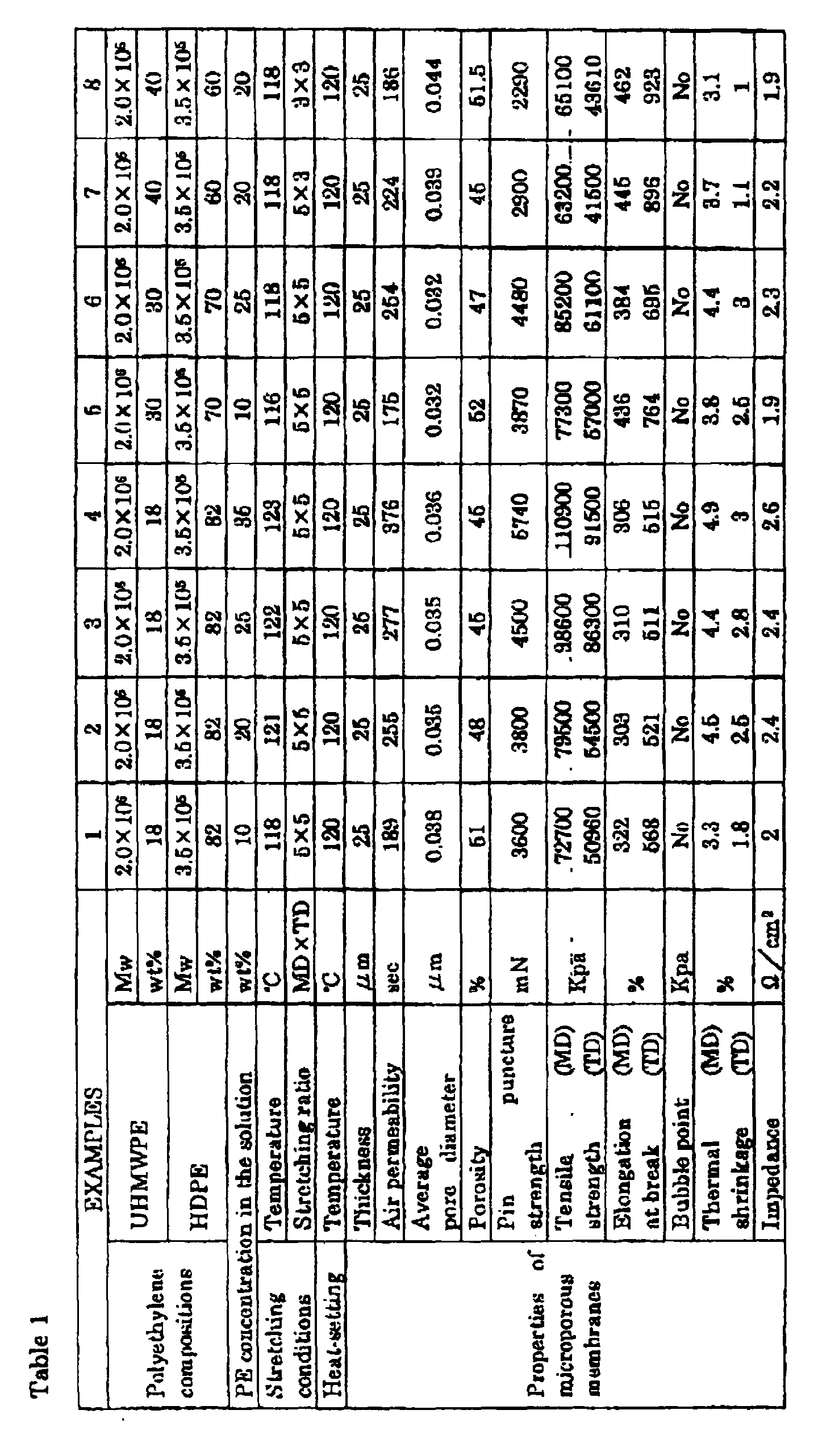
- the properties of the membrane are shown in Table 1.
- Microporous polyolefin membranes were prepared in the same manner as in EXAMPLE 1 except that UHMWPE and HDPE were used in ratios shown in Tables 1 and 2, and stretching temperature and ratios shown in Tables 1 and 2 were used.
- the properties of the microporous polyethylene membranes are shown in Tables 1 and 2. All of the polyethylene compositions had a melting point of 135°C.
- a microporous polyethylene membrane was prepared in the same manner as in EXAMPLE 1 except that polyethylene concentration in the solution was set at 20 wt.%, and stretching temperature and heat-setting temperature were set at 117 and 123°C, respectively.
- the properties of the membrane are shown in Table 3.
- a microporous polyethylene membrane was prepared in the same manner as in EXAMPLE 1 except that polyethylene concentration in the solution was set at 20 wt.%, and the stretching process was omitted.
- a microporous polyethylene membrane was prepared in the same manner as in EXAMPLE 1 except that UHMWPE/HDPE ratio was set at 20/80 by weight, and stretching temperature and heat-setting temperature were set at 120 and 122°C, respectively.
- the properties of the membrane are shown in Table 3.
- the polyethylene composition had a melting point of 135°C.
- a microporous polyethylene membrane was prepared in the same manner as in EXAMPLE 1 except that UHMWPE/HDPE ratio was set at 5/95 by weight, and stretching temperature and heat-setting temperature were set at 115 and 118°C, respectively.
- the properties of the membrane are shown in Table 3.
- the polyethylene composition had a melting point of 135°C.
- the microporous polyolefin membrane of the present invention comprises an ultra-high-molecular-weight polyolefin or composition containing an ultra-high-molecular-weight polyolefin, and is high in elongation, permeability, strength and bubble point and low in thermal shrinkage, and, in spite of its relatively small average pore diameter of 0.01 to 0.1 ⁇ m, high in porosity and conversely high in permeability because of the sharp pore size distribution.
- These properties make the membrane of the present invention suitable for, e.g., battery separators and liquid filters.
Landscapes
- Chemical & Material Sciences (AREA)
- Chemical Kinetics & Catalysis (AREA)
- General Chemical & Material Sciences (AREA)
- Electrochemistry (AREA)
- Engineering & Computer Science (AREA)
- Manufacturing & Machinery (AREA)
- Inorganic Chemistry (AREA)
- Materials Engineering (AREA)
- Health & Medical Sciences (AREA)
- Medicinal Chemistry (AREA)
- Polymers & Plastics (AREA)
- Organic Chemistry (AREA)
- Cell Separators (AREA)
- Manufacture Of Porous Articles, And Recovery And Treatment Of Waste Products (AREA)
- Artificial Filaments (AREA)
Abstract
Description

| COMPARATIVE EXAMPLES | 1 | 2 | 3 | 4 | ||
| Polyethylene compositions | UHMWPE | Mw | 2.0×10⁶ | 2.0×10⁶ | 2.0×10⁶ | 2.0×10⁶ |
| wt.% | 18 | 18 | 20 | 5 | ||
| HDPE | Mw | 3.5×10⁵ | 3.5×10⁵ | 3.5×10⁵ | 3.5×10⁵ | |
| wt.% | 82 | 82 | 80 | 95 | ||
| PE concentration in the solution | wt.% | 20 | 20 | 30 | 30 | |
| Stretching conditions | Temperature | °C | 117 | - | 120 | 115 |
| Stretching ratio | MD×TD | 5×5 | no stretching | 5×5 | 5×5 | |
| Heat-setting | Temperature | °C | 123 | 120 | 122 | 118 |
| Properties of microporous membranes | Thickness | µm | 25 | 25 | 25 | 25 |
| Air permeability | sec | 775 | 25 | 430 | 380 | |
| Average pore diameter | µm | 0.03 | 0.45 | 0.03 | 0.032 | |
| Porosity | % | 37 | 70 | 40 | 46 | |
| Pin puncture strength | mN | 4900 | 1180 | 4116 | 4410 | |
| Tensile strength | (MD) | Kpa | 102900 | 19600 | 93100 | 102900 |
| (TD) | 83300 | 15700 | 78400 | 83300 | ||
| Elongation at break | (MD) | % | 180 | 1100 | 305 | 180 |
| (TD) | 350 | 1200 | 500 | 295 | ||
| Bubble point | Kpa | No | 490 | No | No | |
| Thermal shrinkage | (MD) | % | 4 | 2 | 8 | 10 |
| (TD) | 2.5 | 0.5 | 6 | 7 | ||
| Impedance | Ω/cm2 | 3.6 | 1.2 | 2.2 | 2 |
Claims (13)
- A microporous polyolefin membrane, comprising (A) an ultra-high-molecular-weight polyolefin having a weight-average molecular weight of 5 × 10⁵ or more, or (B) a composition containing an ultra-high-molecular-weight polyolefin having a weight-average molecular weight of 5 × 10⁵ or more, and having a porosity of 45 to 95%, tensile elongation of 300% or more, bubble point exceeding 980 KPa and thermal shrinkage in the TD direction of 3% or less.
- The microporous polyolefin membrane according to Claim 1, wherein said ultra-high-molecular-weight polyolefin having a weight-average molecular weight of 5 × 10⁵ or more is polyethylene or polypropylene.
- The microporous polyolefin membrane according to Claim 1 or 2, wherein said composition (B) containing an ultra-high-molecular-weight polyolefin having a weight-average molecular weight of 5 × 10⁵ or more comprises an ultra-high-molecular-weight polyolefin (B-1) having a weight-average molecular weight of 1 × 10⁶ or more and high-density polyolefin (B-2) having a weight-average molecular weight of 1 × 10⁴ or more but less than 1 × 10⁶.
- The microporous polyolefin membrane according to one of Claims 1 to 3, which has pores having a diameter of 0.01 to 0.1 µm.
- The microporous polyolefin membrane according to one of Claims 1 to 4, which has a thermal shrinkage of 5% or less in the MD direction.
- The microporous polyolefin membrane according to one of Claims 1 to 5, which has a air permeability of 400 sec/100 cc or less.
- The microporous polyolefin membrane according to one of Claims 1 to 6, which has a tensile strength of 14,700 KPa or more in both MD and TD directions.
- A method for producing the microporous polyolefin membrane of Claim 1, which comprises the steps of (a) preparing a solution comprising 10 to 50 wt. % of (A) an ultra-high-molecular-weight polyolefin having a weight-average molecular weight of 5 × 10⁵ or more, or (B) a composition containing an ultra-high-molecular-weight polyolefin having a weight-average molecular weight of 5 × 10⁵ or more, and 90 to 50 wt.% of a solvent, (b) extruding the solution, (c) quenching the extruded solution to have a gel-like extrudate, (d) biaxially stretching the gel-like extrudate at 116 to 125°C at a stretching ratio of 2 or more in both MD and TD directions, (e) removing the solvent and drying the extrudate, and (f) heat-setting the extrudate at 115 to 120°C.
- The method for producing the microporous polyolefin membrane according to Claim 8, wherein said composition (B) containing an ultra-high-molecular-weight polyolefin having a weight-average molecular weight of 5 × 10⁵ or more comprises 15 to 100 wt.% of an ultra-high-molecular-weight polyethylene having a weight-average molecular weight of 1 × 10⁶ or more and 0 to 85 wt.% of a high-density polyethylene having a weight-average molecular weight of 1 × 10⁴ or more but less than 5 × 10⁵.
- The method for producing the microporous polyolefin membrane according to Claim 8 or 9, wherein said heat-setting step involves shrinkage of membrane width to 10% or less at least in one of MD and TD directions.
- A battery separator which uses the microporous polyolefin membrane according to Claim 1.
- A battery which uses the microporous polyolefin membrane according to Claim 1 for the battery separator.
- A filter which uses the microporous polyolefin membrane according to Claim 1.
Applications Claiming Priority (3)
| Application Number | Priority Date | Filing Date | Title |
|---|---|---|---|
| JP4198699 | 1999-02-19 | ||
| JP4198699 | 1999-02-19 | ||
| PCT/JP2000/000829 WO2000049073A1 (en) | 1999-02-19 | 2000-02-15 | Polyolefin microporous film and method for preparing the same |
Publications (3)
| Publication Number | Publication Date |
|---|---|
| EP1097961A1 true EP1097961A1 (en) | 2001-05-09 |
| EP1097961A4 EP1097961A4 (en) | 2003-03-05 |
| EP1097961B1 EP1097961B1 (en) | 2014-01-22 |
Family
ID=12623532
Family Applications (1)
| Application Number | Title | Priority Date | Filing Date |
|---|---|---|---|
| EP00902977.8A Expired - Lifetime EP1097961B1 (en) | 1999-02-19 | 2000-02-15 | Polyolefin microporous film and method for preparing the same |
Country Status (6)
| Country | Link |
|---|---|
| US (1) | US6245272B1 (en) |
| EP (1) | EP1097961B1 (en) |
| KR (1) | KR100667052B1 (en) |
| CN (1) | CN1134491C (en) |
| TW (1) | TW553986B (en) |
| WO (1) | WO2000049073A1 (en) |
Cited By (7)
| Publication number | Priority date | Publication date | Assignee | Title |
|---|---|---|---|---|
| WO2003035232A1 (en) * | 2001-10-22 | 2003-05-01 | Exxonmobil Oil Corporation | Porous polyethylene membrane |
| EP1168469A3 (en) * | 2000-06-14 | 2003-08-06 | Sumitomo Chemical Company, Limited | Porous film and separator for battery using the same |
| EP1928043A1 (en) | 2006-11-30 | 2008-06-04 | Samsung SDI Co., Ltd. | Lithium rechargeable battery and separator for the same |
| EP2065953A1 (en) * | 2007-11-28 | 2009-06-03 | SK Energy Co., Ltd. | Microporous polyolefin film possessing good mechanical properties and thermal stability |
| EP2612702A1 (en) * | 2012-01-06 | 2013-07-10 | SK Innovation Co. Ltd. | Microporous polyolefin film and method for preparing the same |
| RU2580918C2 (en) * | 2011-11-04 | 2016-04-10 | Ппг Индастриз Огайо, Инк. | Microporous material, possessing filtering and adsorbing properties, and application thereof in methods for purification of flowing streams |
| CN111684002A (en) * | 2018-02-23 | 2020-09-18 | 东丽株式会社 | Porous polyolefin membrane |
Families Citing this family (77)
| Publication number | Priority date | Publication date | Assignee | Title |
|---|---|---|---|---|
| US6666969B1 (en) * | 1998-10-01 | 2003-12-23 | Tonen Chemical Corporation | Microporous polyolefin film and process for producing the same |
| ES2204513T3 (en) * | 1999-01-21 | 2004-05-01 | Membrana Gmbh | ASYMMETRIC INTEGRAL POLYOLEFIN MEMBRANE. |
| WO2000049074A1 (en) * | 1999-02-19 | 2000-08-24 | Tonen Chemical Corporation | Polyolefin microporous film and method for preparing the same |
| JP4927243B2 (en) * | 2000-01-13 | 2012-05-09 | 東レバッテリーセパレータフィルム合同会社 | Polyolefin microporous membrane |
| WO2001057940A2 (en) * | 2000-02-04 | 2001-08-09 | Amtek Research International Llc | Freestanding microporous separator including a gel-forming polymer |
| JP5318307B2 (en) * | 2001-03-30 | 2013-10-16 | 住友化学株式会社 | Polyolefin resin film and composition for polyolefin resin film |
| JP2003068270A (en) | 2001-08-29 | 2003-03-07 | Sanyo Electric Co Ltd | Nickel-metal hydride storage battery separator and nickel-metal hydride storage battery |
| EP1296389A1 (en) * | 2001-09-19 | 2003-03-26 | Wilson Greatbatch Technologies, Inc. | Silver vanadium oxide having a fine particle size for improved cell performance |
| US20050112462A1 (en) * | 2003-11-21 | 2005-05-26 | Marple Jack W. | High discharge capacity lithium battery |
| US8007940B2 (en) * | 2001-12-11 | 2011-08-30 | Eveready Battery Company, Inc. | High discharge capacity lithium battery |
| CN100559632C (en) * | 2002-01-24 | 2009-11-11 | 日立麦克赛尔株式会社 | Electronic equipment containing non-aqueous secondary batteries inside |
| JP2004095383A (en) * | 2002-08-30 | 2004-03-25 | Toshiba Corp | Non-aqueous electrolyte secondary battery |
| US20040048958A1 (en) * | 2002-09-06 | 2004-03-11 | Didier David A. | High temperature ultra high molecular weight polyethylene |
| JP3886124B2 (en) * | 2002-10-28 | 2007-02-28 | 日東電工株式会社 | Method for producing porous film |
| EP1614710B1 (en) * | 2003-03-24 | 2019-04-24 | Asahi Kasei Kabushiki Kaisha | Microporous polyethylene film |
| CN101044643B (en) * | 2003-06-06 | 2012-05-16 | 阿姆泰克研究国际公司 | Battery separators containing reactive functional groups |
| EP1518866A1 (en) * | 2003-09-29 | 2005-03-30 | Basell Poliolefine Italia S.P.A. | Process for the preparation of porous ethylene polymers |
| JP4799179B2 (en) * | 2003-10-27 | 2011-10-26 | 旭化成イーマテリアルズ株式会社 | Polyolefin microporous membrane |
| US20050098963A1 (en) * | 2003-11-06 | 2005-05-12 | Omax Corporation | One-piece extrusion-resistant seal |
| US20050233214A1 (en) * | 2003-11-21 | 2005-10-20 | Marple Jack W | High discharge capacity lithium battery |
| US8283071B2 (en) | 2003-11-21 | 2012-10-09 | Eveready Battery Company, Inc. | High discharge capacity lithium battery |
| US8124274B2 (en) * | 2003-11-21 | 2012-02-28 | Eveready Battery Company, Inc. | High discharge capacity lithium battery |
| US7361247B2 (en) * | 2003-12-31 | 2008-04-22 | Neenah Paper Inc. | Matched heat transfer materials and method of use thereof |
| US8104625B2 (en) * | 2004-05-20 | 2012-01-31 | Asahi Kasei Chemicals Corporation | Microporous membrane made of polyolefins |
| US7332531B2 (en) * | 2004-06-11 | 2008-02-19 | Sk Corporation | Microporous high density polyethylene film |
| US20060008636A1 (en) * | 2004-07-06 | 2006-01-12 | Lee Young K | Microporous polyethylene film and method of producing the same |
| US7435761B2 (en) * | 2004-07-06 | 2008-10-14 | Sk Energy Co., Ltd. | Microporous polyethylene film and method of producing the same |
| JP4384630B2 (en) * | 2004-12-23 | 2009-12-16 | トーレ・サエハン・インコーポレーテッド | Polyethylene microporous membrane for secondary battery separator and method for producing the same |
| KR101265556B1 (en) * | 2005-03-29 | 2013-05-20 | 도레이 배터리 세퍼레이터 필름 주식회사 | Process for producing microporous polyolefin film and microporous polyolefin film |
| EP1870430B1 (en) * | 2005-03-31 | 2014-01-01 | Toray Battery Separator Film Co., Ltd. | Microporous polyolefin film and process for producing the same |
| KR100943697B1 (en) * | 2005-04-06 | 2010-02-23 | 에스케이에너지 주식회사 | Polyethylene microporous membrane with excellent physical properties, productivity and quality uniformity and its manufacturing method |
| US20070092705A1 (en) * | 2005-06-18 | 2007-04-26 | Young-Keun Lee | Microporous polyethylene film through liquid-liquid phase separation mechanism and preparing method thereof |
| KR100943234B1 (en) | 2005-05-16 | 2010-02-18 | 에스케이에너지 주식회사 | Polyethylene microporous membrane prepared by liquid-liquid phase separation and its manufacturing method |
| CN1887581A (en) * | 2005-06-30 | 2007-01-03 | 佛山塑料集团股份有限公司 | Making process of microporous polyolefin film |
| CN100418741C (en) * | 2005-06-30 | 2008-09-17 | 佛山塑料集团股份有限公司 | Preparation method of high temperature resistant polyolefin microporous membrane |
| JP5202826B2 (en) * | 2005-08-04 | 2013-06-05 | 東レバッテリーセパレータフィルム株式会社 | Polyethylene microporous membrane, method for producing the same, and battery separator |
| CN101292378B (en) * | 2005-10-18 | 2010-11-03 | 东丽株式会社 | Microporous membrane for electrical storage device separator and electrical storage device separator using the same |
| KR101278090B1 (en) * | 2005-10-21 | 2013-06-24 | 도레이 배터리 세퍼레이터 필름 주식회사 | Process for production of thermoplastic resin microporous membranes |
| KR20080068722A (en) * | 2005-10-24 | 2008-07-23 | 토넨 케미칼 코퍼레이션 | Polyolefin multilayer microporous membrane, manufacturing method thereof, and battery separator |
| CN100371057C (en) * | 2006-03-22 | 2008-02-27 | 广东工业大学 | A kind of extraction method for producing polyolefin microporous membrane |
| US10615388B2 (en) * | 2006-03-22 | 2020-04-07 | Celgard, Llc | Membrane made of a blend of UHMW polyolefins |
| JP5202816B2 (en) * | 2006-04-07 | 2013-06-05 | 東レバッテリーセパレータフィルム株式会社 | Polyolefin microporous membrane and method for producing the same |
| KR101079456B1 (en) * | 2006-05-22 | 2011-11-03 | 파나소닉 주식회사 | Separator and nonaqueous electrolyte secondary battery |
| US7807287B2 (en) * | 2006-08-31 | 2010-10-05 | Tonen Chemical Corporation | Multi-layer, microporous membrane, battery separator and battery |
| US7981536B2 (en) * | 2006-08-31 | 2011-07-19 | Toray Tonen Specialty Separator Godo Kaisha | Microporous membrane, battery separator and battery |
| KR101199826B1 (en) * | 2006-12-14 | 2012-11-09 | 에스케이이노베이션 주식회사 | Polyolefin microporous membrane manufacturing method according to efficient extrusion |
| JP4560079B2 (en) * | 2007-08-09 | 2010-10-13 | パナソニック株式会社 | Method for producing positive electrode for non-aqueous electrolyte secondary battery |
| KR20090050686A (en) * | 2007-11-16 | 2009-05-20 | 에스케이에너지 주식회사 | Polyethylene microporous membrane with excellent physical properties and high permeability and surface energy |
| JP5572334B2 (en) * | 2008-05-30 | 2014-08-13 | 旭化成イーマテリアルズ株式会社 | Polyolefin microporous membrane |
| KR101640777B1 (en) * | 2008-11-17 | 2016-07-19 | 도레이 배터리 세퍼레이터 필름 주식회사 | Microporous membranes and methods for producing and using such membranes |
| CN101747549B (en) * | 2008-12-18 | 2013-06-19 | 比亚迪股份有限公司 | Polyolefin micro porous polyolefin membrane and method for preparing same |
| CN102942706A (en) * | 2008-12-19 | 2013-02-27 | 旭化成电子材料株式会社 | Polyolefin microporous membrane and separator for lithium ion secondary battery |
| JP5062783B2 (en) * | 2008-12-26 | 2012-10-31 | 旭化成イーマテリアルズ株式会社 | Polyolefin microporous membrane |
| US20100255376A1 (en) | 2009-03-19 | 2010-10-07 | Carbon Micro Battery Corporation | Gas phase deposition of battery separators |
| CN101655363A (en) * | 2009-09-04 | 2010-02-24 | 奇瑞汽车股份有限公司 | Method for testing size changing rate of battery diaphragm |
| US20130189587A1 (en) * | 2010-03-11 | 2013-07-25 | Toray Battery Separator Film Co., Ltd. | Microporous membranes, methods for making such membranes, and the use of such membranes as battery separator film |
| US8460591B2 (en) * | 2010-03-23 | 2013-06-11 | GM Global Technology Operations LLC | Porous membranes and methods of making the same |
| KR101336593B1 (en) | 2010-04-20 | 2013-12-05 | 에스케이이노베이션 주식회사 | Method with good productivity for preparing microporous polyolefin film with various properties |
| CN101920565B (en) * | 2010-06-13 | 2011-12-28 | 河北金力新能源材料科技有限公司 | Method for preparing porous polymer film |
| HUE043797T2 (en) | 2010-12-28 | 2019-09-30 | Asahi Chemical Ind | Polyolefin-based porous film and method for producing the same |
| CN102863642B (en) * | 2012-09-17 | 2013-11-06 | 中国科学院化学研究所 | High-performance diaphragm and preparation method thereof |
| KR101611229B1 (en) | 2013-01-31 | 2016-04-11 | 제일모직 주식회사 | Method for manufacturing separator, the separator, and battery using the separator |
| JP2016516279A (en) * | 2013-03-15 | 2016-06-02 | セルガード エルエルシー | Multilayer hybrid battery separator for lithium ion secondary battery and method for producing the same |
| KR102354780B1 (en) * | 2014-03-24 | 2022-01-21 | 도레이 카부시키가이샤 | Polyolefin microporous film, and coating backing material produced using polyolefin microporous film |
| DE112016001677T5 (en) * | 2015-04-10 | 2018-01-25 | Celgard Llc | Improved microporous membranes, separators, lithium batteries, and related processes |
| CN105140448A (en) * | 2015-08-12 | 2015-12-09 | 埃力生亚太有限公司 | Lithium-ion battery separator and preparation method thereof |
| JP6014743B1 (en) | 2015-11-30 | 2016-10-25 | 住友化学株式会社 | Nonaqueous electrolyte secondary battery separator and use thereof |
| JP7421932B2 (en) | 2016-11-07 | 2024-01-25 | セルガード エルエルシー | battery separator |
| TWI762647B (en) * | 2017-05-26 | 2022-05-01 | 美商希爾格得有限公司 | New or improved microporous membranes, battery separators, coated separators, batteries, and related methods |
| JP7395827B2 (en) * | 2018-02-23 | 2023-12-12 | 東レ株式会社 | porous polyolefin film |
| JP6795107B2 (en) * | 2018-11-09 | 2020-12-02 | 東レ株式会社 | Porous polyolefin film, battery separator and secondary battery |
| DE102019112089A1 (en) * | 2019-05-09 | 2020-11-12 | Brückner Maschinenbau GmbH & Co. KG | Film with at least two layers and method for their manufacture |
| CN110931688B (en) * | 2019-12-13 | 2021-08-31 | 华为技术有限公司 | High elongation polyolefin membranes and applications |
| US12403621B2 (en) | 2019-12-20 | 2025-09-02 | Hypertherm, Inc. | Motorized systems and associated methods for controlling an adjustable dump orifice on a liquid jet cutting system |
| US20240170803A1 (en) * | 2022-11-21 | 2024-05-23 | Ii-Vi Delaware, Inc. | Electrochemical Device Separator |
| CN116259924B (en) * | 2023-03-17 | 2024-01-02 | 江苏北星新材料科技有限公司 | Low-closed-pore-temperature diaphragm and preparation method thereof |
| CN121271066B (en) * | 2025-12-09 | 2026-03-20 | 河星新材料科技(广东)有限公司 | Sponge for New Energy Battery Separators and its Preparation Method |
Family Cites Families (10)
| Publication number | Priority date | Publication date | Assignee | Title |
|---|---|---|---|---|
| JPS5819689B2 (en) * | 1975-06-18 | 1983-04-19 | 旭化成株式会社 | Takoumaku |
| US4828772A (en) * | 1984-10-09 | 1989-05-09 | Millipore Corporation | Microporous membranes of ultrahigh molecular weight polyethylene |
| US5230843A (en) * | 1987-12-21 | 1993-07-27 | Entek Manufacturing Inc. | Process of forming microporous fibers and filaments |
| JPH06104736B2 (en) * | 1989-08-03 | 1994-12-21 | 東燃株式会社 | Polyolefin microporous membrane |
| JPH09104775A (en) * | 1995-10-06 | 1997-04-22 | Tonen Chem Corp | Production of microporous polyolefin film |
| JP3444712B2 (en) * | 1996-02-16 | 2003-09-08 | 旭化成株式会社 | Microporous membrane suitable for battery separator |
| US6172163B1 (en) * | 1996-09-02 | 2001-01-09 | Dimitry Rein | Ultra-high molecular weight polyolefin fiber composite matrix, and process for the manufacture thereof |
| JPH1121361A (en) * | 1997-07-07 | 1999-01-26 | Mitsubishi Chem Corp | Polyethylene resin porous film |
| WO1999021914A1 (en) * | 1997-10-23 | 1999-05-06 | Tonen Sekiyukagaku Kk | Process for preparing highly permeable microporous polyolefin film |
| WO2000049074A1 (en) * | 1999-02-19 | 2000-08-24 | Tonen Chemical Corporation | Polyolefin microporous film and method for preparing the same |
-
2000
- 2000-02-15 CN CNB008001758A patent/CN1134491C/en not_active Expired - Lifetime
- 2000-02-15 KR KR1020007011521A patent/KR100667052B1/en not_active Expired - Lifetime
- 2000-02-15 WO PCT/JP2000/000829 patent/WO2000049073A1/en not_active Ceased
- 2000-02-15 US US09/673,456 patent/US6245272B1/en not_active Expired - Lifetime
- 2000-02-15 EP EP00902977.8A patent/EP1097961B1/en not_active Expired - Lifetime
- 2000-02-18 TW TW089102848A patent/TW553986B/en not_active IP Right Cessation
Cited By (12)
| Publication number | Priority date | Publication date | Assignee | Title |
|---|---|---|---|---|
| EP1168469A3 (en) * | 2000-06-14 | 2003-08-06 | Sumitomo Chemical Company, Limited | Porous film and separator for battery using the same |
| KR100912800B1 (en) * | 2000-06-14 | 2009-08-19 | 스미또모 가가꾸 가부시키가이샤 | Porous film, battery separator using the same, and battery containing the separator |
| WO2003035232A1 (en) * | 2001-10-22 | 2003-05-01 | Exxonmobil Oil Corporation | Porous polyethylene membrane |
| EP1928043A1 (en) | 2006-11-30 | 2008-06-04 | Samsung SDI Co., Ltd. | Lithium rechargeable battery and separator for the same |
| EP2065953A1 (en) * | 2007-11-28 | 2009-06-03 | SK Energy Co., Ltd. | Microporous polyolefin film possessing good mechanical properties and thermal stability |
| US8048936B2 (en) | 2007-11-28 | 2011-11-01 | Sk Innovation Co., Ltd. | Microporous polyolefin film possessing good mechanical properties and thermal stability |
| RU2580918C2 (en) * | 2011-11-04 | 2016-04-10 | Ппг Индастриз Огайо, Инк. | Microporous material, possessing filtering and adsorbing properties, and application thereof in methods for purification of flowing streams |
| EP2612702A1 (en) * | 2012-01-06 | 2013-07-10 | SK Innovation Co. Ltd. | Microporous polyolefin film and method for preparing the same |
| KR20130080928A (en) * | 2012-01-06 | 2013-07-16 | 에스케이이노베이션 주식회사 | Microporous polyolefin film and preparing method thereof |
| CN111684002A (en) * | 2018-02-23 | 2020-09-18 | 东丽株式会社 | Porous polyolefin membrane |
| EP3757156A4 (en) * | 2018-02-23 | 2021-11-24 | Toray Industries, Inc. | POROUS POLYOLE FILM |
| CN111684002B (en) * | 2018-02-23 | 2022-10-28 | 东丽株式会社 | Porous polyolefin film |
Also Published As
| Publication number | Publication date |
|---|---|
| KR20010042783A (en) | 2001-05-25 |
| EP1097961B1 (en) | 2014-01-22 |
| CN1294608A (en) | 2001-05-09 |
| CN1134491C (en) | 2004-01-14 |
| EP1097961A4 (en) | 2003-03-05 |
| KR100667052B1 (en) | 2007-01-10 |
| TW553986B (en) | 2003-09-21 |
| WO2000049073A1 (en) | 2000-08-24 |
| US6245272B1 (en) | 2001-06-12 |
Similar Documents
| Publication | Publication Date | Title |
|---|---|---|
| US6245272B1 (en) | Polyolefin microporous film and method for preparing the same | |
| US6566012B1 (en) | Polyolefin microporous film and method for preparing the same | |
| US6666969B1 (en) | Microporous polyolefin film and process for producing the same | |
| US6824865B1 (en) | Microporous polyolefin film and process for producing the same | |
| US7981536B2 (en) | Microporous membrane, battery separator and battery | |
| US7807287B2 (en) | Multi-layer, microporous membrane, battery separator and battery | |
| EP1873193B1 (en) | Process for producing microporous polyolefin film and microporous polyolefin film | |
| EP1870430B1 (en) | Microporous polyolefin film and process for producing the same | |
| CN101796108A (en) | Microporous polyolefin membrane, method for producing same, battery separator, and battery | |
| JPWO2000020493A1 (en) | Polyolefin microporous membrane and its manufacturing method | |
| KR20120002977A (en) | Microporous membranes, methods of making and using such membranes | |
| JP4460668B2 (en) | Polyolefin microporous membrane and method for producing the same | |
| JP2001172420A (en) | Polyolefin microporous membrane and method for producing the same | |
| KR101354708B1 (en) | Method of manufacturing a multi-component separator film with ultra high molecule weight polyethylene for lithium secondary battery and a multi-component separator film for lithium secondary battery therefrom | |
| JP3682120B2 (en) | Composite membrane for battery separator and battery separator | |
| US20090146334A1 (en) | Method for producing microporous polyolefin membrane and microporous membrane | |
| EP0919586A1 (en) | Process for producing microporous polyolefin film | |
| JPWO2000049073A1 (en) | Polyolefin microporous membrane and its manufacturing method | |
| JPWO2000049074A1 (en) | Polyolefin microporous membrane and its manufacturing method |
Legal Events
| Date | Code | Title | Description |
|---|---|---|---|
| PUAI | Public reference made under article 153(3) epc to a published international application that has entered the european phase |
Free format text: ORIGINAL CODE: 0009012 |
|
| 17P | Request for examination filed |
Effective date: 20001116 |
|
| AK | Designated contracting states |
Kind code of ref document: A1 Designated state(s): AT BE CH CY DE DK ES FI FR GB GR IE IT LI LU MC NL PT SE |
|
| A4 | Supplementary search report drawn up and despatched |
Effective date: 20030122 |
|
| RBV | Designated contracting states (corrected) |
Designated state(s): DE FR GB NL |
|
| 17Q | First examination report despatched |
Effective date: 20060907 |
|
| RAP1 | Party data changed (applicant data changed or rights of an application transferred) |
Owner name: TORAY TONEN SPECIALTY SEPARATOR GODO KAISHA |
|
| RAP1 | Party data changed (applicant data changed or rights of an application transferred) |
Owner name: TORAY BATTERY SEPARATOR FILM CO., LTD. |
|
| REG | Reference to a national code |
Ref country code: DE Ref legal event code: R079 Ref document number: 60048414 Country of ref document: DE Free format text: PREVIOUS MAIN CLASS: C08J0009000000 Ipc: B01D0067000000 |
|
| RIC1 | Information provided on ipc code assigned before grant |
Ipc: H01M 2/16 20060101ALI20130613BHEP Ipc: B01D 69/02 20060101ALI20130613BHEP Ipc: B01D 67/00 20060101AFI20130613BHEP Ipc: B01D 71/26 20060101ALI20130613BHEP |
|
| GRAP | Despatch of communication of intention to grant a patent |
Free format text: ORIGINAL CODE: EPIDOSNIGR1 |
|
| INTG | Intention to grant announced |
Effective date: 20130809 |
|
| GRAS | Grant fee paid |
Free format text: ORIGINAL CODE: EPIDOSNIGR3 |
|
| GRAA | (expected) grant |
Free format text: ORIGINAL CODE: 0009210 |
|
| AK | Designated contracting states |
Kind code of ref document: B1 Designated state(s): DE FR GB NL |
|
| REG | Reference to a national code |
Ref country code: GB Ref legal event code: FG4D |
|
| REG | Reference to a national code |
Ref country code: DE Ref legal event code: R081 Ref document number: 60048414 Country of ref document: DE Owner name: TORAY INDUSTRIES, INC., JP Free format text: FORMER OWNER: TONEN CHEMICAL CORP., TOKIO/TOKYO, JP |
|
| REG | Reference to a national code |
Ref country code: DE Ref legal event code: R096 Ref document number: 60048414 Country of ref document: DE Effective date: 20140306 |
|
| REG | Reference to a national code |
Ref country code: NL Ref legal event code: T3 |
|
| REG | Reference to a national code |
Ref country code: DE Ref legal event code: R097 Ref document number: 60048414 Country of ref document: DE |
|
| PLBE | No opposition filed within time limit |
Free format text: ORIGINAL CODE: 0009261 |
|
| STAA | Information on the status of an ep patent application or granted ep patent |
Free format text: STATUS: NO OPPOSITION FILED WITHIN TIME LIMIT |
|
| 26N | No opposition filed |
Effective date: 20141023 |
|
| REG | Reference to a national code |
Ref country code: DE Ref legal event code: R097 Ref document number: 60048414 Country of ref document: DE Effective date: 20141023 |
|
| REG | Reference to a national code |
Ref country code: FR Ref legal event code: PLFP Year of fee payment: 17 |
|
| REG | Reference to a national code |
Ref country code: FR Ref legal event code: PLFP Year of fee payment: 18 |
|
| REG | Reference to a national code |
Ref country code: DE Ref legal event code: R082 Ref document number: 60048414 Country of ref document: DE Representative=s name: MUELLER-BORE & PARTNER PATENTANWAELTE PARTG MB, DE Ref country code: DE Ref legal event code: R081 Ref document number: 60048414 Country of ref document: DE Owner name: TORAY INDUSTRIES, INC., JP Free format text: FORMER OWNER: TORAY BATTERY SEPARATOR FILM CO., LTD., NASUSHIOBARA-SHI, TOCHIGI-KEN, JP |
|
| REG | Reference to a national code |
Ref country code: NL Ref legal event code: PD Owner name: TORAY INDUSTRIES, INC.; JP Free format text: DETAILS ASSIGNMENT: CHANGE OF OWNER(S), MERGE; FORMER OWNER NAME: TORAY BATTERY SEPARATOR FILM CO., LTD. Effective date: 20170915 |
|
| REG | Reference to a national code |
Ref country code: GB Ref legal event code: 732E Free format text: REGISTERED BETWEEN 20171102 AND 20171108 |
|
| REG | Reference to a national code |
Ref country code: FR Ref legal event code: PLFP Year of fee payment: 19 |
|
| REG | Reference to a national code |
Ref country code: FR Ref legal event code: TP Owner name: TORAY INDUSTRIES, INC., JP Effective date: 20180202 |
|
| PGFP | Annual fee paid to national office [announced via postgrant information from national office to epo] |
Ref country code: DE Payment date: 20190205 Year of fee payment: 20 Ref country code: GB Payment date: 20190213 Year of fee payment: 20 Ref country code: FR Payment date: 20190111 Year of fee payment: 20 Ref country code: NL Payment date: 20190116 Year of fee payment: 20 |
|
| REG | Reference to a national code |
Ref country code: DE Ref legal event code: R071 Ref document number: 60048414 Country of ref document: DE |
|
| REG | Reference to a national code |
Ref country code: NL Ref legal event code: MK Effective date: 20200214 |
|
| REG | Reference to a national code |
Ref country code: GB Ref legal event code: PE20 Expiry date: 20200214 |
|
| PG25 | Lapsed in a contracting state [announced via postgrant information from national office to epo] |
Ref country code: GB Free format text: LAPSE BECAUSE OF EXPIRATION OF PROTECTION Effective date: 20200214 |