EP1108848A1 - Method of manufacturing a frame for a window with rounded corners, and frame manufactured according to the method - Google Patents
Method of manufacturing a frame for a window with rounded corners, and frame manufactured according to the method Download PDFInfo
- Publication number
- EP1108848A1 EP1108848A1 EP00204349A EP00204349A EP1108848A1 EP 1108848 A1 EP1108848 A1 EP 1108848A1 EP 00204349 A EP00204349 A EP 00204349A EP 00204349 A EP00204349 A EP 00204349A EP 1108848 A1 EP1108848 A1 EP 1108848A1
- Authority
- EP
- European Patent Office
- Prior art keywords
- frame
- sections
- heat
- window
- insulating
- Prior art date
- Legal status (The legal status is an assumption and is not a legal conclusion. Google has not performed a legal analysis and makes no representation as to the accuracy of the status listed.)
- Withdrawn
Links
- 238000000034 method Methods 0.000 title claims abstract description 26
- 238000004519 manufacturing process Methods 0.000 title claims abstract description 10
- 239000011810 insulating material Substances 0.000 claims abstract description 14
- 239000000463 material Substances 0.000 claims abstract description 12
- 238000010438 heat treatment Methods 0.000 claims abstract description 11
- 238000005452 bending Methods 0.000 claims abstract description 9
- 229910000838 Al alloy Inorganic materials 0.000 claims description 7
- 239000004411 aluminium Substances 0.000 claims description 2
- 229910052782 aluminium Inorganic materials 0.000 claims description 2
- XAGFODPZIPBFFR-UHFFFAOYSA-N aluminium Chemical compound [Al] XAGFODPZIPBFFR-UHFFFAOYSA-N 0.000 claims description 2
- 239000004952 Polyamide Substances 0.000 claims 1
- 239000003365 glass fiber Substances 0.000 claims 1
- 229920002647 polyamide Polymers 0.000 claims 1
- 239000011521 glass Substances 0.000 description 7
- 239000000047 product Substances 0.000 description 5
- 238000007789 sealing Methods 0.000 description 5
- 239000004033 plastic Substances 0.000 description 4
- 229920003023 plastic Polymers 0.000 description 4
- 238000001125 extrusion Methods 0.000 description 3
- 229910052751 metal Inorganic materials 0.000 description 3
- 239000002184 metal Substances 0.000 description 3
- 229910045601 alloy Inorganic materials 0.000 description 2
- 239000000956 alloy Substances 0.000 description 2
- 235000010210 aluminium Nutrition 0.000 description 2
- 238000005253 cladding Methods 0.000 description 2
- 239000010935 stainless steel Substances 0.000 description 2
- 229910001220 stainless steel Inorganic materials 0.000 description 2
- 241000397426 Centroberyx lineatus Species 0.000 description 1
- 229920005830 Polyurethane Foam Polymers 0.000 description 1
- 238000001816 cooling Methods 0.000 description 1
- 239000013078 crystal Substances 0.000 description 1
- 229920001971 elastomer Polymers 0.000 description 1
- 239000012467 final product Substances 0.000 description 1
- 239000006261 foam material Substances 0.000 description 1
- 238000009413 insulation Methods 0.000 description 1
- 150000002739 metals Chemical class 0.000 description 1
- 239000011496 polyurethane foam Substances 0.000 description 1
- 230000001681 protective effect Effects 0.000 description 1
Images
Classifications
-
- E—FIXED CONSTRUCTIONS
- E06—DOORS, WINDOWS, SHUTTERS, OR ROLLER BLINDS IN GENERAL; LADDERS
- E06B—FIXED OR MOVABLE CLOSURES FOR OPENINGS IN BUILDINGS, VEHICLES, FENCES OR LIKE ENCLOSURES IN GENERAL, e.g. DOORS, WINDOWS, BLINDS, GATES
- E06B3/00—Window sashes, door leaves, or like elements for closing wall or like openings; Layout of fixed or moving closures, e.g. windows in wall or like openings; Features of rigidly-mounted outer frames relating to the mounting of wing frames
- E06B3/04—Wing frames not characterised by the manner of movement
- E06B3/263—Frames with special provision for insulation
- E06B3/26301—Frames with special provision for insulation with prefabricated insulating strips between two metal section members
- E06B3/26303—Frames with special provision for insulation with prefabricated insulating strips between two metal section members with thin strips, e.g. defining a hollow space between the metal section members
-
- E—FIXED CONSTRUCTIONS
- E06—DOORS, WINDOWS, SHUTTERS, OR ROLLER BLINDS IN GENERAL; LADDERS
- E06B—FIXED OR MOVABLE CLOSURES FOR OPENINGS IN BUILDINGS, VEHICLES, FENCES OR LIKE ENCLOSURES IN GENERAL, e.g. DOORS, WINDOWS, BLINDS, GATES
- E06B1/00—Border constructions of openings in walls, floors, or ceilings; Frames to be rigidly mounted in such openings
- E06B1/006—Border constructions of openings in walls, floors, or ceilings; Frames to be rigidly mounted in such openings of curvilinear outline
-
- E—FIXED CONSTRUCTIONS
- E06—DOORS, WINDOWS, SHUTTERS, OR ROLLER BLINDS IN GENERAL; LADDERS
- E06B—FIXED OR MOVABLE CLOSURES FOR OPENINGS IN BUILDINGS, VEHICLES, FENCES OR LIKE ENCLOSURES IN GENERAL, e.g. DOORS, WINDOWS, BLINDS, GATES
- E06B3/00—Window sashes, door leaves, or like elements for closing wall or like openings; Layout of fixed or moving closures, e.g. windows in wall or like openings; Features of rigidly-mounted outer frames relating to the mounting of wing frames
- E06B3/96—Corner joints or edge joints for windows, doors, or the like frames or wings
-
- E—FIXED CONSTRUCTIONS
- E06—DOORS, WINDOWS, SHUTTERS, OR ROLLER BLINDS IN GENERAL; LADDERS
- E06B—FIXED OR MOVABLE CLOSURES FOR OPENINGS IN BUILDINGS, VEHICLES, FENCES OR LIKE ENCLOSURES IN GENERAL, e.g. DOORS, WINDOWS, BLINDS, GATES
- E06B3/00—Window sashes, door leaves, or like elements for closing wall or like openings; Layout of fixed or moving closures, e.g. windows in wall or like openings; Features of rigidly-mounted outer frames relating to the mounting of wing frames
- E06B3/04—Wing frames not characterised by the manner of movement
- E06B3/263—Frames with special provision for insulation
- E06B2003/26349—Details of insulating strips
- E06B2003/2635—Specific form characteristics
- E06B2003/26359—Specific form characteristics making flush mounting with neighbouring metal section members possible
-
- E—FIXED CONSTRUCTIONS
- E06—DOORS, WINDOWS, SHUTTERS, OR ROLLER BLINDS IN GENERAL; LADDERS
- E06B—FIXED OR MOVABLE CLOSURES FOR OPENINGS IN BUILDINGS, VEHICLES, FENCES OR LIKE ENCLOSURES IN GENERAL, e.g. DOORS, WINDOWS, BLINDS, GATES
- E06B3/00—Window sashes, door leaves, or like elements for closing wall or like openings; Layout of fixed or moving closures, e.g. windows in wall or like openings; Features of rigidly-mounted outer frames relating to the mounting of wing frames
- E06B3/04—Wing frames not characterised by the manner of movement
- E06B3/263—Frames with special provision for insulation
- E06B2003/26349—Details of insulating strips
- E06B2003/26369—Specific material characteristics
- E06B2003/2637—Specific material characteristics reinforced
Definitions
- the invention relates to a method of manufacturing a frame for a window with rounded corners, which frame comprises frame sections provided at both sides, in-between which heat-insulating means are provided, such as one or more heat-insulating sections made of a heat-insulating material, which method comprises in a first step the application of the heat-insulating means between the two frame sections, and in a second step, with the aid of a suitable bending tool, the bending of the combined section comprised of the two frame sections with in-between the insulating means producing a semi-product having substantially the form of the final frame of the window, which method also comprises the heating of the frame sections, wherein the insulating material is heat resistant up to a certain temperature limit.
- the objective of the invention is a method of the kind mentioned in the preamble, by which it is possible to manufacture frames with rounded corners having a relatively small rounding off radius, and which are characterized by the measures enumerated in the characterizing part of claim 1.
- the feature of the invention is that the basic material for both the frame sections and the insulating material, is readily bendable in cold condition, that is to say normally the temperature prevailing on the shop floor.
- the hardness, especially of the frame sections that is required in practice, is realized only after the bending in a third step of the method, by a heat treatment in a heating furnace.
- Claim 2 relates to a preferred embodiment of the invention.
- Cladding units such as window sections are frequently manufactured from aluminiums.
- the aluminium alloy AlMgSi 0.5 (DIN specification, international specification: 6060/6063) is a widely used material. According to the respective standard, this alloy is used in the manufacture of sections for cladding units such as windows, is applied at a hardness specification F22 (in accordance with the Netherlands NEN specification).
- the preferred embodiment of the invention is based on frame sections that are manufactured, for example, by the usual extrusion, from a frame material of the same aluminium alloy AlMgSi 0.5 but of a lesser hardness, namely specification F19 (in accordance with the Netherlands NEN standard). Because of this lesser hardness, the frame sections are cold bendable after extrusion.
- the smallest rounding off radii that can be realized without damaging the combined section, are considerably smaller than those realizable up to now with the methods of the prior art.
- the hardness of the aluminium alloy can be improved, when in the third step the semi-product obtained by bending, is heated in the heating furnace. When using the said aluminium alloy, this is assumed to be the result of the growing dimensions of the crystals present in the alloy.
- the invention preferably also uses the features presented in claim 3.
- the final product will then, at least approximately, process the same hardness normally used with window sections made of the above-mentioned aluminium alloy for windows, so that they comply with the respective standards.
- the method can be performed at a furnace temperature which is at least approximately 180°C.
- the insulating material for example, of the type mentioned above, has been shown to be unaffected at these temperatures, making it possible to improve the hardness within a reasonable time to approximately F22 (in accordance with the Netherlands NEN specification), at least in the case of the above-mentioned aluminium alloys.
- the invention also relates to a frame manufactured with a method according to the invention, which is characterized in that the frame possesses one or more roundings having a radius of less than 300 mm. This makes it possible for the first time to manufacture windows from frame sections which (i) as ready product are in practice sufficiently hard, (ii) comply with the respective standards, and (iii) possess rounded corners having a radius which for this kind of a window is not unacceptably large.
- the invention also relates to a window provided with a frame according to the invention.
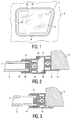
- Figure 1 shows a window 1 provided in a wall 3 of, for example, a pleasure boat, or an inland river craft, or a caravan, or the like.
- a top hung window see Figure 2, having a movable window portion 1A and a stationary window portion 1B, permanently fixed in the wall 3.
- the movable window portion 1A is provided with a glass panel 5, in this case a double-walled glass panel with a heat-insulating interspace 7.
- Such double-walled glass or plastic panels are generally known in the art so that a description of these will be omitted.
- the stationary window portion 1B consists of two frame sections 9 and 11, respectively, between which two heat-insulating sections 13 are mounted.
- the frame sections of the type shown are often manufactured from plastic or light metal by means of a suitable extrusion process. Extruded frame sections for numerous applications are available on the market in an enormous variety with or without intermediate heat-insulating sections and made, for example, from a suitable plastic. A detailed description of the frame sections and heat-insulating sections shown in the drawing will therefore be omitted. It should merely be mentioned that the ends of the heat-insulating sections 13 are inserted into swallow tail recesses of the frame sections 9 and 11, in order to securely connect them thereto.
- the movable window 1A comprises the frame sections 15, and 17, coupled with each other and with the heat-insulating sections 19 to form a combined section.
- the glass panel 5 is mounted between the frame sections 15 and 17 with the aid of an elastic mounting section 21 provided therebetween.
- This mounting section not only serves in the known manner as a soft protective intermediate layer between the glass panel and the frame sections, but at the same time as element to accommodate dimensional tolerance, and as water-tight seal between the glass panel and the window frame, but also as thermal insulation element between the frame sections 15 and the frame section 17.
- the mounting section 21, however, is not part of the window frame to be manufactured according to the method of the invention, and is fitted only when the glass panel 5 is mounted into the window frame.
- an elastically deformable sealing section 23 is provided made of, for example, a suitable type of rubber.
- a similar elastically deformable sealing section 25 is provided.
- Such sealing sections are generally known in the art and will therefore not be described further. Their purpose is to provide a substantially watertight fit between the movable window portion 1A and the stationary window portion 1B, when the window is in the closed position (see Figure 2).
- the combined section comprised of the frame section 9, the frame section 11 as well as the two intermediate heat-insulating sections 13, are bent cold into substantially the shape shown in Figure 1.
- the two ends of this combined section are fastened together with the aid of a stainless steel bracket 27, which is known as such, in order to provide a sturdy frame.
- the semi-product comprised of the combined section bent in cold condition to match the window shape is placed in a furnace at a furnace temperature effectuating the hardening of the frame material. After a predetermined time which will depend on the materials used, the semi-product is removed from the furnace, after cooling the sealing section 23 is applied and the bracket 27 is fitted.
- the frame of the movable window portion 1A is manufactured in a similar manner, using a stainless steel bracket 29 to connect up the ends of the combined section.
- the combined section of the movable window 1A can be seen, comprised of the frame sections 15 and 17 and the two intermediate heat-insulating sections 19, that have been bent in cold condition to a rounding-off radius of approximately 100 mm. This is considerably less than was possible up to now for windows of the kind discussed here. Up to now the smallest possible rounding-off radius was approximately 300 mm. Obviously such a large rounding-off radius will be inappropriate for the manufacture of windows of the type shown in Figure 1 and which are suitable, for example, for boats, caravans, etc.
- the movable window portion 1A shown in Figures 1 and 2 is suitable for being fitted directly into the wall 3, into an opening which is of course smaller than the one used for the window shown in the Figures 1 and 2.
- the invention is not limited to the above-discussed embodiments of the invention but comprises, on the contrary, every method within the scope of the independent claim 1, and any frame within the scope of the independent claim 6.
- frame should be taken in the widest sense. Within the framework of this specification, this term comprises, for example, also frames for doors or for panels of any kind that are provided with a frame having rounded corners of the kind described in claim 1.
- window must be interpreted in the widest sense, and comprises panels of any kind, including doors and the like.
Landscapes
- Engineering & Computer Science (AREA)
- Civil Engineering (AREA)
- Structural Engineering (AREA)
- Wing Frames And Configurations (AREA)
Abstract
Description
- The invention relates to a method of manufacturing a frame for a window with rounded corners, which frame comprises frame sections provided at both sides, in-between which heat-insulating means are provided, such as one or more heat-insulating sections made of a heat-insulating material, which method comprises in a first step the application of the heat-insulating means between the two frame sections, and in a second step, with the aid of a suitable bending tool, the bending of the combined section comprised of the two frame sections with in-between the insulating means producing a semi-product having substantially the form of the final frame of the window, which method also comprises the heating of the frame sections, wherein the insulating material is heat resistant up to a certain temperature limit.
- Such a method is known from the German Offenlegungsschrift DE 43 43 862 A1. This document describes a method in which the frame sections are made of metal, in particular of aluminium. The insulating means consist of a body of insulating foam material, for example polyurethane foam. The drawback of an insulating body of this type is that the frame, for reasons that include the rigidity of the insulating material, tends to break when being bent. In order to avoid this, the assembly consisting of the frame sections and the heat-insulating body are placed in a heating furnace at a furnace temperature of 60°C to 150°C, which temperature is adjusted to the properties of the insulating material. The fact that the insulating material softens at the temperature prevailing in the heating furnace, losing its brittleness, allows the frame to be bent in warm condition.
- The drawback of the above - mentioned method and other methods known from the prior art is that while the combined sections can indeed be bent for the manufacture of a frame for a window, the rounding-off radius that can be realized is always relatively large due to the rigidity of the frame sections; characteristically it cannot be made smaller than 300 mm. For many applications, such as ship's windows for yachts and inland river craft or for caravans, and the like, much smaller rounding-off radii are required.
- The objective of the invention is a method of the kind mentioned in the preamble, by which it is possible to manufacture frames with rounded corners having a relatively small rounding off radius, and which are characterized by the measures enumerated in the characterizing part of
claim 1. - The feature of the invention is that the basic material for both the frame sections and the insulating material, is readily bendable in cold condition, that is to say normally the temperature prevailing on the shop floor. The hardness, especially of the frame sections that is required in practice, is realized only after the bending in a third step of the method, by a heat treatment in a heating furnace.
- Claim 2 relates to a preferred embodiment of the invention. Cladding units such as window sections are frequently manufactured from aluminiums. The aluminium alloy AlMgSi 0.5 (DIN specification, international specification: 6060/6063) is a widely used material. According to the respective standard, this alloy is used in the manufacture of sections for cladding units such as windows, is applied at a hardness specification F22 (in accordance with the Netherlands NEN specification). The preferred embodiment of the invention is based on frame sections that are manufactured, for example, by the usual extrusion, from a frame material of the same aluminium alloy AlMgSi 0.5 but of a lesser hardness, namely specification F19 (in accordance with the Netherlands NEN standard). Because of this lesser hardness, the frame sections are cold bendable after extrusion. The smallest rounding off radii that can be realized without damaging the combined section, are considerably smaller than those realizable up to now with the methods of the prior art. The hardness of the aluminium alloy can be improved, when in the third step the semi-product obtained by bending, is heated in the heating furnace. When using the said aluminium alloy, this is assumed to be the result of the growing dimensions of the crystals present in the alloy.
- The invention preferably also uses the features presented in
claim 3. The final product will then, at least approximately, process the same hardness normally used with window sections made of the above-mentioned aluminium alloy for windows, so that they comply with the respective standards. - In practice, the embodiment of claim 4 has been shown to be interesting. The insulating material according to this claim is sufficiently bendable in cold condition while also being sufficiently heat resistant.
- According to
claim 5, the method can be performed at a furnace temperature which is at least approximately 180°C. The insulating material, for example, of the type mentioned above, has been shown to be unaffected at these temperatures, making it possible to improve the hardness within a reasonable time to approximately F22 (in accordance with the Netherlands NEN specification), at least in the case of the above-mentioned aluminium alloys. - The invention also relates to a frame manufactured with a method according to the invention, which is characterized in that the frame possesses one or more roundings having a radius of less than 300 mm. This makes it possible for the first time to manufacture windows from frame sections which (i) as ready product are in practice sufficiently hard, (ii) comply with the respective standards, and (iii) possess rounded corners having a radius which for this kind of a window is not unacceptably large.
- Finally, the invention also relates to a window provided with a frame according to the invention.
- The invention will now be further elucidated with reference to some non-limitative examples shown in the drawing, in which:
- Figure 1 illustrates a window according to the invention provided in the wall of a ship or a caravan, or the like,
- Figure 2, is a cross section of a portion of the window and the adjacent wall according to Figure 1, and
- Figure 3, is a partial cross section similar to the one of Figure 2 of another embodiment of a window according to the invention.
-
- Similar parts in the Figures will be referred to by identical reference numbers.
- Figure 1 shows a
window 1 provided in awall 3 of, for example, a pleasure boat, or an inland river craft, or a caravan, or the like. In the case concerned it is a top hung window, see Figure 2, having amovable window portion 1A and astationary window portion 1B, permanently fixed in thewall 3. Themovable window portion 1A is provided with aglass panel 5, in this case a double-walled glass panel with a heat-insulatinginterspace 7. Such double-walled glass or plastic panels are generally known in the art so that a description of these will be omitted. - The
stationary window portion 1B consists of twoframe sections sections 13 are mounted. The frame sections of the type shown are often manufactured from plastic or light metal by means of a suitable extrusion process. Extruded frame sections for numerous applications are available on the market in an enormous variety with or without intermediate heat-insulating sections and made, for example, from a suitable plastic. A detailed description of the frame sections and heat-insulating sections shown in the drawing will therefore be omitted. It should merely be mentioned that the ends of the heat-insulatingsections 13 are inserted into swallow tail recesses of theframe sections movable window 1A comprises theframe sections sections 19 to form a combined section. - The
glass panel 5 is mounted between theframe sections elastic mounting section 21 provided therebetween. This mounting section not only serves in the known manner as a soft protective intermediate layer between the glass panel and the frame sections, but at the same time as element to accommodate dimensional tolerance, and as water-tight seal between the glass panel and the window frame, but also as thermal insulation element between theframe sections 15 and theframe section 17. Themounting section 21, however, is not part of the window frame to be manufactured according to the method of the invention, and is fitted only when theglass panel 5 is mounted into the window frame. - At a free end in the
frame section 11 an elasticallydeformable sealing section 23 is provided made of, for example, a suitable type of rubber. In theframe sections 15, a similar elasticallydeformable sealing section 25 is provided. Such sealing sections are generally known in the art and will therefore not be described further. Their purpose is to provide a substantially watertight fit between themovable window portion 1A and thestationary window portion 1B, when the window is in the closed position (see Figure 2). - In accordance with the invention, the combined section comprised of the
frame section 9, theframe section 11 as well as the two intermediate heat-insulatingsections 13, are bent cold into substantially the shape shown in Figure 1. The two ends of this combined section are fastened together with the aid of astainless steel bracket 27, which is known as such, in order to provide a sturdy frame. However, prior to fitting thebracket 27, the semi-product comprised of the combined section bent in cold condition to match the window shape, is placed in a furnace at a furnace temperature effectuating the hardening of the frame material. After a predetermined time which will depend on the materials used, the semi-product is removed from the furnace, after cooling thesealing section 23 is applied and thebracket 27 is fitted. - The frame of the
movable window portion 1A is manufactured in a similar manner, using astainless steel bracket 29 to connect up the ends of the combined section. - In the top right-hand corner the combined section of the
movable window 1A can be seen, comprised of theframe sections sections 19, that have been bent in cold condition to a rounding-off radius of approximately 100 mm. This is considerably less than was possible up to now for windows of the kind discussed here. Up to now the smallest possible rounding-off radius was approximately 300 mm. Obviously such a large rounding-off radius will be inappropriate for the manufacture of windows of the type shown in Figure 1 and which are suitable, for example, for boats, caravans, etc. - After the above description of the embodiments according to the Figures 1 and 2, the embodiment in Figure 3 will be readily understood and will therefore only be discussed very briefly. By omitting the elastically
deformable sealing section 25, themovable window portion 1A shown in Figures 1 and 2 is suitable for being fitted directly into thewall 3, into an opening which is of course smaller than the one used for the window shown in the Figures 1 and 2. - The embodiments according to the Figures 1 to 3 are based on frame sections manufactured from the frame material AlMgSi 0.5. However, other materials consisting of metals or plastics or combinations thereof may conceivably also be applied using the method according to the invention, or may in the future become available for the manufacture of frames for windows with rounded corners in accordance with the method of the invention.
- The invention is not limited to the above-discussed embodiments of the invention but comprises, on the contrary, every method within the scope of the
independent claim 1, and any frame within the scope of the independent claim 6. The term "frame" should be taken in the widest sense. Within the framework of this specification, this term comprises, for example, also frames for doors or for panels of any kind that are provided with a frame having rounded corners of the kind described inclaim 1. Likewise, the term "window" must be interpreted in the widest sense, and comprises panels of any kind, including doors and the like.
Claims (7)
- A method of manufacturing a frame for a window with rounded corners, which frame at both sides comprises frame sections in-between which are provided heat-insulating means such as one or more heat-insulating sections made of a heat-insulating material, which method comprises in a first step the application of the heat-insulating means between the two frame sections, and in a second step, with the aid of a suitable bending tool, the bending of the combined section consisting of the two frame sections with in-between these the insulating means to form a semi-product having substantially the form of the final frame of the window, which method also comprises the heating of the frame sections, wherein the insulating material is heat resistant up to a certain temperature limit,
characterizedin that the frame sections are manufactured from a frame material which becomes harder under the influence of heat,in that the insulating material is cold bendable,in that said second step comprises bending of the combined section in cold condition andin that the third step comprises said heating by placing the said semi-product in a heating furnace at a furnace temperature up to maximally said temperature limit, at which furnace temperature hardening of the frame material takes place. - A method according to claim 1, characterized in that the frame material consists of an aluminium alloy AlMgSi 0.5 (DIN specification) which prior to the third step has a hardness of F19 (in accordance with the Netherlands NEN specification).
- A method according to claim 2, characterized in that the aluminium material in the third step is heated to a hardness of at least approximately F22 (in accordance with the Netherlands NEN specification).
- A method according to one or more of the preceding claims, characterized in that the insulating material consists of polyamide 6.6 reinforced with 25% of glass fibre.
- A method according to one or more of the preceding claims, characterized in that the furnace temperature is at least approximately 180°C.
- A frame manufactured by a method according to one or more of the preceding claims, characterized in that the frame possesses one or more roundings having a radius of less than 300 mm.
- A window provided with a frame according to claim 6.
Applications Claiming Priority (2)
| Application Number | Priority Date | Filing Date | Title |
|---|---|---|---|
| NL1013879 | 1999-12-17 | ||
| NL1013879A NL1013879C2 (en) | 1999-12-17 | 1999-12-17 | A method for manufacturing a frame for a window with rounded corners, as well as a frame manufactured according to the method. |
Publications (1)
| Publication Number | Publication Date |
|---|---|
| EP1108848A1 true EP1108848A1 (en) | 2001-06-20 |
Family
ID=19770455
Family Applications (1)
| Application Number | Title | Priority Date | Filing Date |
|---|---|---|---|
| EP00204349A Withdrawn EP1108848A1 (en) | 1999-12-17 | 2000-12-06 | Method of manufacturing a frame for a window with rounded corners, and frame manufactured according to the method |
Country Status (2)
| Country | Link |
|---|---|
| EP (1) | EP1108848A1 (en) |
| NL (1) | NL1013879C2 (en) |
Cited By (1)
| Publication number | Priority date | Publication date | Assignee | Title |
|---|---|---|---|---|
| EP1503023A3 (en) * | 2003-08-01 | 2006-01-18 | Seitz GmbH & Co. KG | Manufacturing process for door or window frame in particular for caravans or mobile homes |
Citations (4)
| Publication number | Priority date | Publication date | Assignee | Title |
|---|---|---|---|---|
| DE4343862A1 (en) * | 1993-12-22 | 1995-06-29 | Bernhard Kreye | Bending of metal profiles with thermal insulation |
| EP0687743A1 (en) * | 1994-06-16 | 1995-12-20 | The Furukawa Electric Co., Ltd. | Aluminum alloy bumper-reinforcing material and method of producing the same |
| EP0715052A2 (en) * | 1994-10-31 | 1996-06-05 | VIANELLO Fortunato - DAVANZO Nadia trading under the trading style FOR.EL. BASE DI VIANELLO & C. S.n.c. | Automatic method and device for calendering aluminium profiles for producing spacer frames for insulating glazing units |
| WO1998018975A1 (en) * | 1996-10-25 | 1998-05-07 | Ole Frederiksen | A method of working hard aluminium of standard type (us) aa 7075 t6 |
-
1999
- 1999-12-17 NL NL1013879A patent/NL1013879C2/en not_active IP Right Cessation
-
2000
- 2000-12-06 EP EP00204349A patent/EP1108848A1/en not_active Withdrawn
Patent Citations (4)
| Publication number | Priority date | Publication date | Assignee | Title |
|---|---|---|---|---|
| DE4343862A1 (en) * | 1993-12-22 | 1995-06-29 | Bernhard Kreye | Bending of metal profiles with thermal insulation |
| EP0687743A1 (en) * | 1994-06-16 | 1995-12-20 | The Furukawa Electric Co., Ltd. | Aluminum alloy bumper-reinforcing material and method of producing the same |
| EP0715052A2 (en) * | 1994-10-31 | 1996-06-05 | VIANELLO Fortunato - DAVANZO Nadia trading under the trading style FOR.EL. BASE DI VIANELLO & C. S.n.c. | Automatic method and device for calendering aluminium profiles for producing spacer frames for insulating glazing units |
| WO1998018975A1 (en) * | 1996-10-25 | 1998-05-07 | Ole Frederiksen | A method of working hard aluminium of standard type (us) aa 7075 t6 |
Cited By (1)
| Publication number | Priority date | Publication date | Assignee | Title |
|---|---|---|---|---|
| EP1503023A3 (en) * | 2003-08-01 | 2006-01-18 | Seitz GmbH & Co. KG | Manufacturing process for door or window frame in particular for caravans or mobile homes |
Also Published As
| Publication number | Publication date |
|---|---|
| NL1013879A1 (en) | 2000-02-29 |
| NL1013879C2 (en) | 2000-10-03 |
Similar Documents
| Publication | Publication Date | Title |
|---|---|---|
| US6668490B2 (en) | Lightweight door for motor vehicles | |
| US5948185A (en) | Method for improving the hemmability of age-hardenable aluminum sheet | |
| EP0713559B1 (en) | Vehicle body superstructure | |
| JPS58106086A (en) | Threshold and frame body for window or door | |
| JPH0231925A (en) | Method of increasing resistance to intrusion through glazed opening and window glass having resistance increasing to intrusion | |
| SK286645B6 (en) | Glass pane with rigid element optionally incorporated in an over-moulded plastic part | |
| JPH11324514A (en) | Composite profiles for frames such as windows, doors, covering panels, etc., especially infrared reflective foils for these composite profiles and the use of infrared reflective foils for composite profiles | |
| US5493815A (en) | Corrosion barrier for automotive weatherstrips | |
| KR101123233B1 (en) | A glazing unit, a reinforcing element, a method of overmolding | |
| EP1108848A1 (en) | Method of manufacturing a frame for a window with rounded corners, and frame manufactured according to the method | |
| CA3248876A1 (en) | Composite structure for stationary and mobile flat elements | |
| US6647914B1 (en) | Free-standing marine windshield assembly having a polymeric frame | |
| US5325807A (en) | Window assembly for attachment to a flexible sheet | |
| US6189198B1 (en) | Method of making a vanishing warp carrier seal | |
| US4357381A (en) | Thermoplastic building enclosure member | |
| US20070234943A1 (en) | Fixed window arrangement | |
| US6393765B1 (en) | Superelastic sealing closures | |
| US20100244483A1 (en) | Automotive glazing and component assembly | |
| US4636421A (en) | Frame with decorative trim strip | |
| CN214240982U (en) | B-pillar corner of frameless car and car with the same | |
| EP0653541B1 (en) | Set of cold metal section bars which are convertible into thermally-broken section bars | |
| US5454193A (en) | Window glass for automobiles, recreation vehicles or buildings | |
| US4995666A (en) | Sun roof | |
| KR101325764B1 (en) | Manufacturing method for vehicle molding | |
| GB2196369A (en) | Composite frame section with thermal bridge |
Legal Events
| Date | Code | Title | Description |
|---|---|---|---|
| PUAI | Public reference made under article 153(3) epc to a published international application that has entered the european phase |
Free format text: ORIGINAL CODE: 0009012 |
|
| AK | Designated contracting states |
Kind code of ref document: A1 Designated state(s): AT BE CH CY DE DK ES FI FR GB GR IE IT LI LU MC NL PT SE TR |
|
| AX | Request for extension of the european patent |
Free format text: AL;LT;LV;MK;RO;SI |
|
| 17P | Request for examination filed |
Effective date: 20011212 |
|
| RIN1 | Information on inventor provided before grant (corrected) |
Inventor name: VAN GEMERT, HENDRIKUS THEODORUS MARTINUS |
|
| AKX | Designation fees paid |
Free format text: AT BE CH CY DE DK ES FI FR GB GR IE IT LI LU MC NL PT SE TR |
|
| GRAP | Despatch of communication of intention to grant a patent |
Free format text: ORIGINAL CODE: EPIDOSNIGR1 |
|
| STAA | Information on the status of an ep patent application or granted ep patent |
Free format text: STATUS: THE APPLICATION HAS BEEN WITHDRAWN |
|
| 18W | Application withdrawn |
Effective date: 20041231 |