EP1109221A2 - Damascene interconnection structure and method for forming the same - Google Patents
Damascene interconnection structure and method for forming the same Download PDFInfo
- Publication number
- EP1109221A2 EP1109221A2 EP00403464A EP00403464A EP1109221A2 EP 1109221 A2 EP1109221 A2 EP 1109221A2 EP 00403464 A EP00403464 A EP 00403464A EP 00403464 A EP00403464 A EP 00403464A EP 1109221 A2 EP1109221 A2 EP 1109221A2
- Authority
- EP
- European Patent Office
- Prior art keywords
- layer
- interconnections
- dielectric material
- sublayer
- sich
- Prior art date
- Legal status (The legal status is an assumption and is not a legal conclusion. Google has not performed a legal analysis and makes no representation as to the accuracy of the status listed.)
- Granted
Links
Images


Classifications
-
- H—ELECTRICITY
- H10—SEMICONDUCTOR DEVICES; ELECTRIC SOLID-STATE DEVICES NOT OTHERWISE PROVIDED FOR
- H10W—GENERIC PACKAGES, INTERCONNECTIONS, CONNECTORS OR OTHER CONSTRUCTIONAL DETAILS OF DEVICES COVERED BY CLASS H10
- H10W20/00—Interconnections in chips, wafers or substrates
- H10W20/01—Manufacture or treatment
- H10W20/071—Manufacture or treatment of dielectric parts thereof
- H10W20/074—Manufacture or treatment of dielectric parts thereof of dielectric parts comprising thin functional dielectric layers, e.g. dielectric etch-stop, barrier, capping or liner layers
- H10W20/075—Manufacture or treatment of dielectric parts thereof of dielectric parts comprising thin functional dielectric layers, e.g. dielectric etch-stop, barrier, capping or liner layers of multilayered thin functional dielectric layers
-
- H—ELECTRICITY
- H10—SEMICONDUCTOR DEVICES; ELECTRIC SOLID-STATE DEVICES NOT OTHERWISE PROVIDED FOR
- H10W—GENERIC PACKAGES, INTERCONNECTIONS, CONNECTORS OR OTHER CONSTRUCTIONAL DETAILS OF DEVICES COVERED BY CLASS H10
- H10W20/00—Interconnections in chips, wafers or substrates
- H10W20/01—Manufacture or treatment
- H10W20/071—Manufacture or treatment of dielectric parts thereof
- H10W20/081—Manufacture or treatment of dielectric parts thereof by forming openings in the dielectric parts
- H10W20/084—Manufacture or treatment of dielectric parts thereof by forming openings in the dielectric parts for dual-damascene structures
- H10W20/086—Manufacture or treatment of dielectric parts thereof by forming openings in the dielectric parts for dual-damascene structures involving buried masks
-
- H—ELECTRICITY
- H10—SEMICONDUCTOR DEVICES; ELECTRIC SOLID-STATE DEVICES NOT OTHERWISE PROVIDED FOR
- H10W—GENERIC PACKAGES, INTERCONNECTIONS, CONNECTORS OR OTHER CONSTRUCTIONAL DETAILS OF DEVICES COVERED BY CLASS H10
- H10W20/00—Interconnections in chips, wafers or substrates
- H10W20/01—Manufacture or treatment
- H10W20/071—Manufacture or treatment of dielectric parts thereof
- H10W20/081—Manufacture or treatment of dielectric parts thereof by forming openings in the dielectric parts
- H10W20/084—Manufacture or treatment of dielectric parts thereof by forming openings in the dielectric parts for dual-damascene structures
- H10W20/087—Manufacture or treatment of dielectric parts thereof by forming openings in the dielectric parts for dual-damascene structures involving multiple stacked pre-patterned masks
-
- H—ELECTRICITY
- H10—SEMICONDUCTOR DEVICES; ELECTRIC SOLID-STATE DEVICES NOT OTHERWISE PROVIDED FOR
- H10W—GENERIC PACKAGES, INTERCONNECTIONS, CONNECTORS OR OTHER CONSTRUCTIONAL DETAILS OF DEVICES COVERED BY CLASS H10
- H10W20/00—Interconnections in chips, wafers or substrates
- H10W20/40—Interconnections external to wafers or substrates, e.g. back-end-of-line [BEOL] metallisations or vias connecting to gate electrodes
- H10W20/45—Interconnections external to wafers or substrates, e.g. back-end-of-line [BEOL] metallisations or vias connecting to gate electrodes characterised by their insulating parts
- H10W20/48—Insulating materials thereof
Definitions
- the present invention relates to a Damascene-type interconnection structure. She also relates to its production process.
- the interconnection structures of integrated circuits are conventionally made in aluminum doped with copper (Al-Cu), the doping rate being of the order of 2 to 4%.
- the process used to achieving these interconnection structures consists of deposit the metal, then engrave it to form the network of interconnections and finally to deposit, overcoat, a dielectric which is used to isolate the lines of metal as well laterally (inter-line insulation) only vertically (inter-level insulation). This process is commonly called “conventional” or "gap fill” (filling of inter-line spaces by the dielectric).
- the network of interconnections is formed by etching trenches in a dielectric with very low permittivity, then by deposition of a metallic nitride barrier layer followed filling the trench with copper. Lastly place, the excess copper and barrier material is removed by polishing to leave only the dielectric between the metal lines.
- CMP chemical mechanical polishing
- the materials SiO 2 , Si 3 N 4 and SiO x N y are usually used because they are already commonly used in the production of integrated circuits. In fact, they are used either at the active area of the circuits as insulators, or at the interconnections as intermetallic dielectrics or as passivation dielectrics. They can be deposited by various but well known techniques: by thermal growth of oxide, by low pressure CVD (LPCVD), by atmospheric CVD (APCVD) or by plasma assisted CVD (PECVD).
- LPCVD low pressure CVD
- APCVD atmospheric CVD
- PECVD plasma assisted CVD
- SiO 2 has good electrical qualities and good etching selectivity with respect to organic materials. However, its properties are insufficient on the other points. If 3 N 4 has good etching selectivity, good resistance to abrasion and to diffusion of copper, but its dielectric constant is high. SiON is intermediate between Si 3 N 4 and SiO 2 . Thus, none of these conventional materials has all of the required properties.
- dielectric interface materials can induce an oxidation of the interface or of the whole matrix of the material with low permittivity and thus degrading its properties: dielectric constant, leakage current, densification with modification of the thickness, loss of adhesion, chemical modification.
- Dielectric materials with very low permittivity based on Si-O with a porous structure, comprising carbon radicals (of Si-R type) or hydride (of Si-H type) are particularly targeted by these degradations. Indeed, for these materials, during the deposition of the layer of interface dielectric material, more or less deep oxidation occurs depending on their porosity. This oxidation induces the formation of silanol (Si-OH) and water which are respectively very polar radicals or molecules.
- the invention allows the production of Damascene type structures using dielectrics with very low permittivity of Si-O based mineral type having a porous structure.
- dielectrics with very low permittivity comprise organic radicals (for example Si-CH 3 ) or hydrides (for example Si-H). They may be xerogels, methyl aerogels or hydrogen silsesquioxane or any other material based on porous mineral oxide which may contain organic radicals obtained by spreading a precursor or by a CVD process.
- the dielectric interface layers are formed by a combination of sublayers of SiOCH and SiCH.
- the subject of the invention is therefore a method of creation of a type of interconnection structure Damascene on one side to connect a device microelectronics, the process comprising depositing at least at least one layer of dielectric material on said face to be connected, intended to house said interconnections, the method also comprising the deposition of at least one interface layer of material dielectric in intimate contact with said layer of dielectric material intended to house the interconnections, characterized in that said layer interface is formed by depositing at least one SiOCH sublayer and at least one sublayer of SiCH.
- the deposition of a layer of dielectric material intended to house the interconnections involves depositing a layer of a material chosen from dielectric materials to very low permittivity of Si-O based mineral type, comprising organic or hydride radicals.
- the interface layer includes an SiCH undercoat deposited on and in contact with the layer of dielectric material intended to house the interconnections, an underlay in SiOCH being deposited on and in contact with the undercoat in SiCH.
- the SiOCH sublayer can be used as an engraving mask for SiCH underlay to house interconnections in the corresponding dielectric material layer.
- the microelectronic device can be made on silicon.
- interconnections are copper, there provision is made for the deposition of a metal layer forming barrier to copper diffusion in the layer of dielectric material intended to house the interconnections.
- the subject of the invention is also a Damascene-type interconnection structure on a face of a micro-electronic device, comprising at minus a layer of dielectric material intended for house said interconnections and comprising at least an interface layer of dielectric material intimate contact with said layer of material dielectric intended to house the interconnections, characterized in that said interface layer includes at least one SiOCH sublayer and at least an SiCH undercoat.
- the layer of material dielectric intended to house said interconnections is a layer of a material chosen from among the materials very low permittivity type dielectrics Si-O based mineral with organic radicals or hydrides.
- the interface layer includes an SiCH undercoat on and in contact with the layer of dielectric material intended to house the interconnections, an SiOCH sublayer being placed on and in contact with the SiCH underlay.
- the structure includes a metallic layer forming barrier to copper diffusion in the layer of dielectric material intended to house the interconnections.
- the last line of the table concerns the chemical compatibility between each material in the table with the dielectric materials intended to house the interconnections.
- SiCH and SiOCH combine the set of qualities required to obtain a good interface layer: resistance to abrasion, to copper diffusion and selectivity of etching for SiCH, low dielectric constant for SiOCH.
- SiCH is produced without an oxidizing precursor.
- these two materials have good compatibility with each other and can be deposited in the same reactor from equivalent precursors of the methyl-, dimethyl- or trimethylsilane, or even phenylsilane type.
- SiOCH is obtained by adding an oxidizing precursor of type O 2 , N 2 0, NO 2 , CO 2 ...
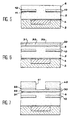
- FIGS. 1 to 10 are sectional views transverse and partial of a structure double Damascene interconnections according to the invention.
- Figure 1 shows a copper line 1 flush with one side 2 of a deposited dielectric 3 on a semiconductor substrate.
- interface layer 4 serving as a barrier layer to the diffusion of copper.
- Layer 4 has a thickness between 10 and 30 nm.
- a layer 5 of dielectric material with low permittivity is deposited on layer 4. Its thickness is between 0.5 and 1 ⁇ m.
- FIG. 3 shows that a layer interface 10 has been deposited on the material layer dielectric 5.
- the interface layer 10, intended for constitute a hard mask includes an underlay 11 made of SiCH deposited on the layer of dielectric material 5 and an undercoat 12 of SiOCH deposited on the undercoat 11.
- the underlay 11 may have a thickness between 10 and 20 nm while the thickness of the sublayer 12 is of the order of 100 nm. This stacking of undercoats is compatible with the material to be low permittivity of layer 5 because SiCH does not oxidize the dielectric and ensures excellent etching selectivity: hard / dielectric mask low permittivity.
- a layer of photosensitive resin 20 is deposited on the layer interface or hard mask 10 and an engraving hole 21 y is defined opposite line 1.
- the etching of the hard mask 10 is done in three operations. A hole is first etched in the sub-layer 12 in SiOCH until the sub-layer 11 in SiCH is revealed. The resin layer 20 is then removed, the dielectric layer via 5, which is very sensitive to the oxidation produced by the oxidizing agents for removing the resin (plasma O 2 , organic bases, etc.), being then protected by the sublayer 11 as shown in FIG. 4. Finally, the sublayer 11 is etched using the sublayer 12 as a mask, the sublayer 12 being partially etched.
- a layer 6 of dielectric material with low permittivity called “line dielectric” is deposited on the layer interface 10 and fills the hole made on the layer interface 10.
- the thickness of layer 6 can be between 0.3 and 0.6 ⁇ m.
- the interface layer 30 is then deposited on the layer of dielectric material 6 like the shows Figure 6.
- the interface layer 30 includes three sublayers: in the order of deposition one sublayer 31 in SiCH of thickness less than 10 nm and compatible with the dielectric material of the layer 6, a SiOCH sublayer 32 with a thickness comprised between 100 and 150 nm and a 33 SiCH sublayer slightly greater than the sum of the thicknesses of layer 2 and sublayer 31 in SiCH.
- the interface layer 30 will serve as a layer stop chemical mechanical polishing and also mask hard.
- the underlay 31 is used in particular to avoid oxidation of the dielectric layer 6.
- the undercoat 32 serves as a stop layer for polishing. She protects the dielectric layer 6 from faults of polishing uniformities. It limits the effect of copper removal during the chemical mechanical polishing.
- the underlay 33 serves as engraving counter mask allowing to engrave in one single step a hole revealing line 1.
- a layer of photosensitive resin 40 is deposited on the layer interface 30 and an etching hole 41 is defined therein opposite the hole previously etched in the hard mask 10.
- a hole is first engraved in the underlay 33 in SiCH with stop in sublayer 32 in SiOCH. The resin is then removed, the dielectric material of layer 6 being protected by sublayers 31 and 32.
- the engraving of the hard mask 30 is continued until the layer is revealed line 6 dielectric.
- the SiCH underlay 33 is engraved over its entire surface at least one thickness equivalent to the thickness of the SiCH sublayer 31.
- FIG 10 shows the presence of a copper connection 9 passing through the dielectric layer via 5 and the layer of dielectric line 6 to contact the line 1.
- layer 6 line dielectric
- dielectric constant equivalent to this stack is 2.25.
- the use of SiN in place of SiCH and the use of SiO 2 in place of SiOCH would lead to an equivalent dielectric constant of 2.55.
Landscapes
- Internal Circuitry In Semiconductor Integrated Circuit Devices (AREA)
Abstract
Description
La présente invention concerne une structure d'interconnexions de type Damascène. Elle concerne aussi son procédé de réalisation.The present invention relates to a Damascene-type interconnection structure. She also relates to its production process.
Les structures d'interconnexions des circuits intégrés sont conventionnellement réalisées en aluminium dopé par du cuivre (Al-Cu), le taux de dopage étant de l'ordre de 2 à 4%. Le procédé employé pour réaliser ces structures d'interconnexions consiste à déposer le métal, puis à le graver pour former le réseau des interconnexions et enfin à déposer, pardessus, un diélectrique qui sert à isoler les lignes de métal aussi bien latéralement (isolation inter-lignes) que verticalement (isolation inter-niveaux). Ce procédé est communément appelé "conventionnel" ou "gap fill" (remplissage des espaces inter-lignes par le diélectrique).The interconnection structures of integrated circuits are conventionally made in aluminum doped with copper (Al-Cu), the doping rate being of the order of 2 to 4%. The process used to achieving these interconnection structures consists of deposit the metal, then engrave it to form the network of interconnections and finally to deposit, overcoat, a dielectric which is used to isolate the lines of metal as well laterally (inter-line insulation) only vertically (inter-level insulation). This process is commonly called "conventional" or "gap fill" (filling of inter-line spaces by the dielectric).
L'amélioration des performances des circuits (vitesse, faible consommation) a nécessité l'emploi de métaux plus conducteurs et de matériaux à faible permittivité. Pour la métallisation, le cuivre, qui possède une résistivité environ deux fois plus faible que Al-Cu, est apparu comme le meilleur candidat. Cependant, l'emploi du cuivre ne peut pas s'envisager dans une structure conventionnelle car la gravure de ce matériau est très difficile. C'est pourquoi il est employé dans une structure dite Damascène.Improving the performance of circuits (speed, low consumption) required the use of more conductive metals and materials to low permittivity. For metallization, copper, which has a resistivity about twice as high weak than Al-Cu, appeared to be the best candidate. However, the use of copper cannot be considered in a conventional structure because the engraving of this material is very difficult. It is why it is used in a so-called structure Damascene.
Dans une structure Damascène, le réseau des interconnexions est formé par gravure de tranchées dans un diélectrique à très faible permittivité, puis par dépôt d'une couche barrière en nitrure métallique suivi du remplissage de la tranchée par du cuivre. En dernier lieu, l'excès de cuivre et de matériau barrière est éliminé par polissage afin de ne laisser que le diélectrique entre les lignes de métal. La réalisation d'une telle structure nécessite l'emploi de couches de matériau diélectrique d'interface à usage de masques durs, de couches barrière à la diffusion du cuivre ou de couches d'arrêt pour le polissage mécano-chimique (CMP).In a Damascene structure, the network of interconnections is formed by etching trenches in a dielectric with very low permittivity, then by deposition of a metallic nitride barrier layer followed filling the trench with copper. Lastly place, the excess copper and barrier material is removed by polishing to leave only the dielectric between the metal lines. The realization of such a structure requires the use of layers of dielectric interface material for use as masks hard, barrier layers to copper diffusion or barrier layers for chemical mechanical polishing (CMP).
Comme matériau diélectrique d'interface dans les structures Damascène, les matériaux SiO2, Si3N4 et SiOxNy sont habituellement utilisés du fait qu'ils sont déjà couramment employés dans la réalisation des circuits intégrés. En effet, ils sont utilisés soit au niveau de la zone active des circuits en tant qu'isolants, soit au niveau des interconnexions en tant que diélectriques intermétalliques ou en tant que diélectriques de passivation. Ils peuvent être déposés par des techniques variées mais bien connues : par croissance thermique d'oxyde, par CVD basse pression (LPCVD), par CVD atmosphérique (APCVD) ou par CVD assisté par plasma (PECVD).As interface dielectric material in Damascene structures, the materials SiO 2 , Si 3 N 4 and SiO x N y are usually used because they are already commonly used in the production of integrated circuits. In fact, they are used either at the active area of the circuits as insulators, or at the interconnections as intermetallic dielectrics or as passivation dielectrics. They can be deposited by various but well known techniques: by thermal growth of oxide, by low pressure CVD (LPCVD), by atmospheric CVD (APCVD) or by plasma assisted CVD (PECVD).
Les propriétés requises pour les matériaux diélectriques d'interface dans les structures Damascène sont les suivantes :
- Les matériaux à usage de barrière doivent posséder une bonne résistance à la diffusion du cuivre.
- Les matériaux à usage de masque dur doivent présenter une excellente sélectivité de gravure vis-à-vis des matériaux sous-jacents de type organique ou minéral.
- Les matériaux à usage de couche d'arrêt au polissage doivent présenter une bonne résistance au polissage mécano-chimique afin de permettre l'élimination du cuivre excédentaire au-dessus des lignes sans qu'il y ait dégradation du diélectrique. Autrement dit, ces matériaux doivent présenter une sélectivité au polissage élevée vis-à-vis du cuivre.
- Tous ces matériaux doivent de plus avoir de bonnes tenues électriques : faible constante diélectrique, faible courant de fuite.
- Les matériaux déposés directement sur les diélectriques à très faible permittivité (matériaux des masques durs et des couches d'arrêt) doivent présenter une bonne compatibilité chimique avec ces diélectriques.
- Barrier materials must have good resistance to copper diffusion.
- The materials for use as a hard mask must have an excellent selectivity of etching with respect to the underlying materials of organic or mineral type.
- Materials used as a polishing barrier layer must have good resistance to chemical-mechanical polishing in order to allow the removal of excess copper above the lines without dielectric degradation. In other words, these materials must have a high polishing selectivity with respect to copper.
- All these materials must also have good electrical resistance: low dielectric constant, low leakage current.
- The materials deposited directly on the dielectrics with very low permittivity (materials of hard masks and barrier layers) must have good chemical compatibility with these dielectrics.
Parmi les matériaux diélectriques d'interface conventionnels, SiO2 présente de bonnes qualités électriques et une bonne sélectivité de gravure vis-à-vis des matériaux organiques. Cependant, ses propriétés sont insuffisantes sur les autres points. Si3N4 présente une bonne sélectivité de gravure, une bonne résistance à l'abrasion ainsi qu'à la diffusion du cuivre mais sa constante diélectrique est élevée. SiON est intermédiaire entre Si3N4 et SiO2. Ainsi, aucun de ces matériaux conventionnels ne possède l'ensemble des propriétés requises.Among the conventional interface dielectric materials, SiO 2 has good electrical qualities and good etching selectivity with respect to organic materials. However, its properties are insufficient on the other points. If 3 N 4 has good etching selectivity, good resistance to abrasion and to diffusion of copper, but its dielectric constant is high. SiON is intermediate between Si 3 N 4 and SiO 2 . Thus, none of these conventional materials has all of the required properties.
D'autre part, certains de ces matériaux diélectriques d'interface, déposés généralement par voie PECVD à partir de gaz oxydants (O2, N2O, NO2, O3...), peuvent induire une oxydation de l'interface ou de toute la matrice du matériau à faible permittivité et ainsi dégrader ses propriétés : constante diélectrique, courant de fuite, densification avec modification de l'épaisseur, perte d'adhérence, modification chimique. Les matériaux diélectriques à très faible permittivité à base Si-O à structure poreuse, comportant des radicaux carbonés (de type Si-R) ou hydrure (de type Si-H) sont particulièrement visés par ces dégradations. En effet, pour ces matériaux, lors du dépôt de la couche de matériau diélectrique d'interface, il se produit une oxydation plus ou moins profonde selon leur porosité. Cette oxydation induit la formation de silanol (Si-OH) et d'eau qui sont respectivement des radicaux ou des molécules très polaires.On the other hand, some of these dielectric interface materials, generally deposited by PECVD route from oxidizing gases (O 2 , N 2 O, NO 2 , O 3 ...), can induce an oxidation of the interface or of the whole matrix of the material with low permittivity and thus degrading its properties: dielectric constant, leakage current, densification with modification of the thickness, loss of adhesion, chemical modification. Dielectric materials with very low permittivity based on Si-O with a porous structure, comprising carbon radicals (of Si-R type) or hydride (of Si-H type) are particularly targeted by these degradations. Indeed, for these materials, during the deposition of the layer of interface dielectric material, more or less deep oxidation occurs depending on their porosity. This oxidation induces the formation of silanol (Si-OH) and water which are respectively very polar radicals or molecules.
Il se pose donc le problème de trouver des matériaux diélectriques permettant la réalisation de couches d'interface satisfaisant l'ensemble des propriétés requises.The problem therefore arises of finding dielectric materials allowing the realization of interface layers satisfying all of required properties.
L'invention permet la réalisation de structures de type Damascène utilisant des diélectriques à très faible permittivité de type minéral à base Si-O ayant une structure poreuse. Ces diélectriques à très faible permittivité comportent des radicaux organiques (par exemple Si-CH3) ou hydrures (par exemple Si-H). Il peut s'agir de xérogels, d'aérogels de méthyle ou d'hydrogène silsesquioxane ou de tout autre matériau à base d'oxyde minéral poreux pouvant comporter des radicaux organiques obtenus par étalement d'un précurseur ou par un procédé CVD. Les couches diélectriques d'interface sont formées par une association de sous-couches de SiOCH et de SiCH. The invention allows the production of Damascene type structures using dielectrics with very low permittivity of Si-O based mineral type having a porous structure. These dielectrics with very low permittivity comprise organic radicals (for example Si-CH 3 ) or hydrides (for example Si-H). They may be xerogels, methyl aerogels or hydrogen silsesquioxane or any other material based on porous mineral oxide which may contain organic radicals obtained by spreading a precursor or by a CVD process. The dielectric interface layers are formed by a combination of sublayers of SiOCH and SiCH.
L'invention a donc pour objet un procédé de réalisation d'une structure d'interconnexions de type Damascène sur une face à connecter d'un dispositif micro-électronique, le procédé comprenant le dépôt d'au moins une couche de matériau diélectrique sur ladite face à connecter, destinée à loger lesdites interconnexions, le procédé comprenant également le dépôt d'au moins une couche d'interface en matériau diélectrique en contact intime avec ladite couche de matériau diélectrique destinée à loger les interconnexions, caractérisé en ce que ladite couche d'interface est formée par le dépôt d'au moins une sous-couche de SiOCH et d'au moins une sous-couche de SiCH.The subject of the invention is therefore a method of creation of a type of interconnection structure Damascene on one side to connect a device microelectronics, the process comprising depositing at least at least one layer of dielectric material on said face to be connected, intended to house said interconnections, the method also comprising the deposition of at least one interface layer of material dielectric in intimate contact with said layer of dielectric material intended to house the interconnections, characterized in that said layer interface is formed by depositing at least one SiOCH sublayer and at least one sublayer of SiCH.
Avantageusement, le dépôt d'une couche de matériau diélectrique destinée à loger les interconnexions consiste à déposer une couche d'un matériau choisi parmi les matériaux diélectriques à très faible permittivité de type minéral à base Si-O, comportant des radicaux organiques ou hydrures.Advantageously, the deposition of a layer of dielectric material intended to house the interconnections involves depositing a layer of a material chosen from dielectric materials to very low permittivity of Si-O based mineral type, comprising organic or hydride radicals.
De préférence, la couche d'interface comprend une sous-couche en SiCH déposée sur et en contact avec la couche de matériau diélectrique destinée à loger les interconnexions, une sous-couche en SiOCH étant déposée sur et en contact avec la sous-couche en SiCH. Dans ce cas, la sous-couche de SiOCH peut être utilisée comme masque de gravure pour la sous-couche de SiCH en vue de loger les interconnexions dans la couche de matériau diélectrique correspondante.Preferably, the interface layer includes an SiCH undercoat deposited on and in contact with the layer of dielectric material intended to house the interconnections, an underlay in SiOCH being deposited on and in contact with the undercoat in SiCH. In this case, the SiOCH sublayer can be used as an engraving mask for SiCH underlay to house interconnections in the corresponding dielectric material layer.
Le dispositif micro-électronique peut être réalisé sur du silicium.The microelectronic device can be made on silicon.
Si les interconnexions sont en cuivre, il est prévu le dépôt d'une couche métallique formant barrière à la diffusion du cuivre dans la couche de matériau diélectrique destinée à loger les interconnexions.If the interconnections are copper, there provision is made for the deposition of a metal layer forming barrier to copper diffusion in the layer of dielectric material intended to house the interconnections.
De manière particulière, l'invention a pour objet un procédé de réalisation d'une structure d'interconnexions de type double Damascène sur une face à connecter d'un dispositif micro-électronique réalisé sur du silicium, ladite face présentant des lignes conductrices en cuivre à connecter, caractérisé en ce qu'il comprend les étapes suivantes :
- dépôt sur ladite face à connecter d'une couche barrière à la diffusion du cuivre en SiCH,
- dépôt sur la couche barrière d'une première couche de matériau diélectrique de très faible permittivité pour le logement desdites interconnexions,
- dépôt d'une première couche d'interface sur ladite première couche de matériau diélectrique, comprenant une sous-couche de SiCH, déposée sur et en contact avec la première couche de matériau diélectrique, et une sous-couche de SiOCH,
- gravure de trous dans ladite sous-couche de SiOCH, en vis-à-vis des lignes conductrices à connecter, au moyen d'un masque de résine, jusqu'à révéler la sous-couche de SiCH,
- retrait du masque de résine,
- gravure de la partie de la sous-couche de SiCH révélée jusqu'à atteindre la première couche de matériau diélectrique,
- dépôt sur la première couche d'interface gravée d'une deuxième couche de matériau diélectrique de très faible permittivité pour le logement desdites interconnexions,
- dépôt d'une deuxième couche d'interface sur ladite deuxième couche de matériau diélectrique, comprenant successivement une première sous-couche de SiCH, déposée sur et en contact avec la deuxième couche de matériau diélectrique, une deuxième sous-couche de SiOCH et une troisième sous-couche de SiCH,
- gravure de trous dans ladite troisième sous-couche, en vis-à-vis des lignes conductrices à connecter, au moyen d'un masque de résine, jusqu'à révéler la deuxième sous-couche,
- retrait du masque de résine,
- gravure de la partie de la deuxième sous-couche révélée et de la partie de la première sous-couche révélée par la gravure de la deuxième sous-couche,
- gravure de trous au travers de la deuxième couche de matériau diélectrique, de la première couche de matériau diélectrique et de la couche barrière, lesdites couches d'interface servant de masque dur, jusqu'à révéler les lignes conductrices, ladite troisième sous-couche étant également éliminée,
- dépôt uniforme d'une couche métallique servant de barrière à la diffusion du cuivre sur l'empilement de couches gravées,
- dépôt d'une couche de cuivre remplissant les trous gravés dans la structure,
- polissage de l'excès de cuivre et de la couche métallique recouvrant la deuxième sous-couche pour révéler la deuxième sous-couche et fournir les interconnexions.
- deposition on said face to be connected of a barrier layer to the diffusion of copper into SiCH,
- deposition on the barrier layer of a first layer of dielectric material of very low permittivity for housing said interconnections,
- depositing a first interface layer on said first layer of dielectric material, comprising a sublayer of SiCH, deposited on and in contact with the first layer of dielectric material, and a sublayer of SiOCH,
- etching of holes in said SiOCH sublayer, opposite the conductive lines to be connected, by means of a resin mask, until the SiCH sublayer is revealed,
- removal of the resin mask,
- etching of the part of the SiCH sublayer revealed until reaching the first layer of dielectric material,
- deposition on the first etched interface layer of a second layer of dielectric material of very low permittivity for housing said interconnections,
- deposition of a second interface layer on said second layer of dielectric material, successively comprising a first sublayer of SiCH, deposited on and in contact with the second layer of dielectric material, a second sublayer of SiOCH and a third SiCH underlay,
- etching of holes in said third sublayer, facing the conductive lines to be connected, using a resin mask, until the second sublayer is revealed,
- removal of the resin mask,
- etching of the part of the second sublayer revealed and of the part of the first sublayer revealed by the etching of the second sublayer,
- etching of holes through the second layer of dielectric material, the first layer of dielectric material and the barrier layer, said interface layers serving as a hard mask, until revealing the conductive lines, said third sublayer being also eliminated,
- uniform deposition of a metal layer serving as a barrier to the diffusion of copper on the stack of etched layers,
- deposit of a layer of copper filling the holes etched in the structure,
- polishing the excess copper and the metallic layer covering the second sublayer to reveal the second sublayer and provide the interconnections.
L'invention a aussi pour objet une structure d'interconnexions de type Damascène sur une face d'un dispositif micro-électronique, comprenant au moins une couche de matériau diélectrique destinée à loger lesdites interconnexions et comprenant au moins une couche d'interface en matériau diélectrique en contact intime avec ladite couche de matériau diélectrique destinée à loger les interconnexions, caractérisée en ce que ladite couche d'interface comprend au moins une sous-couche de SiOCH et au moins une sous-couche de SiCH.The subject of the invention is also a Damascene-type interconnection structure on a face of a micro-electronic device, comprising at minus a layer of dielectric material intended for house said interconnections and comprising at least an interface layer of dielectric material intimate contact with said layer of material dielectric intended to house the interconnections, characterized in that said interface layer includes at least one SiOCH sublayer and at least an SiCH undercoat.
Avantageusement, la couche de matériau diélectrique destinée à loger lesdites interconnexions est une couche d'un matériau choisi parmi les matériaux diélectriques à très faible permittivité de type minéral à base Si-O, comportant des radicaux organiques ou hydrures.Advantageously, the layer of material dielectric intended to house said interconnections is a layer of a material chosen from among the materials very low permittivity type dielectrics Si-O based mineral with organic radicals or hydrides.
De préférence, la couche d'interface comprend une sous-couche en SiCH sur et en contact avec la couche de matériau diélectrique destinée à loger les interconnexions, une sous-couche en SiOCH étant disposée sur et en contact avec la sous-couche en SiCH.Preferably, the interface layer includes an SiCH undercoat on and in contact with the layer of dielectric material intended to house the interconnections, an SiOCH sublayer being placed on and in contact with the SiCH underlay.
Si les interconnexions sont en cuivre, la structure comprend une couche métallique formant barrière à la diffusion du cuivre dans la couche de matériau diélectrique destinée à loger les interconnexions.If the interconnections are copper, the structure includes a metallic layer forming barrier to copper diffusion in the layer of dielectric material intended to house the interconnections.
De manière particulière, l'invention a pour objet une structure d'interconnexions de type double Damascène sur une face à connecter d'un dispositif micro-électronique réalisé sur du silicium, ladite face présentant des lignes conductrices en cuivre à connecter, caractérisée en ce qu'elle comprend :
- une couche barrière à la diffusion du cuivre en SiCH déposée sur ladite face,
- une première couche de matériau diélectrique de très faible permittivité déposée sur la couche barrière,
- une première couche d'interface déposée sur ladite première couche de matériau diélectrique, comprenant une sous-couche de SiCH, déposée sur et en contact avec la première couche de matériau diélectrique, et une sous-couche de SiOCH,
- une deuxième couche de matériau diélectrique de très faible permittivité déposée sur la première couche d'interface,
- une deuxième couche d'interface déposée sur ladite deuxième couche de matériau diélectrique, comprenant une première sous-couche de SiCH, déposée sur et en contact avec la deuxième couche de matériau diélectrique, et une deuxième sous-couche de SiOCH,
- des interconnexions en cuivre traversant ladite structure pour établir des liaisons électriques avec lesdites lignes conductrices, une couche barrière à la diffusion du cuivre séparant les interconnexions des couches de matériau diélectrique de très faible permittivité.
- a barrier layer to the diffusion of copper into SiCH deposited on said face,
- a first layer of dielectric material of very low permittivity deposited on the barrier layer,
- a first interface layer deposited on said first layer of dielectric material, comprising a sublayer of SiCH, deposited on and in contact with the first layer of dielectric material, and a sublayer of SiOCH,
- a second layer of dielectric material of very low permittivity deposited on the first interface layer,
- a second interface layer deposited on said second layer of dielectric material, comprising a first sublayer of SiCH, deposited on and in contact with the second layer of dielectric material, and a second sublayer of SiOCH,
- copper interconnections crossing said structure to establish electrical connections with said conductive lines, a barrier layer to the diffusion of copper separating the interconnections of the layers of dielectric material of very low permittivity.
L'invention sera mieux comprise et d'autres avantages et particularités apparaítront à la lecture de la description qui va suivre, donnée à titre d'exemple non limitatif, accompagnée des dessins annexés comprenant les figures 1 à 10 qui illustrent différentes étapes de la réalisation d'une structure d'interconnexions de type double Damascène selon la présente invention.The invention will be better understood and others advantages and particularities will appear on reading of the description which will follow, given as non-limiting example, accompanied by the drawings attached including Figures 1 to 10 which illustrate different stages of the realization of a structure double Damascene interconnections according to the present invention.
Comme il a été dit plus haut, l'association de sous-couches de SiOCH et de SiCH présente l'ensemble des qualités requises pour réaliser une bonne couche d'interface.As mentioned above, the association of SiOCH and SiCH sublayers presents the set qualities required to achieve a good layer interface.
Le tableau ci-dessous compare le SiCH et le
SiOCH à d'autres matériaux diélectriques utilisés
couramment en micro-électronique. Les signes + et -, et
leur nombre, indiquent respectivement leurs propriétés
plus ou moins bonnes.
La dernière ligne du tableau concerne la compatibilité chimique entre chaque matériau du tableau avec les matériaux diélectriques destinés à loger les interconnexions.The last line of the table concerns the chemical compatibility between each material in the table with the dielectric materials intended to house the interconnections.
Le tableau montre que le SiCH et le SiOCH allient à eux deux l'ensemble des qualités requises pour obtenir une bonne couche d'interface : résistance à l'abrasion, à la diffusion du cuivre et sélectivité de gravure pour le SiCH, faible constante diélectrique pour le SiOCH. D'autre part, le SiCH est réalisé sans précurseur oxydant. De plus, ces deux matériaux présentent entre eux une bonne compatibilité et peuvent être déposés dans un même réacteur à partir de précurseurs équivalents de type méthyl-, diméthyl- ou triméthylsilane, voire phénylsilane. Le SiOCH s'obtient par adjonction d'un précurseur oxydant de type O2, N20, NO2, CO2...The table shows that SiCH and SiOCH combine the set of qualities required to obtain a good interface layer: resistance to abrasion, to copper diffusion and selectivity of etching for SiCH, low dielectric constant for SiOCH. On the other hand, SiCH is produced without an oxidizing precursor. In addition, these two materials have good compatibility with each other and can be deposited in the same reactor from equivalent precursors of the methyl-, dimethyl- or trimethylsilane, or even phenylsilane type. SiOCH is obtained by adding an oxidizing precursor of type O 2 , N 2 0, NO 2 , CO 2 ...
Un exemple de réalisation d'une structure double Damascène va maintenant être décrit en relation avec les figures 1 à 10 qui sont des vues en coupe transversale et partielles d'une structure d'interconnexions de type double Damascène selon l'invention.An example of a structure double Damascene will now be described in relation with Figures 1 to 10 which are sectional views transverse and partial of a structure double Damascene interconnections according to the invention.
La figure 1 montre une ligne de cuivre 1
affleurant sur une face 2 d'un diélectrique 3 déposé
sur un substrat semi-conducteur. On dépose sur la face
2 une couche d'interface 4 servant de couche barrière à
la diffusion du cuivre. La couche 4 possède une
épaisseur comprise entre 10 et 30 nm.Figure 1 shows a copper line 1
flush with one
Comme le montre la figure 2, une couche 5
de matériau diélectrique à faible permittivité dite
"diélectrique via" est déposée sur la couche 4. Son
épaisseur est comprise entre 0,5 et 1 µm.As shown in Figure 2, a
La figure 3 montre qu'une couche
d'interface 10 a été déposée sur la couche de matériau
diélectrique 5. La couche d'interface 10, destinée à
constituer un masque dur, comprend une sous-couche 11
en SiCH déposée sur la couche de matériau diélectrique
5 et une sous-couche 12 de SiOCH déposée sur la sous-couche
11. La sous-couche 11 peut avoir une épaisseur
comprise entre 10 et 20 nm tandis que l'épaisseur de la
sous-couche 12 est de l'ordre de 100 nm. Cet empilement
de sous-couches est compatible avec le matériau à
faible permittivité de la couche 5 car SiCH n'oxyde pas
le diélectrique et permet de garantir une excellente
sélectivité de gravure : masque dur / diélectrique à
faible permittivité.Figure 3 shows that a
En vue de permettre ultérieurement une
liaison électrique avec la ligne 1, une couche de
résine photosensible 20 est déposée sur la couche
d'interface ou masque dur 10 et un trou de gravure 21 y
est défini en vis-à-vis de la ligne 1.In order to allow a later
electrical connection with line 1, a layer of
La gravure du masque dur 10 se fait en
trois opérations. Un trou est d'abord gravé dans la
sous-couche 12 en SiOCH jusqu'à révéler la sous-couche
11 en SiCH. La couche de résine 20 est ensuite retirée,
la couche de diélectrique via 5, qui est très sensible
à l'oxydation produite par les agents oxydants de
retrait de résine (plasma O2, bases organiques, etc.),
étant alors protégée par la sous-couche 11 comme le
montre la figure 4. Enfin, la sous-couche 11 est gravée
en se servant de la sous-couche 12 comme masque, la
sous-couche 12 étant partiellement gravée.The etching of the
Comme le montre la figure 5, une couche 6
de matériau diélectrique à faible permittivité dite
"diélectrique ligne" est déposée sur la couche
d'interface 10 et comble le trou réalisé sur la couche
d'interface 10. L'épaisseur de la couche 6 peut être
comprise entre 0,3 et 0,6 µm.As shown in Figure 5, a
Une couche d'interface 30 est alors déposée
sur la couche de matériau diélectrique 6 comme le
montre la figure 6. La couche d'interface 30 comprend
trois sous-couches : dans l'ordre de dépôt une sous-couche
31 en SiCH d'épaisseur inférieure à 10 nm et
compatible avec le matériau diélectrique de la couche
6, une sous-couche 32 en SiOCH d'une épaisseur comprise
entre 100 et 150 nm et une sous-couche 33 en SiCH
d'épaisseur légèrement supérieure à la somme des
épaisseurs de la couche 2 et de la sous-couche 31 en
SiCH. La couche d'interface 30 servira de couche
d'arrêt au polissage mécano-chimique et aussi de masque
dur. La sous-couche 31 sert en particulier à éviter
l'oxydation de la couche de diélectrique 6. La sous-couche
32 sert de couche d'arrêt au polissage. Elle
protège la couche de diélectrique 6 des défauts
d'uniformités de polissage. Elle permet de limiter
l'effet du retrait de cuivre lors de l'étape de
polissage mécano-chimique. La sous-couche 33 sert de
contre-masque de gravure permettant de graver en une
seule étape un trou révélant la ligne 1.An
Comme le montre la figure 7, une couche de
résine photosensible 40 est déposée sur la couche
d'interface 30 et un trou de gravure 41 y est défini en
vis-à-vis du trou précédemment gravé dans le masque dur
10. Un trou est d'abord gravé dans la sous-couche 33 en
SiCH avec arrêt dans la sous-couche 32 en SiOCH. La
résine est alors retirée, le matériau diélectrique de
la couche 6 étant protégé par les sous-couches 31 et
32.As shown in Figure 7, a layer of
Comme le montre la figure 8, la gravure du
masque dur 30 est poursuivie jusqu'à révéler la couche
de diélectrique ligne 6. La sous-couche 33 en SiCH est
gravée sur toute sa surface sur une épaisseur au moins
équivalente à l'épaisseur de la sous-couche 31 en SiCH.As shown in Figure 8, the engraving of the
Le matériau diélectrique à faible
permittivité des couches 5 et 6 est ensuite gravé au
travers des trous réalisés dans les masques durs 10 et
30 jusqu'à atteindre la couche 4 en SiCH servant de
couche barrière à la diffusion du cuivre. A ce niveau,
le reste de la sous-couche 33 en SiCH ainsi que la
couche 4 en SiCH au fond du trou gravé 7 sont gravés en
même temps. La ligne 1 est ainsi révélée comme le
montre la figure 9.Low dielectric material
permittivity of
Une couche 8 en nitrure de titane ou en
nitrure de tantale, servant de barrière métallique de
diffusion, est déposée uniformément sur la structure.
Cette couche adhère également sur les parois et sur le
fond du trou 7 qui est ensuite rempli de cuivre. Le
cuivre et la barrière métallique en excès sont ensuite
polis avec arrêt dans la sous-couche 32 en SiOCH. On
obtient la structure représentée à la figure 10 qui
montre la présence d'une connexion en cuivre 9
traversant la couche de diélectrique via 5 et la couche
de diélectrique ligne 6 pour prendre contact avec la
ligne 1.A
L'exemple suivant va montrer tout l'intérêt
de la structure selon l'invention. On suppose que la
couche 6 (diélectrique ligne) a une épaisseur de 0,4 µm
et possède une constante diélectrique égale à 2, que la
sous-couche d'arrêt 31 en SiCH a une épaisseur de 5 nm,
que la sous-couche 32 en SiOCH a une épaisseur de 50 nm
après polissage et que la sous-couche 12 en SiOCH a une
épaisseur de 50 nm. Dans ces conditions, la constante
diélectrique équivalente à cet empilement est de 2,25.
A titre de comparaison, l'emploi de SiN à la place du
SiCH et l'emploi de SiO2 à la place du SiOCH conduirait
à une constante diélectrique équivalente de 2,55.The following example will show the advantage of the structure according to the invention. It is assumed that layer 6 (line dielectric) has a thickness of 0.4 μm and has a dielectric constant equal to 2, that the
Claims (13)
Applications Claiming Priority (2)
| Application Number | Priority Date | Filing Date | Title |
|---|---|---|---|
| FR9915669 | 1999-12-13 | ||
| FR9915669A FR2802336B1 (en) | 1999-12-13 | 1999-12-13 | DAMASCENE-TYPE INTERCONNECTION STRUCTURE AND ITS MANUFACTURING METHOD |
Publications (3)
| Publication Number | Publication Date |
|---|---|
| EP1109221A2 true EP1109221A2 (en) | 2001-06-20 |
| EP1109221A3 EP1109221A3 (en) | 2001-09-12 |
| EP1109221B1 EP1109221B1 (en) | 2006-11-02 |
Family
ID=9553165
Family Applications (1)
| Application Number | Title | Priority Date | Filing Date |
|---|---|---|---|
| EP00403464A Expired - Lifetime EP1109221B1 (en) | 1999-12-13 | 2000-12-11 | Damascene interconnection structure and method for forming the same |
Country Status (4)
| Country | Link |
|---|---|
| US (1) | US6624053B2 (en) |
| EP (1) | EP1109221B1 (en) |
| DE (1) | DE60031637D1 (en) |
| FR (1) | FR2802336B1 (en) |
Cited By (1)
| Publication number | Priority date | Publication date | Assignee | Title |
|---|---|---|---|---|
| EP3098851A2 (en) | 2015-05-28 | 2016-11-30 | Commissariat A L'energie Atomique Et Aux Energies Alternatives | Method for producing an infrared filter associated with an image sensor |
Families Citing this family (41)
| Publication number | Priority date | Publication date | Assignee | Title |
|---|---|---|---|---|
| US20020086547A1 (en) * | 2000-02-17 | 2002-07-04 | Applied Materials, Inc. | Etch pattern definition using a CVD organic layer as an anti-reflection coating and hardmask |
| TW535253B (en) * | 2000-09-08 | 2003-06-01 | Applied Materials Inc | Plasma treatment of silicon carbide films |
| US6469385B1 (en) * | 2001-06-04 | 2002-10-22 | Advanced Micro Devices, Inc. | Integrated circuit with dielectric diffusion barrier layer formed between interconnects and interlayer dielectric layers |
| US6979903B1 (en) * | 2001-06-04 | 2005-12-27 | Advanced Micro Devices, Inc. | Integrated circuit with dielectric diffusion barrier layer formed between interconnects and interlayer dielectric layers |
| KR100668819B1 (en) * | 2001-06-26 | 2007-01-17 | 주식회사 하이닉스반도체 | Manufacturing Method of Semiconductor Device |
| US7642202B1 (en) | 2001-06-28 | 2010-01-05 | Novellus Systems, Inc. | Methods of forming moisture barrier for low k film integration with anti-reflective layers |
| US6879046B2 (en) * | 2001-06-28 | 2005-04-12 | Agere Systems Inc. | Split barrier layer including nitrogen-containing portion and oxygen-containing portion |
| US6797605B2 (en) * | 2001-07-26 | 2004-09-28 | Chartered Semiconductor Manufacturing Ltd. | Method to improve adhesion of dielectric films in damascene interconnects |
| US20030064582A1 (en) * | 2001-09-28 | 2003-04-03 | Oladeji Isaiah O. | Mask layer and interconnect structure for dual damascene semiconductor manufacturing |
| JP2003124189A (en) * | 2001-10-10 | 2003-04-25 | Fujitsu Ltd | Method for manufacturing semiconductor device |
| US7091137B2 (en) * | 2001-12-14 | 2006-08-15 | Applied Materials | Bi-layer approach for a hermetic low dielectric constant layer for barrier applications |
| US6890850B2 (en) * | 2001-12-14 | 2005-05-10 | Applied Materials, Inc. | Method of depositing dielectric materials in damascene applications |
| US6838393B2 (en) * | 2001-12-14 | 2005-01-04 | Applied Materials, Inc. | Method for producing semiconductor including forming a layer containing at least silicon carbide and forming a second layer containing at least silicon oxygen carbide |
| KR100799118B1 (en) * | 2001-12-19 | 2008-01-29 | 주식회사 하이닉스반도체 | How to Form Multilayer Copper Wiring |
| US20030119305A1 (en) * | 2001-12-21 | 2003-06-26 | Huang Robert Y. S. | Mask layer and dual damascene interconnect structure in a semiconductor device |
| US6911389B2 (en) * | 2002-09-18 | 2005-06-28 | Texas Instruments Incorporated | Self aligned vias in dual damascene interconnect, buried mask approach |
| US7749563B2 (en) * | 2002-10-07 | 2010-07-06 | Applied Materials, Inc. | Two-layer film for next generation damascene barrier application with good oxidation resistance |
| GB2394879B (en) | 2002-11-04 | 2005-11-23 | Electrolux Outdoor Prod Ltd | Trimmer |
| US6917108B2 (en) * | 2002-11-14 | 2005-07-12 | International Business Machines Corporation | Reliable low-k interconnect structure with hybrid dielectric |
| US6706629B1 (en) * | 2003-01-07 | 2004-03-16 | Taiwan Semiconductor Manufacturing Company | Barrier-free copper interconnect |
| JP3898133B2 (en) | 2003-01-14 | 2007-03-28 | Necエレクトロニクス株式会社 | A method of forming a SiCHN film. |
| JP4068072B2 (en) * | 2003-01-29 | 2008-03-26 | Necエレクトロニクス株式会社 | Semiconductor device and manufacturing method thereof |
| US6913992B2 (en) | 2003-03-07 | 2005-07-05 | Applied Materials, Inc. | Method of modifying interlayer adhesion |
| US7071539B2 (en) * | 2003-07-28 | 2006-07-04 | International Business Machines Corporation | Chemical planarization performance for copper/low-k interconnect structures |
| US20050077629A1 (en) * | 2003-10-14 | 2005-04-14 | International Business Machines Corporation | Photoresist ash process with reduced inter-level dielectric ( ILD) damage |
| US7030041B2 (en) | 2004-03-15 | 2006-04-18 | Applied Materials Inc. | Adhesion improvement for low k dielectrics |
| US7229911B2 (en) | 2004-04-19 | 2007-06-12 | Applied Materials, Inc. | Adhesion improvement for low k dielectrics to conductive materials |
| US7288205B2 (en) | 2004-07-09 | 2007-10-30 | Applied Materials, Inc. | Hermetic low dielectric constant layer for barrier applications |
| US7265437B2 (en) * | 2005-03-08 | 2007-09-04 | International Business Machines Corporation | Low k dielectric CVD film formation process with in-situ imbedded nanolayers to improve mechanical properties |
| JP2007053220A (en) * | 2005-08-18 | 2007-03-01 | Oki Electric Ind Co Ltd | Manufacturing method of semiconductor device |
| JP4231055B2 (en) * | 2006-02-06 | 2009-02-25 | 株式会社東芝 | Semiconductor device and manufacturing method thereof |
| US8084862B2 (en) * | 2007-09-20 | 2011-12-27 | International Business Machines Corporation | Interconnect structures with patternable low-k dielectrics and method of fabricating same |
| US8618663B2 (en) * | 2007-09-20 | 2013-12-31 | International Business Machines Corporation | Patternable dielectric film structure with improved lithography and method of fabricating same |
| US7709370B2 (en) | 2007-09-20 | 2010-05-04 | International Business Machines Corporation | Spin-on antireflective coating for integration of patternable dielectric materials and interconnect structures |
| JP2010003894A (en) * | 2008-06-20 | 2010-01-07 | Nec Electronics Corp | Method for manufacturing semiconductor device, and the semiconductor device |
| US8138093B2 (en) * | 2009-08-12 | 2012-03-20 | International Business Machines Corporation | Method for forming trenches having different widths and the same depth |
| JP5404365B2 (en) * | 2009-12-16 | 2014-01-29 | キヤノン株式会社 | Electromechanical converter and manufacturing method thereof |
| CN104465491B (en) * | 2013-09-23 | 2018-01-12 | 中芯国际集成电路制造(上海)有限公司 | The forming method of metal interconnecting layer |
| US10380868B2 (en) * | 2016-08-25 | 2019-08-13 | Infineon Technologies Ag | Sensor devices |
| US10872861B2 (en) * | 2018-02-07 | 2020-12-22 | Advanced Semiconductor Engineering, Inc. Kaohsiung, Taiwan | Semiconductor packages |
| US20240379561A1 (en) * | 2023-05-09 | 2024-11-14 | Nanya Technology Corporation | Interconnect structure and manufacturing method thereof |
Family Cites Families (4)
| Publication number | Priority date | Publication date | Assignee | Title |
|---|---|---|---|---|
| US6159871A (en) * | 1998-05-29 | 2000-12-12 | Dow Corning Corporation | Method for producing hydrogenated silicon oxycarbide films having low dielectric constant |
| US6331479B1 (en) * | 1999-09-20 | 2001-12-18 | Chartered Semiconductor Manufacturing Ltd. | Method to prevent degradation of low dielectric constant material in copper damascene interconnects |
| US6372661B1 (en) * | 2000-07-14 | 2002-04-16 | Taiwan Semiconductor Manufacturing Company | Method to improve the crack resistance of CVD low-k dielectric constant material |
| US6350675B1 (en) * | 2000-10-12 | 2002-02-26 | Chartered Semiconductor Manufacturing Ltd. | Integration of silicon-rich material in the self-aligned via approach of dual damascene interconnects |
-
1999
- 1999-12-13 FR FR9915669A patent/FR2802336B1/en not_active Expired - Fee Related
-
2000
- 2000-12-06 US US09/731,090 patent/US6624053B2/en not_active Expired - Lifetime
- 2000-12-11 DE DE60031637T patent/DE60031637D1/en not_active Expired - Lifetime
- 2000-12-11 EP EP00403464A patent/EP1109221B1/en not_active Expired - Lifetime
Cited By (1)
| Publication number | Priority date | Publication date | Assignee | Title |
|---|---|---|---|---|
| EP3098851A2 (en) | 2015-05-28 | 2016-11-30 | Commissariat A L'energie Atomique Et Aux Energies Alternatives | Method for producing an infrared filter associated with an image sensor |
Also Published As
| Publication number | Publication date |
|---|---|
| FR2802336B1 (en) | 2002-03-01 |
| US20010004550A1 (en) | 2001-06-21 |
| US6624053B2 (en) | 2003-09-23 |
| FR2802336A1 (en) | 2001-06-15 |
| EP1109221A3 (en) | 2001-09-12 |
| EP1109221B1 (en) | 2006-11-02 |
| DE60031637D1 (en) | 2006-12-14 |
Similar Documents
| Publication | Publication Date | Title |
|---|---|---|
| EP1109221B1 (en) | Damascene interconnection structure and method for forming the same | |
| US6245665B1 (en) | Semiconductor device and method of fabricating the same | |
| KR0160338B1 (en) | Manufacturing Method of Semiconductor Device | |
| US7816280B2 (en) | Semiconductor device, semiconductor wafer, and methods of producing the same device and wafer | |
| KR100288827B1 (en) | Semiconductor device and manufacturing method | |
| US7088003B2 (en) | Structures and methods for integration of ultralow-k dielectrics with improved reliability | |
| US7265038B2 (en) | Method for forming a multi-layer seed layer for improved Cu ECP | |
| KR100689917B1 (en) | Semiconductor device and manufacturing method thereof | |
| US7951705B2 (en) | Multilayered cap barrier in microelectronic interconnect structures | |
| CN100461352C (en) | Interconnect structure and method of forming the same | |
| US7705431B1 (en) | Method of improving adhesion between two dielectric films | |
| US20060024954A1 (en) | Copper damascene barrier and capping layer | |
| US7642185B2 (en) | Insulating film forming method capable of enhancing adhesion of silicon carbide film, etc. and semiconductor device | |
| JPH1140671A (en) | Process for forming a semiconductor device | |
| US20040041269A1 (en) | Semiconductor device and manufacturing method thereof | |
| EP1243024B1 (en) | Method of making interconnection structure with insulation comprising cavities | |
| KR100541185B1 (en) | Interlayer insulating film including capping film and method for forming metal wiring including the same | |
| FR2798512A1 (en) | METHOD OF MAKING A COPPER CONNECTION THROUGH A LAYER OF DIELECTRIC MATERIAL OF AN INTEGRATED CIRCUIT | |
| US6184120B1 (en) | Method of forming a buried plug and an interconnection | |
| US6867135B1 (en) | Via bottom copper/barrier interface improvement to resolve via electromigration and stress migration | |
| CA2006174A1 (en) | Method of making crack-free insulating films with sog interlayer | |
| JP3159134B2 (en) | Semiconductor integrated circuit device | |
| JPH11111845A (en) | Semiconductor device and manufacturing method thereof | |
| JP4108189B2 (en) | Wiring structure and method for forming the same | |
| FR2794286A1 (en) | Damascene-type interconnector, useful in integrated circuits, includes a dielectric interface layer of silicon hydrocarbide |
Legal Events
| Date | Code | Title | Description |
|---|---|---|---|
| PUAI | Public reference made under article 153(3) epc to a published international application that has entered the european phase |
Free format text: ORIGINAL CODE: 0009012 |
|
| AK | Designated contracting states |
Kind code of ref document: A2 Designated state(s): AT BE CH CY DE DK ES FI FR GB GR IE IT LI LU MC NL PT SE TR Kind code of ref document: A2 Designated state(s): DE FR GB IT |
|
| AX | Request for extension of the european patent |
Free format text: AL;LT;LV;MK;RO;SI |
|
| PUAL | Search report despatched |
Free format text: ORIGINAL CODE: 0009013 |
|
| AK | Designated contracting states |
Kind code of ref document: A3 Designated state(s): AT BE CH CY DE DK ES FI FR GB GR IE IT LI LU MC NL PT SE TR |
|
| AX | Request for extension of the european patent |
Free format text: AL;LT;LV;MK;RO;SI |
|
| RAP1 | Party data changed (applicant data changed or rights of an application transferred) |
Owner name: STMICROELECTRONICS S.A. |
|
| 17P | Request for examination filed |
Effective date: 20020215 |
|
| AKX | Designation fees paid |
Free format text: DE FR GB IT |
|
| GRAP | Despatch of communication of intention to grant a patent |
Free format text: ORIGINAL CODE: EPIDOSNIGR1 |
|
| GRAS | Grant fee paid |
Free format text: ORIGINAL CODE: EPIDOSNIGR3 |
|
| GRAA | (expected) grant |
Free format text: ORIGINAL CODE: 0009210 |
|
| AK | Designated contracting states |
Kind code of ref document: B1 Designated state(s): DE FR GB IT |
|
| PG25 | Lapsed in a contracting state [announced via postgrant information from national office to epo] |
Ref country code: IT Free format text: LAPSE BECAUSE OF FAILURE TO SUBMIT A TRANSLATION OF THE DESCRIPTION OR TO PAY THE FEE WITHIN THE PRE;WARNING: LAPSES OF ITALIAN PATENTS WITH EFFECTIVE DATE BEFORE 2007 MAY HAVE OCCURRED AT ANY TIME BEFORE 2007. THE CORRECT EFFECTIVE DATE MAY BE DIFFERENT FROM THE ONE RECORDED.SCRIBED TIME-LIMIT Effective date: 20061102 |
|
| REG | Reference to a national code |
Ref country code: GB Ref legal event code: FG4D Free format text: NOT ENGLISH |
|
| REF | Corresponds to: |
Ref document number: 60031637 Country of ref document: DE Date of ref document: 20061214 Kind code of ref document: P |
|
| PG25 | Lapsed in a contracting state [announced via postgrant information from national office to epo] |
Ref country code: DE Free format text: LAPSE BECAUSE OF FAILURE TO SUBMIT A TRANSLATION OF THE DESCRIPTION OR TO PAY THE FEE WITHIN THE PRESCRIBED TIME-LIMIT Effective date: 20070203 |
|
| GBT | Gb: translation of ep patent filed (gb section 77(6)(a)/1977) |
Effective date: 20070111 |
|
| PLBE | No opposition filed within time limit |
Free format text: ORIGINAL CODE: 0009261 |
|
| STAA | Information on the status of an ep patent application or granted ep patent |
Free format text: STATUS: NO OPPOSITION FILED WITHIN TIME LIMIT |
|
| 26N | No opposition filed |
Effective date: 20070803 |
|
| PGFP | Annual fee paid to national office [announced via postgrant information from national office to epo] |
Ref country code: GB Payment date: 20101201 Year of fee payment: 11 |
|
| PGFP | Annual fee paid to national office [announced via postgrant information from national office to epo] |
Ref country code: FR Payment date: 20110120 Year of fee payment: 11 |
|
| GBPC | Gb: european patent ceased through non-payment of renewal fee |
Effective date: 20111211 |
|
| REG | Reference to a national code |
Ref country code: FR Ref legal event code: ST Effective date: 20120831 |
|
| PG25 | Lapsed in a contracting state [announced via postgrant information from national office to epo] |
Ref country code: GB Free format text: LAPSE BECAUSE OF NON-PAYMENT OF DUE FEES Effective date: 20111211 |
|
| PG25 | Lapsed in a contracting state [announced via postgrant information from national office to epo] |
Ref country code: FR Free format text: LAPSE BECAUSE OF NON-PAYMENT OF DUE FEES Effective date: 20120102 |