EP1110183B1 - Composition de page variable avec elements de page decoupes en bandes - Google Patents
Composition de page variable avec elements de page decoupes en bandes Download PDFInfo
- Publication number
- EP1110183B1 EP1110183B1 EP99945256A EP99945256A EP1110183B1 EP 1110183 B1 EP1110183 B1 EP 1110183B1 EP 99945256 A EP99945256 A EP 99945256A EP 99945256 A EP99945256 A EP 99945256A EP 1110183 B1 EP1110183 B1 EP 1110183B1
- Authority
- EP
- European Patent Office
- Prior art keywords
- page
- label
- band
- pixel
- map
- Prior art date
- Legal status (The legal status is an assumption and is not a legal conclusion. Google has not performed a legal analysis and makes no representation as to the accuracy of the status listed.)
- Expired - Lifetime
Links
Images





Classifications
-
- G—PHYSICS
- G06—COMPUTING OR CALCULATING; COUNTING
- G06T—IMAGE DATA PROCESSING OR GENERATION, IN GENERAL
- G06T11/00—Two-dimensional [2D] image generation
- G06T11/60—Creating or editing images; Combining images with text
Definitions
- the invention relates to printing data that are stored in an electronic format. More particularly, the invention relates to a method and apparatus for printing variable data.
- a personalized print job is a description of a document composed of a number of copies, where each copy can be uniquely customized for the intended recipient.
- the pages are composed of text, graphics, and images which can be unique to just that copy, identical on every copy, or used on some copies of the document but not on others.
- unique elements can include the recipient's name and address, while the product company name and logo are identical on every copy, and the picture of the specific product that the recipient is interested in is found on some copies of the document, but not on others.
- a personalization system includes every component that is required to build and print a personalized job.
- the front end of the system is the job creation process, which is generally driven by a database and authoring applications which build the description of a personalized job.
- the system also includes a raster image processor (RIP) and a printing system on the back end, which is optimized for the characteristics of the job, i.e. to print the job as fast as is possible.
- RIP raster image processor
- Page elements can be text, graphics, images, or a combination thereof.
- Each personalized copy of a job can contain some unique information and some subset of these reusable page elements arranged by the document designer. Some of these elements are only used once, some are used on every copy of the document, and some are used only on select copies.
- page elements need only be RIPed once, then combined at the print engine. By only RIPing each element one time, unique documents can be delivered on-the-fly as quickly as possible.
- target marketing is generally considered to be less expensive and more effective than mass campaigns.
- Using demographic information to customize messages to the target audience produces significantly higher response rates.
- more and more information is collected from customer transactions. Companies use this information to customize their messages to their audience. They are then able to minimize their costs while realizing a greater return on investment.
- Fig. 1 is a block schematic diagram that shows a general description of the data flow of a personalization front end system.
- the front end of a personalization system is composed of all of the applications necessary to build a personalized job that is delivered to the RIP.
- Fig. 1 depicts a simple data flow of the front end applications. It does not show the work flow which is described in more detail later.
- Such applications come in many shapes and sizes.
- Most personalization applications contain the above components in one form or another, but do not necessarily use them in the same ways.
- the majority of the front end applications are built by third party developers specializing in layout design, building graphics, and database design and access.
- Database 14 Contains all of the information that are queried to generate the data set. It may contain demographics for target customers who receive customized bills or sales information. It could also contain information about a region of the country to drive specific versions of a sale catalog. For example, prices may differ by region, or depending on the current weather in the area, specific kinds of clothes could be chosen.
- Page definition language describes a picture (e.g. graphics, or text) to be applied on a page.
- a page element is defined in terms of (PDL) (e.g. PostScript, or HP PCL) or any other graphic format (e.g. TIFF or HTML).
- PDL PostScript
- HP PCL any other graphic format
- TIFF e.g. TIFF or HTML
- Layout Description 12 A description of the layout (e.g. location, bounding box, orientation) of the elements on a page.
- a job might have layouts for several different pages. Each copy of the document could be made up of a different number of pages using, and possibly reusing, some or all of the layouts.
- Page (Application 1, Application 2, ... Application); where an Application applies a page element at a page location x,y for purposes of rendering the page element.
- Merger 16 Builds the personalization specification file of the job. It uses the layout descriptions, page elements, and database queries to build a description of the final print job. The output of the Merger is a personalized job 18.
- the components of the process for building a personalized job are separate. Ideally, there are different people with different areas of expertise building each of the components of the job.
- the page elements library is built by different artists, or potentially by scanning in different elements. There may be many sources of input for each page element.
- the layout description is built by a graphic artist or report designer who creates the layout of the document. This person needs some minimal information about the page elements (such as size and rotation) but does not need to have direct access to the data to build the design. The artist also wants to take into account what database fields contain information to be used in the layout. Again, the specific data are not needed, just information about it. Tools are built to make this design process as easy as possible by providing a clean user interface for describing the representation of the page elements, including location, rotation, scale, and bounding box.
- the database is most likely built by an information systems professional.
- the data can be directly generated from different sources of input such as credit card purchase information and past orders from mail catalogs.
- Fig. 2 is a block schematic diagram that illustrates how the personalization components fit into a prior art RIPing system.
- the prior art such as the Supra product manufactured by Adobe Systems Inc.(see Personalized Printing, Adobe Systems Inc. (October 1996)); see, also D. Punater, R. Gaspar, V. Kubert, M. Duchesne, Printing Press and Method, U.S. Patent No. 5,043,749 (27 August 1991 ) and D. Punater, R. Gaspar, V. Kubert, M. Duchesne, Printing Press and Method, U.S. Patent No. 5,136,316 (4 August 1992 ), the focus is on RIPing jobs on a page parallel basis for fast throughput. The RIPed pages are then combined at the print engine.
- the prior art provides the ability to cache and reuse RIPed page elements. Multiple RIPs are used to process page elements in parallel. When this is combined with the reusability of those page elements, the result is improved performance for printing personalized jobs.
- the merging is an automatic process generally done on a server. There should be no manual intervention necessary. All of the rules regulating database queries and what to do with nonstandard data should be defined before the merging takes place.
- the merger is tasked with building a personalized job. It queries the database to determine which information to place in each copy of the personalized document. It also specifies how many pages go in each copy, which template to use for each page, and which page elements to use in each of the fields in the layout description.
- the output of the merging process is a personalized job.
- This job contains a description of the unique data for every copy of the document, as well as the page elements and layout descriptions. It also describes how to access each component.
- the RIPing component of a prior art personalization system lies in between the front end system and the print engine. It receives as input from the front end.
- the RIP is also tightly integrated with the print engine which outputs the resulting personalized print run.
- Personalized jobs 18 are delivered to the coordinator 20 inside Adobe's Supra product.
- the personalization module 22 is notified, and it then begins processing the file.
- the primary purpose of the personalization module is the management of page elements which are contained in the page element store 23.
- the personalization module controls their flow in and out of the system, their rasterization by the various RIPs 27a-27c, and their caching.
- the personalization module determines which page elements are required, whether they have already been rasterized, and which layout descriptions are required for the page. It also processes this information into a simplified form, which it then passes to the compositor 25 (described below).
- the compositor in conjunction with an assembler 24, then uses this information to compose the rasterized page elements into the finished page which is delivered to the print engine 26 for printing.
- the page store contains the variable information, page elements, and layout descriptions. Because the page elements and layout descriptions are only referenced in the variable data stream, they must be accessed and cached locally to optimize performance.
- the page element store which in a non-personalization system contains only full-page raster data, contains rasterized page elements during a personalized job. The personalization module does not send elements to the RIPs twice.
- the resource checker 21 communicates directly with the personalization module to verify that all the necessary page elements and templates are present. It does a preflight operation to ensure that the job prints successfully.
- the compositor is responsible for combining the rasterized page elements into a final form for delivery to the print engine in real time. It knows the order in which to paint the page elements. Compositors have a full frame buffer of memory to use, several frame buffers, or maybe only enough memory for several bands. Some compositors composite multiple page elements at once, reading multiple channels simultaneously from the bitmap cache.
- WO 96/35181 A describes a method of printing including producing separate non-bit-mapped files for each page of a multi-page job, producing a page file for each page of the multi-page job, producing at least one replacement non-bit-mapped file for one of the pages of the multi-page job to replace one of the pages for which a page file has been previously generated, producing a replacement page file for the replacement page, storing the replacement page file in memory, and printing the replacement page file in the sequence in place of the page being replaced.
- EP-A-0703550 describes an apparatus that comprises a scanning means for inputting scanned data, storage means connected to the scanning means for storing outlines of objects and associated object color data, at least one of the objects having associated object color data defined to be a component of corresponding the input scanned data, and rendering means, connected to the storage means and the scanning means, for rendering the objects utilizing the associated object color data.
- variable data printing in which many pages are generated, where each page is defined as a sequence of applications of a label to a page and is defined in independent method claim 1 and apparatus claim 6.
- label and "page element” will be used interchangeably.
- each application may be described as ⁇ point of application, label description >.
- VarPages are composed by merging pregenerated labels. Labels are color separated, encoded (e.g. Using document compression comprising SDSO and JPEG) rectangular patches.
- SDO is a run length based encoding scheme that overlays another compression scheme which may be grid aligned and applied arbitrarily to a page (such as JPEG). See, e.g., WO 97/02542 , and US- 5,982,937 .
- Labels are applied on any position in the page. All necessary clipping is preferably performed before labels are submitted to the VarJob.
- the invention may include hardware for performing such clipping.
- Labels are preprocessed as soon as they become available. Presumably many labels are generated once and applied many times, albeit at different positions in the page.
- a label preprocessor processes labels after their submission to the job by cutting them into swaths and creating auxiliary information for further planning and scheduling purposes.
- a page planner analyzes the page composition, estimates times and bandwidth requirements, and prepares a page composition descriptor (PCDesc) that specifies the way that the page is composed.
- PCDesc page composition descriptor
- a page composer takes in a PCDesc and the necessary preprocessed labels and composes the page. The resulting page is again color separated and encoded.
- the invention concerns variable data printing in which many pages are generated, where each page is defined as a sequence of applications of a label to a page.
- variable data Job (varJob) is made out of variable data pages (varPages). VarPages are composed by merging pregenerated labels. Labels are color separated, encoded (e.g. Using document compression comprising SDSO and JPEG) rectangular patches. SDO is a run length based encoding scheme that overlays another compression scheme which may be grid aligned and applied arbitrarily to a page (such as JPEG). See e.g., WO 97/02542 , and US-5,982,937 .
- Labels are applied on any position in the page. All necessary clipping is preferably performed before labels are submitted to the VarJob.
- the invention may include hardware for performing such clipping.
- Labels are preprocessed as soon as they become available. Presumably many labels are generated once and applied many times, albeit at different positions in the page.
- a label preprocessor processes labels after their submission to the job by cutting them into swaths and creating auxiliary information for further planning and scheduling purposes.
- a page planner analyzes the page composition, estimates times and bandwidth requirements, and prepares a page composition descriptor (PCDesc) that specifies the way the page is composed.
- PCDesc page composition descriptor
- a page composer takes in a PCDesc and the necessary preprocessed labels and composes the page.
- the resulting page is again color separated and encoded.
- the Hardware Composer implements the label composition algorithm described above.
- the HWC is connected to a system (Main System) via a bus, e.g. a PCI bus.
- the HWC receives, via the system PCI bus:
- the HWC either through the system PCI bus or through an alternative ShipPCI bus, outputs the resulting page encoded and color separated, where such encoding may be accomplished any known encoding scheme.
- the HWC processes information at the rate of its components.
- An HWC based system may parallel process pages by dividing them into as many segments as the number of HWC units it contains, assigning those parts to a unit and submitting the partial composition task simultaneously to all units.
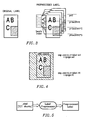
- Label preprocessing transforms an encoded CMYK label into a color separated representation. This representation is such that an expander may be started at the beginning of any of a set of special scanlines which impose a swath structure onto the label. Label preprocessing also creates a Pixel Type Map of the label. This map defines each pixel's characteristics (discussed in greater detail below).
- the swath grid is congruent to the JPEG grid.
- a special table, the Swath Index, points to the beginning of each swath within the label. Each entry points to:
- Label application is realized by applying labels to each band in appTime order. Labels are applied to bands by applying only the subsequent swaths that actually overlap with the band, when are located by using the label's Swath Index.
- One preferred method for composing is based on the following tenets:
- composition has two parts:
- This step may be performed on the whole page, or on a band per band basis. It may also be performed as part of the page preprocess (using the main CPU) or as part of the composition process (using the composer CPU).
- the Composer works on successive bands, and for each band it performs the following steps:
- Composers may be used in parallel, one composer per band. After the bands are composed, a stitching process ties all the bands together into the resulting page.
- the Engine Page FlowDescriptor summarizes the engine characteristics (e.g. start and stop delays, warm and rev up times)
- Extend Cache including local memory and disk storage.
- Fig. 10 is a block schematic diagram showing the structure of an HWC according to the invention.
- the preferred embodiment of the invention isolates the composer into an autonomous unit, with its own internal local PCI bus 31, communicating with the rest of the system via two PCl bridges 30, 32.
- the local PCI bus 31 handles all internal traffic between modules, including all the component setup via CSR setting.
- PCI refers to a bus and protocol therefor
- CSR refers to control and status registers. Writing to and reading from the CSR registers establishes control and communications between hardware elements in the bus.
- the system PCI bridge 32 handles all of HWC inputs that are received through this bus. In many systems, the system PCI bridge also carries the resulting pages. Communication and synchronization with the main system (not shown) (by means of a messaging protocol) also takes place through the system PCI bridge.
- the main CPU and composer communicate via a stream of commands created by the main CPU. The commands carry information about how to apply labels.
- the shipOut PCI bridge 30 connects to the shipOut bus, which is dedicated to the transport of resulting pages to the printer queue.
- the shipOut bus is used in very high page rate systems and systems that require a fairly unloaded system PCI bus.
- Other embodiments of the invention may use the system PCI bridge for transport of print jobs to the printer queue.
- An expander subsystem 43 has two input streams, i.e. an SDSO stream and a JPEG stream. For output, the video signal is synchronized by a signal provided by a synch bus.
- the video bus 48 provides a CMYK color stream, which is the aggregation of four single plane color outputs (32 bits).
- the expander module 43 is controlled by the composer CPU 36, which sets input streams for each expander and which stops the expanders after each label application.
- a JPEG compressor subsystem 44 receives an input which consists of sets of 8 by 8 pixel blocks that are generated by the data flow controller (DFC) 34.
- the compressor output consists of JPEG encoded blocks, including space for JPEG block vectors.
- the compressor subsystem 44 is controlled by the composer CPU 36, which sets input streams for each JPEG strip and which records the output address for each strip to fill in JPEG block vectors later.
- the (DFC) 34 controls a large portion of the information exchange between modules in the HWC.
- the data flow controller 34 is at the core of the composer hardware, staging the actual data traffic between components.
- the DFC is comprised of three main subsystems: Paint 40, CompPrep 41, and SendOff 42. These subsystems operate in parallel as follows:
- the paint subsystem 40 paints in all the labels that need to be applied onto a band. Labels are received from the expander subsystem 43 as a CMYK video stream.
- the CompPrep subsystem 41 prepares a band that has previously been painted by the paint subsystem for compression. For each band, the CompPrep subsystem separates the pixels to be compressed by SDSO and those to be compressed by JPEG, basing its decision on a pixel type map precomputed by the main system.
- the CompPrep subsystem 41 For each strip within a band, the CompPrep subsystem 41 prepares and stores five streams in BSRAM 39:
- the SendOff subsystem 42 directs the output of each one of the five streams already prepared by the CompPrep module.
- the SendOff subsystem operates on strips that have been previously prepared.
- the composer CPU 36 implements the top level of the HWC. It controls all of the different modules in the HWC, communicates with the main system via a messaging interface, and serves as an intermediate data storage for streams that are sent to other modules in the HWC.
- the composer CPU also executes various software functions for the composition process, which include finishing the JPEG output streams by inserting the JPEG block vectors and partitioning the compose commands into band based commands.
- Fig. 11 is a block schematic diagram showing information flow and structure according to the invention. Information flows mostly in the form of streams.
- Input streams carry the label representation to be applied on each band.
- the input streams comprise a preprocessed, color separated encoded stream 120 consisting of an SDSO stream and a JPEG stream.
- labels are applied in composition order. Label sources are stored in system memory and are accessed via the system PCI bridge 32.
- the video stream 48 carries the expanded label.
- the video stream is a CMYK pixel stream in which pixels are organized as a pixel array in row major order.
- the pixel array overlaps the band, possibly starting at an earlier scan line.
- the DFC paint subsystem 40 clips the pixels as needed. Routing of the video stream is generated by the expander modules 43. Flow of the video streams is controlled by the paint subsystem 40.
- the paint stream 110 comprises actual label pixels to be applied on a band, where all extra pixels have been discarded by the DFC paint subsystem 40.
- the paint stream is a sequence of color applications (e.g. color value, address) to be written into the current band in the SDram module 38.
- the DFC SDram output module (55; Fig. 5 ) controls writing of the paint stream to the SDram module from the paint subsystem. Transparent color is not painted. Rather, a skip in the SDram address is generated.
- the band stream 112 is generated once per band and contains the final expanded pixel array for the band.
- the band stream comprises a pixel array arranged in row major order.
- the DFC SDram input module (53; Fig. 5 ) controls reading of the band stream from the SDram module to the CompPrep subsystem.
- the expanded strips stream 104 contains the expanded (8 by 8) blocks to be compressed by the Comp modules 44. Only the non-empty blocks are generated.
- the CompPrep subsystem 41 generates the expanded strips stream on a strip by strip basis. The stream is stored in the BSRAM.
- the pixel type map (118, 122) defines the pixel characteristics of the resulting page.
- the map is encoded differentially. Map lines are 32 bit word aligned and made up commands that are nibble encoded. Encoding is intended to make hardware simple, rather than achieving the ultimate compression rate.
- the pixel type map is created by the main system in advance of the actual page composition.
- the composer CPU 36 receives the pixel type map before a band needs to be processed by the CompPrep subsystem 41, and then stores the pixel type map in a corresponding BSram module 39 region in advance of DFC 34 access to it.
- the JPEG map (118, 122) defines which JPEG blocks are non-empty in the resulting page.
- the JPEG map is created by the main system in advance of the actual page composition.
- the composer CPU 36 receives the JPEG map before a band needs to be processed by the CompPrep module 41 and stores it in the corresponding BSram module 39 region.
- the strip store and fetch streams 114, 116 are storage operations for the JPEG and SDSO strips produced by the CompPrep subsystem and consumed by the SendOff subsystem 42. Their organization is only relevant as part as the general handling and allocation of the BSram module and is discussed below in connection with the DFC BSram description.
- the compose commands stream (118, 122) defines the application order, position (and other parameters) of labels onto the page.
- Compose commands defining the whole page composition are created by the main system.
- the composer CPU 36 receives the compose commands at the beginning of a page and partitions them into band congruent commands. These new band commands are then stored in band dispatch order in the command region of the BSram module for use by the paint subsystem.
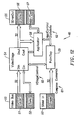
- Fig. 12 is a block schematic diagram of a paint subsystem according to the invention.
- the paint subsystem implements the label application process to the current band. It effectively transforms the video stream 48 ( Fig. 11 ) into the paint stream (110).
- the PaintTop module 59 controls the rest of the paint subsystem. Its main functions include command processing, which receives and interprets compose commands; state information setting, which sets information according to commands; and controlling the collector and applicator modules 58.
- the video stream from the expander subsystem is staged into the SDram output 55 via the video stage 54.
- the video stage module provides any necessary FIFO buffering. The size of this buffering depends on how the SDram module is organized. If the SDram module is organized as two separate 32 bit wide banks, then only a staging register is required. On the other hand, a double width (64 bit) single bank SDram module requires a large FIFO to allow for sharing with the CompPrep module.
- the applicator module 58 steps the SDram module writing of the applied colors.
- the input colors are checked for transparency.
- Transparent Color When a pixel's color equals Transparent Color, then the pixel is not applied (i.e. its corresponding address is skipped). This assumes that the SDram out module 55 is able to skip writes when a transparent pixel is applied.
- the condition pixelsInBounds is kept by means of two control registers, i.e. leftSkipCnt and writeCnt, as shown by the pseudo code listing below:
- the basic flow control is based on the availability of data at the output of the video stage module, and the SDram module being ready to take in an application, as shown by the pseudo-code listing below:
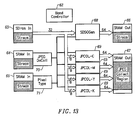
- Fig. 13 is a block schematic diagram of a ComPrep subsystem according to the invention.
- the band is read from the corresponding SDram bank 63. Pixels come in as a stream. At the end of every scan line, the last few pixels may be skipped if needed ( i.e. when the scan line is allocated a larger buffer than its width).
- the pixel stream is used in full by the SDSOGen module 68.
- Each one of the pixel planes is routed as input into the corresponding JPCOL module 69.
- the band controller module 62 keeps track of where in the band various activities are happening.
- the band controller module generates the necessary end of line signals.
- the SDSOGen module 68 generates SDSO based on the current pixel type (provided by the PixelType module 71) and the current pixel color (from the SDram input stream). The SDSOGen module first considers the current pixel. If the current pixel is SDSOTransparent, then the pixel's color is set to BackgroundColor.
- SDSO runs start by issuing a CSET command.
- the run lengths keep increasing while the color remains the same.
- the length is issued by means of an RL command.
- the runs start by issuing a YSET command. After that, the length keeps increasing until the pixel type changes.
- the end of line condition generated by the band controller 62 forces the generation of an EOL command.
- JPEG block collector (JPCOL) modules 69 are one-row stages for the collected 8-bit colors. Collection occurs any time JPEGDoColl is active.
- the band controller 62 generates the endOfJPEGBlock signal necessary to pass on the collected rows to the SRAM Out module 66.
- the PixelType module 71 decodes the current pixel type run and advances synchronously with the rest of the subsystem. When the current run is exhausted, the next run is brought in from the BSram pixel map region through the corresponding FIFO.
- the JPEGDoColl module 70 decodes the current JPEG Vector and advances synchronously with the rest of the CompPrep subsystem. When the current run is exhausted, the next run is brought in from the BSram pixel map region through the corresponding FIFO.
- Fig. 14 is a block schematic diagram of the SendOff subsystem 42 according to the invention.
- the SendOff subsystem 42 is essentially an intelligent processor for the PCl read requests. It interprets the addresses and fetches the right information from the BSram module.
- the SendOff controller module 73 synchronizes band advances and maintains the producer/consumer synchronization with the CompPrep module.
- the PCI read address selects the region to read. This selection activates the corresponding address generator 77, 78, 79.
- the DFC module implements PCI slave mode only. All transfers to and from the DFC module are mastered by other components.
- the address mapped must be at least as large as the whole region to allow for DMA in the master component to increase their address and stay within the region.
- the read accesses are buffered to allow for a slower PCI clock.
- the only write access mode available is direct. Access is unbuffered, directly into the BSram module. Clients may only access the BSram module to store very small amounts of information (e.g. maps and compose commands).
- Fig. 15 is a block schematic representation of a partition scheme showing SRAM control according to the invention.
- a first column 80 identifies the various regions of the SRAM, a second column 81 identifies the actual memory allocation for such regions, and a third column 82 identifies the characteristic of the region.
- the SDram module is divided into two banks, assigned in a ping-pong fashion to the Band-in-Paint and to the Band-in-Compress, respectively, which simplifies internal data paths and increases pin out.
- each band requires 2M words, or two banks of 2M by 32 bits each.
- a read stream is created to read the Band-in-Compress.
- the paint subsystem submits writes to the SDram module, in sequential (with skipping) order. Priority scheduling is not an issue if two banks are used. Otherwise, the read and write accesses should be buffered and scheduled round robin.
Landscapes
- Physics & Mathematics (AREA)
- General Physics & Mathematics (AREA)
- Engineering & Computer Science (AREA)
- Theoretical Computer Science (AREA)
- Record Information Processing For Printing (AREA)
Claims (10)
- Procédé pour générer un travail d'impression de données variable comprenant une page de données variable comportant une pluralité d'étiquettes, chaque étiquette comprenant des données de pixels comprimées comprenant une pluralité de colorants, le procédé comprenant:traiter chaque étiquette pour créer un schéma de types de pixels et un schéma JPEG pour l'étiquette, où le schéma de types de pixels de l'étiquette comprend une caractéristique de compression de chaque pixel dans l'étiquette;recevoir une pluralité de commandes de composition qui décrivent la page de données variable sous forme de séquence d'applications des étiquettes, où chaque application d'une étiquette comporte des coordonnées d'application correspondantes et un moment d'application correspondant;traiter les commandes de composition et le schéma de types de pixels de l'étiquette et le schéma JPEG pour créer un schéma de types de pixels et un schéma JPEG pour la page, où le schéma de types de pixels de page comprend une caractéristique de compression de chaque pixel dans la page;diviser de la page de données variable en une pluralité de bandes; etpour chaque bande:identifier les étiquettes à appliquer dans la bande; décomprimer les étiquettes identifiées;appliquer chaque donnée d'étiquette décomprimée aux coordonnées d'application correspondantes au moment d'application correspondant, pour générer des données de pixels pour la bande; etutiliser le schéma de types de pixels de page et le schéma JPEG de page pour comprimer les données de pixels debande.
- Procédé selon la revendication 1, dans lequel le traitement de chaque étiquette comprend:décomprimer l'étiquette;séparer l'étiquette par couleur;découper l'étiquette en une pluralité de zones explorées;créer le schéma de types de pixels et le schéma JPEG pour l'étiquette; etrecomprimer les données de pixels séparées par couleur.
- Procédé selon la revendication 2, dans lequel, pour chaque bande, l'application comprend le fait de n'appliquer que les zones explorées de chaque étiquette qui viennent effectivement en recouvrement avec la bande.
- Procédé selon la revendication 1, comprenant par ailleurs le fait de traiter chaque bande en parallèle.
- Procédé selon la revendication 1, comprenant par ailleurs le fait de relier les données de pixels pour chaque bande, pour créer la page de données variable.
- Dispositif pour générer un travail d'impression de données variable comprenant une page de données variable comportant une pluralité d'étiquettes, chaque étiquette comprenant des données de pixels comprimées comprenant une pluralité de colorants, le dispositif comprenant:un moyen destiné à traiter chaque étiquette pour créer un schéma de types de pixels et un schéma JPEG pour l'étiquette, où le schéma de types de pixels de l'étiquette comprend une caractéristique de compression de chaque pixel dans l'étiquette;un moyen destiné à recevoir une pluralité de commandes de composition qui décrivent la page de données variable sous forme de séquence d'applications des étiquettes, où chaque application d'une étiquette comporte des coordonnées d'application correspondantes et un moment d'application correspondant;un moyen destiné à traiter les commandes de composition et le schéma de types de pixels de l'étiquette et le schéma JPEG pour créer un schéma de types de pixels et un schéma JPEG pour la page, où le schéma de types de pixels de page comprend une caractéristique de compression de chaque pixel dans la page;un moyen destiné à diviser la page de données variable en une pluralité de bandes;un moyen destiné à identifier les étiquettes à appliquer dans chaque bande;un moyen destiné à décomprimer les étiquettes identifiées;un moyen destiné à appliquer chaque donnée d'étiquette décomprimée aux coordonnées d'application correspondantes au moment d'application correspondant, pour générer des données de pixel pour la bande; etun moyen destiné à utiliser le schéma de types de pixels de page et le schéma JPEG de page pour comprimer les données de pixels de bande.
- Dispositif selon la revendication 6, dans lequel le moyen destiné à traiter chaque étiquette comprend:un moyen destiné à décomprimer l'étiquette;un moyen destiné à séparer l'étiquette par couleur;un moyen destiné à découper l'étiquette en une pluralité de zones explorées;un moyen destiné à créer le schéma de types de pixels et le schéma JPEG pour l'étiquette; etun moyen destiné à recomprimer les données de pixels séparées par couleur.
- Dispositif selon la revendication 7, dans lequel, pour chaque bande, le moyen destiné à appliquer comprend un moyen destiné à n'appliquer que les zones explorées de chaque étiquette qui viennent effectivement en recouvrement avec la bande.
- Dispositif selon la revendication 6, comprenant par ailleurs un moyen destiné à traiter chaque bande en parallèle.
- Dispositif selon la revendication 6, comprenant par ailleurs un moyen destiné à relier les données de pixels pour chaque bande, pour créer la page de données variable.
Applications Claiming Priority (3)
| Application Number | Priority Date | Filing Date | Title |
|---|---|---|---|
| US151375 | 1998-09-10 | ||
| US09/151,375 US6256108B1 (en) | 1998-09-10 | 1998-09-10 | Method and apparatus for label composition |
| PCT/US1999/019659 WO2000016266A1 (fr) | 1998-09-10 | 1999-09-01 | Composition de page variable avec elements de page decoupes en bandes |
Publications (2)
| Publication Number | Publication Date |
|---|---|
| EP1110183A1 EP1110183A1 (fr) | 2001-06-27 |
| EP1110183B1 true EP1110183B1 (fr) | 2008-12-31 |
Family
ID=22538486
Family Applications (1)
| Application Number | Title | Priority Date | Filing Date |
|---|---|---|---|
| EP99945256A Expired - Lifetime EP1110183B1 (fr) | 1998-09-10 | 1999-09-01 | Composition de page variable avec elements de page decoupes en bandes |
Country Status (5)
| Country | Link |
|---|---|
| US (1) | US6256108B1 (fr) |
| EP (1) | EP1110183B1 (fr) |
| AU (1) | AU762746B2 (fr) |
| DE (1) | DE69940205D1 (fr) |
| WO (1) | WO2000016266A1 (fr) |
Families Citing this family (18)
| Publication number | Priority date | Publication date | Assignee | Title |
|---|---|---|---|---|
| DE10001211B4 (de) * | 2000-01-14 | 2004-04-15 | Heidelberger Druckmaschinen Ag | Verfahren zum Erzeugen von Rasterdaten und Rastererzeugungssystem |
| US7164494B1 (en) * | 2000-02-07 | 2007-01-16 | Adobe Systems Incorporated | Color separation of pattern color spaces and form XObjects |
| DE10023945A1 (de) * | 2000-05-17 | 2001-11-22 | Heidelberger Druckmasch Ag | Druckprozesssteuerung |
| US7142326B2 (en) | 2001-05-16 | 2006-11-28 | Xerox Corporation | Method and apparatus for variable data document printing |
| US20030193503A1 (en) * | 2002-04-10 | 2003-10-16 | Mark Seminatore | Computer animation system and method |
| US7391529B2 (en) * | 2003-01-15 | 2008-06-24 | Xerox Corporation | Apparatus and method for managing and using reusable document components during the process of dynamic document construction |
| US7345781B2 (en) * | 2003-03-27 | 2008-03-18 | Hewlett-Packard Development Company, L.P. | Time estimator for printing workflow |
| AU2003902362A0 (en) * | 2003-05-14 | 2003-05-29 | Outback Software Pty Limited | Arranging components on a sheet |
| US9098475B2 (en) * | 2003-08-20 | 2015-08-04 | Xerox Corporation | Apparatus and method for generating reusable composite components during dynamic document construction |
| US20050273599A1 (en) * | 2004-06-08 | 2005-12-08 | Khandelwal Rajesh B | Embedding identification data into a work |
| US8121338B2 (en) | 2004-07-07 | 2012-02-21 | Directsmile Gmbh | Process for generating images with realistic text insertion |
| JP4405878B2 (ja) * | 2004-09-02 | 2010-01-27 | キヤノン株式会社 | 画像処理装置、画像処理方法、ならびにプログラム、記憶媒体 |
| US20070216696A1 (en) * | 2006-03-16 | 2007-09-20 | Toshiba (Australia) Pty. Limited | System and method for document rendering employing bit-band instructions |
| US20090091564A1 (en) * | 2007-10-03 | 2009-04-09 | Raju Thevan | System and method for rendering electronic documents having overlapping primitives |
| US9152292B2 (en) * | 2009-02-05 | 2015-10-06 | Hewlett-Packard Development Company, L.P. | Image collage authoring |
| US8161384B2 (en) * | 2009-04-23 | 2012-04-17 | Hewlett-Packard Development Company, L.P. | Arranging graphic objects on a page with text |
| US20110110591A1 (en) * | 2009-11-09 | 2011-05-12 | Ming-Hwa Sheu | Multi-point image labeling method |
| US9042651B2 (en) | 2009-11-09 | 2015-05-26 | National Yunlin University Of Science And Technology | Multi-point image labeling method |
Citations (1)
| Publication number | Priority date | Publication date | Assignee | Title |
|---|---|---|---|---|
| US6049390A (en) * | 1997-11-05 | 2000-04-11 | Barco Graphics Nv | Compressed merging of raster images for high speed digital printing |
Family Cites Families (5)
| Publication number | Priority date | Publication date | Assignee | Title |
|---|---|---|---|---|
| AUPM822194A0 (en) | 1994-09-16 | 1994-10-13 | Canon Inc. | Utilisation of scanned images in an image compositing system |
| US5729665A (en) * | 1995-01-18 | 1998-03-17 | Varis Corporation | Method of utilizing variable data fields with a page description language |
| US5594860A (en) * | 1995-01-27 | 1997-01-14 | Varis Corporation | Method for banding and rasterizing an image in a multiprocessor printing system |
| IL113614A0 (en) | 1995-05-03 | 1995-08-31 | Indigo Nv | Page make-up system |
| DE69704367T2 (de) | 1996-09-24 | 2001-10-31 | Colorage, Inc. | Rechnersystem und verfahren zur seitenbeschreibungsverarbeitung |
-
1998
- 1998-09-10 US US09/151,375 patent/US6256108B1/en not_active Expired - Lifetime
-
1999
- 1999-09-01 DE DE69940205T patent/DE69940205D1/de not_active Expired - Lifetime
- 1999-09-01 AU AU57893/99A patent/AU762746B2/en not_active Ceased
- 1999-09-01 EP EP99945256A patent/EP1110183B1/fr not_active Expired - Lifetime
- 1999-09-01 WO PCT/US1999/019659 patent/WO2000016266A1/fr not_active Ceased
Patent Citations (1)
| Publication number | Priority date | Publication date | Assignee | Title |
|---|---|---|---|---|
| US6049390A (en) * | 1997-11-05 | 2000-04-11 | Barco Graphics Nv | Compressed merging of raster images for high speed digital printing |
Also Published As
| Publication number | Publication date |
|---|---|
| AU762746B2 (en) | 2003-07-03 |
| US6256108B1 (en) | 2001-07-03 |
| WO2000016266A1 (fr) | 2000-03-23 |
| AU5789399A (en) | 2000-04-03 |
| DE69940205D1 (de) | 2009-02-12 |
| EP1110183A1 (fr) | 2001-06-27 |
Similar Documents
| Publication | Publication Date | Title |
|---|---|---|
| EP1110183B1 (fr) | Composition de page variable avec elements de page decoupes en bandes | |
| US6134018A (en) | Method and apparatus for creating personalized documents that include variable data | |
| US6466210B1 (en) | Blending image data using layers | |
| US5845302A (en) | Method and system for producing high-quality, highly-personalized printed documents | |
| US5801716A (en) | Pipeline structures for full-color computer graphics | |
| US6836342B2 (en) | Variable data print job system | |
| US7327487B2 (en) | Banded compositor for variable data | |
| US6956667B2 (en) | Page composing method using stored page elements and apparatus for using the same | |
| JP3486517B2 (ja) | 印刷システム及び印刷制御方法 | |
| US7301544B2 (en) | Printing tree-described documents | |
| US5136688A (en) | Print data processing apparatus for an image forming apparatus | |
| EP0772115B1 (fr) | Système, dispositif de sortie, méthode et support lisible par oridinateur utilisant un driver d'imprimante divisé pour commander un dispositif d'imprimante d'ordinateur | |
| US8144360B2 (en) | System and method for processing portions of documents using variable data | |
| US7161695B2 (en) | Image information distributing system | |
| US20040091162A1 (en) | Run length compression format for storing raster data in a cache | |
| US6023556A (en) | Processing print job image data | |
| AU2003204222B2 (en) | Variable page composition with page elements cut in strips | |
| JP2973260B2 (ja) | 印刷情報処理装置 | |
| US20040257371A1 (en) | Pipelined architecture for high speed raster image processor | |
| JPH03105688A (ja) | 画像合成方法 | |
| Marovac | Document description language INTERPRESS | |
| JPH04283872A (ja) | 画像処理方法及び装置 | |
| JPH03105686A (ja) | カーソル表示方法 |
Legal Events
| Date | Code | Title | Description |
|---|---|---|---|
| PUAI | Public reference made under article 153(3) epc to a published international application that has entered the european phase |
Free format text: ORIGINAL CODE: 0009012 |
|
| 17P | Request for examination filed |
Effective date: 20010216 |
|
| AK | Designated contracting states |
Kind code of ref document: A1 Designated state(s): AT BE CH CY DE DK ES FI FR GB GR IE IT LI LU MC NL PT SE |
|
| RBV | Designated contracting states (corrected) |
Designated state(s): DE FR GB NL |
|
| 17Q | First examination report despatched |
Effective date: 20060901 |
|
| GRAP | Despatch of communication of intention to grant a patent |
Free format text: ORIGINAL CODE: EPIDOSNIGR1 |
|
| GRAS | Grant fee paid |
Free format text: ORIGINAL CODE: EPIDOSNIGR3 |
|
| GRAA | (expected) grant |
Free format text: ORIGINAL CODE: 0009210 |
|
| AK | Designated contracting states |
Kind code of ref document: B1 Designated state(s): DE FR GB NL |
|
| REG | Reference to a national code |
Ref country code: GB Ref legal event code: FG4D |
|
| REF | Corresponds to: |
Ref document number: 69940205 Country of ref document: DE Date of ref document: 20090212 Kind code of ref document: P |
|
| PLBE | No opposition filed within time limit |
Free format text: ORIGINAL CODE: 0009261 |
|
| STAA | Information on the status of an ep patent application or granted ep patent |
Free format text: STATUS: NO OPPOSITION FILED WITHIN TIME LIMIT |
|
| 26N | No opposition filed |
Effective date: 20091001 |
|
| REG | Reference to a national code |
Ref country code: FR Ref legal event code: PLFP Year of fee payment: 18 |
|
| REG | Reference to a national code |
Ref country code: FR Ref legal event code: PLFP Year of fee payment: 19 |
|
| REG | Reference to a national code |
Ref country code: FR Ref legal event code: PLFP Year of fee payment: 20 |
|
| PGFP | Annual fee paid to national office [announced via postgrant information from national office to epo] |
Ref country code: DE Payment date: 20180821 Year of fee payment: 20 Ref country code: FR Payment date: 20180712 Year of fee payment: 20 Ref country code: NL Payment date: 20180815 Year of fee payment: 20 |
|
| PGFP | Annual fee paid to national office [announced via postgrant information from national office to epo] |
Ref country code: GB Payment date: 20180829 Year of fee payment: 20 |
|
| REG | Reference to a national code |
Ref country code: DE Ref legal event code: R071 Ref document number: 69940205 Country of ref document: DE |
|
| REG | Reference to a national code |
Ref country code: NL Ref legal event code: MK Effective date: 20190831 |
|
| REG | Reference to a national code |
Ref country code: GB Ref legal event code: PE20 Expiry date: 20190831 |
|
| PG25 | Lapsed in a contracting state [announced via postgrant information from national office to epo] |
Ref country code: GB Free format text: LAPSE BECAUSE OF EXPIRATION OF PROTECTION Effective date: 20190831 |