EP1111010A2 - Use of emulsifiers in bituminous emulsions - Google Patents
Use of emulsifiers in bituminous emulsions Download PDFInfo
- Publication number
- EP1111010A2 EP1111010A2 EP00126139A EP00126139A EP1111010A2 EP 1111010 A2 EP1111010 A2 EP 1111010A2 EP 00126139 A EP00126139 A EP 00126139A EP 00126139 A EP00126139 A EP 00126139A EP 1111010 A2 EP1111010 A2 EP 1111010A2
- Authority
- EP
- European Patent Office
- Prior art keywords
- fatty acid
- use according
- polymers
- quaternized
- amidoamines
- Prior art date
- Legal status (The legal status is an assumption and is not a legal conclusion. Google has not performed a legal analysis and makes no representation as to the accuracy of the status listed.)
- Granted
Links
- 239000000839 emulsion Substances 0.000 title claims abstract description 29
- 239000003995 emulsifying agent Substances 0.000 title claims abstract description 14
- 235000014113 dietary fatty acids Nutrition 0.000 claims abstract description 28
- 239000000194 fatty acid Substances 0.000 claims abstract description 28
- 229930195729 fatty acid Natural products 0.000 claims abstract description 28
- 150000004665 fatty acids Chemical class 0.000 claims abstract description 28
- 239000010426 asphalt Substances 0.000 claims abstract description 27
- 238000004519 manufacturing process Methods 0.000 claims abstract description 9
- 229920006317 cationic polymer Polymers 0.000 claims abstract description 5
- 229920000642 polymer Polymers 0.000 claims description 15
- 150000001768 cations Chemical class 0.000 claims description 9
- WNLRTRBMVRJNCN-UHFFFAOYSA-N adipic acid Chemical compound OC(=O)CCCCC(O)=O WNLRTRBMVRJNCN-UHFFFAOYSA-N 0.000 claims description 8
- 125000002091 cationic group Chemical group 0.000 claims description 7
- 229920001577 copolymer Polymers 0.000 claims description 7
- 239000003760 tallow Substances 0.000 claims description 7
- -1 unsaturated acyl radical Chemical class 0.000 claims description 7
- 239000000203 mixture Substances 0.000 claims description 6
- 239000007787 solid Substances 0.000 claims description 5
- RPNUMPOLZDHAAY-UHFFFAOYSA-N Diethylenetriamine Chemical compound NCCNCCN RPNUMPOLZDHAAY-UHFFFAOYSA-N 0.000 claims description 4
- UFHFLCQGNIYNRP-UHFFFAOYSA-N Hydrogen Chemical compound [H][H] UFHFLCQGNIYNRP-UHFFFAOYSA-N 0.000 claims description 4
- 239000001361 adipic acid Substances 0.000 claims description 4
- 235000011037 adipic acid Nutrition 0.000 claims description 4
- 229910052739 hydrogen Inorganic materials 0.000 claims description 4
- 239000001257 hydrogen Substances 0.000 claims description 4
- 239000000178 monomer Substances 0.000 claims description 4
- 229920001184 polypeptide Polymers 0.000 claims description 4
- 102000004196 processed proteins & peptides Human genes 0.000 claims description 4
- 108090000765 processed proteins & peptides Proteins 0.000 claims description 4
- FAGUFWYHJQFNRV-UHFFFAOYSA-N tetraethylenepentamine Chemical compound NCCNCCNCCNCCN FAGUFWYHJQFNRV-UHFFFAOYSA-N 0.000 claims description 4
- 102000008186 Collagen Human genes 0.000 claims description 3
- 108010035532 Collagen Proteins 0.000 claims description 3
- 229920001436 collagen Polymers 0.000 claims description 3
- 239000007859 condensation product Substances 0.000 claims description 3
- OSSNTDFYBPYIEC-UHFFFAOYSA-N 1-ethenylimidazole Chemical compound C=CN1C=CN=C1 OSSNTDFYBPYIEC-UHFFFAOYSA-N 0.000 claims description 2
- VILCJCGEZXAXTO-UHFFFAOYSA-N 2,2,2-tetramine Chemical compound NCCNCCNCCN VILCJCGEZXAXTO-UHFFFAOYSA-N 0.000 claims description 2
- SMZOUWXMTYCWNB-UHFFFAOYSA-N 2-(2-methoxy-5-methylphenyl)ethanamine Chemical compound COC1=CC=C(C)C=C1CCN SMZOUWXMTYCWNB-UHFFFAOYSA-N 0.000 claims description 2
- NIXOWILDQLNWCW-UHFFFAOYSA-N 2-Propenoic acid Natural products OC(=O)C=C NIXOWILDQLNWCW-UHFFFAOYSA-N 0.000 claims description 2
- 244000060011 Cocos nucifera Species 0.000 claims description 2
- 235000013162 Cocos nucifera Nutrition 0.000 claims description 2
- 229920000663 Hydroxyethyl cellulose Polymers 0.000 claims description 2
- CERQOIWHTDAKMF-UHFFFAOYSA-N Methacrylic acid Chemical compound CC(=C)C(O)=O CERQOIWHTDAKMF-UHFFFAOYSA-N 0.000 claims description 2
- WHNWPMSKXPGLAX-UHFFFAOYSA-N N-Vinyl-2-pyrrolidone Chemical compound C=CN1CCCC1=O WHNWPMSKXPGLAX-UHFFFAOYSA-N 0.000 claims description 2
- 229920002873 Polyethylenimine Polymers 0.000 claims description 2
- 229920002472 Starch Polymers 0.000 claims description 2
- 241000209140 Triticum Species 0.000 claims description 2
- 235000021307 Triticum Nutrition 0.000 claims description 2
- 150000003926 acrylamides Chemical class 0.000 claims description 2
- 150000001408 amides Chemical class 0.000 claims description 2
- 150000001412 amines Chemical class 0.000 claims description 2
- 150000003863 ammonium salts Chemical class 0.000 claims description 2
- 125000004432 carbon atom Chemical group C* 0.000 claims description 2
- GQOKIYDTHHZSCJ-UHFFFAOYSA-M dimethyl-bis(prop-2-enyl)azanium;chloride Chemical compound [Cl-].C=CC[N+](C)(C)CC=C GQOKIYDTHHZSCJ-UHFFFAOYSA-M 0.000 claims description 2
- 235000019447 hydroxyethyl cellulose Nutrition 0.000 claims description 2
- 229920000151 polyglycol Polymers 0.000 claims description 2
- 239000010695 polyglycol Substances 0.000 claims description 2
- 150000003839 salts Chemical class 0.000 claims description 2
- 229920006395 saturated elastomer Polymers 0.000 claims description 2
- 229920005573 silicon-containing polymer Polymers 0.000 claims description 2
- 235000019698 starch Nutrition 0.000 claims description 2
- 229960001124 trientine Drugs 0.000 claims description 2
- ACGQRMRFZCXYHQ-UHFFFAOYSA-N 3-[2-(2-aminoethylamino)ethyl-(dimethylamino)amino]propan-1-ol Chemical compound OCCCN(N(C)C)CCNCCN ACGQRMRFZCXYHQ-UHFFFAOYSA-N 0.000 claims 1
- 239000004952 Polyamide Substances 0.000 claims 1
- 229910001508 alkali metal halide Inorganic materials 0.000 claims 1
- 150000008045 alkali metal halides Chemical class 0.000 claims 1
- 150000004820 halides Chemical class 0.000 claims 1
- 229920002647 polyamide Polymers 0.000 claims 1
- 125000002252 acyl group Chemical group 0.000 abstract 1
- 125000000217 alkyl group Chemical group 0.000 abstract 1
- 239000000945 filler Substances 0.000 description 10
- 241000282372 Panthera onca Species 0.000 description 3
- 239000000084 colloidal system Substances 0.000 description 3
- 238000009833 condensation Methods 0.000 description 3
- 230000005494 condensation Effects 0.000 description 3
- XLYOFNOQVPJJNP-UHFFFAOYSA-N water Substances O XLYOFNOQVPJJNP-UHFFFAOYSA-N 0.000 description 3
- XDOFQFKRPWOURC-UHFFFAOYSA-N 16-methylheptadecanoic acid Chemical compound CC(C)CCCCCCCCCCCCCCC(O)=O XDOFQFKRPWOURC-UHFFFAOYSA-N 0.000 description 2
- LQJBNNIYVWPHFW-UHFFFAOYSA-N 20:1omega9c fatty acid Natural products CCCCCCCCCCC=CCCCCCCCC(O)=O LQJBNNIYVWPHFW-UHFFFAOYSA-N 0.000 description 2
- VEXZGXHMUGYJMC-UHFFFAOYSA-N Hydrochloric acid Chemical compound Cl VEXZGXHMUGYJMC-UHFFFAOYSA-N 0.000 description 2
- ZQPPMHVWECSIRJ-UHFFFAOYSA-N Oleic acid Natural products CCCCCCCCC=CCCCCCCCC(O)=O ZQPPMHVWECSIRJ-UHFFFAOYSA-N 0.000 description 2
- NEHMKBQYUWJMIP-UHFFFAOYSA-N chloromethane Chemical compound ClC NEHMKBQYUWJMIP-UHFFFAOYSA-N 0.000 description 2
- GHVNFZFCNZKVNT-UHFFFAOYSA-N decanoic acid Chemical compound CCCCCCCCCC(O)=O GHVNFZFCNZKVNT-UHFFFAOYSA-N 0.000 description 2
- UKMSUNONTOPOIO-UHFFFAOYSA-N docosanoic acid Chemical compound CCCCCCCCCCCCCCCCCCCCCC(O)=O UKMSUNONTOPOIO-UHFFFAOYSA-N 0.000 description 2
- POULHZVOKOAJMA-UHFFFAOYSA-N dodecanoic acid Chemical compound CCCCCCCCCCCC(O)=O POULHZVOKOAJMA-UHFFFAOYSA-N 0.000 description 2
- ZQPPMHVWECSIRJ-MDZDMXLPSA-N elaidic acid Chemical compound CCCCCCCC\C=C\CCCCCCCC(O)=O ZQPPMHVWECSIRJ-MDZDMXLPSA-N 0.000 description 2
- IPCSVZSSVZVIGE-UHFFFAOYSA-N hexadecanoic acid Chemical compound CCCCCCCCCCCCCCCC(O)=O IPCSVZSSVZVIGE-UHFFFAOYSA-N 0.000 description 2
- FUZZWVXGSFPDMH-UHFFFAOYSA-N hexanoic acid Chemical compound CCCCCC(O)=O FUZZWVXGSFPDMH-UHFFFAOYSA-N 0.000 description 2
- VKOBVWXKNCXXDE-UHFFFAOYSA-N icosanoic acid Chemical compound CCCCCCCCCCCCCCCCCCCC(O)=O VKOBVWXKNCXXDE-UHFFFAOYSA-N 0.000 description 2
- QXJSBBXBKPUZAA-UHFFFAOYSA-N isooleic acid Natural products CCCCCCCC=CCCCCCCCCC(O)=O QXJSBBXBKPUZAA-UHFFFAOYSA-N 0.000 description 2
- SIOLDWZBFABPJU-UHFFFAOYSA-N isotridecanoic acid Chemical compound CC(C)CCCCCCCCCC(O)=O SIOLDWZBFABPJU-UHFFFAOYSA-N 0.000 description 2
- 238000002156 mixing Methods 0.000 description 2
- WWZKQHOCKIZLMA-UHFFFAOYSA-N octanoic acid Chemical compound CCCCCCCC(O)=O WWZKQHOCKIZLMA-UHFFFAOYSA-N 0.000 description 2
- SECPZKHBENQXJG-FPLPWBNLSA-N palmitoleic acid Chemical compound CCCCCC\C=C/CCCCCCCC(O)=O SECPZKHBENQXJG-FPLPWBNLSA-N 0.000 description 2
- CNVZJPUDSLNTQU-SEYXRHQNSA-N petroselinic acid Chemical compound CCCCCCCCCCC\C=C/CCCCC(O)=O CNVZJPUDSLNTQU-SEYXRHQNSA-N 0.000 description 2
- OBETXYAYXDNJHR-SSDOTTSWSA-M (2r)-2-ethylhexanoate Chemical compound CCCC[C@@H](CC)C([O-])=O OBETXYAYXDNJHR-SSDOTTSWSA-M 0.000 description 1
- CUXYLFPMQMFGPL-WPOADVJFSA-N (9Z,11E,13E)-octadeca-9,11,13-trienoic acid Chemical compound CCCC\C=C\C=C\C=C/CCCCCCCC(O)=O CUXYLFPMQMFGPL-WPOADVJFSA-N 0.000 description 1
- OYHQOLUKZRVURQ-NTGFUMLPSA-N (9Z,12Z)-9,10,12,13-tetratritiooctadeca-9,12-dienoic acid Chemical compound C(CCCCCCC\C(=C(/C\C(=C(/CCCCC)\[3H])\[3H])\[3H])\[3H])(=O)O OYHQOLUKZRVURQ-NTGFUMLPSA-N 0.000 description 1
- WRIDQFICGBMAFQ-UHFFFAOYSA-N (E)-8-Octadecenoic acid Natural products CCCCCCCCCC=CCCCCCCC(O)=O WRIDQFICGBMAFQ-UHFFFAOYSA-N 0.000 description 1
- ITWBWJFEJCHKSN-UHFFFAOYSA-N 1,4,7-triazonane Chemical compound C1CNCCNCCN1 ITWBWJFEJCHKSN-UHFFFAOYSA-N 0.000 description 1
- ZZEKLJMQENPGEU-UHFFFAOYSA-N 1-n-octadecylpropane-1,2-diamine Chemical compound CCCCCCCCCCCCCCCCCCNCC(C)N ZZEKLJMQENPGEU-UHFFFAOYSA-N 0.000 description 1
- OXEDXHIBHVMDST-UHFFFAOYSA-N 12Z-octadecenoic acid Natural products CCCCCC=CCCCCCCCCCCC(O)=O OXEDXHIBHVMDST-UHFFFAOYSA-N 0.000 description 1
- BXXWFOGWXLJPPA-UHFFFAOYSA-N 2,3-dibromobutane Chemical compound CC(Br)C(C)Br BXXWFOGWXLJPPA-UHFFFAOYSA-N 0.000 description 1
- QSBYPNXLFMSGKH-UHFFFAOYSA-N 9-Heptadecensaeure Natural products CCCCCCCC=CCCCCCCCC(O)=O QSBYPNXLFMSGKH-UHFFFAOYSA-N 0.000 description 1
- DPUOLQHDNGRHBS-UHFFFAOYSA-N Brassidinsaeure Natural products CCCCCCCCC=CCCCCCCCCCCCC(O)=O DPUOLQHDNGRHBS-UHFFFAOYSA-N 0.000 description 1
- 239000005632 Capric acid (CAS 334-48-5) Substances 0.000 description 1
- 239000005635 Caprylic acid (CAS 124-07-2) Substances 0.000 description 1
- 239000004215 Carbon black (E152) Substances 0.000 description 1
- 229920013683 Celanese Polymers 0.000 description 1
- 229920002101 Chitin Polymers 0.000 description 1
- 229920001661 Chitosan Polymers 0.000 description 1
- URXZXNYJPAJJOQ-UHFFFAOYSA-N Erucic acid Natural products CCCCCCC=CCCCCCCCCCCCC(O)=O URXZXNYJPAJJOQ-UHFFFAOYSA-N 0.000 description 1
- VGGSQFUCUMXWEO-UHFFFAOYSA-N Ethene Chemical compound C=C VGGSQFUCUMXWEO-UHFFFAOYSA-N 0.000 description 1
- 239000005977 Ethylene Substances 0.000 description 1
- 229920002907 Guar gum Polymers 0.000 description 1
- 239000004354 Hydroxyethyl cellulose Substances 0.000 description 1
- 239000005639 Lauric acid Substances 0.000 description 1
- 239000005642 Oleic acid Substances 0.000 description 1
- 235000021314 Palmitic acid Nutrition 0.000 description 1
- 235000021319 Palmitoleic acid Nutrition 0.000 description 1
- CNVZJPUDSLNTQU-UHFFFAOYSA-N Petroselaidic acid Natural products CCCCCCCCCCCC=CCCCCC(O)=O CNVZJPUDSLNTQU-UHFFFAOYSA-N 0.000 description 1
- 235000021355 Stearic acid Nutrition 0.000 description 1
- 239000002253 acid Substances 0.000 description 1
- OBETXYAYXDNJHR-UHFFFAOYSA-N alpha-ethylcaproic acid Natural products CCCCC(CC)C(O)=O OBETXYAYXDNJHR-UHFFFAOYSA-N 0.000 description 1
- DTOSIQBPPRVQHS-PDBXOOCHSA-N alpha-linolenic acid Chemical compound CC\C=C/C\C=C/C\C=C/CCCCCCCC(O)=O DTOSIQBPPRVQHS-PDBXOOCHSA-N 0.000 description 1
- 235000020661 alpha-linolenic acid Nutrition 0.000 description 1
- KCXMKQUNVWSEMD-UHFFFAOYSA-N benzyl chloride Chemical compound ClCC1=CC=CC=C1 KCXMKQUNVWSEMD-UHFFFAOYSA-N 0.000 description 1
- 229940073608 benzyl chloride Drugs 0.000 description 1
- 239000012267 brine Substances 0.000 description 1
- 239000001913 cellulose Substances 0.000 description 1
- 229920002678 cellulose Polymers 0.000 description 1
- 239000007795 chemical reaction product Substances 0.000 description 1
- FLASNYPZGWUPSU-SICDJOISSA-N chitosan Chemical compound O([C@@H]1[C@@H](CO)O[C@H]([C@@H]([C@H]1O)N)O[C@@H]1[C@@H](CO)O[C@H]([C@@H]([C@H]1O)N)O[C@@H]1[C@@H](CO)O[C@H]([C@@H]([C@H]1O)N)O[C@@H]1[C@@H](CO)O[C@H]([C@@H]([C@H]1O)N)O[C@@H]1[C@@H](CO)O[C@H]([C@@H]([C@H]1O)N)O[C@H]1[C@H](O)[C@H]([C@@H](O[C@@H]1CO)O[C@@H]1[C@H](O[C@@H](O[C@@H]2[C@H](O[C@@H](O)[C@H](N)[C@H]2O)CO)[C@H](N)[C@H]1O)CO)NC(=O)OC)[C@@H]1O[C@H](CO)[C@@H](O)[C@H](O)[C@H]1N FLASNYPZGWUPSU-SICDJOISSA-N 0.000 description 1
- 229940045110 chitosan Drugs 0.000 description 1
- SECPZKHBENQXJG-UHFFFAOYSA-N cis-palmitoleic acid Natural products CCCCCCC=CCCCCCCCC(O)=O SECPZKHBENQXJG-UHFFFAOYSA-N 0.000 description 1
- 238000010276 construction Methods 0.000 description 1
- 150000004985 diamines Chemical class 0.000 description 1
- VAYGXNSJCAHWJZ-UHFFFAOYSA-N dimethyl sulfate Chemical compound COS(=O)(=O)OC VAYGXNSJCAHWJZ-UHFFFAOYSA-N 0.000 description 1
- 239000006185 dispersion Substances 0.000 description 1
- 238000004821 distillation Methods 0.000 description 1
- DPUOLQHDNGRHBS-KTKRTIGZSA-N erucic acid Chemical compound CCCCCCCC\C=C/CCCCCCCCCCCC(O)=O DPUOLQHDNGRHBS-KTKRTIGZSA-N 0.000 description 1
- 235000019387 fatty acid methyl ester Nutrition 0.000 description 1
- LQJBNNIYVWPHFW-QXMHVHEDSA-N gadoleic acid Chemical compound CCCCCCCCCC\C=C/CCCCCCCC(O)=O LQJBNNIYVWPHFW-QXMHVHEDSA-N 0.000 description 1
- 239000000665 guar gum Substances 0.000 description 1
- 235000010417 guar gum Nutrition 0.000 description 1
- 229960002154 guar gum Drugs 0.000 description 1
- WNSHLJYMOMFBJK-UHFFFAOYSA-N hexanedioic acid;prop-2-enoic acid Chemical class OC(=O)C=C.OC(=O)CCCCC(O)=O WNSHLJYMOMFBJK-UHFFFAOYSA-N 0.000 description 1
- 238000000265 homogenisation Methods 0.000 description 1
- 229930195733 hydrocarbon Natural products 0.000 description 1
- 150000002430 hydrocarbons Chemical class 0.000 description 1
- 150000002431 hydrogen Chemical class 0.000 description 1
- TVZISJTYELEYPI-UHFFFAOYSA-N hypodiphosphoric acid Chemical compound OP(O)(=O)P(O)(O)=O TVZISJTYELEYPI-UHFFFAOYSA-N 0.000 description 1
- 229960004488 linolenic acid Drugs 0.000 description 1
- KQQKGWQCNNTQJW-UHFFFAOYSA-N linolenic acid Natural products CC=CCCC=CCC=CCCCCCCCC(O)=O KQQKGWQCNNTQJW-UHFFFAOYSA-N 0.000 description 1
- 239000011159 matrix material Substances 0.000 description 1
- 238000000034 method Methods 0.000 description 1
- 229940050176 methyl chloride Drugs 0.000 description 1
- WQEPLUUGTLDZJY-UHFFFAOYSA-N n-Pentadecanoic acid Natural products CCCCCCCCCCCCCCC(O)=O WQEPLUUGTLDZJY-UHFFFAOYSA-N 0.000 description 1
- QIQXTHQIDYTFRH-UHFFFAOYSA-N octadecanoic acid Chemical compound CCCCCCCCCCCCCCCCCC(O)=O QIQXTHQIDYTFRH-UHFFFAOYSA-N 0.000 description 1
- OQCDKBAXFALNLD-UHFFFAOYSA-N octadecanoic acid Natural products CCCCCCCC(C)CCCCCCCCC(O)=O OQCDKBAXFALNLD-UHFFFAOYSA-N 0.000 description 1
- 229960002446 octanoic acid Drugs 0.000 description 1
- 239000002245 particle Substances 0.000 description 1
- 239000003208 petroleum Substances 0.000 description 1
- 229920000768 polyamine Polymers 0.000 description 1
- 239000001294 propane Substances 0.000 description 1
- 238000010992 reflux Methods 0.000 description 1
- 238000004062 sedimentation Methods 0.000 description 1
- HPALAKNZSZLMCH-UHFFFAOYSA-M sodium;chloride;hydrate Chemical compound O.[Na+].[Cl-] HPALAKNZSZLMCH-UHFFFAOYSA-M 0.000 description 1
- 239000000243 solution Substances 0.000 description 1
- 239000008107 starch Substances 0.000 description 1
- 239000008117 stearic acid Substances 0.000 description 1
- 239000000126 substance Substances 0.000 description 1
- 238000010998 test method Methods 0.000 description 1
- TUNFSRHWOTWDNC-HKGQFRNVSA-N tetradecanoic acid Chemical compound CCCCCCCCCCCCC[14C](O)=O TUNFSRHWOTWDNC-HKGQFRNVSA-N 0.000 description 1
- AGGKEGLBGGJEBZ-UHFFFAOYSA-N tetramethylenedisulfotetramine Chemical compound C1N(S2(=O)=O)CN3S(=O)(=O)N1CN2C3 AGGKEGLBGGJEBZ-UHFFFAOYSA-N 0.000 description 1
- AQWHMKSIVLSRNY-UHFFFAOYSA-N trans-Octadec-5-ensaeure Natural products CCCCCCCCCCCCC=CCCCC(O)=O AQWHMKSIVLSRNY-UHFFFAOYSA-N 0.000 description 1
- 238000007056 transamidation reaction Methods 0.000 description 1
- 150000003626 triacylglycerols Chemical class 0.000 description 1
- 229920003169 water-soluble polymer Polymers 0.000 description 1
Classifications
-
- C—CHEMISTRY; METALLURGY
- C08—ORGANIC MACROMOLECULAR COMPOUNDS; THEIR PREPARATION OR CHEMICAL WORKING-UP; COMPOSITIONS BASED THEREON
- C08L—COMPOSITIONS OF MACROMOLECULAR COMPOUNDS
- C08L95/00—Compositions of bituminous materials, e.g. asphalt, tar, pitch
- C08L95/005—Aqueous compositions, e.g. emulsions
-
- C—CHEMISTRY; METALLURGY
- C08—ORGANIC MACROMOLECULAR COMPOUNDS; THEIR PREPARATION OR CHEMICAL WORKING-UP; COMPOSITIONS BASED THEREON
- C08K—Use of inorganic or non-macromolecular organic substances as compounding ingredients
- C08K5/00—Use of organic ingredients
- C08K5/16—Nitrogen-containing compounds
- C08K5/20—Carboxylic acid amides
Definitions
- the invention is in the field of bitumen emulsions and relates to new emulsifiers for Production of bitumen emulsions.
- Bitumen is a dark-colored, semi-solid obtained from the gentle processing of petroleum to hard, meltable, high molecular weight hydrocarbon mixture. Usually acts These are colloidal systems, especially brine, which are in an oily matrix (Maltene) dark, resinous or contain carbon-like particles with molar masses in the range of about 300 to 3000, which as Asphaltenes are called.
- Aqueous bitumen emulsions are mainly used in road construction used.
- diamines for example N-stearylpropylenediamine, have been used as emulsifiers.
- fatty acid amidoamines e.g. Tallow fatty acid amidopropylamine proved to be suitable.
- bitumen emulsions can basically be done in two different ways distinguish: If the bitumen is to be processed directly on site, one is interested in that the open time, i.e. the time until setting is as short as possible. In practice, this means that the bitumen emulsion should break as quickly as possible upon contact with the fillers; one speaks in in this connection also of a high breaking speed.
- bitumen emulsion is produced in the factory, so that the other way round, you just start is interested in a large open time so that the bitumen does not set during transport.
- the lowest possible breaking speed is desired here.
- the breaking rate of a bitumen emulsion has established itself as a simple test procedure: For this 100 g of a bitumen emulsion are added under strong shear until fillers are added to the Breakage of the emulsion, i.e. to separate the water. The fractional index is then calculated from the weight ratio of added filler to emulsion multiplied by a factor of 100 the higher the filler content, the slower the emulsion, i.e. the lower the breaking speed.
- bitumen emulsions with a low breaking speed are particularly successful extremely difficult: not only that the emulsions show the tendency, for example to break spontaneously in the event of strong vibrations, the dispersion of the Fillers insufficient, i.e. the filler surfaces are covered with the bitumen emulsion only incomplete, which leads to poor processability of the mixtures.
- the complex object of the present invention was therefore to find new emulsifiers for to provide the manufacture of bitumen emulsions that have low breaking speeds and ensure complete coverage of the filler surfaces.
- bitumen emulsions that have a very low breaking rate show and in which the filler surfaces are completely covered by bitumen.
- the invention includes the knowledge that the resulting bitumen emulsions are the same Solids content have a higher stability, i.e. show a slight tendency to sedimentation.
- Fatty acid amidoamines are known fatty substances which can be obtained by the relevant processes in organic chemistry. Typical examples are fatty acid, the fatty acid component from caproic acid, caprylic acid, 2-ethylhexanoic acid, capric acid, lauric acid, isotridecanoic acid, myristic acid, palmitic acid, palmitoleic acid, stearic acid, isostearic acid, oleic acid, elaidic acid, petroselinic acid, linoleic acid, linolenic acid, elaeostearic acid, arachidic acid, gadoleic acid, behenic and erucic acid and their technical mixtures.
- fatty acid the fatty acid component from caproic acid, caprylic acid, 2-ethylhexanoic acid, capric acid, lauric acid, isotridecanoic acid, myristic acid, palmitic acid, palmitoleic acid, stearic acid
- fatty acids for example, diethylene triamine, triethylene triamine and tetraethylene pentamine and mixtures thereof are suitable. It is preferred to use fatty acid amidoamines of the formula (I) in which R 1 CO is the acyl radical of coconut fatty acid, tallow fatty acid and the partially hydrogenated tallow fatty acid, R 2 and R 3 are hydrogen, and n and m are 2 or 3.
- the amidoamines can be prepared by direct condensation of the polyamines with the fatty acids or by transamidation using fatty acid methyl esters or triglycerides.
- Suitable cation polymers are, for example, cationic cellulose derivatives, such as, for example, a quaternized hydroxyethyl cellulose, which is available from Amerchol under the name Polymer JR 400®, cationic starch, copolymers of diallylammonium salts and acrylamides, quaternized vinylpyrrolidone / vinylimidazole polymers, such as, for example, Luviquat® (BASF) Condensation products of polyglycols and amines, quaternized collagen polypeptides, such as, for example, lauryldimonium hydroxy propyl hydrolyzed collagen (Lamequat®L / Grünau), quaternized wheat polypeptides, polyethyleneimine, cationic silicone polymers, such as, for example, amidomethicones, copolymers of adipic acid and dimethylaminethrine dihydroxy (d) arylarohydroxyaminodi (ethylene) hydroxypropy
- polymers based on adipic acid and diethylenetriamine can also be used, which are quaternized with dimethyl sulfate, methyl chloride or benzyl chloride and are commercially available under the name Fibrabon®.
- Cation polymers are preferably used which contain acrylic acid and / or methacrylic acid or their amides as monomer or co-monomer.
- the emulsifiers are used in amounts of 0.15 to 1% by weight, based on the bitumen emulsions - used.
- the aqueous emulsifier solution is preferably placed and the bitumen from separate tanks in a mixing device in which the homogenization takes place under strong shear.
- An Ultra-Turrax or, for example, are suitable for this purpose a colloid mill.
- the emulsifiers are usually heated to 50 to 70 ° C during the Bitumen for reasons of processability and pumpability, temperatures above 120 and preferably from 140 to 150 ° C.
- the resulting emulsion usually has a mixing temperature in the range of 60 to 90 ° C.
- Example H 500 g (1.85 mol) of tallow fatty acid, 272 g (1.86 mol) of triethylene tetramine (TETA) and 1 g of hypophosphoric acid were placed in a 1 liter three-necked flask equipped with a stirrer, reflux condenser and distillation head. The temperature was raised to 180 ° C. in the course of 3 hours and the water of condensation was continuously separated until the reaction product had an acid number below 2 mg KOH / g.
- TETA triethylene tetramine
- Example H2 500 g of tallow fatty acid and 350 g (0.186 mol) of tetraethylene pentamine (TEPA) were condensed as in Example H1.
- TEPA tetraethylene pentamine
- A acrylamide-diallylammonium chloride copolymer
- B acrylamide-acrylcholinate copolymer
- the aqueous emulsifiers (56 ° C) and the bitumen (140 ° C) were placed in two different tanks and continuously mixed with strong shear (9,000 rpm) using a colloid mill (temperature of the mixture: 75 ° C).
- the results are summarized in Table 1.
- the line “amount of filler” indicates the amount of filler that could be added to the emulsion until it broke.
- the dry residue of the emulsions was determined after treatment for 2 h at 105 ° C and 1 h at 163 ° C. Examples 1 to 5 are according to the invention, examples V1 and V2 serve for comparison.
Landscapes
- Chemical & Material Sciences (AREA)
- Health & Medical Sciences (AREA)
- Chemical Kinetics & Catalysis (AREA)
- Medicinal Chemistry (AREA)
- Polymers & Plastics (AREA)
- Organic Chemistry (AREA)
- Engineering & Computer Science (AREA)
- Civil Engineering (AREA)
- Materials Engineering (AREA)
- Structural Engineering (AREA)
- Emulsifying, Dispersing, Foam-Producing Or Wetting Agents (AREA)
- Compositions Of Macromolecular Compounds (AREA)
Abstract
Description
Die Erfindung befindet sich auf dem Gebiet der Bitumenemulsionen und betrifft neue Emulgatoren zur Herstellung von Bitumenemulsionen.The invention is in the field of bitumen emulsions and relates to new emulsifiers for Production of bitumen emulsions.
Bitumen stellt ein bei der schonenden Aufarbeitung von Erdöl gewonnenes dunkelfarbiges, halbfestes bis springhartes, schmelzbares, hochmolekulares Kohlenwasserstoffgemisch dar. Üblicherweise handelt es sich um kolloide Systeme, speziell Sole, die in einer öligen Grundmasse (Maltene) dunkle, harz-oder kohlenartige Teilchen mit molaren Massen im Bereich etwa 300 bis 3000 enthalten, welche als Asphaltene bezeichnet werden. Wäßrige Bitumenemulsionen werden überwiegend im Straßenbau eingesetzt. Als Emulgatoren haben sich für diesen Zweck Diamine, beispielsweise N-Stearylpropylendiamin, oder Fettsäureamidoamine, wie z.B. Talgfettsäureamidopropylamin als geeignet erwiesen. Bei der Herstellung von Bitumenemulsionen lassen sich grundsätzlich zwei unterschiedliche Verfahrensformen unterscheiden: Soll der Bitumen vor Ort direkt verarbeitet werden, ist man daran interessiert, daß die offene Zeit, d.h. die Zeit bis zum Abbinden möglichst kurz ist. In der Praxis bedeutet dies, daß die Bitumenemulsion beim Kontakt mit den Füllstoffen möglichst rasch brechen soll; man spricht in diesem Zusammenhang auch von einer hohen Bruchgeschwindigkeit.Bitumen is a dark-colored, semi-solid obtained from the gentle processing of petroleum to hard, meltable, high molecular weight hydrocarbon mixture. Usually acts These are colloidal systems, especially brine, which are in an oily matrix (Maltene) dark, resinous or contain carbon-like particles with molar masses in the range of about 300 to 3000, which as Asphaltenes are called. Aqueous bitumen emulsions are mainly used in road construction used. For this purpose, diamines, for example N-stearylpropylenediamine, have been used as emulsifiers. or fatty acid amidoamines, e.g. Tallow fatty acid amidopropylamine proved to be suitable. At The production of bitumen emulsions can basically be done in two different ways distinguish: If the bitumen is to be processed directly on site, one is interested in that the open time, i.e. the time until setting is as short as possible. In practice, this means that the bitumen emulsion should break as quickly as possible upon contact with the fillers; one speaks in in this connection also of a high breaking speed.
Im zweiten Fall erfolgt die Herstellung der Bitumenemulsion im Werk, so daß man umgekehrt gerade an einer großen offenen Zeit interessiert ist, damit der Bitumen nicht während des Transportes abbindet. Hier wird also eine möglichst niedrige Bruchgeschwindigkeit gewünscht. Zur Charakterisierung der Bruchgeschwindigkeit einer Bitumenemulsion hat sich ein einfaches Testverfahren etabliert: Hierzu werden 100 g einer Bitumenemulsion unter starker Scherung solange Füllstoffe zugesetzt, bis es zum Bruch der Emulsion, d.h. zur Abscheidung des Wassers kommt. Der Bruchindex berechnet sich dann aus dem Gewichtsverhältnis von zugesetztem Füllstoff zu Emulsion multipliziert mit dem Faktor 100. Je höher der Füllstoffanteil ist, um so "langsamer" ist die Emulsion, d.h. um so niedriger ist die Bruchgeschwindigkeit.In the second case, the bitumen emulsion is produced in the factory, so that the other way round, you just start is interested in a large open time so that the bitumen does not set during transport. The lowest possible breaking speed is desired here. To characterize the The breaking rate of a bitumen emulsion has established itself as a simple test procedure: For this 100 g of a bitumen emulsion are added under strong shear until fillers are added to the Breakage of the emulsion, i.e. to separate the water. The fractional index is then calculated from the weight ratio of added filler to emulsion multiplied by a factor of 100 the higher the filler content, the slower the emulsion, i.e. the lower the breaking speed.
In der Praxis gestaltet sich insbesondere die Herstellung von Bitumenemulsionen mit niedriger Bruchgeschwindigkeit ausgesprochen schwierig: nicht nur, daß die Emulsionen die Tendenz zeigen, beispielsweise bei starken Erschütterungen spontan zu brechen, häufig ist auch die Dispergierung der Füllstoffe unzureichend, d.h. die Bedeckung der Füllstoffoberflächen mit der Bitumenemulsion erfolgt nur unvollständig, was zu einer schlechten Verarbeitbarkeit der Mischungen führt.In practice, the production of bitumen emulsions with a low breaking speed is particularly successful extremely difficult: not only that the emulsions show the tendency, for example to break spontaneously in the event of strong vibrations, the dispersion of the Fillers insufficient, i.e. the filler surfaces are covered with the bitumen emulsion only incomplete, which leads to poor processability of the mixtures.
Die komplexe Aufgabe der vorliegenden Erfindung hat folglich darin bestanden, neue Emulgatoren für die Herstellung von Bitumenemulsionen zur Verfügung zu stellen, die niedrige Bruchgeschwindigkeiten und eine vollständige Bedeckung der Füllstoffoberflächen sicherstellen.The complex object of the present invention was therefore to find new emulsifiers for to provide the manufacture of bitumen emulsions that have low breaking speeds and ensure complete coverage of the filler surfaces.
Gegenstand der Erfindung ist die Verwendung von Emulgatoren, enthaltend
Überraschenderweise wurde gefunden, daß spezielle Fettsäureamidoamine in Kombination mit Kationpolymeren die Herstellung von Bitumenemulsionen ermöglichen, die eine sehr niedrige Bruchgeschwindigkeit zeigen und in denen die Füllstoffoberflächen vollständig vom Bitumen bedeckt sind. Die Erfindung schließt dabei die Erkenntnis ein, daß die resultierenden Bitumenemulsionen bei gleichem Feststoffgehalt eine höhere Stabilität aufweisen, d.h. eine geringe Tendenz zur Sedimentation zeigen. Surprisingly, it was found that special fatty acid amidoamines in combination with cationic polymers enable the production of bitumen emulsions that have a very low breaking rate show and in which the filler surfaces are completely covered by bitumen. The The invention includes the knowledge that the resulting bitumen emulsions are the same Solids content have a higher stability, i.e. show a slight tendency to sedimentation.
Fettsäureamidoamine stellen bekannte Fettstoffe dar, die nach den einschlägigen Verfahren der organischen Chemie erhalten werden können. Typische Beispiele sind Fettsäureamidoamine, deren Fettsäurekomponente sich von Capronsäure, Caprylsäure, 2-Ethylhexansäure, Caprinsäure, Laurinsäure, Isotridecansäure, Myristinsäure, Palmitinsäure, Palmoleinsäure, Stearinsäure, Isostearinsäure, Ölsäure, Elaidinsäure, Petroselinsäure, Linolsäure, Linolensäure, Elaeostearinsäure, Arachinsäure, Gadoleinsäure, Behensäure und Erucasäure sowie deren technische Mischungen ableiten. Für die Kondensation mit den Fettsäuren kommen beispielsweise Diethylentriamin, Triethylentriamin und Tetraethylenpentamin sowie deren Gemische in Frage. Vorzugsweise setzt man Fettsäureamidoamine der Formel (I) ein, in der R1CO für den Acylrest der Kokosfettsäure, der Talgfettsäure sowie der teilgehärteten Talgfettsäure, R2 und R3 für Wasserstoff, sowie n und m für 2 oder 3 steht. Die Herstellung der Amidoamine kann durch direkte Kondensation der Polyamine mit den Fettsäuren oder durch Transamidierung unter Einsatz von Fettsäuremethylestern oder Triglyceriden erfolgen.Fatty acid amidoamines are known fatty substances which can be obtained by the relevant processes in organic chemistry. Typical examples are fatty acid, the fatty acid component from caproic acid, caprylic acid, 2-ethylhexanoic acid, capric acid, lauric acid, isotridecanoic acid, myristic acid, palmitic acid, palmitoleic acid, stearic acid, isostearic acid, oleic acid, elaidic acid, petroselinic acid, linoleic acid, linolenic acid, elaeostearic acid, arachidic acid, gadoleic acid, behenic and erucic acid and their technical mixtures. For the condensation with the fatty acids, for example, diethylene triamine, triethylene triamine and tetraethylene pentamine and mixtures thereof are suitable. It is preferred to use fatty acid amidoamines of the formula (I) in which R 1 CO is the acyl radical of coconut fatty acid, tallow fatty acid and the partially hydrogenated tallow fatty acid, R 2 and R 3 are hydrogen, and n and m are 2 or 3. The amidoamines can be prepared by direct condensation of the polyamines with the fatty acids or by transamidation using fatty acid methyl esters or triglycerides.
Geeignete Kationpolymere sind beispielsweise kationische Cellulosederivate, wie z.B. eine quaternierte Hydroxyethylcellulose, die unter der Bezeichnung Polymer JR 400® von Amerchol erhältlich ist, kationische Stärke, Copolymere von Diallylammoniumsalzen und Acrylamiden, quaternierte Vinylpyrrolidon/Vinylimidazol-Polymere, wie z.B. Luviquat® (BASF), Kondensationsprodukte von Polyglycolen und Aminen, quaternierte Kollagenpolypeptide, wie beispielsweise Lauryldimonium hydroxy propyl hydrolyzed collagen (Lamequat®L/Grünau), quaternierte Weizenpolypeptide, Polyethylenimin, kationische Siliconpolymere, wie z.B. Amidomethicone, Copolymere der Adipinsäure und Dimethylaminohydroxypropyldiethylentriamin (Cartaretine®/Sandoz), Copolymere der Acrylsäure mit Dimethyldiallylammoniumchlorid (Merquat® 550/Chemviron), Cholinaten, Polyaminopolyamide, wie z.B. beschrieben in der FR 2252840 A sowie deren vernetzte wasserlöslichen Polymere, kationische Chitinderivate wie beispielsweise quaterniertes Chitosan, gegebenenfalls mikrokristallin verteilt, Kondensationsprodukte aus Dihalogenalkylen, wie z.B. Dibrombutan mit Bisdialkylaminen, wie z.B. Bis-Dimethylamino-1,3-propan, kationischer Guar-Gum, wie z.B. Jaguar® CBS, Jaguar® C-17, Jaguar® C-16 der Firma Celanese, quaternierte Ammoniumsalz-Polymere, wie z.B. Mirapol® A-15, Mirapol® AD-1, Mirapol® AZ-1 der Firma Miranol. Ferner können auch Polymere auf Basis von Adipinsäure und Diethylentriamin eingesetzt werden, welche mit Dimethylsulfat, Methylchlorid oder Benzylchlorid quaterniert und unter der Bezeichnung Fibrabon® im Handel erhältlich sind. Vorzugsweise setzt man Kationpolymere ein, die als Monomer oder Co-Monomer Acrylsäure und/oder Methacrylsäure oder deren Amide enthalten. Im Sinne der Erfindung ist es möglich, die Fettsäureamidoamine und die Kationpolymere - jeweils bezogen auf den Feststoffgehalt - im Gewichtsverhältnis 99,9 : 0,1 bis 50 : 50, vorzugsweise 95 : 5 bis 65 : 35 und insbesondere 90 : 10 bis 75 : 25 einzusetzen.Suitable cation polymers are, for example, cationic cellulose derivatives, such as, for example, a quaternized hydroxyethyl cellulose, which is available from Amerchol under the name Polymer JR 400®, cationic starch, copolymers of diallylammonium salts and acrylamides, quaternized vinylpyrrolidone / vinylimidazole polymers, such as, for example, Luviquat® (BASF) Condensation products of polyglycols and amines, quaternized collagen polypeptides, such as, for example, lauryldimonium hydroxy propyl hydrolyzed collagen (Lamequat®L / Grünau), quaternized wheat polypeptides, polyethyleneimine, cationic silicone polymers, such as, for example, amidomethicones, copolymers of adipic acid and dimethylaminethrine dihydroxy (d) arylarohydroxyaminodi (ethylene) hydroxypropyldiamine (d) aryl-hydroxy-di-aminohydroxy-1-aminohydroxypropyldiamine (d) aryl-hydroxy-tri-vinyl-aminohydroxypropyl-dehydro-vinyl-aminohydroxy-laminarodi-hydroxypropyldiamino-dehydro-hydroxypropyl-dehydro-hydroxypropyl-dehydrogenated (adipic acid) Acrylic acid with dimethyldiallylammonium chloride (Merquat® 550 / Chemviron), cholinates, polyaminopolyamides, as described for example in FR 2252840 A, and their crosslinked water-soluble polymers, cationic chitin derivatives such as quaternized chi tosan, optionally microcrystalline, condensation products from dihaloalkylene, such as dibromobutane with bisdialkylamines, such as bis-dimethylamino-1,3-propane, cationic guar gum, such as Jaguar® CBS, Jaguar® C-17, Jaguar® C-16 from Celanese, quaternized ammonium salt polymers, such as Mirapol® A-15, Mirapol® AD-1, Mirapol® AZ-1 from Miranol. Furthermore, polymers based on adipic acid and diethylenetriamine can also be used, which are quaternized with dimethyl sulfate, methyl chloride or benzyl chloride and are commercially available under the name Fibrabon®. Cation polymers are preferably used which contain acrylic acid and / or methacrylic acid or their amides as monomer or co-monomer. For the purposes of the invention, it is possible to use the fatty acid amidoamines and the cation polymers - in each case based on the solids content - in a weight ratio of 99.9: 0.1 to 50:50, preferably 95: 5 to 65:35 and in particular 90: 10 to 75: 25 use.
In der Regel werden die Emulgatoren in Mengen von 0,15 bis 1 Gew.-% - bezogen auf die Bitumenemulsionen - eingesetzt. Zur Herstellung der Emulsionen legt man vorzugsweise die wäßrige Emulgatorlösung und den Bitumen aus separaten Tanks in eine Mischapparatur vor, in der die Homogenisierung unter starker Scherung erfolgt. Für diesen Zweck eignen sich beispielsweise ein Ultra-Turrax oder eine Kolloidmühle. Die Emulgatoren werden üblicherweise auf 50 bis 70 °C temperiert, während der Bitumen aus Gründen der Verarbeitbar- und Pumpbarkeit Temperaturen oberhalb von 120 und vorzugsweise von 140 bis 150 °C aufweist. Die resultierende Emulsion weist in der Regel eine Mischtemperatur im Bereich von 60 bis 90 °C auf. As a rule, the emulsifiers are used in amounts of 0.15 to 1% by weight, based on the bitumen emulsions - used. To prepare the emulsions, the aqueous emulsifier solution is preferably placed and the bitumen from separate tanks in a mixing device in which the homogenization takes place under strong shear. An Ultra-Turrax or, for example, are suitable for this purpose a colloid mill. The emulsifiers are usually heated to 50 to 70 ° C during the Bitumen for reasons of processability and pumpability, temperatures above 120 and preferably from 140 to 150 ° C. The resulting emulsion usually has a mixing temperature in the range of 60 to 90 ° C.
Beispiel H1. In einem 1-l-Dreihalskolben mit Rührer, Rückflußkühler und Destillationsaufsatz wurden bei 90 °C 500 g (1,85 Mol) Talgfettsäure, 272 g (1,86 Mol) Triethylentetramin (TETA) und 1 g Hypophosphorsäure vorgelegt. Die Temperatur wurde innerhalb von 3 h bis auf 180 °C gesteigert und das Kondensationswasser kontinuierlich abgetrennt, bis das Reaktionsprodukt eine Säurezahl unter 2 mg KOH/g aufwies. Example H1. 500 g (1.85 mol) of tallow fatty acid, 272 g (1.86 mol) of triethylene tetramine (TETA) and 1 g of hypophosphoric acid were placed in a 1 liter three-necked flask equipped with a stirrer, reflux condenser and distillation head. The temperature was raised to 180 ° C. in the course of 3 hours and the water of condensation was continuously separated until the reaction product had an acid number below 2 mg KOH / g.
Beispiel H2. Analog Beispiel H1 wurden 500 g Talgfettsäure und 350 g (0,186 Mol) Tetraethylenpentamin (TEPA) kondensiert. Example H2. 500 g of tallow fatty acid and 350 g (0.186 mol) of tetraethylene pentamine (TEPA) were condensed as in Example H1.
Beispiel 3. Zur Herstellung der wäßrigen Emulgatorphase wurden die gewünschten Mengen des Amidoamins
und des Kationpolymers (A = Acrylamid-Diallylammoniumchlorid-Copolymer; B = Acrylamid-Acrylcholinat-Copolymer)
bei etwa 45 °C in einer Wasserphase dispergiert, die durch Zugabe von Salzsäure
auf einen pH-Wert von 2,5 bis 3 eingestellt wurde. Die Herstellung der Bitumenemulsionen erfolgte
dann in einer Pilotanlage der Firma Atomix. Hierzu wurden die wäßrigen Emulgatoren (56 °C)
und der Bitumen (140 °C) in zwei verschiedenen Tanken vorgelegt und unter starker Scherung (9.000
Upm) mit Hilfe einer Kolloidmühle kontinuierlich vermischt (Temperatur der Mischung : 75 °C). Die Ergebnisse
sind in Tabelle 1 zusammengefaßt. Bei der Bruchgeschwindigkeit wurde zwischen "s" (=
schnell) und "I" (= langsam) unterschieden. In der Zeile "Füllstoffmenge" ist die Menge Füllstoff angegeben,
die der Emulsion bis zum Bruch zugesetzt werden konnte. Der Trockenrückstand der Emulsionen
wurde nach einer Behandlung von 2 h bei 105 °C und 1 h bei 163 °C bestimmt. Die Beispiele 1 bis 5
sind erfindungsgemäß, die Beispiele V1 und V2 dienen zum Vergleich. 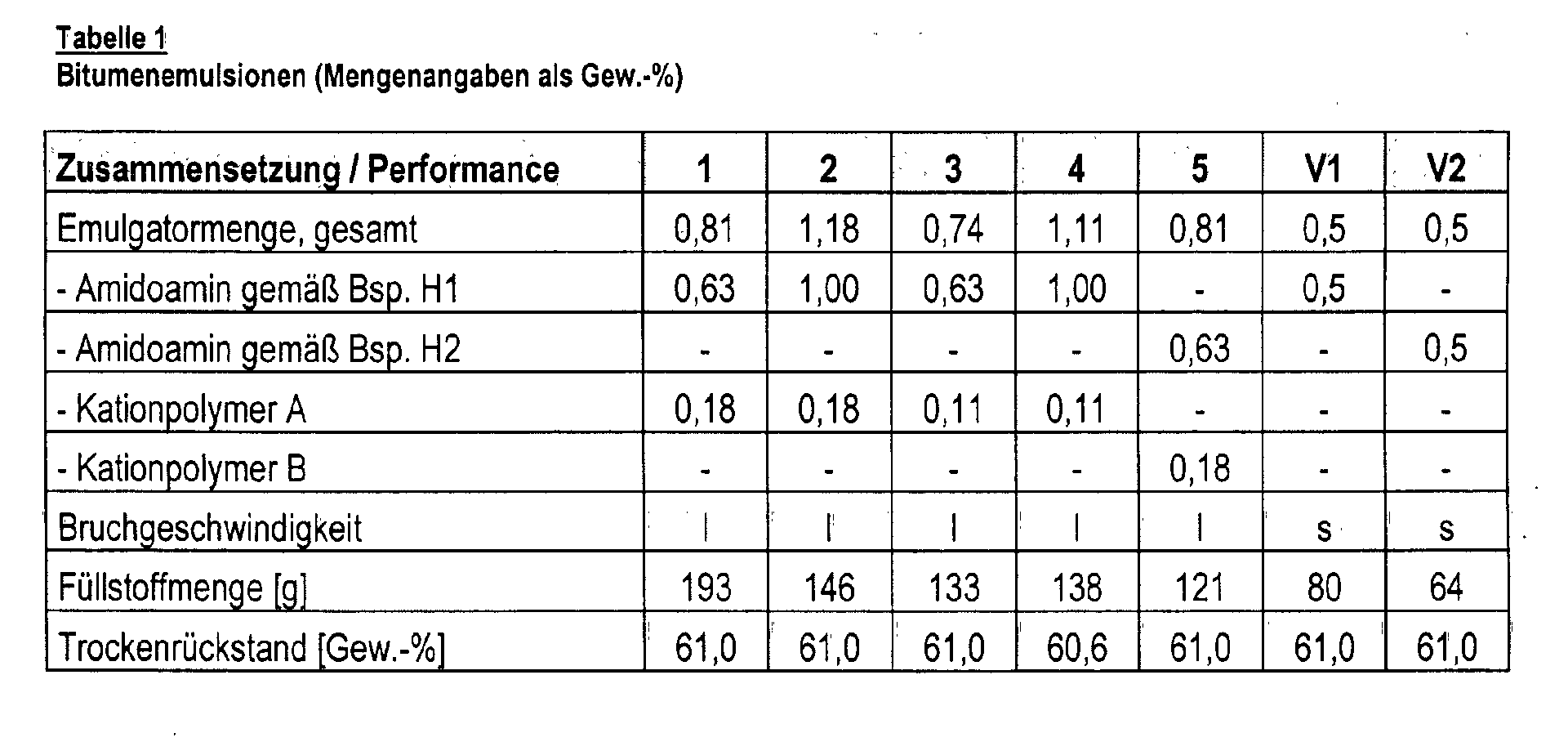
Claims (9)
Applications Claiming Priority (2)
| Application Number | Priority Date | Filing Date | Title |
|---|---|---|---|
| DE19959321A DE19959321A1 (en) | 1999-12-09 | 1999-12-09 | Use of emulsifiers |
| DE19959321 | 1999-12-09 |
Publications (3)
| Publication Number | Publication Date |
|---|---|
| EP1111010A2 true EP1111010A2 (en) | 2001-06-27 |
| EP1111010A3 EP1111010A3 (en) | 2004-01-28 |
| EP1111010B1 EP1111010B1 (en) | 2005-11-02 |
Family
ID=7931964
Family Applications (1)
| Application Number | Title | Priority Date | Filing Date |
|---|---|---|---|
| EP00126139A Expired - Lifetime EP1111010B1 (en) | 1999-12-09 | 2000-11-30 | Use of emulsifiers in bituminous emulsions |
Country Status (4)
| Country | Link |
|---|---|
| EP (1) | EP1111010B1 (en) |
| AT (1) | ATE308588T1 (en) |
| DE (2) | DE19959321A1 (en) |
| ES (1) | ES2251342T3 (en) |
Cited By (5)
| Publication number | Priority date | Publication date | Assignee | Title |
|---|---|---|---|---|
| WO2009113854A1 (en) * | 2008-03-11 | 2009-09-17 | Latexfalt B.V. | USE OF A (1→3)-β-D-GLUCAN AS AN EMULSION STABILISER |
| WO2010112784A1 (en) * | 2009-04-03 | 2010-10-07 | Lafarge | Method for preparing a hydrocarbon composition |
| FR2950893A1 (en) * | 2009-10-05 | 2011-04-08 | Lafarge Sa | HYDROCARBON COMPOSITION AND PROCESS FOR PRODUCING THE SAME |
| US7922802B2 (en) | 2005-11-03 | 2011-04-12 | Cognis Ip Management Gmbh | PIT emulsions |
| CN114573807A (en) * | 2020-12-01 | 2022-06-03 | 中国科学院理化技术研究所 | Branched polyethyleneimine fatty acid amide, preparation thereof, emulsifier containing same and application thereof |
Families Citing this family (2)
| Publication number | Priority date | Publication date | Assignee | Title |
|---|---|---|---|---|
| EP2083050A1 (en) | 2008-01-22 | 2009-07-29 | Cognis IP Management GmbH | Compositions for road contruction |
| MX2011009504A (en) * | 2011-09-09 | 2012-04-27 | Surfax S A De C V | Amidoamine compounds, modified asphalts, warm mixtures and the manufacture and use thereof. |
Family Cites Families (3)
| Publication number | Priority date | Publication date | Assignee | Title |
|---|---|---|---|---|
| DD291330A5 (en) * | 1990-01-03 | 1991-06-27 | "Otto Grotewohl" Boehlen,De | PROCESS FOR BREAKING TIME REGULATION OF NONIONOGENIC AND CATIONACTIVE BITUMENE EMULSIONS |
| US5242492A (en) * | 1991-05-13 | 1993-09-07 | Asphalt Technology & Consulting, Inc. | Microsurfacing system |
| US5443632A (en) * | 1994-02-23 | 1995-08-22 | Westvaco Corporation | Cationic aqueous bituminous emulsion-aggregate slurries |
-
1999
- 1999-12-09 DE DE19959321A patent/DE19959321A1/en not_active Withdrawn
-
2000
- 2000-11-30 ES ES00126139T patent/ES2251342T3/en not_active Expired - Lifetime
- 2000-11-30 EP EP00126139A patent/EP1111010B1/en not_active Expired - Lifetime
- 2000-11-30 DE DE50011502T patent/DE50011502D1/en not_active Expired - Lifetime
- 2000-11-30 AT AT00126139T patent/ATE308588T1/en not_active IP Right Cessation
Cited By (12)
| Publication number | Priority date | Publication date | Assignee | Title |
|---|---|---|---|---|
| US7922802B2 (en) | 2005-11-03 | 2011-04-12 | Cognis Ip Management Gmbh | PIT emulsions |
| WO2009113854A1 (en) * | 2008-03-11 | 2009-09-17 | Latexfalt B.V. | USE OF A (1→3)-β-D-GLUCAN AS AN EMULSION STABILISER |
| US8197589B2 (en) | 2008-03-11 | 2012-06-12 | Latexfalt, B.V. | Use of a (1>3)-β-D-glucan as an emulsion stabiliser |
| AU2009224088B2 (en) * | 2008-03-11 | 2014-06-12 | Latexfalt B.V. | Use of a (1-3)-beta-D-glucan as an emulsion stabiliser |
| CN102015903B (en) * | 2008-03-11 | 2014-06-25 | 山西喜跃发路桥建筑材料有限公司 | Use of a (1-3)-beta-D-glucan as an emulsion stabiliser |
| EA021066B1 (en) * | 2008-03-11 | 2015-03-31 | Латексфалт Б.В. | Emulsion comprising non-modified scleroglucan as a stabiliser and use thereof |
| WO2010112784A1 (en) * | 2009-04-03 | 2010-10-07 | Lafarge | Method for preparing a hydrocarbon composition |
| FR2944008A1 (en) * | 2009-04-03 | 2010-10-08 | Lafarge Sa | PROCESS FOR PRODUCING A HYDROCARBON COMPOSITION |
| FR2950893A1 (en) * | 2009-10-05 | 2011-04-08 | Lafarge Sa | HYDROCARBON COMPOSITION AND PROCESS FOR PRODUCING THE SAME |
| WO2011042647A1 (en) * | 2009-10-05 | 2011-04-14 | Lafarge | Hydrocarbon-based composition and method for producing same |
| CN114573807A (en) * | 2020-12-01 | 2022-06-03 | 中国科学院理化技术研究所 | Branched polyethyleneimine fatty acid amide, preparation thereof, emulsifier containing same and application thereof |
| CN114573807B (en) * | 2020-12-01 | 2024-05-07 | 中国科学院理化技术研究所 | Branched polyethyleneimine fatty acid amide, preparation thereof, emulsifier containing same and application thereof |
Also Published As
| Publication number | Publication date |
|---|---|
| DE50011502D1 (en) | 2005-12-08 |
| DE19959321A1 (en) | 2001-06-13 |
| ES2251342T3 (en) | 2006-05-01 |
| EP1111010A3 (en) | 2004-01-28 |
| EP1111010B1 (en) | 2005-11-02 |
| ATE308588T1 (en) | 2005-11-15 |
Similar Documents
| Publication | Publication Date | Title |
|---|---|---|
| EP1353975B2 (en) | Method for the production of water-in-water polymer dispersions | |
| DE69618029T2 (en) | Water clarification with the addition of colloidal silica and subsequent addition of polyelectrolytes | |
| DE3873126T2 (en) | RAW OIL OR FUEL OIL COMPOSITIONS. | |
| DE2932234C2 (en) | Process for the production of polyether (ester) amides | |
| EP0332002B2 (en) | Use of selected acrylic and/or methacrylic acid ester copolymers as flow enhancers in paraffin-rich mineral oils and mineral-oil fractions (II) | |
| DE2702604A1 (en) | POLYISOBUTENE | |
| DE3916366A1 (en) | NEW IMPLEMENTATION PRODUCTS OF AMINOALKYLENE POLYCARBONIC ACIDS WITH SECOND AMINES AND PETROLEUM DISTILLATE COMPOSITIONS THAT CONTAIN THEM | |
| DE1570870B2 (en) | Amine acylation products of hydrocarbyl-substituted succinic acid and their uses | |
| DE3241197A1 (en) | METAL ROLLING OIL COMPOSITION | |
| EP1124916B1 (en) | Paraffin dispersants with a lubricity effect for distillates of petroleum products | |
| EP1111010B1 (en) | Use of emulsifiers in bituminous emulsions | |
| DE2148638B2 (en) | Defoaming agents and processes for their preparation | |
| DE3135832A1 (en) | BISAMID, METHOD FOR THE PRODUCTION AND USE THEREOF | |
| EP1189990B1 (en) | Utilization of emulsifiers | |
| DE2921330A1 (en) | ADDITIVE PREPARATION FOR DISTILLATE HEATING OILS MADE OF THREE (OR MORE) COMPONENTS | |
| DE10224847B4 (en) | Reaction products of mixtures of long-chain fatty acids and aliphatic diamines and their use | |
| DE1943637A1 (en) | Polyisobutenyl-alkylenepolyamine salts as additives for fuels | |
| EP1179570B1 (en) | Process for adjusting the rate of breaking of bitumen emulsions | |
| EP1111009A2 (en) | Use of emulsifiers in bituminous emulsions | |
| EP0597278B1 (en) | Mineral-oil middledistillate compositions | |
| DE2333207C3 (en) | Process for the preparation of fibrous polyion complexes | |
| EP0761275B1 (en) | Process for separating oil emulsions | |
| WO2017211748A1 (en) | Emulsion, method for the production thereof and use thereof | |
| DE1644910C3 (en) | Cationic wax emulsions | |
| DE1271293B (en) | A lubricating oil containing a graft copolymer |
Legal Events
| Date | Code | Title | Description |
|---|---|---|---|
| PUAI | Public reference made under article 153(3) epc to a published international application that has entered the european phase |
Free format text: ORIGINAL CODE: 0009012 |
|
| 17P | Request for examination filed |
Effective date: 20001130 |
|
| AK | Designated contracting states |
Kind code of ref document: A2 Designated state(s): AT BE CH CY DE DK ES FI FR GB GR IE IT LI LU MC NL PT SE TR |
|
| AX | Request for extension of the european patent |
Free format text: AL;LT;LV;MK;RO;SI |
|
| RAP1 | Party data changed (applicant data changed or rights of an application transferred) |
Owner name: COGNIS DEUTSCHLAND GMBH & CO. KG |
|
| RAP1 | Party data changed (applicant data changed or rights of an application transferred) |
Owner name: COGNIS IBERIA, S.L. |
|
| PUAL | Search report despatched |
Free format text: ORIGINAL CODE: 0009013 |
|
| AK | Designated contracting states |
Kind code of ref document: A3 Designated state(s): AT BE CH CY DE DK ES FI FR GB GR IE IT LI LU MC NL PT SE TR |
|
| AX | Request for extension of the european patent |
Extension state: AL LT LV MK RO SI |
|
| RIC1 | Information provided on ipc code assigned before grant |
Ipc: 7C 08K 5/20 B Ipc: 7C 09D 195/00 B Ipc: 7C 08L 95/00 A |
|
| AKX | Designation fees paid |
Designated state(s): AT BE CH CY DE DK ES FI FR GB GR IE IT LI LU MC NL PT SE TR |
|
| GRAP | Despatch of communication of intention to grant a patent |
Free format text: ORIGINAL CODE: EPIDOSNIGR1 |
|
| RAP1 | Party data changed (applicant data changed or rights of an application transferred) |
Owner name: COGNIS IP MANAGEMENT GMBH |
|
| GRAS | Grant fee paid |
Free format text: ORIGINAL CODE: EPIDOSNIGR3 |
|
| GRAA | (expected) grant |
Free format text: ORIGINAL CODE: 0009210 |
|
| RIN1 | Information on inventor provided before grant (corrected) |
Inventor name: BIGORRA LLOSAS, JOAQUIN, DR. Inventor name: PI SUBIRANA, RAFAEL, DR. Inventor name: ESCODA, MARIA |
|
| AK | Designated contracting states |
Kind code of ref document: B1 Designated state(s): AT BE CH CY DE DK ES FI FR GB GR IE IT LI LU MC NL PT SE TR |
|
| PG25 | Lapsed in a contracting state [announced via postgrant information from national office to epo] |
Ref country code: IT Free format text: LAPSE BECAUSE OF FAILURE TO SUBMIT A TRANSLATION OF THE DESCRIPTION OR TO PAY THE FEE WITHIN THE PRE;WARNING: LAPSES OF ITALIAN PATENTS WITH EFFECTIVE DATE BEFORE 2007 MAY HAVE OCCURRED AT ANY TIME BEFORE 2007. THE CORRECT EFFECTIVE DATE MAY BE DIFFERENT FROM THE ONE RECORDED.SCRIBED TIME-LIMIT Effective date: 20051102 Ref country code: NL Free format text: LAPSE BECAUSE OF FAILURE TO SUBMIT A TRANSLATION OF THE DESCRIPTION OR TO PAY THE FEE WITHIN THE PRESCRIBED TIME-LIMIT Effective date: 20051102 Ref country code: IE Free format text: LAPSE BECAUSE OF FAILURE TO SUBMIT A TRANSLATION OF THE DESCRIPTION OR TO PAY THE FEE WITHIN THE PRESCRIBED TIME-LIMIT Effective date: 20051102 Ref country code: TR Free format text: LAPSE BECAUSE OF FAILURE TO SUBMIT A TRANSLATION OF THE DESCRIPTION OR TO PAY THE FEE WITHIN THE PRESCRIBED TIME-LIMIT Effective date: 20051102 Ref country code: FI Free format text: LAPSE BECAUSE OF FAILURE TO SUBMIT A TRANSLATION OF THE DESCRIPTION OR TO PAY THE FEE WITHIN THE PRESCRIBED TIME-LIMIT Effective date: 20051102 Ref country code: GB Free format text: LAPSE BECAUSE OF FAILURE TO SUBMIT A TRANSLATION OF THE DESCRIPTION OR TO PAY THE FEE WITHIN THE PRESCRIBED TIME-LIMIT Effective date: 20051102 |
|
| REG | Reference to a national code |
Ref country code: GB Ref legal event code: FG4D Free format text: NOT ENGLISH |
|
| REG | Reference to a national code |
Ref country code: CH Ref legal event code: EP |
|
| PG25 | Lapsed in a contracting state [announced via postgrant information from national office to epo] |
Ref country code: LI Free format text: LAPSE BECAUSE OF NON-PAYMENT OF DUE FEES Effective date: 20051130 Ref country code: CH Free format text: LAPSE BECAUSE OF NON-PAYMENT OF DUE FEES Effective date: 20051130 Ref country code: AT Free format text: LAPSE BECAUSE OF NON-PAYMENT OF DUE FEES Effective date: 20051130 Ref country code: MC Free format text: LAPSE BECAUSE OF NON-PAYMENT OF DUE FEES Effective date: 20051130 Ref country code: CY Free format text: LAPSE BECAUSE OF FAILURE TO SUBMIT A TRANSLATION OF THE DESCRIPTION OR TO PAY THE FEE WITHIN THE PRESCRIBED TIME-LIMIT Effective date: 20051130 Ref country code: BE Free format text: LAPSE BECAUSE OF NON-PAYMENT OF DUE FEES Effective date: 20051130 |
|
| REF | Corresponds to: |
Ref document number: 50011502 Country of ref document: DE Date of ref document: 20051208 Kind code of ref document: P |
|
| PG25 | Lapsed in a contracting state [announced via postgrant information from national office to epo] |
Ref country code: LU Free format text: LAPSE BECAUSE OF NON-PAYMENT OF DUE FEES Effective date: 20060102 |
|
| PG25 | Lapsed in a contracting state [announced via postgrant information from national office to epo] |
Ref country code: GR Free format text: LAPSE BECAUSE OF FAILURE TO SUBMIT A TRANSLATION OF THE DESCRIPTION OR TO PAY THE FEE WITHIN THE PRESCRIBED TIME-LIMIT Effective date: 20060202 Ref country code: DK Free format text: LAPSE BECAUSE OF FAILURE TO SUBMIT A TRANSLATION OF THE DESCRIPTION OR TO PAY THE FEE WITHIN THE PRESCRIBED TIME-LIMIT Effective date: 20060202 Ref country code: SE Free format text: LAPSE BECAUSE OF FAILURE TO SUBMIT A TRANSLATION OF THE DESCRIPTION OR TO PAY THE FEE WITHIN THE PRESCRIBED TIME-LIMIT Effective date: 20060202 |
|
| PG25 | Lapsed in a contracting state [announced via postgrant information from national office to epo] |
Ref country code: PT Free format text: LAPSE BECAUSE OF FAILURE TO SUBMIT A TRANSLATION OF THE DESCRIPTION OR TO PAY THE FEE WITHIN THE PRESCRIBED TIME-LIMIT Effective date: 20060403 |
|
| NLV1 | Nl: lapsed or annulled due to failure to fulfill the requirements of art. 29p and 29m of the patents act | ||
| REG | Reference to a national code |
Ref country code: ES Ref legal event code: FG2A Ref document number: 2251342 Country of ref document: ES Kind code of ref document: T3 |
|
| GBV | Gb: ep patent (uk) treated as always having been void in accordance with gb section 77(7)/1977 [no translation filed] |
Effective date: 20051102 |
|
| REG | Reference to a national code |
Ref country code: IE Ref legal event code: FD4D |
|
| REG | Reference to a national code |
Ref country code: CH Ref legal event code: PL |
|
| ET | Fr: translation filed | ||
| PLBE | No opposition filed within time limit |
Free format text: ORIGINAL CODE: 0009261 |
|
| STAA | Information on the status of an ep patent application or granted ep patent |
Free format text: STATUS: NO OPPOSITION FILED WITHIN TIME LIMIT |
|
| 26N | No opposition filed |
Effective date: 20060803 |
|
| BERE | Be: lapsed |
Owner name: COGNIS IP MANAGEMENT G.M.B.H. Effective date: 20051130 |
|
| PGFP | Annual fee paid to national office [announced via postgrant information from national office to epo] |
Ref country code: ES Payment date: 20121217 Year of fee payment: 13 |
|
| PGFP | Annual fee paid to national office [announced via postgrant information from national office to epo] |
Ref country code: FR Payment date: 20121218 Year of fee payment: 13 |
|
| PGFP | Annual fee paid to national office [announced via postgrant information from national office to epo] |
Ref country code: DE Payment date: 20130131 Year of fee payment: 13 |
|
| REG | Reference to a national code |
Ref country code: FR Ref legal event code: ST Effective date: 20140731 |
|
| PG25 | Lapsed in a contracting state [announced via postgrant information from national office to epo] |
Ref country code: DE Free format text: LAPSE BECAUSE OF NON-PAYMENT OF DUE FEES Effective date: 20140603 |
|
| REG | Reference to a national code |
Ref country code: DE Ref legal event code: R119 Ref document number: 50011502 Country of ref document: DE Effective date: 20140603 |
|
| PG25 | Lapsed in a contracting state [announced via postgrant information from national office to epo] |
Ref country code: FR Free format text: LAPSE BECAUSE OF NON-PAYMENT OF DUE FEES Effective date: 20131202 |
|
| REG | Reference to a national code |
Ref country code: ES Ref legal event code: FD2A Effective date: 20150401 |
|
| PG25 | Lapsed in a contracting state [announced via postgrant information from national office to epo] |
Ref country code: ES Free format text: LAPSE BECAUSE OF NON-PAYMENT OF DUE FEES Effective date: 20131201 |