EP1132407A1 - Hydrophob modifizierte Celluloseether Verfahren zu deren Herstellung sowie deren Verwendung - Google Patents
Hydrophob modifizierte Celluloseether Verfahren zu deren Herstellung sowie deren Verwendung Download PDFInfo
- Publication number
- EP1132407A1 EP1132407A1 EP01103063A EP01103063A EP1132407A1 EP 1132407 A1 EP1132407 A1 EP 1132407A1 EP 01103063 A EP01103063 A EP 01103063A EP 01103063 A EP01103063 A EP 01103063A EP 1132407 A1 EP1132407 A1 EP 1132407A1
- Authority
- EP
- European Patent Office
- Prior art keywords
- cellulose
- silylated
- cellulose ether
- group
- methyl
- Prior art date
- Legal status (The legal status is an assumption and is not a legal conclusion. Google has not performed a legal analysis and makes no representation as to the accuracy of the status listed.)
- Granted
Links
- 229920003086 cellulose ether Polymers 0.000 title claims abstract description 57
- 238000000034 method Methods 0.000 title claims description 28
- 230000008569 process Effects 0.000 title claims description 14
- 238000002360 preparation method Methods 0.000 title claims description 9
- 238000006884 silylation reaction Methods 0.000 claims abstract description 29
- 125000001181 organosilyl group Chemical group [SiH3]* 0.000 claims abstract description 20
- 239000000084 colloidal system Substances 0.000 claims abstract description 13
- 230000001681 protective effect Effects 0.000 claims abstract description 12
- XUIMIQQOPSSXEZ-UHFFFAOYSA-N Silicon Chemical group [Si] XUIMIQQOPSSXEZ-UHFFFAOYSA-N 0.000 claims abstract description 11
- 238000004519 manufacturing process Methods 0.000 claims abstract description 10
- 230000007062 hydrolysis Effects 0.000 claims abstract description 8
- 238000006460 hydrolysis reaction Methods 0.000 claims abstract description 8
- 239000003973 paint Substances 0.000 claims abstract description 8
- 230000000694 effects Effects 0.000 claims abstract description 7
- 229920000642 polymer Polymers 0.000 claims abstract description 7
- 125000001424 substituent group Chemical group 0.000 claims abstract description 6
- 230000008719 thickening Effects 0.000 claims abstract description 6
- 239000006185 dispersion Substances 0.000 claims abstract description 5
- 239000002537 cosmetic Substances 0.000 claims abstract description 3
- -1 alkyl radicals Chemical class 0.000 claims description 21
- 239000003153 chemical reaction reagent Substances 0.000 claims description 21
- 229920000663 Hydroxyethyl cellulose Polymers 0.000 claims description 16
- 239000004354 Hydroxyethyl cellulose Substances 0.000 claims description 16
- 235000019447 hydroxyethyl cellulose Nutrition 0.000 claims description 16
- 239000008186 active pharmaceutical agent Substances 0.000 claims description 12
- 229920002678 cellulose Polymers 0.000 claims description 10
- 239000001913 cellulose Substances 0.000 claims description 10
- 239000000203 mixture Substances 0.000 claims description 9
- 229920002153 Hydroxypropyl cellulose Polymers 0.000 claims description 8
- 239000001863 hydroxypropyl cellulose Substances 0.000 claims description 8
- 235000010977 hydroxypropyl cellulose Nutrition 0.000 claims description 8
- 125000003808 silyl group Chemical group [H][Si]([H])([H])[*] 0.000 claims description 7
- IAYPIBMASNFSPL-UHFFFAOYSA-N Ethylene oxide Chemical compound C1CO1 IAYPIBMASNFSPL-UHFFFAOYSA-N 0.000 claims description 5
- 125000003700 epoxy group Chemical group 0.000 claims description 5
- 229920002134 Carboxymethyl cellulose Polymers 0.000 claims description 4
- 229920001479 Hydroxyethyl methyl cellulose Polymers 0.000 claims description 4
- 239000002253 acid Substances 0.000 claims description 4
- 125000000217 alkyl group Chemical group 0.000 claims description 4
- 238000005815 base catalysis Methods 0.000 claims description 4
- 239000001768 carboxy methyl cellulose Substances 0.000 claims description 4
- 235000010948 carboxy methyl cellulose Nutrition 0.000 claims description 4
- 229920003090 carboxymethyl hydroxyethyl cellulose Polymers 0.000 claims description 4
- 239000008112 carboxymethyl-cellulose Substances 0.000 claims description 4
- 239000003795 chemical substances by application Substances 0.000 claims description 4
- TWNIBLMWSKIRAT-VFUOTHLCSA-N levoglucosan Chemical group O[C@@H]1[C@@H](O)[C@H](O)[C@H]2CO[C@@H]1O2 TWNIBLMWSKIRAT-VFUOTHLCSA-N 0.000 claims description 4
- 229920000609 methyl cellulose Polymers 0.000 claims description 4
- 239000001923 methylcellulose Substances 0.000 claims description 4
- 235000010981 methylcellulose Nutrition 0.000 claims description 4
- 150000003961 organosilicon compounds Chemical class 0.000 claims description 4
- 229910052710 silicon Inorganic materials 0.000 claims description 4
- 125000006850 spacer group Chemical group 0.000 claims description 4
- 239000000853 adhesive Substances 0.000 claims description 3
- 230000001070 adhesive effect Effects 0.000 claims description 3
- 229910052794 bromium Inorganic materials 0.000 claims description 3
- GOOHAUXETOMSMM-UHFFFAOYSA-N Propylene oxide Chemical compound CC1CO1 GOOHAUXETOMSMM-UHFFFAOYSA-N 0.000 claims description 2
- 125000004018 acid anhydride group Chemical group 0.000 claims description 2
- 150000005840 aryl radicals Chemical class 0.000 claims description 2
- 229910052801 chlorine Inorganic materials 0.000 claims description 2
- NEHMKBQYUWJMIP-NJFSPNSNSA-N chloro(114C)methane Chemical compound [14CH3]Cl NEHMKBQYUWJMIP-NJFSPNSNSA-N 0.000 claims description 2
- FOCAUTSVDIKZOP-UHFFFAOYSA-N chloroacetic acid Chemical compound OC(=O)CCl FOCAUTSVDIKZOP-UHFFFAOYSA-N 0.000 claims description 2
- 150000004820 halides Chemical group 0.000 claims description 2
- 239000012948 isocyanate Substances 0.000 claims description 2
- 150000002513 isocyanates Chemical class 0.000 claims description 2
- FDRCDNZGSXJAFP-UHFFFAOYSA-M sodium chloroacetate Chemical compound [Na+].[O-]C(=O)CCl FDRCDNZGSXJAFP-UHFFFAOYSA-M 0.000 claims description 2
- 239000000546 pharmaceutical excipient Substances 0.000 claims 1
- XLYOFNOQVPJJNP-UHFFFAOYSA-N water Substances O XLYOFNOQVPJJNP-UHFFFAOYSA-N 0.000 abstract description 8
- 239000002562 thickening agent Substances 0.000 abstract description 3
- 239000003292 glue Substances 0.000 abstract 1
- HEMHJVSKTPXQMS-UHFFFAOYSA-M Sodium hydroxide Chemical compound [OH-].[Na+] HEMHJVSKTPXQMS-UHFFFAOYSA-M 0.000 description 24
- 238000006467 substitution reaction Methods 0.000 description 14
- 238000013459 approach Methods 0.000 description 13
- KFZMGEQAYNKOFK-UHFFFAOYSA-N Isopropanol Chemical compound CC(C)O KFZMGEQAYNKOFK-UHFFFAOYSA-N 0.000 description 12
- QTBSBXVTEAMEQO-UHFFFAOYSA-N Acetic acid Chemical compound CC(O)=O QTBSBXVTEAMEQO-UHFFFAOYSA-N 0.000 description 11
- CSCPPACGZOOCGX-UHFFFAOYSA-N Acetone Chemical compound CC(C)=O CSCPPACGZOOCGX-UHFFFAOYSA-N 0.000 description 11
- 239000000047 product Substances 0.000 description 7
- 239000000243 solution Substances 0.000 description 7
- 238000001816 cooling Methods 0.000 description 5
- 239000000839 emulsion Substances 0.000 description 5
- YLGXILFCIXHCMC-JHGZEJCSSA-N methyl cellulose Chemical compound COC1C(OC)C(OC)C(COC)O[C@H]1O[C@H]1C(OC)C(OC)C(OC)OC1COC YLGXILFCIXHCMC-JHGZEJCSSA-N 0.000 description 5
- 239000000376 reactant Substances 0.000 description 5
- 239000000725 suspension Substances 0.000 description 5
- IJGRMHOSHXDMSA-UHFFFAOYSA-N Atomic nitrogen Chemical compound N#N IJGRMHOSHXDMSA-UHFFFAOYSA-N 0.000 description 4
- LFQSCWFLJHTTHZ-UHFFFAOYSA-N Ethanol Chemical compound CCO LFQSCWFLJHTTHZ-UHFFFAOYSA-N 0.000 description 4
- VEXZGXHMUGYJMC-UHFFFAOYSA-N Hydrochloric acid Chemical compound Cl VEXZGXHMUGYJMC-UHFFFAOYSA-N 0.000 description 4
- DKGAVHZHDRPRBM-UHFFFAOYSA-N Tert-Butanol Chemical compound CC(C)(C)O DKGAVHZHDRPRBM-UHFFFAOYSA-N 0.000 description 4
- 229960000583 acetic acid Drugs 0.000 description 4
- 239000007864 aqueous solution Substances 0.000 description 4
- 239000002585 base Substances 0.000 description 4
- 238000006243 chemical reaction Methods 0.000 description 4
- YQRTUCSVGMLMDA-UHFFFAOYSA-N dimethyl-octadecyl-[3-(oxiran-2-ylmethoxy)propyl]silane Chemical compound CCCCCCCCCCCCCCCCCC[Si](C)(C)CCCOCC1CO1 YQRTUCSVGMLMDA-UHFFFAOYSA-N 0.000 description 4
- XTUSEBKMEQERQV-UHFFFAOYSA-N propan-2-ol;hydrate Chemical compound O.CC(C)O XTUSEBKMEQERQV-UHFFFAOYSA-N 0.000 description 4
- GRYLNZFGIOXLOG-UHFFFAOYSA-N Nitric acid Chemical compound O[N+]([O-])=O GRYLNZFGIOXLOG-UHFFFAOYSA-N 0.000 description 3
- YXFVVABEGXRONW-UHFFFAOYSA-N Toluene Chemical compound CC1=CC=CC=C1 YXFVVABEGXRONW-UHFFFAOYSA-N 0.000 description 3
- 150000001298 alcohols Chemical class 0.000 description 3
- UMZAYKAZMGVWND-UHFFFAOYSA-N dimethyl-[3-(oxiran-2-ylmethoxy)propyl]-phenylsilane Chemical compound C=1C=CC=CC=1[Si](C)(C)CCCOCC1CO1 UMZAYKAZMGVWND-UHFFFAOYSA-N 0.000 description 3
- 238000001035 drying Methods 0.000 description 3
- 150000002576 ketones Chemical class 0.000 description 3
- 239000000178 monomer Substances 0.000 description 3
- 229910017604 nitric acid Inorganic materials 0.000 description 3
- 238000000518 rheometry Methods 0.000 description 3
- 239000007921 spray Substances 0.000 description 3
- FTNCLFLVKLFJPL-UHFFFAOYSA-N triethyl-[3-(oxiran-2-ylmethoxy)propyl]silane Chemical compound CC[Si](CC)(CC)CCCOCC1CO1 FTNCLFLVKLFJPL-UHFFFAOYSA-N 0.000 description 3
- JUVVJJIUMQQDEP-UHFFFAOYSA-N trihexyl-[3-(oxiran-2-ylmethoxy)propyl]silane Chemical compound CCCCCC[Si](CCCCCC)(CCCCCC)CCCOCC1CO1 JUVVJJIUMQQDEP-UHFFFAOYSA-N 0.000 description 3
- CURLTUGMZLYLDI-UHFFFAOYSA-N Carbon dioxide Chemical compound O=C=O CURLTUGMZLYLDI-UHFFFAOYSA-N 0.000 description 2
- RTZKZFJDLAIYFH-UHFFFAOYSA-N Diethyl ether Chemical compound CCOCC RTZKZFJDLAIYFH-UHFFFAOYSA-N 0.000 description 2
- MHAJPDPJQMAIIY-UHFFFAOYSA-N Hydrogen peroxide Chemical compound OO MHAJPDPJQMAIIY-UHFFFAOYSA-N 0.000 description 2
- LRHPLDYGYMQRHN-UHFFFAOYSA-N N-Butanol Chemical compound CCCCO LRHPLDYGYMQRHN-UHFFFAOYSA-N 0.000 description 2
- 239000006227 byproduct Substances 0.000 description 2
- 150000001875 compounds Chemical class 0.000 description 2
- 238000007720 emulsion polymerization reaction Methods 0.000 description 2
- 238000002474 experimental method Methods 0.000 description 2
- 125000000524 functional group Chemical group 0.000 description 2
- 150000002430 hydrocarbons Chemical group 0.000 description 2
- 230000002209 hydrophobic effect Effects 0.000 description 2
- 229910052757 nitrogen Inorganic materials 0.000 description 2
- 150000001282 organosilanes Chemical class 0.000 description 2
- 239000002245 particle Substances 0.000 description 2
- KJFMBFZCATUALV-UHFFFAOYSA-N phenolphthalein Chemical compound C1=CC(O)=CC=C1C1(C=2C=CC(O)=CC=2)C2=CC=CC=C2C(=O)O1 KJFMBFZCATUALV-UHFFFAOYSA-N 0.000 description 2
- BASFCYQUMIYNBI-UHFFFAOYSA-N platinum Chemical compound [Pt] BASFCYQUMIYNBI-UHFFFAOYSA-N 0.000 description 2
- 238000006116 polymerization reaction Methods 0.000 description 2
- 239000000843 powder Substances 0.000 description 2
- 150000003839 salts Chemical class 0.000 description 2
- 238000003756 stirring Methods 0.000 description 2
- 239000000375 suspending agent Substances 0.000 description 2
- STMDPCBYJCIZOD-UHFFFAOYSA-N 2-(2,4-dinitroanilino)-4-methylpentanoic acid Chemical compound CC(C)CC(C(O)=O)NC1=CC=C([N+]([O-])=O)C=C1[N+]([O-])=O STMDPCBYJCIZOD-UHFFFAOYSA-N 0.000 description 1
- 229920002307 Dextran Polymers 0.000 description 1
- YCKRFDGAMUMZLT-UHFFFAOYSA-N Fluorine atom Chemical compound [F] YCKRFDGAMUMZLT-UHFFFAOYSA-N 0.000 description 1
- OWIKHYCFFJSOEH-UHFFFAOYSA-N Isocyanic acid Chemical compound N=C=O OWIKHYCFFJSOEH-UHFFFAOYSA-N 0.000 description 1
- 229920002472 Starch Polymers 0.000 description 1
- 238000005299 abrasion Methods 0.000 description 1
- 238000010521 absorption reaction Methods 0.000 description 1
- 125000004423 acyloxy group Chemical group 0.000 description 1
- 230000001464 adherent effect Effects 0.000 description 1
- 150000008044 alkali metal hydroxides Chemical class 0.000 description 1
- 125000003545 alkoxy group Chemical group 0.000 description 1
- 125000004104 aryloxy group Chemical group 0.000 description 1
- 230000009286 beneficial effect Effects 0.000 description 1
- 239000011230 binding agent Substances 0.000 description 1
- 230000033228 biological regulation Effects 0.000 description 1
- 230000015572 biosynthetic process Effects 0.000 description 1
- 230000000740 bleeding effect Effects 0.000 description 1
- 235000014633 carbohydrates Nutrition 0.000 description 1
- 150000001720 carbohydrates Chemical class 0.000 description 1
- 239000001569 carbon dioxide Substances 0.000 description 1
- 229910002092 carbon dioxide Inorganic materials 0.000 description 1
- 238000006555 catalytic reaction Methods 0.000 description 1
- 239000003086 colorant Substances 0.000 description 1
- 230000001609 comparable effect Effects 0.000 description 1
- 239000002131 composite material Substances 0.000 description 1
- 239000012043 crude product Substances 0.000 description 1
- 238000011161 development Methods 0.000 description 1
- 239000002270 dispersing agent Substances 0.000 description 1
- 239000004815 dispersion polymer Substances 0.000 description 1
- 230000001804 emulsifying effect Effects 0.000 description 1
- 238000006266 etherification reaction Methods 0.000 description 1
- 150000002170 ethers Chemical group 0.000 description 1
- LYCAIKOWRPUZTN-UHFFFAOYSA-N ethylene glycol Natural products OCCO LYCAIKOWRPUZTN-UHFFFAOYSA-N 0.000 description 1
- 238000000605 extraction Methods 0.000 description 1
- 239000000945 filler Substances 0.000 description 1
- 238000001914 filtration Methods 0.000 description 1
- 229910052731 fluorine Inorganic materials 0.000 description 1
- 239000011737 fluorine Substances 0.000 description 1
- 239000012362 glacial acetic acid Substances 0.000 description 1
- 239000011521 glass Substances 0.000 description 1
- 125000005843 halogen group Chemical group 0.000 description 1
- WGCNASOHLSPBMP-UHFFFAOYSA-N hydroxyacetaldehyde Natural products OCC=O WGCNASOHLSPBMP-UHFFFAOYSA-N 0.000 description 1
- 238000010348 incorporation Methods 0.000 description 1
- 239000003999 initiator Substances 0.000 description 1
- 238000002156 mixing Methods 0.000 description 1
- 238000012986 modification Methods 0.000 description 1
- 230000004048 modification Effects 0.000 description 1
- 150000002894 organic compounds Chemical class 0.000 description 1
- 239000007800 oxidant agent Substances 0.000 description 1
- 125000005385 peroxodisulfate group Chemical group 0.000 description 1
- 239000000049 pigment Substances 0.000 description 1
- 229910052697 platinum Inorganic materials 0.000 description 1
- 239000010695 polyglycol Substances 0.000 description 1
- 229920000151 polyglycol Polymers 0.000 description 1
- 229920002689 polyvinyl acetate Polymers 0.000 description 1
- 239000011118 polyvinyl acetate Substances 0.000 description 1
- 125000002924 primary amino group Chemical group [H]N([H])* 0.000 description 1
- 238000010526 radical polymerization reaction Methods 0.000 description 1
- 150000003254 radicals Chemical class 0.000 description 1
- 239000012429 reaction media Substances 0.000 description 1
- 239000011541 reaction mixture Substances 0.000 description 1
- 230000009467 reduction Effects 0.000 description 1
- 238000004062 sedimentation Methods 0.000 description 1
- 150000004756 silanes Chemical class 0.000 description 1
- 150000003377 silicon compounds Chemical class 0.000 description 1
- 125000004469 siloxy group Chemical group [SiH3]O* 0.000 description 1
- UKLNMMHNWFDKNT-UHFFFAOYSA-M sodium chlorite Chemical compound [Na+].[O-]Cl=O UKLNMMHNWFDKNT-UHFFFAOYSA-M 0.000 description 1
- 229960002218 sodium chlorite Drugs 0.000 description 1
- 238000006561 solvent free reaction Methods 0.000 description 1
- 239000011877 solvent mixture Substances 0.000 description 1
- 238000005507 spraying Methods 0.000 description 1
- 230000006641 stabilisation Effects 0.000 description 1
- 238000011105 stabilization Methods 0.000 description 1
- 239000003381 stabilizer Substances 0.000 description 1
- 239000008107 starch Substances 0.000 description 1
- 235000019698 starch Nutrition 0.000 description 1
- 238000010998 test method Methods 0.000 description 1
- 125000000391 vinyl group Chemical group [H]C([*])=C([H])[H] 0.000 description 1
- 229920002554 vinyl polymer Polymers 0.000 description 1
- 239000013585 weight reducing agent Substances 0.000 description 1
Classifications
-
- C—CHEMISTRY; METALLURGY
- C08—ORGANIC MACROMOLECULAR COMPOUNDS; THEIR PREPARATION OR CHEMICAL WORKING-UP; COMPOSITIONS BASED THEREON
- C08B—POLYSACCHARIDES; DERIVATIVES THEREOF
- C08B11/00—Preparation of cellulose ethers
- C08B11/193—Mixed ethers, i.e. ethers with two or more different etherifying groups
-
- C—CHEMISTRY; METALLURGY
- C08—ORGANIC MACROMOLECULAR COMPOUNDS; THEIR PREPARATION OR CHEMICAL WORKING-UP; COMPOSITIONS BASED THEREON
- C08B—POLYSACCHARIDES; DERIVATIVES THEREOF
- C08B11/00—Preparation of cellulose ethers
- C08B11/20—Post-etherification treatments of chemical or physical type, e.g. mixed etherification in two steps, including purification
-
- C—CHEMISTRY; METALLURGY
- C08—ORGANIC MACROMOLECULAR COMPOUNDS; THEIR PREPARATION OR CHEMICAL WORKING-UP; COMPOSITIONS BASED THEREON
- C08B—POLYSACCHARIDES; DERIVATIVES THEREOF
- C08B15/00—Preparation of other cellulose derivatives or modified cellulose, e.g. complexes
- C08B15/05—Derivatives containing elements other than carbon, hydrogen, oxygen, halogens or sulfur
Definitions
- the present invention relates to water-soluble, silylated cellulose ethers, processes for their manufacture and their use.
- Cellulose ethers have a wide range of industrial applications. she are used as thickeners, binders and dispersants, water retention agents, Protective colloids, stabilizers, suspending, emulsifying and film-forming agents.
- cellulose ethers control the consistency and that Water retention, reduce the sedimentation of the pigments and Fillers and strengthen the adhesive and binding capacity.
- An important The application-oriented objective in the production of emulsion paints is Setting a Newtonian rheology as possible, since such systems are related in comparison to spreadability, bleeding and spraying show clear advantages to commercially available emulsion paints, which have a pronounced structural viscosity exhibit.
- the desired rheological behavior is achieved through the use of cellulose ethers which are modified with long-chain alkyl groups or by the use of conventional cellulose ethers in combination with associative acting synthetic thickeners.
- US-A-4 228 277 describes the modification of hydroxyethyl cellulose by the incorporation of less long chain alkyl groups, which increases the rheology in the above described manner is changed and the tendency to spray is suppressed.
- hydrophobically modified cellulose ethers would be more advantageous comparably low degrees of substitution have a comparable effect however, are free of fluorine-containing substituents.
- water-soluble cellulose derivatives in addition to other polymeric carbohydrates, such as, for example, starch and dextrans, are used as protective colloids, since after polymerisation in such systems stabilization of the polymer is necessary.
- hydroxyethyl cellulose is the most frequently used protective colloid in the production of polyvinyl acetate dispersions by emulsion polymerization.
- the choice of protective colloid has a significant influence on a large number of quality criteria of the polymer dispersion.
- the decisive process in emulsion polymerization with regard to the function of the protective colloid is the grafting of the monomer onto the colloid, the grafting rate depending on the one hand on the choice of the initiator system and on the other hand on the nature of the protective colloid. Accordingly, at a low grafting rate, the amount of protective colloid used must be increased, which increases the hydrophilicity of the polymer drawn into a film, which leads to increased water absorption, which is undesirable. In addition, an increase in the amount used is associated with an increase in costs. According to US Pat. No. 4,845,175, the amount of protective colloid can be reduced if hydrophobically modified hydroxyethyl cellulose is used as the protective colloid.
- silanes are used in US Pat. No. 4,474,950 to make them water-soluble Modify cellulose ethers so that they clump-free in an aqueous Allow the medium to stir in over a wide pH range.
- the object of the present invention was the development of novel hydrophobic modified, water-soluble cellulose ether, which is already at very low Degrees of substitution with respect to the hydrophobic substituents are strong Show thickening effect in aqueous solution.
- the invention thus relates to water-soluble, with at least one Organosilyl group containing one or more silicon atoms, silylated Cellulose ethers, which are characterized in that the organosilyl group (s) is stable to hydrolysis to which cellulose ethers are bound and the rest Substituents of the silicon atom or the silicon atoms of the organosilyl group (s) are stable to hydrolysis.
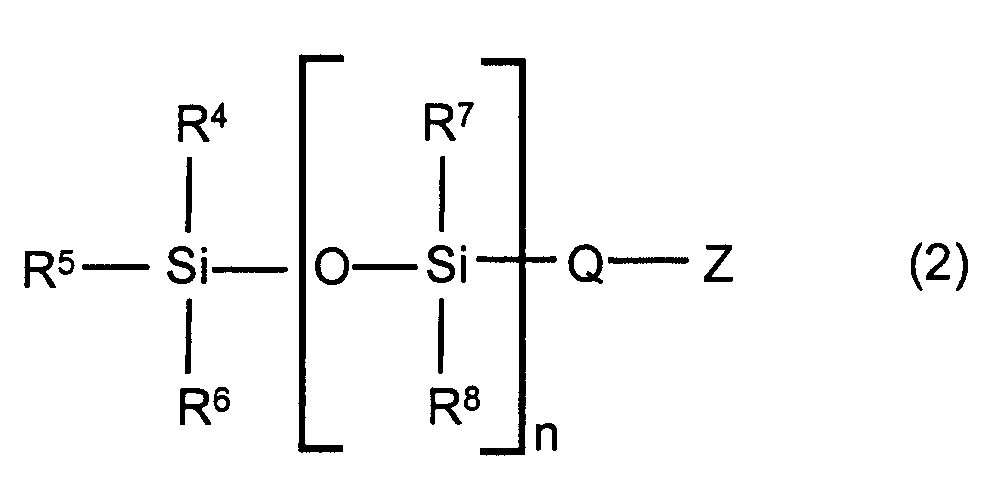
- R 1 to R 8 are preferably (C 1 -C 20 ) alkyl radicals or phenyl radicals. Epoxy groups are preferably suitable as reactive functional group Z.
- Preferred spacer groups Q are (C 1 -C 20 ) hydrocarbon chains.
- n is preferably 1 to 50.
- the average number of silyl groups per anhydroglucose unit is preferably 0.0002 to 0.2.
- Cellulose ethers which are preferably used for the silylation are hydroxyethyl cellulose, Hydroxypropyl cellulose, carboxymethyl cellulose, carboxymethyl hydroxyethyl cellulose, Methyl cellulose, methyl hydroxyethyl cellulose and methyl hydroxypropyl cellulose.
- the present invention also relates to processes for the preparation of the silylated cellulose ethers according to the invention.
- a process (A) cellulose is reacted with base catalysis with one or more etherifying agents from the group consisting of ethylene oxide, propylene oxide, methyl chloride, monochloroacetic acid and sodium monochloroacetate and at least one silylation reagent.
- a process (B) is based on a cellulose ether which is reacted with at least one silylation reagent under base catalysis.
- Cellulose ethers which are preferably suitable for silylation are hydroxyethyl cellulose, hydroxypropyl cellulose, carboxymethyl cellulose, carboxymethyl hydroxyethyl cellulose, methyl cellulose, methyl hydroxyethyl cellulose or methyl hydroxypropyl cellulose.
- organosilanes of the general compositions (1) and / or (2) are preferred as silylation reagents.
- Organosilanes of the general compositions (1) and / or (2) are particularly preferred, in which R 1 to R 8 are C 1 -C 20 -alkyl radicals or phenyl radicals, Z is an epoxy group and the spacer group Q is one C 1 -C 20 hydrocarbon chain.
- the reactions are preferably carried out in a suspension medium.
- Lower alcohols such as, for example, isopropanol
- Butanol or ketones such as acetone
- the weight ratio of suspending agent to cellulose or of suspending agent to cellulose ether is preferably 3: 1 to 30: 1 and particularly preferably 8: 1 to 15: 1 in both processes.
- the bases used are usually aqueous solutions of alkali metal hydroxides, especially sodium hydroxide, use.
- the molar ratio base / anhydroglucose unit is preferably 1.0 to 1.5 and in process B it is preferably 0.1 to 1.0.
- the water content of the reaction mixtures is preferably 5 to 30 and particularly preferably 10 to 20 mol of water per anhydroglucose unit.
- the procedure is advantageously such that, after the suspension medium has been introduced, the cellulose has been added and the mixture has been alkalized with the aqueous base, the batch is homogenized well and is stirred without heat, optionally with cooling, preferably for 0.5 to 2 hours.
- the etherification reagent and the silylation reagent are then added together or in succession.
- silylation reagent in the course of the reaction under the reaction conditions described below.
- the batch is brought to the preferred temperature of 40 to 120 ° C., in particular 80 to 100 ° C., and preferably heated for 2 to 6 hours.
- the mixture is neutralized with an acid, preferably hydrochloric acid, nitric acid or acetic acid, preferably to pH 6 to 8.
- the raw cellulose mixed ether can be extracted from the adhering by-products, for example polyglycols, glycol ethers and by extraction with aqueous alcohols or ketones with a preferred water content of 10 to 50% by weight, in particular isopropanol, ethanol or acetone Salt, be freed. Drying in vacuo or at normal pressure at 50 to 120 ° C gives the desired mixed cellulose ether as a colorless to slightly yellowish powder.
- the adhering by-products for example polyglycols, glycol ethers and by extraction with aqueous alcohols or ketones with a preferred water content of 10 to 50% by weight, in particular isopropanol, ethanol or acetone Salt
- the Cellulose ether and alkalization with the aqueous base the approach well homogenized and preferably without heat, preferably with cooling Stirred for 0.5 to 2 hours. Then add the silylation reagent and heat the approach to the preferred temperature of 40 to 120 ° C, especially 80 to 100 ° C, and preferably heated for 2 to 6 hours. After cooling with an acid, preferably hydrochloric acid, nitric acid or acetic acid, preferably neutralized to pH 6 to 8.
- an acid preferably hydrochloric acid, nitric acid or acetic acid, preferably neutralized to pH 6 to 8.
- the suspension medium is then through Decanted or filtered, the crude product can then be extracted with aqueous alcohols or ketones with a preferred water content of 10 to 50% by weight, in particular isopropanol, ethanol and acetone, of the adherent By-products and salts are exempt.
- aqueous alcohols or ketones with a preferred water content of 10 to 50% by weight, in particular isopropanol, ethanol and acetone, of the adherent By-products and salts are exempt.
- the desired degree of polymerization of the Cellulose ether before or during its manufacturing process by adding a Peroxo compound such as hydrogen peroxide or one Peroxodisulfate salt or other oxidizing agent, for example Sodium chlorite.
- a Peroxo compound such as hydrogen peroxide or one Peroxodisulfate salt or other oxidizing agent, for example Sodium chlorite.
- Cellulose ethers are, for example, stirred kettles, mixers and kneaders. Basically however, all the reactors used in the manufacture can be used of cellulose derivatives are common and adequate mixing the cellulose or the water-soluble cellulose ether with the silylating reagent allow.
- the preparation of the epoxyorganosilanes preferably used for silylation can be carried out, for example, by hydrosilylating allyl glycidyl ether with triorgano-H-silanes with platinum catalysis in toluene based on a regulation according to EP Plueddemann and G. Fanger, J. Am. Chem. Soc. 81 (1959), 2632.
- the cellulose ethers according to the invention are particularly suitable for reduction the tendency to spray in emulsion paints.
- the colors show good spreadability and high abrasion resistance.
- the invention also relates to the use of the invention Cellulose ethers as protective colloids in the production of aqueous Polymer dispersions.
- the preferred area of application is the radical one Polymerization of ethylenically unsaturated monomers in an aqueous emulsion.
- Example 1 Production of cellulose ethers according to the invention by silylation of pulp with various epoxyorganosilanes (method (A))
- Table 1 summarizes the amounts of reactants used, the degrees of substitution MS (OC 2 H 4 OH) and DS (organosilyl grouping) and the viscosities (2% solution, Hoeppler method) of the products for batches a to f.
- the epoxyorganosilanes used for the different batches are listed in Table 2. It can be seen that the silylation causes a significant increase in viscosity.
- Example 2 Preparation of a cellulose ether according to the invention by Silylation of hydroxyethyl cellulose with 3- (2,3-epoxypropoxy) propylphenyldimethylsilane (Procedure (B))
- hydroxyethyl cellulose (®Tylose H 4000, Clariant GmbH) are suspended in isopropanol in a 1 l three-necked flask with a stirrer.
- a solution of NaOH and water is run in after the inertization (evacuation and flooding with nitrogen). It is alkalized at 25 ° C for 30 minutes.
- 3- (2,3-epoxypropoxy) propylphenyldimethylsilane is added as a silylation reagent and heated to 80 ° C. The reaction is left at this temperature for 4 hours. It is then cooled to room temperature and neutralized against phenolphthalein with acetic acid.
- the product is filtered off with suction, washed free of salt with 85% isopropanol, whipped again in 100% acetone and dried at 70 ° C. in a drying cabinet.
- Table 3 summarizes the amounts of the reactants used, the degrees of substitution MS (OC 2 H 4 OH) and DS (organosilyl grouping) and the viscosities (2% solution, Hoeppler method) of the products for batches a to f. It can be seen that the silylation causes a significant increase in viscosity.
- Example 3 Preparation of a cellulose ether according to the invention by Silylation of hydroxyethyl cellulose with 3- (2,3-epoxypropoxy) propyl-tri-n-hexylsilane (Procedure (B))
- the silylation of the hydroxyethyl cellulose is carried out analogously to the experimental procedure in Example 2. However, 3- (2,3-epoxypropoxy) propyl-tri-n-hexylsilane is used as the silylation reagent.
- the amounts used for the reactants, the degrees of substitution MS (OC 2 H 4 OH) and DS (organosilyl grouping) and the viscosities (2% strength solution, Hoeppler method) of the products are summarized in Table 4.
- Example 4 Preparation of a cellulose ether according to the invention by Silylation of hydroxyethyl cellulose with 3- (2,3-epoxypropoxy) propyl triethylsilane (Procedure (B))
- the hydroxyethyl cellulose is silylated analogously to the experimental procedure in Example 2. However, 3- (2,3-epoxypropoxy) propyl-triethylsilane is used as the silylation reagent.
- Table 5 summarizes the amounts of the reactants used, the degrees of substitution MS (OC 2 H 4 OH) and DS (organosilyl grouping) and the viscosities (2% solution, Hoeppler method) of the products for batches a to k.
- Example 5 Preparation of a cellulose ether according to the invention by Silylation of hydroxyethyl cellulose with 3- (2,3-epoxypropoxy) propyl octadecyl dimethyl silane (Procedure (B))
- the hydroxyethyl cellulose is silylated analogously to the test procedure in Example 2. However, 3- (2,3-epoxypropoxy) propyl octadecyl dimethyl silane is used as the silylation reagent.
- Table 6 summarizes the amounts of the reactants used, the degrees of substitution MS (OC 2 H 4 OH) and DS (organosilyl grouping) and the viscosities (2% solution, Hoeppler method) of the products for batches a to p.
Landscapes
- Chemical & Material Sciences (AREA)
- Polymers & Plastics (AREA)
- Life Sciences & Earth Sciences (AREA)
- Biochemistry (AREA)
- Materials Engineering (AREA)
- Health & Medical Sciences (AREA)
- Chemical Kinetics & Catalysis (AREA)
- Engineering & Computer Science (AREA)
- Organic Chemistry (AREA)
- Medicinal Chemistry (AREA)
- Polysaccharides And Polysaccharide Derivatives (AREA)
- Cosmetics (AREA)
- Compositions Of Macromolecular Compounds (AREA)
- Paints Or Removers (AREA)
- Adhesives Or Adhesive Processes (AREA)
- Silicon Polymers (AREA)
Abstract
Description
Der entscheidende Prozess bei der Emulsionspolymerisation hinsichtlich der Funktion des Schutzkolloids ist die Pfropfung des Monomers auf das Kolloid, wobei die Pfropfrate einerseits von der Wahl des Initiatorsystems und andererseits von der Natur des Schutzkolloids abhängt. Bei einer niedrigen Pfropfrate muss dementsprechend die Einsatzmenge des Schutzkolloids erhöht werden, was eine erhöhte Hydrophilie des zu einem Film ausgezogenen Polymers bewirkt, wodurch es zu einer verstärkten Wasseraufnahme kommt, die unerwünscht ist. Außerdem ist eine Erhöhung der Einsatzmenge mit einer Kostensteigerung verbunden.
Laut der US-A-4 845 175 kann die Menge an Schutzkolloid reduziert werden, wenn als Schutzkolloid hydrophob modifizierte Hydroxyethylcellulose eingesetzt wird.
Spezielle Siliziumverbindungen sind bereits mehrfach zur Modifizierung von Celluloseethern herangezogen worden.

Bei einem Verfahren (A) wird Cellulose unter Basenkatalyse mit einem oder mehreren Veretherungsmitteln aus der Gruppe Ethylenoxid, Propylenoxid, Methylchlorid, Monochloressigsäure und Natriummonochloracetat und mindestens einem Silylierungsreagenz umgesetzt.
Bei einem Verfahren (B) wird von einem Celluloseether ausgegangen, der unter Basenkatalyse mit mindestens einem Silylierungsreagenz umgesetzt wird.
Zur Silylierung bevorzugt geeignete Celluloseether sind Hydroxyethylcellulose, Hydroxypropylcellulose, Carboxymethylcellulose, Carboxymethylhydroxyethylcellulose, Methylcellulose, Methylhydroxyethylcellulose oder Methylhydroxypropylcellulose.
Bei beiden Verfahren eignen sich als Silylierungsreagenzien bevorzugt Organosilane der allgemeinen Zusammensetzungen (1) und/oder (2). Besonders bevorzugt sind Organosilane der allgemeinen Zusammensetzungen (1) und/oder (2), bei denen es sich bei R1 bis R8 um C1-C20-Alkylreste oder Phenylreste, bei Z um eine Epoxygruppierung und bei der Spacergruppe Q um eine C1-C20-Kohlenwasserstoffkette handelt.
Bei beiden Verfahren erfolgen die Umsetzungen vorzugsweise in einem Suspensionsmittel. Als Suspensionsmittel werden dabei bevorzugt niedere Alkohole, wie z.B. Isopropanol, tert. Butanol oder Ketone, wie z.B. Aceton, eingesetzt. Das Gewichtsverhältnis von Suspensionsmittel zu Cellulose bzw. von Suspensionsmittel zu Celluloseether beträgt bei beiden Verfahren bevorzugt 3:1 bis 30:1 und besonders bevorzugt 8:1 bis 15:1.
Beim Verfahren (A) geht man vorteilhafterweise so vor, dass nach Vorlegen des Suspensionsmittels, Zugabe der Cellulose und Alkalisierung mit der wässrigen Base der Ansatz gut homogenisiert wird und ohne Wärmezufuhr, gegebenenfalls unter Kühlung, vorzugsweise 0,5 bis 2 Stunden gerührt wird. Danach werden das Veretherungsreagenz und das Silylierungsreagenz gemeinsam oder nacheinander zugegeben. Ebenfalls möglich ist auch die Zugabe des Silylierungsreagenz im Verlauf der Reaktion unter den im folgenden beschriebenen Reaktionsbedingungen. Der Ansatz wird auf die bevorzugte Temperatur von 40 bis 120 °C, insbesondere 80 bis 100 °C, gebracht und vorzugsweise 2 bis 6 Stunden lang erhitzt. Nach Abkühlen wird mit einer Säure, vorzugsweise Salzsäure, Salpetersäure oder Essigsäure, vorzugsweise auf pH 6 bis 8 neutralisiert. Das Suspensionsmittel wird durch Dekantieren oder Filtrieren entfernt, der rohe Cellulosemischether kann durch Extraktion mit wässrigen Alkoholen oder Ketonen mit einem bevorzugten Wasseranteil von 10 bis 50 Gew.-%, insbesondere Isopropanol, Ethanol oder Aceton, von den anhaftenden Nebenprodukten, beispielsweise Polyglykolen, Glykolethern und Salzen, befreit werden. Durch Trocknen im Vakuum oder bei Normaldruck bei 50 bis 120 °C erhält man den gewünschten Cellulosemischether als farbloses bis leicht gelbliches Pulver.
| Ansätze a bis f aus Beispiel 1 | ||||||||
| Einsatzmengen (g) | Substitutionsgrade | Viskositäten (mPas) | ||||||
| Ansatz | Zellstoff | LM | NaOH | EO | Epoxyorganosilan | MS | DS | |
| a | 85 | 727 | 26 | 82 | - | 2,60 | - | 1780 |
| b | 85 | 727 | 26 | 82 | 24 | 2,67 | 0,030 | 14 000 |
| c | 85 | 727 | 26 | 82 | 20 | 2,64 | 0,035 | 2771 |
| d | 85 | 727 | 26 | 82 | 15 | 2,68 | 0,0047 | 5860 |
| e | 85 | 727 | 26 | 82 | 10 | 2,75 | <0,0025 | 3290 |
| f | 85 | 727 | 26 | 82 | 14 | 2,75 | <0,0025 | 3408 |
| in Beispiel 1 als Silylierungsreagenzien eingesetzte Epoxyorganosilane | |
| Ansatz | Silylierungsreagenz |
| b | 3-(2,3-Epoxypropoxy)-propyltriethylsilan |
| c | 3-(2,3-Epoxypropoxy)-propylphenyldimethylsilan |
| d | 3-(2,3-Epoxypropoxy)-propyl-tri-n-hexylsilan |
| e | 3-(2,3-Epoxypropoxy)-propyl-octadecyldimethylsilan |
| f | 3-(2,3-Epoxypropoxy)-propyl-octadecyldimethylsilan |
| Ansätze a bis f aus Beispiel 2 | ||||||||
| Einsatzmengen (g) | Substitutiongrade | Viskositäten (mPas) | ||||||
| Ansatz | Tylose H 4000 | Isopropanol | H2O | NaOH | Epoxyorganosilan | MS | DS | |
| a | 90 | 360 | 54 | 2,65 | - | 2,32 | - | 3770 |
| b | 90 | 360 | 54 | 2,65 | 1,65 | 2,32 | 0,007 | 4035 |
| c | 90 | 360 | 54 | 2,65 | 5,79 | 2,32 | 0,027 | 4941 |
| d | 90 | 360 | 54 | 2,65 | 8,28 | 2,32 | 0,036 | 5607 |
| e | 90 | 360 | 54 | 2,65 | 9,11 | 2,32 | 0,042 | 5459 |
| f | 90 | 360 | 54 | 2,65 | 9,19 | 2,32 | 0,064 | 6705 |
| Ansätze a bis i aus Beispiel 3 | ||||||||
| Einsatzmengen (g) | Substitutionsgrade | Viskositäten (mPas) | ||||||
| Ansatz | Tylose H 4000 | Isopropanol | H2O | NaOH | Epoxyorganosilan | MS | DS | |
| a | 90 | 360 | 54 | 2,65 | - | 2,32 | - | 3770 |
| b | 90 | 360 | 54 | 2,65 | 1,03 | 2,32 | 0,0004 | 4332 |
| c | 90 | 360 | 54 | 2,65 | 2,06 | 2,32 | 0,0007 | 6640 |
| d | 90 | 360 | 54 | 2,65 | 2,48 | 2,32 | 0,0009 | 7249 |
| e | 90 | 360 | 54 | 2,65 | 3,09 | 2,32 | 0,0011 | 16443 |
| f | 90 | 360 | 54 | 2,65 | 3,54 | 2,32 | 0,0015 | 27027 |
| g | 90 | 360 | 54 | 2,65 | 5,16 | 2,32 | 0,0019 | 28753 |
| h | 90 | 360 | 54 | 2,65 | 6,19 | 2,32 | 0,0022 | 124423 |
| i | 90 | 360 | 54 | 2,65 | 7,07 | 2,32 | 0,003 | 154550 |
| Ansätze a bis k aus Beispiel 4 | ||||||||
| Einsatzmengen (g) | Substitutionsgrade | Viskositäten (mPas) | ||||||
| Ansatz | Tylose H 4000 | Isopropanol | H2O | NaOH | Epoxyorganosilan | MS | DS | |
| a | 90 | 360 | 54 | 2,65 | - | 2,32 | - | 3770 |
| b | 90 | 360 | 54 | 2,65 | 0,71 | 2,32 | 0,003 | 4681 |
| c | 90 | 360 | 54 | 2,65 | 1,44 | 2,32 | 0,004 | 5207 |
| d | 90 | 360 | 54 | 2,65 | 2,16 | 2,32 | 0,005 | 5379 |
| e | 90 | 360 | 54 | 2,65 | 2,88 | 2,32 | 0,008 | 5645 |
| f | 90 | 360 | 54 | 2,65 | 4,28 | 2,32 | 0,014 | 5759 |
| g | 90 | 360 | 54 | 2,65 | 5,13 | 2,32 | 0,011 | 5857 |
| h | 90 | 360 | 54 | 2,65 | 5,71 | 2,32 | 0,013 | 7080 |
| i | 90 | 360 | 54 | 2,65 | 6,60 | 2,32 | 0,020 | 10471 |
| j | 90 | 360 | 54 | 2,65 | 7,13 | 2,32 | 0,018 | 10475 |
| k | 90 | 360 | 54 | 2,65 | 8,56 | 2,32 | 0,026 | 28388 |
| Ansätze a bis p aus Beispiel 5 | ||||||||
| Einsatzmengen (g) | Substitutionsgrade | Viskositäten (mPas) | ||||||
| Ansatz | Tylose H 4000 | Isopropanol | H2O | NaOH | Epoxyorganosilan | MS | DS | |
| a | 90 | 360 | 54 | 2,65 | - | 2,32 | - | 3770 |
| b | 90 | 360 | 54 | 2,65 | 0,14 | 2,32 | < 0,0025 | 5255 |
| c | 90 | 360 | 54 | 2,65 | 0,41 | 2,32 | < 0,0025 | 4947 |
| d | 90 | 360 | 54 | 2,65 | 0,55 | 2,32 | < 0,0025 | 7757 |
| e | 90 | 360 | 54 | 2,65 | 0,69 | 2,32 | < 0,0025 | 11663 |
| f | 90 | 360 | 54 | 2,65 | 0,97 | 2,32 | < 0,0025 | 15745 |
| g | 90 | 360 | 54 | 2,65 | 1,24 | 2,32 | < 0,0025 | 34217 |
| h | 90 | 360 | 54 | 2,65 | 1,38 | 2,32 | < 0,0025 | 36453 |
| i | 90 | 360 | 54 | 2,65 | 1,66 | 2,32 | < 0,0025 | 72333 |
| j | 90 | 360 | 54 | 2,65 | 1,79 | 2,32 | < 0,0025 | 117014 |
| k | 90 | 360 | 54 | 2,65 | 2,07 | 2,32 | < 0,0025 | 181622 |
| l | 90 | 360 | 54 | 2,65 | 2,76 | 2,32 | < 0,0025 | 477990 |
| m | 90 | 360 | 54 | 2,65 | 3,45 | 2,32 | < 0,0025 | Gel |
| n | 90 | 360 | 54 | 2,65 | 4,14 | 2,32 | < 0,0025 | Gel |
| o | 90 | 360 | 54 | 2,65 | 6,92 | 2,32 | 0,0025 | Gel |
| p | 90 | 360 | 54 | 2,65 | 8,29 | 2,32 | 0,0027 | Gel |
Claims (11)
- Wasserlöslicher, mit mindestens einer Organosilylgruppe, enthaltend eines oder mehrere Siliziumatome, silylierter Celluloseether, dadurch gekennzeichnet, dass die Organosilylgruppe(n) hydrolysestabil an den Celluloseether gebunden ist (sind) und die restlichen Substituenten des Siliziumatoms bzw. der Siliziumatome der Organosilylgruppe(n) hydrolysestabil sind.
- Celluloseether nach Anspruch 1, dadurch gekennzeichnet, dass es sich bei dem silylgruppenhaltigen Reagens bzw. den silylgruppenhaltigen Reagenzien zur Silylierung des Celluloseethers um Organosiliziumverbindungen mit den allgemeinen Zusammensetzungenund/oder
 handelt, wobei
 a) R1 bis R8 unabhängig voneinander gleich oder verschieden sind und geradkettige oder verzweigte Alkylradikale, geradkettige oder verzweigte Alkenylradikale, Arylradikale und/oder Arylalkylradikale mit geradkettigen und/oder verzweigten Alkylgruppen darstellen,b) Z eine zur kovalenten Bindung an Celluloseether geeignete reaktive Funktion aus der Gruppe Cl, Br, l, Isocyanat, der Epoxygruppierungen, der Glycidoxygruppierungen, der Säurehalogenidgruppierungen und/oder der Säureanhydridgruppierungen darstellt,c) Q eine Spacergruppe zwischen der reaktiven Gruppe Z und der Organosilylgruppe darstellt undd) n gleich 1 bis 100 beträgt.
 - Celluloseether nach Anspruch 2, dadurch gekennzeichnet, dass es sich bei R1 bis R8 um (C1-C20)-Alkylreste und/oder Phenylreste, bei Z um eine Epoxygruppierung und bei Q um eine (C1-C20)-Kohlenwasserstoffkette handelt.
- Celluloseether nach mindestens einem der Ansprüche 1 bis 3, dadurch gekennzeichnet, dass die durchschnittliche Anzahl der Silylgruppierungen pro Anhydroglucoseeinheit (DS Silyl) 0,0002 bis 0,2 beträgt.
- Celluloseether nach mindestens einem der Ansprüche 1 bis 4, dadurch gekennzeichnet, dass es sich bei dem Celluloseether um eine silylierte Hydroxyethylcellulose, eine silylierte Hydroxypropylcellulose, eine silylierte Carboxymethylcellulose, eine silylierte Carboxymethylhydroxyethylcellulose, eine silylierte Methylcellulose, eine silylierte Methylhydroxyethylcellulose oder eine silylierte Methylhydroxypropylcellulose handelt.
- Verfahren zur Herstellung eines silylierten Celluloseethers gemäß mindestens einem der Ansprüche 1 bis 5, dadurch gekennzeichnet, dass Cellulose unter Basenkatalyse mit einem oder mehreren Veretherungsmitteln, aus der Gruppe Ethylenoxid, Propylenoxid, Methylchlorid, Monochloressigsäure und Natriummonochloracetat, und mindestens einem Silylierungsreagenz umgesetzt wird.
- Verfahren zur Herstellung eines Celluloseethers gemäß mindestens einem der Ansprüche 1 bis 5, dadurch gekennzeichnet, dass ein Celluloseether unter Basenkatalyse mit mindestens einem Silylierungsreagenz umgesetzt wird.
- Verfahren nach Anspruch 7, dadurch gekennzeichnet, dass es sich bei dem zu silylierenden Celluloseether um Hydroxyethylcellulose, Hydroxypropylcellulose, Carboxymethylcellulose, Carboxymethylhydroxyethylcellulose, Methylcellulose, Methylhydroxyethylcellulose oder Methylhydroxypropylcellulose handelt.
- Verfahren nach mindestens einem der Ansprüche 6 bis 8, dadurch gekennzeichnet, dass es sich bei den Silylierungsreagenzien um Organosiliziumverbindungen gemäß Anspruch 2 handelt.
- Verwendung eines silylierten Celluloseethers oder eines Gemisches von silylierten Celluloseethern nach mindestens einem der Ansprüche 1 bis 5 als Hilfsstoff mit verdickender Wirkung in Farben, Klebern und Kosmetika.
- Verwendung eines silylierten Celluloseethers oder eines Gemisches von silylierten Celluloseethern nach mindestens einem der Ansprüche 1 bis 5 als Schutzkolloid bei der Herstellung von Polymerdispersionen.
Applications Claiming Priority (2)
| Application Number | Priority Date | Filing Date | Title |
|---|---|---|---|
| DE10006603A DE10006603A1 (de) | 2000-02-15 | 2000-02-15 | Hydrophob modifizierte Celluloseether, Verfahren zu deren Herstellung sowie deren Verwendung |
| DE10006603 | 2000-02-15 |
Publications (2)
| Publication Number | Publication Date |
|---|---|
| EP1132407A1 true EP1132407A1 (de) | 2001-09-12 |
| EP1132407B1 EP1132407B1 (de) | 2004-07-28 |
Family
ID=7630920
Family Applications (1)
| Application Number | Title | Priority Date | Filing Date |
|---|---|---|---|
| EP01103063A Expired - Lifetime EP1132407B1 (de) | 2000-02-15 | 2001-02-09 | Hydrophob modifizierte Celluloseether Verfahren zu deren Herstellung sowie deren Verwendung |
Country Status (4)
| Country | Link |
|---|---|
| US (1) | US20010021387A1 (de) |
| EP (1) | EP1132407B1 (de) |
| JP (1) | JP2001278901A (de) |
| DE (2) | DE10006603A1 (de) |
Cited By (1)
| Publication number | Priority date | Publication date | Assignee | Title |
|---|---|---|---|---|
| CN101547681B (zh) * | 2006-09-29 | 2011-12-28 | 联合碳化化学及塑料技术有限责任公司 | 用于个人护理产品的季铵化纤维素醚 |
Families Citing this family (25)
| Publication number | Priority date | Publication date | Assignee | Title |
|---|---|---|---|---|
| DE19736736A1 (de) * | 1997-08-23 | 1999-02-25 | Stefan Prof Dr Seeger | Verfahren zur Beschichtung von Oberflächen mit definierten Molekülschichten |
| DE10041311A1 (de) * | 2000-08-23 | 2002-03-07 | Clariant Gmbh | Verfahren zur Modifizierung von Celluseethern |
| DE50303496D1 (de) * | 2002-07-31 | 2006-06-29 | Se Tylose Gmbh & Co Kg | Mischungen alkylierter und nicht alkylierter celluloseethere und deren verwendung |
| JP4751570B2 (ja) * | 2002-09-11 | 2011-08-17 | 東レ・ダウコーニング株式会社 | オルガノポリシロキサン変性多糖類およびその製造方法 |
| US6881252B2 (en) | 2003-09-23 | 2005-04-19 | Corn Products International, Inc. | Fiber-based product |
| US8907026B2 (en) | 2004-12-23 | 2014-12-09 | Dow Corning Corporation | Crosslinkable saccharide-siloxane compositions, and networks, coatings and articles formed therefrom |
| KR101292027B1 (ko) * | 2005-05-23 | 2013-08-05 | 다우 코닝 코포레이션 | 사카라이드-실록산 공중합체를 포함하는 표면처리 조성물 |
| JP5122444B2 (ja) * | 2005-05-23 | 2013-01-16 | ダウ・コーニング・コーポレイション | サッカリド−シロキサンコポリマーを含むパーソナルケア組成物 |
| EP2031388B1 (de) * | 2006-05-09 | 2012-11-14 | National University Corporation Nagoya University | Füllstoff zur optischen isomerentrennung |
| CN101478973B (zh) * | 2006-05-23 | 2013-08-28 | 陶氏康宁公司 | 用于递送活性成分的新型硅氧烷成膜剂 |
| JPWO2008143322A1 (ja) * | 2007-05-23 | 2010-08-12 | 財団法人岡山県産業振興財団 | セルロース誘導体、セルロース誘導体−ポリ乳酸グラフト共重合体及びその製造方法、並びに、ポリ乳酸系樹脂組成物 |
| US9174879B2 (en) * | 2007-11-30 | 2015-11-03 | Corning Incorporated | Ceramic precursor batch composition and method of increasing ceramic precursor batch extrusion rate |
| WO2012027073A1 (en) | 2010-08-23 | 2012-03-01 | Dow Corning Corporation | Saccharide siloxanes stable in aqueous environments and methods for the preparation and use of such saccharide siloxanes |
| WO2014084069A1 (ja) * | 2012-11-29 | 2014-06-05 | 学校法人芝浦工業大学 | 接着剤及び積層体、並びにこれらの製造方法 |
| JPWO2018079212A1 (ja) * | 2016-10-25 | 2019-09-12 | 日本ペイントホールディングス株式会社 | 塗料組成物 |
| JP6348199B1 (ja) * | 2017-03-13 | 2018-06-27 | 第一工業製薬株式会社 | 化学修飾セルロース繊維集合体の製造方法 |
| DE102017214349B4 (de) * | 2017-08-17 | 2021-06-10 | Fraunhofer-Gesellschaft zur Förderung der angewandten Forschung e.V. | Verwendung von silylierten Alkylcellulosen als Klebstoff |
| JP6467536B1 (ja) * | 2018-02-26 | 2019-02-13 | 株式会社松村洋紙店 | 剥離層形成材料および剥離紙の製造方法 |
| CN113439091A (zh) * | 2018-12-31 | 2021-09-24 | 美国陶氏有机硅公司 | 硅聚糖及其制备方法 |
| WO2021101679A1 (en) * | 2019-11-19 | 2021-05-27 | Dow Silicones Corporation | Method of preparing a silicon glycan |
| JP7828276B2 (ja) * | 2019-11-19 | 2026-03-11 | ダウ シリコーンズ コーポレーション | シリコングリカンおよびその調製方法 |
| US20230310298A1 (en) * | 2020-09-24 | 2023-10-05 | Dow Global Technologies Llc | Skin care formulation |
| WO2022066591A1 (en) * | 2020-09-24 | 2022-03-31 | Dow Silicones Corporation | Polymer/hydrophobic ester oil blend |
| CN112961254B (zh) * | 2021-01-29 | 2022-03-29 | 衢州学院 | 一种利用微通道反应系统制备疏水改性纳米纤维素的方法 |
| CN113732564B (zh) * | 2021-08-30 | 2023-07-21 | 武汉钢铁有限公司 | 一种用于管道环焊缝的焊接清渣剂及其制备方法和应用 |
Citations (4)
| Publication number | Priority date | Publication date | Assignee | Title |
|---|---|---|---|---|
| DE842044C (de) * | 1949-02-23 | 1952-06-23 | Dow Corning | Verfahren zur Herstellung von Triorganosilylcellulose |
| US5071978A (en) * | 1989-06-05 | 1991-12-10 | Aqualon Company | Silated polysaccharide process |
| JPH07268001A (ja) * | 1994-04-01 | 1995-10-17 | Chisso Corp | 水溶性シリルセルロースエーテル類反応物の製造法 |
| FR2770218A1 (fr) * | 1997-10-27 | 1999-04-30 | Rhodia Chimie Sa | Procede de silylation d'hydrates de carbone |
Family Cites Families (7)
| Publication number | Priority date | Publication date | Assignee | Title |
|---|---|---|---|---|
| JPS6178801A (ja) * | 1984-09-25 | 1986-04-22 | Shin Etsu Chem Co Ltd | 置換シリルプロピル基含有セルロ−ス誘導体の製造方法 |
| JPS6233189A (ja) * | 1985-08-05 | 1987-02-13 | Shin Etsu Chem Co Ltd | 置換シリルアルキルエステル基含有セルロ−ス誘導体とその製造方法 |
| DD299314A5 (de) * | 1989-11-23 | 1992-04-09 | Friedrich-Schiller-Universitaet Jena,De | Verfahren zur herstellung von o-trialkylsilylcellulosen |
| JP2682571B2 (ja) * | 1992-11-12 | 1997-11-26 | 信越化学工業株式会社 | シロキサン含有セルロース誘導体およびその製造方法 |
| JPH0770204A (ja) * | 1993-06-30 | 1995-03-14 | Lion Corp | オルガノポリシロキサンを含有する多糖化合物及び蛋白質化合物 |
| JP3016543B2 (ja) * | 1995-04-11 | 2000-03-06 | 信越化学工業株式会社 | シロキサン含有セルロース誘導体およびその製造方法 |
| JP3514422B2 (ja) * | 1998-06-05 | 2004-03-31 | 信越化学工業株式会社 | シロキサングラフト多糖類誘導体の製造方法及びそれを用いた化粧料 |
-
2000
- 2000-02-15 DE DE10006603A patent/DE10006603A1/de not_active Withdrawn
-
2001
- 2001-02-09 EP EP01103063A patent/EP1132407B1/de not_active Expired - Lifetime
- 2001-02-09 DE DE50102952T patent/DE50102952D1/de not_active Expired - Lifetime
- 2001-02-14 JP JP2001037092A patent/JP2001278901A/ja active Pending
- 2001-02-15 US US09/784,534 patent/US20010021387A1/en not_active Abandoned
Patent Citations (4)
| Publication number | Priority date | Publication date | Assignee | Title |
|---|---|---|---|---|
| DE842044C (de) * | 1949-02-23 | 1952-06-23 | Dow Corning | Verfahren zur Herstellung von Triorganosilylcellulose |
| US5071978A (en) * | 1989-06-05 | 1991-12-10 | Aqualon Company | Silated polysaccharide process |
| JPH07268001A (ja) * | 1994-04-01 | 1995-10-17 | Chisso Corp | 水溶性シリルセルロースエーテル類反応物の製造法 |
| FR2770218A1 (fr) * | 1997-10-27 | 1999-04-30 | Rhodia Chimie Sa | Procede de silylation d'hydrates de carbone |
Non-Patent Citations (1)
| Title |
|---|
| J.F.KLEBE ET AL.: "Silyl Cellulose : a new class of soluble cellulose derivatives.", JOURNAL OF POLYMER SCIENCE : PART A-1, vol. 7, 1969, pages 1947 - 1958, XP002171019 * |
Cited By (1)
| Publication number | Priority date | Publication date | Assignee | Title |
|---|---|---|---|---|
| CN101547681B (zh) * | 2006-09-29 | 2011-12-28 | 联合碳化化学及塑料技术有限责任公司 | 用于个人护理产品的季铵化纤维素醚 |
Also Published As
| Publication number | Publication date |
|---|---|
| JP2001278901A (ja) | 2001-10-10 |
| US20010021387A1 (en) | 2001-09-13 |
| EP1132407B1 (de) | 2004-07-28 |
| DE10006603A1 (de) | 2001-08-16 |
| DE50102952D1 (de) | 2004-09-02 |
Similar Documents
| Publication | Publication Date | Title |
|---|---|---|
| EP1132407B1 (de) | Hydrophob modifizierte Celluloseether Verfahren zu deren Herstellung sowie deren Verwendung | |
| DE69031224T2 (de) | Silicium-enthaltende Polysaccharidederivate und deren Anwendung in der Papierherstellung | |
| DE3004161C2 (de) | ||
| EP0863158B1 (de) | 2-Propenylgruppen enthaltende Celluloseether und deren Verwendung als Schutzkolloide bei Polymerisationen | |
| DE3852739T2 (de) | Hydrophobisch modifizierte Carboxymethylhydroxyäthylcellulose (CMHMHEC) und Verwendung in Schutzfarben. | |
| DE69010350T2 (de) | Polysaccharide mit Alkaryl- oder Aralkyl- Hydrophoben und Latexzusammensetzungen, die die Polysaccharide enthalten. | |
| EP0382150B1 (de) | Verfahren zur Herstellung von aktivierten Chitosanen und deren Verwendung bei der Herstellung von Chitosanderivaten | |
| EP1180526B1 (de) | Verfahren zur Herstellung von Alkylhydroxyalkylcellulose | |
| EP2403882B1 (de) | Verfahren zur herstellung von polysaccharidderivaten | |
| DE69031151T2 (de) | Silierte Celluloseether | |
| GB2053225A (en) | Surfactant-soluble cellulose derivatives | |
| EP1279680A2 (de) | Verfahren zur Herstellung von Alkylhydroxyalkylcellulose | |
| EP1002804B1 (de) | Wasserlösliche sulfoalkylgruppenhaltige hydrophob modifizierte Celluloseether, Verfahren zu deren Herstellung sowie deren Verwendung als Schutzkolloide bei Polymerisationen | |
| US5120838A (en) | Alkylaryl hydrophobically modified cellulose ethers | |
| EP0105171B1 (de) | Verfahren zur Herstellung von Celluloseethern mit verbessertem Dispergierverhalten | |
| EP0573852B1 (de) | Sulfoalkylgruppenhaltige Alkylhydroxyalkylcelluloseether | |
| US5124445A (en) | Alkylaryl hydrophobically modified cellulose ethers | |
| EP0117490B1 (de) | Verfahren zur Herstellung von Celluloseethern mit einem Dimethoxyethan enthaltenden Dispergierhilfsmittel | |
| DE3836779A1 (de) | Celluloseester/polymerkombinationen, deren herstellung und verwendung | |
| EP1589035B1 (de) | Verfahren zur Herstellung von Methylhydroxyalkylcellulose | |
| EP1049719B1 (de) | Butenylgruppen enthaltende celluloseether und deren verwendung als schutzkolloide bei polymerisationen | |
| EP0076988B1 (de) | Verfahren zur Herstellung von Celluloseethern | |
| EP0719793B1 (de) | Verfahren zur Herstellung von wasserlöslichen Aminoalkylderivaten von Polysacchariden | |
| DE10234840C1 (de) | Mischungen allylierter und nicht allylierter Celluloseether und deren Verwendung | |
| EP0598282A1 (de) | Methylhydroxyalkylcelluloseether als Verdickungsmittel für Abbeizer |
Legal Events
| Date | Code | Title | Description |
|---|---|---|---|
| PUAI | Public reference made under article 153(3) epc to a published international application that has entered the european phase |
Free format text: ORIGINAL CODE: 0009012 |
|
| AK | Designated contracting states |
Kind code of ref document: A1 Designated state(s): AT BE CH CY DE DK ES FI FR GB GR IE IT LI LU MC NL PT SE TR Kind code of ref document: A1 Designated state(s): BE DE FR IT NL SE |
|
| AX | Request for extension of the european patent |
Free format text: AL;LT;LV;MK;RO;SI |
|
| 17P | Request for examination filed |
Effective date: 20020312 |
|
| AKX | Designation fees paid |
Free format text: BE DE FR IT NL SE |
|
| 17Q | First examination report despatched |
Effective date: 20030129 |
|
| GRAP | Despatch of communication of intention to grant a patent |
Free format text: ORIGINAL CODE: EPIDOSNIGR1 |
|
| GRAS | Grant fee paid |
Free format text: ORIGINAL CODE: EPIDOSNIGR3 |
|
| RAP1 | Party data changed (applicant data changed or rights of an application transferred) |
Owner name: SE TYLOSE GMBH & CO.KG |
|
| GRAA | (expected) grant |
Free format text: ORIGINAL CODE: 0009210 |
|
| AK | Designated contracting states |
Kind code of ref document: B1 Designated state(s): BE DE FR IT NL SE |
|
| REF | Corresponds to: |
Ref document number: 50102952 Country of ref document: DE Date of ref document: 20040902 Kind code of ref document: P |
|
| REG | Reference to a national code |
Ref country code: SE Ref legal event code: TRGR |
|
| ET | Fr: translation filed | ||
| PLBE | No opposition filed within time limit |
Free format text: ORIGINAL CODE: 0009261 |
|
| STAA | Information on the status of an ep patent application or granted ep patent |
Free format text: STATUS: NO OPPOSITION FILED WITHIN TIME LIMIT |
|
| 26N | No opposition filed |
Effective date: 20050429 |
|
| PG25 | Lapsed in a contracting state [announced via postgrant information from national office to epo] |
Ref country code: IT Free format text: LAPSE BECAUSE OF NON-PAYMENT OF DUE FEES Effective date: 20080209 |
|
| PGRI | Patent reinstated in contracting state [announced from national office to epo] |
Ref country code: IT Effective date: 20091001 |
|
| REG | Reference to a national code |
Ref country code: FR Ref legal event code: PLFP Year of fee payment: 16 |
|
| REG | Reference to a national code |
Ref country code: FR Ref legal event code: PLFP Year of fee payment: 17 |
|
| REG | Reference to a national code |
Ref country code: FR Ref legal event code: PLFP Year of fee payment: 18 |
|
| PGFP | Annual fee paid to national office [announced via postgrant information from national office to epo] |
Ref country code: NL Payment date: 20180226 Year of fee payment: 18 |
|
| PGFP | Annual fee paid to national office [announced via postgrant information from national office to epo] |
Ref country code: IT Payment date: 20180228 Year of fee payment: 18 Ref country code: FR Payment date: 20180222 Year of fee payment: 18 Ref country code: SE Payment date: 20180220 Year of fee payment: 18 Ref country code: BE Payment date: 20180220 Year of fee payment: 18 |
|
| PGFP | Annual fee paid to national office [announced via postgrant information from national office to epo] |
Ref country code: DE Payment date: 20180426 Year of fee payment: 18 |
|
| REG | Reference to a national code |
Ref country code: DE Ref legal event code: R119 Ref document number: 50102952 Country of ref document: DE |
|
| REG | Reference to a national code |
Ref country code: SE Ref legal event code: EUG |
|
| REG | Reference to a national code |
Ref country code: NL Ref legal event code: MM Effective date: 20190301 |
|
| PG25 | Lapsed in a contracting state [announced via postgrant information from national office to epo] |
Ref country code: SE Free format text: LAPSE BECAUSE OF NON-PAYMENT OF DUE FEES Effective date: 20190210 |
|
| REG | Reference to a national code |
Ref country code: BE Ref legal event code: MM Effective date: 20190228 |
|
| PG25 | Lapsed in a contracting state [announced via postgrant information from national office to epo] |
Ref country code: DE Free format text: LAPSE BECAUSE OF NON-PAYMENT OF DUE FEES Effective date: 20190903 Ref country code: NL Free format text: LAPSE BECAUSE OF NON-PAYMENT OF DUE FEES Effective date: 20190301 |
|
| PG25 | Lapsed in a contracting state [announced via postgrant information from national office to epo] |
Ref country code: FR Free format text: LAPSE BECAUSE OF NON-PAYMENT OF DUE FEES Effective date: 20190228 Ref country code: IT Free format text: LAPSE BECAUSE OF NON-PAYMENT OF DUE FEES Effective date: 20190209 Ref country code: BE Free format text: LAPSE BECAUSE OF NON-PAYMENT OF DUE FEES Effective date: 20190228 |