EP1138322A2 - Hartkapseln, enthaltend Polymerisate von Vinylestern und Polyethern, deren Verwendung und Herstellung - Google Patents
Hartkapseln, enthaltend Polymerisate von Vinylestern und Polyethern, deren Verwendung und Herstellung Download PDFInfo
- Publication number
- EP1138322A2 EP1138322A2 EP01105544A EP01105544A EP1138322A2 EP 1138322 A2 EP1138322 A2 EP 1138322A2 EP 01105544 A EP01105544 A EP 01105544A EP 01105544 A EP01105544 A EP 01105544A EP 1138322 A2 EP1138322 A2 EP 1138322A2
- Authority
- EP
- European Patent Office
- Prior art keywords
- hard capsules
- polymers
- acid
- alkyl
- capsules according
- Prior art date
- Legal status (The legal status is an assumption and is not a legal conclusion. Google has not performed a legal analysis and makes no representation as to the accuracy of the status listed.)
- Granted
Links
Classifications
-
- A—HUMAN NECESSITIES
- A61—MEDICAL OR VETERINARY SCIENCE; HYGIENE
- A61K—PREPARATIONS FOR MEDICAL, DENTAL OR TOILETRY PURPOSES
- A61K9/00—Medicinal preparations characterised by special physical form
- A61K9/48—Preparations in capsules, e.g. of gelatin, of chocolate
- A61K9/4816—Wall or shell material
-
- C—CHEMISTRY; METALLURGY
- C08—ORGANIC MACROMOLECULAR COMPOUNDS; THEIR PREPARATION OR CHEMICAL WORKING-UP; COMPOSITIONS BASED THEREON
- C08F—MACROMOLECULAR COMPOUNDS OBTAINED BY REACTIONS ONLY INVOLVING CARBON-TO-CARBON UNSATURATED BONDS
- C08F283/00—Macromolecular compounds obtained by polymerising monomers on to polymers provided for in subclass C08G
- C08F283/06—Macromolecular compounds obtained by polymerising monomers on to polymers provided for in subclass C08G on to polyethers, polyoxymethylenes or polyacetals
Definitions
- the present invention relates to hard capsules, e.g. for pharmaceutical Applications containing polymers, produced by Polymerization of vinyl esters and optionally another one radically copolymerizable monomers in the presence of a polyether-containing compound, and subsequent at least partially Saponification, containing auxiliary substances that improve the structure as well as other usual shell components, their use and Manufacturing.
- Hard capsules are characterized in that the capsules as two-part, assembled empty capsules are produced that only be filled and sealed after production.
- the Hard capsules in most cases become watery Solution in the so-called immersion process (S. Stegmann, PZ Prisma, 5, 42-56, 1998).
- immersion process S. Stegmann, PZ Prisma, 5, 42-56, 1998.
- An overview of the state of the art of injection molding for the production of pharmaceutical hard capsules starch or gelatin is described by L. Eith et al. in drug Dev. Ind. Pharm., 12, 2113-2126 (1986). On closer Consideration of this processing is clear that the two capsule parts must be mechanically very stable, especially since the filling machines run very quickly and shape changes are very annoying would affect the filling process.
- hard capsules are used for medical applications often to increase storage stability in so-called blister packs packed up.
- this packaging is subject to mechanical stress, which must not lead to deformation of the hard capsules.
- Hard capsules therefore necessarily have to be adequate have mechanical stability.
- gelatin exhibits some key drawbacks. So gelatin is a material of animal origin and therefore not kosher. Also remains always a low residual risk of BSE, because of their production preferably gelatin from cattle is used. The extraction a suitable gelatin is very complex and requires one strict monitoring of the process. Nevertheless, the batch differences because of the animal origin, that of a certain Subject to variability, great. Gelatin is microbial very vulnerable as it is a good breeding ground for microorganisms represents. In the manufacture, as well as the use of such packaging materials must therefore be appropriate Measures are taken. The use of Preservatives essential.
- gelatin is a very brittle, not very flexible material is, it must be softened accordingly, that is, it must Plasticizer added in the form of low molecular weight compounds become. These plasticizers often occur from the Cover in the contents and lead to changes there. The Cover depleted in plasticizers and becomes in the course of storage brittle and mechanically unstable.
- the dissolution rate of gelatin is proportional slowly. For quick drug releases, a higher one would be Dissolution rate in gastric or intestinal juice desirable.
- Gelatin can be split enzymatically. Impurities by enzymes or enzymes secreted by bacteria can Change the properties of gelatin dramatically.
- polyvinyl alcohol is described for this purpose.
- polyvinyl alcohol has a slow dissolution rate on, also requires additional plasticizers which can migrate again and, as already described above, can change the properties of the product, and can also become brittle due to internal crystallization. In particular at low ambient humidity the flexibility decreases decreases dramatically during storage.
- DE-OS 23 63 853 describes self-supporting packs or capsules for drugs using graft copolymers from polyvinyl alcohol to polyethylene glycol.
- the preferred graft polymers for this application by grafting vinyl acetate onto polyethylene glycol a molecular weight of 20,000 to 25,000 and subsequent Methanolysis of the vinyl acetate units produced.
- Such polymers are very soft and easily deformable.
- DE 1 077 430 describes a process for the production of graft polymers from vinyl esters to polyalkylene glycols.
- DE 1 094 457 and DE 1 081 229 describe processes for the production of graft polymers of polyvinyl alcohol on polyalkylene glycols by saponification of the vinyl esters and their use as protective colloids, water-soluble packaging films, as Sizing and finishing agents for textiles and cosmetics.
- the object of the invention was therefore to provide synthetic polymers with greater dimensional stability for the production of hard capsules for pharmaceutical dosage forms to find that of gelatin and are superior to many known replacement materials.
- the structural units can be both homopolymers as well as statistical copolymers and block copolymers act.
- terminal primary hydroxyl groups of the polyethers produced on the basis of polyalkylene oxides and the secondary OH groups of polyglycerol can both be free in unprotected form and etherified with alcohols with a chain length of C 1 -C 24 or with carboxylic acids with a chain length of C 1 -C 24 or are esterified or reacted with isocyanates to form urethanes.
- alkyl radicals for R 1 and R 5 to R 7 are branched or unbranched C 1 -C 24 alkyl chains, preferably methyl, ethyl, n-propyl, 1-methylethyl, n-butyl, 1-methylpropyl, 2-methylpropyl, 1 , 1-dimethylethyl, n-pentyl, 1-methylbutyl, 2-methylbutyl, 3-methylbutyl, 2,2-dimethylpropyl, 1-ethylpropyl, n-hexyl, 1,1-dimethylpropyl, 1,2-dimethylpropyl, 1-methylpentyl , 2-methylpentyl, 3-methylpentyl, 4-methylpentyl, 1,1-dimethylbutyl, 1,2-dimethylbutyl, 1,3-dimethylbutyl, 2,2-dimethylbutyl, 2,3-dimethylbutyl, 3,3-dimethylbutyl, 1 -Ethyl
- alkyl radicals mentioned above branched or unbranched C 1 -C 12 -, particularly preferably C 1 -C 6 -alkyl chains are mentioned.
- the molecular weight of the polyethers is smaller 1000000 (by number average), preferably in the range from 300 to 100,000, particularly preferably in the range from 500 to 50,000, entirely particularly preferred in the range from 800 to 40,000.
- average molecular weight (number average) of the polyethers in the range less than or equal to 10,000 (number average), preferably in the range of 300 to 10,000, particularly preferably in the range from 500 to 10,000.
- Homopolymers of ethylene oxide are advantageously used or copolymers with an ethylene oxide content of 40 up to 99% by weight.
- ethylene oxide polymers is thus the proportion of polymerized Ethylene oxide 40 to 100 mol%.
- a comonomer for these copolymers come propylene oxide, butylene oxide and / or isobutylene oxide into consideration.
- Copolymers of, for example, are suitable Ethylene oxide and propylene oxide, copolymers of ethylene oxide and butylene oxide and copolymers of ethylene oxide and propylene oxide and at least one butylene oxide.
- the ethylene oxide content the copolymer is preferably 40 to 99 mol%, the Propylene oxide proportion 1 to 60 mol% and the proportion of butylene oxide in the copolymers 1 to 30 mol%.
- the ethylene oxide content the copolymer is preferably 40 to 99 mol%, the Propylene oxide proportion 1 to 60 mol% and the proportion of butylene oxide in the copolymers 1 to 30 mol%.
- straight chain also branched homopolymers or copolymers as polyether-containing ones Compounds b) are used.
- Branched polymers can be prepared, for example, by on polyalcohol residues, e.g. on pentaerythritol, glycerin or on sugar alcohols such as D-sorbitol and D-mannitol Polysaccharides such as cellulose and starch, ethylene oxide and optionally also propylene oxide and / or butylene oxides.
- the alkylene oxide units can be random in the polymer be distributed or in the form of blocks.
- polyalkylene oxides and polyesters aliphatic or aromatic dicarboxylic acids e.g. Oxalic acid, Succinic acid, adipic acid and terephthalic acid with molecular weights of 1500 to 25000, e.g. described in EP-A-0 743 962, as polyether-containing To use connection.
- Polycarbonates by reacting polyalkylene oxides with phosgene or carbonates such as Diphenyl carbonate, as well as polyurethanes by reacting polyalkylene oxides with aliphatic and aromatic diisocyanates can be used.
- homopolymers and copolymers can also be used as polyether (b) from polyalkylene oxide-containing ethylenically unsaturated Monomers such as polyalkylene oxide (meth) acrylates, polyalkylene oxide vinyl ethers, Polyalkylene oxide (meth) acrylamides, polyalkylene oxide allyamides or polyalkylene oxide vinyl amides are used become.
- polyalkylene oxide-containing ethylenically unsaturated Monomers such as polyalkylene oxide (meth) acrylates, polyalkylene oxide vinyl ethers, Polyalkylene oxide (meth) acrylamides, polyalkylene oxide allyamides or polyalkylene oxide vinyl amides are used become.
- copolymers of this type can also be used Monomers used with other ethylenically unsaturated monomers become.
- Vinyl esters of aliphatic, saturated or unsaturated C 1 -C 24 carboxylic acids such as, for example, formic acid, acetic acid, propionic acid, butyric acid, valeric acid, isovaleric acid, caproic acid, caprylic acid, capric acid, undecylenic acid, lauric acid, myristic acid, palmitic acid, aric acid, stearic acid, stearic acid , Behenic acid, lignoceric acid, cerotinic acid and melissa acid.
- Vinyl esters of the abovementioned C 1 -C 12 carboxylic acids, in particular the C 1 -C 6 carboxylic acids, are preferably used. Vinyl acetate is very particularly preferred.
- At least one ethylenically unsaturated copolymerizable comonomer (c) can be used.
- the proportion of these additional monomers is preferably between 0 and 50 wt .-%, very particularly preferably between 0 and 20% by weight.
- ethylenically unsaturated means that the Monomers at least one radically polymerizable carbon-carbon Have double bond, the mono-, di-, tri- or can be tetrasubstituted.
- Monomers (c) are, for example, acrylic acid or methacrylic acid and their salts, esters and amides.
- the salts can be used by anyone any non-toxic metal, ammonium or substituted Ammonium counterions.
- the esters can be derived from C 1 -C 40 linear, C 3 -C 40 branched or C 3 -C 40 carbocyclic alcohols, from polyfunctional alcohols with 2 to about 8 hydroxyl groups such as ethylene glycol, hexylene glycol, glycerol and 1,2,6- Hexantriol, from amino alcohols or from alcohol ethers such as methoxyethanol and ethoxyethanol, (alkyl) polyethylene glycols, (alkyl) polypropylene glycols or ethoxylated fatty alcohols, for example C 12 -C 24 fatty alcohols reacted with 1 to 200 ethylene oxide units.
- the amides can be unsubstituted, N-alkyl or N-alkylamino monosubstituted or N, N-dialkyl-substituted or N, N-dialkylaminodisubstituted, in which the alkyl or alkylamino groups of C 1 -C 40 linear, C 3 -C 40 branched, or C 3 -C 40 carbocyclic units are derived.
- the alkylamino groups can be quaternized.
- Preferred comonomers of the formula III are N, N-dimethylaminomethyl (meth) acrylate, N, N-diethylaminomethyl (meth) acrylate, N, N-dimethylaminoethyl (meth) acrylate, N, N-diethylaminoethyl (meth) acrylate, N- [3- (dimethylamino) propyl] methacrylamide and N- [3- (dimethylamino) propyl] acrylamide.
- Comonomers (c) which can also be used are substituted acrylic acids and salts, esters and amides thereof, where the substituents on the carbon atoms are in the two or three positions of acrylic acid and are selected independently of one another from the group consisting of C 1 -C 4 alkyl, -CN, COOH particularly preferably methacrylic acid, ethacrylic acid and 3-cyano-acrylic acid.
- These salts, esters and amides of these substituted acrylic acids can be selected as described above for the salts, esters and amides of acrylic acid.
- Suitable comonomers (c) are allyl esters of C 1 -C 40 linear, C 3 -C 40 branched or C 3 -C 40 carbocyclic carboxylic acids, vinyl or allyl halides, preferably vinyl chloride and allyl chloride, vinyl ethers, preferably methyl, ethyl, Butyl or dodecyl vinyl ether, vinyl formamide, vinyl methylacetamide, vinyl amine; Vinyl lactams, preferably vinyl pyrrolidone and vinyl caprolactam, vinyl or allyl-substituted heterocyclic compounds, preferably vinyl pyridine, vinyl oxazoline and allyl pyridine.
- N-vinylimidazoles of the general formula IV in which R 22 to R 24 independently of one another are hydrogen, C 1 -C 4 -alkyl or phenyl:
- Suitable comonomers (c) are vinylidene chloride; and Hydrocarbons with at least one carbon-carbon Double bond, preferably styrene, alpha-methylstyrene, tert-butylstyrene, Butadiene, isoprene, cyclohexadiene, ethylene, propylene, 1-butene, 2-butene, isobutylene, vinyl toluene and mixtures of these monomers.
- Particularly suitable comonomers (c) are acrylic acid, methacrylic acid, Ethyl acrylic acid, methyl acrylate, ethyl acrylate, propyl acrylate, n-butyl acrylate, iso-butyl acrylate, t-butyl acrylate, 2-ethylhexyl acrylate, decyl acrylate, methyl methacrylate, ethyl methacrylate, Propyl methacrylate, n-butyl methacrylate, iso-butyl methacrylate, t-butyl methacrylate, 2-ethylhexyl methacrylate, decyl methacrylate, Methyl ethacrylate, ethyl ethacrylate, n-butyl ethacrylate, iso-butyl ethacrylate, t-butyl ethacrylate, 2-ethylhexyl ethacrylate,
- vinyl ether for example: methyl, ethyl, butyl or dodecyl vinyl ether
- Vinyl formamide vinyl methylacetamide
- vinyl amine Methyl vinyl ketone
- Maleimide vinylpyridine, vinylimidazole, vinylfuran, Styrene, styrene sulfonate, allyl alcohol, and mixtures thereof.
- Monomers with a basic nitrogen atom can be quartered in the following ways:
- alkyl halides are suitable with 1 to 24 carbon atoms in the alkyl group, e.g. Methyl chloride, methyl bromide, methyl iodide, ethyl chloride, ethyl bromide, Propyl chloride, hexyl chloride, dodecyl chloride, lauryl chloride and benzyl halides, especially benzyl chloride and Benzyl bromide.
- Other suitable quaternizing agents are Dialkyl sulfates, especially dimethyl sulfate or diethyl sulfate.
- the quaternization of the basic amines can also be carried out with alkylene oxides such as ethylene oxide or propylene oxide in the presence of acids become.
- alkylene oxides such as ethylene oxide or propylene oxide
- Preferred quaternizing agents are: methyl chloride, Dimethyl sulfate or diethyl sulfate.
- the quaternization can take place before the polymerization or after the Polymerization can be carried out.
- reaction products of unsaturated acids such as acrylic acid or methacrylic acid
- Examples include:
- the basic monomers can also be cationized by: with mineral acids, e.g. Sulfuric acid, hydrochloric acid, Hydrobromic acid, hydroiodic acid, phosphoric acid or Nitric acid, or with organic acids, e.g. Formic acid, Acetic acid, lactic acid, or citric acid, neutralized become.
- mineral acids e.g. Sulfuric acid, hydrochloric acid, Hydrobromic acid, hydroiodic acid, phosphoric acid or Nitric acid
- organic acids e.g. Formic acid, Acetic acid, lactic acid, or citric acid
- comonomers can be used as comonomers (c) so-called macromonomers such as silicone-containing ones Macromonomers with one or more radically polymerizable Groups or alkyloxazoline macromonomers can be used, such as they are described for example in EP 408 311.
- macromonomers such as silicone-containing ones Macromonomers with one or more radically polymerizable Groups or alkyloxazoline macromonomers
- fluorine-containing monomers such as, for example are described in EP 558423, crosslinking or the molecular weight regulating compounds in combination or used alone.
- sulfur compounds e.g. mercaptoethanol, 2-ethylhexyl thioglycolate, thioglycolic acid or dodecyl mercaptan
- tribromochloromethane or other compounds which regulate the molecular weight of the polymers obtained act, are used.
- silicone compounds containing thiol groups can also be used be used.
- Silicone-free controllers are preferably used.
- crosslinking monomers as monomers c) can be achieved.
- cross-linking means that the monomers at least two ethylenically unsaturated double bonds possess, such as esters of ethylenically unsaturated Carboxylic acids such as acrylic acid or methacrylic acid and polyvalent Alcohols, ethers of at least dihydric alcohols, such as Example vinyl ether or allyl ether.
- Examples of the underlying alcohols are dihydric Alcohols such as 1,2-ethanediol, 1,2-propanediol, 1,3-propanediol, 1,2-butanediol, 1,3-butanediol, 2,3-butanediol, 1,4-butanediol, But-2-en-1,4-diol, 1,2-pentanediol, 1,5-pentanediol, 1,2-hexanediol, 1,6-hexanediol, 1,10-decanediol, 1,2-dodecanediol, 1,12-dodecanediol, Neopentyl glycol, 3-methylpentane-1,5-diol, 2,5-dimethyl-1,3-hexanediol, 2,2,4-trimethyl-1,3-pentanediol, 1,2-cyclohexanedi
- ethylene oxide or propylene oxide also block copolymers of ethylene oxide or propylene oxide or Copolymers incorporating ethylene oxide and propylene oxide groups included, used.
- underlying Alcohols with more than two OH groups are trimethylolpropane, Glycerin, pentaerythritol, 1,2,5-pentanetriol, 1,2,6-hexanetriol, Triethoxycyanuric acid, sorbitan, sugars such as sucrose, glucose, Mannose.
- the polyhydric alcohols can of course also after reaction with ethylene oxide or propylene oxide as the corresponding ones Ethoxylates or propoxylates are used.
- the Polyhydric alcohols can also be initially reacted with Epichlorohydrin converted into the corresponding glycidyl ether become.
- crosslinkers are the vinyl esters or the esters of monohydric, unsaturated alcohols with ethylenically unsaturated C 3 to C 6 carboxylic acids, for example acrylic acid, methacrylic acid, itaconic acid, maleic acid or fumaric acid.
- suitable crosslinkers are allyl alcohol, 1-buten-3-ol, 5-hexen-1-ol, 1-octen-3-ol, 9-decen-1-ol, dicyclopentenyl alcohol, 10-undecen-1-ol, cinnamon alcohol , Citronellol, crotyl alcohol or cis-9-octadecen-1-ol.
- the monohydric, unsaturated alcohols can also be esterified with polybasic carboxylic acids, for example malonic acid, tartaric acid, trimellitic acid, phthalic acid, terephthalic acid, citric acid or succinic acid.
- polybasic carboxylic acids for example malonic acid, tartaric acid, trimellitic acid, phthalic acid, terephthalic acid, citric acid or succinic acid.
- crosslinkers are esters of unsaturated carboxylic acids with the polyhydric alcohols described above, for example oleic acid, crotonic acid, cinnamic acid or 10-undecenoic acid.
- Straight-chain or branched, linear or cyclic aliphatic or aromatic hydrocarbons the have at least two double bonds, which in the aliphatic hydrocarbons must not be conjugated, e.g. Divinylbenzene, divinyltoluene, 1,7-octadiene, 1,9-decadiene, 4-vinyl-1-cyclohexene, trivinylcyclohexane or polybutadienes Molecular weights from 200 to 20,000.
- Amides of unsaturated carboxylic acids such as e.g. Acrylic and methacrylic acid, itaconic acid, maleic acid, and N-allylamines of at least divalent amines, such as 1,2-diaminomethane, 1,2-diaminoethane, 1,3-diaminopropane, 1,4-diaminobutane, 1,6-diaminohexane, 1,12-dodecanediamine, Piperazine, diethylene triamine or isophoronediamine.
- the amides of allylamine and unsaturated carboxylic acids are suitable such as acrylic acid, methacrylic acid, itaconic acid, maleic acid, or at least dibasic carboxylic acids as described above have been described.
- Triallylamine or corresponding ammonium salts e.g. Triallylmethylammonium chloride or methyl sulfate, as a crosslinker suitable.
- N-vinyl compounds of urea derivatives at least divalent amides, cyanurates or urethanes, for example of urea, ethylene urea, propylene urea or tartaric acid diamide, e.g. N, N'-divinylethylene urea or N, N'-divinylpropyleneurea can be used.
- crosslinkers are divinyl dioxane and tetraallylsilane or tetravinylsilane.
- crosslinkers are, for example, methylenebisacrylamide, Divinylbenzene, triallylamine and triallylammonium salts, Divinylimidazole, N, N'-divinylethylene urea, reaction products polyhydric alcohols with acrylic acid or methacrylic acid, methacrylic acid ester and acrylic acid esters of polyalkylene oxides or polyhydric alcohols with ethylene oxide and / or propylene oxide and / or epichlorohydrin have been implemented, and allyloder Vinyl ethers of polyhydric alcohols, for example 1,2-ethanediol, 1,4-butanediol, diethylene glycol, trimethylolpropane, Glycerin, pentaerythritol, sorbitan and sugar such as sucrose, Glucose, mannose.
- polyhydric alcohols for example 1,2-ethanediol, 1,4-butanediol, diethylene glycol, trimethylol
- Pentaerythritol triallyl ethers are very particularly preferred as crosslinkers, Allyl ethers of sugars such as sucrose, glucose, Mannose, divinylbenzene, methylenebisacrylamide, N, N'-divinylethyleneurea, and (meth) acrylic acid esters of glycol, butanediol, Trimethylolpropane or glycerin or (meth) acrylic acid ester of glycol reacted with ethylene oxide and / or epichlorohydrin, Butanediol, trimethylolpropane or glycerin.
- Allyl ethers of sugars such as sucrose, glucose, Mannose, divinylbenzene, methylenebisacrylamide, N, N'-divinylethyleneurea
- acrylic acid esters of glycol, butanediol, Trimethylolpropane or glycerin or (meth) acrylic acid ester of glycol reacted with ethylene oxide and
- the proportion of the crosslinking monomers is 0 to 10% by weight, preferably 0 to 5% by weight, very particularly preferably 0 to 2% by weight.
- the comonomers (c) according to the invention provided that they are ionizable Groups contain, before or after the polymerization, to Partially or completely neutralized with acids or bases, for example, water solubility or dispersibility to a desired dimension.
- a neutralizing agent for monomers bearing acid groups can for example mineral bases such as sodium carbonate, alkali hydroxides as well as ammonia, organic bases such as amino alcohols especially 2-amino-2-methyl-1-propanol, monoethanolamine, diethanolamine, Triethanolamine, triisopropanolamine, tri [(2-hydroxy) 1-propyl] amine, 2-amino-2-methyl-1,3-propanediol, 2-amino-2-hydroxymethyl-1,3-propanediol and diamines, such as lysine, be used.
- mineral bases such as sodium carbonate, alkali hydroxides as well as ammonia
- organic bases such as amino alcohols especially 2-amino-2-methyl-1-propanol, monoethanolamine, diethanolamine, Triethanolamine, triisopropanolamine, tri [(2-hydroxy) 1-propyl] amine, 2-amino-2-methyl-1,3-propanediol, 2-amino-2-hydroxymethyl-1
- the monomers of Component a) in the presence of the polyether using both Radical initiators as well as by the action of high energy Radiation, including exposure to high energy Electrons to be understood are polymerized.
- the Peroxo and / or azo compounds customary for this are, for example alkali or ammonium peroxydisulfates, Diacetyl peroxide, dibenzoyl peroxide, succinyl peroxide, di-tert-butyl peroxide, tert-butyl perbenzoate, tert-butyl perpivalate, tert-butyl peroxy-2-ethylhexanoate, tert-butyl permaleinate, cumene hydroperoxide, Diisopropyl peroxidicarbamate, bis (o-toluoyl) peroxide, Didecanoyl peroxide, dioctanoyl peroxide, dilauroyl peroxide, tert-butyl perisobutyrate, tert-butyl peracetate, di-tert-amyl peroxide, tert-butyl hydroperoxide,
- Initiator mixtures or are also suitable Redox initiator systems e.g. Ascorbic acid / iron (II) sulfate / Sodium peroxodisulfate, tert-butyl hydroperoxide / sodium disulfite, tert-butyl hydroperoxide / sodium hydroxymethanesulfinate.
- Redox initiator systems e.g. Ascorbic acid / iron (II) sulfate / Sodium peroxodisulfate, tert-butyl hydroperoxide / sodium disulfite, tert-butyl hydroperoxide / sodium hydroxymethanesulfinate.
- Organic peroxides are preferably used.
- the amounts of initiator or initiator mixtures used based on the monomer used are between 0.01 and 10% by weight, preferably between 0.1 and 5% by weight.
- the polymerization takes place in the temperature range from 40 to 200 ° C, preferably in the range of 50 to 140 ° C, particularly preferred in the range of 60 to 110 ° C. It is usually under Atmospheric pressure performed, but can also be reduced or increased pressure, preferably between 1 and 5 bar, expire.
- the polymerization can be, for example, solution polymerization, Bulk polymerization, emulsion polymerization, reverse Emulsion polymerization, suspension polymerization, reverse Suspension polymerization or precipitation polymerization carried out without the methods that can be used are limited.
- polyether-containing compound b) in at least one monomer group a) and optionally at least one further Comonomers of group c) dissolves and after the addition of a polymerization initiator the mixture polymerized.
- the polymerization can also be carried out semi-continuously, by first part, e.g. 10% of that to be polymerized Mixture of the polyether-containing compound b), at least a monomer of group a), optionally at least one further comonomers of group c) and initiator that Mixture heated to polymerization temperature and after Starting the polymerization the rest of the to be polymerized Mixture is added according to the progress of the polymerization.
- the polymers can also be obtained by the polyether Presents compounds of group b) in a reactor, heated to the polymerization temperature and at least a monomer of group a), optionally at least one further comonomers of group c) and polymerization initiator either all at once, batchwise or preferably continuously adds and polymerizes.
- the polymerization described above can also be carried out in a solvent.
- suitable solvents are, for example, alcohols, such as methanol, ethanol, n-propanol, Isopropanol, n-butanol, sec-butanol, tert-butanol, n-hexanol and cyclohexanol and glycols, such as ethylene glycol, propylene glycol and butylene glycol and the methyl or ethyl ether of the divalent Alcohols, diethylene glycol, triethylene glycol, glycerin and dioxane.
- the polymerization can also be carried out in water as a solvent be performed.
- the emulsifiers used are, for example, ionic or nonionic Surfactants whose HLB value is in the range from 3 to 13.
- the definition of the HLB value is based on the publication of WC. Griffin, J. Soc. Cosmetic Chem., Volume 5, 249 (1954).
- the amount of surfactants, based on the polymer, is 0.1 up to 10% by weight.
- water As a solvent solutions or dispersions of the polymers. Unless you Manufactures solutions of the polymer in an organic solvent or in mixtures of an organic solvent and Water is used per 100 parts by weight of the polymer 5 to 2000, preferably 10 to 500 parts by weight of the organic Solvent or the solvent mixture.
- the ester groups of the original monomers a) and optionally further monomers after the polymerization by hydrolysis, Alcoholysis or aminolysis split In the following this is Process step generally referred to as saponification.
- the saponification takes place in a manner known per se by adding a Base, preferably by adding a sodium or potassium hydroxide solution in water and / or alcohol. Be particularly preferred methanolic sodium or potassium hydroxide solutions used,
- the saponification is carried out at temperatures in the range from 10 to 80 ° C. preferably in the range from 20 to 60 ° C.
- the degree of saponification depends on the amount of base used, on the saponification temperature, the saponification time and the water content the solution.
- the degree of saponification of the polyvinyl ester groups is in the range from 1 to 100%, preferably in the range from 40 to 100%, particularly preferably in the range from 65 to 100%, very particularly preferably in the range of 80 to 100%.
- the hydroxyl groups of the polyvinyl alcohol units can preferably be used and vinylamine units formed by hydrolysis of vinylformamide, are implemented with the epoxides.
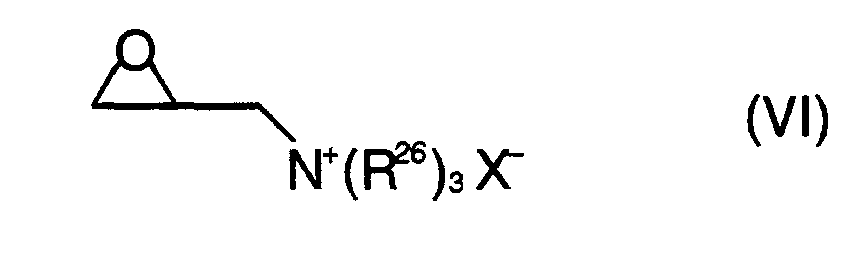
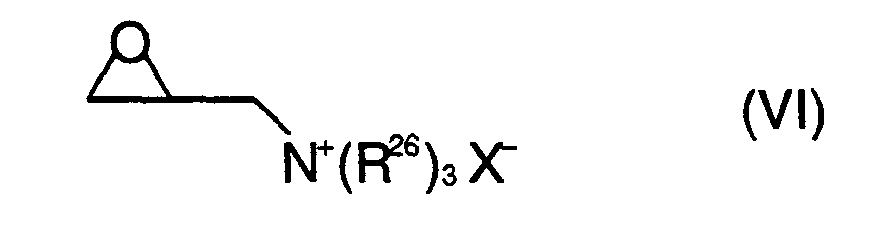
- the epoxides of the formula VI can also be reacted in situ the corresponding chlorohydrins with bases, for example Sodium hydroxide.
- the K values of the polymers should be in the range from 10 to 300, preferably 25 to 250, particularly preferably 25 to 200, entirely particularly preferably in the range from 30 to 150.
- the each desired K value can be done in a manner known per se adjust by the composition of the input materials.
- the K values are determined according to Fikentscher, cellulose chemistry, Vol. 13, pp. 58 to 64, and 71 to 74 (1932) in N-methylpyrrolidone at 25? C and polymer concentrations depending on the K value range are between 0.1% and 5% by weight.
- the polymer solutions can be removed be steam distilled from solvents. After Steam distillation is obtained depending on the degree of saponification, Type of polyether b), the vinyl ester a) and possibly Monomers used c) aqueous solutions or dispersions.
- the subsequent networking can be done by: the hydroxyl groups or amino groups in the polymer with at least bifunctional reagents. At low degrees of cross-linking water-soluble products are obtained with high degrees of crosslinking water-swellable or insoluble products.
- the polymers of the invention Dialdehydes and diketones, e.g. Glyoxal, glutaraldehyde, succinic dialdehyde or terephthalaldehyde.
- aliphatic or aromatic carboxylic acids are suitable, for example Maleic acid, oxalic acid, malonic acid, succinic acid or Citric acid or carboxylic acid derivatives such as carboxylic acid esters, anhydrides or halides.
- epoxies suitable, e.g.
- Diisocyanates are also suitable, for example hexamethylene diisocyanate, isophorone diisocyanate, Methylene diphenyl diisocyanate, tolylene diisocyanate or divinyl sulfone.
- Inorganic compounds such as boric acid or are also suitable Boric acid salts, for example sodium metaborate, borax (disodium tetraborate), as well as salts of polyvalent cations, e.g. Copper (II) salts such as copper (II) acetate or zinc, aluminum, titanium salts.
- Boric acid salts for example sodium metaborate, borax (disodium tetraborate), as well as salts of polyvalent cations, e.g. Copper (II) salts such as copper (II) acetate or zinc, aluminum, titanium salts.
- Boric acid or boric acid salts such as sodium metaborate or disodium tetraborate are preferably suitable for subsequent crosslinking.
- the boric acid or boric acid salts preferably as Salt solutions, the solutions of the polymers according to the invention be added.
- the boric acid or boric acid salts are preferred added to the aqueous polymer solutions.
- boric acid or boric acid salts can directly the polymer solutions added after manufacture. But it is also possible the boric acid or boric acid salts subsequently the cosmetic Adding formulations with the polymers according to the invention, or during the manufacturing process of the cosmetic Wording.
- the proportion of boric acid or boric acid salts based on the Polymers according to the invention is 0 to 15% by weight, preferably 0 to 10% by weight, particularly preferably 0 to 5% by weight.
- the solutions and dispersions of the polymers according to the invention can be carried out using various drying processes such as Spray drying, Fluidized spray drying, drum drying or freeze drying be transferred in powder form.
- a drying process spray drying is preferably used. From that Polymer dry powder obtained can be obtained by dissolving or Redisperse an aqueous solution or Prepare dispersion. Has the transfer in powder form the advantage of a better shelf life, a simpler one Possibility of transportation as well as a lower inclination for germ infestation.
- the water-soluble or water-dispersible according to the invention Polymers containing polyalkylene oxide or polyglycerol are suitable excellent for the production of hard capsules for pharmaceutical Dosage forms.
- the polymers can be Procedure me higher Establish reproducibility. None of them are used to manufacture them Materials of animal origin are used and there are none plant materials are used, that turns out No problem of products of genetic engineering origin.
- the polymers are not particularly susceptible to microbiology, because they are not a good breeding ground for microorganisms.
- the polymer chains become neither by enzymes nor by hydrolysis reduced. Hence the manufacture of solutions for the Film production and encapsulation unproblematic.
- Typical packaged materials are preferably pharmaceutical Products such as solid and liquid active ingredients, but also Vitamins, carotenoids, minerals, trace elements, nutritional supplements, Spices and sweeteners. Furthermore, the Capsules for cosmetic active ingredients ("personal care"), such as Hair and skin formulations, for oils, fragrances, Bath additives or proteins can be used. More applications in the area of "personal care” as well as other applications for water-soluble Packaging is mentioned in WO 99/40156.
- Other packaged materials can be e.g. Cleaning supplies, such as soaps, detergents, dyes and bleaches, agricultural chemicals such as fertilizers (combinations), plant protection products such as herbicides, fungicides or pesticides and seeds.
- Cleaning supplies such as soaps, detergents, dyes and bleaches, agricultural chemicals such as fertilizers (combinations), plant protection products such as herbicides, fungicides or pesticides and seeds.
- Solid contents are preferably packed in hard capsules.
- the polymers according to the invention can be used Pack ingredients that should be protected before they be brought into an aqueous environment.
- the dissolution rate of the polymers according to the invention and hard capsules made therefrom is enormously high and surpasses that of gelatin and polyvinyl alcohol clearly. Besides, they are Polymers soluble in cold water. Dissolve gelatin and polyvinyl alcohol only at higher temperatures. Because many drugs quickly This solution behavior is particularly effective after ingestion a clear advantage for this use.
- the casings according to the invention also encapsulate substances that tend to interact, such as e.g. Aldehydes or polyvalent cations. An extension of the The speed of dissolution cannot be seen.
- Hard capsules of the composition according to the invention can be excellent using aqueous polymer solutions or coat polymer suspensions. So by spraying on Kollicoat MAE 30 DP (methacrylic acid copolymer type C of the USP) in a horizontal drum coater a strong on the surface adhesive enteric coating that can be applied is also stable in storage.
- Kollicoat MAE 30 DP methacrylic acid copolymer type C of the USP
- the sheath can also 20 to 80%, preferably 30 to 70% of an enteric coating Polymers can be included.
- Substances can be used as high molecular weight polymers following substance classes are used:
- Polyamino acids such as gelatin, zein, soy protein and derivatives from that,
- Polysaccharides such as starch, degraded starch, maltodextrins, Carboxymethyl starch, cellulose, hydroxypropyl methyl cellulose, Hydroxypropyl cellulose, hydroxyethyl cellulose, methyl cellulose, Carboxymethyl cellulose, ethyl cellulose, cellulose acetate, Cellulose acetate phthalate, hydroxypropyl cellulose acetate phthalate, Hydroxypropyl cellulose acetate succinate, hemicellulose, galactomannane, Pectins, alginates, carrageenans, xanthan, gellan, dextran, Curdlan, pullulan, chitin, and derivatives thereof, synthetic Polymers such as polyacrylic acid, polymethacrylic acid, copolymers from acrylic acid and methacrylic acid esters, polyvinyl alcohols, Polyvinyl acetate, polyethylene glycols, polyoxyethylene-polyoxypropylene block polymers, Polyvinyl
- inventive Hard capsules contain other common ingredients. These include fillers, mold release agents, flow aids, Stabilizers and water-soluble or water-insoluble dyes, Flavors and sweeteners.
- Dyes are e.g. Iron oxides, titanium dioxide, in a lot from about 0.001 to 10, preferably from 0.5 to 3 wt .-% added triphenylmethane dyes, azo dyes, quinoline dyes, Indigo dyes, carotenoids to color the capsules, Opacifying agents such as titanium diodide or talc to the Increase opacity and save on dyes.
- Flavors and sweeteners are particularly important if a bad smell or taste should be covered and the capsule is bitten.
- Preservatives are generally not required.
- Fillers are e.g. inorganic fillers such as oxides from Magnesium, aluminum, silicon, titanium or calcium carbonate.
- the preferred concentration range for the fillers is about 1 to 50% by weight, particularly preferably 2 to 30% by weight on the total weight of all components.
- Lubricants are stearates of aluminum, calcium, magnesium and Tin, as well as magnesium silicate, silicones and the like.
- the preferred Concentration range is about 0.1 to 5% by weight, especially preferably about 0.1 to 3 wt .-% based on the total weight all components.
- Flow aids are e.g. finely divided or finely divided Silicas, modified if necessary.
- the preferred concentration range is 0.05 to 3% by weight, particularly preferably 0.1 to 1% by weight based on the total weight of all components.
- Thermoplastic polymers such as polyethylene also come as additives, Polypropylene, polyisobutylene, polystyrene, polyacrylonitrile, Polyvinyl carbazoles, polyacrylate, polymethacrylate, polyvinyl chloride, Polyvinyl acetate, polyamide, polyester, polyurethane, Polycarbonate, polyalkylene terephthalate, and copolymers Ethylene / vinyl acetate, ethylene / vinyl alcohol, ethylene / (meth) acrylic acid, Ethylene / (meth) acrylic acid ester, ABS copolymer, SAN copolymers, Ethylene / maleic anhydride copolymers in question.
- the Graft polymer used according to the invention as the starting material can with various known additives such as fillers, Mold release agents, flow aids, plasticizers, Stabilizers and / or colorants are mixed.
- a special case is the incorporation of active ingredients into the Envelope. This can be beneficial to incompatible active ingredients separate from each other. The active ingredient with the lowest Dosage should then be worked into the shell.
- the envelope of the packaging materials according to the invention is made from 10 to 100%, preferably 20 to 98%, polymers, optionally 0 to 80%, preferably 1.9 to 50% structure-improving Auxiliaries and 0.1 to 30% other usual Components.
- the polyether-containing compound is in a polymerization vessel submitted and with stirring and a gentle stream of nitrogen heated to 80 °. With stirring, vinyl acetate and optionally the further monomer metered in 3 h. At the same time a solution of 1.4 g of tert-butyl peroxy-2-ethylhexanoate in 30 g Methanol was also added in 3 h. After that, 2 more hours 80 ° C stirred. After cooling, the polymer is in 450 ml Dissolved methanol. For saponification, 50 ml of one is added at 30 ° C 10% methanolic sodium hydroxide solution. After approx. 40 min. the reaction is stopped by adding 750 ml of 1% acetic acid. The methanol is removed by distillation.
- the K values were determined in 1% strength in N-methylpyrrolidone.
- Films are cast from the polymers prepared in this way and the elongation at break is determined at 54% relative atmospheric humidity.
- the shape stability was checked after 4 weeks of storage using capsule parts produced individually by dipping. It was found that the elongation at break correlated very well with the dimensional stability. With high elongation at break, the capsules could not be used to produce dimensionally stable capsules.
- Hard capsules of size 0 were produced using the Diving process. Both capsule halves were made separately.
- the capsules were firm and at the same time elastic. After 3 months Storage at 23 ° C and 53% relative humidity were no changes in shape ascertain.
- Hard capsules of size 0 were produced using the Diving process. Both capsule halves were made separately.
- the top and bottom parts were difficult to get from stainless steel pins loosen and plug into each other.
- the capsules were great soft and malleable. After 3 months storage at 23 ° C and 53% relative humidity, the capsules were severely deformed, sometimes to run into a lump of polymer.
Landscapes
- Health & Medical Sciences (AREA)
- Chemical & Material Sciences (AREA)
- Medicinal Chemistry (AREA)
- Public Health (AREA)
- Chemical Kinetics & Catalysis (AREA)
- Life Sciences & Earth Sciences (AREA)
- Animal Behavior & Ethology (AREA)
- General Health & Medical Sciences (AREA)
- Pharmacology & Pharmacy (AREA)
- Veterinary Medicine (AREA)
- Epidemiology (AREA)
- Polymers & Plastics (AREA)
- Organic Chemistry (AREA)
- Medicinal Preparation (AREA)
- Cosmetics (AREA)
- Graft Or Block Polymers (AREA)
- Manufacturing Of Micro-Capsules (AREA)
- Polymerisation Methods In General (AREA)
- Detergent Compositions (AREA)
Abstract
Description
- R6
- C1-C24-Alkyl;
- R7
- Wasserstoff, C1-C24-Alkyl, R6-C(=O)-, R6-NH-C(=O)-.

- R1
- Wasserstoff, C1-C24-Alkyl, R6-C(=O)-, R6-NH-C(=O)-, Polyalkoholrest;
- R5
- Wasserstoff, C1-C24-Alkyl, R6-C(=O)-, R6-NH-C(=O)-;
- R2 bis R4
- -(CH2)2-, -(CH2)3-, -(CH2)4-, -CH2-CH(R6)-, -CH2-CHOR7-CH2-;
- R6
- C1-C24-Alkyl;
- R7
- Wasserstoff, C1-C24-Alkyl, R6-C(=O)-, R6-NH-C(=O)-;
- A
- -C(=O)-O, -C(=O)-B-C(=O)-O,
-C(=O)-NH-B-NH-C(=O)-O; - B
- -(CH2)t-, Arylen, ggf. substituiert;
- n
- 1 bis 1000;
- s
- 0 bis 1000;
- t
- 1 bis 12;
- u
- 1 bis 5000;
- v
- 0 bis 5000;
- w
- 0 bis 5000:
- x
- 0 bis 5000;
- y
- 0 bis 5000;
- z
- 0 bis 5000
- n
- 1 bis 200;
- s
- 0 bis 200;
- t
- 1 bis 12;
- u
- 1 bis 250;
- v
- 0 bis 250;
- w
- 0 bis 250;
- x
- 0 bis 250;
- y
- 0 bis 250;
- z
- 0 bis 250 bedeutet und das Molekulargewicht des Polyethers ≤ 10000 liegt.
- R1
- Wasserstoff, C1-C12-Alkyl, R6-C(=O)-, R6-NH-C(=O)-, Polyalkoholrest;
- R5
- Wasserstoff, C1-C12-Alkyl, R6-C(=O)-, R6-NH-C(=O)-;
- R2 bis R4
- -(CH2)2-, -(CH2)3-, -(CH2)4-, -CH2-CH(R6)-, -CH2-CHOR7-CH2-;
- R6
- C1-C12-Alkyl;
- R7
- Wasserstoff, C1-C12-Alkyl, R6-C(=O)-, R6-NH-C(=O)-;
- n
- 1 bis 8 (1 bis 8);
- s
- 0 (0);
- u
- 2 bis 2000 (250);
- v
- 0 bis 2000 (250);
- w
- 0 bis 2000 (250).
- R1
- Wasserstoff, C1-C6-Alkyl, R6-C(=O)-, R6-NH-C(=O)-;
- R5
- Wasserstoff, C1-C6-Alkyl, R6-C(=O)-, R6-NH-C(=O)-;
- R2 bis R4
- -(CH2)2-, -(CH2)3-, -(CH2)4-, -CH2-CH(R6)-, -CH2-CHOR7-CH2-;
- R6
- C1-C6-Alkyl;
- R7
- Wasserstoff, C1-C6-Alkyl, R6-C(=O)-, R6-NH-C(=O)-;
- n
- 1 (1);
- s
- 0 (0);
- u
- 5 bis 500 (250);
- v
- 0 bis 500 (250);
- w
- 0 bis 500 (250).

- R17 =
- H, Alkyl mit 1 bis 8 C-Atomen,
- R18 =
- H, Methyl,
- R19 =
- Alkylen mit 1 bis 24 C-Atomen, optional substituiert durch Alkyl.
- R20, R21 =
- C1-C40 Alkylrest,
- Z =
- Stickstoff für g = 1 oder Sauerstoff für g = 0

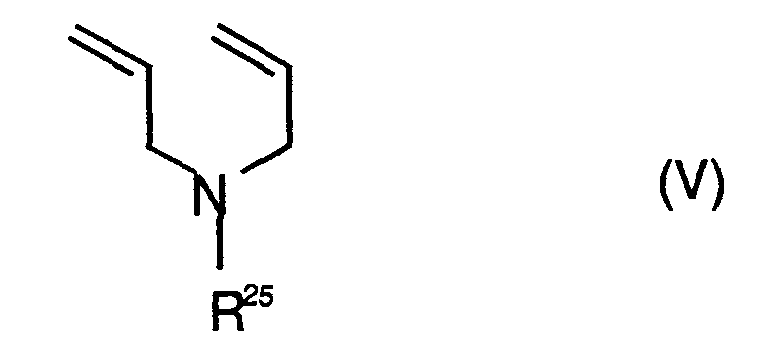
| Beispiel | Pfropfgrundlage (1) | Vinylester | Comonomer | K-Wert | Verseifungsgrad [%] | Reißdehnung [%] | Formstabilität der hergestellten Kapseln |
| 1 | PEG 6000, 72g | Vinylacetat, 396g | Methylmethaclylat, 12g | 47 | > 95 | 21 | Formstabil |
| 2 | PEG 20000 72 g | Vinylacetat, 328 g | N-Vinylpyrrolidon, 82 g | 61 | > 95 | 20 | Formstabil |
| 3 | PEG 20000, 72 g | Vinylacetat, 362 g | 3-Methyl-1-vinylimidazoliummethylsulfat, 48 g | 53 | > 95 | 40 | Formstabil |
| 4 | PEG 6000, 72g | Vinylacetat, 367g | N-Vinylfonnamid, 41g | 57 | > 95 | 35 | Formstabil |
| 5 | PEG 6000, 72 g | Vinylacetat, 326 g | N-Vinylformamid, 82 g | 67 | >95 | 25 | Formstabil |
| 6 | PEG 35000, 270 g | Vinylacetat, 410 g | Pentaerythrittriallylether, 1,6 g | 71 | 95 | 20 | Formstabil |
| 7 | PEG 35000, 270 g | Vinylacetat, 410 g | Pentaerythrittriallylether, 0,8 g | 65 | 94 | 40 | Formstabil |
| 8 | PEG 35000, 270 g | Vinylacetat, 410 g | N,N'-Divinylethylenharnstoff, 0,7 g | 73 | 95 | 42 | Formstabil |
| 9 | PEG 150072 g | Vinylacetat; 410 g | - | 47 | > 95 | 17 | Formstabil |
| 10 | PEG 400072 g | Vinylacetat, 410 g | - | 51 | >95 | 32 | Formstabil |
| 11 | PEG 6000, 72 g | Vinylacetat, 410 g | - | 54 | > 95 | 42 | Formstabil |
| 12 | PEG 6000, 137 g | Vinylacetat, 410 g | - | 49 | >95 | 46 | Formstabil |
| 13 | PEG 6000, 22 g | Vinylacetat, 410 g | - | 73 | >95 | 23 | Formstabil |
| 14 | PEG-PPG-Blockcopolymer 80002, 72 g | Vinylacetat, 410 g | - | 45 | >95 | 65 | Formstabil |
| Vergleichsbeispiele: | |||||||
| Beispiel | Pfropfgrundlage | Vinylester | Comonomer | K-Wert | Verseifimgsgrad [%] | Reißdehnung [%] | Formstabilität der hergestellten Kapseln |
| 15 | PEG 20000 273 g | Vinylacetat, 410 g | 62 | 93 | 180 | Nicht formstabil | |
| 16 | PEG 35000 273 g | Vinylacetat 410 | 59 | 94 | 404 | Nicht formstabil | |
| 17 | PEG 20000 72 g | Vinylacetat, 410 g | 60 | 93 | 141 | Nicht formstabil | |
| 18 | PEG 35000 72 g | Vinylacetat 410 | 65 | 94 | 280 | Nicht formstabil |
| Menge an zugesetzter 5%iger Borax-Lösung [g] | Brookfieldviskosität (LVF, Spindel 2, 30 UpM, 23°C) [mPas] | Formstabilität der hergestellten Kapseln |
| 0 (entspricht Vergleichsbeispiel 16) | 110 | Nicht formstabil |
| 21,0 | 534 | Formstabil |
| 24,0 | 2228 | Formstabil |
| 26,9 | 7520 | Formstabil |
| 29,8 | 29190 | Formstabil |
Claims (22)
- Hartkapseln enthaltend(A) Polymerisate, die erhältlich sind durch radikalische Polymerisation vonmit der Maßgabe, daß bei Abwesenheit eines weiteren copolymerisierbaren Monomers c), die polyetherhaltige Verbindung b) ein mittleres Molekulargewicht ≤ 10 000 (Zahlenmittel) haben muß,a) mindestens einem Vinylester von C1-C24-Carbonsäuren in Gegenwart vonb) polyetherhaltigen Verbindungen undc) gegebenenfalls eines oder mehreren weiteren copolymerisierbaren Monomeren c) und anschließender zumindest teilweiser Verseifung der Esterfunktionen der ursprünglichen Monomere a),(B) gegebenenfalls strukturverbessernde Hilfsstoffe und(C) weitere übliche Bestandteile.
- Hartkapseln gemäß Anspruch 1, dadurch gekennzeichnet, daß die Polymerisate (A) erhältlich sind durch radikalische Polymerisation vonund anschließender zumindest teilweiser Verseifung der Esterfunktionen der ursprünglichen Monomeren a), mit der Maßgabe, daß b) bei Abwesenheit von c) ein mittleres Molekulargewicht (Zahlenmittel) zwischen 300 und 10000 besitzt und n-z, die in Klammern angegebenen Werte haben.a) mindestens einem Vinylester von C1-C24-Carbonsäuren in Gegenwart vonb) polyetherhaltigen Verbindungen der allgemeinen Formel Iin der die Variablen unabhängig voneinander folgende Bedeutung haben:

- R1
- Wasserstoff, C1-C24-Alkyl, R6-C(=O)-, R6-NH-C(=O)-, Polyalkoholrest;
- R5
- Wasserstoff, C1-C24-Alkyl, R6-C(=O)-, R6-NH-C(=O)-;
- R2 bis R4
- -(CH2)2-, -(CH2)3-, -(CH2)4-, -CH2-CH(R6)-, -CH2-CHOR7-CH2-;
- R6
- C1-C24-Alkyl;
- R7
- Wasserstoff, C1-C24-Alkyl, R6-C(=O)-, R6-NH-C(=O)-;
- A
- -C(=O)-O, -C(=O)-B-C(=O)-O, -C(=O)-NH-B-NH-C(=O)-O;
- B
- -(CH2)t-, Arylen, ggf. substituiert;
- n
- 1 bis 1000 (1-200);
- s
- 0 bis 1000 (0-200);
- t
- 1 bis 12 (1-12);
- u
- 1 bis 5000 (1-250);
- v
- 0 bis 5000 (0-250);
- w
- 0 bis 5000 (0-250);
- x
- 0 bis 5000 (0-250);
- y
- 0 bis 5000 (0-250);
- z
- 0 bis 5000 (0-250);
c) gegebenenfalls eines oder mehreren weiteren copolymerisierbaren Monomeren - Hartkapseln gemäß einem der Ansprüche 1 oder 2, dadurch gekennzeichnet, daß die Polymerisate (A) erhältlich sind durch radikalische Polymerisation vonund anschließender zumindest teilweiser Verseifung der Esterfunktionen der ursprünglichen Monomeren a), mit der Maßgabe, daß b) bei Abwesenheit von c) ein mittleres Molekulargewicht (Zahlenmittel) zwischen 300 und 10000 besitzt und u-w, die in Klammern angegebenen Werte haben.a) mindestens einem Vinylester von C1-C24-Carbonsäuren in Gegenwart vonb) polyetherhaltigen Verbindungen der allgemeinen Formel I mit einem mittleren Molekulargewicht von 300 bis 100000 (nach dem Zahlenmittel), in der die Variablen unabhängig voneinander folgende Bedeutung haben:
- R1
- Wasserstoff, C1-C12-Alkyl, R6-C(=O)-, R6-NH-C(=O)-, Polyalkoholrest;
- R5
- Wasserstoff, C1-C12-Alkyl, R6-C(=O)-, R6-NH-C(=O)-;
- R2 bis R4
- -(CH2)2-, -(CH2)3-, -(CH2)4-, -CH2-CH(R6)-, -CH2-CHOR7-CH2-;
- R6
- C1-C12-Alkyl;
- R7
- Wasserstoff, C1-C12-Alkyl, R6-C(=O)-, R6-NH-C(=O)-;
- n
- 1 bis 8;
- s
- 0;
- u
- 2 bis 2000 (2-250);
- v
- 0 bis 2000 (0-250);
- w
- 0 bis 2000 (0-250);
c) gegebenenfalls eines oder mehreren weiteren copolymerisierbaren Monomeren - Hartkapseln gemäß einem der Ansprüche 1 bis 3, dadurch gekennzeichnet, daß die Polymerisate (A) erhältlich sind durch radikalische Polymerisation vonund anschließender zumindest teilweiser Verseifung der Esterfunktionen der ursprünglichen Monomeren a), mit der Maßgabe, daß b) bei Abwesenheit von c) ein mittleres Molekulargewicht (Zahlenmittel) zwischen 300 und 10000 besitzt und u-w, die in Klammern angegebenen Werte haben.a) mindestens einem Vinylester von C1-C24-Carbonsäuren in Gegenwart vonb) polyetherhaltigen Verbindungen der allgemeinen Formel I mit einem mittleren Molekulargewicht von 500 bis 50000 (nach dem Zahlenmittel), in der die Variablen unabhängig voneinander folgende Bedeutung haben:
- R1
- Wasserstoff, C1-C6-Alkyl, R6-C(=O)-, R6-NH-C(=O)-;
- R5
- Wasserstoff, C1-C6-Alkyl, R6-C(=O)-, R6-NH-C(=O)-;
- R2 bis R4
- -(CH2)2-, -(CH2)3-, -(CH2)4-, -CH2-CH(R6)-, -CH2-CHOR7-CH2-;
- R6
- C1-C6-Alkyl;
- R7
- Wasserstoff, C1-C6-Alkyl, R6-C(=O)-, R6-NH-C(=O)-;
- n
- 1;
- s
- 0;
- u
- 5 bis 1000 (5-250);
- v
- 0 bis 1000 (0-250);
- w
- 0 bis 1000 (0-250);
c) gegebenenfalls eines oder mehreren weiteren copolymerisierbaren Monomeren - Hartkapseln gemäß einem der Ansprüche 1 bis 4, dadurch gekennzeichnet, daß die Polymerisate (A) erhältlich sind durch radikalische Polymerisation vonund anschließender zumindest teilweiser Verseifung der Esterfunktionen der ursprünglichen Monomeren a), dadurch gekennzeichnet, daß die polyetherhaltigen Verbindungen b) durch Polymerisation von ethylenisch ungesättigten alkylenoxidhaltigen Monomeren und gegebenenfalls weiteren copolymerisierbaren Monomeren hergestellt worden sind.a) mindestens einem Vinylester von C1-C24-Carbonsäuren in Gegenwart vonb) polyetherhaltigen Verbindungen undc) gegebenenfalls 0 bis 20 Gew.-% eines oder mehreren weiteren copolymerisierbaren Monomeren
- Hartkapseln gemäß einem der Ansprüche 1 bis 5, dadurch gekennzeichnet, daß bei Anwesenheit mindestens eines weiteren copolymerisierbaren Monomers c), dieses ausgewählt wird aus der Gruppe:
Acrylsäure, Methacrylsäure, Maleinsäure, Fumarsäure, Crotonsäure, Maleinsäureanhydrid sowie dessen Halbester, Methylacrylat, Methylmethacrylat, Ethylacrylat, Ethylmethacrylat, n-Butylacrylat, n-Butylmethacrylat, t-Butylacrylat, t-Butylmethacrylat, Isobutylacrylat, Isobutylmethacrylat, 2-Ethylhexylacrylat, Stearylacrylat, Stearylmethacrylat, N-t-Butylacrylamid, N-Octylacrylamid, 2-Hydroxyethylacrylat, Hydroxypropylacrylate, 2-Hydroxyethylmethacrylat, Hydroxypropylmethacrylate, Alkylenglykol(meth)acrylate, Styrol, ungesättigte Sulfonsäuren wie z.B. Acrylamidopropansulfonsäure, Vinylpyrrolidon, Vinylcaprolactam, Vinylether (z.B.: Methyl-, Ethyl-, Butyl- oder Dodecylvinylether), Vinylformamid, Vinylmethylacetamid, Vinylamin, 1-Vinylimidazol, 1-Vinyl-2-methylimidazol, N,N-Dimethylaminomethylmethacrylat und N-[3-(dimethylamino)propyl]methacrylamid; 3-Methyl-1-vinylimidazoliumchlorid, 3-Methyl-1-vinylimidazoliummethylsulfat, N,N-Dimethylaminoethylmethacrylat, N-[3-(dimethylamino)-propyl]methacrylamid quaternisiert mit Methylchlorid, Methylsulfat oder Diethylsulfat. - Hartkapseln gemäß einem der Ansprüche 1 bis 8, dadurch gekennzeichnet, daß die Mengenverhältnissebetragen.a) 10 bis 98 Gew.-%b) 2 bis 90 Gew.-%c) 0 bis 50 Gew.-%
- Hartkapseln gemäß einem der Ansprüche 1 bis 7, dadurch gekennzeichnet, daß die Mengenverhältnissebetragen.a) 50 bis 97 Gew.-%b) 3 bis 50 Gew.-%c) 0 bis 20 Gew.-%
- Hartkapseln gemäß einem der Ansprüche 1 bis 8, dadurch gekennzeichnet, daß die Mengenverhältnissebetragen.a) 65 bis 97 Gew.-%b) 3 bis 35 Gew.-%c) 0 bis 20 Gew.-%
- Hartkapseln gemäß einem der Ansprüche 1 bis 9, dadurch gekennzeichnet, daß die erhaltenen Polymerisate nachträglich durch eine polymeranaloge Umsetzung vernetzt werden.
- Hartkapseln gemäß einem der Ansprüche 1 bis 10, dadurch gekennzeichnet, daß für die nachträgliche Vernetzung Dialdehyde, Diketone, Dicarbonsäuren, Borsäure, Borsäuresalze sowie Salze mehrwertiger Kationen eingesetzt werden.
- Hartkapseln, gemäß einem der Ansprüche 1 bis 11, dadurch gekennzeichnet, daß als strukturverbessernde Hilfstoffe (B) folgende Verbindungsklassen eingesetzt werden:a) Polymere mit einem Molekulargewicht größer 50000b) Stoffe, die zu einer Vernetzung der Polymerketten der Polymere führen,c) sowie gegebenenfalls Stoffen, die zu einer Vernetzung der Polymerketten der strukturverbessernden Hilfsstoffen führen.
- Hartkapseln gemäß einem der Ansprüche 1-12, dadurch gekennzeichnet, daß als strukturverbessernde Hilfsstoffe Polymere aus folgenden Stoffklassen eingesetzt werden:
Polyaminosäuren, wie Gelatine, Zein, Sojaprotein sowie Derivate davon, Polysaccharide wie Stärke, abgebaute Stärke, Maltodextrine, Carboxymethylstärke, Cellulose, Hydroxypropylmethylcellulose, Hydroxypropylcellulose, Hydroxyethylcellulose, Methylcellulose, Carboxymethylcellulose, Ethylcellulose, Celluloseacetat, Celluloseacetatphthalat, Hydroxypropylcelluloseacetatphthalat, Hydroxypropylcelluloseacetatsuccinat, Hemicellulose, Galactomannane, Pectine, Alginate, Carrageenane, Xanthan, Gellan,Dextran,Curdlan, Pullulan, Gummi arabicum, Chitin, sowie Derivate davon, synthetische Polymere wie Polyacrylsäure, Polymethacrylsäure, Copolymerisate aus Acrylsäure- und Methacrylsäureestern, Polyvinylalkohole, Polyvinylacetat, Polyethylenglykole, Polyoxyethylen-Polyoxypropylen-Blockpolymere, Polyvinylpyrrolidone sowie Derivate davon. - Hartkapseln gemäß einem der Ansprüche 1 bis 13, dadurch gekennzeichnet, daß als weitere übliche Hüllbestandteile Füllstoffe, Formtrennmittel, Rieselhilfsmittel, Farbstoffe, Pigmente, Opakisierungsmittel, Aromen, Süßstoffe, Weichmacher, Konservierungsmittel und/oder Wirkstoffe enthalten sind.
- Hartkapseln gemäß einem der Ansprüche 1 bis 14, dadurch gekennzeichnet, daß die Hülle besteht aus 10 bis 100 % Polymerisaten von Vinylestern auf Polyether gegebenenfalls 0 bis 80 % strukturverbessernden Hilfsstoffen und gegebenenfalls 0 bis 30 % weiteren üblichen Bestandteilen.
- Hartkapseln gemäß einem der Ansprüche 1 bis 15, erhältlich durch das Tauchverfahren.
- Hartkapseln gemäß einem der Ansprüche 1 bis 16, dadurch gekennzeichnet, daß sie einen oder mehrere pharmazeutische Wirkstoffe, Vitamine, Carotinoide, Mineralstoffe, Spurenelemente, Nahrungsergänzungsstoffe, kosmetische Wirkstoffe, Pflanzenschutzmittel, Badezusätze, Parfüm, Aroma, Reinigungsmittel oder Waschmittel beinhalten.
- Hartkapseln gemäß einem der Ansprüche 1 bis 17, dadurch gekennzeichnet, daß in der Hülle 20 bis 80 %, eines magensaftresistenten Polymers enthalten sind.
- Hartkapseln gemäß einem der Ansprüche 1 bis 18, dadurch gekennzeichnet, daß zur Erzielung einer Magensaftresistenz nach der Herstellung mit pharmazeutisch üblichen Coatingverfahren ein magensaftresistenter Überzug aufgebracht wird.
- Verwendung der Hartkapseln gemäß einem der Ansprüche 1 bis 19, für pharmazeutische Anwendungen.
- Verwendung der Hartkapseln gemäß einem der Ansprüche 1 bis 20 für kosmetische Anwendungen, Anwendungen im Pflanzenschutz, für Reinigungsmittel oder Nahrungsergänzungsmittel.
- Verwendung von Polymerisaten, die erhältlich sind durch radikalische Polymerisation vonund anschließender zumindest teilweiser Verseifung der Esterfunktionen der ursprünglichen Monomeren a) mit der Maßgabe, daß b) bei Abwesenheit von c) ein mittleres Molekulargewicht (Zahlenmittel) zwischen 300 und 10.000 besitzt zur Herstellung von Hartkapseln gemäß einem der Ansprüche 1 bis 21.a) mindestens einem Vinylester von C1-C24-Carbonsäuren in Gegenwart vonb) polyetherhaltigen Verbindungen undc) gegebenenfalls eines oder mehreren copolymerisierbaren Monomeren
Applications Claiming Priority (2)
| Application Number | Priority Date | Filing Date | Title |
|---|---|---|---|
| DE10015468A DE10015468A1 (de) | 2000-03-29 | 2000-03-29 | Hartkapseln, enthaltend Polymerisate und Vinylestern und Polyethern, deren Verwendung und Herstellung |
| DE10015468 | 2000-03-29 |
Publications (3)
| Publication Number | Publication Date |
|---|---|
| EP1138322A2 true EP1138322A2 (de) | 2001-10-04 |
| EP1138322A3 EP1138322A3 (de) | 2002-10-23 |
| EP1138322B1 EP1138322B1 (de) | 2004-06-23 |
Family
ID=7636751
Family Applications (1)
| Application Number | Title | Priority Date | Filing Date |
|---|---|---|---|
| EP01105544A Expired - Lifetime EP1138322B1 (de) | 2000-03-29 | 2001-03-06 | Hartkapseln, enthaltend Polymerisate von Vinylestern und Polyethern, deren Verwendung und Herstellung |
Country Status (7)
| Country | Link |
|---|---|
| US (1) | US6783770B2 (de) |
| EP (1) | EP1138322B1 (de) |
| JP (1) | JP2001327854A (de) |
| CN (1) | CN1176956C (de) |
| AT (1) | ATE269696T1 (de) |
| DE (2) | DE10015468A1 (de) |
| ES (1) | ES2223665T3 (de) |
Cited By (5)
| Publication number | Priority date | Publication date | Assignee | Title |
|---|---|---|---|---|
| WO2002031096A1 (de) * | 2000-10-13 | 2002-04-18 | Basf Aktiengesellschaft | Verwendung von wasserlöslichen oder wasserdispergierbaren polyetherblöcken enthaltenden pfropfpolymerisaten als beschichtungs- und verpackungsmittel für wasch-, reinigungs- und wäschebehandlungsmittel |
| WO2003068834A1 (de) * | 2002-02-15 | 2003-08-21 | Basf Aktiengesellschaft | Pfropfcolpolymere in kosmetischen formulierungen |
| WO2007051743A3 (de) * | 2005-11-04 | 2007-07-26 | Basf Ag | Verwendung von copolymeren als solubilisatoren für in wasser schwerlösliche verbindungen |
| WO2016169941A1 (de) | 2015-04-23 | 2016-10-27 | Basf Se | Gelkapsel enthaltend sterol und solubilisator |
| EP3205392A1 (de) * | 2016-02-12 | 2017-08-16 | Basf Se | Mikrokapseln und verfahren zur herstellung von mikrokapseln |
Families Citing this family (33)
| Publication number | Priority date | Publication date | Assignee | Title |
|---|---|---|---|---|
| DE10128531A1 (de) * | 2001-06-13 | 2002-12-19 | Basf Ag | Verwendung von wasserlöslichen oder wasserdispergierbaren Polyetherblöcke enthaltenden Pfropfpolymerisaten als Beschichtungsmittel, Matrixbildner und/oder Verpackungsmaterial für Agrochemikalien |
| DE102004031835A1 (de) * | 2004-06-30 | 2006-01-19 | Basf Ag | Schnelldispergierbares, feinteiliges, nicht zur Entmischung neigendes pulverförmiges Filmüberzugsmittel basierend auf Polyvinylalkohol-Polyether-Pfropfcopolymeren gekennzeichnet durch besondere physikalische Stabilität und niedrige Rauhigkeit |
| MX2007007318A (es) * | 2004-12-17 | 2007-07-09 | Procter & Gamble | Polioles modificados hidrofilamente para una mejor limpieza de la suciedad hidrofoba. |
| CA2590434A1 (en) * | 2004-12-17 | 2006-06-22 | The Procter & Gamble Company | Hydrophobically modified polyols for improved hydrophobic soil cleaning |
| DE102005043172A1 (de) * | 2005-09-09 | 2007-03-15 | Basf Ag | Verfahren zur Herstellung von Weichkapselhüllen auf Basis von Polyvinylalkohol-Polyethylenglykol-Pfropfcopolymeren |
| EP1962908A2 (de) * | 2005-12-09 | 2008-09-03 | Basf Se | Verwendung von polyvinyllactam-polyoxyalkylen-blockcopolymeren als solubilisatoren für in wasser schwerlösliche verbindungen |
| US20070161942A1 (en) * | 2006-01-06 | 2007-07-12 | Pharmaphil Inc. | Biodegradable tampon applicator and method of making |
| ATE474906T1 (de) * | 2006-05-31 | 2010-08-15 | Procter & Gamble | Reinigungsmittel mit amphiphilen pfropfpolymeren auf basis von polyalkylenoxiden und vinylestern |
| WO2008018825A1 (en) * | 2006-08-10 | 2008-02-14 | Astrazeneca Ab | Oral polyvinyl alcohol capsules comprising proton pump inhibitors |
| EP2173781A1 (de) * | 2007-07-26 | 2010-04-14 | Basf Se | Verfahren zur herstellung von durch pfropfpolymerisation in lösung erhaltenen copolymeren auf basis von polyethern in fester form |
| CA2730760A1 (en) * | 2008-07-16 | 2010-01-21 | Surmodics Pharmaceuticals, Inc. | Process for preparing microparticles containing bioactive peptides |
| US8101204B2 (en) * | 2010-01-14 | 2012-01-24 | Karl Wei Cao | Hard capsule composition and method of use |
| US8101203B2 (en) * | 2010-01-14 | 2012-01-24 | Karl Wei Cao | Hard capsule composition and method of use |
| US20110171281A1 (en) * | 2010-01-14 | 2011-07-14 | Karl Wei Cao | Soft capsule composition and method of use |
| US9186642B2 (en) | 2010-04-28 | 2015-11-17 | The Procter & Gamble Company | Delivery particle |
| US9993793B2 (en) | 2010-04-28 | 2018-06-12 | The Procter & Gamble Company | Delivery particles |
| EP2694016B2 (de) | 2011-04-07 | 2025-03-19 | The Procter & Gamble Company | Shampoozusammensetzungen mit erhöhter abscheidung von polyacrylat-mikrokapseln |
| MX2013010981A (es) | 2011-04-07 | 2013-10-30 | Procter & Gamble | Composiciones acondicionadoras con deposito mejorado de microcapsulas de poliacrilato. |
| JP6283607B2 (ja) | 2011-04-07 | 2018-02-21 | ザ プロクター アンド ギャンブル カンパニー | ポリアクリレートマイクロカプセルの堆積が増大されたパーソナルクレンジング組成物 |
| WO2013093630A2 (en) | 2011-12-22 | 2013-06-27 | Pronova Biopharma Norge As | Gelatin/alginate delayed release capsules comprising omega-3 fatty acids, and methods and uses thereof |
| CN105295054B (zh) * | 2015-11-16 | 2018-03-30 | 泰安瑞泰纤维素有限公司 | 羟丙基甲基纤维素衍生物‑大豆蛋白共聚物及其植物胶囊的制备方法 |
| JP7020117B2 (ja) * | 2016-06-30 | 2022-02-16 | 三菱ケミカル株式会社 | 農業用組成物、粒剤および徐放性粒剤 |
| WO2018008660A1 (ja) * | 2016-07-06 | 2018-01-11 | クオリカプス株式会社 | 硬度が改善された硬質カプセル、及びその製造方法 |
| US9700518B1 (en) | 2016-11-21 | 2017-07-11 | Karl Wei Cao | Dip molding process for the manufacture of hard capsule shells |
| US9579292B1 (en) | 2016-11-21 | 2017-02-28 | Karl Wei Cao | Film forming hard capsule solution |
| US20210369625A1 (en) * | 2018-10-02 | 2021-12-02 | Qualicaps Co., Ltd. | Improved-strength hard capsule and production method for same |
| HUE065856T2 (hu) * | 2020-02-14 | 2024-06-28 | Basf Se | Biológiailag lebomló oltó-polimerek |
| JP2023543578A (ja) | 2020-10-16 | 2023-10-17 | ザ プロクター アンド ギャンブル カンパニー | 少なくとも2つの封入体集団を有する消費者製品組成物 |
| US12398348B2 (en) | 2020-10-16 | 2025-08-26 | The Procter & Gamble Company | Consumer product compositions comprising a population of encapsulates |
| US12486478B2 (en) | 2020-10-16 | 2025-12-02 | The Procter & Gamble Company | Consumer products comprising delivery particles with high core:wall ratios |
| CN116003668A (zh) * | 2021-10-21 | 2023-04-25 | 中国石油化工股份有限公司 | 高粘度聚乙烯醇的制备方法 |
| CN116966159A (zh) * | 2023-08-29 | 2023-10-31 | 河南省纳普生物技术有限公司 | 一种含地黄提取物的降糖制剂及其制备方法 |
| CN118652529B (zh) * | 2024-08-15 | 2024-11-05 | 福建满山红新材料科技股份公司 | 一种全生物降解生活垃圾袋 |
Family Cites Families (11)
| Publication number | Priority date | Publication date | Assignee | Title |
|---|---|---|---|---|
| DE1077430B (de) | 1958-04-15 | 1960-03-10 | Hoechst Ag | Verfahren zur Herstellung von Pfropfpolymerisaten von Polyvinylestern |
| FR1222944A (fr) | 1958-04-15 | 1960-06-14 | Hoechst Ag | Polymères greffés et leur procédé de préparation |
| NL113645C (de) | 1958-05-31 | |||
| FR1605150A (de) | 1968-12-31 | 1973-03-16 | ||
| DE2363853A1 (de) * | 1973-12-21 | 1975-07-03 | Hoechst Ag | Selbsttragende packungen oder kapseln zum umhuellen von medikamenten |
| US5166276A (en) | 1989-07-12 | 1992-11-24 | Mitsubishi Petrochemical Company Ltd. | Polymer for hair-care products |
| DE4403866A1 (de) | 1994-02-08 | 1995-08-10 | Basf Ag | Amphiphile Polyester, Verfahren zu ihrer Herstellung und ihre Verwendung in Waschmitteln |
| DE19645024A1 (de) * | 1996-10-31 | 1998-05-07 | Basf Ag | Bleichhilfsmittel enthaltende Mikrokapseln |
| FR2757173A1 (fr) * | 1996-12-17 | 1998-06-19 | Warner Lambert Co | Compositions polymeres d'origine non-animale pour la formation de films |
| CN1165296C (zh) * | 1998-09-30 | 2004-09-08 | Basf公司 | 水溶性或水可分散性含聚醚聚合物作为在药物给药形式中的包衣剂、粘合剂和/或成膜赋形剂的应用 |
| DE10012063A1 (de) * | 2000-03-14 | 2001-09-20 | Basf Ag | Weichkapseln enthaltend Polymerisate von Vinylestern und Polyethern, deren Verwendung und Herstellung |
-
2000
- 2000-03-29 DE DE10015468A patent/DE10015468A1/de not_active Withdrawn
-
2001
- 2001-03-06 ES ES01105544T patent/ES2223665T3/es not_active Expired - Lifetime
- 2001-03-06 DE DE50102650T patent/DE50102650D1/de not_active Expired - Lifetime
- 2001-03-06 AT AT01105544T patent/ATE269696T1/de not_active IP Right Cessation
- 2001-03-06 EP EP01105544A patent/EP1138322B1/de not_active Expired - Lifetime
- 2001-03-20 US US09/811,542 patent/US6783770B2/en not_active Expired - Fee Related
- 2001-03-29 JP JP2001096232A patent/JP2001327854A/ja not_active Withdrawn
- 2001-03-29 CN CNB011123087A patent/CN1176956C/zh not_active Expired - Fee Related
Cited By (8)
| Publication number | Priority date | Publication date | Assignee | Title |
|---|---|---|---|---|
| WO2002031096A1 (de) * | 2000-10-13 | 2002-04-18 | Basf Aktiengesellschaft | Verwendung von wasserlöslichen oder wasserdispergierbaren polyetherblöcken enthaltenden pfropfpolymerisaten als beschichtungs- und verpackungsmittel für wasch-, reinigungs- und wäschebehandlungsmittel |
| WO2003068834A1 (de) * | 2002-02-15 | 2003-08-21 | Basf Aktiengesellschaft | Pfropfcolpolymere in kosmetischen formulierungen |
| WO2007051743A3 (de) * | 2005-11-04 | 2007-07-26 | Basf Ag | Verwendung von copolymeren als solubilisatoren für in wasser schwerlösliche verbindungen |
| US8632763B2 (en) | 2005-11-04 | 2014-01-21 | Basf Se | Use of a copolymer in the form of a solubiliser for a poorly water-soluble compound |
| WO2016169941A1 (de) | 2015-04-23 | 2016-10-27 | Basf Se | Gelkapsel enthaltend sterol und solubilisator |
| US10188133B2 (en) | 2015-04-23 | 2019-01-29 | Basf Se | Gel capsule containing sterol and solubilising agent |
| EP3205392A1 (de) * | 2016-02-12 | 2017-08-16 | Basf Se | Mikrokapseln und verfahren zur herstellung von mikrokapseln |
| WO2017137294A1 (en) * | 2016-02-12 | 2017-08-17 | Basf Se | Microcapsules and process for preparation of microcapsules |
Also Published As
| Publication number | Publication date |
|---|---|
| US6783770B2 (en) | 2004-08-31 |
| ATE269696T1 (de) | 2004-07-15 |
| ES2223665T3 (es) | 2005-03-01 |
| DE50102650D1 (de) | 2004-07-29 |
| EP1138322A3 (de) | 2002-10-23 |
| EP1138322B1 (de) | 2004-06-23 |
| US20010036471A1 (en) | 2001-11-01 |
| CN1176956C (zh) | 2004-11-24 |
| CN1319615A (zh) | 2001-10-31 |
| JP2001327854A (ja) | 2001-11-27 |
| DE10015468A1 (de) | 2001-10-11 |
Similar Documents
| Publication | Publication Date | Title |
|---|---|---|
| EP1138322B1 (de) | Hartkapseln, enthaltend Polymerisate von Vinylestern und Polyethern, deren Verwendung und Herstellung | |
| EP1136070B1 (de) | Weichkapseln enthaltend Polymerisate von Vinylestern und Polyethern, deren Verwendung und Herstellung | |
| EP1154751B1 (de) | Haarkosmetische formulierungen | |
| EP1313444B1 (de) | Hautkosmetische formulierungen mit copolymeren aus vinylcarboxylaten, polyetherhaltigen verbindungen und weiteren monomeren | |
| EP1339792B1 (de) | Tensidhaltige kosmetische, dermatologische und pharmazeutische mittel | |
| EP1313431B1 (de) | Haarkosmetische formulierungen | |
| DE10041211A1 (de) | Verwendung hydrophiler Pfropfcopolymere mit N-Vinylamin-und /oder offenkettigen n-Vinylamdeinheiten in kosmetischen Formulierungen | |
| EP1326953A1 (de) | Verwendung von wasserlöslichen oder wasserdispergierbaren polyetherblöcken enthaltenden pfropfpolymerisaten als beschichtungs- und verpackungsmittel für wasch-, reinigungs- und wäschebehandlungsmittel | |
| EP0893117B2 (de) | Verwendung von kationischen Polymeren als Haarkonditionierungsmittel | |
| EP1125954B1 (de) | Verfahren zur Herstellung und Verwendung von wasserlöslichen oder wasserdispergierbaren polyetherhaltigen Polymerisaten | |
| EP1490016B1 (de) | Kationische polymerisate und deren verwendung in kosmetischen formulierungen | |
| EP1545445A1 (de) | Verwendung von polymerisaten auf basis von n-vinylcaprolactam | |
| EP1926480B1 (de) | Verfahren zur Herstellung von Weichkapselhüllen auf Basis von Polyvinylalkohol-Polyethylenglykol-Pfropfcopolymeren | |
| WO2005055990A1 (de) | Hartkapseln, hergestellt aus wasserdispergierbaren copolymerisaten von hydroxyalkyl(meth)acrylat, polyvinylalkohol und/oder polyvinylpyrrolidon | |
| EP1476482B1 (de) | Pfropfcolpolymere in kosmetischen formulierungen | |
| DE10350359A1 (de) | Kosmetisches Mittel enthaltend ein Copolymer mit (Meth)acrylsäureamideinheiten und einen Ester der p-Aminobenzoesäure | |
| DE10330396A1 (de) | Kosmetisches Mittel enthaltend wenigstens ein wasserlösliches Copolymer mit (Meth)acrylsäureamideinheiten | |
| DE10219889A1 (de) | Kosmetisches Mittel enthaltend wenigstens ein wasserlösliches Copolymer mit (Meth)acrylsäureamideinheiten | |
| EP2057986A1 (de) | Weichkapselhüllen auf Basis von Polyvinylalkohol-Polyethylenglykol-Pfropfcopolymeren enthaltend natürliche Polysaccharide | |
| DE19844903A1 (de) | Verwendung von wasserlöslichen oder wasserdispergierbaren Polyether-haltigen Polymerisaten als Überzugsmittel, Bindemittel und/oder filmbildender Hilfsstoff in pharmazeutischen Darreichungsformen |
Legal Events
| Date | Code | Title | Description |
|---|---|---|---|
| PUAI | Public reference made under article 153(3) epc to a published international application that has entered the european phase |
Free format text: ORIGINAL CODE: 0009012 |
|
| AK | Designated contracting states |
Kind code of ref document: A2 Designated state(s): AT BE CH CY DE DK ES FI FR GB GR IE IT LI LU MC NL PT SE TR |
|
| AX | Request for extension of the european patent |
Free format text: AL;LT;LV;MK;RO;SI |
|
| PUAL | Search report despatched |
Free format text: ORIGINAL CODE: 0009013 |
|
| RIC1 | Information provided on ipc code assigned before grant |
Free format text: 7A 61K 9/48 A, 7C 08F 283/06 B, 7C 08F 8/12 B |
|
| AK | Designated contracting states |
Kind code of ref document: A3 Designated state(s): AT BE CH CY DE DK ES FI FR GB GR IE IT LI LU MC NL PT SE TR |
|
| AX | Request for extension of the european patent |
Free format text: AL;LT;LV;MK;RO;SI |
|
| 17P | Request for examination filed |
Effective date: 20020919 |
|
| AKX | Designation fees paid |
Designated state(s): AT BE CH CY DE DK ES FI FR GB GR IE IT LI LU MC NL PT SE TR |
|
| AXX | Extension fees paid |
Extension state: SI Payment date: 20020919 Extension state: RO Payment date: 20020919 |
|
| GRAP | Despatch of communication of intention to grant a patent |
Free format text: ORIGINAL CODE: EPIDOSNIGR1 |
|
| GRAS | Grant fee paid |
Free format text: ORIGINAL CODE: EPIDOSNIGR3 |
|
| GRAA | (expected) grant |
Free format text: ORIGINAL CODE: 0009210 |
|
| AK | Designated contracting states |
Kind code of ref document: B1 Designated state(s): AT BE CH CY DE DK ES FI FR GB GR IE IT LI LU MC NL PT SE TR |
|
| AX | Request for extension of the european patent |
Extension state: RO SI |
|
| PG25 | Lapsed in a contracting state [announced via postgrant information from national office to epo] |
Ref country code: FI Free format text: LAPSE BECAUSE OF FAILURE TO SUBMIT A TRANSLATION OF THE DESCRIPTION OR TO PAY THE FEE WITHIN THE PRESCRIBED TIME-LIMIT Effective date: 20040623 Ref country code: TR Free format text: LAPSE BECAUSE OF FAILURE TO SUBMIT A TRANSLATION OF THE DESCRIPTION OR TO PAY THE FEE WITHIN THE PRESCRIBED TIME-LIMIT Effective date: 20040623 |
|
| REG | Reference to a national code |
Ref country code: GB Ref legal event code: FG4D Free format text: NOT ENGLISH |
|
| REG | Reference to a national code |
Ref country code: CH Ref legal event code: EP |
|
| REG | Reference to a national code |
Ref country code: IE Ref legal event code: FG4D Free format text: GERMAN |
|
| REF | Corresponds to: |
Ref document number: 50102650 Country of ref document: DE Date of ref document: 20040729 Kind code of ref document: P |
|
| GBT | Gb: translation of ep patent filed (gb section 77(6)(a)/1977) |
Effective date: 20040723 |
|
| PG25 | Lapsed in a contracting state [announced via postgrant information from national office to epo] |
Ref country code: DK Free format text: LAPSE BECAUSE OF FAILURE TO SUBMIT A TRANSLATION OF THE DESCRIPTION OR TO PAY THE FEE WITHIN THE PRESCRIBED TIME-LIMIT Effective date: 20040923 Ref country code: SE Free format text: LAPSE BECAUSE OF FAILURE TO SUBMIT A TRANSLATION OF THE DESCRIPTION OR TO PAY THE FEE WITHIN THE PRESCRIBED TIME-LIMIT Effective date: 20040923 Ref country code: GR Free format text: LAPSE BECAUSE OF FAILURE TO SUBMIT A TRANSLATION OF THE DESCRIPTION OR TO PAY THE FEE WITHIN THE PRESCRIBED TIME-LIMIT Effective date: 20040923 |
|
| REG | Reference to a national code |
Ref country code: ES Ref legal event code: FG2A Ref document number: 2223665 Country of ref document: ES Kind code of ref document: T3 |
|
| PG25 | Lapsed in a contracting state [announced via postgrant information from national office to epo] |
Ref country code: LU Free format text: LAPSE BECAUSE OF NON-PAYMENT OF DUE FEES Effective date: 20050306 Ref country code: AT Free format text: LAPSE BECAUSE OF NON-PAYMENT OF DUE FEES Effective date: 20050306 Ref country code: CY Free format text: LAPSE BECAUSE OF FAILURE TO SUBMIT A TRANSLATION OF THE DESCRIPTION OR TO PAY THE FEE WITHIN THE PRESCRIBED TIME-LIMIT Effective date: 20050306 |
|
| PG25 | Lapsed in a contracting state [announced via postgrant information from national office to epo] |
Ref country code: BE Free format text: LAPSE BECAUSE OF NON-PAYMENT OF DUE FEES Effective date: 20050331 Ref country code: MC Free format text: LAPSE BECAUSE OF NON-PAYMENT OF DUE FEES Effective date: 20050331 |
|
| ET | Fr: translation filed | ||
| PLBE | No opposition filed within time limit |
Free format text: ORIGINAL CODE: 0009261 |
|
| STAA | Information on the status of an ep patent application or granted ep patent |
Free format text: STATUS: NO OPPOSITION FILED WITHIN TIME LIMIT |
|
| 26N | No opposition filed |
Effective date: 20050324 |
|
| BERE | Be: lapsed |
Owner name: *BASF A.G. Effective date: 20050331 |
|
| PG25 | Lapsed in a contracting state [announced via postgrant information from national office to epo] |
Ref country code: NL Free format text: LAPSE BECAUSE OF NON-PAYMENT OF DUE FEES Effective date: 20051001 |
|
| NLV4 | Nl: lapsed or anulled due to non-payment of the annual fee |
Effective date: 20051001 |
|
| BERE | Be: lapsed |
Owner name: *BASF A.G. Effective date: 20050331 |
|
| PG25 | Lapsed in a contracting state [announced via postgrant information from national office to epo] |
Ref country code: PT Free format text: LAPSE BECAUSE OF NON-PAYMENT OF DUE FEES Effective date: 20041123 |
|
| PGFP | Annual fee paid to national office [announced via postgrant information from national office to epo] |
Ref country code: CH Payment date: 20080228 Year of fee payment: 8 |
|
| PGFP | Annual fee paid to national office [announced via postgrant information from national office to epo] |
Ref country code: GB Payment date: 20080305 Year of fee payment: 8 Ref country code: IE Payment date: 20080313 Year of fee payment: 8 Ref country code: IT Payment date: 20080322 Year of fee payment: 8 |
|
| PGFP | Annual fee paid to national office [announced via postgrant information from national office to epo] |
Ref country code: ES Payment date: 20080418 Year of fee payment: 8 Ref country code: FR Payment date: 20080311 Year of fee payment: 8 |
|
| REG | Reference to a national code |
Ref country code: CH Ref legal event code: PL |
|
| GBPC | Gb: european patent ceased through non-payment of renewal fee |
Effective date: 20090306 |
|
| REG | Reference to a national code |
Ref country code: FR Ref legal event code: ST Effective date: 20091130 |
|
| REG | Reference to a national code |
Ref country code: IE Ref legal event code: MM4A |
|
| PG25 | Lapsed in a contracting state [announced via postgrant information from national office to epo] |
Ref country code: CH Free format text: LAPSE BECAUSE OF NON-PAYMENT OF DUE FEES Effective date: 20090331 Ref country code: IE Free format text: LAPSE BECAUSE OF NON-PAYMENT OF DUE FEES Effective date: 20090306 Ref country code: LI Free format text: LAPSE BECAUSE OF NON-PAYMENT OF DUE FEES Effective date: 20090331 |
|
| PG25 | Lapsed in a contracting state [announced via postgrant information from national office to epo] |
Ref country code: FR Free format text: LAPSE BECAUSE OF NON-PAYMENT OF DUE FEES Effective date: 20091123 Ref country code: GB Free format text: LAPSE BECAUSE OF NON-PAYMENT OF DUE FEES Effective date: 20090306 |
|
| REG | Reference to a national code |
Ref country code: ES Ref legal event code: FD2A Effective date: 20090307 |
|
| PG25 | Lapsed in a contracting state [announced via postgrant information from national office to epo] |
Ref country code: ES Free format text: LAPSE BECAUSE OF NON-PAYMENT OF DUE FEES Effective date: 20090307 |
|
| PG25 | Lapsed in a contracting state [announced via postgrant information from national office to epo] |
Ref country code: IT Free format text: LAPSE BECAUSE OF NON-PAYMENT OF DUE FEES Effective date: 20090306 |
|
| PGFP | Annual fee paid to national office [announced via postgrant information from national office to epo] |
Ref country code: DE Payment date: 20140530 Year of fee payment: 14 |
|
| REG | Reference to a national code |
Ref country code: DE Ref legal event code: R119 Ref document number: 50102650 Country of ref document: DE |
|
| PG25 | Lapsed in a contracting state [announced via postgrant information from national office to epo] |
Ref country code: DE Free format text: LAPSE BECAUSE OF NON-PAYMENT OF DUE FEES Effective date: 20151001 |